June / July 2010
2
Blue Line Magazine
June / July 2010
Volume 22 Number 6
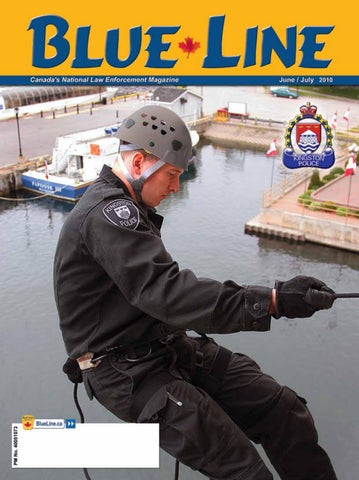
With 169 years of faithful service to a city that once hosted Canada’s first parliament and is the birth and final resting place of our first prime minister, it’s high time we profiled the Kingston Police Force! Read more beginning on page 6.
Features 6 Sustaining a policing purpose 169 years of policing the Limestone City
14
Campus cold case squad
18
The myth of airport security
9 A Victoria Police Department tragedy The knock on the door that changed everything
11 Mending a broken trust A toxic culture in need of repair - Part 2
London detective helps university students solve police cold cases
24 2010 B lue Line Trade in Print
Departments
Case Law
46 22 29 44 5 30
38
Combination of factors provide reasonable grounds
40
Nature of stop also drives s.10(b) analysis
Advertisers Index Deep Blue Dispatches Market Place Publisher’s Commentary Technology
Blue Blue Line Line Magazine Magazine
33
June June/ /July july2010 2010
HOSTAGE
HOSTAGE
HOSTAGE
HOSTAGE HOSTAGE
COMPETITOR X
SUREFIRE X400®
TERRORIST
June www.surefi / July 2010 re.com/X400
ONLY ONE LASER WEAPONLIGHT HOLDS ZERO LIKE THIS. The X400 also has the brightest laser with the largest spot, allowing you to acquire it quicker, even in daylight. The powerful LED provides a smooth, white beam that will easily light up a large room and temporarily blind an assailant. The body is cut from hard-anodized aerospace aluminum and it attaches to Universal and Picatinny rails. Speed 4 and accuracy. Guaranteed. For life. Blue Line Magazine
Publisher’s Commentary by Morley Lymburner
Omnipotent policing - dreaming of a quick solution So many people think they know everything about policing, yet no other field of endeavour is more misunderstood by so many. A steady diet of police shows and movies make the public instant experts and politicians confident they know the policies and regulations that should be invoked. A recent British newspaper story highlighted this phenomenon. The question was whether the 52 police services in England, Scotland and Wales can sufficiently protect the population from terrorists. Cited was an incident where two suspected terrorists were followed from Scotland to London. Each police jurisdiction they passed through had to be notified in case an arrest had to be made within their jurisdiction. The obvious quick-fix political answer to all of this was to unify all 52 agencies into one police force to better fight terrorism. This concept is so flawed on so many levels it is difficult to know where to begin. Police agencies do not and never have existed to fight terrorism. At this late stage in that game I have no idea how you would retrofit any police service to do so. Amalgamating agencies simply produces larger bureaucracy and management levels. This is not to say smaller is better but the larger an agency becomes, the more difficulty it has in keeping a co-ordinated ear to the ground. The intelligence gathering capabilities of smaller agencies was recognized shortly after 9/11, when the CIA and FBI acknowledged the invaluable assistance of small sheriffs departments and police services across the country. Who else would know better what was unusual in their neighbourhoods? The biggest challenge in fighting terrorism is coordinating and sifting through the accumulated knowledge gathered by local cops on beats across the country. The best information can sometimes come
Blue Line Magazine
from the smallest sources. The Oklahoma City bomber was captured by a traffic cop who noticed one car had an expired validation sticker. I still recall the numerous occasions when homicide detectives asked local parking enforcement and radar officers to supply all their tickets issued within a certain location and dates. Mind you this was the precomputerization era but many of these requests ended with arrests. One major case involved a serial rapist captured thanks to information from a meter enforcement officer who continually saw a particular car driving around the block on his beat. Being an unusual car for the area he noted the plate number and description of the driver. It can be tempting to see the apparent unlimited resources of a larger agency as the solution to all of society’s needs. Sir Robert Peel’s concept of policing wasn’t entirely radical but it was straightforward and effective in its principles. Communities should be policed by those who know them and the law. Several years back I was struck by an interviewer asking a police applicant to name all the hospitals in a region and where they were located. Obviously community knowledge was important to them. Around the same time I read a news story about a local historian giving downtown Toronto officers a tour of the St. Lawrence Market area. He pointed out the significant areas of their beats and explained why certain neighbourhoods were designed as they were. Most were quite familiar with the main arterial roads they patrolled in their cars but knew little about many of the back lane ways where only local hoodlums could walk about with impunity. In my beat-walking days I recall being told about a small hole in the bank of the Humber River which was the entrance way to a small cavern. Local thieves had used it for some time to stow away shoplifted items from local
5
stores. A local merchant discovered it simply by following a youth who stole something from his shop. Every community is different in its style and need for police coverage. There is no such thing as one style fits all. The only constant is the lack of consistency. Just when you think you have the playing field figured out it can all change. Larger police agencies are not known for their adapatibility. Experience tells us the level of rigidity increases in direct proportion to size. Police services are by nature reactionary, deterring crime by tight enforcement and their mere presence. The true strength of policing, however, is how resilient they are after a tragedy occurs; like a successful prizefighter, it is more important to recover quickly from a hit and still be able to return a punishing blow. Being good at one but not the other is a recipe for failure. Police services are not about catching terrorists or eliminating organized crime. Some other level must handle this job and be given the tools and legislation to accomplish it. They must co-ordinate their efforts with local police and set up systems which make the co-ordination and co-operation as smooth as possible. In the British situation, the haste to make policing all things to all people runs the danger of forcing local police to lose contact with the common person on the street. Looking at the horizon can cause you to stumble over the stone at your feet. The rush to create a larger agency could make you stumble over the stacks of administrators it takes to maintain it.
June / july 2010
Sustaining a policing purpose 169 years of policing the Limestone City by Greg Harbec From its humble beginnings as one of Canada’s oldest police forces, Kingston Police Force (KPF) members have established a long and proud tradition of serving the community. With an evolving history of steady growth and constant transformation, the force continues to adapt to social change and embrace developing technology. Kingston was the first capital of the United Province of Canada and the home (and now resting place) of Canada’s first prime minister, Sir. John A. Macdonald. Located on the eastern end of Lake Ontario at the gateway to the Thousand Islands, it is renowned as the June / July 2010
fresh-water sailing capital of the world and offers a myriad of scenic boat tours, sailing and fishing opportunities. On shore it boasts a great selection of restaurants and cafes, live theatre, museums, art galleries and shops, walking trails, musical performances and other recreational activities too numerous to list. The KPF expanded in 1999 after the City of Kingston amalgamated with Pittsburgh and Kingston townships. It is now responsible for policing 117,000 people spread over a 450 sq. km. area. Encompassing both urban and rural areas, Kingston is home to Canada Forces Base Kingston, the Royal Military College, Queens University, St. Lawrence College, Fort Henry (the only UNESCO World Heritage site in Ontario) and seven federal penitentiaries. Unique Kingston is unique in Canada in that it is now and has been almost from the beginning a garrison, university and penitentiary town. These institutions have in some respects 6
served to shape the police force and the community. Because of the demands placed on it by the area’s unique demography, the KPF has often been called upon to deal with major incidents not common in municipalities of comparable size. In 1984, a joint forces operation consisting of members of the KPF, OPP, RCMP and Correctional Service of Canada formed a squad to handle all criminal matters occurring within area penitentiaries. There are currently three KPF officers assigned to the “Pen Squad,” as eve front-line officers from multiple responses to the same incident. Through considerations such as analyzing crime, mobilizing analysis, mobilization of community partners, problem-solving techniques, enforcement and public education, the Kingston Police will provide more sustainable solutions to crime and other problems that go beyond the traditional reactive law enforcement approach. The force will endeavour to continue meeting community needs “in a competent, Blue Line Magazine
courteous and co-operative way,” says Kingston Police Services Board Chair Carol Allison-Burra, “with a renewed sense of commitment... and a growing capacity to deliver adequate and effective policing services.” Protecting children online The Ontario attorney general awarded the KPF a $172,235 grant last year to fight the sexual exploitation of children over the Internet and combat other online crimes. The money was used to buy new computer equipment and pay for specialized training. Coupled with advanced investigative processes, the grant has made the force leaders in “e-crimes” investigation and making the Internet safer for children. Det/Cst Stephanie Morgan was chosen in January to fill a new position dedicated to eliminating the sexual exploitation of children. “Ten years ago we may have had a person who was interested or curious about images of children but really never had the means to access those images, or it was certainly more difficult,” notes Morgan. “Now with a click of the mouse a person can have access to thousands of those images and download them in seconds.” Sharing information The KPF has officially launched a new corporate web site which will enhance community awareness and information sharing. It will not only increase the amount of information shared with the public, such as crime prevention tips for various demographic groups, but will also provide up to date digital mapping of crime throughout the city. “It is our hope that this data will further benefit groups such as Neighbourhood Watch,” says Tanner. “It will increase community awareness and community mobilization efforts towards crime prevention and Blue Line Magazine
ultimately further reduce crime. By working closely with our community and with individual concerned citizens, we will make Kingston the very safest that it can be.” Domestic violence memorial With help from a federal government grant, the KPF hosted a crime victims awareness week to publicize their issues and programs, services and laws which can help them and their families. A memorial to domestic crime victims in the ‘Memorial Garden’ in front of KPF headquarters was dedicated last spring. Unique in Canada, it demonstrates the force’s commitment to crime victims. Cst Lisa Damczyk, domestic violence coordinator, helped secure the money and implement many programs, including Phone Safe, which uses cell phones to enhance the safety of those at high-risk of domestic violence. Community liaisons No police force can carry out its mandate without assistance and cooperation from other individuals and agencies. The KPF is fortunate 7
to enjoy an excellent rapport with community partners too numerous to mention, but it is inextricably linked to the members of one community group: the Kingston Police Community Volunteers. Begun with 25 members in 1996, it now boasts 50 volunteers who carry out a wide variety of duties. Volunteer members locate stolen vehicles and property, assist at accident scenes, search for missing persons, locate intoxicated drivers, help search for evidence at crime scenes and control access at standoffs, freeing uniformed officers to concentrate on front-line tasks. The volunteers have also conducted numerous child identification clinics, processing more than 1,500 children in 2002 alone. Blue to green The new KPF Headquarters, opened in 2007, represents a unique step forward in police facility design, incorporating both conventional security considerations and a “green” building design. It successfully expresses the city’s commitment to environmental stewardship. June / july 2010
In addition to meeting the requirements of LEED Gold, the force adhered to four key guiding principles: Reduce, reuse, recycle and rethink. The two-storey, 11,000 m2 facility is a healthy workplace and is inviting and functional for visitors and victims of crime. OACP conference The Kingston area is the perfect location for hosting events. This year the KPF will proudly host this year’s Ontario Association of Chiefs of Police conference from June 13 to 16. “My staff and I are excited about having this important annual event back in beautiful Eastern Ontario for the first time in several years,” Tanner says. “The Limestone City has become a favoured destination not only for its historic sites but also for its many amenities.” The theme for this year’s conference, “Policing in a civil society,” will feature keynote speaker Dr. Benet Davetian. The men and women, sworn and civilian, who have chosen to dedicate themselves to the KPF and its core values – practicing the Golden Rule, listening to both sides of a dispute, demanding excellence and caring about people – provide an integral service to the community. From its modest beginnings of five men, the KPF has been true to its purpose to improve the overall quality of life in the city for residents and visitors alike. That purpose remains unchanged after 169 years of service.
The Kingston Police: 165 Years of Policing “. . . for the preservation of good order and the public morals therein. . . .” With these words and to these ends, the Police Force of Kingston was created by the Common Council of Kingston on December 20, 1841. The Union Act, 1840, which took effect on February 10, 1841, united Upper and Lower Canada into the Province of Canada and, for a period, changed the fortunes of Kingston. When Kingston was designated as the capital of the United Canadas, the population of the town grew rapidly, and construction of a grand Town Hall was begun. In that year, the Town Council also had great concern over the level of crime and the efficiency of the constable system to deal properly with soldiers, sailors, boatmen, and the growing number of transients and immigrants. In September 1841, a Report of the Grand Jury on the State of the Gaol urged the Mayor and Common Council to rectify the “unprotected condition of the Town of Kingston in regard to its police and afford the necessary security of the inhabitants.” The Council resolved to establish a permanent paid police force. The first force consisted of a High Bailiff / Chief Constable, Samuel Shaw, and four sub-constables. Since there were no suitable quarters available for the new force, the
Midland District allowed it space in the Court House and Gaol located at the corner of King Street and Clarence Street. The court records of the day indicate that the small force was kept busy in pursuits other than watching for fires, including such infractions as pigs at large, dumping refuse on the market, drunkenness, and disorderly conduct. It would also appear from these records that there was a noticeable rise in arrests for being drunk and disorderly after the new force came into being. In the court records, the accused were often described as being so drunk that the constable had to “hire a cart” to bring the person to the Station House. Dealing with the drunk and disorderly must have been a sizable task for the five-man force, considering that in 1842 there were 136 licensed taverns in Kingston and its suburbs, serving a community of approximately 8,000 to 9,000 inhabitants. The sale and consumption of liquor in Kingston must have been a difficult problem for the police to address, given that it was reported in the British Whig on March 3, 1854, that the sale of liquor licences in 1853 accounted for over 10 percent of the city’s total revenue, giving Council a vested interest in the consumption of alcohol. Couple this with the fact that the new Prime Minister of the Canadas was himself a frequent supporter of such establishments it could be assumed the constables had a clear understanding of the word discrection.
Chief’s message
It is our special honour this year to host the 59th annual conference of the Ontario Association of Chiefs of Police. Every member of our service looks forward to showing off this wonderful and historic city. It does not seem possible that almost 18 months have passed since my appointment as Kingston’s chief of police. Each day since, I have been thankful for the opportunities that have been presented and the trust that has been placed in me to lead this tremendous police service. The Kingston Police Force exists to make the city the very safest and best it can be and to serve both citizens and visitors to our incredible city. We continue to achieve this goal through the ongoing hard work and dedication of our members, who contribute to our objectives on a day-to-day and case-by-case basis. Despite our many successes we continue to look for ways to enhance and improve the ways we serve our community. This is why we look forward to the upcoming opportunity to interact with other top leaders in Ontario to ensure consistency in the way policing services are delivered across the province. Working closely together, we will realize our greatest successes as an organization and as individuals. At the end of the day we all exist to serve our communities. We intend to ensure a high level of service to all citizens, keeping their needs in mind, dealing effectively and compassionately with victims and bringing those responsible for victimization to justice.
S. J. (Steve) Tanner Chief of Police June / July 2010
8
Blue Line Magazine
The knock on the door that changed everything by Elvin Klassen It was September 22, 1987 and Victoria Police Department (VicPD) Cst. Ian Jordan was responding to a burglary alarm at a local electronics shop. Best friend and dog handler Cst. Ole Jorgensen was also enroute to back him up. They had met earlier for a meal and there was a plan for coffee later. Jordan was coming from the station, where he had just finished paperwork on injuries received from being pushed down the stairs of a local nightclub. Jorgensen had been downtown. They each approached an intersection where the traffic lights were being “controlled red” in both directions by the dispatcher, their emergency lights on but sirens silent. It was 2:48 am. No one knows exactly how it happened but Jorgensen’s car hit Jordan’s marked unit broadside. Both cars were demolished. It was every police agency’s worst nightmare. Today, almost 23 years later, Jordan remains in Glengarry Extended-care Hospital. He opened his eyes as VicPD Chief Jamie Graham and I walked in to visit him but made no sound and there was no sign he recognized us. Then one eye closed with a flicker. The nurses said he moves when he hears new voices. Nobody knows for sure what goes on inside the mind of a patient with severe head injuries. Jordan has spent almost a quarter of a century in a coma. He is a quadriplegic and classified as being in a persistent vegetative state, undergoing sleep/wake cycles but not awake in the way we think of it. Jordan breathes on his own but all nourishment is supplied through a feeding tube. During our brief visit to his bedside, the nurse said he could get him to move his leg but no more than that. The early morning knock on the door changed everything for wife Hilary. She and Jordan had been high school sweethearts who married at age 21. She wonders what life might have been like if the crash had not happened. Their son Mark was 16 months old at the time. He is now 23 and will graduate next year with a political science degree from the Blue Line Magazine
University of Victoria (UVic). Like his dad he dreams of being a lawyer, so law school is a high priority. His paternal grandfather was an RCMP inspector. “He is following in his father’s footsteps by focusing on law school but it is very unlikely he will get into traditional police work,” says Hilary. “He is interested in policing but I would prefer a desk job if it ever happens.” 9
Her pride is clear as she speaks about her son. “I am very pleased with the path he has chosen, as I know his dad would be. Ian would also be extremely proud of him. Mark looks very much like his dad and has similar interests, mannerisms, ambitions and personality!” Jordan graduated from UVic with an undergraduate degree in political science and received his Bachelor of Laws in 1984. A June / july 2010
summer student work program in 1983 with VicPD sealed his fate. As a tribute, Hilary and UVic established the Ian D. Jordan Bursary in 1988 to assist deserving students with their family obligations. Graham learned of the tragedy when he became chief in January, 2009. “This was a shock to me. We march and honour officers who are killed on duty when it happens but in a way this is even more profound because it has such a huge impact – it never ends. It is sensitive in so many different areas in how to initially connect with Jordan, his wife and son. I have dealt with many difficult situations in my career but never something like this. There is no rulebook to follow. I cannot think of a more heartbreaking and tragic set of circumstances for the family as well as Ian’s friends and colleagues.” Visits to Jordan have decreased through the years. Many officers found it difficult to visit someone who does not respond. Others felt awkward and uncomfortable, not knowing what was helpful or the right thing to do. After the accident a police radio was set up near Jordan’s bed. There was a faint hope that he would recognize the voices. It has long since been silenced. Graham was new to Victoria but his first step was to visit Jordan in hospital and speak to Hilary and the staff that cares for him. They are “the real angels of this story,” he says. “What can we do now?” he then asked those who know Jordan. “Just tell us what he needs.” Plans are to wheel Jordan, in his specialized chair, into the hospital’s private garden for some sunshine and fresh air, giving him a
chance to experience the outdoors. His room needs painting, the artwork is a little dated and the bedside radio needs replacing. There is also some thought of developing a small sitting area for visitors. Jorgensen was hospitalized after the collision but his dog Radar escaped injury. He returned to work, had a valued career and retired a few years ago. He has commented many times on the support he received. Counselling helped him deal with “that sad day in September.” “There is a profound feeling that Jordan was a key part of this organization,” says Graham. “Families need to know that when these things happen, we will stand by officers that are hurt.” Lessons learned The tragic accident led VicPD to form a critical incident stress management (CISM) group. Some saw it as conflicting with the macho cop image and therefore did not initially embrace it. The prevailing attitude was that tough cops don’t show emotion. Jorgensen subscribed to this, initially participating but insisting he was fine, but he needed more help than came from his token participation in the few post-accident meetings. He kept up a good front in hiding his emotions but his family bore the brunt as he withdrew, not as much from his two children but from his wife. It was hard for her to accept that he was becoming a different person and the accident contributed to their divorce. Counseling helped him realize that what happened wasn’t his fault, even though Hilary had told him that from the start. He had to
realize that it was an accident and either no one was to blame or he and Jordan were both equally responsible. The counselor helped him realize that if he let the accident destroy him, there would be two casualties. Graham said his first visit to Jordan had a big impact on him. He learned several truths from the experience which he shares freely with staff: • Enjoy each day; • Family comes first, then your job. The job is important but the family is everything; • Hug your family each day; • Do not take life for granted; • Life can change in a heartbeat. Hilary has offered to meet with the members of the department to familiarize them with the tragedy, discuss how they can get involved with her husband and help them reflect on the important things in life. Forensic officer Cst. Jonathan Sheldan became familiar with the Jordan accident when he volunteered as an historian with the department. He realized he had to tread carefully since Jorgensen was still working but he had come to terms with the situation. “This is a unique circumstance that hasn’t come to an end,” he thought. “If we have forgotten Ian in the last few years, we should not have. Is there something more that we can do?” Sheldan has been instrumental in developing a historical marker, set up in 2003, with the names of officers that have died on duty. Jordan’s name will be engraved on the plaque when he dies, he says, adding that there are provincial and national memorials for fallen officers but nothing established for those experiencing traumatic injuries. VicPD has reached out to some agencies that would like to help aspiring students or develop educational projects in memory of Jordan, Graham notes. Individuals or organizations wishing to help can donate either directly to the police department or through the City of Victoria. “A death is final, this is not,” says Hilary. “(It’s) much like an open wound that won’t heal. Weekly visits to Ian and the legal reports are all constant reminders of our situation... “The Public Trustee of B.C. will not allow me to marry or live common-law. Although I am in a relationship, we must live apart. For many years I visited the hospital twice a day and tried everything I could think of to help Ian. I remember taking my son to visit his dad, even changing his diapers in a storage room!” Now she works part-time as an image consultant, fashion writer and speaker and belongs to a local talent and modeling agency. Occasionally people she meets want to know how Jordan is doing but are afraid to ask. His mother visited him everyday for almost 18 years until she became ill and passing away last year at age 90. Jordan’s father died in 1978. He has three brothers – Pat, who lives in Vancouver and visits regularly, Don and Terry, who died in 1994. Graham left me with these words. “What do we owe Ian? We owe him a lot!” Elvin Klassen is Blue Line Magazine’s west coast correspondent based in Langley. Contact him at: Elvin@blueline.ca
June / July 2010
10
Blue Line Magazine
RCMP officers drowning in work Part 2 by Ann Harvey RCMP members say they can’t wait anymore as the federal government continues to study problems and their force deteriorates. Three British Columbia-based RCMP Staff Relations Representatives (SRR) are urging quicker action and have suggested solutions in an internal letter to members which was posted on an Internet site. Lower Mainland SRR Eddie MacDonald and Vancouver Island SRR Scott Warren, both 28-year veteran members, explained their concerns in an interview. They say underfunding has resulted in a toxic employment culture in which some officers are intimidated into ‘voluntarily’ working overtime. This complaint is supported in the 2007 Duxbury Report, which stated: “Because the RCMP is part of the fabric of the communities in which it operates, there is an expectation that the members and often members of their families, must play a role by participating in community activities well outside the narrow definition of law enforcement. The result is members are paying a price, including the risk of burn-out, errors in judgment and consequent public complaints. The impact on family relationships can be enormous. Unfettered time off must become a reality.” The SRRs demand the members be paid overtime and detachment commanders struggle to find the money in their budgets. Some commanders deal with it by telling members they are not using their time efficiently and threatening poor performance Blue Line Magazine
reports – intimidation. They insist the members simply get it done without suggesting any solutions, making unpaid overtime inevitable, Warren said. “We need more police and we need more money to operate properly,” Warren said. “Our members continually work short-handed and don’t get paid for what they do.” The RCMP has failed to communicate properly with the people it serves, he explained. “It costs money to do this job properly and that is one of the messages that I believe we don’t deliver to our stakeholders. There is no question that the RCMP has the methodology to deliver good programs if the taxpayer is willing to pay the real cost. Everything costs money. We cannot continue to put things on the backs of the front line members.” Senior management has accepted more and more responsibilities for its members, simply telling them they have to handle it, he said. “The Duxbury report clearly said, that without voluntary overtime we would sink. There is no way we would survive.” MacDonald agreed. “We have to ask people what they want and then tell them what it will cost. We don’t want to continue to do more with less and that’s the cliché we hear all the time. We don’t want to get the contracts simply because we’re the cheapest. That’s what’s happening here.” Change has to include valuing the front line members and making their workloads realistic – something both the Brown task force and the Duxbury report emphasized, MacDonald said. “These are the people who are drowning, who are overwhelmed... It’s having an adverse effect on our members’ mental and physical health. Our force is breaking down.” Again the Duxbury report agrees, stating: “A significant danger to member safety is overwork. Fatigue and burn-out will inevitably lead to challenged judgment and exposure 11
to greater danger. RCMP management – but also the members themselves – must accept that member safety must be paramount. The culture must not reward – even implicitly – work habits that do not promote good mental and physical health.” MacDonald said policing is a job with built-in costs for members that must be recognized and those who aren’t diagnosed with post traumatic stress disorder still suffer post traumatic stress. “What makes us successful tactically is our level of distrust, so when I stop a vehicle I have to distrust the driver, the passengers and anybody. That makes me tactically safe so now I take that into my family, my church and everywhere.” Members ultimately can become isolated from everyone but other members and their families, he said. “On top of that – all that high pressure while you’re working – now you are coming in on your days off to do your paperwork,” said Warren. They recommend the RCMP shut down two-to-three-member detachments, replacing them with hub policing – service from a nearby larger detachment. “We don’t want a detachment left open because a small community wants it.” These are just too dangerous for members, Warren said. “We still have detachments coast to coast that have back up, but it’s over 40 minutes away, sometimes by ‘air;’ this is unacceptable.” Another concern is the failure of the RCMP to demand members keep up to date with training that has been identified as mandatory, they said. This could be computerized on a card so that supervisors would be notified when a qualification expires. The SRRs said they find members who get in trouble often have not completed training – including use of force, anger management and communication skills. June / july 2010
Phil Warren- www.vipanoramics.com
MacDonald said overall the RCMP has been weak on communication. An example is citizen complaints that members who get into trouble are merely transferred to another community. What the public doesn’t know is that the members in those cases have been given the training they need to teach them better policing skills, he said. At the same time the discipline process is not working well and must be revamped to speed it up, make penalties appropriate to offences and, when necessary, allow it to fire members when that is the right thing to do, he said. Because the system is not well designed, the penalties can be too light or too heavy. “I represented a member who was involved in a traffic accident and was fined about $2,000, much more than the regular fine for the offence,” MacDonald said. “There are still people in that community who don’t think that guy was treated harshly enough.” The biggest issue is management and the
June / July 2010
willingness by managers to push more work on already-over-tasked members. That’s the mentality that has allowed the force to take on contracts for too little money. “All the reports have been saying the same basic thing: ‘You’ve got to change your management style and you’ve got to be more up front with all your stakeholders.’ We can’t continue to do what we do to our young front line police,” MacDonald said. Efforts to turn things around have been useless so far, he added. The Brown report recommended establishing change management teams to implement its recommendations. These were established but, since they were staffed by the “the same managers doing the same stuff with the same culture,” no real change has occurred, he said. “Members call the CMT smoke and mirrors. Commissioner Elliot hasn’t cleaned house like we had hoped he would. It appears he has just moved things around.”
12
MacDonald and Warren also suggested changing the promotion system to have candidates evaluated by the people they supervise as well as their supervisors. The current system, they say, takes hundreds of hours and results in the promotion of people who are good at negotiating the paperwork, but not necessarily good leaders. They also suggested members be required to complete training that is currently designated mandatory but completion is not enforced, and that badges be made for the training as encouragement. Both emphasized that they don’t want to hurt the RCMP. Remaining proud of its history and dedicated to its ideals, they simply want to rescue members drowning in work and fix it before time runs out. Ann Harvey is Blue Line Magazine’s Western correspondent based in Alberta. Contact her at: aharvey@blueline.ca
Blue Line Magazine
A guide to the way forward
Advice for the Commissioner Excerpts from the Duxbury Report (November 2007)
This will be a great challenge... since the change necessary is very complex, will be lengthy... and is to be implemented in an environment which is... not ready for change. • Proceed with caution: ° As the saying goes, “you never get a second chance to make a first impression.” It is essential in the current environment of the RCMP to make the correct move rather than move quickly. Let employees know that you are gathering information and making well informed decisions. Actively solicit their help and input on what needs to be done before any large change that affects the work they do. • Ensure that the Government of Canada will make sure that the critical success factors for change of this nature are provided. Such factors include: ° Time needed to make these changes (i.e., change cannot be rooted in the good will of any political party or the personality of any leader of the RCMP) ° Resources to make the change possible (i.e., resources to deal with the workload issues that have been plaguing the RCMP since Program Review and 9/11) • Persevere: ° The Force can weather this storm and become a high performance workplace (one that places equal emphasis on performance and people) with leadership qualities that embody courage, perseverance and long term commitment. • Assemble a dynamic and capable change team: ° This is very important in light of the deep changes that lie ahead. The change team should include informal leaders from all categories and levels. Be sure to involve both SRR and union representatives appropriately. • Decide on your leadership role (charismatic or instrumental) and who best to put in the other leadership roles (both types of leaders are essential for the success of this change). • Connect with your front line and NCOs and involve them in the change process. • Insist on genuine internal dialogue around key issues at the senior level: Blue Line Magazine
° The senior leadership team MUST see the need for and actively support the change (in actions as well as words) if the change is to succeed. Dialogue is an effective tool in this regard. • Continue to develop and refine your vision for the RCMP: ° The vision must be inspiring to those who work for the institution. It should speak to them and answer the question, “what’s in it for me.” A key element for your vision could focus on becoming a high performance workplace. Operationally the RCMP is already there. The addition of this people-orientation should be appealing to employees. • Hold senior managers accountable for newly assigned priorities/issues: ° Most of the tools (e.g., performance agreements, Balanced Scorecard) are already in place to support this. • Measure, support, develop, champion, and recognize the right stuff: ° Right now, employees at all levels will be more interested in what you do than what you say. Provide appropriate support to those who cannot or do not want to support the reforms. Offer early buy-outs to those who do not want to contribute or actively support the change. • I strongly recommend you confront the workload issues within the RCMP: ° This is a huge issue with the front line and middle management. It will show that you
13
are attentive to their needs and increase receptivity to change. One way to deal with workloads is to examine priorities. If it is a priority fund it. If you cannot fund it, get out. Dealing with the workload issue should help the RCMP create the capacity for change in those whose participation is essential. • I strongly recommend that you conduct a diagnosis of the RCMP’s current culture and its desired culture and collect benchmark data on key outcomes (e.g., trust, respect, stress, etc.): ° Successful transformational change depends on changing cultures as well as structures. ° Included in this assessment would be an examination of those elements of senior leadership and middle management cultures that are essential to the future success of the RCMP, while identifying those elements that are no longer relevant or desirable. This will enable the Commissioner and others to make well-informed decisions in terms of both the desired culture and how best to motivate behavioural change. Finally, I think it is important to re-state that RCMP employees be invited to participate in the change process. What is critical in a workforce such as the RCMP is to “re-engage the heart.” To do this, one has to ask people for input, listen and provide feedback. This information should prove invaluable to the creation of the vision of change that will take the RCMP forward. The Executive Summary of the Duxbury Report can be read at: www.rcmp-grc.gc.ca/pubs/duxbury-eng.htm
June / july 2010
by Carla Garrett A “killer” course at the University of Western Ontario is giving students a new appreciation for the policing profession. The innovative project has them digging for clues about real-life murders. Taught and developed by veteran London Police Det/Cst. Mike Arntfield, the elective course, Serial Killers in the Media, has focused much-needed manpower on US cold case investigations. With the benefit of hindsight, students must excavate new leads to high-profile serial killer cases using modern technology that was unavailable or eluded original investigators. “It is a civilianized version of the major case management model,” says Arntfield, adding group members are assigned a role based on their individual interests. For example a person studying public relations would be the case manager, whereas someone in forensics would be the data input officer. “It is a vehicle to promote the way police have taken hold of new trends in technology,” June / July 2010
says Arntfield, adding it shows how police do business while dispelling myths often generated by the media. Spaces in the inaugural class quickly reached the capacity of 100 students last semester in the undergraduate department of media, information and technoculture. “Over the course of the semester this class has become the talk of the campus because it is rare to take a class that is taught by an actual police officer that deals with crime daily,” says third-year student Kenny Perry. While most academics are a step or two removed from the content they teach, Arntfield teaches from real-life experience. “It is not uncommon for his students to sit through a lecture of his about policing and see him in full uniform patrolling the streets a few hours later,” says Jared Lindzon, a recent graduate from the faculty of information and media studies at Western. Its popularity is also bolstered by the natural fascination people often have with high-profile killers such as Charles Manson. Arntfield says the course has been an effective marketing device for London police 14
and is “tremendous for recruiting.” Several students who started the course with goals of becoming broadcasters now want to become police officers. “I have always been ambitious about becoming a cop after I graduate, however Mike has been informative and helpful in making me more interested in pursuing that goal,” says third year student Kenny Perry. Even students who don’t choose law enforcement as a career, Arntfield adds, learn how police methodology can be imported to professions such as journalism or public relations. “The unique perspective Professor Arntfield has given me regarding the police and the media will surely provide me with the tools I need to become a successful investigative reporter,” says Lindzon. The unique course focuses on cultural criminology and is based on the ideas of the Vidocq Society, a citizen’s detective club in Philadelphia which has solved many cold cases. Groups of eight to 12 students use everything from archived classifieds and ancestry. com to find out victimology and microfiche Blue Line Magazine
and Google maps to plot crime scenes and identify geographical trends. “There is no way to crunch data like now,” says Arntfield. For example, dumping data from thousands of New York City parking tickets over thirty years ago eventually led to the capture of the Son of Sam. London police used the same methodology to capture a nighttime break and enter suspect. After analyzing overnight parking information, police discovered the same vehicle was repeatedly parked after hours near the crime scenes. Some students even contacted the original investigators and reporters who covered the cases years ago. They could not contact victims or any families involved in the cases. “It was exciting because we were able to feel like real investigators as we examined facts and evidence to close the case,” says Perry. While some theories were “really out there,” Arntfield has passed on the most plausible ones to the FBI for consideration. The most convincing theory was that of the “Grim Sleeper,” who has 13 victims in the Los Angeles area; a dozen from the 1980s and another in 2007 linked by DNA. The group traced a vehicle to a church that had recently shut down, suggesting the killings were morally radical messages. The driver’s name was forwarded to the Los Angeles Police Department. “If they made a connection it could be the starting point to closing the case,” says Arnt-
Blue Line Magazine
field. “They set a high standard for the future.” Another group working the “Smiley Face Murders” – 40 college-aged, white athletic men who drowned in the U.S. Midwest – cross-referenced the deaths with reports of sexual assaults on campus. In their report they presented to the class, the students suggested there was a roving band of feminists who were avenging date rapes by varsity athletes. They assumed the men were drugged and then lured to where they were eventually killed. “They have tremendous imaginations,” says Arntfield, adding his experience has also helped him as a police officer. “It has helped me look for new avenues to work cases as long as it conforms to policy,” says Arntfield. “I am more open-minded to what hasn’t been done already.” The serial killer course will be offered at UWO every other year, allowing time to introduce new cases to “keep it fresh.” I’ll sleep when I’m dead Arntfield is a London native who joined the London Police Service (LPS) in 1999, shortly after graduating with a three-year anthropology degree from the University of Western Ontario (UWO). Policing was a natural choice for Arntfield, whose father was a Crown attorney. He says he wasn’t someone to work nine-to-five and wanted to make a difference as an officer of the law. The ambitious 32-year-old has worked in
15
June / july 2010
traffic, community policing and most recently as a detective constable in the criminal investigation division for the past three years. His focus is primarily investigating robberies in the city of about 350,000. Arntfield also spearheaded a prison intelligence position within LPS as a secondary role. As a liaison between the local jail (ElginMiddlesex Detention Centre) and area police services, he interviews inmates for a variety of purposes, whether to clear the books on old cases, develop informants or obtain one-time information on criminal offences occurring within or in relation to the institution. “By subsequently reconciling the community policing model with the model of intelligence-led policing, I have elicited the jail’s management as a community partner in interdicting and investigating a variety of offences,” he says. Arntfield works a regular continental shift at LPS while juggling his responsibilities as an associate professor and PhD student at the UWO. “I just don’t sleep,” he says, adding, “there’s plenty of time for sleep when I am dead.” As a result of shift work, Arntfield suffered from insomnia. He used those sleepless days and nights to his advantage by pursuing graduate studies, though he adds he never could have got where he is today without the support from “great bosses.” “There is a culture of life-long learning
June / July 2010
by the current administration,” he says, adding they have offered invaluable flexibility in his schedule. Arntfield has been enrolled at UWO for nine of his 12-years in policing. He started service teaching before taking his course proposals to the dean. “They were very receptive,” he says, adding he has also been approached by the criminology department. Besides serial killers in the media, Arntfield also taught a course specifically on police and the media, which parallels his PhD dissertation. As for the future, the ambitious Londoner still plans on splitting his time between the classroom and patrol car. He will teach two courses next semester: forensic English and police and the media. “The university makes for a great place of enlightenment and a sanctuary from some of the stresses, tragedies and conflicts of police work, but it also reinvigorates my passion for policing whenever I leave there… One line of work energizes me for the other; it’s a great balancing act and I don’t think any other job besides policing would lend itself to such a dichotomy so nicely.” E-mail Mike Arntfield marntfield@police.london.ca for more information. Carla Garrett is a freelance writer for Blue Line Magazine and can be reached at: carlalgarrett@yahoo.ca
16
Studying police memorials Besides serial killers in the media, Mike Arntfield also taught a course specifically on the police and the media, which parallels his PhD dissertation. Arntfield is examining the evolution of police memorials dating back to the 1850s. He says with the rise of online memorials there is technically no such thing as a private remembrance anymore, making them coveted territory by advertisers. “My dissertation looks at how to effectively keep the iconography fallen officer safe from commercialization…” he says, using the media coverage of the four Mounties in Mayerthorpe as an example in his research. He writes how this specific memorial invoked the image of the frontier that is essential to the RCMP’s heritage, thus protecting it from corporate interests. Arntfield is currently shopping for a publisher for his thesis to complete his PhD. Anyone wishing to communicate with regarding this can do so by e-mail to Mike Arntfield marntfield@ police.london.ca for more information
Blue Line Magazine
New RNC chief is “perfect pick” by Danette Dooley A 31-year veteran has been named the 20th chief of the Royal Newfoundland Constabulary. Robert Johnston stepped up from deputy chief effective May 1. In making the announcement, premier Danny Williams said Johnston is the ideal person to head the constabulary, the oldest civil police force in North America. Not only does he have the support and respect of members and the general public, Williams said, he also has the respect of the provincial government. Williams described Johnston as a seasoned and knowledgeable police officer who he feels will excel in his new position. “The role of chief is a highly esteemed role that is one of leadership, acting essentially as the pillar of this policing organization,” Williams said. While the province has turned the corner towards economic success, creating an affluent society has meant Newfoundland and Labrador has experienced an associated increase in the level and type of criminal activity. Government not only listened to the RNC management team about the increase in crime, it also acted to ensure the force was equipped to handle the criminal elements that go hand-in-hand with prosperity. The RNC’s 2004 budget was approximately $27 million; today, it’s more than $46.5 million. The extra money has paid for 84 new officers and 25 new civilian positions. The province has also initiated a successful recruitment training program with Memorial University of Newfoundland that continues today, so officers no longer need to leave the province for training. The 2007 budget allocated more than a million dollars to add 14 officers for the force’s mobile support unit. “This was a recommendation of the Lamer Inquiry and has dramatically increased the investigation and surveillance capabilities of the force, as highlighted by recent drug operations the Royal Newfoundland Constabulary has conducted,” Williams said. The force has also created a child exploitation unit and $50 million has also been earmarked to redevelop the RNC headquarters at historic Fort Townshend in St. John’s. “There is no greater sacrifice an individual can make than to serve others, in particular in the line of duty. The individuals who choose this most noble of professions deserve the very best, most competent and capable leadership and that is what we are providing for them here today,” Williams said of Johnston’s appointment. In accepting the job, Johnston said he is both honoured and humbled to lead the force into the future. “During my 31 years in policing, the RNC Blue Line Magazine
has afforded me opportunities to develop skills in many aspects of policing. One of those people that has provided me with support is Chief Joe Browne. Not only has he been a mentor but a very dear friend,” Johnston said. The premier also acknowledged the tremendous contribution of Browne, who took on the role of constabulary chief in 2006 after the abrupt departure of Ontario native Richard Deering. Johnston described today’s RNC as an intelligence-led organization that combines crime analysis and criminal intelligence to create crime intelligence. “This crime intelligence is used to objectively direct police resource decisions and focus enforcement activities on serious and prolific offenders,” Johnston said. The RNC currently has 550 civilians and sworn police officers. Each and every one play an important role in ensuring the province is a safe place to live and raise a family, Johnston said. “I know these women and men. They are committed to our many values, from treating
17
people with respect to the goal of keeping our communities safe,” he said. Johnston looks forward to working with his staff to ensure they have the support needed to carry out their duties. “I will maintain and strengthen the partnerships we now have with the many agencies and groups that support us on a daily basis.” Such partnerships (such as the Criminal Intelligence Service of Canada, RCMP and numerous provincial government departments) are crucial to community policing, he said. In an attempt to meet the challenges the province faces involving illegal drug activity and violence against persons, Johnston said the RNC will look at technologies used by other jurisdictions, both nationally and internationally. CCTV cameras, for example, have proven to be an effective deterrent to crime, he said, and could prove effective in such areas as the popular George Street in St. John’s – a short strip of pavement peppered with pubs. Cst. Georgina Short, a 20-year plus RNC veteran, says Johnston is “the perfect pick for chief.” “He is a very compassionate, intelligent and experienced officer and leader. I admire and respect him as a coworker/superior, person and friend. I look forward to working with him as Chief Johnston.” Danette Dooley is Blue Line Magazine’s East Coast correspondent. She can be reached at dooley@ blueline.ca
June / july 2010
The myth of airport security by Matt Sheehy Those who would give up essential liberty to purchase a little temporary safety deserve neither liberty nor safety – Benjamin Franklin, Historical Review of Pennsylvania, 1759. Within our entire national security landscape, airport security is perhaps the most visible and high profile manifestation of our collective will to defend ourselves against terrorism, and a component part of our over-all matrix of national security. Notwithstanding the efforts society has taken to defend itself, we have every reason to be deeply concerned at what happened on Northwest Flight 253, in-bound to Detroit on Christmas Day 2009. This was a very close call. It was only luck and the quick actions of the in-flight crew and passengers that averted another tragedy. If the bomb had detonated, we would be having an entirely different national debate today. Nothing in our normal security screening process detected this bomber or prevented him from boarding the flight. In short, the system once again failed completely. We can’t afford to depend on the ineptitude of aspiring suicide attackers and their bomb makers – or the alertness of overworked in-flight crews and long suffering passengers – to protect us in the air. It is high time the public and airline industry pushed aside the bureaucrats and jumped into this debate before another attack succeeds. The hard truth is the present approach to airline and transportation security hasn’t worked and sooner or later will have to change. The only question is whether it happens before or after the next tragedy. It is in the best interests of the enormous security complex that has developed since 9/11 to pretend the present system is working. After all, it has a huge vested interest in its continuance. Like the Wizard of Oz behind the curtain, the security apparatus keep the public awed by spewing out smoke, whistles, load voices and flashy noises – all intended for show. The frightening truth is that the present system, despite being awash in public and private funding, is utterly ineffective. It provides only the illusion of security. Innocent people are forced to line up, strip down, take off their shoes and surrender their tweezers, scissors, pens and dangerous looking shampoos. To what end? Do we really feel safer when an 85 year old World War II veteran and his equally old and fragile wife are pulled aside for a fatuous random or secondary search? Such a spectacle offends both my intelligence and sense of dignity. If we keep focusing all our energies on innocent people, sooner or later bad guys are bound to get through. Meanwhile, helpless passengers are inconvenienced daily, flights are missed and the public increasingly views air travel with unease. The courts are on record that strip searches are only legal when there June / July 2010
are reasonable and probable grounds that a crime has or is about to be committed, and is incident to an arrest. The Maginot Line mentality The French built the Maginot Line after World War One to prevent another invasion by Germany and reassure the public they were safe. In large measure it was built to re-fight the last war rather than to prepare for the next. The parallels with 9/11 and post 9/11 security precautions are eerily similar. Maginot did make the French public feel safer but this feeling of security wasn’t anything more than an anodyne, masking the growing exposure in the face of German rearmament. The presence of this supposedly impregnable line caused France to under-invest in new armoured doctrines and equipment which it would badly need in 1940. At the beginning of the war, aircraft manufacturing workers even went out on strike! In short, the Maginot Line, with all of its showy strength, induced a deadly hubris. The line was strongest around the industrial regions of Alsace and Lorraine, while areas to the north were weakly defended. In 1940 the storm broke and the Germans, who spent less on fortification than they had on Blitzkrieg doctrines and equipment, swept around it and conquered France and the Low Countries in a matter of weeks. The blow was so sudden and violent that it nearly knocked the United Kingdom out of the war. If London had negotiated, as many urged her to do, World War II would have ended with German victory in 1941. Can something as dramatic happen today? Terrorism can change governments – consider the effect the Madrid bombings had on Spain. Trusted traveller doctrine We must stop throwing 99 per cent of our security resources at the 99.9 per cent of the travelling public that is innocent and on our side. Instead of a no fly list, how about a “can fly list?” 18
This sort of trusted passenger system is already in place and working today as part of the US and Canadian Canpass and Nexus programs. Biometric supported identification through palm prints and iris scans are quick and certainly beat quasi strip searches at the airport. Such a transition in focus and mindset would take time and resources but is certainly doable. Those who say it would be too expensive should ask how much it costs to strip search the thousands of Uncle Gords and Aunt Marthas at Canadian airports every day. Instead of the politically correct approach of one size fits all, we need to change to a threat and trust based security system. As we begin to identify and remove the trusted members of flight crews and the traveling public, unburdening and streamlining our system, two things will start happening: The entire system will become more efficient and cost effective. This new strategy will not only make aviation safer and more secure, it will produce a long-awaited financial advantage that the industry desperately needs to survive and move forward. Consider that the SS Queen Mary appears sold out for this summer’s Atlantic crossings. Fifty years after the jet liner drove the last great passenger ships from the North Atlantic, the Atlantic crossing business is booming: More than just nostalgia is at work here. Personally, I found crossing on the Queen wasn’t just luxurious; it was painless from a security point of view. Yes, bags were screened and so were passengers but the process was quick and efficient, with no lines, yelling, or random pat downs. Why? Because Cunard’s security measures are based on knowing who will be sailing days or even weeks in advanced. No stranger can get on the ship. By the time the great ship lands in New York, Homeland Security knows exactly who is on the vessel, thus it is hard for bad people to get onto the ship in the first place and nigh impossible for them to get off in New York without being identified and questioned.
Blue Line Magazine
Israeli model Israel is recognized as the world leader in all aspects of aviation security and it is insightful to note the simple but effective security matrix and philosophy it has successfully employed since 1972. It designs airport security as a series of concentric circles which focus as many resources and attention on the outer rings as the inner core. If there is to be trouble, they want it to occur as far away, in time and space, from the centre of security as possible. Better to ID a problem passenger in the parking lot based on behaviour than at the terminal checkpoint. Better still, identify him or her days before the flight takes place based on knowledge of them and their background. Our system focuses almost all of its resources protecting only the centre point. This is not only dangerous but ineffective, resulting in huge line-ups which themselves impede security by the very chaos they create. It is time to push our thinking out beyond the passenger screening booths. In conclusion Last year the Canadian Air Transport Security Authority (CATSA) reported it had confiscated more than 700,000 items from mostly honest, decent passengers and crew and captured not one terrorist. The knee jerk over-reaction by our security apparatus, precipitated by the botched terrorist attack on
Blue Line Magazine
the attacker’s own father begged authorities to prevent his son from committing a terrorist attack. At the very least, a lone male buying a one way trans-ocean ticket with cash and checking no luggage should have triggered an immediate alert. The reality is that no system can be 100 per cent secure and there are limited and finite resources to support it. We cannot continue to add more and more barriers and ever more intrusive and demeaning screening at check points. At some point the burden will become unsustainable both for the public and the airline industry. The essential question is this: do you believe the existing system is working? If so, keep on doing the same things and let’s see what happens. If you do not, then it’s time for some new thinking and approaches. Albert Einstein once described insanity as doing the same thing over and over and expecting different results. Christmas Day, should be a big wakeup call that new thinking is required. Technology is useful but it is not a silver bullet. Like the Maginot Line, technology can lull us into a false sense of security. It is unclear whether even the latest technologies could have caught the “underwear bomber.” What could have interdicted this terrorist was better co-ordination of intelligence and better inter-government communications. After all,
19
Captain Matt Sheehy retired last year after flying for 37 years and logging more than 20,000 hours. He is presently a security advisor to Air Canada Pilots Association (ACPA). An OPP auxiliary officer since 2002, he organized a highly successful 2005 seminar on counter terrorism for the OPP (‘Cops are the key’). He continues to lend his extensive security expertise on aviation-related issues to the Peel Regional Police Airport Division and other agencies.
June / july 2010
FBI tackles child porn investigations WASHINGTON - D.C. police detective Timothy Palchak spends his days trawling the Internet for people willing to send him child pornography. It isn’t easy work, pretending to be a pedophile. in online chats, instant messages and telephone calls, Palchak must enter the psyche of men he describes as, “the scum of the Earth.” He tells his targets that he molests children, even infants, and describes his deranged sexual desires. He feigns anxiety at being caught by police and expresses sympathy for a suspect’s fetishes. Before long, Palchak is bombarded with vile photographs and videos, all depicting sexual abuse of children. The investigator scrutinizes the images to build his case and, he hopes, to rescue victims. Palchak is one of hundreds of police officers and FBI agents fighting child pornography. The plight of victims, who live with the knowledge that their abuse endures in cyberspace, has been well documented. But little attention has been focused on the toll such cases take on investigators, who loiter in the Internet’s seediest places and are required to study images that are too graphic to describe in a newspaper. The abuse is so disturbing that investigators rarely talk about it, even with their families. “Those sounds – the crying, the screaming on the videos, are embedded in your
brain forever,” said Palchak, 38, who has been investigating child pornography since 2005. “The screams are complete terror. They are bad. But you have to battle through it and listen to it. The eyes, they are just like death. There is just no life in those eyes.” Experts say the job is one of the most arduous in law enforcement, and it has changed the agents and officers in profound and subtle ways. When they see children on the street, they wonder whether they
are recognizing someone from a video or photo. They regularly run long distances to sweat away the images. They fret about Web cameras in the homes of relatives, thinking that nothing good comes from them. On commutes home, they cleanse their minds before embracing their children. Not everyone can handle the assignment. Local police and the FBI sometimes have difficulty filling slots on a task force of about 20 agents and officers that investigate child pornography for the bureau’s Washington Field Office. Before joining, agents and officers are carefully screened. They must pass a battery of psychological assessments, which continue once they are on the job. Some investigators burn out. One agent cried during a presentation, and another left after investigating just one case. A prosecutor recalled how a stoic FBI agent broke down in tears after reviewing hundreds of brutal videos and images of children being raped. Prosecutors openly worry that their best investigators are running out of steam. “You have no idea how hard this job is until you try it,” said FBI agent Melissa Morrow, who supervises the Washington task force. The squad has made about 60 arrests in the past year on child pornography and related charges in Northern Virginia and the District. Nationally, the FBI makes about 1,000 such arrests annually. Aware of police activity For years, agents and local police pretended to be children visiting online chat rooms, and then they would arrest adults who sought sex with them. More recently, they are impersonating pedophiles interested in swapping child pornography, court records show. Because of publicity about the cases, pedophiles are wary. “You promise you are not a cop,” Palchak wrote to a suspect last year in an online chat, pre-empting the question he almost
June / July 2010
20
Blue Line Magazine
always gets. “Oh yes,” the man responded. “Okay,” Palchak wrote. “What about you?” the man wrote back. “Me either,” Palchak responded, according to court records. “Just a perv that like(s) little girl” body parts. After sending Palchak child pornography, the man was arrested. He was sentenced in August to more than five years in federal prison. FBI agent Chad Elgersma joined the task force in January after spending years investigating health-care fraud. The abuse was far worse than he expected. “You want to reach into the screen and help the kids, but you can’t,” the agent said, growing solemn as he described racing home one night to hug his children after watching a video of two toddlers being tortured. “It is harder than reviewing photographs of homicide scenes,” he said.
The girls were running around in a play area, then vanished momentarily. “I had this sense of panic, pure panic,” he recalled. “I remember thinking, ‘Am I the only parent about to lose my mind?’ I mean, I was trying to watch them every second.” The detective cannot stop child pornography from invading his thoughts at random moments. He passed a little girl on the street, and at first she seemed to be the typical 12-yearold. But then the investigator’s mind began to whirl. Had he seen her in one of those videos? “When you look at so much child pornography, you can’t help but automatically think, that when you see a kid, you kind of equate
that with child porn,” he said. Like other investigators, he has become self-conscious in ways that few others will comprehend. Several months ago, Palchak observed a little boy who was running, jumping and being silly. The detective smiled, relishing the youthful exuberance. But then the smile dissolved, and he turned away. Palchak didn’t want anyone to think he was a pedophile.
(Washington Post)
This story was excerpted from Blue Line News Week, a weekly executive level reading service emailed every Thursday. To subscribe go to www. blueline.ca or phone 1-888-640-3048.
Shattered faith Daniel Rudofossi, a psychologist and former New York police officer, said child pornography investigations “can shatter [the officers’] faith in humanity. . . . It draws from their souls.” Agents and detectives have limited outlets to discuss their roughest moments, even with close friends and spouses. “It’s the elephant in the room,” said FBI agent Jill Blackman, a former social worker who joined the FBI to combat the exploitation of children. “Once you bring it up, conversations change.” So, they rely on each other. A month or two ago, an investigator asked Palchak whether the detective pondered the violent nature of child pornography while changing a defenseless baby’s diapers. “How can anyone hurt something so innocent?” the investigator asked, clearly pained that the job had invaded at home. “It happens,” Palchak told the investigator. “You can’t help it. There is nothing wrong with you. If it wasn’t for this job, these thoughts would never cross our minds.” After particularly bad days, Schelble goes running. Elgersma pumps iron. Blackman visits a local pizza joint for calzones with colleagues or takes a brisk walk with Trevor, her dog. Palchak listens to sports talk radio. A thin man with a buzz cut, Palchak has heavy bags under his eyes and speaks in a soft and soothing voice, a tenor he picked up while investigating child abuse a few years ago. Prosecutors, FBI officials and even defense lawyers say he is great at his job. But they wonder how long he can keep going. “It has stripped away his innocence as a human being,” said David Swinson, a fellow officer and close friend. Swinson said he has noticed that Palchak has become much more protective of his family since he began investigating child pornography. During the summer, Palchak, his daughter and one of her friends were at a baseball game. Blue Line Magazine
21
June / july 2010
Deep Blue by Dorothy Cotton
Job satisfaction means happy employees... and employers My very cool new blender/food processor thing looks like something from outer space. I bought my old food processor when my son was a baby and I decided to be a crunchy granola mom and make baby food. My son is now older than I am so the food processor is very old and leaks all over the place when I try to use it, ergo a new one is good. The best part about the new one is that I did not have to buy it. I got it as a reward for something I did at work. I am all in favour of awards – especially when they are given to me. However, I know that my bosses have a hidden agenda. They think that giving me an award will make me work harder – and might even make other people work harder. Actually, they are probably right about that. I enjoy my current job most of the time. However, like most people, I have had jobs and periods in jobs when I was not a happy camper – and when I was particularly unhappy, all the blenders in the world would not have helped. In general though, I find getting noticed at work does have a positive impact on my job satisfaction. What makes people happy in their jobs? Judging from what the papers say, you’d think it was all about money, benefits and job security. There is no doubt that these things are significant – but only up to a point. Is that all there is, as the old song goes? I think not. Some people hate their well paying jobs and others who earn peanuts sit around with big smiles on their faces. I think some of these people are on drugs, but what about the others? Job satisfaction comes in many forms. It means feeling that you are doing something of value. This is easier in some jobs than others, of course. I would think it’s easier to feel virtuous being a teacher or police officer than a telemarketer. Please note that I am not suggesting that the latter is actually not important – just that the social value is more obvious in the former cases. It also helps if not only you but society feels your job is useful – and more importantly, if your boss feels your job is important and lets you know you’re doing a good job. Bosses convey this information in a variety of ways. Sometimes – not often – they give you a blender. Other times it is an informal thing – and sometimes, it is based on formal mechanisms like annual performance reviews. The latter always sound like a good idea – but it is important that the criteria used to measure performance are actually consistent with what’s important in the job. A police officer evaluated on the basis of how many arrests they make is not likely to spend a whole lot of time linking domestic abuse victims to services or working to prevent crime. An officer rated on how many calls they respond to is unlikely to take the time necessary June / July 2010
to defuse a situation involving a person with a mental illness. There are other things that contribute to job satisfaction, including personal characteristics. People who are relatively new in a position are often more satisfied than those who have been doing the job for a dog’s age. Spending too much time in the same rank is a bummer – which can be problematic in an era of flattened hierarchies. In policing, people doing investigative work are often more satisfied than those on general patrol – although relatively new patrol officers are often the happiest group. (If only we could capture and preserve that naive optimism and idealism!) People who see policing as a long term career choice are more satisfied than those who see it as a means to social activism. While individual characteristics do contribute to job satisfaction, organizational characteristics have a much bigger influence. In fact, the research shows management support, social cohesion and job challenges emerged as strong predictors of job satisfaction. The perception that the community is supportive and happy with local policing also helps. It interests me to watch the job satisfaction of people working in education and health care plummet in recent years. It is hard to feel good 22
about what you do when the government publicly announces that you have been doing it all wrong all these years and that they (who have never actually done that kind of work) will show you the error of your ways. Feeling that you are an integral part of a business leads to job satisfaction. Having a reasonable amount of autonomy also helps. Having little control over what you do is not a good thing and leads to feeling a bit useless. Job satisfaction also comes from a good match between your skills and interests and those that your job requires. Hardly anyone enjoys doing something they are bad at. If the job doesn’t interest you, it’s hard to feel satisfied after a day’s work. The one-size-fits-all entry level jobs in policing are problematic. It is not unusual for police services to ignore or otherwise not take advantage of well developed skill sets or educational achievements that their new officers possess. Why do were care about job satisfaction? Well, some folks clearly don’t. I remember some years ago asking the managers of one health care organization if they would be interested in participating in a study of job stress among their employees. The response? “Our employees are lucky to have a job – they shouldn’t have any stress – and if they do, we don’t want to hear about it. “ “Remind me not to ever work here,” I remember thinking. The comment was made in a period where many nurses were being laid off, but today we find ourselves short of nurses. This particular facility is having a harder time than most hiring nurses. Duh. The real reason we care about job satisfaction is because happy employees do a better job – pure and simple – and they tend not to leave. The cost of turnover is extremely high – especially in occupations like policing where most training and education is “in house.” It is hard to go out and hire a ready-made police officer. You pretty well have to start from scratch – and that costs a bundle. The consequences of having lousy, disgruntled police employees is probably a little more obvious than grumpy employees in some other occupations – and a little more costly in a whole variety of ways. In any case, it’s hard to think of any kind of employment where you don’t want people to do a good job. The blender was my choice. It could have been a shop vac or watches or snow shoes or an espresso maker, but it was my bosses who decided I should receive an award. Smart folks, those bosses. They know that I am now likely going to work my buns off and quit complaining so much… at least for a little while. Dr. Dorothy Cotton is Blue Line’s psychology columnist, she can be reached at deepblue@blueline.ca
Blue Line Magazine
Canada’s 14th Annual National Law Enforcement Exhibition April 27 & 28, 2010 Blue Line Trade Show in Print highlights exhibitors of the 14th annual Blue Line Trade Show, which was held April 27 & 28. The show provided a forum for Canadian and American companies to show case their products and services to law enforcement professionals from municipal, provincial and federal police services, security companies, and government agencies including Canada Border Services Agency, Parks Canada, Department of National Defense, and Correctional Services Canada. The Blue Line Trade Show staff would like to thank everyone for making this year’s show outstanding yet again!
Pictured standing (L to R): Bob Murray, Mary Lymburner, Mark Reesor, and Dave Brown. Seated: Morley Lymburner, Jolene Lymburner, Erin Oliver and Kathryn Lymburner. Special thanks to Liz Brasier-Ackerman, and Kieran Huggins. Blue Line Magazine
23
June / july 2010
3M Canada www.3m.com
Cdn. Outdoor Distributing www.canodi.ca
DiCAN Inc. www.dicaninc.com
3M Window Film Solutions www.conveniencegroup.com
Cancard www.cancard.com
Ensil Canada www.ensil.com
ABLE www.ablenet.ca
CanCom Radio Accessories www.cancomsales.com
Forensics by Diana www.forensicsbydiana.com
Aero Supplies Safety Products www.aerosuppliesinc.com
Canon www.canon.com
Ahearn and Soper www.ahearn.com
Carswell, a Thomson Reuters Business www.carswell.com
Group W Inc./DCM Tech. Services www.groupw.ca
Colt Canada www.colt.com
Heartsafe EMS www.heartsafe.ca
CTOMS www.ctoms.ca
Henry’s Photo, Video, Digital www.henrys.com
DAVTech Analytical Services www.davtech.com
Integrys Limited www.integrys.com
Automotive Tech. Group www.automativetechnologygroup.net Blackhawk Products www.blackhawk.com Brother Int’l Corp. www.brother.ca Cdn Centre for Unmanned Vehicle Syst. www.ccuvs.com
Genesis Enterprise www.ledimports.com
iRes Technology Corp www.irestechnology.com Int’l Police Assoc. www.ipa-usa.org JbWand www.jbwand.com JIBC - Emergency Management Division www.jibc.ca M D Charlton Co. Ltd. www.mdcharlton.ca Marketeks www.marketeks.com Matte Industries www.matte.ca
June / July 2010
24
Blue Line Magazine
Meritus University www.meritusu.ca
Stoeger Canada/Beretta LE www.stoegerindustries.com
Mobile Forensics www.mfce.us
Streamlight/Danner www.koldercanada.com
MSA Canada www.msanet.com
Super Channel Int’l
Native Women’s Assoc. of Canada www.nwac-hq.org Niagara University www.niagara.edu Oakley Canada www.oakley.ca ONGIA www.ongia.org
Union Springs Pharm. www.clynsbrands.com Vault Distribution www.vaultdistribution.net Whelen Canada www.whelencanada.com Whitmore & Hobbs www.whitmorehobbs.ca
OPP UAV
Woolpower Thermal Wear www.canadianoutdoorequipment.com
Panasonic Canada www.panasonic.ca
Work Authority www.workauthority.ca
The 15th Annual Blue Line Trade Show will be held April 26 & 27, 2011 Call 905-640-3048 for info
Philips Speech Processing www.dictation.philips.com Pitney Bowes Business Insight www.pbinsight.com Police Ordnance www.policeordnance.com PTLights R Nicholls Distributors www.rnicholls.com Robert Howson-911 Portraits www.911portraits.com Sterlmar Equipment www.sterlmar.ca
Blue Line Magazine
25
June / july 2010
Special thanks to our sponsors!
Above: OPP Comissioner Julian Fantino is presented with a plaque, by Blue Line’s publisher, Morley Lymburner, in recognition of the 100th Anniversary of the Ontario Provincial Police and the 50th Anniversary of the OPP Auxiliary program.
Door Prize
Winners
GLOCK 4 Pistol Range bag along with GLOCK hat and Field Knife, and Police Ordnance T-Shirt from Police Ordnance Co. Ltd. D/C Allan Dionne, Toronto Police Service, ON
DPG Mission Assault Patrol Bag, Night Stick Flashlight, PolicePro Space Pen and Police Notebands from M.D. Charlton Co Ltd. Officer Sean Hearon, Correctional Service Canada, ON
Canon PowerShot SDi300 IS Digital Camera from Canon Canada Security Officer Williem Woodstock, Rouge Valley Health, ON
Burris Landmark 10 x 32 Binocular from Stoeger/Beretta LE Sgt Rob Schottlander, Niagara Regional Police Service, ON
JbWand Traffic Wand from JbWand Cst. Corey McIntyre, Kawartha Lakes Police, ON
Leather Portfolio and certificate for ICS Online Course from JIBC Emergency Mgt. Division Cst. Chris Mace, Waterloo Regional Police, ON
Magic Bullet Blender from Aero Supplies Safety Products Dir. of Loss Prevention S. Jim Irving, Toronto Transit Commission, ON CFAK Slimline First Aid Kit from CTOMS Cst. George Shem, Chisasibi Police, QC
June / July 2010
First Aid Kit and Baseball Hat from MSA Cst. Bradley Clement, Peel Regional Police, ON First Aid Kit from MSA Parking Enforcement Officer Andrew Bryan, Toronto Police Service, ON
26
Ev e a or y dr ne aw en ye Blu ar s tran u eL ine bscr t rec e Ma i gaz ption ived ine to
Golf Shirt from Ahearn & Soper D/Chief Dan Rioux, West Grey Police, ON Golf Shirt from Ahearn & Soper Inspector Andrew Soutar, Ministry of Revenue, ON
$100 Gift Card from Henry’s Commercial Sales Department Equipment Officer Kevin Nunn, Saanich Police Dept, BC Space Pen from Matte Industries Projects Officer Allan Ryan, Correctional Service of Canada, ON Coffee Mug and $25 Barnes and Noble Gift Card from Niagara University Cst. Kevin Rowley, Waterloo Regional Police, ON
Blue Line Magazine
Tijuana works to
reform its police
TIJUANA, Mexico – That’s Public Safety Secretary Julian Leyzaola’s mantra as he storms Tijuana with its most aggressive police reform to date, a mix of counterterrorism and community policing. If it works, it could be a model for other hotspots and a huge breakthrough in a drug war in Mexico that has taken more than 14,000 lives in the last three years. But the job is as monumental as turning around Al Capone’s Chicago. Cops in this border city and many others nationwide now serve as the eyes and ears of drug lords. And those who fight the cartels – let alone those who lead that fight – often end up dead. Leyzaola, 49, wanted to be in Tijuana. After 25 years in the army and stints running Baja California’s state prisons and police, he moved to the police department in 2007 to be at the centre of the fight against organized crime. A year ago, he became head of the largest police force in Baja, where 90 per cent of officers surveyed last year failed federal security checks. The Associated Press followed Leyzaola for eight months as he rallied troops, consoled officers’ widows and appealed to jaded residents for support. The AP joined commanders and officers on patrol, at target practice and in training classes. “Listen well,’’ the retired military officer says with his trademark certitude. “No delinquent can survive without help from the authorities. If you do not clean up the police, you will never get rid of drug trafficking.’’ Leyzaola’s march to recapture the city starts in early 2009 and expands to a new district every three months. The plan is to begin in quieter areas and end in 2011 in the east, the city’s most violent section, where Teodoro (El Teo) Garcia Simental wages a vicious campaign to take over Tijuana’s drug trade from the Arellano Felix family. Leyzaola draws his strategy from many sources, including French counterterrorism operations in Algeria in the 1950s and Colombia’s war against its cartels in the ‘90s. He has $7 million in federal money this year, part of the $300 million President Felipe Calderon is giving to clean up police nationwide. The plan for each district: First, a strike force is sent to make a slew of arrests. Then beat cops are replaced by officers who pass intensive background checks, and former military officers take over as commanders. They patrol small areas in new pickup trucks with radios less vulnerable to interference by drug traffickers. And they are reprimanded before their peers for every unanswered crime. Blue Line Magazine
“If there are drug dealers, prostitutes, illegal immigrants, robberies, if anything happens ... I’m going after that officer,’’ says Leyzaola, a former lieutenant colonel. First up is downtown Tijuana. In March, Felipe Gandara receives the order to show up for the downtown launch of Leyzaola’s aggressive community policing. Gandara is one of about 400 Tijuana officers who passed the new training and background checks, and he begins by introducing himself at every bank, foreign-exchange business and restaurant. “It’s important to lose your anonymity,’’ Leyzaola says. “I believe police abused their positions because no one knew who they were.’’ The 37-year-old Gandara lost his longtime partner and close friend, Officer Luis Izquierdo, in the reorganization. Izquierdo had yet to go through background checks and was moved to another district. But they both like Leyzaola’s approach. “It was a complete change, a lot more responsibility,’’ Gandara says. “Every crime is your responsibility.’’ Victor de la Cruz, the former air force officer appointed to oversee the launch, estimates a 40 per cent increase in people reporting crimes in little more than a month. The same month, Leyzaola continues his anti-corruption spree. To date, about 130 officers have been jailed. About 250 others have been fired or pressured to resign. When Leyzaola suspects cops are dirty, he puts them on patrol in the palm trees outside police headquarters – a job that humiliates most into quitting. He also likes confronting them personally 27
– in his office, at their stations, even on patrol. He sometimes drives them himself to the army barracks, where they are held. Ricardo Omar Medina, Leyzaola’s body guard of 18 months, receives a call late one March night to report at 8 a.m. for a new radio. When he arrives, his boss demands his vest, badge and other equipment. “I’ve lost trust in you,’’ Leyzaola tells him. According to court documents, one of the officers arrested said he got $500 a month from El Teo’s gang to keep streets clear of cops during murders and kidnappings. If he refused, his family would be killed. Another officer said he was paid $300 to $500 each time he released criminals at El Teo’s command. Families of the officers come forward immediately to say their loved ones were tortured into false confessions – electrocuted genitals, near-suffocation, severe beatings. “He couldn’t even speak, he just held my hand, trembling,’’ Cristina Zapien says after her first visit at an army base with her husband, Jaime Alberto Avila, a commander accused of taking $300 a month. June / july 2010
Leyzaola says he is not responsible for what happened to officers in army custody. He says he played a wiretap to one woman who came to his office claiming her husband was tortured. A man on the tape is heard taking orders from a criminal to clear an area of patrol cars. “Do you recognize the voice?’’ Leyzaola asked her. “Yes,’’ she says, “I recognize the voice.’’ The threats start on April 24, broadcast over Tijuana’s old police radios that drug traffickers routinely commandeer: If Leyzaola doesn’t resign, cops will die. Three days later, Officer Izquierdo, Gandara’s former partner and mentor, is on the night shift, patrolling the San Diego border with three other cops. He joined the force in 2002 for the money, after losing his job at an electronics factory. Tijuana pays police more than $13,000 a year, one of highest among Mexico’s local departments. Izquierdo promised his family the job was temporary, but he fell in love with it. He wants to stay under Leyzaola’s reform and seems a good candidate. He has graduated high school, a new requirement for the police academy added this year, and he – like his top boss – is a fitness fanatic. But his wife, Patricia Isaias, often tells him: “The only thing you’re going to get is a tombstone.’’ That night, Izquierdo walks into a convenience store just as a caravan of black SUVs drives by. Men get out of the vehicles and pump him and three others with more than 200 bullets. The police scanners hum with a “narcocorrido,’’ or a drug ballad. Three more officers go down in synchronized attacks across the city. Gandara picks up the radio traffic and calls his wife. “Luis is dead,’’ he says. She calls Isaias to break the news: Seven officers killed in 45 minutes, including Izquierdo. It is the department’s deadliest day. The next day, Leyzaola stops the community policing, less than two months into the program. His officers are too exposed. They turn to patrolling large areas in convoys of as many as six trucks. Every patrol vehicle gets an AR-15 semiautomatic rifle to boost their firepower against the assassins. But Leyzaola pushes his other reforms. He has introduced moving target practice to train police on assassination attempts. The artificial turf at his low-budget shooting range is held together with duct tape, and the “patrol car’’ for the exercise is two folding metal chairs. But it’s still a big improvement: As late as 2007, shooting practice was optional, and cops had to pay for their own bullets. The department’s 2,000 officers get two-week courses on securing crime scenes, surveilling suspects and other basic policing techniques. The tip comes in early June: Drug trafficker Filiberto Parra Ramos – wanted for killing two federal agents and for his role in one of Tijuana’s deadliest shootouts – is spotted in the Playas de Tijuana neighbourhood. The army already is out looking. Leyzaola, who sleeps with a pistol and a June / July 2010
rifle and spends his nights on patrol “hunting’’ for criminals, joins the massive search. After a false alarm, Parra is cornered at a shopping centre near the airport. Leyzaola personally makes the arrest – nabbing one of El Teo’s top assassins without firing a single shot. The hits ramp up in July. The body of Officer Geronimo Calderon, pumped with bullets, is left with a note: “If you don’t resign, Leisaola (sic), I’m going to kill 5 x week.’’ That night, a Tijuana cop survives an assassination attempt as he stands unarmed outside a grocery store. An officer dies in a drive-by shooting the next day while guarding a Mexican Red Cross centre, and a third is killed five days later in an ambush. By September, funerals are part of Leyzaola’s routine. The memorials look nothing like the display of pomp in the United States when an officer dies in the line of duty – no long motorcades transporting the casket or hundreds of officers attending from departments around the area. In Tijuana, there isn’t even money for $200 plaques to add their names to a City Hall police memorial. Under a blazing midday sun, Leyzaola eulogizes three officers killed in another convenience store hit, this time in Playas de Tijuana, where seafood restaurants and apartment buildings line the Pacific shore. “We say goodbye to three colleagues – honest colleagues, with unblemished records,’’ he tells the sparse crowd gathered outside police headquarters. “If there’s anyone who says otherwise, if there’s anyone who insinu-
28
ates otherwise, they will have problems with the lieutenant colonel.’’ When the three caskets are moved to City Hall, they draw curious onlookers, including Gabriel Perez. “Three cops get killed and not even 100 people show up,’’ he says. “It’s sad.’’ Leyzaola is also quietly campaigning to keep his job after his boss, Mayor Jorge Ramos, is forced out by term limits in December 2010. Leyzaola says senior officials in the Calderon administration assure him they will insist he stay under a new mayor. He tells the constitutional Lawyers Association in one of his many civic talks that his plan needs five years. “We’re really only in our first year,’’ he says. “In two years, Tijuana will see a real difference.’’ After the September killings, Leyzaola moves his campaign to Playas de Tijuana three months earlier than scheduled. The district gets new radios and 58 new Ford F250s. They had 14 patrol vehicles before. The new commander, Rafael Dominguez, 39, comes from the Leyzaola mould. The son of a bricklayer in a small village in Veracruz, he had 21 years in the military but no police experience. As he neared retirement, he called an old army buddy in the department to ask for a job. “If not, I’m going to work for the other side,’’ he joked. That led to an interview with Leyzaola, who impressed him with his military-like approach to police reform – clear, long-term
Blue Line Magazine
goals and detailed short-term milestones. By October, Dominguez is out patrolling with his officers, arresting vagrants and graffiti artists. He runs down a steep canyon called “Smuggler’s Gulch” one night and comes back out with six suspected smugglers. The officers like the new approach. Old commanders ordered them to release suspects, often under threats that something bad would happen if they didn’t. But Dominguez tells his ranks to let him know if they are ever intimidated from making an arrest. “I’ll do it,’’ he says. “I’ll be the one to show my face.’’ All over the city, cops are scared. They routinely patrol with their rifles drawn. Officer Mario Pena, who works in another district, stops wearing his uniform to work and alternates his routes home. He quits meeting officers for coffee on the job, stops socializing with them on weekends for fear they will be recognized and gunned down. But he says the killings are a sign that Leyzaola is succeeding. “We are finishing off the mafia,’’ he says. El Teo has other plans: By the end of September, the Mexican army gets another tip: U.S. authorities say a weapons purchase north of the border indicates a plot is afoot to kill Leyzaola. The intelligence leads soldiers in October to a Tijuana shoe shop, where they arrest Edgar Zuniga, one of El Teo’s men. Zuniga leads them to a ranch on the eastern outskirts, where the plot is being hatched. Among other preparations, the assassins’ vehicles are being painted in camouflage to trick the career
Blue Line Magazine
military man as they approach. The plan calls for 12 men to approach Leyzaola in a fake military convoy as one takes him out with a .50-calibre rifle. The execution would be videotaped, set to a narcocorrido and posted on the Internet. Soldiers surprise the planners Oct. 31 in a shootout at the ranch, arresting 13 suspects. They seize more than 3,400 bullets, plus the camouflaged vehicles. The foiled hit had been personally ordered by El Teo – for the next day. In Leyzaola’s first year as public safety secretary, 32 officers died, more than in the previous five years total. Dozens went to jail and the department shrunk from about 2,200 to 2,000 – forcing him to extend patrol shifts from eight to 12 hours. His community policing plan is still on hold. But Leyzaola already is looking to next year, telling officers he will bring in 150 new hires, send 50 at a time to train with the Los Angeles County Sheriff’s Department and issue new bulletproof vests, each backed by a manufacturer’s $50 million guarantee. Six more people are arrested in the assassination plot in November. Leyzaola is feeling confident enough to perhaps resume community policing early in 2010. He avoids speculating on what would have happened if the plot had gone through. He says, “God protects me.’’ AP reporter Elliot Spagat followed Tijuana’s new public safety chief, Julian Leyzaola, for eight months as he launches the city’s most aggressive police reform to date, in the middle of a raging drug war.
29
Cst. Brent Pilkey was almost forced to choose between his Toronto police career and the dream of being a published author. His first crime novel, to be released this month as part of a three-book deal, set him at odds with police management when he was told he couldn’t be both. That dilemma evaporated when the force suddenly dropped its objections. The new book entitled Lethal Rage, is set in Toronto’s Regent Park neighbourhoods. Pilkey, who’s stationed at Toronto's 32 Division in the city’s north end, says he is releived at the ruling. The novel, published by ECW Press, takes place in an area were Pilkey spent his first 15 years as a uniformed officer patrolling the housing projects and gritty back alleys. Although his publisher has contracted the freshly minted author to pen three “Jack Warren” novels, Pilkey hopes to write a series of six. •••• Robert Johnston was selected as the new Chief of the Royal Newfoundland Constabulary on April 21st. Johnston, who previously held the position of deputy chief responsible for the force’s criminal operations division, replaces outgoing Chief Joe Browne. Premier Danny Williams says Johnston has had an impressive 30-year career with the constabulary, working in areas such as criminal investigations and crisis negotiations. Johnston’s appointment was effective May 1. •••• York Regional Police Chief Armand La Barge is calling it a career. La Barge, who’s been at the helm of “The York’s” for seven years, says he has no job plans and is ready to take things as they come. “I guess it’s time,” the 56-year-old La Barge told reporters after he announced his retirement, effective Dec. 12, at a Wednesday Police Services Board meeting. “I think it’s time for someone else to pick up the challenge.” When pressed on whether he would consider running for public office sometime down the road, La Barge flashed a huge smile and said “never say never.” La Barge, who started with the York Regional Police 37 years ago, said he would enjoy teaching other officers what he has learned about community policing during his tenure as chief. •••• Kevin McAlpine, 59, a former police chief of both Durham Region and Peterborough, was selected as the new head of the Port Hope Police Service. McAlpine became Peterborough police chief in 1986 and was Durham Regional Police Chief between 1997 and 2005. Since then, he has been a professor at Durham College in the School of Justice and Emergency Services and also been working on the transformation of the RCMP through its reform implementation council. He will be taking up his duties from interim Police Chief Emory Gilbert who began last fall when former chief Ron Hoath retired. Asked why he was interested in pursuing policing in a small town after heading such large police services earlier in his career, McAlpine said it's a style of policing he wants to be involved in. It's easier to lead by mentoring and coaching than "through the passing of memos" through layers of police management, he said.
June / july 2010
technology by Tom Rataj
Security video challenges Back in the early days of security video, things were pretty straight forward. Overall image quality was mediocre and most original videos were recorded on standard VHS video cassettes. Poor quality, low-resolution (mostly black and white) cameras produced grainy, low-resolution video in all but optimal lighting conditions and sent it to a VHS recorder, which is generally capable of recording only a low quality image (a paltry 350x480 pixels in computer terms). This was often made worse by poor camera placement (still a huge problem) and many low-budget mom and pop convenience store type operations that repeatedly used the same video cassette for years, to the point where the tape was actually physically worn-out and incapable of recording much of any quality or value. Fortunately this began to change in the past dozen years or so. Camera quality and resolution has grown by leaps and bounds and most systems have long since abandoned tape and switched to digital recording equipment. Most digital systems use purpose-built, computer based control boxes that record video signals onto computer hard drives, although there are many systems available that can be added to a standard desktop computer. The rapid price drops of both cameras and recording equipment has made the technology so affordable that almost everyone has made the switch, although new tape based systems are still available. Most cameras now offer excellent lowlight capture capabilities, providing much more consistent image quality under a vastly wider range of conditions. Cameras with infrared lighting are able to provide decent quality images when there is little or no ambient light. Digital video storage has numerous advantages over the old VHS systems. They typically have much greater capacity than a single VHS tape and the retrieval and review of recorded video is greatly simplified because there is no tape to rewind or fast-forward through to get to the desired time frame. Additionally, because the video is recorded digitally there is no image quality loss introduced into the recording process because of mechanical effects. Unfortunately many digital recording formats use aggressive file compression processes which negatively impact image quality. In a VHS-based system, the cassette June / July 2010
contains a Mylar tape coated with a metal oxide layer. To record or playback, the VCR extracts a section of the tape from the cassette and physically drags it around a large circular rotating drum that contains magnetic playback and recording heads. The actual recording process uses precise magnetic fields to manipulate the oxide particles in such a manner that they store a record of the video image. The playback heads decipher this magnetic profile and the machine translates this back into an authentic copy of the original video image. The biggest issue with the mechanical process is that a minute portion of the oxide layer is worn-off each time a tape is dragged around the drum. Not only does the tape eventually wear-out, but the heads and tape transport mechanisms get dirty from the accumulation of oxide material rubbed off from the tape. Needless to say, dirty recording heads produce poor quality tapes. How many of those low-budget video recorders were ever cleaned? This entire mechanical process also introduces video noise into the process, degrading the image in much the same way as the hiss on audio cassette tapes (caused by a similar tape dragging process), decreasing the quality of audio recordings. While the switch from tape to digital recording has numerous and substantial benefits, there are a few drawbacks, the biggest being that video files tend to be 30
very large. To overcome this challenge, all systems use some type of often complex algorithm to compress the files. Compression typically involves analysing and manipulating the video signal and discarding and coding portions of the image to reduce file size. This is classified as “lossy” because they lose some of the original source video detail. Compression typically reduces file size by 15 to 30 per cent without affecting the perceived video quality. However, security videos still often don’t look very good because the actual image size is still very small (typically only 352x240 pixels) but are played-back on a much larger screen. In the same manner, most videos streamed over the Internet have very small image sizes and aggressive compression algorithms, designed to keep the file size small enough to be quickly transmitted over the Internet. This results in videos that only look decent when played in a very small window, such as on YouTube. Playing them in full-screen mode results in a poor quality, grainy video and security videos have exactly the same issues. To complicate the entire security video business even more, many systems use multiplexing to simultaneously view and record video feeds from multiple cameras. Most people are familiar with these; they display the multiplexed videos in a linear grid on a TV or monitor and require specialised Blue Line Magazine
equipment and/or software to extract the individual camera feeds. Also, many security recording systems don’t actually record a complete full-motion video. Again to save space, many actually record one still image every second or two and then string them together into a stopmotion video like those famous 60s vintage National Film Board of Canada animated shorts (and famous television shows such as The Gumby Show). Most digital security videos are recorded in one of several industry standard encoding formats such as MPEG-2 and MPEG-4. These can generally be played on any computer with standard software and some also work on a compatible DVD player. Unfortunately, with all the different digital security video manufacturers in the business, there are an increasing number of formats that are unique to the individual manufacturer’s product line and so will play only on the equipment they were recorded on. It is estimated that there are more than 1,500 video formats currently in use. This becomes a huge problem when a copy of the video is surrendered or seized in a police investigation. Clearly it is impractical to take the whole system along to access the video, so a number of solutions are available. Since the primary distribution medium for videos is now CD or DVD, most proprietary and non-standard format based systems have custom standalone video players available. In most cases they are added to the CD or DVD at the time that the video is added, making it possible to view it on virtually any computer. Most simply run directly off the disc, without the need to install anything on the computer, making it a fairly straight-forward process. This presents numerous challenges for policing services. It is crucial that all obtained or seized videos on CD or DVD also include the standalone player. Also since many of these standards change over time, even more so with computer based systems, it may become difficult or impossible to view a video in the future because the software needed may no longer be available. Using viewing software not specifically designed for a particular proprietary format may affect the accuracy or quality of the video and any still images captured from it for use in investigations or court. To alleviate many of these issues and potential problems in court, an organisation such as the Canadian or International Association of Chiefs of Police should spearhead a set of standards that all manufacturers must meet. This would help simplify the whole process and improve the quality of security videos, which are so often invaluable to police investigations and successful court cases.
Halton Police announce their newest vessel
The Halton Regional Police Service announced the newest vessel in their Marine Unit as it was launched during a special ceremony in April. The new 39-foot Hike vessel will allow the Halton Regional Police Service Marine Unit to respond to distress calls on Lake Ontario in severe weather and lake conditions, as well as provide an effective method of enforcing the Criminal Code, Liquor License Act and the Canada Shipping Act in the region. “With the proposed improvements and expansion of the Burlington waterfront, the increase in dockage at local marinas, and the growth in marine traffic through Halton, this new vessel will help ensure a proper level of police response on land and on water,” said S/Sgt. Don Cousens.
The Halton Regional Police Service launched their first boat in 1988; the Halton Star was a B-28 vessel that patrolled the waters of Lake Ontario bordering the Halton Region for years. The new $575,000 craft, officially named “Marine One,” is powered by twin diesel Volvo Penta engines and comes equipped with a thermal imaging camera, radio directional finder, radar and GPS. Halton Regional Police Marine unit consists of one Staff Sergeant, one Sergeant, four full-time officers and two part-time officers. Chief Gary Crowell and Mr. Bob Maich, Chairman of the Halton Regional Police Services Board and other dignitaries officially welcomed “Marine 1” to the Service at a ceremony on April 28th. For further information contact Sgt. Brian Carr, 905-825-4899.
Tom Rataj is Blue Line Magazine’s Technology columnist and can be reached at technews@blueline.ca .
Blue Line Magazine
31
June / july 2010
If you seize it
they will come
by Manon Sabourin Created in 1993, the Seized Property Management Directorate (SPMD) of Public Works and Government Services Canada (PWGSC) manages assets seized or restrained under any federal prosecution. The majority of files fall under Canada’s Proceeds of Crime legislation, the Controlled Drugs and Substances Act and the Criminal Code of Canada. SPMD works closely with police officers and Crown prosecutors on cases involving the restraint, seizure and forfeiture of offence-related property or proceeds of crime. Seizures done by the Canada Border Services Agency under the purview of the Proceeds of Crime (Money Laundering) and Terrorist Financing Act are also reported to SPMD for management. Since 2001, it has also managed a pilot project on behalf of the Canada Revenue Agency to manage and dispose of vehicles seized under the Excise Act. Besides assisting federal, provincial and municipal police forces with federally prosecuted cases, the directorate has, in some instances, helped foreign governments manage assets they have restrained on Canadian soil. SPMD also assists with managing properties in foreign countries. Services include providing pre-seizure advice, managing seized assets and disposing of them once the courts have determined the final outcome of the case. As an agent of the courts, SPMD is responsible for managing June / July 2010
assets subject to a restraint, management or forfeiture order. The level of complexity and specific requirements of each case vary with the number and type of assets reported for management, which can include cash, financial instruments, vehicles, vessels, moveable assets and both residential and commercial real estate. At the pre-seizure stage, the directorate offers consultative services and advice on financial and logistical considerations for the assets targeted for seizure. Early involvement in the case allows SPMD to give police sound advice and plan and co-ordinate all the services required at the time of the takedown, including towing, inspection and storage. Directorate employees hold planning meetings with police and attend on the day of the takedown as required. While caring for assets under its management, SPMD arranges for all necessary inspections, appraisals, appropriate safekeeping and storage. Directorate employees collect all revenues and pay necessary expenses, as directed by the courts, settle third-party claims and maintain records. Once the courts have ruled, SPMD disposes of all assets in accordance with the decision rendered. Non-forfeited assets are returned to their rightful owners and those forfeited are disposed of in accordance with the seized property disposition regulations. The net proceeds of the case are shared with provincial and foreign governments in accordance with the forfeited property sharing regulations. 32
Services from coast to coast SPMD fosters teamwork and good communications both internally and with its partners to ensure the delivery of efficient and cost-effective asset management services. Two operational divisions, divided geographically, ensure continuity. SPMD’s Eastern Canada division serves Ontario, Quebec and the Maritime provinces and includes regional representatives assigned to and located within the Newmarket, Montreal and Halifax RCMP Integrated Proceeds of Crime (IPOC) units. One resource is also dedicated to the RCMP’s Ottawa IPOC unit. The Western and Northern Canada Division serves Manitoba, Saskatchewan, Alberta, British Columbia, the Yukon, the Northwest Territories and Nunavut. It includes regional representatives assigned to and located within the Vancouver, Edmonton and Winnipeg IPOC units. The directorate also manages seven warehouses located in key locations across Canada which are mainly used to store moveable assets, vehicles and hydroponic equipment. International assistance SPMD can assist foreign governments with seized or restrained assets in Canada, but only if the court order issued has been authorized by the minister of the department of justice (DOJ) and provided to the Attorney General of Canada for enforcement. Subsequently, a Canadian court must issue a management order for SPMD’s mandate to Blue Line Magazine
take effect. In a few cases, SPMD has managed and disposed of assets following an investigation by RCMP IPOC units. Business volumes Canadian law enforcement agencies have reported more than 86,000 cases to the directorate for management since SPMD’s inception. Today it manages more than 23,000 active cases, with an inventory of 28,000 assets valued at approximately $300 million. SPMD has a shared responsibility with the DOJ to share the net proceeds generated with the jurisdictions whose police officers have participated in the investigation of an offence that led to the forfeiture or imposition of a fine. SPMD determines the net amount available for sharing and the DOJ determines the share of each jurisdiction. Between $14 million and $18 million is shared annually with the various jurisdictions and, in some cases, with foreign governments. Since 1993, $129.5 million in net proceeds has been shared with the federal government. Partnerships SPMD has managed assets on major proceeds of crime cases investigated by the RCMP across Canada, including Project Haze (Halifax), Project Jag (Moncton), Projet Colisée (Montreal), Project Avalanche (Sherbrooke, Montreal, Quebec), Project Olivia (Kingston), Project Omerta (Toronto), Project Determine (Winnipeg), Project Baseball (Calgary), Project Koastline (Edmonton), Project Exceed
Blue Line Magazine
(British Columbia) and Project Gunship (Yellowknife), to name but a few. SPMD has also assisted in managing assets in Switzerland, Antigua, Jamaica and Costa Rica. On several occasions, when requested by the RCMP, SPMD provides materials and equipment for training purposes. It also delivers presentations and distributes information kits that explain the directorate’s roles, responsibilities and services to law enforcement agencies. This article was first published in the April 2010 issue of the RCMP Gazette. Manon Sabourin is a correspondence officer with SPMD. Contact him at manon. sabourin@tc.gc.ca or call 613 991-2477.
The big, the small and the downright unusual The Seized Property Management Directorate has provided key support, advice and expert management services for unique assets seized or restrained. Some of the more unusual has included a retirement home, farmland (with cattle), a herd of elk, race horses, lottery tickets, bunkers, bikers’ clubhouses, helicopters, barges, a shopping centre and apartment buildings.
33
June / july 2010
The expanding span of the active shooter by Michael Soden Columbine, Virginia Tech, Nickel Mines and Northern Illinois are some of the more notable active school shooting incidents in recent years. Other mass shootings have resulted in more than 54 people killed and five injured between December 2008 and March 2009. These incidents occurred throughout the US in churches, private homes and restaurants. Traditionally, law enforcement personnel are the first responders to these incidents. Training and preparation for the active shooter should be a priority for all police services. However, current economic conditions and an increase in the frequency of these incidents place a strain on training departments and budgets. By definition, an active shooter is “... an armed person who has used deadly physical force on other persons and continues to do so while having unrestricted access to additional victims.” As a police officer and instructor, I have found that the training I take and offer focuses on the police response to an active shooter in a school. How do we respond to a gunman actively taking lives on the street or at a church or hospital? A gunman like Michael McLendon, who went on a mobile active shooting spree through two counties in Alabama. McLendon shot his mother and grandparents, burned their house down, then drove to nearby Geneva County and killed several other innocent victims before police confronted him and he took his life. The killing only stops when these individuals run out of victims, are stopped by police or take their lives. Even as I write this, there’s news of a lone gunman entering a nursing room in Carthage, NC and killing seven residents and a nurse. With the economy suffering and people losing their jobs and homes at an alarming rate, the severity and frequency of these incidents is sure to continue. Since mid-December of 2008 I have counted 12 mass killing events in the United States and I am sure I have missed a few. That is an absurd number of people running around killing multiple innocent victims; it is barbaric and uncivilized, and the problem is quickly escalating. I would like to be able to offer a solution for these horrific acts but I cannot. I can’t stop a determined individual from executing his desire to kill multiple innocent victims. As an instructor, what I can do is offer a two pronged attack through educating and training both police officers and the public. We spend the majority of our time in denial, playing a REACTIVE game of catch up and trying to combat unconventional crime with conventional means. A perfect example June / July 2010
of both is how many incidents it took before we began training for an active shooter. Leading up to Columbine, which I will use as the starting point for active shooter training, and starting with Texas University in 1966, there were 18 separate incidents and 68 deaths over a 33 year period. What were we waiting for? All the indicators were there that this phenomenon was not going away. There have been 27 incidents and 95 deaths since Columbine. It’s safe to say that just about every US law enforcement agency now has some type of active shooter protocol in place for their school systems. I recently had the pleasure of attending a lecture by Lt. Col. Dave Grossman US Army (Ret.), one of the world’s foremost experts on violence and violent crime. The active shooter seems to be generational, he says. It began in in the lower grades, moved to the high schools and is now in the colleges. The workplace is next. This doesn’t take into account the terrorist factor – Mumbai is the perfect example. A few well armed gunmen can paralyze society just as effectively as a suicide bomber. There are four stages to an active shooter, according to Pete Eliadis, president of Intelligence Consulting Partners: Visionary, developmental, advance and execution. Police traditionally intercept the shooter in the execution stage. If we want to be successful, says Eliadis, we need to intercept them in the first three stages, and this is done by educating the public and those who have direct contact with them – teachers, employers, counselors and mentors. If they alert police when they see pre-incident indicators, an intervention can be made before the execution stage. The second phase is training officers. 34
We train for active shooters in a school environment, but what about an active shooter in a church? Same concept, but we are not in a ‘search the hallway/classroom’ mode. Churches generally are big open forums, so the dynamics and tactics change. What about an active shooter in a mall parking lot? That scenario closely resembles an urban combat situation, just ask the officers in Mumbai. What about a Beslan type incident? There are hundreds of different scenarios involving an active shooter; as they evolve, we need to stay one step ahead of them. We are very focused on incidents involving schools, but we also must remain vigilant for active shooters in other environments as they become a reality. It is impractical to train for every type of scenario, however we can not wait for an incident to occur and innocent lives to be lost and must remain ahead of the criminal/terrorist element. Law enforcement traditionally does not employ urban battlefield tactics and military style training is relegated to special weapons and tactics teams. Many hesitant to adopt patrol tactics and weapons that emulate the military. We don’t use revolvers, wooden billy clubs or call boxes anymore; we evolved and it is the same concept with the active shooter. We did not choose this. but we have to deal with it and give officers the best equipment and training possible, because ultimately society pays a high price for our lack of training. Prince Georges County Police Cpl. Michael Soden is an adjunct instructor with Maryland Police and Correctional Training Commissions. He can be reached at mrsoden@co.pg.md.us
Blue Line Magazine
QUEBEC CORRESPONDENT by Nancy Colagiacomo
Virtual fines for driving and chatting Despite a province-wide awareness campaign on the dangers of driving while using a hand held cell phone that ran in 2008, many Québec drivers continue to drive and talk. A law banning the practice went into effect the same year but police still encounter these chatter box drivers everyday. The Québec Highway Code law imposes a $115 dollar fine and three demerit points to all offenders but the message is just not getting across. More than 600 drivers were fined in Laval alone in the first three months after the law came into effect. The department found these figures unacceptable and realized that something had to be done. Most road accidents are either caused by driving under the influence, speeding or because of distractions such as talking and driving. As law enforcement officers we have been exposed first hand to the dangers of driving and chatting. A 2001 Laberge Nadeau study revealed that cell phone users are 38 per cent more at risk of being involved in an accident. Le Service de protection aux Citoyens de Laval wanted to find an effective and efficient way to improve the situation. With a little creativeness and innovation a project was launched to underscore the dangers and costs of using a hand held device while driving. Police turned to cyberspace to counter the problem, inviting the public to become somewhat of a cyber police. The main objective of the campaign is to reduce accidents. Citizens can now levy so called “virtual fines” to a loved one that he/she suspects is still using a hand held cell phone while driving by simply visiting the force’s website and following the instructions. The user must provide the e-mail address of the friend or relative and the police department does the rest. The message is sent electronically, thus making it eco-friendly and cost efficient. The virtual fine is accompanied by safety tips and excerpts of the law on cell phone use. The document is an exact replica of the real thing, only it’s clearly indicated that the fine is not real.
Blue Line Magazine
“All information received by police remains confidential and is destroyed,” says Laval police Lieutenant Daniel Guérin, who is responsible for public affairs, “therefore it cannot be used by police for any other purpose. “In the event that a person may feel that he is constantly being targeted, we have a police officer specialized in cyber crime to investigate these types of complaints.” Laval police also joined forces with a well known local radio personality who had been intercepted by police for using a hand held phone to give the campaign an extra edge during its launch week. A local cell phone distributor was also approached to promote the program and offered to give a rebate on the purchase of a hands free device to any client who received a virtual fine. Effectiveness In the first 24 hours more than 500 virtual fines were registered by police; public reaction was very favourable and participation significantly higher than expected. An important decrease of the “real thing” was also noted. “It’s hard to establish a true relevance between the campaign and the change in public behaviour,” says Guérin, “but the difference can’t be ignored and police have witnessed fewer infractions.” The campaign was launched several months ago but public participation is still high. The cost efficient program gets the point across and can easily be adapted to other police services. Nancy Colagiacomo is Blue Line Magazine’s Québec correspondent. Anyone with stories of interest on Québec policing may contact her at: nancy@blueline.ca
35
June / july 2010
Wilfrid Laurier receives IACP award by Linda Johnson The Special Constable Service of Wilfrid Laurier University has been recognized by the International Association of Chiefs of Police with its Excellence in Technology Award for 2010. The service was judged the best in the “Innovation in Information Technology, small agency” category. Announcing the award, the association said, “The Wilfrid Laurier University Special Constable Service is among a very distinguished group of winners.” “I think it’s a great honour for the university,” says Rod Curran, services director. “It shows their commitment to making our campuses safe, and we’ve come a long way in five years.” Since 2005, the university — which includes campuses at Kitchener, Waterloo and Brantford — has undertaken an overhaul of its security system and introduced a wide range of new technologies — from CCTV and a D-3 records management system to emergency poles and a Motorola radio system. In that time, the number of cameras on the
June / July 2010
university’s campuses has increased from 10 to almost 325. The stationary and rotating cameras, made by Pelco, are all digital and record up to five to six weeks. “So we can go back in there if there is an incident and investigate
36
quite quickly and make a DVD for the police or us,” Curran says. In the last five years the department has spent $840,000 on improvements to outside security — including the new cameras, lighting,
Blue Line Magazine
Rod Curran, Director, Wilfred Laurier University Special Constable Service.
“They were able with the camera to focus in on the licence plate of the vehicle, record the licence plate and let the police know — description of the suspect, what residence he went into with the shotgun, that shots were fired,” Curran says. The department has also installed a new records management system, replacing one that was 30 years old. The new $65,000-system has a computer-aided dispatch component, Curran says, which has completely simplified dispatch procedure. When a call comes in, a template is immediately presented to the dispatcher, who simply fills in the blanks and dispatches an officer. Later, the officer simply calls up the report, completes it and, with the press of a button, sends it off to the Waterloo
Regional Police. Curran even introduced a new records management system to manage lost property. “We put almost $50,000 worth of products through our lost and found area at the university every year,” he says. “We’re totally paperless now because of technology,” he adds. “It’s a DVR-run system, all digital. Technology is the way to go.” Curran received the award on May 24th at a ceremony in Atlanta, GA. Published from the April edition of Canadian Security Magazine. Linda Johnson is an intern writer with Canadian Security Magazine. For further information go to www.canadiansecuritymag.com.
alarm systems and 26 blue light emergency poles — cost about $500,000. A new communications centre located in Waterloo houses the dispatch centre, and it’s from there that the CCTV cameras on the three campuses are monitored. The most expensive item was a server room, which contains 10 Sunblade servers that, Curran says, “now run the dispatch centre.” The centre, equipped with more than 42 monitors, has a new panel ($65,000) that ensures a backup power supply and a new communications console ($20,000). A new Motorola radio system in the communications centre means officers can talk to each other, no matter which campus they are on. And because the portable radios have GPS, dispatchers can at any time locate every officer and car; in fact, by looking at a large map in the centre, they can follow them around the campus. “It’s a good way to use technology,” Curran says. “Years ago we had an officer fall on an icy step, and we didn’t know where he was. So now with the GPS, we can tell exactly where they are.” Curran, who was an officer with Guelph, Ont. police for 31 years, was hired in 2005; administrators had just conducted a review of security and wanted to put in place a community-policing model. Extra staff was not an option, so he and his fellow constables planned to rely on a combination of technology and physical patrol to fulfill the school’s security needs. “So I had to sell senior administration on new technology, which they bought into,” says Curran, who had a background in community policing. “It was right after Dawson College and other incidents like Virginia Tech, so we really wanted to make sure we were moving forward in relation to security.” In alternate years, the security service runs unannounced, live emergency plan tests, often in collaboration with the Waterloo Regional police. On a morning in November 2008, for example, their dispatchers noticed on CCTV a man with a sawed-off shotgun getting out of a van. Blue Line Magazine
37
June / july 2010
Case Law by Mike Novakowski
Combination of factors provide reasonable grounds A police officer’s information, observations and experience are all factors that, viewed cumulatively, can provide sufficient cause to make an arrest, Alberta’s top court has ruled. In R. v. Nguyen, 2010 ABCA 146, police investigated the accused after receiving a confidential tip that two individuals were trafficking drugs at a particular address. Surveillance revealed the presence of a red Corvette, linked to Nguyen, who had also been seen there. A police informant subsequently provided information that Nguyen headed a criminal network that supplied cocaine; he brought in drugs from Vancouver, drove a red Corvette, lived near a Blockbuster video store and operated out of JOX Sports Bar. Police reports about Nguyen included information that he had previously provided six ounces of cocaine to an undercover officer and had been charged with selling 58 pounds of marijuana, but had not been convicted in either incident. An intelligence log also revealed that someone told police he feared his brother, a high-level drug trafficker with the same name as the accused, would harm him. No action was taken in the incident. An unknown source had also told the drug unit that a red Corvette was seen at a known drug location and someone named Nguyen was selling large amounts of cocaine in downtown Edmonton. A records search confirmed the red Corvette was registered to Nguyen and surveillance was set up. Police saw him drive to a mall, circle the lot and then stop beside another vehicle for a discussion with two women.
June / July 2010
Two people used cell phones and one of the women was known to be involved in mid-level drug trafficking. Officers believed this was a negotiation between dealers. Nguyen then went into a condominium complex carrying a black portfolio. Four days later he drove to JOX, picked up a male and left about a minute later for the condo complex. He left about 90 minutes later with a black bag. The next day Nguyen’s vehicle was again seen parked at the condo. He left one of the units with an orange and white cell phone box, drove to JOX, sat in his car for about 20 minutes and then drove away. It was believed he used his cell phone there. The investigator directed a marked police vehicle to conduct a “traffic stop,” which was done in Nguyen’s driveway. He approached, identified himself and commented about suspicious activity he had observed at JOX. When asked, Nguyen denied there was any contraband, weapons or alcohol in the vehicle. The officer opened the cell phone box, found cocaine and arrested him. A search of the car turned up more cocaine, money, three cell phones and a condo key. At trial in the Alberta Court of Queen’s Bench Nguyen alleged his rights under ss. 8 and 9 of the Charter, among others, were breached. Following a voir dire the trial judge disagreed, finding the arresting officer had reasonable grounds to arrest him for possessing illegal drugs when he ordered the vehicle stop. Nguyen was convicted on several counts of possessing drugs for the purpose of trafficking, proceeds of crime and illegal handguns.
38
Nguyen challenged his conviction before the Alberta Court of Appeal, suggesting his arrest was illegal. Although he accepted that the arresting officer subjectively had grounds to arrest for drug possession, he submitted that the trial judge erred in the objective assessment of the grounds for arrest. The court disagreed. Under s.495(1) of the Criminal Code, a peace officer has the power to arrest without a warrant, providing they “subjectively have grounds on which to base the arrest, which must be justifiable from an objective point of view,” the court noted. In other words, the court is required to evaluate, in addition to the officer’s own belief, whether such a belief was objectively reasonable. The court must determine whether in all the circumstances at the time of the arrest, viewed objectively, did reasonable grounds exist... The question is whether a reasonable person standing in the position of the officer could conclude that, based on all the factors known or observed, there were reasonable grounds to arrest. This means something more than mere suspicion, but less than proof on the balance of probabilities. Moreover, the standard must be interpreted contextually, having regard to the circumstances in their entirety, including the timing involved, the events leading up to the arrest both immediate and over time and the dynamics at play in the arrest. In evaluating whether objectively reasonable grounds exist, the evidence must be viewed cumulatively (references omitted, para. 18). The trial judge considered the facts, information gleaned from police records, informants and surveillance in concluding the officer subjectively had reasonable grounds to arrest. As for the objective portion of the test, the trial judge found a reasonable person standing in the arresting officer’s shoes would have reasonably believed Nguyen likely possessed drugs – considering the constellation of facts, information the officer knew, his observations and extensive experience investigating the drug trade. Even though another judge may have reached a different conclusion, the trial judge’s decision was supported by the evidence in this case. Given the confidential source information that Nguyen was involved at a high level in the drug trade, where and how he conducted his business, police intelligence on Nguyen that he had been found in possession of drugs on more than one occasion, his involvement with other alleged associates and the surveillance conducted by police generally and (the arresting officer) specifically which confirmed some of the information . The officer had reasonable grounds to arrest Nguyen prior to searching the cell phone box. His appeal was dismissed. Blue Line Magazine
Fighting back against organized crime ABBOTSFORD - Abbotsford police have drawn up their own hit list in the fight against organized crime. Using the list of 130 gangsters, police will be knocking on doors to let people with gang affiliations who live or conduct business in Abbotsford know that they’re not welcome and they will be under constant surveillance until they change their ways or get out of town. “We’re not shying away from this,” police spokesman Cst. Ian MacDonald said Wednesday. A new gang-suppression unit of 15 officers will keep tabs on the gangsters, with the hope of reducing gang-related homicides by 75 per cent this year. Police also hope to see a 20-per-cent reduction in violent gang crime and a 15-per-cent reduction in listed gang associates. Abbotsford was named the murder capital of Canada in 2003 and again in 2008 with a rate of 4.7 homicides per 100,000. The gang list that police have compiled does not include the affiliation of gang members, but includes people involved in the Red Scorpions, the UN Gang and smaller groups. MacDonald said gang crime has been a “burr in the saddle” of the police department for too long. The larger list will be narrowed down to a top 10 list that may be made public. “If we had our say and there weren’t privacy concerns, we would release it,” said MacDonald, adding the department plans to seek legal advice on the matter. Unlike the list of most-wanted auto thieves that is regularly released by police, publicly calling someone a gangster is a more slippery issue. The people on the auto-thieves list are usually prolific offenders or wanted on outstanding warrants. Gang members, on the other hand, don’t always have a long criminal record and “they don’t carry membership
Blue Line Magazine
cards,” said MacDonald. Public feedback on the idea has been positive, with Abbotsford residents eager to show gangsters they aren’t welcome. “Our plan is to have officers meet with the people on the list, face to face, and tell them to either get out of the life, get out of Abbotsford, or warn them that they’re going to have the police in their back pocket,” he said. “I don’t think any gang members would want that kind of attention.” The gang-suppression unit will conduct surveillance and gather intelligence, in addition to active enforcement. The unit, which will not change the role of Abbotsford officers in the Integrated Gang Task Force, will be made up of members with experience issuing warrants, conducting surveillance and knowledge of organized crime. The interview process recently wrapped up, with the unit expected to be fully operational by mid-May. Calling out gang members seems to be a new tactic in the fight against organized crime. A few weeks ago, the head of the Integrated Gang Task Force encouraged the Langley business community to be on the lookout for an up-and-coming gang that began in Langley called the Empire Gang. The gang began with kidnapping and extortion, but recently became involved in the drug trade in the Whalley area — “a contentious piece of geography” that makes turf wars a threat, gang task force spokesman Sgt. Shinder Kirk told The Province at the time. (Vancouver Province)
This story was excerpted from Blue Line News Week, a weekly executive level reading service emailed every Thursday. To subscribe go to www. blueline.ca or phone 1-888-640-3048.
39
June / july 2010
Case Law by Mike Novakowski
Nature of stop also drives s.10(b) analysis Suspending a drivers’ right to counsel just because a traffic stop relates to highway traffic matters is not always justifiable, British Columbia’s highest court has ruled. In R. v. Strilec, 2010 BCCA 198, the accused was riding a dirt bike on a busy rural highway when he was stopped by a police officer concerned about several vehicle infractions. It was near dusk but the bike had no headlight or taillight and the officer did not see it until he came up beside it. Since it was travelling on a highway, it was required to be insured and have illuminated lights 30 minutes after sunset. The officer asked for a driver’s license but Strilec replied that he did not have one and the bike, which he said belonged to someone else, was not insured. Having no insurance is an “arrestable offence” under the BC Motor Vehicle Act (MVA), the officer told him, but he instead opted to “detain” him and did a pat down for weapons. Strilec was then handcuffed and placed in the back of the police car, where the doors could not be opened from inside, until he could confirm his name and driving status. The officer testified he put Strilec in the car because he had to check the VIN number, wasn’t sure whether the bike was stolen and because drivers had taken off on him in the past. The pat down produced a small plastic bag, found in Strilec’s pants pocket, which contained pills he identified as “painkillers;” they turned out to be morphine. A computer check revealed Strilec did not have a driver’s licence, the dirt bike was not insured or registered and it had not been reported stolen. The officer also learned Strilec was a motor vehicle impound candidate under s.104.1 of the MVA, which meant the bike could be impounded if driven or operated on a highway.
June / July 2010
Before impounding the motorcycle, the officer decided to retrieve personal items from it before the tow truck arrived. He could see no way to remove a pouch attached to the handlebars so he simply removed the contents to take them to his car. He had no suspicion that the pouch contained drugs and searched it “for inventory purposes,” intending to return the contents to Strilec when he was released. He also didn’t want Strilec to go back to the dirt bike because of the risk that he might leave. Upon opening the zippered pouch, the officer saw two cell phones and a plastic bag containing lottery tickets. He recognized that tickets were commonly used to wrap drugs, so he opened one and found a white substance he believed to be cocaine. Police subsequently determined there were 43 “lotto paper flaps” which had a gross weight of 35.5 grams of cocaine, including the packaging. Strilec was arrested for possessing cocaine for the purpose of trafficking and said, “Trafficking? I was smoking.” He was advised of his right to counsel under s.10(b) of the Charter and said he wished to talk to a lawyer. About 10 minutes elapsed from the time of the stop to when Strilec was given his rights. He was taken back to the police station, where he said he didn’t need to speak to a lawyer because he was guilty, and was released on a promise to appear. At trial, a BC Provincial Court judge found that placing Strilec into the back of the police
40
car while the officer made inquiries about the dirt bike was justified and the frisk search for safety reasons was not unreasonable; the road was narrow, busy with traffic, it was getting dark and the accused’s identity was unconfirmed. Strilec failed to establish that he had a sufficient privacy interest in the pouch to argue that the search of the pouch violated s.8, the judge held; Strilec claimed that he didn’t own it and had not called evidence of his relationship with the alleged owner. Even if police breached s.8 the judge would have nonetheless admitted the evidence under s.24(2). Finally, because Strilec was initially told why he was being detained and then given his s10(b) rights immediately after the drugs were discovered and he was arrested, his Charter rights were provided as soon as practicable and the delay did not cause any prejudice to him. Strilec was convicted of unlawfully possessing cocaine for the purpose of trafficking and unlawfully possessing morphine. He appealed the trafficking conviction to the BC Court of Appeal, arguing that his rights under ss.8 and 10(b) were breached. In short, he suggested police violated his privacy when the officer examined the pouch contents and that he was denied his right to counsel during the encounter proceeding his formal arrest on the cocaine possession. Search – s.8 Strilec argued that the police officer had no grounds to search the pouch, the warrantless search was unreasonable and the drugs found in the pouch should have been excluded under s.24(2). The trial judge found he had no reasonable expectation of privacy in the pouch, so she did not feel it necessary to determine whether the officer was entitled to empty it for inventory purposes. The appeal court felt it was not necessary to discuss the privacy interest submissions because police had the authority to conduct an inventory search in these circumstances. BC’s MVA contains provisions outlining
Blue Line Magazine
an administrative procedure for impounding and returning vehicles seized from an unlicensed driver (s.104.1-104.95). This power authorized impounding a vehicle for traffic safety reasons, allowed police to take possession of it and require that it be stored in a particular place, said Justice Ryan in delivering the court’s opinion. It is implicit in the legislation that the police have the duty and responsibility under the Motor Vehicle Act to ensure the safety of the vehicle and its contents, and to do that they must be entitled to conduct an inventory of the vehicle’s contents, she said. In my view the authority to impound provided by s.104.1 of the Motor Vehicle Act carries with it the duty and responsibility to take care of the vehicle and its contents, and to do that the police must be able to conduct an inventory of the vehicle’s contents.” Thus, the accused was not subject to an unreasonable search even if he had a privacy interest in the pouch. Right to counsel – s.10(b) Under s.73 of the MVA the driver of a vehicle is obliged to immediately come to a safe stop when directed to stop by police. Although no grounds are required to stop a vehicle under this provision, it must be related to traffic safety and regulation. Strilec was lawfully detained for the purpose of the MVA investigation; he was observed operating a dirt bike not equipped with headlights or taillights. Strilec agreed that police had the right to
Blue Line Magazine
stop and briefly detain him without advising him of his s.10(b) rights while the officer investigated other aspects of motor vehicle safety. He also did not challenge the officer’s decision to take him to the police car and agreed that it made sense to ask him to sit in it. However, Strilec contended that the officer also handcuffed him and placed him in the back of the car – actions which he contended went beyond a brief roadside detention and became a “de facto arrest,” requiring that he be informed of his right to contact counsel. The Crown acknowledged that the duty to advise a person of their right to counsel arises upon arrest or detention. However, it submitted that the officer was investigating matters involving highway safety and therefore was exempted, as a reasonable limit under s.1 of the Charter, from the requirement that s.10(b) rights be provided. In its view, the purpose of the stop, not the nature of the detention, makes it exempt. The court agreed with Strilec. Although the officer did not intend to arrest him, his actions when viewed reasonably in the circumstances, met all of the requirements of an arrest; he sat handcuffed in the police car. Even though it was unnecessary to characterize his detention as a de facto arrest, the purpose of the stop did not exempt the officer from advising him of his s.10(b) rights. After reviewing other appellate cases, Ryan stated: What can be gathered from these cases is that it is not simply the purpose of the safety traffic stop that justifies a failure to provide
41
the driver with his or her right to counsel. It is justified by the fact that the stop is brief, minimally intrusive and limited to what is reasonably necessary to achieve the purpose of the stop. It follows that when the accused was restrained by handcuffs and placed in the back of the locked police car he was not subject to the type of minimally intrusive detention that would have permitted the officer to deal with him without providing him with his right to counsel. To the contrary, the detention was significant, coercive and incompatible with the type of stop anticipated by the decisions in Ladouceur and Orbanski. the accused was in a vulnerable position, having been taken into the effective control of the officer ... Section 10(b) of the Charter was designed to protect persons in the accused’s position. In conclusion, I am of the view that the accused is correct in asserting that the type of detention he experienced in the case at bar triggered his rights guaranteed by s.10(b) of the Charter paras. 40-44. The nature of Strilec’s detention required police to advise him of the right to counsel and in failing to do so, breached s.10(b). s.24(2) exclusion Since police breached his s.10(b) rights, the appeal court had to determine whether they should exclude the statements Strilec made to them. In deciding whether evidence should be excluded under s.24(2), a court must assess and balance the effect of admitting it
June / july 2010
on society’s confidence in the justice system, having regard to: (1) the seriousness of the Charter-infringing state conduct (admission may send the message the justice system condones serious state misconduct); (2) the impact of the breach on the Charterprotected interests of the accused (admission may send the message that individual rights count for little), and; (3) society’s interest in the adjudication of the case on its merits. The court’s role on a s.24(2) application is to balance the assessments under each of these lines of inquiry to determine whether, considering all the circumstances, admitting the evidence would bring the administration of justice into disrepute.
statement after being advised of his rights at the police station. Thus, in these circumstances the concern about the reliability of both statements might appear to be reduced. However, Ryan found the first statement was elicited after Strilec had been unlawfully placed in a vulnerable position while the officer carried on his inquiries. It was while he was being held in this way that the accused was told that drugs had been found in the pouch on the dirt bike and that the statement was made. Thus the fact that he had been physically restrained for a period of time before making the statement detracts from its spontaneity and reliability. The second statement was tainted by the circumstances of the taking of the first; it was causally and contextually linked.
In other words, having made the first statement at the scene, and without being told that the first statement would have no impact on a second, there would be no point in [the accused’s] mind that he talk to a lawyer, the damage was already done. The statements were excluded and, without them, there was little evidence to connect Strilec and the drugs discovered in the handlebar pouch. Without such proof Strilec’s appeal was allowed, his conviction set aside and he was acquitted. Visit www.blueline.ca/resources/caselaw for complete cases. You can email Mike Novakowski at caselaw@ blueline.ca
Seriousness of the conduct The court found the seriousness of the Charter-infringing state conduct fell toward the middle or higher end of the spectrum of seriousness: • Although not willful or reckless, it was not inadvertent or minor; • It did not result from a good faith mistake; the officer had a negligent understanding of his authority and duties; • The detention exceeded what was necessary and reasonable; • Although the officer feared the accused would leave the scene, he gave no reason for the concern except that he had such an experience with others; • The handcuffing was excessive and without authority for the purpose of roadside detention; • The Supreme Court judgment R. v. Orbanski was decided in 2005 and he ought to have known it, and: • The officer determined he could have arrested the accused under s.79 MVA, which would have required s.10(b), but chose only to “detain” him under s.73 MVA, which would not. Impact of the breach The impact of the breach on Strilec’s Charter-protected interests was not minor or fleeting. “The accused was only advised that he was being arrested for possession of cocaine after he had been patted down, handcuffed, and placed in the back of the police car,” said Ryan. “He was in a vulnerable position and made statements about the drugs before he was advised of his s.10(b) rights. The breach was a serious incursion on [the accused’s] Charter interests.” Societal interest The offence of possessing cocaine for the purpose of trafficking is serious and the public has an interest in truth-finding and in adjudicating serious crimes on their merits. However, there is a special concern that police conduct themselves properly in obtaining statements from suspects because of issues of reliability. Strilec’s first statement was made immediately after being told that drugs had been discovered in the pouch. He made his second June / July 2010
42
Blue Line Magazine
Product News
Unmanned Aircraft System
Cool Summer Knives
Tattoo Cover Ups
Elbit Systems Ltd announced today that it was awarded an Unmanned Aircraft System (UAS) contract from the Israeli Ministry of Defense for its brand new Hermes 900 unmanned systems. With enhanced endurance, the Hermes 900 allows flight altitude of more than 30,000 ft, large payload capacity and flight capabilities in adverse weather conditions.
Victorinox Swiss Army introduces the cool summer line of Classic SD Swiss Army Knives, including: Summer Light Blue, Summer Green, Lobster and Summer Blue. The Swiss Army Knife is equipped with a blade, nail file with screwdriver, toothpick, tweezers and key ring. Whether you’re at work or in your own backyard, the convenience of your Swiss Army Knife is at your side.
Ink Armor offers law enforcement professionals a new solution to covering tattoos without painful and expensive surgery. Tattooed customers can now simply slip on an arm or calf sleeve that is skin colored to hide tattoos. Ideal for the professional that has to cope with a tattoo policy at the work place or going for a job interview.
Integrated Upper Receiver
100% concealed light
Magnifying Scope
Colt Canada showed off their new C8IUR at the Blue Line Trade Show. IUR stands for integrated upper receiver, and the one-piece upper receiver adds stability and durability to the well-proven C8 platform. It adds more room for options and enhances accuracy with a free-floating chrome-lined cold hammer forged barrel. The solid rail system and folding BUIS (Back-up iron sights) will make the C8IUR a popular choice for law enforcement.
QUIQLITE Inc announces Stealth, a handsfree 100% concealed light designed to preserve night vision for military and tactical law enforcement applications manufactured from aluminum and Oring sealed with an epoxy encased circuit board for all weather conditions. Its new blacked-out 100° adjustable LED bezel (with visor) directs the light downwards away from your face preserving your night vision for a tactical advantage!
Meprolight, a provider of innovative weapon sights, has designed the compact Mepro MX3. The new scope has X3 magnification to enhance the precision and effectiveness of the rifle’s existing sight by extending the shooting range without re-zeroing the sights. Mepro MX3 can be attached to any standard MI-DST_L1913 Picatinny Rail, behind a reflex sight, using a quick release adapter.
Electronic Headset Peltor’s Com Tac headset is a widely used electronic headset in combat today. It combines a communication headset with sophisticated electronic hearing protection that amplifies ambient sounds but cuts out impulse noises such as gunshots. It finished a solid second in a recent Blue Line comparison test of the best in electronic hearing protection. The updated Com Tac II model pictured here features improved ergonomics and a more flexible boom microphone. Blue Line Magazine
High-Visibility No-bind Follower More and more ‘tacticool’ accessories are available for police shotguns but one that we here at Blue Line consider almost a necessity is a highvisibility no-bind follower. What many believe is the best in the world is manufactured in Canada by S&J Hardware. CNC machined from a solid block of DuPont Delrin, the bright orange follower provides both a visual and tactile confirmation when a shotgun magazine is truly empty. 43
PMC Ammunition Vault Distribution announces they are the Canadian distributor for PMC ammunition, including the ‘Bronze’ line of jacketed ammunition and the ‘Green’ line of frangible rifle and pistol ammunition. Frangible bullets have an important advantage: they powder on impact with steel, meaning there is no minimum contact distance in training and they create much less wear and tear on steel backstops. June / july 2010
Market Place
June / July 2010
44
Blue Line Magazine
Market Place
LETTERS I just wanted to drop you a line regarding an article penned by Dave Brown in the January 2010 issue of Blue Line Magazine entitled “Wanted: a sensible police car.” I’m an instructor for the emergency vehicle operations course at the Brandon Police Service and wanted to let you know I really enjoyed reading it! It’s nice to see someone quite cleverly articulate my feelings (and I’m sure many others) surrounding the police vehicle situation in Canada. Hopefully the article makes its way across the desks of some of the fleet people at Chrysler, GM and Ford. Once again, thanks for the terrific article! Cst Myran Hamm Brandon Police Service
•••
I would like to take a moment to thank all police and emergency services personnel for their support, condolences and prayers during the last few months. Peel Regional Police Constable Artem ‘James’ Ochakovsky is my brother in-law... and my brother #3382. Knowing that our extended emergency services family was, and continues to be, all around us gives us (especially Erin and Owen) the strength to carry on. We were humbled at the respect and honour dedicated toward James. On behalf of Artem’s entire extended family I would wish to thank you all from the bottom of our hearts. Looing a brother is difficult for all of us and it just reminds us that at the end of the shift we all need to…. “Just go home.”
I am writing to respond to the publisher’s commentary and the article titled, “Mending a broken trust,” in your May 2010 edition, in which you refer to the challenge of following the RCMP’s transformation initiatives. Since the Task Force on Governance and Cultural Change in the RCMP issued its report
in December 2007, we have made a number of changes which demonstrate our willingness and ability to improve the organization. Some of our accomplishments over the last few years include: reducing bureaucracy, implementing a national police resourcing model, increasing officer benefits and service pay, increasing recruitment capacity, decreasing vacancy rates, paying cadets, implementing a national back-up policy, improving leadership development, attaining new delegation of financial authorities, development of alternative service delivery models, implementing a policy on Independent Investigations … and the list continues. You can acquire additional information at http://www.rcmp-grc.gc.ca/ transformation/index-eng.htm . I believe that to remain relevant, institutions must avoid seeing change as having a start and a finish. The public we serve deserves its trusted institutions to embrace the concept of continuous improvement. This is what the RCMP aspires to. Bill Sweeney RCMP Senior Deputy Commissioner
Sincerely, Schone G. Tarrant I/Cst #10266 Ontario Provincial Police Blue Line Magazine
45
June / july 2010
RCMP surveys reveal deep dissatisfaction The Canadian Press VANCOUVER - Half of the RCMP officers surveyed for an internal opinion poll said they didn’t think senior leaders within the force were competent to carry out their responsibilities. Forty-six per cent of the approximately 12,000 officers surveyed for the 2009 RCMP Employee Opinion Survey said they did not feel the RCMP had competent senior leaders within the force, compared to 26 who thought they did. While the overwhelming majority of officers surveyed said they were proud of the work they do, 51 per cent disagreed when asked if the RCMP prepares supervisors and managers well, compared to 25 per cent who agreed. Officers in Ontario and Alberta had the least faith in their superiors, with 56 per cent of Ontario officers weighing in against senior leaders and 58 per cent of Alberta officers responding in the negative when asked whether the force properly prepares supervisors. The approximately 1,500 officers surveyed in Alberta, where the force suffered one of the most devastating losses in its history when four Mounties were gunned down near the small community of Mayerthorpe five years ago, appeared to be the least satisfied. Fewer officers from Alberta than any other province felt the force promoted the health, safety and well-being of officers and the province reported the lowest number who felt employees were treated fairly. Thirty-two per cent of Alberta respondents felt the force did not take satisfactory measures to ensure their safety. Fifty-two per cent felt it did. Nineteen per cent of respondents nationwide said they’d been harassed on the job by a superior, supervisor or co-worker in the previous 12 months. Another 48 per cent of respondents said they’d thought about quitting, some daily but most at least monthly, while 44 per cent said they had never considered leaving the force. Yet from coast to coast to coast, officers reported pride and satisfaction in their work. Eighty per cent reported the national police force was a good place to work and 87 per cent said they were proud to be RCMP members. In British Columbia, where the death of Robert Dziekanski after he was shocked by an RCMP Taser at Vancouver’s airport rocked the force, fewer officers than the national average felt they were respected and trusted and fewer felt the force was a good place to work. Yet 73 per cent reported that they found their work personally fulfilling – the same as the national average – and fewer reported that their work wasn’t fulfilling. June / July 2010
Public confidence Since 2003, the RCMP has been conducting surveys of the public, contract policing clients and “stakeholders” to get feedback about the kind of job it’s doing. Two of the many questions asked are whether “the RCMP is an organization with integrity and honesty” and if “the RCMP demonstrates professionalism in its work.” For years, B.C. residents gave the RCMP high marks, with roughly nine in 10 residents agreeing with both statements. But starting in 2007, those figures started to drop – and fast. Between 2006 and 2009, the share of B.C. residents who felt the RCMP demonstrated professionalism dropped from 94 per cent to 74 per cent. And those with confidence in the force’s integrity and honesty went from 91 per cent to 69 per cent. The survey found a similar drop among the RCMP’s B.C. “stakeholders” – a group that includes agencies it works with, such as government departments, non-governmental organizations and the private sector. Since 2006, the share of B.C. stakeholders who agree the Mounties have integrity and honesty has dropped from 86 per cent to 69 per cent. And confidence in the force’s professionalism has dropped from 86 per cent to 68 per cent. The only B.C. group surveyed not to show a dramatic drop in confidence was the RCMP’s contract policing clients, such as B.C. mayors and councillors. Their view of the force’s honesty and integrity remained flat at 72 per cent. And their opinion of the force’s professionalism went up slightly, from 78 per cent to 87 per cent. RCMP spokesman Insp. Tim Shields said the force is concerned by the survey results. “If the public doesn’t trust the police, people won’t come forward as witnesses, they won’t participate in investigations, they won’t report crimes,” he said. “Without trust, we cannot do our job.” The Vancouver Sun obtained the survey data through an access to information request. The survey indicates public support for the Mounties is down nationally, too, but not nearly as badly – dropping from 91 per cent to 81 per cent on the question of honesty and integrity and from 93 to 85 per cent on professionalism. While B.C. residents’ trust in the Mounties appears shaken, the survey showed those who had contact with the force were generally happy with the experience. Nine out of 10 B.C. residents surveyed said the person they interacted with acted professionally, was courteous and respectful and treated them fairly. 46
Advertisers Directory Learn more about these Canadian Law Enforcement suppliers at
www.BlueLine.ca 911 Supply Accident Support Services Int’l ACF Communications Aero Supply Safety Products AIRVAC Artcal Graphics Badge & Wallet Bates Footwear Bell Helicopter Bosik Technologies CalAmp Call Centre Products Canadian Outdoor Distributing C.C.U.V.S Cdn Police Knowledge Network Colt Canada Constable Cigar CP Gear Tactical D & R Electronics Dalhousie University DavTech Analytical Services General Dynamics Itronix In the Line of Fire Infrared Technologies Canada Integral Tactical ITS Canada John E Reid & Associates Justice Institute of BC Matte Industries Mega Tech Milarm Company Ltd Mr Pin Man MSA Canada OPC Tuck Shop Prairie Geomatics Pride in Service Realestate4heroes.com SEALS Action Gear SkyTerra Communications Strath Craft Ltd SureFire LLC The Patchman Thomson Carswell TravelOnly Triform Underwater Kinetics Canada Vacations for Heroes Wolverine Supplies
15 33 15 44 2 44 44 10 48 39 12 44 20 38 36 17 44 35 37 13 33 42 8 19 44 44 28 19 44 16 40 45 36 44 44 44 45 45 21 39 4 40 35 44 29 41 41 31
Blue Line Magazine
Blue Line Magazine
47
June / july 2010
June / July 2010
48
Blue Line Magazine