JUNE / JULY 2008
2
Blue Line Magazine
June / July 2008 Volume 20 Number 6
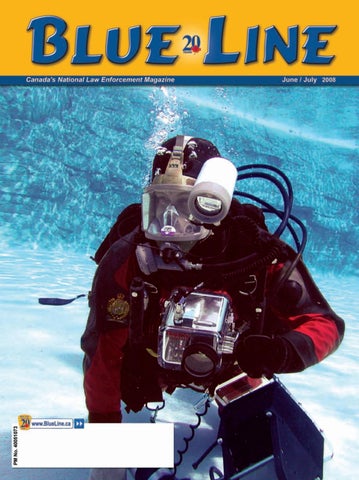
This month’s edition features the Niagara Regional Police Service’s Marine and Underwater Search and Recovery Unit on a recent practice dive. For more on this year’s Ontario Association of Chiefs of Police conference host agency, turn to page 6.
Photo: Denis Cahill, St.Catharines Standard
6 Policing the Niagara frontier The border and waterways challenge traditional
16 Impact projectiles deserve another look Another less lethal force option
policing in the Niagara region
22 Getting it back in line 10 Violent video games desensitize youth
Surveying recruitment in Canadian policing
24 Juvenile justice in Canada - Part 5 14 Saving lives through improved communications
46 46 37 44 38 21 36 45 23 5 34
Advertisers Index Back of Book Book News Dispatches Deep Blue Education & Training Health & Fitness Market Place Odditorials Publisher’s Commentary Technology
Blue Line Magazine
27
Blue Line Trade Show in Print
40
K9 sniffs require reasonable suspicion
3
JUNE / JULY 2008
JUNE / JULY 2008
4
Blue Line Magazine
The ‘three ring’ rule by Morley Lymburner The recent news flash of a donut shop employee being fired for giving a child a free treat brought back memories of days gone by. The offending supervisor hasn’t been heard from and I am sure there is more to the story, but it does bring up the topic of appropriate leadership. Poor management skills are nothing new and the infamous ‘Timbit’ scandal of 2008 took me back to my first days as a station duty operator at the glistening new district headquarters building. We were faced with a problem of the utmost importance one morning. A cadet and two constables huddled around a stack of letters and envelopes, unable to agree on which order they should be stacked. The superintendent had issued an edict that his mail was to be “properly sorted,” with the largest envelopes on the bottom and smallest on the top. Addresses were to be face up and properly displayed. Those not complying would be disciplined. The cadet charged with sorting the superintendent’s daily mail became very red in the face as we argued. All but one of the envelopes were neatly stacked. The remaining one was a little shorter than its immediate predecessor, but also a little wider. We measured and discovered it had the exact same square inches as its predecessor. What should we do? The dilemma escalated and, just as our voices were rising, the duty sergeant walked by and seized the envelope. He quietly told everyone to get back to work and, without a glance or another word, fed the offending envelope into a shredder. He glided back to his desk, picked up his pen and continued to write. We stared briefly at the sergeant and then busily hurried back to our duties. As I returned to my desk I complimented the sergeant on his quick, if not risky, solu-
Blue Line Magazine
tion to the problem. “That’s why they pay me the big bucks son,” he responded without looking up. The superintendent arrived at 7 am and picked up his mail at the front desk. I thought he might scrutinize it and be impressed with the order, but he paid it no heed and instead barked at the sergeant. “I noticed a scout car has parked over a yellow line in the parking lot. I want the driver of the car in my office.” Without any emotion, the sergeant turned and asked me to get the fleet number of the offending car. I did as ordered and our investigation revealed the officer had gone off duty an hour before. The sergeant called and ordered him to report back to the station. He mentioned as he hung up that the superintendent was on vacation. Perplexed, I asked how he knew this. “He isn’t wearing a tie and he has started two hours later than normal – for him that is vacation time,” he replied. He was right. The superintendent was indeed wearing a white open necked dress shirt and black dress pants and was two hours later than his normal 5 am start. We had our orders and tried to follow them. As a newly minted station duty operator this was my christening under fire to the internal workings of a large police facility. It was also my first inkling that perhaps being promoted wasn’t the gleaming ideal I had once imagined. The smaller station I had come from was orderly but did not have the jewel-
5
like qualities of this one and I was initially impressed. My first hint that all wasn’t quite right in paradise was when I noticed that everyone in the station quickly dropped what they were doing to answer the phone if it rang more than twice. There was a “three ring” rule, I was told. The phone must be picked up on the third ring or the superintendent would pick it up on the fourth and everyone at the desk would be documented for neglect of duty. The phone rule, along with the orderly envelopes, properly aligned cars and strict discipline were just a few examples of a long list of rules which ensured the HQ was run properly and efficiently. There was a price to pay for such efficiencies, of course, including a difficulty attracting people willing to work in such an environment. The experience made me determined to avoid a promotion. On one level, I did not wish to risk playing monkey in the middle, administering the tyranny of a superior to those below me. It also became painfully obvious how climbing the ladder affected people such as that superintendent. Everyone at that gleaming new police station was happy when our problem was resolved and the superintendent was promoted to deputy chief – until we saw his replacement. I’ll tell you about him another day.
JUNE / JULY 2008
Policing the
Niagara
frontier
The Border and waterways challenge traditional policing in the Niagara region by Jacquie Forgeron Calls for service on a typical summer evening see Niagara Regional Police Service (NRPS) officers dispatched to widely varying calls across the 12 municipalities they police. A typical evening shift might go as follows: • A Canada Border Services Agency (CBSA) officer seizes a firearm from a person attempting to enter Canada at one of the region’s several international bridges and calls in police. JUNE / JULY 2008
• A CBSA officer at another bridge detains an impaired driver for a breath test. If the driver fails, he/she will be arrested and taken to a NRPS holding facility. • US Border Patrol calls for the NRPS Marine Unit’s assistance to pursue a vessel which refuses to stop and is heading to the Canadian shore. • There’s a disturbance outside a night club in the popular Clifton Hill tourist area of Niagara Falls. Many in the growing crowd are young Americans taking advantage of Ontario’s lower drinking age (19), significantly younger than the New York State age (21). • Casino Niagara security personnel call the NRPS Casino Patrol Unit for help investi6
gating a suspicious pair of men prowling the parking lots. As the police service of jurisdiction and first responder to border requests, nights can present a unique challenge in meeting the demand and ensuring the safety and security of officers, citizens and visitors. The NRPS patrols one of the largest geographical areas of any Canadian municipal police service (1,840 square kilometres), policing 12 municipalities totalling some 430,000 permanent residents. Also unique to the region is the estimated 15,000,000 annual visitors. The Niagara region has seven international border points – four vehicular (QueenstonLewiston, Whirlpool, Rainbow and Peace Blue Line Magazine
bridges) and three railway crossings (though one is out-of-service and barricaded). The NRPS is responsible for the largest international waterways border of any jurisdiction in Ontario, including 120 kilometres of international border, 160 kilometres of shoreline and 1,500 square kilometres of water bordering three sides of the region (Lake Ontario, Lake Erie and the Niagara River). The service works in partnership with CBSA agents at the region’s four bridges, responding to hundreds of calls for service per year; most frequently for impaired driving concerns. Dispatches to border entry ports can become protracted, resulting in closed crossings and traffic backup onto provincial highways and roadways with municipal jurisdiction, often requiring additional, unanticipated police resources. Refugee claims have soared since 9/11 and changes to the Immigration and Refugee Protection Act and Safe Third Country Refugee Agreement pact between the US and Canada. Niagara alone has experienced a 466 per cent increase in the number of individuals seeking refugee status since 2001. With only the Niagara River and Blue Line Magazine
Trained and equipped to meet the needs two lakes separating the two countries, of the service and public, the marine unit it’s likely illegal entries under the cover of serves in three primary job functions – policdarkness have also increased. ing area waterways, assisting the emergency The NRPS and Niagara Parks Police task unit on high-risk calls such as armed (NPP) are the first to respond to calls of ilpersons and executing warrants, and carrylegal entry attempts, which are often made in ing out diving operations, both in the region overloaded and unsafe vessels or under the and under contract for surrounding police railway bridge which crosses the treacherous services. Niagara Gorge. These calls frequently result Members inspect vessels, in rescue efforts by police, endaninvestigate accidents and enforce gering the officers involved. the Criminal Code, provincial A single agency can not adstatutes and marine and navigadress both the workload and tion laws, including the Canada security concerns that challenge Shipping Act, small vessel and the Niagara region. It has beboating restrictions and collision come clear that a protracted and regulations, to name but a few. multi-agency response must exist. The unit, which consists of NRPS Chief Wendy E. Southall one sergeant and ten constables contends that to be effective, ef– six from the NRPS, one from forts on the waterways and land the NPP and three from the must be co-ordinated. RCMP – uses a secure dock at the “The horrific events of SepCanadian Coast Guard station in tember 11, 2001 served to rePort Weller. The two agencies coinforce the vital importance of Chief Southall operate in numerous search and border security and vigilance rescue operations and interdiction operations against terrorism,” Southall states. “As the under a formal partnership. police service of jurisdiction and the first The marine unit’s newest patrol/response responders for incidents involving these vessel, added in 2007, is a Titan 220 inflatable international roadways, railway and waterwith a rigid hull which has already seen exways, we take our responsibility to protect tensive use and proved invaluable during the the citizens of Niagara and Canada very visit by the Greenpeace vessel My Arctic Sunseriously. The professionalism and quality rise. Its speed and handling capability make it of our marine unit and the underwater search a well-rounded vessel for patrol use. and recovery unit reflect that commitment and Two marine unit sergeants and a consolemn obligation.” stable have been seconded to the RCMP The NRPS, RCMP, OPP, NPP, CBSA and and played an integral role in three federa multitude of U.S. partners and jurisdictions ally funded national security initiatives. One have begun working on co-ordinating policsergeant works with the National Waterside ing initiatives to better secure the Niagara Security Team, another is at the Marine Sefrontier, including using helicopters to supcurity Operations Centre and the constable is port ground units and help locate suspicious part of the Mid-Shore Security Enforcement watercraft. Team. The NRPS has developed a working “It is through these types of corelationship with these specialized units. ordinated initiatives that border policing The RCMP vessel Cape Hurd worked will become more efficient and effective,” alongside unit officers during public funcSouthall notes. tions such as Canal Days in Port Colborne, Niagara’s international border crossGreenpeace operations and as partners during ings are busy around the clock, 365 days regular patrol, provided staffing for 33 patrol a year. The increasing demand for police, shifts last year. evolving need to adapt to new technology During the summer months, unit mem– which leads to more criminal innovation bers attend an assortment of public functions – and expanding police adequacy standards throughout the region and enjoy an active underscore the importance of policing community presence, assisting in everything partnerships and co-ordination. The NRPS from waterfront fireworks displays and boat continues to build and explore strong relaclub functions to numerous festivals. tionships to serve its citizens and react to Not all duties are so pleasant. “We have change and challenge. seen an increase in serious vessel collisions and a marked increase in diver fatalities,” Patrolling the water notes Supt Douglas Kane, who oversees the The marine unit is one of the most veremergency and investigative support units. satile parts of the NRPS. Because crime and “This has resulted in a corresponding increase the accompanying need for police assistance in enforcement action on all waterways we isn’t limited to land, unit members patrol patrol and participation in interdiction efforts parts of Lake Ontario, Lake Erie, the Niagara in co-operation with other police services on River and other area waterways, including a Lake Ontario.” 43 kilometre international canal system. The The unit has partnered with police servWelland Canal links Lake Ontario and Lake ices from Toronto, Peel, Hamilton, Halton Erie. Niagara also has infrastructure conand Durham, the RCMP, Ministry of Natural cerns, given that its hydro generating stations Resources, CBSA, US Coast Guard and Airfeed the entire northeast power grid. 7
JUNE / JULY 2008
wing and the US Department of Homeland Security. It also maintains close ties with the marine units of the Erie and Niagara County Sheriffs and Youngstown and Buffalo Police Departments. During the 2007 season, the unit continued a close working relationship with Marine Security Enforcement Teams (MSET), a partnership between the RCMP, Canadian Coast Guard and local police services. The unit participated in three MSET projects, demonstrating how law enforcement agencies in different countries can work together to achieve a common goal. “Given the waterway challenges, we are pleased to offer the citizens and visitors of Niagara an exceptionally well trained and well equipped marine support service,” Kane says. “Our teams work year round with numerous other police agencies to ensure the best possible service is offered in the region.” Underwater search and recovery The NRPS Underwater Search and Recovery Unit (USRU) is a highly professional, trained and equipped service capable of conducting forensic investigation and underwater recovery 24/7. All evidence it recovers is subject to continuity procedures, ensuring the best evidence rules are adhered to when cases go before the courts. All members are specially trained to investigate, among other things: • Water related sudden deaths; • Post mortem physiology; • Skeletal remains recovery; • Air crash investigation; • Weapons recovery and preservation. The USRU assists in recovering vehicles, vessels, aircraft, weapons, bodies and a variety of evidence that has found its way underwater, either through criminal or accidental means. Forensic recovery is a specialized and unique form of diving. The police diver acts as an underwater detective, using tactics, procedures and forensic techniques in the pursuit JUNE / JULY 2008
of truth but with the additional challenge of operating in an underwater crime scene. The ten-person unit includes two underwater explosives disposal divers, which support the explosive disposal unit of the Niagara-Hamilton Police Explosives Disposal Alliance. This team recovers and renders safe underwater ordnance, commercial explosives, marine markers and improvised explosive devices. The USRU also provides underwater recovery and aquatic forensic services on a contract basis to the St. Lawrence Seaway and Waterloo Regional Police Service. In one case, the USRU was instrumental in charging a Welland man with first-degree murder after he staged the death of his 14-year-old son as a diving accident. USRU members are certified in confined 8
space entry, harbour clearing, ship hull inspection and explosive recognition. They actively participated with advisory committees and working groups to establish a collaborative mechanism to ensure public safety and security specific to the marine environment. Connected to the largest population concentration in the country and a vital link in Canada’s transportation network, it is not surprising that this NRPS unit has become the busiest municipal police diving team in Ontario. Jacquie Forgeron is a NRPS constable currently assigned to the public affairs branch in St. Catharines. Contact her at 9693@nrps.on.ca for more information. The Niagara Regional Police is the host to the annual OACP Conference.
Blue Line Magazine
The NRPS Underwater Search and Recovery Unit conducted 34 dive operations last year. It recovered 10 vehicles and conducted four searches for evidence and 20 body search and recovery operations. The unit’s fleet consists of: • 2002 Hike 30’ command vessel • 2005 Zodiac Mark II Grand Raid vessel • 2002 Rayglass Protector 28’ rigid hull inflatable boat • 2007 N 220 Titan 22’ rigid hull inflatable boat • Two 2003 Sea Doo GTX personal watercraft
Stats &Facts NIAGARA REGIONAL POLICE Population: 435,125 Officers: 666 Pop to Cop: 653 CIV Members: 315 Budget: $110,944,714 Per Capita Cost: $255 Crime Clearance Rate: 33% Crime Rate Change: -1% Source: Stats Canada - 2007 - www.statscan.ca
Blue line MagaziNE
9
JUNE / JULY 2008
25 To Life
youth
Violent video games
desensitize by Stephen Metelsky Navigating a robotic mouth through a maze of dots in ‘Pac-man,’ a 1980s video game, is a far cry from realistically decapitating someone in ‘Postal 2,’ a popular 2003 game. This violent trend continues to thrive, as do the game makers. Profits ballooned from $3.2 billion in 1995 to $7 billion in 2003.1 Considering that the average child spends some four to eight hours a day using electronic media,1 it’s safe to assume many have access to violent video games. Research on video game violence has revealed a significant relationship between exposure and aggressive behaviour in society.2 As violent video games have increased, so have highly publicized violent incidents involving youths with strong affiliations to them. The Columbine high school shooting in 1999, for example, involved two students obsessed with the video game ‘Doom’ – so realistic that the US military licensed it to train soldiers how to shoot and kill in an effective manner.3 The students rehearsed by playing it incessantly. Some researchers argue that this repeated exposure to depictions of graphic JUNE / JULY 2008
violence can contribute to desensitization.3 Compared with other media, research into video game violence is sparse, yet “many of the underlying psychological processes identified in the TV-movie literature also apply to video games”.2 Many are concerned about how video games and mass media validate violence on a daily basis. There is vicarious agreement among scientists that media depictions of violence substantially effect children, primarily by increasing aggressive and violent behaviour.4 Opinions vary on the causal connection linking aggressive behaviours with exposure to violent media forums. The entertainment industry argues that there is absolutely no relationship between violent media and aggressive behaviour(s),5 and that violence perpetuated within the media is simply a societal reflection of what occurs in everyday life.5 “If you cut the wires of all TV sets today, there would still be no less violence on the streets in two years,” argued Motion Picture Association of America president Jack Valenti.6 This is simply an unsubstantiated opinion not supported by scientific research. Scientists have presented some clear and convincing 10
behavioural evidence supporting the causal relationship between media violence and aggressive behaviour(s). Sales of violent video games have skyrocketed over the past few years. If they cause violence, why aren’t youths who have just played them committing more murders, the entertainment industry would likely argue. “Media violence exposure is not a necessary and sufficient cause of violence... not everyone who watches violent media becomes aggressive and not everyone who is aggressive watches violent media”5 – but there is scientific evidence indicating that violent media does have an affect on violent behaviour. “At this time, well over 1,000 studies point overwhelmingly to a causal connection between media violence and aggressive behaviour in some children,” six professional/ medical organizations noted in a 2000 joint statement.7 Two critical implications can be derived from this. First, there is valid and reliable scientific evidence from some of the most reputable US professional agencies indicating a causal relationship between viewing media violence and the onset of aggressive behaviour(s). Second, Blue Line Magazine
the joint statement refers to “some” children being affected, not “all,” but given the amount of violent media available, that “some” could be a resounding and significant number. Probably the most damaging aspect of youth overexposure to violent media is that the repeated depictions of violent behaviour become engrained as learned behaviour. Learning theories predict that violent video game play can influence behaviour through reinforcement, practice and observational learning.8 Social learning theory9 explains violence at the individual level as aggression vicariously learned through observation.9 Bushman and Huesmann 10 define observational learning as the process “through which behavioural scripts, world schemas and normative beliefs become encoded in a child’s mind simply as a consequence of the child observing others. Observational learning is a powerful extension of imitation in which logical induction and abstraction are used to encode complex representations.” Their research indicates children are susceptible to violence in both the short and long term after observing it depicted in the media. Emphasis is also placed on extra parameters to ensure protection for children against prolonged and/or repeated exposure to violent media.10 Consider the following factual scenario. There are hundreds of thousands of young children across the world who daily play, unsupervised, violent video games, including ‘Grand Theft Auto,’ which encourages auto theft, car jacking, armed robbery, assault with a weapon, drug use and prostitution. Another game of choice may be ‘25 to Life,’ where the user picks a weapon and then proceeds to hunt down and kill police officers. Behavioural scientists argue that repeat exposure to violent media can lead to a process of desensitization, whereby children develop “normative beliefs that aggression is appropriate”.10 This overexposure to observing media violence can create emotional desensitization towards violence in society.7 There is no doubt that children exposed to repeat images of violence in the mass media may suffer dangerous lifelong consequences.11 Addicted to several forms of violent media – including musical lyrics, television, movies and most prominently, video games, especially ‘Doom’ -- the Columbine killers superimposed the faces of students and teachers who had wronged them in the past onto the faces of the victims depicted in the game. They played it to the point of intense obsession, constantly rehearsing shooting their victims. Research has shown youth learn behaviours, attain knowledge and have their value systems molded via exposure to violence in the media.12 It’s difficult to speculate the exact role violent media played in the tragic Columbine scenario, as both killers ended their lives, but it undoubtedly played a significant role. Repeated exposure to emotionally stimulating media can significantly reduce emotional reactions to violence occurring in the real world. Furthermore, based on this desensitization process, youth can then “think Blue Line Magazine
Grand Theft Auto IV about and plan proactive aggressive acts without experiencing negative affect”.10 This is exactly what the Columbine killers set out to do, planning in a premeditated manner to shoot and kill innocent students and teachers as an outlet for their internalized aggression and frustrations towards students who didn’t make them feel a part of the school. They nonchalantly killed 13 people and wounded 24 others before killing themselves. It’s very difficult to determine if violent media played a role in this massacre. How do researchers account for youth exposed to similar forms of violent media who are non-aggressive? Research indicates computer games can contribute to violent behaviour at certain times, as they may “trigger aggression in certain people already predisposed to violence”.13 “There are a lot of kids that are angrier than they were 10 or 15 years ago,” notes Dr. Robert Butterworth, a trauma psychologist in an Arts & Entertainment documentary. “Stress of the family, a lot more broken homes, kids that don’t know any other reaction when they are frustrated than to strike out in a violent way. They don’t have anything else in their arsenal of responses. Add that to these violent
11
images that will grow and fester to the point where you may have a full blown fantasy mixed in with violence and we’ve seen the tragic results”.14 Ironically this documentary aired two months prior to the Columbine shooting. The essence of the statement serves as a template for what transpired – youth who become engaged in criminality have to accept the consequences of their violent actions and take the full brunt of the responsibility, in lieu of deflecting blame elsewhere. Researchers must continue exploring the behavioural evidence linking exposure to media violence with real world violence. Violent media did not essentially create the violence at Columbine high school but it definitely contributed to the events. As Butterworth suggests: You take a youngster who has that predisposition. You put them in an environment where the media shows these things (violence) and its like a triggering effect. The media doesn’t create, it triggers these people with the disposition. Joireman et al. (2003) and Anderson and Bushman (2002; 2001) define aggression as “a behaviour intended to cause immediate harm to another individual when it is understood that the target is motivated to avoid such harm”.15 It would be difficult to understand the innate behaviours of both Columbine killers, but it’s safe to assume they were both extremely frustrated with different facets of their life, including relationships with peers and teachers, school performance, etc. They were also addicted to violence depicted in various media forums. Based on the behavioural evidence, it would appear that the combination of high levels of frustration and an aggressive predisposition created a ticking time bomb waiting to be triggered. According to the Frustration-Aggression hypothesis, Dollard et al. (1939) proposed: “People who are frustrated, thwarted, annoyed or threatened will behave aggressively,
JUNE / JULY 2008
since aggression is a natural, almost automatic response to frustrating circumstances. Moreover, people who exhibit aggressive behaviour are frustrated, thwarted, annoyed or threatened”.16 This psychosocial approach details the inverse relationship between frustration and aggression and is a relevant theory to explain the killers’ violent behaviours in terms of the motivating precursors to the shooting. A second relevant psychosocial theory is ‘Displaced Aggression’. Denson et al. (2006) theorize that this process occurs when a person is somehow provoked but unwilling (or unable) to act against the person who initiated the provocation.17 The Columbine victims were not the source of the initial provocations of their killers. The retaliation involved innocent bystanders who had absolutely no involvement or previous conflicts with them and hence was an act of displaced aggression 17. A specific aspect of this psychosocial theory details how these frustrated people will intently focus on their anger and set out to plan a retaliatory attack 17. This sub-theme specifically outlines the sequence of events that unfolded from the onset of the original sources of provocation to the aftermath, which involved extreme aggression displaced amongst victims with no connection to the initial sources of conflict(s). Art sometimes imitates life in inappropriate ways. A few years following Columbine, the video game ‘Super Columbine Massacre’ was
JUNE / JULY 2008
25 To Life developed.18 The user could assume the role of the ‘shooter’ and role play through different scenarios, using various weapons to kill teachers and students. Glorified violence (contained within various forums of media) clearly perpetuates and/or encourages copycat crime(s). Consider this statement from Lieberman on the A&E documentary. “Each generation has been exposed to more and more media, so in a sense each new generation is more vulnerable to the psychological impact of media and to engaging in copycat crime.” There were several documented copycat incidents resulting from Columbine, including the 2006 Dawson College shooting by a crazed gunman obsessed with violent video games, including ‘Super Columbine Massacre’ and ‘Postal 2’.
12
The young Montreal gunman strolled into a local college equipped with an assault weapon and long dark trench coat (similar to the Columbine shooters) and, like them, killed himself. The aftermath of this tragedy revealed his dark obsession with death and violence. He had created an online profile on the vampires.com web site which provided a detailed insight into his demented mind. The killer indicated that he hated jocks, preppies and all people in authority. “Work sucks, school sucks, life sucks, what else can I say? Life is a video game, you’ve got to die sometime,” Kimveer Gill stated.19 The frustration-aggression hypothesis again applies, as it is obvious that there was a high level of aggressive predispositions in his behavioural repertoire. These pent up frustrations eventually surfaced in a violent and aggressive response.16 The killers frustration levels are captured in other online postings, made under the username ‘fatality666,’ including this one: “I am not a people person. I have met a handful of people in my life who are decent but I find the majority to be worthless. It’s not only the bullies fault, but the principal’s fault for turning a blind eye. It’s also the fault of the police. Anger and hatred simmers within me”.20 Gill’s words echo the sentiments highlighted in the theory of displaced aggression. He experienced a life of frustration resulting from various sources of provocation. Adhering to the psychosocial theory, he was intently focused on his anger and planned to seek retaliation.17 His victims were not connected to him or his original sources of frustration. Furthermore, he never attended Dawson College, nor did he have any other affiliations with the school, a hallmark trait of displaced aggression. Finally, it is difficult again to pinpoint the exact role violent video games played in this tragedy, but the research has shown that repeated exposure to depictions of graphic violence can contribute to desensitization.3 The video games containing the most violence have subsequently been given an ‘M’ rating for mature. Less violent games are rated ‘T’ for teen. The M rated games contain blood and profanity and depict severe injuries and death to human and non-human characters.21 They are not to be sold to minors, yet consumers are overwhelmingly youth under the legal age of purchase, which varies by region. In May, 2003, Washington became the first US state to officially ban the sale of realistic ‘cop-killer’ video games to children under 17.13 The idea of allocating specific ratings to prohibit minors from buying these games is only one way to control how youth access violent media. Parents must proactively play a role, and this is not emphasized enough. It is one thing to put societal restraints on violent media via content labels and warnings, but parents have the ultimate control in limiting or eliminating violent content in their children’s viewing habits. As Bushman and Huesmann suggest, they need to be aware of the consequences of viewing media with repeated violence and protect their children from it.10 Health care professionals, primarily child Blue Line Magazine
and adolescent psychiatrists, are now being encouraged to include a ‘media history’ in medical evaluations of children, incorporating it as a possible risk factor in a clinical diagnosis.12 The starting point still revolves around the home environment. “The more that you are exposed to parents who are loving and affectionate and who will spend a lot of time with you (attention),” Lieberman suggests, “the more you can fight against these ideas and images you see on the screen.” Limiting children’s exposure to violent media, combined with positive family exposure, can be a preventative measure against negative media influences. The behavioural research has clearly shown that there is a causal relationship between media depictions of violence and an increase in aggressive behaviour(s) in youths. Given the recent emergence of more sophisticated violent video games, including the recent release of the latest Grand Theft Auto game, it is vital that researchers add to the minimal research and continue exploring the dynamic relationship between video games and violence. Recent tragic events have supported the hypothesis that violent video games are desensitizing and causing youths to become increasingly more violent. Det/Cst Steve Metelsky is a a criminal investigator with the Halton Regional Police Service. Contact him at steve. metelsky@hrps.on.ca for more information.
Blue Line Magazine
References
Vastag, B. (2004). “Does video game violence sow aggression? Studies probe effects of virtual violence on children.” JAMA, Vol 291(15): 1822- 1824. 2 Anderson, C.A. & Bushman, B.J. (2001). “Effects of violent video games on aggressive behaviour, aggressive cognition, aggressive affect, physiological arousal and prosocial behaviour: A meta-analytic review of the scientific literature. Psychological Science, Vol 12(5): 353-359. 3 Anderson, C.A. & Dill, K.E. (2000). “Video games and aggressive thoughts, feelings and behaviour in the laboratory and in life”. Journal of Personality and Social Psychology, Vol 78(4): 772-790. 4 Gilligan, J. (2001). How to create less violent societies. Preventing Violence. London: Thames and Hudson, pp. 80-106. 5 Anderson, C.A. & Bushman, B.J. (2001). “Media violence and the American public: scientific facts versus media misinformation”. American Psychologist, Vol 56 (617): 477-489. 6 Moore, J.W. (1993). “Lights! camera! It’s gun control time”. National Journal, December 18 1993: 3007. 7 Joint Statement on the Impact of Entertainment Violence on Children ((American Psychological Association, US Academy of Pediatrics, American Academy of Family Physicians, American Academy of Child, Adolescent Psychiatry and the American Medical Association), Congressional Public Health Summit, July 26, 2000. From website: http:// www.aap.org/advocacy/releases/jstmtevc.htm 8 Funk, J.B. & Buchman, D.D. (1996). “Playing violent video games and adolescent self-concept”. Journal of Communication, Vol 46, 19-32. 9 Bandura, A. (1973). Aggression: A Social Learning Analysis. Englewood Cliffs, N.J.: Prentice-Hall. 10 Bushman, B.J. & Huesmann, L.R. (2006). “Short-term and long-term effects of violent media on aggression in children and adults”. Pediatric and Adolescent Medicine, Vol 160, 348-352. 11 American Psychological Association Commission on Violence and Youth (1993). “Violence and Youth: Psychology’s Repsonse.” Report of the American Psychological Association Commission on Violence and Youth, Vol 1, Washington, D.C. 12 Villani, S. (2001). “Impact of media on children and 1
13
adolescents: a 10-year review of the research”. Journal of the American Academy of Child and Adolescent Psychiatry, Vol 40(4): 392-401. 13 Reichhardt, T. (2003). “Playing with fire”? Nature, Vol 424 (6947) : 367-368. 14 Investigative Reports (1999). Arts & Entertainment Television Network: “Copy-Cat Crimes.” (Video Documentary) February 1, 1999. 15 Joireman, J. Anderson, J., & Strathman, A. (2003). “The aggression paradox: Understanding links among aggression, sensation seeking and the consideration of future consequences.” Journal of Personality and Social Psychology, Vol 84(6): 1287-1302. 16 Bartol, C.R. (1999). Criminal Behaviour: a Psychosocial Approach. Prentice-Hall: New Jersey. 17 Denson, T.F., Pederson, W.C., & Miller, N. (2006). “The displaced aggression questionnaire”. Journal of Personality and Social Psychology, Vol 90(6): 1032-1051. 18 Couvrette, P. (2006). “Columbine game was gunman’s favourite.” The Associated Press. From website: http:// www.chron.com/disp/story.mpl/ap/world/4186275.html 19 Dimanno, R. (2006). “Montreal gunman identified,” Toronto Star, 14 September. From website: www.torontostar.ca 20 Gombu, P. (2006). “Killer loved guns, hated people,” Toronto Star, 14 September. From website: www. torontostar.ca 21 Thompson, K.M., Tepichin, K., & Haninger, K. (2006). “Content and ratings of mature-rated video games”. Archives of Pediatrics and Adolescent Medicine, Vol 160(4): 402-410. Anderson, C.A. & Bushman, B.J. (2002). “Human aggression”. Annual Review of Psychology, Vol 53: 27-51. Anderson, C.A. & Bushman, B.J. (2001) “Is it time to pull the plug on the hostile versus instrumental aggression dichotomy?” Psychological Review, Vol 108: 273-279. Bandura, A. (1977). Social Learning Theory. Englewood Cliffs, N.J.: Prentice-Hall. Dollard, J., Doob, L.W., Miller, N.E., Mowrer, O.H. & Sears, R.R. (1939). Frustration and Aggression. New Haven: Yale University Press. Warmington, J. (2006). “What lurks beneath,” Toronto Sun, 15 September. From website: www.torontosun.ca
JUNE / JULY 2008
P25
Saving lives
through improved communications
by Morley Lymburner
An Air Florida passenger jet crashed into the 14th Street bridge in Washington, DC in January, 1982. Just 30 minutes later, there was a train accident only a few miles away. First responders from federal, state, and local public safety agencies quickly discovered that it was extemely difficult to co-ordinate their efforts because each agency’s radios used different frequencies and signalling techniques. Onscene commanders were forced to borrow each other’s radios to co-ordinate activities. The Oklahoma City bombing further emphasized the need for interoperability. More than a dozen search and rescue teams arrived, each with at least 50 personnel and their own communications system which could not, for the most part, communicate with each other. Since wire line and cell phone service was damaged or overloaded, radios were the only way of relaying information and requesting specific support. It became so bad at one point that an agency had to resort to sending runners with messages. Police and other emergency services across North America began accelerating their communications needs post September 11th. This singular watershed event displayed a wide variety of shortcomings in emergency communications, both within agencies and with other agencies. The changeover from
JUNE / JULY 2008
analog to digital systems only compounded the problems by introducing transitional hardware incompatibilities. The Association of Public-Safety Communications Officials (APCO) has come to the rescue by helping to initialize and institute Project 25 standards. Begun as early as 1989, it sets up standards for all manufacturers of emergency communications equipment. Although not legally binding, companies interested in marketing their products to first responders risk losing customers if they do not comply. Project 25 (P25) or APCO-25 refers to a suite of standards for digital radio communi-
14
cations equipment designed for federal, state/ province and local public safety agencies in North America. Compliant equipment allows communication with other agencies and mutual aid response teams in emergencies. Although developed primarily for public safety services, P25 technology and products have also been selected and deployed in private systems worldwide, including railways, which use it for rolling stock, personnel, and transportation vehicles. One of the biggest advantages to the standard is that compliant radios can communicate in analog mode with legacy equipment, and in either digital or analog mode with other P25 radios. Additionally, P25-compliant systems allow for a high degree of equipment interoperability and compatibility. The standard uses Improved Multiband Excitation (IMBE) decoders, which were designed by Digital Voice Systems Inc. to encode/decode analog audio signals. P25 may be used in “talk around” mode without any intervening equipment between two radios, in conventional mode – where two radios communicate through a repeater or base station without trunking – or in a trunked mode where a repeater or base station automatically assigns traffic to one or more voice channels. The P25 standard suite specifies eight open interfaces between the various components of a land mobile radio system: • C ommon Air Interface (CAI) standard specifies the type and content of signals transmitted by compliant radios. A radio using CAI should be able to communicate with any other CAI radio, regardless of manufacturer. • S ubscriber Data Peripheral Interface standard specifies the port through which mobiles and portables connect to laptops or data networks. • Fixed Station Interface standard specifies a set of mandatory messages supporting digital voice, data, encryption and telephone interconnect necessary for a fixed station and P25 RF subsystem to communicate. • C onsole Subsystem Interface standard specifies the basic messaging to interface a console subsystem to a P25 RF subsystem. • Network Management Interface standard specifies a single network management scheme, allowing all management of all network elements of the RF subsystem. • Data Network Interface standard specifies the RF subsystem’s connections to computers, data networks or external data sources. • Telephone Interconnect Interface standard Blue Line Magazine
specifies the interface to public switched telephone network (PSTN) and supports both analog and ISDN telephone interfaces. • Inter RF Subsystem Interface (ISSI) standard specifies the interface between RF subsystems, allowing them to connect into wide area networks. Michigan claims its public safety communications system is the first statewide radio system to be APCO-P25 compliant. The Motorola 800 MHz ASTRO SmartZone digital trunked communications system complies with P25 standards for common air interface, trunked operation and encryption. All of Michigan’s seven state police districts are part of the system, as are a number of other public safety agencies, including park rangers, highway workers, county and municipal police and fire departments and 9-1-1 dispatch centres. The complete system came on stream in the spring of 2002 and serves more than 14,000 mobile and portable radios. Resources http://www.project25.org/ - Project 25 Technology Interest Group (PTIG) home page http://www.project25.us/ - Motorola Project 25 portable radios and information http://www.apcointl.org/frequency/project25/ - APCO International Project 25 page http://www.aeroflex.com/products/commtest/pmr/ appnotes/p25cc.pdf - APCO-25 control channel information http://www.p25.com/resources/P25TrainingGuide.pdf - Daniels’ P25 Radio System Training Guide
Blue line MagaziNE
Newfoundland Constabulary medal for good service by Edo van Belkom Origins The origin of the newfoundland constabulary medal for good service dates back to 1892. A Minute of the Legislative Counsel authorizing His Excellency Sir John T.N. O’Brien, Governor of Newfoundland (1889-1895) to obtain a design and die for two medals, one of which was the Newfoundland Constabulary Medal for Good Service. In 1893 there was a further Minute requesting the governor to proceed with the procurement of the medals. The following year the attorney general was directed to draw up regulations with reference to the granting of the Good Service Medals to members of the Newfoundland Constabulary. In 1897, several of the medals were issued in honour of Queen Victoria’s Diamond Jubilee as well as the 400th anniversary of Giovanni Caboto’s discovery of Newfoundland in 1497. Nothing more was done with the medal until 1918, when Governor Sir Charles Harris proposed that the remaining medals – discovered in the safe at Government House in St. John’s a year earlier – be presented. In November 1919 five silver medals were issued to members with between 38 and 40 years service,
15
and nine bronze medals were issued to members with between 35 and 37 years service. Following this presentation the medal was never awarded again. Criteria Presented as a commemorative medal, and for long service. The long service awards were for 35-37 years (bronze) and 38-40 years (silver). Insignia An oval medal made of silver or bronze. The obverse features a crown over two crossed sceptres. Below is a scroll with the words “Pax Nobiscum.” Surrounding this are the words “Newfoundland” on the left and “Constabulary” on the right. On the obverse are the words “For Good Service” surrounding by a laurel wreath. Suspender A ring is attached directly to the insignia like the top ring of a pocket watch. The ribbon passes through this single ring. Ribbon Three stripes of equal width, two of forest green on each side of a scarlet stripe. Other The original dies of the medal still exist. The second medal authorized by the minute of legislative counsel in 1892 was for bravery. Information The Royal Newfoundland Constabulary, 1 Fort Townshend, St. John’s Newfoundland, A1C 2G2.
JUNE / JULY 2008
Impact projectiles
deserve another look
Another less lethal force option
Performance expectations Impact munitions users must understand that immediate incapacitation from one round may occur but is unlikely. Like baton strikes, they rely on the effect of kinetic energy transferred to a target to cause motor dysfunction and pain. This, coupled with verbal commands and the psychological effect of hearing a bang and feeling the subsequent impact, contributes to the technology’s effect. Our intent is to incapacitate a subject, thereby reducing or eliminating the threat to officers, citizens and the subject. The kinetic energy transfer resulting from a single projectile is at times insufficient to accomplish incapacitation, therefore requiring the cumulative effect of more than one projectile deployed in succession.
by Colin Watson A suicidal man perches precariously on a parkade railing. Dressed in a heavy sweater and very emotional, he insists that he wants to jump to his death. Crisis negotiators try to talk him away from the edge. He steps to the concrete occasionally but climbs back onto the ledge if officers get within 30 feet. Negotiators realize he is extremely motivated to die and wants police to help him carry out his wish. He has been drinking and using street drugs. He is fatigued, intoxicated and has several times come very close to losing his balance and falling six stories to his death. It’s decision time. Do nothing and likely watch him kill himself, or attempt to save his life and accept the risk that police action may be the catalyst for his demise. Does this scenario change if he is armed with an edged weapon? What sort of force options does your agency currently have that may save his life? Are they effective against loose fitting or bulky clothing? How close must you be to the subject? Have you trained your members to act in a co-ordinated fashion to resolve this type of scenario? Pre-incident planning Planning a successful incident resolution begins long before the call is dispatched. Adding force options or enhancing existing ones is a step in the right direction to providing the best possible response to crisis situations. Every police agency should seriously consider providing its officers with an impact projectile option, allowing them to intervene from a distance when action must be taken; approaching armed, violent, or suicidal subjects puts officers – and subjects – in jeopardy. Without an intermediate distance force option, officers may choose, or be forced, to approach a subject, particularly in circumstances where they are not contained. Even with conducted energy weapons (CEW) such as the Taser, there is a risk associated with getting close enough to be within the operational deployment range. Should the situation quickly escalate or the intermediate force being used fail, lethal force may result. Such encounters may leave individuals and the organization exposed to civil liability JUNE / JULY 2008
should a court find officers, by their actions, created the necessity to use lethal force (Ijames, 1995). Impact projectiles allow these subjects to be engaged from a distance, often providing an opportunity to better use positions of cover. Unfortunately, the legacy of older technology has somewhat hampered police acquisition of impact projectiles. Many officers have heard of deaths from bean bag rounds unintentionally penetrating the bodies of subjects. This normally resulted from the use of older “square” rounds where the projectile wasn’t able to “open up,” or where the bean bags turned sideways and impact on their narrow side. Their less than aerodynamic design also made square bags susceptible to varying from the intended path of flight, resulting in an unpredictable point of impact. The newest “sock” bean bag rounds are far more accurate, making minimum deployment distance and penetration less of an issue. Most studies documenting bean bag injury patterns are now dated and use data associated with the old square bags. Although there remains some slight risk of penetration injuries associated with the newer technology due to reduced impact surface area (MacPherson et als., 2000), they are a safe and accurate lower level force alternative (Ijames, 2005). 16
Potential for death and injury The IACP describes the philosophy of less lethal force options as “a concept of planning and force application that meets operational objectives, with less potential for causing death or serious injury than conventional police tactics” (Ijames, 2007). It is important to recognize that impact projectiles are simply not “non-lethal,” as some literature suggests. They can and have caused serious injury or death when high risk target areas such as the head and neck were impacted. The extent of injury or likelihood of death lies with target selection. Impact projectiles usually result in some type of injury, generally bruising, abrasions or contusions (Bozeman, 2005). This level is normally acceptable when you consider the potential for self inflicted injury or injuries to civilians or officers in the absence of intervention. Internal injuries resulting from blunt trauma can occur in some cases, but is far less likely, particularly when appropriate lower risk target areas are utilized. It is generally accepted that shot placement is the single biggest factor in determining the likelihood of injury with impact projectiles. We must also consider that some deaths have resulted from the intentional use of the projectile as a lethal force option. In a study of 311 subjects impacted by some type of impact projectile, (Hubbs and Klinger, 2004), found that eight died as a result of chest or Blue Line Magazine
neck impacts. Two of these deaths were found to be the result of numerous projectiles (more than 100 on one subject), with death occurring weeks or months later. In at least one case, death could not be directly linked to the projectiles. Outcomes in 88 per cent of impacts ranged from no injury to abrasions. Most of the injuries in the remaining 12 per cent resulted from impacts to higher risk target areas such as the head, neck, chest and spine. Death resulted from only one per cent of total impacts. The rates of more serious injuries and deaths in this study are artificially high, the authors note, as they only take into account reported deployments of 106 agencies and represent a “small portion” of total engagements. All known deployments resulting in death were included in this evaluation, however not all known impact projectile deployments were included, as a large number of incidents were not reported to the study. The most common projectile used in the reported impacts was the 12 gauge square bean bag, which are now considered notoriously inaccurate and inherently more dangerous. Taking this into consideration, it’s expected incidents of death and more serious injury will be substantially reduced by using sock style munitions. Unlike square bags, they do not require distance for the projectile to reach its intended shape in flight. The sock round exits the muzzle in a deployable state and has no edges or flat surfaces that can effect accuracy or reduce impact surface area.
gain compliance by impacting subjects with frangible projectiles fired from a “paint ball” style gun. This technology relies on the combination of pain and the release of a pepper agent when the projectile impacts a target. Taser International is developing the “XREP”(extended Range Electronic Projectile), a self contained Taser cartridge fired from a 12 gauge rifled barrel shotgun at a distance of up to 65 feet. The unit reportedly can incapacitate a subject utilizing Taser’s neuro muscular incapacitation technology for up to 20 seconds, allowing officers time to take control of the subject. Conclusion Our officers faced the parkade standoff described earlier and successfully used an impact projectile to resolve it. That individual is alive today as a direct result of a co-ordinated police response and the availability of an extended range, less lethal force option. As the search for safer and more effective force options continues, agencies should closely look at all the available technology, equip their officers with the best available tools, and provide ongoing training and development. Be realistic about capabilities. Experience and science show that the “one shot drop” is not the likely outcome. Injury will likely result from using impact projectiles, however weighing injury with the risk of death or serious injury to a subject, citizen or police officer, it is a reasonable and life saving compromise.
References
Bozeman, William P. & Winslow, James E. (2005) Medical Aspects of Less Lethal Weapons. The Internet Journal of Rescue and Disaster Medicine. Volume 5 Number 1. Chan, JTS and Yeung, RSD (2003) A Study of police bean bag injuries in a pork model. Hong Kong Journal of Emergency Medicine. Volume 10 Number 2. pg. 124-128 Hubbs, Ken & Klinger, David (2004) Citizen Injuries from Law Enforcement Impact Munitions: Evidence from the Field. Wound Ballistic Review. Volume 4, Issue 4 Pg. 9-14 Hubbs, Ken & Klinger, David (2004) IMPACT MUNITIONS: Database of Use and Effects. National Institute of Justice. Ijames, Steve (1995) Less Lethal Force – Concepts and Consideration in the De-Escalation Philosophy. The Tactical Edge. Summer 1995, Pg. 51-55 Ijames, Steve (2005) In defense of the 12-gauge “bean bag” round. Retrieved on March 29, 2007 from http://www. policeone.com/pc_print.asp?vid=118328 Ijames, Steve (2007) Impact round training & the critical issue of “point of aim/point of impact” Retrieved February 10, 2008 from http://www.policeone.com/writers/columnists/SteveIjames/articles/1266889 MacPherson, Duncan (2000) Comments on Impact Projectiles. Wound Ballistic Review. Volume 4, Issue 4 Pg. 14-15. MacPherson, Duncan, Hudson, Doreen & Maruoka, Richard (2000) 12 Gauge Beanbag Fatality Risk Investigation. Wound Ballistic Review. Volume 4, Issue 4 Pg. 16-30. Pepperball Technologies (2008) Pepperball products page. Retrieved on April 13, 2008 from http://www.pepperball.com/le/applications.aspx Taser International (2008) Taser XREP information page. Retrieved on April 13, 2008 from http://www.taser.com/ PRODUCTS/LAW/Pages/XREP.aspx Cst Colin Watson is an 11 year member of the Victoria Police Department and the less lethal projectiles instructor. He has served on the regional ERT (SWAT) for seven years and is currently second in command. He can be reached at vi5167@vicpd.ca
Selection and training The type of impact munitions selected for deployment should be based on an agency’s ability to provide ongoing training. Weighing the available munitions, subject considerations and urgency of threat can be a complicated process, best done by an operator who has been “stress inoculated” through experience and training. This is particularly true with higher energy, nonconforming rounds such as the Police Ordnance AR-1 or Sage KO-1. Although their additional power increases the likelihood of incapacitation, they are less forgiving and require extra care in deployment. Training needs to be specific so as to reduce the chances of operators defaulting under stress to “centre mass” when using impact projectiles (MacPherson, 2000). In my view, point of aim is the single biggest issue for impact projectile training. Unintentionally impacting a high risk target area such as “centre mass” is understandable, considering that this is ingrained during all pistol marksmanship training. We must therefore take care to ensure that impact projectile operators are sufficiently trained to allow them to make appropriate point of aim decisions under the stress often associated with these dynamic situations. History shows that negative outcomes are likely if we fail to do so, which may result in law enforcement loosing a valuable tool. The future Emerging intermediate distance technologies may provide law enforcement with even more options. The Pepperball system seeks to Blue Line Magazine
17
JUNE / JULY 2008
Culture and ethos
in the Mountie world
by Robert Lunney The parable of the buffalo The early explorers of the western plains found the grasslands teaming with enormous herds of buffalo. They provided the staples of life for the indigenous people and all was well, but when settlers arrived and the railroad began stretching across the plains, the buffalo became an obstacle. They blocked the rails, interfered with construction and presented a hindrance to settlement. White buffalo hunters had already hastened their demise for hides and meat, but the railway encouraged more hunters and the slaughter began. The buffalo, secure in their herd instinct, were oblivious to the carnage. Hunters would open fire from behind a blind but the buffalo would not move, even though their kindred
were dropping all around them. This was called a buffalo stand. The killing continued until the buffalo were almost driven to extinction. Today, buffalo are confined to parks and conservation areas or raised as commercial livestock. Many years on, I encountered a buffalo on a reserve in a setting reminiscent of the primordial prairie. On impulse, I called out to him. “Hey, old shaggy, any advice for us today?” “When times change,” he rumbled, “don’t stand still.” The changes I have proposed to RCMP responsibilities will provide a platform for needed fundamental reforms, but the wrenching pain of surrendering traditional roles is actually the easy part. The toughest job is fixing that “horribly broken” culture, a label
attributed to chief investigator David A. Brown when he released his report on the insurance controversy. Organizational culture consists of those shared assumptions which have a role in shaping and influencing ideas, attitudes and experiences, encompassing a whole way of life of a social group. Ethos is the characteristic spirit and beliefs of an organization; that is, the way in which it sees itself, manages itself internally and sees and interacts with its clients and others outside the organization. To its members, ethos is best understood as “how we do things.” Culture and ethos are constantly evolving, influenced by both positive and negative experiences. The process of cultural change is measured in months and years and is not necessarily affected by events that have a brief period of prominence or popularity. The Duxbury Report Beginning in 2000 and again in 2007 Dr. Linda Duxbury, one of Canada’s leading workplace health researchers, carried out internal surveys of RCMP workplace attitudes. The result, The RCMP Yesterday, Today and Tomorrow – An Independent Report Concerning Workplace Issues at the Royal Canadian Mounted Police, is available on the web. The Duxbury report is a searching assessment of serious internal issues facing the new RCMP commissioner, with commentary on workload, management, leadership and culture. She speculates that “the RCMP may be victim of the ‘success spiral’, which occurs when an organization holds on too long to a culture in the belief that what has worked in the past will continue to confer a competitive advantage in the future.” The report suggests that the RCMP has failed to realign its organizational culture to take into account new environmental realities and that this has resulted in key elements of
JUNE / JULY 2008
18
Blue Line Magazine
its culture being liabilities as the organization moves forward. She lists 75 thoughtful recommendations, all valid and worthy of consideration. According to Duxbury, the salient dissatisfiers are related to the management of people. Internal surveys reveal a startling gap in degree of trust, confidence and optimism between inspector and above and other ranks. Commissioned officers are optimistic, perhaps unrealistically so in the current circumstances. Other ranks and police staff are more pessimistic and one speculates, made cynical by insufficient guidance and support. Altogether, this suggests that factors affecting the quality of working life, such as the enjoyment of mutual respect and dignity, are not evenly distributed. A workplace which values compliance before originality and ingenuity stifles organizational spirit. Training, promotion and career planning are among the domains requiring urgent attention. According to Duxbury, the RCMP is in a very low state of readiness for change. Under these conditions, the profile and style of the lead agent of change is critical. Leadership at all levels Managing change to culture and ethos is nothing new to policing; indeed, some of the largest police organizations in the democratic world have been challenged with demands
Blue Line Magazine
for radical modifications to name, style and methods. The most successful operations are often heralded by selecting an outside chief executive as an agent of change, and the appointment of James Elliott as commissioner was an unsurprising and perceptive decision. While charismatic leadership is often called upon for a task of this enormity, in this case, given the time span needed to fairly begin the process of reform, a combination of quiet leadership coupled with first-class managerial skill will best fit the challenge. It is impossible to out-dazzle 17,000 police officers, each with a scarlet tunic in the closet. The first challenge for the outside leader is to instill and nurture a sense of hope and a promise that remedies for vexing problems will be pursued with diligence. Fine words will not suffice; they must be followed quickly by positive deeds. The preliminary steps in a change strategy must be experienced by as many members and police staff as possible, as quickly as possible. This may range from enhancing the quality of working life, effectively removing barriers to job satisfaction and injecting needed resources, equipment or technology – but the commissioner cannot do this alone. Most often a change agent installs a new leadership team committed to the cause of reform. Leadership at all levels must voluntarily commit to the program.
19
The commissioner’s mission is to transform the RCMP to a high performance organization equal to the challenges of the 21st century. Sorting out the federal responsibilities from other distractions will make the task more manageable. Designing and implementing a purpose-designed human resources strategy is the next order of business. All of Canada will be watching to see how the RCMP responds to the challenge for change. Rien ne change Before I left the RCMP I used to say, in my darker moments, that the force’s motto should be “Rien ne change” (nothing changes) rather than “Maintiens le Droit.” Sweeping structural and program changes are essential and mere tinkering with the levers of culture and ethos will not suffice. These changes will be discomforting to serving members and staff, but the needs of society transcend these concerns. Our country has a vital interest in an effective, efficient and transparent federal police service, functioning with the highest degree of integrity and skill, and staffed by individuals utterly devoted to the safety, security and protection of the people of Canada. There is no time to waste and no room for complacency, for the public trust is in the balance. A former senior officer with the RCMP, Edmonton and Peel Regional Police, Robert Lunney can be reached at lunney@blueline.ca .
JUNE / JULY 2008
Partnering
to maintain public order by Danette Dooley Canada’s largest municipal police service is helping North America’s oldest police force train officers for its public order unit. Four members of the Toronto Police Service (TPS) went to St. John’s, Newfoundland in late April to help prepare new unit members. Royal Newfoundland Constabulary (RNC) deputy chief Bill Browne says the partnership between the two police services is nothing new. “When we reintroduced our public order unit several years ago, we looked around the country for experienced and well trained officers and our partners – the Toronto Police Service – offered the best service to us,” Browne says. The RNC unit now has more than 50 officers, ranging in rank from constable to deputy chief. Experience ranges from as little as two years of service to more than 30 years, Browne notes. As in other jurisdictions across the country, the unit will be used for such things as crowd control and as a means of opening the lines of communication with organizing groups before any major events take place, Browne says. “If there is going to be a gathering of a large group, our officers are trained to meet with the organizers to work to ensure the event is safe and that there is no damage done to people or property.” It’s important for the
public to know, he adds, that police are in no way trying to stop people from exercising their constitutional rights. “In Canada people have the right to protest in peaceful demonstrations. So, we’re not here to prevent any demonstrations. All we want to do is ensure that they are not disorderly, that no one gets injured or hurt, but that the demonstrators’ points are made.” The trip to Newfoundland wasn’t any-
thing new for TPS S/Sgt Russ Cook, who was among a handful of Toronto officers who trained members when the public order unit was first activated four years ago. Cook says many Canadian forces have come onboard with joint force training in various aspects of police work. In Ontario, for example, there are advisory boards where police issues such as the need for tactical training are discussed among different police agencies. Thanks to standardized police training, Cook says, it’s become easier for forces to call on others to help out. “We find ourselves partnering with many police services and we ask others to come in and help us with certain events because we just don’t have the staff to facilitate,” he says. Cook says inter-agency training is winwin for all forces involved. “Yes, we come here as instructors and we have a certain level of knowledge and ability in certain areas, but we will go home with as much knowledge as the folks here have gained… they (RNC) have developed some new equipment that we’re going to be looking at and vice-versa.” Both Cook and Browne encourage other forces to also take a look at such partnerships. “Communication is the key,” Cook says. “It’s all about facilitating a safe environment for everyone.” Browne says RNC public order unit members know that the TPS officers are just a phone call away, adding “the co-operation here has been fantastic... we’re very pleased with what we have accomplished.” Danette Dooley can be reached at danette@nl.rogers.com
JUNE / JULY 2008
20
Blue line MagaziNE
College adds post-graduate courses by Brian Ward Working with the Waterloo Regional and Guelph police services, Conestoga College has revised its programs to offer college and university graduates more exposure to the real world. A major review of the law and security administration and police foundations programs by community services program chair Wayne Morris resulted in revisions and two new post diploma certificates for graduates. Post-grad course The two semester advanced police studies post diploma certificate includes 20 weeks of applied learning and two five week practicums. Under the direction of a coach officer, students will be exposed to many parts of front line police work, including night shifts. They go for the first practicum after 10 weeks of study, return to the college for another ten weeks and conclude the program with another five week practicum. So far, the OPP, London, Oxford, Stratford, Guelph and Waterloo Regional police services and Wilfred Laurier University Special Constable Service have committed to participating in the practicums.
Blue Line Magazine
Advanced security studies The college also offers a post diploma in advanced security studies for students interested in security supervision which was also developed with input from the field. Key players included Barber-Collins and Tone-Gar security services and the Woodbine Entertainment Group. Security studies students will be exposed to security technology, investigative case management and completing independent security projects. They will also learn about the supervisory aspects of their job through human resources and leadership courses and
21
will be required to complete a third semester by participating in a 320-hour placement program as a security supervisor. Admission is capped at 20 students per program. To be considered, applicants must be graduates of a related college or university program, provide a clear criminal reference check and proof of Standard First Aid and CPR training. Police studies students must also prove they meet police fitness standards. Contact charrison@conestogac.on.ca for more on police studies and jphillips@conestogac.on.ca for more on the security program.
JUNE / JULY 2008
RR-3 – The policing sector should build meaningful partnerships with educational institutions to facilitate the capture of high quality candidates. The police sector is faced with a dilemma in terms of how it relates to colleges and universities. Currently there is duplication in terms of training provided to potential recruits. Many people take programs at educational institutions leading up to degrees and diplomas in policing or related areas but the specific content elements of these credentials are not recognized by police organizations. Typically, a two-year diploma in Police Foundations from a college is given no more (or less) credit than a twoyear diploma in any other subject area. As there is no accreditation of the program or the people delivering it, police organizations cannot have confidence in the content that was delivered – all that is known is that the person has satisfactorily completed a two-year diploma program. This situation is inefficient and detrimental to the ability of the police sector to recruit good people. Police academies train new recruits and often repeat material that some people have already covered in their college or university programs, which is wasteful but currently unavoidable. It creates a competitive or even adversarial environment between the academies and the colleges. The larger issue, however, is the misrepresentation that happens in the minds of potential future recruits. Young people are led to believe that if they invest (time and money) in obtaining these college diplomas or degrees, they will be well positioned to be hired as a police officer. When they graduate they discover that the qualification does not provide them with the advantage they had anticipated and, coincidentally, most police organizations will not hire them anyway because they are judged to be too young or inexperienced. The resulting disappointment may turn good people away from a policing career forever. The choice facing the police sector is either to partner with educational institutions in the identification, education and recruitment of future police officers or to distance itself from them and to communicate to the target candidate pool the reality of the value attributed to such programs. JUNE / JULY 2008
We recommend partnership as the preferred option. The details of the proposed partnership approach are discussed in Section 9.0, the highlights are: • E ducational institutions accredited to provide certain policing related programs (curriculum to be established by the police sector) and will award credits for successful completion; • These credits will be regarded as pre-requisites for employment as a police officer and admission into a police academy; • Police academies will not duplicate programs that cover the same curriculum; and • Colleges may include the accredited programs within broader offerings, but will provide realistic information to students and applicants relating to the criteria used by police organizations to screen candidates as suitable or otherwise. All students who enrol to take the prerequisite credits for admission to a career in policing will be a target population for the police sector. These students will be contacted and invited to become a “potential candidate.”, which means that they will be placed on an email list, receive communications from the police sector, their information (bio data, academic results, and other matters of relevance) will be collected, and their progress monitored by the police sector. Such “potential candidates” will be entering into a relationship with the police sector and their college or university will be an active participant. Approximately six months prior to the expected graduation of a “potential candidate” they will be invited to apply as a Constable-in-Training. If they choose to apply, then references will be requested from their teachers (standardized format) and reviewed alongside their application 22
and the results from the accredited courses. The application would then be processed through a new “Constable-in-Training” Application process. The objective being that offers of “Constable-in-Training” would be made and confirmed by the time the person graduates from their program of education. RR-4 – Implement an Employee Referral Incentive Program that is developed in such a way that will increase the level of diversity for the organization. Referrals are reported to be the most successful approach for obtaining the recruits. The majority of employees think policing is a good career and they would recommend it to their family and friends. Most youth perceive that personal connections (i.e. knowing a police officer) have a positive effect on one’s chances of becoming a police officer. However, referrals are typically reported to be a passive process in most services; only a select few take this to a more active level and are leveraging this channel effectively. Currently less than one in five police organizations provide incentives to reward employee referrals. Our recommendation is to implement an Employee Referral Incentive Program that is tied to the National Application Process (RR-5). When an applicant completes their application form, they will indicate an existing employee (civilian or police officer) referred them. If this applicant is hired, the employee who made the referral will receive a financial incentive from the hiring service. Further research of best practices should be conducted and investigation into the potential costs and benefits of such a program would need to take place to flesh out the details. Nonetheless, we feel that the incentive should be of a significant value if the applicant is hired; a cheque for $500.00 for example. An alternative to cash would be to have a catalogue of items that the employee could choose from. Perhaps there could be different levels of reward for different numbers of successful referrals. For instance, if an employee refers one successful applicant, they could receive a first level incentive gift; if an employee refers three successful applicants, they could choose from a second level incentive gift, and if an employee refers more than five successful applicants, they could choose from a third level gift. NEXT MONTH: Candidate Management
Blue Line Magazine
FORT WORTH, Texas - Tellers at the Texas bank were immediately suspicious. After all, it isn’t every day someone walks in to cash a cheque with 10 zeros on it. But police say 21-one-year-old Charles Ray Fuller of the Fort Worth suburb of Crowley tried to do just that. Fuller now faces forgery and other charges after trying to cash a cheque for $360-billion last week. Fuller, who was released after posting $3,750 bail, claims his girlfriend’s mother gave him the cheque to start a record business, a claim the woman denies. In addition to forgery, Fuller has been charged with unlawfully carrying a weapon and possessing marijuana. Police say they found more than 50 grams of marijuana and a .25-calibre handgun and magazine in his pockets. ••• One guard at the Louisiana State Penitentiary is a real bear. A 400-pound black bear. The huge animal is living on the grounds of the 72-square-kilometre prison farm. That’s just fine with Warden Burl Cain, who says no inmate would want to get out after dark, with the chance of running into the big old bear. And the animal likely has some burly bruin friends. Prison officials report there could be eight to 10 bears living on the grounds. The big black bear was first spotted by a prisoner. ••• It was a close call for one driver using a GPS satellite navigation system. Officials in upstate New York report the computer consultant was following the gizmo’s directions a little too closely, and drove right in front of a train. Metro-North railroad spokesman Dan Brucker says the man got out of his car just in time. It had gotten stuck on the tracks, when the passenger train slammed into it going 96 kilometres an hour. The GPS device had told the man to take a right turn, which he did, right into the path of the speeding train. Officials say no one was hurt. The driver was given a minor summons for obstructing a railroad crossing. The railroad says the man and the car rental company would be liable for hundreds of thousands of dollars in damages.
Those calls are monitored by the Norfolk County sheriff’s department. Inmates are even warned the calls are not private. Miller was being held on a heroin possession charge and was a suspect in several store burglaries. He now faces attempted escape and conspiracy charges as well. (The Associated Press)
••• The newest cop on the beat is a little thin and not very well rounded. But he is effective. Police in Neenah, Wisconsin, are using a life-sized cardboard cutout of a policeman to slow speeders. Officer Pam Martin says drivers hit their breaks as soon as they see the cutout cop. But speeders shouldn’t get too cocky concerning the cardboard crimefighter. Police say they’ll alternate using real officers with speed guns and the fake one in high traffic areas. ••• DURHAM, N.C. - Dog isn’t this man’s best friend. Police in North Carolina say Josue Herrios-Coronilla, 18, drove his black Camaro on the wrong side of the road and crashed into the yard of a man who owns four dogs. Police found crushed bushes, a damaged fence, an inoperable car - and a fresh shoe print in a pile of dog feces. Following an odoriferous trail down the street, Sgt. Dale Gunter noticed a white van driving toward him. When he asked the passenger to step out, he noticed the smell of alcohol on the man’s breath and evidence all over his shoes. Herrios-Coronilla was charged with driving while impaired and drinking underage and released on $1,500 bail. (The Associated Press)
••• DEDHAM, Mass. - A burglary suspect in Massachusetts can kiss his escape plans goodbye. Police in Dedham, Mass, say James Miller, 38, planned to escape using a handcuff key his girlfriend would pass him during either a hug or a kiss in court. But authorities say he forgot one crucial factor. He discussed the plot with girlfriend Theresa Fougere in phone calls from jail. Blue Line Magazine
23
JUNE / JULY 2008
Part 5 - An age of enlightenment Another impetus to reform came from the report of the 1891 Ontario inquiry into the prison and reformatory system. During its deliberations, the commission examined a cross-section of the latest theories in penology, visited a number of institutions in the United States, interviewed a host of jail and prison officials and listened to a wide variety of testimony from individuals. The commission had much to say about juvenile delinquency: 16 of its 48 recommendations touched directly on the subject. The report advocated measures to prevent delinquency and changes in the treatment of young offenders. Among the preventive measures were suggestions for strict enforcement of school attendance laws, municipal curfews to keep young people off the streets at night, inspection and regulation of second-hand stores and pawnshops, and assistance for child welfare agencies. In the area of improved treatment, the commission recommended that: • Every city and large town should have one or more industrial school; • Children under 14 should not be publicly arrested and detained; • Children under 14, when it is necessary to hold them, should not be detained in a common jail but in a place entirely away from the police station; • All children under 14 should be tried in special courts; • C onvicted children under 14 should never be incarcerated in a common jail, and should be sent to a reformatory or refuge only as a last resort; • More use should be made of suspended sentences;
JUNE / JULY 2008
• A probation system should be introduced; • Earned remission for good conduct should be offered; • A parole system should be adopted, as well as apprenticeship programs and boarding out; • An association should be formed in every region of the province for the after-care of released juveniles; • Changes in the law should give more power to provincial officials over such things as pardon, parole and the general supervision of delinquent children; Though the report dealt with Ontario, it had a national impact. It heightened public awareness and focused attention on the juvenile reform campaign. It gave further impetus and encouragement to those working in the child-saving movement. Among the specific strategies implemented during the period was greater use of foster care. Many reformers criticized the industrial schools and reformatories as inappropriate for dealing with problem youth. They favoured a non-institutional approach that would emphasize rescue and reform and treat young people not as criminals or potential delinquents but as children in need of help and guidance. It was a social welfare philosophy as opposed to a judicial one. Its supporters advocated foster care, children’s courts, the intervention of welfare agencies and legislation that would be more protective than punitive. A leading advocate of foster care and one of the most prominent reformers of the period was John Joseph Kelso. He began his career as a reporter in Toronto and devoted much of his adult life to helping needy children.
24
Recognizing his dedication and ability, the Ontario government appointed him in 1893 as the first superintendent of neglected and dependent children for the province. Throughout the 1890s Kelso carried on a scheme with the warden of the central prison in Toronto to redirect convicted juveniles and keep them out of institutions. It was the practice for the courts to send some convicted youths to the central prison in Toronto before placing them in a reformatory or industrial school. The warden would inform Kelso of incoming boys, and he would then try to find placements for them in foster homes. The diversion was a contravention of regulations, but both officials conspired in the practice for a number of years. Kelso and people like him in many parts of the country were able to use their influence and powers of persuasion to bring about a wide variety of humanitarian developments at both the provincial and federal levels. In response to such advocacy, on 23 July, 1894, Parliament passed the first piece of federal legislation pertaining to juvenile delinquents, the Act respecting Arrest, Trial and Imprisonment of Youthful Offenders.5 This legislation was the culmination of a series of enactments touching on the treatment of juveniles that dated back to 1857. In that year the Legislative Assembly of Canada passed an act providing for the more speedy trial and punishment of juvenile offenders. In 1875 the federal government made a significant amendment to the Act Respecting Procedure in Criminal Cases6 that permitted ordinary courts to send 16 year-olds to a reformatory instead of prison for terms of not less than two years and not more than five. Legislation was also being introduced at the provincial levels. In 1890, for example, the British Columbia legislature passed a Reformatory Act7 that applied to male offenders under the age of 16. It allowed for the establishment of a reformatory that would provide education, industrial training and moral reclamation. The institution admitted three categories of boys sentenced by the courts : those serving sentences of two to five years, boys transferred from jails and incorrigible or misbehaving youngsters between 10 and 13 who needed supervision. Boys in the incorrigible category could be confined for an indefinite period of not less than two years. Also, with the consent of a Supreme Court judge, on reaching the age of 12 a boy could be released and bound over as an apprentice for five years. On the other hand, boys could earn remission of their senBlue Line Magazine
tences for good conduct and could be released on probation at the end of one year. In 1892 the federal Parliament passed the Criminal Code,8 which included a short section pertaining to juvenile delinquents, Trial of Juvenile Offenders for Indictable Offences, that dealt mainly with the trial process. A number of other sections also touched on young offenders. Section 9 provided that no one under the age of seven years could be convicted of an offence. Section 10 restricted convictions of children under 14 to cases where the offender was competent to know the nature and consequences of his conduct and to appreciate that it was wrong. At least on paper this section was a significant limitation and a victory for reformers who had been struggling for years to have children treated more benignly before the courts. Finally, section 550 provided that, where appropriate and practical, trials of persons under 16 be held apart from adult offenders and without publicity. Although such pieces of legislation were steps in the right direction, they fell far short of the comprehensive provisions that reformers wanted. Thus, the Act respecting Arrest, Trial and Imprisonment of Youthful Offenders of 1894 was a particularly significant development. The Act provided for the separation of youthful offenders from contact with older offenders and habitual criminals during their arrest and trial, and for their commitment to places where they may be reformed and trained to useful lives, instead of their being imprisoned. The Act also provided that the trials of young persons apparently under the age of 16
Blue Line Magazine
years shall take place without publicity and separately and apart from the trials of other accused persons; that young persons shall be kept in custody separate from older persons charged with criminal offences and separate from all persons undergoing sentences of imprisonment; and that young persons shall not be confined in lock-ups or police stations with older persons charged with criminal offences or with ordinary criminals. The Act respecting Arrest, Trial and Imprisonment of Youthful Offenders included special arrangements for Ontario that recognized the new role to be played by the children’s aid societies. It provided that instead of imprisonment, children could be placed by the courts in the care of homes for neglected or destitute children or in charge of the Children’s Aid Society. Also, when any boy under 12 or girl under 13 was charged with an offence, the court was to notify an officer of the society for the purpose of conducting an investigation and offering advice. After such consultation, the court could use a variety of options for sentencing. They included placing the child in foster care, levelling a fine, suspending the sentence or sending the child to the reformatory or to an industrial school. The 1894 Act encompassed many of the changes that reformers had sought since at least the early part of the century. Children would now be kept away from the corrupting influence
25
of adult criminals, afforded more privacy and processed separately by the courts. The essence of the legislation was that delinquents would be treated not as criminals in need of punishment but as young people requiring help and understanding. Instead of sentencing strictly based on the nature of the offence, background information would be provided to enable magistrates to channel delinquents in a direction that would be appropriate to their needs. Agencies outside the correctional system could now intervene and bring a different philosophy and perspective to the treatment of young people in trouble with the law. Progressive legislation, the evolution of reformatories, industrial schools, free education and more use of foster care represented substantial progress. Yet the changes fell far short of solving or even reducing the problem of delinquency and its treatment. The entire system suffered from a host of problems including under funding, poor facilities, inadequate programs and untrained staff. Many institutions continued to be custodial and punitive, and too many young people were still being put in jail or prison. The continued high rates of recidivism suggested that the treatment goals of rehabilitation and prevention were still not being achieved. NEXT MONTH: Drawing the Line -- The Juvenile Delinquents Act of 1908
JUNE / JULY 2008
JUNE / JULY 2008
26
Blue Line Magazine
Blue Line
Trade Show In Print Canada’s 12th Annual National Law Enforcement Exhibition April 29 & 30, 2008
ABOvE: The Blue Line staff from left, Mary Lymburner, Kieran Huggins, Kathryn Lymburner, Mark Reesor, Morley Lymburner, Jolene Lymburner, Susan Murray, and Bob Rodkin. LEFT: Kathryn and Morley, of Blue Line, thank Matte Industry’s Gilbert Matte and Janet Barclay for 10 years of exhibiting. BELOW: Kathryn thanks Pat Kealey from Deeley Harley Davidson for 10 years of exhibiting at the Blue Line Trade Show.
Blue Line Trade Show in Print highlights the exhibitors of the twelfth annual Blue Line Trade Show, which was held April 29 & 30. The show provided a forum for Canadian and American companies to showcase their products and services to law enforcement professionals from municipal, provincial and federal police services, security companies, and government agencies including Canada Border Services Agency, Parks Canada, Department of National Defense, and Corrections Canada, Training courses included Detecting Deception by Verbal Analysis, Search Warrant Preparation, Covert Assignment Training, Terrorism vs Canada, Crime Scene Management, DNA: Evidentiary Uses & Misuses. The 13th annual Blue Line Trade Show will be held on April 28 & 29, 2009 in Markham, ON. Blue line MagaziNE
27
JUNE / JULY 2008
Blue Line
Trade Show In Print Aearo Aearo is a leading manufacturer of hearing, eye, respiratory, head and face protection, as well as fall arrest equipment and communication headsets. Sold under the E.A.R., AOSafety, Peltor and Safewaze brands, Aearo safety products offer a wellearned reputation for quality, selection, dependability and customer satisfaction. Aearo takes pride in leading the industry in new product development and strives to develop meaningful and innovative products that provide solutions for today’s workforce. Aearo’s brands are well known for providing personal safety products that are lightweight, comfortable and effective at providing needed protective properties all day long. To view all brands and product lines, go to www.aearo.com. Ahearn & Soper For complete photo ID & access control solutions, Ahearn & Soper Inc. provides powerful and reliable card printers to personalize and encode your own identification and security cards. Our card printers print cards faster and have high-definition print quality, while guaranteeing a low cost per card. We can print high resolution texts, colour logos, pictures, signatures and barcodes in a few seconds. Ahearn & Soper Inc. is a 125-year old company providing high-tech solutions to industries and agencies across Canada. We are proud to be making ID cards for Blue Line Trade Show attendees. Ensure that your law employees are wearing Canada’s best-dressed cards - Ahearn & Soper is your turnkey solution provider for the best card printing on the market. Association of Black Law Enforcers ABLE is a non-profit organization founded in 1992 by a group of law enforcement professionals who wanted to make a difference in the community. Our primary objectives: -To build bridges between Law Enforcement agencies and the community; -Support post secondary education and provide scholarship opportunities to deserving youth; -Actively participate in community programs working with young people; -Increase awareness of the justice system &; -To be an advocacy for black and other visible minorities within our Canadian mosaic. Our future is our youth and we must strive to provide them with an equitable opportunity to attain safety and success. Blue Line Magazine Featured will be the complete list of books regularly listed on the Blue Line Reading Library page in the magazine and on the website. A variety of Blue Line Magazine back issues will also be available. JUNE / JULY 2008
Big Wheels Clipboards Big Wheel offers clipboards for when “Your Vehicle Is Your Office”. Our 100% customizable, dry erase, 16”x16” 3mm thick expanded P.V.C clipboards attach on your steering wheel and will surely be a benefit for the road. It can display: code systems, phone listings, checklists, photos and much more. Canada Goose For over 50 years, the Canada Goose Tactical and Industrial Division products have been used across Canada by many departments in the following fields: Ministry of Environment, Corrections, Transport Canada, Ontario Air Ambulance, all divisions of Law Enforcement, and Canadian Coast Guard. The line of tactical product offering includes: the Tactical Parka, Squall Jacket, Down Special Parka, Tactical Pants, Peace Keeper Extreme Cold Weather Parka, and Wilderdown Extreme Cold Weather Pant. For further information on our tactical and industrial products, please contact Natalie Gagnon at ngagnon@canada-goose.com or 416-780-9850 ext 246. CanCom Sales Inc CanCom Sales Inc is a Canadian representative & distributor for many quality law enforcement products including safety equipment, communications gear and batteries. Our products include: McKay Communications: McKay Canada offers high quality and cost effective solutions to meet all of your radio accessory needs including speaker microphones, earpiece/surveillance kits, high noise and lightweight headsets. Elvex Safety: Personal protection equipment including hearing protection, tactical earmuffs, and protective glasses & goggles. North American Battery Company (NABC): Quality land mobile radio batteries for all makes/models of two-way radios and Pulse Power Chargers for automatic rapid charging with conditioning. UltraLast Alkalines and rechargeable batteries make NABC the solution for all of your battery needs. Lenbrook Canada: Quality Motorola 2-way radio products. Current Corporation Current Corporation supplies image intensified night vision, thermal imaging, xenon searchlights, and holographic weapon sights to the Canadian Law Enforcement market. Worldwide Current Corporation manufactures and markets Night Navigator camera systems to image intensified night vision, thermal imaging, and day vision onboard yachts, ferries, police vessels, and coast guard vessels to provide safety and security day or night. For more information please visit Current Corporation at www.currentcorp.com Danner Our sole aim is to satisfy the footwear needs of experts in the industry, military, law 28
enforcement, hunting and outdoor recreation. We do this by putting more into our product than any normal person would expect – in a word, we overbuild. Overbuilding improves performance, shows value, and separates our brand in an overcrowded marketplace. For to overbuild is to overserve – an approach that directly affects how someone is greeted by customer service,and how a boot feels in the field. The Danner name serves as a badge of self-expression for those at the top of their vocation, as well as those who aspire to be. DAVTech Analytical Services DAVTECH Analytical Services (Canada) Inc has positioned itself to become a leader in Traffic Safety Products and Solutions throughout Canada. Our product line of Digital In-Car Video, Radar, LIDAR, Emergency LED Lighting, Accident Investigation Software, Traffic Analysis Equipment, Alcohol Breath Testing Instruments, Drugs of Abuse Testing and all related peripherals enable us to supply the sale while also providing authorized technical support for all of our lines. DAVTECH is an authorized distributor for Digital Ally, Decatur Electronics, Laser Atlanta, Intoximeters, NPAS, Visual Statement, Eluminator Lighting, Metro Count, Medtox and Tri-Tech to name a few. Deeley Harley Davidson Deeley Harley-Davidson Canada is the exclusive Canadian distributor for HarleyDavidson motorcycles, parts, accessories and branded products and related services. Deister Electronic Deister Electronics develop, manufacture and distribute a wide range of security products, including Electronic Verification and Key Management Systems. Electronic verification uses a two checkpoint option (barcode and/or proximity) and applications include security patrol, weapons control and evidence tracking. The Proxsafe Key Cabinet prevents the removal of keys and small articles from secured areas, holds up to 32 key bunches and can be expanded up to 32 cabinets. The Amantag Compact Reader sounds a visible and/or audible alarm when it detects transponder tagged articles being removed from monitored locations. Both Key Control Systems are compatible with most existing security systems or can be stand alone. Draeger Safety Canada Draeger Safety, a global company is a leading manufacturer of gas detection & respiratory protection products and has been since 1889. From the single-gas Draeger Pac 3000, ultra compact, gas measuring and warning device to the Xam series multi-gas monitors used for confined space and toxic gas measuring, Draeger products protect human life and the environment. The Draeger CMS unit is designed for accurate, reliable measurement of hazardous gases as an electronic detector Blue line MagaziNE
Blue Line
Trade Show In Print tube system that is fast, easy and accurate. In breathing protection Draeger offers a complete line of products from five-minute escape systems to disposable air purifying products all the way to SCBAs and four-hour rebreathers. We also specialize in Simulation and Training products, such as the Confined Space Training Trailer, the Live Fire Training Systems, the Swede Survival Flashover Systems and Submarine Escape Devices.
Glass Protection Solutions Glass Protection Solutions specializes in glass fragmentation retention systems. Anchoring systems, along with security window films, provide a cost effective solution against loss of life and property from broken glass. Glass Protection Solutions is an accredited company, both with the International Window Film Association and with HanitaTek Advanced Security Systems.
Ferno Canada Ferno’s “Driven by Mass Disaster, Emergency Preparedness and Tactical Operation” Blue Line promotion will feature such new products as Microflex’s MidKnight Black medical glove and Salus Marine’s Transport Canada, CGSB and NFPA approved SAR Operations and Technician Rescue Vests as well as its full-line of CMC Tactical Operation product line. In addition, Ferno’s Command Post shelters and the Pelican Tactical Lighting and Protector Case product-lines will be available. See you at Booth 607.
Hardigg Cases Hardigg designs, develops, tests, manufactures and distributes rotationally and injection moulded reusable containers. The company now offers the largest range in the world, with over 15 standard colours and over 500 standard container sizes readily available. For several decades, the company has been the benchmark manufacturer and major supplier of rugged deployable cases for military applications. Each and every one of our plastic containers have been designed, tested and proven – in the lab and on the ground – to withstand impact, rough handling, and the elements. Our engineers have designed numerous patented features, and we continually test products to ensure they satisfy the toughest standards.
Forensic Identification Services As a forensic artist, I specialize in: Three Dimensional Facial Reconstructions - clay method on original skull; Two Dimensional Facial Reconstructions - drawing on transparent paper on top of photo of the skull; Postmortem Drawings - based on a facial photograph, generally of a decomposing person with severe facial trauma; Comprehensive Composite Drawings - interviewing the victim and drawing from memory; Age Progression to a Missing Child - age a child to current the date; Age Progression to a Missing Fugitive - age the missing fugitive to the current date; Disguise Drawings - add facial features, different hair styles, glasses etc; Video Sketching - identify the assailant on camera through measuring the proportions; Courtroom Sketching - quickly rendered sketches for documentation.
IGSA Management Group Our electroflares are immediately deployable, environmentally friendly and safe. Ideal for R.I.D.E, accident/crime scene investigations and spills with flammable materials, these rechargeable electronic and highly visible LEDs -- available in red, amber or blue -- are waterproof, can float and even operate in subzero conditions. Electroflares come in kits of 6 in a smart charging station / carrying case (12V/110V). SHOW SPECIAL: 6 cone toppers included with each order, a value of $200.00.
Our Electronic Air Cleaner, ideal for forensic labs, holding areas, autopsy theatres and field use, cleans room air of infectious bacteria. Impact Cases Impact Cases helps customers protect their mission critical equipment. We offer a wide choice of ultra-rugged aluminum and injection moulded cases that have proven themselves repeatedly in military, aerospace and law enforcement applications. Impact’s aluminum cases are manufactured from aircraft grade aluminum making them tougher and stronger. Our Explorer line of injection moulded cases are crush proof, shock proof, and designed to protect even in extreme environments. For optimal protection when carrying or shipping tactical gear, detection systems and countermeasure equipment, look no further than Impact Cases. For more information please call us at 1-800-881-7544 or visit our website at www.impactcases.com today! International Police Association The International Police Association (IPA) is a fraternal organization dedicated “to unite in service and friendship all active and retired members of the law enforcement service throughout the world.” The IPA strives to enhance the image of the police in its member countries, and to facilitate international co-operation through friendly contacts between police officers of all continents. Membership now exceeds 300,000 officers in over 58 countries and is steadily rising. Membership is open to any serving or former Police Officer meeting the requirements as set out in the Canadian Section Constitution.
Gerber-Brunton We’re proud to serve those who serve our country. These law enforcement & militaryrelated products also have National Stock Numbers associated with them. If you know what an NSN is, then we’re guessing you’ll also know how to use it. Giantscape From your vision or ours, GIANTSCAPE will design, create, and install remarkably real life size, any size, even giant-size structures with amazing detail that result in extraordinary points of interest. Our sculptures are precisioncarved from expanded polystyrene, and if large enough, fitted with internal steel armatures for added strength and mounting capabilities. Industrial grade armoured coatings are applied for reliable endurance, protection and quality. We can apply an infinite range of finishes to create the effect you desire.... absolutely EVERYTHING IS POSSIBLE! Blue line MagaziNE
29
JUNE / JULY 2008
Blue Line
Trade Show In Print ITS Canada I.T.S. Canada Inc. (Intelligence, Tactical, Surveillance) since 1989 has been a manufacturer’s agent and distributor serving the Law Enforcement and Military industry in the consultation, engineering, supply and service of advanced optical and imaging systems, overt and cover audio and video surveillance systems, rapid deployment and tactical devices for emergency response teams, and Technical Security Countermeasures Systems for counter technical intrusion applications. Lamperd Less Lethal The Lamperd FTS system is the best approach to a complete judgmental system for today’s law enforcement. The simulator is based on video scenarios of high risk assignments that require judgment skills and problem solving techniques. The system is designed with 60% judgment applications, and supports a full array of firearm training software programs that will interact and stress basic fundamentals of marksmanship. The unit is very portable, easy to use and very affordable. This allows management to have the option of more units to train. See Lamperd Less Lethal for firearms training systems, less lethal ammunition and weapon systems, and crowd control pepper spray for correctional and law enforcement agencies. Leica Geosystems Inc The Leica Geosystems ScanStation, is a state-of-the-art forensic 3D laser scanner which enables investigators to remotely measure, model and diagram crime scenes with amazing detail. The ScanStation makes millions of 3D measurements in just minutes preserving the crime scene exactly the way
it was found, forever. Long after the scene has been forensically examined and released, investigators can virtually return to the scene of the crime to make additional measurements or verify witnesses’ testimony. Data can also be used to create compelling jury exhibits and animations allowing jurors to easily understand the layout of a crime scene. With close to 200 years of pioneering solutions to measure the world, Leica Geosystems products and services are trusted by professionals worldwide to help them capture, analyze, and present spatial information. The site link is www.leica-geosystems.us/forensic . Mancom Manufacturing Founded in 1972, and specializing in control systems, communications and electronics, Mancom has evolved to become a global leader in designing the most reliable and innovative live firearms training solutions. With the robustness of our Touch Plus™ target equipment, Mancom is a preferred vendor to numerous law enforcement agencies across North America including such notable organizations as the FBI Training Academy, Royal Canadian Mounted Police, US Customs and Border Protection, and the Sûreté du Québec. Mancom also has put together a team of experts who can assist you with all aspects of your indoor, outdoor, or tactical range development. Matte Industries The cartridges of conventional ball point pens are open allowing ink to be fed to the point. The secret behind the Fisher Space Pen lies in the unique design characteristics of the ink and the high precision manufacturing tolerances of the ball point and socket. The ink is fed to the ball point by gas pressure permitting the pen to write in any position. An additional
benefit of the closed design is that it keeps the pen from drying out giving the Fisher Space Pen an estimated 100 year shelf life. Due to its unique design and reputation for writing in extreme conditions the Space Pen has become the pen of choice for Law Enforcement, Military, Astronauts, Tradesmen, Fire-fighters, Coast Guard and more. MD Charlton Co Ltd M D Charlton has been providing a wide range of top quality equipment to Canadian law enforcement agencies and security companies for the past 29 years. Featured will be MDC Tactical apparel, Streamlight flashlights, Original SWAT boots, ASP batons and tactical handcuffs and NEW Tunsten lights, Hatch gloves, Hiatt handcuffs, Black Hawk tactical gear and Gould & Goodrich nylon belt accessories. We will also be displaying the VidMic, a video and audio recorder and still cameria in one unit. It is fully operational with 1GB of memory and replaces the exisitng shoulder mic and works with most radios. MegaTech Mega-Tech is pleased to offer our customers a full-line of quality products and factory trained technicians. Our new Ontario installation facilities allow us to better serve you from three full service facilities. In many cases the products we offer are recognized as industry standards that offer the very best in quality and customer support. We will also be displaying the VidMic, a video and audio recorder and still cameria in one unit. It is fully operational with 1GB of memory and replaces the exisitng shoulder mic and works with most radios. MSA Canada MSA is a global company engaged in the design, marketing, manufacturing, distribution, sales and servicing of high quality safety and instrument products. Safety has been our sole focus since 1914, when we first protected miners from lethal dangers underground. Our Police Line of products range from respiratory protection to unmatched ballistic protection. With today’s increasing need for specialized police protection, we have invested even more resources toward our stateof-the-art research and engineering capabilities. Our mission as MSA is to provide high-quality products, instruments and services that protect people’s health and safety throughout the world and fulfills their trust in us. Niagara University Niagara University combines a uniquely qualified faculty and a diverse student body to provide an interesting and relevant program. Courses are offered with an international perspective, as a
JUNE / JULY 2008
30
Blue line MagaziNE
Blue Line
Trade Show In Print number of our students work in Canada. Classes integrate management and administration techniques, analytical and communication skills, decision-making abilities and professional ethics. Students’ powers of discrimination and judgment are enhanced, enabling them to function effectively in any organizational environment upon graduation. Graduates know how to anticipate, address and correct problems faced in the criminal justice professions in an efficient, effective and ethical manner. Ontario Gang Investigators Association ONGIA is a non-profit organization committed to addressing the street gang phenomenon, and consists of law enforcement professionals and members of the criminal justice community throughout Ontario, Canada and North America. ONGIA encourages its members to network with their community to better educate everyone about gang prevention, education and suppression. ONGIA is committed to educating youth, parents, school officials, social workers and the community on gang related issues. The Ontario Gang Investigators Association works countless volunteer hours to deliver and maintain their training on gang related issues. OPP Recruitment The OPP, one of North America’s largest deployed police services, plans and delivers law enforcement services throughout Ontario, including traffic management, enforcement, criminal investigation, community policing, and responding to calls for service. The OPP continues to recruit from diverse communities to sustain a workforce representative of all Ontarians. Provincial Constable eligibility requirements include: Canadian citizen/permanent resident; 18 years of age; physically/ mentally fit; valid Class G licence - no more than 6 demerit points/full driving privileges; Grade 12/equivalent; no criminal record for which a pardon has not been received or absolute/conditional discharge has not been sealed; and meet vision/hearing standards. Information at www.opp.ca, 1-877-677-4473, or opp.uniform.recruitment@ontario.ca .
demonstrating that police services can safely operate unmanned aerial systems within civil airspace. The next step to broader police use is with systems that can launch and recover within a standard sized residential lot. Overwatch Consulting Overwatch Inc. is in the Canadian market selling SAIC RTR-4 Digital X-ray units along with a wide assortment of radiation detectors. In addition, Overwatch provides hands-on training in the use of radiation detectors, both search and find units and those for personal dosimetry and alarm. One of the best radionuclide identification instruments is the SAIC GR-135 Identifier which will be on display at the show for you to try out. The Identifier is the present standard for Canadian police forces and military and is the hand-held unit found at all U.S. Homeland Security Ports of Entry. PageNet Canada PageNet Canada is a Canadian company specializing in paging and Two Way wireless messaging. With the most extensive, nationwide paging network, PageNet is proud to list the country’s leading law enforcement, EMS, health care and financial institutions as its client base. If it’s mission critical communications you need, count on PageNet’s advanced design, best network, best coverage and best price! Panasonic Canada Panasonic Canada Inc. manufactures a full line of rugged and semi-rugged notebook computers. The TOUGHBOOKTM series is designed to withstand the demanding conditions of mobile professionals. Ruggedized features include a full or partial magnesium case, a shockmounted hard drive, and sealed keyboards that
resist the hazards of dirt, dust and spills. To learn more visit our website at www.panasonic.ca. Panasonic Security Systems Panasonic Security products are among the best built in the industry. Period. Better materials, better construction, worry-free performance year after year. The kind of reliability that in the long run actually reduces your total cost of ownership. And every Panasonic product is backed by a history of innovation spanning 50 years. So it’s not surprising experts have relied on us for everything from pedestrian bridges to university campuses. It’s security you can count on, from a name you know and trust. For more information visit us at www.panasonic.ca. Pearlene’s Designs The Ultimate Scarf is an innovative twist on traditional winter wear. Designed and produced in Winnipeg by fashion designer Pearlene, the Ultimate Scarf appeals to anyone who has to spend time outdoors in winter conditions. The Ultimate Scarf incorporates unmatched warmth with exceptional safety, having been endorsed as a safe alternative to the strangling risk associated with traditional scarves. The Ultimate Scarf is unisex, appeals to all ages, is loved by snowmobilers, hunters, fishermen; law enforcement officers, and can be ordered in custom color with your logo. Visit us at www.pearlenes. com or www.ultimatescarf.com . Peel Regional Police Recuritment Peel Regional Police is an Equal Opportunity Employer, seeking applicants who reflect the diversity of our community. We are currently hiring Police Consta-
OPP UAV The Ontario Provincial Police unmanned aerial vehicle will be on display. Last August the OPP not only became the first police agency, but also the first civilian agency of any type in North America, to begin regular operational use of an unmanned aerial vehicle (UAV) in civilian airspace with federal government approval. This system is an initial step in Blue line MagaziNE
31
JUNE / JULY 2008
Blue Line
Trade Show In Print bles with or without policing experience and Cadets. Peel Regional Police is an Accredited Police Service dedicated to providing the citizens of Peel Region with the best police service possible, utilizing the diverse skills, abilities, roles and views of our community. Professional Development TSCM Group The Professional Development TSCM Group Inc, specializes in providing professional Technical Surveillance Countermeasures (TSCM), Communication Security (COMSEC), Electronic Countermeasures (ECM), Eavesdropping Detection (Debugging) and Counter-Intelligence (CI) related services. Professional Development TSCM Group Inc, also provides the only advanced TSCM certification training available in North America under the operational umbrella of our Technical Security Branch (TSB) and TSB Operational Standard. PQI Canada Limited PQI Canada Limited (Pro Quip International) is pleased to be a part of the upcoming Blue Line Trade Show. As Canadian distributor of Nova Electronics and its quality products we look forward to meeting with informed customers on how these products can be utilized in their applications. Nova Electronics Inc, designs and manufactures quality, high-intensity LED and strobe warning systems for the automotive, police, fire, motorcycle, constructing and school bus industries. Nova has an LED or strobe product for every application. Made in the USA, we look forward to showcasing, products by a preferred and trusted name in innovative high quality safety products. Prepaid Legal Care of Canada Inc Legal Plans / Identity Theft Shield What can you buy for a dollar and 18 cents a day? Maybe a newspaper or a cup of coffee? What about an entire day’s worth of legal rights protection? There’s no substitute for good legal counsel, especially today. Legal situations and questions pop up without notice. Any one of them could become a serious problem. PrePaid Legal helps you pre-pay for the legal help you are likely to need most. Because when you’re facing a legal problem, no other legal service plan available today gives you more legal rights protection than a Pre-Paid Legal membership. RCMP N-III Project The National Integrated Interagency Information System (N-III) is leading the way to interoperability by providing technology that supports the integrated, intelligence-led law enforcement efforts of Canadian police services and public safety agencies. Led by the Royal Canadian Mounted Police (RCMP), in partnership with Public JUNE / JULY 2008
Safety (PS) and on behalf of the Canadian law enforcement community, N-III is building on the success of the Canadian Association of Chiefs of Police and several Ontario and British Columbia police services. N-III is developing and implementing technology solutions that facilitate communication, enhance investigative work and prevent crime. Royal Roads University Royal Roads University is the only public university in Canada exclusively devoted to meeting the immediate needs of working professionals. We pioneered the best model of learning by combining short on-campus residencies with team-based online learning to enable you to maintain your life and get ahead in your career. Our applied and professional programs are developed in collaboration with industry experts and taught by leading practitioners ensuring current and immediately applicable knowledge and skills. For those who wish to quickly complete an undergraduate degree, we also offer an intensive on-campus model that combines years three and four of a bachelor’s degree in 12 months. Security Equipment Corporation For over thirty years Security Equipment Corporation (SEC) has been a leading worldwide manufacturer of self-defense sprays. SEC’s product line consists of: SABRE Civilian Defense Sprays, FRONTIERSMAN Bear Attack Deterrent, SABRE Dog Attack Deterrent, SABRE Law Enforcement Aerosol Projectors, Training Projectors, and Decontaminates. SABRE provides the safest, most effective and highest quality defense sprays in the industry. As a result of the independent testing, Security Equipment Corporation recently received an award from the Professional Gun Retailers Association for being “Manufacturer of the Most Potent Defense Spray”. Stand Six Inc Stand Six Inc is an innovative company that recognizes the unique health challenges that face individuals that work in law enforcement. Our founder, Brad McNish, spent 18 years as a police officer before launching a successful business manufacturing nutritional products. He has now combined his experience, knowledge and manufacturing capabilities with his passion for the people that wear the uniform to launch Stand Six, a multi-faceted health and wellness company. Stand Six has a strong emphasis on education as it relates to maintaining and improving all areas of health. We have developed many programs, nutritional products and information resources that address the specific needs of both active and retired police officers. We work to promote healthier bodies within the law enforcement community and healthier attitudes towards police in the 32
community at large. Strategic Ops Group We are suppliers of the world’s leading tools and equipment to Canadian Military, Law Enforcement, Security and Rescue Services. When lives are at stake you don’t want to second guess your equipment. That’s why Strategic Ops Group (SOG) delivers the world’s leading brands to your team. Only the products that meet or exceed our stringent standards for quality and durability are carried and distributed to our clients. Streamlight From the ultra-bright, dependable Stinger® -- the standard light for law enforcement – to our lithium ion rechargeable flashlight like the 4.6 oz. Strion, we give police officers the power, performance and the features they need to make their jobs a little easier and a lot safer. Many of our law enforcement sales managers are gun collectors, hunters and competitive shooters. We believe it’s our hands-on, real-world experience that leads to new ideas and innovations that set Streamlight apart. Thomson Carswell For over 140 years, Thomson Carswell has been the market leading provider of authoritative information solutions for law, tax, finance, accounting, and human resources professionals. With innovative online, print, and CD-ROM resources, Thomson Carswell delivers trusted solutions that help Canadian professionals make better decisions, faster. Time Keeping Systems TimeKeeping Systems, Inc. manufactures Guard1 Plus, a system for documenting officer patrols, cell checks, suicide watches, safety checks, and more. Guard1 Plus and The PIPE are currently in use in hundreds of correctional facilities. The system includes The PIPE, an extremely rugged data recorder, and PrisonProof™ hardened steel checkpoints. TSL Aerospace Technologies Ltd TSL Aerospace Technologies are suppliers of a wide range of equipment for Police, First Responder, CBRN, Military and Industrial community. Products include: a full line of portable, rapid deploy decontamination shelters/showers systems; chemical and biological agent decontamination foams and radiation collection solution; secure ID property bags; RSDL (Reactive Skin Decontamination Lotion); a new line of NIOSH approved PAPR’s with unique full face masks using; standard replaceable filter canisters; a new line of CBRN protective suits worn by tactical teams, first responders and the military; and a new simple product for collecting, testing and detecting the existence of peroxide based (Triacetone Triperoxide TATP) explosives. Blue line MagaziNE
Blue Line
Trade Show In Print University of Guelph The University of Guelph, the University of Guelph-Humber and Humber Institute of Technology and Advanced Learning have partnered to offer educational pathways that include tailored programming at the diploma, undergraduate and graduate level in a streamlined manner. These programs have been specifically designed to fully recognize and credit working experience gained by professionals in the justice field. All programs are offered in a convenient and flexible format for working professionals: Ladder 1: Police Foundations Leadership Diploma (Humber College); Ladder 2: Bachelor of Applied Arts – Justice, General Degree (University of Guelph-Humber); Ladder 3: Master of Arts in Leadership Studies (University of Guelph). Virtual Marine Technology Virtual Marine Technology offers innovative solutions that establish and maintain skills in the areas of emergency evacuation at sea, water-borne fast response teams, and search and rescue. Boat operators can gain critical skills in navigation through either full mission, desktop, and/or web-based simulation. VMT employs various combinations of simulation technology, expert instruction, and performance management tools to enable our
Blue line MagaziNE
clients to reduce training time while ensuring optimum outcomes for their marine teams, when it counts the most. VMT is located in St. John’s, Newfoundland and has its roots in Canada’s premier offshore and maritime research community. Whelen Canada Whelen designs and manufactures stateof-the-art visual and audible warning equipment including strobe and halogen lightbars, power supplies, sirens and secondary lighting products. Winsted Group Winsted Group Inc is a mobile video system specialist, providing cameras, monitoring and recording components to end users across North America. The cruiser mounted Police DVR system establishes a new industry benchmark by providing a recording loop time of up to 12 days. Multi-camera systems with remote audio recording capabilities ensure that your officers have the ability to gather the evidence required, while stationary or in pursuit. A complete line of thermal imaging cameras enable officers to pinpoint suspects’ location in the dark, as well as identify any roadside hazards such as disabled vehicles, pedestrians or wildlife entering the roadway.
33
Xtract Xtract is your one stop software solution to pawnshops, second-hand and scrap metal dealer’s reporting to police and checking against stolen property records. The software operates on an Internet web browser and is free to any participating merchant. Xtract provides instant, real time notification of matches to investigators via pager, Internet, e-mail, or digital phone. Instead of submitting paper transaction reports to police, merchants submit their information electronically. Without a comprehensive electronic reporting system, it would be impossible to extend the scope of transactional surveillance beyond that which is already overloading police with unmanageable paper submissions. The accumulation of information within and between departments also builds an intelligence repository that facilitates both better use of police resources, and evidence-based policy and planning. Zone Technologies We are a Canadian manufacturer and master distributor of emergency vehicle lighting, electronics and accessories. Zone Technologies is your “one stop shop” for emergency vehicle up fitting.
JUNE / JULY 2008
Stolen laptops
‘phone home’ by Tom Rataj Despite their rapidly dropping prices, laptop computers remain one of the favourite targets of thieves. Unfortunately, they are also among the stolen items least likely to be recovered. While many decent entry-level laptops can be had for well under $1,000, a serious business-class model can easily run anywhere from $2,500 to $6,000 and the information it contains may be worth many times more than that. Most casual thieves are just interested in the hardware, which is a high demand, easily disposable ‘product’ that generally fetches a tidy sum when hawked at the consignment store, through e-Bay or sold for cash to a customer that doesn’t ask any questions. Professional thieves and individuals engaged in corporate espionage or other more complex criminal endeavours may be more interested in the valuable data contained on a laptop. Because they are so portable and in such
JUNE / JULY 2008
high-demand, stolen laptops are very difficult to recover. I wasn’t able to find Canadian statistics, but FBI figures show that two million laptops are stolen each year and a full 97 percent are never recovered. One in ten can be expected to be lost or stolen in a given year, at a rate of at least one every minute. Many large corporate owners often fail to have a complete or proper inventory of laptops. In situations where several users share one, a theft often goes undetected and unreported for some time. Recording the serial number and adding corporate inventory stickers generally has little deterrent value and is of little assistance when a laptop is stolen. Physical security, such as cable locks and audible alarms, are a deterrent to opportunistic thieves, but not much of a hindrance for professionals. A quick review of police theft reports shows many stolen laptops were unlocked and often taken from a restricted access office area. An experienced thief can readily access these areas simply by using the “I belong here” poise
34
or the air-conditioning, printer or photocopier repair person ruse. Walking around the supposedly secure area unchallenged, they can very quickly grab an unsecured laptop, drop it into their “technician’s” bag and be off with thousands of dollars worth of computer hardware in a matter of minutes. Fortunately, Vancouver based Absolute Software offers a simple product that quite reliably helps to reunite owners with their stolen computers. LoJack for laptops Licensing the LoJack brand from the vehicle recovery service, the company’s Computrace LoJack for Laptops is the leader in a growing field of computer recovery products targeted primarily at the portable computer market. The software comes preloaded into the Basic Input Output System (BIOS) chip on laptops manufactured by many top vendors, including Dell, Lenovo, Apple, Toshiba and Gateway. The software is also available for purchase on-line directly from the company and select computer retailers. Unfortunately, it will not work on laptops from Averatec, Asus, Twinhead and Systemax due to the Phoenix Firstware Recovery Pro (Restore Utility) software that is installed on these computers. There are versions of the software available for Microsoft Windows XP and Vista and Apple Mac OS X version 10.3 or higher. A single year subscription is $49.99 – three years is $99.99. While primarily designed for laptops, LoJack can also be installed on desktop computers. Once installed and activated, it automatically starts when the computer is turned on, running as a system process (which is part of the operating system), so it starts even if the user does not log-on. To the average user (or thief) there are no traces that it is running, although an advanced user may be able to locate the process and turn it off. There is no reference to the software in the programs directory, control panel or processes Blue Line Magazine
tab of Windows Task Manager. The listing will show that the application is running, although there’s no reference to the LoJack for Laptops name. When a connection to the Internet is established, the software ‘calls home’ to the company every 30 minutes, checking in to see if the computer has been reported stolen. The company records the Internet Protocol (IP) address through which the computer is normally connected to the Internet for reference purposes. If a user normally connects from their office, home and nearby coffee shop, for example, those addresses would be recorded in their computer’s profile. If a computer is reported to the local police and the company as being lost or stolen, the monitoring centre adds it to their high-alert file and the next time it connects to the Internet, the centre springs to life. Software calls the computer every 15 minutes, and when it answers, its physical location is initially determined by its IP address. It can also determine the location when the laptop is connected through a proxy IP address, as is often the case in a large networked office environment. The address is registered to an Internet Service Provider (ISP) which controls that block of IPs, information which is readily available. The company than contacts the local police agency with all the necessary information to begin the process of obtaining a subpoena, production orders or search
Blue Line Magazine
warrants for the ISP’s records, which will eventually help determine the stolen computer’s physical address. Former police officers and security professionals familiar with the necessary judicial authorizations and information required to obtain them staff the company’s recovery centre, working with local authorities for a quick recovery. The company says 75 per cent of all stolen laptops with its software installed are recovered – currently at a rate of 50 a week. Computrace complete The company also offers a corporate product with additional features, including utilities to manage corporate computer inventory and assets, ensure compliance with a variety of software licence and regulatory requirements and track assets. For organizations dealing with restricted or confidential information, it also offers a remote data deletion feature, whereby everything on the computer can be erased to prevent it from remaining in the wrong hands. Considering the amount of confidential and restricted data police managers and investigators often store on laptop computers, this software, and especially its remote deletion feature, could be very effective and beneficial. Tom Rataj is Blue Line’s technology columnist and can be reached at technews@blueline.ca .
35
JUNE / JULY 2008
Overcome the toll of
stress
by Brad McNish People today may be free from the stresses that plagued prehistoric man, but stress from work and social situations today is just as dangerous and arguably more detrimental in the long-term. Add the high risk job and need for constant alertness and police are likely under more stress than the average citizen. Police officers are often overtired because of the hours they work, rotating shifts and insufficient sleep. This fatigued state makes them physically and psychologically less able to deal with work and social stress. The ‘fight-or flight’ response is the classic reaction to stress. Consider a zebra, innocently grazing grass or looking for water when suddenly a charging lion bounds from seemingly nowhere. The zebra must either fight or flee, and that response begins the moment the stress does. The zebra’s brain and hormonal system releases a series of stress hormones – the main one is cortisol – which enables it to fight off or run away from the lion. This response occurs quickly and, if the zebra manages to survive and live another day, it goes back to its pre-stress state, placidly going about its day-to-day activities as if nothing had happened. The stress has become a thing of the past. Police officers often have ‘lions’ charging at them but our brains are a lot more complex and thus we remember these stressors. Street officers know that they put their lives at risk engaging in undercover work, making arrests, conducting drug raids, attending domestic disputes or pursuing speeding motorists. There are also other job related work stresses – conflicting task demands, short staffing, court appearances and working in isolated rural areas, for example. Rotating shifts are another issue for most law enforcement officers. Shift work disrupts our internal clock, which is called the circadian rhythm – a complex system that signals JUNE / JULY 2008
cells what to do. A disruption is stressful because it causes major body changes as we enter an unnatural state, out of sync with the earth. A cascade of changes can take place as your body becomes imbalanced, including over-producing cortisol. Chronic stress over the long term can lead to elevated levels of cortisol, which is as dangerous to overall health as high cholesterol is to heart disease or high blood sugar to diabetes. To illustrate this, check out these conditions that can develop with long-term elevated cortisol levels resulting from chronic stress: • Increased levels of body fat, less muscle mass and difficulty losing weight. Chronic stress makes you burn fewer calories and eat more, especially carbohydrates and fats, as cortisol drives up appetite. • Anxiety, depression and mood swings. • Reduced sex drive. • Frequent colds and flu due to an impaired immune system response. • Increased risk for osteoporosis due to a decrease in bone mass. • I ncreased risk for diabetes due to the tendency for insulin resistance and high blood sugar. • Increased risk for heart disease due to the tendency for elevated cholesterol, triglycerides and high blood pressure. Elevated cortisol levels can be largely alleviated through proper nutrition and lifestyle choices such as exercise. A foundational health program that is simple (although not always easy) to follow will help you cope with the daily stress of shift work and life as a law enforcement officer: 1) All of the meals eaten during your shift, regardless of when you’re working, should be mainly high quality protein and essential fatty acids (healthy fats). Protein increases alertness and are required to produce ‘day’ hormones, necessary for your body’s chemistry when you’re active. Protein supplies the raw materials required to produce adrenaline, hydro36
cortisone and thyroid hormones which keep you energized and focused during a shift. 2) Carbohydrates should be eaten only at the end of your shift or afterwards, again regardless of when you’re working. Your body does well with carbohydrates eaten before you go to sleep because it requires energy for activities such as detoxification, repair and restoration. They also allow your body to absorb the amino acid tryptophan and other nutrients required for sleep. Tryptophan is converted to serotonin and melatonin, both essential for sleep. 3) It can be tricky at first to switch to a new eating plan, but studies have shown that an easy way to lose weight and stick with it is to whip up a shake instead of having meals or snacks where necessary. Be prepared. Pack healthy items that can be readily turned into a shake or eaten on the go. 4) Supplement with a high quality vitamin and mineral supplement PLUS a B-vitamin complex. Also take, at the very least, a calcium/magnesium supplement, 1000 IU vitamin D and 1g of fish oil a day. 5) Exercise tricks your body into thinking that it has dealt with your chronic stress – that you have fought off the threat or run away. It metabolizes stress hormones, increases the production of anti-anxiety hormones and also diverts your mind away from the source of the worry. Like it or not, there will always be stress and shift work, despite its effects on our health. Fortunately, you can reduce and even eliminate some of the associated risks by becoming more aware and taking the necessary steps to take care of yourself. This column is supplied to Blue Line readers as a potential information source and not as medical advice. Talk to your doctor before beginning new health regimens. Brad McNish, an 18 year police veteran, is president of Stand Six Ltd, a multi-faceted health and wellness company. He can be reached at health@blueline.ca .
Blue Line Magazine
The class project: How to kill a mother The true story of Canada’s infamous bathtub girls
Author: Bob Mitchell $22.95 paperback - 360 pages ISBN 1552639290 Published by Key Porter Books Picture this: Two teenage girls plot to murder their mother. They scheme for months in advance, scouring the Internet and sharing ideas with their friends on Instant Messenger, they commit murder one Saturday afternoon and make it look like an accidental death. They nearly get away with it, but don’t cover their tracks well enough and are found out. Sounds intriguing, doesn’t it? A great idea for a Hollywood thriller, perhaps? This is no film though – it’s real life. In The Class Project, seasoned Toronto Star journalist Bob Mitchell takes us beyond the headlines of “The Bathtub Girls,” the Mississauga murder case that shocked the nation. In January 2003, two bright teenage girls spent a Saturday afternoon with their alcoholic mother, watch her down her drink of choice – vodka and lemonade – and slip her a few Tylenol-3s along the way. By 6:00pm, she is so out of it that they know it’s time: they walk her to the bathroom, help her undress and guide her into the tub. Then the eldest daughter, in a cold and calculated manner, holds her mother’s head under the water for exactly four minutes until she is dead. The sisters hop a bus to meet friends at Jack Astor’s and provide
Blue Line Magazine
themselves with an alibi. It wasn’t until a year later, when they were bragging about getting away with murder, that the game was up – and it was a game – “like watching television or a movie,” one friend said.. What is most shocking about the case wasn’t that it was premeditated but that it was a class project. In the weeks leading up to the murder, many of the girls’ friends were involved: one told the sisters how many Tylenol-3s would do the trick; another reminded them to wear gloves and another made sure they thought about their alibi. They chatted online as though they were discussing the plot of a movie, all the while casting themselves in supporting roles. Mitchell masterfully weaves the story together, from the scene of the crime, back through the planning stages of the murder, to the investigation and courtroom. The case wasn’t simply about the murder; it was how two girls set out to kill their mother amid complete indifference from their teenage classmates. It’s as if an entire group of people lacked conscience, compassion and basic human morals. Everyone knew the girls were going to do it. The question is: Why didn’t anyone try to stop them? The Class Project probes this question and provides chilling insight to this unforgettable story. Bob Mitchell has been a reporter for The Toronto Star for more than 30 years. He has specialized in crime and court reporting for more than a decade after previously covering municipal politics and sports. He has also won eight ‘police story of the year’ awards.
37
JUNE / JULY 2008
Your brain:
Can it be trusted? by Dorothy Cotton I like to fancy myself a scientist at times – rational, methodical and unbiased in my thinking and decision making. Alas, like most of us, I am probably deceiving. Human beings as a species are remarkably good at fooling themselves. Scientists at Cal Tech and Stanford Universities recently illustrated this by holding a rather odd wine tasting – not in the Napa Valley, or even Niagara-on-the-Lake – but inside various large and scary medical scanning devices; the kind you visit when they think there is something really awful wrong with you. Subjects were given various bottles of cabernet sauvignon, ranging in cost from $5 to $90 – or so they were told. Never trust a scientist – they lie. Although the tasters were told all the wines were different, they were actually given just a couple of different wines, but with a variety of price tags attached, and asked what they thought of them. The subjects consistently reported that the more expensive wines tasted better, even when they were actually cheaper wines. Aside from the obvious conclusion you might draw from this research – most people know squat about wine and can’t tell a cabernet sauvignon from aqua velva – two other possible explanations are obvious: • People lied about which wine they liked the best. After all, most of us don’t want to be taken for unsophisticated boors. Think of the embarrassment and humiliation if you admitted actually liking a cheap bottle of wine. • People really were convinced that the bottle they thought was more expensive WAS better. You can see how they might manage to convince themselves of this – after all, it must taste better if it costs more, and surely the experts know… There is a third possibility. Maybe the wine really did taste better when they thought it was more expensive. As I noted, this experiment was conducted inside a scanner and JUNE / JULY 2008
the researchers not only asked people what they thought but could see how their brains responded to each wine. When told they were getting a more expensive wine, there was actually more activity in a part of the subject’s brain known to be involved in our experience of pleasure. That’s the medial orbital frontal cortex and it lights up like a Xmas tree when a person experiences pleasure. There are a range of different types of pleasure that cause activity here – some of which I will not mention, as it would be terribly rude. In other words, people tasting the wine did not pretend to like the expensive wine better or even delude themselves into thinking it. They truly did enjoy it more; their brains said so. So much for objectivity. While we may like to think we are rational beings, studies such as this suggest we are hard wired to be biased. The brain is not a neutral organ that just sits around pondering the information you submit. It actually seems to have its own opinion about how things should turn out – and works to make sure it is right – “cooking the books,” so to speak. This tendency for our senses to be biased is not limited to wines. We all know about factories where two identical cars are made but sold under different brand names. The more “prestigious” car tends to receive better over all ratings in consumer satisfaction studies. The buyers who paid more tend to ignore or play down minor faults, while the folks who paid less see the shortcomings as verification that the car is cheap. Participants in another experiment were given a series of painful electrical shocks. Half were told the area to be shocked was being rubbed with a medication that inhibits pain – the rest were told it was just a moisturizer to make sure the electrodes stuck. The group told they received the medication not only reported less pain – but when the researchers looked at brain scans, they found the areas of the brain that inhibit pain were actually activated in this 38
group, but not the other. They really did experience less pain – not only in their minds but for real, in the pain centres of their brains. I can quote you studies that looked at socalled energy drinks and found that, as long as people thought they were getting them, they tended to have more energy and actually scored higher on tests. Again, they were not just imagining the good effect – there really was a good effect. It’s interesting to see how this tendency toward bias affects basically everything we do. You buy things based not only on what you see but your beliefs, like “this product must be better because it costs more” or “this must work because the doctor said so and doctors know.” These beliefs come from experience. We were not born believing that things are better if they cost more or expecting that energy drinks make us perform better. The hitch, of course, is that some of the things we learn are not true. For example, it turns out that more expensive wines really are not always better; sometimes they are just expensive bad wines. What does that have to with policing? We hear a lot about the need for bias-free policing – and lord knows, I am not going to go near that topic, even with a ten foot pole – but if you’re human, you are biased – and you’re kidding yourself if you think you are not. Remember – I am talking about wine and cars here. What we believe when we go into a situation will influence not only how we deal with it but even what we actually see, hear and feel. My own pet topic is, of course, interactions with people with mental illnesses. There has been a ton of press in the last several months about their doing all kinds of things that ended in bad ways, both for them and the police officers involved. If you read enough of this in the paper, you just might be convinced that people with mental illnesses are dangerous. Spot something shiny in such a person’s hand and you just might see a knife or weapon of some Blue Line Magazine
sort – but if I tell you that, based on available data, my guess is that only about three of the 1.3 million interactions per year they have with police ended badly, you might instead see that shiny thing as a pen or key chain. The reason why this gets to be a problem occupationally is because people in certain lines of work – like policing and prison psychologists – are exposed to a skewed subset of society and so develop lopsided beliefs. Psychologists, for example, tend to see people who are having problems and not at their best, and eventually begin to believe that no one is normal. If one of my friends is even having a bad day, I am immediately concerned that they are depressed or suicidal. Because I see a lot of that
sort of thing, I have developed a belief that it is common and my brain focuses in on specific aspects of behaviour consistent with my beliefs. My brain is in essence stringing me a line. I should also mention that bias is not inherently a bad thing. We have many positive biases and sometimes being biased is a good thing. The goal of community policing, for example, is a safe community free from fear of crime. There is a big difference between a crime free community and one free from a fear of crime. We can create a bias in people about how safe they feel by developing their beliefs and assumptions in a certain way – then when they are presented with information about crime rates or happenings in their community, they
will focus on different aspects and draw different conclusions. So what can you do about the inherent bias we all have about virtually everything? Whether we are talking about sizing up a person’s behaviour or which bottle of wine to buy, you need to fact check. Take away all the surrounding and vaguely related information and deal only with the facts. Remember, when the price was not mentioned, the people who tried the wines in the study were quite accurate in their assessments. Dr. Dorothy is Blue Line’s psychology columnist, she can be reached at deepblue@blueline.ca
Winnipeg Police
introduce first Tactical Team
A few members of Winnipeg Police Service’s Tactical Support Team (TST) attended a news conference last month along with Mayor Sam Katz, right, at the Public Safety Building announcing that Winnipeg will get a full-time tactical unit to assist uniformed officers in dangerous situations. Winnipeg’s Tactical Support Team has been established to enhance public and officer safety, and provide a more effective response to higher-risk events, Chief of Police Keith McCaskill said at the May 13th press conference. “The Tactical Support Team will provide Winnipeg with a safer and more effective way of dealing with calls for service where there is violence, the threat of violence, or weapons,” said Chief McCaskill. “The Team will also add to our overall efficiency and effectiveness by performing other police related duties, when they are not in tactical use.” The TST consists of 15 highly trained emergency response unit members, who will support uniform and plainclothes units by providing tactical entry in higher-risk events such as search warrants where weapons are believed to be present. TST will also support officers responding to weapons and related calls where there is increased risk of violence. This will enable the Service to enhance the safety of responding officers and the public.
Blue line MagaziNE
39
JUNE / JULY 2008
K-9 sniffs require reasonable suspicion by Mike Novakowski The Supreme Court of Canada has recently ruled in two cases on the legality of police using drug detection dogs to sniff out controlled substances. The court was divided on what the law required however, taking care to distinguish drugs searches (as routine criminal investigations) from cases involving explosives, guns or other public safety issues, which may change the analysis and justify dog use in those cases. The Kang-Brown bus depot sniff In R. v. Kang-Brown, 2008 SCC 18, a three member plain clothes police team and sniffer dog patrolled a Greyhound bus terminal as part of a Jetway project, which looks for drugs, weapons, proceeds of crime, or other contraband at airports, bus depots, or train stations. The accused, Mr. Kang-Brown got off an over-night bus from Vancouver carrying a bag high over his shoulder. This, along with an elongated stare, rubbernecking and an odd circling of the bus, drew the officer’s attention and they spoke with him. The officer asked Kang-Brown for consent to search the bag but the accused pulled it away as he was about to touch it and appeared agitated and panicked. The officer signalled for the dog handler to bring over Chevy, trained in detecting illegal drug odours with a track record of 90 to 92 percent accuracy. The dog immediately indicated the presence of drugs in the bag, which had been placed on the ground. Kang-Brown was arrested and 17 ounces of cocaine was found in the bag and a small amount of heroin in his clothing. At trial in the Alberta Court of Queen’s Bench the accused sought exclusion of the evidence under s.24(2) of the Charter because, he argued, police violated his right, among others, to be secure against unreasonable search and seizure. The dog sniff was a warrantless search and therefore unreasonable. The trial judge concluded the odour emanating from the bag voluntarily brought into a public transportation facility wasn’t information in which he had a reasonable expectation of privacy. Kang-Brown then appealed to Canada’s highest court, which needed to determine whether he had a reasonable expectation of privacy, thereby making the dog sniff a search; if there was a search, whether it was unreasonable; and if it was unreasonable, whether the trial judge erred in not excluding the evidence. Was there a search? All nine judges agreed that there was a search which, for constitutional purposes, occurs when the state intrudes upon a person’s reasonable expectation of privacy. Justice Binnie (with Chief Justice McLachlin concurring) JUNE / JULY 2008
found the use of the dog a search “because of the significance and quality of the information obtained about concealed contents.” Justice Deschamps concluded KangBrown showed he had a subjective expectation of privacy because he held the bag close to his body and made it clear to police – both verbally and physically – that he wanted to control access to it. Objectively, the dog alert “allowed for a strong, immediate and direct inference to be made about the contents of the (accused’s) bag and this involved a certain intrusion on informational privacy.” She continued: The conduct of the police in this case also 40
intruded to a certain extent on the (accused’s) right to territorial privacy: members of the public have historically used bus terminals to travel as a means of exercising their freedom of mobility, security screening wasn’t done routinely in this terminal and there were no signs indicating that a luggage search was possible (paras. 175-176). However, she also recognized the privacy interest was low. The search was in a public place and the technique used was minimally intrusive. Similarly, Justice Bastarache stated: In my view.... A subjective expectation of Blue Line Magazine
privacy is evidenced by the protective manner in which the (accused) carried his bag and his refusal to allow a voluntary search to occur. From an objective perspective, it is significant that the odour identified by the dog wasn’t accessible to humans and that its detection provided immediate information about the contents of the (accused’s) luggage. This court has held that informational privacy protects “a biographical core of personal information which individuals... would wish to maintain and control from dissemination to the state. This would include information which tends to reveal intimate details of the lifestyle and personal choices of the individual”. The information collected about the contents of the (accused’s) bag falls within this biographical core and both a subjective and objective expectation of privacy have thus been established (reference omitted, para. 227). Bastarache also found the privacy expectation at a bus terminal was significantly lower, unlike that associated with border crossings and airports, where the state has an interest in security and fighting illegal activity. Since the search wasn’t authorized by statute, the court examined whether it was authorized at common law, and if so, which legal standard triggered the power. Appropriate standard Three separate legal standards were examined: 1. Reasonable and probable cause: the equivalent of reasonable grounds to believe, the standard generally required for searches and seizures under Canadian law. 2. Reasonable suspicion (or reasonable grounds to suspect): a lower standard which Binnie described as “something more than a mere suspicion and something less than a belief based upon reasonable and probable grounds.” Deschamps noted this standard has been equated to an articulable cause (but a mere hunch would be insufficient). Deschamps opined that this intermediate standard was justifiable because of the lower privacy expectation and the minimal instrusiveness of the dog sniff – it occurred in a public place, could only detect drugs, wasn’t random and was used as a last resort in a progressing investigation. 3. Generalized suspicion: this does not require a reasonable or individualized suspicion related to a particular person, but rather relates to a particular place or event, Bastarache explained. Random searches could be appropriate on the basis of a generalized suspicion that drugs were likely on the premises, in his view. This search power would not only serve to detect crime, but to prevent and deter it. The case for reasonable grounds Four judges (Justice Lebel with Justices Fish, Abella and Charron concurring) refused to lower the threshold for using a drug sniffing dog from the general standard to reasonable suspicion or the even looser test of generalized suspicion. They declined to craft new common law rules reducing the standard, finding police investigative powers arising from dog use was better left for Parliament to establish a proper Blue Line Magazine
statutory framework. They concluded police breached KangBrown’s s.8 rights and found the evidence inadmissible under s.24(2). They would allow the appeal and set aside the conviction. Two other judges commented that if police already had reasonable grounds to believe contraband was present as these four judges required, using a dog would have been superfluous and unnecessary; another two observed dog use would only expedite a more intrusive search. The case for reasonable suspicion Four judges found that all police required was a reasonable suspicion to conduct this search at common law. In Binnie’s view, officers were entitled to call in a dog where they have reasonable grounds to suspect the presence of contraband. However, two of these judges (Binnie with McLachlin concurring) ruled police did not meet the required standard. Binnie concluded the search wasn’t authorized by law, nor was it conducted reasonably. He felt police acted merely on speculation and initiated the warrantless search on inadequate grounds. Since the search was conducted without reasonable suspicion, the dog’s alert did not provide valid grounds for the arrest. However, Binnie noted, if there was a reasonable suspicion for the sniff, the positive alert by Chevy, in light of his accuracy, would have given police grounds to proceed with an on-the-spot warrantless verification search of Kang-Brown’s bag. Then, after the hand search confirmed drugs, an arrest could follow. An arrest prior to this hand search would have been premature, Binnie said. As for the admissibility of evidence, Binnie found it should have been excluded. Police lacked the reasonable suspicion required to exercise this “exceptional power” in the absence of prior judicial authorization. Further, although drug trafficking is a serious matter, so too are the constitutional rights of the travelling public. The other two judges (Deschamps with Rothstein concurring) held police met the necessary reasonable suspicion standard to justify the search. Deschamps found the trial judge properly considered global view of the facts, or totality of the circumstances, in concluding the experienced and trained officer had met the requisite standard. She was critical of Binnie’s approach in deconstructing “the evidence in microscopic detail, piece by piece and stage by stage... Breaking the conduct of the police down by stages to determine whether each piece of evidence is relevant or probative instead of considering the evidence as a whole as it naturally unfolded results in an artificial analysis, she said. In my view, this recasting of the facts neither accurately nor fairly reflects the totality of the facts and circumstances confronted by the police in this case. As well, Deschamps found the search was conducted in a reasonable manner. The dog passively indicated by sitting down. Once it alerted, the positive indication provided reasonable grounds to make the arrest and then search the bag by hand incidental to that arrest. 41
There was no Charter breach and therefore no reason to enter into a s.24(2) enquiry. The case for generalized suspicion Bastarache agreed with Binnie and Deschamps that the common law allows sniffer dog use on the basis of a reasonable suspicion, but also in some cases, such as public bus terminals or schools, that a generalized suspicion is all that’s required. Rather than requiring a reasonable suspicion relating to a specific individual, as police had here, it would have also been appropriate for them to randomly search the luggage of all passengers in the depot if they reasonably suspected drug activity there, and passengers were aware their baggage may be sniffed: In my view, it is, in some circumstances, appropriate for police to conduct random searches using sniffer dogs on the basis of generalized suspicion. Allowing this type of search recognizes the important role sniffer dogs can play not only in detecting crime but also in preventing and deterring crime. Given the accuracy and efficiency of sniffer-dog searches, it is reasonable to conclude that their known presence, or potential presence, at particular locations would have a significant preventative effect. Allowing random searches in certain situations also has the benefit of avoiding inappropriate profiling and reducing any embarrassment which may be associated with a targeted search (para. 246). In this case, it was unnecessary for Bastarache to determine whether the dog use was reasonable on the basis of a generalized suspicion because he found police had a reasonable (individualized) suspicion. He also found the search was minimally intrusive. The dog did not touch or even sniff Kang-Brown, didn’t bark, wasn’t aggressive and was only interested in the bag. The alert was also subdued. The dog simply sat down. The alert was immediate. It did not take long nor create an inconvenience for KangBrown. The only personal information revealed was the presence or absence of one of the nine drugs the dog was trained to detect. The dog did not interfere with his bodily integrity in any way, and no stigma was attached to having a bag sniffed at a bus depot. He wasn’t frisked, nor was his bag opened and searched. It wasn’t an embarrassing process. In the end, six of the nine judges would have excluded the evidence, while three would have allowed it. Thus Kang-Brown’s appeal was allowed and his conviction overturned. The A.M. school sniff In R. v. A.M., 2008 SCC 19, a high school principal, concerned about the presence of drugs in his school, offered police a standing invitation to bring in drug detector dogs. Two years later, three police officers with a dog arrived one morning and asked permission to go through the school, which was immediately granted. Students were told to remain in their classrooms and the random search was begun. The dog alerted on one of several unattended backpacks lying next to a gym wall. An officer looked through it and found 10 bags of marijuana, 10 “magic mushrooms,” a JUNE / JULY 2008
pipe, lighter, rolling papers and a roach clip. A.M.’s wallet and identification were also in the backpack. He was charged with possession of marijuana and psilocybin for the purpose of trafficking. An Ontario Court of Justice judge concluded there were two searches, one by the drug dog and the other by the officer. He also found that, although it was disguised as a school search, it was really a police search and there were no reasonable grounds to believe drugs would be found. Both searches were unreasonable and the evidence was excluded under s.24(2). The case was eventually appealed to the Supreme Court of Canada to determine whether rights were breached and whether the evidence was properly excluded at trial. Was there a search? Seven judges concluded there was a search since A.M. had a reasonable expectation of privacy in the contents of his backpack. Binnie explained that the positive alert led immediately to the warrantless physical examination of the contents, stating as part of his privacy analysis: The backpacks from which the odour emanated here belonged to various members of the student body, including the accused. As with briefcases, purses and suitcases, backpacks are the repository of much that is personal, particularly for people who lead itinerant lifestyles during the day, as in the case of students and travellers. No doubt ordinary businessmen and busi-
nesswomen riding along on public transit or going up and down on elevators in office towers would be outraged at any suggestion that the contents of their briefcases could randomly be inspected by police without “reasonable suspicion” of illegality... As the accused did not testify, the question of whether or not he had a subjective expectation of privacy in his backpack it must be inferred from the circumstances. While teenagers may have little expectation of privacy from the searching eyes and fingers of their parents, I think it obvious that they expect the contents of their backpacks not to be open to the random and speculative scrutiny of the police. This expectation is a reasonable one that society should support (paras. 62-63).
Although a student’s expectation of privacy is lessened in a school setting, it nonetheless existed and wasn’t abandoned by leaving backpacks in the gym when directed to their classrooms. The dog sniff also permitted an inference about the precise contents of its source. It was specific and meaningful information, concealed in an enclosed place where the accused had a continuing expectation of privacy. This is unlike a thermal image, which only shows activities in a house generated heat, or electricity records which are known to third parties. “By use of the dog, the policeman could ‘see’ through the concealing fabric of the backpack,” said Binnie. Nor was the Crown’s argument that there can be no reasonable expectation of privacy in contraband accepted by most of the judges. The sniff of the backpack was therefore a search. Bastarache also found A.M. had a reasonable, but significantly diminished, expectation of privacy in his backpack when it was sniffed. Subjectively, backpacks frequently contain personal items students wish to keep private. Objectively, the odour the dog detected wasn’t accessible to humans and its detection provided immediate information about the contents. This revealed a “biographical core of personal information” about A.M. and his personal choices that would otherwise have been kept secret from the state. Nor is an individual required to be physically in possession of an object to have a reasonable expectation of privacy in it. Deschamps (with Rothstein concurring) found the dog sniff from an empirical perspective may have been a search (the positive indication enabled police to accurately ascertain what was inside it) but not from a constitutional perspective. A.M. did not have a subjective expectation of privacy. Students and parents were aware of a drug problem and that there was a zero tolerance policy, and also knew sniffer dogs might be used. Nor was the expectation of privacy objectively reasonable. The school had a known drug problem, the backpack was unattended, it was a non-personal search and A.M. wasn’t present during it. It was in plain view and he wasn’t wearing or carrying it. The investigative technique was also relatively non-intrusive. The drugs could be detected without opening the backpack and could not convey any information other than their presence. Deschamps concluded that using the dog did not intrude upon a reasonably held privacy interest and therefore s.8 wasn’t engaged. Police didn’t need to have individualized grounds for the dog sniff so there was no need to determine whether the search was reasonable or whether s.24(2) applied. Was it reasonable? The warrantless search was presumptively unreasonable unless it met the requirements of being authorized by a reasonable law and conducted in a reasonable manner. Lebel (with Fish, Abella and Charron concurring) ruled the search was neither justified by statute nor common law. Police were not using the dog to narrow a search under the authority of a warrant, nor was it being car-
JUNE / JULY 2008
42
Blue Line Magazine
ried out by school authorities on the basis of a reasonable suspicion. Binnie (with McLachlin concurring) concluded police had a common law power to use the dog as part of their duty to investigate crime and bring perpetrators to justice. This common law power is subject to Charter compliance but because the dog sniff was minimally intrusive and tightly targeted (alerts only to contraband drugs with a high degree of accuracy), reasonable and probable grounds standard wasn’t required. If it were the required standard, police would already have enough to get a warrant for a physical search without the dog confirmation and there would be no need to deploy it. Instead, police are entitled to use sniffer dogs on the basis of a reasonable suspicion in the context of a routine criminal investigation. A reasonable suspicion requires a subjective belief backed by objectively verifiable indications – a reasonably well educated guess is not sufficient. This lower standard is appropriate because a properly conducted search requires no physical contact with the person or object sniffed and discloses only the presence of illegal drugs – and in this case, the dog had an enviable record of accuracy. Further, police do not need prior authorization as they are already lawfully present when the search occurs. “If the sniff is conducted on the basis of reasonable suspicion and discloses the presence of illegal drugs on the person or in a backpack or other place of concealment, the police may… confirm the accuracy of that information with a physical search, again without prior judicial authorization.” Without this minimal standard of reasonable suspicion, the use of the dog will breach s.8. In this case, Binnie agreed with the trial judge that this search was a random speculative one, not based on reasonable suspicion and the evidence was properly excluded. As a note, Binnie ruled A.M. had not been unlawfully detained under s.9 of the Charter when the principal instructed all students to remain in their classrooms during the search. The announcement was for the purpose of maintaining order and discipline under Ontario’s Education Act. Bastarache viewed the sniff as falling within police powers of preserving the peace and preventing crime – identifying individuals carrying illegal drugs to ensure a safe school environment. These searches are also minimally intrusive, expedient, cause minimal inconvenience and reveal only whether drugs are present in a non-threatening manner. A.M. was not present during the search, his bodily integrity was not interfered with and there was no embarrassing or humiliating encounter. Bastarache balanced a student’s privacy interests with the public’s interest in preventing and deterring the presence of drugs in schools. He found schools are an environment where it is appropriate to base random searches of bags on a lower standard of a generalized suspicion, provided reasonably informed members of the public would be aware random searches may be used. There is no need for an individualized suspicion about a particular student. Blue Line Magazine
However, unlike a transit terminal where there is a generalized, ongoing suspicion about drug activities, Bastarache wasn’t prepared to accept that this conclusion applies to all schools. Rather, the random use of sniffer dogs there requires a suspicion that “drugs will be located at that specific location at the specific time the search is being performed.” In this case police did not act on a current reasonable suspicion drugs were present. Although the principal was concerned about drug use, that was insufficient to justify the random searches. Thus, the absence of a generalized suspicion resulted in a s.8 breach, but the evidence was nevertheless admissible, since it was non-conscriptive and the Charter breach wasn’t serious. The search occurred where there was a diminished expectation of privacy and the breach was neither deliberate nor willful. The constitutional violation was inadvertent and police acted in good faith. Trafficking is a serious crime and the evidence was crucial to the Crown’s case. Its exclusion, not its admission, would bring the administration of justice into disrepute. Like Kang-Brown, in the end, six of the nine judges would have excluded the evidence, while three would have allowed it. Thus the Crown’s appeal was dismissed and A.M.’s acquittal was upheld. Visit www.blueline.ca/resources/caselaw for complete cases. You can email Mike Novakowski at caselaw@ blueline.ca .
43
JUNE / JULY 2008
Francois Pepin, 42, the man who gunned down Laval police Cst. Valerie Gignac through his apartment door was sentenced last month to life in prison with no chance of parole for 12 years. A plea bargain with the Crown saw him plead guilty to second-degree murder instead of facing a trial on first-degree murder. Gignac, 25, died Dec. 14, 2005, while responding to a routine call about a man making noise at an apartment building in Laval, north of Montreal. Crown prosecutor Louis Bouthillier acknowledged Pepin’s mental problems but noted one disturbing element in the case was Pepin’s possession of high-powered rifles, despite a court order he not own weapons. •••• RCMP Assistant Commissioner Mike McDonell has taken over as the commanding officer of the force’s Ontario Division. The 32-year RCMP veteran is now responsible for a division with some 1,400 officers at 13 detachments and a $156 million budget. McDonell has spent the past two-and-a-half years as the head of the RCMP’s national security criminal investigation section. The Ontario branch of the RCMP are mostly involved with criminal intelligence and other federal enforcement activities. McDonell will be replacing retiring Assistant Commissioner Michel Seguin who most recently moved to Ottawa as director of Parliamentary Accommodation Services. •••• Gerry McNeilly, the former executive director of Legal Aid Manitoba has resigned this position to become director of Ontario’s new Independent Police Review System. He has been hired to head the arm’s length body that will vet complaints against municipal and provincial police in that province. The new agency was created following a report by Patrick LeSage, former chief justice of the Ontario Superior Court. McNeely, who is originally from Toronto, assumed his new position at the end of May. The Independent Police Review Act, 2006 entrenches an independent and transparent police complaints system, centred around a new civilian organization, led by McNeilly. •••• Canada’s age of sexual consent has been bumped up two years to 16 as of May 1st. The change means adults who have sex with boys or girls aged 14 and 15 years old could face criminal charges. Canada’s age of consent has been 14 since 1892. Canada’s age of consent will now be in line with other countries, such as Britain and Australia, and most American states. •••• According to the analysis by Patrick Monahan dean of Osgoode Hall Law School in Toronto, an analysis of 2007 Supreme Court cases suggests the nine judges were more sharply divided in their decisions and most of them sided with police. He points out that 2007 was a time of greater conflict among the top judges who took longer to write decisions and turned out fewer than in the past. According to Monahan the highest court in the land put out the lowest number since 1975. Monahan says that in five cases involving individuals alleging that the government and police had violated their right to freedom of expression, all five claimants lost.
JUNE / JULY 2008
1
A makeover for Victoria Police Department
The Victoria Police Department recently hired a public relations firm to help design their new logo, which replaces the city crest with a silver police badge. The change also includes a moniker name makeover in which the agency will promote its name as “Vic PD” in all future promotional material and their web site. Interim police Chief Bill Naughton explained the change is key to putting a modern face on the police. It is hoped the new look and concepts will help Victoria recruit new officers amid what Naughton called slick “Hollywood” recruitment tactics of competing police forces. Naughton said he began working on the
44
strategic plan and rebranding after becoming interim police chief last November because he was concerned Victoria was “lagging behind” other police departments. A new strategic plan released last month calls upon police to increase the feeling of safety among citizens, add volunteers to the force and boost Block Watch and Crime Free Multi-Housing programs. A glossy 32-page document called Strength and Spirit was produced, showing photos of officers of various gender and ethnic backgrounds in the community. It is to be delivered to every household.
Blue Line Magazine
Blue Line Magazine
45
JUNE / JULY 2008
The qualities of leadership Are leaders born or taught? by Chris Lewis From my days playing high school sports to working on a ship, belonging to service clubs and associations and right through my policing career, I’ve always been in awe of good leaders and disappointed by weak ones. In studying what makes leaders tick, I realized I could learn from all of them – some as examples of bad leadership, others as good. I don’t have all the answers, but my 22 years of experience as a police manager and supervisor has taught me that nothing impacts the morale of police officers more than leadership. Good leaders can keep morale high when the chips are down, while bad leaders can turn things upside down when conditions are otherwise wonderful. An effective leader The job of a leader, according to a commonly accepted definition, is to “get things done through influencing others.” A leader “significantly affects the thoughts, feelings and/or behaviours of a significant number of individuals,” writes author Howard Gardner. Leading isn’t about making yourself look good – it’s making your people look good while they meet the needs of the client. Being a leader isn’t about building your own résumé – it’s building the résumés of those you lead. Although an effective leader must possess a variety of specific skills, the most critical is always putting the good of the people being served and within their organization before any personal needs or agenda. It comes down to ‘doing the right things for the right reasons.’
5.11 Tactical 2 Accident Support Services 35 APS Distributors 26 Blue Line Library 47 Bosik Technologies 43 CACP Traffic Committee 21 Cdn Police Knowledge Network 19 CIPS Close Protection 23 Cogent Systems 13 Copeland Engineering Inc 14 Dalhousie University 34 Glentel 15 Groupe Techna 11 Henry’s 19 Hutton Communications 4 Impact Cases 12 Infrared Technologies Canada 13
JUNE / JULY 2008
Benchmark indicators The qualities of a good leader are: • Integrity; • Ethical behaviour; • Setting the example; • Making timely and fair decisions, for the right reasons; • 360 degree communication; • Encouraging and supporting; • Giving credit where credit is due and accepting blame; • Being accountable and accessible; • Treating others fairly and equitably ; • Encouraging those they lead and accepting suggestions/feedback. Leaders can inspire love, respect, fear, hate – and sometimes all of the above. Some of these are beneficial, while others are consequences. ‘People skills’ are crucial – knowing your people and understanding their emotions is one of a leader’s most important jobs. This is a challenge in a large organization, but knowing a person’s name, what inspires them and a little about them really goes a long way in developing bonds. You might not be remembered for how good you were at your specific job, but you will be remembered for how you treated people along the way. Making decisions Encouraging and accepting suggestions doesn’t always mean following them. A strong leader will take all of the input they receive, synthesize it with their understanding of internal and external factors and make a decision. The key is to get the right input and consider it. Sometimes it will cause you to go a better way.
LETS Mega Tech Motorola Original Shoe Co Pentax Technologies Pride in Service SEALS Action Gear Seneca College Starfield Lion Thomson Carswell Treaty Three Police Service Triform Underwater Kinetics Canada Victoria Police Department Whitmore & Hobbs Wolverine Supplies
46
20 33 9 37 48 37 24 25 18 23 39 17 35 35 42 43
When a good leader makes a wrong decision, they admit it and accept the blame, rather than passing it on to someone else. Management vs. leadership There are huge differences between ‘managers’ and ‘leaders.’ Managers understand policy, ensure efficiencies and checks and balances in the system and that staff follow the rules. Leaders are visionaries, challenge the status quo, focus on people and inspire them to do their best. In a perfect world, all police leaders would have the right mix of leadership and management skills. In the real world, I’d take a leader any day of the week and ensure they are supported by good managers to dot the i’s are cross the t’s. Most great leaders were born to lead. OPP Commissioner Julian Fantino, for example, would have excelled at leading any organization, public or private. Developing leaders Some of the important skills seen in great leaders, such as the ability to communicate, come naturally to some. We all know people who are captivating speakers and good listeners, for example – but these skills can also be learned. Training, development and mentoring can help mold leaders. While not a panacea, there are numerous books, tapes and seminars on leadership and all contain useful lessons. Some closing thoughts: • I t takes great leaders to develop great leaders. • We need to ensure there are good leaders throughout our organization, because morale suffers without it. Poor morale often leads to poor relationships and reduced quality of service. • No matter what our job or position, we should all lead by example – at work, play and in our personal lives. It’s hard to develop good leaders if you do not set a good example. • To be effective, a leader must always do the right things for the right reasons. Chris Lewis is a deputy commissioner with the Ontario Provincial Police and is currently the provincial commander of field operations.
Blue Line Magazine
Blue Line Magazine
47
JUNE / JULY 2008
Blue Line Magazine
48
JUNE / JULY 2008