BLUE LINE CANADA’S LAW ENFORCEMENT MAGAZINE
www.BlueLine.ca
JUNE/JULY 2021
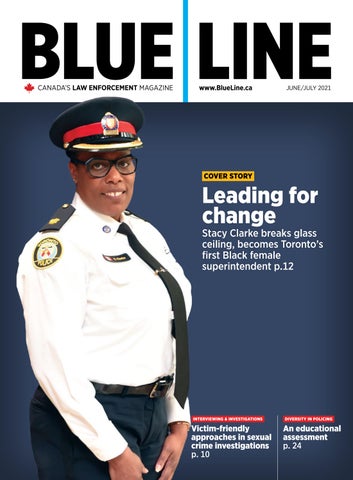
COVER STORY
Leading for change
Stacy Clarke breaks glass ceiling, becomes Toronto’s first Black female superintendent p.12
INTERVIEWING & INVESTIGATIONS
DIVERSITY IN POLICING
Victim-friendly approaches in sexual crime investigations p. 10
An educational assessment p. 24
COMMISSIONAIRES VALUES LAW ENFORCEMENT EXPERIENCE Join Commissionaires and put your skills and experience to work to ensure the safety and security of people and property in a wide variety of environments.
COMMERCIAL
EDUCATION
HEALTHCARE
CONDOMINIUMS
MINING SITES
GOVERNMENT
CONSTRUCTION
PORTS
commissionaires.ca
Contents
12 June/July 2021 Volume 33 Number 6
Features COVER STORY
1 2 Leading for change
Stacy Clarke is Toronto Police Service’s first Black female superintendent. She started in the role in an interim capacity last summer during the time when the Black Lives Matter movement took North America by storm. How intersectionality has affected her career and informed her approach to her new role. By Brieanna Charlebois.
14 Evidence-based treatment for stress injuries
Police officers are often exposed to traumatic incidents through their work. The second of this two-part series focuses on defining what is and is not PTSD and profiles evidence-based treatment for officer stress injuries. By Colleen Stevenson.
Columns 4 8 10 18 20 22 28 30
Editor’s Commentary Q&A Interviewing & Investigations Case Law Health & Wellness Behavioural Sciences Technology Back of the Book
Departments 5 5 9 9 29 30
News By the Numbers Dispatches Calendar Marketplace Blue Links
24 Diversity in policing: An educational assessment
The history of diversity in Canadian policing showcases the importance of education as well as hiring minorities and women in law enforcement. By Amy Ramsay.
26 Police who prey
COVER PHOTO: TORONTO POLICE SERVICE
An expose into a predator in uniform. What happens when the protector turns into the perpetrator. By Matthew H. Logan.
20 @Blue_LineMag
22
26 June/July 2021 | BLUE LINE
3
EDITOR’S COMMENTARY BY BRIEANNA CHARLEBOIS
www.BlueLine.ca
Diversity and the police service
T
here’s no question that the past suggestions as to why the push, which year has been challenging for started decades ago, has not been as suclaw enforcement. Fears of con- cessful as desired. The Back of the Book tracting and spreading the virus also features a story about Women in Law were compounded last summer when Enforcement’s Cross-Canada Wisdom worldwide protests and calls to “defund Web, which provides future female leaders the police” erupted in response to the with a place to seek advice, including how death of George Floyd at the hands of law to navigate a male-dominated workplace. enforcement officers in MinAnother trend within this neapolis. After Floyd’s death Diversity in issue examines the current last May, the perception of policing covers state of public perception. police trickled over the border. both women While this can be disheartenIt has indisputably taken a toll and racial/ ing, it can also be used as a on officer morale. Police faced ethnic catalyst for positive change more scrutiny than ever before minorities. and evolution within the seras calls for change echoed vice. The push for diversity has around the world. been top of mind in policing for years. This month’s theme is diversity in poli- Statistics show that there has been much cing. It’s perhaps the most timely topic, as improvement but, as many of our conpolice interaction with people of colour tributors this month note, the work has remains in the spotlight. Diversity within only just begun. the police service is a vital part of this It’s important to recognize that the push conversation. This includes women and for more diversity isn’t isolated to police— racial/ethnic minorities. Stacy Clarke, even though it may be felt more acutely in Toronto’s first Black female superintend- law enforcement agencies in light of recent ent, encapsulates both. Her own inter- events. For instance, like many of you, I, sectionality has played a role in her journey as a journalist, have also been afforded the through the ranks. It’s also what she privilege of forging relationships within credits for her much for her success—and various diverse communities. Just as is the for “breaking the glass ceiling”. Her depar- case with policing, journalism requires ture from the “typical” image of an officer gaining the trust of community members. allowed her to form strong relationships It’s vital to build strong relationships with in diverse communities, aiding her in her those whom I cover—or serve, if you will. work. This, however, was challenged last But, we definitely aren’t the only ones. June during a Black Lives Matter protest There has been a cultural push in recent in Toronto when she was called a “traitor years to include more women and minorto her race” for choosing a career in poli- ities in leadership positions. Many profescing. Instead of reacting, she displayed sions have been actively working toward compassion and patience in an effort to the same goal. bridge the trust gap that had formed beThat noted, it is nice to work in profestween the police and the public. She advo- sions that provide the opportunity to cates for change through example—and connect with others—especially in the leadership. This all begins (but doesn’t current state of today’s world, when most end) with recruiting. are feeling the effects of pandemic isolaIn another feature story this month, tion. Make no mistake, it does take time Amy Ramsay, the founding president of and effort to make connections, but it’s the Ontario Women in Law Enforcement, always worth it. provides an educational assessment of diversity in policing. She examines the Correction: Blue Line April’s cover story relevance of education in recruiting more misprinted the date of the Temperance Act. It women and minorities, and provides was officially passed in 1916 in Canada.
CONNECT WITH BLUE LINE
www.BlueLine.ca 4
@Blue_LineMag
BLUE LINE | June/July 2021
BLUE LINE
www.facebook.com/BlueLineMagazine
Reader Service Print and digital subscription inquiries or changes, please contact Beata Olechnowicz, Audience Development Manager Tel: (416) 510-5182 Fax: (416) 510-6875 email: bolechnowicz@annexbusinessmedia.com Mail: 111 Gordon Baker Rd., Suite 400 Toronto, ON M2H 3R1 GROUP PUBLISHER/VP SALES | MARTIN MCANULTY mmcanulty@annexbusinessmedia.com PUBLISHER | ADAM SZPAKOWSKI aszpakowski@annexbusinessmedia.com EDITOR | BRIEANNA CHARLEBOIS bcharlebois@annexbusinessmedia.com EDITORIAL DIRECTOR EMERGENCY SERVICES GROUP | LAURA AIKEN laiken@annexbusinessmedia.com ACCOUNT MANAGER | JANICE EATON jeaton@annexbusinessmedia.com MEDIA DESIGNER | GRAHAM JEFFREY gjeffrey@annexbusinessmedia.com ACCOUNT COORDINATOR | KATHRYN NYENHUIS knyenhuis@annexbusinessmedia.com COO | SCOTT JAMIESON sjamieson@annexbusinessmedia.com ANNEX BUSINESS MEDIA 111 Gordon Baker Road, Suite 400 Toronto, ON M2H 3R1 Tel. 416-442-5600 • Fax 416-442-2191 Publication Mail Agreement No. 40065710 ISSN 0847-8538 Printed in Canada SUBSCRIPTION RATES Canada — 1 Year $31.50; 2 Year $52.50 plus tax USA — 1 Year $136.50 CAD Occasionally, Blue Line will mail information on behalf of industry-related groups whose products and services we believe may be of interest to you. If you prefer not to receive this information, please contact our circulation department in any of the four ways listed above. Annex Privacy Officer Privacy@annexbusinessmedia.com; Tel: 800-668-2374 © 2021 Annex Business Media. All rights reserved. Printed in Canada. No part of the editorial content of this publication may be reprinted without the publisher’s written permission. Opinions expressed in this magazine are not necessarily those of the editor or the publisher. No liability is assumed for errors or omissions. Readers are cautioned and advised that articles presented herein are edited and supplied for your personal awareness and should not be used for further action until appropriate guidance is received from a supervisor, Crown Attorney or other persons in authority. All advertising is subject to the publisher’s approval. Such approval does not imply any endorsement of the products or services advertised. The publisher reserves the right to refuse advertising that does not meet the standards of this publication.
NEWS CANADA
Sports betting laws
CANADA
Domestic Violence calls
Between 2014 and 2016, Julie Waters’ abuser— and then-boyfriend—socially isolated her, and made her feel as though she couldn’t trust law enforcement. He held her captive in her Hyundai Elantra and physically assaulted her daily for about ten months before she was able to escape. Though Waters’ story is horrific, it isn’t uncommon (sadly, it was also not the last time she survived an abusive relationship). Though her experience took place years ago, intimate partner violence (IPV) has skyrocketed in recent months. Many experts suggest this increase is the result of isolation associated with stay-at-home orders. The Canadian government, which lists violence against women as one of the most significant societal issues endangering Canadians’ health and well-being, confirmed the pandemic made the problems more severe. A recent Statistics Canada analysis of data collected from 17 Canadian police forces found that calls related to domestic disturbances rose by almost 12 per cent between March and June of 2020 when compared to the same four months in 2019. This created additional challenges for police. Waterloo Police Inspector Terri Turner
said the main reason police dread IPV calls is because they’re often unpredictable. “You have no idea what the range of emotions are going to be. It could be a verbal argument or a physical assault, but it could also be a homicide—and it can also change while you’re on scene,” Turner said. In 2008, Waterloo police formed a domestic violence unit with 20 officers trained in risk management, trauma informed interviewing and other areas related to IPV. Turner explained that typically, the Patrol Unit responds to the call but once it’s determined that charges will be laid, the IPV unit takes over. “Since the unit was created, we’ve had about 6,000 domestic calls a year. Ultimately, it’s important that we focus on getting the offenders into therapy and treatment as well as the victims,” she said. Some provinces have begun taking steps to combat the issue. For example, Quebec, where 10 women were reportedly killed by their male partners in the first four months of 2021, announced a $223 million investment over five years in the fight against domestic violence. To watch the full webinar, visit Blue Line’s YouTube channel: https://www.youtube.com/ watch?v=m6YFes7_utA
Bill C-218, also known as the Safe and Regulated Sports Betting Act, was passed by the House of Commons on April 20. Now in the Senate, if passed, it would legalize gambling on a single sports game. Currently, Canadians can only place parlay bets that cover multiple games, so people skirt the law by using offshore betting services and websites to gamble on sporting events. “The industry has wanted this change for over a decade because we’ve seen the rise of offshore betting and illegal betting operations,” said Paul Burns, president and CEO of the Canadian Gaming Association. “The modernization of this law would level the playing field. The real benefits are that it gives greater consumer protection and oversight, regulation of the operation sports wagering, and it would create jobs and economic opportunity in communities, especially those with gaming facilities now.” Burns said that, each year, Canadians spend about $4 billion through offshore sports books and another $10 billion through operations in Canada run by organized crime. “Just like what was happening with marijuana before legalization, we’re dealing with a product that millions of Canadians spend billions of dollars on illegally but, with sports betting, the laws haven’t really kept pace in the same way,” said Burns. But, not everyone is convinced it will curb illegal gambling operations. Among them is organized crime specialist Stephen Metelsky. “I don’t think it’ll have a real impact on organized crime. Drugs and gambling are
BY THE NUMBERS
PH0TO: VADIMGUZHVA / ADOBE STOCK
The annual femicide report by the Canadian Femicide Observatory for Justice and Accountability was released in March. The report noted that the impact of the pandemic on the numbers is still unclear. Changes may occur as more information emerges. While some service providers reported higher levels of domestic violence calls during the pandemic, the report said emergency funding and supports may have also helped prevent fatalities. To read the full report, visit femicideincanada.ca.
160
women and girls were killed by violence in 2020. This was an increase from 2019, which saw a total was 146 femicides. The average over the past five years remains the same — one woman or girl is killed every 2.5 days in Canada.
@Blue_LineMag
54%
of women and girls killed were in non-urban regions of the country, compared to 46 per cent in urban centres (despite the greater representation of urban dwellers in Canada). The highest rates of women and girls killed by males (accused) were in the Northwest Territories, Nunavut and Nova Scotia.
36
intimate partner femicides reportedly occurred across the country in 2020, a drop of 13 from the 49 reported in 2019. The relationship shared between primary victims and accused was reported in the media in 64 per cent of cases. Of these, 50 per cent involved a current or former male partner and 26 per cent involved male family members of the primary victim.
19%
of the victims were 55-64 years of age, 17 per cent aged 25-35 and 16 per cent were aged 35-44. When compared to their representation in the population, women aged 25-64 were overrepresented as victims. The largest proportion (25 per cent) of the males accused were aged 25-34.
June/July 2021 | BLUE LINE
5
NEWS ONTARIO
two things the government will never be able to fully control through legalization, or be able to thwart the involvement of organized crime. If anything, Bill C-218 will allow the hardcore gamblers to put down additional bets on single games,” Metelsky said. “At the end of the day, if they need a loan they cannot get legitimately, organized crime is ever present to accommodate through loan sharking. It is the tertiary crimes that spill over from gambling through unpaid debts, assaults, extortion, frauds or murders.” Editor’s Note: Bill C-218 was still in the Senate when this issue went to press. ONTARIO
Toronto reports increase in hate crimes
In April, the Toronto Police Service released its Annual Hate Crime Statistical Report, which revealed an unprecedented increase in hate crime reporting in 2020. It showed a 51 per cent increase—139 in 2019 and 210 in 2020. In 2020, the Jewish community, followed by the Black community, LGBTQ2S+ community and the Asian/Chinese communities were the most frequently victimized groups. The number of anti-Asian hate crimes increased from three reported in 2019 to 15 in 2020. There was also an increase in hate crimes committed online (eight in 2019 to 21 in 2020). There were 43 anti-Black hate crimes in 2020, an increase from 13 reported in 2019. Mischief to property, assault and criminal harassment were the most commonly reported criminal offences motivated by hate. “Hate crimes not only victimize an individual but also the entire group they identify with. We know this can have a long-lasting impact on 6
BLUE LINE | June/July 2021
the diverse communities we serve, resulting in increased isolation, stress and vulnerability,” said TPS Chief James Ramer. “One hate crime is one too many. As a service, we have taken steps to address this concerning increase by expanding the capacity of our dedicated Hate Crime Unit who are specialized in investigating these crimes.” The service noted that officers have taken part in various training, educational and community outreach initiatives to address the issue, including town halls, community consultative committees and the Neighbourhood Community Officer Program. Community members are also being encouraged to report incidents of hate, prejudice and bias to police, and work together with police to eliminate these crimes. “We remain committed to working collaboratively within our Service and with our community partners, in a transparent and inclusive way, to build trust and encourage the reporting of hate crimes,” said Ramer.
Ontario plans to increase penalties for speeding, stunt driving and other traffic violations, saying it has seen a spike in the offences since the pandemic hit. In April, the Ontario government introduced legislation that would, among other things, increase vehicle impoundment times and lengthen licence suspensions. The legislation would see roadside vehicle impoundment increase from seven days to 14 days, and roadside driver’s licence suspensions extended from seven days to 30 days. It also introduces escalating post-conviction licence suspensions, up to a lifetime ban for a fourth infraction. It would also lower the threshold for laying street racing charges for those travelling 40 km/h or more above the posted limit on roads where the speed limit is less than 80 km/h. The government reported that stunt driving offences have been on the rise since 2015, with a large spike seen last year. Police laid 796 stunt driving charges in Toronto between March 1, 2020 and Dec. 31, 2020, an increase of 222 per cent over the same period in 2019. The government also plans to introduce measures to protect vulnerable road users, such as pedestrians and highway workers, improve truck safety and strengthen the province’s oversight of the towing sector. If passed, the Towing and Storage Safety and Enforcement Act would require tow operators, tow truck drivers and vehicle storage operators to be certified, and set new standards for customer protection and roadside behaviours, including penalties for non-compliance.
www.BlueLine.ca
PH0TO:(TOP);REDPIXEL / ADOBE STOCK; BOTTOM); KALYAKAN / ADOBE STOCK
Province plans for harsher penalties for speeding, stunt driving
The Gold Standard in
Executive Level Security Training
Working with top educators to deliver a practical approach to professional certification programs. Brought to you by Paragon Professional Institute (PPI), in partnership with University of Waterloo - Professional Development, and collaboration with professional educators from Schulich School of Business, DeGroote School of Business, Wilfrid Laurier University and George Brown College. Learn more at: https://www.ppieducation.com
Watch the PPI Launch Event Video
www.ppieducation.com
Q&A
Q: What are the biggest issues in the leadership development sector?
The CPC is undergoing a modernization of all our courses. Within the context we’re living in right now, with so much uncertainty, leadership development has really evolved and people are seeing leadership development as much more of a necessity. The recognition of the impact that good leadership has on an organization has now been pushed front and center.
Q: What were the biggest takeaways from the CPC’s needs analysis of current national training standards?
It was a very robust analysis. We hired an independent researcher to do a literature review and worked with a professor from Carleton University, who conducted over 25 interviews with police chiefs to see where there are gaps within policing leadership development. We also conducted interviews about six months after they took a course to see how the programs influenced their behavior and organization. There were two main takeaways. First, there is a recognition of the need for leadership development at all levels. It’s about really focusing on leadership development and not management training, though there is a need for that as well. The second piece is the focus on interpersonal awareness. When you think about leadership, you think of the three C’s: character, competencies and commitment. We tend really focus on competencies but the other two that typically don’t get as much 8
BLUE LINE | June/July 2021
Stacey Moreau, director of the Leadership Development Centre at the CPC.
attention but are becoming a larger focus now. The character piece is becoming increasingly important. Competency focuses on what leaders can do, while character focuses on what leaders will do in different situations. In policing, the character piece is so important because we need to have leadership at all levels. The commitment piece speaks to both the individual and organizational piece. It’s becoming important because organizationally, a culture has to want to grow. It’s vital for organizations to look at themselves to see if they’re doing everything they can to support strong and capable leadership.
Q: What feedback did you receive from law enforcement leaders and what does CPC plan to do to address it?
Four main things came out of it: return on investment, continuous
“Four main things came out of the analysis: return on investment, continuous learning, interpersonal awareness and the importance of partnerships.”
This episode of Blue Line Podcast was sponsored by Wilfrid Laurier University. To listen to the full podcast, visit blueline.ca/podcast.
learning, interpersonal awareness and the importance of partnerships. For the first one—return on investment—at the CPC, we’re looking at how organizations can get involved in mentoring and how the CPC can support them in that mentoring relationship. We’re looking at it from an organizational capacity, not just the individual capacity. Right now, we’re exploring the development of a research and knowledge center so when somebody needs something, they can actually go at the moment when they need to find some resources, at which point we might be able to support them in their learning and leadership development. The second one is continuous learning. Not everyone needs a year-long course. It depends on the individual and sometimes people just want to develop a specific area. So, we’re going to continue the longer courses going forward but complement that by offering other workshops on specific competencies. The third is the interpersonal awareness piece and that’s about how we can support people in developing certain aspects of their character, strengthening certain areas and help them identify their strengths and areas they need to work on to ensure you’re creating a team environment where everyone’s strengths complement each other. The fourth piece focused on partnerships, which will really allow for great sharing of information and create the possibility for new and innovative ideas. Editor’s Note: This interview has been edited for clarity.
www.BlueLine.ca
PHOTO CREDIT: CANADIAN POLICE COLLEGE
Stacey Moreau is the director of the Leadership Development Centre at the Canadian Police College. The CPC recently conducted a needs analysis of national training standards focused on modernizing the approach to leadership development. In a recent Blue Line: The Podcast, Moreau joined editor Brieanna Charlebois to review its findings and discuss the future of leadership development in Canadian policing. The following is an excerpt from the podcast.
NEWS DISPATCHES After 34 years of service, Deputy Chief Constable Laurence Rankin of the Vancouver Police Department (VPD) retired. He joined VPD in 1987 after completing the Criminal Justice Program at Langara College. Throughout his career, he held numerous positions: constable, detective, sergeant, staff sergeant and inspector. He also worked in Patrol, the South Crime Unit, the Emergency Response Team, the Justice Institute of B.C. Police Academy as an instructor, in the Domestic Violence and Criminal Harassment Unit, the Home Invasion Task Force, the Sex Crimes Unit, the Polygraph Unit, the Homicide Unit, the Professional Standards Section, Major Crime Section and Personnel Services. He was promoted to deputy chief constable in 2016, assigned to the Investigation Division. Rankin officially retired in May. At their general meeting in April, Serving with Pride announced the appointment of four new board members. Stephen Reid, the executive director for the Police Association of Ontario, was announced as co-chair of the organization. Carmen Wong, who began her career with the Toronto Police Service in 2005 and is currently the LGBTQ2S liaison officer for the Toronto Police Service, was appointed to the board of directors. Noah Clouthier and Jesse Castle were also both appointed as youth directors. After acting in the role for a year, the Cape Breton Regional Police Service announced the official appointment of Robert Walsh as police chief in April. Walsh has been a police officer for 30 years and has worked on patrol, in traffic services, street crime and drug enforcement, and major crime investigations and emergency response. He also served briefly with the RCMP. Most recently, he served as deputy chief before being named acting chief in February 2020. Fiona Wilson, a 22-year-member of the Vancouver Police Department, was promoted from superintendent to deputy chief constable in April. Wilson joined the department in 1999, where she worked as a patrol constable in several operational districts. Early in her career, she also worked as an investigator in the Sex Crimes Unit and on two major @Blue_LineMag
CALENDAR projects that successfully disrupted regional organized crime groups. She was promoted to sergeant in 2009 before returning to the Operations Division and later assigned to the Professional Standards Section. In 2012, she joined the Major Crime Section as a sergeant and went on to work with the RCMP Federal Serious and Organized Crime Unit as a team leader in charge of an international drug investigation. In 2016, she was promoted to staff sergeant and served in the General Investigation Section. Upon promotion to inspector in 2017, she worked as the officer-in-charge of Court and Detention Services. Wilson implemented improvements in training and policy and led a comprehensive review of the Jail Manual of Operations. She was promoted to superintendent in March 2019 and represented the VPD on secondment as a deputy chief officer with the Combined Forces Special Enforcement Unit – British Columbia. In January 2021, she became superintendent in charge of Investigative Support Services. In her new role as deputy chief constable, Wilson will head up the Investigation Division within the VPD. Lynn Noftle was promoted from inspector to superintendent of the Vancouver Police Department in April. She began her career with the VPD in 1998 after graduating as valedictorian of her class at the Justice Institute of British Columbia. She worked as a constable in District 1 for five years before being transferred to the Drug Unit. Noftle spent four years as a school liaison officer and returned to patrol as an acting sergeant for the Beat Enforcement Team in 2011. In 2012, she was promoted to sergeant. She was selected to develop and implement the Community Safety Program in 2013 and transferred to the Mental Health Unit in 2014. Noftle was then promoted to staff sergeant in 2016, assigned to the Youth Services Section. She was promoted to inspector in 2017 and was transferred to her current position as inspector of District 2 in 2019. PROMOTIONS, RETIREMENTS, RECOGNITION • If you have an officer in your agency recently promoted or retiring or an individual you wish to have recognized (major award or recently deceased) you can let Blue Line magazine know by emailing: bcharlebois@annexbusinessmedia.com.
NOTE TO READERS: check with all organizers as COVID-19 continues to affect events.
Bi-weekly Laurier Webinar Series: Online public safety programs June 8-22, 2021 Virtual online.wlu.ca Canada’s 911 Ride – Atlantic 2021 June 12-13, 2021 Truro, N.S. canadas911ride.com International Association of Directors of Law Enforcement Standards and Training 2021 Conference June 13-16, 2021 Fort Worth, Texas www.iadlest.org Tenth National Conference on Critical Perspectives in Criminology and Social Justice June 17-18, 2021 Quebec City, Que. www.criticalcriminology.ca Canadian Society of Forensic Science Conference and AGM June 21-24, 2021 Virtual www.csfs.ca/conference LEOSH 2021 Conference June 24-25, 2021 Saint John, N.B. leosh.org FBINAA National Training Conference 2021 July 7–10, 2021 Orlando, Fla. fbinaa.org IACP 2021 Sept. 11–14, 2021 New Orleans, Louisiana theiacpconference.org IAWP 59th Annual Training Conference Sept. 20–24, 2021 Niagara Falls, Ont. iawp.org Find more calendar events online at blueline.ca/events.
June/July 2021 | BLUE LINE
9
Victim-friendly approaches in sexual crime investigations By Davut Akca
S
exual assault is one of the most underreported crimes in Canada. According to the 2014 General Social Survey results, sexual assault accounted for 10 per cent of all violent self-reported incidents, however, the majority (83 per cent) of sexual assault cases were not reported to police. A 2017 study by Justice Canada examined the reasons sexual assault victims did not report to the police. Reasons provided by the victims in the study included the belief that they would not be believed if they reported, they felt ashamed or embarrassed, they did not know they could report the abuse and they had no family support. To eliminate the barriers to reporting sexual assaults and to enhance the cooperation of the victims with police, appropriate investigation approaches and interview techniques need to be used. In sexual assault cases, the account of the victim is usually the primary— and in some cases, the only— source of evidence. Therefore, the interviewer has the crucial role in responding to allegations of sexual violence as the victim’s first point of contact within the criminal justice system. In December 2019, the Canadian Association of Chiefs of Police (CACP) launched the Canadian Framework for Collaborative Police Response on Sexual Violence, which aims to provide Canadian police departments with guidelines on evidence-based, trauma-informed and victim-centered investigations. The purpose of 10
BLUE LINE | June/July 2021
A victim-friendly interview room was recently launched by Battleford, Sask., police.
this framework is to ensure that the police response to allegations of sexual violence is coordinated, effective and victim-centred. One important requirement of this trauma-informed approach is facilitating the interview process for the victim so that they can trust the police and eliminate any prior negative experiences the victim may have had with the police and/or barriers caused by the sensitive nature of their victimization. Positive treatment from the interviewer will affect the victim’s decision to continue and cooperate throughout the investigation process. The framework suggests the investigation units provide the victims with the opportunity to be interviewed by members of the gender of their choice whenever possible. Indeed, research on victim preferences in investigative interviews provide evidence supporting this recommendation. In a recent study conducted in the Alert Lab (a forensic psychology lab at Ontario Tech University led by Dr. Joseph Eastwood), we examined whether mock sexual assault victims’ preferences for vari-
“Positive treatment from the interviewer will affect the victim’s decision to continue and cooperate throughout the investigation process.” ous police interviewer characteristics would affect their hypothetical reporting behaviour. Based on the responses of 164 participants, we found that participants would be more willing to report their experiences to police if they are given the chance to be interviewed by their preferred interviewer. Participants also indicated that if they were provided with their preferred interviewer, they would feel more comfortable and provide more detail about the event. Female participants had a stronger tendency than males to prefer to be interviewed by an officer similar to themselves in terms of age and gender. Another suggestion of the framework to Canadian police departments was finding a suitable and private place that provides safety for the victim and minimizes re-traumatizing factors that might stem
from interacting with several police officers. One of the initial responses to this call was implemented in Saskatchewan this year. In January, Saskatchewan RCMP announced that they launched a new project in partnership with the Battleford and Area Sexual Assault Centre (BASAC) to create a barrier-free and friendly interview space for sexual assault victims. This new project aims to enhance the capacity of the police to gather extensive information in victim interviews by breaking down barriers and encouraging victims to come forward. The new space is located in the BASAC. The RCMP unit would come to the space for victim interviews—all victim interviews also include the presence of a counselor. There is a welcoming waiting area where children of the victims are supervised by the centre staff and provided with books and toys while their parent is being interviewed. The outcome of this new interview space project is not yet known. However, trauma-informed approaches like the BASAC’s victim-friendly interview space look promising in terms of eliminating the barriers to access to justice for the sexual assault victims. Based on the findings in the lab study, victim preferences on interviewer selection should also be considered in developing victim-friendly approaches in sexual assault investigations. A closer collaboration between researchers and the stakeholders of the sexual assault investigations will build on these new initiatives and research studies through an evidence-based lens Davut Akca is a research officer at the University of Saskatchewan’s Centre for Forensic Behvioural Sciences and Justice Studies. To hear more about his technique, share your expertise or find out how you can get involved, contact him at davut.akca@usask.ca.
www.BlueLine.ca
PHOTO CREDIT: BATTLEFORD AND AREA SEXUAL ASSAULT CENTRE
INTERVIEWING & INVESTIGATIONS
MOUNTING AND VEHICLE EQUIPMENT SOLUTIONS FOR THE FORD F-150
2021+ FORD F-150 WIDE BODY CONSOLE BOX
Item No. 7160-1626
2015+ FORD F-150 VEHICLE BASE
Item No. 7160-0554
2015-2020 FORD F-150 PASSENGER PARTITION Item No. 7160-1402
RUGGED. RELIABLE. RESPONSIVE. Gamber-Johnson is proud to offer rugged mounting and vehicle equipment solutions for the Ford F-150. We offer several console designs to meet your mobile workspace needs as well as dash mounts, rugged push bumpers, window barriers, and passenger partition for the 2015-2020 Ford F-150. To find a dealer in your area visit www.gamberjohnson.com/FindAReseller
2015-2020 FORD F-150 ALUMINUM PUSH BUMPER WITH LIGHT BAR Item No. 7170-0787-04
COVER STORY
Leading for change Stacy Clarke breaks glass ceiling, becomes Toronto’s first Black female superintendent By Brieanna Charlebois
12
BLUE LINE | June/July 2021
to. It’s been 24 years since and she’s never looked back. Her early days were spent working in the Community Response Unit and Youth Bureau and Intelligence. She then spent four years between the Homicide and Divisional Policing Support Units before being transferred to the Police College in 2008. Two years later, she was promoted and was assigned as a sergeant at the 13 Division. In 2012, she was transferred to 22 Division where she worked in the Primary Response Unit and the Detective Office. She was promoted again in 2016 to staff sergeant, where she led the Learning Development and Standards Section at the Police College before moving into the senior ranks assigned to 14 Division as the second in command. This is where she worked when George Floyd died last May.
The impact of George Floyd
Clarke was at work when the video of Floyd’s death began circulating online. When she finally watched it in its totality, she said she was “shattered.” “I didn’t know what to do with myself because I have kids who were asking questions and there was no book on this one. Then, I thought of the members in my organization.” In recent decades, there have been several cries for change regarding police-Black civilian interactions across the United States but there hadn’t been a lot of legal accountability for police. The Floyd case was different.
“If there’s no one on the inside to amplify the voices on the outside, change can’t happen.” When protests erupted around the world, police had the uncomfortable task of monitoring them. While some found this unbearably awkward, when Clarke was targeted, she didn’t take the comments personally. “Police got painted with one brush but I recognized that they were upset at my uniform and what it represents, not by me personally,” she said. “I was emotional at some points too because I felt a lot of the pain that the community was feeling.” She embraces emotion and always assures inquirers that being human doesn’t make officers “weak.” In fact, she believes this is a common and detrimental misconception. “I think it’s important to show emotions and humanity in dynamic situations,” she www.BlueLine.ca
CREDIT: TORONTO POLICE SERVICE
I
n an outcry heard around standing diverse communities, the world in response to and to her success in moving the killing of George Floyd through the ranks, ultimately on May 25, 2020, in Min- breaking the glass ceiling by neapolis, Minn., thousands becoming a superintendent. took to the streets to advocate for police reform. Law en- Career trajectory forcement, including Toronto Clarke began her career at the officer Stacy Clarke, attended age of 21 after graduating from demonstrations in uniform to the University of Windsor ensure civilian safety. Insults with a degree in psychology like, “You’re a shame to your and criminology. Around that race!” were hurled at her but, time, TPS had started making rather than taking offence, the a concerted effort to hire more 24-year veteran saw it as an women and minorities. Because Clarke had a opportunity to empathize with their pain, university degree and exemplify leadership was a competitive and consider the contrack athlete, recruitfrontation a teachable ers considered her a moment; an opportungreat candidate. ity to bridge the gap “When I was first between the badge and approached about Supt. Stacy Clarke the community. joining, I told them I’d “I agreed that changes are never even considered a career needed, but explained that it’s in policing because I’d never not something that can be met a Black female police offidone solely from the outside,” cer,” she said. Though her plan was to purshe said. “If there’s no one on the inside to amplify the sue a law degree, she said what voices on the outside, change finally convinced her to join the force was a conversation with can’t happen.” Clarke was recently promot- Terry James, Toronto’s first ed to superintendent and is Black female police officer (renow one of the highest-ranking tired in 2010). “She said a sentence that has Black police officers in Canada. She’s also the second Black fe- driven me throughout my camale superintendent in the reer and ultimately led me to country’s history and the first where I am today,” Clarke exto hold the rank within the plained. “She said, ‘You’ve got Toronto Police Service (TPS). to be a part of the solution, not She said situations like what the problem’.” So, Clarke decided she would she experienced at last summer’s protest exemplify the commit to five years within the value of strong community re- service and would then reconlations. She attributes her lived sider pursuing law. She officialexperience as a Black woman to ly began her career on April 14, better connecting and under- 1998 at the 51 division in Toron-
PH0TO: ALESSANDRO BIASCIOLI / ADOBE STOCK
said, referencing the protest. “It shouldn’t be either/or.” Clarke succeeded in transmitting this message, not only through words but through action. With the organizer’s blessing, she led a march with a group of protesters on their route from the Christie Pits neighbourhood in Toronto to police headquarters. For her, this was a chance to exemplify leadership to the community and to fellow officers. “I think it’s important for police to be a part of the community. We’re here to serve first, then to protect,” she said. “I felt that if I was silent, I was complicit. It was an opportunity to show the public that members of this organization are here every day, trying to do the right thing. We don’t always do it right, but we are determined to try.” But, this type of reaction wasn’t isolated to Clarke. She said she was very proud of the way her unit responded to similar situations and to adversity, but said it didn’t happen overnight. Having predicted an event of this nature, she had started having conversations about inequity and @Blue_LineMag
inequality within her division. “We had been having conversations about racial inequality within our division for a while, so they were ready for it,” she said. “At the time, I honestly didn’t know I was preparing them for anything, but I had instilled within our members that we had to get comfortable with the uncomfortable; that we can no longer, as a policing agency, think that we can enforce our way out of all of this. We just can’t.”
Promotion to superintendent
Clarke was appointed to the role of superintendent in the Community Partnerships & Engagement Unit in an interim capacity last July and was appointed the permanent position in February. “I’m still not over it, but recognizing there are only two of us in all of Canada makes you stop to think. It’s clear that opportunities just aren’t afforded to women or minorities in the same way and, if you don’t have the opportunity to showcase your skills or resources in the same way as your colleagues, you can’t fulfill your potential.”
Clarke broke the mold. Now, in her new role, she’s using her voice to share her story and speak out on issues. She admits to facing adversity throughout her career, particularly due to her intersectionality. For instance, she had to plan when— and if—she would or could have children and how that would affect her career (what unit she was in, how long it would take her to return to full capacity, etc.). She also had to deal with unconscious bias and (often unintended) alienation that came with being one of the only Black female officers in the field. Now, she’s working to change public perception and bridge the trust gap that’s eroded between police and the public for years. This, she said, starts at home—inside the service. An advocate for leadership embracing progression and setting the tone within their service, she’s been calling for police to have discrimination discussions for years. She said she also started pushing for more nuanced diversity training around 2015. “We’ve always had diversity training but I’ve been saying it needs to be more progressive. It needs to be training that allows us to reflect on our own unconscious biases, to be uncomfortable and examine what the delivery of policing services looks like, recognizing we all have different lived experiences and the relevance of intersectionality.” This is why, she said, there’s also a greater push for more diversity in recruitment. People tend to feel more othered when they can’t relate to authority figures. In fact, she was actively working to recruit about seven Black candidates last spring, most of whom dropped out after the death of Floyd, citing community pressures. Clarke believes that officers are the best tools for recruit-
ing, but if officers don’t feel safe, they won’t be good advocates for the service. “The reason why we’re having such an issue with trust in the communities is because we have an issue with trust within our own organization. We need to recognize that this needs to be addressed in a very methodical way because you can’t fix outside unless you fix inside,” she said. “We need more diverse voices at the table. Culture takes a long time to shift, but we can’t do that if we’re not at the table.” Throughout her 24 years, Clarke has felt a major cultural shift within TPS since joining but said there is still work to be done. According to Clarke, the key is diversity in recruitment. “I’ve definitely seen a change but we’re still struggling with inclusivity throughout the ranks, both on the racial and gender side. I think we can do better. It’s time.”
A catalyst for change
On April 20, after three weeks of testimony from 45 witnesses, a 12-member jury found the ex-officer Derek Chauvin, 45, guilty on all three counts he faced for his role in the death of Floyd. Clarke said she avoided watching the trial as it was too painful to relive the events in lurid detail, but she did watch the verdict. “I expected to feel relieved but I didn’t. We’re still waiting to see what the sentence will look like but I was able to tell my kids that is justice.” Floyd’s death, she said, was a pivotal moment in history; a call for evolution within police forces in the United States and abroad. This change, she said, starts with leadership. “At the end of the day, this verdict is just acting as a catalyst for change,” she said. “It’s not going to bring George Floyd back but it’s definitely a step in the right direction.” June/July 2021 | BLUE LINE
13
MENTAL HEALTH
Evidence-based treatment for stress injuries By Colleen Stevenson
A
ll law enforcement officers have been or will be exposed to highly traumatic events over the course of their career. Most of the time, officers will experience symptoms within the weeks following a traumatic event—most people do. It’s normal to be deeply impacted by horrible situations and experiences. Images of the event will be stuck in your mind, you will have nightmares and poor sleep, you will be distracted, you will question your actions and motives, you will be on edge and you will retreat socially. This is essentially how we recalibrate and figure out how to make sure we are never in that situation again. It’s how we’ve evolved to protect ourselves and learn from dangerous situations—we step back, reassess the world and our place in it. We relive the 14
BLUE LINE | June/July 2021
event until we can make some sense of it, then we move on with better awareness and understanding. This is known as natural recovery. Sometimes, however, we get stuck. The mechanisms that we use to recover simply won’t shut off. Put simply, Post Traumatic Stress Disorder (PTSD) is a dysregulation in the nervous system where the stress response does not shut off long after the threat or danger has passed. We get stuck in that fight, flight or freeze response, locked in an endless loop of reliving the worst experiences of our lives. Think of stress response like a smoke detector. It’s a very good thing to have and it’s difficult to imagine wanting to live in a home without one. That would be reckless and dangerous. So, let’s pretend we left a pan of food on the stove. The alarm goes off—exactly what it designed to do to
keep us safe. But, if the smoke detector then starts misfiring and going off frequently or at random, it would no longer be helpful and would make it really hard to relax in our home. That is what happens with PTSD. It is important to understand that this is not a conscious decision. No one chooses to have a problem with their stress response system. PTSD is an injury to our stress response system. It is not a mental illness. It is not a disease. It is a result of a trauma that happens to us (originates outside of us and) and, for a myriad of reasons, our recovery becomes blocked. To develop PTSD, a person must have experienced a traumatic event, witnessed a major trauma to others, heard details of a traumatic event happening to a family member/friend, or experienced repeated or extreme exposure to details of trauma www.BlueLine.ca
PH0TO: VIACHESLAV IAKOBCHUK / ADOBE STOCK
This is the second part of a two-part series on stress injuries and their warning signs. Part one focused on the stigma surrounding stress injuries for law enforcement officers as well as the warning signs and possible indicators of a stress injury or PTSD. Part Two addresses defining what is (and is not) PTSD, as well as evidence-based treatment for stress injuries.
reduce (and sometimes eliminate) symptoms. PTSD treatment helps you discover where your recovery is stuck and take the steps to put the trauma in the past. The first two treatments are highly recommended and the third is gaining ground.
to others as a first responder, investigator, lawyer or researcher. Symptoms include: • Re-experiencing events through nightmares or unwelcome/untimely images that come at you unbidden, or experiencing a bodily sense that the event is recurring; • Avoidance of people, places, things, emotions or situations that remind you of the events. Unchecked avoidance often start seeping into every area of your life and soon, nothing feels safe or trustworthy; • Negative thoughts about yourself and the world such as extreme cynicism, self-blame, shame, low trust and over-generalizing about certain groups of people or authority figures; • Hyper-arousal which may show up as constantly scanning for threats/danger, being easily startled, finding it exceedingly difficult to relax or sleep, and/or struggling to focus and concentrate. These symptoms take a huge toll on your body, mind, heart and spirit. Having your worst memories arise unexpectedly can be extremely jarring and upsetting. Many people with PTSD report feeling isolated, lonely and detached from others. Some lose their sense of purpose and meaning. They 16
BLUE LINE | June/July 2021
may be persistently anxious (which often shows itself as chronic irritability or anger) and most have a growing desire to avoid. Let’s be clear: the more you avoid, the smaller your life gets and the worse you feel about yourself. These negative thoughts can easily lead to depression. Violence, abusive behaviour, addictions, lying, cheating and any form of exploitation or manipulation are not symptoms of PTSD. Each of these constitutes a separate issue to be addressed. Clinicians make assessments about the presenting issues and then evaluate which one takes precedence in treatment. For example, if a client develops a severe drinking problem, then addiction is the presenting issue. The addiction needs to be treated by an addictions specialist before any kind of meaningful PTSD treatment (PTSD treatment is very challenging and requires clear thinking). If a client discloses they are using violence against their partner, blaming the violence on their PTSD, the clinician must then assess the risk to the If you are struggling with symptoms of a partner and themselves. They must address stress injury, start by seeking help from a accountability and have some frank and trained therapist who specializes in one of uncomfortable discussions about what is the treatments outlined above. and what is not acceptable behaviour before any kind of PTSD treatment can be con- Colleen Stevenson is a clinical counsellor based in Victoria, B.C., specializing in the treatment of PTSD. sidered. Prior to counselling, she worked as an educator and The good news is that PTSD can be treat- graphic facilitator and worked in Ghana, Mexico and with ed. There are several well-researched and Indigenous communities across North America. She was highly reputed treatments that can help also the trauma counsellor at a maximum-security jail. www.BlueLine.ca
PH0TO: NADIA_SNOPEK / ADOBE STOCK
“PTSD is an injury to our stress response system. It is not a mental illness. It is not a disease. It is a result of a trauma that happens to us (originates outside of us) and, for a myriad of reasons, our recovery can become blocked.”
Treatments include: 1. Cognitive Processing Therapy (CPT) is a structured protocol of 12-15 sessions where you learn skills to identify and confront self-limiting beliefs. CPT builds cognitive skills and flexibility. It focuses on safety, trust, power and control, intimacy and self-esteem. Once complete, you take those skills with you for the rest of your life. 2. Prolonged exposure (PE) is a structured protocol and is usually completed within 8-15 weekly sessions. PE is a behavioural approach that involves rating distress and learning how to approach (rather than avoid) traumatic associations both in and between sessions. Over the course of treatment, clients set up exercises to expose themselves to things they have been avoiding, such as walking through an area of town or listening to a recording of sirens. They repeat these exercises until those things are no longer upsetting, then they can tackle something a little more challenging. Finally, they record themselves recounting their most traumatic memories and listen to it repeatedly until it becomes less distressing. Then they keep going until they have fully “digested” it and can recount the events without becoming overwhelmed. 3. Eye Movement Desensitization and Reprocessing Therapy (EMDR) is a treatment that involves you recounting traumatic memories while simultaneously moving your eyes or hands. The theory is that the movements allow you to focus on something neutral so that you can approach the memories and reprocess them so that they are less psychologically disruptive.
Even the most elusive suspects can’t hide their heat signature. The Reveal ShieldPRO lets you quickly clear a room without putting yourself in harm’s way, find discarded evidence at night, and track suspects in complete darkness. While thermal cameras once represented a significant investment for police departments, Seek Thermal has pioneered the next generation of thermal imaging technology sized and priced for every officer’s belt.
KEY FEATURES
BENEFITS
320 X 240 Thermal Sensor
Safeguard Buildings, Land, and Boarders
Records Pictures To Integrated SD Card
Better Than Night Vision
Long-Range Detection
Personal Safety
3.5 Hour Runtime
Situational Awareness
Durable Design
Recover Evidence
Lightweight & Easy-to-use
Survey from a distance
Gain a tactical advantage
+1 (888) 434.0253 | sales@provix.net | www.provix.net
CASE LAW
BY MIKE NOVAKOWSKI
Failure to preserve evidence results in acquittals
T
he Ontario Court of Appeal has excluded crucial evidence after police destroyed other evidence they felt was not significant to their case. In R. v. Hillier, 2021 ONCA 180, a uniformed officer approached the accused, Richard Hillier, who was walking on the street, to arrest him on a warrant for driving under suspension. Hillier ran so the officer gave chase and grounded him a pool of water. After a struggle, Hillier was cuffed behind his back and sat upright. He was sopping wet. He said he had something in his sock, which turned out to be a prescription pill bottle containing mixed drugs. Soon, other officers arrived on scene to assist and Hillier was searched. Police found cell phones, lighters and cash on his person. His shoulder bag contained multiple non-functional cell phones and cigarette packs, but no drugs. After complaining of shoulder pain, Hillier was double-cuffed to take pressure off his shoulder. He was placed in the back of the police car and driven to the police station. At the station, police noticed a bulge in Hillier’s mouth. It turned out to be a larger than golf ball-sized mass of mixed drugs, wrapped in plastic and weighing 28 grams. The back seat of the police car was also searched. A wet, black pouch (containing more drugs and baggies) was found in the rear seat area at the footwell. No photos were taken before the items were seized from the police car. The drugs were turned over to an exhibit officer, who decided to destroy some of the seized items he felt were biohazardous and not significant. This included the pouch, which had coins inside it, all of the drug packaging material and a vial of suspected cannabis oil. None of these items were tested for fingerprints, nor were photos taken before the items were destroyed. At his trial in the Ontario Court of Justice on numerous drug offences and breach of probation charges, the two transport officers gave differing evidence about their inspection of the police car before starting their shift. One said both officers inspected the car including its footwell without the aid of a flashlight. This officer also said he examined the footwell just before Hillier entered. The other officer said his practice was to crouch down to check the footwell with a flashlight as part of his daily inspection and that he always looked inside before a person gets in but made no note of doing such a 18
BLUE LINE | June/July 2021
check that day. Both testified that Hillier was the first person in their police car that day. The exhibit officer acknowledged in hindsight that the evidence he destroyed ought to have been retained. Hillier testified in his own defence. He said he was an addict and admitted havingdrugs in his sock. He also said he was leaning forward in the police car to relieve the pressure on his injured shoulder when he found a bag in a puddle of water at his feet. Curious, he picked it up, unzipped it and a white ball wrapped in white plastic fell out along with other items. In an effort to avoid being caught with it, he said he then attempted to hide it by putting the ball in his mouth. Hillier sought a stay of proceedings on the basis that his rights under ss. 7 and 11(d) of the Charter were breached because the destroyed evidence was relevant and highly probative. In his view, its loss prejudiced his right to make full answer and defence and impairing his right to a fair trial. In the alternative to a stay, he sought the exclusion of the evidence found in the cruiser. The trial judge rejected Hillier’s submission and convicted him of five counts of possessing drugs for the purpose of trafficking (PPT) and two counts of breach of probation. He was sentenced to eight years in prison. On appeal, Ontario’s top court concluded that the police failed in their obligation to preserve the evidence. Its destruction, resulted from unacceptable negligence and impaired Hillier’s right to make full answer and defence as protected by ss. 7 and 11(d). “In this case, the police did not take reasonable steps to preserve the evidence,” said Justice Nordheimer. “To the contrary, the police purposely destroyed the evidence and did so without taking any photographs of it. The officer who destroyed the evidence said that he did so because [he] ‘just didn’t see the significance in keeping them’. But the officer then fairly added, ‘If I could do it again, I would have kept the brown purse’.” Nordheimer continued, “The fact that the officer considered the items to be a biohazard did not justify their destruction. The police routinely handle all sorts of items that could be considered biohazards, but that fact does not justify their destruction. Drugs themselves are biohazards, but they must be retained in order to prove the offences charged. Indeed, the officer acknowledged that these items could have been saved until
the court proceedings concluded.” In this case, the trial judge did not properly analyze the significance of the items that were destroyed. All three officers provided different descriptions of the pouch, which was the apparent source of the drugs in Hillier’s mouth (and the other items found in the back of the police car). Hillier had also been thoroughly searched at the scene before being placed in the car and was handcuffed to the rear. “In these circumstances, it is problematic how an item, like this fabric pouch, could have been on the [accused’s] person and yet not be found in the course of the search of the [accused],” said Justice Nordheimer. “It is hard to see how an item, described by at least one of the officers as being like a ‘fanny pack’, could have been missed in such a search, especially when one considers what the [accused] was wearing at the time: fitted jeans, a skin-tight shirt, a loose-fitting button-up shirt over top and a small nylon jacket. It is also difficult to understand how the [accused] could have retrieved this item from where it was apparently so well-hidden on his person, given he was handcuffed to the rear throughout his time in the cruiser... If the physical size of the pouch would lead to a conclusion that it could not realistically have been missed in a search of the [accused] person, then that fact would have to pose a serious question whether the pouch was actually in the possession of the [accused]. It could certainly raise a reasonable doubt regarding that fact.” Had the judge been able to see the pouch, it would have assisted in him determining the likelihood that it could have been hidden on Hillier, which would have then assisted in evaluating what happened. As a remedy, the Court of Appeal excluded the evidence found in the cruiser, including the ball of drugs from Hillier’s mouth, under s. 24(2) of the Charter. The convictions related to this evidence were set aside and acquittals were entered. The PPT conviction related to the drugs found on Hillier at the time of his arrest was substituted with a simple possession conviction and he was to be sentenced on this conviction. The breaches of probation convictions were upheld.
Mike Novakowski is Blue Line’s case law columnist.
www.BlueLine.ca
HEALTH & WELLNESS BY ISABELLE SAUVÉ
Procrastination and productivity
A
20
BLUE LINE | June/July 2021
The Zeigarnik effect, named after Soviet psychologist Bluma Zeigarnik, is at play when activities are interrupted. In psychology, the Zeigarnik effect occurs when something that was disrupted or interrupted is more readily recalled. It postulates unfinished or interrupted tasks are better remembered than completed tasks. When this effect is at work, unfinished tasks stay active in our brains, opening the door for novel ideas and creative possibilities. In light of this information, it may be worthwhile to build in strategic lulls as part of project plans, particularly when a task weighs heavily on creativity. It is important to have a plan in place but to remain flexible and let ideas sit for a while. A study conducted by the University of California revealed it takes 23 minutes to recover from a distraction. So, after a healthy break, it’s important to take time to resume deep work that requires significant focus and dedication. During this work, it will be important to plan for uninterrupted blocks of time to focus and return to the grind. Finding creativity through proper project management is a juggling
“It is better to take the right amount of time to plan and properly execute projects than to rush and simply give the illusion of being a productive, highly strategic executive team.”
act. While taking time to think things through is important, waiting until the last minute or going too quickly can be detrimental. Building-in breaks is a great strategy for boosting creativity. Rushing projects can often lead to poor planning and execution. When projects are undertaken without proper consideration, strategy and management are often unsuccessful and costly to an organization. Additionally, when an individual or a unit rolls out poor product, it most frequently leads to loss of credibility and tarnishes the name of a unit or team. It is better to take the right amount of time to plan and properly execute projects than to rush and simply give the illusion of being a productive, highly strategic executive team. Isabelle Sauvé is a 14-year veteran with the OPP, and currently the new Psychological Services Advisor in the OPP’s Healthy Workplace Bureau. She has a MA in psychology and is a PhD candidate. She is also an ultramarathon/ endurance athlete and the Racing the Planet/4 Deserts 2018 Series winner as well as a Guinness World record holder. She can be contacted at: isabelle.sauve@hotmail.com
www.BlueLine.ca
PH0TO: BRO VECTOR / ADOBE STOCK
recent idea, highlighting procrastination as a positive quality has yielded widespread attention online, making waves on social media and podcasting platforms. With a goal of debunking the widely-accepted notion that procrastination is counterproductive and can place projects or endeavours at risk, it actually promotes procrastination as inherently beneficial to the workplace. There are even claims that procrastination has hidden and powerful benefits such as boosting creativity. Let’s be clear, procrastination is the act of stalling. By definition, procrastination is the action of delaying or postponing something. In order words, it is to intentionally put off doing something that should be done. People are confusing two distinctly different matters: procrastination and strategic planning. Strategic planning allows for built in hiatuses or breaks without compromising goals, which can indeed boost creativity, innovation and zest for working on a project. Studies point to a curvilinear relationship between strategic pauses and creativity. Research suggests taking calculated breaks from our work and projects allows us to approach them from multiple angles and with various “lenses”. When we are deeply immersed into our work it can be more difficult to take perspective from multiple standpoints. Completing a project as quickly as possible appears to have a dissuasive effect on creativity. Research conducted at the University of Oklahoma suggests greater creative ideas emerge when we engage in moderate rather than low or high hiatus conditions. Strategically taking breaks from an endeavour opens the door for divergent ideas and nonlinear thinking. Taking some time can allow us to make unexpected gains—many works of genius have been improved by the marination of an idea over time.
ADVERTORIAL
Better Together: Collaboration in Police Training Development The Canadian Police Knowledge Network (CPKN) is a national not-for-profit and a long-time advocate for enhancing collaboration to address common training needs within the Canadian police community. The newly released Methamphetamine and the Precursor Control Regulation course is a compelling example for why the community needs to double down on collaborative approaches for developing training that supports an exceptionally complex policing environment. “We know one size does not fit all in Canadian policing,” says Sandy Sweet, President of CPKN. “We also know communities across the country are struggling with many of the same issues. There are numerous intersections where police services are relying on the same information so members can perform their work safely and effectively.” Methamphetamine is one of those issues of common concern. In 2017-2018, the Canada Border Services Agency reported a 333% increase in methamphetamine seizures. And despite the proverbial wrench that COVID-19 has thrown into the global drug trade, producers and traffickers are still hard at work: in December 2020, Alberta CBSA officers diverted a record-breaking 2.28 million doses of methamphetamine from hitting Canadian streets. Notwithstanding law enforcement’s successes, methamphetamine is pervasive. “Methamphetamine is one of the most significant commodities within organized crime. It’s cheap, it’s abundant, and it’s gaining ground in communities throughout Canada,” says Superintendent Bryan MacKillop, a Director of OPP’s Organized Crime Enforcement Bureau and a member of the Canadian Integrated Response to Organized Crime (CIROC). “The more informed officers and other frontline personnel are about the indicators that characterize meth operations, the better our chance to disrupt the supply chain.” The one-hour Methamphetamine course was produced in partnership with CIROC and in consultation with the Canadian Association of Chiefs of Police (CACP) Drug Advisory Committee. Designed for frontline officers and other enforcement personnel, it addresses indicators of suspected methamphetamine production, production methods, precursor chemicals, and investigative strategies.
The course will play a supporting role in CIROC’s national strategy to disrupt the supply of methamphetamine in Canada. “Producing more learning resources that can be used by any police or enforcement agency in the country is a win-win on so many levels,” says Sweet. “The efficiency, economy, and long-term sustainability of a collaborative model cannot be overstated.” A collaborative approach to producing training like the Methamphetamine course generates critical value in key areas: Access to Expertise CIROC provided a national network of expertise from which all police services will benefit. The Economy of Collaboration Collaborative training development reduces the financial load on individual police services—in fact the course was developed at no cost to police services. Training to a Common Standard Ensuring all officers are working from a consistent knowledge base—that can be built upon or adapted according to service-specific needs— adds value at all levels, from individual officers to the communities they serve. Leveling the Learning Field Putting greater focus on producing nationally-relevant training will increase access to high quality learning resources across the board and enable individual services to invest their efforts on producing supplementary resources to support local operations. Canadian policing is in the midst of unprecedented times. The continually evolving criminal landscape, BLM, Defund the Police, and the economic fallout of the pandemic are all driving substantial changes not only in what police are doing, but how they are doing it. “Greater collaboration will play a significant role in how the police community navigates the road ahead,” says Sweet. “We can’t always predict what’s coming down the line, but we can be sure that we’ll be all the more prepared if we’re working together.” The course is available for $50/learner or can be accessed ‘free’ from an organizational subscription.
For more information or to register visit: Methamphetamine and the Precursor Control Regulation – Canadian Police Knowledge Network (cpkn.ca). For information on an organizational subscription contact: info@cpkn.ca
BEHAVIOURAL SCIENCES BY PETER COLLINS
The psychology of arson: Part two
A
rson continues to pose a significant problem in communities across Canada. The true prevalence of criminal fire setting is difficult to ascertain. It’s hard to detect and prosecute because fire can destroy the evidence of its origin, while intent or recklessness must often be inferred from evidence of an ignition source. In April’s column, we discussed how profiling a fire setter is difficult because the characteristics of arsonists are often too general. Four types of fire setting were presented: excitement-motivated, revenge-motivated, vandalism and the rare phenomenon of pyromania. This issue, we’ll examine crime concealment, profit motivated and extremism arson. These fires are a secondary criminal activity and are set for the purpose of covering up another crime, such as homicide. The motivation is to obliterate forensic evidence such as fingerprints, footprints or DNA, and possibly to make it difficult to identify the victim. Murder concealment is usually a one-time event. Typically, an accelerant is brought to the scene if the arson was planned. A more common form of crime concealment arson is setting a fire after committing a break and enter. Keep in mind that often arsons are mixed-motive—the fire may also involve revenge. In crime-concealment cases, the fires were set using available materials found at the scene such as paper, rags or trash. Matches or cigarette lighters are used to ignite the fires. In an FBI study of serial arsonists, the crime-concealment fire setter did not inject themselves into the case by contacting the police, media or the owner of the property. They confided in no one other than their accomplice at the scene, and basically made no behavioural or lifestyle changes following the arson. Automobile fires can also be an example a crime-concealment, if the vehicle was stolen, in order to eliminate fingerprints.
Profit-motivated
Offenders in this category expect to profit from their fire setting, either directly from monetary gain or more indirectly from a goal other than money. Monetary gain can include insurance fraud, dissolution of a 22
BLUE LINE | June/July 2021
Extremism/Hate crime
business, destruction of inventory and gaining employment. Examples of the latter was presented in the 2018 edition of Kirk’s Fire Investigation. The authors, David Icove and Gerald Haynes, described a case where an individual set a fire in a forest region in order to have his equipment rented to support part of the fire suppression efforts. Another example of an arson for profit case is one that the author was consulted on. In this case, a downtown Toronto building had been designated as a historic landmark and the owners were prohibited from tearing it down. Through an intermediary, a 61-yearold offender was hired to set the fire. At the time, he was finishing a sentence involving the construction of a pipe bomb. He had a long history of fire setting, which included setting fire to the drapes in his family home when he was seven and blowing up his father’s car as a teen. Although he confessed to setting the fire that completely destroyed the historic property, he did not reveal if anyone hired him and the owners were never charged. Crime scene indicators frequently noted profit-motivated arsons include a lack of forced entry and the removal or substitution of items of value (i.e. inventory) prior to the fire. Usually the arson is well-planned and methodical, with the crime scene being more organized because it contains less physical evidence. The intent is complete destruction, with excessive use of accelerants, incendiary devices and multiple points of fire origin. Icove and Haynes suggest investigators
Offenders involved and extremism-motivated arsons set fires in order to further social, political or religious causes. Usually, it is a single-issue grievance. Examples include abortion clinics, animal laboratories, fur farms and stores that sell animal furs as fashion clothing. Overall, extremist arsonists tend to be more sophisticated and often use incendiary devices with remote or time delay ignition. Hate crime motivated fires are set at synagogues, yeshivas, mosques, religious schools and organizations reflective or symbolic of these religions. Usually the extremist or hate crime fire setter is associated with the ideology of the extremist cause. Search warrants include extremist literature, writings and paraphernalia pertaining to the group or cause. In conclusion, fire setters engage in behaviour leading to arson for a number of reasons. The most frequent motives for fire setting are anger and revenge, but it can also be for financial gain or some other criminal purpose. Overall, many arsonists have significant psychiatric histories and active symptoms of a mental disorder at the time of fire setting. Some have a disorder of thought or are depressed and suicidal. Others, such as those with borderline personality disorder, are motivated by impulsivity, frustration, anger or need for attention and set fires due to their personality pathology.
References
Icove, D. & Haynes, G. (2018) Arson Crime Scene Analysis. Kirk’s Fire Investigation -Eighth Edition. National Fire Protection Association (2017) Fire and Explosion Investigations. Sapp, A. et al (1996) A Report of Essential Findings from a Study of Serial Arsonists. National Center for the Analysis of Violent Crime, FBI Academy: Quantico, VA Dr. Peter Collins is the operational forensic psychiatrist with the Ontario Provincial Police’s Criminal Behaviour Analysis Section. He is also a member of the crisis/ hostage negotiation team of the Toronto Police Service Emergency Task Force. Dr. Collins’ opinions are his own. Contact him at peter.collins@utoronto.ca.
www.BlueLine.ca
PH0TO: 22091967 / ADOBE STOCK
Crime-concealment
look for a history of financial difficulty, decreasing revenue with increasing and unprofitable production costs, costly lease or rental arrangements, overstated inventory levels and hypothetical assets, pending litigation and/or bankruptcy, and prior fire losses and claims. They also recommend examining whether there have been frequent changes in property ownership, back taxes or history of multiple liens.
POLICE DEPARTMENT MEDIA TRAINING OPPORTUNITIES MEDIA TRAINING for NEW SPOKESPERSONS & CRISIS COMMUNICATIONS TRAINING
OUR BACKGROUND
For 20 years WWP and Associates has facilitated training workshops and webinars to clients all across Canada. The clients who have attended our training sessions have been empowered and prepared to meet the demands of the media during any type of crisis.
EXPECTATIONS:
Each attendee will be given insight as to what the media wants, how to keep the media satisfied, how to work with the media, how to prepare your statements, how best to conduct an interview or be interviewed, learn their bridging phrases, and most of all how to professionally present yourself and represent your department during any crisis.
COST:
$99 plus tax for each 3 HR. WEBINAR. Certificates of Completion will be emailed to each attendee.
REGISTRATION:
Now you can easily sign up all of your staff for this important training OPTION # 1 JUNE 24 – 1:00 to 4:00 EST MEDIA RELATIONS for NEW SPOKESPERSONS 3 Hr. WEBINAR JUNE 25 – 1:00 to 4:00 EST CRISIS COMMUNICATIONS 3 Hr. WEBINAR OPTION # 2 JULY 22 – 1:00 to 4:00 MEDIA RELATIONS for NEW SPOKESPERSONS 3 Hr. WEBINAR JULY 23 – 1:00 to 4:00 CRISIS COMMUNICATIONS 3 Hr. WEBINAR
Send an email to: bobmcc1@rogers.com Please make cheques payable to WWP & Associates, 173 Bayshore Drive, Brechin Ontario L0K 1B0 You can also pay by E-Transfer to bpasel21@gmail.com WWP & ASSOCIATES 173 Bayshore Drive, Brechin Ontario L0K1B0 bpasel21@gmail.com wwpcrisis.com
LEADERSHIP
An educational assessment By Amy Ramsay
R
emember when police agencies suddenly decided to start focusing on diversity in recruitment? Let’s discuss why this didn’t quite happen as planned. First, police services had to define the term diversity. It was finally decided on as “the variety of human qualities among different peoples and groups. More specifically, it refers to the ethnic, social or gender variety in a community of people.” The collection of data on “minority” police officers was somewhat slow in its assent into the categories of Statistics Canada’s reports on policing. While the Canadian Human Rights Commission permitted employers, including police services, to collect data on whether their employees were Indigenous or members of other visible minority groups, some services in Canada chose not to collect this information and those that did collect data did so on a strictly voluntary basis. In 2012, Canadian police services moved from not counting the number of minority officers to not being “compelled” to count minority officers. Another aspect of diversity and inclusion was to recruit more women police officers. Canadian police reported a total of 9,352 female police officers in 2003, (an increase 24
BLUE LINE | June/July 2021
of five per cent from 2002), representing 16 per cent of all officers in Canada. The representation of women as police officers had been increasing since 1986, when data on gender was first collected. At that time, women represented four per cent of officers. By May 2019, there were 15,268 female officers in Canada, accounting for 22 per cent of all officers. This represented an increase of 325 female police officers than the previous year. The May 2019 dataset also showed that only four per cent of police officers and three per cent of recruits self-identified as Indigenous (the 2016 Census reported that Indigenous people represented five per cent of the total Canadian population). As of the same date, eight per cent of police officers and 11 per cent of recruits in Canada identified as visible minorities (though 22 per cent of Canada’s population identified as visible minorities in the 2016 Census). It is important to note that Statistics Canada only classifies ‘visible minorities’ as those who belong to a group as defined by the Employment Equity Act, which defines visible minorities as “persons, other than Aboriginal (sic) peoples, who are non-Caucasian in race or non-white in colour”. This also means Canadian police statistics on diversity are collected using the same def-
Relevance of education
Following the World Wars, policing in North America began expanding. Men returning from war, as recognition of their service to country, were given preferential treatment in hiring regardless of education levels. As one might imagine, many of these hires came with some philosophies and techniques that were better suited to warfare than to public service and policing. The culture was not conducive to the changing times. Some 80+ years later, acceptance of diversity remains remarkably slow. As North America continued to grow and develop, police agencies were established at municipal, provincial and federal levels. Three of the largest services included the Toronto Police Service (TPS), the Ontario Provincial Police (OPP) and the Royal Canadian Mounted Police (RCMP). Some may consider it a fair conclusion to assume education was a key ingredient for progressive leadership but, considering recent statistics, this doesn’t seem to be the case. By 2021, the OPP, RCMP and TPS had combined for a total of 447 years of policing. While there have been 59 commissioners/ chiefs, only 12 (20.3 per cent) have/had a university degree.
Benefits of a diverse police force
There exists a seemingly endless list of benefits when it comes to hiring diverse individuals—in policing and most other occupations/professions. www.BlueLine.ca
PH0TO: RAWPIXEL.COM / ADOBE STOCK
Diversity in policing
inition. This method does not likely provide a very accurate picture of diversity within Canadian policing.
Exploring the differences between people and cultures enriches learning experiences. Diversity helps with critical thinking and problem solving, especially when applied to real world policing problems. A diverse police service helps develop tolerance and a greater sense of security within environments where foreign languages and customs are present (so very critical in Canada’s larger cities, such as Toronto, Montreal and Vancouver). Diversity increases cross-cultural understanding and competence, as well as activism and political analysis. It is also essential to hire officers with a global mindset—they are adaptable and open-minded, they often speak more than one language, they already have experience dealing with different cultures and/or have an understanding of foreign customs and actions. They are the future of public policing. This all starts with education.
Conclusion
Following the recent Civilian Review and Complaints Commission for the RCMP on the Colten Boushie case, Chris Murphy, a
lawyer representing the Boushie family, argued additional training for RCMP officers is not enough to address systemic racism within the force. “There has to be some sort of fundamental change in the RCMP,” he said. “But, putting RCMP members in a classroom for two or three hours and showing them some videos about cultural awareness is not going to change the attitude of the people who are policing this country.” He’s correct. The majority of police recruits hired today grew up in diverse communities or neighborhoods. They went to schools, colleges or universities and studied with ethnic minorities from all over the world. They understand and appreciate their critical thinking, problem solving and cross-cultural understanding abilities on the job. They are tolerant and feel secure in communities where foreign languages and customs are present. They also understand the activism and political analysis that is happening all around us and, more importantly, why. They know how to work with, speak to and build trust
in diverse communities, and want to make life better for all citizens. Therein lies the value of diversity. Police services need to start preparing for the future today by hiring educated chiefs or commissioners who understand why diversity is so critical to public policing. Then they need to emphasize the incredible value of educational standards in hiring new recruits—that a “high school diploma or equivalent” is no longer acceptable. It is these educated and culturally diverse recruits who will become the leaders of public policing tomorrow. It is now up to these future police chiefs and commissioners to change the culture of public policing and bridge existing gaps by utilizing the true power and value of diversity.
Amy Ramsay is the past president of the International Association of Women Police and the founding president of the Ontario Women in Law Enforcement. She retired in June 2018 as a sergeant with the OPP. She holds various undergraduate, master’s and doctorate degrees in a wide-range of policing-related areas.
+1 867-668-5609 publisher@canadianguns.com www.canadianguns.com
CANADIAN ACCESS TO FIREARMS
The only Canadian buy-and-sell firearms newspaper distributed across Canada! WHY ADVERTISE WITH CATF? Our paper is distributed monthly by subscription and at gun shows, gun trades, gun clubs and select stores across Canada. We shall put you in touch with the active, committed core of Canada’s firearm community!
@Blue_LineMag
BL_CATF_JanFeb20.indd 1
June/July 2021 | BLUE LINE
25
2019-12-03 11:03 AM
CULTURE
Police who prey Sexual predators on patrol By Matthew H. Logan
Preying in the community
The predator in uniform is someone’s worst nightmare. The scenario can go from trusting the officer—a protector—to fearing someone armed and aggressive. Case in point: the infamous case of Officer Daniel Holtzclaw of Oklahoma, who sexually assaulted 13 women over a six month period during traffic stops. He was sentenced to 263 years in prison. More often, the predator uses his role as an officer to groom the victim, using charm to seduce the unwary and vulnerable citizen into a compliant state before taking advantage of them sexually. Other scenarios include the predatory officer being the perceived saviour of a victim of sexual assault or domestic violence, who then exploits the victim’s vulnerability. In other cases, the adult consents to a sexual relationship with the officer, but later finds out that they are just another conquest of a predatory officer.
Preying in the department
Regardless of the predator’s hunting territory, the same cat and mouse scenario occurs. It is rarely a blitz attack in this environment, but it is still predatory be26
BLUE LINE | June/July 2021
haviour to form a relationship for the purpose of sexual conquest. The predator simply uses more complex grooming behaviours to facilitate that end. The legal definition of sexual harassment states that this occurs when the advances are “unwanted” or “unwelcomed” by the victim. Sexual harassment can be a spontaneous comment or an opportunistic act, whereas predatory behaviour is planned, targeted and instrumental in nature. The predator is also likely to continue the harassment of an individual and begin targeting others within that police force or other environments. Predatory behaviour exhibits itself in a variety of ways. Though it’s not always sexually driven, it always has the larger element of power and control. Whether the predator is attracted by a victim’s vulnerability or the belief that they have some type of right or ownership of the victim, it is certain that there is a perceived power difference. The damage potential within a police department is immense.
Creating a poisoned environment
The Supreme Court of Canada also defined sexual harassment to include conduct that creates a hostile or “poisoned” environment. Workplace romance creates tension within the work environment. The rumour mill also illuminates situations many would like to keep private. Finally, if there is an imbalance of power within the relationship, it can lead to ethical dilemmas, a perception of favouritism and a potential of sexual harassment claims. All police departments should immediately address inappropriate sexual behaviour that may lead to a poisoned environment and potential violence. Not addressing a sexualized atmosphere may open the door for more egregious behaviour. “Ambient harassment” has been used to describe the spill-over effect that the harassment of one person may have on other people in the environment. It erodes psychological and emotional health as well as job satisfaction. Predatory behaviour is particularly dangerous because it takes advantage of people’s trust.
Officer safety
Trust eroded within a company creates a challenge for leadership. Trust eroded within a police department goes further. It destroys teams and presents an officer safety issue. For example, the RCMP Behavioural Sciences Branch was involved with a case last year where a predator made sexual conquests of women in the Telecoms Operations Group and with fellow officers on the same shift. This built animosity, jealousy, mistrust and hatred within the service—so much so that some did not want to back him up on calls. He single-handedly destroyed both morale and trust within the detachment. Further, he was so entrenched in his pursuit of women that he had to be sanctioned for hundreds of texts he sent to various women while on duty. Vigilance and attentiveness to duty can be seriously eroded by those who are more concerned with their desires than the safety of others.
Pursuing the vulnerable
Targeting women in the workplace is common because the predator is close enough to sense the vulnerabilities and has the time to groom their target. The “prey” is not someone who lives in a perpetual state of vulnerability. Instead, victims are typically in temporary places of weakness due to recent circumstances. These cases often involve men and women who are dealing with a loss of relationship, feelings of powerlessness or an existential crisis. www.BlueLine.ca
PH0TO: PHOTOGRAPHEE.EU / ADOBE STOCK
W
hether pursuing sex, money, power or just the thrill of inflicting emotional harm, predators use victims to benefit themselves. A “predatory act” has the primary purpose of victimization. The term “sexual predator” is often used to refer to someone who habitually seeks out exploitative sexual situations. The manipulation and control exerted by predatory behaviour is often only identified and understood in retrospect. A 2016 Independent Review of the South Australian Police defined predatory behaviour as “the misuse of authority or influence with the intention of exploiting others for sexual or other personal gratification”. The report notes that predatory behaviour is a form of sexual harassment and vice versa. The two are certainly not exclusive. Targeting predatory behaviour is targeting a high risk and more prolific offender.
“Vigilance and attentiveness to duty can be seriously eroded by those who are more concerned with their own desires than the safety of others.” superficial charm, grandiosity, pathological lying, conning and manipulation, lack of empathy, lack of remorse and failure to accept responsibility for their own actions. When the sexual predator is discovered, their only regret is getting caught. They often also regard themselves as victims because of the consequences they face.
An instrumental act
The predator is most often described by that one word: charming. They often groom the innocent by garnering trust, paying them special attention and/or seducing them with false promises. Once he succeeds, he then counts on fear to keep his victim from exposing him.
Conquest
In his approach to potential sexual targets, the individual often regards himself as irresistible and seeks to affirm this. He is certain that any person whom he finds desirable will be attracted to him. A friendly smile may confirm this, signalling he can proceed in his conquest. He cares little what his “partner” experiences. The idea is to conquer, not to have a relationship. He is obsessed, not only with sex but with “winning”; looking at females as potential achievements. Power, control, ability to dominate and act out sexual fantasy is the game, and there are no rules. He perceives himself as irresistible and aims to reinforce that self-image at each conquest.
Psychopathic traits
The predator in the workplace will typically possess personality traits that are considered psychopathic, as described in Factor 1 of the Psychopathy Checklist Revised (PCL-R). This instrument is the gold standard in diagnosing psychopathic behaviour. The following personality (Factor 1) traits are commonly seen in this individual: @Blue_LineMag
Predators commit acts that are planned, goal directed and targeted. The planning is orchestrated and reinforced by sexual fantasy—they are driven by sexual fantasy. Often a predator will have a script in their fantasy that details the future interaction with their target of sexual interest. There is often coercion used to have these fantasies fulfilled or, in the case of a non-compliant victim, violence can ensue.
Sex addiction or compulsive sexual behaviour disorder
Psychologists can be very quick to say that the sex addict would have to stray into illegal acts to be considered a sexual predator. Predatory behaviour can be both legal and illegal. Whether or not a psychologist can determine that a person has an addiction or disorder does not extinguish personal responsibility, nor does it excuse aberrant or deviant behaviour. Sex addiction is not currently a disability that employers need to accommodate, but there are several cases worldwide that have allowed professionals to maintain their roles and professional licences after accusations by using sex addiction as their defence. Compulsive Sexual Behaviour Disorder (CSBD) is not yet considered a mental disorder in North America, but it will be part of the World Health Organization’s International Classification of Diseases (ICD) in 2022 and there has been a consistent pattern of the APA’s DSM-5 following the ICD-11 in recent years. Rules and regulations will have to be very specific to behaviours and employment policy will have to be prepared for behaviour that may be defended by mental disorder. Whether we are discussing predatory
sexual behaviour within the police department or outside, we must agree that it has no part in the ranks of policing. “This behaviour falls short of the high standards set in the code of ethics, which each member of the policing profession is expected to uphold. Where predatory behaviour exists, it requires the strongest response from policing, including the removal of individuals from the service,” Chief Constable Julian Williams, National Police Chiefs’ Council lead for professional ethics, told The Guardian in 2018. Police leaders would surely echo his sentiments. For the last 20 of my 40 years in policing, I have been focused on the five per cent of society that is responsible for this kind of violence. Within policing, I am convinced that this is less than one per cent. It is unfortunate that we have the rotten apple that damages the reputation of the whole barrel, but we must be diligent in screening them out. Once discovered, they must be swiftly eradicated to prevent further contamination and to send a clear message that policing does not tolerate those who use others to satisfy selfish needs.
References
American Psychiatric Association. (2013). Diagnostic and statistical manual of mental disorders (5th ed.). Government of South Australia (2016) Independent Review of Sex Discrimination, Sexual Harassment and Predatory Behaviour in South Australia Police. The Hare Psychopathy Checklist-Revised (2003). Hare, R.D. & Logan, M.H. (2007). Introducing psychopathy to policing. Janzen v. Platy Enterprises Ltd., (1989), Impact Interiors Inc. v. Ontario (Human Rights Commission) (1988), Olarte v. De Filippis (1983). Theresa M Glomb, Wendy L Richman, Charles L Hulin, Fritz Drasgow, Kimberly T Schneider, Louise F Fitzgerald (1997). Ambient Sexual Harassment: An Integrated Model of Antecedents and Consequences, Organizational Behavior and Human Decision Processes.
Disclaimer: The views presented in this article are those of the author, not necessarily the official position of the RCMP or the Canadian Government. Matthew H. Logan is a former RCMP officer in British Columbia and is now the criminal investigative psychologist for the RCMP in Ottawa. He can be reached at matt.logan@rcmp-grc.gc.ca or at www.mattloganhalo.com.
June/July 2021 | BLUE LINE
27
TECHNOLOGY
BY GREG STANISCI
T
he phrase ‘data is the new gold’ is based on the fact business leaders around the world understand that corralling the vast amounts of data generated in today’s tech world is key to their success and evolution. This is no different for law enforcement agencies. Police executives know that leveraging the ever-growing volume of data creates efficiencies and can streamline operations, which in turn, provides better service to their communities. Once drowning in data, York Regional Police (YRP) spent the last seven years designing and implementing a data analytics solution that not only warehouses all its relevant data in one location, but also uses state-of-the-art business intelligence (BI) technology to visualize data through charts, graphs and maps. These visuals transform data into relevant, concise information that officers can use during the course of their duties to actively make their patrol areas safer. As YRP’s business intelligence and data analytics manager, I was tasked by the YRP Executive Command Team to lead this strategy, which included both the procurement and design of the cutting-edge technology, and finding the right people to bring it to life. With community safety a top priority, the team first focused its efforts on the frontline, finding ways for officers to more effectively understand crime trends, both statistically and spatially. Utilizing business intelligence dashboards and a GIS-based solution called the Active Operating Picture, officers can quickly and easily access information such as the last known address of people wanted by any police service in Canada or map intersections with high volumes of collisions or areas experiencing increased incidents of break and enters or vehicle thefts. After a successful rollout to the frontline, the applications were 28
BLUE LINE | June/July 2021
then offered to investigators, emergency support teams, crime analysts and the Real Time Operations Centre. The team continued to innovate, adding capabilities like real-time geo-fencing, which enables commanders to ensure frontline resources are present in areas most at risk of criminality and alerting officers to areas in need of proactive patrol. The automated data is also enhanced by crime analysts assigned to specific areas within the service to ensure the most relevant information is provided for each officers’ patrol zone. This level of situational awareness was not possible in the past when crime and offender data was contained in silos such as RMS and CPIC databases. The team is also currently working on two new projects. The first is member-focused and will provide a significant enhancement to our service’s early detection system. The system helps identify officers who have attended a high volume of intense or traumatic calls for service so they can be offered support and wellness services in a timely manner. However, the current system did not allow our organization to accurately track the intensity of officers’ work in investigative units, nor did it capture the intensity of the work of civilian members, whose tasks are not assigned or tracked in systems like RMS or CAD. The team, along with the YRP lead psychologist, conducted over 10 consultation
sessions with more than 100 YRP members, both sworn and civilian, from all ranks. A number of critical enhancements were identified and are now being developed internally. The new wellness analytics solution will apply to all members of the organization and includes an automated tiering model that weighs the intensity of the calls for service. It will also feature a personal input option, allowing members to record any distressing experience related to their duties. Members will have direct access to their own wellness data on their dashboard. Supervisors, commanders, managers, psychologists and peer support will have a separate dashboard that will summarize wellness data, enabling leaders to proactively reach out to their members. This data will be implicitly captured through the larger early detection system but “Police will also summarize information executives members may choose to explicitly know that share related to their day-to-day leveraging tasks or experiences. This addresses the a key theme captured during their ever-growing consultations: no two members volume of experience calls the same and no data creates two calls have the same intensity efficiencies The second major BI project for and can 2021 is designing a new Community streamline Safety Data Portal to replace the operations, current public crime map on the which in website. The new solution is deturn, prosigned to encourage community vides better involvement by providing a more service to comprehensive collection of data their comand feedback capabilities. The new munities.” portal will share new data sets and is geared to improve police transparency and offer improved download options. These new projects, along with the other analytic applications YRP has developed, demonstrates our continued belief in the value of being a data-driven organization, committed to empowering its people and the community we serve. Greg Stanisci is the Business Intelligence and Data Analytics Manager at YRP.
www.BlueLine.ca
PH0TO:YORK REGIONAL POLICE
Leveraging data to improve officer wellness and community safety
MARKETPLACE
Check it out at BLUE | LINKS • www.BlueLine.ca/referrals
TORONTO POLICE GIFT SHOP
416-808-7024 gift.shop@tps.ca TORONTO POLICE MUSEUM museum@torontopolice.on.ca 416-808-7020
Custom rings and gifts, handcrafted in Canada since 1993 for police officers and police organizations across the country
PRIDEINSERVICE.COM 1-800-535-9735 sales@prideinservice.com
@BlueLineMagazine
BL_Jan_Crimestoppers.indd 1
@Blue_LineMag
2018-12-11 2:11 PM Museum_JUNE_SVA.indd 1 BL_Toronto Police
@BlueLineMagazine 2021-05-13 3:33 PM Pride in service.indd 1
@bluelinemag
2018-07-12 2:12 PM
WE HAVE YOU COVERED! Subscribe Today to Canada’s #1 Law Enforcement Magazine. Visit BlueLine.ca to subscribe!
@Blue_LineMag BL_ILET_JuneJuly21_CSA.indd 1
June/July 2021 2021-05-21 | BLUE LINE 29 9:24 AM
BACK OF THE BOOK BY TANYA MCLACHLAN
Breaking Down Barriers Women in Law Enforcement create “Cross-Canada Wisdom Web” for up-and-coming female leaders.
F
emale police officers face num- ment (BCWLE), an association designed erous barriers to promotion in “to unite law enforcement personnel municipal policing in Canada. across British Columbia, to create opporFor a variety of reasons, includ- tunities for everyone to meet and discuss ing that policing remains a male-dominat- topical issues affecting women in policing, ed profession, there are very few female to provide training for issues specifically officers in high-ranking positions. related to women and to facilitate netAs society has evolved to include and working and mentoring opportunities.” recognize contributions of people from a Prior to COVD-19, meetings were held in variety of ethnicities and genders, policing person and those in attendance were has trailed behind. According to a 2017 asked to share what they hoped to gain Statistics Canada report, not only do from membership in such an organization. women account for only 21 per cent of all One of the prominent requests was for sworn officers, they account for only 15 per some type of mentorship program. cent of senior officers across the In response to Davey’s recomcountry. At chief constable, the In 2020, only mendation and to the feedback highest rank, the percentage two per cent received from women in law drops significantly. In 2020, only of police enforcement, I (a BCWLE board two per cent of police chiefs chiefs member and sergeant with the leading municipal police agencies leading Vancouver Police Department) municipal were female. consulted with Davey and Port With few female leaders comes police Moody Deputy Chief Leslie a lack of female role models, men- agencies Stevens and “The Wisdom tors and decision makers. This were female. Web”, a term coined by Stevens, impacts the types of services police was born. From there, I began agencies provide and how they respond to developing the web by reaching out to the public. In 2020, Vancouver Police De- women in law enforcement organizations partment Superintendent Michelle Davey across Canada. I was able to bring togeth(now a Delta Police Department deputy er Ontario Women in Law Enforcement chief constable) began exploring the real and (OWLE) and Atlantic Women in Law Enperceived barriers that female officers ex- forcement (AWLE) in order to create perience in promotion to higher ranks. In opportunities to share knowledge and her research paper, “Addressing barriers to experience between their members napromotion for female officers in municipal tionwide through the Cross-Canada Wispolicing in Canada”, Davey detailed these dom Web. barriers: shift work, childbearing, childrearThe Cross-Canada Wisdom Web coning, gender specific roles in policing, token- nects service members with other members ism, organizational barriers, negative who can provide advice, support and experself-perception, and lack of role models and tise about topics such as promotion, mentors. Davey also provided recommenda- leadership, career development, specialties tions to create better opportunities for and much more. Launched in February women to be promoted in Canadian police 2021, it currently has a total of 56 advisors: agencies. To address the lack of role models 23 in British Columbia, one in Alberta, 22 and mentors, Davey recommended formal- in Ontario and 12 in the Atlantic provinces. ized mentorship programs. She stressed the I am also actively reaching out to the newlyimportance of junior women seeing success- formed Alberta Women in Public Safety ful senior women, at rank, who look like (AWIPS) and Saskatchewan Women in them, think like them, may have families just Policing (SWIP) associations in an effort to like them and who are supported by men, at bring their members into the initiative. rank, around them. The Cross-Canada Wisdom Web is an Around the same time that Davey was important resource for women to help conducting her research, a group of seven break down gender barriers across the women at the Vancouver Police Depart- country. It provides up-and-coming fement formed BC Women in Law Enforce- male leaders with a place to seek advice
30
BLUE LINE | June/July 2021
BLUE LINKS Advertisers Directory
Discover more about these law enforcement suppliers at www.BlueLine.ca/referrals Carfax
15
CATF
25
Commissionaires Canada
2
CPKN - Canadian Police Knowledge Network
21
D&R Electronics Co. Ltd.
19
Ford Motor Company
32
Gamber Johnson
11
Greater Victoria Crime Stoppers
29
ILET Summits Inc.
29
Paragon Security
7
Pride in Service
29
Provix
17
Streamlight, GLOCK Inc., THE SAFARILAND GROUP
31
Toronto Police Museum & Gift Shop
29
WWP & ASSOCIATES EMERGENCY MEDIA TRAINING
23
Interested in advertising with Blue Line?
Reach the law enforcement community across Canada with an ad in Blue Line and/or in Blue Line News Week, our weekly eNewsletter. Contact our advertising account manager to book your space today: Janice Eaton: 416-527-0191 jeaton@blueline.ca
like how to balance family and work life, how to successfully navigate a male-dominated work culture or learn about the roles and responsibilities of senior executives levels to prepare for future promotion. The diversification of police leadership relies on initiatives like the Cross-Canada Wisdom Web to create mentorship and networking opportunities that promote progress within Canadian police organizations. Sergeant Tanya McLachlan is a 22-year veteran of the Vancouver Police Department. She is the currently the sergeant in charge of the VPD’s Equity, Diversity and Inclusion policy review and is the incoming President of BC Women in Law Enforcement. You can contact Tanya at tanya. mclachlan@vpd.ca.
www.BlueLine.ca
How Practical Goes Tactical A force that puts it all on the line needs vehicles that do the same. That’s why Ford Police Vehicles are designed with safety, durability, performance, upfit and purpose in mind. Put our lineup of conventional and hybrid police vehicles to work for your force, including the all-new 2021 F-150 Police Responder, the only pursuit-rated pickup truck in North America*. Talk to a National Account Manager to help you find the Ford Police solution that fits your force’s needs.
Fleet.Ford.ca Based on the Police Vehicle Evaluation Model Year 2021 Report by the Michigan State Police. ©2021 Ford Motor Company of Canada, Limited. All rights reserved. *