BLUE LINE CANADA’S LAW ENFORCEMENT MAGAZINE
www.BlueLine.ca
JUNE/JULY 2019
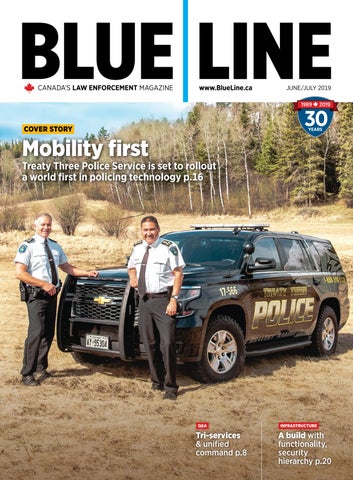
COVER STORY
Mobility first
Treaty Three Police Service is set to rollout a world first in policing technology p.16
Q&A
INFRASTRUCTURE
Tri-services & unified command p.8
A build with functionality, security hierarchy p.20
Infrastructure, Mobility and Managed Services for Law Enforcement.
Desktop as a Service (DaaS) Unified Endpoint Management (UEM) Digital Evidence Management (DEM) Unified Communications (UC) NCACR Policy & Compliance CALEA Accreditation
www.fset.ca 833.321.FSET
info@fset.ca
Contents
16 June/July 2019
Columns
Volume 31 Number 6
4 8 10 12 14 24 26 30
Features COVER STORY
16 Mobility first
Treaty Three Police Service and an array of impressive technology partners have demonstrated how a single smartphone and docking system is the only tool needed to bring the office to the officer, cutting costs & strengthening accessibility. By Renée Francoeur, with files from Kate Shippey
20 A building suited to the changing face of law enforcement
The new St. Thomas Police Service building features architecture and an interior layout that shows how policing has become more community-friendly since the previous, now-demolished station was built in the sixties. By Travis Forrest
Editor’s commentary Q&A Behavioural sciences Health & wellness Holding the line Case law Technology Back of the book
Departments 5 5 6 7 28 29 30
By the numbers News Calendar Dispatches Product showcase Marketplace Blue Links
22 Remembering two of many who served on D-Day
COVER PHOTO: ANDREW ROWE
In commemoration of the 75th anniversary of the D-Day invasion of Nazi-occupied Europe, we recall the lives of two police officers who made the ultimate sacrifice in France in the first week of the liberation of Europe. By Matthew Scarlino
20 @Blue_LineMag
8 26 June/July 2019 | BLUE LINE
3
EDITOR’S COMMENTARY BY RENÉE FRANCOEUR
The question of armoured rescue vehicles
I
have to say, I find the civilian uproar cer safety,” said Insp. Jim Butler, Halifax about police militarization after Regional Police’s operational support offiHalifax Police put out a request for cer. “Like many other forms of equipment proposals (RFP) for an armoured to respond to evolving threats, it is a capvehicle a tad alarmist. As they are just at ability we hope we never have to use but the RFP stage at the time of writing this, one we believe is important for us to have.” we don’t know exactly what kind of arPreparation is the key. And in the aftermoured rescue vehicle, or ARV, might be math of some devastating incidents where added to the fleet once the new chief takes we were not prepared, like in Moncton, the reins in July. why would we not do everything Moreover, I’d point to Fred- “Having an we can to proactively avoid any ericton Police Force, who won armoured loss of life in a world with too the Best Dressed Police Vehicle rescue vehicle many headlines on extremism Award – Special Service for its is about and violent hate crimes? ARV this year. This may be a preparedness, This vehicle will be used “beast” on four wheels but it’s public safety “sparingly and appropriately by not overly offensive looking — and officer those trained to use it,” wrote “rescue” is the featured word — safety...” Robin McNeil, Halifax’s acting - Insp. Jim Butler, police chief in a May 10 letter and the force told us significant discussion occurred, ensuring Halifax Regional Police sent to the board of police comthe community would be comfortable. The missioners. “At no time, would any ARV key is communication and transparency. be deployed during a routine PSU [public Halifax RCMP already owns an ARV and safety unit] event.” I assume the public have seen it around the Of course, we cannot ignore the context busy port city. Numerous police forces in this news erupted in — we know there’s major cities have one included in their tension between police and Halifax’s Black fleets, as well — in fact Calgary just replaced community after the Wortley report on its 12-year-old ARV this April. street checks. I understand we have to be Police militarization is a term we have sensitive to this, especially when one rebeen hearing about for years. I think dis- calls those pictures of the armoured vehicussing data, like the research published cles out of Ferguson, Mo. At the same time, out of Manitoba last year by Kevin Walby we have to remind people that Canadian and Brendan Roziere, is valuable and police agencies work in their own regulatprogressive. That leads to positive conver- ed landscapes where some incredible sations about evidence-based models and de-escalation training and leadership is the international/national impact of cer- happening, and where the focus is on tain events and wider societal changes on proactive versus reactionary measures to our police forces. In my opinion, it stimu- upholding public safety. It’s better to have lates more analysis and information the tool in the toolbox than to be scramsharing among our services. It can spark a bling if such a critical call should come. second look at the state of things, like Of course, we have to have due diligence training, which never hurts. and show the public that yes, we know That being said, is the public’s issue with ARVs do not belong in every police departthis ARV truly about militarization con- ment. We can continue to encourage an cerns? I think it’s the cited cost of $500K open conversation on when and why we that has people stomping their feet. A deploy SWAT teams, which incidents similar effect was felt in Medicine Hat ARVs have a role in and which they do not, when they purchased their ARV in 2014. and how we can collaboratively customize “Having an armoured rescue vehicle is ARVs for each region so they are not overabout preparedness, public safety and offi- ly offensive.
CONNECT WITH BLUE LINE
www.BlueLine.ca 4
@Blue_LineMag
BLUE LINE | June/July 2019
www.facebook.com/BlueLineMagazine
BLUE LINE www.BlueLine.ca
GROUP PUBLISHER | MARTIN MCANULTY mmcanulty@annexbusinessmedia.com EDITOR | RENÉE FRANCOEUR rfrancoeur@annexbusinessmedia.com ACCOUNT MANAGER | JANICE EATON janice@blueline.ca MEDIA DESIGNER | SVETLANA AVRUTIN savrutin@annexbusinessmedia.com ACCOUNT COORDINATOR | TRISH RAMSAY tramsay@annexbusinessmedia.com CIRCULATION MANAGER | BEATA OLECHNOWICZ bolechnowicz@annexbusinessmedia.com Tel: 416-442-5600 ext. 3543 COO | SCOTT JAMIESON sjamieson@annexbusinessmedia.com PRESIDENT & CEO | MIKE FREDERICKS ANNEX BUSINESS MEDIA 111 Gordon Baker Road, Suite 400 Toronto, ON M2H 3R1 Tel. 416-442-5600 • Fax 416-442-2191
Publication Mail Agreement No. 40065710 ISSN 0847-8538 Printed in Canada SUBSCRIPTION RATES Canada — 1 Year $31.50; 2 Year $52.50 plus tax USA — 1 Year $105.00 USD CIRCULATION email: asingh@annexbusinessmedia.com Tel: 416-442-5600 ext 3553; Fax: 416-510-6875 or 416-442-2191 Mail: 111 Gordon Baker Road, Suite 400, Toronto, ON M2H 3R1 Occasionally, Blue Line will mail information on behalf of industry-related groups whose products and services we believe may be of interest to you. If you prefer not to receive this information, please contact our circulation department in any of the four ways listed above. Annex Privacy Officer Privacy@annexbusinessmedia.com; Tel: 800-668-2374 © 2019 Annex Publishing & Printing Inc. All rights reserved. Printed in Canada. No part of the editorial content of this publication may be reprinted without the publisher’s written permission. Opinions expressed in this magazine are not necessarily those of the editor or the publisher. No liability is assumed for errors or omissions. Readers are cautioned and advised that articles presented herein are edited and supplied for your personal awareness and should not be used for further action until appropriate guidance is received from a supervisor, Crown Attorney or other persons in authority. All advertising is subject to the publisher’s approval. Such approval does not imply any endorsement of the products or services advertised. The publisher reserves the right to refuse advertising that does not meet the standards of this publication.
NEWS VANCOUVER
Police, other first responders train for ‘active deadly threat’
Left to right: Dorothy Schulz of The City University of New York, Linda Duxbury of Carleton University, and Corina Schulze of the University of South Alabama discuss women in policing at a conference in Brantford, Ont. PHOTO: R. FRANCOEUR BRANTFORD
Recruiting, Retaining, and Promoting Women Police Officers conference seeks evidence-based solutions
Scholars from around the globe, Canadian police officers of all ranks and other experts with a stake in the law enforcement field converged at the Wilfrid Laurier University’s Brantford, Ont. campus on April 29 to discuss evidence-based data and analyses concerning gender inequality in policing for the inaugural Recruiting, Retaining, and Promoting Women Police Officers conference. “The goal of the workshop is to work with researchers to identify how we can transform the rich literature on the barriers faced by women police officers into actionable recommendations. Our ultimate goal is to improve the overall experience in the workplace for women and also for men,” said Debra Langan, who, with fellow Laurier associate professor of criminology Carrie Sanders, has been researching women’s experiences in police organizations since 2013. Revisit the purpose of policing, Jennifer Brown of the London School of Economics and Political Science in the U.K., told attendees, and “re-balance the skill sets that both men and women bring to policing.” Brown also stripped down the entrenched idea of the dichotomy of what women and men bring to policing. “The point I want to
make is men and women can have both masculinity and femininity and a balanced police force has to capitalize on both.” Meanwhile, Queensland Police Service in Australia is celebrating the recent appointment of its first female police commissioner, Katarina Carroll. Jaqueline Drew of Griffith University, Australia, highlighted this news and noted “careful consideration needs to be given to how we promote and support female officers in the promotion systems.” She looked at why equity programs fail, saying “the big stick approach is not going to work; it reinforces a negative perception of gender equity policies.” Gender-focussed policies should simply be sold as good organizational practices; move the goal of unification into the limelight. Canada’s Linda Duxbury of Carleton University unveiled an interesting finding about how in 2001, female police officers were more penalized than their male counterparts for putting family first. Now, according to Duxbury, men who seek paternal leave or time off to support partners, children, etc. are seeing more repercussions. Conference organizers — Debra Langan, Carrie Sanders and Julie Gouweloos — noted they will be compiling and disseminating a report based on the event in the near future. Find more photos here: bit.ly/2HugcoU.
The Vancouver Police Department is working with the city’s firefighters, paramedics and emergency communication providers to create what it calls a rescue task force capable of responding to active deadly threats. Supt. Steve Eely says under the initiative, police will continue to be responsible for locating a threat and making an area safe, but once that is done other members of the task force will have key roles. Police officers will work with firefighters to stabilize and extract people who are wounded to designated safe zones, where Emergency Health Services paramedics can do further treatment and transport them to hospital. Training began last fall in the classroom and in exercises that simulate an attack, with more than 700 police officers and 400 firefighters trained to date. Police say paramedics and staff with emergency communications provider E-Comm are involved in the newest training model. The rescue task force is the latest in a series of initiatives aimed at ensuring public safety in Vancouver during an active deadly threat. Eely says police training has evolved in response to active deadly threats in other parts of the world. “By partnering and training with other emergency services personnel, we can ensure a more effective response that will help to keep victims alive by getting them medical treatment much faster,” he says in a news release. - © Canadian Press Enterprises Inc., 2019
PHOTO: VANCOUVER POLICE DEPARTMENT.
BY THE NUMBERS
Surrey RCMP was among the first to release first-quarter statistics for 2019, following the changes to Statistics Canada’s Uniform Crime Reporting Survey that took place Jan. 1. This means “founded” occurrences now include offences where there is no credible evidence to confirm the incident did not take place. The RCMP says it fully supports the new rules, noting that they will impact crime statistics for all police agencies across Canada and, as such, residents will notice differences in some crime types that are not directly comparable to the same time period last year. More here: bit.ly/2GVfgef.
4
%
increase in total Criminal Code offences in Surrey, B.C. in the first quarter of 2019, compared with the first quarter of 2018
@Blue_LineMag
43
%
jump in violent crime
27
%
of assaults involved intimate partner violence
9%
decrease in property crime, continuing its four-year downward trend
June/July 2019 | BLUE LINE
5
NEWS CALENDAR 2nd World LGBTQ Conference for Criminal Justice Professionals June 19-21, 2019 Toronto, Ont. www.proudtobeyourfriend.org LEOSH 2019 Conference June 19-21, 2019 Niagara-On-The-Lake, Ont. www.leosh.org/conference-2019 Leading Complex Systems Retreat June 24-28, 2019 Halifax, N.S. secure.royalroads.ca/cscourses IACLEA 2019 June 25-28, 2019 Vancouver, B.C. www.iaclea.org/iaclea-2018-annualconference First Annual International Windsor Area Police Insignia Collectors Meet June 29, 2019 Windsor, Ont. www.ipa-canada.org Camp Courage • The First Responders Society July 9-16, 2019 Dartmouth, Halifax, Lakeside, N.S. campcourage.ca International Cyber Security and Intelligence Conference July 16-19, 2019 Toronto, Ont. www.icsicanada.org World Police & Fire Games Aug. 8-18, 2019 Chengdu, China www.cpaf.org/5 CACP 2019 Aug. 11-14, 2019 Calgary, Alta. cacp.ca/conferences-events.html Annual IAI International Forensic Educational Conference 2019 Aug. 11-17, 2019 Reno, Nev. theiai.org/2019_iai_conference_reno.php
6
BLUE LINE | June/July 2019
Edmonton Police Chief Dale McFee apologizes to the LGBTQ2S+ community . PHOTO: EPS EDMONTON
Police chief apologizes on behalf of EPS to LGBTQ2S+ community
Edmonton Police Service (EPS) Chief Dale McFee apologized to the LGBTQ2S+ community on behalf of the EPS. The apology, made during a news conference at police headquarters, is the beginning of a reconciliation process with members of the Lesbian, Gay, Bisexual, Trans, Queer, Two-Spirit community. The apology acknowledged that while police have an obligation to uphold the law and to create safe communities for everyone, the EPS has not always demonstrated behaviours and approaches which embody our core values. “To the members of the Lesbian, Gay, Bisexual, Trans, Queer and Two-Spirit community – both across our public and within our service – on behalf of the Edmonton Police Service, I am sorry and we are sorry,” McFee said. “Our actions caused pain. They eroded trust. They created fear. They caused members of the public and our service alike to feel unsafe on their own streets, in their workplaces and even their homes.” Chief McFee pledged his own personal commitment to stand against homophobia, transphobia and any other kind of marginalization, denigration or disrespect. He invited people to share their stories and to participate in shaping an engagement process aimed at changing the essential nature of the relationship between the EPS and the community. McFee also indicated that part of the reconciliation will include a look inward to understand the impact that the EPS has had historically, on its own members. “To make sure we get this right it has to be guided and informed by those in our community. By those who have spoken out
before, and by those who haven’t yet had the opportunity to share their voices. We are requesting advice, guidance and partnership,” McFee said. The EPS is asking members of the LGBTQ2S+ community to share their ideas about the engagement process through a specially established website, www.epsinput. ca. The input shared will shape the design of the engagement process, which will be facilitated by external consultants early in Fall 2019. MARYLAND
JTIC releases reports on law enforcement using UASs
The Justice Technology Information Center (JTIC), based in Gaithersburg, Md., recently released two new reports related to the ways in which law enforcement agencies use UASs (unmanned aerial systems) to fulfill their missions. The first report summarizes testing done by three law enforcement agencies on using small unmanned aircraft systems (sUAS) for indoor tactical missions. Information on the effects and potential limitations imposed by maneuvering in tight, confined spaces and in environments where GPS, video and command/control coverage may or may not be ideal could help agencies considering use of sUAS indoors. The second report highlights some basic insights/lessons learned from focus group members on implementing a UAS program and choosing and operating UAS technology. As both are considered law enforcement-sensitive, send an email to asknlectc@ justnet.org from a legitimate government agency/law enforcement agency address (no Yahoo, Gmail, etc.) to get your copies. Visit www.BlueLine.ca for the latest news, stories, products, videos, photo galleries and industry events.
www.BlueLine.ca
NEWS DISPATCHES As of Jan. 1, 2019, the new chief of police for the Corman Park Police Service is Warren Gherasim. He replaces previous Chief John Garnet, who led the service from 2013-2018. Gherasim started his policing career as a cadet with the Peel Regional Police in 1986 and left to join the RCMP in 1991. After serving almost 25 years with the RCMP in Alberta, NWT, Ontario and Saskatchewan, he retired from the force as a sergeant and took a position with the Corman Park Police in 2015. Gherasim is the eighth chief in the 49-year history of the service, which polices the rural area surrounding the City of Saskatoon. Dan Kinsella is Halifax’s next police chief. Kinsella, who is currently deputy chief of operations for the Hamilton Police Service, assumes his new role on July 1. After 32 years of experience, he will take over the position previously held by Jean-Michel Blais.
Rollin was the first female detective inspector at the police service and is the president of Algoma Women in Law Enforcement. Staff Sgt. Kevin Beaudoin, a 29-year veteran, has been appointed deputy chief of police at LaSalle Police Service. He replaces retiring deputy chief William Scanlan, who has had the job since April 2016. The deputy superintendent of administration at the Ontario Correctional Institute (OCI) in Brampton, Ont., Kevin Junor, has retired. He started in corrections in 2011 after 34 years in the Canadian Armed Forces (Reserves).
Chief Andrew Fletcher, South Simcoe Police Service, has been inducted into the George Mason University Department of Criminology, Law and Society’s Evidence Based Policing Hall of Fame for his contributions to evidence-based policing in Canada. Toronto Police Service Supt. Bill Neadles has retired after 42 years, many of which were spent enriching public/ private partnerships. He served in uniform patrol, drug squad and public order/public safety roles. His final command was as 43 Division Unit commander.
PROMOTIONS, RETIREMENTS, RECOGNITION • If you have an officer in your agency recently promoted or retiring or an individual you wish to have recognized (major award or recently deceased) you can let Blue Line magazine know by email to: rfrancoeur@annexbusinessmedia.com.
Nishnawbe Aski Police Service Const. Mel Coles has passed away. He received his badge in 1998. Rest in peace.
Craig Ambrose, a former inspector from Waterloo Regional Police’s intelligence bureau, is the new the chief of the Owen Sound Police Service. He began his new role on Jan. 21, 2019. Chief Fitch and Deputy Chief Gaudet are proud to announce the promotion of Staff Sgt. Mike Berry to rank of inspector at Fredericton Police Force. Canadian Critical Incident Inc. (CCII) welcomes Det.-Insp. Monique Rollin, who retired from Sault Ste. Marie Police Service after more than 31 years, as its vice-president and director of training. Rollin will work with CCII as a lead instructor and curriculum developer advancing the development of new courses. June/July 2019 | BLUE LINE
@Blue_LineMag BL_Jan_Spirito.indd 1
7
2018-12-14 3:06 PM
Q&A York Region’s emergency services have developed an integrated response model, leveraging a collaborative approach to major incidents. In October 2018, York Regional Police (YRP), York Region Paramedic Services and the eight fire services agreed to introduce enhanced training to promote effective response during mass casualty criminal incidents. York Region Paramedic Services Supt. Tait Mitchell, YRP Sgt. Douglas Ritchie and Deputy Fire Chief Ryan Jagoe share more about plans for the program and continuing to mould such a unified framework. Q: Tell us how this integrated approach for responding to incidents like mass shootings first came about.
Q: Was there a particular anecdote that cemented the need for more collaboration?
Douglas: There was actually. We conducted a major exercise in the region and we had hostages and people that were injured. This was all a mock-up of an active shooter situation and when we requested fire and paramedic services to attend inside the mall where some of 8
BLUE LINE | June/July 2019
Left to right: York Region Paramedic Services Supt. Tait Mitchell, York Regional Police Sgt. Douglas Ritchie and Ryan Jagoe, the deputy fire chief with the Town of East Gwillimbury, describe how they all work together for more integrated response training to major incidents.
the victims were, we were unable to provide enough safety clearance in order for them to operate to their standards. We had four command posts there. Typically — and cutting out all the police terms — we go in and once it’s safe and clear, then we can have fire and paramedics come in to tend to patients, but during that period of time hours can go by and we lose those patients that otherwise would have survived. That golden hour is really key but even a platinum 10 minutes is more important for us to get in. To do that, we have to create a safe environment that is consistent with the standards of fire and paramedic services and we’ve managed to figure out what that looks like. That also then became supported by the NFPA
Snapshot of York Region
1.11
million residents, according to 2016 census
5
districts served by YRP
8
fire departments
22
paramedic response stations
(National Fire Protection Association) standard that came out last year. The interesting part is the work we were doing was already aligned with that standard. In fact, we’ve exceeded that standard. Tait: In an active shooter event, this is a patient-centred event where rapid care is needed. In York Region, we are fortunate in that we have a tactical paramedic program but it’s a resource that isn’t prevalent enough... This is about how do we tap into all these resources and bring everyone together efficiently because we do need everybody on those calls. Ryan: We have enough evidence from real-life situations around the world of exactly what we’re trying to prewww.BlueLine.ca
PHOTO: R. FRANCOEUR
Douglas: It started in our own internal exercises—with our eight fire services and one paramedic service. We recognized there was a gap with the response for medical treatment for those who could become victims during a mass casualty incident. We wanted to close that gap. This was a seed that was planted in 2015 and it has become a formalization of integration of inter-agency response. This will be one of the few inter-agency policies that combines all our efforts into one focused force multiplier. In England at a terrorist event, there were firefighters who wanted to go help people within visual range who were yelling at them, but they didn’t have the policy permission to respond. You can imagine the stress it put on those firefighters. We took a different approach; you’re going to be able to help in a co-ordinated manner and have the permission to do it.
vent from happening — paramedics and firefighters staging a few blocks back of an incident waiting to be cleared to go in. We’re in this business to save lives and we want to be making the right decision so it was timely in terms of world events, and for us to say, “Hey we’re not immune to this in York Region but we’re going to be prepared if it happens.” It wasn’t about can we do this; it was about we have to do this.
Q: What happened next?
Douglas: We came together and had a preliminary discussion on how we would work together to form up a committee to create the training and education standards for it. Tait: The people that came together to build this program really deserve the credit; these are frontline tri-service staff that do these jobs every day. That’s what helped answer some big questions and it lends credibility to the program. Ryan: This committee isn’t a one and done deal. It will stay active so we have a tri-service communication group to tackle hot topics; a forum. That was an unintended spinoff: we are communicating and we’re communicating well so let’s keep doing it
Q: And last fall was a pivotal moment?
Tait: In October 2018, it was ratified that we’d be starting this approach as of January 2019. We had all the tri-services decision makers and senior ranks in the room and presented the program. The result was a full agreement and communication to fully move forward with it.
Q: How is the training happening to date?
Douglas: For us, we are now training all our members in their annual training. So, every @Blue_LineMag
sworn member will have this training by the end of 2019. As of the end of February, we already had people deployed with this training in hand. A PowerPoint is YRP’s current training platform. By this summer a video will replace that. Tait: We’re creating a generic platform that is easily implemented, maintained and shared for this training. We’re set to rollout our training platform in what we’re going to call Program Development Day No. 2 in Q3 of 2019. Douglas: By the end of 2019, all tri-services will have undergone the first phase of training. We expect this to be a live program, that evolves every year depending on the needs of the community and the members. It will go on to include small scale and larger scale practical exercises, exercises with different jurisdictions... The key piece is developing and maintaining unified command. It’s a bit of an elusive term in the real world; it sounds good on paper, but what is really good in a practical setting is making sure people are trained and disciplined to stay in that environment. That’s the pivotal part of what we’re trying to do; if we put the leadership at a scene that works co-operatively together, managing each other’s interests, then we can deploy our resources effectively. So, whether it’s a mass casualty event with an active threat, a train crash with chemicals spilled or some type of pandemic we’re dealing with, all of our services, as applied to unified command, can be co-ordinated the same way.
Q: What kind of challenges did you have?
Ryan: Our challenge was how to make this training adaptable to each of those eight fire services. There was the question of cost and if we were increas-
ing the level of service to our community. How do we roll this out because we have associations to deal with? The great part is the committee has made this program that uses our existing knowledge and skills and now we hone in on who’s in charge. Douglas: We have a common vision through the tri-services: a preservation of life and we all bring different skills to the table to make that happen. The problem was we were working independently of each other. For example, if it was a police-led call, we’d be in charge until someone else spoke up and said let’s move these resources over here... This is different. This is when we already know we’re going to use a co-operative structure. The sooner we’re co-ordinated, the more efficient we are at putting in our assets. More importantly, this program gives all our services permission to work together — permission for me to let fire into the scene. That didn’t exist before. And it doesn’t exist very much in Canada, though we are starting to see some changes, like in Vancouver where they have a program.
Q: Were there any surprises as this program took shape?
Tait: It has brought so many opportunities to engage in great conversations. It has been a remarkable way to build relationships with our counterparts in our fire services and they have really come to the table and embraced it, which is absolutely fantastic to see — that willingness to take on some extra kit, equipment and do some extra training. We have quite a large paramedic service but this model could be a gamechanger for a smaller community or rural area where it takes time to get resources in. Then it becomes even more essential to have a
unified response to really any incident — it doesn’t have to be a criminal one.
Q: What is the cost to this program?
Tait: It’s scalable for each region truly. You can do it for next to nothing, with just staff time for the training and education. Ryan: And if there’s a product to be bought — like you want to have tourniquets in your fire trucks — buy the same one your police service and paramedics are using. That’s all part of the communication piece. Douglas: Recognize there’s some policy considerations to be had... but it’s cost-effective and easy to implement.
Q: How does this program change specific roles in command?
Douglas: They’re doing the same job they normally do; It’s quantifying the risks differently, shifting the risk profile. Ryan: For us, the roles haven’t changed. The message for our leadership team is: when you arrive on scene, this is going to happen on the hood of an SUV; it’s not a big fancy command post — those arrive hours later — this is the first three arriving units on scene, three people need to get together and strategize who is doing what and where. Douglas: Let’s say we have a big car accident with extrications required. Typically, as police officers, we are not picking up patients and moving them to an ambulance, but there’s nothing that stops us from doing that. Now we’ll be able to say, “Hey, I’ll do the part of picking the patient up,” and it might be a firefighter saying that too. We have the ability to interchange our roles within these rescue teams, if you will, based on the environment. June/July 2019 | BLUE LINE
9
BEHAVIOURAL SCIENCES BY PETER COLLINS
Erotic delusional disorder: what you need to know
A
few terms and words well known in the behavioural sciences realm have entered everyday language. However, some are being used incorrectly. This could be said of the term delusion. A delusion is a false belief that is based on an incorrect interpretation of reality. Delusions, like all psychotic symptoms, can occur as part of many different psychiatric disorders such as schizophrenia or the manic phase of a bipolar disorder. The delusions associated with those disorders tend to be bizarre (for example, “Aliens have implanted computer chips in my brain,” or “I possess special powers.”) Non-bizarre delusions include firmly held beliefs that could be based in reality, but which would also be considered unlikely. Examples can include: • the belief someone is in love with them • the belief someone is following them • the belief they are suffering from a severe medical illness or infection Symptoms that are absent in this disorder include significant depression or mania (mood symptoms), auditory or visual hallucinations, and disorganized/incoherent thought process. The delusion, and its ramifications, fit into a comprehensive and complex system that makes sense to the patient. Outside of this delusional system, the patient’s functioning is relatively intact and unremarkable.
Erotomanic delusions
Also known as de Clérambault syndrome, erotomania may be an isolated symptom or associated with other psychiatric disorders, usually schizophrenia. It is the delusion that another person, often unobtainable and of higher status in society, is in love with the subject. Not unlike others who suffer from delusions, erotomanics exhibit paradoxical conduct—the ability 10
BLUE LINE | June/July 2019
to interpret all evidence to the contrary as confirmation of his or her belief. For example: the denial of any romantic interest by the object of the delusional interest. The erotomanic individual maintains the hopeless idea that the desired relationship will prevail.1 Erotomania is more prevalent in women than in men, but it is the male erotomanic who poses more of a risk for violence. They can also pose a risk to other individuals whom they believe are acting as an obstacle/rival to establishing a relationship. Generally, the risk factors for violence include substance abuse, a history of violence and tends to occur more in younger males.2 Efforts to contact the object of the delusion is common and thus erotomania can be the cause of stalking behaviour. Stalkers, however, are a heterogeneous group with erotomanics being a small proportion. They can be persistent because nothing will persuade them the individual is not in love with them. Complete strangers can become erotomania victims and even police officers have been known to become targets of erotomanic stalkers. As with other love obsessional stalkers, they will engage in murder/suicide because of thought processes like: “If I can’t have her/him, no one else will,” or, “We will meet in heaven.”
Communicating/negotiating
Negotiating with individuals with delusional disorders can be difficult.
They may incorporate the police or a specific negotiator into their delusional system. You cannot argue with them about the validity of their beliefs. The best way to negotiate with these individuals is to establish a rapport over time. Use your active listening skills and accept it may be a long call. Utilize your mental health consultant. In summary, erotomanic delusional disorder is not a common condition. It is a smaller subset of stalkers but usually comes to the attention of the police in the context of stalking. It affects more woman than men; however, the male erotomanic is potentially more violent. The duration and persistence of the pathological pursuit—even if it is not violent Negotiating —can cause long-term psychologicwith al damage to the victim, including individuals post-traumatic stress disorder. 3 with Regardless of the cause of the stalkdelusional ing, an excellent book to help (and disorders can one you can recommend to the be difficult. victim) is by Dr. Michelle Pathé They may called Surviving Stalking. incorporate Lastly, as with other stalking the police or cases, a threat assessment with risk a specific management recommendations negotiator should be sought by the investigainto their tor in incidents involving erotodelusional manic delusional disorder.
system. You cannot argue Footnotes 1. McEwan, T, Mullins, P., & Mackenzie, R. with them (2009) A study of the predictors of persistence about the in stalking situations. Law and Human validity of Behaviour. 33: pp 149-158. their beliefs. 2. Ibid 3. Menzies, R. (2018) Erotomania. In Forensic Psychiatry: fundamentals and clinical practice Edited by B. Puri & I. Treasaden. London, UK: CRC Press
Dr. Peter Collins is the Operational Forensic Psychiatrist with the Ontario Provincial Police’s Criminal Behaviour Analysis Unit. He is also a member of the crisis/ hostage negotiation team of the Toronto Police Service. His opinions are his own and not necessarily the opinion of the OPP, CAMH, University of Toronto or his mother. Reach him at pcollins_blueline@gmail.com.
www.BlueLine.ca
THE COMPLETE PUBLIC SAFETY PLATFORM AXON EVIDENCE - Easily organize, retrieve and share digital evidence in a secure, cloud-based system hosted in Canada
AXON BODY 3 – A connected camera with real-time awareness capabilities
AXON CAPTURE AND CITIZEN – Gather critical information from the field from Citizens or with your mobile device
TASER 7 – De-escalate with confidence and reduce clothing disconnects with our updated technology
FLEET 2 – Reduce the infrastructure in your vehicles and offload critical evidence with our cloud connected in-car camera solution
AXON INTERVIEW – Record, organize, and stream crucial interviews with redundant, high-quality video and audio technology
ca.axon.com
HEALTH & WELLNESS BY ISABELLE SAUVE
Coaching versus mentoring
L
earning and growth opportunities are central to employee wellness and job satisfaction. These opportunities are also closely related to recruitment and retention. Two empirically validated forms of development activity can be further utilized to enhance organizational capacity – coaching and mentoring. While closely related, they are distinct and important functions present in healthy work forces. Coaching is a process usually undertaken by the immediate manager (or supervisor) with a focus on refining specific skillsets or competencies. The coaching process helps to equip officers with the knowledge and tools needed to achieve job specific goals. It includes creating opportunities for growth and success. Coaching can be formal or informal and the relationship is generally shorter in duration than that of a mentorship. The informal coaching process involves five steps: forging a partnership and a level of mutual trust, inspiring commitment, skills growth, promoting persistence, and shaping the environment. Formal coaching programs are quite individualized. However, they typically have several common features: one-to-one relationships, an extensive preliminary battery of tests/instruments, clear development plans, regular meetings, possible inclusion of role play, immediate feedback, and identification of values or behaviours to be demonstrated and espoused. A critical component of formal coaching is the establishment of a developmental plan. It provides a road map with specific goals, timelines and means of evaluation. Coaching is highly performance driven. It is believed lessons learned from coaching programs lead to permanent behavioural change. On the other hand, mentoring involves a long-term, personal relationship between a protégé and a more experienced mentor (usually someone a number of levels above the protégé). Mentorship is develop12
BLUE LINE | June/July 2019
ment driven. The mentor can be a sponsor, guide, or role model and act in one or all of these roles over time. They provide the protégé with counsel, knowledge, and support — particularly in career development. Guidance can also be extended in areas such as organizational politics, strategy and personal development. Like coaching, mentoring too can be Whether a formal or informal. coaching or Mentors and coaches play a criticmentorship al role in inspiring commitment, relationship supporting skill acquisition, developing persistence and fostering is most suitable will understanding. That being said, be mentoring differs from coaching in a individually number of respects. Mentoring often based and does not target specific development largely needs but rather long term career dependent goals and can involve an external upon person, outside the organization. In respective private industry, business managers stages of often utilize mentorship programs to personal and enhance productivity, recruitment professional and opportunities for employees to development. develop talent. For a mentorship relationship to flourish, mutual trust and a deep admiration for the mentor must be in place. The mentor must also be highly invested in guiding their mentee. Cross-gender mentoring is certainly possible but can be more complicated and is less common. A mentor must also want success for a protégé even if they exceed their own knowledg or accomplishments. Facilitating mentoring — such as allocating a number of hours per month to meet with a mentor — encourages the progression of individual careers and benefits organizations as a whole. Mentors have
direct communication with protégés but generally do not interact with immediate supervisors in relation to them. Immediate supervisors are indirectly involved and provide performance feedback specific to one’s current role. For example, a protégé under the guidance of an astute mentor would learn to consider recruiting the most qualified and talented persons for their teams, even if it meant those recruits would have more qualifications or education than they themselves. Forward-thinking and confident leaders or managers recognize hiring the most qualified personnel is not a personal threat but rather an opportunity to shine as head of highly effective and productive teams. Having a highly talented and qualified team also makes the job of managing easier. A manager stands out when he or she has the backup of a well-performing team. Mentoring programs can also have a number of positive, unexpected results, such as assisting first responders to identify and then address Occupational Stress Injuries (OSIs). The strong bond between mentors and protégés increases the likelihood emotional or psychological changes are noticed and taken care of. Mentoring relationships can also address generational gaps by bridging differing views and approaches. Mentorship and coaching programs can allow first responder agencies to remove barriers hindering success for their diverse human resources. Whether a coaching or mentorship relationship is most suitable will be individually based and largely dependent upon respective stages of personal and professional development. They are highly successful approaches which address employee satisfaction issues and promote retention. Isabelle Sauve is a 12-year veteran with the OPP, currently with the Lanark County Detachment. She has a MA in psychology and is a PhD candidate. She is also an ultramarathon/ endurance athlete and the Racing the Planet/4 Deserts 2018 Series winner as well as a Guinness World record holder.
www.BlueLine.ca
DID SOMEBODY CALL FOR BACKUP?
INTRODUCING THE 2019 DODGE CHARGER ENFORCER. It starts with the most technologically advanced AWD system in its class*. A powerful 5.7L HEMI® V8. A super responsive 5-speed Automatic Transmission with Autostick. And All-Speed Traction Control and Electronic Roll Mitigation for unparalleled control. But it doesn’t stop there. Front seats sculpted to accommodate a full-service duty belt. Controls and instrumentation that are touch- and eye-friendly. And an available 12.1-inch integrated display touchscreen. The 2019 Dodge Charger Enforcer. One car. Zero compromise.
BEST-IN-CLASS
HORSEPOWER*
BEST-IN-CLASS
AWD SYSTEM*
fcacanada.ca/fleet
*Based on current competitive information for 2019 Ford Interceptor Sedan.
1 800 463-3600
HOLDING THE LINE
Supporting the listening ears outside our agencies
A
s our nation focuses on the mental health of first responders and resources that are available to support our needs, more and more of those organizations that are already established and proven to work are coming to mind. I mentioned in my last column that there are a variety of excellent resources many members may not be aware of, both for-profit as well as non-profit. Some of these organizations I have experienced on a personal level as a volunteer mental health facilitator. One of them is Badge of Life Canada and their Hero’s Call and SOLE Sistas retreat programs. These programs offer first responders weekend and five-day opportunities to explore and reflect on the range of mental health issues that may be affecting them, including Post-traumatic Stress Disorder/ symptoms, Operational Stress Injury, de-
The Hero’s Call and SOLE Sistas programs from Badge of Life Canada provide team-building, leadership and educational support through ropes courses and more.
pression, anxiety, etc. The beauty of this program is it is run by dedicated, retired first responders who have experienced mental health challenges of their own. They understand the job, the cultural pressures and they “get” the mental health dynamics that often result in challenges within the family and workplace.
Make a Difference JUSTICE STUDIES FOR WORKING FRONTLINE OFFICERS
At Humber, we teach the professional and practical skills you need to move up and make a difference in your community and in your career. Further your education one course at a time or work towards a certificate, diploma or degree. Advanced standing is available to those in the Justice Services industry.
communityservices.humber.ca /justiceprofessionals
14
Ironically, as I write this article, I am focused on writing Chapter Two of my dissertation for my final PhD requirement, which consists of an in-depth analysis through literature review of programs available for police — programs supported by their organization. I am fortunate I work for an organization that supports our members’ participation in wellbeing in these various programs. In saying that, not all organizations have the resources (or even have the information on resources) such as this to provide to their members. While there are many evidentiary articles noting the benefits of resources provided by peers, either past or present, the most popular one is by Evans et al. (2013). This study found that when non-judgmental support was offered through the listening ear(s) of persons outside of the organization, the likelihood of incurring an Operational Stress Injury was less. This author notes it is the perceived availability of this resource that affects the relationship between resources and the development of a serious mental health issue, such as PTSD/OSI/depression/anxiety. One of the most important pieces non-profits tend to bring is the networking and ensuing relationships created through peers and program providers. Hero’s Call and SOLE Sistas provides team-building, leadership and educational support through equine activities, ropes courses and spiritual activities all in within the restoring power of mother nature. These smaller non-profits provide opportunity for attendance for all through their lowcost, volunteer-driven programming. There are many other non-profits providing outstanding first responder programming/services who are also so worthy of mention here. These include: Wounded Warrior Canada, Boots on the Ground and La Vigile in Quebec, which is soon to expand into Ontario as The Haven. Let’s explore what these organizations can provide and spread the word so we can support increased and prioritized funding and collaboration. Michelle Vincent is a 17-year York Regional Police officer with a master of arts in counselling psychology and a background in equine-assisted therapy, workplace reintegration after a critical incident and long-term leave, as well as teaching. She is in the process of implementing the first non-profit treatment centre that will be occupationally specific for first responders and is working towards her PhD in Forensic Psychology/Crisis Response. She can be contacted at: michelle@vincent.net
BLUE LINE | June/July 2019
BlueLine_Feb_Humber.indd 1
www.BlueLine.ca 2018-01-29 10:15 AM
PHOTO: BILL RUSK, BADGE OF LIFE CANADA.
BY MICHELLE VINCENT
NEW E-COMMERCE WEBSITE AT WWW.DISTRIBUTIONELITECANADA.COM
DOWNLOAD OUR LATEST 400+ PAGES CATALOG HERE !
FEATURED PRODUCT
MRAPS® IV WORLD’S MOST ADVANCED LIGHTWEIGHT
COMPOSITE BALLISTIC SHIELDS It’s a fact! Timed force-on-force exercises repeatedly and consistently prove the Baker Ballistics line of NIJ level lightweight composite ballistic shields shorten first responder to active shooter response times, and improve the accuracy of firepower delivered to the threat. The smart choice of ballistic shields to use while confronting armed adversaries!
The Reaper™ exoskeleton support unit eliminates user fatigue to increase physical endurance & performance while providing stable aiming platform for amazing weapon accuracy with his zero gravity feature !
CONTACT US FOR AGENCY TRIAL !
74, rue Goodfellow, bur 110, Delson (QC) J5B 1V4 T 450 874-0917 T 1 888 674-5113 info@distributionelitecanada.com www.distributionELITEcanada.com
COVER STORY
Mobility first Treaty Three Police Service and its technology partners demonstrate how a mobile device is the only tool needed to bring the office to the officer, cutting costs & strengthening accessibility By Renée Francoeur, with
I
t was years ago when Jeff Skye, now Chief of Police for the Treaty Three Police Service (T3PS), asked the agency’s Chief Information Officer why he couldn’t just hook up his iPhone and see all its information on a bigger screen. It’s difficult to work on such a small screen after all, he says. Where is the interoperability? The seamless transition? Today, T3PS has taken the answer to that question one step further and
is at the forefront of what could be called a revolution in policing technology. The Northwestern Ontario agency is preparing to take policing fully mobile and enhance its in-cruiser solutions with a major update— the only in-car tool previously available to the officers responsible for over 142,000 square kilometres and almost 20,000 people is their radios. T3PS is the first police service in the world to deploy the new Samsung DeX MDTs (Mobile Data
85 sworn T3PS members
The first 2019 Tahoe with the mobile equipment features a new striking, sacred design of the Bear. 16
BLUE LINE | June/July 2019
Terminals) to their cruisers. “There is a fundamental worldwide need and momentum to bring information and systems access to frontline officers,” says Tim Grimes, enterprise mobility sales manager at Samsung. “Samsung’s DeX takes this leap forward... made possible by our strong partner ecosystem.” This choice of deployment is based on the #MobilityFirst initiative at FSET Inc., a Canadian information technology and services company in Kenora, Ont., which is working towards having all T3PS officers issued a mobile handheld. They are able to cradle their Samsung Galaxy device in the cruiser (as well as at a desk with a monitor if need be), which then re-formats the device output in desktop mode using the 12-inch touchscreen, keyboard and trackpad fitted for the vehicle. As demonstrated at the 2019 First Nations Chief of Police Association (FNCPA) Conference, T3PS’s vision of a single computing device for officers is about to be a reality. Skye says he plans to see five fresh 2019 Chevrolet Tahoes, outfitted by DARTA Fleet Solutions and D and www.BlueLine.ca
PHOTOS: ANDREW ROWE
files from Kate Shippey
The D and R Electronics dovetail system allows for easy connection while in the cruiser, eliminating the need for a ruggedized laptop.
R Electronics out of Bolton, Ont., with the proprietary Dovetail solution for docking, hitting the roads by the end of July. “We’ll give each officer a chance to try one of the new vehicles and unveil them to all of our 23 remote communities,” Skye says. “Most of our communities have cell service and we’re going to have these officers out in these beautiful vehicles, visible, engaging — not sitting in the office because they need the connectivity. They’re mobile.” It’s an exciting time for the officers — like a new toy at Christmas, according to the Chief — but it’s been plenty of hard work and complex collaboration to get T3PS this connected.
Looking for a solution
As one of the largest First Nations police services in Canada, T3PS sometimes requires its officers to travel upwards of a hundred kilometres to each location. Many times, officers are working alone, the nearest backup being hours away. MDTs were not in the previous budgets due to funding and the agency was unable to provide @Blue_LineMag
handheld devices to its officers. “Officers required a mobile solution that would allow them to communicate through voice text and email, as well as a way to run queries, enter reports, capture evidence, and other operational tasks without having to make the long return trip back to their home detachment where they would begin their day,” says Dave Brown, CEO of FSET. “Finding a balance in meeting the security requirements with a cost-effective solution that allowed for ease of use proved challenging.” While T3PS couldn’t afford the old standard MDTs, the project they embarked on with FSET and the selected Samsung DeX MDTs were one third of the price, Brown notes. “That’s why we wanted to try them out,” Skye says. “So, we became the
23 communities policed by T3PS
20k population policed by T3PS
first service to do so. It just makes sense. You have your Android with you and if you happen to jump into a cruiser, you put it in a docking station and away you go. All you need to install is a monitor and keyboard, and you’re off to the races.”
A process of many hands
“Do you remember the BlackBerry days?” Skye asks. “Those were the only devices you could use for security requirements...” He’s relieved T3PS’s “mobility first” initiative has received all its security clearance — no easy feat when it comes to smartphones. The project will see all officers issued a Samsung Galaxy handheld device, managed through a Unified Endpoint Solution. The Information Technology Unit (ITU) at T3PS proposed the Personal Identity Verification (PIV) framework as an alternative to replacing the existing PKI (Public Key Infrastructure) and Common Access Cards (CAC) being used within the province and country at the time. T3PS began the research and development, and the Proof of Concept (PoC) for this new model by working collaboratively with the Ontario Provincial Technology Information Co-operative (OPTIC) Security and Mobile Committees, Ontario Provincial Police (OPP), and Entrust Datacard. The PIV framework would also allow for the use of Derived Credentials or PIV-D, which would provide the Multi-Factor Authentication (MFA) required on a mobile device. An independent Threat Risk Assessment (TRA) was then conducted on the PoC and with a seal of approval from OPTIC, the next step was service-wide deployment. One application to be deployed would be Mobile Police Assist
“As a small First Nations police service, it’s something not many would have dreamed we’d be piloting, but we dream big here at Treaty Three.” - Police Chief Jeff Skye June/July 2019 | BLUE LINE
17
COVER STORY
THE GRANDFATHERS TEACHINGS Mobile technology isn’t the only thing T3PS is doing that’s capturing attention. The service has also launched fresh designs for their entire fleet that honour the sacred Seven Grandfathers Teachings, widely shared in North American Indigenous culture as a way to interact with your fellow human beings. “The Seven Grandfathers Teachings have always been very present for us,” Skye says. “Our service prides ourselves in following these teachings and one of our Elders, through ceremony, came up with an eighth Grandfather Teaching called Forgiveness.” Forgiveness will eventually be illustrated on a police vehicle, too, in the form of a rock. The others teachings are: • Bravery, represented by the Bear • Honesty, represented by the Sabe or Raven • Humility, represented by the Wolf • Love, represented by the Eagle • Respect, represented by the Bison • Truth, represented by the Turtle • Wisdom, represented by the Beaver The first 2019 Tahoe with the mobile equipment features the striking design of the Bear. This vehicle includes both the English and Ojibway wording for the Grandfathers Teaching as well. Skye says more Grandfathers Teaching designs are on the way.
Peace of mind protection for you our heroes Protecting our police partners is a priority in our mission to save lives. Special MedicAlert offer:
Get a FREE ID + 50% OFF our service plan* Please call 1.877.250.5739 or visit medicalert.ca/firstresp to sign up. Use Offer Code: HERO19N
®
MedicAlert® saves lives.
*Free $39 ID or $39 off any MedicAlert ID. $30 off any prepaid service plan selected at time of sign-up. Shipping is extra. Cannot be combined with other offers, some exceptions apply.
18
(MPA) Niche from Mobile Innovations. This would provide access to the Niche Records Management System (RMS) used by T3PS and other agencies within the OPTIC collective from their mobile device. The Axon Capture application and Evidence.com portal would be used for the agency’s Digital Evidence Management (DEM) Solution. This allows for the collection of audio, photos and video evidence on the mobile devices. It also provides the members with the ability to securely share in the data being collected during its investigations with their partners, such as the OPP. D and R Electronics took over handling the vehicle docking station, which provides “a ruggedized, secured system that ensures stability in the vehicle environment and avoiding the unwanted disconnects due to vehicle vibration or rough terrain the vehicle is traveling on,” says Harry Alkema with D and R Electronics. The docking station also provides a device cooling system that ensures product longevity and stability, he adds, as well as six USB A ports for peripherals, power for phone charging and HDMI port for an external monitor. Meanwhile, Windows Virtual Desktops from Citrix provides members with the ability to run their windows desktop applications on the same Samsung Galaxy device, while FSET provides the experience, infrastructure and resources to pull it all together and make it work. Data from within the Windows Virtual Desktops never actually touches the device, providing a more secure solution, Brown further explains. “Not only is it more secure, but it also requires less user support and administration. Investment is made on the
BLUE LINE | June/July 2019
BL_JuneJuly_MedicAlert.indd 1
back end and only a light touch is required on the endpoints.” “FSET launched a global innovative solution, utilizing Citrix Workspace, enabling law enforcement to securely access critical information on a Samsung mobile device, any place, anytime,” summarizes Cirtix’s Kostas Papadimitriou. “This is expected to increase the service level of Canadian law enforcement, resulting in a safer, happier environment for all.” The smartphone, the docking system, the software, the digital evidence management solution in the Cloud — it all makes for a seamless transition between the vehicle and the desk, Alkema concurs. And it couldn’t have happened without all these technology partners coming together with the common goal of ensuring officers always have access to applications, whether they’re on foot, in cruisers or in the office.
Momentum in the future
At the cusp of deployment, Skye says he isn’t worried about kinks to work out or challenges the new technology might bring once actually in use. He says he’s confident they have the capabilities to troubleshoot and strong partners who are available for support. “I like to say it’s the next best thing in technology,” he says. “In my days when I was on the road, we were doing hand-written reports on the side of the road. Now, 25 years later, you get to do it on your smartphone, and in remote areas. I can see the momentum growing very fast here. For a third of the price, it does the same thing an MDT does — it just makes sense. “We’re very excited about it,” he adds. “As a small First Nations police service, it’s something not many would have dreamed we’d be piloting, but we dream big here at Treaty Three.” www.BlueLine.ca
2019-05-17 8:56 AM
The Future of Mobile Computing is Hyper Customization:
That’s iKey
iKey has designed its public safety business on this simple premise: reliable mobile computing is key, and public safety professionals need the best designed peripherals in order to do their job. When only the best will do, and your team needs reliable, rugged solutions that do no fail in the field, there is only once choice for keyboards, displays and pointing devices: iKey. iKey, with headquarters in Austin, Texas, is the founder of rugged peripherals and, for 30 years, the leader worldwide in rugged peripherals for many business segments including industrial, fleet, military and public safety. iKey has set the pace for the industry, adding new features to peripherals including NVIS, Bluetooth, liquid-proof, smaller display, thinner profile and special function keys. iKey has created innovative designs including arm/wrist keyboards, pelican briefs, attachable keyboards and more. Users trust iKey for their most important projects.
n
Customization is king at iKey. Every peripheral is designed to a specific customer segment or specific customer. Hyper customization creates the best user experience, and there is nothing quite like using a keyboard or display that is designed specifically for you. n
iKey has increased its offering as it has witnessed the shift from laptops to tablets, as public safety workers have demanded more reliability, more mobility, less cost and more flexibility. iKey has helped design peripherals to these needs and iKey’s solutions can be found in many public safety vehicles – in sedans, vans and Maseratis - worldwide. Read on to learn about the newest mobile computing solutions from iKey and its partners, including new Samsung solutions. iKey + Samsung DeX for police vehicles iKey’s rugged displays and keyboards make the new Samsung DeX solution complete for users of the Samsung S9 or S10 phone. As Dale Stockton wrote in Insights.com in August 2019, “Forward-thinking police departments have recognized that DeX has the potential to revolutionize police computing. By leveraging the computing power of a smartphone and combining that with a dedicated keyboard and display, DeX can eliminate the need for the expensive in-car computer that occupies today’s patrol cars.” iKey + Samsung Galaxy Tab Active2 Rugged Tablet For police departments that choose the new Samsung Galaxy Tab Active2 Rugged Tablet, iKey offers an attachable rugged keyboard, IK-SAM-AT. This rugged keyboard has a unique design which allows the tablet to snap into the keyboard in one motion, and allows for a great typing experience. Public safety professionals can quickly move from the car to the field and then back to the station, with the device in hand and ready at all times.
iKey offers many rugged keyboards with red LED backlighting, Bluetooth, emergency key and other options. iKey’s iKeyVision ™ daylight bright displays can be installed at 11.6” or 13.3”. Photo courtesy of Samsung, Chula Vista demo trial
iKey + Mounting Solutions… use the existing mounting even if you change computers Another unique benefit of using iKey peripherals in-vehicle is that the user can keep his/her current mounting solutions as he/she changes or upgrades the computer. Mounting from Gamber-Johnson, when used with iKey peripherals, creates lower cost of ownership as customers re-use existing mounting in vehicles. iKey works closely with partners such as Gamber-Johnson to design a whole solution, with special care taken to determine the best peripherals and mounting solutions given the customer’s needs, wants and budget. Police car mobile solution with Gamber-Johnson mounting. Photo courtesy of Gamber-Johnson
iKey + Customization = Empowerment iKey truly enables public safety workers all over the world to do their best. Mobile peripherals can and should be an advantage, not a liability. iKey works with Samsung and other brand parnters globally. If you are interested in finding out what iKey can do for your team, please contact iKey at: 512-837-0283. Email: info@ikey.com.
Real Tough for Real Life.™
INFRASTRUCTURE
A building suited to the changing face of law enforcement
By Travis Forrest
T
he new St. Thomas Police Service building exemplifies the changing face of law enforcement. The facility’s layout shows how policing has become more community-friendly since the previous, now-demolished station was built in the early 1970s. The new police presence makes its first impression with a pop art, supergraphics display visible from Talbot Street, the southwest Ontario town’s main drag. On the police building’s roof, four-foot-high letters, illuminated at night, spell out “P-O-L-I-C-E.” We, as the architects who managed the project, tried not to make it look like a
20
BLUE LINE | June/July 2019
police station. It’s recognizable; it stands out in the area. But it’s not a concrete box. The building’s architecture sets a friendly tone with an easily identifiable double-height, vaulted entry. At night, its windows glow, transforming the entry into a beacon with a welcoming street presence. On the façade, paired tall windows with clerestory openings above, and the materials palette of a limestone base with warm red brick, have a comforting, domestic scale. “We have a great facility thanks to the community of St. Thomas, city council, the police services board and past chiefs,” said Chief of Police Chris C. Herridge in
a recent interview. “In the old building, a number of officers worked in the basement. Sometimes the only time they got to see daylight was when they went out.” One of the big complaints about the old building was, “It’s so dark.” That’s a health-and-safety issue now. In the new building, an expansive skylight above the open stairway creates a column of light that penetrates down to the basement and its open lunchroom area. Another problem with the old quarters was its devil-may-care mash-up of disparate user groups. “We were transporting prisoners, victims of crime and children all in the same hallways because of the lay-out and the functionality of the building,” Herridge said. “People who wanted to do their police checks or use the elevator to get upstairs to the courts had to go back in the cell block, where all the prisoners were.” The new building’s carefully structured security hierarchy separates visitors, victims, witnesses and suspects. Nonetheless, where the public comes in, it’s pretty inviting. You can see the inner workings; you don’t feel segregated. www.BlueLine.ca
PHOTOS: MARIO MADAU
Ontario’s new St. Thomas Police Service building depicts the evolving change in crime patterns and the trend to more community- and detainee-friendly policing
“Here, the elevator is just off the front foyer to get down to the lower level, where we have a community room,” Herridge said. The space is used for education and outreach programs. “We did not have that in the old building. When you can invite your community partners into your house, it builds relationships with those partners. “We have interview rooms here for children and victims of crime. Again, you don’t have to go into the inner working space of the police facility. Not only are prisoners intimidating, even,” he said, pointing to himself, “this police uniform can intimidate; [some] people are uncomfortable around police officers. So, having this public area right here is conducive to keeping people happy and calm. That’s why I call this a community-friendly police building.” In the old building’s layout, cross-contamination imperiling the chain of custody was collateral damage. Prisoners and evidence would go through the public lobby with numerous people sitting in it. A lawyer could have a heyday with that. Of the new building’s dedicated evidence room, Herridge said, “Evidence goes into a one-way locker. Only our property officer can retrieve it, from the other side. It’s catalogued, tagged and placed in the proper storage area. We can articulate when evidence came in, where it went and who had contact with it. “DNA evidence is extracted here and sent to the Centre for Forensic Science [in Toronto]. If you bag something that’s still wet, you run the risk of mould. We have multiple drying cabinets so that when we get soiled clothing where we’re looking to extract DNA, we avoid cross-contamination; it’s all very sterile.” The new facility accommodates staff positions undreamt of when the old facility was new. “We didn’t have a lot of cybercrime back then like we do now,” Herridge continued. “Now we have a cybercrime location. White-collar, drug and serious crime that requires investigation by detectives has increased. Now we have more detectives, a street-crime unit and a canine unit [with adjacent outdoor run]. We had our largest drug bust in history a few months ago, with $500,000 worth of fentanyl and crystal meth in St. Thomas.” In the new building, detainees don’t mingle with members of the public because a sally port leads directly to the jail cells. There, the one-piece structure incorporating the sink and toilet is made of stainless steel rather than porcelain, which @Blue_LineMag
“I call this a community-friendly police building.” —Chris C. Herridge, Chief of Police can be shattered into hazardous, sharp glass shards. Flush controls are in the hallway to prevent detainees from concealing contraband substances. The lack of cell bars, the high ceiling and the smooth inner door surface ensure a ligature-free environment, with no points for prisoners to attach a cord to injure themselves. To that end, the cell ceiling is a one-piece flat concrete roof deck instead of the steel deck and support beams prevailing elsewhere in the building.
Further to eliminate ligature risk, and the bother of laundry and storage, the concrete wall benches (in lieu of beds) have heating tubes inside. Also, as designers we had to focus on avoiding any perception of mistreatment, such as having to sit or sleep on a cold, unheated concrete bench. The new building does away with the traditional barred cell. Instead, doors are fitted with bullet-resistant windows. A narrow slot in the door opens from the hallway side for passing food trays. This is a new standard that police across Canada and the U.S. are gradually implementing. The trend is driven by the type of incidents police run into. With bars, if you gave detainees food on a tray, they can use it as a weapon by turning it sideways and sticking it through the bars at you. The construction cost of $10.9 million the 43,900 square-foot (gross) project came in under the budgeted $11.2 million. Construction began in October 2015 and ended in July 2017. To ensure buy-in from police staff, our firm began with a strategic process. Once we had devised the overall floor plan, we gave each room’s plan to Chief Darryl Pinnell, the previous police chief, who distributed them to the staff. They, in turn, jotted down their input. The extensive consultation paid dividends, 10 years later, in a sense of ownership and pride when the new building opened. “We had so many people involved with our moving days who stepped in and came in off duty to help out,” Herridge said. “Everyone was just so excited.” Travis Forrest, associate partner at the Brantford, Ont., office of +VG Architects (formerly The Ventin Group), managed the St. Thomas Police Service project team. He has led the design and construction of over a dozen Ontario civic buildings, including police stations for the City of Pembroke, Town of Caledon, and Wellington and Renfrew Counties.
June/July 2019 | BLUE LINE
21
HISTORY
Remembering two of many who served on D-Day By Matthew Scarlino
D
uring wartime, many police officers enlist to serve their country. In commemoration of the 75th anniversary of the D-Day invasion of Nazi-occupied Europe, we remember two such officers who made the ultimate sacrifice.
Clarence Verdun Courtney
On June 8, 1942, 28-year-old Courtney, a police constable, enlisted with the Royal Canadian Army Service Corps (RCASC), a logistical transport and supply corps. Courtney was quickly promoted to Lance Sergeant and posted to No. 84 Company, RCASC—a part of the 2nd Canadian Tank Brigade, which would provide logistical support to tanks in battle. His company moved to England in the summer of 1943 where they trained for the
D-Day invasion. On June 3, 1944, to avoid enemy detection, they sailed down the Thames River from London aboard the SS Sambut. On June 6, 1944, around noon, they arrived off the coast of Dover, to prepare for their crossing of the English Channel, heading towards Normandy. German coastal artillery in Calais was bombarding Allied convoys along the English coast and at 12:15 p.m. the side of Courtney’s ship was hit with 15-inch shells, wounding him severely in the abdomen. He received prompt medical attention, but at 12:45 p.m., an ammunition cache in the burning ship’s hold exploded and everyone abandoned ship. Courtney was helped to the life rafts but eventually succumbed to his wounds and slipped into the English Channel. He is commemorated at the Bayeux Memorial in Normandy, France.
OSGOODE’S GRADUATE DIPLOMA IN LAW FOR LAW ENFORCEMENT PROFESSIONALS
It’s the only program of its kind in Canada. Designed and co-taught by law enforcement professionals, this flexible, part-time program focuses on the substantive law issues confronting policing professionals in their day-to-day work. COURSES INCLUDE: · Policing and the Charter · Police Oversight & Accountability · Policing Vulnerable Communities · Foundations of Evidence for Law Enforcement Professionals Kerry Watkins, Director, The Interview Group Graduate Diploma Advisory Committee
Attend a free information session to learn more at osgoodepd.ca/enforcement 22
On Nov. 11, 1939, shortly after war was declared, Smuck, a 41-year-old patrol sergeant with 13-years’ service with the Toronto Police Departmen, enlisted with the First Hussars, an arClarence Verdun moured unit in London, Courtney Ont. He was made an acting sergeant and quickly promoted several times. By 1940 he was offered a commission as a second lieutenant. In November 1941, Smuck and his men landed in England and were stationed at Aldershot. They received Harry Lee Smuck newer M4 Sherman and Sherman Firefly tanks in December 1943 and began their training for D-Day. On June 6, 1944, the now-Captain Smuck and his armoured unit successfully landed on Juno Beach and despite heaving fighting, advanced inland further than any other unit that day. At 1 p.m. on June 11, 1944, Smuck’s unit set off to help liberate the French town of Le Mesnil-Patry. They were met with heavy mortar and machine gun fire from the village. While advancing through the countryside, Smuck’s tank squadron began to see 7.5-cm, anti-tank gun rounds and eventually rounds from powerful German Panzer IV tanks. Smuck’s tank was disabled and he and his crew – some of them wounded – escaped and attempted to return to their lines. Smuck and one of his men were eventually captured and marched to a secluded area with other Canadian prisoners of war where they were lined-up, shot and buried in a shallow mass grave. Smuck was eventually re-interred and now lies at the Ryes War Cemetery in Bazenville, France. The circumstances of his death were investigated and publicized during the trial of Nazi General Kurt Meyer. As we reflect on the 75th anniversary of the D-Day invasion, we salute all the men and women who served and continue to put their lives on the line. We will remember you. Matthew Scarlino is a Toronto Police officer, military veteran and amateur historian. He can be reached at: khakiandblue@protonmail.com.
BLUE LINE | June/July 2019
BL_JuneJuly_Osgoode.indd 1
www.BlueLine.ca 2019-05-17 8:52 AM
PHOTOS COURTESY OF: MATTHEW SCARLINO
Harry Lee Smuck
CANADA’S ONLY Approved mobile RMS solution for law enforcement
Multi-Factor Authentication Electronic Pocket NoteBook Samsung DeX Compatible Live demos at CACP 2019 Set up a trial or proof-of-concept deployment for your agency. Find out how 10,000 users across Canada and the UK put the sum total of police knowledge at their fingertips.
1.416.889.9997 mobinnoco.com
Mobile
Innovations
CASE LAW
BY MIKE NOVAKOWSKI
Factors leading to arrest to be viewed cumulatively
I
t is an error in law for a judge to assess an officer’s grounds for arrest in isolation rather than in their totality, as we see in R. v. Omeasoo & White, 2019 MBCA 43. In this case, the police received information from a 911 caller at about 1:40 a.m. of a road-rage incident involving firearms. A red “Chevy” Silverado truck had cut off the driver of another vehicle after he drove up beside the truck and gestured. The caller reported that the truck followed the other vehicle and pulled over. Two males exited the truck and were armed with handguns. No shots were fired. The caller, who was not involved in the incident, described the two males as white, one wearing a white hoodie and a baseball cap, and the other wearing a black hoodie or sweater and a baseball cap. Two police officers near the area responded. As they drove on the street where the red truck was last seen, they saw no other vehicles on the road. They did see a red truck parked at a Tim Horton’s restaurant nearby. The vehicle, a Dodge Ram, was the only vehicle in the parking lot and was occupied by two males. The officers watched the passenger, who was wearing blue jeans, a black shirt and a baseball cap, go into the Tim Horton’s restaurant towards the washrooms. Two to four minutes later, they saw him leave the washroom area, go to the cashier and return to the truck carrying a juice bottle. In addition to the cashier, there were at most two other people in the restaurant. Concerned about the safety of people in the area, the officers went to speak to the occupants of the truck at 1:54 a.m. They wanted to investigate whether the men were involved in the firearms incident. One officer went to the driver’s side of the truck and noticed it was running. The driver was not wearing a baseball cap and the passenger was Indigenous. A second officer went to the passenger side of the truck. He used his flashlight but did not see any firearms. The driver provided identification in the name of White while the passenger verbally identified himself as Joseph Omeasoo. The names were checked in the police computer but there were no outstanding warrants or court orders. At 2:00 a.m. the men were told they were free to go. 24
BLUE LINE | June/July 2019
“When determining whether an officer’s subjective belief of the existence of reasonable grounds is objectively reasonable, a court must not assess the various factors relied upon by the officer in isolation.The totality of the circumstances known to the officer at the time must be taken into account.” - Justice Lemaistre One of the officers then went to use the washroom inside the Tim Horton’s restaurant. He found a .22 calibre bullet in the urinal and showed it to his partner. The officers determined that they had reasonable grounds to believe that the men had been involved in the firearms incident and that the passenger had left the bullet in the urinal. At 2:06 a.m., the officers returned to the truck and arrested the men for a “firearms investigation.” Omeasoo’s name was determined to be Jaden, not Joseph, and it was learned he was breaching a probation order. The men were advised of their s. 10(b) Charter rights and the truck was searched. Police found a “crack pipe” and crystal methamphetamine. When they searched Omeasoo at the police station, they found crack cocaine. The truck was again searched at the police station and police found a .22 calibre assault rifle, a prohibited clip for the rifle with ammunition and more than two kilograms of illegal drugs, including cocaine, marihuana, fentanyl, MDMA and methamphetamine. The men were charged with possessing drugs for the purpose of trafficking and several firearms offences. White was also charged with additional weapons offences. In the Manitoba Court of Queen’s Bench, the Crown conceded that the officers’ initial contact with the men was an
investigative detention and the police failed to advise them of their s. 10 Charter rights because the officers did not tell them why they were being detained nor provide them with their right to counsel. During cross-examination by defence, the officers were questioned about the differences between the information they had received about the firearms incident from the 911 call and what they observed. In particular, defence counsel highlighted: 1. the truck was a red Dodge Ram not a red Chevrolet Silverado 2. only one of the males was white (one of the males was Indigenous) 3. only one of the males was wearing a baseball cap 4. the passenger was wearing a black shirt, but neither of the males was wearing a hoodie or a sweater One of the officers responded that he could not tell the difference between a Chevrolet Silverado and a Dodge Ram and that, in his 12 years of police experience, people very often get the make and model of a vehicle wrong. When it was suggested to the other officer that the passenger was Indigenous and not white, he said, “It never crossed my mind.” He also said that people sometimes get things right and sometimes they get things wrong. The officers testified that they did not believe they had grounds to arrest the men until the bullet was found in the urinal. At that point, they believed they had reasonable grounds to arrest the men because the truck was found in the area of the firearms incident, it matched the general description of the suspect vehicle, there were two male occupants and they found the bullet in the washroom where the passenger had just been. The judge found White’s Charter rights under ss. 8, 9 and 10 had been breached while Omeasoo’s rights had been infringed only under ss. 9 and 10 because he did not have standing to challenge the lawfulness of the search of the truck as its passenger. In the judge’s view, the men had been detained when the officers initially approached the truck but were not advised of their s. 10 rights (as conceded by Crown). And, even after finding the bullet, the police only had enough to detain the men — not arrest them. He described the connection of the bullet to the firearms incident “tentative at best” and it did not materially change the facts. Rather, its discovery was as “close to being a red herring as it could possibly be, rather than significant new www.BlueLine.ca
evidence” and was insufficient to provide the necessary grounds for arrest. The judge found the initial s. 10 breach tainted all that followed even though the men were advised of their s. 10 rights on arrest. Since the men had been unlawfully arrested, the search of the truck was unreasonable as was the search of Omeasoo’s person. All of the evidence found in the truck and on Omeasoo was excluded under s. 24(2). The charges were dismissed. The Crown challenged the lower court’s ruling to the Manitoba Court of Appeal arguing, among other things, that the trial judge got it wrong in holding that the arrest of the men and the subsequent searches breached the Charter. Moreover, if the arrest was lawful, the Crown asserted that the s. 10(b) breach would not result in the exclusion of evidence. The men, on the other hand, contended (in part) that the trial judge got it right in applying the law to the facts and the admission of the evidence would bring the administration of justice into disrepute.
The arrests
In determining whether the police had the power to arrest in this case, Justice Lemaistre stated: Section 495(1)(a) of the Code provides the police with the power to arrest a person whom they believe, on reasonable grounds, has committed an indictable offence without the need to obtain a warrant. The requirement of reasonable grounds involves a subjective belief that is objectively grounded. In other words, a reasonable person, standing in the shoes of the officer would believe reasonable grounds to arrest exist. The police do not need to establish a prima facie case for conviction before making the arrest.
Establishing a reasonable belief is not a high or overly onerous standard to meet. [references omitted, paras. 29-31] In this case, the Court of Appeal held the trial judge erred in determining whether the officers’ subjective beliefs that they had reasonable grounds to arrest the men after finding the bullet were objectively reasonable. “In my view, the trial judge failed to assess the totality of the circumstances when considering the reasonableness of the officers’ beliefs that there were grounds to arrest,” Lemaistre said. “He dealt with the evidence in a piecemeal fashion and failed to consider the cumulative effect of all of the facts and circumstances known to the officers at the time of the arrest on a holistic basis to determine whether, objectively, they had reasonable grounds to believe an offence had been committed.” And he also failed “to consider the facts and circumstances from the perspective of the officers.” Lemaistre continued: In my view, the officers’ beliefs that the males in the truck had been involved in a firearms incident 26 minutes prior to their arrest was objectively reasonable in light of the constellation of factors known to them at the time of the arrest. This is so particularly in light of the evidence which established that [one officer] could not differentiate between a Chevrolet Silverado and a Dodge Ram; it did not occur to [the other officer] that the passenger was Indigenous; and, in both of the officers’ experience, details provided by 911 callers can be wrong. In my view, the
When determining whether an officer’s subjective belief of the existence of reasonable grounds is objectively reasonable, a court must not assess the various factors relied upon by the officer in isolation. The totality of the circumstances known to the officer at the time must be taken into account. The officer is entitled to rely on information received from third parties, reject information he or she believes is unreliable and draw inferences ... @Blue_LineMag
trial judge erred in finding that the arrests breached section 9 of the Charter. [para. 43]
The searches
Under the common law, “the police are permitted to conduct warrantless searches incident to arrest provided that the arrest is lawful, the search is conducted for a legitimate purpose related to the arrest and the search is reasonably conducted.” Since the officers had reasonable grounds to arrest the men for the firearms incident, the searches of the truck and Omeasoo were well within the scope of this common law power. “The searches were connected to the offence and conducted in order to protect the police and the public and to discover and preserve evidence,” Lemaistre said. And there was no suggestion that the manner in which the searches were conducted was unreasonable. The warrantless searches did not breach s. 8 of the Charter.
Admissibility
Although the Crown conceded a s. 10 Charter breach when the officers initially approached the truck and detained the men but did not advise them of their s. 10 rights, the Court of Appeal found the evidence was admissible. The seriousness of the Charter-infringing conduct and its impact on the Charter-protected interests of the men did not favour exclusion. Moreover, society had a strong interest in the adjudication of this case on its merits. The charges were serious, and the evidence was reliable and essential to the Crown’s case. The Crown’s appeal was allowed and a new trial was ordered. Mike Novakowski is Blue Line’s case law columnist. He can be contacted at caselaw@blueline.ca.
CONTACT US FOR ALL YOUR DEPARTMENTAL NEEDS! PROUDLY SUPPORTING MILITARY & LAW ENFORCEMENT SINCE 1989!
RIFLES • PARTS • UPGRADES
BL_JuneJuly_Wolverine.indd 1
June/July 2019 | BLUE LINE
25
2019-05-13 1:34 PM
TECHNOLOGY
BY WILL MAZGAY
A face in a crowd Facial recognition systems are becoming smarter, more effective and more accurate
O
Technological challenges
“A lot of them (data) probably are very skewed towards white, middle-aged per26
BLUE LINE | June/July 2019
Deep Vision’s Smart Cities video monitoring initiative can help gather data on specific areas of a city. The company is currently running pilots in three municipalities.
sonalities,” Putterman says. “What happens is, when you train against a specific group, you become very good at finding that group and you become very bad at finding anyone outside of that.” He says the solution is to train algorithms with data that pulls from a diverse and representative collection of people. Oberg agrees that larger databases, which are becoming more readily available, are helpful, since the more images algorithms have to train on, the more accurate they are going to be. While access to extensive data is a boon to facial recognition, combing through exhaustive information can also pose a challenge. “When you have an IT database with millions of images, the rate of false positives or false negatives is obviously still quite high. It’s just a massive amount of images, so the more you can reduce that, the better,” Oberg says. Putterman agrees that the technology is not infallible, and says to mitigate errors and create the desired outcomes for his customers, Kogniz’ system can make adjustments. “If you’re looking for someone who you’re concerned will cause harm... you’d rather put up with a few false positives, but you really want to make sure with certainty that you don’t miss that person,” he says.
Another challenge the technology is grappling with is poor image quality. Oberg says machine learning techniques and enhanced data processing have allowed lighting processing to improve and algorithms to learn different poses and get more accurate tracking variances. Accuracy isn’t the only priority; customers need results fast too. “If the person is seen and you get the alert five minutes later, that does not help security staff at all,” Oberg says. She preaches a holistic approach to getting it right quickly, cameras with adequate bandwidth so the data can move quickly, enough computing power to scan and compare images quickly, and how staff act on the information: “The human aspect is obviously not completely going away; they need to react to the information as well.”
Beyond security
Beyond picking out persons of interest, Oberg says facial recognition in video surveillance has useful anonymous applications, in crowd control and people counting. Cameras can survey if people are moving through an area in a prescribed time, or if too many people are gathering in an area. Oberg says airports are using it to measure how long it takes people to get from the entrance all the way to the gate, data that has implicawww.BlueLine.ca
PHOTO: DEEP VISION AI INC.
nce considered unreliable, facial recognition has taken a huge leap forward and become increasingly accurate and fast. One expert says this is due to advanced machine learning techniques, greater computing power that can process very large amounts of data, and the availability of larger databases. Elke Oberg, marketing manager of German multinational facial recognition firm Cognitec Systems GmbH says, “It is now at a point where end users can see the benefits, see that it’s working, that the accuracy is sufficient enough, and that you get a very low rate of false alarms.” Oberg says Cognitec’s main business is in identification management, using face recognition to check for ID fraud in large databases. The firm is also heavily involved in border security, through e-gates, self-service checkpoints used in airports that verify individuals against their passports. But Cognitec’s latest addition to its product portfolio is real time video surveillance — run either through existing video management systems and cameras or its own IP camera — looking at people in a room and comparing them against a database of known persons of interest. California-based Kogniz Inc., a start-up with about 20 employees, also offers video facial recognition, along with object identification, activity monitoring and watchlists for access control, but with a slightly different product — an edge-based camera which runs the processing within itself. Managed through the cloud, the firm says this method eliminates the need for server integration. “The fact that we have so much processing capability running on the device, lets us literally put in a camera in any environment with no additional hardware,” says Jed Putterman, the company’s co-founder. “This has traditionally been a difficult, inaccurate, cumbersome type of technology to implement. And we’ve tried to democratize it to the point where it’s as simple as plugging in a camera and turning it on.” While Putterman is confident in his solution, he notes that the models used are only as good as the data that is fed into them.
tions on how airports are set up, security practices and regulations. Facial recognition can also target advertisements to individuals based on demographics data. Agustin Caverzasi, CEO and co-founder of Argentina-based multinational Deep Vision AI Inc., is applying this concept on a city-wide scale, part of his firm’s Smart Cities video monitoring initiative. Age and gender of pedestrians are gathered by cameras, and people are counted. This data can then help customers understand the makeup of a particular area of a city, and target ads accordingly. Deep Vision’s technology can be deployed by customers connecting their application programing interface to the firm’s cloud infrastructure; on premise, for environments with security constraints like banks or airports; and on the edge, through graphic processing units embedded in cameras. Regardless of the preferred method, Caverzasi says the technology can be seamlessly integrated into an organization’s existing video management system and security infrastructure. This technology is being embraced by municipalities, as Deep Vision currently has three different pilots in three different cities, both for advertising and its security application, which tracks persons of interest and vehicles.
in ensuring the technology isn’t abused by mass surveyors. Putterman agrees that the next frontier of facial recognition is making sure data is used in responsible ways: “We are also very considerate of the data. We throw out as much data as we can.” Privacy is also important for Deep Vision. “When we have situations or environments in which you need to preserve privacy, the default is the device acting as a sensor, so no imaging or video information is getting extracted from the camera. The only thing you are getting out of the device is meta data,” Caverzasi says. On the other hand, Oberg says there are future applications that can make life easier, such as an individuals’ face acting as tokens that allows them to travel through an airport without ever showing a passport, making air travel a much quicker and more painless experience. Another benevolent application, that has potentially life-saving ramifications, is finding missing people or rescuing them
from dangerous situations. Deep Vision has a partnership with the Global Emancipation Network, which is integrating its technology to fight human trafficking, using facial recognition to narrow down search databases of victims. Whether the future of facial recognition is one of time-saving conveniences and life-saving innovations, gross violations of privacy, or a mixture of all of the above, recent improvements and an ever-growing list of applications suggest that it is only going to become more common. This story appeared in the January/February 2019 edition of SP&T News Magazine. Find it here: www.sptnews.ca/digital.
Will Mazgay is the associate editor of Canadian Manufacturing.com, Cleantech Canada, Canadian Security Magazine and SP&T News Magazine. He provides a fresh voice on all things related to business, trade, manufacturing, environmental innovation, security services and security technology.
DALHOUSIE’S CERTIFICATE IN POLICE LEADERSHIP
Become the leader you know you can be
A wide-open future
Putterman says that regardless of its use, facial recognition technology will keep getting better. “We’ll continue to evolve. We’ll continue to get smarter in how we do things. We’ll get better at using the information we have.” Caverzasi concurs, explaining that algorithms are not only focused on detecting specific objects but also gathering information on environments and what people are doing in them, to create a more holistic picture for applications. Oberg says the potential applications for facial recognition technology are limitless, and as such its future is wide open, but she hopes above all else that future is ethical. “I don’t want drones with facial recognition. I don’t want body cameras with face recognition. There’s definitely some applications that are going in a very scary direction,” she says, also stressing the importance of lawmakers and regulators
Built for modern policing, our online courses, designed and delivered by industry leaders and experts, give you the knowledge and skills to advance in your profession. Learn from the innovator in quality police education for over 25 years. DAL.CA/POLICELEADERSHIP Fall Term starts September 5
CCE
College of Continuing Education
June/July 2019 | BLUE LINE
@Blue_LineMag BL_MAR19_Dalhousie.indd 1
27
2019-02-25 10:24 AM
PRODUCT SHOWCASE
Find more product info at www.BlueLine.ca/products
Burris introduces RT-8 riflescope
IndigoVision reveals Control Center v16.0
IndigoVision has unveiled an array of new features to Control Center, its intuitive security management solution. Focusing on advanced analytics, cyber security and ease of use, Control Center v16.0 will “offer operators a powerful new line-up of features to help combat security threats.” Timeline preview, which provides a thumbnail of the recorded video timeline, will be introduced as well as lower storage costs. It also boasts reduced eyestrain for users, adding to its core grey/white view with a new Dark Mode. www.indigovision.com
Designed for speed and accuracy at short to mid ranges, Burris Optics expands its RT line of riflescopes with the RT-8x24mm. Competition shooters and hunters can now combine fast target acquisition at close range with true both-eyes-open 1x magnification and “extremely” accurate mid-range shooting with 8x magnification and 600 yards of trajectory compensation. The RT-8 is built with internal spring tensioned assemblies and rugged waterproofing. Three competition-ready, illuminated reticles in front, rear and dual focal plane models allow shooters to pick the right setup for their shooting needs. The official weight is 17.5 ounces. www.burrisoptics.com
App MyEar can help officers interacting with hard of hearing person
For officers interacting with a deaf or hard-of-hearing person, lipreading doesn’t always work due to darkness and reaching for a paper can be dangerous. App MyEar converts voice to text in real time. The app also has larger text size and different text colours to accommodate seniors and make the text easier to read. The police officer can talk directly into their iPhone or iPad and it will convert their voice to text in real time so the deaf person can read what they’re saying. The hard-of-hearing or deaf person can also use their voice to respond back. www.deaflifeapps.com/home
PART OF YOUR TEAM Commissionaires works with hundreds of municipalities to deliver administrative and non-core police support so sworn officers can focus on the jobs only they can do.
commissionaires.ca 28
BLUE LINE | June/July 2019
BL_JuneJuly_Commissionaires.indd 1
www.BlueLine.ca
2019-05-08 11:26 AM
MARKETPLACE
Check it out at BLUE | LINKS • www.BlueLine.ca/referrals
Stainless Steel Long Shank Spurs TORONTO POLICE MUSEUM AND GIFT SHOP
Wayne Harris (306) 529-2642
Shop on line after Jan 15, 2018 at
Custom rings and gifts, handcrafted in Canada since 1993 for police officers and police organizations across the country
PRIDEINSERVICE.COM 1-800-535-9735 sales@prideinservice.com
info@royalspurs.com
www.royalspurs.com
BlueLine_ROYAL 2018-07-12 2:12 PMSPURS_2018.indd 1
Pride in service.indd 1
www.torontopolice.on.ca
or in person at 40 College St., Toronto Mon-Fri 9:30am-4pm (416) 808-7020
NEW BL_MK_Toronto Police Museum ad.indd 1 2018-03-21 9:23 AM LOOK
2017-10-12 12:48 PM
Writes in EXTREME conditions!
forums.blueline.ca BL_JuneJuly_ZebraPen.indd 1
2019-05-14 2:22 PM
WE HAVE YOU COVERED!
Subscribe Today to Canada’s #1 Law Enforcement Magazine blueline.ca/opinion/ Visit BlueLine.ca to subscribe for FREE corrections-corner @Blue_LineMag
June/July 2019 | BLUE LINE
29
BACK OF THE BOOK BY DEAN YOUNG
Para-policing: complementing public safety
P
ublic Safety Canada’s depart- tion beyond the traditional authority. mental plans over the past 10 A significant challenge still facing years have prominently listed para-policing, regardless of the model being crime prevention as a strategic used, is the simple mistrust between agenoutcome, and I submit the use of para-po- cies regarding information sharing. The lice resources can bolster public safety by need for information networks to merge contributing to this outcome. and become accessible is evident, but this A para-police model provides a viable is a significant challenge in countering means to address the many challenges of crime. There are other public sectors that rural policing. The western world (Can- demonstrate the success of such networks ada, United States and the United King- (healthcare, for example) but there is also dom) has adopted, in one form or another, a real threat with the security of this inforpara-policing models, all of which are used mation (as we have also seen with the for code enforcement, minor criminal healthcare information networks in terms matters and a myriad of other legislative of hacks and misuse). administration. Such co-operative workPara-policing is not a perfect solution. ing relationships increase efficiency, re- There are many disadvantages associated duce costs, allow sworn police officers to with the use of non-sworn police memincrease time spent on core policing roles bers. The para-police industry is rife with and ultimately improve organizational lack of training and education, either by performance. small employing agencies with It is time for Canada to explore A significant fiscal restraints or exacerbated the role that para-police play in challenge by a lack of access to police countering rural crime. The trad- still facing colleges to gain the professionitional provider of security and paraal knowledge. public order is the police. However, policing, Some studies have compared due to the changing organizational regardless sworn police and civilians when and social requirements for those of the model it comes to levels of job satisservices—as well as budgetary re- being used, faction/dissatisfaction, stress, straints, training and human re- is the simple burnout, organizational comsource issues and staffing—we mistrust mitment and absenteeism. have seen the expansion of peace between Most para-policing agencies officer/special constable roles or agencies have limited promotion opporthe use of private security services. regarding tunities and few opportunities These roles usurp some of that information for lateral movement, which power and responsibility to provide sharing. would provide job enrichment the public with a more direct and or new work experiences (impermanent service, aligning the para-poli- portant for an individual’s career growth). cing agencies’ roles closely with Sir Robert There are better paid opportunities in the Peel’s principles of community policing. private sector, where para-policing can Many municipalities have defined a set escape the organized labour issues and of strategic goals, one of which typically collective agreements. includes crime prevention. Aspects of this That being said, my intent is to simply goal usually fall to the peace officer/special open the door, both by policy and by constables, due to their increased pre- procedure, and to work toward substantial ventative and proactive presence in the strides in building a foundation of trust community as well as their availability to between all public safety partners. respond to complaints. It is time to recognize the contributions of peace officer/ Dean Young is a veteran first responder special constables as a supplementary from Alberta. service to the police and to provide guidance and drive to maximize crime preven-
30
BLUE LINE | June/July 2019
BLUE LINKS Advertisers Directory
Discover more about these law enforcement suppliers at www.BlueLine.ca/referrals Central Square Technologies 32 Commissionaires Canada 28 Dalhousie University 27 Distribution Elite Canada Inc. 15 FCA Canada Inc. 13 FSET Inc. 2 GM Fleet 31 Humber School of Social & Community Services 14 iKey 19 Medic Alert Foundation Canada 18 Mobile Innovations 23 Osgoode Professional Development/ Osgoode Hall Law School 22 Pride in Service 29 Royal Spurs 29 Spirito 7 TASER International Inc. 11 Toronto Police Museum & Gift Shop 29 Wolverine Supplies 25 Zebra Pen Canada Corp. 29
Interested in advertising with Blue Line?
Reach the law enforcement community across Canada with an ad in Blue Line and/or in Blue Line News Week, our weekly eNewsletter. Contact our advertising account manager to book your space today: Janice Eaton: janice@blueline.ca 416-527-0191
Visit blueline.ca for the latest news, stories, products, videos, photo galleries and industry events
www.BlueLine.ca
THANK YOU FOR THE THINGS YOU DO You work hard keeping us safe. Let us return the favour. We’re proud to offer first responders special pricing on an OnStar® plan. PUSH THE BLUE ONSTAR BUTTON OR CALL 1.888.466.7287 FOR DETAILS.
First responders employed by federal, provincial or municipal governments may be subject to restrictions that limit their ability to accept this offer. By accepting this offer, you verify that it complies with all restrictions regarding ethics and gift acceptance that apply to you. Limitations apply. Push the blue onstar button or call 1.888.466.7827 for details. Services vary by model. Properly equipped vehicle required. ©2019 General Motors of Canada Company. All rights reserved.