BLUE LINE CANADA’S LAW ENFORCEMENT MAGAZINE
www.BlueLine.ca
JUNE/JULY 2018
COVER STORY
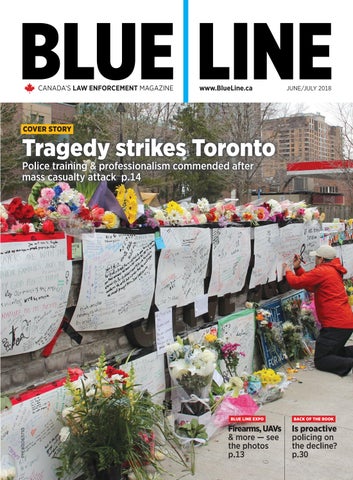
Tragedy strikes Toronto
PM 40065710
Police training & professionalism commended after mass casualty attack p.14
BLUE LINE EXPO
BACK OF THE BOOK
Firearms, UAVs & more — see the photos p.13
Is proactive policing on the decline? p.30
13 Colt Canada was one of 50-plus exhibitors displaying new technology and products at Blue Line Expo 2018. PHOTO: T. JACOBS
Contents
June/July 2018
Columns
Volume 30 Number 6
4 8 10 11 12 24 25 30
Features
Editor’s commentary Q&A Deep blue Holding the line Health & wellnes Technology Case law Back of the book
13 Blue Line Expo 2018 in review Check out the photos from Canada’s premier event for law enforcement where more than 50 vendors set up shop to show off the latest in technology, services and products. COVER STORY
14 Toronto Police hailed for professionalism after tragedy Predicting attacks like the one that saw 10 killed in North York in April is difficult but the power is in how police respond to such events. By Renée Francoeur & Ellen Cools
18 Combating the rising opioid epidemic Although opioid misuse isn’t slowing down in North America, oral fluid testing may be one tool that can help law enforcement on the frontline of drugged driving. By David Mayfield
Departments 5 5 7 7 23 28 29 30
By the numbers News Dispatches Calendar Off the shelf Product showcase Marketplace Blue Links
20 The risky business of marijuana butane honey oil
COVER PHOTO: R. FRANCOEUR
An increase in fires and explosions at marijuana butane honey oil extraction operations is an issue all first responders must be prepared to handle, especially as the legislation governing marijuana is set to change. By Jason M. Williams
8 @Blue_LineMag
18
20 June/July 2018 | BLUE LINE
3
EDITOR’S COMMENTARY BY RENÉE FRANCOEUR
BLUE LINE www.BlueLine.ca
Ready or not here comes cannabis
B
y the time this reaches your as 32 additional SFST courses between mailbox, the Senate will have July 2018 and March 2019. The race is on. cast its final vote to usher in Bill On top of that, may I remind you not a C-45, also known as the Canna- single roadside screening device has been bis Act. And my guess is we all draw in a approved for use yet (at least at the time sharp breath yet again. of writing this). It’s nothing new — we’ve been talking We are just not ready. non-stop about how the legalization of On a more positive note, Gilpin also marijuana will cause a titanic shift in law mentioned how the OPP is using its anaenforcement duties, training, etc. Many lytics to determine “problem areas” so it agree it all feels too rushed and that the can place its certified officers where they consequences, especially on our roads, need to be. could be devastating. “We’re tracking the data. In our records We were privileged to hear management system, we’ve creatmore on this evolving piece of Not a single ed a form so we can track how legislation during Blue Line Expo roadside many incidents we have so a year from Supt. Chris Gilpin of the screening or two from now we can see what Ontario Provincial Police. She device has the impact was from legalization. touched on concerns with some been We’ve also brought in a verificaof the regulations, screening de- approved tion policy so we can ensure our vices, the additional challenges for use yet. officers are doing accurate evaluwith cannabis edibles as well as ations.” the training pressures. It is yet another good example of how There are currently 285 drug recognition technology continues to influence law expert (DRE) officers in Ontario (the OPP enforcement, adding in efficiencies and a has 99 DRE officers and 480 Standardized heightened ability to be proactive — even Field Sobriety Test, or SFST officers), ac- if it means more data and more storage. cording to Gilpin. The goal is to have a While Gilpin shared portions of a police minimum of 472 DRE officers. agency perspective on the Cannabis Act, “We projected that number because there are other concerned law enforcement that’s the fastest we can train people,” she seats at this table, too — Canada Border said, noting Ontario officers have to travel Services Agency (CBSA) being one of them. to Jacksonville, Fla., for DRE training. I recently flew to Atlanta and was pulled “We’re looking for an Ontario-based solu- in at customs for extra screening — I blame tion and that’s in progress.” the maple lollipop I’d forgotten to mention British Columbia is ahead; about 30 of- in my carry-on — and sure enough there ficers were trained in the field of drug was another person in there who had been recognition back in 1995. It was the first trying to travel with pot. course of its kind to be held in Canada. His argument? This training push, according to the Van“It’s going to be legal here soon!” couver Police Department, was sparked by Earlier this year I read of the declassified studies indicating impairment due to CBSA document Global News gained acdrugs involved in 15-20 per cent of all cess to, warning of longer waits at the driver fatalities in British Columbia. Canadian border as well as a rise in illicit And that was in 1995... marijuana exports. Last year it was reported there were One thing is for sure: there will be growfewer than 600 DRE officers in Canada. ing pains as we attempt to understand this Gilpin said there are eight DRE courses rushed legislation and another massive, occurring throughout 2018, refresher moving piece will climb onto law enforcetraining for all OPP SFST officers as well ment’s already full plate.
CONNECT WITH BLUE LINE
www.BlueLine.ca 4
@Blue_LineMag
BLUE LINE | June/July 2018
www.facebook.com/BlueLineMagazine
GROUP PUBLISHER | PAUL GROSSINGER pgrossinger@annexbusinessmedia.com EDITOR | RENÉE FRANCOEUR rfrancoeur@annexbusinessmedia.com ACCOUNT MANAGER | JANICE EATON janice@blueline.ca ART DIRECTOR | SVETLANA AVRUTIN savrutin@annexbusinessmedia.com ACCOUNT COORDINATOR | TRISH RAMSAY tramsay@annexbusinessmedia.com CIRCULATION MANAGER | BEATA OLECHNOWICZ bolechnowicz@annexbusinessmedia.com Tel: 416-442-5600 ext. 3543 PRESIDENT & CEO | MIKE FREDERICKS
ANNEX BUSINESS MEDIA 111 Gordon Baker Road, Suite 400 Toronto, ON M2H 3R1 Tel. 416-442-5600 • Fax 416-442-2191
Publication Mail Agreement No. 40065710 ISSN 0847-8538 Printed in Canada SUBSCRIPTION RATES Canada — 1 Year $31.00; 2 Year $51.50 plus tax USA — 1 Year $103.00 USD CIRCULATION email: asingh@annexbusinessmedia.com Tel: 416-442-5600 ext 3553; Fax: 416-510-6875 or 416-442-2191 Mail: 111 Gordon Baker Road, Suite 400, Toronto, ON M2H 3R1 Occasionally, Blue Line will mail information on behalf of industry-related groups whose products and services we believe may be of interest to you. If you prefer not to receive this information, please contact our circulation department in any of the four ways listed above. Annex Privacy Officer Privacy@annexbusinessmedia.com; Tel: 800-668-2374 © 2018 Annex Publishing & Printing Inc. All rights reserved. Printed in Canada. No part of the editorial content of this publication may be reprinted without the publisher’s written permission. Opinions expressed in this magazine are not necessarily those of the editor or the publisher. No liability is assumed for errors or omissions. Readers are cautioned and advised that articles presented herein are edited and supplied for your personal awareness and should not be used for further action until appropriate guidance is received from a supervisor, Crown Attorney or other persons in authority. All advertising is subject to the publisher’s approval. Such approval does not imply any endorsement of the products or services advertised. The publisher reserves the right to refuse advertising that does not meet the standards of this publication.
NEWS
The Human Trafficking Team with Toronto Police Service accepts the Bill Hancox Award of Excellence. PHOTO: R. FRANCOEUR TORONTO
TPS Human Trafficking Team among those honoured at Crime Stoppers dinner The Toronto Police Service Human Trafficking Team was honoured with the Bill Hancox Award of Excellence during the annual Toronto Crime Stoppers Chief of Police Dinner, celebrating the achievements of Chief Mark Saunders. Other award winners of the evening included Amiya Reis for the Crime Stoppers Student of the Year title and St. Marcellus Catholic School, which took home the John Mungham Award. Fellow Annex Business Media publication, Canadian Security, presented Toronto Crime Stoppers with a cheque for over $13,000 to be funnelled towards the youth programs. The money was raised from the third annual Mission 500 Hockey Classic. Toronto Crime Stoppers tips over the past year have been responsible for solving “murder, sexual assault on children, people involved in child pornography, people that are dealing in guns, people that are dealing in fentanyl, and people that are just making lives miserable for others in our community,” according to Gary Grant, founder and chair of the Toronto Crime Stoppers board of
directors. “So that’s why it’s important to keep this dinner going to raise funds to support Toronto Crime Stoppers.”
because of fears associated with social stigma and confidentiality issues. By keeping this completely separate from employee wellness programs our hope is that more people will utilize our available services.” Boots on the Ground has 40 people trained in peer support as of June 2018 and McLennan noted they are also establishing a 1-800 number to include on the web page so people can call for immediate assistance. “This number will be answered by volunteers on their own cell phones so that nobody has to sit in an office waiting for calls,” he said. Boots on the Ground services will be open to police members as well as Fire, EMS and Corrections employees.
See more PHOTOS from the dinner at bit.ly/2Iltsvw. CANADA ONTARIO
Boots on the Ground to offer alternative wellness program Police officers in Ontario have organized to incorporate a new non-profit geared to offering over-the-phone and in-person support to first responders throughout the province. Boots on the Ground is slated to officially launch this fall and currently boasts a group of 56 volunteers, including serving and retired police officers. “We believe that our two-on-one peer support model makes us stand out from other resources currently available,” said Boots on the Ground president Dave McLennan. “We are looking to offer an alternative to current wellness programs being offered through employers. We believe that these programs are under-utilized
RCMP collaborates to modernize sex offender registry
The Royal Canadian Mounted Police will be working with OffenderWatch, a public safety sex offender registry network in the United States, to modernize the Canadian National Sex Offender Registry. This marks the first time OffenderWatch, headquartered in Covington, La., has worked with a law enforcement agency outside of the U.S. OffenderWatch was awarded the contract following a Government of Canada procurement process. The contract is focused on making technical enhancements to the RCMP’s existing national database, and as such, no protected information will leave RCMP premises, the organization said.
BY THE NUMBERS The 2014-15 Canadian Student Tobacco, Alcohol and Drugs Survey, previously called The Youth Smoking Survey, is the eighth cycle of data collection on student tobacco, alcohol and drug use. Information was collected from students in grades 7 to 12, who were asked how difficult they felt it would be to get prescription medicine if they wanted it, among other questions.
4% of students surveyed used psychoactive pharmaceuticals to get high
@Blue_LineMag
17% 40% 37% used cannabis
used alcohol
thought it would be ‘fairly easy’ or ‘very easy’ to obtain prescription pain relievers
June/July 2018 | BLUE LINE
5
NEWS With the OffenderWatch technological backbone supporting the new Canadian system, public safety agencies across Canada can configure certain features to bring efficiency in records management and investigations, according to OffenderWatch. OffenderWatch currently works with more than 3,500 local, state and federal law enforcement agencies in 36 states in the U.S. — with statewide implementation in 16 of those states. “Our capabilities for geocoding, radial-based searches and hosting structure allow for large concurrent access and improve public safety,” said Mike Cormaci, president and co-founder of OffenderWatch. BRANDON
Use of Force Simulation Lab for police training opens The Manitoba government, Assiniboine Community College and the Brandon Police Service (BPS) have partnered to develop a Use of Force Simulation Lab, which has been
A Brandon Police officer demonstrates using the life-sized video screen as part of the new use of force training. PHOTOS: ASSINIBOINE COMMUNITY COLLEGE officially opened at the college’s Victoria Avenue East campus in Brandon. “This simulation lab will be an invaluable training resource for police service personnel in the Westman region,” Justice Minister Heather Stefanson said in a news release. The 7,000-square foot space allows for complete scenario training exercises to be deployed using a life-sized video screen, shoot back cannon and a digital control room. The simulation technology makes it possible for trained officers and employees to decide how the scenario plays out in real-time, guided by the responses and actions of the trainee. “The acquisition of this simulator will enhance officer and public safety for the
LETTER TO THE EDITOR Right- and left-wing extremism not equally covered HAVING PICKED UP the April issue of Blue Line, I read the article regarding “The political wings of extremism in Canada,” a topic I thought would be potentially interesting. In retrospect, it was just another attempt to smear the “Right,” which, presented in the pages of Blue Line, makes one question whether the authors — or the editor — truly know their audience. The article states: “While right-wing groups may not be recognized as terrorist entities by the Canadian government, nor been responsible for attacks, many are known to hold nativist and intolerant views.” Interesting that, while these right-wing extremists are completely irrelevant and “not responsible for attacks,” — unlike the violent Left — you find it necessary to single them out. The very notion of an “extremist group” — Right, Left or otherwise — suggests the members hold
CANADA
“intolerant views,” so why go after the Right, when you specifically state that they aren’t responsible for attacks? Another section reads: “It is important to note that with the increased focus on right-wing extremism comes an equal obligation to focus on left-wing groups that have mobilized in response to the right.” Clearly this is a baseless and indefensible accusation that the Right is the provocateur and the Left is reactionary. Against a backdrop of “Antifa” that labels mere Trump supporters as “Nazis” — and justifies violence against them on that basis alone — one wonders why “equal” focus on the Left encompasses merely a comment in passing where the thrust of the entire article is an attack on the Right. I see no mention of the Black Lives Matter movement, Berkeley riots, Greenpeace or eco terrorism. Is there no room for those in an “equal” article of Left and Right extremism? - Rob Edwards
We always welcome your insights and feedback. Email rfrancoeur@annexbusinessmedia.com or comment directly on the items you see at blueline.ca (N.B. letters may be edited for clarity and brevity.)
6
BLUE LINE | June/July 2018
Brandon Police Service and other public safety organizations,” said Chief Wayne Balcaen, BPS. “This technology is another tool that will better assist our officers and safely prepare them for situations they may not otherwise encounter. Police service members will now be able to engage in dynamic and realistic situations that would not be possible until faced in a real-life situation.” The computer system allows for more than 450 different scenarios to play out, all with the aim of training police officers and other public safety personnel how to react quickly and appropriately in situations that range from routine to high stakes. The college reports that updates are made to some of the scenarios every few months.
NFPA releases world’s first active shooter standard The National Fire Protection Association (NFPA) has released the NFPA 3000, Standard for an Active Shooter / Hostile Event Response (ASHER) Program to help communities “holistically deal with the fast-growing number of mass casualty incidents that continue to occur throughout the world.” Serving as the “first of its kind,” NFPA 3000 provides unified planning, response and recovery guidance, as well as civilian and responder safety considerations. “The NFPA 3000 process, from start to finish, has been an exceptional example of emergency responders and other safety-focused practitioners swiftly coming together to provide invaluable perspective and address a significant threat in our world,” NFPA president and CEO Jim Pauley said. NFPA says this is only the second time in its 122-year history that it has issued a provisional standard. (Provisional standards are developed in an expedited process to address an emergency situation or other special circumstance.) www.BlueLine.ca
NEWS DISPATCHES Vancouver Police Chief Adam Palmer was recognized by Julie Payette, Governor General of Canada, as an Officer of the Order of Merit of the Police Forces this past spring. Peel Regional Police (PRP) have formally appointed two new deputy chiefs: Ingrid Berkeley-Brown (left) and Marc Andrews (right), bringing the total number of deputy chiefs to four. Supt. Pam Mizuno and Insp. Brad Hill of the Windsor Police Service are the new deputy chiefs, replacing Rick Derus, who retired in December, and Vince Power who is retiring later this year. This marks the first time the force has had a female deputy chief. Mizuno, who brings 24 years of experience to the role, will be in charge of operational support. Hill, a 37-year veteran, is the deputy chief of operations. Insp. Penny Hart of Halifax Regional Police (HRP) announced her retirement after a 30-year career in law enforcement. She is moving on to a new role, leading investigations as part of an independent initiative called International, Impartial and Independent Mechanism. Established by the United Nations General Assembly, the program assists in the investigation and prosecution of those responsible for war crimes or crimes against humanity. Insp. Hart will be based in Geneva for this role. Her area of focus will be investigations of sexual and gender based crimes related to the Syrian crisis. Sgt. Dave Rektor is retiring from the OPP’s west region. Rektor has served in OPP media relations since 1996. He began his career in EMT services, after graduating from Conestoga College in 1983. @Blue_LineMag
CALENDAR The Kiwanis Club of Edmonton - Oil Capital has named Edmonton Police Const. Michael Zacharuk as their Top Cop for 2017. Zacharuk was selected for going above and beyond the call of duty. He has volunteered with the Londonderry Junior High School outdoor education program, local and provincial search and rescue teams, and with sheltering efforts for the city’s vulnerable and homeless. He joined the agency in 1999. The Royal Newfoundland Constabulary is honouring the memory of Ruby Tobin, who was an RNC employee for 27 years and passed away earlier this year after a courageous battle with cancer. She worked within the chief’s office as an executive assistant to the chief. Ruby was a “rock for our organization,” RNC posted, noting she played a key role in the agency’s success. Calgary Police Service is honouring the memory of Const. Sarah Onofrychuk, who was an active member when she passed away this past spring from a stroke at the age of 36. She was part of the Calgary Police team that brought home the silver medal in volleyball at the 2017 World Police Fire Games. She was honoured with the Keith Harrison Memorial Award and also the Award of Valour. Supt. Shawn O’Reilly has been prompted from inspector. O’Reilly is now leading the Royal Newfoundland Constabulary’s Criminal Investigation Division in the NEA region (Northeast Avalon). CORRECTION: In the Dispatches section of the May issue, the photo accompanying the notice of Insp. Larry Cope, who is retiring from the Vancouver Police Department after 31 years, was incorrect. We apologize for the error.
PROMOTIONS, RETIREMENTS, RECOGNITION • If you have an officer in your agency recently promoted or retiring or an individual you wish to have recognized (major award or recently deceased) you can let Blue Line magazine know by email to: dispatches@blueline.ca.
Canadian Association of Police Educators Conference June 25-29, 2018 Chilliwack, B.C. cape-educators.ca First Nations Chiefs of Police Association Conference July 4-5, 2018 Calgary, Alta. www.fncpa.ca FBI NNA July 21-24, 2018 Quebec City, Que. www.fbinaa2018.com Canadian Association of Police Governance Conference Aug. 8-11, 2018 Winnipeg, Man. capgconference.ca Ontario Special Constables Leadership Summit Aug. 10, 2018 Toronto, Ont. www.specialconstables.ca Calgary Police Rodeo Aug. 11, 2018 Cochrane, Alta. www.calgarypolicerodeo.com ABLE - Boat Cruise Aug. 11, 2018 Toronto, Ont. ableorg.ca Canadian Association of Chiefs of Police Annual Conference Aug. 12-15, 2018 Halifax, N.S. cacpconference.ca Warriors’ Day Parade Aug. 18, 2018 Toronto, Ont. www.thewarriorsdayparade.ca Canada 911 Ride - Ontario Aug. 25-26, 2018 Alliston, Ont. www.canadas911ride.com
June/July 2018 | BLUE LINE
7
Q&A Colin MacLeod spent over 20 years in the RCMP as a pilot, flying fixed-wing aircraft and helicopters on nail-biting missions through Newfoundland snow, the peaks and saddles of the Rocky Mountains and beyond. Also a former Edmonton Police officer, MacLeod shares his stories from the cockpit at a time when policing by air was still quite the novelty. Q: How did you begin your career in law enforcement?
Q: Was anything about the job routine?
Q: What was it like starting with the RCMP in 1981?
mark. That’s when the RCMP called. The force had previously chosen its pilots from within its ranks, who were all regular ranked members, but just before my joining they had gone through reorganization, changing the pilot positions to the rank of special constable. Some of the current pilots had chosen to convert to special constable status, with its subsequent rise in pay. Others decided to remain in the regular rank structure, as they were senior non-commissioned officers. In my case, the force had no experienced helicopter pilots to draw from and was forced to go outside to hire a civilian. I came on as a civilian helicopter pilot, classified as a special constable. There were grumblings but I stayed out of it. I first reported to Victoria, B.C., where the force operated a Beech King Air 200 and a Bell 206B Jet Ranger helicopter, C-GMPI.
At the time I was flying for a commercial operator, Shirley Air Services, out of Edson, Alta., and getting close to the magical 1,000-hour
Q: What was your most memorable moment as an RCMP pilot?
Q: Where did the interest in flying stem from? My father was in the air force; I grew up on airports with old yellow Harvards flying around all the time. So aviation has always been a part of my life and when I started police work, helicopters in policing was a concept just starting to emerge. In a big city like Edmonton, we really could have used one back in those days... I thought it would be an interesting field to get into, combining both of my interests.
8
BLUE LINE | June/July 2018
Snapshot of RCMP Air Services
1937 Royal Canadian Mounted Police Air Services established in Moncton, N.B.
19 Air sections make up the service today with 41 aircraft
150+ People employed in RCMP Air Services in 2015
The RCMP was different than urban policing nowadays. One of my routine things was the constant repairing, adding and maintaining of mountaintop radio repeater sites for communication with the dispatch centres. We did a lot of that in the mountains and mountain flying is a completely different set of skills. We were just at the cusp of introducing infrared cameras and searchlights; we did that where we could. This was all before GPS, remember, so we did so many searchand-rescue missions, too.
Q: Helicopter safety has been thoroughly debated over the years. Do you have any accounts of accidents or close calls that directly impacted you? When I found my friend and fellow pilot Wayne Meyers after he had hit a cable in a valley in B.C. The cable had ripped the top off the helicopter. He and another fellow by the name of Frank Jones died right there. It was traumatic. I flew down over the same valley and I just happened to be at a different altiwww.BlueLine.ca
PHOTO: COLIN MACLEOD
I started with EPS (Edmonton Police Service) in 1973 when I was only 20-years old and looking for a job. At 20 you don’t know much about the world but I stayed there for five years, grew up a bit and learned lots. After having a taste of recreational flying — and an actual flight in an operational RCMP helicopter out of Fort McMurray, Alta. — I knew my days as a general duty policeman were numbered. The RCMP has a storied history in aviation and was the only police organization at the time to operate helicopters —they had a fleet of about half a dozen. They required 1,000 hours of experience before they would consider you. So in 1978 my wife Wendy and I moved temporarily to Victoria, B.C., and I started training with a little school called Transwest Helicopter School.
There are so many — I couldn’t even begin to pick one... One that comes to mind right now was a mine explosion in Yellowknife. We were sitting at 25,000 feet in the air and the northern lights put on quite the show for us. It was just absolutely extravagant. Some of more memorable things are being in a position to help members in the street and making their day easier. That was the most satisfactory part of the job.
tude than he was. I never did see the cable he hit. It took me a long time to get over that. Another time we were helping the highway patrol in Banff and the engine of my DXC went. I had to commit to a full-on autorotation. With about 400 feet of altitude left, my turn towards the highway had lined me up pretty well but I didn’t have time to look for vehicles behind me. We skidded along on the pavement for about 100 feet, but I had directional control and the impact was minimal. Thank goodness for being within reach of the highway. There were not a lot of other clearings along this stretch and the only other choice I had would have been the Bow River or the trees. Either would have been disastrous. It certainly woke me up.
Q: How did the RCMP aviation services change during your career?
When I first started, I remember flying over northern Saskatchewan and how it all looked the same; we didn’t have a clue where we were half the time — just a compass. Today, you know exactly where you are thanks to sophisticated navigation. The technological changes in the machines themselves have been amazing. Each generation gets a little more powerful, smoother, faster, cheaper to run. It’s phenomenal growth. Internally within the RCMP, I still don’t believe they have the civilianization process figured out. They bounce that back and forth and it causes a lot of turmoil and frustration. So the HR function requires improvement.
Q: What is your advice for others in law enforcement dreaming of a career in aviation? It’s difficult and it’s competitive.
Identify exactly what you want to do and get the qualifications. Develop a plan on how to meet all those qualifications and make sure the decision makers in the organization know about it. Plus, it’s expensive, so you should establish a financing plan.
Q: You retired from the RCMP in 2001 and sold your charter company in 2016. What’s life like after flying? I definitely miss it. I haven’t flown in a couple years now. I’m enjoying being a grandpa and travelling. I’ve written a book about all the adventures and just released that on Amazon at the end of March of this year. It’s been valuable to my friends and family; it also serves as a way to pay tribute to the friends and colleagues we lost, like Wayne... I think any police officer would get a chuckle out of it. And it’s all true.
Find MacLeod’s personal account from his time in the law enforcement cockpit here on Amazon: amzn.to/2wB11bk.
PART OF YOUR TEAM Commissionaires is your proven partner to: Keep police officers doing police work Contain your law enforcement costs Meet your community’s expectations for public safety
commissionaires.ca @Blue_LineMag
June/July 2018 | BLUE LINE
9
DEEP BLUE BY DOROTHY COTTON
Challenging social norms, rethinking mental illness
I
t was not so long ago that the whole idea of mental illness was something we kept locked away in a closet (or an institution). While on the one hand I am delighted to see we seem to be addressing the issue of stigma, and people with mental illnesses are speaking up and demanding to be heard and seen, sometimes I feel like the pendulum has swung too far the other way. It almost seems that every time someone does something weird or unusual, their behaviour gets blamed on mental illnesses. If you are an unstable politician, or a mass murderer, or a parent who absconds with your own kids, or a socially awkward person, suddenly everyone has decided that you are mentally ill. I don’t think conclusions such as this do any favours for people with real mental illnesses. Most people with mental illnesses are not homicidal and most do engage in an endless pattern of dangerous, unpredictable or irrational behaviour. Of course, some do at times and some “normal” people do too at times. But mainly all this shows us is we still have a limited understanding of what mental illness really is and that we have much to learn about it. Unlike the case for many “physical” diseases, there are no tests or measures that give us clear answers about whether someone does or does not have a mental illness. That’s not to say we have not made significant progress in identifying and understanding mental illnesses in recent decades. It is interesting to look back over the history of mental illness and see some of the diagnoses that have existed in the past — and mostly vanished. Since summer is here, and I like to lighten things up a bit at this time of year, I thought I’d give you a bit of a chuckle by
10
BLUE LINE | June/July 2018
telling you about some of the old psychiatric diagnoses that have come and gone over the years. My personal favourite is “involutional melancholia.” It just rolls off the tongue. This disorder was considered to be a type of depression that occurred in midlife people. Generally, people with this disorder were felt to be lousy at coping with the life changes that accompany middle and older age. So whereas other forms of depression were seen to be more biological in nature, involutional melancholia was more of a personal deficit. However, by the 1950s there seemed to be more or less general agreement this was not a real separate diagnosis. The fact is people get depressed at all ages and for a variety of reasons. Even older than involutional melancholia is the phenomenon known as “the vapours.” (One should picture a woman in a tight corset, hand held to forehead and swooning — gently of course — upon a couch.) This is a Victorian era disorder, which probably encompassed a variety of symptoms of anxiety, panic and depression, and often involved fainting and
There are no tests or measures that give us clear answers about whether someone does or does not have a mental illness.
flushing. Mind you it might also have been attributable at least in part to very tight corsets, which led to an inability to breathe. What we do for fashion... Then there is hysteria. (We still use that word today but in a different manner.) In days of yore, it referred to the tendency a woman’s uterus had to wander around, causing all sorts of trouble. While some of the symptoms were probably abnormal — like fainting and insomnia — many were simply “symptoms” of being a normal female — things like having sexual desire, retaining fluid and being irritable at times. The treatment? Hold your breath... It was for the physician to masturbate the affected female, bringing on an orgasm. Aside from the fact that all three of these diagnoses tended to affect women rather than men, what else do we note? In all cases, it appears that the main problem is people did not behave the way predominant society wanted them to behave — or if they did behave that way, it made them sick. It makes me think... the next time we accuse someone of being mentally ill because they behave in a way that is not consistent with predominant social norms, we might want to rethink our analysis of what constitutes a disorder and what is just an example of things that just fit (or don’t fit) our social norms. Sometimes the behaviour in question is definitely problematic, but may not be a mental illness, as the examples earlier suggested. And sometimes it may well be that the behaviour is fine; it is society that is a little rigid. Not every uncommon behaviour is a mental illness.
Dr. Dorothy Cotton is Blue Line’s psychology columnist. She can be contacted at: deepblue@ blueline.ca.
www.BlueLine.ca
HOLDING THE LINE BY MICHELLE VINCENT
Big problems can lead to big solutions
H
ow often does life deal us a real challenge and we think: How will I ever get through this? I am just not sure I can. Maybe it’s a work-related challenge, such as an upcoming court case, a personality conflict with a colleague, or some trouble we inadvertently got ourselves into while on shift. And, let’s face it — there is always something going on when it comes to the home front. Perhaps we are dealing with relationship issues, difficult teens and/ or crying babies on little to no sleep. We may have ailing parents we are caring for, family members with mental health issues, financial challenges, etc. Regardless of the specifics, it always feels big. We commonly deal with big problems in a panic, anticipating the worst. And when we are engaged in the occupational world of policing, our perception of these big problems can be scary. When stressed, the average person tends to shut down, which makes new thoughts and ideas inaccessible. Imagine what we as police officers construe with the thoughts we have! If we were to look at times when we experienced a significant challenge and followed it through to the point of an outcome, I wonder what it would look like? We often imagine the outcome to be much worse than it ever ends up being. There are always exceptions to that rule, of course, but generally speaking the end result often ends up working out in the end. Sometimes the hardest part of navigating a big challenge is having faith in the end result. When we explore what resilience truly is, I believe it encompasses an understanding and faith (often blind) in seeing the challenging experience is present to guide us in a direction we had not intended. Wouldn’t it be nice if we could experience a challenging moment and recognize it as a growth spurt? How much more effective would @Blue_LineMag
we be in finding the solution? Resilience is conceptualized as a state of mind or an ability to work through what would be considered challenging times. There are a variety of outstanding resources available to support resilience: reading material and programming developed to prevent and educate on operational stress injury (OSI), post-traumatic stress injury (PTSI), anxiety, depression, etc. Developing a healthy, unique outlook on an experience is another form of resilience and I will suggest it is one of the most powerful. Post-traumatic growth is a term I came across recently. Yes, it is another “trendy-at-the-time” term for what is now called resilience — except this term’s development is deemed to be from the traumatic experiences we incur in life (and not necessarily derived from personality).
Developing a healthy, unique outlook on an experience is another form of resilience and I will suggest it is one of the most powerful.
I decided to do some research on this term and found a fantastic 2016 article by Brian Chopko, Patrick Palmieri and Richard Adams. It explains what they believe to be the relationship with post-traumatic growth and traumatic exposure. There is a distinct relationship between post-traumatic growth and post-traumatic distress, however the reverse is not true. The amount of post-traumatic growth experienced by the police officer does not reduce the amount of post-traumatic distress experienced. Perhaps exploring this connection might provide a missing piece in treating mental health issues such as PTSI, OSI, depression and anxiety in our members. Perhaps big problems equal big solutions after all. Engaging in mindfulness as we go through the journey called life may provide us with an opportunity to reflect on how some of our most challenging experiences are what made us the amazing person we are today — if we hadn’t had that big problem to begin with, we might never have been challenged to be available to receive big solutions. Michelle Vincent is a 16-year York Regional police officer with a Masters Degree in Arts in Counselling Psychology and a background in equine assisted therapy, workplace reintegration and teaching. She has a practice supervised by a psychologist and is working towards her PhD in Forensic Psychology/Crisis Response. She can be contacted at: michelle@smith.net.
5% Military & LE Discount Available *SOME RESTRICTIONS APPLY - PLEASE VISIT www.wolverinesupplies.com/military-law-enforcement
NEW PRODUCT LINE! C lip IR
Ti CAM 1000B
N i CAM-31 NVG
N i CAM-14 NVG
June/July 2018 | BLUE LINE
11
HEALTH & WELLNESS BY ISABELLE SAUVE
Wellness plans: fad versus fact
V
egan diets, blood type diets, liquid diets, lunar diets, werewolf diets, grapefruit diets — one cannot avoid being bombarded by the hype for the latest “revolutionary” and transformative diet proposal. The overwhelming number of fad diets emerging with “pseudo” scientific demonstrations can easily be confused with proven nutritional facts. Despite absence of solid scientific proof to substantiate many of the claims made, fad diets boast having unearthed the perfect equation. However, there is no magic universal formula. Many of these diets are in fact unhealthy and unbalanced. Fad diets frequently prescribe a set plan and propose unrealistic results. Some of them proclaim fat loss without exercise, which can wrongfully seem appealing. Physical activity is an irreplaceable component to long-term wellness, health, and weight management. Perhaps what all fad diets have in common is the improbability that followers will be able to adhere to them long-term. Overly strict diets are too restrictive in terms of calories and nutritional value. Over time they can have an adverse impact on health and be harmful due to a deficit of minerals, vitamins and nutrients. Restricted diets can have a substantial negative impact on athletic, physical and mental performance, and can cause serious medical issues. Being under nourished increases the likelihood of exercising poor judgment. These deficiencies can have a 12
BLUE LINE | June/July 2018
devastating impact for those in the field of law enforcement. For example, reducing carbohydrate intake, a biomolecule necessary to fuel the muscles and the brain, decreases overall energy. Diets too low in carbohydrates place the body in a state of ketosis. Ketosis happens when the body burns fat without carbohydrates, producing a by-product in the bloodstream called ketones. This creates the feeling of fatigue (and even nausea in its extreme). Being carbohydrate deficient can be a serious problem for anaerobic activity or intense action, such as a foot chase or a physical struggle as the body turns to carbohydrates for fuel. The equilibrium between calorie intake and expenditure is the tipping point. It is the overall dietary pattern that matters in conjunction with physical activity. At the end of the day, there is no rapid solution to weight management. It takes time to lose weight, as it takes time to gain it. Safe weight loss occurs at approximately one to two pounds per week and does not come easily. It takes approximately a deficit of 3,500 calories to shred one pound. If more calories are spent than are ingested, the result is weight loss. The reverse signifies gain. Our health is our wealth. Imagine your body as a bank account; you can enrich it with exercise and a balanced nutrition. On the other hand, poor nutrition and a sedentary lifestyle deplete the account. As such, do not live in debt with your body as it is hard to repay and usually comes with high interest.
Rather than having an elaborate calorie count, the focus should be on fresh, natural and colourful food. Pay close attention to the nutritional value.
The word “diet” implies hardship and deprivation, immediately creating an unbalanced psychological mind set. Therefore, calling wellness undertakings something more empowering — such as a “health management plan” or simply a “wellness plan” — can set you up for success. It also suggests a multi-faceted approach to wellness with nutrition being but one important component. There is no need to entirely eliminate foods enjoyed — it’s about balance and moderation. Eating should support health, feeling well, mood stabilization, energy and vitality. Wellness management plans should be individually based, taking into account varying needs related to age, medical conditions, activity level, etc. Undertaking small incremental steps such as eating slowly and gently reducing portion sizes eventually leads to grand results. Committing to simple steps alone will gradually make a big difference. Other easy steps, such as drinking more water or adding a vegetable snack once a day can also lead to substantial change. Preparing one’s own snacks and meals offers more control over what is eaten. Eventually small efforts become habit and become permanent routine. Rather than having an elaborate calorie count, the focus should be on fresh, natural and colourful food. Read labels and know the content of food. Pay close attention to the nutritional value of what you eat. Moreover, notice how you feel after eating, as it can be a good indicator of whether or not the food is healthy for you. Do not skip meals as it can depress your metabolism. Like a sport-performance car, the body responds best when filled with quality fuel. Isabelle Sauve is a 10-year OPP veteran currently with the Emergency Response Team (ERT) at the Almaguin Highlands Detachment in Burks Falls, about 300 km north of Toronto. She can be contacted at: isabelle.sauve@hotmail.com.
www.BlueLine.ca
Technology talk steals the show at Blue Line Expo
PHOTOS: R. FRANCOEUR & A. KHAN
O
n May 3, Blue Line hosted its annual Blue Line Expo, Canada’s premier event for the law enforcement community, at the International Centre in Mississauga. Over 50 vendors set up shop to show off the latest in technology, services and products from the law enforcement, corrections and security industries. This included body worn cameras, police pistols, Narcan Kits, robbery detection systems, law enforcement vehicles and so much more. On the conference side of things, the OPP’s Colin Giles stole the show with his talk on unmanned aerial systems and the role they play in collision reconstruction as well as search-and-rescue endeavours. The audience also lined up to ask Supt. Chris Gilpin questions after her presentation on the legalization of marijuana and how the OPP is preparing drug recognition experts. Cost, battery life and changes to officer workflow were all topics brought up during the enlightening Body Worn Camera panel, featuring various law enforcement officers from agencies who have already incorporated the equipment or are in the process of doing so. Who needs robots when you can have robocops? Peter Sloly put this thought to the crowd during his “Smart Policing in Smart Cities” session. He said in 2009 not a single hand went up when a law enforcement audience was asked if they thought they would be policing in the Internet. He said the question today is: How will we be policing in the human body, in outer space in the future? Thank you to all the sponsors, exhibitors, speakers and attendees for making Blue Line Expo a success. Find additional PHOTOS and a VIDEO from the event on blueline.ca.
@Blue_LineMag
It’s all ears as attendees listen to Colin Giles detail how handy a UAV is in the swamp.
Staff Sgt. Lindsey Houghton with the Combined Forces Special Enforcement Unit B.C. accepts one of the Best Dressed Police Vehicle Award certificates from Janice Eaton.
Blue Line Expo attendees catch up on the news with issues of Blue LIne as they wait for the resilience workshop to begin.
Vancouver Police Const. Dale Quiring, right, accepts the Police Leadership Award from Blue Line’s editor, Renée Francoeur.
Insp. Todd Cox, left, congratulates Steve Gawadzyn, who was behind the design of the award winning Windsor Police car.
The body worn camera panellists chat about pilots, costs, battery life and more.
Expo speaker Supt. Chris Gilpin of the OPP walks attendees through the Cannabis Act.
Stephanie Conn of First Reponder Psychology hosts a workshop on resilience.
Deloitte Canada’s Peter Sloly explores the current threat landscape. June/July 2018 | BLUE LINE
13
THEMIOUS COVER STORY DIPSOTK
Tragedy strikes Toronto Toronto Police hailed for training and professionalism in the wake of a mass casualty event, on the streets of Canada’s largest city By Renée Francoeur & Ellen Cools
“T
hat is a very professional arrest.” This was the first reaction from Jessica Davis, a consultant and former intelligence analyst, as she watched the videos on social media capturing the subduing of the accused in the recent Toronto van attack. She wasn’t alone in these thoughts — people from all over the world commented on the officer’s composure and swift expertise. At the same time, she said she believes that is what Canadians expect of their police forces. Similarly, Const. Ken Lam, the traffic officer who made the arrest, reportedly told colleagues and family, “I was just doing my job.”
Horrific scene Toronto Police Service (TPS) and other first responders rushed to the scene on the afternoon of April 23, where eyewitnesses reported a white van mowing down pedestrians starting at the Yonge and Finch intersection in the northern part of the city — about a 10-minute drive from the Blue Line office. Ten people were killed and 16 injured. “I must have seen about five, six people being resuscitated by bystanders and by ambulance drivers,” said Phil Zullo, one of the eyewitness, to Canadian Press. “It was awful. Brutal. Just people everywhere...” Alek Minassian, 25, of Richmond Hill, Ont., has been charged with 10
7
minute span from the first 911 call reporting attack to an arrest being made
A memorial quickly grew for the 10 people killed and 16 injured after a white van mounted the sidewalk and mowed down pedestrians on April 23. 14
BLUE LINE | June/July 2018
counts of first-degree murder and 16 counts of attempted murder. He is due back in court in September. “This was a horrible, horrific scene,” Mike McCormack, the president of the Toronto Police Association, told Blue Line the day after the attack. “The officers were all amazing. It speaks to what we do in policing. Too often, we have a negative narrative but this shows truly what policing is really about — the commitment of the first responder.”
All first responders to be commended In one of the videos from the scene posted online, a man stands by a damaged white rental van and points an object at the officer, asking to be killed. The officer refuses to shoot, yelling repeatedly at him to get down and an arrest is later made with the man on the ground. In a press conference a few days after the event, Toronto Police announced it was Const. Lam with 32 Division who arrested Minassian and that while he is grateful for all the public support, he doesn’t want the hero status. He asked that all www.BlueLine.ca
PHOTOS: R. FRANCOEUR
Resources from Peel Regional Police and York Regional Police were utilized to process the one-kilometre scene.
Crowds gather in the background to pay their respects at a memorial set up for the victims on the east side of Finch and Yonge.
first responders who attended to the scene are commended and recognized. “I can assure you, not a single Toronto Police officer wakes up and says ‘I want to be a hero,’” said Deputy Chief Peter Yuen during the press conference. Toronto Police Chief Mark Saunders said it was a total of seven minutes from the time the first 911 call came in to the time the arrest was made. Saunders said Lam told him he “defaulted to his training... and as a result we had a successful outcome.” McCormack had also spoke with Lam soon after the attack, commenting, “When you’re in confrontation with someone, it’s stressful enough; when you compound that with the horrible, horrible day of having 10 dead, it’s a lot to be a part of. It’s very overwhelming.” “Impressive” is the word Satyamoorthy Kabilan uses when he describes Lam’s actions. “The officer used very good judgment,” said Kabilan, the director of
national security and strategic foresight at the Conference Board of Canada, in a phone interview with Blue Line. “He should really be commended. It is very difficult in these situations to act so well... when you do not have the certainty the suspect does not have a weapon. This officer paid very close attention to this and didn’t see a gun. He was astute enough to notice this.” Mubin Shaikh is a counter terrorism expert from Canada who trains police, intelligence and special operations forces around the world on matters related to the jihadist
@Blue_LineMag
1,206 calls from 911 received in the two hours and 15 minutes surrounding the event
873 of these were for the attack alone
threat. He said, as tragic as the attack was, it gave an opportunity for TPS to really showcase superb policing skill, as learned through training and the examples set by colleagues and superiors. “The manner in which the citizenry rallied around Const. Lam is a testament — that the goodwill of the public must never be taken for granted,” he said. “And while police responses are usually always criticized by the Monday morning quarterback crew,” this culled a reverberating plethora of police pride, positivity and support.
“We’re not going to be able to prevent these type of incidents 100 per cent but we can learn from them. And we do that by reviewing.” - Jessica Davis, consultant & former intelligence analyst June/July 2018 | BLUE LINE
15
“This is a tragic event,” says Satyamoorthy Kabilan. “But in the response, Toronto Police got so many things right.”
A dump truck blocks the intersection at Yonge and Finch in North York the day after the attack.
De-escalation
the public, the media — anyone— that our mindset is to de-escalate and have zero harm.” For Kabilan, this is also a great example of a police officer doing whatever they can without taking out a firearm in an extremely difficult situation. “However, we need to be careful and understand this is a unique situation and another officer may respond differently, legitimately so, in a different but similar situation,” he noted.
Toronto Police officers are put through rigorous training every year, Yuen noted, and Lam “clearly exhibited and understood that training.” He said TPS is often asked how it knows its training works. “Well, folks, it does work because it was exhibited by Officer Lam,” he said. “Every year, we have almost 30,000 people taken into custody and use of force is less than 0.5 per cent. That speaks loudly for our decision making ability, assessing and thinking under stress.” It is one thing to tell other officers and the public what de-escalation looks like, and quite another to be able to show a real-life, perfect example, he added. “That’s why it’s remarkable for us, to be able to hold something like this to say, ‘Look at this,’ and we can tell
397 911 calls received in the same period the week before
369 911 calls received in the same period the year before
TPS “got so many things right” “This is a tragic event,” Kabilan continued. “But in the response, Toronto Police got so many things right.” He pointed to the controlled way authorities released information, connected with others, such as Sunnybrook Hospital staff, and
“Every year, we have almost 30,000 people taken into custody and use of force is less than 0.5 per cent. That speaks loudly for our decision making ability, assessing and thinking under stress.” - Toronto Deputy Chief Peter Yuen 16
BLUE LINE | June/July 2018
didn’t jump to conclusions — police announced a motive would not be discussed, as charges have been laid and the case will go to trial. In regards to motive, Kabilan also noted that speculation is harmful and applauded Chief Saunders for doing “very well” in that respect and being careful in his wording. Saunders mentioned there was no national security connection to the incident in a press conference the night the attack occurred. “The reality is: any large metropolitan area has the potential for this to happen... there is a large concentration of people and you get more trucks going through the city than a small town, for example,” Kabilan went on to state. “The question is what can we do to protect pedestrians and we’re never going to be able to make it a zero-risk situation.” Detecting and preventing this type of attack is really challenging for law enforcement and security services, Davis agreed. “We’re not going to be able to prevent these type of incidents 100 per cent but we can learn from them,” she said. “And we do that by reviewing.”
www.BlueLine.ca
PHOTOS: R. FRANCOEUR
COVER STORY
COVER STORY
Vehicles as weapons Phil Gurski, president and CEO of Borealis Threat and Risk Consulting, and a former senior strategic analyst at CSIS, also said that unfortunately nothing could be done to mitigate these types of vehicular attacks. Although cities can install barricades outside public areas such as sports stadiums, parks and city hall, the question is, where do you draw the line, he said. “If you want to say, ‘Okay, Yonge Street was hit, we’ll just barricade Yonge Street.’ Well, good luck with that, because Yonge Street’s pretty big. So first of all, you couldn’t do it. Second of all, you could try, but it would be incredibly expensive. Thirdly … if you did it, you’d basically be building ‘Fortress Toronto,’ which nobody wants. And fourthly, the bad guys just move onto the next block,” he explained. Barriers are just one tool anyways, Shaikh added. “An even greater tool, if not the greatest, is how officers respond to such events, and if it is of course easier said than done to bring an offender to justice by arresting and prosecuting them.” Officers will have to focus on the successful responses to such attacks, Shaikh concluded. “You don’t know where the threat will come from — even where we are conditioned to anticipate such attacks from specific groups — but the response, is fully in our control.” Additionally, these attacks, according to Gurski, are “stupid simple.” “Who’s going to stop you from driving into a crowd? The answer is nobody, unless you’re already under surveillance, under investigation, and even then it’s problematic.” In this case, he said it will be interesting to discover why the driver chose to attack the city. All TPS can currently say is it apprehended a cell phone and Minassian allegedly posted a cryptic message on Facebook before the attack. Gurski said the reporting of potential signs of such an attack is paramount. “All my work on radicalization when I worked for the service [CSIS] indicates quite categorically that there are always signs and that the challenge is not that there aren’t signs, but …what do you do about them?” he asked. “You’ve got to call somebody.” @Blue_LineMag
“... This shows truly what policing is really about — the commitment of the first responder.” - Mike McCormack, Toronto Police Association Toronto Strong Going forward, TPS will “look at lessons learned, updating the public in a timely fashion — what we can do better,” Saunders said. Through the horrific event, “I’ve have the opportunity to be surrounded by some of the best investigators, the most knowledgeable people in counter terrorism and we were able to break down things very minutely and I’ve got to tell you, on the world scale, we are ahead...” he added during his speech at the Toronto Crime Stoppers Chief of Police Dinner in May. “The fact that we utilized officers that were issuing pamph-
lets to help people heal from the crimes they witnessed... the fact that we brought in therapy dogs in that particular neighbourhood — they were all things the rest of the world looked at.” The tragedy has indeed exacted “a toll that will last forever,” Saunders said, but in response, it is the ability to “train people to do the right things” that makes a difference. Watch Blue Line’s video from a press conference with Deputy Chief Peter Yuen: bit.ly/2rcZdQ4. Ellen Cools is the assistant editor for fellow Annex Business Media publications Canadian Security, SP&T News and Electrical Business.
DALHOUSIE’S CERTIFICATE IN POLICE LEADERSHIP
Skills for now Better career tomorrow
Built for modern policing, our online courses, designed and delivered by industry leaders and experts, give you the knowledge and skills to advance in your profession. Learn from the innovator in quality police education for over 25 years. REGISTER AT:
DAL.CA/POLICELEADERSHIP Fall Term starts September 5
June/July 2018 | BLUE LINE
17
OPIOIDS CRISIS
Combating the rising opioid epidemic Oral fluid testing is one tool law enforcement can use to detect drugged driving By David Mayfield
S
tatistics Canada has found the number of apparent opioid deaths in Canada in the first nine months of last year almost matched the figure for all of 2016. The Public Health Agency of Canada reports there were 2,946 deaths stemming from opioids in 2016 and at least 2,923 from January to September of 2017, the vast majority of them accidental. From January to September 2017, almost three-quarters of such fatalities involved fentanyl or fentanyl analogues, compared with 55 per cent the year before. Additionally, in British Columbia alone, 161 people died from drug overdoses in March, according to the
2,946 deaths from opioid overdose in Canada in 2016
2,923 deaths in JanuarySeptember 2017
The Dräger DrugTest 5000 system is a means of testing oral fluid samples for drugs of abuse, such as amphetamines, cocaine, opiates, etc. 18
BLUE LINE | June/July 2018
B.C. Coroners Service, revealing that a 58 per cent increase from the month before. By May 14, there were 391 deaths across B.C. this year alone. Researchers at St. Michael’s Hospital in Toronto also had only grim data to report earlier this spring; they found the overall rate of opioid-related deaths nearly tripled in Ontario from 2000 to 2015. In other words, the opioids crisis isn’t dissipating anytime soon. The CDC (Centers for Disease Control and Prevention) estimates that the “economic burden” of opioid misuse alone in the United States is $78.5 billion a year. These costs include: • Health care, • Lost productivity, • Addiction treatment, • Criminal justice involvement.1 The steep increase in drugged driving accidents has quickly created a national epidemic in the States as well, with prescription drug use being associated with more fatal crashes than any other drug type. According to the 2016 National Survey on Drug Use and Health (NSDUH), 20.7 million people aged 16 or older drove under the influence of alcohol in 2016 and 11.8 million drove under the influence of illicit drugs.2
Similarly, according to Statistics Canada, almost 3,000 drug-impaired driving incidents were reported in 2015, representing 4 per cent of all impaired driving incidents — double the proportion in 2009, when data on drug-impaired driving first became available. So what’s being done about it? In Canada, the federal government spearheaded the Joint Statement of Action to Address the Opioid Crisis last fall, which outlines the combined commitment of over 80 partner organizations to respond to this crisis. The statement was created as a result of the Opioid Conference and Summit and the Canadian Centre on Substance Use and Addiction is tracking its progress. Actions fall within the “pillars of prevention, treatment, harm reduction and enforcement, supported by strong evidence.” The enforcement component means: addressing illegal drug production, supply and distribution. This is done by: • Continuing enforcement on the importation, exportation and trafficking of illegal opioids; • Pursuing legislative, regulatory, policy and programmatic changes to better control substances and equipment; • Supporting education and training for law enforcement; • Collecting, assessing and sharing information with law enforcement agencies domestically and internationally.3 Opioids have been “a focus of working level, bilateral co-operation with the U.S. and are part of the trilateral discussions with the U.S. and Mexico through the recently established North American Dialogue on Drug Policy,” stated the Canadian government. The “dialogue” is a means to “exchange information on drug trends, increase trilateral co-ordination on drug policy and develop actions that our governments can take to protect our citizens from harmful drugs and drug trafficking,” the feds added. “Further, the RCMP Federal Policing Program is working in close www.BlueLine.ca
BODYGUARD TM
collaboration with U.S. law enforcement counterparts, particularly the Drug Enforcement Administration and Homeland Security Investigations, to share best practices and lessons learned.”4
Apparel
Ɣ Cost Effective Uniform Solutions
The drugged driving epidemic The drugged driving issue at hand has the capacity to have an even broader impact on society. While police have long been well equipped with breathalyzers to detect alcohol, such tools for drug abuse are not as widely available. Oral fluid testing is under consideration and currently undergoing pilot and fielduse testing. Oral fluid testing provides law enforcement officials with roadside drug screening capabilities that test for amphetamines, designer amphetamines, opiates, cocaine and metabolites, benzodiazepines, cannabinoids and methadone. Oral fluid drug testing manufacturers, such as Dräger, are working to help get these tools into the hands of law enforcement to assist in drugged driving investigations. These tests are highly reliable and are currently being evaluated by NHTSA (National Highway Traffic Safety Administration) for application by law enforcement. Public Safety Canada said results from a pilot last year suggest the devices can be used by police officers successfully.5 The next steps, as expressed in the pilot’s final report of recommendations, include developing a list of standards for device functionality, as well as standard operating procedures at the roadside, and development of core training for police forces.
Footnotes 1. Center for Behavioral Health Statistics and Quality. Results from the 2016 National Survey on Drug Use and Health: Detailed Tables. Rockville (MD): SAMHSA; 2017. www.samhsa.gov/data/sites/ default/files/NSDUH-DetTabs-2016/NSDUHDetTabs-2016.pdf. Accessed Sept. 14, 2017. 2. Florence CS, Zhou C, Luo F, Xu L. The Economic Burden of Prescription Opioid Overdose, Abuse, and Dependence in the United States, 2013. Med Care. 2016;54(10):901-906. doi:10.1097/ MLR.0000000000000625. 3, 4. www.canada.ca/en/health-canada/services/ publications/healthy-living/actionsopioids-2016-2017.html. 5. www.blueline.ca/news/police-gives-thumbs-upfor-oral-fluid-drug-screening-device-pilot-4445.
David Mayfield works in marketing management for Dräger Inc.
@Blue_LineMag
Ɣ Great Quality Ɣ In-Stock Items Ɣ Quick Turn-Around 905.565.7576 1.800.996.9499 sales@spirito.com
www.spirito.com
Make a Difference JUSTICE STUDIES FOR WORKING FRONTLINE OFFICERS
At Humber, we teach the professional and practical skills you need to move up and make a difference in your community and in your career. Further your education one course at a time or work towards a certificate, diploma or degree. Advanced standing is available to those in the Justice Services industry.
communityservices.humber.ca /justiceprofessionals
CANNABIS
The risky business of marijuana butane honey oil operations As legalization looms, law enforcement should prepare to see a potential rise in these concentrate extraction labs By Jason M. Williams
F
ires and explosions occurring at marijuana butane honey oil extraction (BHO) operations have increased significantly over the past several years, according to the Office of the Fire Marshal and Emergency Management (OFMEM) in Ontario. There are inherent hazards and dangers associated with the extraction process due to the volatile fuels utilized by the manufactures of the illicit marijuana concentrate product. The incidents, which are occurring at illegal drug producing facilities, have caused serious injuries,
39 fire/explosion incidents involving BHO have been investigated in Ontario since 2012
property damage and even death to those involved in the manufacturing process as well as members of the public. It is an issue all first responders must be prepared to handle, especially as the legislation governing marijuana is set to change in Canada. Between 2012 and April 2018, the OFMEM investigated 39 fire/explosion incidents involving BHO extraction processes in the province. The BHO method of producing marijuana concentrate allegedly provides a greater yield than other methods and has become very popular. Information on how to carry out a BHO extraction can be found readily online and does not require any specialized equipment — it can all be purchased at a local hardware store.
A background on marijuana concentrate production
Hash oil is manufactured by solvent extraction of marijuana and/or hashish. PHOTO: JASON M. WILLIAMS 20
BLUE LINE | June/July 2018
Hash oil is manufactured by solvent extraction of marijuana and/or hashish. After filtering and evaporating the solvent, a sticky resinous liquid remains. One pound of mari-
juana will produce between 1/5 and 1/10 of a pound of hash oil. (As a side note, hash oils seized in the 1970s had THC contents ranging from approximately 10-30 per cent. Hash oils seized in the past five years have had THC concentrations as high as 90 per cent.) A wide variety of solvents can and have been utilized for the extraction process including chloroform, petroleum ether, naphtha, benzene, ethanol and butane.1 Here we will focus on the utilization of butane as the solvent. The preferred method to produce marijuana concentrate is to manufacture BHO, which regularly utilizes a four-step process. The manufacturers of the BHO will moderate the amount of marijuana plant material (which includes buds, stems and leaves) by grinding the material into smaller particulate with a grinder or blender; the smaller particulate is commonly known as “shake.” This material is then placed into an extractor tube, which can be made from PVC piping, glass mason www.BlueLine.ca
PHOTOS: JASON M. WILLIAMS
jars, glass piping materials and stainless steel piping along with extractors. One end of the extractor is equipped with a receiver that will accommodate a butane canister dispensary nipple and the other end will be covered with a filter (coffee filter, cheese cloth). A collection device (bowl or dish) is placed under the filtering device to collect the product at this stage. The extractors can vary in size, shape and can be made out of an array of materials. Commercially available extractors are also available, such as Close Looped Extraction systems, which often utilize refrigerant cylinders to store the butane. The butane is stored in liquid form in the commercially available cylinders, which are sold predominantly for the purpose of refilling cigarette lighters. The process strips the cannabis marijuana of its cannabinoid rich oils and THC-containing materials by using the butane to break off and dissolve the trichomes into the solvent, carrying it away from the plant material where it is further refined by the manufacture of the BHO. The manufacturers of the BHO then attempt to refine or purge the product of any impurities or butane fuel by soaking the collection dish/ bowl with a solution of warm water in a double boiler system or crock pot(s). Another common method is the use of a vacuum pump attached to a vacuum chamber and/or oven. Some of the manufacturers of the marijuana concentrate will attempt to further refine the BHO product into “shatter,” which continues with the attempts to purge the product of any impurities and is known as “winterizing” or “de-waxing.” These steps of the process remove the marijuana plant wax from the hash oil. The manufacturer places the BHO product into a container (such as a mason jar) and pours acetone, toluene, grain alcohol or 99 per cent-pure isopropyl alcohol into the container with the product, which is then often placed into a freezer.
Hazards The fuels utilized in the BHO operation (butane, isopropyl alcohol @Blue_LineMag
etc.) have explosive properties. The intentional introduction of the fuels into a compartment only requires the diffused fuel/air mixture within the explosive range and a competent ignition source to potentially cause an explosion. The factors affecting the dynamics of the explosion incident and pressures created by the diffused fuel vapour explosion are the fuel-air ratio, turbulence effect, volume of the confining space, location and magnitude of the ignition source, venting and strength of the structure. Explosions occurring at BHO manufacturing facilities have completely destroyed single-family dwellings, business and industrial facilities, along with causing serious life-threatening injuries and death to individuals in or near the site.
Example of butane honey oil (BHO) extraction devices.
Premium butane cylinders litter the scene of a BHO operation.
Investigations BHO fire and explosion incidents are becoming a more regular occurrence in Ontario. These explosion investigations are being under taken by the OFMEM along with local fire and police services. Insuring the proper legal authority to conduct such an investigation is required by all of the agencies involved. Often the scene results in parallel investigations; a narcotics investigation and a fire/explosion investigation. Under these circumstances both a Control Drug and Substances Act search warrant and an s. 487 Criminal Code search warrant should be sought, as any authority under the Fire Protection and Prevention Act would not be applicable in this instance.
Law enforcement response In February of 2013 the Federal Emergency Management Agency (FEMA) posted an alert in its emergency services bulletin titled “Hash Oil Explosions Increasing across U.S.” The alert was in relation to an increasing number of explosion incidents occurring where “a process using butane to extract and concentrate compounds from marijuana,” was being utilized. These destructive incidents that FEMA identified could even be mistaken for pipe bomb or meth lab explosions.2
The charred remains of a BHO extraction device.
10-30 per cent THC contents in hash oils seized in the 1970s
A commercially available extraction device with vacuum pump system.
90 per cent THC concentration in hash oils seized in past five years
Marijuana can be seen within the confines of this extraction tube.
In 2012, the state of Colorado de-criminalized possession of marijuana for medical purposes, regulating it like alcohol. Since the de-criminalization of marijuana there have been a reported 55 explosions in the state, all associated with the illegal production of marijuana concentrates.3 June/July 2018 | BLUE LINE
21
CANNABIS
A look at what investigators found during one BHO extraction fire investigation.
Legalization It is clear that the intentional introduction of butane into a confining vessel or compartment for the purposes of the illicit manufacturing of BHO is an extremely hazardous and dangerous process. With the upcoming legalization of ma-
rijuana in Canada, the likelihood of an increase in BHO laboratories and subsequent explosion incidents in Ontario can be expected, as has occurred in many areas of the United States. This put the manufacturers, members of the public and first responders all at an inherent risk of an explosion and/or fire incident.
Footnotes 1. Klein, S. (2016). Butane Hash Oil Manufacturing: It’s a Fire Service Problem Too. Fire Engineering, 13. 2. Hallet, A. (2013). Hash Oil is Blowing Up Across the U.S.-Litterally. Wired, 2. 3. Klein, S. (2016). Butane Hash Oil Manufacturing: It’s a Fire Service Problem Too. Fire Engineering, 13. 4. DEA, U. S. (2014). What you should know about Marijuna Concentrates. Washington, D.C.: US Department of Justice. 5. News, C. (2015, March 19). “Shatter” drug now on police radar in Ontairo. Retrieved January 10, 2017, from CBC News. Jason M. Williams is a fire and explosion investigator with the Office of the Fire Marshal and Emergency Management. You can reach him at Jason.Williams2@ontario.ca.
PHOTO: JASON M. WILLIAMS
United States law enforcement agencies have identified a rise in the number of BHO explosion incidents in states that have de-criminalized possession of marijuana for medical purposes, especially on the west coast of the country.4 The Drug Enforcement Administration (DEA) and local law enforcement agencies throughout the United States have implemented task forces to deal with the rising concern in relation to the illegal operation of marijuana concentrate extraction laboratories. The Royal Canadian Mounted Police,
municipal and provincial police agencies in Ontario have all indicated that BHO operations have been identified in numerous areas.5 In other words, these types of explosions won’t be going away any time soon. In Ontario, individuals who are prosecuted in relation to an explosion at a BHO manufacturing laboratory are regularly charged under Section 433 of the Criminal Code of Canada which states, “Every person who intentionally or recklessly causes damage by fire or explosion to property that is not wholly owned by that person is guilty of an indictable offences.” Sections 434.1 and 436.(1) also apply and may be laid in relation to a fire/explosion related to a BHO operation.
22
BLUE LINE | June/July 2018
www.BlueLine.ca
OFF THE SHELF
Taking Care of Business: Police Detectives, Drug Law Enforcement and Proactive Investigation By Matthew Bacon; 2016, 352 pages ISBN: 9780199687381
How does law and administrative bureaucratic regulation affect the working world of police detectives? This is a crucial question and Matthew Bacon’s ethnographic study of specialist covert drug squads in ‘Smallville’ and ‘Metropolis’ provides an important piece of a complex puzzle: a theory of policing. Actually, Bacon’s book has more than one thesis. The author is also interested to understand the relationship between drug law enforcement and illicit markets. He wants to argue that by understanding the regulation of drug markets in terms of harm reduction we can thereby somehow limit the importance and centrality of criminal law enforcement in shaping them. I am pessimistic on this count and tend to agree with scholars of ‘organized crime’ who have argued that prohibition regimes in drugs, alcohol, gambling and other ‘vices’ long ago allowed the organization of criminal enterprise to reach take-off velocity and become self-perpetuating. Reading Bacon’s book I detect that the old-style ‘drug squad’ is being wound down, indeed the author notes that drug law enforcement was being deprioritized during his period of observation (p. 164), and this may be partly why he was able to gain such remarkable research access. If drug law enforcement is being denuded, one question that arises is: what will be the next assignment for officers who used to work the drug squad? This is merely to voice questions that reading Taking Care of Business raised for this reader and are by no means intended as criticisms. Bacon’s book is an important contribution to contemporary scholarship in the field and will be usefully mined for insights by academic criminologists and many other types of scholar. What I found particularly good about this book is the meticulous ethnographic description of the workings of the drug detectives. The discussions about informant @Blue_LineMag
handling, the formalities of source and information evaluation and the descriptions of the intelligence process, help the reader to understand the management structure of covert policing. The guts of the book are three chapters, which provide a faithful description of the routine workings of drug units. Chapter six is about “intelligence-led investigation,” chapter seven is titled “Licensing Criminals” and chapter eight describes police “making cases.” The reader learns how police ‘intelligence’ is selected, shaped, interpreted and acted on at a stage prior to the manufacture of evidence for public presentation in a court of law. Since drug markets are large, pervasive, elastic and fluid enough to allow for exchange and profit, intelligence-led drug policing can be like shooting fish in a barrel. As Bacon’s research subjects (police informants?) readily admit, there is more serious drug-related crime than police can feasibly turn into successful cases. Total drug law enforcement is not an option, but what are the criteria of selection? Here the book’s discussion involves consideration of the measurement of harm and concerns about harm reduction. As far as the drug squad is concerned, taking out dealers is what they do because they believe it to be central to effective harm reduction policy. This book also provides nice, brief accounts of the historical origins of the police detective, the war on drugs, and of criminological theories concerning illicit drugs markets. One chapter carefully explains the author’s entry into the field and the process of negotiating research access as well as giving due methodological consideration to the project as a whole. Specialists in these topics may skip over these early chapters or stop to quibble, but novice students will find them to be readable, concise and informative. They help to hold the book together as a thoroughly interesting and compelling read. - JAMES SHEPTYCKI
Two exceptional tools in the fight against Fentanyl contamination. Purpose built, tested and endorsed by and for law enforcement. The only insulated carry solution, multiple sizes and deployment options. Wear the only, Fentanyl and Heroin certified hand protection.
Exceptional puncture resistance and superior break strength Patented Diamond Grip technology ensures a non-slip grip
MCLAUGHLIN COLLEGE, YORK UNIVERSITY * This review is a condensed version of one originally published by the Canadian Criminal Justice Association. Find the original here: www.ccja-acjp.ca/ pub/en/reviews/taking-care-of-business-policedetectives-drug-law-enforcement-and-proactiveinvestigation.
For more information and to order, visit www.narcankit.ca June/July 2018 | BLUE LINE
23
TECHNOLOGY BY CLAUDIA WASKO
Faster by pedal: eBikes can improve response time standard bicycle, allowing them to expand their patrol area and cover more ground. As with a standard police bicycle, officers can patrol in crowds or places a car can’t go, but eBikes get them there faster than a traditional bike. When a call comes in, an officer can adjust the assist level into “turbo” and pedal up to 28 mph — that’s comparable with top Tour de France pro rider speeds on flat terrain, and 9-10 mph faster than an average rider. Officers not only get to a scene faster — they also arrive stronger. The boost from the motor means an officer arrives at a scene less fatigued than they would be after powering a trad-
GIVING UP THE STREET, GANGS IN THE MILLENIUM
ONGIA 2018 GANG AND ORGANIZED CRIME PROFESSIONAL DEVELOPMENT CONFERENCE
NOV 19-22, 2018 HUNTSVILLE, ONTARIO VENUE Deerhurst Resort, Huntsville, Ontario
ACCOMODATION A wide variety of accommodation options are available starting at $150 Including resort fee + HST
REGISTRATION FEE $300 + HST* (Early bird registration)
This year’s conference will examine how evolving social & criminal behaviors, technology and crime pattens have impacted the prevention, intervention and suppression of gangs and organized crime groups. Attendance is open to sworn members of the justice community. This includes police, corrections, border services, analysts, crowns, military and staff involved in support of the analysis, enforcement and prosecutions of criminal offenses.
Information will be posted on www.ongia.org soon. For more information contact info@ongia.org
24
BLUE LINE | June/July 2018
Capt. John Laux of the Green Bay Police Department in Wisconsin says his agency has been using eBikes since October 2017.
itional bike at high speeds using just their legs. So now they can use more energy for police work and less for pedaling. eBikes also provide the opportunity to get more officers involved in bike patrol. Officers who aren’t sold on the physical demands of traditional bicycling can now get out, patrol and engage with the community because of the assistance the eBike’s motor provides. Even bike patrol officers who crave the physical challenge of riding can appreciate an eBike because the beauty is that the rider can always choose how much assistance to get from it. When an officer is cruising the town on standard patrol, he or she can have the motor assist on Eco, which boosts leg power by 50 per cent. This makes the experience very similar to traditional bike riding, while increasing the eBike’s range to as high as 160 km. But when they need to get somewhere fast, they have the option to kick up the assistance level to turbo —a 300 per cent boost. A less tangible effect of a police officer on an eBike is the approachability the bike affords. Both kids and adults who
When a call comes in, an officer can adjust the assist level into “turbo” and pedal up to 28 mph — that’s comparable with top Tour de France pro rider speeds on flat terrain. might never approach an officer in a squad car will greet an officer on a bike, and the eBike’s motorized feature gives it an extra “cool factor” that serves as a conversation starter. To cover more ground, respond faster and police more effectively, tech-savvy police departments can explore the implementation of an eBikes program. With 82 independent bicycle dealers across Canada trained on eBikes, it’s as easy as going down to the local bike shop. Claudia Wasko is the general manager of Bosch eBikes Systems Americas. She can be reached at Claudia.Wasko3@us.bosch.com.
www.BlueLine.ca
PHOTO: GREEN BAY POLICE DEPARTMENT
E
lectric bikes have been around almost as long as traditional bicycles, but advances in motor and battery technologies in recent years have been driving consumer growth in places like Europe and China. Canada is starting to take notice — eBike sales rise 100 to 500 per cent each year depending on the jurisdiction, according to many media outlet reports. And they’re not just for consumers; law enforcement also can use an eBike’s advantages to police more effectively. With a boost from an electric motor, officers can ride further and longer than they can on a
CASE LAW BY MIKE NOVAKOWSKI
No need for a lawyer’s second consultation when circumstances unchanged
J
ust because an arrestee wants to speak to a lawyer again does not mean they are entitled to do so. In R. v. Watson, 2018 BCCA 74, police in British Columbia were informed by U.S. investigators that pornographic images had been uploaded to a Microsoft storage service by a user associated with a B.C. address. Police in B.C. then sought and obtained a warrant to search that address. Watson was home when the police arrived and executed the warrant, seizing 49 exhibits including a USB containing 663 suspected child pornography images. Three weeks later, Watson was arrested at his home. By then, he had already retained a lawyer. After being informed of the charges, Watson immediately told police he wanted to speak to his lawyer. Nevertheless, the police gave Watson the standard Charter advice and warning. He was transported to the police station where he spoke to a lawyer. After he spoke to a lawyer, Watson was interviewed, for about four hours. It was audio and video taped. Before commencing the interview, the officer confirmed that Watson had spoken to his lawyer and understood the advice he had been given. Part way through the interview, Watson asked to speak to his lawyer again but the request was denied because he had already spoken to his lawyer. Watson stated that his lawyer had told him not to discuss anything with the police. The police officer told him “that was fine” but that the police officer would continue talking. During the interview, Watson asserted his right to silence a number of times and said his lawyer had told him not to discuss anything with the police. He said he knew that anything he said could be used against him. In the course of the interview Watson made several admissions, including:
• He was the owner and only user of the computer the police had seized, • On the morning of the search he had been looking at pictures on a USB the police had found inserted into his computer desktop tower, • He knew the images he collected were @Blue_LineMag
Even though Watson had expressed a wish to speak with counsel again part way through the interview, he had a right to do so only if there were changed circumstances resulting from new procedures, a change in the jeopardy he faced, or a reason to believe the first information Watson had received was deficient. illegal but he could not stop himself from looking at them, and • He agreed with the police officer that the only reason to keep such a collection was for sexual gratification. At trial in B.C. Provincial Court, the judge found, among other things, that Watson’s statement was admissible. First, the judge found the statement was freely and voluntarily given. There was
no atmosphere of oppression during the interview nor were any inducements made. Watson was articulate, understood his right to remain silent and had an operating mind at the time he made his statement. As for s. 10(b), the judge also found no breach. Even though Watson had expressed a wish to speak with counsel again part way through the interview, he had a right to do so only if there were changed circumstances resulting from new procedures, a change in the jeopardy he faced, or a reason to believe the first information Watson had received was deficient. Since none of these factors arose, the judge concluded the police complied with s. 10(b). Watson was convicted of possessing child pornography. Watson appealed his conviction to B.C.’s top court arguing, among other things, that the trial judge erred in admitting his statement because his Charter rights were breached. Justice Saunders, speaking for the unanimous Appeal Court, disagreed. With respect to s. 10(b), the Court of Appeal found there were no changes in circumstances as described by the Supreme Court of Canada in R. v. Sinclair, 2010 SCC 35, such that the police were obligated to provide Watson with a reasonable opportunity to consult counsel again. Justice Saunders stated: [T]here were no new procedures involving Mr. Watson; no change to the jeopardy he was facing; and no reason to believe that Mr. Watson had not understood his initial legal advice. In particular, the judge’s conclusion that Mr. Watson understood his right to remain silent throughout the interview negates his submission of confusion; no additional charges were layered into the interview that were not first mentioned to him at its beginning; no further investigative methods or other matters were employed that would have engaged his right to consult a lawyer again. [para. 15] The trial judge did not err in admitting Watson’s statement and his appeal was dismissed. June/July 2018 | BLUE LINE
25
CASE LAW BY MIKE NOVAKOWSKI
Case not condemned when ASD policy not followed
J
ust because an officer does not follow an approved screening device (ASD) procedures manual does not necessarily mean he cannot rely on the accuracy of its results. In R. v. Jennings, 2018 ONCA 260, a police officer followed and pulled over a vehicle after seeing it straying significantly out of its lane. The officer detected an odour of alcohol on Jennings’ breath and asked him if he had been drinking. After receiving an affirmative response, the officer concluded he had a reasonable suspicion Jennings had alcohol in his body. Following a demand for a breath sample into an ASD, Jennings registered a “fail.” He was arrested and taken to a police detachment where he provided two breath samples into a breathalyzer, both significantly exceeding the legal limit. A judge of the Ontario Court of Justice concluded that the officer did not have reasonable grounds to believe Jennings had committed the offence of driving impaired as a consequence of the roadside ASD test. Although the officer had the requisite subjective belief Jennings had committed the offence, the judge found the officer’s belief was not objectively reasonable because the officer failed to follow three procedures set out in the police manual for using the ASD. The officer did not (1) perform a selftest of the ASD at the beginning of his shift, (2) record the particulars of the ASD calibration check in his notebook or (3) perform a second self-test after Jennings provided his breath sample. Since the officer did not follow these procedures, the officer could not have reasonably believed the ASD was in proper working order and therefore could not rely on the results of the roadside test as a reason to believe Jennings’ blood alcohol level was over the legal limit. Thus, the breath sample demand and taking of the subsequent breath samples at the police station amounted to an unreasonable search or seizure under s.8 of the Charter. The judge excluded the breath samples as evidence under s. 24(2) and Jennings was acquitted. The Crown challenged the trial judge’s ruling to the Ontario Superior Court of Justice but an appeal court judge upheld the ruling. In the appeal judge’s view, there 26
BLUE LINE | June/July 2018
arrest, the officer is authorized to arrest the driver and demand breath samples on an approved instrument pursuant to s. 254(3).
“Failure to follow policy or practice manual directions does not automatically render reliance on test results unreasonable.”- Justice Miller was no error in finding that the officer’s subjective belief in the “fail” result was not objectively unreasonable. The trial judge’s decision to exclude the evidence under s. 24(2) was also upheld and the Crown’s appeal was dismissed. The Crown again appealed, this time to Ontario’s top court, arguing there was no s. 8 violation in the taking of Jennings’ breath samples at the police station and that the breath samples ought not to have been excluded as evidence under s. 24(2). Justice Miller, speaking for the Ontario Court of Appeal, outlined the two-stage investigatory process set out in s. 254 of the Criminal Code: “… Initially, an officer with a reasonable suspicion that a driver has alcohol in his or her body is authorized by s. 254(2) of the Criminal Code to demand the driver provide a breath sample into an ASD. This is a preliminary screen only, and registering a fail on the ASD cannot be used as evidence that the driver was impaired or that his or her blood/alcohol level was over the legal limit. But an ASD failure — either alone or in combination with an officer’s other observations — may provide the officer with reasonable and probable grounds to conclude that an impaired driving offence has been committed. If the officer forms reasonable and probable grounds for an
The determination of whether there are reasonable and probable grounds to demand a breath sample under s. 254(3) of the Criminal Code has a subjective and an objective component: (i) the officer must have an honest belief that the suspect committed an offence, and (ii) there must be reasonable grounds for that belief.” [references omitted, paras. 9-10] In this case, Miller noted there was no dispute that the officer had a subjective belief Jennings had been driving while over the legal limit. As for whether this belief was objectively reasonable, Miller found it was reasonable for the officer to believe the ASD was functioning properly and could rely on the accuracy of its results. The “failure to follow policy or practice manual directions does not automatically render reliance on test results unreasonable,” said Miller. “What matters is whether the officer had a reasonable belief that the device was calibrated properly and in good working order, and whether the test was properly administered.” Miller then went on to address each deficiency identified by the trial judge: 1. Not performing a self-test of the ASD at the beginning of his shift. Although the officer did not perform a self-test of the ASD at the beginning of his shift, he did perform a self-test at roadside immediately before administering the test to Jennings. For the purposes of ensuring proper functioning of the ASD at the time the test is administered, there was no evidence that there was any advantage to performing the self-test at the beginning of the shift rather than at the roadside. “The beginning of the shift requirement appears simply to be a matter of operational efficiency — of avoiding the inconvenience of finding oneself in the field with malfunctioning equipment,” Miller said. “The failure to follow the directive in this particular respect could not have had any bearing on the officer’s belief that the www.BlueLine.ca
ASD was functioning when the test was administered.” 2. Not recording the calibration particulars of the ASD in his notebook. The officer said that he checked the calibration and accuracy of the device (which must be verified) at the time of the stop but did not record the details in his notebook as required. Recording calibration results is an administrative matter but a failure to record the results does not automatically negate the officer’s testimony that he performed the necessary checks. Moreover, the officer testified that the ASD had a fail-safe feature that would not allow it to be operated at all if it was not properly calibrated. 3. Not performing a second self-test immediately after the accused provided a breath sample. “This is a matter of best practices, to confirm that the ASD remains in working order, and would provide some evidence that the ASD was properly functioning at the time
of the test,” Miller said. “But absent something happening to the ASD in the brief period after the first self-test, the constable would have no reason to believe that the ASD was no longer in proper working order. The failure to perform the second self-test does not negate the objective reasonableness of the constable’s subjective belief that it was in working order when the test was administered.” In this case, contrary to the views of the trial and Queen’s Bench judges, the Court of Appeal found the officer’s subjective belief that Jennings had been driving over the legal limit was objectively reasonable based on the following evidence: • The officer observed Jennings’ vehicle swaying into the wrong lane; • The officer detected alcohol on Jennings’ breath; • Jennings admitted to having consumed alcohol; • The officer followed the procedures for use of the ASD (except for those noted above);
• The results of the self-test and the calibration check indicated the device was working; and • Jennings’ breath sample registered over 80 milligrams of alcohol in 100 millilitres of blood. Since there was no s. 8 breach, it was unnecessary to consider the admissibility of the breath test results under s. 24(2). However, even if there was a breach, the evidence ought not to have been excluded. First, the officer subjectively believed the ASD reading was accurate, took steps to ensure that it was and acted in good faith. Second, the impact of the breach would be minimal. And finally, the breath samples were reliable evidence. All three of these factors favoured the admission of the evidence. The Crown’s appeal was allowed, a conviction was entered and the matter was remitted to the trial judge for sentencing. Mike Novakowski is Blue Line’s case law columnist. He can be contacted at caselaw@blueline.ca.
PRODUCT SHOWCASE
MAXX-DRI VEST 3.0
BALLISTIC SHIELDS
ELITE SERIES SAFETY LIGHTS
Increased air flow for fast evaporation of moisture beneath your ballistic vest. Keeps you cool during summer and warm during winter !
Exceptional visibility on the move while using weaponry. Level III+, Level III++ and Level IV ballistic shields available in regular or X-large size.
Innovative, safety-oriented, magnetic wearable light. Rechargeable : 12 hrs running time. Accessories : bike mount, shirt clip, arm strap, etc.
@Blue_LineMag
June/July 2018 | BLUE LINE
27
PRODUCT SHOWCASE Find more product info at www.BlueLine.ca/products
ResQ-Grip glove for law enforcement Summit Glove says it manufactures the only 100 per cent nitrile, powder and latex free glove on the market “tested and proven to protect first responders from accidental exposure to fentanyl and heroin.” With the ResQ-Grip product, first responders no longer have to “double glove,” Summit Glove says. Akron Rubber Development Laboratory testing showed that a highly aggressive combination of liquid heroin/fentanyl did not permeate ResQ-Grip gloves up to 240 minutes of exposure. These gloves also feature raised “diamond grip” technology to repel moisture and ensure a non-slip grip. www.narcankit.ca
Trimble Forensics SX10 solution
Robbery detection system
Trimble has unveiled its new Forensics SX10 solution, a hardware and software data collection and processing system for collision and crime scene reconstruction. The solution includes the SX10 scanning total station, with the Trimble T10 tablet and “capture” field software. Trimble says the SX10 enables law enforcement agencies to capture evidence faster with fewer station setups so they can clear scenes quickly. Users collect data at the scene and view point clouds immediately in the field, confirming complete coverage. forensics.trimble.com
EhEye Inc. is a Canadian technology company that protects people by automating video surveillance. Robbery Overwatch is a portable Robbery Detection System (RDS) designed to reduce crime through targeted short-term police deployment, real-time robbery alerting and public awareness campaigns to communicate that the risk of being caught just went up. www.eheye.com
Are you driving Canada’s Best Dressed Police Vehicle?
• Best Dressed Vehicle (regular uniform patrol vehicles) • Community Relations (promotional, drug awareness, recruiting or other non-patrol vehicles) • Law Enforcement (sheriff, CBSA, Corrections, campus or transit police/special constables) • Special Service (tactical trucks, K9 vans, helicopters or other specialty response unit)
DEADLINE:
September 28, 2018 The award winners will be featured in the February 2019 issue of Blue Line and honoured at
Enter now at blueline.ca/canadasbest-dressed-police-vehicle
28
BLUE LINE | June/July 2018
www.BlueLine.ca
MARKETPLACE
Check it out at BLUE | LINKS • www.BlueLine.ca/referrals
WE HAVE YOU
COVERED! Subscribe Today to Canada’s #1 Law Enforcement Magazine
Stainless Steel eel eel Long g Shank Spurs purs u Wayne Harris rris (306) 529-2642 6 642
Custom rings and gifts, handcrafted in Canada since 1993 IRU SROLFH RI¿FHUV DQG SROLFH RUJDQL]DWLRQV DFURVV WKH FRXQWU\
PRIDEINSERVICE.COM 1-800-535-9735
info@royalspurs.com
www.royalspurs.com
TORONTO POLICE MUSEUM AND GIFT SHOP Shop on line after Jan 15, 2018 at
www.torontopolice.on.ca or in person at 40 College St., Toronto Mon-Fri 9:30am-4pm (416) 808-7020
Visit BlueLine.ca to subscribe for FREE
Are you receiving receiving
News Week? Subscribe today! www.blueline.ca @Blue_LineMag
June/July 2018 | BLUE LINE
29
BACK OF THE BOOK CHRIS D. LEWIS
Is ‘de-policing’ alive and not so well?
P
roactive policing should be a big some, the inappropriate actions of a minpart of what officers do. It ority of officers resulted in a knee-jerk shouldn’t simply be responding reaction by government, leaving all offito radio calls. Conducting high cers with rules that have all but ended it. visibility patrols, checking out suspicious Declining officer morale is a huge probpeople in suspicious circumstances, inter- lem in a number of police services. When acting with vulnerable people and pre- morale goes bad, productivity and profesventing crime and victimization — these sionalism can plummet, which is never are all critical roles for police officers. good for public trust. Police morale is However, conversations I’ve had with negatively impacted by all of the above officers from a variety of police services issues; as well as police resource challensuggest that members are only doing what ges, change and leadership failings. they have to more and more due to a variety The cycle of change and modernization of factors. These include increasing over- within policing will not go away soon, if sight, public criticism and officer morale. ever, and we all know there are two things Public criticism of police has cops hate: the way things are always existed. Although I still Many officers and change. Increasing costs believe the vast majority of the feel the for salaries and technology are public respect and trust police, balance has a significant driver for modernthe agendas of some groups and tipped to the ization. This cries out for the a number of individuals — fueled point where most effective leadership posby the proliferation of video re- all they do is sible to involve members cordings and social media plat- subject throughout the change process forms — has inflamed the level of themselves to and lead them through the daycriticism unfairly. Some real — overwhelming to-day stressors of an already and many perceived to be real scrutiny. difficult job. Honest and open — racial profiling or conduct communication as well as trust violations have become viral postings on and resiliency are key to keeping employsocial media sites. And some of these have ees engaged and morale high. resulted in disciplinary proceedings, leadMany officers distrust the leadership ing to a number of officers choosing to model that focuses less on people and more avoid the potential for conflict altogether. on strategic plans and measurables. Getting Police are the most highly regulated, the best bang for the limited buck and governed and legislated profession in achieving community safety results are Canada. There are many internal and ex- undoubtedly very important. But if personternal entities to ensure officers are play- nel don’t trust and respect their leaders ing by the rules and within the boundaries (and feel the same sentiments coming toof all legislation. wards them in reverse), morale will not Effective and transparent oversight is a improve and those critical business goals must for a publicly funded profession that will never be met. “People” have to come has the immense powers of being able to first for everything else to come together. restrict liberty and use deadly force against Without strong and effective leadership, citizens, but many officers feel the balance as well as pubic and government support, has tipped to the point where all they do many police officers will only do what they is subject themselves to overwhelming have to do and no more. None of us want scrutiny. That has led to policy decisions that — we want them to professionally that officers feel negatively impacts their keep us safe and secure. I truly believe effectiveness. that’s what the overwhelming majority of The Ontario’s regulation regarding our police officers want as well. “carding” is a significant example. ComChris D. Lewis is the president of monly known as “street checks,” this acLighthouse Leadership Services Inc. and tivity has dropped significantly among a a former commissioner of the Ontario number of Ontario police services. HistorProvincial Police. He is also the author of ically a core function of policing in terms Never Stop on a Hill. More information at of delving into the suspicious actions of www.lighthouseleadershipservices.com.
30
BLUE LINE | June/July 2018
BLUE LINKS Advertisers Directory Discover more about these law enforcement suppliers at www.BlueLine.ca/referrals Alden Dimensional Media Cambli International Commissionaires Dalhousie University Distribution Elite FCA Canada Inc. Fisher Space Pen GM Fleet Humber School of Social & Community Services Moneysworth and Best Quality Shoe Care ONGIA Pride in Service Royal Spurs Smith & Wesson Spirito Summit Canada Distributors Toronto Police Museum & Gift Shop William Scully Ltd. Wolverine Supplies
23 22 9 17 27 32 29 2 19 29 24 29 29 31 19 29 29 29 11
Interested in advertising with Blue Line? Reach the law enforcement community across Canada with an ad in Blue Line and/or in Blue Line News Week, our weekly eNewsletter. Contact our advertising account manager to book your space today: Janice Eaton: janice@blueline.ca 416-510-5238
Visit blueline.ca for the latest news, stories, products, videos, photo galleries and industry events
www.BlueLine.ca
SMITH & WESSON
M&P®9 M2.0
TM
SKU: 11761 • 10 ROUNDS • 9 MM
10 Round - 9mm SKU: 194420000 UPC Code: 022188127928
Total of four interchangeable palmswell grip inserts.
SPECIFICATIONS Model: SKU: Frame Size: Caliber: Action: Capacity: Barrel Length: Front Sight: Rear Sight: Frame Width: Overall Height: Overall Length:
M&P®9 M2.0™ 11761 Full 9mm Striker Fire 10+1 Rounds 4.25” (10.8 cm) Steel - White Dot Steel - White Two Dot 1.3” (3.3 cm) 5.5” (12.7 cm) 7.4” (18.8 cm)
OTHER FEATURES Sight Radius: 6.5” (16.5 cm) Grip: Polymer Weight: 27.6 oz. (782.0 g) Weight Empty Mag: 2.8 oz. (80.3 g) 10 Round Magazine Barrel Material: Stainless Steel Armornite® Finish Slide Material: Stainless Steel Armornite® Finish Frame Material: Polymer Finish: Black UPC Code: 022188870640
• High grip to barrel bore axis makes the M&P pistol more comfortable to shoot reducing muzzle rise and allowing for faster aim recovery. • Proven optimal 18-degree grip angle for natural point of aim. • Four interchangeable palmswell grip inserts for optimal hand fit and trigger reach - S, M, ML, L. • Aggressive grip texture for enhanced control. • New M&P M2.0 crisp trigger with lighter trigger pull. • Tactile and audible trigger reset. • Accurate 1 in 10” twist M&P M2.0 barrel. • Extended rigid embedded stainless steel chassis to reduce flex and torque when firing. • Armornite® durable corrosion resistant finish.
1-800-331-0852 MADE IN USA
www.smith-wesson.com NASDAQ: AOBC
REV010517
U.S. model. Not available in Canada as shown.➤
MEET THE NEW ENFORCER ON THE TEAM. INTRODUCING THE 2018 DODGE DURANGO ENFORCER. It packs a powerful 5.7L HEMI® V8 engine and a full-time active all-wheel drive system. It goes where you go, with two-speed transfer case for true low-range off-road capability. Everyone rides comfortably, with class-exclusive K-9 friendly Tri-Zone interior temperature control.† The heavy-duty antilock brakes deliver a 96 km/h to zero stopping distance of 40.8 metres when you need it. Best-in-Class 3,265 KG (7,200 LB) towing capability† and ParkView® Rear Back-Up Camera° means it’s ready for anything coming or going. The 2018 Dodge Durango Enforcer is here.
BEST-IN-CLASS
HORSEPOWER AND TORQUE* 360 HP / 390 LB-FT
CLASS-EXCLUSIVE
K-9 FRIENDLY TRI-ZONE† INTERIOR TEMPERATURE CONTROL
fleet.fcacanada.ca
1 800 463-3600
†Based on the latest available competitive information for the Ford Police Interceptor Utility. °This is a driver convenience system, not a substitute for active driver involvement. The driver must remain aware of their surroundings and be prepared to take corrective action to avoid collisions. *Based on the latest available competitive information for the Ford Police Interceptor Utility and combined horsepower and torque ratings. ➤U.S. show model shown for representation purposes only. Not available in Canada as shown. Aftermarket equipment shown.
Accident Support Services International Ltd.
Bulletin.
SUPPORT
SERVICES
I N T E R N AT I O N A L
LT D .
Issue 43
Canadian Insurance Advisory Group
A
ccident Support Services International Ltd. (ASSI) recently hosted a meeting of our Canadian Insurance Advisory Group. Claims Executives representing a number of our insurance partners were in attendance at the Hotel International High Park Meeting room for a day of discussion moderated by ASSI’s Rick Yates, Vice President, Insurance Programs.
process, additional pre-qualification questions for reporting drivers, more informational Collision Reporting Center (CRC) signage and updates to CRC and CROMS training for insurer staff members. As well, our IT Department is investigating potential enhancements requested to our Collision Reporting and Occurrence Management System (CROMS) that will assist insurers in more efficient claims processing.
One key takeaway from this meeting was the proposal to develop formal working groups, bringing representatives from our insurance partners together to advance issues affecting the industry. ASSI is already working to formalize a working group to organize presentations to Police Services and legislators on matters such as regional towing issues, electronic pink slips, distracted driving and
The meeting was a great success. It provided our insurance participants the opportunity to gather updated information on the Collision Reporting Center process, as well as to provide ASSI with valuable feedback and recommendations to assist us in continuing to improve and enhance our service and programs. A number of recommendations from this meeting have already been implemented by ASSI, including tweaks to our intake
insurance fraud.
ASSI - Accident Support Services INNOVATION
A
ccident Support Services hosts regular User Group Meetings, Insurance Advisory Council gatherings and operational review meetings with our individual insurance industry partners. The purpose of these meetings is not simply to bring ASSI information to our insurers, but to discover how our company may modify or improve our programs to bring added value to the insurance claims process. ASSI is proud to be working with a ma-
This Issue:
jor insurance carrier in North America to accept the collision data gathered at our Collision Reporting Center to populate their First Notice of Loss (FNOL) claims module. The concept will have data in real-time transferred to the carrier’s system to confirm by policy number the insured’s information and whether a claim is active at the time of receipt. If this is a new claim, then the system will accept the information and return a claim number which CRC staff will provide to the insurer’s policy holder during the interview process at our Collision Reporting Center. We have also completed testing with a new on-line insurance start-up company which will receive all of its information electronically from FNOL to invoicing of reporting packages. Accident
Support Services has been able to successfully accommodate and link with this company to populate their claims system and return a claim number to our CRC counselors to provide to the policy holder while still in our Center. With FNOL integration, one size does not fill all! ASSI will continue to work with each of our insurance partners to create solutions that will enable each carrier to provide early intervention and the best customer service to their customers.
ICTA 2018, Exceptional Customer Service, On the Road
Bulletin.
ASSI - Finalist in ICTA 2018
T
he ICTA, Insurance Canada Technology Awards, were recently presented at the Insurance-Canada.ca Technology conference. These awards highlight and celebrate the use of technology impacting insurance processes. Accident Support Services International Ltd. is pleased to have been a finalist this year, part of a field of distinguished nominees. ASSI was nominated for enhancements to our Collision Reporting and Occurrence Management System (CROMS) that include our Damage Estimator Tool and Citizen Photograph Upload Feature. The Damage Estimator or appraisal tool provides insurers with a more accurate and consistent record of expected repair costs from information entered and calculated at the Collision Reporting Center (CRC), allowing adjusters to be vigilant in
cases where actual repair invoices may vary disproportionately. This tool includes a Total Loss calculator that will notify insurers and enable them to take immediate action with a vehicle where weighted rankings on the CRC questionnaire identify a potential total loss. This is designed to reduce the average settlement time of total loss vehicles by up to 20%.
2 01 8
FINALIST
Another new feature included as part of this nomination is the Citizen Photo Upload tool. Drivers involved in collisions now have the opportunity to provide their personal photographs of the damage to be included as part of their collision report file. Drivers are notified of this option when they report at the CRC, and they may upload immediately or later from the comfort of their home or office. Insurers have access to all uploaded photographs for both their insured or any third party involved in the collision, to assist in fault determination and in identifying possible additional damage when compared to damage photographs taken by CRC staff. Our insurance partners are currently enjoying the benefits of these enhancements in their claims process. Accident Support Services International Ltd. was the recipient of a 2013 ICTA award for our CROMS program.
(l-r) Rob Martin, Director of Sales, Octo Telematics (Award Sponsor), Lynn Hemingway, Vice President Operations, Accident Support Services International Ltd., Andrew Lo, President and CEO, Kanetix Ltd. (Award Sponsor)
CROM is also the recipient of the 2005 Microsoft Impact Award for Integrated E Business Solution of the year and a 2008 finalist as the Microsoft Impact Award for Custom Development Solution of the Year.
Imagine Exceptional Customer Service
J
ust imagine. What a day! You’ve been involved in an accident. Thankfully, no one has been seriously hurt. You exchange pertinent information with the other driver: plate, driver license, name, address, insurance particulars. You call the Police to make a report and are directed to your local Collision Reporting Center (CRC). You attend at the CRC and the Accident Support Services counselor assists you in making your collision report, photographs your damaged vehicle, advising you on next steps including contacting your insurance company. Now what? How long is your insurance claim going to take? How will you get your car repaired? Is this all going to be a circle of telephone tag, inconvenience, time and trouble?
Now imagine this. Your insurance company has an office right inside the CRC where you reported your collision. The ASSI Counselor introduces you to a Claims Adjuster from your insurance carrier who will immediately initiate your collision claim, provide information on car rental and repair op-
tions so you don’t have to search the internet, and help you get back to your regular routine with much less stress and worry. As a driver, you are more than pleased to have such amazing customer care and service when you really need it.
It is not your imagination! Allstate Insurance currently occupies a customer care office at our Toronto East Collision Reporting Center. TD Insurance will move into our London CRC in April, and our North York facility will welcome insurers later this year. Benefits to the insurer include immediate personal contact with policy holders to assist in mitigating further tow, rental and repair costs. As well, the opportunity to provide your exceptional on-the-spot customer service to reporting drivers will certainly result in increased customer satisfaction and retention. For more information on imagining your own customer care space in one of our CRCs, please contact VP Rick Yates at ryates@accsupport.com
Bulletin.
ASSI Offers Training Webinars ASSI – Envisioning
A
ccident Support Services International Ltd. now offers convenient webinars designed to provide insurers with online training in our Collision Reporting and Occurrence Management System (CROMS) from the comfort of their own desk-top. As we consistently update CROMS to reflect the collision reporting requirements of our stakeholders, it is beneficial for insurance company staff to participate in regular training to focus on best practices and additional information available in CROMS and through the Collision Reporting Center (CRC) program.
collision reports and additional information available, photographs, tow information, identifying suspicious losses that may require more investigation, best practices, a CROMS program demonstration and Q & A.
These training webinars are customized for Auto PD, Accident Benefits, Bodily Injury and SIU sectors. Each session includes information on CRCs, accessing CROMS, retrieving and maximizing the use of
For information on training, please contact Ashley Kendall at akendall@accsupport.com
Training sessions are also offered for individual insurers and their staff at one of our locations or in the insurer’s office in-person, via webinar for larger group sessions or for a train the trainer approach. This training is customized to the needs of each company and their divisions for on-boarding, specialized instruction or as a refresher course.
Concierge Programs
F
ollowing a collision, one of the biggest concerns for the driver whose vehicle is not driveable is how they are going to get home safely from the Collision Reporting Center. Accident Support Services International Ltd. (ASSI) is working with insurers to assist in making arrangements for these drivers to get home through their contracted car rental agencies or with taxi companies. We want to encourage our insurance partners to work with ASSI on a Concierge program to arrange for rentals or cabs to pick up drivers of towed vehicles from the Collision Reporting Center.
This type of organized valet service will help to reduce the incidents of damaged vehicles being transported to unknown compounds only because the tow operator has been able to convince the reporting driver that they would take care of everything for them, and get them home safely. Your policy holder will also appreciate your enhanced customer care in ensuring their comfort and safety during a very stressful time for them. Please contact Rick Yates at ryates@accsupport.com to discuss Concierge programs.
Road Safety
A
ccident Support Services is a proud supporter and contributor to the Vision Zero Campaign in every jurisdiction we service. We work with local police, government and road safety professionals to provide important and timely data for pro-active road safety police enforcement and for engineering departments to analyze and review to improve road conditions, saving lives. Vision Zero is a global movement dedicated to the elimination of the 1.2 million fatalities and 50 million injuries caused by vehicle collisions every year. With more and more cars on the road, these numbers continue to rise and program proponents are working diligently to affect changes in attitude, design and public policy to realize ‘Vision Zero’. Rather than assign principal responsibility for collisions and injuries to individual road users, Vision Zero looks towards sharing that responsibility between the road users and the system providers. System providers are deemed to be those responsible for road infrastructure, enforcement and vehicle manufacturers. While road users are obligated to comply with the basic rules of road safety, Vision Zero tackles the approach that the road system consider the inevitable human failure to do so and absorb these errors in an effort to avoid fatalities and serious injuries. When the road user fails to follow the rules of the road, responsibility falls on the system designers to remodel the system, including road design, vehicle design and safety, as well as changes to rules, regulations and enforcement. As providers of critical and timely automotive collision report data for each jurisdiction we work with, Accident Support Services International Ltd. is doing our part to make a difference and assist in this vital road safety campaign to achieve “Vision Zero”.
Bulletin.
B
rantford Collision Reporting Center staff was pleased to celebrate Pink Shirt Day 2018 with members of the Brantford Police Service to support local anti-bullying programs that teach empathy, compassion and kindness.
Perfect in pink are: back row (L-R)– Inspector Scott Williams, Acting Inspector Rich Paolini, Chief Geoff Nelson, Joe Camilleri, Tabitha Fischer, Inspector Steve Sumsion Front row – Susan Campbell, Marva Usher, Kelly Dzuba
On the Road with ASSI
The Accident Support Services International Team will be on the road this season at the following events: June 3 – 6 – CCMTA, Quebec City June 10 – 13 – Ontario Association of Chiefs of Police (OACP) AGM, Huntsville June 17 – 21 – AAMVA, Region 2, Myrtle Beach, SC June 24- 27 – Michigan Association of Chiefs of Police (MACP), Bellaire, MI June 25-27 – America’s Claims Event, Austin, TX August 8 – 10 – NACE Conference, Atlanta, GA August 12 – 15, Canadian Association of Chiefs of Police (CACP), Halifax, NS August 21 – 23 – AAMVA International, Philadelphia, PA August 26 – 29 – GHSA, Atlanta, GA September 26 – Ontario Association of Chiefs of Police B2B Tradeshow, Vaughan, Ontario October 21 – 24 – International Association of Chiefs of Police (IACP) Conference, Orlando, FL October 31 – November 3 – SEMA, Las Vegas, NV November 14 – 16 – Alberta Chiefs of Police Association Conference, Red Deer, AB We look forward to meeting you and sharing information on our Collision Reporting Centers and Collision Reporting and Occurrence Management System (CROMS) programs.
SUPPORT
SERVICES
I N T E R N AT I O N A L
LT D .
Did you know?
D
uring our interview process with your policyholder we ask every person if they have contacted their insurance provider yet? What we found was very interesting and supports the need for integration with our insurance partners. ASSI found that over 65% of policyholders had not contacted their insurance company before coming to the Collision Reporting Center. As we all know, one of the biggest complaints from claimants is that they have to repeat themselves in multiple situations when dealing with their claim. With the knowledge that we handle over 60% of your policyholders before you hear about the claim provides a unique opportunity to improve customer experience and reduce administrative expenses in setting up a claim. At ASSI, we are prepared to work with our partners to facilitate a transfer of information to create a First Notice Of Loss transfer. Not only can we assist with populating your claims file but we can also work with you to provide an informative brochure/instruction on what the next steps are before they leave the CRC. Imagine your claims adjusters being able to pro-actively contact your policyholder and confirming the accident and where they have taken their vehicle and know if there were any injuries at all. Your policyholder will be happy that their insured is calling to make sure they are OK and handle any questions they may have. Also consider that all pictures can now be transferred to your appraisal supplier to create the estimate to be sent over the shop to prepare for and schedule the work into the facility. All of this can help save time and money for every insurer. Contact Rick Yates at ryates@accsupport.com to discuss the opportunities available to our insurance partners!
111 Toryork Drive, Toronto ON M9L 1X9 Ph: (416) 745-3301 Fax: (416) 745-5555 Toll Free: 1-877-895-9111 For more information, go to www.accsupport.com Recommendations, Suggestions, Comments, contact: Editor: Jane Ross admin@accsupport.com