BLUE LINE CANADA’S LAW ENFORCEMENT MAGAZINE
www.BlueLine.ca
JUNE/JULY 2017
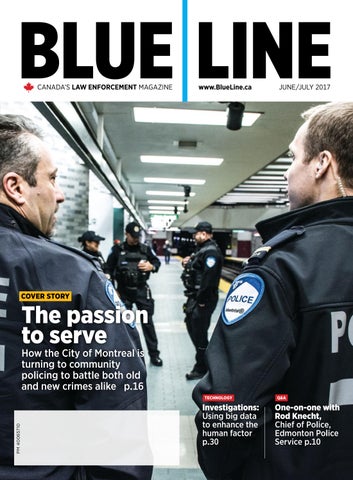
COVER STORY
The passion to serve
PM 40065710
How the City of Montreal is turning to community policing to battle both old and new crimes alike p.16
TECHNOLOGY
Q&A
Investigations: Using big data to enhance the human factor p.30
One-on-one with Rod Knecht, Chief of Police, Edmonton Police Service p.10
THE DASH IS ALL BUSINESS. POLICE BUSINESS. Welcome to the interior of the new 2017 Dodge Charger Enforcer. Gone is the centre tray. Gone is the laptop, safely relocated to the trunk. Gone is the clutter. In its place, an available 12.1-inch touchscreen^ that works seamlessly with police software systems to deliver all the information an officer wants; in full-colour customizable displays, a variety of configurations, and dozens of graphics communicating vehicle data. It’s everything you need for a workspace. And nothing you don’t.
fleet.fcacanada.ca
^Available on select models.
1 800 463-3600
22 Bleed: 11.125” Trim: 10.875” Safety: 9.875”
Contents
June/July 2017 Volume 29 Number 6
Features COVER STORY
16 The passion to serve
Montreal is no stranger to history and change, which is why the Service de police de la Ville de Montréal is always looking to evolve with the times. By Melanie Lajoie
20 At your fingertips
Discover how several officers at the Ottawa Police Service are trying to standardize the way fingerprint analysis is documented. By Peggy Staruch
22 Blue Line Expo 2017 in review
Check out pictures from Blue Line Expo, which featured more than 50 exhibitors displaying the latest law enforcement technologies and services.
Columns 4 10 12 14 15 26 30 34
Publisher’s commentary Q&A Deep blue Holding the line Health & wellness Case law Technology Back of the book
Departments 5 5 7 8 29 32 33 34
By the numbers News Calendar Dispatches Off the shelf Product showcase Marketplace Blue Links
24 Man on a mission
OPP Sergeant Mark Radke is about to enter a new phase of life: retirement. By Stephanie Rudyk Toepfer
24
COVER PHOTO: SPVM
10 20 @Blue_LineMag
June/July 2017 | BLUE LINE
3
BLUE LINE
PUBLISHER’S COMMENTARY BY PAUL GROSSINGER
Rethinking change
A
fter reading this issue’s cover For me, change begins with the realizastory, The passion to serve, a tion that something might not be working profile about the Service de like it should. For the SPVM, the host city police de la Ville de Montréal of this year’s Canadian Association of (SPVM), I immediately remembered the Chiefs of Police Conference, change is time I attended a change management upon its more than 6,000 employees. I was workshop delivered by Peter de Jager. so impressed to see the honesty of its De Jager, a world-renowned change police chief, Phillippe Pichet, when he management expert, speaker, and consult- says, “A police organization of the scope ant, “changed” the way I looked at change. of the SPVM needs to adapt to the society In his workshop and throughout his that surrounds it…. The work of Montreal musings, de Jager talks about the fact that police officers is increasingly complex. although nobody likes change, nobody They must content with a constantly actually could live without change. Im- evolving environment.” agine doing the exact same job And nothing could be closer to for five, 10, 15 years. Imagine The world the truth. The world around us is performing the same routine day around us is changing, and with that comes in and day out for years upon changing, different threats, different probyears. How about drinking the and with lems, different realities that need same wine or eating at the same that comes new solutions, new approaches restaurant for a prolonged period different and new lines of thinking. Frontof time. Most, if not all, people threats, line officers are still dealing with would display the behaviour — different the more traditional crimes, such boredom, frustration, anger — problems, as robberies, assaults and even Bill Murray so cleverly illustrated different murders, but they are also conduring his portrayal of Phil in the realities fronted with new-age crimes like that need 1993 movie Groundhog Day. identity theft, human trafficking But this is where de Jager’s new and cyber crime, which require change management theory really solutions, new approaches, new expertise hits home with me. As a graduate new and new sensitivities. of Ryerson University’s School of approaches Add to the mix the opioid epiJournalism, I was taught the typ- and new demic in Canada, as well as the ical reporter’s line of questioning: lines of growing number of people sufferWho, What, Where, When, How thinking. ing from mental illness, and what and Why? Great queries that often you have is a policing environillicit the necessary answers to write an ment that requires a different level of article or to track down a story. However, communication, partnership and openwhen it comes time to implement real, ef- ness amongst its different agencies and fective change, these questions often won’t stakeholders in order to deal with the evmove the needle to experience change with er-changing public safety landscape. staying power. Change is never easy and it is never Instead, de Jager suggests asking these without repercussions, but for Canada’s questions when change is desired: 1) Why? police community, including the SPVM, 2) What’s In It For Me – the question others change is upon us, and it might be the only will ask when notified about the change? constant it faces for the next little while. 3) Monday – what is different come the first day change is implemented? 4) Won’t Paul Grossinger is the publisher of – what won’t change? 5) Might – what Blue Line magazine, and a group might go wrong during this change? 6) Will publisher at Annex Business Media. – what’s going to hurt? 7) Signposts – how He can be contacted at: pgrossinger@annexweb.com. to measure progress towards a goal?
CONNECT WITH BLUE LINE
www.BlueLine.ca 4
@Blue_LineMag
BLUE LINE | June/July 2017
www.facebook.com/BlueLineMagazine
www.BlueLine.ca
GROUP PUBLISHER | PAUL GROSSINGER pgrossinger@annexweb.com PUBLISHER EMERITUS | MORLEY LYMBURNER morley@blueline.ca ACCOUNT MANAGER | JANICE EATON janice@blueline.ca ACCOUNT MANAGER | APRIL LENSEN april@blueline.ca ART DIRECTOR | SVETLANA AVRUTIN savrutin@annexweb.com ACCOUNT COORDINATOR | TRISH RAMSAY tramsay@annexweb.com CIRCULATION MANAGER | BEATA OLECHNOWICZ bolechnowicz@annexbizmedia.com COO | TED MARKLE tmarkle@annexweb.com PRESIDENT & CEO | MIKE FREDERICKS ANNEX BUSINESS MEDIA 80 Valleybrook Drive, Toronto, ON M3B 2S9 Tel. 416-442-5600 • Fax 416-442-2230 Publication Mail Agreement No. 40065710 ISSN 0847-8538 Printed in Canada SUBSCRIPTION RATES Canada — 1 Year $30.00; 2 Year $50.00 plus tax USA — 1 Year $100.00 USD CIRCULATION email: asingh@annexbizmedia.com Tel: 416-442-5600 ext 3553; Fax: 416-510-5170 Mail: 80 Valleybrook Drive, Toronto, ON M3B 2S9
Occasionally, Blue Line will mail information on behalf of industry-related groups whose products and services we believe may be of interest to you. If you prefer not to receive this information, please contact our circulation department in any of the four ways listed above. Annex Privacy Officer privacy@annexbizmedia.com; Tel: 800-668-2374 © 2017 Annex Publishing & Printing Inc. All rights reserved. Printed in Canada. No part of the editorial content of this publication may be reprinted without the publisher’s written permission. Opinions expressed in this magazine are not necessarily those of the editor or the publisher. No liability is assumed for errors or omissions. Readers are cautioned and advised that articles presented herein are edited and supplied for your personal awareness and should not be used for further action until appropriate guidance is received from a supervisor, Crown Attorney or other persons in authority. All advertising is subject to the publisher’s approval. Such approval does not imply any endorsement of the products or services advertised. The publisher reserves the right to refuse advertising that does not meet the standards of this publication.
NEWS A related issue is whether journalists can be shielded from having to reveal their sources and essentially becoming proxies for police investigations, he added. - Jim Bronskill EDMONTON
Alberta announces a review of photo radar due to cash-cow concerns OTTAWA
RCMP looking to expand media protections amid police surveillance concerns
The RCMP is eyeing a policy change for organized crime investigations to better protect the rights of journalists, newly disclosed documents say. The possible move follows revelations in Quebec about surveillance of reporters by provincial and municipal police and growing concern about the ability of journalists to shield sources from authorities. Under a 2003 ministerial directive, the RCMP must take special care in national security investigations involving sensitive spheres such as the media, politics, academia, religion and unions. It means Mounties must seek high-level approvals before engaging in terrorism and espionage probes that touch these sectors. “Recognizing the sensitivity of investigations involving the media, we are currently discussing how to apply this national security related ministerial directive to all RCMP federal investigations, such as those involving organized crime,” internal Mountie briefing notes say. The Canadian Press recently obtained the November 2016 notes through the Access to Information Act.
RCMP spokesman Harold Pfleiderer had no additional comment. Public Safety Minister Ralph Goodale, the cabinet member responsible for the RCMP, has previously said the government is reviewing the 2003 directive to ensure the language is sufficient to safeguard press freedoms. The internal notes say the Mounties do not engage in activities to investigate or disrupt the efforts of journalists that are protected by the charter. “That said, the RCMP does have the mandate and responsibility to investigate criminal activity, which could involve individuals in a variety of professions, including journalism.” The RCMP’s push to broaden the 2003 ministerial directive could spring from a desire within the force to avoid the pitfalls of spying on journalists — such as the current glare of publicity in Quebec, suggested Wesley Wark, a national security expert at the University of Ottawa. In 2007, the RCMP contravened the ministerial directive in conducting physical surveillance of two journalists in an attempt to identify the person who leaked a classified Canadian Security Intelligence Service document. The surveillance was unauthorized and ended once RCMP management became aware.
Alberta is reviewing photo radar across the province, responding to concerns that what is supposed to be a watchdog road safety tool has morphed into an engorged cash cow. Transportation Minister Brian Mason says a review is now underway in his department. It’s a plan that has the support of all four opposition parties in the legislature. “There’s a strong public view, I think, that photo radar has gone beyond just enforcing safe traffic and has become, in some cases, a bit of a cash cow for municipalities,” Mason said. “That is a misuse, if that is occurring. We need to know to the degree to which that is occurring, and we need to make sure that we correct that.” Municipalities with 5,000 residents or more can run photo radar through their local police or RCMP. Most of the money from a photo radar ticket — 73 per cent — goes to the municipality. The other 27 per cent goes to the province. Every ticket has a 15 per cent surcharge for a victims of crime fund. Under guidelines established in 2014, photo radar should be set up in areas where drivers habitually ignore traffic laws, where there have been a lot of collisions or pedestrian accidents, or where there is a lot of pedestrian traffic. The guidelines are flexible but the overarching principle is public safety. Mason said his department will review where municipalities are running photo radar and how much money they are receiving.
BY THE NUMBERS
PHOTO: GETTYIMAGES.CA
Curious about the number of police officers in Canada and how much money our policing industry spends each year? Well, here are some figures from Stats Canada, as of May 16, 2016, that you might want to look at
5th
Consecutive year that has seen a decline in the Canadian police force. In 2016, there was a 1% reduction of officers from the previous year.
@Blue_LineMag
68,773 Police officers in Canada.
$14.2 billion 21
%
Year-end operating expenditures for police services in Canada, 66% of which goes toward salaries and wages, 15% towards benefits and 19% towards other police operations.
Of sworn officers are women. Women also make up 13% of senior officers.
June/July 2017 | BLUE LINE
5
NEWS
SPRUCE GROVE
The RCMP Fight clubs and social media
RCMP are investigating a suspected fight club involving teens in a community just west of Edmonton. Police say they’re checking allegations that youths in Spruce Grove are using social media to announce
College of Continuing Education
the fights that are attracting spectators. A woman in the community tells CTV that earlier this month, her junior high-aged son was injured in a fight and was pressured into participating in the altercation with another boy a grade ahead of him. The woman, who doesn’t want her name revealed to protect her boy’s identity, says her son needed plastic surgery to repair multiple facial injuries and will probably miss classes for the rest of the school year as he recovers. Mounties are monitoring social media and reaching out to local schools to keep students from taking part in fights. They say participation in such activity could lead to criminal charges.
Certificate in Police Leadership
Have a degree already? A post-degree certificate only enhances your skill-set as a police officer. Professional development is necessary in an era of rapid change, and our courses are career specific, adding to your arsenal of skills.
Legal Issues in Policing “is an
excellent course that increases one’s ability to manage risk…It causes you to look differently at service delivery and see how officers can avoid unnecessary complaints and internal investigations…This course would be useful for any officer, but particularly managers and those in charge of investigative units.”
There are 7 different certificate concentrations to choose from:
Sgt. Robert Dixon, RCMP, Surrey, BC
• Administration • International Policing - NEW • Law & Justice • Local Government • Service-Delivery • Supervisory Skills • Advanced Police Leadership
ONLINE COURSES Fall Term begins Sept. 5, 2017 (Early Registration Discount up to July 4) COACHING WORKSHOP Halifax: Nov. 3-5, 2017
Note: Prior university experience is not required
Prepare for career advancement today! Detailed information and online registration can be found on our website at www.dal.ca/cce. If you would like further information please contact the Program Manager, Sherry Carmont, by email at CPL@Dal.Ca, by phone at 902.494.6930 or toll-free at 1.800.565.8867.
Dalhousie University College of Continuing Education 1459 LeMarchant Street, Suite 2201 PO Box 15000 Halifax NS B3H 4R2
TORONTO
Pride Toronto moves closer to securing annual grant amid controversy
Canada’s largest Pride parade is one step closer to securing municipal funding that has been threatened by a decision to ban uniformed police officers from the annual event. Pride Toronto has sparked controversy ever since a decision early this year to ban police floats from the colourful summer parade. Recently, a committee at Toronto City Hall recommended upholding a $260,000 annual grant to the event after a petition from Olivia Nuamah, the executive director of Pride Toronto. A final ruling on the fate of the grant is still pending. Toronto Mayor John Tory has expressed his support for the funding, saying both Pride Toronto and Toronto Police Chief Mark Saunders have told him cutting the grant would not help resolve the controversy around the parade. Earlier this year, a Toronto city councillor called for the grant to be revoked over Pride Toronto’s decision to ban police floats, saying the event had become exclusionary. The union representing Toronto police officers quickly echoed that call, saying it would be unacceptable for the city to sponsor an event that shuts out certain municipal employees. In a recently released statement, Pride Toronto reiterated that police officers were welcome at the parade so long as they appeared as civilians rather than in an official capacity. The organization said officers could participate in the march if they left their uniforms, weapons and cruisers behind. In January, Pride Toronto decided to adopt a list of demands issued by the Toronto chapter of Black Lives Matter, which included a ban on police floats. The issue first made headlines during last year’s parade, when members of the anti-racism group staged a sit-in that halted the march until Pride organizers signed a list of demands. - Paola Loriggio News files from Canadian Press
6
BLUE LINE | June/July 2017
BlueLine_Dalhousie_June.indd 1
www.BlueLine.ca 2017-05-29 3:38 PM
PHOTO: PAULMCKINNON
Mason’s department could not provide figures or municipal breakdowns on how much money photo radar is collecting. Mason said that will be part of the review, which he wants completed by the fall. The Wildrose and Progressive Conservative parties have previously raised questions about photo radar. Progressive Conservative Leader Jason Kenney has been calling for a photo radar review following a cross-province tour he made to win the party leadership in March. He said he heard “hundreds of Albertans in every corner of the province” express frustration with photo radar. - Dean Bennett
Panasonic has “police in mind” with Toughbook 33 reveal
Panasonic went way, way up for the launch of its latest rugged laptop — 1,776 feet up to be exact. This spring, Panasonic’s Toughbook 33 made its debut on the 102nd floor of the One World Trade Centre, also known as the Freedom Tower, in New York City to a select group of customers and media. Designed with direct input from lawenforcement officers currently in the field, Panasonic says the latest Toughbook edition has “police in mind” when it comes to display adjustments, ergonomic accessories and high-tech security add-ons. “Tonight we turn the page on the next chapter of the Toughbook story, and it’s an exciting one,” said Magnus McDermid, vice-president of enterprise solutions at Panasonic Canada and senior vice-president of mobility at Panasonic North America, adding the Toughbook has now been around for two decades. With jaw-dropping views of sunset-soaked Manhattan below, Panasonic introduced “the first fully-rugged, 2-in-1 detachable laptop that features a 3:2 display,” powered by 7th Gen Intel Core i5 and i7 processors and Windows 10 Pro. The product involved two years of work, said Dan Diliberti, Panasonic’s head of mobility products and market strategy, and a “unique development process” entailing one-on-one focus groups. The company discovered a number of concerns regarding the former 16 x 9 inch display (the Toughbook 33 is 12.3 inches long, 11.4 inches wide and 1.8 inches high, weighing 6.1 lbs.). “A lot of our business customers are running legacy applications that have not yet been converted to keep up with the times and these weren’t rendering properly on a 16 x 9 display. This was a big influence on the decisions we made,” Diliberti said. As law enforcement officers can’t be wasting time scrolling, he added, Toughbook 33’s display now has 15 per cent more viewing area, and the 1200 nit QHD, high-resolution widescreen also means it’s easier to handle applications like Computer Aided Dispatch (CAD), which many police force members use. Other benefits of a 3:2 screen over the standard widescreen, according to Panasonic, includes less vertical scrolling, an aspect ratio that better approximates the feel of 8.5 x 11 paper, and less interference around airbag zones for better vehicle-occupant safety. @Blue_LineMag
CALENDAR International Association of Crime Analysts Symposium June 19–21, 2017 Halifax, Nova Scotia www.iaca.net
Windows Hello is a crucial component for police, who often have to log into the system quickly, noted Jennifer Scott, a U.S. account manager for Panasonic Toughbook Mobility Solutions. Backward compatibility, flexibility and at least 10-hours of battery were also top desires expressed from the focus groups. Speaking to the flexibility side of things, Diliberti said Toughbook 31 customers explained it cost between $500-1,000 to replace the equipment in their work vehicles. Panasonic responded with a new vehicle dock adapter, which allows drop-in placement onto any of Panasonic’s large installed base of Toughbook 31 vehicle docks. Other significant Toughbook 33 features include an infrared camera, Windows Hello — Microsoft’s new biometric security system — as well as six usage modes and two keyboards. Windows Hello is crucial for police, who often have to log into the system quickly, noted Jennifer Scott, a U.S. account manager for Panasonic Toughbook Mobility Solutions. The program scans your face, she said, and can tell the difference between two twins, even in low-light conditions. The product also comes with the optional fingerprint reader and can save you the backache, Scott said, from turning to type out reports on the laptop (clamshell) dock thanks to the 2-in-1 vehicle dock, which utilizes the detachable “premium keyboard” and features a convertible mode. “From the beginning, we’ve designed the Toughbook product line with the demands of the mobile workforce in mind and the 2-in-1 Toughbook 33 device is the truest expression of that commitment to date,” concluded Brian Rowley, vice-president of marketing and product management, Panasonic System Communications Company of North America. “One thing we know for sure, the workplace is changing,” he added, speaking to technology and innovation. – Renée Francoeur
National Law Enforcement Occupational Safety and Health (LEOSH) Association Conference 2017 June 21–23, 2017 Regina, Saskatchewan www.leosh.org 31st Annual Police Security Expo 2017 June 27-28, 2017 Atlantic City, New Jersey www.police-security.com CACP Annual Conference and Tradeshow July 16-19, 2017 Montreal, Que. www.cacpconference.ca Great Lakes Police Motorcycle Training Seminar August 16-19, 2017 Toronto, Ont. www.glpmts.com International Women & Law Enforcement Conference Sept. 17-21, 2017 Cairns, Australia www.2017iwlec.com.au Focus On Drones Oct. 4, 2017 Toronto, ON www.focusonseries.ca IACP Annual Conference and Tradeshow Oct. 21-24, 2017 Philadelphia, Pa. www.theiacpconference.org Serving with Pride Gala Oct. 21, 2017 Toronto, ON www.servingwithpride.ca Ontario Gang Investigators Association Conference Nov. 20-23, 2017 Windsor, Ont. www.ongia.org
June/July 2017 | BLUE LINE
7
NEWS DISPATCHES
ONGIA 2017
GANG AND ORGANIZED CRIME PROFESSIONAL DEVELOPMENT CONFERENCE
NOV 20-23, 2017
WINDSOR, ONTARIO The Ontario Gang Investigators Association is finalizing the details of this year’s Gang and Organized Crime Professional Development Conference. We invite you to mark your calendars for our 16th annual conference taking place this fall in Windsor, Ontario. Please contact info@ongia.org for additional information. VENUE Caesars Windsor, Conference Centre 377 Riverside Dr. E, Windsor, ON CONFERENCE FEE $300 Rooms: starting at $135
TOPICS • Chicago Gangs • Street gangs & organized crime cooperation • Integrated task forces • Innovative case studies and more
WWW.ONGIA.ORG
BL_ONGIA_ad.indd 1
THE KENNEBECASIS REGIONAL
Deputy Chief Bill Moore announced he’s retiring from Halifax Regional Police, effective June 30, 2017, to become the executive director of the Canadian Association of Chiefs 2017-05-29 8:50 AM of Police (CACP). Moore has been a police officer for more than 30 years, starting with the Dartmouth Police Department and then HRP. He has been a member of the management team since 2008, according to HRP.
(Formerly Rothesay Regional) Joint Board of Police Commissioners invites applications for the position of:
CHIEF OF POLICE For more information regarding this position please visit the News Update section of our website at www.kennebecasisregionalpolice.com Matt Alexander, Chairman
The Strathroy-Caradoc police services board has appointed Mark Campbell as the new police chief. Campbell has been working as the acting chief for the past five months. The board says he started his policing career with London police in 1990 before taking a job with the Strathroy force in 1999. A graduate of Western University, Campbell also serves as the chair of Middlesex Community Living.
Darrell Kambeitz, the Chief of the Camrose Police Service, retired in May, concluding a 36-year career in policing. Kambeitz held executive positions with the local and provincial police associations while rising within the ranks. He received the Governor Generals Police Exemplary 20 year medal in 2001, the Queens Golden Jubilee medal in 2002, the Alberta Centennial medal in 2005, the Alberta Exemplary 25 year service medal in 2006, the Governor Generals Police Exemplary 30 year service bar in
2011, the Queens Diamond Jubilee medal in 2012 and the Member of Order of Merit of the Police Forces in 2015. Deputy Chief Lee Foreman will assume the Chief’s duties until a new Chief is identified. Robin McElaryDowner is the South Simcoe Police Service’s new Deputy Chief, as selected by the Bradford West Gwillimbury-Innisfil Police Services Board. She formally served as the Chief Adjudicator for the Ontario Provincial Police. McElary-Downer started her career in policing as a constable with the OPP in 1981, and has served as manager of the First Nations Policing Section, as Director of Investigations under the auspices of the Alcohol and Gaming Commission of Ontario, and headed the Queen’s Park Detachment, with the Protective Services Bureau. PROMOTIONS, RETIREMENTS, RECOGNITION • If you have a senior officer in your agency recently promoted or retiring or an individual you wish to have recognized (major award or recently deceased) you can let Blue Line magazine know by email to: dispatches@blueline.ca.
CONNECT WITH BLUE LINE www.BlueLine.ca @Blue_LineMag www.facebook.com/ BlueLineMagazine
Are you receiving
News Week? Subscribe today! www.blueline.ca www.BlueLine.ca
Commissionaires Commissionaires is Canada’s premiere security provider offering comprehensive and cost effective non-core police services that help police officers get back on the streets. With over 90 years of experience, Commissionaires support police departments across the country by taking on non-core duties including admin, process serving and traffic control. www.commissionaires.ca
FCA Canada
CACP Heads to Montreal
On July 16-19, Canadian police chiefs and other law enforcement officials from across the country will converge in Montreal for the 112th Canadian Association of Chiefs of Police Annual Conference (cacpconference.com). This year’s conference theme is Policing in a Digital Society – Risks and Opportunities. Sessions over the four-day event will focus on facing and managing disruptive change, building trust by communicating with the community, creating organizational resiliency and making good decisions for policing the digital society. Here’s a look at some of the CACP Conference exhibitors.
Accident Support Services International Facilitating centralized collision reporting, no cost to police or taxpayers. Reallocate manpower and operating cost savings. Our Microsoft Award winning Collision Reporting & Occurrence Management System (CROMS) electronically captures collision details and location (latitude/longitude) to share with stakeholders in near real-time, with secure data transfer to police and government RMS. Our analytics portal allows ad-hoc queries from all reported data fields. www.accsupport.com
Alcohol Countermeasure - DrugWipe DrugWipe is a drug detection device used to screen for drugs and drug metabolites on surfaces, in saliva or in sweat. The DrugWipe range of drug detection tests provide a convenient, easy-to-use and reliable means to detect common drugs of abuse. DrugWipe is manufactured by Securetec and distributed in North America by Alcohol Countermeasure Systems (ACS). www.acs-corp.com
American Public University System The Center for Applied Learning (CAL) at American Public University System provides customized training and workforce @Blue_LineMag
development solutions designed to address the diverse and changing needs of teams and organizations. CAL solutions deliver focused, relevant, interactive and educational experiences that improve organizational performance. www.amu.apus.edu
Blue Line Blue Line is Canada’s #1 law enforcement magazine. Read by more than 10,000 law enforcement professionals from across Canada, Blue Line’s 10 yearly issues provide insight, information and thought leadership from a broad spectrum of experts. Our website and weekly eNewsletter, Blue Line News Week, are also great sources of information and must reads for anyone working in Canada’s policing community. Visit www.blueline.ca to learn more and to subscribe.
Colt Canada Colt Canada weapons have been battle tested and proven through extreme battlefield conditions worldwide. At Colt Canada we listen to our customers that make up some of the most elite warfighting units and police services in the world. That, along with our attention to emerging technologies, ensures that our products continue to advance in operational functionality as well as popularity. www.coltcanada.com
FCA Canada has approximately 440 dealers and markets Chrysler, Jeep, Dodge, Ram, FIAT and SRT models and distributes Alfa Romeo and Mopar products. The company has two Canadian assembly facilities that produce the Chrysler Pacifica, Dodge Grand Caravan (Windsor), Chrysler 300, Dodge Charger and Dodge Challenger (Brampton) as well as an aluminum casting plant (Etobicoke), a research and development center (Windsor) and has sales and parts distribution centres throughout the country. www.fleet.fcacanada.ca
Smith & Wesson Smith & Wesson has been manufacturing quality firearms since 1852. We have successfully grown from a single firearms operating division to four operating divisions focused on law enforcement and sporting markets. Our vision is to be the leading provider of quality products for the shooting, hunting and outdoor enthusiast. See for yourself by visiting us at the CACP Conference and handling the “New” M&P® 2.0 pistol. www.smith-wesson.com
Summit Canada Summit Canada offers a wide variety of police equipment and clothing from Safariland, Heckler & Koch, Smith &Wesson, Second Chance, ABA, ProTech, NIK, Fornsic Source, First Defence, Bianchi, Monadnock, Streamlight, Surefire, Under Armor, Original Swat, Peerless, Condor, and so many more. www.summitcanada.ca
Whelen Engineering Whelen Engineering designs and manufactures reliable and powerful warning lights, white illumination lighting, sirens, controllers, and high-powered warning systems for Automotive, Aviation, and Mass Notification industries worldwide. On the road, in the air, and around the world, Whelen is trusted to be seen, trusted to be heard, trusted to perform. www.whelen.com June/July 2017 | BLUE LINE
9
Q&A In 2017, the Edmonton Police Service is celebrating its 125th anniversary. Blue Line recently sat down with Chief Rod Knecht to discuss his 40-year career in law enforcement, his six years as Edmonton’s chief of police and what he sees as the current and future challenges facing Canada’s policing community Q: As the Chief of the Edmonton Police Service (EPS), what is your favourite part of the job?
cessful [because] of the relationships we developed with the victims, those people that were infected with HIV and Hepatitis C. Listening to them, working with them, and the cooperation they provided made that investigation a success. It was a very difficult, very emotional investigation and many of the people that I dealt with as witnesses passed away during the course of the investigation.
I get to meet people from different backgrounds, different cultures, different places in Canada and the world. Everybody’s got a unique story. I always like to hear where they come from and what they’ve done.
Q: What is the toughest part of the job?
Q: With the EPS celebrating its 125th anniversary this year, what do you think are the most valuable changes that have been made since you been Chief?
Q: Over your career, you have relocated about 16 times, and have worked in several provinces and territories. In your experience, does policing change based on where you are working?
Every community is unique. I always thought Saskatchewan, Alberta and Manitoba were very similar until I had to police in those provinces and they are very, very different. Sometimes the politics makes it a little bit different and sometimes it’s the people that make it different. I would say the similarities are the police officers. Every place I’ve been, you meet police officers that are absolutely dedicated and committed to their communities and delivering public safety in those communities. It’s a unique profession where people are completely committed to their communities and making them better.
Q: What wisdom can you impart regarding what it takes 10
BLUE LINE | June/July 2017
to be a successful police leader in today’s society?
That has changed over time and I guess wisdom comes with age and experience. Earlier in my career, I always thought knowing the Criminal Code well was important, but I think I’ve found, as I’ve become a senior leader in the organization, the most important thing you can do in policing is build relationships. In my job right now, my number one responsibility is to build relationships, repair broken relationships and establish new relationships.
Q: When you look back at your career in policing, what are you most proud of?
Back in the late 90s, early 2000s, I was in charge of the blood taskforce; it was an investigation into the [tainted] blood system in Canada. I would say that investigation was largely suc-
SNAPSHOT OF THE EDMONTON POLICE SERVICE
1892
Year the Edmonton Police Department was formed
22
Number of police chiefs the EPS has had over its 125 years of serving the community
31,000
Tips provided to EPS by Crime Stoppers since the program came to Edmonton in 1983
When I first got here, I think we were somewhat myopic. As an organization, we were focusing inwardly and I think what we’ve changed over time is that we’re more outward focused. We have a very robust outreach program. I think we listen better to the community and I think we put service first over self. That has evolved over a very short period of time and the members deserve the credit for that. I would say we’re doing a much better job of listening to the community and delivering a policing service the community wants as opposed to telling them what kind of a service they should get.
Q: Let’s talk about that community outreach, in particular, the work the EPS has done with Canada’s Syrian refugee community. Can you share with our readers your experiences working with Syrian refugees?
About 18 months ago, we had an influx of Syrians coming to Canada www.BlueLine.ca
PHOTO: EDMONTON POLICE SERVICE
As Chief of Police, I have many, many bosses and it’s very difficult to keep everybody happy all the time. Probably every decision I make, I always end up making somebody unhappy with that decision.
and coming to Edmonton, so we developed a strategy around working with that community as they arrived. It was a program we called First Positive Contact. When the reception centres were set up here in Edmonton, we had a large police presence there. We helped them find places to live and helped them create a safe residence. We gathered food, clothing and furniture donated by members of the police service and brought those to their apartments. We thought if we could have a first positive contact with these people when they arrived in Canada, it would help us work with that community going forward. For a lot of those folks, specific to the Syrian community, the police where they came from are the bad guys and we just wanted to change that dynamic and have these people have a very positive image of their police service. As a result of that, we got the
@Blue_LineMag
BlueLine_ACS_Dec.indd 1
first International Human and Civil Rights award.
Q: What do you think are the major issues concerning Canada’s law enforcement community?
Our number one issue right now, certainly in the EPS — and I would suggest right across Canada in police services — is cybercrime. There’s not a crime out there that can be committed in the real world that can’t be committed online. We face the challenge of social media everyday. About three or four weeks ago, we had a police shooting and it was a situation where we were having to respond in real time because the individual’s Facebook page became very public as we were doing the investigation. It changed the dynamic of how we were approaching that entire investigation as a consequence of what was being published in real
time on social media. I think social media can be a tremendous asset for policing but it can also be a tremendous challenge and I think we have to do a better job of responding to social media.
Q: What advice do you have for people who are considering launching or advancing their career in policing?
I don’t think I would have done it for 40 years unless I thought it was a great career. It is, in my opinion, one of the greatest careers out there. It can be so rewarding. Some of those rewards come instantaneously when you help somebody, when you make a life better. Some of them are more long term. Everyday is different in policing. If you’re somebody that gets bored easily, this is the career to get into because everyday is different and everyday can be very rewarding.
In a CBC interview in 2015, Chief Knecht said his mother suggested a career in law enforcement, but when he applied to the RCMP, he was told he was underweight and was turned away.
June/July 2017 | BLUE LINE
11
2016-11-16 10:08 AM
DEEP BLUE
How Attitude Influences Behaviour
I
was reviewing the details of a training program about interactions with people with mental illnesses recently, and I noted that the prescribed course devoted a whole lot of time to addressing people’s attitudes toward mental illness. There is no doubt that many of us hold pretty negative and stigmatizing attitudes about mental illness. In this instance, the curriculum examined whether the participants held essentially negative attitudes, believing that people with mental illnesses were weak, bad, and, even, dangerous? Or did they see them as sick, powerless, and in need of protection? Maybe a few participants might even feel that people with mental illnesses were really no different from the rest of us, but were just having a “bad moment.” Needless to say, there is a full range of possible attitudes. Attitudes are interesting, and somewhat telling. But while changing attitudes is a good thing, it is not sufficient — not by a long shot. “But,” you say, “attitudes drive behaviour! We must change attitudes in order to change behaviour!” Actually, no. Attitudes may influence behaviour, but to a large extent, the relationship works the other way around. It turns out that attitudes don’t predict behaviour as much as we like to think. Consider a study done in the U.S. in the 1930s. A college professor was driving across the U.S. with a Chinese couple. Back in that era, many people discriminated against Chinese people. The professor was worried about finding accommodation each night, and worried they might be turned away from hotels. But they stayed at many hotels during their trip across the country and were only once turned away. After the trip, the professor decided to do a survey. He sent a questionnaire to each hotel and asked, “Would you allow a Chinese 12
BLUE LINE | June/July 2017
person to stay at your hotel?” Virtually everyone said ‘no.’ Clearly, there was a major disconnect between the expressed attitudes of the hotel operators and their actual behaviour. Why? There are several possibilities. It may have been that the question asked (and therefore the attitude expressed) was not specific enough. Maybe the hotel would not have let a single Chinese person, who turned up on the doorstep, stay, but they were okay with a couple who appeared well-dressed, well-educated and were travelling with a white college professor. Maybe the person at the desk really wanted to turn the Chinese couple away but was afraid they’d get in trouble. Maybe the hotel was so desperate for business and needed the money so badly that they comprised their own beliefs or attitudes and let them stay. Who knows? There are some situations in which attitudes predict behaviour fairly well. If you have a positive attitude toward a particular politician or political party, you are fairly likely to vote for them. Other attitudes are not so predictive. You might feel very strongly that eating right and exercising regularly are very important but still find yourself sitting in front of a screen eating a bag of Cheetos.
Only once we have sorted out what we are talking about, can we begin to work on the consistency between our behaviour and our attitudes.
We also know that in some people, attitude is a much stronger predictor than in other people. Research suggests, for example, that younger people (e.g., students) show less consistency between attitudes and behaviour than older people. It may be that younger people have not had as much time to develop enduring attitudes so they are less wedded to them. Behaviour also tends to be strongly influenced by practicality and the immediate circumstances. You might feel it is very important to donate blood, but if you live far from a donation site and are afraid of needles, it is not terribly likely that you will take the time to give blood. But here is the interesting part about that last example. The likelihood is that if you consistently do not give blood, your attitude about giving blood is going to change. Basically, your choice is to believe one of these two options: 1) You are a wimp and an irresponsible person because you do not give blood; or 2) Giving blood is really not all that important. Most of us will enter through door number two. Why? Because we like consistency. People really want to be consistent and they want their attitudes and behaviours to match. Consider this study that was done with kids: A group of little kids are shown a number of different toys and asked with which one they’d most like to play with. Whichever toy they pick, they are then told they will be in big trouble if they play with that toy, but they can play with any of the other toys. These seem to be well-behaved kids because they do not play with the banned toy. After a short time, they are asked again to pick the most desirable toy. No one picks the original “best” toy. They all pick the toy they actually played with: “If I played with that toy and enjoyed it then it must be the most desirable toy; my beliefs are now consistent with my behaviour.” This takes me back to mental illness training. What does all this theory about attitudes tell us? Well, on the one hand, it tells us that talking about something as broad www.BlueLine.ca
PHOTO: GETTYIMAGES.CA
BY DOROTHY COTTON
and nebulous as mental illness is probably not very helpful. I suspect most of us have very different attitudes about social anxiety as opposed to PTSD as opposed to schizophrenia. We likely behave very differently when confronted with a 78-year-old woman who has become unable to leave her house and calls 911 for help and reassurance many times a day, as opposed to a disheveled 25-year-old man with active hallucinations who calls 911 repeatedly to report that the aliens have arrived. So perhaps the first step is to realize that talking about mental illness is probably no more helpful than talking about physical illness. Only once we have sorted out what we are talking about, can we begin to work on the consistency between our behaviour and our attitudes. If we learn and practice a set of behaviours that direct us to
reassure and calm down the man with the hallucinations, then my guess is that your attitude toward people with hallucinations is going to change. But if you always act like the man with the hallucinations is bound to be dangerous, if you are trained and practice hauling out your weapons and handcuffs “just in case,” then you are likely to retain or even develop the attitude that such people are dangerous. I mean after all, if you did not think that, then why did you behave the way you did? It turns out that people are pretty predictable. There was a study that asked a group of people to look at some comic strips. One group was told to nod their heads up and down as they read them; the other group was told to shake their head sideways (like they were saying “no”) as they read them. Afterwards, the participants were asked to rate how
Attitudes may influence behaviour, but to a large extent, the relationship works the other way around.
funny they thought the cartoons were. The nodding group rated then as funnier than the shaking group. It’s all about consistency. Mind you, I am left wondering about the inconsistency between the behaviour and the attitudes of the hotel staff who gave rooms to the Chinese people in the 1930s. My guess is that if it were pointed out to them that their behaviour was not consistent with their attitudes, then they just might answer the “attitude” question a little differently next time it was asked. On the other hand, they might have changed their behaviour and turned away the next Chinese people who were looking for a room. We’ll never know.
Dr. Dorothy Cotton is Blue Line’s psychology columnist. She can be contacted at: deepblue@blueline.ca.
COME SEE US AT TACWEST IN CALGARY, AB | SEPTEMBER 19-21
PROUDLY SERVING MILITARY & LE SINCE 1989.... PHONE (204) 748-2454 EMAIL BRENT@WOLVERINESUPPLIES.COM WOLVERINESUPPLIES.com @Blue_LineMag
BlueLine_Wolverine_June.indd 1
June/July 2017 | BLUE LINE
13
2017-05-26 1:23 PM
HOLDING THE LINE BY MICHELLE VINCENT
I
f we put some thought into what we do on a day-to-day basis as first responders, call takers and dispatchers, dealing with the unknown, the challenging and the horrific, it would be unreasonable to think that we can move forward without some form of mental health care. That might come in the form of self-care, such as meditation, exercise or it might come in the form of some type of therapy, like psychotherapy, psychologist appointments and/or group sessions. Regardless of what our mental health regime looks like, it may be time to explore and define what it is we do to look after the piece of us that actual keeps us alive and well. A few months ago, I wrote about selecting a mental health care provider and how important it is to choose that provider with clarity and care — to make sure you find someone you connect with, that you trust, that you know you can reach out to for that last minute appointment when life becomes challenging. Understanding the resources that are out there for us is not easy. We talk about them in conferences, training sessions and other educational venues, but typically this is not when we are truly seeking them. I remember one of the times I was in what I would consider a crisis, attempting to look for the Employee Assistance Program (EAP) number. I thought that was the only help available to me — I hadn’t even considered private therapy from a psychologist. I didn’t even think my crisis was important enough to warrant that kind of support, nor was I aware of our benefit coverage. Now, I understand how invaluable my psychologist is to me, regardless of the extent of my life dilemma. In this case, about five years ago, I called into our communication 14
BLUE LINE | June/July 2017
Obtaining the necessary support shouldn’t be that hard. The information should be as prevalent and available as 911 or any other life-saving connection. centre looking for the contact number, feeling embarrassed and praying that no one would ask me why I wanted the information. The person I spoke with had no idea where to find the EAP number, so I called the front desk and spoke with the operator, as well as the officer whom was working that night. Finally, after some time, we found the number. Another personal experience of attempting to locate mental health care information was when a colleague from a different police ser-
15
The number of reported suicides of public safety professionals in 2017, as reported by The Tema Conter Memorial Trust
vice was in crisis and was seeking mental health support. Attempting to locate the resources for this individual was not only challenging — the length of time it took was unacceptable. In our world, we need to have a clear understanding that, as a result of the nature of our chosen career, the likelihood that we will require mental health support is not a question of if, but when and in what form. Obtaining the necessary support shouldn’t be that hard. The information should be as prevalent and available as 911 or any other life-saving connection. Let’s think about this for one minute: In your time of need, how life saving was that mental health professional that you connected with? They save lives and give us the tools to be able to cope in times when we are at our lowest. We need to make this information available to all of our law enforcement members, and readily accessible in all of our organizations. They need to be available not only at work, but on the Internet, at home or on-the-go. So, where is your list? Our police organization has a list of carefully vetted mental health professionals that are proficient and experienced in dealing with first responders that are covered by our benefits — professionals that will take us in last minute, if necessary. We just have to let them know we are first responders and we are prioritized immediately. If we are not in need of these services ourselves, we may find that a close friend, colleague or family member is in need. Let’s be prepared ahead of time. Have a look for that information before you or your colleague is in crisis. That way, support is just a phone call away. Michelle Vincent is a 15-year York Regional Police officer with a Masters Degree in Arts in Counselling Psychology and a background in equine assisted therapy, workplace reintegration and teaching. Her counselling practice is supervised by a psychologist with a specialty in addictions and trauma. She can be contacted at: michelle@smith.net.
www.BlueLine.ca
PHOTO: GETTYIMAGES.CA
Mental health support is all about when, not if, you will need it
HEALTH & WELLNESS BY ISABELLE SAUVE
The dangers of sugar
PHOTO: GETTYIMAGES.CA
S
ugar is a beloved natural ingredient, deep-rooted in our diet for thousands of years. It is adored for providing an immediate boost of energy along with instant gratification. Nonetheless it is not without consequence to our health. Problematically, we have no “off switch” for sugar, repeatedly keeping us going back for more. This addictive characteristic incites many food producers to enhance the taste of their products by adding sugar despite it being at the expense of our health. Chronic sugar overconsumption is unhealthy and can be particularly detrimental for all of us and especially for shift workers. Technically speaking, sugar is a generic name for delectable sweet and water-soluble carbohydrate derived from various plants used to provide energy. Simple sugars are part of many processed foods and include glucose (dextrose), fructose, maltose, and galactose. Also known as table sugar or sucrose, simple sugar is a combination of glucose and fructose. Sugar intake causes a ‘feel good’ dopamine release in our brains somewhat akin to those experienced by drug addicts. It is estimated that the average North American swallows 130 pounds of added sugar per year, much of which is unknowingly consumed. That is approximately 22 teaspoons per day. Sugar is hidden in many foods and drinks, such as yogurt, beef jerky, bread, frozen dinners, ketchup, granola, smoothies, and sauces. It is estimated that more than 80 per cent of processed food contains added sugar. Therefore, cutting down on processed food will inadvertently reduce sugars from one’s diet. Part of controlling the intake of added sugar is to understand it is disguised under many names. Put simply, ingredients that end in ‘ose’ are sugar. Ingredients ending as ‘sweetener’ or ‘syrup’ are also likely sugar. Beware of foods labelled “fat @Blue_LineMag
free” or “low fat” as they may be designed to give the illusion of being healthier products. The truth is they tend to contain a high concentration of added sugar. The danger is that sugar disturbs our micro biome (bacteria in our digestive tract), which plays a significant role in regulating our metabolic, immune, and nervous systems. In other words, it affects our emotional behaviour and consequently our response to stress. This is of particular importance for first responders frequently exposed to stressful situations. Recent research suggests sugar actually promotes anxiety. Thus, excessive sugar intake may be correlated to and affect one’s ability to adequately respond to challenging and stressful situations. Sugar overconsumption has also been linked to cancer and heart disease. Unused sugar in the human body becomes fat and therefore, is a primary contributor to obesity. Further, it primes the body for diabetes, by diminishing the functionality of the immune system, suppressing the release of human growth hormone, stimulating inflammation, reducing the body’s ability to heal, and accelerating human cell aging.
Excessive sugar intake may be correlated to and affect one’s ability to adequately respond to challenging and stressful situations.
To learn more about how you can reduce sugar from your diet, visit the Heart and Stroke Foundation of Canada online at heartandstroke.ca.
In addition, it takes less than 30 minutes to go from a sugar boost to a sugar crash. Consequently, sugar is fully capable of making us energy deficient ‘zombies’. Night shifts invite fatigue by nature while simultaneously increasing levels of ghrelin, a hormone that triggers hunger. To make things worse, the body’s natural ability to process sugar declines drastically at night. Therefore, night shift workers should favour easy to assimilate low-sugar meals and sugar-free drinks. The aim is not to entirely remove sugar from one’s diet. It is about moderation and balance. Some foods like fruits and dairy products also contain natural sugars. These are not single-handedly the problem but they must factor in when looking at overall sugar intake. Thankfully, a number of healthier and tasty alternatives to sugar are available for those looking to moderate sugar intake. For instance, bread containing added sugar is now replaceable by sugar-free bread. Healthier sweeteners are also available such as dates, raw honey, stevia, molasses or maple syrup. Another tip is to consume clean protein or to drink a large glass of water as this can communicate satiation to the brain and potentially eliminate cravings. Walking or engaging in an active interest for 15 minutes can also abolish an urge to reach for something sugary. Another fundamental factor to consider is the timing of sugar consumption. Sugar can in fact be processed by the body very efficiently after a workout making it a good time to satisfy a sweet tooth. Patience is of the essence when embarking on a quest to reduce sugar intake. It takes a few days for the taste buds and the body to adjust, but as a reward, this will take inches off the waist, contribute to energy level equalization, and promote better health. Isabelle Sauve is a 10-year OPP veteran currently with the Emergency Response Team (ERT) at the Almaguin Highlands Detachment in Burks Falls, about 300 km north of Toronto. She can be contacted at: isabelle.sauve@hotmail.com.
June/July 2017 | BLUE LINE
15
COVER STORY
The passion to serve
SPVM FACTS:
6,000
civilian employees and police employees
32
local police stations
3,000+ daily interventions handled by the SPVM
16
M
ontréal is a city of culture and entertainment — always taking pride in its history, and its ability to keep up with the modern times. Quebec’s metropolis is a dynamic, unique place, with a hotbed of diversity — diversity in cultures and languages, diversity in the architecture and arts, diversity in beliefs and ideas. Its neighbourhoods offer unique lifestyles that deserve to be explored. The appeal and complexity of this major city lies on every street corner, in every park or alleyway, and whose warmth and friendliness are at the root of its international reputation.
BLUE LINE | June/July 2017
The Service de police de la Ville de Montréal (SPVM) is a large-scale organization, a leader in its field and, like Montréal, diverse in its makeup and what it represents. Proudly serving Montréal, its primary mission is to protect the lives and property of citizens, maintain peace and public safety, prevent and combat crime, and enforce current laws and regulations. As the largest city in Quebec and second largest in Canada, with close to 2 million inhabitants, Montréal is also a great place to live. It is a place where people feel safe. In 2015, The Economist ranked Montréal as the second-best city in the world to live in, while a poll conducted by Mercer ranked Montréal among the five cities offering the best quality of life in North America. In 2016, Montréal was also named the top university city, ranking number one on the list of the 100 most sought-after cities by students, according to a poll conducted by the Quacquarelli Symonds (QS) research institute. Watching over Montréal and playing an essential part in the city’s events are SPVM police officers, who play a key role in its citizens’ quality of life. “The SPVM’s strength lies in the engagement of all its members to carry out their mission and through
their passion for assisting and serving citizens,” says SPVM Chief Philippe Pichet. “This passion is what drives us to ensure the safety of Montrealers everyday.” With nearly 6,000 employees, including more than 4,500 police officers, namely in its 32 local police stations, its four operational centres, its specialized investigation centre and its headquarters, the SPVM is the second-largest municipal police department in the country and eighth largest in North America. It is estimated that Montréal police officers conduct 3,000 to 4,000 interventions daily, or a total of one million interventions annually. Each and every year, emergency call operators take almost 1.2 million calls, among which more than 400,000 are dispatched to police officers. Montréal peace officers also act as public order officials in more than 1,200 events, including neighbourhood parties, hockey playoff celebrations and many festivals that mark the passing of each season in Montréal. Despite all of www.BlueLine.ca
PHOTOS: SPVM
The City of Montreal is no stranger to history and change, which is why the Service de police de la Ville de Montréal, the host city of this year’s CACP Conference, is looking at the power of community policing to tackle the types of crime its officers are now confronting on a daily basis. By Melanie Lajoie
these events and this activity energizing and bringing the urban landscape to life, Montréal, mostly, remains a peaceful place, where countless people — tourists, students and families — converge in the streets and parks.
Keeping an eye on crime trends
For more than 20 years, crime has been on a downward trend in Montréal. Moreover, in 2015, the SPVM recorded the smallest number of infractions and offences — 86,640 — to be reported within its jurisdiction since 1980. Crime seems to be on a dowwnard plane — and although this is not exclusive to Montréal, the work of police officers in the city is increasingly complex and citizens’ expectations of them are increasingly high. Experts agree that this drop in crime could be explained by several factors. It’s quite possible that crime as we know it today is in mutation. The surge in cybercrime and rise in crimes like online scams, @Blue_LineMag
identity theft, production and distribution of child pornography, human trafficking and cyberbullying, at the expense of more traditional crimes, suggest that crime is transforming. This reality poses significant challenges for police forces. These new types of crime, sometimes committed in several geographic locations at a time, mean that police officers need to develop new skills in conjunction with their partners, namely their colleagues from municipal, provincial and national police forces. Aware of this reality, the SPVM continuously seeks to foster the development of technologies and analysis tools to better respond to these new challenges and to more traditional public safety issues, such as road safety or crime associated with organized crime and street gangs.
Adapting to social realities
In a major, constantly evolving urban centre, police officers must deal with increasingly complex
“A police organization of the scope of the SPVM needs to adapt to the society that surrounds it and we are giving ourselves the tools to accomplish this.” Director Philippe Pichet issues. In Montréal, the mosaic of social realities has an impact on the work of its police officers. During their encounters with the public, they need to contend with a diversified and aging population as well as a multitude of economic and social conditions. The Montréal police force comes in many forms: a police officer on a bicycle downtown, intervening in a conflict between a homeless person and a merchant; a community officer from the West Island visiting an elementary school June/July 2017 | BLUE LINE
17
“The work of Montréal police officers is increasingly complex. They must contend with a constantly evolving environment.” Director Philippe Pichet SPVM FACTS:
2nd
largest municipal police force in Canada
1843
Year the City of Montreal was born, and first police inspector appointed
400,000
calls dispatched to police annually
The SPVM’s motto and mission statement is “Ensemble pour mieux servir” (Together to serve you better)
18
to speak about bullying; a patroller in the south end of the city, meeting with an imam whose mosque has been covered by heinous graffiti; and an investigator recording the statement of an elderly lady, who has fallen victim to a phone scam. SPVM police officers come faceto-face with today’s social realities on a daily basis. They intervene among people with social and mental health issues many times per day. These interventions, often recurring, are the daily reality of patrollers and investigators. They force police officers to go beyond their more traditional law enforcement duties. In the face of complex issues such as these, the SPVM has set up co-ordinated response teams, in partnership with mental health and social care workers. Over the years, these intervention models have proved effective in the face of recurring social issues, such as homelessness and mental health issues. The Équipe mobile de référence et d’intervention en itinérance (EMRII) is a good example of these response teams. The EMRII is a team of health-care workers from
BLUE LINE | June/July 2017
the Centre de services et de santé (CSSS) and SPVM police officers. The team carries out local work to reach the homeless or those at risk of becoming homeless who are often involved in police interventions, and then refer them to the appropriate services in order to promote their reintegration. The Équipe de soutien aux urgences psychosociales (ÉSUP) is another success story. It is also comprised of SPVM police officers and social workers patrolling in mixed teams and intervening directly with individuals in crisis situations or who are mentally ill. The team is dispatched by 911 agents who receive an emergency call or called in by police officers working on the scene of a distress call concerning a mental health issue. The team’s work consists of supporting police officers during interventions and referring them to the appropriate services (e.g., legal, health or community support).
The community police model
With its 19 boroughs and 14 linked cities, Montréal is a blend of sever-
al living environments. Each sector is unique, with its own attributes and identity. Residents have specific needs and concerns and are often very attached to their borough and neighbourhood. The SPVM police model is ideally suited to this Montréal reality. Officers from neighbourhood police stations are also assigned to very specific sectors of the city. They are familiar with their sector’s realities and adapt to these to better meet the expectations of the citizens actively involved in their community. In 1997, the SPVM adopted a new police model, Neighbourhood Policing. It is a neighbourhood police station model based on community policing principles that places the public at the heart of its concerns and its organization. The 32 neighbourhood police stations (PDQ) of the SPVM are spread across the entire territory and provide services to the local population they serve. This proximity to the community allows for a better understanding of citizens’ needs in terms of safety and for a targeted, effective response. The successful implementation of this model is dependent on building ties with the community and being accessible. Work methods adapted to each setting are needed in addition to much creativity and originality. Neighbourhood police stations regularly hold in-house activities to meet with citizens or resolve specific issues. For example, last summer, police officers from Station 45, in the northeast end of the city, held a Popsicle activity to respond to a very specific need. The police officers were finding it difficult to meet with residents in a sector of their territory that was experiencing certain problems. During several hot summer days, the police officers set up camp in a park and invited individuals — young and old — to have a Popsicle with them. By way of this simple gesture, police officers were able to break the ice, make initial contact and talk to people. Elsewhere, at Station 15, in the southwest corner of the city, a project was set up to allow police www.BlueLine.ca
PHOTOS: SPVM
COVER STORY
officers to intervene with road-safety issues. Each work team from the station was asked to sponsor a high-accident intersection in the sector. Sponsors therefore had to pay special attention to their intersection and provide a certain level of visibility to the residents of that area. This recurring police presence was used to encourage residents to adopt safer behaviours and increase their vigilance as they approached intersections.
A police service focused on the future
While the Montréal police’s 175th anniversary is approaching, the SPVM is an organization focused on the future. The development of technologies, easy travel, crime that increasingly knows no borders, the phenomenon of radicalization, and emergence of hate crimes are all realities Montréal police officers
need to contend with, in co-operation with its many partners. Nowadays, it is essential for the different levels of police forces to work together. Every player in the public safety network, at the national, provincial or municipal levels, must play a complementary yet coherent role with one another to adequately tackle these issues. Proud of its achievements and propelled by a will to continue to improve its practices and develop its expertises, the SPVM has adopted a strategic plan that will enable it to build the foundations to ensure its longevity by the year 2020. Director Philippe Pichet is convinced that Montréal police officers will be proud to belong to an organization that has been able to continue to adapt to its environment and to develop technologies and new ways of meeting citizen needs. “The work of Montréal police offi-
cers is increasingly complex,” says Pichet. “They must contend with a constantly evolving environment. I admire the work done by our police officers every day in the field, in light of all these challenges. A police organization of the scope of the SPVM needs to adapt to the society that surrounds it and we are giving ourselves the tools to accomplish this.”
Check out SPVM’s YouTube channel @ www.youtube.com/ user/spvmvideos
©2017 Whelen Engineering Co., Inc. All rights reserved.
WHEL0012_BLUELINE_HORZ_NOFDIC.indd 1
@Blue_LineMag
BlueLine_Whelan_May.indd 1
4/13/17 5:08 PM
June/July 2017 | BLUE LINE
19
2017-04-17 9:23 AM
FORENSICS
At your fingertips By Peggy Staruch
B
The Canadian Identification Society (CIS) offers certification programs at its annual training conference. For more information on CIS, visit: www.cis-sci.ca.
20
est practices in science seek to eliminate any form of bias in the processing of data, so by creating an environment of pure evidence-gathering and assessment, it actually augments the value of the data collected. Forensic Identification Sergeant Ugo Garneau of the Ottawa Police Service (OPS) saw a chance to standardize the way fingerprint analysis was being documented, as well as finding a new method to eliminate bias in the data. “I read the National Academy of Science report (2009) stating we had to raise the standard of reporting,” says Garneau. “I wanted to find efficiencies in documenting the process.” After reading the report, Garneau began working on developing a method of auto-generating reports based on data inputs. As a result, instead of taking several days to complete a Friction Ridge Analysis
BLUE LINE | June/July 2017
Report (FRAR), it could be done in minutes — and it ensured that recommended terminology was used universally. With the help of his colleague, Constable Dominique Trudeau, they created an interactive form to document the methodology used in the analysis of fingerprints. But that wasn’t the end of the improvements.
“We are standardizing a process that not only eliminates bias, but adds to the credibility of the results.”
Sergeant Bart Gilligan, OPS
A second version of the interactive form was developed which addressed the need to adopt best practices to reduce bias in the discipline. The new form, for the
FRAR, incorporates safeguards against potential bias by removing some pre-existing data from the process, thus providing a scientific blind method, which allows the examiner the ability to come to his own conclusions without any external influence. After an officer inputs his or her data, the form is locked, and identifying information is removed from the process. This adjustment helps to augment the value of the data by reducing bias. “An automatic blind verification mechanism,” Garneau explains, “was built directly into the form that allows the peer review process to be completed with no contextual information.” A blind verification is the independent examination of a fingerprint impression by another examiner that is provided with no, or limited, contextual information, and has no expectation or knowledge of the conclusions of the original examiner. “Research in the forensic field showed that bias can skew or invalidate results,” says Garneau. “We really had no choice but to adapt.” Garneau credits Trudeau, who www.BlueLine.ca
took the initiative to code up the document to provide the blind automation. Trudeau redesigned the codes for the FRAR, which automated the report process and added quality assurance validation features – greatly reducing demand on time from an officer and providing significant efficiencies to the process. “We are pioneering new ground here for fingerprint identification,” says Forensic Identification Staff Sergeant Bart Gilligan of the OPS, about Garneau’s project. “We are standardizing a process that not only eliminates bias, but adds to the credibility of the results.” The project is gaining support. Niagara Regional Police Service has adopted the expedited report-making form, and other police agencies in Canada are interested in the 2.0 version of the form with the blind assessment process. Recent court
@Blue_LineMag
BlueLine_G4S_Feb.indd 1
challenges and scrutiny of the science has demanded standardization and consistency in terminology. Ultimately, the minimization of bias introduced by Garneau and Trudeau adds validity to findings by the examiner. “It allows the courts to understand the scientific process we follow,” asserts Gilligan. The OPS presented its new innovation to FRAR to the Canadian Friction Ridge Working Group (CanFRWG) at the end of March, in hopes of receiving support for the new processes nation-wide. Representatives from forensic groups across Canada will be on hand to review the work being done at the OPS. While blind methods have been employed with fingerprint examination in different ways, Garneau is looking to universalize the process, and eventually turn it into its
2017 Year the CRA started to track tax evaders via their fingerprints
70,000
Number of Canadian police officers that can access the Canadian Police Information Centre database
own software system for ease of use and consistent processing protocols. He also sees it as a useful training tool for new officers, as well as a system to support academic research at various institutions across the country. “We are looking for partners to further develop the concept and build it on a better platform with additional features,” says Garneau, and asks that anyone who may have interest in contributing to a new standalone software program to contact him at info@ottawapolice. ca. “Our goal is to create something that can be used for operational purposes, but also have practical functionality for training and research purposes.”
Peggy Staruch is the Corporate Communications Specialist with the Ottawa Police Service.
June/July 2017 | BLUE LINE
21
2017-01-18 12:52 PM
EVENTS
O
n May 2, Blue Line Magazine hosted its annual Blue Line Expo, Canada’s premier event for the law enforcement community. Held at the Toronto International Centre in Mississauga, Ont., the oneday event featured more than 50 exhibitors from across Canada, displaying the latest law enforcement products, technologies and services. CP24’s Cam Woolley, a former OPP officer, was on hand to conduct live broadcasts from the show while attendees enjoyed Blue Line’s Conference, sponsored by G4S Security Solutions. The evening culminated with the Blue Line See more Police Leadership Award Gala, sponsored by PHOTOS BlackBerry. Its master of Ceremonies, Cam and a VIDEO Woolley, entertained the audience, while Toronto from the Police Chief Mark Saunders offered an inspiraevent at blueline.ca tional and thought-provoking keynote address.
OMVIC’s Michael Rothe and CP24’s Cam Woolley, Masters of Ceremonies for the Blue Line Leadership Gala, present Blue Line’s 2017 Best Dressed Award to retired Deputy Chief Bruce Carlson of the Barrie Police Service.
Constable Christine Trotter, Toronto Police Service, accepts MedicAlert Foundation Canada’s Legends of the Call Award from Robert Ridge, President & CEO, and TPS Police Chief, Mark Saunders, who delivered the keynote address at the Blue Line Leadership Award Gala.
2017 Blue Line Leadership Award recipient PC Cinda Michael from the Vancouver Police Department proudly displays her award with Paul Grossinger, Publisher, Blue Line (far left), her husband Dr. Randy Mackoff and Morley Lymburner, founder of Blue Line Magazine. 22
BLUE LINE | June/July 2017
BlueLine_Teel_March.indd 1
www.BlueLine.ca 2017-02-21 8:56 AM
Pulsar’s Rich Collier and Chris Kerschen (right) enjoyed a busy day talking about their thermal and night vision technologies.
Pierre Leger from COLT Canada shares his expertise with one of the hundreds of attendees that visited Blue Line Expo.
IBM’s Michael Akpata delivers his presentation, Big Data and Investigative Techniques, at the Expo’s conference, sponsored by G4S Security Solutions.
Inkas, a Canadian manufacturer of armoured vehicles, showcases its INKAS® Sentry APC.
Delegate bag sponsor 911 Priority was on hand to display its various push bumpers, consoles, and lighting products.
At Stoeger Canada’s booth, attendees were exposed to the company’s Beretta’s commercial product line.
@Blue_LineMag
BlueLine_Colt_Dec.indd 1
June/July 2017 | BLUE LINE
23
2016-11-09 12:45 PM
OPP Sergeant Mark Radke is about to enter a new phase of life: retirement. By Stephanie Rudyk Toepfer
C
ome May 2018, OPP Sergeant Mark Radke will celebrate 30 years with the Ontario Provincial Police. However, Radke’s retirement plans do not include sitting idle. Instead, he is on a mission to provide children in Nicaragua access to eduction by building a classroom in an impoverished community with SchoolBOX, a non-profit organization that provides educational resources to the people of Nicaragua.
Hailing from Peterborough, Ont., Radke spent his career serving in five OPP detachments: Hawksbury, Kanata, Goulbourn, Kemptville and Ottawa. He currently serves at the Ottawa detachment as a supervisor of nine platoon officers. After three decades of service with the provincial police force, Radke will undoubtedly miss the friendships and camaraderie developed with fellow officers on the job. However, he is excited about the prospect of using his retirement to make a difference in the developing world.
“I have always been drawn towards helping underprivileged children in some way.” OPP Sergeant Mark Radke
With the help of 30-year OPP veteran Seargent Mark Radke, SchoolBOX is planning to break ground on a new classroom in Nicaragua come 2018. 24
BLUE LINE | June/July 2017
“As I’ve gotten older, I have become more involved in volunteer work,” Radke says, adding that since 2015, he has volunteered with the Canadian Cancer Society’s Wheels of Hope program.
As a cancer survivor himself, Radke now drives cancer patients to and from their cancer treatments. He is also a team organizer in Relay for Life. Radke says these initial forays into volunteerism are what led him to look for other opportunities to make a difference post-retirement. “I have always been drawn towards helping underprivileged children in some way,” Radke says. “I wanted to build a school or hospital, something permanent that would be valuable to a community, even beyond my lifetime. As time went on, I began leaning towards building a school and needed to find an organization I could partner with. I came across SchoolBOX’s website, and was captivated by the story of their humble beginnings, their lean operation costs, their local Nicaraguan team, and the massive impact they’ve had empowering kids to go to school.” SchoolBOX began in 2006, when founder Tom Affleck gave two girls a notebook and a pencil in rural Nicaragua. Immediately, their father’s face lit up as he exclaimed, “Now my children will be able to go to school.” In that moment, Affleck realized simple tools that we often take for granted had the potential to empower children to get an education. Based on that small act, SchoolBOX was born. Since those humble beginnings, SchoolBOX has constructed 84 www.BlueLine.ca
PHOTOS: MARK RADKE
Man on a mission
Since its launch in 2006, SchoolBOX has constructed 84 classrooms, 54 libraries, and 50 washrooms.
classrooms, 54 libraries, and 50 washrooms. In addition to its infrastructure programs, SchoolBOX equips over 18,000 children in 97 communities in Nicaragua with the school supplies they need to get a basic education on an annual basis. Just $5 is all that it costs to provide school supplies to one child for an entire year. In Nicaragua, the
@Blue_LineMag
BlueLine_AMU_June.indd 1
second poorest country in the Western Hemisphere after Haiti, the elementary school graduation rate is just 56 percent. SchoolBOX’s programs are designed to encourage children to go to school, and stay in school year after year. Radke believes that “education is a priority for lifting yourself out of poverty and empowering yourself.”
He looks forward to breaking ground on his classroom in late 2018, and bringing a group of his family and friends to Nicaragua to take part in the build. Most of all, he says, “I want to be there to see the finished classroom and witness the smiles on the kids’ faces when they see their new school for the first time.”.
To learn more about “Mark’s Mission” to build a classroom in Nicaragua, visit schoolbox.ca/ marksmission
June/July 2017 | BLUE LINE
25
2017-05-02 10:47 AM
CASE LAW
BY MIKE NOVAKOWSKI
Exigent circumstances do not include parenting check-up
O
26
BLUE LINE | June/July 2017
Initial Warrantless Entry
child welfare and the secondary criminal law aspect for the entry never overtook this concern. The judge found the child protection concern entitled the police to do a “protective sweep” of the house to “assess the degree of risk” to the young boy and his siblings. However, the judge did find other Charter breaches. He held that the police violated Davidson’s rights under s. 10(b) of the Charter by failing to advise him of his right to counsel after he had been detained (when they smelled the marijuana) and before questioning him about the marijuana. As well, the judge held that the search for and discovery of the marijuana without a warrant violated s. 8. Nevertheless, the judge ruled the evidence admissible under s. 24(2) and Davidson was convicted of producing marijuana and possessing it for the purpose of trafficking. He was sentenced to 18 months in custody.
“Godoy does not give the police sweeping authority to enter a home without a warrant to investigate whether a child’s mother and father are good parents.” Justice Laskin Davidson challenged his convictions before the Ontario Court of Appeal, arguing, in part, that the judge erred in ruling that the initial entry by police did not breach s. 8 and that the evidence should have been excluded under s. 24(2). The Crown, on the other hand, submitted that the police entry was lawful as a protective measure and, even if it was not, the police
Justice Laskin, speaking for the Court of Appeal, noted that warrantless entries into a home are presumptively unreasonable under s. 8 of the Charter. However, he also recognized there were exceptions to this presumption including “exigent circumstances” under statute (eg. 529.3 of the Criminal Code) or the common law exception recognized in R. v. Godoy, [1999] 1 S.C.R. 311. Godoy affirmed “the principle that the police have a common law duty to protect a person’s life or safety and that duty may, depending on the circumstances, justify a forced, warrantless entry into a home.” But Godoy has narrow limits when the police can enter without a warrant in response to a 911 call. “The police must reasonably believe that the life or safety of a person inside the home is in danger,” Laskin said. “And once inside the home, their authority is limited to ascertaining the reason for the call and providing any needed assistance. They do not have any further authority to search the home or intrude on a resident’s privacy or property.” Here, however, there were no exigent circumstances. Unlike Godoy where the emergency had not been resolved when the police arrived at the home and the victim was still inside, the boy in this case was safely in his mother’s arms when police arrived and was outside the home, 50 metres away. Laskin stated: “In summary, in the case before us, by the time the police arrived at the intersection, no exigent circumstances existed. There was no reason to believe the life or safety of any person inside the [accused’s] home was at risk. They could see for themselves that the boy was safe and not in any immediate danger. Moreover, after the police had ascertained the reason for the 911 call, they were not entitled to search the Davidson house. Godoy does not give the police sweeping authority to enter a home without a warrant to investigate whether a child’s mother and father are good parents. In the present case, at most the police were entitled to inspect the lock, which they could do without going inside the home. Godoy did not support their warrantless entry www.BlueLine.ca
PHOTO: GETTYIMAGES.CA
ntario’s top court has thrown out a marijuana grow-op that police found in a man’s home after they entered it to check on his parenting. In R. v. Davidson, 2017 ONCA 257, a motorist called 911 after seeing a four-year-old boy, clad only in a diaper, standing alone at a busy intersection at about 10 a.m. on a day in June. When police arrived, the boy was safely in his mother’s arms, wrapped in a blanket. Harley Davidson, the boy’s father, arrived soon after. He told police that his son was autistic and had a tendency to wander away from the family home, which was about 50 metres away. Davidson said he had installed a special lock high up on the door, but his son had managed to open it and get out. The police insisted on examining the lock, and Davidson agreed they could do so. Although satisfied with the lock, the police then insisted on looking inside the house, claiming they were entitled to look around the house to check on the boy’s well-being, to ensure he was safe and properly nourished. Three police officers entered the house and an odour of marijuana was detected. An officer conducted a brief search of the upstairs of the house, checking the kitchen cupboards and the refrigerator for food. He then went down to the basement, where the smell of marijuana became overwhelming. The smell came from behind a closed and locked door. When the police asked for the key, Davidson kicked the door open, revealing numerous marijuana plants. He was arrested and charged with marijuana production and possession for the purpose of trafficking. At trial in the Ontario Superior Court of Justice, a sergeant at the scene conceded he did not believe the life or safety of a child inside the home was in danger nor did he have grounds to obtain a warrant to search. The sergeant also admitted to conducting warrantless searches of homes to check on the well-being of children. Further evidence suggested that the police were not only concerned about the boy’s safety but were also looking for drugs. Despite this, the judge found the primary motivation for the initial police entry was
had the authority to enter by virtue of Davidson’s consent or the provisions of Ontario’s Child and Family Services Act (CFSA).
and the trial judge erred in holding that it did.” [paras. 29, 32]
Consent
Davidson did not consent to police entry. At most, he acquiesced to the police intrusion into his home. He was never told of his right to refuse the police entry nor did he expressly consent to the search. Furthermore, Davidson was never asked to sign a form that the police normally used before conducting a consent search of a home.
Child and Family Services Act (CFSA)
Under Ontario’s CFSA, a police officer may enter a home without a warrant to bring a child to a place of safety only if the officer believes on reasonable and probable grounds that the child is in need of protection and there would be a substantial risk to the child’s health or safety during the time needed to obtain a warrant or to bring the matter to a hearing. Laskin concluded that, even if the boy was in need
@Blue_LineMag
BlueLine_Commissionaires_Feb.indd 1
of protection, “there was no evidence of any risk, let alone a substantial risk, to the boy’s health or safety if the police had taken the time to try and obtain a warrant.” Moreover, the on-scene sergeant conceded he had no grounds to obtain a warrant.
Exclusion of Evidence
Because of the trial judge’s error in finding the initial police entry reasonable, the Court of Appeal reassessed whether the marijuana was admissible under s. 24(2). In doing so, the Charter breaches were found to be on the high-end of the seriousness scale: • The police committed not one, but four separate breaches of Davidson’s Charter rights. • The police’s initial entry into the home was by itself especially serious. • The police not only entered Davidson’s home without a warrant; they conceded they had no grounds to get a warrant. Instead, they relied on their misguided belief they could enter the
home to find out whether the boy’s parents were good parents. • Ignorance of the scope of police constitutional authority does not amount to good faith. • The police admitted to a systemic practice of warrantless searches of homes to check on the well-being of children. The impact of the breaches on Davidson’s Charter-protected interests was also significant. It involved a home, which attracts a high expectation of privacy, and the police conduct inside the home by searching his cupboard and refrigerator, and questioning him in front of his family infringed on his dignity. Despite the evidence being relevant, reliable and important to the Crown’s case, the marijuana was excluded as its admission would bring the administration of justice into disrepute. Davidson’s appeal was allowed, his convictions were set aside and acquittals were entered.
June/July 2017 | BLUE LINE
27
2017-01-11 11:31 AM
CASE LAW
Ontario appeal court awards $75K in charter & punitive damages
A
three-member panel of Ontario’s Divisional Court has found police conduct amounted to racial profiling and it nearly tripled the damages that had been awarded at trial. In Elmardy v. Toronto Police Services Board, 2017 ONSC 2074, two police officers were driving a police cruiser on a winter’s evening when they saw the plaintiff, Mutaz Elmardy, walking in the opposite direction and on the opposite side of the street. Elmardy is a black man and police had a hunch he might be violating bail. They were also concerned he might be carrying a weapon because he had his hands in his pockets. The police made a u-turn and pulled alongside Elmardy. They questioned him but he was somewhat hostile. When he declined to take his hands out of his pockets, an interaction ensued during which one of the officers punched Elmardy twice in the face. He was knocked to the ground, handcuffed and left lying on a wood deck covered with ice. His hands were exposed to the ice for 20 to 25 minutes as he was left handcuffed in the cold. All of his pockets were searched and emptied, as was his wallet. Elmardy was carded and a field information report was completed. He was identified as being “black” and born in “Sudan.” Elmardy brought an action against the Toronto Police Services Board and the officer, suing them for assault, battery, unlawful arrest, and for violating his Charter rights. An Ontario Superior Court judge concluded that the officer committed battery and awarded Elmardy $5,000. He had also been arbitrarily detained under s. 9 of the Charter and was awarded $2,000. The judge found the police had no reasonable suspicion of criminal activity, the stop was random and there was no right to detain Elmardy for carding alone. As for the unlawful search of Elmardy’s pockets, the judge awarded $1,000. A further $1,000 was awarded for breaches of ss. 10(a) and (b) because the police did not tell Elmardy why he was detained nor provided him with his rights to counsel upon detention. Finally, the judge award28
BLUE LINE | June/July 2017
ed Elmardy $18,000 in punitive damages. Declarations that Elmardy’s rights were breached under ss. 8, 9 and 10 of the Charter were also made and he was awarded $60,000 for costs of the proceeding. As for a s. 15 Charter claim (equality rights), the judge declined to find that the conduct of the officers was racially motivated because Elmardy had not proven, on a balance of probabilities, that he was profiled. Elmardy brought an appeal before Ontario’s Superior Court of Justice Divisional Court arguing that the trial judge failed to make a finding that he was a victim of racial profiling.
“Racial profiling has a serious impact on the credibility and effectiveness of our police services. It has led to distrust and injustice. It must stop.” Justice Sachs
Racial Profiling
Justice Sachs, speaking for the three-member panel of the Divisional Court, agreed there was no direct evidence of racial profiling. However, she found there was circumstantial evidence from which an inference could be made that it was more probable than not that the officers’ conduct towards Elmardy was motivated by the fact that he was black: “The only reasonable inference to be drawn from the fact that both officers, without any reasonable basis, suspected the [plaintiff ] of criminal behaviour, is that their views of the [plaintiff ] were coloured by the fact that he was black and by their unconscious or conscious beliefs that black men have a propensity for criminal behaviour. This is the essence of racial profiling. In this case, the officers’ unreasonable beliefs about the [plaintiff ] caused them to assault the [plaintiff ], unreasonably search him and forcibly restrain him. In other words, instead of presuming his innocence, they assumed and acted as if he were guilty and dangerous. He must be violating his bail and he must be car-
rying a gun. These assumptions, for which there is no explanation other than the colour of the [plaintiff ’s] skin, caused them to blatantly and aggressively violate the [plaintiff ’s] constitutional rights. [paras. 19-21] The Divisional Court concluded that there was “no issue that the [plaintiff ’s] right to equal protection and equal benefit of the law without discrimination based on race under s. 15 of the Charter was also violated.”
Damages
The $5,000 general damage award for the battery was upheld. However, damages for the Charter breaches were increased from the total of $9,000 awarded at trial to $50,000 against the Toronto Services Board. “The driving force behind the Charter breaches – racial profiling – is a phenomenon that has been recognized as a problem in our police services for some time,” Sachs said. “Racial profiling has a serious impact on the credibility and effectiveness of our police services. It has led to distrust and injustice. It must stop.” As for punitive damages, the award was increased from the $18,000 at trial to $25,000 against the individual officer to punish and deter him for his misconduct. “The amount awarded should reflect the seriousness of that misconduct, but not be so large as to remove any realistic possibility that a police officer ... would be able to pay those damages,” Sachs said. “In my view, an award of $25,000 will accomplish these objectives. I appreciate that by reason of [the Police Services Act], the Toronto Police Services Board is also liable to pay this damage award. However, that fact is not determinative of the exercise I must perform in assessing damages, which is to determine the amount that the person who is directly responsible for those damages should pay.” Elmardy’s appeal was allowed; the trial judge’s award for Charter and punitive damages of $27,000 was set aside and replaced by an award of $75,000. The battery award of $5,000 remained unchanged. The Divisional Court also awarded Elmardy about $20,000 in costs.
Mike Novakowski is Blue Line’s case law columnist. He can be contacted at caselaw@blueline.ca.
www.BlueLine.ca
OFF THE SHELF
Interviewing and Investigation, Third Edition By Kerry Watkins; 2017; 252 pages ISBN: 978-1-77255-064-1
JUSTICE STUDIES FOR wORkIng FROnTlInE OFFICERS At Humber, we teach the professional and practical skills you need to move up and make a difference in your community and in your career. Further your education one course at a time or work towards your diploma or degree. The Police Foundations Leadership Diploma program provides advanced standing to those working in justice services, including security.
The first time I read a description of the Reid technique of criminal interrogations, I was troubled by the false premises behind it. Because these methods were (and still • Advanced standing opportunities are) fairly well entrenched, I despaired for justice professionals of seeing any advances • Guelph-Humber Justice Studies Degree or improvements in • Criminal Justice Degree police interviewing methods in the near • Police Foundations Diploma future. I was wrong. • Police Foundations Leadership Program Change is not only possible, it is happening at a rate that I • Forensic Identification Services Certificate would never have predicted. Watkins et al.’s Interviewing and Investigation, 3rd Edition (2017) is a major contributor to this progress. I use superlatives communityservices.humber.ca sparingly. That said, this is a very good book. /justiceprofessionals The writing is engaging, with effective use of case examples. Two of the authors have decades of policing experience; the third has conducted extensive applied research in forensic psychology. BlueLine_Humber_June.indd 1 The result is a book that provides practical recommendations contextualized with recent case law and evidence-based investigative principles. Among the topics that receive a thorough and balanced treatment are: the confessions rule and the challenge of how voluntariness should be determined; the role of tunnel vision and confirmation bias in nudging an investigation off the rails; and an explicit acknowledgment of the dangers of (and alternatives to) coercive interrogations. The dedication says this book is for “those who recognize the need to combine the art of investigative work with the rigour of science.” The authors have recognized this need and done an excellent job of combining science with practice. — TIM MOORE, YORK UNIVERSITY
OFF PAR ERED T & On -TIME lInE
Are you receiving
News Week?
Subscribe today! www.blueline.ca @Blue_LineMag
2017-05-26 1:45 PM
TECHNOLOGY
Big data is nothing new in the investigative environment
“B
ig Data” has multiple personal definitions for people across many spectrums. As investigators, whether frontline uniform officers or secondary investigative units, the proper collection, analysis, interpretation and sharing of this information is becoming more critical in all investigations. As our world becomes more accepting and reliant on technology, its role in the investigative process has changed as well. Unfortunately, in some circumstances we have not moved as quickly as needed to make use of this information that streams into our investigator’s hands. If we take a moment to look at the amount of collectable information that exists because of these changes it can be seen how investigations have changed. When I first started on the road as a uniform patrol officer in 1995, the peripheral information that existed around a specific first contact was minimal as compared to today. There were several things that were not in play. There were no Tweets, no Facebook Live, no bloggers and no streaming Wi-Fi cameras to consider as possible sources of evidence. In my best handwriting, I 30
BLUE LINE | June/July 2017
The human factor is what created “Big Data” and it is the human factor that can crack it.
would record my witness statements on our carbonized four-copy report forms, and conduct my canvass. It was rare other than in commercial spaces to hear people offer up security video, or to indicate that a device in their own possession may have captured the incident. The Polaroid camera would be dropped off, my evidentiary photo would be taken and I would complete my report and either leave it in my favourite expandable steel clipboard or fold it neatly and tuck it into the visor space above my head and go back into service. I myself was certainly not a data source. There was no GPS vehicle history, mobile data terminal logs, cellphone call history or in-car video to upload and disclose. A body-mounted camera was not even something that we considered. At the end of my shift, I handed in my reports, completed my activity sheet and booked out of service. Today, the role that external sources of information play in investigations has grown substantially. First-arriving personnel play a pivotal role in discovering, securing and collecting this valuable evidence. Few of today’s investigations do not include some type of video evidence. The canvass for, and
eventual discovery of these files, is almost expected. The problems may begin with the discovery of these files themselves. A 16-camera multiplexer in a corner store or home surveillance system can provide critical information to assist the investigation, if the internal clock is accurately set, the cameras are all working, and the owner of the system knows how to download these images before the system follows the internal overwrite protocols. Once properly collected, this evidence must be reviewed, video summaries created, properly logged into evidence, copied, vetted, redacted and then disclosed. Depending on the investigation, it may be smart phone video taken at the scene and provided to investigators. It may be open source searches of posted pictures, or streamed videos from many social media platforms and various websites. Then there is always the evidence that comes into the hands of investigators as a result of a judicial authorization. Almost every individual has in their possession a smart phone, fitness tracker, or some other device that far exceeds the memory, speed, storage and computing power of the mainframes that put the astronauts on the moon in 1969. Once lawful examination of these devices begins, the substantial amount of information that needs to be sifted through to find that nugget of corroborating information can become overwhelming. In investigations involving vehicles, the event data recorder or black box can be a rich resource capturing the last few seconds of an incident and storing it. Personally owned in-car video systems can be purchased at corner stores and affixed to windshields to provide drivers with their own dash cams. The dash-mounted GPS (depending on manufacturer) may be downloadable and provide a wealth of tracking and address data. Exchangeable image file (EXIF) and the geotagging ability lie embedded in photo files taken with many of our digital devices. The time, date, location, and other information is www.BlueLine.ca
PHOTO: GETTYIMAGES.CA
BY MICHAEL AKPATA
available using a number of readily accessible free data viewers. Once all this information is logged, correlated and made available, the task of sifting through all of it may seem ominous. Various comprehensive solutions are available on the market to help navigate these digital waters, glean those priceless pieces of information, and bring them to the forefront. However, all this stuff that sometimes turns simple files into epic documents that rival War and Peace becomes useless without the most important component of any file. That being: the professional, competent, and focused individuals that continue to move these cases forward. We have all worked with people that have an uncanny ability to recognize faces, remember birthdates, and within the blink of an eye identify the person in the video and pull their entire list of contacts from the RMS. The human AUTHORIZED DEALER factor is what created “Big Data” and it is the human factor that can crack it. 1055, LOUIS-MARCHAND STREET, BELŒIL // info@prefair.ca // P 450 446-7060 // 1 866 855-7060 One of the investigators that I had the privilege to work with was clear in her views of how to conduct investigations. Slow it down, take a breath, go one step at a time, and make sure you do the best BlueLine_Prefair_June.indd 1 2017-05-26 2:12 PM possible job you can do. The best technology, to interpret the mountains of evidence that is collected, is useless without the human eyes to see, understand and draw reasonable conclusions from what is provided. Investigators have always dealt with Big Data; it has simply changed forms as technology has advanced. We are either at the end of the “way it used to be” or at the beginning of a new investigative day. The constant factor throughout the years of change of technology has always been the dedicated investigator. Knowing the quality of individuals that are currently conducting our investigations, I have no doubt that the solutions that currently exist and are being utilized in investigations are only successful because of the human factor that read, discern and interpret the boiled down information. Slow it down, take a breath and do the best possible job you can.
YOUR TACTICAL
DEALER
Michael Akpata joined IBM Canada in November of 2015 as the Team Lead Public Safety, Investigations, & Counter Fraud i2 National Sales after serving 20+ years with the Windsor Police Service in Windsor, Ont.
@Blue_LineMag
PRODUCT SHOWCASE
Find more product info at www.BlueLine.ca/products
Dual-light flashlight
Steel Targets
Action Target has launched its new PT Gongs series of steel targets. The series features easily-adjustable leg brackets and The Last Stand system, a self-healing polymer that is more durable than ropes and chains. PT Gong series targets are available in circles from four to 18 inches, as well as IPSC Torsos and life-size animal shapes for training. Thicknesses of .25, .375, and .500 inches are available. www.actiontarget.com
Bayco Products’ 850 Lumen Nightstick NSR-9854XL LED USB Rechargeable Tactical Dual-Light flashlight features 850-lumen CREE® LEDs for beam up to 280 metres and a 200-lumen floodlight for up-close illumination. The upper switch operates the flashlight, providing momentary or constant light with a high-, medium-, or low-brightness and strobe setting. The lower switch operates the downward-directed floodlight. The housing, tail-cap and bezel are made with aircraft-grade 6061-T6 aluminum and a Type III hard-anodized finish. A rechargeable Lithium-ion battery and waterproof-tested USB charging port are included. www.mynightstick.com
Non-core police services
G4S is the world’s largest security solutions provider, supporting police forces in Canada and around the world. G4S can support police agencies through increased monetary value, improved service levels, national surge capacity, and effective security management. Additional value can be found in the provision of specialist knowledge, expertise and focused training on an as needed basis. In engaging G4S for non-core activities, police resources are freed up and are able to do more for less. www.g4s.ca
Night-vision technology
Pulsar had added two new digital night-vision monoculars to its line-up, the Digiforce 860RT and X970. The 860RT features video/audio recording, streaming ability, 640x480 CMOS sensors, adjustable IR power, six hours of battery life and a power input jack, while the X970 features a 640x480 OLED display, Pulsar’s Sumlight™ technology, and 752x582 CCD sensors, able to detect objects up to 500 yards away. Both models include a carrying case, wrist strap, warranty card and user manual. www.pulsarnv.com
Visit blueline.ca for the latest news, stories, products, videos, photo galleries and industry events
32
BLUE LINE | June/July 2017
BlueLine_Accident_March.indd 1
www.BlueLine.ca 2017-02-21 9:35 AM
MARKETPLACE
Check it out at BLUE | LINKS • www.BlueLine.ca/referrals Don’t Drag your family through Divorce/family court. DON’T DRAG YOUR FAMILY THROUGH DIVORCE/FAMILY COURT.
Choose the civilized way to separate.
LEADING EDGE REALTY INC.
Choose the civilized way to separate.
Antonio Saade 647-567-5175
Stop fighting, start moving forward.
Stop fighting, start moving forward.
Dawn is dedicated to YOU, your family and an
Antonio.Saade@century21.ca
From one police officer to another, I will take care of your real estate needs and make it an easy and enjoyable experience. Contact me and inquire about my services to members in the blue line family and see for yourself what makes me different from other real estate agents.
BL_Antonio Saade_Marketplace.indd 1
time to do the right thing for equitable agreement. Dawn is dedicated to It’s It’stime tofamily. do Over 16 years your mediating. YOU, your family and the right thing anstay equitable agreement. Save thousands … and out for your family. of court.
Over 16 years mediating.
Cornerstone Mediation.com
Save thousands ... and stay out of court. 905-567-6833
Cornterstone Mediation.com 905-567-6833 Dawn Porter-Schofield, Acc.F.M, LLM (ADR)
Dawn Porter-Schofield, Acc.F.M., LLM (ADR)
PRIDE IN SERVICE
2017-03-21 BlueLine_Cornerstone_Nov.indd 2:17 PM 1 2016-10-20 10:30 AM BlueLine_FisherSpace_Nov.indd 1 HONORIS ET FIDELIUM “HONORING THE FAITHFUL”
2016-10-20 10:45 AM
Stainless Steel Long Shank Spurs Phone: 306-529-2642
Custom rings and gifts, handcrafted in Canada since 1993 for police officers and police organizations across the country
PRIDEINSERVICE.COM 1-800-535-9735
BlueLine_FreedomLock_Nov.indd 1
2016-10-18 Pride in service.indd 1:20 PM 1
BlueLine_Summit_Nov.indd 1
2016-10-13 BlueLine_Target_Nov.indd 9:57 AM 1
www.royalspurs.com
BlueLine_ROYAL 2017-05-19 8:31 AMSPURS_DEC.indd 1
2016-11-02 12:09 PM
2016-10-20 11:22 AM BlueLine_Wealth_Nov.indd 1
2016-10-20 2:45 PM
PUBLIC SAFETY AND POLICING:
A DVA N C E D T E C H N O L O G Y S O L U T I O N S
VISIT BLUELINE.CA/BLACKBERRY TO LEARN MORE
June/July 2017 | BLUE LINE
@Blue_LineMag BlueLine_Scully_Nov.indd 1
2016-10-21 9:34 AM
33
BACK OF THE BOOK BY TOM WETZEL
BLUE LINKS
Fighting hate crimes through community policing
Advertisers Directory
R
ecently, I had the opportunity to people in their impressionable years. provide a safety presentation to Through partnerships involving cops, a group of Jewish Holocaust teachers and members of the community, survivors. The program was a collaborative effort can be made to chalgeared towards crime prevention, which is lenge students to recognize the value of all ironic as these gentle souls had been vic- human life. tims of some of the worst crimes against Primary-grade children would be taught humanity this world has ever seen. early on about the powerful benefits of reAs kind as they were in listening to me specting others who are different from talk about ways to protect themselves, they them. As they get older, they would learn could have collectively said to me, “You more about the fallacies of the unhealthy have no idea when it comes to evil.” stereotypes associated with different reliAnd, of course, they would be right, as gions or races. those eyes had seen unspeakable hell. To This is critical because kids may be getsay it was a privilege to be in their company ting a different message from their homes would have been a grand understatement and this can help stop the development of as I was in the presence of a tiny part of a early prejudicial attitudes. “living history.” When kids get older, they should I think about those people now Early be required to listen to Holocaust as anti-Semitic behaviour across education survivors tell of their painful past. North America has ratcheted up involving If unavailable, there are other and I wonder what anxiety they cops and people who could volunteer to tell must feel when they see recently kids is a their powerful stories. They could vandalized gravesites at Jewish critical listen to a Tutsi from Rwanda talk component of the genocide committed there cemeteries. Over the years, we’ve seen other of any in 1994 or a Bosnian Muslim talk violence against Jewish targets, community about the horrors of ethnic cleansand when the perpetrators are policing ing around the same time. captured, we often find persons program These testimonies would definwho have harboured illogical ani- worth its itely impact a young mind. mus towards a group of people salt. And as one final effort, a police who have done nothing to them. officer could speak with older Sadly, these arrested subjects will only be students about the legal ramifications of replaced by others later in a vicious cycle hate crimes. This would be followed by that seems to continue unabated. reformed offenders who could address the Will it ever end? And what can we do to price they paid for adhering to a life of hate. abate this dark mindset? Maybe, take a page A comprehensive venture of this nature from community policing. would certainly involve significant effort. This approach to police services recog- But as cops who value community policing nizes that we cannot arrest ourselves out know, making a neighbourhood safe takes of a problem, particularly something as a team effort. foul as anti-Semitism and hate crimes, a We are at a critical juncture, especially corrupt phenomenon that has contamin- with the power of social media, where that ated entire nations. effort is vital. We owe it to those beautiful So how can a lesson from community souls I had the chance to teach (a generous policing address such an intractable mess term as I was the one taught) that we can like this, as well as other hate crimes? in fact attend to the better angels of our For me, the answer is start young. Early nature and stamp out hate. education involving police officers and kids is a critical component of any comTom Wetzel is a suburban police munity policing program worth its salt. lieutenant in Greater Cleveland, Ohio, and We see it in projects like Safety Town and an adjunct professor on community policing at Lakeland Community College. DARE, which are designed to reach young
34
BLUE LINE | June/July 2017
Discover more about these law enforcement suppliers at www.BlueLine.ca/referrals
Accident Support Services
32
ACS Corp
11
American Military University
25
Blackberry
33
Canadian Ammunition Disposal
29
Century 21 Leading Edge
33
Colt Canada
23
Commissionaires
27
Cornerstone
33
Dalhousie University
6
FCA Chrysler Canada
2
Fisher Space Pen
33
Freedom Lock & Security
33
G4S Secure Solutions
21
Georgian College
31
Humber College
29
Kennebecasis Regional Police Force
8
ONGIA
8
Panasonic
36
Prefair, Imrico Ltd.
31
Pride in Service
33
Royal Spurs
33
Smith & Wesson
35
Summit Canada
33
Target Sports
33
TD Wealth
33
Teel Technologies Canada
22
Whelen Engineering
19
William Scully
33
Wolverine Supplies
13
Interested in advertising with Blue Line?
Reach the law enforcement community across Canada with an ad in Blue Line and/or in Blue Line News Week, our weekly eNewsletter. Contact one of our advertising account managers to book your space today: Janice Eaton: janice@blueline.ca 416-510-5238 April Lensen: april@blueline.ca 416-294-6994
www.BlueLine.ca
M&P® 15 SPORT . AN EXPERIENCE YOU HAVE TO FEEL TO BELIEVE. TM
FEEL PERFORMANCE BACKED BY OUR LEADERSHIP IN MODERN SPORTING RIFLES. PLUS A LIFETIME SERVICE POLICY THAT LETS YOU SET YOUR SIGHTS ON JUST ONE THING – MORE ADRENALINE. * TARGET EFFECT DRAMATIZED
#EXPERIENCE #MANDP AT SMITH-WESSON.COM/MPPISTOLS
M&P®15 SPORTTM