Flying Cross by Fechheimer washable 75/25 wool blend uniform shirts and trousers answer the call for comfort style and durability. DOl ran
75/25 Dacron/Wool Shirt Imodel57R8786 f(\r ml'n. 157R8786 for wamenlls form·fitted and will accommodate body armar. Tailored with a 7·button placket front optional concealed zipper, pleated pockets w th Vf-' r ' ures. and five permanent silicone creases. Nl.w 74% Dacron/2S% Wool/l % Lycra® Trousers 1m d< 43200 for men 43250 for women) provide extra stretch for freedom of movement, then bounce back to original shope They also feature our exclusive Freedom Fit® waistbands.
For a free catalogue of all the quality Flying Cross by Fechheimer garments, just call Tricia Rudy Enterprises, Inc., Kettleby, Ontario at 905-726-4404 or Fechheimer at 1-800-543-1939. Visit our web site at www.fechheimer.com
FLYING CROSS Wear It With Pride.
Number 6 ~• •jji~
Volume 11
June/July 1999
INSIDE THIS EDITION
Publisher's Commentary
5
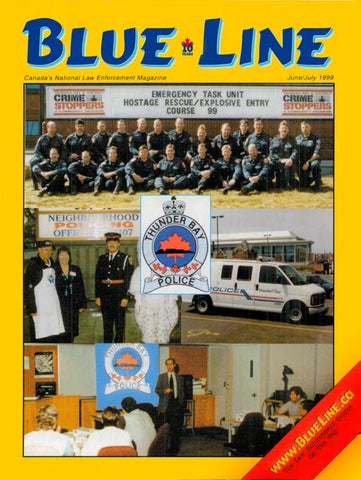
A caring community is focus of Thunder Bay policing
6
New recruit evaluation test is Canadian designed
12
Drawing in the spotlight The need for facial specialists in policing has never been greater
14
Taking a bite out of police pursuits Terminating pursuits the "Roadshark " way
17
Blue Talk
19
Letters to the editor
20
When the program fails
22
-Editor/Publisher-
Morley S . Lymburner Phone (905)640·3048·Fax (905)640·7547
E-mail: blueline@blueline .ca Web Page: www.blueline.ca -News Editor-
Blair McQuillan General Manager
Mary K. lymburner, M.Ed. - Advertising -
Mary Lymburner (Director) Phone (905) 640-3048 Fax (905) 640·7547 Bob Murray Phone (905) 640·6506 Fax (905) 642·0900 - lIIustration-
Tony MacKinnon Steffon Sepa - pre-press Prodyction -
Del Wall
Blair McQuillan
- Mechanical Specifications -
Gary Welch
Phone (905) 466-5039
- Contributing Editors-
Ballistics & Firearms Pierre Descotes Tactical Firearms Dave Brown Police Leadership Robert Lunney Survival Tactics Joel Johnston Case Law Gino Arcaro Computers & Technology Tom Rataj - Contributing Writers-
Bob Herman Dave Brown Floyd Cowan Karen Moffat Reid Goldsborough
Frank Daulby Mark Welch Mark Lalonde Fred Geiger len Hughes
Blue Line Magazme is published monthly, September to June. by Blue line Magazine Incorporated wllh a mailing address of: 12A • 4981 Hwy. 7 East, Ste. 254, Markham, Ontario, L3R 1N1 . Individual magazines are $3.50 each. Subscriptions are $25.00 per year or $40.00 for 2 years. (Overseas· S50.00) All articles are protected by copynght No part of thiS publication may be reproduced or transmitted in any fonn or by any means, electroniC or mechanical, Including photOCOPYing and recording or by any Information storage or retrieval system Without permission from the publisher Internet activity is monitored and use of material on the Internet is restricted. All material submitted for publication becomes the property of Blue Une Magazme unless other arrangements have been made with the publisher The authors, advisors and publisher accept no liability whatsoever for any inluries to persons or property resulling from the applicalion or adoplion of any of the procedures, tactics or conslderaliOns presented In this magazine. Readers are cautioned and advised that arncles presented herein are edited and supplied for your personal awareness and should not be used for further action unlil appropriate advice and gUidance IS received from a SUperviSor, Crown Attorney or other person in authOrity. Established In 1988. Blue Une Magazine IS an independent publication designed to Inform, entertain, educate and upgrade the skills of those Involved In the law enforcement profeSSion. It has no direct control from a law enforcement agency and Its opinions and articles do not necessarily renect the opinions of any government, pelice, or law enforcement agency. Blue Line Magazine is a private venture and as such is not funded by a'l¥I~~~i~feg~~e~~~ie"n~ ~~e~~r,\t~~oi~ °t:~~~c~ation. by Garson Graphic Services Inc.
calU
- Ajjiliations-
International Association of law Enforcement Planners Canadian Advertising Rates & Data International Police Association , , The Canadian Press Newswire Periodical Publishers Exchange
ISSN #08478538 Canada Post Canadian Publications Mail Product Sales Agreement No. 176796
YEARS
OACP 48th Annual Exhibition
28
A new benchmark for police community partnerships
30
Safer communities through police training
31
Technology Case Law Product News Classified Tell-Seven News Criminally funny
36 38 42
44 45 53
"A community divided yet uni ted" is one quote from Thunder Bay Deputy Chief Bob Herman in thi month's profile on his police service. The city of Thunder Bay was an amalgamation of two communities brought together in 1970. ince the adoption of community-based policing concepts the city was divided up into smaller community neighbourhoods with a common goal of uniting the city into one safe community of caring citizens. Thunder Bay Police advise this has been a tremendous success for them. You can read more about this on page 6 in this issue. Thunder Bay Police are also proud of the fact that they will be hosting the 48th annual conference of the Ontario Association of Chiefs of Police. A part of this conference is their annual trade show with 60 booths of exhibitors available for law enforcement personnel to see what is new in goods and services. To see a preview ofthi show you can tum to page 28 in this issue. This is one of our two combined summer is ues and you will see us again in August. I lave a safe and wonderful summer.
LIST OF A DVERTISERS Accident Suppon ervices Aegis Applicant Testing Services Ancal Graphics Blue Line ews Week CAP lnc Carruthers Shaw & Panners Crown VMS Dalhousie University DSM Law Enforcement Products DuPont Canada Elbeco Inc F.C.P.O. Flex-O-Lite Ltd Flying Cross by Fechheimer Fred Fowler Glock Henry's lIighpoint Security Technologies I lumber College Interactive Justice Studies InvestigAide Software Kirkpatrick's Leather Products Lacrdal Medical
18 17 10 12 46 41 38 55 19 39 7,51 4 41 43 2 44 36 44 27 37 52 40 37 25
Laser Labs Maritime Services Malle Industries Mega Tech Micheals of Oregon Most Wanted Motorola Nonhem Airboume Tech Pads Fitness & Supply Panasonic PRC Inc Pride in Service R Nicholls Distributors Rocky Shoes & Boots Southwest University Stop tick Ltd tunn Ruger & 0 Tactical Enterprises Int' l lnc. Tetragon Tasse The Wafter Fedy Partnership Trifonn Business Systems Valley Associates Vinual Depot Westervelt College
19 43 14 21 29 48 49 5
52 8
47
to 15 56 18 33 II
35 23 18 35 47 26 27
81-- - - - - - - - - - - BLU£ LIN£ June/July , 1999_ _ _ _ _ _ _ _ _ _ _ _ _ _---lD~_------------------ Magazine
introducing ELBECO's advanced Fiber-Blending Technology for a professional appearance and optimum comfort. Now exceptional fit, function, and style are par for the course: DUTY PLUS+P UNIFORM Superbly crafted Dacron polyester/worsted wool uniforms that are setting the new Canadian standard.
REGULATION TURTLENECK AND DICKIE Extra long, full-cut, 100% cotton body with or without embroidery.
WINDSHIRT Contemporary look and comfort in a lightweight, windproof Burlington 's Versatech@shell.
PARAGON PLUS UNIFORM
A combination of natural and sueded cotton blends provide natural stretch and breathability with unique fashion-grip waistband for comfort and style.
franc.,., DI"."'alJl~1W'ltelrprj10fsystems for In,-wI,atlrrerprotection from our Canadian climate. For more information, contact the following authorized ELBECD dealers: ~ Western Canada: Atlantic Police & Security Supply (403) 288-4452 • (llIt8rio .ltd Eastern Canada: At/alltic PO/ice & Security Supply (902) 835-1819
.. tlilibllc: J..V. Verr;er(514) 743-5310
®
...CD RAT E 0
P b'~ er' s Com
Taking care of business is not always that easy by Morley Lymburner I am a bit of a misfit and always have been. It appears that I have always been out of step with the popular nonns that were currently in place. Thi "problem" has been amplified worse with a mental attitude that I describe as "walking in the eye of a hurricane." Many times I have found myel f moving along in what I felt was a calm atmo phere until I hit the wall of the hurricane and realize there is a stonn all around me. I can put a little meat on this bone of statements with a scenario from my professional past. Way back in the mid seventies I came to the realization that 1was continually going to the same addresses to handle domestic disputes and giving the same advice to the same people. "Yes Ma'an1! He hit you. I can see the bruise on your cheek. You can go to the court house and swear out a ummons for assault against your husband. The general policy is that we don't lay charges in dome tic disputes." My frustration in such cases was greatly relieved by the Bail Reform Act. This gave us the authority to issue an 8. I release fonn at the scene. I did not have to have the detective office overseeing my every move in such situations and I took advantage of this new freedom. "Yes ma'am he hit you and I can see the bruise. I will lay the charge against your husband and you will be called to court as a witness." You can imagine the heat that came down on my back at the station. It was not kosher and I was no longer pulling the company line. I was the crazy cop that wanted to go to court for every crazy-assed domestic assault offence knowing the witness would back down or not show up. My ca e loads were getting quite large because [was the only officer out ofa couple ofhundred who wa doing this. Detectives refused to handle any of my cases and I was on my own. My simple philosophy was this. Their domestic problem is none of my business. They needed the advice and assistance of other social organizations that were better trained and equipped. They had to leam that if the police are called then enforcement would follow. That would be my function to do just that until the message got across that they had to seek help elsewhere. It was also clear to me that it was not my duty to get a conviction. Just bring the evidence before the court and let the court decide. r was called into the boss's office and told bluntly not to lay these charges. It was pointed out that my conviction rate was very poor and the charges just filled the courts. 1explained my philosophy and was met with a very stone-faced Inspector. "You are rocking the boat Lymbumer. We have gotten along with our present style long before you came along." My pointing to a rising homicide rate in domestic disputes seemed to only enrage him.l was clearly a radical that had to be brought under control... or gotten rid of. The sergeants got the word and I was watched. My habit of checking properties on night hift and finding a high number ofunIocked YEARS
doors got me the nickname of "Mr. Insecure" on my platoon. I did not realize the double meaning immediately. Intelligence Bureau surveillance of me discovered that r was not breaking in to these premises but actually checking my properties. Partnering me with an old salt copper simply made him work harder. 1 finally realized the war was on after being documented 28 times for such things as wearing my collar up, dirty boots, not wearing a hat,
June/July, 1999._ _ _ _ _ _ _ _ _ _ _---1
and disobeying orders not to lay charges. Although I felt I was doing the right thing I also real ized that I had to take care of me first before I could be of any help to anyone else. It was at this point I found "the pristine beauty of Traffic." If I had to get along in a large city police service r finally found my happy niche. I look back today and have no doubts who won that war way back then. My Inspector left the job as a Deputy Chief and Ta Constable.
/ -_ _ _ _ _ _ _ _ _ _ _ _ _ _ _ _ _ _ _ Magazine
by Bob llerl1l(ll1 Deputy hief of Police When Thunder Bay Police came into existence on January I, 1970 ""ith the amalgamation of the Port Arthur and Fort William Police Forces it carried on a policing tradition that dated back to 1874. Thunder Bay, a progre ive community of 117,000, is located on the western shores of Lake uperior. The city boast a full service port apable f ervicing ocean-going freighters. It i a me a for outdoor enthu ia ts with some of the fine t kiing, nowmobiling, hiking, camping, fishing and hunting facilities in Canada. Today Thunder Bay Police consi t of 214 sworn officers and 91 civilian members. It is responsible fI r providing policing service to the ity of Thunder Bay and the Municipality of Oliver Paip nge, an area in excess of 600 quare \"'ilometres. The e ervices include everything fr m a fully trained tactical unit to community-based policing initiatives. In 1995, Thunder Bay Police adopted a philo phy of community based policing. This philo ophy i ba ed on the premise that the police hould w rk with the community to form partner. hips to olve problems related to both the safety and well-being of persons and the protection ofproperty. From it initial inception the community p licing program has been extremely worthwh iIe. In 1997, one neighbourhood pol icing area received the" aring Communities ward" from the Trillium Foundation, which attests to the ucce of the program . urrently, the ity i divided into 16 neighbourhoods, with an officer assigned to each one as the neighb urhood officer. ach neighbourho d has a Liaison Committee and a group of volunteers. One repre entative of each neighbourh d it n the Chiefs ommunity Policing dvi ory ommittee. Two Patrol Branch turf officers per neighbourhood area complement the program and work with their neighbourhood police fficer to meet the need of their specific community. All of the above component work together to ensure that the philosophy and objectives of ommunity based policing are met. Whether it i ding c nOict re olution in a local school to implementing a new program involving community members ur officers have integrated themelves totally into their neighbourhood areas. Our officers pend many hour with the youth of our c mmunity. Many of these young persons have come t realize that the police are there to help them and it is through these youth that we will ee one ofthe benefit of community policing in year to come. Once you embark on community based policing in the manner that Thunder Bay has there is n st pping it. The program has received many te timonial about it success from ity Counci I, b th Bards of ducat ion and numerous community group.
The Training Challenge Another area where Thunder Bay is taking on a regional leadership role is our training program. We have come to recognize that our geographic location has made it very difficult to meet our ongoing training needs. The sheer cost of sending candidates to courses at the Ontario Police College and Canadian Police College has forced us to examine how we do business. In 1998, Thunder Bay Police embarked on an aggressive training program designed to meet the needs of our police service and provide support for other regional police services. Many partnerships have been formed with police training facilities, local educational institutions and other police services in order to achieve that goal. Last year more than I 10 Thunder Bay Police officers and civilian members received advanced training courses in Thunder Bay. These courses included Major Case Management, Police upervisors Course, General Investigative Techniques, Basic Tactical Officer Course, Hostage Negotiators Course as well as many others. These courses have allowed us to train over 50 per cent of our sworn officers at cost savings of approximately $25,400.ln 1999 Thunder Bay Police have already hosted a Hostage Commanders Course, Coach Officers Course, Hostage Rescue Course and Major Case Management. In all cases, an invitation was extended to regional police services to send candidates on these courses. Kenora Police Service, Dryden Police Service, Terrace Bay Police Service, Red Rock Police Service, Atikoken Police Service, Canadian Pacific Police, Ontario Provincial Police and the Department of National Defence have all taken advantage of these invitations. Further, Thunder Bay Police provides qualified instructors to various regional pol ice agencies in order to meet their mandatory training needs. Although this method of training has been available to police services in Southern Ontario for some years, it is a new venture for Northwestern Ontario. With the implementation of the new adequacy standards, police services must look at innovative methods to meet the training needs in order to achieve the objectives ofthe standards by January 1,200 I. Thunder Bay Police looks at itself as a conduit to assist regionaJ police services in regards to training issues.
Hosts to the 48th OACP Conference In June of this year, the Ontario Association of Chiefs of Police (OACP) will be hosting its annual conference in Thunder Bay. The focus of our conference will be Internet Crimes, SexuaJ Exploitation of Children, Youth Gangs and Outlaw Motorcycle Gangs. These four issues are at the forefront of policing concerns in the Province today. The presentations are designed to inform the delegates about these issues in order that the OACP can determine what it should be doing to ensure that effective policing occurs in these areas. Other presentations will focus on Y2K, communication initiatives, the ru, firearm legislation and police legal matters. All in all the conference should prove to be both informative and an excellent opportunity for senior police admini trators to network. In 2000 the Thunder Bay Police Association will be hosting the Police Association of Ontario (PAO) annual conference in Thunder Bay. We look forward to showing the delegates of both the OACP and PAO what orthern Ontario hospitaJ ity is all about. For further information on the OACP conference call Terry Wal Is at 807 684-1217.
The city of Thunder Bay, with a population of 117,000 people, is located in the Province of Ontario and on the north west shore of Lake Superior. The Thunder Bay Police Service consists of 214 police officers (181 male and 33 female) and 91 civilian and support staff for a total of 305 members. The police to population ratio is 576 citizens for each officer. The police budget for 1997 was around $18.5 million . This figure breaks down to a per capita cost of $155. The Thunder Bay Police reported that on average each officer on the department investigates 65 criminal incidents each year. The total number of criminal code offences recorded with the police service was 13,287 during the year 1997. The police service reported a 31 per cent clearance rate on property crime and a 87 per cent clearance rate on crimes of violence. Overall there was an 8 per cent reduction in crime over the previous year of 1996.
BLU£L'N£ ----------------------~~ 6 r--------------------~~~~=-. Anagazins ____________________________________~~r------------------------------June/July,1999 mw
New DuPont Kevlar®Protera'" outshoots the competition!
Kevlar®Protera" can provide up to 15% lighter weight and 45% greater flexibility, or 6% increased ballistic protection! * KEVLARIll PROTERA'· is a new fibre technology combined with an advanced fabric construction that ounce for ounce provides the best ballistic prot ction available. When we asked the law enforcement community what they wanted their body armour to provide, they consistently replied, "protection with comfort and flexibility!" ow you don't have to sacrifice protection to get greater comfort, and that mean more wearability!
100% U.S.A. made fibres. Based on V-50 testing.
*Data based on V-50 testing vs. "Shield" products. ® Registered trademark of E.I. du Pom de Nemours and Company. DuPont Canada Lnc. is a licensee.
™Trademark of E.!. du Pont de Nemours and Company.
revolutionary new technology in ballistic protection that begins with the molecular structure of the fi bre and a proprietary new spinning proces . Through this we achieve increa ed tensile strength and improved energy absorption. The result: exceptional ballistic protection, increased comfort and flexibility. The time is right now to investigate KEVLAR PROTERA ~, the new technology to protect you and your officer . CalI1-800-4-KEVLAR for more information and a list of licensed vest manufacturers in Canada.
8l>
Kevlar Protera Only by DuPont
Panasonic. First we gave it a built-in antenna - simply add the integrated wireless modem to access the CDPD, ARDIS and MOBITEX networks from the field . Then we gave it a fully sealed keyboard, a gel-cushioned HD and a bright, anti-glare colour display that's readable in sunlight. Finally, we wrapped it all up in a magnesium alloy housing that's 20 times stronger than plastic and can withstand a fall of three feet onto solid concrete. It's the CF-27 TOUCHBOOK from Panasonic . Because if you can take it, you can take it with you .
www.panasonic.ca/toughbook 1-800- 265-0616 All brand names/logos are trademarks or registered trademarks of the" respechve holders.
Single source technology to provide a new era in justice Ontario's new Integrated Justice Project - How it will help police get back on the street by Ailsa Hamilton Director, Integrated Justice Project What would you say if somebody told you they could make your job easier? You'd be interested? What if they said they could make it safer, too? And then, what if they went on to say they could help you make life safer for all Ontario citizens, and improve the functioning of our justice system? You'd want a whole lot more detail. But the story's legit-Ontario's Integrated Justice Project (UP) is coming on stream by 200 I, and it's going to make a di fference in precisely those ways. The UP is the re ult of analysis and consultation with people from across the Ontario justice y tem, from police officers to judges. ew ways of doing business and electronically integrating computer systems make it possible to hare infonnation and documents across the system among police, Crown attorneys, courts, and corrections. And recent inquiries into the justice system have een a need for better information-sharing, saying it could save lives in the future. An example is the coroner's inquest into the May/ lies case. In 1996, Arlene May, a 39-year-old mother of five from the Collingwood area, was murdered by her former boyfriend Randy lies, who then killed himself. At the time of the murder, local police had a long history with lies- he wa out on three separate bail orders. The problem was that he had appeared in court in two jurisdictions, and officials in one didn't realize he was facing similar charges in the other, or that he had already Oouted court orders to stay away from Arlene May. They also didn't realize that he had a violent record, or a firearms permit. With the UP, all that infonnation would have been immediately available to police officers and rown attorneys. The UP is building systems to electronically link police, Crown attomeys, courts, and corrections. All authorized people will have access to a full file on anyone facing criminal charge, pulling together the most up-to-date infornlation: current charges anywhere in Ontario, previous convictions, court orders (including family court orders), behaviour in previousjail tenns, etc.
What is the IJP? The UP is a set of new ways of doing busine s across the justice system, assisted by powerful new soflware programs. These will act together to ease workloads and make the system more effective and efficient. There wi II be: § a new police Computer-aided Dispatch and Records Management System (CAD/RM ), replacing the current Ontario Municipal and Provincial Police Automation Co-operative (OM PPAC) system used by the Ontario Provincial Police (OPP) and 57 municipal police I'ENIS
services § a Common Positive Identification system, to store digital mug hot of offender in the criminal system § a Crown attorney case management system § new court case management systems, covering criminal, civil and family courts § digital audio recording systems to record court proceedings § a new corrections case management system, for use by correctional, probation and parole officers What is really new is that all these systems will be integrated, 0 that they work together. Infonnation entered anywhere in the justice enterprise will be automatically available to authorized users- police officer ,judges, prosecutors, lawyers, court staff and correctional stafr. Security is central. Access to records will be on a "need to know, right to know" basis, with password protection. A system of electronic signatures may be u ed to authorize documents. Each step in the UP has been taken with input from people in the field. The police team working full-time on the project includes officers from several municipal services and the OPP, and they consult with police services across
June/July, 1999_ _ _ _ _ _ _ _ _ _ _ _
Ontario. The viewpoint of the police is also well represented on the UP's Executive teering Committee, which oversees the project and acts as its link with it dilTerent constituencies.
Less paperwork ... The sheer load of paperwork in the justice system is one of the most powerful arguments for the UP. Think ofa row of grain silos. Today, each sector of the system is its own silo, with its own fonns, ystems, and files. As a case moves from silo to silo, the same information is rekeyed, printed and filed many times. Each part of the system will still produce its own records, but if the infonnation is in the system already, it won't need to be keyed in again. E lectronic document handling will eliminate duplication core infornlation will Oowwhere it's needed, when it's needed. An electroni c "invo lved person" file will link all documents produced at each stage, so that authorized users can share them. Full-circle informati on The proce starts with the people at the front end of the justice system- the cop on the beat. A police officer arrests a suspect, enters a
----10~---------------8-L~!g~~i~!
chargc and crcate a crown brief on the computer. The system will nag particular kind of chargcs, which will be available to police as \\cll for c'l.ample, "lethality factor" related to domcstic vi Icnce, su h as a weapons conviction or a prcvious rc ord. Thc rown attorney then receive the relcvant case matcrial electronically from police. Il c or shc will use the new system to tran fer documcnts to court and make di closure to defcnce lawycrs, or to automatically generate forms such a indi tments and subpoena. In courts, clcrking, record-taking and trans ript producti n will be modernized, with the full rccord ofthc trial captured in digital audio form. ourtJudgement and order will be entcrcd on thc ystcm as part of the file, with the complctc digital audio rec rd of the trial attached. orrcctional tatTwill have full information on otTcndcrs whcn they arri e at jail. In addition to Incrcaslng cfficienc)" this will allow them to bettcr m nitor pe pie who are a danger to themsclvcs or others. Infornlation from correctional scrviccs for c'l.ample, temporary ab ence or failurcs to rcport will now back to police and 'rown attorncy , allowing better tracking of dangcr us otTcnders. I Icctronic integration will come full circle for thc front-line police officer. For example, hcrc's a typical bad situation a police officer might b' involvcd in: You're enton a I a.m. call about a domcstic dispute. When you get there, you find thcrc's a hild involved, and both parcnts claim to have cu tody. f cour e you have to takc action but today, you have little in for-
APPUCANT TESTINGSERVICES, INC.
"ft.latcltillg People to Positions" I '>. tllUnded on t 994, IS a human resources company peclali/11lg in the admini tration and interpretation of pft!-intcrvicw crccning tests. I S has fully mobIle testong capabilities that allow us tle ihd,ty to accommodate the needs of our clients. TS will work collaboratively to utilize your existing test111 ' protocol or dcvcl p a testing pr cess that will meet )our hiring needs. I '> i currentl) licensed by the ntario Association nf (,h,efs of ')nhce (0 CP) and the Ministry of the '>"hcltor General and Correctional . ervices (M ) t,) cnnduct the I)re· lnterview Assessment Phase of the ('nn'>table SelectIon S) tern , a provincially tandardi/ed police con s table hiring process de,eloped joint I} b) the OA P and M \ I " has \H>r~ed joinll) ",ith the Ontario Ministry
of' ,Ihnur, ,,,sistlOg "'ith a hiring process for lIealth & Safety Omcers; Ontario Ministry of
mati on to go on. The UP will throw a beam oflight into thi unpleasant ituation. With it in place, you'll be able to radio your tation, where a dispatcher will acce the justice enterprise sy tem and call up the relevant court orders. In a few minutes, you'll have an answer which parent has custody, or if an abusive spou e i breaking a restraining order. Greater Safety A key goal of the UP is greater safety- for police officers, correctional officers, and the general pUblic. Clear identification of "involved persons" is a big part ofthi , and the new ommon Positive Identification (CPI) system will give police officer acce to digital mug shots and personal information. The PI record may link to fingerprint record and a uspect' electronic file, including criminal history, behaviour while injail, and probation/parole record. Data fields could include "tomb tone" data, aliases, physical description with di tinguishing features, and a unique numbering system. This system will be linked with the Canadian Police Information Centre (CPIC) managed by the RCMP. For example, here's another typical bad situation for a police officer. You have to stop a vehicle on the road at night. With access to the PI record and the integrated justice files, you'd be able to ee if the driver or a passenger is out from a correctiona l institution on a temporary pa . That's a pretty important piece of information that's not readi ly accessible today. Accurate identification is critical for safety all across the justice spectrum. Correctional officers will be able to u e CP I to clearly ID inmate coming in and out of jail on day pas e . Probation and parole officers will use itto ID new clients at the mo t basic level, to see ifsomeone i who he says he i ,or what hi record is. More safety, better information and less paperwork are pretty big pluses already, but there are more benefits for police. For example, it is anticipated that electronic schedu ling will be able to compare everyone's availability in setting court dates. Resu lt: fewer delays, fewer reschedulings, and less time pent tanding around in court, waiting to testifY. Who 's working on the IJP? The UP i a public-private project, where the Ontario justice mini tries, the Attorney General, and the olicitor General and Correctional erv-
ice, are working with a consortium offour leading anadian companies. Led by ED y temhouse Inc. of Ottawa, the con ortium also include DMR onsulting Group Inc., KPM LLP, and Teranet Land Lnformation ervice Inc. The public-private approach means that the government benefits from private capital and private expertise. The consortium members are putting up three-quarters ofthe estimated I89 million co t of the UP. In return, they will share in savings that the project is expected to generate through greater efficiencies in the system. But they share the ri k as well no savings, no profits. Each project team- police, Crown attorneys, courts, corrections include people from both side of the partner hip. In the case of the police team, front-line police officers work side by ide with systems experts from the private partner . Overall direction comes from a project management office, with co-director from the public and the private ectors. The two ju tice ministries began to explore the po ibilities ofan integrated justice ystem in 1996. Private partners were identified and a contract igned. After a successful planning phase, the government and the consortium agreed to proceed to the development phase, in March of 199 . Thing have now reached a stage where the new recommended UP systems are soon going to be tested, both on their own and as an integrated y tem. The plan is to test the courts, rown and corrections systems with the involvementofLondon Police ervices. Full implementation is planned for 200 I. The police team plans to test its recommended new AD/RM sy tem later this year, under real user conditions at OPP headquarters in Orillia. Conta ct the IJP The UP will re pond to inquiries. You can check the public Internet site at http: www.integratedjustice.gov.on.ca. or the Intranet ite for ntario government employee at http:/ Iju tice.ij.gov.on.caiijprojectiOO home.html. r you can phone the inquiry lineat(416)326-2121. A il.~a Hamilton ha.~ beell involved with the IJ P .\·in£'e il.\ illceptioll, and wa.~ appointed dira tor ",hen the project wa.\ forma/~v laun ch ed. Sh e ha.5 OI'er 1() ~'e ar.\'
experience a.~ a manager and c·on.~·u'ta'" ill illformation tedll1% gy, ill both the public' alld pril'ate .\ ectoTS.
"PRIDE IN SERVICE"
I ra"spon.ltinn assi tlng with a hiring process for I ru(~ Inspectors and a number of ntario I'olice ServIces to assIst them with hiring processes for Speual ('nnstables and oun mcers. 10 d,scuss how ATS can help your organization, pic,,,. enntaet us at the phone numbers below.
1-800-429-7728 or (519) 659-8686
A Ring of Exceptional Qu ality to how Your " Pride in ervice"
Fax: (519) 659-8757
E-Mail: atiody ey.on.ca WEB: www.thenetnow.comlatsi
CALL TODAY FOR YO R FREE COLOUR BROCHLRE
1-800-535-9735
Check out our new web page at www.pride·in·serv ice.on.ca
Pride in Service P.O. Box 705 Pickering, Ontario L1V 3T3 Fax: (905) 509·6933
8LU£ L'N£- - - - - - - - - - - - - - - I Q M agazin e
Vr------------------
-QU PMENT Ruger)s Answer to Your Professional Nee ds _ . The compact, lightweight autoloading Mini-14 Government have heat-treated chrome-moly or stainless-steel alloys throughout the mechanism to give reliability under adverse operating conditions . Available in .223 caliber (5.56mm NATO ).
1"14-15 4iAiU;U.. iiit'itJiQi:W1 5,ii~iliij~:==!f!::~" ~;;:;:=~~~- 5.56mm ::::? Chambered in caliber , and available in blued
~::.!F:;::::::::-.·=::::===~=J~::!p.!3.
or matte stainless-steel finishes, fixed or folding stock configurations. Built to deliver durable and dependable functioning under adverse field conditions.
(
II . II i ;Jlla AtCiJ §:11$. The carbine is a tough, reliable shoulder arm which is user friendly and costeffective enough to place in every police car. Available in 9x19mm and .40 Auto calibers, the magazines are interchangeable with the Ruger P-Series pistols.
This high-tech 9x19mm pistol has an injection-molded one-piece gripframe structure of super strong polyurethane material. ew for 1999, the .45 ACP KP97 pistol is now available.
This compact 9x19mm submachine gun features a telescoping folding stock and a three-position safety / selector lever. Firing from a closed bolt, in a semi- or full -automatic mode, it is highly accurate and dependable.
Ruger's tactical firearms offer exceptional value and certain models* are exclusively manufactured for official use. For additional information on Ruger service firearms and your nearest law enforcement dealer and representative, write or telephone: Sturm, Ruger & Company, 134 Old Post Road , Southport, CT, U.S.A., 06490 (203) 259-4537
l!l
Les Distributeurs
2475 De La Province
R. NICHOLLS Longueuil, QC J4G 1G3 Distributors Inc.
Phone: (450 ) 442 -9215
QlRUGER
New recruit evaluation test is Canadian designed able. Many may be qualified, but only a select number are suitable. One test does not fit all. There are over 120 tests for various professions and occupations and, because of the mathematical structure of the instrument, tests can be readily customized. The Ferguson Test is in the vanguard of progressive managerial and organizational structures.
It is signi Iicant that much of the testing that is administered in Canada is predicated on te ts developed in the United tates and validated with groups of workers who reprcsent American ethnic populations and nonns. The shortcomings of this has not been lost on may anadian police agencie who have been looking for a truly Canadian answer to the problem. In response to this need the Brandon, Manitoba, firm of 'ampbell-Manns International Inco has come up with the Ferguson Test Role Percept ion. Testing Instruments The catalogue of psychological tests offered by thc Institute of Psychological Research in Quebe rcveals that less than 5 per cent of all the tests onered were properly validated in 'anada.l\s well, many of the tests available are ubjective in nature and provide the applicant with the pportunity to . fudge" the result . One of the more common psychological tests being used in anada today i the Minnesota Multiphasic Personality In\'entOl:\' (MMPI). This test is used to eliminate candidates from selection, based on an ability to judge deviant behaviour from the norm, particularly theft and or dishonesty. This test was validated in the United ' tates, therefore, the applicants are being compared to a norm which mayor may not be relevant to the anadian fact. The Ferguson Test of Role Perception was developed and validated in anada. It has also been rcscarched in Japan, and the United tates. The Ferguson Test is a psycholinguistic instrument which objectively and quantitatively measures the subject's perceptions of the role of a police orJicer and i a strong indicator of future
behaviour in this role. What makes this test different from most other instruments is its objectivity and lack of"fudgeability." The Ferguson Test is culture and gender neutral. The instrument provides empirical data which determines and substantiates the suitability and compatibility ofthe candidate. Sinee the predictive validity is high, the test can be used without fear of discrimination grievances. For example, if the organization has 100 or more candidates who are qualified, i.e. have met the selection criterion, the Ferguson Test can then be applied to select the most suitable. The key word is suit-
Committed Community Policing One recurring definition of community policing is that it's a customer oriented approach to building partnerships, to make communities safe and liveable. It's problem solving at the level closest to the problem. In other words community policing, in contrast to the traditional sy tem, focuses on solving the problem rather than on generating arrest statistics - quality not quantity. Community policing is pro-active as opposed to reacti ve. Research gathered from police forces in Canada and the United States has identified the following qual ities are indicative of committed community police officers: I. Decision maker and problem solver 2. Sel r tarter 3. Assertive 4. Selectively open or private - the person needs to maintain confidential material while at the same time be open and approachable 5. Participative management style - important in forging partnerships with the community 6. Community Service/Customer oriented 7. Teamplayer 8. Good self-esteem 9. Respect for administration - while they need
phic§
Custom ····UTeAL
GRAPHIC IMAGING ' SCREENPRINTING
779 Industrial Rd. London, On. N5V 3N5
1-800-265-6128
BLUE L'NE- - - - - - - - - - - - - - 1 Q Magazine
(FAX) 519-453-3617
www.artcal.com
VI-_ _______________ June/ July,1999
YEARS
to be self-starters you need to know that they will respect and follow the decisions that are implemented by administration 10.Re pect for the public - this ties in with customer service II .Respect for the role of police oflicer - someone who has Iittle respect for the role wi ll not stay in the position or may cause problems 12. Empathetic 13. Re pect for those who are different 14. Communication ski lls 15. Extraverted, friendly, likes to be with people 16. Flexible, open-minded 17. Extensive police experience 18.Ability to motivate others 19. Patience 20. Organizational skills Applications of the Ferguson Test The Ferguson Test is an extremely accurate additional tool which indicates role perceptions. This facet of the recruitment process is most valuable and can be applied by Police Services for a wide number of uses, including recruitment, promotion, team building and diagnostic. The Fergu on Test accurately measures the perceptions of candidates/police officers/super-
visors on major issues that affect the organization's efficiency, profitability and public image. The statistical analysis enables accurate pinpointing of areas where compromi e is required and areas where there can be no compromise. The nature of the test makes it especially valuable in assisting an organization, such as the police service, in the creation of a new organizational direction. The admini tration can, in fact, create an atmosphere and develop the character of their organization which will be significantly ditferent from the traditional one. Organizations tllUS become socially acceptable, desirable, and community committed. In other words, use oftllis in trument keeps the organization on top of new social workplace requirements. By judicious use of the instrument organizations can be in the vanguard of socially acceptable and profes ional change. The Ferguson Test can be extremely beneficia l in assisting police organizations across Canada to reassess members already on the force and to create a demand for recruits who meet the newly perceived requirements. By establishing an organizational noml the force is now able to identity the perceptions necessary to meet the directed change in philosophy and direction.
Progressive, proactive community policing requ ires familiarity, acceptability and the use of the most up-lo-date instruments to enable them to meet their perceived goals. In a writtell response to Blue Line Magazille Brandon Police Chief Richard Scoll stated "It is a rare occasion when I find myself able to recommend a lIew instrumellt that has been created specijiClllly for police. The Brandon Police Service has usell the Fergusoll Test and has been able to implemellt the results ofthe test into a viable method ofstaffrelationships and development. I have found the test to be most IIseful in salvaging careers whell officers have been placed in positions ill which they were not suited. The Ferguson Test idelltijied problems alld the consultallts provided recommelldations for remediatioll. I have no hesitation in recommending the Ferguson Test." Further information is available by contactmg lli7abelh Roberts at CampbellMarins Intematlonallnc. at (204)726-5240 or email: cmj(u\\cstman.wave.ca.
Getting an edge in police testing You wouldn't think of enrolling in a college or univerSIty course in September, paying your money, not attending classes, not studying,not doing a.'iSignmenls, and then going back in December and writing the test! That would be a waste of time and money. And yet, that is how most people apply to police services across the country. Thcy hand in their application and monc~, get a test date, then sit, \Vait, and get ner\ous. Is applying to the police different from collegt: or university? It shouldn't be! A new onc-day course designed by a Toronto-based firm called Phyper Consulting teaches potential applicants how to systematically prepare and apply to a Police Service, so they can increase their opportunitIes of becoming a police ollicer. TIllS course was developed through extensive research, and interviev\s \~ith recruiters and successful as well as unsucct:sSflll applicants. Inter\ iews v\ ith recruiters looked at common problems and mistakcs by applicants, opinion oflevcl of preparedness of applicants and improvement techniques. Interviews with successful and unsuccessful applicants looked at: the preparation undertaken by each student: level of prep aration; knowledge of tests prior to testing; kno\\ ledge oftests after testing; frustrations; anxietJes; number of Police Services the appI ieant applIed to; kno\\' ledge of each Pol icc ';ervice, etc. Joming thc Police has become extremcly dirficult. and onl) those \\ho have tried and fai led understand the frustration. Excellent
YENIS
candidates are ollen not hired because the) do not understand the tests, or arc unable to "demonstrate" their knowledge, skills or abilities. This course is designed to explain the various parts orthe testing process, demystify them, and offer techniques and information to assist applicant:; in improving their opportunities. for many enthusiastic police applicants, the realities orthe police testing process are a cruel and unnerving remlllder that merely wanting to be a police oflicer doesn't mean you will become one. In order to become a police officer in the Province of Ontario, applIcants IllUSt not only be successful in the police testing process, they must also out score their com petit ion. Police testing has bccome hlghl) competitive. Additionally, man) Police Scrvices are Illodifying or redesigning their tests. This is being done for two reasons. ~ irstl), to retlect current, future policing rcquirements. Police services in thc Province of Ontario arc directed by the Police Services Act to provide "community-oriented police sCr\ices". This rcquircs police servict:s to work in partnership with their communitics in order to identify and address community probkms and concems. In order to deliver community -oriented police services, the police must rt:cruit people who cxhibit the skills and abilities necessary for community-oriented policmg. ApplIcant must possess communication and problcm soh ing skills, be capable of working \\ ith the community, shO\\ initiative and have the ability to develop pm1nerships and resolve conflicts. Additionally, the increased use oftechnology in policing and advances in investigative techniques (accident reconstruction, forcnsic, etc.)
all reinforce the need for applicants to exhibit sound general aptitudc and analytical skills. Applicants must demonstrate their proficiency in these arcas, and show they are capable of meeting the future training demands of the Service. Secondly, police testing must be "appropriate". Police ser\ ices arc revic\~ ing their tests to ensure they rellcet the actual duties performed by police officers. Police physical fitness testing IS one example of the change which is occurring in police testing today. In the past, most police services tested applicanLs tc;inga I . mile run, push-ups, sit-LIPS, and chinups. However, some police services, such as the R.C.M.P., are adoptmg tests which simulate actual pol icc dutlcs. The R.C.M.P. use thc Phl'sicu/ Ahilit)' Requiremellts Eva/llation (P.A.R.L) test. The P.A.R.I test uscs an obstacle course rather than a I t ml. run. The obstacle course is used to simulate a police foot chase. AddItionally, weIght machines are used to simulate taking control of a suspect and handcuffIIlg prisont:rs. The H..eM.p. tests arc "appropriate" because of their relevance to the duties ofa police ollicer. Kno\\ ledge and preparation have become essential III today 's competitive police testing proet:ss. Phyper Consulting teaches applicants ho\\ to systemically prepare and apply to a police st:rv ice, as a police ofticer or court officer. I-or further mformation, contact Anne ,It Phyper Consulting, (416) 424-121\7, L-mall' phypere(ll interlog.eom or check OLlt their Ilome Page at \\ww.interlog.eom 1 phypcrc
\13?f------------
BLU£ LIN£ June/July, 1999_______________-\Vr____________________ Magazine
Drawing in the spotlight The need for facial specialists in policing has never been greater by Frank Daulby The facial specialist must be an artist and a trained interviewer capable of producing both a suspect drawing and an accurate witness or victim evaluation. The Special ist that meets these criteria is looked upon as an expert in this field . Police artists, computer soflware operators and composite artists are now being referred to as facial specialists. Facial specialists take on an enomlOU re pon ibility when they interview a witnes or victim. They must listen to, interprct and evaluate every word and gesture the witness or victim articulates. Their ability to di fferentiate between memory, confabulation (imaginary experiences created by the victim to reduce embarras ment), and deception, has a signi ficant impact on a criminal case. The primary focus must be the accurate evaluation of the witness's or victim's memory, or the careful recording of its absence, not necessarily the production of a suspect drawing. Any system can pr duce a face, and every system has what they call successes. Only a person with accredited training can accurate ly evaluate a witness's or victim's memory. Knowing when not to produce a suspect image is just as valuable a concluding an interview with a suspect image. Everyone understands that when an expert is asked the question, " What do you think?", he is not being invited to have a casual conversati n. l ie is being asked for a carefully considered profc orial pinion based upon his formal training and work experience. At the conclusion of a composite interview, the expcrienced facial specialist will usually have anticipated the question " What do you think?". The facial speciali t will have a carefully measured re pon e, at least partially prepared, in anticipati n of the que tion . Anyone who assumes the role ofa facial specialist, but does not have
Drawing by Frank DauJby
special interview training, must understand that as soon as he responds to the question he is giving unqualified expert opinion. Indeed the facial Specialist's opinion can change the course, and thus the outcome, of any investigation. His opinion carmot be based on "gut feeling". Experts must qualifY their answers, and cite the reasons for their opinion. Facial Specialists' answers must be carefully weighed and measured, taking into consideration the witness' language and behaviour in the interview room, before they venture an opinion. A recent worldwide survey was conducted by myse lf and aptly titled, "Who is Your Composite Artist", revealed that many of the surveyed police services employ a unifornled police officer or a technica l identification officer as their facial specialist. Some police services use a full or part time civilian artist or computer operator hired specifically for composite art. Other agencies utilize existing employees already working in their department. A few police services use a local painter, or celebrity artist. Very
rM
POLICE PnO gets personal!
''''di es upside down , in extreme temperatures , under' water, on ca"bon{css pope,., ove,. g"ease and finge,.prints ....
'88 pace 5fl ."'. 1-888-772-2350 Fax: (416) 696-0236
~
.rn.atte.ca
spacepen @matte.ca
Pen
Ask sbout our
few ofthese people have any interview training, and even less have had any special training in interviewing victims of crime. If you had to pick one person from this group to interview your victimized loved one, whom would you pick? A closer look at the international history of composite art will help us understand how such a wide variety of people began working in this specialized profession. Historically, police artists were local newspaper cartoonists, hired when police needed a break in a case. Later, portrait artists were utilized as the need arose. Eventually, existing police officers were chosen solely on the bases of their artistic talent. These artists had no training in interviewing, primarily because training was not available. In the late 1960's, some police departments adopted a few mechanical facial systems. These systems usually consisted of a series of clear plastic sheets with one or more facial features printed on them. Depending on which system was used, the plastic sheets were slid or stacked one on top of another to create a suspect likeness. A corresponding catalogue accompanied these systems. The witness or victim usually ended up looking through the catalogue with the operator to find a facial feature they thought looked like the suspect. This was not the recommended method of use, but according to my survey this was the practice. The accepted bel ief was that all you had to do was show your witness or victim enough facial features, such as eyes, noses and mouths and the witness or victim would recognize the features that looked like the suspect. The facial specialist would then pull the whole thing together, and presto, we had a picture of the suspect. Very little was known about the perils of confabulation, or the inherent desire most witnesses and victims have to "save face" or "help the police". Consequently the resulting images were usually accepted as being "the best that they could do" and simply published. The manufacturers of these first generation systems trained operators to use them in less than a week and promoted the idea that anyone could make a face using their system. These first generation systems had their advocates and opponents, and like any reasonably thought out systems of that time, they had some successes. A closer look at some of these successes revealed that a case was considered successful ifboth the created suspect image and the actual suspect photograph displayed one or more disguises, such as a beard, hat, moustache, eye glasses, or a combination ofthese. These items have strong recognition value for witnesses but in actual criminal cases they seldom identify the suspects, unless the suspect habitually wears the described items. At least one research project attempted to show that mechanical systems were superior to freehand artists but the research failed to gain
.... continued page 16
BLUE L'NE- - - - - - - - - - - - - IQ M agazine
Vl-_ _______________ June / July, 1999
lUlL')
R
Ie
QlLS
DISTRIBUTORS Inc.
.
'lite ~ in- ~af,()- &~ S~
SUea 199'0
UNIFORMS DESIGNED FOR ... • STRENGTH • VERSATILITY
• DURABILITY • TOMORROW
... WITH THE HIGHEST QUALITY TRADITIONS-4 is our own line oj clothing that has been specifically designed Jor Law Enforcement, Fire and Security ProJessionals. This collection oj clothing will meet all oj your needs Jrom warm summer days to our harsh Canadian winters. Many oj these items incorporate tried and tested des igns with modern innovations, that have been suggested or recommended by users like you. It's timeJor you to try TRADITIONS-4- yourself and Jind the quality, comfort and style that you deserve and require. FEDERAL SIGNAL VISTATM CORPORATION HALOGEN LIGHTBAR Federal Signal's VISTA ™ lightbar is your best halogen choice. It uses dependable Federal Signal rotators . Every sweep cycle includes a pass by an exclusive diamond trapezoid mirror which multiplies each flash and reflects normally wasted light to areas where it can be seen. Emergency Products
The VISTA halogen lightbar has a wide range of ~:!!!!!-'7options available including choices in directional flashes, takedown/spotlights , alley lights , steady burn/worklights , brake/ taiUdirectionallights, corner flashi ng lights and SignalMaster™ traffic management lights . Available in your choice of hook-on, permanent or flat mounting. Dimensions: 44" 1 x 16-112" w x 5 -3 /4 " h .
STREAmLIGHT
STINGER XTTM
All the power & strength of Stream~==;;.!., light ' s famous rechargeable Stinge ,but with a tailcap switchfor the tactical options of momentary or constant operation. StingerXT also features a virtually indestructible machined aluminum case with comfortable, non-slip rubber g r ip, a Nickel Cadmium battery and Charger, and an unbreakable polycarbonate lens. Length 7 . 7 ", weight 11.1 oz. Available in black.
2475 de la Province Longueuil, Quebec J4G 1G3 Tel.: 1-888-442-9215 Fax: (450) 442-9581 Web Site: www.rnicholls.com E-Mail: info@rnicholls.com
t)eur, ~ 20t4 rI~
eata bJ9la u ~ ~. eaa eau~rua ~ ~ ~ t)d (JHe.
popular supp rt. Thi . ma have been because the Images I ked mechani al. Lay per on are usuall} the fir tto marvel at the ability of good artists. Ilowever they arc al 0 the first people to ITlvent alternative ' to replace them, usually cIting that not every p lice agency can have a police arti t on staff. 'ood freehand comp ite arti t are rare pnmanl} becau e drav.ing i a practi ed kill, and the vast maj rity f"freehander" a they are called, are also working in other area of policll1g. Police arti l. that are full-time are usuall} bus enough to devel p and maintain trong portrait skills. Ilighly skilled police arti IS have a constant workload. 'omputer sollware program have, in good flllth, naively repr duced the mechanical facial feature s stem, in orp rating the arne as embly approach . These new computer program are rapldl} rcpla ing mechanical sy tem . Most mechanical and c mputer facial systcms advcrtise how fast suspect drawing can be crcatcd with lillie or n training. "This soflware requires no . pccial skill or training." is the promIse ofonc sollware progranl. They further promIse, "comp site pictures in Ie than I0 minute ." Whilc this 'peed sound enticing it ignores the Importance f alldating the victim' memory, and thus credibility. They ignore the fa ,t that their operator, like police artist, are reall II1terviewers and lli uch they hould have e\tensive interview training not offered on any, but the most advanced police training course. fhe p lice artists, c mputer sollware operators, and composite arti. t arc con idered to be Illcial specialist . roach as ume the role of e pert 111 the eyes of the publi and the police communlt}. It IS important t n te that a re iew of my 1997 statisti s revealed that appro\imately 75 per cent of all facial identification wilne e were victlillS, not independent witnes e ,and there i no reason to belie e that the e tatistic would not appro\lmate tho e of other fa ial speciali IS. Thi statlstl ' IS e\tremel} Ignificant when you try to balancc the claims of the manufacturers about speed and the lack of need for training, with the il11a 'e of an untr, ined facial peciali t attempting to II1terview a savagel beaten rape victim. The psychol glcal pre ure to produce a suspect drawing i. enough to cloud any facial specllllist's good Judgement, unless that per on has had fornlal interviev. training to guide them In makll1g, and later justifying, their decision . 'omll1g out of an interview ro m without a upect drawing is ·till c nsidered an admi ion of 1~lIlun: b the vast majority of police omcers, lI1c1udll1g facial speciali. ts. The take are even hi .her Ifthc facial spe ialist, witness, or victim become. the 1'0 u of in ten e media attention or the faCial specialist feel any real, or imagined pressure fr m an}one in authority. To manage and h pefullyavoid ome of the ps}chological pressure, the fa ial pecialist mu t havc Interview training. Thi will not only enable thc facial pecialist to c pe with out ide pressure but also to recognize the indicators of conlabulatlon or dcceptl n. Knowing when not to produce a uspe t rendering is ju t as valuable as being able to recogni7e memory. If the lacial spc iali t is pressured into pr ducing a
-
-
I
Face
Next
PreviOus
gazine
-
---
Edit
---------- -----
CondlOete
FlIes
Xfer
EXlt
CandIdates
I
ompllterized composite identification kits are cllrrently available th rollgh a wide variety of companies includillg firearm m(lIIufacturer mith & Wessoll. u pect rendering they will at least be able to arti ulate the preci e value of the suspect drawing produced. The under estimation ofthe time required to professionally interview and thus develop a witne ' or victim' memory is part of the mistaken belief that computers are fa ter than freehand artists. very adult can tell a tory about having 10 t omething such as a set of keys and the slow, systematic process it took to find them. II' their earch was interrupted or any pressure was put on them to hurry up they had to stop and retrace their footsteps to retrieve their 10 t memory. Memory, like love, doe not respond well to pressure, or speed. Memory mu t be ma saged, slo" Iy and without probing questions, interruption ,or uggestion ,to avoid distortion or loss. In short, peed kills not on ly people but also memory. Confabulation is on ly too wi ll ing to ubstitute for memory ifmemory is not pre ent or has become the casualty of the interview proce s. Speed imply has no place in a conversation concerning interviewing a witness or victim. Mo t of the current facial system promote at Ie, t two compelling reasons to buy their system peed and minimal training. There is never any mention of the cI ienl. We mu t never lose sight of the fact that our client i the victim, and the victim demands more than money can buy. Interviewing victims and witnes es i a resp n ibility that mu t only be undertaken by profe ionally trained interviewers, with veT} pecial kills. Interviewing takes time, and is the key to the accurate recording of pictorial or lingui tic memory. It is criminal to suggest that "thi
BLU£ L'N£- - - - - - - - - - - - - - - \ Q M
-
sollware require no pecial skills or training" to interview witnesse or victims. The primary focu of the facial specialist mu t be the accurate evaluation of the witne s' or victim's memory, or the careful recording of ilS absence, not the production of a suspect drawing. Any sy tern can produce a face, and every ystem has what they call "succes es" but only an expert can accurately evaluate a witne s's or victim's memory. Knowing when not to produce a suspect drawing i just as valuable as concluding an interview with a drawing. Facial specialists must be professionally trained interviewers capable of recogni7ing memory, confabulation, and deception before they interview witnesse or victims of crime. They must work independently without time constraint . If the facial pecialist expects to have credibility, witne evaluation mu t replace the p ychological drive to ju t produce a face. Facial pecialists must be trained interviewers that can reproduce face, notarti IS that enjoy drawing in the spotlight that is focu cd n victim. The profession of policing expects nothing Ie s and the victim demands it!
Det. Cst. F ra II k .-----==-----, Dalliby i\ a force composite artiH with the Techllh'al Identificatioll Services Section of the Olltario Prm'incial Polh·e. He can be reached by pholle at 705 329-6186.
U-I-_ _______________ June/ July, 1999
YLW
Taking a bite out of police pursuits Terminating pursuits the ~~Roadshark" way by Dave Brown High speed pursuits have exacted a deadly toll on both police officers and bystanders alike. Winnipeg Police Constable Jon Mateychuk thought so, too. The important thing is, he did something about it by inventing the " Roadshark." There are many tragic examples in recent years. In 1993 , Calgary Constable Rick Sonnenberg was instantly killed while laying down a spike belt in an attempt to stop a neeing vehicle. He left behind a shocked and grieving family and fiancee . In 1998, Joliette, Quebec officer Dominic Courchene was struck and killed by a Quebec Provincial Police cruiser pursuing a stolen vehicle while he was placing a similar spike belt. One month later, a Manitoba RCMP Constable narrowly avoided injury when a truck swervi ng around a pike belt missed the officer by inches. And these are but a few of the tragedies and near tragedies resulting from high speed pursuit. Have you ever thought that there mu t be a better way?
Stolen Auto Epidemic Out of the eleven chases that Stolen Auto Unit Inve tigator Jon Mateychuk has been involved in , seven resulted in major accidents. Most ended with extensive injuries and property damage. One of his most memorable pursuits resulted from the attempted arrest of a gang of juveniles who were estimated to have stolen over 200 vehicles. When the cha e concluded with a serious wreck, officers were shaken to discover the thieves were only 12 years old. Thankfull y, the occupants escaped serious injury. Mateychuk tries to identify with why these offenders decide to run. " Half the time, I think they ju t panic. Once they decide to take off, they feel there i no turning back." Other officers agree that the majority of chases result from seemingly minor traffic violations or offences. " I wanted to come up with some method to stop the suspect running in those first few seconds when they are trying to decide-should I run or should I just stay here and face the consequences," says Mateychuk. Much like many urban areas, the city of Winnipeg i bisected by several arterial roads with fairly limited access. Once a vehicle is committed to one of these expressways, they have few opportunities to leave the road for another route. The problem has always been to get in front of the speeding vehicle to lay down a spike belt. Additionally, the spike belts always seem to be most conveniently placed in the trunk of the lead vehicle ... immediately behind the offender. Only in an ideal world are they ever available for deployment at exactly the right time and place. hort of requiring manufacturers to install radio-controlled tire deflators in every vehicle YDRS
on the road, Jon Mateychuk began envisioning a more realistic way to slow down chases.
A Permanent Road Spike System The solution was not to equip every vehicle on the road with road spikes but to equip the road itselfwith road spikes. In a comprehensive examination of Winnipeg Police pursuits over a four-year period, Mateychuk noticed three roadways in particular experienced more than their share of chases. The Disrael i Freeway, the
Slaw Rebchuk Bridge and the ChiefPeguis Trail hosted almost 15 per cent of pursuits annually. Mateychuk's background in welding and drafting were put to the test with the de ign of a prototype retractable road spike system de igned to be permanently embedded into a roadway. Remotely activated by a digital radio signal, the spikes would protrude from the road only long enough to denate the tires of a pursued vehicle,
.... continued page 18
WORLD CLASS PROTECTION AND COMFORT The toughest protection standards (we meet them). A complete armour line (we pioneered them). Unlimited accessory and custom options (we offer them). As important as these features are, protective apparel in thc real world demands one other critical component... comfort. That's why at JEGIS our designers place a special emphasis on material selection and fabric weaves so thaf our products meet your most demanding standards of protection and durability and are comfortable to wear. Day in and day out. Real world comfort that makes JEGIS a world class body' armour supplier to national and international police and peace keep ing forces.
lEGIS Engineered Textile Products Inc.
'":zCOl
Ar~rio~ Ontario JEGIS 86 K7 3M ;:,
'i
~
~
~ l"~.......\,,«-
251 Fifth Avenue
Tel: 613-623-6001 Fax: 613-6236169 www.aegisinc.on.ca
\17!f---------- - -
BLUE LINE June/July, 1999_ __ _ _ _ _ _ _ _ _ _ _ _---\D~------------------- Magazine
and then safel retract ut of the way. l Ie regi tered the name "Roadshark" with the help and adVIce ofthe anadian Police Re eareh entre and applied for a patent. Il lS prototype wa tested throughout the \\inter of 199 and wa ultimately installed in a cIty works yard in Winnipeg. This \\ould ubject the umt to sn w, icc, c Id, alt and heavy machinery continually driving over it. The Roadshark system i unique in that it is deSIgned to deflate all four tires ofa vehicle drivIIlg over the hidden insta llation. Row of alternatlllg 2" bn.:akmvay h 11 w spike and 2.5" fixed sp Ikes ensure both front and rear tire are dellatedll1 a controlled manner. The only p rtion of the Road hark vi ible to motorists IS a flat steel plate m unted flu h with the road. The t p of the plate i coated with a rubberl/ed compound that allows the pike to remalll hidden until required. nce used, the sp Ikes arc simply retracted below the road surface. mai ntenance crew thcn rcp laces any brokcn or damaged spike and cover the top surfa 'c wi th a new coating of rubber. Thc holl w pike are de igned to remain 111 thc lire, reliably deflating e en the mo t puncture-reslstcnt design . Iligh peed te ts have demonstrated that chIcles will not 10 e control, even with both tires on one ide down to the rllns. In addition, the tenacious pike create a start ling rattle that ound like the entire vehIc le IS coming apart. Ifthe vehic le continues to flee, pursuit speed are reduced substantl3lly. Because the pike are threaded into a movable pneumatic aml, they can be installed in any
combination of fixed or hollow pike, and in a variety oflength . This allow them to al 0 serve as di creet perimeter ecurity device ; hidden until needed. Installation Once a strategic roadway is selected for the in tallation of the Roadshark, the surface is dug away two feet on either ide of an existingjoint. Ii oles are drilled in the lab for reinforcing bar pins and the self-contained unit is simply wired into power lines and dropped in place. The hole is then fi lled with concrete. On ly the mooth top surface of plate is expo ed, covered by a thick rubberized membrane. Drainage hole allow water to run out the bottom and heating cable ensure that ice doe not accumulate inside the boxed tructure. Bright red warning lights beside the road can be wired to indicate spike activation. Thi erve asa visual ignal to pursuingtmits and can also act, if desired, as a final warning to the fl eeing driver. Spike Activation Sequence Pursuits happen. uppo e for example, in pite of all efforts, a su pect choo es to run but now they are in a " hark Zone." During the pursuit, assisting units need only attempt to keep the uspect away from re idential areas and use their vehicles to direct the pursued toward expres ways. Once committed to one of the select routes, the vehicle till has the choice to terminate the chase at any time. The pursuing units remain in constant communication with a duty upervisor. Once the supervi or is notified that a chase is proceeding toward a "Roadshark" installation, the officers would
1 your police ervice fa cing budget constraints? LET US HELP!
Improve ervice to your citizens and save money Participating police agencie realize immediate benefits
be given a unique digital radio code that will activate the spikes. When the vehicle approaches the pike area, this code is transmitted by their portable radio and the spikes \\ould immediately project from the road urface. At the same time, a red warning light would indicate to the pursuing units that the pikes have been activated. Aller the vehicle drives over the pikes, a similar code would be broadcast to retract the spikes. Ifrequired, the spikes could also be retracted by the dutyupervisor. hould the vehicle attempt to cross the median, the digital signal for activation of the opposite lane could be instantly transmitted. It is through the wider use of ecure digital radio in law enforcement that really makes the Road hark practical. This gi es virtually any officer on the cene the ability to activate the spike, u ing approval and codes provided by a central uper isor. Either the officer on the cene or the central dispatch will also have the ability to retract the spikes. Th i also means that "Ma and Pa" will not inadvertently fire the pike into the tires of their unday driver when they accidentally hit their garage door opener. Cos t Effe ctive D e t e rre nt Patiently sitting and waiting below the road surface until needed, the Roadshark uses digital radio technology combined with low-tech pneumatic pike. ot practical only a few short years ago, it is truly a single-minded solution to a seriou problem. Road hark allow police to figuratively and literally shift their focus fromjust in front of them to farther down the road toward a termination point of a pur uit. After all, in spite of the adrenaline rush, Jon Mateychuk does not like chases. They have taken a tragic toll on life, and left far too many grieving urvivors. lIe never again wants to extract broken and bleeding bodies from steaming wrecks. He has taken a common de ire for a better method and turned it into reality.
urrcnll under co ntract wil h Toronto, London, Ba rrie, Thunder Bay a nd Onta r io Provincia l Police
[ii'
teve anderson for m ore inform ation - - - - - -
~ 111 Toryork Drive, Weston, ON M9L 1X9 ~ Tel:416745-1600 Fax: 416745-1606
~ CCIDENT SUPPORT SERVICES LTD. I
1' 01' more inltlrlllation on the Roadshark spike barrier, contact .Ion \1atc: ehllk til \\ innipeg Strect SolutIOns at (20-l) 224121 7 or b) emaIl atroadshark a spnnl.ca You ma: abo \ isitthe Shark /.one onlh.: II1temel at \\ \\ \\ .roadshark.eolll
Bachelor of Science - Master of Science
The Walter Fedy Partnership
and/or
ARCHITECTS. ENGINEERS & PROJECT MANAGERS ... in the solutions business ,.
Doctor of Philosophy in Criminal Justice Self-Paced Home Study Programs
Southwest University
Design solulions for loday's policing challenges: • • • • •
Community based policing facilities Needs assessmenVprogramming Adaptive reuse Asset management Indoor and outdoor firing ranges
2200 Vete ran s Blvd. , Kenner, LA 70062
1-800-433 -5923 -
W ebsite : www.south w est .edu
( 'redit for pccialized Training and Field Experience)
546 Belmont Avenue West Kitchener N2M 1 N5 Phone (519)576-2150 Fax (519)576 - 5499 email: solutions @twfp .com website www.twfp com
8LU£ L'N£- - - - - - - - - - - - - - IQ M 9 z ine Vl-_ _______________ June/July, 1999 'tfNIS
Blue
by Terry Barker
Talk
Blue Talk is a regular column of advice on the topic of police communication problems. Terry Barker is the creator and teacher of Dalhousie's Communication Skills for Police Personnel course, and is the author of Boss Talk and the Five Minute Police Officer. He taught communication skills for the RCMp, the Justice Institute of B.C. and the Canadian Police College for over 20 years, and is recognized in Canadian police circles as an expert on the subject of how members can talk to each other better. Send your questions, anonvmous if vou wish, to Blue Line at Fax 905 640-7547 or email blueline@blueline.ca
I'm an Acting NCO for the next six weeks. One of the members has made a mistake and 1 know 1 have 10 do something about it. The trouble is that 1 have only half as many years in as he does, and he doesn't respect me. He feels he should be the Acting NCO instead of me, but they didn i give him the job because he s a screw-up and has a bad attitude. How should 1 approach him? Normally, when police officers make mistakes you can approach them directly because they are professionals and care about their job. You can just come right out with it and say, "Bill, you missed a diary date," or "Mary, where s that report?" But some people who are too sensitive to criticism, or have a negative attitude, will take such remarks as a personal attack. That puts you in the role of attacker and them in the ro le of defender. The result is war. And six weeks later, you have lost all your temporary power and are back on the level playing field with Godzilla. Ugh! Instead of direct criticism, try PNF (Positive Negative Feedback). It works like this: To get the dialogue on to a positive note, start with praise. "Boy, you sure took care of
that Broadway B&E yesterday. I'm going to write it up and put it on your file." Even if he merely growls at you, he can't help but be secretly pleased. We all love praise. The purpose of this is to build a communications bridge to make it easier for you to talk to each other about the heavy stuff. Then ask him what problems he 's been having. "You've been at this game a lot longer than I, but even you must run into difficulties
some times. What problems have you been having lately?" This question lets him bring up the bad news in his own way. After all, he knows that you know what he's been up to. Ifhe doesn ' t raise the issue, you can still revert to telling him outright, so what do you have to lose? Yeah, he might say, "I kinda lost control
II"
with those teen-age punks last night. I whopped a couple of them on the bean and probably yelled a few choice words at them." Now the problem is on the table, and you must restrain yourself from telling him what a jerk you think he is. Instead, help him solve the problem:
"Yeah, we had a couple of verbal complaints today from parents. Nothing in writing, not yet, anyway. I said I'd discuss it with you. What are your options here? What do you think you should do?" Asking these questions makes it his problem to solve, and turns the whole enterprise into a learning experience instead of a pun ishment ordeal. He knows what to do, you don ' t have to tell him. Give him the courtesy ofietting him figure it out for himself. At the end of such a session, he wi ll thank you for helpin g him deal with a tricky issue instead of resenting you for tearing strips offhim. And you will have earned the reputation of being a tactful and helpful guy. What a deal!
Dalhousie University
~;:; Certificate in Police Leadership
Our Certificate program is now designed to allow you more flexibility in course selection. You are now able to choose the courses that will benefit you the most in the attainment of your career goals. You can earn a Certificate in Police Leadership by taking Police Leadership and Management Development, plus the two courses in any of four different 'concentrations' listed below.
Service Deliverv Concentration Problem-Oriented Policing Community-Based Policing
Administration Concentration Budgeting and Financial Management Police Human Resource Management
Law and Justice Concentration Legal Issues in Policing Policing and the Law of Human Rights
Supervisory Skills Concentration
We now offer an Advanced Police Leadership Certificate which is designed in collaboration with the agency In which you work. Call for prerequisites and details.
Register before June 30 and receive $50 off your tuition!
Communication Skills for Police Personnel Certified Police Coach Program (Coaching includes a 3-day workshop; call for locations and dates) To receive our new brochure containing details of this unique distance-education program, contact Sherry Carmont-MacBean at (902) 494-6930, fax (902) 494-2598 or e-mail CPL@DaI.Ca. You can also use our Information By Fax line by dialing locally 481-2408 or toll free at 1-800-932-0338 and requesting document #02 11 . Check out our web site at www.dal.cal- hensonlcert-pl.htrnl
HENSON COLLEGE
Learning Solutions for a Changing World
S9Jr-----------
BUJE LINE June/ July, 1999_ _ _ _ _ _ _ _ _ _ _ _ _------\vr__________________ Magazine
LETTERS You have an excellent magazine. As a ecunty supervisor, till trying to become a cop, I find all of the inf mlation and articles highly infonmllive and entertaining, e pecially the "B lue Talk" column b Terry Barker. I, unfortunately, f< rgot about Re pon e 99. I had pre-registered and forgot the dates and now It'S too fate. Could you pos ibly tell me of any other trade show you might know of in the ncar future. Iso, I'm an amateur patch collector just startlllg out. ould you tell me of any patch sho\ys that might be coming up as well. Thanks for our lime and I look forward to hearing from you soon. Keep up the go d work.
James Ilope Toronto, Ontario Editor :f ate There will be at least two other events this rear similar to Response. The first will be the Ontario Issoctation of Chiefi of Police Conference and Trade Show being held on Jllne 27 to 30th in Thunder Bay. }ou will find 1II0re details about it in this 1II0nth S edit/(m Tile \'econd event will be the anadian /'\soell/tion of hiefv of Police conference and Trade how being hosted by the Ilamilton- Wentll'ortll Regional Police. 1t is being held on August 22 to 24th in Hamiltoll. You lI'ill find out mucll more about this el'ent in 0111' IlIgllst eptemiJer edition. WI' do not normally promote patch swap el'en/.I bllt are aware of many police associat/(J/JS ami organizations who do IIost them. IJ I' will leave you to ),our own devices to contllct l'OtI/' local police as to when and if they slIpport sllch el'ents ~
~»»»»>."
'»
I anla new ubscriber and received theApril Issue and I ju t want to say I enjoy reading your maglvine. Keep up the excellent work and I look forward to reading May's issue. Regnrd , F=w Ranallo
BC
Regarding the I would like to report that the onference wa an ovemhelming su cess with over 5 regi lrants frOI11 algal), Winnipeg, Mi higan, Montreal, aint John, ttawa, Ilamilt n, iagara, ndon, Ilait n, ~ r nt, uelph, Mi is auga, ( PP, R ' M P, Wind or, King ton and MA Y olher area. The critiques were very positive and offered excellent suggesti n for the future. I would like 10 offer m appreciation to Blue Line Maga=inl' \\ho co-sp ns red thi e ent. The peak(!rs had e cellent pre 'cntations and the attendees and 111) sci fappreclated their hard work. I \\ould like to pas on infonnation on an upcomin g Conference being ho ted by the R MP f< r etober 14 to 16,1999 in algary Iberta. Westem 'anada urveillance pecial-
TO
THE
EDITOR
ist onference' 99 is being prepared for this fall and their contact number is (403) 230-6496. I wi h them as much ucce as we had at our onference. Thank you for your intere t and participation.
Hal Cunningham Surveillance Consultants (416) 716-3107
«««««««««««<»»»»»»»»»»»»»» A few years ago, a good friend of mine sent me a copy of Blue Line Magazine and I was impressed at the quality and standard of the articles. It eems that time has not faded your commitment. Judging iTom your latest magazines, you have my congratulation . I think law enforcement in Australia would be better erved if we had a imilar national publication. I am writingtoaskifl can utili eBlueLine Magazine to make a reque t for anadian law enforcement penpals. I am particularly interested to hear from omcers interested in defensive tactics or fireaml training, but will reply to any officer who write me who i generally intere ted in Au tTalian policing is ue . Thank you for your effort ... and your dedication.
Craig Elliott ew South Wales Police 95 Marsden St., Pan'amalla New South Wales 2150 Australia Email: ellilcrapolice.nsw.gov.au
«««««««««««<»»»»»»»»»»»»»» Just received your May 1999 issue and am dismayed to see on page 36 the headline "Jail guard fired after illegal strike". I would expect that a publication such as your would not use uch lang to refer to Correctional Omcers. I fail to see any reference to "cop" - it's always Police Omcer or Toronto Police etc., not "Cops to be awarded bravery medals" or "Gue lph ops race committee recognized" ... I know for a fact that I don't work at ajail and I don't guard anything, nor does my identification read "jail guard". Perhaps "jail guard " are be t left in the media tereotype of the uneducated brutes that exi t only to torture ylvester tallone as in the movie Lock-Up. Dare I peak for my fellow orrectional Omcers, but I can as ure you that while we operate in a negative environment at the be t of time ,the majority of us are Professional, Dedicated and ducated ORRECTIO AL OFFI ERS!
coppers, do call themselves this. it is only the people outside Ihe police community who feel this is a negative slang. However your point is well taken that the term 'jail guard " is not even clo e to the lasks you perform. The item you speak of was a distillation from several news items we monitored over the previous month and [guess a lillie of the ignorance of the popular media slipped by us. Sorry for the slight.
«««««««<<<<<<<<<»»»»»»»»)i.
t>
I ha e just fini hed reading the article "Maximum force ... Limited Options" by Mike Ilargreave located on page 10, in the May, 1999 i ue of Blue Line Magazine. I have been working in the armed private ector for over two years and felt that the article was well written and to the point. I feel that it i important to stres the fact that in this industry one ofthe most crucial options at our di po al is the option to AVOID! It is be t to avoid a ituation before it actually arises. There are many policie in place designed to achieve thi which were, (for good rea on) not in the article. Ilowever, these policie must be followed in order for them to be effective. Anacks again t the armed private ector are rare and because ofthi complacency can be a problem. Ifall the armoured companies enforced such policie on their employees the use of deadly force would rarely be needed. It is important that your reader understand that ye , we do ha e guns and a unifonn but most of u are not "wanna-be-cops". We are ju t trying to do ajob that society demands.
Todd Tiller iagara Fall, Ontario
Great Mac Attack by TOllY MacKi////o//
Steve Culos Correctional Officer 2 Mimico Correctional Center Ministry of the Solicitor General and Correctional Services Editor's ate You are so right! We will try to be more sensitive in the future to this terminology. By the way your parallel to the word "cops" is not quite the same. We have and will continue to use the term because many cops, or
THIS MIGHT BE A GOOD TIME TO GO FOR A COFFEE !
BLU£ L'N£- - - - - - - - - - - - IGQ? M 9 z ine Vl-_ _______________ June/ July, 1999 I'URS
SOOOC breath alcohol instrument is the standard for gathering cases. court-accepted infrared spectometry (IR) to measure alcohol a breath sample. CMI's exclusive three-filter design identifies all interferants and subtracts their effect or prevents them from test results. Don't leave yourself vulnerable to a defence
lHw'Dn,r-~rn""nt in breath testing communications and data management from eMI, Inc. a central office to monitor their Intoxilyzers out in the field. Data can be gathered from the a central archive for several uses. status of each Instrument - COBRA can perform calibration tests on an Intoxilyzer that's for remote monitoring and if necessary be taken out of service. Subject And Instrument Test Records - COBRA allows test records from each instrument to be IIfaIlI8tical analysis, spotting high incident areas, and much more.
INTOXILYZER 4 (Roadside Screening Device) Today's most advanced , handheld breath alcohol tester features automatic breath sampling and system diagnostics. It's the newest in CMl's line of Intoxilyzers which includes the the Intoxilyzer 5000, the number one evidential breath test instrument in the U.S. The 400 makes the ideal road-side screening device.
Fully Automatic Breath Sampling Quick and Easy To Use Fully Automatic Calibration
~ MEGA-TECH ~.~
Call: 1-800-700-793
When the program fai's What do you do when you've invested time and resources into setting up a new program and when it comes time to evaluate the results you realized you've jailed? You might drop the program, ignore the problem and pretend everything is fine and carryon, or you might do what the Saanich Police Department did, do a hard evaluation and find out what Y0lt can do to make it work. by Floyd
OIV(/Il
aanich isthelargestofthe four mW1icipalities dlat make up the Greater Victoria area on southern Vancouver Island . It is a large sprawling ~• •, mostly residential area with a , great range ofsocio-economic group in the population. One ofd1e main probIcm aanich Police face is crime against property; break and cntries into homes and autos. For about five years, using Neighbourhood Watch thcy disseminated information to residents, but the pr blem refused to go away. 1l1e B&E' continued at a high level. Residents were fru trated and angly, and they wanted the policc to d something about the problem. "We failed with the Neighbourhood Watch program." ays rime Prevention Officer, Ian Ritchie." ur clearance rate on these crimes was around 15 per cent. It just wasn't good enough." 0 the evaluation began. "With Neighbourhood Watch we held meeting and gave out information but d1en we lell the re ident on his own. We had to make it better. aanich consists often community associations so wc went to d1em to help us facilitate an improvcd progranl." Block Watch programs have been u ed in the Greater Vancouver area for many years so Saanich tapped into cxisting programs to help establish their own. Thcy rcalized that to make Block Watch work infomlation had to /lowbod1ways. "It has to be a two-way street," Cst. Ritchie states. "We established Area Co-ordinators and then we organi7ed those areas into blocks of between ten to twenty home wid1 a Captain and a Co-Captain. We not only di seminated information, as we previou Iy had, but we established a communication chain. The most important d1ing we did was to hold neighbourhood meetings. The pc pIc in the area gather in a residence [or half hour meeting t give them a chance to meet each othcr, and ollen this is neighbour meeting neighbour for the very first time. Talks are given by profcssional on such topics as home security." Whcn thc first part o[the meeting concludes the police thenjoin them. "This is a great opportunity to get right into their living rooms and talk to them about the issues and the problems they're having. We also fmd out what is upsetting them and what is working with our programs and police service and what isn't. We talk about when they should call, what they could expect when they call, and proper rep rting procedures. To facilitate communication we estab lished newsletters and a dial in number they can call to get crinle information." In the two years the program has been in
operation 220 meetings have taken place and, most importantly Cst.. Ritchie emphasizes, there has been at least one police ofiicer at every meeting. Often, when problems arise on a specific issue, professionals and members of other mlmicipal departments will attend. Arecent problem concerning a skateboard park not only had ilie pol ice in attendance but staff from the Parks and Recreation department as well. There are now 4000 homes in 220 blocks with 18 area co-ordinators and 400 Captains and Co-Captains in the program . In response to the growth, Saanich Police hired a coordinator, Karen Wallis, to take responsibility for the implementation and management ofB lock Watch . Working closely with area coordinators, she oversees the day to day operations of the program. One ofthe most successful areas has been the North Quadra area where the leadership is very strong and halfilie homes are in dle Block Watch program. The people are very vigilant and there are more Block Watch road signs in this district than any other. In 1998 they had 300 - 400 more calls about suspicious circwTIstances d1an d1e previous year. The most telling statistic though is the 39 per cent decrease in property crimes in d1 is area. "That is not all due to Block Watch," Cst.. Ritchie states, "but it was a big part of it." One additional benefit stemming from d1e Block Watch organization is that other programs such as emergency preparedness piggy back d1eir program on this. Neighbours meeting for Block Watch may implement some of the structure for emergency preparedness such as identifying people with particular skills that wou ld be needed in the event of a disaster. "The new approach has been successful because we are not running around putting out
small fires but addressing cOITIlTIwlity problems by working at a grass roots level. We are able to establish good communications which is essential for good community relations and good police work," Cst. Ritchie states.
For further il1fol1natiol1, contact either your community association or Saanich Police's Cst. Ian Ritchie at 250 475-4346; or Karen Walles at 250 475-4346. You can now contact the Community Police Section b) e-mail at YCSD@police.saanich.bc.ca
The district municipaility of Saanich. with a population of 106,200 people, is located on the southern part of Vancouver Island. The Saanich Police Department consists of 132 police officers (111 male and 21 female) and 37 civilian and support stafffor a total of 169 members. The police to population ratio is 759 citizens for each officer. The police budget for 1997 was around $14.3 million. This figure breaks down to a per capita cost of $135. The Saanich police reported that on average each officer on the department investigates 60 criminal incidents each year. The total number of criminal code offences recorded with the police service was 8,469 during the year 1997. The police service reported a 20 per cent clearance rate on property crime and a 62 per cent clearance rate on crimes of violence. Overall there was an 4 per cent reduction in crime over the previous year of 1996.
81U£ L'N£- - - - - - - - - - - - - - I G 2Vl-~ 7 _______________ June/ July, 1999 ruRS M agazine
by David Hart Canadian Police Artists Association In 1987, in the coastal town of Powell River, BC, Constable Bruce Denniston, a young RCMP member, was living the ideal life. He had a beautiful wife, three adorable children, a wealth of friends, and the respect of his community. He had it all. Then one day, Constable Denniston's entire world crumbled. He was diagnosed with leukaemia and told that his only chance for long term survival was a bone marrow transplant. The best chance of finding a compatible bone marrow donor is within the patient's family, and so, testing began on Bruce's siblings. But luck was not with him. None of his family members were a match, so the search began for an unrelated donor. In 1987 in Canada, bone marrow transplants were not common, especially with unrelated donors. The odds offinding an unrelated donor can be as high as 1 in 750,000 or more depending on the genetic uniqueness of the patient. There was no national registry of potential Canadian donors, only an informal list of about 1500 willing individuals. It seemed hopeless, but the town of Powell River, and the RCM P were not willing to give up. it was obvious that if Bruce was to get his transplant, there would have to be a much larger donor ba e to choose from. The Bruce Denniston Bone Marrow Society was fonned to raise funds and lobby government for the creation of a Canadian Unrelated Bone Marrow Donor Registry. Volunteers, under the direction of the Canadian Red Cross, presented information and Recruitment Sessions to sign up potential donors. The response was phenomenal. In one session alone, in Powell River, a town of 13,000 people, one thousand people showed up to be added to the donor list. The entire community joined Bruce Denniston 's fight, and soon, people all over British Columbia were anxiously watching h is progress. In less than a year, the goal of a national unrelated bone marrow donor was realised. The Canadian Registry was linked with registries around the world, and in December, 1988, a donor for Bruce Denniston was located in Britain. This was the miracle that everyone had been hoping for. The bone marrow was harvested from the donor in England and flown to Vancouver General Hospital where it was transfused into Bruce. After more than a year of waiting, it looked like he was finally in the clear. But during the long months of waiting for a donor, the leukaemia had ravaged Bruce's body. He was no longer strong enough to recover !Tom the transplant. He passed away in February, 1989. H is untimely death was a tremendous loss to everyone whose lives he touched. But his valiant fight was not in vain. He helped to enlightened the entire country. The Canadian Unrelated Bone Marrow Donor Registry, is Bruce Denniston's legacy. It now contains the nanles of over 183,000 potential donors, and is available to all Canadians. Ilowever, many people still die every year without being able to find compatible donors. There is much work to be done.
The Bruce Denniston Bone Marrow Society, a registered Canadian charity, is in its 12th year. Its scope has expanded to a national level and chapters in Nova Scotia and Newfoundland have joined the BC head office, with others to follow in the near future. The Society continues its crusade to raise money for the expansion and enhancement of the national registry, which is now under the auspices of Canadian Blood Services. The RCMP has maintained its ties to the Bruce Denniston Bone Marrow Society and continues to spearhead several annual fund-raising projects. Many RCMP members also volunteer to present bone marrow information sessions in numerous locations throughout the country. In 1999 the Bruce Denniston Society has formed a new and exciting partnership with the Police Artists Association of Canada. The P.A.A.C. is a group of fine artists who are by profession, law enforcement members, from various Canadian police forces. The artists,
masters in a variety of two and three dimensional art techniques use their works to raise funds for charity. The Bruce Denniston Society and the PoIice Artists Association of Canada made their first joint appearance at the Response 99 trade show in Markham, Ontario, and are in the process of planning a Canada-wide art tour which is to culminate in a gala and auction of the trave lling show's art pieces. The tour is expected to take place in the year 2000, and corporate sponsors are currently being sought to support the endeavour. Proceeds from the tour and the auction will be contributed to the Bruce Denniston Bone Marrow Society for support of the Canadian Unrelated Bone Marrow Donor Registry. It is hoped that the art tour will accomplish several objectives, including raising critically needed funds, and increasing public awareness of the issues surrounding bone marrow transplantation, the need for bone marrow donors, and the work of the Bruce Denniston Society. In addition to the humanitarian objectives, the tour will also show the creativity sides of many fine artists who happen to be police men and women. The Bruce Denniston Bone Marrow Society and the Police Artists Association of Canada have both sprung from law enforcement roots. It is fitting that two such organisationsjoin forces to form a life-saving partnership ... a partnership sharing one goal: that all people suffering from diseases of the bone marrow, will be ab le to have hope for the future.
For more information or to make a donation to the Bruce Denniston Bone Marrow Society phone 604 485-8488, Fax 604 485-0052 or ch ec k the web page at www.bmarrow.org. To contact the Police Artists Associatio n call 905 898-7471.
TRAINING FOR REAL WORLD
ON TARGET WITH THE NEW FXBLUE MARKING CARTRIDGES!
Use them with FX Red Marking cartridges to stage more true-to-life team scenarios!
g
On the street. .. in the field... in a crisis! Prepare your personnel for the real-life situations they are likely to encounter. Developed with law enforcement and military professionals, the FXsystem is built around non-lethal marking cartridges. It includes easy·to-install conversion kits, safety·ring inserts and protective gear.
Exclusive Ontario & Western Canada Distributor
. . Tetragon- Tasse
Phone 1-800-38POLICE Fax 905-828-6390
~' ~~~~~------------------~~ 23 ___________________ ~---------------------- BLO£L'N£ YEARS June /July, 1999~_____________---\V~ Magazine
How to spend your summer vacation ... hy 1ark LaLonde
TIllS summer marks the third year that law en forccmcnt per 'onnel and other intere ted studcnts from across 'anada and the United tate willmcet in the fore t out ide of Vancouver to thg up gravcs, crawl through ar on cenes, and asscmble skeletal remain . s part of the Foren ic cience Technolog Diploma Progranl, the B Police Academy, 111 partnership with the B Institute of Tech no 1og}, otTers b th rural and urban version orthe popular five-day Foren ic nthropology cour e. Students arc I11troduced to the principle of forensl anthrop logy, and hown how the e principles arc used in the location and po itive Identi tication of human remain at homicide scencs. Thesc sene may be buried, hidden in bushcs b} a lonely r ad, or located in a hou e or a car which has been deliberately et on fire in order to conceal the crime. In b th the urban and rural cour e ,elaborate scenarios are c nstructed to create reali tl erlme eenes. In pa t year, in tructor ha e been tound digging grave out in the fore t the night before elas , or setting fire to structure and cars which c ntain a variety offorensi and blologi al evidence. Instructor. c me from such varied backgrounds a police, coroner, fire ervice and university faculties. Many are world-renowned e:-.pel1s in their field. In the rural F ren ic nthropology course, students take part 111 full-day cenario where the} must locate and excavate c ncealed outdoor graves. In groups, they process the rime scene from start to finish . Thi includes initial scene analySIS, gridding, measuring, recording, scre.:n111g, e:-,c:,lVatlOn, and rec very of the rema111S and con luding with a debriefing e sion. long with th.: c:-.aminati n of outdoor homicide scencs, studcnt learn how to collect and pres.:rvc entomol gical evidence. Any death 111vestigator who handle homicide cases older than 24 hours sh uld be familiar with the use coll.:ctlon and use of in e ts. Prior to each course, pig carcas:e (known locally as multiple hoglcldes) are pIa cd in the forest at varying time 111tervals to Illustrate di rrerent tages of deca :md the various insect and larvae infestations that oc ur. ' tudents wh attend the urban Forensic nthrop logy c ur e learn how to identi fy ituat ions whcre ars n ha been u ed to conceal a homicide scene. lad in white "bunny suit ", students I wly w rk their way through burned out stnlctures 10 king for phy ical evidence and skeletal rema111S. n another day, they proce S a car that has been deliberately et afire. Like the structure, a varlet} of e idence ha been placed 111 the ar prior to be111g burned. B th in lectures and in lab etting , tudent e\amine the theories and methodologie empI cd in the examination of human keletal remains in rder t determine uch identifying traits
a racial amnity, sexual morphology, stature, chronological age at time of death, elapsed time since death and socio-economic tatus. At the end orthe their five day of training, tudents leave with the knowledge, kills and abilities to fully document and process an outdoor homicide scene.
Anyone int.:rested in karning mol'': about the summer Forcnsic Anthropolog) cour~e s and the For.:nsic Science Technolog) Program . can find infonnation at http : \\w\\.jibc.bc .ca and then click on " Police Academy". You may also phone 604525-5422.
BLUE L'NE- - - - - - - - - - - - - - - I G ; 7 M 9 zin Ur------------------
Meet the toughest, smartest, biggest little AED in the field today. The HP Heartstream ForeRunner Automated External Defibrillator
Laerdar helping save lives
*This symbol represents an alliance between Hewlett-Packard and laerdal. Hearutream and ForeRunner are registered trademarks of Heartstream.lnc.
Laerdal Medical Canada, Ltd . • 70 Ironside Cres., Unit#2 · Toronto, On MIX IG4 · Tel: 888-523-7325 . Fax: 416-298-8016 . savelivest!!laerdal.ca
Drivers get a clear vision of impaired consequences
Fa/al I7sioll imulator lasse are a pecia II designed and manufactured pair ofgogglcs that Simulate the vi ual impainnent cau ed b drugs or alc h I. Viewing through the goggles is rather clear, but confusing to the mind. rmal movement are affected which produce. one of the effects of intoxication. Both the wearer and those observing are convinced that such impairment make acti ities with known risks, such a driving vehicle, very dangerous.
The impact is lasting••• The principle underlying the Fa/al Vision Pr gram IS to dem nstrate how quickly an impaired driver can turn fun into devastating consequences. Program material will help you put this dynamic principle into action. When people direetl experience impairment while trying to do a task, the les on sticks. Research show ' that th se who learn from hands-on experi en e retain two to four time more than those who learn fromju t Ii tening or listening and seeing. How the goggles are being used••• Law enforcement officers are using the goggles In two distinct ways. Fir t of all, they arc uSing the goggles In all of their drunk driving programs. When a police officer or sheriff's officer is making a pre 'entation concerning al-
cohol and/or drug impairnlent, the goggles are a lmique way to ' drive home' the points of the presentation. econdly, law enforcement agencies can use the goggle for the training of their own officers. When officers were trained to observe drunk/drugged behaviours in the pa t, orne of the participants were actually intoxicated by alcohol to provide legitimate subjects for observation. uch practice have a lways been a real concern to the police executives, but a necessary evil. ow much of the behaviour can be observed with a participant wearing Fa/al Vision goggle in tead. Thi makes the important training safer, cleaner, and even cheaper; with a lot Ie 'headache' for all concerned. Driver education instructors have just begun to ee the real advantage of having Fatal Vision goggles as a routine portion of their training program . The most dramatic effect of using
PD ~ Virtual Depot is in the business of finding buyers and sellers of your surplus law enforcement equipment. If your agency has excess equipment, goods or supplies - or not quite enough simply give us a call . .. we'll do the rest! Phone 905 726-4404 -
Fax 905 726-440
Divi iOI1 of Tricia Rudy Enterprises BLU£ L'N£- -- - - - - - - - - - - - 1 Gs/ M
9
zin
Fa/al Vision goggle has been that the tudent are immediately attentive and actually intere ted in the topic being di cus ed. They are not 'putoff' by the pre entation, they are actually 'drawn -in' to the e ion. With their full attention on the presentation, they are ripe and ready for the seriou Ie on to be driven home. afety officer for any business that manage a neet of vehicles can easily include Fa/al Vision goggle a part of their in-service training. Alcohol 'drug impairment is a must for all professional driving programs and Fa/al Vision goggle can be the difference between a routine boring, almost \\orn-out session on alcohol and an effective, interesting exchange that will produce afer driver. ollege, university profe sionals can utilize Fa/al Vision as an integral part of their alcohol drug education campaigns. Most campuses across the country today are taking a pro-active approach to addres alcohoVdrug problems. Fa/01 Visioll goggles can be an important part of that campaign .
The organizations using these goggles••• Fa/al Vision was introduced at the Wi conin overnor's Conference on Ilighway afety in June of 1996. s of eptember 1997, customers fall into Ii e categories: 38% Law enforcement agencies, 22°'0 chools & Universitie , 190/0 Ad ocacy roup , 15°'0 GovemmentAgencie , 6% Bu ine es. The goggles are now in all 50 tates within the U.. and several foreign countries. And thi i how to get the me sage across ... The mo t vivid way to teach the impairing effect of alcohol and drugs i to make your participant experience what impairment feel like. Fa/alVision i a unique tool. It provide a dramatic opportunity to help people realize that impaired vi ion i fatal vision. Some example activities••• The e activities pre ent a great opportunity to work in me sage about how impairment affects u in everything we do and to constantly
Vl-____________ ____ June /July, 1999
I'fNIS
TASER TE86 The Alternative to Deadly Force
• Portable, reliable & easy·to-use • Maintains distance between officer and subject • Immediately and totally incapacitates the subject • No penetration or contact with skin required stress the potential deadly consequences ofimpairmenl.
Have a person squat and stand back up whi le wearing Fatal Vision.
Walk tlte Line tandard heel toe, arms at the side, walk a straight line taking nine steps, tight 180 degree tum, 9 steps back. Stand 011 one leg I lave the participant stand on one foot, holding the other foot out in front of the body about four to six inches above the floor and count to 30 while balancing on one fool. Touclt an object Iioid a slim object like a ball point pen in front ofthe participant's face at about their arnl 's length away. Il ave them touch the tip ofthe pen with their index finger, alternating between each hand. Give a Itiglt jive I lave the participant g ive you a high five. Have them do it quickly.
Note: To effectively demonstrate the dramatic effect of impairnlent, have the participants do the activities twice; first without and then with Fatal Vision. Make sure you have spotters protect the person doing the activities.
• WARNING: As the demons/ra/O/; you mus/ use your left hand. If you use your right hand YOll may be accidentally struck in the face . Pick up objects Toss keys on the floor and have the person wearing Fatal Vision go across the room and pick them up. TltrolV it I lave the person wearing Fatal Vision throw a crunched up piece of paper into the tra h can. Do dribbling drills Il ave the person dribble a basketba ll from one end ofa room to the other. Have them throw the ball back to you when they are finished. Sltoot baskets If you are in a gym, have participants shoot baskets. This is a good demonstration of how Impairment atTects us in ath letics. Play catclt Il ave two people wearing Fatal Vision play catch with a soil sponge football. M(/I1oeu vre a course Il ave the person wearing Fatal Vision manoeuvre a remote control car through a course. Do squats YfNIS
For more information call 1-800-272-5023 or Fax 608 848-5558 or check the \\eb page at www.fatalvision.com.
• No permanent harm or serious after-effects
HIGHPOINT SECURITY TECHNOLOGIES Inc. R.R. #1 Morrisburg, ON KOC 1XO
Ph: 613652-4623 Fax: 613652-2739 Canadian Distributor
Westervelt College Excellence in Education Since 1885
Police Foundations Training delivered in an intense one-year "Police Academy" environment Advanced status available to those with:
~~~~I~::~~~~ ~
- 1 or 2 years Law and Security -1 or more years Unive rsity - Career related experience Westervelt College
Teaching tomorrow's professionals, today!
Toll Free 1-877-668-2001
1060 Wellington Road London Ontario N6E 3W5 (519) 668-2000
\2771------------ BLUE L.NE
June / Ju I y, 1999_ _ _ _ _ _ _ _ _ _ _ _ _ _---l
V I-_ _ _ _ _ _ _ _ _ _ _ _ _ _ _ _ _ _ _ Magazine
Ontario Association of Chiefs of Police 48 th Annual Exhibition Valhalla Inn, Thunder Bay June 27 - 29, 1999 01
RO M I 9 14 30
Dictaphone o M Law nf< r ement Product F in Ind u trie I k
15
16
17
18
1 A DLAROOM
32 10 18
5 31
14
34 25
1
13
33 26
2
BALLROOM
12
32 27
3
3
11
31 28
4
10
30 29
5
6 29
2
13 33, 34 12 4 7, 17
25,26,27,28 IS 16 2, 3
Whelen anada M anada 001 R OM Blauer anadian F rce iai on Imagi I ee's M li alion
R
P hance
II
22 uncil
21
20 24 19
4
23
9
I
42
8
7
6
II
46 4 ,49 44,45
37
21
20
19
35
39,40
47 6
ODlNROOM
35 38 01
ROOM
46 47 24
23
22
52
51
50
ICE LA Dl
ROOM
52 51
53 pa e aver
38
45 48
50 M
44 49
40
3 I
2 4
55
81U£ LIN£ -----------~G87 M ag zin
54
53
43
Vl-_ ____________ 'une/'uly, 1999
Yf.UIS
When duty gear is proven most durable, lightest in weight, most comfortable and best in performance, it gets the vote of the Ottawa-Carleton Regional Police Service. Such was the case with Michaels of Oregon's (aka "Mike's") nylon belts and belt accessories, now worn by most of the force. Some of the officers, both uniformed and tactical, are equipped with Mike's PRO-3 Duty
Holster with its internal retention device which defeats attempts to grab the officer's gun. All holsters and belt accessories used by Ottawa-Carleton are made of Cordura®nylon and are designed for tough street duty, but clean up easily to pass inspection. The professionals at Ottawa-Carleton are serious about their duty gear, serious about their training and, like the professionals at Mike'S, are Dedicated to Duty.
A new benchmark for police community partnerships by Korell Moffatt & Fred Geiger
InitiatIves 10 mmunity based policing have ta(...en on a new dimension in the We tern RegIon ofthe nt. rio Provincial Police. For years, o-op students have e"perIenced pol ice "ride-along" programs with various police ervices. At the London detachment or .P.P., Westervelt College students are now e"periencing diver e hands- n training which in ludes intera ti nand participatIon with the various operational specIalt units and community program . Experiencing front-line service Iler an initial reening process, tudents arc mVlted to the local .P.P detachment to par1I Ipate in working rour h ur hitt which commence aller their rull da or tudies at the 01lege. Students , ituated beside di patcher , experience the "real thing" by seeing the actual emergency cal l for service un rold. They interact with the communicati ns staff and get a real sense or how calls ror service arc handled by proressionals. • tudents also assi t the Technicalldenti ficalion Servl es I11t at L nd n with the preparati n orphotographs of"actual" case whi h wi ll eventuall be pI' ce 'sed through the court . These students are the fir t to commence such a program at the London Oeta hment, \"hlch In ludes assisting with aller-hour receptIon dulles. Student have quickly learned the realities orpolicing. Initially there were moments of bore do III when the phone lines weren't bu y and the administrative assignments had dried up, but 10 the ne t se ond , a rrantic phone call was belllg ans\"ered by the ame tudent who was instantly converted into a problem olver. Paul BOIS, a recent graduate of We tervelt 'ollege's P lIce I'oundations Program tates "It' a great experIence. Witnesslllg how everyone interacts ror a comm n purpose has helped devel p a better understanding of the complete picture." Community comes first Westervelt students have attended ommunlty policin ) committee meetings in the London detachment area. In agreement with the college, students have been a igned "real community" Issues to problem . olve, and present. TIle students have already received their first assIgnment involving a traffic issue in front of a local elementary ch 01 located in orth [orchester m"nshlp. Thc community policing commIttee had already c mpleted an initial urve} and ta(..en photo . The We tervelt tudent \"ere as(...ed to take this raw data, analy e and d 'velop It, then provide the community with solutions and strategic on how t olve thi communIty issue. In March, Westervelt tudents made a pre entatIon of theIr findings to the . 0 rche ter 'ommlUllty Poll mgc mmittee. Their uggestions an: Ill1\\- bemg ta(...en to town council. The e activItIes have been a benefit to all partie involved. The result is a rather steep learning curve allow109 students to develop man} of the core competencIes ne essal) for a career III policing. Dr. L. . Doerr, halrInan of the Board at Westervelt ollege state "This partnership with the O.P.P. and the community coincides with the
BLU£ L'N£ M agazin
prac~ti~ce~o~f:p~ro:v~id:i:n~g-r~~r==~~~;:~~iii'i'li[iii~
ollege's long-standing hands-on career orientated training wherever possible."
Expanding Program The success of this program has pread rapidly throughout communitie within the area. Requests to become part ofthi partner hip have increased dramatically. Future plan include involvement in the "Citizens on Patrol Program" which is pre ently running out of the town of -xeter. tudents will ride along with community members to be the eye and ears for the community and be directly involved with all afety related issues contributing to the town's overall goal of a safer community. We tervelt students have been exposed to the gras roots of policing with their involvement in the communities, the public, police officers, and citizen which make up the operational frameworkofa policedetachmenl. These tudents will have undoubtedly leamed about the diversity that accompanies the job of being a police officer. As learning is a two-way experience, the benefits the police officer derive from interaction with well trained student of this program, a ists everyone in supplying the communities with a multi-faceted respon e and service which is second to none. Officers and students function as a "team" re ponding to community/police i sues solving problems and planning future respon e options through early identification. The application of well thought out plans, re ults in uccess and afer communities ror all parties involved. The uccess of this program and others, are as a reult or dedicated instructors and tudents at We tervelt, trained police officers, community input, and a cooperative effort. Initiatives such as thi , clearly demonstrate the way policing must continue now and in the future .
- - -- -- - - - - - - - - \ r : :30 :!
Westervelt graduate Paul Bois receives instructions/rom COllstable Myra Rusk, while working at the LOlldon OPP detachment.
Westervelt adel Gareth Harris alld arah Rose make a presentation to the Dorchester Community Policing Committee
Starf Sen!eant Karen Morfatt IS the detachment commander of the Ont<.lrio Pro\ incial Police office located in London, OntarIo. I red (Ieiger i the [)e,Ul of eademic Studies, and has de\eloped the Police I oundations Program oflcred at Wester\elt College.
U-I-_ _______________ lune/luly, 1999 YfNIS
Safer communities through police training by Len Hughes The method of training and selecting police recruits in Ontario has been the subject of considerable examination over the last few years. In particu lar, the Police Learning System Advisory Committee has conducted a study of police recruiting and training issues. Certain decisions have been made based on the Committee's recommendations. The following article has been prepared to inform stakeholders of these decisions and subsequent changes to the police recruit system of education, selection, and training. It is also intended to inform stakeholders of the related processes involved in becoming a police officer in Ontario, especially those groups and individuals who are not completely familiar with the many steps in the process.
Introduction The goal of police education, selection, and training is to support and improve the quality of Ontario's police officers, so that they can help make our communities safer places to live. The purpose of this communique is to inform police stakeholders, educators and individuals seeking a career in policing of the changes that are being made to the system of police recruit education, selection, training and development in Ontario. Background tn 1989, the Working Group on Short-Term Issues Facing Police Training was formed by the Ministry of the Solicitor General to review immediate police training issues at the Ontario Police College. The Working Group's endeavours indicated a need for a more strategic review of police training, education, and development. Consequently, in the Fall of 1990, the Strategic Planning Committee on Police Training and Education was established by the Government of Ontario to address in a more strategic manner the longer-term issues related to police training, education, and development. The Committee's 1992 Final Report and Recommendations contained eighty-six di ITerent recommendations. In March, 1995, the Solicitor General and Minister of Correctional Services announced the formation of the Police Learning System Advisory Committee to advise on the implementation ofthe recommendations of the 1992 report. The Committee began by submitting a detailed plan to address the recommendations about police recruit training. In the Spring of 1998, the Solicitor General and Minister of Correctional Services communicated his support for the Advisory Committee's plan, including implementation in September, 1998 of Pol ice Foundations, a program of post secondary study designed to prepare individuals for a career in policing. However, the Minister decided not to make Police Foundation a mandatory requirement for police candidates at this time. A standardized, province-wide examination, known as the Police Qualifying Examination, is plarmed for implementation effective May I, 2000 as a requirement for police candidates. The policeYEMS
specific skills training program at the Ontario Police College will be enhanced with the implementation oftheApplication of Knowledge and Skills Training (AKST) program in September, 2000. The implementation of Police Foundations, the PQE and theAKST program represents a significant change in the police recruit system in Ontario. The Police Recruit System of Education. Selection, and Training
Individuals seeking a career in policing must now successfully pass through a comprehensive system ofeducation, selection and training to become police officers in the Province of Ontario. This system is divided into pre-employment and post-employment stages.
PRE-EMPLOYMENT STAGE
Police Foundations As of September 1998, most Ontario community colleges and a number of private career colleges are offering the Police Foundations program of study. The program includes study in criminology and law, political science and public administration, ethics, community and social services, racial and ethnic diversity, communication and interpersonal skills, and community policing. Police Foundations is the recommended preparation for a career in policing and for taking the Police Qualifying Examination. However, the Ministry needs to resolve a number of operational issues before it is willing to revisit the decision not to make Police Foundations mandatory. Constable Selection System The Ontario Association of Chiefs of Police and the Ministry have implemented the Constable Selection System throughout Ontario. It is a standardized process to assess a candidate's suitability for the position of police constable. It includes the following elements: pre-interview assessment and testing of aptitude, written communications, and physical skills and abilities; a job simulation exercise to measure the candidate's interpersonal skills and judgement; an interview to assess essential competencies; and a thorough background investigation, including credit and reference checks and psychological testing. Candidates can obtain further information about the selection process from the police service they are applying to for employment. Police Qualifying Examination Effective May 1,2000, the Police Qualifying Examination (PQE) is planned for implementation as a requirement for police candidates. The purpose ofthe Police Qualifying Examination (PQE) is to test the knowledge encompassed by Police Foundations as a prerequisite for attending theAK T program at the Ontario Police College.In addition to examining candidates on their knowledge of police-related law, knowledge of the
criminal justice system, community policing principles, social sciences, racial and ethnic diver<rO'D~~ sity, and communication skills will be tested. Candidates can prepare for the examination by enrolling in Police Foundations at a post-secondary institution, or through a progranl of selfstudy. The PQE is currently being developed by a working group composed of police and educational representatives, and Ministry staff. In the spring of 1999, the Ministry will begin to distribute information about how to prepare for the examination. POS ~EMPLOYMENTSTAGE
• Upon hire by a police service, recruits receive a brief orientation to the police service, and are prepared to attend the Ontario Police College. • At the Ontario Police College, recruits are trained in a variety of police -specific skills. • Effective September, 2000, the training provided at the Ontario Police College will be enhanced with the implementation oftheApplication of Knowledge and Skills Training (AK ST). This program will apply the knowledge tested by the PQE. [n an intensive program of realistic scenarios and practice sessions, recruits will be trained to apply the law to pol ice situations; to use police resources and techniques in an appropriate and effective manner; and to promote the principles of community policing. • On graduating from the Ontario Police College, recruits return to the police service for local procedures instruction, and an extended period of training and supervision by a coach officer. • After successfully completing local procedures and coach officer training, recru its assume regular police constable duties. • At regular intervals, police constables receive training at the local police service, as well as refresher training, police specialities training and developmental opportunities offered by the Ontario Police College, and other police training and development institutions.
Making Commu n i ti es Safer Places [n its ongoing effort to make Ontario communities safer, the Police Learning System Advisory Committee is now preparing for the 01 icitor General and Minister of Correctional Services a detailed plan for police leadership and management training. Further Information As further information becomes available it will be shared with Blue Line Magazine. If anyone has further questions, please call Len Hughes at (519) 773-4277, or Greg Brown at(519) 773-4298.
Len Hughes is the Deputy Director of Police Learning Systems with the Ontario Police College. He may be contacted at 519-7735361 or Fax 519-773-5762.
Q31 _ ~------------ BLUE LINE June/July, 1999·_ _ _ _ _ _ _ _ _ _ _ _ _ _---'UI__________________ Magazine
Pholo e\Hly by - Dave BroHlII
-----------------
M ag zin
Response 99 proved to be the most popular yet with over 1,000 pre-rcgi~tercd attendccs and 80 exhibitors who greeted them. A~ one exhibitor put it "\\e are all winners at thi~ ~how." In the midst of all the hubub at Response 99 there were some real winner~. Sho~~n abovc Iromthe left arc e,iilitors Irom I rek I [all, Ontario Police Supplies and Winhur~t Technologies. These e,hibitors won Iree advertisemcnts in Blue Line Maga=ille In addition to the Trade Show there were o~er 80 attendees to the t\\o-da y Surwillallce Seminar held in the lecture halls attached to the Respol1Se Trade Sholl'. The popularity of this event has encouraged Bille Line Mag(t=ine to ho ld a similar set of seminars next year. Keep an eye on up-coming issues as the plans for next year become forma lized.
Police vvork is complex. Deflating a tire shouldn't be.
When it comes to stopping pursuits safely, who's been making the job simpler? Stop Stick® - the tire-deflation device with simplicity of design for reliability in action. Stop Stick is the lightest, safest,
easiest-to-deploy tire-deflation system made. And with no moving parts to rely on, it's heavy on dependability, too. Who needs more complexity, anyway? Certainly not you. THE BIG STICK AGAINST DANGEROUS PURSUITS.'"
CALL STOP STICK TOLL-FREE 1-800-537-0102 FOR PRODUCT LINE INFORMATION.
Ontario: Ontario Police Supplies 1-800-236-0892 Made In U.S.A.
YEARS
All Other Provinces: Atlantic Police & Security Supply Ltd. West office: (403) 288-4452 East Office: (403) 835-1819 www.stopstick.com
Quebe c : Thomas Electronic Security 1-800-361 -7365 0 1999 Stop Stock, Ltd
QI-- - - -- -- - - - BLUE LINE June/ July 1999 _______________-\V r____________________ M a g a zine I
CORPORATE
PROFILE
Meeting the challenges of the new Millennium
R. NICHOLLS
OISTRIBUTORS In(
I or the past two decades R. icholls Distllbutors has been the premier supplier to anadian aw Fnforcement, Military, ecurityand I'ire agencies. Partner Bob icholl and I larry I ned have always st d by their commitment to provIde these markets \\ith high quality, depcndable and IIlnovatlve pr ducts at competitive p"ces. This IS a position that they intend to contlllue \\ell into the next millennium and the many changes undergone III the pa t year are indicatl\e of thIs commItment. fhc lirst of many changes was implementatIon of an IS09002 standards team to as es the company's prcsent operating tandards and to prepare the company for certi fication. In January 1999 this goal became a reality as R. ich II was certified by S ' International ertifi ation Services anada Inc. as meeting all I' the reqUIrements orthe I 9002 f, r b th distribution and manuillctunng. To date they are the only 1<1\" enforcement distribut r in anada to have completed such a ng r u certi fication pr e s successfully. s with any ucce rul operation R. Icholls was findlllg that their present warehouse and manufactunng ra ilities were not meeting the ehanglllg needs rthe ompany. In eptember 199 a new expanded warehouse pace was added to the present building, more than doubllllg the si/e of their racility in Longueuil rr m 30,000 to 65,000 square feet. The new warehouse nm, features ncw equipment and improved racklllg and t rage ystems to keep more Items III st ck, while at the ame time maklllg them more acce ible and easier to hip. In addItion tillS has enabled the company to implement more security mea ure ror the storage of rcstneted products, in order to exceed the new Jovernment legislati n, and en ure that these Items are properly identified and tracked at all stages of the company's involvement. This increased space has enabled the mpany to consolidate all ortheir manuracturing IIlto the main ofTIce location. Armour of America (Canada), Shuriken Leather and part or Anna' 'arcer apparel arc now all under one roof. Each 01 these Illcllllles has been rede igned and laid out to \\ork mmc etliciently and maintain a high I~O quality control tandard. 1 ollowing thc reccnt relea e of the Traditlons-4- clothing line, and introduction orthe new Strctch Fabric, R. icholls i going one tep further. The increased pace has allowed them to
implement an In- tock Traditions-4- Uniform Program where the central products in the Tradition -4-line are on the helfand can be hipped within 4 hours. While made to order lines will still be available, thi new approach will enable many more departments to order only what they need and not try to store and keep their own warehou e of products. The implementation of a central Customer ervice department and order desk with a toll free number (1-8 442-9215) that can be reached from across anada, will enablecu tomer to get the answers they need and place orders directly. ales repre entatives can also be reached using this number, and one can leave a message to arrange product demonstrations or any other need that may arise. For almost a year and a half R. icholl has been aware of the impending Year 2000 bug (Y2K) and has taken measures to correct all potential computer problems. A team was as igned and together with outside consultant they analysed and corrected potential problems. This included a thorough inventory tudy of all product lines as a well as all internal systems. As a re ult of their findings, many y tems were replaced or upgraded including the central computer mainframe. The company took the opportunity to purcha e the latest in technology acquiring a new IBM A 400 system. In addition to resolving any Y2K issues this sy tem has improved the access to infornlation within the company. As a re ult of all of the e measures R. icholls is anticipating no dismption in their ervice in the Year 2000. AI 0 on the road to technology R. icholl ha increased their infrastructure 0 that all office employee can now receive and end information via email, with over forty different addresses created. In addition to making the employees more efficient it ha al 0 made the company much more accessible to customers. In the changing work environment many cli-
ent have been embracing this technology. It is now the preferred method of communication for many of the company's customers from acro s the country. In addition the company has been working on a nev" \,eb page which shou ld lead to more and more transactions being done over the internet rather than through traditional methods. R. icholls has always been committed to high quality products and customer at is faction and as the recent changes would indicate it i something they intend to continue well into the future. In the last few years they have een many change in the world of policing. It i important that police departments and their corporate partners work together to meet the need of the community. It i to this end that R. icholl ha been trying to tay one step ahead and always ensure that they meet their customer's needs. For furth er details call 1-888-442-9215
BLU£ l'N£ -----------~G4? M
gazin
Vr________________ June/ July, 1999
mRS
CORPORATE PROFILE
CoolMax shirt ideal for body armour
FLYING CROSS BY
ECH
M R
Flying Cross by Fechheimer has added to its line a new short sleeve shirt in five colours which takes advantage of the latest fabric technology to keep officers cool when the heat is on. It's made with a new high-performance blend of 65 per cent CoolMax and 35 per cent polyester. The CoolMax is specially engineered to wick moisture away from the kin and channel it to the fabric surface for quick evaporation, keeping the wearer cooler and drier. Its 9-91 /2 ounce knit providing stretchable comfort makes it the perfect fabric to wear over body armour and perfect for bicycle patrols where stretch and mobility are important. An additional benefit is the material is cool and light, but it is not transparent so it hides body armour well. Flying Cross by Fechheimer has taken advantage of the latest technology offered by Dupont in developing an ideal fabric. By blending oolMax with polyester in place of cotton, worries about fading and shrinkage are eliminated. The mix of Cool Max and polyester also does a better job of keeping the wearer dry. Moi ture is channelled to the surface promoting evaporation instead of being absorbed by the fabric. This blend provides greater durability and comfort, thereby offering excellent value. Also, bicycle officers wanted the look ofan officers shirt rather than a civilian polo shirt. The new shirt has five sewn-in military creases, two in the front and three in the back. It features cross- titched shoulder straps, pleated pocket with scalloped flaps, and a placket front with convenient zipper and a badge sling. Extra long tails keep the hirt tucked in for a more professional appearance. The hirt is offered in white, black, and two shades of blue including LAPD Blue and Midnight Blue. The Midnight Blue shade coordinates well with Fechheimer 's popular Alitta Bicycle patrol navy Supplex material featured in its stylish and highly functional jackets, pant and horts. The LAPD shade coordinates with Flying Cross by Fechheimer's LAPD trousers for department who adopt the shirt for everyday cool, dry comfort. The black, of COllf e, coordinates with Fechheimer's Alitta black high-impact jackets, pants, and shorts. The fifth shirt colour is si lver tan that has all the same features as the other colours except it has plain pocket with scalloped flaps instead of pleated pockets. Fechheimer'sAlittajackets are available in solid navy or black and two-tone jackets with z ip-offslecves are offered in navy/royal, navy/ gold, and black/gold. The Super hort and Iligh Impact Pants are offered in navy, black and green, in both lined and unlined versions. The upplex outershell by Burlington is soft and uppie with impressive wicking and quick drying features for comfort and mobility. The lined pant and short versions feature a TfNIS
/'
pemlanent, speciall y designed, Spandex innershort, with a SuperSuede seat panel providing a soft insulating layer to e liminate pressure and provide superior riding comfort. An elastic band in the leg prevents liner ride-up. Flying Cross by Fechheimer ha a national distributor network to provide departments with local service. Substantial inventories are stocked to provide fast deliveries. For a free catalogue of all the quality Flying Cross by Fechheimer garments, just call Tricia Rudy Enterpri ses, Inc .. Keltleby, Ontario at 905-7264404 or Fechheimer at 1-800-543- 1939. Visit their web site at www.fechheimer.com
in solutions 1i:"':":orm leading note-taking III~
• MEMO BOOKS· NOTEBOOKS· DUTY BOOKS 200 Writing pages numbered 1 to 200, sewn construction, over 33 stock books - Immediate Delivery Group 1 3-1/4" x 4-7/8" Group 2 3-1/2" x 5" Group 3 3-1/2" x 5-3/8" Group 4 3-1/8" x 5-1/2" • RECORD BOOKS - TRB10 150 Writing pages, numbered 1 to 150, sewn construction, can be punched for 3-Ring Binders Immediate Delivery Widely used across Canada for Criminal Investigations. (Black Genuine Leather Case, TL 11 C). Group 6 11" x 8-1/4"
• RECORD BOOKS" TRB24 144 Writing pages, numbered 1 to 144, sewn construction -Immediate Delivery Group 5 7-1/4" x 4-1/4" Books for British Columbia, Prairie Canada, Ontario, Atlantic Canada & General Purpose • NOTEBOOK CONTROL OVER (1) Issuing (2) Returning (3) Storing (4) Retrieval Your Notebooks & Record Books can be imprinted with the name of your Police Service and each book serially numbered. There is a Index Control Card for each such imprinted & serially numbered book to record the history of the notebook. Special File Units, for control purposes, supplied free with these orders. • CARRYING CASES for the Notebooks and Record Books 5 different materials, Open Book Style or Locking Clasp Style - 28 different cases - Immediate Delivery NEW for Groups 1 to 4, Black Nylon Cordura, Book Style Cases with business card pocket NEW for Group 6, Black Genuine Leather Cases (TL 11 C) & Black Nylon Zipper 3-Ring Binders (TN11 C) • GOLD STAMPING of Carrying Cases Cases for Groups 1 to 5 can be stamped in Gold, White or Silver with your Service Name and Crest. • TICKET HOLDERS (Triform & Saunders) FORMS HOLDERS (Saunders) All Aluminum construction or Fabric with metal parts, available in many sizes - Immediate Delivery
Telephone: (416) 226-6000 • Fax Toll Free: 1-800-563-1666 (Canada & USA) Please contact us for product information. Visit : www.triform.com
Triform Business Systems Limited
Serving you since 1958.
---\GI-_______________B_L~!g~~;~!
June/July, 1999_ _ _ _ _ _ _ _ _ _ _ _
Technology
Kodak updates digital calJ1era line In the rapidly growing and competitive digital camera market, Kodak is proving to be an aggressive competent competitor with the release of three new cameras by TOIII Rfl lflj
In March of thc year, Kodak anada announced the launch of three new digital cameras to fill out and update its already extensive oflcnngs. ew to the line-up is the entry-level D 200Plus, a basic mega-ph:el (more than I million pl'\els. or picture clements) camera in an attra 1I\l! charcoal grc)- bod)- imilar to the pre iou I llhlliable [ 210 and D 210-plu . I IIll1lg out the middle ofthe product line i the new [) ' 240. \\hich features a newly designed, slightl)- more compact body, higher re 0lutlOn Image sensor, and a zoom len . The ne\~ top-of:the-line consumer market camera, is the DC265, \~hi h offers faster tart-up and shot-to-shot processing and an astoni hing new higher rcsolution mega-pixel image ensor. II three camera include a col ur L D prc\ le\~ reVle\\ screen on the ba k that doubles as the set-up screen to change camera settings. 1 he Ilmer end cameras have I. "L D' while the top-or-the-hne camera feature a lightly larger 2" screen. Picture re olution can be ch<U1ged on the 11)-. allowing users to et the re 0IUlion oreach IIldividual hot dependant on the final use orthe picture.
D e200 Entry Level
The new D 200-Plu i a nice package, although it appears to be one of those marketing driven offerings. It has true mega-pixel (1152 X 864) re olution, making it capable ofcapturing image that can compare to colour negative film prints up to 5 x 7 in ize. Like ome of its predece ors, it offers all the convenience of a decent quality point-and- hoot pocket camera, without the need for film. Priced at under 600,
thi camera i an attractive offering in the overall digital camera marketplace. Improving on the previou generation camera, this new camera i noticeably fa ter in all area. Battery life i adverti ed to be 20% better, which i a good thing, becau e the camera come without a 9 volt adapter, making the user rely entirely on the batterie (or purchase the acce ory kit for an additional 150). The acce ory kit i a decent deal, because in addition to the adapter, it also includes a case and an additional Kodak picture card (8MB). The camera ship with only a 4M B card, which is capable of toring between 13 and 60 picture dependent on re olution ettings. The feature mo t obviously missing on thi model is any type of zoom feature, optical or digital, limiting the creativity of the user. The lens is however threaded to accept standard-mount acce orie, which allow for the addition of coloured or other creative filter options. Thi camera al 0 till u es a erial interface for connecting to P 's, and ship only with Kodak' Picture Ea y oflware and mounting oftware. A Macinto h connecting kit i available a a 39.95 option.
Glock was the first to manufacture a pistol that doesn't require an external lever to render it hot or cold. Handgun enthusiasts and law enforcement officers worldwide have shown a distinct preference for this Glock technology for some time now. Undoubtedly, that's why so many other manufacturers have, as well.
BLU£ L'N£- - - - - - - - - - - - - - - \Q M
g a zin
U-I-_ _______________ June/ July, 1999 YEARS
~~a~~~ei!5 Picture Card
(ti JMPAC 'f ASH"'
~fi'iT:)
DC240
All New The all-new "industrial-design" of the DC240 sets it apart from the rest of Kodak's Line. While I onl y had a few minutes to try this camera, 1 found it to be a pleasing sl ightly smaller package that offers a host of newer features that make it an attractive offering. StaIting with a slightly higher resolution sensor than the DC200-Plus, the DC240 ships with an 8MB Kodak picture card, rechargeable nickel metal hydride (Ni-MH) AA batteries and charger, as well as serial and USB connections and cables. In addition to the Kodak Picture Easy software, it also includes Adobe PhotoDeluxe (an image editing package), and Adobe PageMill (an Internet Web Page publishing tool). Also built into the camera are special effects features that allow users to choose between plain colour pictures, black and white mode, sepia (giving pictures a reddish-brown antique look), and a colour border mode. A 3X optical zoom, auto-focus lens, dramatically increases the versatility of this camera over the DC200- Plus. The rechargeable batteries are also a nice touch, since digital cameras are still fairly tough on batteries. With a street price of around $1,000 this camera would be my pick. Top Of The Line The new top of the line DC265 is an enhanced version of the previously available DC260. This is a larger fonllat camera than the other two, and offers a wide range of features aimed more at the commercial user. With its 1536 X 1024 pixel resolution, this Call1era can capture images equivalent to 8 X 10 colour print film enlargements. In keeping with the general direction of the computer market, this camera features a USB interface, although it also has the old serial con-
Humber
® ©IDIl~
nection as well. A 16MB Kodak Picture card ships with the canlera, as does a set ofNi-MH batteries with charger. The same software package as the DC240 is also included. Several features that really set this camera apart include audio playback, which allows users to attach short comments to pictures. It a lso features a hook-up for an external flash. A unique digital scripting capabi li ty allows the camera to be programmed to perform a wide variety of functions in a manner silllilar to macro prograIllS in word processors aIld other software. As with its predecessor, the DC265 has the ability to provide audio feedback to the user for certain functions. Since digital cameras use solid state electronics for all picture-taking functions, it is often difficult to know that the picture has been taken. To overcome this lack offeedback, this camera provides a small sound effect that sounds like a shutter release and motor drive advancing a fi 1m when the user takes a picture. With a $1,400 street price, tllis canlera is a serious business tool with excellent picture taking abilities. It is also a hefty camera that is a little on the large size. Look for a review of this camera in a future issue of Blue Line Magazine.
Software All three cameras ship with Kodak's Picture Easy 3.0 software which provides a simple non-computerish front end for retrieving pictures from the Call1era, doing basic image cOITections, filing ofinlages, and camera set-up and control. It also has the ability to interface with scanners and other image handling hardware, providing a convenient one-stop solution. As with previous versions of this product, version 3 also suffers from the current trend in making software products with too many flashy non-Windows features. Instead of sticking to Windows standards, this software introduces too
Police Foundations Diploma Program on the Internet
Intere ted in a career in policing or security? Obtain a diploma in Police Foundations while tudying at home at your own pace.
many of its OW11 user interface features that make it necessary for new users to learn how the product's interface works instead of learning how to accomplish the tasks they want. Not to say tllat it is difficult to use, but the interface interferes with the use of its features.
Connection All three cameras still support the standard old computer serial port connector, which is a little overwhelmed by digital images being transferred from the camera to the computer. Transferring a dozen high-resolution images from the DC200-Plus took allllost 10 minutes via its serial port connection. The Universal Serial Bus (USB) is the new standard general-purpose computer connection system that is fmally taking hold in the marketplace. Significantly faster than the serial port connection, USB also simplifies initial set-up by being designed to be completely Plug-and-Play. Unfortunately a DC265 was not avai lable at the time I prepared this article, so I was unable to test the USB connection. Conclusions While the computer market has demonstrated an amazing level of advancement in the last couple of years, digital camera technology seems to be moving forward at an even more hectic pace. A digital camera with the same feature set at the entry level DC200-Plus retailed for more thaIl twice the price this tinle last year. The push towards mega-pixel resolution in the entry-level market is a great development, since it provides images with a quality level almost on par with colour negative fillll. Advances in power management and increases in processing speed now make digital cameras even easier to use. For complete specifications and avai lable accessories, check out Kodak Canada's website at: www.kodak.ca.
Quality Halldcrafted Leather Products Since 1881
FULL LINE OF PRODUCTS WALLETS, ID CASES AND CLIP-ONS BELTS AND EQUIPMENT CASES, POUCHES AND HOLDERS
LEATHER AND NYLON WEB For further information contact Gina Antonacci (416) 675 6622 exten ion 3229 or visit us at www.humberc.on.ca
2600 John Street, Unit 123, Markham, Ontario L3R 3W3 Phone: 905-475-2206 Fax: 905-475-9890
1-800-522-1881
... Q 8LU£ L.N£ 11 June/July, 1999_ _ _ __ _ _ _ _ _ _ _ _--161-________________ Magazine
Case
Articulable Cause · Authority to detain and search by Gino Arcaro A lillie known but significant authority to detain and earch is the common law "articulable cause" authority. This article examines the relevant ca e law principles and procedures, in respon e to a request from a police service, regarding an investigation relating to the authority.
Circumstances The police received infonnation from a confidential informant that members of a certain gang alway carried knives. The information was not directed to a pecific person, but rather to the entire gang. The belief constituted mere uspicion only, not reasonable grounds, which was in ufficient to do a weapons search under sec. 117.04 C.C. Two police officers saw a gang member walking. The officers approached and told the pedestrian, "stop, I want to talk to you." The pedestrian complied and kept his hands in his p ckets. The officers instructed the person to rem ve his hands from his pockets. The pedestrian refused . One officer took hold ofthe person's one hand and took him down during a struggle. The officers detained the person for the purp e of obtaining identification documents and sca r hed him . The police found a lock blade knife in the pedestrian 's pocket and false identification. The pedestrian was charged with carrying a concealed weapon. I U E: Do the pol icc have the authority to detain a per on for investigative purposes without making an arrest? This issue is one that has daily significance for police officer. Section 495 C.c. specifies when the police may arrest without a warrant. That provi ion docs not authorize arrests based on mere suspicion. A common problem that occurs during an inve tigation, particularly during the preliminary investigation shortly after the offence occurred, is that mere suspicion exists and the police find a su pecl. The officer has a duty to investigate the suspect but ha no statutory authority to arrest a per on in the absence of reasonable gr ullds to believe that the person committed an indictable offence. I n other words, no statutory
law authorizes the detention of a suspect for the purpose of elevating mere suspicion to reasonable grounds. One method of questioning a suspect, when only mere suspicion exists, is by consent. The consent procedural guidelines are found in case law. A second possible method is a common law authority that allows the detention of a suspect based on "articulable cause". The prominent case that provides the most valuable explanation was made by the Ontario Court of Appeal in R.v. Simpson (1993). The British Columbia Court of Appeal adopted the principles and procedures explained in the Simpson case, in R.v. Ferris (1998). The common law "articulable cause" authority is not specific. It is a vague authority that has been interpreted in case law. However, this issue has extreme significance for police officers to detennine whether a suspect may be detained on mere suspicion for the purpose of trying to fonn reasonable grounds to make a lawful arrest.
Common law llarticulable cause" authority In the Simpson case, the Ontario Court of Appeal made the following significant ruling: the police have authority to detain persons for investigative purposes, without making an arrest, if the detaining officer has "articulable cause" for the detention. The same court applied this authority in the reasons for making ajudgement in R.v. Godoy. In 1999, the S.C.C . confirmed the Godoy case and stated that the judgement made by the Ontario Court of Appeal was correct. This circumstance supports an argument that this authority, to detain, is part of a binding decision that applies anywhere in Canada. The basis for the Simpson decision was made on the following criteria: · In R.v. Dedman (1985) the S.C.C. ruled that the police had common law "ancillary power" that justifies random vehicle stops in the course of enforcing laws relating to vehicle operation. • The Dedman case created a general common
Carruthers Shaw and Partners Limited, Architects 2345 Yonge Street. Suite 200 Toronlo. Ontario M4P 2E5 Tel (416) 482-5002
BLU£ L'N£- - - - - - - - - - - - I G 8 !
law authority to detain for investigative purposes where reasonable grounds does not exist if certain criteria, which was established in R.v. Waterfield (1964) and confirmed in R. v. Knowlton (1973) and R.v. Stenning (1970) is met. • The Waterfield case created the "ancillary power doctrine" which states that the common law authority exists if: a) the police conduct is imposed by statute law or recognized at common law, and b) whether the conduct involved an unjustifiable use of powers associated with the duty. • The "justifiable use of police power" was explained in the Simpson case. Justifiability of police conduct is dependent on the following factors: a) the duty being performed b) the importance of the perfonnance ofthe duty to the public good c) the extent to which some interference with individual liberty is necessitated to perfonn the duty d) the liberty that was interfered with e) the nature and extent of the interference. The term "articulable cause" is not found in any Canadian statute and is rarely, if ever, spoken in law enforcement. It is an American phrase adopted by the Ontario Court of Appeal and apparently confumed by the S.C.C. The definition of"articulable cause" is: "a constellation of objectively discernible facts which give the detaining officer reasonable cause to suspect that the detainee is criminally implicated in the activity under investigation." In other words, it means a mere suspicion that a person has committed an offence. A "hunch" based entirely on intuition gained by experience does not constitute articulable cause even if the "hunch" proves to be correct. Therefore, a "guess" that is later proven accurate is not articulable cause because there is no factual basis for the belief. The first step in a prosecution involving a detention based on mere suspicion is to prove the existence of articulable cause. However, if articulable cause is successfully prove, the detention is not automatically justified. The following two examples explain this rule. Articulable cause exists in both cases. Detention is not justified in the fust example. The second example shows ajustifiable detention. # 1. A reasonably-based suspicion that a person committed some property related offence at a "distant point in the past" constitutes articulable cause. However, this type of articulable cause does not justify the detention of that person for questioning. #2. A reasonable suspicion that a person hasjust committed a violent crime and is in the process of fleeing from the crime scene is articulable cause that may justify a detention to quickly confirm or refute the suspicIon.
nna g azin e ____________________________________4~r------------------------------June/July,1999 ~
Additionally, the existence of articulable cause may justify a brief detention to ask for identification but would not justify physical restraint and an extensive interrogation. The Simpson case provides an example of circumstances that do not constitute articulable cause. A police officer stopped a car that had been at a suspected "crack house". The officer's suspicion of drugs being in the car was based on an internal police memorandum written by another police officer. The information originated from an unknown source and it was unknown how old or new the information was. The officer knew nothing about the driver or passenger other than that they had visited the house. The officer asked the occupants to get out of the car. Questions about identification and past record were asked and answered. The accused stated that he had been in trouble for theft and a "a knife" but he did not have possession of the knife currently. The officer saw a bulge in the accused's pocket and asked what was in the pocket. The accused replied, "Nothing." The officer asked the accused to remove the item. As the accused began to do so, the officer grabbed the accused's hand and removed a bag of cocaine. The Ontario Court of Appeal ruled that the officer had no articulable cause for detention. The court made the following significant rulings: o "attendance" at a location bel ieved to be the site of ongoing criminal activity is a factor which may contribute to the existence of "articulable cause." o however, where this is the sole factor and the information is of unknown age and reliability, no articulable cause exists. The cocaine was excluded under sec. 24(2) Charter because of the severity of the Charter violations committed. If the court had perceived the Charter violations as being less severe, the drugs may have been admissible. In summary, the following are the significant elements of the decision: o the court stated that until Parliament makes statutory amendments, the common law authority for the police to detain persons for investigative purposes when mere suspicion exists will be regulated by the case law guidelines found in R. v. Waterfield. o the "articulable cause" authority is supported by case law. The existence of articulable cause does not automatically justify a detention. o the existence of articulable cause justifies a brief detention to ask for identification, but does not justify any physical restraint or extensive interrogation. Therefore, refusal to produce identification is not an offence and does not justify physical detention. The British Columbia Court of Appeal, in R. v. Ferris (1998) agreed with the Ontario Court of Appeal that investigative detentions based on articulable cause are lawful. The circumstances of that case are as follows: The accused was charged with possession of cocaine for the purpose of trafficking. The accused was a passenger in a car that was followed by the police. A routine computer check by the officers revealed that the plates on the car had been reported stolen. Three occupants
YEAII'l
were in the car. The officers formed a belief that: o the car itself was likely stolen o it may have been used in a violent crime o the occupants may be armed. The officers stopped the car. The driver opened his door and immediately ran. One officer pursued him. The remaining officer approached the stopped car with his gun drawn. The accused was seated in the front passenger seat. Another occupant sat in the back. The occupants were told to get out of the car. The officer told the accused that she was "under investigation for possession of stolen property" and then handcuffed her behind her back. A "pat down" search was conducted. Upon request, the accused identified herself verbally and stated that her identification was inside a waist pack that she was wearing. The officer searched it for l.D. and weapons. Two ounces of cocaine were found and seized. The accused was arrested and informed of her right to counsel. The B.C. C.A. made the following rulings: a common law police authority does exist to detain a person during the course of a police investigation o the stolen plates indicated an intention to avoid identification and detection. Combined with the driver's fleeing from the car, it was reasonable to suspect that the occupants had committed some type of crime o it was "beyond dispute" that articulable grounds existed to detain the passengers to determine what criminal activity was occurring o
the police were justified to search for weapons in this case o a search for weapons as an incident to detention is justified if the police believe that the person detained is carrying a weapon. In proper circumstances, the police have authority to search for weapons as an incident to an investigative stop. A search in these cases must be proven to have been reasonably necessary, which it was in this case. o the scope of the search was reasonable. Both the "pat down" and search of the waist pack were justified by the circumstances of this case. A reason given was that the police were conducting a spontaneous investigation as opposed to a planned investigation. Two other recent cases illustrate examples of circumstances that constitute articu lable cause to detain for investigative purposes: 1) R. v. Yamanaka (1998) Offence: Possession of instruments for the purpose of breaking into a coin-operated device. o
C ircum s tances At 5 :30 a.m., the police received several911 calls about possible gunfue on a specific street. Two officers were separately dispatched. The first officer saw the accused stand ing near a parked car and accepted his explanation that the car had broken down after backfiring. The second officer looked in the car and saw drywalling equipment. He noticed that the accused was closely holding a gym bag. He became suspicious about the explanation and suspected the ..... continued p age 40
LAW ENFORCEMENT PRO DUCTS
I
•
- lor-,_7 l·~ l· . ,.
.~ l ~-. I" rl~
I
-
\: . _[
I
·"" 1
_r.-
I
I
I I \ IW9rlt~ng together with law ~nforcement to increifse the rafefy standards of evidence-and firearm starrge.
Evidence & Forensic Cabinets Handgun , Ammunition & Shotgun Storage Please call for further information or pricing
1-800-276-0445 Sales Head Office: (519) 941 -5191 • Fax: (519) 941-4184 E-Mail: dsm@beeline.ca o lJVllVW.dufferinsheetmetal.com
91-------------
BLU£ LIN£ June/July, 1999_ _ _ _ _ _ _ _ _ _ _ _ _ _---\Vf-~__________________ Magazine
a cuscd causcd the reported gunfire. This offi cr asked to I ok in the gym bag for firearms. The accused agreed and the officer found the IIlstrumcnts. The offi er later te tified that he \\ould have earched for firearms regard Ie s of whether consent was given . B. . .A . ruling: The accused wa convictcd at his trial and the British Columbia ourt of ppeal dismis ed the accused ' appeal. The c urt made the following ruling: • the principles of the Ferris case govcrned this case • the circumstances constituted articulable cau e t both : a) temp raril detain the accused for the purpo e of investigating the gunfire complaint, and b) earch the accu ed for weapons • thejustificati n for earching was stronger in thi ca e than in the Ferris case becau e of the gunshot c mplaints. It did not matter that the first officcr bclieved the accused's origina l e:-.p lanati n. The second officer wa not bound to make the ame conclusion. • the court al 0 made an interesting comment. The ' r wn c nceded at the trial that the accllsed had n t given genuine consent, "although anyone but a lawyer or ajudge would probably think he did." enuine consent wa not es. entia I to the lawfulne of the earch.
Ci r c ums t a n ces Two brothers had been killed as part of a gang-related feud regarding drug trafficking. Officers were assigned to protect the home of the remaining family members. One of the officer received information from his superiors over a computer terminal that the occupants of a speci fically described car (including plate number) were to be considered armed, dangerous, and a threat to the house being guarded. Five days later, the officers saw the car and stopped it two blocks from the guarded house. The officer tood behind the car with his gun drawn. The driver held documents out the window of the driver' door while hi hand hook vigorously. The driver was asked to step out and he was searched. The officer unbuckled a pack that the accused was wearing around his waist. The pack fell to the ground becau e of its heavy weight. The pack was opened and a loaded semi-automatic pistol was found and seized. The accused was arrested. At the trial, the officer testi fied that: • he had "no idea of the source of that information or of the reliability" other than it was sent by hi corporal, who was not called to testify • the accused had no criminal record and was unknown to the police • the reasons for the search were; concem that the accused posse ed a ftreann, and, to protect his own safety and the fami ly he was guarding.
Conduct extensive Crime P attern Ana lysis
his appeal. The following rulings were made: • there are two general methods of forming a belief: a) "conclu ory tatement" b) "totality of the circumstances" A conclu ory statement refers to information from a ource that i imply a conclusion without the facts that led to the conclusion. There are no reasons or supporting detail that how how the conclusion was reached. Totality of the circumstance refers to a combination of all the factors that compo e an officer's belief. There are three general factor that ajudge will consider: a) was the infornlation that was received compelling? b) if the information was based on a "tip" originating from a ource outside the police, wa that ource credible? c) was the information corroborated (supported) by police investigation? The "totality of the circum tances" refers to more information than a simple conclusory statement. • a mere conclusory statement will not constitute articulable cau e. Additional independent circum tance mu t support the belief. • articulable calise must be based on the "totality of the circum tance ". • the standard of mere suspicion (articulable cau e) i "Ie demanding" than for reasonable ground. Therefore, proving reliabi lity of information that led to articulable cau e al 0 i less demanding than proving reliability for reasonable grounds infonnation. • in this case, the information that caused the officer to detain the lIspect and conduct the search was analysed by the court as follows: i) the information received by the corporal was largely conciusory but it did contain some detail. ii) this car was "said to be connected in some way" with two murders and later found two blocks from the victims' family. Combining the e facts con tiMed articulable cau e based on the totality of the circumstance. The officer had mere u picion that permitted him to make an inve tigative stop of the car. The totality of the circumstances eliminated the posibility of a coincidence. Therefore, the detention was lawfully based on articulable cause. iii) the search for weapons wasjustifiable under the circumstances because articulable cau e existed to stop and detain the accused, and there wa a u picion of further violence.
Quickly and easily share data with other analysis tools
Note: The Lal decision has been appealed to the . . . 0 deci ion had been made at the time of publication.
R v. Lal (199 :; Offences I.Po. essi n ofa concealed weapon 2 .Po se sion of an unregi tered re tricted weapon
B . C. C.A r uli ng The accused was convicted at his trial and the British Columbia Court of Appeal dismissed
Do you know where your 4%er's are? Some cities do. Dramaticall y improve data qu ality a nd collection processes Proactively direct your ta rgeti ng tea ms Create a knowledge base for ana lysts, investigators and trainers
nvestigAide S oftware Residential B&E
Commercial B&E
Auto Theft 457 Catherine Street, Ottawa, Ontario K1S OM1
TeI613-563-3413
Fax 613-563-3438
www.investigaide.com BLU£ L.N£- - - - - - - - - - - - - - 1 M
9
zine _ _ _ _ _ _ _ _ _ _ _ _ _ _ _ _ _ _ _---\
In addition to being Blue Line's Legal editor Gino Arcaro is the author of Criminal Investigation - Forming Reasonable Grounds, Basic Police Procedures and Impaired Driving - Forming Reasonable Grounds. All three texts contain current (1999) material. Additionally, he provides consultation to law enforcement officers through this column . Please forward any question via email to garcaro@niagarac.on .ca.
I--_ _ _ _ _ _ _ _ _ _ _ _
June / July, 1999 YEARS
The Police Leadership Forum's Leadership A ward by Scott Bleecker The Police Leadership Forum's first annual
Leadership Award - conferred for Attitude and Creativity in Leadership - will be presented to the successful nominee at the Forum's 4th Annual Leadership Conference planned for September 26-28, 1999 at Wind or, Ontario. The Leadership Award - established to recognize and encourage a standard of excellence that exemplifies "Leadership a an Activity, Not a Position"- was instituted to increase the effectiveness, inOuence and quality of police leadership in Canada from an organizational and community perspective. While communities and police organizations have traditionally recognized police officers and the public for special acts of heroism and dedication to public service, the Forum believes that
visionary men and women need also to be recognized as ethical role models and agents for change. Award Categories The award may be conferred upon an individual who showed leadership in a speci fic initiative or strategic endeavour as well as for distinguished visionary service to the broad police community. The award may also be presented to a team of people who conceived and initiated a project that serves as a model in policing on a wide scale, or establ ishes a precedent in policing practice and service to the con uming public. Eligibility The Leadership Award is open to all members of police organizations in Canada, as well as individuals and institutions which serve as
community partners. To be considered for the award, an individual or a team must be nominated by a group of at least five people. Selection An independent panel, comprised of one representative from the following list of organizations, groups and individuals, will make a recommendation to the Board of Directors of the Police Leadership Forum for final consideration: The Canadian Association of Chiefs of Police Canadian Police Association Police College or Justice institute University or Community College Community Police Committee The Canadian Bar Association or Judiciary Blue Line Magazine Previous award recipient Nominations and more Information The Police Leadership Forum is now actively soliciting nominations for the 1999 award. For more information, to obtain a nomination package or discu nominations for the 1999 award, contact: Sergeant Scott Bleecker : Ontario Provincial Police Eastern Region Headquarters 3312 County Road 43 East, P.O. Box 2020 Sm iths Falls, Ontario, K7A 5K8 Ph. 613-284-4557 FAX 613-284-4597 Email: coff.bleecker@jus.gov.on.ca
The application deadline is July 15, 1999.
Judgment Training Co nsta ble Ge r ry Dwyer sh ows off th e new Toro nto Police "Safety Bug,"w hich is part of a joint project beh vee n Volkswage n Ca nad a Inc., Tor onto Police ervice an d Scarborough a fety Village. T he new Beetle is bei ng p rovid ed to the Village by Vo lkswage n a nd will be a h igh p ro fil e a ddition to th e police safety p rogra mme. T hrough t he use of video a nd rea l police offi ce rs th e Beetle will act as a too l to keep th e children in teres ted a nd foc used on t he sa fety d emonst r a tions. T he Beetl e has been eq uipp ed w it h a video ca m er a a nd VC R. Allowing th e tra ining offi ce r to spea k in to th e ca mera a nd the n be broadcas t on to a large sc ree n TV to be see n a nd hea rd by a ll th e child ren a r ound th e ve hicle. Safety videos w ill a lso be show n a nd with th e touch of a button t he scr een will switch from offi cer to movie. T he a fety Village w ill open in Ja nu ary 2000 on a th ree acr e parcel of la nd a nd will playa ro le in th e edu ca tion of 25,000 child" en a nn ua lly, teachin g t hem abo ut t ra ffi c, ped estrian, bi cycle, ra il, fi re a nd p erso n a l sa fet y. For fu rt h e r d eta ils ca ll Gerry a t 41 6 808-
PO Box 520 Station " A " Scarborough , Ontario M1K 5C3
If you would like more information on becoming a subscriber or member simply write down your name, address and phone number and mail it to us.
YEARS
Sharing the Truth amI the Way and the Life Ollr Lord Jeslls Christ
Train with your service weapon and live ammunition in the range or with plastic projectiles in the classroom on a low-cost, Canadian-made CAPS Simulator. Contract training and custom scenario production available . Systems in use with : The Montreal Urban Community Police and Smith & Wesson Academy
CAPsr+l CANADIAN ACADEMY OF PRACTICAL SHOOTING INC. C P 312 Roxboro. Quebec. Canada HBY 3K4
Contact: Dave Young Tel: (514) 696-8591 Fax: (514) 696-2348 www.caps-inc.com
Q BLV£ L.N£ June /July 1999,_ _ _ _ _ _ _ _ _ _ _ _ _ _- I 6 r - - - - - - - - - - - - - - - - - - Magazine I
Product
News
Introducing the JABRA EarSet from Omega You're going to love the sound of this! From the bu inc s per on making a deal, to the teenager making a date, everyone ha one. cell ph ne, that is, one of the world' fastestgrowmg wirele s ommunication devices. Over 4.9 million anadian u e cell phone making them one f the most p pular product in hi tory. nd within the next decade at lea t 40 per cent oCthe p pulati n will be u ing a cell phone on a regular ba is, according to the anadian octatlon. Wireless Telc mmunication But while the p pularity f ell phones is growmg, so re con em ab ut afety. ome countries have already enacted regulation restricting cellular u e while driving becau e of the high accident rates a sociated with ce ll phone usc. nd numer u tudie offrequent users who hold cell phones clo e to the head, have linked high levels of microwave radiation absorbed from the phones to variou health problem ,including memory loss, Impaired patial awareness, and p or oncentrati n. Now OMEGA ELECTRONICS Offers a safe and unique solution
The J BRA Ear et combines an ultra- ensltlve microphone and high-quality speaker in a st IIsh miniature unit that fits c mfortably in the outer car. The I'ar et provides totally hands-free
cell phone u e, permitting tho e who are driving to keep both hands on the teering wheel. The innovative de ign of the JABRA Ear et channel sound directly into the ear canal while allowing the user to till hear out ide ound like emergency sirens. The built-in microphone efficiently picks up the u er's peech as they talk. The device fits most cell phones either directly, just plug and play, or with available adapter. And expo ure to danlaging radiation is minimized because the cell phone is kept away from the u er's head.
The JABRA Ear et also has many use at home or at the office: connecting to a cord le s telephone for hand -free mobility, to any computer for u e with voice recognition ollware, for videoconferencing, Internet telephony, gaming, or ju t Ii tening to music. The Ear et u e a lightweight EarGel intead of the foam pad headsets use. els are healthier: they're washable, allow air to circulate freely, and becau e they're soil, they fit comfortably and ecurely. Each JABRA Ear et come with a range of six gels sized to fit large or mall, right or lell ear. Omega Electronics is a wholly anadianowned company providing innovative and affordable olutions for home and office need. mega has office in Toronto, Ontario, and Delta, Briti h olumbia and e!'\ ice virtually all major retail chains across anada. ror rurth~r infonnallon pleas..: call : Da\..: ,\1 a) n~ . l.ome Ilay den , Product ,\1anager. '\kuia R<.:Iations, Om..:ga I ledronics Conte. t Communi..:atlOns 1-800-661\-7, 81 (416)361\- 1414 (416) 667-9909 cont..:\.tl{/ sp..:ctranel.ca
Horde your all1l11unifion! Canadian ammunition and firearm distributors anticipate major supply problems
The RaUl\. RX I, a product recently laun hed or the Bnllsh firm I [(lIer De ign onultant, i desenoed as a "revolutIOn in mgged handheld c(lmputm£ technol gy." [)..:signed for usc in harsh environment the computer mcorp rates an advanced technology housed mat ugh plastic tubular ca e that proVides robust protecti n, making it pos ible for it to functi n without problem even aller being suomcrged, dropped repeatedly from a height of t\\O metres and subjected to wide temperature ranges. The R I features an Intel 4 6cx proce or \\lth ouilt-in P M I and memory ex pan ion eapaolllt . It uses IBM P D .70/. The unit also comcs \\ith a fully functional deta h ole keyboard for u e in more ho pitable conditions. I r further inti rmation call +44 171 6246011 or Fax +44 17132860 5.
While police are bu y preparing for computer to fall from the ky on January I, there may be other seriou problems hitting police forces long before the end of the mi llennium. Major ammunition and fireanll distributors across an ada are anticipating long delays importing ammunition and fireanlls into anada from the nited tates. Thi is likely to seriously impact users oflarge quantities of ammunition uch as police forces. As part of international trade agreements signed by countries in orth America, the import and export of arms and ammunition will be much more tightly controlled. Originally expected to be postponed until January 1,200 I, manufacturers and distributor were caught by surpri e when the US government signed a Pre idential Order on April 12 requiring exporters to obtain a Department of tate xport Permit and an International Import Certificate (II C) from the country of origin. The problem arises that anada does not currently have an International Import Certificate form, and is not likely to have them until 200 I. Canada's Department of Foreign Affairs and International Trade i currently working with major importers to obtain forms acceptable to the U Department of tate. The ammunition upplier wi ll need to fi ll in this II and send it to
BLU£ l'N£- - - - - - - - - - - - IQ M
9
zin e
Ottawa with a matching Purchase Order. ttawa will place a seal on the lIC, and then the PO and II can be sent to the U supplier. The upplier then end the PO, IIC and an end-u er application to the tate Department. ot unti l they have approved and ent back the export application, can the supplier release tile fireanns or ammunition to the carrier. "I fthere is one tiny difference - 0 much as a spelling mistake on any of the e forms it is rejected by the tate Department, and the process starts all over again," say one fmstrated supplier's Import Manager. A spokesper on for the distributor of OlinWinche ter in anada is anticipating a minimum of eight weeks dela in getting shipments across the border. anadian distributors and retailer are already complaining of shortages with police training and i sue ammunition. Until the i ue are clarified, Blue Line Magazine recommend guarding your exi ting supplies carefully. Sharing ammunition with another Department would even be a magnanimou ge ture at thi time, but don't tell them we sent you. Blue Line s Tactical Firearms Training Division will continue to keep you informed about this late-breaking news story as more information is learned.
Vl-_ _______________ / une //uly, 1999
YfNI$
High Tech Crime focus of International conference by Mark Welch The International Training Conference ofthe Iligh Technology Crime Investigation Association will be held in San Diego, California on September 20th to 22nd 1999. This is a chance for both police and corporate investigators to attend lectures, seminars and demonstrations of the late t techniques, software and equipment used to investigate Computer Crime. The other delegates will be among the most experienced and innovative of practitioners from across North America and around the world. Just the opportunity to make new contacts is worth the price of the trip. There were over 300 delegates in attendance at the 1998 conference. They came from uch organizations as: the pace & Naval Warfare ystems Centre, Sun Microsystems, U.S. Dept. of Justice Drug Intelligence Centre, U.. Army Research Laboratory, cotland Yard, eagate Technology, Lucent Technologies, CentrallntelligenceAgency, Digital Equipment Corp., l.B .M., General Dynamics, Hewlett Packard, U.S. Secret Service. There were also many police officers, government investigators district attorneys and corporate security officers. And thi incredible collection of experts wasjust the audience! It is unlikely that there will be another opportunity like this conference to obtain so much knowledge in such a concentrated form.
1<
Greater Toronto Chapter Some readers may feel daunted by the calibre of the other participants. Three members of the executive of the Toronto Chapter of the HTCIA attended the 1998 onference. They had varying levels of expertise and they found that there were seminars and lectures for every level of knowledge. Many delegates brought their spouses. San Diego is a prime tourist destination and there will be tours and activitie arranged for spouses.
Agenda I. Computer Forensics for Microsoft Windows 95/98 - latest procedures & tools 2. Computer Security - What should you spend your money on
3. Case tudy - Kevin Mitnick 4. On-line I lacking demo - see a hack in action 5. Current Federal & State High Tech Laws & Updates 6. Cable T. V. fraud - cable T.V. and able Internet Fraud Issues 7. Identity Theft - trends & Current Issues 8. Cellular Phone cloning& Subscription Fraud & Cyber talking - How is it done and how is it investigated? 9. Computer Forensics Software - demonstrations of the latest software tools 10. Computer etwork Take-downs & omputer Raids - LA & PC Preparation & Seizures II . Counterfeit Microprocessor Chips - Latest trends & software 12. Data Encryption - What it is? Ilow can you attack it? 13. Break-out Sessions (hands-on) Personal Computer and MacIntosh Computer Forensics - oftware and hardware tools 14. Credit Card Smart Cards - Reprogramming & Fraud 15. Internet Re earch Tools Sec the IntanationalllTCIA Web Site at http:rhlcia.org for th e conference agenda or ca ll Mark. Welch aI4 16-69 1-40 19.
Flex-O-Lite "The Safety People" POLIC E SAFETY PRO D U CTS ROAD FLARES
NIGHTSIGHT Thermal Imaging Solufions
• Revo lutionary infrared imaging tec hnology • Works in daylight or total darkness • Detects suspects in hiding, recently drive n cars, a nd much more • Affordably priced
MARITIME SERVICES DIVISION OF TRITON HOLDINGS INC.
3440 Bridgeway Street, Vancouver, B.C., Canada V5K 1B6 Tel: (604) 294-4444 TLX: 04-354598 FAX: (604) 294-5879
6
TRAFFIC V ES TS PORTABLE SPEED D ISPLAY SIGNS POLICE LINE TAPES TRAFFIC CONES LIGHT STICK S SPOT L I GHTS
SET THE SAFETY EXAMPLE! FLEX-O- LiTE LIMITED 15 Flex-a-Lite Road St . Thomas, Ontario N5P 3N5 Telephone 800-265-7661 Fax 800-267-3265
-=----.,-;--;----::;=:--------------lQ 43 7 - - - - - - - - - - - - BLUE LINE
1
~~_------------------------------------_ nnagazine
Blue Line's Classified advertisements is a FREE service to law enforcement agencies and related personnel support groups. Other persons or organizations may place their notices in this section at a price of $50.00 per insertion up to 25 words. Pre-payment by Visa, MasterCard or Cheque only please. Send information and pre-payment to: 12A-4981 Hwy. 7 East, Ste. 254, Markham, ON. L3R 1N1 or Fax (800) 563-1792 UpJun e 13, 1999 Runner by the ea : ainl Jo hn - ew Brun wi ck The Saint J hn Police Force i hosting this event which ha runnlllg categoric for participants Ih m all age gr up in addition to ategone. for p lice department and runnlllg club. For more information a ll st. J e liver at ( 88) 446-9977. June 15, 1999 Tascr Less Lethal y tem Ottawa - Onlario Sgt. Darren Laur of the ictoria Police Servl e will be addre IIlg the resear h into and subsequent operatIOnal experience regardIng the Taser. lIighpoint Security will be on-site demonstratlllg. For detail. ontact t. John McDonald at (613) 7 29503. Jun c 24 - 25, 1999 \ ork & \ ell- Being in Policing & Public Safcty Buffa lo - ew ork TI1C purpose of this c nference is to r,\Ise awarenes. ,0fTer upport and Idenllf} strategIes that law enfor ement oflicers and their familie can use to address issues that they fa e. r or details ca ll Dr. Robert Delprino al(7 16) 87 -6669. J unc 27 - 30, 1999 48th nnua l ntario \\ocialion of hicfs of Police onfe rence Thunder Ba - ntario The Thunder Bay Police are hostIn' thIS year's conference. The
theme for the four-day event wi ll be "Yesterday, Today, Tomorrow, Po licing in Ontario". For further conference details contact taIT gt. Terry Wall at (807) 68412 17. Jun e 28 - July 1, 1999 anadian Identification ociety's 22nd nnual onfe rence and Training eminar Fredericton - New Brunswick This conference i open to law enforcement officers as we ll as members of the armed force, security, hospita l and government agencies. The conference is being organized by forensic identification technicians from the Fredericton ity Police Department and the Royal Canadian Mounted Po lice. For more information ca ll Bert Il udon at (506) 452-3495. Ju ly 6, 1999 ops For ancer Annual C harity olf lassic Windsor - ntario Wind or area members of the Ontario Provincial Police wi ll ho t this event, which will take place at Lakewood Go lf Course. All proceed will be donated to Cop For ancer. For more tournament detail ca ll Phil uellette at (519) 25 - 9 6. Ju ly 12 - 16, 1999 C rime Ana lys is Training Ottawa - Ontario Thi hand on app lications cour e is limited to 35 participants and will co t 495. For more information contact Graydon Patterson at (613) 236-1222, ext. 2285.
August 9 - 13, 1999 Disturbance & Riot ontrol pecialist Instructor ertificate Course The Vancouver Police Department wi ll ho t this cour e. on tact pI. Brad awcett at (604) 717-3129. A ugust 8 - 12, 1999 65th nnual AP 0 onference & Ex hibition Minneapolis - Minnesota The A ociation of Public afety ommunications Officials i hosting th is event. Educationa l sesions inc lude tracts on management, techno logy, information systems, telecommunicator training and 911 practices. There will al 0 be a trade show with 200 companies repre ented. For more conference and exhibition detail contact Ch ristopher Cain at (904) 322-2500, ext. 28 1.
eptember 1 - 2, 1999 Proceeds of Crime onference Orillia - Ontario 110 ted by the Ontario Provincial Police's Proceeds of rime Unit, thi conference is open to police officers, private financial inve tigator and members of the legal profe sion. To regi ter for the conference contact Diane Rubinato at (705) 329-7497. e ptember 2 - 5, 1999 a nin e Police Association National TraiJs Lethbrid ge - Alberta The trial will be hosted by the Lethbridge Police ervice K-9 nit. Thi event is for law enforcement K-9 teams. One day will be et aside for a eminar and three for events. For detail call (403) 330-5006.
Au gust 22 - 25, 1999 94th Annual anadian Association of C hiefs of Police onference Hamilton - Ontario This year's event will be ho ted by the Il amiiton-Wentworth Regional Police ervice. For further information contact taff gt. Paul Morrison at (905) 540-5200.
eptember 12 - 15, 1999 Wes tern a nada Usc of Force onfe rence a lga ry - A lberta 110 ted by the Calgary Police ervice, this conference is a forum for all law enforcement and peace officers to enhance their knowledge and understanding of current use-of- force issue . For detail call gt. Brian Willis at (403) 974-0630.
Au gust 25 - 26, 1999 Inte rnationa l Association of Law Enforcement Firearms I nstructors Training C onference Th is fir t Canadian regional training conference will be ho ted by the ntario Provincial Police and the GTA Regional In- ervice Training nit. For information contact Joe Gajcevic at (905) 841-5777.
ovember 14 - 17, 1999 5th nnual C anadian National Ad van ced Fire Arson & Ex plosion Training Program To ronto - Ontario Internationally recognized authorities will pre ent lecture on fire, ar on and explosion investigation. For information contact Denni Merkley at (416) 7540459.
QUIET LEEPTM OOYO
KNOW
Photographic and Video Specialists Our indu trial department tand ready to help with your imaging n ed
OOF
FRED FOWLER 1.0.# 12 1435 416·244 1919 1AX 416-242-7269
INOEPE DE T 01 TRiBUTOR FOR UTRITION FOR LIFE TO ORD ER CA LL 1-888-688-6354
-\v l_- _______________ June/ July, 1999 ;a
BLUE L'NE- - - - - - - - - - - - - IQ44 M
9
zina _ _ _ _ _ _ _ _ _ _ _ _ _ _ _ _ _ _
TEARS
Why we ask Employers to Support the Reserve Force Why do we need the Reserve Force? Canada now has a smaller Canadian Force than at any time since the end of the Second World War. Most Canadians would consider this logical in light of the changing world situation and budgetary realities at home.
about ten soldiers. On exercise the yOlmg leader must look after the training, administration and welfare of the team, encourage the weaker team members but control the over-confident.The sergeant must understand the tactical and logistical options, make decisions and often carryall of this out in demanding physical conditions and against the clock.Without a
However, we also live in a time of great instability; our military is being reshaped, yet we have no idea of what might be arolmd the corner. 0 ooner had we begun to reap
" ... Individuals that we employ from the reserves have unique talents and capabilities that I think enhance their value to a company ... "
"Reservists bring some of the skills they learn back to the job and these are very beneficial to their job ... "
Anthony Goode Program Manager Litton Systems Canada Enfield, Nova Scotia
Jack Ewatski Ch ief of Police Winnipeg, Manitoba
doubt this individual will emerge from the experience a wiser and more capable person - with a capacity to motivate people and manage situations that can be applied to most civilian environments.
the peace dividend than our international commitments began to increase: Bosnia, Croatia, Haiti, Rwanda and others.A more flexible use of our part-time Reserve Force will provide greater cost effectiveness in the new international security environment. As well , reservists make substantial contributions at home, such as flood relief efforts in Quebec and Manitoba.
By entering into a "Profitable Partnership" with the Reserve Force, employers can ensure they will benefit from the ongoing training and skills development reservists undergo.
What you, an employer, can do to benefit
By having a strong Reserve Force, Canada is able to harness the contribution of the e voltmteers twice over, both in their civilian capacities and as members of a highly trained defence force .
What's in it for employers? Employers benefit from the tangible development of their staff as a result of Reserve Force training and experience.The Canadian Forces' reputation for personal development and training is lmparalleled. Many of the skills that reservists learn in a military environment will be relevant to the civilian workplace.
Although reservists do most of their training on their own time (mainly evening and weekends), they are asked to participate in an annual training period , usually two weeks long. Many reservists use their civilian holiday time for this training.This may lead to family difficulties, and many reservists cite workrelated reasons for leaving the Reserve Force.This leads to the los of key individuals, often as they are entering the crucial junior leadership levels, and increase the costs of maintaining a trained Reserve Force.
Initiative, imagination, confidence and leadership are vital qualities in any workforce and many reservists undergo technical training that may be directly applicable to their civilian tasks.
" The development and training that is provided definitely helps to build better employees ... "
For example, a re erve infantry sergeant (in civilian life, anything from a computer programmer to a store manager) has responsibility for a section of
Blaine Irving New Brunswick Power Corporation Fredericton, New Bru nswick
As a result, we invite you, an employer, to show your support of the Reserve Force. Please consider granting time off for military training and sign a statement of support to that effect or incorporate leave for military training into your human resources policies. Call us at 1-800-567-9908 to obtain more information on how exactly you can demonstrate your support.
For more information call toll-free 1-800-567-9908 TIIE CANADIAN FORCES UAISO COUNCIL (eFLC) is a group of prominent dviIian business persons, supported by a network of Reserve Fo rce members, who promote employer support fo r the Reserve Force. They believe that by supporting the Reserve Force employers will reap the benefit of a better tr"dined, more capable work force as well as assist Canada in meeting its defence commitments.
1+1
National Defence
Defense nationale
Employer Support for the Rel·erl'e Fore e
Canada
Pourquoi demandons-nous aux employeurs d'appuyer la Force de reserve Pourquoi avon nou be oin de la Fo~ e d re rYe? L'cfC,'clif de~ For es canadiennes e t pre entement ason plus bas depuis la fin de la Deuxieme Guerre mondiale. L1 plupart des Cllladiens el de anadiennes considere-ront cene situation logiqu " compte tenu des changements qui surviennent sur la cene mondiaJe et de realites budgetaire du pays. " Les reservistes appliquent en milieu de travail certaines des aptitudes acquises dans la Reserve et cela leur est d'une grande utilite au travail ... "
vie civile) est responsable d'une ection de dix soldats. En exercice, Ie jeune leader s'occupe de l'administration de I'entramement, veille au bien-etre de l'equipe et encourage les plus faibles tout en retenant ceux qui sont trop confiants. Le ergent do it comprendre les options tactiques et logi tiques, prendre des decisions et s'acquitter de toutes ce taches dans des conditions physiques exigeantes et pressantes. ul doute que ceue per onne gagnera d'experience et des competence en executant ces taches qui la rendront apte amotiver les gens et agerer des situations qui s'appliquent dans la plupart des milieux civils.
Jack Ewatskl Chef de police Winnipeg (Manitoba)
" ... Les reservistes anotre service ont des talents et des aptitudes particulieres qui, pour moi, rejaillissent sur I'entreprise ... "
Toutefois, no us vivon aus i aune epoque de grand inS!.1! ilile;I' rganisation militaire subit de grande tr:lI1Mormations, alor que nou ne savons pas ce que I'avenir nous reserve. ou~ yenions a peine d'acquerir notre experien 'e en matiere de maintien de la paix que nos engag ' l11ent~ internationau:: nt commence a s'ac roitre : Bosnie, roalie, lIai'ti, Rwanda et autres. L'emploi plu souple de notre Foree de re~e"e a temps partiel apportera une meilJeure optimisation des couts dans Ie nouvel environnement de la securite internationale. Aussi , les reserviste~ contribuent considerablement aux efforts coUeclifs au pal's, comme Ie secours apportes aux victimes des inondations elu aguenay et elu Manitoba.
Anthony Goode Dlrecteur des programmes Litton Systems Canada Enfield (Nouvelle-Ecosse )
En e joignant a un « partenariat avantageux » avec la Force de reserve , les employeur sont assures de tirer avantage de la formation continue et du develop-pement de competences que les reservisles acqllierent.
Que pouvez-vous faire , en tant qU'employeur, pour beneficier
En maimenant une forte Foree de reserve, Ie Canada peut melIre en mleur la contribution ele ces volontaire deux fOis, soit dans leurs capacites ciyile et comme membres eI'une force de defense hautement entrainee.
Qu' n r tir nt 1 employeur Les employeurs beneficient elu developpement tangible de leur personnel grke a la formation et aI'experience de la Force de reserve. La repulation des Forces canadiennes en matiere de perfectionnement personnel el dc formation e t san egal. De nombreuses competences a 'qui. '~d;ms Ie milieu militaire 'appliquent aussi en milieu de travail ovil. L'initialhe, l'imaginati n,la confiance en soi et Ie leadership sont des qualilt vitales en milieu de travail et nombreu"\ s nt les reervistes qui re oivent une formation te 'hnique qui e t elirectement applicable aleur emploi civil. Par cxemple, un sergent d'infanterie de la Force de Re~ef\c (qui pcut etre n'importe quoi entre un programmeur informatiqlle et tm ger:lI1t de magasin dans la
Pourd
Quoique les reservi te font leur entrainement ur leur propre temps (prin ipalement Ie oir et Ie fins de semaine), on leur demande de participer a une periode de formation annuelle d'une duree de deux emaine. De nombreux re ervistes prennent leur conge annuel pour suivre cene formation. Cela peut entrainer des difficultes d'ordre familial, et nombre de reserviste qui quittent la Force de reserve en imputent les raisons liees a leur travail civil. La Force de reserve perd alors des persolmes des, on ne peut plus souvent au niveau crucial de chefs subalternes, et accroit les couts lies au maintien d'wle force bien formee .
En consequence, nous VOllS inviton ,colTIJue employeur, amontrer votre appui envers la Force de reserve. Considerez donner du conge aux fm d'entrainement militaire et signer Wle " La formation et Ie dedaration d'appui acet eJfet ou incorporez Ie conge aux perfectionnement que re~oivent les reservistes font d'eux de fins d'entrainement militaire avos politiques de ressources meilleurs employes, humaines . Appelez-nou au 1-800-567-9908 pour incontestablement.. . » obtenir des informations relative ala fu~on de demontrer votre applli. Blaine Irving Societe d'energie du Nouveau-Brunswick Fredericton (Nouveau-Brunswick)
uppl<~ments d'information, composez Ie 1-800-567-9908
1£ CO:-<SI]ID[ UAN). DE.'> FORm dc mcml rc, d • I" Force de reserve.
£ENNES (CLFe) est compose de dirigeants d 'enrreprises dviles,appuyes par lUl rCseau
Ib noicnt qu'en appU).ullla Force de r6er"e,le~ employeurs recolleront les avantages d'LUle main-d'reuvre mieux forrnee el plus COll1lX'll'l1lC IOUI en aitLullle OUlad1 a s.1lisf;lire a M:;, engagements de defense.
I
Defense nationale
National Defence
L 'applIi der emp!oyellrs afa Force de lesene
Canada
- -- - - - - - - - - - - - - - - _ . -
Province needs ,"ore officers: AG says Cuts to the RCMP 's budget has left British Columbia under-policed and the federal government is to blame, Attorney General Ujjal Dosanjh says. There are currently 400 vacant RCM P positions in B.C. and that number could increase to 600 by the end of the year, Dosanjh said. But RCM P spokesman Cpl. Grant Learned says the numbers can be misleading. Learned said there are currently only 200 actual police vacancies in the province, with another 200 positions open due to temporary leaves of absence, suspensions or reassignments. The remainin g 200 is factored in as a result of the force 's attrition rate. On average, the Mounties lose about 200 officers a year due to retirements, deaths or resignations, Learned said. " Putting all of those things together, that would mean you've got potentially, by the end of the year, 600 vacancies," he said.
CPIC system will undergo upgrade The Canadian Police Information Centre's computerized information system will get a much needed $115 million upgrade, the solicitor general announced in April. The 27-year-old CPIC system is a critical law enMacAulav forcement tool that must be updated in order to remain effective, Lawrence MacAulay said. "The existing CPI technology is outdated," the solicitor general said in a press release. "To maintain and improve public safety, we will replace it with a modern system that will serve Canadians well into the new millennium." The upgrade, to be completed by 2003, will include new technology that will allow law enforcement officials to transmit digital fingerprints and mugshots. The new system will also allow the storage and transmission of audio and video files . The changes will reduce the amount of time it takes to enter information onto the system and improve information sharing among police, prosecutors, courts, corrections and parole. CPIC can be accessed by 14,000 police, corrections and immigrations agencies across Canada. The system handles about 117 million requests for information each year.
Regardless of the numbers, the attorney genera l blames funding cuts as the source of the staffing problem and has called on Solicitor General Lawrence MacAulay to solve the problem. "The cutbacks that happened last year to boats, to vehicles and to the closure of the RCMP training depot in Regina, all of those cuts are now beginning to impact in B.C.," Dosa njh was quoted as saying. Last year the RCMP had a national deficit of about $ 14million, $ 10 million of which B.C. was forced to absorb, the attomey general said. Ottawa handed out $10 million last fall to help put aircraft and boats back into service, but that money has been used to cover the increases to officers' salaries in the Lower Mainland. Dosanjh says if the federal government fails to address the problem, he will look at other options including, creating a provincial police service.
Dan Brien, a spokesman for the solicitor general, said MacAulay is willing to discuss the matter with Dosanjh and the two are currently trying to schedule a meeting. In the meantime, the RCMP is committed to providing the best service to citizens in the municipalities it serves, Learned said . " We have been steadfastly committed to sustaining core police services," he said. " (If) you call 911 because of a crime in progress, you will get a police officer there. In that regard we can meet those core needs." However, Learned added that while core policing requirements are being met, the force's resources have been stretched to their limit. Mounties in B.C. aren't optim istic about getti ng any immediate money from the solicitor general, but are hoping that an independent resource review committee currently exam ining RCMP budgeting will provide some so lutions when it releases its repo rt in September. WELL SIR.
YOU'RE OBVIOUSLY INTOXICATED AND I'M GONNA HAVE TO TAKE YOU IN. SEEING THERE AREN'T ANY CRUISERS IN THE AREA, I'M GONNA HAVE TO ASK YOU TO RIDE ON THE HANDLEBARS.
"YEARS June/July, 1999 _______________-Q\ 6 1 - - - - - - - - - - - - - - - - -- -BLUE L.NE - M a gazine
LAW ENFORCE
ENT NEWS FRO
BOlJ1bs discovered outside police stations, local bank Montreal police are trying to Iigure out why fivc bomb were planted outside of It cal poli e station and a credit union. ncr a citi/en found the Iirst bomb on the evcning of pro 24, poIi e received a call from an anonymous person who directed them to a letter in a telephone booth . The letter Said e\.plo ive devices had been planted at 21 police 'tations. About 400 officers \~ere called in to conduct everal earches. The hunt yielded five b mb planted in and around downtown Montreal. Three were di covered at neighb urhood police tation ,one at an operations centre and one near a Quebec provillcial police credit union . one of the detonators on the bombs were functIOnal and some parts were mis ing, police ofliclals sa id . The b mb were wrapped III plastic and paper and placed in bOll.es. The e\.p los lves and detonator are the kind commonly used In mining. While no one has claimed re ponsibility for the incident, po li ce arc optimi tic that an ana lysis of the bomb and tips from the public will create leads.
The word ' Kosovo' was written at the bottom of th e letter police di covered in the telephone booth, but they are not certain ifit was len as a clue or to mi lead inve tigators . A loca l radio station reported a bomb threat linked to Kosovo just two days prior to the police bomb care. Investigator are comparing the 911 calls made in both incident to determine if there is a connection. Direct attacks on police facilities are rare in anada. A bomb exploded outside of a police station in aint John, .B., la t April cau ing evere damage to the building. 0 one was injured in the blast. In December 1996, an exp losive device blew a hole in the wall of the police headquarters building in udbury, Ont. Police made arre ts in the ca e on the Iir t anniversary of the b mbing. In the 1970 , a bomb wa planted on the roof ofthe police headquarters in London, Ont. It was afely removed by the force's bomb disposal unit.
Marijuana growers are moving out of the city MariJuana dealers III Manitoba are movIIlg out ofurhan areas choosing instead to grow their crops U\\a} from IU\~ enforcement officers, police sa . R ' MP and Winnipeg police have reported a maJOr declille in pot busts and they believe It'S heeause those IIlvolved in the illicit trade
are growing the plants in more rural areas. of mid-April , the Mounties and Winnipeg police had seized 1.7 million worth of marijuana compared to "'0 million last year. The RCMP admits that large marijuanagrowing operation are hard to uncover without help from the public.
A Weekly Digest of News for the Law Enforcement Community If you need current information on any of the following topics
you need to subscribe to Blue Line News Week Police Procedure Forensic Evidence Community Based Policing Court Rulings Legislation Awards
Criminal Code Ch arter of Rights Special Investigations Unit Amendments Helicopters Firearms
Major Arrests Solicitor General Correction al Service Technology Police Act Inquests
To order a subscription call 905 640-3048 52 Weekly Issues by Mail $100 per year
52 Weekly Issues by Fax $200 per year
Crime flowing to the U.S. through Canada ian border, congressman says La\. Canadian Imll1lgration and drug la\\s ha\e pa\ed the \\a) for Middle ["astern terrorists, gangs and crime families \\antlllg to enter the nited States, a U.S. congrcssman said. "I\. porous border IS open IIlvltation for Illegal drug smugglers and for terrorIsts and their goal of mass destruction," Representativc Lamar mlth \\as quoted as sa) Illg at an I\.pnl hearing held In Washington. Smith IS thc chairnlan of a Judlciar) subcommlttec re\ ic\\ing the IIlcrease in drugs, illegal IITIl11Igrants and terrorists enterlllg the . ~. from Canada. Last year, 12,000 Illegal Immigrants \\ere apprehended at the Canada- .S. border b) 279 agents \\ho inspected 113 million people, the congressman said. "The question is, ho\\ man) did the) miss?" Smith \\as quoted as sa)lIlg. 11chael HrOlTI\\ ich, the U.S. IIlspector general for thc Justice Dcpartment, told the subcommittee the immigration department and other intelligence reports Indicate that terrorist groups estab li sh themsel\es 111 Canada 111 part because of the COllillr) 's liberal 0,: Isa and as) lum la\\ s and because of its close pro\.imity to the .':l.
" It IS clear to me from this case ... that northern border en lorcemel1l issues arc vitally Important to the security of the I1Ited States," Brom\\ich was quoted as sayll1g. anadian drug la\\-s have also fuc ll ed an increasing trade in the sale of mariJuana to the .':l., the panel \\a5 told. Drug sel/ures, mostly along a 100kilometre strip on the H.L -Washington border, rose 600 per cent fi'om 1997 to 1998. I\. total of 1,9 5 kilograms of manj uana \\ as sci/cd last) car. "Ten jears ago \\c e\.perienced \-ery little alien or drug smuggling along the border," [ u"ene Da\ is, the deput) chlel III Blain~, Wash., \\as quoted as say ing. "We knO\\ that Illegal smugglll1g activit) takes place on a dail) basis." DaVIS also said that because Canada does not demand Visas from as many countries as the United States It has become a gate\\ ay for smugglers who \\ant to transport aliens II1to the U.S In a letter to the committee, Ra) mond Chretien, Canada's ambassador to the .~ , said the best solution \\as II1creaseo co-operation \\Ith the RC 1P and provincial police.
BLU£ LIN£ W ~,.., M 9 zin - - -- - - - - - - - - - - - - - - - - I 6-r- - - - - - - - - - - - - - June/July, 1999 ~
Provincial sex offender registry announced by solicitor general Ontario police will be ab le to keep The registry will on ly be made avai lab le to police omcers, but an oftrack of sex offenders through a provincial registry if proposed legislation fender's name and address cou ld be receives approval, Solicitor General released ifpolice feel there is a risk to Bob Runciman announced in April. public safety. The registry legislation will be Plans for a provincial registry, the first of its kind in Canada, were made known as Christopher's Law in memory of II-year-old Christopher after Ottawa refused to establish a naStephenson who was murdered in 1988 Runciman tionalone. by a pedophile out on parole. A coroner's jury examining Under the new law, which Runciman is Stephenson's murder had recommended that a expected to introduce in the spring session of national registry be created. the legislature, the name and address of any Critics say the Ontario government Ontario resident who has been convicted of a should have scrapped plans for a registry and serious sex offence in Canada wi ll be listed on put the money towards rehabilitating sex the regi ter. offenders. The information will be updated annually, But information sharing seems to be the or when anyone on the list changes their adfavorite method of prevention. dress. Failure to notify police of a change of In May, the Quebec Iluman Rights Commission said the province shou ld establish an address could result in a $25,000 fine and a possible one-year jail term, with two years for agency to co-ordinate the handling of information on sex offenders. a second offence. Sex offenders are currently registered with The commission said the information the Canadian Police Information Centre, but should be shared anlOng police and other authey are not required to update their informathorities, but should also exclude public notion once they are no longer under supervitices warning against offenders when they are sion. re leased from prison.
Integrated Information
Keep You r
Computer Aided Dispatch
Graphical User Interface
• Integrated Mapping and AVL • Mobile Data Communications •
Open Systems Multi-Platform Support (DEC, IBM , HP)
Ballistic & Anti-Riot Helme ts
• Scalable for All Size Installations
Litton
PRe Public Sector, Inc.
t
ead
At the top of ballistic performances, the large range of CGF Gallet Anti-Bullet Helmets responds to the needs of worldwide armys and police agencies. Completed with further acce sories and options, these helmets adapt themselves to each customer's specifications.
• Records Management •
Three investi gations were launched in May after a B.C. deputy sheriff died during a training session. Fifly-one-year-o ld Jim Askew died on May I, one day after he fell and hit his head on a concrete floo r. lie never regained consciousness. "It ~\as a standard training session," Warren Maurer, the deputy regional director for court services, was quoted as saying. "The group \\as working on control tactics which included safety and physical fitncss." Dcputy sheri ffs must complete a physical qualification program cvcry 18 months. Askc\\ was involved in such a program at the tllne of his death. A coroner's inquiry has been called and The Worker's Compensation Board will also conduct a probe. An internal investigation will also be initiated, Maurer Said. Askew had \\orked at the Kamloops courthouse for 21 years. I Ie also spent eight ycars with the RCMP.
Specializing in Tactical Products and Ballistic Protection
Systems for Public Safety •
Investigations launched in training death
411 Queen Street Newmarket, Olltario Canada, L3Y 2G9 (905) 830-0193
--\07r______________8_L~!g~!~!
June/July, 1999 _ _ _ _ _ _ _ _ _ _ _
LAW ENFORCEMENT NEWS FROM BLUE LINE MAG
Police officer rescues woman as she jumps from overpass 1\ Ilamliton, Ont., police officer has
bccn crcditcd \~Ith savll1g the life of a \\oman \\ho Icapt from an overpas . ' st. Ian Mel Iroy, 33, had just finlshcd his shift and \\as driving homc around 8:00 p.m. on pro 21, ",hcn hc spottcd a \\oman tanding "on thc \H()I1g sidc" of an overpas . Thc qllld.-thinkll1g M L1roy immcdlatcly stoppcd his car, dialed 911 and rcqucstcd back-up. lie then got out of his vchlclc and approached the woman . "I got probably \\ithin 20 feet of her and told hcr I was a police officer," said McElroy, a IO-ycar poli c veteran. " he told me not to comc any closcr." [ cspitc hcr prote ts, McLlroy managed to gct \\lthll1 a fc\\ mctres of the w man a he tncd to talk hcr out oflumping. Thc constablc spcnt 15 minute talking to thc distraught woman while additional officcrs arrivcd on thc sccne. lie advised policc to stay back as he tried to gain the woman's trust.
"I talked to her for about another five minutes and all of sudden she just leaned back, looked down, looked at me and said,' OITY, ," Mc Iroy recalled. "As I heard her ay sorry she looked back down again and just let go." McElroy lunged forward a the woman relea ed the railing and grabbed her by her arm and the back of her pants. lie managed to hang on to the woman until two other officer helped pull her to afety. The woman, who e name was not released, had e caped from a p ychiatric hospital just a half-hour before McElroy potted her on the ovcrpa . Mc Iroy, who received a commendation from the Ilamiiton- Wentworth Regional Police ervice, says he has mixed feelings about the incident. "It's a nice feeling," he aid. "Ilow many time do you get to save a life? "I'm just hoping she gets the help she need a he doe n't do it again."
BRIEFLY Officer remembered Pol icc officers from across the country gathered in May to honour a askatoon R M P officer who died in the line of duty. t. Danny Bourdon was struck and killed by a semi in early May during a traffic stop. About 250 police officers attended the funeral. a charges have been laid in the case.
Company pleads guilty to fraud A telemarketing company was ordered to pay I million in fines in May after pleading guilty to fraud. The fine is the highest ever brought again t a fraudulent telemarketing firm operating in anada, the federal Competition Bureau said . Investigators charged the Montrealba ed company after hundreds of conumers complained that they spent thouand of dollar buying expensive promotional product after they were told they would be eligible for valuable prizes. ome Individuals spent up to 17,000. Telemarketers working for the company received up to 3 million between December 1995 and February 1997, Quebec uperior ourt heard.
Expansion on hold HEIGHT: 180 em
WEIGHT:
79 kg
HAIR: Brown
EYES : Blue
CASE DETAILS FULL LIST OF ALLEGED OFFENCES : Trafficking in a Controlled Drug and nine other offences relating to Break and Enter, Possession of Stolen Property, Possession of HouseBreaking Tools and Fail to Appear. ORIGIN : Calgary, Alberta
Plans to expand B.C. 's photo-radar program were put on hold in May by Attorney General Ujjal Do anjh. The Integrated Traffic Camera Unit had announced that another 10 vans would be on the road by the end of 1999, bringmg the total number of vans to 40. Ilowever, the attorney general said he wants time to determine exactly how many vans are needed.
OTHER DETAILS: On the 23rd day of October, 1992, Calgary Drug Section investigators
Off the streets
arrested GARLAND and executed search warrants at his parents acreage north of Calgary in Airdrie, Alberta and at a storage facility rented by him in Crossfield, Alberta. Within these locations police seized stolen property, hundreds of chemicals, laboratory equipment and such illegal drugs (with recipes) as Methamphetamine (ICE), Methaqualone, L.S.D., M.D.A. and M.D.M.A. GARLAND's residence housed a clandestine laboratory which had the capability of producing large quantities of different drugs of abuse.
Edmonton and Calgary police have taken more than 50 child prostitutes off the treet under a new provincial law. In Edmonton, 41 underage prostitutes have been placed in a safe house ince Feb. I. A total of ten children have been placed in protective custody in Calgary.
BLU£ L ' N£-----------~r-;:t 48 ~ M a g z in V~---------------- June/July, 1999 YEARS
Look closely. We're more than communication networks. We offer the ----r---------------------------best services. too.
There's a lot more to Motorola than you think. Performance consulting. Process improvement.
It's time you took a closer look at Motorola. We're
Technical support. 24 hours a day, 7 days a week,
ready with the breadth of services you'll need to
365 days a year network management. Disaster recovery.
enhance your communication network. Helping
Technology integration. Spectrum Services. Dedicated
your organization freely share information to boost
personnel at your site. The list goes on.
productivity and give you peace of mind.
So you see, building some of the world's best communication networks is just part of what we do. We provide an array of services that are equally
For a closer look at our services call us at 1-800-268-5758.
superior. And just as reliable.
and Motorola are trademarks of Motorola, Inc. 1Cl1999 Motorola, Inc. www.motorola.com
@ M OTOROLA
LAW ENFORCEMENT NE
Parole board appointments announced live people \\ere appointed to the atlOnal Parole Board in April by Solicitor eneral Lawrence Ma ulay. Maurice harbonneau, a lawyer from Ilull, Que., was re-appointed as a part-time board member. Bet\\een 19 6-1993 ' harbonneau _rved a pecial advisor to the bard's chairman. Prior to this he \\as eni r counsel with the ati nal Parole Board and dire tor of the legal ervice unit of the Department of Justice 111 the Department of the olicitor Jeneral of anada. harbonneau was a board member from 1975-1977 and he was last appointed a a full-time board member in the appeal division of the ational Parole Board In 1994. Robert Plain of Kingston, Ont., was appointed as a full-time Board member. !\ lawyer, previou Iy in private practi es, he holds a Ma ter
of Law degree from Queen' niver ity. Plain wa independent chairperson and cnior independent chairperson for the Ontario Region, preiding at ollins Bay Penitentiary di ciplinary tribunal. Michael agan an Oakville, nt., lawyer wa appointed as a part-time member of the Board. Eagan wa full-time board member from 1993-1998. He was a volunteer probation officer from 1970-19 6, and wa Director of Operation pringboard, a nonprofit organization committed to making the community safer by de igning and providing services and program that encourage law abiding behavior, from 19871991 . Beri udershen of carborough, nt., wa also made a part-time board member. li e wa a career civil servant in Kenya for 26 years where he
retired as deputy secretary, Human Re ource ecretariat, Office of the President. He was al 0 a member of the Promotion and Disciplinary Board of the Civil Service ommission, Police ervice ommi ion and Pri on ervice . Beri wa a part-time community member on the provincial Ontario Board of Parole from 1990-1996. Phil Arbing of Charlottetown, PEl, is re-appointed as a part-time board member. He holds a Masters of Criminology degree from the Univer ity of Ottawa and has worked in a number of senior positions in the criminal justice field for the Government of Prince Edward I land. He is currently a provincial advior with Corrections and Criminal Justice. Arbing has been a part-time Board Member since 1996.
ABDUCTED Ro al
T hi i a monthl column supplied by th e anadian Mounted Police Missing Children's Registry in COO I)eration with Blue Line Magazine.
All material supplied is copyright free and may be distributed to local media.
Readers who feel they know the whereabouts of this child are asked to call :
(613) 993-1525 or Fax (613) 993-5430 National Center for Missing and Exploited Children Sex:
Female Date of Birth:
19 April 1982 Height:
Weight:
Hair:
Eyes:
5'6" (167 em )
1151bs (52 kg)
Brown
Brown
Name of Child:
Sex:
Male
Brandon FEDYNICH SANTERRE Race:
Date of Birth:
Caucasian
04 Aug. 1989 Height:
Weight:
Hair:
Eyes:
4'7" (1 40 cm)
77 Ibs (35 kg)
Brown
Brown
Sex:
Female Date of Birth:
Brionna, wh were la t seen in M ntreal on 30 July 199 .
01 Feb. 1993 Height: 3'9"
em)
Weight:
Hair:
Eyes:
48 Ibs (22 kg)
Brown
Brown
8
8LU£ l .N£ - - - - - - - - - - - - - - \
M agazine _ _ _ _ _ _ _ _ _ _ _ _ _ _ _ _ _ _ _---\
CoI ••• JissioneIIs
Commendation awarded Ahout 4,000 R MP officers and volunteers \\ere recogniled by the force III 1ay for their wo rk in the cra~h of S\V issair Flight III. I n\ estigators and support staff were awarded the RCMP Commissioner's Commendation in a special ceremony held III I lali fax. It marked the lir~t time the award was presented collectively, Commissioner Phil Murray said. The effort put into the ''Ai.3Ir recovery operation and investigation \\ a~ exceptional and c\ eryone involved \\ as to be recognized, the commi sioner aid. The jetplane crashed into the ocean off Peggy's Cove, . ., last eptember. killing all 229 people on board.
RCMP to investigate complaints made by Edmonton detectives The R MP has been appointed by Alberta' ju tice mini ter to investigate two complaints against the Edmonton Police ervice. Ju tice Mini ter Jon Havelock says R MP Asi tant Commissioner Don McDermid will determine whether the complaints filed by two Edmonton police detective will be wrapped into a single inve tigation. Det. Ron Robert on filed a formal complaint with the Edmonton Police ommission in April, aying the Hells Angel have a mole in the police service. ome of Robertson's allegation are similar to those made by Det. Ken Montgomery. In March, Montgomery lodged a complaint with the police board alleging ecurity breaches, internal coverup and police a sociation with individual linked to organized crime. Havelock appointed the R MP to investigate Montgomery' claim la t month. Rob Leatherdale, an assistant commi ioner in Regina, wa selected to inve tigate tho e allegation .
I -_ _ _ _ _ _ _ _ _ _ _ _ _ _ !une/!uly, 1999
t
Suspected drug smugglers may be detained by customs officers: see People crossing the Canadian border can legally be detained at length if they are suspected of smuggling drugs in their stomachs, the Supreme Court of Canada ruled in April. The decision upheld a customs official's right to hold a "bedpan vigi l" if they have reasonable grounds to believe a person i attempting to smuggle illegal substances. Justice Frank Iacobucci wrote that whi le being asked to submit a bodily samp le can be embarrassing, it is "the price to be paid in order to achieve the necessary balance between an individual 's privacy interest and the compelling countervailing state interest in protecting the integrity of Canada's borders from the flow of dangerous contraband materials." The ruling stemmed from an incident at Toronto 's Pearson International Airport in which a man was detained and searched because his travel plans indicated he was a possible drug courier. A customs official was suspicious of Isaac Monney because his birthplace is Ghana - a
common source of drugs - and he had travelled to Switzerland which is a common transit point ror drug co uri ers. Monney had also purchased his ticket on the date of departure and paid by cheque. He also admitted that part or his travel schedule had included a trip to Ghana. Monney initially refused to give a urine sample and was told he would have to be detained until he produced a sample that proved he hadn 't swallowed any drugs. After a urine test came back positive for narcotics, he admitted to ingesting 84 pellets of heroin weighing about five grams each. He was arrested and turned over to the RCMP after he had passed all of the pellets. Monney was convicted of importing narcotics, but an appeal court overturned the ruling saying that his right to be free from unreasonable search and seizure was violated. However, the upreme Court ruled Mooney's Charter rights were not violated and his conviction was restored.
Ontario courts undergo name changes Two level s of Ontario courts were renamed in April. The general diVISIOn or Ontario Court will now be known as the Superior Court or Justice. The superior court will mainly be responsible for handling civi l and criminal trials. The provincial division of the Ontario Court has become the Ontario Court of Justice and will also hear criminal cases. The namc changes were made at the request of judges who relt the old names \\ere confusing for the public. Brendan Cra\\ Ie) of the Attorney General's office says the new names are similar to ones used in other provInces and around the \\ orld. The cost of renaming the courts will be minimal , he said. Courts and law firms have been granted a one-year grace period to switch court seals, order new software and use up old letter-head.
KEVLAR®CORR CT 0 Real protection against real threats.
'"•
Now, patented technology specifically engineered to give corrections officers puncture and slash protection they can wear every day. Pri on overcrowding. Growing violence. Attacks on officers occurring more than once every hour in the United States. Vicious slash, stab and puncture attacks with lethal weapons crafted out of everything from spoons to bed frame sections. To meet this threat, DuPont introduces a new, patented technology, Kevlare Correctional- . It's engineered specifically to stop the threats corrections officers face-even awls and ice picks. Personal body armour of Kevlare Correctional- is concealable, flexible and significantly lighter than metal alloy vests ... comfort for everyday wear. And, Kevlar e Correctional- provides the first all-fabric armour designed to pass the "California lee Pick Test." Your officers deserve Kevlare Correctionar-protection engineered specifically with them in mind. For assistance with a successful corrections officer protection program at your facility and a list of body armour manufacturers, call DuPont at l-SOO-4-KEVLAR.
Protection against the threats you face every day ...
<OD!DEt> ® Registered trademark of E.I. du Pont de Nemours and Company. DuPont Canada Inc. is a licensee.
Kevlar Correctional" Only by DuPont
TM Trademark of E.I. du Pont de Nemours and Company.
*=
g BLUE LINE June/July, 1999 _ _ _ _ _ _ _ _ _ _ _ _ _ _---16~------------------ M agazin e
LAW ENFORCE
ENT NEWS F
Coroner's inquiry calls for changes in youth detention coroner' Jury cxamining the beating death of a teen in jail called for sweeping change in how youths arc detained. he five-member jury probing the killing of 16-year-old James Lonnee made 119 recommendations following the inque t. Lonnee wa beaten to death b dam Tr tter on ept. 6, 1996, aller the two were placed in a egregatlOn unit at the Wellington DetentIOn entre in uelph, Ont. Totter received a fi e-year entenee aller he plea ed guilty to manslaughter. The jur ' rec mmendation Included banning the use of secure Isolation ell, installing Video cameras in prison hall\\ayS and prohibiting jail employees who have no outh training from supervising young offenders. The chief unsel for the Ontario coroner's ffice, 10'Marra, ailed the recommendations a blueprint for change. The jury' re mmendation also reached beyond the pri on S\ stem to the ntaflo go ernment. They re ommended the pro ince establish a m1l11stry for all youth sen Ices to ut bureaucracy and give jail employees easier access to 1I1formation that would hel p
identify high-ri k pri oners. During the inquest jury member heard that Irene Dooley, the jail supervisor in charge at the time, admitted to altering a report to cover up her deci ion to place Lonnee and Trotter in the ame cell. They were also told a correction officer aid he heard Lonnee scream for hour the day he wa killed, but did not help the teen. While jury' recommendation are not legally binding, inque t lawyer are hoping the publicity urrounding the review of Lonnee's death prompts the government to make change .
Trial date set in Hancox case The trial for two women accused ( f"illing an undercover Toron to police officer is et to begin on Oct. 4. I lallle Rose ece, 40, and Mar) Barbara Taylor, 30 are charged \\lIh second-degree mur-
der in the tabbing death of Det.t. William Ilancox. Ilancox was murdered in a Toronto parking lot Aug. 4, 1998, while on urveillance duty. pre-trial hearing was held on Ma 5.
S FITNESS SUPPLIES
New unit will target organized criminals Organized cnminal organ izations \\ iII be the target of a nev> intelligence gathering unit. Manitoba's justice m111ister announced III April. "The intent is to e>.pose, prosecute and dismantle organized crime enterprises," Vic Toe\\s was quoted as say ing. "We should have a more unified approach to the way we do business try ing to combat crime." The unit \vill operate on a full-time basis and at least 14 police and justice officials \\ ill be recruited to fill positions. While it could ta"e at least six months to \york out all of the details, the unit's mandate is clear. "This is intelligence gathering, not la\\ enforcement," Toews was quoted as say ing.
"A II these investigators \\ould identify specific targets and pass in formation on to enforcement." In order for a joint project to be successful the RCMP, provincial and municipal police mu't put a ide jurisdictional battles, said gt. GUy Ouellette, a Montreal-area bike gang specialist. "The national strategy aga111st organized crime must be folloy\ed," he \Vas quoted as sa) ing. "That's \\h) the I1 ells Angels are so successful. They are professional and 1'0110\\ one plan." RCMP Assistant Commissioner Tom Egglestone agreed that such dispute must end. "We tend to get hung up on Jurisdictional lines in the shar1I1g of resources and informat ion," he was quoted as say 111g.
Police need more training in dealing with mentally ill: jury Police need more training when it comes to dealing with the mentally ill, a coroner' jury aid in April. The jury made 24 recommendations following a 10-week inquest into the shooting death of Edmond Yu by a Toronto police officer. Yu, who suffered from chizophrenia for 12 years, wa fatally wounded by Cst. Lou Pasquino in February I 997, after he threatened police with a hammer.
Among the recommendations the fi e members of the jury ugge ted the solicitor general implement crisis-resolution training into the Ontario Police Act. They also outlined requirements for a five-day training course and annual one-day refresher course. The training courses shou ld tre non-violence, de-escalation techniques, active listening and fear management, the jury aid.
~ p I nter active Ju tke tudies Inc.
Confronta t i ona l Simulations Equipment
De/en ive Tactics Training Products Knowledgable Staff Competitive Prices
ET,
ertifieat
in Ua ie or
d an ed Private
eurity
IImmm R~/alilJn. / S~(·urity Pnll'tl ('.\ / rmlUwl C(I(/~ & R~/ar~J Statllte / P"\."tlelU'{* Sun '~illQlI(' e / Cnmurol CoJ~ cl Prrntnl wi LaM' / Coun T~,ulnwn) /Intt'rv, InR
Police oundation Diploma Program CtlU"~\ oJJt'r~J on thi' Im~rn~t
treet, Edmonton, Alberta Phone/Fax: (403) 490-0144 Dale K/iparcllllk - Director / Instrllctor
Law
nfore m nt
/fII~n ';~"'inl( I Det<'OInIl Deu/)/wn I
minars
IUtem<nt nul",; I Ethics I CompUla Cnm tudiesl or ",,11 (41 6) 209 9772
Humorous tales of laughable oddities from both sides of the thin blue line
Rules of law enforcement they don't teach in college S ubmitted by Tricia Rudy • The bigger they are, the harder they fall. They also punch, kick and choke harder too. • The speed at which you respond to a fight ca ll is inverse ly propo rtiona l to how long yo u've been a cop. • Tear gas works on cops too, and regard less of wind direction, will always blow back in your face.
• Placing a gun back in a shoulder holster with your finger on the trigger will cause you to walk with a limp. • If a cop swings a baton in a fight, he'll hit other cops more often than he' ll hit the bad guys. • Domestic arguments will always migrate from an area of few available weapons (living room), to an area with many available weapons (kitchen) .
• High speed chases will always proceed from an area of light traffic to an area of extreme ly heavy traffic.
• If you have 'cleared' all the rooms and met no resistance, you and your entry team have probably kicked in the door of the wrong house.
• If you know someone who tortures anima ls and wets the bed, he is either a serial ki ller or he works for IntemalAffairs.
• When a civilian sees a blue light approaching at a high rate of speed, he wi ll always pull into the lane you need to use.
Locker Room Bandit now locked in prison A man who stole an estimated $ 1 milli on from th e wa ll ets of wealthy health club members was sentenced in March to three years in jail. Dub bed the Locker Room Bandit, 57-year-o ld Ken Crawford spent the past six years trave lling across Canada stealing cash and oth er goods. C rawford began his li fe of crime in Vancouver in 1992, when the too l-and -dye worker fo und himself without ajob, court heard. Crawford woul d enter a health club, te ll th em he was interested in j o ining and ask to try out the fac iIities. He would th en fin d a wealthylooking member on thei r way to work out. Wh ile the member was away, Crawford woul d break into th e ir locker a nd stea l wa llets, watches and any other va luab les.
He always carried a duffe l bag during the heists which contained several padlocks. Crawford wou ld replace the broken locks with a similar one from his bag. When the victims returned, they would think the lock was broken and have it forced open. This wou ld give the bandit time to visit the victim's bank and empty accounts and obtain cash advances from credit cards. The plan worked hundreds of times. Crawford pleaded gui lty to defrauding the public, possession of property obtained by crime and possesion of stolen cred it cards. "If you have a talent, it is as a talented crook," Judge Pau l Belanger told Crawford in an Ottawa court room. "But not that talented bearing in mind where you currently sit."
Outta the way by Wayne Watson We were attem pting to exec ut e a searc h warrant at an alleged drug dea ler's townh o use when, after having kn ocked an d run g the doorbell a coupl e of times, we decided to use a ram to knock down the door. The ram is a meta l cy linder wi th handl es on the sides so th at two men can drive the cylinder beside the door lock thus breaking it in. The ram we ighs up to th irty-fi ve kilos. Two offi cers each grabbed a handl e of the ram and, with a running start, charged at the door. When they reached the door, the owner of th e residence opened th e door and watched two men whi zz by ho ld ing the ram. Their momentum carri ed th em through the hall , into th e dining room, crashing thro ugh the pati o doors, on to th e deck and endin g up in the above ground pool. It seems th e owner was in the bathroom wh en he heard th e doo rb ell rin g, by the time he fi ni shed hi s business an d arri ved at the door th e boys were on th e ir way in with th e ra m. Fortun ately, they found enough drugs in the house to j ustifY the search.
*~--;-::-:---:-::-=--=------------\r;;;; YEARS
June/July, 1999
BLU£ LIN£
61-- - - - - - - - - - - - - - - - - - Magazine
(3) $58.95
CD $48.95 CD $14.70 CD $17.95 ®
wld I;omprchcnsi\'c Cana-
Advanced material ideal for academy and departmental training programs
Tactics for anned encounlers. Positive tactics designed to master rea l-life
dii..Ul Ie,' boo~ IS designed
and for all law enforce-
situations. This book deals
to IIl'olrul.:t )OU in the \\ork-
ment officers. This very real-life book will not only teach you about the "Tactical Fdge" it will help keep) ou on it.
with tactics police officers can employ on the street to effectively use their own fireanlls to defeat those of assailants.
Dcsf.:rihcd 8\ a " ,lapcr Po-li!.:c (,ollege", this unique
ing~ of the Criminal Code
Uf(''illllldi.llll lilogicl.li, casy 10 retld fi.l,hlon
"The ability to deal with the public in all its [onns, moods and temperament with a 'System' allows even e'<perienced officers to feel a new confidence:'
Give Terry Barker's "Sys· tern" a try, it will prove to be a valued tool.
$20.00
@ $58.95 The main concepLS ofTac-
Written by the author of The Five Minute Police
sive study of Canada's
tics for Criminal Patrol
Officer, this book is a must
drinking driver la".5. Ex-
states that '".:chicle SlOpS arc
read for anyone looking toward a manageriallc\-cI career. This book has been evaluated by college training stafT and psychologists around the ",orld.
ccllent resource for police officers. prosecutors or anyone interested in the administration of la\\"s to\\ard drinking dri\-ers.
golden opportunities for unique field investigations ",hich ... can lead to major felony arresLS." Forofiicers ",ho wanl to stop ~mugglers in transit.
From the author of the Court Jesters series comes a hilarious collection of real-life tales from those \... ho batt le crime. Stupid crooks, cops with a sense of humour, incidenls gone wrong - this boo~ has it
The sequel to A Double
all.
Lake.l.oon Lake and more.
This book takes you along for the ride as a 12-year veteran of the Vancouver Police Departmcnt describes some of his most interesting calls. The stories will help you understand ",hat u's like to work Vancou\Cr's high-crime areas.
This book is a compTchen-
Ta(!t l l!:al
Comm.n1catlon .
®
2~ $29.95 Cumlnunil:i.llion is n ponertullon\. I C.lm aholll and imphl,"c ) our ,kil\<; II1lhis ure.1 nnd rc(';ot{OI/C Illm ., Ull fed in order 10 I.:ontrol ~itu.lliuns fur )ollr purf'(, ..e. I hi .. N'klk \vill help ) Ull undcr'iIUnd 111 u ne\\
Police officers are seekers oftnlth Wid fa".:lS. n,is I:x>ok \... ill help officers to intervic", people ",ith the ultimate goal being to identify the guilty part) in an e(leeli\ e mrumer, consistent \\ ith the requircments orany tribunal or coun.
\\.t) ,
This book covers the first decade in the history oCthe North West Mounted Policc, 1873-1883, a decisive period in the history of
Western Canada. The book examines the beginning of the force and the dillicultic:) it faced.
$27 .95
William McCormack, a former Toronto police chief, re lates some of the city's most famous murder cases. The reader is taken directly into the inner circle of each investigation. where the murderer's steps are traced.
--<
> Blue Line Magazine has been the officer's choice for law enforcement ne\\s, features and information for more than 10 years. The magazine's 10 annual issues covcr topics including fircanns, private policing. communications. training, computer technolog). and forensics.
~)th the theoretical and practi-
28
$24.95
lion. The role of the Mountic:) has been dO"'l1-pia)ed by historians , but this docsn '( do justice to the officers \\ ho battled at Duke
tailed ne\~s from coast-to-coast. Bluc Line e\~s Week is a must for all la\l. enforcement agencies \\ho want to stay infonned. All 52 \ .. eekly issues can be delivered to you by fax or mail.
> This book effectively bridges cui aspects of police v.ork. It \urvcys current rcsearch and policy to c\amine the structure, operation and issues facing p0licing in the I 990s and the approaching millennium.
1885 North· West Rebel·
--< filled ",ith up-to-date, de-
ITom legendary Sam Steele to Nelson fddy in Rose Marie. I rom the Great March West to the Musicnl Ride, the Mountie \hinc~ as an image of strength, couruge nnd Ihe Canadian way. A must read for RCMl> members of those intcrested in the force.
1'114' ' Iollnt ie'
Duty, this book CO\ ers the
®
$45 .00
r--------------------------------------, ] .] =t iiij(e] .. FI LL OUT Till
O RD ER FORM A D E D BY MA IL OR FAX. O RD ERS MAY ALSO BE SU BMITTED VIA BL E LI E'S W EBSIT E.
~l
~.
~l ~,~
Name:
( + 2.00 Shipping each additional book)
.,
Address:
." ."
City'
Province:
Postal Code:
Phone:
~
7% G.S.T .
~ ~--------------------------------------~ ~ Sub Total
Signature: X CARDHOlDER WILL PAY TO THE ISSUER OF THE CHARGE CARD PRESENTED HEREWITH THE AMOUNT STATED HEREON IN ACCORDANCE WITH THE ISSUER'S AGREEMENT WITH THE CARDHOLDER
Subscription to Blue Line Magazine (Tax Incl.)
Total
or
o
Cheque Make cheques payable to _ VISA~ 0 WW ~ Enclosed Blue Line Magazine Fill out and Fax to 1-800-563-1792. You can also order by phone at (905) 640-3048, order to : _ _ _ _ _ _ _ _ _ _ _ _ _ _ _ _ _ _ _ _ ~ L _ _on_the _Internet _ _ at _www.Blueline.ca. _ _ _ _ _or_mail _your __ __ Credit Card Number Expiry Date 12A-4981 Hwy. 7 East, Suite 254, Markham ON L3R 1N1
•
Get Your Next Complete Police Vehicle On The Street So Fast, It's Almost Criminal. Yes officer, we are aware we were speeding. But we're doing it on your behalf. May we explain? Right now you could wait several weeks to get a new police vehicle off the assembly line and onto your community's streets. Order a Crown Victoria Police Interceptor, however, and things speed up significantly. That's because we offer you a total transportation solution.
Welve Pulled Out All The Stops. Simply order your Police Interceptor from your Ford dealer. Once off the assembly line your Police Interceptor is shipped-through to Crown-VMS, Canada's only Crown Victoria-certified modifier, for installation of a completely prepped independent system. Fleet managers and technicians will appreciate the quality and convenience of the independent electrical harness, storage and mounting systems.
111[~
::_:1 13'lil
TOLL FREE: 1-888-867-4545
And police officers will value their reliability. What's more, you can be sure your vehicle will maintain its factory quality and improve resale value because Crown-VMS is Crown Victoriacertified and offers its own additional warranty. Financial arrangements are a breeze. Ford Credit Commercial Lending Services offers flexible and innovative leasing or financing programs. It will capitalize the cost of both your vehicle and your modifier package, lessening your upfront costs and leaving funds available for other important acquisitions. You'll find it all remarkably simple and easy.
A Car To Serve An The Crown Victoria Police Interceptor offers leading 5-Star front crash protection, along with superb performance, handling and, of course, rear-wheel drive. Great vehicle. One-stop leasing or financing . Complete and profeSSional value-added police systems. That's what you get with the Crown Victoria Police Interceptor. Now that's the ticket.
&I Commercial Lending Services ~
FUXlBU: LEAsE A,\V FINANCE PIA'li fOR BL'SIVH~
WAIST PACK WIlli AiPHAFoRce-
$1.
VAlUI
AlPHAFoRCETM W hen critical decisions need to be made, you can be confident that ROCKY
AlphaForce~ boots react with
the highest level of performance. Tough full-grain leather and 1,200 denier nylon offer durability and protection during the most intense situations. A cushioned mid sole and rubber outsole provide the traction and responsiveness of an athletic shoe. Inner comfort IS achieved through a moisture wicking lining. All of this at a price you won't second guess. Call 800-421-5151 for the ROCKY dealer nearest you. ROCKY Shoes and Boots, Inc . • 39 East Canal Street . Nelsonville, OH 45764 1
AodIy
&BooII