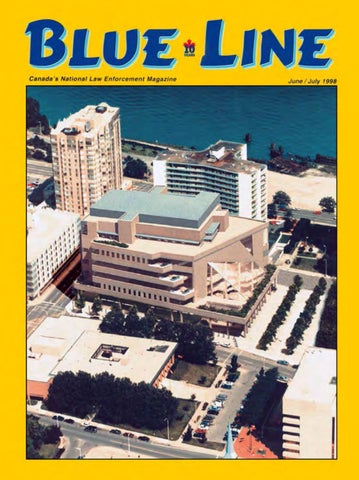
The new Windsor Police and Justice Facility About Maga:dot!:
The slow road towards police helicopter patrol When does handcuffing equal control Video surveillance: admissibility in criminal courts Water Cops-Border Patrol and Water Safety Have you practiced getting out of hostage situations? Technology - Some Solutions to Millennium Chaos
Write to Us at · 8lueUne
lueline.co
Find out the latest information about what's new between the covers of Blue Line Magazine, including up-coming articles, main feature story, commentary - past and present, up-coming events, book purchases as well as links to other law enforcement agencies across Canada and around the world. Do you need to know more about some product or service? Tune into Blue Line's web page and get connected to the electronic catalogues of companies and individuals supplying goods and services of particular interest to you. Feedback is more immediate and your letters to the editor can help direct future editorial content of Canada's only independent national magazine directed at the law enforcement profession.
This is another medium by which Blue Line can assist you in fulfilling your mandate to serve and protect.
Volume 10
Number 6
June I July 1998 - Editor I publisher Morley S. Lymburner
E-mail: blueline@blueline.ca WEB PAGE: _.BlueLine.ca
- News Editor Blair McQuillan - Contributing Editors Ballistics & Firearms Manfred Benton Dave Brown Tactical Firearms Police Leadership Robert Lunney Joel Johnston Survival Tactics Gino Arcaro Case Law Tom Rataj Computers & Technology - Adyertising Mary Lymburner (Director) Phone (905) 640-3048 Fax (905) 640-7547 Don Disher Phone (416) 604-8793 Fax (416) 604-8497 - Illustration Tony MacKinnon Stefan Sepa - production Del Wall Blair McQuillan General Manager Mary K. Lymbumer, M.Ed .
- Contributing Writers Barbara Ross Steve Satow Blair McQuillan Sue Pritzker Elliott Goldstein Dave Brown Blue Line Magazme is published monthly, September to June, by Blue Line Magazine Incorporated with a mailing address of: 12A·4981 Hwy. 7 Eas~ Ste. 254, Markham, Ontario, L3R 1N1. Individual magazines are $3.50 each. Subscriptions are $25.00 per year or $40.00 for 2 years. (U.S. & Foreign' $50.00) AU articles are protected by copyright. No part of this publication may be reproduced or transmitted 10 any form or by any means. electronic or mechanical, Including photOCOPYing and recording or by any Information storage or retrieval system without permission from the publisher. Internet activity is monitored and use of material is restricted on the Internet. All material submitted for publication becomes the property of Blue Line Magazine unless other arrangements have been made with the publ sher. The authors, advisors and publisher accepl no liability whatsoever for any injuries to persons or property resulting from the application or adoption of any of the procedures. tactics or considerations presented in this magazine. Readers are cautioned and advised that articles presented herein are edited and supplied for your personal awareness and should not be used for further action until appropnate advice and guidance IS received from a supervisor. Crown Attorney or other person in authonty. EstablIShed in 1988, BJue Une MagaZIne is an Independent publication designed to inform, entertain, educate and upgrade the skills of those Involved In the law enforcement profesSion. It has no direct control from a law enforcement agency and Its opinions and articles do not necessarily reflect the opinions of any government. police, or law enforcement agency. Blu. Lin. Mag,,;n. is a private venture and as such Is nollunded by any level of govemmentagency, union or association.
Blue Line Magazine is printed in Canada by Garson Graphic Services Inc.
- AfJiliationsInternational Association of Law Enforcement Planners Canadian Advertising Rates & Data
~~:~:~~:~:~:~:sA~::=~~n Periodical Publishers Exchange
fiFR ~
ISSN #0847 8538
,.
Canada Post Canadian Publications Mail Product Sales Agreement No. 176796
Publisher's Commentary
4
Windsor Justice Facility
6
Letters to the Editor
11
The slow road towards helicopters
12
Selling history for future gain
15
When does handcuffing equal control
16
Video surveillance: admissibility and weight in criminal courts
18
Water CopsBorder Patrol and Water Safety
22 ,
Bandwagons by Robert Lunney The Next Big Thing Part 11 The Shape O/The Challenge And A Formula For Survival
24
Have you practiced getting out of hostage situations?
26
Case Law
34
Technology by Tom Rataj Some solutions 10 Millennium Chaos? 42 Product News
44
The Clipboard
46
Classified
47
Ten-Seven News
49
Criminally Funny
54
List of Advertisers ADT Sec uri ty Barrday Inc. Blue Line Magazine CAPS Inc. Ca rruth ers Shaw & Partners Code 3 Dalhousie University DavTech AMS Ca nada Federal Signal Flex 0 Lite Ca nada Forensitek Ltd. Glock Inc. Hartt Boot & Shoe Co. Hi-Tec Sports Ca nada Imagis Cascade Interq uest Justice Ca nada Laser Labs Lethbridge Co mmuni ty College Litton PRC Public Sector Matte Industries MD Charlto n Motorola Niagara University
03
30 8 2 27 26 29 38 45 36 lO 47 49 30 52 32 25 13 51 51 10 7 15 4 9
-~
The new Windsor Police Service headq uarters building makes an ideal cover for this edition of Blue Line on two counts. First the Windsor Police Service is the host to the 47th Annual Conference of the Ontario Association of Chiefs of Police Conference and Trade Show. You wi ll find a floor plan of the Trade Show on Page 28 of this edition. Second ly the new building is particularly unique in both design and content. The structure also holds the Provincial Court House and the central lock- up facilities. You can read more about this faci litiy beginning on page 6. This being our June/July combined issue you wi ll find lots of other material to keep you thinking and pondering over the summer months. We have columns of interest from Robert Lunney, Joel Johnston and Tom Rataj as well as our usual news and up-coming events. Have a warm and safe summer and you will see us again in August. Nine One One Outerwear 35 North York Accident Support Services 42 Ontario Drive & Gear 37 Pacific Body Armour 53 Pads Fitness & Supply 13 Panaso nic Canada 2l Paisley Systems Inc. 9 Pride in ervice 40 Pro Ca rry Systems 39,41 ,43 Pumpuii Energy Products 41 R. Nicholls Distrib utors 19 Robinso n Helicopters 5 Rocky Shoes & Boots 56 Seco nd Chance Body Armor 33 Southwest University 47 Steiner-Optik Ca nad a 27 Streetquip 23 Sturm Ruger & Co. 31 Tetragon Tasse 20 T he Exec utive So urce II T he Walter Fedy Pa rtnership 4174 Triform Virtual Depot 44 Westervelt College 17
L.N£ June/ July, 1998 _ _ _ _ _ _ _ _ _ _ _ _ _ _--1_rI - - - - - - - - - - - - BLU£ Magazine L _________________
YEARS
.
Who says you can't INTEGRATE RELIABLE wireless systems that'll MEET your every need?
At Motorola, we don't use the word
We can even
impossible. We prefer to call it
continue to optimize
system integration, a nd we're
network capabilities with
making it happen every day. In fa t, Motorola is
the latest software updates and enhancements after your system is in place.
an indu try leader In developing cu tomer-driven olutions that are developed, tested and delivered right to your door,
Ultimately, we design your wireless solution to help your organization do the impossible: get more out of your system than ever before by utilizing the latest in communications technology.
connected and ready to integrate into your network. So consider the possibilities. Then let us show you how From tuning in to your needs through an initial assessment, to developing a totally integrated wireless voice and data
quickly-and effectively-wireless solutions can help you enhance your productivity.
y tem, to a si ting in site acquisition, we're with you every tep of the way.
and Motorola are trademarks of Motorola, Inc.
C1998 Motorola, Inc. httpJ/www.motorola.com
Call us at 1-800-268-5758
MOTOROLA Land Mobile Products Sector
PUBLISHER'S COMMENTARY
Helicopters: We need action not more studies by Morley Lymburner As we were in the midst of laying out this edition of Blue Line a news story hit th e wires regarding a police pursuit in Toronto ending in the death of a citizen (and two of his dogs) on a sidewalk when the vehicle that started the pursuit went out of control and struck him . As this story hit the media we were laying out page 12 in this edition. It is a submission by ex-copper, now helicopter pilot, Steve Satow giving our readers a rundown on the state of he licopter usage in policing across Canada. As if this coincidence was not enough we also found Sue Pritzker 's article on page 32 which outlines a doubling of auto thefts over the past ten years. Given the recent turn of events in the news it makes for so me very prophetic reading indeed. It is still shocking to me why police agencies can not be a lot more aggressive in the area of helicopter acquisition for general patrol work. The death of this gentleman in Toronto echoes the tragedy experienced by the city of Calgary when they lost a fine young police officer to a teenager in a stolen car being chased. This officer had just laid out a spike belt across the roadway and moved off the road to await the arrival of the young thief. The last thing this officer saw was a young man so desperate to get away that he actually entered the ditch area of the freeway at hi gh speed in order to go around the clearly visible spikes. The shock of this one incident alone was enough to encourage that city to abandon studies, reports and budget approvals and fast-track the acquisition of a helicopter patrol unit. What about the rest of the country? They have stood back and watched as Calgary has reported mammoth successes in curbing car thefts and all nature of criminal activities. In the first year of operation alone they were involved in 26 police pursuits. Not one citizen was hurt. Not one police officer was hurt. Not one suspect was hurt. And the reasons they know that no suspect was hurt is because in all 26 cases every suspect was arrested. [t is pretty foolish for people to ignore numbers like this. Now let us focus on one area that is in serious need of such a program . The greater Toronto region has almost 6 million people living in it. There are 7 large police agencies responsible for the protection of these people. None of the Police Services Boards are convinced that human lives are more important than budgets. Even worse ... none of these police agencies have managed to give an argument convincing enough to encourage them to take action. When the subject was brought up to the Toronto Police Services Board last year the then Commissioner decided it was time for a . study. The study was, in my opinion, very well researched and written. It did not come to any conclusions, however, and left the question of 'yes or no ' up to the Police Services Board. The Board 's decision was that sometime in the next five years helicopters may be acquired ...
* YEARS
but not right now. This is little comfort for th e family of the citizen killed on that sidewalk. It is little comfort to the police officers who must endure an investigation on whether they used "good judgement" in pursuing someone who initiated the chase. (After all it was the young driver who started it... not the police!) Most of all it is little comfort to those living in the community who still have to ask the question " Who's next?"
Do police have a duty to the accused as we ll as the victim? I believe they do! I have often said that the vast proportion of police work is simply protecting people from their own mis-adventures. The biggest crime prevention tactic in the world is simply convincing people of the certainty of getting caught. He licopter patrols are just one more tool that can be brought to bear on the foo lhardy in society. ltjust makes good common sense.
The new R44 Police helicopter is the first high-performance, affordable, turn-key aerial platform designed specifically for law enforcement agencies.
as , Effective, es
--,··~e at
Fast Cruise Speed. As fast as the most popular turbine helicopter, the R44 will get to the scene quickly.
Gyrostabilize d Nose -Mounted Gimbal. Full 360 0 rotation with convenient remote co ntrol by observer.
Low Acquisition Cost. Fully equipped for law enforcement, the R44 is less than half the cost of a comparably equipped turbine police helicopter.
High Quality Infrared Sensor & Color TV Camera. Clear, steady pictures fo r day or night surveillance.
Superior Reliability. 2000-hour T80 for airframe and dependable Lycoming engine. All equipment factory installed and tested. Low Operating Cost. Low fuel consumption, no scheduled maintenance between 1OO-hour inspections. Modern Design. RPM governor, automatic clutch engagement, rotor brake, advanced warning devices, and 28 volt electrical system.
.
Convenient Fold - Down Monitor. For maxim um outside visibility when sensor and camera are not in use. Searchlight. 15-20 million candlepower with remote control or slaved to nose gimbal. Communications & Navigation. A wide choice of instruments, equipment, and avionics to pinpo int destinations qu ickly and communicate over the full ra nge of law enforcement frequencies.
FOR MORE INFORMATION, CONTACT:
Robinson Helicopter CompClIny 2901 Airport Orive
June/July, 1998 _ _ _ _ _ _ _ _ _ _ _ _ __
.
Torrance, California 90505 U.S.A .
~
~ BLUE LINE ---\01--_________________ Magazine
Windsor Justice Facility 1
PUBLIC ENTRY TO COURTS
c=J Poljce Facilities CHATIiAMSTREET
c=J Court House Area
The City of Windsor and the Province of Ontario have formed a partnership in order to construct a new Police Headquarters and Ontario Courts facility. One block west of the Casino, and with a panoramic view of the Detroit River, the building (which is featured on this month s cover) is expected to be ready for occupancy in the spring of 1999. A plan of the second floor level shows the reporting facility for Windsor's Downtown Patrol Unit (on the left), the shared 24-hour Custody area (central) and Court House accommodation (on the right). Each elevator is dedicated to a specific circulation route, including: prisoners, police staff judges, public (Court side) and public (police side). by Barbara Ross Until recently Windsor was a city whose economic life turned largely upon the fortunes of the automobile industry. Since the late 1970's, lasting memories of this downtown are of empty storefronts, pawn shops, bingo halls, and strip clubs. The Detroit skyline lies across the river, providing a constant reminder of how urban decay on a massive scale looks. On my flr t visit to Windsor, on a cold evening in early March of 1995, the CAW union had set up pickets lining Pitt Street. Small groups clustered around bonfires in several oil drums on the sidewalk. The Province's first attempt to breath a little Ii Fe back into downtown Windsor - the temporary Casino - was closed due to a strike. But downtown Windsor isn ' t quiet
anymore. The bonfires have been replaced by visiting engineers. By the fall of 1995, seven tower cranes had been brought to town. Five of them were for the permanent Casino and two of them were on the property at Goyeau and Chatham. The Province's new consolidated Court House was under construction. Meanwhile, the daily ritual of escorting prisoners from the old Police Headquarters to the old Provincial Court building was still practised . Down a steep staircase, under dripping hot water pipes, through a damp underground tunnel, up another steep staircase and slam into a holding cell, which might have worked as a set for a movie in a Dickensian world, if it hadn't been so small. With the new construction of the Provincial Courts, prisoner handling would be brought out ofthe dark ages. The Police would operate a 24-hour shared custody facility for their own, "first stop" detainees, together with those detainees returning from remand for trial. This custody facility would be within the
Courthouse, and would provide direct access to the new Courts and to the new Police Headquarters. Overground transport of prisoners from one building to another today is required for those Courtrooms in remote buildings not served by the tunnel. This would be eliminated with the new shared facility. Indoor prisoner movement would be through dedicated elevators; the dangerous stairways and dripping water pipes would be things of the past. The Justice Facility will occupy a site which locally is known as the west half of the old Steinberg site. It forms the west boundary of "The Esplanade", which is a new, tree-lined urban green space extending from the City Hall to a waterfront park at Riverside Drive. The Esplanade is the central element in a network of open space in Civic Square, which is a focal point in the City of Windsor's Downtown Revitalization Plan. Chatham Street will be the main pedestrian route along which visitors to the Casino are to walk to the restaurant and hotel district. The front door to the Courthouse
BLUE LINE \,;/ ", M agazine _ _ _ _ _ _ _ _ _ _ _ _ _ _ _ _ _ _-4\!J-I--_______________ June/ July, 1998::
would be on Chatham Street, at the corner of The Esplanade. As construction of the Courthou e began, the City of Windsor was committing capital funds to construct its new Police Headquarters on the east half ofthe Steinberg site. Consideration was being given to the development ofa "shared use" building, involving new accommodation for police operations as well as another use. The challenge would be to find a suitable co-habitant for the Police Headquarters.
Each partner wished to have its own identity, to be a prominent part of the community, and to be seen to be independent of undue influence of any other public agency.
Making 110 Small pla1ls ....
W e're Known btl the Company W e Keep. Many communities have considered shared arrangements for various police u es. I believe these succeed or fail only partly through the quality of the design, but in very large measure through the choice ofappropriate partners and an appropriate site. Candidates include municipal/regional offices, retail stores, even doughnut shops. In many instances, the presence of a viable partner appears to make the difference between proceeding with a new Police facility, and making do with the old dungeon fo r another few years. The dominant issue must be, what does the choice of co-habitant say about the Police Service who is settling in for future decades of occupancy? Buildings are powerful symbols, and our public buildings are read as the material demonstration of what our society values and how we want to live. Is this police building - and, by extension, the agency which occupies it - part of its community? Is it so entangled in its neighbourhood as to be seen as the " long arm" of one element of society or another? Or does it maintain an objective position? With the possibility of creating a shared police-court house building, a particular version of this set of questions arose among the future neighbours.
Why Would A nybody W ant to do This? The design team heard plenty of the reasons why one might OT want to do this. Negative perceptions which might be fo tered, shou ld the Po lice and the Courts share one building included the idea that the courts would be unduly influenced by the police, or, perhaps that the sole mandate of the police is to prosecute criminals. Out would go community policing, and in wou ld rush a real-live version of the worst of American television dramas. in Windsor, "busting heads and administering the law" would be the order of the day. If the Courthouse and Police Headquarters did not have physical separation and if this separation were not obvious to the passer-by, the very foundations of the Canadian justice system might be threatened. Of course, no-one among the project co-ordinators, the future occupants of the building, nor the design team would have advocated this outcome.
Both Image alld FUllctiollalih): Issues ill Shared-Use Faci lities A " Win-Win", in which both project partners would benefit from co-habitation, would only be possible if the design was thoroughly worked out to: • allow each partner to present its own clear image to the public, through the architectural character of the bui lding, and
v::
•
• without compromise, preserve every detailed aspect of functiona lity which each partner would require if it were in a freestanding building. The Windsor Police Service wished its Headquarters to be the product of creative excellence on the part of an open, transparent, and accountable organization. A "non-threatening face" was es ential, which would appear approachable at all hours, particularly to victims and distressed per ons. The Police wi hed the building to be emblematic of the safe and secure downtown which the City of Windsor is committed to developing. The Province of Ontario's Architectural Design Standards clearly articulate the desired image for a Court I louse as, above all, "dignified" . Care and concern for the convenience of witnesses, jurors and litigants is to be emphasized in the design. An Ontario Court House is expected to make a po itive visual contribution to its community, creating pride through attractiveness and acce ibility. It is expected to be neither ostentatious nor sterile and oppressive.
"Functionality" is equal in importance to "image" for the Court I louse in its own way and for the Police Headquarters in its own unique way. The privacy and security of police operations, behind the restricted-access line, is of no less importance than an open image at the front door. In addition to its large Patrol Division, the Wind or Police Headquarters accommodates inve tigation of criminal suspects (who are not always cooperative), analysis of crime scene evidence and handling of co ntrolled substances (activities which are loaded with health and safety issues), intelligence operations, deployment ofESU-EDU specialists, polygraph interviews, and 9- 1- 1 call taking. The design team conducted a eries of very detailed problem-solving eions with police user groups in order to tailor each of these individual work areas. Functional and operations planning would need to take into account the distinction between Police areas which operate around the clock, and those which operate five day a week during business hour. Tracking of access to high-security areas, the location of particularly discreet units, as well as emergency preparedness were all considered in the design . The " Police half' of the Justice Facility will be similar in size to the existing headquarters building in the Regions of HamiltonWentworth, York, and Halton. On move-in day, it will be the home office of 420 people (the facility has been designed to absorb up to 100 additional staff). The "Courts half' is one of three major Provincial ourts which has been in progress since the early 1990's. It will include 10 courtroom, one large First Appearance Court, and offices for judges and crown attorneys. (Hamilton and Brampton are the others in the group.) Functional planning for the Courthou e would be based upon three distinct sets of corridors: one public, one private (for judges and jurors), and one restricted (for prisoner ), with no overlap between any of the three.
Finally... Pens t hat truly perform! Writes upside down, in extreme temperatures, underwater, on carbon less paper, over grease and fingerprints .... ~
-f~her\ ..s-~~E" . VISA
r:;-;__________________ OUIE LINE -----\Vr
June/July, 1998 ______________
Magazina
The Justice Facility inco rporates 141 ,000 square feet of Police ll eadquarters, 141 ,000 quare feet of ourthouse space, and 75,000 squ are feet of shared 1100r area. (" Shared spaces" include the large common custody area as well a service pace, exi ts, a loading bay, and a two- torey underground parking garage.) Picturillg It. .. At th e co rner of Goyeau and Chatham Streets (two hundred feet west of the front door to thc ourthouse) i the front door to the Wind- . so r Police Il eadquarters. This corner, is no less conspicuous than the ourthouse entrance. ignagc and entrance to the public lobby on thc Po l icc s ide will be visible from severa l blocks away. Visitors driving across the Ambassador Bridge, or emerg ing [rom the Tunnel, immediately will get the signal that Ole peace is being maintained, on this ide of th e border. Ju t inside the front door is a 2-storey public lobby, which will be filled with light from the outh. The first-time visitor will have clear orientation to reach servi ce counters for traffic reportin g, reco rd s, and patrol. Visitors to investi gative omces and ad ministration will use a public-onl y elevator to reach the third and fourth floors. Within the building is th e 200-strong Downtown Patrol unit, which is the largest of Windso r' neighbourhood uniform divisions. Parking, clevator and stairs, locker room s and reporting areas were designed with their routin e mov e ments in mind . Ins pector Bill tephens drew a cartoon wnich helped the design team imag ine the da ily flow o[ officers in ide the building.
QcporllOH<[:>
~ite my
repov
~ktoCeIlBI~
COUNT THE NUMBERS
PANIC TIME
SHAKE HEADS IN DISBELIEF
RE-COUNT THE NUMBERS
THE HEADQUARTERS PLANNING PROCESS
ALL IN A DAY'S WORK
Tile Headquarters P Ia tilling Process: It Takes Longer t han You'd Think In March , 1995, Carruthers Shaw and Partners were commissioned by the C ity of Windso r to assess the space requirements for a new police headquarters. In this exercise, which preceded the design of any building, the
goal of the agency as a whole and the specific demands of each operating unit were clarified. This was an important step because it enabled the team to "try on" a series of options for different properties, and a variety of building co-habitants. The diagram reflects th e kind of work and rework which is part of th e process. It has taken a whole lot of communication and a whole lot of teamwork to get thi s far. The Wind or Police Service is looking forward to the day when it can "show off" its new home. Barbara Ross is an architect who is employed by Carruther, Shaw and Partners Limited, Architecls in Toronto. She is a member of th e IACP a nd the OAPE and conducts seminar, on a wide variety of issues related to the design of police facilities.
WORLD CLASS PROTECTION AND COMFORT The toughest protection standards (we meet them) . A complete armour line (we pioneered them) . Un limited accessory and custom options (we offer them). As important as these features are, protective apparel in the real world demands one other critical component ... comfort. That's why at Barrday, our engineers and designers place a special emphasis on material selection and fabric weaves so that our products meet your most demanding standards of protection and durability and are comfortable to wear. Day in and day out. Rea l world comfort that makes Barrday a world class body armour supplier to national and international police and peace keeping forces.
TOP: Barrday Advanced Tactical Armoured Vests (ATAV) offer maximum flexibility and protection for police and military tactical applications. LEFT: Barrday offers a variety of external carriers for soft body armour including our functional and popular CLEAN FRONT carrier.
Barrday__ ADVANCED TEXTILE SOLUTIO S Barrday, In c., P.O. Box 790, 75 Moorefield Street, Cambridge, 0 , Canada N1 R 5W6 Tel : 519-621-3620 Fax: 519-621-4123
A PAGE FROM HISTORY
1111. WINDSOROPENSNEWPOLICESTATION The BOllrder Cities Stllr -
WIND OR, Ont. - Pomp and ceremony marked the official opening, by AttorneyGeneral William Edgar Raney, K.C., of Windsor 's new police building Friday afternoo n. Several hundred were present during th e ceremony, the attorney general afterward paying a visit to " Willistead," the new home of the Walkerville police and to the Ford City police station. " I take it that this building is an expression of the self-confidence of the people of Windsor and of their confidence in the future of this great Province of Ontario and of our beloved Canada," Mr. Raney said to the gathering of citizens in the court room shortly after hoisting the British nag over the building. More than 50 members of the police staff paraded for inspection, under the direction of Chief of Police Daniel Thompson, Inspector Mortimer . Wigle and Inspector of Detectives William Reid. The force presented a very smart appearance and was complimented by the attorney general. When addressing the gathering the attorney general said: "This building will stand for a hundred years and by that time Canada will be a nation of 100 millions of people. It is a symbol of the ideals of the city of Windsor, whieh are identical with the civil ideas of every other community."
Decelllher 24, 1921
or know the extent of the growth of the police department in the last year or two. In their work the department has been getting great results, he said. Judge Grundy also acted a chairman and master of ceremonie , e corting the attorney general through the new building. The attorney general stated that the building was the finest for police administration which he ever had the occasion to inspect. Ju.tice Mayor H.W. Wilson, when called upon to make a few remarks, spoke ofthe act ion of the city in turning the building over to the police commis ion, saying that the city had taken a very wise step. Judge J.J . Coughlin eulogized the city council for its foresight in setting aside fund for the building. " I feel that having a good police force and efficient equipment together with the proper administration of justice is a matter of the most importance," the judge said. Following the nag rasing ceremo ny the force, under direction of police Inspector Mortimer S. Wigle, was lined up on the roadway in front of the building and the ~~~~§~~2:~~;::::::.::.~=====:::;a motor equipment consisting of the police n ier, the patrol car, a touring car and the motorcycle equipment turned out and were placed in front of the rows of co nstab les Judge Grundy spoke brieny, praising the while several official and newspaper photoefficiency of Windsor 's police department. lIe graphs were taken. stated that he doubted if the citizens of Wind-
RANtY OPtNS
N[W STATION:
LAUDS POLICE
l
Prepare For Leadership
Study Criminal Justice Master of Science Criminal Justice Administration Niagara University
An 11-course evening program 90 minutes from Toronto
For further information :
Phone 716 286-8060 Fax 716 286-8061 Attention: Dr. Edward Sieh
*=
\at BLU£ L.N£ --IDI-__________________
June/July, 1998 _ _ _ _ _ _ _ _ _ _ _ _ _ _
M agazine
1998 Sex ual Assault Investigators' Seminar The Toronto Police Service Sexual A sault quad held their annual Sexual Assault Investigators' eminar from March 2 to 6 and it was deemed a tremendous success with close to three hundred in attendance. Police officers from across anada and United tates represented over 37 Police ervices. Aloin attendance were representatives from organizations such as, the Toronto Transit ommission, Bell Canada Security, Victim Witness Programs, hildren's Aid ocieties, ollege of Physicians and Surgeons, Ontario College of Teachers, ollege of Veterinarians, Department of Defence, ocial ervice, orrectional Services, Community Colleges, Un iver itie and exual A ault Care Centres. The week began with a full day presentation by Geraldine Crisci, a specialist in the asse sment and treatment of child exual abuse. he presented a very practicable approach to chi ld interviewing. The audience participated in a hands on exercise of structuring questions for children . During her presentation she covered, cognitive development of children, memory and suggestibi lity, cultural considerations and cues of sexual abuse. Mary Ellen Cullen , an Assistant Crown Attorney from Peel Region lectured the audience on Tuesday morning about third party records. he explained what constitutes a record and the implications of the O ' Connor
Flex-O-Lite
decision upon po lice and the crown in securing a victim 's personal records. She stressed the need for victims to be tru ly info rmed of the implications in signing consent forms. Two officers from the Toronto Sexual Assault Squad, Constable Peter Duggan and Constable Brian Thomson shared their investigation of Selva Subbiah in the form of a case study. Subbiah is a convicted serial sexual assault offender serving 20 years in Kingston Penitentiary. Prior to assau lting women, he drugged his victims with a pharmaceutical drug called Halcion. The officers' presentation took the audience through the investigation from the initial report, through the justice system, to his conviction. Richard Ovens a retired New York State Police Officer gave a captivating presentation on criminal interrogation. He shared with the audience, qualities of a successful interrogator, deve loping the required skill s, creating and controlling the environment and evaluating somatic language. He also discussed new studies which reveal the impact of birth order on personality deve lopment. Critiques rated this presentation as the favourite and requests for future seminars were made by the attendees. A panel discussion by Dr. Wayne Murray of the Centre of Forensic Sciences, Renee Pomerance and Scott Hutchison of the Crown Law Office reviewed case law, search and seizure and recent improvements in 0 A analysis. New to the seminar this year, were workshops entitled: Practical DNA, Victim Records,
ThreatAssessment, Cu ltural Issues, 8 1O's, and the Internet and Police. Each participant had the opportunity to attend two different workshops during Thursday afternoon . The officer in charge of the Maple Leaf Gardens sexual assault investigation, Detective David Tredrea from 52 Division, presented a case study on th is renowned case. His pre entation was augmented by a video, 'Social Secret Pedophi les', produced by the Toronto Police Service Video Unit in conjunction with Detective Wendy Leaver and three convicted pedophiles. Issues about the media and the' Jane Doe' civil suit against the Toronto Police Service were discussed by Detective Sergeant Kim Derry. He made suggestions to the audience concerning the importance of timely and accurate press releases. At the conclusion ofthe seminar, each candidate received a certificate, as well as information on all the participants. This list was to encourage future communication, expanding the networking which was developed over the course of the week. Plans are already underway for the 1999 Seminar. It will be held at the Colony Ilotel, from March 1 to 5. 1999. The details will be reported in Blue Line Magazine. The Sexual Assault Squad can be contacted directly at (416) 808-7474, fax: (416) 8087472 or on e-mail : mtpsas(j!interlog.com.
Integrated Information
"The Safety People"
Systems for Public Safety
POLICE SAFETY PRODUCTS
• Computer Aided Dispatch • Records Management
ROAOFLARES TRAFFIC VESTS
•
Graphical User Interface
RAOAR TRAILERS
• Integrated Mapping and AVL
POLICE LINE TAPES TRAFFIC CONES
• Mobile Data Communications
LIGHT STICKS SpOTLIGHTS
•
Mu lti-P latform Support (DEC, lBM, HP)
SET THE SAFETY EXAMPLE!
• Scalable for All Size Installations
FLEX-O-LiTE LIMITED St. Thomas, Ontario Telephone 800-265-7661 Fax 800-267-3265 BLU£ L.N£
Open Systems -
Littan PRe Public Sector, Inc. Q
411 Queen Street Newmarket, Ontario Canada, L3 Y 2G9 (905) 830-0193
;8
Magazine -------------------I ~f---------------- June/July, 1998::
Since its inception, I have enjoyed reading Blue Line Magazine. This is because in my opinion it portrays policing across Canada in a very true and professional manner. Every article hold great interest and is timely in its presentation. I was pleased to ee the article on the government reinvestment of criminal proceeds, however, imagine my disappointment and chagrin when it came to the issue of $20,000 being delegated to the Dryden Police ervice to implement a P COPS Program. Right next to the "Dryden Police Service" is an Ontario Provincial Police Badge. I am sure you are well aware of the climate surrounding municipal and provincial police in this province at this time, and I, along with the other members of the Dryden Police ervice, take considerable exception to this glaring oversight on the part of your magazine and whoever put this article together.
R.G. Imrie Chief of Police Dryden Police Service Editor 's Response I WQS, like yourself, horrified to see this error. It is indeed rare but this is no real excuse for such a huge gaff on our part. Not having a police background, our layout and design people rely heavily on the editorial people (like myself) to check their work for such mistakes. Obviously this error was not seen. Silvan Tompkins, a great sociologist, once said that "shame is one step removed from heaven because shame can exist only when someone wants to re-establish a bond. " We certainly feel the shame ofsuch a mistake and wish to apologize for any difficulties that may have arisen. We are very proud of the bond we have established with the law enforcement community across Canada and will work very hard, both presently and in the future, to maintain it. Thank you for bringing this matter to our attention. 00
I read with interest your two-part series on the Wild Pigs Motorcycle Club in the February and April editions. While this group of enthusiastic motorcyclists, who happen to be peace officers, may be law abiding, upstanding citizens, perhaps they would con ider a name change to more accurately reflect the desired image. We can all live with "PIG" for it can stand for Perseverance, Integrity and Guts. As for " Wild", the dictionary definition offers up these frightening comparisons: "not civilized, barbarous, unrestrained, disorderly. uncontrolled, tempestuous, violent, infuriated, angry, haphazard, ill-aimed, rash,
*
unchecked. undisciplined, uncouth, lacking refinement. " When I add all these comparisons up it spells one thing, Outlaw Motorcycle Gang. Under the banner "The Wi ld Pigs'" I doubt they will ever completely convince anyone that they are who they claim to be. The Blue Knights (connoting society's saviours) is a name more in tune with the image peace officers should strive to convey. I am not a motorcycle owner, yet, but in retirement I hope to motor around on a "HOG" my elf. I will certainly distance myself from any club with a name as scary as "The Wild Pigs." J. Andrew Black Ottawa, Ontario
o I wish to inform your readers of three important aspects of parole warrants. I. In accordance with Section 137 of the federal Corrections & Conditional Relea e Act, all warrants of apprehension issued by provincial parole boards in Canada have an automatic nation-wide application. These warrants are to be executed by any peace officer in Canada. The Ontario warrants of apprehen ion form is being revised to indicate Canada-wide application.
2. An agreement among all parole boards and respective Ministers allows for the transfer of jurisdiction for parolees across Canada. In other words, if an Ontario parolee is arrested in Newfoundland on an Ontario Board of Parole (OBP) warrant, he/she is not required to be transported back to Ontario. lIe/ he can be taken to the nearest detention facility and the parole board which has jurisdiction in Newfoundland, (that is, the National Parole Board) will conduct a post-suspension hearing. There is no requirement for any parolee to be transferred back to the releasing province at the taxpayers' expense. 3. The National loint Committee of the Canadian Association of Chiefs of Police and Correctional Services (Canada), Ontario Region, agreed to establish a subcom mittee to examine ways to expedite warrants of arrest of parolees. The subcommittee is chaired by Nlnspector Don lones of the Toronto Police and has a number of criminal justice agencies including OBP and OPP represented on it. We are all hopeful that this will be a major step towards establishing an improved system of warrant execution. The report of this committee is expected to be presented to the N1COntario in the Spring.
Ken Sandhu Chair, Ontario Board of Parole
The Regina Police Service is responsible for the delivery af policing services for the City of Regioo, avibrant, growing city of 185,000 located in centlOl Saskatchewan. Home to the RCMP training academy, Regina boosts a strong and increasingly diversified economy. An experienced police administrator with ostrong commitment to community policing is required to assume the position of -
CHIEF OF POLICE With over 400 sworn ond civilian members and an onnual budget in excess of $31 M, the Regina Police Service is dedkated to bUilding a sofe and coring community. The successful candidate provides leadership in all aspects of the Police Service operation, having responsibility for planning and policy development, policy im~ementotion, administration and financial control and operotionol evauotion. The Chief of Police ensures policing services ore provided in accordance with community needs by working closely with all levels of government, professional aSSOCiations, the justice system, (ommunity groups and the media. Senior management experience is required, preferob~ backed by a university degree, and extensive knowledge of community based policing. Other competencies for this position include strong public and media relations skills; sensitivity to the challenges of policing in a mulliiocioi society; and a commitment to employment equity. Direct all enquiries in confidence to: Hony Hetherington Suite 401, 2201-llthAvenue Regina, SK S4P 018 Tel: (306) 359-2550 .ir Fox: (306) 359-2555 e xecu1fIlve ource E11lail: execsource@cobleregina.com
:Jt;-e
cl
--\61---________________BLUE LINE
: : June/July, 1998 _ _ _ _ _ _ _ _ _ _ _ _ _ _ Q
Magazine
--------------------------------------------------------------------------------------.
The sloMf road tOMfards helicopters An Overview of the Progress made by the Police across Canada by feve SalolV Vancouver ranks second highest in North America when it comes to car theft. La t year the Insurance Corporation of British olumbia paid out 125 million dollars in auto theft claims alone. ( ource: The I B ) Add to this the fact that helicopter have been hown by numerous independent studies to reduce the occurrence of theft-of and theft-from autos by an average of 10-12% ( ource: Project ky Knight) and there is an overwhelming financial reason to operate patrol helicopters. Yet somehow these simple, but compelling facts are still not reaching those people re pon ible for vetoing the police in their quest for helicopters. I am not suggesting that helicopters should be the' umber One' priority, or that the police do not have many other important things to conider. Of cour e they do. But here in anada the helicopter is still treated as an expen ive toy rather than as a concept of modem policing that will have a significant impact on the service that the police provide to the community. During 1997 the prospects of the police getting helicopters " inched" forward. number of departments across the country are pursuing the goal of airborne support with varying degrees of enthusiasm and success. Olltll Vancollver Island Departments in and around Victoria have begun di cussion amongst themselves, and with local operators and businesses, into the feasibility of cooperating a helicopter. Vancouver and Lower Main land Vancouver has established a contract with a local operator to provide a helicopter on tand-by for ERT operations, but this machine doe not provide any patrol or ground support function to the officers on the street. In the lower mainland area of British Columbia, where the RCMP provide policing in a number of municipalities, they (the RCMP) have recently taken the initiative. Earlier this year the R MP organised a meeting of the chiefs of all the police departments in the lower mainland to explore the implications and posibilities of collaborating in a Regional Air upport programme. Although the results of that meeting are not immediately known it is an encouraging deve lopment. Many pitfalls lie ahead of them - political, financial , administrative and technical being just a few. A lberta In dmonton, a recent operational helicopter tria l wa conducted on a Friday and Saturday night on an average weekend in September last year. During the two nights they netted two armed
robbery suspects, two theft-from auto suspects and an armed highspeed pursuit suspect who discharged a shotgun at an RCMP officer. Edmonton police are amongst the forerunners in the struggle to convince the sceptics on their police services board that the helicopter is a vital tool rather than a toy. They have a civilian group who has expressed genuine interest in raising the money for a helicopter in much the same way as was done in Calgary, but the board, and even some senior officers, are still not convinced that they can afford and justify one. Even the enormous first-hand evidence from neighbouring Calgary's operation has failed to dislodge the entrenched misconceptions that some board members cling to. Recently, four of Edmonton 's seven board members have been rep laced and only the future will tell if they will be more open-minded to the benefits of the helicopter. The success of Calgary's HAWC-I programme is well-documented and a source of very valuable information for the rest of the country and will not be a topic in this article.
Ontario In the city of London, powered by the commitrnent ofChiefFantino to equip his force with the tools of modem policing, it is perhaps realistic to use the term 'close' when it comes to helicopter patrol. London began seriously looking at the use of helicopters less than a year ago and in a relatively short period has clearly identified their need, capacity and mandate. A video,
BLU£ L'N£-----------~Q 12 M agazine
illustrating the effectiveness of helicopters, has been made and is in the final stages of editing, and a business plan has been drawn up and submitted for discussion. London 's project has attracted the attention of a local fixed-wing company, who is developing a 'poweredglider ' as a low-cost alternative to the helicopter. Sudbury, with the possibility ofa greatly enlarged jurisdiction in the future, has begun the process of researching the use of helicopters. But it is a long road and they have just taken the first tentative steps. The next glimmer of hope lies in the collaboration between Halton and Hamilton-Wentworth. These two departments have recently been given the go-ahead by their respective boards to begin fund-raising for an operational trial. Initially for one year. Niagara, with its busy border and waterways, has recognised the potential value ofa patrol helicopter. Chief Waddell is interested in the possibility of doing a trial sometime this year but for the moment there seems to be little momentum. A number of the police departments in the Greater Toronto Area (the 'Megacity ') pay lip-service to the idea of he licopters. But, apart from Toronto, the region is bewilderingly silent. The Toronto Police Service has been trying for almost fifteen years to get a helicopter. Their most recent submission to the board was once again refused but we must give them full marks for their tenacity. Out of the embers of their latest refusal already spread the wings of a new effort. And maybe this one will bring them a little closer to their objective. It was encouraging to see Maureen Prinsloo, the ex-Toronto Chairperson, quoted as saying that getting a helicopter is now a question of 'When' rather than 'Whether' . But talk of "five years" is less encouraging. Before leaving her post as head of the Services Board, Prinsloo commissioned a study by an independent research company into the need for helicopters in Toronto. Amongst other things, the report concluded that there is a lack of substantive evidence available in Canada (a fact that needs to be seriously addressed) and that Toronto should consider doing an operational trial. The report is public domain and available on request from the Toronto Police ervices Board. The new Chair ofthe board is Mr. Norm Gardner and his positive attitude toward policing in general should be cause for optimism. York Regional Police continue to romance the idea of getting a helicopter, but recent internal upheaval make it only a dream at the moment. For some years they have used the
,.
V~_----------------------------- June/ July, 1998 YEARS
Ontario Provincial Police helicopters, hired fIXed-wing aircraft or helicopters from local commercial operators for such tasks as drugs surveillance, but no operational budget exists. The recent report by the Solicitor General, demanding significant increases in the services and manpower provided by a number of departments, including York, Durham, Halton and Ottawa-Carleton, probably mean that a helicopter in York has become even less of a reality. Kingston, like udbury, is destined for major territorial change. Earlier enthusiasm has had to be put on the shelf for the foreseeable future whi le the lines are redrawn and the responsibilities are reallocated. And that leaves Ottawa-Carleton and the Montreal region. Ottawa-Carleton, much like Toronto, has just lost what momentum they had. This time through a change in Regional Government and the requirements of the olicitor General's report. ln November of 1997 it looked very positive that permission to begin actively procuring a helicopter would be granted from everyone concerned. But, yet again, changes in the political landscape have put the programme on indefinite hold. Ottawa-Carleton has RCMP helicopters stationed on their doorstep, but with all their other responsibilities, these machines are seldom available for the rapid re ponse that is the stock-in-trade of the patrol helicopter. In the Montreal area, Laval has been using helicopters on an occasional and irregular
Go AHEAD •.• MAKE YOUR DAY WITH
basis for several years. They utilise the helicopters of the urete de Quebec or local commercial operators for about 35 - 50 hours of flying a year, mostly for surveillance and special operations. With the exception of Calgary, Montreal Urban Police are probably the only other city
in Canada using a helicopter on a 'regular' basis. As reported in last month's Blue Line they have finalized a deal with the RCMP to use their Bell Long Ranger for between 200 and 300 hours per year spread over 22 weekends. The helicopter flies patrol missions on ( Continued ... )
Canadian Fireanns Centre
Centre canadien des annes afeu
DO YOU OWN FIREARMS ? On Oc'ober I , 1998 ,lte Firearm. Ac' 'alce. eHec' aero•• Canada. So... wlta' doe. ,Ita' mean? 1. A alway safety come fir t. The firearms afety cour e and te t, and the rules for storage, di play and transportation which are part of the current law are now part of the Firearms Act.
2. Everyone will need a firearm licence in order to regi ter firearms (your FAC icon ide red a licence) There are 2 type of licences (valid for 5 year ): • possession (for the firearms you now own) OR • po se ion and acqui ition (if you plan to obtain firearm , even if you own flrearms now).
3. Registration of all firearm begins October I , 1998. All firearms mu t be regi tered by January I, 2003. You register your firearm only once. You may do so at one bulk price (one price for any number of flfearms you register alJ at the ame time).
Distributors of confrontational simulations equipment for all law enforcement defensive tactics training. Knowledgable staff, competitive prices, No P.S.T.
Fees for licence and registration are on a sliding scale. It's cheaper in the fir ~ twelve month . $10 October 1998 - September 1999 Po es ion and acquisition licence $60 from October 1998 onwards (rifles and hotgun) Registration (bulk) $10 October 1998 - September 1999
To find out more, call 1-800-731-4000 or visit our web site at http://canada.justice.gc.ca
Fo r more details call or write:
PADS FITNESS SUPPLIES 9624-74tb Street, Edmonton , AJberta P bonelFax: (403) 490-0144 Dale Kliparchuk - Director I I nstructor
FIREARMS SAFETY IS EVERYONE'S CONCERN
Canad1¥
"YURS June/July,1998 ____________________________~~r----------------------------------Q BLUE L INE ~agazina
Frid ay, aturd ay and unday nights. a t of Montreal there i li ttle activity. The R M P or urete de Quebec provide ervices but few of the commun itie are big enough to j u tify operating their own machines. The withdrawa l of the RCMP helicopters from the Maritimes in 1997 (due to fu ndin g issue) ha le ft th e area without any coverage and th e local police now rely on commercial operators to prov ide whatever air upport they need. T he rea on for the stagnation in the process of getting helicopters are multi ple and complex. The main hurdle ha always been that most police board members have failed to inform themselves u ffic iently of the capabi liti es effectiveness and value o r helico pters. And on tho e occasions w he re indi v idu a ls HAV E edu cated th e m elves, the ir tenure a board members is hort-li ved and th ey are repl aced by new a nd unin fo rm ed peo pl e. T hu s the proce tall and tagnates aga in. Offi cer making submisions a proponent of helicopter patro ls should be encouraged to put a much effort into the presentation of their ca e as they do into the contents. The p wer of any ' Business Plan' lies as much in the way it i drafted and presented, as in its content . n occa ions the police, finn ly believi ng that the [acts will peak for themselve , fa il to make an effective case and the process flounder . I do not uggest th at helicopter are devo id o f pro blems. ertai nly there are genuine i ues to be addres ed. But they HAV been addressed in departments all over the world for over 50 years, and workable so luti on have been fo und which make helicopter one of th e mo t effective too l ava ilable to the police. All the argum ents put forward aga in t helicopter can be di proven or defused. Particularly th e big three of Co t, oise an d Danger. Modern machine are not onl y extremely safe,
they are (relative ly) cheap and produce noise signatures well within the to lerance of any urban commun ity. In this article I have made little attempt to present the arguments and evidence to support helicopter operations, the sheer volume of whi ch would fill an issue of Blue Line. But I in vite anyone interested in the subj ect of police av iation to contact me for furth er infonnation. I would like to reiterate one fact that I discussed in an article over a year ago, and which boa rd me mbe rs co ntinu e to avo id . a mely; th at th ey will soon fi nd them elves re ponsible and acco untable for the consequences of OT end orsing helicopters. I would suggest that the police would do we ll to start recording all the situati ons in which a helicopter could have produced a safer, qui cker, cheaper or more effecti ve re olution to an incident and offer this info rnl ati on to their police servi ces board on a regular basis. Perh aps, after enough anecdotal evidence has crossed their desks, th e members will begin to see th e j ustifi cation. Let me conclude by throwing one last pebble into the pool of Police av iati on: In Great Britain, police av iati on is overseen and extensive ly funded by the Governm ent through the ' Home Offi ce'. The perception being that it is the governm ent's responsibility to empower the police to do th eir job. Helicopters are seen as an important part of this process. The Canadian Government recently sanctioned the purchase of a fleet of I 5, bran d new, fan tastically we ll-equipped, EH I0 I onnorant earch and Rescue helicopters for a price tag in excess of 700 million dollars. Whilst I do not deny the need fo r SAR helico pters, 1 wonder whether th e balance between expenditure and va lue to the taxpayer has been achieved? Steve Satow is a fonner police oflicer and Po lice he licop te r speciali st, presently ,""orking as a helicopter pilot for lIeli orth Corporation . You may contact teve by ca ll ing him at 705 693- 0856
T~or -m leading in
IIII ~
note-taking solutions
• MEM O BOOKS· NOTEBOOKS· DUTY BOOKS · RECORD BOOKS • CASE BOOKS Numbered pages, sewn construction, 6 sizes, over 33 different stock books & immediate delivery SPECIAL NOTEBOOKS designed & produced for your specific needs are a Triform specialty
• CARRYING CASES 5 different materials, 5 styles, over 23 stock cases, GOLD STAMPING & immediate delivery
• RING BINDER FORMAT Numbered pages, convenient for scanning. Binders w ith handy pockets & floppy diskette holders
• TICKET & FORMS HOLDERS All sizes and styles, Fabric and Aluminum , In stock, immediate delivery Telephone: (416) 226-6000 • Fax Toll Free: 1- 800-563-1666 (Canada & USA) Please contact us for product information and visit: www.triform.com
Triform Business Systems Limited Serving you since 1958.
Calgary Police Helicopter Statistics Top 12 Calls July 1995· July 1996 Total Call.\': - 3251
1. Ala rm 2. Suspicious Auto 3. Suspicious Person 4. Break & Enter - House 5. Break & Enter - Shops 6. Stolen Auto 7. Disturbance 8. Miscellaneous 9. Robbery 10. Theft II. Hit and Run 12. Impaired Driver
562 288
245 22 1 194 168
163 132 129 129 81
77
Otller
Missing Person Possible Gu nfire Firearms involved
13
44 24
FOOTNOTES In Calgary's first year of operation they responded to 26 vehicle pursuits. In 100 percent of these cases vehicles were successfull) stopped without any fatalities, injuries or significant damage. In Warren. Michigan, the two-helicopter unit flies 1500 hours a year. Their entire operation, including fuel. maintenance. part s and administration cos ts around $200,000 (Canadian) a year. In We. t Palm Beach, Florida, the Police helicopter is partly funded by the Regional Water Board in return for anti-vanda lism surveillance of the catchment area. Since the start of the programme vandalism has completely ceased. In Calgary, targeted ' Deterrent Run s' have effected anywhere from 25 to 90 percent reducti ons in the target crimes. In Columbus, Ohio, the helicopter responded to a search for a 5-year-old boy missing for several hours. Most of the regional cruisers from several agencies ,"" ere already involved in the search. The helicopter spotted the boy within ten minutes and the search wa~ called oil' and cars retumed to regular patrol duties.
*
BLUE LINE Q M agazine _ _ _ _ _ _ _ _ _ _ _ _ _ _ _ _ _ _-\~~--------------- June/July, 1998 :::
Selling history for future gain by Blair McQuillan
The military police in Halifax will sell the Blueno e schooner in October for the bargain basement price of two dollars to raise money for charity. A handcrafted scale model of Can ada's mo t famous ship is being raffled off to raise money for the Military Police Fund for Blind Children. " It looks just like the dime, only better," raffle organizer Cpl. Ted King said of the model. The replica, constructed by Commissionaire Terry Little, took more than four months and two hundred hours to build. The finished model, which was built on a quarter inch scale, is 42 inches long, 36 inches high and eight inches wide. "[t's the biggest boat I've done so far," said Little, who has been building model ships since he was in high school. King, who became the force's training and media relations CO in April, came up with the idea of raffling off a replica of the Bluenose several years ago. He held off on plans to launch the initiative because up until this year the force had always raised money for the blind fund through an annual marathon. "For the past I0 years in Halifax we have held the Fight for ight Run, but it's been quite difficult to carry on as our manpower has decreased from year to year," King said. "They put out a survey this year and asked anyone who had a fund raising idea to step forward, so I started this up and everything fell into place." King began by approaching Little and asking him if he'd be willing to donate his model of the Bluenose, which was on display in Lunnenburg, N.S. When he agreed to sell it to the charity for cost, King went to work promoting the raffle. "We're going to start the rame on July 2," he said. "Tickets will be sold for two dollars a piece. We will be drawing for the prize on Oct. 15, at the Maritime Command Headquarters in Halifax. The reason we picked October is to commemorate the International Fisherman 's Challenge Cup races. All of (the Bluenose's) cup wins were in October, so it's fitting that we hold the draw then." The Bluenose was launched in Lunnenburg in 1921 . In the same year, Capt. Angus J. Walters sailed the ship into history with its first of three consecutive International Fisherman 's Trophy wins. The Bluenose was only defeated once, by the Boston schooner Gertrude L. Thebaud, in the Lipton Cup in 1930. However, it triumphed over the Thebaud for the Fisherman 's Trophy in 1931 and 1938. The Bluenose was sold to a West Indies trading company in 1942 and wrecked off the coast of Haiti four years later. While the Bluenose replica, worth an estimated $1,200, will never win a racing title, Little is proud of it just the same. He built the model using copies of the original blueprints purchased from the Maritime Museum and the "plank on bulk head construction" method. This method is used by model builders who want to construct their work in the same manner that the actual ship would have been created. "Mr. Little built it as the original Bluenose would have been built," King said. "You lay a keel down and make the ribs. Then you lay the planks
I
along. It's the same method of con truction only miniaturized." The replica will be housed in an oak and glass di splay case built by Commissionaire Gerry Mitchelmore. The Bluenose itself is cradled in a dry dock made by Little. A fisherman, built sixfeet to scale, stands on the dock to give viewers an idea of how large the real schooner was. King said he is hoping that the Bluenose, the most modelled ship in the world, will generate lots of interest across Canada. "I'm hoping to sell 10,000 tickets," he said. "Down here in the Maritimes the Bluenose is a big thing. I thought it would be a nice fundraiser because someone would have something to take home with them and the kid would get the money." The Military Police Fund for Blind Children was created in 1957, by Col. (ret.) James R. Stone after his daughter was diagnosed with a form of eye cancer called retinal blastoma.
Wh'lI e vlsltmg ... his . daughter at a Brantford, Ont., school for the blind, the only school of its kind at the time, tone learned that some of the children couldn't go home over the Christmas holidays, or even purchase items at the school's tuck shop because they had no money in their trust fund . tone took it upon hirnselfto provide for those who needed fmancial support. He started by contributing to their tuck fund, then began to collect money from officers while visiting Military Police detachments across the country. By the end of the first year, Stone had managed to collect $2,300. The money was used to send two girls home to askatchewan for Christmas for the first time in three years and ensure that no one would be denied goods from the tuck shop. Since its inception, the Military Police Fund for Blind Children has expanded and now supports all blind schools in Canada. Over the pa t thirtyone years, the fund has raised $2 million to pay for research and supply guide dogs and special equipment to children under 13. King said he is proud to be part of such a noble cause and will work hard to help raise money and awareness through the raffle. "I only wish I could do more," he said. To purchase raffle tickets send a cheque to: The Military Police Fund for Blind Children clo Clp. Ted King Military Police Section Maritime Forces Atlantic P.O Box 99000, Stn. Forces Halifax, NS B3K 5X5. Cpl. Ted King can be reached at (902) 427-0550 ext. 7960.
ECONOMICAL AIl'ERNAIIVE TO
PHOSPHORUS FLARES MADE FROM RECYCLED POLY MATERIAL
FLASHES 50 TO 70 TIMES PER MINUTE IMPACT RESISTANT RECHARGEABLE
M D CHAS•~... 6 •
•
O~.
...
CO. LTD.
BOX 153 , BRENTWOOD BAY, B.C. V8M lR3 Phone: 250 652- 5266 Fa x: 250 652 - 4700 East Phone: 519 942-9235 East Fax: 519- 942- 9246 Prai ries Phone : 306 549 - 4 60 2 Prairies Fax: 306 5 4 9- 4663
111 June/July, 1998_ _ _ _ _ _ _ _ _ _ _ _--l81-_______________BL~!g~!~!
When does handcuffing equal control? by Joel A. Johllstoll Tactical COlltrol Editor The followillg is a fictio llal story, but represents simi/ar scenarios tha/ occur across Canada on a dai/y basis. An intoxicated man at home become involved in a violent argument with hi common law wife. The argument i 0 loud and ounds 0 violent that the neighbours call the police. When they arrive the woman an wers the door sobbing, he has a wollen cheek and bruises on her arm. The man comes to the door and attempt to get hi wife to come back inside. The police, eeing the condition of the woman, draw the man out ide and attempt to arre t him . I Ie shrugs the police off and says " crew you, I'm goin' back in my house!" everal additional attempt to communicate the fact that the suspect is under arrest fail. The u pect remains non-compliant and verbally re i tive, "pi s om" lie violently pulls away fr m the officer attempting to arrest him, and begins to walk back to the front door. The man i a large mu cu lar person - used to phy ical contact, very goal-oriented and very uncooperative. lie is not going to be arre ted ifhe has hi way. Unfortunately for the officer attending, they have a legal obligation to arre t this man because it appears that he ha committed a criminal offence, they have a duty to protect the public, and they have a duty to enforce the law. A one officer again approache the u pecl he tum aggressively toward him, raises hi hands and says "let's go!" The officer u e his pepper pray, which has a minimal elTect on the su pect, but does distract him. everal officers then forcibly take him to the ground where they struggle to get the suspect handculTed. Finally they succeed in getting the econd handcuff on. When they raise the man to his feet he begins spitting at the officers, twi ting violently, attempting to head butt the officers behind him, back thru t kicking the officer near him with his work boots, and attempting to t mp their feet. everal officers have been pit on, two have been kicked in the shin and one ha had his foot stomped on. The officer move in clo er to restrain the suspect, fI ur in all, and repeatedly yell at him to "stop fighting!", but in what ome would de cribe as a 'roid rage' or a ' cocaine-like induced psychotic tate', he continue to twist and tum, to thrash about, to kick, stomp and spit, and when one officer grabs one of his hands the suspect attempts to break hi fingers. ventually the officers and the suspect fall to the ground where the suspect strikes his face and body on the walkway (the officers strike their elbows and knees on the ground). lie continues to twist and tum, to spit and kick at the officer who en e they have lost control of the ubject and feel that they cannot imply re train the violent uspect. ach of the officers apply several impact technique to the u pect's legs and body. Becau e of the chaotic nature of the situation one officer who was attempting to forearm strike
BLU£ llN£
the suspect in the torso strikes him in the head, the other officers apply knee strike and elbow strikes to the suspects legs and torso. In all he is struck nine times (three times by one officer, twice by two officers and once by a fourth officer). eighbours have gathered and the common law wife is now swearing and yelling at the officers. Because of the egocentric nature of confrontation and combat, none of the officers knows how many times, or even if the other officers struck him at all. Finally after the strikes are applied the suspect stops struggling and he is escorted to the back of a squad car 'without further incident' . The suspect has a large bump and cut on hi head, he has a bleeding lip and scrapes on hi elbows and knees. His shirt and blue jeans are tom. The officers ask for an ambulance to attend the scene and assess the suspect. After the suspect has settled down considerably the ambulance attendants treat him at the scene and authorize the police to take him to the lock-up a his injuries are not as severe as they appear. For their part, the police officers are fatigued. Three have been spat upon, two have bruised shins from being kicked, one has a sore foot from being stomped, one ha ore fll1gers from having them twisted, two have sore knees from falling to the ground, all of the uniforms are oiled with spit, dirt and/or blood, and two are tom at the knees. None of it is officially reported mind you. When one is put into the po ition of having to arre t a violent subject this ort of thing is expected, it is ' routine' . However, later after the suspect has been charged with a variety of offence , has sobered up, and has begun to feel some of the pain associated with his injuries he decides to make a complaint to the police department. li e claims that he was having an argument with his wife when the police showed up, pepper sprayed him, knocked him to the ground, handcuffed him and beat him while he did nothing to resist them. His common law wife corroborates hi story. The police department is compelled to investigate such a complaint. The fact that the subject was in handcuffs makes the complaint appear to have more credibility. eighbours are interviewed and they confirm that the suspect was in fact handcuffed, and was in fact struck several times. They also confirm
that the suspect was resisting. In some circles there is the automatic assumption that if a subject is struck while in handcuffs it i necessarily a case of excessive force by the police. Probably becau e it conjures up the Hollywood image of overzealous cops smacking and beating a compliant subject while standing with his hands behind his back offering no resistance. eldom is the scene de cribed above envisioned, and if it is, the police must have done something wrong in allowing such a scene to develop. However unless one has been charged with the re ponsibility of arre ting and detaining a violent, adrenal in-induced, goal-oriented subject, who may be larger, stronger and more skilled, all the while being careful to use only the 'necessary' amount of force so as not to injure the subject, one would have a difficult time envisioning such a scene. Handcuffs are temporary, partial restraint devices. They simply assist in restricting the movement ofa subject's hands. Handcuffs are a step on the way to achieving contro l, but do not in and of themselves indicate that control has been achieved. ontrol is achieved when the upper hand has clearly been gained, when there exists no opportunity to fight back or escape, or when the the subject submits and offer no resistance. For a handcuffed ubject to be dangerous or to injure people he simply has to be 'goal-oriented' and refuse to submit to control. Goal-oriented means that they actively decide they are not going to be arrested, they are going to escape, they are going to injure anyone who gets in their way, they are going to assault a police officer, etc ... etc. A subject who is willing to assault a police officer certainly would not hesitate to attack a citizen. There are widely documented incidents where arrested and handculTed subjects have escaped from, assaulted, stabbed, disarmed, and murdered police officers, and injured and killed members of the pUblic. Police officers have a sworn duty to protect the public, but cannot carry out this duty if they cannot first protect themselves. Handcuffed subjects maintain the use of their primary power ource and their most powerful personal weapons - their hips and and their legs. They have the ability to generate power through movement, they have the ability to head butt, spit, bite, shoulder, elbow, grab, knee, kick, stomp, resist and run away. Handcuffed subject need to be controlled! Most subjects submit after handcuffing, but for whatever reason, some choose to resist, assault, escape, or engage in all of the above. The larger, stronger and more goaloriented (mentally committed) that a subject is, the more difficult they are to control without having to physically impede them, which usually means striking them or rendering them uncon cious. Control of a violent subject is not a 50/50 proposition. Control must be achieved, and achieved as quickly as possible. The longer a
Q ..... -\6-f-______________ l unelluly, 1998!!
M agazine _ _ _ _ _ _ _ _ _ _ _ _ _ _ _ _ _
violent encounter goes on, the greater chance there is For injuries to occur. UnFortunately most omcers use less force than is required to achieve control initially becau e they do not want to injure a subject, for a variety of reasons. However, un less force is used decisively, early on in a conFrontation it is likely to degenerate and ultimately require an e calation of force while extending the time span of the confrontatio n, thereby increasing the likelihood of inj ury to all invo lved. It is important to realize that when officer presence fails, tactical communication (in the fo rm oflawful requests, commands and orders) fails, low level empty hand control (in the Form of escort holds, restraint and pain compliance techniques, etc.) fai ls, pepper spray Fails, then officers must necessarily escalate to higher re po n e options. This may involve striking a subject with empty hand techniques, which include (but are not limited to) hand, Forearm, elbow, knee, and foot strikes. It cou ld mean the use of the impact weapon to momentari ly 'stun' the subject in order to gain control. It may, depending on local procedures, also justify the app lication of vascu lar neck restraint in order to render such a violent subject, who is in immediate need of control, unconscious. All of this is regardless of whether the subject is handcuffed or not. Striking a handcuffed subject does not nece sari ly equate with excessive force. Once contro l has been achieved all force must immediately be de-escalated and appropriate Followup care provided. Officers, no matter how upset, inj ured, and/or angry, cannot play 'catchup' or ' get even' after contro l has been achieved! We have all heard the expression: 'I could take you with both hands tied behind my back' . Well, ome people will try, and some people actually can. Handcuffs should assist in facilitating control ofa resistive, or assaultive subject, but they are on ly a tool. We must make the tool work in conjunction with decisive, competent control tactics and effective teamwork.
A Solution to In-Custody D eath s by Sue PritzJ;er
. The Wrap is a safe!) i~mobilization system. distributed in Canada b) Nicholls Dis!rlb.utors, that h~~ been deslg~ed b) la\\ enforcement and medical experts to reduce the mCldents of po Illonal asph) xlation and injury. . The 'Jr,!p reduces sus~e~t or detainee injuT), while allowing for medIcal treatment whIle restramed. The Wrap IS mtended to limit agency and individualliabilit\ and increase offi~er safe!~. It minimizes the time required to secure a person safel), ret~~ them to an upright posItIon and prepare them for transport. This device has been field tested for medical safety, and allows for easier handling of individuals for transportation in vehicle or ambulance. Also available is a medical wrap, made in Staph-chek which is completely flanle-resistant, waterproof. tear resistant, tough and durable. It combines industrial nylon with formulated plastics to be bacteriostatic so that tor the lite of the fabric it will reduce and inhibit bacterial grow1h and odour caused by blood. and other bodily fluids. In a 1996 article in Defensive Tactics Aewsletter; Sgt. Jeff Martin ofthe ~an Jose Police ~ept reported that during actual field testing. the subjects once restramed. actually calmed down. This can be the difference between liti: and death in these battles. Once the offender calms down. it becomes possible to talk to them. and understand the situation in detail. In fact. the respiratory recovery times of a victim in The Wrap. and one who was unrestrained was virtually the same. The traditional practice of "hogtying" was much higher. and in some cases may danlage the suspects chance tor recovery completel). . E,,:en ~hile takin~ the recommended precautions. and obe)mg gUIdelines. most mstances of suspect restraint result in injury to either the the officer. The Wrap provides an effective wa) of dealing with ultra-violent oftenders.
Westervelt College Excellence in Education Since 1885
Joel A. John ton i the Control Tactic Coordinator for the Vancouver Police Department and Defen ive Tactics Editor For Blue Line Magazine.
Out 01 the Blue by Dave Bluestein
Police Foundations Training delivered in a "Police Academy" environment Police Training Ava ila ble I ncl udes:
> Front-line Supervisor > exual Assault Investigation > Effective Presentation > >
IIOkay/ Who's going to cuffhim?"
Teaching tomorrow's prof essiollals, today!
General Investigation Computer Fraud Westervelt College 1060 Wellingto n Road Lo ndon Ontario N6E3WS (SI9) 668-2000
~ ftme7~~1~8_~~~~~~~~~~~~~~~~~~~~~~~~~~8LV£L'N£ vr---------- - -- -----Magazine
by Elliott Goldsteill B.A., LL. B
Video surveillance: admissibility and lNeight in crilt1inal courts
Th e R. CM. P suspected four persolls who lived ill a roomillg house in Winnipeg, Maflitoba, oftrajJickillg ill drugs. They plallted a self-collfessed drug addict ill tile roomillg house alld gave him marked mOlley to purchase drugs from one of the suspects. 011 the balcony of a house directly across th e street f rom th e roomillg house, R.CM.P. ojJicers were statiolled with a surveillallce camera. They observed a drug buy alld filmed it. The film also showed the actual arrest oftltree ofthe accused after R.CM.P. blocked th e escape of the suspects' vehicle. The lIIotioll picture film was telldered ill evidellce at the trial of the fo ur who were joilltly charged with cOllspiracy ill the sale of the lIarcotics. The year was 1950 I By the late 1970' anadian police regularly used video camera and recorder during surveillance operations. riminal acts uch a conspiring to commit murder, attempting to commit murder, drug trafficking, then, fraud, gambling, illegal picketing, mischief, and act of gross indecency ha e been recorded on videotape by police and tendered in evidence. 2 urveillance videotape and films are admi ible in evidence in anadian criminal courts if they are relevant, true and accurate reproductions (i.e., reliable), fair (i .e., not misleading), and verified on oath by a capable witness (i.e., authenticated). 3 urveillance videotapes are relevant only iftheir content are material to an issue before the curt. Tapes are not true and accurate reproductions if they contain di stortion (e.g., colour, optical, tape speed, etc.). Editing of the ound (audio) or picture (video) track will result in a tape's rejection by the court, if such editing de troys the equence and chronology of the tape. A surveillance videotape may be authenticated by: (I) the per on who operated the surveillance camera; (2) a person pre ent when the recording was made; (3) a qualified witness; or, (4) an expert wilne s. Witnes es in categories one and two - who ee the event as it is being recorded - are eyewitne e. n eye-witne testifies to two things: (a) what he saw, from memory; and (b) whether what he sees on the monitor screen in the courtroom is the same as what hi memory tells him he saw at the scene. Witne es in categories three and four are
not eye-witnesses, but they can still authenticate the surveillance ~~::::il!alliQ) videotape either because of their familiarity with its subject matter or their knowledge of the operation of the equipment that produced it. An example of a qualified witness is a police officer that watches the event take place on a surveillance monitor simultaneous with it occurrence. If the event was recorded by an automatic surveillance camera (e.g., time-lapse) or one triggered by an alarm (such as a motion detector) then an expert witness would be called to verify the videotape and prove its "technical production". otwithstanding that a surveillance videotape has aforementioned four criteria, a trial judge (as trier of law) has ajudicial discretion to reject a videotape ifits prejudicial effect outweighs its probative value. For example, if the videotape's contents are gruesome, horrific, or would only serve to arou e the sympathy and passions of a jury it may be excluded. Prejudice may also arise if the videotape's soundtrack contains hearsay statements. The weight afforded the videotape is determined by the trier of fact (i.e., the jury or the judge if sitting alone). The veracity of the authenticating witness and the quality of reproduction affect the emphasis that the trier of fact will put on the surveillance videotape. If the authenticating witness is not credible (not believable) then the jury may choose to ignore the videotape evidence. Where identification is in issue, the upreme Court of Canada has held that a videotape alone can provide the necessary evidence to enable the trier of fact to identify the accused as the perpetrator of the crime. If it is of good quality and gives a clear picture of
Footnotes I. e R. v. K,ss,ck and Smallwood (October 18, 1950, a decision of the Honourable Mr.Justice Montague ofthe Court of Queens Bench ofMal1ltoba., as reported III The Vancouver Sun, October 18, 1950, p. 11, Winl1lpeg (Canadian Press) "Mounties use films as dope eVidence: Alleged pedlar photographed as he hands over narcotiCs. "). 2. ee chapter 22" urveillance ofCrimmal Suspects " in Goldstein: Visual Evidence. 3. These same criteria govern the admiSSIOn of surveillance videotapes andfilms in the criminal courts of the United tates, Ul1I ted Kingdom, Australia, New Zealand, and South Africa. 4. R. v. Nlkolovski (1996), 141 D.L.R. (4th) 647 (. .C.C.)
events and the perpetrator, the videotape may provided the best evidence of the identity of the perpetrator. The number of video surveillance cases has more than doubled in the last decade. Canadian criminal courts have demonstrated a positive attitude toward the use of videotape to pre ent evidence. In fact, the upreme ourt of anada has commented that a videotape " may indeed be a silent, trustworthy, unemotional, unbiased and accurate witness who has complete and instant recall of events. It may provide uch strong and convincing evidence that of itsel f it will demon trate clearly either the innocence or guilt of the accused." 4 The many uses for videotape by law enforcement officers will be discussed in future articles. tay tuned! I' lliott Goldstein. B.A .. LL.B . is a Toronto area lawyer who practices civil and commercial litigation and consults to the security industry Ov~r the past 17 years Mr. Goldstein has \Hillen and puhlished over four dozen articles and two hooks on the topic of videotape and photographic e\·idence. lllesc articles ha\e been published in Canada, the United States, England, and South Africa. Mr. Gold stein has lectured extensivcl) throughout Canada on the legal aspects of video surveillance to the RCMP in Regina, the OPP in roronto. the Canadian Police College in Ottawa and at the Justice Institute of British Columbia in Vancouver. Mr. Goldstein is a member in good ~tanding of the I.aw Society of Upper Canada and has heen practising law in Ontario since 1988. Prior to that he was a member of the Bar of British Columbia since 1984. Mr. Goldstein's interest in the application of \ ideo technology to the legal process hegan in 1980 when he was in la\\ school in Saskatche\\an. Mr. Goldstein subsequently \\TOte one ofthe first articles ever published in Canada on the use of videotape to record and present evidence in ei\il and criminal courts. Mr. Goldstein 's latest book entitled Visual Evidence : A Practitioner's Manual was publ ished in 1991 by Carswell Legal Publishers. It is now two volumes and contains chapters on the law of video surveillance of criminal suspects. casino suneillance, and video conferencing. Mr. Gold stein has agreed to write a continuing column for Blue Line Magazine on the suhject of video evidence. For more infonnation or feedhack call (905) 709-3936; fa" (905) 709-3844 email : e1 gold.flshaw.wave.ca.
*
8LU£ L'N£----------------------~~ 18 ~____________________ June / July, 1998 YEARS M agazine - - - - - - - - - - - - - - - - - - - - - - I V
Monadnock DETECTIVE™ FRICTION LOCH BATONS
UNClE MIKE:S ""_of"""",,,
STREAmUGHT
This is the NEW STANDARD in friction lack batons. These batons with black chrome finish and closed cell extra-finn foam handles are covered by an unconditional lifetime guarantee. Available in 21 ': 24/1 and 26/1 lengths. We encourage you to test these batons head-to-head with any friction lack baton an the market.
Premier Crown Corporation 906 RIOT HELMET The model 906 provides bath head protection and superior comfort. It features an integrated molded visor with additional space to accommodate a gas mask and a permanently mounted neck protector. The 906 meets all NIJ 0104.02 riot helmet standards.
1((((
The Wrap RESTRAINING DEVICE
KUSTOM
~. Beretta
S/GARIfAS HUGEH
nik
o
OJ
Sa/ariland 070 HOLSTER
The mast technologically advanced duty holster in service today. The 070 SS III features a tap snap thumb break, middle finger release tab, patented molded ejection pari or cylinder detent and decay side strap together they provide the highest possible degree of weapon retention. Its mid-ride belt position and slightly forward cant assures a comforlasphyxiaable carry and, and personal injury. when properly It is designed to reduce subject injury, limit drawn, a agency and individualliabilility and allow for smooth release medical treatment while restrained. It also in a single minimizes the time required to secure a per- natural motion. son safely, return them to an upright position and prepare them for transport.
The wrap is a revolutionary new immobilization system developed by law enforcement and ical experts. It is the safest method avail-
2475, de la Province, Longueuil, Quebec J4G 1G3 Tel.: (514) 442-9215 Fax: (514) 442-9581 Web site: www.rnicholls.com E-Mail: info@rnicholls.com
An Overwhel"1ing Response by Blair McQuillllll
Two tactical officers enter an open door at the front of a building. A shotgun is racked . A iren wails in the distance and a man is hurled to the ground. o it wasn't a police take-down, it wasju t some of the exhibits and training seminar that attendees saw at Response 98. Response 98, Blue Line Magazine' second annual trade show, took place on April 21 and 22 at the Le Parc Conference Centre in Markham, nt. During those two days more than 600 police ervice members and security officer had an opportunity to view, te t and buy the thou and of products on di play. Martin Ransom, the forensic identification supervisor for the North Bay Police ervice, said hc wa impressed with the variety of product and ervices he aw at the show. "This trade how has been excellent," he said. " It' been a valuable experience." Darren Montour, of the ix ations Police ervice agreed. " It' a very good venue," the sergeant aid. " I've seen a lot of interesting displays." In fact, Response 98 hosted more than 70 exhibit r who displayed everything from criminal investigation software, to telecommunications equipment and all-terrain vehicle. And let' not forget the pen . Robert Matte, president of Matte Indu trie Inc., did a brisk business at the show. Many of the officer and security personnel who attended Re pon e 98 were intere ted in hi line of durable, all-weather Fisher pace Pens. "They all eem to migrate toward the pens," Matte explains. "What Space Pens do i the) write underwater, at minus 50 or plus 250 degrees Fahrenheit on carbonles paper." " Officer generally use them for writing out tickets and not being stopped by rain or
other weather factors. 0 it's really a tool more than a pen." Smith & Wesson al 0 had a lot of traffic around their booth where Law Enforcement Manager John Podergois displayed a range of weapons and handcufTs. But while the shine of stainless steel handguns may have drawn people in, it was the company's new mountain bikes that seemed to interest attendees. "We've had an excellent response with the bikes," Podergois said. "We so ld five bikes at the show and five (mountain bike) light and siren packages." But Response 98 didn ' tjust ofTer attendees a chance to look at and purchase products.
TRAINING FOR I REAL WORLD
Show organizers and interested companies also scheduled a total of nine seminars on topics including tactical ground control manoeuvres, shotgun techniques, firearms training and how to use the late t inve tigation software. "We also had a u e of force trainer demonstrating an innovative padded suit for use in hand-to-hand and baton training," said Dave Brown, Respon e 98's seminar director. "And a company that displayed some very durable tactical clothing and helters." Brown aid that most seminars attracted a fairly large crowd. "On average, the turnout for the seminars was quite good," he said. "The officers who attend the show are already motivated to learn about what's new in their profession and when they have a chance to take part in an exerci e or u e a piece of equipment first hand, they're more than willing to do so." Blue Line Magazine publisher Morley Lymburner said the entire reason for starting the Response Trade how was to allow law enforcement personnel to have access to the products and ervices they need to carry out their jobs efTectively. " It's good to see that 0 many officers are intere ted in this venue," Lymburner said. " It's important that officers have an opportunity to view the tools ofthe trade and see what's avai lab le to them." But Lymburner was also quick to point out that although the Re pon e Trade hows are stationary, officers will have a chance to see some other products in difTerent venues acro the country this summer. "The Ontario Association of Chiefs ofPolice will be holding their annual show in Windsor in June and the Canadian Association of Chief of Police has a show in Edmonton in August," he said. "Both of those shows, like our Respon e how, allow officers to take some time, meet the people who are selling thc products they use and deal with them on a more personal level." When a ked what's in store for Response 99, "We'll ju t have to wait and see," he said. "But one thin g is certain, we'll be back next year, and the how will keep getting better."
Door Prize Winners at RESPONSE 98 Subscription to Blue Line Newsweek Insp. Peter Lambert MSGCS Corrections Subscriptions Rod Frost Ray Ealdama Rick McGregor ON TARGET WITH THE NEW FXBLUE MARKING CARTRIDGESI
Use them with FX Red Marking cartridges to stage more true-to-life team scenarios!
On the street... in the field ... in a crisis! Prepare your personnel for the real-life situations they are likely to encounter. Developed with law enforcement and military professionals, the FX system is bui~ around non-lethal marking cartridges. It indudes easy-te-install conversion kits, safety-ring inserts and protective gear.
iii Exclusive On~ario & Wes~ern Canada Dis~ribu~or . . Tetragon- Tasse
Phone 1-S00-3SPOLICE
Fax 905-S2S-6390
SLUE 1.INE MAGAZINE
HARP Security Sudbury Regional Police Toronto Police Service
Smith & Wesson Hats Kathryn Cameron Peel Regional Police Service P.J. McCaffrey O'p.P. Napanee Sam Lindo Scarborough Town Security Street Survival Seminar David Wales CAF Military Police Dave Bradshaw MSGCS Corrections
Winners must contact Blue Line Magazine to receive their prizes - 905 640·3048
BLUE LINE r:;;:; .. Magazine --------------------\~I---------------- Jutle/ July, 1998 YUIIS
Water Cops -
by Dave Brown "Where else can you work all day and then drop a line over the ide of your cruiser to catch your evening meal?" enthused onstable Duncan Babchuk as he invited Blue Line along for what wa to become the last RCMP patrol of northwe t ntario 's Lake of the Woods. The thought of/ishing for my supper did not exactly thrill me, as I have been known to hook variou appendages; none of which even remotely resemble the gill-breathing variety. I even squirm at the thought of baiting my own hook. Ilowever, the idea of"/ishing" for some larger "ganle" did sound exciting. I volunteered to accompany onstablc Babchuk and onstable Kevin Walker on a three day patrol of the lake. With its 14,000 i lands and over 65,000 miles of coastline, the Lake of the Woods is the second large t inland lake in Ontario. One million visitors are aid to pass through the area each year, but it was the "unauthorized" visitors that most interested Babchuk and Walker. Lake of the Woods is unique in that it straddies the border of two Canadian provinces and one US state. In fact, the United tates border splits the lower half ofthc lake, and multitude of inlets and passages ensure that illegal acti ities can take place almost undetected. The purpose of our patrol was to possibly intercept any smugglers operating in the patrol area, but mostly to provide a very vi ible R MP pre ence on the lake in the hopes of deterring uch activities, at least for a period of time. We also planned to conduct safety inspections on many of the numerous boats we would encounter.
Border
trol and Water Safety
The RCMP, the Ontario Ministry of atural Resources and the Ontario Provincial Police all operate boats from Kenora, Ontario, but the sheer size of the lake ensures there is little chance that all these patrol boats will bump into each other. Thi means that the three enforcement agencies in the Kenora area have to be creative in maximizing their limited resources. Together with the Kenora Police Service, they work hard at maintaining a spirit of cooperation among themselves and resolving differences quickly. With uch a vast area to patrol, there is little room for inter-agency rivalry. Officers will often share a patrol with another agency and cooperative training exercises are common. Even with all these agencies, many areas of the lake may not see an enforcement officer for years. Motoring around one quiet bay near the western edge of the lake, the cottagers
gaped at the obviously unfamiliar po lice boat. "You would think a UFO has just landed here," wryly observed onstable Babehuk. Part of the patrol mission was specifically to travel areas of the lake that are traditionally under-enforced. I was certainly surprised at the reception we received. The vast majority of safety inspections were conducted with friendly cooperation and often a sincere "thank you" for being out on the water protecting the citizens. One week before this patrol, Constable Babchuk even managed to save a boater's life when he saw him tos ed out of a small boat after an unexpected sharp turn. While the victim could swim, he was not wearing a lifejacket and his physical size made it impo ible to reboard his boat. Tiring quickly in the cold water, he wasju t about exhausted within the two short minutes it took to speed over and recover him onto the police boat. Providence and the sharp eyes ofan officer who happened to be in the right place of the lake at the right time prevented a possible tragedy. Not all boaters we stopped were quite so glad to see u , however. The police on the lake have a policy of zero-tolerance on life-anddeath items such as life-jackets, safety equipment and drinking on board. Even having an effective ound- ignalling device on board seems pretty minor, until you run out of gas or suffer a breakdown in the middle of the lake one night. If you do make it safely to shore, there are still a million square miles of bush out there where your only companions are hungry bears. In fact, our first stop of the day was to a
BLO£1IN£-------------~~, ____________ ~~/~~1~8~y~ Mag azine - - - - - - - - - - - - - - - - - - - - - - ' V
~
boat where everyone was wildly waving their arms. They had run out of gas and had drifted for hours until we came along. A short tow to the nearest gas dock got them back to an afternoon of fishing enjoyment. Our next stop was another family of six out for a quiet day of fishing, but without any lifejackets. When asked, all they could produce was one soggy seat cushion that could not possib ly have kept itself afloat. Grandfather was none too happy about receiving a ticket, just as his four- year-old grandson blissfully leaned over the edge of the boat, playfully splashing in the water. Another perturbed boater did not appreciate the warning he received for lack of a fire extinguisher on board, in spite of the hazard of built-in fuel tanks. He especially did not like being told to stop fishing and head back to the lodge to pick up the extinguisher that he promised was 'just forgotten in the cabin ." Aller he calmed down somewhat, his wife confided to u that he was just embarrassed at being caught because he was a retired Fire Chief. From the marine officer's perspective, the worst offence on the water has to be the consumption of alcohol. It is viewed as a low risk activity and people will often drink on a boat when they would never consider doing the same thing in their car. All enforcement agencies on the lake agree. The Ontario Provincial Police ee this as one of their most significant duties. When Blue Line had an opportunity to interview the OPP Marine Patrol, they were asked about their number one problem. OPP Constable Brian Newton quickly answered ... Alcohol. "Boating and drinking seem to be far more acceptable that drinking and driving in a car and yet it can be even more dangerous." As Con table Babchuk points out, "A couple of drinks on the water in the hot un can quickly lead to intoxication and a ignificant los of judgement. Aller all, it takes more than average skill to operate a boat. There are no roads or lanes marked on the water. At night, there are no streetlights or headlights. We have had some unfortunate tragedies in this area in the last few years and one of the cau e always seems to be excess alcohol consumption." Drinking and boating are so closely intertwined in some people's eyes that there seems to be little attempt to conceal it. All three of us could not believe our eyes when a loud boatload ofpartyers could not resist tugging at beer bottles as our patrol boat slowly motored past them. A quick turn mid -river resulted in a ticket, and an expensive lesson about drinking directly in front of a police boat. The R MP vessel is twenty-seven feet of blue hull with a bright yellow deck and P-O-L-I-C-E spelled out in four foot letters down the length of the sides. "I wonder what part of POLlCE he did not understand," quipped Babchuk as we motored away from what was probably the easiest bust of the day. The vast majority of safety inspections were received with smiles and an appreciation for the police presence on the lake. We met many friendly boaters from both countries and the two most frequently asked questions were "How big is the motor in your boat?" and " Ilow fast does it go?" The answer varied, of course, depending on the apparent speed of the ques-
=
,.
tioner's boat. I noticed the RCMP vessel even seemed to magically grow omewhat in engine displacement and top peed throughout the course of a day. "Actually, there are many boats on the lake that we would not have a hope of catching," admitted Babchuk. " I would love to have a faster boat, but then we would also be burning more gas than this one." And it does burn a significant amount. This was illustrated as we fuelled up at 6:30 one morning at a lodge along the Rainy River. The owner apologized profusely for sleeping in, even though we woke them early on a Sunday morning, hoping for full tanks before we tackled the huge breakers sweeping across Big Traverse Bay. 150 gallons later, the owner's wife helped untie the boat and pushed us away with a very sincere wish to "Come back. Plea e. Anytime!" Pulling into the dock at the Kenora detachment many sore hour later, we concluded a successful three days on the lake. Maybe we did not catch any smugglers, but the unexpected presence ofa police boat along the miles of undefended border certainly made some of
Spyderco Streamlight Hi -Tec Boots Body Armour Hatch Gloves Surefire Lights Damascus Gloves Eversharp Space Pens American Handcuff Co. Tactical & Duty Uniforms Strong Leather & Nylon Gear Gunleather Belts & Accessories
them rethink their career path. Every taxpayer dollar that was spent on fuel for the boat was made up at least two-fold in ticket revenue. The IllOst significant result, however, was an increased awareness that the police were out there, watching out for the safety and wellbeing of the hundreds of thousands that use the lake. We never did have time to drop a line over the side of the boat to catch supper but I came away with a new appreciation for the importance of border patrols and boat safety inspections. The first thing I did when J got home was to count the life jackets on board my own boat and make sure the fire extingui her was fully charged. ow, if I could just get the ground to stop rocking up and down. FootNote Shortly after this patrol took place in the late summer of 1997, the RCMP removed their patrol vessel from the Lake of the Woods. Citing budgetary considerations, they are also rumoured to be closing the detachments in Kenora and Fort Frances. They will provide allfederal policing in the Lake of the Woods area from Thunder Bay, 500 kilometres to the east. This brings to an end many decades of RCMP presence in this major recreational area ofCanada, first by the Northwest Mounted Police and finally by many dedicated members of the RCMP over the years. Raised in an RCMP family, this author will certainly be one more person sad to see the detachment house disappear where he and his brother and sister once grew up.
STRD G UNCl.E
MIKES by MIChBof. 01 <Kogan
~
CASCO Batons
STREETQUIP t & Resc ue Equipment 1344 Youville Drive Unit 5 Orleans, Ontario K1C 2X8
220 Roya l C re s t C ou rt U n it 8 Markha m , O ntario L3 R 9Y2
r:;:;t BLUE LINE ----ldl-__________________
June/July, 1998 ______________
M a gazine
BANDWAGONS
The Next Big Thing The Shape Of The Challenge And A Formula For Survival by R obert F. Lunney Make no mistake; policing is in deep trouble. lobalization of the economy is an unstoppable force, and competitive pres ures are demanding efficiency and economy from the public sector. Pru trated governments are desperate to reduce expenditures. An increasingly capable and aggressive private security industry i probing for opportunities. The slow but steady erosion of market share we are now experiencing could rapidly escalate, driven by economic necessity. Private eCllrio) Private security is both a valuable partner and a potentially serious business competitor. Security firms now provide efficient protection to privately owned assets throughout Canada. This role is most often carried out in privately owned spaces and in a style complementing and assisting the police. Lately some companies are probing opportunities to expand into the patrolling of public spaces. This is a new development in our country, but common in the United tates, where private ecurity outnumbers the police by a ratio of eight to one. At the top end ofthe scale, consulting firms are pursuing an aggressive business trategy, providing pecialized investigative and asset protection services in sectors where the capabilities of the police have been reduced by budget restraint. When a privately financed toll road was under construction in Ontario, it was rumoured the Province would employ private ecurity for traffic control. This was later denied, and today the OPP patrols the road, but the spectre remains: Why not? Private security wage rate undercut police salarie by approximately 60%. Most agents may not have the kills and education of the entry level police candidate, but when the tasks are es entially the watchman variety, the agent is adequate for the job and the savings are compelling. Security companies are con tantly improving their producI, displaying improved appearance and standards of deportment. Many of the young people entering the security field are graduate of College Law Enforcement programs. Increasingly, they are quality people, and their managers are capable and well qualified, many with a police background. Parallel w ith Nursillg The experience of the Nursing Profession is in tructive. Years ago, hospitals began to transfer the lower skilled tasks of the professional nurse to aides and auxiliaries, reducing the number of Registered Nurses. Hospitals satisfied their need to lower the cost oflabour. This occurred despite the excellent public image of the nurses and high standards of competence and education ensured by the Nur ing olleges. When the health sector adopted a bias for cost efficiency, administrators responded with a multi-tier system of human resource management. Public SlIpport Por the past twenty years, accentuated by the practice of community policing, the Police have
focused on responding more precisely to Two Tier Policillg alld a New public desires. This should have guaranteed Compellsation System a firm foundation of public support as eviRe-structuring the levels of work while denced by a recent international study awardmaintaining organizational integrity will ing an 80% approval rating for Can aboth modernize the police and provide dian police. Although this could be inthe vehicle for reducing costs. A few terpreted as unwavering public compioneering forces have taken measmitment to policing, it is less cerures to reduce non-essential layers tain that this support will stand up of rank, but to this point there is ifhigher property taxes are the cost no accepted organizational theory of maintaining service, particuor body of experience to guide the lady if a cheaper alternative is process. This issue deserves conavai lab Ie. Brand loyalty often certed study, but pending the adcrumbles when price is a factor. vent of a more considered [orPublic Policing has the option mula, in my opinion there are but offinding new ways of holding the four legitimate full service ranks in support and confidence orthe puba police organization. lic, or ri k becoming marginalized. Tier DlIe - Full Service With the aggres ive positioning of the Policillg private ector, the police may find * Front line Officers (Patrol and General themselves confined to providing limInvestigation) ited services to the least privileged of * Supervi orsiSpecialists society, in a shrinking locality. * Managers Surviving the Challeuge *Executive A formula for the survival of full servWith the use of extended pay bands ice policing rests on two major strategic to mitigate compression and provide inresponses. The first is to build upon a pubcentives, this structure can deliver lower lic appreciation that justice in a democratic total salary costs and a fair method ofrecsociety depends upon maintaining public ognizing merit and contribution. control over those forces empowered to Tier Two - R egulaton) Elljorcelllellt maintain the public peace and to enforce ~ alld COllllllllllio) Service the laws of government. Delegating or ab* Community Service Officers (limited rogating this responsibility to private enterprise law enforcement duties) risks arbitrary decision making and loss of demo* Auxiliary Officers (supplementing full cratic control. Business may argue that its servservice officers) ices are subject to government regulation, but past * Citizen Volunteers (supplementing police experience does little to instill confidence. Pricivilian staft) vate security has a vested interest in protecting Below the level of full service police officits business position against external scrutiny, and ers, the levels and grades oflimited appointments of course, a profit margin must be included in (Special Constable; Community ervice Officer), the cost of service. could be expanded, replacing full service officA second critical factor is that the Police must ers for many routine complaint taking and reguconsistently demonstrate high ethical standards, latory duties, including walking beat patrols and a commitment to service, and a dedication to pubroutine traffic law enforcement. There would be lic accountability. This in itselfmay not be suffilower entry qualifications for the lower tier, based cient to tip the balance back to uncritical support on educational and skill factors, but all tier two of the police, but the absence of high standards positions would be fully integrated organizationwould be deadly. ally. This is where real savings may be realized. Cost Reductiolls SllIllIllan) The real challenge is in the arena of economic Police organizations must develop and install performance. Thus far the police have responded a new standard structural model for policing. With with load shedding, outsourcing, limited de-Iayefficiencies in hand, the police may even restore ering, reduction in numbers, postponement ofimsome lost capacity to investigate business crime. provements and a host oflesser efficiency measThe proposals for change sketched out here ures. Real productivity is advancing, prompted are very basic and preliminary. Yet the challenge by technology. Yet police executives, civic adis clear: Ifpolicing is to survive as a full-service ministrators and elected officials know that these public institution of government, methods must options will not be sufficient. Drastic methods be found to reduce the costs of labour. The chalwill be needed. lenge of delivering on demands for economy and Policing is a labour intensive activity. In most efficiency must be met on its own terms. police services, eighty to eighty-five percent of the total budget is allocated to salaries and benefits. If policing i to fend off the challenge of Robert Lunney is available by private security, the cost of labour must be reFax at 416597-8211 or by duced. Email atrf.lunney@Sympatlco.ca
BLUE L'NE- - - - - - - - - - - - - { f W Magazine
*
U - I - - - - - - - - - - - - - - - - - June/July, 1998 YEARS
C
A G GT EFACE OF POLICE WO K.
CAr
1\'-...-- LJ
THE ULTIMATE COMPOSITE PICTURE
M ore th an 2,200 coded facia l el ments. Photo-perfect resu lts. Q uick and easy to use. And at $69.95 per unit, it's one of the most affordabl e crime-fighti ng too ls around. Crime is about to take a one-two punch as Montreal -based InterQuest Inc. introdu ces th e world 's most adva nced, morpho log ica ll y-coded composite picture CD- RO M , a unique produ ct th at ca n re-crea te billi ons of faces. Thanks to FACES' specia ll y-coded facia l elements, po lice agencies anyw here in the w orld ca n quick ly exc hange informatio n and re-create a composite pictu re. At InterQuest, we are changing the face of po li ce wo rk. FACES, The Ultimate Composite Picture™ is endorsed by Child Find Canada and Victims of Violence Canadian Center For Missing Children, and has received the support of the RCMP's Our M issing Children Registry. The COROM is avail abl e in IBM and M ac in tos h fo rm ats and comes eq uipped with a user-friendly 10 fil e for qui ck reference.
•
Call1nterQuest Inc. today at 1-888-82~-3223 or 4500 La Peri ere Street, Su ite3 00 Saint-Hubert, Quebec J3Y 9E5
(51~) ~62-6886 to order FACES or to obtain more
information.
Wi\ w.facesinterquest.com
Have you practiced get ting out of hostage situations? This new training video from Calibre Press may help you out of a dangerous situation It to k just one second for a ew Mexico officer, making a traffic stop for speeding, to become the hostage of a gunman with a .380 calibre emiautomatic handgun. "The thought of being taken as a ho tage had never even entered my mind before that day," ay the officer. "I never even aw it as a po ibility. " It's amazing how quickly I found myselfstaring down the barrel of a gun. ne second I thought I was in control of the situation and the next second I wa a ho tage at the mercy of an agitated kid with a gun shoved in my face." Portions of this officer 's ordeal and how he handled it are critiqued in 'Hostage Officer urvival " the new video release from alibre Pres , Inc., of orthbrook, IL. Filmed in an action-packed, content-intensive style, the 82minute home-training program is the first comprehensive training ever presented on how to escape alive from what many con ider an officer's worst nightmare - being taken captive and placed in jeopardy of serious injury or death by one or more assailants who want to u e control over an officer as leverage for reaching ome goal. The ew Mexico officer forced him elf to remain calm, despite the gun held to his head. ing calming techniques as demonstrated in Ilostage fficer ur ivaI i one of the most baic,-yet important,-keys to urviving being taken hostage. The officer also calmly convinced his captor that it would be in his best interest to remove his finger from the trigger to avoid an accidental shooting. The gunman complied. This critical ituation was resolved without the officer being injured . As a survivor, he offers this ad ice to officers everywhere : "Educate your elf on escaping from a variety of different situations. And when you train, d it in a realistic fashion ... Think ahead and have a backup plan."
Carruthers Shaw and Partners Limited, Architects 2345 Yonge Street, Suite 200 Toronto, Ontario M4P 2E5 Tel (416) 482-5002
By weaving remarkable real-life footage and photographs of actual hostage-takings with vivid recreation of captiveofficer incidents and interviews with officer survivors, Hostage Officer Survival teaches the principles of offender motivation and appropriate strategies for regaining control that can help any officer potentially vulnerable to offender attack.
Five Quick Tips That Call Help Yo u Survive A Hostage-Takillg Any officer is vulnerable to offender attack, whether working on the street, in jails and correctional facilities in the military or in probation/parole settings. And what you don ' t know about hostage officer dynamics can quickly get you into deep trouble. No two officer hostage-takings are exactly alike. And no two are resolved exactly the same way. Yet the attributes they often hare can provide a trained officer with the opportunity he or she need to regain control and survive a hostage ordeal. Among the many principles the video Hostage Officer Survival teaches about offender motivation and hostage strategies are these five tips: I. U e "tactical communication" as a tool to gain freedom. As a hostage, the way you verbally communicate with your captor can be a tactic to build rapport, buy you time to spot an opportunity to e cape, employ a well-rehearsed physical control technique, or use deadly force to ave your life. One of your early goals is to calm your assailant by reassuring him that he 's in control. Don 't bark orders, argue, belittle or judge him. Try to present yourself as a non-threatening collaborator working with him to help solve his problem. (In Hostage Officer Survival you ' 1I1eam the 3 primary motivations of officer hostage-takers and how to use these as psychological leverage in gaining your freedom.)
2. Recognize and take advantage of the inevitable vulnerabilities that betray your captor. Over time, hostage takers do make themselves vulnerable to your practised physical release/ control move by changes in their positioning, their tension level, the strength of their grip on you or on their weapon, their fatigue level, and more. Be aware that there are three distinct stages during a hostage-taking when physical release/control tactics are most likely to work. (Hostage Officer urvival shows up close and in detail more than a dozen easy-to-Iearn physical tactics to defeat a hostage-taker holding you at gunpoint or with a knife to your throat.) 3. Carry extra handcuff keys ... in clever locations. Against the po sibility that your own handcuffs may be u ed against you, con ider hidden handcuff keys a regular part of your duty gear. For example, a couple might be taped inside your trousers belt (not inside your duty belt! It's a good bet that's going to be taken away). But to acquire proficiency in unlocking handcuffs while wearing them requires exten ive practice - especially since stress can erode your fine motor skills. (Other defeats of handcuffs as well as e capes from ropes, duct tape and car trunks are presented in Hostage Officer urvival.) 4. Keep an eye out for a tactical team response. At some point during a hostage-taking, tactical team members may arrive with the appropriate fire-power. As the hostage, stay alert for subtle movement off in the distance where a marksman and forward observer would take up positions. And if you are aware of their pre ence, be careful not to telegraph their location with your head or eye movements. (Hostage Officer Survival provides important instruction in how to work with responding officers so they help, rather than endanger, your safe relea e.) 5. Prepare yoursel f for the emotional aftermath. A traumatic experience like this will likely generate feelings of anger, relief, fear. One overriding need i compassionate treatment by your peers and supervisors at the scene. This will affect your recovery.. later. (Hostage Officer urvival shows what should take place at the scene and offers revealing insights into hostage experiences from surviving officer .)
Hostage Officer Survival is available in YHS format to law enforcement only for US$49.95, plus $6 SIB. It is also offered a~ part of a three-video set with Calibre Press' earlier home-training releases, Surviving Edged Weapons and Ultimate Survivors, for US 129 (a savings of over $20). plus $7 S/H. To order or for more information. contact: Calibre Press. Inc .. 666 Dundee Rd., Ste. 1607. orthbrook, IL 60062-2760; (800) 323-0037 or (847) 498-5680. Fa,,: (847) 498-6869. Email: orders .ci..calibrepress.com.
BLVE L ' NE- - - - - - - - - - - - - - - 1 M ..... 26 _ _ _ _ _ _ _ _ _ _ _ _ _ _ _ _ Jurte/ July, 1998 Magazine _ _ _ _ _ _ _ _ _ _ _ _ _ _ _ _ _ _--IU-J-
'!!
Ontario crackdown on biker gangs
The Ontario Provincial Police's Special Squad received more than $3 million in funding from the provincial government in May to help crackdown on biker gangs. "With this additional funding, our law enforcement agencies will be better equipped to combat the criminal activities of outlaw motorcycle gangs," Sol icitor General Jim Flaherty said. Among other things, the special squad will use the additional funds to continue and improve their work with 16 local police services in Ontario and the RCMP. "They will now be able to launch utained, co-ordinated and proactive strategie against this growing threat to the safety of our communities," Flaherty aid. "We do not want Ontario to experience the violence that warring biker factions have brought to our neighbours in Quebec." Quebec has been plagued by a biker gang war over the province's lucrative drug trade in recent years. The battle has claimed more than 50 people, including an ll-year-old Montreal boy who was killed in August 1995, by shrapnel from a car-bomb. The Ontario government, which will contribute 3.4 million to the squad for the 1998/ 99 fiscal year and 2.7 million in subsequent years, plans to get tough on biker gangs, according to Bob Wood, the MPP for London outh. "Zero tolerance is the only approach that will work against these outlaw biker gangs," Wood said. "Any gang that wants to expand its activities or move into Ontario will now face
The Great Mac Attack! by To,,), AfacKinnon
a much greater risk of apprehension, prosecution and incarceration ." The increase in funding to help combat the 12 biker gangs operating in Ontario will not only help the police, but communities as well, said London Police Chief Julian Fantino, who also heads the Committee for a National Stratcgy to Combat Outlaw Motorcycle Gangs. " Make no mistake about it, outlaw bikers are now as sophisticated as other organized crime groups and far more prone to violence," he said. " Furthermore, a direct link exists between the activities of outlaw bikers and crime and quality of life is ues at the community level." The Ontario Provincial Police Special Squad was formed in 1968 to investigate and monitor the activities of outlaw motorcycle gangs in the province. With the additional funding the squad will increase its strength from seven members to 20.
Judgment Training
Train with your service weapon and live ammunition in the range or with plastic projectiles in the classroom on a low-cost, Canadian-made CAPS Simulator. Contract training and custom scenario production available. Systems in use with: The Montreal Urban Community Police and Smith & Wesson Academy
CAPsr+l CANADIAN ACADEMY OF PRACTICAL SHOOTING INC. C P 312 Roxboro, Quebec, Canada H8Y 3K4
Contact: Dave Youn g Tel: (514) 696-8591 Fax: (51 4) 696-2348 www.caps-inc.com
STEINER MILITARY/MARINE Battle Tested & Ready For Action. They've stood up to some of the toughest conditions in the world. That's what makes these rugged , lightweight Steiner binoculars the free world's leading military binoculars. So whatever action you have in mind-whatever environment you challengeSteiner stands ready with optics that deliver sharp, crisp images with German precision. The Steine, 8 x 30 Militerr/Marine. Once focused, it's sharp from 20 yards out for fast recognition of your target. Also a.ailable in 6 x 30, 7 x 35, 7 x 50, Sx40and 'Ox 50 models.
PIONEER Research
97 Foster Road. Moorestown, NJ 08057 (609)866-9191 (800)257-7742 FAX: (609)866-8615
Steiner Optik Canada, Inc.
52 Chatham Street West, Suite 300, Windsor, Ontario N9A 5M6 Canada (519)258-7263
STEINER~ GERMANY Pull It over Fonzie... I'd like to give you an autographed momento of your speed for the last couple of miles.
"Yum June/July, 1998 --------------------------------~
/-_____________________________________ M a g a z ine
Ontario Association of Chiefs of Police 47th Annual Conference
Trade Show & Exhibition June 22.23, 1998 10
11
12
13
14
Blue Line Magazine
On Court Sports
27
28
Ontario
Panasonic
15
16
30 Carruthers Shaw
Canada Law Book
Dack's Shoes
Sound Off Inc.
20
21
22
23
35
36
Canadian Police College
Canadian Police Research Centre
Applicant Testing Services
Outdoor Outfitters
Ca1acb1
College 18
19
Westerve~
17
29
~ct
9·1·1 Outerwear
Bank of Montreal
R Nicholls Distributors
Barrday
Certicom
Canadian Images Provincial Forces Lucent Cascade Sokkia Police Laison Technologies Corporation Technologies BSC Council
31
32
Gordon Agency
33
34
Dictaphone Heli North
Atlantic Police & Security
D&R Electronics
25
37
38
26
39
40
41
Rocky Shoes & Boots Volvo
VCR Video Warehouse
M.D. Charijon
Whalen Lees Engineering Motivation
42
43
44
45
55
56
57
Dufferin Sheet Metal
24
Michael's of Oregon
ADT Security 68
69
3M Canada ort York Accident Support Services 70
Evin Industries
Litton PRC
46
47
48
49
50
51
52
53
54
58
59
60
61
62
63
64
65
66
67
Comnetix
Second Chance Body Armour
Blauer
R.C.M.P. Child Find
Ontario Police College
77
78
79
80
Computer
71
Ontario
Intergraph Public Safety
Glock
72
Federal Signal
Versaterm
Police
Supplies 73
74
75
76
Floor Plan as of May 7, 1998
3M Canada Exhibit 57
Blauer Exhibit 60
Canadian Police Research Centre Exhibit 36
D&R Electronics Exhibits 26, 42
Blue Line Magazine Exhibit 13 See ad page 55
Carruthers Shaw Architects Exhibit 30 See ad page 26
Dufferin Sheet Metal Exhibit 55
Applicant Testing Services Exhibit 6
Canada Law Book Exhibit 21
Certicom Exhibit 7
Evin Industries Exhibit 50
Atlantic Police & Security Exhibit 34
Canadian Corp. Commissionairs Exhibit 20
Comnetix Computer Exhibit 58
Federal Signal Exhibit 63, 64 See ad page 36
Bank of Montreal Exhibit 3, 4
Canadian Forces Laison Council Exhibit 10
Oack's Shoes Exhibit 22
Glock Exhibit 71
Canadian Police College Exhibit 35
Dictaphone Exhibit 32
ADT Security Exhibit 68, 69
Barrday Exhibit 15
See ad page 30
See ad page 8
See ad page 30
See ad page 49
Exhibitor List continued on page 30
BLU£ L .N£- - - - - - - - - - -----lr:;;;t28 1 " M agazine V r - - - - - - - - -- - - - - - - Tune/Tll y,1998 YEARS
Code 3 ®introduces the all new
The Lowest Profile Full Power Light Bar Offering the Most Warning Light Features. 00
No one but Code 3 could have organized as much warning light power into such a compact area. Excalibur™ is the Preferred low Profile Strobe Package that you've demanded. Plus the versatility to feature Halogen lighting, or a combination of Strobe and Halogen, giving you the best of both technologies. And Excalibur'sTM profile isn't its only low feature. This light bar is competitively priced, as well. 00
How low can you go? We offer two decks of warning lights in one of the lowest profile light bars on the market.
For more information on the Excalibur™ or other Code 3 products, contact your nearest dealer or distributor, or call our customer service department.
Strobe. Halogen. Or a combination of both. Check out our new Linear Corner Intersection Strobes. And the new Angled Takedown Lights that allow you to aim between 0° - 15°. Plus new Stationary Devices with Low Wattage Bulbs. And of course all the great standard options that you've come to expect from Code 3 t1 •
Combine the elements you want. It's your choice. We'll customize your light bar to suit your needs!
PUBLIC SAFETY EClUIPItAEIVT, IIVC.
10986 North Warson Road· St. Louis. MO 63114-2029 Phone: (314) 426-2700 • Fax: (314) 426-1337
( .. .continued from page 28)
Gordon Agency Exhibit 31
Michael's of Oregon Exhibit 56
Panasonic Exhibit 1,2
Heli North Aviation Exhibit 33
Nine-One-One Outerwear Exhibit 5 See ad page 35
R.C.M.P. Child Find Exhibit 61
Volvo Exhibit 41 , 54
Imagis Cascade Technologies Exhibit 11 See ad page 32
North York Accident Support
Exhibit 70
R. Nicholls Exhibit 16, 17
Westervelt College Exhibit 18 See ad page 23
Intergraph Public Safety Exhibit 72, 73
Oncourt Sports Exhibit 14
Rocky Shoes & Boots Exhibit 40 See ad page 56
Lee's Motivation Exhibit 47
Ontario Police College Exhibit 62
Second Chance Body Armor Exhibit 59 See ad page 33
Litton PRC Exhibit 48, 49
See ad page 42
See ad page 21
See ad page 19
Ontario Police Supplies Exhibit 75
Sokkia Corporation Exhibit 12
Lucent Technologies Exhibit 9
O.P'P. BSC Exhibit 8
Sound Off Inc. Exhibit 23
M.D. Charlton Exhibit 44, 45
Outdoor Outfitters Exhibit 19
VCR Video Warehouse Exhibit 43
See ad page 10
See ad page 15
Versaterm Exhibit 74
Whalen Engineering Exhibit 46
-
Because you shouldn't have to search for the news you need
Pick up your FREE sample at the Blue Line Magazille Exhibit at the OA CP Conferellce Trade Show
TOUGH LOVE
SERVICE FOOTWEAR with all the quality features of our famous Motorcycle and Riding Boots. • 'Wetlock' Treated, Waterproof bogwalker Steerhide' Uppers
· 360· Solid Goodyear Welted • Durable Lug Sole • All Around Padded Topline • 3/4" Wide Steel Shank for Support • Nickel Plated Solid Brass Eyelets ~~ ~ • Fully Leather Lined ~~ • and fully Rebuildable Quality Leather
L 's
Footwear Since 1834
They 're beautiful, comfortable and rugged. Start your own love affair! Contact: Sid Mcinnes 595 Trethewey Drive Toronto, Ontario Canada M 1W 1W2 Local 416-241 -5216 Fax 416-241-5210 Toll Free 1-800-268-1 433 Proudly crafted by Hartt Boot & Shoe Co. Fredericton, NB
(
Established in 1874, ADT is North America's oldest and largest electronic security provider, with over 2 million customers . ecurity for Life • Full range of Home and Business systems • Intrusion, Fire, ccrv, Card Access
• 6 Month Satisfaction Guarantee and 5-Year Free Relocation Offer for homeowners
• 24-hour monitoring, UlC listed
• Ask about our special package price
Visit Dack's at Booth 22 - O.A.C.P.
Bu,£ L'N£ -----------~ ________________________________4 ~a g azin a
f - - - - - - - - - - - - - - - - - - - - - - - - June/ Ju ly, 1998
~
Ruger)s Answer to Your Professiona l Needs MINI-14 GOVERNMENT MODEL AUTOLOADING RIFLE*
~1!!i!Ii__ ;..~~~:;:::=:::;;;= The compact, lightweight
.iiiiiiiii•••Lt
autoloading Mini-14 Government have heat-treated chrome-moly or stainless-steel alloys throughout the mechanism to give reliability under adver e operating condition . Available in .223 caliber (5.56mm NATO).
AC556 SELECTIVE-FIRE RIFLE*
~~~,::~_&:;;;..-==-t.; _
Chambered in caliber 5.56mm, and available in blued or matte stainless-steel finishes, fixed or folding stock configurations . Built to deliver durable and dependable functioning under adverse field conditions.
Gila a;i4i;I:j1$.11 The carbine is a tough, reliable shoulder arm which is user friendly and costeffective enough to place in every police car. Available in 9x19mm and .40 Auto calibers, the magazines are interchangeable with the Ruger PSeries pistols.
This high-tech 9x19mm pistol has an injection-molded one-piece gripframe structure of super strong polyurethane material. The re ult is a tested sidearm that will continue to define pistol construction for decades.
This compact 9x19mm submachine gtm features a telescoping folding stock and a three-position safety / selector lever. Firing from a closed bolt, in a semi- or full-automatic mode, it is highly accurate and dependable.
Ruger'S tactical firearms offer exceptional value and certain models* are exclusively manufactured for official use. For additional information on Ruger service firearms and your nearest law enforcement dealer and representative, write or telephone: Sturm, Ruger & Company, 134 Old Post Road, Southport, CT, U ..A. , 06490 (203 ) 259-4537
Motor vehicle theft rate doubles by Sue Pritzker
try almost $600 million in Motor vehicle theft ~'., " ",", "~y' 1995-96. One quarter of the British Columbia J has almo t doubled in the stolen vehicles are never re.P""· .. . " ,i/;':""t ,... Manitoba past ten years and Mani.J covered , and police only '" I ' " toba has had its rate of identify an accused person W,.J ,/', {''5' Quebec .:'::'C,\',,'. motor vehicle theft almost 12 per cent of the time. triple in the past 5 years. Over 40 percent of the Saskatchewan I ." In fact out of the nine largaccu ed persons charged Onlario .;z. J e t metrop Iitan areas, with motor vehicle theft in Vancouver and Winnipeg 1996 were between the ages Alberta J reported the highest of 12 and 17. Out of the fenumber of thells. males charged, 60 per cent Nova Scotia :.1 Canada In 1996 alone there were youths, compared lO 40 New Brunswick J was a 10 per cent increase ',043 per cent of males. Females continue to represent a small in incident of motor ve- Prince Edward Island hicle theft acro s the portion of those charged country. While British Newfoundland Graph - Slats Canada with 92 per cent of the olumbia reported the accuseds being male. a 500 1,000 1,500 highest rate of motor ve2,000 Although the theft of hicle theft in 1996, the Rate per 100,000 registrations motor vehicles has risen draonly province to decrease matically, the theft of parts in the number oftheft was PEl, although ewand object from within a vehicle has declined . Quebec City had the lowest rate with approxifound land had the lowest overall rate. ova The 1996 rate decreased one per cent from the mately one third the rate of Vancouver. Only cotia and a katchewan had the largest inrate in 1995. This is the fifth consecutive year Quebec, Toronto and Edmonton were below erea es with 30 per cent and 20 per cent rethe national average of thells. in a row in which theft from a motor vehicle has continued its downward trend. spectively. This i askatchewan's third year Motor vehicle theft is a growing problem. in a row with a significant increase in the Currently, the automotive industry and law While two-thirds of the vehicles stolen are cars, number of theft . enforcement officials are looking into various the fastest growing type of theft i that of sport There was a wide variation in rates method of car theft prevention in order to reutility and minivans. Theil of motor vehicles among t the nine major metropolitan centres. verse the rising rate of motor vehicle thefts. and their components cost the in urance indus-
t:::J
P
COMPUTERIZED ARREST & BOOKING SYSTEM Hair Surname: ASH Given 1. Frederick Given 2' John "'------I
Hair length' Medium Eyes: Brown Sex: M
Malden N/A cm Height 190 D OB 1960/07/16
'-=",:,-,='-1
• • • • •
•
•
BUild Medium •
Offences General Address Effects J Alerts
Checklist
Vehicle j Alias
Forensic
Desc: LT Smith PIC Date 1997/08/08
Primary' ,/
Delete
... List PIC
New Pic ~
Browse
Save ...
~
New Search Find Lineup Print
Filters
VIew Record Modo
NUM
BLUE L'NE- - - - - - - - - - - - i r : ; : ; 32t M agazine -
Exit
A
- - - - - - - - - - - - - - - - - - - - - \ V r - - - - - - - - - - - - - - - - June/July, 199B'!!
Stopping crime in its tracks The Calgary Police helicopter (IIAWC I) worked in tandem with the police Canine Unit to catch two suspects in a convenience store robbery just after 4 a.m. on January 4, 1997. The helicopter crew spotlighted the culprits, who dropped their weapon and stolen goods as they ran from the scene. A canine omcer and police dog tracked the suspects to one of their homes. The suspects were arrested and charged. During February 1997 The Calgary Police helicopter darted to the scene ofa reported auto theft - a parkade where a witness said several people were trying to steal a white car. Only 10 seconds after receiving the call, the police helicopter was circling above the parkade. Using a cell phone, the witness reported the suspects leaving the parkade, and moments later the flight crew saw a van emerge, followed by a car with its lights off'. The police helicopter quietly followed the vehicles, telling officers in patrol cars that the suspects were heading northbound. As the police cars converged on the two suspect vehicles, the car fled eastbound, losing control on a northbound turn and rolling onto its side. Police immediately arrested the occupants. The van tried to escape northbound but was boxed in by other police units. The driver and passengers were arrested. Police found two stolen, loaded weapons in the vehicles. One adult and four minors were charged. The Calgary Police helicopter was on routine patrol Feb. 15, 1997 when the flight crew heard a report of a vehicle evading a CheckStop. A police Traffic Unit was attempting to stop the vehicle, which had jumped a median to avoid the barrier. When the flight crew trained their searchlight on the vehicle, the driver immediately stopped without incident. Besides searching for suspects in 1997, the Calgary Police helicopter responded to 75 traffic col li sions involving injuries, one aircraft accident, two hazardous material spills and 60 fires, including several the flight crew spotted first.
High Tech Is Key To Stolen Cars Ford of Canada hopes to deter car thieves with an anti-theft ignition system. The new "SecuriLock" features a special ignition key with a digital code in its head. Every key in the anti-theft system is unique and its signal can't be intercepted because it only has a range of eight centimetres, Ford officials said. Each system is capable of accommodating eight keys, each with a different code. Only a Ford dealer can cut and program spares. The vehicle's engine won ' t start without one of the keys. The SecuriLock system costs less than $100 and a Ford spokesman stated it will be standard equipment on all Ford vehicles within the next year.
. . June/July, 1998 yum
Remember when we did this to our MONARCH· armor panel!
WELL •••
Second Chance body armor just got lighter, thinner and more wearable!
() ) nell. armor features Arafl e x V fabri c, manufactured with the latest ba ll isti c fiber improvement from DuPont, 100% Ke vl a r Prote ra '" . This new hi g h streng th u ltra fine fiber is woven into a unique fabri c constructio n, proprie tary to , creating a fabric that yields, pound per pound, the hi ghest ba lli st ic performance on any other available aramid fabric.
)I ilrmo r fea tures th e first-ever bi-compo ne nt technolog y. This technology combines two hi g h performance components (Allie d Signal's Goldflex and Araflex IV , m ad e softe r wi th Akzo No bel Twaron T-2000 Microfilamentl in to a syste m that out pe rfo rms any ot her ball istic system available . This combination prod uces the lightest, thi nnest armo r ava ilable today. Both a rmo rs contain pate nte d Butte rfly lite tec hnology, a sophisticated, self-enforcing stitch pattern yie lding multi -hit a nd multi-a ngle hit blunt trauma performance. Both armors include the w a terp roof, moisture vapor breathable and Oleophobic b a lli stic p ad covers adding protection hum contamination by body oils and salts, fue ls a nd o il spills.
,-Ethel' way you wear it, or - you hav lhe THINNEST, LIGHTEST, STRONGEST, MOST WE ARABLE 100% ~ OR BI-Component Armor available .. . anywhere . It's patent guaranteed!
------------------------------~
r-----------------------------------__ ~agazine
Search Incident to arrest A six hour delay between arrest and search - R v. Caslake (1998) by Gino A rcaro
The simplicity of the common law authority to search after an arrest is apparent in most cases. After a lawful arrest is made, the police may automatically search the accused and immediate surroundings without forming reasonable grounds that the accused has possession of weapons or evidence. After most arrests, searches incident to the arrest are conducted immediately or with minimal delay. However, the common law authority does not specify the amount of time that may elapse between the arrest and the search, or whether an " inventory" search of a vehicle after an arrest may be conducted without a warrant and consent, several hours after the arrest. The Supreme Court of Canada, in R. v. Caslake (1998) ruled on admissibility of evidence seized as the result of an inventory search of a vehicle six hours after arrest without warrant and without consent.
The accused was convicted. His appeals were based on the grounds that the search violated section 8 Charter and that the evidence should be excluded under sec. 24(2) Charter. The accused argued that the six hour delay between the arrest and the search was excessive to make the search " indecent" to the arrest. Appeals to the Manitoba Court of Queen 's Bench and to the Manitoba Court of Appeal were both dismissed because no substantial wrong or miscarriage of justice had occurred .
S.c.c.: The Supreme Court of Canada dismissed the accused 's appeal. The Court was unanimous in deciding to admit the seized evidence. However the reasons given by the majority differed from the minority. The majority ruled that a sec.8 Charter violation occurred but admitted evidence under sec. 24(2) Charter. The minority ruled that no sec. 8 Charter violation occurred.
Offences:
Majority Reasons:
I. possession of marijuana for the purpose of trafficking 2. pos ession of cocaine
1. The three main purposes of an incident to an arrest are: i) ensuring the safety of the police and the public ii) Preventing destruction of evidence iii) discovering evidenee which ean be used at the accused 's trial A search conducted after an arrest must be truly incidental to the arrest, meaning that the police must be attempting to achieve a valid purpose relating to the arrest. 2. Ordinarily the accused has the onus to prove the commission of a Charter violation except in cases involving warrantless searches, which are unreasonable unless the Crown proves otherwise. Consequently, the Crown has the onus to prove that a warrantless search is reasonable. In order to be reasonable, a search must be authorized by a statute or common law. If a search is not authorized by law, a theft or trespass may have occurred. There arc three ways that a Crown may fail to prove that a search was authorized by law: i) no statute or common law actually authorized the search. ii) the search was authorized by law, but was not executed in accordance with the regulations stipulated by law iii)the search exceeded the scope ofthe search authority, relating to factors including the place, items seized and time of search . 3. The Crown relied on the common law search incident to arrest authority to prove reasonableness. No readily ascertainable limits exist
Circu1I1stallces: A natural resources officer saw a car parked by the side of a highway and stopped to investigate. The officer saw the accused tanding in tall grass, about forty feet from the roadway. The officer questioned the accused, who stated that he was relieving himself. They returned to their respective cars, and the accu ed drove away. The officer returned to the area where the accu ed was standing. A garbage bag containing about nine pounds of marijuana wrapped in cellophane was found and seized. The officer returned to the cruiser and contacted the RCMP, pursued the accused stopped him and arrested him. An RCMP officer arrived at the scene and took custody o[the accused, transporting him to an RCMP detachment. The accused 's car wa towed to a garagc. Approximately six hours after the arrest, the RCMP officer went to the garage, unlocked the accused 's car and searched it without a warrant and without consent. According to the officer 's testimony, the search was conducted pursuant to RCMP policy requiring that inventory be taken ofa vehicle 's condition and contents, seized during a investigation . The officer testified that this was the so Ie reason for the search. The search resulted in the seizure of two packages containing one quarter gram of cocaine each, and $1400 cash.
Tria l:
relating to the scope of this search authority because it is a common law power. Consequently, the courts are responsible for establishing procedural boundaries that may limit the authority. 4. The scope of the search incident to arrest extends to both persons and places, including vehicles. The Supreme Court of Canada, in this decision, stated that this power to search may be used to search automobiles if it constitutes the accused 's immediate surroundings because no"heightened expectation of privacy" exists to prohibit the search. However, some limits are imposed relating to vehicle searches incident to arrest. The reasonable of a vehicle search incident to arrest will depend on certain factors including: i) the basis for the search, ii) the location ofthe vehicle in relation to the place of the accused 's arrest, and iii)other relevant circumstances such as "temporal" factors, referring to the time that the search was conducted after the arrest. 5. No specific amount of time exists that may be used as a procedural guideline to determine when a search of a vehicle is " incidental" to an arrest. Time limits do exist and are derived form the same principles that are used to determine whether a search ofa vehicle incident to arrest is reasonable. A substantial delay between arrest and vehicle search will not automatically make the search unreasonable . A reasonable explanation may justify a substantial delay. 6. In this case, the six hour delay itself was not the problem. Instead, the officer 's reason for searching, to conduct an " inventory search", caused the search to fall outside the scope of the common law authority. An inventory search does not serve a " valid objective in pursuit of the ends of criminal justice." The inventory search in this case constituted a sec. 8 Charter violation . Despite the commission ofthe Charter violation, the evidence was admitted under sec. 24(2) Charter because the trial was fair, the Charter violation was not serious, and the exclusion of evidence would have a "detrimental impact" on the administration of justice. The S.C.C. minority ruled that no sec. 8 Charter violation occurred for the following reasons: -a search incident to arrest extends to an accused 's automobile as part of the accused 's immediate surroundings -the inventory search was justified because its purpose was related to the lawful arrest and impounding of the car, and was " incidental" to the arrest.
BLU£ L'N£- - - - - - - - - - - - - - 1Q " M agazine U r - - - - - - - - - - - - - - - - June/ July, 1998 YEARS
New youth strategy announced Canada' Young Offenders Act could be scrapped under a new strategic proposal aimed at reducing youth crime, Ju tice Minister Anne McLellan announced in May. "T he current system is not working as it should in many significant areas," McLellan said. "We need to do more to prevent youth crime in the first place , to develop meaningful A nne M cLellan responses to youth crime that emphasize responsibility and respect for the victim and the community, and to deal more firmly and effectively with violent and repeat young offenders." The strategy is based on three key directions that work together to better protect the pUblic : prevention , meaningful consequences for youth crime and intensified rehabilitation . ome of the proposals include: • replacing the Young Offenders Act with a new youth criminal justice act that will put public protection first and that will command respect, foster values such as accountability and responsibility, and make it clear that criminal behaviour will lead to meaningful conseq uences. • a strong prevention component linked to other federal government initiative aimed at children and youth, including the 32 million Crime Prevention Initiative , National Children's Agenda, and response to the Royal Commission on Aboriginal Peoples. • encouraging the development of a full range of community-based sentences and effective a lternatives to the justice system for nonviolent young offenders that foster respect, emphasize responsibility to the victim and community, help youth understand the impact of their actions, and allow them to see a clear connection between the offence and its consequences. • expanding the offences for which a young offender would be liable to adult sentences from murder, attempted murder, manslaughter, and aggravated sexual assault to include a pattern of serious violent offences. In addition, the age limit for young offenders who are presumed to be liable to adult sentences would be lowered from 16 to 14. • permitting the publication of the names of a ll young offenders who have been conviCfed and qualify for an adult sentence. Publication of the names of 14- and 15-year olds convicted of murder, attempted murder, man laughter, aggravated sexual assault or who have a pattern of convictions for serious violent offences could also be permitted. • estab lishing a special sentencing option for the most violent, high-risk young offenders.
The regime would require the e offenders to participate in intensive rehabilitation and treatment programs and be subject to extended periods of controlled supervision in the community once released. • reducing the legal complexities in determining whether voluntary statements by youth can be admitted as evidence. The government's new youth justice strategy also proposes provisions that would s implify and streamline procedures so that the system works more efficiently, placing less of a burden on victims and families, and en uring that young offender see a clear
connection between their offence and the sentence they receive. Emphasis will also be placed on providing more support to victims, ensuring better victim notification and improving public participation and information in the youth ju tice system. "We are responding to calls for necessary changes to the law, but we are doing much more than that," McLellan said. "Our new youth justice strategy looks beyond legislation and even the youth ju tice system itself to explore ways society as a whole can address youth crime and associated factors such as poverty and child abuse." The minister indicated that the provinces and others working in the youth justice ystem will be immediately consulted on the development and implementation of the proposals, and that detailed measures, including new legislation, will follow. The government's strategy responds to recommendations made by the House of Commons Standing Committee that conducted a year-long review of Canada's approach to youth justice. The Committee travelled across Canada hearing from victims' organizations, the law enforcement community, municipal and provincial officials and many others on how Canada's youth justice system could be improved. The committee issued its report in April, 1997. " anadians want a youth justice sy tem that protects ociety and that helps youth avoid crime or turn their lives around if they do become involved in crime," McLellan said. "The government's youth justice strategy will accomplish this."
CustonJ Canadian Outerwear
~E'A"Y POI? rHE' gfa HE'A r ANY 'l'ASK ... ANY SI~ASON Extensive line of outerwear Jackets, Parkas, Insulated Pants Bicycle foul weather suits andshorts Full range of fabrics to choose Waterproof breathables, Leathers Zip-In Zip-Out Insulations Made with Thinsulate All fabrics and designs have been fully researched and field tested to meet the rigours of Canadian emergency services personnel.
..... June/July, 1998 ______________----1,01-__________________ Q BLUE LINE 11 M a gazine
THE PROFESSIONALS TOLD US
eed A Speaker That Fits"
When we polled public safety officials about their warning equipment needs, th y told us, "Siren speakers just don't fit well." That's b cause today's vehicles don't leave mu h room under the hood for warning quipment.
Thin Is In Our new DynaMax" speaker doesn't need much room. Just 2- 5/ 8 inches deep, this ::.peaker i::. the slimmest lOO-watt lass A" speab.er available anywhere. In addition to its remarkable size, the DynaMax peaker utilizes ground-breaking technology to make it more lightweight, reliable, durable, adaptable, and easy to install than other emergency vehicle speakers on the market.
See For Yourself For a convincing look at this revolutionary new speaker, visit your nearest Federal ignal Distributor today. Or call (708) 534-4897 to receive a free full-scale model. Use it and see for yourself how DvnaMax speakers will fit in with your emergency vehicle fleet. "Cnmpill" wIth CCR litk 11 CI"" A rcqum'mcnt \vht.'n m.lkhl'd \\ Ilh I t.'dual Signal l'il'drol11c ~lren....
Side view of DynaMax speaker shown actual size!
TM
THE SPEAKER THAT FITS
Easy to install and fits almost anywhere!
FEDERAL SIGNAL CORPORATION Emergency Products 2645 Federal Signal Drive, Univers ity Park, IL 60466-3195 Phone: (708) 534-4897 • Fax: (800) 682-8022
DynaMax is a trademark of Federal Signal Corpora tion. ©1997 Federal Signal Corporation
Reasons fo r collisions focus of research group by Sue Pritzker Over the past 34 years, the Traffic Injury Research Foundation (TIRF) has worked with many groups, including the Canadian government to reduce the number of road user fatalities. A non-profit group, TIRF, examines the high ri sk driving groups, including young, inexperienced drivers and hard core drunk drivers. In order to prevent road collisions, TIRF launched a total of four programs aimed at improving the driving safety of these two groups. In 1994 ova Scotia, and Ontario in reaction to the high level of collisions among new drivers instituted a new program of graduated licensing. The acceptance and understanding of the program was at a high level with both the parents and the drivers affected, according to the Insurance Institute for Highway Safety. While there is no concrete evidence avail able to substantiate the validity of implementing graduated licensing in Canada, New Zealand reported a 25 per cent decrease in the first year of the program. In 1996, TlRF published a study which found that while drivers education course do teach vehicle safety, the methods are not put in to practice by young drivers. Reasons for this remain a mystery, but TlRF is looking into ways to keep the skills learned in use. Other new programs they have begun to look into are the Administrative License Suspension and Vehicle Seizure and impoundment. This program targets hard core drivers, and the risk they pose on the roads. TIRF defines hard core drivers as individuals who continuously drink, and drive especially with high BACs. In November [989, Manitoba introduced these two programs. Their Admini trative License Suspension (ALS) imposed a 90 day driving suspension on those drivers who are found to have a BAC over the legal limit, or refuse to have a breath sample taken. This suspension was independent of the courts, and was separate of any sentencing to be placed at the time of conviction. The guide lines of the Vehicle Seizure and Impoundment (VSI) allowed an officer to seize and impound the vehicle of any driver whose license has been suspended, disqualified, or otherwise prohibited from driving. In the six years following the implementation of the ALS and VSI programs in Manitoba, the rate of drinking driver fatalities decreased 12 per cent. The net decrease in casualty crashes over the same period of time was 40.8 per cent. Since VSI has been introduced the rate of people driving while suspended has declined 38 per cent. Some of this decrease may be contributed to the new enforcement strategies as well. Overall, ALS and VSI have proved a significant aid in the war against drunk driving. Another interesting initiative is Alberta's Ignition [nterlock Program. The alcohol ignition interlock is a small device which attaches to the ignition of a motor vehicle. It prohibits the driver of the vehicle from operating it unless they blow into the device and have a BAC lower than the legal amount. Offenders are often ordered by the driver
= *
control board to have this device installed as a condition [or the reinstatement of their license. If an offender volunteers for the program, they may receive early reinstatement. The interlock device has the ability to log unsuccessful attempts to start the vehicle, which is useful to the control board when looking at the possible reinstatement of a license. Multiple attempts to drive the vehicle may result in an extension in the length of time the offender is involved with the program. [n the initial 36 months of the pilot program, the number of offenders who were convicted for OWl decreased 15 per cent. While these results were merely preliminary, the program continues to look promising in prevent-
ing drunk drivers. While the search for methods of reducing fatalities on our roads continues, we can see that through these various new initiatives, the collisions on our roads have decreased. By reducing the number of high risk situations on our roadways we are that much closer to safer driving. For more information contact Diane rahlman. Communications & Marketing Manager. TIRF, 171 Ncpcan St., Suite 200, Ottm.va. Ontario. Canada K2P OB4 Tel: (613) 238-5235 - Fax: (613) 238-5292 e-mail: tirf({sonetis.com
The Ultimate Off·Road Machine Discover the all-terrain amphibious ARGO. When you're pushed to the limit, count on Conquest to power you through. ARGO Conquest offers the features professionals on, even when adverse conditions bring other vehicles to a halt. ARGO Conquest - because only the best will do.
Come see us at RESPONSE 98
Call 1-800-561-9508 for free information or see us on the vveb at: vvvvvv.agroatv.com
Q BLUE LINE June/July, 1998 _ _ _ _ _ _ _ _ _ _ _ _ _ _---\&~------------------ Magazine
Innovative drinking driver book has a different perspective by Blair M cQuillall
When a drunk driver causes an accident, everyone involved i victimized . No one knows this better than Kathleen Ferguson. When Ferguson 's long-time friends, Ri n and Alex Van Ilemert, lost their daughter, son in-law and unborn grandchild in a car accident caused by an impaired motorist, she saw first-hand the pain and uffering that such a tragedy can bring to a family. "Witnessing what they went through was terrible," Ferguson aid. "You never really get over something like that." But Fergu on, 44, isn't one to dwell in the past. Instead, she has taken an active role in helping to prevent further tragedies like the one her friends went through from happening. ince 1992, Ferguson has been the vicepresident ofa volunteer organization called Prevention oflmpaired Driving Injuries. Launched by the Van Ilemerts, PIDI is a ewmarket, Ont., ba ed organization that tries to raise awareness about the dangers of drunk driving. Over the past six-years, Ferguson has dedicated much of her time to doing everything from scheduling and taking part in speaking engagements, to organizing fund-raising drives throughout York Region. Ilowever, her latest endeavour in the crusade again t impaired driving has taken her in a new direction . On April 27, Ferguson officially released a children's book entitled Wailing For Dad. Two years in the making, Wailing For Dad
takes a unique look at the affects drinking and driving has on the family of an impaired motorist. Told through the eyes of a young boy named Danny, Wailing For Dad chronicles the emotions, confusion and pain a child goes through after his father is arrested for hitting a girl while driving under the influence. "I feel that to really get at the problem, you need to work with the offender groups and a lot of anti -drinking driving groups don 't do that," Ferguson said of her reason for writing the book. "I fe lt we needed a perspective fTom the child of
Dalhousie University Certificate in Police Leadership .I Police Leadership and Management Development
.I Communication Skills for Police Personnel
.I Community-Based Policing .I I roblem-Oriented Policing .I Legal Issues in PoliCing
"The Community-Based Policing course teaches the philosophy and strategies oj community poliCing and integrates tbat with the process oj change. It is an excellent course. What makes it so relevant is how the Instructor, Dr. Chris Murphy, jorces you to apply it to your own organization. It is a model jor organizational change - very practical. "
.I PoliCing and the Law of Human Rights .I Budgeting and Financial Management
S/Sgt. Michael P. Shea Hamilton, ON
for Police Services To obtain a brochure or Registration Fonn, call our Information By Fax line at 1-800-932-0338 or locally at 481 -2408 and request Document#0211 . For further information, call Cara Lynn Garvock, Program Infonnation Officer at (902) 494-6930 or write to Cara Lynn via E-mail at CPL@Dal.Caorto the address below: Ilenson College, Dalhousie University 6100 University Avenue lIalfax, S B311 3J5
HENSON
Web site: http://www.dal.cal-hensonlcert-pl.html
for a Changing World
s ....... .
learning Solutions
BLUE LINE
the offender's family because they' re victims too." While Ferguson used words to capture the emotion and tell the tale, she enlisted Sheridan College student Robert Glazer to illustrate the scenes. Ferguson said she learned of Glazer and his artistic ability by chance, while swimming at a local hotel owned by his parents. "I happened to be speaking to his family about what PID I was doing," she explained. "His mother mentioned that her son was at Sheridan in the animation department. We got to talking and he volunteered his talents." Fergu on said that both she and Glazer collaborated on picture ideas, but she left it up to the artist to decide how to present the story visually. "I had an idea of what I wanted to see with the illustrations," she said." I blocked the story as I wanted it to appear on the pages. But ultimately he came up with the design . He did a fantastic job." Ferguson said she is pleased with the work she and Glazer did and that they aren't the only ones who are glad to have the book in print. "Addiction ervices was really happy seeing they work with families in crisis," said the married mother of three. "The police were real excited to see it and the York Region Board ofEducation would like to have it in all of their schools." The York Region police are thinking ofincluding the book in their RIDE program, but distributing that many copies is an added expense that neither the police, nor PIDI can afford to undertake. PIDI is already looking for a corpomte sponsor to pay for the books to be used in RIDE progmms. However, the seven-member organization was able to print 10,000 copies of Wailing For Dad and will be distributing them free of charge, thanks to private and corporate sponsorship. "The book is free," Ferguson said. "Obviously we'd love donations, but we want the message to be free for anyone." And what message does Ferguson want readers to find? "I hope that a child that's going through this can find some support in the book," she said. "But more than that I hope that children will be encouraged to talk about the issue of drinking . "From the adult's point of view, I hope they look at it and ee that their choice to drink and drive will affect the whole family." As for future publications, Ferguson is already working on a sequel. The second book will tell a story from the victim's point of view. "It's the story of a little girl that was hit by a drunk driver," she said. While Ferguson expects the book to be completed in less time than the first, she said no definite release date has been set. "It depends on the donations that we get in." To order bulk copies or Il'ailing For Dad contact : Gar) Welch Garson Graphic Sen-ices Inc. Phn: 1-800-832-0406 E-mail: glwclch0)nterlog.com For individual copics of the book or more infonnation on PIDI contact: Kathleen Ferguson (905) 836-1827.
* --\6r:;;;t1-_______________ June/ July, 1998 !!
M agazine _ _ _ _ _ _ _ _ _ _ _ _ _ _ _ _ _ _
Rendering racial tolerance by Blair Mcquillan and emergency crews in Toronto's 13 Division have been raising awareness about their jobs and promoting racial tolerance in the community over the past three years thanks to an annual open hou e. Held on or before March 21, the International Day for the Elimination of Racism, the open house helps to bring the community and police closer together, said Const. Harold Webber. " We 've held an annual open hou e in conjunction with that day since 1996," the school liaison officer with the public and media relations unit said. "This division is in a very multi-cultural area. We have a mix of the richest peop le in Toronto and the poorest people in Toronto. This is a way of bringing everybody together and getting the community involved in policing." But this open house doesn ' t just break down barriers by allowing members of the public to meet face to face with fire, ambulance and police service members. This open house promotes brotherhood and community pride through an art exhibition that gives local children a chance to display works expressing their views on racial harmony. " It's a way to bring people in and get the kids involved in the community," Webber said of the exhibition. " We run it for grade five students in elementary schools in 13 Division." Webber said the art exhibition concept was created by two constables, Kimberly Quigley and John Pierrepont, in an effort to give youngsters a forum to display their talents and promote the annual open house. " When it tirst started we decided we needed some kind of attraction here at the station," Webber said. "We thought that if we involved the kids we'd be more likely to have parents come out and get involved." The officers were right. This year an estimated two hundred people passed through 13 Division on March II during the three-hour open house. Organizers chose the 11 th to hold the event because children were on March break during the 21 st. "All of our offices were open to how the different units within our division," Webber said. "Any officers that were walking through were in conversation with the community members. " It' a way to open it up because mo t people would never get to see past the front desk." This year citizens had a chance to tour the station and take in displays created by emergency crews and members of the community who work with the Toronto force. They also had the opportunity to view art work from the eight elementary schools that took part in the event. Webber said it's hard to get schools involved because many teachers don't have time to include the event in their schedule. "It's something else added on to their cur-
riculum," he said. "It depends on their school and whether they have time for it." But the bicycle patrol officer is quick to point out that eight schools is enough. " [fwe had everybody participate we would need a station the size of headquarters to display everything. With eight schools our hallway were full." Webber said police generally begin to invite local elementary chools to take part in the exhibition in January. This gives the children plenty of time to decide how they want to express what racial harmony means to them. And their art isn ·t confined to a piece of paper. "They can do anything from culptures to posters," Webber said. "We didn't put any constricting guidelines on it. I figure as long as I can get it into the van and bring it to the station it's tine. If it' too big for the van, it's too big for our hallways too. " After viewing the works during the open house, citizens have the opportunity to vote for their favourite piece. This year's winner was Alexandra leghel from Cedarvale Community chool. Sleghel, who came to Canada from Romania last year, drew a picture which she said attempted to show the earth a a home and people as residents who live in different rooms. "The piece of work was quite unique," Webber said. For her hard work and effort, Sleghel received a trophy which will be displayed at her school for a year. The award was donated by Toronto police officer Joseph Eves prior to his retirement in 1996. Plaques for the first, second and third place winners, are donated by the Toronto Raptors basketball team . Aside from having the chance to di play their work and win prizes, the open house gives children a chance to learn about the police, their community and racial tolerance, Webber said. " You have to tart young. It's hard to change older people, but it's not too hard to get young people to think in that way."
--1G91/-______________ BLVE LINE V Magazin e
*y .. _ June//tlly, 1998 _ _ _ _ _ _ _ _ _ _ _ _ ~
Left handed firearms holster and the magazine release button problem
You Asked •••
rhe Coaldale Alberta Police Service, alollg witll Lethbridge, Medicille Hat, alld the RCMP are all usillg Smith & Wessoll 5946 9mm pistols. We carry this weapoll ill a Saf arilalld Level III holster. rhe problem arises with left hallded police officers. rhe weapoll carried 011 the left side leaves the magazille release buttoll completely exposed, where as 011 a right hallded persollthe buttoll is illside towards the body. I COlltilllllllly must check the magazille as the buttoll is easily pushed alld the magazille is released. rhe magazille must be clicked back ill several times a sll ift. Arm rests 011 cllairs, seatbelts ill the car, a simple bump agaillst sometllillg all result ill this occllrrillg. I religiollsly check this, however, it is all obviolls safety isslle f or left halldlers. Worse case scellario would reSlllt if the weapoll is drawlI alld the magazille falls to the street. Is this 1I0t happellillg across the COlllltry alld what call be dOlle? Jason Dobirstein Coaldale Police ervice. Alberta
We found out • .• Bille Lille went to work on this quickly due to the serious nature of the problem and the potential danger to officer. We received positive information from Michaels of Oregon regarding a h I ter solution and from igarms, mith & Wesson and even the R MP Armourer Office in Regina with regard to a firearms solution. Initially we contacted a few firearm manufacturers and we were advised by ome that the problem could be the holster manufacturer's problem as well. TIle official line of some gun manufacturers was that not only would it be major re-tooling to accommodate an ambidextrous mag release but presently trained letl handed officers would have to be retrained to the right hand thumb release process as oppo cd to the more e tabli hed left hand index finger release procedure. oupled with thi would be the incompatibility of magazines from the weapons carried by right handed officers. The Firearm SO /lI tiO Il hecidng with R MP Armourer Norm Fradet in Regina revealed they were made aware of the problem with the first issue of mith & Wesson
Model 5946 weapons that went with officers to Haiti several years back. They were so conccmed that they sent one of their people down to check out the problem and make a temporary alteration until a permanent solution could be found. Further investigation revealed that & W has got a model 5946 which can be ordered specifically with a right side thumb release for the magazine. He advised that it was only about a $10.00 adjustment on price. When the Armourers looked at the model 3953 weapons there was no similar solution. These are a more compact weapon and more suited for smaller hands and plain clothes work. To solve this problem they asked Smith & Wesson for the design prints and went to work milling an in-house solution to the problem. They were successful and re-issued their own customized version two years ago. Bille Lille received word that the ig aur model 226 comes with a left-hand mag release option. Ontario Provincial Police gt. Brent Thomas advised that they were aware of the left handed officer situation and original specifications for a firearm suggested a left handed officer mag release option on the right side of the firearm. TILe Ho/ster SO /lI ti01l The OPP and RCMP solution was okay for a larger agency, which would include roughly 500 and 1500 weapons respectively. This is not a real solution, however, to smaller agencies who may
"PRIDE IN SERVICE" ",.~~~~O/ A Ring
of Exceptional Quality CAll TODAY FOR YOlJR FRE[ COLOUR BROCHURE
1-800-535-9735 Pride In Service P.O. Box 705
• Ontario L 1V 3T3
FAX: (905) 509-6933
8UJ£ L.N£- - - - - - - - - - - - - - - - - { r ; ; : - ; M agazine
or may not have left handed officers at any given time. In financial term they do not wish to keep extra weapons in inventory. It was felt for these agencies the only real solution would be to look at a holster design that would protect the mag release. Upon checking all the major manufacturers we found only one that had a solution. "Our Pro3 line hoi ter have always protected the mag relea e button for left hand officers," says David au, v.P. in charge of Marketing for Michaels or Oregon. "With the benefit of having a left handed person in the design stage of these holsters we were sensitized to the issue." At a retail price of around $65(U ) per holster this solution appears to be the most cost effective way to protect left handed officers. Other manufacturers contacted were sensitive to the i ue and advi ed they would be looking into the problem further. "It is one of tho e ituations that many people quietly suffer with and never bother to give us feed-back about," one manufacturer stated. The Traillillg SO /lItiO Il "It's a training issue - pure and simple," carne one reply. "We imply train the left handed officers that they have to get use to it. We point out the problem to left handed officers and train them to constantly sweep the magazine. We know that if they lean over a desk the wrong way or sit in an arm chair it could come loose. So we train them to constantly sweep the magazine area to ensure it isn 't loose. Ifany left handed officer can't do this simple thing then he is not competent enough to handle the firearm ." Although weeping the magazine could be a good habit to get into for all officers it should not be the ole solution to such a hazardous problem. When this olution was presented to one left handed officer the response was simple. " In Canada we don't have the death penalty for the most horrific offender. Why should it be so for a left handed officer who forgets to check it that one time when he should have?" CONTACTS Michaels of Oregon - 503 255-6890 mith & Wesson - 800-33 1-0852 X2904 Safari land - 800-347-1200 orm Fradet (RCMP Armourer) 306-780-5832 Sigarms - 603-772-2302
&~--------------- June/ July, 1998
* YEARS
ReMP planning conference on money-laundering MO TREAL (CP) - Despite the advantages of computer banking, some people still prefer making deposits the oldfashioned way - especially when they have suitcases full of$I,OOO bills. The cash-stuffed luggage is the most obvious element in moneylaundering, a giant criminal industry that 's the focus of an international conference the RCMP will hold In Montreal Sept. 21-23. "Getting your money into a bank legitimizes your ill-gotten gains," Wayne Blackburn, a security specialist and former Mountie, said at a press conference last month . "Then you can move that re latively easily, by just giving instructions to whoever runs the financial institution." Crooks are also eager to get money into a bank "so it won't get stolen," said Blackburn, director of corporate security services for Deloitte and Touche, a chartered accounting firm. "The problem when you have large sums of cash is that a lot of the criminal element don ' t trust each other - for good cause," said Blackburn, of Toronto, who spent 28 years in the RCMP. RCMP Insp. Yves Duguay said the conference will draw about 500 delegates, who
will listen to 27 speakers. Discussions will be in English, French, Spanish and Italian . Bankers must be suspicious when dealing with businesses with an absurdly high income, said Duguay, citing the example of an Edmonton pizza parlor that was only a front for drugdealing. " Within the year and a half that we investigated, there were very few pizzas that were sold. [t was actually cocaine that was being sold. There were daily deposits of around $60,000 in cash." The case led ReMP to seize more than $1 million from a Swiss bank account, said Duguay. Every year in Canada, $ 15 billion to $30 billion in dirty money gets laundered, he added. Duguay said ReMP want tighter limits on how much cash can be brought into Canada from the United States. Blackburn said once dirty money gets into a bank, criminals can transfer it anywhere electronically and they gain the appearance of respectability through the banking connection. He said if someone tries to buy a mansion "with a suitcase full of a million dollars cash, everybody looks at you. "I fyou write a cheque and it clears through a bank, people think maybe you're an astute businessman." For further information contact S/Sgt. Fred Pratts at (6 13) 998-6050.
YOUR HEALTH & FITNESS IS OUR BUSINESS
GET SERIOUS . ... our CREATINE speaks for itself • 100% Guaranteed • Affordable and highly effective nutritional supplement • Canadian Product, Canadian Company and Canadian Standards Toll Free 1-800-665-0802 Fax (807) 346-1244 email: pumpuii@tbaytel.net
I
LAW ENFORCEMENT DISCOUNT· 15%
--I6f-__________________8LU£ L.N£
. 11. June/July, 1998 _ _ _ _ _ _ _ _ _ _ _ _ _ _ Q
M a gazine
TECHNOLOGY
At preci ely 00:0 I hrs., January 01 , 2000 - the world won't end. There will likely be ome very big problems though . The Year 2000 (Y2K) problem, or "Mi llennium Bug" as ome people refer to it, threatens to be a very big prob lem for all of modern society. If you haven't heard about it yet, or have and don't understand it, read on becau e it will almo t certainly affect you personally and profe ionally. In e ence, the Y2K problem is one involving computers and computeri ed sy tem and how they deal with the year portion of the date. Instead of using all four number to repre ent the year, many computer and software programs u e only the last two number of the year, assuming that the first two will alway be "19". Therefore, when the interna l clocks on the e computer rolls over from 23:59 on Friday, December 3 I, 1999 to 00 :0 I on Saturday, January 0 1,2000, they will continue to assume that the fir t two numbers of the year are 19 in tead of 20. It i at this point that many expert have suggested that problems cou ld be encountered in uch things as older airplane
navigation systems, older software programs and even elevators and other systems relying on dates burned into microchips. Big problems could result in untouched historical data in financial institutions or other archival databases. Histon) In the binary language of computers, each character, whether a letter or a number is represented (dependent on interpretation) by a number of "bits" of code. Therefore, using all 4 numbers for the year wou ld require more bits than using on ly 2 numbers for the year. In the early days of computers, the savings in process-
Police Reporting Centres and Accident Support Services In Partnership With The Insurance Industry Is your police service facing budget constraints? LET US HELP!
Participating police agencies realize immediate benefits • • • • • • • • • •
Budget saving Re ource reallocation Pro-active policing Improve traffic flow Reduce accident ave 90 minute per accid ent inve tigation Improve ervice to citizens in community ervice provided in your police facility Provided at no co t to police or taxpayer for q ualifyin g municipalities Funded by participating insurance companies
We are "Accident Support Services,"
Established in 1994 Call Steve Sanderson for more information.
~
....... _ _
currently under contract with Toronto, London, Barrie, Thunder Bay and Ontario Provincial Police Services.
.... _ _ _ _ _ _ __
~CCIDENT ,........ ..... ...• 111 Toryork Drive Weston, ON M9L 1X9 Tel: 416745-1600 Fax: 416 745-1606
ing power, memory, and information storage space, made this process a logical and acceptable practice. It soon became the industry norm and its eventual ramifications were apparently not well contemplated. Many of the people and companies involved in the early days certainly did not in their wildest dreams assume that 30 or 40 years later, their equipment, or at the very least, their software would still be in widespread use. Besides that, it wouldn't be their problem to fix anyway. In addition to this, the year-end bonuses offered to Information Technology (IT) Managers have always been based on reaching certain goals within the business year. Devoting significant resources to solving a complex (and future) problem such as Y2K would almost certainly interfere with meeting the goals and hence endangering the often-generous yearend bonus. It is no wonder that many in the industry have procrastinated for so long. The recent rapid increases in computer power, and the almost unbelievable price reductions for such things as memory, haven't induced the industry to tackle the problem (i.e.: endanger the bonus). Instead, complacency and a focus on surviving the lean economic times of the early 1990's resulted in many industries putting the problem on the back burner. And since there is nothing better than deadlines to spur on work, many industries have finally begun to tackle the problem. Some report into this issue suggest that nearly every desktop computer manufactured before 1996 will fail to work on January 0 I, 2000. The problem though, is not just with computers themselves. Many high-tech devices with built-in computer chips are not compliant, and simply will not work anymore or will not work correctly. These may be as simple as the VCR in your house, where the builtin calendar for programming recordings only goes to December 31, 1999. Others have no date sensitive chips in them, but the data they generate will cause problems for other systems that use the data.
Are Yo u R eady? The mad rush towards Y2K compliance seems to be picking up momentum. A recent tatistics Canada survey estimated that 54% of private sector fmns are dealing with the problem in some way, while the remaining 46% are doing little or nothing about it. On the other hand, the Federal Government is hard at work on the issue, with an estimated $1 billion spending al located to the problem, and a reported 44% completion rate on mission critical applications. The government has established a deadline of April 01 , 1999 for completion of all projects, allowing for 8 months of fmal te ting. All the big names in the industry are involved, with teams headed by SHL Systemhouse Inc.,
~~~~z~~N_£______________________________~~~__________________________ June/Jul~199S1!!
IBM Canada Ltd., DMR Consulting Group Inc., ED Canada, and others. Despite this, major non-compliance problems plague such organisations as the Canadian Blood Agency, which will soon replace the Red Cross as the national blood supply service. After having spent tens of millions of dollars on a new computerised system, the lead vendor was dismissed, and industry projections suggest the agency will not be ready with a new system in time for the new millennium. The Gartner Group, of Stamford, CT, a major American consu lting company, has rated Canada as the best-prepared country in the world, just ahead ofAustralia, and significantly ahead of the Un ited States. In Europe, the Y2K problem is even further complicated because of the introduction of the new "Euro" currency, which begins to get phased in on January 0 I, 1999. Because the Y2K problem is so big on its own, several members of the European Monetary Union have urged th at the transition to the "Euro" be postponed until we ll after the Y2K problem has been successfully dealt with. Germany's Lufthansa Airlines is even so worried about the problem, that they have already planned their schedule so that their entire fleet of aircraft will be parked on the tarmac or in a hanger on the evening of December 3 I, 1999. Some organisations, such as Nav Canada, the organisation that oversees the Canadian airtraffic control system, is in the process of replacing its system with a brand new system that is being designed from the ground-up to be compliant. South of the border though, the American equivalent of av Canada, has already publicly admitted that they expect that their system will not be ready in time.
Liability The legal commun ity is already licking its proverbial chops on this mess. everallawsuits have already been filed in the US, alleging economic losses, lost customers and other damages as a result of non-compliant systems. [n one of the first cases, a retailer sued their cash register vendor and manufacturer because the system could not dea l with credit card trans-
actions when the expiry date of the card was anywhere in the year 2000. Many large corporations already have their lawyers doing an in-depth audit of their contracts to determine Y2K liability and/or exposure. Recommendations are already being made as to how companies can protect themselves against general and specific li ability issues. Many of the recommendations deal with wordings in service agreements and contracts for computer hardware and software. Even Y2K specific insurance coverage is already being made available.
R ecommendations " Right now" is the main recommendation being touted in the industry. With so many companies not even having started to work on the problem, immediate action is required. The problem in many ca e seems to be far more complicated than many people expect, and any degree of procrastination will certainly be a prescription for disaster. There are a number of Y2K comp liance testing and repair software packages on the market both in the mainframe and desktop markets. Check under "So You Want More Information" below for a list of site containing testing utilities. For single desktop PCs the following test was posted on several Web sites. It tests to see if the BIOS (Basic Input/Output System) chip correctly rolls the internal clock over to the year 2000 when the machine is turned off at the be-witching hour. Additionally, it checks to see if the PC correctly deals with the year 2000 as a leap year. • et date and time to 12/3 1/99 II :59:00pm • Tum system off and wait at least I minute • Turn system on and enter BIOS setup • Verity date reported by BIO setup is 1/ 1/2000 • et date and time to 2/28/2000 II :59:00pm • Turn system off and wait at least I minute • Tum system on and enter BIOS setup • Verity date reported by BIOS setup is 2/29/2000 • Reset your date and time to the current settings
So You Want More In/ormation! [n addition to the basic information in this article. there is a mountain of information available in books. periodicals. and of course on the Internet. Here are a few sites that provide general information, as well as specific product information and services that deal with the issue: Toronto Computes Newspaper -- www.tcp.ca/gsb/pc/y2k.htmIArticles with a variety of general information about the Y2K problem. Computer Associates -- www.cai.com. · Their Discovery 2000 package. consists of several components which deal with tackling the problems in programs written in COBOL "cipher Systems Ltd. (Calgary) ~. www.ciphersys.com .. Their Renaissance2000 Plus is a COBOL conversion tool which analyses COBOL code. automatically expanding all dates and other related fields at over 1.500 lines per minute. You may also phone them at (800) 661-9961. Microsoft Corporation - www.microsoft.com Their Web site features a complete section on the issues, dealing in general terms such as how products deal with dates. two-digit dates. common errors, as well as testing recommendations. Not-ell Canada Inc. - www.llovell.com/canada - Novell's NctWare 3.2 Enhancement Pack and intraNetWare products are fully Y2K compliant and are available today.
Testing Software For Y2K Compliance HuMIX Company o/Cleveland, Ohio, www.humix.com/y2k1fix.htmlAMI BIOS (American Megatrends)·· www.megatrends.com/ Unicore Software - www.unicore.com/millennium.htmIBasic tests are free, with a complete testing package available for US$49.95.
.. June/July, 1998 _ _ _ _ _ _ _ _ _ _ _ _ _ _-r;:;; LINE 61 ,.._________________BLUE Magazine YEARS
Freelance fingerprinting services now available An Oakville, Ontario, based company is the fir t of its kind in Canada to supply full fingerprinting services for the private industry a well as other law enforcement agencies who wi h to work on a private contract basi . Forensitek Limited began operations in March of this year and they advi e business i bri k. Technicians working for Forensitek have previous police experience and pecialized forensic training. All personnel have received recognition of their forensic experti e by the court system and are prepared to testifya to the circumstances surrounding the detection ofa fingerprint in the event a client wishes to pur ue civil or criminal litigation. In addition to lending their credibility to a court proce Forensitek per onnel are prepared to tender compari on charts and other graphical illu trations to enhance the impact of evidence obtained. "All material handled and processed by F ren itek is ubject to continuity procedures which en ure that the 'be t evidence rule' is adhered to in the event a client's case is brought ber, re the courts," advi es Rod pencer, President of Foren itek. "Our client are as igned in-
dividual case reference numbers which are used to further armotate fingerprint impressions and other evidentiary matter." pencer, a retired police superintendent with the Toronto Police, and a qualified fingerprint expert, advised that every fingerprint impression identified is subject to an assessment and verifi-
Virtual Depot is in the business of finding buyers and sellers of your surplus law enforcement equipment. If your agency has excess equipment, goods or supplies - or not quite enough simply give us a call. . . do the rest!
Phone 905 833-4654 -
Fax 905 833-8385
A Divis ion of Tric ia Rudy Enterpris es BLU£ LIN£
Q
cation of a minimum of two separate qualified fingerprint specialists. "We will provide clients with opinions regarding the evidentiary value of fingerprint impressions developed and will provide certificates which establish whether two impressions have a common source or not." [n addition a detailed report outlining all aspects of a forensic ca e and the ensuing results are provided to client along with relevant recommendations. In addition to on-scene examinations Forensitek is also prepared to supply clients with employee fmgerprinting and document processing with all material upplied with appropriate 'continuity seals' and ' case receipts.' In addition Forensitek can supply "Forensic Case Kits" which contain all the necessary articles and forms necessary to send documents by courier. Although the targeted user of Forensitek services is private individuals and industry they also see extensive possibilities as a resource to law firms as well as police agencies that are either over burdened or wish to have a econd analysis of internal investigations. "Our primary focus will be private sector corporations and private investigators who wish to obtain proper evidence of internal improprieties without resorting to a public prosecution," pencer stated. "I n mo t cases uncovering an internal problem and dealing with it under existing labour relation processes can be every bit as complicated, and the repercussions even more dramatic, than it i within the criminal justice system," Spencer concluded. Present associates with Forensitek are all members of the Canadian Identification Society and Fellows of the International Fingerprints ociety. For further details and a schedule of fees charged you may call 905 815-1452 or Fax 905 845-5258 or Email to forensic@ interlog.com.
".
nnagazine ___________________________________~~~----------------------------- lune/luly, 1998:::
Robinson Top Producer of Helicopters in 1997
ALeO-SENSOR IV DIGI-WARN-FAIL Approved Canadian Model
Again in 1997, Robinson Hel icopter Company produced more commercial he licopters than any other manufacturer worldwide. A total of 246 R22 and R44 helicopters were produced. Bell Canada was second with a total of 233 commercial helicopters, accordin g to the Aerospace Industries Association. Robinson has led the industry in the production of commercial helicopters for nine of the last ten years. With the increased popularity of the R44, Robinson expects 1998 sales to be even better than 1997. For more infonnation contact Judy Ne il y Ph : (310) 539-0508 ext. 151.
THE UNIT The Intoximeters Alco-Sensor IV DWF is an automated, hand-held breath alcohol tester. It offers a simple, accurate and economical method of determining a subject's breath/blood alcohol level for the Canadian Zero Tolerance Programs. UNIQUE FEATURES The ASIV DWF follows a program driven test procedure. Each function is displayed on a LED panel which provides the Technician with step-by-step instructions for fail-safe testing . The Alco-Sensor IV DWF automatically samples deep lung breath and displays results in a preset Digital , Warn or Fail Readout. The unit has automated calibration , automatic zeroing and a audible indicator which highlights certain test sequences. FEATURES
l' W
t
The Steiner Mini-Scope is ideal for police officers who wish to have binocular capability but have no extra space to put one. This little gem will easily fit into a pocket, briefcase or in a pouch (which is included) on a gun belt. The new 8X22 Mini-Scope is small yet provides an 8-power close up view any time. At a weight of only 3 ounces it packs away nicely and is not too awkward to cany even in a shirt pocket. Designed with a new porro-prismatic optical system, the Mini-Scope allows focusing from eight feet to infinity. By using Stei ner's highest grade "colour adjusted transmission" optical coating, the Mini-Scope's optics deliver incredible clarity and brightness. The Mini-Scope comes in matte si lver or forest green, a I O-year warranty and a field of view: 335 feet @ 6,000 feet. For further details contact Steiner-Optik Canada at 519 258-7263 or see the entire range of binoculars at the OACP Trade Show in Windsor.
+ Fuel Cell Technology / Linear Response
+9Volt Battery Operation / with Indicator 1500+ Tests + RFI Protected + Fail Safe Test Sequence + Fast Response - 5 Seconds on Negative I 35-40 Seconds on Positives + Disposable One Way Mouthpiece with No-Touch Eject Mechanism + Portable Hard Impact Carrying Case + 313g (11 oz) FOR PRICING, INFORMATION AND SUPPLIES CALL: (/ntoximeters, Inc. - http://www.intox.com)
davtvch Analytical & Media Services (Canada) Inc. 25-B Northside Road Nepean , Ontario K2H 8S1 (613) 596-0030 (800) 331 -5815 Fax: (613) 596-9769 email: davtech@fox.nstn.ca
..... Q BLUE LINE !! June/July, 1998 _ _ _ _ _ _ _ _ _ _ _ _ _ _-46~----------------M a g a z in e
-------ff,1J} THE CLIPBOARD 1Y
'" Acquitted : An Ontario Provincial Court judge acquitted four Peel Regional Police officers of charges relating to a pur uit in February 1996. The suspect was wounded during the early morning pursuit, which covered approximately 15 kilometres. Charges were brought again t the four officers following an investigation by the province's pecial Investigation Unit. In his summation, the judge noted that there was insufficient evidence to support the charges. Officers Bruce Thomson , Donald ou ineau and William McGarry were di charged of all charges on April 8 . Const. Napolean Quimpo was acquitted on March 4.
Confiscated : Ajoint forces operation resulted in the seizure of a biker gang c lubhouse in April. The clubhouse seizure is believed to be the first of its kind under the federal proceeds of crime legislation. The raid on the Satan's Choice clubhouse in Hamilton, Ont., followed an 18-month investigation. The investigation, which was conducted by HamiltonWentworth , Toronto, Thunder Bay, Durham, Halton, York and the provincial police, was partially funded by the solicitor general through the Criminallntelligence ervice of Ontario as part of the national strategy to combat outlaw motorcycle gangs.
Filed : A justice minister should have no part in potentially sensitive criminal investigations like the Airbus affair, according to a report relea ed in April. M ulroney I n t ern a tional requests against high-profile suspects should be handled by senior officials, said the 83-page report commi ioned by the federal government after the Airbus scandal. In 1995, justice officials sent a letter to authoritie in witzerland alleging former prime minister Brian Mulroney was involved in a kick-back cam over the 1988 sale of Airbus planes to Air anada. The federal government eventually apologized to Mulroney and agreed to pay 2 million to cover hi legal fees and other costs after he launched a libel suit. lIealth Minister Alan Rock, who wasju tice minister when the letter was sent, said he never knew about the letter. Rock also told critics that a minister shouldn't get involved in a police inve tigation. The report upports Rock's philo ophy by concluding that, in order to remain free of political innuence, such requests should never be reviewed by the minister of justice.
Hired : The Ontario Provincial Police named Dr. Peter Collins ofToronto's Clarke I nstitute of Psychiatry as the head of the force's new fo rensic psychiatry unit in April. The unit, which is part of the OPP's behavioural sciences section, will help investigators with a variety of crimes including arsons, sexual assau lts and homicides. The new unit will also train officers to deal with emotionally disturbed people and hostage negotiations. The new psychiatry unit will also be available to lend its services to other po l ice agencies across the province.
BLU£ L,;..J£
suicide of a teen last year. The review decided there was no chance of gaining a conviction on a charge of criminal negligence causing death . However, the review was also critical of the slow police response
to a suicide warning for Isaac Mercer. The 16-year-old hung himself by his shoelaces in a police station interview room in January 1997. Justice Minister Jon Havelock ordered the review following a fatality inquiry report which said police botched the arrest, detention and charter of rights of Mercer. The Alberta Justice review found the initial police investigations of Mercer 's death to be thorough and complete. "I'm very pleased," Calgary Police Chief Christine Silverberg was quoted as saying. "I had a great deal of confidence in my investigators and the findings support my confidence in the thoroughness and fairness of the investigation ."
Absorbed: Municipal police in Dalhousie, .8. replaced their old uniforms and guns with the sidearm and red serge of the Royal Canadian Mounted Police. The Mounted force officially took over po licing in the town during a ceremony in late April. The municipal force was comprised of 10 officers, including the chief and one civilian emp loyee. Busted : An organized drug trafficking ring operating out of bars and cafes in northern Montreal was broken by police in April. Police said the raid resulted in the seizure of $1 15,000 in heroin, cocaine , hashish and marijuana. Authorities also confiscated five cars and $30,000 in cash. Seventeen people were charged with various weapons and trafficking offences. Running: Former Montreal police director Jacques Duchesneau ended months of rumours and officially announced he was running for Duchesneau mayor as head of a new party, New Montreal.
r::t
The polls show Duchesneau is ahead of other declared and potential rivals in the bid to govern Canada's second- largest city. Duchesneau retired from the Montreal police service on April 3, after 30 years of service.
Awarded : The Toronto Humane
~
~~r~~e; C!~~~
~" ,
Customs detec.... , tion dog in May as part of Be , Kind to Animals Week. Shad, a four-year-old black Labrador Retriever, was recognized for his part in fighting the war on crime. During his three-year career, Shad and his partner Scott Cable, have been directly involved in the seizure of over 2,400 kilograms of narcotics worth an estimated $60 million .
Corrected: Justice Department officials and the RCMP have worked out a discrepancy over gun-related crime statistics, an assistant RCMP commissioner said. The discrepancy was found last year when researchers were gathering information on the use of firearms in violent crime in Canada as part of the background work for drafting new gun-control laws. Of 88 , 162 violent crime investigations , RCMP statistics showed that 73 firearms were involved, whi le the Justice Department reported there were 623 . But in a recent letter to the Ottawa Citizen, assistant commissioner D.C. Cooper said police and justice researchers fixed the problem in December. "There was simply a different methodology used by the RCMP and the Firearms Smuggling Work Group," Cooper was quoted as saying. "We were focusing on criminals incidents in which a firearm was actually used in the commission of a crime" whi le Justice researchers recorded "all firearms recovered by police" even if they weren ' t used during the commission of a crime.
•
~~~-----------------------------lune/luly,l 998:::
nna g a zine __________________________________
Blue Line's Classified advertisements is a FREE service to law enforcement agencies and related personnel support groups. Othe~ persons .or organizations may place their notices in this section at a price of $40.00 per insertion up to 25 words. (paid subscnbers pay $30.00) Pre-payment by Visa, MasterCard or Cheque only please. Send to:-U~tAl-'oiu£!..l.!~U f
June 22 - 27, 1998 Canadian Law Enforcement Games Guelph - Ontario The organizers hope to welcome you to this year's games. Open to law enforcement officials and their spouses, this year's games will include mountain bike racing, martial arts, golf, running and the toughest cop al ive competition. Call Mike Mathieu at (613) 226-2815. June 22 - 28, 1998 SaskTel Ericsson Can-Am Police-Fire Games Regina - Saskatchewan Plan now to be part ofan event dedicated to the physical excellence and positive public profile of pol ice and fire protection services throughout North America. For information call the games office at (888) 229-2698. June 26, 1998 Can/Am Mounted Police Competition Toronto - Ontario Sponsored by the Toronto Police Mounted Unit, this event will have competitions including equitation and uniform dress in addition to an obstacle course. For more details call Sgt. Lorna Kozmik at (416) 808-1730. June 26 - July 1, 1998 Disaster Forum '98 Edmonton - Alberta Local authorities, individuals and organizations who plan for, respond to and recover from disasters should plan to attend this year's conference. For more information regarding registration fax (403) 422-1549.
f . June 29 - July 3,1998 21st Annual Conference on Forensic Identification Kitchener - Ontario This conference, hosted by The Canadian Identification Society, will be held at Conestoga College. Contact Don Taylor at (519) 623-5388. July 12 - 15, 1998 29th Annual NASSLEO Conference Toronto - Ontario The National Association of School afety and Law Enforcement Officers is holding a 3-day conference. Regi ster early as spaces are limited . For detail s contact T. M. Dorward at (416) 394-6865. July 27 - 31, 1998 Crime Prevention Through Environmental Design Winnipeg - Manitoba CCSA Consultants Inc. and Security Training Acadcmy of Manitoba is sponso ring a certificate five-day seminar on Crime Prevention Through Environmental Des ign with the creator of the CPTED training program, Timothy D. Crowe. For further information, contact Herb Stephen or Kevin Gamble at (204) 982-6837.
September 3 - 6, 1998 Canadian Police Canine Association Seminar & Championship Dog Trials Edmonton - Alberta The Edmonton Police Service's Dog Unit hosts this conference offered to all law enforcement dog handlers. For further information on the event and seminar contact the Edmonton Police Service Dog Unit at (403) 496-8618. September 19, 1998 25th Anniversary Antique & Custom Car Show Cambridge - Ontario Hosted by the Waterloo Regional Police Service the show will displaya number of classic cars along with displays by officers from the canine, tactical and scuba units. Admission is free with a non perishable food donation . For additional information call (519) 653-7700, ext. 786.
August 23- 25, 1998 98th Annual Canadian Association of Chiefs of Police Trade Show Edmonton - Alberta The CACP Conference is sure to be an exciting and well attended event. For more information call Sgt. Phil Bailey at (403) 42 13505.
Bachelor of Science - Master of Science and/or
Doctor of Philosophy in Criminal Justice Self-Paced Home Study Programs
Southwest University 2200 Veterans Blvd., Kenner, LA 70062 1-800-433-5923 - Website : www.southwest.edu
(Credit for Specialized Training and Field Experience)
Forensic Occultology Unbiased identification and evaluation of occult-related situations, material, individuals, groups: B.H. Harris Consulting and Research, 140 King St. w., Gananoque, ON, K7G 2G4, (613) 382-3629.
July 11, 1998 Woodtock Trade Show Woodstock - Ontario For more details call Bob or Dot Pyefinch at (519) 539-8629 September 12, 1998 Windsor Trade Show Windsor, Ontario For further details call C. Hiuser at (5 19) 735-9189.
P.O. BOX 788 OAKVILLE ONTARIO LSJ 5C5 Tel: (905) 815 ·1452 Fax: (905) 845·5258 E·Mail: forensic@interlog.com Web: http://www.interlog.com/-iorensic
It;}
The Waner Feely Partnership ARCHITECTS. ENGINEERS & PROJECT MANAGERS
Building Solutions for Today's Policing Challenges Specializing in: • Communi~ Based Police Facilities • Energy Management • Adaptive Reuse and Asset Management • Investigative Engineering • Environmental Management 546 BELMONT AVE. w.. KITCHENER, ONTARIO N2M 1N5 Phone:1-800·685-1378. Fax:(519) 576-5499
t ~~/~~lm ____________~~~-------------- B~~~
Police agencies need better resources to battle organized criminal groups, Scott told Law enforcement officers from dian public and the political folks are not going to dedicate the resources a ro the country had an opportunecessary," Fantino, the head of the nity to peak with olicitor General Andy coll in April about what they organized crime committee of the Canadian Associations of Chi efs of Poneed to catch criminals. The olicitor general met with 40 lice, was quoted as saying. police officer and prosecutors dur"And it's foo lishness to expect ing a day-long se ion on how to that the law enforcement community combat organized crime. be held accountable for public safety Julian Fantino, chief of the Lonsolely." don, Ont., police, aid organized The meeting heard that organized crime is generating illicit profits of crime has changed so much over the Fantino $20 billion annually. year, law enforcement agencie are Scott said the federal government thinks it ha ing trouble keeping up. can do more to help combat criminal groups. rganized criminal group have the technology and money to tay ahead of authoriHe said he hoped to use what he learned during the meeting to develop a plan of action to ties, Fantino aid . take to the cabinet. "We cannot any longer be held accountHe added that any plan would have to be able for optimum public safety if the Cana-
Blue Line writer now Justice of the Peace by Morley LymbuTller ary Miller, a long time contributor to Blue Line Magazine, has accepted an appointment by the Ontario Attorney eneral as a Justice of the Peace in Toronto. Gary will be fond ly re- - ------- membered (or not, depending Miller on your point of view) for his biting editorial commentary in Blue Line Magazine over the past five years. l ie wa al 0 a frequent contributor of feature torie for Blue Line and everalofhi exposes have made considerable impact over the years. Gary ha indeed covered a wide array of topics. In 1994 he presented a erie of artiIe regarding women in policing which was followed by a second erie on the problems as ociated with aging police personnel and its impact upon policing ervice . In more recent year he produced an insightful serie on Parole Board and their function . A life-time re ident ofToronto Gary joined the Toronto Police ervice (Metropolitan Toron to) in 1964 and retired with over 32 years of service. Late last year he wa offered and accepted the opportunity to serve as a Justice of the Peace. li e was sworn in on March 16th this year.
by Dave Bluestein
affordable and have wide support from the provinces, police and justice officials across anada. It has been suggested that one of the things the federa l government should do is reinstate the anada Ports Police because ports are most often used as a gateway for drugs entering the country. The ports police were disbanded last year by Transport anada as part of a restructuring of port administration. Fantino said there is no immediate solution that will help the law enforcement community catch up, but added that hitting criminals in their pocketbooks through proceeds of crime legislation is the best way to fight back. colt said he plans to meet with provincial ministers in the fall to discuss the results of the April meeting.
FOR THE LAST TIME, THIS IS ALL YOUR FAULT. IF YOU HADN'T OF LISTENED TO ME, WE WOULDN'T BE HERE RIGHT NOW!
8LU£ L.N£ G7 ~agazine ____________________________________~ ~ ~_____________________________ June/July, 1998 " YU~
United Nations to host global drug su".,,,.,it tating that "a grand alliance of nations can and will conquer the global plague of drugs," UN Undersecretary- General ~_i(!iIIi;~:::: Pino Arlacchi announced last month that heads of state and government leaders from 186 UN member states will participate in a General Assembly pecial ession on the world drug problem. The event, to be held in ew York on June 8-10, 1998 is expected to be the largest multilateral gathering ever held on combating illegal drug trafficking and abuse. The Drug Summit marks a critical new juncture in the global fight against drug supply and demand. For the first time, national leaders from throughout the world will gather together to agree to: - The first truly global strategy to control drugs; - The goal of substantially reducing and eventually eradicating the illicit cultivation of opium, coca and other narcotic crops in the next ten years; - The first international agreement on demand reduction; - Find solutions to the problems posed by amphetamines and "designer" drugs; and - Identity specific timetables to strengthen and harmonize member states'law on money laundering, extradition of drug traffickers,
~
11
and sharing information on drug cartels. The UN announced that leaders who have expressed interest in attending the Drug Summit include the heads of state or government from Canada, the United States, France, Mexico, Colombia, Ita ly, Belgium, Sweden, Peru, Spain, Ukraine, among others. According to Mr. Arlacchi, who also serves as Executive Director of the U International Drug Control Program and the U 's Office of Drug Control and Crime Prevention," arcotics and organized crime are the major threats to the world in the next century. With the involvement of so many world leaders, we now have an opportunity for the first time to meet a g lobal threat with a global response." Mr. Arlacchi, who previously served as a leading strategist in the Italian government's successful campaign again t organized crime tated that "This is a fight that can be won, given the political will illustrated by the international community's participation in this Drug ummit." "G lobal coca leaf and opium poppy acreage totals an area less than half the size of Puerto Rico. There is no reason it cannot be eliminated in little more than a decade." The Drug Summit will feature Plenary essions for adopting specific political declarations and operational resolutions, as well as six symposia devoted to topics such as: I. Attacking the Profit of Crime;
2. Cutting the upply Lines; 3. Children, Youth and Drug Abuse; 4. Drugs and Productivity; 5. Drug Abuse and HIV/AlD ; 6. Drugs and Development; and 7. A Workshop on Media Coverage of the G lobal Drug Problem, featuring leading journali ts, academics and community activi ts. For further information: Don athan or Bill Bodie, ew York, 212-484-7782, for UND PI O.
The Great Mac Attack by Tony MacKillnoll
" Nice garden Mary! Silver Bells, Cockle Shells and an acre of high grade Marijuana!"
Glock was the first to manufacture a pistol that doesn't require an external lever to render it hot or cold. Handgun enthusiasts and law enforcement officers worldwide have shown a distinct preference for this Glock technology for some time now. Undoubtedly, that's why so many other manufacturers have, as well.
LIN£ -16r_________________BLU£ Magazine
.YEARS . June/July, 1998 _ _ _ _ _ _ _ _ _ _ _ _ _ _ \.;;;7
Feds, province enter prison agreement ew Brun wick and Ottawa announced major changes to the province's prison system in April, which wou ld allow the two jurisdiction to exchange prisoner and share ervice. The exchange of ervice agreement i exclu ive to ew Brunswick, but other province are intere ted in entering a imilar deal, federal olicitor General Andy cott said. The program will allow the provincial government to place it more eriou offenders into federal prisons, while federa l parolee will have an opportunity to u e provincial rehabilitation ervices. "What we're doing is taking advantage of our experti e in federal prisons in terms of programming, which i world-renowned and the province' experti e in term of community ervice," cott was quoted as aying. ormally, anyone sentenced to two years les a day i sent to a provincial jail. nder the new correction agreement, ex offender erving ix months or more and other criminal entenced to a year or more, will be con idered for placement in one of ew Brunswick' two federal prisons, olicitor General Jane Barry aid. raham tewart of the John Iloward ociety of anada aid he had concern about placing hort-term prisoners into federal pri on .
" I'm worried about short-term people being he ld in facilities that are oriented towards long-term prison offenders," he was quoted as saying. "The environment is generally perceived to be higher risk." But Stewart also said he didn't have a problem with offering special groups, such as sex offenders, the best services at a nomina l cost. ew Brunswick plans to gradually transfer about 125 provincial offenders, roughly one-third of the province's tota l prison popu lation, into federal jails. The transfer will save the province more than $1 million annually. New Brunswick has already closed four provincial jai ls over the last couple of years to save money. But Barry said the province i n 't just trying to cut costs. "This is not about clo ing jai ls," she was quoted as saying. "This is about maximizing services between the two jurisdictions." Canada has the second-highest rate of incarceration among deve loped cou ntries with a rate of 133 prisoners per 100,000 people, Scott aid. The United States has the highest rate with 600 inmates for every 100,000 people. The average annual cost of keeping a federal offender in a Canadian prison is roughly 50,000.
"It's important for Canadians to know that we do incarcerate more often than most and we should be looking at ways to provide a lternatives to incarceration where appropriate," Scott was quoted saying.
Prisons to hire additional guards Federal pri so ns will be able hire 1,000 new guard over the next two to three years to improve security and safety thanks to an increase in funding. An estimated $40 million a year will be needed to cover the cost of salaries and benefits for the new correctional offic ers, but a n in c rease in security is needed because the pri son population is growin g and changing, olic itor General Andy Scott said. everal federal prisons already have part-time workers and many of those will be hired full -time. The dec ision to increase staff was made af1er Co rrecti onal Services Canada workers sa id th ey don't feel as safe on the j ob as they used to. The new guards will bring the tota l number of federal con'ectional officers up to 6,5 00.
Drug dealers suspected in police station bombing t+.t
aint John police are taking a harder tance again t the city's drug trade following - • the April bombing ofa poIice station. Investigator aid • .s'~/11 :<."c, they believe the bombt JOhn Poll'~ ~o ing was an act of revenge orche trated by local drug dealer . "It's a direct retaliation as a result of our ongoing, aggres ive manner in topping drugs in the city and other criminal activity that's going on," gt. Pat Bonner said. The early morning bla t followed a raid on a crack house three days earlier, Det. Bob Powers aid. Threats had been made against police at the time. onst. Gordon Redfurn, who was off duty, di covered dynamite on the doorstep of the station about 2 a.m., gt. Bonner said. The quickthinking officer ran around the ide of the building and yelled at the officers inside to get out. The bomb went offwhile officer were attempting to leave the building. The station was" everely damaged" by the bla t Bonner said. A door was shattered and ome damage was caused by nying glass. -
"We're still working out of it now," he said. "There's some major work to be done to the doorways and entrance ways." Three officer were taken to hospital with minor injuries and later re leased. Police are "very actively" continuing their investigation of the incident, Bonner said. Meanwhile, police have tightened security at their stations and tepped up operations against local drug dealers. "That didn't slow us down any," Bonner
said. "That made us step it up more." Direct attacks on police facilities are rare in Canada. In December 1996, a bomb blew a hole in the wall of the police headquarters building in Sudbury, Ont. Arrests were made in the ca e exactly one year after the bombing. In the I 970s, a bomb was planted on the roofofthe police headquarters in London, Ont. It was afely removed by the force's bomb disposal unit.
Q ..... -------------------\~I---------------- June/ July, 1998!!
B UJE LINE Magazine
This Saint John police station was bombed on April 23. Th e bomb was placed on the deck of the side entrance (arrow), Const. Gordon R edfurn discovered the bomb alld alerted officers inside.
CRACK/DOWN Provincial force swears in new police commissioner
Commissioner Gwen Boniface The first female Ontario Provincial Police commissioner was sworn in at police headquarters in Orillia on May 28. Gwen Boniface, a 20-year veteran of the
Ontario set to hire 115 police cadets The Ontario government will spend $6 million to help get more provincial police officers back on the streets, olicitor General James Flaherty said in May. The government plans to hire 115 police cadets, over 18 months, to perform operational support duties currently handled by police officers. "The work of the cadets will free up officer from non-operational duties and let them get back on the street," Flaherty said. Among other duties, cadets will answer non-emergency calls from the public, respond to basic inquiries by phone at detachments and as ist in processing reports at collision reporting centres. The government feels the cadet program will appeal to young adults looking to gain experience in the policing field. "This is a wonderful opportunity for cadets to learn about policing first hand," Commissioner Gwen Boniface said. "It will also allow more of our front-line members to get back to what they do best, protecting the people of Ontario." The program is part of the provincial government's recent five-year commitment to invest $150 million to make Ontario communities safer.
* TEARS
provincial force, replaced Thomas O'Grady who retired after 40 years of service. Boniface began her career with the OPP in 1977 as a constable. ince that time, she has held a number of positions including Superintendent in the First ations and Contract Policing Branch, and Chief uperintendent in the Organizational Development Bureau. he was the Chief uperintendent, regional commander in Western Ontario, before accepting the top job. The new commissioner holds a Bachelor of Arts degree from York University and a Bachelor of Laws degree from Osgoode Hall Law School. She is a member of the Law Society of Upper Canada and Ontario Association of Chiefs of Police and is a director for the Canadian Association of Chiefs of Police. Aside from being a police officer, Boniface has contributed to the field of justice as an adjunct profes or at the University of Western Ontario Law School and her appointment to the Law Commission of anada in 1997. "She is capable of taking the Ontario Provincial Police into the 21 t Century," former Solicitor General Bob Runciman said.
ON WINDOW TINT
Window Tint Testers LAB TESTED FOR ACCURACY EASY TO OPERATE TENS OF THOUSAN DS IN USE THIS DEVICE WI LL SEND A MESSAGE TO ILLEGAL TlNTERSI M
# I Tint Meter
Shouldn't You Be Using The Same Meters Other Cops Are Using?
cali/llF 80~2.2344
CRIMINAL JUST ICE (Through D istance Education) Enhance your employment opportunities in a changing and competitive field. Lethbridge Community College's Criminal Justice program provides specialized training in Corrections, Security and Policing. Courses offered include: Criminal Law and Procedure, Human Relations, Interviewing, Young Offenders, Criminal Investigations and more. A one-year certificate in Retail / Industrial Secu rity is also offered. Apply education training or work experiences toward course credit in the program.
For more information call: 1-800-572-0103 (ext. 6932) e-mail: petersonJ@al.lethbridgec.ab.ca fax, (403) 380-3450 ~ www.lethbridgec.ab.ca
III:: LETHBRIDG[ ()JV1MUNllY COLLEGE
--\01-_________________BLUE LINE
June/July, 1998 _ _ _ _ _ _ _ _ _ _ _ _ _ _ g
M agazina
British Columbia introduces chase regulations Regulations outlining police chas e procedures came into effect in Britis h Columbia in late April. Under the new rule s police can only engage in a chase when an ofDosanjh ficer has reason able grounds to bcIicvc the seriousness of a suspected offence outweighs any risk to the public that may result from a pursuit. "These regulations try to create a balance between apprehending criminals and public safety," Attorney General Ujjal Dosanjh was quoted as saying. The main difference between the old and new rules is the focu s on pursuit. "Pursuit is now defined ," lIal Yacowar of the ministry's criminal justice branch was quoted as saying. "There is a requirement for risk assessment." Another change involves the use of lights and s irens. Police used to be able to keep their light s and siren s off to close the distance between them and a suspect. While they still have the option to use the tactic under the new rules, they must always use both lights and s iren when passing through a red light, stop s ign , school or playgrow1d area. The need for pursuit regulations was sparked by the 1995 deaths of Erik Thomson, 19 and Krystal Bartusek, 18. The two teens were killed when an RCM P vehicle struck their car as they returned home from a famil y reunion in Kamloops. The office r, travelling between 125 and 140 kilometres an hour, didn't have his car 's siren or emergency lights on. The Mountie was later acquitted of dangerous driving caus ing death by a B.C. Supreme Court jury. Police feel that the new regulations strike a balance between justice and safety, Abbotsford Chief Const. Barry Daniel said . He also pointed out that criminals initiate pursuits, not police. "Stronger sentences are needed for those who cause the pursuits," Daniel was quoted as saying. Dosanjh also said the government will payout a total of 480,000 for new spike belts and police training.
Owen Sound swears in new chief of police The Owen Sound, Ont., police force swore in a new chief in May. Tom Kaye , who wa s promoted from deputy chief, said hi first priority will be to create a management team and set a firm direction for the police se rvice. Owen Sound Police ervices Board Chair Rick Beaney said Kaye was the on ly person considered for the job because he excels in trainin g, community policing and communi-
cation. The 40-year-old officer began his career in Toronto in 1976. He has also worked in Smith Falls, oburg and Shelburne. Kaye was hired by the Owen Sound police in November 1995. He had been acti ng chief for seven months followin g the resignation of former ch ief Bert Faragher, who left the force prior to the release of a critical auditor's report.
The choice is yours Pacific Body Armour is dedicated to designing and manufacturing tactical body armor that offers you the ultimate in function, comfort and protection. We listen to professionals in the field. We respond with innovative design using the most advanced ballistic materials available on the market today. Utilizing our in-house testing facility for ongoing research and development, Pacific is a leader in manufacturing high quality armor products. All Pacific tactical vests have rubberized grip pads on both shoulders to secure rifle butt placement. Grom protector, ballistic collars and many other options are also available call for d tails on t 5 and oth r products IJ (I RTlIlFD HSI~ Panik Body Armour itl1Jltm III th.: ."'atkINI]n Illul 01 JU\lIlt' ".iI1I.!.mh 10 dt:'>lgnmg, prodUl.ing .lnd It'\IIIIX
body armor nus l~ tilt> l'mtomer's assuran((' evt:ry vt'\t h ~on\l\h nlly top quality and DUm ma\imum prutl'(tinll
*n::
BLU£ LIN£ lune/luly, 1998 ____________________________--4Q ~r----------------------------------~agazina
Humorous tales of laughable oddities from both sides of the thin blue line
Elderly women defend their homes against would be thieves in two separate incidents ran downstairs as s he men inside ransackTwo elderly women defended their homes "I hit h im over the h ead w it h ing her house. ye lled at him to get out of and drove ofT burglars in two separate inciher house. my umbrella, then 1 poked "One of them dents between March and April. The burglar fled the In the late t ca e, a 79-year-old woman said to me as he was him in the back and said, walking towards home and ran right into used a pillowcase to drive off two knife-tot'You get out and stay ou t !''' me that somebody two security officers who ting thieve who broke into her home. - Annie MacDouga ll had been a lerted by a had broken into the The woman, who didn 't want to be identiL-.::;===-------------=' _ house and he was pa ser-by. fied, aid she awoke at about 12:45 a.m., after A 17-year-old youth trying to look after a light came on in the hallway. it," MacDougall was quoted as saying. and an 18-year-old man were charged with The woman aid she reacted quickly after " 0 I told him to get out right away and [ break and enter. realizing the hadow in the room was too tall hit him over the head with my umbrella, then I In an earlier incident, 70-year-old Annie and thin to belong to her iter, whom she lives MacDougall managed to frighten off two burpoked him in the back and said, 'You get out with. and stay out! ", glars with an umbrella and sti ll make it to " I jumped up and grabbed the pillow sham She gave the econd suspect the same treatchurch for morning mass. and hit him in the ment and then led them both to the door. The Sydney, .S., face," he was resident was on her way Two men were arrested by police, who quoted a aying. " I "I jumped up and grabbed were notified of the break-in prior to to church from her apartdidn't stop to think. the pillow sham and hit him MacDougall's encounter with the intruders. ment when she stopped to It happened too fa t in the face . 1 didn 't stop Despite the ordeal, MacDougall almost check on her vacant famto be scared." to think." made it to church on time for Sunday mass. ily home. A fter the VVhen she unl ocked " Oh, I was a few minutes late," she was woman hit the - E lderly victim the door she found two quoted as saying. home invader, he
-
Clumsy thief breaks leg The third lime wasn't luck)' for a would-be thief who broke his leg while attempting to flee a crime scene in March . The ill-fated burglary attempt began when the man tried to break th rough the glass at the rear door of a home, Toronto police De\. Daryle Garry said. According to the detective. the man secured the glass with tape so it wouldn't shatter, but he hit it too hard and the whole door caved m. The man left the scene, but returned to the home when no pol ice officers arrived. He then made offwithjewelry and a fax mach me. But according to Garry, the man wasn't satisficd, so he returned yet again. This time for a microscope. The thief tried to escape by climbing over a fence in the backyard. but he fell and broke his right leg in two places. eighbours alerted the police when the)' heard a man screaming. GaiT)' said. Officers followed the yelps through the neighbourhood and arrested the man as he attempted to crawl home. The suspect \~as charged with break and enter and possession of stolen property.
B LUE LINE
Q
..
nnagaz;n e _ _ _ _ _ _ _ _ _ _ _ _ _ _ _ _ _ _ _ _ _ _~ ~~----------------------------- June /July, 1998 TUM
Line lfleadil!Jg 11.1
CD $58.95 Tactll!al
Commun1cations ••.
...- , ..,. . . .
~:
•••
~,,,,.I
.
....
• ........ ..... "'. , ,~
Tired of wrestling for the office copy? Don't hesitate! Order your very own subscription today! Are you tired of planning how to steal the office copy of BWE LINE every month? Do you find that you get frustrated when someone has dog eared all the pages before YOU have a chance to? Why not reduce the stress in your life by filling out the order form below so you can receive your very own copy next month?
Fill out this h r-------o [~'!'l~ •
order form and send by mail or save time by using a fax.
-----------------------------.
I
Place Credit Card Account Number Here
o Cheque Enclosed (Make cheques payable to Blue Line Magazine) Name ___________________________________________________ Address ____________________________________________
( + 2.00 Shipping each additional book) ---+------
~?>-<~---
City _______________________________ Province _________ Postal Code _______________ Phone _____________________
7% G.S.T. Sub Total
Customer Signature X_____________________________________
Subscription to Blue Line Magazine (Tax
CARDHOLDER WILL PAY TO THE ISSUER OF THE CHARGE CARD PRESENTED HEREWITH THE AMOUNT STATED HEREON IN ACCORDANCE WITH THE ISSUER'S AGREEMENT WITH THE CARDHOLDER
Total L _____________________________ ____ ______
12A - 4981 Hwy. 7 East, Ste.254, Markham, Ont. L3R 1N1 Phone: 905640-3048
24 Hour Toll Free FAX 1-800-563-1 '792
~
WE'VE GOT You COVERED. You depend on instinct, your partner, and your equipment. That's why Rocky®Shoe & Boots creates more high performance footwear for the wide t range of applications than any other company. Proven on the streets, RO KY GORE-TEX· boots are guaranteed waterproof, and alway comfortable. Rocky's Eliminato boots now utilize the innovative ROSSTECH®fabric lining that's durably waterpro f a well as re i tant to blood, body fluids , and common chemicals. ow that's a shield against more than Made in the U.S.A. j u t th e lem nt . For a deaJer near you, call 1-800-421-5151.
39 East Canal Street, Nelsonville, Ohio 45764
_1Oc:. eon.,....,