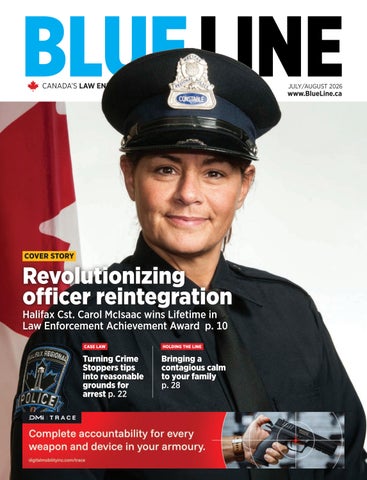
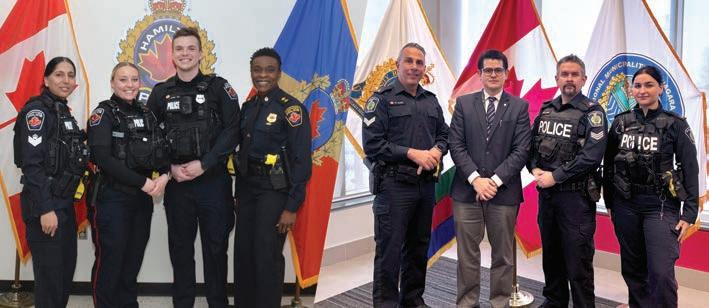
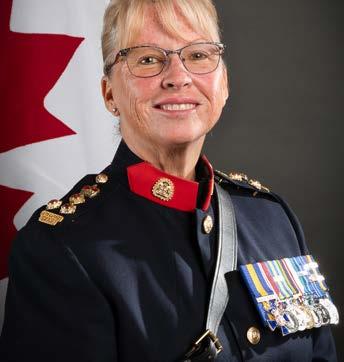
Halifax Cst. Carol McIsaac wins Lifetime in Law Enforcement Achievement Award. By Brittani Schroeder.
12 Why police strategies stall and what leaders can do about it
Strengthening strategic execution and Adaptability in Ontario police services. By Hector Perez and Amanda Gill.
16 Ambush attacks on police officers
Constable Greg Pierzchala case study. By Jim Van Allen.
20 Driving gender-responsive policies
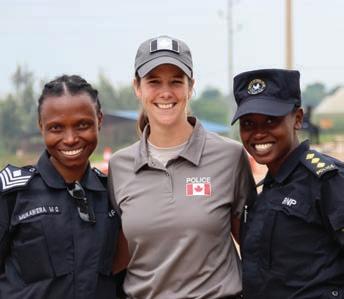
The crucial role of law enforcement under UNSCR 1325. By Barbara Fleury and Carlyn Messinger.
24 The officers you lost already told you why How independent exit interviews may fix the listening gap. By Neil Dubord and Cal Corley.
Honouring the lives behind five fallen officers
For our Canadian policing community, 2024 and 2025 were years of rare but welcome silence. Two full years without a line-of-duty death. But as we move into the second half of 2026, that silence has been replaced by a familiar grief. We have lost five officers, each a devastating reminder of the risks you face every time you show up for your shift.
You don’t need a letter from me talking about the inherent dangers of the job. As the National Police Federation (NPF) emphasized in June, these officer deaths are not statistics or historical averages to be tracked on a graph. They are the colleagues, friends, spouses and parents who did not come home and will leave a permanent void. I think it’s important that we honour them.
escaped from a hospital. Though many will remember him as an enthusiastic police officer, his wife shared that, to her, Bali will always be someone who could carry the weight of the job and still go home with kindness.
That silence has been replaced by a heavy, familiar grief.
The year’s first tragedy struck on March 31 in Portneuf-sur-Mer, Que., when Sgt. Investigator Anaïs Fortin-Cozzens of the Sûreté du Québec’s major crimes division was travelling and involved in a threevehicle collision. A mother of three, she was described as a calm, genuine person and a dedicated investigator who had joined the service in 2010. At the memorial service in Montreal, her partner, Sgt. Valérie Bergeron-Roy, noted that while they always had contingency plans, losing a loved one is a reality no one can truly prepare for.
Less than a month later, on April 27, the Ontario Provincial Police lost a member: Sgt. Brandon Malcolm of the Northumberland detachment was killed in a motorcycle crash on Highway 401. Malcolm was a former member of the Canadian Armed Forces and a proud rider with the Golden Helmets precision team. He was remembered as a skilled motor officer who OPP Commissioner Thomas Carrique said was living his best life in service to his province.
June proved to be another particularly difficult month. On June 9, Cst. Tarun Bali of the Dufferin OPP was killed near Hearst, Ont. Bali was fatally struck by a vehicle while attempting to arrest a suspect who had
Only two days later, on June 11, Toronto Police Service lost Cst. Marc Pinizzotto. A veteran of the Emergency Task Force, known as “Pinner”, he was fatally shot while executing a high-risk search warrant. His impact as a mentor was vast, having trained thousands of officers throughout his career, but his impact as a father was immeasurable. To his children, he was everything. But the month wasn’t over yet. On June 22, during a midday shooting, Cst. Mohamed Lamine Benredouane was killed in Côte-des-Neiges, Montreal. Benredouane leaves behind a three-year-old son and a wife expecting their second child. A private funeral was held at the end of June, and a public memorial was scheduled for July 7. This was the first line-of-duty death of an SPVM member in 24 years.
The NPF has rightly noted that no profession should have its on-the-job killings measured by an average, and that violence against police must never be normalized. As Toronto Police Chief Myron Demkiw recently observed, policing is one of the few callings that can’t press pause, even when the world stops for a fallen member. You continue to report for duty because the mission demands it.
In public safety, we often speak of “heroes in life, not death.” These five officers are remembered for the readiness and compassion they brought to their roles every day. As you turn the pages of this issue, carry their names with you: Fortin-Cozzens, Malcolm, Bali, Pinizzotto and Benredouane. Our team stands with you as you carry their legacy forward.
Until next time, stay safe and be well.
Reader Service
Print and digital subscription inquiries or changes, please contact customer service
AUDIENCE DEVELOPMENT MANAGER BEATA OLECHNOWICZ | (416) 510-5182 bolechnowicz@annexbusinessmedia.com
CEO | SCOTT JAMIESON sjamieson@annexbusinessmedia.com
ANNEX BUSINESS MEDIA 111 Gordon Baker Road, Suite 400 Toronto, ON M2H 3R1 Tel. 416-442-5600 • Fax 416-442-2191
Publication Mail Agreement No. 40065710 ISSN 0847-8538
SUBSCRIPTION RATES
Occasionally, Blue Line will mail information on behalf of industry-related groups whose products and services we believe may be of interest to you. If you prefer not to receive this information, please contact our circulation department in any of the four ways listed above.
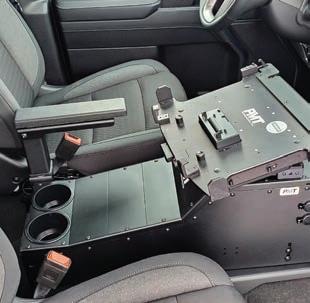
While we’re known for our industryleading docking stations, we’ve expanded far beyond the dashboard Since 1954, our team has been designing and manufacturing rugged, reliable law enforcement vehicle equipment—everything you need to fully upfit your fleet.
Federal bail and sentencing reforms receive Royal Assent
Canada’s new Bail and Sentencing Reform Act (Bill C-14) officially became law in June, introducing more than 80 changes to the Criminal Code intended to strengthen public safety and support frontline responders. Most of the reforms came into effect July 15.
The legislation makes bail significantly harder to get for repeat violent offenders by expanding reverse onus rules, requiring the accused to justify their release. For members of public safety across Canada, the Act provides clearer direction to detain an accused for a bail hearing when necessary to protect the public, victims or witnesses. Courts must now also consider factors such as unprovoked random violence and an individual’s history of outstanding charges.
Sentencing provisions have also been toughened, including new aggravating factors for crimes committed against first responders. Canadian Association of Chiefs of Police President Thomas Carrique welcomed the reforms, noting they give the justice system stronger tools to address chronic offenders.
“By passing Bill C-14, the federal government has prioritized public safety and led change that will protect Canadians from preventable harm,” he said.
Federal officials noted that while the law is now in place, successful implementation will
BY THE NUMBERS
depend on provincial and territorial governments adequately resourcing policing and prosecution services.
ALBERTA
Alberta invests $8 million to combat organized crime and extortion
The Alberta government is providing nearly $8 million to help police services disrupt complex organized crime networks and address a surge in extortion-related violence targeting the South Asian business community.
The one-time grants will support the Edmonton Police Service ($ 2.25 million), Calgary Police Service ($2.24 million), Alberta RCMP ($2 million), and the Alberta Law Enforcement Response Teams ($1.5 million). The funding is earmarked for advanced surveillance, digital forensics and intelligence-gathering tools to combat technology-enabled and transnational criminal operations.
“Organized crime doesn’t stop at city limits, and neither does our work,” said Mike Ellis, Minister of Public Safety and Emergency Services. A key focus involves investigating a rise in extortion-related shootings that often transcend jurisdictional boundaries.
Alberta RCMP Deputy Commissioner Trevor Daroux said the funding allows for a more modern response to gang activity through municipal, provincial and federal cooperation. Edmonton Deputy Chief Nicole Chapdelaine
added that this level of support is essential for resource-intensive investigations to maintain public safety without compromising other operations.
MANITOBA
Manitoba funding boost cuts RCMP vacancy rates by more than half
The Manitoba government has seen a significant drop in Royal Canadian Mounted Police vacancy rates following a multi-year surge in provincial funding. Vacancy rates for positions under the Provincial Police Service Agreement (PPSA) fell to 9.69 per cent in 2026, down from 21.99 per cent in October 2023.
The decline was bolstered by 110 new officers joining the force in 2025-26. Budget 2026 committed an additional $8 million in PPSA funding, bringing the total investment to over $206 million, up from $170 million in 2023.
The funding prioritizes front-line detachments and integrated units targeting serious and organized crime. Recent allocations also supported the expansion of the RCMP Emergency Response Team and the Operational Communications Centre.
“The Manitoba RCMP is making great strides when it comes to recruitment, with significant reductions in our vacancy rate,” said Assistant Commissioner Scott McMurchy. He also called the investments integral to enhancing public safety across the province.
In March 2026, Statistics Canada released recent data on Police-reported hate crime in Canada, 2024. For more information, please visit www150.statcan.gc.ca.
4,882 police-reported hate crimes in Canada in 2024.
168 %
increase in the number of annual police-reported hate crimes since 2018.
6
In 2024, the number of hate crimes decreased in 6 provinces and Nunavut.
55 % of police-reported hate crimes were non-violent in 2024.
PHOTO CREDIT: YAVDAT/ADOBE STOCK
PHOTO CREDIT: SPIROVIEW INC./ADOBE STOCK
Stop Buying More Applications. Start Building Enterprise Capability.
Every police executive wants officers to make better decisions in the field.
The challenge isn’t a lack of information, or even a lack of technology. It’s ensuring the right information reaches the people who need it, when they need it.
One system manages records. Another manages CAD. Another stores intelligence. Others manage body-worn video, digital evidence, bail conditions, court records, community safety, real-time operations, drones, or automated licence plate recognition. Collectively, they can create information silos if they aren’t connected; and every year, another specialized application promises to solve another operational challenge.
The result is an impressive technology portfolio, but not necessarily a more informed officer.
Frontline members often spend valuable time switching between systems or waiting for information to be relayed through dispatch, analysts, or supervisors. Crime analysts produce exceptional intelligence products that are presented during morning briefings, but too often those insights become disconnected from frontline operations once the shift begins.
Technology should reduce friction, not create it.
The agencies seeing the greatest operational gains are beginning to think differently. Rather than asking, “What application should we buy next?” they’re asking, “How do we connect the information and capabilities we already have?”
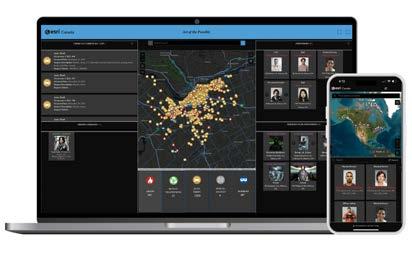
An enterprise location platform is often misunderstood as “mapping software.” It’s digital infrastructure that connects operational information across the organization, helping agencies move from isolated systems toward shared enterprise capability.
Nearly every policing dataset has a geographic component. Calls for service occur somewhere. Offenders are associated with addresses. Victims are connected to locations. Crime patterns emerge in places. Community resources serve neighbourhoods. Patrols move through geographic areas.
Location becomes the common language that allows information from previously disconnected systems, and the people using them, to work together.
More importantly, it provides agencies with enterprise capabilities that extend far beyond mapping—data integration, real-time awareness, analytics, mobile workflows, dashboards, application development, automation, and secure information sharing. These become reusable building blocks that can support almost any policing priority.
Instead of purchasing a new operational application every time a new challenge emerges, agencies can build on an enterprise foundation they already own.
Today’s priority may be hotspot policing. Tomorrow, it could be repeat violent offenders, bail compliance, intimate partner violence, organized retail crime, human trafficking, missing persons, disaster response, or community safety and well-being initiatives. In each case, the underlying enterprise capabilities remain the same.
Consider hotspot policing. Identifying crime concentrations is valuable, but analysis alone rarely changes outcomes. Real value comes when those insights flow directly into operational planning: assigning directed patrols, guiding officers in the field, capturing proactive activity, measuring outcomes, and continuously refining deployment strategies. Intelligence becomes operational rather than informational.
Those same enterprise capabilities can support entirely different policing priorities, with only the operational use case changing.
A bail compliance initiative can combine offender conditions, patrol activity, geographic priorities, and supervisor oversight into a coordinated operational picture.
A human trafficking investigation can bring together offenders, victims, hotels, transportation corridors, financial intelligence, community partners, and investigative leads within a common operational environment.
A real-time operations centre can integrate CAD, AVL, drones, traffic cameras, weather, planned events, critical infrastructure, and live sensor feeds to provide decision-makers with a single operational picture during critical incidents—different missions supported by one enterprise foundation.
Police agencies have already invested significantly in operational technology. The opportunity isn’t replacing those investments—it’s increasing their value by con-
necting them through a common enterprise capability.
This is the difference between buying software and building capability.
Enterprise platforms create organizational capability that grows over time.
Every police service has unique priorities, workflows, governance requirements, and community expectations. The most valuable technology isn’t the one that forces every agency into the same operational model. It’s the one that provides a flexible, secure foundation that adapts as policing evolves.
That flexibility protects technology investments while allowing agencies to respond more quickly to emerging priorities without repeatedly starting from scratch.
For police leaders, strategic conversation should no longer centre on which application to procure next. It should focus on which enterprise capabilities the organization is building.
The agencies that will lead the next decade won’t necessarily be the ones with the most software. They’ll be the ones with the strongest digital foundation—one that connects people, information, and operations so officers have the right information, in the right place, at the right time.
Because better policing isn’t achieved by collecting more applications. It’s achieved by building an enterprise capability that allows every technology investment, and every officer, to become more valuable.
Written by Shaun Hildebrand Manager - Law Enforcement
DISPATCHES
On March 31, Sgt. Anaïs Fortin-Cozzens of the Sûreté du Québec was killed in the line of duty in Portneuf-surMer, Que., after a three-vehicle collision. Fortin-Cozzens began her career with the SQ in 2010.
On April 27, Sgt. Brandon Malcolm of the Northumberland Ontario Provincial Police detachment died in a single-vehicle collision while riding his motorcycle on duty. He joined the OPP in June 2020 after serving with the Canadian Armed Forces.
On June 9, Cst. Tarun Bali, a member of the Ontario Provincial Police, was fatally struck by a vehicle while attempting to arrest a suspect. Bali had been an OPP officer for two and a half years and was on deployment with the James Bay detachment.
On June 11, Cst. Marc Pinizzotto of Toronto Police Service’s Emergency Task Force was killed while executing a search warrant. He had served with TPS for 18 years and spent the last five years with ETF.
On June 22, Cst. Mohamed Lamine Benredouane, a member of Service de police de la Ville de Montréal (SPVM), was killed in a midday shooting in Côte-des-Neiges, Montreal. He had been an officer with SPVM since 2021.
The York Regional Police Service Board has appointed Paulo Da Silva as the next chief for York Regional Police. Throughout his 31-year career, Da Silva has been known for fostering inclusive and supportive workplaces, building high-performing teams and strengthening partnerships across sectors.
In early June, Todd Matsumoto became the interim chief constable of Surrey Police Service. Matsumoto is a dedicated and effective police leader with more than 30
years of municipal policing experience. He believes that inclusion of all community members is vital in forging partnerships for safer communities.
The Cobourg Police Service has selected Chris Leather as its new chief. Leather brings more than 36 years of policing experience, including 21 years with the RCMP and 15 years with York Regional Police. Throughout his career, he has demonstrated a strong commitment to accountable leadership and community engagement.
Assistant Commissioner Dan Morrow is now leading the Nova Scotia RCMP as its commanding officer. He has served in Nova Scotia since 2007. Morrow joined the RCMP in 1992, starting his career in his home province of Manitoba.
Chief Robert M. Bruce has announced that he will retire from the Saint John Police Force at the end of his current contract in July 2026. He shared, “It has been a distinct honour to serve the City of Saint John... I am both humble and grateful for the opportunity to have been able to contribute to this organization and community.”
The Saanich Police Department (SPD) promoted Damian Kowalewich to the rank of deputy chief in March. Kowalewich began his policing career with SPD in 2005 and has since built strong working relationships with national and international law enforcement partners.
Neal Fowler will be Saint John Police Force’s newest deputy chief. Fowler brings more than 22 years of policing experience, during which he has progressed through the ranks and developed a strong record of leadership, innovation and community engagement.
Effective August 2026, Deputy Chief Jeff Haskins will retire from Cobourg Police Service. Haskins is a 35-year veteran of policing, serving with the Durham Regional Police Service before being sworn in as deputy chief of CPS in Nov. 2021.
Sarah Darraugh is the new inspector of the Upper Ottawa Valley (UOV) Detachment of the Ontario Provincial Police. Darraugh became a member of the OPP in 2015 after spending five years with Toronto Police Service.
The Saskatoon Police Service welcomed Taffy to the Saskatchewan Internet Child Exploitation (ICE) Unit following her successful completion of the Jordan Detection K9 Electronic Storage Detection (ESD) program. Taffy is a nearly three-yearold golden retriever.
CALENDAR
121st CACP Annual Summit and Policing Trade Show
Date: August 16 – 18, 2026 Location: Edmonton, Alta. cacp.ca
Policing in a Digital Age Date: September 16, 2026 Location: Online blueline.ca
Emergency Services Career Expo West Date: October 24, 2026 Location: Calgary, Alta. careerexpowest.ca
Find more calendar events online at blueline.ca/events
PROMOTIONS, RETIREMENTS, RECOGNITION • If you have an officer in your agency recently promoted or retiring or an individual you wish to have recognized (major award or recently deceased) you can let Blue Line magazine know by emailing: bschroeder@annexbusinessmedia.com
Revolutionizing officer reintegration
Halifax Cst. Carol McIsaac wins Lifetime in Law Enforcement Achievement Award
By Brittani Schroeder
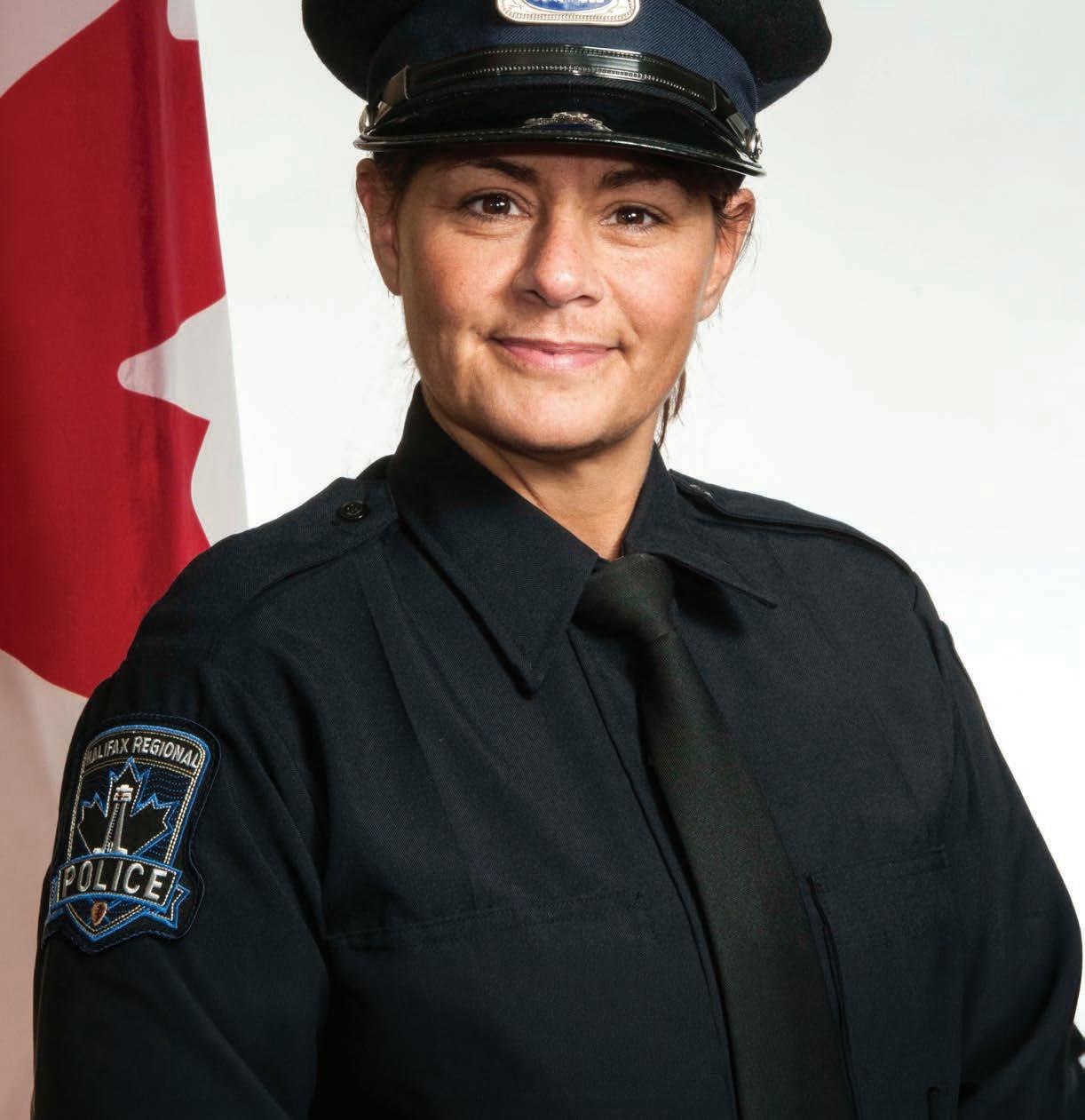
After more than 30 years of dedicated service, Halifax Regional Police Cst. Carol McIsaac is honoured with Blue Line’s 2026 Lifetime in Law Enforcement Achievement Award for a career defined by resilience and a deep commitment to officer wellness. Although 2026 also marks McIsaac’s transition to retirement, her legacy will live on at HRP through the supports she created for those still serving today and those who will serve in the future.
A trailblazer
Carol McIsaac always knew she wanted a law-related career, but the opportunity to work in the community led her toward policing rather than to practicing law. When she joined Halifax Regional Police (HRP) in 1995, she was only the twenty-fifth woman to do so, though she didn’t find this a barrier to acceptance or success.
“In this environment, you have to prove yourself to your fellow shift members, particularly the senior ones and all your co-workers, no matter your gender identity. As long as you showed up, did your job and were there for your coworkers, you were accepted,” she shared.
McIsaac’s career included more than a decade on patrol, several years in the Criminal Investigations Div-
ision, time as a media relations officer, a move to the training division, and a transition to the reintegration program as its coordinator. She was also among the first women at HRP to earn their firearms and use-of-force instructor certifications.
“When I was in the training division, I wondered how I was supposed to be an instructor to my coworkers. What did I know that they didn’t? It was a bit of imposter syndrome.” It took McIsaac a long time to become comfortable as an instructor, and she credits the team in the training division for giving her the opportunity to overcome her anxiety and build her skills.
Throughout her three-decade policing career, McIsaac appreciated the constant changes she faced each day. She preferred it to a workplace where she did the “same monotonous thing over and over again”. Above all else, she valued the lasting relationships she built with those around her.
An advocate
Over the years, McIsaac saw many officers struggle as they returned to regular duties after leave. She herself struggled with the transition to patrol after an extended absence from work and several years in the Criminal Investigations Division. Officers in this situation shared that they felt anxious, unsure whether they’d be
“There are people who come to work each day simply to do their job. Then there are people like Carol, who continually look for ways to make their workplace better for everyone. Her dedication has strengthened our organization and left a lasting impact on the health and well-being of those she has supported.”
– Chief Don MacLean, Halifax Regional Police
working alone or with a partner, or whether they’d be responding to a potentially triggering call.
“There wasn’t a chance for that anxiety to alleviate, because there wasn’t an opportunity to gain confidence in their job-related skills and abilities prior to returning to full duties,” said McIsaac.
While assigned to training, McIsaac accepted an invitation to attend a five-day Royal Canadian Mounted Police course hosted by H Division (Halifax) and taught by members of K Division (Edmonton), focusing on the reintegration program.
The first person to whom McIsaac shared her new knowledge of the program was Supt. Stephanie Johnson, who at the time was the human resources inspector and oversaw training. Johnson was immediately supportive of the idea to create a reintegration program at HRP.
“I think the biggest thing that you need is your own passion for and belief in the program. The other thing you need is even just one member of senior leadership who will support you in it. That’s how you’ll eventually move it forward,” shared McIsaac.
To those unfamiliar with the program, McIsaac describes it as a peer-driven support program for members returning from any type of leave. A member of the support team is paired with the returning officer until the returning officer is once
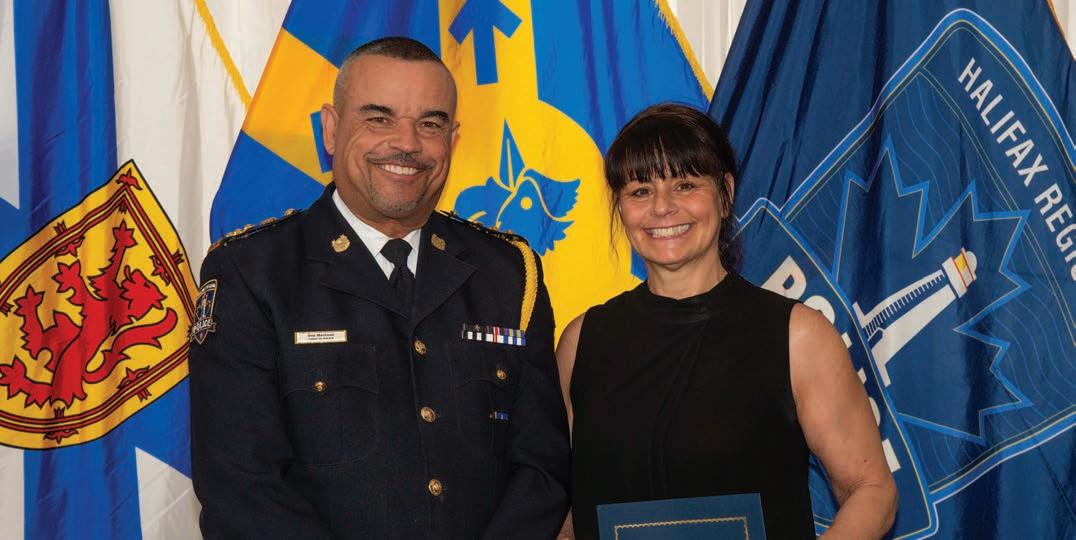
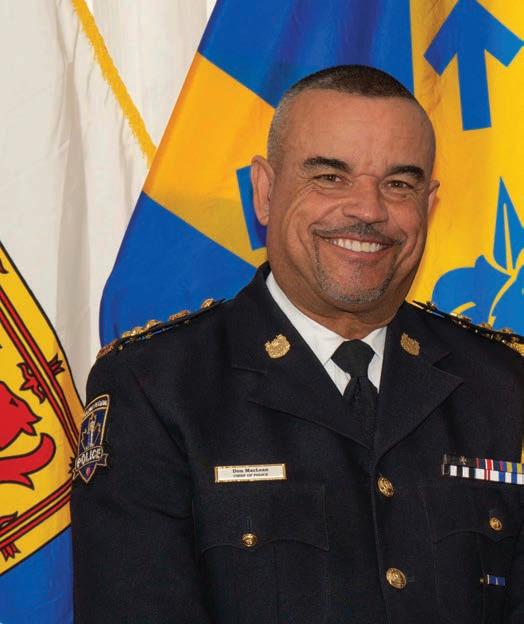
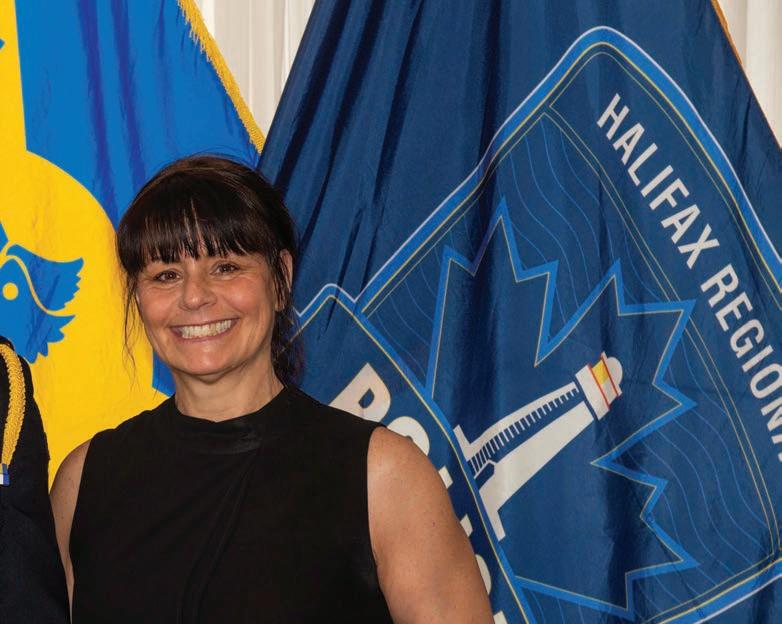
Cst. Carol McIsaac with Chief Don MacLean.
again confident in their own capabilities. The program is modelled after Edmonton Police Service’s program, but McIsaac believes that any service that builds a program will do so based on its organization’s needs and the resources available to it.
Initially, developing the program was slow because it was a side project while McIsaac continued her full-time duties in the Training Division. During this time, she attended two courses facilitated by Edmonton Police, which significantly increased her understanding not only of the program but also of how to successfully build and maintain one for her own organization. As the HRP program progressed, McIsaac invited Edmonton to the East Coast to deliver their training to a group of officers who would be the first members of the HRP reintegration team.
As the program grew, McIsaac wanted to build a reintegration peer supporter course specific to HRP. She worked with curriculum specialist Julie Moore over many days and nights to get it “right”. In spring 2024, they hosted the first HRP Reintegration Peer Supporter Course.
It took two to three years of testing, tweaking and gathering feedback on the program from leadership members, watch commanders, shift supervisors, coworkers, participants, reintegration peer supporters, health care providers and other internal and external partners. McIsaac admitted that though she didn’t have all the answers, she knew, without a doubt, how important this program would be in the end.
the team that built the program. She incorporated all their feedback to shape the program into what it is today. And thankfully, working within a team has never been an arduous task for McIsaac. Instead, it’s where she’s thrived for the past three decades.
A lasting impact
McIsaac has many fond memories from her time in policing with HRP, but when she was asked to narrow it down to her favourite, one stuck out. She will never forget the feedback she received after facilitating her final peer supporter course in December 2025. “I was floored. It was profound. And really, it has nothing to do with me; it has to do with how the course was built and how impactful it is for our members. It made me feel like we hit the nail on the head with this.”
“There were growing pains, because anything new that you bring to police officers can be a challenge, or not initially well-received. But I was very open to positive feedback and constructive criticisms, because I knew that what worked for Edmonton might not necessarily work for us. I sought out feedback from every person that would talk with me.”
Once the program began, many people came to McIsaac and shared their stories. “For me, even if it’s as simple as an officer going to the range with their pistol two or three times before returning to regular duties, the program is useful. With reintegration, there’s no pressure being put on the member.”
Once the program was up and running for frontline patrol officers, it was expanded to include IES Dispatchers and Call-takers, and later external agencies. McIsaac believes that for the reintegration program to work, you don’t need to be a first responder. It can be used by any type of team and can be tailored as needed. At the end of the day, it’s a peer support program for employees who may need extra support.
“Over the past four years, Cst. McIsaac has been a driving force behind the development and success of the HRP Reintegration Program. Her humility and commitment keep her focused on one goal: helping members transition successfully back into the workplace while equipping peer support teams with the tools they need to thrive,” said Staff Sgt. Robert Fox.
McIsaac recognized that, though she had built the Reintegration Program team, it was
It was at times like these when McIsaac thought back to the very beginning of the reintegration program, when no one wanted to apply to take the course and join the peer support team. She and Supt. Johnson had to personally reach out and ask people to join. Then, in 2024, when 26 people applied to join and another 34 applied in 2025, McIsaac knew this would have a lasting impact on HRP and its members.
An honour
As McIsaac began preparing for her retirement, leaders at HRP knew that the work she had done in public service since 1995 deserved recognition.
“She embodies the very best of HRP and HRM values: respect, collaboration and integrity. She always puts other people first. Cst. McIsaac is not only a dedicated officer but a true champion of service, mentorship and community,” said Fox.
When Blue Line announced she was the winner of this year’s Lifetime In Law Enforcement Achievement Award, she initially thought it was some kind of scam. “I thought it couldn’t be real. But then I was humbled, thankful, grateful, honoured and all the other positive words you can think of,” she said.
Though she was happy about this nomination and recognition, what mattered more was what it revealed to her: how highly HRP valued the program she and her team had created.
Johnson shared, “Through this work, Carol helped countless members build resilience during their most difficult times. That legacy lives on even after her retirement. Carol is so deserving of this recognition.”
Why police strategies stall and what leaders can do about it
Strengthening strategic execution and adaptability in Ontario police services
By Hector Perez and Amanda Gill
Police services across Ontario invest significant time and effort into developing strategic plans. These plans typically reflect extensive consultation, align with community expectations and respond to legislative and governance requirements. Yet despite this effort, many police leaders recognize a persistent challenge: strategies are approved, communicated and launched, but they too often stall during implementation.
This gap between planning and performance is not anecdotal. In 2025, we conducted a province-wide survey of 110 senior police leaders at the Ontario Association of Chiefs of Police Conference. Participants represented services of all sizes, from small municipal organizations to large, complex regional services, providing clear evidence that the challenge facing police services is not a lack of vision, but translating that vision into sustained operational action.
Police leaders were asked a straightforward but revealing question: How successful are police services at executing their strategic initiatives?
The answer was striking.
More than half of respondents reported completing fewer than 60 per cent of their strategic initiatives, while only a small minority indicated success rates above 80 per cent. Importantly, this execution gap was observed across services of all sizes.
These findings confirm what many executives already sense: the issue is not whether police services are planning strategically, but whether they are equipped to carry those strategies through operational reality.
Why it happens: Where strategies lose momentum
When asked about barriers to strategy implementation, leaders identified five recurring challenges:
1. Insufficient staffing and resource capacity
2. Poor communication across the organization
3. Limited understanding of strategy at the frontline level
4. Weak accountability and follow-through
5. Resistance to change
Staffing pressures were cited most frequently by more than three-quarters of respondents. However, staffing alone does not fully explain why strategies stall. Communication breakdowns and accountability gaps emerged as equally significant obstacles. These challenges also differed by organizational size. Smaller services emphasized limited resources, competing operational demands and the absence of formal accountability mechanisms. Simply put, the
“do-it-all” culture means there’s no one left to hold people accountable for long-term projects. Larger services highlighted structural and cultural barriers, including siloed divisions—one hand doesn’t know what the other is doing—misalignment between strategy and operations, and inconsistent messaging across organizational layers.
Despite these differences, the outcome is the same across services: strategic priorities lose momentum once they move beyond the executive table and into day-today operations.
Why it persists: The measurement trap
Another key factor contributing to stalled strategies is how police services define and measure success. Leaders reported relying heavily on community-facing indicators, including:
• Community safety and well-being
• Public trust and legitimacy
• Alignment with community priorities
These measures are essential. Public confidence and legitimacy remain central to
effective policing. However, far fewer leaders reported using internal performance measures, such as workforce engagement, operational efficiency, resource optimization, organizational learning and innovation.
This imbalance matters. Without strong internal indicators, police services may struggle to detect early warning signs that strategies are falling behind. By the time community outcomes fail to materialize, it is often too late, or too costly, to adjust course.
Effective strategic execution requires leaders to monitor both external legitimacy and internal organizational health.
What happens when a strategy is not working
The survey also examined how police organizations respond when strategies begin to fail.
Overall organizational adaptability was rated as moderate, with an average score of 6.4 out of 10. This suggests that while police services are capable of adjustment, adaptability is often constrained by structure, culture or governance.
Responses differed noticeably by service size. Smaller services were more likely to redesign strategies, reassign resources or adjust priorities, reflecting a more iterative, problem-solving approach. Larger services were more likely to pause or abandon initiatives or escalate issues to executive leadership, reflecting more hierarchical decision-making and greater risk aversion.
Neither response is inherently right or wrong. However, the findings suggest that larger organizations may struggle to make timely mid-course corrections once strategies encounter resistance or unforeseen barriers.
The solution
Across all service sizes, several enablers of successful strategy execution stood out consistently:
• Clear accountability structures
• Frequent and transparent communication
• Visible executive leadership support
• Embedding str ategy into day-to-day operations
• Change champions at multiple organizational levels
These are leadership-driven factors, not technical ones. They point to a central conclusion: closing the strategy-execution gap does not require more plans or greater
complexity, but stronger and more effective leadership through implementation. Strategy execution cannot be delegated and forgotten. While operational ownership is essential, sustained executive engagement remains a critical factor. Leaders who reinforce priorities, model commitment and hold the organization accountable create the conditions for strategy to survive operational pressure.
Success isn’t about writing a better plan; it’s about having the leadership grit to see it through.
Practical takeaways for leaders
The findings highlight several practical actions police leaders can take to strengthen execution and improve strategic outcomes.
1. Stop treating the plan as “final”
Strategic plans should not function as static documents reviewed annually or revisited only during budget cycles. Instead, they should serve as living frameworks that guide daily decision-making, resource allocation and performance conversations across the organization.
2. Real accountability
Clear ownership, milestones and reporting structures are essential, but they must support action rather than create additional friction. It’s not about more paperwork; it’s about clear ownership. Who owns this goal? What do they need to get it done?
3. Measure the “inside”
Start tracking internal efficiency and staff morale as closely as you track crime rates. Community outcomes such as trust, safety and legitimacy remain critical, but they depend on internal organizational capacity. Leaders should track workforce capabilities, engagement, efficiency and learning alongside external measures to ensure strategies are sustainable over time.
4. Build in “exit ramps”
Give your team permission to redesign a failing initiative rather than just letting it stall. Strategies should anticipate the need for course correction. Regular review
points, feedback loops and explicit permission to redesign initiatives help prevent premature abandonment and support learning when conditions change.
5. Visible leadership
Strategy survives when the chief and the executive team are seen “doing the work” alongside the frontline. Execution improves when leaders remain present throughout implementation, communicating priorities, explaining trade-offs and reinforcing why the strategy matters, particularly during periods of operational strain.
In practice, these enablers are the building blocks of effective change management. Strategy implementation is organizational change: it requires consistent executive sponsorship, a clear narrative explaining why the change matters, active engagement of supervisors and frontline teams, and deliberate reinforcement over time. Without a simple change approach: communicate, equip, reinforce; strategies are vulnerable to drift, resistance or quiet disengagement.
Taken together, these actions signal a shift in how police leaders approach strategy, away from static planning and toward active leadership through execution.
From planning to performance
The complexity of modern policing means we can no longer afford to let 40 per cent of our goals go unfinished. Success isn’t about writing a better plan; it’s about having the leadership grit to see it through and a greater focus on building the organizational capacity to execute, learn and adapt.
The evidence from police leaders themselves is clear. When leadership attention, accountability and adaptability align, strategies are far more likely to deliver meaningful results and real value for organizations, staff members and the communities they serve.
Hector Perez is a corporate analyst with the Niagara Regional Police Service, specializing in evidence-based policing, organizational strategy and performance measurement. Hector can be reached at Hector.Perez@niagrapolice.ca.
Amanda Gill brings over 25 years of public and private sector experience, shaped by a commitment to people and purposeful leadership. At the Hamilton Police Service, she leads strategic initiatives that help the organization grow and better reflect its community. Gill can be reached at AGill@hamiltonpolice.ca.
OUT OF THE COLD
BY STEPHEN METELSKY
Intelligence gathering continues in the search for Elora Patoine
Three years after Elora Patoine vanished, RCMP investigators in Prince Edward Island continue to search for answers in a case that has left family and friends living with uncertainty.
Elora Patoine was last seen on June 17, 2023, when she was dropped off in Borden-Carleton, P.E.I., the community located at the foot of the Confederation Bridge. Police say she later travelled to Moncton, N.B., where she remained until June 19, the date of her last confirmed sighting. She has not been heard from since.
RCMP investigators classified the file as high priority. They immediately contacted Patoine’s known contacts, reviewed video footage and conducted interviews to determine Patoine’s movements and state of mind in the days leading up to June 19.
In 2023, investigators in P.E.I. were utilizing the new Missing Persons Act to assist with the investigation into Patoine’s disappearance, as reported earlier by the CBC and confirmed by then RCMP spokesperson Corporal Gavin Moore. However, the RCMP did not release specific details about how the Missing Persons Act would be used in the investigation.
The Act permits investigators to access personal information about someone who goes missing, which can include access to banking information and cell phone records, with the goal of pinpointing their location and the sequence of events that occurred after they were reported missing. Prior to the enactment of the Act, this information would have been considered private.
As days turned into weeks and the investigation evolved, the Prince District RCMP and the RCMP Major Crime Unit continued to work the case, which eventually transitioned from an active search to an unsolved missing-person investigation.
For loved ones, the passage of time has done little to ease the anguish surrounding Patoine’s disappearance, leaving family members caught between hope and heartbreak as they wait for answers and closure.
In this case, police have not publicly stated whether foul play is suspected in Patoine’s disappearance.
Elora Patoine was 30 years old at the time of her disappearance. She is described as being 5’10” (178 cm) tall and weighing approximately 150 pounds (68 kg), with a medium build, long curly brown hair, green eyes and a fair complexion. Police say she was last seen wearing a brown faux leather coat and black pants.
Someone out there has information about Elora’s disappearance that could crack this case and finally bring closure to her family.
Anyone with information about Patoine or her whereabouts is being asked to contact the Prince District RCMP at 902-436-9300. Tipsters can also provide information anonymously Crime Stoppers at 1-800-222-TIPS (8477)
Stephen Metelsky is an author, university professor and (ret.) sergeant. Follow him on LinkedIn and X at @StephenMetelsky.
Ambush attacks on police officers
Constable Greg Pierzchala case study By Jim Van Allen
Ambushes of police officers in Canada have typically involved spontaneous violence upon an officer’s arrival at a scene, an element of surprise, indications of planning to entrap any police officer or a specific police officer, and indications of concealment of an assailant, their weapon or their intentions. Some instances have also involved luring specific officers to a position of vulnerability by using a ruse.
Ontario Provincial Police Cst. Greg Pierzchala was tragically murdered in the line of duty on December 27, 2022, when he responded to a vehicle in a ditch near Hagersville, Ont. This deliberate ambush was captured on Pierzchala’s body camera, which allowed investigators and members of the court to see the events that led to his death.
This tragic case of an officer’s death has provided public safety personnel with a
unique opportunity to review the offender’s conduct and movements immediately preceding the attack.
Situational awareness is the ability to perceive, grasp and forecast information about one’s environment, enabling informed decision-making and effective responses to dynamic situations. Vigilance is critical during an officer’s engagement in any situation, as ambush attacks often occur quickly, within minutes of an officer’s arrival on scene. It is also vitally important not to have your thinking “primed” to a particular conclusion just because you may be responding to a commonplace assignment, such as a disabled motorist or traffic violation.
Pierzchala was fatally shot before he could determine that the “ditched vehicle” was stolen, or that his killer was armed, wanted, desperate to avoid being returned to custody and willing to shoot a police officer in order to stay free. It is critical from the outset of any call that officers perceive and interpret suspicious or furtive movements that might “telegraph” any danger-
ous intentions.
Police training has identified “tells” that indicate an individual may be concealing a weapon. Bulges in clothing, being overdressed for the weather conditions, or reassuring touches to confirm positioning may indicate that a weapon is present. More importantly, a suspect’s arm movements will telegraph when a weapon is being drawn. A hand movement to the waist level, and the corresponding raising of an elbow, may be consistent with drawing a gun. Movement of both hands to raise or pull open clothing to access a weapon could signal an imminent risk. Hand movement to waist level and raising an elbow are consistent with “drawing a concealed gun”.
Right elbow raised, consistent with weapon being drawn from waist level.
Right elbow raised, consistent with weapon being drawn from waist level.
Right elbow raised, consistent with weapon being drawn from waist level.
Right elbow raised, consistent with weapon being drawn from waist level.
Illustration 1: Right elbow raised, consistent with weapon being drawn from waist level.
Right elbow raised, consistent with weapon being drawn from waist level.
The o ender moved behind his accomplice to obscure his actions.
The o ender moved behind his accomplice to obscure his actions.
Illustration 2: The offender moved behind his accomplice to obscure his actions.
The o ender moved behind his accomplice to obscure his actions.
Illustration 3: The offender monitored the officer. Unseen, he moved the pistol to the front pouch pocket of his hoodie.
The o ender monitored the o cer. Unseen, he moved the pistol to the front pouch pocket of his hoodie.
The o ender monitored the o cer. Unseen, he moved the pistol to the front pouch pocket of his hoodie.
The o ender begins to approach the o cer.
The o ender monitored the o cer. Unseen, he moved the pistol to the front pouch pocket of his hoodie.
Illustration 4: The offender began to approach the officer.
The o ender begins to approach the o cer.
The o ender moved behind his accomplice to obscure his actions.
A study of 94 Canadian police murders between 1980 and 2023 revealed that 86 killers were males, indicating that the highest risk posed to an officer will be male-initiated. Only one of eight females who were charged as accomplices or accessories after the fact actively murdered an officer (2024 Van Allen, Parent & Parent).
The o ender moved behind his accomplice to obscure his actions.
O ender confronts the o cer with his right hand concealed in his hoodie pocket seconds before ring.
O ender confronts the o cer with his right hand concealed in his hoodie pocket seconds before ring.
Illustration 5: Offender confronted the officer with his right hand concealed in his hoodie pocket seconds before firing.
Warning: This article contains details regarding a fatal attack on a police officer and may be upsetting to some readers.
In the case of Cst. Pierzchala, the male offender walked away from him. The offender’s right elbow raised, which was consistent with a weapon being drawn. The pistol was later found to be equipped with an aftermarket belt clip for waistband concealment. The offender obscured himself from view behind a female accomplice, and while concealed, he watched the officer. The offender placed his loaded pistol into the front pouch pocket of his hoodie. He walked towards Pierzchala with his right hand concealed before firing at close range. As seen on the body camera footage, the sequence of events took approximately five seconds. Too fast.
Interpreting physical behaviour may be open to more than one explanation; however, in this case, the male offender took a passive role from the outset. He didn’t engage Pierzchala in any conversation. The officer didn’t ask him any questions, nor did the offender volunteer information. The offender wasn’t asked to produce identification or other documents. His movements were stealthy until he had prepared his attack. At that time, and in quick succession, he approached and confronted the officer and fired his concealed weapon.
Vigilance is critical during an officer’s engagement in any situation.
Criminal decision-making is often based on “reward versus consequence”. For example, the reward of evading apprehension may have been seen as immediately outweighing the potential consequences of being captured and charged. Some convicted offenders who have killed American police officers have admitted that they evaluated an officer’s appearance and behaviour and attacked if they believed they could succeed in a violent confrontation with the officer (FBI Study 1992).
All ambushes and many other fatal attacks on police officers occur quickly. Upon arrival at any incident, I recommend visibly “frisking” a suspect and monitoring any furtive movements which could be consistent with weapon possession, and especially an imminent intent to attack. Additionally, regularly practice “what if” scenarios and identify tactical options that include defensive responses, taking cover or tactical retreats. And always remember to be most vigilant in the first minutes of any interaction.
The hope is that by recognizing these potential risks, officers may have an opportunity in future situations to take defensive action and take cover. To prevent another ambush such as this. We honour Pierzchala’s loss and sacrifice.
Remain cautious, be observant and stay safe.
Author note: Three recent murders of Canadian Police officers and five non-fatal attacks speak to the need for police officers to use situational awareness, and focused tactical decision making in the early phases of service responses.
The thoughts and views expressed herein are those of the author, and reflect his training and experience, and do not reflect those of the Ontario Provincial Police.
Property & Evidence
• Controls marijuana odors in storage area.
• Eliminates airborne virus & bacteria from contaminated evidence.
• Reduces airborne pollen.
Communications Room
• Eliminates the electronic odor
• Provides clean air for enclosed areas.
• Reduces the spread of viruses and bacteria among employees.
• Reduces the sick building syndrome known as “SBS”.
• Eliminates the stale air.
Booking Room
• Protects from the airborne and physical contaminants of suspects.
• Reduces exposure from contaminated evidence.
Alco-Test
• Cleans room air of contamination.
• Positive pressure can prevent air entry from other areas.
• Eliminates “tainted” test results.
Jim Van Allen is a retired Ontario Provincial Police detective sergeant and criminal profiler. He maintains an interest in projects which focus on officer safety.
Experience, opportunity and the future of policing
A conversation with Calgary Police Chief Katie McLellan on career, community and what it means to choose policing for the long haul.
Policing is more complex than it’s ever been. Officers are responding to increasingly challenging calls, exposure to trauma remains a reality of the profession, and agencies across the country are competing for experienced officers who know exactly what they’re signing up for.
Chief Katie McLellan has been a police officer for 35 years and has seen this shift throughout different phases of her career. Now leading the Calgary Police Service, she reflects on a profession that has changed dramatically, a city that shows up for its officers, and why she continues to champion what she describes as the most rewarding career one can have.
Your path to Chief has been long and varied. Can you walk us through it?
I’ve been a police officer for 35 years, starting out as a civilian in the 911 centre for about a year and a half. I was 19 when I got hired; 20 when I went into patrol and spent about 13 years there. I went to a whole bunch of different areas, climbed through the ranks, had amazing opportunities and incredible projects and initiatives where I really saw policing change. In 2013, I retired as a superintendent and went to oil and gas for four years and had an amazing experience there, but I knew poli-
cing was still in my blood. The RCMP had an opportunity for me to come into their federal policing, overseeing national and international guns, drugs and gangs. I wanted to stay with the RCMP, and then this opportunity came up to be a deputy chief back here in Calgary. After a few years in different roles back with the Calgary Police Service, I was given this amazing opportunity to become the Chief in 2025. I couldn’t have written the story any better.
You’ve seen policing evolve significantly over 35 years. How would you describe the reality of the job today, and why does that make experience so valuable?
When I was a patrol constable, it would be an anomaly to pull over a vehicle with guns and drugs – that was the traffic stop of the year. Now, our members are seeing that every single day. They’re seeing tragedy and trauma on very different levels. Experienced officers come to us having seen the good, the bad and the ugly. They know what they’re getting into, and they’re coming to hit the ground running.
Policing is a complex, demanding career, but it is so rewarding. At the end of a 25-year career, you will have interacted with hun-
dreds of thousands of individuals and changed their lives – hopefully for the better, in ways we’ll sometimes never know.
What should an experienced officer look for when considering a move to a new service?
Compensation is definitely a factor, but it’s also about the service that you’re coming to. Mature individuals, people who’ve had a career before, don’t want to come to a service full of drama. They want to see that we’ve worked hard at relationships – with the association, the commission, city council – that there’s support and respect.
For us in Calgary, it’s not all rainbows and white picket fences and unicorns, but we’re doing a lot of great things. We’re really focused on the wellness of our members, on engagement, on being the leading edge with respect to training and technology.
But it’s not just about the service, it’s about the community you’re coming to live in. Calgary is a very affordable city when you look at other major cities across the country. Experienced officers might ask, is it a place to bring up children, a place for spouses too? What kind of mentorship and coaching do we provide? Is there as much opportunity here as anywhere else? We see Calgary as a whole package deal. We want experienced officers to embrace the service and embrace the city, so they stay here for their entire careers.
What does the relationship between the Calgary Police Service and the community look like, and how does it shape the day-to-day experience of officers serving here?
I’m not naive, we’re not loved by everyone.
But if police officers could be at most or all city events on a regular basis, the Calgary Police Service would be there. It’s a community that embraces us – we’re asked to attend community events and speaking engagements regularly. Take our school resource officers for example – we were the only service in Canada who stood firm and reinforced the importance of police officers being in schools, because of our amazing relationships with our colleagues in our schools. We have lots of integrated teams and we’re so fortunate to have great support in this city from so many partners.
Calgary has invested heavily in integrated policing models that bring mental health and social services into frontline policing. How has that changed the job, and is this where modern policing is heading?
I think in the past, policing thought we needed to solve everything. We’ve learned over many decades we’re not the experts in a lot of these calls, particularly around mental health, social disorder and addictions. We’re the first to admit there are calls we should not be the first responders at. So how do we figure out what those root causes are? How do we help these individuals? Many of them don’t belong in a jail, and they don’t belong in a hospital either.
We’ve been working hard with many partners in the Government of Alberta and across the city on what that other option looks like. We have the Compassionate Intervention Act coming our way, and we’re exploring how to build a 24-7 wraparound service where these individuals can get the supports they need.
Our direction as a leadership team is that arresting is connecting. Sometimes we have to arrest these individuals to connect them to the right resources. We are responsible for keeping the city, and all of its citizens, safe.
Officer wellness, inclusion and reintegration after trauma have become major conversations in policing. How has the profession evolved on these fronts?
From day one in recruit class, you’re taught about inclusion – you look for behaviours, not gender, race or age. We want different voices and different experiences at the table. But I think some of it is intrinsic. It’s about your values, your ethics, your moral compass. If those things are aligned, you should naturally know it makes sense to be inclu-
sive, and it makes sense to have equity and diversity at the table.
We have to ensure we’re hiring the right people, and be honest about what it’s going to be like. People call us because they’re in crisis, not because they’re having a birthday party. You could go to traumatic scene after traumatic scene, and we need to be transparent about what that looks like right from the start.
We have a dozen support programs for when members first join the Service, and another dozen that help our members come back into the workplace if they do go off. Years ago, people wouldn’t talk about going to see a therapist. Now it’s, “I’m off to see my therapist, I’ll see you guys in a couple of hours.” I think policing has adopted the idea that it’s OK to not be OK – but we also know it’s OK to be OK, too, because not everyone is impacted the same way by the same things. If we’re not healthy and well inside the Service, we’re not healthy and well outside the Service, and we can’t do our number one job.
What does career development look like at the CPS, and what would you say to someone weighing whether this career and this city are right for them?
There will be people who join the police service who will be constables for their entire career. I honour and respect that – my husband retired as a constable. But for people who want different kinds of growth, there are 27-plus different careers in this profession, and we continue to create opportunities for officers to develop specialized expertise, take on leadership roles and explore different areas of policing throughout their careers.
I was a constable in District 4 for 10 years,
longer than most. My sergeant finally told me it was time for me to move on, and I was mortified – I just loved what I was doing because every day is different. The job is what you make of it, so we have to ensure we have processes that are easy to access for those who are looking for new opportunities. People need to be able to see a path for their future here.
When people are deciding whether this career and this city are right for them, they need to look at the whole picture. You’re not just choosing a service; you’re choosing a community. You want to know you’ll be supported in the work, connected to the city you’re serving, and able to build a fulfilling career and life.
Policing is a challenging, complex, difficult career, but it is also the most rewarding career, and one of the most impactful that you will ever get to have in serving our city. Even when you’re off duty, you’re the police officer at a party, the police officer at an event – everybody wants to talk to you. Your family needs to embrace it, the people you hang around with need to embrace it, because it’s not just a profession, it’s a lifestyle. Even though we’re not on duty, we’re always part of the family, and the bar is higher. That’s what comes with this job.
Driving genderresponsive policies
The crucial role of law enforcement under UNSCR 1325
By Barbara Fleury and Carlyn Messinger
The United Nations Security Council adopted Resolution 1325 (UNSCR 1325) 26 years ago, and it’s important for members of law enforcement worldwide. Under the banner of Women, Peace and Security (WPS), the resolution acknowledges that women are disproportionately affected by conflict and are underrepresented in negotiations, militaries and police organizations. While it urges member states to increase women’s representation in UN peacekeeping operations and field roles, UNSCR 1325 takes it further by promoting victim-centred approaches for agencies and advocating for gender-responsive policies, guidelines and training.
UNSCR 1325 has four pillars:
1. Participation: Active involvement of women in peace processes, conflict prevention and decision-making.
2. Protection: Protection of women and girls from gender-based violence.
3. Prevention: Prevent conflicts from arising and address underlying causes.
4. Relief and recovery: Ensure women can access healthcare, education and economic opportunities in post-conflict settings.
Countries that adopted UNSCR 1325 were encouraged to develop National Action Plans (NAPs). As of 2024, 112 countries have implemented NAPs, created with input from domestic law enforcement.
Canada
The first Canada National Action Plan (CNAP) was created in 2010 and is now in its third iteration, which includes the Elsie Initiative aimed at increasing the number of women in uniform deployed to peacekeeping missions. The associated Elsie Fund is managed by UN Women.
The RCMP supplies trainers for the UN Pre-Selection Assessment and Assistance Team (Pre-SAAT), playing a vital role in boosting the participation of women, especially Francophone officers, in UN peacekeeping operations. This training covers skills such as report writing, interviewing, driving and computer proficiency. In 2024, Canadian police officers provided Pre-SAAT training to more than 300 officers in Zambia, Niger, Djibouti and Rwanda. The benefits extend beyond the trainees; Canadian police trainers refine their skills, adapt to challenging environments, deepen their understanding of global policing trends and expand their professional networks.
Tanzania
Tanzania has initiated several actions despite not finalizing a NAP. According to May 2023 UN Women data, Tanzania contributed 1,599 peacekeeping troops, with 9.3 per cent women, and 77 military observers and staff officers, 28.6 per cent
of whom were women. In 2022, Tanzania established the Anti Human Trafficking and Child Exploitation and Abuse Task Force to combat Trafficking in Persons and Child Sexual Exploitation through a multiagency approach involving law enforcement and the Ministry Department Agency.
United States
The United States WPS NAP was adopted in Oct. 2023, following three previous NAPs adopted in 2011, 2016 and 2019.
The Department of Homeland Security offers Human Trafficking Awareness Training and a Sexual Assault Investigator Training Program to better equip law enforcement to address and compassionately manage these types of investigations.
In the U.S. in 2020, women were less than 3 per cent of police leaders and only 7 per cent of officers. The “30X30” initiative, started in 2021, aligns with UNSCR 1325 and aims to increase women in recruit classes to 30 per cent by 2030.
Recognizing women’s crucial role in preventing and identifying radicalization, the U.S. Department of Justice’s International Criminal Investigative Training Assistance Program and Department of State’s Counterterrorism Bureau launched a program to support women in counterterrorism.
Practitioners
Lea Biason, a researcher with over 20 years of experience in this field, shared her perspective on whether the resolution has achieved its intended goals.
“The WPS NAPs [are] a critical entry point for the integration of gender equality into police reform in many countries.
“Only when a police service represents the community it serves and is responsive and accountable to all the members of the community can it truly deliver the best quality service... If you want police operations to be successful, you will want situational awareness and intelligence to be gathered from everyone and everywhere, including the
women in the community. Most importantly, you would want to gain the trust and confidence of the entire community, including the women. You would not want to do a job half done. Gender inclusion is about doing the job fully with no blind spots.”
What can you do as a police leader in Canada?
Join national associations, such as CACP or IACP, and become action-oriented leaders on committees that focus on WPS.
Support victim-centred and gender-responsive policing in your jurisdiction. Develop curriculum that incorporates input from victims and is gender-responsive.
Support initiatives that ensure policies and guidelines do not have hidden barriers and create opportunities to ensure inclusivity in your agency.
Review action plans and initiatives and consider adopting successful programs to combat human trafficking, encourage women’s active participation in counter-
terrorism or mentor the next generation of leadership.
Commit your agency to the 30Forward Initiative in Canada, based on the 30X30 Initiative from the U.S., or consult the vast library of resources on the 30X30 website with guidance on improving the representation and experiences of women in your organization.
Author note: Men play a vital role in supporting the WPS agenda and UNSCR. This article honours Jon Christian Moller, a dedicated leader and advocate for gender equality and Sexual and Gender Based Violence prevention. He contributed significantly to building gender-focused units and training in Haiti before his passing in 2024.
Barbara Fleury O.O.M., served 37 years with the RCMP at the rank of assistant commissioner. She is currently an independent contractor.
Carlyn Messinger is a senior technical specialist with 413, LLC. She holds a master’s in international public management from Sciences Po Paris and a master’s in international relations from the London School of Economics.
CASE LAW
BY MIKE NOVAKOWSKI
Turning Crime Stoppers tips into reasonable grounds for arrest
An anonymous tip, sufficiently confirmed, provided the necessary grounds for an arrest and the seizure of almost a kilogram of fentanyl. In R. v. Dinh, 2026 BCCA 190, police on Vancouver Island received a Crime Stoppers tip that the accused, Hong Dinh, was involved in the transportation of illicit drugs from B.C.’s Lower Mainland to Vancouver Island. The tipster provided the make and model of Dinh’s vehicle, a white Honda Civic, as well as its licence plate number. The tip did not provide any details on timing, the nature of the drugs or the method of transport. A background check and target sheet were completed, determining where Dinh resided, that the Honda described belonged to her, and she had been arrested three years earlier at a Vancouver Island ferry terminal where two kilograms of drugs were seized. However, the police were unable to access the file related to this incident because it had been “privatized”. Dinh was associated with two known drug traffickers in the Victoria area. A sergeant with significant experience investigating drug crimes believed the tip was worthy of further investigation. Nine days after receiving the tip, police surveilled Dinh while she used the Honda, but observed nothing suspicious. The next day, police resumed surveillance and saw Dinh driving the Honda towards the ferry terminal. The Honda was followed onto the ferry and then to a large retail parking lot in the Lower Mainland where she parked in an area separated from the general activities of others. Dinh retrieved a blue bag from the Honda’s trunk, placed it on her front passenger seat and returned to her car. A white Ford pickup truck circled the parking lot and parked next to the Honda in a driver’s-doorto-driver’s-door configuration. Dinh got out of her Honda carrying the blue bag and walked around to the pickup’s passenger door, left the blue bag in the pickup, and walked back to the Honda carrying a black bag. The black bag appeared to be weighted down, and Dinh put it in the trunk of her Honda. The Ford then departed. The pickup’s registered owner did not appear to have a criminal record or any entries on CPIC.
The entire transaction between Dinh and the pickup’s driver took less than a minute. Based on the totality of the circumstances, including observations made during surveillance, the Crime Stoppers tip, the target sheet and the previous arrest, the sergeant authorized Dinh’s arrest. Police followed her towards the ferry terminal and, when she parked at a nearby shopping centre, she was arrested. The Honda was searched, and police found a black bag in the trunk, hidden in the spare tire compartment. The bag contained 994 grams of fentanyl, and Dinh was charged with possessing it for the purpose of trafficking.
“In conducting the objective assessment, the court should not examine the evidence in isolation or a piecemeal fashion.”
At trial in BC Supreme Court, the judge found the sergeant had the necessary grounds to order the arrest based on:
1. He was an experienced police officer familiar with the means by which drug trafficking occurs,
2. He was aware that most of the illegal drugs finding their way into the Victoria area come from the Lower Mainland,
3. He had been advised of the Crime Stoppers tip that Dinh was engaged in the transport of illicit drugs from the Lower Mainland to Vancouver Island,
4. The tipst er’s information regarding Dinh’s vehicle and its licence plate number checked out,
5. He was aware that Dinh had a prior arrest at the ferry terminal on Vancouver Island with a large quantity of drugs seized,
6. He had been advised that two individuals associated with Dinh were known drug traffickers, which in his mind added to the credibility and reliability of the Crime Stoppers tip,
7. He had received contemporaneous reports from members of the surveillance team of suspicious behaviour by Dinh
and the driver of the pickup, which, in the sergeant’s experience, was likely consistent with Dinh receiving drugs in exchange for money, and
8. His own observations of Dinh’s behaviour during surveillance were indicative of her trip being for the sole reason of obtaining drugs and transporting them back to Vancouver Island.
Since Dinh’s arrest was lawful, there was no s. 9 Charter breach, the right not to be arbitrarily detained. Dinh was convicted of PPT fentanyl and sentenced to eight years in prison.
Dinh then appealed her conviction to the BC Court of Appeal, arguing that the sergeant’s grounds for arrest were not objectively reasonable. But the Appeal Court disagreed and upheld the trial judge’s ruling. “Reasonable grounds may be based on indirect evidence, partial information and reasonable inference drawn from personal observation or information provided to the arresting or authorizing officer by others. In conducting the objective assessment, the court should not examine the evidence in isolation or a piecemeal fashion.”
In this case, the tip was not vague and simply reporting that Dinh was involved in drug trafficking. It included details that Dinh was transporting drugs from the Lower Mainland to Vancouver Island. This incriminating aspect was corroborated by background checks completed before the arrest, including the prior seizure of drugs at the ferry. In addition, Dinh was associated with two known drug traffickers, which, in the sergeant’s view, added to the reliability and credibility of the tip.
The Appeal Court concluded the trial judge had properly considered the totality of the circumstances known to the experienced sergeant at the time he authorized the arrest, including Dinh’s suspicious behaviour, which was consistent with her receiving drugs in exchange for money and aligned with the incriminating nature of the tip. Dinh’s appeal was dismissed.
Mike Novakowski is Blue Line’s case law columnist.
August 16-18
Edmonton, Alberta
The officers you lost already told you why
How independent exit interviews may fix the listening gap
By Neil Dubord and Cal Corley
Picture this: a 20-year detective retires on a Friday afternoon. There is a cake in the briefing room, a handshake from the chief and a box of personal effects carried to the parking lot. By Monday, the department has recovered a badge, a service weapon and a set of keys. What it has not recovered, and never will, is the detective’s intuitive understanding of which community leaders could defuse a neighbourhood crisis before it reached the evening news, which informants required careful handling, or which bureaucratic
shortcuts through the Crown prosecutor’s office could shave weeks off a complex file. That and other professional knowledge, built over decades and at enormous institutional cost, simply evaporates.
This scenario repeats itself across Canadian policing at an alarming rate. Recent workforce data from the Police Executive Research Forum (PERF) indicate that police resignations across North America surged by 47 per cent between 2019 and 2022, while retirements climbed by 19 per cent over the same period.1 For chiefs and senior leaders, these are not abstract
statistics; they represent the reality of running services that are bleeding experienced personnel faster than they can be replaced. Broadly speaking, there are two types of knowledge in policing. The first is explicit knowledge, such as policies, training curricula, crime statistics and standard operating procedures. While important, these and other forms of explicit knowledge are not at risk. Tacit knowledge, on the other hand, is cause for considerable concern. It is largely “what we know, what we know how to do, what we understand works and what
doesn’t work.” 3 It is the most valuable and most neglected asset in policing today. This knowledge is built up and developed organically over the arc of a career. Unfortunately, it often vanishes the moment the officer leaves the service.
Why exit interviews are failing
If exit interviews are the obvious remedy, why are most agencies still hemorrhaging insight? The answer lies in a painful irony: those with the least actionable knowledge are the most willing to talk, while those with the richest operational intelligence are the least likely to share it.
Consider two departures. The first is a solid, well-respected officer who retires after a full career. He followed procedure, did competent work and moved through various assignments without significant friction. The internal HR-administered exit interview is what researchers call “the love fest.” 3, but is devoid of actionable insights.
The second departure is an officer who spent years in the proverbial trenches. The officer learned something new every shift, turned those lessons into methods for getting at complex, recurring problems, and built relationships across agencies and communities that no policy manual could replicate. But these are also the officers most likely to have seen where the organization’s systems break down. By the time they are ready to leave the organization, they have correctly concluded that the internal exit interview is a bureaucratic formality and that constructive criticism will either be ignored or quietly shelved.
Research on organizational justice reinforces why this silence is well entrenched. A qualitative study exploring officers’ responses to perceived unfairness, titled “The Expendables,” found that officers rarely leave because of the external dangers of the job. They leave because of a sense of internal betrayal: arbitrary discipline, unsupported complaints, blocked career paths and chronic conflict with supervisors.4 Asking such an officer to sit across from HR or a senior commander and openly critique the organization is, in practice, an exercise in futility.
Engineering candour
So how do you get the officers who know
the most to share it? The evidence points to three structural changes that, taken together, can transform the exit interview from an administrative afterthought into a genuine intelligence-gathering operation.
First, remove the chain of command from the process entirely. Empirical retention studies reveal that up to 63 per cent of the reasons employees cite for leaving the organization change dramatically when the interview is conducted by an independent, external party rather than internal staff. 6 Participation rates climb by nearly 40 per cent when a thirdparty interviewer manages the process. 6 An officer who tells internal HR they left for “better pay” will usually tell an independent interviewer the real story: a dysfunctional leadership culture, relentless harassment from a specific supervisor, unsafe operational mandates, or a promotional system perceived as fundamentally unfair and broken.
Every officer who leaves takes a piece of your agency’s operational DNA with them.
However, the independent third party cannot be just anyone. The interviewer must be a credible professional with substantive policing experience and the organizational fluency to understand operational realities. The interviewer must also possess the professional judgment to receive such disclosures, maintain strict confidentiality and accurately interpret them within the operational framework in which they were shared.
Equally important is the guarantee of confidentiality when reporting findings to the organization. Organizational data gathered through the exit interview process must be reported to the agency in aggregate form, with patterns, trends and systemic themes identified, rather than specific statements being attributed to individuals. This is not merely an ethical safeguard but a structural prerequisite for candour. Officers will not speak freely even to an independent interviewer if they believe their words will be packaged with their names attached and delivered to the very leadership they are critiquing.
Second, respect the emotional timeline. Conducting the interview on an officer’s last day, squeezed between turning in a firearm and signing payroll documents, is an unforced error. Best practice calls for scheduling the in-depth conversation two to four weeks after separation.3 Once the immediate emotions subside, departing members shift from venting to providing constructive, systemic critique—the kind of insight that actually informs policy and practice reform.
Third, appeal to the badge. Even the officers who have lost faith in the administration almost universally retain fierce loyalty to the friends and colleagues they are leaving behind. Frame the interview not as a favour to headquarters, but as a mechanism to improve the daily lives of the officers still on the line. When a departing member believes their words might lead to safer equipment, more humane shift rotations or better mental health support for a younger partner, loyalty overrides apathy.
Exploring both organizational and operational domains
Of course, candour alone is not enough. The conversation must be structured to capture actionable intelligence. A well-structured exit interview must go beyond general satisfaction questions and probe two distinct domains, each designed to surface a different layer of institutional knowledge:
• Organizational: How the agency functions as a workplace
• Operational: What the departing officer knows about the work itself, such as the contacts, the craft and the intelligence that live nowhere but in their head.
The organizational inquiry has four critical domains3:
HR practices and tangible support evaluate what is working and what is not. This could include fairness in compensation, promotional transparency, the accessibility and effectiveness of wellness programs and whether shift schedules are sustainable or destructive.
Workplace culture examines the unwritten rules, such as psychological safety, cohesion and whether officers felt pressure to stay silent about operational failures.
Management effectiveness assesses leadership at every level, from the line
supervisor’s support after critical incidents to the command staff’s strategic clarity.
Ideas for improvement is where tacit knowledge surfaces. For example, asking a departing officer questions such as “If you were chief tomorrow, what is the first policy you would change?” or “In your experience, how can operations or workflows be improved?” unlock pragmatic, ground-level solutions that headquarters cannot see from the top floor.
This is not cataloguing complaints but harvesting the hard-won intelligence of people who have spent years navigating and maneuvering through the complex myriad of systems that frequently don’t work together or as intended.
On the other hand, it is in the operational and tactical domains that the loss of tacit knowledge poses the greatest, and most under-recognized, risk.
A well-designed, externally conducted exit interview should probe who the officer’s key community contacts are and should explore investigative craft: the workarounds, innovative techniques and hard-won procedural shortcuts that enabled the officer to move complex files forward more effectively than any prescribed method would allow. It should capture criminal intelligence that may not be available elsewhere in the organization. For example, what the officer knows about the structure, rivalries and activities of criminal groups or other malicious actors operating in their area, as well as the identities and hand-
ling requirements of unofficial informants whose cooperation could otherwise be entirely lost.
When these operational debriefs are conducted well, the resulting intelligence can be codified, appropriately secured and channelled to personnel, ensuring that decades of situational awareness are not carried out the door. Agencies that fail to build this operational dimension into their exit interview framework are, in effect, allowing their most strategically valuable knowledge to walk away uncaptured.
From venting to action
Collecting feedback and filing it away is worse than not collecting it at all. It confirms suspicion that “nobody is listening”.
Feedback on HR practices, culture and leadership must be aggregated and translated into executive dashboards that reveal both macro trends (e.g., 40 per cent of patrol resignations cite wage stagnation) and micro trends (e.g., a single supervisor generating turnover rates 300 per cent higher than peer managers).7 These dashboards give chiefs the empirical ammunition to demand change, and the specificity to address toxic leadership at its source.
Operational intelligence cannot sit in an HR server or dashboard. Rather, these data require secure, targeted transfer to incoming personnel, unit commanders, investigative teams and intelligence analysts. This stream must be handled with the same rigour applied to any sensitive operational file: appropriately classified, shared on a need-to-know basis and actively integrated into succession planning and unit briefings rather than archived as “shelf ware”. Agencies must communicate aggregate results back to the rank and file. When active officers see that a new shift schedule, upgraded body armour or a streamlined reporting system was born directly from the feedback of departed colleagues, and when a predecessor’s operational knowledge has been passed forward rather than lost, it validates the entire process. That is the foundation upon which institutional trust is rebuilt and is central to developing a learning organization.8
The chief’s imperative
The exit interview is not an administrative checkbox. When executed properly, it becomes a strategic intelligence operation that transforms the pain of attrition into the engine of organizational learning.
Every officer who leaves takes a piece of your agency’s operational DNA with them. The question for today’s police leaders is straightforward: will you let that knowledge disappear into a cardboard box in the parking lot, or will you capture it, act on it and use it to build the resilient service your community and your remaining officers deserve?
For a full list of references, visit blueline.ca
Neil Dubord is an accomplished law enforcement professional and thought leader with over 30 years of experience in policing and public safety.
Cal Corley, MBA, is a former Assistant Commissioner of the RCMP, where he was head of the Canadian Police College and served as the RCMP Senior Envoy to Mexico and the Americas. Now, Cal is the CEO of the Community Safety Knowledge Alliance (CKSA), a Canadian non-profit that supports police, public health and social sector leaders.
Beyond eNotes: The Future of Frontline Intelligence
Years after Canadian policing began retiring the paper notebook, the conversation is shifting once again, from documenting events to capturing intelligence.
For most of the past decade, police technology in Canada has centred on a single necessary shift: moving officers off paper and onto electronic notes. The gains were real. Electronic notes improved legibility, disclosure, accessibility and day-to-day efficiency across services large and small.
But as modernization spreads, a harder question is surfacing at command tables. Is digitizing the notebook actually enough?
Canadian public safety technology company Digital Mobility Inc. (DMI) does not think so. The company behind IMP, its Intelligent Mobile Patrol® eNotes platform, argues the next generation of policing will not be defined by just electronic notes. It will be defined by how effectively agencies capture, connect, protect, and act on frontline intelligence. Some believe the next evolution isn’t about better note taking at all. It’s about transforming frontline observations into operational intelligence.
I FROM RECORDS TO INTELLIGENCE
The premise is straightforward. Every shift, officers observe information that may later prove critical: a suspicious vehicle, a pattern of behaviour, a photo, a location, a person tied to a recurring incident. Historically, much of that detail stayed buried in static notes or disconnected systems.
Field Intelligence Capture, now being deployed as part of the next generation of IMP eNotes is the process of transforming frontline observations into structured, searchable and connected operational intelligence that supports investigations, officer safety and organizational decision-making.
PROVEN AT SCALE:
YRP’S 60,000 HOURS
The concept is not theoretical. At York Regional Police, DMI’s digital notes deployment, Canada’s largest and longest-running digital notes project, has generated more than 1.6 million notes and saved in excess of 60,000 officer hours, which the service has tied to roughly $3.6 million in efficiencies. Those are among the most concrete modernization figures any Canadian service has
“eNotes create records; Field Intelligence Capture creates intelligence.”
Says Amir Azimi – CEO of DMI.
put on the record, and they represent time returned to frontline work rather than a projection on a vendor’s slide.
I THE AI QUESTION
The shift arrives as artificial intelligence becomes more visible in public safety, and DMI’s position is deliberately measured. AI-assisted tools can help officers summarize and generate reports, but they can also hallucinate, reflect bias and misread nuance. The company argues the future is not AI performing the officer’s job. It is officer-led policing, supported by responsible AI models that strengthen accuracy and accountability rather than replace professional judgment.
A PROCUREMENT DECISION, NOT A FEATURE
DMI also frames electronic notes as a choice with a long tail. Notes become the foundation for reports, investigations, disclosure, analytics, and institutional memory. When
they are bundled as just another component within a broader records management system, the company cautions, agencies should ask whether they are buying convenience or building long-term lock-in. IMP’s answer is a vendor-agnostic model, which also includes the company’s patented Braidmark® technology, creating tamper-proof notes that can be instantly authenticated in court.
I A FIT FOR SMALLER SERVICES TOO
That flexibility runs in both directions. For services without an enterprise budget, IMP now includes a built-in RMS and CAD, designed for small to mid-sized agencies that want a complete option without committing to a single vendor ecosystem. Even then, the platform stays vendor-agnostic and continues to integrate with existing CAD, RMS, DEMS, Asset, and HR systems, so an agency can add capability without disrupting the infrastructure it already relies on.
I THE SOVEREIGNTY FACTOR
There is a Canadian dimension the company says leaders can no longer treat as background noise. As agencies modernize, it is becoming increasingly important to understand not only where data is hosted, but who ultimately controls it, which legal frameworks may apply to it, and what that means for long-term public trust. DMI, which is Canadian-owned and operated, positions homegrown technology not as a slogan but as a strategic fit for Canadian laws, disclosure obligations and community trust.
Dean Wood, CPO of DMI, reminds Police leaders that “Canadian data residency is not the same as Canadian data sovereignty.”
The next generation of IMP brings together Field Intelligence Capture, evidential integrity, responsible AI and Canadian data sovereignty into a single vendor-agnostic platform that is already being deployed by forward-thinking agencies such as Niagara Regional Police.
For police leaders evaluating technology today, the question is no longer simply how to move beyond paper. It is whether they are investing in electronic notes, or in the future of frontline intelligence.
Bringing a contagious calm to your family
It’s the end of shift. You clear your last call, finish the paperwork and sit in the cruiser for a moment. Your radio is finally quiet. You drive home, pull into the driveway, walk through the front door, and before anyone says a word, you can feel it. Your spouse knows how your day went. Your kids do, too. They may not know the details, and they may never hear about the call or the decisions you made throughout the day, yet somehow, they know.
Most policing families have experienced moments like this. A partner says, “Long day?” The energy in the house shifts. We often assume this happens because of what was said, but more often, it begins long before words enter the conversation.
In the last article, we explored how the nervous system is constantly communicating through things like posture, tone, breathing patterns and energy. I discussed how people respond to our internal state before we speak. But what happens when nervous systems begin to interact? Nervous systems are contagious. We experience life together with our partners and children, friends and others who matter most.
Human beings are wired for connection. Before we develop language, our nervous system learns to read safety through relationships. A calm voice, a soft facial expression, a steady presence. These cues shape our sense of safety and belonging. A child’s nervous system requires an adult to support regulation, and that process continues throughout our lives.
Whether we realize it or not, our nervous systems are constantly influencing one another. When one person becomes anxious, others will feel it. When one person settles, others frequently follow suit. This is known as co-regulation.
Many public safety professionals spend their day serving as regulators for others. These are valuable skills, yet there is another side to that responsibility.
Every nervous system eventually needs a place to be supported, too. A place where vigilance can soften and constant readiness can give way to connection. A place where the body receives the message that it is safe enough to rest. Returning home after a demanding shift can feel surprisingly challenging, but it’s more than a simple transition from work to home. It’s a transition between nervous system states. One environment has required vigilance alongside many other emotionally charged experiences, and the other thrives on connection, patience, emotional availability and presence. Both require strength, and each draws on a different part of us.
Many officers and civilians describe physically arriving home while feeling emotionally distant. This experience often causes frustration on both sides, as partners may interpret the distance personally. Officers may wonder why they can’t relax, and children may respond in ways that seem confusing or unpredictable.
Everyone in the home responds to physiology before they respond to behaviour. Children, in particular, are remarkably skilled at reading nervous systems. They “feel” the energy, often unaware of it. Many of these observations occur automatically, outside conscious awareness. As a result, children often respond to what they feel long before they understand what they are feeling, and the same is true for partners.
Years of shared experiences create a deep understanding and
neural pathways for one another’s nervous system patterns. A spouse may recognize stress in the way a door closes or in the pace of footsteps. This isn’t oversensitivity. It’s what healthy nervous systems are designed to do.
The encouraging part is that the same dynamics work in our favour. Just as stress influences those around us, calm does too. A few moments of intentional transition can change how an entire evening unfolds. This is one reason small practices matter so much. A few slow breaths before walking through the door, a pause in the driveway, a moment to consciously leave the pace of the shift behind. These practices help us connect to ourselves and arrive at the pace of home. While seemingly simple, they create powerful physiological signals of safety. Over time, they help build flexibility within the nervous system and create the capacity to move between different roles while bringing out the best of ourselves in each one.
This understanding also creates space for compassion. Compassion for ourselves. Compassion for our partners and children. Everyone is doing the best they can with the data their nervous system is giving and receiving in that moment.
When we begin viewing our relationships through this lens, many things start to make sense: the tension, the misunderstandings, the moments of perceived distance and the moments of connection.
Beneath every conversation and every relationship lies an ongoing exchange between nervous systems. That influence is among the greatest responsibilities and opportunities we carry. When we learn to bring a little more regulation, presence and steadiness into our homes, we offer something powerful to those around us. We offer a nervous system that feels safe to connect with, and for many families, that becomes the foundation for trust, resilience and deeper connection long after the shift is over.
Michelle Vincent, PhD/MACP is a retired officer and the founder of The Haven, a non-profit, inpatient treatment centre in Ontario exclusive to first responders and uniform personnel. Contact her at michelle.vincent@thehaven.cloud.
Join the successful policing transition in Grande Prairie
Police of Jurisdiction October 2026
Benefit from a lower cost of living, more affordable housing, shorter commutes, and no provincial sales tax
Shape the future of policing with opportunities for advancement in a growing, modern service
Specialize in units like canine, tactical, PACT, recruiting and training, criminal investigation section, and community and youth engagement
$25K TRANSITIONAL ALLOWANCE FOR EXPERIENCED OFFICERS
BY ANIL RANA
Leadership agility using the Javelin and Huddle frameworks
Nobody taught me this at the academy. They didn’t teach it in the MBA classroom either, though I sat through enough leadership modules to fill a filing cabinet. I learned it the slow way, through the mistakes I made when I misread a room, pushed too hard in a moment that needed patience or held a meeting when what my team actually needed was a decision.
After nearly two decades of moving between banking, finance and now uniformed service, I kept noticing the same pattern, not just in others but in myself. Most leadership failures don’t stem from bad goals or poor intentions. They stem from misreading the moment, such as calling a meeting when the building was figuratively on fire, or seeking consensus when people just needed someone to make the call and lead.
sponse unfolding
• A deadline is real and imminent
• The team is overwhelmed and needs a steadying hand
• Speed matters more than debate
Leadership communication isn’t just transferring information. It’s transferring confidence.
I kept asking myself: is there a simpler way to think about this? Something you could use on a Tuesday morning when staffing is short and a decision can’t wait?
That question eventually led me to two frameworks I call The Javelin and The Huddle. I didn’t discover them in a textbook. I coined them and stumbled upon them by watching what worked, and, more honestly, what didn’t.
The Javelin: When speed is the mission
Picture a javelin in flight. No hesitation. No detours. It moves with one purpose.
That’s what directive leadership looks like when it’s done well. There are moments where a team doesn’t need discussion, and most of us who’ve worked the street or managed a unit under pressure know these moments instantly. The team needs clarity and a path forward.
I’ve seen it go wrong both ways. I’ve watched leaders freeze in those moments, trying to build consensus when the clock was ticking, and I’ve been guilty myself of reaching for the javelin when what the room actually needed was a conversation.
The Javelin works when:
• There’s a critical incident or tactical re-
The risk is overuse. If you lead with a Javelin in a room that needa a Huddle, you don’t just miss; you leave people blindsided. They comply on the outside and disconnect on the inside.
The Huddle: When ownership is the mission
Now picture a team huddle before the next play. Heads together, everyone leaning in. The leader might have the final say, but they’re listening first.
We don’t fully appreciate this style early in our careers, or we’re not ready to learn from failures, successes and changing expectations. I thought moving fast and making clear decisions were always the mark of a strong leader. It took a few cultural misfires—initiatives that looked great on paper and landed with a thud—to understand that buy-in isn’t a soft concept. It’s what determines whether a plan actually works once you leave the room.
The Huddle works when:
• You’re trying to shift culture or rebuild morale
• The work is long-term, and the team needs to own the solution
• The best ideas are likely sitting with the frontline, not at the top
• Trust is the real goal
The danger here is mistaking endless consultation for leadership. There’s a fine line between “collaborative” and “avoiding the decision.” If you Huddle during a crisis
out of fear of making a mistake or decisions going awry, you lose the room.
The best leaders use both and remain eager to learn and evolve.
I won’t pretend I’ve mastered this with my theories of Javelin and Huddle. What I’ve learned is that the strongest leaders aren’t the ones who’ve perfected a single style; they’re the ones who’ve learned to read the moment and adjust.
Sometimes that means starting with a Huddle to build trust and gather input, then shifting to a Javelin when a decision has to land. Other times, you Javelin first to stabilize a situation, then Huddle afterward to understand what happened and how to do it better.
The flexibility itself is the skill. In an era of staffing shortages and public scrutiny, leaders who can do only one or the other will struggle.
Here are five questions to ask yourself before every decision:
• Do I need speed right now, or do I need buy-in?
• Is this a tactical problem or a cultural one?
• Does my team need direction, or do they need to feel heard?
• Is morale fragile right now?
• Am I responding to the situation or to my own frustration?
That last one is the hardest. Communication is key—it either lands or doesn’t.
I’ve watched well-designed directives fail completely, not because the decision was wrong, but because a cold email delivered it at the beginning of the year about expectations. The team didn’t resist the idea. They resisted the way it arrived. No presence. No tone. No trust.
Leadership communication isn’t just transferring information. It’s transferring confidence. Whether you’re throwing a Javelin or calling a Huddle, how you show up in the delivery is what carries the message across.
Anil Rana, is an MBA with over 17 years of experience in banking and finance across two countries, rising from frontline roles to management, followed by seven years in policing, currently with the Halifax Regional Police.
Transform your service with Triton Police Innovations
FOR BETTER SPEED, ACCURACY, AND EFFICIENCY
Virtual Front Counter
Transform service delivery with an intelligent platform that simplifies the intake of screening requests.
» Virtual assisted forms
» Flexible ID verification
» Automatic jurisdiction check
Recruitment Screening
Speed up hiring with smarter, faster recruiting decisions powered by advanced screening technology.
» 48-hour turnaround
» High-volume processing
» Cost-effective pricing
Ready to transform your service?
Online Public Safety Reporting
Capture non-emergency reports and evidence online through a single, secure, user-friendly system.
» Virtual response
» Template builder
» Location intelligence
Scan the QR code to discover how Triton can help modernize your operations and strengthen community engagement.
Canada’s full-service security partner
Freeing police officers to focus on the work only they can do
BY-LAW ENFORCEMENT
NON-CORE POLICING
PRISONER MONITORING/ ESCORT/TRANSPORT
DETENTION GUARDS
ADMIN SUPPORT
PHOTO RADAR
FINGERPRINTING SOLUTIONS
ONLINE CRIMINAL RECORD CHECK SOLUTIONS
… AND MORE
YOUR
Le par tenaire canadien en sécurité à ser vices complets
Permettre aux services policiers de se concentrer sur les rôles que seuls eux peuvent remplir
APPLICATION DES RÈGLEMENTS MUNICIPAUX
SERVICES COMPLÉMENTAIRES AUX CORPS POLICIERS
SURVEILLANCE DE DÉTENUS /ESCORTE ET TRANSPORT
AGENTS DE DÉTENTION
SOUTIEN ADMINISTRATIF
RADARS PHOTO
SOLUTIONS DE PRISE D’EMPREINTES DIGITALES
SOLUTIONS DE VÉRIFICATION DE CASIER JUDICIAIRE EN LIGNE