AUGUST / SEPTEMBER 2011
2
BLUE LINE MAGAZINE
August / September 2011 Volume 23 Number 7
Features 6 Innovation & co-operation gets results for border city police
6
10
Blue Line advertisers at the CACP
12
Preventing crime 140 characters at a time
14
Social media primer for investigators
22 New national CBRN standard protects first responders
12
32
Officers kick off fundraiser
38
Uniting to fight car thieves
45
“Bring it on” approach to cancer
46
hat officers should know when applying W characteristics of an armed person
Departments 54
Blue Links Ad Directory
24 Book Review Suicide and homicide-suicide among police
38
30
Best in show Innovation sends motorists a moving message
34
Deep Blue Reactions to depression often depressing
27, 31
Dispatches
52, 53
Market Place
5 Publisher’s Commentary After actions are worth the review 42
Technology In search of more lumens
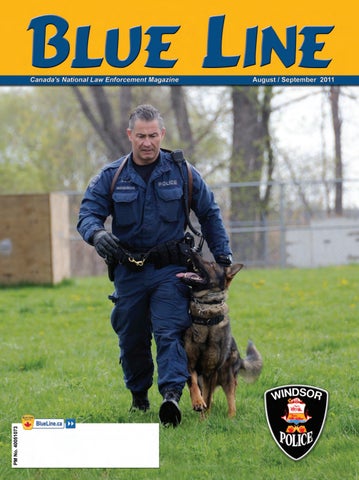
Case Law 48 Statutorily compelled statements can’t establish reasonable grounds 49 Odour plus cash provides basis for arrest Cover Photo Bob Wilson: Windsor Police Constable Marty Kerekes and Service Dog Rando go on a tracking expedition.
BLUE LINE MAGAZINE
50
3
Reasonable suspicion requires objective facts
AUGUST / SEPTEMBER 2011
AUGUST / SEPTEMBER 2011
4
BLUE LINE MAGAZINE
Blue Line
PUBLISHER’S COMMENTARY by Morley Lymburner
Magazine Inc. PUBLISHER Morley S. Lymburner - publisher@blueline.ca GENERAL MANAGER Mary K. Lymburner - mary@blueline.ca SENIOR EDITOR Mark Reesor - editor@blueline.ca CREATIVE DIRECTOR E. Jolene Lymburner - jolene@blueline.ca CONTRIBUTING WRITERS Mike Novakowski Mark Giles Robert Lunney James Clark Dorothy Cotton Dave Brown Tom Rataj AFFILIATIONS International Association of Law Enforcement Planners Canadian Advertising Rates Data International Police Association The Canadian Press Newswire Access Copyright SUBSCRIPTIONS $30 per year; $50 for 2yrs; US & Foreign: $100 ADVERTISING 888-640-3048 advertising@blueline.ca
www.blueline.ca 12A-4981 Hwy7 East, Ste 254, Markham, ON L3R 1N1 Canada P: 905 640 3048 F: 905 640 7547 blueline@blueline.ca
PRINTED IN CANADA ISSN# 08478538 Blue Line Magazine was established in 1988 as an independent publication to inform, entertain, connect and educate those involved in the law enforcement profession. With no direct control from an enforcement agency, its opinions do not necessarily reflect those of any government or law enforcement agency. The authors, advisors, and publisher accept no liability whatsoever for any injuries to person(s) or property resulting from application of adoption of anything presented in this magazine. Readers are cautioned and advised that articles presented herein are edited and supplied for your personal awerness and should not be used for further actions until appropriate guidance is received from a supervisor, Crown Attorney or other persons in authority. All material submitted for publication becomes property of Blue Line Magazine Inc. unless arrangements have been made with the publisher prior to publishing. © 2011 All articles are protected by copyright. No part of this publication may be repoduced or transmitted in any form or means, electronic or mechanical, (including photocopying and recording or by any information storage or retrieval system), without prior permission. Permission to reprint may be obtained in advance from Access Copyright 1-800-893-5777.
BLUE LINE MAGAZINE
After actions are worth the review The news surrounding the Toronto police G-20 “After-Action Review” release prompted me to write my own, even if it is 23 years late. I was involved in only one “G” event, known in those pre-inflation days as the G7 Summit, in 1988. Since the number has increased three times since then, you can imagine today there may be three times the trouble. My most memorable event occurred while controlling traffic downtown at the corner of York, University and Front Streets. As an experienced traffic officer I was placed there as a “master controller” of the intersection. Two divisional officers were assigned to assist in ensuring the orderly flow of traffic and giving convoys or entourages of IPPs (Internationally Protected Persons) the right of way. Located west of the Royal York Hotel, with hundreds of security personnel inside a caged off street, I didn’t expect many challenges. My first indication of “issues” was when I approached my two assistants. I suggested dividing up responsibilities but they quickly made it clear that I was the traffic officer and they would be out of their scout car if I needed help. I accepted this as code for “you’re on your own pal. We’re just here for the coffee and the overtime cheque.” I assumed a position to the east of the intersection, keeping watch on east bound traffic and studying the area for future reference (you can check it out on Google maps). My two dog-faced compatriots watched from their car between sips of coffee. I was notified to take my traffic point as Margaret Thatcher’s British entourage was leaving the hotel to go west. I stopped all east bound lanes of traffic and waved at my two aids to help. Of course we all know there is no signal that won’t be misinterpreted; my wave prompted the stopped traffic to move toward me. My two compatriots just chuckled at the traffic cop with the confusing hand signals and I quickly understood... I was on my own. I waved “Maggy” and her crew to move out and instantly realized there was a “flying squad” of four motorcycle officers with the Japanese Prime Minister’s four limousines coming north. I directed the point escort to stop but his hand signal was an emphatic “no,” as they were supposed to have right of way. I signaled to the officer driving the front limousine for the British entourage to stop but the driver emphatically waved me off, because they had right of way. As spectacular headlines danced through my head I gestured once more for both to stop, along with a loud blast of my whistle. The only reactions were shaking heads. My compatriots scrambled 5
out of their car but had no idea how to help. I finally took one last look at both moving groups and, with great emphasis, dropped the whistle from my mouth and folded my arms across my chest. This signal appeared to work. As the limousine pulled up to my left and the motorcycle leader pulled up to my front, we all had to smile. “Are we all on the same page now?” I asked. Both drivers bowed their heads to me as I blew two short blasts to let the Brits go west. My two wide-eyed divisional officers asked what happened. “Just another day on a traffic point,” I smiled. The testament we can write, which only the passage of time affords us, is the best teacher. The more time the stronger the testament. The Toronto Police Service (TPS) has wisely taken advantage of this past year to ensure a proper study of the actions and events of the 2010 G20. The report is a superb text with lessons to be shared for everyone. Between the covers of this 70 page document I found remarks highlighting all that was right and a few things that went wrong. One gets the feeling the authors were determined to glean whatever knowledge they could from this remarkably unique event. A total of 1,118 people were arrested during the summit; 39 reported being injured during their arrest and 97 police officers were hurt while carrying out their duties. No critical injuries or deaths occurred. Ten thousand officers were assigned to the G20 but there were only 286 complaints about their actions. Toronto police kept up with calls for service from the city’s other three million people and staffed other special events such as the Toronto Jazz Festival and World Cup soccer celebrations. The key criticism remains the federal government’s last-minute change of venue from the announced small-town of Huntsville to big city Toronto for the largest part of the event. It can only be viewed as the root of all negative issues. Upping the ante on Toronto with only six months notice can only be seen as trouble in the making. “We owe it to the people we are sworn to serve and protect to take a hard look at ourselves,” TPS Chief William Blair states in his forward to the report. This finished work pulls no punches and is worth studying. Go to torontopolice.on.ca/publications to download the full report.
AUGUST / SEPTEMBER 2011
&
Innovation co-operation gets results for border city police
www.spikebell.com
Effective patrol response and investigative strategies are the cornerstones of reducing and solving crime, helping to maintain Windsor as one of Canada’s safest communities. Many strategies rely on partnerships with local, national and international law enforcement agencies, enhanced by effective communication, leveraging funding sources and absolute commitment to co-operation and collaboration in pursuing safer communities. International border As a border community, Windsor recognizes and embraces the opportunities and challenges presented as North America’s busiest international gateway. The Windsor Police Service (WPS) has a citizen focused approach for local communities and is an active leader in detecting and investigating crimes without borders and other criminal activity affecting all Canadians. The co-operation and collaboration among all levels of police services on both sides of the border has never been stronger. In 2009 the WPS led an international invesAUGUST / SEPTEMBER 2011
tigation into child luring as an Internet Child Exploitation initiative (ICE). Tremendous co-ordination and planning among local, state (Virginia) and national police services during the investigative stage led to a Windsor man being sentenced to 110 years in the US for luring a minor via the Internet and crossing international and state boundaries to commit a felony. WPS officers helped initiate an international PWEU/ATF (Provincial Weapons Enforcement Unit/Alcohol Tobacco Firearms) undercover investigation (Project Singer) of US firearms being exchanged for Canadian MDMA (ecstasy). Undercover officers from Canada (TPS) and the US worked side by side over many months on both sides of the border, their efforts culminating in the arrests of six individuals and seizure of 36 handguns, including several Mac11 and Tech 9s all destined for the streets of Toronto. These successes were ensured by interagency co-operation and the support of organizational leaders in reducing jurisdictional barriers. Project Singer was chosen as a model for inter-agency co-operation and selected in 2010 to present its results in Washington before the US–Canada Cross Border Crime Forum Ministerial. Attendees – including Homeland Security Secretary Janet Napolitano, Attorney Generals Eric Holder (US) and Rob Nicholson (Canada), Public Safety Minister Vic Toews and many 6
justice and public safety leaders – were briefed on the project by ATF and WPS lead investigators. Locally, the WPS recently engaged the neighbouring police services of LaSalle and Amherstburg in a joint forces investigation into street level drug traffickers. Within months, undercover officers made numerous purchases of illicit narcotics in all three jurisdictions. Shared resources and expertise were the key elements in this collaborative approach to obtaining positive results. The investigations provide a glimpse of the expectations of a border city police service in the 21st century. The WPS has positioned itself to succeed in a complex future by securing the best technologies, embracing and leveraging partnerships (law enforcement and private), adopting best practices and committing to training and developing all employees. The turning point For the first time, in May 2006, the WPS family experienced the murder of an on duty officer. S/Cst. John Atkinson was shot and killed as he approached two youths engaged in a drug transaction. Within hours the suspects were in custody and the shooter was later convicted of first degree murder. The effect of these events and the support from the broader community left a profound and enduring impact on the men and women of the service. BLUE LINE MAGAZINE
Over the ensuing 18 months, in response to Atkinson’s murder, a massive reorganization of investigative services took place. An infusion of personnel was organized into special teams, including major crimes, analysis branch, target base, DIGS (drugs, intelligence, guns and surveillance) and special victims. Respective mandates of each unit are distinct, however they share intelligence, expertise and human resources based on need. A clear link was identified between illicit drugs, gangs and firearms as causal factors for violent crime. Repeat offenders, serial crimes, drugs and firearms became the focus of proactive investigations based on the intelligence-led policing model. Patrol response renewed its focus on strategic community based partnerships and targeted enforcement with the goal of problem solving to reduce crime and calls for service. The results have been dramatic. Crime reduced Overall, total Criminal Code offences in Windsor have dropped 27 per cent since the 2007 investigative service reorganization. There were no homicides in 2010, despite a 50 year average of almost five a year. Motor vehicle thefts and break and enters are down 48 per cent and 35 per cent respectively since 2006. Enforcement of OIC release, court imposed bail conditions and other criminal offences have increased over the same five-year period by more than 10 per cent. Effective patrol response, targeted enforcement and problem solving initiatives have also netted great results. There were only two fatal collisions in the city last year, down dramatically from the 10-year BLUE LINE MAGAZINE
average of 6.2/year. Overall motor vehicle collisions per 1,000 population have fallen 21 per cent in the past five years and calls for service are down 14 per cent, despite a marginal increase in total population and a slow economy. New technologies The WPS records management system was enhanced in 2009 with the Versaterm Data Mart (VDM) software module. Crime information is now updated every 10 minutes with newly aggregated data, allowing officers to isolate information and statistics and identify trends and modus operandi. By leveraging the VDM success the WPS has created an application to integrate with an online mapping tool designed by Crime Reports. This allows the service to publish and aggregate crime data into maps and e-mail crime alerts and analytics to law enforcement and the general public. An electronic ticketing project was launched in April, 2010. Developed with the assistance of the London Police Service and in partnership with court personnel for compliance and accountability, it improves efficiencies and reduces officer time requirements. The WPS implemented new fingerprint technology (Canadian Criminal Real Time Identification Services), which uses “LiveScan”, capable of transmitting prints directly to the RCMP. This greatly improves efficiencies by reducing wait times for criminal records checks, despite a 25 per cent increase in requests over the past year. The WPS continues to advance toward full electronic disclosure of all criminal court files. This massive project is contingent on co-operation and collaboration with the Ministry of the Attorney General and will 7
address quality control issues and reduce inefficiencies associated with hard files. Community responsiveness The WPS endeavors to be a professional, effective and accountable organization that upholds the human rights and dignity of all people, in accordance with the Ontario Human Rights Code. It is committed to playing its part in making Windsor a community where everyone lives, works and visits in a safe, comfortable and inclusive environment. As evidence, the service, Windsor Police Services Board, Ontario Human Rights Commission and Ontario Police College agreed on a Human Rights Project Charter (HRPC) in Feb. 2010 modeled after the Toronto Police HRPC, which concluded in May 2011. The project’s mission is to support the service and board in their ongoing initiatives aimed at identifying, eliminating and preventing any possible discrimination in employment practices and service delivery to Windsor’s diverse community. This project will include such areas of concern as recruitment, selection and promotion, accommodation, accountability, training and public liaison. The WPS actively participates in and remains committed to many charitable and community programs, providing resources, expertise and volunteerism. The annual Troy Klyn Memorial Law Enforcement Torch Run has been held for more than 25 years, contributing more than $1 million to Ontario Special Olympic programs. Officers also raise funds and organize Camp Brombal, which gives grade six students identified from the VIP Program a AUGUST / SEPTEMBER 2011
week-long camp experience. These students would not normally have an opportunity to attend summer camp. Partnering for effective police facilities The WPS shares all four of its facilities with community partners and has fully embraced a unique integrated partnership model to serve the community. The organization’s downtown headquarters, a full service facility incorporating a provincial courthouse, was very carefully designed to functionally integrate the many complex workings of both a contemporary law enforcement operation and public court facility. The Major F. A. Tilston VC Armoury
AUGUST / SEPTEMBER 2011
and Police Training Centre, on the city’s western periphery, is a first-of-its-kind in Canada partnership with the Department of National Defence (DND). Opened in June 2004, it houses the local military armoury and a comprehensive training facility for both the WPS and DND. The Sandwich Community Police Station, located in the historic “Olde Sandwich Town” district of the city, houses the community services unit and includes a satellite office at the Children’s Safety Village of Windsor and Essex County. It is shared with the General Brock Public Elementary School, Sandwich branch of the Windsor Public Library and a child care facility. The East End Community Patrol station,
8
built in 1979 on the east side of the city, is the organization’s oldest facility. It is an innovative partnership with the private sector to provide comprehensive service delivery for those involved in vehicle collisions. Identifying and engaging in strategic partnerships has been a key driver for operational and administrative success within the WPS for many years. As the uncertainties of the 21st century unfold, new and renewed partnerships will most certainly be the cornerstone of a co-ordinated Windsor police response. Sergeant Brett Corey is the Windsor Police Media Relations Officer. He may be reached by phone to 519-2556700 or email to bcorey@police.windsor.on.ca
BLUE LINE MAGAZINE
BLUE LINE MAGAZINE
9
AUGUST / SEPTEMBER 2011
Blue Line advertisers at the CACP Accident Support Services International Facilitating collision reporting, at no cost to police or taxpayers. Reallocate manpower and operating cost savings. Microsoft award winning Collision Reporting and Occurrence Management Systems (CROMS) electronically captures real-time collision details to share with stakeholders. Analytics portal allows ad-hoc queries from all reported data fields and mobile CROMS for in-car reporting! American Military University AMU has attracted hundreds of Canadian students seeking online programs that are flexible, affordable, current and relevant, with more than 70 degree programs uniquely tailored to meet the needs of today: intelligence studies, criminal justice, emergency and disaster management. American Military University is a good choice for Canadians. Blue Line Magazine Blue Line Magazine, an independent national law enforcement publication, reaches the entire spectrum of Canadian law enforcement. Blue Line News Week, an electronic law enforcement news digest, is emailed to the executive level weekly. Blue Line Trade Show and Blue Line OnLine provide discussion forums, training courses and exhibitions. Canadian Police Knowledge Network (CPKN) The Canadian Police Knowledge Network is Canada’s leading not-for-profit provider of e-learning for the police and public security sectors. CPKN works in close collaboration with the policing community to identify and develop course ware specifically designed to meet the priority training needs of front-line personnel. Colt Canada Colt Canada is Canada’s military arsenal and also supplies several NATO countries. Colt Canada now offers Canadian built MILSPEC equipment directly to law enforcement. Products include sniper systems, carbines, pistols grenade launchers, storage, spares and training. Colt Canada’s catalogue can be found on the web site. AUGUST / SEPTEMBER 2011
Commissionaires Commissionaires is a leading national provider of advanced security services, including bylaw enforcement and non-core policing. Municipal and federal police departments trust Commissionaires to provide services such as parking, bylaw, administrative and jail custodial services to help communities put more police back on the front line. D&R Electronics D&R Electronics is a design and manufacturer of emergency light, siren and mounting solutions since 1976 and operates from our 3600 sq ft facility in Bolton, Ontario. We specialize in automotive, industrial equipment products to provide our customers with a safe and unique line of products for their vehicle requirements. DAVTECH Analytical Services (Canada) Inc DAVTECH Analytical Services provides product solutions for law enforcement and public safety. With locations across Canada, we offer equipment, parts and service for: speed management devices (radar, lidar, RDD, traffic calming/ analyzing devices, alcohol breath testing instruments, protective cases, flashlights and remote lighting units, forensic products and more. Ford Motor Company of Canada Ford is a leading OEM manufacturer of motor vehicles including police, special service and fleet vehicles. Ford is making strides in technology, setting records in quality, and continuing to find new ways to become greener – all while remaining a leader in safety. Integral Tactical Integral Tactical is a designer and manufacturer of our own range of police tactical outerwear and insulated products which we sell direct to tactical and government customers. We specialize in small production runs and “just in time” manufacturing in our own factory in Calgary. We have been in business since 1986 supplying our loyal customers with functional products that help them do their jobs better.
10
Intergraph Canada Intergraph provides the latest software technologies to agencies that protect one in 12 people in the world. Our reliable, integrated applications transform vast amounts of data into intelligent information and promote interoperability to enable multi-agency and multi-jurisdictional co-ordination. Count on us when seconds count. Maxxam Maxxam is the market leader in analytical services and solutions to the energy, environmental, food and DNA sectors. As the leading private forensic lab in Canada, Maxxam helps police agencies with timely, cost effective and legally-defensible DNA analysis. Maxxam’s scientific experts combine efficiency and customer service with rigorous science and uncompromising quality management. Mr. Pin Man Inc. Mr. Pin Man Inc. specializes in stock and custom lapel pins and metal products, including key chains, dog tags, belt buckles, badges, golf products and water bottles. Plus our extensive line of stock products include law enforcement, RCMP/GRC licensed products, crime stoppers, victim services plus many more. Priority Dispatch Corp. Ask the right questions. Send the right information. We provide comprehensive, integrated solutions for police, fire, and medical emergency dispatching. The National Academies of Emergency Dispatch® Priority Dispatch System® protocols are at the core of our internationally recognized ProQA® Paramount dispatch software and companion AQUA® Evolution quality improvement software. Raybestos Brake Products Raybestos Brake & Chassis is a global manufacturer of vehicle braking systems and steering components. With leading-edge research and development, global resources, and state-of-the-art manufacturing, Raybestos developed the first endorsed Police Brake System engineered solely for patrol and pursuit vehicle operations, creating a new standard of safety, performance and durability. BLUE LINE MAGAZINE
R Nicholls Distributors Inc R. Nicholls is Canada’s largest distributor of specialized equipment to public law enforcement, private security, and national security agencies in Canada. It is also one of the country’s largest manufacturers of uniforms and clothing items. R. Nicholls has been in business for over 30 years and today employs approximately 200 talented individuals across the country. It is Canada’s only truly bilingual and cross-country distributor in its field. Savage Range Systems Savage Range Systems offers total range solutions for the finest, safest, cleanest, shooting ranges, bullet traps, targetry, and 360-degree shoothouses. Bullet traps utilizing Wet Snail® technology, combined with low angle ramps and 360-degree deceleration chambers safely capture bullets. Specializing in custom systems. Whelen Canada Whelen Engineering is proud to design, manufacture and assemble all of our products in North America. We produce a wide range of emergency warning lights, sirens and controllers to satisfy the needs of all our customers in the fire, EMS, police and public works community. For more information on the CACP conference visit www.cacpconference.ca
BLUE LINE MAGAZINE
11
AUGUST / SEPTEMBER 2011
Preventing crime 140 characters at a time
by Simon Martin Cst. Scott Mills feels most at home sitting behind his laptop. At a small café on College Street, he opens up his twitter account and shows his latest tweet. “Coming up on #Toronto Police livestream @OfficerVella live from @chinRadioCanada – listen here: Facebook.com/TorontoPolice.” Although it may look like a foreign language, it’s all about police reaching out to the community for Mills. “Having citizens that are engaged is the best thing ever for police work,” he said. Mills is the social media czar at the Toronto Police Service. He joined corporate communications two months before the G20 to help the force use social media platforms like Twitter, Facebook and YouTube. His passion for the importance of social media in law enforcement has helped lead the TPS to increase its presence on all social media platforms. The TPS was set to unveil a comprehensive social media policy July 27. AUGUST / SEPTEMBER 2011
“Toronto is definitely the leader in taking the initiative to develop a social media strategy,” said Lauri Stevens, director of LAwS Communications and an expert in helping police forces across North America integrate social media into their overall strategy. She has done work for Ottawa, Calgary and Vancouver police but said Toronto is the gold standard for integrating social media in Canada. “They are way out there ahead of the pack.” Stevens spent eight weeks in Toronto this spring helping to develop a social media strategy. She said that strategy will have every division on Facebook and close to 200 officers on twitter officially representing the police. “Social media tools are so powerful, they have huge implications on improving policing,” she said. The indelible images of smashed glass and smouldering police cruisers in Vancouver were only a reminder of the importance social media plays in 21st century law-enforcement and all too familiar to Mills. “It was a similar type of 12
event and situation to the G20,” he said. “Definitely another major event that demonstrated the need for social media.” Mills recalled being inundated with pictures and videos sent to him by citizens following the G20. “It’s overwhelming how much information came in,” he said. The information was very helpful to police, he said. It is becoming more difficult to ignore the need for social media in modern investigating. Mills said many in the industry believe you cannot manage major events anymore as law enforcement without using social media. Stevens said such a plan is a necessity in this day and age. “Law enforcement likes to strategize tactically for an event like the Stanley Cup but I think they need to include social media in that,” she said. “The problem is when you tell the police chief he needs to include Twitter in his event management strategy you get a funny look.” Vancouver could represent a sea-change in how law enforcement looks at the role of social BLUE LINE MAGAZINE
media in policing. Stevens said Vancouver did a pretty good job at using social media tools on the fly, getting citizens to submit evidence privately. Social media has exploded in popularity over the past five years and Mills said it is important for police to take notice. TPS is working hard to figure how best to use the new tools but it’s tough to implement any sort of coherent strategy organization wide. “We are working diligently behind the scenes to develop a social media policy that has a process to it,” he said. “It’s so valuable building relationships with people in the community because we want the community to trust the police.” The wild, wild, west days of social media are ending as users understand the power and scope of the communication platforms at their fingertips. “We are creating some rules for it, procedures of what you can and cannot do,” he said. Mills was a uniform patrol officer from 1990 to 2002 with Peel Regional Police. His interest in the power of technology peaked in 2001 after participating in the Canadian Musicians for Liberty concert to raise money for the victims of September 11. The 181 hour concert holds the Guinness World Record for longest live event streamed over the Internet. Mills said it gave him a different understanding of the power of technology. He joined the TPS in 2002 as a community youth officer working in high schools and authored a project targeted at youth violence
BLUE LINE MAGAZINE
prevention (Project Internet Truancy). The program posted uniform bicycle patrol in places where students frequently skipped school. The officers would attempt to return students to class and asked for their e-mail, address and web site, then tried to find postings about bad situations, alerting the necessary parties to help prevent harm from occurring. Mills began working as a school officer for the Toronto Crime Stoppers program in 2006, which began posting YouTube videos, trying to educate students virally. It also created a leave a tip tab that can be added to Facebook pages. The results were impressive. “Tips went from 300 a month in Toronto to over 1,000,” said Mills. YouTube has become a great way to get information to the public, said Mills. He mentioned the case of Mariam Makhniashvili, a 17-year-old girl who went missing from Forest Hill. Police posted YouTube press conferences to keep the public engaged in the search. Videos were even translated to Georgian by a member of the public to reach as many people as possible. “If you get public man-power you can do amazing things,” said Mills. So far Mills said the best success story of online crime prevention was when a citizen alerted the police that someone was threatening a school shooting on Facebook. TPS was able to get on top of the situation before anything happened. Mills and TPS are excited about the future possibilities offered by social media. “The community wants police preventing crime
13
and they want that done economically,” he explained. “You don’t need a lot of bells and whistles to have a social media strategy and you can reach so many people.” Stevens said one of the greatest things social media offers police is an opportunity to reach out to the public. “Often you don’t see public support for the police,” she said. “The profession is partly to be blamed because they don’t get the word out about what they do. I think they should horde information less and be more forthcoming with what they know.” TPS is trying to implement this strategy by getting officers on Twitter and divisions on Facebook. “We want officers to celebrate their daily life in social media to people we never have reached,” said Mills. The TPS plan to use social media to communicate to specific demographics within the city, said Stevens. Often times important issues need to be discussed at ground level rather than in a press conference, she said. Back at the café, Mills looked-up from his laptop and locked eyes with a patron sitting at the table adjacent to him. “Do you have Twitter?,” he asked. “Yes,” the patron responded. “You should follow me. I’m with the Toronto Police,” he said, handing the man his card. This is 21st century law enforcement; engaging citizens to prevent crime, 140 characters at a time. Simon Martin is an assignment writer with Blue Line Magazine. He can be reached at simon@blueline.ca .
AUGUST / SEPTEMBER 2011
Social media primer for investigators
by Lane Wheeler and Mike Keleher Headlines repeatedly cite the dangers of victims posting sensitive information online, yet the amount posted daily which can be misused by criminals is nothing short of staggering. It is imperative for investigators to understand the information routinely posted on social media web sites, the technology involved and common posting practices. Investigators are in the people business and always have been. A pen and notebook are considered essential to anyone gathering information. With the advancements in personal computing, the Internet, social media and smart phones are now de facto just as critical in documenting personal information about suspects, witnesses, family or friends. Computers are used in conjunction with every imaginable crime. As part of this growing phenomenon, investigators should be familiar with the popularity of social networking, its uses and abuses and understand the actual user/subscriber figures, which are unprecedented in the history of the world. According to 2009 statistics from the FBI Uniform Crime Report, young adults ages 18-29 comprised 44 per cent of all arrests and adults 30 and older comprised 42 per cent of arrests. As of 2009, 72 per cent of 18-29 year olds have at least one social networking profile and 47 per cent have a public profile available for viewing by anyone on the Internet. The study, published by Cox Communications, noted users willingly provided personal information, including their real age, photos, current city, videos and pictures of themselves and friends, cell phone numbers and e-mail addresses. Forty seven per cent of online adults ages 30 and older have an account on at least one social networking site and 52 per cent have two or more different profiles. While these two age groups possess nearly equal arrest rates, young adults are much more active in social networking and are more likely to have elaborate on-line contacts and viewable personal information. Cyber based inquiries can gather and display extensive personal information in seconds. Google searches were originally seen to be a vastly improved way of finding information on individuals. Building upon the Google concept, searches have been upgraded and expanded by sites like Spokeo. com, known as social network aggregators, which scour data from many online as well as offline sources and report back to the user. They dig much deeper into information which AUGUST / SEPTEMBER 2011
is not always viewable via a standard search. Some of the Spokeo.com information is free but it also offers affordable subscription rates like $4.95 for a three month subscription. Entering a name can result in routine reporting of name, age, address, e-mail addresses, gender, photos, videos, hobbies, economic health, estimated wealth, review of 86 social media sites, blog posts, family household make up, property details, maps, estimated value of property, politics, religion, education and occupation, family tree and neighbourhood information. All of the information is publicly available but the aggregator pulls from sources not routinely viewed or thought of when research is conducted on potential suspects. In addition to Internet based search engines, the emerging platforms of choice for researchers are social networking web sites, where users create a profile and upload content ranging from pictures, video, maps and live check ins. Some of the most popular include Facebook, Twitter, Foursquare and Hi5. They often encourage constant interaction, so other people can update and comment on a person’s profile in near real time. This information can range from posting a link to an interesting article, music, photographs, videos and comments on the most important or banal moments of a person’s day-to-day life. The ease with which people can expose their private lives often results in over-sharing of private information, leaving users vulnerable to exploitation or attack. Cyberstalking victim and Facebook Largely anonymous cyberstalkers can get personal information from subscribers themselves, who voluntarily display personal information or invite strangers into protected information. A study by Nicholas Kendrick and Shana Rakowsky at Georgetown University in 2009 examined how readily users would expose their profiles to unknown people. They created two Facebook profiles with generic names and no pictures. Thirty four per cent of users accepted their unsolicited request to be “friends” and all these new profiles allowed access to personal identity information. As of May 2011, Facebook lists over 500 million users. A false sense of security exists with users who do not take measures to protect their information on the site and many 14
are unaware how many people can view data which they thought was protected. Since these web sites are openly accessible with little or no expectation of privacy, investigators or anyone else can easily view the displayed data. Some sites require the viewer to have an account or profile before allowing access, however sham profiles can be easily created. Most web sites require a valid e-mail address to register, however free unverified e-mail accounts can be set up in minutes using nebulous identifying information. Once the investigator creates an account, he or she can enter whatever information they want in their profile and attempt to interact with other social media users. Those who do have privacy blocks in place may still accept “friend” requests from complete strangers to build their social status. Keeping in mind the results of Rakowsky’s study, investigators could create an attractive profile and directly attempt to add a subject as a friend to access to information not shared with the entire Internet audience. Once allowed as a “trusted” or “accepted” friend they can see all of the user’s profile data, photos and connections to other listed friends. Indirect approaches can work where users only accept invitations from “trustworthy” or known individuals. This may begin by linking to friends of the target to establish “trustworthiness” – having friends in common and thus safer to interact with. Cybercasing is the process of finding Global Positioning System (GPS) type geotagged or location based information about a subject from their online posts. It is possible, with very little software or experience, to track a subject’s location or past locations and activities. It is a growing trend made possible by using web sites such as Twitter and Foursquare, which can post a user’s location, and Picasa and Flickr, image-hosting sites which organize pictures by location. Geotagging, the hallmark of cybercasing, is the routine process of embedding digital photos with time and location information. A simple digital cell phone photo, with geotagging enabled, can contain the time and GPS location where the photo was taken. Geotags are automatically embedded with most smartphone pictures. Camera phones come with geotagging enabled; users aware of this function must navigate through several layers of menus to manually disable it and prevent geotagging future pictures. Just as humans have DNA, digital pictures have EXIF (Exchangeable Image File BLUE LINE MAGAZINE
BLUE LINE MAGAZINE
15
AUGUST / SEPTEMBER 2011
Format), the metadata located inside the properties of a picture, which contain four main types of data: General, EXIF, GPS and TIFF. General data embedded in EXIF includes colour or gray scale ratings, pixel size, camera properties, focal length and shutter speed. If geotagging is enabled, the GPS data will list the latitude and longitude of where the photo was taken, accurate to within approximately 15 feet. TIFF data shows exact date and time when the picture was taken and make and model of the camera. This information can obviously pinpoint where a person was when the picture was taken or, by the subject matter, perhaps where they live, work or were at a certain time. EXIF data can be viewed through free downloadable EXIF viewer plug-ins or applications on various Internet browsers, including “Exif Viewer” (Google Chrome), “FxIF” (Firefox) and “Opanda iExif” (Internet Explorer). Installed within minutes, users can simply right click on an image, select “View EXIF data,” and see any information included on the photo. Additional clicks can almost instantly bring up additional cyber based resources like Google Maps and graphically show the location in a variety of ways, including 360 degree panoramic street views taken from ground level in that area. This was posted on Twitter by a celebrity, apparently unaware of the risk. News stories documented it and how viewers could quickly establish the exact location where the celebrity lived and extrapolate additional data about their life. (Kate Murphy, Web photos that reveal secrets, like where you live, New York Times, 11 August 2010) Privacy settings rarely taken seriously Geotagging creates two main threats to user privacy. The first and most important is many users are simply unaware about the EXIF/TIFF data in their cameras and don’t realize they are exposing their information or, if they do know about it, don’t bother to disable the feature before posting on-line. On popular social networking web sites the default privacy settings may also leave users viewable and vulnerable. Facebook’s default settings leave every aspect of a user’s profile except photos and wall posts as publicly viewable. Twitter accounts are public by default. Users need to manually adjust the privacy settings to change their profile to more restrictive privacy; actions which few younger subscribers seem to understand or implement. The second threat is the sheer amount of data available to stalkers online. The SANS Institute conducted a study with the Internet Storm Center blog analyzing pictures from TwitPic, a web site allowing users to post pictures to Twitter. The study analyzed 15,291 images at random – more than 10,000 contained EXIF tags, 5,297 contained camera information and 389 had GPS tags. Although AUGUST / SEPTEMBER 2011
2.5 per cent of the sample seems small, the amount of photos uploaded online each day is staggering and provide more than sufficient amounts of data for both stalking and other privacy attacks. Given the high volume of data available online, users are routinely reporting who they are, where they go and who else may have been involved, all in a matter of hours. Resources range from Foursquare, where users post where they are in real time, to Google Maps, which can corroborate potential addresses identified during the cybercasing process. These sites have made cybercasing a nearly effortless act. Vulnerabilities in popular social networking web sites Facebook: The average user has 130 friends and posts 90 pieces of content (status updates, photos, videos, etc.) per month, with over 30 billion pieces of content shared site-wide each month. Users accessing Facebook on their mobile device are twice as active as other users. When setting up a new account, users are asked to fill in sensitive contact information to their profile, including physical addresses, birthdays, e-mail accounts and phone numbers. Under the default privacy settings, this information is publicly displayed; around half of young adults will not change them when setting up their profile and entering contact information. Facebook Places, an online check-in system, registers where users are physically located. Most locations, landmarks and businesses have public web based pages and users post by “checking in.” Facebook determines their location either by the IP address of their desktop computer or the GPS location broadcast from their smartphone and posts it on their wall (personal site) along with a link to the location’s public page. The public page includes the address of the location, a map, directions of how to get here and when other associated friends checked into the location. This is also posted on the news feeds of all of the user’s friends’ pages. Again, under the default privacy settings, a user’s wall is public; anyone can see their places updates. Why would anyone use this application? The answer may lie within pop psychology 16
related to status and self importance, but it there is another motivator. Money. Facebook Places business sites offer instant discounts or rewards for repeated check-ins, encouraging users to do so as frequently as possible. The unintended consequence is the documented patterns of behaviour, times and typical routes taken are also captured and displayed. Despite the vulnerabilities, Facebook’s default privacy settings have more protection for uploaded photos than most other social networks. Its applications strip EXIF data from posted photos so it is impossible to get geo-tagged information from them. Twitter: Twitter had nearly two million accounts during its rise in popularity in 2008. As of October 2010, it had more than 160 million accounts, with almost 500,000 new ones created daily. Its main purpose is to post personal typed updates (“tweets”) of up to 140 characters via either computer or mobile device. Twitter profiles are completely public by default, so anyone can see tweets, even if they do not have an account. The user can manually change their privacy settings so only those who send a request and are accepted can see them. Unless disabled, tweets use either a computer’s IP address or a smartphone’s GPS to determine what neighbourhood the user is tweeting from. This location information, while vague compared to the co-ordinates found in geotagged photos, is included along with a map of the area. The most alarming Twitter vulnerability lies with pictures. Users can post them by uploading pictures to external sites such as www.twitpic.com and www.yfrog.com, including the URL in their tweet. EXIF data is not stripped. Many tweets relate what a user is doing throughout the day and digital pictures are often taken from various places a user regularly visits. This can expose commuting patterns and the locations of homes and workplaces along with dates and times they frequent that location. The number of photos containing GPS tags ranges from 1.3 per cent to 2.5 per cent of pictures posted at any given time. The explosion of smart phones sales will only increase that number. Foursquare: Foursquare, which boasts over six million users, is expanding rapidly, growing 3,400 per cent last year alone. Unlike Facebook’s elaborate multimedia displays, Foursquare’s sole function is to allow users to check in to businesses and other locations through their smartphones. It encourages this by allowing companies to provide financial incentives and reward loyal customers. Those who check in the most over a 60-day period are made “mayor” of the location and receive discounts. This practice promotes constant check ins, which creates detailed timelines of where a user is and what places they frequent. Viewers do not need to have Foursquare accounts to track a person’s whereabouts. Combining technology, users can link their BLUE LINE MAGAZINE
account to their Twitter feed (publicly viewable), thus automatically sending a tweet which identifies the user’s location, address and link to the original Foursquare post. If a user’s Twitter profile is public, a viewer will be able to see where the account holder checks in, regardless of their privacy settings on Foursquare. This weakness exists across all major social networking sites, which allow users to “link” their profiles together, such as posting Tweets on a user’s Facebook wall. Imagine the treasure trove of information an investigator could gain from suspects who willingly post and record their movements and life history during the time frame they were committing crimes. Then imagine this same information in the hands of those seeking to do harm to others. Relevance for investigators How valuable would it be for a criminal to provide police with a timeline of their activities on a given day, maps of where they travelled, their thoughts and feelings about the day’s events, names and photos of co-subjects they associated with and maps – all without an interrogation, surveillance or search warrants? Social networking sites have rapidly evolved into transparent windows to view user’s personal data and photos. Along with global access, these public web sites are being freely and willingly updated and displayed by the users to include GPS data. Close monitoring can show who a subject interacts with and how often, their habits, hobbies and routine patterns. Most importantly, there is no expectation of privacy with publicly posted information and it is easily accessible even if the post is sent from abroad. The Internet has rapidly evolved beyond anything science fiction could have conceived only a few short years ago. Social media has emerged as a new preferred method to “keep in touch.” Nearly three quarters of young adults have profiles on social networking web sites. A teen or young adults tweet or post on someone’s Facebook wall holds just as much weight as
BLUE LINE MAGAZINE
communicating the same information in person. Texting minutes have become a huge part of a young person data plans in recent years, replacing a lot of calling minutes. Social media continues this trend to make limited but frequent contact with peer or friend groups with little personal effort. This generation of computer and cell phone users has demonstrated they are extremely comfortable with cyber based postings and their continued use is not only guaranteed but ever expanding. It is imperative investigators look at social media and on-line posts as investigative tools or they risk missing a substantial percentage of the widely accepted basic communication of people in the 18-19 year old age group. This type of communication is so socially acceptable, perpetrators freely post incriminat-
17
ing pictures, videos and personal information without seemingly realizing the implications. Searching for personal information has also become a common business practice, with corporations reviewing profiles of potential applicants to find evidence of their character. Who could have anticipated that one day criminals would share their innermost thoughts, beliefs, habits, friend’s names, photos and travel patterns, date and time stamps on publicly viewable sites? The potential sources of criminal intelligence may be limited only by an investigator’s imagination and a suspect’s desire to be on-line “friends”. Mike Keleher is a special agent with the US Naval Criminal Investigative Service.
AUGUST / SEPTEMBER 2011
Re-thinking police budgets Private forensic labs as partners in public safety by Wayne Murray, Ph.D. The current demands for police agencies to cut budgets and officers are hugely disruptive and upset many. Services across Canada face significant cuts given the financial distress faced by all levels of government since the 2008 economic crisis. As a stark illustration, Toronto City Council recently asked the country’s largest police force to consider reducing officers by a whopping 10 per cent to help the city resolve its $774 million budget shortfall. There is a popular notion that cutting budgets and officers could threaten public safety but given changes to investigative techniques, advances in science and the analytical choices now available, this concern can be mitigated. There is a clear opportunity for agencies to re-think funding allocations in a way that will help maintain the standards of public safety that are so important to us. Budgets and personnel can be allocated differently to leverage scientific advancements and work more effectively within the constrained environment. It’s an opportunity that cannot be ignored. Since the establishment of the DNA Act and the National DNA Data Bank (NDDB) in 2000, DNA analysis has become a major enhancement in administering justice and a major contributor to the safety of all Canadians. Using forensic DNA analysis in evidence is now one of the most powerful tools available to law enforcement agencies. According to the NDDB bi-monthly statistics report (June 6, 2011), searches of the CSI (Crime Scene Index) against the COI (Convicted Offender Index) have produced more than 19,158 offender hits. Investigations assisted by NDDB searches included 1,353 homicides, 2,439 sexual assaults, 444 attempted murders, 2,198 armed robberies and over 8,600 break & enter with intent. In addition, approximately 27 per cent of suspects whose DNA profiles are checked against the
CSI are exonerated immediately, thus focusing an investigation on other suspects. Police agencies primarily rely on their respective provincial/regional public laboratories to perform DNA laboratory testing, which face capacity constraints as a result of the same tight budgetary environment. This is further exasperated by the rapid growth and sheer volume of DNA testing police agencies require. While traditional crime rates are falling, the mandate is expanding for many policing agencies – special units are being called on to fight terrorism, identity theft, white-collar crime and child pornography, to name just a few. Recent changes to the criminal code (Bills C-13 and C-18) added 176 new offences to the designated categories for collecting COI and CSI samples. It is little wonder that public forensic labs have to prioritize cases and that testing turn-around times are simply not able to meet the growing demand. Long turn-around times for DNA testing add exponential costs to police agencies as cases remain open and active. There are times when police chiefs know a DNA test conducted in a private, accredited, approved forensic lab can save them a tremendous amount of money. In fact, outsourcing can save weeks of investigator time in surveil-
lance and interviewing suspects who could be excluded or confirmed quickly through timely DNA results. Police agencies and private forensic labs can strengthen their ad hoc outsourcing relationships as a matter of practical necessity while maintaining or even enhancing public safety. Moreover, this can be achieved in a way that reduces the cost to taxpayers. “During a recent major crime investigation, VPD was able to avoid tens of thousands of dollars of overtime and surveillance costs by utilizing the services and quick turn-around times that Maxxam offers,” says Insp. Kevin McQuiggin of the Vancouver police forensic services section. “Cast-off DNA was recovered from a suspect and a VPD member flew to Toronto overnight so that the sample could be analyzed over the weekend. A positive result from the DNA analysis (within 48 hours) allowed the suspect to be arrested weeks before he otherwise could have been. This protected the community and got a dangerous predator off the streets. The cost of the member’s airfare and Maxxam’s analytical test was far less than that of keeping a surveillance team on the suspect until other evidence would have become available.” In this constrained budget environment, there is an opportunity to become significantly more efficient by using proven resources in fundamentally different ways. Private forensic labs, working along side the public laboratory services, can be part of the solution, delivering timely scientific results as partners in public safety. Dr. Wayne Murray is director of Forensic and DNA services at Maxxam, co-author of “DNA Handbook” and previously was head of the DNA unit of the Centre of Forensic Sciences in Toronto. For more information, contact him at: dnainfo@maxxam.ca. Founded more than 40 years ago, Maxxam offers analytical services and solutions to the energy, environmental, food and DNA industries. It has 2,000 employees and a national network of laboratories which process more than 2,000,000 samples, generating more than 35,000,000 results annually.
AUGUST / SEPTEMBER 2011
18
BLUE LINE MAGAZINE
Edmonton officers win ‘best overall’ in shooting competition by Bruce Edwards On Saturday, June 4, the Edmonton Police Officer Safety Unit sponsored four members, drawn from across the Service, to compete in the Alberta Inter-Service Small Arms Shooting Competition. This annual competition pits shooters from police, corrections, sheriffs and military against each other in a ‘come as you would for duty’ competition. Constables Jason Forbes, Rick Abbott, Jason Perry and Jason Mitchell braved early morning snow to compete in team and individual competitions with their service pistols, carbines, shotguns
BLUE LINE MAGAZINE
and sniper rifles at the Rocky Mountain House gun range. The team immediately highlighted themselves with a first place showing in the Team Rifle shoot, and Cst. Jason Mitchell individually placed second in the event. In the handgun event, the EPS team again took first place overall with the top two individual positions going to Cst. Rick Abbott (first) and Cst. Jason Perry (second.) Finally, the team placed second overall in the Team Combat Shotgun event. This was an especially good showing considering the EPS retired use of the shotgun over a year ago. This outstanding team of shooters was picked on short notice, but the value and
19
quality of this competition will see the EPS returning to defend our title. Selecting next year’s team will fall to the EPS Marksmanship Club who can assess the shooters through their own competitions. Congratulations to the four constables who represented Edmonton so admirably, medaling in six of the eight categories and winning Best Team Overall. Congratulations to the Calgary Police Service as well. CPS garnered a second in the shotgun and a third in the sniper competitions. Bruce Edwards is a member of the Edmonton Police Service and can be contacted by phone 780-421-2663.
AUGUST / SEPTEMBER 2011
Order of Merit
of the Police Forces
2011 Appointments His Excellency the Right Honourable David Johnston, Governor General of Canada, appointed 44 people to the Order of Merit of the Police Forces, including eight Officers and 36 Members. The Order was created in 2000, to recognize conspicuous merit and exceptional service by members and employees of the Canadian police forces whose contributions extend beyond protection of the community. Three levels of membership with post-nominal letters reflect long-term, outstanding service: Commander (C.O.M.), Officer (O.O.M.) and Member (M.O.M.). RECIPIENTS OFFICERS OF THE ORDER OF MERIT OF THE POLICE FORCES Ast. Commissioner Line Carbonneau RCMP, Westmount, QC.
MEMBERS OF THE ORDER OF MERIT OF THE POLICE FORCES
Superintendent Robert Davis RCMP, Newmarket, ON.
Director General Robert Fahlman RCMP, Ottawa, ON.
Deputy Chief Danny Aikman Cornwall Community Police Service, ON.
Chief Glenn De Caire Hamilton Police Service, ON.
Chief Robert Herman Thunder Bay Police Service, ON.
Assistant director Serge Bélisle Service de police de la Ville de Québec, QC.
Chief Henry DeLaronde Treaty Three Police Service, ON.
Dpt. Chief Constable Warren Lemcke Vancouver Police Department, BC.
Deputy Chief Gary Broste Saskatoon Police Service, SK.
Chief Frank Elsner Greater Sudbury Police Service, ON.
Chief Dale R. McFee This is a promotion within the Order. Prince Albert Police Service, SK.
Sergeant John William Burchill Winnipeg Police Service, MB
Deputy Chief Eric Girt Hamilton Police Service, ON.
Superintendent Brian Simpson RCMP, Red Deer, AB.
Ast. Commiss. J.G.P. Michel Cabana RCMP, Ottawa, ON.
Chaplain R.A. (Bob) Harper RCMP, Edmonton, AB.
Chief A. Paul Smith Charlottetown Police Services, PEI.
Staff Sergeant Jean-Marc Collin RCMP, Moncton, NB.
Superintendent Timothy Head RCMP, Ottawa,ON.
Chief Wendy Southall Niagara Regional Police Service, ON.
Deputy Chief Troy Cooper Prince Albert Police Service, SK
Sergeant Tobin Hinton Vancouver Police Department, BC
AUGUST / SEPTEMBER 2011
20
BLUE LINE MAGAZINE
Superintendent Andrew Hobbs Vancouver Police Department, BC
Deputy Chief Bernard Pannell Saskatoon Police Service, SK.
Chief Murray Rodd Peterborough Lakefield Community Police, ON.
Superintendent Jamie Jagoe RCMP, Kitchener, ON.
Staff Sergeant Stephen Patterson Saint John Police Force, NB.
Staff Sergeant Stéphane St-Jacques RCMP, Ottawa, ON.
Director Kristine Kijewski Toronto Police Service, ON.
Assistant director Marc Parent Service de police de la Ville de Montréal, QC.
Chief Joseph Tomei Orangeville Police Service, ON.
Chief Superintendent Alphonse MacNeil RCMP, Ottawa, ON.
Assistant director Mario Plante Service de police de la Ville de Montréal, QC.
Ms. Sylvie Mantha Service de police de la Ville de Gatineau, QC.
Superintendent Kathryn Martin Toronto Police Service, ON.
Ast. Commissioner Dale McGowan RCMP, Regina, SK.
Staff Superintendent Jeffrey McGuire Toronto Police Service, ON.
Chief Stephen McIntyre Rothesay Regional Police Force, NB.
Chief Superintendent Blair McKnight RCMP, Halifax, NS.
Staff Sergeant Terry McLachlan RCMP, Kelowna, BC.
For more information about the Order of Merit of the Police Forces, visit the Honours section of our website at www. gg.ca, or visit the website of the Canadian Association of Chiefs of Police at www.cacp.ca.
ORDER OF MERIT OF THE POLICE FORCES FACT SHEET The Order of Merit of the Police Forces honours a career of exceptional service or distinctive merit displayed by the men and women of Canadian police forces, and recognizes their commitment to this country. The primary focus is on exceptional merit, contributions to policing and community development. The commissioner of the Royal Canadian Mounted Police, the Principle Commander of the Order, submits recommendations for appointment to the governor general on behalf of an advisory committee. Nominations for appointment to the Order may be made by submitting the name of a member or employee of a police force to the commanding officer of that police force.
service and demonstrated leadership in duties of great responsibility over an extended period, usually at the national or international level.
Levels and post-nominals
The badge of the Order is the same as that of the Order of Military Merit: a blue-enamelled, straight-end cross (four arms, narrow at the centre, wider at the ends) with an annulus in red, surmounted by St. Edward’s Crown. The ribbon is different and consists of three equal bands of blue, gold and blue. The annulus bears the inscription MERIT.MÉRITE.CANADA.
Her Majesty Queen Elizabeth II is the Sovereign of the Order; the governor general is the chancellor and one of the commanders of the Order. The Principle Commander is the commissioner of the Royal Canadian Mounted Police. Commander – Post-nominals: C.O.M. Recognizes outstanding meritorious
Officer – Post-nominals: O.O.M. Recognizes outstanding meritorious service in duties of responsibility over an extended period, usually at the regional or provincial level. Member – Post-nominals: M.O.M. Recognizes exceptional service or performance of duty over an extended period, usually at the local or regional/ provincial level.
Insignia Description
Detective Raymond Wai-Sang Miu Toronto Police Service, ON.
Deputy Chief Robert Napier Kingston Police, ON.
Chief Superintendent Richard Noble RCMP, St. John’s, NL.
Detective Inspector Dennis J. Olinyk OPP, Kenora, ON.
BLUE LINE MAGAZINE
21
AUGUST / SEPTEMBER 2011
New national CBRN standard protects first responders by Danya Vidosa and Patty Xenos The 911 caller is frantic, screaming that everyone is collapsing. In 90 per cent of these cases, specialty teams are 20 minutes to hours away and emergency responders are the first to arrive. Is the loss of consciousness a deliberate chemical, biological, radiological or nuclear (CBRN) incident? With limited information, police, fire and emergency medical services must gear up and rush to the scene. Emergency services run through their standard operating procedures (SOPs) for CBRN incidents as they plan their response, selecting from available personal protective equipment (PPE). The SOPs were developed based on a myriad of existing sources, including Canadian and American workplace and military CBRN standards. Emergency response managers worry about providing the safest respiratory equipment, suits, gloves and boots and can only hope that they work together for maximum protection and performance. The nagging uncertainty about having a sufficient level of protection, especially in situations where the exact nature of the threat is unknown, is a constant concern. This is just one of many possible scenarios that could occur anywhere in Canada or the world. It is at times like these when certainty begets safety and there is no room for error. Access to tools such as a scientifically-researched CBRN standard provides critical information to guide decisions on procuring and using PPE. An important gap in capabilities Although Canadians face a low probability of suffering from a deliberate CBRN incident, the consequences would be disastrous and responders must be ready to deal with this worstcase scenario. We must also be cognizant of accidents or natural disasters causing the release of CBRN agents, as illustrated by the nuclear crisis in the aftermath of the earthquake that ravaged Japan in March. In order to exercise their responsibilities for workplace health and safety, managers referred to existing recognized standards to protect their employees but the development of a comprehensive Canadian national PPE standard was long overdue. “When there’s no specific reference, using relevant recognized standards is a good start,” said Ron Meyers, project manager of the Occupational Health and Safety Program at the Canadian Standards Association (CSA). “The problem is that even if managers piece together parts of different existing standards, they still don’t get a comprehensive picture of AUGUST / SEPTEMBER 2011
the PPE protection requirements needed for CBRN response, which includes respiratory, ocular and dermal protection. Previously, none of the Canadian workplace PPE standards applied to domestic CBRN events and although the United States has CBRNE PPE standards, most address individual PPE components and not whole-body protective system performance. “As well, U.S. standards may not be applicable in Canada because of the differences in our jurisdictional and regulatory environments. All in all, we found that there was a gap in information regarding PPE system selection and performance for CBRN response that first responders needed and the Z1610 Standard was developed to fill this gap.” The events of 9/11 prompted responder organizations to re-examine their CBRN capabilities and the need for a national PPE standard became a priority. As an initial step, managers sought guidance from organizations like the Royal Military College (RMC), which was recognized for its expertise in testing chemical protection suits and respiratory protection systems, and the CBRNE Research and Technology Initiative (CRTI), a federal program established in 2002 to mobilize Canada’s federal science and technology (S&T) expertise to strengthen CBRN counter-measures. The managers requested realistic, sciencebased guidance on selecting and using the appropriate level of PPE in a CBRN incident, clarity on the requirements for whole-body protection, information on integration with other equipment and intelligence on the capabilities and limitations of protective equipment. 22
The feds step in These discussions led to a four-year CRTI-funded project entitled Protecting First Responders Against Chemical and Biological Threats, managed by RMC. The project team, which included the RCMP, Health Canada, the Department of National Defence and Defence Research and Development Canada, conducted a systematic analysis of responder roles, procedures and requirements. Using scenarios, they examined the characteristics of CBRN agents and measured their effect against a variety of protective clothing and respiratory equipment. The team also developed protocols for measuring levels of protection. The final phase consisted of creating an outline to guide the development of an actual standard. The project’s findings provided an excellent foundation for a second CRTI project, which aimed to develop the first ever Canadian CBRN PPE standard, known today as CAN/CGSB/ CSA Z1610-11: Protection of first responders from chemical, biological, radiological and nuclear (CBRN) events. This project was initiated in 2006 with $550,000 in CRTI funding, bringing together dozens of subject matter experts (SMEs) various organizations. Project partners also made significant in-kind contributions. “I believe the CRTI model, which strongly encourages collaboration, ensured that all relevant stakeholders were represented in the project team and created vital linkages and partnerships that otherwise would not have existed,” said Dr. Eva Dickson from the Department of Chemistry and Chemical Engineering, RMC. “This standard would not have been possible BLUE LINE MAGAZINE
without the support of this federal program.” The CRTI project was led by Public Works and Government Services Canada’s (PWGSC) Canadian General Standards Board (CGSB), with joint leadership from the Canadian Standards Association (CSA). A technical committee consisting of first responder and government organizations and regulators, industry, academia and special interest groups was formed. “CGSB’s standards development work uses a proven, consensus-based process to achieve results,” said Patricia Wait, CGSB team leader and committee secretary. “The committee pooled their expertise to address issues related to the different types of CBRN incidents and the corresponding level of protection needed.” The Canadian Police Research Centre was also represented on the technical committee, offering opportunities for responders to share their first-hand contextual accounts of dealing with CBRN incidents and helped the S&T experts better understand how PPE is used on the front lines. The committee was chaired by Dickson, the expert who managed the 2002 project and is a recognized expert in protective chemical and biological gear design, requirements and testing. Her involvement was essential to the success of the project.
ments, which is part of the benefit of the National Standards System.” Managers of responder organizations can now rely on scientifically-validated information to ensure that their personnel wear the appropriate protective equipment. The success of the standard can be attributed to it being developed through consensus by world-class experts from diverse fields, thus ensuring that all relevant perspectives were considered. This effort is a great example of how the federal S&T community can help provide solutions by working with different Canadian sectors to identify and address public safety challenges. The standard was published in March 2011 and is available in electronic and hard copy in
both official languages. It may be purchased for $150 on CSA’s web site at: http://shop.csa. ca and searching for Z1610. CRTI and CPRC are managed by the Defence R&D Canada – Centre for Security Science, a joint endeavour between the Department of National Defence and Public Safety Canada, to strengthen, through S&T, Canada’s ability to prevent, prepare for, respond to and recover from accidents, natural disasters and criminal or terrorist acts that impact the safety and security of Canadians. Danya Vidosa is with Defence R&D Canada – Centre for Security Science. Patty Xenos is with Xen Communications.
Integrating the new standard into current practices The standard ensures that all Canadian responders are sufficiently protected by providing guidance on the following elements of CBRN PPE: selection, use and care; capabilities and limitations; requirements for wholebody protection to ensure individual components work together for maximum protection and responder performance. The standard will also provide industry with vital knowledge to accelerate the development of innovative technologies that meet responders’ needs. For now, the standard is not legislated but can be consulted voluntarily as a best practice reference. “At first, adoption of a new standard is always voluntary,” said Meyers. “Through awareness and community engagement activities, we are promoting its use while provinces consider its implications in legislation. To date, provinces have demonstrated interest in the standard and we hope to continue garnering their support in its implementation. In the meantime, the key stakeholders are really the different responder groups and we will continue working closely with this community to ensure the standard is useful to them.” The new Canadian standard is the product of nearly a decade of work that brought the right people together to cut through the complexities associated with identifying PPE best practices. “During the development of the standard, the document must be voted upon by the committee members for approval. The final vote was almost unanimous, which considering the diverse backgrounds and expertise of the committee members, is remarkable,” noted Wait. “Not only did the committee achieve the goal to develop the standard, but all the committee members gained valuable insight to other first responder stakeholders’ requireBLUE LINE MAGAZINE
23
AUGUST / SEPTEMBER 2011
BOOK REVIEW
Suicide and homicide-suicide
among police Author: Antoon A. Leenaars Reviewed by Daniel M. Rudofossi, Ph.D Suicide is a psychological drama on an interpersonal stage: this is so for police. Starting with no less then William Shakespeare, Leenaars places Othello’s bid adieu to the world. With precise placement of his betrayal, loss and trauma, at least in the fiction of his owned ‘psyche ache,’ the lines haunt our collective conscience: I kiss thee ere I kill’d thee ere: No way but this. Killing myself, to die upon a kiss (Falls on the bed and dies). A kiss, a connection and a severance between Othello and his lady. Connections to self, others and the world in the flowing and rational guidance of our sage expert in suicide/ homicide leaves us with many questions and some very important humbling answers. Answers as scientists are not agendas of politics that seek to fill gaps with Machiavellian and Medici’s cabinets elixirs. Leenaars seeks no pet theories or ‘isms;’ He is the real deal, a foremost scientist eschewing the politicization of science. Political correctness is left at
the door of intellectual and coercive fascism. The crying out in an intractable thrust ‘No way but this” is one heard by female and male officers, as we in the field are familiar with. Homicide transcends race and gender. Suicide/homicide levels the playing ground of a cloistered world where options eclipse in the constriction of free-will and the suicidal mind. Leenars offers understanding and compassion. Understanding police are not brutal, homicidal and pre-morbidly aggressive, nor racially or gender divided, are important if not crucial factors in attempting to understand the complexity and sensitivity needed. Homicide and suicide requires open and honest incisive exploration. Leenaars takes a tradition of science, not agenda and simplification, and helps us understand the ‘common forensic ecological fallacy’ with an example of this error: Using Dave as a law enforcement officer of 22 years, with depression in the family, a girlfriend rejecting him, he is isolated; receiving a demotion, his pain is unbearable and he see no escape from his malaise but suicide. Even given 70 per cent of such officers, having a similar background, become suicidal, does that mean that Dave has a 70 per cent chance
of killing himself? Echoing Allport, Murray and Shneidman, the answer is no – not at all. Dave is a unique being. This is the very reason for this book. – Page XI Leenaars delivers! William Shakespeare offered the world of drama to comfortably view realities most run from. Leenaars’ work thrusts those of us in the saddle as cop docs, cops and clinicians into the trauma of violence (suicide– homicide). He ingeniously takes the wrapping of fiction, aligning it onto the tracks of non-fiction, which is more than tragic; it beckons an answer. Leenaars’ work answers the questions in part, leaving space for humility – no work is definitive, ever; only to the extent it is a humane endeavor does it become timeless. In a quest to understand the almost perplexing and lost world and language of murder of self and others, Dr. Leenaars takes us where others do not tread with the focus needed. Police who are sworn to protect and serve are truly the finest: Nothing is more tragic – when a shield boomerangs into self and other violence one is sworn to deter. Leenaars has earned his station as the world leader in the field of suicide-homicide. Even most cop docs will not venture within the depth he plummets into so as to give you and me a guide toward real understanding. He offers prevention as much as post-vention. He offers the clinician and police supervisor responsive intervention before catastrophic results ensue. A respected and prominent leader in the world of police psychology and medical experts worldwide, Leenaars is, in my mind, the leading expert in suicidality, sucidology and suicide among human beings. His clinical skill jumps out in this guide in a step by step resource in understanding suicide, homicide and suicidehomicide in police officers. Please read this guide, then read it again while underscoring as you score clues, suggestions and wisdom for intervention. Now you are better primed and loaded for working with police and public safety officers. I’ve been in the saddle for almost two decades as a cop doc and having dealt with suicidal impulses, ideations, plans and immediate intervention strategies, this guide brings rare insights clearly expressed for the tenured practitioner. Something for everyone This work is not just bound to become a classic on suicide/homicide for professional
AUGUST / SEPTEMBER 2011
24
BLUE LINE MAGAZINE
anthropologists, psychologists and psychiatrists: It is destined to become a street guide for you. One that permeates your sweat glands as a street cop in need of understanding: I was one and know the real deal and here it is for you. Leenaars offers you understanding; this is not a dummies guide. You are no dummy! Redirect your attention to this quote: I KISS thee ere I kill’d thee ere: No way but this. Killing myself, to die upon a KISS (Falls on the bed and dies). Dummed down guides hold onto a certain philosophy of K.I.S.S. – Keep It Simple Stupid. Anybody who has been on ‘the job’ knows that line! Leenaars does not openly resist that line and at times it is crucial, but here it is too heavy a situation to keep it simple and you are not stupid, even as a simplistic suggestion! This whole book and lifelong work offers a different insight. He counters a suggestion in our culture that others think they know about police and public safety. What is that so called knowledge? Joe the donut swigging slob of a cop is typical of us all as much as the gun shooting dirty Harry. Do not get me wrong, both Joe and Harry are two needed officers. There is a Joe and dirty Harry side to policing but the vast majority of officers almost always take a different approach and style. This guide offers a unique approach, going where no other I know of does – including my own. The focus on suicide – homicide is the integral focus of Leenaars’ lifelong work. He is there as a friend and cop doc in the mix of process when cops get into the dark zone with no way out, offering you an opening to the light, waiting for the next day in the darkest night.
BLUE LINE MAGAZINE
New directions He is a rare visionary with an eagles domain and, with more than one sight in mind, is able to let go and soar over many domains – one is literature as a launching site. In a kindred spirit, in my first guide on complex trauma, I share a case example where Shakespeare’s Julius Cesar offered a vision for an officer returning from a constricted consciousness, feeling that becoming a cop meant having to let go of his love of classics and poetry. After a debilitating line of duty injury King David’s Psalms and Melville’s Moby Dick helped him realize he too was obsessed with payback for an injury of psyche and body. He could let go of his rage while embracing his faith as a Catholic and forgiveness set in when he realized his course was chartered, no matter how righteous, with Captain Ahab. The point being options open up new directions and new inroads which hold the promise of life and hope in each officer as a humane being and individual. Faith helps shield one from despair. You can choose many paths to get there – without doubt understanding and empathy are the critical life lines that make it real for the officer. By making and keeping it real Leenaars shows how and why you can get out of the mess of despair and/or help a peer out of the suicidal mind set. Everyone from police chiefs down to front line supervisors can benefit from this book. I suggest you make mental notes to appreciate the hardship of the struggles inherent in dealing with an officer who has lost his/her vision. Consider the options Leenaars offers as assistance in getting back on the blue-line when the railroad of life’s express is ready to derail. This is the map to guide you out of the
25
malaise of doom and gloom. The choice to close and constrict life is looked at in its raw form in a study that combines the artistic and medical model at its best. As a cop doc, former police officer and licensed psychologist I recommend this ingenious book to students, officers in the field and colleagues in need of understanding, empathy and innovation in the greatest challenge of both/and the police and mental health professional world – suicide/homicide. Leenaars’ work in the field of police and public safety psychology and psychiatry is at, or perhaps has surpassed, the quality of Sapir, Reik and Zilboorg. Having trained at the NY Psychoanalytic Institute and with the late Professors Dr. Albert Ellis, Dr. R.R. Ellis and Dr. Charles Brenner I learned tradition is not to be discarded, but integrated in the sense of the classic tradition. That is what Antoon has achieved. It is best not to look into the abyss but at times we all must do so… this guide is the one parachute that works: It is time and treatment tested. Please do not only buy it, but allow yourself time to read it twice over – it may save your life, or that of another. If you’ve ever been in the darkest zone – light is refreshing and illuminating so open up a new time tested and time worn perspective – right here and right now. Dr. Daniel M. Rudofossi, a retired NYPD police sergeant and chief psychologist – Detective’s Crime Clinic NY and NJ, is author of A Cop Docs Guide to Healing from Terrorism as Human Evil: For Military, Police and Public Safety Officers and their Families and A street survival guide for public safety officers: The cop doc’s strategies for surviving trauma, loss and terrorism.
AUGUST / SEPTEMBER 2011
A gun fighting tune-up Break out of the ‘annual re-qualification rut’
by Rob Welsman For some officers, ongoing firearms training means re-qualifiying once a year using a set number of stages and positions and performing a set number of stoppage manipulations. It can become a process of going through the motions, simply trying to attain the qualifying score, only to re-holster until next year. When was the last time you practiced contact distance shooting so close to your target that you couldn’t bring your hands together in a fully extended presentation? When did you last practice shooting while moving to a position of cover, whether laterally, forward or to the rear? Have you practiced engaging multiple assailants, prepared yourself to shoot after being pushed onto the ground or with one hand after injuring the other? How about practicing pistol presentation with your issued plainclothes holster, especially from your usual means of clothing concealment? These were just some of the issues addressed at Tactical Response’s Fighting Pistol Class, held May 27-28 at the recently expanded Abbotsford Fish and Game Range in British Columbia. Taught by Aaron Little and
Paul Gomez, the course emphasizes not just the skills of handling and manipulating the pistol, but also the mindset and tactics that must pervade the technical proficiency. Attendees were from varied backgrounds, including military, private citizens and law enforcement. I was a little skeptical about what a two-day pistol class could teach me after having already completed a six-month departmental training program years ago but could not have been
more pleased with the amount of new material brought to my attention. Throughout the program Little and Gomez stressed the critical importance of moving, or “getting off the X,” as soon as a threat is identified and utilizing that movement to get to cover whenever possible. Every draw incorporated at minimum a side-step, requiring the attacker to readjust his focus and giving the respondent more time to get their gun up to address the threat. One of the unique differences between my prior training and the course was using a complete turn scan; students do a 360 degree turn after assessing that a person in front of them no longer poses an immediate threat. The basis for this, unlike a traditional 180 degree head turn scan, is to address the realistic concern that a significant number of violent attacks may involve two or more assailants who may have pre-planned the attack as an ambush. Tactical Response also emphasizes immediately topping up the pistol after the scan to prepare for any other threats and keeping it up at eye level while performing any sort of manipulations. The instructors made me aware of my bad habits, including a tendency to look low while correcting stoppages or reloading the pistol. Little helpfully reminded me that “the threats are up here” as he moved the pistol up to my face, allowing me to simultaneously keep my eyes on the threat while bringing the gun back into readiness. Gomez pointed out that the partially empty magazine doesn’t leave the gun until a fresh one is literally inches away from the magwell. He also provided options for effectively getting the gun from the holster and on target using only the support hand. Although I fired some 800 rounds over the two days, not all of the course was trigger time. Day two began with a discussion of the psychological and physiological aspects of a violent encounter and Canadian legal justifications and implications of use-of-force. Although Tactical Response began in the US, Little and Gomez drew on the knowledge and experience of participants in the class, including a local crown prosecutor. Undoubtedly, my initial skepticism of what could be gained from a two-day course was unfounded. I’ve come to realize that this training wasn’t just a tune up but also a starting point of some skills I had not been taught at my police service’s training program. We owe it to our fellow officers, families and ourselves to break out of the ‘annual re-qualification rut’ and seek out continuing instruction of life-saving skills where our departmental training either falls short or fades from memory. E-mail Rob Welsman at r_welsman@hotmail.com for more information.
AUGUST / SEPTEMBER 2011
26
BLUE LINE MAGAZINE
BLUE LINE MAGAZINE
27
AUGUST / SEPTEMBER 2011
AUGUST / SEPTEMBER 2011
28
BLUE LINE MAGAZINE
BLUE LINE MAGAZINE
29
AUGUST / SEPTEMBER 2011
BEST IN SHOW Best innovations from the 2011 Blue Line Trade Show
Innovation sends motorists
a ‘moving’ message by Morley Lymburner Each year Blue Line Magazine is surprised by the quality and ingenuity of many of the goods and services shown at the Blue Line Trade Show. Once in a while we find an item, product or service that relates something of compelling interest to the law enforcement community. The BRAKERS Early Warning System is just such a product and a shining example of Canadian ingenuity. Designed to revolutionize how drivers respond to emergency response vehicles, the system should allow first responders to reach situations sooner and more safely. “BRAKERS is an acronym which best describes the product,” says Timothy Newman, president and CEO of Early Warning Systems Canada. “Broadcasting to Radios
AUGUST / SEPTEMBER 2011
Ahead Keeps Emergency Responders Safe pretty much tells it all.” The system informs drivers in advance that emergency responders are approaching. When
30
the responder selects a pre programmed message, a special receiver (in cars which have it installed) broadcasts the message over the car radio, even if it’s turned off or playing something else. Once the message is over the radio it is released to go back to its original function. This system is intended to compliment existing lights and sirens, making them more effective. Drivers will not only be informed at a greater distance (approximately 500 metres) but will also receive specific, clear and precise directions so they know exactly what to do. An average of more than 70 officers are killed in the line of duty traffic accidents in North America each year – and that doesn’t include injuries, other emergency responders and civilian drivers affected by emergency vehicles en route. Many people seem to panic and react in
BLUE LINE MAGAZINE
odd ways when surprised by lights and sirens. Hearing a voice describing the significance of a situation and telling them how to respond will allow an officer to get where they are needed sooner and, more importantly, safer. The messages can be pre-recorded using words, sayings and even dialect or language which relates to the area a police vehicle patrols. This would be the most effective way of reaching area drivers because it reduces the lag time between a message being broadcast and the driver’s reaction time while still giving them a chance to move out of the way. Various customized messages could be used if an officer has someone pulled over and is out of the car on the side of the highway. The BRAKER system could also allow an agency
BLUE LINE MAGAZINE
to address specific concerns in an area such as speeding within a school zone. “I know there have been some attempts in the past to introduce a product like mine,” explains Newman, “but they have failed due to a couple of reasons, as I understand it. First, most have made the receiver do all the work by attempting to capture something from the emergency vehicle. They have also had issues getting past the FCC in the US and CRTC in Canada. I have received approval from both based on the components I have chosen for my design.” Not making the receiver do most of the work reduces the cost of integrating it into cars at the manufacturer level, he notes. “I have made progress even since the Blue Line Trade Show. There are two companies
31
that already have sales and distribution within the responder fields that are very interested in my technology. I have also made headway with a manufacturer of AM/FM radios for one of the top three car makers in North America.” Newman says auto makers have been trying to solve this issue for almost ten years because they recognize making cars more sound proof also makes it harder for drivers to hear sirens. Early Warning Systems of Canada has already filed for patents and has a pending status in many countries. Contact Timothy Newman at 613 391-1796 or EarlyWarningSystemsCanada@cogeco.ca for more. Visit blueline.ca for more on the Blue Line Trade Show.
AUGUST / SEPTEMBER 2011
Officers kick off fundraiser by Nancy Colagiaccomo A Granby, Quebec police soccer tournament has raised more than $50,000 for community organizations over its 10 year history, including $10,000 last year alone. “Our mission is to raise enough money so that underprivileged kids can participate in sports,” says organizer Patrick Matteau. “We are associated with the Yves Phaneuf foundation and buy equipment and other necessities for young children who want to stay active but whose families do not have the means.” Just four teams participated in the first Granby (about 68 kms. east of Montreal) tournament, Matteau says. “This year we have 29 teams composed of 15 players (each). Teams come from all over the province; with families and locals joining the festivities, it’s a fun weekend for everyone.” Although the tournament is always held in July, it takes all year to plan and organize. The wheels are already in motion for next year’s tournament, notes Matteau. “We are fortunate to have generous sponsors such as the city of Granby, which donates the soccer fields and other equipment for the weekend.” Teams must have a female player on the field at all times. The tournament was opened to correctional officers, firefighters and
customs officers four years ago and students registered in the police technology program were invited to play this year. “We have both leisure and competitive teams,” says Matteau. “Some of our players played AA and AAA soccer; we have a strong calibre in those categories but we also have some that have hardly ever played and come for the fun.” The tournament won two awards from Quebec soccer associations in 2009 and was recognised as being the best organised event overall. Organizers hope to attract 40 teams
from across the country for the tournament’s 15th anniversary in 2015 – it would be a great opportunity for Canadian peace officers to get together, says Matteau. This year’s tournament was held over the Canada Day weekend at Terry Fox Park, which has five soccer fields. The 2011 spokesperson was Elodie Menard, a local girl who was diagnosed with lymphatic cancer at age 17 after just completing her first of three years of police studies at Drummondville College. Menard began playing soccer at age five in the Granby house league and soon moved on to compete in the AAA division. Soon after her diagnosis, Menard participated in a shave your head for cancer event, raising close to $1,000 in just two days for cancer research. She underwent chemotherapy and has now been in remission for one year and is ready to pursue her dream of becoming a police officer. Nancy Colagiacomo is Blue Line Magazine’s Québec correspondent. Anyone with stories of interest on Québec policing may contact her at: nancy@blueline.ca.
Hybrid patrol in Laval The Laval police force recently acquired a new hybrid Ford Fusion, a first for the department and is studying whether to purchase more to lessen its impact on the environment.
AUGUST / SEPTEMBER 2011
32
BLUE LINE MAGAZINE
Grads can earn a
degree online by Josie Livingstone Two-year diploma holders from any Canadian public community college can earn an accredited online Bachelor of Science degree in criminal justice from Husson University (HU) through the University of Fredericton’s Diploma-to-Degree program. Offered in partnership with Canadian Public Community Colleges, the degree is accredited by the New England Association of Schools and Colleges (NEASC), one of the top accreditation agencies in North America. The program provides an accessible and comprehensive formula for educational upgrading. By combing a two-year diploma with ten eight-week courses from HU, students can complete the work at any location with Internet access. The program was previously limited to business administration graduates from New Brunswick Community College (NBCC) and was developed after they reported not being able to advance in their career without a Bachelor’s degree. “It was impossible for a working individual to attend classes at a traditional university in order to complete a degree without disrupt-
BLUE LINE MAGAZINE
ing his or her personal and professional life,” Co-ordinator Caralise Cummings said. The university realized that many working professionals in other industries also experienced this problem and we “took it upon ourselves to find a solution.” After a year of research, it launched the program in 2009. After the success of a pilot group, the criminal justice program was developed. Students awarded the maximum prior credits must complete 10 eight-week courses to receive their Bachelor’s degree. At least five must be in advanced studies in the student’s area of concentration, with the remaining five comprised of a variety of general education courses. Students may enroll over the Internet, with no residency requirements. Classes are open 24 hours a day, seven days a week. Online students receive the same highquality education as students enrolled in an on-campus program, said Cummings, and can interact with peers and professors daily to ask questions, participate in class discussions and work collaboratively on study material. Visit www.universityfredericton.ca or www.husson.edu for more information.
33
AUGUST / SEPTEMBER 2011
DEEP BLUE by Dorothy Cotton
Reactions to depression often depressing I was thinking of writing a very short column this month. After all, it’s still summer and people tend to like reading short fluffy stuff at the beach or cottage – light summer fare. So here is my short and perky Summer 2011 column: Please read my February 2010 column again. The end. For those who can’t find that copy of Blue Line, the column was about truths and fallacies about mental health problems in police officers. The gist of it was that, on the one hand, there’s a lot of “my, aren’t we special” malarkey on the Internet about police suggesting very high rates of suicide and domestic abuse (not necessarily valid information!). On the other hand, there is the contrasting view which suggests a sort of macho “there are no mentally ill police officers because we are tough as nails” bologna. The truth lies somewhere in between malarkey and bologna. The reality is that police are suspiciously like other people. Sometimes stuff gets to them and mental health problems ensue. “Stuff” can be environmental, external or driven by biology and bad luck. Sort of like cancer, really. It can be hard to know where it came from and why you got it. So why another column on this, especially
when it is summer and this is clearly not a light and fluffy topic? Well actually, there are a few reasons. I was talking to a police colleague recently, an older geezer like me. He cut me off in mid sentence to say he had to go visit a sick colleague. Being an essentially nosey person (an occupational requirement for a psychologist), I asked “so what’s wrong with your co-worker?” “Depression,” he replied. “Poor bugger can hardly get out of bed, has lost interest in pretty well everything. He is very ill. Thought I’d see what I can do to help.” I made the usual commiserative noises. “You know, I had a bout of depression many years ago,” my friend added.
“It was a real learning experience. “Early on in my career, I ripped a tendon in my leg playing baseball – was off work for a few months. My coworkers were great – people brought me food, mowed my lawn, came over and played cards, ran my errands. It was about ten years later that I got depressed. Was again off work for two months or so. Luckily I did well with some meds and therapy but I was really surprised by how supportive my co-workers were NOT. “You’d have thought I had leprosy. No one called, no one visited, I could have had sheep on my front lawn the grass was so high – but I could hardly look after myself let alone mow the lawn. I’m a pretty upfront guy so I wasn’t hiding the fact that I was depressed… but the reaction of my buddies was as depressing as the illness. I learned from that. Lots of folks here have gone on stress leave or medical leave for anxiety or depression. If it is someone I know, I make a point of being there for them.” I have heard that story before – how people with “real” physical illnesses get a lot of attention when they are off – and when people have “mental” problems everyone pretends they don’t exist. It was really nice to hear this officer talk frankly and set a good example – especially since he is a sergeant and thus somewhat of a role model for others. Indeed, it appears that this particular officer is not the only one wising up about mental health problems in the workplace. A number of police organizations are developing mental health strategies. I think people have clued in that this is a good idea at any number of levels – it is the humane and responsible thing for an employer to do, decreases risk in many ways, contributes to a healthy and productive workplace and saves a bucket of money. The latter concern is a biggy these days as budgets get tighter. People with mental health problems are often away from work longer – and often suffer what is called “presenteesim” as opposed to absenteeism. They may come to work but be less productive or effective. Does your organization have a mental health strategy? You might consider attending an upcoming conference on mental health in the police workplace – check out the CACP web site (www. cacp.ca) for details. It is in September in Ottawa, right after the Police Memorial. If you’re looking for a place to start, this would be a good first step. If you are developing policy, making a case or want to find out if you are “state of the art,” check it out – and if your organization is not yet on this bandwagon, get with the times. Finally, mental health seems to be an issue whose time has come – and it sure is about time!!! Dr. Dorothy Cotton is Blue Line’s psychology columnist, she can be reached at deepblue@blueline.ca
AUGUST / SEPTEMBER 2011
34
BLUE LINE MAGAZINE
Staying well on the homicide beat by Roxanne Beaubien Homicide can be murder on the health and wellness of investigators and the Integrated Homicide Investigation Team (IHIT) in the BC Lower Mainland District is no exception. That’s why IHIT head, Supt. Dan Malo, created the Organizational Improvement Team (OIT) when he joined the team in the spring of 2010. “There was a really heavy workload and people were very stressed,” says Malo. “Everyone was doing the best they could but it was taking a significant toll.” It was a time when burnout was high, people were working 60 to 70 hour or more weeks, experienced investigators were leaving and the team was exhausted following a two-year gang war in the Lower Mainland. With 83 investigators and 23 support employees, IHIT is the largest homicide investigation team in the country. It is responsible for investigating all homicides that occur in the 13 RCMP detachments within the district as well as New Westminster and Abbotsford. There were 56 murders in 2008/09 and 48 in 2009/10. In 2010/11, that number has dropped to 38. Over the last year, significant steps have been taken to improve the work/life balance within IHIT which, along with the murder rate drop, has made the working environment much more positive. “The future looks good,” says Cpl. Bari Emam, chair of the OIT. One of the changes with the biggest impact was a new on-call schedule. IHIT has eight teams and in the past, new cases were assigned by a simple rotation – the first case to Team 1, the second to Team 2 and so on. This meant a team could be called out on days off or in the middle of the night even if they had just worked a full day. Now a team is on call for a week-long period, taking any new cases that occur during off hours. They also work a 2 pm to midnight shift the week they are on call so there is less chance of being up all night and having to be in the office in the morning. This helps to ensure that, with the exception of one week in every eight, the team will have some days off. The increased importance of work/life balance and wellness has also been advanced by giving team members an hour to exercise every day. “Staying fit is a way of life here now,” Emam explains. Investigators are also encouraged to attend resilience training so they know how to take care of themselves after a particularly difficult scene or case, and so they know when to reach out for help from a registered psychologist. The changed shifts, training and gym time have made a massive improvement in the work/ life balance but there are no guarantees. “If you get a fresh case, you can still be working long hours when you need to but when it cools down, you’re expected to get back to focusing on work/ BLUE LINE MAGAZINE
life balance,” says Emam. IHIT now also holds day-long townhall meetings with the entire team featuring a guest speaker and a ‘state of the union’ update from Malo. The guest speaker at the first event was a clear indication of the priority placed on wellness – Dr. Myron Schimpf, a psychologist who specializes in working with police officers. He spoke about how to deal with stress and find work/life balance in what is one of the most
35
challenging police roles. Schimpf says the IHIT initiatives are crucial in that management is approaching this issue in a very structured and deliberate way. “It is potentially very significant… and much needed.” IHIT managers are encouraging hobbies, urging people to spend time with their families and life outside of IHIT, Schimpf explains. “If an investigator goes to a difficult scene and they need to take some time to deal with it, they are encouraged to take it.” Being a homicide investigator, or a civilian who supports them, is a difficult job. There are no second chances in a murder investigation; no room for error. “It is a very demanding environment,” Emam says. Before the move to emphasize wellness and when the homicide rate was the highest, several veteran investigators transferred out to other units. As new investigators have arrived and the number of murders has dropped, the pressure has lessened – but if that rate does go back up, with all the changes over the last year, IHIT is in a much better position to weather any storm. Contact Roxanne Beaubien at roxanne.beaubien@ rcmp-grc.gc.ca for more information.
AUGUST / SEPTEMBER 2011
It can take time to heal Critical incident stress team ready to help by Steve Horner and Stephanie MacKenzie-Smith What happens when a police officer, firefighter, paramedic or emergency room nurse has a really bad day? While high-stress situations are common for many emergency services workers, events like the death of a child, tragic car accident, suicide or on-duty injury or death of a co-worker can leave even the most heroic individuals struggling with the emotional and psychological scars of their jobs. Since 1996, a dedicated team of volunteers in York Region have been ready to respond 24 hours a day, seven days a week to assist colleagues in need. The York Region Critical Incident Stress Management Team includes emergency services workers, mental health professionals and chaplains trained in techniques to manage critical incident stress. Members are certified by the US-based International Critical Incident Stress Management Foundation. Most typically, the team responds after child deaths, fatal motor vehicle collisions and incidents where an emergency services worker is injured or nearly injured. After two years of work by a steering committee, the York Region CISM Team was officially launched 15 years ago. Clinical director Dr. Barbara Anschuetz and YRP S/Sgt. Brad McKay, the coordinator, have been with the team since day one and admit that they faced some challenges in getting it off the ground. “At first it was hard to sell the idea that emergency service workers would want to share their emotions with their peers. Although the term ‘post traumatic stress’ (PTS) had been around for a long time, people saw it as something you came home from war with and not something that could happen to a police officer, firefighter, paramedic or healthcare professional,” says McKay. Since its inception, the team has responded close to 600 times to assist emergency services workers and their families, a sign that the stigma surrounding PTS is lessening. “Today, we have no problem getting people to talk. The fact that we are all peers makes people more receptive to the idea,” explains McKay. The team is clear that they don’t do therapy, although they provide referrals when necessary. What they do is provide emergency services workers with a safe and confidential place to share the thoughts and emotions associated with an event without fear of being judged. Unlike operational debriefings,
AUGUST / SEPTEMBER 2011
a CISM debrief doesn’t examine ting in a circle, the participants are procedure or processes, nor does led through a series of questions. it look to assign blame or evaluate Participation is strictly voluntary how a call was handled. and attendees are encouraged to The basic premise is that talkshare their role was at the incident, ing helps. The team typically prowhat they were thinking and the vides three kinds of interventions; worst part of the experience for one-on-one meetings, defusings them. This mixture of cognitive and debriefings. The focus of all and emotional exercises is followed interventions is on normalizing the by information sharing with peers, experiences that follow a traumatic which most often leads to a sense event. of relief among participants who “We try to make people aware Dr. Barbara Anschuetz find that they are not alone in their that what they are experiencing reactions or emotions. are normal reactions to abnormal situations,” The York CISM Team is one of very few Anschuetz explains. multi-disciplinary teams in existence. The One-on-one meetings are often the first advantages are many. Emergency services point of contact between a member of the team workers have often found closure through and a potential participant. Often the CISM CISM debriefings where they were able to member will reach out to an individual at the connect with peers from other disciplines who end of a bad shift, learning basic information attended the same call. and more about the incident. “Police officers often feel better about an A defusing is a bit more formal and usually incident when, for example, they hear from involves multiple attendees, who are provided a paramedic that a patient they performed with written materials to educate them about CPR on could not have survived their injury. some common reactions to traumatic events. It relieves any guilt they may feel in not havFor particularly traumatic incidents, a ing saved the person and gives them insight debriefing may be called. They may involve that they may not have had previously,” says many people and follow a more structured proMcKay. cess led by a mental health professional. SitTrust and confidentiality are two key as36
BLUE LINE MAGAZINE
pects of the team’s success. All of the peers on the team are familiar with the day-to-day work that goes into emergency services. Many have experienced traumatic events personally and are able to share first-hand knowledge of common reactions to these situations. Participants are more likely to share with someone who they know has experienced similar incidents. The opening and closing remarks at debriefings always stress the fact that everything is said in confidence. No notes are taken or name lists maintained. After a debrief it isn’t uncommon for team members to hear feedback from participants who walk away from the intervention with an overwhelming sense of relief that they are not alone. “What we try to do is educate people at a critical time. Many emergency services workers have heard about critical incident stress and just need to be reminded that a sleepless night or short-term loss of appetite is nothing to worry about and that their symptoms should get better with time. Mental injuries are much the same as physical ones. It can take time to heal,” Anschuetz points out. The York CISM Team is holding a training day with Dr. Kevin Gilmartin and a Masquerade Gala fundraiser to celebrate 15 years of service. The event will be held at the Sheraton Parkway North Hotel in Richmond Hill Oct. 22. Visit www.yorkcism.ca for tickets and more info. Det. Cst. Steve Horner and Stephanie MacKenzieSmith work in the YRP provincial ViCLAS centre. E-mail them at 767@yrp.ca for more information.
BLUE LINE MAGAZINE
Media outlets told to apologize to family of fallen officer TORONTO - Publishing the words of a dying police officer as he lay trapped under an overturned minivan was an appalling breach of ethics and trust and could jeopardize the investigation into the death, the officer’s chief said June 30th. In a letter of complaint, York Regional Police Chief Eric Jolliffe called on media outlets to apologize to Cst. Garrett Styles’ family and remove the radio transmissions from their websites. “The transmissions depict Cst. Styles in obvious pain and distress,’’ Jolliffe writes in his letter to the Ontario Press Council and Canadian Broadcast Standards Council. “I am, quite frankly, appalled that the media would post these audio recordings in such a callous fashion.’’ Just before dawn on Tuesday, police say Styles was dragged 300 metres before being pinned under a minivan he had stopped. Several media outlets, including The Canadian Press, published or broadcast parts of Styles’ call over his police radio. In the transmission, the married father of two young children pleads for someone to get the minivan off him, while the dispatcher urges him to keep talking and tells him help is on the way. The audio recording of the non-encrypted exchanges between Styles and his dispatcher were obtained via RadioReference.com, a website
37
Chief Eric Jolliffe
Cst. Garrett Styles
that broadcasts and archives such publicly available transmissions from across North America. “Their actions have compounded the grief that has stricken the members of this police service and I can only imagine the additional anguish that has been inflicted upon his family,’’ Jolliffe said. Jolliffe would not discuss his complaint but media outlets said the call was of compelling news interest and that they took great care in which parts they used. This article is an excerpt from Blue Line News Week. For more information on this news service or to subscribe visit blieline.ca.
AUGUST / SEPTEMBER 2011
Uniting to fight car thieves by Keith Copeland Long awaited Criminal Code changes relating to auto theft and stolen property went into effect at the end of April, thanks in part to lobbying efforts by the Insurance Bureau of Canada. The Code is amended with four new offences which specifically aim to assist police and the courts with better tools to tackle auto theft and the trafficking of stolen and fraudulently obtained goods. The new legislation also provides for mandatory sentencing provisions for third offences. It is estimated organized crime networks are behind one in five vehicle thefts. Theft and resale of vehicles and parts is a relatively low-risk, high-profit activity, making it particularly attractive. European police estimate trafficking in stolen vehicles is more profitable than prostitution, gambling and other black market activities. Until now, Canadian police have not had effective tools to investigate auto theft crimes and legislation did not adequately address the complexities of such investigations. Similarly, there were also no mechanisms in place for the sale (trafficking) of stolen property.
AUGUST / SEPTEMBER 2011
Previously the charge was possession of stolen property, whether the accused had just one stolen diamond ring or 100. Local jurisdictions often created their own legislation to deal with pawnshops and used goods stores, but the Internet has rendered these ineffective by-laws obsolete. Creating specific offences for auto theft and trafficking in stolen property is a logical progression that will allow police and the courts new avenues with which to pursue those
38
who specialize in and profit from these crimes. The legislation also provides for investigative tools and provisions which were not previously available. The Criminal Intelligence Service of New Brunswick published a comprehensive analysis of motor vehicle crimes in New Brunswick in 2009 which made several conclusions and recommendations and also referenced the anticipated Criminal Code changes. One recommendation was to “develop a provincial motor vehicle theft strategy that includes proactive awareness, education and enforcement initiatives.” Another was to organize training sessions for front line law enforcement officers across the province. The report also referenced the lack of specialized auto theft investigations and suggested pursuing a provincial motor vehicle theft strategy – a call to action from my perspective. I refer to myself as the Maytag repairman for auto theft in New Brunswick (NB). I’ve been doing stolen auto investigations since late 2007 and my most frequent investigative partner, Guy Ouellette of IBC Investigative Services, has done them since the early 1990s. He’s examined and identified more than 4,100 stolen vehicles, instructed police officers across the Maritimes and is a subject matter expert in many Maritime courts – definitely my go-to guy! My first thought after reading the CIS document was “what can we do NOW to build on the momentum.” The answer came in the recommendation to train front line officers. Ouellette and I put together a training module which provided a four hour workshop on identifying and investigating stolen vehicles. He provided instruction on identification, redflags to look for and other investigative tools. I instructed on legal authorities related to searching and seizing vehicles. Cst. Roger Clavet of the Bathurst Nigadoo Police Service (BNPS) took my place alongside Ouellette during the French language workshops throughout northern NB. We took the training on the road during BLUE LINE MAGAZINE
the fall and winter of 2009 and it was well received. The positive comments confirmed the appetite for another of the recommendations; a provincial auto theft strategy. While it’s clear that not every NB police agency requires a full-time auto theft investigator, there is a definite decline in valuable intelligence without ‘someone’ being assigned to oversee and co-ordinate certain investigations. I deal with insurance claims adjusters and investigators every day and have heard of the challenges they face in getting information for their parallel investigation from law enforcement agencies. The Code changes indicated the federal government is serious about the problem; perhaps the time was right to build a provincial network of auto theft investigators. Discussions with Ouellette and now retired director of investigative services Justin Murray led to a proposal from the IBC to the NBACP (New Brunswick Association Chiefs of Police) at its 2010 convention in Campbellton. The IBC asked each municipal police agency to establish one auto theft investigator position and offered to provide and pay for the initial training. Thanks to Ouellette’s efforts the previous day drumming up support at the trade show, coffee breaks and the hospitality suite, the proposal received unanimous approval. The Criminal Code changes took effect April 29 and the first round of training for provincial auto theft investigators began May 10 in Moncton. The two day session expanded
BLUE LINE MAGAZINE
upon the four hour workshop provided earlier and included hands-on examinations of cars, trucks, ATV’s and heavy equipment. Officers return to their departments to act as a resource for colleagues on auto theft, coordinate and oversee all related investigations, act as a contact point for insurance claims adjusters and investigators and collect relevant intelligence and statistics. Results didn’t take long. Just one day after completing the training, one officer helped execute a search warrant and subsequently identified and recovered three stolen ATVs and a snowmobile! Perhaps the most important part of this endeavour is creating the New Brunswick Provincial Auto Theft Network (PATNET), which will maintain regular email contact and additional cohesiveness through quarterly meetings and on-going training. Even in this day and age of instant communication, the exchange of information between police agencies is woefully inadequate. This network seeks to break down those barriers and uses the new tools legislation has provided. I expect New Brunswick will see auto theft investigations increase but not because thefts increase; it will be due to an increased ability to both detect and successfully investigate the crime. Keith Copeland is an auto theft investigator with the Saint John Police Force. Contact him at keith.copeland@ saintjohn.ca for more information.
39
AUGUST / SEPTEMBER 2011
Hamilton police step up the chorus
Compete on new reality TV show by Peter Bailey North America’s oldest continuouslyoperating police choral group, the Hamilton Police Male Chorus (HPMC), will be featured in Canada Sings, an original Global TV series where co-workers compete to win $10,000 for a charity of their choice. Each team was schooled on the finer points of song and dance by industry professionals and then went head-to-head against 11 other teams in front of a judging panel which included Jann Arden, Rob Van Winkle (aka Vanilla Ice) and Simple Plan’s Pierre Bouvier. There were six episodes taped, featuring 12 teams from across Canada. The HPMC was established in 1959. Unlike other police choruses and choirs, it consists entirely of active and retired members, the majority patrol officers and detectives. Most of their songs are in the ‘doo-wop’ style, performed in four-part harmony, a cappella – similar to ‘Boyz to Men’, but more like ‘Constables to Staff Sergeants’. The chorus has travelled the world over the past 52 years, representing the city and service at public and private venues, performing for two US presidents and other heads of states and at corporate functions and national law enforcement gatherings. Locally, the chorus performs at senior centres, churches, schools, pro sporting events and numerous charity fundraisers as a public relations arm of the Hamilton Police Service (HPS), allowing the public to see police officers outside their
AUGUST / SEPTEMBER 2011
traditional law enforcement role. The chorus was approached last December to audition for the show, which features coworkers forming workplace ‘glee clubs’ to compete in the six episode series. The competing glee clubs represent an interesting cross-section and includes teams from the Scarborough Hospital, Toronto Fire Services, 1-800-GOT-JUNK?, GoodLife Fitness, Air Canada, Eric Hamber Secondary School, Lone Wolf Real Estate Technologies, The Keg Steakhouse and the Toronto Zoo. The chorus wasn’t involved in the original casting call; the producers found them through an Internet search and thought a police group might be an interesting and entertaining addition to the lineup.
40
While the chorus members have no problem singing, the idea of dance and choreography was something new – and definitely way outside the comfort zone – but after hearing the enthusiastic pitch by the casting producer, the group decided to take a chance. A crew attended to film a performance at a local retirement home, which served as the audition tape. The next step was ensuring we had the permission and support of HPS Chief Glenn De Caire to participate. After hearing the concept and learning that the competition would benefit charity, he was behind us 100 per cent. He saw the show as an excellent opportunity to showcase both the chorus and police service in a very positive light and his enthusiasm was encouraging. De Caire also participated in promoting the show, appearing in on-camera interviews and visiting us during rehearsals. His support was very important and greatly appreciated. A full production crew set up shop in a rehearsal hall not far from our police HQ building, taping the group from our very first night all the way through to the end of our instruction week. We were put in the hands of two very capable instructors. Sharron Matthews, an accomplished singer, actress and performance artist, led us through our vocal performance and Christian Vincent, a world-class dancer and choreographer, had the unenviable task of trying to teach 23 largely unco-ordinated men how to move in step with the music and not look like complete fools. BLUE LINE MAGAZINE
Our coaches definitely had their work cut out for them, admitting later that they had their doubts before meeting us as to how well a group of police officers would take instruction and adapt to the routines they had planned. Vincent, who has worked with Madonna, Prince and Britney Spears, now had to coordinate a rigid, inexperienced group of guys, all type A personalities with plenty of doubts and concerned about looking silly. We began to relax after a couple of days, knowing Vincent had our backs. The choreography was a good fit for the music and though it was definitely a struggle for some, we actually began to have fun with it. To say it was a challenge to learn our moves and dance routines would be an understatement. Further, the music selected for us was a mash-up of three very different songs – and nothing like what we were used to doing. The look on our faces on the first night when Matthews previewed the material said it all. Despite our initial discomfort, we gamely soldiered on for the cause. We weren’t competing because we needed the attention – we were simply looking to have fun and escape the pressures of a tough job. We also wanted to win money for Project Concern, the in-house HPS charity which supports Hamilton-area organizations that help those in need. Sharron and Christian put us through our paces for five straight evenings, from 5pm until midnight and sometimes beyond. Practices were done on our own time; those scheduled to work were allowed hours off to participate.
BLUE LINE MAGAZINE
As word began to get around, everyone in the service was supportive of our efforts in helping our members to get out to as many practices as possible. Between rehearsals, camera crews rode along on patrol with some of our uniform members and interviewed members on their background with the chorus and police service. In all, they shot many hours which would be edited down to fit the show and provide a personal glimpse into the jobs and home lives of some of our team. While we have always functioned well as the chorus, our group dynamic underwent an amazing shift as we began to really pull together as a true team, coaching each other whenever someone was having problems with a particular step or turn and working toward a common goal. In the weeks between our last formal rehearsal and the show taping we continued practicing on our own three times a week for two to three hours a night. By then we were so committed to honing our routine that very few people missed these gruelling practices, continuing to give up banked hours to come out when they were working or sacrificing family time when off-duty. Towards the end we were beyond exhausted and looked forward to getting on stage for the real show. When asked to come up with a team name, we became the ‘Hammer Cruisers’ in tribute to the nickname of our city and a reference to our patrol cars. The performance date finally arrived and we found ourselves in the John Bassett Theatre
41
in Toronto for the show, taping in front of a live audience and the judging panel. We were up against formidable competitors and they put on a very high-energy show, with dance moves we could never have pulled off without serious or embarrassing injury. However, we felt confident that our vocals were very strong, particularly given that we have been singing together for years, and thought this levelled the field. At last it was time to take the stage. Weeks of practice and repetition brought us to this defining moment. For those few fleeting minutes in the lights we were no longer the Hamilton Police Male Chorus but the ‘Hammer Cruisers.’ The fear of how we would look to our peers was the furthest thing from our minds. We had our routine locked down, our moves ingrained into muscle memory and knew we looked and sounded sharp. As a group we had come a long way from our first tentative practice, awkwardly pacing through the choreography and wondering what the heck we’d gotten ourselves into. Canada Sings begins airing on Global TV August 10 at 9 p.m. ET/PT. Each team is guaranteed to win some money for their charity so there really were no ‘losers’. Best of all, the guys had a fantastic time and have grown even closer as a team. Peter Bailey has been with the HPS for 21 years and is the civilian manager of the records business centre and property & evidence unit. He has been a member of the chorus since 1992.
AUGUST / SEPTEMBER 2011
TECHNOLOGY by Tom Rataj
In search of more lumens Left to Right: Fenix TK35; Surefire z2-S CombatLight; Streamlight PT 2L; and Maglite LED XL 100
The call was for yet another of those annoying commercial alarm calls that are invariably false. We headed over and went for the “door-shaker’s” time honoured walk around the perimeter. The gates were closed so my partner went around one side and I around the other. There were no signs of any intrusion or other apparent cause for the alarm at the front or down either side. That left one last door to check before heading off to more interesting Sunday morning pursuits – maybe another coffee and back to the Sunday paper – but the rear door opened easily, apparently left unlocked. Stepping inside was like heading into a dungeon without a torch – and that nice 3 Dcell Maglite was back in the car, parked at the other end of the large warehouse. Heading in from the bright daylight, even to locate a light switch, was a pointless and potentially dangerous task so back to the car I went. Fortunately, the days of massive 3 and 4
AUGUST / SEPTEMBER 2011
D-cell incandescent flashlights machined from aircraft aluminum (as if that somehow made them lighter) are becoming a distant memory. Far smaller and brighter halogen and xenon bulb equipped rechargeable flashlights began to appear on the market some 10 years ago, many small enough to permanently stay on the duty-belt. In more recent years rapidly maturing light-emitting diode (LED) technology and high-capacity rechargeable nickel-metal hydride (NiMH) batteries have further revolutionized the portable “personal” flashlight market. A decent LED flashlight with several hours of runtime on one charge is now smaller than a typical 14-round pistol magazine – and lighter to boot. The big advantages are the 50,000 hour (advertised) life expectancy of the LED, incredibly low power consumption and their much greater resistance to breaking during minor mishaps. Many also offer two or more brightness settings, often increasing run times
42
per charge to several dozen hours. Not all lights are alike, of course, and just accepting the “LED” label on the front of the package does not mean the light will be substantially brighter than that old MagLite. While large halogen and xenon bulb flashlights, with their bigger batteries and substantially larger reflectors, still have their place in law enforcement, many of the small 127mm (5”) sized personal LED flashlights offer enough light and run time to be effective for general policing duties. They easily fit on already crowded duty belts, suit jackets or purses, always ready for those unexpected occasions. Lumens The most common accepted measurement of effective lighting output is the ‘Lumen.’ In layperson’s terms, it represents the total amount of measurable visible light measurable on an object. Comparing output is accomplished by testing each light source under the same conditions and distance. Many of us are already familiar with lumens from buying compact fluorescent bulbs, where the light output is usually quoted in lumens (and sometimes the equivalent wattage of incandescents). The output of most flashlights is now rated in lumens, making comparisons easier. There are now many very good professional grade personal sized LED flashlights that are perfect for law enforcement duties. Here is a short run-down of some of the current offerings from the more popular and well-known brands. The new Surefire Z2-S CombatLight features a high-intensity, single-output LED BLUE LINE MAGAZINE
rated at 160 Lumens, activated with a tailcap switch. At only 127mm (5”) in length, this black anodised mil-spec aluminum light is small enough to carry at all times. The advertised run-time on two CR123A Lithium batteries (which look like short stubby AA’s) is two hours. It lists at a hefty US$145 with a box of 12 replacement batteries (which normally cost $22.50) and includes an interesting “tactical strobe” feature that produces a constant bright-white strobe flash. A variety of accessories are available. It’s also worth considering SureFire’s other models, including the G2X and 6PX Tactical lights (www.surefire.com). The slightly non-traditional looking Fenix TK35 is an amazing little unit with four brightness levels, ranging from a dim 12 up to a blazing 820 Lumens. Constructed of aircraft-grade aluminum, the 164mm (6.45”) body is a slightly flattened tubular shape to accommodate 2 rows of CR123A lithium batteries or a pair of 18650 rechargeable lithium-ion batteries. The CR123A equipped model lists sells for $152.95 with a pack of 10 batteries, while the rechargeable model with charger and batteries sells for $218.95 (www. fenixtactical.com). The old standard Maglite brand is still around. In addition to updated versions of its tried and true big flashlights, it has two smaller D cell based LED flashlights (a 2 and 3 cell version) and three small personal LED flashlights – a LED Mini Maglite and two new designs, the Maglite XL50 and XL100. The XL50 packs 104 lumens with almost nine hours run-time on high from three AAA alkaline batteries, all in a 121.9mm (4.8”) body. True to tradition, the body is machined aluminum and comes in black and four other colours (www.maglite.com). Streamlight is another old flashlight standard. Its ProTac 2L boasts 180 lumens using a C4 LED bulb powered by two CR123A
BLUE LINE MAGAZINE
lithium batteries. The waterproof (to 1m for 30 minutes) black anodized aluminum body with a tempered glass lens measures just 118.9mm (4.68”) and features a tall-cap switch and metal belt-clip. As with many other personal flashlights, it offers a strobe mode. List price is US$80 (www.streamlight.com). In an interesting non-flashlight approach to personal lighting, Québec based FP Technologies demonstrated its FlexLite line of rechargeable LED work lights at this year’s Blue Line Trade Show. They offer complete hands-free work-area lighting and consist of an LED lighting module and battery pack attached to an over the shoulder harness system that resembles suspenders. They distribute the weight of the components over the harness and
43
hold the components snuggly against the user’s body. The lighting module sits in the middle of the chest and the small rechargeable battery pack in the middle of the back. The basic 2-LED model produces an even 130 degrees of light to the front that is equivalent to two four foot fluorescent bulbs (around 5,000 lumens). These units would be excellent for search and rescue missions inside dark buildings, executing search warrants and other duties requiring powerful hands-free personal area lighting (www.flexlite.ca). The Pelican 2330 M6 LED is a slightly larger 144mm (5.51”) machined aluminum personal flashlight rated at 100 lumens, with a six hour run-time on two CR123 lithium batteries. The bright red tail-cap switch has a
AUGUST / SEPTEMBER 2011
Left: Flexl Lite; Above: Pelican 2330
lock-out feature to prevent accidental activation and ships with a pair of batteries and a Cordura nylon belt case. This water resistant unit is guaranteed for life and sells for about $60 (www.pelican.com). Other considerations Consider where and when you will use a personal flashlight. Other things to keep in mind: • The ability to change the beam spread from tightly concentrated to a larger room-filling flood light. • L atest generation single white LED’s. Cheaper hardware and dollar store flashlights feature clusters of three or more older generation LED’s set behind the lens, which are generally cheap and ineffective, Most
AUGUST / SEPTEMBER 2011
do not even mentioning their lumens rating. • Many better quality flashlights use CR123A lithium batteries, which are fairly readily available. Unfortunately these are single use and when spent, need to be disposed of in an environmentally responsible fashion since they contain environmentally hazardous materials. • Rechargeable Nickel-Metal Hydride (NiMH) batteries are available in standard battery sizes (AA and AAA) and can be recharged about 1,000 times. Their initially higher up-front costs (batteries and chargers) are quickly recouped in operating costs and reduced waste. • Tail-cap versus side-mounted switch. Your tactical training may dictate one type over the other. • P lastic versus metal bodies. The Glock pistol has proven the durability of advanced polymers (plastic). Some personal flashlights
44
are available in similar quality plastic bodies which are very resilient, thermally stable in our colder northern climes, weigh less than their aluminum counterparts and are not electrically conductive. • Glass versus plastic or polycarbonate lenses. A glass lens is heavier but also the most scratch resistant. A polycarbonate plastic lens probably offers the best balance of weight and durability. • Warranties and replacement parts. Many larger first-tier manufacturers offer great warranties (often lifetime) and the ability to replace damaged or broken parts instead of having to buy a new flashlight. • Waterproof bodies and spark-free switches. Depending on the areas where the light will be used, waterproof ratings and spark-free switches may be important. Tom Rataj is Blue Line’s Technology columnist and can be reached at technews@blueline.ca.
BLUE LINE MAGAZINE
“Bring it on”
approach to cancer
‘It can’t always be somebody else’ by Danette Dooley A recently retired Royal Newfoundland Constabulary officer well known for his role as RNC spokesperson is battling cancer. Paul Davis, who traded in his policing career for a run at provincial politics last year, has been diagnosed with non-Hodgkin lymphoma, a cancer of the lymphocytes, white blood cells that help fight infection. Davis’ symptoms began in April when he went to a local emergency department with increasing pain and discomfort. A surgeon removed his enlarged appendix. Biopsies of the organ led to the cancer diagnosis. His treatments, which include several cycles of chemotherapy, will likely run until Christmas. Until then he’s unable to make public appearances because of a weakened immune system. “There will be times when I’ll be very susceptible to colds and those types of things,” he explained. “I have to be careful all the time but, during those times, I have to be really careful and have as little contact as possible with people.” A well known volunteer and community activist Davis said while he won’t be in the public eye for the remainder of the year, he’ll continue working and volunteering from his home. Davis is confident in his treatment plan. The surgeon made the right decision to remove his appendix, he said. He has faith in his haematologist and other health professionals responsible for his care. “It was very obvious to me from the very start that everybody knew what they were doing and that was important to me... I learned that the time frame to see a hematologist (about two weeks) was relatively short compared to some other provinces,” he said. Davis joined the RNC in 1985. After two years working the beat in the St. John’s area, he transferred to the force’s Corner Brook detachment. After policing there for five years, he returned to St. John’s to work in the criminal investigation division and as RNC media relations officer from 2006-2010. Shortly after retiring he was elected to the provincial legislature representing the District of Topsail. He also served for nine years as a councillor in Conception Bay South, serving on two occasions as the town’s deputy mayor. A provincial election is just months away in Newfoundland. Davis has already won the Progressive Conservative nod for his district and said he’s still very much in the race. BLUE LINE MAGAZINE
While he won’t be knocking on doors or attending rallies as he did last year, he has a team in place to help him with his re-election campaign. Active volunteer Davis has been involved in community work his entire adult life. While policing in Corner Brook, he joined the board of directors of Big Brothers/Big Sisters and eventually became president of the Corner Brook branch. He served as the president of the branch’s Atlantic Region and sat on the organization’s national board for six years. Active with the RNC Association, in 2006 Davis participated in a national lobby day in Ottawa coordinated by the Canadian Police Association to put forward its goals to the federal government. “That was the same time that Prime Minister Harper had been first elected. He got sworn in and opened parliament at the same time we were holding our lobby effort. So this turned into a little conference and Garry Janz and Byron Smith, the founders of Motorcycle Ride for Dad Canada, came in and did a presentation to the delegation.” Motorcycle Ride for Dad is a policerelated organization that helps fight prostate cancer and was founded in Ottawa in 2000. Janz and Smith told those attending the 2006 conference that they wanted to expand the organization outside Ontario. After the presentation Davis approached the men and told them he’d like to form a
45
chapter in St. John’s. Davis and his wife Cheryl Davis founded the Avalon Chapter in 2006. In 2007, for the first time in the organization’s history, rides were held outside Ontario in Edmonton, Calgary, Halifax and St. John’s. More than 200 riders bikes showed up for that first ride in St. John’s, Davis said; it now attracts more than 700 riders. The chapter has raised over $360,000 and leads the country in corporate sponsorship. This year 27 rides took place in 30 cities throughout the country. Since his cancer diagnosis, Davis said, cancer survivors, government colleagues, Motorcycle Ride for Dad friends and police have contacted him to offer their support. “The policing community is a very tightknit community. It’s a community that’s the same wherever you go in the world. I get phone calls from police officers every day. The support has been phenomenal,” he said. NHL greats Mario Lemieux and Saku Koivu have both beaten non-Hodgkin lymphoma and Davis is confident he will also defeat it. “The treatments can be rough but Cheryl and I are ready for it. We’re taking a ‘bring it on’ approach to this and, as my father-in-law put it, ‘it can’t always be somebody else.’” Paul Davis can be contacted at PADavis@gov.nl.ca dooley@blueline.ca
AUGUST / SEPTEMBER 2011
What officers should know
when applying characteristics of an armed person Regina v. J.K. 2010 ONCJ 232 by Robert A Duttchen An Ontario justice excluded the real evidence of a firearm and a small quantity of drugs recovered after an officer detained the accused using “characteristics of an armed person.” Justice E.B. Murray of the Ontario Court of Justice stated that the detention was arbitrary and police conduct violated J.K’s section 6, 8 and 9 Charter Rights. In order to fully understand the facts I strongly recommend reading the case. However, for the sake of brevity, here’s a brief summary of the facts. Three plain clothes officers saw the accused walking in an east end Toronto neighbourhood at around 10 am and, after briefly observing him, turned their unmarked vehicle around to talk to him. All of the officers recorded in their notes that they observed the accused exhibit the
AUGUST / SEPTEMBER 2011
following characteristics of an armed person: 1. The accused wore baggy clothing; 2. The accused kept his left hand placed on his hip in a stationary position, as if he might be controlling something under his clothing. The officers observed that the accused wore his pants slung low, so that his left hand might be at waistband level. 1 Based on those observations, the officers
46
followed the subject into a store, then back out when he departed. A spotcheck resulted in the recovery of a loaded firearm in J.K.’s waistband. If observations are the cornerstone of the successful use of characteristics of an armed person then police notes are the mortar needed to build a rock solid wall of a case. In R. v. J.K. the court talked at length about the importance of officers’ notes. In finding an
BLUE LINE MAGAZINE
absence of grounds for detention the judge clearly indicated that “(t)he officers did not record in their notes aspects of the accused’s behaviour which they testified they believed were indicators that he was an armed person.”2 Like many in a long line of court decisions, officers are being told in no uncertain terms that if it is important, it must be in your notes. The decision went on to comment on independent recollections beyond what is noted. I agree with the Crown’s submission that it is not reasonable that every aspect of an officer’s observations be included in his notes,” the judge said. “I do think it is reasonable to expect that an officer will note significant factors which informed his decision to detain an individual. A failure to do this detracts from the reliability of a professional witness’s evidence. 3 Observations that form part of your grounds must be in your notes. It is not this article’s purpose to fault officers based on the sterile words of a court decision. That J.K. exhibited the characteristics testified to by the officers is irrefutable. However, Justice Murray’s decision does provide the police with some valuable lessons. According to the decision, the officers observed J.K. for 5 to 10 seconds, after which he became a person of interest to them. Good policing relies on a visceral gut reaction to observations. Often times the smallest indicator can draw an officer’s attention to a would-be criminal. How officers respond to that initial observation can be the difference between life
BLUE LINE MAGAZINE
and death or a successful prosecution versus exclusion of evidence. The characteristics exhibited by a potential offender carrying a concealed weapon exist for two main reasons: 1) physical necessity; and 2) psychological compulsion. Watching a person of interest for characteristics requires officers to fight the gut reaction to ‘jump right in.’ The longer you’re able to observe a subject, absent any imminent danger to public safety, the more characteristics the subject is likely to exhibit. Consider the observations that can be garnered by following an impaired driver in the wee hours of the morning down an abandoned street. Each additional block of driving compounds the grounds in the case; it’s the same for characteristics. Absent an imminent threat, additional observation becomes additional evidence. More is better. The court in this case parsed the officers’ observations into individual categories and dismissed their value as a ground. For example, J.K.’s manner of dress (baggy clothing) was deemed “normal.” True, not every person wearing baggy clothes is secreting a weapon. However, it can also be a bona fide characteristic exhibited by a person secreting a weapon. As a singular observation it has limited value. However, as part of a larger shopping list of observations it increases in significance. In short, baggy clothes have little value alone, but greater value when taken in a broader context which includes the officer’s training and experience. Individual characteristics by themselves
47
can be explained away with plausible reasons for the specific behaviour or style of dress. This is why characteristics must be presented in context and include everything the subject was exhibiting. By presenting an expansive list of observations as recorded in their notes, officers can articulate how the totality of their observations formed their grounds. Later, when confronted on the stand about whether baggy clothing could then be explained as innocuous, the officer could respond that, coupled with the other signs the subject exhibited and based on their training and experience, the baggy clothes appear to have been worn to conceal a weapon. Individual characteristics are less important than their totality. Officers need to remember this when testifying. These attempts to narrow and dismiss each observation in a vacuum is no different than similar attempts in impaired driving cases or border searches. The officers in R. v. J.K. were correct to suspect J.K. of carrying a weapon. While the prosecution in this case wasn’t successful, the courts have provided excellent points for officers to ponder when using characteristics in the future to ensure a different outcome. 1
R. v. J.K. Page 2 Para 9 R. v. J.K. Page 7 Para 39 3 R. v. J.K Page 7 Para 40 2
RCMP Det. Robert A Duttchen is a firearms enforcement support officer with NWEST Manitoba.
AUGUST / SEPTEMBER 2011
CASE LAW by Mike Novakowski
Statutorily compelled statements can’t establish reasonable grounds Police cannot use a compelled admission of driving at the scene of an accident in forming their grounds for breath tests, the Ontario Court of Appeal has held. In R. v. Soules, 2011 ONCA 429 a police officer investigating a multi-vehicle collision spoke to each driver, asking them what happened. Soules identified himself as a driver. Because of his observations the officer suspected Soules had alcohol in his system and made an approved screening device demand. Soules failed, was arrested for operating a motor vehicle with more than 80 mg% and advised of his right to counsel. He provided two samples into an approved instrument (143 mg% and 136 mg%) at the police station and was charged with over 80 mg%. Soules was acquitted at trial in the Ontario Court of Justice. The trial judge found his Charter rights were violated under s. 7, which protects a person against self-incrimination, because he was compelled under Ontario’s Highway Traffic Act to admit he was a driver. The judge concluded Soules remained at the scene and answered the officer’s questions because he understood the law required him to do so.
AUGUST / SEPTEMBER 2011
The breath results were excluded under s. 24 of the Charter because, without Soules’ statement, there was no reasonable suspicion for the approved screening device demand. A Crown appeal was dismissed by the Ontario Superior Court of Justice, which upheld the s. 7 Charter violation and the exclusion of breath results under s. 24. The Crown further challenged the acquittal. The Crown submitted to the Ontario Court of Appeal that the rulings in the case had “the potential to cripple the investigation of drinking and driving offences where a collision has occurred.” The Crown suggested that Soules’ statements were admissible for the limited purpose of establishing that the officer had grounds to make an approved screening device demand and such use did not violate the right against self-incrimination under s. 7. In support of its argument the Crown pointed out that a motorist’s compelled participation in an ASD test is admissible to support an officer’s grounds to make a breath demand, thus compelled statements made at the scene of a collision are also admissible when they are being used for the same limited purpose.
48
The Crown, in the alternative, contended that if there was a s. 7 infringement it was justifiable under s. 1 of the Charter. Justice LaForme, speaking for the court, rejected these arguments. Statutorily compelled statements are only admissible to prove non-compliance under the Highway Traffic Act but not for any other purpose, including to establish reasonable grounds. Unlike breath testing, where a motorist’s compelled participation in an ASD test is admissible to support an officer’s grounds to make a breath demand, “the questioning by police in those cases does not involve compelled answers. In each of them the motorist can refuse to answer if he or she chooses; they are not forcefully enlisted in aid of their own prosecution,” said LaForme. For example, in the case of a breath demand made by a police officer pursuant to s. 254(5) of the Criminal Code, the motorist is legally obligated to comply with the demand; nevertheless, s. 7 continues to furnish him or her with the right to choose whether or not to speak with the police – a choice statutory compulsion clearly eradicates. There is absolutely no legal compulsion to speak or provide information in any of the cases cited. Soules’ statutorily compelled admission wasn’t admissible to establish grounds for making either the ASD or the breath demand. Unlike s. 10(b) where the right to counsel can be “limited until arresting officers have developed reasonable grounds to effect an arrest, the choice of whether or not to remain silent – and thus prevent self-incrimination – nevertheless remains.” The court also commented on the Crown’s submission that not permitting use immunity “has the potential to cripple the investigation of drinking and driving offences where a collision has occurred.” Even though information deriving from the duty of a motorist by statutory compulsion cannot be used in a criminal proceeding, there are other ways police might investigate, acquiring information independently of the accident report that can be used. For example, an officer may inform the driver that they intend to secure the details of the accident report from sources other than the driver, thus terminating the statutory duty to report. Or police might tell the driver that they will postpone the taking of an accident report until after they have questioned him or her. With these alternatives, LaForme concluded the Crown’s argument was unfounded. Since there was no argument raised in the lower courts that a s. 7 infringement was justifiable under s. 1 of the Charter, the appeal court refused to consider it. The Crown’s appeal was dismissed.
BLUE LINE MAGAZINE
CASE LAW by Mike Novakowski
Odour plus cash provides basis for arrest The smell of freshly smoked marijuana and a large amount of cash provided the necessary grounds for an arrest, the Supreme Court of Canada has ruled. In R. v. Loewen, 2011 SCC 21 an officer smelled freshly burnt marijuana coming from the vehicle and saw a duffle bag on the back seat after stopping the accused for speeding. Loewen identified himself verbally by name but could not produce a driver’s licence. The officer invited him to move into the cruiser to check his identity, first patting him down for safety reasons and discovering $5,410 in cash. Loewen then admitted he misidentified himself and gave a new name. After issuing a speeding ticket under the second name, the officer arrested Loewen for possessing a controlled substance and indicated he would search the vehicle, which uncovered 100 grams of cocaine. At trial in the Alberta Court of Queen’s Bench the Crown submitted the large bundle of cash implied trafficking, suggesting quantities of marijuana over 30 grams and justifying an arrest under s. 495(1)(a) (on reasonable grounds), as opposed to s. 495(1)(b) of the Criminal Code (finds committing). Loewen contended the officer did not see any marijuana and therefore did not “find” him committing an offence, as required by s. 495(1)(b). In his view, the smell could not amount to “finding” an offence being committed because it didn’t give sufficient grounds for arrest, since burnt marijuana was at best indicative of past possession, not present possession. The trial judge agreed with the Crown, finding Loewen’s arrest was lawfully made under s. 495(1)(a), which allows an officer to arrest an individual whom they believe on reasonable grounds has committed an indictable offence. “What the cash adds to the smell is an indication of buying or selling of drugs in a relatively large quantity,” she said. Although possession of marijuana in excess of 30 grams is required to constitute an indictable offence, the judge held the officer had reasonable grounds to believe Loewen possessed sufficient marijuana to constitute an indictable offence, having regard to the totality of the evidence, including the smell in the car and the money found in his pocket, mostly in $20 bills, which suggested involvement in the drug trade. “Based on... the smell, the precise nature of it and where it came from, how that smell was associated with the accused and the accused alone and the cash on the accused’s person, the officer came to the conclusion that the accused was currently in possession of marijuana, arrested him for this and searched for evidence in a search incident to that arrest,” she said. There were no Charter breaches and, even if there were, the evidence would have been admitted under s. 24(2). Admitting the real evidence would not have rendered the trial unfair, the Charter breach wasn’t serious, the officer acted in good faith and Loewen had a reduced privacy interest in the vehicle. He was BLUE LINE MAGAZINE
convicted of possessing a controlled substance for the purpose of trafficking. Loewen challenged his conviction to the Alberta Court of Appeal, arguing the evidence against him was obtained from an illegal search that followed an unlawful arrest. A majority of the court disagreed. Both Justices Slatter and Hunt agreed that the trial judge made no error and upheld the arrest under s. 495(1)(a). Since the arrest was lawful the search which followed was proper as an incident to arrest and there were no Charter breaches; even if there were, the cocaine evidence was admissible under s. 24(2). Justice Berger disagreed. In his view the arrest was unlawful, the search was unrelated to the arrest and the evidence was inadmissible under s. 24(2) of the Charter. Loewen appealed to Canada’s highest court. Arrest: s. 495(1)(a) CCC The unanimous Supreme Court (7:0) first noted that if Loewen’s arrest was unlawful, his detention violated s. 9 of the Charter. The search could then not have been incidental to arrest, breaching s. 8, but the court agreed the officer did have reasonable grounds to arrest for possession of a controlled substance under s. 495(1)(a). In its view, “the evidence was sufficient
49
to support (the trial judge’s) inference that the necessary grounds for arrest existed.” In holding that the officer reasonably believed he was dealing with more than 30 grams of marijuana, the trial judge considered not only the smell but also the large amount of cash found in Loewen’s pocket. The evidence supported the trial judge’s conclusions and the arrest under s. 495(1)(a) was lawful and did not violate the Charter’s protections against wrongful detention. Search incident to arrest Since the arrest was lawful, the Supreme Court upheld the trial judge’s conclusion that the search was properly conducted incidental to arrest and did not violate s. 8. Section 24(2) Charter Although it was unnecessary to consider s. 24(2) since there was no Charter violations, the court would have agreed with the trial judge that the evidence was admissible. She considered and weighed the relevant factors in her analysis. Loewen’s appeal was dismissed. (More detailed facts of this case were taken from the Alberta appeal court judgement R. v. Loewen, 2010 ABCA 255.)
AUGUST / SEPTEMBER 2011
CASE LAW by Mike Novakowski
Reasonable suspicion requires objective facts Although requiring objective facts, the threshold for a reasonable suspicion justifying an investigative detention is not as stringent as the standard required for an arrest. In R. v. Savage, 2011 SKCA 65 police in Saskatchewan stopped the accused for speeding. The officers were performing traffic duties and had a drug sniffing dog with them. The truck’s interior was somewhat cluttered with food wrappers, drink bottles and maps, both windows were down and there was a very strong, almost overpowering, odour of air freshener. Savage was extremely nervous, trembling and breathing rapidly, his hands shaking, carotid artery visibly pulsating and voice cracking. The vehicle and Savage were from Ontario and he said he was employed part-time in Alberta and travelled back and forth for that purpose. Police thought this explanation a bit odd, as it involved long distance travel for parttime work. Although they had noted a number of “flags” that alerted them to the possibility the accused might be transporting contraband, the officers did not yet believe they had grounds to detain the accused for further investigation. These flags were: • extreme nervousness;
AUGUST / SEPTEMBER 2011
• cluttered appearance of the truck’s interior; • t he somewhat odd explanation of why he was travelling; • very strong smell of air freshener and the open passenger side window, suggesting it could be used to mask the smell of contraband; and •S avage was travelling west to east, bound for a large urban centre. A computer check revealed Savage had a criminal record, including a conviction about 18 years prior for trafficking in drugs. At this point an officer opined that he now had sufficient grounds to detain. The criminal record was the tipping point so that the accumulation of suspicious factors gave rise to a reasonable suspicion that Savage might be transporting drugs. The drug dog made a positive hit at the rear of the vehicle. Savage was arrested and the truck searched as an incident to arrest. Four pounds of marijuana divided in eight half pound bags were found, rolled up in a sleeping bag and tucked in the box of the truck. Savage was charged with possession of marijuana for the purpose of trafficking. A Saskatchewan Provincial Court judge determined that the factors the officers relied upon did not support a reasonable suspicion to
50
detain Savage nor deploy the sniffer dog. She noted the absence of positive indications of drug possession, such as a smell of marijuana or the presence of drug paraphernalia, and that Savage wasn’t driving someone else’s vehicle. Each individual factor was innocuous when taken alone. “(T)he police officer did not have a reasonable suspicion that the accused was guilty of an on-going criminal offence,” she said. “A hunch is not good enough, even though in hindsight, the police were right. In this case, all of the relevant evidence, considered collectively, does not satisfy the reasonable suspicion test of criminal activity.” Since the grounds for the arrest arose from the sniffer dog hit, the arrest was unlawful and the vehicle search unreasonable. The evidence was excluded under s. 24(2) and Savage was acquitted. The Crown appealed to the Saskatchewan Court of Appeal, which found the trial judge imposed an unduly high standard in evaluating the facts the officers relied upon to justify a reasonable suspicion Savage might be transporting illegal drugs. She confounded the threshold of reasonable suspicion with that of reasonable and probable grounds: Although neither requires proof beyond a reasonable doubt, there is a significant distinction between the test of objectively reasonable and probable grounds to believe that a crime has been committed and the test of objectively reasonable suspicion that a crime is being or has been committed. The former requires that the factors relied upon have enough probative value to establish the probability that the suspect is implicated in criminal activity. This is the threshold required for a lawful arrest and a physical search incident to arrest. The standard for reasonable suspicion, the threshold for investigative detention and for the deployment of a sniffer dog, is less stringent. This requires that the police have more than a mere hunch, based on intuition gained by experience. They must be able to point to objective facts that support the suspicion. However, the lower standard does not require that the officers be able to point to factors sufficient to establish the probability of the crime. Reasonable suspicion is a lower standard and can be established by less evidence, with less probative value, than reasonable and probable cause (para. 18). A “positive indication” of drug possession, such as the presence of an odour of marijuana or drug paraphernalia in plain view, could well provide reasonable grounds for an arrest but their absence is not determinative in relation to the test for reasonable suspicion. Moreover, “the trial judge erred in failing to assess or to appreciate the probative value, or the relevance, of the factors cited by the officers as grounding BLUE LINE MAGAZINE
their suspicion,” said Justice Smith, authoring the court’s opinion. “The test is not whether there might be an innocent explanation. It is whether the presence of such a fact enhances or makes more likely the possibility of the crime at issue. In my respectful view, each of the factors relied upon by the officers was objectively relevant to and logically probative of their ultimate suspicion.” The court then examined the factors police cited: • The strong and almost over powering smell of air freshener. “While this is by no means inconsistent with innocent activity and is therefore far from conclusive, the officers were able to point to their experience that air freshener is often used by those transporting drugs to mask the smell of the contraband. Thus, the presence of this factor makes it more likely, than would its absence, that contraband is present. More than that, however, an innocent use of a very strong masking agent, while possible, is improbable. It is, in fact, an unusual circumstance that distinguishes the truck of the (accused) from the vast majority of trucks traveling at the same time on the same highway. Accordingly, the probative value of this factor is of some considerable significance. It is not ‘innocuous.’ ” • The untidy appearance of the interior of the vehicle. This “is less probative, because less unusual, but it is not devoid of probative value. Again, the officers were able to point to their experience that the vehicles of those transporting drugs over a long distance often have a ‘lived in’ look, with evidence of eating and often sleeping in the vehicle. This is because drug couriers generally do not wish to stop for meals or hotels and leave the vehicle unattended. At the same time, of course, many travelers eat in their car and are untidy. Nonetheless, this factor is not entirely ‘innocuous.’ ” • Nervousness. “(M)any people not guilty of criminal activity might exhibit signs of nervousness when stopped by the police, even for minor traffic violations, and some might show signs of extreme nervousness. Nonetheless, nervousness beyond what the police would normally expect, while far from conclusive, is not an irrelevant or completely innocuous factor. It has probative value making more likely the possibility of criminal activity.” • The travelling direction, destination and travel explanation of the occupants. “(T)he fact that a vehicle is traveling from west to east has very weak probative value. Probably half the vehicles on the road are traveling in this direction. Nonetheless, it is not entirely devoid of relevance, since this is, in the officers’ experience, the normal direction for drug traffic. That the travel destination is an urban centre demands a similar analysis. Its probative value is very weak but not non-existent, since drugs are more likely to be destined to a large urban centre where drug use would be higher than in a small centre or rural area. Finally, whether an explanation of the reasons for the travel or the itinerary is odd, inconsistent or unusual is often a matter of debate, but it does require some analysis by the trial judge, because it can BLUE LINE MAGAZINE
be an indication that it is an invented story to cover a more nefarious purpose for the trip. These factors are often of limited significance, considered alone, but may nonetheless be of some relevance when taken together with other factors considered.” • Criminal record. “A criminal record of a previous conviction for drug trafficking, even a record 18 years old, clearly has some probative value, making the possibility that the (accused) is carrying drugs more likely than it would be had he no record at all in this regard. That it is far from conclusive does not make it innocuous.” The trial judge failed to give any consideration to the probative value of the facts relied upon by the officers under the mistaken view that if they were susceptible to an innocent explanation, they could be accorded no weight. She also failed to give appropriate consideration to the probative value of the factors when considered collectively: The point of considering the factors collectively is that, to pass the threshold for reasonable suspicion, no one factor is likely to have compelling probative value and the value of some may be very weak, having significance at all only when considered together with other factors. In addition, while a generalized suspicion of something wrong cannot justify a search using a sniffer dog, some of these factors may operate to focus the suspicion on a particular criminal activity... To establish the threshold for reasonable suspicion the police needed only to point to objectively discernible facts which support a reasonable suspicion that the (accused) was transporting drugs. In this case, on a proper consideration of the relevance and probative value of the factors relied upon by the police, it is my view that that threshold was clearly crossed. Of particular significance and of strongest probative value, were the use of an odour masking agent and the (accused’s) criminal record, for these both served to distinguish him sharply from the average traveler and to relate his nervousness to the particular activity of transporting illegal drugs. The (accused’s) nervousness, insofar as it was unusual, was also relevant to heighten suspicion. The untidy interior of the vehicle and the travel destination and explanation for travel were in this particular case significantly less probative, but nonetheless relevant factors in the overall constellation of factors considered by the police officers (paras. 29-30). The investigative detention of Savage and the deployment of the sniffer dog did not violate the Charter and, following the positive hit, the arrest was based on reasonable grounds to believe that he was transporting illegal drugs. The search of the vehicle that uncovered the marijuana was a lawful search incident to arrest. The Crown’s appeal was allowed, Savage’s acquittal set aside and a new trial ordered. Visit www.blueline.ca/resources/caselaw for complete cases. You can email Mike Novakowski at caselaw@ blueline.ca
51
AUGUST / SEPTEMBER 2011
MARKET PLACE
AUGUST / SEPTEMBER 2011
52
BLUE LINE MAGAZINE
MARKET PLACE
BLUE LINE MAGAZINE
53
AUGUST / SEPTEMBER 2011
New funding helps behavioural assessment unit by Abby Kokolski The Edmonton Police Behavioural Assessment Unit (BAU) will benefit from two government funded projects over the next several years. As part of the Alberta Safe Communities Innovation Fund, $435,500 was given to help provide transitional housing and support services for high-risk violent and sexual offenders to reintegrate them back into society. “This is an exciting initiative we worked very hard to achieve,” says Det. Doug MacLeod who is one of three investigators in BAU. “The funding is a huge step to allow monitoring and wrap-around services.” The program is an innovative way of dealing with high-risk offenders, by providing them a bed, treatment and support services upon release from prison. It allows for a much better form of supervision and monitoring as the house is monitored around the clock, and BAU will know if offender conditions are broken, says MacLeod. “When we see offenders slipping back into the crime cycle, we can intervene prior to another violent or sexual offence occurring,” says MacLeod. Edmonton is the first jurisdiction in Canada to receive this funding. Both Edmonton and Calgary also received $129,000 for the GPS Electronic Monitoring project over three years. This funding goes toward electronic monitoring bracelets, which can track highrisk violent and sexual offenders. “These bracelets greatly assist in monitoring offenders,” explains Det. Jamie Clover. “Electronic monitoring holds offenders accountable by providing information on an offender’s whereabouts at all times.”
AUGUST / SEPTEMBER 2011
Photo by Patrycia Thenu
Once the bracelets are put on an offender and activated, they are monitored 24 hours a day, seven days a week. The bracelets are designed with an alarm and are capable of allowing two-way conversation. Benefits of the bracelet include no-go zones, where the bracelet will alert police if an offender goes near or into their no-go zones. Police can then call the device and tell the offender to turn around or leave, in addition to dispatching an officer to the location. If the offender has a curfew and the bracelet shows them somewhere else, police can talk to the offender through the bracelet. Currently, BAU is monitoring three offenders – two high-risk sex offenders and one domestic violence case. For more information on the Behavioural Assessment Unit, visit their web page at edmontonpolice.ca.
54
Advertisers Directory Learn more about these Law Enforcement suppliers at
www.BlueLine.ca
911 Supply 42 Accident Support Services Int’l 39 Aimpoint Inc. 9 American Military University 11 Badge and Wallet 52 Bell Helicopter 2 Blazing Lumens 53 C.R.A.F.M. Inc. 18 CADSI 55 Canadian Critical Care Incident 33 Carswell, a Thomson Reuters Business 49 CashTech Currency Products 52 Chrysler Canada 56 Clauma Inc 24 Code Zero Licensing International 52 Colt Canada 48 Commissionaires 43 Constable Cigar Co 52 CPKN 44 CS&P Architects 45 D&R Electronics 19 Dalhousie University 35 DAVTECH Analytical Services 47 Digital Evidence International 53 Fisher Space Pen 52 Ford Canada 28, 29 Frontline Training & Tactical Products 54 Gamber-Johnson 46 Gieserlab 17, 43 Hatashita International 44 HeartZap Services 53 Henry’s Photo-Video-Digital 37 In the Line of Fire 34 Infrared Technologies Canada 30 Integral Tactical 53 Intergraph Canada 30 International Police Association 53 Investors Group 52 John E. Reid & Associates 32 Keenbeam 53 Leupold & Stevens 51 Maxxam 26 Mr Pin Man 53 Ontario Cottage Coppers 52 Pacific Business & Law Inst 37 PES Canada 33 Prairie Geomatics 52 Pride in Service 52 Priority Dispatch 27 Pro. Development TSCM Group 41 R Nicholls Distributors 39 Raybestos Brakes 4 Savage Range Systems 8 SEALS Action Gear 21 Stokes International 53 Sturm, Ruger & Co 15 The Patchman 52 Trackers Edge 53 Triform 50 UK Products Canada 13 Uniforce Tactical Gloves 13 University of Fredericton 17 Vancouver Island University 38 Vancouver Tactical Supplies 52 Whelen Engineering 23 Wolverine Supplies 40 Wolverine World Wide (Bates) 31 York Regional Police 25
BLUE LINE MAGAZINE
BLUE LINE MAGAZINE
55
AUGUST / SEPTEMBER 2011
AUGUST / SEPTEMBER 2011
56
BLUE LINE MAGAZINE