August / September 2009
2
Blue Line Magazine
August / September 2009
Volume 21 Number 7
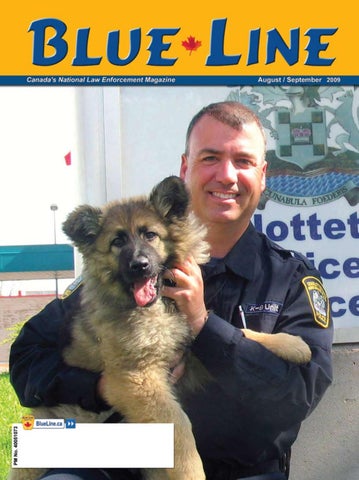
This month’s cover shows Charlottetown Police Cst. Walter Vessey and his new K-9 partner, Pride. They are ready to begin training to replace the recently retired K-9 Noble, who served the city with trainer Cst. Sid Stead for seven years. This year’s Canadian AssociationChiefs of Police Conference is being held in Charlottetown and the Canada Games will round off a very busy August in Prince Edward Island. Shown here is Sgt.Clair Mullally, Cst. Kristi MacKay and Kelly Hollett with Canada Games mascot. See Page 6.
Features 6 Keeping the peace with charm and grace
16 100 years Ontario Provincial Police
10
24
12 Calgary police beat unit taking back the core
Managing risk and auditing quality of Canadian policing
32
From broken windows to open doors
Departments
Case Law
46 Back of Book 46 BlueLinks Ad Directory 27 Book Review 36 Coming Events 22 Deep Blue 34,39 Dispatches 28 Forensic Science 45 Market Place 34,35,43 News Week 36 Odditorials 44 Product News 5 Publisher’s Commentary 30 Technology
40
Gum taste test doesn’t taint evidence
42
Search incident to arrest requires proper purpose
The lighter side of a century
Blue Line advertisers at the CACP
Blue Blue Line Line Magazine Magazine
33
August August//September September 2009 2009
August / September 2009
4
Blue Line Magazine
Publisher ’s Commentary by Morley Lymburner
Courage is in the eye of the beholder It was 20 years ago that 600 members of the Akwesasne Mohawk community near Cornwall thanked police for their bravery. The entire community showed up at a special recognition and award night in April 1990 on the reserve. Every person wished to show their support of police actions and gave each of the force’s 11 members the Tree of Courage, their highest honour. Officers wore the small silver oval shaped medal, with the turquoise coloured tree emblazoned in the middle, proudly above their uniform pocket. Commissioned by the band council, it was a true symbol of community support. Officers wore it not so much in recognition of their own hazardous duty, but as a visual sign of the respect the community holds for them. It is this mindset that today’s Akwesasne leaders must keep in mind. All law enforcement personnel, border and police officers are there to protect everyone. When I visited the Akwesasne First Nation and border services facility on Cornwall Island in the summer of 1990, the local issue was a dispute with Mohawks on the American side. They had declared the First Nations reserves in Ontario, Quebec and New York to be a single sovereign nation. Along with the declaration, of course, was considerable pressure from a few criminals intent upon building an illegal casino on the US side of the self-proclaimed territory. At that time the Mohawks on the Canadian side wanted nothing to do with this but a few of the criminal element brought intimidation to bear. This included fire-bombing homes
Blue Line Magazine
and random shots with AK47s at patrolling Akwesasne Police officers who, being outgunned, asked for assistance from police on all sides of the three borders. Thereafter an uneasy peace existed, as long as there were police from Ontario, RCMP, Quebec, New York State and Akwesasne. Amongst all the clamour was a chainlinked, barbed wire topped Customs post where a group of Canada Customs officers worked to prevent smuggling and protect our borders from the very people who would harm Canadians. They bravely did their jobs, unarmed, in an area that had all the trappings and appearance of a Vietnam-era security perimeter adjacent to the infamous DMZ. It felt oppressive to cross the border, especially in light of the numerous Canadian and US news flashes about the tense situation. I was immediately struck by the mindless absurdity of the criminal element. They wanted to build an illegal casino to attract the general public to a militant reserve to spend lots of money. This attitude reflected a tragic comedy built with little forethought. It was just action, reaction, confrontation and intimidation from a group of dispossessed adventure seekers. Fast forward almost 20 years and we find an equally oppressive atmosphere created by a new group intent upon illegally importing cigarettes through the same Akwesasne territory, but the dynamics have changed dramatically. Today some Canada Border Services Agency officers are armed, ready to intervene and have thus far proven very effective. They have made record breaking seizures of drugs and contraband at the Windsor and Sarnia ports of entry. The newly armed officers no longer have to concern themselves with running for cover and calling other law enforcement agencies for help. Since the old system of intimidation has
5
been seriously hampered, the new agenda has changed to militant blockades. All this was very predictable; in fact, the Akwesasne situation was one of the main catalysts in arming CBSA officers in the first place. Suddenly it wasn’t so easy to use subtle intimidation. Larger amounts of contraband are being confiscated and criminal profits are drying up. The unfortunate part of all this is the fear by law-abiding Akwesasne residents that the old days of shootings and fire-bombings may return. It’s the fear of armed conflict that has obviously motivated them to turn out in large numbers to control the government side of the equation, rather than attempt to control the criminal minority amongst them. More needs to be done to help them. Canada needs a more robust border agency ready to patrol the entire US/Canada border area. The officers need enhanced governance of their activities and (probably) an appropriate oversite mechanism similar to those in place at most of this country’s police agencies. The agency also needs a self generated criminal investigation branch, rather than having to rely upon local police agencies. Given the past track record at this troubled crossing, what has happened can be no surprise. What I do find surprising is the sudden fortitude being demonstrated in Ottawa. Finally there appears to be a light at the end of a very long tunnel. Perhaps the good folks from the Akwesasne could take a minute to present a Tree of Courage medal to all those CBSA officers who have bravely hung in there all those years... unarmed and unappreciated.
August / September 2009
Above: The newly branded CPS vehicle incorporates the new departmental logo, an eye-catching design and the Charlottetown Police Mission Statement. Left: City Hall Building, home to the Charlottetown Police Services for over 140 years. Right: Current police headquarters, 10 Kirkwood Drive, Charlottetown.
Keeping the peace with charm and grace by Gail MacDonald Known as the cradle of Confederation, Charlottetown has steadily grown in both size and stature over the years, developing a peaceful charm and grace seldom seen in comparably sized cities. The city’s residents can take credit for the charm and grace but the peacefulness is courtesy of the police. History The CPS is one of Canada’s oldest police departments, dating back to August 17, 1855, just four months after the community of 6,500 August / September 2009
became a city. Six days after holding its first meeting, council decided to appoint six police officers, to be attached to the city’s five wards. Salary was set at 45 pounds per year and the constables were told to find their own “dress,” as long as it was satisfactory to the mayor and council. Perhaps the civic leaders were hard to please, since the city subsequently decided to pay for uniforms. The first city marshall (chief) was Michael O’Hara. His officers patrolled the city’s plank sidewalks, which had a life expectancy of just three to four years and so were expensive to maintain, and four miles of streets. 6
City council passed its first bylaw governing motor vehicle traffic in 1922. Enforcement procedures were by sight and summons only, unless the officer felt the urge to give chase on foot. There wasn’t a lot of options; a horse and jigger was the department’s only vehicle at the time. Officers used it to take prisoners to the station lockup after brawls. The police force had expanded to a chief, three sergeants and four constables by 1932. They were responsible for policing the city’s then 13,000 residents and 25 miles of streets. Despite the problems brought on by the Great Depression and widespread unemployment, Blue Line Magazine
the force was credited with keeping a lid on crime. The RCMP began policing the island on May 1, 1932, taking over from the provincial police and customs and excise. The Mounties and city police would work together closely in the ensuing years and this strong bond continues to this day. The city police “communication system” was rudimentary during the force’s early years The desk sergeant would turn on a light in front of the city hall station. Patrol officers were ordered to regularly go past the station and drop in to receive further instructions if the light was on. The force went wireless in May, 1940, buying a Marconi radio transmitter for the station and receiver for the patrol car, greatly improving efficiency. The department paid for the new equipment by suspending uniform purchases for the 12 man force, which included eight constables. The Marconi system was replaced with a RCA two-way radio system in 1950. The department gained prominence by hosting the annual convention of the Canadian Association of Chiefs of Police in 1955, attracting officers and their wives from across Canada. From a tourist perspective, the convention was viewed as having far reaching effects for the whole community. The service, along with RCMP “L” Division, are once again co-hosting the CACP Conference this year, and expect some 800 delegates and companions to attend.
Top Right: Cst. Melissa Craswell, a patrol member of CPS, enjoys working with youth in the community through such projects as DARE and Kids n Kops. Top Left: Jeff Craswell, police dispatcher and 911 call taker takes a call for service at Charlottetown Police Services Telecommunications Section. Middle: Paying a visit to the newly opened Downtown Depot, the CPS satellite office is (from left) Deputy Chief Operations Gary McGuigan, Chief A. Paul Smith and Deputy Chief Administration Richard Collins. Bottom: Photo of the Charlottetown Police Department, circa 1955.
Today Charlottetown Police Services (CPS) has grown to 74 sworn and civilian members, headed by Chief A. Paul Smith, who joined in 1978, and deputy chiefs Richard Collins (administration) and newly appointed Gary McGuigan (operations). The CPS is in the process of implementing recommendations resulting from a recent operational review. One of the changes was to appoint McGuigan to take over responsibility for all uniformed members. The Greater Charlottetown area is now home to almost 60,000 people and is growing six times faster than the provincial average. The population to officer ratio is approximately 1 to 550 and immigrants make up some 4.4 per cent of the city’s residents. The department has moved out of city hall, which it has called home for more than 140 years, to a newly renovated headquarters building. The CPS continues its close co-operation with the RCMP through integrated policing operations, including the emergency response team, street crime and tactical units and JFO drug section. Charles MacPherson, a youth intervention outreach worker, is on call 24/7 and has had an office at the CPS for the past seven years. He works closely with officers on files involving Blue Line Magazine
7
August / September 2009
Members of Charlottetown Police Choir performing for seniors at local Charlottetown Seniors Home.
youth when they first become involved on the wrong side of the law, and has helped turn them around before they choose crime as a career. The CPS is also well known for its choir, originally formed in 1996 under the direction of Cst Gary Clow. Its Christmas concerts in seniors homes, begun the same year, became an annual tradition, delighting hundreds of Charlottetown seniors. The choir has also performed for royalty on two occasions, with the RCMP Musical Ride and at the National Memorial Service in Ottawa and the International Police Memorial in Cleveland, Ohio. The Charlottetown Police Choir cut its inaugural CD in 2000, with all proceeds going to the Canadian Cancer Society. It performs throughout the year at municipal celebrations, funerals of fallen officers and family members and other ceremonies. PEI’s population expands dramatically during the summer, when some one million tourists make their way to island shores. Many of these visitors find their way to Charlottetown. This year promises to be especially busy with thousands of people expected to attend the Canada Summer Games. Charlottetown will co-host the athletes village and the closing ceremonies. The CPS hires police cadets and trained police officers from other parts of Canada each summer to deal with the influx. A side benefit – the extra help allows full-time members to take some vacation during the summer months. Future Charlottetown Police Services new image reflects its goal – “Our city, our community, our responsibility.” A strategic plan outlines its path to the end of 2011 and a new statement of vision, mission and core values puts the focus clearly on keeping police services in tune with community needs. The aim is to refresh the department’s connections with the community. One of the more visible changes is a new satellite office in downtown Charlottetown, staffed daily by civilian service members. A drop-in spot for officers working the downtown core, the new ‘Downtown Depot’ officially opened June 24 and has already helped the department connect with downAugust / September 2009
town businesses and residents. The service has divided the city into four policing zones to better serve the desires of residents and for statistical tracking purposes. CPS members continue to be involved with their community at the grassroots level. Some officers enjoy working with young people on a regular basis and give of their time and talents in an effort to keep them engaged and discourage substance abuse. Several members are actively involved with DARE. From its humble beginnings patrolling the mud streets of a little city of 6,500 people, the Charlottetown Police Service stands firm as a witness to over 154 years of change. From corner call lights to radio communication, the department has steadily progressed. Challenged through two world wars, depression, recession and changes in laws and people, the department has remained steadfast in its service to citizens and visitors alike. The Island way of life As Canada’s smallest province, “the Island” is best known for its vivid colours, gently rolling landscape, active communities and is one of the safest places to live or visit in the country. P.E.I. is surrounded by miles of red sandstone cliffs and beautiful white sandy beaches. As the capital city and cultural centre of the province, Charlottetown has evolved into a dynamic city without sacrificing its historic charm. It possesses a relaxed quality of life and unique character that defines it so well. In recent years, al fresco dining, waterfront development, outdoor festivals and an architectural integrity to new construction has all contributed to making the city more vibrant and interesting. Visitors constantly mention the slower pace and quality of life. Without sacrificing the excitement and innovation of modern times, Charlottetown keeps one foot firmly planted in the past. Its architecture, friendliness, relaxed pace, familiarity and safety are all reminiscent of a gentler era. Coupled with the vibrancy and diversity of the present day, the city seeks to combine the best of both worlds. 8
Mission Statement “As guardians of the birthplace of Canada, the Charlottetown Police Services, working with the community, will provide high quality police services and maintain a safe and peaceful environment for residents and visitors.”
Core Values The Charlottetown Police Services will be guided by the following set of values: ccountability - Taking responsibility for A our actions. quality - Consistently provide fair, impartial E and equitable treatment to all people. onesty - Strength of character, truthful and H trustworthy. I ntegrity - Doing the right things for the right reasons all the time. Q uality of service - Exceeding policing standards in our Community. espect - Upholding the rights and freedoms R of all people by showing compassion and sensitivity to their needs. eamwork - Addressing the needs of our T community through partnerships and by empowering our staff to be innovative and creative. ommunication - Interacting proactively and C regularly with community stakeholders.
Our Vision “To work in partnership with the community to enhance the quality of life through crime prevention, enforcement and education.”
Gail MacDonald has been employed with the Charlottetown Police Services since 1976. First joining as a civilian dispatcher, a job she held for 13 years, she went on to a position of Administrative Assistant of the Department. In 1995, during an Amalgamation period, she became the Communication Coordinator and Records Supervisor. Thanks go out to Deputy Chief Wayne (P.W.) MacIntyre, (ret’d) for his assistance in compiling the history portion of this article.
Blue Line Magazine
Blue Line Magazine
9
August / September 2009
Blue Line advertisers at the CACP Accident Support Services Int. See advertisement page 15 Accident Support Services facilitates centralized collision reporting to police, insurers and Provincial Ministries of Transportation, at no cost to police or taxpayers. Our Microsoft award winning Collision Reporting and Occurrence Management System (CROMS) can serve as your electronic collision database and our new CROMS Analytics Portal lets you create ad-hoc queries from your computer using any data field, for enforcement or statistical purposes. Identify hotspots, reduce traffic congestion and minimize risk of secondary collisions. Reallocate or direct your manpower to higher priority needs. Improve response times and traffic charges with proactive enforcement. Our services are flexible to meet your needs, regardless of your population through our CRC or CROMS database programs.
a perfect fit for markets such as field service, public safety and transportation. Mobile solutions include the small format MPrint along with the full page PocketJet mobile printers and powerful DSmobile scanner.
Blue Line Magazine See advertisement page 22 Blue Line Magazine is Canada’s independent national law enforcement publication. Published monthly, it reaches the entire spectrum of Canadian law enforcement and is known for dynamic articles relevant to all levels of law enforcement. Blue Line News Week, an electronic law enforcement news digest, reaches executive law enforcers every week. Blue Line Trade Show and Blue Line.ca complement the two publications with discussion forums, training courses and exhibitions.
Canada Law Book See advertisement page 30 As one of Canada’s foremost legal publishers for more than 150 years, Canada Law Book has established itself as an industry leader, publishing some of the finest legal resources available. Our continued commitment to excellence helps to ensure you meet your law enforcement responsibilities both knowledgeably and confidently every day. Enlist Martin’s Annual Criminal Code – Police Edition, Police Legal Access System (PLAS) on CD-ROM, and Martin’s Online Criminal Code, as your ammunition to making a difference in the line of duty. Our word is the law.
Bosik Technologies See advertisement page 35 Bosik Technologies Ltd manufactures safety and security products from their location in Ottawa. BOSIK Suspect Package Container is the economical solution for safe handling and removal of suspicious packages from high traffic areas, ensuring public safety and minimizing operational downtime. It is a light weight, mobile container that will completely contain the bomb blast, fragments, resulting gasses, and chemical/biological threats. BOSIK Portable Bullet Trap is designed for use as a low-priced safety device for protection against accidental discharge of a weapon during loading or unloading of a pistol or rifle. Brother Mobile Solutions See advertisement page 2 Brother Mobile Solutions Inc offers a full line of ultra-printable and innovative mobile printers and scanners for the mobile workforce. These highly reliable mobile devices are August / September 2009
Correctional Service Canada See advertisement page 14 Correctional Service Canada is contribution to public safety by ensuring that its criminal justice partners get essential offender information on a timely basis. One way of doing this is through InfoPol, a secure web based application developed for police services./ It provides them with information about offenders who are released into the community. Information on incarcerated offenders is now available through InfoPol for the use of Police personnel conducting investigations and managing intelligence information.
Cdn Police Knowledge Network See advertisement page 36 The Canadian Police Knowledge Network (CPKN), a not-for-profit organization, is Canada’s leading provider of online training solutions for police officers. Created in response to a recognized need for an efficient, cost-effective training model for Canadian police services, in March 2004, members of the Canadian police community collaborated with government and academic organizations including the National Research Council Canada Industrial Research Assistance Program (NRC-IRAP) and Holland College’s Justice Knowledge Network to create CPKN. Working with subject matter experts from police training academies and police services across Canada, CPKN delivers highly effective, economical, and engaging e-learning courses to meet the needs of police services. 10
Chrysler Canada See advertisement page 48 Chrysler now has the most impressive product range and the most valuable brands in the automotive industry. Backed by strong research and development, these brands will be at the cutting edge of technology in their respective segment, offering our customers the best there is in terms of innovation, design, safety, quality, service and the sheer enjoyment of owning one of our products. Colt Canada See advertisement page 24 Colt Canada is the strategic source of supply for small arms to the Canadian government, and supplies small arms systems to roughly half of our NATO allies, including The Netherlands, Denmark and the UK. Colt Canada now offers military specification equipment and services Canadian law enforcement agencies directly. Products and services include sniper systems, tactical weapons, patrol rifles, 40 mm launchers, pistols, less lethal solutions, optics, accessories, armourer’s tools, engineering, service and repair, armourer and tactical rifle training, safety equipment and technical publications. DAVTECH Analytical Services See advertisement page 41 DAVTECH Analytical Services (Canada) Inc has positioned itself to remain a leader in traffic safety products and solutions throughout Canada. Our newly expanded product line includes digital in-car video, radar, LIDAR, emergency LED lighting, accident investigation software, traffic analysis equipment, alcohol breath testing instruments, drugs of abuse testing and all related peripherals. DAVTECH is an authorized distributor for Digital Ally, Decatur Electronics, Laser Atlanta, Intoximeters, NPAS, Visual Statement, Eluminator Lighting, Metro Count, Medtox, and Tri-Tech to name a few. Digital Boundary Group See advertisement in Blue Line News Week Digital Boundary Group has been assisting Canadian municipal police services since 2001, providing information technology security auditing, operational security status assessments, external penetration testing, vulnerability scanning, threat advisory reports, network intrusion investigation services, network security training and end user security awareness training. DBG is an Associate Corporate Member of C.A.C.P./A.C.C.P. Blue Line Magazine
General Dynamics Itronix See advertisement page 17 Itronix Corporation, a General Dynamics company is a world-class developer of wireless, rugged computing solutions for mobile workers, which distinguishes itself in the market through its technology innovation, superior implementation capabilities and customer support services. Itronix has a full range of wireless, rugged field computing systems, from handhelds, to laptops, to tablet PCs, secure mobile servers and ultra-thin clients. Itronix serves mobile workers in markets such as commercial field services, communications, utilities, transportation, public safety, government agencies and the military. Groupe Techna See advertisement page 33 Groupe Techna’s MES, mobile enforcement solution, is a premiere electronic citation issuance and management solution. MES enables law enforcement agencies to create E-TICKETS for parking, traffic and city code enforcement, improving officer productivity, reducing errors and improving departmental efficiencies. E-tickets drastically improve your collection rate because up to 20 percent of manual paper-based citations are unenforceable due to officer errors or illegible handwriting. With over 16 years of experience in mobile computing software applications, EZ TAG has made it simple and affordable to acquire E-TICKETING technology. We offer turnkey leasing plans that allow cash strapped agen-
Blue Line Magazine
cies to implement E-TICKETS. Instead of a large up front capital expenditure, we offer affordable monthly or per citation lease payments which allows agencies to reap economic benefits immediately. Mega Tech See advertisement page 11 Mega-Tech is pleased to offer to our customers a full line of quality products and factory trained technicians. Our Eastern Regional office allows us to better serve you from two full service facilities. In many cases the products we offer are recognized as industry standards that offer the very best in quality and customer support. Meggitt Training Systems See advertisement page 9 Meggitt Training Systems is the only training company in Canada offering both live fire and virtual training solutions, including Road Range, a mobile training facility for both. As the world leader in R & D, we developed the BlueFire line of tether-less weapons for the most live-like virtual training. We service our customers from our offices in Medicine Hat and Montreal with service reps in Edmonton, Gagetown, Halifax and Victoria TWB Designs See advertisement page 28 TWB Designs solves your ammunition disposal problem through its Mobile Ammunition Combustion System. M.A.C.S
11
cost effectively disposes and recycles in an environmental certified manner your confiscated ammunition. Multiple units are in use across Canada and worldwide at Police Departments and military installations since 2002. Please see our website at www.twbdesigns.com for videos and pictures of the MACS system. Whelen Engineering See advertisement page 19 Whelen designs and manufactures vehicular visual and audible warning equipment including LED strobe and halogen lightbars, beacons, power supplies, sirens and secondary lighting products. Whelen products are designed and manufactured in the U.S.A. Work Authority See advertisement page 43 In 1938 a one-man company began what would become the pre-eminent provider of managed footwear programs to Canadian industry. Operating und the name Industrial Safety equipment Company (ISECO), it built a reputation over almost seven decades for leadership and innovation. It was instrumental in working with the Canadian Standards Association (CSA) in the 1960s to develop safety footwear and equipment standards. It was the first to offer a technology solution to provide customers with “managed footwear programs” in the 1990s. We are proud to continue building on that tradition today, with leading “no cost” innovations like ProPass.
August / September 2009
Calgary police beat unit
taking back the core
by Nancy Scott
The barometer for a city’s safety is the public’s perception of how safe they are in its downtown core. For Calgary’s more than one million residents, this perception was the reality confronted by Rick Hanson upon his appointment as police chief in October 2007. Hanson has been transparently candid in admitting that the Calgary Police Service had lost the downtown core to increasing gang violence, street disturbances, highly visible drug trafficking, a growing homeless population and rising crime rates. Returning after an 18 month absence, he described a core plagued by crime and social disorder characterized by aggressive panhandling, mentally ill and drugaddicted street people loitering and sleeping in public areas, mischief to property, anti-social and criminal activity on public transit, street fights and gang violence in the entertainment districts. These problems, compounded by inadequate policing resources and a litany of other policing issues, contributed to the public’s general perception and growing fear that police did not control the city. Calgary’s city centre area makes up August / September 2009
about six square kilometres of its 850 square kilometre area. There were more than 24,000 public-generated, officer-dispatched calls to the core in 2008 and 43 per cent were for social disorder-related complaints. These incidents can negatively impact citizens’ quality of life and perception of safety, particularly in public places. Primarily, these calls were for panhandlers or other loiterers, suspicious or intoxicated persons, disturbances or drug activity. It’s imperative that police display a presence to demonstrate their strong commitment to creating a safe downtown, particularly for the more than 180,000 people living and working there. “People in Calgary’s belt line,” Hanson states, “were desperate for the style of community policing where they worked together with police to solve issues of concern to them.” There was no one simple course of action or knee-jerk approach to unravel the complex constellation of factors that led to the city’s current crisis. On a strategic and tactical level, the situation demanded a multi-faceted plan integrating thoughtful, focused deployment. Also crucial was co-operation and support 12
from the municipal, provincial and federal governments to grant funds for more resources and long-term alternatives to “revolving-door” justice that saw offenders back out on the street in a matter of hours. As an essential component of this plan to “take back the core,” Hanson envisioned the inception of a permanent downtown beat unit he described as “a community-based policing model of old-style foot patrol combined with strategic deployment.” Not surprisingly, the beat initiative presented a range of logistical hurdles, such as the need for additional clothing and equipment, office space and the realignment of radio dispatch channels in the downtown district. However, finding the actual human resources to deploy remained the most significant challenge in a city which has one of the largest geographical areas, yet one of the worst policeto-population, or “pop-to-cop” ratios, of any major Canadian city. One initial concern was that the new beat unit would be comprised of very junior officers with little policing experience. That was countered by Deputy Chief Al Redford, who overcame the logistical challenge through Blue Line Magazine
an internal promotional campaign that drew members from within the service. He also deployed a pool of experienced officers from the United Kingdom who had recently completed recruit classes. Ultimately, the unit was realized as a balanced composition of officers with varying levels of policing experience. Each team included a mix of current patrol officers, experienced UK officers, members from the original beat unit (created in 2006) and newly-graduated recruits. Supervisors were also thoughtfully selected. The unit’s 62 uniformed officers hit the street on May 27, 2009, with very clear marching orders: to act as a highly visible presence in the downtown core, deploy to targeted areas to interdict crime and social disorder and improve the comfort and safety of all people. The four 15 officer teams are the linchpins at the aggressive enforcement end of a strategy Hanson identified as “the most important uniformed initiative of the Calgary Police Service.” Redford describes the new unit as a sort of “back to the future” kind of policing. “This is old-style foot patrol, but in a new way. We have always had a community-based policing philosophy, but this is a return to face-to-face connections and geographical ownership of problems and patrol knowing the people and the problems of an area.” In other words, the objective wasn’t to simply flood the downtown area with uniformed police – the “a cop on every corner” strategy – but rather a focused, sophisticated and strategic approach to directed patrol with the mandate
Blue Line Magazine
of proactive, intelligence-based policing. The deployment model was developed with these objectives at the forefront. Beat teams are on the street from 6 am to 4 am every day and focus on changing “hotspots” largely identified by unit members. Additionally, each team assumes ownership of a geographical area within the city centre, such as the 7th Avenue transit corridor, the East Village, known for its high transient population and open-air drug trade, Chinatown or the 17th Avenue business corridor. During the day and afternoon, the focus is on keeping the downtown area safe for working Calgarians, through what Hanson identifies as “aggressive policing,” with unrelenting targeting and enforcement of street disturbances, panhandling, public intoxication and property crimes. By night, the focus shifts to the bars and nightclubs of the entertainment district, streetlevel drug activity and the associated fighting
13
and violence. Here, beat officers are part of a coordinated effort that includes the Violent Crimes Suppression Team (VCST) and BarWatch, to reduce crime by bringing back legitimate social activity and sending a loud and clear message that this criminal element is not welcome and will not be tolerated. Unit members will also be deployed to social events such as concerts and theatre or visits from political figures and foreign dignitaries. The objective is simple: for citizens to feel safe when attending venues and not having to worry about a gauntlet of panhandlers or feel intimidated while walking alone to parking lots or public transit. One of the many benefits, notes team leader Sgt. Jason Walker, supervisor of the former beat unit, is “presence-based policing that allows for the development and strengthening of effective community partnerships” with the focus of proactive beat policing. Once officers have cleared their points or “hotspots,” Walker says, they self-deploy to areas of merit and individual interest. They do a lot of on-view drug enforcement work and are key players in major investigations, vice and gang operations. They also focus on intelligenceled policing and are given time to develop and handle sources and informants. Walker echoes Hanson’s philosophy that police work relies upon building relationships within the community. He tells of beat unit officers garnering trust through daily, face-to-face interactions with local merchants, residents, downtown workers, the homeless – even known criminals – and investing time in forging strong
August / September 2009
relationships. These investments have shown profit in critical intelligence that has contributed to solving several homicides and major crimes. In addition, because it is a “specialty unit,” officers have the flexibility, availability and fluidity to respond immediately to information and very quickly mobilize an operation that doesn’t require a full-blown operational plan. Schedules can be easily adjusted to allow members to change from uniforms to plainclothes and raid jackets and quickly assemble a four-to six-member team that can act upon important, real-time information, or respond to dynamic situations to apply immediate action to a developing trend or incident in progress. Still, officers who walk the beat face a variety of challenges. Although all unit members completed a comprehensive 40-hour training week prior to deployment, they must possess expert knowledge of powers and authorities. Responding to immediate, on-view situations does not afford the same luxury of time to think and react as call-driven policing may offer. There can be precious little room for the uncertainty of inexperience and public perception, scrutiny and criticism are always a consideration. Very simply, foot patrol officers have more direct, day-to-day contacts with the public than most colleagues working regular patrol, and this can make them more vulnerable to citizen complaints. Walker knows firsthand that his officers walk a fine line when a citizen sees only the final moments of an interaction with an aggressive or combative offender. He has had to answer the public outcry that condemns police for being
August / September 2009
little more than a band of pirates who bully the homeless. Beat unit officers must also strike a balance between combating blatant drug activity one moment and contending with a jaywalking businessman in a three-piece suit the next who defies them to “go and arrest the real criminals.” Beat unit officers are policing a very different city than the Calgary of even 10 years ago. “Communication skills for officers are now more important than ever,” notes Walker. “Not only are they interacting with people from all walks of life, but the situations that they face often require an enhanced level of communication with all parties involved.” Another change, improved technology, has proven to be a double-edged sword, Walker acknowledges. It has made possible valuable surveillance cameras on the streets, but also cell phones that can record officers’ words
14
and actions. These can then be uploaded as sound bites to the Internet or provided to the media to be broadcast, out of context, on the six o’clock news. The challenges for Cst. Rich Wall, an experienced UK officer who has walked the downtown beat for two years, include staying motivated, battling negative perceptions of the unit held by some colleagues and combating fatigue. There’s also the very real hardship presented by Calgary’s inclement weather – he recalls a January night when the temperature dropped to -48. Nonetheless, “this is absolutely the best unit in the city,” he declares, adding that the camaraderie, freedom and diverse policing opportunities far outweigh any adversity. The new unit is no one-trick pony in the plan to secure the city centre, emphasizes Redford, noting police cannot rely upon only one approach to tackle the current crisis in the core. “If the only tool you have is a hammer,” he quips, “then every problem looks like a nail.” Consequently, the initiative to take back the downtown began with “Operation Endeavour” and street-level undercover cops targeting drug trafficking, detaining offenders in custody and releasing them with conditions, including restricting them to areas outside the core. This put teeth into what beat unit officers can do when these conditions are breached to keep certain groups from returning to and staying in the downtown area. Fear of crime can have as great an impact as crime itself – and with any form of interdiction, citizens have a very real, although mistaken
Blue Line Magazine
concern, that all the criminal activity will simply be displaced to adjacent areas; perhaps their own neighbourhoods. As a result, developing a plan to address the displacement – both real and perceived – of crime and social disorder as a result of aggressive enforcement was a critical part of the multi-phased strategy to clean up Calgary’s core. Since isolating the impact of displacement is impossible, the CPS will employ a more valuable strategy that includes taking a baseline analysis of “hotspots,” using intelligence-led policing, to actively monitor and detect evidence of displacement and emerging trends. It will respond proactively to emerging issues and provide ongoing community engagement and education. Still, displacement “in and of itself” is not a negative effect, insists Supt. Trevor Daroux, who maintains that, with any targeted activity undertaken by police, “there is always the overall result of a net reduction in crime.” Calgary’s beat unit is not a temporary expedient, Daroux emphasizes, contrasting the initiative to other operations where police target a specific problem, only to lose that ground when forced to move on to other projects due to lack of long-term resources. The unit is a permanent fixture in Hanson’s mission to put substance behind the promise; his goal is for police to not only take back Calgary’s downtown core, but to keep it. The multi-phased plan also includes a coordinated effort from the community, services, all levels of government and partnerships with social agencies such as the Homeless Foundation. Treatment links to outreach agencies such
Blue Line Magazine
as Pathways to Housing must also be made to more strategically deal with factors that lead to homelessness, such as drug and alcohol addiction or mental illness. A final component looks to a modified jail system that will rehabilitate addicts, resulting in more long-term solutions to the current “revolving door” practice of processing people through either the health or justice system. “We are making a statement that the city is ours – we own it and we own the street,” Hanson told unit officers on their inaugural day. The atmosphere was distinctly optimistic as they assembled on the steps of city hall in front of the Police Memorial for the official launch, attended by Premier Ed Stelmach and Mayor Dave Bronconnier. Still, Hanson is characteristically forthright in his assertion that the success of the overall initiative hangs in the balance of achieving solidarity with a judicial system that can no longer afford to deem certain offences “insignificant” or “minor.” He says it’s imperative for all agencies to work together with police to achieve the goal of creating a safer community. “Beat and foot patrols, bike units, VCST,” Hanson states, “no matter how many cops are put down there – if the courts and prosecutors don’t support our efforts to make streets safer, it is inevitably destined to failure because police are only part of the justice system.” Cst. Nancy Scott has been a member of the Calgary Police Service for five years and currently works patrol. Contact her at pol4014@calgarypolice.ca for more information.
15
August / September 2009
The lighter side of a century by Cst. R.D. (Bob) Cooke (Ret) It’s no secret that the job of policing has inherent dangers, tragedy and heartbreak. Throughout the 100-year existence of the Ontario Provincial Police (OPP), officers have experienced all of these circumstances and more, one way or another. Human nature being what it is though, the lighter side often prevails, even for incidents where those with a less developed sense of humour might have considered disciplinary action appropriate. For example, imagine eight uniformed OPP officers in a conga line formation, each with hands on the hips of the officer ahead, doing a “one two kick, one two kick,” down the centre of a provincial highway. A reliable, retired source who took part in this boredom-fighting effort remembers it occurring on a bitterly cold, moonlit night in February 1979 near Fort Francis. The OPP was doing strike duty and officers were set up to check incoming vehicles carrying strikers and possible contraband.
August / September 2009
Robbers’ success short lived Then there’s the ill-fated but laughable “daring” daylight Havelock bank robbery of Aug. 31, 1961, when several armed men got away with almost $250,000 in cash and securities after two years of planning. Well, “got away with” is a stretch, because the culprits were arrested hiding in the bush days later, after a run of bad luck which included flat tires, police road blocks, broken car springs and a road blocked by a motorist’s disabled car. Bill Baluk, who retired from the OPP in 1980 after 33 years, was involved in the incident. Although the money was never found, the five culprits were arrested. Four went to prison while a fifth died awaiting trail. The series of events that caused their downfall came to be known as The bad luck robbers, the title of a book by Grace Barker. “Most of us felt (it) would have made a good movie at the time,” recalls retired assistant commissioner Clive Naismith. “About 30 seconds was the difference between a successful robbery and being caught,” he reports. In his book From muskeg to murder, Andrew
16
(Maks) Maksymchuk, who retired as inspector after 30 years with the OPP, writes about an incident that occurred while he was undergoing recruit training at the Ontario Police College (OPC) in Aylmer. With his permission, here’s a truncated version of the event. Discipline at OPC was strict and each morning recruits were lined up at attention in front of the war-time barrack “H-huts,” so named for their shape. As every recruit was to be in exactly the same position each morning, one member of Maksymchuk’s class, because of difficulty pronouncing Maksymchuk’s name, chose to call him “Smith.” Always one of the last to arrive, he would emerge from the barracks calling goodnaturedly, “Where’s that (bleepin’) Smith?” One morning, Maksymchuk noticed his fellow recruit emerging and decided to beat him to the call by yelling, “That (bleepin’) Smith’s right here!” Bad move, for he did not see the instructor approaching from another direction – instructor Angus Smith. Now, any OPC attendee who has been in a class instructed by the late Angus Smith will remember him with affection but also as someone not to be trifled with. Glaring at Maksymchuk, Smith roared, “That’s right, I am here!” The result was neither bloodshed nor punishment although, as expected, it did mean Maksymchuk never again answered to “Smith.” Another recollection by Bill Baluk goes back to 1957 when he was issued an unmarked highland green 1957 Chevrolet cruiser. In the early 1960s, it was decided that all “plain” cruisers were to have white doors. “My highland green with white doors looked like hell,” Baluk recalls, “but, worse still, Whitby Detachment had a chocolate brown car with white doors... some VIP or MPP must have got caught speeding, ergo all plain cruisers had to have white doors,” he opines. Ninety-eight-year-old Marjory Peel, widow of the late Sgt. Harry Peel, often did extra duty during the early 1930s when their living room doubled as the Welland Detachment office. Part of that duty was to answer the telephone. One day, she was busy trying her hand at wallpapering an upstairs bedroom when the phone rang. It was a constable at Woodstock Detachment, asking to speak with High County Cst. Peel. The brief conversation that followed could now be seen as humorous, even prophetic given the composition of today’s OPP. “I told him the men were out and I would take the message,” Marjory relates. “I’ll have you know there are no women on our force,” he replied indignantly. “If he were alive today he sure would have to eat his words,” she says with a smile. Blue Line Magazine
Blue Line Magazine
17
August / September 2009
2009 Appointments
Police Medal of Merit The Order of Merit of the Police Forces was created in October, 2000 to recognize conspicuous merit and exceptional service by members and employees of the Canadian police forces whose contributions extend beyond protection of the community. There are three levels of membership — Commander, Officer and Member — that reflect long-term, outstanding service in varying degrees of responsibility. Each level has corresponding post-nominal letters: C.O.M., O.O.M. and M.O.M. The following is a list of the 2009 recipients. For further information about the Order of Merit of the Police Forces go to www.cacp.ca and search for “Awards of Merit”
OFFICERS A. Comm. Stephen W. Graham, O.O.M. (Promotion within the Order) RCMP, Halifax, NS C. Ins. Jocelyn Latulippe, O.O.M. Sûreté du Québec, Montréal, QC A. Comm. Gary R. (Bud) Mercer, O.O.M. RCMP, Richmond, BC Supt. Lloyde F. Plante, O.O.M. RCMP, Surrey, BC Supt. Michael Jay Sekela, O.O.M. RCMP, Edmonton, AB
MEMBERS Chief Paul Douglas Cook, M.O.M. North Bay Police Service, ON
S. Supt. Anthony D. Corrie, M.O.M. Toronto Police Service, ON
August / September 2009
Chief R. M. Brent Crowhurst, M.O.M. Bridgewater Police Service, NS
C. Ins. Luc Lafleur, M.O.M. Sûreté du Québec, Gatineau, QC
Ins. Frederic Leigh Desroches, M.O.M. RCMP, St. John’s, NL
Sgt. Jean Lamothe, M.O.M. Ottawa Police Service, Ottawa, ON
Prov. Cst. Richard J. Ellins, M.O.M. Ontario Provincial Police, Paris, ON
Mr. Charles A. R. Lawrence, M.O.M. Toronto Police Service, ON
Det. Supt. Ronald James Gentle, M.O.M. Ontario Provincial Police, Orillia, ON
S. Sgt. Gary John Le Gresley, M.O.M. RCMP, Bathurst, NB
S. Sgt. Roy H. E. Hill, M.O.M. RCMP, St. John’s, NL
D. Chief Kenneth J. Leendertse, M.O.M. Hamilton Police Service, ON
Ins. John Clifton House, M.O.M. Royal Newfoundland Constabulary, St. John’s, NL
Acting Sgt. Katherine J. Macdonald,M.O.M. Calgary Police Service, AB
D. Chief Kenneth John Jackman, M.O.M. Peterborough Lakefield Community Police Service, ON
S. Sgt. George Frederick Heber Noseworthy, M.O.M. RCMP, Port Saunders, NL
18
Blue Line Magazine
Prov. Cst. Jerry Novack, M.O.M. Ontario Provincial Police, Pembroke, ON Ins. Anthony (Adam) Palmer, M.O.M. Vancouver Police Department, BC Chief Daniel Colin Parkinson, M.O.M. Cornwall Community PS, Cornwall, ON
Mark Giles promoted
Commander Paul Seguna, reserve advisor with the Canadian Forces Public Affairs Branch, promoted Mark Giles to the rank of Major in June. Giles – Blue Line’s media and public relations columnist – is a part-time instructor at the Defence Public Affairs Learning Centre in Ottawa and Public Safety Canada’s Director for Vancouver 2010. He served as a Calgary police officer from 1990-2000.
A. Dir. Pierre-Paul Pichette, M.O.M. Service de police de la ville de Montréal, QC D. Chief Cst. Robert D. Rolls, M.O.M. Vancouver Police Department, BC
S. Sgt. Ian Charles Sanderson, M.O.M. RCMP, Edmonton, AB S. Supt. Peter J. M. Sloly, M.O.M. Toronto Police Service, ON
A. Comm. William Allan Smith, M.O.M. RCMP, Edmonton, AB S. Sgt. Major William H. Sparkes,M.O.M. RCMP, Prince Albert, SK Cst. Linda G. Stewart, M.O.M. Vancouver Police Department, BC
Supt. Ronald Taverner, M.O.M. Toronto Police Service, ON
Corp. Spurgeon Kenneth Walker, M.O.M. RCMP, Summerside, PEI
C. Supt. J. A. M. (Mike) Woods, M.O.M. RCMP, Ottawa, ON Blue Line Magazine
19
August / September 2009
The Rock ’s top cop
heads south
by Danette Dooley The commanding officer of the RCMP in Newfoundland and Labrador is stepping aside to take on a new role as senior RCMP envoy to Mexico and the Americas. Gerry Lynch will retain his assistant commissioner rank as he heads Canada’s contribution to training police officers in Mexico and the Americas. There are some 410,000 police officers in Mexico, Lynch said, and while some are professionally trained, others have no formal instruction. Under his leadership, a train-the-trainer approach will see Canadian police officers teach Mexican officers about policing here. “We’ll be putting some police trainers in there to help train 10,000 new police recruits...
they’ve hired a number of police managers right out of university who don’t have any police experience. We’re looking at tailormaking a managers’ course for them from the Canadian Police College,” Lynch said. The partnership will also see Mexican police being trained at the RCMP Depot in Regina. After receiving basic training in Ottawa, the new recruits will spend time at RCMP headquarters in Ottawa for in-service training before heading to the Canadian Police College to study advanced police instruction. Lynch has visited Mexico twice within six months. He made a presentation to Mexican officials during a symposium on judicial reform in December, focusing on policing in an environment that has a Charter of Rights and Freedoms. A needs assessment initiative in
March involved representatives of numerous organizations. “We met with the federal police, we met with the Department of Foreign Affairs, we met with the attorney general’s office and we met with a whole bunch of senior people in different departments to hear what they are doing and to hear from them how they think we can help them.” Knowing Mexico’s needs has helped in putting together an assistance plan, Lynch said. He will also travel to many countries within the Americas and make frequent treks to Ottawa, where his staff will be based. “This is not a day-to-day role. It’s more of a step back and looking at strategies from a Canadian perspective,” Lynch explained, noting that he is looking forward to his new role. In a press release announcing Lynch’s appointment, RCMP Commissioner William Elliott noted that Canada and the international community receive many requests to assist countries with governmental capacitybuilding. One of the key demands is for professional training and support to national policing organizations, Elliott stated. “The RCMP has long participated in this type of assistance in Mexico, the Americas and the Caribbean, both in terms of support for Canadian investigations abroad and international police development and training,” noted Elliott. Elliott also pointed to Lynch’s extensive police experience. He joined the RCMP in 1973 and has served in numerous positions across Canada. He was the officer responsible for the police information system for the 1988 Calgary Winter Olympic Games, worked with the RCMP’s Foreign Services Directorate and was sent to Newfoundland to head criminal operations in 1998. Lynch’s office will remain based in St. John’s, although no plans have been made as to whether he will continue working out of RCMP headquarters in the White Hills. Bill Smith took over as assistant commissioner for Newfoundland and Labrador July 31. A former criminal operations officer in the province, Smith returned from policing in Edmonton to take on the new role. Danette Dooley can be reached at dooley@blueline.ca
August / September 2009
20
Blue Line Magazine
Lynch presented with high French honour RCMP Asst. Comm. Gerry Lynch has become the second Mountie to receive France’s National Defence Medal, which is normally given only to members of the French Armed Forces and the National Gendarmerie. Lynch said the award recognizes the tremendous accomplishments of many of his members in enhancing relations with officials in St. Pierre and Miquelon over the past decade. Lynch received his award from France’s Ambassador to Canada, His Excellency Francois Delattre, at a ceremony at the French Embassy in Ottawa, May 25. Building strong partnerships with authorities on the French islands began to take shape under Lynch’s leadership 10 years ago, when several St. Pierre residents were taken to Newfoundland for medical reasons. The incident stemmed from criminal activity on St. Pierre, Lynch said. “I thought at that time that it was important that we establish strong communications back and forth so that those in Newfoundland aren’t caught off guard by something that may go on somewhere else.”
Blue Line Magazine
Since that time, RCMP members in the province have formed numerous partnerships with the French government and the Gendarmerie Nationale in St. Pierre and Miquelon. Initiatives include personnel exchanges between the two police forces, secondments for language training, joint training initiatives between the Patrol Vessel “MV Murray” and the Gendarmerie Maritime Vessel “Fulmar” and making Gendarmerie Nationale affiliate members of the Criminal Intelligence Service of Newfoundland and Labrador. In addition to recognizing the efforts of his own members, Lynch also credits the Gendarmerie Nationale, current Prefect Berçot and his predecessors and the current and past commandants of the Gendarmerie Nationale and Gendarmerie Maritime for the successful partnership. “We have a lot of interaction back and forth, not only with the police but with government officials in St. Pierre. Between our detachment on the Burin Peninsula and elsewhere, we were able to establish strong partnerships, and that’s exactly what this award is all about,” Lynch said.
21
Blue Line Magazine recognized for service to IPA International Police Association (Canada) National President Phil Bailey presents Blue Line Magazine’s Morley and Mary Lymburner with a plaque recognizing their long service to the association. “Mary and Morley’s work on behalf of the IPA has spanned over 20 years,” Bailey said at the national general meeting, held May 30 in Mississauga. “We can attribute a great deal of the IPA’s success in this country to their efforts and the impact of Blue Line Magazine.” “We have indeed been honoured by this recognition,” said Lymburner, Group Publisher of Blue Line Magazine. “Over my years of publishing I have found that wherever I go and no matter what police officer I speak with, it is reassuring to realize so many common and mutual interests. It is, dare I say, almost theraputic. Due to this recognition I have attempted to promote organizations similar to the International Police Association as often as I can. It is a truly remarkable, if not unique organization.”
August / September 2009
Deep Blue by Dorothy Cotton
Making snap decisions are rarely a snap Few things seem to give the popular press more joy than pointing out police wrongdoing. Police do sometimes get things wrong, I’ve noticed. I could make the same observation about psychologists, supermarket cashiers, educators or widget manufacturers – but the consequences when they err are generally less notable (and it may take some time for psychologists’ mistakes to be noticed). The time element is one of the things that distinguish the context of police decisions from those the rest of us make. As a psychologist, I can review books, talk to colleagues, consult my regulatory body, review the code of ethics and sleep on it to help sort out my next move. I can tell people “Let me get back to you on that.” Police can sometimes do that, but not always, and this can be a problem. Frankly, when you think of all the steps that go into making a decision, it is surprising that anyone ever gets anything right – particularly when they’re forced to make a decision in a split second. I was just reading on article on “crisis decision theory,” written by Kate Sweeny at the University of Florida. It hasn’t anything to do with policing – at least not directly – but it does outline the process people engage in when they must make a decision in the face of a negative event. Waking up in the middle of the night and smelling smoke, for example, getting a really awful diagnosis from your doctor or discovering your wallet is gone. What if someone looks like they are about to harm you or someone else? It often seems like we just react in these situations – but the process is actually a lot more complex. Crisis decision theory suggests there are three phases to our reaction. First, we assess the severity of the event, asking ‘so how bad is it anyhow?’ We look at
August / September 2009
what caused the event. Can we control it or is it entirely externally driven? Then we try to classify the event. Is it like something else we have experienced? Do we have a frame of reference to compare to, or is it entirely new to us? While it might seem advantageous to have been through something similar before, our past experience can also send us off in the wrong direction, as we might overgeneralize or make assumptions that don’t really fit. We might also assess the severity of an event by looking at the possible outcomes. How bad is it going to be if this whole thing heads south? Sometimes, once we assess the severity, that’s the end of it. If it doesn’t look all that important, we might opt to go no further. Ironically, the same thing can happen if the event seems TOO severe. If it looks like a sure fire disaster and there is no good outcome possible, we may just fold – or become paralyzed to the extent that we cannot persevere. Assuming one reaches some conclusion about severity, we then go on to the second step – determining how we can respond. Some people are really good at conjuring up alternatives and others seem to have no ideas at all. The responses might also be limited by feasibility. For example, leaping a tall building in a single bound might be theoretically a great idea, but most of us can’t do it. Options are limited by a variety of practical concerns – but also by our perception of the controllability of the outcome. If we think something is inevitable – nothing we can do will make a difference – we are apt to respond passively, or not at all. The ability to generate some possible responses in stage two is essential for stage three – evaluating options – to occur. It’s a little tough to evaluate options if we can’t
22
think of any. Come up with some ideas and you can then consider which one might have the most desirable outcome. Typically we do this by considering both the possible outcomes and the amount of resources needed to carry out the response. Most of the time, we’ll lean toward an option that requires less resources, but that has to be balanced with our assessment of the outcomes. What are the direct and indirect consequences – physical, emotional, social? Sometimes the immediate consequences don’t seem so bad but the long term ones are significant – or vice versa. When you conceptualize crisis decision making in this manner, I’m surprised anyone can make a decision in less than a few weeks. (Actually, I know a few people who actually do take a few weeks to make even the simplest decisions. They make me want to pull my hair out. Here’s hoping they don’t get hired by police services.) There are ways to speed up the process, of course, including training and experience. You learn to work through these various stages faster; in many instances, your options are well known and well defined. In policing, things like the use of force continuum are designed specifically to provide both the right questions and the right answers in specific situations. It’s not a simple process and it can be tough when danger is staring you in the face. My advice? If you’ve got the time to follow the steps and think it through, that’s always a good idea, but when you don’t, well… pat yourself on the back for getting it right most of the time. Thank your lucky stars for good training – and try not to read the newspapers. Dr. Dorothy Cotton is Blue Line’s psychology columnist, she can be reached at deepblue@blueline.ca
Blue Line Magazine
Blue Line Magazine
23
August / September 2009
Managing risk and
auditing quality of Canadian policing by Luc Delorme and Terry Cheslock Increased pressure on policing is driving demands for transparency and accountability. Quality assurance (QA) processes aim at continuously improving what we do and are critical to support the overarching goals of community and officer safety and public service. Its fundamentals are simple and common to most approaches: • Say what you do: define objectives and document policies; • Do what you say: develop procedures to build consistency; • Prove it: keep records and audit them; and • Improve it: analyse the results and feed them
August / September 2009
back to continuously improve. Canadian police agencies operate in dramatically different contexts. Mandates and governance structures, resources and infrastructures vary but we share many common goals and objectives, regardless of size or geography. When QA processes are done well, they help to align the work of police executives, managers and front line officers in promoting high performance and continuous improvement. Managers must commit to taking needed action or we risk just adding to the burden of administrative paperwork. There is an important distinction between approaches focusing simply on top-down compliance and those which engage all levels of the organization.
24
The experience of police globally suggest that well designed and implemented programs can support better management, improved community relations and strengthened accountability while limiting liability and risk exposure. We know that no one size fits all but there are many ways to learn from one another. Sharing information about processes, procedures, innovative use of technology, successes and even failures can help us work together to strengthen policing. The Quality Assurance in Law Enforcement (QALEC) Committee of the Canadian Association of Chiefs of Police is working to promote an integrated approach to improving Canadian law enforcement. Our study surveyed police agencies across the country to understand the conception and approaches to QA and risk management. We received replies from 23 of the 104 police services contacted, including: • The largest: RCMP, OPP, Surete du Quebec, Toronto Police Service and Service de Police de la Ville de Montréal (SPVM) • Mid-sized agencies: Vancouver, Calgary, Edmonton, Ottawa, Peel and York • S maller services: Regina, Lethbridge, Abbotsford, Durham, Halton, Waterloo, Guelph, London, Strathroy-Caradoc, Thunder Bay, Fredericton, Beresford, Nigadoo, Petit-Rocher and Pointe-Verte (BNPP) and Bridgewater It is often difficult to measure the value of effective risk management but we most certainly can see the impact of high profile failures. QA processes generally result in comprehensive, well thought-out written directives, better information to support decision making, improved management processes, increased accountability and reduced liability and risk. We asked members to tell us how QA processes have tangibly impacted their agency effectiveness: • A review of a major homicide squad revealed it was not properly documenting decision making and supervision on files. This is a major cornerstone of major case management, which must be disclosed under the law and is required in court proceedings. By failing to document tasking and direction the unit risked failure by missing crucial investigative steps or evidence or subjecting the investigation to defense scrutiny in court. Blue Line Magazine
After the review and refresher training, the investigative team improved its processes and reduced the risks. • A workload assessment in one agency showed a substantial increase in calls for service and revealed significant deficiency in the number of authorized patrol officers, based on current calls for service data. The workload assessment results were provided to the city’s elected leadership during annual budget considerations and more officers were hired. • Reviews have also resulted in new training and administrative support positions. One service noted that the QA process resulted in a new position to review court document packages, which improved reporting quality, coaching and training, ultimately improving the chances of prosecutorial success. • O ne police service is reviewing actual norms related to call response. Quality and promptness are at the center of its strategic plan and public commitments. Management review, benchmarking, empowerment and audit missions are helping it ensure these commitments are met. • One police service used stakeholder and employee engagement surveys to track perceptions and satisfaction levels. It made the results public to enhance accountability. In another, reviews uncovered morale problems and high turnover rates in one division that appeared to be linked, in part, to supervision issues. An improvement plan was instituted. • In some cases, QA reviews have helped identify policies or processes which were inappropriate or at odds with the organization’s objectives – recruitment practices which screened out experienced police officers from other jurisdictions and retired officers seeking to return, for example. Given acute staff shortages, processes were modified.
Blue Line Magazine
• At a time when resources are constrained, QA processes can assist in acquiring and allocating resources. Documentation improvements have resulted in costs being more appropriately allocated and recovered, services report. A review of one force’s contract revealed that the contracting agency wasn’t fulfilling its obligations to provide logistical support and manage employees providing the services. As a result, the force was able to recover funds. • A US police agency planned to build a new facility costing millions, in part to house exhibits. The QA process revealed that property room exhibits were not regularly cleared out and more than 80 per cent were redundant. Improving the property management process improved space utilization, making it unnecessary to build the new facility. Many organizations acknowledged they are still in the early stages of implementing QA and finding opportunities for improvement: • A common theme was the need for increased awareness of the role of QA and risk management throughout the organization. A sense that the function wasn’t well understood or clearly linked to strategic and operational priorities appeared to be behind some of these comments. • While most agreed that QA processes need to be linked to strategic outcomes, the survey showed a major gap in the feedback loops. Many acknowledge that the formal processes in place to provide effective follow-up and to track results need to be strengthened. • Improved training is critical to ensure that QA and risk management are integrated at every level. • Some identified opportunities to improve technological support – for example, simplifying reporting processes for front-line members though e-reporting. There seem to be significant opportunities to share tech-
25
August / September 2009
nological approaches and design new ones among agencies. Most used some computerized tools to support reporting and analysis. Some also used technology to strengthen feedback loops by, for example, having electronic suggestion boxes or an internal network for ongoing updates on progress towards recommendations. • Another important issue that surfaced is the notion of balancing the need to measure and track costs. In some organizations, the QA and risk management process is extremely comprehensive but it’s not clear that all the data collected is put to good use. In general, there is little usefulness in collecting data if it is not analyzed and fed back in some way. It is easier to effectively integrate these processes into management and operations if participants see the value of the associated paperwork (electronic or otherwise). • We were not able to obtain much information about the scale of these functions or their costs, although it is clear larger organizations have committed extensive staff and resources. These efforts need to be scalable – small services cannot undertake the same level of activity as their larger counterparts. • Striking a balance is one of the major challenges facing those in QA, risk management and audit functions. “Audits should only be conducted when the expected benefits exceed the cost (cost-benefit analysis should also apply to audits themselves),” one respondent noted.
August / September 2009
Process costs are not just measured by head count and budgets. It is important to consider the administrative burden and impact on morale of processes perceived to be too burdensome or heavy handed. This reinforces an issue which surfaced earlier in the report concerning the need to balance how to apply a process and how much data to collect with the cost of doing nothing. How to effectively strike that balance would be a fruitful area for further examination. • Most identified areas for more collaboration to build common understanding and share best practices, reinforcing the findings discussed above. • Some had specific suggestions about how to appropriately organize organizational functions; linking QA to risk management and clarifying the internal audit function, for example. Others had process suggestions. “In general,” suggested one, “(unit level)
26
audits should be documented with hard evidence/facts. Opinions should be heavily discounted when it is time to produce audit recommendations.” The study confirmed the challenges associated with establishing rigorous professional standards while balancing the interests of different stakeholders in developing and applying the process. For example, effective processes must link to community safety and accountability and other strategic priorities while respecting the operational realities of the front line. We found that processes need to fit with the reality and resources of the organization, ensuring that reporting requirements are costeffective and aligned with corporate priorities and objectives. The QALEC committee will continue to promote training and professional development opportunities to build capacity for QA and continuous improvement in Canadian policing. It will also encourage and enable the sharing of experience and approaches and research the best practices of non-police organizations. Smaller agencies without the resources to develop new procedures or research policy impacts can benefit from the experiences of others. For the full report, look for document QA Report 01.12.2009.pdf at the Blue Line Knowledge Portal (blueline.ca).
Blue Line Magazine
Book Review
Interrogating images: Audio-visually recorded police questioning of suspects
Author(s): David Dixon with Gail Travis Federation Press: Annandale, NSW, 2007 Reviewed by: Gilles Renaud All Canadian police services should consider purchasing Volume 23 of The Institute of Criminology Series, both for the importance of the subject and the soundness and depth of the analysis conducted. Is there any area of controversy in policing more easily resolved than demonstrating through technology that the person questioned was treated fairly and fully informed of all rights? Can one identify a greater waste of resources and energy than attempting to show, without electronic means, that nothing untoward occurred between police and a detained person? Is there an area of the law where courts are less indulgent of police discretion than cases where they did not employ electronic means of preserving evidence? To ask these questions is to answer them and it is therefore self-evident that the valuable lessons consigned in this well-written and well-researched 292 page book are ignored to the peril of the particular investigation in question. Stated otherwise, I know of no superior study of the best practices to be employed in conducting interviews with the aid of audio-visual techniques, and can think of no better condensed presentation of the skills to be resorted to in interviewing suspects. The principle author, the Dean of the Faculty of Law of the University of New South Wales, Australia, has conducted a wealth of academic study and practical observation and supervision of police questioning. The resulting text offers an encyclopedia of information as to what may and must not be done when questioning detainees. I acknowledge that a good deal of the concerns raised correspond to precise legislative requirements foreign to Canadian law. However, the safeguards proposed and techniques advocated do conform to common law and Charter-based issues that are litigated from Vancouver Island to St John’s, Newfoundland and all points in between, especially as regards youthful detainees. In particular, the fourth chapter, touching upon the interviewing process, provides signal instruction on the ‘do’s and don’ts’ of questioning, not to speak of the best means of ensuring a clear and accurate transcript of the information Blue Line Magazine
which is obtained. In the same vein, the research on recorded interrogation found in the second chapter is apt to assist both the novice and the veteran police “questioner.” The subjective accounts of those interviewed found in chapter six are helpful in making plain what might lead to a successful interview and what “turned off” certain detainees. That being said, I have written elsewhere at great length that I am not of the view that much weight should be assigned to demeanour evidence. For example, where the eyes of a suspect go when asked the fateful question is of no consequence, as it is so subjective at the best of times and varies between cultural groups if, in fact, such a conclusion may be defended for any group. It is without value for no other reason than the fact that some of the “bad guys” are quite intelligent and read abut police techniques and know that if they look to the right and up when answering, to give a stereotypical example, such a response is thought to be a badge of good faith. In my considered opinion, police questioning
27
should focus on eliciting all available information, which must then be evaluated and scrutinized, not on how the answer is given. For example, it matters not if a suspect looks into the camera and does not bat an eye in saying certain things; he/she will not be believed on the basis of lack of a logical foundation depending on what is suggested. The best illustration is that of a drunken baseball player dragged out of a burning hotel room. When accused of falling asleep while smoking, he immediately responded, without any sense of shame being betrayed on his face: “That’s a damn lie! The bed was already on fire when I lied down to sleep.” Demeanour evidence on trial: A legal and literary criticism, Melbourne: Sandstone Academic Press, 2007 and my book review of Psychologie des entrevues d’enquête De la recherche à la pratique, sous la direction de Michel StYves et Jacques Landry, Éditions Yvon Blais: Cowansville, Qc, 2004, found in Provincial Judges’ Journal, Winter 2007-08, Vol. 30(2), at page 46.
August / September 2009
Forensic Science by Brian Ward
The Summertime Blues! No season for serious crimes Crime does not recognize summer holidays. Serious incidents can happen in an instant and law enforcement must respond appropriately regardless of the season. That often means that less experienced officers are responsible for managing crime scenes appropriately. With that in mind, I feel it is important to offer a number of crime scene management recommendations to follow. Indoor scenes Your dispatcher is sending you to a serious crime scene in a home or commercial premises. You should be planning ahead and asking: • The type of crime?
August / September 2009
• Is someone standing by for your arrival? • Has anyone been injured? • What is their medical condition? • What other emergency services are responding? • In the case of a serious crime, is assistance being dispatched?
28
• Is there a suspect still at the scene? • Is the suspect armed? • Are there any unsafe conditions anticipated at the crime scene? In the case of serious injury, the assumption that the victim is still alive is paramount. First aid and medical assistance must be obtained. Qualified medical personnel will make a determination of death. Law enforcement may assume death if the victim has been decapitated, transected (body torn apart) or is badly decomposed. • Take control of the scene as the first officer, but remember you still work with a team. • Officer safety is critical. Direct backup personnel to immediately secure the area and search for a suspect. • R emove witnesses from the immediate scene and isolate them if at all possible. • Communicate with a supervisor who will be able to arrange for extra resources. • Forensic officers must respond. • I f a victim is taken to hospital, or a coroner’s facility, ensure the body is accompanied by an officer. • Ensure there is only one way in and out of the scene. If at all possible, post an officer at other exits, or arrange for them to be locked. • Good note taking is crucial to managing a crime scene. It is not necessary to write and manage at the same time. But begin to gather your thoughts about what you first saw, heard and smelled on your arrival. • Do not hesitate to record even the most innocuous observations. They may be important later in the case. • A sketch of the area must be made in your notes. The drawing does not have to be accurate but should reflect approximate measurements, location of a body, furniture and compass points including north. Although the area will be formally documented by forensics personnel, a diagram will refresh your memory for a later date in court. • Do not rely on your partner’s notes. Make your own! • Do not disturb any evidence unless it is fragile and may be damaged. • Remember that a search warrant may be needed to process the scene. It may even be necessary to withdraw and set up a close perimeter. • Do not attempt to make suspect firearms safe. They may hold fingerprints or DNA. The weapon will not discharge on its own! Blue Line Magazine
• Once the dust has settled, suggest that a command post be established. It can be as simple as an officer in a radio equipped police vehicle, a specialized police command vehicle, or a premises nearby. As the first officer at the scene, you will probably be remaining until relieved. Don’t hesitate to ask for whatever resources you feel you require. The outdoor scene Once you receive the call to a serious crime scene outdoors, apply the same guidelines as you would to an indoor scene. Ask the same questions and manage it in the same manner. Outdoor scenes must be secured by establishing a large perimeter. This can be done by erecting plastic police barricade tape with the message “POLICE LINES DO NOT CROSS”. Additional barricades can be created by the use of rope, police vehicles and other officers. Enlist the aid of civilian bystanders to help erect the tape. A good rule of thumb when setting up is to remember that: “YOU CAN ALWAYS REDUCE YOUR PERIMETER WHEN NECESSARY, BUT YOU CAN NEVER ENLARGE IT.” Enlarging the perimeter later in the investigation exposes the case to allegations of tampering, missed evidence and sloppy work.
Blue Line Magazine
• A lways assume the victim is alive and quickly obtain first aid and medical assistance. • Make sure there is only one way in and out of your scene. • As soon as practical, place another officer at the entry point to obtain details of arriving resources. • Don’t be afraid to direct other responders with authority. • Ensure forensic personnel are enroute. • K eep an eye on the weather. Summer rainstorms can occur anytime. • With the approach of bad weather, consider covering transient evidence with cardboard boxes, coffee cups or a tarpaulin. • H ave a supervisor arrange to deliver raingear. • Don’t hesitate to ask questions. •D o officers at the scene need water? • Does anyone at the scene require sunblock? Prolonged exposure to the sun may bring on severe sunburn or heat stroke. •C ommunicate with your supervisor or officer in charge of your station. You function as their eyes and ears. They will be fielding inquiries about the incident and need to be updated. Media relations Serious crime scenes will attract attention from the media. You will be questioned about the incident, often with cameras and microphones pointed in your direction.
29
Remember to be polite when dealing with the media. Advise them that a more senior officer will be available to update them on the progress. Do not make any comments; even if you are assured that what you say will be “off the record”. Remarks made at the time will often be resurrected at the time of any court proceedings. Act in a professional manner. Media outlets are encouraging submission of private video recordings or cell phone videos. These can be downloaded instantly. Personal impact Exposure to a violent crime scene is traumatic to everyone involved. We are all human and can still be shaken at the sights and sounds we may encounter. After the incident, don’t hesitate to talk with your colleagues about what you saw and how you reacted. Peer support is vital to decompression. If you find yourself badly shaken by what you saw or had to do, speak to a supervisor or member of your service’s employee assistance program. Your discussions are confidential. Often seeking help at this stage avoids, or minimizes, the possibility of post traumatic stress disorder. Brian Ward can be contacted at forensics@blueline.ca
August / September 2009
Technology by Tom Rataj
Getting the big picture – with projectors Since the old adage, “a picture is worth a thousand words” is generally true, it’s little wonder so much of what we see and do is presented in a visual manner. Televisions, computer screens, cell phones and iPods seem to be everywhere. Visual displays have penetrated every aspect of our lives, including office and training environments, where the modern multimedia projector has become the core of an efficient and effective system of delivering visual information to large groups. Today’s projectors have become incredibly small, light and capable of a sophisticated array of tasks. They can be connected to almost any video source, including USB thumb-drives, and produce large and very sharp, vivid images, often from surprisingly close range. As with most other modern electronics, the incredible advances in technology and design and the steadily dropping prices have dramati-
cally increased market penetration. While often outwardly simple to operate, projectors are packed with an intricate array of electronics and automatic image processing technologies that constantly optimise the projected image. While entry-level consumer and small business projectors can often be had for under $800, far more powerful mid-range projectors are in the $1,500 range. Higher-end commercial and professional projectors start upwards of $2,500 and can easily cost many times that. The projector market was until recently dominated by two main types: data or business projectors for presenting business-related
PowerPoint presentations and home-theatre projectors for showing movies and sporting events. Each is optimised for their intended purpose and produce their best results when used for their intended purposes, although either can generally display a wide variety of material. Many general-purpose “do-it-all” multimedia projectors now offer a wide array of decent performance capabilities. While not masters of any one specific purpose, they offer decent value for the money. All projectors use a bright light behind a tiny internal display and a lens to aim and project that image onto a screen or other flat surface. Several different technologies are used to accomplish this, but they all produce decent images. Each has its strengths and weaknesses and individual models, sometimes from the same manufacturer, vary widely in image quality. Shopping Understanding the core technical specifications before going shopping will help ensure you buy the right projector for your purpose, at the right price. It can get very complicated and intimidating, but arming yourself with some basic knowledge makes it easier to compare several different models and make a sound, informed decision. Many manufacturer and retailer Internet sites offer tools to compare models. Aspect ratio One of the main differences between projectors is the shape or “aspect ratio” of the default or native image they produce. Business projectors generally project an image with a 4:3 aspect ratio, which is almost square, similar to an old standard-definition television or a non wide-screen computer monitor. Theatre projectors, on the other hand, are available in both 4:3 and the wider rectangular HDTV standard of 16:9, which makes the buying decision more difficult. Most entry-level
August / September 2009
30
Blue Line Magazine
theatre projectors are 4:3 while mid-range and higher-end projectors are more commonly 16:9. Resolution Image resolution, where bigger numbers are always better (and more expensive), is the next major spec. It follows the same basic rules as with televisions and computer monitors. As with aspect ratios, projectors also have “native” image resolutions – the actual number of picture elements (pixels) of the small internal screen. The more pixels, the clearer and sharper the projected image will be, regardless of how physically large it is. For business projectors, native resolutions of SVGA (800x600) or XGA (1024x768) are recommended because they will produce excellent quality images in very large sizes. Even higher resolutions are available but command far higher prices. To obtain the best results, the projector’s native resolution should match the resolution of the display on the computer that it is usually connected to. For theatre projectors, native resolutions of 1280x720 and 1920x1080 are recommended, since they will provide the best quality images for HDTV formatted television and DVD or Blu-Ray sourced movies. Brightness Brightness is generally quoted in “ANSI Lumens,” which represents the amount of light the projector can produce. Generally, higher numbers are better, although it is somewhat subjective since the amount of actual light output you need depends highly on the environment where the projector will be used. A normally dark room obviously needs less light than a normally bright room. It is also somewhat dependant on the type and quality of screen used. ANSI Lumens generally start at 1,000 and go upwards past 3,000. Mid-range projectors often have around 2,000 lumens, which is suitable for classroom and conference room use. Contrast Contrast numbers represent the degree of brightness between the whitest whites and the blackest blacks. The higher the numbers, the more dynamic an image will be. Contrast is less important with business projectors because they generally display static images, while theatre projectors are generally used for video images, which have far greater contrast range. Contrast numbers are generally represented as “On/Off” ratios such as 2000:1 and up. Decent mid-range theatre projectors typically have a 5,000:1 contrast ratio, which helps produce very rich images and excellent details in all aspects of the picture. Other features Most projectors come equipped with a wide assortment of features, allowing them to be used in a variety of applications and to display virtually any video format. Zoom lenses, focus control, automatic Blue Line Magazine
keystone correction (keeping the projected image squared-off), remote controls with laser pointers and a wide range of audio/video and computer and electronics connectors are typically included. Most projectors can also be mounted on the ceiling (with optional mounting hardware). Display technologies LCD (Liquid Crystal Display) and DLP (Digital Light Processing) projectors dominate the market, although a third technology, LCoS (Liquid Crystal on Silicone) is also available. Regardless of the display technology, all projectors use a small, very bright lamp module as their light source. Unfortunately, these bulbs often have a rated life span of only 2,000 to 3,000 hours and typically cost upwards of $250 each. They are easy to change, but can add to operating costs if the projector is used a lot. Some newer compact models now use LED technology for the light source. These typically offer a rated lifespan of 20,000 hours and are expected to last the “lifetime” of the projector. Screens While any projector can produce an adequate image on any light coloured flat surface such as a wall, a proper screen is important to obtain optimum results. Unlike a flat white wall, it reflects the light of the image back at the viewer. For certain situations, or for tight budgets, there are special “screen” paints that can be applied directly to a wall. The aspect ratio of the screen should generally be matched to that of the projector, but should be large enough to display other aspect ratios. Displaying a 4:3 image on a 16:9 screen, for example, will result in a small image at the centre of a very large wide screen, so a larger 16:9 screen would be needed if 4:3 material will be frequently used. The overall size of the screen should also be adequately proportioned for the size and type of room in which it will be used. Most 4:3 projectors can produce excellent images of more than 100” (diagonal), so a screen large enough to accommodate this may be required. Basic screens start around $200 and go upwards from there. Prices and warranties A quick survey of Canadian retailers shows decent multi-purpose multimedia “doit-all” projectors from major name brands typically cost from $800 to $1,600. Super-portable micro-projectors start at under $400, while dedicated “home theatre” projectors typically run upwards of $4,000. Manufacturer warranties range from a low of as little as 90 days, through the typically standard one-year period, with a few two and three year warranties for some of the better brand-name models. Tom Rataj is Blue Line’s Technology columnist and can be reached at technews@blueline.ca . 31
August / September 2009
From broken windows
by Elvin Klassen Canada’s newest police agency, The South Coast British Columbia Transportation Authority Police Service, protects the 900,000 people who daily ride Vancouver’s buses, rail and marine services. Its motto – “Safely linking communities” – speaks to its mission of promoting public transport. Chief Officer Ward Clapham became the leader of this special police service, which patrols the entire transit system, in July 2008. The service has 169 sworn officers and 68 civilian staff.
August / September 2009
to open doors
“I heard it loud and clear from everyone with whom I have spoken that they want us to be very visible and engaging on and around the system,” explains Clapham. “This means taking back the rails, buses and streets and moving from broken windows to open doors.” Clapham served with the RCMP for 28 years, most recently as chief superintendent in Richmond. Promoting neighbourhood safety is one of his top priorities. The transit system is built on hubs where the buses, ferries and trains meet to transfer passengers, and he is developing station target area response (STAR) teams to police these areas, beginning with a pilot project in Richmond. It’s a new strategy that Clapham and Richmond RCMP Interim OIC Insp. Renny Nesset believe will be a major deterrent to criminals and send an early message to bandits that they aren’t welcome. The new two billion dollar Canada Line Skytrain, due to open by Labour Day, will run along a 19 kilometre track from the Vancouver International Airport in Richmond to downtown Vancouver. It is projected to carry 100,000 passengers a day and will form a key part of the transportation plan for the 2010 Winter Olympics. An eight member STAR team, made up of four officers each from the Transit Police and RCMP, are committed to keeping the terminals safe. They will work as an integrated team, focusing on the stations and their immediate area. “The police will be highly visible and engaging with the public,” notes Clapham. “They will be in the neighborhood using bicycles, vehicles and foot patrol.” Two new community police stations, located right next to the Canada Line platforms, will serve as home base for the STAR teams, security guards, emergency personnel and volunteers. Highly visible to the law-abiding public and criminals alike, Nesset says the idea is for people to stop not just to seek help but to ask for assistance, seek directions or report problems. Clapham and Nesset want riders to not only be safe but feel safe, reassured by the knowledge that help is never far away. Both 32
believe a strong message will have the same impact as when Richmond took a zero-tolerance approach to street racing following a rash of five deaths in high-speed car crashes. Officers are already working around the almost completed stations to determine the level of crime and other problems, says Clapham. This will help gauge the effect of the new rapid transit service on the neighbourhoods. STAR teams will be developed at other stations in Metro Vancouver once the Richmond trial project is fully implemented and evaluated. Clapham is also working with SkyTrain CEO Doug Kelsey to introduce a system which will allow passengers to instantly alert transit police to trouble through text messaging. The concept is being developed under the name SkyWatch. “If you’re riding on a car and you’re at a certain station and there’s an event happening but you don’t want to be seen pushing the alarm button, you can text in to a certain number and we can dispatch accordingly,” Clapham says. Whether it’s an assault, garbage piles or rude behaviour, anyone with a cell phone will be able to text police anonymously. The number to call will be highly visible in the cars and stations. Clapham has already experienced the value of this service. Riding the SkyTrain to downtown Vancouver in his first week on the job as chief officer, he noticed four young men openly drinking alcohol and being obnoxious. Unarmed and out of uniform, Clapham used his Blackberry to contact his officers, who intercepted the train, confronted the youth and escorted them off the train. “When they were taken off the train by the uniformed police officers the riders all stood up and started clapping and cheering,” added Clapham. Officers will also combat “signal crimes,” Clapham notes – warning signs that tell people things are not safe. These vary from neighborhood to neighborhood but may include graffiti, discarded needles, drug use, prostitutes and garbage on the streets. Locals often fear purse-snatchings, Blue Line Magazine
robberies, assaults, theft and vandalism. The officers will work with residents and businesses that receive signals, either perceived or real. A special unit has been set up to deal with graffiti. Paying attention to little things shows that somebody cares, he says, and this will reassure the public that it is safe to use the transportation system. Another innovative idea Clapham is initiating is displaying messages and good news stories on the Transit Police web site. Staff will regularly post updates about how they are “safely linking communities.” The Transit Police work in all Lower
Blue Line Magazine
Mainland communities, connecting with all 17 area police departments. Transit officers are guests in these communities, Clapham emphasizes, working as partners with municipal and RCMP detachments through collaborative relationships. Common transport, PRIME, E-Comm 911 and specialized integrated police units help officers to offer residents “seamless policing,” he adds. The media, politicians and the public have often expressed concerns about fare evasion since the stations have no turnstiles. Some believe millions of dollars is
33
lost because people ignore the paid fare zone areas and do not purchase tickets. The higher officer visibility is making a big difference. Police checked 60,000 riders in February and found just 2.6 per cent who had not paid their fare. This is much lower than what the media had previously described. Staffing is a high priority for Clapham Half of the force has less than three years of experience. Many experienced officers have joined and Clapham welcomes more, suggesting those looking for a career change consider his service. He promises new opportunities and innovative strategies in “safely linking communities.” Contact Chief Officer Ward Clapham at 604 516-7401 or visit www.transitpolice.bc.ca for more information.
August / September 2009
Police officers at higher risk
for heart disease
BUFFALO, N.Y. - It is well documented that police officers have a higher risk of developing heart disease: The question is why. In the most recent results coming out of one of the few long-term studies being conducted within this tightly knit society, University at Buffalo researchers have determined that underlying the higher incidence of subclinical atherosclerosis - arterial thickening that precedes a heart attack or stroke - may be the stress of police work. “We took lifestyle factors that generally are associated with atherosclerosis, such as exercise, smoking, diet, etc., into account in our comparison between citizens and the police officers,” said John Violanti, Ph.D., UB associate professor of social and preventive medicine, who has been studying the police force in Buffalo, N.Y., for 10 years. “These lifestyle factors were statistically controlled for in the analysis. This led to the conclusion that it is not the ‘usual’ heartdisease-related risk factors that increase the risk in police officers. It is something else. We believe that ‘something else’ is the occupation of policing.” Results of the study appeared in the June issue of the Journal of Occupational and Environmental Medicine. Violanti and colleagues have been studying the role of cortisol, known as the “stress hormone,” in these police officers to determine if stress is associated with physiological risk factors that can lead to serious health problems such as diabetes and cardiovascular disease. In a study accepted for publication in Psychiatry Research that looked at the male-female differences in stress and signs of heart disease, Violanti found that female police officers had higher levels of cortisol when they awoke, and the levels remained high throughout the day. Cortisol normally is highest in the morning and decreases to its lowest point in the evening. The constantly high cortisol levels were associated with less arterial elasticity, a risk factor for heart disease, Violanti noted. “When cortisol becomes dysregulated due to chronic stress, it opens a person to disease,” he said. “The body becomes physi-
August / September 2009
ologically unbalanced, organs are attacked and the immune system is compromised as well. It’s unfortunate, but that’s what stress does to us.” In the current study, the researchers used carotid artery thickness to assess heart disease risk. Participants were 322 clinically healthy active-duty police officers from the Buffalo Cardio-Metabolic Occupational Police Stress (BCOPS) study and 318 healthy persons from the ongoing UB Western New York Health Study matched to the officers by age. All measurements were taken in the morning after a 12-hour fast. In addition to testing carotid thickness via ultrasound, investigators measured blood pressure, body size, cholesterol (both total and HDL) and glucose. They collected information on physical activity, symptoms of depression, alcohol consumption and smoking history. These are the factors that typically cause heart disease. Results showed that police work was associated with increased subclinical cardiovascular disease - there was more plaque build-up in the carotid artery - compared to the general population that could not be explained by those conventional heart disease risk factors. Subclinical atherosclerosis means that the disease shows progression but does not qualify yet as overt heart disease. “In this case we examined the thickness of the carotid artery as an indicator of increasing risk for atherosclerosis,” noted Violanti. “The plaque buildup was greater in police than the citizen population. “In future work, we will measure the carotid artery thickness again to see how much it has increased. At some point in time, the thickness may reach a stage of possible blockage, which will require medical intervention and treatment. We think that police officers will likely reach that stage quicker than the general population.” (eurekAlert)
This article was excerpted from Blue Line News Week. This weekly executive reading service is available for email delivery every Thursday. To subscribe to this service go to www.BlueLine.ca or phone 905 640-3048.
34
Career bureaucrat Richard Fadden is the new boss of Canada’s spy agency. Fadden, currently deputy immigration minister, became director of the Canadian Security Intelligence Service on June 27. Prime Minister Stephen Harper says Fadden brings both legal expertise and security intelligence experience to the job. He has spent 32 years in the federal public service with various departments including Foreign Affairs, the Auditor General and the Privy Council Office. Earlier this decade, Fadden was deputy clerk of the Privy Council as well as security and intelligence co-ordinator. He takes over from Jim Judd, another longtime bureaucrat who recently announced his retirement after more than four years as CSIS director. •••• The Durham Regional Police Services Board has extended its contract with Chief Mike Ewles by two years. It will now expire in May, 2014. “Chief Ewles has demonstrated exceptional leadership since his appointment”, said board chair Terry Clayton. “He has earned the confidence of the board by leading the service’s transition to proactive policing. By extending his contract, the board is taking steps towards solidifying the future leadership of the service.” Ewles, 48, was hired by the Durham Regional Police Service in May 1982 and was appointed chief in June, 2007 •••• Julian Fantino has been reappointed Ontario Provincial Police Commissioner through July 2010. He will stay on as the commissioner for about a month after the G8 Summit scheduled for June 25-27, 2010. Fantino has been at the helm of the police force since 2006. His original appointment was extended in March 2008 through to the end of October 2009. A spokeswoman for Community Safety and Correctional Services Minister Rick Bartolucci said the government was pleased Fantino agreed to stay on for another eight months. The usual appointment time is three years. “Clearly, as evidenced by this extension, our government feels the leadership and experience of commissioner Fantino will prove valuable as Ontario works with our federal partners to provide the best possible security for an international event such as the G8 summit,” said spokeswoman Laura Blondeau. A search for his successor will begin next January. •••• Oxford Community Police Chief Ron Fraser has announced plans to retire in October after more than three decades of policing. Admitting the timing is awkward because of the high-profile investigation into the death of eight-year-old Victoria Stafford. Fraser said his retirement had been in the works since last December. Fraser joined the Ron Fraser former Woodstock Police in 1976, became chief in September 2001 and helped develop and transition the force to a regional police service. The outgoing chief will be replaced by Deputy Chief Rod Freeman. Freeman has 31- years of service in Timmins, St. Thomas, Fergus (as chief of police), Orangeville (as chief of police) Rod Freeman and, since September 2007, as Oxford deputy chief. The promotion takes effect Oct. 26, the day Fraser retires.
1 Blue Line Magazine
New cross border
water patrols OTTAWA (AFP) - The United States and Canada agreed in May to increase security along their shared border - once trumpeted as the longest un-militarized boundary in the world - and work to jointly counter threats, officials said. US Secretary of Homeland Security Janet Napolitano and Canadian Public Safety Minister Peter Van Loan outlined new border security initiatives aimed at thwarting terrorism and organized crime at a joint press conference. Building on past accords, the pair agreed to develop joint risk assessments and share threat data to prevent terrorists or “goods that threaten our mutual safety and security” from entering either country, said a joint statement. Canada and the United States will also consider sharing border facilities, equipment and technology, as well as launching joint border patrols, it said. US border surveillance has already been strengthened since the 2001 attacks, with unmanned drones, radar towers, remote motion sensors and more than 2,000 new agents assigned to monitor the US-Canada border. Van Loan and Napolitano agreed at a meeting in Detroit to integrate maritime patrols on the Great Lakes and Saint Lawrence seaway.
Blue Line Magazine
The so-called Shiprider agreement will see Royal Canadian Mounted Police and US Coast Guard officers assigned to each others’ ships, permitting them to chase criminals across the Canada-US boundary. During a pursuit, “if you get to the border, the waterway border, (the criminals or terrorists) can’t just wave at you to say goodbye,” Napolitano said. A 57-day test of the protocol led to the seizure of $1.4 million in contraband cigarettes and 97 kilos of marijuana, Van Loan noted. This article was excerpted from Blue Line News Week. This weekly executive reading service is available for email delivery every Thursday. To subscribe to this service go to www.BlueLine.ca or phone 905 640-3048.
35
August / September 2009
OdditoRials KELOWNA, B.C. - Most criminals try to keep their nefarious deeds under wraps - and a Kelowna, B.C., suspect is finding out why. The 27-year-old is accused of breaking into a home in the Okanagan city and stealing electronics, a pair of shoes and a van. That was his first mistake. His second was parking the van outside a known drug house and setting the vehicle on fire. It didn’t take long for police to show up and a search of the home revealed a man hiding in the basement. Investigators are fairly certain they have their man, since he was wearing the stolen shoes at the time. (CKOV)
••• HARRISBURG, Pa. - A retired police chief says he was robbed by probably the dumbest criminal in Pennsylvania. It happened at a police officers’ convention near Harrisburg, where 300 narcotics officers from Pennsylvania and Ohio were gathered. John Comparetto says as he came out of a stall in the men’s room, a man pointed a gun at his face and demanded money. Comparetto gave up his money and cellphone. But when the man fled, Comparetto and some colleagues chased him.
August / September 2009
They arrested 19-year-old Jerome Marquis Blanchett of Harrisburg as he was trying to leave in a taxi. When a reporter asked Blanchett for comment as he was led out of court, he said: “I’m smooth.’’ ••• HAMILTON - It’s not too bright to slash tires when there’s a cop sitting in the car. But police say that’s what a young Hamilton man did, puncturing one on an unmarked Peel police cruiser sitting at the curb on a Hamilton street. Two men and a young woman walked by and one of the men stuck a knife in the cruiser’s tire. The officer inside whistled up his colleagues who were nearby and they arrested all three a few metres away. One man and the young woman were released. A 22-year-old man was charged with mischief under $5,000, carrying a concealed weapon and possession of a prohibited weapon, a set of brass knuckles. (Hamilton Spectator)
These articles are excerpts from Blue Line News Week. This weekly executive reading service is available for email delivery every Thursday. To subscribe to this service go to www.BlueLine.ca or phone 905 640-3048.
36
Coming Events October 18-21, 2009 Canadian Outlaw Motorcycle Gang Investigator’s Conference (COMGIC) Saint John, NB Break the Cycle: Featuring police and criminal intelligence experts from across Canada, COMGIC 2009 will focus on deterring biker gang reorganization after large-scale take-downs. Registration info at : 2009comgic-ccebmc2009@ rcmp-grc.gc.ca ••• November 25, 2009 Justice Institute of BC New Westminster, BC A one-day conference, “Assisting the Mentally Disordered During Crisis: A Community Response” A Simon Fraser University, School of Criminology and JIBC - Police Academy event, supported by the BC Chiefs of Police and the I.C.C.L.R. Registration at www.jibc.ca ••• April 27 & 28, 2010 Blue Line Trade Show Markham ON The 14th annual trade show for law enforcement personnel from across Canada to view and purchase a wide spectrum of products and services in the law enforcement industry. For more information visit www.blueline.ca/ tradeshow.
Blue Line Magazine
Blue Line Magazine
37
August / September 2009
Legal drugs not the answer Reader responds to Bratzer comment by Michael Klimm The June “Back of the Book” column (The failure of drug prohibition) by David Bratzer was very interesting but I disagree with his opinions as expressed. I have 25 years experience as a police officer, including more than 11 in our drug enforcement unit. I also spent time in our intelligence unit and criminal investigations bureau. Let me start with the claim that the modern “war on drugs” was started by US President Richard Nixon. The United Nations adopted a “single convention on narcotic drugs” (signed by 180 nations, including Canada) in 1961. Long before Nixon took office the world realized that drugs were a problem. The UN added new manmade drugs to the list through the “convention on psychotropic substances” in 1971, (signed by 175 nations), and the “convention against illicit traffic in narcotic drugs and psychotropic substances”
August / September 2009
in 1988 (signed by 170 nations). I am not aware of a single country in the world where illicit drugs are legal. In Holland, the Dutch authorities choose not to enforce their drug laws in certain parts of the country. They are also a signatory to the single convention. I have spoken to Dutch police officers and read several articles on their drug policies. Their system is not working. Organized crime is still involved and the ideology has not reduced drug use. I don’t see the Dutch
38
Government telling the world what a great success they have had. Working in British Columbia, Mr. Bratzer, I am sure you have been to East Hastings. I visited it once and you cannot tell me that tolerance is working there. The Vancouver Police Department shuts its station doors there at 7PM because of the large number of drug users who, looking for a safe place, come in to shoot up. I was escorted through the area by a uniformed officer. There were hand to hand
Blue Line Magazine
deals going on right in front of him and prostitutes openly propositioning people for sex. Looks like a “free for all” to me. This is not a Canada I want to call home. Alcohol, cigarettes and gambling are legal in Canada. Organized crime is still involved in these activities. Government control costs money and taxes need to be collected on these items. Illicit drugs would be no exception, hence organized crime. Legal prescription drugs are still sold on the street to drug abusers. Organized crime is involved in that activity as well. The answer is not legalization, it is education with strict enforcement. It is working with impaired driving, so why not drugs? Our youth needs to understand that drug use is dangerous and carries serious legal and medical consequences. They need to know that using drugs can kill. They are confused, associating decriminalization with legalization and acceptance. Although smoking is not illegal, it is on the decline through education. You are correct, drugs have changed; they are now more potent. Many of our leaders are from the Hippie age, when smoking “pot” and doing drugs was acceptable. We need to educate everyone. I was involved in the “Greensweep” initiative and spoke at several high schools. No student ever asked me why alcohol was legal and marihuana (the correct spelling in Canada, by the way) was not. If a student does ask me, I would answer that alcohol is probably worse
Blue Line Magazine
that marihuana, but alcohol is legal; once you allow something it is pretty difficult to take it away. Prohibition did not work. Just because marihuana is less harmful than alcohol does not make it good for you. Two bad things don’t add up to a good thing. Once you make drugs legal you can never go back. Organized crime only works if you have a consumer. I agree that our current system is flawed. We have it backwards, spending too much time on the big fish and not enough on the consumer. For example, suppose the three big auto manufacturers are selling an illegal product and we take out one of them in a big, expensive project. What have we actually accomplished? A big press release, a temporary shortage of cars and more money for the other two manufacturers because they will increase production and sales. The answer is take out the consumer and all three will collapse on their own (which is unfortunately happening now). Take the profit out and you take organized crime out. In my opinion and experience, the answer is not legalization or, as we call it, decriminalization; it is education with strict enforcement. It worked in New York with the broken window ideology. At the front end it will be expensive and labour intensive, but the dividends would be immense. Michael Klimm is a Dective Constable with the York Regional Police Service and may be contacted by email at 374@yrp.ca.
39
Senior Constable Wilfred Chum, of the NishnawbeAski Police Service, died in a boating accident on the Winisk River. The incident occurred in June and the police service announced the recovery of his body on July 9th. Chum was a member of the Moose Cree First Nation and he began his police career at Moose Factory in 1978. In 1980 he joined the Ontario Provincial Police and was stationed with the Northeast Patrol in South Porcupine. He was later seconded for a period of two years to Northern College in Moosonee as an instructor. He had served the Ontario Fire Marshal’s Office for six years in Sudbury and Thunder Bay. He returned to policing with the Anishnabek Police Service and was last working as a relief officer with NAPS Northeast Region. On June 9, 2009 he received the Governor General of Canada Exemplary Service Medal for his 30 years of service. •••• Constable Allan Hack, of the Ontario Provincial Police, died on July 6th as a result of a collision between his cruiser and a truck southwest of London, Ontario. A second officer in the cruiser was airlifted to hospital in London with serious injuries. The 31 year old officer recently became a full-time police officer after many years serving as an Auxiliary officer with both London City Police and the OPP. At the time of his death he was engaged to be married in August. •••• Bill Blair will be Toronto’s chief of police until April 2015. Police Board chair Alok Mukherjee made the announcement at the end of May. Blair, 54, has led the force through a period of transition and change, said Mukherjee. He has “insisted on a culture of accountability and transparency.” Community trust in the service has never been higher, he said. The six year extension onto his current fiveyear contract is believed to be the longest in recent years. Blair was first appointed chief in 2005 and joined the force in 1976. He is the son of a Scarborough officer and holds a criminology degree. His three-decade career has taken him to the helm of 51 Division and the city’s detectives. He has had stints with family and youth services, drug enforcement and corporate communications. •••• Hamilton police Chief Brian Mullan has announced plans to retire at the end of the year. Mullan has worked in policing for 35 years. In a statement, Mullan says it was an honour to lead the men and women on the force and to serve Hamilton residents. Bernie Morelli, chairman of the Hamilton Police Services Board, credited Mullan with increasing the number of Hamilton police officers by ten per cent. Morelli also complimented Mullan’s ability to connect with the community through radio talk shows, cable television and blogging. •••• Ontario’s Special Investigations Unit Director, James Cornish, reports that for the third year in a row their resources were stretched with increases of police involved incidents. The record-breaking 246 occurrences investigated by the SIU resulted in 10 officers being charged. That is five times as many as last year and the most to be charged in 15 years. This was also the first year they didn’t meet a performance standard to complete 65 per cent of cases within 30 business days.
1 / September 2009 August
Case Law
by Mike Novakowski
Gum taste test doesn’t taint evidence Tricking an accused into sampling chewing gum to obtain a DNA sample did not breach the Charter, Alberta’s top court has ruled. In R. v. Delaa, 2009 ABCA 179 the accused was a strong suspect in two violent sexual assaults. An undercover operation was launched to obtain his DNA by collecting cast off evidence. Delaa was selling his truck so undercover officers posed as potential purchasers. During a test drive, one officer and Delaa stopped at a gas station to check the vehicle’s fluids. Another officer approached and asked if they would like to participate in a gum survey. Prior to the gum testing, the undercover taste tester offered Delaa a lollipop which had been in her mouth. Delaa placed it in his mouth, then returned it to her. Delaa agreed to participate and sampled four pieces of gum, spitting them into a Dixie cup provided by the undercover gum tester, ostensibly to avoid littering. DNA obtained from the gum and lollipop matched that of
August / September 2009
the sexual assault suspect. Delaa was arrested and a warrant for his blood samples was obtained. Lab testing confirmed the sample was a match. At trial in the Alberta Court of Queen’s Bench the judge concluded police did not breach Delaa’s Charter rights during the undercover operation. He did not have a reasonable expectation of privacy since he voluntarily participated in the gum survey, which occurred in a public place. He wasn’t in police custody or control and discarded the gum as garbage. Even if there was a Charter breach, the judge would not have excluded the evidence under s.24(2). The DNA evidence was nonconscriptive and discoverable in any event. Delaa was not compelled, threatened or coerced to produce the evidence but participated willingly. Police acted in good faith, there was no interference with bodily integrity and the samples were willingly discarded or abandoned.
40
Furthermore, Delaa wasn’t physically detained in any way, police dealt with him in an undercover capacity in a public place and he had no reasonable expectation of privacy in the samples. As well, the trick was passive and not unfair or dirty – it would not shock the community, and police ultimately obtained a sample of Delaa’s DNA through a warrant. Any breach would not have been serious, Delaa wasn’t vulnerable and the operation was carried out in a respectful manner under circumstances of some urgency and necessity. The charges were serious, the DNA evidence crucial to the Crown’s case and excluding it would bring the administration of justice into disrepute. The accused was convicted of two sexual assaults. Delaa appealed to the Alberta Court of Appeal, arguing the trial judge erred in finding that there was no s.8 Charter violation when police seized his DNA. An illegal search occurred, he submitted, when the officer asked him to spit his chewing gum into the cup. In
Blue Line Magazine
Delaa’s view, he did have a reasonable expectation of privacy in the seized gum because he did not abandon it – the undercover officer collected it. If his rights were breached, Delaa also asserted the trial judge erred in his s. 24(2) analysis. When a person abandons property, they no longer have a reasonable expectation of privacy in it. In this case, Delaa conceded that if he had merely dropped the gum onto the ground or put it in a garbage can, there would have been no violation of s.8. The officer holding out the cup – suggesting where it should be put when he was finished with it – was state intervention or compulsion and therefore not abandonment. The appeal court disagreed. Abandonment is a conclusion inferred from the conduct of the person claiming the s.8 right, thus consideration of reasonableness (of a claimed expectation of privacy) must relate to the conduct of that person and not to anything done or not done by the police or anyone else involved in the subsequent collection and treatment of the items discarded, noted the court. Thus, the focus must be on the conduct of the (accused) and whether a reasonable and objective person, considering the totality of the circumstances, would think spitting out the gum into the cup was abandonment. Spitting out the gum in this case was abandonment, and it didn’t matter whether Delaa
Blue Line Magazine
spit it into an anonymous object like a garbage can, the ground, an ashtray or in a receptacle someone placed in front of him – the cup. “It is the act of spitting it out that evidenced what can only be seen as an unequivocal intention to dispose of it,” the court said. “He was clearly finished with it and had no intention of preserving it.” As for the argument that Delaa was compelled by state intervention to abandon the gum: The act of the officer holding out the Dixie cup did not cause the (accused) to discard the gum; it merely provided an opportunity for the police to collect it. The actions of the (accused) were voluntary. He was free to choose to participate in the gum survey, free to choose whether to discard the gum and where to dispose of it. He wasn’t compelled to put his gum into the cup, although it was suggested that he do so… (The accused) voluntarily discarded the gum as garbage, in a public setting and not in custody. The (accused) abandoned his privacy interest (para. 20). Finally, the police technique of providing the cup wasn’t intrusive nor objectively unreasonable. The undercover operation was merely a “passive trick” and could not be seen as a “dirty” one or as something that would “shock the community.” There was no s.8 violation and therefore no need to consider s.24(2). Delaa’s appeal was dismissed.
41
August / September 2009
Case Law
by Mike Novakowski
Search incident to arrest requires proper purpose Police must have a proper criminal justice purpose when searching as an incident to arrest; they cannot simply rummage through personal effects. In R. v. Majedi, 2009 BCCA 276 police stopped the accused after a computer check indicated she was breaching her recognizance by being in the area. She told officers the provision was no longer in effect but did not have her court papers with her. A call to her “lawyer” confirmed this, but the officers weren’t sure the person they spoke to was a lawyer. A police dispatcher confirmed the provision remained in force and Majedi was arrested, handcuffed and secured in a police vehicle. The officers decided to impound Majedi’s vehicle because it was illegally parked. A search turned up a woman’s handbag and a backpack. One officer searched the handbag, testifying he did so to look for court papers and to inventory possible valuables, and found some money. The other officer searched the backpack to inventory it, protecting police from potential liability if valuables went miss-
August / September 2009
ing, and to search for sharp objects to protect custodial staff. Drug paraphernalia and cash were found in the backpack and Majedi was re-arrested for drug trafficking. Further searches of the car yielded more evidence to support the drug charge, but it was subsequently determined that the recognizance condition was no longer valid. At trial in British Columbia Provincial Court, Majedi challenged her arrest and the admissibility of the evidence the officers found. She submitted her rights under s.8 of the Charter had been breached and that the evidence should have been excluded under s.24(2), but the trial judge rejected her arguments. He found the arrest was valid and the searches that followed were lawful as an incident to that arrest. The searches were not simply for one purpose – to inventory the purse contents, he ruled. One purpose was to inventory valuables but the officers were also concerned about safety – there may have been a sharp
42
item (needle or knife) or other weapon in them. The second purse was also searched to find court documents, which may have assisted Majedi. Even if the searches breached her rights, the judge would have admitted the evidence under s.24(2). Majedi appealed to the BC Court of Appeal, contending the searches were for inventory only, not a valid criminal justice purpose, and therefore did not fall within the scope of a proper search incident to arrest. Thus, the searches were unreasonable under s.8 and the evidence should have been excluded under s. 24(2), she submitted. The Crown countered that the searches were valid as an incident to arrest and, even if they were not, an inventory search was permissible when the vehicle was impounded. Although warrantless searches are presumptively unreasonable, a search incident to arrest can justify them. Justice Chiasson, writing the unanimous opinion, examined the power to search as an incident to arrest, noting a number of propositions: • Officers undertaking a search incidental to arrest do not require reasonable and probable grounds; a lawful arrest provides that foundation and the right to search derives from it; • The right to search does not arise out of a reduced expectation of privacy of the arrested person, but flows out of the need for authorities to gain control of the situation and to obtain information; • A legally unauthorized search to make an inventory is not a valid search incidental to arrest; • The three main purposes of a search incidental to arrest are: one, to ensure the safety of police and the public; two, to protect evidence; three, to discover evidence; • The categories of legitimate purposes are not closed: while the police have considerable leeway, a valid purpose is required that must be “truly incidental” to the arrest; • If the justification for the search is to find evidence, there must be a reasonable prospect the evidence will relate to the offence for which the person has been arrested; • Police undertaking a search incidental to arrest subjectively must have a valid purpose in mind, the reasonableness of which must be considered objectively. In this case, Chiasson found there was no issue of officer safety apparent to justify entering the car; Majedi was handcuffed and in a police vehicle. However, because the vehicle was to be impounded as an incidence of the arrest, the officer was entitled to enter Blue Line Magazine
it to determine whether there were dangerous items or weapons inside. The search of the purses, however, had nothing to do with the crime for which Majedi was arrested – breach of recognizance. “The facts needed to charge her for that crime were known: she was identified as a person in a place she wasn’t supposed to be,” said Chiasson. The officer testified he was looking for exculpatory papers, a valid purpose that was connected to the arrest. Majedi stated the papers were not there and the trial judge was entitled to accept the officer’s stated purpose as an additional factor relevant to the validity of the search. Furthermore, both officers said they searched the purses, which would accompany
the arrestee to police station, for the safety of the jail staff. The officers reasonably believed the purses would likely accompany Majedi to the jail, a belief that was objectively reasonable. On this point, Chiasson stated: The officers relied on their experience that personal effects such as purses usually accompany arrested persons to jail. They also relied on their experience and jail staff practise that requires an inventory of the contents of personal effects that are held by the police for safe keeping. In my view, the officers believed the purses would accompany Ms. Majedi to the police station and would be searched there by jail staff. The subjective and objective requirements for searching the purses for objects that
might imperil the safety of jail staff were met (para. 32). The court did caution that “the law is very clear that the police cannot simply rummage through the personal effects of arrested persons in the absence of a proper criminal justice purpose.” Since the searches in this case were justified as an incident to arrest, it was unnecessary to determine whether they would have been valid solely for inventory purposes. Majedi’s appeal was dismissed. Visit www.blueline.ca/resources/caselaw for complete cases. You can email Mike Novakowski at caselaw@ blueline.ca
Edmonton police now have two eyes in the sky
The Edmonton Police Service took possession on June 30th of a second helicopter - a Eurocopter EC120 B patrol helicopter. Staff Sgt. Dave Berry, flight operations unit manager, said Air-2 will shortly be retrofitted with police equipment - including thermal imaging technology, radios and monitors - before going into active duty in early August. Air-2 will be the Edmonton Police Service’s primary aircraft, with the aging Air-1 helicopter - in service since 2001 and in need of a mechanical overhaul - acting as a backup. The cost of the second helicopter and related equipment is about $2 million. “With a one helicopter operation, there’s a certain time that requires the aircraft to be in maintenance,’’ said Berry. “Any given evening if there’s an emergency that we’re required to respond to, two-thirds of the time we may be able to go, one-third of the time we may be in maintenance and unable to respond. ‘’ “The addition of a second helicopter is going to afford us the ability to at least be able to respond 24-7 to an emergency.’’ The pilot and tactical flight officer are both trained police officers. In addition to inhouse training, Edmonton Police pilots receive recurrent training at Canadian Helicopters Limited School of Advanced Flight Training in Penticton, B.C. This article was excerpted from Blue Line News Week. This weekly executive reading service is available for email delivery every Thursday. To subscribe to this service go to www.BlueLine.ca or phone 905 640-3048.
Blue Line Magazine
43
August / September 2009
Product News
DNA Testing Resource Orchid Cellmark announces its new website, www.orchidcellmark.ca, a DNA testing resource. A specific forensic testing services overview section highlights screening services, routine STR testing services, specialized Y-STR mitochondrial and minifiler DNA analysis services. Also downloadable is the case submission form and forensic evidence handling guidelines.
ID2 Meth Scanner DAVTECH Analytical Services highlights the ID2 Meth Scanner designed to detect methamphetamine down to nanogram levels. The scanner illuminates the target substance at a specific ultraviolet wavelength to activate molecules of the material. Photons are emitted by the target material and are detected and analyzed by the sensor’s electronics. If the chemical signature of meth is present, the ID2 Meth Scanner provides a visual LED indication.
Inside-theWaistband Holster Safariland, BAE Systems, announces the inside-the-waistband (IWB) concealment holster made with durable SafariLaminate. A synthetic suede outer material grips clothing to minimize movement of the holster. It features a double-snap belt loop for overall positioning within the waistband. It is designed to fit pistols and revolvers with barrels ranging form 2’ to 5”.
Retractable Stun Gun Tether Gear Keeper’s stun gun tether features 24 ounces of retraction strength, for quick draw into “aiming” position. It comes complete with a Velcro-strap mount or a rotating belt clip to securely fasten the stun gun to the belt, while a Clamp-On Belt clip easily bites on to any gun belt and provides 360 degrees rotation.
New Patroller Models with Greater Visibility Segway Inc announces two new Patroller models, i2 and x2 versions. They have highly reflective surfaces and an integrated lighting system, a newly designed Lean Steer frame, a font bag specifically designed to carry officers’ cargo and an upper shield for affixing the insignia.
Alternate-Frequency Reconnaissance Robots ReconRobotics Inc announces the alternate-frequency Recon Scout mobile reconnaissance robots that will allow police tactical teams and military personnel to use two robots in the same environment at the same time. This capability will reduce reconnaissance time and enable SWAT teams to quickly clear rooms during high-risk operations.
Ergronomic Gun Belt Duckbill’s innovative Max-Con accessory module docking technology is at the core of their duty belt innovation. When each half of Max-Con duty dock links with its mate on the back of the duty belt, the cross-linked components are transformed into a stable, comfortable duty platform. The entire weight of the duty belt is attached to the officer on 100% of the waist. The officer and gear now perform as a single integrated unit.
30-Day IP Recording Solution Toshiba Surveillance and IP Network Video now offers its IPS-30-30-3, the world’s first network video recorder that comes preconfigured to record up to 30 IP network cameras at VGA resolution (649 x 480) for 30 days at three frames per second, all with the touch of a button.
Hand-held Thermal Imager FLIR Systems has launched its new HSeries line of hand-held law enforcement thermal imaging cameras, purpose built for law enforcement. It features include onboard video storage with real-time clock, wireless streaming video transmission, and a 20-day standby battery life.
August / September 2009
44
Blue Line Magazine
Market Place
Blue Line Magazine
45
August / September 2009
Back of Book
A league of frightened men/women Or: what you won’t find in the officer’s handbook
by Ian Parsons There is a most curious transformation that occurs when one is bestowed the “Queen’s Commission” within a police organization. Men, and now women, who have confronted daunting scenarios during their ascent up the ladder of law enforcement seem to misplace their intestinal fortitude upon taking up the “Sword of Officership”. These are individuals who have faced down rowdy barrooms full of drunks, been outnumbered and uncowed by anti social outlaw biker gangs, been placed in any number of circumstances where their personal courage has been tested. This courage is not only physical, as they have been harangued by intimidating lawyers, overbearing mayors and council, and generally, anti social members of the public. Yet the assertiveness and presence of mind that served these public servants so well seems to diminish with the assumption of executive rank. Can this possibly be attributable to the fact that senior officers have learned the power of intimidation as they experienced it on their own personal assent? There are examples to illustrate this unsettling transition. Analyzing the group dynamics of a typical “police executive committee” is
as good as any place to observe. These assemblies are usually highly confidential, so spectating is not generally permitted. They can be found in session almost anywhere in command centers across the country. They consist of the Commanding Officer or Chief Constable, who is typically the chairman. Seated at the table are senior and junior officers, each who command some segment of the police operation. The Commanding Officer sets the agenda. Members of the Committee will bring items to the table from time to time, but primarily, it is a forum from which the Commanding Officer expresses his insights and philosophies on how his entity will be run. Opinions are welcomed providing they support or endorse the CO’s position. Dissenting views are considered somewhat of an inconvenience, and can shine an uncomfortable light upon the originator. These former independent thinkers spend much of the time anticipating what it might be the CO wants to hear, because that is what is acceptable. There is much unspoken that must be gleaned and understood within the Officer Corps. It can be a rather steep learning curve for the neophyte. In one setting, the “Chief” would often return to his office after the supper hour to continue his weighty work. All of
BlueLinks Advertisers Directory www.BlueLine.ca 911 Supply Accident Support Services ACF Communications BCIT BlueLine.ca Bosik Technologies Brother Mobile Solutions C.R.A.F.M. Canada Law Book Canadian Police Knowledge Network Chrysler Canada Colt Canada Copeland Engineering Inc Correctional Service Canada Dalhousie University DAVTECH Analytical Services DuPont General Dynamics Itronix Glentel Groupe Techna Henry’s Photo-Video-Digital In the Line of Fire Infrared Technologies Canada
August / September 2009
40 15 13 31 22 35 2 32 30 36 48 24 25 14 42 41 4 17 15 33 36 16 33
Investigative Solutions Network Leupold Mawashi Mega Tech Meggitt Training Systems Motorola Remington SEALS Action Gear Seneca College STC Footwear The Patchman Thomson Carswell Triform TWB Designs Underwater Kinetics Canada Vacations for Heroes Victoria Police Service Whelen Engineering Co White Tiger Self Defence Wolverine Supplies Wolverine Worldwide Inc Work Authority York Regional Police Service
46
40 21 41 11 9 23 20 34 35 38 22 25 39 28 29 38 29 19 40 27 37 43 26
his underlings were aware of his attraction to his desk in the evening. Several made it a point to be present at their work stations, and would remain so until “Himself” departed for the evening. One member of the “team” often sat at his desk reading a pocket book. He had no reason to be in his office other than the fact that the Chief was on site. Many felt they had to be available in the event the “great man” needed to confer. Another instance involved a Chief who was very social and expected his minions to be on hand at the Officer’s Mess for any and all occasions. Dignitaries, and even entertainers who had little or no relevance to the police operation would be invited to dine at the mess. The Chief would advise his officer staff that they were expected to be on hand, often in uniform. The mess would have a full complement for the evening, no questions asked. This would occur several times in a month. Very few had the effrontery to decline these “command performances”. This milieu has diminished in past years. However, it still occurs. Most commissioned officers will not challenge “The Chief”. Even if they disagree with his policy, they are uncomfortable dissenting. There is a transformation of servility that occurs within the officer corps, and still exists to this day. The feeling is residue from the past, and does not enhance a dynamic organization. It may be the reason police forces are so slow to change. Most successful Chiefs have been through this acculturation process. Many expect the same fealty that was required of them during their ascension. Although the concluding phrase on correspondence, “I have the honor to be, Sir, your obedient servant”, is long past, the conference of “supreme power” to the Chief is alive and well. Having been a member of the “League of Frightened Men”, I have personally experienced these dynamics to a greater or lesser degree. It is acknowledged that the foregoing can pervade any corporate structure. The para military milieu of law enforcement predisposes it to facilitate “boardroom intimidation”. It is incumbent on any new Chief Executive of a police entity in the 21st Century to strive to diffuse this suffocating environment in the interest of generating fresh ideas and innovative thought. A retired RCMP inspector, Ian Parsons resides in Courtenay, BC and be contacted at parsonsposse@shaw.ca
Blue Line Magazine
Blue Line Magazine
47
August / September 2009
August / September 2009
48
Blue Line Magazine