www.BlueLine.ca
JULY/AUGUST 2024
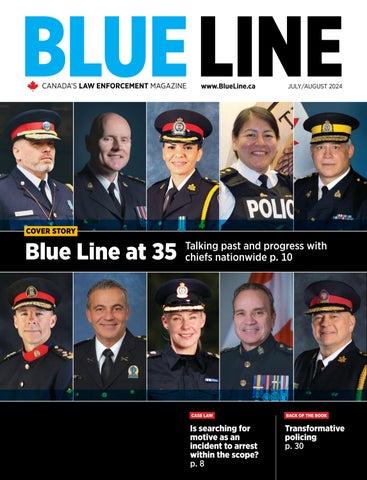
COVER STORY
Blue Line at 35
Talking past and progress with chiefs nationwide p. 10
CASE LAW
BACK OF THE BOOK
Is searching for motive as an incident to arrest within the scope? p. 8
Transformative policing p. 30
CANADA’S LEADER IN POLICE INNOVATION
ONLINE RECORD CHECKS
RECRUITMENT SCREENING
ONLINE REPORTING
Automate checks with a custom-built platform for your agency’s needs, including multiple ID verification options.
Streamline your hiring process to make datadriven choices that foster long lasting relationships with your most important assets.
Online platform to report crimes and incidents to keep your community safe.
Criminal Record Check • Social Media Check • Employment Verifications • Reference Check • Education Check • Credit Check • Driving Record Abstract
•
•
Dynamic software to support automation • Internet based platform for continuous innovation • Easy mobile enabled access for your community
•
•
Non-Emergency Reporting Retail Crime Cases
Powered by
CONTACT US
ROB STEWART (416) 606-6016 rob.stewart@tritonverify.com tritoncanada.ca
WANT TO GET STARTED? Let’s talk about how we can create a custom solution for you.
Contents
10 JULY/AUGUST 2024 Volume 36 Number 4
4 8 18 20 22 30
Features COVER STORY
10 Blue Line at 35
Pioneering a new era in Alberta law enforcement. By Brittani Schroeder.
14 @Blue_LineMag
Editor’s Commentary Case Law Q&A Technology Behavioural Sciences Back of the Book
Departments
Major changes and the future of Canadian law enforcement. By Brittani Schroeder.
24 Building from the ground up in Grande Prairie
Columns
5 5 6 6 9 29
News By the numbers Dispatches Calendar Off the Shelf Marketplace
24 30 July/August 2024 | BLUE LINE
3
EDITOR’S COMMENTARY BY BRITTANI SCHROEDER
www.BlueLine.ca
Blue Line Magazine’s 35 anniversary: A look back and a look ahead th
W
e are celebrating Blue three decades, and how that has impacted Line’s 35th birthday, and police and their operations. Their insights everyone is invited to the on the future direction of policing can also party! be found in the full story, which you can Anniversaries are a great time to reflect find on page 10. on our progress, but they are also an exFurther exploring the topic of the future cellent opportunity to consider our fuof policing, several municipalities across ture. What started as a small print Canada have contemplated transitioning magazine created in the basefrom RCMP services to municiment of founder and former Anniversaries pal police departments over the publisher Morley Lymburner, are a great past few years. Grande Prairie, has grown into a Canadian poli- time to Alta., embarked on this journey cing industry staple. Blue Line is reflect on our in 2023, and there has been sigthe country’s only national law progress, but nificant progress since then. enforcement magazine, and it they are also Earlier this year, I had the opporhas progressed to include more an excellent tunity to visit northern Alberta to than just a digital rendering of opportunity observe firsthand the developthe print edition—it expanded to to consider ments within the new police include newsletters, podcasts, our future. service. You can read about my webinars, social media, virtual experience with the Grande and in-person events, and more. Prairie Police Service and their In this anniversary edition, we dive into hopes for the future on page 20. the last 35 years of policing history in It is a privilege to be Blue Line’s editor and Canada. I had the pleasure of speaking to work with all of you throughout the year with police leaders nationwide to discuss to share what’s been happening in the pivotal changes that have shaped the Canadian law enforcement industry—the policing landscape. Through meaningful challenges and the triumphs. Putting conversations with Chief Julie Chanin together this edition has been enlightening (Oak Bay Police Department), Chief Fady and fulfilling, and I hope to offer you some Dagher (Montreal Police Department), insight into our collective evolution over Chief Myron Demkiw (Toronto Police the past few decades. Service), Commissioner Mike Duheme As always, please reach out to me at any (Royal Canadian Mounted Police), Chief time if there is a topic you think we should Cheryl Gervais (Treaty Three Police Serdiscuss, a new program your police service vice), Chief James Killeen (UCCM Anishhas started, or an officer you believe naabe Police Service), Deputy Chief should be highlighted. I can be reached at Treena MacSween (London Police Serbschroeder@annexbusinessmedia.com vice), Chief Mark Neufeld (Calgary Police Until next time, happy reading and be Service), Chief Adam Palmer (Vancouver well. Police Department), and Chief Danny Smyth (Winnipeg Police Service), I heard anecdotes from their early careers and reviewed with them the differences between policing in the late 1980s and present day. We explored how Canadian communities have evolved over the last
CONNECT WITH BLUE LINE
www.BlueLine.ca
4
@Blue_LineMag
BLUE LINE | July/August 2024
www.facebook.com/BlueLineMagazine
Reader Service Print and digital subscription inquiries or changes, please contact customer service Angelita Potal Tel: 416-510-5113 Fax: (416) 510-6875 email: apotal@annexbusinessmedia.com Mail: 111 Gordon Baker Rd., Suite 400 Toronto, ON M2H 3R1 GROUP PUBLISHER | PAUL GROSSINGER pgrossinger@annexbusinessmedia.com PUBLISHER | ADAM SZPAKOWSKI aszpakowski@annexbusinessmedia.com EDITOR | BRITTANI SCHROEDER bschroeder@annexbusinessmedia.com EDITORIAL DIRECTOR PUBLIC SAFETY GROUP | LAURA AIKEN laiken@annexbusinessmedia.com ACCOUNT MANAGER | JANICE EATON jeaton@annexbusinessmedia.com MEDIA DESIGNER | LISA ZAMBRI lzambrii@annexbusinessmedia.com ACCOUNT COORDINATOR | KATHRYN NYENHUIS knyenhuis@annexbusinessmedia.com AUDIENCE DEVELOPMENT MANAGER BEATA OLECHNOWICZ | (416) 510-5182 bolechnowicz@annexbusinessmedia.com CEO | SCOTT JAMIESON sjamieson@annexbusinessmedia.com ANNEX BUSINESS MEDIA 111 Gordon Baker Road, Suite 400 Toronto, ON M2H 3R1 Tel. 416-442-5600 • Fax 416-442-2191 Publication Mail Agreement No. 40065710 ISSN 0847-8538 Printed in Canada SUBSCRIPTION RATES Canada — 1 Year $32.13; 2 Year $53.55 plus tax USA — 1 Year $139.23 CAD Occasionally, Blue Line will mail information on behalf of industry-related groups whose products and services we believe may be of interest to you. If you prefer not to receive this information, please contact our circulation department in any of the four ways listed above. Annex Privacy Officer Privacy@annexbusinessmedia.com; Tel: 800-668-2374 © 2024 Annex Business Media. All rights reserved. Printed in Canada. No part of the editorial content of this publication may be reprinted without the publisher’s written permission. Opinions expressed in this magazine are not necessarily those of the editor or the publisher. No liability is assumed for errors or omissions. Readers are cautioned and advised that articles presented herein are edited and supplied for your personal awareness and should not be used for further action until appropriate guidance is received from a supervisor, Crown Attorney or other persons in authority. All advertising is subject to the publisher’s approval. Such approval does not imply any endorsement of the products or services advertised. The publisher reserves the right to refuse advertising that does not meet the standards of this publication.
NEWS memorial effort that recognizes the positive impact of their lives and legitimizes the grief of those who carry on their memory,” said Canada Beyond the Blue in a press release. “The relentless exposure to on-the-job trauma can significantly impact the mental health of police members.” A distinct memorial was created not only to dignify these members’ service but also to prompt stakeholders to advocate for more comprehensive policies that will address the mental well-being of law enforcement members and their families. This is a step forward to ensure that these individuals are never forgotten.
PHOTO CREDIT: HANSSLEGERS / ISTOCK / GETTY IMAGES
BRITISH COLUMBIA
Project ‘Spotlight’ - AbbyPD arrests prolific violent offenders
The Abbotsford Police Department (AbbyPD) devised project ‘Spotlight’ to target prolific violent offenders and offenders responsible for random acts of violence. The goal of the 8-month initiative was to make communities safer by arresting violent offenders who were released on conditions and by targeting property crime offenders who were using violence during the commission of their crimes and creating continuous financial losses to businesses. Uniformed and undercover officers collaborated and used multiple tactics, including surveillance and vehicle, foot, bike, and ATV patrols. Project results included 224 arrests, 122 of which were outstanding wanted persons; weapon seizures, including two loaded sawed-off shotguns and imitation firearms, machetes, hatchets, bear spray, batons, throwing stars, knives, spiked bat and crossbow; the recovery of stolen property; seizures of drugs and illegal cigarettes; the issuing of 106 violation tickets; eight impaired drivers were prohibited from driving; vehicle impounds and one car seized for civil
forfeiture. In the first four months of 2023, Abbotsford reported a 23.3 per cent increase in crimes against persons. Comparatively, in 2024, after the project was completed, the rate of increase was decreased to 6.8 per cent. This project was funded through the Special Investigations & Targeted Enforcement (SITE) program under the British Columbia government’s Safer Communities Action Plan. - Courtesy of Abbotsford Police Department ONTARIO
Ontario holds first annual Police Suicide Memorial
On June 23, Ontario held its first annual Police Suicide Memorial at Ontario Police Memorial Park, organized by Canada Beyond the Blue. The Ontario Police Suicide Memorial honours and pays tribute to Ontario’s police members who have died by suicide ‘Because of the line of duty’. Families of loved ones who died by suicide were present on Sunday from several police services throughout Ontario. “Members are deserving of a formal
QUEBEC
SPVM creates symbol to honour colleagues who died in the line of duty
The Service de Police de la Ville de Montréal (SPVM) has updated its procedure relating to appearance and maintenance of SPVM personnel. The internal procedure had not been revised since 2005, and it became essential to update to contemporary realities. The “Thin Blue Line” crest was a critical topic of discussion when considering the new dress and maintenance procedures. Through the numerous talks Director Fady Dagher conducted with his police officers, it became clear that they wanted to be able to wear a badge that allowed them to honour the memory of their sisters and brothers who died in the line of duty. A new neutral, impartial symbol belonging to the SPVM has been developed, and a transition period is planned between the two. The new badge will feature the SPVM coat of arms and the words “Fallen but never forgotten.” - Courtesy of Montreal Police Department (SPVM)
BY THE NUMBERS In March 2024, Statistics Canada released recent data on online child sexual exploitation, 2014 to 2022. For more information, please visit www150.statcan.gc.ca.
15,630 police-reported online sexual offences against children.
@Blue_LineMag
84 %
of victims between the ages of 12 and 17 were girls.
30,983
59 %
charges were processed in court between 2014 and 2021.
of online sexual offences against children not solved by police.
July/August 2024 | BLUE LINE
5
NEWS DISPATCHES After 33 years of service to law enforcement, Chief Duncan Davies of the LaSalle Police Service has announced that he will retire effective Oct. 1. Davies began his career as a constable with the LaSalle Police Service in 1996. He worked as a community patrol officer and was later assigned to the criminal investigation division. He completed his Certificate in Criminology and Criminal Justice at the University of Windsor in 2006 and, in 2014, was promoted to Sergeant. Davies was promoted to Staff Sergeant in 2019 where he proved to be an integral part of the LaSalle Police Service administrative team. In 2021, Chief Davies competed against many other candidates for the position of Chief and was selected by the LaSalle Police Services Board to lead the Police Service. Al Sauve, chief of the CPKC Police Service – Canadian Pacific Kansas City (formerly CP Police), will retire effective Aug. 16 after 45 years of law enforcement. Sauve joined the Edmonton Police Service in 1979 and retired in 2005, and shortly thereafter, he became Alberta’s first Chief Sheriff. He retired from there in 2012 before being recruited by CP Police as a Commander for Alberta and B.C. He was promoted to deputy chief in 2014 and to chief in 2019. Sauve was inducted into the Her Majesty’s, Order of Merit of the Police Forces in 2013 by then Governor General David Johnston and currently holds the O.O.M designation. Cameron McBride has been appointed chief of police for the Saskatoon Police Service for a five-year term. McBride has been a member of the Saskatoon Police Service since 1997 and has seen it grow, evolve, and strengthen in areas like diversity and equity. He recently led an in-depth review of each department within the police service to examine workload and capacity. Over the years, he has built strong relationships with many front-line community service organizations and has shown excellence in leading teams in several areas of the police service.
6
BLUE LINE | July/August 2024
CALENDAR Gary Conn has officially retired as chief of the Chatham-Kent Police Service, effective June 14. He was appointed to this position in 2015. In 1995, Conn began his policing career with the London Police Service, and in 1998, he joined the newly amalgamated Chatham-Kent Police Service (CKPS). Over the course of his nearly 30-year career, Conn has had the privilege of working in many areas of policing, either in a direct or supervisory role. During his tenure as Chief of Police, he was known as a progressive and people-focused leader who championed change for many initiatives. Over the years, he has also worked in collaboration with the Board and Associations to increase and enhance wrap-around support and services for police personnel dealing with work-related operational stress injuries. The Chatham-Kent Police Services Board selected Kirk Earley to assume command as the new chief of the Chatham-Kent Police Service, effective June 15. Earley is a 27-year veteran and began his career with the Chatham Police Service as a special constable in 1997. In 1998, Earley was sworn in as a constable with the newly formed Chatham-Kent Police Service. Earley has spent time throughout his career in community patrol, training, community priority action teams, major crimes, and the intelligence section. He has also held various supervisory roles in each branch of the service, gaining extensive experience in a multitude of levels. Robert A. Davis has officially retired from the Brantford Police Service. Having joined the Brantford Police in Sep. 2019, Davis is the only Indigenous chief in Ontario to have served with both Indigenous and non-Indigenous police services, then eventually lead a non-Indigenous police service. Arriving at a time when Brantford was experiencing a high rate of fatal overdoses and a downtown with significant issues, Chief Davis lobbied for and promoted a stratified approach to public safety, with a push to utilize resources appropriate to the need, including municipal by-law enforcement officers, private security, and Special
119th CACP Annual Summit and Policing Trade Show Date: Aug. 11 – 13, 2024 Location: Halifax, N.S. www.cacp.ca 2024 Safety of Our Cities Conference Date: Sep. 16 – 18, 2024 Location: Mississauga, Ont. www.safetycitiesconference.ca 27th Annual Fraud and Anti-Counterfeiting Conference Date: Oct. 15 – 17, 2024 Location: Toronto, Ont. lipkuslaw.regfox.com Security • Police • Fire • Aviation Career Expo – Edmonton Date: Oct. 29, 2024 Location: Edmonton, Alta. www.emergencyservicesexpo.ca Find more calendar events online at blueline.ca/events.
Constables. Davis shared that he was moving on to other opportunities where he would continue to positively impact public safety. In May, Davis began transitioning responsibilities to Jason Saunders, who will serve as interim chief of police. The Grande Prairie Police Service has sworn in its eighth officer and first female member. Cst. Brenda Tunke, a proud member of the Tsilhqot'in Nation in British Columbia, has nearly 15 years of experience as an officer with the Edmonton Police Service and moved to Grande Prairie in 2023. She has since served as a Community Peace Officer with the Municipal District of Greenview. Looking for a new challenge and opportunities to serve her community, she turned to GPPS and hopes to play a role in creating a police service Grande Prairie is proud to have, with a passion for increasing public security and safety. PROMOTIONS, RETIREMENTS, RECOGNITION • If you have an officer in your agency recently promoted or retiring or an individual you wish to have recognized (major award or recently deceased) you can let Blue Line magazine know by emailing: bschroeder@annexbusinessmedia.com.
www.BlueLine.ca
STANDING SHOULDER TO SHOULDER WITH YOU Your trusted source for uniform insignia
trimtag.com • contact@trimtag.com • 905-763-7300
CASE LAW
BY MIKE NOVAKOWSKI
Is searching for motive as an incident to arrest within the scope?
T
his year, Blue Line celebrates 35 held that the vehicle search was temporalyears. Congratulations! It was ly and spatially connected to the arrest. She also 35 years ago when the Su- accepted that the officer had a subjective preme Court of Canada heard belief that a search of the vehicle might arguments in the landmark search incident shed some light on why Dautruche had fled to arrest case, Cloutier v. Langlois – a deci- from police. This subjective belief was obsion that took the Court three months to jectively reasonable. Since the search was decide. Now, more than three decades lawful as incidental to arrest, there was no later, courts are still considering the scope s. 8 Charter breach – the right to be secure of this common law power. against unreasonable search or seizure. As In one such case, R. v. Dautruche, 2024 for the bag of cocaine found on top of the ONCA 426, the Ontario Court of Appeal snowbank, the only rational inference from was tasked with deciding whether a search the whole of the evidence was that Dautfor motive—or the reason why a driver fled ruche threw it out of the driver’s side from a traffic stop—was truly incidental to window. He was convicted of PPT cocaine arrest such that a search of a vehicle, which and PPT crack cocaine, and flight from a turned up cocaine, was conducted for a peace officer. valid law enforcement objective. Dautruche then appealed his drug conIn this case, the police tried to pull over victions to Ontario’s top court, claiming the accused during a traffic stop the search of the vehicle was not sometime after 2 a.m. But rather valid as an incident to arrest. than yielding to police, Daut- The law Dautruche argued that the ruche – whose driver’s licence enforcement Crown had not met its burden was suspended at the time – fled. purposes for of establishing that the searchHis vehicle subsequently skidded the search ing officer subjectively turned off the road, and its driver’s side must be his mind to the permissible ended up tightly lodged against subjectively scope of the search incident to an eight-foot-tall hedge and a connected to arrest power. He suggested the snowbank of freshly fallen snow. the arrest, and officer did not have a subjective Dautruche, the lone occupant of the officer’s belief that searching Dautthe vehicle, emerged from its belief that the ruche’s vehicle might reasonably passenger side and was arrested purpose will uncover evidence related to the for flight from police, an offence be served by offence of flight from police, the under s. 320.17 of the Criminal the search reason for which he had been must be Code. arrested. An officer decided to search objectively However, the three-judge Dautruche’s vehicle as an inci- reasonable. panel of the Ontario Court of dent to arrest. During the search, Appeal rejected Dautruche’s a bag of crack cocaine was found on the contention. The Court first outlined the driver’s side floor. When the vehicle was requirements for the common law power towed away, a bag of cocaine was found on of search incident to arrest: top of the snowbank in the area where the The common law “permits the police to driver’s side window would have been be- search a lawfully arrested person and to seize fore the vehicle was moved. The driver’s anything in their possession or the surrounding side window was open four to six inches, area of the arrest to guarantee the safety of the and the snow around the vehicle remained police and the arrested person, prevent the undisturbed, except for the ripples on the person’s escape, or provide evidence against surface where the vehicle had struck. them”. The “surrounding area” can include an When this went to trial in the Ontario automobile. Court of Justice, the officer said he searched The common law power of search incident the vehicle because “maybe it would shed to arrest requires that the individual searched light as to give some reason as to why” (1) has been lawfully arrested, (2) the search Dautruche would have taken off. The judge be incident to the arrest in the sense that it is 8
BLUE LINE | July/August 2024
for a valid law enforcement purpose connected to the arrest, and (3) the search be conducted reasonably. The law enforcement purposes for the search must be subjectively connected to the arrest, and the officer’s belief that the purpose will be served by the search must be objectively reasonable. To meet this standard, the police require “some reasonable basis” to do what they did. As for whether the police were entitled to search for the motive or reason why Dautruche fled, the Court of Appeal added this: He was lawfully arrested for the offence of flight from police. While the police knew that he had a suspended licence, [the searching officer] was evidently alive to the possibility that the [accused] might have also had another motive to flee from the police. [The searching officer] and another officer both testified that they believed that the driver might be impaired. It was also a reasonable possibility in the circumstances that he might have fled because he was in possession of contraband. This gave [the searching officer] a reasonable basis to search the vehicle for evidence that might better explain why the [accused] had fled. While this evidence might have shown that the [accused] had committed a different offence, this evidence might nonetheless also have had probative value in relation to the flight from police charge, which required the Crown to prove, among other things, that the [accused] had no reasonable excuse for his failure to stop. In the Court’s view, the officer’s testimony revealed he subjectively conducted the search consistent with the proper purposes of search incident to arrest — a search for evidence of Dautruche’s possible motive for fleeing from the police. Since the officer’s search of the vehicle was a valid search incident to arrest, there was no s. 8 breach and, therefore, no reason to consider whether it should have been excluded under s. 24(2). Dautruche’s appeal was dismissed, and his convictions were upheld.
Mike Novakowski is Blue Line’s case law columnist.
www.BlueLine.ca
OFF THE SHELF What It Takes: Things a Canadian Police Officer Wants You to Know About His Job By Owen R. B. Roberts ISBN: 978-1039164987 What It Takes offers a compelling firsthand account of policing in Canada through the eyes of a seasoned officer. Written with an authenticity that only someone with direct experience in law enforcement can provide, this book offers readers a rare glimpse into the daily challenges, triumphs and complexities of police work. From the start of an officer’s career, including hiring and training, to the challenges that police face with drugs and mental health, the author paints a vivid picture of the diverse situations encountered each day. Each chapter is filled with gripping anecdotes that bring to life the realities of law enforcement in Canadian communities. One of the book’s strengths lies in its balanced portrayal of the profession. While the author does not shy away from highlighting the adrenaline-fueled excitement of police work, he also candidly addresses the inherent risks and ethical dilemmas officers face. Through introspective reflections, readers gain insight into the personal side of policing, including the toll that the job can take on one’s mental and emotional well-being.
BL_DRElectronics_MayJune24.indd 1 @Blue_LineMag
Moreover, What It Takes delves into the intricacies of policing within the Canadian context. The author provides valuable insights into use-of-force training and how society expects officers to be perfect in every situation. By exploring issues such as use-of-force, media, drugs and mental health, the book offers a nuanced understanding of law enforcement in Canada. What sets this book apart is its emphasis on the human side of policing. Through the author’s personal anecdotes and interactions with community members, readers witness the empathy, compassion and resilience that define the best officers. Moreover, the author’s willingness to acknowledge moments of vulnerability and self-doubt adds depth to their portrayal of the profession. In conclusion, What It Takes offers a captivating and insightful journey into the world of Canadian policing. Whether you’re an experienced law enforcement professional, a student of criminal justice, or simply a curious reader, this book provides a valuable perspective on the complexities of maintaining law and order in a diverse and evolving society. It is a must-read for anyone seeking to gain a deeper understanding of the officers who wear the badge. – Sgt. Casey Ward, Regina Police Service, and President of the Saskatchewan Federation of Police Officers.
9:46 AM9 July/August 2024 2024-04-24 | BLUE LINE
Blue Line at 35
Talking past and progress with chiefs nationwide By Brittani Schroeder
T
he year was 1989. Brian Mulroney was the prime minister of Canada. The Canadian Space Agency was created. The Calgary Flames defeated the Montreal Canadiens to win the 1989 Stanley Cup Finals. Out of Toronto, a brand-new Canadian-focused policing magazine appeared in print. To celebrate Blue Line’s 35th anniversary, we spoke with members of police leadership across Canada to learn about the most significant changes that impacted police over the last three and a half decades and where we might be headed next.
A look back
Policing in the late 1980s and early 1990s, described by Neufeld as “simpler” and echoed by Dagher, who noted it was “more black and white”. This was a world without social media, texting and smartphones. Cellphones were bulky and unpopular, leaving payphones as the norm. In-vehicle computers were not standard issue, necessitating handwritten reports on carbon paper. Duheme recalled training at Depot involved learning to type 18 words a minute on a typewriter. Smyth recalled the challenge of accessing information in the field;
officers were instead required to return to the station for queries of the paper archives. Officers then carried revolvers and wooden batons, lacking modern tools like tasers, pepper spray, beanbag shotguns or pepper balls. Kevlar vests were only just brought into law enforcement, but they were not made mandatory. Their radios were analog and ran on an unsecured network. Crime mapping was done manually with paper maps and colour-coded pins. Encountering a firearm on the street was a rare occurrence, noted Demkiw. Illegal substances, like cocaine, methamphetamine and cannabis, were a problem but were less likely to be fatal than today’s fentanyl, carfentanil or xylazine. There were significantly fewer women and people from diverse backgrounds in policing. This apparent gender disparity was always in MacSween’s face. Duheme noted that men and women were separated during training at the RCMP’s Depot in Regina and wore different uniforms. Police visibility in Indigenous communities was limited, and very few policing positions were filled by Indigenous members, shared Gervais. “Indigenous Policing had, in large part, been contracted out to the RCMP prior to 1991. First Nations
“I like that Blue Line can tap me on the shoulder by coming to me via email and other digital platforms. It’s a must-read by senior officers and it permeates throughout all ranks.” – Chief Danny Smyth, Winnipeg Police Service 10
BLUE LINE | July/August 2024
Policing came about from the Kanehsatà:ke Resistance, otherwise known as the ‘Mohawk Crisis’ that took place in Quebec in 1990,” said Killeen. “The Oka crisis motivated the development of Indigenous Policing through the First Nations Policing Program (FNPP) to try to prevent future confrontations.” At that time, Neufeld also felt a higher level of respect for the policing institution in general. Despite these differences, a few things have remained the same. Palmer emphasized the ongoing societal challenges of victimization, which is a reminder of the importance of policing. He also highlighted the inherent goodness of those in law enforcement and the public’s continuing need for safety. Both Smyth and Demkiw noted that the profession has continuously focused on people, and the interactions with the public have remained unchanged.
Thirty-five years of change
The rise of technology The new millennium ushered in a technological revolution in Canadian policing. In 2001, police services in British Columbia adopted a new electronic records management system, significantly reducing reliance on paper. What began as basic two-way radios evolved into in-vehicle computers, transforming officers’ capabilities on patrol. Now, officers can digitally query the records systems, access real-time crime maps and anticipate future crime hotspots. They can also run checks on licence plates and driver’s licences and receive additional information through dispatchers during service calls. “The vehicles themselves have also been upgraded, recognizing that some officers may be in the cruiser for 10 to 12 hours straight,” said www.BlueLine.ca
PHOTO: UCCM ANISHNAABE POLICE SERVICE, VANCOUVER POLICE DEPARTMENT, LONDON POLICE SERVICE, TREATY THREE POLICE SERVICE, ROYAL CANADIAN MOUNTED POLICE
COVER STORY
PHOTOS: CALGARY POLICE SERVICE, MONTREAL POLICE DEPARTMENT (SPVM), OAK BAY POLICE DEPARTMENT, WINNIPEG POLICE SERVICE, TORONTO POLICE SERVICE
“Blue Line has always been relevant. It’s also been one of the most consistent things throughout my career. It is evolving alongside law enforcement. It’s more than a publication— Blue Line connects people in the industry.” – Chief Mark Neufeld, Calgary Police Service MacSween. Advancements in technology have equipped police with an array of tools, including global positioning systems (GPS), body-worn cameras, laptops, drones, encrypted radios, Narcan, and CPR masks. “This new technology creates transparency. However, it also creates a situation where officers feel everything they are doing is being scrutinized, and they are sometimes apprehensive about engaging with the public in the same manner that they used to,” shared Killeen. Police-issued firearms shifted away from revolvers to automatic pistols with red dot sights and flashlights. Smartphones have also had a significant impact on policing and the sharing of information. Police services across Canada have begun to switch to electronic notetaking, but Smyth doesn’t believe it will stop there. In the not-too-distant future, he foresees being able to dispatch through the smartphone, query into service mainframes and records management systems, take recorded statements and videos, and capture evidence through photography. “When cell phones were created, they were meant to be used as phones. Now, you have a mini computer in your hands,” said Duheme. These technological advancements have also transformed investigative practices. Traditional face-to-face interactions for resolving incidents have been supplemented by the need to obtain production orders for evidence retrieval across multiple digital platforms. Neufeld highlighted challenges in adapting to the new online space. Chanin also acknowledged the com@Blue_LineMag
plexities introduced by technology, which have required police to acquire expertise across various technological domains to combat modern crimes effectively. The Charter and case law Since the signing of the Charter of Rights and Freedoms (“Charter”) in 1982, there has been a notable shift in community expectations regarding public-police interactions. Alongside this, significant advancements in the form of new case law have emerged to guide officers in carrying out their duties. One pivotal case, R. v. Stinchcombe (1991), altered procedures concerning disclosure to the defence. Following the decision on this case, any notes or reports pertaining to an arrest or prosecution needed to be given to the defence team well in advance of the trial. “That seems reasonable nowadays, but before that case, the defence would only learn of our notes’ contents while already in the courtroom,” said Smyth. Failure to comply could ultimately result in charges being stayed or evidence being excluded. R. v. Feeney (1997) addressed officer entry into residences without a search warrant. Prior to this case, the law allowed entry when searching for a wanted individual. Following Feeney, officers must obtain a warrant before entering any residence for a search. In R. v. Grant (2009), an uninten-
tional breach of an individual’s Charter rights led to the discovery of a firearm and marijuana. The court needed to decide if they were going to allow this evidence to lead to a serious charge because there was a breach of rights. From this case, the Supreme Court of Canada created a new test to determine whether evidence obtained by a Charter breach should be excluded under s. 24(2) of the Charter. This test weighs how serious the breach is against the criminal case that is being executed. R. v. Jordan (2016) imposed time limits on criminal trials, stipulating that most trials must conclude within 18 to 30 months from the initial charge. Running beyond that timeline risks having the charges dropped entirely, or the prosecution halted indefinitely. Specialization and training Over the years, police training has significantly evolved to meet their communities’ diverse needs and expectations. Officers now undergo extensive instruction in various areas, such as de-escalation tactics, mental health awareness, Integrating Communications, Assessment and Tactics (ICAT), and fair and impartial policing. They can also hone their skills through virtual reality simulations, ensuring readiness for real-world scenarios. “There are so many options on the use-of-force continuum that the officers have on their toolbelts now,” said Palmer. Training and operational standards are also closely aligned with provincial regulations, which Smyth believes should give communities comfort
“Blue Line is an important part of policing in Canada. We often get very focused on our own departments and jurisdictions and lose sight of the people who are blazing trails or trying new things. Blue Line provides a vehicle for us to connect.” – Chief Julie Chanin, Oak Bay Police Department July/August 2024 | BLUE LINE
11
COVER STORY
“Blue Line is something that I see frequently. The information shared around best practices and other things going on in policing is something that we always look to learn from, and Blue Line provides an avenue of engagement like that.” – Chief Myron Demkiw, Toronto Police Service that officers are not out there “winging it”. The advent of smartphones, delivering global news instantaneously, has compelled police services to pivot quickly to address emerging trends. “We must be able to respond in a way that’s culturally competent and sensitive to what’s happening in our neighbourhoods,” said Demkiw. The policing profession has also grown more specialized, with larger municipal services establishing dedicated teams for child exploitation, cybercrime,
political stability, climate considerations, and safety concerns in other countries. This influx includes people who may come from regions where perceptions of law enforcement are negative. Neufeld emphasized the need to find new pathways into policing so that diverse communities can be authentically represented. “It’s crucial to ensure our services reflect the communities we serve,” echoed Duheme. Demkiw advocated for embedding community perspectives in policing operations
“I’ve been around for 37 years, and I’ve been reading Blue Line for the 35 years it has been around. An awful lot of excellent work is being done across the country, and it needs to be shared. Blue Line is one of the places we can do that.” – Commissioner Mike Duheme, RCMP organized crime, homicide, drug enforcement, canine units, forensics and financial crimes. Collaboration across municipal, provincial and federal levels of law enforcement has intensified for investigations involving drugs, organized crime, national security and terrorism, and also extends into international cooperation with the United States and other global partners. “Continuous training and development for all officers at every level is essential,” Chanin stressed. Despite challenges posed by events like COVID-19, she viewed this period as an exciting opportunity for advancing police practices. Changing demographics Over the last few decades, Canada’s population demographics have undergone major transformations. Immigration to Canada has been motivated by various factors, such as geo12
BLUE LINE | July/August 2024
through co-designing and co-delivering safety initiatives. As the country’s demographics have changed, so too have the demographics of police services. When women in policing data were first collected in 1986, women made up only 4 per cent of all Canadian police officers, whereas in 2023 the number sat at 23 per cent. In 2024, the RCMP marked a milestone as they reached the fiftieth anniversary of its first female troop. MacSween, currently the highest-ranking black woman in Canada and the second to be appointed deputy chief after Peel Regional Police’s Ingrid Berkeley-Brown, sees the numbers headed in the right direction, though it is slow-going. She sees her role as an opportunity to help inspire diverse applicants to join the policing profession. Similarly, Chanin made history as the first female deputy chief and now chief of the Oak Bay
Police Department. There has also been an improvement in the representation of Indigenous members within police services, alongside increased visibility in Indigenous communities. When Gervais transferred from the OPP to the newly created T3PS in 2003, 30 other members began with her. Since then, the service has expanded to include 100 sworn members, with ongoing growth. Gervais noted, “We strive to provide fair and equitable policing to the 23 communities we serve. We regularly engage with them to identify areas for improvement and opportunities to enhance our services through the creation of culturally responsive programs.” With these shifts in policing also came the greater focus on diversity, equity and inclusion (DEI) efforts—a change Neufeld sees as ultimately for the better. Demkiw recommends a comprehensive equity strategy focused on confronting anti-Black racism, supporting Indigenous cultural safety, engaging with the LGBTQQIP2SAA community, and fostering trust and professionalism within the police service. These efforts reflect a commitment to evolving alongside demographic changes, ensuring that Canadian police services are inclusive, responsive and representative of the communities they serve. Mental and physical health Recent years have seen a shift in policing towards prioritizing members’ mental health and well-being. While resources may vary among police organizations and provinces, there is a growing
recognition of the psychological and physical toll inherent in policing. This has led to establishing wellness units and specialized programs staffed by dedicated wellness officers and psychologists who work closely with members to provide necessary support. When Killeen began as a recruit and was dealing with a tremendous amount of stress due to the illness of his newborn son, he didn’t feel like he could talk about it with his peers. “There was a huge stigma for any officer to show a chink in their armour,” he shared. He recognized the “great strides” that have been made to challenge this stigma of mental health issues, PTSD and burnout in the policing profession over the past few decades. The focus on mental health extends beyond policing. Officers are increasingly responding to mental health-related calls daily, which reflects a broader societal change in how mental health issues are addressed. “I keep telling my team to get used to the change. We must be adaptable. We can’t look at it as an obstacle, though; we need to see it as an opportunity. When we adapt, we discover new ways of doing things,” said Dagher.
A look ahead
Looking ahead, police leaders are keenly aware of the rapid evolution of technology and its implications for the future. MacSween acknowledged the growing reliance on technology among members and stressed the need to carefully weigh both the positive and negative impacts, especially in the realm of digital evidence gathering.
“I think it’s incredible that we have a Canadian-focused policing magazine. I always make sure to read Blue Line and disseminate the magazines down through the ranks. I like reading about what’s happening in other provinces to draw parallels to what we’re doing or find best practices for something new.” – Chief Adam Palmer, Vancouver Police Department www.BlueLine.ca
Building Bridges
@Blue
Evidence-Based Policing Conference
Join us at the beautiful Blue Mountain Resort and Village Conference Centre to learn about developments in evidence-based policing (EBP) and the positive impact research-driven decision-making is having on policing in Canada. The event agenda will explore topics such as: Change Management Recruitment & Retention Police Operations Resilience & Wellness Innovation & Future of Policing Police Legitimacy And More!
CO-PRESENTED BY
PRIORITY REGISTRATION
$289+ HST
Event Entry Ticket Includes, breakfast, lunch, coffee breaks and EBP delegate bag.
SUPPORTED BY
SPONSORED BY
For more information, please contact the Building Bridges Team at BuildingBridges@BarriePolice.ca
For more information, please contact the Building Bridges Team at BuildingBridges@BarriePolice.ca
COVER STORY “I’ve seen Blue Line throughout my career and I look for the best practices and new equipment. I make sure that Blue Line is available in my office’s waiting area, so my guests can read it.” Chief Fady Dagher, Montreal Police Department “The criminal landscape is evolving rapidly alongside technology. I feel our legislative framework is having difficulty keeping up,” said Duheme. For smaller departments like Chanin’s and Gervais’s, the future of policing technology appears promising. “We value the opportunity to learn from other Canadian services trialling new equipment,” said Chanin, highlighting its potential to effectively address complex societal changes. Demkiw, Palmer and Smyth all shared similar sentiments concerning artificial intelligence (AI), recognizing its potential benefits while cautioning against risks such as deep fakes
and data manipulation. “How do we manage the significant growth in AI while ensuring community safety and considering privacy and ethical implications?” asked Demkiw. In addition to technological initiatives, establishing sustainable funding models for policing will be crucial as we move forward. Public scrutiny over budgets requires police leaders to carefully balance advancing budgets with community concerns and ongoing discussions. Demkiw emphasized the need for police to be able to adopt operational and strategic planning that considers sustainable funding over multiple years, moving away from an-
nual cycles. “The future requires discussions on sustainable and predictable funding,” echoed Duheme. Understanding longterm funding streams would enable informed, fiscally responsible decisions that respect community perspectives, needs and expectations. For Gervais and Indigenous police services like T3PS, ongoing conversations are crucial regarding funding parity between municipal and Indigenous police services. She emphasized, “This remains a collaborative effort, not just among Indigenous services in Ontario, but nationwide.”
Killeen echoed these sentiments and stated that the recent 2023 ruling from Justice Gascon for First Nations Police to be able to implement specialized units that were previously denied, such as drug, canine and crime units, is just the beginning. “These specialized units will not only help Indigenous Police Services better meet the community’s needs and wants, but also allow officers and staff professional growth opportunities and the ability to move laterally within their careers.” Above all else, Dagher envisions the future of successful police departments as those that are capable of fostering a
“It’s important to acknowledge Blue Line’s role, especially as it helps to advocate for critical issues in policing. If I’m able to learn about important topics here, it’s clear that other police leaders across Canada can as well.” – Chief Cheryl Gervais, Treaty Three Police Service
Proudly Canadian. Successfully Global. Reliable to the Core.
Classic Canadian! Thanks to Canada’s diverse police agencies that believed in our platform, NicheRMS365™ is the most widely used, large-agency RMS in the world, outselling our top 8 competitors.
Discover your Niche today! Learn more at NicheRMS.com
1 14 BL_Niche_JulyAug24.indd BLUE LINE | July/August 2024
2024-07-02 10:33 AM www.BlueLine.ca
cohesive police family structure. Drawing parallels to the healthcare system’s diverse roles, he advocated for a similar multidisciplinary approach in policing. During his tenure as chief in Longueuil, Que., a RESO team was created—comprising a police officer, nurse, social worker and therapist—to service specific addresses frequently calling 911. “The team assessed individual needs and ensured we could deliver on promised services to maintain trust. Results showed a significant reduction in 911 calls,” he said. Similarly, Neufeld acknowledged policing’s evolving chal-
lenges and advocated for deeper integration with healthcare professionals, particularly concerning the drug crisis. However, while police are able to provide essential insights to help future policy responses, he shared that they must resist the temptation to become the whole system. He said, “The police need to unapologetically be the police. At the end of the day, when someone is committing an offence, only the police have the power to arrest or intervene.” Gervais admitted that sometimes, the police are not the right people to tend to specific calls. “Partnering with other
“No other national Canadian magazine speaks specifically to policing’s hot topics. It’s awesome because I can pick up the magazine and see what someone out west or out east is doing. I have made so many contacts through Blue Line as well. It’s like an encyclopedia of policing information.” – Deputy Chief Treena MacSween, London Police Service
“Seeing officers and staff I know being featured in Blue Line throughout the years brings a sense of pride for those people and to be part of this profession. Seeing all the articles featuring Indigenous Policing shows we are, and will continue to be, part of the growth and success of First Nations Policing for decades to come.” – Chief James Killeen, UCCM Anishnaabe Police Service agencies to create a more holistic approach to serve our communities is the way forward.” Duheme emphasized the need for enhanced international law enforcement collaboration, marking a shift from “policing in silos” to collective action. “We’re all fighting for the same cause, just our uniforms are different,” he said. Duheme also believes that public trust hinges on transparency and accountability, and a concerted effort needs to be focused on keeping that trust.
Final thoughts
In reflecting on Blue Line’s 35-
year journey alongside Canadian policing, it’s clear that the landscape has undergone profound changes. From an era characterized by simpler technologies and different societal expectations, policing has transitioned into a dynamic and complex field shaped by technological advancements, legal precedents, demographic shifts, and a heightened focus on mental health and community integration. As challenges evolve and society changes, Canadian policing remains steadfast in its mission to uphold safety, justice and integrity.
+1 867-668-5609 publisher@canadianguns.com www.canadianguns.com
The only Canadian buy-and-sell firearms newspaper distributed across Canada!
WHY ADVERTISE WITH CATF? Our paper is distributed monthly by subscription and at gun shows, gun trades, gun clubs, and select stores across Canada. We shall put you in touch with the active, committed core of Canada’s firearm community!
BL_CATF_JanFeb24.indd 1 @Blue_LineMag
$50
2:00 PM July/August 2024 2023-12-21 | BLUE LINE 15
Q&A Recently, editor Brittani Schroeder spoke with Rob Shearer and Bob Hackenbrook, both from Peel Regional Police, about the twentieth anniversary of the Run to Remember, and how it supports the families of officers lost in the line of duty.
Bob Hackenbrook (BH): The National Peace Officers’ Memorial Run, known as the “Run to Remember”, was established in 2005 when the Peel Regional Police (PRP) running team, The Pacers, decided to raise awareness of the annual Police and Peace Officers’ Memorial Service. It’s also an event to support officers who have been killed in the line of duty and their surviving family members. The annual national service is held on the last Sunday of September in Ottawa, with the run occurring over three days immediately preceding it. The Run to Remember is a 460-kilometre relay that passes through many communities. It begins at the Ontario Police Memorial site in Toronto and finishes at the National Memorial in Ottawa. Rob Shearer (RS): For the runners who participate in the three-day relay, it is their way of fulfilling that pledge, that promise, that they will not forget those who have made the ultimate sacrifice in service of their community, their province and, indeed, their country. The long— and sometimes gruelling—hours of running allows the participants the opportunity to reflect on the sacrifices of those brave officers whose names are etched on the memorial wall in Ottawa and their families who have had to endure the pain of their loss. Ultimately, it’s not just a run through the city; it’s a lifestyle. We stand with these families who have suffered loss throughout the year. 18
BLUE LINE | July/August 2024
The team running in Ottawa.
Q: How has the run changed over the years?
BH: I’ve been with PRP for 29 years—Rob is at 36 years—and we’ve seen this run evolve since its inception. Eventually, other organizations jumped on board, the first being the Ontario Provincial Police. Now, we’ve grown to have more than 30 involved, everyone from corrections to
immigration to military police, who are involved alongside the RCMP and provincial and municipal police services. We’ve also had officers come up from the United States to join our run, and we’ve sent officers down to their memorial runs. We run from Toronto to Cobourg, to Brockville, and finally to Ottawa. Our problem now is that we don’t have enough rooms to house all the
runners in Cobourg and Brockville, so we must cap the registration numbers at 300. In 2018, we grew outwards and received interest from the Abbotsford Police Department to start a British Columbia run. Now, there’s the West Coast Run, which falls under our umbrella. A five-kilometre run was also held in Newfoundland. We hope to gain membership in Alberta soon, as Edmonton Powww.BlueLine.ca
PHOTOS CREDIT:PEEL REGIONAL POLICE
Q: Can you provide some background on the Run to Remember?
running for everyone else, and then last year, we ran for him. It is tough, but we keep going for him.
Q: Can you tell me about the charitable donations made from the funds raised?
A gentleman who plays the bag pipes to great runners every year stands on the shoulder as they head out of Brockville. The “Lone Piper”.
lice and Calgary Police are also considering starting a Run to Remember. RS: Not only has it evolved in size, but also in the charitable donations we’re able to collect and the awareness we can raise. As we run through the smaller Ontario communities, we’re greeted with open arms, and they really roll out the red carpet for us. People line the streets and show their support. It’s actually a counter-narrative to what people think about the relationship between police and society. During our run, we also like to identify widows’ and widowers’ homes if we pass them on the route and drop by to say hello. The mother of Cst. Chris Garrett, who was killed in the line of duty in 2004, lives in Cobourg. One year, we stopped by her house during the run and made pasta sauce with her. Chris started his career at PRP, and he left to police in a smaller community because he thought it would be safer for his family. This just highlights the fact that bad things can happen anywhere in this profession. BH: The run now includes @Blue_LineMag
survivors—those family members left behind after the loss. Their presence inspires the core group of runners to complete their journey of remembrance. We’ve seen children grow up while doing this run. Three young boys joined immediately after their father was killed, and at first, they would carry the flags or do other small tasks. Now, they’re bigger than us and running great lengths. Seeing them going through their lives and knowing that they’re okay is rewarding. Though this run is dedicated specifically to those who die in the line of duty, we still recognize those who are lost in other ways. In 2022, York Regional Police’s Cst. Travis Gillespie was killed in a car accident while on his way to a training day. His whole family came to our stop in Cobourg during the 2023 run, and we made sure to mention them and him. RS: As the run grew to include more organizations, Cst. Devon Northrup came on board to help, and he was such a big part of our team. In 2022, Devon was killed in the line of duty. This was someone who was always
BH: We donate yearly to the federal memorial in Ottawa, the provincial peace officers’ memorial in Toronto, and to other provincial memorials across the country. Then, we donate to the families who have children. For those widows or widowers who do not have children, we ask them which organization or charity we can donate to in their loved one’s name. Usually, they are charities focused on community initiatives. For example, RCMP’s Cst. Harvinder Singh Dhami, who was killed in April 2023, didn’t have any kids, so a donation to Meals on Wheels was made because he used to volunteer there. RS: The intent of the donations is almost to be selfdirected because we don’t want them to be pigeonholed. We truly want to help the family out where we can. If the children are not ready to head off to school, then a scholarship isn’t the best fit for them, but maybe they’ve dreamed about going to Disney World or something along those lines. With the donations’ help, they can live out that dream in spite of the fact that they’ve suffered this severe loss. BH: We’ve also supported Camp F.A.C.E.S. in the past. They are essentially a support group that hosts classes for widows and their kids, and it’s for anyone who has lost first responder loved ones. They could’ve also been lost to suicide or other mental health-related causes. For the kids, it helps to normalize what’s going on in their lives so they know they’re not alone in what they’re going through. By the end of this year, we will
have been able to raise $600,000 over the past two decades, all of it donated.
Q: Is there anything special happening this year to commemorate the run’s twentieth anniversary?
BH: We’re inviting back our alumni members, the Peel Pacers, who started the run in 2005. At that time, they were probably around 30 to 40 years old, and now they’ll be close to 60. We owe this all to them, as they got the ball rolling. RS: This is also the first year we’ve sought corporate sponsors. Generally, a lot of the money we accumulate for donations comes through the sale of t-shirts. We’re expanding by trying to involve stakeholder groups that are somehow connected to the world of law enforcement.
Q: What does the Run to Remember mean to you?
RS: I was inspired to join policing by family friends, and their grandfather, Det. Michael Irwin, was killed in the line of duty. So not only do I owe them thanks for my career in policing, but they were the driving force behind my initial involvement in the Run as well. Every time I run, I run for them. BH: Every officer has a few close calls throughout their careers, and in the U.S.A., they probably have dozens. My wife, who is also a police officer, joined the run before I did and encouraged me to do it with her. After that first time, I was hooked. We run with spouses, children and parents of those we’ve lost. Seeing how much support we can give them and how much it means to them has always stuck with me. We like to say that it’s not about the strength of our legs, but the strength of our hearts. Editor’s Note: This interview has been condensed and edited for clarity.
July/August 2024 | BLUE LINE
19
TECHNOLOGY
BY AMY BALFOUR
E
very year, the Regina Police crime trends in the city. In the first few Service receives requests for days, the map was viewed over 20,000 information from members of times. Community members sent messathe community, people looking ges and emails to share their appreciation to move to the city, property developers for the real-time information. Now, they and civil servants. People are smart, and can access information when they have they want to know what is happening in the questions, rather than waiting for a formal areas where they live, work, invest and response from the police service. This inspend time. novation propelled the Regina Police SerOur elected officials wanted to vice by sharing crime trends with be able to attend community Crime is people on their schedules, right meetings with up-to-date infor- always a from their own devices. mation about crime and offer matter of Before this new map, the Retips on how citizens could be- public interest, gina Police Service was only able come more informed. Wanting and it is to share some types of crime on more information, more often frequently an a hot spot map on the website. and in real time is the nature of emotive The information was uploaded society, and policing is no differ- issue.” – once a month and had no filter ent. Police agencies often use Ratcliffe, 2002 capabilities. The new Communcrime maps to reach these goals. ity Crime Map gives the public In late 2022, the Regina Police Service the power to search areas, time frames and launched a new, modernized public-facing different crime types. The data can also be crime map which is accessible 24 hours a downloaded and used for information at day, seven days a week and updated every another time. 24 hours for viewing on the Regina Police Although public-facing crime maps are Service website. This resource has proven becoming commonplace in Canada, it is to help engage our community in a way we important that planning, stakeholder conhave not been able to do in the past, while sultation and strategic deployment are at the same time increasing awareness of considered. A balance between providing
information to the public and protecting the privacy of victims must be paramount. At the Regina Police Service, the ability to modernize mapping technologies was first deployed operationally in 2019. The success we experienced laid the groundwork for additional reporting to be possible for public consumption. Once the tool became part of our day-to-day operations, our focus shifted to using the tool to help provide more information to our community. Careful consideration to ensure we adhered to local privacy legislation and the privacy of victims was critical. Although the process took months, consideration of all of these moving parts was imperative. The planning process was not without its challenges. We began exploring the idea of a new map without a project manager or dedicated GIS specialist. Analysts and inhouse information and technology personnel were tasked with developing, learning and delivering a new tool. We completed a search of other police agencies to see what was common, what was unusual, and how the crime data was displayed in other jurisdictions. Despite the hours of work and the need to develop skills in-house, the effort was worth it. Like many other police agencies, we recognized that a public-facing crime map could “have real potential to engage the public with local community problems” (Ratcliffe, 2002). The map has been considered so intuitive and easy to use, ESRI Canada has requested the Regina Police Service map to be available as a template in their suite of tools. Additional plans to expand the map and the data provided are already underway. The possibilities seem endless, from adding media release linkages, hot spot analysis, calls for service data and even storyboards. The next few years will be a time for exploring priorities and adapting to the needs of our community using this online mapping tool.
Reference
Ratcliffe, J.H., 2002. “Damned if you Don’t, Damned if you Do: Crime Mapping and its Implications in the Real World.” Policing and Society, pg. 224. Amy Balfour is the Manager of Strategic Services at the Regina Police Service.
20
BLUE LINE | July/August 2024
www.BlueLine.ca
PHOTO: REGINA POLICE SERVICE
Empowering communities: Regina Police’s modern crime map for public access
Early bird pricing ends August 23, 2024* 2nd Annual Canadian Congress on
REAL TIME CRIME CENTER OPERATIONS & September 25 – 26, 2024 TECH INTEGRATION Calgary, AB Understand the fundamentals of an effective real-time crime center. CO-CHAIR:
C/Supt. Larry Montgomery
SCAN TO VISIT WEBSITE
D/CROPS – Specialized Investigative & Operational Police Services E Division, RCMP
Early bird pricing ends August 16, 2024*
15th Annual
LAW OF POLICING CONFERENCE
November 6–7, 2024 Burnaby, BC
Serving the public, protecting your team. CO-CHAIRS:
Robert Fenton
Director, Legal Services Calgary Police Service
R. Kyle Friesen, O.O.M
General Counsel, Legal Services Surrey Police Service
*Special pricing for law enforcement and group rates available! @Blue_LineMag
SCAN TO VISIT WEBSITE July/August 2024 | BLUE LINE
21
BEHAVIOURAL SCIENCES BY PETER COLLINS
Crossing the line: Examining police sexual misconduct and violence against women
I
n medicine, distinct boundaries Case study – Driving While Female separate the relationship between a About three decades ago, I was asked to physician and patient. Other profes- assess a constable from a municipal agency sions, like policing, have similar who had several complaints regarding his boundaries. The National Police Chiefs’ behaviour during traffic stops. An analysis Council of the United Kingdom, in con- indicated that over 75 per cent of his traffic junction with the College of Policing, has stops were of young women, which inpublished a guideline regarding these creased during the summer months. On the guise of conducting searches for illicit boundary violations. The guideline states police must act drugs, he would have women unbutton ethically, professionally and appropriately, their shirts or lift their halter-tops. Many and treat individuals with whom they have of these victims would then be warned contact with dignity and respect. Their about their driving instead of receiving a Code of Ethics goes on to say that “officers ticket. On a few occasions, he would circle must not engage in sexual conduct or other the block a few times if he noticed a parinappropriate behaviour on duty and must ticularly attractive woman and tried to not establish or pursue an improper sexual engage them in conversation. He left the or emotional relationship with a person job prior to his Police Act hearing. In the literature, this behaviour is referred with whom they come into contact in the course of their work who may be vulnerable to as Driving While Female. The primary motivation for pulling over the vehicle is to an abuse of trust or power.” 1 The Code also says that “while a sexual that the officer perceives the female driver or improper emotional relationship with and/or female passenger(s) as attractive. any member of the public met through Sometimes, the questions get personal. work is likely to be a breach of Case study – Befriending this guidance, the breach will be Developing a and grooming a victim of aggravated where the member of sexual or domestic violence the public is particularly vulner- improper A uniform member who reable.” Examples of what might emotional sponded to a domestic violence be considered “particularly vul- relationship nerable” included suicidal indi- with a member call began showing up at the victim’s residence on the premviduals, victims of domestic of the public ise of following up to see how abuse, people with dependencies with whom she was doing. He did these folon alcohol/drugs, young people, you have low-up “well-being checks” people who have been trafficked professional contact may while he was off duty. One night, and unhoused individuals.1 Offensives against women by also amount to he suggested they order dinner, police are on a continuum. Kras- an abuse of and he brought over a bottle of per and Kappeler (1995) de- your position. wine. She disclosed his amorous scribed “unobtrusive” behaviour overtures to her therapist, who as consisting of viewing sexually explicit encouraged her to lodge a complaint material that has been seized as part of an against the officer and the police agency. investigation. This would be considered a form of secondary victimization. “Obtru- Case study – Inappropriate sexual sive” behaviour consists of roadside strip comments to females searches, illegal detentions, deception, A different senior constable had a pervasive sexual favours, provision of services for pattern of maladaptive interpersonal funcsexual favours and sexual harassment. tioning that chronically interfered with his These behaviours are obviously criminal in ability to be a police officer. He was rigid in nature; however, Krasper and Kappeler his dealings with the public and fellow offi(1995) have a separate category on this cers and did not respond well to criticism continuum, described separately as crim- from his supervisors. In the past, this senior constable had inal behaviour. Examples provided are stolen from other officers and made several sexual harassment and sexual assault. 22
BLUE LINE | July/August 2024
sexually inappropriate comments to female members of the public, whom he insisted on interviewing at the station. According to evidence provided at the hearing, in the interview room, the constable asked a woman about the size of her ex-boyfriend’s genitalia and inquired if she stayed with her boyfriend because of his “size”. On another occasion, a woman came in to complain that her criminal record was released to an ex-spouse’s lawyer. The officer asked her if she enjoyed being a sex worker and made comments about nude parties he had attended. I recommended a female undercover (UC) officer from another police service act as a complainant who would present when the police officer in question was on duty. When he interviewed her, he asked if she liked big or small [penises], whether oral sex was good, and if she performed oral sex. At one point, the constable pushed aside the woman’s jacket and commented on her small waist. He said she had a good figure but couldn’t tell for sure because she wasn’t nude. The constable then touched her “cleavage area” with a pen. Later, after he was off duty, he drove by the gaff address the UC had provided a total of three times. Upon examining all the evidence before him, the Presiding Hearing Officer determined that this senior constable “demonstrated a propensity for asking inappropriate questions of a sexual nature and making inappropriate comments of a sexual nature when in contact with women who approach the Police Service for assistance.”
Conclusion
It is your responsibility to be aware of the imbalance of power between you as a member of a police service and members of the public you encounter through your work and to maintain professional boundaries. Reference
1. “Maintaining a professional boundary between police and members of the public.” National Police Chiefs’ Council and College of Policing. Dr. Peter Collins is the operational forensic psychiatrist with the Ontario Provincial Police’s Criminal Behaviour Analysis Section. He is also a member of the crisis/ hostage negotiation team of the Toronto Police Service Emergency Task Force. Dr. Collins’ opinions are his own. Contact him at peter.collins@utoronto.ca.
www.BlueLine.ca
SCAN HERE TO LEARN MORE
FUTURE POLICING
Building from the ground up in Grande Prairie
Pioneering a new era in Alberta law enforcement By Brittani Schroeder The original eight
In the past eight months, GPPS achieved a significant milestone by hiring its initial eight members. Chief Dwayne Lakusta was followed by Supt. John Respet, with 27 years in the RCMP, and Supt. Greg Redl, with 21 years in various RCMP detachments. Similarly, S/Sgt. Mike Lefebvre, the fourth sworn member, had 24 years of RCMP experience across multiple provinces. Sergeants Shawn Graham and Jason McFarlane, the fifth and seventh members, both have over two decades of policing experience; Graham solely with the RCMP and McFarlane with Edmonton Police Service and the RCMP. Coming in as the sixth member was Cst. Graham Bourke,
who spent 14 years between the RCMP and the B.C. Sheriff Service. The eighth member, Cst. Brenda Tunke, marked a milestone as the first female and Indigenous recruit, bringing 14 years of Edmonton Police Service experience. The team expressed immense pride in being part of establishing this new service, embracing both challenges and opportunities.
Recruitment and growth
With the RCMP contract date terminating on March 30, 2026, one of GPPS’ main priorities over the next two years will be recruitment. During the initial recruitment campaign, GPPS received a “significant” level of interest from both experienced
officers and potential new recruits. This level of interest came from a wide range of applicants with diverse backgrounds, including ethnicity, gender, lived experiences, professional careers, schooling, and geographical locations. The inaugural experienced officer class began on May 27, and the first recruit class—increased from eight members to 12 due to interest—is set to start on Sep. 9. Redl has been heavily involved in the recruitment process. He has attended career fairs, designed the application forms, and has started to establish the processes for applications. As part of his role, he also sources everything GPPS needs to meet the provincial standards for recruiting, such as the facilitators
From left to right: Supt. Greg Redl, Cst. Brenda Tunke, Sgt. Jason McFarlane, Chief Dwayne Lakusta, Cst. Graham Bourke, Supt. John Respet.
24
BLUE LINE | July/August 2024
www.BlueLine.ca
PHOTO: BRITTANI SCHROEDER
I
n the expansive landscape of Alberta, no new municipal police services had emerged in 67 years. That all changed in 2023 when the City of Grande Prairie made the decision to transition away from the RCMP’s contract policing model. With a focus on community engagement and modern policing strategies, GPPS aims to set itself apart and redefine the standard of law enforcement in the province. During a recent trip to Northern Alberta, Blue Line had the opportunity to speak with each of Grande Prairie Police Service’s (GPPS) inaugural eight members and learn about their diverse backgrounds and experiences. This was just a glimpse into what will shape GPPS’s new identity.
to run the physical, vision and psychological tests, the equipment, the test booklets and the testing locations. Redl is looking forward to the days when the recruitment and training processes are all established and in place because he’ll be “able to look at it all from a higher-level view, rather than being in the thick of it every day.” “This is all brand new for us. The members overseeing the recruitment and training units are mostly former RCMP members, and the practices for hiring municipal police officers are quite different,” said Lakusta. When fully operational, GPPS aims to have roughly 200 people, including sworn and civilian members. One hundred members will be sworn officers, followed by 30 to 40 municipal peace officers and outreach workers, and the rest admin staff. They will all serve the roughly 70,000 people who reside in Grande Prairie.
Training initiatives
Training is another important focus for the GPPS team as they build their new service. The province has strict guidelines for recruit training, but there is a little more flexibility when it comes to experienced officers, shared Redl. As the GPPS officers will report to the RCMP over the next two years, Redl and the training unit want to ensure they provide their new members with whatever training the RCMP would have so they are ready to work alongside them. Edmonton Police Service’s experienced officer training was also consulted to see what GPPS could learn from as they designed their own program. Grande Prairie Police Service recognizes that many of its members will come from the RCMP and will have been trained differently than Alberta’s municipal police officers. “This is why everyone will go through the same training when they’re @Blue_LineMag
hired, so that we know they’re all on the same page and they’ve done the training recently. This will give us more time to prepare for in-service training and recertifications in the future,” Graham explained. An example of the differences between RCMP and municipal police service training pertains to handcuffing techniques. Bourke, who came from a career in the RCMP, explained that there are four approved handcuffing methods in the national police force. “Those methods may be more traditional. We’re not trying to reinvent the wheel at GPPS, but we’re able to research which handcuffing methods are the safest to use when necessary and implement them here,” he said. Adding new training skillsets for GPPS members doesn’t stop with handcuffs. The training unit has recently travelled to Louisville, Kentucky, to the Gracie University to learn the Gracie Survival Tactics (GST). This defensive tactics system is based on Gracie Jiu-Jitsu and incorporates techniques into a system designed to help officers verbally and physically de-escalate while humanely prevailing resistant and/or aggressive subjects. These tactics will be taught at GPPS. “Going forward, our training will be done locally. We’re also bringing in local historians, people from different ethnic backgrounds, and Indigenous elders to instruct so when our officers hit the street, they understand the history, the culture and the demographic challenges in the area,” said Executive Director Darren Balanik.
BLACK EAGLE® TACTICAL 2.0 GTX HIGH SIDE ZIP
> Perfect blend of Comfort & Durability > Lightweight, Anti-Slip, Waterproof
scan for details
Mobile Outreach
Grande Prairie Police Service will be creating a tiered model of policing. This will include their Mobile Outreach program, which consists of civilian members working with subject matter experts in a variety of disciplines.
BL_Haix_MarApr24_CSA.indd 1
www.haixca.com
July/August 2024 | BLUE LINE
25
2024-02-16 12:25 PM
FUTURE POLICING
“We don’t need a fully trained constable or sergeant with a badge and gun to attend every call. Because of some peoples’ backgrounds, it might even be traumatic to involve the police in every interaction,” said Balanik. The Mobile Outreach team will assist the vulnerable populations and ensure they get the proper referrals to mental health providers, hospitals, housing and more. “We will work closely with different agencies across the city, and strike a balance between enforcement and intervention. Homelessness, social disorder, and the opioid crisis are all affecting communities across Canada, but incarceration shouldn’t be the first step when it comes to people suffering from complex needs. We want to address the root causes of the behaviour that’s putting people in unfortunate situations,” shared Lakusta. In addition, GPPS is looking to have mental health workers attend specific calls alongside officers. “As the call for service comes in, the individual can be triaged by officers and the nurse and properly at-
Editor Brittani Schroeder with Chief Dwayne Lakusta at his swearing-in ceremony.
tended to,” said Bourke. The Police and Crisis Team (PACT) section of the proposed GPPS model would consist of four teams, each composed of a police member and mental health workers, providing 24/7 service coverage.
Navigating public perceptions
During a transition from a federal policing model to a municipal police service, in a community that has only ever known policing by the RCMP, support from the locals
TRACKER Scan for DEMO
is of the utmost importance. Respet shared that he has only felt a “tremendous amount of support” from the community, but Grande Prairie Police Commission Chair Dan Wong said that he still sees a bit of negativity from the public. “Some people see this as a waste of time, or they’re happy with the RCMP. So, we’re just going to try to engage with these people, sometimes one-on-one or in groups, to show them how this will be beneficial,” said Wong. When the GPPS team is out spreading awareness, they focus on the advantages of a municipal police service, such as the local governance and oversight, and the ability to pivot and react overnight to emerging trends. “We live here, and we will know what can serve our community the best,” said Lakusta. The GPPS team has also been asking what community members would like to see from the new police service and returning that key information to the planning table. “In the end, it’s not about the RCMP or GPPS; it’s about the people of Grande Prairie. We need to make sure the public is confident that a police officer will show up when a call for service comes in. It’s always about public safety,” said Lakusta. Another challenge GPPS is facing is not knowing what they don’t know. “What’s around the corner?” said Respet. “I thought I knew everything there was to know about policing, but building a police service? There’s no playbook or manual to follow.” Respet’s goal, similar to Lakusta, Redl, Balanik and Wong, is that no matter the challenges they face, there should be a “seamless transition of command.”
NOW AVAILABLE: 24/7 NONCONTACT BIOMETRICS MONITORING
Contact CIMS Today to Learn More!
1 26 BL_CIMS_MayJune24.indd BLUE LINE | July/August 2024
2024-04-26 10:28 AM
The GPPS team has high hopes for the service’s future. While opinions varied on what was most important, they all shared the hope that they would create one of the most professional, efficient police services that would become an example for other municipal agencies while also connecting with the community in a positive way. “We only have this opportunity once, so we need to do it right. If other communities decide to do this transition in the future, we want them to be able to look at us and see that we did it right, and they can follow what we did,” said Respet. Redl, Lefebvre and McFarlane shared similar sentiments. Their hopes are that when they look back, five to ten years down www.BlueLine.ca
PHOTO: BRITTANI SCHROEDER
Vision for the future
Celebrating 20 years of collaboration, innovation, and evolution.
Over the last 20 years, CPKN has evolved from an e-learning provider into a collaborative network addressing relevant topics for police and the communities we serve.
FUTURE POLICING the road or even in retirement, they can proudly say, “I helped build that.” Graham and Tunke hoped for a strong partnership with the community of Grande Prairie. “It’s not just cops who solve crimes; it’s police and the community together,” said Graham. Tunke agreed and added that she hoped GPPS would always be seen as approachable, and that the community has pride in their service.
Embracing change and innovation
Lakusta believes that making a difference starts at the top. He shared that this includes having the right people with the right attitude there for the right reasons. “Quite often in policing, we stick to doing things a certain way because we don’t like change. But we need to change because society is changing, as are its expectations.” “We are a police service being created in the 2020s, and we need to meet the needs of the modern society. We need the policies, equipment, technologies and programs to reflect that. And we will,” said Redl. “We are
a modern agency for a modern society, with no baggage from the past pulling us back.” The service plans to have the “newest equipment and technology”, like new sidearms, a drone program and innovative software. There will also be high-visibility policing in the city of Grande Prairie, which means more officers on the street and more vehicles on the road. They also are in the first stages of developing an employee family assistance program and mental wellness/preparedness program. “We have been doing a lot of research on the programs currently offered, and we have the ability to pick and choose what will be best for our team. This is going to be a huge part of our culture because we want to make sure our members are looked after mentally and physically,” said Lakusta.
Reflections from GPPS
When Blue Line gathered final reflections from GPPS’ original eight members, distinct themes surfaced. Firstly, Grande Prairie’s scenic landscape was highlighted by Balanik and Respet,
praising its lakes, trails and golf courses. McFarlane expressed pride in serving such a close-knit community. Secondly, the focus shifted to the creation of a new police service, with Lakusta emphasizing the opportunity to shape a positive culture from scratch. Redl and Bourke both underscored the uniqueness of the endeavour, with Redl affirming his full confidence in its success and Bourke emphasizing the honour of contributing to its foundation. The last theme centred on the nurturing of a positive team culture. Lefebvre and Graham stressed the opportunity to cultivate a supportive environment, particularly focusing on mental health and training. Tunke concluded with, “We already have a great foundation. I believe in our leadership team. It’s already such a great place to work. Anyone who joins us now will be pivotal in helping establish and mould this beautiful service. For me, it’s already a dream come true—it’s better than I could’ve imagined. I am so honoured to be a part of it.”
3 SHOWS IN 2024
BRINGING JOB SEEKERS AND EMPLOYERS TOGETHER
MARCH 27 TORONTO
MAY 16 VANCOUVER
OCTOBER 29 EDMONTON
REGISTER AT EMERGENCYSERVICESEXPO.CA 28
BLUE LINE | July/August 2024
www.BlueLine.ca
MARKETPLACE
Check it out at BLUE LINKS • www.BlueLine.ca/referrals
LAW ENFORCEMENT INFLUENCERS IN COMPELLING CONVERSATION
PARTNER WITH BLUE LINE TO ELEVATE YOUR SUCCESS! Come grow with us as we celebrate 35 years in business.
Brought to you by
CONTACT JANICE EATON Janice@blueline.ca
ARE YOU RECEIVING
BL_TorontoPolice_JulyAug23.indd 1
2023-07-10 BL_MARKETPLACE_FILLER_MARCH24_BAS.indd 9:27 AM 1
News Week? Subscribe today!
blueline.ca
2024-03-14 BL_PODCAST_AD_MayJune2023_SVA.indd 1:48 PM 1
2023-05-10 4:13 PM
www.blueline.ca
BL_NewsWeek_Oct23.indd 1
2023-09-14 4:17 PM
DIVERSITY AND INDIGENOUS PEOPLES IN CANADA, 5TH EDITION Scan code to buy this book
Diversity and Indigenous Peoples in Canada, 5th Edition provides a firm foundation for criminal justice students and law enforcement to understand cultural and identity issues within the Canadian context. Through examining the concepts of diversity, human rights, and Indigenous issues, readers will learn to responsibly manoeuvre through Canada’s evolving social landscape—a necessary skill in law enforcement. This text is designed to help students and professionals build greater diversity competency through meaningful examples and exercises. $105.00 | Item# 1774624524
Educational Resources for Industry Professionals | 877-267-3473 | annexbookstore.com
BL_BOOKS_HALFPAGE_JMAYJUNE_BAS.indd 1 @Blue_LineMag
9:26 AM July/August 2024 2024-04-26 | BLUE LINE 29
BACK OF THE BOOK BY PETER SLOLY
Transformative policing: Reflections on the past 35 years
30
BLUE LINE | July/August 2024
liced and under-served—concerns that needed to be addressed. Our IT-enabled, high-five-worthy occupational health and safety successes are also cold comfort to the truth that our institution could have prevented more of our colleagues from enduring physical degradation and developing moral injuries, with some tragically taking their own lives. We are more determined and capable than ever to “do no harm” to our communities while doing a better job of healing our members in body, mind, heart and soul. The summer of 1989 birthed a generation of officers with great responsibility and the incredible opportunity to meet constant changes and challenges throughout our careers. We also simply couldn’t have done it without Blue Line Magazine. From the glossy, yellow-bordered paper magazine in the guardroom that I would read prior to parade, to today’s digitally interactive version that arrives without fail in my inbox, Blue Line has been faithfully by our side, documenting our successes and advances, identifying new technological and operational innovations, and, most importantly, partnering with us in building a safer, more just, and more inclusive society. Policing and Blue Line have accomplished so much together over the last 35 years. I can’t wait to see what we can co-produce together over the next three to five years and beyond! Peter Sloly has had three successful careers: as a professional athlete, a partner at Deloitte, and a police officer who rose through the ranks to become chief of the Ottawa Police Service. Sloly is a progressive police leader, a passionate public servant, and an experienced private sector executive.
www.BlueLine.ca
PHOTO: OTTAWA POLICE SERVICE
A
lmost 35 years ago, I and the The massive metal patrol cars with the other 74 members of the Toron- clunky radio and no air conditioning gradto Police Service’s Recruit Class ually evolved into state-of-the-art, ergo88-05, received our badges from nomic vehicles that served as mobile offices Chief Jack Marks, graduated from Charles with the computing power to operate as O’ Bick College and were deployed to the hi-tech command posts. Civilian members stations to officially start our careers. We led the design, implementation and evaluwere part of a new generation of police ation of many of these innovations, and as constables honoured to take the torch from such, they are no longer seen as a “support” those who proudly served and protected to core policing but have become “mission Canadian communities over the twentieth critical” to the future of policing. century and carry it forward into the new Criminals also rapidly evolved over the millennium! past three and a half decades by using 3D Our recruit class reflected the demo- printed guns, committing digitally enabled graphic changes that were taking crimes in the deep web, and place back then across Canada, pushing devastatingly deadly with more women, minorities The summer of designer drugs that are destroyand Indigenous officers who 1989 birthed a ing whole Canadian communspoke more languages and pos- generation of ities. It sometimes seems we are sessed more post-secondary officers with caught up in a hopeless education. Our recruit class also great never-ending mouse trap game held the core values that had responsibility and an ever-escalating arms race. underpinned the best traditions and the At such times, the very best of of Canadian policing; compas- incredible our police service members dig sion for all, selfless service to the opportunity to deeper personally, work smarter community, and a willingness to meet constant collectively, and partner more changes and make the ultimate sacrifice. effectively externally because It was these qualities that led challenges they care deeply for their profesto so many glass ceilings being throughout sion and the public they are broken by our generation. Each our careers. sworn to serve. individual success story was We protect beyond deciding only possible with the support what level of force to use as we of our brother and sister memare increasingly equipped and bers from all backgrounds, ranks and roles; enabled to save lives by spraying Narcan, members who refused to be a bully and applying tourniquets, and referring people wouldn’t be bullied into being bystanders to a growing array of online and in-person but instead became active allies, leaders social service agencies. We became less and champions to promote and protect the isolated and reactive by learning to better rights of all. integrate our operations with other comGone now is the uniform and equipment passionate, courageous, committed procirca 1989; revolvers, speed loaders, wood- fessionals such as school guidance counen batons, three-cell flashlights, and leath- cillors, mental health nurses and violence er Sam Brown belts. Yet it was our genera- interrupters. Our willingness to invest in tion of Canadian cops that piloted new Star upstream prevention operations is improvTrek-like equipment, including a suite of ing community safety and well-being while less lethal force options, breathable micro- reducing the financial and social costs of fibre uniforms, lumbar-friendly web belts, policing. We are slowly (re)building public paramedic quality first aid equipment, trust and community confidence in our body-worn cameras, drones, robots, and institution. the most powerful of all tools – a rechargeDespite all the hi-tech operational adable data-enabled smartphone that puts vances since 1989, there have been far too the world’s accumulated knowledge at many outcries from marginalized, racialevery cop’s fingertips. ized communities that were being over-po-
WHERE EXPERIENCE
SHINES Join a growing and supportive police service with big city career opportunities. Competitive pay + benefits Career opportunities A one-of-a-kind patrolling area
JOIN US AT: UCCMPOLICE.COM/UNIFORM
SMARTER SECURITY.
STRONGER COMMUNITIES. There are 4,000 commissionaires supporting law enforcement across the country so sworn officers can focus on the job only they can do. commissionaires.ca