BLUE LINE CANADA’S LAW ENFORCEMENT MAGAZINE
www.BlueLine.ca
JANUARY 2021
COVER STORY
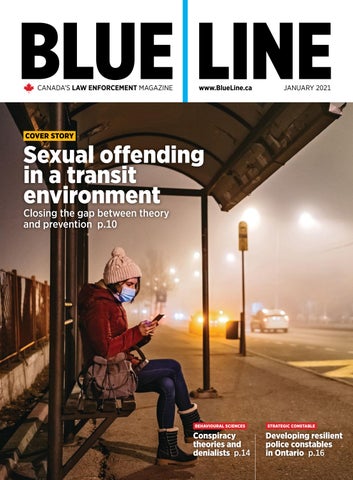
Sexual offending in a transit environment Closing the gap between theory and prevention p.10
BEHAVIOURAL SCIENCES
STRATEGIC CONSTABLE
Conspiracy theories and denialists p.14
Developing resilient police constables in Ontario p.16
ASSEMBLY LINE TO FRONT LINE
GFX IS AWARDED THE FCA-MOPAR® DODGE DURANGO PURSUIT PROGRAM! The Dodge Durango Pursuit embodies power, performance and speed like no other SUV. While still providing the utmost in utility with a spacious interior, a daring design and innovative technology. Combine that with GFX’s 30-years of automotive upfit experience in Electrical Pre-Wiring, Lighting, and Graphics to name a few. It’s no wonder why GFX is the preferred vehicle upfit partner.
Dodge Durango SSV 2021 Sales code Guide
GFX LAW ENFORCEMENT VEHICLES
WWW.GFXLAW.COM | 1-800-739-6837
10
Contents
January 2021 Volume 33 Number 1
Features
Columns 4 18 13 14 30
Editor’s commentary Holding the line Case law Behavioural sciences Back of the book
COVER STORY
10 Sexual offending in a transit environment Closing the gap between theory and prevention. By Justin Biggs
16 The Strategic Constable
Developing resilient police constables in Ontario. By Matthew Wood
20 Not meant to make it alone
Some strategies for those who spend shifts in a highly activated stress response state. By Colleen Stevenson
Departments 5 5 8 9 9 27 28 29 30
News By the numbers Cold case Dispatches Off the shelf Calendar Product showcase Marketplace Blue Links
22 Mind the ‘brand’ gap
COVER PHOTO: URBAZON / GETTY IMAGES TOP: PINKBADGER / GETTY IMAGES/ISTOCK PHOTO
What is your service’s brand? It is more than the public image of your chief or your media relations officer. By Roxanne Beaubien
16 22 @Blue_LineMag
20 January 2021 | BLUE LINE
3
EDITOR’S COMMENTARY BY MARIO CYWINSKI
BLUE LINE www.BlueLine.ca
Short but sweet
T
aking over as the interim protests against premiers and public editor of Blue Line magazine in health officials. Mike Novakowski’s late October was no small feat, Case Law column examines how a as following Renée Francoeur, “Strip search did not re-trigger S.10(b) I definitely had big shoes to fill. And in Charter advisement.” Also in the issue is “The Strategic no time at all, two issues have been done, it’s the holidays and the calendar is Constable” by Matthew Wood, which looks at how to develop resilient police changing to 2021. This was definitely different than any constables in Ontario, “Mind the ‘brand’ magazine I have worked on previously. gap” by Roxanne Beaubien, Back of the I’ve worked on automobile, machinery, Book by Christ D. Lewis and and all our maintenance, manufacturing, small busi- regular departments. ness, even stamps and coins, but never a Last but certainly not least, I would law enforcement magazine. It like to introduce Brieanna has been a fascinating and won- I am now Charlebois, who is taking over passing the as the editor of Blue Line. She derful experience. In my short time, I have met torch, which joined Annex Business Media some great people and enjoyed I held (Blue Line’s parent company) as my time as the interim editor of briefly, to an associate editor with the Blue Line. I have always been a Brieanna company’s fire service magazines in December 2019. big fan of law enforcement Charlebois, Some interesting facts about shows on television, and the first with whom, Brieanna, she went to Ohio thing I noticed working on Blue Blue Line University/Scripps School of Line, is that how they are por- readers are trayed on television, and what in good Journalism on a (D1) soccer the job entails in real life, are two hands. scholarship, and graduated with different things. two degrees in Journalism and Switching gears, let’s do a quick run- Psychology. She later got her Master’s in down of what is in this issue. Blue Line’s Journalism from Carleton University. cover story focuses on how police agen- Brieanna also has a three-year-old puli cies have a role in collecting data about dog named Bodie (named after downhill how sexual assaults on transit are com- skier Bode Miller), the connection mitted. Justin Biggs of the Metro Vancou- makes sense when you realize that she ver Transit Police looks at case studies was a competitive ski racer while in her and how data can be gathered. youth, and has coached downhill racing Two features look at mental health, at Blue Mountain. with Colleen Stevenson discussing why I am now passing the torch, which I we are “Not meant to make it alone,” and held briefly, to Brieanna, with whom Blue Michelle Vincent looking at “Expanding Line readers are in good hands. the Peer Support Role.” Thank you, Peter Collins’ Behavioural Sciences column discusses conspiracy theories Mario Cywinski is the interim editor of Blue Line and denialists, which have been seen magazine. He can be contacted at: mcywinski@ recently with the coronavirus, and annexbusinessmedia.com.
Reader Service Print and digital subscription inquiries or changes, please contact Beata Olechnowicz, Audience Development Manager Tel: (416) 510-5182 Fax: (416) 510-6875 email: bolechnowicz@annexbusinessmedia.com Mail: 111 Gordon Baker Rd., Suite 400 Toronto, ON M2H 3R1 GROUP PUBLISHER | MARTIN MCANULTY mmcanulty@annexbusinessmedia.com INTERIM EDITOR | MARIO CYWINSKI mcywinski@annexbusinessmedia.com ACCOUNT MANAGER | JANICE EATON jeaton@annexbusinessmedia.com MEDIA DESIGNER | ANDREA M. SMITH asmith@annexbusinessmedia.com ACCOUNT COORDINATOR | TRISH RAMSAY tramsay@annexbusinessmedia.com COO | SCOTT JAMIESON sjamieson@annexbusinessmedia.com
ANNEX BUSINESS MEDIA 111 Gordon Baker Road, Suite 400 Toronto, ON M2H 3R1 Tel. 416-442-5600 • Fax 416-442-2191
Publication Mail Agreement No. 40065710 ISSN 0847-8538 Printed in Canada SUBSCRIPTION RATES Canada — 1 Year $31.50; 2 Year $52.50 plus tax USA — 1 Year $136.50 CAD Occasionally, Blue Line will mail information on behalf of industry-related groups whose products and services we believe may be of interest to you. If you prefer not to receive this information, please contact our circulation department in any of the four ways listed above. Annex Privacy Officer Privacy@annexbusinessmedia.com; Tel: 800-668-2374 © 2021 Annex Publishing & Printing Inc. All rights reserved. Printed in Canada. No part of the editorial content of this publication may be reprinted without the publisher’s written permission. Opinions expressed in this magazine are not necessarily those of the editor or the publisher. No liability is assumed for errors or omissions. Readers are cautioned and advised that articles presented herein are edited and supplied for your personal awareness and should not be used for further action until appropriate guidance is received from a supervisor, Crown Attorney or other persons in authority. All advertising is subject to the publisher’s approval. Such approval does not imply any endorsement of the products or services advertised. The publisher reserves the right to refuse advertising that does not meet the standards of this publication.
CONNECT WITH BLUE LINE
www.BlueLine.ca 4
@BlueLine_Mag
BLUE LINE | January 2021
www.facebook.com/BlueLineMagazine www.BlueLine.ca
NEWS
The Airbus H125 helicopter, AIR 2 is well-suited for multi-role law enforcement missions. ALBERTA
Edmonton Police Service adds second H125
The Edmonton Police Service announced its new Airbus H125 helicopter, AIR-2, will enter into service. This is the second H125 to join the Edmonton Police Service’s (EPS) fleet, with Airbus Helicopters Canada delivering AIR-1 back in 2017. Airbus explains the H125 is well-suited for multi-role law enforcement missions including surveillance, command and control, search and pursuit, search and rescue, special operations, escort and more. “AIR-1 and AIR-2, our two helicopters, play an integral role in ensuring citizen and officer safety,” said Paul Shafer, Staff Sergeant, EPS’ Canine and Flight Operations Section. “They allow us to monitor fleeing vehicles from a safe distance, locate missing persons, find suspects who may be trying to evade police, and assist officers on the ground with scene surveillance.” Airbus states, that over the past 15 years, its helicopters account for 100 per cent of those delivered for airborne-law enforce-
ment in Canada. The company supplies helicopters to Canadian airborne units including the RCMP, OPP, Calgary Police Service, York Regional Police, and Winnipeg Police Services. Today, Airbus helicopters make up 86 per cent of Canada’s airborne law enforcement in-service fleet. “Edmonton Police Service has proven to be an invaluable resource for its citizens, and we sincerely thank you not only for the critical work you do day and night, but for continuing to place your trust in Airbus,” said Dwayne Charette, President and COO, Airbus Helicopters Canada, based in Fort Erie, Ont. CANADA
RCMP Constable named to Top 100 Most Powerful Women List
The late Constable Heidi Stevenson has been named to the 2020 edition of Canada’s Most Powerful Women: Top 100 Award Winners, presented by Women’s Executive Network. This year a new category was added, Women of Courage, which recognizes women whose work carried inherent risks and, tragically, their lives.
“We take bittersweet pride in congratulating the late Cst. Heidi Stevenson for recognition on this prestigious list, and hope this provides at least some measure of solace to her family, her friends, and her former colleagues, many of whom are still suffering the trauma of the worst mass shooting in Canadian history,” said Brian Sauvé, President, National Police Federation. “Yet we also take this moment to congratulate all of this year’s winners in the other categories, and we wish them continued achievements over the course of their careers.” Stevenson joins the late Captain Jenn Casey and the late Sub-Lieutenant Abbigail Cowbrough as the inaugural, posthumous recipients of the new category. Women’s Executive Network releases a yearly list of women whose contributions to their workplace and the communities they serve deserves special merit. Thousands of women across the country are nominated annually to the list, only a few are chosen as winners. BRITISH COLUMBIA
Two RCMP detachments to get net-zero facilities
The Honourable Catherine McKenna, Minister of Infrastructure and Communities, and Garth Frizzell, President of the Federation of Canadian Municipalities, announced over $11.5 million for two net-zero municipal building projects through the Green Municipal Fund. In Fort St. John, a new net-zero-energy building will be constructed and leased to the local Royal Canadian Mounted Police (RCMP) detachment, replacing the 35-year-old building they currently use. The new four-story building will control heat loss and gain, minimize electricity consumption, and use energy-efficient mechanical HVAC systems.
BY THE NUMBERS
PHOTO: AIRBUS
A new study on policing in Canada by Angus Reid Institute, shows how Canadians perceive the police.
75%
of Canadians view police in their community favourably. Visible minorities (67 per cent), and Caucasian (77 per cent) view police favourably.
@Blue_LineMag
80% of Canadians in rural areas view the police in their community favourably. That drops to 74 per cent in urban areas.
79%
of Canadians in Calgary viewed police favourably. Regina was highest with 84 per cent. Montreal was lowest with 67 per cent.
80% of Canadians view the RCMP favourably, followed by provincial police (78 per cent), and city/ municipal police (73 per cent).
January 2021 | BLUE LINE
5
NEWS
ONTARIO
Body-Worn Cameras Introduced by Peel Regional Police Peel Regional Police (PRP) is set to begin a phased implementation of a body-worn cameras (BWC) and a digital evidence management solution for frontline officers. “As we continue to modernize our organization, our vision is to utilize available innovation and technology tools to enhance Community Safety and Well Being while demonstrating the professionalism of our frontline members. PRP has taken a leading role in introducing the concept and framework for providing real-time enhanced services, utilizing BWC live-stream technology,” said Deputy Chief Anthony Odoardi, Officer in Charge of Innovation and Technology Command. “These opportunities include utilizing embedded medical professionals in our 6
BLUE LINE | January 2021
Peel Regional Police Test Body Cameras. real-time operations centre (RTOC) to assist frontline members in safely supporting persons in crisis. We also look to provide social supports in real-time that would otherwise not be achieved through traditional response models.” The initial rollout and testing phase is at the force’s airport division at Toronto Pearson Airport. “With the current pandemic, PRP intends to interact virtually to ensure meaningful and collaborative dialogue to help inform our processes and policies,” said Inspector Josh Colley, BWC/DEMS Project Lead. “This collaboration is meant to continue well beyond the initial test and rollout phase that is set to go live on November 23rd at our Airport Division.” PRP is also implementing a platform enabling the organization to handle large volumes of data in a secure and cost effective environment. This will be the foundation for all other data systems. PRP will leverage data analytics, in order to inform police activities, with the goal of improving service delivery to those who live, work, and visit the Region of Peel. “We’re pleased that Peel Regional Police has chosen Toronto Pearson as the first location for the testing of body-worn cameras,” says Dwayne MacIntosh, Director, Corporate Safety and Security at the Greater Toronto Airports Authority (GTAA). “Our shared focus on collaboration for a safer airport experience,
combined with the GTAA’s concentration on implementing the latest innovations, makes the airport the perfect place to introduce this technology.” Phased deployment of additional cameras, and related innovative support solutions, will begin in early 2021. NOVA SCOTIA
Gunman behind mass shooting in Nova Scotia had targets in Halifax: search warrants
(CP) HALIFAX – Newly released documents suggest the gunman behind the April mass shooting in Nova Scotia had planned to “get” a pair of people in Halifax during his murderous rampage, but the Mounties were warned by his common-law spouse while he was on the loose north of the city. The information is contained in partially redacted RCMP search warrants, which say Halifax Regional Police officers were dispatched to a residence where they provided protection to two people. No other details are provided, but the suggestion that the killer was headed to Halifax falls in line with the route he was taking after he killed 22 people in northern and central Nova Scotia during a 13-hour rampage. On the night of April 18, the killer set fire to several homes and killed 13 people in Portapique, N.S. www.BlueLine.ca
PHOTO CREDIT: PEEL REGIONAL POLICE
“As the Energetic City, we know energy, and the most valuable form of energy is what you conserve,” said Lori Ackerman, Mayor of Fort St. John. “With the Green Municipal Fund’s support, this building will significantly reduce the energy required to operate, reducing the annual operating costs and lowering our emissions. The replacement RCMP Detachment has been an identified need in Council’s Strategic Plan for several years, and we are excited to see construction ongoing.” While, the District Municipality of North Cowichan will conduct a feasibility study to determine specifications required to make the local RCMP detachment building a net-zero facility. The study will explore a range of measures, including optimizing the building’s envelope, lighting and HVAC systems, and adding an on-site solar photovoltaic system to generate energy. “By investing in buildings today that generate as much energy as they use, we’re saving money while putting a down payment on cleaner air and water for generations to come in Canada. The new local Royal Canadian Mounted Police detachment in Fort St. John will be four stories of maximum energy efficiency, heat loss control and minimal electricity consumption. And in North Cowichan, we’re funding a feasibility study to see how the local RCMP detachment in that community can meet the same high standard,” said McKenna.
NEWS He then evaded police while dressed as a Mountie and driving a vehicle that he had modified to look exactly like an RCMP cruiser. He resumed killing people he knew and others he came across the next morning before he was fatally shot by a Mountie at a gas station on a highway just north of Halifax. - The Canadian Press ONTARIO
Man charged with attempted murder after dragging officer with car: police
(CP) Toronto police say they have charged a man with the attempted murder of an officer who was hit by a car last month. Police allege the man was driving a car that struck the officer and dragged him for more than 50 metres. Supt. Ron Taverner says the officer was taken to hospital with serious injuries but
@Blue_LineMag
BL_SevenView_AugSept20.indd 1
has since been released. Taverner says the incident took place on Nov. 21, after the officer heard sounds of gunshots while on patrol. He says the officer saw a car fleeing the area, caught up to the vehicle and had signaled for the driver to stop when he was hit. Police say Terry Baksh, 39, faces several charges that include attempted murder, assault with a weapon, flight from police and dangerous operation of a vehicle. - The Canadian Press ONTARIO
PAO Welcomes OPPA as Member
The Police Association of Ontario (PAO) members recently gathered virtually for a Special General Meeting of the Membership to vote on a request made by the Ontario Provincial Police Association (OPPA) to join the organization.
The PAO membership voted unanimously in favour of the OPPA’s affiliation with the PAO. OPPA’s membership will become effective on January 1, 2021. “I am so pleased to announce that the PAO membership endorsed the OPPA’s affiliation,” said Bruce Chapman, President, PAO. “Our provincial advocacy efforts, which include ensuring our members have access to adequate tools and resources to effectively uphold public safety and supporting the mental health and wellness of all first responders, will now be reflective of the priorities of nearly all policing members across Ontario. I truly believe we are stronger together, and I look forward to the OPPA being an active member of the PAO.” With OPPA addition, PAO will become the official provincial representative, and voice for over 28,000 sworn and civilian members who make up the majority of Ontario’s policing professionals. Local level membership is composed of sworn police
January 2021 | BLUE LINE
7
2020-07-13 1:20 PM
NEWS officers, 911 dispatchers, victim services personnel, special constables, administrative police service staff, and more. “The OPP Association are excited to join the Police Association of Ontario. The formality of officially joining the PAO will formalize our years of collaboration to represent the interests of our members and the safety of the public,” said Rob Stinson, President, OPPA. “Our members work hard every day to keep our communities safe, healthy, and prosperous. Professional, well-trained, and committed, our members provide effective policing
services to Ontario communities across nearly a million square kilometres of land and 100,000 square kilometres of waterway. Our members are proud to serve and are honoured to join the Police Association of Ontario.” ONTARIO
Six Nations police, OPP investigating homicide on Six Nations territory
(CP) OHSWEKEN, Ont. – Provincial police are assisting Six Nations Police Service with a homicide investigation on Six Nations
territory just east of Brantford. Six Nations police say the shooting on a driveway in front of a home was reported Tuesday evening. A 27-year-old man died of a gunshot wound. Provincial police say two suspects who were known to the victim left before police arrived, and Six Nations police say there is no apparent danger to the public. An autopsy has been ordered and will be conducted in Toronto. Investigators ask anyone with information about the shooting to contact them. -The Canadian Press
Blue Line’s Cold Case Series:
OUT OF THE COLD File # 5: Toronto Police solve 1984 Jessop Murder with new science BY STEPHEN METELSKY
We are proactively profiling a cold case in every other issue for our readers to share in order to spark renewed interest and hopefully generate tips and information. Canadian police have a new investigative tool at their disposal to solve cold case homicides and it is due to a “major shift in science,” said acting Det.-Sgt. Steve Smith of Toronto’s cold case squad. In October 2020, Toronto Police announced they had successfully identified Christine Jessop’s killer through genetic genealogy – a new science that uses DNA from cold case homicides to identify an offender through family members whose DNA had voluntarily been uploaded to genealogy databases. The breakthrough occurred in California in 2018 with the first arrest in a 40-year old serial killer file dubbed “The Golden State Killer” case. This case involved 13 homicides. Joseph DeAngelo, now in his seventies, was identified as the offender responsible for the heinous crimes that reigned upon California from 1975 to 1986. DeAngelo, a police officer in Exeter, Calif. from 1973 to 1976, had been positively identified when his “cast off” DNA matched the evidence discarded and preserved from the scenes of his murderous crimes. He had been identified through genetic genealogy.
8
BLUE LINE | January 2021
Equipped with the new genetic technology, the Toronto Police Cold Case Unit delved into the Jessop case in December 2019, sending the offender DNA to the Centre of Forensic Sciences in Toronto. In October 2020 a DNA hit identified Calvin Hoover as Christine’s killer. Even though Hoover had taken his life in 2015, the Jessop family was relieved after Smith notified them of the breakthrough in their daughter’s case. “They were relieved to have closure. A press conference is held after a breakthrough Both the parents did not know whether in the Jessop cold case. they would live to see who killed their daughter. These cases have never been In 2018, investigators from the DeAngelo forgotten,” Smith said. case attended the Canadian Police College in The cold case detective emphasized the Ottawa to present their case on the “Cold importance of crime scene preservation. Case and Unidentified Human Remains” “The most vital thing in an investigation is to course. Steve Smith was in attendance. After preserve the scene properly.” The Jessop that training, “that’s when we really started case would not have been solved had investigating, putting time into learning investigators not protected and preserved about this process and this procedure,” the crime scene — well before DNA testing Smith confirmed. was an option. The checklist criteria to immerse this Toronto Police will be applying genetic technology in the investigative process is genealogy to other unsolved homicides. The stringent. Investigators must ensure that “you cold case detective has a message to all the are using offender DNA.” yet-to-be identified offenders: “you can Christine Jessop went missing on Oct. 3, either come see us, or inevitably we will be 1984. She was found on Dec. 31 and had coming to see you.” been sexually assaulted before being stabbed Have a tip or information? Call the Toronto to death. DNA had been found in the Cold Case Unit 416-808-7400 ext. 77394 or underwear of the nine-year-old girl. anonymously at Crime Stoppers: 416-222Neighbour Guy Paul Morin was initially TIPS (8477). charged with Christine’s homicide in 1984 but later acquitted two years later. Morin was Stephen Metelsky, M.A., is a writer, (ret.) police found guilty during the second trial and sergeant and professor at Mohawk College. Find him successfully appealed his conviction in 1995. on LinkedIn, follow him @StephenMetelsky or email The Jessop homicide became a cold case. Stephen.Metelsky@mohawkcollege.ca.
www.BlueLine.ca
PHOTO: TORONTO POLICE COLD CASE UNIT
COLD CASE
NEWS DISPATCHES York Regional Police Deputy Chief Andre Crawford is retiring after 34 years of service. Crawford is recipient of the Police Exemplary Service 20-year Medal and 30-year Bar, a Chief of Police Award for investigative excellence, a gold medal from the Human Rights and Race Relations Centre, and the BBPA Harry Jerome Social Engagement Award. He was awarded the Order of Merit of the Police Forces from the Governor General of Canada. P.E.I. RCMP Const. Stephen Duggan has been appointed to the national board of MADD (Mothers Against Drunk Drivers) Canada. He is the first person from Prince Edward Island to join the national board. The 14-year member of the RCMP, was awarded the P.E.I. Crime Stoppers police officer of the year award in 2017.
OFF THE SHELF Leading at the Edge: True Tales from Canadian Police in Peacebuilding and Peacekeeping Missions around the World* By Ben J.S. Maure; 2020, 349 pages ISBN: 978-0995034303
There has been an ongoing acknowledgement of the need to practice a more co-ordinated and holistic approach to complex security challenges. To this end, a new form of collective action calls for the inclusion of a variety of actors and agencies through greater levels of co-ordination and collaboration, thereby integrating as a whole, with a view to generating lasting solutions to the complex security challenges which confront us today. A key constituent to this process are police forces. Their mission somewhat differs for that of traditional defence forces but is of no less importance in achieving lasting solutions to the complex security challenges we face. Ben @Blue_LineMag
After about 35 years in policing, Barrie Police Service Deputy Chief Ken Weatherill has retired. He began his career in 1986 with Hamilton Police Service. In 2014, he was appointed to the rank of deputy chief and was responsible for field support. He joined Barrie Police Service in 2017 and has been responsible for overseeing Operational Services, Operational Support Services, Investigative Services, Information Technology, and Records and Information Management. Deputy Chief Rod Stafford retired from the Weyburn Police Service on December 31, 2020 after 35 and a half years in policing. He joined the Saskatchewan Highway Patrol in 1985 (known as the Saskatchewan Traffic Board,
Maure’s book, Leading at the Edge, offers magnificent insight into the complexities and challenges faced by police officers who constitute this vitally important component of the inter-agency team. The 10 case studies presented from operations around the world both broadens and deepens our understanding of international policing complexities and challenges. In addition, the appendices offer further insight into the policing selection processes as well as a very insightful appendix on peacebuilding, peacekeeping, and peacemaking. From Afghanistan to Bosnia to South America, Maure presents each case with an easily read and consistent format, which covers the history of the conflict, pre-deployment issues and individual stories offering lessons learned and advice from those who have experienced “leading at the edge.” Maure highlights the unique nature of each of the operations, emphasizing that pre-deployment training — while useful to a certain extent — seems to insufficiently prepare police officers for the uncertain and complex environments they are about to face. For example, the use of aircraft with rather questionable serviceability records, complete with some emergency exits welded shut, facing a devastating earthquake in Haiti, or being propelled into the middle of a “war zone” all highlight the unique and uncertain environments thrust upon the police officers unaccustomed to such environments. As such, a common theme through each of
at the time). In October 1989, a position opened up for the municipal police force in Churchbridge, Sask., where he spent over two years. In June 1992, he accepted a position with the City of Weyburn Police Service, where he retired in December after over 28 years. Weyburn Police Service is proud to welcome their new Deputy Chief Brent VanDeSype. He began his policing career with the RCMP in September 2000. He was first stationed in Watrous, Sask., where he served for six years, later transferring to Saskatoon Forensic Investigative Unit for his final year. He became a member of the Weyburn Police Service in July 2007, where he was promoted to the rank of Sergeant on May 2015.
the cases in the book involves examining the motivations of the police officers who must first apply for international policing operations and a leave of absence form their domestic policing duties before being selected. Highlighting flexibility of mind, optimism and an adventurous spirit, Maure admits international policing operations are certainly not for everyone. Those who have answered the call to serve and protect beyond the borders of Canada have distinguished themselves well in their conduct and contribution to operations, be it in intelligence, crimes scene operations, training, or building police forces in countries devastated by conflict or natural disasters. While this book is unquestionably apt for students and practitioners in the fields of security studies, politics and international relations, it is equally an interesting and compelling read for the casual observer of global affairs. Overall, Maure has compiled an impressive series of case studies on the complexities of policing in international security operations. The book offers useful insight and both broadens and deepens our understanding of the multifaceted challenges and complexities of international policing operations. A welcomed and much needed contribution to the field of security studies. - Lieutenant Colonel Michael A. Rostek, CD, PhD, APF Adjunct Professor, Ontario Tech University
* Review previously published in Canadian Army Journal January 2021 | BLUE LINE
9
COVER STORY
Sexual offending in a transit environment: closing the gap between theory and prevention Police agencies have a role to play in the data collection, specifically, data about how sexual assaults on transit are committed. By Justin Biggs
C
rowded transit environments can create ideal conditions to facilitate sexual harassment, inappropriate touching, or groping. Many offenders and attempt to disguise their inappropriate touching, rubbing, or groping as incidental to the bumps and turns in the journey; and women make up the vast majority of victims. Many transit authorities acknowledge that women’s safety on transit is an important issues, while researchers argue that acknowledging women’s safety has not led to many policy or practices that address the issue.1 Research on sexual offences on transit mostly focused on rates of occurrence, perceptions of fear, and categorizations of offences. However, research has also not led to much policy and practical implementation regarding women’s safety on transit. 10
BLUE LINE | January 2021
There appears to be a gap research and practice, and police may be able to bring the gap with data available to them.
A Canadian case study Anonymous data was obtained from the Metro Vancouver Transit Police (MVTP) for a sample of 411 reported, founded sexual assaults that occurred from 2013 to 2017. Sexual assaults reported to MVTP occurred more frequently onboard a bus compared to a SkyTrain. Forty-on per cent (166) of all reported incidents occurred on a bus, while 133 (33 per cent) incidents occurred onboard a SkyTrain. There were also 74 (19 per cent) incidents that occurred inside a SkyTrain station. Aggregate data showed that sexual assaults occurred at an almost equal rate from Monday to Friday. The time that sexual assaults occurred the most in the case study was
between 4 pm and 6 pm. The findings for days and times reflected peak travel times and ridership usage, which was to commute to and from work or school. The findings were also consistent with studies in New York and Brazil’s Sao Paolo that found that sexual harassment and sexual violence were associated with peak ridership times and days.2,3 Age appeared to be a risk factor for victims as 308 (70 per cent) of the 440 total victims were under the age of 29, and 40 per cent or 176 of all reported victims were between 18 and 24 years old. As a comparable across Canada, 47 per cent of self-reported sexual assault victims were aged 15 to 24 years old. Also, strangers appeared to commit all sexual assaults reported to the MVTP, as all victims stated the offender was unknown to them. Throughout Canada however,
There is plenty of research available on sexual offences in general, however, little research has delved into the niche of sexual offending in a transit environment. most sexual assault offenders are known to the victim4 and as little as 17 per cent of all sexual assaults were reported to the police.5 The MVTP received 171 (41.6 per cent) reports from victims who called into the police service. There were 129 (29.9 per cent) reports from victims who observed and spoke to a www.BlueLine.ca
PHOTO: OLASER / GETTY IMAGES
uniformed transit employee before completing their journey; and 10. 7per cent or 44 reports from individuals who utilized Transit Police’s SMS text reporting service that was introduced in 2013. It was interesting to observe how many incidents were reported in person before the victim completed their journey; such data is supported by research, which suggests that the public views police on foot more favourably to police in vehicles, and police wearing visibility vests appear more positively to the public than police in regular uniform.6 Lastly, the case study revealed possible seasonal patterns in sexual assault on transit. The data revealed that May (50) and July (54) had the highest aggregate number of incidents in the sample period. Together, May and July accounted for a quarter of all reported incidents sug@Blue_LineMag
gesting possible seasonal patterns of offending, which was consistent with seasonal findings in a study of sexual offences on a Sao Paolo public transit system.7
Gathering data There is plenty of research available on sexual offences in general, however, little research has delved into the niche of sexual offending in a transit environment. Much of the research into sexual offences on transit has focused on categorizing types of sexual misconduct and identifying rates of occurrence. Police agencies have valuable data available to contribute to the discourse, specifically, data about how sexual assaults on transit are committed. The following are potential sources for data gathering: Templates: A template can be a valuable
tool for an agency interested in cultivating empirical data about sexual offences and having accurate, up-to-date information available. A template can prevent endless hours of reading through reports and the need to manually extract data onto spreadsheets. This makes data for potential projects or policy decisions available much sooner. A template can quickly capture information such as a suspect’s behaviour prior to, during, and after the offence; as well as the victim’s behaviours prior to, during, and after the offence. By simply checking boxes, micro spatial data can be collected like seated versus standing, boarding versus exiting.
Technology: The MVTP adopted a text messaging reporting service in 2013 and its use has grown every year since. Research to
date indicates the MVTP receive approximately 10 per cent of all reported sexual assaults through the text service.8,9 Victims of sexual assault face many personal and social barriers when deciding whether or not to report to police,10 and a technological convenience like text reporting will not on its own increase reporting. Reporting sexual assaults through text message could become more common as a culture around making text reports to police grows. A reliable technology that can cater to the broadest audience through languages, imagery, or text-to-speech options could help to bridge barriers to reporting. One study showed that 65 per cent of sexual assault victims told someone they trust about the incident whereas only five per cent of victims reported it to police.11 An alternative could be to create or January 2021 | BLUE LINE
11
COVER STORY
Intelligence analysis: More and more transit systems have transitioned to digital fare media. The transition comes with new opportunities for intelligence led policing. Research into pickpocketing on transit systems using digital fare media suggest that offenders may have irregular travel patterns, which can be compared, isolated, identified, and compared against ‘regular’ travel patterns.12 Sexual offenders on transit are thought to have atypical travel patterns as part of their victim selection process and, according to experienced NYPD (New York Police Department) transit officers, sexual offenders on transit exhibited similar behaviours to pickpocket offenders.
Awareness campaigns are often used to promote a service like a text reporting service. It is recommended that victim advocacy groups are consulted when designing such campaigns so that victim interests and perspectives are represented. Awareness campaigns: Building a database is one starting point to addressing sexual offences and a welltimed public awareness campaign could help to increase reports to authorities. Awareness campaigns could also promote a supportive culture that addresses the barriers victims or even witnesses may face in reporting to police. Further, awareness campaigns are often used to promote a service like a text reporting service. It is recommended that victim advocacy groups are consulted when designing such campaigns so that victim interests and perspectives are represented. In a transit environment, print media and audio messages are the traditional methods 12
BLUE LINE | January 2021
where a message can be communicated. Recently, transit systems have begun providing Wi-Fi at stations or onboard vehicles. This offers new opportunities for transit authorities to communicate messages to passengers. There has been much research into the occurrence of sexual offences in a transit environment and that research has focused on the occurrence of sexually related behaviour; categorizing behaviours (i.e. sexual assault or sexual harassment); gendered perceptions of safety; and theoretical approaches to improving perceptions of safety. There appears to be a gap between research theory and prevention strategies. Police agencies can play a role by collecting detailed data that is up to date regarding transit sexual assaults. Such data has been generally inaccessible to researchers. Increasing the robustness of the database on transit sexual offending could provide the missing link to understanding the scope of the problem and from there evidence-based prevention strategies can be developed and tested.
Footnotes
1. Loukaitou-Sideris, Anastasia. “Fear and safety in transit environments from the women’s perspective.” Security Journal 27, no. 2 (2014): 242-256. 2. Ibid. 3. Stringer, S.M. (2007) Hidden in plain sight: Sexual harassment and assault in the New York City Subway system. Retrieved from: http://www.nytimes.com/ packages/pdf/nyregion/city_room/20070726_ hiddeninplainsight.pdf. 4. Conroy, S., & Cotter, A. (2017). Self-reported
sexual assault in Canada, 2014. Juristat: Canadian Centre for Justice Statistics. Retrieved from: http:// www.statcan.gc.ca/pub/85-002-x/2017001/ article/14842-eng.pdf. 5. Conroy, S., & Cotter, A. (2017). Self-reported sexual assault in Canada, 2014. Juristat: Canadian Centre for Justice Statistics. Retrieved from: http://www.statcan. gc.ca/pub/85-002-x/2017001/article/14842-eng.pdf. 6. Simpson, R. (2017). The Police Officer Perception Project (POPP): An experimental evaluation of factors that impact perceptions of the police. Journal of Experimental Criminology, 13(3), 393-415. 7. Ceccato, V., & Paz, Y. (2017). Crime in Sao Paulo’s metro system: sexual crimes against women. Crime Prevention and Community Safety, 19(3-4), 211-226. 8. Biggs, J. (2018). Examining the Law Enforcement Response to Complaints of Sexual Assault on a Public Transit System (Doctoral dissertation, University of the Fraser Valley). 9. Cyr, S. S. (2017). TEXTG 4 HELP: An Evaluation of Metro Vancouver Transit Police’s SMS Texting Program (Doctoral dissertation, University of the Fraser Valley). 10. Conroy, S., & Cotter, A. (2017). Self-reported sexual assault in Canada, 2014. Juristat: Canadian Centre for Justice Statistics. Retrieved from: http://www.statcan. gc.ca/pub/85-002-x/2017001/article/14842-eng.pdf. 11. Clark, S. K., Jeglic, E. L., Calkins, C., & Tatar, J. R. (2016). More than a nuisance: the prevalence and consequences of frotteurism and exhibitionism. Sexual Abuse, 28(1), 3-19. 12. Gu, H., Guo, Y., Yang, H., Chen, P., Yao, M., & Hou, J. (2019, March). Detecting Pickpocketing Offenders by Analyzing Beijing Metro Subway Data. In 2019 IEEE 4th International Conference on Big Data Analytics (ICBDA) (pp. 62-66). IEEE.
Justin Biggs is an 11 year member with the Metro Vancouver Transit Police. He is currently working as a detective in the General Investigation Unit. In 2018, he completed a Master’s degree in Criminology focusing on Transit sexual offences. He can be contacted at Justin.Biggs@transitpolice.bc.ca
www.BlueLine.ca
PHOTO: LECHATNOIR / GETTY IMAGES
leverage anonymous third-party reporting via apps, hotlines, websites, and building community connections, which present opportunities to capture information that would otherwise go unreported.
CASE LAW
BY MIKE NOVAKOWSKI
Strip search did not re-trigger s. 10(b) Charter advisement A B.C. Supreme Court judge has concluded that a strip search was not the type of non-routine procedure that required the police to re-advise an arrestee of his right to counsel before conducting it.
I
n R. v. West, 2020 BCSC 1780, the police attended an address after receiving an anonymous tip that the accused would be present, and had warrants outstanding for his arrest. West was located at the home and he was arrested, handcuffed, and advised of his s. 10(b) right to counsel. When he was patted down, police found a $1,500 wad of cash in his sweatpants’ pocket along with a small glass vial containing suspected methamphetamine. West was also wearing a cellphone shoulder holster containing a wallet with $650 in cash. After examining the items found in West’s possession, the officer arrested him for possessing drugs for the purpose of trafficking, and again advised him of his right to counsel. West was transported to the police detachment where he was again advised of his s. 10(b) rights but waived them. When he was patted down a second time as part of the booking procedure, an officer ran his hand up West’s leg toward his groin. West appeared uncomfortable. He bent over and then squatted down, taking a couple of breaths. He “pulled away” and seemed “antsy”, which was not in character based on previous police dealings with him. West was taken into a shower room for a strip search. He became agitated, resisted, and insisted he was not going to be strip searched. He was restrained in handcuffs and his sweat pants were pulled down. A black pouch, containing cocaine and fentanyl, was found in a pocket on the outside front of his underwear. West said he did not have anything else on him. His underwear was not pulled down nor was his shirt removed. He was subsequently charged with three counts of possessing a controlled substance – fentanyl, cocaine, and methamphetamine – for the purposes of trafficking. During a voir dire in B.C. Supreme Court, West argued, among other things, @Blue_LineMag
that the police were required to re-advise him of his right to counsel under s. 10(b) prior to conducting the strip search. In his view, the strip search was a “new procedure” as recognized in R. v. Sinclair, 2010 SCC 35, such that he had a right to be informed about the strip search, re-advised of his right to counsel, and given the opportunity to speak to counsel before the strip search occurred, if he asserted his right to counsel. Since his s. 10(b) right was denied, the strip search was unreasonable under s. 8 of the Charter. And he wanted the evidence obtained from the strip search excluded under s. 24(2). The Crown, on the other hand, submitted that s. 10(b) did not require that the police tell an arrestee that they are going to be strip searched before performing it, nor did it require a separate advisement of their s. 10(b) rights and access to counsel before the strip search. Justice Iyer noted there was no dispute that the police had reasonable grounds to search West, incidental to his arrest as well as to perform a strip search. Nor was there any dispute that the manner of the strip search complied with the requirements of R. v. Golden, 2001 SCC 83. Iyer also found West understood his s. 10(b) right to speak to counsel when arrested and had chosen not to exercise it. This waiver was clear and unequivocal. As for whether West’s s. 10(b) right was re-triggered by the strip search, Justice Iyer concluded it was not. A “new procedure” does not mean any procedure that is non-routine for the types of offences with which the detainee has been charged. “I conclude that Sinclair establishes that a new procedure includes those procedures that are not within the reasonable contemplation of counsel, providing advice in relation to a particular charge or charges, where the consent of the detainee is required,” said Justice Iyer. “I cannot interpret it as saying any-
thing about the situation here; a non-routine procedure for which the detainee’s consent is not required.” While the strip search in this case was not routine, it was not exceptional. “It lacks both the novelty and the degree of intrusiveness of a penile swab search,” said Iyers. “Sinclair also requires that the new procedure be beyond the contemplation of counsel providing the initial advice. Although I have no evidence on this, I find it hard to believe that if Mr. West had chosen to exercise his right to counsel, the possibility of a strip search would have been outside the expectation of the advising lawyer.” And the strip search in this case was not conducted as a matter of routine policy. Justice Iyers cautioned, however, that if an arrestee did assert a desire to contact counsel (and did not waive the right as West did in this case), the police must be careful in delaying access to counsel in all cases until the strip search is completed. “Where a detainee has asserted the right to counsel … it is imperative that the police advert to all of the circumstances, including the circumstances of the alleged offence, those of the alleged offender, and the ability to mitigate risk, before deciding whether conducting the search before providing access to counsel is justified,” he said. “A consistent practice of always conducting strip searches in drug investigations before providing access to counsel would be constitutionally suspect.” Since West did not have a right to be re-advised of his right to counsel before he was strip searched, there was no s. 10(b) breach and therefore his s. 8 claim on this basis failed. His application for exclusion of the evidence was dismissed. At the conclusion of his trial, West was convicted of possessing cocaine for the purpose of trafficking and simple possession of fentanyl and methamphetamine (2020 BCSC 1927). He was sentenced to a total of six months imprisonment plus ancillary orders (2020 BCSC 1928). However, he didn’t serve any more jail time, having been credited for time already served, which exceeded the six months’ sentence.
Mike Novakowski is Blue Line’s case law columnist.
January 2021 | BLUE LINE
13
BEHAVIOURAL SCIENCES BY PETER COLLINS
Conspiracy theories and denialists
I
n the past few years there has been an increase in conspiracy theories. It has been amplified over the past nine months of the pandemic. Some of the more popular coronavirus theories include: • Bill Gates artificially created the coronavirus in order to profit with Jewish organizations and pharmaceutical companies in order to profit from the vaccine or to use the vaccine to implant people with microchips; • the coronavirus has been caused by the effects of the 5G network; • the coronavirus is a fabrication in order for the government to gain more control of citizenry; and, • the coronavirus is being spread (along with other poisons) from the “chemtrails” emitted from airplanes as part of a government plot. There has been a parallel growth in denialism: • vaccines cause autism; • the Holocaust never occurred or is greatly exaggerated; • AIDS does not exist or is unrelated to HIV; and, • anthropogenic (caused by humans) climate change is a myth. All the above theories persist and even grow despite the mounting scientific or historic evidence to the contrary. Central to this the argument that ‘the truth’ is being suppressed, usually by the government. Conspiratorial beliefs are characterized by being hyper-skeptical of all information that does not fit the theory, over-interpreting evidence that supports a preferred theory, and inconsistency.1
Why are conspiracy theories popular? Social media has created a world in 14
BLUE LINE | January 2021
which any individual can potentially reach as many people as mainstream media. The lack of traditional gate-keeping is one reason why misinformation spreads farther and faster online than true information.2 According to Lewandowsky & Cook (2020) individuals who feel powerless or vulnerable are more likely to endorse and spread conspiracy theories. This is evident in online forums where people’s perceived level of threat is strongly linked endorsing conspiracy theories. Conspiracy theories will also allow an individual to cope with events that they perceive as incomprehensible.
Social media has created a world in which any individual can potentially reach as many people as mainstream media. The lack of traditional gate-keeping is one reason why misinformation spreads farther and faster online than true information.2 Franks et al (2013) provide the example of the death of Princess Diana. Although there was an explainable cause for her death (the driver of the vehicle she was a passenger in was intoxicated). A conspiracy theory satisfies the need for a ‘big’ event to have a big cause, such as a conspiracy involving British intelligence assassinating Princess Diana at the request the Royal Family.3 This is known as proportionality bias, the idea that large significant events have to have large significant causes.
Other cognitive biases that can contribute to conspiracy thinking include attribution bias or attribution error, a tendency to overestimate the effect of dispositional factors, especially in an attempt to understand the intentions of others. When an event occurs, we are much more likely to attribute it to some intentional, internal motive, than to circumstance or happenstance. Confirmation bias is where beliefs and ideas that are consistent with one’s own ideas, tend to be reinforced, while alternative ideas are downplayed or ignored.4 Individuals will become attached to their beliefs and to search for (or interpret) information in ways that confirms their beliefs or preconceptions. A related reason why individuals want to believe in conspiracies, according to Lewandowsky & Cook (2020), is that it will explain events that are highly unlikely. Conspiracies can serve as a coping mechanism to help people handle uncertainty. There is also a bit of a narcissistic component to conspiracy beliefs. Believers will consider themselves part of a select in-group that, unlike the deluded masses, has figured out what’s really going on. Lastly, as evidenced during the Trump era, conspiracy theories that are used to dispute mainstream political interpretations and rational explanations are labelled as ‘fake news.’
The harm of conspiracy theories Conspiracy theories can cause harm. As a physician, I was perplexed when the www.BlueLine.ca
PHOTO: JONATHAN STUTZ - STOCK.ADOBE.COM
After months of watching our colleagues deal with protests against the Premiers of the provinces, and the vitriol towards public health officials regarding the coronavirus, this month’s column will examine the cause of conspiracy theories.
former South African President stated that the HIV virus did not cause AIDS. The South African government’s denialism as part of a conspiracy led to the deaths of over 300,000 individuals, due
to lack of public education, preventive measures, or treatment programs, based on the known science at the time. Since March 2020 the President of Mexico, Andrés Manuel López Obrador, has stated his “protective shield” against the coronavirus is “amulets and prayer.” As of December 1, 2020, Mexico had recorded 1,107,071 individuals who had tested positive for the coronavirus, and 105,940 deaths. With the possibility of a COVID-19 vaccine in the near future the ‘anti-vaxers’ are active, again, on the Internet. According to the anti-vaccine movement, those involved within the vaccine industry, fake their data on vaccine efficacy as a way to suppress evidence of side-effects in order to make money. The Internet has been shown to play a significant role in disseminating anti-vaccine information. The ‘anti-vaxers’ are supported by celebrities, and ignore the vast scientific evidence that there is no link between vaccines, or
vaccine ingredients, and autism spectrum disorder. Recommended reading – Kahn-Harris, K. (2018) Denial-the unspeakable truth. Cumbria: Notting Hill Editions Ltd.
Footnotes
1. Lewandowsky, S. & Cook, J. (2020) The Conspiracy Theory Handbook. http://sks.to/conspiracy 2. Vosoughi, S., Roy, D., & Aral, S. (2018). The spread of true and false news online. Science, 359, 1146–1151. doi:10.1126/science.aap9559 3. Franks, B., Bangerter, A., & Bauer, M. W. (2013). Conspiracy theories as quasi-religious mentality: An integrated account from cognitive science, social representations theory, and frame theory. Frontiers in Psychology, 4. doi:10.3389/fpsyg.2013.00424 4. Thresher-Andrews, C. (2013) An introduction into the world of conspiracy. Psychology Postgraduate Affairs Group Quarterly Issue 88. Dr. Peter Collins is the operational forensic psychiatrist with the Ontario Provincial Police’s Criminal Behaviour Analysis Section. He is also a member of the crisis/ hostage negotiation team of the Toronto Police Service Emergency Task Force. Dr. Collins’ opinions are his own. Contact him at peter.collins@utoronto.ca.
+1 867-668-5609 publisher@canadianguns.com www.canadianguns.com
CANADIAN ACCESS TO FIREARMS
The only Canadian buy-and-sell firearms newspaper distributed across Canada! WHY ADVERTISE WITH CATF? Our paper is distributed monthly by subscription and at gun shows, gun trades, gun clubs and select stores across Canada. We shall put you in touch with the active, committed core of Canada’s firearm community!
@Blue_LineMag
BL_CATF_JanFeb20.indd 1
January 2021 | BLUE LINE
15
2019-12-03 11:03 AM
The Strategic Constable Developing resilient police constables in Ontario By Matthew Wood
W
ith renewed tensions rising out of the United States, the profession of policing is once again under the microscope. Today, there are countless demands for heightened accountability, additional training and even the de-funding of our police services. In times such as these, we might ask ourselves where to turn for guidance. Ever since my transition from the military to policing, I’ve often advocated that we might adopt some of the lessons learned from our military sisters and brothers – specifically the concept of the Strategic Corporal. In 1999, U.S. Marine General Charles Krulak wrote about the concept of the Strategic Corporal in relation to another concept he termed the “three block war.” In his view, the environment in which the military was beginning to operate was becoming increasingly complex. 16
BLUE LINE | January 2021
He posited that soldiers would soon be required to undertake peacekeeping, humanitarian and full-scale military operations all within three hypothetical city blocks of each other. The police, too, operate within a similarly complex environment; they regularly alternate between high-stress and lowstress situations (e.g. violent crimes, neighbour disputes), one after the other, while being expected to maintain a consistent degree of professionalism. In General Krulak’s view, the actions of the corporal (a junior leader not unlike a police constable) has the potential to influence strategic-level, political decisions due to a growing media presence. This concept holds
true in policing; actions like those of Derek Chauvin in the death of George Floyd clearly have far-reaching consequences for the profession of policing. In the environment of the three block war, Krulak explains soldiers must be able “to confidently make well-reasoned and independent decisions under extreme stress – decisions that will likely be subject to the harsh scrutiny of both the media and the court of public opinion.” In order to be prepared for this environment, Krulak insists that developing the Strategic Corporal requires a combination of education, training and leaders who act as competent role models – all of which begins by hiring “bold, capable,
intelligent” people. Next, forging strategic corporals requires lifelong professional development during which values such as integrity, initiative, decisiveness, mental agility and personal accountability are reinforced. Finally (and arguably the most important), formal leadership training molds the corporal into the strategic-minded individual prepared to face the complex environment of the three block war. It is these last two steps where I believe policing in Ontario has the most room for improvement. Change, in any form, begins with an organization’s leaders. My own research into police leadership training practices paints a bleak picture: professional development for police officers is optional beyond basic training. The only legally mandated training is annual re-certification in use of force. The Ministry of the Solicitor General (formerly Ministry of
Forging strategic corporals requires lifelong professional development during which values such as integrity, initiative, decisiveness, mental agility and personal accountability are reinforced. www.BlueLine.ca
PHOTO: WHYFRAMESHOT - STOCK.ADOBE.COM
STRATEGY
PHOTO COURTESY MATTHEW WOOD
Community Safety and Correctional Services) prescribes the basic training requirements of police constables in its Policing Standards Manual, which was last updated 20 years ago. Surely much has changed in policing since then. Absent in the standards manual is any mention of police leadership training. The word “leadership” doesn’t appear a single time in all of the manual’s 226 pages. Despite acting as leaders in their community, leadership training for the police is neither governed by the Province of Ontario nor is it applied uniformly across police services. Management training (separate from leadership training) is generally reserved to those promoted to supervisory positions, and even then, is not on-going throughout their careers. Several reports and commissions have cited the need for high-quality police leaders, including the Ontario Provincial Police Independent Review Panel, the Office of the Ombudsman of Ontario, retired Justice Frank Iacobucci, and the auditor general for the City of Toronto. Among other benefits, effective leaders have been shown to produce alignment with organizational goals, a sense of cohesiveness and personal development among followers, @Blue_LineMag
improved relationships between leader and follower, and increased morale and productivity. Police constables with effective leaders benefit from improvements in emotional intelligence and are likely better equipped to respond to the moral dilemmas they regularly face. Most importantly, effective leadership is also the cornerstone of culture change. In 1993, the Canadian Armed Forces experienced a similar type of organizational crisis not unlike what policing is facing today. Canadian soldiers captured, tortured, and killed two unarmed Somali men suspected of stealing from their base in what would become known as the “Somalia Affair.” The actions of a few frontline soldiers led to international disgrace, service-wide loss of morale, and a
to the professional body that exists today. It did so by recognizing the influence of its leaders, by committing to their development and by outlining the way ahead though publications such as Duty with Honour and the Leadership in the Canadian Forces series. If we, as a profession, are to begin moving in the right direction, I would argue that now is the time to embrace the idea of the Strategic Constable.
References
1. Annis, F. (2020, February 3). Krulak revisited: The three-block war, strategic corporals, and the future battlefield. Retrieved from https://mwi.usma.edu/ krulak-revisited-three-block-warstrategic-corporals-future-battlefield/ 2. Drodge, E. N., & Murphy, S. A. (2002). Police leadership as a transformational social process. International Journal of Police Science & Management, 4(3), 198-212. https://heinonline.org/
“I’ve often advocated that we might adopt some of the lessons learned from our military sisters and brothers – specifically the concept of the Strategic Corporal.”
25 per cent reduction in national defence spending. The resulting national inquiry concluded that the leadership of the once-famous Canadian Airborne Regiment was so broken that the only possible solution was to disband the entire regiment. Rather than accept its demise, the Canadian Armed Forces — through a period of serious introspection — transitioned
HOL/P?h=hein.journals/ injposcim4&i=212 3. Fairholme, M. R. (2004). Different perspectives on the practice of leadership. Public Administration Review, 64(5), 577-590. https://doi. org/10.1111/j.1540-6210.2004.00405.x 4. Government of Ontario. (2020). Ontario Provincial Police independent review panel: Final report [PDF file]. http://www.mcscs.jus.gov.on.ca/ sites/default/files/content/mcscs/ docs/OPP_IRP_FinalReport_ Accessible_EN.pdf 5. Griffiths, J. (2006, October 26). Review of police training, opportunities
for improvement, Toronto Police Service [PDF file]. http://www.toronto.ca/ legdocs/mmis/2007/au/bgrd/ backgroundfile-2617.pdf 6. Iacobucci, F. (2014). Police encounters with people in crisis: An independent review conducted by the Honourable Frank Iacobucci for Chief of Police William Blair, Toronto Police Service [PDF file]. https://www. torontopolice.on.ca/publications/files/ reports/police_encounters_with_ people_in_crisis_2014.pdf 7. Kelloway, E. K., & Barling, J. (2000). What have we learned about developing transformational leaders. Leadership & Organization Development Journal, 21(7), 355-362. https://doi. org/10.1108/01437730010377908 8. Krulak, C. (1999). The strategic corporal: Leadership in the three block war. Retrieved from https://apps.dtic. mil/dtic/tr/fulltext/u2/a399413.pdf 9. Ministry of the Solicitor General. (2000, February). Policing standards manual (2000) [PDF file]. http://www. ontla.on.ca/library/repository/ mon/28002/233900.pdf 10. Mukherjee, A. (2020, June 4). Are we ready to talk about defunding the police? The Globe and Mail. Retrieved from https://www.theglobeandmail. com/opinion/article-are-we-ready-totalk-about-defunding-the-police/ 11. National Defence. (2005). Leadership in the Canadian forces: Conceptual foundations [PDF file]. Retrieved from http://publications. gc.ca/collections/collection_2013/ dn-nd/D2-313-2-2005-eng.pdf 12. National Defence. (2009). Duty with honour: The profession of arms in Canada 2009 [PDF file]. Retrieved from https://www.canada.ca/content/dam/ dnd-mdn/documents/reports/2019/ duty-with-honour-en.pdf 13. Office of the Ombudsman of Ontario. (2016). A matter of life and death: Investigation into the direction provided by the Ministry of Community Safety and Correctional Services to Ontario’s police services for deescalation of conflict situations [PDF file]. https://www.ombudsman.on.ca/ Files/sitemedia/Documents/Ontario OmbudsmanDeescalationEN_1.pdf 14. Van Wart, M. (2003). Public-sector leadership theory: An assessment. Public Administration Review, 63(2), 214-228. Matthew Wood, CD, is a police constable with the Toronto Police Service. He served 18 years with the Canadian Armed Forces and retired as a sergeant. He is also a recent graduate of the Master of Public Policy, Administration and Law program at York University.
January 2021 | BLUE LINE
17
HOLDING THE LINE
Expanding the peer support role
I
f you are a reader of my column, you are aware of my passion for mental health in our first responders and uniform personnel. My world revolves around exploring/discovering leading-edge mental health resources for those who serve our community in any capacity. Being a recently retired police officer, my specialty lies within this particular “community”. From Critical Incident Stress Management (CISM) to peer support, Edmonton Police Service’s Reintegration After Critical Incident and Long-Term Leave program, to resilience training; proactive and reactive programming is essential to supporting first responders in maintaining their wellness. This is how The Haven came to be. A late night on a CISM incident with a paramedic on long-term leave experiencing suicidal ideation, brought about the discovery of La Vigile, the first non-profit, occupational-specific, inpatient treatment oasis exclusive to first responders and uniform personnel. Understanding the intricate needs that are woven throughout our professions, involving exposure to traumatic incidents, and the underlying culture that innately elicits reactions, is key in providing effective, supportive, mental health programming. Great ties have been maintained with leading-edge organizations I have worked with as a police officer and continue to work with. Their many members with whom I have a great connection, both nationally and internationally, have contributed with their leading-edge ideas to the various mental health programs that exist today. One of those connections, a frontline police officer, recognizing this passion for mental health resources and programming, came to me for consultation on an idea for a proposed program he felt might be instrumental in preventing members from experiencing serious mental health issues and/or suicide. Completed suicides amongst policing first responders are an ongoing, serious concern as the numbers continue to rise. This statistic of suicide 18
BLUE LINE | January 2021
that grows daily, and this front-line constable’s own personal experience of being off on such a leave, is what has inspired him to initiate the development of this proposed program. This program would be a combination of effective mental health programming, specific to members who experienced mental health issues and/or discipline, and are off on a leave as a result, and peer support. The program development is in its infancy, but it would work like this: a member who has been suspended, is on a mental health leave, and/or is on a mental health leave as a result of an internal or
external investigation, would be paired up with a peer. This peer support-trained member would offer ongoing peer support, working out of the districts, matching their skills, abilities, and their shared/lived experience with their peer, who is off on leave from the organization no differently than a peer supporter. It’s the peer-based delivery that ensures those members are working with someone who has “been there and done that”; someone who understands the feelings of isolation and shame, that a suspended member may feel while the investigation on them is ongoing. This proposed program recognizes that when members leave the service for various reasons, sometimes not by their choice, a “grieving” process
may begin. This grieving process renders them vulnerable at different stages, during different time frames. While peer support reaches out to the member at the initial stages of their leave, they are less likely to be ready to accept support. The challenge is, later on in the grieving process, when the member is likely to be most vulnerable, needing and receptive to a peer support connection, the opportunity for connection is often lost. This proposed program engages the peer-to-peer relationship throughout the process, from beginning to return to work or other resolution, to ensure the member is shown that they continue to be a valued employee of the policing service. In this way, the peer supporter can identify a change in behaviour or thought process at any given time in the peer they are supporting. “Members do not trust to call in to the organization for support during this very traumatic time in their lives and would rather “crawl under a rock”, a place we want no member to be,” said this front-line constable, the creator of this inspiring proposed program/resource. This program would be a combination of peer support with some aspects of Edmonton Police Service’s Reintegration After Critical Incident and Long-Term Leave program. When we look at how discipline is managed by policing organizations we may want to consider both its effectiveness and the potential outcomes. Johann Hari, a researcher on various mental health aspects from drug addiction to depression and anxiety, suggests on his Ted Talks that as we evolve as a society, we have an opportunity to explore how we view these issues and how we deal with these issues as a whole. Mental health issues in police officers are a significant liability in relation to our organizations, families and communities, and can develop very easily into a misconduct at work. While this may seem like it is another topic, providing peer support for all of members at all times, includes when members are involved in disciplinary matters. This provision of peer support in almost all circumstances sends the message that the organization is not discriminating between the mental health needs of its members; a very strong meswww.BlueLine.ca
PHOTO: METAMORWORKS - STOCK.ADOBE.COM
BY MICHELLE VINCENT
sage of valuing their members. Most if not all Canadian policing organizations have a set of values, one of which usually involves an investment in their members, sworn and civilian. Whatever value they have identifying their commitment to their members, is often tied in with an overall experience of “walking the talk”. These organizations have an opportunity to truly demonstrate through the provision of programming, their commitment to their members. Those members inside the organization, those who are actively contributing to their communities may feel greater inspiration to serve with the understanding that not only are they important and essential during active service, but are just as important while outside of their organization on leave no matter what the circumstance. The mutual understanding between members and the organization, that the “psychological contract” is being met, according to Duran, Woodland and Bish-
@Blue_LineMag
BL_ILET_Dec20.indd 1
opp (2018), is key in feeling valued as members of an organization. Feeling valued within the organization contributes to loyalty, productiveness, and overall satisfaction within the organization (Duran et al., 2018). It minimizes operational stressors, a large contributor to mental health issues such as PTSD. This proposed program, would create an opportunity for support and a life-enriching relationship between members off on leave; the invisible yet essential support so many members need at this crucial time in their lives. Policing organizations pride themselves on being leading-edge, seeking change in challenging areas that often remain the unspoken. Their exploration of undertaking changing the culture in policing from toxic to constructive at the grass roots level through various projects is just one example. This proposed program, may be key in preventing further serious mental health decline, and may prevent suicide among its members.
Many policing organizations could develop this type of programming and show how to best support their members off on a mental health leave, and those off on a leave involving discipline. When off on a leave involving discipline, selfdirected or not, the feeling of being ostracized, shunned, and isolated are very often prevalent. Feelings of hopelessness and helplessness, all contributors to suicide are common in members in this predicament. Part of the solution? Implement a version of this type of program in your organization and ensure a peer is walking with their peer in what is likely the most challenging time of their life. Michelle Vincent is a retired York Regional Police officer and the founder of The Haven, Ontario’s first non-profit, inpatient treatment centre exclusive to first responders and uniform personnel. Contact her at michelle.vincent@thehaven.cloud.
January 2021 | BLUE LINE
19
2020-11-16 1:29 PM
MENTAL HEALTH
Not meant to make it alone
Some strategies for those who spend shifts in a highly activated stress response state
W
hen we perceive a significant threat to our lives or the lives of others, our sympathetic nervous system is activated. All parts of the body respond to maintain life at all costs and the body’s sole focus is on surviving the crisis at hand. Our hearts beat faster. Pulse and blood pressure increase. Blood flows to the muscles, the heart and the vital organs. The liver releases glucose, which is directed to our muscles for energy. Our breathing speeds up and our lungs dilate, sending more oxygen to our brains. We are more alert, with heightened cognition and sensory awareness. Research even suggests that our pain threshold rises in acute stress (which explains the phenomenon called “hysterical strength”, the classic example being the mother who lifts the car to save her child trapped beneath). This rapid-fire response occurs before we are fully capable of processing the sensory information in the prefrontal cortex to know exactly what is happen20
BLUE LINE | January 2021
ing. This is why we are able to react so quickly only to make sense of what happened later. All of these reactions work towards survival under imminent threat. But they all require a vast amount of energy, energy that is instantaneously redirected from other systems geared towards maintenance and repair such as digestion, growth and reproduction. We evolved to activate this complex stress response in times of extreme crisis. This means it should be activated = for short spurts and infrequently. The problem for humans is that we are conscious beings who face not only real-life, physical threats but also ruminate and rehash those same threats long after we are out of danger. Add to that our ability to envision a whole plethora of threatening scenarios... and we have a situation that keeps our stress response system activated far beyond its evolutionary usefulness. And then there are you, the police and corrections staff that work in dangerous environments. Moreover, the job itself is to monitor and be alert to every hint of
potential threat. Rather than your stress response being activated briefly and infrequently, you spend your entire workweek in a highly activated stress response state. Compounding this are other factors in your particular line of work that impact your stress level: • We fare better with stress when we can predict its intensity and duration, information to which you have no access. You work with people who are unpredictable and, for police officers, in settings often unknown to you. • While harm to oneself can be extremely impactful, being a witness to violence between others is even more impactful. People in law enforcement regularly witness violence. • Harming others can be the most impactful type of stress. You are trained in the use of force but can have your actions perceived as excessive or even unintentionally hurt people. • Neither police nor corrections work are understood by society at large. Even worse, media portrayals of law enforcement are rarely favourable. www.BlueLine.ca
PHOTO: STOCKPHOTOSART - STOCK.ADOBE.COM
By Colleen Stevenson
MENTAL HEALTH
We all need to feel understood and a common understanding of our role by our society helps us to regulate our stress. • Custody centres are closed to the public and police work must be kept confidential so very few professionals understand the challenges you face. Our human tendency to ruminate, imagine and worry, along with the unrelenting nature and the specific elements of your police and/or corrections work, put you at high risk for the impacts of chronic stress. Some of the issues people under chronic stress face have to do with the diversion of energy away from maintenance and repair. On the physical front muscles atrophy, fat accumulates around the midsection, blood pressure rises, insulin is used inefficiently, digestive issues develop, sexual function and arousal can be impaired, fertility declines and immunity is suppressed. Mentally, chronic stress impacts learning, memory, the ability to correctly assess risk, and the capacity to recognize safety cues. And emotionally, chronic stress reduces pleasure, which, in its extreme, is a definition of major depression.
Our stress response system evolved to save our lives in a crisis, not to be activated day in and day out. So what do we do when our very jobs require us to be in an activated state for our entire shifts? Speaking of depression.... How bleak! When your very jobs, by definition, require a heightened stress response, how can you counteract the impacts on your health and well being? Luckily, there is a lot of research focusing on the factors that protect against the impacts of chronic stress. Here are some strategies you’ve probably heard before but it never hurts to revisit helpful suggestions you might have long put off or even forgot: Set aside time for a hobby that is separate from your work; an outlet for your pent-up energy, whether it be carpentry or @Blue_LineMag
trekking or kayaking or fixing cars or singing or cooking. Just keep those parts of yourself alive as these are the parts that use other skills and interests than the ones you use at work... Even if you are a novice, even if it has no “productive” value, even if you derive minimal pleasure from the hobby at first, just keep going. Notice where you have control of your surroundings and exercise control in those environments. I think of my father’s workshop. Every wrench and screwdriver had its place, every extension cord was wrapped just so and every cordless power tool was charged and ready. That was the one environment where he could exercise control. (Maybe that says more about my mother than my father.) Maybe for you it is your desk, your kitchen, your greenhouse or your vehicle. And maybe your family teases you or your friends don’t understand. That’s okay: they don’t need to understand everything, because frankly, they probably cannot understand what you face every day. Alternately, find a ritual or specific practice where you can exercise control. Maybe it is as simple as drinking your coffee in a specific mug. Or maybe it is the practice of starting every rotation of days off with a trip to a particular favoured bakery or organic market. Maybe it is a routine of walking your dog to a favourite viewpoint after your shift. Maybe it means doing something small to tell yourself that work is over and you are shifting gears to be at home. I am thinking of a doctor friend who would wash his hands and face between each patient, not just for the hygienic reasons, but to ritualistically ready himself for the next patient. For myself, I put my lipstick on after seeing clients to remind myself that my workday is over. And I think of those of us who have dogs to greet us. How better to shift gears from work to home that a good snuggle and wrestle at the door? Most importantly, cherish the social connections you have. Accept that your friends and even your partners may not understand the environment that you work in. Try to take in the support they offer, however imperfect. Maybe the friends you play hockey with are people you can joke around with and argue with about who will win the NHL. And maybe that is where it ends with them. Of course that is not enough when you are carrying a heavy weight from work,
but it is also not nothing. It is still friendship and it is important. Maybe the people you hike with love the same authors as you do and enjoy sharing ideas about world politics. They might not be the folks with whom to process the stresses of your work, but perhaps you can forget about the grisly events of your week as you hike and chat. Maybe your extended family drive you a bit nuts (whose don’t, really?) but you know that certain relatives will have your back. Or maybe your family of origin is not a healthy one but you love your children to the moon and back. Then spend time with them. Hold on to your friends, your neighbours, your family members, your pets — anyone who you care about and who cares about you. We are not meant to make it alone. We are social animals and we can endure terrible stresses when we have people supporting us.
References
1. Charuvastra, A. and Cloitre, M. (2008). “Social Bonds and Posttraumatic Stress Disorder.” Annual Review of Psychology. 59: 301-328. 2. Hamilton, Lisa & Meston, Cindy. (2013). Chronic Stress and Sexual Function in Women. The journal of sexual medicine. 10. 10.1111/jsm.12249. 3. Harvard Health Publishing. (2019, August 21). Stress and the Sensitive Gut. Harvard Medical School. Retrieved from https://www.health.harvard.edu/ newsletter_article/stress-and-the-sensitive-gut 4. Harvard Health Publishing. (2018, May 1). Understanding the stress response: Chronic activation of this survival mechanism impairs health. Harvard Medical School. Retrieved from https://www.health. harvard.edu/staying-healthy/understanding-the-stressresponse 5. Junger, S. (2016). Tribe: on homecoming and belonging. First edition. New York, NY: Twelve. 6. Sapolsky, R. (1998) Why Zebras Don’t Get Ulcers. Why zebras don’t get ulcers: an updated guide to stress, stress-related diseases, and coping. New York, NY: W.H. Freeman 7. Sapolsky R. (2018) The Neuroscience behind behaviour. Retrieved from https://www.youtube.com/ watch?v=7htlm3DQ_so 8. Southwick, S. M., Sippel, L., Krystal, J. , Charney, D. , Mayes, L. and Pietrzak, R. (2016), Why are some individuals more resilient than others: the role of social support. World Psychiatry, 15: 77-79 9. Wise, J. (2009, December 28). When Fear Makes Us Superhuman. Scientific American. Retrieved from https://www.scientificamerican.com/article/ extreme-fear-superhuman Colleen Stevenson is a registered clinical counsellor (RCC) based in Victoria, B.C. She has served as a trauma counsellor for inmates in a maximum-security jail and also as an educator across the globe. Reach her at colleenstevensoncounselling@gmail.com.
January 2021 | BLUE LINE
21
BRANDING
Mind the ‘Brand’ Gap By Roxanne Beaubien
I
22
BLUE LINE | January 2021
Your ‘brand’ needs to be reflected in the day-today interactions your officers have with the public, in the community outreach initiatives your service offers, and in the professionalism of everything from your letterhead to your website.
what your brand is. Step two is to brainstorm about what the words are that you want to come to mind when those you serve think of your organization? Professional, trustworthy, honest, accountable, transparent are common but you may have many more for your agency. Innovative, responsive, compassionate? Now, compare the public and employee feedback to your list. If there’s a gap, you have some work to do. Too often we rely solely on the mainstream news media or social media to try to overcome that gap. Simply put, that is not going to do it. One could argue, as I often have, that there are positive news stories about policing every single day. You catch a bad guy or gal, seize firearms or drugs, get a conviction in court — these all reflect positively on the police but they are slippery stories; they don’t stick to the public or to our members the way those that are critical of the police service do. Citizen video of an arrested that involves any level of use of force versus a major drug seizure or even murder charges — which one is going to get more media play? Which one is going to leave a longer lasting impression? So, all that is to say, you have to
go beyond the news and social media. Your ‘brand’ needs to be reflected in the day-to-day interactions your officers have with the public, in the community outreach initiatives your service offers, and in the professionalism of everything from your letterhead to your website. It also needs to be reflected in how you communicate with your members; do you tell your members about significant changes before they are implemented? Do they get a heads up before something major is announced externally? If you want the public to see you as transparent, it needs to start with your members; they are either your best ambassadors or your worst critics. If you don’t ‘mind the gap’ between what citizens and members think of your service, and what you would like them to think, just like getting on the Tube, it can trip you up. Roxanne Beaubien is a former crime reporter with nearly two decades experience in corporate communications in the policing sector at the federal, provincial and municipal levels. She was most recently the Corporate Communications and Media Relations Manager with the London Police Service. She now owns and operates Duty Calls Communications. More at dutycallscommunications.ca. Her opinions are her own.
www.BlueLine.ca
PHOTO: FILADENDRON / GETTY IMAGES
n the old days — circa. any time before the ‘me’ generation and social media — there was little talk of personal or professional brands outside the world of Hollywood and the like. Now there is no shortage of self-help and business books on how to brand yourself in the Internet age. But let’s think bigger for a moment; beyond the individual. What is your service’s brand? It is more than the public image of your chief or your media relations officer. It is more than your crest or your shoulder flash. Your brand is the way the people ‘see’ your organization. It is what they think and feel when they think about your service. And while the deportment and personality of those who publicly represent your organization is part of your brand, it is not all about them. Many services spend a lot of time determining their mission, vision and values. Building and managing your brand is amplifying those words in everything your organization does from interactions with citizens and representation in the news media to your community programs and the design of your website. The first step in managing your brand is to know what that brand is. In an ideal world, you have recent public and employee surveys showing how these groups view your service. If you don’t, show 20 random citizens from different walks of life your agency’s crest and ask what words come to mind. Do the same thing with 20 members. Yes, it is a very small sample size but it may give you an idea of
SUPPLY & SERVICE GUIDE 2021 CORPORATE LISTINGS stations, cyber and IT security companies and security-related consultants. 5.11 Tactical 3201 North Airport Way, MANTECA CA 95336 Tel: 416-432-8352 Toll Free: 866-451-1726 Email: kerins@511tactical.com www.511tactical.com
Annex Bookstore 105 Donly Drive South, PO Box 530 Simcoe ON N3Y4N5 Tel: 877-267-3473 Toll Free: 877-267-3473 Fax: 877-624-1940 Email: info@annexbookstore.com www.annexbookstore.com/security Distributor of educational resources, textbooks and manuals for law enforcement and security professionals. The Annex Bookstore is a division of Annex Business Media, a dynamic B2B company comprised of over 65 forward-thinking media brands. All of these brands are built to serve Canadian industries with timely and relevant information and resources, and through a wide variety of events. Armor Express PO Box 516 Central Lake MI 49622 Tel: 231-544-4363 Toll Free: 866-357-3845 Fax: 204-837-4083 Email: adam@armorexpress.com www.armorexpress.com
Axon Public Safety Herengracht 499, 200 Bay Street, P.O. Box 84 Amsterdam ON 1017BT Tel: 604-805-7570 Email: info@axon.com www.ca.axon.com Axon is making significant strides in digital policing. We are helping police forces simplify their workflows and drive savings with seamless integration. We are committed to pushing the boundaries of technology from Smart Weapons, like our TASER devices, to police body cameras. Babel Street 1818 Library Street Reston VA 20190 Tel: 703-628-4465 Email: tbeck@babelstreet.com babelstreet.com
@Blue_LineMag
Canadian Critical Incident Inc. 194 Westmount Drive North Orillia ON L3V 7X9 Tel: 289-387-3250 Email: tom@canadiancriticalincident.com canadiancriticalincident.com CCII offers current and comprehensive training in Major Incident Command, Crisis Negotiations, Scribe, Crisis Communications for Police Communicators and Crisis Negotiators Introduction Courses. CCII provides the course training material and experienced instructors to the hosting police service, to support them to acquire accreditation by the Ministry of Solicitor General, via the Ontario Police College.
Canadian Safety Equipment Inc. 2465 Cawthra Road, Unit 114 Mississauga ON L5A 3P2 Tel: 905-949-2741 Toll Free: 800-265-0182 Fax: 905-272-1866 Email: ross@cdnsafety.com http://cdnsafety.com We offer a complete line of Respiratory equipment for protection in Clan labs, confined spaces etc. We are also a major supplier of Hazmat/Decon equipment, High Angle fall protection including ropes, gloves and harnesses, ballistic and non-ballistic helmets, thermal imaging, portable gas detection and intrinsically safe electronic road flares. Also in addition to all of the above we carry a full line of ventilators and decon and command shelters.
Canadian Security Association 50 Acadia Avenue, Suite 200 Markham ON L3R 0B3 Tel: 905-513-0622 Toll Free: 800-538-9919 Fax: 905-513-0624 Email: pstraw@canasa.org www.canasa.org CANASA is the national association representing the security industry in Canada. We represent electronic security companies, guard companies, manufacturers of security products and services, monitoring
DAVTECH Analytical Services (Canada) Inc. 133 Walgreen Road Ottawa ON K0A 1L0 Tel: 613-831-6009 Fax: 613-831-6610 Email: customerservice@davtech.ca http://davtech.ca DAVTECH is a privately held, federally incorporated company headquartered in Ottawa, Ontario. DAVTECH specializes in the sales, service, training and maintenance of Traffic Safety (Radar/Lidar/Traffic Stats/Signage/ALPR/BWC) and Forensic (in-stock) related products used in Law Enforcement and Public Safety throughout Canada. For over 26 years, DAVTECH has maintained a national presence with boots on the ground representation in every province and territory of Canada. Our technicians and sales individuals are factory trained and certified with the products they manage and present second to none. DAVTECH specializes in solving customer requirements and will quickly adapt to individual requests and policies. Defense Aerosols PO Box 13 Chilliwack BC V2P 6H7 Tel: 604-701-6495 Toll Free: 888-233-3340 Fax: 866-899-8884 Email: sales@defenseaerosols.com www.defenseaerosols.com
FCA Canada Inc. 6500 Mississauga Road Mississauga ON L5N 1A8 Tel: 905-821-6043 Toll Free: 800-463-3600 Email: canadafleet@fcagroup.com http://fcacanada.ca/fleet FCA Canada offers specialized Law Enforcement vehicles - Dodge Charger Enforcer, Dodge Durango Enforcer and Ram 1500 Classic SSV, and markets Chrysler, Jeep, Dodge, Ram, FIAT and Alfa Romeo branded models and MOPAR products through its approximately 440 dealers in Canada.
Fundy Tactical & Uniforms Ltd 8000 Hwy 27, Unit 7 Vaughan ON L4H 0A8 Tel: 905-264-6300 Toll Free: 833-239-1495 Fax: 902-897-0944 Email: sales@fundytactical.com www.fundytactical.com
Georgian College 1 Georgian Drive Barrie On L4M 3X9 Tel: 705-728-5149 Email: continuingeducation@ georgiancollege.ca www.georgiancollege.ca/ academics/part-time-studies/ programs/honours-bachelor-ofpolice-studies-baps
GFX Law 4505 Rhodes Drive Windsor ON N8W 5R8 Tel: 800-739-6837 Email: policecars@gfxltd.com gfxlaw.com Ground Effects, has more than 30-years of automotive upfit experience. GFX Law, a Division of Ground Effects, Ltd., is committed to high quality, personal service, and unique products that provide outstanding value and longevity. GFX Law is a custom shop for Mopar® police equipment. GFX Law’s direct connection to Mopar, Dodge and Ram engineering ensures that your vehicle’s equipment is installed to deliver the best in fit, finish, quality and functionality. Our selection of aftermarket equipment packages and options give you control to provide your department’s needs, effectively saving time and money. GFX’s intimate knowledge of the vehicle and emergency systems provide unparalleled expertise on equipment integration for all three FCA police vehicles, Charger Pursuit, Durango Pursuit, and Ram 1500 SSV. When you require professional installations go to where the OEM’s go, GFX Law. The Preferred Upfitter for a reason.
January 2021 | BLUE LINE
23
SUPPLY & SERVICE GUIDE 2021 • CORPORATE LISTING
Greater Victoria Crime Stoppers 760 Vernon Ave Victoria BC V8X 2W6 Tel: 800-222-8477 Toll Free: 800-222-8477 Email: pdownie@saanichpolice.ca http://victoriacrimestoppers.ca Greater Victoria Crime Stoppers is a community, media, and police cooperative program designed to involve the public in the fight against crime. We are located in Victoria, the capital city of British Columbia, on beautiful Vancouver Island. Greater Victoria Crime Stoppers encourages members of the community to assist local law enforcement agencies in the fight against crime by overcoming the 3 key elements faced by law enforcement in generating information that inhibit community involvement: fear of reprisal, apathy and reluctance to get involved.
Hudson Supplies Inc 3521 Ashby Saint-Laurent QC H4R2K3 Tel: 514-337-5005 Toll Free: 888-599-9959 Fax: 514-332-3383 Email: info@hudson4supplies.com www.hudson4supplies.com Leading supplier of plastic and metal components for manufacturers of tactical gear for first responders. We have a LE-MIL Kit for accessories for your tactical vest and Repair kit for your bags and backpacks. Humber College - Faculty of Social and Community Services 3199 Lake Shore Blvd. West Toronto ON M8V 1K8 Tel: 416-675-6622 Email: ce-sscs@humber.ca communityservices.humber.ca/ future-students/explore/ continuing-education.html International Police Mountain Bike Association 583 Frederick Road, Suite 5B Baltimore MD 21228 Tel: 410-744-2400 Fax: 410-744-5504 Email: info@ipmba.org ipmba.org
InVeris Training Solutions 296 Brogdon Road Suwanee GA 30024
24
BLUE LINE | January 2021
Tel: 678-288-1090 Toll Free: 800-813-9046 Email: michelle.henderson@ inveristraining.com inveristraining.com InVeris Training Solutions, formerly Meggitt Training Systems, provides unmatched expertise in training technology with customized, cutting-edge solutions to keep military, law enforcement and commercial range clients safe, prepared and ready to serve – Because Seconds Matter. InVeris is the global leader in integrated live-fire and virtual weapons training solutions, fielding over 15,000 live-fire ranges and 5,100 FATS® virtual systems worldwide. InVeris provides complete shooting range design, equipment and installation, backed with proven innovations and far-reaching, dedicated support. Our FATS virtual systems provide realistic, immersive training, available in our new Virtual Reality platform (VR-DT), or in 5-screen, 3-screen or a 1-screen portable version. Our patented BlueFire weapons are the most realistic in the industry, simulating the same form, fit and function of a live duty weapon. At InVeris, we proudly stand with you. Visit us at InVerisTraining.com.
Korth Group Limited 64186-393 Loop East Okotoks AB T1S 0L1 Tel: 403-938-3255 Fax: 403-938-2722 Email: le@korthgroup.com www.korthgroup.com Canadian LE & Military Representative for Hornady Manufacturing, Leupold Optics, Ruger Firearms, Proof Research, Hygenall Decon Products. Firearms such as: Patriot Ordinance Factory, Kimber, TacSol and Fabarm. Firearms Accessories such as Grovtec, MTM Cases, Clenzoil, Eley Ammunition, Birchwood Casey and SureShot.
Logistik Unicorp 820 chemin du Grand-Bernier Nord Saint-Jean-sur-Richelieu QC J2W 0A6 Tel: 450-349-9700 Toll Free: 888-326-8688 Email: ventes_sales@logistikunicorp.com www.logistikunicorp.com/en/ index.asp DND, CBSA, CSC, CATSA and countless other enforcement agencies turn to Logistik Unicorp to achieve optimum cost-effectiveness when it comes to their customized and complex uniform programs. Our
innovative, best in class Managed Clothing Services help them leverage their purchasing power and capture all possible opportunities for cost savings. Contact us to find out how we can do the same for you.
Mobile Innovations Corp. 5833 Marshall Rd Niagara Falls ON L2G 0M5 Tel: 416-889-9997 Email: gary.bauer@mobinnoco.com www.mobinnoco.com
Outdoor Outfits 372 Richmond Street West, suite 400 Toronto ON M5V 1X6 Tel: 416-598-4111 Toll Free: 800-776-8398 Fax: 416-598-4111 Email: info@outdooroutfits.com www.outdooroutfits.com
Plasticase Inc (Nanuk) 1059 boulevard des entreprises terrebonne QC J6Y 1V2 Tel: 450-628-1006 Toll Free: 800-783-6883 Email: mholstvoogd@plasticase.com nanuk.com Nanuk by Plasticase is one of North America’s leading designer, manufacturer and marketer of injection molded PROTECTIVE CASES and product-specific foam interiors for firearms, drones, photo, video and broadcast medical and electronic devices and any other equipment that requires special protection in normal or harsh environments. PROUDLY MADE IN CANADA. Nanuk designs and build their cases for unforgiving environments. Where better to do that than in Canada? In fact, only Switzerland and Japan rank higher in terms of reputation for making high quality products globally! Nanuk believes that there’s no better setting than the cold, harsh conditions of Canada to make cases that protect valuable equipment.
PRE Labs Inc. 2600 Enterprise Rd., 100 Kelowna BC V1X 7Y5 Tel: 778-753-6539 Toll Free: 877-435-7360
Email: info@prelabsinc.com prelabsinc.com PRE Labs uses the science of survival to engineer high-performance body armour and survivability products. Harnessing the industry’s most innovative technology backed by the most trusted certifications, PRE Labs has become a choice supplier of protective systems to security, defence, military and police organizations around the globe. Prefair 1055 Louis Marchand Beloeil QC J3G6S4 Tel: 450-446-7060 Toll Free: 866-855-7060 Fax: 450-446-7523 Email: info@prefair.ca prefair.ca/home.
Pride In Service 2-4215 Catherine Street Dorchester ON N0L 1G0 Tel: 226-777-5510 Toll Free: 800-535-9735 Email: sales@prideinservice.com prideinservice.com PRIDE IN SERVICE is dedicated to recognizing and honoring Canada’s police, military, and emergency service personnel. Since 1993, we have been offering distinctive, heirloom quality rings, awards, and gifts to emergency service organizations and individuals across Canada.
PROD360 Inc. 1440 Av Bernard Outremont QC H2V1W3 Tel: 438-490-5336 Email: info@prod360.ca www.prod360.ca Drone countermeasure, training, detection & jammers, net launchers Non lethal close-range Dazzling Laser - K9 vision, dog goggle cams, see, listen, record - Scanforce, gloves that detect metal - RFID Weapon tracking, asset management - Ground Bomb Killer, BioBag, FireWall, Counter Terrorism Safety - Anti-riot Body Armor - IT software and Cyber investigations Dark and Deep web search - Solutions to fight against domestic violence (GPS/RF precision location tracking for continuous offender monitoring) - Autogyro
www.BlueLine.ca
SUPPLY & SERVICE GUIDE 2021 • CORPORATE LISTING
Provix Inc 3 Greengage Rd New Lowell ON L0M 1N0 Tel: 705-424-9960 Toll Free: 888-434-0253 Fax: 705-435-6419 Email: sales@provix.net http://provix.net Provix specialises in thermal imaging and PTZ camera systems for tactical and command vehicles. We have designed, built and supported customised mast camera systems for police forces across North America. We will work with your vehicle builder or retrofit your existing vehicle.
RTFAK 2801 Ch. Ruisseau St-Georges S. St-Jacques QC J0K 2R0 Tel: 514-813-1217 Email: contact@rtfak.com www.rtfak.com
Soundoff Signal 3900 Central PKWY Hudsonville MI 49426 Tel: 616-896-7100 Toll Free: 800-338-7337 Fax: 616-896-1226 Email: www.soundoffsignal.com www.soundoffsignal.com SoundOff Signal, a global leader in LED vehicle lighting, control systems, and electronic warning solutions for the law enforcement, amber, and government markets is pleased to announce the expansion of their Hudsonville headquarters.
Step Training Inc. 148 Concession 11 East Freelton ON L8B1H8 Tel: 647-402-2027 Email: steptraininginc@gmail.com www.steptraininginc.com Step Training Inc. is an internationally recognized professional Canadian research and education provider dedicated to law enforcement training. We are world leaders in de-escalation skill based training, validation and communication best practices, delivering training in Iceland, U.S, England and Canada. Our clients
@Blue_LineMag
have included Canadian police services, Ontario cities and municipalities, US Federal Probation Service, Sheriff’s Departments, Icelandic National Police Service and US Marshals. Our modern programs can be delivered both in person and in online training formats providing flexibility and a response to COVID-19. Another key area of expertise is in policy development regarding training and Use of Force practices. We have a great amount of experience helping organizations create and update policies to reflect modern best practices.
Stoeger Canada 1010 Thornton Road South Oshawa ON L1J 7E2 Tel: 905-436-9077 Email: info@stoegercanada.ca www.berettadefence.ca Stoeger Canada (1990) Ltd is a Beretta Group Company serving as the exclusive Canadian distributor for Beretta, Benelli, Sako, Tikka, Steiner, Burris, Centanex, Zamberlan and Ase Utra. Creating a single source contact for the high-tech military & law enforcement hardware.
Tactical Distributors Canada 91 Armstrong Ave. Georgetown ON L7G 4S1 Tel: 905-873-7030 Toll Free: 855-225-4177 Email: orders@tacticaldistributors.ca www.tacticaldistributors.ca
Tasmanian Tiger Canada 3521 Ashby Saint-Laurent QC H4R2K3 Tel: 514-585-5005 Email: info@tasmaniantiger.ca tasmaniantiger.ca Premium supplier of professional military and police equipment, all Tasmanian Tiger products are made of the very best quality and with the best functionality.
TrimTag Trading Inc. 15 Wertheim Court, Suite 704 Richmond Hill ON L4B 3H7 Tel: 905-763-7300 Fax: 905-889-6409 Email: info@trimtag.com http://WWW.TRIMTAG.COM TrimTag supplies insignia and regalia. Our expertise enables us to convert your brand into product. We supply product in metal; fabric, both woven and embroidered, as well as bullion finishes. Crests, Billboards, Badges, Wallets, Toques and Ballcaps are some of our product range.
Tyr Tactical Canada, ULC 10 Hearst Way Unit E Kanata ON K2L 2P4 Tel: 613-591-8666 Email: troy@tyrtactical.com www.tyrtactical.com At TYR Tactical Canada’s® state-of-the-art manufacturing facility in Kanata, Ontario, we’ve assembled an elite team of designers, engineers and sewing professionals. We are fully committed to advancing the performance of Tactical Police Officers, Patrol Police Officers and First Responders throughout Canada.
University of Guelph-Humber 207 Humber College Blvd. Toronto ON M9W 5L7 Tel: 416-798-1331 Email: info@guelphhumber.ca www.guelphhumber.ca/ futurestudents Part-time 100% online program. Earn your Bachelor of Applied Arts specialization in Justice & Public Safety at the University of Guelph-Humber. Receive credit for work experience and postsecondary study. Complete in 2 to 2.5 years. Open up opportunities for your future: 416-798-1331 ext. 6389, info@ guelphhumber.ca or www. guelphhumber.ca/ futurestudents/jps.
Veritone, Inc. 575 Anton Blvd., Suite 100 Costa Mesa CA 92626 Tel: 888-507-1737 Toll Free: 888-507-1737 Email: info@veritone.com www.veritone.com Veritone (Nasdaq: VERI) is a leading provider of artificial intelligence (AI) technology and solutions. The company’s proprietary operating system, aiWARE powers a diverse set of AI applications and intelligent process automation solutions that are transforming both commercial and government organizations. aiWARE orchestrates an expanding ecosystem of machine learning models to transform audio, video, and other data sources into actionable intelligence. The company’s AI developer tools enable its customers and partners to easily develop and deploy custom applications that leverage the power of AI to dramatically improve operational efficiency and unlock untapped opportunities. Veritone is headquartered in Costa Mesa, California, and has offices in Denver, London, New York and San Diego. To learn more, visit Veritone.com.
Visual Labs Canada Inc. 607 Menlo Avenue Menlo Park CA 94025 Tel: 818-919-9802 Email: alp@visuallabsinc.com visuallabsinc.com Visual Labs Canada Inc. provides smartphone-based body camera, in-car camera and interview room camera solutions, along with a robust evidence management platform. The Visual Labs solutions provide an alternative to expensive, single-purpose, proprietary hardware. Our body camera solution includes functionality as a digital camera, an audio recorder and a personnel locator, all while maintaining the full functionality of the smartphone itself. Our in-car and interview room solutions can be up to 90% less expensive than other systems. Many automatic recording triggers are available to ensure that videos are captured in critical situations. Livestreaming, including the ability to remotely activate a
January 2021 | BLUE LINE
25
CORPORATE LISTINGS
livestream, is included as one of many built-in officer safety features. Secure Canadian cloud storage is included in the low monthly fee, and there is not any long-term financial commitment.
Wilfrid Laurier University 20 Charlotte Street Brantford ON N3T 2W2 Tel: 416-889-0700 Toll Free: 844-528-8611 Email: maggie.paoletta@online.wlu.ca www.laurierpublicsafety.ca Wilfrid Laurier University 100% Online Public Safety Degrees | Earn your degree while you work, Honours Bachelor of Arts in Policing, Combined Honours Bachelor of Arts in, Criminology and Policing, Master of Public Safety, Public Safety Graduate Diplomas
Wolverine Supplies Box 729 Virden MB R0M2C0 Tel: 204-748-2454 Fax: 204-748-1805 Email: sales@wolverinesupplies.com www.wolverinesupplies.com Wolverine Supplies — proudly supporting Military and Law Enforcement since 1989! Understanding the special requirements for our LE, DND and government agencies, our professional staff is capable of meeting your requirements and sourcing the equipment for you, should we not have it in our inventory. We pride ourselves in working with you to fulfill your tactical equipment needs.
Wyndham Forensic Group 128 Woolwich St, Suite 204 Guelph ON N1H5C6 Tel: 519-822-9344 Email: admin@wyndhamforensic.ca http://wyndhamforensic.ca Forensic biology & DNA laboratory services including genetic genealogy, cold case & complex case reviews and alternate testing strategies.
PRODUCT LISTINGS
ACCESS CONTROL Veritone, Inc. AIR GUNS Plasticase Inc (Nanuk) Stoeger Canada AMMUNITION Korth Group Limited Stoeger Canada Wolverine Supplies ASSET MANAGEMENT SYSTEM PROD360 Inc. Veritone, Inc. ASSET TRACKING PROD360 Inc. ASSOCIATION Canadian Security Association International Police Mountain Bike Association AUDIO/VIDEO AIDS Axon Public Safety Veritone, Inc. AUTOMATIC LICENSE PLATE RECOGNITION (ALPR) DAVTECH Analytical Services (Canada) Inc. Veritone, Inc. AWARDS, BADGES, PINS Pride In Service TrimTag Trading Inc. BINOCULARS & TELESCOPES Korth Group Limited Plasticase Inc (Nanuk) Provix Inc Stoeger Canada BIOMETRICS Step Training Inc. Veritone, Inc. BODY ARMOUR Armor Express Canadian Safety Equipment Inc. Fundy Tactical & Uniforms Ltd PRE Labs Inc. PROD360 Inc. Tyr Tactical Canada, ULC Wolverine Supplies BODY WORN TECHNOLOGY Axon Public Safety PROD360 Inc. Visual Labs Canada Inc. BOMB DISPOSAL PROD360 Inc. BOOTS, SHOES & FOOTWEAR 5.11 Tactical Fundy Tactical & Uniforms Ltd Prefair Stoeger Canada CAMERAS Plasticase Inc (Nanuk) PROD360 Inc. Provix Inc Veritone, Inc. Visual Labs Canada Inc. CASES, DUTY BAGS, STORAGE 5.11 Tactical Canadian Safety Equipment Inc. Fundy Tactical & Uniforms Ltd Plasticase Inc (Nanuk) Tactical Distributors Canada CCTV, FILM Veritone, Inc. CLOTHING & OUTERWEAR 5.11 Tactical Fundy Tactical & Uniforms Ltd
26
BLUE LINE | January 2021
Outdoor Outfits Prefair Tactical Distributors Canada COMMUNICATIONS - MOBILE Axon Public Safety Mobile Innovations Corp. Provix Inc Visual Labs Canada Inc. COMPUTER - FORENSICS Plasticase Inc (Nanuk) COMPUTER - RECORDS / MANAGEMENT Axon Public Safety Veritone, Inc. Visual Labs Canada Inc. COMPUTER - SOFTWARE Babel Street Mobile Innovations Corp. Veritone, Inc. COMPUTER - STORAGE DEVICES Plasticase Inc (Nanuk) COOLING VESTS Canadian Safety Equipment Inc. Fundy Tactical & Uniforms Ltd CYBER SECURITY Humber College- Faculty of Social and Community Services PROD360 Inc. DATA COLLECTION Babel Street Mobile Innovations Corp. Veritone, Inc. DATA STORAGE Axon Public Safety Veritone, Inc. DEFENSIVE TACTICS TRAINING RTFAK DISASTER PLANNING & RECOVERY Canadian Critical Incident Inc. DOG TRAINING & SUPPLIES Plasticase Inc (Nanuk) PROD360 Inc. RTFAK E-SERVICES Georgian College ERGONOMIC DUTY BELTS & ACCESSORIES 5.11 Tactical EVIDENCE NOTEBOOKS Mobile Innovations Corp. EVIDENCE/EXHIBIT STORAGE Veritone, Inc. Visual Labs Canada Inc. EYE, EAR & SKIN PROTECTION 5.11 Tactical Korth Group Limited Prefair Stoeger Canada FIREARMS - ACCESSORIES GFX Law Korth Group Limited Plasticase Inc (Nanuk) Stoeger Canada Tyr Tactical Canada, ULC Wolverine Supplies FIREARMS - DISTRIBUTOR Korth Group Limited Stoeger Canada Wolverine Supplies FIREARMS - LOCKS Korth Group Limited
FIREARMS - SIMULATION TRAINING InVeris Training Solutions FIREARMS - TRAINING InVeris Training Solutions Wolverine Supplies FIREARMS - TRAINING EQUIPMENT InVeris Training Solutions Plasticase Inc (Nanuk) FLASHLIGHTS 5.11 Tactical Canadian Safety Equipment Inc. Fundy Tactical & Uniforms Ltd Prefair FORENSIC AIDS & INVESTIGATIONS Humber College - Faculty of Social and Community Services Veritone, Inc. FORENSIC SERVICES & EQUIPMENT DAVTECH Analytical Services (Canada) Inc. PROD360 Inc. Veritone, Inc. Wyndham Forensic Group GLOVES 5.11 Tactical Canadian Safety Equipment Inc. Fundy Tactical &Uniforms Ltd Prefair PROD360 Inc. GUN LOCKERS Korth Group Limited Plasticase Inc (Nanuk) HAZMAT EQUIPMENT Canadian Safety Equipment Inc. Korth Group Limited PROD360 Inc. HELICOPTERS & EQUIPMENT PROD360 Inc. HOLSTERS & ACCESSORIES 5.11 Tactical Hudson Supplies Inc Tyr Tactical Canada, UL ID HOLDERS Fundy Tactical & Uniforms Ltd TrimTag Trading Inc. IN-CAR VIDEO Axon Public Safety DAVTECH Analytical Services (Canada) Inc. Provix Inc Visual Labs Canada Inc. IT / SOFTWARE Axon Public Safety GFX Law PROD360 Inc. Veritone, Inc. JEWELRY Pride In Service K9 5.11 Tactical PROD360 Inc. Tyr Tactical Canada, ULC LASER RANGEFINDERS Korth Group Limited LIGHTS - PORTABLE Canadian Safety Equipment Inc. Plasticase Inc (Nanuk) PROD360 Inc. MARINE ELECTRONICS Provix Inc
www.BlueLine.ca
NEWS
SUPPLY & SERVICE GUIDE 2021 • PRODUCT LISTINGS
MEMO BOOKS Fundy Tactical & Uniforms Ltd NIGHT VISION EQUIPMENT Plasticase Inc (Nanuk) Provix Inc Wolverine Supplies ONLINE TRAINING Axon Public Safety Canadian Critical Incident Inc. Georgian College Humber College - Faculty of Social and Community Services Step Training Inc. University of GuelphHumber PHOTO IDENTIFICATION Veritone, Inc. POLICE SERVICE GFX Law Humber College - Faculty of Social and Community Services PROTECTIVE SERVICES GFX Law Humber College - Faculty of Social and Community Services PUBLISHERS, BOOKS, PRINTING Annex Bookstore Canadian Critical Incident Inc. RADAR / LIDAR DAVTECH Analytical Services (Canada) Inc. Plasticase Inc (Nanuk) RANGE SUPPLIES 5.11 Tactical InVeris Training Solutions Korth Group Limited Plasticase Inc (Nanuk) Tactical Distributors Canada RECORDS MANAGEMENT Axon Public Safety Mobile Innovations Corp. Veritone, Inc. RESEARCH & TESTING Step Training Inc. RIFLESCOPES Korth Group Limited Plasticase Inc (Nanuk) Stoeger Canada Wolverine Supplies SAFETY & RESCUE EQUIPMENT 5.11 Tactical Armor Express Canadian Safety Equipment Inc. Plasticase Inc (Nanuk) SCHOOLS / INSTITUTIONS Canadian Critical Incident Inc. Georgian College Humber College - Faculty of Social and Community Services University of Guelph-Humber Veritone, Inc. Wilfrid Laurier University
@Blue_LineMag
SECURITY - IDENTIFICATION Veritone, Inc. SECURITY - PRODUCTS Plasticase Inc (Nanuk) PRE Labs Inc. PROD360 Inc. SECURITY - SERVICES Humber College - Faculty of Social and Community Services SECURITY - TRAINING Canadian Critical Incident Inc. Humber College - Faculty of Social and Community Services International Police Mountain Bike Association InVeris Training Solutions RTFAK Step Training Inc. SIMULATION TRAINING - MARINE Georgian College SIRENS & EMERGENCY LIGHTING Canadian Safety Equipment Inc. GFX Law Provix Inc SPORTING/HUNTING 5.11 Tactical Korth Group Limited Plasticase Inc (Nanuk) SYSTEMS INTEGRATION / SUPPORT GFX Law TACTICAL TEAM EQUIPMENT 5.11 Tactical Armor Express PRE Labs Inc. PROD360 Inc. Tactical Distributors Canada Tasmanian Tiger Canada Tyr Tactical Canada, ULC Wolverine Supplies TELESCOPING MASTS & ANTENNAS Provix Inc THERMAL IMAGING Canadian Safety Equipment Inc. Korth Group Limited Plasticase Inc (Nanuk) Provix Inc Wolverine Supplies TRAFFIC SAFETY DAVTECH Analytical Services (Canada) Inc. TRAINING COURSES & SERVICES Georgian College Greater Victoria Crime Stoppers Humber College - Faculty of Social and Community Services International Police Mountain Bike Association InVeris Training Solutions RTFAK Step Training Inc. University of GuelphHumber
Wilfrid Laurier University UNIFORMS & ACCESSORIES 5.11 Tactical Fundy Tactical & Uniforms Ltd Hudson Supplies Inc Logistik Unicorp Outdoor Outfits Prefair Tactical Distributors Canada TrimTag Trading Inc. UNMANNED AERIAL VEHICLES AND TRAINING PROD360 Inc. Provix Inc VEHICLES - ACCESSORIES DAVTECH Analytical Services (Canada) Inc. FCA Canada Inc. GFX Law VEHICLES - FLEET FCA Canada Inc. GFX Law VEHICLES - LIGHTBARS Canadian Safety Equipment Inc. FCA Canada Inc. GFX Law Provix Inc Soundoff Signal VEHICLES - MANUFACTURER FCA Canada Inc. VEHICLES - OFF ROAD FCA Canada Inc. VEHICLES - SPECIALTY FCA Canada Inc. GFX Law VEHICLES - VEHICLE TIRES FCA Canada Inc. VIDEO - MOBILE & SURVEILLANCE Provix Inc Veritone, Inc. Visual Labs Canada Inc. WEAPONS - ACCESSORIES Plasticase Inc (Nanuk) WEAPONS - MAINTENANCE Korth Group Limited WEAPONS - NON-LETHAL Axon Public Safety Defense Aerosols PROD360 Inc. Wolverine Supplies WEAPONS - SECURITY Plasticase Inc (Nanuk) WEAPONS - TRAINING InVeris Training Solutions Plasticase Inc (Nanuk) RTFAK WORKFORCE MANAGEMENT Canadian Critical Incident Inc. Georgian College Humber College - Faculty of Social and Community Services Wilfrid Laurier University
CALENDAR NOTE TO READERS: check with all organizers as COVID-19 continues to affect events.
National Symposium on Sexual Assault Cases in the Criminal Court Feb. 27, 2021 Toronto, Ont. www.osgoodepd.ca TACCOM 2021 Show Apr. 23-25, 2021 Mississauga, Ont. www.osgoodepd.ca Fourth International VPD Police Judo Clinic Apr. 27-30, 2021 Vancouver, B.C. policejudo.ca HK Memorial Hockey Tournament 2021 Apr. 29-30, 2021 Brampton, Ont. hkmemorial.com FutureCon: Toronto CyberSecurity Conference May 12, 2021 Toronto, Ont. futureconevents.com/events/torontoon-2020/?ref=infosec-conferences.com CANSEC 2021 June 2-3, 2021 Ottawa, Ont. www.defenceandsecurity.ca Canada’s 911 Ride – Atlantic 2021 June 12-13, 2021 Truro, N.S. www.canadas911ride.com Tenth National Conference on Critical Perspectives in Criminology and Social Justice: Responsibility June 17-18, 2021 Quebec City, Que.. www.criticalcriminology.ca LEOSH 2021 Conference June 24-25, 2021 Saint John, New Brunswick . www.leosh.org/conference-2021 Find more calendar events online at blueline.ca/events.
January 2021 | BLUE LINE
27
PRODUCT SHOWCASE
Find more product info at www.BlueLine.ca/products
Chevrolet announces new police Tahoes for 2021
The 2021 Chevrolet Tahoe is available in two law enforcement packages: the Tahoe Police Pursuit Vehicle is designed for high speeds and “dynamic capability” with the added comfort needed from an everyday patrol vehicle; the Special Service Vehicle is more focused on off-road and towing needs where high-speed operations are not required. Both the PPV and SSV models are powered by the Tahoe’s 5.3L V-8 engine paired with a 10-speed automatic transmission. The PPV engine borrows rocker covers from the Chevrolet Camaro ZL1 LT4 engine. These rocker covers improve crankcase ventilation, allowing the 2021 Tahoe to handle high lateral conditions better than its predecessor, according to the company. www.chevrolet.com
Safariland Vertical Universal Belt Loop (VUBL) (for efficient holster height adjustment)
Safariland has introduced the adjustable Vertical Universal Belt Loop (VUBL). The VUBL is the first of its kind belt loop, according to the company, enabling users to raise or lower their duty holster to one of three height positions while the holster is on the belt. The VUBL is made of Dupont Zytel nylon. It slides on to equipment belts and is available for belt widths of two inches or 2.25 inches. Offered in Black, the VUBL may also be ordered in FDE, OD Green, Coyote Brown or Foliage Green with a minimum order of 1,000 units. www.safariland.com
IndigoVision adds to Ultra and BX camera ranges
IndigoVision will add to its Ultra and BX camera ranges with the introduction of a line-up that offers users multiple form factors, low light sensitivity, augmented analytics and wide dynamic range (WDR), giving operators improved image clarity. The new HD Ultra X Cameras will deliver enhanced performance through the company’s SMART.core and CyberVigilant in-camera technology, which give users the ability to detect and respond quickly to potential cyberthreats. The BX420 4K Minidome, BX430 4MP Microdome and BX630 HD/4K Bullet and Fixed Cameras will now have an enhanced intruder detection enabling Control Center to safeguard against an increased range of threats. www.indigovision.com
Ford says latest tech helps police vehicles neutralize COVID-19
Traverse Overt Patrol Carrier from Armor Express
Armor Express (AE) has unveiled its newest innovations in ballistic technology, carrier designs, hard armour applications and accessory tools. This includes the Traverse Overt Patrol Carrier, which converts from a concealable soft armour into a front zip-side opening system. This vest offers both MOLLE and Dress configurations along with optional features to meet departmental requirements. It is available in either a LEGACY or new BRAVO configuration. www.armorexpress.com
28
BLUE LINE | January 2021
Ford announced it has designed a new heated software enhancement to pilot with its Police Interceptor Utility – one that law enforcement agencies can utilize to help reduce the footprint of the COVID-19 virus. The latest example of smart vehicle technology, this software solution is available immediately on all 2013-19 Police Interceptor Utility vehicles in Canada, the United States and other countries around the world. The solution involves baking the vehicle’s interior until viruses inside are inactivated. “Using Police Interceptor Utility’s own powertrain and climate control systems, this software solution enables vehicles to elevate passenger compartment temperatures to 56 degrees Celsius for 15 minutes – long enough to help disinfect vehicle touchpoints.” ford.com
Tetrad ID Sleeve is first with integrated 10-finger scanner
Integrated Biometrics (“IB”), designer and manufacturer of mobile biometric fingerprint sensors, announced Corvus Integration has made the Integrated Biometrics Five-O ten-print fingerprint scanner part of their latest device, the Tetrad ID Sleeve handheld multi-modal biometric identity and networking solution. IB’s Five-O is the world’s first FBI-certified FAP-50 fingerprint scanner, according to the company. At 4.5” x 3.25” and 3/4” thick, the Five-O packs mobile 10-finger enrollment, verification and booking capability into a compact unit that consumes little power and weighs less than 200 grams. www.CorvusID.com www.BlueLine.ca
MARKETPLACE
Check it out at BLUE | LINKS • www.BlueLine.ca/referrals THE 808 – TORONTO POLICE GIFT SHOP 416-808-7024 • gift.shop@tps.ca
Custom rings and gifts, handcrafted in Canada since 1993 for police officers and police organizations across the country
TORONTO POLICE MUSEUM 416-808-7020 • museum@torontopolice.on.ca
BL_Jan_Crimestoppers.indd 1
@BlueLineMagazine
2018-12-11 BL_Toronto 2:11 Police PM Museum_SVA.indd 1
@Blue_LineMag
PRIDEINSERVICE.COM 1-800-535-9735 sales@prideinservice.com
2020-12-17 Pride in service.indd 3:17 PM 1
@BlueLineMagazine
@bluelinemag
2018-07-12 2:12 PM
WE HAVE YOU
COVERED! Subscribe Today to Canada’s #1 Law Enforcement Magazine. Visit BlueLine.ca to subscribe for FREE!
@Blue_LineMag
January 2021 | BLUE LINE
29
BACK OF THE BOOK BY CHRIS D. LEWIS
Retirement: The loss of a sense of belonging
I
’m not afraid to admit that I strug- don’t need me hanging around at every gled with retirement after 36 years turn. I also never wanted to be that police in policing. Quite a bit in fact. On leader that never really went away, so I occasion I still do. carefully select what I go to and which It isn’t that I’m no longer “the commis- events I don’t. sioner” whatsoever. I loved my job and the ability to positively impact the lives So, what do I miss? of thousands of wonderful personnel, but I miss people. I don’t miss the circus but I do miss the clowns. I miss I don’t miss the politics, the fiformally interacting with uninancial pressures or the stress My phone went from formed officers and civilian one little bit. employees at all levels, as well What I’ve come to realize is dozens of as their families – celebrating that retirement has brought me calls a day a lack of a “sense of belonging.” and hundreds their successes in the good times and helping them I belonged to the same great of text through the bad. I miss saying police department for most of messages hello to staff in the halls of our my adult life. With that I had to complete HQ, in the cafeteria and parkring-side seats to the greatest silence. I ing lot. I miss meeting volunshow on earth! Watching from initially had the benches isn’t nearly as grati- to shake it to teers like the auxiliary members, the Pipes and Drums and fying. I’m not whining or com- see if it still the Choir, and expressing my plaining about my lot in life, I’m worked. appreciation for all they do. just being honest about the reI miss outside agency partners. tired life versus a life in policing. I suspect I miss hearing the day to day stories that many retirees feel the same. Having a plan going into retirement warmed my heart. Tales of our officers certainly made my transition easier. I had finding a lost child or shoveling the snow a couple of contract jobs lined up; a motor- off the front walkway of an elderly citizen, cycle to ride; a fitness level to renew and and so much more. I miss sitting around the senior a “honey do” list of tremendous proportions. I’m sure that those who retire and management table with the deputy comsit on the couch, not sure what they are missioners and others as we brainstormed going to do for the remaining decades of various approaches to the latest challenge their lives must struggle even more than I as a team. But mostly I just miss actively belongdid. And we all know others that simply don’t care at all and maybe never really did ing a great organization that is comprised care about the job or the people. They’re of great people who are committed to not likely to miss what they were never public safety. Although in my media role I will be honestly critical on occasion, I’ll passionate about. My phone went from dozens of calls a always be in their corner and proudly day and hundreds of text messages to cheering them on from afar. I have accomplete silence. I initially had to shake cepted that my role is to be an ambassador it to see if it still worked. For a while it for them, for the policing profession and bothered me that I wasn’t hearing from for all emergency responders. I will do people I once heard from hourly and met that with passion and immense pride. with daily. Then as time went on I thought, “I may not be as busy as I once Find the full, unabridged version of this piece at was, but those folks still are.” I also rewww.blueline.ca/retirement-the-loss-of-acalled that I hadn’t always regularly sense-of-belonging/. contacted people I thought the world of when they retired. I’ve fought the urge to attend most Chris D. Lewis is the president of Lighthouse Leadership Services Inc. and a former commissioner policing events. It simply isn’t my role of the Ontario Provincial Police. He is also the author anymore, as the OPP has had two great of Never Stop on a Hill. More information at www. commissioners since my departure. They lighthouseleadershipservices.com.
30
BLUE LINE | January 2021
BLUE LINKS Advertisers Directory
Discover more about these law enforcement suppliers at www.BlueLine.ca/referrals
Cannabis Clinics
31
CATF
11
FCA Canada Inc.
32
Greater Victoria Crime Stoppers
29
Gound Effects
2
ILET Summits Inc.
19
Pride in Service
29
Seven View Chrysler
7
Toronto Police Museum & Gift Shop
29
Interested in advertising with Blue Line? Reach the law enforcement community across Canada with an ad in Blue Line and/or in Blue Line News Week, our weekly eNewsletter. Contact our advertising account manager to book your space today: Janice Eaton: 416-527-0191 jeaton@blueline.ca
Get our 2021 Media Kit!
Please contact Janice Eaton: 416-527-0191 • janice@blueline.ca www.BlueLine.ca
Chronic pain? Sleep issues? PTSD? Many conditions affect RCMP members in your line of duty. Medical cannabis may help counteract this. We write individual, relief-focused, treatment plans for RCMP members so you can continue performing at your best.
Visit our website to learn more or book an appointment www.cannabisclinics.ca
1-888-256-7043 | hello@cannabisclinics.ca
BUILT TO PROTECT THOSE WHO PROTECT.
THE 2021 DODGE CHARGER ENFORCER. Not many vehicles are designed and built based on direct officer feedback. The 2021 Dodge Charger Enforcer is one of them. It starts with your choice of a PentastarTM V6 or 5.7L HEMI ® V8 engine. A super-responsive 8-speed automatic transmission with Autostick offers a more driver-focussed feel. Its available All Wheel Drive features an active transfer case and front-axle-disconnect technology for superior handling. All-Speed Traction Control and Electronic Roll Mitigation delivers unparalleled control. Inside, the interior features sculpted front seats to accommodate a full-service duty belt. Controls and instrumentation are touch-and eye-friendly and include an available 12.1-inch integrated display touchscreen. The 2021 Dodge Charger Enforcer. One car. Zero compromise.
fcacanada.ca/fleet | 1 800 463 3600