BLUE LINE CANADA’S LAW ENFORCEMENT MAGAZINE
www.BlueLine.ca
JANUARY 2020
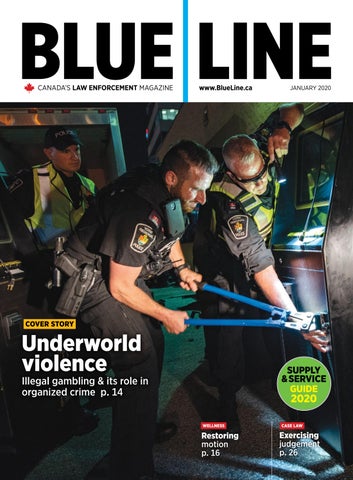
COVER STORY
Underworld violence
SUPPLY & SERVICE GUIDE
Illegal gambling & its role in organized crime p. 14
2020
WELLNESS
CASE LAW
Restoring motion p. 16
Exercising judgement p. 26
14
Contents
January 2020 Volume 32 Number 1
Features COVER STORY
14 Odds are... gambling is behind recent wave of underworld violence
According to the Royal Canadian Mounted Police, illegal betting and gaming is at the top of the list of income generating rackets for organized crime — and business is good in southern Ontario. By Stephen Metelsky
16 A modern approach to injury recovery
The E.L.D.O.A Method is a modern approach to injury recovery for today’s officers. By Sean Waldie, with Micheal Okumura
18 Annual Supply & Service Guide
Columns 4 8 10 12 13 22 26 30
Editor’s commentary Q&A Health & wellness Behavioural sciences Holding the line Technology Case law Back of the book
Departments 5 5 7 7 27 28 29 30
By the numbers News Dispatches Calendar Off the shelf Product showcase Marketplace Blue Links
COVER PHOTO: YORK REGIONAL POLICE SERVICE.
Blue Line’s Supply & Service Guide is the national law enforcement community’s year-round information tool for sourcing cutting-edge products as well as finding new vendors and suppliers.
8 @Blue_LineMag
16
22 January 2020 | BLUE LINE
3
EDITOR’S COMMENTARY BY RENÉE FRANCOEUR
BLUE LINE www.BlueLine.ca
Of coroners and constables...
T
he eight-day CN Rail strike, al- ideas, such as the role technology can play legedly the longest rail strike in a coroner’s attendance and in fast-tracksince 2012, was the talk of the ing the transfer of video footage from the town back in November as it train’s camera to police. sparked waves of supply disruption across An on-scene CPRDI check list was also the country. However, the rail conversation disclosed, with this preamble: “The primary for me was centred solidly on community goal is to release the train and tracks within safety and collaboration within the ways we 90 minutes (or less) of any non-suspicious respond to non-suspicious rail death inves- death. Holding the train unnecessarily protigations. It’s a sensitive topic but it is one vides no evidentiary value and increases we cannot ignore. risks to public safety.” Railway fatalities are not going to just It’s about much more than a delay, as stop happening. Overall safety for the Harvey told me — stopped trains may be public as well as the investigators must causing blockages on roadway crossings, remain the priority. This was at which in turn may impede emerthe heart of Ontario’s first Rail “The primary gency services responding to calls. Death Investigations & Public goal is to Allegedly, the U.K. is working Safety Summit, which continued release the on a similar 17-minute protocol, the roll out of the new Collab- train and but I was impressed by some of orative Protocol for Rail Death tracks within the early results from the 90 minutes Investigations (CPRDI). 90-minute process here in OnI was honoured to be person- (or less) of tario. Case studies from the Toally invited by Metrolinx Insp. any nonronto Transit Commission, York Steve Harvey to this summit (you suspicious Regional Police, VIA Rail Police can read more about it in our death. and Chatham-Kent Police illusnews section). I hadn’t heard a lot Holding the trated how implementing CPRDI about the protocol — despite its train not only resulted in an expedited adoption by the Ontario Associ- unnecessarily investigation, but also fulfilled ation of Chiefs of Police and its provides no “mutually shared goals.” coverage at the 2019 CACP Na- evidentiary I also appreciated how the tional Traffic Conference — and value and summit was consistently looking increases I was eager to learn more. “beyond the collisions,” into The protocol’s working group risks to public their impacts and consequences... — comprised of police, transit/ safety.” how one of the protocol’s princirail police and the office of the ples is “readiness to move away chief coroner/Ontario Forensic Pathology from habits of the past.” Farewell to the Service — has worked on this system of silos and the excess photos of a scene that guidelines and best practices for the past will be of no use. two years. Essentially, it’s a protocol that “I was that guy,” said one former police outlines the roles of all players, from front- officer who is now employed by a transit line staff to the coroner, and how to meet company. “I was the one holding the their responsibilities by working together. scene. I’m a converted individual now and Speakers at the summit shared more on I understand the impacts our decisions defining the non-suspicious rail death in- can have.” vestigation, establishing the anatomy of the I look forward to seeing more positive investigation and its 90-minute pathway, results as this protocol hopefully spreads activating the various aspects of the inves- across the country. tigation and exactly how teamwork plays into it all. You can find more photos from the summit and a The presenters proposed questions and video with Harvey at bit.ly/2s2XJeZ.
CONNECT WITH BLUE LINE
www.BlueLine.ca 4
@Blue_LineMag
BLUE LINE | January 2020
www.facebook.com/BlueLineMagazine
GROUP PUBLISHER | MARTIN MCANULTY mmcanulty@annexbusinessmedia.com EDITOR | RENÉE FRANCOEUR rfrancoeur@annexbusinessmedia.com ACCOUNT MANAGER | JANICE EATON jeaton@annexbusinessmedia.com MEDIA DESIGNER | SVETLANA AVRUTIN savrutin@annexbusinessmedia.com ACCOUNT COORDINATOR | TRISH RAMSAY tramsay@annexbusinessmedia.com CIRCULATION MANAGER | BEATA OLECHNOWICZ bolechnowicz@annexbusinessmedia.com Tel: 416-510-5182 COO | SCOTT JAMIESON sjamieson@annexbusinessmedia.com
ANNEX BUSINESS MEDIA 111 Gordon Baker Road, Suite 400 Toronto, ON M2H 3R1 Tel. 416-442-5600 • Fax 416-442-2191
Publication Mail Agreement No. 40065710 ISSN 0847-8538 Printed in Canada SUBSCRIPTION RATES Canada — 1 Year $31.50; 2 Year $52.50 plus tax USA — 1 Year $105.00 USD CIRCULATION email: bolechnowicz@annexbusinessmedia.com Tel: 416-510-5182 Fax: 416-510-6875 or 416-442-2191 Mail: 111 Gordon Baker Road, Suite 400, Toronto, ON M2H 3R1 Occasionally, Blue Line will mail information on behalf of industry-related groups whose products and services we believe may be of interest to you. If you prefer not to receive this information, please contact our circulation department in any of the four ways listed above. Annex Privacy Officer Privacy@annexbusinessmedia.com; Tel: 800-668-2374 © 2020 Annex Publishing & Printing Inc. All rights reserved. Printed in Canada. No part of the editorial content of this publication may be reprinted without the publisher’s written permission. Opinions expressed in this magazine are not necessarily those of the editor or the publisher. No liability is assumed for errors or omissions. Readers are cautioned and advised that articles presented herein are edited and supplied for your personal awareness and should not be used for further action until appropriate guidance is received from a supervisor, Crown Attorney or other persons in authority. All advertising is subject to the publisher’s approval. Such approval does not imply any endorsement of the products or services advertised. The publisher reserves the right to refuse advertising that does not meet the standards of this publication.
NEWS ST. JOHN’S
RCMP NL sweat lodge reflects “commitment to true reconciliation”
The working group behind the new Collaborative Rail Death Investigation Protocol presented case studies and more during the first Rail Death Investigations & Public Safety Summit. PHOTO: BRIAN MAIN, METROLINX
TORONTO
Rail Death Investigations Summit rolls out collaborative protocol
About 135 members from police and public safety agencies across Ontario gathered recently at the Toronto Police College to examine and discuss the new Collaborative Protocol for Rail Death Investigations (CPRDI), launched in May 2019, at what marked the first Rail Death Investigations & Public Safety Summit. It was an opportunity for participants to learn how the working group developed the protocol over the past two years, said Steve Harvey, the main organizer of the event and an inspector with Metrolinx. “There was a working group of 15 different agencies,” he said. “The protocol has now been adopted through the Ontario Association of Chiefs of Police and this summit is all part of rolling it out.” Non-suspicious deaths occur with alarming frequency on freight and passenger railway, mass transit, light rail and subway lines across Canada. This is a single, uniform and reliable protocol to guide the on-scene response and early investigative requirements associated with all categories of railway deaths. It details a system in which all partners on scene can work collaborative-
ly to see the safe and efficient restoration of operations to the transportation systems in about 90 minutes. “The protocol is not to say the whole investigation is over in 90 minutes,” noted Norman Taylor, president of Global Network for Community Safety and a key member of the working group. “The goal is the interruption is over at 90 minutes. It’s about accelerating the decision point.” Aside from the delays in the transportation system, there is the potential for additional community safety concerns, Harvey noted. The effects of having a lengthier than necessary investigation can cascade across numerous communities farther away from the incident site. That can result in blocked crossings, traffic and crowding issues and trains trapped in potentially isolated areas, he explained. The summit heard case studies from the Ontario Provincial Police, Peel Regional Police, VIA Rail Police, CN Police, the Toronto Transit Commission and others. “This is the beginning, the building blocks,” Harvey said. “It’s part of changing the culture in policing and the way we do things. Culture takes a while to change but it’s not impossible — there’s lots of work ahead.” The working group will reconvene in early 2020, he added, to develop a strategic plan and identify further training opportunities and aids.
RCMP Newfoundland and Labrador has constructed a sweat lodge on the grounds of its headquarters in St. John’s, the second one to be established by the RCMP in Canada. “Connecting with Indigenous Peoples through the understanding of and participation in their cultural traditions is vital for the RCMP,” said Assistant Commissioner Ches Parsons. “The establishment of a sweat lodge here on the grounds of headquarters is an important step in the reconciliation process and reflects our commitment to engaging with Indigenous communities in respectful and meaningful ways.” An inaugural sweat was held at the RCMP Sweat Lodge, with participants including Assistant Commissioner Parsons, Commanding Officer of RCMP NL, constables Brad Squires and April Janes of RCMP NL Indigenous and Community Policing Services, and Sgt. Troy Bennett, who is based in the Stephenville Detachment and is a member of the Qalipu First Nation, as well as other participants. Indigenous Elder Kenny “Mutchie” Bennett, also a member of the Qalipu First Nation, conducted the ceremony. “The construction of a sweat lodge by the RCMP is significant for me both as a police officer and as an Indigenous resident of this province,” Bennett said. “The sweat lodge offers healing that supports our mental and physical well-being and I am proud that the RCMP sees this as an important piece of our relationship with Indigenous Peoples and communities.” Indigenous groups were consulted in the plans for the establishment of a sweat lodge at RCMP Headquarters, including the Qalipu First Nation and the Miawpukek First Nation.
BY THE NUMBERS
A report commissioned by a senior City of Kelowna staffer has revealed the RCMP detachment in the British Columbia city is critically understaffed. More from the Global News story on that report and its recommendations below:
300
page report compiled in November 2019
@Blue_LineMag
56
additional police officers recommended to be hired by 2025
28
civilian staff recommended to be hired by 2025
40%
of sexual assault cases were deemed unfounded in 2018 for the detachment, which is three times the provincial average, according to Statistics Canada
January 2020 | BLUE LINE
5
NEWS EDMONTON
Visual card helps police and drivers communicate better
In partnership with Deaf and Hear Alberta, the Edmonton Police Service recently announced a new tool to help police officers and drivers with hearing loss communicate more effectively. “Last year I had an interaction with a Deaf driver where communication was a concern,” said Const. Trevor Claydon, with EPS Traffic Services. “I wanted to do something more to help us understand each other better, break down the barriers, and reduce the stress during the traffic stop.” Claydon discovered police agencies across North America had similar problems and some had created information cards to aid with communication. This prompted the traffic constable to work with Edmonton’s Deaf and hard of hearing community to develop a similar tool. The card’s design features common visual symbols and text that can be pointed at by either party to facilitate conversation. Drivers are encouraged to keep the card in their vehicles and EPS officers involved in vehicle stops will also carry the card in their cruisers. Cards are available free of charge to the public at all EPS division stations, as well as at the Deaf and Hear Alberta office located in the Alberta School for the Deaf. “EPS officers deal with members of the Deaf and hard of hearing community on a regular basis, and while we utilize Text with 911 and TTY technology for emergency and complaint calls, and offer training and interpreters when needed, we can still face challenges communicating one-on-one,” Deputy Chief Greg Preston said. “The visual nature of the card will help us share information more effectively and bridge these communication gaps.” LONDON
Police service’s internal mental health campaign wins national award
The London Police Service’s ‘Stronger than you Know’ mental health awareness campaign has received a national Silver Leaf Award of Excellence from the International Association of Business Communicators (IABC). The campaign is an internal mental health, anti-stigma initiative designed to increase awareness and understanding about mental 6
BLUE LINE | January 2020
PHOTO: EDMONTON POLICE SERVICE
wellness, and to reduce stigma associated with seeking help when experiencing a mental wellness struggle. It was led by Roxanne Beaubien, the service’s manager of corporate communications and media relations. “Raising awareness and having conversations about the mental health of our members and the importance of de-stigmatization is crucial — we have no greater resource than our members,” Chief Steve Williams said. The month-long campaign, comprised of video testimonials, an intranet microsite and posters, was directed at all employees and featured three central components: • I am stronger than you know — an officer and a communications operator who survived mental health struggles encouraged others to seek help and support in video testimonials. • Show your strength — hundreds of members pledged to end the stigma associated with post-traumatic stress injury or mental illness. • Asking for help is a sign of strength — Respected members encouraged others to seek help if needed. According to the IABC, the Silver Leaf is Canada’s premiere professional awards program celebrating excellence in business communication. THUNDER BAY
Tree of Hope remembers Missing and Murdered Indigenous Women and Girls
Const. Sharlene Bourdeau of Thunder Bay, Ont. started an initiative this past holiday season to remember Missing and Murdered Indigenous Women and Girls (MMIWG) all around Canada through the Tree of Hope.
When it comes to MMIWG, there are still approximately 1,000 to 4,000 cases that remain unsolved Canada-wide. Reclaiming Power and Place: The Final Report of the National Inquiry into Missing and Murdered Indigenous Women and Girls states that Indigenous women and girls are 12 times more likely to be murdered or go missing than any other women in Canada. Bourdeau is an Indigenous police officer with the Thunder Bay Police Service, hailing from Pays Plat First Nation community. She PHOTO: OPP said she has friends who were affected by the wide-reaching tragedies connected to MMIWG, including a co-worker whose mother was murdered. It was this moving, personal connection that sparked the Tree of Hope initiative, a one-of-a-kind campaign dedicated to bringing awareness to the general public regarding the “appalling” MMIWG statistics and providing families with reassurance their loved ones are not forgotten. The campaign consists of: lighting Christmas trees to remember MMIWG, as the light bulbs each symbolize a life; a GoFundMe page; and a Crime Stoppers tips invitation on the Tree of Hope website. The Tree of Hope campaign kicked off by stringing 1,200 red lights on one of the four Christmas trees selected for the project in Thunder Bay. Each red light on the four trees represents an MMIWG in Canada. Blue stars were also glowing from atop the four trees, signifying law enforcement support in this issue, according to Bourdeau. Bourdeau said she hopes others in the policing community are encouraged through the Tree of Hope to incorporate more Indigenous-led incentives around the country. Donations from the GoFundMe account will go to an RBC CrimeStoppers account with a goal of accumulating $48,000. Follow the campaign at www.treeofhopeproject.com. - By Zeba Khan www.BlueLine.ca
NEWS DISPATCHES Malcolm Murray, chief pilot of the Winnipeg Police Service, received the 2019 Airbus Innovation in Safety Award, which was announced during the Helicopter Association Conference held in Vancouver, B.C. Airbus explains Murray, who has been a pilot for 20 years, was recognized for his exemplary work to enhance aviation safety in Winnipeg and across airborne law enforcement operations. Murray joined Winnipeg Police Service in 2011 and assumed the role of chief pilot in 2012. After 34 years, Calgary Police Association president and former tactical unit officer Les Kaminski is retiring. Kaminski started his role with the Calgary police on patrol before transitioning into serving with the force’s tactical unit. There, he held several roles, including working in the bomb disposal team, before moving back to working as a sergeant. Kaminski also led the force’s Gang Suppression Team. RCMP Assistant Commissioner Bernadine Chapman is the new commanding officer for the national division. She takes over from outgoing CO, Deputy Commissioner Mike Duheme. She was most recently the RCMP district officer for southern Alberta. The Quebec cabinet named Johanne Beausoleil to the post of associate director-general of the Sûreté du Québec (SQ) for a three-year period. She is a former internal auditor of the SQ and was most recently working for the Montreal police force. It marks the first time in Quebec’s history that a woman is at the SQ’s helm. Born in Montreal, Beausoleil has degrees from the Université du Québec à Montréal and a master’s in public administration from the École nationale d’administration publique. She also has 27 years’ experience working for Quebec’s correctional services, including five years as a deputy public security minister for correctional services. Trish McIntyre of the London Police Service is now the deputy chief of police for operations. McIntyre began her policing career in 1999 as a cadet with the London Police Service. She has held supervisory @Blue_LineMag
CALENDAR positions in the Major Crime Section, Professional Standards Branch, Patrol Operations Branch, Investigations Branch and most recently was promoted to acting inspector in charge of a patrol modernization project. Fredericton’s new police chief, Roger Brown, was sworn in for a three-year term last June. He is the former head of the New Brunswick RCMP and boasts 36 years of experience in policing. He also oversaw the investigation of the murder of three mounties in Moncton in 2014. David Moskowitz, president of the Ontario Special Constable Association (OSCA), is handing the reins over to vice-president Sarah Kennedy. Brenda Lucki, the commissioner of the RCMP, has been named one of Canada’s Most Powerful Women: Top 100 in the CIBC Trailblazers & Trendsetters Awards category. Women’s Executive Network (WXN), a member-based organization, exists for the advancement, development and recognition of professional women in Canada. It presents Canada’s Most Powerful Women to recognize the “incredible accomplishments of women, develop a community of support, and increase the visibility of strong leaders in order to inspire future generations.” Insp. Sharon Warren of the Royal Newfoundland Constabulary is the new president of Atlantic Women in Law Enforcement.
The RCMP has chosen union leaders from its ranks for the first time. Brian Sauvé was elected to the National Police Federation’s (NPF) top position. Michelle Boutin, Peter Merrifield and Dennis Miller were also elected as national vice-presidents. The NPF is the sole certified bargaining agent for regular members and reservists of the RCMP below the rank of inspector. For a full list of the board of directors, visit npf-fpn.com.
NSSF Shot Show Jan. 21-24, 2020 Las Vegas, Nev. shotshow.org 17th National Symposium on Search and Seizure Law in Canada Feb. 7, 2020 Toronto, Ont. www.osgoodepd.ca Alberta Association of Community Peace Officers Conference Feb. 10-14, 2020 Lake Louise, Alta. aacpo.ca/winter-conference/ registration-2020 CACP Information and Communications Technology Committee Summit Feb. 23-26, 2020 Vancouver, B.C. cacp.ca Courtroom Testimony: A Practical Skills Workshop for Police and Other Law Enforcement Professionals Feb. 27, 2020 Toronto, Ont. www.osgoodepd.ca Calgary Cyber Summit 2020 March 10-12, 2020 Calgary, Alta. cybersummityyc.ca 13th National Symposium on Tech Crime and E-Evidence April 3, 2020 Toronto, Ont. www.osgoodepd.ca Risk & Recovery Conference April 16-17, 2020 Hamilton, Ont. www.riskandrecoveryconference.com Canadian Police Association Conference April 20-22, 2020 Ottawa, Ont. www.cpa-acp.ca National Symposium on Sexual Assault Cases in the Criminal Court April 25, 2020 Toronto, Ont. www.osgoodepd.ca January 2020 | BLUE LINE
7
Q&A Border Services Officer Tamara Lopez is with the Canada Border Services Agency (CBSA) in the Greater Toronto Area and is also a director for Serving with Pride. She is a member of the CBSA’s Committee for Diversity and Inclusion, helping to educate others on LGBTQ2+ rights and history. An actor, TV host and Diamond Jubilee medalist, she was previously a guest on Blue Line, The Podcast. We share some of that illuminating conversation here. Q: You began working with CBSA in 2005. As a graduate with a major in psychology and a minor in sexuality studies from the University of Windsor, why did you choose a career in law enforcement?
I think the job may have actually chosen me. I was unaware what border security was when I was in university. I stumbled upon a booth one day during a career fair at the University of Windsor. From the individuals there that were talking to me about it, I found the job interesting. I applied as a student officer and never looked back. The nice thing is I feel I use my degree in psychology in my job because understanding the human psyche and things like motivation really helps in this line of work. Also, having taken a course on gay and lesbian studies, as well as co-creating the Out on Campus student group, obviously helps me in my quest to further advance the visibility of the LGBTQ+ community within law enforcement.
Q: What has been the most pleasantly surprising thing about your career?
Every day is a new beginning. As a line officer at Toronto’s Pearson International Airport, no two shifts are ever the same. I’m constantly learning new skills and perfecting old ones as well. Another surprising thing about the job is the many different aspects and areas CBSA has under its portfolio. For example, we have passenger operations at the 8
BLUE LINE | January 2020
at first. So, there is some adjustment. There are resources to turn to. For example, we have an employee assistance program, which can offer resources for maintaining optimal health, a nutritionist or assistance with things like financial planning. You also end up forming, I find, a really strong bond with your crew members, because you spend a lot of time with them on shift, working very long hours together.
Q: In 2017, the CBSA announced that it created its first LGBTQ2+ Committee and you quickly joined. What does this committee mean to you?
airports, which everyone will be familiar with of course, and traffic at land border crossings... There are postal operations at our international mail centres and there are also commercial operations at cargo warehouses, marine operations, plus training and learning opportunities — the list goes on. Your career never gets stale.
Q: What has been the most challenging?
At times, the most challenging part of the job can be establishing things like a good work/life balance. Law enforcement as a profession is 24/7 for all 365 days a year. Sometimes, people will not be prepared for that
CBSA officers provide services at
1,200 points across Canada
39
international locations
13
international airports
The minute they had announced they were forming the committee, I immediately put my name forward. The LGBTQ2+ Advisory Committee raises awareness and serves as a consulting body on issues that impact the CBSA LGBTQ2+ community. This committee is a safe and open forum for members to connect and discuss issues and the promotion of a healthy, inclusive work environment. I should note, the LGBTQ2+ term is an umbrella term often used to describe the lesbian, gay, bisexual, transgender, queer and two-spirit community. It encompasses the diversity found within these communities. In order to represent the range of diversity, of course, the abbreviated acronym utilizes the plus symbol, as there’s roughly about 29 letters, I believe, in the actual acronym. So, for example, “a” for ally would also www.BlueLine.ca
be in there as well; we obviously need allies for the community. The committee means forward momentum and that the CBSA is moving in the right direction by identifying the need for a group to work on the investment in the agency’s LGBTQ2+ employees. It means recognizing such things like the International Day Against Homophobia, Transphobia and Biphobia or pride month or National Coming Out Day. It means a more inclusive work environment where we can be openly who we are.
Q: You’re also the host of Women As Career Coaches outside of work. What do you love about motivational speaking and working with a range of women of all ages?
Part of my vision is to showcase the fact that you can try on different career hats throughout your journey — before you figure out what you want to do. The model for Women As Career Coaches is just “because you wander doesn’t mean you’re
lost.” And that is what I love. My career has been constantly evolving — both inside and outside of work — and being elected as a board member with Serving with Pride is another prime example of me trying on different hat. What I love about motivational speaking is that I’m not the average motivational speaker. I’m a gay woman of colour in a uniform, and I want those in the audience to see that and understand that there is nothing holding you back — not your gender, not your race, not your sexual orientation. You can be all of those things or none of those things and still be successful. And our differences are what makes us stronger together.
Q: Sometimes, in the wider law enforcement discussion, other agencies, like those of correctional officers and CBSA officers, are left out and the focus is on the “traditional policing agencies”... what are your thoughts when it
comes to ensuring CBSA is fully represented and recognized inside the big picture?
We are a federal institution that is part of the public safety portfolio. Ensuring the security of our borders as well as the safety of our frontline officers is a key priority for the Government of Canada. The CBSA is responsible for enforcing the law at designated ports of entry. We also get to work closely with our national and local law enforcement partners to do things like detect and prevent any illegal cross border activity — smuggling, human trafficking... We process millions of people and examine millions of mail parcels. Each year we see illicit drugs, weapons, or even arrest people that are found to be smuggling. And of course, throughout the course of our duties, we can enforce almost 90 if not over 90 pieces of legislation. We play a big role in public safety. Listen to the full conversation on Blue Line, The Podcast at bit.ly/2Oynehe or wherever you listen to your podcasts under Annex Business Media: Podcasts.
Online Police Studies Degree Fast-track with advanced standing. Designed for first class constable or higher.
Apply today! GeorgianCollege.ca/policestudies @Blue_LineMag
BL_Georgian_Jan20.indd 1
January 2020 | BLUE LINE
9
2019-12-09 1:57 PM
HEALTH & WELLNESS
BY ISABELLE SAUVÉ AND BRUNO SEGUIN
Employee development: Let’s do it together
10
BLUE LINE | January 2020
Employee retention and performance is directly linked to how employees are treated and given consideration. Planning for employee development is crucial. Prior to offering training opportunities or compelling employees in a specific career direction, it is important for the organization and the individuals involved to understand the need and purpose of the intended developmental initiative. In other words, “identifying the needs and the purpose of development endeavours is a critical part of its planning,” according to Noe Hollenbeck Gerhart Wright, the author of Human Resource Management, which targets the idea of “gaining a competition advantage.” A noteworthy change over the years has been the need for employees to see meaning in their jobs. In fact, today’s workers are known to seek “protean careers,” which is to see a project or job through to completion, rather than performing only one piece or portion of a job. It brings a psychological dimension where employees’ career goals are motivated by psychological successes. These successes are no longer strictly determined by the employer through the allocation of salary increases and promotion; they are also self-determined by each employee achieving their own life goals (growing a family, being healthy, etc.). In short, employees take pride in and responsibility of managing
Law enforcement organizations need to invest in “development planning” or “career management systems”...
their careers. Proper support from the employer helps personnel make the right decisions and can provide guidance for potential change. It is often that — and rightly so — organizations provide training for specific tasks or compliance for the current jobs. On the other hand, it is very rare that organizations take the time to prepare a thorough and meaningful development plan — as well as an action plan — taking into consideration the goals and needs of both the individual and the work environment. It is this lack of planning which creates a gap and a misunderstanding between law enforcement personnel and organizations, resulting in loss of motivation, loss of focus and, by consequence, more and more individuals handing in a resignation. This happens not necessarily because they dislike what they do or forget why they joined in first place, but simply because individual development and career goals are not properly planned and achieved. Law enforcement organizations need to invest in “development planning” or “career management systems” to retain, guide and motivate employees who have the potential for strategic, lateral progression as well as for promotion into managerial positions to better suit each individual and by consequence the organization. These systems allow the identification and subsequent gratification of employees’ development needs.
Isabelle Sauvé is a 13-year veteran with the OPP, currently with the Lanark County Detachment. She has a MA in psychology and is a PhD candidate. She is also an ultramarathon/endurance athlete and the Racing the Planet/4 Deserts 2018 Series winner as well as a Guinness World record holder. She can be contacted at: isabelle.sauve@hotmail.com. Bruno Seguin is a senior executive manager and international business consultant with experience in global operations, international business development, strategic planning, leadership and corporate governance. He is also an ultra-runner, 9th place finisher at the Racing the Planet/4 Deserts 2018 Series and fellow Guinness World record holder.
www.BlueLine.ca
PHOTO: © CACAROOT / ADOBE STOCK
L
ong-term employee commitment and skilled personnel retention are at the heart of every organization that invests substantially in recruitment and training — a.k.a. law enforcement. In order to attract the best candidates — and more importantly to retain them — law enforcement agencies should recognize they are not immune to competition and social changes. Figures are showing law enforcement officers are increasingly transferring to other agencies or simply changing their career paths altogether when they feel their personal development and career goals are poorly supported. A perceived lack of support can range from having an unfitting focus and ambiguous career pathway, to inefficient, inappropriate and unfair lateral and promotional selection processes. As such, it is legitimate and critical to thoroughly look at initiatives and investments devoted to employee development and selection. It is recognized employee development is a key contributor to an organization’s efficiency by aiding employees in understand their strengths, weaknesses and interests. Another aspect of employee development is the importance of openly and transparently advertising new job opportunities. Employees must know what is available to them and how to meet personal growth needs based on their existing competencies and skills. Understanding how to obtain specific competencies, skills and knowledge through various means like formal education, assessment, job experiences and interpersonal relationships must be ensured. Every aspect of the process must be clear, fair and apparent. By nature, humans are eager to learn, change and progress. For this reason, emphasis must be placed on both training and development.
Our Nation’s Heroes. In 2019, $4.5 Million was raised to support more than 47,500 Special Olympics Athletes across Canada. These amazing results are attributed to all Law Enforcement Champions in communities from coast to coast. Your dedication and spirit of inclusion inspire all. You are an integral part of the Special Olympics movement. Thank you!
@specialocanada specialolympics.ca Photo Credit: Jeff Cross Prestige Photo
BEHAVIOURAL SCIENCES BY DR. PETER COLLINS
What is psychosis? – A primer for police officers
P
sychosis is a term that denotes a disorder of thought. By definition, a disorder of thought involves tangential thinking and difficulty in maintaining thought on a fixed topic. Typically, there are two major components – delusions and perceptual abnormalities.
Delusions
Delusions are false, fixed and formed ideas that are inconsistent with the accepted beliefs of a person’s education, culture or social background. The false belief is held with extraordinary conviction and subjective certainty. Delusions are the world view of those who experience them.The most common delusional themes are paranoia; grandiosity and religiosity. Paranoia involves intense anxious or fearful feelings and thoughts related to persecution, threat or conspiracy. Paranoia occurs in many psychiatric disorders, but is most often present in psychotic disorders. Paranoia can become a delusion when the irrational thoughts and beliefs become so fixed that nothing (including contrary evidence) can convince a person that what they think or feel is not true. A person with grandiose delusions has an over-inflated sense of worth, power, knowledge or identity. Others may believe that they have a special relationship with someone who is famous. The person might believe he or she has a great talent or has made an important discovery. Delusions of grandeur are more common with bipolar disorder and schizophrenia. If a person has a history of bipolar disorder and has had delusional thoughts in the past, delusions are more likely to happen again.
Hallucinations
Perceptual abnormalities are hallucinations. Although hallucinations can be in any sensory modality – sight, hearing, taste, smell or touch — auditory and visual hallucinations are most commonly experienced in psychiatric conditions. Gustatory 12
BLUE LINE | January 2020
(taste), olfactory (smell) and tactical (touch) are less common in major mental illness but can be experienced in other medical conditions. When confronting someone with a disorder of thought, officers should ask if the person is hearing voices and if the voices are telling him or her to harm him/her self or others (command hallucinations). An illusion is not a hallucination; it is a misperception of physical phenomena that is external to the person. While they can be disturbing in some situations, illusions are not due to internal beliefs. They are tricks of the eye.
Psychosis
The classic disorders that involve psychosis are schizophrenia, schizoaffective disorder, and delusional disorder. These are deemed to be serious mental illnesses because of the major impact they cause on life and relationships. In addition, psychosis can be experienced by people with other diagnoses, such as major depression and bipolar disorder. Officers should also try and determine if the psychotic individual is using drugs or alcohol. Individuals with schizophrenia, as an example, are at a higher risk for suicide, especially if they have a co-existing diagnosis of substance abuse. Another cause of a psychotic state is drug-induced psychosis. On a regular basis, frontline officers and police crisis negotiators encounter individuals who are psychotic and potentially violent due to their consumption of agents like methamphetamine and THC.
On a regular basis, frontline officers and police crisis negotiators encounter individuals who are psychotic and potentially violent due to their consumption of agents like methamphetamine and THC.
For the frontline officer who encounters a psychotic individual, it is important to acknowledge that the subject has delusions but not to argue, agree or disagree with the delusional beliefs. It is also crucial not to deceive or lie to the subject. Don’t pretend that the delusions are true or you can hear the voices as well. Although they may be delusional, the individual will remember being deceived and this will make their co-operation less likely in subsequent encounters. In trying to determine the content of the delusions, those subjects who experience the delusional belief of control by an external force (an override delusion) are more at risk for violence as are those have the delusional belief of infidelity. If present, these delusions may double the risk of violence but overall those who experience these symptoms will not be violent. Generally speaking, psychosis is weakly associated with violence. Certain symptoms, and not a particular psychiatric diagnosis alone, are associated with violence. Overall, the risk of violence is still better predicted by being a young male than by a diagnosis of schizophrenia. The combination of schizophrenia and substance abuse have higher rates of violence than those with substance abuse alone, who, in turn have higher rates than those with schizophrenia alone. In conclusion, psychosis is a symptom, not an illness. Given the uniqueness of this state, its widespread relevance and its potential destructiveness, it is important for those in law enforcement to understand and empathize with those individuals who are suffering from a psychosis.
Dr. Peter Collins is the operational forensic psychiatrist with the Ontario Provincial Police’s Criminal Behaviour Analysis Unit. His clinical appointment is with the Centre for Addiction & Mental Health and he is an associate professor with the University of Toronto. Dr. Collins’ opinions are his own and may not reflect the opinion of the OPP, University of Toronto, CAMH or his mother. Contact him at peter.collins@utoronto.ca.
www.BlueLine.ca
HOLDING THE LINE BY MICHELLE VINCENT
How values impact organizational messages in culture
O
rganizational values in policing are similar throughout Canadian organizations. From original, longstanding values (integrity, accountability and community) to newer, more forward- thinking ones such as compassion, innovation, fairness and professionalism, these values constitute the very cloth in which our policing culture is threaded. With this thought in mind and the goal of implementing mental health “wellness” programs in most — if not all — policing organizations, culture is expected to mirror those values. It is with curiosity and inspiration I also suggest co-operation be a value that is included in every organization. Co-operation includes working together to achieve a predetermined outcome. It dissolves the competitiveness that is natural in police culture and yet also destructive in most ways in most processes. Imagine if co-operation were a required theme/component in every process, such as the promotional process. Being required to show how you were co-operative in implementing a new program within the organization, or how you managed a particularly intricate and yet successful investigation from a co-operative perspective, may reframe the way in which we perceive a successful outcome and the manner in which it was achieved. This co-operative, thematic approach to the organization’s vision may demonstrate strong relationships between our members, their units, policing organizations and finally (and maybe most importantly) an authentically strong relationship between policing organizations and the communities in which they serve. Imagine the leaders in our organization, from our Executive Command Team downwards, operating with co-operation as their background theme and objective in most if not all of their endeavours. The message would be clear to members that their organization truly cares about them and their wellbeing, for without co-operation in each and every task, it becomes a one-person show. Competitiveness has been innate in policing organizations for decades. This is understandable as we are expected to be in top shape both mentally and physically as we “compete” in physical fights to gain
control and protect the innocent. This can happen in firearm interactions and other altercations that could involve life and death. It is not a surprise our mindset as police officers is competitive in most if not all aspects of the career. As with society in general we have evolved as a species in many areas of combat. Centuries ago, prior to firearms, we used primitive projectiles, arrows and other forms of defence. We moved to firearms, grenades and bombs when combat became atomic bombs and chemical warfare. The mental health issues we contend with today are believed to be a combination of exposure to traumatic incidents and the management of those incidents by the organization. The physical and chemical reaction that results from these incidents and the member’s perception of their experience can contribute to operational stress injuries, depression, anxiety and PTSD.
If the organization approaches their values in a co-operative manner, adding co-operation to their list, the culture they are working on changing through inclusivity/diversity, wellness, ethics, etc. (I have to check out the rest) may unfold in a more organic way. Co-operation dissolves competitiveness. Instead of having to write the most tickets, the member/supervisor has to reframe their thinking to be successful by supporting the successes of their teammates. That is what fosters an environment conducive to healthy culture and sound mental health. Michelle Vincent is a 18-year York Regional Police officer in the process of implementing the first non-profit treatment centre that will be occupationally specific for first responders. She is working towards her PhD in Forensic Psychology/ Crisis Response. She can be contacted at: michelle@ vincent.net
DALHOUSIE’S CERTIFICATE IN POLICE LEADERSHIP
Become the leader you know you can be
Built for modern policing, our online courses, designed and delivered by academics along with industry experts and leaders in policing, give you the knowledge and skills to advance in your profession. Learn from the innovator in quality police education for over 25 years. WINTER TERM STARTS JANUARY 29
DAL.CA/POLICELEADERSHIP
CCE
College of Continuing Education
January 2020 | BLUE LINE
@Blue_LineMag BL_Oct19_Dalhousie.indd 1
13
2019-09-13 1:56 PM
COVER STORY
Odds are... gambling is behind recent wave of underworld violence
G
ambling — is it a victimless crime? A game of poker may seem harmless and innocent, but it isn’t. Gambling is a lucrative vice in organized crime, fraught with territorial violence and even murder. The common denominator in the underworld that transcends geographic borders, cultures and genres of any organized criminal group is cash — and gambling provides plenty of cash. According to the Royal Canadian Mounted Police, illegal betting and gaming is at the top of the list of income generating rackets for organized crime — and business is good in southern Ontario. The experts agree. In southern Ontario, “history has shown that the Hells Angels and traditional organized crime are working together in the illegal gaming industry,” says Len Isnor, an
outlaw motorcycle gang expert and former detective staff sergeant from the OPP’s Biker Enforcement Unit, who retired in 2017. “These card games are all held at locations that limit people from attending. The security is there, but nobody knows where they are. They will get an invitation the day of the game. They attend a location and a van takes them to the gaming location.” Illegal card games comprise one of many gaming rackets in the underworld. Online sports betting provides a greater, more lucrative profit margin in the underworld, as evidenced by Project ORIVER. The RCMP-led investigation involved an illegal online betting platform called Platinum Sports book, involving a profitable partnership between organized crime and the Hells Angels. “With Project Oriver, it exposed a little bit of what the Hells Angels are into with traditional organized crime. Traditional organized crime
$35 million in assets seized in Project Sindacato
“With the amount of money these groups are bringing in, that creates a power struggle within the underworld, so everyone wants a piece of it...” - Det.-Sgt. Carl Mattinen, York Regional Police 14
BLUE LINE | January 2020
runs Platinum Sports book, but the Hells Angels are a part of it,” adds Isnor, the biker expert who worked on the RCMP led project. The Criminal Intelligence Service of Canada reported the discovery of Platinum Sports book back in 2012. It involved organized criminal groups “using an off-shore gambling website, PlatinumSportsBook.com, to launder proceeds of crime generated in Canada and make money through illegal gambling,” reports the Criminal Intelligence Service of Canada (CSIS). “The website was host to thousands of gamblers whose wagers allegedly resulted in millions of dollars in profit for organized crime,” CSIS said. When this much money is involved, violence is typically not too far behind. From 2016 into 2017 there were dozens of violent incidents in the Greater Toronto Area (GTA) and Golden Horseshoe region, ranging from homicides, attempt homicides, www.BlueLine.ca
PHOTOS: YORK REGIONAL POLICE SERVICE
By Stephen Metelsky
Project Sindacato focused on tracking money being generated and then locally laundered by the mafia in both government-owned Ontario casinos and on an international level. The takedown happened in July 2019.
fire bombings, arsons and drive-by shootings. These were attributable to the brewing turbulence in traditional organized crime, confirms Det.-Sgt. Carl Mattinen of the York Regional Police Service. “A lot of it dealt with debt collections, gambling collections and loans. This increase in violence caused a lot of attention,” Mattinen adds. He confirmed the traditional organized crime task force was formed by the York Regional Police to target organized crime in the GTA due to increased mob violence. The investigation evolved into a parallel investigation with the Italian authorities, both focusing on the ‘Ndrangheta, which is the Calabrian faction of traditional organized crime. The 18-month investigation, dubbed Project Sindacato, focused on the Figliomeni crime group, a Toronto-based organization with connected cells in Italy. The project focused on tracking the vast amounts of money being generated and then locally laun@Blue_LineMag
dered by the mafia in both government-owned Ontario casinos and on an international level. “With the amount of money these groups are bringing in, that creates a power struggle within the underworld, so everyone wants a piece of it, whether it be online gambling, or gambling within the café. They make so much money — astronomical amounts of money — that all the other crime groups want a piece of it,” Mattinen says. The head of the traditional organized crime task force contends these violent acts were all ‘messages’ within the mob. They were intended to intimidate and threaten others during this underworld power struggle in the GTA. This territorial struggle over gambling rackets was at the epicenter of the recent escalating violence in the Toronto and Hamilton areas, Mattinen confirms, “which creates your fire bombings, the arsons, other crimes and then, ultimately, innocent people getting hurt.”
27
individuals arrested in Project Sindacato
Gambling is definitely not a victimless crime, he continues. “These aren’t friends in someone’s garage playing poker. It is the furthest thing from that. When you see the large volumes of cash, into the hundreds of thousands plus, that’s when you see the fire bombings, people’s homes shot at. These are messages.” Project Sindacato, while focused on forensically tracking the money and the eventual forfeiture of assets, sent a message of its own, resulting in several arrests of Figliomeni crime members in Toronto and Italy in 2019. Police netted more than $35 million in assets and arrested 27 individuals, nine of them in the top echelon of the crime group. Gambling is not a victimless crime. Want to bet? Stephen Metelsky, M.A., is a writer, (ret.) police intelligence sergeant and professor at Mohawk College. Find him on LinkedIn, follow him @StephenGm_Jr or email Stephen.Metelsky@mohawkcollege.ca.
January 2020 | BLUE LINE
15
OFFICER WELLNESS
A modern approach to injury recovery Decompression stretches for today’s officers
By Sean Waldie, with Micheal Okumura
Policing has changed in many ways since walking the beat back in the early 1900s. Advancements in technology have allowed officers to have updated information from databases. Psychological training in human behaviour to help diffuse contentious situations and police vehicles equipped with computers also make their jobs more effective. However, this also makes the job more stationary in many elements. It is interesting to note from the study that officers aged 30 to 39 were most likely to become injured from bodily reaction and exertion, which was 29 per cent of claims for missed work. Could it be the changes in the officer’s bodies as they have aged or the changes from their environment — like sitting for extended periods of time? Both scenarios have a cause and effect on the body.
How does being stationary contribute to injuries?
Historically, officers were armed with lighter gear than they are today. Many officers wear gear that weighs up to 27 pounds. A Kevlar vest weighs 5.5 to 7.5 pounds and a Sam Browne can weigh up to 15 pounds. These are worn during shifts no shorter than eight hours — the average being 10 hours. The walking and the extra load are not the key issues for the modern police officer; it’s the sitting — sitting in cruisers, at desks, in courts, at meetings and during intake reports from citizens. All of this creates excess compression on the joints of the body, which contributes to loss of ability to move pain-free. This loss of space in the body leads to tightness and restrictions, making the body less elastic and more prone to injury due to its constricted range of motion. Many injuries happen when you move your body from an idle state to an active state. It’s not unusual for officers to feel back pain and discomfort from time to time and some may even fall victim to more severe back issues. The usual suspects of lower back pain are at the L4-L5 and L5-S1 area, where 80 per cent of back herniations happen.
What can the modern officer do to offset the habits and risks of the job?
An example of an exercise to reduce back pain. For more on how to perform this exercise, visit fusionhealthstudio.com. PHOTO: FUSION PERSONAL HEALTH STUDIO
M
any modernizations, especially in technology, have made policing more efficient, but there has been also been an unforeseen cost to these modernizations, which has led to numerous officers suffering on the job. An in-depth study (“Determinants of Injury and Death in Canadian Police Officers” by Dr. Irwin M. Cohen and Len Garis from the University of the Fraser Valley) was released in 2018 and allowed law enforcement departments across the country to take a closer look at how to protect officers from getting injured on the job.
16
BLUE LINE | January 2020
Enter the E.L.D.O.A Method. This exercise method was created by osteopath Dr. Guy Voyer. E.L.D.O.A is a French acronym which translates to mean LOADS: longitudinal osteoarticular decoaptation stretching. In non-technical terms, it means a series of decompression stretches. There are hundreds of specific E.L.D.O.A(s) a person can learn for individual joints, specific muscles or groups of muscles. Many professional athletes and sports teams have started to incorporate the practice of E.L.D.O.A to help with recovery, performance and injury prevention. The reason E.L.D.O.A is being utilized by other peak performers is because the exercises are precise at increasing space in the body, and it’s with millimeters that great miles are achieved. If we have healthy ranges of movement our body can move without restriction, hesitation or complaint. When these millimeters of movement decrease, we begin to lose large degrees of movement and then pain and discomfort can show its signs. People often come to embrace E.L.D.O.A for its ability to diminish: • pain that spikes during activities • pain or discomfort after specific positions (sitting or standing for long periods) • pain while they are at rest www.BlueLine.ca
In addition to restoring optimal ranges of motions, E.L.D.O.A has another important goal: to re-condition connective tissue (fascia) to be elastic. It is our connective tissue that creates the casing around muscles, giving them the room to move freely or not. When you do your E.L.D.O.A exercise, you are creating space not just at the bone and joint but also at the muscle, giving it shape. It is this change in the structure of the muscle that helps to maintain the improved function of the target area. Our team of practitioners hears one or both of the following statements on a daily basis: • “I’m glad I started training in E.L.D.O.A now” • “I wish I started 20 years ago” Micheal Okumura is the founder of Fusion Personal Health Studio in Toronto. He says E.L.D.O.A changed his life and he wants to see its knowledge and use expanded. “My situation was looking fairly bleak,” Okumura says. “I had seen chiropractors, sports medicine doctors, massage therapists, leaders in the exercise education community. I had spent thousands of dollars and had not found a solution to my joint issues.” Okumura had osteoarthritis in his knees, elbows, ankles, wrists and neck. He says his movement was limited and strenuous and his pain ranged from levels three to nine out of 10 every day, depending on how much he worked.
In addition to restoring optimal ranges of motions, E.L.D.O.A has another important goal: to re-condition connective tissue (fascia) to be elastic. “The E.L.D.O.A Method allowed me to reclaim my body back after years of high mileage,” he says. “I have exercised for four decades and I have been a health coach for 20 of those 40 years. I had known about E.L.D.O.A since 2003 but it was not until just a few years ago that I began a 10 to 15-minute daily practice.” Okumura says he practiced E.L.D.O.A everyday and within six months, he was pain-free. “This is my new primary form Sean Waldie is a manual of exercise,” he says. “It looks osteopath and movement like stretching but holding the specialist at Fusion Personal positions for 60-90 seconds is Health Studio. Reach him at the most intense workout I have sean@kempwaldie.com. ever done. Today, I insert Eldoa Micheal Okumura is a into my training sessions and as personal trainer and the a recovery method. Almost two owner of Fusion Personal years of daily practice and I am Health Studio. Reach him at pain-free at work and in my mo@fusionhealthstudio.com. workouts.”
+1 867-668-5609 publisher@canadianguns.com www.canadianguns.com
CANADIAN ACCESS TO FIREARMS
The only Canadian buy-and-sell firearms newspaper distributed across Canada! WHY ADVERTISE WITH CATF? Our paper is distributed monthly by subscription and at gun shows, gun trades, gun clubs and select stores across Canada. We shall put you in touch with the active, committed core of Canada’s firearm community!
@Blue_LineMag
BL_CATF_JanFeb20.indd 1
January 2020 | BLUE LINE
17
2019-12-03 11:03 AM
SUPPLY & SERVICE GUIDE 2020 CORPORATE LISTINGS
Annex Bookstore 105 Donly Drive South PO Box 530 Simcoe, ON N3Y 4N5 Tel: (877) 267-3473 Fax: (877) 624-1940 Email: info@annexbookstore.com www.annexbookstore.com The Annex Bookstore is a division of Annex Business Media, a dynamic B2B company comprised of over 65 forward-thinking media brands. All of these brands are built to serve Canadian industries with timely and relevant information and resources, through a wide variety of events. ATNOH Group Tel: (905) 269-7858 Email: info@atnohgroup.ca www.atnohgroup.ca Global risk identification and mitigation services, including cyber security, investigations, and resilience.
Axon Public Safety Canada Inc. Royal Bank Plaza, South Tower, Suite 3800 200 Bay Street, P.O. Box 84 Toronto, ON M5J 2Z4 Tel: (604) 805-7570 www.axon.com Axon is making significant strides in digital policing. We are helping police forces simplify their workflows and drive savings with seamless integration. We are committed to pushing the boundaries of technology from Smart Weapons, like our TASER devices, to police body cameras.
Backster – School of Lie Detection Tel: (613) 507-4660 x210 Email: jstabback@limestonetech.com www.Backster.net Internationally recognized as a leader in the security industry with 60+ years experience and expertise, Backster provides training that meets and exceeds standards set by the American Polygraph Association — offering progressive, evidencebased education for forensic credibility assessment, our low
18
BLUE LINE | January 2020
instructor to student ratios provide students with the most ideal learning environment. Courses: 400 hr Basic Polygraph Examiner Advanced Polygraph Examiner Onsite Training Available
in your career you need to build your skillset and strategic perspectives. Our online courses are designed to build upon your police training, education and experience. Learn from the innovator in quality police education for over 25 years. Defense Aerosols PO Box 13 Chilliwack, BC V2P 6H7 Tel: (604) 701-6495 Toll Free: (888) 233-3340 Fax: (866) 899-8884 www.defenseaerosols.com
Borderline Security Services Inc. 2044 Lockie Rd. Branchton, ON N0B 1L0 Tel: (519) 209-1072 Email: info@borderlinesecurity.ca www.borderlinesecurity.ca Borderline Security specializes in Special Event & VIP Security. The majority of our staff are former law enforcement officers. Our in-house training is provided through Mr. Donald Hawkins. Mr. Hawkins retired as Detective Staff Sergeant and Commander of VIP Security for the OPP.
Canadian Security Association 50 Acadia Avenue, Suite 200 Markham, ON L3R 0B3 Tel: (905) 513-0622 Toll Free: (800) 538-9919 Fax: (905) 513-0624 Email: pstraw@canasa.org www.canasa.org CANASA is the national association representing the security industry in Canada. We represent electronic security companies, guard companies, manufacturers of security products and services, monitoring stations, cyber and IT security companies and security-related consultants.
Dalhousie University 1459 LeMarchant Street, Suite 2201 PO Box 15000 Halifax, NS B3H 4R2 Tel: (902) 494-6930 Toll Free: (800) 565-8867 Email: police@dal.ca www.dal.ca/policeleadership To prepare yourself for the next step
F.A.C.E. Inc. Unit 10, 5100 South Service Road Burlington, ON L7L 6A5 Tel: (647) 338-4379
FCA Canada Inc. 6500 Mississauga Road Mississauga, ON L5N 1A8 Tel: (905) 821-6043 Toll Free: (800) 463-3600 Email: canadafleet@fcagroup.com fcacanada.ca/fleet FCA Canada offers specialized Law Enforcement vehicles - Dodge Charger Enforcer, Dodge Durango Enforcer and Ram 1500 Classic SSV, and markets Chrysler, Jeep, Dodge, Ram, FIAT and Alfa Romeo branded models and MOPAR products through its approximately 440 dealers in Canada.
First Responder Technologies Inc. #915 – 700 West Pender Street Vancouver, BC V6C 1G8 Email: info@firstrespondertech.com www.firstrespondertech.com First Tactical 91 Armstrong Avenue Georgetown, ON L7G 4S1 Tel: (905) 873-7030 Toll Free: (888) 476-7700
Email: ordersca@originalfootwear.com www.firsttactical.ca/ Guided by the principles of innovation and reliability, First Tactical works first–hand with real–world users to create durable products that meet the needs of public safety.
FSET 201-610 Lakeview Drive Kenora, ON P9N 3P7 Tel: (833) 321-3738 Email: info@fset.ca www.fset.ca FSET offers a wide range of cybersecurity services for the public sector. FSET hosts and manages a fully virtualized environment that passes all Threat Risk Assessment for Canadian Law Enforcement. Other specialtiesNCACR compliance, BCDR planning, #MobilityFirst plus more.
Fundy Tactical & Uniforms Ltd 8000 Hwy 27, Unit 7 Vaughan, ON L4H 0A8 Tel: (905) 264-6300 Toll Free: (833) 239-1495 Fax: (902) 897-0944 Email: sales@fundytactical.com www.fundytactical.com We are one of the leading tactical gear providers for first responders in Eastern Canada. We provide purpose-built gear for the most demanding missions. The products have been built to enhance safety, performance, durability, and above all, health and wellness.
Georgian College 1 Georgian Drive Barrie, ON L4M 3X9 Tel: (705) 728-5149 Email: continuingeducation@ georgiancollege.ca www.georgiancollege.ca/ academics/part-time-studies/ programs/honours-bachelor-ofpolice-studies-baps/ Degrees, diplomas, certificates, apprenticeships and more – Georgian College offers more than 130 market-driven programs to accelerate your success. Georgian is a
www.BlueLine.ca
SUPPLY & SERVICE GUIDE 2020 • CORPORATE LISTING
recognized leader in co-op education and has one of the highest graduate employment rates among Ontario colleges.
Graduate Diploma in Law for Law Enforcement Professionals 1 Dundas Street West, Suite 2602 Toronto, ON M5G 1Z3 Tel: (416) 597-9724 Fax: (416) 597-9736 Email: admissions-opd@osgoode. yorku.ca www.osgoodepd.ca/lawdiploma Gain a legal understanding beyond the procedural laws in your daily work. Osgoode’s Graduate Diploma in Law is a flexible, part-time program designed and taught by experts in your field, and the only of its kind in Canada. Learn the substantive laws behind policing starting Fall 2020. Greater Victoria Crime Stoppers 760 Vernon Ave Victoria, BC V8X 2W6 Tel: (800) 222-8477 victoriacrimestoppers.ca Greater Victoria Crime Stoppers allows members of the public to anonymously report crime. Tipsters never have to go to court and if their tip leads to an arrest, recovery of stolen property or drugs, they could be eligible for a cash reward of up to $2000.00 International Firearms Corp 31726 South Fraser Way unit 2 Abbotsford,BC V2T 1T9 Tel: (604) 744-0013 Email: internationalfirearmscorp@ yahoo.com
Korth Group Limited 64186-393 Loop East Okotoks, AB T1S 0L1 Tel: (403) 938-3255 Fax: (403) 938-2722 Email: LE@korthgroup.com www.korthgroup.com Canadian LE & Military Representative for Hornady and Leupold Optics, Hygenall Decon Products, Firearms such as: Proof Research, Patriot Ordinance Factory, Kimber, TacSol and Ruger. Grovtec Firearms Accessories, MTM Cases, Clenzoil, Eley Ammunition, Birchwood Casey and SureShot.
@Blue_LineMag
Meggitt Training Systems 6140 Henri Bourassa Ouest Batiment C1 Montreal, QC H4R 3A6 Tel: (514) 339-9938 Toll Free: (877) 746-8726 Fax: (514) 333-3361 Email: MTSQ-Info@Meggitt.com www.MeggittTrainingSystems.com
Outdoor Outfits 372 Richmond Street West Suite 400 Toronto, ON M5V 1Z6 Tel: (416) 598-4111 Toll Free: (800) 776-8398 Fax: (416) 598-4111 Email: info@outdooroutfits.com www.outdooroutfits.com
camera, see, listen, record - Scanforce, gloves that detect metal - RFID Weapon tracking & asset management - Ground Bomb Killer, BioBag, FireWall, counter terrorism safety Anti-riot Body Armor – Autogyro etc.
Mobile Innovations Corp. 5833 Marshall Rd Niagara Falls, ON L2G 0M5 Tel: (416) 889-9997 Email: Gary.Bauer@mobinnoco.com www.mobinnoco.com Mobile Innovations provides secure, multi-factor authenticated mobile apps on Android, iPhone, and Windows. Our Mobile Police Assist (MPA) suite includes Niche Records access, Electronic Pocket Notebook, on-duty GPS tracking and now eTicket printing and Occurrence creation.
Precision Mounting Technologies 2322 49 Ave SE Calgary, AB T2B 3E3 Tel: (888) 869-7652 Email: sales@precisionmounts.com www.precisionmounts.com Precision Mounting Technologies (PMT) is an industry pioneer and leading provider of premium in-vehicle mobile mounting solutions tailored to the unique needs of public safety, utilities, transportation, supply chain and government markets. The company offers purpose-built mounting systems that include consoles, pedestals and motion mounts and vehicle docks and cradles.
Provix Inc 3 Greengage Road New Lowell, ON L0M 1N0 Tel: (705) 424-9960 Toll Free: (888) 434-0253 Fax: (705) 435-6419 Email: sales@provix.net provix.net Provix specialises in thermal imaging and PTZ camera systems for tactical and command vehicles. We have designed, built and supported customised mast camera systems for police forces across North America. We will work with your vehicle builder or retrofit your existing vehicle.
OMVIC 65 Overlea Blvd, Suite 300 Toronto, ON M4H 1P1 Tel: (416) 512-3167 www.omvic.on.ca OMVIC-Ontario’s Vehicle Sales Regulator Original S.W.A.T 91 Armstrong Avenue Georgetown, ON L7G 4S1 Tel: (905) 873-7030 Toll Free: (888) 476-7700 Email: ordersca@originalfootwear.com originalswat.ca/ We design and build high-quality footwear that law enforcement officers, military operators, first responders, and other uniformed professionals can trust in every critical situation.
Pride in Service 2-4215 Catherine Street Dorchester, ON N0L 1G0 Tel: (226) 777-5510 Toll Free: (800) 535-9735 Email: sales@prideinservice.com prideinservice.com/ PRIDE IN SERVICE is dedicated to recognizing and honoring Canada’s police, military, and emergency service personnel. Since 1993, we have been offering distinctive, heirloom quality rings, awards, and gifts to emergency service organizations and individuals across Canada.
Osgoode Professional Development 1 Dundas Street West, Suite 2602 Toronto, ON M5G 1Z3 Tel: (416) 597-9724 Fax: (416) 597-9736 Email: osgoodepd@osgoode.yorku.ca www.osgoodepd.ca/crim-edu Learning opportunities specially designed for law enforcement professionals like you. Topics include: Search and Seizure, Tech Crime and Search Warrants. Our programs will equip you with the practical information you need, concise legal updates and have your questions answered.
Prod360 Inc. 1440 Av Bernard Outremont, QC H2V1W3 Tel: (438) 490-5336 Email: info@prod360.ca www.prod360.ca/ Innovative solutions that provide peace of mind to police, military and first responder organizations. Drone countermeasure, training, detection & jammers - K9 vision, dog goggle
Royal Roads University 2005 Sooke Road Victoria, BC V9B 5Y2 Tel: (250) 391-2600 Toll Free: (877) 778-6227 Email: shelley.langille@royalroads.ca www.royalroads.ca Located in Hatley Park National Historic Site, RRU has a long history of excellence. This rich tradition has helped shape our unique educational model, with online/blended programs that provide life-changing experiences that enable professional and personal transformation. RTFAK 2801 Ch. Ruisseau St-Georges S. St-Jacques, QC J0K 2R0 Tel: (514) 813-1217 Email: contact@rtfak.com www.rtfak.com “RTFAK products will enhance officers training by providing absolute realism, durability and safe replica weapons for reality-based scenario. RTFAK products are manufactured in Canada in close collaboration with a specialized accessories manufacturer. We mold your reality...” Situalis 1375 Kerns Road Suite 100 Burlington, ON L7P 4V7 Tel: (416) 860-5654 Email: info@situalis.com www.situalis.com
January 2020 | BLUE LINE
19
PRODUCT LISTINGS
SUPPLY & SERVICE GUIDE 2020 • CORPORATE LISTING
Soundoff Signal 3900 Central PKWY Hudsonville, MI 49426 Tel: (616) 896-7100 Toll Free: (800) 338-7337 Fax: (616) 896-1226 www.soundoffsignal.com SoundOff Signal, a global leader in LED vehicle lighting, control systems, and electronic warning solutions for the law enforcement, amber, and government markets, is pleased to announce the expansion of their Hudsonville headquarters.
Spacesaver Solutions Inc. 115 Engelhard Drive Aurora, ON L4G 3V1 Tel: (905) 726-3933 Toll Free: (877) 726-3933 Email: info@spacesaver.ca spacesaver.ca/ We’re the Storage Experts! We help departments run like a well-oiled machine with a variety of storage solutions. We offer uniform & gear lockers, secure evidence storage with audit technology, records storage, weapons storage and more, to create an unbreakable chain of custody. Standby Performance 14641 - 119 AVE NW Edmonton, AB T5L 2N9 Tel: (888) 897-8027 Email: brock@standbyperformance. com www.standbyperformance.com/ Standby Performance offers innovative and affordable life-saving technology for emergency vehicles. We are a certified Feniex Industries partner providing high performance LED Lighting, Sirens, Speakers and Controllers that will meet any departments need or specifications. Step Training Inc. 148 Concession 11 East Freelton, ON L8B 1H8 Tel: (647) 402-2027 Email: steptraininginc@gmail.com www.steptraininginc.com Step Training Inc. is an internationally recognized professional Canadian research and education organization dedicated to law enforcement training. We are world leaders in de-escalation and communication best practices, delivering training in Iceland, U.S, England and Canada.
20
BLUE LINE | January 2020
Stoeger Canada 1010 Thornton Road South Oshawa, ON L1J 7E2 Tel: (905) 436-9077 Email: info@stoegercanada.ca www.berettadefence.ca Stoeger Canada (1990) Ltd is a Beretta Group Company serving as the exclusive Canadian distributor for Beretta, Benelli, Sako, Tikka, Victrix Armaments, Steiner, Burris and Centanex. Creating a single source contact for the high-tech military & law enforcement hardware.
Target Sports Canada 14 Stalwart INdustrial Drive Gormley, ON L0H 1G0 Tel: (905) 888-8288 Fax: (905) 888-8688 Email: sales@targetsportscanada.com targetsportscanada.com The Shooting Edge 4 510 77 Ave SE Calgary, AB T2H 1C3 Tel: (403) 720-4867 Fax: (403) 720-8147 Email: sales@theedgegroup.ca theshootingedge.com
Trimtag Trading Inc. 15 Wertheim Court Suite 704 Richmond, Hill, ON L4B 3H7 Tel: (905) 763-7300 Fax: (905) 889-6409 Email: info@trimtage.com www.trimtag.com TrimTag supplies insignia and regalia. Our expertise enables us to convert your brand into product. We supply product in metal; fabric, both woven and embroidered, as well as bullion finishes. Crests, Billboards, Badges, Wallets, Toques and Ballcaps are some of our product range.
True North Tradecraft 84 Rusholme Rd Suite 100 Toronto, ON M6J 3H6 Tel: (416) 617-1141 Email: info@truenorthtradecraft.ca truenorthtradecraft.ca/store/ True North Tradecraft Ltd. is the premier vendor of specialized training and equipment in Canada. We provide focus on the areas of security, covert/non-destructive entry, restraint escape & countercustody and personal security in non-permissive environments for MIL/LE clients. Whelen Engineering Co Inc 51 Winthrop Road Chester, CT 6412 Tel: (860) 526-9504 www.whelen.com Wilfrid Laurier University 20 Charlotte Street Brantford, ON N3T 2W2 Tel: (416) 889-0700 Toll Free: (844) 528-8611 Email: maggie.paoletta@online.wlu.ca online.wlu.ca/landing/100-onlinepublic-safety-programs/b2b Wilfrid Laurier University 100% Online Public Safety Degrees | Earn your degree while you work: •Honours Bachelor of Arts in Policing •Combined Honours Bachelor of Arts in Criminology and Policing •Master of Public Safety •Public Safety Graduate Diplomas
Wolverine Supplies Box 729 Virden, MB R0M 2C0 Tel: 204-748-2454 Fax: 204-748-1805 Email: sales@wolverinesupplies.com Web: www.wolverinesupplies.com Wolverine Supplies — proudly supporting Military and Law Enforcement since 1989! Understanding the special requirements for our LE, DND and government agencies, our professional staff is capable of meeting your requirements and sourcing the equipment for you, should we not have it in our inventory. We pride ourselves in working with you to fulfill your tactical equipment needs.
Access Control Borderline Security Services Inc. Spacesaver Solutions Inc. Air Guns Stoeger Canada Ammunition Korth Group Limited International Firearms Corp. Stoeger Canada Wolverine Supplies Ammunition & Weapons Disposal International Firearms Corp. Target Sports Canada The Shooting Edge Armoured Vehicles Borderline Security Services Inc. Asset Management System PROD360 Inc. Asset Tracking PROD360 Inc. Spacesaver Solutions Inc. Association Canadian Security Association Greater Victoria Crime Stoppers OMVIC Audio/Video Aids Axon Public Safety Canada Inc. Awards, Badges, Pins Pride in Service Trimtag Trading Inc. Binoculars & Telescopes Korth Group Limited Provix Inc. Stoeger Canada Biometrics Step Training Inc. Body Armour PROD360 Inc. Wolverine Supplies Body Worn Technology Axon Public Safety Canada Inc. Fundy Tactical & Uniforms Ltd. Bomb Disposal PROD360 Inc. Boots, Shoes & Footwear Fundy Tactical & Uniforms Ltd. Original S.W.A.T Stoeger Canada The Shooting Edge Bullet Traps Meggitt Training Systems Cameras F.A.C.E. Inc. Provix Inc. Cases, Duty Bags, Storage First Tactical Fundy Tactical & Uniforms Ltd. Spacesaver Solutions Inc. The Shooting Edge Trimtag Trading Inc. CCTV, Film F.A.C.E. Inc. Clothing & Outerwear First Tactical Fundy Tactical & Uniforms Ltd. Original S.W.A.T Outdoor Outfits The Shooting Edge Communications – Handheld FSET Communications – Mobile Axon Public Safety Canada Inc.
www.BlueLine.ca
FSET Mobile Innovations Corp. Precision Mounting Technologies Provix Inc. Computer – Accessories F.A.C.E. Inc. Precision Mounting Technologies Computer – Forensics F.A.C.E. Inc. Computer – Hardware F.A.C.E. Inc. Computer - Records / Management Axon Public Safety Canada Inc. Spacesaver Solutions Inc. Computer – Software FSET Mobile Innovations Corp. Situalis Computer - Storage Devices F.A.C.E. Inc. Precision Mounting Technologies Conflict Resolution Royal Roads University Cooling Vests Fundy Tactical & Uniforms Ltd. Cyber Security ATNOH Group FSET Data Collection Borderline Security Services Inc. Mobile Innovations Corp. Situalis Data Destruction F.A.C.E. Inc. Data Storage Axon Public Safety Canada Inc. F.A.C.E. Inc. FSET Spacesaver Solutions Inc. Defensive Tactics Training RTFAK Disaster Planning & Recovery Royal Roads University Dog Training & Supplies RTFAK E-Services Georgian College Emblems & Decals Trimtag Trading Inc. Encrypted Hard Drives F.A.C.E. Inc. Evidence Notebooks Mobile Innovations Corp. Evidence/Exhibit Storage Spacesaver Solutions Inc. Eye, Ear & Skin Protection Korth Group Limited Stoeger Canada Target Sports Canada Facilitators Step Training Inc. Firearms – Accessories Korth Group Limited Stoeger Canada
@Blue_LineMag
Target Sports Canada The Shooting Edge Wolverine Supplies Firearms – Distributor Korth Group Limited Stoeger Canada Target Sports Canada The Shooting Edge Wolverine Supplies Firearms – Locks Korth Group Limited The Shooting Edge Firearms – Manufacturer The Shooting Edge Firearms - Simulation Training Meggitt Training Systems Firearms – Training Borderline Security Services Inc. Wolverine Supplies Firearms - Training Equipment Meggitt Training Systems The Shooting Edge Flashlights Fundy Tactical & Uniforms Ltd. Target Sports Canada The Shooting Edge Forensic Aids & Investigations F.A.C.E. Inc. Forensic Services & Equipment F.A.C.E. Inc. Gloves Fundy Tactical & Uniforms Ltd. PROD360 Inc. Trimtag Trading Inc. Gun Lockers Korth Group Limited Spacesaver Solutions Inc. Hats & Head Protection Trimtag Trading Inc. Hazmat Equipment Korth Group Limited PROD360 Inc. Helicopters & Equipment PROD360 Inc. Holsters & Accessories Target Sports Canada ID Holders Fundy Tactical & Uniforms Ltd. Trimtag Trading Inc. In-Car Video Axon Public Safety Canada Inc. Provix Inc. IT / Software Axon Public Safety Canada Inc. F.A.C.E. Inc. Situalis Jewelry Pride in Service K9 PROD360 Inc. Laser Rangefinders Korth Group Limited
The Shooting Edge Lights – Portable Whelen Engineering Co. Inc. Marine Electronics Provix Inc. Memo Books Fundy Tactical & Uniforms Ltd. Motorcycles & Supplies Standby Performance Night Vision Equipment Provix Inc. Wolverine Supplies Online Training Axon Public Safety Canada Inc. Dalhousie University Georgian College Photo Identification F.A.C.E. Inc. Police Service OMVIC Promotional Items Trimtag Trading Inc. Protective Services Borderline Security Services Inc. Publishers, Books, Printing Annex Bookstore Range Supplies First Tactical Korth Group Limited Original S.W.A.T The Shooting Edge Real Estate, Relocation Records Management Axon Public Safety Canada Inc. Mobile Innovations Corp. Spacesaver Solutions Inc. Research & Testing Step training Inc. Restraining Devices True North Tradecraft Riflescopes Korth Group Limited Stoeger Canada The Shooting Edge Wolverine Supplies Safety & Rescue Equipment Standby Performance Schools / Institutions Dalhousie University Georgian College Graduate Diploma in Law for Law Enforcement Professionals Osgoode Professional Development Royal Roads University Wilfrid Laurier University Security - Consulting & Systems ATNOH Group Borderline Security Services Inc. Security – Identification F.A.C.E. Inc. Security – Perimeter First Responder Technologies Inc.
Security – Products Borderline Security Services Inc. Security – Services Step training Inc. True North Tradecraft Security – Training RTFAK Step training Inc. True North Tradecraft Simulation Training – Marine Georgian College Sirens & Emergency Lighting Provix Inc. Soundoff Signal Whelen Engineering Co Inc Souvenirs Trimtag Trading Inc. Sporting/Hunting Korth Group Limited The Shooting Edge Suppressor/Silencer International Firearms Corp Surveillance Borderline Security Services Inc. F.A.C.E. Inc. Switches and Control Systems Soundoff Signal Systems Integration / Support F.A.C.E. Inc. Tactical Team Equipment First Tactical Original S.W.A.T PROD360 Inc. True North Tradecraft Wolverine Supplies Telescoping Masts & Antennas Provix Inc. Testing Services The Shooting Edge Thermal Imaging Korth Group Limited Provix Inc. Wolverine Supplies Training Courses & Services Backster – School of Lie Detection Dalhousie University Georgian College Graduate Diploma in Law for Law Enforcement Professionals Osgoode Professional Development Royal Roads University RTFAK True North Tradecraft
Uniforms & Accessories First Tactical Fundy Tactical & Uniforms Ltd. Original S.W.A.T Outdoor Outfits Trimtag Trading Inc. Unmanned Aerial Vehicles and Training PROD360 Inc. Provix Inc. Vehicles – Manufacturer FCA Canada Inc. Vehicles – Accessories FCA Canada Inc. Soundoff Signal Standby Performance Vehicles – Fleet FCA Canada Inc. OMVIC Standby Performance Vehicles – Lightbars FCA Canada Inc. Provix Inc. Soundoff Signal Standby Performance Whelen Engineering Co. Inc. Vehicles - Off Road FCA Canada Inc. Vehicles - Restoration Vehicles – Specialty FCA Canada Inc. OMVIC Vehicles - Vehicle Tires FCA Canada Inc. Video - Mobile & Surveillance Provix Inc. VIP Protection Borderline Security Services Inc. Weapons – Accessories Target Sports Canada The Shooting Edge Weapons – Maintenance Korth Group Limited Target Sports Canada The Shooting Edge Weapons - Non-Lethal Axon Public Safety Canada Inc. Defense Aerosols Wolverine Supplies Weapons – Security Borderline Security Services Inc. The Shooting Edge Weapons – Training RTFAK The Shooting Edge Workforce Management Georgian College Royal Roads University
Are you receiving
News Week?
Subscribe today! www.blueline.ca
January 2020 | BLUE LINE
21
TECHNOLOGY
BY RENÉE FRANCOEUR
A new credibility assessment method has come to town
W
hile attending the Canadian Association of Chiefs of Police (CACP) annual conference and tradeshow last summer in Calgary, Alta., a fellow exhibitor told me about an “unbelievable” piece of technology I had to see for myself — and it wasn’t even the technology being showcased at his own booth. He was referring to EyeDetect, an automated, computer-based “breakthrough” in uncovering lies. The exhibitor, who asked to remain anonymous, said he was ex-military. “I was in the special forces and I was trained to beat polygraphs,” he said. “I couldn’t beat this.” EyeDetect is an ocular-motor deception test (ODT) — meaning it measures eye behaviour to evaluate the credibility of individuals. It is a product from Converus, a provider of “scientifically-validated” credibility assessment technologies headquartered in Utah. It was first launched in 2014 to the Latin America market, but it’s still fairly new to the Canadian one. “I’d heard of the ‘new polygraph’ but I hadn’t tried it until now,” the ex-military source continued as he led me to the EyeDetect booth. “I spent a lot of time looking at the questions... It’s well done.” An EyeDetect test starts with the examinee sitting in front of an EyeDetect computer with an infrared eye-tracking camera mounted below the monitor. The eye-tracker takes 60 measurements per second of involuntary eye behaviours — including pupil dilation, blink rate, and other eye movements — to detect deception while the examinee answers a series of true/false questions. At the conclusion of the test, the data is uploaded to a secure cloud server and analyzed by computer algorithms. In less than five minutes, according to Converus, the person is scored as either credible or deceptive. EyeDetect is not a polygraph as polygraph measures various psychophysiological indices. However, it was developed by the same scientists who developed the polygraph technique called the Utah Approach to the Comparison Question Test (CQT). What’s more, two members of the Converus Science Team, Dr. John Kircher and Dr. David Raskin, are credited with inventing the world’s first computerized 22
BLUE LINE | January 2020
Lt. Matt Sly of the Idaho State Police participates in an EyeDetect test. PHOTO: CONVERUS
polygraph in 1991. Kircher, along with his colleague Dr. Doug Hacker, originally conceived the concept behind EyeDetect in 2002. Both the polygraph and this newer, non-intrusive credibility assessment method are proven technologies, according to Converus, and both have roles to play in modern law enforcement. “It will never replace the polygraph and should never,” says Mark Handler, a polygraph examiner and former police officer. “You need the polygraph... but when the polygraph is not available, [EyeDetect] is an exceptional alternative because it’s as accurate. I believe in it.” Full disclosure: Handler joined Converus as the director of professional services in 2016. However, he is a member of the American Polygraph Association (APA) board and previously taught at the Canadian Polygraph Association. He’s also an independent polygraph instructor. “Of course, my first thought when I heard about EyeDetect was there was no way anything can work better than what I do. My own cognitive dissidence kicked in and I got very defensive of my first love, polygraph,” he says. “Then I started to look around at the research behind EyeDetect. When I saw Dr. John Kircher and some of the other folks who were behind it, like Dr. Hacker and Dr. Anne Cook... I know them and I know their excellent
reputations. John, to me, is the ultimate scientist... Finding out he was involved opened my mind up and I was willing to read the research.” EyeDetect has formats that can be used in two arenas: for diagnostic testing and for pre-employment or employee screening. The company says screening tests take about 30 minutes, are 86 per cent accurate and are ideal for evaluating job applicants or current employees on various topics. One year ago, EyeDetect added a new 15-minute Directed Lie Comparison (DLC) test — a test technique commonly used in criminal investigations or civil cases. This meant EyeDetect could now be used in situations such as sexual assault, murder, sexual abuse of a child, spousal abuse, parole or treatment violations, or infidelity. The DLC test protocol is a technique originally developed for polygraph and is used primarily for conducting diagnostic or single-issue tests. Diagnostic tests take about 15 minutes, are 90 per cent accurate, according to Converus, and target specific questions. In polygraph, there are a number of testing techniques considered validated. Some examples are the Concealed Information Test (CIT), Directed Lie Screening Test (DLST), and the Utah technique. With EyeDetect, there are now three techniques: DLC test, Relevant Comparison Test (RCT) and Multi-Issue Compariwww.BlueLine.ca
The premier event for Canada’s law enforcement community
April 21, 2020
PHOTO: LONGUEUIL POLICE SERVICE
The International Centre • Mississauga, ON
FREE TO ATTEND NEW THIS YEAR
Training + sessions Hosted by
Register today at bluelineexpo.ca
in partnership with
More than 50 vendors bringing you the latest in technology, services & products from the law enforcement, corrections & security industries. Conference Agenda • Tackling Urban Gangs • Blue Line’s Awards Presentation
• Radicalization and Terrorism • Plus more!
Featuring these speakers:
Craig Peddle, Owen Sound Police Service
Ron Chhinzer, Toronto Police Service
Brent Bergeron, Soteria Security Consulting
Plus NEW TRAINING opportunities with Steven Poplawski, Step Training Inc.
Thank you to our generous sponsors
TECHNOLOGY
BY RENÉE FRANCOEUR
24
BLUE LINE | January 2020
immediately test suspects onsite. The company also says the agency was interested in a test that took less time than polygraph as well. Indeed, a huge benefit to EyeDetect seems to be how it impacts the clock. “If I were to train you at one of the polygraph schools, it would be a minimum of 10 weeks,” Handler says. “Then, for the actual ability to conduct testing — if you’re in a licensing state, for example — it will take about a year to obtain a license. Even if you’re not getting a license, it takes about a minimum of a year to get comfortable with the process for most people.” For agencies that can’t afford to or can’t wait to send someone to polygraph school, EyeDetect fills a very important void without losing sensitivity or specificity. “I can teach you EyeDetect in two hours or less,” Handler says. That being said, the launch of EyeDetect and its endeavor to continue to grow across the globe hasn’t been without its challenges. “I believe there is a genuine concern from polygraph examiners regarding EyeDetect and it replacing them as a polygraph examiner,” Sly notes. “Based on our results, we still conducted a lot of pre-employment polygraphs. It does add a little time to the testing process on the front end, usually an hour. But if they pass EyeDetect, we save time not doing a polygraph.” For Handler, he says in any credibility assessment technology that’s out there, there are always challenges in examining the accuracy of the technologies. “This is because testing is conducted in a lab with a mock crime scenario and in the field as well — with real police exams from real people who have been cleared or found to have done the wrong thing. It’s very expensive, extremely time consuming and hard to do.” Another trial to wade through is the willingness for people to accept alternative technologies, Handler points out.
“Let’s face it, polygraph has been the go-to credibility assessment technology — empirically based and proven to work scientifically to certain levels — for about 100 years. We’re the new kids on the block and there’s a reluctance here particularly because they can’t necessarily see the results,” he says. “What I mean by that is, in polygraph, most evaluations or scoring is done by an experienced or trained examiner looking at test data that has manifested into a visual depiction — you see charts. The changes in the measurement of the human body are actually there to see. You are able to evaluate it with your eyes.” Meanwhile, algorithmic-based credibility assessment technology, like EyeDetect, is based on measurements and algorithms that the person administering the test doesn’t see. That being said, Handler sees EyeDetect only continuing to expand in the future. “It was part of my personal journey in this field to realize there may be things out there other than polygraph. And I believe there are. I don’t think we’re done with EyeDetect,” he says. “Aspects of the polygraph can be capitalized on by using things like artificial intelligence, automated feature extraction, etc. As a whole, the credibility assessment profession needs to be willing to accept that there may be alternative technologies and alternative ways to look at our data in the current technologies.” Handler says his job is largely just to help decision makers make better decisions. “We also do a lot of post-conviction sex offender testing where these folks have already been in prison or they’re on probation and they’re in therapy. They want to make sure they’re not breaking the rules because doing so could possibly lead to reoffending. We help therapists make better decisions about how to treat their patients. Whether it’s a polygraph, EyeDetect or a Ouija board, if it works, if it helps make those better decisions, why wouldn’t we want it?” For more information on EyeDetect in Canada, contact Nash Yousef at EyeVestigate Inc. at 647-483-6000 or at nash.yousef@EyeVestigate.com. EyeVestigate provides EyeDetect stations and tests as well as the associated training for agencies to do their own testing. Alternately, EyeVestigate offers the service of writing tests and delivering tests on an outsourced basis. Pricing ranges from $35 per test for a single volume purchase of a 2,000+ term test licenses, or up to $2,000 per test for the custom writing and delivery of a specific test for an involved case.
www.BlueLine.ca
PHOTO: CONVERUS
son Test (MCT). Since EyeDetect’s release, it’s been used principally as a screening, or RCT, test. When EyeDetect is used in conjunction with the polygraph, and when both tests have the same result, Converus states the confidence in the test outcome can be as high as 97-99 per cent. Currently, there are two federal agencies in Canada that have purchased EyeDetect equipment. “Unfortunately, we cannot release their names publicly due to confidentiality agreements,” notes Jeff Pizzino, vice-president of Converus corporate communications. “We have nearly 50 law enforcement customers in the U.S. and nearly 100 worldwide.” One of those customers is the Idaho State Police (ISP). It first adopted EyeDetect in 2016 as its pre-screening lie detection technology for job applicants. Lt. Matt Sly of ISP oversees the polygraph unit and has been a certified polygraph examiner since 2008. He encourages others in law enforcement to fight past their fear of the unknown, as “often times, we’re our biggest enemy when it comes to doing this job because we become comfortable with doing things a certain way and we need to be able to adjust with the times.” Even though ISP notes it believes polygraph should remain a vital part of the pre-employment hiring process, the agency says it saved time and money by not using polygraph on its first 19 applicants that had already passed an EyeDetect test. The agency also discovered that when applicants failed EyeDetect, they also failed polygraph. In October 2018, ISP said hiring costs had been reduced by $5,500. “The people that have passed and made it through background checks, they are good, honest employees,” Sly adds. “It’s also a very standardized test... It takes the human factor out.” In November 2018, EyeDetect was used to test some of the 11 child sex solicitation crime suspects arrested in a sting operation supervised by the Idaho Internet Crimes Against Children (ICAC) task force in the Boise area. A special agent and polygraph examiner working for one of the law enforcement agencies assisting ICAC was interested in using EyeDetect because at times, according to Converus, his agency doesn’t have enough examiners to
CASE LAW
BY MIKE NOVAKOWSKI
A
38-year old woman who was arrested by a police officer after she refused to identify herself when the officer saw her not holding the handrail of an escalator at a Quebec subway station has been awarded $20,0000 in damages plus court costs. In Kosoian v. Société de transport de Montréal, 2019 SCC 59, the court heard how Ms. Kosoian was leaning forward and rummaging through her bag as she descended an escalator at a Laval subway station. She was not holding the escalator’s handrail, despite a pictogram indicating that the handrail should be held. A police officer saw her, approached her and said, “Careful, you might fall. It’s dangerous. You should hold the handrail.” Kosoian refused to hold the handrail and a heated exchange occurred. The officer ordered her several times to hold the handrail but she refused to comply. When she reached the bottom of the escalator, she refused to accompany the officer to a room so he could ticket her and she tried to walk away. She was physically escorted to a holding room where she refused to provide identification. She was handcuffed, forced to sit in a chair and her bag was searched. She was subsequently identified and ticketed for disobeying a pictogram and hindering police in their duties. Kosoian was acquitted of the offences in a Quebec Municipal Court because the judge concluded he was not satisfied beyond a reasonable doubt that there was an obligation to obey the pictogram. Kosoian then brought a civil liability action against the police officer who arrested her, the city who employed him (Laval), and the authority responsible for the subway system (Société de transport de Montréal). She argued that her arrest was unlawful and unreasonable, and it constituted a fault under Quebec civil law. In her view, holding the handrail was not an obligation under a by-law, but simply a warning, and a reasonable police officer in the same circumstances would not have acted as the arresting officer did. She claimed to suffer significant psychological stress and humiliation and sought $69,000 in compensatory and punitive damages. In the Court of Quebec, Kosoian’s arguments were rejected and her civil liability action was dismissed. In the judge’s view, 26
BLUE LINE | January 2020
An appendix attached to the judgement.
the rules were clear and their implementation was beyond reproach. Further, the officer’s actions were exemplary and irreproachable. Kosoian was not unlawfully detained and the officer’s conduct was entirely justified. She was the author of her own misfortune by refusing to comply with the officer’s order and not holding the escalator’s handrail. The plaintiff appealed to Quebec’s top court. In a split decision, the Quebec Court of Appeal rejected her submissions. A two-member majority ruled that the officer did not commit a civil fault by ticketing and arresting her when she refused to identify herself. The majority opined that failing to hold the handrail was a bylaw offence, which was presumed valid. The officer had been trained that holding the handrail was an obligation under a bylaw and he acted as a reasonable police officer would have done under the same circumstances. A dissenting judge, however, found there was no obligation imposed under a bylaw that required a person to comply with the pictogram and hold the handrail. First, the pictogram had not been approved by the city, a requirement for making a bylaw offence. Second, the pictogram only communicated a warning to hold the handrail, not a directive to do so. The dissenting judge would have awarded Kosoian $20,000, but reduced it to $15,000 after finding she was 25 per cent at
fault for aggravating the situation by failing to co-operate with police. The $15,000 was to be paid by the subway authority because it drafted the bylaw, trained the police officers and prosecuted Kosoian. Kosoian then appealed to Canada’s highest court. In a unanimous judgment delivered by Justice Côté, the Supreme Court of Canada found the bylaw did not create an offence for not holding the handrail. The pictogram was only a warning to hold the handrail and communicated advice to be careful. It did not impose an obligation to do so. The officer unreasonably believed in the existence of an offence that did not exist in law. Since there was no legal basis for the actions taken by the officer, his conduct was unlawful. “In short, a reasonable police officer in the same circumstances would necessarily have doubted the existence in law of the offence and, as a result, would not have required Ms. Kosoian to identify herself so that she could be given a statement of offence,” Côté said. “Such an officer would certainly not have arrested her if she refused, but would instead have allowed her to continue on her way. I therefore conclude that [the officer] departed from the conduct expected of a reasonable police officer by grabbing Ms. Kosoian in order to prevent her from leaving and by taking her to the holding room. By acting in that manner, he made an arrest which was unlawful … and which, having regard to the context, constituted a civil fault.”
Police training
In its judgment, the Supreme Court considered the obligation of police officers to know and understand the law. In doing so, Justice Côté made the following comments: • “Police officers are obliged to have an adequate knowledge and understanding of criminal and penal law, of the offences they are called upon to prevent and repress and of the rights and freedoms protected by the Charters. They also have an obligation to know the scope of their powers and the manner in which these powers are to be exercised. A police officer whose application of the law departs from that of a reasonable police officer in the same circumstances commits a civil fault. In this respect, an officer who arrests someone on the basis of a non-existent offence may be civilly liable.” • “[W]hile police officers are not held to an obligation of result with regard to knowwww.BlueLine.ca
PHOTO SUBMITTED BY COLUMNIST
Arrest for non-existent offence results in $20K judgement
OFF THE SHELF ledge of the law, the applicable standard is a high one. Citizens rightly expect them to have an adequate knowledge and understanding of the statutes, regulations and bylaws they are called upon to enforce and of the limits of their authority.” • “Police officers cannot claim to carry out their mission — to maintain peace, order and public security and to prevent and repress crime and offences under the law and bylaws — without having an adequate knowledge and understanding of the fundamental principles of criminal and penal law, of the rights and freedoms protected by the Charters and of the offences they are called upon to repress, and without knowing the limits of their authority. • “As professionals responsible for law enforcement, police officers must be able to exercise judgment with respect to the applicable law. They cannot rely blindly on the training and instructions given to them, nor can they mechanically follow internal policies, directives and procedures or usual police practices.” • “[I]t is well established that police officers cannot avoid personal civil liability simply by arguing that they were merely carrying out an order that they knew or ought to have known was unlawful. … The same is true of the training and instructions given to police officers and of internal police force policies, directives and procedures.” • “[P]olice officers are not lawyers and are not held to the same standards as lawyers. For example, they are not themselves expected to carry out thorough research or to engage in extensive reflection concerning the subtleties of conflicting case law. Moreover, where a question of law is controversial, a police officer’s conduct should not be found to constitute fault insofar as it is based on an interpretation that is reasonable and consistent with the training and instructions given to the officer.” • “[T]he expectations that exist for police officers remain high. Where there is uncertainty about the law in force, it is incumbent on them to make the inquiries that are reasonable in the circumstances, for example by suspending their activities in order to consult with a prosecutor or by rereading the relevant provisions and the available documen@Blue_LineMag
tation. In principle, an error will be judged less severely if it is made during an emergency response, or in a situation where public safety is at stake, rather than in the context of a carefully planned operation or the routine application of a by-law. In other words, unless the circumstances require immediate intervention, it is not appropriate to act first and make inquiries later. I note that — even in an emergency — the fact that conduct seems dangerous to a police officer does not permit the officer to presume the existence of an offence.” • “[P]olice officers sometimes commit a civil fault if they act unlawfully, even where their conduct is otherwise consistent with the training and instructions they have received, with existing policies, directives and procedures and with the usual practices. It is all a matter of context: the question is whether a reasonable police officer would have acted in the same manner.” • “[A] police officer’s conduct must be assessed in light of the law in force at the time of the events. An officer can hardly be faulted for applying a provision that was presumed to be valid, applicable and operative at the relevant time.” (references omitted, paras. 58-65)
Liability
As for apportioning liability, Côté found the subway authority, the City of Laval, and the police officer all liable. The subway authority was at fault as the officer’s mandator by designating the officer as a transit inspector, and for implementing the bylaw and teaching police officers the pictogram imposed an obligation to hold the handrail. The City of Laval was liable as the police officer’s employer. However, since Kosoian had no legal obligation to hold the handrail and was entitled to refuse to obey an unlawful order, no apportionment of liability was imposed on her. Kosoian’s appeal was allowed, the Quebec Court of Appeal’s judgment was set aside, and the award of $20,000 in damages set by the dissenting judge in the Court of Appeal was assessed, 50 per cent apportioned to the subway authority and 50 per cent to the officer involved.
Cybercrime: Awareness, Prevention, and Response By Kathy Macdonald; 2019, 300 pages ISBN: 978-1-77255-451-9
We live in a society that has an increased sensitivity to and heightened awareness of risk, and the police play an important role in how we seek to address the risks that are all around us. This role is particularly important in the field of cybercrime, where public and private institutions, organizations, and individuals are vulnerable to a wide range of threat actors with sometimes complex motivations. Cybercrime: Awareness, Prevention, and Response details the degree to which police are involved in the many aspects of cybercrime response and investigation. Their evidence preservation skills can be crucial to the effective prosecution of these crimes, and this book details ways in which police can better navigate the Internet to collect open source information or seize digital evidence on social media. Police are an essential point of contact for the cybercrime victim beyond responding to the crime itself. The follow-up services and advice that police provide can help victims better mitigate the effects of an attack. This support extends to the important public education role that police play. Cybercrime: Awareness, Prevention, and Response provides readers with important guidance on privacy and risk mitigation practices. Readers will become more aware of the cybersecurity risks inherent in Internet use so that they can protect themselves and the public they serve. Awareness of cyberthreats helps police better identify those risks, which, in turn, through proper education and outreach, leads to increased public awareness of cybercrime vulnerability and prevention. There is no doubt that the more the police understand computing science, the better equipped they may be to address some types of cybercrime. The guidance in this book will help readers be better able to assist victims in the increasingly important field of cybercrime awareness, prevention, and response. - MARTIN KRATZ, QC, SENIOR CYBERSECURITY
Mike Novakowski is Blue Line’s case law columnist.
AND TECHNOLOGY LAWYER WITH BENNETT JONES LLP.
January 2020 | BLUE LINE
27
PRODUCT SHOWCASE
Find more product info at www.BlueLine.ca/products SPONSORED SPOTLIGHT
Combination Gun Lockers
Efficiently store your handguns, shotguns, rifles and ammunition in the same unit with Combination Gun Lockers from Spacesaver Solutions Inc. These lockers feature a virtually limitless number of openings for all your weapons storage needs. Made of all welded construction with heavy duty continuous hinges, they exceed even the toughest security standards. Open the full-size, main front door with a master key to inspect all compartments, perform weapons inventory and maintenance. Never worry about lost or stolen keys with a choice of keypad or combination lock. Visit our website to learn more about our combination gun locker solutions. spacesaver.ca/custom-specialized-storage-shelves/weapon-rack
Gamified app offers anxiety treatment
Rootd, a mental wellness app focused on anxiety disorders, has been named one of the Best Anxiety Apps of 2019 by Healthline. The app also offers lessons on understanding panic attacks and anxiety. The app’s “therapist-approved” features include a panic button for when individuals are experiencing a panic attack. Rootd encourages users to take on both short-term and long-term goals. In the short term, Rootd suggests changes a person can make to manage anxiety, such as diet and exercise. Over the long term, the app “leads to big shifts in how users think about anxiety and panic attacks using sleep, meditation, and positive visualizations.” The app is available in English and Portuguese and will soon be available in French and Mandarin. www.rootd.io
Babel Street wins Software Inno Blazer Award
Babel Street, a data-to-knowledge company, was honored as the 2019 Software Inno Blazer winner from the DC Inno 50 on Fire. Babel Street launched Babel BOX in 2019 as part of its Babel for Business product suite, which an enterprise uses to analyze proprietary data within the security of its own network by applying Babel Street’s cross-lingual search and text analytics technology. It also released Babel Channels, an “expert-curated streaming collection of publicly available information (PAI) from vetted hyper-local sources around the globe.” The data is consumable on a desktop through Babel X or via mobile on the Babel Street app, also new in 2019. DC Inno 50 on Fire is a celebration of the greater Washington D.C. metro innovators across multiple categories for people and organizations of all sizes. www.babelstreet.com
Leadership is an Activity not a Position...
Deadline:
January 17, 2020 Nominate a fresh face deserving of this recognition at bluelineexpo. com/event/ awards
For years Blue Line ran an annual Police Leadership Award. This year, we’re still looking for leaders, but we’re changing things up! We’re making it more specific thanks to your feedback! And so, we present you with our brand-new Rookie of the Year Award! The award is open to active Canadian police officers who have been serving for 3 years or less and are below the rank of senior officer.
PRESENTED BY
The winner will be selected by our panel of judges and will be profiled in the April 2020 edition of Blue Line.
28
BLUE LINE | January 2020
www.BlueLine.ca
MARKETPLACE
Check it out at BLUE | LINKS • www.BlueLine.ca/referrals
NEW!
4TH EDITION OF THE POPULAR
INVESTIGATING IMPAIRED DRIVERS The NEW impaired driving laws analyzed and explained in plain language. A must-have resource for anyone involved in the investigation and prosecution of impaired driving.
3rd Annual Lifetime in Law Enforcement Award The Lifetime in Law Enforcement Award seeks to recognize a leader in law enforcement who has a made a difference in their communities through exceptional dedication and compassion. It is open to all law enforcement officers who are below the rank of senior officer, but it specifically targets those working for organizations that are not traditional police agencies. The winner will be selected by our staff and profiled in the April 2020 edition of Blue Line Magazine.
Deadline:
January 17, 2020 bluelineexpo.com/event/awards
LawProfessionalGuides.com
-XQH _'D\WRQ 2KLR _'D\WRQ 2K KLR LLR ZZZ LSPED RUJ ZZZ LSP Z LSP LSP PED R PED RUUJ UJ HYHQWV#LSPED RUJ _
Custom rings and gifts, handcrafted in Canada since 1993 IRU SROLFH RI¿FHUV DQG SROLFH RUJDQL]DWLRQV DFURVV WKH FRXQWU\
PRIDEINSERVICE.COM 1-800-535-9735 sales@prideinservice.com
Stainless Steel eel eel g Shank Spurs purs u Long Wayne Harris rris (306) 529-2642 6 642
PRESENTED BY
info@royalspurs.com
www.royalspurs.com
TORONTO POLICE MUSEUM AND GIFT SHOP Museum hours Mon-Fri 9-4 • 416-808-7020 Gift shop hours Mon- Fri 9-3:30 • 416-808-7024 40 College St Toronto, ON www.torontopolice.on.ca
2019
WINNER:
Corrie Zafirides
@Blue_LineMag
Writes in EXTREME conditions!
January 2020 | BLUE LINE
29
BACK OF THE BOOK BY HUANG MING-CHAO
Taiwan cannot be absent from the fight against transnational crime
T
he 2018 World Drug Report, pub- received responses in only 46 cases. Thus, lished by the United Nations only by participating in INTERPOL will Office on Drugs and Crime Taiwan be able to acquire timely and com(UNODC), found North Amer- plete criminal information, safeguard borica, East Asia and Southeast Asia are key der security, enforce law and order, and regions in the production and consump- engage in closer co-operation with police tion of amphetamine. agencies worldwide to combat Similarly, the 2019 UNODC Of 130 cross-border crime. report stated large-scale criminal international Taiwan, which serves as a key groups and financiers from information or hub connecting Northeast and Macau, Hong Kong, China and assistance Southeast Asia, was ranked 13th Thailand, in co-operation with requests in the World Economic criminal networks and chemists made by Forum’s Global Competitivefrom Taiwan, have turned South- Taiwan’s ness Report 2018, and 31st east Asia into a major centre for police agency worldwide in terms of reliabilthe production and transporta- in 2017, ity of police services. In Taiwanese tion of illicit drugs. the 2018 Global Peace Index, As a result of co-ordination authorities Taiwan was ranked 34th out of among criminal groups from dif- received 163 countries regarding safeferent countries, drug trafficking responses in ty. This is one reason why Taiis increasingly controlled at the only 46 cases. wan was listed as the best place international level, not the nato live in the world among extional level. Trafficking operations are pats in 2016. Furthermore, it demonstrates highly organized and extend across re- how Taiwan could play an important role gions. This makes it very difficult for towards combating transnational crime if sovereign nations to fully clamp down it were allowed to participate more openly within their territory on all aspects of in the international community. these criminal networks, such as producWith criminal methods constantly tion, transportation, sale and money flow. evolving, it is of extreme importance that The challenges for Taiwan are even countries are able to learn from the experimore daunting. Due to political factors, ences of others. Taiwan’s inclusion in Taiwan cannot participate in UNODC or international crime fighting efforts can INTERPOL, and lacks access to critical help countries like Canada. Given the intelligence shared via the I-24/7 global connection between the North American police communications system. opioid epidemic and criminal organizaTaiwan is also unable to participate in tions based in East Asia, Taiwan is well related events and training courses. This positioned to support Canadian authormight create a serious gap in global efforts ities in their attempts at combating to fight drug-related crime, ensure public fentanyl, other illicit drugs and money security and combat terrorism. laundering. Despite having to work under these Overall, Taiwan is both willing and able conditions, Taiwan’s police authorities to provide the needed assistance in order have spared no effort in fighting inter- to prevent gaps in international efforts to national crime. In 2018, for example, Tai- combat crime. wan’s police co-operated with their Maintaining global security and social counterparts in Thailand in a large-scale justice must take precedence over political operation targeting cross-border econom- differences. ic crime, recovering assets worth 120 * Simon Sung, the executive director of information at million Thai baht. Although Taiwan seeks to acquire up- the Taipei Economic and Cultural Office in Canada, submitted this piece on behalf of Huang Ming-chao. dated criminal information through bilateral channels, countries are reluctant to co-operate, owing to political consideraHuang Ming-chao is the commissioner tions. Of 130 international information or of the Criminal Investigation Bureau, assistance requests made by Taiwan’s poMinistry of the Interior, Republic of lice agency in 2017, Taiwanese authorities China (Taiwan). 30
BLUE LINE | January 2020
BLUE LINKS Advertisers Directory
Discover more about these law enforcement suppliers at www.BlueLine.ca/referrals 5 Mile Corner
29
Blue Line Expo
23
Blue Line Rookie of the Year
28
CATF
17
Dalhousie University
13
FCA Canada Inc.
32
First Responder Technologies Inc.
2
FSET Inc.
31
Georgian College
9
Greater Victoria Crime Stoppers
29
International Police Mountain Bike Association
29
Pride in Service
29
Royal Spurs
29
Security – Police – Fire Career Expo
25
Special Olympics Canada
11
Toronto Police Museum & Gift Shop
29
Zebra Pen Canada Corp.
29
Interested in advertising with Blue Line?
Reach the law enforcement community across Canada with an ad in Blue Line and/or in Blue Line News Week, our weekly eNewsletter. Contact our advertising account manager to book your space today: Janice Eaton: 416-527-0191 jeaton@annexbusinessmedia.com
Visit blueline.ca for the latest news, stories, products, videos, photo galleries and industry events
www.BlueLine.ca
Infrastructure, Mobility and Managed Services for Law Enforcement.
Desktop as a Service (DaaS) Unified Endpoint Management (UEM) Digital Evidence Management (DEM) Unified Communications (UC) NCACR Policy & Compliance CALEA Accreditation
www.fset.ca 833.321.FSET
info@fset.ca
THE AVERAGE TRUCK NEVER COMES WITH THIS MUCH STORAGE.
BUT THEN THIS ISN’T YOUR AVERAGE TRUCK. The 2020 Ram 1500 Special Service is no ordinary truck, starting with its legendary 5.7L HEMI® V8 engine featuring the fuel-efficient Multi-Displacement System (MDS) Fuel Saver Technology. Variable Valve Timing (VVT) delivers impressive engine performance, while its Class-Exclusive Multilink Coil Spring Rear Suspension* ensures lateral stiffness and superior vehicle control. An available RamBox® Cargo Management System* means you’ll never run out of room — whatever you bring to the job. The Ram 1500 Special Service. With so many great features, no wonder they call it Special.
CLASS-EXCLUSIVE RAMBOX CARGO MANAGEMENT SYSTEM ®
WITH BED DIVIDER*
CLASS-EXCLUSIVE MULTILINK COIL SPRING REAR SUSPENSION*
fleet.fcacanada.ca
1 800 463-3600
*Based on Automotive News Full-size Pickup segmentation. Excludes other vehicles designed and manufactured by FCA US LLC.