BLUE LINE CANADA’S LAW ENFORCEMENT MAGAZINE
www.BlueLine.ca
JANUARY 2018
SUPPLY & SERVICE GUIDE 2018
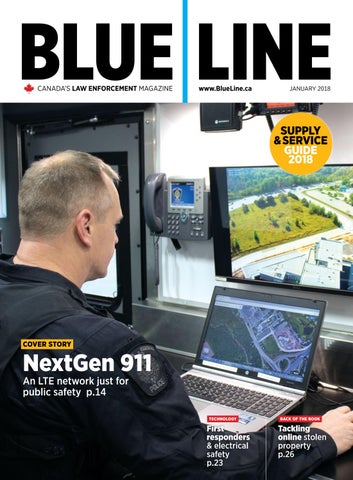
COVER STORY
NextGen 911 PM 40065710
An LTE network just for public safety p.14
TECHNOLOGY
BACK OF THE BOOK
First responders & electrical safety p.23
Tackling online stolen property p.26
2017 winner: Const. Cinda Michael
Leadership is an Activity not a Position... The Annual Blue Line Police Leadership Award recognizes and encourages a standard of excellence and pride in service to the public. The award is open to active Canadian police officers below the rank of senior officer. The winner will be profiled in the May 2018 edition of Blue Line Magazine and honoured at Blue Line Expo.
DEADLINE: February 16, 2018
NOMINATE someone deserving of this prestigious
PRESENTED BY
recognition at blueline.ca/leadership
Contents
20 January 2018
Columns
Volume 30 Number 1
4 8 10 12 13 22 23 26
Features COVER STORY
14 Prepping for the NextGen 911 wave
Next Generation 911 — which will include texting in emergency calls as a service — is on the horizon. A dedicated public safety wireless network can help police prepare. By Renée Francoeur
17 Annual Supply & Service Guide
Blue Line’s Supply & Service Guide is Canada’s most-read Buyers Guide, serving the national law enforcement community. Use this year-round information tool for sourcing cutting-edge products and finding new vendors and suppliers.
Editor’s commentary Q&A Deep blue Health & wellness Holding the line Case law Technology Back of the book
Departments 5 5 7 7 24 25 26
By the numbers News Dispatches Calendar Product showcase Marketplace Blue Links
20 Seven layers of police grief
COVER PHOTO: HALTON REGIONAL POLICE SERVICE
When an officer has been killed in the line of duty, the grief experienced by that police service is very unique. It’s up to the police members to cultivate more understanding for friends and family. By Troy Kneebone
8 @Blue_LineMag
5
23 January 2018 | BLUE LINE
3
EDITOR’S COMMENTARY BY RENÉE FRANCOEUR
BLUE LINE www.BlueLine.ca
A roadmap to innovation
A
few months ago Blue Line tion of “first movers and innovators,” inco-hosted a private roundtable cluding York Regional Police for its anaon protecting smart cities, lytics project, the government of sponsored by BlackBerry and Saskatchewan for its humans services hosted at Deloitte’s downtown Toronto transformation and Halton Regional Pooffice. The day saw a number of chiefs, lice Service for its dedicated public safety deputy chiefs and IT (information tech- broadband, among others. (For more on nology) policing personnel assemble to the Halton project and how NextGen 911 discuss — in an open dialogue — innova- is driving the change, see our cover story tion and technology in public safety. on page 14). “We can’t have smart cities Cybercrime concerns aside, without having safe cities and safe “Are we too the roundtable attendees still cities need to be secured ones,” risk expressed an interest in the said Alan Treddenick, the director adverse?” “need and viability of pooling of government relations for Black- asked one police resources to create a Berry’s National Security & Law roundtable collective private Cloud.” It’s Enforcement Liaison, at the Pro- participant. something I think we can all “Do we say tecting Smart Cities event. agree on that would help effiIt’s no surprise security was ‘no’ too ciencies in response and reporttop of mind — especially in a often as ing time. And, as Halton Deputy cyber sense, given the Prince Al- opposed to Chief Nishan Duraiappah menbert Police Service in Saskatch- ‘how’?” tions in our cover story, there is ewan had just launched a new a larger national trend of moving website at the time, after its homepage was towards multi-sector, collaborative inhacked (no information or privacy breach itiatives growing, and it’s being viewed as occurred, the service stated to media). the next evolution of applying communFor many services, this type of news has ity safety. been enough to freeze any IT strategy Creating a “roadmap for innovation” was action involving Cloud-based solutions also a desire communicated during the and data storage. roundtable discussion. There is so much “Are we too risk adverse?” asked one going on as law enforcement transforms roundtable participant. “Do we say ‘no’ and modernizes — everyone seems to be too often, as opposed to ‘how?’” trying something different — that it can be Waze, the free mobile traffic navigation overwhelming to know where to start for app, was brought up as an example of a implementing a sustainable strategy. handy tool for real-time reporting of acciWhile the talk of mobile forces and dents and emergency vehicle presence. It traffic sensing streetlights was riveting, uses Spinnaker (“an open source, multi- there was one comment in particular that cloud continuous delivery platform for remained with me long afterwards: releasing software changes”) for simultanAt the end of the day, we have to “reeous deployments to multiple Clouds. member policing is about human interWith Waze, the question becomes: How action.” could frontline officers utilize something Sure, autonomous intersection managelike this safely and securely, in conjunction ment is cool, but indeed, we have to be with fire and EMS? careful not to lose sight of our industry’s I think we’re starting to hear more heart: it is a human transaction and that is “how’s,” as the roundtable saluted a selec- a strength in itself.
CONNECT WITH BLUE LINE
www.BlueLine.ca 4
@Blue_LineMag
BLUE LINE | January 2018
www.facebook.com/BlueLineMagazine
GROUP PUBLISHER | PAUL GROSSINGER pgrossinger@annexbusinessmedia.com EDITOR | RENÉE FRANCOEUR rfrancoeur@annexbusinessmedia.com ACCOUNT MANAGER | JANICE EATON janice@blueline.ca ART DIRECTOR | SVETLANA AVRUTIN savrutin@annexbusinessmedia.com ACCOUNT COORDINATOR | TRISH RAMSAY tramsay@annexbusinessmedia.com CIRCULATION MANAGER | BEATA OLECHNOWICZ bolechnowicz@annexbusinessmedia.com COO | TED MARKLE tmarkle@annexbusinessmedia.com PRESIDENT & CEO | MIKE FREDERICKS ANNEX BUSINESS MEDIA 111 Gordon Baker Road, Suite 400 Toronto, ON M2H 3R1 Tel. 416-442-5600 • Fax 416-442-2191
Publication Mail Agreement No. 40065710 ISSN 0847-8538 Printed in Canada SUBSCRIPTION RATES Canada — 1 Year $31.00; 2 Year $51.50 plus tax USA — 1 Year $103.00 USD CIRCULATION email: asingh@annexbusinessmedia.com Tel: 416-442-5600 ext 3553; Fax: 416-510-6875 Mail: 111 Gordon Baker Road, Suite 400, Toronto, ON M2H 3R1 Occasionally, Blue Line will mail information on behalf of industry-related groups whose products and services we believe may be of interest to you. If you prefer not to receive this information, please contact our circulation department in any of the four ways listed above. Annex Privacy Officer privacy@annexbizmedia.com; Tel: 800-668-2374 © 2018 Annex Publishing & Printing Inc. All rights reserved. Printed in Canada. No part of the editorial content of this publication may be reprinted without the publisher’s written permission. Opinions expressed in this magazine are not necessarily those of the editor or the publisher. No liability is assumed for errors or omissions. Readers are cautioned and advised that articles presented herein are edited and supplied for your personal awareness and should not be used for further action until appropriate guidance is received from a supervisor, Crown Attorney or other persons in authority. All advertising is subject to the publisher’s approval. Such approval does not imply any endorsement of the products or services advertised. The publisher reserves the right to refuse advertising that does not meet the standards of this publication.
NEWS • Const. Daniel Noordman, WPS; • Sgt. Edward Riglin, RCMP; and • Sgt. Wesley Rommel, WPS. More than 130 police officers have received this award to recognize their contributions to their communities, police service or the betterment of law enforcement in Manitoba. PHOTO COURTESY CP
OTTAWA
CANADA
WINNIPEG
CP and Canadian Pacific Police Association reach agreement
Manitoba recognizes officers with Excellence in Law Enforcement Awards
Canadian Pacific (CP) and the Canadian Pacific Police Association (CPPA) have announced a tentative, forward-looking five-year agreement. “CP is proud to announce another long-term agreement with a valued union partner,” said Keith Creel, CP president and CEO. “I give credit to the negotiation teams on both sides for demonstrating outstanding leadership and a commitment to collaboration in coming to this progressive, long-term agreement well in advance of the upcoming deadline.” The CPPA negotiating team says it worked diligently in the best interest of its members, while at the same time recognizing the overall benefits for both sides. “The end result being a tentative memorandum of settlement being reached in a very professional and respectful manner,” said Stephen Ross, CPPA president. ”CPPA members take very seriously their commitment to keeping company employees, assets and the general public safe in relation to CP railway property and activities.” The CPPA represents approximately 80 Canadian police officers employed by CP. Highlights of the five-year deal include a wage increase, added compassionate leave, expanded training opportunities and an enhanced relocation expense allowance.
The Manitoba government is recognizing 16 police officers for “outstanding contributions to their communities and police services” through the Excellence in Law Enforcement Awards. “They have all demonstrated excellence that goes above and beyond what’s expected in the line of duty, and have made a difference in the lives of countless Manitobans,” said Justice Minister Heather Stefanson. This year’s recipients are: • Const. Michael Baranyk, Brandon Police Service; • Sgt. Guylaine Berube, Royal Canadian Mounted Police (RCMP); • Cpl. Timothy Clarke, RCMP; • Const. Ryan Corrin, Winnipeg Police Service (WPS); • Cpl. Greg Fast, RCMP; • Const. Luanne Gibb, RCMP; • Const. Jonathan Goertzen, Morden Police Service; • Cpl. James Helyer, RCMP; • Const. Darren Kerchak, RCMP; • Const. Saif Islam Khan, WPS; • Const. Arnold Klassen, Winkler Police Service; • Sgt. Kent MacInnis, RCMP; • Sgt. Steve McArthur, Dakota Ojibway Police Service;
CCSA launches dedicated call centre in Ontario
Canadian Crime Stoppers programs have launched a new venture in Ontario, with plans to expand across the country. The National Anonymous Call Centre opened for business Nov. 1, 2017, and marks the first time a dedicated, anonymous call centre has offered 24-hour, year-round service to Crime Stoppers organizations. The exact location of the centre will not be released for safety reasons, stated the Canadian Crime Stoppers Association (CCSA). NACC now offers anonymous call answering service outside regular business hours or when co-ordinators are unable to be in their offices. All of the tip info is forwarded to the appropriate program for processing and to police services for investigation when warranted. Individual programs still have the option of working with the call-taking service of their choice but Forster said he is optimistic that the exclusivity of the NACC and the reasonable rates offered, thanks to its non-profit status, will make it an attractive option for programs across Canada.
BY THE NUMBERS
New data released by Statistics Canada in November 2017 on police-reported hate crimes reveals a 3 per cent increase in 2016 compared to 2015, a result of “more incidents targeting South Asians and Arabs or West Asians, the Jewish population, and people based on their sexual orientation,” the agency stated. In contrast, hate crimes against Muslims and Catholics declined in 2016.
1,409 48% 13% 43% criminal incidents in Canada motivated by hate in 2016, 47 more than in 2015.
@Blue_LineMag
of all police-reported hate crimes in 2016 were motivated by hatred of a race or ethnicity.
of all police-reported hate crimes targeted sexual orientation, rising from 141 incidents in 2015 to 176.
of hate crimes were violent, compared with 38% in 2015.
January 2018 | BLUE LINE
5
NEWS TORONTO
OHRC launches inquiry into racial profiling by Toronto Police
The Ontario Human Rights Commission (OHRC) announced it has launched a public interest inquiry into racial profiling and racial discrimination by the Toronto Police Service (TPS). Using its legislated inquiry powers under section 31 of Ontario’s Human Rights Code, the OHRC says it has called for the TPS, the Toronto Police Services Board (TPSB) and the Special Investigations Unit to provide a wide range of data to determine exactly how and where racial profiling operates in law enforcement. “Mistrust in police is not a new phenomenon but it is a growing one,” said Renu Mandhane, OHRC’s chief commissioner, noting the community has waited more than 40 years to see progress in the elimination of racial profiling and it “can’t afford to wait any longer.” The OHRC is inquiring into the practices and activities of the TPS between Jan. 1, 2010, and June 30, 2017, to assess whether they are consistent with racial profiling and racial discrimination against the Black community. The commission says it will also examine the TPS and TPSB’s culture, training, policies, procedures and accountability mechanisms relating to racial profiling and racial discrimination. Charlene Tardiel, the community services executive officer with the Association of Black Law Enforcers (A.B.L.E.) attended the launch and said the organization supports the inquiry. When questioned about why TPS was being singled out for this inquiry, Mandhane said the commission has a long history with the service and “well documented evidence of 40 years of community concerns and serious incidents.” Secondly, she said TPS, as the largest service in the country, would serve as a “real foundation from which to move forward” if solutions can be posed from this endeavour and data collection. “We feel this service has the resources to provide us with the data,” she added. ONTARIO
New funding aims to improve reporting of sexual assaults
New funding for a project that will improve the tracking and reporting of sexual assaults by law enforcement authorities in Ontario communities was announced recently as part 6
BLUE LINE | January 2018
Charlene Tardiel, the community services executive officer with the Association of Black Law Enforcers, says the organization supports the OHRC inquiry into profiling. PHOTO: OHRC of the 16 Days of Activism Against GenderBased Violence. Under this project, the Ottawa Coalition To End Violence Against Women (OCTEVAW) will work with police services, women’s sexual assault centres and shelter networks to pilot the Philadelphia Model at five sites. The Philadelphia Model is a collaborative process that allows outside experts to review police case files to help identify any missteps in the investigative process and alert investigators to worrying trends. It was first used in the U.S. in 2000 after an investigation by The Philadelphia Inquirer revealed police in that city were dismissing a disproportionately high number of sexual assault complaints as unfounded. According to the Americans, this approach has resulted in an overall decrease in the number of misclassified sexual assault cases. “With this new funding, we can position frontline expertise at the forefront and start the process of building a more responsive justice system,” said Sunny Marriner, executive director, Ottawa Rape Crisis Centre. “Public trust is paramount and this model has illustrated an ability to foster collaboration and enhance policing.” In 2017, an investigation by the Globe and Mail examined why police dismiss one out of every five sexual-assaults claims as unfounded. Data was gathered from more than 870 police forces. MARKHAM
Red Friday program expands to include first responders
The Red Friday program (Remember Everyone Deployed) was re-launched in Markham, Ont., in November 2017, as a national program that now includes first responders. York Regional Police officers were on hand to usher in the refreshed program, which was originally started in 2006 by Karen Kelly
and Lisa Miller, two Canadian Armed Forces spouses. They wanted to “give Canadians the opportunity to show their gratitude to our past and present heroes by wearing red on Fridays” and 20,000 people were on Parliament Hill in red at the program’s peak.
York Regional Police officers were on hand to usher in the refreshed Red Friday program in Markham with Bob McTaggart, centre. PHOTO: R. FRANCOEUR The 4th Canadian Mounted Rifles Association is working with the City of Markham for this latest reiteration and states it “is proud to now have these two talented women working side by side with us to reinvigorate and take Red Fridays across the country.” Red Friday 1918-2018 honours police, firefighters, ambulance personnel and paramedics as well as veterans, reservists and active service women and men. “Why are we doing this?” said Bob McTaggart, chairperson, founder of the 4th Canadian Mounted Rifles Association and veteran. “Because someone had to.” Watch our video from the Red Friday launch at goo.gl/i1VrZY.
Are you receiving
News Week? Subscribe today! www.blueline.ca www.BlueLine.ca
NEWS DISPATCHES
CALENDAR
Michael Bellai has been appointed as the Chief of the Saugeen Shores Police Service. Chief Bellai has 29.5 years of policing experience with Peel Regional and Stratford Police Services. He retired as Chief of Police in Stratford to take on the position in Saugeen Shores. He graduated from the University of Guelph and Conestoga College and has a Certificate in Police Administration from Dalhousie University. Bellai is also a proud graduate of the FBI National Academy.
Acting Chief R.H. (Rick) Head has officially become the seventh chief of Dakota Ojibway Police Service in Manitoba. He served in various roles with the RCMP for 25 years. To read Blue Line’s recent Q&A with Chief Head, visit goo.gl/k97twV.
Saugeen Shores Police Chief Dan Rivett retired on November 30, 2017, after serving in the position for 11 years. Rivett started his career in policing in 1982 with the Guelph Police Service. In 1997 he was hired by the Southampton Port Elgin Police Service and moved up through the ranks. During his time with SSPS he was a member of the board of directors of the Ontario Association of Chiefs of Police and was actively involved in the community.
Staff Sgt. Sony Dosanjh has been promoted to inspector at York Regional Police. He is the officer in charge for Community Services - Diversity, Equity & Inclusion Bureau, and the Community Safety Village.
Barrie Police recently promoted Staff Sgt. R. Wyllie Allan to inspector and Sgt. Rose Richter (photo) to staff sergeant
Const. Art Wlodyka of the New Westminster Police Department in B.C. has been recognized as one of the 150 Leading Canadians For Mental Health Police from the Centre for Addiction and Mental Health. In 2013, Wlodyka became the founding officer of his department’s mental health unit and in 2016, he graduated from the University of British Columbia’s Masters in Counselling Psychology. He offers post-incident stress counselling to his colleagues and his unit has built close relationships with local community and hospital mental health professionals. RCMP Assistant Commissioner Joe Oliver was elected as vice-chair of the International Association of Chiefs of Police global policing division steering committee during IACP 2017 in Philadelphia, Penn. @Blue_LineMag
Nathalie Castets has been selected at the new Medicine Hat Police Service Victim Assistance co-ordinator. She has been with the Victim Assistance unit since 2015.
The co-ordinator of Windsor Police’s Victim Assistance Unit, Patti Kelly, is retiring after 38 years with the service.
Supt. Lauri Morin is retiring from Regina Police Service after 32 years.
After 35 years of OPP service, Provincial Const. Paul Maudsley has retired from the Port Credit detachment.
Insp. Carol Powell has retired after more than 33 years of policing with Abbotsford Police Department in British Columbia.
Paul Woodruff has been named Deputy Chief of the Royal Newfoundland Constabulary. The former inspector, born in Twillingate, has been with the RNC since 1986.
PROMOTIONS, RETIREMENTS, RECOGNITION • If you have a senior officer in your agency recently promoted or retiring or an individual you wish to have recognized (major award or recently deceased) you can let Blue Line magazine know by email to: dispatches@blueline.ca.
3rd Annual Mission 500 Hockey Classic Feb. 15, 2018 Toronto, Ont. sptnews.ca/hockeyclassic CACP Information, Communication & Technology Committee Workshop Feb. 25-28, 2018 Vancouver, B.C. www.cpa-acp.ca Calgary Police Cyber Summit March 5-7, 2018 Calgary, Alta. www.cybersummityyc.ca International Human Trafficking Conference March 19-21, 2018 Toronto, Ont. tps-human-trafficking-conference-2018. eventbrite.ca ILEETA 2018 March 19-24, 2018 St. Louis, Mo. www.ileeta.org/ileeta-conference-expo Hardeep Kang Memorial Hockey Tournament Apr. 19-20, 2018 Brampton, Ont. www.hkmemorial.com Blue Line Expo May 3, 2018 Mississauga, Ont. www.bluelineexpo.ca International Police Association Canada AGM May 24-29, 2018 Vancouver, B.C. www.ipacanada.ca National Crime Stoppers Conference May 31, 2018 Hamilton, Ont. www.canadiancrimestoppers.org OACP Annual Meeting June 10-13, 2018 Huntsville, Ont. www.oacpconference.on.ca
January 2018 | BLUE LINE
7
Q&A On April 19, 2016, an Ottawa police officer was injured during an altercation on the job. Exactly one year later, Const. Michael McNaught found himself on CBC’s Dragons’ Den. Today, he’s back with Ottawa Police Service — while still managing his marketplace business, RVezy. He shares how entrepreneurship helped in his recovery and complements his policing, too. Q: Why did you choose a career in law enforcement?
with people who are looking to rent one for less — like “Airbnb on wheels.”]
I was always involved in service. I’ve been with Scouts Canada my whole life... When I was at an RCMP seminar with my brother, I had my “Aha” moment. I knew I’d found a career where I wouldn’t be at a desk all the time, everyday would be different and I would be serving and interacting with the public.
Q: Why did you want to do Dragons’ Den?
You’re tapping into a resource of highly successful Canadian entrepreneurs. The publicity is great as well. We attended an open casting call and part of our pitch centred on how you’re not just investing in our company but also in the people behind it. So we explained how the business got started, touched on my police officer background — my partner is an Afghanistan veteran. We received a phone call within two weeks, saying we’d inspired them to do a “Heroes” episode.
I was on patrol for four years at Ottawa Police Service and was part of our neighbourhood unit before moving into ICE (Internet Child Exploitation). I went back to patrol and I lasted about two weeks before my injury happened. I had just started my shift and there was a sexual assault call nearby. I talked to the complainant and sure enough there were grounds to arrest. The suspect was still there and after a couple efforts to talk to him, I could tell he was not interested in talking to me. It’s exactly like they teach you in police college — the moment I touched him and said, “You’re under arrest,” that’s when it started. He jumped out of his seat and the fight was on. My bicep snapped and recoiled into the shoulder. I didn’t know what had happened. It wasn’t painful — the adrenaline was pumping — but I knew something wasn’t right.
Q: How did you handle this disruption?
Prior to this, I was a busy guy. I have a beautiful wife, three kids and three rental properties. I was still running a different small business 8
BLUE LINE | January 2018
at the time, taking three full-time classes at university and competing in body building contests. You go from being really high functioning to doing absolutely nothing — that was the toughest part. Now, I was relying on everyone — I couldn’t even do up my zipper. I reached out and used professional services available to me and I’m glad I did.
Q: How did you start your own peer-sharing marketplace, RVezy, during this time?
I met up with some of my business contacts and friends and told them about an idea I had... I’d always been renting my RV and I thought there was something bigger there. That night out with friends turned into a three-hour bar conversation and led to RVezy, which kept me busy and focused. [RVezy is Canada’s first RV sharing marketplace, connecting RV owners
SNAPSHOT OF RVEZY
2016
McNaught is injured on the job in April and incorporates Rvezy in June
10%
stake in the company and $150k: what McNaught asked for on Dragons’ Den
17.5%
stake and $150k: final deal with Michele Romanow
Q: What was that experience like?
The most challenging part was the unknowns. You don’t know what to expect when you first walk in. We did a lot of preparation and our CFO made sure we had the proper numbers.
Q: What has the feedback been like from your colleagues in policing?
All of my colleagues are very supportive of this endeavour. I’ve also had colleagues reaching out to ask about the background story with my injury and recovery. People also ask about juggling everything, as I am still very committed to my job as a police officer.
Q: How has RVezy changed you as a police officer?
Many of the skillsets from policing and from the business aspect are transferrable. Much of what I’m www.BlueLine.ca
PHOTO: MICHAEL MCNAUGHT
Q: What happened that led to your injury on the job?
learning from the business side — managing a team, developing relationships and partnerships — that’s what you do at a police service. I’m understanding more of the business side of policing: the use of analytics, how the police service actually functions. On the same note, policing also helps the business side. For example, with the report writing you have to do as a business owner, I laugh and kind of feel like I’m writing police reports. My story with RVezy has also opened up the conversation about overcoming the disruption that happens when you’re sidelined from an injury on the job. I think it’s an important conversation we’re not having very often.
I was in the Dragons’ Den exactly one year ago to the day I was at the hospital, preparing for surgery — you can accomplish a lot in one year. I’ve learned it’s important to be honest and talk about what you’re going through. When you’re part of the ICE unit, it’s mandated to meet with a psychologist so I had reached out to chat with him about what had been going on after the injury. He said, “We’re not even going to mention the word PTSD. That’s not what this is. This is what happens when your life is flipped upside down. You need to find something to keep yourself busy. You need to relax. This is about adjusting.”
Q: What were some takeaways from the combined experience of recovering while founding RVezy?
Q: What is your advice for other officers struggling after an injury?
@Blue_LineMag
BlueLine_Jan_Whelen.indd 1
Talk to people and share the ex-
periences. There may be a lot of emotions and reactions you’ve never experienced before. It’s important to reach out and understand where those are coming from and seek professional advice on how to work through that. The second thing would be to surround yourself with supportive people. Build networks, because huddled up in your house and eating potato chips only works for so long. Get out of the house, even if it’s just for an hour.
Q: What are your next steps? Do you plan to continue policing?
I really see myself as a police officer. That’s my career. I also plan to pursue my MBA and what I want to do is bring a lot of the skillsets I’ve learned in the business community back to the policing community.
Watch McNaught and his partner Will Thompson pitch their business to the Dragons at cbc.ca/ dragonsden/ pitches/rvezy. The episode was filmed on April 19, 2017, and aired on Nov. 9.
January 2018 | BLUE LINE
9
2017-10-26 3:29 PM
DEEP BLUE
BY DOROTHY COTTON
Hand in hand: organizational and personal resilience
I
was talking to some HR people the other day who were musing about the increased focus on employee well-being in recent years. Some reflected with a chuckle about the “good old days” when they thought everything would be peachy once they offered something like R2MR (Road to Mental Readiness) training to the masses. If only it were that simple! It is easy to get caught up in R2MR, PTSD legislation and EAP (employee assistance program) resources and accommodation — all very important things. But it is also easy to lose sight of prevention — and early development of resiliency. You can indeed teach a lot about stress and resilience to individual employees, but for all those strategies to work it helps to take a look at the organization itself. The whole idea of resilience in people exposed to significant stressful events has garnered a lot of attention of late — and, as is often the case when something gets attention, the concept has morphed over time. It used to be that we thought about personal resilience simply as the ability to tolerate/cope/bounce back after bad things happen. More current theories talk a lot about resilience as not just bouncing back to where you were before the bad things happened, but to actually ending up a better/stronger/more resilient person after the event. Programs meant to improve resilience among individual people tend to be focused on... duh... individual people. We teach people to identify symptoms, self assess their level of distress, identify supports, develop coping mechanisms, distinguish between healthy and unhealthy coping, and to know when to get help. This is all good stuff. There is also, however, a literature on organizational resilience. How well does an organization cope 10
BLUE LINE | January 2018
when bad things happen? When budgets go south, when a very bad, high profile event occurs, when there is a need for major organization change... how resilient is the organization? I suppose it should not be a surprise to anyone that these two types of resilience are not independent of each other. One person who has done a whole bunch of work about resilience is Joana Kuntz, along with her colleagues at the University of Canterbury in the U.K. She provides the following definition of employee resilience: “Employee resilience is defined… as the behavioural capability to leverage work resources in order to ensure continual adaptation, well-being, and growth at work, supported by the organization.” 1 What is interesting about this definition is that while it is talking about individual people, it refers to work resources and support from the organization. In other words:
Sometimes I think our efforts in relation to well-being in the workplace amount to little more than a shift from “Suck it up, Buttercup,” to “Please allow me to instruct you on how better to suck it up, Buttercup.”
while it is all well and good if the individual person has adequate personal coping skills and self-awareness (the things we usually associate with personal resilience), it is also important that the person can leverage resources from within the organization — and that the organization in fact actually provides those resources. I rather like this point of view because I have to confess that sometimes I think our efforts in relation to workplace well-being amount to little more than a shift from “Suck it up, Buttercup,” to “Please allow me to instruct you on how better to suck it up, Buttercup.” There is definitely a significant advantage in having employees better able to suck it up and cope with whatever needs... er... tolerating. But I think the idea of “it is to the advantage of both the organization and the individual employees to develop a workplace that provides the support and resources for developing resilience” has a lot of merit. What might these nebulous resources be? We are not talking about EAPs and peer support here. We are talking about systems and processes within the essential being of the organization, which facilitate employees becoming resilient before bad things happen. This is where it gets boring. Kuntz and her colleagues have identified a number of factors that foster both individual and organizational resilience. I will be very surprised if you are surprised by any of them. They include (but are not limited to): • Leadership and organizational culture issues: Do leaders encourage people to develop and flourish at work? Are processes seen as fair? Do they encourage creative problem solving? • Valuing employees and their contributions: Do we reward employees who have done a good job? Do we actually care about civility in the workplace? Do we acknowledge that employees actually just might have a life outside of work? www.BlueLine.ca
• Promoting high involvement practices: Do employees have an appropriate level of autonomy? • Modelling proactive behaviours. • Facilitating continuous learning. • Ensuring goal clarity and alignment: Is it clear where the organization is going — and do the activities actually seem to be consistent with the espoused goals? Not rocket science, eh? You can find examples of exactly what kinds of practices are included in each of these categories but in the end they suggest it all boils down to four main principles: The Adaption Principle: fostering not only behaviours in employees that help them adapt to organizational change but also fostering change in the organization in response to employee needs and ideas.
At Humber, we teach the professional and practical skills you need to move up and make a difference in your community and in your career. Further your education one course at a time or work towards a certificate, diploma or degree. Advanced standing is available to those in the Justice Services industry. Programs of interest: • Criminal Intelligence Analysis Certificate • Cyber Crime Specialist Certificate • Guelph-Humber Justice & Public Safety Degree Completion
The Cycling of Resources Principle: resources — including people — are developed, utilized and transformed as needed; consistent with the organizational goals. The Interdependence Principle:BlueLine_Dec_Humber.indd an 1 acknowledgement that the relationship between people and their environment is fluid — that all these principles interact and that organizational resilience and personal resilience are not independent of each other. The Succession Principle: individual roles, trajectories and needs will inevitably change and vary as organizations are in a state of flux (which is pretty well all the time!) but in order for people to succeed and move forward — which means the organization succeeds and moves forward — they have to be resilient. Kind of circular? You bet. 1. Joana R. C. Kuntz, Sanna Malinen, and Katharina Näswall, (2017) Employee Resilience: Directions for Resilience Development. Consulting Psychology Journal: Practice and Research 2017, Vol. 69, No. 3, 223–242.
Dr. Dorothy Cotton is Blue Line’s psychology columnist. She can be contacted at: deepblue@blueline.ca.
@Blue_LineMag
• Criminal Justice Degree • Private Investigation Certificate • Police Foundations Online Diploma • Police Foundations Leadership Diploma
communityservices.humber.ca /justiceprofessionals
2017-11-10 3:39 PM
HEALTH & WELLNESS BY ISABELLE SAUVE
A synergistic effect: building mental toughness through “good pain”
M
ental toughness can mean the difference between life and death in the realm of law enforcement. Those who reject the notion of “giving up” are more likely to survive a life threatening situation and better handle precarious situations. The topic of a “tough brain” is somewhat ambiguous. There is no single definition for mental toughness but it is explainable as: “A measure of individual resilience and confidence that may predict success in sport, education, the workplace and in life.” It is also known as “grit” or fortitude but it’s important to know it goes beyond physical performance and pain tolerance. Can mental toughness be improved? Is it inherently acquired or can it be developed and strengthened? Studies have shown that achievement in life is highly related to mental toughness, perseverance, passion and the willingness to go all in — even at the risk of failing. The same studies clearly show mental toughness can be strengthened with hard work (i.e. determination and commitment to seeing things through). To train the mind one must first learn to control it. Practicing mindfulness and using techniques such as visualization, imagery, meditation and breath work can assist with this. Being challenged through direct exposure to demanding situations can also strengthen your ability to control your mind. The mind and body have a synergistic effect on one another. Endurance sport athletes quickly learn that success is dependent on both mental and physical training. A key factor in successfully strengthening the mind is the ability to embrace mental, emotional and physical discomfort. Finding a degree of comfort in being “uncom12
BLUE LINE | January 2018
fortable,” knowing it will build strength, is counterintuitive but extremely effective. Stepping out of one’s comfort zone stimulates growth and mental toughness is often garnered through pushing beyond boundaries and challenging oneself. One of the critical learning points for anyone undertaking physical training is the difference between “bad pain” and “good pain.” Bad pain arises out of a legitimate injury and requires the physical activity, which is further aggravating the injury, be stopped. Good pain is a natural injury-free response from our bodies when we challenge ourselves. Physical effort in this discomfort zone can be sustained with mental toughness. Embracing a positive relationship with good pain permits one to push the body beyond perceived limits. When it comes to training for a physical endeavour, unless there is an injury or illness at play, the easy way out should not be an option. Cutting training sessions short out of mere boredom or lack of motivation is counterproductive. As the difficulty rises, do not allow yourself to quit — even when your brain is screaming at you to give up. Use positive self-talk and do not let negative messages like “I’m so tired” or “my legs are sore” creep in. For every negative thought that pops up, rehearse a positive
Most things that are difficult to achieve require dedication and sacrifice. Create a psychological advantage through training.
one for a few seconds. Remind yourself of the reasons you took on the challenge and of the reasons you will be proud when you complete it. The Navy Seals operate with the notion that when we think we can’t keep going anymore we are only at 20 per cent of our full potential. When you attempt something, whether in training or at home, give a true 100 per cent effort. Be willing to do what others are not willing to do. Most things that are difficult to achieve require dedication and sacrifice. Create a psychological advantage through training. Sacrificing to gain is not easy. It is about having the patience and will to delay gratification in order to ensure a better end result. Prior to undertaking a monumental challenge, it is vital to set out the reasons why success is important. Knowing one’s emotional drivers, triggers and what makes one “tick” promotes resilience under challenging situations. Expanding mental, emotional and physical energy wisely is also critical. Negative thoughts deplete us of precious time and energy. When faced with a significant challenge, breaking it into more manageable pieces can also be helpful. For instance, completing a marathon (42.2 km) may seem impossible, but undertaking 5 km at a time will eventually lead to that full distance. Acknowledging one’s successes, even small ones, is important as it strengthens confidence and is positive reinforcement. Success in one area spills into other areas of one’s life and in order to succeed, we must first believe that we can. Isabelle Sauve is a 10-year OPP veteran currently with the Emergency Response Team (ERT) at the Almaguin Highlands Detachment in Burks Falls, about 300 km north of Toronto. She can be contacted at: isabelle.sauve@hotmail.com.
www.BlueLine.ca
HOLDING THE LINE BY MICHELLE VINCENT
Re-integration after a critical incident or long-term leave
O
ur firearms as police officers are significant pieces of our culture and what we do. It is hard at times not to allow it to define us, especially when it is unexpectedly removed after an incident involving a shooting for example. What is the message we receive when, after having discharged our firearm in an incident, we are ushered into a room, secluded and stripped of our firearm? There is good reason for this of course, as the firearm that was used may need to be tested and forensically investigated, but the experience and chronology of its removal can be very challenging. I had the opportunity to attend Edmonton Police Service’s (EPS) “Workplace Re-integration After a Critical Incident” course back in November. EPS has a phenomenal program that strives to keep their police officers safe from operational stress injury by minimizing the mental health impact of a firearm removal. This mandatory program is geared towards re-integrating the member into their unit — with their new firearm — after a critical incident. Such incidents can be the cause of post-traumatic stress injury and operational stress injury (these terms are often used interchangeably) as well as other mental health issues, like anxiety. All mental health issues have the potential to leave a significant impact on workplace confidence and attendance. The EPS program involves members from the training unit with specific critical incident stress management skillsets. These gifted men and women are handpicked to deliver a very powerful, highly sensitive program that explores the potential residual effects of a critical incident through a step-by-step program involving therapy and basic firearms training. This program has been highly successful in preventing serious @Blue_LineMag
mental health issues as well as building the confidence of the affected member in the use of their firearm through a customized program that is delivered at the member’s personal pace. Losing one’s firearm doesn’t just happen in regards to critical incidents. Leaves, such as maternity/ parental leave, or an injury — whether it is physical or mental — may require a member to give up their firearm for a period of time. Similarly, this can cause a member to be anxious or even avoidant of returning to work. This is another instance where EPS shines, as it strives to support members who may have otherwise been anxious and even lost in the return-to-work process. What impacted me the most about this outstanding program is the way the various teams come together for a common goal: seeing the affected member return to work in a mentally healthy, meaningful way. It’s all about a smooth transition. EPS says its program has almost eliminated reports of PTSD as a result of workplace injury. It’s also seen the return of some members who have been off on long-term disability. In Alberta, the health care provider Morneau, Workers Compensation Board, policing organization and the members all work together to see the member return to work in the fullest capacity possible after a critical inci-
BlueLine_Jan_Wolverine.indd 1
EPS says its program has almost eliminated reports of PTSD as a result of workplace injury. It’s also seen the return of some members who have been off on long-term disability.
dent or long-term leave. There are no egos involved; just the best supports, treatment and effective workplace re-integration. That being said, it is not perfect and there are disagreements, however they have come a long way in how they address mental health in the workplace. This is the second time I have attended this course and once again the EPS officers who supported our learning inspired us to bring this powerful, lifesaving program back to our own services. We had several members of varying rank from organizations across the country attend and I can say I’m pretty sure we all left with an energized drive to do more. If you have a passion for mental health and training branch/CISM (Critical Incident Stress Management) experience, I highly recommend this program. It will change how you do business and empower your members with confidence through a strong message that your organization cares. Michelle Vincent is a 16-year York Regional police officer with a Masters Degree in Arts in Counselling Psychology and a background in equine assisted therapy, workplace reintegration and teaching. She has a practice supervised by a psychologist and is working towards her PhD in Forensic Psychology. She can be contacted at: michelle@smith.net.
January 2018 | BLUE LINE
13
2017-12-14 10:07 AM
COVER STORY
Prepping for the NextGen 911 wave A dedicated public safety wireless network is key to data-rich policing By Renée Francoeur
1 M st
public safety LTE wireless network for first responders only, commissioned by Halton Regional Police and Motorola
ission-critical voice communications is set to undergo an extensive makeover as Next Generation 911 prepares to take over in Canada. The sheer amount of multimedia data the IP (Internet Protocol) update will make available to police is detonative — it’s already making deep rumblings, as we’re seeing with police drones and body worn cams. “Look at what happened with smartphones and the explosion of data on the consumer side,” says George Krausz, Motorola Solutions Canada president. “We feel this is also a big wave that is now going to come to the public safety market-
place... NextGen 911 is a big driver.” Halton Regional Police Service in Ontario is making plans to surf this surge. The service has teamed up with Motorola to commission Canada’s first public safety LTE (Long-Term Evolution) wireless network, a network for first responders only. “The whole policing environment has changed. We cannot operate without data,” says Deputy Chief Nishan Duraiappah at Halton Regional Police Service. “I could easily go through a long list of applications on the frontline that we require data for... And so we see [the LTE network] as the next beneficial element to the model.”
Halton Regional Police IT manager Bill Payne, left, and Deputy Chief Nishan Duraiappah working in a cruiser’s mobile workstation. 14
BLUE LINE | January 2018
Moving to a multimedia environment
Currently, officers relay data through commercial networks designed for public use. As such, first responders are never guaranteed priority and access on these networks during crises. Thanks to this new undertaking, officers will be able to use the Motorola Solutions LTE network exclusively to instantly access data on their computers or mobile devices. This includes dispatch information, GPS data, pictures, videos and real-time analytics for day-to-day operations and during emergencies. “By supplementing their Motorola Solutions mission-critical LMR voice network with a dedicated public safety LTE broadband network, they will be able to use next generation applications to help improve safety,” Krausz explains. “Halton feels they can expand the effectiveness of their police officers by providing data to them in real-time.” A dedicated public safety LTE network means Halton will be ready for NextGen 911. As of now, emergency calls come in via a voice call and are then dispatched by voice out to a police officer. www.BlueLine.ca
WHAT IS NEXTGEN 911 AND WHERE IS IT AT NOW?
PHOTOS: HALTON REGIONAL POLICE SERVICE
Officers test out streaming data from a drone into one of the viewing stations within the mobile command vehicle. This is the type of data that can be securely communicated over the LTE in a crisis, Duraiappah says.
“As we move to NextGen 911, the theory is we move into a multimedia environment where calls from the public could be voice or text or video, or communicated by sending a picture. This can all be very valuable to the police,” Krausz says. NextGen 911 means the dispatch centre must have the ability to track and record all of that information in an accurate way — just like voice — and put it out to the field, he continues. “When they put that out to the field, that’s where the public safety LTE dedicated network is required. We feel this is a huge requirement in the policing world.” Being in control of their own system is encouraging for Halton. “Having our own LTE network will allow us to use as much data as we want and to push it out through all our public safety endpoints, whether that’s to the cars or mobile devices,” Duraiappah says. “Conceivably, anything that is received via NextGen 911 can then be pushed to our officers right on the frontline in a secure environment.” @Blue_LineMag
With mobile command units, drones, in-car cameras and license plate recognition vehicles all currently operating with video data, that security is crucial. The movement of data is one of the biggest questions facing police agencies in 2018, Duraiappah adds, and “we can rest assured there is a mechanism for us to manage and disseminate data from NextGen 911 on our own internal infrastructure.” The Halton LTE project kicked off fully at the onset of the New Year and will take roughly 11 months to implement, according to Krausz. The new network is complimentary to the current system, he adds, and will ride
2020 Year networks have to be updated for Next Generation 911 services
2018 Year trials start for NextGen 911
The Canadian Radio-television and Telecommunications Commission (CRTC) has mandated that all 911 service providers update their 911 networks, including equipment, systems, databases, etc., to align with the NENA i3 architecture specification for Next Generation 911 services — based on IP technology — by June 30, 2020, and NextGen 911 Text Messaging (based on real-time text) by Dec. 31, 2020. Telephone service providers and Public Safety Answering Points (PSAPs) will also need to make updates to their equipment and networks. NextGen 911 means access to “new, enhanced and innovative 911 services, which has the potential to improve emergency response and save lives,” said Patricia Valladao, CRTC manager of media relations, in an email to Blue Line. These enhancements include “the potential for Canadians to send photos of accident damage or a fleeing suspect, or send personal medical information, including accessibility needs, which could greatly aid emergency responders.” Timelines for these other services have not yet been established, Valladao said, noting there will be a communication plan to inform Canadians as new services become available. In the current 911 networks, voice traffic relies on analogue technology and is transmitted over voice trunks, while ancillary data (i.e. caller’s name, telephone number and estimated location) is IP-based and transmitted over IP data links. After 2023, all traffic transmitted over the NextGen 911 networks will be IP-based, according to Valladao, which will result in “greater efficiencies and enable the delivery of different information mediums.” As of the end of November 2017, Valladao said the CRTC has mandated that both Telus and Bell conduct NG911 trials as a first step. Additionally, the ESWG (Emergency Services Working Group) was in the process of discussing the technical design of the NextGen 911 networks and developing a trial plan that was to be presented to the commission by the end of 2017. According to Valladao, the trials will take place over several stages, starting in 2018.
“By supplementing their Motorola Solutions mission-critical LMR voice network with a dedicated public safety LTE broadband network, they will be able to use next generation applications to help improve safety.” - George Krausz, Motorola January 2018 | BLUE LINE
15
COVER STORY
Mobile command units monitor live video. Currently, this is done through a commerical network. PHOTO: HALTON REGIONAL POLICE SERVICE
on some existing infrastructure.
Critical stability
Post 9/11, North American governments recognized how critical voice communication infrastructure was to crisis management. The U.S. reallocated a portion of the broader radio spectrum band, which all commercial networks operate off of, for the purpose of public safety. Canada soon followed suit with its plans for a Public Safety Broadband Network (PSBN) — “secure, high-speed wireless data communications
networks for emergency responders and public safety personnel to communicate with each other.” In 2012, the Government of Canada allocated 10 MHz of the 700 MHz spectrum to the public safety community. It announced its intention to allocate an additional 10MHz of the spectrum in 2015 and in the spring of 2017, it committed $3 million to “engage diverse stakeholders and produce evidence-based analysis on implementation models for a potential PSBN” over the coming year. A section of the broadband is exclusively available for public safety, but no one is using it, says Duraiappah, apart from a few small experimental pilots, such as one with Calgary Police and another with Defence Research and Development Canada. “I think most organizations would agree that the use of the 700 MHz LTE public safety band is the right thing to do. The question is how do we do it?” he asks. “The biggest barrier is obviously the fiscal investment involved. You need a partner to come along to leverage the capacity to
build that infrastructure. Most police agencies don’t have the capacity to build their own LTE network.”
Not just for police
Halton isn’t planning on hoarding the network. It sees it as a way to facilitate more collaboration — even across municipalities. “We want it to be a municipal co-hosted model, which is perhaps counter culture to what the government or other commercial carriers were anticipating,” Duraiappah says. The base of the infrastructure will be physically housed at Halton Police, but other public safety agencies will be able to connect to it. It speaks to a larger national trend, he adds, of moving towards multi-sector, collaborative initiatives, viewed as the next evolution of applying community safety. “It’s really not a cost-savings initiative,” Duraiappah says. “It’s more about the right thing to do for public safety — providing stable, critical infrastructure in times of crisis is the key.”
YEARS
NÜRNBERG, GERMANY:
ONE LOCATION, TWO EXHIBITIONS BUY YOUR TICKET TODAY
#IWAshow
MARCH 9 – 12, 2018 IWA.INFO/READY
International Exhibition & Conference Law Enforcement, Security and Tactical Solutions
MARCH 7 – 8, 2018 Conference partner
16
Those under the age of 18 and private individuals will not be admitted. Identification required.
BLUE LINE | January 2018
We‘re happy to provide more information! Canada Unlimited Inc. T +1 (905) 813 1052 ncorrea@canada-unlimited.com
IWA_ET_18_177_8x127_CAN_Blue_Line_Magazine_KOMBI.indd 1 BlueLine_Jan_IWA.indd 1
ENFORCETAC.COM
www.BlueLine.ca
29.11.1710:04 13:01 2017-11-30 AM
SUPPLY & SERVICE GUIDE 2018 CORPORATE LISTINGS
5.11 Tactical 1360 Reynolds, Suite 101 Irvine, CA 92614 Tel: 416-432-8352 Toll Free: 888-451-1726 Email: kerins@511tactical.com Web: www.511tactical.com With offices around the globe, 5.11 works directly with end users to create purpose-built apparel and gear designed specifically to enhance the safety, accuracy, speed and performance of tactical professionals and enthusiasts worldwide. 5.11 products exceed rigorous standards, which have allowed the brand to establish a reputation for innovation and authenticity, and become the premier choice for those who must always be ready.
Armorer Link 4660 NE Belknap Crt., Suite 101 Hillsboro, OR 97124 Toll Free: 800-571-0753 Email: info@armorerlink.com Web: www.armorerlink.com Armorer Link is the leading firearm management software for law enforcement that provides firearm tracking, training and maintenance compliance. Unlike other solutions, Armorer Link is affordable, functional and easy to use. Track the status of firearms and equipment using barcodes, reduce paperwork and increase efficiency and controls.
Dalhousie University 1459 LeMarchant St., Suite 2201 Halifax, NS B3H 4R2 Tel: 902-494-6930 Toll Free: 800-565-8867 Fax: 902-494-3662 Email: police@dal.ca Web: www.dal.ca/policeleadership Built for modern policing, online courses in the Police Leadership
@Blue_LineMag
Program are designed and delivered by industry leaders and experts to give you the knowledge and skills to advance in your profession. Learn from the innovator in quality police education for over 25 years. Courses start each September and January.
Davtech 133 Walgreen Rd. Ottawa, ON K0A 1L0 Tel: 613-831-6009 Email: bruce.campbell@davtech.ca DAVTECH Analytical Services (Canada) Inc. is the leader in the supply of product solutions for law enforcement and public safety. Based in Ottawa, Ont., with sales and service locations across Canada. Products include speed management devices, ALPR, facial recognition, alcohol breath testing products, pelican cases and lights, forensics products, and fatal vision.
FCA Canada Inc. 6500 Mississauga Road Mississauga, ON L5N 1A8 Tel: 905-821-6000 Email: canadafleet@fcagroup.com Web: fleet.fcacanada.ca FCA Canada has approximately 440 dealers and markets — Chrysler, Jeep, Dodge, Ram, FIAT and SRT models — and distributes Alfa Romeo and Mopar products. The company has two Canadian assembly facilities, which produce the Chrysler Pacifica, Dodge Grand Caravan (Windsor), Chrysler 300, Dodge Charger, Dodge Charger Enforcer and Dodge Challenger (Brampton) as well as an aluminum casting plant (Etobicoke), a research and development centre (Windsor) and has sales and parts distribution centres throughout the country.
Fisher Space Pen 975A Elgin St. W. Cobourg, ON K9A 5J3 Tel: 905-753-2020
Fax: 905-713-1690 Email: fisher@spacepen.ca Web: www.spacepen.ca Fisher Space Pens write through water, upside down, over grease, extreme and temperatures.
Georgian College 1 Georgian Dr. Barrie, ON L4M 3X9 Tel: 705-722-5149 Email: parttimestudies@ georgiancollege.ca Web: georgiancollege.ca/ policestudies Already work in the field? Take our ONLINE Bachelor of Human Services (Police Studies) Degree. Qualified applicants may be eligible to receive advanced standing of up to 75 per cent of the program. Fast track, part-time. Register Now!
Humber College 3199 Lakeshore Blvd. W Toronto, ON M8V 1K8 Tel: 416-675-6622 Ext. 3259 Toll Free: 866-484-6622 Fax: 416-675-6622 Web: www.communityservices. humber.ca/justiceprofessionals At Humber’s School of Social & Community Services, we teach professional and practical skills you need to move up and make a difference in your community and in your career. Further your education one course at a time or work towards a diploma or a degree. The Police Foundations Leadership Diploma program provides advanced standing to those working in justice services, including security.
Integrys Limited 5805 Kennedy Rd. Mississauga, ON L4Z 2G3 Tel: 905-502-2070 Toll Free: 888-509-8455 Fax: 888-509-8456 Email: info@integrys4security.com
Web: www.integrys4security.com Integrys Public Safety and Security (IPS&S) provides market-leading technology solutions to police forces and other public safety areas. IPS&S focuses on all aspects video and image processing and the management of that information for evidential purposes and decision making purposes. This includes digital recording in interview rooms, body-worn cameras, license plate reading systems, in-car video systems, surveillance solutions and digital evidence management software systems and video and management systems for control and dispatch facilities.
Korth Group Ltd. 64186-393 Loop E Okotoks, AB T1S 0L1 Tel: 403-938-3255 Fax: 403-938-2722 Email: lawenforcement@korthgroup.com Web: www.korthgroup.com Korth Group Ltd. is the Canadian LE and Military Manufacturer / Distributor for Hornady Ammunition, Leupold Optics, Hygenall Decontamination Products, Grovtec Firearm Accessories, Patriot Ordnance Factory Firearms, Kimber Firearms, MTM Cases, Eley Ammunition, Ruger Firearms and CRKT Knives. Providing Ballistic and Optical Seminars / Training on a yearly basis.
Moneysworth & Best 120 Midair Crt. Brampton, ON L6T 5V1 Tel: 905-790-0650 Fax: 905-790-0650 Email: info@moneysworth-best.com Web: www.moneysworth-best.com Moneysworth & Best develops, produces, distributes and markets over 750 shoe and foot care products to over 10,000 stores across North America and abroad. Our products are made of the finest quality materials sourced and used from around the world. Moneysworth & Best products are initially tested and marketed in Moneysworth & Best’s own retail repair shops before being launched into the marketplace.
January 2018 | BLUE LINE
17
SUPPLY & SERVICE GUIDE 2018 • CORPORATE LISTING
Northwest Law Enforcement Academy 200-1821 Wellington Ave Winnipeg MB R3H 0G4 Tel: 204-953-8300 Toll Free: 866-953-8300 Fax: 204-953-8309 E-mail: victor.popow@northwestlaw.ca Web: www.northwestlaw.ca Northwest Law Enforcement Academy has been in business for 18 years and provides foundational training for students interested in law enforcement as well as customized training for organizations. The staff are all current and former retired members of the RCMP, WPS, CBSA and federal Corrections. Discounts are offered for law enforcement organizations and individuals interested in the programs.
Outdoor Outfits 372 Richmond St. W, 4th floor Toronto, ON M5V 1X6 Tel: 416-598-4111 Fax: 416-598-4626 Email: info@outdooroutfits.com Web: outdooroutfits.com
Pride in Service Box 70, Dorchester, ON N0L 1G0 Tel: 226-777-5510 Toll Free: 800- 535-9735 Fax: 226-270-4905 Email: sales@prideinservice.com Web: prideinservice.com PRIDE IN SERVICE is dedicated to recognizing and honouring Canada’s police, military and emergency service personnel. Since 1993, we have been offering distinctive, heirloom quality rings, awards and gifts to public service organizations and individuals across Canada. Based near London, Ont., PRIDE IN SERVICE is a trusted provider to dozens of police organizations and associations! We are proud to be a partner with Wounded Warriors Canada. 10 per cent of the profit from our products goes to support the work they do with Veterans, Military Personnel and First Responders.
18
BLUE LINE | January 2018
Provix Inc. 6436 Hwy 89 Alliston, ON L9R 1V2 Tel: 705-434-0253 Toll Free: 888-434-0253 Fax: 705-435-6419 Email: sales@provix.net Web: www.provix.net Provix supplies and installs video and lighting equipment, including command/tactical vehicle systems, FLIR thermal imaging cameras, masts and escort vehicle recording systems. Consult with Provix on any custom video requirements, including in car video and remote viewing and surveillance systems. Provix also supplies portable and equipment mounted scene lighting.
Rampart 2574 Sheffield Rd. Ottawa, ON K1B 3V7 Tel: 613-729-0446 Toll Free: 855-729-0446 Fax: 647-930-1860 Email: sales@rampartcorp.com Web: www.rampartcorp.com Rampart is Canada’s leading and fastest growing operational equipment supplier to the Military, Law Enforcement, Special Forces and First Responders. We select the industry’s best equipment in each category for our operators. Our equipment offering ranges from small arms systems to combat clothing, PPE, electro-optics, medical/survival and tactical equipment.
Royal Spurs 3250 Rae St. Regina, SK S4S 1S2 Tel: 306-529-2642 Email: royalspurs@sasktel.net Web: www.royalspurs.com Royal Spurs has been supplying long shank spurs to RCMP members for almost 15 years. The custom designed spurs are the finest stainless steel (99.8 per cent pure). Premium grade leather is used in the craftsmanship of the straps and tabs.
Smith & Wesson Corp. 2100 Roosevelt Ave Springfield, MA 1129 Tel: 413-781-8300 Toll Free: 800-331-0852 Fax: 413-747-6219 Email: jcroze@smith-wesson.com Web: www.smith-wesson.com Smith & Wesson is the leading manufacturer and supplier of handguns serving markets that include Law Enforcement, Military and commercial customers. This iconic brand has been in business since 1852 and remains the world leader in handguns. Known for producing exceptional metal firearms, Smith & Wesson also offers state of the art polymer platform pistols branded under the M&P M2.0, M&P Shield and M&P Bodyguard. These polymer frame pistols are available in .380ACP, 9mm, 40 S&W and .45ACP.
Spirito Italia SRL Inc. 7115 Tomken Rd. Mississauga, ON L5S 1R7 Tel: 905-565-7576 Fax: 905-565-7574 Email: changjonathan@spirito.com Web: www.spirito.com Building on 32 years of experience, Spirito aims to provides quality uniform & work wear apparel to retail and corporate. We operate an in-house sewing and assembly services to facilitate small runs & odd size orders such as: applying reflective tape on ready made garments and applying minor conversion on ready made garments.
Stoeger Canada 1010 Thornton Rd., S Oshawa, ON L1J 7E2 Tel: 905-436-9077 Fax: 905-436-9079 Email: info@stoegercanada.ca Web: www.stoegercanada.ca/defence
Summit Canada Distributors 700 Campbell St., Unit 1 Cornwall, ON K6H 6C9 Tel: 613-932-1441 Fax: 613-935-3234 Email: sales@summitcanada.ca www.summitcanada.ca Summit Canada can equip you with all your law enforcement needs including: Duty Gear, Holsters, Firearms, Ammunition, Body Armor, Handcuffs, Batons, Less Lethal, Protective Apparel, Flashlights, Forensic Supplies, Drug Tests and more. Contact us at sales@ summitcanada.ca or 613-932-1441.
Whelen Engineering 51 Winthrop Rd. Chester, CT 6412 Tel: 860-526-9504 Toll Free: 800-438-0981 Fax: 800-637-8762 Email: canadiansales@whelen.com Web: www.whelen.com Whelen Engineering designs and manufactures reliable and powerful warning lights, white illumination lighting, sirens, controllers and high-powered warning systems for Automotive, Aviation and Mass Notification industries worldwide. With two state-of-the-art facilities in Connecticut and New Hampshire, Whelen has the largest design staff in the industry and over 1,500 employees.
Wolverine Supplies Box 729, 1 River Valley Rd., N Virden, MB R0M 2C0 Tel: 204-748-2454 Ext. 236 Email: brent@wolverinesupplies.com Web: www.wolverinesupplies.com Wolverine Supplies understands the special requirements for our LE, DND and Government Agencies. Our LE/ Military staff has a combined experience of 34 years of military and LE service, plus over 60 years of combined industry experience. We pride ourselves in working with you to fulfill your tactical equipment needs.
www.BlueLine.ca
PRODUCT LISTING • SUPPLY & SERVICE GUIDE 2018
PRODUCT LISTINGS Alcohol Detection Devices Davtech Ammunition Korth Group Ltd. Rampart Asset Management System Armorer Link Asset Tracking Armorer Link Audio/Video Aids Integrys Limited Awards, Badges, Pins Pride in Service Royal Spurs Fisher Space Pen Batons Rampart Binoculars & Telescopes Korth Group Ltd. Stoeger Canada Body Armour Rampart Summit Canada Distributors Wolverine Supplies Body Worn Technology Integrys Limited Boots, Shoes & Footwear 5.11 Tactical Moneysworth & Best Rampart Royal Spurs Cameras Integrys Limited Cases, Duty Bags, Storage 5.11 Tactical CCTV, Film Integrys Limited Clothing & Outerwear 5.11 Tactical Outdoor Outfits Rampart Royal Spurs Computer – Accessories Fisher Space Pen Computer – Hardware Integrys Limited Computer – Laptops Integrys Limited Computer - Records / Management Integrys Limited Computer – Software Armorer Link Integrys Limited Computer – Training Georgian College Data Mining, Data Recovery Integrys Limited E-Services Georgian College EMS Software Integrys Limited
Emblems & Decals Royal Spurs Encrypted Hard Drives Integrys Limited Evidence Notebooks Integrys Limited Facial Imaging & Identification Davtech Integrys Limited Firearms – Accessories Rampart Smith & Wesson Corp. Firearms – Distributor Korth Group Ltd. Rampart Stoeger Canada Summit Canada Distributors Wolverine Supplies Firearms – Manufacturer Smith & Wesson Corp. Firearms – Training Armorer Link Smith & Wesson Corp. Firearms - Training Equipment Armorer Link Smith & Wesson Corp. Flashlights 5.11 Tactical Rampart Forensic Services & Equipment Davtech Integrys Limited Gloves Summit Canada GPS / Mapping Integrys Limited Gun Lockers Korth Group Ltd. Holsters & Accessories Summit Canada Distributors In-Car Video Integrys Limited IT / Software Armorer Link Jewelry Pride in Service Royal Spurs Laser Rangefinders Korth Group Ltd. License Plate Recognition Davtech Integrys Limited Lights – Portable Whelen Engineering Marine Electronics Provix Inc. Night Vision Equipment Integrys Limited Provix Inc. Rampart Wolverine Supplies Online Education Dalhousie University Georgian University Humber College
Pens Pride in Service Fisher Space Pen Promotional Items Georgian College Pride in Service Royal Spurs Protective Services Georgian College Publishers, Books, Printing Georgian College Emond Publishing Radar & Speed Equipment Davtech Range Supplies Korth Group Ltd. Recruitment & Selection Georgian College Riflescopes Korth Group Ltd. Stoeger Canada Wolverine Supplies Schools / Institutions Dalhousie University Georgian College Security - Consulting & Systems Armorer Link
Sirens & Emergency Lighting Whelen Engineering Souvenirs Royal Spurs Surveillance Integrys Limited Switches and Control Systems Whelen Engineering Systems Integration / Support Armorer Link Integrys Limited Tactical Team Equipment 5.11 Tactical Provix Inc. Rampart Summit Canada Distributors Wolverine Supplies Thermal Imaging Integrys Limited Provix Inc. Wolverine Supplies Training Courses & Services FCA Canada Inc. Northwest Law Enforcement Academy Georgian College Wolverine Supplies
Uniforms & Accessories 5.11 Tactical Outdoor Outfits Spiriot Italia SRL Inc. Royal Spurs Unmanned Aerial Vehicles & Training Integrys Limited Vehicles – Accessories Provix Inc. Whelen Engineering Vehicles – Lightbars Whelen Engineering Video - Mobile & Surveillance Integrys Limited Weapons – Accessories Wolverine Supplies Weapons – Maintenance Armorer Link Weapons - Non-Lethal Wolverine Supplies Weapons – Training Armorer Link Wolverine Supplies Window Films Wireless Communications Workforce Management
DALHOUSIE’S CERTIFICATE IN POLICE LEADERSHIP
Skills for now Better career tomorrow
Built for modern policing, our online courses, designed and delivered by industry leaders and experts, give you the knowledge and skills to advance in your profession. Learn from the innovator in quality police education for over 25 years. REGISTER AT:
DAL.CA/POLICELEADERSHIP Winter Term starts January 29
January 2018 | BLUE LINE
@Blue_LineMag BlueLine_Jan_Dalhousie.indd 1
19
2017-12-01 9:38 AM
MENTAL HEALTH
Layer No. 1 - The Thin Blue Line
Seven layers of police grief
Your friends and family won’t understand — here’s why By Troy Kneebone
N
ovember 6, 2017, is a day we will never forget. Const. John Davidson of the Abbotsford Police Department was responding to a report of shots fired at a local strip mall. He was the first officer to arrive and was tragically shot and killed. The news hit our department and community hard. I was out of town the week this happened, and the distance from my brothers and sisters made the impact more difficult. It was one of the most difficult things I’ve ever had to deal with in my life. As I worked through the emotions, I began to receive some messages of condolence from friends and family. They all meant well but I quickly realized most of them did not fully understand the immense weight and impact of this loss. As I was finding it difficult to even leave my room, these messages — which said things along the lines of: “Sorry to hear about your coworker. That must be hard.”
20
BLUE LINE | January 2018
— just seemed trivial and trite. I struggled to understand why they didn’t quite “get it.” I began to analyze and examine my own grief. I came to the realization that unless you are a police officer, you cannot possibly know what this feels like. It is not their fault they don’t understand; they truly want to, but it will not come naturally. As I thought it through, I recognized and compiled this list of seven unique components that I believe are only experienced by police officers. I called them “layers” because each one adds depth and weight to our grief. These points are not meant as a “scolding” or to sew up the conversation up with a “you don’t understand” patch. They are meant to help civilians understand the unique grief a police officer feels and to explain how this is so much more than just the death of a “coworker.” Our friends and family want to help; let’s give them the information they need to do so.
We don’t talk about “coworkers.” We call each other “members;” not because we are a member of a club, but because we are family members. This family is not limited to our own department; it applies to everyone who wears the uniform. When John’s body was taken from the hospital to the morgue, over 100 police officers from neighbouring cities came to Abbotsford to escort him for the 53-kilometre journey. And they did it again a few days later to bring him back home. Most of these were officers who didn’t know John personally but thought of him as family. Technically we are “coworkers,” but when police officers work together it is a much different environment than found at a “regular” job. We band together, watching each other’s backs while we face the evil most people never see. We fight together, protect each other and celebrate victories together. The experiences and stresses we endure together bind us in a way that cannot be duplicated. Most people outside of policing do not think of their coworkers as family and do not have the strong ties to each other that we as police officers do.
Layer No. 2 - It was murder
This is difficult to say, and perhaps difficult to read, but John did not just “pass away.” He was murdered. We didn’t “lose” him. He was taken from us. He was taken simply because he was a police officer doing his job. There was no reason for this. John did not do anything that would cause someone to react in this way. He simply arrived at the scene of a crime and was murdered because he wore the uniform. Most people are not murdered at work for simply doing their job.
Layer No. 3 - Vicarious trauma
Since the day John died, we have all thought, “That could have been me,” and our spouses and families have all thought, “That could have been you.” It’s not a thought that expires after a week or so; we are still thinking about it. The vulnerability and fragility of our humanness becomes very apparent. We are not indestructible Hollywood action heroes and any one of us could be in this same situation that John found himself in. For most people, if a coworker dies (at home from a heart attack, for example) they do not think, “That could have been me.” www.BlueLine.ca
Layer No. 4 - Survivor guilt
This goes hand in hand with No. 3. We all think about what we could have/should have done differently. We all replay it in our minds wondering, “If I had been there, could I have helped?” or “Could I have prevented it?” And then we start looking for where to place blame, thinking, “If only we had this equipment,” or “If this policy was different,” or “If this training was different...” Aside from suicide, most people will likely never experience “survivor guilt” when a coworker dies.
Layer No. 5 - We are still open for business
We have to keep working. The normal, everyday policing calls are still coming in. We still have to deal with domestic disputes, assaults, thefts, robberies, neighbourhood disturbances, traffic complaints, etc. We can’t just stop answering the phones, letting it go to voicemail, advising we are closed until further notice. We do not have that option. We have to keep working. In the “regular” workplace it is not uncommon for a business to completely shut down due to an employee death or tragedy.
Layer No. 6 – Post-Traumatic Stress Disorder
Due to the way the media will cover this and then move on to the next “story,” most people will see this as an “event” or “incident” that occurred but is now in the past, something we can move on from. They do not realize that our lives have been changed forever. We will still deal with unexpected waves of emotions over the years, even as the pain eases, as something seemingly benign triggers our memories. Every time we drive on “that” road we will be reminded. Every time we enter “that” strip mall, we will be reminded. And each of us will have our own personal memories of John as well that can be triggered in ways that will be unique. Sometimes we will be reminded while we are awake, other times while we sleep. Sometimes we will expect it, other times it will catch us completely off-guard. Most people will not likely suffer PTSD after the death of a coworker.
people are depending on us. We cannot arrive at a disturbing scene and immediately fall apart with the others there. Often we have to pretend that we are OK even when we are not. The policing culture has changed over the years as we have recognized that showing your emotion is healthy for the healing process. We are encouraged to seek help and it is crucial that we don’t keep our emotions bottled up. However, it is foolish to believe the stigma doesn’t still exist. We as cops are proud. We are proud of our profession and proud to protect the people we serve. No one wants their fellow officers to see them as “weak” or worry that they will break down in the middle of the next emergency situation. Most people are allowed and expected to show their weakness, there is no “tough as nails,” or “larger than life” persona that they are expected to portray. These are all things that make policing unique. This is the reality we live in. This
is the reality that we are grieving and mourning in. These are the factors that make our grief deeper and heavier than “regular” people realize. So what can we do? First off we need to support each other. This is not the time to lay blame or discuss all the “what ifs;” this is the time where we need each other the most. For our non-police family and friends, we need to explain these layers. Don’t push them away because they don’t “get it.” Your friends and family want to get it. They want to help you. They want to support you. It is our responsibility to help them understand the complexity and uniqueness of police grief. We owe it to our fellow officers so that we can heal and become better police officers for each other. We owe it to John. Const. Troy Kneebone is a 13-year member of the Abbotsford Police Department in B.C. He has worked in the patrol division and also spent five years in a covert surveillance team. He can be reached at tkneebone@abbypd.ca.
BODYGUARD
Layer No. 7 - Suck it up
Cops are the “tough” ones. We are not supposed to show our emotions. We have to fight through our emotions every single day. We are obligated to do this because
TM
Apparel
● Cost Effective Uniform Solutions ● Great Quality ● In-Stock Items ● Quick Turn-Around 905.565.7576 1.800.996.9499 sales@spirito.com
www.spirito.com January 2018 | BLUE LINE
@Blue_LineMag BlueLine_Jan_Spirito.indd 1
21
2017-12-14 10:02 AM
CASE LAW
BY MIKE NOVAKOWSKI
Protestors awarded damages for detentions
T
wo protestors have been awarded damages after police used plastic ties to restrain them and detained them longer than ne-
cessary. In Godin v. City of Montreal, 2017 QCCA 1180, three plaintiffs were amongst a group of 60 to 70 other protestors occupying a small and densely populated tent city in Montreal’s Victoria Square in support of the “Occupy Wall Street” movement. Municipal authorities ordered the public park, which included Victoria Square, closed on a 24-hour basis. An order to leave was given by the Montreal police and most of the protestors left voluntarily and peacefully. However, about a dozen people, including the three plaintiffs, refused to leave and attached themselves to each other and a tent. They were arrested — two of the plaintiffs had their hands bound behind their backs with plastic tie wraps and were held in a heated bus parked at the site for about 20 to 60 minutes. Following their arrest, the plaintiffs were photographed and the back of one hand was marked with a number in black felt pen and invisible ink, which could be viewed under a special light in the event that the black ink is erased or blurred (for the purposes of identification). In the experience of the police, some people refuse to identify themselves or provide a false name and so the numbers allow the police to match the person arrested with any possessions seized from them. As well, the numbers provide easy identification should the arrestees return to occupy the square upon their release from custody. The ink would ordinarily be gone from the hand in three days. An extensive video recording was also made by the police of the entire operation. One of the plaintiffs, Godin, was released on site (his car was parked nearby) but the two others, Haugh and O’Callaghan, were placed in the back of police cars, still bound by plastic ties, and driven to other parts of the city. This prolonged their detentions for about 20 minutes. All three plaintiffs sued the City of Montreal, seeking damages for bodily, moral or material injury under the Civil Code of Quebec for, among other things,
22
BLUE LINE | January 2018
Marking the hands
The Court of Appeal found that marking the hands with ink was momentary and minimal, did not penetrate the skin, and did not interfere with the plaintiffs’ physical, psychological or emotional integrity in more than a fleeting manner. Nor was there any suggestion that the plaintiffs were bothered or suffered psychologically beyond the fact of their arrest by the markings. The police committed no wrong. And, even if they did, there was no material damage proven.
Photographing
“A police officer acting reasonably would seek to preserve evidence of the offence, including the arrestees’ identity and appearance for the purposes of collecting evidence...”
- Justice Schrager
marking their hands with invisible and black ink, taking photos of them during their detention, and for the duration and manner of their detention, including the cuffing of their hands with plastic ties and their transport to other parts of the city. A Court of Quebec judge dismissed the plaintiffs’ actions. He found the plaintiffs failed to demonstrate the police did not act reasonably. In the judge’s view, the techniques used and the force applied were not excessive, given the necessity of physically removing the plaintiffs from the square, their persistent refusal and their passive resistance. Marking their hands with invisible and black ink was not offensive in the context of a mass arrest. As for the binding of the hands behind the back with plastic tie wraps, the judge found this to be a lawful common practice. The judge ruled that the detention in a heated bus was, in the circumstances, reasonable. The taking of the plaintiffs’ photos following their arrest was for the purposes of identification. And, even if the police did commit a fault, the plaintiffs suffered no damage and any discomfort experienced by them was minor and temporary. The plaintiffs appealed the trial judge’s decision to the Quebec Court of Appeal.
Although there was no statutory authority for the taking of the plaintiffs photos, since they were only arrested for a by-law infraction, the police may nonetheless “take a photo of people they arrest as part of their duty to retain evidence of the offence (i.e. the identity of the alleged perpetrators)... A photo simply records in visual form what a sketch or notes of a detainee’s appearance would preserve in written form,” stated Justice Schrager, adding: A police officer acting reasonably would seek to preserve evidence of the offence, including the arrestees’ identity and appearance for the purposes of collecting evidence to present to a court. There was consequently no fault committed by the police in taking the photographs in question. [para. 39] Furthermore, no damages (bodily, material or moral) had been proven that might have resulted from the taking of the photos after arrest.
Plastic tie wraps
The two plaintiffs who had their hands bound with plastic tie wraps argued this was unnecessary because they were co-operative. The police, on the other hand, contended that the binding was necessary to prevent the detainees from rubbing out the black ink numbers marked on their hands and as a security concern. “Police officers, acting reasonably, may handcuff an arrested person for reasons of security or to execute their duties,” said Justice Schrager. “Even though handcuffing may arise upon arrest, the fact of arrest, even if legal, does not automatically give rise to the right to apply handcuffs to a detained person… Handcuffing should www.BlueLine.ca
TECHNOLOGY
BY STEPHANIE G. SEAY
not be carried out systematically. Applying handcuffs (or tie wraps) is within the discretion of an arresting officer but there must be a good reason to do it, such as the security of the police or others, including the arrestee.” In this case, the initial binding of the hands was not unreasonable. However, the plaintiffs’ continued restraint in the back seat of police cars with their hands bound when they were taken off the bus was unreasonable. At this point, the police had already decided not to charge the two plaintiffs.
Detention duration
The Court of Appeal found the plaintiffs’ detentions in the bus for 20 to 60 minutes was not unreasonable. However, the prolonged detention once they were off the bus constituted a fault by police. Once it was decided the plaintiffs would be released, their continued detention was not necessary and the police were therefore obliged to release them: Though the police do not operate a taxi service, if having resolved to release the [plaintiffs], the police really felt the necessity to remove [the plaintiffs] out of the area of Victoria Square to avoid a re-occupation of the square, they could have uncuffed them and offered to drive them home. Instead, they left them handcuffed and transported them without consent to a distant point. This constitutes a fault in what was otherwise reasonable action on the part of the police. [para. 58]
Damages
In assessing damages, the Court of Appeal awarded Haigh and O’Callaghan, the two plaintiffs who were zip tied and transported to other parts of the city, $2,000 each with interest for moral and material loss related to the inconvenience of the transport and discomfort of the tie wraps. As for Godin’s detention, the third plaintiff, it was not prolonged and he was not handcuffed so no damages were awarded. However, his initial order to pay legal costs was reversed given the public interest questions involved in this case.
Mike Novakowski is Blue Line’s case law columnist. He can be contacted at caselaw@blueline.ca.
@Blue_LineMag
DC “hot stick” developed for first responder safety
The DC hot stick voltage probe can detect the presence of DC voltages within a hybrid electric vehicle. PHOTO: CARLOS JONES, ORNL
W
ith more volts than ever in electric vehicles (EVs) and solar-panelled rooftops, first responder safety is a growing concern. Researchers at Oak Ridge National Laboratory (ORNL in the U.S.) are addressing this challenge with the development of a probe to accurately detect direct current (DC) energy. “If you can imagine... in an accident, a vehicle may be splayed open, and first responders need to know whether the car is carrying a charge before they can even touch it, much less cut through cables and extract a victim,” explained ORNL lead scientist Bruce Warmack. “That much voltage is potentially lethal, and can cause arc flash hazards or trigger explosions.” Exposure to these high voltages is increasingly commonplace as technologies such as hybrid cars, EVs and solar panel arrays — all of which contain large amounts of DC power — are adopted by a growing number of consumers. Electric vehicles, for example, may carry as much as 400-600 volts, Warmack says. Battery packs are typically situated in the rear of EVs, with electrical cables running to the controller at the front and to other devices. The patent-pending DC “hot stick” not only detects DC voltage, but also ensures the probe is properly tapped into the electrical lines being tested. The probe is designed to penetrate cable insulation and make contact with a conductor. It then indicates whether a cable is fully discharged of energy. Making that contact is important. In preliminary work on the project, ORNL researcher Roger Kisner suggested a probe tip verification system that would ensure direct, galvanic contact was made.
One of the challenges for the project was dealing with DC voltage, which is more difficult than AC to work with, Warmack said. “In certain cases you can get electrical fields from DC, but it is easily interfered with by plastics and other kinds of materials. It’s more or less a science experiment to find DC unless you make direct contact with the conductor using a voltmeter,” he added. The researchers created a device similar in appearance to most existing AC probes and familiar to first responders. In fact, the DC probe can be designed to slip onto the end of an AC probe, and its functionality is quite simple, they said. A green light indicates proper contact and, when voltage is detected, a red light illuminates. The prototype is already being tested on a first responder vehicle in Frederick County, Md., Warmack noted.
“In an accident, a vehicle may be splayed open, and first responders need to know whether the car is carrying a charge before they can even touch it, much less cut through cables and extract a victim.” - Bruce Warmack, ORNL
“The probe would give a firefighter or other first responder assurance very quickly that the conductor is either not charged or needs to be handled with care,” Warmack said. “Our probe makes sure that an emergency worker has made contact and isn’t just hitting air or a piece of plastic. There’s really no tool that does this as effectively. This technology can save lives.” Going forward, Warmack and his colleagues envision the addition of a microcontroller to the probe to give a digital readout, and to capture and process data. (While law enforcement would “probably not directly encounter many situations involving high voltage,” Warmack told Blue Line in an email, it is still important for “any first responder to an accident or fire involving electric or hybrid vehicles, downed power lines, or solar panels to be aware of dangerous voltages.”) Stephanie G. Seay is a science writer and communications specialist with the Oak Ridge National Laboratory in Tennessee. ORNL is managed by UT-Battelle for the Department Of Energy’s Office of Science. Reach her at seaysg@ornl.gov.
January 2018 | BLUE LINE
23
PRODUCT SHOWCASE
Find more product info at www.BlueLine.ca/products
LightGuard HS-DV3200
Ganz Security’s LightGuard flashlight camera/recorder is an IP66-rated, 1080p portable camera and flashlight that incorporates switchable far/near LED light, IR lighting, an onboard screen for local playback and an SD card for recording. It also has an emergency notification alarm for additional safety and an RFID reader capability for route patrol recording. www.ganzsecurity.com
Information Builders’ Accelerators
Information Builders has launched its Accelerators, a set of pre-configured analytical capabilities. These vertical-specific accelerators — including one for law enforcement — provide data management, integration and analytics necessary to explore data and answer common industry questions. The Accelerator helps agencies “identify key trends and various risk factors through a variety of predefined content that allows officials to understand the dynamics and relationships between diverse data points.” www.informationbuilders.com
LensPen optics cleaning
LensPen says its molecular carbon cleaning technology is now available in a new line specially designed for law enforcement. LensPen is used to clean scopes and night vision goggles of tactical units, lenses on forensic photographers’ cameras, even the lenses on dashboard and body cameras. The technology consists of a retractable natural brush at one end and a cleaning tip at the other. Every time you twist the cap back on, the carbon in the cleaning tip is recharged and each product will provide more than 500 cleanings, according to the company. www.lenspen.com
Online Police Studies Degree Fast-track with advanced standing DT Research’s DT325T tablet
Already working in the field? The part-time Honours Bachelor of Police Studies degree lets you set your own pace and workload. Qualified applicants may be eligible to receive advanced standing for up to 75 per cent of the program!
APPLY TODAY!
Call 705.728.1968, ext. 3181 parttimestudies@georgiancollege.ca
GeorgianCollege.ca/policestudies
24
DT Research’s vehicle mount tablet solution includes a 12.5-inch, full HD display tablet with a slim folding keyboard cradle. The IP65 military standard DT325T tablet can be used in and out of vehicles or wall mounted. It was designed with support for Windows Hello face authentication and optional 4K Ultra HD displays. The tablet includes DT Research’s hot-swappable battery pack to avoid downtime in time-critical situations as well as an optional camera, RFID reader, GNSS, 2D barcode scanner and optional mobile broadband connection. www.dtresearch.com
BLUE LINE | January 2018
BlueLine_Jan_GeogianCollege.indd 1
www.BlueLine.ca 2017-12-15 8:53 AM
MARKETPLACE
Blue Line AD R3.pdf
1
2017-09-05
3:49 PM
Check it out at BLUE | LINKS • www.BlueLine.ca/referrals
C
M
Y
CM
MY
CY
DO YOU WEAR A UNIFORM?
BlueLine_FisherSpace_Nov.indd 1
CMY
Custom rings and gifts, handcrafted in Canada since 1993 for police officers and police organizations across the country
K
PRIDEINSERVICE.COM 1-800-535-9735
2016-10-20 10:45 AM BlueLine_Moneysworth_Oct.indd 1
Shop on line after Jan 15, 2018 at
EXCLUSIVELY AVAILABLE THROUGH
BlueLine_Jan_Rampart.indd 1
2017-10-02 9:47 AM
TORONTO POLICE MUSEUM AND GIFT SHOP
THE GLOCK IOP PROGRAM OFFERS QUALIFIED MILITARY AND LAW ENFORCEMENT PERSONNEL EXCLUSIVE DISCOUNTS ON THE LATEST GLOCK PRODUCTS
WE EQUIP YOUR MISSION
Pride in service.indd 1 2017-09-06 9:55 AM
www.torontopolice.on.ca
SHIELD
or in person at 40 College St., Toronto Mon-Fri 9:30am-4pm (416) 808-7020
RAMPARTCORP.COM/SHIELD
BlueLine_Summit_Nov.indd 1 2017-11-15 9:41 AM
2016-10-13 9:57 AM BL_MK_Toronto Police Museum ad.indd 1
2017-10-12 12:48 PM
WE HAVE YOU COVERED!
Subscribe Today to Canada’s #1 Law Enforcement Magazine Visit BlueLine.ca to subscribe for FREE @Blue_LineMag
January 2018 | BLUE LINE
25
BACK OF THE BOOK SEAN GREGSON
Hats off to Calgary’s Online Stolen Property team
I
want to draw attention to a Calgary In my prior life, before moving back to Police pilot project started in May Canada, I was a captain in the Maricopa 2017 to combat the increase we County Sheriff’s Office Advisory Posse in Ariwere seeing in stolen property being zona. We were involved in fundraising for the fenced through online companies such as families of fallen and injured officers. In that Kijiji, Facebook and LetGo. Whereas trad- role, I was exposed to a variety of operating itional stolen property was usually fenced units and I will tell you from that experience through pawnshops, technology has now (and from a victim’s perspective in this case), provided the means for quickly dispersing Calgary’s OSP is an amazing group of people stolen property through legitimate web- that are highly effective. sites with relative anonymity. Thirty-six hours after the theft, we Bearing this increasing trend The OSP had our stolen items returned and a in mind, and as we didn’t have a team has strong sense of faith in the Calgary standard approach to these assisted with Police Service. To top it off, they are types of investigations, the On- more than really great people who truly care. line Stolen Property team was 268 calls for This is the kind of function that has created to react quickly to stolen service since a direct and positive impact on its inception, public perception of the service. I am property identified online. Since May the team has grown recovering sure they make quite a large number from two staff members to a upwards of of recoveries for the citizens of Calsix-person team, run by Sgt. Lee $474,000 gary due to these individuals’ drive Dunbar. The OSP team helps worth of and effectiveness. support the frontline members stolen I want to thank you for having this by focusing on verification of the property. unit and encourage you to continue property, a quick response, re- Additionally, providing this service. more than covery and arrests. This recent letter from a mem- 190 charges - R. Leighton Fisk ber of the public to OSP team have been President, Uzima member Const. Jordens speaks laid and 20 plus search to the great work being done: The above letter is one of many warrants this team has received, based on My son worked most of the summer executed. their quick response (these are to earn the money for a new Mactime sensitive investigations afBook Pro and AirPods for school. Both were ter all) and commitment. stolen at school yesterday and he was devastatOSP members receive the CPS Level ed by the loss. He filed a police report yesterday 200 Online Investigators Course, allowing afternoon and scoured Kijiji last night, looking them to research the property and comfor his laptop. He found it listed for sale and municate covertly with the sellers online, convinced the “seller” to send him a photograph while still abiding by policy. where the serial number was visible, thus The OSP team has assisted with more proving it was his laptop. than 268 calls for service since its incepEarly this morning, my wife called Calgary tion and recovered upwards of $474,000 Police and within an hour we had an officer at worth of stolen property. Additionally, our doorstep. We provided her with all the more than 190 charges have been laid and relevant ownership information, the “seller” 20 plus search warrants executed. communication and she assured us there was We have developed standard responses a new unit within Calgary Police that was to ensure excellence in service and I look excellent at working with Internet crimes. forward to continuing to see this type of Almost immediately upon her departure, we online investigative work. were contacted by Const. Jordens, who had a Sean Gregson is Calgary Police Service’s “buy” scheduled with the “seller” of my son’s Acting Staff Sergeant and a 19-year items within a couple of hours. Constables member of CPS. He has worked in Jordens and Marjerrison secured his laptop organized crime and homicide, and currently oversees and AirPods, and took several individuals into the Centralized Break & Enter, District Operational as custody in the process. well as the OSP teams. 26
BLUE LINE | January 2018
BLUE LINKS Advertisers Directory
Discover more about these law enforcement suppliers at www.BlueLine.ca/referrals Blue Line Expo
27
Dalhousie University
19
FCA Canada Inc.
28
Fisher Space Pen
25
Georgian College
24
Humber College
11
IWA Outdoor Classics
16
Moneysworth and Best Quality Shoe Care
25
Osgoode/York University
11
Police Leadership Award
2
Pride in Service
25
Rampart International
25
Spirito
21
Summit Canada
25
Toronto Police Museum
25
Whelen Engineering Company Inc.
9
Wolverine Supplies
13
Interested in advertising with Blue Line?
Reach the law enforcement community across Canada with an ad in Blue Line and/or in Blue vLine News Week, our weekly eNewsletter. Contact one of our advertising account managers to book your space today: Janice Eaton: janice@blueline.ca 416-510-5238
Visit blueline.ca for the latest news, stories, products, videos, photo galleries and industry events
www.BlueLine.ca
THE PREMIER EVENT FOR CANADA’S LAW ENFORCEMENT COMMUNITY
May 3, 2018
The International Centre Mississauga, ON
REGISTER TODAY at bluelineexpo.ca
PRESENTED BY
THANK YOU TO OUR GENEROUS SPONSORS FROM 2017 Gold Sponsor
Silver Sponsors
Awards Gala & Leadership Award Sponsor
Conference Sponsor
Lanyard Sponsor
Delegate Bag Sponsor
Industry Partner
Best Dressed Award Sponsor
Registration Sponsor
Coffee Sponsor
YOU HAVE THE RIGHT TO REMAIN IMPRESSED.
RAM 1500 SPECIAL SERVICE 395 horsepower, 410 lb-ft of torque* DODGE CHARGER ENFORCER Available AWD with active transfer case and front-axel disconnect DODGE DURANGO SPECIAL SERVICE 8-speed automatic transmission As policing gets ever more complex and specialized, you need a vehicle that can keep up. You won’t find a more impressive lineup than this: Ram 1500 Special Service, Dodge Charger Enforcer and Dodge Durango Special Service. Each loaded with safety and security features. Each purpose-built to excel in its field. Each offering uncompromising performance, capability and reliability. Whatever your policing needs, they’ve got you covered.
fleet.fcacanada.ca
1 800 463-3600 *Available on the 5.7L HEMI® VVT V8.