JANUARY 2014
2
BLUE LINE MAGAZINE
January 2014 Volume 26 Number 1
Features
6
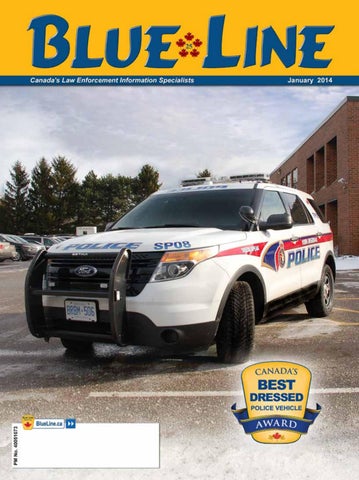
6 Canada’s Best Dressed Police Vehicle York Regional Police’s winning vehicle design shows the way
10 Keeping Rubber on the Road
A 23- year challenge of managing a police fleet
12
The Top 5 Vehicle Safety Innovations
14
2014 Police Vehicle Tests
18
Challenging the Future
Departments 38 Back of the Book – Crazy Canuck cops Blue Links Advertisers Directory 38 36 Dispatches 26 Deep Blue – Unwritten rules for the in-crowd Holding The Line 28 – Less reason now to hide PTSD 31 Letters 37 MarketPlace 5 Publisher’s Commentary – Traffic direction Product Showcase 36 30 Technology – Driving home the message
12 14
Case Law 32 33 34 BLUE LINE MAGAZINE
3
Reasonable grounds & the experience factor Smell may be used for grounds Warrant required to search computer JANUARY 2014
JANUARY 2014
4
BLUE LINE MAGAZINE
Blue Line
PUBLISHER’S COMMENTARY
PUBLISHER Morley S. Lymburner – publisher@blueline.ca
Take it seriously or get off the road!
by Morley Lymburner
Magazine Inc. GENERAL MANAGER Mary K. Lymburner – mary@blueline.ca SENIOR EDITOR Mark Reesor – editor@blueline.ca NEWS EDITOR Kathryn Lymburner – kathryn@blueline.ca CREATIVE DIRECTOR E. Jolene Dreja – jolene@blueline.ca MARKETING MANAGER April Lensen – april@blueline.ca CONTRIBUTING WRITERS Robert Lunney Dave Brown Mike Novakowski Nancy Colagiacomo Tony Palermo Stephanie Conn Tom Rataj Dorothy Cotton Brent Snook Mark Giles AFFILIATIONS International Association of Law Enforcement Planners Canadian Advertising Rates Data International Police Association The Canadian Press Newswire Access Copyright
SUBSCRIPTIONS $30 per year; $50 for 2yrs; US & Foreign: $100 ADVERTISING 888-640-3048 advertising@blueline.ca
www.blueline.ca 12A-4981 Hwy7 East, Ste 254, Markham, ON L3R 1N1 Canada P: 905-640-3048 F: 905-640-7547 blueline@blueline.ca
PRINTED IN CANADA
ISSN# 08478538 Blue Line Magazine was established in 1988 as an independent publication to inform, entertain, connect and educate those involved in the law enforcement profession. With no direct control from an enforcement agency, its opinions do not necessarily reflect those of any government or law enforcement agency. The authors, advisors, and publisher accept no liability whatsoever for any injuries to person(s) or property resulting from application or adoption of anything presented in this magazine. Readers are cautioned and advised that articles presented herein are edited and supplied for your personal awareness and should not be used for further action until appropriate guidance is received from a supervisor, Crown Attorney or other persons in authority. All material submitted for publication becomes property of Blue Line Magazine Inc. unless arrangements have been made with the publisher prior to publication. © 2014 All articles are protected by copyright. No part of this publication may be reproduced or transmitted in any form or means, electronic or mechanical, (including photocopying and recording or by any information storage or retrieval system), without prior permission. Permission to reprint may be obtained in advance from Access Copyright 1-800-893-5777.
BLUE LINE MAGAZINE
Traffic direction
An American police magazine article on traffic direction a few years back came as a shock. The main photograph showed what I assumed to be a police officer directing traffic, at night, wearing a dark uniform and no hat; he didn’t even have a whistle! The author must be showing ‘what not to do,’ I thought, but no, this was an example of how it should be done. “Okay! Okay!” I said to myself, “Let’s not judge the story by the poor selection of photograph,” ignoring the theory that one picture is worth a thousand words. I read on but it only became worse. This officer’s theory (and I say theory because he could not have survived traffic points long enough to develop good practices) was to stare down approaching vehicles. “Look like the boss, give assertive directions and stare down the driver” was his basic concept. He backed this up with a picture of another hatless, nameless, motionIess, assumed-to-be police officer, doing what he cares not to do. I read further but had to take a blood pressure break before returning to discover the officer’s credentials. He was a 13 year veteran police dog handler from Washington State. “Okay, Okay, Okay!” I says to myself, “he found my key – he’s got me wound up.” The magazine went into the trash and I hit the keyboard to write this little ditty. It ain’t the be-all and end-all on the subject but at least it may help justify my 20 years as a traffic specialist. How do you want to be remembered in one of the few times you’re on display to the public? Erect, sharp and in control or hatless, bored, ill-tempered and sloppy? You rarely get a chance to make a second impression and your life may very well hang in the balance. Here are my five basic rules. Rule 1 • Be seen Put on a fluorescent vest, wear white gloves, carry a flashlight. Park your cruiser with lights flashing near the intersection. All of the above is best but any one is better than none. Rule 2 · Wear a hat I don’t know where this bare-headed, bone-headed, stupid idea of not wearing a hat came from. Your hat is a necessary part of your job. It is your professional identity and the most readily seen part of your uniform – the first thing that identifies you, from the furthest distance. It sits on the highest part of your anatomy and can be seen at 360 degrees, even above the roofs of most vehicles. It’s the first clue for motorists that a “police officer” is doing a traffic point. Want to make it better? Put a white or orange cover on. It is my firm belief that any officer working permanent traffic detail should wear an issue white hat. An optional helmet would be even better. 5
Rule 3 · Use a whistle Car stereos will drown you out, no matter how loud you yell. Remember that you are directing PEOPLE, not bumpers and headlights. Use as loud a whistle as you can find. One long and one short blast for “stop” and two short blasts for “go” have been the most effective for me. Rule 4 · Clear signals Keep your hands high and never give a direction with your hands below your head. Motorists are looking there anyway (they’re impressed by that hat) so you might as well communicate something that you want them to do. Remember that this ain’t no game of charades. Don’t let the hustle of traffic worry you. Go at your own pace. There is nothing less lenient on time than a traffic light so why should YOU hurry! You are in control and no one does a thing until you want them to do it... Right?! Show the largest mass of your body to the vehicles you want to stop (you may have to take inventory to decide if that is front or sideways). Don’t permit traffic to move in one direction without stopping up the other direction. When stopping a lane of traffic look back in the line and determine which car you want to stop. This may be three or four back but a good rule is to stop the driver you establish eye contact with and then point at them. (It’s easier than trying to get their attention by riding on the hood or putting a well placed bullet in the grill.) Rule 5 · CYA Always think of your back (side). A true traffic controller develops eyes in the back of their head. If you can’t see in one direction you have to attune your ears to it. Let them be your second set of eyes. Too many motorists appear to have prescription windshields – and have just switched cars. They don’t see beyond their hood ornament and you are as good a target as any. While we’re on this subject, have you noticed that the chances of somebody stopping to ask directions is directly proportional to the amount of traffic congestion at your traffic point? They still think you have time to direct them to the freeway. Firmly, but politely, bring them back to reality. Advise them their wheels have stopped rolling and that is against the rules presently in effect (you can really use your imagination here!) Updated from original published in April 1996.
JANUARY 2014
York Regional Police’s winning vehicle design shows the way
York Regional Police Looks, style, function and innovation are the new criteria for the annual Best Dressed Vehicles competition and York Regional Police is the clear winner. For the past seven years the major criteria has focused on vehicle exteriors. The use of graphic design to get the public’s attention was the main point of interest. This included the use of colour, fonts, striping and how it was incorporated with the physical lines and design of the vehicle. Other aspects were identifying with the community, enforcement focus and how quickly the vehicle could be recognized as a community police car. We suddenly realized that there is more to a law enforcement fleet vehicle then the exterior packaging. Other factors should be considered in what constitutes the “Best Dressed” in working vehicles. Toward this end we decided to open the doors and pop the hood and trunk. We now want to see how they are accessorized towards the betterment of the members driving and the communities they protect. Creativity, innovation, doing more with less and employing what’s new will now be considered along with the exterior work. Although some agencies may have vehicles which fall short at one level this may be offset by other compelling factors which help overcome a shortfall and make it a winner overall. When viewing a wide array of police vehicles we quickly came to the conclusion that York Regional Police had a vehicle head and shoulders above the rest which best epitomizes the new “Best Dressed” standard. 1. The vehicle’s exterior lines not only show the uniqueness of the fleet but closer examination reveals that the red striping has a retro-reflective “watermark” embedded with the York Regional Police motto of “Deeds Speak.” This creative aspect prevents anyone imitating the vehicle for fraudulent or unauthorized purposes. 2. The mixed flowing blue and red striping is emblematic of the region’s mix of urban-rural and industry-recreation. 3. The transformation of the patrol vehicles from standard passenger cars to SUV type vehicles. This change was found to be economical due to less maintenance requirements, better passenger space and easier outfitting. Although the initial price is higher, the vehicle is expected to have a longer street life and higher trade-in value. 4. The V-6 engine has a low energy mode which kicks in for extended idle times saving on fuel consumption and reducing carbon emissions. 5. In-car computer design allows use by both driver and passenger without interfering with air-flow and air bag deployment.
by Morley Lymburner and Dave Brown (with files from Erik Young and Gerald Donnelly)
Since 2005, Blue Line Magazine has been recognizing creativity, visibility and community identity in the design of Canadian police vehicles during our annual Best Dressed contest. Police vehicles are not just transportation; they are the calling cards of a police service to the community. They must be both highly visible and instantly recognizable. Designs are ever evolving but the one area we focus on the most every year is officer safety. This is becoming more important as cars get smaller and lightbars more aerodynamic. One factor we especially look for are graphic elements that instantly show at a glance the direction a car is traveling day or night. We have added one new criteria to our selection process for this year. As you read in our cover story, we are now looking at interior design and integration. Gone are the days that an agency could unbolt all the police gear from an older model car and bolt it into a newer one. Some lessons in police work come at a great price, and this is why we have modified our judging criteria to also look at factors such as a clean and professional integration of the interior equipment that allows officers to scramble across the front seats in an emergency. There must not be any openings where someone could get a hand or weapon through a partition from the back seat. Contest finalists Finalists for each year’s contest are selected by a panel of editors at Blue Line Magazine and by Erik Young and Gerald Donnelly at www.policecanada.ca. Finalists are judged on a scale that awards points for creativity, visibility, readability, ergonomics, equipment integration and community identity. We announce the winners every January in conjunction with our police vehicles issue. JANUARY 2014
6
BLUE LINE MAGAZINE
6. New security locks for both shotgun and carbines. 7. The ergonomic keyboard holder is something that was studied and experimented with for over two years. Considerable effort was put into ensuring the keyboard was able to be used by both the passenger and the driver in a safe and efficient manner while still making it universal enough to incorporate a wide variety of keyboard styles. 8. Equipped with front and rear in-car cameras and audio recording features to capture events taking place in front of the cruiser and in the back seat. 9. Ease of access to equipment such as first aid kits, ropes etc. due to the SUV configuration. 10. The card swipe is mounted on the cruiser dashboard. It contains a barcode reader that reads magnetic swipes as well as the 2-D swipe on newer driver’s licences. It took more than two-years of study and research to bring the final vehicle together – and considerable co-ordination between fleet management, technical support, senior management, the clothing and equipment committee and many corporate clients and private sector fabricators. The finished product is simply stunning and a positive trendsetting example for others.
Vancouver Police Department
The Northwest Coast First Nations share two main clans, symbolized by an eagle and a raven. The clan that the mother belonged to defines membership, and these two cultural icons have become widely used in native art and sculpture. The forward ‘swoosh’ on the front fender of Vancouver Police Department marked cruisers is a Haida depiction of an eagle. That forward swoosh has another purpose. It helps define at a glance the direction in which a cruiser is traveling. The word “POLICE” is clearly defined night and day and the door panel nicely frames the crest. Selected by a committee of officers and citizens, the new design became necessary when the VPD chose the Dodge Charger as its marked cruisers. The previous design did not fit – another indication why visibility becomes so much more important as cruiser exterior panels get smaller and more rounded. Vancouver uses an unusual gradient-fill in its design that integrates perfectly within the vehicle body lines and adds the necessary directionality. The highly reflective graphics were created by Ampco Grafix of Vancouver.
Service de police de la Ville de Montréal (SPVM)
The SPVM’s 4,600 police officers and 1,600 civilian employees serve the island of Montréal and its 1,800,000 inhabitants. The visual identity of the entire agency is represented by a graphic star symbol containing a human silhouette and the acronym SPVM. With the launch of new neighbourhood police stations, it adopted a new identity for all personnel, including civilian employees, police officers, cadets, school crossing guards, parking agents, taxi bureau and towing inspectors. This logo was developed through consultation with citizens and police officers and dates back to the symbol used during Expo 67, a visual identity that emphasized fraternity and solidarity between peoples. It stands for excellence, and the human silhouette within it reminds citizens that respect for fellow humans are the focus of every member. The heavier graphics towards the rear and the upward jog of the reflective striping just aft of the b-pillar adds directionality to the design. While the word “POLICE” may be smaller than others, it is simple, plain and centered in a place of prominence on the door. Montreal also uses very clever stealth cars that utilize the same basic design but in a covert gold on black style.
Top: The new key board has a neat trick of swinging out towards the driver. Middle: The Cage and camera. Below: Reflective stripe detailing with watermarked “Deeds Speak” on the new York Regional Police vehicle design.
BLUE LINE MAGAZINE
7
JANUARY 2014
Kitigan Zibi Police Department Kitigan Zibi Police serves 2,700 people adjacent to the town of Maniwaki, Québec. The design was chosen specifically to reflect the people it serves and integrates the community logo in a prominent place on the front fender. The drum in the logo symbolizes the drum originally given to the women because of their responsibility and position in the structure of social life within the community. The seven fires represent the legend that speaks of two covenants of law – one given to the land and the other to the Anishinabeg of North America. The otter depicts the animal that went before the great spirit who created the earth, and offered to educate and instruct people by teaching them the ways to protect their family and group. The cruiser graphics pick up the same colours from the community logo and use them to great effect to reinforce the power and speed of the host vehicle. “POLICE” is simple, strong and very readable.
Prince Edward Island Sheriff Services The PEI Sheriff Services is tasked with providing a safe environment in and around the province’s courts. Its duties include court security, inmate and jury management, fine and writ collection and process work. One of our concerns with law enforcement vehicles is that the design must clearly define who the agency is. PEI Sheriff Services is one of the best examples we have ever seen of a clear and professional design. We especially love how the graphics use the lines of the vehicle to best effect. We would be willing to bet that PEI citizens can see at a glance who the agency is and that its people mean business.
The CBRPS serves 106,000 people across a 2,500 square kilometer area. Formed through a 1995 amalgamation of the Sydney, North Sydney, Sydney Mines, Glace Bay, New Waterford, Dominion and Louisbourg police forces, it also took over all policing duties for rural areas of Cape Breton County in 2000 and the Membertou First Nation in 2007. The CBRPS moved its entire fleet back to a historical black and white look because it is instantly recognizable as police. The design uses the colours of the Cape Breton Regional Municipality and all stripes and lettering are made from a highly reflective material, making the fleet visible both day and night. One factor that impressed our judges is the integration of the new look across every vehicle in the fleet, including motorcycles, ATVs and boats. The design elements are also incorporated on business cards, letterhead, publications, signage, websites and promotional materials.
Cape Breton Regional Police Service (CBRPS)
Have your say about the January Automotive issue! Visit blueline.ca. JANUARY 2014
Submit your police vehicle pictures, with 200 words on the design and your full contact info to BestDressed@blueline.ca Any vehicle design that has not won may enter. Previous winners may resubmit if their design has changed significantly.
8
BLUE LINE MAGAZINE
BLUE LINE MAGAZINE
9
JANUARY 2014
KEEPING RUBBER ON THE ROAD A 23-year challenge of managing a police fleet
by Morley Lymburner “The safety of the officers on the street is our number one concern,” says York Regional Police (YRP) Sergeant Lloyd Dow. “I was a cop on the road for 17 years before I took on the job of fleet manager and I understand the importance of safety and comfort when it comes to patrol cars. After all this is their office and their home-away-from-home for 12 hours a day. The environment they find themselves in should be as secure, functional and comfortable as we can make it.” Dow’s attitude and dedication is reflected in the current recognition Blue Line Magazine has given to the new YRP cruisers the 1,500 member police service is currently deploying. He has been a major supporter of the move toward replacing all front-line patrol cars with SUV-type vehicles and was part of the group instrumental in working with the executive command team and police services board on this transformational shift. Managing a fleet of police vehicles is a multifaceted job, Dow points out, that begins long before vehicles are bought and continues well after they are in use. “The comfort and
JANUARY 2014
safety of every member of the force depends on the manner in which the vehicles are studied, acquired, suited-up and maintained,” he notes. After 23 years of fleet management, Dow well understands the intricacies and subtleties. Beginning his career as a patrol officer in
10
1974 he was called in to help the police fleet manager in 1991 and told it would be a twoweek duty. Nine months later the incumbent manager decided to retire and he returned. Managers recognized his prior-to-policing experience, which included working for a relative’s car dealership. His keen interest in the automobile industry was apparent and he was later confirmed in the position with a promotion to sergeant. Accepting the position and the promotion came with a steep learning curve which, as Dow points out, continues to this day. The agency’s sudden and dramatic growth led to fleet services becoming a full-time responsibility. The YRP fleet presently consists of more than 700 vehicles. Other modes of transportation such as helicopters and marine vessels are excluded from his portfolio but Dow is regularly consulted on some of their aspects. Networking with the officers in the field, senior management and manufacturers is one important aspect of Dow’s duties. “Keeping up-to-date with recent technology is of vital importance to us,” he says. “I work closely with the car manufacturers and act as a voice for the rank and file to address issues of concern.” Dow was a member of the Ford Police Advisory Board, is a sitting member of the General Motors Law Enforcement Product Counsel and keeps up an active dialogue with Chrysler and manufacturers of various types of vehicles. Dow points out that he has always reported to command officers who appreciated the importance of the fleet and shared his concerns about officer safety. “York Regional Police Chief Eric Jolliffe, as with all my previous chiefs and staff, have understood the importance of acquiring and maintaining a safe and a top-of-the-line equipped fleet and I have always appreciated their support,” he concludes. BLUE LINE MAGAZINE
BLUE LINE MAGAZINE
11
JANUARY 2014
THE TOP
VEHICLE SAFETY INNOVATIONS by Dave Brown There have been many advancements in safety since automobiles first hit the roads more than a century ago. Some, such as anti-lock brakes, are huge technological advances that prevent accidents every day but it’s hard to gauge their significance on actual lives saved. Others, such as the 1970s fuel crisis, saved many lives by keeping millions of people off the highways but are not really technical innovations. While some of us at Blue Line Magazine may seem like we have been driving for a good portion of those hundred years, we were not present for the invention of fire (honest!) but have seen some amazing innovations. Here’s a list of what we consider the top safety features invented since they did away with the actual horse part of horsepower:
they must be worn. This is why they are only #4 on our ascending list of top safety innovations. Most Canadian police officers will attest to the fact that the one overwhelming factor in non-fatal versus fatal single-vehicle accidents is the wearing of seatbelts. 3. Crush zones
5. Airbags
These have a special place in my heart as they probably saved a family member’s life in one of the very first documented crashes of an airbag-equipped police vehicle. Hit in the middle of an intersection by a vehicle being pursued by another unit, the officer remembers only a loud bang and then dust floating in the air. The hours it took emergency crews to cut him out of the wreckage – without a scratch – were probably spent thinking of the best way to explain to the chief how he had just wrecked a brand new cruiser not even a week old. I can imagine the phone call went something like, “Good news chief! The airbags work!” 4. Seatbelts The National Highway Traffic Safety Administration (NHTSA) estimates that airbags saved approximately 8,000 lives in a ten-year period from 1991 to 2001 in the United States. It is estimated that seat belts saved over 109,000 lives on US streets and highways over the same period. Before seatbelts can save lives, of course, JANUARY 2014
Bump into another car in a mall parking lot today and, no matter how slowly you are going, you could easily do $1,500 in damage. Years ago, vehicles were made a lot stronger and heavier. The problem was, of course, that the human occupants became the crush zones in an accident. Modern car designs and the increasing standards for occupant protection may result in the car being destroyed but the people inside getting to walk away. Personally, I think that is an easy trade off. 2. Electronic Stability Control (ESC) systems
The difference between airbags, seatbelts and crush zones and stability control systems is that the former three help prevent serious injuries in an accident. The latest ESC technology is designed to prevent the accident from happening in the first place. The NHTSA 12
estimates widespread availability of ESC in all new cars could save as many as 10,000 lives every year. Mandated since 2012, they use a sophisticated system of computers and sensors to detect when a driver may be losing control and selectively apply brakes to one or more of the four wheels to help maintain control. They don’t stop stupid people from doing something really, really stupid, but they are probably the greatest ever advancement in car technology. ESC is still new technology in most vehicles; many of the sensors may be sophisticated but still use a lot of old school technology. If any sensor fails, even momentarily, it completely disables the entire system. Blue Line has learned of at least one instance of a dealer threatening to disallow a warranty claim for a faulty sensor because a cursory scan of the freeze frame data in the computer showed wildly differing readings between the yaw sensor and the steering wheel position sensor. Thinking that the vehicle must have rolled after a violent skid, they didn’t bother to consider a brand new vehicle without the slightest scratch on it just might have a faulty sensor. Thankfully, the customer went to another dealership. Until the sensor technology catches up to the promise, we will have to live with the fact that when a failure is detected, the fix may be as simple as restarting the vehicle. The other issue is that the stability control system necessarily includes traction control and anti-locking brakes. Police vehicles generally have special traction control programming that allows a certain amount of wheel spin but regular vehicles don’t. If your new car has traction control, I highly recommend you practice with it rather than being suddenly caught short by a significant lack of acceleration when entering a highway from a gravel road. 1. Traffic enforcement All of the above may save many lives but pale in comparison to an active traffic enforcement program. You need to get eyes and cars on the streets, ticketing people for doing stupid stuff. Police agencies are finding they cannot delegate BLUE LINE MAGAZINE
traffic enforcement to red light cameras and photo radar. Those may serve to increase revenue and reduce right-angle collisions at the immediate intersections where they are installed but don’t affect traffic safety as much as police officers actively patrolling the streets. Some officers don’t like doing traffic enforcement, but others see it as what my publisher often describes as the “pristine beauty of traffic.” Stopping a driver has an immediate impact on behaviour – not to mention that many serious crimes have been solved by the seemingly simple traffic stop. If one doesn’t appreciate the need for good traffic enforcement in their community, tell them to take a (long) walk – frequently, as I do. There isn’t a day goes by that I don’t have to almost leap out of the way as drivers insist on stopping two inches into a controlled intersection instead of behind where the pedestrians are or will be. All the airbags, seatbelts, crush zones and technology in the world won’t do anything to save a pedestrian’s life if a driver is speeding, texting, running red lights, not paying attention or just plain driving like an idiot. Dave Brown is Blue Line Magazine’s Automotive and Firearms editor as well as general staff writer. He may be reached by email at brown@blueline.ca.
BLUE LINE MAGAZINE
Manitoba Public Insurance Corp. recently released a campaign for motorists who wish to text while driving. Statistics suggest drivers who are texting are 23 times more likely to be in an accident and one-quarter of fatal crashes in Manitoba are caused by some form of distracted driving. Many police agencies have begun countermeasure activities to reduce the problem and recent caselaw out of Ontario said it’s illegal to hold a cellphone while driving even if it’s not transmitting and no matter how briefly it’s in a driver’s hand. The Court of Appeal released a pair of decisions ordering two people convicted under the Highway Traffic Act for violating the ban on using cellphones while driving. In one case, Khojasteh Kazemi argued that she had just picked up her cellphone, which had fallen off the seat to the floor of her car when she stopped at a red light, when a police officer spotted her holding it. But the Appeal Court overturned that finding. In the other case, Hugo Pizzurro was caught driving with a cellphone in his hand but argued the Crown couldn’t prove it was capable of sending or receiving at the time. But the Appeal Court concluded the language in the law requiring a capability of sending or receiving applies only to devices other than cellphones as cell-
13
phones have that capability built in. “Moreover, to impose the requirement that a cellphone held by a driver while driving was capable of receiving or transmitting would be unreasonable both for enforcement and for prosecution,’’ the court ruled. “The legislature could not have intended that result.’’ “Road safety is best ensured by a complete prohibition on having a cellphone in one’s hand at all while driving,’’ the Appeal Court wrote in the Kazemi decision. “A complete prohibition also best focuses a driver’s undivided attention on driving... In short, it removes the various ways that road safety and driver attention can be harmed if a driver has a cellphone in his or her hand while driving.’’complete prohibition also best focuses a driver’s undivided attention on driving...In short, it removes the various ways that road safety and driver attention can be harmed if a driver has a cellphone in his or her hand while driving.’’ The Appeal Court made similar comments in the Pizzurro case. “To hold out the possibility that the driver may escape the prohibition because the cellphone is not shown to be capable of communicating, however temporarily, is to tempt the driver to a course of conduct that risks undermining these objectives,’’ the court wrote.
JANUARY 2014
by Dave Brown 2014 is destined to become the most memorable year in police vehicles since we first began reporting preliminary results from the National Institute of Justice and the Michigan State Police (MSP) Police Vehicles Test. To summarize some of the highlights: Carbon Motors is finally gone for good (yea) but the Australian-built Chevrolet Caprice still isn’t coming to Canada (boo.) Ford has released its first-ever non-pursuit-rated Special Service Police Sedan with an economy 2.0 litre V6 engine for administrative duties. At the opposite end of the spectrum, Chevrolet is poised to offer its first-ever pursuit-rated four-wheel-drive (4WD) Tahoe, and Dodge is building an all-wheel-drive (AWD) version of the Dodge Charger. Ford finally knocks Dodge out of first place for the fastest accelerating police car on the planet, a position it has held since the introduction of the hemi-engined Charger in 2006, and Blue Line Magazine finally gets its fondest wish from last year’s test – a brand new 3.5 litre turbocharged Ecoboost version of the Ford Police Interceptor Utility – and it is very fast. Rear-drive traditionalists can rejoice that the twin-turbocharger Fords may be quick on the drag strip but the naturally-aspirated 6.0 litre rear-drive Caprice turns in the second fastest lap times on the road course (topped only by the AWD 5.7 litre Charger) and the highest top speed (155 MPH) of the entire bunch. This will soon be the year of all-wheeldrive. General Motors, Chrysler and Ford have taken careful note that fewer than three per cent of all police buyers in North America opted for the FWD option in the Ford sedan, even at a discount price. By mid-2014, all three will be offering at least one police vehicle in an allwheel-drive or four-wheel-drive configuration. Just to illustrate how competitive the market is getting, both Ford and Dodge entered early versions of models slated for mid-2014 introduction (as 2015 models) in the testing procedures. As always, police buyers should look carefully at the numbers, evaluate their needs JANUARY 2014
and, this year for the very first time, perhaps be prepared to wait a few months if the mid-year models better match those needs. Agencies wanting to know which vehicles will be most popular with their officers should particularly note the ergonomic scores – after all, officers use them as their offices and homes for up to 12 hours a day. These scores almost exactly match our informal surveys on the Blue Line forum. Here in Canada, the Tahoe is considered the most comfortable place to spend a shift, with the Charger not far behind. The third-rated Ford Police Interceptor Utility crossover SUV is considerably more popular with officers than the Ford sedan version, even though both are based on nearly the same front-wheel-drive economy car platform. In fact, more than one Canadian agency is going exclusively with the Ford Utility for all patrol duties. MSP yearly vehicle tests Every fall the MSP, in conjunction with the US National Institute of Justice (NIJ), test the handling and performance of every new police vehicle on the market for the coming year in back-to-back acceleration, braking and lap time tests. These tests are seen as the most comprehensive analysis of police vehicles in North America, and the results are eagerly anticipated by officers and buyers alike. The MSP publish the results on its web site at www.michigan.gov/msp, and Blue Line is once again reporting the preliminary figures. Final figures and a summary of the results should be ready on the MSP web site by the time you read this article. Vehicles The NIJ and MSP evaluate police vehicles in two categories: police-package and special-service. Police-package vehicles (PPV) are designed for the full spectrum of general police activities, including high-speed pursuit. Special-service vehicles are designed only for specialized duties such as canine units or adverse weather conditions and are not intended or recommended for pursuits. 14
Fifteen vehicles were submitted to the NIJ in the police-package category for 2014: • 2014 Chevrolet Caprice 9C1 (with the 3.6 litre V6 or 6.0 litre V8); • 2014 Chevrolet Impala 9C1 with the 3.6 litre V6; • 2014 Chevrolet Tahoe PPV with the 5.3 litre V8; • 2015 Dodge Charger with the 3.6 litre V6 and standard 2.65:1 axle ratio; • 2104 Dodge Charger with the 5.7 litre V8 and standard 2.65:1 axle ratio; • 2014 Dodge Charger with the 3.6 litre V6 and optional 3.07:1 axle ratio; • 2015 Dodge Charger with the 5.7 litre V8 and optional 2.65:1 axle ratio; • 2015 Dodge Charger AWD with the 5.7 litre V8 and optional 3.06:1 axle ratio; • 2014 Ford Police Interceptor FWD sedan with 3.5 litre V6; • 2014 Ford Police Interceptor AWD sedan with the 3.5 litre V6 (normally aspirated or turbocharged); • 2014 Ford Police Interceptor Utility AWD with the 3.7 litre V6; • 2015 Ford Police Interceptor AWD sedan with the turbocharged 3.5 litre V6; • 2015 Ford Police Interceptor Utility AWD with the turbocharged 3.5 litre V6. Here is the lineup of Police Package Vehicles for 2014 (with preliminary figures from the 2014 Michigan State Police vehicle tests, and additional comments from Blue Line). Chevrolet The popularity of the Chevrolet Tahoe may have caught General Motors by surprise but it will run with it for as long as sales stay strong. The 2WD Tahoe is both fast and nimble considering its weight. The Caprice will again not be sold in Canada for 2014, an increasingly curious decision considering sales of the Impala have stalled. GM is not going to give up its market share without a fight and is already planning to introduce the pursuit-rated 4WD Tahoe mid-year. This is significant for many Canadian police agencies who like the Tahoe for its room and BLUE LINE MAGAZINE
The Charger has always been known for great brakes but early models suffered from short pad and rotor life. This was corrected for 2011, and improved again for 2014 with even larger 14.5-inch high-performance brakes. Visibility was vastly improved in 2011 and Dodge did some cleaning up of the exhaust pipe tips and rear fascia panels to prevent damage when crossing highway medians. New convenience features include a Secure Park idling system that prevents cars from being driven off without the key fob in the car, and even an available rear park assist for cruising the malls. Plus, Dodge still makes the most aggressive-looking police car on the market. Ford adverse weather capability and will love the pursuit-rated 4WD version. Unlike Dodge or Ford, the GM is a true switchable 4WD. You can drive in 2WD for best mileage and then switch to Automatic 4WD (A4WD) in variable conditions. This setting is similar to on-demand systems in that it can divert torque to the other axle when it detects slippage, but unlike the Dodge or Ford, it uses an actual transfer case that keeps five per cent of the torque always flowing to the front axle when engaged. This adds stability on slightly slippery surfaces and quickly engages more torque to the front axle when slippage is detected. GM’s Autotrac system has two more settings when conditions get serious. In 4WD Hi, it locks front and rear axles together for true four-wheel-drive, and in 4WD Lo, it switches to a low range in the transfer case for descending slippery slopes or crawling over rocks at a walking pace. Unlike older 4WD systems, officers can switch back and forth between 2WD, A4WD and 4WD Hi at any speed without slowing down or pausing to lock hubs. GM has not announced plans for the police Impala after model year 2014, so it will be interesting to see if it continues the line. Maybe if we are really good this year, Santa will finally bring the Caprice to Canada for 2015. Dodge
The Dodge Charger Pursuit will be available later this year with an all-wheel-drive option. It is basically a rear-drive system that can channel up to 100 per cent of the engine’s torque to either axle when it detects slippage. Both the AWD and traction control systems use special police programming, meaning that fans of big V8 rear-drive police cars from the past will feel right at home. BLUE LINE MAGAZINE
Ford uses a software-based AWD system computer to detect slippage and divert torque as required. The one substantial difference between this and the other two makes is that both Ford models are based on a front-wheel-drive mid-size economy car platform. This means that the AWD system is biased to front-wheeldrive but can divert up to 100 per cent of the torque to either axle. Asking the front end to both steer and carry the power means understeer at the limits of traction, but Ford has done an amazing job disguising the fact that the sedan and SUV are both front-wheel-drive at heart. Most (97 per cent) of all Ford sales are AWD and 60 per cent of all Ford police vehicles sold are the Police Interceptor Utility, so the biggest news this year is the introduction of an AWD Utility interceptor with the powerful twin-turbocharged 3.5 litre Ecoboost engine. This model may even help officers forget that Ford uses a curious seating position in both models that drops the seat toward the floor to increase front headroom. There were a few early reports of difficulty installing partitions in the utility but that seems to have been resolved. Ford has also learned an important lesson from Dodge – a police car should look like a police car. Ford combines aerodynamics, styling, durability and speed into a strong package in every category. As late as last year we were still lamenting the passing of the big Crown Victoria Police Interceptor, but with more new sedan and utility models hitting the streets every day, the old design just looks dated. Carbon Motors Carbon Motors is dead once and for all. We predicted this years ago, and now all that is left is for bankruptcy trustees to change the locks on the factory Carbon executives 15
fast-talked from the people of Connorsville, Indiana, and auction off the one and only asset – a very tired old E7 mockup prototype vehicle. An Indianapolis Star investigation showed that Carbon racked up more than $21 million in liabilities to creditors and managed to blow through $7 million in local government grants on salaries, vacations, resorts, unrestrained travel expenses, lavish hotel rooms and gifts to local councilors. Blue Line began seeing huge holes in the company’s business model shortly after its startup announcement; right around the time it chose to purposely ignore the substantial Canadian police market. Perhaps Canadians were just too savvy for the overblown hype; what we here in Canada refer to as “big hat; no cattle.” The US energy department wasn’t buying the empty ‘rah-rah-Merica’ advertising either, or the unworkable promise of the built-in Weapons of Mass Destruction detector in every car, and turned down a $310 million bailout loan request – not surprising because it is hard to bail out a company with one car as its only asset. Carbon executives didn’t let that stop them from jet-setting across the country on taxpayer funds, including a socalled “marketing trip” to Dubai in 2012 that the company touted as their first tour visit to a country outside the US. It conveniently forgot that Canada probably loses more police cars falling off the back of transporter trucks in a year than Dubai has ever purchased. Blue Line has not yet substantiated rumours that the two failed company founders are now trying to market a robot security guard for schools. The tests MSP and the NIJ’s National Law Enforcement and Corrections Technology Center (NLECTC) test all the vehicles together over a three-day period at the Chrysler Proving Grounds and Grattan Raceway. Each vehicle is tested without rooftop lights, spotlights, sirens or radio antennas in place. Tires are original equipment rubber provided by the manufacturer. Acceleration, braking and top speed tests are performed at the Chrysler proving ground and vehicle dynamics tests are done using the two-mile Grattan road course. (All dimensions and measurements given are US numbers.) The results Vehicle dynamics testing The objective of the vehicle dynamics testing is to determine the high-speed pursuit handling characteristics. Except for the absence of traffic, the road course simulates actual pursuit conditions, allowing evaluation of the blend of suspension components and acceleration and braking ability. Four different drivers test each vehicle over eight laps, with the five fastest counting toward each driver’s average lap time. Final score is the combined average of all four drivers for each vehicle. JANUARY 2014
Braking The objective of the braking test is to determine the deceleration rate attained by each vehicle on twelve 60-0 mph full stops to the point of impending skid, with ABS engaged. Each vehicle is scored on the average deceleration rate it attains. Each test vehicle makes two heat-up decelerations at predetermined points on the test road from 90 to 0 mph at 22 ft/sec2 using a decelerometer to maintain rate. The vehicle then turns around and makes six measured 60-0 mph stops with threshold braking applied to the point of impending wheel lock, using ABS if so equipped. Following a four-minute heat-soak, the sequence is repeated. Initial velocity of each deceleration and the exact distance required is used to calculate the deceleration rate. The resulting score is the average of all 12 stops. Stopping distance from 60 mph is calculated by interpolating results.
Acceleration and Top Speed The objectives of the acceleration and top speed tests are to determine each vehicle’s ability to accelerate from a standing start to 60, 80 and 100 mph, and to record the top speed achieved within a distance of 14 miles from a standing start. Each vehicle is driven through four acceleration sequences, two in each direction to allow for wind. Acceleration score is the average of the four tests. Following the fourth acceleration sequence, each vehicle continues to accelerate to its highest attainable speed within 14 miles of the standing start point. JANUARY 2014
Ergonomics The objectives of the ergonomics and communications test are to rate a vehicle’s ability to provide a suitable environment for patrol officers to perform their job, accommodate required communication and emergency warning equipment and to assess the relative difficulty in installing this equipment. A minimum of four officers independently evaluate each vehicle on comfort 16
and instrumentation. MSP communications division personnel then evaluate each vehicle on the ease of equipment installation. A total of 28 factors are evaluated on a scale of one to 10 and averaged among all the testers. The final score is the total cumulative score from the average of each of the 28 factors, which include seat design, padding, ease of entry, head room, instrument placement, HVAC control placement, visibility, dashboard accessibility and trunk accessibility (2013 figures). ERGONOMICS
Fuel economy While not an indicator of actual mileage that may be experienced, the EPA mileage figures serve as a good comparison of mileage potential from vehicle to vehicle. Vehicle scores are based on data published by the vehicle manufacturers and certified by the US Environmental Protection Agency. Mileage figures are given in US miles per gallon. (235/MPG = litres /100 kilometers).
Dave Brown is Blue Line Magazine’s Automotive and Firearms editor as well as general staff writer. He may be reached by email at brown@blueline.ca.
BLUE LINE MAGAZINE
No Trivial Pursuit
What’s the real story on the Chevy Caprice? by Morley Lymburner For the third year in a row General Motors and its union, recently repurposed with the name “Unifor”, is making every cop in Canada feel like a little boy with his nose pressed up against the window of a closed candy store. You can look but you can’t buy... the Chevy Caprice. The Caprice PPV is actually a lightly modified version of GM’s long-wheelbase Zeta sedans, marketed in Australia as the Holden Commodore and in the Middle East as a Chevy Caprice. GM offered ordinary Canadian consumers a shorter Zeta, in the form of the well liked but short-lived Pontiac G8, but it unfortunately died with the vapourization of the Pontiac line. Only members of Six Nations Police (and one other mystery police service) know the true impact this car could make to Canadian police work. (Last year Six Nations police supplied us a favourable review of the car.) We went to a great deal of trouble over two years to find out why GM will not sell or even speak to Canadian law enforcement about the Caprice. It wasn’t that we weren’t asking... they just weren’t tellin. With numbers out of the National Institute of Justice Trials seeming to indicate a very ergonomically competitive car, the decision to freeze out Canadian cops became even more mystifying. Last year I called around to see what the problem could be. Some claim the vehicle is simply not competitive. One source said the cost of bringing the Caprice in from Australia and re-tooling to left hand drive must be recouped from the biggest market – the US – before the price will drop. Apparently it simply can not match the price of the Charger, Impala and Ford. This piece of intel falls apart at three levels. 1) Why not offer it to any Canadian agency willing to shell out the extra bucks? No one must stick to a lowest tender if the toy fits the need. 2) The car’s higher price tag will likely also command a higher trade-in or resale value. 3) One agency reports it’s switching its entire fleet over to SUVs, which means the reasons for changing the RFP have been met and obviously price is not a factor – unless the BLUE LINE MAGAZINE
Caprice costs more than a Ford Explorer or Chevy Tahoe. Highly unlikely. After a year of digging, my theory is simple. The Caprice is made in Australia and the Impala in Canada. The answer comes down to industrial and political intrigue that sidelines Canadian police. No Caprice here unless it’s made here. Too bad... but hey, maybe it’s okay for Canadian policing to do its part for our economy. To confirm my suspicions, I e-mailed the top ranks of the former Canadian Auto Workers, more recently renamed Unifor: I am looking for information about why GM does not permit the Australian made Caprice into Canada for sale to Canadian police. We have been making a lot of inquiries and no clear answer as yet. After about a year of research we have come to the conclusion that the Caprice is being kept out of Canada because the Impala is still made in this country and this is the preferred car to sell to Canadian cops (even if they don’t or even can’t buy it.) I would like someone to give us some feedback from the CAW perspective. No response will indicate to us these facts are correct. I received this answer the very next business day: Mr. Lymburner The CAW Procurement Policy is that we
17
demand governments buy vehicles built in this country. It is a simple policy as it is Canada’s economy that depends on these manufacturing jobs and in turn taxpayers money that is used to purchase these vehicles. Too many times the federal government uses taxpayers money to purchase foreign-made vehicles. It does not make sense. We have lost too many manufacturing jobs to other countries through unfair trade laws. We want fair trade, not free trade. Do you see other countries buying our vehicles supported by their government? I think not. The Impala is a great vehicle and there are other vehicles built in this country that would serve our police services well as they have for many years. Keith Osborne, National Representative Canadian Auto Workers (Unifor)
Finally an honest answer. The long and short of it is Canada will not have Caprices until the Australian branch of GM licenses the vehicle for manufacture in Canada or the United States. Now let’s take another look at those Impalas. GM and Unifor say they want you to buy these cars to save jobs... We got a quote back from GM Fleet sales for Canada... “we are limited with product.” Bottom line here... Chrysler and Ford are all that’s left that will be interested in your business. Originally published in January 2013.
JANUARY 2014
CHALLENGING
THE FUTURE
by Kathleen Griffin When York Regional Police (YRP) Deputy Chief Bruce Herridge began his policing career more than 40 years ago, he had no idea how varied his assignments – and challenges – would be. Herridge joined in 1982 following several years in Toronto. He worked a few months in uniform patrol at both #3 and #1 District, but it wasn’t long before he found his niche. It was a time of change. The world had started to move from typewriters to computers; from hard copies to electronic; from inter-office memos to email messaging. YRP was interested in researching new computer-aided dispatch and records management systems, as well as mobile work stations in the cruisers. They were all new, untried technologies. “I was asked did I know anything about computers and when I said yes, I found myself in planning and research inside a year as part of the feasibility and implementation team,” he recalled. “We were the first service in Ontario to receive police services board approval to move forward on all three technologies. The
JANUARY 2014
cost was more than $2 million at the time, which was significant.” Herridge championed the innovative and forward-thinking move and YRP became a leader in this area as a result, a reputation it continues to enjoy today. Many services were resistant to this change, but he
18
knew it was the way of the future. “It was important for us to be capable of using every tool at our disposal in order to meet the growing expectations of our community and the interest of the public in our business, which became far greater than ever before,” he said. “Advances in technology sped up the appetite for information, from the media and from the community, and that increased the pace of policing.” A life-long learner, Herridge had the knowledge and skills to move those initiatives forward. He holds a master’s degree in business administration, a bachelor of arts honours degree in criminology, a certificate in law enforcement administration from the University of Toronto and successfully completed the FBI Law Enforcement Executive Development Program. His education, and other assignments in internal audits, information services and operations, developed his now-extensive experience in implementing automated systems, emergency communications and collaborative public safety response logistics. Just three months ago, Herridge received the F. Darren Smith Award of Excellence in recognition of his leadership and vision for a technology-enhanced future in police training. Technology has led to policing growing as a profession, Herridge said. Policing itself is more sophisticated and officers more accessible. “Forty years ago we believed our clientele were criminals. Now of course we know the criminal element makes up only a small portion of our clientele and that it is far more important to interact with and engage with the 95 per cent of our community that is not. It has become one of our core functions.” Herridge has taken that value to heart, volunteering in a variety of areas during his career to give back BLUE LINE MAGAZINE
to the community he serves. He is the immediate past chairman of the Southlake Regional Health Centre Board of Directors, past chair of the Southlake Regional Health Centre Foundation and the University of Toronto’s Faculty of Management Alumni Association and the past vice-chairman of the York Region Children’s Aid Society. He also supports Special Olympics, Big Brothers Big Sisters of York Region and was the co-chair of the Region of York 2009 and 2010 United Way campaigns. As working relationships between the community and police continue to improve, so does community interest in policing. Increased media scrutiny and the popularization of television shows focused on policing – the ones where crimes are solved in an hour – have brought policing under the spotlight more than ever before. The challenges of policing are continuing to grow along with the population and in the current economic climate, where the cost of policing is being questioned at all levels of government, the old reasoning won’t wash. “The argument has always been more police officers but you could argue nowhere is there enough officers. That can’t be the answer. We can’t afford for that to be the answer.” Focusing on specific enforcement, expanding complementary business models to address things like nuisance and noise calls, creating more robust bylaws to be enforced by municipal bylaw officers and the civilianization of some police positions, such as forensic identification technicians, are themes Herridge expects to see as police services move forward. As Deputy Chief of Operations, Herridge also has had a long-time commitment to advancing road safety in York Region. He credits his early years as a traffic unit officer with the then Metro Toronto Police for that. “It’s the ideal place to learn frontline policing - investigation, note-taking, court preparation and testimony,” he said. “Doing that job made me appreciate the impact of road safety, that it’s not just enforcement, it’s about altered lives for victims and their families, it’s about the health care and insurance costs, all tolls far greater than a dented fender.” Herridge took that attitude and knowledge and applied it at YRP, right up until his last months in the job. Traffic strategies over the years have reflected the shift to increased education and awareness and he takes special pride in the YRP Safe Arrival program. The technical monitoring of police patrol vehicle speeds and the requirement to justify excessive speeds has reduced high speeds and the potential for high-risk collisions, he believes. “We lose more officers in North America in vehicle-related incidents than we do having them stabbed or shot. It has always been important to us that our people go home at the end of shift.” Herridge was recently named the new director of the Ontario Police College, a job he’ll start January 2, 2014. He’s excited to continue his long-standing commitment to BLUE LINE MAGAZINE
learning, training and technology, but leaving YRP won’t be easy. “There is always something new happening, this is not an assembly-line job,” he said. “I loved working with people who had common interests, solving problems while delivering excellent service. I enjoyed helping the community and our local politicians understand policing is an important element in a safe community and safe communities attract business and people looking for a place to raise their families. I liked knowing we did make a difference and are still making a difference. I will miss it.” He credits his fellow officers, family and the leaders who came before him for his
19
success and he’ll be sad to leave the many officers and civilian members he’s worked with over the years. “I’ve connected with many people over my 40 years and I will miss them. I enjoyed discussing people’s aspirations and expectations. No one does it alone and building successful teams in an ever-changing environment has been very satisfying. Many of my relationships built here at YRP are life-long and will continue long after I have left.” Kathleen Griffin is the Manager of Corporate Communications for the York Regional Police. She may be contact by phone at 905-764-1300, ext. 7919 or email to 5457@yrp.ca.
JANUARY 2014
Disconnected Training by Brad Fawcett The ascendance of online law enforcement training appears to be associated with the economics of policing and the (seemingly monthly) calls for more training to better meet the concerns of identified special needs groups, which typically originate from coroners inquests or public inquiries. The development of provincial policing standards requires that remote agencies be able to access training without incurring a disproportionate financial burden. Online training might be appealing in that it may mitigate “instructor drift” and differing training materials and delivery modalities across agencies, a concern expressed about conducted energy weapons training, for example. Commissioner Thomas Braidwood noted that “there is a troubling lack of consistency in provincial law enforcement agencies’ training materials respecting conducted energy weapon use” (Braidwood, 2009). Online training appears to offer at least a partial solution to these issues; however,
JANUARY 2014
there are some concerns. Online training assumes that if participants demonstrate knowledge in some context, then it should be available in all contexts (Nicholson, 2005). In other words, agencies assume that an officer demonstrating some knowledge by meeting the
20
minimum standard on an online course and accompanying exam will be able demonstrate that knowledge in the field. The difficulty is that officers acquire the knowledge entirely out of context with the reality in which they’re expected to apply it. Also of concern is the issue of inert knowledge in which isolated facts are disconnected from how they can be used to accomplish some purpose (Nicholson, 2005). Knowledge, though seemingly available (the agency “trained” the officer and the officer passed the exam), is often not used to solve problems (Renkle, 1996). One of the reasons the knowledge required is not accessible may be that it was learned out of context with the operational reality in which it is expected to be used. The officer acquired the information in a sterile, safe environment by watching, reading and viewing a computer screen where the only threat is to ego (officers might be embarrassed if they fail the online exam), which is contrasted with real-world consequences they confront. An assumption apparently supporting the move towards online training is that officers will recognise and use data present in the environment once they have been trained what to look for. Unfortunately, numerous human error studies have demonstrated that training in data recognition and a person’s ability to recognise and act on it is not supported in the field. This can be seen in “fail to pull” fatalities in which experienced parachutists fall to their deaths even though they have received extensive training on recognising problems and their remedies (typically, using their reserve parachute). One explanation may be that the parachutist “learned” the skills in a controlled, non-threatening environment (on the ground) and was unable to access the knowledge because it was required in an entirely BLUE LINE MAGAZINE
different environment (plummeting through the air) (Leach, 2011). Research on state-dependent learning suggests that knowledge acquisition should take place in environments similar to which one expects it to be recalled (Weingartner, 1977). Simply stated, state-dependent learning/retrieval refers to impairment in performance when there is a mismatch between physical or mental states at learning and retrieval (Swihart, 1999). Officers acquiring knowledge through online courses in controlled environments without consequences may not be able to access it when it’s required during operational activities due to the mismatch between the physical environment where they learned it and the chaotic and uncertain environment in which retrieval is expected. Online training in areas such as crisis intervention, de-escalation and use of force decision making may not provide knowledge that is accessible to officers when it is most needed. They acquire it while in the comfort and relative security of their department, or worse – their home, with a near-to-resting heart rate and little concern that a wrong decision will result in significant consequences. The environment where they’re expected to retrieve the knowledge relative to crisis intervention, de-escalation and use of force decision making stands in stark contrast. Online training may mitigate concerns regarding instructor drift, access, cost and training standards; however, it should not be expected to provide accessible knowledge and skills that police officers can use in the field. Employing a blended model of knowledge acquisition, one where online information is reinforced and built on in face-to-face training, may mitigate some of the concerns. Agencies should not assume that online training increases public, officer and subject safety, nor does it necessarily provide liability protection due to the incongruity that exists between the emotional, physical and tactical environments of knowledge acquisition and retrieval.
Uniform policy to include hijab option The Edmonton Police Service has approved the option for female officers of Muslim faith to wear a police-issued hijab headscarf while in uniform. The traditional hijab is worn by some Muslim women as an outward expression of religious and cultural identity. It covers the head and neck, but not the face. While there are different interpretations on the meaning and practice of hijab, the EPS respects a Muslim woman’s choice to wear the headscarf. The EPS does not currently have any members or applicants requesting to wear the hijab. However, to be proactive the EPS uniform guidelines have been updated to better reflect the changing diversity in the community and to accommodate the growing interest in policing careers from Edmonton’s Muslim community. The EPS Equity, Diversity and Human Rights Unit (EDHRU) and the Chief’s Muslim Community Liaison Committee conducted community consultation and research into how police can be more inclusive and representative in this manner without impacting service. As there were no police-issued hijabs readily available, the EDHRU, with the EPS Tactics Training Unit developed a prototype with the assistance of a hijab tailor. The headscarf was designed to be simple, unobtrusive and easily removed. After rigorous testing,
it was determined that the headscarf did not pose any risk to the officer wearing it, reduce officer effectiveness, nor interfere with police duties or public interactions. The hijab prototype met the requirements of Occupational Health and Safety and the professional standards of EPS Dress and Deportment. The EPS Chief’s Committee approved the police-issued hijab and the necessary uniform policy changes, which have also been supported by members of Edmonton’s Muslim community. The Edmonton Police Service continues to change with the times, as have a number of police, justice and military organizations in western nations that have already modified their uniforms to accommodate the hijab. As protected by the Canadian Charter of Rights and Freedoms, the EPS considers any special religious or cultural requests by officers or the community, to determine if they meet reasonable accommodation requirements. The EPS responds with a fair, consistent and respectful approach to try to meet these diverse needs wherever possible. Regardless of race, culture, religion, or sexual orientation, it is important that anyone who has a calling to serve and protect Edmontonians and passes the rigorous recruitment and police training standards, feel welcome and included in the EPS.
Braidwood, T. (2009). Restoring Public Confidence: Restricting the Use of Conducted Energy Weapons. Victoria: Province of British Columbia. Leach, J. (2011). Survival Psychology: The Want to Live. The Psychologist, 26-29. Nicholson, S. S. (2005). Exploring Myths about Online Education in Information Systems. Informing Science Journal, 55-73. Renkle, A. H. (1996). Inert knowledge: Analyses and remedies. Educational Psychologist, 115121. Swihart, G. Y. (1999). The Role of State-Dependent Memory in “Red-Outs”. International Journal of Law and Psychology, 199-212. Weingartner, H. M. (1977). MoodState-Dependent Retrieval of Verbal Associations. Journal of Abnormal Psychology, 276-284. Sgt. Brad Fawcett is a 24 year veteran of the Vancouver Police Department (VPD) and a seconded instructor at the Justice Institute of British Columbia (JIBC). He is a past contributor to Blue Line and is a court qualified expert in use of force and police training. The views expressed are his own and do not represent those of the VPD or JIBC.
BLUE LINE MAGAZINE
21
JANUARY 2014
CCII crisis negotiation training TRAINING by Tom Hart A woman in a state of shock called police to report she had just escaped from her residence, where she had been sexually assaulted and held hostage by her former boyfriend, who was armed with a handgun. Communications called the residence in an effort to confirm the suspect’s location; he answered. The call was important to isolate the location, but now the communicator is dealing with an armed and violent suspect, enraged because his former girlfriend was able to escape. He threatened to shoot anyone that came anywhere near the residence. The suspect pointed the handgun towards arriving officers from an upstairs bedroom window and they took cover, established containment and attempted to evacuate a nearby shopping plaza, church and public school. The communicator had the enormous tasks of keeping the suspect on the phone, attempting to keep him calm, establishing a rapport and gathering important information to ensure the safety of
responding officers and the community. The primary objectives were to keep the suspect on the phone, away from the windows, and prevent him from threatening police. It also allowed the communicator to continue building a rapport by using good listening skills and providing reassurance, allowing the suspect to de-escalate. The secondary objective was to introduce the crisis negotiator to the suspect, without diminishing the level of trust and rapport. The victim told detectives the suspect abuses steroids and had been drinking heavily and using
cocaine. The communicator called the suspect back and used steady, calm and clear language to kept him on the phone, gather vital information for responding officers and begin making a subject assessment. The suspect hung up several times throughout the incident. The communicator called back each time, using good listening techniques and continuing to speak in a calm and reassuring voice to keep the suspect on the line. A crisis negotiator assisted with a plan to be introduced to the suspect, who was assessed as desperate, unorganized and feeling trapped. He reacted violently and with frustration over his former girlfriend rejecting him. The objectives were met and the crisis negotiator was on the phone with the suspect, whose state of mind shifted from violent, expressive and frustrated to helpless, hopeless and threatening suicide. Effectively using paraphrasing, reflection of feelings, association, probing and summarizing assisted in the relationship and influence the crisis negotiator had with the suspect. The assessment shifted from an armed person threatening to shoot an officer to a barricaded suicidal person. Continual and accurate subject assessment is vital. It helps define the incident and influences the tactics and resources the incident commander considers. Accurate subject assessment and strong communication skills are critical when dealing with people suffering from mental illness or emotionally disturbed and in a state of crisis. To learn more about this and other incidents and the crisis negotiation techniques used register for Crisis Negotiation Training at the Blue Line EXPO. It is essential for police officers, 911 communicators, EMS, social workers, security staff and students. Tom Hart retired as a detective with 32 years of policing experience -- including tactical, intelligence and major crime -- and 20 years as a crisis negotiator. Now president of Canadian Critical Incident Inc., he is an executive member with the Durham Region Critical Incident Stress Support Team, sits on the Correctional Services Canada Ontario Region-Citizen Advisory Committee and is certified for advanced group crisis intervention by the International Critical Incident Stress Foundation, Inc.
JANUARY 2014
22
BLUE LINE MAGAZINE
TRAINING by Wayne van der Laan You ask the question properly, I’ll answer it… I wasn’t lying. You didn’t ask the correct questions. I am not an addict, nor do I do drugs. I’ve made mistakes in the past – Toronto Mayor Rob Ford, Nov. 5, 2013. As the Rob Ford saga continues to be reported daily by the media and increasingly, late night talk show hosts, some of his past comments have been closely examined in light of his recent admission to having smoked crack cocaine. The above quote was made at a news conference where Ford made his first admission to having used the drug after months of denials. Ford makes a good point in saying that he wasn’t asked the correct questions because, in May 2013, he was asked questions similar to “Are you a drug addict?” and “Do you smoke crack cocaine?” His reply:”I do not use crack cocaine, nor am I an addict of crack cocaine.” Note the fact that he said “I do not use” as opposed to “I did not use” and goes on to deny being a crack addict. If he has only smoked crack on one occasion, then both of these statements are truthful on their face. They also answer the questions put to him and allow him to claim, as he did on Nov. 5, that the problem wasn’t with his answers but with the questions. Strictly speaking he was lying by not being entirely candid in his answers. However, the reason Ford says he wasn’t lying is that he answered the questions put to him and his answers did not contain any untrue words. This is not an uncommon tactic when a politician answers media questions and is often used by people who are trying to deceive. In the investigative world, formulating and asking proper questions is the key to getting accurate information from people in a timely and reliable manner. The way in which a question is structured can have a profound impact on the information received from an interview subject. It can also have a significant impact on the relationship between the interviewer and subject. Questions need to be structured in such a way as to build the relationship and make providing information a comfortable experience for both parties. The importance of formulating questions cannot be over emphasized. “If I had an hour to solve a problem and my life depended on it,” Einstein observed, “I would use the first 55 minutes determining the proper question to ask, for once I know the proper question, I could solve the problem in less than five minutes.” Planning and preparing for an interview, knowing as much about your subject and offence as possible – and about your own strengths and weaknesses – all factor into formulating the questions that you will ask. You also have to consider communication issues, environmental BLUE LINE MAGAZINE
Ask me no questions, I’ll tell you no lies factors and anything else that might impact the interaction between you and your subject. In the book, Asking the Right Questions,1 the authors emphasized this interaction as being key to getting information: Questions require the person being asked the question to act in response. By our questions, we are saying to the person: I am curious; I want to know more; help me. This request shows respect for the other person. The questions exist to inform and provide direction for all who hear them. In that respect, critical thinking begins with the desire to improve what we think. The point of your questions is that you need help to have a deeper understanding or appreciation of what is being said. Another key point to remember is that question formulation is a dynamic process during an interview. The subject’s answer often suggests that a new line of questioning be followed, or that clarification be sought if they start to be evasive or deceitful. A good interviewer needs to listen to the answer, analyze it, then compose appropriate follow up questions and present them in an acceptable manner to the subject. In the Ford example, several well formulated
23
follow up questions would have gone a long way to exposing the truth when the scandal first broke in May 2013. The good news is that, with experience and proper training, questioning a subject becomes second nature to a good investigator – but it is a learned skill that must be developed and practised in order to be effective. Gord MacKinnon and I will present courses April 29 and 30 at the Blue Line Expo designed to help current and aspiring investigators learn some of the skills discussed in this article. The courses are open to police and civilian investigators and anyone else interested in getting reliable, truthful and complete information from people in a timely and non-accusatory manner. 1. Asking the right questions: a guide to critical thinking /M. Neil Browne, Stuart M., 2007, Pearson Education Inc. Wayne van der Laan is an instructor at the Blue Line EXPO, held April 29 and 30. For more details and to register for his course go to www.BlueLine.ca.
JANUARY 2014
RECOGNIZING COMMUNITY
PROGRAM CONTRIBUTIONS
Front row, left to right: Dr. Alain Beaudet, CIHR President; Dr. Bonnie Leadbeater, recipient of the CIHR Partnership Award; Governor General David Johnston; Health Minister Rona Ambrose; Samuel Breau, RCMP youth policy analyst. Back row, left to right: Cpl. Ajit Tiwana, formally of the RCMP’s Youth Crime Prevention; Tina Daniels, researcher and associate professor in the Carleton University Department of Psychology; Dr. David Smith, from the University of Ottawa; Dorian Brown of the Rock Solid Foundation; and RCMP Cst. André Sparkes.
by Danette Dooley An RCMP officer policing in rural Newfoundland was invited to participate in the 2013 Canadian Health Research Awards, held in Ottawa in December. Cst. Andre Sparkes represented the national police force and touted its continued partnership in the Walk away, Ignore, Talk it out and Seek help program (more commonly known as WITS). WITS programs bring together schools, families and communities to create responsive environments, which help children deal with bullying and peer victimization. There are two components: the WITS Primary Program gears toward Kindergarten to Grade 3. The LEADS (Look and Listen, Explore Point of View, Act, Did it Work, Seek Help) program focuses on children in Grades 4-6. The in-class sessions are based upon popular children’s books that reinforce the WITS philosophy and address the victimization side of bullying by teaching students conflict resolution skills. JANUARY 2014
Community leaders – including emergency services personnel, university or high school athletes, elders and other community role models interested in preventing peer victimization – play an important role in the programs. They launch the primary program with a swearing-in ceremony where students are deputized as WITS Special Constables. They also launch the LEADS program with the Tug-of-Help skit and follow-up with the schools throughout the year to see how their special constables are doing. During the initial visit to the school, the younger students are introduced to the WITS Mascot. The walrus was the first ever WITS constable. “We read them a book about a boy who is getting picked on by his classmates. He (the Walrus) helps him be more confident. He uses the WITS philosophy to help him fix his problems,” Sparkes says. The LEADS program begins with Sparkes placing a tug-of-war rope on the floor. The rope represents the child’s rights, he says. “We have a teenaged student from the 24
school to represent the bully, then I get a volunteer to be on the other side of the rope. The tug-of-war struggle sees the younger student trying to protect his rights while the bully is trying to take them away.” The younger child loses the first battle but is then asked to get some of his friends and people from the community who have been invited to the session to help him out. With the help of his friends, teachers and community members, the younger student wins the battle. “It shows the kids that with the community behind you, you don’t have to be afraid. You don’t have to have your rights taken away.” Sparkes has been involved with the program since the fall of 2011, taking part in a pilot program and helping launch and support the spread of the program in both Nova Scotia and Newfoundland and Labrador. “Six schools were chosen in more rural areas to see if the program could be developed with help from front-line officers who are busy in their detachments and doing investigations. They wanted to see if they could BLUE LINE MAGAZINE
also help with this program,” Sparkes says. Sparkes was ready to pilot the launch for Nova Scotia in a reserve school in January 2012. He was posted to the Chapel Island detachment in Richmond County at the time. “A school nearby heard about and wanted it as well. It’s about ten minutes away so I launched it there as well about a month later,” Sparkes says. “We launched the primary part of the program last April.” Sparkes is quick to point out that WITS is not an RCMP program but rather a community initiative. The force supports the program but does not run it, he says. “The police help and facilitate the launch but it’s community-based so you create an environment where the community is aware of the bullying and they help pass out the badges.” About the awards ceremony The Canadian Institutes of Health Research (CIHR) presented four awards to honour exceptional people for their remarkable contributions to health research. The CIHR Partnership Award was presented to the WITS Program National Partnerships. University of Victoria Professor Dr. Bonnie Leadbeater, lead researcher for the program, accepted the award on behalf of the partnerships, which include PREVNet, the Rock Solid Foundation, local RCMP Detachments and the RCMP’s National Youth Officer Program. The awards were presented at Rideau Hall by Governor General David Johnston. Visit www.witsprogram.ca to learn more about the program. Danette Dooley is Blue Line’s East Coast correspondent. She can be reached at dooley@blueline.ca
BLUE LINE MAGAZINE
25
JANUARY 2014
DEEP BLUE by Dorothy Cotton
Unwritten rules for the in-crowd There was a guy in my aquafit class this morning. A young guy, with long hair. What’s with that?!?!?! Everyone knows that this aquafit class is made up entirely of dumpy old women who do not look good in lycra. We do “allow” men to attend but only if they are old and infirm. If you just had a joint replacement or have a serious heart condition, you’re in. We even make allowances for men accompanying their wives – as long as the wife meets the “old and dumpy” criteria – but they have to stay in the back row. That’s a rule – and you should look uncomfortable, like you know you don’t belong. There are other rules. You have to stay put for the duration of the class. Even if the instructor makes you move around in the pool, you have to return to your original spot. You face forward or backward but never to the left or right – and some spots are “protected.” There are a few people who have been coming since they built the pool; you do NOT stand in their spot. Of course these are all secret unwritten rules. You have to know them or you risk being shunned – and getting dirty looks from those of us “in the know” – but of course, no one will tell you these rules. People will even deny that they exist. If you ask, people will say, “Sure – stand anywhere you want.” They lie. To be frank, my aquafit class is not really very different from the rest of civilization. We have the official rules; these tend to be called “laws” or, in the workplace, “policies” or even “procedures.” You might have a code of conduct in your workplace. Generally, it’s not too tough following these rules. They are pretty clear – but the rules of life are a whole lot less clear and harder to follow. One of the things that makes unwritten rules difficult is that they tend to be specific to groups – and a group might be defined by age, gender, religion, culture or ethnicity, occupation, location – any number of things. So while dumpy old women in ugly bathing suits might figure out the aquafit rules pretty quickly (because they were made up by people much like them), long haired young men might struggle. It doesn’t help that the aforementioned women are far more likely to tell another similar participant the rules than this young guy. It probably does not matter in the big scheme of things if the young man with long hair ever comes back to my aquafit class – but if you re-read this column and substitute ‘workplace” for “aquafit class,” you start to see the problem. If you substitute “police JANUARY 2014
workplace,” it becomes even clearer. We talk about wanting more women and visible minorities and people of different sexual orientations and whatever in our organizations – but we want them to “fit in.” There are a couple of problems with this. First, we will not tell them HOW to fit in and second (or maybe this is first), who said they have to “fit in” if that means “be like me?” In regard to the secret rules, a series of studies a few years back looked at reasons why immigrants and people from “different cultures” have difficulty advancing in many workplaces. The people in charge of selection and promotion will tell you that a very common reason has to do with “soft skills.” Candidates may lack “people skills” – they may not be prompt for meetings because people back where they came from were not so time obsessed. They may treat underlings badly, dress inappropriately or wear too much cologne. So they apply for a promotion, get turned down and are told, when they ask why, “There was a more qualified applicant.” As any reasonable person would do, they then go off and become better qualified: take courses, get more experience and obtain more formal credentials. They apply again… and find nothing has changed. This time the better qualified applicant actually turns out to be much less qualified on paper and they complain – all because no one wants to say “You smell bad and are a jerk with the clerical staff.” Maybe we need to tell people the secret rules – or maybe we should reconsider them. It was actually kind of nice to be staring at the back of someone who does not look like me in the aquafit class. It would be easier to 26
dismiss the secret rules if they did not have any purposes but they often do. In aquafit, for example, it can get a little crowded at times so it really does help if people return to their original spots and all face the same way. In many cases, the secret unwritten rules are what binds a group together and defines the “in-group.” That term does not just refer to high school football players and cheerleaders. Any group that you are a member of, whether formal (the Toronto Symphony) or informal (the people who get off the train at 5pm every day), has members – and nonmembers. If you identify psychologically with a group, you are part of the in-group. The police group is its own in-group. You have your own language, traditions, “rules” and identity. To some extent, the in-group mentality is healthy and adaptive. Members look out for each other, meet each other’s affiliative needs, derive status from membership – and at a basic level derive part of their identity from membership. However – I’ll bet you can see where this is going – if there is an in-group then there has to be an out-group. If everyone is a member of a group, there is no group. In-group members prefer people who are like them and part of looking out for each other means favouring and even covering up for each other. It’s normal, human and in many cases even adaptive… but it has its disadvantages. Next time you are trying to broaden your horizons, diversify your workforce or enrich your group of friends, don’t look in the mirror and find the closest match. Dr. Dorothy Cotton is Blue Line’s psychology columnist, she can be reached at deepblue@blueline.ca
BLUE LINE MAGAZINE
BLUE LINE MAGAZINE
27
JANUARY 2014
HOLDING THE LINE by Stephanie Conn
Less reason now to hide PTSD Why do more officers than ever before have PTSD, someone asked me recently. I was very happy to hear the question because it’s important to talk about what many may be thinking and trying to make sense of, but not talking about. There are many reasons PTSD seems to be more prevalent today than before: 1) more help-seeking due to less stigma 2) more awareness of PTSD by practitioners 3) departments hiring older officers 4) ‘Generation Y’ culture entering the profession 5) more publicity on PTSD due to social media and 6) an overstimulating environment. 1) More people (including officers) are seeking help for their mental health concerns. The stigma has lessened some due to public campaigns and PTSD being likened to a physical injury, such as “operational stress injury.” I have spoken with many older officers who likely had PTSD but hid it for fear of being fired or otherwise judged. They turned to the bottle, pills or alcohol, sex, shopping or all of the above to soothe their pain. Their friends don’t know they have PTSD. They see them as having a drinking or “anger problem.”
Some are experiencing delayed-onset PTSD as they retire because they no longer have their work structure to keep them distracted. The risk of suicide heightens upon retirement for this reason. 2) PTSD became a diagnosis in 1980. I believe it has become better understood in recent years due to the occurrence of suicides in the military. Just this year the criteria was changed again to include emergency service personnel’s chronic exposure to the trauma of others. Even stigmatized disorders, such as borderline personality disorder, are being better understood as a form of complex PTSD. 3) Departments are hiring older officers more likely to have been exposed to their own traumas, not just great life experiences. Research shows that prior trauma histories can make the officer more vulnerable to PTSD. This is complicated by the fact that older officers who have faced prior traumas may have also developed coping skills to help manage the traumas they face on the job. Some of the best cops (and therapists) have overcome difficulties in their lives, making them more hardy and compassionate in doing their job.
4) I did a study last year on older non-retiring cops and it was very clear that there was a divide between veterans and the new generation. Veterans saw the Gen Y cops as weak and lacking loyalty to the job, asking for days off for family and stress leave at the drop of a hat. I did some research on Gen Y to explain this and found that they are responding to what they saw in their parents: TOO MUCH loyalty to their employers, resulting in health problems, shock and betrayal when they were let go due to downsizing, divorce and ‘latchkey’ kids. Gen Y cops are focused on their mental health, family lives and career advancement. Veteran cops do not see the knee jerk reaction their generation created in their offspring, who insist on work-life balance for the benefit of their health and, ultimately, their employer because they are more productive when happy and healthy. 5) Social media is heightening our awareness of issues such as PTSD, depression and anxiety. It seems like it’s everywhere now. Social media was non-existent 20 years ago. 6) Related to #5, we are inundated with e-mails, texts, tweets, status updates, podcasts, online news, cyberbullying and Internet child porn. This has contributed to our anxiety and awareness of the ills of the world. I have clients who are quite affected by the negativity of what is being promoted out there. Cops are no exception. They see ignorant comments made by a critical public about traumatic calls they have worked. Officers tell me they read the news about a suicide they attended and are infuriated by the comments made by readers who have no idea what they are talking about. This adds to their feelings of isolation and being misunderstood and judged by the public they serve. This is why I strongly discourage cops (and others) from reading about events they were involved in. Positive, uplifting stories are not sexy so they rarely make the news, which can contribute to officers’ sense that the world is a bad place, people are jerks and they are alone in their fight against evil. This can contribute to secondary traumatic stress, PTSD’s cousin. If you find yourself wondering about the prevalence of PTSD in the profession, or within your department, I challenge you to keep an open mind to the above points and be aware of how harmful your skepticism can be to those who suffer. PTSD is not a sign of weakness or an excuse to get out of work but, rather, a debilitating reaction to traumatic events. Stephanie Conn is a registered clinical counsellor and former communications dispatcher and police officer. To find out more visit conncounsellingandconsulting.com or e-mail her at stephanie@blueline.ca
JANUARY 2014
28
BLUE LINE MAGAZINE
WHY IT WORKS January is national Crime Stoppers month
by Lenore Terry Newscasts urge listeners and viewers to “please contact your local police service or Crime Stoppers” after reporting on major crimes – but police are not always aware of what the program does. Despite being a civilian member of the Peel Regional Police (PRP) for more than 10 years, I didn’t even know we had a program; when I became assistant coordinator, I had to learn from the ground up. Since January is Crime Stoppers Awareness month, there’s no better time to highlight the not-for-profit charitable organization, which is run by a volunteer board of directors and partners with the community, media and police. Crime Stoppers receives anonymous tips, which are sent to a police coordinator and then assigned to the appropriate agency for investigation – everyone from local police services to approved outside agencies such as CBSA, Ministry of Natural Resources or the SPCA for specialty or federal crimes. When a “tipster” provides information about a crime, he/she is given a confidential code and asked to call back after a specified period of time to see if their information is eligible for a cash reward. With Peel Crime Stoppers, investigators have 90 days to advise the police coordinator of the results of their investigation. If the tip lead to an arrest or property seizure, the tipster is eligible for a cash reward of up to $2000. When the tipster calls back, they’re told whether their information is eligible for the reward and where to go to pick up their cash. Although most programs use a bank for pick up, some use other cash pick up locations. Peel Crime Stoppers approved over $45,000 in rewards in 2012. The success of the program is directly related to its relationship with the police, community and media. The community gives the tips, police and other agencies investigate them and the media promotes the message through re-enactments and by highlighting the Crime Stoppers phone number – 1-800-222-8477 (TIPS)). This number can be used all over Canada. Tips are electronically transferred to the appropriate program for investigation. There are currently 38 Crime Stoppers programs in Ontario, 100 in Canada and more than 1,700 worldwide in 32 countries. The volunteer boards are made up of residents passionate about the Crime Stoppers message, which they promote by organizing fundraising events, soliciting sponsorship and prizes and maximizing the message to BLUE LINE MAGAZINE
the community. Board members never have access to tips. Program coordinators work in conjunction with boards to decide where the money goes. All rewards paid to tipsters comes from donations. With Peel’s program, PRP covers the salary of a sergeant and civilian assigned to the program and also donates office space and maintains the program’s vehicle.
29
The success of the Peel program is due in no small part to the relationship with the PRP. We have the privilege to promote the program to all officers and civilian staff. The service has a directive stipulating that tips are to be responded to within 90 days. Crime Stoppers is a safe, anonymous avenue for ALL citizens to provide information about a crime. Lenore Terry is the assistant Co-Ordinator for the Peel Crime Stoppers. She may be contacted by phone at 905-453-2121 ext. 4877.
JANUARY 2014
TECHNOLOGY by Tom Rataj
Driving home the message Choose your ride
While on vacation two-years ago, Toronto Police Service (TPS) 32 Division Superintendent Selwyn “Sam” Fernandes happened upon an interesting anti-drinking and driving promotional vehicle in Georgia operated by the Savannah-Chatham Metropolitan Police Department (SCMPD). He found the late model Ford Crown Victoria Police Interceptor along with several vintage police vehicles parked outside the department’s historic “Barracks” building, which dates from 1870 and is the oldest continually active police headquarters building in the US. What made this vehicle very unique was that the entire front half appears to be a standard SCMPD patrol car; white base paint colour, a navy blue and gold striping and lettering package and a large gold police shield. A standard police roof-light bar is positioned in the centre of the roof above the B-pillar. The entire back half of the car, however, appears to be a standard Yellow Cab; taxiyellow base paint colour with black graphics and lettering. A standard TAXI sign is located in the centre of the back half of the roof. In addition to the standard lettering at both ends, the front fenders read: “This ride = $18,000+,” while the back fenders read: “This ride about $20.” The otherwise blank hood is adorned with text outlining the costs associated with being arrested, charged and convicted of Driving under the Influence (DUI). Borrowed inspiration Fernandes was so impressed with the concept that he knew he had to “borrow” it for use in Toronto, so in early 2013 he put his plan into motion. Sgt. Doodnath Churkoo was assigned the lead role of creating the TPS version of the “Choose your Ride” car. Taking into account the usual budgetary restraints, the project included looking for help from community partners. Beck Taxi, one of Toronto’s largest cab companies, signed on by donating a retired 2008 Chevrolet Malibu with a failed drivetrain. The company’s cabs are all painted in bright orange base colour with a green hood, roof and trunk. An orange and white BECK sign adorns the roof, with vehicle graphics and lettering in green and black. Over the course of the summer, several students employed in the TPS Youth In Policing Initiative (YIPI) program at 32 Division cleaned-up and prepared the front half of the JANUARY 2014
car for painting in the standard TPS white base colour. They did all the sanding, taping and other preparatory work required before painting could be done. Abram’s Towing, a large Toronto based company and a TPS contracted towing operator, then had the front half of the car professionally painted. The final step was undertaken by the skilled new-vehicle preparation team located at the TPS body shop. They started by applying all the standard uniform patrol car decaling to the front half of the vehicle, including the standard “To Serve & Protect” logo and reversed POLICE across the front edge of the hood. They then added “THIS RIDE = $15,000+” to each front fender and “THIS RIDE = Approx. $40.00” to each rear fender, as well as “CHOOSE YOUR RIDE” along the front edge of the roof. The final part of the transformation is the hood messaging. It starts with the title: “YOUR COST FOR THIS RIDE” and then continues to explain the $15,000+ legal cost plus immediate seven-day vehicle impoundment, 90 day licence suspension (both Ontario Highway Traffic Act provisions) for the ‘expensive’ ride. Then there’s the one year licence suspension upon conviction, one year of having an ignition interlock, increased insurance premiums, possible termination of employment and a criminal record. The message ends with: ‘DO WHAT’S RIGHT. CHOOSE LIFE. DRIVE SOBER!” 30
Outwardly the vehicle appears to be complete, although it no longer has an engine or transmission and so needs to be delivered using a flatbed tow truck and manually pushed and steered into location. A faux-vanity licence plate reads “32 RIDE”. Much attention was given to the details, including typical wheel cover treatments – nice decorative plastic wheel covers for both rear wheels and the typical black police style wheels with nothing more than a chrome centre cap fitted to the front. The body-shop team had to custom manufacture a pair of mounting brackets for the surplus roof-light since they had none to fit a Chevrolet Malibu. News event An official media launch event was held Nov. 27 at Mel Lastman Square in the North York area of Toronto to coincide with the beginning of the annual Christmas season RIDE program. In addition to unveiling the car, a staged crash-scene was set-up in the curb lane of Yonge St. in front of the square featuring two previously crashed cars, complete with broken off parts and bumper skins. Empty wine bottles littered the roadway between the cars. Dry ice created a smoke or steam effect. Several pedestrians passing the scene were so convinced it was a real crash scene that they approached officers to ask whether BLUE LINE MAGAZINE
everyone was all-right. The TPS Traffic Services (TSV) mobile breath alcohol testing unit, a large custom built recreational vehicle sized truck often used at large RIDE spotcheck locations, was also on hand. Complete breathalyser tests can be done in the unit and prisoner processing can also be commenced. TSV unit commander Supt. Gord Jones lent his team’s expertise and presence to the launch. Representatives from “arrive alive – DRIVE SOBER” (www.arrivealive.org) and Mothers Against Drunk Driver (MADD) Canada (www.madd.ca) also attended to help reinforce the message. The launch received good coverage in traditional TV and print media and on social media with the Twitter hashtag #ChooseYourRide. After the media launch the vehicle was temporarily stored indoors in the 32 Division garage, awaiting the beginning of its public tour of shopping malls and public events over the Christmas shopping season. It should help illustrate the financial implications of being arrested and convicted of impaired driving, something not usually mentioned in the standard anti-impaired driving messaging. Tom Rataj is Blue Line’s Technology columnist and can be reached at technews@blueline.ca.
BLUE LINE MAGAZINE
LETTERS I just finished reading Intelligence-Driven Transportation Security (Blue Line Magazine, November 2013) and agree with the authors’ general argument that civil aviation security couldn’t help but benefit from a closer look at who is flying and why they’re doing so. And while it’s true that increased security around commercial air travel, particularly since 9-11, has indeed rendered it very inconvenient for some folks, it’s important to accurately distinguish the source of the angst. By this I mean that ‘airport security’ is not the culprit. As the authors likely know, commercial airports in Canada are privately operated facilities whose purpose, in simplest terms mind you, is to provide a safe, secure environment in which people can board and disembark from aircraft. In order to do this, airport operators must accommodate passenger, employee and baggage screening measures. We do so gladly, but on both sides of the border, screening requirements are federally legislated and pertain to the security of commercial air travel. Airport security, on the other hand, is responsible for a host of things and chief among them is making sure only employees and passengers with appropriate documentation enter restricted areas of their facility. Dan Tanner, Manager, Security Halifax International Airport Authority
•••
I write with regard to the article “Intelligence-Driven Transportation Security”. (Page 20, November 2013, Blue Line Magazine.) I was optimistic the lead “A flawed Premise” would be followed up by some new ideas but unfortunately this
31
is just more security theater. Security Theater is the art of making the public feel safer without actually making them safer. The authors of this piece make the same basic logical error that CATSA and the US TSA have been making for over a decade: thinking that identity = security. This has never been proven and I would suggest that’s because it’s not true. Here’s a simple way a group at the Massachusetts Institute of Technology came up with for any terrorist cell to be able to bypass all identity based screening operations with ease. This would work especially well against the authors suggested “trust but verify” system. 1. Get a group of willing terrorists, more than you need for your plot; have them all fly around without carrying anything illegal or doing anything out of the ordinary. 2. Now ask the ones who got extra screening to go home. They now know they’re on a security screening list. 3. Plan and carry out the attack with the people who are “trusted” and don’t receive extra screening. 4. Bang. If the public wants to be safer on an airplane we need to spend more money on basic security screening. The author points out that nine of the nineteen 9/11 hijackers might have been flagged by the CAPPS identity based screening system; but all nineteen went straight through security checkpoints. With nearly three billion annual air passenger trips in 2013, an identity based systems that is 99.9 per cent accurate would still leave out millions of potential threats. Nicholas Cotton, MA Science & Security (London) Nic@Nintu.net
JANUARY 2014
CASE LAW by Mike Novakowski
Reasonable grounds & the experience factor Police officers are entitled to use their training and experience in determining whether grounds for arrest exist. In R. v. Messina, 2013 BCCA 499 crime reduction unit (CRU) plain clothes members saw the accused meet four people at four different locations over a one hour period. They approached Messina’s car on foot, entered the vehicle for approximately 30 to 60 seconds, exited and then immediately left the area as follows: 1. A police officer saw a disheveled man standing on the sidewalk smoking a cigarette and looking left and right. Messina then drove up very slowly and stopped in front of him. The man got in, the car circled the block and then the man left and walked into an alley. The officer believed what he saw was consistent with his experience dealing with dial-a-dope operations, having investigated 20-30 suspected drug trafficking incidents, including 10 which led to dial-a-dope trafficking arrests. As a result, the CRU supervisor – a 17 year police veteran with extensive experience in dealing with drug addicts, dial-a-dope traffickers, surveillance projects and street level drug sales – authorized surveillance. 2. After driving to a gas station and talking on his cell phone, Messina drove to a location where a “skinny” female got into his car. She came from and returned to what was described as looking like a “crack shack.” The officer concluded that the woman’s thin build supported an inference that she was a drug user. 3. Messina picked up a male and dropped him off at a McDonald’s nearby, then drove to another location where a man briefly entered the car. Based on his own observations, those communicated by other CRU members and a discussion with the supervisor, the officer arrested Messina. A strip search at the station yielded two rocks of crack cocaine totalling 0.5 grams. In British Columbia Provincial Court both the officer and CRU supervisor testified that the meetings between Messina and the four people were pre-arranged. Each approached on foot, got into the car, sat there for 30-60 seconds, then exited and immediately left the area. Despite both officers independently forming reasonable grounds for the arrest, the judge relied only on the arresting JANUARY 2014
officer’s testimony, finding Messina’s s. 9 Charter rights were breached because the reasonable grounds necessary to arrest were lacking. The judge concluded that the arresting officer “was operating from behind lenses which cast everything he saw in the light of being connected to a dial-a-dope operation” and had a “mindset during the investigation which permits only inferences supporting their theory of guilt to be entertained.” The grounds here did not add up to the critical mass necessary to elevate them to reasonable and probable grounds for arrest... The evidence was sufficient to provide the officers with a reasonable suspicion but otherwise amounted to little more than ‘acting on a hunch based on intuition and experience’. Since there were insufficient grounds to justify the arrest, the strip search was unreasonable. The evidence, however, was admitted under s. 24(2) and Messina was convicted of possessing cocaine for the purpose of trafficking. Messina then argued before the BC Court of Appeal that the trial judge erred in admitting the evidence under s. 24(2). The Crown, on the other hand, contended that the arrest was lawful under s. 495(1) of the Criminal Code – and even if it wasn’t, it contended it was properly admitted. Justice Stromberg-Stein, delivering the court’s judgment, agreed with the Crown, finding Messina wasn’t unlawfully arrested and the search incidental to arrest was lawful. The arrest Under s. 495(1) of the Criminal Code a police officer may arrest without warrant a person they have reasonable grounds to believe has committed an indictable offence. Determining the existence of reasonable grounds requires a two-part test. The first step requires the arresting officer to have a subjective, personal belief that there are reasonable grounds for the arrest. The second part requires objective justification for the officer’s subjective belief. In assessing objective justification, the consideration is whether a reasonable person, “standing in the shoes of the police officer, would have believed that reasonable and probable grounds existed to make the arrest.” The test requires reasonable probability or reasonable belief and not proof beyond a reasonable doubt (reference omitted, para. 20). An officer’s experience can be included 32
in assessing the objective grounds for arrest. (The case law) authorities leave no doubt that (the arresting officer’s) interpretation of (the accused’s) actions must be considered in light of his experience and training as a police officer and a CRU officer. This is what the Crown refers to as the “experience factor,’’ which requires that an officer’s reasons for arrest be assessed from the vantage point of a prudent, reasonable and cautious police officer, similarly experienced as the arresting officer, rather than an untrained civilian (para. 24). Furthermore, the CRU supervisor had relevant extensive experience and made observations that were completely ignored by the trial judge. She too had independently formed reasonable grounds to arrest Messina. Both (officers) have specialized skill and training that the trial judge failed to take into account when deciding whether there were objectively valid grounds for arresting (the accused). These were experienced officers who had been involved in numerous drug investigations. Their observations, considered in their totality, were sufficient to support objectively reasonable grounds that (the accused) was engaged in drug dealing. They did not have to rule out all other possible innocent explanations for (the accused’s) conduct or each event. They were entitled to use their training and experience to conclude from the totality of their observations that (the accused) was trafficking in drugs from his car (para. 26). The trial judge failed to assess the objective reasonableness of the officers’ belief, considering a reasonable person “standing in the shoes” of the arresting officer and the CRU supervisor. “The trial judge adopted a layperson’s view of what an experienced officer would deduce in the circumstances, focusing on the officer’s subjective belief, when her task was to consider whether there was an objective basis for the officers’ subjective belief,” said Stromberg-Stein. “In my view, the observations made of (the accused’s) actions, when considered having regard to the experience of the officers involved, objectively support the officers’ belief in the existence of reasonable grounds.” The arrest was lawful and the search that yielded the evidence was reasonable, having been obtained incidental to the arrest. Since there were no Charter breaches, s. 24(2) wasn’t engaged. Messina’s appeal was dismissed and his conviction upheld. BLUE LINE MAGAZINE
CASE LAW by Mike Novakowski
Smell may be used for grounds Police may use their sense of smell when deciding whether to proceed with an investigation. In R. v. McNeil, 2013 NLCA 52 a police officer received source information on three separate occasions that the accused was moving marijuana. The officer considered the informant reliable, having received information in the past that had been corroborated by positive searches and arrests, including the seizure of cocaine and marijuana. The informant had provided information more than 40 times, had no criminal record and had been paid. On the first occasion, the source said McNeil “was moving marijuana in a pickup truck.” The officer located McNeil and a passenger in a Dodge Ram, identified them but took no further action that day. Two weeks later the informant told police McNeil had brought out another “load of weed” the week prior. Police learned through a CPIC search that he had been previously charged with a simple possession offence. Then, four days later, the informant stated McNeil was on his way with a load of marijuana and that he “never moves less than two pounds.” Police looked for McNeil, found him alone driving the Ram and pulled him over. An officer approached and, as soon as the window was opened, instantly smelled the overwhelming odour of fresh, unburned marijuana. McNeil was immediately arrested, advised of his right to counsel, silence and police caution. He was searched and police found money, a red cell phone and a silver coloured marijuana grinder. In the truck, police found marijuana in four mason jars, four large plastic bags inside a hockey bag and a small bag in a tool box. They also found $2,200 cash under the rear seat and in the glove compartment. In total, 3.15 pounds of marijuana was seized and McNeil was charged with possessing it for the purpose of trafficking. In Newfoundland Provincial Court the judge concluded McNeil had not been arbitrarily detained under s. 9 of the Charter. Police relied on the informant’s tip, which they had reason to consider reliable. They also knew McNeil and his vehicle from the earlier stop, knew he had recently been charged with drug possession and had received information from a reliable source on three occasions that he was moving more than two pounds of marijuana at a time. They smelled the overwhelming odour of fresh, unburned, marijuana coming from the truck. As well, the judge noted, “the smell of marijuana… provides the grounds necessary for the police to believe that the occupant(s) of BLUE LINE MAGAZINE
the vehicle from which the smell of marijuana emanates are or have been in possession of marijuana.” McNeil was convicted of possessing marijuana for the purpose of trafficking and sentenced to nine months imprisonment less 15 days served on remand. McNeil argued in the Newfoundland Court of Appeal that he had been arbitrarily stopped and detained and the vehicle search violated his rights under s. 8 of the Charter. Justice Welsh, delivering the court’s opinion, disagreed. McNeil’s vehicle was stopped on the basis of the informant’s information, which the trial judge accepted as reliable. The investigative detention was short in duration, said Welsh. The police officers reported an overwhelming smell of marijuana emanating from inside the vehicle. (The accused), who was the lone occupant, was immediately placed under arrest and advised of his constitutional rights. The search did not take place until after (the accused) was arrested. In these circumstances, the investigative
33
detention could not be said to be arbitrary. The arrest was also lawful. The informant’s information was corroborated by other factors. In particular, (the accused) was alone in the vehicle, the police reported the overwhelming smell of marijuana, they knew (the accused) and his vehicle from the (earlier) stop and they knew he had earlier been charged with drug possession. It follows that there is no basis on which to conclude that the trial judge erred in determining that (the accused’s) arrest and the consequent search did not infringe sections 8 and 9 of the Charter (para. 25). On the issue of smell, the court noted that “a police officer may use his senses, including smell, as one element in determining the presence of grounds to proceed with an investigation... The smell was just one of many factors on which the police proceeded and was appropriately considered as such by the trial judge.” McNeil’s Charter rights were not infringed and his appeal was dismissed.
JANUARY 2014
CASE LAW by Mike Novakowski
Warrant required to search computer Police who find a computer while executing a search warrant must obtain specific pre-authorization to search it, Canada’s highest court has ruled. In R. v. Vu, 2013 SCC 60, a BC Hydro subcontractor reported an electricity diversion. Police sought and obtained a search warrant under s. 487 of the Criminal Code to investigate the theft. The warrant authorized officers to search not only for equipment used to divert electricity but also for “documentation identifying ownership and/or occupancy” relevant to the investigation of the offence. Police found a marijuana grow-operation in the basement, an electrical bypass and two computers and a cell phone in the living room. A desktop computer was connected to a security video camera monitoring the front of the residence. Video showed a black Honda CRV in the driveway; Vu owned a 2007 black Honda CRV. A laptop was actively running MSN Messenger (on-line chat) and had Facebook open, both using Vu’s name. Using the laptop’s search tools, police located a resumé under Vu’s name and took a photo of it. They also examined the cell phone and found a photo believed to be of Vu. They seized all three devices and charged Vu with production of marijuana, possession for the purpose of trafficking and theft of electricity. A British Columbia Supreme Court judge held that the Information to Obtain (ITO) did not support reasonable grounds to believe that documentation showing ownership and/ or occupancy of the residence would be found inside the premises. The officer did not say he believed this to be so, there were no facts to support such a belief and the judge did not accept that the justice of the peace (JP) could have inferred that they would be found. The trial judge also ruled that police were not authorized to search the computers and cell phone, holding the searches to be unreasonable. “It is no longer conceivable that a search warrant for a residence could implicitly authorize the search of a computer (or a cellular telephone containing a memory capacity akin to a computer) that may be found in the premises, even where the warrant specifically grants an authority to search for documentary evidence of occupation or ownership,” she said. In her opinion, a warrant must expressly authorize a search for documents in electronic form. Although the judge admitted the images from the security computer, the evidence obtained from the laptop and phone were excluded. She wasn’t satisfied beyond a reasonable doubt that Vu had knowledge and control of the grow-operation and JANUARY 2014
subsequently dismissed all charges. On appeal, BC’s top court concluded there was a basis on which the authorizing justice could have included documentary evidence in the list of things to search for. In its view, the trial judge re-weighed the grounds set out in the ITO and substituted her view for that of the authorizing judge. Justice Frankel, writing the judgment, found the facts in the ITO were sufficient to support a reasonable inference that documentation evidencing ownership or occupancy would be found in the residence. The appeal court also disagreed on the warrant’s authority to search the computers and cell phone for documents showing ownership or occupancy. In its opinion, there wasn’t anything in the nature of electronic devices that required they be treated differently than other receptacles found on a premises. The warrant authorized searching for documentation that could assist in determining who controlled the premises, including documentation contained in the computers and cellular telephone. The evidence obtained from the examination of those devices should have been admitted. The Crown’s appeal was allowed, Vu’s acquittals were set aside and a new trial ordered. Vu appealed to the Supreme Court of Canada, arguing that the appeal court erred in finding the warrant properly permitted a search for documentation, including on the computers and phone, identifying the owners and/or occupants. The high court unanimously rejected one of Vu’s submissions but agreed with another. Documentation The Supreme Court found the ITO established reasonable grounds to believe that relevant documents would be found in the residence. Although the affiant police officer did not expressly state his belief that documentation identifying ownership and/or occupancy would be found, the facts in the ITO were sufficient to support a reasonable inference that they would be and a JP could draw that inference. Thus, the BC Supreme Court justice (reviewing judge) erred in substituting her opinion for that of the JP issuing the warrant (authorizing judge). The question for the reviewing judge is “whether there was reliable evidence that might reasonably be believed on the basis of which the authorization could have issued, not whether in the opinion of the reviewing judge, the application should have been granted at all by the authorizing judge”. In applying this test, the reviewing judge must take into account that authorizing justices may draw reasonable inferences from the evidence in the ITO; the 34
informant need not underline the obvious. The ITO set out facts sufficient to allow the authorizing justice to reasonably draw the inference that there were reasonable grounds to believe that documents evidencing ownership or occupation would be found in the residence. In particular, the ITO referred to the premises to be searched as a “residence” and as a “two storey house.” It also indicated that the (accused) owned the property and that electricity was being consumed there. In my view, it is a reasonable inference that a residence would be the place to look for documents evidencing ownership or occupation. Where else would one expect to find such documents if not in the residence itself? Moreover, I think that the authorizing justice could reasonably infer that a place was being occupied as a residence from the fact that electricity was being consumed at that place and that it had an owner (references omitted, paras. 16-17). It was open to the authorizing justice to lawfully issue the search warrant for documents evidencing ownership or occupation of the property, thus there was no s. 8 Charter breach on this basis. Computer searches The court noted that privacy interests in computers (and cell phones) are markedly different from receptacles such as filing cabinets and cupboards, ruling that a warrant authorizing the search for ownership and occupancy documentation did not allow police to search these devices. To do so, they would have needed specific, prior authorization. After-the-fact review, it found, would not provide sufficient protection for the privacy rights at stake during a computer search. In a sense, computers are to be treated as a separate place requiring a warrant. Computers potentially give police access to vast amounts of information that users cannot control, that they may not even be aware of or may have chosen to discard and which may not be, in any meaningful sense, located in the place of the search, said Justice Cromwell, speaking for the court. These factors, understood in light of the purposes of s. 8 of the Charter, call for specific pre-authorization... Computers differ in important ways from the receptacles governed by the traditional framework and computer searches give rise to particular privacy concerns that are not sufficiently addressed by that approach. One cannot assume that a justice who has authorized the search of a place has taken into account the privacy interests that might be compromised by the search of any computers found within BLUE LINE MAGAZINE
that place. This can only be assured if, as is my view, the computer search requires specific pre-authorization (para. 2). And further: (T)he general principle is that authorization to search a place includes authorization to search places and receptacles within that place. This general rule is based on the assumption that, if the search of a place for certain things is justified, so is the search for those things in receptacles found within that place. However, this assumption is not justified in relation to computers because computers are not like other receptacles that may be found in a place of search. The particular nature of computers calls for a specific assessment of whether the intrusion of a computer search is justified, which in turn requires prior authorization (references omitted, para. 39). The court then went on to outline, in a viable way, how its ruling applied to police searches of computers. In practical terms, the requirement of specific, prior authorization means that if police intend to search computers found within a place with respect to which they seek a warrant, they must satisfy the authorizing justice that they have reasonable grounds to believe that any computers they discover will contain the things they are looking for. If, in the course of a warranted search, police come across a computer that may contain material for which they are authorized to search but the warrant does not give them specific, prior authorization to search computers, they may seize the device but must obtain further authorization before it is searched (para. 3). And again: Specific, prior authorization means, in practical terms, that if police intend to search any computers found within a place they want to search, they must first satisfy the authorizing justice that they have reasonable grounds to believe that any computers they discover will contain the things they are looking for. They need not, however, establish that they have reasonable grounds to believe that computers will be found in the place, although they clearly should disclose this if it is the case. I would add here that once a warrant to search computers is obtained, police have the benefit of s. 487(2.1) and (2.2) of the Code, which allows them to search, reproduce and print data that they find. If police come across a computer in the course of a search and their warrant does not provide specific authorization to search computers, they may seize the computer (assuming it may reasonably be thought to contain the sort of things that the warrant authorizes to be seized) and do what is necessary to ensure the integrity of the data. If they wish to search the data, however, they must obtain a separate warrant (para. 48-49). The court, however, rejected a constitutional requirement of search protocols – conditions limiting how computers are to be searched – as part of the warrant. It also was careful to highlight that the requirement for computers only applied to those found during BLUE LINE MAGAZINE
searches with a warrant: It is not my intention to create a regime that applies to all computers or cellular telephones that police come across in their investigations, regardless of context. As the respondent correctly points out, police may discover computers in a range of situations and it will not always be appropriate to require specific, prior judicial authorization before they can search those devices. For example, I do not, by way of these reasons, intend to disturb the law that applies when a computer or cellular phone is searched incident to arrest or where exigent circumstances justify a warrantless search. Rather, these reasons relate to those situations where a warrant is issued for the search of a place and police want to search a computer within that place that they reasonably believe will contain the things for which the search was authorized. As noted earlier, it is not necessary that the police present reasonable grounds that a computer will be found in order to obtain a warrant that includes authorization to search a computer found in the premises. While the scope of these reasons is restricted to warranted searches of a place, they apply equally to all computers found within a place with respect to which a search warrant has been issued. Put differently, any time that police intend to search the data stored on a computer found within a place for which a search has been authorized, they require specific authorization to do so.
35
I find no reason, for the purposes of prior authorization, to treat computers differently on the basis of the particular use to which they have been put. For example, in this case, I make no distinction between the “personal” computer and the “security” computer for the purposes of prior authorization because both were capable of storing personal information. Computers do not distinguish between personal data and non-personal data; if information can be reduced to a series of ones and zeros, it can be stored on any computer. Moreover, decisions about whether or not to search the data on a device must be made before police know exactly what it contains. Rare will be the case where police know, at the authorization stage before they search a device, whether a computer is used for personal purposes or not. When it comes to authorization, then, I would treat all computers in the same way (paras. 63-64). Exclusion of evidence Despite the s. 8 Charter breaches, the court refused to find the evidence obtained from the personal computer or the cell phone inadmissible under s. 24(2). Vu’s appeal was dismissed and the order setting aside his acquittals and ordering a new trial was upheld. Visit www.blueline.ca/resources/caselaw for complete cases. You can email Mike Novakowski at caselaw@ blueline.ca
JANUARY 2014
PRODUCT SHOWCASE 2014 Mitsubishi Outlander Introducing the 2014 Outlander, our most technologically advanced & fuel-efficient SUV. Available features include Forward Collision Mitigation to minimize the effects of a collision, a superior All Wheel Control system optimizing power and traction, ECO Drive Support System, and a light & strong body structure with 7 airbags. Complimented with an industry leading 10 year powertrain limited warranty. Mitsubishi Motor Sales of Canada supplies innovative electric vehicles and fuel-efficient vehicles with low emissions. It offers Best Backed Cars with an industry-leading, long-term warranty.
TabCruzer for Panasonic Toughpad FZ-G1 Vehicle Docking Station TabCruzer is a Toughbook Certified docking station that accommodates extended battery, smart card reader, rear hand strap and bumper guards. The Toughpad can also be mounted vertically or horizontally to a Gamber-Johnson system using the Universal Adapter Bracket. Rugged construction for long-term durability and comes with a 3 year limited warranty.
D&R Prowler Lightbar The Prower lightbar combines the best features of LED technology. Controlled through any of the standward D&R and other manufacture’s switch packs or electronic light control systems. The Prowler meets all applicable SAE Class 1 and California Title XIII when properly configured.
Scott E Vest Anti-Hacking Pocket In today’s uncertain climate, having the ability to protect sensitive information is key. That’s why Scott E Vest has released their Blackout Pocket, a standalone pocket made to protect your most sensitive information. The pocket lined with proprietary RFID Armor material to protect your digital valuables. It is a standalone pouch that can be carried in a vest or jacket pocket, or attached with hook-and-loop.
License Plate Recognition
AutoVu™ is the license plate recognition (LPR) system designed by Genetec to automate and simplify the verification of license plates. Whether in fixed or mobile installations, AutoVu provides the highest plate capture and accuracy rates in the industry and has been fielded and proven in parking and law enforcement operations for over 15 years. JANUARY 2014
36
DISPATCHES Retired York Regional Police Deputy Chief Bruce Herridge has commenced his duties as Director of the Ontario Police College as of January 2, 2014. He has taken the position recently vacated by Acting Director Bill Stephens. Herridge began his career with the Metropolitan Toronto Police and moved in 1982 to the York Regional Police. He quickly moved up the ranks and became Deputy Chief in 2004. Noted as a life-long learner he holds a master’s degree in business administration, a bachelor of arts honours degree in criminology, a certificate in law enforcement administration from the University of Toronto and successfully completed the FBI Law Enforcement Executive Development Program. ••• Ontario Provincial Police (OPP) Chief Superintendent Brad Blair has been promoted to rank of Deputy Commissioner, Provincial Commander for Traffic Safety and Operational Support, replacing Deputy Commissioner Larry Beechey who retired end of November. Originally from Essex, Ontario, and a graduate of the University of Windsor, Blair’s former position was the Commander of the OPP’s Central Region. A 27-year veteran of the OPP, Blair will assume responsibility and oversight for all OPP traffic programs in the province, the Communications and Technology Support Bureau and includes programs such as Emergency Response Teams, Tactics and Rescue Units, the Aviation Services program, the Auxiliary program and Offender Transport. ••• André Crawford has been promoted to the rank of Deputy Chief with York Regional Police in December after serving since 1986. During his 27-year career, his assignments have included Uniform Patrol duties in #2 District and #5 District, Criminal Investigations, Intelligence, Sexual Assault, Crimes Against Children, Homicide/Missing Persons, Training and Education and, most recently, Community Services. He has a Bachelor of Arts degree in Fine Arts from the University of Waterloo. He is a graduate of the Rotman School of Mgmt Police Leadership Program and the Senior Mgmt Institute for Police in Boston. Deputy Chief Crawford is the recipient of the Police Exemplary Service Medal and in 2004 he received a Chief of Police Award and in 2010 received the Human Rights and Race Relations Centre Gold Medal Award. ••• Toronto Police Constable John Zivcic, 34, died on Monday December 3rd from injuries sustained in an on-duty vehicle collision on November 30th. Reports indicate he was responding to a call about an impaired driver when he collided with a car then crashed into a tree, ejecting him from the vehicle. The officer succumbed to injuries at St. Michael’s hospital three days later. A memorial service was held on Monday, Dec. 9, In the north building of the Toronto Congress Centre which was preceded by a large police procession in advance of the service. The officer is survived by his mother, and his brother and sister and their spouses. ••• York Regional Constable Michael Pegg, 36, lost his life on November 30th while recuperating in hospital after a serious training accident. Cst. Pegg, a 10-year veteran, had been assigned to the York Regional Police Air Support Unit as a Tactical Flight Officer since June 2008. He suffered a broken leg during annual re-qualification training, Nov. 12, in their Vaughan training facility. He underwent surgery on Nov. 15. Reports suggest he died from an infection while being cared for in hospital. On the request of family a private funeral was held in December.
BLUE LINE MAGAZINE
MARKET PLACE
BLUE LINE MAGAZINE
37
JANUARY 2014
BACK OF THE BOOK Advertisers Directory
Crazy Canuck Cops by Robert Lunney After years of competition with infrequent success, a team of five Canadian downhill skiers competing internationally in the late 1970s and early 80s achieved a spectacular breakthrough using daring tactics executed with courage and skill. Dave Irwin, Dave Murray, Steve Podborski, Jim Hunter and Ken Read captured medals and earned high rankings in World Cup competition. Enthusiastic European fans dubbed them “The Crazy Canucks.” Decades later, challenged by a stalled economy and badgered by governments and policing authorities to reduce or contain costs, Canadian police are facing their own challenge to come up with a winning strategy in a race for survival. Should they falter, they face the uncertain consequence of having governments and oversight bodies impose reform. “Police services face two options,” observed former public safety minister Vic Toews at the Economics of Policing Summit in January 2013. “They can do nothing and eventually be forced to cut drastically, as we have seen in some countries; or they can be proactive, get ahead of the curve and have greater flexibility in designing and implementing both incremental and meaningful structural reforms. “It is critical that all levels of government and the entire policing community be engaged in innovation and reform efforts, so that we can turn a fiscal challenge into an opportunity to sustain our police services and better serve Canadians.” Canadian police have endured economic downturns many times in the past and dealt with them through a formula of temporarily freezing hiring, postponing equipment purchases and organizational adjustments. Recessions were short lived and the return of economic growth reinstated business as usual. This time is different. The economy of the developed world is not rebounding in the familiar way since the financial collapse of 2008 and economists are predicting an extended period of slow growth. Government revenues are fixed or lagging and the temporary adjustments that worked in the JANUARY 2014
Learn more about these Canadian Law Enforcement suppliers at
www.BlueLine.ca
past will not be sufficient. The challenge today calls for a new spirit of creativity, innovation and risk-taking. Riffing off the winning formula of our fabled downhill ski team: Can Canadian Cops Get Crazy? Getting crazy means applying creative approaches to the standard methodology of policing and challenging practices previously considered untouchable. Tempering this new spirit of innovation, getting crazy also calls for credible methods to measure outcomes, not just outputs. Outcomes ask the question, “So what happened?” as it affects the target clientele. Measuring both outputs and outcomes requires the discipline of SMART performance indicators, for success in the new economy means proving definitively that new approaches reduce or contain costs. Anecdotal tales and subjective assurances no longer cut it. Like it or not, cost control is the new imperative. A word of caution: This is not a return to the mantra of “operating like a business,” that delusionary notion pressed upon policing during the recession of the 1990s. Canadian policing has long been guided by Peels’ Principles. While change with an eye to the bottom line must guide innovation for the foreseeable future, the foundation of democratic policing must be protected and preserved. Establishing methods for measuring the outcomes of reassurance policing and crime prevention will be critical to preserving the role of police as protectors and enablers of a civil society. Canadian police leaders, front line officers and police staff are today better equipped to contend with rapid change than at any time in the past. Getting crazy means cutting loose from orthodoxy, thinking creatively and designing a new policing model for the future. Picture your service poised as a skier at the top of the run – and go for it! Robert Lunney is the former chief of the Edmonton and Peel Regional police services. He is Blue Line Magazine’s Police Management edtior and he is the author of “Parting Shots - My Passsion for Policing.” He may be contacted by email at lunney@blueline.ca.
38
911 Gear
37
American Military University
10
Boxer Audio
37
Blue Line EXPO
9
Blue Line EXPO Awards Gala
11
Blue Line EXPO Training
27
Blue Line Police Leadership Award 39 Canada Post
13
Carswell, Thomson Reuters
20
Chrysler Canada
40
D & R Electronics
23
Dalhousie University
33
Fisher Space Pen
37
Force of Habit Barbell Co
37
Ford Canada
4
Genesis
37
Grip Idle Management
22
Humber College
28
International Police Association 17 Investors Group – Muldoon
37
John E Reid & Associates
18
OMEK International
37
Osgoode Professional Dev.
21
PES Canada
29
Photography by Kat
37
Pride in Service
37
Subaru Fleet Canada
2
Treaty Three Police Service
31
Triform
35
Underwater Kinetics Canada
31
Vortex Canada
37
Whelen Engineering
19
Wolverine Worldwide Canada
25
BLUE LINE MAGAZINE
BLUE LINE MAGAZINE
39
JANUARY 2014
JANUARY 2014
40
BLUE LINE MAGAZINE