Invest in your career Take Blue Line training courses Drug Investigation Techniques April 27, Fee:$250 +GST This course is designed to assist young officers or veteran officers in transfers or promotion to a drug enforcement unit through the development of appropriate skill sets that relate to drug investigation. The course includes information on: • Interception of private communications and acquiring an intercept order • Undercover techniques • Managing and initiating undercover drug operations • Search warrant acquisition • Interception of private communications and acquiring an intercept order • Drug surveillance techniques • Close quarters combat for undercover officers Instructor: Det. Steve Walton (retired).
The Non-Accusatory Interview Technique April 27, Fee:$250 +GST This topic is designed for all police officers as well as private investigators and security people involved in interviewing suspects and/or victims. Learn the basics of: • Conducting an investigative interview in a conversational setting with the emphasis on obtaining important information. • How to establish a “free-flowing” interchange between the subject and the interviewer. • How to plan and enter into an interview and get the subject talking and keep them talking. • Current legal status of investigative interviews and how far you can pursue the truth in a legal manner. Instructor: S/Sgt Gordon MacKinnon (retired).
Detecting and Defusing Deception April 28, Fee:$250 +GST This topic is of interest to all police officers as well as private investigators and security people involved in interviewing suspects and/or victims. In this course you will learn: • How deceptive subjects act? • What they say and how they say it? • What they do when faced with certain probing or bait questions? • We will also cover some of the latest findings in this field and dispel some of the myths about lying. Instructor: A/Sgt Wayne van der Laan (retired).
January 2010 April 27 & 28, 9am - 4pm
2 Line Magazine Pre-registration & Info atBlue BlueLine.ca
January 2010
Volume 22 Number 1
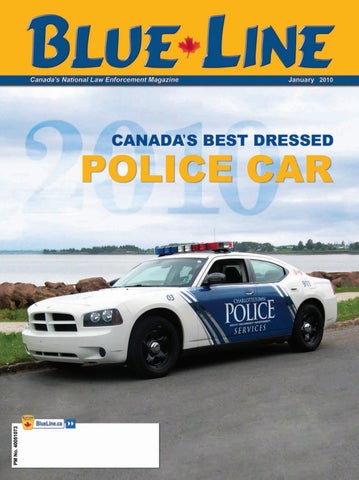
This month’s cover presents a Charlottetown Police car as the recipient of Blue Line Magazine’s Best Dressed Police Car for 2010. Read more about this cruiser, the runners-up and winners from other categories on page 6. This month features a host of articles and comments about the changing face of police fleet vehicles. We also feature the car selected as the fastest police car on the planet, the Mecedes-Benz CLS V12 S Rocket sedan. With 730 twin-turbo charged horses stampeding under its hood, the Rocket lives up to its moniker with a 225.19 mph top speed. Second in this class was the BMW 123d. Heaven forbid you should ever see one of these things in your rearview with its gumballs flashing. Outrunning it is not on your list of options.
Features 6
Canada’s Best Dressed Police Car
15 The perfect police cruiser 18 Budgets will not be saved by legalizing marijuana
9 Michigan State Police vehicle trials On the cusp of change
12 A police fleet revolution
20 The stigma of mental health problems
Departments
Case Law
38 38 32 37 36 5 16
33 34
Should police record checks include mental health information?
And now for something completely different
Advertisers Index Back of Book Dispatches Market Place Product News Publisher’s Commentary Technology
Blue Blue Line Line Magazine Magazine
33
Search reasonable to ensure officer safety Search on arrest does not require exigencies
January January 2010 2010
Invest in your career Take Blue Line training courses Mastering Media Opportunities, Trad’l & 2.0 Mastering Media Opportunities, Traditional and 2.0, is an introduction to the principles and practice of media relations in the world of ever expanding conventional and new media public affairs. It will help you understand how to fine tune your audiences and craft key messages for broadcast media, print and web 2.0 (blogs, new media and the Internet). You will get the opportunity to create messages for a topic of your choosing and practice using them in an interview that will be recorded and debriefed. Instructor: Allan Joyner
Cell Phone Forensics Mobile Forensics Inc, the leader in mobile phone training brings a one day course that will introduce you to legal issues, service providers and current methodologies utilized in cell phone forensics. This course will prepare you to realize the need for cellular evidence from the carrier and device and learn the steps necessary to secure this valuable evidence. The course will also cover tools that are currently used for both physical and logical examinations with actual live extractions during the presentation. Topics include: • Court Paperwork • Radio Isolation: First Responders and Examiners • Troubleshooting • Software Tools • Hardware Tools • Completed Reporting Instructors: Bruce Downey, Lee Reiber
FREE admission, with course registration, to the Blue Line Trade Show. Canada’s largest law enforcement exhibition of the latest products and in demand services. Course location offers FREE parking, easy access to several major highways, a wide range of hotels, restaurants and amenities.
April 27 & 28, 9am - 4pm
January 2010
4 Line Magazine Pre-registration & Info atBlue BlueLine.ca
Publisher ’s Commentary by Morley Lymburner
Overseas missions must consider a hierarchy of needs Sending Canadian police officers on “training missions” to teach people how to police in a war zone is complete folly. The citizenry will probably not understand the difference between police and soldiers and the Canadian police officer is confronted with a war zone they are not psychologically prepared to cope with. How can a civilian police officer teach people to keep the peace when there is no peace to be kept? Given Maslove’s second hierarchy of needs, these war torn countries must first have national security and adequate shelter, safe water and food before they’re ready to learn such great western principles as community policing and self actualization concepts. Citizens of many countries see little distinction between police and the military and this problem becomes more acute in countries like Afghanistan, where we place officers in war zones and treat them like soldiers. Not only are police not soldiers but, unless they come to the job with previous military training, they are not physically or (especially) mentally ready to take on the challenges of a soldier. Everything a police officer does outside of martial arts and firing a gun is foreign to soldiering. Soldiers are taught, for the most part, to take commands without question and work in groups against a clearly identifiable enemy. The day to day soldiers life is generally uncomplicated. A large part of the training process ingrains a culture that not only stresses the importance of teamwork but also how to psychologically handle taking a human life. Military trainers know the stress of placing soldiers in war zones and teach them to de-humanize the target to the point that the
Blue Line Magazine
enemy is sub-human; killing them is no more traumatizing than taking the life of a rabbit or vermin. This is not an easy task and, given the wide range of people being trained, not always completely successful. To compensate, soldiers are taught such things as comradeship and pride of unit (or family, if you will). Another way the military structure gets around the stresses of the job is by ensuring large numbers are brought to bear in a battle. The more successful rotate soldiers out of frightening war zones so they are not overly impacted by the sights and sounds of the battle. Core training includes ingraining a sense of invincibility, along with a belief in their superiority over the enemy, so new arrivals are kept segregated from the wounded and dead as much as possible. In short the modern military has a studied approach to war that is purposefully designed to ensure maximum health (physically as well as mentally) so that the home-coming soldier is returned to as reasonable a proximity of regular life as is possible. None of this occurs with police officers, who are hired for a long term engagement and taught specific skills which enable them to work with people on a one to one basis. They are taught to enter a strife-filled situation with the intent of resolving conflicts and restoring, as much as possible, the peace which existed prior to the problem arising. Virtues valued in policing include the ability to show empathy toward victims and problem-solve. In this respect, every officer is a general, not a soldier – but unlike the military, they are not taught to dehumanize a
5
target on command or kill when ordered with minimal emotional impact. They are most certainly never taught how to cope with war zone situations and post traumatic stress is very low on the priority scale.. I was horrified to hear that police officers have been routinely trained on military weapons because they may need to use them in some of the locations they are sent. If this is a requirement, then I would suggest the area is not quite ready to learn about community problem solving techniques. It would be much wiser to first let the military do its job. Send police in to show a better way when a region is stable – not just anticipated to be stable. In the mean time I would suggest a much better approach would be to sponsor a “train the trainer” process. Send the brightest and best from afflicted countries to a Canadian police college, where they will learn a better way of dealing with the public and meet much better role models to emulate. They will learn from Canadian recruits and experienced staff who share common beliefs. Once indoctrinated with Canadian style policing concepts and previously armed with their own cultural understandings, they will be far better prepared to incorporate what they have learned in their homelands. A secondary benefit will be a reduction in psychological issues experienced by returning police officers attempting to re-immerse themselves in peace-time Canada. Make sure a country’s first four needs are met before jumping into the fifth – policing.
January 2010
2010
Canada’s Best Dressed
1
st
by Dave Brown
Twenty years ago, trying to choose Canada’s best dressed police car would be like trying to find the shiniest vehicle at a Kandahar car show. Now, with the graphics talent of Canada’s police and law enforcement agencies, selecting the finalists is more like picking the winners of a Los Angeles beauty pageant; there really are no losers. Erik Young and his panel of judges at policecanada.ca have once again chosen the most creative finalists and Blue Line Magazine selected the winners. Vehicles are judged on a scale that awards points for creativity, community identity, visibility and readability. We reward strong and unique designs and appreciate vehicles that communicate their purpose clearly and simply without resembling mobile ransom notes. We especially love ‘branding,’ where agencies use a consistent design throughout their department. Here are the 2010 winners. January 2010
6
Canada’s Best Dressed Police Vehicles Charlottetown Police not only created an appropriately themed design for its vehicles but has, for the first time, incorporated chrome striping – literally reflecting the community they police. I can not recall another agency that has taken such a bold creative (and I dare say expensive) step which sets a new standard in decal design. The lettering follows a standard of clarity of purpose, combined with regional identity. The word “Police” is prominent and the letters set on a field of blue is reminiscent of the city’s maritime roots. Once again we find a police service that carries its police vehicle design as a departmental branding, duplicating the textual designs and colours across all vehicles, signage and corporate identity on letterheads and documents.
Blue Line Magazine
2
Waterloo Regional Police earned second place honours by following a new trend toward high contrast colours, defining a traditional police design revived by the Ontario Provincial Police. Waterloo uses a deep navy blue rather than black, accented with a curving red stripe intersecting with a prominent “Police” motif covering the width of both doors – a striking design which is quickly identified by the public.
ND
The southwest Manitoba community of Morden takes third place thanks to its use of colours in a conservative fashion, yet in a manner which appropriately outlines the profile of the vehicle for high visibility in inclement weather conditions. Once again we find a prominent identity with the word “Police” and a secondary recognition of the community patrolled. Appropriate placement of the department badge to the left of the word “Police” recognizes the corporate branding so necessary for today’s police services. Placing the departmental badge on the outside of the cruiser also gives continuity to the badges, helping people to recognize officers when they are outside their vehicles.
3
RD
1
st
Best Dressed Tribal Police The Rama Police Service takes first place in the First Nations category. Patrolling the shores of Lake Couchiching, north of Lake Simcoe in Ontario, it has effectively used blue lettering with a yellow outline on its vehicles, both for clarity of design and to reflect the Chippewas of Rama First Nations heritage of fishing the lakes. Part of the long-standing Chippewa Tri-Council of communities in the Lake Simcoe area, Rama First Nation has always been a traditional meeting place and the bold intersecting sweeps of its design reflect this meeting of equals. This is an excellent example of a clean and seemingly simple design but with a strong underlying message about the community and its heritage.
2
ND
Second place goes to the Kativik Regional Police Force (KRPF), which patrols all of Quebec north of the 55th parallel. This region, known as Nunavik, makes up an entire third of the province. The versatile force patrols a vast area and the bold bear paws on the sides of its vehicles reflect not only the traditional respect area residents hold for the area’s great roving bears but also the fact that they’re one of the force’s constant workplace hazards. The remarkable yellow and brown of the design looks a little like a flat horizon stretching off to infinity during one of those northern sunsets, which seem to last for weeks.
3
RD
The Kahnawá:ke Peacekeepers patrol the Kahnawá:ke Mohawk Territory on the south shore of the St. Lawrence River. It chose a white drop-shadow effect on red lettering and sweeping graphics of red and white across its vehicles in a design reminiscent of the shores of a great river rising upwards to its banks. Its third place design is clear and concise and the placement of the community police phone numbers stands out exceptionally well. Blue Line Magazine
7
January 2010
1
st
Best Dressed Law Enforcement The OC Transpo Special Constables patrol the transit system of the Ottawa-Carlton area and its newest design uses sweeping red graphics against a white car. It even includes a distinctive maple half-leaf poking out from the front wheel well. This unique and minimalist design reflects the effort that has gone into it while illustrating how much work goes into making the best designs look clean and effortless. Now if only they can do a retake on the confusing corporate name (OC to me is Orange County – not sure why!)
Aussie patrol car causing buzz
1
st
Best Dressed Police Promotional No matter how extreme, promotional vehicles still need to convey a professional image. One example is the 2010 best dressed promotional vehicle, Miramichi Police Service’s Chevy SSR. Community police vehicles are designed more for show than patrol so this is where agencies can get creative in selection and design. Examples range from the wildly impractical to full-out race cars. One important factor, however, is that sooner or later, some officer will pull up in front of a high school or drive in a parade and in those situations you want most people saying “cooool!!!” Miramichi’s design is clean and simple, conveying both fun and professionalism without looking like it’s just pandering to youth. Plus, unlike some other ‘clown car’ entries, this one looks like it could pull someone over if need be. To submit a vehicle for next year send pictures and descriptions to Dave Brown at bestdressed@blueline.ca or policecanada.ca
January 2010
8
A prototype of a “smart” police car which may be manufactured for the Los Angeles Police Department (LAPD) was put on display last November. The car is the work of a Melbourne, Australia, company, National Safety Agency (NSA), that specializes in innovative technology development for emergency services operations around the world. The L.A.P.D. Pontiac G8 is a prototype designed to showcase the technology NSA has been working on over the past two years for both domestic and international agencies. NSA Director Des Bahr reported to local media that the Pontiac employs several new features specially designed to improve officer safety, efficiency and reduce cost. The most notable is the police computer screen being molded directly into the dashboard. The company was able to integrate many of the separate technologies used by law enforcement agencies into the single platform. “We’ve created a virtual police station on wheels,” Bahr says. Much of the work on the Pontiac was also used on the company’s Emergency Services Concept Vehicle. It is an Australian built Holden Commodore design and built to a national standard, unlike current law enforcement vehicles that conform to individual state requirements. NSA has worked with Holden, a GMC owned company, for over two years on the project. It is believed American law enforcement agencies currently have approximately 80,000 Ford Crown Victoria sedans on fleet but the aging car is due to be phased out next year. This leaves a large hole in the police fleet market. Most forces require V8-powered rear-wheel drive sedans and the Dodge Charger has been adopted by some police forces, but Bahr believes the Pontiac represents a safer and better-equipped option. In addition to the LAPD Bahr says the RCMP, as well as agencies in the UK and around the world, have shown interest in the prototypes. The car, which costs $25,000 to $30,000, has an in-dash computer, in-car video, license plate readers and a heat detection device in the grill to detect people and animals from a considerable distance. Its seats are custom-made for the department’s officers, with space for their particular gunbelts and vests. The next version of the police car would also have cooling ducts in the seats. LAPD is shopping for a manufacturer willing to build a fleet of these police cars in the U.S.
Blue Line Magazine
2010
Michigan State Police
vehicle trials
On the cusp of change by Dave Brown Okay, we confess. It would appear that we have reprinted the Michigan State Police (MSP) vehicle trials test data the past few years, simply cutting and pasting text and figures, adding a year to the headline and tweaking a few of the numbers, which only vary slightly from year to year. This is all due to change in 2011. In the meantime, police cars are faster, better built and more capable of handling the real life conditions encountered in the real world. They may seem to lead pretty dull lives, doing nothing more extraordinary than burning fossil fuels, but police cars are not like fire trucks; they don’t drive around in parades, act as backdrops for calendars or get their wheel nuts polished daily. They act as office, transportation, jailhouse and protection to the street officers. Their primary job is to keep officers safe during their shift and get them home safe at the end of the day. If a few million-year-old dinosaurs and a couple of fenders get sacrificed to that end, so be it. New police models are due for 2011, so these 2010 vehicles may be considered the most refined designs of the past decade – but no matter how polished the design, the reality is that there will never be one perfect police vehicle. Selecting an agency’s fleet will always be a complex task. Head-to-head testing will always be valuable in assisting agencies to make those important decisions. MSP annual vehicle tests Every fall the MSP, in conjunction with the US National Institute of Justice (NIJ), test the handling and performance of every new police vehicle on the market for the coming year in back-to-back acceleration, braking and lap time tests. These tests are seen as the most comprehensive analysis of police vehicles in North America and the results are eagerly anticipated by officers and bean counters alike. The MSP publish the results on its web site (www.michigan.gov/msp) and Blue Line MagaBlue Line Magazine
zine is once again reporting the preliminary figures. Final figures and a summary of the results should be ready by the time you read this article. Vehicles Police vehicles are evaluated in two categories: police package – designed for the full spectrum of general police activities, including high-speed pursuit; and special service – designed only for specialized duties such as canine units or adverse weather conditions and not intended or recommended for pursuits. Eight vehicles were submitted in the policepackage category for 2010: • Chevrolet Impala 9C1 (standard and E85 [85 per cent ethanol] versions) • Chevrolet Tahoe PPV (standard and E85 versions) • Dodge Charger (3.5 litre V6 and 5.7 litre V8) • Ford Police Interceptor (3.27:1 and 3.55:1 final axle ratios) Here are the preliminary results, with our comments. Police package
Chevrolet knows how to build police cars and probably understands handling dynamics better than anyone. The Impala is possibly the most nimble police car on the road today but comes up short in one crucial area – space. Inches matter and with the Impala, it is a matter of a few inches of shoulder room that is lacking. GM did a remarkable job of taking a transverse V6-powered front-wheel-drive car and turning it into a police interceptor, but those few inches of missing shoulder room has prevented the Impala from winning the market share it deserves, especially with agencies that run a 9
lot of two-officer patrols. The company is adding an entirely new Australian-sourced (think Holden/Pontiac G8/ Chev Camaro) platform in 2011; a rear-wheeldrive long wheelbase sedan with a 6.0 litre V8, 6-speed automatic transmission, four-wheel independent suspension and a clever in-dash touch-screen computer that can be tied into the onboard radio system. The new Caprice is to begin being built in Australia in Dec. 2010, for sale to US police (no retail sales) - the company was still deciding in December whether to offer it here. The 2010 Impala, which will continue here, can out-handle just about anything else on the road in real-life street conditions, especially when the snow begins to fall. It is equipped with heavy-duty oil, power steering and transmission coolers, heavy-duty front and rear stabilizer bars and fully independent front and rear suspension with increased ride height springs. It comes with remote entry and programmable lockout protection, remote start and optional fleet-wide key and door remotes. The Chevrolet Tahoe is still the dark horse in the Government Motors stable. GM has worked hard to ensure this truck stays competitive with everything else on the market. It is roomy, fast and intimidating. The company has added a brand-new six-speed transmission for 2010 and dropped the final drive ratio from last year’s 3.73:1 to 3.08:1; that improves mileage significantly while maintaining (and even improving) acceleration and top speed. First tested in the police-package category in 2005, the Tahoe has proven to be a durable and increasingly popular choice. Officers who drive it for the first time come away impressed by its speed, tight turning radius and, of course, the front shoulder room. Two well-equipped officers in winter gear can easily fit into the front seats with plenty of room to spare for a switch panel and laptop. You may even be able to fit a Smart car in the back, though why you would want to do this is, of course, a different topic entirely. January 2010
The 2010 Police Interceptor comes with power pedal adjustments and can be equipped with a limited-slip 3.55:1 rear axle (electronically governed to 120 mph) or a non-limited-slip 3.27:1 rear axle (governed to 130 mph.) Ballistic door panels and an onboard fire suppression system with both automatic and manual operation are still popular options for 2010. Fiat owns about 20 per cent of Chrysler and appears to have operational control (the United Auto Workers union is the majority owner, last time we checked). Fiat also owns Ferrari. We here at Blue Line are not expecting officers to be driving around in Fiat X1/9s or Ferrari 550 Modenas, soon. However, Fiat is well aware that the Dodge brothers have been building hairy police cars for many decades and the two Dodge Chargers in this test are becoming more popular every year. Plagued by early reports of premature transmission failure and short brake life, the latest version of the Charger may be more refined but is still, in the great Dodge tradition, the most aggressive-looking police car on the market. The police Charger is rear-wheel-drive, with either a 3.5 litre V6 or 5.7 litre ‘Hemi’ V8. The majority (75 per cent) of North American police customers choose the V8 and it is still the fastest accelerating police car on the market. The Hemi uses Dodge’s Multiple Displacement System and a five-speed automatic transmission to ensure EPA mileage figures actually equal the smaller V6. Both Dodges come standard with Chrysler’s Electronic Stability Program (ESP), which uses the ABS brakes, traction control system and yaw and steering angle sensors to help keep the car stable at the edge of control. The police version comes in three modes: ESP on to enhance stability; partial off to disable traction control at low speeds; and full off while still retaining full ABS braking.
There may be more Chev and Dodge cruisers on the streets these days but Ford sells more Crown Victoria Police Interceptors than everyone else combined. It still holds 75 per cent of the police market and, just to illustrate how ubiquitous this car really is, when Ford announced it would be replaced in 2011, both officers and chiefs across North America were diving on their ceremonial swords. The Crown Vic was one of the last remaining body-on-frame cars on the market; Ford stopped selling the last civilian version two years ago. With its solid frame and live-axle rear end, it may be ‘old school’ but that is exactly the kind of toughness officers have appreciated for years. Ford has promised to maintain the traditional qualities of the Police Interceptor in a purposebuilt police car that may also be sourced from Australia, though Ford says it will be engineered and built in America. For some reason, commonsense Australians still seem to value tough, wellbuilt rear-wheel-drive cars; a lesson that both Ford and GM are keeping in mind. January 2010
The tests MSP and the NIJ’s National Law Enforcement and Corrections Technology Center (NLECTC) test all the vehicles together over a three-day period at the Chrysler Proving Grounds and Grattan Raceway. Each vehicle is tested without rooftop lights, spotlights, sirens or radio antennas in place. Tires are original equipment rubber provided by the manufacturer. Acceleration, braking and top speed tests are performed at the Chrysler proving ground and vehicle dynamics tests are done using the two-mile road course at the Grattan Raceway. (All dimensions and measurements given are US numbers.) The results Vehicle dynamics testing The objective is to determine the high-speed pursuit handling characteristics. Except for the absence of traffic, the two-mile road course simulates actual pursuit conditions, allowing the blend of suspension components, acceleration and braking ability to be evaluated. Four different drivers test each vehicle over an eight-lap road course, with the five fastest laps counting toward each driver’s average lap time. Final score is the combined average of all four drivers for each vehicle.
Acceleration and top speed The objectives are to determine each vehicle’s acceleration from a standing start to 60, 80 and 100 mph and to record the top speed achieved within a distance of 14 miles from a standing start. Each vehicle is driven through four acceleration sequences, two in each direction to allow for wind. Acceleration score is the average of the four tests. Following the fourth acceleration sequence, each vehicle continues to accelerate to its highest attainable speed within 14 miles of the standing start point. Braking The objective is to determine each vehicle’s deceleration rate on 12 60-0 mph full stops to the point of impending skid, with ABS on. Each vehicle is scored on its average deceleration rate. Each test vehicle makes two heat-up decelerations at predetermined points on the test road from 90 to 0 mph at 22 ft/sec2 using a decelerometer to maintain rate. The vehicle then turns around and makes six measured 60-0 mph stops with threshold braking applied to the point of impending wheel lock, using ABS if so equipped. The sequence is repeated following a four-minute heat-soak. Initial velocity of each deceleration and the exact distance required is used to calculate the deceleration rate. The resulting score is the average of all 12 stops. Stopping distance from 60 mph is calculated by interpolating results. Ergonomics The objectives of the ergonomics and communications tests are to rate a vehicle’s ability to provide a suitable environment for patrol officers to perform their job and accommodate required
Vehicle dynamics testing chart
Acceleration and top speed chart
Vehicle braking chart
10
Blue Line Magazine
communication and emergency warning equipment. The relative difficulty of installing this equipment is also assessed. A minimum of four officers independently evaluate each vehicle on comfort and instrumentation. MSP Communications Division personnel then evaluate each vehicle on the ease of installing equipment. A total of 28 factors are evaluated on a scale of one to ten and averaged among all the testers. The final score is the total cumulative score from the average of each of the 28 factors, including seat design, padding, ease of entry, head room, instrument placement, HVAC control placement, visibility, dashboard accessibility and trunk accessibility (2008 figures).
Ergonomics chart
Fuel economy chart
Fuel economy While not an indicator of actual mileage that may be experienced, the EPA mileage figures serve as a good comparison of mileage potential from vehicle to vehicle. Scores are based on data published by the vehicle manufacturers and certified by the EPA. Test vehicle specifications chart
(Preliminary reports – All specifications are subject to change)
Blue Line Magazine
11
January 2010
Vauxhall
by Morley Lymburner Since the beginning of motorized police patrols North American manufacturers have held the lion’s share of the police fleet market. Chrysler, General Motors and Ford have dominated for more than 100 years. The big three have learned some hard lessons in recent years and watched their sales drop substantially. Police fleet managers have remained loyal but taxi, government and industrial fleets have not. Almost anything goes in these areas and most of it hinges on the bottom line rather than the blue one. Canadian police market A recent Blue Line investigation of the Canadian police vehicle market indicates a niche that no car manufacturer can ignore. There are 22,567 police agency vehicles on the road (2007 figure) and agencies generally rotate a third of their fleet out of service each year. This means an annual market in Canada of more than 7,500 vehicles, and this is just police. Add other government agencies such as military and federal, provincial and municipal law enforcement and you’re talking at least 30,000 vehicles. Surprisingly, approximately 52 per cent of police fleet vehicles are unmarked. This is significant because these are the easiest to convert to police use since they require little in the way of external markings and don’t have to meet patrol car standards. It is easy to see a niche for imported vehicles, a shift which could lead to Asian and European built patrol cars. January 2010
Peugot The fear factor There is still a significant fear factor in police fleet sales. The stigma attached to buying offshore is now off-set with the recognition that most foreign manufacturers build, assemble or at least have a significant presence in Canada and the US. These manufacturers employ a growing domestic workforce in both production and sales and an increasing number of people have a stake in their success, including dealership owners and employees. The often heard argument that profits go off-shore ignores the reality that an increasing number of North Americans own stock in the companies and collect dividends. The automotive industry is a multinational business; the big three North American manufacturers have significant investments and partnerships with European and Asian counterparts and import cars and parts from many countries. Employment is another common factor which community leaders must grapple with. The fiscal belt-tightening at many government levels tends to reduce this impact. Once faced with products of equal quality and utility most 12
taxpayers would quickly recognize the importance of reducing costs. The watershed year, of course, has been 2009. The topsy-turvy world of high finance has seen all North American car manufacturers either hitting the skids or coming so close they could smell the scorched earth. They quickly kicked into survival mode, directing their attention to consumer sales and countering the impact of all that negative publicity. All three manufacturers cut vehicle lines and Ford announced it will soon stop making the most popular fleet vehicle of all time – the Crown Victoria. Both Chrysler and GM have for years fiddled and tweaked a consumer line car in an attempt to beat back Ford’s dominance and popularity. The Charger and Impala have made considerable inroads, with smaller size translating to lower costs. The sales challenge The manufacturers’ sales teams face unique challenges when dealing with the police market. Unlike military or other federal or provincial agencies, selling to police forces means delivering a convincing sales pitch to a large number of small, medium and large services. It’s not as simple as meeting one RFP requirement for a large sale to the feds. Instead, they must tailor a proposal to the RCMP, which has 7,000 patrol cars, the OPP (2,400), Sûreté (2,100), Toronto Police (1,400) and Montreal (1,200). Sales to these agencies may lead to purchases by smaller forces, who tend to follow the lead of their larger counterparts – but not always. Blue Line Magazine
The larger agencies often do not set the trend for the industry. The requirements of meeting large turn-overs means sticking to the “tried and true.” They have been known to watch with interest the experience of smaller and more flexible organizations. Geography and climate varies greatly across this huge country and a careful eye must be kept upon the novel solutions of some regional law enforcement agencies. With all this in mind Blue Line began looking into some blue-sky alternatives to the “big three” for police patrol. The exercise is important on at least two fronts – finding a more stable supply of suitable replacement vehicles for aging fleets and waking up the existing manufacturers to the magnitude and importance of this market. The contenders Vauxhall: Despite the compact “puddle jumper” from the 60s that we in North America remember, this British-made GM vehicle is popular for its large passenger compartment and powerful engine. Kia
Kia Magentis: The size and price of the Magentis makes it the “almost police car” candidate. The V6 engine is less powerful than the typical North American police V8, but more police agencies are finding the V6 adequate for most patrol work. Simple comparisons with the Crown Vic reveal the Magentis is only marginally smaller but a far better bang for the buck.
Audi Audi A6: Used for some police work in Britain and Germany. Classed as a midsize sedan, with dimensions comparable with the Chev Impala. What kills it in North America is a whopping base price of just under $53,000. Most of the price issues are due to high import duties.
Nissan to Ford and Impala and it’s probably worth a look as an alternative to the Crown Vic. Citroen
Citroen C5: Recently has made a serious push toward the European emergency vehicle market with its C5 V6 HDi. Its selling points include a green theme with a high performance but fuel efficient engine. Mazda
Mazda: Mazda’s innovation makes it a good candidate for alternative fuel vehicles in the future. Currently used as a patrol vehicle in South Africa, its value to performance ratio has earned it a good reputation. Honda
Honda Hybrid: The Ontario Provincial Police uses hybrid Accords for some specialty patrols. Although undersized for two-person patrols it holds its own as a one person urban patrol vehicle or a specialty response car. It comes with a low price tag and high fuel savings. Engine performance and durability is almost legendary.
BMW
Lexus BMW 5GT: Although heavily used in Europe, it suffers from the same fate as all nondomestic vehicles – high price. Nissan Altima: Another contender for police fleet sales. Its fleet prices would be very close Blue Line Magazine
Lexus ISF 250: The vehicle of choice for Britain’s Humberside Police. Said to have impressive performance and handling and earns top marks for its aggressive looks, which are on par with the Dodge Charger. Price may be a factor on this side of the pond. 13
January 2010
Subaru
Toyota Toyota Avalon Pursuit: California Highway Patrol have been experimenting with the Avalon for two years and seem happy with its performance and durability. It is a mid-size sedan and seems to compare well against the Impala. The downside may be airbag placement but innovations in computer and communications equipment have made this less of an issue.
Skoda Skoda: Built in the Czech Republic, this vehicle has earned a great deal of respect in European markets, particularly Israel. Value for money seems to be the biggest benefit – but the car is not currently available in Canada.
January 2010
Ford
Subaru: A well respected police vehicle in China, Singapore and some South American countries. Suburu has an impressive array of models; the most likely candidates for Canadian police work appear to be the Legacy PZEV and the Impreza. As is the case with most Asian vehicles, price is a big factor in its popularity.
Hyundai Hyundai: Both the Sonata and Genesis seem to be good alternatives to the Impala and perhaps even the Crown Vic. The Korean manufacture is an aggressive competitor on price point and quality in recent years.
14
The pretenders The rumour mill is currently running rampant with the announcement of the Canadian-made Crown Victoria’s imminent death. Here is an overview: • The production tools, casts and dies are to be sold to a company that has ambitions to continue making the vehicle for police, taxi and government fleets. • Ford is importing a European vehicle and rebranding it the Ford Taurus. • Chrysler is keeping its rear-wheel drive Charger but may be doing some cosmetic upgrades to the grill and adding a few new accessories. • Chev may import the Vauxhall from its British roots. • Carbon Motors is still intending to begin large scale production of its “from-theground-up” police vehicle, but still can’t get the prototype across the border for the Blue Line Trade Show – we’re still working on it though!
Blue Line Magazine
by Cam Wooley It is fun to dream about the “perfect” police car and it’s a great exercise, since your view of perfection depends on your job description. It brings to mind the old tale of the three blind men describing what an elephant looks like by feeling its various parts. It’s all accurate but does not produce a complete picture. The front-line officers wish-list includes: • Enough room for tall/large cops in duty-gear to enter/exit quickly; • Space for both the driver or passenger to access the MWS and printer without contortion; • Easy access to long-gun; • Enough room in the back to place prisoners without struggle (in or out); • Great acceleration and decent top speed (at least 220 km/h); • Brakes that don’t overheat and fade in hard use; • Predictable, forgiving handling characteristics; • High level of occupant protection in collisions. Ask any collision reconstruction officer. Mass matters! Stopped police cars get hit – a lot; • Carries an image of “authority;” and • Looks cool. I can remember when Toronto Police had yellow Plymouth Volares which didn’t even have “real” sirens. The fleet guys would clip the wire off one of the two-tone horns to give them a distinct sound they hoped citizens would come to identify with a police car. What they ended up with was something that sounded just like the “meee-maaa” horns on a catering-truck. I am sure every time a Toronto officer hit their “sirens” the construction workers would head out for their coffee break. Many years ago I was dispatched to assist Blue Line Magazine
Toronto Police with a pursuit that had entered Hwy 401 near Allen Rd. I quickly caught up to the pursuit in my old black and white OPP Impala and the bad-guy pulled over right away for me. I asked him why he didn’t stop for the Toronto cars. “Would you pull over for THAT?,” he replied, pointing at cruisers which looked more like yellow cabs. On the more or less positive side, Joni Mitchell, in her enviornmental song of the late sixties entitled Big Yellow Taxi, referred to the Toronto Police car as the “big yellow taxi” that took away her “old man,” but few who have not seen them would ever associate the lyrical lines in the same way. Thankfully the Toronto Police got rid of the “big yellow taxis,” in 1986 and have since conformed to a more contemporary police car look. Government/management’s list is always shorter: • Cheap to buy; • Cheap to fuel; • Cheap to fix; • Slow enough to reduce lawsuits from high-speed crashes; • Friendly “green” look; and • Built by local workers (translated as “voters”). Auto manufacturers have the shortest list: • Make easy money with minimal engineering (See Chev Lumina, Ford LTD II, Dodge Volare and Intrepid) Over the years there has been much discussion about the suitability of using imported vehicles for police use. There have been a number of arguably “brave” police services who have tried out European patrol cars – everything from Saab to Volvo. Most, if not all, were ultimately 15
unsuccessful. It is really an “apples & oranges” thing. Most European countries are densely populated, with tight, comparatively narrow roads and streets. Fuel prices are very high, so many patrol vehicles are diesels. The largest Euro-police cars could be chartitably described here as “mid-size,” while the majority are “compact” or “sub-compact.” For example, the Mercedes E-Class is considered a decent patrol car in Europe and is also the main platform for taxi-use, but put a cage in it and it is pretty cramped. There are some larger platforms that I feel would make fantastic police cars: Audi A8, BMW 7, Mercedes S Class. All of these meet the frontline officer’s list. The problem is they are way off the government/management and auto manufacturer’s list. Besides cost, the manufacturers feel selling them as fleet units would “cheapen” their high-end models. The other thing to keep in mind is that some vehicles are more suited to certain police duties than others. One size does not fit all. While there are some decent picks like the Holden, Porsche, BMW and Mercedes being used around the world, there are too many factors against them for acceptance in North America. Right now I would pick the pursuit Tahoe for highway and rural police work. For city work, look at cross-overs like the Ford Edge and GMC Acadia. Cam Wooley is a Toronto area broadcaster who retired
after more than 30 years with the Ontario Provincial Police. He has extensive experience in traffic, including accident reconstruction, equipment and fleet purchasing and RFP standards.
January 2010
Technology by Tom Rataj
Police fleet shake-up on the horizon The long market-dominance of the police car standard, the Ford Crown Victoria Police Interceptor (CPVI), is finally coming to its oftrumoured end with the closing of the St. Thomas assembly plant in late 2011. Ford is developing an all-new, purpose-built police interceptor vehicle which is scheduled to replace the CPVI in late 2011, with no supply interruption, but has offered few additional details. General Motors has also unveiled an allnew, purpose-built police patrol vehicle which will be available only to (so far) US law enforcement, releasing details at the IACP Conference. Chrysler rounds out the established brands patrol vehicle line-up with its Dodge Charger. While not purpose built, the police version offers high-performance, heavy-duty enhancements designed to survive the rigors of patrol work. Carbon Motors promises will change the entire police fleet market in 2012 when it begins delivering its purpose-built, diesel-powered patrol car, currently code-named E7. Prototypes have already been demonstrated in the US. Goodbye Crown Vic Citing a continued commitment to the police and municipal vehicle business, Ford announced the CPVI replacement in mid-November, devel-
January 2010
oped with extensive and ongoing consultation with its police advisory board. Overall occupant safety, driver comfort and convenience and vehicle performance and durability are key areas of focus, Ford says. Improved quality, durability and fuel efficiency will reduce fleet costs, Ford says. It promises to reveal more details and specifications in the first quarter of this year so agencies and aftermarket equipment manufacturers will
16
have time to adapt their product lines. The automotive news media has speculated that the new car will be based on the current generation Ford Taurus SHO sedan, which offers a sophisticated twin-turbo 3.5 litre EcoBoost V6 engine rated at a healthy 365 hp and 350 lb.-ft of torque. That’s equal to many V8s with the fuel economy and weight of a V6. A six speed SelectShift automatic transmission sends that power to the front wheels, while the standard Taurus also offers all-wheel drive, a helpful feature for police operating in mountainous and snow-prone areas. This engine and transmission combination would offer respectable high-speed pursuit and response capabilities, better fuel economy (12.3L/100 km city and 8.0 hwy) and lower emissions. The interior of the civilian Taurus would need to be heavily modified to accept all the typical patrol equipment found in modern police vehicles. The back seat is a little snug for clients, although the large trunk would certainly offer more than adequate capacity for storing equipment. Welcome back Caprice A new Chevrolet Caprice police patrol vehicle will return to duty in early 2011 after being absent since 1996 – but it may remain absent on this side of the border. “Currently, the business case for adding this vehicle to the Canadian portfolio is under review,” said GM Canada’s George Saratlic in early December. “If the business case is positive, we are confident the product will be well accepted.” Chev will continue offering the Impala to Canadian police. Chevrolet has released extensive information about the new car and, as with the Crown Vic replacement, it will not be based on an existing civilian passenger car – or at least not a North American model. Built on GM’s global “Zeta” platform (also used on the Camaro), the new Caprice will be based on the Australian-built Holden Commodore/Chevrolet Caprice. Holden is GM’s Australian subsidiary, which was also responsible for the short-lived but well received 2009 Pontiac G8. The new Caprice is to come with a 6.0-litre V8 engine, said to take it from 0-96 km/h in less than six seconds. Rated at 355 hp and 384 lb.-ft. of torque, it is mated to a six-speed, police-duty, performance-calibrated automatic transmission driving the rear wheels and features Active Fuel Management and E85 (85 per cent ethanol, 15 per cent gasoline) capability. A V6 engine will also be offered in 2012. Interior volume is to be greater than the outgoing Crown Vic, offering an additional 10cm (4”) of rear leg room which, more importantly, adds greater front-seat travel for the good-guys and gals up front. The 535-litre (18 cubic-ft.) trunk features a full-size spare and room to accommodate all the usual police equipment. Blue Line Magazine
The typical array of engine-oil and transmission-oil coolers are planned along with heavy-duty 4-wheel disc brakes behind 18” steel wheels, controlled with heavy-duty suspension and police-calibrated stability control system. GM appears to be quite serious about the new car because it is also actively designing and testing police-specific seats designed to accommodate all the equipment typically found strapped to an officer’s waist. It will offer two trunk-mounted batteries to support all the onboard electronics and computer equipment. Front seat only, side-curtain airbags will also be optional, providing added protection for the driver and passenger. The dashboard is designed to accommodate computers and other police electronics and an available factory installed “technology” package will feature a purpose-designed, multifunction touch screen dash mounted display, greatly simplifying vehicle preparation. Keep on charging Chrysler’s Dodge Charger police model continues with few substantive changes. The newest-generation 5.7-litre V8 Hemi with fuelsaving Multi-Displacement System (MDS) is mated to the rear wheels through a 5-speed autostick transmission. The engine has 368 hp and 395 lb.-ft. of torque, although the MDS system cuts fuel usage by 20 per cent by deactivating four cylinders while cruising at a steady speed. A less-potent high-output 3.5-litre V6 engine will be standard. It offers 250 hp and 250 lb.-ft. of torque through the same transmission. All the usual safety features (ABS brakes, Electronic Stability Program and traction control come standard. Front passengers are protected with advanced multi-stage front airbags and side-curtain and seat-mounted air bags. The fuel tank is saddle-mounted near the centre of the car, providing additional protection against being punctured during high-speed rear end collisions. The usual assortment of heavy-duty police specific suspension and brake upgrades continue along with engine-oil and transmission coolers and performance-tuned steering. “Easy Path” wiring grommets link the engine bay with the passenger compartment, making vehicle preparation easier.
The proposed speci would turn the police vehicle market on its head. Equipment, much of which is not yet available on any police vehicle, will include NIJ Level III-A ballistic panels in the front doors and behind the dash, a thermal imaging system, 360-degree surveillance (includes prisoner compartment – with audio) and Automatic Licence Plate Recognition. The primary LED emergency lights are built into the roof for a very clean low-profile aerodynamic design, offering excellent 360-degree coverage, improved fuel economy on the highway and a higher top speed. Another innovation – the Carbon will be sold directly to police agencies in a complete turnkey solution which includes an end-of-vehicle-life process. While pricing has yet to been announced (I would expect it to be expensive), Carbon is already taking orders for 2012 delivery. Visit www.carbonmotors.com for more. Wish-list While all the manufacturers are tripping over each other in the race to build the next generation police vehicle, a few equipment items should be on all of their mandatory lists: • Great-quality, purpose-built front-seats with heating and cooling, lumbar support with height adjustment and seat-height and pitch adjustment, including length and firmness adjustment for thigh support. GM appears to be heading in the right direction by designing seats to properly accommodate duty belt laden waists. Here’s hoping we’ve seen the last of its flaccid, no support, lazy-boy style seats of the past. • Excellent headlights (preferably tracking High-
Intensity Discharge) are an absolute must. Most domestic manufacturer’s headlights seem to be more decoration than actually useful, as was my experience with the Ford CPVI. Fleet managers will probably break out in a sweat at the thought, but actually being able to see where you are going at night, especially when responding to an emergency, will hopefully keep officers (and their cars) out of harm’s way. • Laminated side and rear window glass to better protect occupants against assault and injury during collisions. Laminated glass also reduces road-noise for a quieter “office” environment. • Proper multi-speaker configuration for police radios. Single dedicated speakers generally produce lousy sound and are hard to hear over all the other noise in the cabin. A decent AM/FM radio could also take advantage of a multi-speaker arrangement. The long-standing tradition of taking a civilian passenger-car and adding heavy-duty and calling it a police vehicle appears to (thankfully) be nearing its end. Only Chrysler appears to be sticking with the old way of doing things. The most promising part of the new vehicles is that they are all being built specifically with policing in mind. They are either factoryequipped with a wide variety of police-specific equipment or provide mounting platforms and other equipment-ready systems. This will reduce vehicle prep times and make officers far more comfortable, safe and efficient. Tom Rataj is Blue Line’s Technology columnist and can be reached at technews@blueline.ca .
New kid on the block Carbon Motors Corporation, an upstart US based homeland security company, promises to soon introduce its all new, diesel-powered police vehicle. The company is yet to show a production-ready model but toured a prototype of the as-yet unnamed vehicle around the US last year. All specifications come from the company. The E7 platform vehicle will use a turbodiesel engine to drive the rear wheels. Displacement and configuration have yet to be announced but it is to have 250 hp and a whopping 400 lb.-ft. of torque, which is expected to propel it from 0-96 km/h in 6.5 seconds while delivering 28-30 mpg (US figures). From these figures, I would expect the engine to be a V6 with upwards of 3.0 litres displacement. The vehicle is to be assembled in the US using an aluminum space-frame rated to withstand a 75 mph rear impact. It will feature all the usual equipment, including all-wheel disc brakes with ABS and vehicle dynamic control. Blue Line Magazine
17
January 2010
Budgets will not be saved by
legalizing marijuana
This is the fifth and final submission on the legalization of marijuana issue. by Michael Klimm I have read the follow up article on David Bratzer’s views that marijuana should be legalized and taxed. Although he may have some interesting statistics I do not believe he has painted an accurate picture of the legalization of marijuana. Let me start with his first paragraph where he pointed out that he acknowledges that: • The status quo is not working, • Tobacco use has been reduced by increased education, • The profit motive for organized crime must be removed and finally, • Marijuana is not legal anywhere else in the world. I agree with all of these points and I discussed them in my first response. Mr. Bratzer is correct that marijuana is not a benign substance and there is evidence that marijuana is actually harmful to your health. There have been studies in the United Kingdom and published in the British Journal of Psychiatry
January 2010
that link marijuana use to mental health issues. Although I believe that marijuana is not as harmful as alcohol it is none the less a hazardous substance and becomes more dangerous in that marijuana is becoming more potent through selective breeding and improved cultivation methods. The active ingredient Tetrahydrocannabinal (THC) level in the early 1970s was around two per cent and today can go as high as 24 per cent. I see no reason to legalize marijuana just because it is not as harmful as alcohol. This is the “lesser of two evils” theory and Bratzer’s belief is that we must accept both evils equally.
18
One other factor not emphasized by the pro legalization group (a fact they would like to go away) is that THC is fat soluble. The implications of this on a sedentary population, gaining weight and dieting to lose it, can be obvious. THC will be stored in the body for long periods of time. Regular users, of course, have a desire for increased eating thus higher caloric intake and potential fat storage. Having these people on a crash diet while driving a car could very well end in a real crash with time and distance distortions the causative factors. Regarding the de facto decriminalization in the Netherlands. Organized crime in the Netherlands is still profiting by the sale of marijuana even though (by the statistics provided by Bratzer) the cumulative lifetime incidence of cannabis is only 19.4 per cent. Even if you legalized marijuana, organized crime would still profit because the taxes needed to properly regulate the cultivation and distribution of marijuana would be enormous. Organized crime could produce the product cheaper and would have a larger market because more people would buy marijuana because possession would not be an offence. By applying Bratzer’s rationale that it is too expensive to enforce the marijuana laws, I would suggest that the same argument could be used for other illicit drugs and even other criminal offences. Law enforcement should not be dictated by the cost but once we look at costs it should be noted that upon legalization costs would actually increase to a level that would make the public want to stay high just to keep from thinking about it. It is obvious that legalization would turn to regulation. Exactly how do you regulate a product that virtually everyone can produce? “Put a seed in the dirt and don’t forget to pay your taxes on what pops up.” You would be replacing police with Revenue Canada agents and bureaucrats chasing something which requires no special tools or expertise to produce. It would be like taxing grass. (I mean real grass). It would appear to me that you are trying to distance marijuana from other illicit drugs. Some people may not have noticed that with almost all large drug busts, marijuana is included in the seizure. I am certain that if you tried, you could probably justify the responsible and recreational use of cocaine and heroin as well. I am in no means suggesting they are even close to being Blue Line Magazine
harmless or that they should be legalized. Now we look at statistics. I find it interesting that in 2008, 53 per cent of the population supported legalization of marijuana, while only 44 per cent of Canadians have ever used marijuana and only two million use marijuana recreationally today. Actually, by Bratzer’s numbers, the majority of Canadians have never tried marijuana and just over six per cent use marijuana recreationally. I also find it difficult to believe that if 53 per cent of the population supported the legalization of marijuana that it would not become an election issue. I am certain that any politician looking for votes would endorse the legalization of marijuana if that many people wanted marijuana legalized.
Upon legalization Canada would still have to withdraw from the 1988 United Nations Treaty “The Convention against Illicit Traffic in Narcotic Drugs and Psychotropic Substances” to which Canada is a signatory. This brings me to my last point. These views that I have expressed are only my opinions and mine alone albeit backed up by some research.. As a police officer I am entitled to an opinion and we can debate this opinion ad nauseam. I am not entitled, however, to ignore the laws that I am sworn to enforce no matter what I think the law should or should not be. It is up to the citizens of this great country to elect our representatives who in turn make the laws that police officers are sworn to enforce. No matter how our marijuana laws or any other laws evolve, I will always
follow the direction of the citizens of Canada, and that is how our children and grandchildren will judge us. Michael Klimm is a Detective Sergeant with the York
Regional Police and may be contacted by email at 374@yrp.ca
This is the last of a five-part debate between David Bratzer and Michael Klimm on the legalization of Marijuana first presented in the June issue of Blue Line Magazine by David Bratzer of the Victoria Police Service. David manages a blog for Law Enforcement Against Prohibition. Previous pieces appeared in the June/July, August/ September and November issues. People wishing the full series may contact the publisher by email to publisher@blueline.ca
OPP shots are arresting
An Award of Excellence has been presented to the Ontario Provincial Police Museum for their outstanding travelling exhibit “Arresting Images: Mug shots from The OPP Museum.” The award was presented at the annual Ontario Museum Association (OMA) conference in Hamilton on October 22, 2009, where Museum Curator Jeanie Tummon and Museum Collections Co-ordinator Chris Johnstone proudly accepted the award from the Honourable Aileen Carroll, Minister of Culture. Arresting Images was launched in the spring of 2009 and has been met with intense interest on the part of the many visitors who have viewed the exhibit over the course of its travels this past year. The bilingual exhibit consists of a selection of 100 mug shots from the past, dating from 1886 to 1908. Among this rare and unique collection of mug shots from over a century ago are pickpockets, horse thieves and escaped fugitives to name a few. Since its launch this spring, Arresting Images has been tremendously successful during its visits to the Art Gallery of Peel, the Simcoe County Museum and the Guelph Civic Museum, the exhibit’s first three stops in its approximate five year journey across Canada. The OPP Museum has played a lead role in providing the historical context required to carry out the OPP 100th Anniversary this past year, and Arresting Images has proved to be an important and highly acclaimed element in celebrating “A Century Of Policing by the Ontario Provincial Police.” Blue Line Magazine
19
January 2010
The stigma of mental health problems Should police record checks include mental health information?
by Dorothy Cotton and Jane Letton The police record check (PRC) is a nebulous entity which goes by many names – vulnerable sector screening check, police reference check – the general public might call it “a CPIC.” It may be the same as a criminal record check – or it may be more. Its content varies from one jurisdiction to another. The PRC is generally an expanded check of a person’s record of contact with police. It is often used to screen applicants for employment or volunteer positions involving contact with vulnerable persons, but can also be requested for other purposes. It may include charges, non-conviction dispositions and some pardoned offences (such as sex offences) in addition to convictions. An agency sometimes requests a PRC through a contract with police. Other times an applicant may ask for the report and provide it to the potential employer. Procedural details and local variability aside, does it make sense to report an apprehension under the Mental Health Act (MHA) on a PRC? Consider the situation of Susan 1, who successfully worked in the social service field for nearly 20 years before experiencing her first period of severe depression, which ultimately led her to attempt suicide. A call to 911 for help led to police apprehending her under the MHA and a trip to the hospital. After treatment and time away from work, Susan recovered and attempted to re-enter the workforce. She consented to a PRC when applying for another social service position, unaware that the record would reflect her call to access emergency health care. Fortunately, Susan’s potential employer was able to deal with this information appropriately and she still got the job – but not without enduring the indignity of revealing personal health information and the very real fear that it would cost her the position. Many other applicants for employment, academic programs and volunteer positions have not been as fortunate as Susan. Whether the PRC merely indicated that there was “information of interest,” or specified that there was a MHA apprehension, the fact is much of the public – including employers – harbour suspicion and fear about mental illness. This is stigma, and it leads to discrimination. Police services have a great deal of discretion in developing record check policies, which has led to a wide variety of practice on what information is considered for a PRC. While there was never a directive or government mandate to include police contact under the MHA on a PRC, some services do include this information. In an informal 2008 survey, 20 police services across the country were asked the following question: “I have been offered a job working in a day care centre and I need a police record January 2010
check. If I have been apprehended under the Mental Health Act in the past, is that going to show up?” About half acknowledged that they always report MHA information and some 25 per cent said they sometimes report it, depending on the circumstances. The remaining quarter of those surveyed stated they did not consider this information relevant and never include it. Note that several other police organizations were not able to answer the question; they either did not know what their policy was or did not have one that spoke specifically to this question. Most of the police services which routinely provide MHA information on a reference check believed they were required to do so by some external agency or government directive. Most also said that the subject of the PRC would have to sign a consent form or waiver, thus ensuring that the information release would be voluntary – however, a review revealed that no consent form indicated that the MHA information would be included. Police services said it would be up to the individual applicant to decide whether to pass the information on to the employer, which put applicants in a difficult situation. A failure to consent to the PRC would likely result in losing the job or other opportunity – but consenting may lead to discrimination and violate the person’s right to keep their medical history private. Stigma and false assumptions about mental illness are rife. Research indicates employers are very uncomfortable when a history of mental illness is revealed and will actively avoid hiring people who have experienced mental health problems. In fact, the literature indicates they would rather hire people with a criminal record. They fear people with mental illnesses are unreliable and – far worse – dangerous. The belief that mental illness and violence are connected is widespread, yet largely inaccurate2. Similarly, there is also frequently a connection made between mental illness and a lack of reliability. There is no doubt some 20
people with mental illnesses are unreliable, but so are some people without mental illnesses. This is generally information that an employer finds out from previous employers and references and is arguably outside the realm of police work. The London Police Service (Ontario) has developed one possible solution to the problem of what mental health related information should be reported on a PRC. Its policy dictates that officers review the nature of any vulnerable populations which will be served, the environment where the job or activity is to take place, the nature of the activities, the specific nature of the relationship between the position being sought and the vulnerable persons and other relevant factors. This information is used to determine what the police service considers in its reports. This process provides a logical way to consider the appropriateness of releasing information that may be related to mental health issues. It is hard to argue that police should withhold information about ANY person – with or without a mental illness – if it can reasonably be foreseen to predict a level of risk to a vulnerable population. There are many positive features of the London model (and readers involved in providing PRCs who are not aware of it should definitely check it out3), however it does raise some concerns. Do the people who provide PRCs have the skills to do the type of job analysis necessary to make these sorts of decisions? Most would not have formal human resources training and are likely not familiar with formal risk analysis and the complex relations between mental illness and violence. They may also have the same stigmatizing attitudes toward mental illness as much of the population. How would London Police have handled Susan’s situation? Its model broadly addresses mental health issues but not specifically MHA apprehensions and does not preclude releasing all MHA information – however the service reports it hasn’t returned a positive record check on any person solely on the basis of an MHA apprehension since it began this policy. Other police services have opted to release MHA information. Consider the hypothetical example of “Carly,” a teen going through depression and harming herself. A classmate becomes concerned and tells a teacher, who feels compelled to call 911 so Carly can be assessed. Police take her to a hospital for assessment; she is released without treatment, graduates and enrols in university, pursuing a career working with children. Years later, applying for a childcare job, she needs a PRC. The police service involved in this case considered an MHA apprehension sufficient to indicate that there was “information of interest.” This was the only interaction with police Carly ever had, but it was enough for the employer to turn her down, citing their Blue Line Magazine
(also faulty) policy that anything “positive” on a PRC was unacceptable. This prevented her not only from obtaining this particular position but also made it difficult to find a course-related placement. A case much like Carly’s was filed with the Ontario Human Rights Commission, resulting in a significant Toronto Police Service (TPS) policy change. It now indicates that MHA apprehensions will no longer be reflected or considered as part of record checks unless an employer: • Specifically asks for it, and; • Certifies that there is a bona fide occupational requirement for the information and that it has made a conditional offer of employment/ volunteer opportunity to the applicant. Furthermore, the consent form the applicant signs clearly indicates that MHA records will be included only upon the employer’s request and outlines their obligations to the applicant. The results of the PRC are disclosed only to the applicant, who then chooses whether to disclose it to the employer/volunteer agency. The TPS has also implemented a review process allowing a person with a MHA record to request it be suppressed4. The TPS policy is clearly a significant step forward. It articulates many principles that should direct the behaviour of an employer trying to balance public safety and the need to protect a vulnerable population while also recognizing the rights of individuals under the Human Rights Code5 – but is it sufficient? As noted, the policy indicates that MHA information will only be released in instances where it constitutes a bona fide job requirement – but is there any job or position for which a history of mental illness is a bona fide exclusionary criteria? In a recent decision (Thompson v. Selective Personnel) the Ontario Human Right Commission held that asking an applicant to disclose psychiatric care on an application constitutes discrimination and “serves to classify applicants by disability or perceived disability,” which is contrary to the Ontario Rights Code. In other words, employers themselves are not allowed to ask whether a person has received or is receiving mental health treatment. There are jobs – like policing, for example – for which a degree of psychological fitness and certain psychological attributes are legitimate job requirements. One can legitimately refuse to hire an aspiring police officer who has an impulse control problem, for example, but can that conclusion be drawn based on a previous MHA apprehension? It would more appropriately come from looking at patterns of behaviour over time and a psychological assessment of the applicant, and this is what police agencies do. For the few jobs that may legitimately require psychological fitness, a mental health professional is the appropriate person from which to obtain that information. Just as police would not normally release information indicating that a person has suffered a back injury in an MVA if they were applying for a job unloading trucks, the onus should not be on police to act as a back door mechanism for obtaining mental health information. What about the concern that police are Blue Line Magazine
somehow liable if they issue a report of “no findings” in regard to a person who turns out to be a problem in the workplace? It has been argued that police have an obligation to report information that might be relevant to public safety. How does one avoid the stigma trap, but at the same time provide information that may address public safety concerns? Police agencies can make clear both to employers and applicants that MHA information is not contained in a record check and employers with a legitimate need should obtain this kind of information from a mental health professional. The burden for ensuring that appropriate employees are hired lies with the hiring agency, not police. A PRC was never intended to be a shortcut to obviate the need to check job references, review employment history and conduct interviews6. At the same time, employers can be assured that persons with criminal records or an enduring pattern of problematic run-ins with police – whether or not they have a mental illness – will be identified. There is nothing stopping any police service from instituting a policy indicating that MHA apprehensions will not be reported on employment or volunteer service related record checks. This is the position of the Mental Health Commission of Canada. In fact, many police services already have this policy and have not suffered negative repercussions. Such a policy incurs no additional risk to public safety and may help challenge the stigma and discrimination affecting people who have experienced a mental health problem.
21
Ironically, it is often this stigma that brings people with mental illnesses into contact with the police in the first place. 1 - The names and stories in this article are fictitious, but based on actual situations. 2 - People experiencing depression – a common reason for apprehensions under the MHA – are actually significantly LESS likely to be violent than the general population. 3 - See Lisa Heslop, Eldon Amoroso, Sherry Joyes (Police records check and vulnerable position screening) in the Psychiatric Patient Advocate Office 25th anniversary report (2008), page 247 – http://www.ppao.gov.on.ca/ pdfs/pub-ann-25.pdf 4 - This is by necessity a simplification of the TPS policy. Details are available at: http://www.torontopolice. on.ca/prcp/ 5 - While the human rights cases referred to in this article were both in Ontario, all provinces have human rights codes which articulate the same general principles. 6 - See http://volunteer.ca/sites/volunteercanada/files/ PS_08-026_VolunteerScreening_lowres_E.PDF for one example of guidelines on how volunteers should be screened. This federal government document specifically advises agencies NOT to reply inappropriately on PRCs. Jane Letton is a student-at-law at Ryder Wright Blair & Holmes. Dorothy Cotton is Blue Line’s psychology columnist.
January 2010
Never too late to get in shape The RCMP supports and encourages the development and maintenance of healthy lifestyles. Police Officers who participate in regular physical activity benefit from improved current and future health. Despite the general understanding about the benefits of physical activity and the range of opportunities to be physically active in daily life; many people find themselves inactive and in poor physical condition. In the summer of 2008 Sgt. Miriam Booth, an 18 year veteran of the RCMP, was one of those individuals, both out of shape and overweight. She had once been very fit and maintained an extremely healthy lifestyle. “When I joined the RCMP at 21 years old I was able to perform 50 pushups and 14 pull ups.” said Booth. “I was proud of my level of fitness and was just devastated when I realized just how out of shape I had become.” Looking for some form of motivation, she learned that the World Police and Fire Games would be taking place in British Columbia in August 2009. Miriam saw this as the perfect opportunity, a goal she could work towards by her 40th Birthday. Soon it was January 1st and she was heavier and more out of shape than she had ever been. At 157 lbs feeling discouraged and upset her boyfriend Michael told her he believed she could still do it and persuaded her to give it a try. They began to work out together and Miriam revised her diet. In February she decided to get some extra help and hired Kerry Marshall, a personal trainer in the area. Kerry started by taking her body composition. Now at 147 lbs she was at 29 per cent body fat, just below the rating of “obese.” It was time to make some changes. Kerry revised her diet, adding over 500 calories to her daily intake and several extra “meals.” Sure enough, the weight started to drop at a rate of approximately three pounds every two weeks. This new diet was difficult to manage at first and took some time getting accustomed to. In the beginning it took almost two hours to prepare all the meals for the next day at work. Miriam’s co-workers enjoyed teasing her about the huge lunch cooler she brought with her every day, “ I think they were actually just jealous I got to eat so much food!” said Booth. “My weight training consisted of a three day split and I started off with three days of cardio. I was pretty sure my new lifestyle was going to kill me from pure exhaustion alone.“ Over the next six months, most days looked something like this: • Wake up at 4:00 am in order to give enough time to cook two eggs and oatmeal; • One hour commute to work with a start time of 6:00 a.m.; • Second meal consumed at approx. 7:30 a.m.; • Third meal, which happened to be steak and green beans, at 10:00 a.m. • 1:00 p.m., meal four and at 3:00 p.m. commute 1.5 hrs home, or should I say, to the gym. January 2010
Photo courtesy of: Coast Mountain Photography
• Complete workout by approximately 6:30 p.m.; • Consume meal five en-route home; • Then…Prepare supper for her family and feed the dogs. By about 7:30 pm, attend to the needs of her son (homework, etc), begin preparing meals for the next day, clean-up, and prepare clothes, etc. for the next day. • 9:00 PM meal six and hopefully, into bed by 10:00 pm. Booth stated “Despite being advised I should get at least seven hours sleep – believe me I think I needed that much – it just wasn’t possible.” So, with six hours sleep the process was repeated day after day. Being tired and working out had its challenges. There was a fair share of breakdowns which would result in the “conclusive” decision that she was “not doing this anymore!” On occasion, this led to eating bits and pieces of whatever forbidden food she could get her hands on which inevitably led to extreme feelings of guilt and despair, handled very tactfully by Michael. One email or text message to Kerry and things always ended up back on track. This was not the only obstacle in the way. From the beginning Miriam was also tasked with fitting into her busy weeks trips to the chiropractor, physiotherapy and massage therapy. “I endure arthritis in my neck and hands, bum knees and a chronic pain in the upper area of my left arm, which is yet to be properly diagnosed. It would have been so easy to give up and use these aches as convenient excuses but I chose to soldier on.” she said. 22
By her 40 Birthday in June, Miriam had dropped another 21 pounds and weighed 126 pounds. This was the lowest she had weighed since high school! “I looked fantastic and felt fantastic about myself!” Booth said. With two months to go, the workouts got longer and the cardio increased to seven days a week. Miriam managed to speed up the meal preparation over time and had a regular well structured daily-living routine. The meltdowns and frustrations continued from time to time but were always overcome. On August 1, less than eight months after her journey began, she competed in the Bodybuilding competition in the World Police and Fire Games and won a gold medal in the senior lightweight category. “I never thought my body would transform the way it did,” Miriam stated. “And in such a short time. I stood proudly on stage, bursting with the excitement of my achievement.” At competition time she weighed in at 113.6 pounds and approximately 6-6.5 per cent body fat. In eight months Miriam had managed to lose 44 pounds and over 22 per cent body fat, all while adding several pounds of muscle. Following the competition the RCMP in British Columbia posted a press release of Miriam’s success on their website. Soon she was on several newspaper websites and was interviewed for articles in the Vancouver Sun and both local newspapers. “I received many emails of congratulations from co-workers as well as strangers. I received emails of thanks from people who told me how much my story has inspired them to achieve their goals.” Booth said. “What an absolutely fabulous feeling it is to be that motivation that someone needed in order to flourish.” “I learned that it is never too late to get into shape. At 40 years old I am better than I have ever been, in every way. I look better, I feel healthier and my self-esteem has improved.” Miriam wants to continue to inspire others by her example and is in the process of completing her certification as a Personal Trainer. “I would like to focus on current Police Officers and Law Enforcement personnel, as well as those who are hoping to join this rewarding field.” declared Booth. “It is just so important that we stay in shape for this job but so easy to fall into the rut of daily living and forget to implement a healthy lifestyle.” Miriam Booth is a Sergeant with the Royal Canadian Mounted Police and stationed in Vancouver, BC. She may be contacted by email to miriam.booth@rcmp-grc. gc.ca or phone at 604-264-3564.
Blue Line Magazine
FinTRAC budget cut OTTAWA - Canada’s financial transactions watchdog says its services are in greater demand than ever, yet the federal government has cut its budget by eight per cent in two years. The Financial Transactions and Reports Analysis Centre of Canada (FinTRAC) referred 556 cases to domestic or foreign police and other agencies in 2008-09. In tabling the centre’s annual report in Parliament on November 17th, Finance Minister Jim Flaherty cited the devastating effects of whitecollar crime and lauded the centre’s role in, “strengthening the integrity of Canada’s financial sector.’’ The centre’s director, Jeanne Flemming, said FinTRAC is able to produce, “more financial intelligence, more quickly’’ than ever in the face of growing demand. However, the Conservative government, which has made anti-crime legislation a centrepiece of its agenda, has cut the centre’s 2009-2010 budget to $48 million from $54.9 million in 2007-08. A spokesman for the minister’s office denied FinTRAC’s budget has been cut. “In fact it’s been increased by about 50 per cent since we formed government in 2006, when it was around $32 million,’’ media relations director Chisholm Pothier said by email. “The extra money that brought it up to $54 million was temporary funding announced in 2006 to implement specific amendments to the Proceeds of Crime (Money Laundering) and Terrorist Financing Act. That funding is no longer required.’’
Blue Line Magazine
The report says FinTRAC conducted a resource review aimed at tailoring its operations to the depleted resources. “As part of the review, resources were allocated to the strategic priorities of the organization, multi-year budgets were allocated across FinTRAC, and resource management practices were reviewed and improved,’’ it said. “An accommodation strategy was also developed that allowed the agency to reduce its space holdings by 8.5 per cent.’’ The little-known centre, with a staff of 295, analyzes financial transaction reports and discloses financial intelligence to domestic and foreign agencies. Its 2008-09 investigations covered 474 suspected money-laundering, 52 suspected terrorist financing and 30 combined cases. The bulk of its financial intelligence, 68 per cent, was passed along to the RCMP. The breakdown for other agencies was: • Canada Revenue Agency (27 per cent) • Municipal police forces (27 per cent) • Foreign financial intelligence units (17 per cent) • Canada Border Services Agency (14 per cent) • Canadian Security Intelligence Service (10 per cent) • Provincial police services (10 per cent) The percentages don’t add up to 100 because some cases are referred to multiple agencies. The centre, which played a key role in an international cash-smuggling investigation called Operation Mantis, says following the money trail has become an ever more important link
23
in fraud, terrorist, drug-trafficking and other criminal investigations. “Demand for financial intelligence is growing,’’ said a statement from the centre. “Police agencies are making use of financial intelligence when conducting their investigations.’’ The centre has developed a three-year, sixpart strategic plan that includes an “innovative . . . approach to operational processes to maximize our efficiency and effectiveness.’’ “We plan to ensure the best possible matching of resources with results,’’ says the report, citing state-of-the-art technology as a key element of the plan to deliver an efficient, cost-effective service. “We will streamline and integrate our business processes, strengthen our compliance program, improve and extend our analytical capacity, and deliver our disclosures and other intelligence products to our partners even more efficiently and expeditiously.’’ The annual report came on the same day Canada’s privacy watchdog expressed concern that the national anti-money laundering agency is collecting too much information about personal financial dealings. In her annual report released Tuesday, Privacy Commissioner Jennifer Stoddart said the centre must scale back its data gathering. This article was excerpted from Blue Line News Week. This weekly executive reading service is available for email delivery every Thursday. To subscribe to this service go to www.BlueLine.ca or phone 905 640-3048.
January 2010
A force multiplier
Durham Regional Police opens a new reporting centre by Morley Lymburner Ontario’s latest collision reporting centre recently opened in a facility that once housed a Durham Regional Police Service (DRPS) detachment in Whitby, Ontario. The goal is to begin an active partnership between police and the insurance industry in post-accident care. Upon being involved in a minor collision a citizen is advised to attend the reporting centre within 24 hours. There they will find knowledgeable insurance industry personnel and police officers who assist citizens in accurately reporting their incident. Staff not only supply practical advice, they are an information source for government and insurance companies and offer empathy and a form of stability at a time when citizens may be confused and traumatized. The reporting centres are convenient for the public and police and reduce the number of radio calls. This means officers can con-
centrate on road safety and other more urgent calls. It gives officers more time to problem solve and permits theman opportunity to analyze where collisions are occurring and take steps to rectify the root causes. The best part of these reporting centres is they cost the police service nothing. Supporting insurers fund the program and receive a
benefit through more accurate, consistent and complete collision information. The hosting police agency dedicate staff to ensure proper investigation of criminal violations, fraud, misbehaviour or non-reporting violations. The DRPS contracted with Accident Support Services Int’l. (ASSI) to organize, implement and manage the reporting centre. This company pioneered the centres, opening its first in Toronto in 1995. Its understanding of both the insurance industry and policing has given it a platform from which to satisfy the needs and interests of all concerned. Currently 15 police services across Ontario have implemented the program. Another 11 with insufficient incidents to warrant a facility of their own have used the collision database through a computer link-up supplied by ASSI. The DRPS is featuring the collision reporting portion as the centrepiece in a suite of services, both current and planned, which is intended to reduce the number of calls and offer Durham residents a more convenient way to report minor collisions. The second floor of the facility contains the police call-in centre, where citizens may report minor thefts and assaults over the phone. There is a walk-in section on the main floor where citizens can report an incident directly to a police officer. “This is simply good customer service that is a normal expectation of the citizens of our region,” says DRPS Chief Mike Ewles. “We have one of the fastest growing areas in Ontario. This is a prime example of a force multiplier. It demonstrates how we intend to work with community partners to reduce problems and free up resources, which in turn can solve even more problems.” Contact Dave Selby at dselby@drps.ca for more on the centre. Visit www.accsupport.com or contact Bob Gutwien at bgutwein@accsupport.com for more on Accident Support Services.
January 2010
24
Blue Line Magazine
Above: DRPS Chief Mike Ewells, Steve Sanderson - President Accident Support Services, D/Chief Chuck Mercier, Bob Gutwein - VP Accident Support Services and Tammy Michael Hunter - Manager Durham Regional Collision Reporting Centre at the opening of the new collision reporting centre. Right: The new Durham Regional Police Service reporting centre, located in a converted Whitby, Ontario police station, opened its doors on November 23rd.
Blue Line Magazine
25
January 2010
A fresh look at bullet trajectories by Tod Whitfield It’s funny how well you get to know someone after being in their home, even if it’s after they’ve died. I’ve spent way too much time in dead people’s homes over my more than 30 years as a police officer and, as a forensic specialist, investigated many different types of death – everything from accidentally falling out of a tree to complications arising from exorcism. The most difficult cases to properly present to a court have been those involving bullet trajectories, especially combinations of trajectories into difficult to describe surfaces of objects. I had a case where a victim was in his bedroom late at night when a bullet shot from a moving vehicle went through the speaker of his portable radio and hit him in the heart. In another case, a man was shot through his apartment door at different stages as he opened it, never having seen his attacker. There is often little evidence other than the bullets themselves and their trajectories in these kinds of cases. If properly dealt with, trajectory evidence can go a long way to telling the story. Let me introduce myself. After retiring from the Toronto Police Service, I really needed a
hobby. I’m not too fond of stamps but I love building things, especially things that no one else has thought of. My area of expertise is really dealing with monochromatic light, leaning toward the geometry of light. I have several patents dealing with light. As a developer of new technologies I continuously work with three dimensional AutoCAD software – a drawing program that represents objects in three dimensional associations to each other. Viewing a scene in three dimensions is the next best thing to being there and is sometimes better. The only thing missing was an instrument that could measure bullet trajectories accurately on a vertical and horizontal plane. Solving this by making a protractor with spirit levels on two axes,
I then incorporated a laser to extend its ability to measure the angles that associate objects to each other irrespective of their distance from each other. Let’s assume 3D AutoCAD and someone proficient in using it are not available – how can trajectory information be taken to court? Photoshop is a wonderful tool accessible to most forensic units and there is always someone who can use it. Photograph the scene under proper lighting conditions, taking a long exposure photograph without moving the camera to show a laser following the bullet path. Then take a second shot, emphasizing the laser by walking along its path holding a sheet of paper in the beam, which exposes the camera to the trajectory. Don’t worry about getting proper exposure – all you need is the over exposed beam. Process the second photo in Photoshop by selecting a box or the lasso tool around the beam, then isolating only its area. This layer can then be laid over the first photo without making any other adjustments. The process can be repeated as many times as required, depending on the number of trajectories. If you wanted to get fancy, change the colour of the different trajectories to more easily identify them. You can see in my photo, which shows a particularly busy end of my machine shop, how changing the colours of the different trajectories makes them easier to see. I spoke about my method of measuring bullet trajectories last June at the Firearms and Tool Mark Examiners conference in Miami. A company looking for new technology to assist the US military asked me how they could look at the trajectory of enemy fire within a hot zone without exposing soldiers to unnecessary danger. The answer, as far as I am concerned, is photogrammetry, using coded trajectory targets placed into bullet holes after the scene is under control, or back in the safety of the base. Then the vehicle and three dimensional trajectories can be placed into satellite or aerial photos to identify possible enemy positions. For those not familiar with photogrammetry, it is a process for measuring in three dimensions from combinations of two dimensional photographs. Photogrammetry is a very interesting application of math that really deserves its own article. As police officers we often need to think outside the box and to learn about technologies in other disciplines and adapt them to allow us to do a better job. Tod Whitfield is the owner of Group W Inc. Technical Lighting. He can be reached at tod@groupw.ca .
January 2010
26
Blue Line Magazine
Calgary Police took top honours The Calgary Police Service (CPS) Air Support Section took top honours at the Airborne Law Enforcement Association (ALEA) Annual Conference and Exhibition in Savannah, Georgia. The 2009 Vision Awards, presented by FLIR Systems, recognize law enforcement agencies for their contributions to public safety through the outstanding use of tactical airborne thermal imagery. Winners were selected from videos submitted by agencies throughout the year, and receive leather flight jackets, a commemorative plaque and a donation to the charitable organization of their choice. The CPS Air Support Section, Pilot Cameron Dutnall and Tactical Flight Officer (TFO) Cst. Tat Ng’s winning entry demonstrated exceptional tactical use of airborne thermal imaging during a complex chase and apprehension. It included a vehicle pursuit, searching a steep, heavily wooded area after the suspect fled on foot and co-ordinating the
Blue Line Magazine
Calgary Police Service Air Support Section Pilot Cameron Dutnall (left) and Tactical Flight Officer Cst. Tat Ng pose with their award. final apprehension by guiding a K-9 unit to the suspect’s place of concealment. The Brevard County Sheriff’s Office STAR 2 Aviation Unit (second place) and the Fairfax County Police Helicopter Division (third place) were also recognized.
27
January 2010
Preparing for
Vancouver 2010
by Allan Joyner The cameras and reporters arrived before the first police or ambulance personnel. The high school rally in support of our Olympic hockey team was going well until the snow machine started up and people began falling seriously ill. Now an emergency was in full swing. Victims were rolling on the ground, vomiting and coughing or being helped away by friends. The first ambulance on the scene relayed information to the city, including details on the media presence. Whether authorities like it or not, information is about to start flowing to the public – the only question is whether it will help the situation or contribute to the already all too clear problems. Fortunately, this scenario is not real but part of Exercise Gold, the culmination of a series of emergency response exercises readying public safety and security resources for the upcoming Vancouver 2010 Winter Olympics. The reporters and their camera crews simulated the media to generate exercise play for public affairs personnel at local, provincial and national levels. Working for the simulated Canadian Virtual News Network (CVNN), the reporters were gathering footage and doing camera “standups.” The scenario, held in a Greater Vancouver area city, was designed to test a wide range of responses, not just the obvious first responders and police resources. With people to protect, a crime scene to manage and relatives and friends of victims to reach with critical information, the media formed a critical component in successfully managing the event. To take the media play beyond the onsite event, actual stories were prepared and deployed on the mock news web site cvnn. ca . Ultimately local officials and police commented and provincial and federal public affairs issues were examined and coordinated at regional, provincial and federal levels – but that’s jumping ahead. At the start of the scenario, reports from first responders triggered media relations protocols in the local municipality and within minutes, public affairs staff were heading to the location. Local police were contacted to ensure they implemented their own media relations plans. Public affairs personnel relayed media relations instructions to the first officers on scene and the effort of preparing to manage the media presence was underway. The goals were to ensure media didn’t interfere with the response, were kept safe and that a team of professionals could reach the local public through them. Public affairs officials from the city arrived quickly and the simulated media were moved January 2010
back to a safe distance from the casualty scene. As soon as information could be gathered from ambulance and police, both on scene and at headquarters, initial statements were prepared and a city spokesperson released the first official information about the event. Even while that process was underway, a police officer tasked with media relations duties was being briefed on scene to add more information and put a public face to the efforts of security responders. Within half an hour, the first reports were available on the exercise media web site. Text stories appeared initially but within an hour the on scene police spokesperson could be viewed explaining to a throng of reporters that a number of people had been incapacitated by some noxious substance but the situation was now under control. The source of the irritant had been identified, the location was secure and ambulances had taken a specific number of casualties to local hospitals. More information would be forthcoming shortly. The initial investigation indicated there may have been a criminal act and its nature mandated wider security responses and formed the impetus for both provincial and federal involvement. The media always want information and there are still important messages to convey to the public, however this will now become a criminal investigation, limiting what can be said. Evidentiary matters will be extremely prohibited to all interested parties and this is as true at the local level as at the highest levels. That’s why police departments, municipalities, provinces and federal departments and agencies have carefully developed media relation 28
policies and procedures governing what can be said, who can say it and how it can be said. It’s no time for “No comment.” To confirm preparations, public affairs offices from local police, RCMP, the integrated Olympic security and public safety organizations, province and various federal departments and agencies have worked together for many months planning for Vancouver 2010. They all contributed trusted agents for Exercise Gold who worked together to design the media play, including reviewing all the scenarios planned and analyzed their public affairs content. Planners’ task entailed reviewing the events planned by operational players in the exercise and envisioning how they would affect public affairs. They then created initial exercise injects (actions, calls and simulated media activities) that would test the systems and people in the public affairs chain, top to bottom. The planning included designating the places where the media simulation of CVNN would be applied. There are many pieces of information and important messages in real events that can help to minimize its overriding effects. To control the spread of fear or even panic, the public need reassurance that the police and other services are on the job and capable of handling whatever is going on. Effective use of on-scene and other media ensures that this and other important information and messages can be quickly and simply conveyed. A lot of progress has been made in recent years in Canada but more work must be done on the policy and procedures dealing with the relationship between on-site media and emergency personnel. It may seem difficult to believe when Blue Line Magazine
you have just threatened to arrest a cameraman who slipped into your crime scene, but the media can be very helpful in a crisis, sending out the right message on your behalf. Recognizing their needs and dealing with them respectfully will go along way to keeping them on the team. The good news in all this is that creating, properly vetting, approving and rolling out the messages is a team sport and not the responsibility of a single office or first responder. Every police department, ambulance service and municipality has policies and guidelines for this. With proper training in the fundamentals of media relations and familiarity with the procedures and policies that guide your department’s public affairs, operating as an effective member of the public affairs team is not only possible, its exciting and interesting. The public affairs play in Exercise Gold was very successful and, judging by the many smiling faces in the hot wash that followed the exercise, any issues that come up during Vancouver 2010 will be handled by a well trained and confident team. Allan Joyner is a consultant, media relations trainer and video production professional, with a background in television journalism and security and public affairs consulting and production. His company creates media simulations for emergency preparedness exercises and he is a strong advocate for integrating emerging web 2.0 functionality into traditional public affairs and policing. Joyner is the instructor for the course Mastering Media Opportunities at the Blue Line Trade Show & Training, in April 2010. Visit www.blueline.ca for registration information.
Blue Line Magazine
The new smoking gun behind the technology curve Part 1 of 4 -A fictional informative story by Lee Reiber
The scene was horrific; a body lay motionless on the living room floor of this one bedroom apartment, a single gunshot wound visible. A cell phone was close to the victims extended hand, just out of reach of his single outstretched index finger. It was an odd sight, as if he was pointing at something in the room past the cell phone. The apartment was in complete disarray with papers, trash and books strewn throughout. As it was surveyed for any evidence of the perpetrator of this horrible crime, a patrol officer entered. “Detective, are there any leads we can follow-up on right away?” “Not at this time Officer Kelso, just trying to get a feel for what we have,” the veteran detective replied. What happened next would later be determined to have changed the course of the investigation – and not in a good way. The victim’s cell phone vibrated and made an audible “chirp.” The detective jumped and quickly looked at the phone, which was now frantically jumping in place, twisting with each new vibration. “What the?”
29
“It looks like it’s getting a message,” the younger officer observed. They both walked over to the phone; what they saw on the front of the screen said it all. SMS Message CONTENTS DELETED “What does that mean?” the confused detective asked, looking to Kelso. “I have heard that some service providers allow their subscribers the ability to send a text message to their phone to delete all contents from the phone if they lose them,” Kelso quickly replied. “Also, a lot of criminals are using this service as sort of a ‘burn after reading’ technique so law enforcement cannot get the data from them.” “Are you kidding me?” shouted the detective. “I thought a cell phone was only used for calls!” “There is a lot of evidence you can get from a cell phone,” said Kelso. “They are sort of the new smoking gun. I guess the victim knew that too,” he added. Both officers now realized what the victim was pointing at. To be continued… Reiber is an instructor for the course Cell Phone Forensics at the Blue Line Trade Show & Training, in April 2010. Visit www.blueline.ca for registration information.
January 2010
Training conference
a tremendous success
by Danette Dooley The Atlantic Women in Law Enforcement’s (AWLE) 17th annual police training conference is being hailed as a tremendous success. Hosted by Pictou County law enforcement agencies and held in Stellarton, Nova Scotia in October, it attracted 58 delegates and a great line up of guest speakers, says Cst. Tammy MacDonald of the Halifax Regional Police, who served as conference media relations officer. The keynote speaker was Dr. Dorothy Shultz, professor of law, police studies and criminal justice administration at New York’s John Jay College of Criminal Justice. Author of Breaking the brass ceiling, Shultz’s presentation reflected the “Breaking the boundaries,” conference theme. “Dr. Shultz discussed the emergence of women as more than token leaders of law
enforcement as well as some obstacles women face being leaders in policing,” MacDonald says. Sgt. Kevin Scott from the New Glasgow Police Service discussed critical incident stress, which all delegates could relate to, she says. Sgt. Pamela Bryan-Lahaise from the International Peace Operations Branch spoke about how women have contributed to international missions, the positive role model female police officers provide for women living in unstable countries. “There were a few officers at the conference who had been seconded on peacekeeping missions and could offer some good experiences for delegate discussions during the presentation,” MacDonald says. Forensic pathologist Dr. Marnie Wood spoke about excited delirium, the medical diagnosis – how officers can recognize and treat
such cases, which cross reference a medical call and a police emergency call. Dr. Ed Strok of the Valley Regional Hospital spoke about how officers can use hypnosis as an investigative tool. Cpl. Annie Neilson, Sgt. Scott Sawyer and Cst. Yves Allain of Bathurst RCMP presented a case study on the Bathurst High School basketball team motor vehicle fatality. Many tears were shed after this heartfelt presentation, says MacDonald, adding “this was a good learning tool for police investigators.” RCMP Cpl. Scott MacMillan presented a case study on the Penny Boudreau murder investigation in Bridgewater, Nova Scotia, which was covered heavily by local media. Established in 1998, AWLE is a network of women in law enforcement committed to providing an annual forum for training and development, promoting teamwork by
April 27 & 28, 9am - 4pm LeParc Conference Centre, 8432 Leslie St, Markham, ON.
FREE online registration & info at
www.blueline.ca January 2010
30
Blue Line Magazine
“Twenty-five years ago when I fostering professional and interfirst joined the RNC there were only agency associations. It works a handful of female police officers. toward a common understanding Today, because of continued efforts of issues surrounding women of the RNC to increase women’s working in the field and responrepresentation within its ranks, apsibly representing the interests of proximately 19 percent of its sworn its general membership. officers are female.” Members include sworn fedNext year’s AWLE conference, eral, provincial and municipal law hosted by the Fredericton Police enforcement officers from across Service, will be held Oct. 19 to 22 Atlantic Canada. AWLE officially at the Crowne Plaza Hotel. affiliated with the International The 2012 IAWP conference, Association of Women Police which celebrates the organization’s (IAWP) organization in 2003, 50th anniversary, will be held in St. enabling more frequent interaction John’s, hosted by AWLE in partnerof international partnerships and AWLE award recipients providing access to international (left to right) Mentoring: Cpl Kelly MOORE-REID Truro Police Service; Leadership: ship with the RNC and RCMP. The Sgt Tammy WARD RCMP Fredericton; Hon. Ross Landry Attorney General and event will offer world class training training opportunities, says RCMP Minister of Justice in NS; Officer of the Year (Top Cop): Cst Sharon WARREN Royal for delegates from around the globe, Const. Paula Raymond, AWLE Newfoundland Constabulary; Excellence in Performance: Cst Andre-France PAGE RCMP Raymond promises. president. Tracadie-Sheila; Community Service: Cst Jeannie RANKIN Halifax Regional Police. “Conference directors Sgt. Annual training conferences Suzanne Bill of the RNC and Cpl. held throughout the Atlantic Reby the lack of information sharing, which Colleen Fox of the RCMP have begun the gion attract male and female delegates, sometimes allows criminals to fall through formidable task of planning the conference Raymond says. “Each year... we recognize the cracks,” Bill says. and have set their goal to break all previous the contributions of women (and in certain Police officers everywhere are aware of attendance records for IAWP conferences. cases their male counterparts) through the the value of having contacts so that they can I have every confidence that the conferpresentation of awards… recipients are share information and request assistance of ence will be a tremendous success and (also) nominated for annual IAWP awards,” another agency. Bill notes, “attending conwill exceed all expectations of attendees,” Raymond notes. ferences of this nature allows one to make Raymond adds. AWLE vice-president Sgt. Suzanne Bill personal contacts that can be called upon of the Royal Newfoundland Constabulary when the need arises.” says the awards banquet is one of the highFor more information or to contact Bill or Fox, visit www. Women have finally been accepted into lights of the conference. iawp2012.org. Visit www.awle.org for more on AWLE. the ranks of the once male-dominated profes“It is always a proud moment when your dooley@blueline.ca sion, says Bill. peers are honored for the work they do,” she says. The conference is an opportunity for police officers to share information and ideas, Bill adds. “Due to the ever-changing methods of committing crimes and the mobility of criminals, it is extremely important for officers in various jurisdictions to share information. Investigations can be critically hampered
Blue Line Magazine
31
January 2010
Canada needs to triple police numbers OTTAWA – Canada’s police will soon need to double or triple officer hiring or make consequential changes in the way they fight crime, including abandoning some classic duties, according to the head of the federal policing council. Geoff Gruson, executive director of the Police Sector Council says the stark and urgent message results from a “perfect storm” of converging demographic, cultural, economic and political forces. Chief among them is a shrinking labour pool. “We’re not suggesting panic ... (but) something has to give. The walls are closing in,” says Gruson, whose council assesses manpower capacity implications among Canada’s 209 police departments for the federal government. “The question that needs to be asked is, are we at risk to find the young people who are going to be able to do that into the future?” Consider: • Upwards of half of senior police officers are eligible to retire over the next five years. • Police across the country now recruit about 2,000 new officers a year. But in just two years, by 2012, an estimated 5,000 to 6,000 new officers will be required annually. • A recent Ipsos Reid online survey of 1,521 youths, ages 16 to 27, found only four per cent would even consider careers in policing, underscoring the notion held by some that police work is a “calling” rather than a job. • As crime becomes more sophisticated, so do the talents needed to combat it. Where policing once depended more on brawn and response-and-control, it now relies more on intellectual and technological abilities, the same skills prized by higher-paying private sector employers. • Successful police candidates must pass rigorous physical and mental-health tests and be willing to spend up to two years going through recruiting and training before they’re “road ready” and those demands require a larger applicant pool than many other professions. About one in 10 applicants makes it into uniform. • While immigrants are expected to help offset the coming workforce decline, many come from countries where police are held in low regard and policing is not a welcomed career choice within families.
January 2010
• With the exception of the RCMP and police in Quebec, police departments in Canada recruit separately and without the benefit of a co-ordinated national strategy. The 2008 federal budget committed $400 million over five years to put 2,500 new police officers on Canadian streets. Ontario’s $156-million share of the Police Officers Recruitment Fund was used to hire about 329 new officers. Still, the province and the Ontario Association of Chiefs of Police complain the fund is seriously undercapitalized and also needs to be permanent. Gruson points out that they have to do something different. He points to the military’s gritty national marketing campaign, “Fight... for the Canadian Forces,” which cost $17.6 million in 2006-07, and to the RCMP’s “A Career Nowhere Near Ordinary” campaign. Both are credited with boosting recruitment. Since most policing in Canada is municipal, no one is confronting the problem with a national view, much less putting up the big money required. It’s every department for themselves, which adds to the already varied standards and quality of police services across the country. Without enhanced recruiting, the alternative will be to considerably change the way policing is done, including abandoning some services now taken for granted, such as assigning patrol officers to all sections of a municipality, says Gruson. Boom economies such as Alberta’s, meanwhile, have been hard hit by the high-paying oilpatch jobs. Calgary and Edmonton police at one point had more than 400 vacancies between them. Nationally, the implications of a thinning blue line were spelled out last year by former RCMP chief Giuliano Zaccardelli, who told the Senate National Security Committee that Canadian policing was approaching “a crisis point, and we may already be there in certain parts of the country.” In 2006, the RCMP under his command, was only able to deal with 30 per cent of all the organized-crime groups that police knew of and, “I am afraid it is probably getting worse,” he said. This article was excerpted from Blue Line News Week. This weekly executive reading service is available for email delivery every Thursday. To subscribe to this service go to www.BlueLine.ca or phone 905 640-3048.
32
Gerard E. Mitchell, a retired chief justice of the P.E.I. Supreme Court, has been appointed to the province’s newly created position of Police Commissioner. The Office of the Police Commissioner will ensure civilian oversight of police agencies on the Island, including the Atlantic Police Academy and UPEI Security Services. The independent office will provide an appeal process for a complainant, or a police officer whose conduct is the subject of a complaint, if either is dissatisfied with a decision made by a police chief. However, the office will not have jurisdiction over the RCMP, which has its own complaints procedure. Mitchell became chief justice in 2001 and stepped down in 2008. •••• Deputy Chief Robert Thompson of the West Grey Police Service retired at the end of December after more than three decades of policing. Thompson’s policing career started in 1976 when he was hired as a Special Constable with the Town of Durham Police Service. In 1978 he was appointed to the rank of constable with the same police service and promoted to the rank of Sergeant in 1987. Thompson retained the rank of Sergeant during the transition of the Town of Durham Police Service to the West Grey Police Service in 2001 and appointed Deputy Chief of Police in January 2007. The new Deputy Chief is Dan Rioux former 27-yearmember of the Ontario Provincial Police. Prior to that he was an officer with the Walpole Island Police for two years. While with OPP he worked out of various detachments and more recently from was their Director of Aboriginal Issues and the Aboriginal Critical Incident Group. He also served as the Manager of the OPP Provincial Emergency Services Branch from 1995 to 1996. •••• Paul Kennedy, the outspoken head of the RCMP Public Complaints Commission, was told his services will no longer be needed by the Conservative government. Kennedy was informed of his contract refusal before his completed, but not yet released, investigation into RCMP actions in the death of Polish immigrant Robert Dziekanski, was made public. Kennedy, a career public servant, is a former counsel to CSIS and assistant deputy solicitor general. He has held the Chair position since October 2005 and has long called for more independent oversight powers. •••• Glenn DeCaire has been selected as Hamilton's new Chief of Police. DeCaire is a former Staff Superintendent with the Toronto Police Service and marks the first time Hamilton has gone outside its own service to fill the top job. Hamilton police announced the appointment in late November and Decaire took up his duties January 1st. De Caire is best known for bringing police surveillance cameras to Toronto’s Yonge Street. He also played a major role in upgrading the force’s computer system. Outgoing Hamilton police Chief Brian Mullan retired at the end of December. Other candidates in the running to replace Mullan were Hamilton’s two deputy police chiefs, Eric Girt and Ken Leendertse. •••• Six Nations police detective Roger Smith was identified as the victim of a fatal crash near Rockford, Ont., On November 29th. Det. Smith, of Ohsweken, Ont., was alone in his vehicle when it went out of control on Highway 8 near Rockton and rolled three times. Smith, the son of Six Nations Deputy Chief Rocki Smith, was wearing his seatbelt but was pronounced dead at the scene.
Blue Line Magazine
Case Law by Mike Novakowski
Search reasonable to ensure officer safety Opening a candy container during a search was reasonable because police believed it might contain a weapon, Alberta’s highest court has ruled. In R. v. Abdo, 2009 ABCA 340, two police officers stopped a car at about 2:45 am because it was swerving and speeding and they believed the driver may be impaired. When they looked in the car, they saw a sword resting on the floor, with the handle tucked between the console and the front passenger seat, within arm’s reach of Abdo. He was ordered out, arrested for possession of a weapon and asked to place his hands on the car for a pat down search because of a concern for officer safety. Abdo did not comply and appeared to be trying to hide something. The searching officer thought he may have a weapon, felt a hard object in his genital area and removed a Skittles container from his pants. Suspecting it may contain a weapon, the officer opened it and discovered 17 pieces of cocaine. Abdo was arrested for possession of a controlled substance. At trial in the Alberta Court of Queen’s Bench Abdo argued his Charter rights under s.8 and 9
Blue Line Magazine
had been breached. The trial judge held that the initial detention was lawful because the officers had reasonable cause to suspect that Abdo was impaired. She found that reasonable grounds for arrest for the weapons offence were established on both a subjective and objective basis because Abdo was driving at 2:45 am with swords within arm’s reach. There was also a valid purpose for the pat down search incidental to arrest because Abdo had been arrested for a weapons offence and there was a reasonable concern for officer safety. She found that the officers had a subjective belief that the hard object might be a weapon and, once retrieved, that the Skittles container might hold drugs, drug paraphernalia or a weapon and there was an objective basis for those beliefs. Therefore, there were no Charter breaches and Abdo was convicted of possessing cocaine for the purpose of trafficking and possessing a weapon for a dangerous purpose. Abdo appealed to the Alberta Court of Appeal. Justice Costigan, delivering the judgment for court, first noted that the standards of review for issues relating to reasonable and probable grounds are well settled: • A trial judge’s factual findings are entitled to deference; and • The application of a legal standard to the facts
33
is a question of law reviewable on the correctness standard. The court wasn’t satisfied that the trial judge had erred: The trial judge correctly articulated the relevant legal tests and the facts she found were sufficient, at law, to support her conclusion that those tests were met. The evidence supports the trial judge’s conclusion that the officers had reasonable and probable grounds to arrest the (accused) for possession of a weapon for a dangerous purpose after they detained him in the early morning hours and observed the location of the swords. The fact that there might be innocent reasons why the (accused) had the swords in the car could have an impact on whether a reasonable doubt exists but it does not detract from the reasonable and probable grounds of the police officers at the scene. The evidence also supports the trial judge’s conclusion that the search of the (accused’s) person was reasonable given the arrest for a weapons offence and the concern for officer safety. Moreover, the evidence supports her conclusion that it was reasonable to extend the search to the contents of the Skittles container given the officers’ belief that it might enclose a weapon (paras. 7-8). Abdo’s appeal was dismissed.
January 2010
Case Law by Mike Novakowski
Search on arrest does not require exigencies Police do not need to consider practicality in obtaining a warrant when searching as an incident to arrest, New Brunswick’s highest court says. In R. v. Tontarelli, 2009 NBCA 52, two plain clothes police officers went to a large convenience store, restaurant and gas station to meet a source. While waiting in the parking lot a GMC Jimmy drove slowly by; the driver checked out one of the officers and made eye contact. After parking nearby, the driver remained seated behind the wheel and appeared “nervous” as he scanned the parking lot, seemingly looking for someone or something. The officers left the area about 10 minutes later, returning in 15 minutes to note the Jimmy had been moved – it was now backed into a spot, giving the driver an unobstructed view of the area ahead. Within a few minutes a Pontiac G6 arrived. It was confirmed to be a rental vehicle and was driven by Tontarelli, who was the sole occupant. He walked over to the Jimmy, got in and talked with the driver for 15 to 20 minutes. The conversation ended with a handshake, followed by Tontarelli’s exit with a black duffle bag and a smaller bag, which he immediately placed in the trunk of his car. Tontarelli went into the store and came out with two other men. They got into the G6 but a different man drove. Believing there had been a drug transaction, police pulled over both vehicles after they left the parking lot. The drivers were arrested and the vehicles searched. Twenty individually wrapped bundles of marijuana, each weighing half a pound, were seized from the black duffle bag in the G6 trunk. No controlled drug or substance was found in the other bag. Police found $16,000 in cash and a small amount of marijuana in the Jimmy. At trial in New Brunswick Provincial Court police testified they believed a drug transaction had taken place in the parking lot, based on experience and the “totality of the circumstances.” The vehicle was then searched as an incident to the arrest of the G6 driver. In the officer’s mind the law permitted a warrantless search, even where there were no exigent circumstances, for (1) police safety and (2) the need to secure evidence pertaining to the suspected drug transaction. The trial judge found the arrest of the G6 driver was lawful and the search which followed was incidental to arrest. Even though there were no safety issues because the arrestees were well secured, police were gathering evidence of illegal possession of drugs. The marijuana seized from the G6 was admissible in evidence and Tontarelli was found guilty of trafficking. A DNA sample was ordered and he was sentenced to 28 months in jail and prohibited from possessing firearms. Tontarelli appealed to the New Brunswick Court of Appeal arguing, in part, that the warrantless search of the car wasn’t authorized at law. In January 2010
his view, the lack of exigent circumstances rendered the warrantless search unreasonable under s.8 of the Charter. In other words, he suggested that the common law power to search a vehicle incident to the driver’s arrest could only be lawfully exercised under exigent circumstances. Exigent circumstances Chief Justice Drapeau, writing the unanimous judgment, found the lawful exercise of that common law power wasn’t conditional upon exigent circumstances – circumstances indicative of “an imminent danger of the loss, removal, destruction or disappearance of the evidence if the search or seizure is delayed,” making it impracticable for police to obtain a warrant. “’(E)xigent circumstances’ are not required for the lawful exercise of the common law power of search incident to lawful arrest where, as here, the place to be searched is a motor vehicle on a public highway and the person arrested is the driver,” said Drapeau. Although as a general rule, warrantless searches are presumptively unreasonable for s.8 purposes, the burden of establishing reasonableness can be discharged by the Crown if: • The law authorized the search; • The authorizing law was itself reasonable; and • The search was executed in a reasonable manner. The common law power of search incident to arrest however, is a well-established exception to the ordinary requirements for a reasonable search because it requires neither a warrant nor independent reasonable and probable grounds. “In my view... exigent circumstances are not a prerequisite to the lawful exercise of the common law power of search incident to arrest in circumstances such as those revealed by the present record,” said Drapeau. Application Section 11(7) of the Controlled Drugs and Substances Act (CDSA), as noted by the court, did not diminish the scope of the common law 34
power to search on arrest: Section 11(7) allows a peace officer to exercise, without a warrant, the search power described in s. 11(1) if two prerequisites are met: (1) the conditions for obtaining a warrant exist; and (2) exigent circumstances make it impracticable to obtain one. Section 11(1) provides for the issuance of a warrant authorizing the search of a “place” for a controlled substance and its seizure where a justice is satisfied by information on oath that there are “reasonable grounds” to believe any such substance is in that place. As is well known, a “place” includes a motor vehicle and “reasonable grounds” means “reasonable and probable grounds.” From a purely textual standpoint, s.11(7) is broad enough to cover searches incident to arrest. However, the modern approach to statutory interpretation enjoins courts to consider Parliament’s words in the light provided by the context within which they are used... That exercise leads me to conclude that s. 11(7) has no application to searches of motor vehicles conducted in the lawful exercise of the common law power of search incident to the driver’s arrest. I begin by underscoring the CDSA’s silence on the subject of the common law power of search incident to arrest. This state of affairs is particularly revelatory of Parliament’s intention when one bears in mind both the power’s longstanding acceptance by the courts and the direction in s.13(3) of the CDSA that once a controlled substance is seized “pursuant to a power of seizure at common law,” the CDSA and its regulations apply in respect of that substance. Section 13(3) would be superfluous if the common law power of search incident to arrest was subsumed under s. 11(7). As well and from a broader perspective, it bears remembering that s.11(7) is part of a search and seizure scheme which, as a matter of law and proven fact, requires reasonable and probable grounds to believe that a controlled substance will be found in the place to be searched. A search incident to arrest does not fit within that scheme because it may be lawfully performed in the absence of such grounds (references omitted, paras. 45-48). The common law power of search incident to arrest did not offend s.8 if (1) the G6 driver’s arrest was lawful; (2) the search was truly incidental to his arrest; and (3) the search was effectuated in a reasonable manner. In searching the trunk and duffle bag police were acting for a purpose directly related to the driver’s arrest. As for the scope of the power as it relates to vehicles, Drapeau held: (M)y view is that, where the evidence establishes a reasonable basis to search the trunk for evidence referable to the offence of arrest, there is no compelling reason to exclude that vehicular compartment, whether open or closed, from the spatial scope of the power of Blue Line Magazine
search incident to arrest... To hold otherwise would be illogical once it is accepted that: (1) the power in question extends to the arrestee’s “immediate surroundings”... which covers his or her motor vehicle...; and (2) the search’s legitimate objectives include the discovery and seizure of incriminating evidence referable to the offence of arrest... Thus, I reject the American approach, which in its most recent formulation, restricts to the passenger compartment the power of vehicle searches incident to an occupant’s arrest (references omitted, para. 51). Reasonable grounds for arrest The court ruled that the police had reasonable and probable grounds for the arrest. In order for the driver’s arrest to be lawful, the officer: Had to subjectively believe on the basis of objectively sufficient grounds that (the driver) had committed an indictable offence for which he could be arrested without a warrant. The objective component of the test is satisfied if, as the trial judge recognized, a reasonable person standing in the arresting officer’s shoes would have believed there were reasonable and probable grounds to make the arrest. It is absolutely clear that... (the arresting officer) was entitled to rely on the information provided by (other officers) in forming his own belief, on reasonable and probable grounds, that (the driver) had committed an arrestable indictable offence. The applicable standard is not proof beyond reasonable doubt. All the law requires is
Blue Line Magazine
this: the officers must believe the arrestee has committed an indictable offence for which he or she can be arrested without warrant and this belief must be founded upon information giving rise, on an objective basis, to a “credibly based probability” that such an offence was indeed committed (references omitted, paras. 52-53). The trial judge found the arresting officer subjectively believed that reasonable grounds existed and that they were objectively discernible. The facts, taken together, met the legal standard of reasonable and probable grounds. Even though none of the tidbits of supporting information... carried stand-alone probative value, courts must look to the totality of the pertinent circumstances to determine whether the arresting officer had the requisite reasonable and probable grounds to effect the warrantless arrest at issue... In my view, the cumulative effect of the individual pieces of supporting data, viewed contextually, commonsensically and in light of (the arresting officer’s) significant training and experience in investigations under the CDSA, is sufficiently compelling for this court to agree with the trial judge’s conclusion that the G6 driver’s arrest was carried out with the requisite reasonable and probable grounds, said Drapeau. In my respectful judgment, it follows from the foregoing that there was also a reasonable basis for (the arresting officer’s) search of the G6’s trunk and the duffle bag. Visit www.blueline.ca/resources/caselaw for complete cases. You can email Mike Novakowski at caselaw@blueline.ca
35
January 2010
Product News
C8 Integrated Upper Receiver The 5.56 mm C8IUR adds a new look, as well as some exciting new features to the C8 weapon platform. The one-piece integrated upper receiver gives the C8 more stability and durability, and gives the user more options for accessories and sighting equipment. The free floating barrel not only provides enhanced accuracy but also allows for various barrel lengths to be added.
Bust A Cap attaches to your existing ASP baton. The caps are made from special steel, apply in less than a minute, require no training, and will break glass with one tap. A tactical and safe entry or exit can be made of an automobile, house, boat or plane. This rapid entry tool can save your life.
Hearing Protection Device SensGard Sensory Protection Solutions introduces a new hearing protection device for shooters. It does not ‘block’ excessive noise, but channels it into small chambers located above the earpieces where it is refracted and cancelled. Resting comfortably at the entrance to the ear canal, it uses the mechanical energy inherent in sound waves to draw hazardous noise away from the sensitive inner ear. The device uses no electronics or batteries.
Colt Canada 519-893-6840 www.coltcanada.com
Bust a Cap 949-752-8100 www.bustacap.net
SensGard Sensory Protection 877-208-0883 www.sensgard.com
Infrared Imager
IdleRight Fuel Management System
The new ZX55 Infrared Imager from Bosch is the company’s longest range infrared camera, capable of seeing up to 1,000 feet in total darkness. It captures the details needed to distinguish facial features at distances of up to 350 feet (110 meters). The camera delivers full detection, classification, recognition and identification capabilities as measured by the DCRI surveillance standard.
A typical vehicle that idles for 6 hours at an emergency scene uses as much as 4 gallons of gas. That same vehicle, equipped with the Havis IdleRight Fuel Management System uses less than one-quarter of a gallon of gas. It monitors the battery’s condition and automatically idles your vehicle only when necessary. Emissions and wear and tear on your engine are reduced as well!
Bosch Security Systems 585-678-3152 www.boschsecurity.us
Havis 800-524-9900 www.havis.com
January 2010 November 2009
ASP Caps
36 36
Blue Line Gear Unisex Black Tees $15 • Small, Medium, Large, and Extra Large. • 100% Pre-Shrunk Cotton Unisex Black and Yellow Caps $15 • One Size Fits Most, • Velcro Adjustable Back, • 100% Cotton Blue Line Magazine 905-640-3048 www.blueline.ca Blue Line Line Magazine Magazine Blue
Market Place
Blue Line Magazine
37
January 2010
Back of Book
Wanted: a sensible police car by Dave Brown
Canadian Tire store. Climb back in your corGeneral Motors. Ford. porate jets for that 200-mile Chrysler. Welcome to Blue hop home and get back to the Line Magazine’s international drawing boards, boys. Maybe corporate headquarters here in hire some sensible car folks to Markham. We appreciate you help you design these cars, not all coming. Hope you had a nice some marketing genius who trip. You didn’t need to bring thinks police officers care about all three of your corporate jets, the latest craze in crossovers – but that’s not what we’re here or thinks they want to drive a to talk about today. We want to battery-powered, “eco-friendly” discuss the future of police cars. toy car that’ll no doubt eventuFirst of all, can we get you ally end up hurting the environanything to drink? Coffee … ment way more than a hundred tea … some water perhaps? Oh Chernobyls. sorry; we don’t put fancy labels Hire folks that have a full on expensive bottles and serve set of metric and imperial sock1975 Bricklin SV-1 you something that’s not even ets in their garage, know how as good as tap water here in to use a torque wrench and Canada. Thanks for asking though. still laugh at that old joke about why the with exotic materials they can’t pronounce We’re getting off topic. We want to British drink warm beer (they have Lucas and parts hand-machined by NASA in beshow you what police officers are looking refrigerators). tween Mars missions. for in tomorrow’s police car. I know it’s Going to Australia for your next design They want simple, solid designs and a bit of a stretch for you folks to actually might not be a bad idea; they have almost need good handling, reliable vehicles in talk to end users, but that’s why we invited as much common sense as Canadians. Why common production, with enough room to you here – to pass on what officers want, not check your lines for good solid designs fit two heavily equipped officers, in winter not what you will tell us they want when that comfortably fit our officers, in our gear, side-by-side with enough space for you start rolling out new designs next year. conditions, and have room for a client or radios, light switches and a laptop between Police are getting pretty tired of you two in the back? them. Oh, and they want a place to set their foisting things on them. They don’t want The bottom line is that cops need coffee so they don’t have to toss it out the your half-used-bar-of-soap, shoulder room something dependable enough to do their window every time a call comes in. killing aerodynamics or your retro musclejobs today and safe enough to get them They want room to do their jobs, car-era look, with windows the size of gun home tonight. enough space to stretch out a bit after 12 slits in a tank. They don’t want some ugly We know you worry more than you hours in the same seat, sufficient performsquare car that looks more like the box it let on about Carbon Motors’ specialized ance to shut down pursuits even before they came in. They definitely do not want some police car design, but remember that we are start, good visibility so they can see and one-off design built specifically for them, sensible people up here. We know all about be seen, and parts available at the nearest the Tucker, DeLorean and (especially) the Bricklin; all brilliant single-purpose ideas that ended up just being crappy cars. We buy a TON of police cars and replace them more often than most. We www.BlueLine.ca don’t line up to put down deposits on cars ACF Communications 14 Mega Tech 33 we haven’t even yet seen. Carbon Motors Artcal Graphics 8,37 Meggitt Training Systems 40 hasn’t even figured out how to get its protoBadge & Wallet 37 OPC Tuck Shop 37 type onto the floor of Blue Line’s big police Bates Footwear 18 Peak Time 37 trade show – and we’re still waiting to hear Blue Line Trade Show & Training 2, 4 Prairie Geomatics 37 back from them about when we can drive it. Bosik 35 Pride in Service 37 We even promised to leave our corporate jet Canada Law Book 17 Royal Roads University 19 (Jet Blue) at home but no bites yet. Constable Cigar 37 SEALS Action Gear 32 So, don’t worry about them. Validate Dalhousie University 21 Securesearch 37 your parking on the way out, head back to DavTech Analytical Services 27 Strath Craft 37 Detroit and put some common sense into Digital Ally 25 The Patchman 30 your next police car design. Glentel 23 Thomson Carswell 13 Remember, we’ve given you billions – Groupe Techna 31 Toronto Police Museum 27 and we’re part owners, GM and Chrysler. In the Line of Fire 24 Triform 31 We are watching and waiting. Integrys 29 Underwater Kinetics Canada 29
BlueLinks Advertisers Directory
ITS Canada John E. Reid Matte Industries
January 2010
37 26 37
Winkler Police Service Work Authority York Regional Police Service
38
25 16 35
Dave Brown is Blue Line Magazine’s Firearms Editor and staff writer. He is a tactical firearms trainer and consultant. He can be reached at firearms@blueline.ca
Blue Line Magazine
Blue Line Magazine
39
January 2010
January 2010
40
Blue Line Magazine