Flying Cross 75/25 Dacran®polyester/wool washable blends are breathable and durable, and help you look sharp and feel great in all seasons .
For a free catalogue of all the quality Flying Cross by Fechheimer garments, just call Tricia Rudy Enterprises, Inc., Kettleby, Ontario at 905-726-4404 or Fechheimer at 1-800-543-1939.
75/ 25 Shirl (model 07W87861 is form-fitted and has military dress style detailing with a 7-button placket front, permanent collar stays, and double-stitched shoulder strops and pocket flops
Visit our web site at www.fechheimer.com
74/ 25/ 1 lycra® Trousers (model 43200, 432501 . Just 1 of l'(cra gives the fabric extra stretch for maximum freedom
FLYING CROSS
of motion, then baunces bock to its original shope . Trousers also feature exclusive Freedom Fit® Waistband.
Wear It With Pride.
Y FE
Volume 11
_
Number 1
~;~:r~~u1b~:~er
a
In ~lde This Publisher's Commentary
_' ,
~
Morley S. Lymburner
f
Phone (905) 640·3048· Fax (905) 640·7547
E-mail: blueline@blueline.ca WEB PAGE: www.BlueLine.ca - News Editor Blair McQuillan
General Manager Mary K. Lymburner, M.Ed.
- Advertising Mary Lymburner (Director) Bob Murray Phone (905) 640·3048 Fax (905) 640·7547
- Illustration Tony MacKinnon
Sieffon Sepa
- pre-press production Del Wall
Blair McQuillan
- Mechanical Specifications Gary Welch
Phone (905) 466-5039
- Contribyting Editors -
OJ.S.c. 6 Vancouver police department initiated project to control the sex trade consumer. Videotaped Sobriety Tests
9
Letters to the Editor
10
Special weapons for Tactical 12 Intervention Units ewly developed "1 ,i Counter- Terrorist(CT) I .. , j r " ' ~~ units have the task of .~ ( -.' " I leading the tactical fight . against terrorism. Special weapons are one of the ';, most important elements, enab lin /5 CT units to accomplish these mission , successfully.
..... . . '
.-
," ',~,' ~, ~
Out in the cold
Ballistics & Firearms Pierre Descotes Tactical Firearms Dave Brown Police Leadership Robert Lunney Survival Tactics Joel Johnston Case Law Gino Arcaro Computers & Technology Tom RataJ
- Contribyting Writers Ruben Sorge Karen Swol Gary Foo Hal Cunningham Robert Stevens
Eitan Meyr Elliott Goldstein Vida Jurisic Peter Kratcoskl Ken Sanz
Blue Une Magazme IS published monthly, September to June, by Blue Une MagaZine Incorporated with a mailing address of 12A • 4981 Hwy. 7East, Ste. 254, Markham, Ontario, L3R 1N1. Individual magazines are $3.50 each. Subscriptions are $25.00 per year or $40.00 for 2 years. (Overseas· $50.00) All articles are protected by copYright No part of this publication may be reproduced or transmitted in any form or by any means electrOniC or mechanical. Including photOCOPYing and recording or by any Informatioo storage or retneval system wlthout permlssloo from the publisher, Internet activity is monitored and use of material on the Internet is restricted. All matenal submitted for publication becomes the property of Blue Line Magazme unless other arrangements have been made with the publisher The authors, advisors and publisher accept no liability whatsoever for any Injuries to persoos or property resulting from the application or adoption of any of the procedures. tactics or coosideratlons presented In this magazine, Readers are cautioned and adVised that articles presented herein are edited and supplied for your persooal awareness and should not be used for further action until appropriate adVice and gUidance IS received from a supelVisor, Crown Attorney or other person in authonty Eslablished In 1988, Blue Line Magazme is an Independent publication deSigned to Inform. entertain, educate and upgrade the skills of those Involved In Ihe law enforcement profeSSion It has no direct conlrol from a law enforcement agency and ItS op'nions and articles do not necessanly renect the opinions of any government, police, or law enforcement agency Blue Line Magazine is a private venture and as such is not funded by any level of government agency, union or association.
Blue Line Magazine is printed in Canada by Garson Graphic Services Inc .
- AffiliationsInternational Association of Law Enforcement Planners Canadian Advertising Rates & Data International Police Association The Canadian Press Newswire Periodical Publishers Exchange
~'
ISSN #0847 8538 Canada Post Canadian Publications Mail Product Sales Agreement No, 176796
t
4
16 Winter training session helps prepare police officers to deal with cold weather and also helps identifY equipment problems.
Identifying the emotionally disturbed 20 20
Case Law
Quality community policing services 22
Making good on the promises The Surete du Quebec restructures into a community-based policing organization. The hard work of delivering customer satisfaction lies ahead. urveillance
25
Technology High tech targeting
27
Industry News
30
Technical Firearms
31
The Ruger carbine
Classified
32
Ten-Seven News
33
Criminally Funny
38
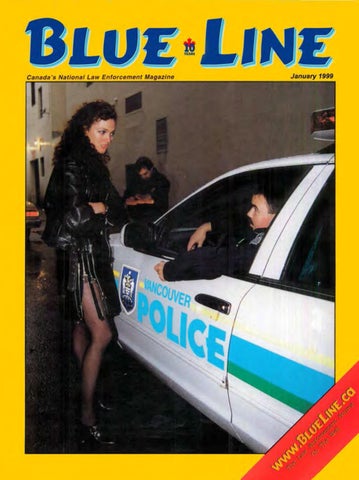
This month 's cover is courtesy ofthe folks from the Vancouver Police Vice Squad. The photograph was staged by Constable lizabeth Miller and Ruben Sorge, to illustrate an innovative program designed by two Vice Squad officers. The program, called DISC, was designed by Constables Oscar Ramos and Raymond Payette and is designed to target and track the sex trade consumers as they move from city to city. The program is a winner on many fronts and fits Blue Line's editorial criteria to perfection. It is a grassroots, innovative approach to a common community problem. It involves the day to day cooperation of front-line officers and the utilization of new technology. Most important of all an integral part of the program encourages inter-agency cooperation. It is a real winner and all law enforcement agencies can get involved at an extremely reasonable cost. Read more on page 6 in this issue. This month we are also pleased to supply you with tv.o other major articles. The first being an story about the Surete du Quebec and their five-year reconstruction program. The second is from an anti-terrorist consultant from Israel who will take you through a brief rundown on various types of weaponry used by some of the world's top tactical units. There is much more in this issue and we feel it is a tremendous way to say Happy ew Year to our readers.
List of Advertisers Response 99 Dalhousie University Dufferin Sheet Metal Enterpol Fechheimer Fellowship of Christian Peace Officers Henry's Camera Ken net's Trading Co. Laser Labs Lethbridge Community Collegc Missing Children Owcn Sound Police
0
JanuanJ I 1999 _ _ _ _ _ _ _ _ _ _ _ _ _ _ _-;
4 18 23 II
2 27 37 32 25 13 34 18
Pads Fitness & Supply Pride in Service Rocky Shoes & Boots Simulaids Inc. Southwest niversity turm Ruger & Co Tactical Enterprises lnt' llnc. Tetragon Tasse Triform Trijicon Sight Systems Virtual Depot Westervelt College
37 14 40 13 27 7 21 22 15 5 29 21
BLUE LINE Magazin e
Meet the people who make the decisions both corporately and in the law enforcement field. All sectors of law enforcement and other first response personnel, along with their support staff, are invited. First buying opportunity after 1999 budget approvals. Immediate response. Vendors are encouraged to bring goods for sale. Produced, supported and promoted by Canada's top law enforcement magazine with a pre-event circulation impact of over 76,000 magazines.
oo 0 o 0
Lounge Area
Emerging Technologies Display Area
I' pI it ' '[, '[ lJtl ~ 0 100 Iu~ l ) '[ GOO [Ul.;
PUBLISHER' S COMMENTARY
Moving ahead • with a big push from behind by Morley Lymburner Looking over my shoulder I see ten binders filled with back issues of Blue Line Magazine. It is a bit of a shock to look at those binders and think that when I thought up this "hare-brained" idea I was ten years younger and a lot more foolish than those ten years of experience has now taught me. I can still remember the look on my wife's face when I told her that I wanted to start a national law enforcement magazine. At that time] was a police constable, recently injured from one-too-many arrests and knowing I would be permanently disabled and far too disposable by my department. The shocked look in her face renected the knowledge that we had a 7 and 3 yearold to raise and a mortgage to pay. Given this situation and saying that I was soon to become excess baggage to the department would send many women into a tailspin and a marriage on the rocks. What ever her doubts may have been she quietly and confidently stated, "okay... where do we start." With a partner like that how could we lose. This monthly publication works hard to support the law enforcement community in Canada. The following are the more visible ways in which we accomplish this task;
* YEARS
Blue Line Magazine has published over 100 editions and presently circulates over 100,000 magazine each year. For the past four years Blue Line has published a news fax service that goes out every week to those interested in current events as it relates to law enforcement. This news is gathered from the close scrutiny of over 80 daily newspapers and major media facilities across the country. ubscribers to this service find this consolidated news source keeps them on top of what interests them the most in law enforcement. Blue Line Magazine now provides an opportunity for its readers and advertisers to get together at an annua l trade show. This event, the Response Trade Show, is presently organizing its third annual event and it is growing stronger each year. It is a prime opportunity for the private sector to showcase those products and services
\;/
that keep law enforcement organizations and their people on the leading edge. More recently Blue Line Magazine has entered the World Wide Web with the same energy and enthusiasm as it has with its magazine. This exciting new venture has shown phenomenal growth over the first six months of its existence. In that period it has attracted over 337,000 visitors. These visitors download over 200 megabytes of data from this web site each month . Many officers and agencies have indicated that it has become their conduit for law enforcement research and information from the internet. Throughout the past ten years, and even longer, I have been blessed by the Lord and those people He has sent my way. Those many people have included you our readers, and you - our writers, and you - our advertisers. Without these three elements this magazine would not exist. As for my staff and myself we are simply the spokes, wheels and axles. It is the reader, the writers and advertisers that make the engine that keeps it all going. Our goal in the coming years is to ensure that you are a little more successful from having read this book and from participating in it. We are here for you!
111111 In
--\01-____________________BLU£ LIN£
JanuanJ, 1999 ________________
Ma g azin e
bJ' Ruben Sorge One of the many requirements ofpolice officers is addressing cOlllmunity identified co n cerns. Within this context, it is incumbent on police departments to be creative and to develop tools that assist in fillfilling this mandate. Th e Vancouver initiated DISC (Deter/Identify Sex Trade onsumers) program is such a tool. This influiry will examine the development of the DI program, examine the program itself, provide some illustrations concerning the a{Jplication of DISC, and encourage other agencies to j oin in a collaborative effort to implement the program locall>\ Genesis of the DISC Project In July of 1997 Detective on table oar Ramo and Raym nd Payette were working on Iia ting treet as member of the VanOuver P lice Vice Unit. Thi area is well known to police member and contain the "Franklin troll," which is occupied by both street levcl e worker and sex trade con umcrs. n thi particular day, the Detective onstab lcs wcre topped at a traffic light near an elcmentary chool. Two young girls were cros ing the street and wa lking towards a bus stop. man driving a dark, four door Pontiac stopped by the girls and motioned them toward him. Thc girl ,recognizing this as a dangerous situation, ran away to a waiting bus and boarded. The Detective onstables then fo llowed aller the vehicle and topped the driver. fier orne investigation, it was discovered thnt the driver was on probation for exual intcrference with a minor from a neighbouring jurisdiction. Unr, rtunate ly, as an apparent isolated incident, there was little that could be done ab ut this ituation. Ilowever, if there had been a rileans by which thi incident cou ld have been aptured and shared with various police jurisdictions the situation could have ended in a mu h more ati factory fashion. This incident lefi both onstables frustrated. There was no meth d by which to coordinate investigative em rts and information on sex trade c )lsumers. Thi fru tration crystallized into a earch for a olution to this fundamental problem. The culmination ofRanlO and Payete' efforts resulted in the development of the 0 1 C Project. An Overview The primary purpose of the 0 1 Project i to focus police attention on the sex-trade COnSumer. 0 1 provides a pro-active appr ach b identifying the consumer and e tablishe a database on these "consumers" and their activitie . In addition it captures incident details of the contact and any pecific characten. tic. that ma be unique to certain con umerS. By sharing this data with other police agencies, sex consumers may be tracked in other
jurisdiction . Thi provides a powerful investigative tool for the potential identification of suspects involved in criminal activities ranging from sexual assault to pimping and homicides. To ensure data integrity 0 1 C is designed to be accessed by patrol members. It is these members who have considerable contact with both ex-trade workers and consumer and it is vital that 0 1 C captures the information these officers can provide. Constables Ramos and Payete recognized that in order to encourage patrol member to provide this vital information, 0 1 C had to positively impact the patrol function. Therefore, DISC was designed to be searched and used as an investigative tool by these same officers. Rather than seeing valuable information " lost" in the organization, patrol officers are able to directly acce s the database to which they have contributed. Another important aspect of the program involves mailing a "Dear John" letter to tho e individuals who are entered into the 0 1 system. o warning is given to the individual that a letter will be sent. This maximizes the desired impact when individuals receive a letter in the mail. While recognizing the limitations associated with "Dear John" letters this program may assist in deterri ng certain sex-trade consumers.
Data entry standards and program procedures In any information management system, tilters are required to en ure that only desired data is received and entered. DISC is no different. A high tandard exist for entering an individual into DISC. Essentially, an investigator mu t ensure that there are reasonab le grounds to believe that the person ha the intent to commit an offe nce under Sec. 2 13 or 2 12(4) being "to com-
BLUE l'NE- - - - - - - - - - - - - - - - 1rG"l M agazine
municate for the purposes of prostitution". This can include any. number of scenarios. For example, picking up or being found in the company of a ex-trade worker; being repeatedly observed driving in the area frequented by extrade worker; continually stopping and talking to ex-trade workers or other community ob erved behaviours that are difficult for the individual to explain. This standard provides for high quality entries into the 0 1 information management sy tern. It is important to note that this is not a " hame the Johns" program and that there i nothing random about 0 1 C entries. An entry in the 01 system occurs only after direct contact with a police officer. Il aving implemented DISC as an ongoing program, the Vancouver Police Department developed consistent procedures for members using 0 1 C. Members are advised to log on to a prostitution call over the radio. Members then inform the su pect that he is being entered on 01 . Members then enter specific incident details on their Mobile Data Terminals (MDT's). The e details include: • su pect information, paying particular attention to physical de cription, tattoos, scars etc.; • vehicle information; • sex-trade worker information; • incident details - specifics of sex acts, juveni le involvement, any weapons, ropes, g loves or other items of interest found, or anythi ng that a victim might recall as unique (i.e. - peculiar carpeting, uphol tery). In one in tance a victim recalled a large jar of cigarettes in a suspect's van. Thi same fact wa contained in the DIS information management system and therefore resulted in the identification of an accused. Member are then able to clear the call
V~-------------------
COl/til/ued Page 8
January, 19991!
u
MEN
Ruger)s Answer to Your Professio n al N eeds • The compact, lightweight autoloading Mini-14 Government Model rifles have heat-treated chrome-moly or stainless-steel alloys throughout the mechanism to give reliability under adverse operating conditions. Available in .223 caliber (5.56mm NATO).
AC556 SELECTIVE-FIRE RIFLE* ~
Chambered in caliber 5.56mm, and available in blued or matte stainless-steel finishes, fixed or folding stock configurations. Built to deliver durable and dependable functioning under adverse field conditions.
I•• II' ;\1169 tii·' , :"$1:11 The carbine is a tough, reliable shoulder arm which is user friendly and costeffective enough to place in every police car. Available in 9x19mm and .40 Auto calibers, the magazines are interchangeable with the Ruger P-Series pistols.
This high -tech 9x19mm pistol has an injection-molded one-piece gripframe structure of super strong polyurethane material. New for 1999, the .45 ACP KP97 pistol is now available.
This compact 9x19mm submachine gun features a telescoping folding stock and a three-position safety / selector lever. Firing from a closed bolt, in a semi- or full-automatic mode, it is highly accurate and dependable.
Ruger's tactical firearms offer exceptional value and certain models* are exclusively manufactured for official use. For additional information on Ruger service firearms and your nearest law enforcement dealer and representative, write or telephone: Sturm, Ruger & Company, 134 Old Post Road, Southport, CT, U.S.A., 06490 (203) 259-4537
til
Les Distributeurs
2475 De La Province
R. NICHOLLS Longueuil, QC J4G 1G3 Distributors Inc.
Phone: (450) 442 -9215
"RUGER
\\ithout having to author any other report. In turn, onstables Ramo and Payete earch the aneouver Police Department's omputer Ided Dispatch system for all pro titution entries and record the information on to the DI inforn1ation management system. This offer a streamlined reporting proce that avoids addilional paperwor(.. for patrol members and provides for an efficient data entry process. Most importantly, however, thi program ha produced tangible results as the DISC statistics ehart illustrates.
JAN 98 - SEPT 98 DI SC ENTRIES 217 JUVENILE APPREHENSIONS 1 53 WARRANTS 21 ARRESTS 12 SPEC IAL INTEREST 2 12 I JIII'enile .Iex trade workers either re/lnited with their /amil" or taken to /amily services.
2 Individllals checked IInder slispiciollS circllmstance,l that warrant /ollow-Ilp and colltinlled police interest (i.e. )ohnll'itll dllcttape ill ,'ellic!e)
Tech nical Specifications While the DI project originated with nstables Ramos and Payete, they received te hnical assistan e from Don Ilrynew of the Vnncouver Poli e Information Technology ecti n. In fact, after con iderable di cu sion application was amongst themsclve ,the DI developed in Micro oil' Acces 97 for the databa e and a search engine was developed that olTered ea e of use and reliability. Further, thi soflware pac(..age i not hardware inten ive. Dl can be run on almo t any Window 95 n figured mputer platform, and requires only the ccess 97 application and a modem, This configuration was deliberate, as the success of DI is dependent on the number of juri dictions who u. e DI . Given the relatively low cost hardware requirements and free acces to program, it is hoped that police juristhe DI diction will avail them elves of this resource. A more police jurisdictions enter into the DI program, the DI in formation management sy tem will grow. Work i continuing on developing a DI , network to encompa all of orth merica . Within orth America there an~ specifi "prostitution circuits" where a tremendous amount of sex trade activities take place. These circuits will be mirrored in the DI Information Management ystem as can track individuals agen ie using DI across boundaries and jurisdictions. In order t addre these growing pains sp cific tep are pre ently being taken. First, every police juri diction on DI is going to require an e-mail address for the program . Thi will allow police jurisdiction to send their data to all police jurisdictions on the DI network as a simple e-mail attaohment. nce received, it is up to the department DI coordinator as to whether or not that particular information will be entered II1to their DI databa e. entially, if there are 100 departments compiling DI in formntlOn a department on the network could get 99 e-mail data attachment. This would providc for an c:\tensive database.
econd, in order to protect the security of thi information an encryption application is being sought. ncryption crambles information in complex ways rendering it essentially unintelligible to anyone but the intended recipient. This will provide all u er with a high degree of ecurity when sending data and receiving infonnation from other departments. Community Policing Implications Prostitution in a residential neighbourhood is a contentious issue. ommunities undertandably get very upset with not on Iy the street ex-trade, but also the problem that accompany the sex-trade. Thi include the drug culture, litter of condoms and drug paraphernalia, and public sexual acts to name a few. Ollen street sex trade activities impact more sensitive public domain, taking place near, or in, school ground, playgrounds, or parks. While the e circumstances give rise to obviou and immediate health and order concerns, long-term effects must also be con idered. ex trade activities in a neighbourhood likely contribute to the decay of that neighbourhood and its social tructures. Invariably neighbourhood committees form and they lobby their police departments for assistance and solutions. The DI C Project provide solutions for both neighbourhoods and police manager. It is purposefully designed to offer the following: I) a proactive law enforcement strategy; 2) enhanced detection, identi fication, and deterrence of sex trade consumers; 3) provides patrol officers with an innovative method to investigate "nuisance" calls and to contribute to developing solutions to the concerns of the complainant and community; and 4) provides a useful investigative tool.
Various Responses to DISC While DI offers policejuri dictions coniderable assistance, it also provides the crown attorney with some useful information. In many "procuring" or "living off the avails" cases the credibility of the sex-trade worker as a victim is often viewed with suspicion. In these circumstances collaborative and corroborative evidence is vital. Inforn1ation that can link the accused and the victim, detail circumstances of contact with police members, provide a timeframe of events, or assist in howing a pattern of travel can greatly assi t the crown's case. DI C specifically provides this information. DI C information can provide a u eful rebuttal to the "I was ju t driving through the area" or "I was lost and getting directions" excuses ollen offered by Johns. As Johns frequent sex-trade worker thi involvement will be noticed and documented by police officers. As officers investigate and record these contacts on DISC, sex-trade consumers will be shown to have an establi hed history with sextrade workers. In this fashion, DISC not only assists in the identification and arrest of a uspect, but also may be used in the court process to assist in securing a conviction of the offender. At present, six police jurisdiction have initiated a DI C program with even more going through the approval process. The e juri dictions include police departments from British Columbia, Alberta, to udbury Regional Police in Ontario. Constable Corine Fewster, udbury Re-
gional Police, trongly upport the program . In particular, the udbury program has been u ed to identify a su pect resulting in charge. Also, onstable Fewster relates that community groups have been very positive in their response to DI C. ergeant Wayne mith, Port Moody Police Department, B ,and Corporal heryl Armstrong, orth Vancouver RCMP Detachment, are equally supportive. For these departments DI C provide better intelligence and useful knowledge than would otherwise be available. As the number of police jurisdictions using DI increa es, the effectiveness of the program will also increase. This will provide for better intelligence, tracking, and identi fication of all ex-trade consumers, workers, and pimps.
Conclusi on Traditionally, information on sex-trade con umer ha not been captured on any infonnation ystem. DI C directly remedies this situation. DI C focu e police attention on recidivist con umers and removes any previously assumed cloak ofanonymity. It is a powerful investigative tool that is user friendly. Further, it provide a concrete strategy that, in conjunction with local initiatives, meets the needs of neighbourhood and communities that are negatively impacted by sex trade activities. A Deputy hief onstable Terry Blythe ofthe Vancouver Police Department point out, "DI is one piece of the puzzle. In attempting to find solution to this complex problem, police communities mu t do business differently to be succe sful." It i recognized, that the continued and expanding ucce of this program depends on two factors. First, other police jurisdictions must examine DI and adopt the program for use by their departments. econdly patrol or line officers mu t become an integral part of the progran1 and contribute on a continuous basis. Thi will database, allow for an expan ion of the DI tracking both ex trade consumers and workers throughout variou juri dictions. TI1e Vancouver Police Department is prepared to act as a central repository for the DISC information management system. Ilowever, the spirit of the program aspires to the tree u e of thi information as an effective law enforcement and investigation tool to be used by any police juri diction intere ted in expanding their repertoire of options to deal with community and law enforcement concerns.
For further information Detective Constables Raymond Payette and Oscar Ramos can be reached at the Vancouver Police Department, Vice Unit 604-717-2678 VICE direct 2586 Fax 3232 email disc@clty.vancouver.bc.ca ,orcontact Constable Ruben Sorge, VPD, Planning , Research and Audit Section 604-717-2688.
About the Author Ruben Sorge has been a constable with the Vancouver Police Department for 10 years, and worked in patrol until changing to his present assignment in Planning and Research.
BLU£ LIN£ \::t ~It. M agazine - - - - - - - - - - - - - - - - - - - - \ 6 J - - - - - - - - - - - - - - - - - - !anuartj, 19991!
Videotaped
obrie y
by Elliott Goldstein B.A., LL. B.
Videotaping sobriety tests of suspected impaired drivers has occurred for many years in Canada'. As early as 1976, police were videotaping sobriety tests of accused persons at police headquarters 2 • For example, in R. v. Goodeil the British Columbia Provincial Court viewed a videotape recording of a sobriety test performed by an alleged ly impaired driver. When convicting the accused, the trial Judge said that the videotape evidence was "the frosting on the cake." In the 1978 British olumbia case of R. v. Dunn4 a videotapc of the sobriety test of a suspected intoxicated su pect was admitted to supplement the evidence ofthe arresting officer as to the condition of that suspect at the time of the alleged driving offence. The videotape of the accused's sobriety test was tendered in court to supplement the arresting officer's evidence as to the condition of the accused at the time of the alleged offence. The videotape showed the accused "performing" some basic balance tests (e.g., wa lking a straight line). The presiding Judge ruled as follows: "First of all 1 would like to deal with Count 1, the impaired driving charge. I must say that the video tape that was introduced in this case was of great assistance to me. From listening to the evidence in totality and from observing Mr. Dunn (the accused) on the video tape, r have come to the conclusion that his ability to drive a motor vehicle was not impaired within Section 234 and 1 therefore dismiss Count I .. " On the issue of voluntariness, the judge remarked s "I can only say that the presence of the videotape equipment is not oppressive and the fact that this conversation took place in a long hallway, which is not very wide, the officer gave me the dimensions in the course of the hearing, I think he said something like five to six feet wide. It is not oppressive and I find that the conversation is a voluntary one even though it was videotaped." The trial judge treated the sound (audio) portion of the videotape as ifit contained the accused's confession. The tria l judge focused on the issue of the voluntariness of the accused's statement and determined whether there was any oppression - a ground for rejecting a confession. The Court held that neither the presence of the videotape equipment nor the environment in which the conversation took place was oppressive. The Dunn case demonstrates that playing a videotape recording of the accused's sobriety test at trial does not always result in a conviction. The Judge may acquit on the basis that the accused's judgment does not appear impaired. This is well illustrated in the 1980 British Columbia ca e of R. v. Layton 6 , wherein the Crown tendered a videotaped sobriety
test of an allegedly impaired driver with the consent of his defence counsel. "It was the Christmas season and the accused, a ' businessman ', dined at a Vancouver restaurant where he consumed three glasses of wine with his dinner. Just after midnight on December 22, 1979, while on his way home, he was stopped by police at a " ounterAttack" roadbloc 7 • The police took him to the police station and demanded he take a breathalyzer test but the accused refused because he was "tired and annoyed at the long delay" (seventy minutes since he was stopped by the police). Instead, he performed some sobriety tests - walking heel to toe down a line, touching his finger to his nose, and standing on one foot - for a videotape camera. The accused wa charged with having care and control of a vehicle while impaired and with failing to blow into the breathalyzer." Defence counsel explained his reason for consenting to the admission of the videotaped sobriety test at trial 8 : "It is unique that video evidence was used and your Honour had the benefit of seeing for yourself how my client acted at the time. The fact is that the video was most beneficial to my case. ot only is there no evidence of impairment, there is abundant evidence of sobriety." The trial judge commented 9 : "The case commenced yesterday with the testimony of onstable Kleeband, who is a credible witness, as well as the video evidence that was tendered. [The accused] completed certain physical tests, both at the scene and at 312 Main Street (i.e., the Vancouver Police Station), and he did some of them reasonably well, and he did some of them poorly. There is no way I can find a consistency, or a constant threat of impairment running through that unless I just allow my subjective bias to decide the issue. That is, just look at him, a I might, for this first occasion, including yesterday, and the view of him on video. He perfonned on the video reasonably well, not, certainly, as well as the police officer, who perfonned meticulously all of the physical tests that he asked the gentleman (the accused) to do, but nevertheless, he was cogent, he spoke with the officer. He was civil, co-operative. Those are not generally the indicia of intoxication. "I think Mr. Layton is a very able adversary in the system and very able to cope with
ts
exigencies (i.e., needs or necessities) as they arise, and not like most people who will generally allow their condition to expose itself. "What I'm saying is, although I may be very suspicious that Mr. Layton was impaired at the time and probably over .08, my views are only suspicions and Mr. Layton was one ofthe rare individuals who can perform adequately in an emergency and he certainly stood himself in good stead on this occasion, and was supported by the good luck that the roadblock was being moved at the time and the BATmobile lO was being taken elsewhere. For those fortuitous reasons, I am obliged to dismiss both counts. This case clearly demonstrates that a videotape of a obriety test of an impaired driver is a double-edged sword: it can be used by the prosecution to prove impainnent or by the defence to prove sobriety. Future articles wi II discuss other uses for videotape evidence including recording views of crime scenes. Stay tuned! I.
Section 253 of the Canadian Crimina l Code makes it an offence to "operate a motor vehicle or ve sel or operate or assist in the operation of an aircraft or of railway equipment or have care or control of a motor vehicle, vessel, aircraft or railway equipment, whether it is in motion or not, (a) while the person's ability to operate the vehic le, vessel, or aircraft or railway equipment is impaired by alcohol or a drug; ." 2. R. v. Thibeaudeau, February 26, 1976, (B.C. Provo Ct.), unreported decision ofC litTe, J., cited in Goldstein, ., "Visual Evidence: A Practitioner's Manual" (Toronto: 1991 , Carswell Legal Publications), at ection 29.8 (hereinafter V PM). 3. R. v. Gooder (November 3, 1978, B.C. ProvoCt.) Vernon Registry No. 78- 02102, unreported decision of Ellis, J. cited in VEPM . 4. ( 1978, B.C. ProvoCt.), Vernon Registry 0.7802047, unreported decision of Behncke, J. cited in VEPM. 5. Ibid. 6. (May 17, 1980, B.C. ProVo Ct.), Vancouver Registry O. 94242, unreported decision of Craig, Provo Ct. J. cited in VEPM. 7. British Columbia's ounterAttack Program was instituted to combat drinking driving. 8. Needham, P., "Videotape helps clear driver of charges" (May 17, 1980), The Vancouver Sun. 9. Excerpt from Proceedings at Trial, May 16, 1980. 10. BATmobilc - Breath Alcohol Tester mobile.
Elliott Goldstein, B.A ., LL.B . is a Toronto area lawyer who practices civil and commercial litigation and consult s to the security industry. Mr. Goldstein's latest book en titled Visual E\ 'idellce.· A Practitioner Manllal was published in 1991 by Carswell Legal Publi shers. It IS now two volumes and contain s chapters on the law of video surveillance of criminal suspects, casino surveillance, and video conferencing. For more infonnation or feedt.,ck call (905) 709-3936; fax (905) 709-3844 emai l: elgold(ashaw.wave.ca. Web site: www.tor.shaw.wave.cal-elgoldl
s
~ January,1999 ____________________________~~~-------------------------------B--L~!g~!~!
I would like to comment on what is otherwise a very good magazine and that is the cover photo of your ovember 1998 issue. First, why i the officer not wearing a helmet? It appears that the officer is on an overhang r is attempting a window/balcony entry, which would require the officer to fit through a limitcd opening which could cause contact between head and non-head material. The pc iric ituation doe not matter, but if you are rappclling, you wear a helmet. The officer in the photo has no belay line and is dCRloying from a rope bag, therefore, no bra~eman . I f the officer hits her head, there i n afety for them . cc nd, it appears that the officer is a ta ti al fficcr. If thi is true, unles the officcr i lell handed, why i the strong hand being u ed a the brake hand and not holding thc officers secondary weapon (pistol)? Rappelling i u ually used for its surprise fa tor, if the officer enter the room withut thcir wcap n up and ready, urpri e is I t. It is thc ame as a dynamic room entry, d y u entcr and then draw your weapon? Thank you for the audience.
ThOll/as Koch Ottawa, Olltario Editor 's ote: We contacted the Toronto P Ii e ide Training Unit and the Director - J hn andcman - responded a follows; "J completely understand your concern fi r afety. I can a ure you that is the utmost c n rn for both the Emergency Task Force and Video ervice nit. I ha e bcen informed that in thi photo the officcr had climbed up the rope, about 4 fcct t chcck thc visual for the cameraman. Y u are ab olutely correct in assuming meone may think that they are actually rappclling, I certainly hope they do not. I als h pe they don't watch any of the cop h w on T ,bccause even I know they are contrary t opcrational procedures of anadian p lice ervice . p n renecti n of your comment, we should havc been more pecific in the photo caption. We at ~ ronto Police ervice are probably undcr the microscope more than mo t ther ervices, and your comments undcr~ orc the importance of being very pecifi , evcn in a police magazine. Our capti 1'1 hould have tated, "a member of thc ETF and Video ervices Unit prepare for a vide sh t before uiting up with all the required weapon and afety gear. By utililing video, members can simulate situati n \\ ithout ri king iniury. " Thoma, all your points are valid. I wI' 11 ta'-.c full rc p n l'bl'II'ty fior the error and I hope that per on who view the picture, view it in the sanlC way as they do tclevl'sl'on h ws and realize it is not a training photo.
You have brought to our attention the need for being very specific. Your attention to this matter is greatly appreciated."
Members of pecial Investigation ervicesBreak & and Enter Enforcement ection wish to extend our sincere thanks and appreciation to all the persons who provided assistance and upport in the tragic circumstances of the death of Detective Constable Bill Ilancox. We would like to profoundly acknowledge the unifonn, investigative and support staff of the Toronto Pol ice ervice, members of numerous other police sevices, public and private agencies, organizations and companies, the media, private citizens and members of our community as a who le, who strived to help at the cene of the incident, enroute and at the hospital and throughout that mo t difficult night. Who managed, participated and as isted in the homicide investigation that re ulted in the effective arrest of two suspects and who responded with their heartfelt condolences and support during the aftermath and most poignantly at the funeral . Bill Hancox was a good cop but above all he was a fine human being. He will be sorely missed and always remembered in our ection. Ilis loss is only tempered with the knowledge that Bill's quiet dedication and strong contribution to the ervice has been so overwhelmingly recognised by every level of the public and the police communities. We join with many of you in expressing our deepest sympathy to Kim and the Hancox family. On your behalf, we will endeavour to provide active support and a sistance to Kim and her young family as long as it is needed. Once again a sincere thank you to you all. Billy himself would have been amazed.
Special Investigation Services Break and Enter Section Toronto Police Service
The Versadex 1998 Conference hosted by the London Police from eptember 23 to 26 was an overwhelming uccess thanks to the assistance of Blue Line Magazine in promoting the event. I would like to take this opportunity to thank you for your contribution to the success of the conference. The delegates attended from across Canada and the United tates. They were impressed with our city and with all of the amenities which we provided. Thank you once again for your participation. Fred T. Goebel Acting Chief of Police London Police Service
Regarding your editorial entitled" orne police agencies suffer from an identity crisis" .111 th e ovember edition, the solution for safety . Ie as a badge. cou Id be as sImp Many uni fonn shirts and jackets produced . rth A ' '1 bl .h h m 0 menca are aval a e WIt an attac ment for a badge over the leU pocket. Each
agency could select the design for its badge; or ifnot enough time, additional hat emblems could be issued to be worn over the left pocket.
Billy Wright Newport Beach, California Editor's Response: This is perhaps a good suggestion but I think it would be simpler and Ie s expen ive to simply put the word "Police" on the patch. Did you know that "OPP" in orwegian means "UP"? It's on all their elevators. But they all recognize the word "Police" for what it is. orne people around the world actually collect the patch as a conversation piece ... to stump their friends. GI
Regarding the response of Sllnsp. Relph in the ovember 1998 issue, to the publisher' commentary in the March 1998 issue entitled "Road Rage? Blame Poor Enforcement!" Beyond all the well-worn P.R. spins and the community-based policing buzz-words in the Ilnspector's response, lies the fact that traffic enforcement in general seems to be at an all-time low. While lax traffic enforcement is not the only cause of road rage, it is a significant contributing factor. People are taking the law into their own hands because they consistently see no justice being done by the pobce. Twenty years ago in Metro Toronto it eemed that there was a traffic officer hiding at every red-light, stop-sign, and prohibited tum, not to mention the dreaded radar-man hiding in every 40 and 50 zone. Every driver knew this and it kept most people in check. Accident figures going up or down makes no difference to the family who has ju t lost a child to a careles motorist. Ilnsp. Relph can champion all the fancy programs he wants, and although they may have their place in the Qverall scheme of things, nothing can keep drivers in check more than their fear of the dreaded traffic officer hiding around every other bend. I say, bring on the traffic cop ... and road rage be gone!
Name withheld When I vi itBlue Line's Web Page [anl only succe sful in viewing the current issue. I am, for example, interested in reading the article in the October is ue dealing with the Orillia O.P.P. Detachment meeting the challenges of tran ition. How do I locate it?
J.D.
Editor 's COlllments: Unfortunately we have to delete the previou edition each month to keep the web page current - and at a reasonable ize. We are working on the idea of supplying an archivalsearchenginebuthaven'tquitegotitready. Last month ovember) our web page had over 72,000 visitors. They downloaded over 232 b fd fr . h' h ' mega ytes 0 ata om our sIte w IC mcluded t ' d h h 0 .. sk ones ant p fotograp S. ne suggestIon th b h th ISThto eep on op 0 e we page eac mon I th I . . th fu Id .b e on y 0 er a tematlve 111 e ture wou e to do omething desperate like ... buy a subscription! After all that's what we are in the business of upplying
BLU£L'N£----------------------~~ 10 r----------------------~--~~~~. M agaz ine ---------------------\V~------------------ January, 1999!!
In law enforcement, every LINK is crucial. ENTERPOL gives you the ability to access and utilize information .. wherever you are, whenever you need it.
c
The Features ENTERPOL is a law enforcement software solution designed to enable teams to COMMUNICATE, COORDINATE and COLLABORATE. It allows you to find, organize, mobilize, share and utilize critical information, between team members and between enforcement agencies. The results are impressive: Your force spends less time at a desk and more time on the street. Crucial clues, details and statistics are faster and easier to find. Your team functions more cohesively. ~ Resources are allocated to their most immediate need.
*
*
EASY ACCESS TO THE RIGHT INFORMATION empowers your team to use its time and effort to maximum advantage. And that's critical in an environment where poor communication may mean the difference between life and death.
ENTER pol I SOlUTiONS fOR LAw EN foRCEMENT I
. _. ,. ..
I I ,. . J
-·-•
j lltMl'l"
'164 . ." . . . . . . .
-·tt_ . ____ I'
. . .....
, _ ....... .........
I l. QU_ ........ • " ...... _ It. CIou.a •
f?-uM 1 _ AI .......
~
J'., ....u.I.1_.1t'Q
____ I.
e,..
.,,'G~l..
The Fact s
1. ENTERPOL is proven. ENTERPOL is currently being used by law enforcement agencies in 21 locations across Canada and in the United States. The Foundation 2. ENTERPO L meets the unique ENTERPOL is built on Lotus Notes and require ments of law enforcement Domino - the market-leading platform for t eams. messaging, groupware and Internet Having been a police officer, Brian Henry, solutions. Lotus Notes/Domino is the architect of ENTERPOL, understands the unmatched in its ability to provide secure, day-to-day requirements and priorities of flexible information management to small law enforcement agencies. or large groups, located across the office 3. ENTERPO L is affordable. or across the world. Even the smallest law enforcement teams can afford ENTERPOL. It is less costly than competitive alternatives, and quickly pays ",'~i Business Partner for itself in improved productivity. 4. ENTERPOL requires minimal training. CALL 905.761.2003 ENTERPOL requires just three days training, FAX 905.761.8013 provided by our experts. It's that easy! E-MAIL brian.henry@enterpol.com WEB www.enterpol.com 5. ENTERPOL is Year 2000 Ready.
*
Records Management • Crown Folder Documentation • Computer-Aided Dispatch • Provincial Offences Tracking · Automated Statute Updates
Special Weapon by Eil(lI1 Meyr M.A.
M dern urban terrori m, manife ted by aircrafl hijad.ing ,emba syoccupation and hostage taking, i a relatively new and unfamiliar ph en menon for most of the ecuritr fI rear und the world. Until more recent time they had no experience in this type of warfare, and there wa no special formation to handle the e incident . onventional military and police forces deployed in large and n nnally low-to-react fonnations, were n t capable of dealing with mall and c1ande tine terr ri t cell , striking swiftly and melting into the civil cenery. Moreover, mas i e and undiscriminating fire-power for uppressing terrori t was un uitable for u e in deli ate situation where civilian hostage were held at gun point. There wa a need for a new type of pecial unit to be u ed in the taelical fight again t terrori ts. A new concept wa de i ed, dictating the creati n of an outfit characterized by : I. Ple,ible c mmand and structure enabling rapid rca tion t quickly changing ituatjons. 2. , pecial tactical training compatible with the d i ITerent terrorist cenario . . :kilful and profe ional operator with proper per onal traits. 4. li mployment of special weap n y terns and equipment de igned pecifically for the new tasks. The newly developed Counter-Terrori t ( T) unit, a they became known, were given the task of leading the tactical fight agajn t terr ri m, and a uch were all cated the following mission : 1. lnterventi n in e lreme terrorist attacks inv Iving hijacking and kidnapping. 2. , upporting other ecurity agen ie in dealing with severe iolent acts including h micide, extortion and bomb attacks . . Pr tecting vital national assets, providing IP protective service to key government personnel and protection of oflicial guests of the tate.
The Beretta 9mm PM12 al 0 achieved a certain degree of popularity among T unit during the 1970 and the early 1980s. It main use r , however, were the Italian " OC "and" I " units, created following the wave ofterrori t attacks perpetrated
pecial weapon are one of the mo t important clement, enabling T unit to accomplish the e mi sions uccessfully. The foil wing re iewde cribes in detail the various types and m del used in the tactical fight again t terrori m, and analy e their specifi role in operational deployment. Sub-machine guns In mo t [[he T engagement, the ubmachine gun ( M ) is regularly preferred to a sault ri fle ,a the main attack weapon. The M i lighter and more compact, and con~equently ea ier to handle. Thi is especially appreciated when the u er ha to move in confined pace, or requires minimum en umbennent from the weap n, in order to car:}' other ta k . The MG i easier to controllll burst firing, and at hort range (100m or les ) is ufficientlyaccurate. he diJTerent ersions of the I raeli Uzi MG were for many year very popular among T units, looking for a compact and reliable weap n that can take almost any r ugh treatment.
9 mm MlnI-UZl sub-machine gun With stock folded
The Mini-Uzi, in particular, becanle one of the most sought-after SMGs, after being adopted by aliI raeli T forces, especially the Border-Guard's "YAMAM" elite hostage-rescue unit. Thi weapon had been used extensively during recent years in many internal-security and CT operations, the best known of which wa the re cue of six bus passengers by the "YAMAM" in March 1988, following a bus seizure by three terrorists on the road from Be ' er- heba to Dimona. It should be noted, that the Minizi had al 0 been chosen as the favourite weapon by many VIP protection groups around the world, including the U. . ecret ervice presidential detail and the Israeli General Security ervice protective teams.
BLU£ L ' N£ - - - - - - - - - - - - - - - IQ12 M a g azin e
by member of the " Red-Brigades" organization. The PM 12 i fed by 20, 30 or 40 round magazine ,and can be fitted with optical and laser sights, illumination equipment and a ilencer (attached with the help of a special adaptor). The mo t appreciated aspects of the PM 12, are its stability in burst firing (550 ri m) and the ease with which it can be concealed beneath a coat or a jacket during covert operations or VIP protection assignments. The PM 12 had been u ed extensively by Italian Police and Carabinieri in many T operations, the best known of which was the rescue of General James Dozier by the ' OC" in January 1982, following his abduction by "Red-Brigade "terrorist in Verona in December 1981. The Heckler & Koch 9mm MP5 M began enjoying universal succes in the afterrnath of the Mogadishu rescue operation in October 1977, in which ennan" G9" commando , armed with MP5 MGs, re -
V I - - - - - - - - - - -- - - - - - - Januanj, 1999
-~
'!!
cued 86 passengers and four crew members of a "Lufthansa" airliner hijacked to Somalia. The most appreciated aspects ofthe MPS, were its stability in burst f!fing, made possible by the locked-breech mechanism, and the ease with which different types of accessories, optical and laser sights and noise dampers could be fitted to it. Throughout the following years, the MPS was also adopted by other elite units, like the British "SAS" and the French "GIG ", and has been used extensively in many CT operations, such as the PrincessGate incident in London in 1980 and the Airbus rescue at Marseilles airport in 1994. Today, the MPS is produced in a variety of models and calibres (including 10mm and O.4S), making it adaptable to almost any CT operational requirement. Moreover, the introduction of the PDW (Personal Defence Weapon), an upgraded version of the compact MPSK equipped with a side-folding butt, promoted the German SMG to a leading position in the VIP protection field as well, thus turning the MPS into the ultimate weapon system in the internal-security arena. It is also interesting to note, that the MPS has been gradually adopted by an increasing number of CT units in the former Soviet-Block countries, including, for example, the Czech "URNA" unit and the Slovak Police CT unit. It might not be a far-fetched hypothesis, therefore, asswning that the Russian "Spetsnaz" units will also add the MPS to their CT arsenals, currently based on the Kalashnikov-family weapons. New designs are constantly tested by CT units, and among the more promising are the Austrian Steyr TMP, already adopted by the Italian "GIS", and the Belgian FN S.7mm P90, currently in service with the U.S. Navy's "SEAL" teams and the Turkish VIP protection details.
Handguns Handguns are the secondary side-arms carried mandatorily by all members of the combat team. In certain scenarios, when onehanded firing might be needed (clearing rooms, climbing and rappelling), the handgun becomes the primary weapon of choice. Aircraft storming operations, in particular, exemplify the importance of handguns in tactical confrontations with terrorists. In such incidents, surgical and very accurate close-range shooting, and not burst firing, is the obligatory mode of weapon handling, and consequently, the light, compact and easier to handle handgun becomes the primary assault weapon, while the SMG is used as the backup for the worst case scenarios. At first, the 0.38 and 0.3S7 revolvers were the most popular among CT units, looking for reliable and strong weapons that were not affected by stoppages and [!fed power-
=
ful bullets. The "GSG9", for example, had used the S& W model 36 0.38 revolver for many years as its main assault handgun, and later replaced it by a more powerful weapon, the S&W model 190.357 revolver, considered to have superior incapacitating capabilities. Members of the German local SWAT teams ("SEK" and "MEK") followed suit, and kept their S&W 0.3S7 revolvers even after new pistols were put into service. The French "GIG "also decided in favour of a 0.3S7 revolver, the Manurhin MR 73, and so did the Austrian "Cobra" and the Spanish "GEO" and "UEI". The French went even further, and produced a "mini sniper-rifle" model of the MR73 by adding a scope and a bipod to the long-barrelled version of the weapon. As terrorist organizations became more heavily armed, and in many cases even better equipped than the security forces confronting them, most of the CT units decided to replace their six shot revolvers by highcapacity semi-auto pistols, in order to possess greater fire-power during operational engagements. For a very long period, the 9mm Browning P35 "High-Power" had the primacy among police and military CT units, including the British "SAS" CRW teams, the American "HRT", the Israeli "YAMAM" and the Canadian RCMP's intervention unit. The most appreciated aspects ofthe weapon, were its mid-level size, 13 round capacity, Continued Page J 4
FIRE RESCUE EXTRICATION MAN OVERBOARD C.P.R. CONFINED SPACE CRASH MEDICAL FREE CATAL O G ! Tel: 914 679-2475 Fax: 914679-8996
SIMULAIDS, INC. Woodstock, NY 12498 www.simulaids.com
CRIMINAL JUSTICE (Through Distance Education) Enhance your employment opportunities in a changing and competitive field. Lethbridge Community College's Criminal Justice program provides specialized training in Corrections, Security and Policing. Courses offered include: Criminal Law and Procedure, Human Relations, Interviewing, Young Offenders, Criminal Investigations and more. A one-year certificate in Retail /Industrial Secu rity is also offered. Apply education training or work experiences toward course credit in the program.
FOR INFORMATION CALL: 1-800-572-0103 (ask for extension # 6932) e-mail: petersonr@aUethbridgec.ab.ca fax: (4b3) 380-3450 ~ www.lethbridgec.ab.ca
Ii:
~..l.~
LETHBRIDCj( COVlMUNITy COLlECjE
--->61-_________________BU'E LINE
' " January, 1999 _ _ _ _ _ _ _ _ _ _ _ _ _ _ Q
Magazine
un urpa ed ergonomics and utter mechanical reliability. Through the year, the " Il ighPower" had been u ed in many T and highri k ho tage-re cue peration around the wOrld, the be t known of which wa the storming of the Iranian emba y by the " " in London in May 1980.lt hould be added, that variou governmental and private VIP protective teams also adopted this pistol, eq uipped either with the sta ndard magazine r the extended 20 round model. The perational need to carry safe ly a loaded handgun, stimulated a new rearmament pr ce among T unit, during which tho " Iligh-Power" has been grad uall y replaced by modem 0 semi-automatics, equipped with hammer-dropping and trigger-di connecting mechanisms. m ng the more prominent model put into er ice, it is worth mentioning the I 226, adopted by the British" A ", the Be(etta 92, elected by the Italian and French unit, and the re o lutionary Glock 17, u ed by many elite and pecial operations group around the world.
Sniper-rifles
this specific incident, five out of the six hijackers were e liminated simultaneously by "G IG " snipers, enab ling the rest of the team to storm the bus, terminate the sixth terrorist and save the hostages. Throughout the years, many advanced sniper rifles have been put into ervice around the world, equipped with sophisticated day and night vision systems, laser range-finders, adjustable butt and different types of silencers. Among the more important models in use, it is worth mentioning the Erma 100 and Walther 2000, adopted by the "G G9", the ccuracy lnt. PM, elected by the British units, the IG G 3000, u ed by the wiss, lovak and Czech police forces, the teyr G, in service with the Au trian "Cobra", and the new fami ly of heavy rifles in 0.5 inch calibre, of whom the Beretta, already issued to the Italian "Gl ", i the be t known. It is interesting to note, that the Russian CT units continue to use the Dragunov VD as their main sniper rifle, and are currently issued with a new bull-pup version, that might gradually replace the older models of this weapon. According to various sources, the new ri fte has also been adopted by Boris Yeltsin's protective team, and its members were een using it in actual deployments.
Fighting shotguns
7 62 mauser Model 66 SP snopong nfle With Zeiss telescope
niper-ri fle are ne of the mo t importan. clement in any T unit' ar enal. Longrange firing capability is con idered vital to the successfu l uppre sion of ho tage-takers, and acc rdingly units are equipped with the best hardware of the day. Because the po r sniper shooting during the 1972 M uni h incident triggered the massacre fthe Iympic ho tage , German manufacturers were quick to tudy the Ie ons, and produced two of the be trifle th Mauser 66 and the I1 &K P G I in 7.62mm that dominated T scenery for a long time. -quipped with advanced optical ights, infrared sights and light intensifiers, the e rifles were u ed exten ively during the Ii lIowing yea r by many units. T he French FR- I is another prominent sniper rifle, which had been u ed extensively in many T and internal ecurity operations, the best known of which was the rescue of 30 children by the "GIG "in Djibouti in ebruary 1976, following a school-bu seilure by terrorist near the omali border. In
Daewoo USAS-12
Fighting shotguns have been used by many CT unit as clo e a au lt weapons, deployed in the final pha e of an attack. The two most important types in use, are the pump-action gun, whose best representatives are the Remington M870, Il&K 502 and Bernadelli B4, and the semi-automatic rifle, exemplified by the italian Franchi PA -15. Being ab le to fire different types of ammo, shotguns were found to be very effective during house storming incidents, when used at point blank against locks, bolts and hinges, defeating them instantly. n interesting upgrading of the ba ic em i-automatic shotgun concept, is represented by the USA -12 produced by the South Korean firm Daewoo. This weapon is
"PRIDE IN SERVICE"
fed by either straight 12 rounds or circular 20 round magazines, and fires automatic bursts of 12-caliber ammunition, the effects of which might be devastating at clo e-range CQB engagements. Its weight (6.5 kilo) and size may, however, limit the weapon's tactical applications in most CT scenarios, where lighter and more manageable systems are required.
Specialized equipment Beside weaponry, CT units are also lavishly equipped with specialized hardware and electronic gadgetry. ormally it includes ballistic helmets, protective vest, gas masks, advanced communication and niper coordination ystem, C and Stun grenades, explosives and breaching devices as well as night vision equipment and oice monitoring instruments. Most of the units have a lso at their di posal specially converted and equipped cars (like the Mercede 280 E limousines or the Range-Rovers), motorcycles, Jeep and armoured special operations vehicle . Summary T unit are one of the most important elements in the fight against terrorism. In many cases they are the last-ditch defence. When all other measures fail, they are called to handle the wor t-case scenario, in which lives are threatened in real time. Period of relative tranquillity tend sometimes to create the impression that the e units are more of a burden than an as et. This is a dangerous illusion. The best weaponry, specialized equipment and material resources should be allocated to them. Any other policy is playing with fire. About the author Mr. Fitan MeH is a former assistant to the Counter-Terrorism Advisor to the Israeli Pnme-Mmister. His main fields of expertise are Counter-Terrorist and Hostage-Rescue Umts. He holds an M.A. degree in Criminology and B.A. degrees in MlI ita!) Histo!) and Political Sociology. Mr. Meyr ts currently engaged in several security projects in the private sector.
•
Ma . .. OH, I'M SURE THE OTHER TEAM MEMBERS WEREN'T LAUGHING AT YOU INSPECTOR!... IT'S JUST YOUR ORDER TO ' FIX BAYONETS AND FORM A SQUARE", SUGGESTION, CAUGHT THEM OFF GUARD!
~~~a~o/ A Ring of Exceptional Quality (All TODAY FOR YOUR FREE COlOUR BROCHURE
1-800-535 -9735 Pride in Service P.O. Box 705 Pickering, Ontario L1V 3T3
FAX: (905) 509·6933
8LU£ l'N£- - - - - - - - - - - - - - 1Q
~
M agazin e - - - - - - - - - - - - - - - - - - - - - \ 0 1 - - - - - - - - - - - - - - - - - - January, 1999 YWS
Private security and public policing in Canada by Karen Swol Canadian Centre for Justice Statistics
. . _.J -.
.-- - .
In recent years both the nwnber of police officers in Canada and the ~===~ crime rate have been declining. However, the rates for many workplace or whitecollar crimes, such as computer crimes, employee theft., and fraud, are increasing, Public police do not always have the re ources to handle these "internal" crimes. In some cases, for example, a fraud has to be in the $100,000 range for publ ic police to give it priority. With cutbacks to police budgets occurring at the same time as the security demands of the public seem to be growing, the use of private security has been increa ing. Police officers differ considerably from private security personnel in the work they perform, the basic job requirements and training. Both police and private security playa role in society; however the line between the two security professions is becoming less clearly defined. Police officers who walk the beat in front of commercial properties may now meet up with private security guards who have been hired by the shop keepers to patrol their storefronts as a deterrent to theft and break and enters. In general, this type of private security does not require a police presence nor does there exist a potential for danger. Some police forces have fonned partnerships with private security in areas such as: secure storage of property and evidence, monitoring of alarm centres, guarding of prisoners while in lock-up or in transit, and video and audio taping of suspects being interviewed. A recent luristat release discusses the differences between public and private security and includes information on roles and responsibilities and minimum requirements and training. Data from the Census ofPopulation and Housing provide counts and profiles of those working in the above occupations. These profiles include data on gender, age, education, salary, visible minorities and Aboriginal identity. In this report the definition of private security personnel include private investigators and ecurity guards as defined in Statistic Canada's Standard Occupational Classification. It does not include persons who work in the manufacturing of alarm systems, or other such occupations that produce security devices or equipment, nor those who work for companies that monitor alarm system.
-
Statistical Highlights Private security personnel outnumbered police officers in both 1991 and 1996. In 1996, there were 59,090 police officers in Canada compared to 82,0 I 0 private security per onne l comprised of 12,230 private investigators and 69,780 security guards. As a
Police Officers, Private Investigators, and Security Guards', 1991 and 1996 Pr....... lnYOS1Jgat...
PoI~e Oflicots
Sewn!)' GuanIs
1991
1996
% Change
1991
1996
% Change
1991
1996
% Change
880 210 1,595 1,480 16,315 21 ,975 2,640 2,055 4,840 6,810 120 280
-11 .6 2.4 ·4.8 03 '0.6 ·6.8 " .6 -178 ·2.3 ·0.3 14.3 9.8
85
70
·17.6
235 145 2,055 3,335 340 220 TIS 1,010
lSO
SaskatcheWan AIber1a BriUsIl Columbia YtJkon Northwest Territones
995 205 1,675 1,475 16,415 23,690 2,275 2,500 4,955 6,830 105 255
·36.2 ·34 1294 33.6 ·26.5 -6.8 6.5 37.6
1,250 315 2,970 1,940 22,310 27,920 2,405 1,725 5,305
1,220 305 2,705 2,145 16,445 28,845 2,540 1,695
6,5010
70 135
7,665 70 155
·2.4 ·3.2 ·8.9 106 ·26.3 3.3 5.6 ' 1.7 12.9 17.2 00 14.8
Canada
61,280
51,090
·3.6
n ,ne
19,780
-4.3
N8WlO\Jnd~nd
PflnCe Edward Island
Nova SCOIia New Brunswick Quebec Ontario Manitoba
I
~ ~:O':e:':~~=~t::Ornt~:
no'
:=:r::':;
1,215
140 4,715 4,455 250
205 825 1,990 15 12,230
41.9
5,990
he 19911nO 1995 ClRSus ofPopulJOottIndHoulingIOd rtpftSlfltpttSOns aged 15yun
... flvum DOt IIPPI'GpriaM Or IpPieIbIe - nlhHztrO ••• too lew QSCS to be RIwn Tolils may not add up due to rtndom IO\rding to ba3e 5 tor cettws dill.
whole, the number of private security personnel increased by I per cent between 1991 and 1996, compared to a 4 per cent drop in police officers, Security guards declined 4 per cent between 1991 and 1996 at the national level, while private investigators increased 49 per cent over the same period. Despite increases in the nwnber of security guards between 1991 and 1996 in some provinces, the overall decrease in security guards can be attributed to the large drop seen in Quebec. There are no minimum education requirements for private security, while police officers must have a minimum of grade 12 education. As such, education levels were found to be higher among police officers than private security as over 80 per cent of police officers had attained levels higher than a high school diploma compared to 66 per cent for private investigators and 53 per cent for security guards. In terms of training, police officers are required to attend a police college or police training facility for three to six months of academic training, followed, in most cases, by SIX months to a year of field experience training. Training for private security is generally left up to the employer. Only two provinces, British Columbia and Newfoundland, have training requirements in order to receive a private security licence. Women had greater representation in private security than in policing. In 1996, 21 per cent of private investigators and 20 per
cent of security guards were women, compared to 13 per cent of police officers. Although the representation of women was lowest among police officers, the proportion of female officers has been growing steadily since the mid-1970's when it was less than 1 per cent. Visible minorities were under-represented for both police officers and private investigators in 1996, while security guards had a higher than average representation. Visible minorities accounted for 10 per cent of the employed labour force in Canada, This compares to II per cent for s.ecurity guards, but only 3 per cent for police officers and 6 per cent for private investigators, While visible minorities were under-represented in policing, Aboriginal perS?~S were well-represented. In 1996, Aborlgmal persons represented 3.0 per cent of all police officers compared to 1.7 per cent of the employed labour force. Employment income for police officers in Canada for 1995 was considerably higher than for private security. Police officers reported an average employment income of 53,795, which was nearly $20,000 more than private investigators earned and more than double the average income of security guards. For further infomlation on ho\\ to obtain the full 12-page report on this subject call 1-800 700-1033 or Fax 1-800889-9734.
leading in III note-taking solutions li:...;.corm ~
• MEMO BOOKS' NOTEBOOKS' DUTY BOOKS' RECORD BOOKS' CASE BOOKS Numbered pages, sewn construction, 6 sizes, over 33 different stock books & immediate delivery SPECIAL NOTEBOOKS designed & produced for your specific needs are a Triform specialty
• CARRYING CASES 5 different materials, 5 styles, over 23 stock cases, GOLD STAMPING & immediate delivery
• RING BINDER FORMAT Numbered pages, convenient for scanning. Binders with handy pockets & floppy diskette holders
• TICKET & FORMS HOLDERS All sizes and styles, Fabric and Aluminum, in stock, immediate delivery Telephone: (416) 226-6000 • Fax Toll Free: 1-800-563-1666 (Canada & USA) Please contact us for product information and visit: www.triform .com
Triform Business Systems Limited SelVmg you since 1958.
®
~ ~~a~,1~9 _ _ _ _ _ _ _ _ _ _ _ _ _~~~f-~~~~~~~~~~~~~~~~~~~~~~~~~~~ 8LU£L'N£ V Magazine
Dur III TUE COLD FiHEAHIWS THAIIIIIIII by Blair McQllillan o here we are in the middle of another al13dian winter. rctic wind are blowing down from the n rth, making the days uncomfortably frigid and a blanket of now covers mt of the land. As resourceful anucks, we know it's time to throw on a couple of extra layers before we head outdoor. Ileavy winter coat, big winter bo t and glove become common attire at thi time of the year. But re urceful anadian police officers realize that the cold climate and extra clothing i going to make their job a little different. Winter isn't ju t a time of year when an officer hould Pu\ n me extra padding to keep warm, it' al 0 time to take in entory and make ure they're ready to de. I with the winter as it relate to policing. J "Will your firearm function in extreme cOld r wet nditions?" a k Jim Fry, a provincial training peciali t with the Mini try of atural Re ource . "Do you have access to your firearm? Will your holster function in the cold? Will your an1mo function ifit gets wet?" The e are que tion officer mu t answer before the winter et in, Fry told delegate wh attended the 199 anadian Use of Force Trainer nference held in King ity, Ont., In ct ber. " Il ow may people have te ted their pray to ee ifit will work if they're out ide?" he asked. Fry said it' important for police officers to check their pepper pray because there are a number of produ ts on the market, some widely used, that won't work if left outside in the cold for a long period ftime. "I can tell y u right now, there i a product out there that i very, very, popular that will n t w rk if you're getting your officer carrying their duty belt on the out ide (of their ja kets) and they're out for an extended period of time. It will not work when the temperature dr p below 15° ." fficers who are only outdoors for hort periQd oftime won't have to worry about thi , Fry pray in said. But officers should test their 0 c Id weather condition before they are in a seriou situati n where it fail when they need it. " I f y u're in and out of a vehicle all the time it will work," the instructor said. "(But) what I ugge t is that you try it and make sure it' going to work." The 19-year ministry veteran, who i tati ned in Minden, nt., also suggested that police officers conduct firearms training outside during winter m nths so they understand what it' like to h t in a cold climate. "From roughly October until April officery; are going to have varying amounts of CIOU1ing n, yet a lot of organizations want to get all of their training done under good climate c nditi n ," Fry aid. The Mini try of atural Re ouree has implemented mandatory winter firearm training days to en ure U1at their officers know how to handle themselve when they're using lethal force in cold climate condition. "What we did thi year wa we et target up in the bu h," Fry aid." 0 they had to shoot around tree, they were hooting through leaves, they were hooting with object in front of them as oppo ed to being on a nice range."
Thi training method forced officers to move around to get a better look at their target, manoeuvre over uneven terrain and decide when and where to seek shelter in case a u pect returns fire. ome officers complained about having to train in the cold, but Fry had little sympathy for them. "Welcome to the real world," the training officer wou ld tell unhappy members. "That's the way it is." However, Fry has found most officers approve of the initiative because it imulates ituations they are likely to face. li e said he realizes not every police officer in the country needs to train in the wood , but mo t law enforcement agencies should make an effort to conduct winter u e of force training using scenarios their members may encounter. " If you have a facility where you can do that kind of stuff I really recommend it," he said. Const. Rick Wigle, a control tactics instructor with Alberta's Medicine Il at Police ervice, a lso recommends outdoor winter training. Wigle said using a baton, or handcuffing a suspect becomes more difficult in the winter because of seasonal variables. Officers have to realize tilat tileir movements are going to be restricted by the amount of clothing tiley have on and tile freezing temperatures they may face. "You have to be ab le to adapt to the weather," Wigle aid. "It's ju t a reality." Roy Kennedy, who works in tile Police and Public afety ervices Division of the ova cotia Department of Justice, agree tilat outdoor training helps to condition officers. "The majority of officers patrol or perform their function in inclement weather," said
Kennedy, a retired police veteran, who ha lectured on cold climate confrontations and training. "Their work day aren't cancelled because of a snow storm , sleet, rain, or wind." But winter training doe n'tju t prepare police to deal with cold weather, Fry aid. It al 0 helps to identify equipment problems. During a winter training session in 1995 some Mini try of atural Resources officers found their weapon wouldn't fire. Fry soon di covered that the frigid climate had slowed ome firing pins to the point where they weren't even denting the primer on tile bullets. "The problem is that you don't notice it if you're on an indoor range," he said. "The way we di covered it was during winter firearm training." Ammunition and holster problem may also be di co ered in the same manner, Fry said. For example, ome ammunition may be deadened if water leaks behind a firearm's primer or ifit surround tile bullet itself. A firearm may al 0 be rendered useless if moisture freeze between tile weapon and it holster. Identifying problems during a training ession is a lot better than having officers discover tilem when they're in an actual use of force confrontation. Thi is why the importance of training police officers in the conditions they face, with the tool they're going to be u ing can't be stre ed enough, Fry said. "It' critical. It' really important to gear you ' re training to the environment your officers are working in." To contact Jim rl) phone (705) 766-0508, or fax at (705) 766-0294.
8LU£LIN£----------------------~~ 16 r----------------------~--~==. M agazine ---------------------\V~------------------ January, 1999::S
Dealing with the elllotiona"y disturbed by Blair McQuillan
Verbal, behavioural and environmental cues can help police officers identify emotionally disturbed people, according to a psychiatrist with the Ontario Provincial Police. "We're not trying to teach (police officers) how to be psychiatrists or psychologist ," Dr. Peter Collins, the manager of the OPP's Forensic Psychiatry Unit, told delegates at the 1998 Canadian Use of Force Trainers Conference in October. "All I want are for the police on the street to realize some of the indicators of emotiona I disturbance. "If you know the verbal cues, the behavioural cues and the environmental cues, it will assist you in determining whether a person is emotionally disturbed." Collins says there are a number of verbal cues which police should be aware of when trying to determine if a person is mentally ill. An inability to put words together to form a sentence, or sentences together to give a coherent answer, is ~ommon among disturbed persons. Mentally III people may also engage in "rhyming speech". This occurs when a person hears a word and then blurts out a number of words that rhyme with it or make sounds that are related to it. Tangential thinking, where people think in tangents, is another sign of emotional di _ turbance. "There are people that if you ask them a question, the answer they give you is totally in left field," Collins said. "Then you ask them another question and the answer they give you is not even related to the answer they gave you before. That's known as tangential thinking." Police can also identify the mentally ill through their behaviour, according to Collins, who serves as a psychiatric consultant for the Criminal Behaviour Analysis Branch of the RCMP and the FBI's ritical Incident Response Group. Some of these signs may even be displayed as a result of medication their psychiatrists have prescribed. "The medication we give people who are psychotic isn't like a silver bullet," he said. "It's going to deplete certain neural chemicals in the brain that's going to help the schizophrenia, but it's going to deplete the same neuro chemical in other parts of the brain, which is going to cause other di orders. One of the other disorders it can cause is a drug-induced Parkinson's syndrome." Signs of the drug-induced Parkinson's can include a slow, shuftling walk, strange body posture and visible muscle stiffness, including stiffness in the neck. A sen ation of thickening of the tongue, a lack of fluid motion in a person's wrists and failure to swing the anns when walking are also telltale indicators.
* YEARS
Collins said a person's environment can also be used to identify the mentally ill. Windows covered in tin foil, loads of trash strewn about a home or yard, or the presence of numerous cand les in a dwelling are all signs of emotional disturbance. Dr. Sylvia Geist, president of the Schizophrenia ociety of an ada, says most police services are sensitive to the issue of mental illness, but additional training is necessary for police to learn how to deal with disturbed people. "Police are beginning to recognize that more time needs to be allocated to this particular (issue)," she said. "There is a gap in enough training for police in recognizing the symptoms of mental illness." To help increase awareness, the SC is working on a national education strategy for police. The initiative will focus on schizophrenia, but could help police to identify many forms of mental illness, Geist said. An outline of the initiative should be ready for the SSC to review in February. Dr. James Ogloff, a psychology professor at Simon Fraser University in British CoI~bia, said additional training would help polIce officers who sometimes find it hard to assess a person's mental state. "It's sometimes difficult for (pol ice) to determine if they're mentally ill, if they're drunk, or if they're just being difficult," said Ogloft', who is also the director of mental health services for B.C. 's corrections ministry. "A lot of the police haven't had very much training on the identification part and what to do when you actually identify that they are mentally ill." Collins agrees that simply identifying a person as being mentally ill isn't enough. Police officers must also understand how to in-
017
teract with them. "First and foremost, do not join in the behaviour related to the person's mental illness," the doctor warns. "Do not pretend to believe in their delusions. Do not go along with their delusions. "You can acknowledge the fact that they're delusional or hearing voice. You can say something like, 'It must be pretty disturbing for you to think the Mafia's after you.' That recognizes the fact that this is their concern. "You can't argue with these peopIe. You can't reason them out of their delusions, so you might as well not even try." Police should also avoid using deceit to get a mentally ill person to co-operate with them, Coli ins said. If trickery is used it could cause further problems if the police service has to deal with the person again in the future . "Remember, there is no correlation between intelligence and mental illness," he said. "This guy is going to remember being deceived. Plus when they get a little bit better, it's a bit humiliating for them (to know) that they've been lied to by the police. " 0 as a very last resort, use deceit... as opposed to the first line of communication." While a disturbed person may be intelligent, officers should avoid giving them options or choices when dealing with them because their thought process will be disrupted by the voices they hear or the delusions they believe in. "You have to be very concrete with them and don't give them a lot of choices," Collins said. "You don 't say, 'You can do A, B, or C,' because they' re going to lose you after A. Sometimes they can only take in so much." Collins said officers must also remember not to whisper, joke, or laugh when a mediator is trying to open a line of communication with a disturbed person. If this type of behaviour is permitted, any rapport a mediator has made with the individual cou ld be lost. "Mentally ill peoplt! - paranoid peoplehave a knack of taking benign situations and attributing it to something having to do with ~em," he said: "You may bejoking or laughmg at somethmg else, but they're going to think you're joking and laughing at them." This is why officers must take emotionally disturbed people seriously. Police may feel a person is over reacting to a problem or situation, but it's very important to them. "Don't negate the seriousness of the situation for these people," Collins warns. "It causes misunderstanding, it evokes hostility and it can cause them to be embarrassed." Hostility may also be evoked in a mentally ill person if someone stares at them, the psychiatrist said. "If you do the hard-line stare (and) someone's paranoid, it's going to make them even
January, 1999- - - - - - - - - - - - - - - - - \ _ ,'-___________________ r - - - - - - - - - - 8LUE LINE _ M agazin e
The Owen ound Poli ce Service haa an immediate requirement to fill po itions of
onstable with previous experience
1'0 be considered, it is necessary the candidates ll10etthc requircll1ent of the Police ervices ct, provide pro f of having succes fully completed the Recruit Training Program at the ntario Police ollege (O. P. .) or equivalent and proof of medical fitnes . pplicants selected for interview will bc required to attend at their own expen e. [ etai led resumes with supporting do ull1entati n will be received by the undersigned until Januaf) 29, 1999. Thomas J. Kaye h ief of Police Owen ollnd Police ervice 9222 nd venu e West Owen o llnd , Ontario 4K4M7
more paranoid. You kind of have to practise an indirect eye gaze with these people." When dealing with the emotionally disturbed, Collins said officers should not: • Use analogies, threats, command , legal jargon or psychological terms. This can confuse the person and evoke ho tility. • Make physical contact while talking to the them. Touching can often increase paranoia and create a violent situation. • Judge, preach to, or engage in a debate or discussion with them . This can also evoke hostility. • React to any disparaging remarks they make about you. Their taunts may be a product of their mental illness, or they may make comments because the mental illnes ha uppressed their inhibitions. Whatever the reason, be professional and don't take it peronally. While there are potential pit falls that officers should avoid, there are also ome tactic police can use to help maintain a positive atmosphere when dealing with the mentally ill, according to 011 ins . "When you' re dealing with an emotionally disturbed person the goal is to keep it at the verbal level and not have it escalate," he said. "But at the same time there is an element of unpredictability when it comes to dealing with emotionally disturbed people, so you have to continually assess for danger." "If it's already at the physical level verbal means aren't going to work. If it's at the physical level you have to react phy ically." But physical confrontations may be
avoided if an officer remains calm while dealing with a disturbed person, Collin aid. " [t's as if the calming is infectious. Sometimes these people can be afraid, bewi Id ered, frightened and paranoid. But they ' re going to recognize that the police officer is omeone who can help them . If a police officer pre ent him elf calmly, then that' oothing." ollins said officer should also remember to : • Maintain per onal pace. This isn 't just an officer safety is ue. Like touching, invading a mentally ill per on's personal space can inc rea e paranoia. • Give clear, finn directions. Thi relates back to not giving an emotionally di sturbed person a lot of choices. You must communicate with them in a concrete manner without talking down to them . • xercise authority. It's important to be finn , fair, helpful and stay in control of the situation as it unfolds. While these guidelines may help to avoid an adverse situation, they may not always be used when dealing with emotionally disturbed people, Collin said. , one of this is go pel, but there are reasons behind it," he sa id . "These are basic guideline to sort of hold on to when you deal with people who are emotionally di turbed." To contact Dr. Peter Collins phone (705) 329-6351 or fax (705) 329-6365.
s.s.c. wants input from cops for national strategy
~ Dalhousie University
Professional Development Opportunities ow that hri tmas is over, are you looking for somethin g to do for the rest r the long anadian winter? Why not eize an opportunity? We make Pfofes ional development convenient for those in the policing industry. You d n' t have to juggle yo ur sc hedule , travel or find chi ld care. Our courses are rfered through corre pond e nce. Thi means you won ' t have to leave the .... armth and comfort of your own home this winter. Our winter term begins January 25. all us today to register for any of our 7 cour es. lt i not too late! • Remember tuition increases are planned/or September 1999. Ellrol/ today to get 199 7 prices.
Budgeting and Financial Managementfor Police Services Police Leadership and Management Development ommunication kills for Police Personnel Policing and the Law of Human Rights » Legal Issues in Policing » Problem-Oriented Policing ommunity-Based Policing Watch For... A Program for the Professional DevelojJment of Police Coach e ... Coming oon!
T register or for more detailed infonnation: """ 902-494-69 0 .fi' PL Oal. a Infi rmati n By Fax 1-800-932-0338 Rcque t D cument 0211
HENSON COLLEGE
Learning Solutions for a Changing World
The chizophrenia ociety of Canada is appealing to the law enforcement community for advise on how to better train officer to deal with the mentally ill. " preliminary inve tigation show that while there are pockets of success, it is obvious that there is a need for a national strategy which addresses the lack of formal training," said Gregory Zed, chainnan of the ommunity Issues Group of the C . " uch training would address the real facts about chizophrenia in the line of police and correctional work and how to best help tho e with Schizophrenia in crisis." Zed, the director of the Community Mental Health Centre in ussex, .B., said he has been in contact with many law enforcement agencie acro s the country that already have training programs in place that addre the needs of the mentally iII. However, he would like more infonnation, advise and ideas from police, correctional and government agencies to help create a training initiative that could be implemented on a national or provincial level. The chizophrenia ociety of anada hope to have a draft of the training strategy ready for the Community Issues Group to review in February. Any law enforcement agencies that could ofTer advise in regards to training are asked to contact Zed by phone at (506) 432-2071.
*
BLUE LINE Q ~agazina ____________________________________--4 ~~_________________________________ lanuanJ,l999:::
Liability Issues S~, what about legal liability? Do you
have Insurance, like liability insurance, contents theft insurance, equipment damage insurance, business interruption insurance, and so forth. If you are not teaching under the aegis of a government body or a bona fide company, also consider the business and lia~ility co~cems of incorporating your operatIng (bUSIness) name versus a sole proprie~or. Make it clear whom you are representIng. If you are a police officer operating without the knowledge of your department, it may become an issue with them when they find out. Do you know the general background of your audience and what exactly they are expecting? Be aware of any ramifications of your associations with others or your moonlighting activities. This two parI ~ria.'ized arlie/e, by professional inslructor and author Gary Foo from the Police CharIer, willl~~ghllght some.oj".,the m?,ny Issues surrounding the role oja teacher. Gary Foo is a proponenl of SuggestopedlG and Accelerated Learning and Teaching. "
------
by Gary Foo
Preparing to Teach
Communication is the key in more than just dealing with the public. We need to be effective communicators when working with our peers, giving evidence, communicating at home or as an instructor and even communicating with ourselves (known as ' intra-personal communication.) The effectiveness of a good teacher or instructor is no longer just wholly contingent on how well they know the subject but also on how well th ey can ' teach ' others how to know that subject well. In the case of psychomotor skill s, like physical use of force, driver training, marksmanship, rappelling, etc., there is also a muscle memory learning curve. Everyday we learn things through a process of multi-sensory input in an incidental (usua lly unstres ed) environment. For example, you may be to ld that it is raining outside and that there is congestion on a certain highway. Then you ask which highway and how badly and you are given feedback . Learning is a life skill and a life practice. As an introductory note on the matter, many people believe that instructors should be beyond reproach. ot that they are perfect beyond correction, or that they never make mistakes, but they must make more educated choices. These choices, either with time to ponder or under stress and time constraints, hopefully, have them making still fewer mistakes and indeed in most cases "the way one should do things." Whether you subscribe to this philosophy or ~ot, you must at least acknowledge that an Instructor by virtue of their position, is influential and highly responsible. Like anything, it takes a long time to build a solid consistent reputation and yet it can be tarnished by the thoughtless ' act ofa moment. ' Therefore, remember that as an instructor you are watched, in and out of the classroom. Look and aCllike a professional ofyour craft.
Personal Administration That means that if you are teaching an academic or physica l presentation, you should be clean, smart and dress appropriately for the occasion: unifonn? suit? golf shirt? Tactical black pajama 's? Spend time on the details, too. Is your foo~ear polished and not muddy? Is your clothIng pressed and not horribly wrinkled? Do you have clean hands and fingernails? (Men: Did you shave?) and so forth. Do you have a cold and no tissue? Tonce saw a D.T. instructor start a presentation in a sweaty black T-shirt with salt stains under the armpit and holes in his sweat pants. eedless to say, that is not the way one should start to make a good impression . Professional Conduct Do not use your platfonn as an opportunity to 'badmouth ' others or equipment. If you are cornered into a public comment on a subject, show diplomacy and class. Those who burn bridges soon realize that the world is a ~ma ll place and roles and people change. Whilst I have no problem cutting people off or burning a bridge, I would caution with foresight and prudence. Sometimes, ego of the moment gets in the way ofthe longevity of humility. Think what you must - but generally, hold off on public announcement, unless It really matters and you are really sure of your facts. Also, always use appropriate language. Being politically correct is a big theme these days. Avoid sexist, racist and insulting comme~ts. This will not be conducive in creating an Image of you as an impartial and sincere professional educator. Do not alienate yourselffrom your audience.
Personal Preparation When planning your presentation, ask yourself if you are ready for your presentation? Did you cue your videotapes and prepare the order of your slides? Do you have markers for the board? Did you ask your sponsor / coordinator what time they expect a tea break or lunch to coincide with the delivery or student expectations?
Build your credibility Credibility is like a reputation, which takes time to develop but not long to ruin . It can be tarnished by off the cuff comments or being caught in a lie. It gets stronger when you are the expert or infonnation source that others say you are. It becomes stronger with kind power, the sort that helps people into jobs or out of a bind . You need to network ~d become known by teaching and advismg. Are you a member of any associations or organizations? Do you sit on a board or advise on policy? Are you taking regular courses yourself and keeping current? (Personally, during the calendar year I wi ll attend several programmes myself, study via various recognized correspondence schools sit educational diploma courses and practic~ my craft.) Also, have you written any published articles? Obtain letters and references when starting out. You may be good, but make sure you are not the only one who is saying so! Need to get started? Professionalism has many ambassadors. All teach~rs had to start somewhere. If you are not qUIte ready but really want to do this, then get prepared today. It is never too late. Volunteer to help your department's trainers. ~e keen and get involved. Show your enthusiasm and tell everyone, but do it, and you will gain more credibi lity. Don't wait for everything to be perfect. Find out what must be done, set a goal with a timeline and for it. Do what you need to today. There is an old Chinese proverb which says; "The best time to plant a tree was 20 years ago ... the next best time is today." Next month in part 2, "Actual teaching tips, during your presenation."
Gary Foo is the Executive Director, The Police Charter, Excalibur House Ltd. and the author of many books, seminars and training aids. His most recent book "Tactical Communications" is a guide to police officers in professionally dealing With the public and diffusing aggressive behaviour with verbal and non-verbal messages. For further information you may contact Gary directly at 905 820-9845. To obtain a copy of hiS book turn to page 37 in this issue or buy it on the web at blueline@blueline.ca.
~ ~~a~ ,1~9 _ _ _ _ _ _ _ _ _ _ _ _ _~~~-------------BLU£ L'N£ Vt-- - - - - - - - - - - - - - - - - - - Magazine
Refusal can have a Inultitude of &&what-if's" by <Sillo Arcaro
Question Offi er slopped a car for no bumper, and ome erratic driving. Driver smelled of alcohol, and an Approved creening Device (A 0) demand given. Suspect belched contil1uously, even under the direction that such deliberate behaviour 1V0uid result in refusal charge. At this point, the officer only had the device ready to go, and did nol presenl it 10 the u pecl. Judge ruled that the suspect was 110t guilty, even Ihough she accepted Ihe offi er:S evidence Ihal the man belched deliberately, thereby contravening acceptable adl11inistration of the ASD. The Judge advise(lthat because the man had never refused and only continued to belch, he had not ef fectively committed a constructive refusal. The Judge stated that the officer should have at least pre ented the device, with mouthpiece ready al1d aI/owed him the chance to refuse, even ifhe belched continuously. This loodksslike a ffersonfo~~ co~ti~lOusly belch all e cape Ie pen 'J an . - pl. Mac Eaton The ircumstance of this investigation arc an excellent example of the multitude of "what ifs" that relate to drinking and driving ffence, particularly the offence of "refU e t comply". U ually, the olution to peoi fic problem i found by examining the fact in issue of the offence being investigated. f1erward, a recommended procedure an be made relating to the circumstances f the peci fic problem. Facts in issue "Refu e" or "fail to comply with an appro cd creening device (A D) demand" i a dual pr cedure offence, contrary to secti n 254(5) . . The facts in i sue that must be provcn are: I. Identity of a cused 2. Time and date of refu al . Place f refu al 4. alid D demand wa made 5. The demand wa made by a peace officer 6. The accused failed or refused to provide a uitable breath sample, forthwith afier the demand wa made 7. The failure or refusal to comply wa made without rca onable excu e Validity of an ASD demand The fir t critical element of a refusal to c mply charge i the validity of an A D demand. The c ndition that mu t precede the demand arc as follow: • the demand can be made only by a peace officer, n t a citizen • the m t ri t mu t be operating the motor vehicle r ha e care or control of it • the officer mu t form reasonable suspicion that U,e driver has alcohol in his or her body. The reasonable u picion relates only to
alcohol consumption, not to impaimlent. The mell of alcohol on the suspect's breath or hi or her admission of any degree of alcohoi consumption constitutes reasonable suspicion. Time limit Unlike a BAT Demand, officers are not afforded a two hour limit to form reasonable suspicion. The A D Demand may be made only if the suspect "is" driving or "has" care or control. The demand cannot be made if the suspect has driven and had care or control. The ASD Demand deals with the pre ent, not the past. The case law definition of care or control applies, meaning "immediate vicinity of the motor vehicle while possessing the means of setting it in motion". N.atu""" • .ofASD . . D""mand . A demand is a legally binding request compelling the suspect to provide a breath sample that, in the opinion of the officer, is suitable for analysis. The Criminal ode does not create a formal A D Demand. The case law requirements of a valid demand are: • the words must clearly convey that the demand is being made pursuant to section 254(2) C.C., and, • the demand is mandatory and compliance with it is compulsory by law. Additionally, the officer has the onus to prove that the accused understood these requirements. Time of ASD test Section 254(2) .C. requires the suspect to provide a suitable breath sample "forthwith", defmed by the S. .C. as immediately. This imposes obligations on both the officer and the suspect. The officer must have the device with hin1 or her at the time of the demand, and mu tconduct the test immediately afier the demand. No exact minutes were attached to the definition. Essentially, no unjustified delay may occur. onversely, the suspect must provide a suitable breath sample immediately after the demand. Presenting the device Section 254(2) C.C. doe not specify the exact procedure of how to present the ASD to the suspect. The . . . in R. v Grant
BLU£ LIN£-----------~9
(J 99 i) stated that the officer making the demand mu t have the A D with him or her when the demand is made. ection 254(20 C.C. states that the officer may: • "require" the person to provide a breath sample • to "enable a proper analysis". These term infer that the officer pre ent sthuespdeecvtl.·cThe, l'wS l!~remreOnucthe PI'siereCaseinonsatabilleedb'etcoauthsee lUi
the suspect obviously cannot be expected to provide a sample without the device being prepared for analysis and presented to him. The demand and the pre entation then oblige the suspect to provide the sample immediately. The officer has the advantage ofevaluating the sample and forming an opinion about whether a proper analysis may be made. Th e secllon " proVI des that th e suspec t .IS required to provide a breath sample, that in the opinion of the police officer, can be properly analysed. This provision must be u ed for the officer's ad antage when "what if' problems occur. TIle onus is placed on the suspect to provide a breath sample suitable for analysis. Any intentional act to circwnvent this requirement constitutes a refusal, if the officer forms a reasonable opinion that the uspect has not immediately provided a suitable sample . "Mouth alcohol" Another factor that may affect the procedure u ed in this particular investigation is the existence of mouth alcohol. The . . . in R. v. Bernshaw (i995) imposed an additional obligation on police officers when evidence of mouth alcohol exists. Mouth alcohoi is defined as residual alcohol remaining in the mouth, cau ed by recent alcohol consumption, or by belching or burping. Mouth alcohol dissipates within 15 minutes. If reasonable grounds exist that mouth alcohol may contaminate the breath sample, the officer must delay the A D test and allow a 15 minute waiting period which essentially creates an exception to the "forthwith" rule. Actus reus The actus reus for many criminal offences consists of a di cemible physical act. I Iowever, the actu reus for refusal to comply is
"
~a9azine ____________________________________~~~-------------------------------- January,1999 yws
conceptually different. A verbal statement of conduct may constitute the actus reus. A verbal statement obviously has higher probative value because no inference is required when a suspect informs an officer that he will not provide a sample. "Conduct" encompasses many behaviours that require an inference. In order to ensure a strong inference, an officer must explain the conduct precisely during testimony. Paraphrasing the conduct should be avoided because it results in vagueness and ambiguity, which often is the primary cause of failure to prove that a specific conduct constituted a failure or refusal to comply. Mens rea Two components must be proven to establish that the suspect intentionally refused or failed to comply. The fust is proving that the suspect clearly understood that he or she had no choice about providing the breath anlpIe, and that compliance with the demand was mandatory. The second is the suspect's intent. Without a verbal statement, proof of intent also requires an inference. Again, the degree of precision of the testimony will be directly relevant to the inference made about the suspect's intent.
Reasonable excuse The riminal Code does not define what "reasonable excuse" will justify a refusal. This defence is available to the accused but the onus is on him or her at the trial to prove the existence ofa reasonable excuse. Examples of successful reasonable excuses have included: • medical grounds, defmed as a risk to the accused's health by providing a breath sampIc, or, thc nccd for mcdical trcatmcnt • mental grounds, defined as the inability to understand the nature of the demand or the consequences of refusing. An example is advanced intoxication.
Recommended procedure Relating to the case in question, warning the suspect about continuous belching is futile. The nature ofthe demand combined with the provisions of section 254(2) C.C. direct the suspect to comply immediately. it is simply an issue of compliance or not. The officer is not obliged to warn or repeatedly ask for a breath sample. The officer in this case apparently explained the suspect's conduct with sufficient precision because the trial judge ruled that the suspect's continuous belching was intentional. However, the failure to present the o with the mouthpiece apparently inferred that the suspect was not " required" to provide the sample. In summary, the recommended procedure is : • form reasonable suspicion of alcohol consumption • ensure that the suspect has care or control of the motor vehicle • make the ASD while having possession of the device • prove the suspect's knowledge of the demand by asking him to explain it • if the suspect intentionally belches continuously, prepare theA 0 and present it to the suspect. A 15 minute waiting period is justifiable according to the Bernshaw case. A
* YEARS
failure to present the ASD will constitute a failure to "require". • if the suspect's conduct proves the intent to fail to provide a suitable sample, the officer's opinion that a proper analysis cannot be made will suffice to prove the refusal to comply. • if the suspect does actually provide a breath sample, he or she has the onus to prove that a sec. 8 Charter violation occurred because of a contaminated sample. It must be remembered that a FAIL test result simply provides reasonable grounds that the suspect's BAC is over 80 mgs. Additionally, a sec. 8 Charter violation does not result in automatic exclu ion under section 24(2) Charter. Finally, officers should strongly consider the .C.C. guidelines of impairment created in R v. Stellato (1994) . The court defined impairment as any departure from sobriety, referring to a slight degree of impairment. Proof of impairment no longer requires evidence of "marked departure" from sobriety, which refers to a great degree of impairment. Consequently, emphasis should be placed on the issue of whether the accused's ability to drive is impaired. It is a relatively simple offence to prove. The A 0 test procedure should not obscure the oITence of impaired driving when the requi site evidence exists. In cases where impairment cannot be proven and an ASD test is required, the onus is on the suspect to provide a suitable breath sample after a valid demand and presentation of the device is made.
Westervelt College Excellence in Education Since 1885
Police Foundations Training delivered in an intense one-year "Police Academy" environment Advanced Status Available To Those With:
>
I or 2 years Law and Security I or more years University > Career related experience
>
Teaching tomorrow's professionals, today!
We tervelt College 1060 Wellington Road London Ontario N6E3W5 (519) 668-2000
Q OUI£ LIN£ JanuanJ, 1999 ________________-\0J-~------------------Ma g a z i n e
Atthis point, the M initer of Public Safety, Robert Perrault, wanted to further modi fy the regulation governing the pric- , ing of the SGrete's services but al 0 to personalize its ervice . To accompli h thi, • Perreault undertook a provincial tourney to consult with municipal officials. The outcome was Bill 77 that amended the police act and other legislative provision which, in essence, changed serv icing by the Surete. Bill 77 authorized the Minister to conclude agreements for police ervices with a local municipality with a population of 5,000+ , or, with a Municipalite Regionale de Conte (M. R.C. translation: county regional municipality), if the municipality's population was under 5,000. Bill 77 gave local municipalities with over 5,000 population everal options for police servicing: they cou ld create a local autonomous police force, enter into an inter-municipal agreement, or be serviced by the SGrete, for cases deemed exceptional by the Minister. A Summary Report explains how the agreement process was carried out. Representatives of the Ministry of Public afety and the SGrete were given the mandate to contact M.R. . representatives and initially propose an agreement in principal to form the desired partnership. The agreement's objectives were to define the general nature of ervice offered, specifY the personnel required for the M.R.C.,
Q
by Vida J llrisic
ow that the Grete has laid the foundation and begun its new life as a community-based police force, the hard work of delivering cu tomer satisfaction lies ahead . The stakes are high f, r the front-line cop as well as management wh no longer can rely on what they u ed to know but mu t get u ed to rethinking their rol , n a daily basis. To better understand why it happened, here's a look at the events leading up to the re tructuring. The momentum started back in 1992 with th pa age of Quebec Bill 145 . At that time a new pricing sy tcm for ervices provided by the Grete came into effect, municipal police force and rcgional police board were created, and service agreements werc signed . ne of the consequences of Bill 145 was that it cut back a izeable chunk of the Grete's telTitory, and municipalities who were serviced by the Grete \ ould now pay a higher part of the co ts for the ervices. It wa deemed a air deal by the province but municipal reacti n was rierce at the outset. What' more, no attempt was made to restructure the territ ry to enable thc Grete to better target deli cry f its services to the population. Four years later, in 1996, other factors were thrown into the equation : budget cutbacks by the government which was intent on balancing its budget and implementing a strategy to tran form the Grete. Atthe same time, the Poitras Inqui ry ommis ion was et up by the government on ctober 26, 1996 to look into the Grete' management of criminal investigati ns. The ommission concluded it work in mid 199 and is expected to publish its rindings shortly.
TRAINING FOR REAL WORLD
ON TARGET WITH THE NEW FXBLUE MARKING CARTRIDGESI '--__-:....;...._..
Use them With FX Red MarKing cartridges to stage more true-to-life team scenarios!
On the street... in the field ... in a crisisl Prepare your personnel for the real-life situations they are likely to encounter. Developed with law enforcement and military professionals, the FX system is built around non-lethal marKing cartridges. It includes easy-to-install conversion kits, safety-ring inserts and protective gear.
iii Exclusive Ontario & Western Canada Distributor . . Tetragon-Tasse Phone 1-800-38POLICE Fax 905-828-6390 BLU£ L'N£- - - - - - - - - - - - - t :G;! M a g azin e -
as well as the location of the detachment. In this first agreement, each M.R. . would, at the out et, elect four repre entatives to sit on the public afety committee and the Grete du Quebec would, for its part, choo e two repre entati e . lts task was to prioritize the service offered by Quebec that wou ld improve the population 's feeling of public safety. It a lso comm itted the Grete to enforcing the federal statute , the criminal code and provincial statutes and municipal by-laws in the M.R.Cs it would be servicing. As a result of this activity there were 80 Executory Agreements signed (at end of ovember 199 ) and there are pre ently82M.R.C fully operational. The econd agreement, referred to as the executory agreement, wou ld formalize the essential points in the agreements, make any necesary adju lrnents agreed to by the parties sitting on the public afety committee and carry them out according to Bill 77. The agreement had to stipulate : - the nature and extent of police services; - the number of police men and women as igned to these services; - the sharing of information; - the control and application of the agreement; - the location orthe police detachment; - the role of the SGrete and the M.R. . ; - the arrangement for settling disputes; - the duration of the agreement (5 years minimum). t the same time that the police act was modiried, 0 was the Regulation on the co ting for municipalitie serviced by the Grete. Under the new pricing schedule that came into effect January 23, 1997, municipalities wou ld pay approximately 50% of core services provided by the SUrete services based on a cale rating of population factors and standardized real estate wealth. Additionally, a new regulation governing police core ervices required municipalities with a population ofless than 5,000 to provide the following core services : - continuous police presence ensuring an intervention capability within a reasonable time; - conduct initial investigations; - implement local preventive measures and programs. To municipalities with a population in excess of 5,000, the Grete had to provide: - 24-hour non-stop patrol ; - conduct its own follow-up on initial investigations. ..JJ.
- - - - - - - -- - -- - - - - - - - - - \ V r - - - - - - - - - - - - - - - - - - January, 19991!
To accomplish this enormous task, the first phase involved drat1:ing a service proposal for information meetings that would be set up by the commanders of the SOrete's nine districts across the province, attended by a representative of the Minister, whenever necessary. The proposal would cover in detail the followin g areas: - the community policing model - the public safety committee - the advisory committee - core services - application of municipal regulations - selection of detachment locations - call answer service - material resources - responsibilities for human reso urces - additional services - organization charts of SOrete du Quebec - M.R.C. public safety statistic - inventory of road system who e maintenance falls under municipal jurisdiction - prevention measures - cost of additional services. Reconfiguring the provincial territory to better correspond with the administrative territorial assignment required a major phys ical effort to relocate detachments and personnel. Thi s included ome 900 members of the Orete, their families and civilians. There wou ld not be only the emotional difficulties to contend with but also the economic repercussions for municipalities of gaining or losing a detachment. Learning to negotiate police services forced Orete management to reshape their thinking and role: now they had to propose their services to multiple partners union members, municipal mayors and representatives - and make decisions in concert with these groups. To make community policing viable, a new leadership philosophy had be taught and implemented at the management and grassroots level that would transform the whole management approach into "adapted" management. Each of the 82 new M.R.C. detachments would be headed by a sergeant who would be both manager and coach . In the "coach" capacity, the sergeant's job would be to faci litate the work of his officers who had to actively participate in the day-to-day life of the municipalities assigned to them , and determine how be t to meet and se rvice each municipality's public safety needs. To do this, officers had to think in terms of problem resolution. That meant extending their role from strictly law enforcement to resolving problem in consultation with a wide range of partners in the community. For both management and front-line staff, this meant more work, more involvement and, most importantly, being accountable. Naturally the question that comes to mind is " has front-line staff bought into community policing?" Even at this early state, it would appear that the answer is a firm "yes" based on both management's evaluation and informal feedback from front-line staff about their success stories. Gilles Bouchard, deputy director general, field operations attributes the success to a common will that enabled the SOrete to tackle the restructuring as a corporate project. " It wasn't the work of a s ing le person that ensured its
success but the concerted effort of parties involved in the process - the district commanders, unions and civilians. Rather, from the moment that the government hiked the municipal costs for pol ice services - and service agreements had to be negotiated with municipalities - the geographic distribution of police servici ng would become more productive. Equally important was the openness in communicating problems that arose, as well as the solutions reached by the Steering Committee made up of SO rete management. This same openness was carried in each district by th e district commanders who met regularly with police officers and union members of the Association des policiers provinciaux du Quebec (the SOrete du Quebec Police Association) to update them on the restructuring process. This is not to say that success was won without turbulence, particularl y when it came to moving staff. There was the difficult business of selling the ir homes, moving to a new town, of spouses having to give up their jobs and children having to leave their chools and friends. " It took considerable effort, cooperation between the SOrete, provincial police and civilian associations, endless meetin gs and flexibility in applying the collective agreement to facilitate the speedy relocation of personnel ," sa id Captain Samson, deputy chief, field operations, for the Outaouais district. "At the outset, there was an undertow of bitterness. Howeve r, once officers recei ved word of their new postings - which for the most part was the posting they favoured - it eased the initial sense of loss and hardship . They gradually accepted that it was a necessary step to make community policing a reality. Nonetheless, the relocation of staff was completed within the scheduled time frame, and no complaints were lodged ." The logistics of opening certain detachments and closing others had an impact province-wide. One of the ongoing difficulties revolves around the relocation of detachments. "A detachment operates much like a small or medium-sized business," Bouchard explained.
JanuanJ, 1999
Vida Jurisic is a freelance writer and Blue Line Magazine'S Quebec Correspondent.
I~IUI~ l'U}IS
I)UOl)I~U'l'Y
I~OIU~NSI(~ S
(!.SM) E-Mail: dsm@beeline.ca -
i8~------------------------~~ YEARS
" If you have a staff of 20 or 30, each earning approximately $60,000, these jobs benefit a mall municipality. Since each M.R.C. comprises man y small municipalities, the problem is to find a site that is productive for the SOrete and the M.R.C." The whole idea of community policing getting officers comfortable with the idea of working mainl y out of their cars and to put down roots in the community through dail y interaction with the citizens of thei r assigned municipalities - produced uncertainty in some quarters among SOrete officers who just weren't ready to see what was in it for them. But that gradually changed once the officers actually started interacting with the citizens of the municipalities and learning what their needs were. "The officers were really buoyed by the community 's enthusiasm and this created a snowball effect," says Corporal Yves Grimard, chief of community relations, field operations, for the Outaouai district. Samson puts the philosophical shit1: in context. "Before commun ity policing was introduced, we managed public safety through highway patrol intervention and core services. Today, the population has been given other means of addressing their safety issues through problem resolutions which focuses on the quality of intervention, and getting to the heart of the problem, rather than proceeding by command and control. The fami liar presence of Orete police officers in the community and the manner in which the officers communicate with the population has fostered an openness towards the population. This same openness is demonstrated by the detachment commanders in their dealings with the population, the media and municipal meetings. By having counterparts in the municipalities we serve, the population's perception of the sOrete, has changed for the better."
Website: www.dufferinsheetmetal.com
BLU£L.N£
d f -- - - - - - - - - - - - - - - - - - - Magazine
Restructuring Objectives: 1998·2000 • [mph.:ml.!ntatwn orcommunity policmg • Reform of crimll1al inquiries • De\dllpl\1g a ne\\ mdhod of ddivering spl.!ciailled SI.!f\II.!I.!S • Ik, c1op\llg a ne\\ disciplinary procl.!ss of Inll.!rnal inquIrIes and disciplinary code • MOlkml/lllg technology: a) setting up a mon: sophisticated systems infonnation infrastructure; b) I.!nhanclllg the illlegrated polIce tdecommulllcatlOns net\\ork Malor transformation of management system tra III II1g and preparing replacement sta IT: a) malor management reform and deYdopment of replacement staff; b) continuous tnlllllng programs
Police in Quebec The numbl.!rs of police oflicers in Quebec as of the 1996 federal census stands at 16,115 . This number represents a 0.6 per ccnt decrease in the number of officers recordcd five years previous in the 1991 census. Quebec ha\ ing a population of 7.4 million Its police to population ratio is 1 officer for eyery 453 citi/ens. This compares \\ ith a national average of 1 oflicer for SOH citi/ens. I [0\\ ever Statscan reports this number was ske\\ed slightly due to the l~lCt that Quebec police agenClt:s tcnd to Illre more rart-time police onicers. This factor al 0 alTected other statistics mention here . I·emah.: oflicers make up 10 per cent ofthc I.!stablished strength of police personnel and thiS IS some\\ hat lo\\er than the 13 per cent national a\·eragc. Only the Maritime provinces have ratios lower than thiS. The average mcome of police oflicers in Quebec in 1996 was . 53,806 and represl.!ntl.!d a figure that was slightly hlghl.!r than the national average of $53,795 .
The Great Mac I'D LIKE TO REPORT A SLIGHT FLAW IN THESE NEW ' BUDGET TAILOR" PANTS!
STORE~ •
»)
BLUE L.NE M agazine
SOrete Citizen Survey Since citizen satisfaction is the ultimate test for determining just how successful the SOrete has been 111 delivering community policing services, listed below are the resuhs of two surveys conducted in 1996 and January 1998, fifteen months apart, 111 the MRC. ofValltie-de-1aGatineau and the M.RC. of Pontiac, serviced by the pilot community policing detachments of Maniwaki and Campbelrs Bay, respectively. The purpose of the 1998 survey was to identify the concerns and expectations of MRC. citizens as well as their feeling of safety and satisfaction regarding police work prior to the pilot project and to obtain a comparative measure in order to evaluate, approXimately, one year later, the effects of the pilot project on the population. MANIWAKI Community Affiliation· Francophone ·89.8% Length of residency 11+ years 67.3% Survey Results _ Police Presence Contact in the last year· personal or b Factors most influencing feelings of insecurit • Don't see police officers often in the area ·Ensuring police presence in your community ·Know a police officer onaHy Feeling of Safety, Trust ~ vel and SatisfactIOn Safety ·Affected by pro ms In surroundings · Very affecteri ·Consider Iyaffected ·Affecte y cidenfs on regional ro Trust Level ·High evel of trust · Tru police officers Satisfied th lice attitude Satisfaction rating improved for · Coo~rati ness . Honesty Best rating for attitudes by vert · Competence . Honesty . Respect · Politeness For most attitudes Ihe number of sq
1m
1m
44 0 %
51 .6%
37.8% 78.9% 56.7%
32.1%
38.4%
Willing to partiCipate In cltizenlpolice-m gs to resolve a specifIC community problem Willing 10 volunteer or a prevention program CAMPBELL' S AY Community Affiliation - Francophone Length of residency 11 + years
- 36.9%
n1
Survey Results 1m 1m Police Presence Contact in the last year - personal or 5 36.6% 31.2% Factors most influencing feelings of insecurity ·Oon't see police officers often in the area 41 .3% 48.6% ·Ensuring police presence in your community 74.3% 66.7% -Know a police officer personally 37.1% 36.73 Feeling of Safety, Trust Level and Satisfaction Safety ·Affected by problems in surroundings 45.9% 62.3% ·Considerablyaffected 22.4% 37.4% ·Affected by accidents on regional roads 36.0% 46.2% Trust Level 86.5% 77.1% ·High level of trust 25.5% 22.3% · Trust police officers 61.0% 54.8% Very satisfied and satisfied with police attitude 88.8% 82.9% SatisfactIOn rating improved for all attitudes, with the highest gains registered for. ·Cooperativeness +14.2% ·Understanding +13.0% ·Ustening +10.0% Best attitude rating by very satisfied and satisfied citizens ·PoIiteness 92.7 % -Respect 92.4 % -Cooperativeness 92.8 % Overall, the rating increased mainly in the "very satisfied" category ~ 1996 Satisfaction with police work 86.5% 72.9% The number of satisfied citizens increased regarding the majority of work aspects, With the highest gains registered for: .responding within a reasonable time frame +17.5 % -controlling drunken drivers +11.8 % ·handling public order disturbance complaints + 9.5 % 80% of citizens registered satisfaction with two work aspects: ~ 1996 -crime control 86.6 % (83.8%) -assisting persons in need 92.1 % (82.6%) Citizens gave a "satisfied" rating to elements of application of the law, public assistance, maintaining peace and services However, there remains room for improving prevention and police presence components ~ 1m Citizen Participation ·Willingness to participate informally 78.2% 70.0% Willing to participate in citizen/police meetings 53.3% 49.5% While the inttial resu~s bode well for the future of community policing and the SOrete, caution must nonetheless prevail "When all the MRCs are fully operational throughout the province, then we will truly become accountable to the population: said Captain Samson, deputy chief, field operations, for the Outaouais district. "From that point on, we'll have to make good on our promise to deliver quality community policing services to the population:
G
------------------------------------------~-
24
~---------------------------------------
.....
!anuarty, 1999 m YEAU
by Hal Cunningham
I would like to discuss the responses that I have received to my series of articles regarding Surveillance. One night last November I received a call at home from the Winnipeg Police Surveillance Unit, who were just hanging around and discussing my articles in Blue Line Magazine. They wanted to call to advise me, "I'm right on the mark as far as they are concerned regarding survei lIance!" Well! I walked a little taller, bragged to my police colleagues of the call and felt extremely rewarded with their feedback. Thanks guys! Subsequently, I have received calls from the Vancouver urveillance Unit requesting the entire series of articles for their surveillance operatives. Additionally, the Calgary Surveillance Unit, called the" trike Force Unit", (I gotta love the nanle) called and wanted to ask me about the "Expert urveillance Witness" status I attained in the High Courts. Staff Sgt. Chris Magnusson, who is with the unit, says it is unheard of out in their area. J am forwarding to him my copy of A Guide to Surveillance Evidence written by enior Crown Attorney Robert sh where he includes one of my trial transcripts in which he had me qualify and be declared an expert witness giving opinion surveillance evidence. Chris also wants to send two of his surveillance instructors on one of my next training courses for the benefit of his staff development program . Police constables and detectives from York, Halton, Peel and Toronto Police Services have also called to request course and/or surveillance information. There are several common concerns and comments from all my fellow police officers calling. They all say there is a lack of credible surveillance training within our own police organizations. No one is questioning the "in house" training within the surveillance units but the surveillance officers in Old Clothes, Major Crime, Drug Squad, Fraud, and other special units are looking for adequate training. California Highway Patrol speaker Gordon Graham discusses the principles of risk management and the onus on the organization to provide proper training for all our people to prevent criminal and civil liability and injuries to our officers and citizens. We have not addressed this concern in all of our units performing surveillance. There are a lot of police officers in these units that advise they have done surveillance and are now training the newer officers. Unless they were permanently trained and attached to the units proper surveillance unit, they are passing on bad habits and traits to vthers. Would we let a guy in our station that has fired offhis gun at the range several times be our unit's firearms instructor? Because an officer has been in a few vehicle pursuits, should he be a Pursuit Driving instructor? I won't discuss bomb
disposal. I would hope that with proper training only qualified instructors are trained and available to all the squads to pass on their genuine expertise. Some of my clients that have taken my surveillance training are investigators from anada Post, Purolator Couriers , Bell Canada, Cantel , Bell Mobility, Winners, Canadian Armed Forces and many others. They have all considered privatc training from my seminars to meet their special needs . In some areas the private sector is leaving the police services behind with private training at premium seminars . (eg. Kinetics, Interviewing Techniques ... ) There are presently four schools in the Toronto area teaching surveillance privately along with sales of videos and books on the subject. It is no longer someone's private deep dark secret. Almost every sub-unit and squad is required to perform mobile and foot surveillance. ] am suggesting from all the dialogue that] have encountered in the last year, that Surveillance be brought out orthe closet and the sharing of techniques, training and information is long overdue. Why can't the supervisors from urveillance Units from across the country get together and discuss "surveillance". They should organize and communicate with a future surveillance conference in mind. Suppliers could be present to show the absolute latest in "electronic surveillance" toys such as GP , Video and Camera technology and Communications equipment. A round table "brainstonning" session would be extremely rewarding for our home units arrer the conference. Something as simple as the Calgary Strike Force Unit obtaining the method to have their crown attorney's declare their surveillance officers as expert witnesses for the crown's case. Temporary exchange programs of surveillance officers is another suggestion . I would like any Chief of Police or Senior Officer reading this article to consider the Risk Management principles and make available to all your squads and sub-units a qualified surveillance instructor. The squads should approach their upper management to request this area be addressed. Please consider, as I have, and submit your thoughts to Blue Line Magazine. It is the sharing of information and can be very rewarding to you personally. In closing I would like to pass on a conversation I had recently with one of my surveillance students . The student wanted to know that in our police surveillance units do we always go by the rule of shade and not bare or get off or always have lots of distance if there is no shade? The student realized how much harder it is to perform with aggressive driving required all the time when sometimes maybe the target isn't looking and I can ease up a bit and hope he doesn't notice me bare on him. I pondered my past and all of tile qual-
ity surveillance operatives I had been fortunate to work with over the years and replied, "Yes - that's the RULE - always. Because we are professionals!" Again, thanks for all your calls, comments and feedback. I wish you all the best success in your projects. Visit our Website: www3.sympatico.ca/ surv.consultants EMail : surv.consultants@sympatico.ca Hal Cunningham (416) 716-3107
~ 800:45e2~2344 OJ. l!!i Moj~r
Call:
I:
Credn Cords Accepted
www.Loser-Lobs.com
Symposium Report
1111. Crime Prevention: A Community Policing Approach
by Peter . Kratcoski, Ph.D. The Fifth International Police Executive y mposillm /Vas held in The Hague, the ether/ands,from June 2 through June 5, 1998. The thellle of the symposium /Vas " rime Prevention: A Com III unity Policing Approach. " The symposium /Vas hosted by Dr, Jan Wia rda, Chief of the Haaglanden Regional Police Force. Representative from 21 countries, from frica, A ia, the Middle a t, Europe, orth Iperica , entral America, and outh merica, participated in the yrnposium session . Approximately fifty per ons were in attendan e as participants or ob ervers. In kceping with the theme of the fourday ymposium, the presenters were asked to prepare papers that speci fically addressed the following matter : (I) the concept, philosophy/history of crime prcvcntion in their countries; (2) c isting crime prevention projects in their countries, including innovative approache ; (3) thc mechanism used to execute/implement crime prevention project and descriptions of what has worked be t; and (4) plans for future crime prevention in their countrie . The infonllation provided by the speakCf/) illustrated that, despite the difTerence in customs, traditions, and values, crime preventiOn cfTort in the countrics had many common featurcs. It wa al 0 evident that certain countries had borrowed or adapted crime prevention programs that had bcen demonstrated to be eOeetive in other countrie . The majority ofthc countries' pre enters mentioned and illustrated variou crime prevention endeavours opcrating on primary, secondary, and tertiary level . On the primary level, uch efTorts focused on cnvironmental factor of which bu inessc and citizens could be made aware, to make the c mmi sion ofa crime more difficult. These included architectural design, stafT training in counterfeit currency detecti nand pr cedurcs to follow in the event of ah attcmpted robbery, electronic monitoring of busincsses, schools and private homes, improved lighting, and the use of the mass rnedia to di eminate crime prevention in/brmation. Thc secondary crime prevention level oonsi ted of cfTorts to identifY high crime arcas within the community, determine the oau es for a crime problem, and focus on mcans to reducc or eradicate specific types qf crimes. The mo t common programs menl\oncd included neighbourhood crime watch, prcvcntive police patrol, and developing programs to target specific crimes, such as motor vehicle theft, shoplifting, school violence, Or drug tram king. Thc tertiary crime prevention concentratcs on developing the appropriate institulional and community corrections to assure that individuals will not reofTend . For example, in somc countries persons travelling out ide their pecific area of residence were
BLUE L INE iVJa g azin e
required to have identification cards, and, if persons convicted of certain sexual offences were considered sexual predators, members of communities were notified if the persons came to reside there. A number of the countries were integrating community based policing into their crime prevention programs, but some speakers stated that community based policing was not feasible in their countries at this time. It was very difficult to obtain citizen cooperation because people had highly negative experiences with the police in the past. For these citizens, police were to be distrusted, feared, and avoided. The perceived corruption of the police and government officials, limited resources to expand and improve policing programs, an unstable political base, and the concentration of police efforts and resources on external threats, such as drug trafficking, smuggling, and/or international organized crime were also given as reasons for difficulties in implementing community based policing. Communities have often organized themselves without police initiatives. It was noted by several speakers that traditionally crime prevention activities were focused within the family and/or the rural village, and only became a governmental activity when the country became more urbanized and professional police forces were organized. This tradition of the commlmity exercising some of its own crime prevention activities was evident by the rather extensive use of private policing for protection of businesses, industries, and residences. While crime prevention can be, and often is, initiated at the community level, community based policing is police initiated . During the symposium, there was some discussion and disagreement regarding the definitions of "community" and "community policing," and how much crime prevention can be achieved through community based policing. Police tend to view a community in terms of territorial boundaries. A definition that may become obsolete with the advent and extensive use of electronic communications that give their users instant ability to exchange ideas and develop relationships without ever having physical contact. This concept includes crime on the World-Wide Web. It was illustrated by several speakers that community based policing involves both a philosophy and a specific approach to policing. It is not public relation, and it should not be grounded in the needs of the police, but in the needs of the community. Community based policing has crime prevention as a goal, but it has a much broader goal of assisting the citizens to improve their quality of life within the communities in which they reside. Community based policing must include the citizens in its planning and execution. Community based policing is constrained in some countries by the values, culture, and political traditions. It was noted that social and political equality are not al-
r:;;;-;
ways practiced, even in countries with a long democratic tradition. If the citizenry is heterogeneous, manifesting wide divergencies in wealth or social status, community based policing may service tho e who are at the top of the established social order at the expense of those who are at lower levels. Ifthe police functioned under a tradition of serving the government officials rather than the citizens, the citizens may have a fear of the government and the police, and no form of interaction and/or cooperation with the police is likely to occur until there is considerable change. In such countries, crime prevention efforts were currently focu ed on: • recruiting, educating, and training a new type of police officer, with orientation toward providing service to the public; • eliminating corrupt officials and police administrators; • directing attention to crime prevention programs that target youths, through protection of young people from physical abuse, educating them regarding substance abuse, and providing more opportunities for youths to succeed through legitimate avenues. Important topics considered during the open discussion period included: • the extent to which crime prevention and community based policing are constrained by the culture and traditions of various countries, • methods to evaluate the effectiveness of crime prevention programs developed throughout the world, • the possibility that programs that have been successful in one country can be replicated in another country, • whether community based policing can be successfully implemented at all levels within police forces, • the appropriate amount and types of education and training for community based policing, • how effective community based policing is in reducing fear of crime and the actual amount of crime, • and the need for enlisting the cooperation of government, public health and welfare agencies, private service agencies, and citizens in community policing efforts. The first issue of Police Practice and Research: An International Journal, will appear in July, 1999. Thisjoumal is the official publication of the International Police xecutive ymposium and will be published by Gordon and Breach, Publishers. The ixth International Police Executive Symposium, on the theme of "Policing of Public Order," will be held on July 13-16 , 1999 , in Hyderabad, India. For additional information on the Fifth International Police Executive Symposium, the upcoming Sixth International Police Executive Symposium, or on the j ournal, contact Dr. Dilip K. Das, at 518 475-11 89 or Fax: 51 8 475-0078.
141
---------------------\6~----------------- !anuanj, 1999;EARS
TECHN OL O GY
High. Tech Targeting Finding and stopping threats in low-light conditions has never been better
by Tom Rataj
Shooting in low-light, high-stress situations is perhaps the most dangerous circumstance any officer would want to fmd himself in. While these types of circumstances fortunate ly don't happen too often, several high-tech companies have developed products that provide some much-needed help in target acquisition.
Night Sights One of the better products on the market appears to be the Trijicon N i g h t Sights . Of~_'=' fered as a --standard or factory installed option on many pistols, this simple and effective product does an excellent job of allowing officers to accurately aim at threats in low light conditions. Starting with a precision-machined metal body, Trijicon ights feature small glass "bu lbs" filled with pressurised tritium gas, that emits a bright green light in the dark. The glass bulb is then mounted in a small aluminium cylinder and sealed behind a polished sapphire lens that protects the bulb. This unit is then mounted in ide the metal body of the sights using a silicone rubber compound that isolates it from shock. Finally a white ring is mounted around the edge of the opening providi ng targeting assistance in nonnal lighting conditions. These sights, which are mounted on my service pi tol - a Glock Model 22, provide excellent targeting assistance in virtually any light cond ition. Essentially maintenance free and warranted for 12 years they provide excellent value. Peace Officers have a good understanding how close help is for every citizen 01 this country because they provide that help. When it comes to their own needs, however, they are not so sure.
If you would like to know more we urge yo subscribe to our publication simply calle ' PEACEMAKER",
Lasers Often featured in the movies, laser-targeting devices offer an interesting alternative. No traditional aiming is really required when usi ng these devices in low light conditions. Target acquisition consists of activating the laser, pointing the weapon towards the threat, and moving the weapon until the little red dot appears on the desired point on the threat. Pull the trigger and the round will strike the threat exactly where the red dot is. Like the universally recognised sound of a 12-guage pump-action shotgun being racked, the lillie red dot has a distinct psychological effect on the threat. The price, running around the U $500600 range, of laser-targeting devices are an expensive high-tech solution to accurate shooting in low-light conditions. This price range limits their use to specialised units where the price can be justi fled. Perhaps the best-integrated product on the market is the LaserMax. The entire de-
.."sar.r.'GX",It
"'--~
vice is user-installable, and contained completely inside the pistol. Some competing products (Crimson Trace and QuartonBeamshot) mount the laser device and battery source outside the fireann , making it
CRIMSON TRACE CORPORATION
Crimson Trace Corporation . 1433 W Quimby St., Portland, OR. USA 97209 Ph.(503) 295-2406 or www.crimsontrace.com Quarton USA 7042 Alamo Downs Parkway, uite 370, an Antonio, TX, USA 78238 Ph . 210-520-8430 www.quarton.com
Bachelor of Science - Master of Science and/or
~
Sharing the Trllt I and the Way and the Life If you would like more information on becoming a Our Lord subscriber or member simply write down your name, Jesus Christ address and phone number and mail it to us.
*=
LaserMax Inc. 3495 Winton Place, Building B, Rochester, NY, 14623 Ph .(716) 272-5420 or www.lasermaxinc.com
no
difficult or almost impossible to use with regular issue holsters, and making the device susceptible to being damaged or knocked out of alignment. ome of the external devices also need to be installed by a gunsmith or sent to the laser manuFacturer for installation. A tactical disadvantage associated with laser-targeting devices is the fact that your
PO Box 520 Station " A " Scarborough , Ontario M1K 5C3
position is given away by the laser. With some individual specification differences, all the laser products are more or less the same. There are marginal differences in strength with resultant differences in efFective range, although realistically, most if not all, shooting situations in the police field would be adequately covered by any of the product . Dot-diameter at 10m is typically around I cm, and overall effective range reaches up to 700m. SOURCES For more infonnation on the above products, contact: Trijicon Ph. 248-960-7700 Fax 248-960-7725 . www.trijicon-inc.com
Doctor of Philosophy in Criminal Justice . Self-Pilced Home Study Programs
Southwest University 2200 Veterans Blvd., Kenner, LA 70062 1-800-433-5923 - Website: www.southwest.edu
(Credit for Specialized Training and Field Experience)
BLUE LINE --\&1-___________________
January, 1999 ________________ r:;;t
Magazine
Study finds jury duty may be "too complex" People who sit on juries are unable to comprehend the intructi ns set ut to guide their decision-making, leading to the c nclusion that "the ta k required ofjur rs may be too compic ," a new imon Fra er Univer ' ity study has deterrnined. The three-year study invol ed 545 participants in dayI ng 'mock' jury exerci e and al revealed a lack of comprehensi n in each of 10 alternate tr tegie for pr viding jury instruction te ted by researchers. " erall, without a doubt, the re ults indicate that people have a great deal of difficulty comprehending jury instructi ns," say F p ychology prbfe or Jim glotT, who has been conducting jury re earch since 1985. In his late t study, undertaken from 1995 to this past ummer, glotT found jurie have just a much difficulty - if not more - understanding and recalling in ' truction concerning key terms, uch as 'guilt beyond a reasonable doubt,' a they do comprehending ubstantive instruction for otTen es such a aggravated assault and attempted murder. "The e results raise very criou questibns ab ut the extent to which the accused can be guarantecd, in the case of ajury trial, that they are 'pr en guilty according to law in a fair and public hearing by an independent and impartial tribuanl," ay Ogloff. "Quite the eontrary, the findings here uggest that study participant ollen rendered their erdict in ignorance of the law and legal standard ." Pc pie recruited from the community to serve a m ckjurors, all of whom were eligible for jury duty, watched a video re-ena,ctment of an actual case, played out by actors or by actual judges and lawyer, which had been conden ed for study purpo es. They later deliberated the ca e and ended the day with a verdict. The study also found that out of a maximum two-hour deliberation period,juror on average spent only 73 econds di cu ing the judicial in tructions they were given, and on the rare occasion when they attempted to define them, they did so correctly only 60 per cent of the time. necd te recorded during deliberation confirm the difficulties facing jurors, note glotT. ne mockjuror said: "If the judge gives all the c rules, one gets very confused. One cannot possibly remember them, or even relate to them, being a lay person." Another said the judge, 'just went on and on, and by that time I had already made up my mind, before I had listened to her." Oi concerting to glotTwas the fact that n ne of the alternative strategie for instructingjurie pr ved to be particularly etTective. trategies ranged from ' plain language' instru ti ns t note-taking and written copies of instruction .
Another involved a technique developed by OglotT and fellow re earchers, called a 'decision-tree,' which provides a structured approach to jury deliberation. "This procedure breaks down the numerous questions that jurors have to consider when deciding whether the elements of the instructions are satisfied, and enables jurors to focus on and use the jury in tructions to guide their decision-making one step at a time," says OglotT, suggesting the strategy didn't work in its fir t-ever test because jurors failed to actually use it. "This interactive method enables jurors to askjudges questions about the instruction at important junctures during the course oflheir deliberation." Ogloffbelieve the decision-tree strategy can work, and says further study should confinn it. "Instead of changing the way we do
things," insists Ogloff, ''we need to look at ehanging the way we expect those who sit on jurie to make their decisions." OglotT also hopes to expand hi re earch to as es the relationship between jury comprehension of instructions and verdict reliability. The research was conducted through FU's law and psychology lab at the mental health, law and policy institute, with funding from the B. . Law Foundation and the ocial ciences and Humanities Re earch Council of Canada. It is also supported by the FU jury advi ory board, made up ofjudges and law faculty. OgioIT has undertaken several studies relating to jury decision-making and has looked at the impact of graphic photographic evidence on mock jurors' decisions in murder trials, the influence of defendants' emotion during testimony and the impact of pretrial publicity on juror. Ogloff was last year elected president of the American Psychology Law ociety. l Ie is also involved in applying and designing new research and continues to work with lawyers and judges, providing expertise, training and workshops at their invitation. For further details contact Jim Og lofT at Simon Fraser Uni\ersity (604) 291-3093 or Marianne '\IIeadahl, 604 291-43:!3 .
Gala Ball organized for Special Olympics ince 1987, Law Enforcement Officers have been involved with the Ontario Special Olympics in order to achieve the following goals: • raise funds for pecial Olympics • increase public awareness of Ontario pecial Olympics • involve law enforcement per onnel in a community based province-wide program At that time, 3420 athletes were registered and 100,000 was contributed by the Torch Run; in 1997 over 10,000 athletes were registered and $2.5 million was raised by the Torch Run . Officers organize different fund-raising events throughout the year in an effort to meet the e goal . The mandate of the Ontario pecialOIympics is to provide sports training and competition for people with a mental disability through community based programs. This a sists not only in generating community based sport training, recreation or fitness level, but also helps them gain self confidence, improve se lf-esteem, and increase motivation in their everyday life to overcome
Police vehicle leasing ... by Robert Stevens More than just an option As budgets continue to decrease in size police services are forced to come up with more creative ways to get the equipment they require while keeping within their guidelines. One of the biggest headaches a police force faces is how to acquire new motor vehicles without compromising their finances. "Leasing vehicles is an effective way of reducing your capital expenses," says Bill MacKenzie of ATI, a fu ll service leasing company that specializes in complete emergency vehicle fulfi llment. "Capital purchases must be paid for within the fiscal year of actual purchase and budget approval. However, closed end leasing or an operational lease, as it is sometimes called, may be carried from year to year. "You can write off the expense much the same way as private industry, who long ago realized the savings and benefits of leasing. Leasing also leaves money available for other capital expenditures that would not be able to be obtained otherwise." Leasing a police vehicle can benefit the service in other ways, MacKenzie said. A lease will allow the department to spread payments out over a longer period of time. Police agencies will be able to keep the vehicle during its prime years and then simply return it to the dealer when the lease has expired and eliminate the problems associated with vehicle dosposal. " ew and used vehicles for undercover use can also be leased," MacKenzie said. "Prisoner transport and ident vehicles are also available." When leasing, a police force can order a vehicle to meet their specifications. Local dealers should be able to supply a complete car with lights, siren, a cage and any other
option the service requires. This means that no vehicle will be kept off the street waiting for equipment to arrive and even longer to be installed. "Imagine driving into your local dealer, signing a piece of paper and driving out in a brand new, fully outfitted, police cruiser," MacKenzie said. "Two year later you go back and complete the process again. "By leasing new equipment every two to three years, instead of every 10 to 15 years, you would be getting the most up-to-date equipment available on the market. Also, by leasing a fully outfitted cruiser, the department can be confident they are having the equipment installed properly and within the manufacturer's guidelines." MacKenzie says even the local community can benefit from having a police service that leases vehicles. "All vehicles are purchased by the leasing companies from local dealers," he said. "This keeps the business in or near the community it will be erving." MacKenzie also aid a good leasing company will realize that many police departments don't have the resources or man-
power to have a full-time fleet manager. The company should be able to offer the agency fleet management services, which will lookout for their interests by finding the best prices on parts and equipment. A reputable leasing company should be willing to meet with a police service's representatives, assess the force's needs and develop a plan best suited for their requirements. The company should also be flexible in meeting needs of the police service and may be willing to go so far as to offer a variable payment plan. "Be careful when choosing your leasing company," MacKenzie warns. ''Make sure they have a reputation for quality and service. Check with other local police agencies to see if they have had success with the company you are thinking of dealing with." Sage advice from a man who knows the business well.
Robert Stevens is a freeLance writer f rom Brampton, Ontario.
For further informatIon call 705 228-8 163 or Fax 705 228-8 107 .
, Virtual Depot is in the business of finding buyers and sellers of your surplus law enforcement equipment. If your agency has excess equipment, goods or supplies - or not quite enough simply give us a call . we'll do the rest!
HEY GUESS WHAT! I JUST FOUND WALDO ... AND I THINK I KNOW WHERE HE'S BEEN. PASS ME THE SCREENING DEVICE WILL YA!
..
Phone 905 726-4404 - Fax 905 726-4405 A D ivision of Tricia Rudy Enterpris es
;e JanuanJ,1999 ______________________________~~~-----------------------------------Q BLU£ LIN£ ~agazine TURS
IAACI... Focused on the 21st Century Blue Line's GPS Gaff by Ken
(/I1Z
Thore ha long been a need for a professional organization devoted exclu i cly to the mi sion f combating ian gangs and sian rganized rime. The I I wa foundcd in 19 7 with a grant from the Falls hurch, irginia, Poli e sociati n. This grant enabled the a ociation to produce it first newsleller, then called The uarterly ew . Over the years, the newsleller (in conjunction with meetings, eminars and intelligence e change forays ) has allempted to keep pace with the rapid incre e in ian criminality. In early 1994, the as ociation moved its C retariat to the Office of International ' riminal Justice at the University of LlIin i at hieago, providing the IAA I with a tnte "global" capability. The IAA I has since grown I'rol1'\ a handful of sian crime inve tigators into an expanded circle of ian crime e. perts, academic and members of the \ orldwide criminal justice communilY. 'fhi "global" membership network now radiates to all fI ur comers of the world . The I I i a non-profit organization, inc rp rated in the tate of Illinois, who e primary objective i the advancement of the sian community through a reduction in sian criminality. This advancement will mQ through increased investigative professionalism, training and educational opportu-
nities and the unification of a criminal justice organization with an international perspective. The LAA I does not wish to replace existing regional Asian crime investigator's association . Rather, the lAACr strives to enhance the capabilities of these associations by providing a coordinated network for the exchange of intell igence and a fontm for the research of the many complexities associated with Asian criminality. The lAACr provides "answers" in the form of criminal assessments and contemporary intelligence trends so that sian crime investigators worldwide can have a more complete understanding of this social/ criminal problem. Through it quarterly newsletter, the [AACI provides the most up-to-date in[ormation available to assist its membership and offers a free forum for them to express their points of view. A yearly member hip directory provides a ready network of a sistance around the globe. The lAA I supports all efforts that will enhance the safety and well-being of investigators and members of Asian communitie throughout the world. If you would like further infonnation like to become a member contact Ken Sanz at 813 878-7392 or e-mail atk sanz~raol.co m . 01' would
Marketing Consultant appointed Blue Line Magazine i happy to announce the appointment of Mr. Bob Murraya a Marketing onsultant and ales Representative. In thi position Bob will be re ponsible for advertising sales a well as developing marketing Bob Mllrray promotion concepts [or companie and indi iduals intere ted in the la\ enforcement 'oml11unity in ' anada. Bob ha gained con iderable experience a the former pre ident and CEO of Kodiac Industrie , a manufacturer and supplier to the petroleum industry. Previou sale experience within the ign and ma vi ual
marketing industry gives Bob a particular advantage in advising on the strategic approaches required to maximize impact through various printed media. " When I looked at the multifaceted approach Blue Line has taken toward infonnation sharing I was impressed," Bob advises. "The free flow of information today is vitally important to both the corporate community and law enforcement. It is nice to see the infrastntcture Blue Line has developed to take full advantage of this aspect of marketing." Blue Line Magazine's 10,000 monthly magazines are supplemented by a weekly news fax ervice, an annual trade how and an extremely popular web page. "With these great tools at our disposal," Bob concludes, "there is certainly tntth to the slogan that we 'put our readers within your reach'."
Last month Blue Line published a sidebar article on page 6 that indicated Mississauga-based LT. . onsultants could supply law enforcement agencies with GPS fleet management. This information was published in error and Blue Line apologizes for any confu ion thi may have cau ed . I.T. . Consultants supplies Global Positioning devices u ed in covert surveillance which can be used to track the position of vehicle on a computerized mapping package. LT. . ad ises that their product can assist agencie in tracking vehicles under surveillance without using police vehicles or per onnel on the treet. The cost savings in such a product are obvious. I. T. . advi es that their GPS hardware and vehicle tracking software, called Tracker 1.0, is specifically made for individual tracking and the software mapping displays give you the late t feature with colour print outs for evidentiary purposes. Their technology also incorporate real time tracking that uses cellular link equipment that is ntgged and reliable. For further information call 905 5027610 or Fax them at 905 625-8506.
What about the GPS Fleet Management? For those readers interested in GP Fleet Management there is a Montreal area company called Avel-Tech Inc. vel-Tech's AVL solutions u e the AVSTAR Global Positioning ystem (GP ) a a preci e po itioning ource for fleet vehicles. When used in Differential GP mode with accurately surveyed mapping, dynamic emergency vehicle po itioning is achievable to within metres. ince 1991 , Avel-Tech Inc. has provided leading edge, real-time vehicle tracking systems for the most demanding applications on land, sea and air. Avel-Tech is a world leader in the development of AVL software solutions, and offers an integrated family of powerful products for mobile, telecommunication , and ba e station applications. The company claims their products, known as Avel- et, provide the broadest and smartest AVL capabilities available. For further infonnation call Avel-Tech Inc. at 450 682-6262 Fax 450 682-8117 or check out their web page at www.aveltech .com .
~~~~z~~N_£_ __ _ _ _ _ _ __ _ __ _ _--l,GI-______________ JanuanJ, 199912
TECHNICAL FIREARMS
Tile Ruger Carbin Establishing new trends in police firearms
by Pierre Descotes
Last October I had the privi lege to attend two more armourer's courses at Ruger and during that time we covered among other things, Ruger's new carbine. It is a whole new concept toward secondary police firearms and I found the weapon very surprising. This carbine comes in two calibres: 9mm (15 rounds) and.40 SW ( I I rounds). Ten round magazines are also avai lab le for both. On the technical side, it comes in semiauto only, the action is a mass impulse de-
layed blowback, O.L. is 883mm (34.75"), barrel length is 413mm (16.25"), weight is 2.84 kg in 9mm and 2.81 kg in .40 sw. The trigger pull is very nice to use. It stands at about 6 Ibs. both calibres. Rate of twist is I10 RH in 9mm and 1- 16 RH. It comes with a durable stock made with Dupont "Zytel" in matte black. It also comes with two kinds of sights: blade fTont with ghost rings or adjustable rear sight. On the user end, as I stated in my introduction, I was surprised. When I looked
G00125-9mm G001 01 -.40 Auto,.".....""'/V G07900
r~·-.
"""-
~ G01703
~
15101 : A '01801
~-
GO~3101'
(LT-.
~
•
' -,
G07501
' -_ - ' . G03000
~'-
G13202~
.~ "G05900A ' , UG01200
-,
~G02201
~ G05301
_ : - , G05000
G068oo ~
KG02005
~G05200
~~1
G02305
G06701~_'
4:t-JG"~
L
G02401 G05501
V00501-1oo-9mm VOO510-1 00-.40 Auto J056) 2
/ .
at this carbine I was expecting it to have the feel of a .22 rifle, because oflhe bullet used in conjunction with the weight of the gun. When I fired it (in 9mm), I could feel a gentle but yet very present recoil, more than I expected. That is good. You know you are using a firearm, not a toy. The carbine I f!fed had ghost rings and it was very dirty. It had not been cleaned for some time, and yet, during the two weeks that I was there, two different classes used it, and I saw no malfunction whatsoever. A very reliable weapon under very stressful conditions. The mechanism is based on the pistol. A clip magazine is used to feed it. It is the very sanle magazine that is being used in the "P" series pistols from Ruger. Any "P" series magazine can be used (with the right calibre) with it. One important point h?wever. Even if some other brand of magazmes appear to work with it, it is NOT made to be used with anything else but Ruger's magazines. I believe that this carbine is a very good replacement for the 12 gauge shotgun. Actually I believe that it is better than the shotgun. It gives better accuracy and a lot less possibility of hittmg an unwanted target, especially if compared with buckshot, while using ammunition that is designed for duty, rather than for hunting. If your department is using Ruger's pistols, you are even better off with this carbine. It means that you never have to leave the weapon with the ammunition. It can remain an empty gun until the need is there. All that the officer has to do, is use one of his own extra clips to load the gun. If need be, he can use one of his partner's extra clips. Of course with the shotgun, the anlffiunition is always with the gun. So the choice is simple. If someone manages to remove the firearm from the patrol car he either gets a loaded shotgun or an unloaded carbine that can only be used as a club. Maintenance is very easy. To field strip the carbine, only two screws are removed and there you go. You have in your hands five parts (excluding the clip and screws) to care for and they are also very easy to put back in place. An armourer's dream! With all the safety mechanisms found in this carbine, the general design and its accuracy, this carbine is bound for a great future. I do not believe that it will replace all shotguns but eaSIly could do so, for many obvious reasons. This carbine will surely set new standards in the very near future and keep many tactical 0rearms instructors busy thinking up new techntques and strategies and passing it along to officers in the field. Available from R. Nichols Distributors Call 1-888-442-9215. Pierre Descotes is Blue Line Magazine's Technical Firearms I.ditor and a factory trained freelance armourer in Quebec. You may contact Pierre at 450454-555 5 o r Fax 450 454-5440.
,/
'L
C -91 S~ .
*r;:----------:;~-------------(G}---------- BLUE L.NE YEARS
January , 1999
31 _
M agazine
Blue Line's Classified advertisements is a FREE service to law enforcement agencies and related personnel support groups. Other persons or organizations may place their notices in this section at a price of $50.00 per insertion up to 25 words. Pre-payment by Visa, MasterCard or Cheque only please. Send information and pre-payment to: I
January 24 - 30, 1999 anadian Police Ipin e ames Mtn. ernon - B. The anadian rganization ofPoli ce kier i the ho t organization for the anadian Police Ip ine ame . Thi i an event for law enf, I cment personnel from around the Vol rid. F r infornlation conta t Jer meMalyshat(604)264-2371. Jal1l~ary 28 - 29, 1999 Tactical ont rol ste m s Levell Trainer linie dmonton - Iberta Thi two-day cour e on devel ping aJ~d implementing a ground contr I tactic program i for law enf, r ement and military personnel. ontact Emmie tewart at ( 8 ) 7-466 f, r m re inli rmation .
February 6, 1999 Police fficer 's ala Ball ollill gwood - Ontario The o llingwood ntario Provincial Poli e arc organizing this event, which i a fundrai er Ii r the pecail Iympi . For more details call Tamm Bradley at (705) 4454 2 I , ext. 227. Februar 11 - 12, 1999 T hi,'d nnual onference on hild buse Issues iagara a ils - ntario The iagara Regional Police ervicc' hild Abuse Unit hosts thi s inli rnlative conference geared to law enfor ement agencies, chi ld
welfare ervices and any other persons involved in the field of child abu e. The conference w ill focus on the i ue of young chi ldren being u ceptible to the effects of suggestive interviewing techniques. For details contact Lianne Daley at (905) 68 -41 I I, ext. 5 I 00. March 1 - 5, 1999 exual ssa ult Investigators' eminar Toronto - Ontario The Toronto Police exual Assault quad is hosting this semi nar, which w ill deal w ith maJ1Y aspects of exual a au lt inve tigation and give investigators invaluable knowledge. For more information contact Det. Ruth chueller or Det. John Re lph at (4 16) 808-7474. March 8 - 10, 1999 pecial Events Planning and E n g in eering Madison - Wisconsin This cour e will include a eries of case tudies covering pecial events of variou types u ing a planning and engineering perspective. For more information contact Katie Peter on at the University of Wiscons in-Madison at (800) 462-0876. March 10 - 13, 1999 25th nnual Western Canadian Police Hockey Champions hips Winnipeg - Manitoba The Winnipeg Poli ce ervice will be ho ting this event in conjunction with the 125th anniversary celebration of their force . Any municipa l department in Western
k....fG.Jhe Handware Specialists ~
Suppliers of quality leather gloves and gauntlets used by many crowd management units across the country as well as regular duty winter wear.
Phone: 905 666-8333 or Fax: 905 666-2223
R.
anada interested in participating in the tournament can call Det. John Burchill at (204) 906-6607.
ference contact the a katchewan Institute on Prevention of I landicaps at (306) 655-2512.
April 5 - 9, 1999 bawa - Ontario April 12 - 16, 1999 Wi nnipeg - Manitoba Crime Prevention Tbrougb E nvironmental Design e minar The Durhrun Regional Police ervice and The Law Enforcement and Security Training Academy of Canada have arranged to bring the creator of the PTED program, Timothy Crowe, to Oshawa and Winnipeg. Participants will learn how to use CPTED to improve quality of life in neighbourhoods and reduce crime. For more information call Durham Regional Police gt. Dianne Jennings at (905) 72 1-3090 or Kevin Grunble in Winnipeg at (204) 982-6840.
June 27 - 30,1999 48tb nnu al Ontario ssociation of Cbiefs of Police onference Tbunder Bay - Ontario The Thunder Bay Police are hosting this year's conference. The theme for the four-day event wi ll be "Yesterday, Today, Tomorrow, Policing in Ontario". or further details contact taff gt. Terry Walls at ( 07) 684-12 I 7.
o
April 20 - 21, 1999
RESPONSE 99 Markbam - Ontario Blue Line Magazine's third annual trade show is directed at those involved in law enforcement. This is an opportunity to check out the late t products and ervices available in an atmosphere designed to encourage both understanding and acquisition. A variety of seminars will al 0 be avai lab le to tho e in attendance. For more information contact Blue Line Magazine at (905) 6403048 or fax (905) 640-7547. May 13 - 16, 1999 14th nnual Peace Officers Memorial Celebration leveland - Ohio Law enforcement and corrections officers are invited to honour all fallen officers aJld share in the camaraderie and fellowship of the event. Air fare discounts are available and all ground transportation to and from events in C leveland is free. For more informatio n call (2 16) 621-3830. Ma 26 - 29, 1999 The First anadian Co nference on baken Baby y ndrome askatoon - askatchewan For more information on this con-
June 28 - July 1, 1999 a nadian Identification ociety's 22nd Annual Conference and Training eminar Fredericton - ew Brunswick This conference is open to law enforcement officer a well as members of the armed forces, security, ho pital and government agencie . The conference i being organized by forensic identification technicians from the Fredericton ity Police Department and the Royal anadian Mounted Police. For more information call Bert Hudon at (506) 452-3495.
Forensic Occultolog Unbia ed identification and evaluation of occult-related situations, material, individuals, group: B.II. Harris onsulting and Research, 140 King t. GanaJloque, 0 , K7G 2G4, (613) 382-3629.
w.,
I,:tm "iJiitJ :I.Wi!.itMI I
ttentioo: Retired police, military or military police. ucce sful entrepreneur seeks business partner for new venture. Police and computer knowledge an asset. Work from home. Must be willing to invest time and enthusiasm. eriou inquiries only. end VfRe ume in confidence to: Dept. 256, /0 Blue Line Magazine, 12A-498 1 Hwy.7 East, uite 254, Markham, 0 L3R I I.
*
BLUE LINE r:;::; nnagazina ____________________________________~ ~~-------------------------------- lanuary,l999:::
RCMP officer recognized by IACP An RCMP officer was recognized ror his dedication to community policing during the International Association orPolice Chiers Conrerence in Utah. Cpl. Il aroid T. Matthews received the 1998 Community Policing Award at an IACP banquet on Oct. 2 1 ror his "ongoing leadersh ip and commitment to working with the community." " I always relt that I was on ly doing my job," Matthews said. "To have it recognized by your peers makes it all worthwhil e. When people li ke that stand back and recognize what you've done and appreciate what you've done, then it's very rewarding." Matthews, a member of the Grand BayWestfield RCMP detachment in ew Brunswick, displayed his leadership skills early last year when the province was hit by two natura l disasters. In March, New Brunswick raced massive noods just two months after the inramou ice storm had devastated the area. During both or thcsc cvcnt Matthews managcd to bring the police, community organizations and emergency services together to help those in need . Matthews also showed great leadership in eptember 1997, when he helped implement a personal sarety program at local schools ro llowing the release of a convicted pedophile. The offender had served eight years in prison and moved back to the community where he had comm itted his crimes. The sarety program was created after Matthews successfu ll y lobb ied to have a news release issued addressing the public's concern . The local media covered the story and included the man's name and background. The Mountie a lso addressed community concerns two years ago when he implemented a 10-block eighbourhood Watch program rollowing a rash of burglaries and thefts. li e appointed captains for each block and an area coordinator to oversee the program and act as a liaison between the neighbourhood and police. The program has been credited with preventing several attempted thefts. Matthews was nominated ror the community policing award by a Grand Bay-Westfield resident. The 27-year RCMP veteran said the ract that the public has shown its support ror his work is encouraging. " It was very overwhelming," he said. "When you see the people rrom the community recogni zing what you've done you know then that what you've done has to be a positive thing and that's very rewarding."
Two other Canadian pol ice officers were selected a finalists for the community policingaward. RCMP Cp l. Gi l Dares or Yarmouth, N . . , was nom inated ror writing a reading book to help reduce illiteracy in his community. Dares donates proceeds from hi book to the local literacy council to help improve the quality or lire for those who can't read and to improve relations between the community and RCMP. Edmonton police gt. Bob Montgomery was recognized for launching a rraud prevention assoc iation aimed at educating the public through lectures and inrornlation campaigns. Since being estab lished in 1997, the I leads Up Fraud Prevention Association has evolved from
,.. n have shown '"thatpolicelocalservices problems can be
4
o
solved through community policing. "The winning individuals and departments implemented a philosophy of community-oriented policing, which required a new way ofthinking about and approaching problems," he said. "They proved that it is not only possible but can be uccessful." The IACP, a non-profit organization ror police executives, has more than 17,000 members in I 12 countries.
Crime commission hands out awards A police officer. social ~orker and police enforcement unit were honoured by the Ontario Crime Control Commission in November. Ontario Provincial Police Det.-Const. Danielle McLean, community activist Jim Chicago and the Niagara Regional Police High Enforcement Action Team were given the commission's award ofexcellcnce during a conrerence in Toronto. 'These are all exceptional individuals who have gone above and beyond the call of dut) to make our streets sarer," said Commissioner Bob Wood. "It's important to recogni7e their contributions and their commitment to making Ontario a better place to live. work and raise a family." McLean. who won the International Association ofWol11en PolieeAward of Ex eellence last November, was recogni7ed for her work in tracking and investigating major organi7ed crime figures. McLean's work has resulted in a number or convictions against organi7ed crime members. Kenora Native Street Patrol coordinator, Jim Chicago, received the commission's award ror bell1g "an invaluable community leader." Chicago oversees the street patrol program, which conducts f'oot pa tro ls in the
Niagara Regional Police Supt. Davidson s award on beltalfoftheforce\ HEAT Imit. accept~ lite crime commission
Kenora area in an effort to reduce crime and help those in need. lie also SIts on the Community Policing Committee and the I lomeless Task Force in Kenora. Ilcaded by iagara Regional Police Supt. K.R. Davidson, the High Enrorcement Action Team was honoured for drastically reducll1g crime in the city of iagara. Launched I, Jmmer. BrAT, cut assaults 11) 38 per ccnt. disturbances b) 36 per cent. purse snatching by 78 per cent and has heen credited with virtually elim inating street prostitution 111 its first three months of operation.
..... JanuanJ, 1999________________--'r:;:;t 11 61-___________________BLUE LINE Magazine
Public needs biker gang education: Chief Po lice want to increa e public awareness ab ut ou tl aw motorcycle gang and their ongoing c lTort to crackdown on biker-related crimes. Bike-gang investigator from acro anada decided at a recent conference in Toronto that they have to how th e publi c that bikers are behind numerous crime· in a lmo t every community, said Julian Fantino, conference pok sman and president of the ntario A 0 iation of hie~ of Police. I' antin , the chief of the York Region[l l Police, aid investigators hope the public w ill begin to pres ure the govetnment for more changes once they become aware of th e everity of the problem. "We sometime tend to be a little too secretive," Fantino was quoted as aying. " I think there' much more willingne s (now) to hare this kind of infonnation, to hare with the public at large. "'rhe publi need to be more aware, as do the lawmaker, that organized crime is a very real public safety is ue, a very real public afety
concern that plays out right at the community level." Fantino said the public tends to think of biker and other organized crime ligures in abstract tenns and don't reali ze they are heavi ly involved in the drug business, which leads to
ABDUCTED This is a monthly column supplied by the Royal Canadian Mounted Police Missing Children's Registry in cooperation with Blue Line Magazine. All material supplied is copyright free and may be distributed to local media.
Readers who feel they know the whereabouts ofthis child are asked to call:
(613) 993-1525 or Fax (613) 993-5430 National Center for Missing and Exploited Children
1
800-843-5678 Sex:
Name of Child:
Katrina Amadea MATTSON
Female
Race:
Date of Birth:
White
23 Oct. 1992 Height:
Weight:
Hair:
Eyes:
104 em (3'5")
17kg (38Ibs)
Brown
Blue
Date Last Seen: 01 August 1996 Missing From: Seattle, Washington, USA. Ailias: Katriana Amadea MOATS, Katriana Amadea CATANIA, Katrlana Amadea DAVIS, Katriana Amadea COOK. Child may be In company of her mother.
Wanda Lou MOATS , is a 50-year-old (19 June 1948), white, female with blond hair and brown eyes. She is 170cm (5'7") tall and weighs 73kg (160Ibs.). Suspect has crooked teeth and noticeable scars on her neck (from a tracheotomy) and her chin (2 inches long). She also uses a date of birth of 19 June 1945. She wears glasses and likes to dye her hair rust colour. Suspect also speaks Spanish. Known occupations include: lab technician , exotic dancer, waitress/bartender, house cleaner. Alias : Wanda Lou CATANIA, Wanda Lou DAVIS , Wanda Lou COOK.
BLUE L.NE- - - - - - - - ----Ir:::t 34
such routine crimes as prostitution, robbery and break-in . "When you talk about organized crime, it's a lmo t as if you're talking about a cloud of radioactive du t," the chief wa quoted as saying. "Peop le don't really eem to be preoccupied by a whole lot of what's go ing on." In addition to educating the public, police would also like to see the federal government create a law requiring convicted organized crime members to prove why their asset shou ldn 't be seized, Fantino said. The onu is currently on the police to show that certain income or property was obtained illegally. It's an expensive foren ic accounting task that requires a lot of time and money. The chief said legislation imposing tougher sentence for organized-crime-related offence i al 0 necessary. Fantino aid officers at the conference al 0 decided more effort and cash is needed to create teams of organized crime specia lists who can devote long periods of time to investig~ tion .
Waterloo officers awarded medals for bravery T\\o Waterloo region police constablcs vvere recognized for theIr heroism and courage m 0vember. The Ontario Medal for Police Bravery was posthumollsl) awarded to Const. DaVid SU IlI'e Icholson, \\ho dIed last August \vhill: 11)mg to locate the bod) of a 12-) ear-old boy who dro\\ned \\ hile sw imming at a local dam. Const. Rohert ')auve was also recognized for hIS efforts to rescue icholson after he became trapped in one of four holes that allows vvater to flow through the dam. The police officers. family members and delegates m attendance responded with a standmg ovation vvhen the medals were presented. "There's still a lot of emotion surroundmg the circumstances of thIS inCIdent," saId ~gt. Dav Id Perchaluk, a Waterloo police spokesman. icholson's vvife Wendy, accepted the award on her late husband's behalf.
W
Magazine - - - - - - - - - - - - - - - ----------\Vr-- - - - - - - - - - - - - - - - - JanuanJ, 1999 YEARS
Sattle over contracts ~'7Y1.
Ontario's turf war between municipal, -=;;:;;='-1Ibo!"-# regional and provincial police forces continued to heat up in November. The Police Association of Ontario added fuel to the fire by issuing a warning aimed at government of1icials who might be thinking about contracting with the Ontario Provincial Police. The PAO, which represents 19,000 municipal police employees across the province, uscd a recent provincial auditor's report as ammunition against the provincial forcc, which they called mismanaged, costly, bureaucratic and inef1icient in responding to the public. "These concerns undermine public confidence in OPP policing," Bill Baxter, the head of the police association, said in a media release. "Municipal officials should consider the ramifications of this repOlt before they take steps to contract services through the OPP." The criticism was dismissed by the union representing the provincial officers. "They feel threatened, very much so," Jim Drennan, chief administrative officer of the 4,750-member Ontario Provincial Police Association, was quoted as saying. "The more officers and more municipalities that come over to the OPP, the more di fficult it is for them." Dave Grif1in of the PAO, said that while there is a battle for contracts taking place, the real issue is one of adequate policing. lie said the provincial government is at fau It for the ongoing open market biding war. "The province has not regulated the process, so too much time is being spent by police forces in marketing themselves and going out and looking for new business," Griffin was quoted as saying. Under municipal restl1Jcturing ordered by the provincial government, a number ofcommw1ities have been forced to examine their existing police scrvices. Changes to the Pol ice Services Act, which requires all municipalities to pay for policing, has also prompted communitics to look for cost-effcctive policing. -
* YEARS
Province to get 1 ,000 new officers O nta rio wi ll have 1,000 new poIice offi cers o n the street over the next five years th a nks to a gove rnm ent program. " Onta ri a ns have co ns istentl y to ld us that we need to see more front-line offi cers in our communi ties," So li cito r Ge ne ra l Bo b Runciman said. " With these 1,000 new officers patro ll ing our commun iti es, we wi ll see increased po li ce visibili ty in our res identi al neighbourhoods, in local parks and especiall y in areas of hi gh crimin al activity." Und er th e Community Po li cing Partn erships program th e Ontario gove rnm ent will pay for up to 50 per ce nt of sa lary costs fo r th e newly hired po li ce o ffi cers. The rema ining costs w ill be covered by th e mu ni ci pa lities invo lved in th e program. "These officers are badly needed to support overworked fro nt-line officers," Peel Regional Police Chief oel Catney said. "This will go a long way in help-
HEIGHT: 178cm
WEIGHT: 75 kg
HAIR: Brown
ing maintain and improve the safety of our communities." Peel Region will hire 123 new officers under the program. The Toronto Po lice Service was allotted the largest number of officers with 250. The remaining top five rec ipients include, the York Regional Police ervice, which wi ll receive 77 new officers, the iagara Region Police Service with 55, and the Waterloo Regional Police Service with 53. " It sends the message that we will not tolerate crime," Run ciman said. " We are serious about building and maintaining a safe and sec ure Ontario for the benefit of everyone." The first recruits under the program en tered the Ontario Police College for basic constable training in early January. The government is expected to put $30 million-a-year into the project over the next five years. The program's goal is to improve community safety.
EYES : Blue
CASE PROFILE IDENTIFYING MARKS: May wear glasses, may have facial hair VEHICLES: 1. 1987 Black Chev Cavalier Vermont Plates BPE 216 2. 1977 Green Dodge Aspen Vermont Plates BFN 595 DETAILS: KOPP is wanted for a Canada Wide Immigration Photo circa 1996 Warrant. KOPP is also subject of a Material Witness Warrant in the U.S. with respect to the murder of Dr. Barnett SLEPIAN on October 23, 1998 in Amherst, New York. See also FBI News Release : http://www.fbi .gov/fo/bffo/kopprel. htm
BLO£ L.N£ ---161-___________________ Magazine
January, 1999_ __ _ ________ __ _ _ Q
No need for sex offender registry: report ~ A federal-provincial working
group recommended again t creating a national ex offender registry in a report submitted during a meeting ofjustice ministcrs in October. The report, prepared by senior government omcial who focu on high-ri k offenders, said such a regi try wou ld be no better than the R MP's existing computer databa e of criminal records. 'fhe wor"'ing group also found that a national registry wou ld fail to provide a comprehensive li st of potentially dangerous offender beCaLlSe man have pleaded down to non- exual harges r have been charged but never convicted. "RegIstries \~ith the foregoing limitation, may, on one hand, inname public fears by givII1g the impres ion there are many individuals in th ir midst to be fearful of without being able to verify whether or not they have anything to fear," the report says. Despite the working group's recommendation, Ontario and Briti h Columbia are planning \0 launch their own provincial regi trie . Those who endorse a national ex offender registry want a system that would make avai lab le to the public the identitie , criminal hi tory and \~hereabout of sex offender who have moved after theIr pa t became known.
"It's absolutely outrageous ... the government could change this in the blink of an eye, and yet shows absolutely no inclination of doing so. "
"
: '
1 ,1
- Eric Lowther The ationa l Paro le Board ha granted an e timated 12,000 pardon to ex offenders since 1971, according to a survey by the federa l 0licitor General's Departm ent. In th e last 27 year an estimated 845 pardons have been revoked, 700 of whi ch were because offenders committed another sex crime. "To think the e are just th e ones who have been caught," Reform MP Eric Lowther was quoted as saying. " It's ab o lute ly outrageous ... the government could change this in the blink of an eye, and yet hows abso lutely no inclinati on of doing so." Lowther has drafted a private member's bill which wou ld require ex offenders to dec lare th eir criminal history even if th ey have been pardoned. While the anadian government seems reluctant to introduce legislation requiring offenders to noti fy authoritie of th eir whereabouts, Britain has continued to get tough on sex crimes. A of December, police were g iven the power to keep sex offenders away from areas
where there is a high concentration of kid , such as schools or nur eries. Police can apply to the courts for such a ban under the Crime and Disorder Act. The ban must be approved by a judge who determines if a per on is a danger to the public. Increased public pressure has been growing in Britain to prevent convicted sex offenders from committing additional offences after their release. The introduction of the new legislation coincided with a urvey that showed nearly 6,000 sex offenders have registered with police as mandated in England and Wale . The ex Offender Regi ter was estab lished in 1997 to a llow groups worki ng with children to check the background of job app licants. As of early December, 96 per cent of those required to provide their names and addresses to police had signed up. About 200 offenders who have failed to comply now face prosecution. Critics predicted the register would drive sex offenders underground to avo id complying with the policy. About 450 convicted rapi ts and pedophiles disappeared during the first three month after the register was introduced. Many told case workers they planned to change their identity to avoid detection. In 1996, the United States implemented legislation which requires convicted sex offenders to regi ter with police. Dubbed Megan's law, the legi lation i named after a seven yearold girl who was raped and murdered by a neighbour.
Firearms enforcement may differ across the country, Ottawa says
Provincial officer killed in collision
tell you there's some discretion Ne\\ IIreanllS licensing and and judgcmcnt call in how n:glstratlOn icgislallon maj not be Cnl(lrCed :lS !'olnetl) in provyou charactcri/e an offence," Valin was quoted IIlces \\ hen: the Im\ has been as saying critici/ed. a Justice DepartIn Alberta, Manitoba ment otlicwl said. ~".... ~~,,'~'-'.-.f. and Saskatchcwan the " Ir pro\ inces arc reluctant """"'-' 1 RCMP was been tas"'ed with the to en lon.:e the la\\ s of the land ... responsibilit) of overseeing the imthe\ ha\ e the choice to interpret plementation ofthe icgislation after the thi~ 's clther loosel) or tightl)." Jean provinces refused to participate. Valin. the l an ad IllI1 I' ircanns Centre's public The provinces. along with Ontario, have ,Irtllirs director. \\as quoted as saying. challenged the law in court and arc waiting L nder the ne\\ laws, vvhich too'" effect for the Supreme Court to rule on the matter on Dec I appro'<ll11atel y 3.4 million Canadisometime this year. ans must reglSlcr their morc than seven mil"People arc really mad and they ' ll problion 'uns b) 2002 In parts of the country \\here shotguns ably continue to be mad," RCMP spokesman Keith Sen) was quoted as saying. "A and nlks arc cOllsidcred to be tools as oplot of people want to make this into a stormpos 'd to lethal weapons. police arc Ii"'cly to trooper kind of issue. lake a soHer approach \\hen enforcll1g the "But discretion is not nc\\. The RCMP I'i\\s. This could cause an imbalance 111 enis about community-based policing. We do a li\lcemenl across Canada, Valin satd. lot of our enforcement based on community " I' nloreement continues to be a local values." police Issue ... and c\erj police olliccr will
Family, friends and col leagues gathered together to pay their last respects to an Ontario Provincial Police omcer who was fatally injured in a two-car collision. Det.- onst. Keith Badger was killed on the morning of Dec. 9, when his unmarked police car crashed into an oncollling vehicle whi le he was en route to the Caledon detachment where he worked. The driver of the second car, a woman, wa taken to ho pital with non-life threatening injuries. Investigators are looking into the cause orthe cra h. A funeral ervice for the 42-year-old officer was held in Bolton, Ont., on Dec. 14. Badger was a 19-year police veteran and a member of the Caledon rime Unit.
P.:
BLUE l ' NE- - - - - - - - - - - - - - - - - \Q Magazine
•~
O.P. P.
ill
Uf--- - - - - - - - - - - - - - - - - JanuanJ, 1999 YURS
Charges laid, lawsuit pending in Mountie's drowning death Six charges were laid against the RCMP in Nova Scotia following an investigation into the drowning death of one of the force's divers. Const. Francois Carriere, 41, drowned in ovember 1997 while conducting an underwater drug search on the hull of a gyp um freighter on the Bras D'Or Lake in Cape Breton. While the Mounties who supervised the dive weren't charged, Human Resources Development anada did charge the Solicitor General's Department, their emp loyer. The charges, laid under the anada Labour Code, include: • Failing to properly train, equip and supervise arriere during his dive on the freighter; • Failing to ensure he was aware of all possible safety hazards; • Failing to ensure his health and safety while at work; • Failing to ensure that each employee who played a role in the operation was aware of all possible safety hazards; • Failing to provide documents and witness statements to investigators; • Removing evidence without a afetyofficer's authorization. Former Labour Min ister Lawrence MacAulay had until the end of ovember, one
year after Carriere's body was found, to lay charges. The charges were sworn in Halifax provincial court on Nov. 18, less than two weeks before the first anniversary of Carriere's death. Scott augler, the labour minister's press secretary, said a report into the officer's death will not be released, but court documents are considered public information unless a publication ban is pa ed. Sources say the draft report detailed the dive on the freighter, safety procedures and witnesses' statements of events prior to and after the dive. RCM P spoke man Sgt. tephen Merrick said this is the first time the RCMP has been charged through the Solicitor General's Department. "We are no different than any other Canadian citizen," he wa quoted as saying. "If we are remiss in our actions, then there are procedures in place to address tho e issues." The Solicitor General's Department faces a maximum fine 01'$270,000 i I' found guilty on all charges. Carriere, an eight-year RCMP veteran and experienced diver, is survived by his wife Diane Papineau, daughter Melanie, 17, and son MarcAndre, 14. The officer' family has filed a lawsuit against the RCMP and the federal Attorney General's Department under the Crown Liability Act and the Fatal Injury Act.
Provincial force appoints new director Another civilian has taken over as head of Quebec's provincial police. Florent Gagne became the twentieth director of the 128-year-o ld Surete du Quebec during a swearingin ceremony held on Nov. 5. Gagne succeeded Guy Coulombe who was with the force for two years.
Cou lombe, a former president of Quebec hydro, was appointed in November 1996 when a public inquiry into how the force conducts criminal and interna l invcstigations was launched. The probe concluded in August. The findings are to be made public early this year.
PADS FITNESS SUPPLIES Confrontational Simulations Equipment
Defensive Tactics Training Products Knowledgable Staff Competitive Prices
Agencies preparing for Dec. 31, 1999 While the new millennium is being ushered in by revellers next year, the nation's police officers and members of the military ",ill be on standby, prepared for the worst. Security forces will stand ready in the event that the dreaded Y2K bug reeks havoc on computers that handle services such as water, electricity and hydro. The RCMP has cancelled leave for its 16,000 officers between Dec. 27, 1999 and March 15, 2000. Toronto's 5,000 uniformed officers won't be able to take any vacation time from the last week of 1999 until the beglllning of the millennium. The Canadian Armed Forces hasn't cancelled leave but that could change as the military is III the midst of deciding what action they will take to ensure safety when the clock strikes midnight on Jan. I, 2000. "What we bring that no one else can is a national command and control sU'ucture," Lt.-Cmdr. Jeff Agnc\\, a military spokesman for Operation Abacus, a year 2000 projcct, was quoted as sa) ing. "We have communications facilities and we havc people in every province in the country in large numbers. "We deal with largc problems on a daily basis, we're trained in it." The military will be able to supply medical personnel, pilots, telecommunications experts and other skilled membcrs. Ilowever, the number of people available will be limited. Agnew said a maximum of 30,000 people, including reservists could be available to deal with the Y2K problem during its earliest stages.
~~I~<:!J ~/I(~ Photographic and Video Specialists Our industrial depattment stands ready to help with your imaging needs
9624-74th Street, Edmonton, AJberta Phone/Fax: (403) 490-0144 Dllie Klipllrclluk - Director / Instructor .jJ.t.
Q BLUE LINE --101-___________________
~ ' antiart), 1999________________
Magazine
Humorous tales of laughable oddities from both sides of the thin blue line
Speeding motorist caught by Mr. Dar by Wllyne Watson case involving a motori t who wa caught peeding wa thr wn out of traffic court becau e the judge felt that there sh uld have been a ign on the r ad with the word "radar" written on it indicating that the POli e used this technique to c ntrol speeding. A m nth later the same judg¢ wa presiding when anotl1er motori t ticketed for speeding on the ame road was pre ent to fight the ticket. The motori t' lawyer, who was present when the judge had thr wn out the case the month ber, rc, figured that he would u e the same argument. lie had taken that road the day befi rc and had not een any signs indicating that there wa radar being u ed.
With the constable on the stand he que tioned him on how he had come to the conclusion that hi client was speeding. The policeman replied that his radar indicated that the motorist was travelling at 3 kilometres in a 60 kilometre zone. The u ual questions concerning the calibration of the radar were asked and answered by the witness.
Finally the defence lawyer, looking at the judge, asked the constable, " Were there any signs on that road that indicated that there might be radar being used to control speeding?" "Yes, your honour there were," replied the policeman. The lawyer looked at the witness incredulously and said, "Your honour I drove by yesterday and there were no signs. The witness i lying." The judge turned to the police officer and a ked him ifhe had any evidence to how that a sign had been put up. The constable picked up a large manila envelope and removed a 12"xI3" photograph of a rural mailbox on the road where the motorist was caught. A name was written in large white letters on both sides of the mailbox. The name wa "Ray Dar!"
Child talks dad into jail A tive-year-old boy who \\a. allegedly trying to keep his dad honest also helped put him behind bars m October. Police in MontclaIr, .1., say the father told officers that he and hIs son \~erejust passmg through to\\n. But the boy told police his father had just tried to break a car \\ indow, Chief Thomas Russo said. lie then took them to a red Jeep Cherokee \\ here he shO\\ed them scratches and a pIece of concrete. Police said the father del1led the allegations, but the boy told him not to lie tll the police. The father was charged wIth a number of otTences.
Woman fined three times in single day It was anything but a free ride for a British olumbia 863 during a drive from anaimo to the Victoria area in ovember. The woman wa fined three times during her road trip. The first ticket was issued when onst. Keith Derkson puller her over in anaimo for doing 136 kmIh in a 90 kmIh zone. Derkson said he could have also fined her for not wearing a seat belt, but she said he ju t had her navel pierced. he was handed a 345 fine for excessive speeding and Derkson watched a he put her seat belt on and took off. Just 15 minutes later, Derkson received a call from highway patrol asking him if he'd been topped in anaimo. This time the woman was caught doing 136 km\h in an 80 km\h zone. he told the officer her sister wa in labour in Victoria. Derk on said he could see a trend starting, so he called ahead to police near Victoria. They waited for her arrival on the highway. The woman was fined $173 for her final offence of the day. he was going 35 km\h over the speed limit.
BLU£ L'N£- - - - - - - - - - - - - - 1 r ; ; 38t ~ M agazin e V~------------------ !anuanJ, 1999 YEARS
C'i.Uli!l.:~l
J..,!\'I.'~-
0) $39.95
(i~ $58.95
(3) $48.95
(5~ $14.70
0$17.95
@
Described as a "Paper Police College", this unique and comprehensive Canadian text book is designed 10 instruct you in the ",orkings of the Criminal Code of Canada in a logical. cas) to read fashion.
Advanced material ideal
"The ability to deal with
Wrinen by the author of
This book is a comprchen-
for academy and depart-
Tactics for armed cncounleTS. PositiH tactics de-
sivc study of Canada's
tics for Criminal Patrol
mental training programs
signed to ma:o.tcr real-life
The Five Minute Police Office,., this book is a must
situations. 'rhis book deals ".. ith tactics police officers can emplo) on the street to effecti\ely use their own fircanns to defeat those of assailants.
drinking driver laws. Lxcellent resource for police officers. prosecutors or anyone interested in the administration of lav.~ to\\.ard drinking dri"ers.
states that '''chicle stops arc
and for all 13\\ en force-
the public in all its fonns, moods and temperament ".ith a 'S)stcm' allows eHn experienced officers to feel a ne\... confidence." Gi\e Jerry Barker's "S)Stern" a tl). it "ill prove to be a valued tool.
The sequel to A Double Duty. this hook co\ers the 1885 orth-Wes[ Rebellion. The role ofthe Mounties has been do\\ n-play cd by historians, but this doesn't do justice to the officers \\-ho bauled at Duke Lake. Loon I ;Ike and more.
This book takes you along for the ride as a I 2-) car \etcran of the Vancouver Police Department describes some of his most interesting calls. The stories will help) ou understand ",hat it's like to \\olii. Vancou"cr's high-crime areas.
mcnl officers. This \'cry real-life book \\ill not only teach you about the "Tactical Fdgc" it \... ill help keep you on it.
read ror an}onc looking tov.ard a managerial le"ct career. rhis book has been e"aluated b) college tmining staff and ps)chologists around the \\-orld.
® $58.95
$20.00
The main concepts ofTacgolden opportunities for unique field in"estigations which .•. can lead to major felon) arrcsb:' J'orofficers "ho \\ant to stop smugglers in transit.
T:act:IC!:a1
Con,mUJlkatlons
®
$35.00
Communication is a p<}\\erful tool. Learn about and improve your ski lls in this area and recognize how )OU feel in order to control s ituations for your purpose. This book will help )OU understand in a ne\\ \\-ay.
~~ $27.95
@$29.95 Police officers are seekers oftruth and facb. This book \\ill help officer.; to interview people with the ultima[e goal being [0 identilY the guilty party in an effccti\-e manner. consistent \\-ith the requirements of any tribunal or court.
rhis book co"ers the first decade in the histol) of the orth We:..t Mounted Police, 1873-1883, a decisive period in the history of Western Canada. The book examines the beginning of the force and the difficulties It faced.
William McCormack. a former foronto police chief~ relates some of the
city's most famous murder ca!o.es. rhe reader is taken directly into the inner circle of each im'cstigation, \... here the murderer's steps arc traced.
from the author of the Court Jesters series comes a hilarious collection of real-life tales from those \\-ho battle crime. Stupid crooks, cops with a sense of humour. incidents gone \Hong - thiS boo"- has It all.
-c:
-III( From legendary Sam Steele to Nelson Eddy in Rose Marie. From the Great March West to the Musical Ride. the Mountie shines as an image of strength. courage and the Canadian \\ay. A must read for RCMP members of those intere~ted in the force.
Filled with up-to-date. detailed ne",s from coast-to-coa~t. Blue Line News Week i:.. a must for all law enforcement agencies nho want to Sla) infonned. All 52 \\eekly issues can be deli\'ered to you by fa"( or mail. ,... Blue Line MagaJi.ne ha.s bl.'Crl the officer's choice for law enforcement news. feature:.. and information for more than 10 years. The magaJ'ine's 10 wUlual issues cover topic s including fireanns. private policing, communication:;, trdinlng. computer tcchnolog). and forensic .
>-- This book cfTectiHly bridges both the theoretical and pmetical aspects of police \ ... ork. 11 surveys current research and policy to examine the structure. operation and issues facing p0licing in the 1990:; and the a~ proaehing millennium.
2D $45.00
FILL OUT THIS ORDER FORM A D SE D BY MAIL OR FAX. ORDERS MAY ALSO BE SUBM ITTED YIA BLUE LINE'S WEBSITE.
r--------------------------------------~ ~e] ~l a] =t ~ __ iij(e] ~l ~,~ . . Name: hipping each additional book)
Address: City:
Province:
Postal Code:
Phone:
'"'"'" i;J-~----~---------------------~
Signature:X ~~-L_
CARDHOLDER WILL PAY TO THE ISSUER OF THE CHARGE CARD PRESENTED HEREWITH THE AMOUNT STATED HEREON IN ACCORDANCE WITH THE ISSUER·S AGREEMENT WITH THE CARDHOLDER
Fill out and Fax to 1-800-563-1792. You can also order by phone at (905) 640-3048, on the Internet at www.Blueline.ca. or mail your order to: 12A-4981 Hwy. 7 East, Suite 254, Markham ON L3R 1N1
7% G.S.T.
~~-----------------------------S--u--b--T---o--ta--I4-----~ Subscription to Blue Line Magazine (Tax Incl.) -----1---- -----
- ..
Total
o ~ VlSA iiI 0 ...... o Cheque Enclosed Credit Card Number
Make cheques payable to
Blue Line Magazine
Expiry Date
~----------------------------- ------- --~
ROCKY SHOES A 0 BOOTS. I c.
THE REAL DEAL SINCE 1932. Made in the U.S.A.
READY FOR ANYTHING.
Eliminator~ Model 8032
You depend on in tinct, your partner, and your equipment. That' why ROCKY® H E D BOOT create more high performance footwear for the wide t rang of appli ation than any other company. Proven on th 'treets, R KY boots with GORE-TEX' are guarant d waterpr of, ,md alway comfortable. ROCKY ' ELiminator®boot n w utilize th inn vative CRO STECHI!' footwear fabric lining that's durab ly waterproof as well a bloodborne pathogen and common chemical Liquid penetration re istant. Tough 1000 DNR ordura ' and leather upper provide trength and durability. N w that' a hield again t more than just the clem nts. or a dealer near you, ca ll 1-800-421-5151.
Available at:
2475 De La Province Longueuil, QC J4G 1G3 Phone: (450) 442-9215