Magazine
+ l
Over90 ' Exhibit5 ~:
,
April 22 • 23 1997 LeParc Convention Centre Markham, Ontario
Blue Line Magazine's first annual trade show is the perfect place to review, test, negotiate and purchase products and services. This event is specifically targetted toward public and private law enforcement personnel and their support staff. Watch/or more details in up-coming editions
For exhibits information contact: Tricia Rudy 905 833-4654 - Fax 905 833-8385
For registration information contact: Blue Line Magazine 905 640-3048 - Fax 905 640-7547
Volume 9 Number 1
January 1997 - EDITOR I PUBLISHER -
Morley S. Lymburner Phone (905) 640·3048 Fax (905) 640·7547
InterNet Address: 102547.3140@COMPUSERVE.COM
- Contributing Editors Ballistics & Firearms Survival Tactics Case Law Supervisory Principles Peer Counselling Computers & Technology
Manfred Benton Joel Johnston Gino Arcaro Robert Holston Neil V. Thompson Tom Rataj
- ADVERTISING Mary Lymburner (Director) Phone (905) 640·3048 Fax (905) 640-7547 Don Disher Phone (416) 516-8797 Fax (905) 640-7547 Tim Wise Phone (905) 640·3048 Fax (905) 640-7547
- CONTRIBUTING WRITERS Robin Stoney Neil Thompson Keith Merith Normand Boucher Ken Rodd Tom McKay Pierre Descotes Bill Sopiro Edward Tully
-ILLUSTRATION Tony MacKinnon
Stefan Sepa
General Manager Mary K. Lymburner, M.Ed . Blue Line Magazine is published monthly, September
to June, by Blue Line Magazine Incorporated with a mailing address of: 12A -4981 Hwy.7 East, Ste.254, Markham, Ontario, L3R 1N1 .Subscriptionsare $25.00 per year. ($50.00 for U.S. & Foreign) Editorial and copy is considered to be completely separate from advertising sales. No commitment for editorial coverage can form any part of a sale agreement All articles are protected by copyright No part of this publication may be reproduced or transmitted in any form or by any means. electronic or mechanical, including photocopying and recording or by any information storage orrebieval system without permission from the publisher. The authors, advisors and publisher accept no liability whatsoever for any injuries to persons or property resulting from the application or adoption of any of the procedures, tactics or considerations presented in this magazine. Readers are cautioned and advised that articles presented herein are edited and supplied for your personal awareness and should not be used for further action until appropriate advice and guidance is received from a supervisor or Crown Attorney. Blue Une Magazine ~ an independent publication designed to entertain, educate and upgrade the skills of those involved in the law enforcementprofession. lthasnodirectcontrolfrornalawenforcement agency and its opinions and articles do not necessarily reflect the opinions of any government police, or law enforcement agency.
Blue Line Magazine is printed in Canada
- AffiliationsInternational Association of Law Enforcement Planners Canadian Advertising Rates & Data The Canadian Press Newswire Periodical Publishers Exchange International Police Association
CARD
laLU (CP)
ISSN #08478538 Canada Post Canadian Publications Mail Product Sales Agreement No.176796 January, 1997
Publisher's Commentary 4 3 The Ar mourer - Pierre Descote Balancing the budget on the firing range. Safety Concerns in Interactive Training 7 Bill Sopiro writes about strategies and issues surrounding interactive firearms training. Unintentional Discharge of Weapons 9 EdwardJ. Tully discusses use afforce policies in this second of a two part series Team Among Best in the World I2 Editorial Assistant Owen Percy reports on the award winning dog team from York Regional and Peel Police. World Police / Fire Games 14 A report on these international games being held this year in Calgary Last Drink Program 16 Safety in Action - Robin Stoney 17 How to check your semiautomatic pistolfor a bullet in the chamber. In The Line of Duty 18 Vancouver Police Department and Constable Louis Byers Blue Line Classified 20 You are Never Down and Out 21 The fourth of a four part series by Keith Merith on ground fighting techniques and firearms retention. Room Clearing - The Basics 22 Normand Boucher explains some of the basics ofentering rooms safely when making raids or arrests. Tactical Sniper Shoot - Ken Rodd 24 The 1996 Police Sniper Survey 25 Lower crime with environmental design 26 Peel Region Police officer Tom McKay writes about his award winning program that helped reduce crime in a local high school. Product News 30
List of Advertisers Artcal Graphics Atlantic Police & Security Supply Barrday Beretta Bushnell Sports Optics Carruthers Shaw & Partners Current Corporation DDS] DKW Systems FATS Ford Motor Co Innovative Police Products ITS Canada Justice Publications L.E.O. Products and Training Nicholls Distributing Pacific Body Armour Pads Fitness & Supply PPCLl Tuck Shop Rocky Shoes & Boots Salient Manufacturing Smith & Wesson Southwest University Tetragon Tasse
12 16 4 8 13
29 14 II 25
28 19 24 16 23 5 23
27 29 24 25 32
20 6
20 15
BLU£·
,
£
January 1997
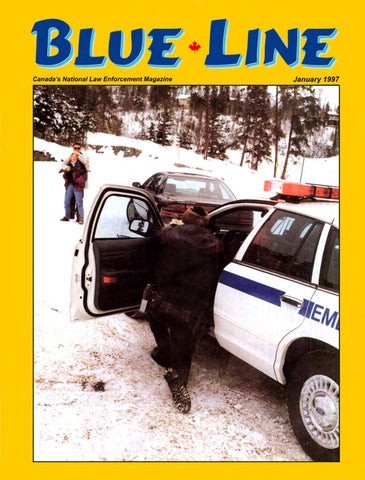
Here is a dramatic winter scene courtesy of the Kenora Police Service via Dave Brown of Winnipeg. The photograph was taken as part of a training shoot Dave was working on with regard to hostage situations and officer cover. Dave writes, "It might seem a shame to use this brand-new Ford Crown Victoria as cover but Constable leffWiebe of the Kenora Police Service knows how to duck as the bullets start flying. Constables Lloyd White and Dawn Wideman may be hamming it up a bit for the camera as the ' bad guys,' but they help illustrate how vehicle stops can sometimes become one of the most hazardous duties of the patrol officer." As you can gather this edition's focus is on firearms and firearm strategies and training. This edition is so full of information on these subjects we did not have enough room for Dave's own article on shotgun loading. Never fear, we have deferred this article to February's edition. Dave's cover story is also appropriate in that Blue Line has reached another milestone while entering its ninth year of publication .. . we have received our very first, ever, advertisement from a car company. And it is from the Ford Motor Company. See this landmark insertion on page 19. (We still can't get light bar manufacturers to talk about their products though.) This first edition also sports a column from our gunsmith, Pierre Descote and a second article from Bill Sopiro on interactive firearms training. We continue with part 2 of the 2 part series on unintentional discharge offirearms by Edward 1. Tully and part four in the series presented by Keith Merith on ground fighting techniques. As added interest we also have an article about room clearing and a survey on Police Sniper equipment. There is even more material than this but you will have to find it yourself in this action packed, information filled special edition. If January is too cold where you are just grab this magazine and curl up by the fire and enjoy.
G!f-- - - - - - - - - - - BLVE LINE
-------------------\0
Magazine
PUBLISHER'S COMMENTARY Mo rley Ly mbu m er
Happy New Year... hey, it can't help but get better! Itsccms in redible but Blue Line Magazine is cntcring its 9th year of publi hing! What a happy thought to bring in the New Year. Upon look.ing back. I can only say that it I ok.s lik.c a long dusty road weju t came down. vcr thc ycars wc'vc fought a lot of battles and Icarned a lot of Ie sons on the way. And wc no doubt havc a lot m re of both ahead of us. But regardless of all that has gone by we are till alive and k.ick.ing ... \\ho \\ould have thunk. it! It \\as a hallenging year for policing in anada. Imost every agcnc} in the country was struggling with budget problems never een before. Many agencies imply gave up the ghost and let theiragencics bo\\ outgracefullybyab orption or amalgamation to other agencie more aggrc sive and with a greater will to urvive. hallenges wcre mct on the ea t coa t with the f rmation of the Iialifa ... Regional Police and the apc Breton Regional Police. These t\\O nc\\ amalgamated agencie should evolve into far more cmcient police forces once a few gro\\ing pains arc o,ercome. f particular concern i the t. John, ew Bruns\\ick., Police Force. ftera thorough tudy b) some of anada 's leading policingauthoritie a highly critical report was ubmitted to the ity council and the Province. The report ba ically p rtraycd a highl) dysfunctional agency that will requirc considerable effort on everyone' part to ch, ngc. In ~pite of all this the rank. and file
omcer continue to perform their daily tasks of protecting their community. Blue Line and TenSeven Magazines will be watching this particular agency closely over the next year. We think their will be a lot for the rest of the country to learn from a rejuvenated t. John Police Force. The new year hould bring considerable change in Prince Edward Island. With the new connecting link to the mainland in place sometime this year we will be watching with interest to see if the crime patterns change. The highly mobile criminal of today may have been somewhat intimidated by the need to enter and leave this province by boat and this new ease of tran portation could mean a dramatic change for Prince Edward Island. I laving the largest population base in Canada, Ontariohas not found the fiscal purse strings any easier to open. Metropolitan Toronto Police have been cut back in strength over the past six years and they hit an all time low when over 600 omcers took a pension ofTer in one month alone. The absence of this enior talent was noticed everywhere. A new recruiting campaign began but replacing the numbers will never be the same as replacing the people. The Metro Toronto Police ervice has a lot of work ahead to rebuild. The new year will see the creation of a newly amalgamated outh imcoe Police ervice. This agency is the amalgamation of two rural police services situated in the southern
section of imcoe ounty. Innsifil and Bradford We t will imbury Policeomcer will now be wearing a common uniform to fight a common foe. ongratulations are in order to hier Bruce Davis and Brian Harrison for this initiative. It is through leaders such as these that policing will develop and flourish in the future. We will also look forward to the developmentofFir t ations Policing across anada in the new year. This area is about to get an increa ing amount of attention as the First ations people acro the country come to terms with their new found empowerment. There is no doubt that all police omcer can learn from the Fir t ations style of policing and we will be showing you how in upcoming i sue . 1997 will al 0 see many new technological advancement including uch things as helicopter patrol, atellite and digital communication and computer technology being brought into police vehicle like never before. Policing has come of age. It is now far more fashionable to fight smarter rather than tougher. It i hoped that in 1997 the court system can finally catch up with la\ enforcement' ab ility to bring offender before them. For a more detailed breakdown of law enforcement new over the past year check. in to Ten- even Magazine's January edition. A alway we are here to be your eye and ears to what is happening in law enforcement.
WORLD CLASS PROTECTION AND COMFORT The toughest protection standards (we meet them). A complete armour line (we pioneered them). Unlimited accessory and custom options (we offer them). As important as these features are, protective apparel in the real world demands one other critical component .. , comfort. That's why at Barrday, our engineers and de igners place a special emphasis on material selection and fabric weaves so that our products meet your most demanding standards of protection and durability and are comfortable to wear. Day in and day out. Real world comfort that makes Barrday a world cia s body armour supplier to national and international police and peace keeping force.
TOP: Barrday Advanced Tactical Armoured Ve t (A TA V) offer maximum flexibility and protection for police and military tactical application. LEFT: Barrday offers a variety of extemal carrier for soft body armour including our functional and popular CLEAN FRONT carrier.
Barrdal_ _ ADVANCED TEXTILE SOLUTIONS Barrday, Inc., P.O. Box 790, 75 Moorefield Street, Cambridge, 0 ,Canada 1R 5W6 Tel: 519-621-3620 Fax: 519-621-4123
THE ARMOURER Pierre Descotes
Balancing the budget on the firing range
's it worth your life ? Today is target-practice day. You clean your gun, make sure that all is well. No obstruction in the barrel, no rust. all parts are moving well. Your gun just came back from the armourer after a complete inspection. You are ready for action. At the range, you put your safety glasses on-Hey. .. salety first! Then you put your ear protectors on to prevent any hearing lossemphasis is on that word prevention. You get to your booth, load your gun and start shooting: BANG. BANG. BANG. CLICK. BANG. CLICK! You have got faulty ammunition! You reload your gun with some other brand of ammo or from a different box and start shooting again. This time, all six shots went off. You seem to be okay. You keep on shooting, and this time you get just a few misfires. Has to be the ammo or maybe your gun is getting a little dirty. You get out ofthe range, load your gun with your "service" ammo. As you do this you keep thinking that you have to remember to clean your gun later on. YOU ARE DEAD MY FRIEND... I have seen this situation dozens of times, and in ALL cases, it was always a life threatening situation. When practising, most departments use reloaded ammunition to cut the cost of training. In most cases, the ammo used is less powerful than the one used in service. It is especially true for those who use the .357 magnum revolvers. Most reloaders use non-magnum primers when reloading their ammo. It is less expensive and they know that the shooter will not notice any difference. Depending on the brand of primer, some are softer and some are harder, meaning that they will require more or less power on the hammer nose or firing pin to set it off. So it may be part of why during shooting, when you changed your ammo, it started to go well again. So you may say that it is a simple matter of asking your reloader to use softer primers in order to avoid misfires. Aha! Problem solved-no more misfires! WRONG AGAIN. .. What will you do about the " new" ammo that you use in your gun. You cannot ask the manufacturer to use a different kind of primer just for you. They may have soft primers and they may have hard primers. Worse still, they may actually have magnum primers which are even harder. You know that your gun is perfect because it keeps coming back from the armourer and you assume it has been thoroughly checked. But you are still facing misfi res. If you were using non-magnum loads in practice and were getting misfires, and you use magnum loads as service ammo, what do you do??? Where is the problem ??? How do you solve it ???
January, 1997
The problem with primers is the same, no matter which calibre of pistol or revolver; hard or soft. The problem is NEVER the primer and rarely the firearm 's fault. Your problem is your armourer. In Canada, anybody with or without any knowledge on firearms can get a license as an armourer. And as an armourer, that person can legally work on anything and try to fix-it. The really bad armourers are easy to spot. The problem starts when you th in k that your armourer is good. That person may be able to correct most problems but, what is his basic understanding. Anybody can remove screws and replace springs or "fit" parts to make the gun work but is he doing it within the specifications of the manufacturer? Then again, if that person is not authorized by the manufacturer, you may not only end-up with problems with the firearm, you may also end-up with problems with the manufacturer. Usually, any work done on a firearm by a nonauthorized armourer, voids the guarantee on that firearm. Should anybody get hurt or die because of a faulty firearm, and the manufacturer finds out that it was serviced by somebody without the armourer's certificate from that manufacturer, the fault may become the agency's alone.
Armourers are like doctors; you have the generali sts and you have the specialists. In the case of misfires it may be caused by one or a combination of the following: weak main spring, worn strain screw, worn hammer nose or firing pin, bad bead space, faulty ammo, slide not closing fully, hammer bind, and more ... If you are not using the services of a certified armourer, with a valid certificate from the manufacturer, how can you be sure that he/she knows what to do? When a person attends a manufacturer's armourer's course, they learn all the little secrets about those firearms that not all people know about. lfit is expense that is a factor most agencies would find that a properly trained armourer is not more expensive than any other. So why risk your life with a somewhat knowledgable friend of the boss if that person can not do the best and safest work. Everybody should always ask to see or get a valid copy of the armourer's certificate(s) to make sure the person is not only trained but is authorized to service your agency's firearms. Pierre is a Iicensed freelance armourer working out of St. Remi, Quebec. He may be contacted by phone at 514 454-5555 or Fax 514 454-5440.
Hatch Leatherman Maglite Multipliers Rapid Rotation Uncle Mikes Protective Optics Quick-Kuf Remington Streamlight Zak Tools Co.
__________________________~~~-------------------------------B-L~!g~!~~
Smith&Wesson Where safe:tY
is always on dutY. As a law enforcement officer, handgun afety i an issue that concern you both in and out of uniform. 0 one understands your concerns more than Smith & Wesson. That' why we have developed a full range of features to provide an added mea ure of gun handling security. On or off duty, Smith & Wesson help you make handgun afety your #1 priority.
When th lever is in the down position, the firing pin j<, ~hi Ided from the hammer. Returning the ICHr to 01 up position puts the pistol in a readyto-fire mode. This feature also allows the hammer to be safely decocked without engaging the trigger.
Positively locks the firing pin in place at all times, so the pistol will not fire unless the trigger is pulled, thus eliminating the possibilities of an accidental discharge if it were dropped.
When the magazine is removed, the firing mechanism will not operate. This eliminates the chance of an accident when cleaning or mi use by unauthorized persons even with a round in the chamber.
all
1-800-331-0852,
Ext. 2904 for more information.
Safety Concerns in Interactive Firearms Training (B'/I1 S . b U/"II' ~ rr l /Um I I oplro
Interactive training can be one of the most effective and rewarding forms of training both for the in tructor and student. With a little common sense and fore thought it can be as safe as any other method we currently use. Q uestion: What do these incidents have in common? • Louisiana 1996 Correctional Officer killed during training ession; herbrooke, Quebec [996 female officer injured in fall down stai rs while training; • Florida 1995 Fish and Game officer almost blinded in training. A nswer: Aside from the obvious, the type of training is actually the common denominator. The incidents involved Interactive Train.... . ing. Does thi s mean all mteractlve trammg IS dangerous? 0 , but when teaching certain di ciplines with interactive training methods, there may be an element of danger involved. These incidents are discussed not to pointthe finger of responsibility at anyone person or behaviour but to illustrate some very relevant points to con ider when conducting training. Interactive training and live fire exclusion [n the first instance the Correctional Officer was in a high risk vehicle stop. As he exited the suspect vehicle to engage a trainee, a single shot was fired and the Correctional officer was fatally wounded. The weapon involved was a 45 A P Smith and Wesson semi auto loaded with blanks. The scenario had been run several times previously. omehow a live round found it way into the scenario . [n interactive firearms training, we must take extraordinary precautions to ensure no live ammo is present. The use of specially modified weapons, blank firing attachments (BFA 's) and pecial conver ion kits do not guarantee the exclusion of a live fire situation, only the absence of live ammunition can. There are numerous methods used to address this need for the exclusion oflive ammunition. [n somejurisdictions an actual di stance around the training area is specified where no one may possess live ammunition . [n others, trainees are told prior to the training ses ion that they should not bring ammunition or weapons to the training area. Ideally all participants are physically checked ( earched) immediately before the start of a scenario for weapons or ammunition that can pose a safety risk. Check for back up weapons and other possible weapons lethal or non lethal. This should be done before any training ammo and/or inert devices are issued to them. [n the case of scenario training either using blank, FX Marking ammunition, or other special purpose training ammunition additional safeguards should be enacted. Product identification Most important is the correct identification of the ammunition. There's a lot of ammunition out there, that looks awfully simi lar. [ remember one incident in the 1960's when an army cadet unit decided to do some field training with their .22 calibre NO.7 rifles and some blanks one ofthe cadets had provided. Halfway through the exercise it was discovered that the blanks
.
were actually .22 rimfire nately no damage done. Persons usi ng blank or train ing ammunition should ensure that they understand all the safety warnings that the manufacturers provide with their product. Never assume that inert training products are " inert". Check the label. [ have less than fond memories of someone's class room demonstration of the " proper" use of OC spray with a su ppo ed inert can of OC... It wasn ' t! A policy of ammunition control Just as we control ammo on a normal range we must control training ammo. Estab lish an ammo control point, have one officer issue the training ammunition and inert devices. Have the trainees load their mags under his supervision . Allowing a bulk issue of training ammo and allowing the trainees to load at their discretion is to invite accidents. After the scenario is completed the same officer should received any unused material. Keep all ammunition packaging until the exercises are over. Two reasons. After training is over re-pack the ammo back in its original boxes. That way the ammunition remains identified. Second reason, if there is a problem with the ammo latter on, the task of tracing the cause for the manufacturer is greatly simplified because he has lot numbers and production dates. A final thought, even ifthe training exercise calls for the use of blank training ammunition, duty body armour is a good idea. Not all officers can run backwards and shoot back The second incident involves a fall. Consideryourstudent'sagility. Most range exercises use [ittle or no movement. If there is movement it is often done on a very controlled manner. [n interactive training the movement on the part of actor and students, is often spontaneous, and extremely dynamic. Quite often when the student tries to maintain that safe zone between himself and his aggressor he moves in a retrograde manner. [ have observed numerous falls, the results of
attempting to e>.it the kill zone in an uncoordinated fashion. [fyou think about it logically, moving backward, while attempting to remain focu ed on a threat to your front is an acquired skill. Certainly some movement coordination exercises wouldn't be a bad idea. An instructor should do his utmo t to ensure that there i secu re footing in the training areas. Be e pecially vigilant for small debris, rocks, wires, bottles, broken glass, etc. The actor (bad guy) should also be aware to coordinate his attack in such a manner as to move the trainee toward a afe direction, where the effect of a fall would be minimized . Understand the lim itations of your p rotective gear The third incident involved an officer in a training scenario using paint ball guns. Hi s eye protection came loose during some physical exertion and that is when he was injured. Eye protection is a crucial part ofinteractive training where we wish to use specialty amm unition such as paint ball or FX cartridges. It is important that the instructor is aware that just as ballistic vests are designed to meet specific types of threats and specific threat levels, so too is the eye protection offered on the market. Instructors need to pay attention to the fit of these devices. Be aware that "one size/style does not fit all." Be wary of products that do not remain on the face under the rough and tumble of the scenario. Mask fogging is another item that is addressed in different ways by different manufacturers. Goggles are not sufficient enough to prevent serious injuries to the face and head. Serious and disfiguring injuries may be incurred with a projectile strike to the forehead, ears, and und erthejaw. These areas should be protected as well as the back of the head. Exam ine carefully the mask manufacturer's len e warranty. This often provides clues to the level of protection that the lense offers. Just because it is given an A S[ ratin g does not mean you are covered for all threats. For exampIe most "paintball" masks offer yo u warranted protection against "paint" pellets rated at three hundred feet per second. The FX Marking Cartridge ve locity is cited by the factory at four hundred feet per second. Ventilation holes in the mask may be a problem where the mask was designed to stop " paint ball" projectiles. FX projectiles are smaller in diameter, so u e the appropriate mask. Lenses may not be rated to withstand mu[tiple or repeated impacts. Some safety lense warranties actually call for the discarding of the lense after a single impact or if the len se becomes sc ratched in any way. Ifyou intend to use them in "failure drills" where head shots are called for, [ would suggest wearing a second set of safety goggles under the mask. Interactive Training is simu lation in "three dimensions." Our safety concern s also have to be "three dimensional." William (Bill) Sopiro CD is an interactive training consultant from St.Bruno, Quebec. He is a member of ASLET, IALEFI and a certified NRA law enforcement firearms trainer. For further informatio n phone 514 653-1101 or Fax 514 875-2656.
------------------------------~r;?~----------------------BLU£L'N£
January, 1997
Vl--- - - - - - - - - - -__________ M a g a zine
ouwon anywhere
a better partner ~-I. the world.
Model 92/ 96 Centurion and Model 92/ 96. TIw high
capacity shorlclled alld lalldard versiollS of the legendary pislol lhat protects Allwrica.
Model 92/ 96D.
/)Ollh/C a lum oll/}~ - .......... F aillri'\ l/i(k Ii<IIY lrlll lL'llI1110 xl mal lafely l('1'cr alld a hohl>cd hallllller,
Model 92/ 96 Centurion. Sew
Shortelled, high-capacity versions oflhe 92196F models, 15+1 firepower (9I11m) and Jl+Jflrepawer (.40 cal.), wilh a compact sized slide alul barrel.
Model 92/96F.
Model92F Stainless . •1111h
feature , reliability and firepower of lhe la/ulard 92F pislol. Sew malic tainkiss finish. Solid lainU!ss slide and barrel. Black pia lic grips.
i.£'Rclld II}' rcliabilily
III !hlllll or. 10 calil>cr. -
............ 1.')+1 firc/></lL'I'f(9111111) alld II+Jfin'/></lLw( 10 cal,). /)Ollh/C/IIIIRI adioll, wilh extemal la/clytdcadllll( Ict'cr. Beretta Operating Systems F Models- f)oub/e / Ilngk actiol/,
Model 92/96D Centurion. Double
aelioll only versioll of th Cenlurioll. Fealures slick Iide syslem with no exlemal afety lever alld a bobbed halllnwr.
u.'1I1r exlemal safely deco<klllg U!1.'£r.
o Models- /)oub/e acliol/ ol/fy u.'illlOul safety U!1.'£r (fuk fide).
~) Beretta U.S.A.
Model 92EL.
TIw legendary reliabilitya/ul ............... fealures oftlw 92F. .. wilh bright blucdfillish, distillctive gold inlay alld richly grai/wd waillut grips.
,J-dot and tritium night iglrt available.
Unintentional Discharge of Police Weapons by Edward J . Tully
Part 2
Use of Force Policies
.
Law enforcement agencies should have a formal statement to the effect that the protectIOn of innocent lives and a r espect for the dignity of all individuals are fundam enta l values ofthe organization . F rom th e commitment to th ese two pa rticular valu es, an org ani z a~ ion ~ i11 cr.aft a use of forc e policy th a t the police office rs foll ow wh en th ey find th emselves In a s it ua tIOn which r equires t he use of some leve l offorce. This policy, or set of ge neral g uid ~ line s, i.n.turn leads to th e development of specific rules, reg ul a tions, and procedures th at provide additIOn a l directi ons to be followed whil e performin g poli ce duti es, which will includ e confr ontation a l situations and th e safe handlin g of wea pons. Continuing this logical progression of thought, the organization then must provide the officer with the equipment and means toacquire the skill and habits that enable the officers to use the lea t amount offorce without endangering themselves or other innocent parties. Care should be taken to ensure the policy, rules, and procedures do not impose unrealistic constraints on the officers that would increase their exposure to ri k or not allow a reasonable margin for officer judgment and discretion. A use of force policy is the mean by which an organization discharges its responsibility to both law enforcement officers and the public by having guidelines that attempt to strike a reasonable balance between the values of protecting the lives of law enforcement officers and deterring the abuse of authority. Some officers might argue that these values, policies, rules, and procedures only tip the balance in favor of the criminal in a confrontation. First of all , from a tactical standpoint, the balance is already in favor of criminals because they know what they are going to do next, while the officer must usually react. econdly, if an organization adopts a use of force policy by following existing law and Supreme Court decisions, then the organi zation not only has a legal but al 0 a moral obligation to provide the officers with knowledge, attitudes, and skills that will give the officer the edge in a confrontation. This is why organizations must provide the best possible training and proper equipment, and use sound tactical procedures. By these means, a department maintains a proper balance between the needs and protection of the officers and the prevention of the misuse of force. An organization which fails to back up their
officers by providing adequate training and equipment will cause officers to become concerned for their personal safety. It is nice to discuss the logic of values in an academic atmosphere, but it is an entirely different matter when the officers find themselves in a dark alley or hallway, forced to make complex and difficult decisions in a stressful atmosphere in a split second. Officers fear 20/20 hindsight judgments by their superiors, the courts, and the public. However, a review of police conduct cases over many year and a reading of recent court decisions, including those of the U.S. and Canadian Supreme Court, on the use of force revea ls the judicial branch understands and sympathizes with officers ' concerns far more than they think. (See Garner v. Tennessee,Vol. 471 , U.S.S. Ct. decisions, or Graham v. Connor,Vol. 490, U.S.S. Ct. decisions). The most visible thread that runs through the fabric of the use of force is training or the lack thereof. At present, the legal profession has zeroed in on use of force cases seeking to find liability on the part of the officers or the department for the real, or imagined, injuries suffered. Charges of poor training, a lack of training, vio lation of procedures, and use of poor judgment in deciding what level offorce was necessary are often cited as reasons why officers and departments shou ld be held liable for damages suffered by the plaintiff. Given this legal environment and the importance of training, it is my opinion that police executives, associations and unions, and the rank and tile police officers must join together to create a police culture that places the highest premium on training. Considering that some departments do not provide an adequate level of training or proper
equipment, and that officers are increasingly encountering dangerous and stressful situations on the street, and are under the constant pressure of having their actions reviewed by attorneys, community groups, the courts, and their internal affairs office, it is under tandable why some have lost their idealism, become a bit cynical, paranoid, and overly defensive. It is quite likely that things are not as bad as they sometimes seem. I think most officers know things are never perfect and understand why bureaucracies always lag behind. Basically, officers have to keep their en e of humor and shrug offmany of the shortcomings. This is not because they are not correct, but if emotions become overly involved, personal stress levels will increase which then leads to decisions that are not in the officers best interest. In most organizations, the trainers playa significant role in maintaining, transmitting, and developing the organizational culture. Personally, I always had great respect for firearms instructors and would suggest that they are the most influential of all police instructors. Like most recruits, I was looking for a role model, someone to mimic until I got my feet on the ground. In my experience, firearms instructors were knowledgeable, experienced in police work, and wise to the ways of the world. I hung on their every word, every intonation, and expression on their faces. I respected their wisdom and advice. ow, after having observed them forthirty-fiveyears, myopinion has not changed one iota. Whether these individuals know it or not, they are extremely influential teachers, and so the organization must select their firearms instructors with great care. Ifrecruits and veterans are going to look to these people as role models- and they will- the instructors must have a commanding knowledge of firearms, a deep respect for human life and dignity, a strong belief in the rule oflaw, a complete understanding of the role of the police officer in our society, and they must have experience on the street including the techniques and mechanics of arrest. I would also select only those officers who had a great respect for the chain of command, a willingness to be a strong disciplinarian, and a strong desire to teach . The reason for the substantial list of requirements for firearms instructors is that they must translate use of force policies, rules and regulations, and arrest procedures from the written word to practical application. During the training process, both recruit and in-service training, it is the responsibility of the firearms instructor not only to teach marksmanship, but when to draw, aim, and perhaps fire the weapon during a confrontation. They also form the attitudes all officers have concerning firearms safety. If they allow officers to be careless with firearms in training, they will be careless with firearms throughout their careers. Should they disparage the use offorce policy as being wimpy, then it is most likely the officer will consider it in the same light. Should they revel in stories of curbside justice, then the officer' s respect for department policy and the law can be seriously eroded, which in turn places the officer's career in potential jeopardy.
(continued...)
--------------------------------~rgl~-----------------------BL~~g~!~~ January, 1997 D
hen on idering the role of the firearms in tru t r, whilelearningu eofforcepolicy, let m empha il in the trongest terms pos ible the neces -ity ~ r the highe t quality of firearm instructi n. For e\ample, the trongest influen e in our lives rcgarding the afe handling of wcapon \,ill c me fr m the firearms instructor. Ifthey refuse to make any compromi e with the rule of the afe handling of weapon and mete out appropriate di cipline and retraining for tho 'e of who violate the rule in training, then we will be well served. They may occai nally embarra the officer for hi her careIe nes, tupidity, and lack of concentration, but in the long run, the attitude formed and the les on - learned will significantly redu e the p ibilit) of unintentionall) discharging a weap n and the potentiall) disastrous consequen es. In preparation for this article. I talked with a number f experienced firearm in tructors. They acknowlcdged that since thc introduction of ertain semiautomati wcapons in law en~ r ement, thc in idences of unintentional disharge fweapons has increa ed significantly. II were in agreement that carelessne wa the primal) cause of unintentional di charge. particular!) with thosc emiautomatic weapons that were designcd with little room for error. II I' the instru tors agreed that in tances of un intenti nal discharge c uld be reduced and mitigated if all officers were trained to draw the weap n with thc trigger finger outside the trigger liard and coached eten ively as to when th trigger fingerwa to be placed on the trigger. It wa str ngly ugge ted that way be devi ed to reduce the number of time officers handled the weap n, not only on the range but also on the job and at home. They univer ally agreed that tudents mu t beexten ivelydrilled to keep the mll7Zle of the wcapon pointed afely downrange and to alway know if the weapon is loaded . nother way to reduce the number of unintenti nal di charge wa to forbid recruits fr m h wingtheirncw"toy" to anyone. trong pini ns were held by these instructors on the necessity to terminate any emp loyee who coni ·tently vi lated firearms afety. These are me ugge tion to consider in attempting to redu the numberofunintentional discharges. I am sure, however. that there are many more go d ideas that need to be hared. Fireanns Testing I he purcha e of firearm by a law enforcement agen y i • rcgardless of the depanment' Slle, a maj r outlay of fund . on equently, it is in umbent to examine the characteri tic of the vari lI. weap ns available to detennine what weapon meet the need of the department. Depcnding on the testing capabilities of the department. the prudent law enforcement executive should fir t appoint a committee compri ed of 'everal recognized e\pert in the field o ffi rearm to examine the problem. Thi group will, as bjectively as po ible, determine the needs of th department. well as the tandard to be used mthe te ting proce . I would urmi e thi mmittee would like to e amine a variety of \\eap n to detennine their reliability, safe handling hara teristi • a curacy, and durability. It
is rea onable to assume that each department will et their own standards in these areas. ome departments set a standard of one malfunction per 2,000 rounds and require the life expectancy of the weapon to be at lea t 10,000 rounds. Another critical te t is the drop test. In this test, the weapon is dropped on its critical pans to determine if the concu sion will cau e a di charge. This is a simple but very important test. Failure in this test will cause some experts to disqualifY the weapon from further consideration. Finally, in some areas of Canada, it is mo t important to test the weapon for reliability under extreme weather conditions. There can be a great deal of emotion surrounding the selection of firearms for a department. We all have our opinions on the best weapon and are not he itant making our feelings known to others. As previously stated. I have great re pect for firearm instructor, but they are a contentiou lot. I love to hear them argue over the smallest details of firearm u e and why one weapon i better than the other. Theiropinionsare honestly held and well thought out, but consensus among them is hard to find. This is a major rea on why a rigorou firearms te ting program, conducted under valid scientific condition by the e ame experts, is essential to the selection proce s. uch a testing program will not only yield valid dataon weapon characteristics, but when the results are combined with the experience and knowledge of firearms instructors, will form the basis for solid recommendations about which weapon best fits the needs of the department. orne department ju t do not have the time-or money-to conduct a rigorous testing program. One way out of this problem is to contact other agencies who have done testing or who have ongoing ammunition and firearms testing programs. For example, I have always had a vel) high opinion of the work done by the Firearms Training Unit at the FBI Academy. The re ults of their testing programs are available to all law enforcement agencies simply by asking them to place your department on their mailing list (write to : Firearms Training Unit, FBI Academy, Quantico,V A 22135). In summary, the adoption of any weapon for use by law enforcement officer is a significant decision on the part ofa police executive. Officers may well be using the cho en weapon for twenty years or more. acrificing quality or afe handling characteri tics to save a few dollars in the short term may well turn out to be a poor decision particularly for those officers whose safety and live depend on the deci ion. Fireanns Training Training is not the answer to every problem which affects organization, although some trainers would have you think otherwise. There is no question that there is a time for training to solve problems, but some problems caused by a few officer who hear the beat of a different drum are best solved by enforcing the rules and regulations and dispen ing appropriate discipline. To my knowledge there have not been any large scale studies conducted on the reasons for unintentional discharges, although each depan-
ment keep it own records. onethele . the evidence we do have, plus our own common en e, strongly suggests the leading cau e is carele nes. arelessness is mo t often the resultofindividual ignoring the simple rules or firearms safety. When careless behavior is observed on the range it need to be recogni7ed. corrected immediately, and noted.lfthe behavior continue and the student does not respond to additional coaching or appropriate di ciplinal) measures, then the individual should be con idered for termination. We must take evcl) opportunity to in till re pect for the safe handling of weapons in all of our students. In continuing the di cussion a to how the unintentional di charge of weapon can be reduced. I think it is important to reitcrate some previous thought on the importance or the firearms instructorto the law enforcement training process. There i a certain mystique about this individual that is powerful and influential. Most recru its remem berthei r pri nc ipa I fi rearms instructor for a long time. Like young ducklings who imprint their behavior pattern from their mother. recruit have a tendency to mimic this impressive. knowledgeable individual. Lager to learn everything. the recruit \\atches the instructor's evel) move and li ten to eyel) tone and word . In addition to teaching the ba ics of firearms, the firearm instructor also indirectly tran mit the culture of the organization. They are powerful role modcl . If the instructors are impre sive, the recruits will imitate their attitude, language. and image. The recruit's attitude towards firearms safety \\ ill be indelibly forged by the instructor. The in tructor must also be a good coach, a stern disciplinarian, and always display the best image of the department in both word and deed. on and off the job. Given the fact that from day one the safety rule of firearm handling and range afety are fully explained and strictly enforced. I think it is fairly safe to say the recruit \\ill carry a respectful attitude towards firearms arct) throughout their career. In terms of the veteran officcr who \\as most likely trained to use a revolver and is nov, learning to use the semiautomatic pi tol. the training problem changes complexion. The e individual have formed their attitude and habits toward firearms safety and are not as impresionable as recruits. They are also Ie s amenable to strict di cipline and, at time. may have a cavalier attitude toward rules and regulation This is natural and to be expected. on equently, the wi e in tructor knows that veteran officers do not respond as well to fear as do recruits, and embarras ment in front or their peers lead only to hatred. ince we all agree there can never be any compromise on thc rule ' for the afe handling of weapons, hor cplay. or disrespect for range rules, the problem be omcs how to handle a situation that may be po ed by a few veteran officers. It is be t if they arc handled in pri ate in an understanding and respectful manner. If this approach is not uccessful, or doe not lead to an immediate attitude and beha ioral change, then there is no recourse except to throw the book at the individual.
BLUE LINE Q ~Bg ZinB ______________________________________~~~---------------------------------- January, 1997
Although excellent learners, the veteran officers need to know the reasoning behind every Ie on. Great patience is required with these individuals as they try to break the ingrained habits that they have with the revolver which may not be compatible with the safe handling ofthe semiautomatic. Veteran officers will need far more shooting time to familiarize themselve with the new weapon and its different characteristics. Expect progress to be re latively slow. Do not be foo led, however, by the fact thattheir scores will be better with the pi stol than the revolver! Old habits die hard and teaching veterans to leave their fingers off the tri ggerwill take much practice, time, and undertanding as to why this is nece ary. A John Hall pointed out in the first part of this serie , it may be that veteran officers need up to 40 more hours of in truction on the semiautomatic weapon than most departments are pre ently offering in transitional training programs. All instructors at a police academy are important, and each plays a significant role in the formation of professional law enforcement officers. Both the legal instructor and the defenive tactics instructor are critical to the implementation of a use of force policy in a law enforcement organization . The legal instructor provides the student with the knowledge and re pect of the law, while the defensive tactic instructor provides the training necessary to develop a wide range of skills used at the lower end of the force continuum . A respect for the law and being competent in the use of defensive tactics isjust as important as firearms ski ll s, and it could be argued successfully, I believe, that they are more important. It is crucial to the training process that the firearms, legal, and defensive tactics instructors teach from the same sheet of music. One discipline should never demean the other. The instruction they give should be complimentary and should reinforce lessons learned in the other discipline. While it may not be possible for each instructor to be equally proficient in the other discip lines, it shou ld be expected that they be reasonab ly knowledgeable of the other field and never provide connicting information to the students. The Chief Executive Officer, the command staff, the Director of Training, and every instructor hould ab olutely ensure that all members of the department have a clear understand ing and absolute commitment to the rule oflaw. It does not serve anyone ' s best interest to have instructor who belittle the 'Iiberal courts' or the 'bleeding heart' judges who rule on the various aspects of our criminal and civil law. Law enforcement officers who have a low opinion of the courts are, I think, ill-informed and may have a tendency to fee l justified in using excessive force, or perhaps, justified in taking the law into their own hands. I would argue that law enforcement officers who are given a comprehensive legal education develop a better understanding and appreciation fo r the role of the court in our criminal justice system. Given a more extensive education in the law, an officer is better ab le to follow a sound decision-making process in dealing with the variety of difficu lt situations encountered on the street.
J a nuary, 1 9 97
It is obvious that law enforcement officers should be in re lative ly good condition, physically strong, and self-confident in their knowl edge and application of defensive tactics. In terms of unintentional di charges of police weapons, it is qu ite possible that these quali ties may reduce the number of unintentional discharges considerably by simply red ucing the number of ti mes the weapon is taken out of the ho lster. While much of the defensive tactics instruction must take place in the isolation of a gym, it is important to give consideration to combining various aspect of defensive tactics with firearms instruction . This is best accompli hed in role playing arrest scenarios in which the judgment of the officer is tested when they are required to use their legal knowledge to assess situations and, thereafter, choose the level offorce necessary to handle the situation. Role playing performance needs to always be critiqued by instructors. This type offeedback to students on their judgment and performance is necessary to correct mistakes, which in turn, becomes a very powerfu l learning experience. We also need to develop scenarios that will demonstrate the concept developed by Dr. Roger Enoka, outlined in the first article in this series, (December 1996) about the consequences of involuntary muscle contraction and the unintentional discharge of the weapon in hand. I realize role playing scenarios take a significant amou nt of time and manpower. However, the concept that we learn best by doi ng is very sound . One area that needs to be empha-
sized more in law enforcement training is the management offirearms during activitie uch as searches, handcuffing, foot chases, and physi cal struggles. There is no better way to teach these subjects than through the role playi ng method. To the extent that this concept can be app lied to both firearm s and defensive tactics instruction, it should be applied . The resu lts obtained from role playing and additiona l firearms trai ning under stressful conditions will prod uce results that will, in the long term, reduce the incidence ofunintentional discharges.
Conclusion The safe handling of weapons in law enforcement can be achieved through a combination of weapon knowledge and familiarity, respectful attitudes, excellent safety habits, and a measure of self-discipline. These various skills, attitudes, and knowledge can be taught in the classroom and on the range. These lessons must be learned and internalized by each officer. Absentmindedness, carelessness, horseplay, and improper handling of the firearm cannot be tolerated. The consequences of unintentional discharges, while not always tragic, shoul d be a serious concern of police executives and al 0 every officer who lays hi s or her life on the line, relying a they do, on the quality of the training and equipment they are furnished. Just make sure your officers get your best effort.
Edward J. Tully is the editor of the Beretta Leadership Bulletin. He served in law enfo rcementfor 31 years before his retirem ent in 1993. He can be reached at 540-371-3084.
GET OUT OF THE DARK~~m1t AND INTO THE FUTURE WITH
COMPU-CAPTURE ®
A COMPLETE VIDEO IMAG I NG SOLUTION ...j BOOK AND ID FASTER THAN
EVER ...j BUILD ALINE-UP IN
SECONDS ...j ElIMINATE WASTED filM
AND TIME ...j EASILY MAKE ID BADGES
AND WRISTBANDS
Don 't forget to ask about:
COMPU-SKETCH ®
COMPU-SCENE ®
Create compos ites for suspect Idenficalion
DraWing program for crime and accident Scenes
products by
DDSI
CALL OR FAX TODAY FOR MORE INFORMATION B.R. (Bev) Graham, R.R. #1 (Jakobi Road ), Castleton, Ontario KOK 1MO
Telephone: 905-344-5906
Fax: 905-344-1103
91-- - -- - - - - - - - -8LU£ LIN£
--------------------10
M agazine
general idea of where the suspects are, through
live video images relayed from the dog to a Team among best in the world receiving visual monitor outside.
by Owell Percy fficer Zack and Major aren't your run of the mill police officer . ~t:~~ They' re fa ter on foot than most, they eat like animals, and they don ' t even have the common courte y to u e the correct wa hroomand they could care Ie s. Although they may und like friend s or even relatives of your, they ' re n t,or they houldn ' t be. They' re police officer , tryin g to improve the world and retain order. h yeah, one more thing, they ' re dog ... prize \~innin g dogs. on table teve eabrooke and Pat He ter and their canine partner Zack and Major of York Region are one halfofthe fifth place team fr m the nited tate Police anine ational Trial s ciati n competition in Wa hington D. . long wilh Peel officers Barry Le lie and Ingo, MiJ...e B wman and Bar, and pare coll F wid with Wilko, they competed in the 175dog ompetition earlier thi year. The gr up qualified for the competition at the anadian Police anine Trials. They reeived fundin g and were pon ored by local ompanie , and even chipped in from their own p cJ...et to go to D. . and prove them elve . The dog and trainer competed in ix categories dealin g with real life canine ituations. he dogs were judged on obedience to trainer ,
agility, an article search and suspect search in a field . The four-legged peace officer also took a hand at criminal apprehension and apprehension with gunfire. Most people would likely look for the floor when a gun is fired , but these courageous canines stand their ground through six rounds fired into the air, and don ' t flinch a muscle. All in a day's work for a canine officer. The four German hepherds and one Belgian Malinois proved themselve and made their masters proud. Although German hepherds are as symbolic to policing as Dalmatians are to firefighting, the Belgian Malinois is becoming more common in policing. As a matter of fact, some police departments in the United tates have hired- brace yourself--drug sniffing, criminal tracking pigs. Zack and Major didn ' t seem too impres ed when informed of this fact, and they're not worried ... yet. The first German hepherd was bred approximately 100 years ago, and has been used in many kinds of policing operations since. They have been used in all sorts of different situa-" tions, and as a matter of fact, the Metro Toronto police are currently experimenting with a hostage surveillance dog. It is a German hepherd wired with a video camera who is brought into special incidents. The dog arrives on the scene, enter the situation and gives the officers a
Back at work, Zack and Major are u ed in the line of duty for tracking criminals and missing persons, for field searche , build ing earche and evidence searches. Their keen sen e of mell gives them a great advantage over fleeing criminals. The canine unit of York Regional usually has slow days, but get called on an average of four incidents per night. The canines of course weren't naturally prepared to be police dogs. Dog, like all other police officers, must endure a har h training program. The dogs are trained for a total of fourteen weeks constantly and consi tently. The dog are taken through real-life situation and are trained in situation scenario . After a hard day at the office, the dogs go home with their trainers to catch a few z' , recalling a twist on the old adage The canine unit that lives together stays together. Mo t dogs feel more comfortable with only one rna ter, and after hearing stories of officers getting bit by a confu ed dog, constable eabrooke and Hester no doubt agree. Of cour e the officers must sacrifice time and a bit of money, but they claim that it is well worth it, and they have the orth American award to prove it. As for their kibble and veterinary bills (the dogs that is), the Police Department picks up the tab. The dogs require daily exercise, as all dogs do, and occasional training to harpen their skills. Officer eabrooke says the dogs never forget their training, but may form orne bad habits or attitudes and naturally, get slower as they age. Therefore, it is uncommon for the department to use a police dog over the age of 3, (or 21 in dog years.) The ideal police dog age is from 12 months to two years. The dogs are so effective becau e they do not view their work as work. To them it is a game, and it is always fun to play. This, claims eabrooke, is why most police dogs are good natured. The officers of York Region prefer male dogs over females simply becau e they have always had males, and never had bad experiences with them . "If it ain ' t broke don't fix it," tates eabrooke. In contrast, other departments may only use female dogs for the same reasons. There is no preferred gender in the industry. The origin ofa good police dog can be quite varied . Con table eabrooke claim that they could take a dog from the shelter and make it into a faithful police dog, but 0 far, they haven ' t tried . Zack and Major came from a breeder, as have most police dogs. Ifever a problem arises with an uncooperative dog, the department doesn't hesitate to return the dog, because, naturally, they only want the best when it comes to public afely. York Regional Police have been fortunate enough to have never had that experience. The dogs will forever be obedient to their trainer, as they are the only one who can deliver important commands. The only situation where a dog will attack without having been given a command is when their owner is in danger. It is advi able to take eabrooke's word for it, rather than pushing him around to test it. The dogs mainly bite on the arm, becau e it is natural as a human to protect yourself by
BLU£ LIN£ Q6-r __________________ January, 1997 M agazina _ _ _ _ _ _ _ _ _ _ _ _ _ _ _ _ _ _ _--I -
blocking with your arms, and it is one of the easiest spots to h it causing the least physical damage. The fibreglass training arm shield is certainly solid, but appeared quite mangled, and would likely seem a tad unstable when in use. (Anything would look unstable with a raging dog hanging from it.) The dogs are quite a bit larger than perceived', with long muscular legs, (all the better to hunt the bad guys down with.) One wou ld imagine that the dogs would seem larger than life when they are in mid-air, a millisecond before they get a good taste of your wristwatch. This intimidation factor is one of the reasons that dogs are used for criminal apprehension. They have an extraordinary sense of smell, can pick up a trail in a cornfield, and there are few on earth that can outrun an angry German hepherd. The dogs, however, are not just for winning prizes and intimidation. Earlier this year, the canine unit responded to a break and enter call at a Snowmobile dealership in Go rml ey, Ontario. The dogs were brought just as a precaution, but they soon discovered that they wou ld be needed for more than just their bark. When the squad cars arrived, the cu lprits dashed into the neighbouring cornfield, disappearing in the maze of ears and stalks. After a brief foot chase by officers, it was decided that the criminals were too far ahead of them. The dog was released, and within seven minutes, the dog had apprehended the suspect and held him in fea r until the officers arrived and handcuffed one of the suspects. The man was apparently quite convinced that the dog meant business, as he is probably sti ll trembling in his cell, for fear of becoming
Part of the fifth place team at the U.S. Police Canine National Trials Association competition are shown (L-R) Officers Steve Seabrooke, Zack, Major and Pat Hester. the dogs com-meal. (Get it? Com-meal.) The dog had surged into a gigantic cornfield, picked up a scent and traced a suspect with a generous head start, all within seven minutes, and enough corn to feed a small country. The dog did his job, and expected nothing in return other than the necessities of life. The dogs prove their loyalty and worth daily with apprehensions and discoveries that would be virtually impossible by human officers. Of course, the dogs aren't always successful in thei r searches. And even though they have the ob ligation to their work, they ' re only canine, as this next bit demonstrates. During a training procedure in Bolton, Ontario, dogs were doing an article search in a local grocery store that agreed to cooperate. The dogs were finding the drills a bit repetitive, but
remained on task, for the most part. A dog entered the empty store to attempt to locate a piece of planted evidence. The curious canine wandered around for a bit, and notified his trainer with a bark when he had found what he wanted. The trainer opened the door to discover what the hungry dog really wanted. As the dog munched on his fresh package of steaks, the trainer turned around to find the displeased store owner, awaiting payment for the steaks. These are some of the sacrifices you have to make to keep a police dog but since the officers had a good laugh over the incident, it can also be fun. Although there are many amusing and exiting dog stories, they must not stray the attention away from the real purpose of canine officers. The dogs are different in personality, more trusting, faster, and some would say, smarter. But the dogs alone would be practically useless without someone to obey and follow and couldn ' t be as effective in capturing criminals, tracking evidence, and doing their other duties. This is why there is such a strong bond between officer and animal. They can both count on each other all the time. They work as a team, act as a team, playas a team and live as a team. The dogs are unquestionably different from the other officers, but both are equal in their work. No life is valued any more or less than the other, and both follow the same set procedures. The two are drawn together by one sim ple trait. Their dedication to the protection of society. Both are dedicated to protecting people and property, solving crimes and saving lives, and that is why Canadian dogs and dog handlers are considered among the best in the world.
Put a 30 million dollar sight system on your gun.
o Standard
n/
Rising Dot
0+ Dual Rings
Open Crosshairs
The Bushnell®HOLOsight®brings the advanced holographic sighting system from U.S. fighter jets to your gun. It gives handgunners, slug , wing and rifle shooters a technological edge. The reticle appears suspended in front of your gun. The heads-up display gives you instant target acquisition and unlimited field of view. Head alignment and eye relief are no longer critical. Four interchangeable 2-D and 3-D reticles give flexibility to change patterns in the field . And it's waterproof and fogproof. To experience this next generation in gun sight technology, you have to see through it. Bushnell ®HOLOsight®, another example of leadership and vision.
BUSllnE~O
s i 9 h r
For more information please contact Carol McFarlane at Bushnell Sports Optics Worldwide 1-800-361-5702 January, 1997
9
BLUE L'~E ________________________________~~r---------------------------------------~agaz'ne
Wor;ld Police / Fire Games
The World Police/Fire Games are coming to algary June27 - July4, 1997. Eight exciting days of international competition. algary wa awarded the bid for the '97 ame in olorado prings and was in competiti n with Phoenix, Indianapolis, Honolu lu, Regina and Il ulkonite, Finland. The ame are being organized by a dynamicgroupofPoliceOmcersfromtheCalgary Police ervice. local Royal anadian Mounted P Ii e and Firefighter from the Calgary Fire Department and algary citizen. All member of the ommittee are volunteer, with Directors i tant filling ten different areas. These Dire tor are over een by a hairman and two Vi e hairmen; all volunteer. This group i guided by a teering ommittee made up of member from the three departments involved and repre entative from the ity of algary. The ity f algary and the Province of Iberta have been behind this project from the
tart, assisting with political, financial, and logistical expertise in the bid process and planning of the Games. As an Organizing Committee they have made a commitment that the Games be planned and organized totally by volunteers. Over and above the regular sporting events, Calgary will include an Ice Hockey Tournament and a Rodeo as added events. The Calgary Exhibition & tampede have agreed to "A Salute to Police Officers & Firefighters" as their theme for the '97 Stampede, which will include displays, demonstrations, and an international contingent in the Stampede Parade. This will bring a western flavour to the Games as the last day of Competition is the first day of the tampede. The events will be spread throughout the Calgary area in 30 different venues, both indoors and outdoors. Spectator seating is a large priority at all venues. Opening Ceremonies are planned at McMahon tadium, followed by a
the
PORATION
ITT.
Rltij:ll v lS IO NI
-t
SWAROVSKI
TECHNOLOGY CORPORATION
M~EAMI . o PEAK BEAM SYSIEMS. INC
Country & Western social at the "Big 4" building. Four ocials are planned during the week with the Clo ing Ceremonies being held at Spruce Meadows. The Games Committee has aggressively gone out to ensure travel accommodations, city and area information, and hospitality services will be available to all participants and visitors. In conjunction with the Results Cel1lre, plans are in the works for aJledia Centre where all venue results and film footage will be available immediately for all press attending the Games. Also included in the Games \\ill be a 3-4 day educational conferenceallo\\ ing fora \\orldwide information exchange pertaining to police and fire services. The Goal A the Games reach Calgary, organizers expect registration in the numbers of 10,000 competitor . This number is comparable only to the Summer Olympic Games. These athletes will reflect participation of over 6.300 communities world-wide. Typically, due to pride injob and community, these contingents are usually accompanied by senior omcers. These numbers estimate 6,000 participants from the .. A. alone. The} will be accompanied b} 10,200 visitors. The Canadian contingent will consist of2,000 athletes and 3,400 visitors. The Pacific Rim countries will send 1,000 participants \\ith 1,700 vi itor , Europe 700 participants with 1,190 vi itors; the balance, Africa and offshore countries will send 300 athletes and 510 visitors. Thi forecast computes to a total of27.000 visitors to Calgary. Plans include over 5,000 volunteers giving their time to make these Games a success. Estimation in regard to local audiences is around 300,000 people. Due to the numbers of vi itors along with local involvement, media coverage will be extensive with daily reports, interviews and event results. To encourage and inform participants to be involved in the '97 Game , an information booklet with registration forms will be mailed to over 40,000 Police and Fire departments world-wide. These booklets contain information on travel, accommodations, event dates and times, contact names and number, ocial events, pre and post Game tours, and point of interest in and around the Calgary area. For fur ther deta il ca ll (403) 974- 1997 or Fax (403) 974-1999.
BLUE LINE Q ~BgBzine ______________________________________~ ~ ~__________________________________ Janu a ry , 199 7
A history of fitness and fellowship has followed the games from the beginning The World Police/Fire Games, (WPFG) is an Olympic styled event designed to promote friendly competition, fellowship, and international relations among police officers and firefighters. The Games were originally organized in 1985 by members of the Southern California Police Athletic Association, then forming a Federation controlling the World Police & Fire Games. This group has grown to a body of 15 members, with police or fire fighting backgrounds. The Games are held every second year and have been in San Jose, San Diego, Vancouver, Memphis, Colorado Springs and Melbourne, Australia. The bid process for the Games in 1999 was held in Melbourne immediately following their Games, with Stockholm, Sweden, being awarded the 1999 Games. The Games include up to 65 different competitive events, approximately 55 being standard at all Games. The Host City has the option of adding a few events particular to theirclimate and logistics. All events, whether individual or team oriented, are divided into age and gender categories. Competitive levels in all events are very high, with all events officiated to international standards. Since their inception, participation in the World Police/Fire Games has increased by 1500 to 1700 participants every Game year, with a total of 7,000 participating in Melbourne in 1995! Melbourne had over 44 countries represented including: Australia, Austria, Belgium, Bulgaria, British West Indies, Canada, Cayman Islands, Channel Islands, Cook Islands, Croatia, Cyprus, Czechoslovakia, England, Estonia, Fiji, Finland, France, Germany, Hong Kong, Hungary, India, Ireland, Isle of Wight, Italy, Japan, Latvia, Malaysia, Mauritius, Netherlands, New Caledonia, New Zealand, Northern Ireland, Norway, Papua New Guinea, Panama, Puerto Rico, Russia, Scotland, Singapore, South Africa, Spain, Sweden, Switzerland, Trinidad, U.S.A., Ukraine, Vanuatu, Virgin Islands and Wales. Of the total competitors, 3,500 were from Australia, 1,250 were from the U.S.A. and 1,934 were from other countries. Expectations for the Calgary games are even greater with more events and more competitors from even more countries.
Calgary offers program for health and fitness to battle the unseen kille s by Ted Herbert, 1997 World PolicelFire Games For many years, police officers and firefighters have been battling, not only crime, but the negative effects ofa career that is not always conducive to good health, These are the silent killers; the underground causes of premature death, ill health and injury. Irregular hours, unscheduled meals, inactivity and a lack of coordinated health and lifestyle programs, have lead to an increase in the risk of many ailments including heart disease, diabetes, alcoholism, back problems, emotional and mental distress. There are things that can be done to reverse the trends toward poor health. The Calgary Police Service, R.C.M.P. and the Calgary Fire Department are joining forces to host the 1997 World PolicelFire Games in June of 1997 and as a part of the Games they will be bringing together internationally recognized experts from the health and lifestyle community to present information and advice on issues of wellness. Programs designed to attack, unhealthy lifestyles have taken many forms. Employee Assistance Programs have been established in most large departments. Various types of employee fitness initiatives have been put in place. Applicant and in-service testing and monitoring programs have been designed to reduce the incidence of health problems in many departments. Yet there is still a lack of consensus as to how best to combat the pitfalls of toxic living. Most agencies act independently without the benefit of experiences that others have had. "Do [t"the conference for improved physical and mental well being that Calgary will host, will attempt to enhance better understanding and mutual agreement on the issues involved in health promotion and disease prevention in public emergency service organizations.
WORLD POLICE I FIRE GAMES
CALGARY .JUNE
27
97
.J lJ L Y
4
Dr. Kenneth Cooper, whose Cooper Clinic in Dallas, Texas has been the leading centre for health and fitness research and development in the world, will be the opening keynote speaker at the conference. Dr. Cooper will be extremely informative covering current issues in fitness and health on a general level where other speakers will focus more directly on topics specifically addressing police and fire members. Shift scheduling, nutrition, stress management, employment standards, maintenance programs and other topics will be of interest to department managers and to front line personnel. All presenters at the conference have impressive credentials and international reputations. The 7th World Police/ Fire Games provide the perfect backdrop for this discussion. The Games are designed to promote physical fitness for law enforcement officers and firefighters in an atmosphere of camaraderie and friendly competition. The conference will be held over two days leading immediately into the festivities of the Games. Expected participation in the 64 events is between 8000 and 10000 participants. Including fami ly members and accompanying guests, the visiting population will top 20,000. This is definitely the place to be June 26 and 27, 1997 for the conference and June 28 to July 4, 1997 for the Games.
TRAINING FOR
ON TARGET WITH THE NEW FX BLU E MARKING CARTRIDGESI
Use them with FX Red Marking cartridges to stage more true-to-life team scenarios!
Prepare your personnel for the real-life situations they are likely to encounter. Developed with law enforcement and military professionals, the FX system is built around non-lethal marking cartridges. It includes easy-to-install conversion kits, safety-ring inserts and protective gear.
iii Exclusive Ontario & Western Canada D istributor . . Tetragon- Tasse
Phone 1-800-38POLICE
Fax 905-828-6390
G 5 ? 1 - - - - - - - - - - - - -BLUE LINE
January, 1997 _ _ _ _ _ _ _ _ _ _ _ _ _ _ _ _ _--\v~--------------------- Magazine
Last Drink Program a second winner for Peel Police lem olving Awards were handed out in an Diego at the 7th Annual Intemational Problem-Oriented Policing Conference, ovember 2 to 5. The awards are named after a professor emeritus at the University of Wisconsin Schoo l of Law, who developed the problem-oriented policing concept. The Last Drink Program has al 0 been identified through the Ontario Association of Chiefs of Police - Traffic Operations Comtry.) mittee as being an exemplary proWhile attached to Compugram worthy of consideration by ter ervi e \ ith the Peel Reother communities. gi nal P Ii e ervice, onstaThe program is viewed as a ble Dan arrier developed a community oriented project and is reporting ystem that a proactive approach to policing. d wn loaded certain data related Its goal is to gain voluntary compl ito riminal driving offeneesand Peel Regioll al Police Chief Robert LUI/lley (left) is shown congratlliatillg ance with the Liquor License Act. 12-h ur licence u pensions the 10 ation and time of the Constable Dan Carrier upon receiving his Herman Goldstein A ward last In order to accomplish this goal, ovember at a conference held in San Diego. co-operation is required between offence and rre t, colli ion, the police, the management of liblo d alcohol con entration , the "drinking at" location, and more. This data sources to the premises with a demonstrated censed premises and other agencie uch as the provided a way to identify location with a problem. Actions ranged from letters of warn- Liquor Licen e Board. The project success is ignifi ant number of collisions and enforce- ing and educational visits by LLBO field staff, notguaged by the numbers ofarrests made but by the relative decrease in the numbers of arre ts. mentactivity, and licenced premi eswhich tend to full investigations and covert surveillance. For further information contact: OfficerLast Drink data is also u ed to direct RIDE to over- erve alcohol. The information wa hared with the Liq- units to areas where they are most likely to In-Charge, Drinking Driver ountermea ures Unit, Peel Regional Police, Phone (905) 453u r Licence Board of Ontario (LLBO), which encou nter impaired drivers. The Herman Goldstein Excellence in Prob- 2 12 1 Ext. 7050 or Fax: 905 507-8287. wa able t efficiently direct their limited rehe La t Drink Program is a pr active effort to deal with the pr blem of impaired driving before the driver even enters hi car. Thi program was the second recipient of the Il erman Id tein ~ xcellence in Problem olving Awards given out to member of the Peel Regional Pol ice ervice. ( ee Page 26 in thi edition for the econd
TS
eJbeec· INCORPORATED
75% Polye ter / 25% Wool Worsted
CANADA Supplier of specialist
INTELLIGENCE and
TACTICAL SURVEILLANCE ELECTRONICS Night Vision CCTV Phoneline/cel/ular video transmission Microwave, UHF video links Atmospheric laser video transmission Intrusion detection Infrared Illumination Covert audio and video Electronic countermeasures For complete information: 1-800- ITS-8135 or 613-830-8329 fax: 613-830-8274
BLU£ L' N£ - - - - - - - - - - - - 1Q
Washable ... Wrinkle resistant... Cooler in the summer ... Warmer in the winter ... Longer lasting.. . on-fading... Female sizes ... and we arejust getting started! Make the transition to true quality. Call today.
Phone: (902) 835-1819 Fax : (902) 835-2470
Phone: (403) 256·8807 Fax : (902) 835-2470
~Bg Bzine -------------------------------------~~ ~----------------------------------- January , 1 9 9 7
Safety in Action:
You're Never a Fool for Checking @
1 - imply keep the weapon in the ready position with the gun hand in a firing grip, FINGER OFF THE TRIGGER. Then use the support hand to open the action by placing the thumb against the rear of the receiver and hooking the second joint of the index finger in front of the rear sight. 2 -A simple pinch movementwil1 open the actionjustthe right amount to confirm a loaded chamber. 3 -In a low light situation, the tip of the little finger can physical1y confirm a loaded chamber.
by Robin Stoney "You're never a fool for checking." How many times have we heard that coming from a Police Firearms instructor? Probably not as often as we should. The double check ensuring that " Yes, I do have a round in the chamber," should be done, faithful1Y, just after you complete your start-ofshift load and in preparation to any high risk situation. Many officers are familiar with the pinch check used on the venerable old .45 pistol. You placed your thumb inside the trigger guard and with the tip of your forefinger on the recoil spring plug, you cracked open the action with a simple pinch movement. A quick glance down revealed a fami liar glint of brass in the ejection port. However, the arrival of modern pistols with ful1 length guide rods and our stricter safety concerns makes this particular style ofchecking obsolete. Today, we use a different kind of pinch check that works wel1 on the Glock Model 22 pistols. It passes al1 the requirements of safe condition check: ./ it works (the action opensjust enough to see/ feel the casing); ./it's done while in the ready position(weapon stays pointed in a safe direction); ./ you don't disturb your strong hand firing grip; ./ fingers and hands stay behind the ejection port and away from the muzzle; ./ it's a control1ed movement (no othertravel of slide al10wing the chambered cartridge to eject or ' stovepipe ' );
./ officers of slight stature can handle it with ease. Occasional1y during our Tactical Pistol Course I wil1 ask, "Is everyone loaded?"immediately fol1owing a simple load dril1 at the range. I see a few nods and hear some "yups". Then I ask, "Would you bet your life on it?" At this point, anyone who hasn't already confirmed the readiness ofhis or her weapon usually checks. I had one student recently who responded, "Yes, I' d bet my life on it." So, I asked him ifhe would bet his partner's life on it. The look from his partner apparently convinced him that to visual1y confirm a round in the chamber after loading wasn ' t too much to ask! We' ve found that in a forty hour course with eight sutdents, there wil1 often be four or five failures to chamber, usual1y from failing to properly seat the magazine. In our CPS classes, we emphasize the importance of having confidence in our issue sidearm and ammunition . We face enough variables during high risk situations on the street without adding to them. The last thing we need is the possibility, however slight, that our weapon is not in a loaded condition. Rememb er : your're never a fool for checking. Robin Stoney is a member of the Calgary Police Service and a member of their Tactical Unit as wel1 as a firearms instructor. ext month we wil1 present part two of his series entitled Professional
Weapons Handling.
New vests for high risk wanderers The Alzheimer Society of Peel Region in southern Ontario, has premiered a new line of clothing designed for the high risk wandering persons. The garment is a yel10w T-shirt, vest or sweat shirt with " WANDERER" in bright blue print on the back and the Alzheimer logo of forget-me-nots on the front. The intent of the garment is to readily identifY and locate wandering persons. If someone is unaccompanied and wearing this identification garment, they are likely lost
January, 1997
and frightened. The citizen than needs to stay with this person and have someone contact the police. The police wil1 return the subject to their caregiver. The clothing has been designed, sponsored and produced, in partnership, by the Alzheimer Society of Peel, the Peel Regional Police, ursing Homes, The Region of Peel, Square One Shopping Centre and Intercon ecurity Limited. For further information contact Maureen Davis, Executive Director, Alzheimer Society of Peel (905)278-3667.
New and improved MedicAlert bracelets The Canadian Medic Alert Foundation has changed the look of its primary member ervice - its customized bracelets and necklet. s of May 1, 1996, members of the Foundation received newly designed, Canadian-made bracelets and necklets embossed with the Medic Alert name and widely recognized medical symbol rather than the traditional red paint lettering. While existing members wil1 continue to wear bracelets and necklets with the red-lettering, it is important that medical and emergency responders recognize the new embossed emblems as genuine Medic Alert products. Although the design of the bracelets and neck lets have changed, they wil1 continue to be custom-engraved with each member's vital medical information, personal member ID and tOl1-free hotline number to be used in the ca e of an emergency. For further information contact helagh Tippet-Fagyas, President, at (416)696-0142 ext.226 FAX :(416)696-8324.
Kit Shops
The Princess Pat's 'got you covered!' The Princess Patricia's Canadian Light Infantry is proud to introduce the kit shop catalogue - the first of its kind within the Regiment and possibly within the Canadian Forces. The Regimental Kit Shop has been an integral part of the Patricia's s ince 1922. Their mission is to enhance Regimental esprit in garrison and quality of life in the field through the provision of quality items of clothing and equipment at the best possi ble price. Over the year, the PPCLI Kit hop has developed a clientele far broader than serving members alone and, although the product line remains focused on the soldiers' needs, the services have evolved to meet a growing demand. In addition to soldiers, the growing customer base includes, reservists, veterans, and law enforcement officers. The Kit Shop's military-approved field equipment has proven a favourite among the rank and file of local law enforcement. It has been used by Patricias on operational duty in the former Yugoslavia, the Middle East, yprus, Africa, and exercises in the cold and wet climes of northern Canada. The PPCLI Kit Shop only stocks kit which is designed to make an outdoors person more comfortable and more functional in that environment. A recent press release stated that "Regardless of where we are, or where you are, . We've got you covered! '" The PPCLI Kit hop catalogue can be viewed on the global internet at http://www.nucleus.com!-ppcli. To order your own mail order catalogue write, fax or phone: PPCLI Regimental Kit Shop, 4520 Crowchild Trail SW, Calgary, AB, T2T 5J4. Phone : (403) 974- 2865 , Fax : (403) 974 -2864, emai 1: ppcli@nucleus.com.
__________________________~~r-------------------------------B-L~~g~!~~
- - - - Vancouver Police Department Illustrated by Stefon Sepa Compiled by Blal( McQUillan TIIi VIrie wa compiled by BIlle Line Magazine al/d is il/tel/ded to tell the stories of police officer killed in th e fin e of dllty. Tlte initial articles will involve tlte first officers killed iI/ the lil/e of dllty from eaclt of tlte major police forces across Cal/adfl. The/ollowing arlic/e reproduced/rom The un. Tuesday March 27. 1912 (By permission of the I'ancouver un)
Poli email hot dead by assassin who /lOW lie betweell life aud death Call table Byers murdered by Oscar Larsen, wede, at a shack 011 Waterfront assailallt thell gIVes battle from his barricade to squad of polIce, alld falls from their bullets.
appeared, the door opened about a foot and a half and I thought I saw the form of Larsen in the shadow. I fired two shots through the door, which remained open. By this time Byers was safely secured behind a neighbouring shack. We brought a stretcher from the waiting ambulance and carried him to it. Then we went back to where Larsen was still firing away. We surrounded the r,lace and fired several volleys into it. , Detective Crewe was using a rifle. We afterwards found a wound on Larsen's temple which I think the rifl made, for the flesh was ploughed in a way which I do not think possible with the thirty-eight calibre revolvers we were using. After this last volley the firing from the shack ceased.
Murderer Unconscious "We waited for a time and then P.e. Quirk cautiously opened the door and we rushed in, expecting Larsen to open fire the moment we entered. We found him unconscious on the floor, bleeding from wounds in his chest and head. The floor of the cabin was strewn with empty shells and the walls were splattered with blood." Larsen was taken to the ambulance and placed beside Byers. The two were then rushed to the General Hospital. Byers was examined first and the doctors pronounced him quite dead. The bullet passed through his heart and death was probably instantaneous. Larsen was found to have five shot wounds in his left chest, which seemed to have been self inflicted, for the flesh was blackened with powder. Over his right temple was a revolver wound and the right eyebrow was nearly torn off, where a bullet of heavy calibre had ploughed through the flesh . The wound in the temple was much more serious than any of the others and may cause the man's death.
The Bed Watch
Riddling tile hack "Wh n Crewe ran forward," aid P.e. Ru II to th un, "I wa on the side facing the d or of th ha k. The moment Crewe
At nine o'clock last night Larsen had recovered consciousness and asked for water. He was questioned as to his motive for shooting the officer but refused to say anything. The officer who was waiting in the hall at once informed the station and two detectives went to the hospital. They watched beside the murderer's bedside throughout the night. Larsen remained conscious but refused to answer questions put to him. His face was terribly swollen and his right eye was alma t blind from the effects of the stunning blow caused by the impact of the rifle bullet with the skull. Byers had been a member of the force
Oet. Samuel Crewe was credited with pulling Constable Louis Byers' body from the line of fire as he laid on the beach in front of the killers shack. Crewes is also credIted with delivering the fatal shot that finaly put an end to Byers' murderer. since last October. He was formerly a member of the orthwest Mounted Police, in which force he served for three years. He was married four months ago and has been living at 1240 Commercial Drive. Fr d Lar n, a brother of the man now lying in the hospital, is held in the jail as a witne s to the hooting of Officer Byer . Th shooting of Byers marks the first tragedy which ha occurred in the Vancouver p Ii force. ever before has an officer been killed in the performance of duty. Byers was one of th mo t fficient men on the force, his long training in the Mounted Police fitting him for hi work. Tonight the officers and men of the poli e force were to have held a smoker in the gymnaSium of th station, but this is indefinitely postponed on account of the death of Officer Byers. In the m antime Larsen lies in the hospital. On the one hand death waits to snatch him. Be ide his bed sits the officers of the law, remor elessly waiting until their prisoner recovers to carry him before the tribunal of justice.
Historical Commentary by S/Sgt. eil Tltompson Records ection - Vancouver Police ancouver in 1912, was a city in tran Ilion. The population had nearly quadrupled from the 27 000 figure of 1900 to over I 10,000. The downtown area was in the midst of a building boom. Many of the monolithic granite bank building built during this period till stand. and will probably be there for decades to come. The We t End of Vancouver, now home to approximately 50,000 people con isted at that time of tree lined boulevards with ornate homes looking out over the beauty of Engli h Bay. The interior areas of V ancouver. those one or two mile from the hores of Burrard Inlet. were being cleared for residential housing and the real e tate business was booming. Vancouver had een tough time too, the anti-oriental riots of 1907 and the police handling ofa trade unionist unemployment rally in Februal) of 1912, were ign of growing unre t. There were high times too, however. fhe Coronation of King George V in 1911 brought thou ands ofVancouverites out onto Granville treet to celebrate. Police Officers in Vancouver still trode the treels wearing the traditional " Bobbie's" helmet and fire engines were being drawn by a teams of horses. Vancouver was then, a it i now, the jewel of the west coast. o-one knows how Louis Byers began that fateful day. We do know it was quite warm for March. While the overnight low was only one degree, it had warmed to thirteen and a half degrees by three in the afternoon. It wa a dry month, and though patchy with clouds. it \\as
BLU£ LIN£ Q M ag zin _ _ _ _ _ _ _ _ _ _ _ _ _ _ _ _ _ _~~f----------------- January, 1997
obvious it wa n 't going to be a rainy day. The Byer' s house at 1240 Commercial is gone now, but one can still imagine a mall frame house with the young couplejust starting out in life. He likely would have left home after tending the garden and enjoying a hearty breakfast with his young bride. He was 21. A brisk walk north on Commercial would take h'im to the tram stop on Hastings which would then carry him to work. He would have arrived at the old brick station at Cordova and Main, a scant 10 minutes later, and quickly reported for duty, linle knowing he would never see home again . A few hours later, he was dispatched to face a man with a gun, alone, and within a few moment , he lay dying on the sandy shore of Burrard Inlet. We don 't know much about Louis Byers, there are no photographs, and a blank shield stands where his photo should be on the Wall of Honour at the Vancouver Police Mueum. I don 't even know his wife's name or what became of her after the tragedy. However, we do know he died honourably, if there can be said to be an honourable death. 1 imagine that as he approached the scene, he didn't think too much about the possibility of his own death, this type of call was probably quite common in those days, otherwise one would assume, more men would have been sent. Be ides that, what would he have to worry about, no police officer had ever been killed in the line of duty in Vancouver, and there was no reason to expect there ever would be approached the scene, he scouted out the area and discovered a pot from where he could have successfully shot. elson, who lived across the street from Larsen advised later that as he passed her house, Byers asked her if there was a back door to her home. he replied in the negative, but advised she did have a front window which had a commanding view of Byer's shack. Byers exanlined the window and said "I could shoot him ea ily from there, but I don 't want to do that." At that moment, Larsen was recklessly firing his gun in the air. Byers advised Mrs. Nelson to "seek a place, where bullets could not reach her" and turned to face his suspect. As he did so, Larsen ordered him not to come any closer. Byers took one step forward and before he even had time to unholster his revolver, he was struck by two of three bullets unleashed by the drunken man. One of the bullets destroyed his heart, he turned slowly to his left and fell to the sand along the shore of the inlet. He stood no chance. The funeral for Constable Byers took place on Sunday afternoon, March 31, 1912 at 2:30. By all accounts it was one of the largest attended events in Vancouver's history to that point. As the funeral cortege, itself consisting of over two thousand people, made its way from the Central Methodist Church to the Canadian Pacific Railway Depot, it passed by overtwenty thousand citizens of Vancouver. The body of Constable Byers was taken by train to Carlevale, askatchewan for interment. Constable Byers' widow received a grant of one thousand dollars, after a special meeting of City Council. J anuary, 1997
She also received an unspecified amount from donations contributed through the generosity of the public. Oscar Larsen, died as a result of several bullet wounds the day following the shooting. According to the Vancouver Province of March 27, "Larsen had eight bullet wounds, three were on the left temple and were from bullets from the revolvers of the detectives, while five which were upon his left breast were self inflicted." Louis Byers died a hero, a young man who was popular with his fellows and concerned about his city. Over the next few years, Vancouver would suffer what would seem like an unending stream of officers killed in the line
of duty. Constable James Archibald was murdered in May of 1913 , Detective Richard Levis, on Augu t27, 1914,and Chief Constable Malcolm MacLennan on March 20, 1917 leading an assault on a barricaded suspect. Finally, on October 12th, 1922, Constable Robert McBeath was slain while arresting an impaired driver. McBeath, had won the Victoria Cross during the Fir t World War, and had been with the Vancouver Department for only a year at the time of his death . Over the course of the next twenty-five years, there were only two police officers murdered while on duty, a period of relative calm began, the city was becoming more civilized.
DESIGNED TO SERVE AND
PROTECT
CROWN VlcrORIA
INTERCEPTOR ep FLEET HEADQUARTERS
BOX 1580, SJATlON 'B', MlS~SSAIJGA, ONTARIO L4Y 4&3. TOll FRf£ 1·800-888·5515 FAX: (905J ~2mi3
__________________________~~r-------------------------------8-L~~g~!~~
Blue Line's Classified advertisements is a FREE service to law enforcement agencies and related personnel support groups. Other persons or organizations may place their notices in this section at a price of $40.00 per insertion up to 25 words. (paid subscribers pay $30.00) Pre-payment by VISA, MasterCard or cheque only please. Send to : -
March 3 - 7, 1997 c 'ua l ault In vc ti gator cmin ar Toronto- ntario The Metro Toronto Police, exual A ault quad is ho ting this seminar at the olony Il otel in Toronto. The 5 day eminar will deal with many a pe t of exual a ault inve tigati n and focus on victim management and interviewing technique, giving the investigative pra titioner invaluable knowledge which will enhance their investigati ve ki II . For further detail and a complete program conarie ta tRuth chueller or Drummond at 4 16-808-7474 or Internet Email at MTP a @ interl g.com . pril 15 - I , 1997 Fir t ations Police A ociatio n nnu al onference encva Park, Ontario
This meeting is open to all First Nation Association Members as wel l as any non-members who may have an interest in becoming a member. If you are a non member and wish to become a member you may do so by contacting Acting Pre ident Doug ewell at Fax 705759-9 17 1 or mai l to 236 Frontenac t., aull te.Marie, ON P6A 5K9. April 22-23, 1997 BWE LINE MAGAZINE
Response 97 Markham - Ontario Canada's first independent trade show directed specifically at those involved in law enforcement. This is an opportunity to check out the late t products and services available in an atmosphere designed to encourage both understanding and acquisition ofthe goods and services law enforcement practitioners require. For further information contact Blue Line Magazine at 905 640-3048 or Fax 905640-7547 for a media kit.
Bachelor' and/ or Ma ter's Degrees In rimina l Ju tice If yOU \\,lIlt to learn a nd ea rn your unde rg raduate/ graduate degree by elf-paced home stud) ... all or \\ rite Dr. heid rick at:
outhwest Univer ity 2200 Veteran Bh d. Kenner. LA 70065 1-800-·l33-5923 (Credit for Specialized Training and Field Experience)
Ever wonder what is behind that corner? third eye could tell you! Fully Extendod to a pprox . 75 "
An c~tcnSlon of your own arm. The Portable Detective allows you to see over,
April 27 - 30, 1997 1997 Canad ian Society for Industrial ecurity Co nference & Ex hibits Toronto - Ontario The Canadian Society ofindustrial Security will be holding their 1997 annual conference at the Toronto Hi lton Hotel. The theme of the confe rence is "Securing the Global Vi llage". For registration information: 6 13 738-1 744, 1-800-4617748 or Fax 6 13738-1 920. May 25 - 28, 1997 24th Ann ual Ca nadian Association of Police Ed ucators Conference & Workshop Oshawa, Ontario The Durham Regional Police and Durham College wi ll be hosts of th is year's conference and workshops situated on the campus of Durham College in Oshawa. ubjects will include methods of improvi ng learning, program design and delivery. For further information contact Alan Mack 905 579- 1520 ext. 4440 or Heather Dwyer 905 72 1-3 I II ext.2242. June 27 - July 4, 1997 The World Police & Fire Game Ca lgary, Alberta Calgary is the site for this prestigious international event in 1997. Organizers anticipate from 8 to 10,000 athletes from police and fi re departments from around the wo rld wi ll register forthis event. In addition to the games a health and fitness conference will take place along with a trade show. Other events and social activities are also planned through the course of the events. Events are open to any employed or retired police officer
or firefighter and they may register by writing to 270 144-4 Aven ue W, Calgary, AB or through the Internet atwww.WPFGCalgary97.ucalgary.ca June 23 - 25, 1997 Onta rio Association of Chiefs of Police onference& Trade how London - Ontario The London Police will be hosting this year's annual conference and Trade how of the OACP. For fu rther details Ph: 519 66 1-5670 or Fax 519 645- 1908. August 23 - 27, 1997 92 Annual ACP onference and Exhibition Fredericton, ew Brunswick The Fredericton Police will be the hosts of this year's conference and exhibition, which will be held at the heraton Inn in Fredericton. For further detail contact Tim Kelly at 506 452-970 I or Fax 506 452-0713 . ovember 8 - 13, 1997 I.A.W.P. 1997 Training onference Da lla , T exas
The International Association of Women Police will hold the 1997 Training Conference in Dallas, Texas. The conference will be hosted by the Dallas Police Department. For further information contact IA WP '97 Conference, PO Box 797784, Dallas, TX 75379. Blue Line Classified is FREE to all law enforcement agencies and their recognized support organizations.
BABE-AlAN INCORPORATED Investigative Case Management & Forensic Accounting
undcr, and around bstacies. This collapsible, portable silent partner can be used in a vancty of applications. Various model to cboo e from and cu tomization i available.
Salient Manufacturing & Security Products Inc. 160 Main Street South, Ste. 92501,Brampton, ON L6W 4R1
2085 Hurontario Street, Suite 300Mississauga, Ontario L5A 4G1
1-800-558-5958 Tel/Fax 905-456-9258
Phone: 905 469-9988 -
Fax: 905 827-3690
BLUE L'N_E ____________________________~V ~r.---------------------------JanUa~,1997 M agazine
by Keith Merith While in the Guard Position th e officer must entertain the possibility of th e offender attempting to disarm th em With th e officer'S gun hand th ey must grab th e wrist of th e offender'S hand th at is capable ofgrabbing the gun. In this position m ost officers will not be capable ofllOlding that handfor long. In order to hold tllat hand th e officer must use th e leg that is on the same side as the gun and pull it into a tu ck position, meaning pulling your knee to your chest. This m otion will allow you to place your shin bone in between the inside of the subject 's elbow. Your next move is to lock the opponent's hand into th e hollow space that has been created.
A second method of handgun retention is available while still in the Guard Position and if you have not been able to grab the wrist of the offender's gun grabbing hand. In this case one should attempt to lock that hand into your side in order to severely restrict the movement. With the gun hand wrap your ann around the outside of your opponent's arm ju t below their elbow. Bring your hand all the way back to your side. Then immediately lock it in and grab onto your clothes or the offender's for added control. NOTE: - This is not the primary handgun retention system from the Guard Posi tion but it will offer you an alternative technique which j ust might save your life. The problem with this technique is that the assai lant can still possibly touch the gun but if the technique is applied properly they should not be able to remove the gun from the holster.
GOA L Remember- The objectofhandgun retention is to re-establish control. The goal is to survive. You must escape this life threatening situation and re-establish a position of control. BENE FITS Adding this type of training to existing use of force programs will most certainly be beneficial to all officers. afety will be the paramount concern. Officers will be better able to deal with a larger variety of combat situations. Capitalize on unpredicted events, learn new techniques and as a result of this, gain more confidence. Remember- knowledge is power. Being able to recognize and deal with a situation might just be the edge necessary to be successful.
January, 1997
Keith Merith is a 10-year member of the York Regional Police and works as an instructor in the Use of Force section of the Training Branch. He is a certified Black Belt Illstructor with Judo Canada. For m ore information about the strategies and concepts in thisfour-part series you may contact Keith or Kevin Smith at 905 773J 221 Ext. 7265.
__________________________~~r------------------------------B-L~~g~!~~
As poillled 0 111 illllli article by orm Boucher room clearillg is 1101 magic. Simple common sellse and team work accompanied by a little praclice is alllll~t is ~eally required. P!,~to J (top left) sho"!s officers ~bout to ellter a darkened room. The t~am will have to react and "Key-off" accordillg to th e sltllatlOlI alld to th e trall/II/g they have received. Ollce //I the room (photo #2) th ey must cOl/tll/ue to react to situations as a team and remaill aware of their resp eclive area of responsibility. Each member of the team counts on the other to react in a predictablefashion (pholo #3), This is II Ot pre-plalllled. 11 is diclaled by th e sitl/ation according to established training principles. by
ormalld Boucll er
on ider the following situations: • Two uniformed p lice omcers re pond to a B E in progress at a ga tation; they arrive at the location and prepare to enter and search the building. the man drug unit line up at the door ofa u. pect, read} to kick the door in for a search. • An eight man tactical unit prepares for a hard entf} during a hostage incident. While at fir t sight, the three situations de cribed ab ve appear to be totall y different, the oncern of the omcer involved are idential. II have to enter unknown premise to 10 at one r more u pects and all will need to \york as a team to do o. According to the training tandard of mo t police forces, howeyer, the tactical unit will likely be the only team t have had inve 'ted any time in room clearing. To many members of drug teams and ther enfor ement sections where building ear he are part f day-to-da} activities, uch term a "r om clearing", "two man t~Nc£ntact-cover" belong to high-
ljt&i
risk operations applicable mainly to emergency response teams. These principles, however, are so simple that they answer the basic needs of anyone required to enter a building to locate a suspect. Of course, high risk situations-when they are known before the search- should be delegated to specialized entry teams. But any entry entails an element of risk and, accordingly, the ame attention to a few very basic concerns.
A room Is only Just a room There is no magic in room clearing. Even to members of specialized anti-terrorist teams such as the Briti h .A. . and the French G.I.G.N., concern regarding the entry of a room are the same as the concerns fe lt by any police officer in room clearing situation; all aim at taking control of the suspect(s) without, in the process, acrificing their own safety. In fact, drug section members instinctively use such tactics as speed, multiple man entries, and the effect of surprise when doing searches. In contrast to this uniform members will often
use a less dynamic approach, stealthing through a building in search ofa suspect. Both the e are valid tactics for anyone clearing a building . Where tactical and specialized teams differ, however, is in the attention they give to the intricacy of room clearing. They have learned, throughout the years, that a number of basic principles must be applied to ensure the cohesiveness of the individuals doing the search, and that the simplicity of these principles mu t contain enough flexibility to adjust to any situation. When the first man in encounters a suspect, what does the second man do? And what about the third man? Training has shown that with only minimum time spent, the effectiveness of the team can be improved drastically even in potentially dangerous situations. Train as a team earching a building is team work. The member involved must continuously react to each other and progress as if governed by one mind. This can only be achieved if umcient time has been invested in training a a team, through cenarios and paper exercises.
~ag zin ______________________________________4~r----------------------------------January. 1997
If possible, avoid dedicating specific areas to specific members Entering a building means entering the unknown. Even when the lay- out of the building is well known, the location of the suspects inside can affectdrastically any pre-assignment of duties. I f, for example, the first bedroom is preassigned to a specific member, it will probably be overlooked ifthe member gets tied up in an arrest omewhere else. Thus, the plan of the entry should be flexible enough to allow for an instinctive adjustment by the members involved.
training can then be adjusted to satisfy the intrinsic needs of the unit and its operational policy. An abandoned house, for example, can be used for a wide assortment of scenarios which can be varied by changing the points of entry and the location and number of suspects encountered. Of course, proper safety policy should be in place if unloaded firearms or paint ammunition are to be used.
Normand Boucher is an 18-year member of the RCMP and stationed in Victoria, B.C. He has been a guest instructor in the field of officer safety at the Canadian Police College and cer" - - - - - tified instructor with Atlantic Law Enforcement Education Consultants and by PPCT Management ystems Inc. He is a team leader of the "A" Division Special Emergency Response Team.
Your Body Armour Can Save Your Neck on the ~1mlCfr
Use a "reaction" or "key-off' system
THIS CAN SAVE YOUR NECK ON THE ~T~1NI1Dl THE "DAYPLANNERICASEMANAGER" GET IT NOW! & GET ORGANIZED!
A team of officers entering a building should learn to react to what is ahead of them. [fthe first man enters a doorway and clears the right side, the second man should clear left and so on. The actions of the men ahead will dictate what action should be taken by the members of the team. Only hands-on training sessions and proper debriefings can achieve the kind of team cohesion necessary for this to occur instinctively.
Features:
Tabbed Registers For: • • • • • • • •
The contact-cover principle When a memberofthe raid team encounters a suspect, his/her attention will be focused on the latter's movements. He becomes the contact person and must direct and control the suspect. This makes hirnlhervulnerable to other possible sources of danger. The next member to enter the scene then becomes the cover person and is responsible for these other sources of danger as well as assisting the contact person in controlling the suspect. Starting with these basic principles, any enforcement team can begin the implementation ofa successful room clearing program. The
•
File Control Case Management Notebook Master To Do Overti me Phone Directory Court Expenses
•
• • •
A Complete Dayplanner & a Casemanagement System To Order with Visa Call 1-800-281-7129 or Send Cheque OR Money Order to Justice P ublications 829 orwest Road, Suite 729, Kingston , Ontario K7P 2N3
•
Criminal Code Quick Reference Search Law Quick Reference Quality Zippered Binder Holds 48 Bus. Ca rds 24 hr Time Format Page Finder ArrestlRelease Flowchart Planning year begins month of order date
"Just Another Tool of The Trade"
til
The Leaders in Law Enforcem ent Supplies - Since 1980
I(ce«(ce
til
SPEED MONITORING AWARENESS RADAR TRAILER
KUSTOM SIGNALS/INC. The SMART radar trailer is a portable, self-contai ned speed display system designed to promote speed aw areness in your community. The SMART system is t owed to a site which is experiencing speed-related problems. After a quick and easy set-up, the trailer is left on the roadside where it displays t he speed of oncoming vehicles. Mount ed inside t he locked, 16 gauge steel trailer is a Kustom rada r unit clocking speeds. Speeds are then displayed on a 16 inch high giant d isplay screen and can be viewed from up to 100 yards aw ay. If your community is experiencing a vehicle speed ing problem, t he SMART system may be the solution to increasing driver awareness. Available with three digit display. W ID EST S ELECTI O N OF POLICE P RODUCTS IN C ANADA LONGUEUIL, QUEBEC
TEL.:
(613) 737-0261 FAX: (613) 737-0261 (905) 629-9171 FAX: (905) 629-9184 TEL.: 1 (800) 561-3246 FAX: (403) 973-3291 TEL.: (506) 385-2484 FAX: (506) 385-2499 TEL.: (709) 368-0999 FAX: (709) 368-0991 TEL.: (902) 893-3288 FAX: (902) 893-3227
OTTAWA SALES, ONTARIO TEL.: MISSISSAUGA, ONTARIO EDMONTON, AB. FREDERICTON, N.B. GOULDS, NFLD. TRURO, NOVA SCOTIA
January, 1997
TEL.:
__________________________~~~-------------------------------D-L~~g~!~~
The I hird nnual Tactical niper hoot \\a held on June 12th la t year at anadian For e Range Winona in rimsby, Ontario. La t June' event wa ho ted b} Peel Regional P Ii e \\ho rep ned the event. although very c mpetitive in nature. had a real atmo phere of "c prit de orp." Thrce year - ago the niper Fun hoot was et up t get area police service tacti al niper together for a fun and friendly hoot, and to ompare equ ipment and exchange training idea . Team ' in ntario were spending two or threc day ' a month punching holes in target but not rcall) "'nowing \vhere they stood with regard to training and equipment. Mo t nipers have ompleted niper courses ranging one
Go AHEAD ... MAKE YOUR DAY WITH
NESS SUPPLIES Distributors of confrontational simulations equipment for all law enforcement defensive tactics training .
week to ix weeks in duration, which are run inhouse, by provincial or federal instructors. orne team have even had cour e taught by exmilitary in tructors where the in tructor tudent ratio i almost one on one. 0, keeping in mind that the Ontario teams varied from full to pan time status, organizers set up a cour e of fire which required all shots from 100 yards. This would allow individual and team shooting talents to be tested, yet everyone involved cou ld compete no matter what their kill level. The course of fire for the shoot is broken down into four components. A deliberate, snap, walking man and a stress shoot, all of which have time limits. The main target used isa facial target with coring rings and a one inch bull. For the walking man they use a silhouette target. The last stage has changed every year to provide an element of surpri e and a new challenge. This year they used a target made up often different shape varying in ize, and had the hooters run 100 yard between each hot. On top of that they gave them ten minutes to complete it, in an effon to simulate shooting under stress. The first shoot in 1994 was attended by 26 shooters from across Ontario, including several shooter from the Unites tates. In 1995 they had 46 shooters attend, and the same number again this year. In both 1994 and 1996 they conducted a urvey on each team's equipment and their type of training, which has revealed consider-
able improvement in just three year. The survey re ult have helped make a significant difference in the panicipant team' training level and direction, and has funher led to an upgrade in equipment. According to the sur ey police niper average between one and two practice hoots per month . Mo t shooters surveyed shoot mainly head and facial target and use the other tyle for ighting. Thiny hooter indicated that they hoot at moving or nap up targets, usually head and facial. Thi was a 50% increase over the 1994 survey. The other twenty shooters indicated they do not shoot at moving target at all. The main rea on indicated was a lack offacilitie or lack of volunteers who wanted to be a target! Distances shot during practice vary from 25 yard to 400 yard. However only ten of the hooter hoot at distances less than 100 yards. Only even hooter shotpast200yard . Around 90 0 0 of the panicipants indicated they shoot 100 and 200 yards, with 100 yards being the most commonly shot distance. Of the 46 shooters surveyed 44 kept a log book for retaining shooting information and for coun purpo e . 1I0pefuilythe e survey results will beu eful to other niperteam ,and rna} assi t \vith setting tandard in both equipment and training. F or ill/ormatioll Oil this year 's hoof cOllfacf Kell Rodd at 905 453-331 I Ext. 7381 or F ax 905 507-9237.
COpyCars
Knowledgable staff, competitive prices, No P.S.T.
or more detail call or write:
PADS FITNESS SUPPLIES
Ontario Pro~inciaJ Police
#2 in a series of 20 cars.
9624-74th tr et, Edmonton , Alberta Ph one/ a : (403) 490-0144 Dale Kliparc/lLlk - Director / I nstructor
BLU£ L'N_£ ____________________________~~ M
gzin
V
INNOVATIVE POLICE PROOUCTS
705-734-1802
A=~
7 Gordon Court, Same, Ont. L4N 7M Fax 705-734-0396
SpocIII OIympocs
Dealer mqUines welcome!
Janua~,1997
The 1 99& Police Sniper Survey Remington 700 Police OM.30B
Remington 700 Police OM.223
Rifle Make Remington Accuracy International Winchester Model 70 Krico Model G.M.B.U. ig Model 3000
43 I 2 5 3
Calibre
46 4
.308 .223 Ammunition .308 Winchester up. Mat I 68gr HPBT .308 Federal Gold Match 168gr HPBT .223 Imperial 55gr IIPBT .223 Winchester 55gr SP .223 Federal 55gr SP
25 21 I
2 I
Scopes 3-9 X OB:40mm Ziess Hensoldt lOX OB:42mm Leupold 6.5-20 X OB:30mm OB:50mm OB:40mm Leupold Vari XlII 3.5-10 X OB:40mm OB:50mm 4.5-14 X OB:40mm 2-8 X OB:40mm Bausch & Lomb lOX OB:40mm Trijicon 3-9X OB:56mm Redfield 4-12X OB:32mm OB:40mm lOX OB:30mm 6X
PRINCESS PATRICIA'S CANADIAN LIGHT INFANTRY
2
Stocks Wood Synthetic/ Kevlar/ Polymer Synthetic/ Kevlar/ Polymer Adjustable
23 17 10
B arrels
II 16 2 2 2 4 5 I
Hart Douglas Remington MacLennan ig Winchester Krieo Semi
8 2 26 3 3 2 3 2 Sling s
One Point Two Point No Sling
7 34 9
vide nce . .
Not Evident Sometimes, searching for tha· ." vital piece of evidence can be like looking for the proverbial .. .'l\ needle in a haystack. That is why DKW Systems, in cooperation with members of the Calgary Police Service and the RCMp, designed a computer program known as the Canadian Law Enforcement Information Management System (CLEIMS).
PPCLI Regimental Kit Shops supply you with top-of-the-line military-approved equipment: • Name brand field gear & clothing at competitive rates • Danner boots, Ranger blankets, and Mini Maglites are standard inventory • Custom medal mounting - miniature & full-sized • Specialty orders available for law enforcement personnel
ORDER YOUR CATALOGUE NOW! We 've Got You Covered • MAIL • FAX
• PHONE
PPCLI Regimental Kit Shops 4520 Crowchild Trail S.w. Calgary, Alberta T2T 5J4 Ph: (403) 974-2865 Fax: (403) 974-2864 email: ppcii@nucieu5.com internet: http://www.nucieus.com/- ppcii
CLEIMS easily and quickly converts case files and other documents into searchable libraries of information. Operational intelligence reports, cancelled cheques, testimony, memos, letters and a host of other documents can be converted into digital format and stored in libraries. CLEIMS can conduct lightning-fast searches of documents and can match up various pieces of evidence from many different case files, including misspelled words, physical evidence, dates or times, and many others. Search results are ranked by relevance and document images can be instantly displayed on an investigator's screen for review or analysis. Call us if you would like a demonstration of the computer software which really can find that needle in the haystack. DKW Systems Corporation .1060, 736 - 8th Avenue S.w. Calgary, Alberta (403) 263·6081 Fax: (403) 262·2911 ...mail : cleimsOdkw.com httpJ/IMNw.dkw.comlcleims.htm
DKW SYSTEMS
CORPORATION
------------------------------~~ 5 ~-----------------------BLVEL'NE
January, 1997
V~_------------------_ Magaz;na
Lower crill1e with environll1ental design Too often the public views the police only as an emergency response service. In January 1992, C t. Tom McKay ofPeel Regional Police Crime Prevention Services began a major problem-solving initiative in respon e to a letter receivedfrom local high school principal Drew Leverette. The result 110t only received the 1996 Herman Goldstein Excellence in Problem Solving Award but it has gone a long way toward pUlling the singular image of criminal apprehension to rest.
J.A.TURNER
.'" " ,"I" " : I',',; ',I, ;',', ','" ,"" " "," ," " ,
O"I""I"""~~"""""" " "I"'I""I'
r- - -
W.J.FENTON
n _
The letter, which principally identified a "trespa ., problem, read in part: " I am requesting in writing, assistance
from your bureau to our school. Turner-Fenton • econdarv chool is a campus hrgh school/ast approac/llng 2,()()() students, operating alii 0/ two hlllldmg joined by a common parking lot. We have many ways 0/access onto our property and into our buildings. The size 0/ our population is Stich, that staff can not know every slUdent This allows the problem a/intruders to escalate I would like some professional advice on how we can make thi location more secure. I am assl/flllng Ihal your department give local indl/slryadvice on parking lotflow and access, bllildingacce. s, employeesecllrityetc. Wewould like 10 explore some o/these concepl with YOtlr cieparlm nl 10 see which are applicable to a school seiling , I-urtherdetail about the problem weregathered by st. M Kay who reque ted a tati tical overview from the divisional crime analyst and arranged for an on-site, preliminary meeting \\ith Mr. l everette. The meeting with Mr. I e\erette revealed the true extent of the trespa s problem On an} given day, the chool received b 't\\ecn 20 - 25 trespassers, some travelling a distance of up to 25 kilometer to be with friends and acquaintance. While on school property, the tre pa ers would gather, loiter and frequently engage in criminal activity, including brandishing a handgun during the playing of a basketball game. This combined with the students' own incident of conge tion, loitering and vandali m,
and an ineffective response by school officials (limited to occasional challenge) resulted in the school developing an unsafe reputation. Cst. McKay undertook a much more thorough analysis, using a Crime Prevention Through Environmental Design ( PTED) approach to comprehensively assemble crime tats, collect floor and site plans, make regular observation during different limes and periods and conduct frequent user interviews with students, administrators, gym, teaching and maintenance staff. lie then organized the in formation into a matrix style as essment which detailed the major crime environment problems. This assessment added to the original list of problems pre ented by stake holders and revealed a number of design and u e deficiencies not mentioned by interviewees, among them: o a parking lot which physically and psychologically divided the campus into two halves, o a parking lot entrance characterized by an irregular border and multiple access points and e cape routes, o an open and undifferentiated classroom and gymnasium area; and o a lack of effective or well placed signage. Other significant problems identified by the as essment included a lack of walkways to afely move people between school buildings, and the complete lackofbus loading facilities to effectively address the parking lot loitering and congestion problems. Response This project considered a range of CPT EDstyle respon e alternatives, emphasizing the
_
_
r
J
proper design and effective use of the bui lt environment. The main objective wa to develop an effective and efficient school environment. Fundamental to achieving this was the reorientation of the school's parking lot from an east-west bias to a north-south bia . 1 his simple. yet important tep, was critical to permanently braking the wedge effect created by parked car. It further established an easy-todevelop grid pattern which : o provided for the anticipated increase in pedestrian traffic between the soon-to-be amalgamated schools; o regularly introduced natural surveillance opportunities into the parking lot and between school buildings; o better defined the parking lot entrance and facilitated the developmentofa clearly marked transitional zones between semi-public and private pace; o reduced parking lot entry points from 3 to 2 while limiting e cape routes by 50%; o provided for the development of safe, raised concrete walkways and bus loading areas complete with feeder sidewalks; and, o establi hed a fire route by eliminating the parking from in front of the J. A. Turner building. Other external changes made to improve the functioning of the school included: o developing a ense of territorial ity thr ugh a series of signs which effectively communicated campus rules, bolstered property rights and reinforced transitions from
BLU£ L'N£- - - - - - - - - - - - - \G67 Msgszin Vf-_ __________________ January,1997
public to private space; and, • placing speed bumps strategically throughout the driveway areas. Similar design and use enhancements were achieved in the interior of the school. Once again, the main objective was to develop an effective and efficient learning environment. This was most critically needed in the J. A. Turner building, where the trespass, congestion and noise problems common to the undifferentiated classroom and gymnasium corridors was effectively dealt with by construction of strategically placed partitions. The development of the partitions also: • distinguished these areas from the school's more active hallways; • facilitated the development of out-of-bounds hallways and territorial feelings; and, • provided for the continued natural surveillance of problem corridors through the extensive use of safety glass. Details of the design plan and earlier assessment were presented in a 64 page CPTED study, complete with 18 illustrated appendices, prepared by Constable McKay. This '"stand alone" document carefully documented the school's crime and use problems, and explained and illustrated the CPTED assessment and design directives. Using a simple and easy-to-read format, the document provided Mr. Leverette with all the tools he needed to address a Board of uperintendents and convince them of the merits of the plan. The study further served as a working document that the Design and Construction section used to develop a formal site plan and prepare a construction schedule. With only slight amendments to the plan, reflecting minor landscaping and building code adjustments, construction began in August of 1992. As the plan quickly became a reality. additional use enhancements were now actively considered including the developmentofa parking pernlit system and the designation of a visitor's parking area. Evaluation The CPTED response was an unqualified success. In the three calendar years following construction, police occurrences at the 2,000 student high school campus dropped by an average of87%, from a pre-intervention high of 62 police occurrences in the 1991-92 chool year to 7 - 9 police occurrences in each of the following years. Equally impressive was anecdotal evidence which frequently spoke to the plan 's effectiveness and the accomplishment of its goals. A prime example came from Mr. Leverette who told a group of visiting school officials that the parking lot had been transformed from a "no man 's land" into " part of the campus" and the word isout"you don ' ttrespassatTurner Fenton". Another impressive comment came from a long-serving teacher who told Mr. Leverette 'this is the first time in 17 years that I feel like I'm at a new school." Other comments relayed directly to Cst. McKay came from a graduate student and a summer school principal who respectively claimed that "grades had improved" at the school and that "traffic flow was much better."
January, 1997
Some of the best testimonials came during tours of the school. When a visiting, 45 year old male, school official parked his vehicle outside the visitor's parking area, a 16 yr. old, female student approached him and said "You're a visitor to this school (he didn't have a parking permit). You will have to park in the visitor parking area and report to the main office". Another time, a news cameraman from a local television station attended the campus to film the arrival of an American Planning Association mobile bus tour. While conducting an interview with Cst. McKay inside the school, the cameraman briefly left his private vehicle in a fire route. Upon his return, the cameraman found a tow truck in the process of removing the illegally parked car. These comments and incidents are typical of a properly designed, selfpolicing environment which has developed strong feelings of ownership. It is fully anticipated that the campus will continue to "work" well into the future and that the feelings of ownership engendered by the design will continue to be exhibited as and when required. An indication of the plan 's long term effectiveness has already been te ted with the departure of Mr. Leverette in the fall of 1993 . Notwithstanding his departure, the school attained its lowest level of Police occurrences in the following year. Other significant signs of success include considerable international interest, and a lack of problems and reported displacement after implementation. With many examples of intern ational interest, the most notable examples include: • a cover story in the April 1996 edition of Security Management magazi ne; • an article in the June 1996 edition of Parking Security Report; • ajoint visit, as partofa mobile bus tour, of the Association of Collegiate chools of Planning (ACSP) and European chools of Planning (AESOP) on July 26, 1996 and • a presentation to the American ociety for Industrial Security (A I ) 1994 Profit Centre II seminar in Edmonton, Alberta, culminating in the receipt of a special acknowledgement award. A final and very special acknowledgement was received by prominent American Criminologist and CPTED advocate Timothy Crowe who described the project as "one of the best" that he had seen.
Only one ••• Pacific Body Armour provides the quality you deserve in a concealable vest with the options to meet your specific needs.
All Pacific concealable vests feature: • Padded shoulder straps for added comfort. • Trauma plate for extra protection. • 10 year ballistic warranty.
Philosophy and Organization The arrival of Mr. Leverette's letter coincided with the development ofa Crime Prevention Through Environmental Design position at the Peel Regional Police. The position, open to first class Constables, was awarded to Cst. Tom McKay who subsequently took and successfully completed a one-week, basic Crime Prevention Through Environmental Design course at the National Crime Prevention Institute in Louisville Kentucky. As this was both the Region's and Cst. McKay's first major CPTED project, the development of a supporting document required a great deal of time and effort. As is normal with the introduction of any new concept, it was also
Pacific
Body Armour A Division of Pacific Safety Products Inc.
In Canada call The Current Corporation toll free at 1-888-272-7700 or call us at 1·800·667·5487 Visit us on the Internet at
HTIP:llwww.pacsafety.com • IrilJt"'I<uk of 1'I'(;/i(." "dId), PmJIl, t~ JII. P,Utllh !'t'/lin"S
__________________________~~~-------------------------------B-L~~g~!~~
SOLUTIONS THROUGH SIMULATION TO MEET CANADA'S CHALLENGES FOR TOMORROW OVER 2000 SYSTEMS IN THE FIELD
TRAINING FEATURES LASER I SERTS, SYSTEM CO TROLLED
D D
J H RI
&
WEAPO S, OC SPRAY, BATO
S
R MP lTUT D P LI
LIVE FIRE - IT'S YOUR CHOICE. DU QUEBEC ERVICES OLLEGE RVICES
OM and 32
TH R
ATl
S
fats
-z o
OVER 1000 EXISTI G SCENARIOSIT'S YOUR CHOICE. MARKSMA SHIP, HOOT / SHOOT,
0
0
-LETHAL,
VERBAL OE-E CALATION IT'S YOUR CHOICE.
IT' YOUR RESPONSIBILITY, IT SHOULD BE YOUR CHOICE JOI THE MAJORITY! CHOOSE THE LEADER, CHOOSE FATS
DESIGNED BY POLICE FOR POLICE TRAINING EXCELLENCE FOR DEDICATED PROFESSIONALS
Firearms Training Systems, Inc. 7340 McGinnis Ferry Road Suwanee (Atlanta), GA 30174-1247 U.S.A. Tel (770) 813-0755 Fax (770) 813-0751 FL XIBILITY, D PENDABILITY, ON TIME DELIVERY AND UNPARALLELED SERVICE
AFTER _ CPTED
70 60 50 40 30 20 10 0
...............
(/)
<{
(/)
C
UJ 06
0)
C
>
.0
'C
E
0.. , U CU i (/) 1 ,-
+-'
0 1 Q) u
I~I~
0
a..
0
I
0
co co
1991 -92 fim 1992-93B 1993-94_ 11994-95 _
7 1 1 2
-
'~ o I ..c
::::J
ro (/)
4 0 0
2 0 0
1 0 1
0
0
3 0 1 1
necessary to explain the basic philosophies and justify the reasons for the assessment and design directives. Compounding this already daunting task was the sheer size of the project, the scale of its problems and Cst. McKay' s general lack of problem-solving or problemoriented police training. Embracing the challenge, Cst. McKay spent approximately four and one-halfmonths working on the project. Usi ng Timothy Crowe' s CPTED textbook as a principal reference guide, Cst. McKay divided his time between available office, evening and weekend sessions as he quickly took " ownership" of the project and freely devoted his personal time to it. Support for the project came from technical people
9 0 3
3 3 0 0
24 4 3 1
7 0 0 0
I
2 1 0 1
62 9 7 9 , J
The Innovator's' unique suspension system provides unmatched multihit performance without bunching. and your vest needs no quilting.
within Peel Regional Police in the form of desktop publishing skills and the development of computer generated diagrams. All work completed by the Department was accommodated through existing budgets with no incentives or overtime paid. The School Board funded construction costs of$50,000 and signage costs of $7,000 which were equal to the cost of reno vating a single classroom. The improvements to the quality oflife and ongoing savings and benefits to the students, school, Police and community, while almost impossible to completely measure, are generally considered invaluable. For further information contact Cst. Tom McKay at 905453-2121 or Fax 905507-8287.
10 Year Ballistic Warranty
Pacific
Body Armour A Division of Pacific Safety Products Inc.
Carruthers Shaw and Partners Limited, Architects
In Canada call The Current Corporation toll free at
2345 Yonge Street, Suite 200 Toronto, Ontario M4P 2E5 Tel (4 16) 482-5002
1-888-272-7700 or call us at 1-800-667-5487
Visit us on the Internet at HTIP:llwww.pacsafety.com
\29lt - - - - - --
-
- - - - -BLVE LINE
January, 1997 _ ______________________________~~ r _-------------------------------------- nnagaz;ne
PRODUCT NEWS
New carbine designed for street cops Ultrasonic gun cleaning
ney' . eeondary firearm de igned for patrol officers not only improve shot a curacy hut uses the officer' tandard ammunition as \vell Sturm, Ruger & ompany, Inc. recently announced the introduction of the Ruger autoloading carbine, in the popular pistol calibres, 9,19 mm and .40 calibre. Ruger reported in a pres relea e that to meet today '5 demanding requirement, special de 'ign, engineering and production proces es have been incorporated into the new arbine to achieve a high degree of dependabilit} . ''The design of this firearm reflects all the pos ibilities of modern materials and manufa turing methods", the release aid . Sturm Ruger rep rt the Zytel tock. i designed to function not merely as a handle but a an IIltegral part of the framework. of the gun and the entire trigger mechanism i mounted directI} III the molded tock. The barrel and action lock. into the t ck. \\ith uch precision that no subframes arc needed . The straight bloyv-back principle is employed for the breech mechanism gi\ing the Ruger carbine it notable simplicity and econom} . I he Ruger arbine i reportedly equipped \\Ith a maga7ine that is fully interchangeable \\ith the Ruger P- eries pi tol .ofwhi h more then 1 million units have been old . The readily interchangeable magazine eliminates the need of carrying separate carbine magazines, allowIIlg oflicers to dra\\ a pi tol magazine from the maga/ine p uch (if needed) to engage ho tile threats, beyond effective pistol range. I eature, include a 413 mm (16.25") cold hammer forged barrel. a "Zytel" matte black stock.. adjustable rear ight, and a fixed (blade
type) front sight. To readily install optic or aiming devices, the alloy steel receiver i machined to accept Ruger scope mount with I" or 30 mm rings. afety feature include a push button crossbolt safety that blocks the trigger mechanism, a pas ive firing pin block safety to prevent the firing of the carbine unle s the trigger is pulled and a unique bolt lock device to prevent the ejection ofa chambered round if the carbine is slammed on its buttplate. Its overall length of883 mm (34.75") and light weight of 6.4 pounds permits handling inside confined area. A cri p trigger pull allows for accurate hot placement up to an effective range of 100 - 125 meters and the 355 mm (14") length of pull makes it manageable for use by officers of various tatures. When firing 9x 19 mm or .40 caliber ammunition , muzzle blast and felt recoil is sub tantially lower than that of shotguns, providing additional shooter comfort and control. For periodic maintenance Ruger reports the carbine quickly field strip into four (4) major components without the need of special tools. The carbine consists of only 68 parts, is easily serviced by any Ruger certi fied armourer, and is fully supported by Ruger' s technical and tranitional training cour es. The Ruger carbine is manufactured, in Prescott AZ, U A. It is designed and manufactured to meet or surpass ATO and IJ standards. It is pre ently being evaluated by Vancouver and Metro Toronto Police. For any additional information you may write: turm, Ruger & ompany, Inc., 200 Ruger Road, Pre con, AZ 8630 1-6 181 , U.. A., or call (520) 778-6555.
L& R Manufacturing of Kearny . 1, has announced a new ultrasonic gun c1eaningchamber called" weepZone." In ide each of these new units is L&R ' s mart ircuit with Pulse Width Modulation (PWM). This is a custom engineered electronic y tem that en es the cleaning load, olution level and voltage fluctuation s and automatically adjusts for each variable to create con i tent cleaning power. Whatever the volume of weapon put in a weepZone system. the Smart ircuit will always adjust po\\er to the optimum level for complete cleaning. For further details phone 20 I 991-5330.
Heated Wiper Blades
orthland ngineered Products ha. introduced a heated wind hield wiper y\ith a built in tainle teel housing and etched foil heating element that maintains the wiper blades at a minimum of 10 degrees C. The unit begin heating as oon as the car' ignition i turned on . Blade are available from 13 to 20 inches. For further details call 800 232-6374 or Fa, 508 366-2575.
92nd Annual Conferenc e and Exhib it ion
policing in
Canadian Association of Chiefs of Police
Ontario
August 23 to 27 . 1997
Phone 506 452·9701
Phone - (519) 661·5655 -
Fax 506 452·0713
Fax - (519) 661·2375
BLUE LINE r:;;;) M 9 z ine _ __ _ _ _ _ _ _ _ _ _ _ _ _ _ _ _--I ~ I------------------ January, 1997
7!he Blue Line ReadiQg Ii.ibrar}f
The Great Mac Attack!
11996 Edition 1
.----------..,-..'.'
Milligan's Correlated Criminal Code
,,~
.;~ ;'"
. •.t ,,,
•
& Selected
Fede ral Statutes
8fACOH KIll BOOK UMrrED , ...
$19.95 TaC!t(C!al
Commun1cations r f'_'~ . ........ , ' , ...
. . ""
_, • • • _
.... . . ..... .1., . . , .... ,.
Both 01 the above 18 X 24,neh pnnts are fromonglnal eolo'JI acrvi,eDam'bnas on the nght depicts a police dog while the painbng on the left a "Then and Now' theme
BI.UE LINE :- - - _n _
.~.:·l:/Tt!j: .::'~i/:iS~SJr.'i4lij Im,I These numbereded,bon pnnts are available ata pneeol S69 95 ~!--. -_. -_. _._ each Also avaolable ,n a beautiful mahogany frame, double matt i
~
•
and protecbve glass at a pnee 01 $230 00,
-- ~ IImI
"
I I
I I
,.
Organizations wishing to purchase volumes 01 these limited editions lor lund raismg purposesmayeontactMaryatBlueline Magazine lor special bulk rates,
QUANTITIES ARE LIMITED
N
~~----~------~~~
Fill out this handy order form and send by mail or save time by using a fax.
r--------- -----------------------------.
0 . . .-. Place Credit Card Account Number Here II o -r- VISA I 0 Cheque Enclosed (Make cheques payable to Blue Line Magazine)
I
I II Name _________________________________________ I ( + 2.00 Shipping each additional book) I I Address _ _ _ _ _ _ _ _ _ _ _ _ _ _ _ _ _ _ __ ....en I II City _ _ _ _ _ _ _ _ _ _ _ _ _ _ _ Province - - - - - - - - en~~~~-----------------------~---------1 I . ~~~--~---------~~---~-----I I 70/0 G.S.T. I Postal Code _ _ _ _ _ _ __ Phone _ _ _ _ _ _ _ _ _ __ ~ I Sub Total I I Customer Signature X Total subscriptions as Indicated above (Tax Incl.) I I CARDHOLDER WILL PAY TO THE ISSUER OF THE CHARGE CARD PRESENTED HEREI WITH THE AMOUNT STATED HEREON IN ACCORDANCE WITH THE ISSUER'S AGREE· Total I ________________________ ______ __ ~
L~~~HE C~HOL~
12A - 4981 Hwy. 7 East, Ste.254, Markham, Ont. L3R 1N1 Phone: 905640-3048
24 Hour Toll Free FAX 1-800-563-1 '792
~
AT HOME ON ANY
TURF;
Cordurall' !'to,sterld trldtmar1c of thl Du Pont Company Vibram is. regl tired tradtmlnc of Vlbfam SPA 01894 Rocky Shoot & 800"'11<
If you've got a lot of ground to cover, Roc sho s and boot ar comfOItabl , lightw ight and durable. Arm d with rugged ordurall nylon, oolmaxll high technology lining, th Rocky upport y t m, Air-O-Magic air-cushion d footb d and ibram ll slip-r sistant outsole , Rocky continues to s t the tandard for military and law enforc ment.
Rocky 911 ri s advanced t chnology footwear, at hom on an turf. Call 1- 00-421-5151 for the Rocky dealer neare t you.
Rod"
hOt' and Boo Inc \elso",ille. Oluo 45764
TIlE \16 HD\'~\CED SIIOESA\D BOOn, EVER BLILT