THE FINEST LEATHER &. NYLON POLICE DUTY GEAR
I
For information and catalog call: 800-327-0078 or Fax 305-558-9318
Volume 8 Number 1
January 1996 - EDITOR I PUBLISHER Morley S. Lymburner Phone (905) 640·3048 Fax (905) 640·7547
InterNet Address: 102547.3140@COMPUSERVE.COM
- Contributing Editors Ballistics &Firearms Survival Tactics Case Law Supervisory Principles Peer Counselling Computers &Technology
Manfred Benton Craig Best Gino Arcaro Robert Hotston Neil V. Thompson Tom Rataj
- ADVERTISING Mary Lymburner (Canada) Phone (905) 640·3048 FAX (905) 640·7547 Richard Hubbard (United States) Toll Free (800) 268·5503 Fax (905) 513·1377
- CONTRIBUTING WRITERS Tom Rataj Blair McQuillan Morley Lymburner
Gary Miller Craig Best Dave Brown
- ILLUSTRATION Tony MacKinnon
Dave Bluestein
General Manager Mary K. Lymburner, M.Ed. Blue Line Magazine is published monthly, September
to June, by Blue Line Magazine Incorporated with a mailing address of: 12A· 4981 Hwy. 7 East, Ste.254, Markham, Ontario, L3R 1N1 .
Edltonal and copy is considered to be completely separate from advertising sales No commitment for editorial coverage can form any part of a sale agreement All articles are protected by copYright No partofthis publication may be reproduced or~ansmltted in any form or by any means, elec~onic or mechanical, including photocopying and recording or by any information storage or re~ieval system Without permission from the publisher. The authors, adVisors and publisher accept no liability whatsoever for any Iniunes to personsQ{ property resulting from the application or adoption of any of the procedures, tactics or considerations presented in this magazine. Readers are cautioned and advised that articles presented herein are edited and supplied for your personal awareness and should not be used for further action until appropnate advice and guidance is received from a supervisor or Crown Attorney. Blue Lme Magazine is an independent publication deSigned to entertain, educate and upgrade the skills of those involved in the law enforcement profession It has no direct control from a law enforcement agency and its opinions and articles do notnecessanly reflect the opinions of any governmen~ police, or law enforcement agency.
Blue Line Magazine is printed in Canada
- Affiliation sInternational Association of Law Enforcement Planners Canadian Advertising Rates & Data The Canadian Press Newswire Periodical Publishers Exchange International Police Association
CARD
(CP)
ISSN #08478538 Canada Post Canadian Publications Mail Product Sales Agreement No. 176796
January, 1996
5 Co mm enta ry The publisher presents his state of the publication address Dea r Mr. Remin gto n... 6 Dave Brown directs your attention to an economical tactical weapon. Technology - Tom Rata) 9 Are you prepared for the big changes a Review of Windows 95 The Cross Ca nada Gun Survey 10 finally you will get to see what everyone else got with their firearms budget Book Reviews 15 Common sense leadership - Drug abuse & the family Ten-Seven 16 Ca nad ian Military Police in Rwa nda 18 Step into the world of a Military Police officer in the heart of Africa Patc h Profil e - AI Evans Collection 21 News Br iefs 21 Industry Platfor m - Part 2 22 Officer's art gives a rea l-li fe edge 24 Use of force reporting - Gil Puder 26 When is it appropriate to report the drawing of a firearm Mo untie Cop "Ta lks Shop" 28 A Hope, BC, officer hits the airwaves on his own talk show Age ncy Profil e - Abbotsford Police 29 Case Law - Gino Arcaro 30 Auth or of Criminal Code passes 31 Blue Lin e - Class ified 32 Letters to the ed itor 34 Prod uct News 36 Child ab use video studio set up 37 Mending Fences - Gary Miller 38
List of Advertisers American Institute Applied Sciences Artcal Graphics Barrday, Inc. Beretta Compu-Capture FATS Glock L.E.O. Products M.D. Charlton Distributors Microset Systems Inc Mixson Nicholls Distributors Nine-One-One Outerwear PADS Fitness Supply Rocky Shoes & Boots RSP International Scope, Inc. Sig Arms Smith & Wesson Southwest University Stop! Police Humour TI Night Sight System US Cavalry Western Avionics Yamaha Motor Canada Ltd
22 25
5 14 30 34 7 29 22 25 2 39 20 23 40
19 37 33 4 32 19 8 23 37 32
181u£ llN£
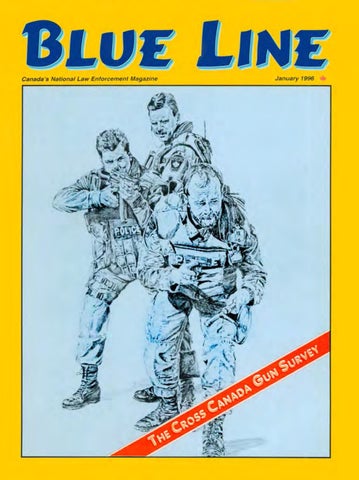
This month we feature the artistic talents of Niagara Regional Police Constable Bill Wiley. Bill and his wife Caroline have started a family business called CopArt out of their St.Catherines, Ontario, house. The combination of Bill' artistic abilities and Caro line' s marketing skills has produced a neat hobby interest in selling prints and T-Shirts with sketch art like this. Read more on page 24 in this month's issue. Who knows it may be an inspiration for your own hobby interest. Bill's art work is appropriate for the main feature this month. Blue Line Magazine commenced a cross Canada survey to try to determine the trends in semiautomatic purchases by police agencies. This was a monumental task and is believed to be a first in this country. ot even Stats Canada has made this attempt! The assistance of all gun manufacturers and distributers was sought and received in short order. Special thanks are in order to the following: Bob and Jon Nicholls of icholls Distributors; George Ferrier of Smith & Wesson; Richard Karst of Atlantic Police Supply; Murray Charlton of M.D. Charlton; Gerry Neeley of LEO Products; Tyke Arbaugh representing Beretta; Carolyn Sizer and John Matthews of Glock; and the good people from SigArmsand Heckler Koch. Another big thanks mustgo out to the numerous police officers and Chiefs of Police who took Blue Line into their confidence. They will remain nameless forever... but never forgotten. Thank you! This survey was quite a task. Playing a numbers game was difficult in a survey of this magnitude. At times it was like trying to nail jelly to the wall to get halfway accurate figures and determine the trends. As an example one problem was in determining if the figures supplied were for weapons delivered or promised for delivery. Other problems arose when we found some agencies actually purchasing far more weapons than needed only to find they had made a multiple agency purchase for price breaks. We feel satisfied, however, that the numbers we came up with are at least close and hope they will be of interest to you and your agency. Your comments are expect.
__________________________~~~-------------------------------B-l~!g~!~~
Nobody gets
-Th-e-S-i-gm--a-Ch--all-e-n-ge-from Smith &. Wesson
ergonomically correct pistol in history The development of the Sigma Series ® resulted
to the t :~:o~:~:~ Si,""'~."", polO ...4m twelve new patents. Among these is
Pick up any pistol, close your eyes, and point. ow open your eyes. If you're pointing a Sigma, your aim will be straight. If its any other pistol,
A - __ _
your aim may be ofT. On the range you have the luxury of time, but in a critical situation, you don't! Aiming a Sigma is as natural as pointing your fmger. Sigmas superior pointability is the result of sophisticated research into how the human hand, wrist, and arm operate while grasping and firing a pistol.
Sigmas unique
Three-Dot Sighting System
you superior sight alignment.
~I'a
.I.~
Ler
Smith &: Wesson is proud to be the
fiGt American firearms manufacturer to win prestigious 1S09001 certification. Smith &:
than -tgma. S
Wessons Sigma Series , recipient of both Handgun of the Year and Product of the Year
awards, is supported by the industry; most
ou~tanding
"""
program for warranty, service, and repair :
The Smith &: Wesson Advantage. So take The Sigma Challenge. For pointability For accuracy For reliability
Human factors
For durability Choose the best
experts, ergonomics
pistol in America. Even with
engineers, medical sensors,
your eyes closed.
and computer analyses
For more information
were all brought together
contact your Smith &: Wesson
to perfect Sigmas state-of-
law enforcement distributor, or call
the-art 18 0 grip design.
1-800-331-0852, extension 2904.
Web angle, angle of grasp, S
refined to create the most
The Science of Shooting.
Quality Firearms
I
S
G
M
A
E
R
I
I
and trigger reach were
Since 1852
E
S
By Morley Lymburner Publisher Welcome to the opening issue ofYolume number 8 for Blue Line Magazine. I thought it would be nice to have an inventory trivia of the issues for you statistical maniacs. ~ Blue Line has published 72 monthly editions since 1989. ~ Made up 2,864 pages of copy. ~ provided our readers with over 9,500 articles and features. ~ printed a grand total of 475,000 magazines ~ Our first print run in January 1989 was 2,000 copies. ~ Each month we now print 10,000 copies of the magazine for distribution Canada wide. After all of this we found there is still more information out there for you than Blue Line can handle by itself. Because of this we decided last year to strike out on two new ventures, Ten-Seven Magazine and Media Watch. Ten-Seven Magazine is designed to bring the news stories of interest to cops across the country. This magazine began publishing in September and we are optimistic about its growth. It is certainly an interesting way to find out what is happening in other police jurisdictions across the country. Media Watch celebrates its first birthday
police community from across Canada and is sent out each week to subscribers. It is sent by mail or by fax broadcast each Friday morning and appears to have a great deal of interest to chiefs of police, police associations and unions as well as media relations officers attached to law enforcement agencies. The news is obtained from news wire services and press releases sent to Blue Line Magazine ' s office and the articles are considered for insertion only if they have a specific interest to the law enforcement profession. [fyou are interested in subscribing to either of these new publications tum to page 17 in this issue for further details. 1995 has proved to be a busy year for Blue Line Magazine and its staff. There have been a number of stories and on-going stories that require considerable watching. One such problem was the Ontario " Bullet" issue which set a dangerous precedent for the safety of the public and the police. Blue Line Magazine was proud of the "gad fly" or "social conscience" (depending on which side of the argument you were on) role we played in having this situation corrected. We are happy to play this role at any time but it should be noted we only take these positions when all else fails. We attempt to
open dialogue first and worry about sensational headlines secondly. Forthose of you who doubt this we can only suggest that our next case celebe may be a certain "dinosaur" which seems to be slow in moving off centre stage. [n the coming year we hope to bring you a variety of new concepts and services that will enhance your ability to better understand, cope and grow with your chosen vocation. We will also be bringing more commentary designed to stimulate thoughts and conversation between your colleagues and/or community. We have a keen interest in supplying you with the experiences of other officers across the country and around the world in the hopes that you will be able to learn and adapt new concepts and programs to your own environment. We also have a keen interest in letting you know about how the private and corporate sector can best help you do your job better and smarter. [fthere ever was a time when law enforcement needed an independent professional magazine it is now. This one fact has been long recognized by myself and [ have spent considerable time in developing the network to assist the policing function at all level s. [fyou or your agency need the assistance of Blue Line Magazine' s pages give us a call , write or fax and we will be happy to see what we can do.
TAKE COMFORT IN OUR PROTECTION
8arrday's complete line of body armour includes both male and female lightweight Concealable Full Wrap Vests, offering unparalleled comfort and protection in everyday use. Optional external carriers are also available.
The last thing you need to worry about as you face the ever more demanding tasks of law enforcement is the effectiveness of your armour. Or the distraction caused by ill fitting vests and protective apparel. That's why we take special care in material selection, product design and assembly to ensure that each of our body armour products meet or exceed the various standards of protection. And provide real world comfort. The result is a proven world class reputation for effective lightweight quality armour products. You can take comfort in that!
Barrdal_ _ ADVANCED TEXTILE SOLUTIONS Barrday, Inc., P.O. Box 790 75 Moorefield Street, Cambridge, ON N1 R 5W6 Tel: 519-621-3620 Fax : 519-621-4123
"Dear Mr. Remington ...
by Dave Brolllll Dear Mr. Remington ... Yes, I realize that there no longer is a Mr. Remington . In fact, no one from the Remington family has headed the company since 1888. But, somehow, I get the feeling that the founder, Eliphalet Remington would take this letter seri u. ly. Since he began making custom flintlocks back in 18 I 6, the Remington Arms Company ha always had a very close relationship with police agencies. In fact, Remingtons have pos ibly saved more officers' lives than any other single item of equipment, sho rt of the two-way radio. The reliance on Remington products and, in particular, Remington shotguns stems from three main rea on . They are reliable and work when you really need them. They are robust enough to handle a lot of neglect and abuse but till function when necessary. They are economical to the point that-while not the least expensive hotguns on the market- their cost over a projected lifetime of use and abuse plea es both officers and bean counters alike. They are not, however, what one could de cribe a new, sexy or high-tech . While it may be an excellent patrol weapon, emergency respon e teams often relegate the lowly shotgun to the task of only shooting locks off doors. When it comes time for a team to affect entry in order to ave live , only the best products should obviously be selected for thejob. A fullautomatic Ileckler & Koch MPS, for example, ean put three 9mm shots into the head of a target in a fraction of a second with little time or recoil between shots. It can then traver e to engage another threat within seconds. Mix hostage into the scenario and it is easy to ee why gun uch as the MPS have a well-deerved place in the inventory of specialty teams. Few firearm can match this performance of speed and accuracy in a multiple target environment.
But, "best" does not necessarily mean '"new," "Iatest," "high-tech," or even "the most expensive." What about the shotgun? Can it not place nine well-aimed shots into the head area of a target, instantly, and with no recoil between all nine projectiles? With proper training, a shotgun can be as accurate as any sub-gun inside a design range of IS to 20 yards. It can engage multiple targets in fractions of a second, and hit with enough force to instantly disable almost any threat. It also has the advantage of instinctive aiming and ultimate speed on multiple targets. It also has the advantage that it is already in a department's inventory. While it would be a wonderful world if every agency could be showered with tax dollars, most police departments must work tightly within their budgets. As wonderful as the MPS is, the tag on it is still more than four digits. There is also a public perception that full-automatic firearms are more "dangerous" than the commonly used shotgun. Correct perception or not, the general public does ultimately sign a lot of officers' paychecks. If the shotgun is such a wonderful entry weapon, why has it not been embraced by more departments? The answer is both one of design and one of ability. While the design of a shotgun lends itself to very fast shooting, the rudimentary sights that most come equipped with are not confidence-inspiring. This leads to the heart of the problem. Few agencies are trained in the capabilities of the tactical shotgun. Before it can be u ed in the close-quarters world of special operations, it must be capable of inspiring confidence. My Wish List One of the perceived deficiencies in shotgun accuracy is the sights. Action handgun shooters have effectively demonstrated the viability of electronic sights. Now it is time to make the transition to shotguns. The electronic ight, as typified by AimPoint and Tasco ProPoint, create the optimum compromise of fast
speed and accurate shooting. Shotguns, with their instinctive aiming, are even faster than handguns for those critical few fraction of a second it takes to find the bright spot in the tube. Shouldering the shotgun properly will result in consistent acquisitions. While electronic sight depend on a battery for a power source and would probably not adapt well to rolling around in the dirty trunk of a patrol vehicle, they are ideally suited for special teams. Another change that could improve performance and confidence is in the selection of barrel chokes. Many police shotguns come equipped with a cylinder bore or an improved cylinder choke. Thi tems from the previously held belief that hotguns should be used for riot control. This ridiculous error in thinking has resulted in shotguns that spread a pattern as fast as possible out the barrel. A shotgun is always considered potentially deadly force, regardless of the load in the chamber. Any other attitude is not now, nor ever should have been, acceptable from a liability standpoint. Shotguns must be aimed properly to perform. Handling them correctly requires quality training, just like any other piece of equipment at an officer's disposal. Remington came up with the best allaround choke for its sporting shotguns years ago. All we need is equip police shotguns with the same benefit. There never, of course. is one single best choke for a barrel, so Remington sells barrels with " Rem-Chokes" that can be quickly changed from one restriction to another. In this manner, we can carry shotguns with modified chokes, but have others available when required. If you put all these points together, I guess you get what might be considered my "",ish list." Here's the part you will like, Mr. Remington. You can build my gun exactly the way I want it using strictly off-the-shelf items. You already manufacture everything that would tum thi shotgun into an outstanding entry weapon. You just have to be creative in the combinations. First of all, this gun should be a semi-auto. While pumps are reliable and virtually as fast as semis in the hands of the well-trained, you cannot escape from the fact that they are too prone to short-stroke on fourth or fiflh shot of fast multiple-shot strings. This creates a psychological slow-down which should not be discounted in environments where precise hots must be accomplished in fractions ofa second in order to save lives. I would therefore start with the excellent 11-87 Police with 18-inch barrel and plain bead sight. I have personally owned aRemington 1100 Special Field (the only semi-auto 1100 model I can still buy in 12 gauge) for several years and love it. The gun has never failed to fire or jammed on me. Its gas-operated action may not be as ultimately fast as some of the newer recoil operated, but, man, I love the lower felt recoil. It allows me to engage multiple targets without having to surgically remove to buttstock from my shoulder after each hot. Replace the bead on the front of the barrel with a large white bead. Add the '"Rem-Chokes"
--\61-_________________ January, 1996
BLU£ LIN£ r;:t M agazine - _ _ _ _ _ _ _ _ _ _ _ _ _ _ _ _ _ _
that I want. Go to the after-market if you have to, for a quality Weaver-style scope mount. It must have a see-through to the bead as emergency backup. A lso check out the after-market for a reliable electronic sight, made for heavy recoil. (I have used Tasco Pro-Point products on competition and combat shotguns for years, and have never had a fai lure.) You could even make the 11-87 Police with 2 l-inch barrel and rifle sights as an option. The mount would havc to bc a quick-change removable mount for the electronic sight, but it wou ld be an acceptable alternative. There you have it, Mr. Remington. How about building me this gun? Once you finish mine, I am sure that there may be a few thousand or so, people like me that would consider this the ultimate shotgun, if not the ultimate close-range weapon. Find someone that would be willing to champion this gun across the country. Show everyone else what this thing is capable of accomplishing. Spread my secret around a little bit, I don ' t mind. Even give me a call and I'll spread the word myself. Somehow I get the feeling that even Eliphalet Remington would be pleased to see his name on the side of my "ultimate" entry weapon.
Police service now armed with shotguns
Remington 870 Police Metropolitan Toronto Police Servavailable in three gunstock styles inice recently announced a plan to TOR cluding wood and metal folding ~~ 01types. purchase Remington 870 shotguns o~ ~ 7-?' 0 Decaire stated they are going for patrol use over the next 3 years. ~ -1) to be trainingofficerson agradual Sgt. Glenn Decaire of the ~ ~l!l (~J - ~ phase-in period of around two to three years. " We are certainly MetroPolicefirearmstrainingunit u.I stated the estimated price tag for ~ looking toward equipping every marked scout car with shotguns but the weapon is only the tip of the this may take a long time," Decaire iceberg. Added on top of this is the cost of the security mechanism being supplied concluded. "1 have the best firearms by Markham, Ontario, based Dactar Systems. training officers around but as good as they Other expenditures are a form of " soft are there is just so much that can be done at costs" which include such things as training any given time." Decaire stated that in addition to the officers in the use of the shotgun and the security mechanism. shotgun training and conversions his 10 Presently the police service has maninstructors are working long and hard at dated 4 shotgun cars per police Division and converting officers over to the new Glock two per Traffic Unit. semiautomatic pistols. This conversion is Decaire advised the Remington 870 shotmandatory by the province with a strict deadline. Decaire pointed out that given the guns have a proven re liability and performsize of the 6,000 officer agency they want to ance for police use. Remington Corp. in ensure that no officers are trained in a slip Kentucky advise the Mode l 870 is available shod manner in the shotgun training. In either blued or Parkerized to reduce light reflection. It also comes in barrel lengths of keeping with this policy he feels the timed conversion period is most appropriate. 14, 18 and 20 inches. In addition it is
THIS TRIGGERED A REVOLUTION.
Glock was the first to manufacture a pistol that doesn't r equire an external lever to render it hot or cold. Handgun enthusiasts and law enforcement officers worldwide have shown a distinct preference for this Glock technology for some time now. Undoubtedly; that's why so many other manufacturers have, as well.
January, 1996
____________________________~~~--------------------------------B--L~!g~!~~
Introducing NIGHTSIGHT NIGHTSIGHT" is one of the new family of Thermal Imaging Solutions from Texas Instruments.
Revolutionary Technology For Only $7,995. Texas Instruments infrared imaging technology has been used to great advantage by the U.s. military for a numb r of years. Now it can help you fight the battle against crime.
Heat Detection Puts Night-Vision Technology In A Whole New Light. The NIGHTSIGHT system uses Forward-Looking Infrared (FUR) technology to detect the differenc s in heat that objects emit. You can readily distinguish people and any warm items from background clutter. NIGHT IGHT helps you see even on the darkest of nights. IGHTSIGHT operates independently of light conditions. Which means if a bright light is shone into the camera, it won't shut down or wash out at critical times like some other night-vision devices.
The Easy Way To Improve Your Night Vision. The $7,995 (US) price includes the entire NIGHTSIGHT system: infrared camera, 360-degree sweep pan-and-tilt unit with remote control, roof-mounting rack, cable and video monitor. For stationary applications, the weatherproof NIGHTSIGHT camera is available alone at $6,995 (US). It's a quick and easy replacement for a standard or low-light-level camera in fixedmount locations.
Start Seeing More Today. Just call (214) 995-7511 to learn how the Texas Instruments family of Thermal Imaging Solutions can help give you the advantage you need in fighting crime.
EXT E
o 19'J5Tl
D I
G
Y 0
R
REACW
"'11 TEXAS INSTRUMENTS
08-1r,r,gp
[
]
Are you prepared for big changes? If you are ready for change or if you are new to computers you should go for this new operating system.
Tom Rataj - Editor Computers alld Techllology Even non-computer users could not have escaped the multi-million dollar advertising blitz, and computer industry hype, that surrounded the August 24 launch of the long overdue Windows 95 operating system. Designed to replace the well entrenched but ageing MS-DOS/Windows 3.1 combination, Windows 95 is poised to rapidly become the new desktop standard for million of personal computers worldwide. With its clean, easier to use interface and advanced features, Windows 95 represents the first major overhaul in mainstream operating ystems since the introduction of Windows 3.0.
A CLEAN NEW LOOK Anyone familiar with Windows 3.1, will immediately notice the clean, uncluttered look of the Windows 95 desktop. The Task Bar replaces the program manager window as the default desktop view. With nothing on it other than a clock and a button labelled "Start," the task bar sits at the bottom edge of the screen. The rest of the screen is blank, save a few icons, labelled " My Computer," " Recycle Bin," and '"lnBox," as well as I or 2 others depending on the way Window 95 was installed . Although this new screen is rather stark in comparison to previous versions of Windows,
every user will quickly conclude that clicking on the "Start" button is the logical place to, ah, start! Therein lie the basic design premise behind Windows 95- make things so easy to use, that any user, regardles of experience, will readily figure out how to make things work. Once the basic tasks have been leamed, the more advanced tasks fall easily at hand because every feature, whether basic or advanced complies with the same general functionality rules. Experienced users will initially find the new interface very different. A few minutes of exploring will however, quickly reveal many familiar features. Beyond the initial facade, Windows 95's heritage is obvious. What really sets it apart from its previous generations is the quantity and quality of the refinements and improvements. Although Windows 95 was written more or less from scratch, the best features and functions from previou versions of Windows were retained. They were however, streamlined and re-engineered to adhere to tough new usability standards.
ON THE TECHNICAL SIDE This is where things really get different. Windows 95 wa written using a newer programming architecture known as 32-biL (as compared to the older 16-bit). This allows it to
multitask (do more than one thing at a time), and provides a faster and much more stable base on which other programs can work. The new architecture also eliminates the need for the venerable old MS-DOS to be installed first. Windows 95 runs the whole show, relegating MS-DOS to a minor role of upporting older non-windows programs that might still be in u e. Windows 95 also helps to establish a new hardware/software tandard known as "Plug and Play." This simplifies the installation of new hardware by automatically recognizing and configuring the hardware and making the nece ary changes to allow the software to use it. This feature alone is practically worth the price of the Windows 95 upgrade. Networking has also been written right into the core of Windows 95 . Now even nontechnical users can quickly and easi ly connect a computer to a network. Some common software types do however not run under Windows 95. Most notable are the utility and anti-virus programs. Because of fundamental structural changes brought about by the 32-bit programming architecture in Windows 95 these speciali sed programs do not work. ot to worry though, Windows 95 versions of all these types of programs were released within days of Windows 95.
SHOULD YOU SWITCH? The answer to that is a qualified yes. The mo t important qualifications seem to be; do you have the hardware that is capable of running Windows 95 well, and are you prepared for big changes? If yo ur answer is sti ll yes, remember as well, that to take full advantage of Windows 95 you hould also be looking at upgrading all yo ur important software to the new Windows 95 versions. This of course translates into lots of cold hard cash. If you are not afraid of change, go right ahead and make the switch. Window 95 is a fast, table, and reliable operating system that would appear to be poised to become the new co mputin g standard worldwide.
\97f-- - - - - - - - - - -BLV£ LIN£
January, 1996 ----------------------------------1~r----------------------------------------- ~agaz;ne
By Morley Ly mbumer In 1992 the Province of Ontario went intoan extensive research project that set out to evaluate the most appropriate firearm for police use in the province. In late 1993 the results stunned the police community across the country and caught many firearms manufacturers with their inventories down. The re ult ofthe tud) not onl) determined that the emiautomatic firearm was more appropriate for u e but \-Vent further by declaring the old revolver illegal for use by police officer . Police chier across the province were faced with the legi lated requirement to witch over all their officers to emiautomatic firearms within the next five year. As word of the Ontario study became known other jurisdictions decided it wa probably more appropriate to voluntarily switch than to wait for either legi lation or a disaster. The mo e to semiautomatics has caused
AGENCY .P. Rail Police nvironment anada Fi heries & cean R. . M.P. ~
. PeaceJ...eeping Force Wildlife ervice Iberta 01. eneral algar; Police am rose Police oaldale Edmonton Police Lethbridge Medicine Ilat Taber
MAKE Federal S&W &W &W &W &W &W &W Alberta &W GLO K GLO K &W GLOCK &W &W &W
considerable train on both budget, manpower and re earch. Many agencies have found their initial purchases were made in haste and many others did not have the resources to properly study the range of firearms available but made moves that were determined on little else than budget considerations. A mostAmericanpoliceagencie areaware the purchase ofa firearm can be a very per onal one. ot every firearm is appropriate for every police officer. Most Canadian agencies have decided, however, to stick to one make and model of firearm for every officer. Certainly this is the most prudent way to move given the massive changeover and training required. Making square pegs fit into round holes can prove difficult in the long run when it comes to firearm. It is hoped, however, that most agencies will attempt to make exceptions in the future and permit individual officers the freedom to select the firearm they feel is better uited to them. An officer should feel comfortable about the weapon he i carrying and be
MODEL
QTY
AGENCY
3953 5946 5946 3953 5946
75 7 650 2500 17500 100 7
Altona Police Brandon Police
5946
5946 3953 G22 G22 4046 G22 5946 5946 5946
British Columbia BERETTA P0969DC BERETTA PS9619DT entral aanich Police GLO K G22 Delta Police GLO K G22 quimalt Police GLO K G22 GLOCK G23 ewWe tmin terPolice GLO K G22 ak Bay Police GLO K G22 Port Moody Police GLOCK G22 R MP Auxiliary Police &W 5946 annich Police GLO K G22 P09619D3 BER TTA ik ika ation Police tl'Atl'lmx Tribal Police GLOCK G22 GLO K G23 ancouver Police BERETTA P 9619DT GLO K G22 Victoria Police We t Van ouver Police GLO K G22
Abott ford Police
BLUE LINE Magazine
Dakota Ojibway Police Winnipeg Police Bathurst Police Caraquet Police Edmunston Fredericton Police Grand Falls Police Moncton Police Rothesay Police Sackvllie Police Saint Basile Police Shediac Police St. Stephen Police St. John Police Woodstock Police
6 1300 17 10 1200 11 0 75 13 80 15 140 85 40 2 88 23 33 1400 19 10 9 2 1200 120 78
MAKE
MODEL
QTY
GI7 GI7 GI9 PS9219DT G22
6 70 20 18 1100
New Brunswick BERETTA PS929DC BERETTA P0929DC &W IGMA IGARMS 226-9-BSS BERETTA P 929DC BERETTA PL929DC IGARM 226-9-BSS BERETTA P 929DC &W IGMA BERETTA P0929DC BERETTA P 929DC BERETTA P0929DC BERETTA P 929DC
30 4 28 20 2 140 23 14 7 3 II 105 13
Manitoba GLOCK GLOCK GLOCK BERETTA GLOCK
Unamaki Tribal Police Wolfville Police
Nova Scotia IGARM IGARM IGARM IGARMS IGARM IGARM IGARMS IGARMS &W lGARM
Alexandria Police Alliston Police* Amherstburg Police
Ontario GLOCK GLOCK &W
Amher t Police Bridgewater Police Cape Breton Police Halifax Police Kentville Police Truro Police
§
equall) confident in it u e. ow that the dust has settled to some degree Blue Line Magazine thought it would be an appropriate time to supply its readers with a rundown on what agencies purchased which firearms. It is hoped that other agencies till wondering what to go for ma) wish to contact some of these agencies and learn from their experiences. They may also wish to consider swapping firearms if they find some officers would be more comfortable with a different type. The Ii t upplied in this article is far from complete but is the be t that can be determined so far. A great deal of thanks are in order to the firearm manufacturer, distributor and police agencies for being so cooperative with Blue Line Magazine in this effort. The listings are for the make, models and quantitie contracted for delivery and does not necessarily mean they have taken delivery. Few things in life are 100% accurate so for further information contact the agency involved.
226-9-BS 226-9-BS 226-9-BS 226-9-B 226-9-BS 226-9-BSS 226-9-BSS 228-9-BSS 5946 226-9-8
23 20 88 20 238 12 21 2 I II
G22 GI7 4046
8 15 20
January, 1996
AGENCY Anderdon Twp. Police Anishinabek Police AtikokanTwp.Police Aylmer Police Barrie Police Belleville Police Bradford W Gwillimbury Brantford Police Brockville Police Carleton Place Police Cobourg Police Colchester South Police Collingwood Police Cornwall Police Durham Region Police Elliot Lake Police Fergus Police Gananoque Police Glouchester Police* Guelph Police Halton Region Police Hamilton- Wentworth PS Ingerso ll Police Inni sfi l Twp. Police Kenora Police Kingston Police Kingsville Police Lakefleld Police LaSalle Police Leamington Police London Police Mersea Twp. Police MetroToronto Police Midland Police Nepean Police* Niagara Region Police North Bay Police Ont. Min. Corr. Services OPP College Ontario Natural Res. Ontario Police College
Ontario Provincial Police Orangeville Police Orillia Police* Ottawa Police* Owen Sound Police Paris Police Peel Region Police Pembroke Police Penetangui shene Police Peterborough Police Port Elgin Southampton Port Hope Police Sarnia Police Sault Ste.Marie Six Nations Police Smith Falls Police St.Clair Beach Police
January, 1996
MAKE
MODEL
QTY
S&W BERETTA GLOCK GLOCK S&W BERETTA BERETTA BERETTA GLOCK SIGARMS BERETTA GLOCK SIGARMS GLOCK BERETTA GLOCK GLOCK BERETTA SIGARMS GLOCK BERETTA BERETTA BERETTA GLOCK SIGARMS S&W GLOCK SIGARMS S&W GLOCK GLOCK S&W S&W GLOCK S&W GLOCK BERETTA GLOCK GLOCK BERETTA BERETTA S&W BERETTA H&K GLOCK GLOCK S&W SIGARMS SIGARMS BERETTA BERETTA SIGARMS S&W GLOCK GLOCK SIGARMS GLOCK S&W BERETTA SIGARMS GLOCK BERETTA SIGARMS BERETTA S&W S&W BERETTA S&W
4046 PS969DC G22 G23 4046 PS969DC PS9619DT PS969DC 022 229-40-BSS PS969DC GI7 229-40-BSS 022 P0969DC 022 G22 PS969DC 229-40-BSS 022 PS9619DT PS969DC P09619GT 022 229-40-BSS 4046 G22 229-40-BSS 4046 G22 G23 4046 4046 G22 4046 G22 PS969DC G22 G22 PS96IDT PS969DC 3953 P0921 DT 704007 GI7 G22 4046 228-9-BSS 229-40-BSS PS969DC PS929DC 229-40-BSS 4046 G22 G22 229-40-BSS G22 4046 PS969DC 229-40-BSS 022 PS969DC 226-9-BSS PS969DC 4046 5946 PS969DC 4046
7 26 14 2 8 96 77 22 115 42 14 30 22 26 86 500 25 II 10 120 105 473 19 650 13 35 25 154 12 7 2 28 30 440 7 4000 25 200 750 25 15 7 28 335 32 3 37 20 35 10 10 4950 27 50 500 16 25 1200 16 II 100 10 19 125 100 20 21 5
AGENCY St.Thomas Police Stratford Police Strathroy Police Sudbury Region Police Thunder Bay Police Tilbury Police Tillsonburg Police Timmins Police Trenton Police Wallaceburg Police Wawa Police Windsor Police Woodstock Police Waterloo Region Police York Region Police
MAKE
MODEL
QTY
S&W BERETTA SIGARMS BERETTA BERETTA BERETTA BERETTA SIGARMS SIGARMS BERETTA BERETTA S&W S&W SIGARMS BERETTA BERETTA
4046 PS969DC 229-40-BSS PS9604055L PS969DC PS9619DTC PS969DC 229-40-BSS 229-40-BSS PS969DC PS969DC 4046 4046 229-40-BSS PS969DC PS969DC
46 42 14 12 190 218 10 21 78 10 22 9 410 46 427 286
Prince Edward Island Atlantic Police Academy Bordon Police Charlottetown Police Eel River Police Summerside Police
BERETTA S&W S&W BERETTA S&W RUGER
PS929DC 5946 SIGMA-9 P0929DC SIGMA-9 KP-89W
12 14 2 22 2 12
G22 G23 SIGMA SIGMA P0969DC 3953 3953 KP-89DAO 4046 4046 P0929DC SIGMA KP-89DAO KP-89DAO KP-89DAO KP-89DAO 225 -9-BSS 228-9-BSS 729-40-BSS 5946 KP-89DAO KP-89DAO SIGMA 5946 KP-89DAO 226-9-BSS KP-89DAO SIGMA P0969DC KP-89DAO KP-89DAO
35 15 30 15 45 25 80 3 150 200 2 25 3 9 6 16 15 60 130 II 20 8 25 8 8 4 3 17 20 6 8
022 022 G22 023 G22 G22 023 022
2 2 66 3 65 56 290 350
Quebec Aylmer Police BlainviIle Police Carrigan Police Chateauguay Police Chaudiere-Ouest Police Drummondville Fermont Police Gatineau Police Hull Police lie Perrot Police Kahniawake Police Katavik Regional Police La Pocatiere Police Lac Brome Police Lachenaie Police Laval Police
Listugaj Aboriginal Police Loretteville Police Port Cartier St.Lambert St.Lazare Ste.Agathe des Monts PS Ste.Julie Police Ste.Sophie Police Valcourt Police Victoriaville Police Village Des Hurons Police Windsor Police
GLOCK GLOCK S&W S&W BERETTA S&W S&W RUGER S&W S&W BERETTA S&W RUGER RUGER RUGER RUGER SIGARMS SIGARMS SIGARMS S&W RUGER RUGER S&W S&W RUGER SIGARMS RUGER S&W BERETTA RUGER RUGER
Saskatchewan Dalmeny Police Lusland Police Moose Jaw Police Prince Albert Police Regina Police Saskatoon Police
GLOCK GLOCK GLOCK GLOCK GLOCK GLOCK GLOCK GLOCK
* Denotes an amalgamated police agency since guns contracted.
@}
BUJ£ L.N£ Magazine
Percentage of Total Purchases of Semiautomatic Handguns by Manufacturer
Number of Canadian Police Agencies Purchasing Semiautomatic Handguns By Manufacturer 1993 - 1995
Other Beretta
9%
1%
50
40 Smith & Wesson 51 %
30
c: 20
0
lit lit
GJ
Trying to determine trend in thi urvey proved to be a daunting ta k. onclu ion were difficult, if not impossible, to arrive at but some interesting characteristics did eem to appear. I will tep through orne of the e an malie and hope you gain some value from them . The 40 calibre emiautomatic handgun are the mo t popular. With a total of25,454 of the popular model being old by all manufacturers it \~ould appear thi calibre has become the darling of the law enforcement community in anada. 100 of the 180 agencie in the Cro s an ada urvey favoured the 40 calibre.
Federal & National A tated the 40 calibre was the mo t popular but the 9mm rung up sale of 21,146 gun . Most of the e were by the giant purchase of the Royal anadian Mounted Police last pring. The main reason for the Mounties electing a 9mm appear to be more tradition than an)thing else. When Blue Line interviewed one member of the Mountie firearms ection he stated that they imply decided not to be "trendy". lIe advi ed the 9mm has an excellent and I ng track record with both police and military worldwide and the bullet wa readily available acro the country. Although the & W did not come in as the least e:-.pen ive weapon, the RCMP, after extensive te ting, seemed to take into consideration the weapon' reliability. There i no doubt the previou relationship developed over the past 90 year with this firm was also a factor. The Federal and ational agencie eemed to follow the R MP lead and in our urvey switched to the mith & Wes on varieties of the 9mm emiautomatic almost exclu ively.
~
10
~
.. C
~
u
0 (!)
GJ ~ GJ CO
~
GJ
:;)
C
V)
.2' V)
~
GJ
C) :;) ~
o Maritime Provinces The tradition and military aspects of the 9mm appear to be the factor in the """"--,-,..-" ,.,,, Maritimes where almo t all the surveyed agencies went to 9mm. Nova Scotia not only went completely 9mm but also one manufacturer. ova cotia legislated the Sig Sauer as the weapon to be used by all municipal police while the highway and rural areas will be policed by the Smith & Wesson's of the RCMP. This makes the entire Province 9mm. New Brunswick seems to have purchased firearms from different manufacturers but again stuck by three 9mm calibre. Ontario Ontario appear to be a different story however. In that province only 8 of the 76 agencies surveyed went to the 9mm variety while the re t of the province went to the 40 calibre. Due to the fact that Ontario police were legislated to convert all weapon over to the semiautomatics most agencies felt they might as well obtain the latest firearm technology while the change-over was necessary anyway. With the remaining agencie it would appear that cost played a big role in their decision as the 9mm varieties tended to come at a marginally lower price. Two ofthe largest sales in Ontario were the Glock 40 calibre to the Metro Toronto Police
and the ig auer 40 calibre to the Ontario Provincial police. Almost every other agency surveyed in Ontario followed the same trend by calibre but plitthe acquisitions between Glock, Beretta and ig. The one exception was the enforcement officer of the Ontario atural Resource who acquired 335 Heckler & Koch model 704007 semiautomatic . In Ontario the popularity of the Glock 40 calibre wa evident with over 43% of the purcha e coming from this manufacturer. Around 30% were persuaded to follow with the OPP over to the ig auer, while 15% of the 40 calibre sales went to Beretta and around 12 0 0 to mith & Wes on. With the 9mm calibre, Glock once again eemed to take the largest portion at around 68% of purchase followed by Beretta at 20% and ig auer at 12%.
Quebec Quebec appears to be an enigma in its firearm purchasing. A good Ruger alesman appears to have burned a trail across the province and it i the only recorded purchases by police agencies of the weapon in Canada. Although price may have been a factor other agencie indicated they were also concerned about price as well but purchased other makes. It very well could be that this weapon may have simply been overlooked.
BLV£l'N£ ----------------------~~_ r------------------------------Magazine _ _ _ _ _ _ _ _ _ _ _ _ _ _ _ _ _ _ _--IDI_ _ _ _ _ _ _ _ _ _ _ _ _ _ _ _ _ _ January, 1996
One real problem in Quebec appears to be the regressive approach of both Montreal and the Surete in actually purchasing revolvers in a day when everyone is dropping it like yesterday's new paper. With the proliferation of violent crime in Quebec as of late one would certainly question the wisdom of rearming officers with a weapon that was found to be dangerous in a neighbouring provincial tudy. Joe MacDonald has not been dead so long that they could not learn from this. Our survey of 27 more progressive thinking Quebec agencies found that if they wanted a 9mm 61 % went to Ruger while if an agency wanted a 40 calibre they were more likely to go to Smith & Wesson for their new SIGMA series. Top purchases for semiautomatics in Quebec went to Smith & Wesson with a total of 575 weapons. ig auer came in second with total purchases of 209. Laval Police Force was the only agency to mix its calibres. Although its main weapon of choice was the 40 calibre Sig Sauer the agency also purchased 75 - 9mm Sigs for it compliment of female, detectives and command officers. The city of Aylmer, Quebec, was the only agency surveyed in that province to purchase the Glock and its 50 weapons only accounted for around 5% of total semiauto purchases.
~Z~::lf;;;r--~' Prairie Provinces Western Canada appears to have a split everywhere except Saskatchewan. If you want to see wheat or Glock 40 calibres. go to Saskatchewan. The report on this province can only be rivalled by its southern landscape. Six agencies purchased 833 40-calibre Glocks... EXT! Almost the same could be said for Manitoba with almo t all agencies going to Glock with the purchase of I, 100 - 40 cals to Winnipeg and 76 Glock 9mm to other agencies. Alberta had a bit more variety. This province had three agencies report the purchase of a total of 2,517 Glock 40 calibres and five purchased a total of 214 Smith & Wes on 9mm. British Columbia Ofthe 13 agencies sur- .1iiii;~IiS~t veyed from B.C. 10 went Glock, 3 went Beretta and all went 40 calibre. The big difference in numeric popularity, however, leans toward the three law enforcement agencies that acquired the Beretta. Beretta was the weapon of choice with 1,345 of the 40 calibres purchased by only three agencie . The other ten agencies went for the Glock which made up less than half the total weapons purchased in the Province for municipal pOlicing. The one statistical glitch in this picture was the acquisition by the RCMP Auxiliary police in British Columbia of 1,400 - 9mm mith & Wessons. As it is not clear how to categorize this on several levels, it has been reported outside the other Municipal purchases.
Agency Size
It ha long been recognized that smaller agencies tend to take a "wait and see" stance when it come to equipment purchases. In simple terms it simply makes sense to let the larger agencies with the big R&D budgets do the research and take the advantage. With firearms acquisition it would appear to have occurred in only a small measure. Most agencies were more concerned about cost than any other factor. As far as agency size is concerned it would appear that agencies with less than ten officers tended to purchase from Ruger (27%) and then Smith & Wesson (13%). With the tendency for the 9mm weapons to come in at a marginally lower price than the 40 calibre it was no surprise to see these two companies come out on top. The Beretta appeared to be most popular among the agencies between 10 to 49 officers and then picked up again in popularity from the 100 to 500 agency size. It fell off in popularity with agencies above the 500 mark. The Glock maintained fairlycon tantpopularity with agencies from 50 officers up to over 500 officers. In fact it appeared to gain strength in popularity as the size of the agency increased and hit 50% of agencies with over 500 officers. The Sig Sauer was popular in only one category that being the 10 to 19 officer agencies (25%) but even in this category it was behind the Beretta's 35%. Smith & Wesson ' s popularity was constant across a range of agency sizes and was the most popular in the under 10 officer agencies and then again with the over 500 level.
Numbers of Agencies Purchasing
Municipal Police This was an interesting statistical analy i because unlike the larger provincial and federal agencies Municipalities were the most hard pressed to make conversions either due to funding or local political pressures. They were also the agencies, for the most part, without the ability to do the extra research to determine the most suitable weapon to purchase. Some smaller agencies complained that they were under pressure to "watch the budget because the RCMP and OPP come with their own guns if they are contracted." Of the 154 municipal police agencies surveyed 29% selected a Glock firearm. Several agencies indicated that this was the best weapon
for the money that would give local people the appearance that they were keeping up on the leading edge of weapon technology. The second most popular weapon was the Beretta at 26%. A random survey indicated that price was the driving factor but also due to it impres ive track record in the United States. ext was the mith & Wesson (23%) the Sig auer(15%) and the Ruger (7% and all in Qucbec).
Is there a winner? We found throughout this survey that picking out a clear winner is difficult. As far as the industry is concerned the clear winner would be Smith & Wesson . With its single RCMP contract the numbers blaze out quite clearly with over 45% of weapons purchased. When one translates this survey into the numbers of individual agencies convinced to purchase a product it is a three-way race between Glock, Beretta and Smith and Wesson respectively. When this survey was commenced last July it was Blue Line's intent to present facts and figures that would assist uncommitted agencies in their deliberations. When interviewing some selected agencies we wanted to find out what motivators prompted them to purchase the weapon they did. In most cases it was nothing more than price. This factor loomed largest in Ontario where the push to purchase was legislated. In a few situations the agency was concerned about service. But this aspect meant different things to different people. In some ca es the concern was how well the weapon could be serviced by the manufacturer while in others the ability oftheir own agency to do their own maintenance was more important. Concerns about serviceability was a factor with some agencie as they were looking for the most durable and rugged weapon they could find. till others were concerned about the weight, ize and handling of the weapon. No matter what the concerns every agency listed in this survey no doubt has obtained their weapon of choice on a set of priorities that fit their immediate need. Many agencies, however, are now taking their time to re-evaluate the weapon purchased with a view to possibly switching to a weapon or weapons that are more suitable to their officers. In a very few cases agencies are looking at the ew York City Police strategy ofapproving several weapons of the same calibre and permitting the officers to choose the weapon they feel most comfortable with. So is there a real winner? There certainly is! The 43,272 police officers across Canada who are, or will shortly be, armed with semiautomatic handguns. With the extra training involved in learning how to use these weapons the officer is mentally more aware of the firearm they carry and their confidence levels must rise. Thi can not help but reflect in the day to day operations of any agency. ow what about those 3 1,728 police officer with revolvers ... or how about those 70,000 security guards ... or 17,000 federal and provincial government ministry enforcement officers?
W l - - - - - - - - - - - - -Bu'£ L.N£
January, 1996 - - - - - - - - - - - - - - - - - - 1 0
M a gazine
&'rile Beretta Arsenal. America's
premier collection of tactical firepower. Model 92F. liolll"-!'III;:V: mtum V'mi'(lIltotnattr, dw')", as II" U. \'. \11111111)'\ (Jlti(UI/ fltffflml. 9mm Pambetlum
mill I h I mllml firrtK1lLn; fX('/Jtional Itlw/Jt/tf) and "(lfrt). ~ h'(1IlabJ, III F aPid
Model 96. Owmbmdjor.40raL carlnd~. 10+1 round jirt/JOlL'l'f. In aU 011", rtsptru. 1I's fn'" 921: .11'011,,1"m F, G mId /) ,1W<k1s.
(:m(ldrl.,.
921960 Models. l)oll/""-artlllll onl\ PIStol., wIth wm, Inggn pull on huh lOmui fiud FfflluffS bob/.Jt(J l/fIlum".. /5+1 nJlllld jirtpmllfTOn
92. /(/+1 1'<lll1ld fir",,,,,..,. 011 96.
92/96 Centurion Models. S,w rampart. h'gh rapan? prslois. 15+1 roulld fi"po""" 011 92. 10+1 rOll1ld fir",aw" 011 96. ,\<'mlal"- m FOllll/)'lUJ{kls.
800018040 Cougar. (}l(IIIw.mi for 9011 .. alld AO rnL ThN rampart Jram, pulfJls a" 0"(111,,1"- In f; (; and [) optmll1lJ< SI,lnns. 10+1firrpau.." I1nprlMd n/(lmamia. rrdurtd r(,(oIL through nn.tl rotatmg barrtl IIXk,"p.
Beretta Operating Systems: Model PM12S. S"'(/It~ fiIP 9mm P"mbellum submachmt gun wIth 32·rolWd magazint.
F Models - Double/single-action \ViUl external safety decocking lever. G Models - Double/single-action \\;th external decocking lever only. o Models - Double-action only withoul safely lever (slick slide).
Model 120lFP3. 12·l<"u/(I'. CJwmbnedjor J' shills. 6+1 rolllldfi..."""",
Model 1201FPG3. ldntlirai lo 1201Fp, ,,"lit I'" addtllOlI of P,sloignp IIIXk. 6+1mu1Id fin,!>u",,,,
Berella has won an enviable, hard-earned reputation for excellence in today's military and law enforcement circles. A repulation built on the only things that count ...superior perfonnance and total dependability. This superiority has made B retta lhe handgun of choice for thousands of law enforcement agencies and police forces in over 50 countries. These same qualities are built into our entire line of tactical weapons, For complete infonnation, contact:~ Berella USA Corp., Law Enforcement Division, 17601 Beretta Dr., Accokeek, MD 20607. Or phone 301-283-2191. ~ .... ,, "
Beretta
"iZffl.Il!>
si nce 1526
Straight answers to some tough questions
Whether you are the first time den leader of a cub scout troop or the Chiefofa large police agency, Roger Fulton's newest book, Common Sense Leadership, is a great source of advice and inspiration to become a successful leader. In this book you will find page after page of informative and practical guidance for discovering the qualities of great leadership within yourself. People involved in law enforcement are, by the nature of their work, forced into taking a leadership role on the streets and in their communities. These are the people who are frequently sought out to take up leadership positions in volunteer organizations because of their training and insights. Many people have found this community involvement the proving ground for a very successful career. Roger Fulton's book offers a framework for enhancing one's concept of what leadership is and implementing those traits into one's own leadership skills. Each page of this pocket sized book offers a trait or characteristic crucial to understanding effective leadership followed by a relevant quote from such sage minds as Mahatma Gandhi and Andrew Carnegie. Roger Fulton is a graduate of the FBI's National Academy and the New York State Police Academy and is the owner of Knight Management Corp., a firm dedicated to addressing the management training needs of the law enforcement community. The book can be ordered from Speed Press, PO Box 7123, BerkelyCA 94707 for$8.95 US . Phone 510-559-1600 - FAX 510-524-4588.
January, 1996
Reviewed by J. Delcourt, P.Mgr., AMCTA(A) Chief of Police Barrie Police Service It can be safely said that Norman Panzica' s books improve as he gets older. No doubt, his very last book - at age 105 - will make him a millionaire. The fact is that his most recent work is a classic. I n short, Drug Abuse & The Family is acomon-sense book for people who need adose of common sense. It is filled with information that all of us can use, whether we think we are knowledgeable about drugs or not. Tho e of u who have little time for frilly dissertations will appreciate the directness of Mr. Panzica' s style. Obviously his income, unlike Victor Hugo ' s, is not derived from the number of words he generates. There are few
books which condense a historical perspective in a few pages, but all the important and relevant facts are mentioned. In my opinion, anything else would be superfluous. If we were to licence parents before they can conceive a child - as we should - this book should be on the list of required study material, with appropriate testing. The question and answer style, which has become the author's trademark, helps both the writer and the reader to stay focused on the subject at hand. Mr. Panzica has the practical experience in the drug treatment field to legitimize his words. His use ofstati tics isjudicious, never overpowering, Finally, this book, as the two previous one , combines information, anecdotes and humour to form a delicious stew sprinkled with very small amounts of rather dry drug information as seasonong. The total effect is appealing. The author, who holds both the Order of Canada and the Paul Harris Fellowship, says he expects "some flack" for his views on violence and the section on self-esteem. Th is book sells for $9.95 and has been added to Blue Line Magazine ' s Preferred Reading List. Turn to page 16 to find out how to order it.
25th ANNIVERSARY COMMEMORATIVE SWORD 1971 - 1996 In celebration of 25 years of proud service to the citizens of the Regional Municipality of York, York Regional Police Chief Bryan Cousineau has commissioned the manufacture ofanniversary poignard swords from the Wilkinson Sword Company, U.K. (sword maker to Her Majesty Queen Elizabeth II). This limited edition is now available to members of all law enforcement agencies and the public. . . Special Inscription etched on blade . . Engraved with Royal Hallmark . . Gold plated hilt on solid silver blade . . Rosewood grip . . Handsome presentation case . . Certificate of Limited Edition . . Individually numbered . . Insignia of York Regional Police on hilt . . 15-1 /2" overall length
Fo r info rm atio n on how to orde r one of t hese Lim ited Edition Poigna rd Sword s p lease co ntact: Inspecto r Barry Dela ney or Co nsta ble Pau l Davies at (905) 895-1221 before Fe br ua r y 29, 1996
__________________________--4~r-------------------------------B-L~!g~!~~
DECEMBER 1995 "Senior officer" says Quebec force is rotten from the top down J _J Iv J .J J J ~ The Quebec pro- people, they'rejust roughing them ~ - T r::~~7
vincial police ervice took another direct hit to it image and reputation during November, when a man who i said to be a "senior officer" with over 20 years ofe\perience, told a r intcrvie\\er that the force i rottcn from top to bottom. rhe fficer, who hid behind a mash.. sunglasses and a scarf\~hile being intcrviewed on the LaPoint nc\\ hO\~, said that member of the provincial police commit many illcgal infraction in order to get convictions. The unidenti fied man aid getting re ult i \"hat matters most. To this end, the officer said membcr. \vi ll employ all imaginable and thin"-able methods to \\ in including lying to obtain earch warrant ·, illegal \ ire tapping, obtaining proof through break-ins, kidnapping, equestration, assault and perjury. When asked if he ever lied in court thc officer was quoted on LaPoint as imply replying" 1wa) .... "Perjury becomes a toll of the trade in obtaining search warrant, affidavit, wire tapping or in court testimony. It becomes second nature. It's no longer a lie. It's just life, it's normal.'· Theman, who was interviewed f r 40 minutes said that he knows what his men are doing and his uperiors arc aware of the actions underta"-en b) both hi men and himself. The officer further tated that ifone of hi men refused to toe the linc he would not be working for him any more. Thc di guised officer said ph) ical violence is not uncommon during interrogations. The prefcrred method i to lam upect again ·t table or walls as opposed to triking out with fists or feel. li e aid they are not beating
up on occa ion in addition to constantly employing intimidation. The officer, who hid his identity for fear of losing his job, said he wou ld li ke to see provincial police return to healthy and profes ional working method . The man said the force's methods were justified in the fact that they are hindered by the ame law the) are worn to uphold. l ie also added that he felt most Quebec citizen would not have any problem with the way the force handlestheir investigations as long as criminals are sent to jail. The allegations made by the
officer backed up additional claims made by a former member of the force, Gaetan Rivest, who stated he and his colleagues routinel) lied to courts and beat confessions out of suspects. The statements made by Rivest drew tern denials from the force's enior officers. But the denials seemed to lose their heat \\ hen, a short time later, a hashi h importing case was tossed out of court after the judge determined police had fabricated evidence. Four officers were suspended and one faces criminal charges in relation to the allegations of evidence tampering.
Ontario Heroes recognized
Mountie Mayor from Quebec suspended Sleepy gunman grew weary during stand-off Council ousts chief in midst of allegations Cops greater deterrent than photo radar Joint forces bust auto theft ring Skywatch pollution cops High court says "Sleep it
Two police officers charged in home invasion .
.
,
"
A, ;,,,,Hg,Hoo
intoamidNovem;~ ~ ber home invasion ' r"" tyle robbery has '. . brought charges •• against two po lice • officers. Peel Regional Police reported their inve tigation commenced after a woman answered her door and was sprayed in the face with an unknown substance and tied up on the Ooor. A second su pect entered the home and assisted in searching the premise and they both left after obtaining a quantity of cash. The victim was able to free herself and called police and wa taken to hospital and treated for face and eye irritation. The inve tigation wa conducted by a number of investigators from Peel Region Pol ice Intel-
ligence and Identification Bureau as well as officers in the same unit as the arrested officers. Charged with robbery related offences are Constable George Bonsu, 26 years and Constable Trevor Babott 27 years. Both officers were attached to the same police Division in which the incident occurred. When asked how others in the 1,300 member police force are taking the news, a spokesman aid that many members were stunned to hear about it and the range of emotions run from "shock to anger." The officers were held in custody after their arrest one week after the incident. At a bail hearing the following day both were let go on a conditional bail release. Charges under the police act are presently being determined.
Putting the news of interest to your profession within your reach every month . One year subscription to Ten -Seven $20.00 ($10. 00 fo r Blue Line Subscribers)
Phone: 905 640·3048 Fax: 1·800·563·1792
off'
Chief says he won't cut $59 million from budget Sentenced to seven years for helping Hell's Angels North Bay new OPP District HQ Officer guilty of misconduct More powers may be given to Customs officers File closed on Melanie Carpenter case LEGAL BRIEFS Cops failed to notice body in car Horrific domestic incident leads to appeal by police Man who refuses to stay out of Canada jailed for two years File closed on Melanie Carpenter murder case RCMP officers still on payroll after conviction Motorist forced to beg forgiveness
BLUE LINE MAGAZINE • Preferred Reading Library
CD$58.95
® $ 48.95
-1"Jd {fOOl tht ~ ~....., ~'iee};'~f roo", ...-:.~' rerl'y.,}~~~
~
.~ ~JJ..J ~
I... ~
~::;::
,.
'~'- '~~ ~,'
7
11996 Edition
I
Milligan's Correlated Criminal Code & Selected Federal Stat ut es
.
BINDERS
The Great Mac Attack!
Special binders designed to hold a one year subscirption of Blue Line Magazine
10 14.95
0
MEDIA WATCH (52 Weekly issues MAILED)
$150.00
0 0 0
TEN-SEVEN Magazine (12 Monthly issues)
$20.00
Blue Line Magazine (1 0 monthly issues)
$25. 00
Both TEN-SEVEN and Blue Line Magazines
$35.00
0
I am a Blue Line Subscriber and I want TEN-SEVEN
$10. 00
ALL TAXES & SHIPPING INCLUDED WITH SUBSCRIPTIONS
r_
Fill out this handy order form and send by mail or save time by using a fax.
r------ - - - - - - - - - - - - - - - - - - - - - - - - - - - - - - - - ,I r-
~ IIO l- vlSA 0 WW Place Credit Card Account Number Here I 0 Cheque Enclosed (Make cheques payable to Blue Line Magazine) II Name ________________________________________
I Address _____________________________________
Ic' . _____ I Ity__________________________ PrOvlnce I Postal Code _____________ Phone ___________________ I Customer Signature X.______________________________
7% G.S.T. Sub Total Plus subscriptions as indicated above
CARDHOLDER WILL PAY TO THE ISSUER OF THE CHARGE CARD PRESENTED HEREIIL MENT WITH THE AMOUNT STATED HEREON IN ACCORDANCE WITH THE ISSUER'S AGREETotal __ _ _ ___________________________________ WITH THE CARDHOLDER
12A - 4981 Hwy. 7 East, Ste.254, Markham, Ont. L3R 1N1 Phone: 905 640-3048
24 Hour Toll Free FAX 1-800-563-1 792
~
Canadian Military Police in Rwanda
R 2AI R E
:" ~ "
• -.s
(
r'\~'*KIGALI DA \
,
(
.;
y--~
)
\
I
) . Nya nza
-)
~
7 'dt;'~ril
I
'~
/'""'
./"1.
.J
... ___ .\~_
I U • U " 0'
( / ' - . AN 2 A H , A
Eight Military Policeman from across Callada served as Canadiall Forces Peacekeepers as a part ofth e United ations Assistance Missioll in Rwanda (UNA MIR). Th ey were part of th e . alladian effort to relieve humall suffering ill that strife-tom country. They served as all IIItegral part of th e United Nations Military Police CompallY in Kigali, Rwanda sillce ovember 1994. At present th ere are about 120 Calladialls servillg ill Rwallda, ineluding th e Force Commander, Maj. Cen. C. c. Tousignant. Military Police officer Marc Picardfiled this report so that Blue Line Magazine readers could learn more about th e day to day operatiolls
0/ a M ilitary Police detachmellt while overseas. by Marc Picard The United ations Military Police Company i a 70 per on multinational police force, including Military Police form Tunisia, Ghana, Nigeria, India, Zambia, Malawi a well a anada and is responsible for policing over 6000 UN troops and civilians that form the nited ation As istance Mission in Rwanda. 1 hey face an intere ting challenge in policing per onnel in a country where the civilian population i relatively not policed and the traffic law , although strictly enforced by Miliper onnel, are not tary Poli e toward enforced by the local police and the speed of the local vehi Ie otlen exceed 120 km/h in rural areas where the peed limit i posted at 40 kmh. On their arrival in Kigali in ovember of 1994, the /irst ommanding Officer, Canadian Major Jean- uy Plante of Montreal was pleased and relieved to ee the 8 Canadian that would form the back bone of the Military Police ompany. With very little equipment and a great deal of anadian ingenuity, the nited ation Military Police Company was born in Kigali , Rwanda. It i a challenge to bring together police from so many different countries and uch varied culture and try to get them working a
a unit. nder former Commanding Officer Major Plante (now retired), the Canadians established a month long training period in an attempt to bring this African ation's Military Police to an acceptable standard of inve tigating traffic accidents and responding to complaints. " In Canada we are the fir t to complain about the training that i available. Our work here has certainly shown us to appreciate what we have in Canada," tated Sgt. Claude Vezina from Ottawa. He was responsible for most of the instruction during the training period. He added " I couldn't conceive teaching omeone to compile a proper police investigation report when they had trouble reading and writing." The first few months were very fru trating working with virtually untrained personnel, very limited and in some cases no equipment. All of the Canadian Military Police in Rwanda are bilingual, a necessity as all but one of the Tunisians speak only Arabic and French, while none of the persons from the African nations peak French and in so me cases their English is limited.
PATROL DUTIES The Canadians were pread throughout the unit in an effort to provide as much expertise in as many areas as po sible. Sgt. Vezina, Cpl.
Mike ollet from Esquimalt and '" . Cpl. Gilbert Poirier from Valcartier were assigned to the patrol section and worked on one of the three shifts working 12 hours on and 2 day, 2 nights and 2 off rotation. The patrol section often responded to eriou traffic accidents and armed robberie daily. " It' certainly different than home. It' s not often you respond to an armed robbery in progress and it's 6 guys with AK47's robbing the hou e," tated gt. Yezina. He added, "you need a great deal of common sense to deal with most of the occurrences here." "You're outon patrol and you see a vehicle that is ob iously tolen from the U ," stated Cpl. Collet. lie continued, "It has identification mark and the white paint is starting to show under the haphazard camouflage paint job. Then you think, there are 8 guys in thi truck, the olde t is probably 15 and they all have loaded AK47 assault rifle . It' only a truck. You make note of it for aquick report and continue on patrol."
ADMINISTRATION Warrant Officer Yves Bessette of Montreal was the overall shift supervi or and second in command to the detachment commander in Kigali. He faced the interesting challenge of providing adequately trained personnel to police the country 24 hours a day, seven days a week with a language barrier between the shift commanders, who do not speak English and most ofthe patrolman who do not peak French. There is an interpreter on each shift that speak Engli h, French and the local Kinyarwanda as well as one Canadian per shift that i bilingual. pI. Mario Paradi from Halifax provided his experti e in the Criminal Investigations Cell which investigates among other things. murder, highjacked vehicles and armed robberies throughout the country. "It i a challenging concept to investigate a murder without any foren ic a i tance and with very limited tools," he stated, adding, "we do more reporting than investigating, but the seems content with that. " Cpl. Parent, al 0 from Montreal, ran the Logi tics for the unit and provided food, water, supplie , vehicles and lodging to the 70 people in the unit. He dealt daily with the frustrations of the United ations bureaucracy in his attempt to make the tour as smooth as possible for unit per onnel. "When you come into a country and police the people that have been free for month , you are certain to be la t on the list to get anything," he stated. " It's a con tant battle to get anything we need from them ." M.Cpl. orm Chouinard of Kingston, was
BLV£L'N£ ----------------------~~r-----------------------~------M agazine _ _ _ _ _ _ _ _ _ _ _ _ _ _ _ _ _ _ _----\DI-~ __________________ January, 1996
in the Company Operations Cell and responsible for reviewing and often rewriting all police reports that were submitted b) the unit and forwarded to the United Nations Board of inquiry, whieh determines whether the is at fault and to what degree, if any, compen ation will be paid to the victim(s). In many ca es it was quickly determined that you would have to be psychic to determine what many of the reports said. In the beginning there was very little information contained in the reports that were submitted to him and he somehow managed to make ense of them and submit a clear and concise final product," stated Cpl. Mike Collet about the dedication that MCpl. Chouinard ha toward his work." orm is always working by 6 a.m. and often continues well past 7 p.m. to ensure timely submission of reports to the United ations. Cpl. Marc Picard from CFB Borden, was the Detachment administrator and responsible for cOl1trollingand tracking all police reports as well as the administration for the detachment. "His introduction ofa computerized system to track the status of reports saved many hours of searching through the log book. The United ations Claims Department was calling daily as they had people in their office submitting claim that could not be processed without the police reports," stated MCpl. Chouinard. With the computer system, the U AMIR licence number, or any other relevant information could be entered and the file number known within seconds. He added, "Cpl. Picard 's knowledge of computers has certainly been challenged in
trying to maintain operational systems with very limited hardware, oftware and an abundance of computer viruses." About his computer skills Picard says, ··there is a point where you just get tired of telling people no. It takes longer that 5 minutes for me to teach you how to use a computer. I could have been a full time computer instructor and still not have had enough time to teach everyone that wanted to learn. "
TRAFFIC ENFORCEMENT The first traffic enforcement was conducted with a Muni Quip T-3 tationary radar gun that was "acquired" for a short period in December from other Canadian in the area at the time. "The amazement of ome of the people who were detected at over 100 kmlh in a 40 kmlh zone was a story in itself, .. stated Cpl. Picard referring to his fir t day of enforcement with the radar. Warrant Officer Bessette added, " We now control speed with the use of a stop watch where vehicles are timed over a specific distance and their speed measured by a pre determined formula. Although it is not the technology that we have available in Canada, it works as a preventive measure and deters speeders." The first impaired driver spot check that was done on a Friday night was another culture hock to the AM IR personnel who had been living and working in a virtually non-policed area for a long period of time. Although not popular, the Military Police were responsible for the sudden use of de ignated drivers and a drastic reduction in the speed at which UN vehicles were travelling.
Major General Guy Tousignant stated, "I am very pleased by the influence brought on by the Military Police Corp. and it is evident in the law enforcement and preventive policing that is being done here in Rwanda. The Military Police company as a whole was a nece sary 'AMIR." addition to In the first 5 months of the year, the company has logged approximately 400 reports, over 210 of which are traffic accidents. For a period of time last January, there was a response required for an average of three accidents per day, a challenge to a shift of 10 persons of which most are not qualified or capable of investigating without detailed supervision. During a visit to the Military Police Company in Kigali on May 26, 1995, Maj. Gen. Tousignant tated, "if not for the pre ence of the Military Police in the mission area, the accident figure would be much higher by now. I am very pleased with the way the military police conduct their daily operations. They work hard each and every day." Traffic accidents were further hampered by the fact that the company did not even have a tape mea ure and had to borrow one from the local police to complete a sketch at the cene. The Rwanda traffic police on the other hand are without vehicles or communications. When responding to an accident which involved the UN and a local vehic le, one MP was left at the scene and the other went and picked up the traffic police at their office. In some cases, the traffic police would stop someone on the road and su mmon a ride back
STOP! This is not a riot!
;Ri1l£Sic Jnterviewing 'leclmiques Course (Detecting Deception) By D. Glenn Foster Mr. D. Foster has been an instructor for the Glencoe Law Enforcement Training Center, The Federal Bureau of Investigation and the U.S. State Department. He is an interview consultant for the U.S. Postal Inspectors and has conducted training with the U.S. Army on interviewing tactics for counter intelligence officers. Authorof "Kinesic Interviewing Techniques " and "How can 1 get through to you".
Da t es: L ocatio n: Cost :
May 14, 15 and 16, 1996 University of Toronto, Erindale Campus Mississauga, Ontario $250 + tax (includes lunch) Rooms available: $30.00 per night
STOP! PoliCel "umour
Oy Druce Dey
But it sure is 175 pages loaded with a lot of laughs If you want a good laugh of your own order this book today!
Please !tend me _ copies of "Stop! Police Humour " at SIO,IJ. each p/UJ' $3,lf shipping. I hUl'l! enclosed payment ofS by cheque (or money order) payahle to Bruce J)uy.
I I Address: _ _ _ _ _ _ _ _ _ _ _ _ _ _ _ _ _ _ __ I I City: _ _ __ _ _ _ _ _ Provo P Code: _ _ __ __ I STOP! Police Humour I Mall t o (~ PO Box 21133 - RPO Charleswood ____ _ _______ ~ IL _ _ _ _ _ _ Winnipeg, MB R3R 3R2 I Name :_ _ _ _ _ _ _ _ _ _ _ _ _ _ _ _ _ _ _ __
Co n tact:
RSP International
56 Charles Street Alton, 0 LO 1AO Phon e/F ax: (519) 942-9527
G:9! January, 1996 - - - - - - - - - - - - - - - - - - 1 0
BLU£ L'~£ M agaZIne
to their office. The MP ompany has since been pro ided with one tape mea ure which wa ent from anada by the Military Police. Where a minor traffic accident in Canada could take as little a one hour, in Rwanda, a patrolman an be at an accident for an average of 4 hour. The local policy at accidents was seizure of both vehicle until fault i determined and re titution paid. Although under the tatus of Mis ion agreement between the UN and the 10 al government it is not permitted to seize a vehicle, it oflen take the patrolmen hours to negotiate for the relea e of AM IR vehicles. Prior to the arrival of the Military Police, there was a simple rule followed at traffic accident . "If it is white and says UN on iI, it was at falilt . " The relations between the local and Military Police assisted in as uring a fair investigation of the accident.
CORDON & SEARCH OPERATION
kids were gathered around the trucks begging for food. "They certainly didn't look starving. o I told them to go away," stated Cpl.. Mario Paradis. The only one left was a young looking mother with a baby in her arms. He added, "I only had one ration left and it wa to be my lunch for the day; I felt compelled to give it to her, knowing she would benefit from it much more than I would. You try to treat people in the most humane way possible in such an inhumane environment." The prisoners were eventually turned over to the prosecutor in Gikongoro on the afternoon of the third day. "You just can't under tand the state of the legal system here. Of the 45 prisoner turned over in December 1994, four were relea ed in April 1995 for lack of evidence and the remainder are still imprisoned awaiting trial," stated W.O. Bessette.
"1 only had one ration left and it was to be my lunch for the day; 1 felt compelled to . It. to h er, ... " give
In December 1994, the company was deployed to the Kibeho refugee camp a U AMIR conducted a cordon and earch operation. It was believed that the camp w being u ed as a afe haven for war criminals. Once again the anadian ingenuity was challenged \"hen, on arrival at the point where prisoners were to be detained, it wa discovered that nothing had been et up to harbour the pri oners a previously arranged. The local market, with its four foot high burlap fences was tran formed into a prisoner processing and detention centre. "Looking back on the operation, it wa amazing that a group of people could come together in uch an adverse situation and make it work," stated W.O. Be ette who was in charge of the pri oner detention facility. "The logistics problems were endless. Every time we Ived a problem, two more materialized." " n the fir t night in the camp," Bessette added, "the 45 pri oners could not be left outside becau e of the limited security. They were transferred into the local church were they could easily be guarded by four or five men." " It was so ironic to me," tated pI.. Picard, "that thi was a church where massacres took place during the war. ome of these prisoners vvere accused of taking part in the massacres. I couldn't help but think that the eguys believed we were going to kill them in the church." lie added, "there was a guy in there with no shirt on . It was comfortable for u but he looked cold. I took off m) T-shirt and placed it over him. lie looked ver) happ) and I hoped that he was finall) convinced he would not be killed by
Bessette added, "It is probably tough for someone in Canada to imagine the pri on sy tem in Rwanda. There are people dying everyday from disease and uffocation becau e of over crowding. The Kibeho Camp was a place that I will never forget. I sent my wife a video tape of where we were and she turned it offafter 10 minutes," stated Cpl.. Parent." he couldn't understand how we can deal with this mi ery." On April II , 1995, shortly after the first anniversary of the Rwanda civil war, Cpl. Mike ollet was flown by helicopter to Gisenyi in orthern Rwanda to investigate a fatal traffic accident between a U AMIR vehicle and a young local girl. On route from the scene of the
CustomllNYCanadian Manufacturer "'llSU ... llNY SI~llS0N
Extensive line of outerwear including Jackets, Parkas, Insulated Pants, Bicycle Foul Weather Suits & Shorts
Waterproof breathables, Leathers
Zip-In Zip-Out Insulations made with Thinsulate
u ."
On the first night, a young girl was released from custody. he had been arrested for "assoiation" and only spoke wahili. When she was told to leave she refused, obviou Iy in the belief that he would be shot in the back and accused of e caping. After a long period of time, she wa finally convinced that she was indeed free. The operation continued for three days as there was no local prosecutor in the area to take custody of the pri oner . On the eeond day of the operation, in the town of Butare a group of
1·800·667·6831
8LU£ L'N£ - - - - - - - - - - - - - - 1\2o! M a gazine
accident to the heliport for a return flight to Kigali, he encountered a crowd of 300 to 400 anti AMIR prote ters. Fortunatel) he was not seriously injured, however, the vehicle in which he was travelling was severely damaged. "It i very frustrating," Collet said, "to be in a country to help people when they turn on you in this manner. It was one of those day that if I would have been offered a chance to return to Canada, I certainly would have taken it. I was never so glad to see the guys from the Canadian HelicopterCompany when they came and picked me up that day." Collett recalls speaking to the pilot on the headset and when a ked how he wa ,he imply responded, "just get me out of here." Cpl. Picard recall a local boy that would hang around outside their office daily. "I lis name was Guidon. lie was about I 0 year old and only spoke Kinyarwanda:' A group of kids would pia) occer on the road with an old beat up volleyball and there was a volleyball and a soccer ball at the office that no one used. "1 came to him with both the occer ball and volle) ball and gave him his choice. His eyes were as ,vide as I've ever een and he stared in a daze at the soccer ball. I motioned for him to take the soccer ball but he just stood there in amazement not wanting to believe the moment. lie eventually took the ball and thanked me 10 times or so. I hey played daily on that dirt road beside our office and every time I saw them I felt a little sen e of accomplishment. It was almost a if they were transformed out of their war-torn country and into another world while they played occer," On May 21 t, 1995, Maj Samuel Dare from Nigeria assumed command of the MP Company. He stated, "From the briefing I received on assuming command and ITom my per onal experience in the office to date. I have found the Canadian Militaf) Police personnel a group of very hard-working, dedicated and conscientious
D~_------------------ January, 1996
soldiers. They have perfonned well, leaving behind impressive landmarks. They are worthy ambassadors to their country. I enjo) working with them, their rank structure notwithstanding, they excelled. I salute the sense of duty of the Canadian Military Police." The Military Police for this deployment were taken from all over Canada. Only two had ever worked together before. All arrived in Ottawa for a three day briefing prior to departing Canada in ovember 1994. They were fortunate to get a really good group of people for this assignment. Living and working so closely together for such an extended period of time and under such stressful conditions is very demanding. Six of the eight were married and they all admit that the toughest part is being away from their wives and children for so long. CpJ. Parent sums it up best. '"On my return to Canada, I will look at the medal on my uniform and I will feel proud of us all. We did the best we could in an adverse situation and maintained the pride of Canadian Peacekeepers. " Rwanda is a small country of around 8 million people situated almost in the centre of the African continent. It has had five centuries of ethnic intolerance and violence bet\\ een the two main cultures. In 1992 the country erupted in a spate of massacres which saw over 500,000 people killed and a quarter of the population became refugees. Canada and other countries finall) sent in troops to bring back a fornl or stability in 1993 .
;::==== = =======, by AI Evans Within a garlandofmaple leaves an Indian thunderbird with outstretched wings is pre ented in this distinctively Canadian insignia that represents the Military Police of the Canadian Armed Forces. Its simple motto reads "Securing" in Latin. The thunderbird is a mythical Indian spirit, probably derived from the eagle, whose name signifies the voice of the thunder. It is one of the most common emblems ofthe northwest coa t Indian tribes and is u uallythe crowning figure on the carved totem poles placed before a chiefs house. It is believed to be a symbol of supremacy and power in the life of the tribe. The mystique surrounding this emblem varies according to the legends of the tribe concerned. The common feature of its attributes, however, concern its role as a protecting spirit, one who gives wise counsel and guards the tribe from evil and misfortune. These attributes make itan appropriate symbol for the security services of the Canadian Forces. It is a bold and striking emblem, distinctive in appearance and identifiably Canadian. Al Evans isan avid patch collector and apastmemberofthe Royal Canadian Mounted Police and Medicine HatPolice Department. He is still an active member of the Intemational Police Association. Al has been diagnosed with Amyotrophic Lateral Sclerosis (ALS.) better known as Lou Gerhig's Disease which is at present incurable and untreatable. AI is no longer able to work and one of the few hobbies he still enjoys is Police Patch Collecting. His goal is to have the largest and most complete police patch and memorabilia collection in the country. He wisnes to tum this collection over to Chief Bill Spring for display with the Medicine Hat Police Department. AI has agreed!o share some of his knowledge in amonthly column about the more interesting patches in his collection. If you have an II1terestlng or extra patch of your agency it would be appreciated if it could be donated to this worthwhile collection. Send all donations to:
The AI Evans Collection 24 Stone Crescent S.E., Medicine Hat, Alberta T1 B 3 Kg.
Allegations Of ReMP Members Attending "The Good 01' Boys Roundup" Conclusion of Investigation An internal investigation has determined that no members of the RCMP were prescnt at thc I995 "Good 01' Boys Roundup" held in Ocoee, Polk County, Tennessee, May 18, 1995. The investigation did determine that in 1994 one member and one fonner member were present at the '"Good or Boys Roundup", while another member paid the registration fee but did not attend. In addition, three members were present at the 1992 event. The members who attended did so on their own time for a social activity with other
members of the law enforcement community. The investigation concluded that none of the members who attended ob erved racist literature nor did they participate in activities that were racist in nature. The RCMP is satisfied that although RCMP members were in attendance at the 1992 and 1994 "Good 01' Boys Roundup", these members found no evidence of racially oriented overtones and activities nor did they promote racist attitudes in any way. With the conclusion of this investigation, the RCMP plans no further activities relative to the allegations.
Conspirator allowed to stay in Canada An immigration Board hearing has concluded an American who plotted the deaths of hi Canadian business partners can stay in Canada because his time in jail has rehabilitated him. Arnold Markowitz, anativeofPhilidelphia, was convicted in 1993 of the concpiracy after he contracted the services of an undercover
Toronto police officcr to kill his business partner and four other associates. He was sentenced to five years in prison and was released early on good behaviour. Markowitz has lived in Canada for over 20 years but has never taken out Canadian Citizenship nor revoked his U.S. citizenship.
January, 1996 __________________________
Investigation of cops death may be reopened A New York City pathologist has stated a Trois-Rivieres police officer who died of an alleged self-inflicted gunshot wound in 1969 was acutally murdered. Ajudicial hearing was convened la t month under Quebec uperior Court Justice Ivan St.Julien to determine whether the investigation should be reopened. At the time the body was found a pathologist from Montreal concluded the officer died from a selfinflicted gunshot wound to his chest. The New York Pathologist, however, found this conclusion was in error because ofthe trajectory of the bullet and the size of the entry and exit wounds would indicate he was shot through the back. The pathologist indicated several other irregularities including the calibre of the bullet used was not that of the weapon the officer had and there were no fingerprints left on the fireann alleged to have been used. The original incident was inve tigated by the dead officer' s immediate supervisor.
~~r------------------------------B-L~~g~!~~
In thi column Blue Line Magazine provide private indu try and bu iness an opportunity to speak about their products or service. Reader hould be aware that the following article are written by the marketers of the subject material and Blue Line doe not accept responsibility for the accuracy or claim made. This is part 2 of a 2 part series on private training agencies which tarted in the December issue.
Active Canadian Emergency Training Inc. Active anadian Emergency r d '111 rall1l11g I nco was ,orme Januaryof 1992. Our goal wa INC . to offer the highest level of ir t id and PR training courses available. We belieyed that to reach thi goal the in tructor should have an extensive educational background in emergency pre-ho pital care alld years of fir t-hand experience working in the field. Who better to teach First Aid and CPR cour es than practicing paramedics and ambulance attendants. fter all, who is going to come to your aid when you call 9 1I (the people ",ho teach our cour e ). ince \~e began , ctive Canadian has deeloped course designed to meet the specific need of our clients. ome of the program we offer in lude; Emergency Training for: police, lifeguards, school teachers, hockey coache and trainers, sn wmobilers, daycare workers and a wide varicty of indu try. Active anadian Emergency Training is recogni7cd by the Ministry of Labour and the Worker ompen ation Board under the Workwell Pr gram and the Ontario Il eart and
<1
ACTIVE CANADIAN EMERGENCY TRAINING
T ..
troke Foundation. We are the on ly private company in Canada recognized by the Ministry of llealth and by the Royal Life aving ociety to provide Advanced Fir t Aid Courses. We also have affi liations with the Ontario Hockey Development Centre and the Ontario Federation of Snowmob ile Clubs. Our program Emergency Training for Police has been extremely popular with the police services we have trained. Over the past three
year we have trained the uniform officers from the Durham, York, Peel, and Waterloo Regional Police ervices as well Guelph and Brantford City Police Services. This summer ,\e ran a one day program designed for the officers who would be instructing the u e of the new handgun. Officers from HamiltonWentwonh, Ilaiton, OPP, Brantford and Guelph were taught a ystematic approach to patient care with a focus on gunshot wounds and their treatment. What ha made our courses so popular? The realism and the fact that we make the cour e fun. ot only are they educational but thoroughly enjoyable. I've had officers tell me after a course, that they have been taking first aid for over thirty years and not only did they learn more today than they have in the last thirty years, but they didn't even fall asleep once! We are currently training officers from Waterloo, Peel, Guelph and Brantford Police Service and the response has been tremendous. For more information on our courses plea e call cott Ashley or Malcolm Bryon (4 16)-690-0634 or 1-800-205 -3 278.
Knowing how to read this fingerprint could improve your future.
New '95-'96 Product Catalogue (Over 200 Pages) Now Available Phone or Fax to Order Yours Today !
Forensic science is not just a fancy name. But it's imburse the student after the name of the game completion. If you are inwhen it comes to promo- terested in advancement, tion and training in crimi- take the first step now and nal investigation and iden- call our toll-free number to tification techniques. request our current course catalog . Then step into the Many departments require the AlAS course and pay world of forensic science for the training. Others re- and let a new future unfold.
555·2'4 (995)
EN0458
A.I.A.S. American INSTITUTE OF APPLIED SCIENCE P.O. BOX 639, YOUNGSVILLE, NORTH CAROLINA 27596·0639 PHONE: (919) 554·2500 • FAX: (919) 556·6784 TOLL·FREE (in U.S.A. only): (800) 354·5134 ~~~~z~~N_£________________________________--4~~_______________________________ January, 1996
Canadian Law Enforcement Learning Centre The Canadian Law En forcementLearningCen. "'~ , - w--O ~f 1;. tre has designed a comp; ...C> pre henslve ' I'1St 0 f over ;" <$ I ".,' . I t ,~, ~ I & i~; E I 65modulartrainingtop\';:;~ ~\ .iL /,l..q:f"'I~"'')IJ ics to serve the needs of A- ~,' F~~ ~f . . .,,~ ~ 2, -c,'" the police community, .J err \99' pri vate secu rity, privatecitizens and th e retai l and corporate sectors. This enables em ployers, managers, tra iners and groups to design training packages specifically suited to their needs and wo rk schedu les. Training modules can include hands-on learning or scenario exercises such as Police Officer Survival, "S imunition"/paint ball scenarios. All modules are presented by a cross ection of perso nnel each with current expertise in r7
0"
c,£MEN1'{
y-,
~~
? ~~.?..,. .p
iii.,.
their field. Trainers include serving police officers (some with a background in private security) law enforcement officers and people with private sector expertise. The Canadian Law Enforcement Learning Ce ntre does not rely exclusively on its staff to accom mod ate every modular training topic . People with current, hands-on experience in specific topics wi ll he utili zed to compliment the expertise of ou r staff. The combination of modular topics, tailor made training and current trainers ensures appropriate, applicable and cost-effective training to organizations, groups and indi viduals. For further details feel free to call either of our two location s. Toronto - Phone 416 9280165 FAX 416 928-0165. Vancouver - Phone 604 276-4500 FAX 604 276-2092.
Law Enforcement Officer Products and Training regular basis and have the credentials Law Enfo rcmen et Officer Products and certifications to back them up in and Training (L.E.O.) is the on ly police and security store in Ontario to,.--J~--=:--=----''--.. offer phys ical ski ll courses for Keepingcurrent is very imofficers in th e public and prip?~ant for an. o~ficer fro~ the Prod~c:ts c ivil and c rimin a l li ab ility vate sector on a regular basis. L. E.O. has an on-s ite classroom & Training standpoint and th e derivatives of ones that will comfortably hold 12 officers. ,d .,;. training is of utmost importance. CertiCo urses include P.P,C.T., Handcuffing, ~ fications are quickly becoming a required Bas ic Officer Safety, Expandab le Baton, criteria for many court purposes, Expandable Baton Instructors, Introduction to A l otofco urs~s.are taught on either the ?asis Edged Weapons, Firearms Acquisition Certifithat the officer giVing the course was or IS an instructor or simply has a martial arts backcate, and Basic Firearms. Other courses relating to physical skills are ground, This training can quickly become dated also ava ilabl e on request. or the instructor may not keep up to date. L.E.O. Courses may be held at e ither our site or if ensu res that every instructor is both competent and current in their training practices. a police department or security firm wishes the courses may take place at th eir facilities. L.E.O. Products and Training may be an The instructors teaching most ofthe courses appropriate alternative to maintaining a full time staff at your own facilities. If you have any are current Use of Force In stru ctors, with various police departments. This means they are further questions please call Gerry Neely at teaching these ski lls to police officers on a (905) 839-4193 or Fax (905) 839-4592.
Charges laid in video gambling investigation A comprehensive, South Western Ontario Gaming House undercover investigation has resulted in hundreds of charges being laid, with more pending. Project 'Last Chance" targeting the illegal use of video gaming machines, such as Lucky 8 Line, Video Poker, and Quarter Horse, led to the execution of search warrants throughout 5 police jurisdictions on Tuesday November 28, 1995. Over 150 video gambling devices valued at $525,000 have been seized, as well as a large amount of cash . The investigation was conducted by Illegal Gaming, ClB OPP Headquarters, Orillia; London City Police Service; London OPP Crime
Unit; St. Thomas Police Service and with assistance from officers from Police Services in Six Nations, and Chippewa-Muncey First Nations Territories, Anti-Rackets and Auto Theft, Ontario Provincial Police. The investigation began in June 1995, when the police agencies involved received complaints from private citizens regarding illegal payouts for credits won on video gambl ing machinesat businesses throughout South Western Ontario. A total of 200 individuals and corporations are charged, or are to be charged, with the Criminal Code offence " Keep a Common Gaming House".
Beat the Streets! . with U.S. Cavalry's tactical uniforms and gear . Over 120 full-color pages including body armor, batons, boots , GPS's , night vision optics , radios , target practice devices , flashlights, military uniforms and gear at onpost prices , camping gear , survival aids , knives and more-America's largest!! Guaranteed satisfaction! For a free full-color catalog, just call
1-800-475-9455
U. S. CAVALRY
-«
Go AHEAD ••. MAKE YOUR DAY WITH
NESS SUPPLIES Distributors of confrontational simulations equipment for all law enforcement defensive tactics training . Knowledgable staff, competitive prices, No P.S.T.
For more details call or write:
PADS FITNESS SUPPLIES 9624-74th Street, Edmonton, Alberta Phone/Fax: (403) 490-0144 Dale Kliparclmk - Director / Instructor
WI-- - - - - - -- -- - -BLV£ LIN£
January, 1996 __________________________________-\~~----------------------------------------- nnagaz;ne
Officer's art gives a real-life edge
When Bill Wiley was in university tudying art, he never expected to one day own a busincss devotcd to ketching police officers, much less become a cop himself. Thirteen years later, the 34-year-old t. atharinc , Ontario man head up the marine and dive unit at iagara Regional Police. He i also co-ordinator of the service's explosive disposal unit. When thc constable isn't earching for drowning victims or disrupting explosive deviccs, he can usually be found in his studio at home, skctching his latest in a series of police drawings. Ilc believes his experience as a cop are reOected in h is art work. "I've seen other artists' police drawings and their work is good, but I think my experiences as a police officer give a rcal-life edge to my sketches," Wiley sa id . Two of hi ketches depict tactical officers performing manoeuvres during . Project Bam,' al 0 the name of the commemorative sketches. The terrorist trial held recently in St. Catharines was one ofthe highest security trials in Canada.
Wiley's diving sketch, called Underwater Investigators, depicts two police divers consulting during a hazardous sub-ice dive in Lake Erie near Port Colborne. He has also captured an explosive disposal officer clad in a bomb suit as he carries in his hand a knapsack originally believed to contain an explosive device. Wiley was the second bomb technician at the call, which turned out to be unfounded when X-rays revealed the bag contained someone's lunch. The detailed pencil sketches - unique retirement gifts and awards - take about 40 hours each to draw. "I like to crank up my boom box and lose myself for a couple hours at a time," Wiley said. "Sometimes I think I've been drawing for about an hour, and it's actually been more like four (hours)." Wiley graduated from the University of Guelph in 1984 with a bachelor of arts degree. Many of his university days were spent honing his talents in drawing, painting and medical illustrating. He worked at his father's Canadian Tire store for two years before joining Niagara
Regional Police in 1986. He became the immediate supervisor of the dive team, and performed regular patrol duties. Wiley joined the marine unit in 1988 and the explosive disposal unit in 1993. lie is commissioned from time to time to provide witnesses' sketches of suspects and has provided a facial reconstruction ofan unidentified murder victim found burning in a field. When hejoined Niagara police, Wiley had little time for drawing. In fact, he didn't pick up a pencil for almost eight years - until a colleague asked him two years ago about his hidden artistic talents. Wiley started with the 'Bomb Guy' sketch and expanded his portfolio from there. One thing led to another and Wiley and his new wife Caroline Bourque Wiley decided last spring to open a bu iness together called CopArt. Operated out of their St. Catharines home, they sell T-shirts, stationery, prints and plaques bearing Wiley's images to police officers around the world. The Wileys hope to expand CopArt's range to include images of firefighters and United
~~!z~~N_£________________________________~~~______________________________ January, 1996
ations peace keepers. Wiley's latest sketch of a tactical officer aiming a sub-machine gun, called 'The Final Option ', is painstakingly drawn with pen and ink. Thousands of dots are used to draw the helmeted officer and the MP5 using the dot technique. Wiley expects to delve into oil painting and water colours next year. "Every day, I find myself coming up with another subject I want
to draw," said Wiley. "The potential is unlimited." His most recent works will include a line of general police duty themes. For more information on CopArt, or to reach the Wileys, call (905)641-1978. CopArt' s address is P.O. Box 22053 , Glenridge Plaza Post Office, 224 G len ridge Avenue, St. Catharines, Ontario, L2T 4C I.
............ 1 -----------------From the bang of the Gun to the
1 ca::n~~~:;
IN POLICE FLEET GRAPHICS ...
'ta
; avel.....
..
,
1
is the major Case Management computer program in four of five regional forces in the Greater Toronto Area. Now being marketed nationally, Case File! has been
j
~
" .,
Case Management and Preparation . Case File! is a cop's product! It minimizes the drudgery of paperwork, while organizing the facts on people, evidence and activities from the moment a crime is first re ported .
1 'ta .' 1
fijARle:AL
1
~ ~
At court time, Case File! prints subpoenas, charge sheets, facer pages, witness lists in any order, a variety of reports for the Crown Brief and much , much more.
" .,
In development for over four years , Cas e File! is a proven product that can get your ducks in a row now!
" ~ "
Microset System s In c. 1335 Morningside Ave. Unit 7, Scarborough, ON., M1B 5M4 Ph. 416-283-4949
~~~~~~~~ @ I - - - - - - - - - - - - -BLVE LINE
January, 1996 - - - - - - - - - - - - - - - - - - \ 0
Magazine
USE OF FORCE REPORTING Balance and relevance are essential
from other ources? In pur uit of accuracy. situational data must be collected at the same time. u ing related criteria, as that which records police action. Only through this method will the perceptions and information available to the officer(s) involved be collected in equal measure to records of police use of force.
Drawing the Gun: An Inappropriate Criterion for Measurement
by Gil Puder A mandatory reporting format documenting uses of force is becoming widely accepted as a component of police accountability. The concept has been legislated in Ontario. endor ed b) Royal Commission. and forms organilational policy in agencies without a regulator) requirement. Ideally. force reporting provides the ability to accurately record the frequency and types of force used by police. as well as the situation which necessitated a forceful response. Thi balanced approach creates an empirical database. which can be analyzed to evaluate operational policy. police training and equipment requirements. Law enforcement re istance to force reporting eems misplaced, ince an accurate statistical record benefits the profession. Police hme long suffered through media and pecial interest misrepresentation of unusual events as standard police practice. An accountable databa e afeguards against such circumstantial opportunism, at the same time raising public awarene of the foreseeable threats to their pcace officers. Affected officers, however, have legitimate concern, such as statistically engineered discipline and a rever e onus of proof. Unfortunatel). voicing police concerns has been portrayed as intran igence over accountability matters. Two critical i sues for police are the inclusion of drawing a firearm amongst required data. and an unbalanced reporting process, whcreby inadequate consideration i given to ituational factor necessitating use of force.
Both of these flaws should be vigorously addressed by affected agencies, due to their high potential for allowing misrepresentation to negatively impact law enforcement.
The Need for Balance A reporting process emphasizing force used by police has an unsavoury innuendo (i.e. only the pol ice use force), and is conceptually flawed. Any group of professionals would object to recording their behaviour, without the opportunity to include those situational factors which explain such behaviour. Unless one presumes that police behave independently of external influence, compiling a one-sided database will not answer the critical questions of why individuals choose between various courses of action, and what impacts upon the effectiveness of such choices when exercised. Analyzing statistics from a one-sided database with those drawn from other sources (e.g .. investigation reports, occurrence reports) would have inherent accuracy problems, rendering conclusions immediately suspect. Essential elements and focal issues will often differ from a use of force report, and information will not be captured equally by both instruments. Furthermore, many low-level police uses of force occur in circumstances where an occurrence report would not be submitted. Consequently, comparative analysis of data collected under disparate methodology is flawed from the onset. Accountability and reliability of data input is also at issue; although police would bear the responsibility of reporting their force in specified circumstances, who would be accountable for comparative measurements, later drawn
BLV£ L'N£- - - - - - - - - - - - - \\W Magazine _ _ _ _ _ _ _ _ _ _ _ _ _ _ _ _ _ _ _ _---4al-~
The zeal with which some activists pursue mandatory reporting of drawn firearm telllS partly from a hallow understanding of relevant issues. Reporting all incidents where police draw their firearms has limited value to analyses of police use of force, yet presents serious implications for officer safety. Any enforced disincentive for police to ready their duty weapon enhances the risk of hesitation in a critical incident, with potentially fatal consequence for the officer(s) involved. Removal ofa sidearm from its ho lster, (or, for that matter. a shoulder weapon from a vehicle), applies no force to any person, yet removes a physical obstacle from the firearm's potential use. Were the firearm to remain holstered or otherwise secured. and suddenly be needed in a critical incident, officers would be required to utilize both fine and complex motor skills to draw the weapon. Unfortunately, it i precisely these types of motor skills which are mo t susceptible to impairment by critical incident tressors. Oft-neglected is the fact that holsters are not merely designed for easy access to the sidearm. The very real threat of forcible disarming by an assailant requires holsters to have a ecurity element to their design. which of necessit) compromises the simplicit) of drawing the weapon. Under stress. this is far more difficult than the, "quick-draw:' popularized by Hollywood entertainment. Recognizing the complexity ofa high-stress drawing of the weapon, police often draw their sidearm prior to engaging in a dangerous situation. This precaution removes the physical obstacle of a high-stress draw, and allows the officer to obtain a secure grip on the weapon. Theoretically, if firearms use is ultimately required, a readied weapon facilitates faster target acqui ition and improved shooting accuracy; here both public and officer safety interests run parallel. Police who are required to report when drawing their firearm. however, face the subtle type of behavioural modifier which compromises operational safety. Officers may hesitate to prudently draw their weapon, and then face a desperate need under critical incident stress. Since the gun is seldom required, why bother this time, and avoid the paperwork? Unfortunately. one such decision driven by expedience may be an officer's last. Advocates of reporting drawn guns regularly cite statistics, which can indicate slightly reduced firearms use in jurisdictions which have this requirement. It is self-fulfilling, however, that interference with an action reduces the incidence of that action. Extending this false logic would
___________________ January, 1996
result in padlocking a sidearm to the officer's duty belt; certainly firearm use would decline, although the compromise to safety becomes too obvious to ignore. What cannot be documented is the number of times officer safety is jeopardized by unconscious hesitation, when learned behaviour over time is influenced by complacency, compounded with fear of econd-guessing and the drudgery of another report. The dead officcr cannot explain why they hesitated; a survivor may not understand why, or even be aware that they hesitated at all. Other officers may leave their gun holstered when prudence dictates otherwise, and have a fortunate re olution to an incident leave them unaware of an offender' s deadly intent. Officers who eventually become cognizant of a mistake can be cowed by organizational pressures not to speak out against the status quo. The argument against reporting drawn guns is persuasive, yet impossible to objectively quan tify. Since drawing agun merely accesses equipment, and appl ies no force to anyone, relevance to force reporting is dubious. Appropriate measurement criteria, however, are those incidents where an officer actually points a firearm at a person. Both the functional aspects of firearm use and the direction of case law would support a reporting requirement in these circumstances. Pointing a firearm is distinguished from drawing a sidearm by the presence in the incident of a subject, against whom the officer demonstrates the intent, through the act of pointing the gun, to potentially deliver deadly force. A variety of situational factors may require police to prudently draw their firearms prior to engaging, but it is the relationship ofa subject to the situation which leads the officer to actually point their weapon at that person. Exercise of deadly force through the use of a firearm will, of course, be preceded by it being pointed. Police can already expect to account for pointing a firearm at a person, and consequently should not object to recording the incidents. The act is a codified offence, unless officers act with lawful excuse and on reasonable grounds. Section 86( I) of the Criminal Code of Canada states, "Everyone who, without lawfitl
excuse, points ajirearm at another person ... " commits a dual offence. Pointing the firearm may also be interpreted as threatening, "by an
..
grounds, and/or using necessary force/or that purpose. Given this direction, an officer pointing a firearm will almost certainly bear the onus of establishing their reasonableness and lawful authority. Reporting the incident appears consistent with this respon ibility.
Summary Use of force reporting can help facilitate the accountability and professionalism that Canadian citizens rightfully expect from their police. Balancing the design places police action in context with the working environment, which should be the intent of policy makers interested in public safety. Inclusion of questionable elements (i.e. drawing sidearms). detract from the credibility of the entire process. Noteworthy is Recommendation # 198(b) of the Oppal Commission, which selects pointing a firearm, as opposed to drawing the sidearm, as the appropriate criterion measure. Furthermore, when the issue
was examined at a recent Coroner' s Inquest involving a police shooting. the jury recommended that police be required to report only firearm use. The public represented here was clearly unwilling to jeopardize officer safety. Force reporting merits close and considered deliberation. with processes established outside the emotionally charged atmosphere of a high-profile incident. Reaction afterwards is too often politically driven, and influenced by special intcrcst groups, who rcadily sacrificc others at the altar of their own agenda. If Canadians still subscribe to Robert Peel's principle that, '"the police are the public and the public are the police." then safety is in everyone 's interest. Gil Puder is a thirteen-year veteran of the Vancouver Police Department, who has presented to both the Canadian Association of Chiefs of Police and the American Society of Law Enforcement Trainers. Cst. Puder has served as the Use of Force Coordinator at the Justice Institute of British Columbia Police Academy, and has provided expert testimony relevant to uses of force. lie has an extensive control tactics background and is an active black belt in Shotokan karate.
~[J(jJfI[J f1[JJ(jJfl @(jJ[j] f1[JJO[J[l [J~(jJfl THEWARTHO~
o Reduced risk of high speed chases o Reduced risk to citizens and police o Reduced risk of damage to victim 's car o Puncture holes are easily patched o Dramatically increased apprehension ra tes
act or gesture, to apply force to another person. .. , .. and thus be a prima facie assault as
Inspected and approved for police use by t he Canadian Police Research Foundation
defined by S. 265( I )(b) of the Criminal Code. Although Section 25 ofthe Criminal Code provides police with the ability to lawfully point firearms, the general justification is a "shield," not a "sword;' for officers acting reasonably in lawful circumstances. Writing for the majority, Dickson J said on behalf of the Supreme Court of Canada:
Edmonton Police Service reports outstanding success in apprehending car thieves who a re placed under surveillance using this de vic e.
"The section merely affords justification lor a person/or doing what he is required to do in the administration or enforcement 0/ the law. if he acts on reasonable and probable
------~~--------------------~~r----------------------BlUEL'NE January, 1996 Uf-_ ____________________ M a gazine
Mountie cop "talks shop"
by Blair McQllillall lie's not just another radio talk show host. ure he' got a microphone and a smooth voice, but ho\" many radio per onalities carry a gun? R MP st. Gary Desparois does! Desparois ha rapidl) become a celebrity in I lope, British olumbia, his first post out of training, ince he landed a spot on a local radio station . Desparois ho ts a monthly open line show on the town's local station CKGO. The show is called" op Talk", and it covers a variety of community policing issues through interviews and di cu sion with law enforcement personnel and members of the general public. The idea for the show came about after De parois and KGO station manager Tom De orcy teamed up in December 1993, to discu the R MP's Christmas Counter Attack program. De orcy is the host ofa show called "Contact", which Desparois was to be featured on
for a single episode. Desparois admits that he got on the show by accident. His friend was originally supposed to go on, but was unable to. Due to the fact that Desparois is a notoriou talker, he was more than happy to fill in. The show was an overwhelming success. With the positive audience response Desorcy. Desparois and Hope detachment commander, S/Sgt. Ed Hill, began to plot the beginnings for the program which wou ld eventuall y be known as Cop Talk. Three months after the hristmas show aired, Desparois found himself behind the microphone on a permanent basis. Since his pilot episode aired, Desparois ha learned the ropes of the radio business and has taken on more responsibility in the control room. Desorcy says the officer turned radio host has a great voice and the presence required to keep listeners interested. Desparois' nair for radio is not surprising
BLU£ l'N£ - - - - - - - - - - - - 1G8! M agazine
given hi background. As a youngster he became interested in amateur theatre at a local playhouse in his hometown of Montreal. When he finished high school he entered the drama program at Concordia University. As Desparois strove to become an actor, he also had aspirations of joining the RCMP. He finally decided that a career in law enforcement offered a better lifestyle. "I tasted both careers," Desparois said in an interview with a local newspaper. "And this one lets me eat better." The 28 year-old officer says he stays away from sensationalism and instead deals with real issue for real people. Since the show has hit the airwaves the Constable has touched on topics ranging from child identification programs to search and rescue operations. Recent programs have consisted of interview with Cst. David Vince. who participated as a member of an RCMP-United Nations Civilian Police Force in Bosnia and teve Carpenter, who formed a society to help violent crime victims and to campaign for tougher penalties against criminals after his daughter was lain. AJanuary progranl featuring Commi sioner Phil Murra) is currently in the works and Desparois has expressed interest in doing a show with Blue Line Magazine in the new year as well. In October, Cop Talk was recognized by the Canadian As ociation of Broadca ters (CAB). Due to the show's service to the community it received one of broadcasting's highest honours by becoming a finalist in the 1995 Gold Ribbon Awards competition. Although Cop Talk did not win the prize in the information program category, Desparois said it was a great honour just to be nominated as one of the top three shows in Canada. "1 feel like we won by being recognized," Desparoi said. "This is the highlight of my career." As far as careers go Desparois admits that balancing a radio show and dutie as a law enforcement officer can be a difficult task. "Sometimes police work gets in the way," he says jokingly. But all jokes aside Desparois enjoys being an officer as much as he enjoys being in the spotlight. li e has also found that the two generally go hand in hand. "A an RCMP officer you become the centre of attention just by wearing a uniform," he said in an interview. Desparois feels the new image of law enforcement is about bringing policing back to the people. Cop Talk is an innovative outlet which definitely brings police into the community. The show has taken an officer out of the patrol car, out of uniform and made accessibi lity by the public available in an entirely different way. Cop Talk has allowed citizens to speak to police regarding i sues in their community which subsequently generates new ideas and promotes a greater understanding between law enforcement personnel and general public. But for Cst. Gary Desparois, it's all in a day's work.
D~_------------------- January, 1996
Abbotsford Police celebrates first birthday by George Leukefeld Originally, British Columbia ta:~~iJJJ was policed by the BC Provincial Police, with the exception of several larger urban area . When the BC Provincial Police were disbanded in 1950, the Municip a lity of Mats qui , Village of Abbotsford and Municipality of Sumas were policed by the RCMP. In the fall of 1954, Matsqui Council decided that they would be better served for th ei r money by havin g their own Police Department. On January I, 1955, the RCMP contract wa cancelled and the Matsqui Police Department stepped in to try its hand at policing the community. The Department was made up of four members consisting of a Chief and three constables. As Abbotsford was still a village and therefore was paid their policing co ts by the province, they retained the RCMP. The Municipality of Sumas also had its own Detachment of RCMP members. In 1973, when the Village of Abbotsford and the Municipality of Sumas amalgamated as the Di strict of Abbotsford, policing services did the same. Thi s remained essentially the same until the early fall of 1993 when, as a result of a request by both the Di st rict of Abbotsford and the District of Matsqui, the Mini ster of Municipal Affairs approved a referendum on amalgamation which was held in conjunction with the general local election on November 20, 1993. It was established that amalgamation would take place and both districts would be policed by one police force. The official take over date would be January L 1995 . Joint councils were busy making many deci sions with regard to amalgamating the two di stricts. It was during this process that Joint Councils decided that the policing of the amalgamated district would be served by the Matsqui Police Department. This would mean that our patrol area would grow from 85 square miles to 135 sq uare miles and the combined population would be 109,000. Members of the RCMP were given the opportunity to make lateral tran sfe rs to the Matsqui Police Department with no loss of rank or seniority. In January of 1994, an Amalgamation Implementation Committee was struck within the Matsqui Pol ice Department. Much work needed to be done. Staffing had to be increased to handle the additional area. Equipment had to be procured to patrol the greater area. Demographics also came into play and a new radio ystem had to be put into place. The Police Office had to be renovated to house the additional manpower, both regular members and staff. Police files
from the Abbotsford Detachment had to be moved . Major files, whether open or not, were tran sferred by the RCMP at the Chilliwack Detachment and all others were tran sferred to the Matsqui Police Office. In May 1994, ten new recruits were hired and immediately sent for training at the Police Academy at the BC Ju stice Institute. These recruits graduated on December 23. 1994. Several more experienced members were also hired during th e remainder of the year. Our fleet of vehicles was increased from 37 to 51 . Several of these vehicles were purchased from the Abbotsford detachment. Asaresultofa vote on November26, 1994, re idents voted that the ama lgamated area would be known as the City of Abbotsford. A new council to se rve the amalgamated municipality was also elected. On top of all amalgamation issues it was also decided that the new City should have a 9 I I system. This was also due to be in place by January I, 1995. In spite of several small glitches, everything moved along very quickly and smoothly. Letters Patent for the new city was received from the minister of Municipal Affairs at 1300 hours, December 30, 1994.
•
The change over occurred during the last two weeks of December 1994. Additional staff was on duty during this period . On December 29, 1994 at 0800 hours all telephone calls were switched from the Abbotsford Detachment to Matsqui Police Department. Four members and civilian staff of the RCMP made the transition to the new Abbotsford Police Department. The di spatch personnel were increased, complaint taker position increased. Records staff also increased as it was anticipated that our files would grow from 36,000 to 60,000. ew patrol areas were established. Community Police Posts were set up so th at patrol members could write their reports in the outlying areas without returning to the office. Community forum s were held to identify needs of the community. In all 25 new sworn members were brought on staff to facilitate the amalgamation of the two districts. The Abbotsford Police Department is currently at a strength of 127 swo rn members. It is anticipated that the amalgamat ion of the two police services will result in substantial long term savings as there will be no more duplication of services. These include dispatch, detention, traffic, identification, as well as other facilities. The amalgamation of the two police agencies has indeed been an interesting experience for all of us. We are relieved that the process is over, however, we are pleased that all is working extremely well.
MAG-LITE PROTECTIVE OPTICS, INC .
Ilkhf11a)r ZAK TOOL CO. HATCH
T raining We are holding classes to certify security and police officers for a variety of courses; > Expandable Baton Users Course > Handcuffing / Restraining Techniques > Pressure Point Control
G9)t---- - - - - - - - - -BLUE LINE
January, 1996 - - - - - - - - - - - - - - - - - - 1 0
Magazine
counsel." * The pol ice have a mandatory obliga-
Right to Counsel violation: pressuring plea bargain
tiOIl to infonn a suspect of the right to counsel
R. v. Burlingham (19-5) Supreme Court of Canada, doc #23966 by Gi"o A rcaro I sue : onfession and murder weapon obtained afler denigrating the role of counsel and pres uring the acceptance of a plea bargain without consultation with a lawyer. ffence: Murder (first degree) ircum tance : The accused person was arre ted for the murder of a young woman (victim # I) and he confes ed. The police later inve tigated another murder ofayoung woman (victim # 2). The murders had similar manner, causing the police to interrogate the accu ed about the murder of victim # 2. A lengthy interrogation occurred between Jan. I, and Jan. 4, 1985. The accused was allowed to speak to his lawyer. who advi ed him not to speak \\ ith police. The interrogation continued. during which the police denigrated the role of eoun el by making di paraging remarks about defence counsel' loyalty. commitment, availability and amount of legal fees. Additionally, the police suggested that they were more trustworthy than the accused's lawyer but the accused declined to an wer until consultation wa made with his lawyer. The police then consulted with a Crown Attorne) and offered a deal ofa econd degree murder charge in exchange for the location of the murder weapon. a gun. and other relevant information. The accused rejected the deal until he could consult with his lawyer. The police informed him that his lawyer intended to be absent for the weekend, questioning the lawyer' helpfulnes, and that the deal would be kept open during the lawyer's absence. It wa emphasized that the offer was a "one-time deal." The accused spoke to another lawyer, who advised him not to speak to police. Ilowever, the accused accepted the deal. The following evidence was later obtained: - a full confession - directions to the weapon's site (a frozen river) - recovery of the actual gun - a verbal tatement made by the accu ed to his girlfriend informing her that he directed police to the weapon and that he '"knew something about the murder." Aflerward, a mi sunderstanding about the deal developed. The accused thought he would be able to plead not guilty to a second degree murder charge. The Crown insisted that a guilty plea wa required to complete the plea bargain . The accu ed was charged with first degree murder. Trial: The trial judge ruled the following: the misunderstanding was an honest mi take made by the police. - a sec. IO(b) Charter violation occurred regarding the right to counel - the confe sion to police and the direction to the river were excluded under ec. 24(2) harter. - the gun and the girlfriend's state-
ment were admitted. The accused was convicted of first degree murder. Appea l to B.CCA.: The B.C.C.A. dismissed the accused's appeal of his conviction. Appeal to S.CC.: The Supreme Court of Canada allowed the accused's appeal and ordered a new trial. Reaso ns give n by S.CC: Three right to counsel violations occurred: (i) continued questioning despite requests to consult with hi lawyer. In such circumstances, police must refrain from questioning except when urgent circumstances exist. (ii) sec IO(b) Charter specifically prohibits the police from " belittling" an accused's lawyer with the "express goal or effect of undermining the accused's confidence in and relationship with defence counsel." This is a Ilew compollellt of sec. JOrb) Charier. (iii) Police " pressured" the accused to accept the deal without first having the opportunity to consult with his lawyer. The court noted that an argument could be made that the accused had consulted with another lawyer, thereby negating the ec. I O(b) Charter violation. However, calling a random lawyer during the absence of the accused's lawyer constituted a Charter violation. b sec. I O(b) does not guarantee an accused the right to counsel of his or her choice at all times. However, in this case, the offer should have been made during the accu ed person's availability. b the accused would not have accepted the deal without the "concerted effort by the police to convince the accused not to consult with his
where there is a '"fundamental and di crete change in the purpose ofan investigation which involves a difTerent and unrelated ofTenceorasigniflcantly more serious offence that contemplated at the time of the original instruction of the right to counsel." The deal in this case involved a differentofTenceand constituted a "fundamental change in the course of prosecution;" b when offering a plea bargain, sec. IO(b) Charter mandates the Crown or police to tender the offer to the accused's lawyer or to the accused while in the presence of his or her lawyer, unless the accused has "expressly waived the right to counsel." Making a plea bargain offer directly to an accused and leaving it open only for a hort time period during the lawyer's unavailability, constitutes a Charter violation; b the court noted that the plea bargain i an "integral element of the Canadian criminal process." Consequently, the Crown and officers participating in the process must act "honorably and forthrightly;" b all the evidence obtained after the Charter violation, including the confession, directions, the gun and the statement made to the girlfriend was classified by the court as "derivative evidell ce," defined as evidence resulting from a Charter violation. All derivative evidence was excluded. Regarding the statement made to the girlfriend, the court noted that it was voluntarily made to a person not in authority. The statement was excluded under sec. 24(2) Charter because the statements resulted from a '"confu ed state of mind" stemming from the right to counsel violations. The new trial will exclude the evidence obtained after the Charter violations because the court ruled that the admission of the evidence would bring the administration ofjustice into disrepute. Ilowever, the Crown may rely on inculpatory evidence that existed before the violations occurred.
BOOK , 10, AND TRACK PRISONERS FASTER THAN EVER!
World Leader in Advanced Video Imaging Systems
Call Today for Complete Information on Compu·Capture 2000 !
COMPU-CAPTURE® B. R. Graham RR # 1 (Jakobi Road) Castleton, Ontario CA KOK 1MO (905) 344·5906 FAX (905) 344·1103 All products and trademarks afe property of tt'uer respectIVe owners and manufacturers
BLU£L'N _£____________________________~G ~~---------------------------Janua~, 1996 Magazine
Author of Criminal Code with a "Cop's perspective" passes On Apri l 5, 1995, my father Bruce Charles Milligan passed away engaged with his favourite pastime - editing his Criminal Code. I can recall the early struggles of my father as he spent countless hours planning, typing and generally driving the rest of the family insane with his pursuit of perfection. He was forever proud of the simplicity inherent in his creation and continually strove to ensure comp lete accuracy. Dad was conscious of the need for a Code that police officers, students and lawyers could easily use, and didn't require a small bank loan to purchase (but I won't get into his feelings about banks). Bruce was born and raised in Belleville, Ontario and maintained close ties to the area throughout his life via a host of family and friends. In 1954 he joined the Ontario Provincial Police, serving in and around London until 1970. During that period he somehow found
the time to acquire a Bachelor of Arts degree from the University of Western Ontario and celebrate the births of four daughters. In 1970 the family moved to the St. Catharines area where Bruce began a new career as the Co-ordinator of the Law and Security Administration Program at the Niagara College of Applied Arts and Technology. He had left his mark on hundreds of students by the occasion of his retirement in 1988. Although he was an intensely active man who always succeeded in drawing the most from life, apart from his family there was nothing closer to his heart than this Code. In keeping with that dedication, I have attempted to carryon in his, admittedly, oversized shoes. I have kept all the features that have made Milligan 's Correlated Criminal Code & Selected Federal Statutes the model publication Bruce demanded. I enlisted the se rvices of a friend, Paul M. Cooper, a Toronto criminal lawyer who so kindly dedicated his time and talents to the ardous task of editing the 1996 publ ication. On April 8, 1995 my father Bruce Charles Milligan was laid to rest from whence he came in Belleville, Ontario. Today, his memory lives on.
- Beth R. Milligan, Publisher
New editor has impressive credentials Paul Martin Cooper is a graduate of Osgoode Hall Law School and also holds an Honours degree in economics. He is a partner in the Toronto criminal law firm of Genova, Cooper, Covre and has appeared as both defence counsel and crown prosecutor in countless cases. Paul has attended advanced courses in the United States on Advanced Advocacy and Trial Techniques and has spent a summer studying International Law in England. He has an intense interest in advocacy as an art and a science. Paul picked up the task left by Bruce in preparing the 1996 Correlated Criminal Code. Editing an annual text book such as this can be a particularly daunting task. Bruce's book is even more so because it requires not only updating legislation but making pertinent marginal notes as well as cross-referencing new legis lation with related statutes and sections. Paul has managed to capture the essence of Bruce's style and has created an excellent publication that is still sensitive to a police officer's needs. The book isavailable from Blue Line Magazi ne' s Preferred Reading List on page 16.
Have You Seen This Child? This is a monthly co lumn supplied by the Royal Canadian Mo unted Police Missing C hildren's Registr y in coo peration with Blue Line Magazi ne. All material supplied is copyright f ree and may be distributed to local media.
Readers who feel they know the whereabouts of this child are asked to call
(613) 993-1525 or Fax (613) 993-5430 National Center for Missing and Exploited Children
1-800-843-5678 Sex:
Name of Child:
F£MAL£
EMILIE CLAIRE HARDY Race:
Details
WHITE
Weight:
ABDUCTED BY FATHER Hair
Eyes
BROWN
BROWN
Missing From:
GRAND JUNCTI
COLORADO
Known Abductor: REJEAN HARDY (/960 - /0 - 28) Other Known Details
AL THOUGH TH£ PHOTO DO£S NOT SHOW IT HE MAY DE WEARING WIRE RIMMED GLASSES AND HAS CAPPED TEETH . HE SPEAKS WITH A FRENCH - CANADIAN ACCENT . HE HAS POCK MARKS ON HIS FACE AND AN OILY COMPLEXION . HE MAY HAVE A MOUSTACHE .
G1?~------------ Bu,£ LIN£
January, 1996 ________________________________~~~--------------------------------------- nnagazine
J~
This is a free service to law enforcement agencies and related personnel support groups. Other persons or organizations may place their notices in this section at a price of $40.00 per insertion up to 25 words. (paid subscribers pay $30.00) Pre-payment by Visa, MasterCard or Cheque only please. Send to:12A-4981 Hwy. 7 East, Markham, ON. L3R 1 N1 Fax (800) 563-1792
January 28 - February 2, 1996 anadian Police Ipine Game - ilver tar 1996 ernon - Briti h olumbia Book your leave now to attend the 10th annual ski race at ilver tar. The week long event is designed to be a fun race for all levels of skier. For further details contact pI. Jerome Maly h (604) 264-2323. January 25 - 27, 1995 International A ociation of Aron Inve tigator eminar Nashville - Tennes ee rhe International Association of r on In ve tigators, Inc., wil l be holding a seminar regarding - Iectrica I Fi re . If you want to be a part of the eminar please contact xecuti ve Director Benny King at (3 14) 62 1-1966, or Train ing and Education hair Bill Buxton at (6 18) 44- 162 I. February 21 - 23, 1996 International A socia tion of r on Inve tigator eminar Honolulu - Hawaii eminar will be held regarding Basic Fire In e tigation. If you want to be a part of the seminar plea e contact Executive Director Benny King at (3 14) 62 1-1 966, or Training and Education hair Bill Bu ·ton at (6 18) 344- 162 1.
Want to place an ad? Law
nforcement Agencie advertise for free in
BLUE L.NE.
March 18-22, 1996 exual Assault eminar Toronto - Ontario Thi 5 day seminar, formerly called Profile 2000, is ho ted by the Metropolitan Toronto Police exual A ault quad. It will focu on 0 A, interviewing victims wi th disabilities, pedophiles, behavio ur profiling and false memory syndrome. Regi tration is $150.00 per participant and a special room rate i offered at the Colony Ilotei. For more information contact Det. Ruth chueller, or Det. C t. Terry Green at (4 16) 808-7474. May 21 - 25,1996 Interaction '96 - Conflict Resolution: Tran forming the Future Edmonton - Alberta The etwork: Interaction for Connict Reso lution presents its fourth biennial onference Interaction '96. Together participants will explore current issues and chart a course into the promi ing future of creative connict re olution. For more information contact Conference Coordinator, ylvia McMechan, at (5 19) 885-0880, ext. 274. April 22 - 24, 1995 Health and afety Conference and Trade how Toronto - Ontario The Ilealth and Safety Conference and Trade how will be held again at Toronto' Regal Constell ation Ilotei. Both conference and trade how will be held under one roof. For more information contact Micheal Il ami iton at (800) 6694939.
YAMAHA
June 9 - 14, 1996 Texas World Police Game Houston - Texas The state of Texas is inviting you to participate in the first Texas World Police Games. The game will be hosted by the Houston Police Officers Association and will be based at Rice Un iver ity. The games are expected to draw over 4000 plus police-athletes competing in 30 events. The time to plan your vacation is now. To get on the Texas Police Athletic Federation mai ling list call (5 12) 252-3675. August 31 - September 5, 1996 International Assn. of Women Police Training Conference Birmingham - England The International Association of Women Police, will be holding their annual training conference in cooperation with the European etwork for Policewomen. This is the first time the IA WP conference will be held outside of North America. For further inquiries contact Carolyn Williamson, Conference Director, by Phone and Fax +44 (0) 121 236 043 I.
1988 Mallard Trailer - 36 foot park model in excellent condition and situated in existing trai ler park at Lake Huron' s Sauble Beach. The park is secure and well forested with heated indoor pool. Ideal for kids. Has double bed and bunk room, front kitchen , living-room, with new permanent awning over concrete deck and backing onto forest. Cable TV & Phone hookup available. Call (905) 640-3048. MDR For Sale - Moving Doplar Radar - KR-IOSP Traffic afety Radar ystem -complete with manual, accessories and ca e included. Purchased from Kustoms Signals Inc. Has a frequency of 24.150 GHZ. Asking$ I,500. Contact Police Chief Glen Bannon of the Anishinabek Police ervice, at (705) 946-2539.
Patrick Voss -A etherland police officer - is attempting to purchase a Ilarley Davidson Police Motorcycle. He has put a request in through the International Police Association ' s office in the United tate's and is hoping that an officer in Canada wou ld be able to help in locating someone \Vho wishes to sell a bike. Voss would pay forshipmentofthe motorcycle to the etherlands and doe n't mind having to make any necesary repairs. Anyone intere ted in helping Voss can contact him at his re idence at 475-492519. Ed monton Police ervice Pipe Band i about to celebrate its 35th anniversary in 1996. The band committee i re earching it hitory with plans to publish a commemorative book. The committee is al 0 considering writing a chapter in the book on Canada's police pipe band. A deciding factor in the venture is making sure ALL police and auxiliary police pipe bands are included. If your agency has or had a pipe band plea e contact Lonnie Croal at(403) 289653 1.
New Brunswick-19 Police Baton Sem inar Hamilton, ON Moncton, NB
Saturday 24 February 1996 Basic usage qualification courses begin in both locations at 9:30 A.M . Pre-Registration required $125.00
i.,
~POII" ••• Am A,,, ~ PO Box 7303, Sub 12
.
.. '
Riverview, NB E1B 4T9
Phone/Fax 506 387-5126
Bachelor's and/or Master's Degrees in Criminal Justice
ATTRACTIVE PRICING FOR POLICE FORCES LEASING AVAILABLE
If you want to learn and earn your undergraduate/ graduate degree by self-paced home study... Call or write Dr. Sheldrick at:
SNOWMOBILES I MOTORCYCLES I ALL TERRAINVEHICLES PUMPS, GENERATORS I OUTBOARDS I WATER VEHICLES Over 600 dealers across Canada.
2200 Veterans Blvd. Kenner, LA 70065
For additiollal information ca ll Peter Smallman (416) 498-1911 at Yamaha Motor Canada Ltd.
Southwest University 1-800-433-5923 (Credit for Specialized Training and Field Experience)
BLUE L.NE - - - - - - - - - - - - - 1\32? M agazine DI-_ _________________ January, 1996
9~RMS~ SIGARMS INC. CORPORATE PARK EXETER, NH 03833
__________~
ENGINEERED RELIABILITY
* 13-round magazine available for law enforcement personnel only.
I was wondering if, in a near future i sue, you would publish a li st of the make, model and calibre of the pistols that each of the largest police department in Canada are switching over to. It may also be u eful to know the length of the transition period. If you took time to conduct a quick telephone survey of major Canadian eitie and the two provincial force you could obtain a wealth of information. I am ure this would appeal to many of your readers as this is currently a hot topic in Canadian policing. Rob Ilalverson New Westminster, B.C. Editor's Note ol'lY Bob' We scopped yuh' We commenced work on this idea around June thi year and Ihe results you have probably already read by the time you get to this page. Thanks for the thought and please keep on sending us suggestions. We appreciate them.
issues, I was able to figure out who were police officers and talked to them via e-mail. One time while several of us were discussing the problem with Alex Rudd of New York and Flint Waters of Wyoming, we decided to build a place for LEOs on the net. Alex builtthe Listserver Police-L, I built a Website called Police Resource List which contained pointers to useful sites and Flint was going to build a password protected Wed area just for LEOs. All three got going and built up a very large following in no time. In July, Flint, who was a part-time reserve, got ajob offer and had to fold up his site, so it was re-directed to mine (l also run three LEO related list servers). As best as I can tell my Web Site was the
third related to law enforcement on the net, following FBI-Unibomber and Palo Alto. At this time last year I was getting a few hundred hits per month. ow it is in the range of 80100,000 per month. To date I have been unable to find any official sponsor from the LEO community, but I have run it in my spare time with my own funds, along with the help of several dozen other LEOs in eight countries. There is a LEO-Only area and I have been informed by many that it is one of the most useful resource they have found for police on the Web . John Evans eva nsj sas.ab.ca
PROUD TO BE THE STANDARD -I
Your reader may be interested to know that the Glock compact pistols depicted on page 27 of your ovember issue may soon be prohibited weapon. According toJu tice Minister Allan Rock's proposed Firearm Act (Bill C-68) any pistols with a barrel length less than four inches long belong to a class of "cheaply made, Saturday night specials which serve no practical or sporling purpose. " Forget about being able to legally buy one as a private citizen. This cia ification would not affect departmental procurement of the new Glock pistol, but from a liability standpoint it would be foolish for a department to buy pistols carrying such an unkind stigma by our nations highe t lawma(..er. trangely, underthisdefinition most .38 calibre revolvers carried by police for the last 100 years "served no practical purpose. " My hat is off to all police association who have recognized that C-68 i an unpopular and dreamy wa te of scarce funds that will do more to drive a wedge between the public and the police than to top criminal access to firearm. The} are to be congratulated for withdrawing their support from this flawed legislation. John Gavder t. Calh~rines, Onl. The article which appeared in the October is ue regarding the Internet contained a wrong add res . The correct address for the Cop Net, based out of Edmonton, is: http://police.sas.ab.ca. The story behind the founding of op et began close to two years ago. I was having tr uble finding any thing on the Internet for police. There was stuff out there, but it was very difficult to find . It was al 0 very hard to locate other police officers to talk to, but by reading what some people wrote on certain
-z -z For 10 years the small arms simulator supplier to Canadian Law Enforcement. 7340 McGinnis Ferry Road Suwanee, GA 30174 (404) 813-0180 FAX (404) 813-0741
BLU£ LIN£ - - - - - - - - - - - - - I\34? Magazine DI-_ __________________ January, 1996
Principal Contractor
We.stexn
llVlOnlCS Avionics Suite 1-800-668-9704
Partner Companies
fl
AMTECH AERONAUTICAL LIMITED
Alberta Aircraft Overhaul (1987) Ltd . Structural & Sheet Metal 403-250-1177
Amtech Aeronautical Limited Design & Engineering 403-529-2350
:*:na'l: • •
ill
Northern Airborne Technology Tactical Communications 604-763 -2232
New case permits discreet handgun carrying
Take it an~""here, anytime. T~e portability and tyle of the new "AnyTimer " otTers gun owners a practl al method of carry mg their \\-eapon. The Any Timer features patented interchangeable foam inserts. The form fitted inserts are encased in reinforced. leather, providing both durability and ecurity. They come in a variety of weapon . tyle~, allowl~g the AnyTimer to be used to transport an array of weapons. . The mterIor contam. torage areas for magazine and speed loader . In ide the cover is a clear vIew pocket for credentIals or a concealed weapons permit. For additional details contact Pierre O'Rourke, Papago oncealement Systems, Inc. (602) 423-9346 or Fax (602) 423-9551.
"Atlantic Wave" hits western Canada ova cotia based Atlantic Police and ecurity upply Ltd. recently announced it will be sending a "wave of service and supply acro s the country." Thi s "Atlantic Wave", which will commence in the new year, will be hitting Calgary firt where the company has announced the appointment of Richard Kar t to head their ,\estern regional sales omce. Karst come from 10 years police experience and more recently worked as the ale manager for Beretta . .A. In the announcement Atlantic Police & . ecurity upply manager, Paul Gibbons stated, "This ne\\ development completes Atlantic Police upply's transition into a full line supply company with national ervice. And we empha ile the word ervice. The law enforcement ommunity will ee the service we have become noted for across the Martime and we look. fomard to the "Atlantic wave" being of benefit to the rest of Canada." Atlantic di tribute products from Code-3, Gould & Goodrich, mith & We on, ova, and ncle Mik.e' s. For further detail you can call Richard at (403) 256-8807 or Atlantic at (902) 835-1819.
Police are using microchip controlled cameras, no bigger than a man's thumbnail, to crack do\\-n on crime. The camera \Va developed by a British firm and was first tested in a Montreal robbery when the store owner had one installed by the cash register. The till operator triggered the camera and the image was sent to a security com pan) \\ho confirmed it was an actual robbery and notified local police. An arrest was made at the scene. The tiny lens can also be used with infrared technolog) for night "ision capabilit). For further details call TVX International in England at +44 1442216589 or fax +44 1442 217524.
Pacific Body Armour announces new vest and distributor Pacific Body Armour has announced that The Current Corporation of Port Moody, British Columbia ha become the exclusive Canadian dealer for the Kelowna-based body armour company. Randy awatzky, Vice President of Sales and Marketing for Pacific said he is pleased The Current Corporation has "come on board" as the exclusive dealer. '"The Current Corporation is a very energetic sale organization , well-kno\\-n and respected in the law enforcement field for carry ing excellent products. We feel this arrangement is a good match." Pacific Bod) Armour develops and produces numerous armour products for the safety and protection of police, paramedics, and military personnel. Their late t development is THE INNOf 'ATOR, a concealable bullet resistant vest. U ing revolutionary new technology, THE INNO f 'A TOR provide considerable advantages to the user because of its protective capabilities, weight and reaction to bullets. One of the unique features of the vest is the 'active' suspension system which prevents it from "pillowing" \\ hen shot. "Pillowing" is the industry term describing the reaction of some ve t ""hen the bullet re i tant materials bunch together. This phenomenon can reduce a vest'
protective capabilities especially during multihit situation . Instead THE IN Of 'ATOR retains it hape, form and flexibility. Randy awatzky, VP of Sales and Marketing, for Pacific expects THE INNOf 'ATOR to increase ales of concealable vests ten fold. "We're looking at a potential market that will easily generate 800 thousand to $1 million in sales for thi particular vest. In addition, it will give Pacific a profile in the marketplace for othe~.body armour products, particularly in the Brad Field, President and General Manager of Pacific, says he is very pleased with the re ponse to THE I,VNOf'ATOR. Instrumental in de igning and developing THE I NOf 'ATOR, Field has submitted a patent application A. for the ystem in both Canada and the "Up until now we have had to use more exten ive, titTer materials to provide the ballistic performance required today," Field said. " But with our new INNOVATOR we are able to enhance the performance of any balli tic material ,vithout making them more rigid. We plan to mak.e this the new standard in bod) armour throughout orth America." For further information contact David Procter, Manager, Advertising & Communications Tel. 800 667-5487 or fax (604) 763-9730.
BLV£L'N£ ~~-----------------------------Magazine _ _----------------------~ _ _ _ _ _ _ _ _ _ _ _ _ _ _ _ _ _----4o-l-~ __________________ January, 1996
Child abuse video studio opens with help from Triangle Technologies by Dave S aullders ~=-
The new Save The Children Video 'Studio began operations in the , Toronto Catholic Children's Aid • building mid- ovember in Toronto's east end. While this is a positive achievement, the unfortunate reality of child abuse means there is potential for daily use of the studio. The opening marked the end of six years of fighting on the part of Metro Toronto Det. Dave Lowe, of 55 Division's Youth Bureau. Det. Lowe, a long-time advocate of video testimony, said since Bill C-IS was introduced in 1988, it has been legally acceptable to have testimony of child abuse victims presented in court on videotape. Lowe said it is less traumatic and intimidating for the child than appearing in court. However, until now, there has never been a "child-friendly" video facility in Metropolitan Toronto. The Save the Children Studio will be accessed by the police and three Children's Aid Societies serving the area. What is particularly impressive is the collaborative efforts of the Metropolitan Toronto Police, private enterprise and the local community, in bringing this project to fruition. Det. Lowe, community activist Mary Donohue-Brent and local businessman Lido Chilelli spearheaded the planning and fund-raising efforts. Community donations and corporate assistance in procuring state of the art video equipment through Markham-based Triangle Technologies, allowed forthe realization of the Save the Children Video Studio without the use of any taxpayer dollars. In these financially difficult times it is especially important for government agencies, such as the police, to look for community partnerships to achieve goals. As Mary Donohue-Brent puts it, ··It is important that we remember the intimidation our children feel in court. We saw the need for this type of facility in our community and did something about it." All parties involved are to be congratulated for this accomplishment. ~=
Sgt. Saunders has been a police officer for 15 years. He is currently a supervisor in the Community Patrol Office at 55 Division. He is active in the development of community-based policing in the Beaches area of Toronto. For further details on how to get involved in similar programs contact Antoinette Modica of Triangle Technologies at (905) 479-7543 or Fax (905) 479-4130.
January, 1996
The Reid Technique of Interviewing and Interrogation - - - - - - Reid and Associates, Chicago, Illinois - - - - - -
One Day Introductory Program wr wr wr wr
Interviewing and Interrogation Preparation Verbal and Non Verbal Aspects of a Suspect's Behaviour Behavioural Analysis Interview Nine Steps of Interrogation
Seminar Schedule Toronto Montreal Ottawa Toronto London Winnipeg Edmonton Calgary Vancouver
February 12 , 1996 February 13 , 1996 February 14 , 1996 February 15, 1996 February 16 , 1996 February 26 , 1996 February 27 , 1996 February 28 , 1996 February 29 , 1996
Seminar Registration ... Fees $189.00 (cheque or money order payable to SCOPE Inc.) ... Limited seating available ... Registration must be 30 days prior to seminar Seminar registration includes: .. All business materials and texts .. Group Lunch
Three Day Advanced Program .. Enhance the investigator's ability to read and evaluate behaviour symptoms . .. Expand the content of the investigative interview. .. Demonstrations of behaviour provoking questions. .. Increase the investigator's ability to secure legally acceptable confessions. .. Develop themes, stopping denials, overcoming objections and alternative questioning techniques.
Seminar Schedule Toronto -
March 6 - 8, 1996
Seminar Registration .. Fees $698.00 (cheque or money order payable to SCOPE Inc .) .. Limited seating available .. Registration must be 60 days prior to seminar Seminar registration includes: .. All business materials and texts .. Group Lunch
tnilit\PE
SC~
.fiJrInbreilll'ormation Oal1orlUlifeltX INC. 100 Fullerton Street, London, Ontario N6A 1K1
SECURITY CONSULTANTSFOR OPTIMUM PROFESSIONAl. EDUCATION
Phone 519 433-4909
Fa x 519 663-1165
__________________________~~r-----------------------------B--L~!g~!~~
by Gary Miller
Shooting the Messenger The most despicable, depraved and diabolical erial murderers in orth America have been historically, virtually without exception, \~hite males. One could argue with guaranteed success that your tereotypical North American crial killer is a white male with certain characteri tics. Demographic experts who tudy these things could nesh out an even more detailed description of a suspect: cunning, manipulative, per ua ive and charming, well spoken, superficially good looking, while setting the trap: cold, cruel, controlling, completely ruthless, once the trap i prung. Book have been written on this very phenomcnon. An investigator would be on solid ground in pur uing this as an objective exercise and would have a useful tool in solving a crime or serie of crime of this nature. The que tion begs. Ilow then would I a a white male feel about this kind of stereotyping ofm) race and gender? Because it i stereotyping. Other race don't create even a blip in the stati stical chart for this type of vile, horrible crime. In today' hypersensitive setting of race awareness, one would have to be awfully careful how one answered. But I WILL an wer. First, though, let us turn to the Toronto Star of November 25, 1995. The nation's biggest ncw paper, and one of the oldest, with a mass circulation, it spreads its innuence far beyond the grcaterToronto area. Police well know that the tar i no particular friend of theirs, and while all media must be regarded with caution, thc tar is a more than eager protagonist for almost any anti-police cause. n thc above date, Don Sellar, ombudsman for the paper, was delving into a published description the police had released of a man reported to have attacked a woman at knife point in a downtown washroom. The man was described as "black, in his 20 's, about 5 '5", weighing 150 Ibs., having short black hair that Slicks aliI lightly in the back, slight accent and wearing a dark jacket. .. ellar reported that a woman reader had complained about the description. When he read it he wa "disgusted". The reader characterited the description as so foggy it was useIe s and yet saw it as needlessly targeting thousands of innocent black men as suspects. he aid uch a description feed a racial tereotype of the dangerous young black man who inspire fear. What racial stereotype? In who e mind? Is thi an accurate description of the suspect? Need it reflect on any black man \"ho does not in pire fear, who has no wish to in pire fear and present no reason for the community to feel fear? Are skins really that thin? nfortunately yes! fhe Metropolitan Toronto Police have a policy that says where an accused is known to
the victim or to the police or where an accused is in custody, his or her race WILL NOT be released to the media. This policy, brought about almost single handedly by former Police Board Chair Susan Eng states that the Metro Toronto Police WILL OTcoliect, compile or compare crime statistics based on race. This policy is not in question here. Only in unsolved criminal cases involving violence where the accused is unknown to victim or police and still at large is the race of the wanted person a part oflhe news release, if in fact the race is known. A total 300,000 blacks live in the greater Toronto area, less than 8% of the total. Therefore knowing the race is helpful to police and public, better than a racially neutral description that includes 100% of the males in that age group. Are the media now advocating that the police and/or the press wilfully and purposefully withhold information on the race of unknown criminal suspects for whom they have no identity? Yes, and particularly in WA TED descriptions characterized as "generic" that is general in the sense that the cops only have the offender's height, weight, race and approximate age. In a case where the description is so detailed and particular to one suspect that the mention of race would be irrelevant, police MA Y mention the race. Say what? That' s like saying when it matters least, police may identify the suspect's race. In other cases, when it may be absolutely pivotal that police quickly eliminate other races for the information of the public and other police agencies, they may not do so. Is that clear? Must all victims' descriptions of unknown offenders now be clean ed of reference to race as being offensive to members of the race involved? That appears to be exactly what is now being advocated. The police are trying to locate an unknown dangerous suspect and are appealing to the public for help. The public have a right to expect accurate information. The police have a duty to provide the public with the best most complete description they have. In our obsessive "correctness" is the first duty of the police to spare the sensitivities of the racial community to whom the suspect belongs? OR is the priority to alert other police and the public alike to be especially observant for anyone matching the description. One print media guru actually asked, perfectly seriously: "Should we be making the entire black community suspect? How does a law abiding black male feel?" The questions pile up and no easy answers present themselves. One must consider what purpose the police are trying to achieve. What duty do they have to the community at large, meaning all the people? When they are trying
to track down a dangerous anonymous assailant, their first duty is surely not to have to tiptoe around a particular racial group to spare them hurt because they may feel "stereotyped". The argument is almost circular. When does it serve the public well to conceal the facts from them? Most people would say, almost never, and particularly when a potential or proven violent criminal is on the loose. Now to answer the question I fir t posed, how do I feel, knowing that a huge percentage of serial killers are white males. I am no apologist for white males. It is disgusting that anyone should murder another human, nearly as disgusting if the race of a criminal at large was concealed from the public to spare "feelings". Police must be fearless and factual in releasing data on wanted violent criminal offenders, including the crook's race. The police hould not make themselves a party to concealing the truth from the reading public which may assist them in securing and enhancing their own safety and also being of possible help in identifYing a criminal assailant. Ifcertain members of the media choose to monitor and censor this information let them be held accountable by their readers. To pose one last question. One remembers those grim times when the Scarborough rapist, and then the schoolgirl murderer was at large in Ontario. It was well known to the police that the culprit was a white male. How would the visible minority communities have viewed a policy where the police deliberately and wilfully concealed the race oCthe rapist! murderer out of deference to the sensitivities oCthe white race?
If he smells alcoltol he barks... He's a "Boozit Houlld!"
Bu,£ LIN£ Q M a g a zine _ _ _ _ _ _ _ _ _ _ _ _ _ _ _ _ _ _ _----\ 5 r __________________ January, 1996
til
The Leaders in Law Enforcement Supplies - Since 1980
til
Heckler & Koch MPS Used by military and law enforcement units in more than 50 nations, the MP5 is firmly established as the world's preeminent submachine gun. Over 120 variants of the HK MP5 submachine gun are available to address the widest range of tactical requirements. A selection of optional trigger groups allow for single fire only, full automatic, 2-round burst and 3-round burst options. Now available in 9 mm and 40 cal. versions.
HKS3 The HK53, only two inches longer than 9 nm MP5 SMG, offers the compact size and handiness of a submachine gun combined with the increased range and hard-hitting firepower of a high velocity rifle cartridge. Available in .223 (5.56 mm) caliber with several trigger group options.
G3 The G3 rifle was the first HK firearm developed using the delayed blowback roller-locked operation common to all current Heckler & Koch submachine guns, rifles, and machine guns. Available in .308 (7.62 mm) caliber, with fixed or retractable butt stock. Single fire only, full automatic and 3-round burst trigger group options.
FOR A FREE CATALOG & SPECIFICATIONS, CALL TODAY. THESE AND A WIDE VARIETY OF OTHER FINE PRODUCTS ARE AVAILABLE FROM LONGUEUlL, QUEBEC
TEL.: (514) 442-9215
FAX: (514) 442-9581
OTIAWA SALES, ONTARIO
TEL.: (613) 737-0261
FAX: (613) 737-0261
MISSISSAUGA, ONTARIO
TEL.: (905) 629-9171
FAX: (905) 629-9184
EDMONTON, AB.
TEL.: (403) 973-3999
FAX: (403) 973-3291
FREDERICTON, N.B.
TEL.: (506) 385-2484
FAX: (506) 385-2499
GOULDS, NFLD.
TEL.: (709) 368-0999
FAX: (709) 368-0991
TRURO, NOVA SCOTIA
TEL.: (902) 893-3288
FAX: (902) 893-3227
AT HOME ON ANY
TURF;
COrdura Is I rtgl5lered trademaJ1c of the Ou Pont Company Vlbram ill regIstered IrademaJ1c of Vibram S_PA 01994 Rocky Shoes & Boots Inc
If you've got a lot of ground to cover, Roc shoes and boots are comfortabl ,lightweight and durable. Armed with rugged Cordura®nylon, Coolmax®high technology lining, th Rocky Support System, Air-O-Magic® air-cushioned footb d and Vibram® lip-resistant outsoles, Rocky continu s to set the standard for military and law enforcem nt.
Rocky 911 erie advanced technology footwear, at home on any turf. Call 1-800-421-5151 for the Rocky dealer n arest you.