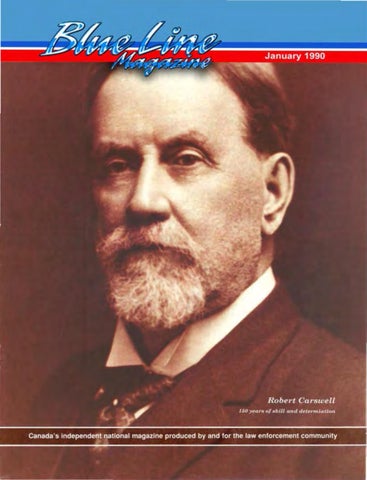
• Canada's independent national magazine produced by and for the law enforcement community
·~
Introducingl The Annotated Tremeear's Criminal Code 1990 by Mr. Justice David Watt & Michelle Fuerst
The all new Tremeear's 1990 is the only Criminal Code that gives you both concise annotations and incisive commentary for each Code section all in a single volume. Special featu res include: • Full text of the Code plm, these statutes: Narcotic Comrol Acr, Food and Drugs Act, Canada Evidence Act, Charter of Rights and Freedoms, Young Offenders Act. • Commentary explaining in everyday language each & every provision of the Code.
• Comprehensive textual cross-references to related provisions of the Code and other statutes. • Succinct, one or two sentence case annotations organized by topic, court level and province. • Comprehensive. well organized general index. Tremeear's 1990 has been prepared by Mr. Justice David Watt - a former Senior Crown Counsel in Ontario and now a judge of the Supreme Court of Ontario - and criminal law;er Michelle Fuerst.
SpeciaJ 60-Day No-Risk Examination terms apply Multiple copy discounts available L459-33151 hardcover
November 1989
1418 pp. $55.00
Also Available POLICE INTERROGATION by Sewnas Woods
Provides a complete examination of the law and practice relating to interrogation specifically prepared for police officers. Coverage includes: overview of interrogation tacucs; discussion of the right to counsel. privilege against self-incrimination, the right to remain silent & the confessions rule; impact of the Charter of Rights and Freedoms and more! IA59-33911 ovember 1989 approx. 300 pp. hardcover $55.00 L459-33921 sofcover $25.00
POCKET CRIMINAL CODE OF CANADA 1990 Sets out the complete Criminal Code with all recent amendments including provisions relating to: instruments and literature for illicit drug use, proceeds of crime and victims of cnme. Plus: the text of 11
statutes related to the Code: comprehen~ive index to the Code and related statutes. L459-32791 No,ember 1989 800 pp. softconr (4-112" x 7") $14.95 (Multiple copy discount'> a' allable)
ONTARIO PROVINCIAL OFFENCES 1990 The essential collection of Matute~ and regulations used by every Ontario law enforcement officer. Contains the full text of 19 provincial statutes including the Pro1·i11cial Offences Acr and the Highway Traffic Act. Plus official words and expres~1ons used in charging offences. L459-33801 ovember 1989 1100 pp. $19.95 softcover (4-112" x 7") (Multiple copy discounts available.)
All of rile above titles are available for a 30-day free etami11atio11. Call, or wrire or FAX:
CARSWELL
Toronto • Calgary • Vancouver • Ouawa
2330 Midland Avenue, Agmcourt, Ontario MIS IP7 (416) 291-8421 FAX: (416) 291-3426 (24 hours a day) TOLL FREE: 1-800-387-5164 (Toronto Business Hours only) IN TORONTO CALL: (416) 291-8421
Pnct' sub1ttt ro changt' i.1thour norict' 10·89
January 1990 ~~~~~~~~~~~~~~~~~
-~~~~-
Cover story
IN THIS ISSUE FEATURES: Force Celebrate Year of Racial Harmony
4
MTPF Declaration of Concern and Intent
5
150 Years of Skill and Determination - M.B. Gausden
6
Grim Realities: Policing in India - Mohammed Dawood
8
The origins of Community Policing (Part 3) - Chris Braiden 10 Portable personal security system - Product review
13
Dispatchers and Officer Safety - Robert Hotston
14
The Greater Victoria Police Chorus - Ray J. Adrian
15
Letter to the Editor
18
The Exhibits Man - Richard Duplain
20
New communications system for O.P.P. 10-20
22 23
The 5 -Minute Policeman - Book Review
24
Surnmers ide Police test high tech - W.J.R. MacDonald
25
The R.l.D .E. Team -Tony MacKinnon
28
True Crime: The Fraudule nt Vicar - Geoff Cates Books
30
NEWS:
12
Equipment theft co-ordinator charged Court rules on Fax case
16
American bounty hunters guilty on appeal
16
Prison to pay $75.000 to inmate's wife
17
Florida jails irresponsible parents Crack dealer convicted on "seamly" evidence
17 17 17
The case of the exploding birds
18
Murder rate grows in U.S. capital
CASE LAW:
12 19
Court approval not required for videotap Decision to transfer not a heavy onus on Crown Probation not breached by impaired conviction
23 24
Officer must tell accused seriousness of charge
27
Man did not "use" firearm
January 90
3
T
here are many lawyers, judges, politicians, and police officers who have cut their professional teeth on a Carswell Law Book. There is no other publishing house in the country (and I would venture to say in the world) that could hold a candle to the number of police profession publications written, edited and published by this company. When I was in High School l received my first introduction to the Criminal Code through a copy of the 1955 version of Carswell's ''Police Officer's Manual. " The first paragraph in the book, by Clifford Magone, tells a timeless story. "A few general observations are offered for the guidance of the police officer with ambition to succeed. He must realize that he is essentially a peace officer, and as such must see to it that the Queen 's peace is not broken. His first duty is the prevention of crime." The piece later went on to say; "Jn the discharge of his duties as a police officer he should judiciously regard the rights of others; by so doing he will not only earn the commendation of his superiors but the respect of the public at large." Blue Line Magazine would like to salute the Carswell people for a job well done and congratulate them on reaching this milestone of 125 years in the law book profession.
Focus
Police Force celebrates the year of racial harmony - Morley Lymburner •
II.
1
t's a step in the right direction " " I exist that reflect the department's senam quite pleasantly surprised. I sitivity to minority concerns. The "Decdidn't know it existed .'' "It's a nice effort laration of Concern and Intent" document is considbut I hope they realize that ered to be one of the finest in now they have made it public North Amerit is a commitica. ment for life." T h e "The fo rce "Declaration of Concern should be comand Intent" plirnented for this gesture of (also known by that force as goo d will. I have never Standing Orseen anything der 24) was first drafted in like it. Wonder£ul. Simply 1985and isan official declawonderful." ration stating These clearly the were some of the comments position of the Force with by minority regards to rarepresentatives ToroHto Police Cliir/ William McCnnnack watches as cism both invited to the Polict Commission JreodjuneRow/andssignsDeclarotion. within and outMetropolitan Toronto Po lice Headquarters on No- side the police force. It was discovered vember l 5th to celebrate a re-affirma- that the community at large was not tion of the "Declaration of Concern and fully aware of this policy statement. The Intent" order by that police force's new Police Commission decided that it would Chief William McCormack. be in keeping with the City of Toronto's The Metro Toronto force , rocked declaration of the year 1989 as the by a series of incidents over the past "Year of Racial Harmony" to have an year that were of concern to local official re-signing of the standing order minority groups. decided that it was before representatives of the many tlme to go on the information offensive . minority groups of the city. They felt it was time that the community In addition each member of the discovered what programs presently upper level ranks were present and all
members of the force given an open invitation to attend the foyer of the new police headquarters on College Street. The mayors of each of the six municipalities making up Metropolitan Toronto were also present to view the ceremonial signing of the declaration document. Chairman June Rowlands spoke to the gathering describing the standing order as a "Stellar race relations policy that should be an example for police forces across the country." Chief McCormack, faced by a large gathering of "uninvited guests" picketing the headquarters building stated; '' It's our duty to protect people who wish to demonstrate and protect that right. You be the judge and tell us if we are doing it right or wrong." Art Lymer. the President of the Police Association, advised the gathering that it is "My duty to promote a harmonious community. Racist attitudes can not be tolerated in our community or in our force. It (the force) can only be the best it can be with the help of the community . ~ However he rem1nded the audience that it was his further duty to speak out on behalf of the Association membership because they form a visible minority in blue. He continued by saying that from time to time he will be seen to defend certain actions that appear to be conflicting with media stories. He then asked them to try to consider "the other side" of each story before they make a judgement on his OT the Association's stand. It Is believed to be the first time in North America that such a statement has been publicly announced and celebrated by a police force. Wendy Forbes, Co-ordinator of the Year of Racial Harmony for the City ofToronto, stated that it is her expectation that other communities will do likewise and they are invited lo contact the Metro Police Force for their advice on this subject. She also stated that her office would be happy to assist. Thos interested can call her at (416) 392-0020. City of North York Mayor Mel Lastman, has already announced the year 1 990 "The Year of Racial Harmony" for that city.
Vol.2 No.I - January 1990 - EDITOR/PUBUSHER -
Morley Lymbumer
- EDITORIAL ADVISORS David H .Tsubouchi LLB. Edward Gunraj (P.0 .A . Consultant) Doug Ramse~ (MTPA Education & Research.) Elizabeth Alexander (MTPA News & Views) M~ Lymbumer B.A. M .Ed.
Metropolitan Toronto Police Declaration of Concern and Intent (Standing Order No.24)
Gerald A. Oxman I.CJ.A.
Joan Schaer B.A. (Metro Police EA.P.) Tom Dykes (Halton Regi~n Police) Robert Hotston B.A. M.Crtm, (Peterborough Police Force) The Editorial Advlsors are pefsons from whom !his publicatlon seeks out advice and guidance. The use of their names is in recognition of their assiS1ance and ongoing SYpport.
- ADVERTISING Al Stiver (416) 294-5502
- WRITERS Morley l..ymbumer (Editor) Louise Dueck • Al Porter Richard Duplain - COLUMNISTS • Geoff Cates • Gary Miller Robert Hotston • Jim Bardgett -PHOTOGRAPHY John Loftus Don O'Shaughnessy
·lllUSTRATION·
Tony MacKinnon • Bette Clark
- DESIGN AND PRODUCTION Don O'Shaug~
i:Mlem Gr<1phlcs Services 66 Gerrard Street East. Suite 203 Toronto, Ontario M5B IG3 (416) 348-8713 Fax: (416) 348-8725 Blue Une Magazine Is published monthly . ten times per year by Blue Llne Magatine Incorporated with head offloe 111 118 M11in Street North. Markham, Ontario Canada, L3P IYl. Editorial and copy Is considered to be completely separate from advertising sales. Nocommittment for editorial coverage can form any part of a sale agreement. Advertising enquiries should tie made at (4 16) 294-5502 ot FAX number (416) 294-8952. All artioles are protected by oopyrighl. No part of this publication may be reproduced or transmitted In any formorbyanymeans,electronk:ormechank:al, Including photocopying and recording, or by any Information storage or retrieval system wlthou1 permission from the publisher. The authors. adVISOrs and publisher accept no liability whatsoewr for any injuries to person or property resulting from the application or adoption of any of the procedures. tactics or considerations presented In I his magazine. Readers are cautioned and iidvised that articles presented herein are edited and supplied for your personal awareness and.should not be referred 10 for further e..-tion until approptiate advise and guidance ls rea?aved from .i supervising officer or the advice of <> Crown Anomey Blue Une Magazine Is an independant publication designed to educate and upgrade the skills of th05e involved in the law enforcement profession. It has no direct control from a law enforcement agency and its opinions and articles do not neceessarily reflect the opinions of any government agency or police force. Blue Line Magaiine ls printed ln Canada byJOOanns GraphlGs. The sole a uthorized d istributor of Blue Une Magazine is Green Gables Book Shop, Markham, Ontario.
f:fCI A5socll>te ITl<lmb«r, NatkanAl
~ Assx:iadono1Polle4Plol'll1<!,..
II.
T
he relationship between the members of the Metropolitan Toronto Police Force and the public they serve is the single most important concern of this Board. "The Metropolitan Board of Commissioners of Police and the Metropolitan Toronto Police Force have always been concerned about the exhibition or expression of any fonn of bigotry, discrimination . prejudice, and sexual or racial harassment by its members. The Board is concerned not only with the manner In which members of the Force treat the public but also with the manner in which they treat one another. "The Board recognizes that each member of the Force is entitled to his or her own beliefs; however, a member of the Force cannot allow those personal feelings to enter into contacts with the public or contacts with other members of the Force. ''Every member of the Force must avoid any expression or display of prejudice, bigotry, discrimination, and sexual or racial harassment. "Members of the Force should conduct themselves, at all times, in a manner that promotes public confidence in the integrity and impartiality of the Force. Even the appearance of bias or prejudice can be as damaging to the public confidence as would be the actual presence of bias or prejudice. Likewise, such behaviour can damage the mutual respect between co-workers and must be avoided to maintain positive working relationships which are vital to a smooth functioning organization.
··Members of the Force are conspicuous representatives of government and are symbols of stability and authority upon whom the public can rely. As such, members of this Force must recognize that individual dignity is vital to a free system of law and that while all persons are subject to the law, they are equally entitled to dignified treatment by all persons involved in law enforcement. T herefore, members of the Force must. at all times, whether on duty or off duty, refrain from conduct o r remarks which may be Interpreted in a way that is detrimental to themselves , the Force, Lhe Metropolitan Corporation, or any other person or agency involved in the administration of justice. "The Metropolitan Board of Commissioners of Police will ensure that training programmes in the area of human and community relations are continued in order to keep members of the Force continually aware of these critical areas and their roles within the Force and their communities. "The Board hereby recommends lo the Chief of Police that an Order be issued stating the Board's Declaration of Concern and Intent and indicating that any violation of this Declaration by a member of the Force will result in disciplinary action against that member. All members should be made aware that if they are the target of such intolerable behaviour they should approach their Unit Commander, or the Unit Commander of the Internal A ffairs Unit, to apprise him or her of a violation of this Declaration of Concern and lntent"
Member, Periodical Publishers Exchange
ISSN #0847 8538 Second dass mail registration No. 8242
January90
~£
, ~~ §"
----------5----------,~ ~~rjffj ~ ~
The idea was to take root and grow and the business he founded was to prosper over the next century and a quarter to become the Carswell Company Ltd. It is Canada's largest publisher of books for the legal and law
The Carswell story
150 years of skill and determination
From humble begi1111i11gs, Carswell has becomt a major international supplitr to the legal a11d law tll/Orctmtnt professions.
- M .8 . Gausden -
0
ne way or another. most police officers across Canada are famiHar with the Carswell name. Mostly in connection with the various reference books they use on the job almost every day or read to improve their law enforcement skill and professional knowledge.
Robert Carswell: tht start of a tradition
But chances are not too many officers will realize that the Carswell name is very much a part of Canadian history. It has been around as a cornerstone of Canadian publishing since before Confederation. In fact , 1989 was the firm 's 125th anniversary year. It all began in 1864 when Robert Carswell, a 24·year-old school teacher from Colborne, Ontario had an idea, and more important. the skill determination and luck to make it work.
6
January 90
~-----
enforcement professions and Canadian distributor of legal and police texts of all kinds from other publishers around the world . The professions Carswell was destined to serve for the rest of his long life were relatively simple 125 years ago. Police forces were small and primitive and many of the problems and issues that concern all of us today were simply
unknown. Drugs just weren 't around, except for the demon rum, of course. Human rights hadn't been invented nor had juvenile offenders been identified as a protected species. There was no such thing as family law, no breathalyzers, no speeding tickets and no traffic laws. As a matter of fact there was no traffic either, apart from lots of horse-drawn vehicles on unpaved roads.
Nonetheless, much of the legal framework we know today was already in place in Robert Carsweil's Upper Canada and the other scattered jurisdictions of British North America. This was true even though the population was still only around 3 ,000,000. Montreal was still the largest city with about 100,000 people in 1864. Toronto was less than half the size, with 49,000. But crime certainly flourished to keep the hardworking all-male police forces of the day on their toes. Murder was only one of eight or nine capital offences and public hangings remained in vogue until 1869. Scores of misdeeds meant penitentiary terms of three years or more. Minor infractions frequently earned a routine "twenty dollars or 40 days" and nobody had heard of time off for good behaviour. There was lots to be done on the civil side as well. Land registrations, property transfers and mortgage placements were constant needs in a fastgrowing land, often with the man in blue in an English bobby's helmet standing by with his nightstick (but no gun) in the interests of good order. As for the policemen and lawyers themselves in those all-male days, some could enjoy an 1860s version of the good llfe, in the cities at least, where a family could live in relative affluence on $25.00 a week. Successful lawyers would make that much, but policemen would have to be pretty senior to approach that kind of pay. Even so, they did reasonably well, long before the days of inflation and tough taxation. In the small towns and villages of Upper Canada there were plenty of lawyers around, but often only a single local constable. He was expected to work out his own rough and ready law enforcement methods and to operate at rock-bottom cost. When he first arrived in Toronto in 1864, the young Robert Carswell's first role was as a Canadian representative for the American Cyclopedia, an important reference book of the period. He had also seen a potential market for law books. He began to sell them immediately - used ones at first - and Continued on Page 21
January 90
7
people are the police and the police are the people." I recall my explanation of the application of Peel' s theory to my host, an Indian Police Inspector in Baroda. The look of disbelief and amusement still stands out vividly in my mind. But in order to properly convey his thoughts on the matter, I must relay another event that I had witnessed just prior to our meeting. My first encounter with an Indian police officer took place during the ride - Mohammed Dawood from the airport to my father 's village. This exhausting, northbound fourteen he officer directing traffic at the the police officers in Boroda , a modem hour trip, on a two lane highway disintersection blew his whistle long city located some 450 kilometers north played more carnage and accidents in one rainy night than anything I have and loud as the rusted white vehicle east of Bombay. came to an abrupt stopped some three It was an experience which !had heard of or experienced in the time meters from the officer. The officer, endeared me to be more understanding since I've been a police officer. While I admired now with a ll four directions stopped. the serenity of the country side. my atdrew his bamboo night stick and tention was diverted away by the sudden walked to the driver's door. Opening it he change in traffic. At grabbed the offendfirsr, I dismissed the ing motorist by the change to another back of the neck and one of many accidragged him out of dent, but was taken the car and pulled unawares when the driver turned around him to the centre of the intersection. and said, "Check The officer then post. Saheb. Five rupees or passport?" displayed to the motorist the perimeBeing confused but more so curious, I ter of the intersection and punctuated poked my head out the lesson with the of the window and observed an officer night stick. He then returned the violator standing in the middle to his vehicle and Police Officers anned with submachit1e guns ovmee an intfflection near Government buildings in of the road. Traffic waited dangerously Ntw Delhi. Tht realities ofpolicing outside North America are easy to see. approached him on close as the man took out some money and empathetic with the Asians, here in each side and with amusement and and placed It in the officers hand. After Canada. Moreover, I also understand disbelief, I watched as he stretched his two more slaps on the back of the head their feelings of mistrust and refusal to arms. to each side, to take something from each passing vehicle, and promptly the officer placed the money in his become involved. I could go on and write about the placed it in his pockets. pocl~el and returned lo the dusty interbeauty and richness of India, but for the section and continued his direction. I observed closely as we neared the This was just one of my introduc- most part, I will concentrate on the officer. Our driver approached the tions to the city of New Delhi as viewed general attitude of the Indian public ''check post", so to speak. It was his from my taxi on a recent vacation to towards the police. duty to inspect the vehicles that apIndia. This is the land which my fat her In order to understand the attitudes proach his position and to conduct affectionately calls "The Old Country." of Asians towards the police, I am searches, much like Customs officers at I had a rare opportunity just after this reminded of Sir Robert Peel's Principal the Canada/USA border. event to spend a few days working with on community based policing. 'The In order to bypass the hassle of
Profile
Grim Realities: Policing in India
T
being questioned, searched and taxed zens and his actions towards them. Surprisingly enough, I learned that on goods, many motorists will give the officer a few rupees for his troubles. In not all officers graduate with a rank. return. he gladly lets you continue your The majority of the officers hold the journey. But to refuse to pay up would rank of Constable, the typical cop on cause either undue physical reprisal or the street. He will most likely never hold another rank. The next ranks up would searches. My feelings for being remotely be Sub-Inspector. Inspector. Superinassociated with these two incidents by tendent District Superintendent, Assismy own profession was very distasteful. tant Commissioner and Commissioner I relayed the incidents to my host and of Police. In this progressive ranking received a combination of amusement system, an officer will graduate as a and surprise when I began to outline the Sub-Inspector and work his way up the procedure of our Complaints Bureau ladder, accordingly. and Complaints Boards. My host had decided to continue our talk while patrolling the nightlife in Boroda. The black patrol Jeep was equipped with a CB type radio and the Inspector's name was stenciled to the outside of the windshield. I couldn·t help noticing the steel mesh on the windshield and the fact that of all the patrolling officers. the Inspector was the only man armed with a firearm, a .22 caliber p istol. The Inspector began to explain the grim realities of a police officer's life in India. As we passed through an intersection, the traffic officers both stood erect and saluted the jeep. The Inspector pointed out the On patrol in the scout car - 8oradb style. two officers and explained that they had reached the maximum extent of The ranking officers are provided their promotions. They actually earned with living accommodations for themonly 6,000 rupees a year and in a selves and their families and provided country where the price of a bottle of with a car. Officers from the Inspector's pop is 3 rupees, it is little wonder that rank and upward, are usually provided corruption was a daily occurrence. In with a patrol jeep, along with the aforeretrospect, if an officer is caught red- mentioned car, and driver. The promotional system is, in some handed, in any act of corruption, he ways, similar to our own. Unfortunately faces immediate dismissal. For the most part, the average in some cases the chances of being officer on the street has very little edu- promoted are dependent upon how cation and is looked down upon by the much the individual is willing to spend to public wilh disgust and distrust. He attain the next rank. More often, howdeals with that part of Indian society, in ever. the individual ls recommended which the population possess very little upon his personal merit, and is quite or no formal education. Hence. it be- smart and does his job well. The mancomes futile to reason with logic, com- ner in which they go about their work mon sense and politeness when the may often raise a few eyebrows. bamboo staff can be a more convincing During the course of one night, I act. The training for the average officer was able to take part in a drug bust, theft is not very rigorous or lengthy. He loses arrest and a liquor raid. To discuss these the ability to differentiate between citi- events further would paint a very grim
and disturbing picture of law enforcement in comparison to our own methods. I do not wish to distort the image of police officer in lndia and I would like to mention that I had the opportunity to meet some very honest and duty-minded officers as well. during my visit I learned of an officer who went undercover for two weeks, unarmed and with no backup team, to unravel a child-selling ring. T also heard of an Inspector who arrested a man wanted in England for swindling a company out of $5 million. Upon being arrested the Inspector was offered $750,000 to allow the man to escape. The Inspector refused , laid an additional charge and sent the accused to face charges in the U.K. The general consensus among the Indian public is that the average officer on the street is corrupt and is one of the lowest fonns of life ever created. They fear the police, regardless of rank, and display grave mistrust and will adamantly refuse to become Involved in police matters. In most cases, they will settle any disagreements amongst themselves rather than face the end of a bamboo stick. They also harbour contrary feelings for the court systems. This is an attitude, from what I understand, dating back to the time of British rule in lndia I have provided a very short insight into the attitudes and ways of thinking employed by many Asians. I hope to have provided some understanding and empathy in dealing with the Asians who comprise our Canadian mosaic. It is true that some attitudes cannot be changed but they can be developed so that the next generation's gap with their elders will be bridged, and their attitudes toward the police will be more tolerant. It is hoped that we, as police officers, will exemplify the reputation of trust and understanding which has been recognized the world over. It is hoped that the same reputation will also be embodied within the minds and attitudes of the people we serve and protect.
that tells us the right things to do. "Problem-oriented policing·· is how we get those things done right (more about this later on). "Community Policing" is the head, .. Problem-oriented Policing" strategies are the feet . To quote Herm Goldstein. the father of Problem·ori· ented Policing thinking, "Community Policing is the bun and Problem·ori· ented Policing is the beef. " There is another thought that is critical to an understanding of Commu· nity Policing. It embodies the words of Part 3 of 4 parts Ralph Waldo Emerson who said, "Go · Chris Braiden often to the home of thy friend for weeds choke the unused path.·· Conommunity po!icing is a philoso· doing things, then there first has to be ventionally, the only paths we walk are phy. a mind-set, the reason why a re-tooling of the heads of the brass those to the bad guy's house. Weeds we do things in policing . It is the strate- before you can re-tool the feet of the choke the path between us and the gic vision that must precede strategic grunts. It has more to do with why we do common people . "Only want the facts planning; otherwise we have planning things rather than what those things ma'am, we'll do the rest. ·· for planning's sake. The Community are. It has to do with the classic definiTraditionally, police have decided , Policing philosophy - - --------unilaterally, what is is constant, it doesn't important . As a change from police consequence, be· department to pocause we have a molice department or nopoly over our police officer to powork. and because lice o ffic er. Conpolicing has a very versely, how it gets nebulous job dedone changes conscription (1 defy stantly. anyone to quantify To use the religPeel's principles. ious corollary, faith and don't look to is constant but the the Police Acts for help), and mostly denominations and paths to it are multibecause we are tudinous. This perhuman, to a large ception is the es· degree we have sence of Community ended up doing the things we like to do, Policing because it Community Polici11g: 011 old idw with new app/icatio11s. recognizes that and that are quanti· communities such as cities are made up tion of effectiveness and efficiency fiable (an hour spent on radar is meas· of a collection o f individual neighbour- captured by Warren Bennios who put it urable, not so with a bunch of snottyhoods and that the personalities, prob- this way: "Effectiveness is doing the nosed kids bent on :mischieO, as op· lems, and solutions to those neighbour- right things. Efficiency is doing the posed to what is best for the commuhood problems vary widely. Another things right." nity, over time, a space has developed But no matter how well we do between what we think is important and way of putting it is to say that Community Policing is an effort to bring the things. if they are the wrong things in what the public thinks is important. village to the city and to see the city as the first place then we're spinning our Let me use an everyday example to a collection of villages as opposed to a wheels. No amount of efficiency re~ make this point. A bank is robbed and big blob of people. "Community" is the places effectiveness. We have become a wino is mugged. In our criminal code large term encompassing a number of very efficient at the routine things but these crimes are equal, they are both neighbourhoods. never even question whether they should robberies. There is no special category If a conventional police agency is to be done. for banks. Police reaction to them, "Community policing" is the vision however. is not. On the Richter scale of adopt the Community Policing way of
Serles
"Brinegi;;g cihe p;iilage to the city''
C
10
January 90
police priorities, the bank job is an 8, the wino doesn't even register. Why? it all has to do with mind-set. It has to do with evolution of police thinking of what is important. That thinking has been predicated upon the actions of the criminal rather than the social damage of the criminal's action upon the community. It has to do with such things as the amount of money involved. status of the crime in the criminal code and in some case the
In short, the social damage to the "community" most affected by this crime is slight, and transitory. Looking at the wino's mugging, the damage to his "community" is considerable and his financial loss is total. It may be his last $5.00 (wine's not so cheap anymore). Worse still, the crime is perpetrated in the neighbourhood where he is destined to live as are the people who may have witnessed the crime or learned of it from the other people who
We are an important part ofthe comm1rnities in which we operate, but we must continue to work to let the public know we value all parts ofthe community highly.
status of the victim. Our conventional reaction is influenced more by its legal damage versus its community damage. If we were of the Community Policing mind-set, we might ask these question before we decide what our reactions would be. What is the community damage to the banking community specifically? Well, in terms of money, it is infinitesimal. It is simply part of doing business just as doctors are bloodied once in a while. All banks are insured and they can cover the cost of this insurance in the rates that they charge their customers. Also, people of the banking community go home every night to suburbia where they can feel secure from the type of people who rob banks.
live in that neighbourhood . Also, a person as opposed to an institution is the victim. Often these people know who committed the crime and may have been victimized before, but be· cause of their fear of retribution , may not have reported these crimes. These are types of street-level predatory crimes that feed the perpetual fear of victimization these people must endure; the feeling of helplessness they have in their own neighbourhood grows inexorably because they cannot get away from it. In this case. the social damage to the immediate "community" is significant, and everlasting. From a pure survival point of view, who do you think needs us the most?t
Community Policing, in its purest form , requires that we use this Community Damage Criteria as a central factor in predicating our response to crime. It does not mean an abdication of one for the other but rather that the bank robbery perhaps comes down to a 6 on the Richter scale and the wino moves up to a 2. It does not change what we do so much as why we do it. lt simply broadens our vision of what our work is and who our customers are. Wealth must never be a factor in police services rendered . This is precisely why we enjoy the freedom we do from the elected branch of government. We must not be manipulated. In this case, I have used the crime of robbery as an example; the rationale can be applied to any crime or piece of work we do. Whether the scene of the crime be the main branch of the Bank of Montreal or the community detox centre, it must not influence our decision-making as much as it did in the past. You see, there is no difference between a bank robbery and a wino mugging except in the Department's monthly crime reports. and our heads. And that is as clear and as simple as I can explain the basic philosophy of Community Policing. tEdltor's Note: Although l agree in principle with Chris Braiden 's bank robbery analogy l feel it may duty to bring it into perspective. In theory his analogy is correct as far as making his point is concerned. However In reality officers handling bank robberies still must consider the dangers involved both to the public and himself. Bank robbers can be far more dangerous and despe rate than someone who mugs a wino. The stakes are much higher in bank jobs and the dan ger to the public is considerably higher. As stated by Mr. Braiden it isn 't a matter of reducing the importance of bank robberies as much as to increase the importance of the mugging of a wino and the understanding of its impact on the community he lives in. NEXT MONTH: Part 4 How to ac-
complish Community Policing "More than one way to skin a cat. "
Court approval not required for "VIDEOTAP" (Regina Vs. OEOELS)
A picture Is worth a thousand words and it could be easier to get. This was the lesson taught by a British Columbia County Court Judge recently when he permitted video tape evidence admitted at trial. The court decided that unlike wire· tap evidence, video-tap evidence is not governed by Part VI of the Criminal Code. This ruJjng appears to contradict the decision that came from a Quebec Court of Appeal case In 1986 In the case of Regina Vs. Asencios where the court rejected videotape evidence from a secret camera placed in a man's garage. In this most recent case RCMP drug squad officers in U1e Prince George B.C. crea were seeking evidence of some suspects diluting cocaine in a resldence . When they sought approval to oblain a "Video-lap" they found that there were no guidelines. The officers subsequently set up a video camera
after proper wire tap evidence indicated that the residence was being used for the purpose of diluting the drug and packaging of it. On the "voirdire" the key issue was the video tapes admiSSibility in light of the accused's section 8 Charter right to be free from unreasonable search and seizure. The thorny issue has been moving back and forth over many years. In one case it was determined that video taping a gambling game in a private residence was not illegal because it was a public event taking place in a private place. Another case determined that taping homosexual activity in a public washroom amounted to private activity in a public place and thal this too was admissible evidence. In the present case the courts determined that the evidence obtained by the camera was admissible for the following reasons; The officer had made every e ffort to seek advice of other members
and Crown Counsel, che police had ensured the camera was focussed on only one location where the criminal activity was taking place (one table in the middle of the room) and thereby minimized the poss~ble intrusion to privacy: the police demonstrated that the residence was not the accused's only residence and that its primary purpose was that of a fortress to protect the accused from the prying eyes of the police. The officers had obtained proper authority from the courts to enter the premises to initially search for evidence and then to install the devices. The presiding judge concluded that the video evidence obtained. although a technical invasion of privacy, was reasonable under the circumstances and that the accused's right to privacy would have to yield to the public's need for proper and e ffeclive law enforcement.
Equipment Theft Co-ordinator charged TORONTO - An Ontario Provincial Police officer and three employees of Simcoe Investigations. a Barrie private investigations agency. face a total of 24 charges in connection with attempts to fraudulently claim "finder's fees " for the recovery of stolen heavy equipment and motor vehicles. On September 8th , 1989, the OPP received a complaint from the Insurance Crime Prevention Bureau that a private inv~sllgations agency had been invoicing "finder's fees " to various insurance companies. claiming it had recovered stolen equipment and vehicles. Members of the OPP's criminal investigations branch conducted an investigation. and determined that a member of the auto theft section was associated
with an employee of the agency. The investigation revealed lhat "finder's fees" totaling approximately $50,000 had been invoiced to 15 insurance companies, a heavy equipment manufacturer and a leasing company. The invoices were issued following three separate recoveries of stolen equipment and vehicles in the Bolton, Coboconk and Alliston areas during the summer of 1989, The stolen property was worth an estimated $800.000. Arrested and charged on December 7th with one count of conspiracy to defraud, five counts of attempted fraud , and one count of fraud over $1.OOO are Constable George E. Kleinsteiber, 40, of Stroud. Ontario. a 21-year member of the OPP, Brenda J oyce Money, 30.
12
of Barrie. Ontario. a private investigator with Simcoe Investigations; Brian Sartorelli, 34. owner and president of Simcoe Investigations. Also charged with one count of conspiracy to defraud and two counts of attempted fraud is Timothy Sexton, 29, also of Simcoe Investigation s branch office in Orillia. As reported in our October issue the CPIC local for the Heavy Equip· ment Theft Co-ordinator is ON46001 . This information is still valid and the OPP will continue to co-ordinate the recording and dlsseminalion of information on stolen hea\1)1 eqUipment. They hope to be finding a replacement for Constable Kleinstejber shortly.
_ _J_an_uary 90
~ Product Review
Cenadlan Charter of Rights and Fteedome
Completely portable personal security system
A
complete portable security system from Britain fits into an inconspicuous and easily carried case and can be set up and operational in minutes.
range of up to about 200 metres (520 feet). The number of sensor units and transmitters in the system can be varied to suit specific needs.
'7 . Euervone has the right to fife. liberty and security of the person and the right not to be deprlued thereof except Jn accordance with the principles of
fundamental }usttce. " The rights outlined in these sections spell out the basic legal protection that safeguards eveiyone in their dealins with the state and its mechlnlery of justice. They are designed to protect the Individual and to ensure simple fairness should he or she be subjected to legal proceedings. particularly criminal cases. In recent years the various levels of court have made It clear that this section does not enter Into the workplace and in particular members of police forces that ftnd themselves charged under Police Acts or Force regulations. It Is widerstood by the courts
that even this right can be of limited use to the indMdual If the courts or the law makers deter· mine that some restrictions must be made In the Interest of the Protutor 502: Personal protection goes high-tech.
The "Protector 502" from Protect Co. Limited, designed to protect personages such as head of state, government ministers and leading industrialists during official visits, can also be used to protect valuable equipment or art treasures on temporary display. The standard package contains four battery-powered infrared sensors which can be sited at strategic points around the premises. They have a wide angle of vision and can be placed up to 10 metres (26 feet) apart. The package also contains four personal alarm transmitters; small hand-held units which activate an alarm when two buttons are pressed simultaneously. Both types of unit, which maintain radio contact with the "base station" built into the carrying case, have a January 90
Powered by either regular current or batteries, the case becomes the security officer's console. Any intruder passing a sensor or any activation of a personal alarm transmitter will light a lamp on the console, allowing the security officer to dispatch guards to the area. Optionally available from the company is a fully weather-proofed passive infrared detector which detects human targets at up to 150 metres. These may be used singly or in groups for such applications as perimeter protection or guarding aircraft on the ground. For further details contact Protect Company Ltd. , Elstree Studios, Borehamwood, Hertfordsh ire, England (WD61JG)orphone+4419538272. Contact person is Mr. K.A. Chittenden. 13
public's good. One example Is the laws permitting the stopping of cars to screen citil.ens for alcohol
abuse.
"Hey! Who stole the Ride Team cartoons ... again?" If you don't have your own subscription to Blue Line Magazine yet, just think of what you might be missing ...
Robert Hotston
Dispatchers and Officer Safety
S
ome months ago, a member of my force came to me and suggested that I write about police dispatchers and their role tn officer safety He had responded to an "armed person" call two days before and was concerned that the lack of Information provided to him and other responding officers while en route to the incident had jeopardized his safety Appreciating his concern, I decided to take him up on his suggestion. The backbone of any police agency is its radio communications. By this means, officers are kept in constant contact with headquarters, supervisors, each other and with the community they serve However, an incomplete or poorly worded dispatch will put an officer at a disadvantage. It may also put him In a situation which could prove lifelhreatenlng because he or she lacks the necessary information about the assign· ment and is therefore unaware of its potential hazards In short. radio dis· patchers work behind the scenes telling cops where they are needed and alert· ing them as to what they might find when they get there. There are two problems inherent in poor dispatching. One is the failure of the dispdtcher to transmit enough information to the officer in the field. This is related to the second problem, that persons tdking incoming telephone calls fail to obtain enough information to enable the dispatcher to provide sufficient details to responding officers. Inept, la1)1orindifferent persons handling
the phones and dispatch may easily compromise an officer's safety. The dispatcher's job, while techni· cally a "desk job", is far from the usual desk job. He or she must remain calm while speaking to people who call the police, even those who are obviously under extreme stress and perhaps irra· tional. Once basic information for a call for service has been obtained, the dispatcher must concisely and with the proper information, assign police to cover the incident. regardless of the circumstances. This requires a calm professionalism at all times, but espe· cially so in relaying stressful and emotional calls. How, when and how completely the information is relayed will determine, to a great extent. the success of the field officer In carrying out the assignment. The training of police dispatchers should include some time in the field so that they may observe first-hand the Importance of their work. They should be obliged to ride on patrol to see officers in action to fully appreciate the problems that can result from misinterpretation. misinformation or no infer· mation at all. By this. communications personnel can better understand the scope and significance of their own role and appreciate the dangers inherent in inadequate communication. They must understand that there should NEVER be any question in a field officer's mind as to what he is supposed to do, or where or when he is to do it. lf that turns
, -
~
14
out to be the case. then the dispatcher has committed the ultimate sin of misln· forming or underinforming with potentially hazardous results. Policing being what it is, officers are lulled into the rhythm of "routine'' calls. Poor communication enhances this state of mind. With only basic information, an officer will be inadequately prepared to meet the possible dangers that exist if the call to "see a woman about a domestic dispute · is actually a domestic dispute involving a drunken spouse armed with a knife. The call may be assumed to be a ''routine" domestic and as such an officer will make no special assessment as to any potential for danger The whole issue of effective communications revolves around po· lice officer early awareness." Dispatch· ers must never forget that an alert cop, warned early by radio. is less susceptible to the inherent dangers of an unin· formed cop. Dispatching procedures are impor· tant in all field operations They are crucial in situations where officers are being sent to a robbery alarm, calls involving intoxicated or mentally unstable persons, a call involving weapons or domestic disputes. In any "hot" call, all officers involved should be advised of the nature of the Incident and given relevant details. lnsofar as they may be known , and assigned to specific duty by the dispatcher. There is an additional element in assuring quality radio dispatching. It is ensuring that street cops fully under· stand the problems dispatchers face and what dispatching entails. Street cops should be given an appreciation of what dispatching involves and the stress inherent in the job The dispatcher occupies a pivotal role in assuring officer safety. On one hand . the dispatcher should remain emotionally uninvolved in the actiVities of officers and emergency callers, while simultaneously being concerned, per· ceptive. enquiring and sincere. Good police dispatchers are worth their weight in gold , just ask the cops who work with them! M
January 90
~
0
n January 11 , 1984, twenty hesitant policeman from the five municipal police forces surrounding Victoria British Columbia gathered to be taught how to sing and harmonize by the well-known tenor Art Wiebe. Mr. Cycril Mossop, a retired music teacher, was the first pianist. Nearly all the members who showed up for this first practice are still active members of the Chorus. The members are nearly all serving police officers from Victoria, Oak Bay, Central Saanich, Esquimalt and Saanich. A few are retired from active service but continue to serve the community through participation with the choir. In 1986, the Chorus successfully competed for a three-day participation in the entertainment program at Expo '86. They gave dally performances in the B.C. Pavilion and the Plaza of Nations. The Chorus plays for shut-ins, at civic events, in hospitals, graduation ceremonies at the Police Academy and other police functions. and of course , gives public concerts. Their entertainment capacity is considerably enhanced by Art Wiebe's
ProfHe
The Greater Victoria Police Chorus - Ray J . Adrian -
171e Greater Victoria Police Cho ms photographed on the steps ofBritish Columbia's Parliament Buildings in Victoria with Premier William N. Va11denal111, Mrs. Marilyn Rendle (pja11ist), Mr. Art Wiebe (director) , and Mrs. Jeanne Campbell (pianist).
·--
r:.,~··--t...~.....
...
,, ....... c.-i.:.
« """•"-
'
"
Vancouver Island: Home to the Chorns
solos and an appropriately named quartet called "The Flatfoot Four". This group is comprised of Bill Chisholm, Tony Brouwers, Amie Davies and Harry January 90
Vanderhoek as the "flatfoots". The chorus' repertoire represents a wide variety of music styles including opera, sacred/gospel, musicals, barber shop, and patriotic. To reciprocate for the fine hospitality extended to them in the Netherlands in 1987, they hosted the Dutch National Police Choir in the fall of 1988 for a very successful concert tour of British Columbia and Washington State. On the international scene, the Chorus has now received invitations from Wales, West Germany, and again from the Netherlands for a tour to commence this April. 15
This is a fine example of inter-force co-operation and an excellent example of international good-will . The side benefits for the members is self satisfaction and fulf illment as well as a good method of socializing and networking with the community. It is most certainly a good method of stress reduction for its members. Any one wishing to purchase tapes from this group may do so by sending $8.00 to Greater Victoria Police Chorus, Box 5682 Station B, Victoria, B. C. V8R 658.
.news beat ... news beat ... news beat... news Just the FAX ma'am The Ontario Court of Appeal has re· cently ruled on two cases that should be of great significance to lawyers and police forces across Canada. As reported by the "Lawyers Weekly'' newspaper last November the ruling states that the delivery of docu· ments by utilizing a FAX (facsimile) machine is "good and adequate delivery". This ruling could have some benefit to members who are attempting to serve such things as remand notices. The actual cases involved the service of an "offer to Purchase .. document. In his summation Mr. Justice Sydney Robins stated; "Where technological advances have been made which facili· tate communications and expedite the transmission of documents. we see no reason why they should not be utilized. Indeed they should be encouraged .. " The procedure used was an offer to purchase that was sent from the law office representing the purchaser to the seller. In the original letter sent by FAX the law office requested that the seller return a FAX message acknowledging that they received the message and that the law office had indeed sent it to the right location . The seller returned a FAX message indicating that they had received the message and that the law firm was to send the ''official documents" through to them. However before the documents could be delivered the seller had accepted another offer that had been delivered a fter the FAXed message . The court ruled that the FAXed message was the legal document that was served first. As far as real estate deals are concerned this could mean a matter of telephone tag. However in the criminal realm their may be some real benefit. It would initially be good for serving notices of motion where the law firm or C rown office do not wish to contest the
service of such a document. Areas such as serving notice of higher penalty or notices to tender documentary evidence could be an area that should be investigated further. However complications may arise if the people receiving the message do not confirm delivery by return FAX. Not withstanding this the method could be of real benefit when serving documents from a great distance. Officers should consuJt With their local Crown Attorney before implementing this type of service. Anyone having success in this area are encourage to write us about it. (Full text of this matter can be obtained from Butterworth's Lawyers Weekly by citing "Rolling v. Willann investments Ltd ..
928-019, 9pp.)
American Bounty Hunters found guilty on appeal The Ontario Court of Appeal recently confirmed the conviction of two Ameri· can bounty hunters who abducted a Toronto man wanted in the U.S. However the Court of Appeal reduced their sentence to time already served.
FLASHES
lly Tony M1><.KUlOOll
"We better make these the last, and then go. We don't want to miss lunch."
The case revolved around a Mr. Sydney Jaffe who was a Florida native but obtained Canadian citizenship. Mr. Jaffe was charge With a large real estate fraud in Florida and the two bondsmen put up a $137 .OOO bond for his release from the U.S. jail. Mr. Jaffe promptly took flight to Canada and never returned . The two Bondsmen were given authority under Florida law to "forthWith apprehend. arrest and surrender" Mr. Jaffe to the court. The two men went to Toronto and abducted Mr. Jaffe and transported him to the Florida court where he was tried and convicted of the fraud charge . The Canadian government intervened and subsequently had Mr. Jaffe released and returned to Canada. Warrants were later issued for the arrest of the two bondsmen and an application was made to the State of Florida for the extradition of the two. This extradi· tion brought the two bondsmen back to Canada to face abduction charges. They were subsequently convicted . The two appealed their case stating that they had authority by common law to apprehend Mr. Jaffe. They also stated they had an honest belief they were acting under proper authority and that due to this the mens rea intent was
.news beat... news beat... news beat... news lacking in their prosecution. The courts determined that there was no evidence brought forth by the accused that would given an air of reality to the defence of "officially induced error. " On the second point the court decided that although the common law power of arrest is indeed quite broad it did not extend over international boundartes. T he court pointed out that even the U.S. laws indicate that an American surety to seize can only be exercised within the territorial boundaries of the United States. The court ruled when dismissing the appeals that the "very conviction of those men of one of the most serious offences known to Canadian law would go a Jong way towards the vindication of Canada's sovereignty.''
Prison to pay $75,000 to inmate's wife HUNTSVlLLE, TEXAS - A grave mistake will cost the Texas Department of Corrections $75,000. The Texas Supreme Court has turned down the Department's application to appeal a jury verdict awarding $75,000 to the ex-wife and son of a former Texas prtson inmate. While D.W. Winters was serving time at "The Walls", a prison complex in Huntsville, Texas four years ago, his family was erroneously infarmed of his death. Only after funeral arrangements had been Initiated was the mistake discovered and the family informed that he was, in fact, alive. The award was made on the basis of psychological testimony of the mental anguish suffered by the Winters family. Michael P. Hodge, the assistant Texas attorney general defending the case, described the amount of the award as "bizarre."
"It was less than a day that they had the impression he was dead," Mr. Hodge told reporters. When the incident occurred, Mr. Winters was serving time for aggravated assault on his wife, the successful plaintiff in the suit against the prison.
New Florida Law will put parents in jail Florida has become the first state to impose jail terms on parents whose children use guns in the home to injure or kill. The legislation was approved by many of the same lawmakers who passed a sweeping gun de-control bill in 1987, giving Florida the nation 's weakest gw1 laws. The move is seen as an effort to quell the rising militancy of the gun-control advocates in the state. Gun-control advocates say the new law, which took effect in October, may become a model for other states seeking tighter controls.
Murder rate in U.S. capital growing The murder rate in Washington is climbing rapidly despite police overtime and newly introduced rewards of up to $10,000 for information on wanted killers. According to the latest statistics, Washington had a murder rate of 59.5 per 100,000 inhabitants in 1988. But by mid-September of 1989 the toll had climbed above 300 or about 8 killings per week. Much of the violence is rooted in drugs, particularly the cocaine derivative crack. Dealers of crack are known to shoot each other in territorial disputes, and kill clients who are late with payments.
Russia may join INTERPOL Police from the Soviet Union may be forced to join INTERPOL, the Paris based international police criminal in· telligence agency, due to a huge increase in organized crime. Sources state that the age of Glasnost has hit the criminal element as well. Soviet Interior minister Vadim Bakatin revealed the move as he announced a huge rise in street crime, pushing the overall Soviet crime rate up by nearly a third in the first half of 1989. He warned that the 700.000-strong police force. which cost nearly $ 7 billion this year, would need more resources in the future. "There is no cause for joy. The level of the fight against crime continues to be unsatisfactory," Bakatin said . ''I think that we shall join INTERPOL because organized crime in the USSR is acquiring a transitional character. " From January to June, over one million crimes were committed in the Soviet Union, 32 per cent more than in the same period last year. The biggest jump was in street crimes, up by 84.3 per cent. Muggings rose by nearly 109 per cent. Bakatin offered no explanation for the increase, but told a conference in Moscow that a growth in crime was typical of any society in transition. He believes that recent food shortages have also contributed to the problem.
Crack dealer convicted on "seamley" evidence A Kansas City dope dealer was convicted after a sharp eyed juror noticed his trousers had a split seam in them. Chad Hughes was charged with trafficking in over one pound of crack
.news beat... news beat... news beat... new cocaine after he tried to sell it to an under cover officer. During the trial a video tape of the scene was introduced as evidence and played for the jury. From what could be seen on the tape it was not possible to identify the accused from his face alone. During its deliberations the jury asked to see the videotape a second time. The tape was stopped at the point where the man alleged to be Hughes climbed on his motorcycle, revealing a split in the seam of his pants. The jury then asked a rather puzzled judge for the camouflage trousers worn by the accused. The jury examined the trousers and found the identical split in the seam and about three minutes later returned a guilty verdict The jury had found the one piece of evidence that was missed by the FBI. city police and the U.S. attorney s office
The case of the exploding birds People attending a Wedding last year in the town of Celeg, Hungary. found themselves being bombarded by bird entrails. Feathers, blood and all were falling on them from out of a clear sky. The 300 guests of the party watched as many crows flying in the air simply exploded before their eyes. A later investigation revealed that the crows had gorged themselves on the rice that had been thrown at the bride and groom. A local zoologist stated that the occurrence was due to damp rice and an unusual atmospheric condition which caused the rice to expand rapidly in the stomachs of the crows. As a result of the foul air problem the town of Celeg passed a bylaw prohibiting the throwing of rice at all weddings. Time will tell if future generations will remember why this law was created but the town fathers stated that exploding birds could be a hazard to its citizens.
Letters to the Editor A Refreshing Change
Please find enclosed my $20.00 subscription for the magazine. I have read two copies so far and find the "low key" approach to police problems a refreshing change from the .. macho" television image. I found the editorial on Gossett and Cross (Life's Teachings Vol.1 No.8) re· freshing in that the problems encountered by an officer who shoots someone are very real. In addition I agree that we have to portray ourselves as feeling human beings and not "Blue Bullies". I look forward to receiving future copies of your magazine and hope the interesting articles continue. Sgt. Brian Leng Hamilton Wentworth Police Force Ontario
••• EDITOR'S NOTE This editorial became even more real for the members of the Winnipeg Police Force. At the same time as that editorial went to press, Kenneth Dowson, a much respected Inspector on that force, took his own !ife. He was scheduled to give evidence that same day before the Cross inquiry. In his suicide note the officer apologized for his bungling of the investigation that brought about the inquiry. His perceived guilt extended to the feeling that his actions had brought on the mental collapse of Constable Cross. Inspector Dowson went on to explain how the public and media wanted their "pound of flesh" out of this andhe would be the one sacrificed. This man's sense of duty and honour to his profession could not live with the situation in which he found himself. There are many questions in this world that simply go unanswered to mortals. Only God knows the answers and sometimes I think we have a hard time accepting that.
18
Just one thing ...
I wish to take this opportunity to commend yourself and your staff on a fine police oriented publication. to which my husband subscribes. I refer specifically to your commentary, "Life's Teachings" in the October 1989 issue, which I feel would be of interest to the public. should it be published in national newspapers and hopefully would enable the public to better understand a police officer's real stress associated with shootings, and not the "Dirty Harry" attitudes. I do. however, have one complaint about your publication, and that involves the way it is mailed out. Ifeel that such a publication should not be sent in such a manner that anyone handling it can read it before we receive it. I feel that this magazine contains certain informalion that is of great assistance to police officers. but is not the case if the public also reads it. I hope you will seriously consider this matter, and look forward to receiving the next issue. Yours very truly, Jill Jordan Bradford, Ontario
••• EDITOR 'S NOTE: I understand your concerns and there are several valid points you have made here. We are forced to follow certain rules when using second class mail. To conform with these requirements we had to consider many options that limit how we send magazines out. We also had to consider costs. At this early stage in our development we are attempting to keep our overhead down. (Believe me I have not been paid for doing this for the past year and probably won't be for quite some time yet.) This, and several other reasons, have necessitated our mailing the magazine
January 90
such as it is. We are aware that quite a few members share your feelings so we hope to go to a plastic sealed mailer as soon as we can afford it. On your second concern about the content I would like to make it clear that none of the content is really secret. Any citizen can find this stuff out if they want to dig for it. What we are doing is concentrating and consolidating aJl the law enforcement community information between the covers of our maga· zine. I have no problem having the public read it. I will, however, very aggressively pursue any non-law enforcement people who attempt to copy the infonnation contained or breach our copyright. (Anyone who knows me also knows how tenacious I can be about law breakers) There is another point that I would like to make here. Much of the news and information contained in Blue Line should be read by the public. Do we have a secret about officers who suffer strain and stress on the job? Are the problems you read about unique to the law enforcement profession? I feel we
have reached an age when the public should be more aware of what a cop's life is really all about. I do not necessarily feel , however, that it is my position to tell them. If they wish to get a glimpse of something in Blue Line then they can be my guest. Our only service, though, is to this noble profession.
• •• Here 's to '90 Kindly renew my subscription to Blue Line Magazine. Thanks for pro· ducing such a wonderful magazine. V. Preidt Kitchener, Ontario
••• Looking forward to it! Looking forward to another year of your great magazine. Payment for 1990 is enclosed. Thanks Bill Wardle Scarborough , Ontario
Thank you
l thank you for your interest in our readers and would like to take this opportunity to compliment you on the excellent work you are doing for the law enforcement community through Blue Line Magazine David Davidson Director General Communications Group Solicitor General Canada
"Somebody in the media ought to tell the policeman's side of the story for a change ... "
Somebody does . .. every
month. Have you sent in
_J CASE LAW: \ Youth Court
your subscription yet? - - - - - - - - - - - - - - - - - - - - - - - - - --
Decision to transfer not a heavy onus on Crown (Regina Vs. S.H .M. & Regina Vs. J .E.L.) In a majority decision from the Supreme Court of Canada, it has been determined that the Crown, and the Youth Court Judge, do not have a particularly heavy onus to have a young offender moved into the regular court system. In this particularly brutal case out of Alberta it is no wonder the Supreme Court ruled as it did. It is hard to imagine a case that would be more worthy of going to a higher court. The 1986 case involved two youths who at the time where 1 7 years and 1 1 months old and 1 7 years and six months old when the murder occurred. The two youths befriended a 50· year-old homosexual who invited them to his house to watch porno videos. The
January 90
Crown alleged that when the man attempted to have sex with one of the boys the two youths strangled him to death. The two lived in the house for several days during which they attempted to sell the victims stereo and computer system. The man 's body was not found for two weeks when the video store owner made inquiries regarding his unreturned videos. In its decision from last year, the Supreme Court of Canada laid out the six rules that should be considered by the Youth court and all appeal court judges that subsequently hear the matter; 1: the seriousness of the alleged offence and the circumstances in which it was allegedly committed: 2: the age, maturity. character and background of
19
the young person and any prior record of offences; 3: "the adequacy'' of the VOA, and the adequacy of the Criminal Code or any other applicable Act, if a transfer is made; 4: the availability of treatment or correctional resources; 5: any representations made to the court on behalf of the young person or the Crown; and 6: any other factors that the court considers relevant. The Supreme Court stated that "the Act does not require that all factors be given equal weight, but only that each be considered .'' The majority decision stated that the Alberta Appeal Court had appropriately weighed the evidence and came to a proper decision when it ordered the two tried in an adult court.
THAT'S HOW MANY CANADIANS A RE SWIMMERS
Closeup
The ''Exhibits Man'' - Richard Duplain East Coast Correspondent
THAT'S HOW MANY CANADIANS ARE SOFTBALL PLAYERS
0
ver the years he has been found in possession of handguns. switchblades. drug paraphernalia and stolen property. But no one has said a word about it. Until now! And that's because Sgt. John King of the Fredericton City Police Department is the exhibits man - the only person allowed to have these items. For the past 10 years, Sgl. King has been meticulously managing the property room where at any one time can be
found up to 200 bicycles. lost or stolen clothing, wallets, homemade weapons and shelves of paperwork. Sgt. King's main goal is to see to the proper storing of evidence so when it comes time to go to court, he can find the exhibit then testify as to continuity. However he rarely gets to testify. King's reputation is such that he is known for his exactness and accuracy and this is known by both Crown and defence counsel in the area.
20
The Carswell Story C011li111wijrom Page 7
then quickly established the connections to import and sell U.S., British and other legal publications of all kinds. His first store, opened in 1866, was at 16 King Street West. The business clearly thrived from the beginning and the young entrepreneur was to move to successively larger premises several times in the next few years. He was a genuine pioneer, meeting a genuine need in supplying law texts to serve the new Dominion in its first years after Confederation in 1867. As opposed to books published by others, Carswell's first venture into publishing came in 1872 with the appearance of .. A treatise on Criminal Law as Applicable to the Dominion of Canada by Samual Robinson Clarke of Osgood Hall , Barrister at Law." The book was dedicated to the Prime Minister, Sir John A. MacDonald who also wore the hat of Minister of Justice. "by whose exertions and under whose administration the Criminal Law of the Confederated Provinces has been assimilated." Clarke devotedly pursued his worthy objectives through 720 pages of close, hand-set type in a sturdy leatherbound volume. Robert Carswell sold it for $6.00 in a day when a dollar was truly a dollar. Apparently the Treatise was well received by the legal and police fraternities and the Upper Canada Law Journal was inspired to comment: "We recommend our professional readers throughout the Dominion to become possessed of this book. No man much engaged in the practice of Criminal Law can afford to be without it. " It was an auspicious start - the first book of all the untold thousands to carry the Carswell name over the next 125 years. The earliest known catalogue is that of 1877 . It solicited "the same generous encouragement from the profession of Canada, which has to this time been so liberally accorded" . With 280 pages the attractive little book listed something over 2,000 publications. Most were British and American
with just over 100 shown as being Canadian works. Prices started at 15 cents. Some books cost a quarter and lots were available at a dollar. As to the corporate organization of the firm , Carswell himself was the sole proprietor from 1864 to 1879 when he formed a partnership with three others under the name "Carswell & Co." This became an incorporated Ontario company in 1891 with Carswell as president, as he was to remain until his death in 1928 at age 88. From its inception in 1864 and through various corporate reorganizations. Carswell remained an all-Canadian undertaking until 1 963 when control passed to British interests. At that time. the company became a subsidiary of Methuen of Canada which was, in turn, a subsidiary of Associated Book Publishers of London, England. This was the ownership situation until 1987 when Carswell joined the ranks of the International Thomson Organization Ltd. The Thomson organization, with a staff of 18.000, is one of the largest and most profitable newspaper and periodical publishing companies in the world. Clearly, the Carswell operation has come a long way in its 125 years to date. Today in year 126 there are some 350 talented men and women on the team representing a broad spectrum of skills. Besides settling down as members of the large Thomson team, the Carswell people are also going through all of the hard work of a major physical move from the current overcrowded set of offices in Agincourt. They will be moving to the spanking new Corporate Plaza development nearby and scheduled for completion sometime this year. No doubt about it - these are busy and demanding days for Carswell, but rewarding ones as well. All the people involved are confident they're onto a good thing together. They're confident too that if Robert Carswell were around to see what's happening 125 years later, he'd approve and applaud.
canadlan Charter Of Rights and Freedoms 8. •Everyone has the right to
be secure against unreasonable search or seizure."
Any person, Crown or officer, who Is attempting to enter evidence Into a trial that was ol>talned by a warrant.less search must understand that the courts automatically assume that the search was unreasonable. It is up to the Crown to sway the mind of the court and prove the
necessity lor such a search. Search warrants should not authorize a "fishing expedition": The description of the evidence sought should be so clear that the searchers can identify the thing to be selZed. Officers should remember that It is the Justice who must be satisfied that there ls reasonable grounds for believ-
ing the facts before a search warrant ls granted.
Blue Une Magazine Flash cards The .fudge's Rules Numbel-8 "When two or more are charged with the same offence arm statements are taken separately from the persons charged, the police should not r~ these statements to the other persons charged, but each of such persons should be furnished by the police With a copy of such statements and nothing should be said or done by the police to invite a reply. If the person charged desires to make a statement In reply, the usual cauHon should be admini-
stered."
~~~~~~~~~~~~ January 90 21
forces. This will permit inter-force radio communication on the provincial common channel as set up by the Ontario Police Commission. Portable radios operate through repeaters in the cars thus overcoming the major problem of lack of range of portable radios considering the large geographic areas in which the OPP operate. The radio system is complemented by a modem telephone system at the central dispatch office and each of the Edited from an address by outlying detachments. The telephone Chief Superintendent Earl Gibson system includes various productivity General Manager, Telecommunications features such as speed dial. Dedicated lines are provided for toll free calling between detachments within a district umber 5 District, in Aurora. is the the public and provides coordinated which will lead to greater coordination sixth of seventeen Districts to be command and control of resources. It is and deployment of resources and at the implemented with a new radio telecom- cellular in nature in the sense that fre- same time control ongoing operating munications system. Implementation of quencies used at one tower site are only costs. A terminal to communicate with the system in the remaining ten districts used again at a tower site sufficiently far will be carried out on a District by away to avoid interference. It involves the hearing impaired has been installed District basis with at the central discompletion patch office. At scheduled for the each detachment facility there is a spring of 1992. Planning of toll-free outside telephone booth this new system whereby the pubstarted several years ago when it lic can contact the District dispatch was recognized that the applicaoffice should tion of band-aids there be no one to the old system, in the detachment implemented in building. 1947, were no Another inilonger sufficient. tiative to compleIn 194 7 the ment the central0.P.P. had some ized dispatch 600 uniformed concept has been the development members and 300 radio of a mapping equipped vesystem. Maps of the district, counhicles. Today 711e new Communicatio11s Centre at Number 5 District OPP HeadQ11arter.; in Aurtora, Ontario. there are over ties, detachment 5.000 employees and almost 2.000 the use of multiple channels which areas. settlements, diagrams of highreduces or eliminates competition for way interchanges and an overall index radio equipped vehicles. The new system uses one multiple "air time" and permits channels to be have been produced on microfiche for position dispatch office in each District assigned to support special operational use by the dispatchers. Copies of the maps and diagrams have been placed in with sufficient strategically placed re- or tactical functions. each patrol car. The mote towers. linked by a microwave radios. designed to meet OPP system. to provide the required radio specifaciations by the Motorola CorAs a matter of interest the telecomcoverage. This "centralized.. dispatch portation, operates in the same range munications equipment installed in concept handles calls for service from of the radio spectrum as Municipal police number 5 District (Aurora) cost ap-
New Telecommunications system for O.RR
/Y
22
January 90
proximately $5.5 million. The new system offers the public a 24 hour point of telephone access rather than the multiple points of access that did exist. The Force is using an inwats service (800 numbers) which will allow the caller to dial direct at no charge. For example as of December lst the Metro Toronto and Regions will use the number 1-800 263-2277 to obtain the services of an OPP officer in the field. The following is the anticipated schedule for implementation in the forseeable future; Peterborough -January 1990; Perth- March 1990; Belleville - May 1990; Ottawa - August 1990; North Bay - October 1990. The schedule permits the incorporation of a new district every 6 to 8 weeks with completion of all equipment and detachments by April 1992. The system is already set up and functioning in Chatham, London, Mount Forest, Burlington, and Barrie.
( CASE LAW: \
__) Use of Weapon
Tlze integrated use oftelephone, microwaue, and cellular technology puts the new OPP Communications system on the koding edge oflaw enforcement communication.
___ __ _ _ _ _ _ _ _ __
Man did not "use" firearm (Re gina Vs. Chang) In 1988 Barry Allan Chang attended the Pacific National Exhibition and approached another man that was working there. Mr. Chang drew a semiautomatic pistol and waved it in the air while shouting at the man. Mr. Chang was subdued by people in the area and was later charged with five counts. At trial three of the counts were dismissed but convictions were registered for using a firearm while committing an indictable offence and possession of a weapon dangerous to the public peace. The accused appealed the two convictions and the appeal court determined that the accused did not "use" the handgun while committing an indictable offence because he had been convicted of possession of a dangerous weapon. In their decision the B.C. Court of Appeal cited several Supreme Court of January 90
Canada rulings that stated that "being armed with an offensive weapon and using it are not the same thing. " T he B.C. court stated that the conviction could have been registered had the original trial judge convicted him of attempt murder or assault as these offences conjure up the suggestion of the "use" of a firearm. However the conviction for possession simply means the accused had it in his pocket. Madam Justice Mary South in stated in her submissions that, "the accused on the evidence took the pistol out of his pocket but as the learned judge acquitted him of assault, difficult although that is to understand, he (the accused) is entitled to say that he did not attempt to threaten by an act or gesture to apply force to another person ... " The court did sustain the conviction for the "weapons dangerous" charge.
23
10-20 Blue Line Magazine bu lmtltuted • Canada-wide 88UCb for the people lleted below. (They have not been placed on CPJC..... YET!) It is alleged that they have committed the offence of failure to notify this magazine of their new address. The penalty for such a violation is eternal ribbing from your co-workers (nottospeak of the embarrassment of having your name placed in this magazine).
Victoria JONES - Toronto Scott LAYMAN - ???m
J.G. GRADY - New Brunswick R.J . ZANUSSI - Alberta
Kevin BELANGER - Brockvllle Gary CLOW - P.E.l.
''The Five Minute Policeman'' ($ 12.95 postage & handling included) Au1hor/ Publisher: Terry Barker - Box 709, Gibsons, 8.C., VON 1VO Reviewed by: Morley Lymburner
/;11
is world rs full of pond-scum. After seven years, "The Tack" has learned that when the phone rings it's always bod news. He is cynical. hardened. belllgerent. aggressioe and abrasive, the very quafltles demonstrated by the policemen he most admires - and he'scontent to be that way. "He survioes each day by being aggressive or indifferent with the public. convinced its the only way. His tone of voice is flat and unfriendly. I /ls body language is cold and aloof. "And this Is the guy Sorge wants
me to teach 7he System~ to; a guy with the verbal skill of a pile of wet underwear. and the personal warmth of a dead cow." Here it is ladies and gentlemen! The book that every officer should read from cover to cover. And you want to know something? You'll enjoy it all. Terry Barker has authored a book that should help every officer work less and go home a little less stressed. It will teach you the five basic steps to better take control of any situation. ll will show you how to diffuse any situation and tum things around to work for you in
five minutes. The author. Terry Barker. has previously written and published another book called "Boss Talk" which is a guide book for managers. He is a regulart instructor at the Canadian Police College in Ottawa and at the Fairmount Police Academy in Vancouver. The writing of this book is a natural extension of his first book and uses the members of the Gibson R.C.M.P. detachment to bring it into a police officers perspective. The stories in the book are drawn from real experiences. As I read the pages I was reading about myself You will be amazed as you identify yourself and many of your colleagues in these pages. It is a good indication that the problems experienced by each of us are quite common with all others from coast to coast. This book should be issued to every officer In every police force in the country. It tells it like it is. It may save many coppers from "having their entrails stapled to the boss·s wall. ' or "their gonads pulled out through their nostrils " It is written in an entertaining style and an easily understandable format. In short this book is an excellent resource to teach every officer how to work less and reduce stress.
(CASE LAW: \ __) Probation
__- - - - - - - - - - - - - - - - - - - - - - - - - -
Probation not breached by impaired conviction (Supreme Court of Canada R Vs. Docherty)
The Supreme Court of Canada ruled that an accused arrested and convicted on a charge of Impaired Care or Control was round not guilty of breaching his probation because he showed no intent to commit this offence when he was initially arrested. The decision from Canada 's high· est court states that lhe Crown must prove that the accused specifically intended to breach his p robation and that his acts were directed toward that purpose. In other words that he was fully aware that there was a specific requirement that he was breaking The Crown can no longer simply show that a crimi·
nal conviction was registered on another offence to convict on a breach charge. In the case heard by the court the accused was found behind the wheel of his car by officers in Newfoundland. They determined at trial that his ab!Jity was impaired while he was in care or control of the car and they sought to bring this evidence against the accused on his trial for breaching his probation. In his defence the accused advised lhe court that he fell the car would not work and that for this reason he did not breach his probation. This in spite of the fact another court determined that
24
he was in care or control while impaired. The accused would have been convicted if his probation order had stated that he was to abstain from the consumption of alcohol. This would have been a dear breach. However as IL stands the court decided that the offence for which he was convicted requires a very minimal level of intent to convict. It decided that to extend the intent further than the offence committed would be improper. It is interesting to note that all courts from the beginning of this case agreed with the Su· preme Court's decision.
January 90
~~
L
ast October Summerside, Prince Edward Island , was hit by thirteen daylight fires that had been the work of arsonists. Four of these fires either destroyed or partially gutted homes and all the others were either barns or sheds or fires in homes discovered by the occupants or a special "Fire Watch" team. These suspicious house and building fires brought about the formation of an investigative task force comprised of members of the Summerside Police Department, Summerside Fire Department, the Prince Edward Island Fire Marshall's Office, and the National Crime Prevention Bureau. The task force under the direction of the Chief of Police W .J. R . MacDonald , was headed by Sergeant
Produpt Review
Summerside Police use combined technology - W.J.R. MacDonald -
raised by the Task Force that the possibility existed that the Citizens Band Radio Network was possibly being used
MacDonald the Federal Department of Communications allowed the Task Force to set up and operate the Remote Interact Monitoring System (R.I.M.S.) to monitor the 40 channel Citizens Band network. This equipment was installed at the Summerside Police Department Radio Tower and connected to a direct dedicated telephone line , which transmitted remotely to an IBM personal computer. The unit recorded all C.B. transmissions and the computer collated the dates, times and channels.
Summerside, P.E.T. Police Departme11t's Cammu11ications Ce11tre
D. Griffin NCO l/C General investigation Section. During the course of the investigation, one of the Task Force Investigators talked to a young girl who lived in the vicinity of the majority of the suspicious fires and she relayed to the investigator that she had heard a one sided conversation on her AM transistor radio th.a t sounded like persons discussing the setting of fires. Although these transmissions were not totally discernible, suspicions were
for illegal activity, or the planning of the setting of the suspicious fires , or disrupting the surveillance teams that were in place. On instructions from the Chief of Police, Constable Dave Emery of the Summerside Police Department made contact with Mr. Ray Howatt of the P .E. I.Telephone Company who in turn, collaborated with the Federal Department of Communications both in Charlottetown and Moncton. As a result of a formal written request by Chief
11ie heart ofthe Remote/11teract Mo11itoring System
In addition this system allowed the police and telephone technicians to voice-record all C.B. radio transmissions in the immediate area and gave the police a computerized print out of all radio transmissions and an audio cassette recorded all transmissions. The location of the voice with the computerized data was recorded with the exact position on the tape counters.
This monitoring system was in place for approximately ten days and although not instrumental in capturing the two accused persons, it did demonstrate to the police a very large potential for the use of 'RIMS' as a factual investigative tool. The 'RIMS' system is capable of monitoring CB, VHF, UHF and almost all commercial radio frequencies. It was developed at the request of the Canadian Department of Communications by the NCA Microelectonics Inc. Company of Saint John. New Brunswick to provide management with better law enforcement of the. airwaves. By automating the listening activities that radio inspectors carry out, a greater range of channels and geographical areas can be managed with the same personnel levels. In addition, the accuracy and turnaround time of measurements can be increased. NCA was contracted to build an additional prototype unit for the Canadian Department of Communications and begin a technology transfer process
that will see the INTERACT concept commercialized. Groups as diverse as law enforcement, Coast Guard and commercial operators have expressed
an interest in the product. For further details contact N.C.A. Microelectronics Inc. 199 Chesley Drive Saint John, New Brunswick.
S14111merside Police Constable Dave Emery, Ray Hewatt from P.E.I. Telephone and Howard Blaxla11dfrom the Federal Deparlme11I of Comm1111ications look over tht computer line monitoring seh1p.
Get Canada's National Law Enforcement Magazine delivered to you every month! YES! I want to subscribe to
~~
Name: Address: City: Province:
Postal Code: Enter my subscription right now for the next 10 issues of Blue Line Magazine (10 issues: $20.00; US and foreign $50.00) copies I want a bulk subscription of [ J (5 - 49 copies $15.00 each: 50 or more call for price) PAYMENT METHOD
r
My payment is enclosed Bill me with my first issue (Your subscription begins with the next issue) :=J Blue Line Magazine will gladly charge your subscription to your MasterCard. Visa or American Express account. Do not enter your account number on this card. Call our authorized retail representatives at Green Gables Book Shop (416) 294-4 773 for immediate processing of your order.
1.-
Mail coupon to: Blue Line Magazine . 118 Main Street North. Markham, Ontario L3P 1 Yl Blue line Is an independent magazine produced by and for the law enforcement community.
L----------------------------------- - --~ 26
January 90
CANADA'S MOST WANTED Chief W...l.R. MacDonald of the Summenlde PoJiee D epartment has just completed 40 years o f policing. He served 21
yurs In the Royal Canadian Mounted Police and retired with the nnk of Staff Sergeant to become the founding directOT of the Atlantic Police~· After se.rvlng in that capadty for six years he became the Oilef of the Summerside Police Department and bas Mrwd for over 13 years in that poeltton.
Chief MacDonald and his wife Eileen have two "iOn.'i; Roelle, a pollcie officer with the Moncton, New Brunswick, Pollce Departmeot and Dean, a CorrectionaJ Officer with the P £.I. Departinent o f Conections. Chief MacDonald is o n the Board of Directors of the Ca· nadlan AModatlon ofChiefs of Polk:e, a member of the lnternetlonal Aaocladoa of amfs of Polkie and a fonner Pres._ dent of the Adandc Association of Chiefs of Police. the P.E.I. A.-odiltlon of <lliefa of Po&ce and RCMP Veterans Assocla· don.
CASE LAW: Charter Rights
A few years ago the RCMP discontinued the photo identification cards for Canada's most wanted persons. Blue Line Magazine would like to help your police force locate that suspect you have been looking for. We would like to fill that gap for your agency. Send us the most up to date photo you have of the suspect along with a brief description. Advise us what he/ she is wanted for and perhaps some unusual habits he/she might have or the type of people they may hang around with. We will print the photo and story on suspects wanted on a priority basis. Top priority will be given to capital crimes and on Canada-wide return warrants. We will print your agency name, phone number, and contact person if required. For further information about this service you may contact the editor at (416) 293-2631.
Officer must tell accused seriousness of charge (Re gina Vs. Black) In a decision brought down last August the Supreme Court of Canada ruled that before an officer takes a statement from an accused he must not only advise the accused of the offence but also the seriousness of any other offence later laid and also given a second opportunity to contact counsel. The ruling involved a Nova Scotia case were a woman stabbed a neighbour in an argument with a kitchen kn ife. The accused was quite intoxicated when arrested and the victim was being operated on at the hospital. The accused was given her Section lO(b) charter right to counsel on a charge of attempted murder. She phoned her lawyer and spoke to him briefly. She was then held for about two hours and then advised that the victim had died and she was now facing a charge of first degree murder. The accused asked to call her lawyer again but could not get through. The officers concluded that the lawyer had
left his phone off the hook. They then spoke again to the accused and asked her if she wanted to speak to another lawyer. She indicated sh~ did-·not. They then began to ask her questions about the incident and she gave a~ inculpatory statement to th~ officers. She also took the officers to the house and gave them the knife she used. The Supreme Court of Canada ruled that the statement taken by the officers was in breach of the accused·s rights and would bring the administration of justice into disrepute if it had been admitted. The court determined that the officers did not make the accused fully aware of the seriousness of the new charge. The officers, in light of the more serious offence, should have ensured the accused had first talked to counsel before the taking of her statement. Madam justice Wilson stated in her summation, "A person's lO(b) rights arise because she has been arrested or
detained for a particular reason , and the right to counsel can only be exercised meaningfully if the accused knows the extent of her jeopardy." The Supreme Court Justice further explained that upon arresting a subject the officers must consider section 1 O(a) of the Charter which states that "everyone has the right on arrest or detention to be informed promptly of the reasons therefor." At the same time the Supreme Court ruled that the knife could be admitted into evidence as it "existed" quite apart from the statements made at the time of discovery of the weapon. That its admission into evidence was proper as the kn ife. unlike the statement, did not come into existence from the participation of the accused. It was a real and tangible piece of evidence that stands on its own merits before the court. The accused was therefore found guilty of manslaughter.
~ -~~~~~~~January 90
27
.
Presents:
The R.I.D.E. Team By Tony MacKinnon
.. ..
'.
w
. .'
...
.
·•
.....
•• ---
~
/
'
.,.
...
..
.
.. •'" .. .,.. ..
...
.
~
"
'
" I know it's cold out, but maybe we should get out for a couple of minutes at least."
I
I
"The idea is not to see how many pilons you can knock down, Ace!"
" Just wave the bloody flashlightf"
"I think I might have one!"
"May I suggest in future you refrain from shouting 'I'll check the broad with the big hooters'?"
"They'll never notice in the dark."
"McDonalds
will never miss it."
I
.
True Crime
The case of the fraudulent Vicar - From Geoff Cates Books -
T
he recent conviction or the Rever- a fee, supplied names and addresses of end Jimmy Bakker in a North people for a mailing list. From this, Clapham took his inspiCarolina Court has made a lot or headlines over the past year. It should be ration. He obtained a list from an agency pointed out that he and started send· is not the only man ing out requests to people. As his litof the cloth to fall from grace over erary style im greed. Let us go proved, so did the back to the 1920-s contributions. He and check up on started sending out the Reverend booklets with phoHarry Clapham of tographs designed England. to tug at the heart The Reverend strings, as well as was bom in 1888 the purse strings. of well-meaning in Bradford. Eng· folks. One such land. Hequltschool picture was of poor at age 14 and even· old women lining tually joined the up outside the church . He came church to collect to Canada and was - -Christmas dinner. ordained in 1919. Another photograph showed a He returned to England shortly after and in 1926 became the Vicar in benevolent Clapham with a down-andSt.Thomas parish on the outskirts of out tramp newly attired in a good set of London. St. Thomas was well known as clothes. Reverend Clapham quickly one of England's poorest parishes and became known as ~the down-and-out most certainly a posting to this place Vicar. " For the next 15 years he colwas not , on the face of it anyway. a lected donations totaling over $500,000. During his best year he sent ticket to the good life. One day, while visiting one of his out 211. OOO requests for contributions. parishioners in hospital, Clapham He had a staff of six girls working for passed by an office where some girls him opening envelopes containing were sorting out money. and opening money and postal orders for money. envelopes containing money from On these amounts he alone kept acpeople supporting the hospital. Inter- counts. ested, he inquired as to how the hospital He purchased a general store, came to receive this support. He was complete with sub-post office, for his told there were organizations which, for brother. This, of course. made it that
much easier to cash the postal orders. He and his family took trips all over the world. drove expensive cars and he owned nine houses in South London . St.Thomas became known world-wide for its charitable works. Yet how much money was going where? As the money increased. so did the Vicar 's arrogance. Church officials questioned his lavish lifestyle . He argued that the trips and cars were from grateful admirers. As this display grew, it became more and more embarrassing for his superiors to explain away. Finally it came to the notice of the Police and Officers from Scotland Yard began an investigation . At first the police had only strong suspicions that the vicar was misusing the funds, but no real proof. But, as often happens with criminals, Clapham suffered from a common defect : GREED! He allowed the paltry sum of 7 pounds. 10 shillings snare him. He had the audacity to claim this sum for his son's schooling, stating on an official document his income did not exceed 400 pounds a year. This was enough to bring in a full investigation from the police. Soon the walls came tumbling down for Harry Clapham. Confronted with a warrant for his arrest, he collapsed like a pricked balloon and told all. Perhaps he was goaded slightly by a guilty conscience. At any rate upon checking what records that could be found it was discovered that out of a total of 11 7. OOO pounds, a fortune in those days, only about 1, OOO pounds we nt to the poor. Clapham was found guilty and sentenced to 3 years in prison. After serving his term, he moved to Canada. He died in 1948 leaving an estate worth
$18.000. Much the same fate has been shared by Tammy and Jimmy Bakker. But there really is nothing new under the sun after all. And so too it ls with criminals who seek to exploit the public's feelings of human kindness. Their lives might have taken a different course had they heeded this verse of scripture: " Be not deceived. God is not moved . What-so-ever a man soweth, that shall he also reap. "
3...Q_ ---~-----~------J_a_ nua __, ~_9_0__
GERALD A. OXMAN, l.C.I.A., L.P.C.
the l.M.P.A.C.T. group inc.
FINANCIAL CONSULTANT
Inventors of
Pusorw. TAX Rr:n.IRNs - SMALL Bus111r..ss
p.c. c.o.p.s.™ Personal Computer Community Organization and Prevention System
22 emellne Crescent Markham, Ontarlo, L3P 404 Phone (416) 294-9017 OR (416) 294-5945
Effectively used by over a dozen CanaClian Polfce Forces Current users include:
Mr:MBeR: Tue CMAl>&An IMTITUTe op Acceom:o Puauc AccounTAllTS
Who tells it lil<e it . . 7 1s ... every time.
Sudbury regional Police Metro Toronto Police, Division 22 Sun Youth I Operation Tandem London Police Force St. Thomas Police Force Windsor Police Force Oxnard County Sherriff's Office R.C.M.P. Coquitlam R.C.M.P. Surrey Ottawa Police Force Regina Police Force Thunder Bay Police Force the l.M.P.A .C.T. group Inc. Suite 300, 19 Yorkville Ave .. Toronto, Ontario M4W 1L1 Tel: (416) 924-3777 Fax: (4 16) 924-1480
Sent in your subscription yet?
The system works - contact our users!
ThisKidS60 No Kidding. Rick Flaxman doesn't know the meaning of age. In fact he doesn't feel much different now than he did thirty years ago. Major new scientific breakthrough? Not really. Just some simple, healthy habits that make Rick Flaxman forget his age. He calls it "pleasure-cise". Keeping fit by doing things he likes to do. A fitness philosophy
that never gets boring. Because Rick Flaxman doesn't believe exercise should be anything but a pleasure. A bike-ride in the park or a game of hockey with guys young enough to be ... well, you know. It's kept Rick Flaxman fit for a lifetime ~ ofliving. ~
J.
PilRTIC/PilCTID,)
Sometimes you look all day and still can't find what you're after.
Sometimes it's right in your hand. Blue Line Magazine gives you what you need to know and makes it easy to find. Stories of Canadian and international police interest. Details and reviews of new products. books and training materials. Closeup looks at the people who set the standards for our profession, and the people who put in their time every day making it work. We research and present case law thars of practical use to you on the job. Facts. not fiction.
And just in case we run the risk of getting too serious. Tony MacKinnon and The Ride Team make sure that every issue offers a look at the business from the lighter side. We have made a committment to the Police Officers of Canada: to provide news. information and entertainment features from the Police perspective.
Join the growing ranks of Blue Line Magazine subscribers today. Look for the subscription coupon in this issue and send it in. If irs missing, call us at (416) 294-4773 and we'll take your subscription on the phone. You get 1O issues for $20 - the best bargain around these days, and you didn't even have to go looking for it.
Your subscription to Blue Line Magazine will ensure that you get the benefits of that effort.
Canada's National Law Enforcement Magazine