BLUE LINE CANADA’S LAW ENFORCEMENT MAGAZINE
www.BlueLine.ca
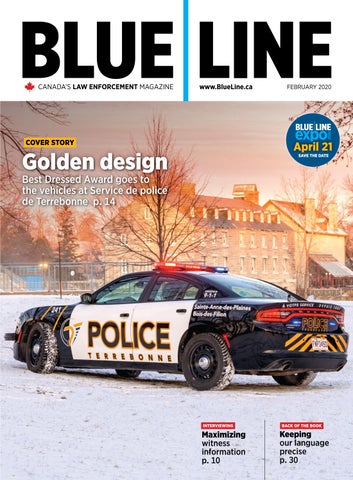
COVER STORY
FEBRUARY 2020
April 21
Golden design
SAVE THE DATE
Best Dressed Award goes to the vehicles at Service de police de Terrebonne p. 14
INTERVIEWING
Maximizing witness information p. 10
BACK OF THE BOOK
Keeping our language precise p. 30
Right Features. Right Price. introducing
lightbar
The newest SoundOff Signal lightbar is the perfect solution for those who want trusted quality at an affordable price level. Featuring proven nFORCE® reflector LED technology, nFUSE lightbar offers multi-color capability in a sleek, low profile design. nFUSE is built with the same high-quality housing as our legendary MAGNUM bars, but that’s where the similarities end. Inside,
Available March 2020
nFUSE offers the features needed to be a versatile lightbar for your fleet.
SoundOff Signal is proud to offer industry-best lead times, superior service and support, and products made in the USA.
For additional information, contact: www.soundoffsignal.com
Cody Bock, Western Canada, 801.865.5023, cbock@soundoffsignal.com Gabe Casucci, Ontario, 716.553.4431, gcassuci@soundoffsignal.com
20
Contents
February 2020 Volume 32 Number 2
Features COVER STORY
14 Best Dressed Police Vehicle Award winners
Service de police de Terrebonne comes in on top for Blue Line’s 2020 Best Dressed Police Vehicle Awards. Check out the crisp designs that snagged top honours in all the categories — we even have a nautical champ this year. By staff
20 Results from the Michigan State Police vehicle tests
COVER PHOTO: SÉBASTIEN ARBOUR, ARBOUR PHOTOGRAPHE
Model year 2020 is indeed a year of both firsts and lasts for police vehicles. Find out more on what’s fresh off the assembly line and how every new police vehicle on the market handled and performed in the Michigan State Police annual, comprehensive analysis. By Dave Brown
8 @Blue_LineMag
16
Columns 4 8 10 12 13 25 26 30
Editor’s commentary Q&A Interviewing & investigation Health & wellness Holding the line Case law Technology Back of the book
Departments 5 5 7 7 7 27 28 29 30
By the numbers News Dispatches Letter to the editor Calendar Off the shelf Product showcase Marketplace Blue Links
19 February 2020 | BLUE LINE
3
EDITOR’S COMMENTARY BY RENÉE FRANCOEUR
Risky business: off-duty carrying of firearms
A
contact of mine and I were 62 firearms lost or stolen between 2010 recently looking back at some and 2017.” of 2019’s notable events. My Days after the Halifax policy news, the acquaintance brought up the Cape Breton Regional Police Service stated policy change at Halifax Regional Police it would be reviewing its gun policy, even (HRP) regarding firearms storage. It was though it said it has not had any incidents a matter I’d actually completely over- involving officers and service weapons looked because to me it was a straight- while off duty. I salute you CBRPS. forward, appropriate update. “Police officers are charged with roles In October, HRP Chief Dan Kinsella that come with unique powers as well as announced members would no longer be unique responsibilities. The ability to carry permitted to take their service-issued firearms is one such aspect,” Kinsella said weapons home once they were off duty. in an email to Blue Line. “I believe we have According to The Canadian Press report at an obligation to be mindful of both public the time, Kinsella said “rules and officer safety implications around the carriage and storage In October, of off-duty carrying of firearms. of weapons vary among police Halifax It is important to recognize forces across the country,” and Regional Police that carrying a service weapon it was noted the new policy in Chief Dan off-duty increases these risks, Halifax is the same one he served Kinsella which in turn has the potential under with the Hamilton Police announced to increase liability to the orService before starting the Hali- members ganization. It is also important would no fax job in July. to factor in exceptions that “As far as I’m concerned there longer be apply to special considerations is no need for an officer to have permitted to required for law enforcement their gun with them outside of take their purposes. There are in fact regular duties. There may be service-issued multiple documented cases special circumstances where weapons home demonstrating the risks inthat is required ... and I have the once they were volved, and it is important that ability to provide special con- off duty. police organizational policies sideration in certain circumand practices address this issue stances.” appropriately.” As an example, he said exceptions might I’ve mentioned how I see this as an obbe granted to officers who are on duty vious policy for moderately-sized, urban around the clock. forces with multiple members who rotate This sounds perfectly acceptable in my shifts in a detachment... I don’t see such a opinion and should be a policy in all mod- policy being very realistic, in all honesty, erately-sized urban forces across Canada. for organizations like Nishnawbe Aski It’s simply a means of preventative safe- Police Service, whose officers are spread guarding — especially when we look into across an area that equals nearly twopolice firearms that are lost or stolen. thirds of Ontario, serving 35 communities. Last March, a service pistol was stolen I understand firearms are “significant from an off-duty RCMP officer’s personal pieces” of law enforcement culture, as one vehicle in downtown Halifax. According to of our columnists wrote a couple years a November 2019 Globe and Mail report, “a ago, and that “it is hard at times not to recent count prepared by the RCMP shows allow it to define us,” but, like Kinsella that police forces and other government said, you don’t need your service-issued agencies have lost 813 firearms, including guns outside of regular duty, and if you do, 173 to theft, since 2005. Another tabula- of course, I believe special consideration tion found that the Mounties had declared should and would be given.
CONNECT WITH BLUE LINE
www.BlueLine.ca 4
@Blue_LineMag
BLUE LINE | February 2020
www.facebook.com/BlueLineMagazine
BLUE LINE www.BlueLine.ca
GROUP PUBLISHER | MARTIN MCANULTY mmcanulty@annexbusinessmedia.com EDITOR | RENÉE FRANCOEUR rfrancoeur@annexbusinessmedia.com ACCOUNT MANAGER | JANICE EATON jeaton@annexbusinessmedia.com MEDIA DESIGNER | SVETLANA AVRUTIN savrutin@annexbusinessmedia.com ACCOUNT COORDINATOR | TRISH RAMSAY tramsay@annexbusinessmedia.com CIRCULATION MANAGER | BEATA OLECHNOWICZ bolechnowicz@annexbusinessmedia.com Tel: 416-510-5182 COO | SCOTT JAMIESON sjamieson@annexbusinessmedia.com
ANNEX BUSINESS MEDIA 111 Gordon Baker Road, Suite 400 Toronto, ON M2H 3R1 Tel. 416-442-5600 • Fax 416-442-2191
Publication Mail Agreement No. 40065710 ISSN 0847-8538 Printed in Canada SUBSCRIPTION RATES Canada — 1 Year $31.50; 2 Year $52.50 plus tax USA — 1 Year $136.50 CAD CIRCULATION email: bolechnowicz@annexbusinessmedia.com Tel: 416-510-5182 Fax: 416-510-6875 or 416-442-2191 Mail: 111 Gordon Baker Road, Suite 400, Toronto, ON M2H 3R1 Occasionally, Blue Line will mail information on behalf of industry-related groups whose products and services we believe may be of interest to you. If you prefer not to receive this information, please contact our circulation department in any of the four ways listed above. Annex Privacy Officer Privacy@annexbusinessmedia.com; Tel: 800-668-2374 © 2020 Annex Publishing & Printing Inc. All rights reserved. Printed in Canada. No part of the editorial content of this publication may be reprinted without the publisher’s written permission. Opinions expressed in this magazine are not necessarily those of the editor or the publisher. No liability is assumed for errors or omissions. Readers are cautioned and advised that articles presented herein are edited and supplied for your personal awareness and should not be used for further action until appropriate guidance is received from a supervisor, Crown Attorney or other persons in authority. All advertising is subject to the publisher’s approval. Such approval does not imply any endorsement of the products or services advertised. The publisher reserves the right to refuse advertising that does not meet the standards of this publication.
NEWS
Coming together for EPS employees: Lahn Jones from Living Hope, Retired Supt. Gary Jones, Acting Insp. Brenda Dalziel, Chief Dale McFee, Chaplain Lawrence Peck, and Det. Michael Elliot (president of the Edmonton Police Association). PHOTO: EPS EDMONTON
Suicide Prevention Signpost helps employees navigate challenging roads of life
The Edmonton Police Service (EPS) says it has a progressive employee assistance program, but felt they needed to talk more openly and safely about mental health and the stigma of suicide. As it is so easy to become overwhelmed, to feel helpless and hopeless, and lose direction, EPS created a signpost to help employees see the warning signs of suicide and better navigate the roads of life. The signpost is a symbolic reminder that we are all together on this journey, and we need to be able to ask for help with directions to avoid making a wrong turn. The Suicide Prevention Signpost was unveiled at an employee wellness event at EPS headquarters on Sept. 16, 2019, during Suicide Awareness Month. Similar signposts have since been installed at each EPS division station as a constant reminder to employees that support is available, and as a memorial to those lost to the senseless tragedy of suicide. The sign’s words were thoughtfully chosen to encourage employees to talk more openly about their challenges and seek a more positive direction: Suicide, Prevention,
Mental Health, Talk About It, You Matter, Purpose, Reconnect, Resilience, Strength, Support, Help, and Hope. “Preventing suicide takes all of us to care and to act,” Chief Dale McFee said. “Let’s continue to build awareness and a safe environment for employees to share their troubles. Let’s reach out and help others struggling to carry their burdens. Most importantly, let’s help them find their way, and restore their hope for the future.” - with files from Chad Orydzuk, EPS CANADA
RCMP partners with New York Academy of Art to identify the lost
PHOTO: SERGE GOUIN, RCMP-GRC
There are currently over 700 unidentified remains in the RCMP’s national database of missing persons and unidentified remains. With the help of a unique partnership, the
RCMP announced it is giving a face to some of these people, in the hopes of unlocking the mystery of who they are. For the first time, the RCMP is partnering with the New York Academy of Art to reconstruct the faces of Canadian unidentified human remains. From Jan. 6-10, the Academy hosted a forensic sculpture workshop, using 3D-printed versions of 15 real skulls supplied by the RCMP. The 15 Canadian skulls are all male and were located between 1972 and 2019. These particular skulls were chosen for this initiative because they were in the best overall condition. Academy students will put their anatomical knowledge and artistic skills to work in order to reconstruct each of the faces with clay. “The RCMP is very excited about this partnership with the New York Academy of Art,” said Chief Supt. Marie-Claude Arsenault, the RCMP officer in charge of Sensitive and Specialized Investigative Services. “This was a unique opportunity to have 15 Canadian faces reconstructed in a single week.” The skulls’ journey to New York began with the British Columbia Coroners Service and the Nova Scotia Medical Examiner Service, which provided the skulls for this initiative. Technicians from the National Research Council (NRC) flew to B.C. and Nova Scotia to scan the skulls. Back in Ottawa, NRC specialists printed 3D versions of the skulls using powdered, laser-melted nylon. The skulls were printed in batches of four, with each batch taking approximately 48 hours to complete, including cooling time. Once cooled, the skulls were cleaned using a combination of brushes and compressed air to remove residual nylon powder. NRC staff used dental picks when necessary to clean the tiniest nooks and crannies. The faces will be featured on the Canada’s Missing website, in the hopes of generating tips from the public. The RCMP says it hopes to eventually bring this type of workshop to Canada, to build facial recognition capacity here and bring more people home.
BY THE NUMBERS
Macleans has released their annual list of Canada’s Most Dangerous Places, based on Statistics Canada data. It ranks 20 places with the highest level of overall crime by the crime severity index (CSI) in 2018, the most recent year with data available, and a formula based on population. For the full list, visit macleans.ca/canadas-most-dangerous-places-2020.
384.57 The crime severity index of the No. 1 most dangerous place, North Battleford, Sask.
@Blue_LineMag
365.89 291.83 140.51
The crime severity index of the No 2. most dangerous place, Thompson, Man.
The crime severity index of the No. 3 most dangerous place, Quesnel, B.C.
The crime severity index of the No. 20 most dangerous place, Prince Rupert, B.C.
February 2020 | BLUE LINE
5
NEWS HALTON REGION
Police to implement virtual reality training program
The Halton Regional Police Service (HRPS) has become the first law enforcement agency in Canada to partner with Axon for its virtual reality (VR) empathy training program through Axon Academy, a network of online and in-person training for law enforcement. HRPS has received 20 Oculus Go headsets to begin training their internal teams and will officially launch their program in the first quarter of 2020. HRPS says it is deploying Axon’s VR empathy-based training in an effort to increase community safety following an increasing number of mental health calls seen in the region. The program provides officers with an immersive training experience where trainees can put themselves in the shoes of both the officer responding to the scene and the person in crisis. With this deployment, HRPS will have access to three different VR training scenarios that Axon currently offers: autism,
Police Foundations Leadership Diploma
Left to right: HRPS Deputy Chief Roger Wilkie, Axon Managing Director Vishal Dhir, and HRPS Training Bureau Staff Sgt. Dave Tutte. PHOTO: HALTON REGIONAL POLICE SERVICE. schizophrenia and suicide empathy training. The agency will also gain access to future training scenarios as they are developed. “Axon’s innovative empathy-based training will complement our existing training program and further enable our frontline officers to manage and de-escalate potentially high-stakes interactions,” says
HRPS Deputy Chief Roger Wilkie. “This partnership with Axon will ultimately serve to bolster community safety and well-being.” Axon’s empathy development training is currently available to law enforcement agencies in the Canada and the U.S. For more information on the program or to contact the team, visit axon.com/training.
This diploma program is specifically designed for working justice professionals (police officers, private security and members of the Canadian military). Find out how you can make a difference at communityservices.humber.ca
WE ARE FUTURE FOCUSED 6
BLUE LINE | February 2020
BL_Humber_Feb20.indd 1
www.BlueLine.ca
2020-01-10 3:22 PM
NEWS DISPATCHES Niagara Regional Police has promoted Todd Waselovich to the role of inspector. The City of Surrey has announced Chief Supt. Brian Edwards will be taking over the reins as the Officer in Charge of the Surrey RCMP. Edwards started as a volunteer auxiliary constable with Okotoks RCMP before joining the Calgary Police Service in 1995. Since 2003, he has worked with the RCMP in the Lower Mainland. Det.-Sgt. Stacy Gallant of the Toronto Police Service has retired after 30 years and eight months of service. He spent 15 years in the Homicide Unit. His last positions were managing the Cold Case Unit, forming the new Missing Persons Unit and the Forensic Video Analysis Unit. He will be now working as the Ontario director at GardaWorld. Manitoba RCMP Const. Allan Poapst died on duty in a motor vehicle collision on the
CALENDAR Perimeter Highway on Dec. 13. A proud father of three teenage girls, Poapst was five days away from serving 13 years with the RCMP. He was known for his passion for the Winnipeg Jets and all things hockey. He volunteered with the True North’s Foundation - Jets Training Academy for youth and was an avid player and a key organizer in many police and fire hockey tournaments. Rest in peace. Jay Lawrence has been appointed as Interim Chief Constable with the Toronto Transit Commission.
Manuela Byrnes has been named the new commander of the Ontario Provincial Police Sault Ste. Marie Detachment. Staff-Sgt. Byrnes had been the acting detachment commander since May 2019 and was recently promoted to the rank of staff sergeant. She is the first female to lead the Sault Ste. Marie Detachment.
LETTER TO THE EDITOR The following is a comment directed to the Back of the Book op-ed section from our December 2019 issue, titled “A look back: Our failure to challenge discriminatory statutes.” The trouble with revisiting history through a modern-day lens is that we fail to see our achievements through our obvious flaws. It also implies that we occupy the peak of the moral high ground. This myopic viewpoint obscures the inevitable truth that we too will be judged by a future society of shifting values. Mr. Parsons attempts to impose modern day morality on the police of 50 years ago. Not only is this disingenuous, but also, it’s an inept analysis of the times. I also use the term “morality” loosely as in my opinion, we are lacking them in our modern society. Parsons scolds police officers of half a century ago for enforcing “discriminatory statutes,” but gives a free pass to the voters, the legislators that wrote the law, the prosecutors that prosecuted the cases, and the judges that convicted the offenders of their crimes. What a strange standard it is that he chooses to impose on the police and @Blue_LineMag
no one else. Do we hold Pierre Trudeau, Prime Minister at the time, to the same standard that Mr. Parsons would expect of the police? Of course not. Much like Trudeau’s son’s use of blackface, the standards of discrimination have changed over time. It could be said that a parallel exists today with the implementation of Bill C-75. Legislators have thought it appropriate to impose a two-tiered system of justice where Aboriginals specifically and “others over represented in the criminal justice system” are treated differently with respect to bail and sentencing. Would Mr. Parsons have police officers today take the ethical position that race-based legislation is inherently wrong and refuse to enforce it? His comments suggest that he would, although I don’t think he’d agree with that position. Perhaps 50 years in the future, our grandchildren will reflect on our society and wonder how, with one hand we could vehemently denounce racism in all its forms, while on the other hand, write textbook racist legislation, without a single ounce of irony. - Rob Edwards
CACP Information and Communications Technology Committee Summit Feb. 23-26, 2020 Vancouver, B.C. cacp.ca Axon Innovate: Canadian Public Safety Technology Conference Feb. 26-27, 2020 Vancouver, B.C. ca.axon.com Courtroom Testimony: A Practical Skills Workshop for Police and Other Law Enforcement Professionals Feb. 27, 2020 Toronto, Ont. www.osgoodepd.ca 2020 Hockey Classic in support of Peel Crime Stoppers Feb. 27, 2020 Toronto, Ont. canadiansecuritymag.com Calgary Cyber Summit 2020 March 10-12, 2020 Calgary, Alta. cybersummityyc.ca 13th National Symposium on Tech Crime and E-Evidence April 3, 2020 Toronto, Ont. www.osgoodepd.ca Risk & Recovery Conference April 16-17, 2020 Hamilton, Ont. www.riskandrecoveryconference.com Two Day Peer Support Training offered by Mood Disorders Society of Canada April 16-17, 2020 Sharon, Ont. conta.cc/35pRIIs Canadian Police Association Conference April 20-22, 2020 Ottawa, Ont. www.cpa-acp.ca 2020 Battle of the Badges Hockey Tournament April 24-26, 2020 Oshawa, Ont. ashl.ca February 2020 | BLUE LINE
7
Q&A Helen C. Escott is a retired civilian member of the RCMP in Newfoundland and Labrador and the author of two crime thrillers. She served as the communications lead on many high-profile events, including 9/11. She shared more of that experience on a past episode of Blue Line, The Podcast. We bring you clips from that conversation here. Q: Congratulations on the recent publication of your second book, Operation Vanished. You said this book was an opportunity to rely on your years of rich experience as a civilian member of the RCMP. How did you channel that?
Q: What kind of challenges did you have to tackle as a trailblazer in communications?
At that time, the RCMP had gone through a brutal program review where they almost lost the contract for policing in Newfoundland and Labrador. One of the things that came out of that review was the community said they didn’t know what the RCMP did from day to day — there were a lot of “no comments” when the media came around. There was also not a lot of communications between management and the frontline or even among the districts themselves. I really had to start at the beginning. I had to build the foundation and pry open those lines of communications, which I did through internal newsletters... I created a media relations course and set out to train as many members as I could. It was also the beginning of social media at that time, so I had to drag the RCMP kicking and screaming into the early days of creating a website, 8
BLUE LINE | February 2020
Q: Where can we improve communications in today’s policing landscape?
keeping it updated, and using Facebook and Twitter. I have to say I did have the support of management for everything I did. At times I’m sure they thought I was a little crazy but eventually they came around to my way of thinking and saw the benefits.
Q: What is your most memorable moment on the job?
There are so many! There were really funny times and then there were really dramatic times, but I think it would have to be 9/11. It was first time I’d ever heard the word “terrorist” being used and it really frightened me. It was also the first time that as a communications expert, I really questioned if I should be doing this job. People didn’t know what this was; we didn’t know if it was this the beginning of World War III... Then there was the attack on the Pentagon and we didn’t know when the next plane was coming. The public was panicking. Crisis is what the RCMP does really well; it’s the everyday stuff we kind of stumble at. So, everybody knew what their job was and was willing to do it. You train for it all your life; you just hope you never have to do it...
There is a real fear that “if I say the wrong thing, I can sink an investigation,” — and that has happened. Officers need to know what they can tell the media while still maintaining the integrity of an investigation. People need to know this not when they’re 20 years into their career; they need it at Depot at the very beginning… They need media training grounds where they can learn, do interviews, and make mistakes. We also need to stop apologizing for things that are not our fault. We need to defend ourselves against the critics. And I don’t mean every Internet bully on Twitter… I mean calling out the people in power who are more interested in getting media likes than defending first responders.
Q: What is your top tip to officers and civilian members alike working in media relations departments?
People don’t realize how stressful it can be to be the media relations officer — when you’re the face of your police force. It’s a huge weight to carry... I’ve had two co-workers who were media relations officers who died by suicide… You need to go to the briefings and talk to somebody about your stress. Listen to the full conversation on Blue Line, The Podcast at bit.ly/2ZWlLoZ or wherever you listen to your podcasts under Annex Business Media: Podcasts.
www.BlueLine.ca
PHOTO: FLANKER PRESS
I worked with a lot of great police officers and there’s a character in my book, Cpl. Gail McNaughton, who is named after two RCMP officers: Staff Sgt. Gail Courtney and Insp. Chris McNaughton. Gail is retired now and she was in the first female class for the RCMP. She was also one of the first Newfoundland women to join and Chris was just such an amazing investigator. I worked with them for years — Gail actually hired me and Chris mentored me. They both changed the direction of my life dramatically. This book is my way of honouring them and women like them.
We were talking to the commissioner, who was talking to the prime minister, who had been talking to the president, and we had never seen that chain of command in motion before. When I look back at it, I’ve never seen anything like it... you have to imagine all of a sudden 17,000 international passengers have landed here in the province... It was like drinking water from a fire hose.
For all emergency response operations, mobility is at the center of effectiveness. With the Samsung Galaxy S9 to Note 10 technology today, first responders have more options for mobility while in the field. Indeed, Samsung’s innovative DeX program essentially allows users to replace their desktop or laptop with their Samsung Galaxy phone, which will bring enhanced benefits to emergency workers as they are always on the go. D & R Electronics’ Dovetail mobile computing solutions line of products are optimized to help first responders experience the Samsung DeX difference on the road, at a desk or any deployment mode the officer has engaged. R’s DeX Dovetail mobile solution brings In addition to advancing your technology foot print D & R major cost savings to your operational budget. Trust your mobile technology deployment to D & R Electronics to provide the best custom solutions.
Brought to you by
&
www.dandrelectronics.com | TEL: (905) 951-9997
INTERVIEWING & INVESTIGATIONS BY KERRY G. WATKINS, LL.M.
Maximizing witness information with the modified cognitive interview
E
The first component of the modified cognitive interview is the “Report everything” instruction.
Explicitly telling a witness to report everything they can remember — whether or not they think it is important, complete, or in chronological order — is an essential part of the cognitive interview. The more information a witness is encouraged to report, the greater the chance that one piece of reported information will trigger a memory about another piece of information, thereby increasing the overall quantity of information produced. While no witness is ever likely to report literally everything they know about 10
BLUE LINE | February 2020
focussed, and potentially leading, questions.
The fourth and final component is “Summary and review.”
When the investigator has finished asking questions and believes that they have elicited as much information as reasonably possible from a witness, they should summarize and review the witness’s account. This is essential to ensuring the investigator’s understanding of that account is correct and it often results in a witness recalling additional information as they listen to the investigator’s summary. Where an investigator has the time to use the full cognitive interview protocol, they should do so because it has been shown to produce superior results. However, in instances where an investigator faces significant time constraints, utilizing the modified cognitive interview can still help them to conduct effective witness interviews during criminal investigations.
an event, an investigator’s job is to maximize the amount of information produced by each witness during an investigation.
The second component is the “Sketching reinstatement of context” technique.
Asking a witness (where appropriate, considering what they have witnessed or experienced) to draw a sketch of what they have witnessed, and to talk about their experience as they do so, has been found to be a particularly effective method for assisting witness recall. The witness should be reassured that their drawing skills are not important, that they should take their time, and that they should concentrate on describing to the investigator what they could see, hear and feel while they are sketching.
The third component is the “Questioning funnel.”
Once a witness has produced their account, the investigator should conduct followup questioning utilizing the questioning funnel approach. Open questions should be used first (questions that begin with words like “tell, explain or describe,” etc.). These should be followed by probing questions, which involve asking the “who, what, why, where, when, how.” Closed questions — “Was it a man or a woman?” — should be used last. Utilizing the questioning funnel helps the investigator to maximize the quantity of information gathered from the witness while minimizing the potential of contaminating that information through the use of more
If time is an issue, investigators can still benefit from utilizing a modified cognitive interview.
Sources
Colomb, C., Ginet, M., (2012) The Cognitive Interview for Use with Adults: An Empirical Test of an Alternative Mnemonic and of a Partial Protocol. 26:1 Applied Cognitive Psychology 35 Dando, C., (2011) Modifying the Cognitive Interview: Countenancing Forensic Application by Enhancing Practicability. 17:6 Psychology, Crime and Law 491 Eastwood, J., Snook, B., Luther, K., (2018) Measuring the effectiveness of the sketch procedure for recalling details of a live interactive event. Applied Cognitive Psychology, v 32, iss. 6, pp. 747-754. Rivard, J., et al., (2014) Testing the Cognitive Interview with Professional Interviewers: Enhancing the Recall of Specific Details of Recurring Events. 28:6 Applied Cognitive Psychology 917 Kerry Watkins conducted more than 2,000 interviews during his 30-year career, the majority of which was spent as a criminal investigator in specialized units investigating a wide range of matters, including police corruption, corporate fraud and homicide. He is currently director of The Interview Group, a professor at Humber College and an adjunct faculty member in the Ongoing Professional Development Program at Osgoode Hall in Toronto.
www.BlueLine.ca
PHOTO:KATARZYNABIALASIEWICZ/ISTOCK/GETTY IMAGES PLUS/GETTY IMAGES.
ffective interviews of witnesses, including victims, are an essential part of criminal investigations. Employing best practice interviewing methods helps to ensure investigators maximize the quantity and quality of information they gather during investigative interviews. The most researched and proven method for interviewing co-operative witnesses is the enhanced cognitive interview. It has been shown to be far superior to standard “Q&A” style police interview approaches in terms of the amount and reliability of the information it generates. Research indicates, however, that in practice, investigators tend to utilize some of the cognitive interview’s components far more than others, and often express frustration with the length of time it takes to conduct a full cognitive interview. While employing the full cognitive interview protocol is preferred when time allows, if time is an issue, investigators can still benefit from utilizing a modified cognitive interview. The modified cognitive interview discussed here consists of four components from the traditional cognitive interview that have been shown to be especially effective at increasing the amount and reliability of information gathered from witnesses.
We have demo units in stock! 1-888-358-4920
info@cambli.com
HEALTH & WELLNESS
BY ISABELLE SAUVÉ AND BRUNO SEGUIN
Emotionally-involved people equal successful transformations
I
n both public and private sectors, organizations are perpetually trying to improve, restructure or transform a major part of their operations, people and processes. New available technologies, corporate governances, rules and regulations, social changes or market demand are often the reasons why these organizations undertake major transformations. What is generally called a “transformation” is a change in the strategic management that aims to align people, processes and technological initiatives with new visions to help support the new strategies. Organizational transformation is a complex endeavour, which includes many components and specific factors for both the private and public sectors. A critical issue of transformation is the ability to thoroughly conceive the structure prior to the start of the transformation. Implementing a planning process is often divided into five key activities: preparation, assessment, plan, development and implementation. The majority of organizations undertaking transformations are quite familiar with these five activities. Nonetheless, 74 per cent of the private sector’s and 80 per cent of public sector’s “transformation efforts fail to deliver their objectives,” according to research from global management consulting firm McKinsey and Company. The lack of resource allocation is one of the most common reasons, although studies are showing that emotional adoption by individuals is pivotal to all transformation success. Despite this fact, emotional adoption is a long-term investment that most leaders fail to realize. There are multiple reasons why transformations in public sector and government agencies fail at a higher rate than in the private sectors; this article highlights only a few of them. All public sector and government agencies are facing the need
12
BLUE LINE | February 2020
to improve their operations, deal with more and more stringent budgets, and provide a better public service experience. It is not only the consequence of their leaders’ promises or goals, it is a sustained worldwide evolution. With a generally “less culture-adverse mentality,” the public sector and government agencies must pay attention to the people and place them at the heart of the transformation process in order to succeed. Large transformation projects must be scalable to facilitate their management and implementation, and they must be accepted by people overall within the workforce. “Scalability” in transformation is the ability to nurture and assign dedicated and emotionally committed resources to the project. McKinsey identified five success factors with a “strong people component” in government transformation: committed leadership, compelling communication, cadence and co-ordination in delivery, clear purpose and priorities, and capability for change. Furthermore, it is crucial for organizations to perform high on the Organizational Health Index (OHI) to be able to transform and adapt rapidly. Organizations can measure and manage health, which means they measure how well they align, execute and renew in the same way they measure performance. Another study from McKinsey measured the health of more than 2,000 organizations in both the public and private sectors using their Organizational Health Index Survey, accounting for five million respondents. This study “indicates that over 75 per cent of public-sector organizations have below-average health.” The research also clearly indicates that organizations in the public sector fall short when it comes to “culture, co-ordination and capabilities.” McKinsey notes, “only in the dimension of leadership do public-sector organizations match the
health of their private-sector peers.” As previously mentioned, with a risk adverse culture, civil servants who would try to innovate or outperform are more likely to be penalized in case of failure than they are to be rewarded. Similarly, in a law enforcement environment, as an example, a daring initiative to improve a service for the safety of the population has little chance to reward the civil servants at the The research helm of the project if a small numalso clearly ber of complaints are received indicates about the change. that “Likewise, a public-sector manorganizations ager who succeeds in improving in the public efficiency in his or her department sector fall might be ‘rewarded’ with a reshort when it duced budget — but punished comes to with a poor performance review if “culture, the effort fails,” McKinsey continco-ordination ues on its website. and In our previous article, we also capabilities.” highlighted the importance of development plans in order to keep the personnel motivated and skilled. When it comes to transformation, this development becomes significant. Indeed, research suggests managers in public sectors were seen as deficient in at least three important interpersonal skill factors areas: providing feedback, motivating employees and supporting their development. The public sector participants in the survey “were less likely than the average participant to agree that managers at within their organizations were trained in these skills.” Visit www.BlueLine.ca for the latest news, stories, products, videos, photo galleries and industry events. Isabelle Sauvé is a 13-year veteran with the OPP, currently with the Lanark County Detachment. She has a MA in psychology and is a PhD candidate. She is also an ultramarathon/endurance athlete and the Racing the Planet/4 Deserts 2018 Series winner as well as a Guinness World record holder. She can be contacted at: isabelle.sauve@hotmail.com. Bruno Seguin is a senior executive manager and international business consultant with experience in global operations, international business development, strategic planning, leadership and corporate governance. He is also an ultra-runner, 9th place finisher at the Racing the Planet/4 Deserts 2018 Series and fellow Guinness World record holder.
www.BlueLine.ca
HOLDING THE LINE BY MICHELLE VINCENT
Call takers and dispatchers navigate critical incidence response like no other
A
s my life journey shifts and changes, I have more acutely noticed the key roles our civilian colleagues — notably the call takers and our dispatchers in our communications centres — have in the success of policing within our community. I liken their role to parenting with a touch of God. I feel we need to give them the recognition they deserve. They keep us safe as we patrol our communities and as we respond to intense, sometimes life-threatening incidents. They do this by ensuring they provide us with essential information so we know how to best approach the call. They oversee us like parents, at times telling us what to do as we navigate from call to call. As police officers we have a need to be in control of our environment, especially on the job. We are often making life-saving decisions as we handle something as simple as a traffic stop whereby a gun may be pulled or an impaired driver may hit our carefully placed cruiser. How does this translate to our relationship with our communications folks? We know what we are doing, we will do what needs to be done and we do not need to be told what to do. The challenge with this is the narrow scope within that mindset and the impact it may have on community policing. We see “the big picture” through our mobile work station (MWS) with one set of senses rather than as an overview of the multiple interactions our communications folks experience as a whole. The demographics of the various districts managed by each dispatcher, along with the firsthand interactions the call takers have with the community members creates only a fraction of the communications experience. What may seem like a simple, 10th time “panic alarm call” — as it appears in the queue for outstanding priority calls — may seem actually more like a potential emergent situation from our call taker’s honed perspective. We have all heard of, or even personally experienced, that dreaded call: violence resulting in an armed and barricaded circumstance. Our call takers and dispatchers take these calls from start to finish, informing officers of details that enable us to effectively navigate the call and remain safe throughout. This can be an emotionally draining experi-
ence that endures for many hours, at times spilling into overtime. The call takers and dispatchers are also often not privy to the outcome, which can be challenging from a mental health perspective as there is no closure. This is just one example of their heroic actions in community policing. At York Regional Police, we are fortunate to have our communications centre working closely with a crime analyst whose role is to advise them of potential hazards for our police officers as they navigate the queue of outstanding calls. We are also fortunate to have a powerful computer analytical tool: business intelligence. Our communications sisters and brothers use these tools as they manage our attendance to each and every call. With a touch on their screen, they are able to see higher risk areas, higher rates of break-ins, mental health issues and other calls that may require extra care and expedited attention.
When we are gathering our thoughts for our notes, completing reports or any other “stationary work” — or perhaps we are having a door-to-door with another officer and we see a message from our beloved dispatcher checking up on us — let’s remember that is exactly what it is... a check in and/or check-up to ensure we are safe and all is well. So, when you get the chance, be sure to thank your call takers and dispatchers. At the end of the day, they truly are our parents with a touch of God in them and they are concerned for our safety and wellbeing.
Michelle Vincent recently retired from York Regional Police after 18 years. She is the founder of The Haven, Ontario’s first non-profit, inpatient treatment centre exclusive to first responders and uniform personnel. Contact her at michelle.vincent@thehaven.cloud.
DALHOUSIE’S CERTIFICATE IN POLICE LEADERSHIP
Become the leader you know you can be
Built for modern policing, our online courses, designed and delivered by academics along with industry experts and leaders in policing, give you the knowledge and skills to advance in your profession. Learn from the innovator in quality police education for over 25 years. SPRING TERM STARTS FEBRUARY 28
DAL.CA/POLICELEADERSHIP
CCE
College of Continuing Education
February 2020 | BLUE LINE
@Blue_LineMag BL_Dalhousie_Feb20.indd 1
13
2020-01-15 9:22 AM
COVER STORY
Golden outline design takes the gold Service de police de Terrebonne comes in on top for Blue Line’s 2020 Best Dressed Police Vehicle Awards By staff
“The slash on the front fender may seem like a small element but it adds directionality to the design, which is one of the most important characteristics we look for today.” - Dave Brown, judge 14
BLUE LINE | February 2020
1ST PLACE SERVICE DE POLICE DE TERREBONNE 2019 DODGE CHARGER
Quebec’s Service de police de Terrebonne didn’t want just any new fleet design — it had to be one that was “more visible and dynamic,” while also nodding respectfully to the service’s long history. The result is a classic, unmistakable look featuring regal tones of deep yellow, black and white, and capped off at the back with the proud phrase “à votre service depuis 1882,” or, “at your service since 1882.” The best thing about this new design, according to Terrebonne Police Directeur Marc Brisson, is it was created with suggestions directly from officers. It was a team effort, led by the police department administrators, in which all members of the service submitted ideas for the work wheels. These submissions were then put together by Jessy Brisson, the chief of staff of the dispatch service, to create several different designs. Members could vote on the final design. “We also wanted to be one of the first municipal police departments in Québec to introduce a black and white car, which has been a universally known design for police cars for many years,” the service notes in its award submission. “When choosing the colours, we redesigned the logo of the police department to reflect colours that align with those used in the traffic act, such as the yellow, which represents caution.” Dave Brown, not only our judge for these awards but also Blue Line’s firearms and vehicle contributor, says he loves how the word “police” truly jumps out at you on Terrebonne’s vehicles. “Some agencies try too hard to make the word ‘police’ look different and it can lose that immediacy of recognition that’s so important to a marked patrol car,” he says. “Terrebonne has chosen a simple font (in highly reflective letters) that make it immediately identifiable as a police car. ‘Police’ stands out, both with the easily-readable font and the yellow outline around the letters that is duplicated in the crest and the slash on the front fender.” The above photo features the 5.7-litre, 2019 Charger, with all wheel drive, but the service also applied their new design concept to the entire fleet, including the trucks. www.BlueLine.ca
PHOTO: SÉBASTIEN ARBOUR, ARBOUR PHOTOGRAPHE
Congratulations to all the winners of Blue Line’s Best Dressed Police Vehicle Awards. We strive to showcase innovative and effective designs. We look for clear identification, graphic designs that enhance visibility, elements that show directionality of travel and impressive integration of equipment and controls. Of course, we also take “green” vehicles into consideration! “I am big on officer safety, and this is why I want to see something instantly recognizable as a police car,” says Dave Brown, our long-time Best Dressed judge. “We work so hard on firearms but more often officers are injured or killed in traffic accidents.” Thank you to everyone who submitted. Stay tuned to blueline.ca for 2021’s call for submissions later this fall.
“We decided to use three colors for our vehicles: all white, all black, and black with white doors,” the service notes in its submission. “We know the population gets used to seeing our patrol cars and after a while, they do not notice us. But with those three colours, and the punchy graphics, we believe they will notice our presence much longer.”
All of the material used for the wrapping of the car is made from pure colour vinyl (3M Wrap Film Series 1080), according to the service; it is not printed ink, meaning the colour will not change or fade. All the “police” letters on the car are cut in 3M “sunflower’ reflective vinyl, the police service adds, in order to make the words as visible as possible. “The back bumper sports a reflective hazard marker that serves to warn others to give extra space when they go around stopped police vehicles, which helps to keep our officers safe. The colours and shape respect the signalisation of Québec’s traffic act. Overall, the material used is more visible, of higher quality and richer in colour.” What struck Brown the most was “the timelessness of the design and the simplicity of it.” He says it “works equally well on white, black and black-with-white-doors vehicles... I especially love the way the crest and the word ‘police’ is integrated into the natural lines of the vehicle. The slash on the front fender may seem like a small element but it adds directionality to the design, which is one of the most important characteristics we look for today. Citizens should be able to tell at a glance, day or night, the direction a marked police vehicle is travelling.” The design does indeed “increase security for all of our drivers and our officers,” Brisson continues. “We love the inscription on the trunk reminding everyone that we have been serving the community with pride for 138 years... We are really proud to be named Blue Line’s best dressed car of the year.”
OSGOODE’S GRADUATE DIPLOMA IN LAW FOR LAW ENFORCEMENT PROFESSIONALS
Knowing the law is different than enforcing it. Earn a graduate diploma covering substantive law with this flexible, part-time program, designed for and co-taught by law enforcement professionals like you. Apply by May 15 | Start in September 2020 Learn more at osgoodepd.ca/blueline th
SPECIALIZATIONS STARTING IN JANUARY 2017: · Administrative Law · Business Law · Civil Litigation & · Dispute PoliceResolution Oversight and · Constitutional Law Accountability · Criminal Law & Procedure · Energy & Infrastructure Law Law Vulnerable ·· Family Policing · General LLM
Courses Include:
Communities
WINTER 2017 APPLICATION ·DEADLINE: Policing and the OCTOBER 26 Charter
· Foundations of Evidence for Law Enforcement Professionals VIDEO CONFERENCING IS AVAILABLE FOR ALL COURSES.
@Blue_LineMag
BL_Osgoode_Feb20.indd 1
February 2020 | BLUE LINE
15
2020-01-16 9:35 AM
COVER STORY
PHOTO: MANITOBA FIRST NATIONS POLICE SERVICE
2ND PLACE MANITOBA FIRST NATIONS POLICE SERVICE 2019 FORD F-150 POLICE RESPONDER
The Dakota Ojibway Police Service officially transitioned to “Manitoba First Nations Police” (MFNPS) in 2018 and to celebrate this, it sought a vehicle design that would reflect all six of the communities it serves in southern Manitoba. MFNPS, a recognized self-administered agency, serves the Birdtail Sioux, Canupawakpa Dakota, Long Plain First Nation, Roseau River, Sandy Bay and Waywayseecappo First Nation communities. Police Chief Rick Head explains the eagle was selected as it is widely accepted as “the protector” in many First Nations’ cultures. “The Manitoba First Nations Police vehicle design is very clean and simple,” Brown says. “And this is why I love it.” This truck was the top vote of our intern, Zeba Khan, who describes it as “visually appealing” with a consistent colour scheme and highly reflective, unobtrusive — but still commanding — eagle depiction. She notes how viewers do not end up startled upon seeing it for the first time, nor lost in the details. MFNPS Insp. Dave Scott says the design marks a fresh start. Out of the 22-vehicle fleet, he notes there are only about two left to fully covert to the redesign. “Insp. Bruno Rossi played a big role in the design process,” Scott says. “Every time I see an eagle, it’s a very spiritual thing. It’s the master of the skies and it can send a prayer and a message to the creator. It is a symbol of greatness and we are a growing, proud service.” Avenue 4 Communications staff assisted in the design as well as Accent Striping and Lettering Co. in Brandon, Man. Community members and Elders were also sought out for advice, Head says. “This design is for all of us and for the future generations.”
3RD PLACE SERVICE DE POLICE DE LA VILLE DE SAINTEUSTACHE • 2019 DODGE CHARGER PURSUIT
The Service de police de la Ville de Saint-Eustache was on a mission to harmonize its new logo with the town colours on its cruisers in early 2019. They succeeded, in the view of our judge, with the clean blue and white design, and highly visible diagonal lines along the bottom of the doors. “Saint-Eustache is fresh and new,” Brown says. “Plus, as we know, one of the main elements I look for is directionality of a design; can another driver see at a glance which direction a police vehicle is facing night or day. This is what really won me over.” A duotone design was selected to increase police vehicle visi16
BLUE LINE | February 2020
PHOTO: SERVICE DE POLICE DE LA VILLE DE SAINT-EUSTACHE
bility, the service notes. “Road users and first responders can recognize the style quickly and easily. This contemporary design boosts visibility and the checkered pattern on the front and rear is modelled on traditional emergency vehicle logo designs.” The use of reflective vinyl police badges is a key element of the design. The badge displays the police department’s guiding principles of service, rights, prevention and protection, while the other logo on both sides of the vehicle represents the municipality’s soaring swallows, symbolizing the town’s dynamism. The big and little swallows represent the family and family values. The prominent word “police” — reflective vinyl is used for the contours — and the pictogram of a telephone (accompanied by the terms “urgence” and 911) are “reminders that the police department is a first-line service in tune with our community.” In addition to the reflective gold badge, “ergonomic oblique lines” of the same vinyl give movement to the overall image and “suggest a quick response and action.” Designs for all municipal vehicles were also revamped to draw on the new Saint-Eustache police department design. “This approach generated a sense of security among residents while projecting a harmonious, consistent image,” the service explains. “With their sleek lines and minimal colour, the designs for both police and municipal vehicles are modern and project a sober and dynamic image. Feedback from every quarter has been abundant and positive since the first vehicle appeared.” Sgt. Philippe Geoffrion represented the police in creating the design as a member of a working committee co-ordinated by Saint-Eustache’s communication department. The committee hired Jules Communications to propose visuals matching certain guidelines. Proposals that were reworked and chosen by the working committee were then submitted to the public safety committee, as well as the communications and citizen relations committee, which is composed of town residents and elected officials. www.BlueLine.ca
Infrastructure, Mobility and Managed Services for Law Enforcement.
Desktop as a Service (DaaS) Unified Endpoint Management (UEM) Digital Evidence Management (DEM) Unified Communications (UC) NCACR Policy & Compliance CALEA Accreditation
www.fset.ca 833.321.FSET
info@fset.ca
COVER STORY
PHOTO: WIKWEMIKONG TRIBAL POLICE SERVICE
COMMUNITY RELATIONS WIKWEMIKONG TRIBAL POLICE SERVICE 2019 DODGE RAM 1500 REBEL
There is no missing this spirited, wrapped truck from The Wikwemikong Tribal Police Service (WTPS). It is an electrifying entry, bursting with a textured orange, yellow, white and brown thunder bird, or eagle. It is also distinct from the service’s regular patrol design, which depicts a grey and white thunder bird with gold highlights. WTPS serves those on the Wiikwemkoong Unceded Territory on Manitoulin Island in Ontario and prioritized the incorporation of Anishinaabe culture into its vehicles. The WTPS patch, as found on the back door, is centred on the Seven Grandfather Teachings in the form of seven feathers hanging from the medicine wheel. The thunder bird represents one of the Teachings: love. You can also see elements of the other Teachings on the truck by their playful pawprints: • Bear – bravery • Beaver – wisdom • Wolf – humility • Turtle – truth • Sabe – honesty • Buffalo – respect “I truly hope this vehicle will bring our youth closer to our officers through conversations on the Teachings that are interwoven into the design,” Police Chief Terry McCaffrey says. Additionally, we were struck by the design on the hood of the vehicle, accompanied by the word “Enaagdawenjiged,” which translates to “the ones who take care of things,” or “the protectors.” This translation was provided by Wiikwemkoong Elder and language keeper Phyllis Williams through a ceremony. The fonts, too, represent an evolution of First Nations policing that bridge the wisdom of the past into the future, WTPS says. “The design overall represents a visual response to ‘reconciliation’ from colonial modern-day police to a community-oriented policing, using symbols that define Anishinaabe culture and traditions. The unorthodox designs maintain a balance between legislative requirements and the values of the Anishinaabe in Wiikwemkoong.” 18
BLUE LINE | February 2020
The service goes on to note this design “represents where we come from, our guiding principles, cultural teachings, modern day protection, living in harmony and the respect for all.” WTPS partnered with Fuel Media in Sudbury, Ont., for help with the graphic and Tehkummah-based Beacon Images also assisted with adjustments and applied the wrap to the truck.
LAW ENFORCEMENT PARLIAMENTARY PROTECTIVE SERVICE 2018 FORD INTERCEPTOR SEDAN
The Parliamentary Protective Service (PPS) amalgamated the Senate Protective Service and House of Commons Security Services in 2015 into a single unified security body to serve the Parliament of Canada. It is a separate and distinct organization from the RCMP and the Government of Canada. This winning car is also the very first official patrol vehicle for the service. “The vehicle design would establish and accentuate our presence on the Hill,” PPS notes in its submission. “We wanted it to represent elegance, modernity and authority while possessing elements that would easily be associated with our protective mandate. The vehicle had to represent the colours, style and purpose of the organization, and it had to be easy for the public and law enforcement partners to identify it... It was also important for our design to differentiate itself from all other cruisers in the National Capital Region.” A fully functioning patrol vehicle, complete with lights and sirens, the all-wheel-drive sedan is wrapped in a striking “deep impact blue” colour with sweeping gold and light blue lines. A series of fine white lines was also selected for the back side of the vehicle, immediately underneath the taillights. These add “diversity and depth,” bringing in contrast, while filling in the rear section of the vehicle. Additionally, the impression of artistic shading is created with part of the design printed on a highly reflective safety vinyl decal. After several colour schemes were considered — including ruby red metallic— the combination of blue and gold was ultimately chosen because it represents the “true branding style” of the organization. www.BlueLine.ca
PHOTO: PARLIAMENTARY PROTECTIVE SERVICE
“The uniforms of our protection and detection personnel are also dark blue, with gold contoured shoulder badges and cap crests,” the service explains. “The name of the organization is featured both in the form of a bilingual acronym (PPS-SPP) on the rear and sides, and also it is written out in full in English and French on each side of the vehicle, matching the uniform branding.” Several gold maple leaves can also be seen on the vehicle, as they are an “essential” part of the PPS emblem, as well as being one of the “most iconic symbols” of Canada.
SPECIAL SERVICE HAMILTON POLICE SERVICE MARINE 1 PATROL BOAT
There was an extra number of stunning submissions in this category this year, all of which checked so many of our boxes, but Brown says he simply couldn’t resist the slick new addition to the Hamilton Police Service Marine Unit’s fleet, which went into the waters last June. “Who would not want to be in that Hamilton Police boat at speed?” he exclaims. The 12-metre Interceptor aluminum vessel, known as “Marine 1,” was built in Kingston, Ont., by MetalCraft Marine. It is a multi-mission capable platform utilized for marine patrol and enforcement, as well as search and rescue operations on the Hamilton Harbour and the western end of Lake Ontario, an area of over 300 square kilometres. A committee of marine officers, fleet and command staff was formed for this procurement. Operational needs and end-user input were given high priority, Hamilton Police Service (HPS) notes in its submission. The hull is designed for stability and performance, with a top speed of 50 knots (92 km/hr) as outfitted with triple 300 horsepower Evinrude outboard engines. “This has significantly reduced response time over the previous (now decommissioned) vessel,” HPS says. “The fully-enclosed cabin is insulated and climate controlled, protecting operators from the elements during the nine months of the year this boat is operational.” The cabin includes ample storage space and shock-mitigating seats for a @Blue_LineMag
PHOTO: HAMILTON POLICE SERVICE
four-member crew, according to the service. There is also plenty of deck space, it adds, as well as removable dive doors to support person-in-water recoveries and diving operations. The grey cabin, black collar, and subdued decals also caught our attention. “At close proximity, the police decals are clear and the vessel is both highly visible and unmistakable as a police boat,” HPS says. “However, from a distance the greyscale can blend more with the water than the previous white police boat, providing an advantage for enforcement and interdiction. This colour scheme matches another vessel Hamilton Police has, and affords some consistency with some of the newer and emerging designs of neighbouring police agencies.” The striking patrol vessel boasts the standard blue marine strobe light bar, mounted on top the cabin, as well as mini-strobes on the transom (near the engines), to provide full 360-degree outward visibility. It is also equipped with flood lights and deck lighting that can be switched from white to red to preserve night vision. Another aspect that swayed our vote was this boat’s ability to move under the lift bridge between the harbour and the lake without the bridge actually lifting. “The entire radar mast can be lowered by one person in less than 90 seconds, providing emergency bridge clearance,” HPS explains. Furthermore, all systems and electronics were “designed with the crew in mind.” The electronic charts, radios, sonar, radar, FLIR camera, and remote spot light controls are accessible from both the operator and navigator positions. “Feedback from the community has been extremely positive and the expected life for this asset is 25 years.” Marine 1 has already clocked hundreds of patrol hours, HPS says, and responded to numerous search and rescue calls. Thank you to Dave Brown, Blue Line’s longtime Best Dressed Police Vehicle Award judge for his expertise and tireless dedication to this contest, as well as Blue Line’s Fall 2019 intern, Zeba Khan, for her input. For more information on the awards and past winners, visit www.blueline.ca/ canadas-best-dressed-police-vehicle.
February 2020 | BLUE LINE
19
VEHICLES
A year of firsts and lasts Results from the Michigan State Police vehicle tests
T
he day after Ford announced that the 2020 Ford Police Interceptor Utility was now the fastest pursuit-rated police car in North America, social media lit up with comments about how, “they still can’t catch my BMW/ Corvette/Ferrari/Tesla/super-turbocharged Civic … etc.” These types of comments all miss the point. Top speed may be one of the least important factors in choosing a modern police vehicle. Actual pursuits are only a small part of their purpose. They also have to be a comfortable and safe workplace for one or two officers for up to 12 hours at a time. On the other hand, the new Ford SUV ties the 2020 Dodge Charger 5.7-litre Hemi for
top speed at 150 miles per hour (mph), and bests its 0-to-60 time of 5.81 seconds by 0.38 seconds. That’s close. That’s fast. Model year 2020 is indeed a year of both firsts and lasts for Ford: the first pursuit-rated SUV hybrid; the first year a combined gas/electric hybrid drivetrain is standard in both the Ford Sedan and the Ford Utility; the last of the Ford sedans. In 2019, Ford stopped selling the Ford Taurus, which was the base for the Ford Police Interceptor Sedan. Now called the Police Responder Hybrid, the sedan continues for 2020 but only in a front-wheeldrive, 188-horsepower hybrid version. A version of the Ford Taurus is still being built by a joint venture between Ford and Chongqing Changan Automobile of China,
Top speed may be one of the least important factors in choosing a modern police vehicle. Actual pursuits are only a small part of their purpose. 20
BLUE LINE | February 2020
and the Chinese Taurus just received a body redesign and a new 2.0-litre hybrid engine, so there is some speculation that Ford may import a version from China for the police market in North America. Or perhaps the sedan may just disappear after 2020. In the United States, police SUVs have been out-selling sedans by almost five to one in recent years. In 2018 for example, Ford sold just over 7000 police sedans and almost 34,000 police SUVs in the U.S. They are still popular in urban areas, but with the only choice in Ford being a relatively slow front-wheeldrive sedan, the only option for police agencies in North America may be Dodge. Dodge has already announced (and tested) two new sedan models for 2021: an all-wheel-drive (AWD) version of the 3.6-litre V6 Charger Pursuit and a rearwheel-drive (RWD) version of the 5.7-litre V8 Charger. Both versions of the Dodge Charger will now be available in either RWD or AWD for 2021. Jumping on the SUV bandwagon, Dodge also sells two pursuit-rated versions of its AWD Durango. www.BlueLine.ca
PHOTO: FORD
By Dave Brown
always, it will be up to the individual agencies to determine if a particular vehicle is suitable for their mission. Also, as far as pursuing and catching plugin electrics like a Tesla... there is nothing to worry about. Four minutes at top speed and its batteries are pretty much depleted. As for the BMWs and Ferraris of the world… well, radio waves still travel at 186,000 miles per second.
MICHIGAN STATE POLICE YEARLY VEHICLE TESTS
The 2020 Ford Police Interceptor Utility Hybrid.
While all the following vehicles are advertised as “pursuit-rated,” there is no specific definition of the term, but Michigan State Police (MSP) and Los Angeles County Sheriff ’s Department document and test every police model offered for sale in North America, and both agree that police category vehicles should be designed for the full spectrum of police work, including pursuits. Traditionally, a pursuit capable vehicle must be able to reach 60 mph in nine seconds, 100 MPH in 24.6 seconds, complete all 32 laps of the dynamic testing without major component failure, and maintain an average deceleration rate of 25.79 feet/sec 2 while performing 20 threshold braking stops from 60 mph. As
Every fall MSP, in conjunction with the U.S. National Institute of Justice (NIJ) test the handling and performance of every new police vehicle on the market. These eagerly anticipated tests are seen as the most comprehensive analysis of police vehicles in North America. 2020 will mark the 22nd year Blue Line has reported the results.
Vehicles
The Michigan State Police Precision Driving Unit evaluates police vehicles in two categories: police category vehicles and Special Service vehicles. Police category vehicles are designed for the full spectrum of general police activities including highspeed pursuit. Special service vehicles are designed only for specialized duties such as canine units or adverse weather conditions and are not intended or recommended for pursuits. Thirteen vehicles were submitted to the NIJ in the police category for the 2020 (and early 2021) model years: • 2020 Chevrolet Tahoe PPV 5.3L RWD • 2020 Chevrolet Tahoe PPV 5.3L 4WD • 2020 Dodge Charger Pursuit 3.6L RWD • 2021 Dodge Charger Pursuit 3.6L AWD
THE RESULTS Vehicle dynamics testing
The objective of the vehicle dynamics testing is to determine the high-speed pursuit handling characteristics. Except for the absence of traffic, the two-mile road course simulates actual pursuit conditions. It evaluates the blend of suspension components and acceleration and braking ability. Four different drivers test each vehicle over an eight-lap road course, with the five fastest laps counting toward each driver’s average lap time. Final score is the combined average of all four drivers for each vehicle. @Blue_LineMag
Overall average lap times
Overall average lap times
Overall average lap times
• 2021 Dodge Charger Pursuit 5.7L RWD • 2020 Dodge Charger Pursuit 5.7L AWD • 2020 Dodge Durango Pursuit 3.6L AWD • 2020 Dodge Durango Pursuit 5.7L AWD • 2020 Ford Police Interceptor Utility Hybrid AWD • 2020 Ford Police Interceptor Utility 3.0L EcoBoost AWD • 2020 Ford Police Interceptor Utility 3.3L AWD • 2020 Ford F-150 Police Responder 3.5L EcoBoost 4WD • 2020 Ford Police Responder Hybrid Sedan FWD These are the police category vehicles that will be available for sale in Canada for 2020 and early 2021 (with figures from the 2020 Michigan State Police vehicle tests, and additional comments from Blue Line.)
The tests
Michigan State Police Precision Driving Unit and the NIJ’s Justice Technology Information Center (JTIC) test all the vehicles together over a three-day period at the Chrysler Proving Grounds and the Grattan Raceway. Each vehicle is tested without rooftop lights, spotlights, sirens or radio antennas in place. Tires are original equipment rubber provided by the manufacturer. Acceleration, braking and top speed tests are performed at the Chrysler proving ground and vehicle dynamics tests are done using the twomile road course at the Grattan Raceway. (All new sedan dimensions and measmodels for 2021, announced by urements are given in Dodge U.S. numbers.)
2
Chevrolet Tahoe 5.3-litre V8 RWD
Chevrolet Tahoe 5.3-litre V8 4WD
Dodge Charger 3.6-litre V6 RWD
2021 Dodge Charger 3.6-litre V6 AWD
1:40.13
1:40.36
1:37.95
1:37.75
2021 Dodge Charger 5.7-litre V8 AWD
Dodge Charger 5.7-litre V8 AWD
Dodge Durango 3.6-litre V6 AWD
Dodge Durango 5.7-litre V8 AWD
Ford PI Utility 3.3-litre Hybrid AWD
1:36.77
1:36.31
1:45.14
1:42.57
1:39.34
Ford PI Utility 3.0-litre V6 EcoBoost AWD
Ford PI Utility 3.3-litre V6 AWD
Ford Police Responder F150 3.5-litre V6 EcoBoost AWD
Ford Police Responder Hybrid Sedan FWD
1:36.52
1:39.60
1:44.24
1:45.72
February 2020 | BLUE LINE
21
VEHICLES
The new Ford SUV ties the 2020 Dodge Charger 5.7-litre Hemi for top speed at 150 miles per hour, and bests its 0-to-60 time of 5.81 seconds by 0.38 seconds. Acceleration and top speed
The objectives of the acceleration and top speed tests are to determine the ability of each vehicle to accelerate from a standing start to 60 mph, 80 mph and 100 mph, and to record the top speed achieved within a distance of 14 miles from a standing start. Each vehicle is driven through four acceleration sequences, two in each direction to allow for wind. Acceleration miles per hour is score is the average of what a pursuitthe four tests. Followcapable vehicle must be able to ing the fourth accelerareach in nine tion sequence, each seconds vehicle continues to accelerate to its highest attainable speed within miles per hour is 14 miles of the standing what a pursuitstart point. capable vehicle
60 100 must be able to reach in 24.6 seconds
Braking
The objective of the braking test is to determine the deceleration rate attained by each vehicle on twenty 60-0 mph full stops to the point of full ABS. Each vehicle is scored on the average deceleration rate it attains. Each test vehicle makes five measured 60-0 mph stops to full ABS engagement in one direction, and then five measured 60-0 mph stops to full ABS engagement in the opposite direction. After ten stops, each vehicle completes one lap around the test oval to cool the brakes, and the test is repeated. The resulting score is the average of all 20 stops. Stopping disFord stops tance from 60 mph is selling the Ford calculated by interpolTaurus ation of results.
2019
22
BLUE LINE | February 2020
Acceleration
Chevrolet Tahoe 5.3-litre V8 RWD
Chevrolet Tahoe 5.3-litre V8 4WD
Dodge Charger 3.6-litre V6 RWD
2021 Dodge Charger 3.6-litre V6 AWD
0 – 60 mph
7.81
7.94
7.70
7.23
0 – 80 mph
12.80
13.14
12.41
11.75
0 – 100 mph
19.29
19.98
19.42
18.39
Top Speed (mph)
134
122
141
140
Acceleration
2021 Dodge Charger 5.7-litre V8 AWD
Dodge Charger 5.7-litre V8 AWD
Dodge Durango 3.6-litre V6 AWD
Dodge Durango 5.7-litre V8 AWD
Ford PI Utility 3.3-litre Hybrid AWD
0 – 60 mph
6.06
5.81
8.59
7.44
7.20
0 – 80 mph
9.33
9.60
14.17
12.47
11.46
0 – 100 mph
14.04
14.53
22.68
20.36
17.62
Top Speed (mph)
149
150
117
118
138
Acceleration
Ford PI Utility 3.0-litre V6 EcoBoost AWD
Ford PI Utility 3.3-litre V6 AWD
Ford Police Responder F150 3.5-litre V6 EcoBoost AWD
Ford Police Responder Hybrid Sedan FWD
0 – 60 mph
5.43
8.10
6.69
9.06
0 – 80 mph
8.88
12.79
10.68
15.45
0 – 100 mph
13.99
19.74
16.66
27.91
Top Speed (mph)
150
138
106
119
Braking
Chevrolet Tahoe 5.3-litre V8 RWD
Chevrolet Tahoe 5.3-litre V8 4WD
Dodge Charger 3.6-litre V6 RWD
2021 Dodge Charger 5.7-litre V8 RWD
Average deceleration rate (ft/sec2)
27.18
26.71
30.42
30.43
Projected stopping distance from 60 mph (feet)
142.5
144.9
127.3
127.2
Braking
2021 Dodge Charger 5.7-litre V8 AWD
Dodge Charger 5.7-litre V8 AWD
Dodge Durango 3.6-litre V6 AWD
Dodge Durango 5.7-litre V8 AWD
Ford PI Utility 3.3-litre Hybrid AWD
Average deceleration rate (ft/sec2)
30.01
30.15
29.44
29.98
29.76
Projected stopping distance from 60 mph (feet)
129
128.4
131.5
129.2
130.1
Braking
Ford PI Utility 3.0-litre V6 EcoBoost AWD
Ford PI Utility 3.3-litre V6 AWD
Ford Police Responder F150 3.5-litre V6 EcoBoost AWD
Ford Police Responder Hybrid Sedan FWD
Average deceleration rate (ft/sec2)
29.71
29.45
26.54
29.69
Projected stopping distance from 60 mph (feet)
130.3
131.5
145.9
130.4
www.BlueLine.ca
POWERED BY
DIGITAL ARMOURY & ASSET MANAGEMENT SOLUTION
Be.Weapon secures and simplifies law enforcement armoury and equipment real-time management.
Weapons, equipment, ammo, RFID tracking
stid-security.com
Inventory management automation
Regulatory processes automation
No time-consuming processes. Performance optimization
www.prod360.ca info@prod360.ca
VEHICLES The 2020 Dodge Charger Pursuit and the 2020 Dodge Durango Pursuit.
Communications and ergonomics
The objectives of the communications and ergonomics tests are to rate a vehicle’s ability to provide a suitable environment for patrol officers to perform their job, to accommodate required communication and emergency warning equipment and to assess the relative difficulty in installing this equipment. A minimum of four officers independently evaluate ergonomic factors, and Michigan State Police Communications Division personnel then evaluate each vehicle on the ease of equipment installation. A total of three communications factors are evaluated on a scale of one to 10 and averaged among all the testers. The final score is the overall average of all three factors, including dashboard, trunk and engine compartment accessibility.
A total of 27 ergonomic factors are evaluated on a scale of one to 10 and averaged among all the testers. The final score is the overall average of all 27 fac-
Fuel economy
EPA Mileage (miles per U.S. gallon)
Chevrolet Tahoe 5.3-litre V8 RWD
Chevrolet Tahoe 5.3-litre V8 4WD
Dodge Charger 3.6-litre V6 RWD
Dodge Charger 5.7-litre V8 RWD
City
15
14
18
18
Highway
22
20
26
27
22
Read last year’s report on the tests at bit.ly/39Vg536 to compare with the 2020 results. Dave Brown is Blue Line’s firearms and police vehicle contributor, as well as the Best Dressed Police Vehicle Awards judge. He is a tactical firearms trainer and consultant based in Winnipeg, Man. He can be reached at dave@bulletproofset.ca.
24
BLUE LINE | February 2020
Total ergonomic test scores
Dodge Charger
Dodge Durango
Ford Utility
Ford F150
Ford Sedan
8.84
8.71
9.78
9.44
8.71
6.74
Chevrolet Tahoe
Dodge Charger
Dodge Durango
Ford Utility
Ford F150
Ford Sedan
8.92
8.74
9.13
8.29
8.77
7.98
tors, such as seat design, padding, ease of entry, head room, instrument placement, HVAC control placement, visibility and ease of entry and exit.
EPA Mileage (miles per U.S. gallon)
2021 Dodge Charger 5.7-litre V8 AWD
Dodge Charger 5.7-litre V8 AWD
Dodge Durango 3.6-litre V6 AWD
Dodge Durango 5.7-litre V8 AWD
Ford PI Utility 3.3-litre Hybrid AWD
City
16
15
18
14
23
Highway
25
23
25
22
24
EPA Mileage (miles per U.S. gallon)
Ford PI Utility 3.0-litre V6 EcoBoost AWD
Ford PI Utility 3.3-litre V6 AWD
Ford Police Responder F150 3.5-litre V6 EcoBoost AWD
Ford Police Responder Hybrid Sedan FWD
City
17
17
16
40
Highway
22
23
22
36
www.BlueLine.ca
PHOTO: FIAT CHRYSLER AUTOMOBILES
While not an indicator of actual mileage that may be experienced, the EPA mileage figures serve as a good comparison of mileage potential from vehicle to vehicle. Vehicle figures are based on data published by the vehicle manufacturers and years Blue Line certified by the U.S. has been reporting on Environmental Protecthe Michigan tion Agency. Mileage State Police vehicles tests figures are given in U.S. miles per gallon.
Total communications test scores
Chevrolet Tahoe
CASE LAW
BY MIKE NOVAKOWSKI
Delay in facilitating counsel renders evidence inadmissible
C
onvictions related to drug offences have been overturned because the police waited almost three hours before arranging access to a lawyer, a serious Charter breach that significantly impacted an accused, the Ontario Court of Appeal has ruled. In R. v. Noel, 2019 ONCA 860, the police obtained a warrant, based on confidential information and surveillance, to search the accused’s residence for cocaine, other controlled substances, and other evidence of drug trafficking. He lived with his partner and his brother, and all three were suspected of small-scale cocaine trafficking. When the warrant was executed, police used a dynamic entry. Noel was arrested at gunpoint in a bedroom containing his belongings and identification. His partner and his brother were also arrested. Noel was not immediately advised of his right to counsel. Instead, he was brought to a central location in the house where, within five minutes of police entry, he was read his right to counsel. He asked to speak to a lawyer, but no steps were taken to facilitate his right to counsel at that time. Police found $5,670 in Canadian and another $71 in U.S. funds, 73 grams of cocaine, 55 grams of marijuana, and a digital scale in the same bedroom where Noel was arrested. He was taken to the police station but no one facilitated his right to counsel. Police called duty counsel and left a message requesting a return call, but there was no evidence duty counsel ever called back. A judge in the Ontario Superior Court of Justice ruled Noel’s right to consult counsel without delay was violated due to an implementational breach. However, the judge refused to exclude the evidence under s. 24(2). She found the seriousness of the breach was attenuated because the police complied with their obligation to hold off questioning Noel until after contact with counsel was facilitated. Further, the judge found there was no evidence Noel’s s. 10(b) right to counsel was denied, or that the delay impacted adversely on his ability to have a meaningful conversation with counsel. Convictions for drug related offences followed. Noel appealed his convictions to Ontario’s top court. He argued, among other @Blue_LineMag
“...The right to counsel is also important in providing ‘reassurance’ and advice on such questions as how long the detention is apt to last, and what can or should be done to regain liberty.” - Ontario Court of Appeal things, that the trial judge erred in not excluding the evidence under s. 24(2). The Court of Appeal agreed, finding the trial judge erred in determining the seriousness and impact of the delay in facilitating Noel’s right to counsel. As for the seriousness of the breach, it was not lessened because the police held off questioning. If the police tried to question Noel before providing a reasonable opportunity to speak to counsel, that would have been an additional s. 10(b) breach. Moreover, there was no evidence Noel ever spoke to a lawyer. The best that could be said was that the police left a message for duty counsel about three hours after his arrest, but there was no evidence that anyone followed up to ensure contact occurred. The trial judge inappropriately proceeded on the assumption that Noel ultimately spoke to counsel. As for the impact of the Charter breach on Noel, it was not neutralized because the right to counsel was delayed, as opposed to denied. Nor did Noel need to demonstrate the delay caused him the inability to have meaningful conversation with counsel albeit late. “The right to consult counsel without delay exists because those who are arrested or detained are apt to require immediate legal advice that they cannot access without help, because of their detention,” the Court of Appeal said. “Detention also raises questions of immediate importance relating to the detainee’s rights during detention, including the right against self-incrimination. Beyond this, the right to counsel is also
important in providing ‘reassurance’ and advice on such questions as how long the detention is apt to last, and what can or should be done to regain liberty.” In this case, Noel asked to speak to counsel promptly but that right was denied. He was not required to offer direct evidence about why he required access to counsel without delay. Since the trial judge erred in her admissibility analysis, the Court of Appeal did a fresh s. 24(2) determination and came to a different conclusion. First, the s. 10(b) violation was serious. Noel was under the control of the police and no one took charge to ensure he had access to counsel as he requested. He was placed in a cell and left there. Three hours passed between the time of the arrest and the first confirmed attempt by the police to contact counsel for him. “From the beginning, the police appear to have had a somewhat cavalier attitude about a fundamental, important, and long-settled Charter right to consult counsel without delay,” the appeal court said. Second, the impact of the breach on Noel’s Charter-protected interest was significant, not neutral as the trial judge held. He remained in custody without the benefit of a lawyer for at least three hours. He was unable to receive the direction, reassurance, and advice that counsel could provide. Although the evidence was reliable and necessary to the Crown’s case, the Court of Appeal nevertheless excluded it. “This was a clear violation of a well-established rule,” it said. “The law around s. 10(b) is clear and long-settled. It is not difficult for the police to understand their obligations and carry them out. Furthermore, it is troubling that the police in this case could not provide any reasonable explanation for the delay, nor could they even say whether Mr. Noel did, in fact, speak to counsel.” Noel’s appeal was allowed, the evidence was excluded, his convictions were set aside and verdicts of acquittal were entered.
Mike Novakowski is Blue Line’s case law columnist.
February 2020 | BLUE LINE
25
TECHNOLOGY
BY ALEXANDER LOMASNEY AND MICHAEL HISKEY
Finding the heart of cybercrime in the perimeter-less landscape: Enter NC3 Keynote address from the RCMP’s National Cybercrime Coordination Unit (NC3) at a Toronto cybersecurity conference highlights the aim to protect citizens from evolving threats This article details an October 2019 briefing from Chris Lynam, DG-NC3, Director General, National Cybercrime Coordination Unit, RCMP, during the Data Connectors Cybersecurity Strategies Conference in Toronto.
T
hreats evolve over time, as do the police forces facing down these threats. The Royal Canadian Mounted Police (RCMP) was formed 100 years ago on Feb. 1, 1920. The lineage of the RCMP traces back to the North-West Mounted Police (NWMP), established in 1873 by Canada’s first prime minister. The mission of the NWMP was to maintain order across the North-West Territo-
ries, an area that is today western Canada. The force countered macro-threats to Canadian sovereignty and individual threats to citizen-ranchers. Back to present times, Chris Lynam serves as the director general of the RCMP’s National Cybercrime Coordination Unit (NC3) in Ottawa. Lynam is leading the RCMP’s response to rapidly evolving threats, namely those perpetrated in cyberspace. NC3 is tasked with responding to threats to sovereignty, businesses and Canadian citizens, as the NWMP was in the past. At the Data Connectors Cybersecurity Strategies Conference in October 2019, Lynam delivered a keynote address focused on introducing the audience to NC3.
He began by explaining that traditional policing was border-based, with physical jurisdictions making far away threats minimally impactful on society. “Today, with the emergence of cybercrime: the suspect, the victim and the evidence/data are all segmented and physical boundaries matter much less,” he said. For many, software-as-a-service (SaaS) is a familiar idea; ‘cybercrime as a service’ is a similar concept. Criminals operating in cyberspace don’t need to be the ones who develop an exploit; they can outsource nearly every aspect of an attack. A far cry from the stereotype of a solitary hacker in a basement, criminal elements have organized and refined their
+1 867-668-5609 publisher@canadianguns.com www.canadianguns.com
CANADIAN ACCESS TO FIREARMS
The only Canadian buy-and-sell firearms newspaper distributed across Canada! WHY ADVERTISE WITH CATF? Our paper is distributed monthly by subscription and at gun shows, gun trades, gun clubs and select stores across Canada. We shall put you in touch with the active, committed core of Canada’s firearm community!
26
BLUE LINE | February 2020
BL_CATF_JanFeb20.indd 1
www.BlueLine.ca
2019-12-03 11:03 AM
OFF THE SHELF
Criminals operating in cyberspace don’t need to be the ones who develop an exploit; they can outsource nearly every aspect of an attack. digital weapons over the last decade. As we all know, the ease of retaining anonymity through digital crime is a challenge for law enforcement and an incentive for criminal actors. Physically robbing a bank creates an evidence trail with security cameras, licence plate databases, gait analysis, facial recognition, DNA, witness accounts, ballistic forensics, and a series of other CSItype tools. Digitally robbing a target with the correct tools and tactics can be done with near-perfect anonymity; attribution is extremely difficult, especially for local police forces lacking technical resources. Criminal enterprises have taken note of this, and many have formed corporate-style enterprises with the goal of perpetrating crimes in the digital domain. In fact, many have shifted their actions from the physical to the digital domain. The simplified organization chart of a digital criminal organization consists of developers; marketing teams (focused on propagating the exploit); leadership; money handlers, and; OPSEC (operational security) units. These units are well funded, act with impunity and have grown considerably larger in the last 10 years. Enter NC3, part of Canada’s response to malicious actors in the digital domain. NC3 is a national police service, meaning its aim is to support all branches of law enforcement. NC3 enables Canadian police organizations to pursue cybercriminals. To collectively advance this cause, some police units throughout the country have specialized cybercrime units. Most often, NC3 provides technical advice, tools, techniques and other forms of guidance. They aim to produce Cybercrime Intelligence Reports related to both new and existing threats. NC3 is not focused on policing one jurisdiction; rather it carries a national mandate with international liaison capabilities. This mandate is to enable and empower Canadian law enforcement to better address cybercrime to reduce the @Blue_LineMag
threat, victimization and impact on Canadians. The focus is on technically sophisticated and high-impact cybercrimes. NC3’s role is to: 1. Work with law enforcement to co-ordinate and de-conflict cyber investigations in Canada and with international partners. 2. Provide digital investigative advice and guidance to specialist police units across Canada. 3. Produce actionable intelligence for Canadian police (cybercrime intelligence). 4. Establish a new national public mechanism/portal for Canadian SMBs to report cybercrimes to police. Lynam explained NC3’s main focus is on the ‘technology as the target’ crimes; though they will also target ‘technology as the tool’ crimes if these crimes are deemed to be of high social or monetary impact on Canadian interests. Examples of ‘technology as the target’ crimes are exploits targeting a system — attacks on critical infrastructure like nuclear power plants and hydro-dams. ‘Technology as the tool’ crimes see criminal actors focus on child exploitation, fraud and money laundering. Interestingly for Canadian businesses, ransomware, intellectual property theft, phishing and denial of service attacks all fall somewhere in the middle of this spectrum. Ultimately, NC3 targets the head of the snake; “We can only build the perimeter so hard; we need to focus our efforts on attacks and the people behind cybercrimes,” Lynam explained. At present, NC3 is acting in a pathfinder capacity: diving into the threat landscape as an advance force, bolstering existing forces with refined intelligence and guidance, liaising with multi-national partners, prioritizing threats, and deconflicting with neighbouring police forces. “We can’t arrest our way out of this problem,” Lynam said. He also noted that while other countries have had dedicated units working for some time, NC3 has the benefit of learning from those organization and preparing for modern threats. Alexander Lomasney is the manager of information security at Cyber724 and Michael Hiskey is the chief strategy officer at Avanan, a cloud email security platform.
Law Professional’s Guide to Investigating Impaired Driving, 4th Edition Bryce Pashovitz, editor; 2019, 369 pages ISBN: 978-0-9867330-3-1
The fourth edition of Investigating Impaired Driving is a real-world practical guide to investigating and prosecuting impaired driving. With the assistance of frontline prosecutors and veteran police officers, the author unpacks a very complex area of the law, taking the reader step-bystep through the investigation and successful presentation of evidence in court. Blue Line actually first reviewed this book in 2011 and said then that the book belonged in the toolkit of everyone serious about the successful investigation and prosecution of impaired driving. Almost a decade and four editions later, the book has become — as predicted — and remains the go-to guide for police and prosecutors across the country. It is comprehensive, well organized and easy to use. Written in plain English, it gives quick answers to frequently asked questions in a no-nonsense style. The author analyzes the new Criminal Code provisions, providing strategies and practical as well as tactical advice on conducting successful investigations. The book is replete with case law and real-life examples. The 30 chapters are broken down into small chunks, which means you can either read it cover to cover or skip right to the bits you need. It answers questions like: Can I ask the driver to blow in my face? How do I know if I have sufficient grounds? How long do I have to wait for counsel to call back? The original author, Greg Koturbash, now sits on the British Columbia Provincial Court. Author Bryce Pashowitz, who has more than 20 years of prosecution experience and knowledge, has done an excellent job picking up where Judge Koturbash left off. He continues to offer what the boots on the ground need to know to succeed. Investigating Impaired Drivers is the only book of its kind in Canada and a must-have resource for anyone serious about investigating and prosecuting impaired drivers! - MAPLE BOOKS
February 2020 | BLUE LINE
27
PRODUCT SHOWCASE
Find more product info at www.BlueLine.ca/products
Armor Express wins helmet contract from Drug Enforcement Administration in U.S.
StormCaster payload family introduced for FLIR’s SkyRaider, SkyRanger Unmanned Aerial Systems
FLIR Systems announced the FLIR StormCaster family of Unmanned Aerial System (UAS) payloads for its SkyRanger R70 and R80D SkyRaider airframes. The new line launches with two multi-sensor products – StormCaster-T, which delivers continuous zoom and longwave infrared (LWIR) imaging; and StormCaster-L, which provides ultra-low-light imaging, tracking and mapping. StormCaster represents FLIR Systems’ next generation payload family for the company’s own UAS airframes, gained through the acquisition of Aeryon Labs in February 2019. www.flir.com
28
BLUE LINE | February 2020 BL_SECURITYEXPO_HP_NOV19_JLR.indd 1
Armor Express was awarded the ballistic helmet contract from the U.S. Drug Enforcement Administration (DEA). The company received a five-year Blanket Purchase Agreement (BPA) to provide its Busch PROtective AMP-1 TP ballistic helmet, believed to be the “first and lightest composite helmet with VPAM (HVN2009) certification in the world.” In addition to the DEA, the Federal Bureau of Investigation (FBI), United States Marshals Service (USMS), and Bureau of Alcohol, Tobacco, Firearms and Explosives (ATF) will be authorized to purchase the helmet as part of the BPA. This product is constructed of a multi-layer aramid composite and a patented production technique. www.armorexpress.com
Digital Ally’s security solution wins the 2019 Golden Eagle Award
Digital Ally was the winner of the 2019 Golden Eagle Award, presented at the National Sports Safety and Security Conference & Exhibition. The company was one of three finalists, whose case studies were presented to conference attendees who then voted for the winner. SDM Magazine, which sponsors the award, reported on the win: “Digital Ally’s solution included body-worn cameras on the security team members at MetLife Stadium in East Rutherford, N.J. The cameras allow stadium security to capture video evidence of interactions between staff and patrons. The goals of the deployment were to improve accountability and transparency for security, reduce civil liability and to have a tool to help de-escalate volatile situations.” www.digitalallyinc.com
www.BlueLine.ca 2020-01-17 12:38 PM
MARKETPLACE
Check it out at BLUE | LINKS • www.BlueLine.ca/referrals
NEW!
4TH EDITION OF THE POPULAR
INVESTIGATING IMPAIRED DRIVERS The NEW impaired driving laws analyzed and explained in plain language. A must-have resource for anyone involved in the investigation and prosecution of impaired driving.
LawProfessionalGuides.com
BL_IPMBA_Feb20.indd 1 2018-12-11 2:11 PM
BL_Jan_Crimestoppers.indd 1 2019-12-06 9:02 AM
BL_5 Mile_Market ad.indd 1
2020-01-13 9:56 AM
Stainless Steel Long Shank Spurs TORONTO POLICE MUSEUM AND GIFT SHOP
Wayne Harris (306) 529-2642
Custom rings and gifts, handcrafted in Canada since 1993 for police officers and police organizations across the country
PRIDEINSERVICE.COM 1-800-535-9735 sales@prideinservice.com
2018-07-12 2:12 PM SPURS_2018.indd 1 BlueLine_ROYAL
Writes in EXTREME conditions!
PHOTO: LONGUEUIL POLICE SERVICE
Pride in service.indd 1
info@royalspurs.com
www.royalspurs.com
Museum hours Mon-Fri 9-4 • 416-808-7020 Gift shop hours Mon- Fri 9-3:30 • 416-808-7024 40 College St Toronto, ON www.torontopolice.on.ca
2019-11-05 2019-10-16 11:38 10:51 AM The premier event for Canada’s law enforcement community
BL_Dec19_TorontoPoliceMuseum.indd 2018-03-21 9:23 AM BL_MK_Toronto Police Museum ad.indd 11
April 21, 2020
The International Centre • Mississauga, ON
FREE TO ATTEND NEW THIS YEAR
BL_JuneJuly_ZebraPen.indd 1
Training + sessions
2019-05-14 2:22 PM Hosted by
in partnership with
Register today at bluelineexpo.ca Thank you to our generous sponsors
February 2020 | BLUE LINE
@Blue_LineMag BL_EXPO20_MARKETPLACE.indd 1
29
2020-01-09 11:39 AM
BACK OF THE BOOK
BY COLLEEN STEVENSON
Talking about trauma
A
s someone who specializes in trauma counselling, I have to admit I bristle every time I hear that word, or variations of it, dropped casually in conversation:
person randomly and without warning, so it is like the trauma is happening to them all over again. I am describing a very specific type of event and, thankfully, not an everyday experience. These experiences are ex• That six-hour flight delay was tremely costly to our physical bodies, our traumatizing! minds and our spirits. • The way that movie ended was We need to keep our language precise. traumatic! It is the precision of language that gives it • He stopped returning my texts just out its power. When we overuse or inaccurateof the blue. It was traumatizing. ly use a word, it dilutes it of its power. There are people among us We are using that word to describe We need to who have experienced trauma. pretty much anything we don’t keep our Some research suggests that as like — dead-end dates, horrible language many as 50 per cent of the job interviews, failed grades, fights precise. It is population have experienced a with roommates. We are using it the precision traumatic event. Every time we to describe things that are really of language toss out the word to describe distressing, such as a sudden job that gives it something as commonplace as loss, divorce, or a loved one dying. its power. a delayed flight or failing grade But distress and pain and sorrow (albeit disappointing), we are are distinct from trauma. slowly sanding off the edges of a word that An event is traumatic when: needs to have some punch to it. It is flippant and perhaps disrespectful to people • It is abrupt, unexpected and who have actually endured extreme and overwhelming. traumatizing experiences to dilute the • You believed that you or someone else very terminology that can help them make would die or be severely hurt. sense of what they have experienced. • You had no choice. We don’t use other words haphazardly. • You felt powerless. The word rape, for example, has a very specific and ugly meaning, as does the An event is traumatic when your stress word murder. It is reprehensible to use response skyrockets from zero to 100 and those words casually and inaccurately. you struggle to calm yourself afterwards. So why do we not take the same care Alternately, there can be many events that with the word trauma? slowly raise your stress response over time I think it is time to pull back on the use and then keep it elevated. of that word and use it with more care and Someone who has experienced trauma consideration. will struggle to make sense out of what has happened to them. The memories might be fragmented and jumbled with big gaps Colleen Stevenson is a registered in the timeline. The memories might be clinical counsellor (RCC) based in Victoria, B.C. She has served as a distant and the person might feel like they trauma counsellor for inmates in a happened to another person in a different maximum-security jail and also as an time. Or, conversely, the memories might educator across the globe. Reach her at be vivid and crystal clear, bombarding the colleenstevensoncounselling@gmail.com.
BLUE LINKS Advertisers Directory
Discover more about these law enforcement suppliers at www.BlueLine.ca/referrals 5 Mile Corner
29
Blue Line Expo
29
Cambli Group Inc.
11
CATF
26
Dalhousie University
13
D&R Electronics Co. Ltd.
9
FCA Canada Inc.
32
FSET Inc.
17
Gamber Johnson
31
Greater Victoria Crime Stoppers
29
Humber School of Social & Community Services
6
International Police Mountain Bike Association
29
Osgoode Professional Development/ Osgoode Hall Law School 15 Pride in Service
29
Prod360
23
Royal Spurs
29
Security•Police•Fire Career Expo
28
Sound Off Signal
2
Toronto Police Museum & Gift Shop
29
Zebra Pen Canada Corp.
29
Interested in advertising with Blue Line?
Reach the law enforcement community across Canada with an ad in Blue Line and/or in Blue Line News Week, our weekly eNewsletter. Contact our advertising account manager to book your space today: Janice Eaton: 416-527-0191 jeaton@annexbusinessmedia.com
Visit blueline.ca for the latest news, stories, products, videos, photo galleries and industry events
Are you receiving
News Week?
Subscribe today! www.blueline.ca 30
BLUE LINE | February 2020
www.BlueLine.ca
RUGGED IN-VEHICLE MOUNTING SOLUTIONS
PMT’S DOCKING STATION FOR PANASONIC CF-33 LAPTOP
RUGGED. RELIABLE. RESPONSIVE.
Precision Mounting Technologies fully rugged Panasonic CF-33 laptop docking station is designed and built utilizing aircraft grade CNC machined aluminum for unparalleled durability. Its low-profile maximizes vehicle occupant safety and comfort without compromising performance or taking up valuable real estate. Our vehicle docking station incorporates genuine Panasonic electronics and are now Toughbook Certified to ensure laptop compatibility, dependable operation and reliable connectivity. Learn more at precisionmounts.com or call 1-888-869-7652
WWW.PRECISIONMOUNTS.COM
READY TO SERVE AND PROTECT. THE 2020 DODGE DURANGO ENFORCER. It packs a powerful 3.6L PentastarTM V6 engine with a fuel economy rating as good as 9.6L/100 km highway.∞ Or, push it further with a 5.7L HEMI® V8 engine powered by the segment’s most technologically advanced AWD system. It goes where you go, with two-speed transfer case for true low-range off-road capability. Everyone rides comfortably, with K-9 friendly Tri-Zone interior temperature control. The heavy-duty antilock brakes deliver a 96 km/h to zero stopping distance of 40.8 metres when you need it. ParkView® Rear Back-Up Camera° means it’s got your back. Add the 2020 Dodge Durango Enforcer to your team.
BEST-IN-CLASS
HORSEPOWER* 360 HP/390 LB-FT
BEST-IN-CLASS
V6 TOWING 6,200 LB†
fleet.fcacanada.ca
1 800 463-3600
∞ Based on 2020 EnerGuide ratings. City fuel economy rating as good as 9.6L/100 km. Your actual fuel economy will vary. See your dealer for details. †Based on WardsAuto Mid-Size Sport Utility segmentation. When properly equipped. Excludes other vehicles designed and manufactured by FCA US LLC. °This is a driver convenience system, not a substitute for active driver involvement. The driver must remain aware of their surroundings and be prepared to take corrective action to avoid collisions. *Based on WardsAuto Mid-Size Sport Utility segmentation. Excludes other vehicles designed and manufactured by FCA US LLC.