BLM 2014-02.indd 1
1/15/2014 4:29 PM
FEBRUARY 2014
BLM 2014-02.indd 2
2
BLUE LINE MAGAZINE
1/15/2014 4:29 PM
February 2014 Volume 26 Number 2
Features
6
6 Latest Colt Offering Hits all the Checkboxes 10
The Next Ten Minutes
16
Canada’s Counter-Terrorism Strategy
Why every officer should carry an individual first aid kit
20 Predictive Policing Behavioural Data and it’s Future
24 Autonomy-Supportive Motivating Style 33
Supply & Service Guide 2014
44
Blue Line Training Courses
Departments 62 Back of the Book – Studies may decide: Body worn video, the next big thing 62 BlueLinks Advertisers Directory 52 Deep Blue – Denial is not always a bad thing Dispatches 9, 47 50 Holding the Line – Train to be resilient 61 MarketPlace 47 Odditorials Product Showcase 57 5 Publisher’s Commentary – Amalgamate this! 54 Technology – Take a tablet and call me in the morning
10 33
Case Law 56 57 58 60 BLUE LINE MAGAZINE
BLM 2014-02.indd 3
3
Police must finish notes before seeing lawyer Gun admissible despite Charter breach Shirt lift less intrusive than pat-down Serious charges stayed because of police brutality FEBRUARY 2014
1/15/2014 4:29 PM
FEBRUARY 2014
BLM 2014-02.indd 4
4
BLUE LINE MAGAZINE
1/15/2014 4:29 PM
Blue Line Magazine Inc. PUBLISHER Morley S. Lymburner – publisher@blueline.ca GENERAL MANAGER Mary K. Lymburner – mary@blueline.ca SENIOR EDITOR Mark Reesor – editor@blueline.ca NEWS EDITOR Kathryn Lymburner – kathryn@blueline.ca CREATIVE DIRECTOR E. Jolene Dreja – jolene@blueline.ca MARKETING MANAGER April Lensen – april@blueline.ca CONTRIBUTING WRITERS Robert Lunney Dave Brown Mike Novakowski Nancy Colagiacomo Tony Palermo Stephanie Conn Tom Rataj Dorothy Cotton Brent Snook Mark Giles AFFILIATIONS International Association of Law Enforcement Planners Canadian Advertising Rates Data International Police Association The Canadian Press Newswire Access Copyright SUBSCRIPTIONS $30 per year; $50 for 2yrs; US & Foreign: $100 ADVERTISING 888-640-3048 advertising@blueline.ca
www.blueline.ca 12A-4981 Hwy7 East, Ste 254, Markham, ON L3R 1N1 Canada P: 905-640-3048 F: 905-640-7547 blueline@blueline.ca
PRINTED IN CANADA
ISSN# 08478538 Blue Line Magazine was established in 1988 as an independent publication to inform, entertain, connect and educate those involved in the law enforcement profession. With no direct control from an enforcement agency, its opinions do not necessarily reflect those of any government or law enforcement agency. The authors, advisors, and publisher accept no liability whatsoever for any injuries to person(s) or property resulting from application or adoption of anything presented in this magazine. Readers are cautioned and advised that articles presented herein are edited and supplied for your personal awareness and should not be used for further action until appropriate guidance is received from a supervisor, Crown Attorney or other persons in authority. All material submitted for publication becomes property of Blue Line Magazine Inc. unless arrangements have been made with the publisher prior to publication. © 2014 All articles are protected by copyright. No part of this publication may be reproduced or transmitted in any form or means, electronic or mechanical, (including photocopying and recording or by any information storage or retrieval system), without prior permission. Permission to reprint may be obtained in advance from Access Copyright 1-800-893-5777.
BLUE LINE MAGAZINE
BLM 2014-02.indd 5
PUBLISHER’S COMMENTARY by Morley Lymburner
Amalgamate this!
It’s time for Canada’s greater urban areas to seriously look at amalgamations similar to that which created the former Metropolitan Toronto Police in 1957. Thirteen Toronto-area cities, townships and villages had become inexorably conneted by the 1950s. In some sections of the region it was difficult to determine which municipality you were in unless you looked at the colours on the nearest fire hydrant. Interestingly, when the two-tiered municipal system began, each municipality lost its police force but kept its fire department. Hydrant colours determined who could hook into what and on my old beat, there were several streets with hydrants of different colours beside each other. Now the advantage for me was knowing which municipality to write on the parking ticket by checking the colour of the nearest hydrant. One corner created real confusion as it was famously known for three different coloured hydrants. Keeping up with, and even ahead of, crime trends, organizations and individuals is an on-going need of police work, yet everything about current grassroots policing in some regions appears counterintuitive to this objective. One of the largest issues to contend with is the far reaching effects of crime and the limited reach of law enforcement in curbing it. In today’s police world problems exist mainly in the greater Toronto, Montreal, Vancouver and Halifax areas. It would be better if police rather than politicians initiated the change but the police culture is quite often to blame for much that ails it. The Green Ribbon Task Force report of 1996 clearly pointed out problems that can exist with fragmented jurisdictional police work. Different forces might as well have been operating in separate countries, the report noted. The solution lay in technological advances alone, the report found, successfully skirting the concept that good police work comes down to consistency and continuity in grassroots policing. Today we see several regions of Canada who wish to ignore the elephant in the room. They should be talking about this for the good of everyone – and they know it – but petty jealousies and departmental pride prevent opening up real discussions. The Greater Toronto Area (GTA) is a perfect example of ignoring the lessons of the past. In the mid 50s local police and politicians could see the need for amalgamation and creation of a two-tiered municipal system but one unified police service. Today we see that same region 5
with a combined population of around six million people sharing the same geography but policed by four different police services. As was the case in the mid 50s there really is no distinction between the jurisdictions. It is time for a revised metropolitan Toronto Police Service, which would have more than 10,000 officers. The Greater Vancouver Area (GVA) currently includes six to nine heavily populated cities which appear to be half way toward recognizing the values of an amalgamated police structure. The biggest problem appears to be a schizophrenic makeup which can’t help but interfere with good police work. An amalgamation of this region’s police services would certainly go a long way toward curbing a crime scene in full bloom. A single Metropolitan Vancouver Police Service would encompass more than 4,000 officers serving a population of more than 2.5 million. There is no question that a uniform structure of procedures, rules and training would reduce crime. Halifax Regional Municipality, with a population approaching half a million, appears to have developed everything in half measures and this is certainly reflected in its policing. Recognizing the benefits of a twotiered municipal structure but not a unified police service is just plain counterintuitive. Montreal has endured a long legacy of issues involving jurisdictional crossovers and a denial of problems with municipal and police effectiveness both on the island and the south shore. Amalgamating all island police and possibly some south shore agencies would be extremely helpful in reducing crime. None of this is a surprise to any of the agencies involved. They are all aware of the benefits of working under one umbrella. They also probably know that one day it will happen, if not voluntarily then certainly as a result of public pressure; it is a sad statement when, just like an old plow horse, nothing can be done without an enormous amount of external pressure and public embarrassment. It would be far better to have these changes come about internally, from the police themselves, through recognizing what is best for their communities.
FEBRUARY 2014
1/15/2014 4:29 PM
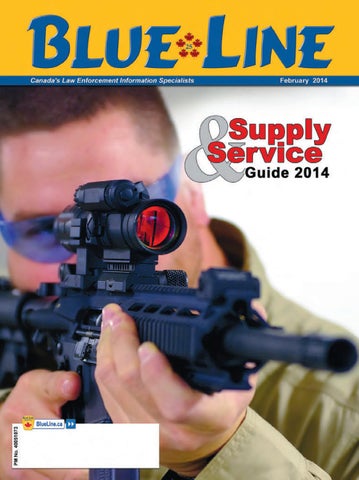
LATEST COLT OFFERING HITS ALL THE CHECKBOXES by Dave Brown With the rapidly expanding use of patrol carbines in Canada, many police agencies have logically turned to Colt Canada, manufacturer of the highly regarded Canadian military rifles, for law enforcement carbines. It responded to this demand with the new LE Patrol rifle, with innovative features ideally suited to the role. Colt Canada stands out in a burgeoning market. Its products command a premium price and are relied on by numerous agencies over the many other law enforcement rifle choices. It’s not just the firearms themselves but also the people who design and build them. Blue Line Magazine was recently given unprecedented access to Colt Canada’s plant and an opportunity to talk with the actual designers and engineers. The company is not just a Canadian success story; it designs and manufactures outstanding products in a highly competitive field. Its small Kitchener, Ontario plant produces what military forces around the world consider to be one of the best rifles on the market. More than a quarter million of which have now been issued to troops in Canada and Europe. Its 110 employees work around the clock. Two shifts manufacture, assemble or upgrade weapons for various clients and one shift FEBRUARY 2014
BLM 2014-02.indd 6
is dedicated to testing and maintaining the machinery to sustain high standards of quality control. Patrol rifle market To say the market for AR-pattern rifles and accessories has exploded in the past few years is a bit of an understatement. Immensely popular with civilian shooters because of its solid and reliable design and military heritage, the biggest selling point is its modular construction, which allows for vast customizing opportunities. If you took every single part and accessory available for this platform and laid them all end to end… someone somewhere would buy them all. AR-pattern rifles get their name from the original 7.62mm AR-10, designed by Eugene Stoner for Armalite, and the AR-15, a lighter 5.56mm version. Armalite sold the rights to Colt Firearms in 1958 and Colt first started manufacturing the AR-15 in 1959. When it was adopted by the United States military, the full-automatic variation was designated as the M-16, and Colt continued to market the AR15 as a semi-automatic version. Not without initial growing pains, the M-16 has now evolved into a combat-proven weapon with many variations, including the M-16A2 rifle and M4 Carbine. 6
On the commercial and law enforcement side of the market, there are now literally hundreds of companies manufacturing AR-pattern rifles or building them from parts. Open the pages of any gun magazine and you will see ad after ad for rifles at every price point. Some are the cheapest rifles you can buy, others are good for casual plinking and target shooting; better examples will withstand the rigors of competition weekend after weekend, and a rare few are built close to military (commonly called mil-spec) standards. There are literally more manufacturers and distributors of AR rifles than there could possibly ever be zombies to shoot. Police officers aren’t playing games and don’t want rifles made by the lowest bidder. They don’t want parts originally designed for plastic airsoft guns. They need firearms that work reliably under the most trying conditions. If a part fails during a competition, one could drop a few points or lose a match; if a firearm fails in operational use, one could lose their life. Regardless of what many gun magazine ads say, one cannot buy a true mil-spec firearm unless you happen to be the US military. The term is not just the standards that the rifle is built to; it also includes the inspections the military subjects it to before accepting it. Lots of commercial manufacturers may build BLUE LINE MAGAZINE
1/15/2014 4:29 PM
to nearly the same standards or contain parts built to nearly the same standards, but the reality is that in the commercial marketplace, there is no one entity except the market itself to ensure quality and adherence to standards. Colt Canada Colt Canada is different. Everything coming out of its plant not only exceeds mil-spec standards but is also tested to the much-tougher NATO standard for small arms, referred to as NATO-AC225/D14. Originally called Diemaco, the company was purchased by Colt Defense in 2005. Diemaco manufactured a Canadian-only variant of the US Military’s M16A2 rifle under license for the Canadian military, designated as the C7, and a similarly made-in-Canada version of the shorter US M4 carbine, designated the C8. One of the biggest differences between Colt in the US and Diemaco in Canada was how Diemaco made its barrels. Barrels for the US M16A2 rifle and M4 carbine are first machined from steel. A bore hole is then drilled through the middle and a button cutter drawn through the bore to cut the grooves in a process called button rifling. Diemaco felt that no matter how accurately a hole is drilled through the middle of a long piece of steel, there is always the possibility of a tiny amount of runout that could affect accuracy. It chose instead to make barrels using a cold hammer forge process. In a cold hammer forge, short barrel blanks start from an oversized cylinder of steel with a hole larger than bore diameter drilled through the middle. The CNC-controlled cold hammer forge machine uses multiple hydraulic hammers to pound the steel into a very dense barrel, squeezing it almost like toothpaste under pressures exceeding 80 metric tons – about the weight of a passenger locomotive – to compress and draw out the steel barrel around a hardened mandrel inserted into the chamber and bore. This results in a barrel that almost doubles in length, with a very precise bore, and zero variation from end to end. (See photo below: from left to right is the mandrel with the 5.56 NATO chamber already precisely milled onto it, a barrel blank before forging, a barrel after forging, and a completed barrel threaded and machined to the correct length and profile.)
BLUE LINE MAGAZINE
BLM 2014-02.indd 7
Once forged, each barrel is proof-tested, magnetic particle inspected and cut to desired length, then stamped with a serial number, caliber designation (5.56) and “CC MP” to signify it fully passed the magnetic particle inspection (see photo below).
photo below), meaning you can replace a gas tube without taking off the IUR or needing to remove the front gas port from the barrel. Barrel cooling is never compromised by blocked off cooling holes in the handguards, which occurs with many aftermarket accessory rails.
Ironically, cold hammer forged barrels are faster and cheaper to make than button cut rifled barrels – provided you invest many millions of dollars into a computerized cold hammer forge machine and the space (about the size of a small warehouse) in which to operate it, like Colt and a very few other manufacturers of high-quality barrels and firearms around the world have done. (Interestingly, Colt Canada’s cold hammer forged barrels are still stamped with a highly coveted “D” proofing mark, which a representative explained is from both Diemaco and also the last name of the aerospace company Héroux-Devtek Inc, which owned Diemaco.)
One wear point identified by Colt Canada in endurance testing is the slot in the upper receiver where the charging handle latches in place. It uses a steel insert in this area to ensure the upper receiver will last the life of the rifle (see Photo A). Once mated to the barrel (see Photo B) it forms one solid and accurate platform (see Photo C).
LE Patrol Colt Canada was one of the first manufacturers to introduce a flat-top receiver on a military rifle. Again on the cutting edge, it is building an AR rifle with a completely integrated upper receiver, handguard and rail system, made from one solid piece of machined aluminum.
The monolithic upper receiver starts off as a solid block of cast aluminum, precisely machined to exact specifications (see photo above). This integrated upper receiver (IUR) fits over top the barrel, solidly locked to the lower receiver but not making contact with the barrel in any way. This design leaves the barrel to free-float, enhancing accuracy. Accessory rails are also solidly part of the receiver; you can remove an entire upper receiver – complete with handguard, sights and accessories – and never lose zero. There is no need for expensive third-party rails and the upper rail is one unbroken piece from rear to front to maximize the accuracy of any sight mounting system. A completely straight gas tube under the handguard can be simply removed straight out the front by removing one Allen screw (see 7
Even parts as simple as buffer tubes (see photo below) are precisely machined to very
FEBRUARY 2014
1/15/2014 4:29 PM
close tolerances on CNC milling machines controlled by expert operators. (The company cross-trains many employees on a variety of different stations.) The end user can easily swap barrels in seconds depending on the mission, from a Close Quarter Battle 11.6-inch, Standard 14.5-inch and Extended 15.7-inch lengths. To remove the torqued barrel nut, the company provides a unique extended barrel nut socket. This unique combination of a monolithic upper receiver that provides a solid sight platform and cold hammer forged, free-floating barrel results in enhanced zero retention and accuracy no matter the barrel length. Shooting tests We shot the 15.7-inch barrel version of the LE Patrol and a 20-inch barrel DMR rifle with suppressor on Colt Canada’s 27-meter indoor test range. I don’t pretend to be much of a rifle shooter – and a slight astigmatism in my dominant eye means I don’t always see one clear dot through an Aimpoint (and often two to four, depending on how much sleep I’ve had or coffee I consumed that morning) – but I managed to get five rounds into one admittedly largish hole. Jason Ross, Colt Canada’s Law Enforcement Sales and Training Co-ordinator, easily upped me by putting five rounds into a group so tight (.3 inches) that even the highly–accurate acoustic shot detector could not discern a difference between at least three of the holes (see photo below).
Sensitive microphones are placed downrange to give a graphical display of accuracy, and every single rifle is test-fired for accuracy before being shipped. While I would not want to predict an actual MOA accuracy number unless I was able to confirm the exact distance from the bench we were using to the target, I would suggest the combination of a free-floating, cold hammer forged barrel and a monolithic upper receiver resulted in accuracy that is more than acceptable for a patrol carbine. It is certainly far beyond my capabilities for accuracy. It should be noted that Ross beat my score by putting every round into an area less than the size of a dime (see photo D) while firing standard military ball ammunition and using an Aimpoint red dot sight with three-power magnifier, not match ammo or a telescopic sight. Durability There will always be a debate about whether police agencies need the strength of military weapons. Some say that a well-made, button FEBRUARY 2014
BLM 2014-02.indd 8
rifled barrel can be just as accurate as a cold hammer forged barrel, and the average soldier or police officer does not need the potential for that slight increase in accuracy or much longer barrel life. It’s not the training conditions that a military-quality rifle may be used in on an optimum day (if there ever were such a thing) that convince so many large and small agencies to buy patrol rifles from Colt Canada (see sidebar article), it’s the conditions that may be experienced on the worst day. The battle of Wanat in July 2008 was once described as the “Black Hawk Down” of Afghanistan. Forty eight US and 24 Afghan soldiers were outnumbered three to one while repelling attacks during a firefight that lasted more than four hours. Nine American soldiers were killed and 27 wounded in one of the bloodiest days of the Afghan war. Surviving soldiers described how M4 carbines were suddenly thrust into the role of squad automatic weapons, as magazine after magazine was expended keeping the enemy from overrunning their position. Wounded troops continued to hand ammunition to the firing soldiers; weapon barrels turned white hot and some eventually jammed from nonstop firing. Later tests showed that M4s modified to fire full-auto could theoretically become so hot from firing in quick succession that the barrel literally melted and drooped. Destructive testing of the C7/C8 under sustained full automatic firing by Colt Canada has shown that gas tubes would melt and handguards would catch fire long before a cold hammer forged barrel would even begin to lose its shape. One NATO-AC225/D14 standard is testing for a worst case barrel obstruction – a bullet stuck in the bore only far enough to get shoved forward by a subsequent cartridge, making contact with the tip of the bullet behind it. Footage from one such test taken by Colt Canada’s locked off high-speed camera is both impressive and frightening. Destruction of the upper receiver and bolt was instant, but remarkably, the shooter would be likely to walk away with only minor cuts and bruises (and one hell of a flinch in the future!) The bolt protected the receiver from any flame cutting and detonation to rounds still in the magazine and the barrel was left intact. In fact, it could have been used to shoot tight groups… albeit with a noticeable bulge just past the chamber. Above and beyond NATO-AC225/D14 standards additionally address many areas not covered by US 8
mil-spec. For example, Colt Canada tests every component and accessory for operability in intense heat, extreme cold and after being submerged in special NATO-standardized mud, clay, dust, sand and water. It also applies a wide variety of solvents that one could reasonably (or even unreasonably) come in contact with. For example, the company cited one popular polymer magazine. Coat it with a common ingredient used in mosquito repellent, return in 30 minutes and the rounds will be all over the floor and the spring imbedded into the ceiling. Colt Canada does not just do endurance and reliability testing on a few rifles. Depending on the contract, up to five can be pulled from every batch of 40 or 50 and subjected to a battery of tests, including sustained firing of 6,000 rounds. Every one of the 110 employees take their job very seriously. Quality control is second to none and if an issue is found or suspected to be out of spec, the rifle is removed from the line and red-tagged for further investigation. Every single piece can be inspected and compared to exact dimensions on a comparator machine (see photo below).
There are numerous top quality rifles on the police market, many less expensive, but when an agency chooses Colt Canada, it is not just paying for a rifle made to NATO-AC225/ D14 standards; it’s paying for the company’s experience and after-purchase support, including armourer training, an extended warranty package offered to law enforcement agencies and a predictable parts replacement strategy. It is paying for the strength of a cold hammered forged barrel and magnetic particle inspection of every barrel, barrel extension and bolt before it leaves the plant, guaranteed accuracy, extensive testing and inspections, a fanatical attention to detail and an intense desire to push the boundaries of excellence where “good enough” is not good enough. As for Colt Canada’s parent, Colt Defense LLC in the US, there is plenty of friendly competition about who makes the best products. “Our forward thinking into research and development and our focus on R&D is a win/win situation,” says Colt Canada Project Manager for Research and Development, Chuck Franklin, with a smile. “We fit comfortably into theirs.” “There are 110 reasons why” Colt Canada products are so highly regarded among police and military, says Jason Ross. “Every single employee of this organization is intensely proud of the work they do.” As well they should be.. Dave Brown is Blue Line Magazine’s Automotive and Firearms editor as well as general staff writer. He may be reached by email at brown@blueline.ca.
BLUE LINE MAGAZINE
1/15/2014 4:29 PM
RCMP patrol carbine highly anticipated
by Dave Brown The RCMP has been quietly rolling out its new patrol carbine program, training instructors and preparing to issue the new kit to officers. There was a lot of speculation about the rifle and its capabilities when the program was first announced in 2011, including thread after thread on the Blue Line Forum. We can finally offer some much needed information about the new patrol carbine – it is real, and it is spectacular. The LE Patrol Rifle featured in our cover story on Colt Canada is similar to the one the RCMP chose. It is a semi-auto, 15.7-inch-barreled version of the Colt Canada LE Patrol IUR, complete with the solid onepiece, integrated upper receiver and full-floating, cold hammer forged barrel. Rumour has it that it will be equipped with the combat-proven Aimpoint red dot sight, Troy folding backup sights, Vickers combat sling, quick detachable light and the same silky smooth, two-stage trigger upgrade used by many US special forces. When asked, a Colt Canada
BLUE LINE MAGAZINE
BLM 2014-02.indd 9
expert would only say the company was “very pleased” with the ammunition the RCMP chose to match the LE Patrol’s 1-in-7 barrel twist. In fact, if you asked AR-pattern rifle experts around the world, they would say the new RCMP carbine hits every checkbox for the best of the best in rifle, sights, magazines and accessories. The Aimpoint red dot sight, for example, is one of the fastest and most durable sight systems on the market. With its extended battery life, it’s designed to stay on all the time; the battery is simply replaced every few years. Rated to be fully functional from minus 45 to plus 75 degrees Celsius – which should nicely cover almost every weather condition in Canada – the Aimpoint can be submerged as deep as 45 meters. Walking around the Colt Canada factory and talking to the people who design and build these rifles made me think about my dad. He spent 30 very proud years with the RCMP and remained active with the Veterans Association and in documenting the history of the Mounties long after he retired. He lived his life with the quiet confidence of a Christian with four aces. When he passed away at 90, his funeral was a sea of red serges; many of the officers who proudly wore them that day were not even born when he retired in 1967. I know that he would be somewhat saddened by the need for the new carbine but proud of the choices made in its selection. The RCMP didn’t just step up to the plate with this rifle; it knocked it out of the park.
9
DISPATCHES Ontario Provincial Police Commissioner Chris Lewis is retiring from the force after a 35year career. Lewis, who joined the provincial police in 1978, will be stepping down on March 28. He began his career as a provincial constable in Kapuskasing and rose through the ranks, becoming the OPP’s deputy commissioner of field operations in 2007. He was then appointed commissioner in August 2010, taking over for Julian Fantino, now a Conservative MP for the Toronto-area riding of Vaughan. Lewis is the first police officer to have been awarded all three levels of the Canadian Order of Merit of the Police Forces, presented by three successive Governors General. “I want to thank Commissioner Lewis for a lifetime of outstanding service over his long and distinguished career. He should be proud of the significant contribution he has made to ensuring Ontario remains safe, strong and prosperous,’’ Premier Kathleen Wynne said in a statement. ••• Chief of Police Tom McKenzie of the Lethbridge Regional Police Service will be hanging up his hat in October. He was appointed chief in January 2007 announced he will be retiring after 37 years of service. McKenzie graduated from Lethbridge College’s criminal justice program, joined the service in 1976, and moved up the ranks. In addition to his duties as a police officer, he is active in the community and serves on various boards and committees. The commission has asked McKenzie to remain as Chief until the end of October, a few months past the July expiry of his current contract, to help the organization develop its 2015-2018 Business Plan. Mayor Chris Spearman issued a statement saying during McKenzie’s 37 years of service, he has earned the respect, trust and admiration of the community. Spearman added Lethbridge has been fortunate to have a quality person like McKenzie leading the municipal police service for the past seven years. The commission will work with the police service and the City of Lethbridge to search for McKenzie’s replacement. ••• Sault Ste. Marie Police Service Chief Bob Davies will be retiring effective June 30, 2014 after 37 years of service. Davies, born and raised in Sault Ste. Marie, was hired by the Sault Ste. Marie Police Service June 16, 1976, and appointed Chief of Police December 2, 1996. Davies, 57, was promoted to Sergeant in 1988 and placed in charge of the Youth Bureau. In 1992, he was promoted to Detective Sergeant in Investigation Services branch. That same year, he became the Chief’s Executive Officer, responsible for policy development, planning and research, public complaint investigations, Community Services and emergency measures coordination. Promoted to Inspector in 1994, Davies was in charge of public complaints, Court Services, Management Services and emergency measures co-ordination. In January 1996, less than a year before being appointed Chief, he assumed command of Investigation Services, Identification Services, the Fraud Bureau, the Morality Bureau and the Joint Forces Operation Drug Unit. Davies, a husband and father of two sons and two daughters, told us he has no particular plans for his retirement other than to enjoy free time with his family.
FEBRUARY 2014
1/15/2014 4:29 PM
THE NEXT TEN MINUTES Why every armed officer should carry an individual first aid kit by Dave Brown A bright flash, a loud bang and you suddenly hit the ground before the smoke clears. Feeling pain, you reach for the source and are surprised to find blood quickly seeping through your once-pristine uniform. Thankfully, backup is right behind you, EMS is only 10 minutes away and the nearest fully equipped trauma room is 30 minutes down the road. Unfortunately, if bleeding from a serious gunshot wound is not controlled immediately, you could be dead in three minutes. The next 10 minutes are critical, since that’s about how long it takes EMS to reach most of us in populated areas of North America. Everyone who carries a firearm for a living or spends any amount of time on a shooting range should seriously consider carrying an individual first aid kit (IFAK) in an easily accessible place on their person. You may have to use it on yourself, perhaps with only one hand free, or instruct others how to use it on you. In these and other cases, the well-equipped first aid kit you carry in your vehicle may be just 50 feet too far away. FEBRUARY 2014
BLM 2014-02.indd 10
A good IFAK should have the minimum equipment needed to save your life after a serious gunshot wound for those crucial first ten minutes. It is not a boo-boo or survival kit; it has a singular purpose and is designed specifically to stop uncontrolled bleeding from a gunshot wound almost anywhere on the body. (This is why they are sometimes termed blow-out kits.) There is no one perfect setup for everyone – as always, let the mission dictate the gear – but recent advancements in combat medicine mean that a few carefully selected items can now be stored in a compact kit the size of a double AR magazine pouch. Designed to help control massive hemorrhaging and simple enough to be applied quickly, these few items can give you the most valuable thing you may need for the rest of your life – survival for those first critical 10 minutes. Lessons from combat Two decades of armed conflict in Iraq and Afghanistan have seen significant changes in emergency trauma care for combat casualties. While police officers don’t deal with the same risks, the lessons learned can help 10
keep officers alive on the streets of North America today. In the 1990s, a United States Special Operations medical research project was undertaken with the goal of improving combat trauma outcomes through optimizing care rendered in tactical environments. The research on pre-hospital trauma care resulted in an article, “Tactical combat casualty care in special operations,” published as a supplement to the August 1996 issue of Military Medicine. The project’s core principles for tactical combat casualty care (TCCC) are to avoid preventable deaths with effective gear, good training and proper tactics. The guidelines were highly customized for use on the battlefield and concentrated on the three most common causes of preventable death in combat: • Extremity hemorrhage (60 per cent of deaths); • Tension pneumothorax (33 per cent of deaths); • Airway obstruction (6 per cent of deaths). The US military began equipping every soldier on the ground with a compact first aid kit designed to specifically address these three problems. They were designated as the “improved first aid kit” in the US Army and “individual first aid kit” in the US Air Force and Marines. The items they contained depended on the issuing branch but they were designed for self-aid first and buddy-aid second. In other words, when carried in a BLUE LINE MAGAZINE
1/15/2014 4:29 PM
place easily accessible to either hand, you would first use the kit on yourself and, if that was not possible, another soldier would use your kit on you. Combat soldiers have to deal with hospital care that may be hours or days away. Canadian police officers rarely face these circumstances but a tactical situation can be much like a combat zone. The military principle, “The best medicine is sometimes superior firepower” is just as applicable to law enforcement as combat. The items in an officer’s IFAK may be more tailored to conditions at home, but the principles of call for help, win the firefight and patch up the bullet holes haven’t changed in hundreds of years. What to carry Emergency first aid is a complex topic. Even with the lessons learned from combat and today’s modern products, the field is constantly evolving. Equipping your own IFAK requires both careful thought and proper training but there are a few rules of thumb that may help simplify your decision process. Firstly, recognize that if you are suddenly suffering uncontrolled bleeding from a gunshot wound, the best equipped first aid kit in the world – nearby in your car – may not be as good as a minimal kit carried on your person. This means you need to understand what works – and almost as important, what you don’t need. Secondly, few prepackaged kits contain all top-quality components or will suit every situation, so be prepared to do some research. While it may be tempting to just keep it simple and push the “add to cart” button, remember that human life isn’t simple and you aren’t stupid. There is too much at stake here. Thirdly, my extensive research, which included talking to everyone from EMS and combat medics to emergency room physicians, taught me one important lesson: the amount of gear people try to stuff into a kit is inversely proportional to their experience in real-life gunshot trauma situations. While that may seem counter-intuitive, it’s a fact; experienced medics know what works and what to leave out. Don’t carry more than you can pack in one small case and nothing that you are not trained to apply. Since hemorrhage bleeding is the number one cause of preventable combat deaths, there are three main possibilities to address in those first critical ten minutes: a gunshot wound to an extremity or chest or a severed artery. So while tension pneumothorax (a buildup of air from a sucking chest wound) and airway obstructions are the next two causes of preventable death on the battlefield, they won’t kill you in the first ten minutes; uncontrolled bleeding will. Unlike combat troops, police officers can generally leave the latter two for EMS and worry first about stopping the bleeding. A minimal kit can have as few as five basic items: • Tan or blue nitrile gloves; BLUE LINE MAGAZINE
BLM 2014-02.indd 11
• A quality tourniquet that can be applied with one hand; • A self-adhering compression bandage, often known as an Israeli bandage; • Hemostatic gauze to pack into a wound if pressure can’t control the bleeding; • High-adhesive chest seals that can prevent air from entering a sucking chest wound. Gloves Nitrile gloves are a necessity. Even dealing with your own injuries, they will help pack gauze deep into a bullet wound. Tan or blue are much better for checking for blood than the traditional black colour. Tourniquets Applying direct pressure will always be the first line of defense for a gunshot wound but lessons f rom Afghanistan and even Boston have shown the value of tourniquets in quickly arresting life-threatening external hemorrhage from limb injury. In these rare situations, they can be life-saving. Sometimes pressure packing the wound with gauze and applying a compression bandage just does not work to stem bleeding – or perhaps you are alone or may need to keep two hands free to deal with other wounds. In ongoing tactical situations, it may not be practical to be on your knees for ten minutes trying to stop the bleeding. To be effective, a tourniquet must be tight. It will cause pain when applied and again when released. Proper training is important. There is a risk of serious complications if it is not properly applied but with modern designs and good training, one should be able to save both life and limb. In my research, I have found three different levels of pre-hospital tourniquets: 1. H igh quality combat-tested products such as the genuine Combat Applications Tourniquet (CAT) and the new version of the Special Operations Forces Tactical Tourniquet (SOF-TT Wide.) The CAT is slightly smaller and lighter, thanks to its composite rod versus the aluminum rod of the SOF-TT. Both are extremely well made. The CAT is now standard issue for Canadian troops and has been given to 11
millions of soldiers in the US, Canada and Britain since 1995. Other manufacturers are quickly entering this market with their own unique designs. 2. No-name knock off (what I call “white label”) brands that copy the CAT design and are manufactured by medical supply houses in China. Primarily sold in volume by tender, there is no evidence that they may fail to work as designed. Potential copyright issues aside, I personally wouldn’t buy one just to save a few dollars. 3. I mitation CATs designed for airsoft gamers. These are cheap counterfeit copies made by toy companies in China that go for $14 or so on eBay. They are designed only for the look and should never be used in a real first aid kit. Be aware that the counterfeit tourniquets may be poor quality but are good imitations of the real thing and have fooled more than one combat soldier. Strictly toys and one of the many reasons why I don’t play with toy guns. Compression bandages Designed to wrap tightly around a wound and apply needed pressure, compression bandages can often be applied where a tourniquet is not appropriate. Stored in a highly-compressed state, they usually come in four and six inch widths. The best ones are Israeli bandages (most still made, surprisingly enough, in Israel) and the OLAES bandage, named after US Special Forces combat medic Army S/Sgt. Tony Olaes, who was killed Sept. 20, 2004 during Operation Enduring Freedom in Afghanistan. Applied properly, they are capable of significant compression. One four inch Israeli (commonly called an “Izzy”) fits very nicely into my compact IFAK and I keep several more four and six inch Israelis plus an OLAES bandage in a larger mobile vehicle kit. If there were one item you would use more often than any other, it would probably be the combat compression bandage. Hemostatic gauze Hemostatic products speed clotting of blood and have significantly improved in the past few years. Original products came as a powder or crystal and were sprinkled over the wound and then sealed or packed with gauze. The problem was that the early versions could cause severe burns through a chemical reaction. Emergency room physicians absolutely HATED them because of this and the difficulty in debriding wounds. People also misused them for minor injuries such as fishhooks stuck in thumbs instead of bleeding that couldn’t be stopped through pressure. The much better hemostatic gauze has now replaced hemostatic agents in most military IFAKs. Quick-Clot Combat Gauze and Celox Rapid z-fold gauze are probably the two best products on the market. The gauze can be packed tightly into a deep wounds to control bleeding or folded into a pad and placed over shallow wounds such as FEBRUARY 2014
1/15/2014 4:29 PM
in the head, torso, neck or groin areas where compression bandages don’t work well. Quick-Clot is impregnated with very fine silica/clay particles to enhance clotting, while Celox Rapid relies on a faster-working material called chitosan, a product of shellfish. Chest seals One place you do not need any holes – as if there were any place on your body that you do – is the chest. This includes from the belly-button area to the clavicle, on all four sides. A bullet hole here creates an opening in the chest area and lungs; air sucked through it is just as likely to kill you as the bleeding, which is why they are often referred to as a “sucking” chest wound. A chest seal is a large adhesive plastic disk designed to stick to the skin and quickly seal up bullet holes. The best ones, such as the Halo Chest Seals, come in pairs, because if there is one hole in your chest, there is likely two. Halo uses a very high adhesive seal that will effectively stick to hair, blood and wet skin. Before the advent of good chest seals, medics would sometimes use old EKG probe patches or even plastic sheets from bandage wrappers taped on three sides, but there is no reason to waste time doing that today. The only downside to the Halo is its awkwardly sized package, which will likely need to be folded at least twice to fit inside a compact kit. What you don’t need Many experts I talked to have seen
unnecessary gear take up valuable space in an officer’s IFAK – everything from nasopharyngeal airways, chest decompression needles and even scalpels. Understand that you are not surrounded by combat soldiers who have all been trained in emergency first aid. You may be alone or surrounded by people with minimal or no training. Your kit is designed to be used (first) by yourself and (second) by others on you. For example, before deciding to put a chest needle into your kit, I always suggest people look around at those around them and decide whether they want any of these folks jabbing long sharp needles into their chest close to the heart. Even experts have difficulty applying chest needles and they are not usually needed in the first 10 minutes, especially if a chest wound is properly occluded with Halo chest seals. First aid trainers with real life gunshot wound experience usually say that, outside of combat conditions, needle decompression of the chest is not usually very effective, has a high complication rate and is better done as a chest drain at the hospital. Based on good advice from a combat medic, I even dumped my CPR mask. He recommends to go compression only when doing CPR since using a mask takes regular practice. Most times, people over ventilate and the stomach fills up with air. This causes the body to purge the stomach contents and now you’ve got the big issue of trying to clear out the vomit.
Individual first aid kit Here’s what I carry in my individual kit: • One pair tan nitrile gloves; • CAT tourniquet; • Four inch Israeli compression bandage; • Celox Rapid combat gauze; • One pair Halo chest seals; • Sharpie; • Small roll of surgical tape; • EMS shears. The Sharpie is for marking the time of application on the tourniquet; the surgical tape just fills a hole. I also added a few inches of orange paracord to the zipper pulls to help distinguish the first aid kit in a hurry. Vehicle kit Due to the amount of time I spend on shooting ranges, I carry a second larger kit in my vehicle for everything that is important but not necessarily critical in those first few minutes. It contains: • Six pairs nitrile gloves; • A CAT tourniquet; • Four inch OLAES modular bandage; • Four inch Israeli compression bandage; • Six inch Israeli compression bandage; • Quick-Clot Combat Gauze; • 2 packs H&H compressed sterile gauze; • EMS shears; • 12 4x4 gauze pads; • Two Purell cleansing and sanitizing towels; • Two packs Water-Jel burn dressing; • All weather space blanket; • Head-mounted LED light; • Reflective vest. I am not a medic or first aid expert. I researched the top-quality products on the market today but what works for me isn’t going to work for everyone – and new products are being introduced every day. I’ll even admit that over the course of researching this article, my own personal kit has changed. I dumped a few items that might have minimal usage such as sterilizing wipes and a CPR mask. I also replaced a SOF-TT tourniquet in the vehicle kit with a second CAT for simple standardization. “I continually change my load out depending on what I’ve got going on or what new things I’ve learned,” one highly experienced medic told me. “Like anything it’s an open dialogue.” Like everything else in police work, survival is good training added to a proper mindset. Good care now is better than perfect care later, after it’s too late. When you’re down on the ground and first see blood gushing from you, there is nothing more satisfying and reinforcing to your survival mentality than to keep yourself busy. Jam a finger in the wound and apply combat-tested gear to stop the bleeding while you wait for that most comforting sound – sirens in the distance. Dave Brown is Blue Line Magazine’s Automotive and Firearms editor as well as general staff writer. He may be reached by email at brown@blueline.ca.
FEBRUARY 2014
BLM 2014-02.indd 12
12
BLUE LINE MAGAZINE
1/15/2014 4:29 PM
BLUE LINE MAGAZINE
BLM 2014-02.indd 13
13
FEBRUARY 2014
1/15/2014 4:29 PM
by Dave Brown Blue Line Magazine only had to travel a few miles down the road from our Markham, Ontario corporate headquarters to see what may be one of the world’s best police patrol rifles being made, but ironically we would have to travel across the ocean to watch the manufacture of what may be the world’s best police shotgun. Thankfully the Benelli line of tactical shotguns are available on this side of the pond. Imported by Stoeger Canada, Benelli military and law enforcement shotguns are part of Beretta Defense Products. We had an opportunity to review and test two of their top police models: the SuperNova Tactical pump-action and the Benelli M4 Tactical semi-automatic. SuperNova Tactical This modular design pump-action has a lightweight steel skeleton frame over-molded with a polymer shell, resulting in what Benelli says is a super-light, super-strong shotgun, almost completely impervious to any weather conditions. Dual-action bars and a two-lug rotary bolt locks steel-to-steel inside the barrel. It is capable of handling everything from light 2 ¾ -inch target loads to 3 ½ -inch magnum shells. Law enforcement versions come with either low-profile rifle sights or a military ghost ring sight, adjustable for both windage FEBRUARY 2014
BLM 2014-02.indd 14
and elevation. Optional three-dot tritium inserts can be added to the ghost ring. Options include a full-length pistol grip stock, standard “ComforTech” full stock and a collapsible multi-position stock. Barrel lengths are 14 or 18-inches. The receiver is drilled and tapped for a top picatinny rail. We found the ComforTech a little long, especially when wearing a jacket, but optional butt pads come in three sizes to accommodate different pull lengths. Regardless of stock or barrel length, the Supernova Tactical was able to put every slug through one ragged hole at 20 meters. Recoil may not have been pleasant but was easily managed. Something as simple as changing slug brands can sometimes affect point of impact and this is where fully adjustable sights come in handy. For example, Remington Managed Recoil 1-ounce slugs seemed to consistently shoot about six inches to the right of everything else. No matter how fast we pumped, the shells used or how much we neglected the cleaning, we could not induce a single misfeed. That is pretty impressive performance for a shotgun not even ‘broken in’ yet. So what’s the downside? Well, looks are subjective but this thing is uuuugly. To me, it looks more like an exoskeleton alien weapon than a police shotgun. Thankfully, looks have no bearing on how well it works and equally 14
thankfully, Benelli does not consult Blue Line on its designs! But it is still ugly. Operation The SuperNova Tactical is designed to feed and cycle any shells, low or high brass, all the way up to 3 ½-inch. It uses a unique magazine bypass button, called the push-button shell stop, located about half way up the forend so an officer has full and complete control of when to cycle shells from the magazine tube. When you cycle normally, shells eject from the magazine tube and sit on the carrier, ready to go into the chamber. Every user of a pump-action firearm will be instantly familiar with this drill, but should you not want a round to eject from the magazine, the push-button shell stop can be depressed. That activates a stop and bypasses rounds from feeding from the magazine. With the chamber empty, the user pushes the slide release lever upward and starts the pump moving backwards. After about an inch of travel, the shell stop can be depressed to block shells from leaving the tube. In a police vehicle, normal carry would be locked inside the rack with empty chamber and loaded magazine. To bring into action, an officer simply pushes the slide release up to unlock the bolt and cycles the BLUE LINE MAGAZINE
1/15/2014 4:29 PM
action as required. If no rounds are fired, the SuperNova Tactical is returned from loaded to cruiser-carry by pushing up on the slide release to open the action slightly and then depressing the push-button shell stop located in the middle of the forend. This ensures no rounds will be ejected while the action is completely pumped to the rear. The chambered shell is removed and replaced back into the magazine tube and the shotgun goes back in the rack. If an officer wishes to insert ammunition different than what is loaded in the tube, holding the push-button shell stop while operating the action ensures no shells come out of the magazine; the replacement shell can then be dropped directly into the ejection port. It is simple and instinctive. Cleaning, when we finally got around to it, was also simple. The magazine end cap comes off easily if the user needs to separate the barrel from receiver and a nub on the end of the magazine cap doubles as a takedown tool if you need to remove the trigger group. The action is smooth, with perhaps more of a plasticky sound than you may be used to on an 870. The polymer finish seems very tough and did not show any scratches or marks even after hard use. The cross bolt safety is forward of the trigger and within easy reach of an extended finger. The slide release is just forward of the safety, in roughly the same position as an 870. When speedloading, a 3 ½-inch chamber means the ejection port is a large and smooth-sided target. While some find it ugly, users report that the SuperNova Tactical’s reliability and smooth action gives it a beauty all its own.
The lightweight bolt and twin pistons result in what may be the fastest cycling police shotgun in the world. In previous tests conducted by Blue Line, shot-to-shot times of the M4 were all easily under .20 seconds. This means it will cycle as fast as one is physically able to move their trigger finger. A shooter who could keep their sights on the target at this speed could conceivably put five slugs into it in under one second. In comparison, a Remington gas 11-87 Police semi-auto averaged .24 to .26 seconds shot-to-shot and a Remington 870 pump turned in times of .29 to .31 seconds. Like all Benelli law enforcement shotguns, the M4 is tested for reliability in extreme conditions such as cold, heat, water, mud and sand. It will fire 2 ¾-inch or 3-inch shells of varying power without adjustments. The simple design of the gas ports, dual self-cleaning pistons and dual operating rods result in a minimum of moving parts that still function with minimal cleaning. There is little residue buildup and an occasional shot of spray lube on the bolt is about all that’s needed to keep it going for thousands of rounds. In our tests, it digested every single round of police shotgun ammunition that we threw at it without hang-up and it even cycled training rounds of heavy target birdshot.
Benelli M4 Tactical A semi-automatic police and military shotgun based on the US Military’s M1014 shotgun, first issued to the Marines in 1999, the M4 uses an inertia-operated bolt to eject and load rounds from a magazine tube, plus a unique gas-operated mechanism to assist the bolt operation. Benelli refers to this as the Auto Regulating Gas Operated (ARGO) system. It utilizes two gas ports located just slightly ahead of the chamber to bleed a small amount of combustion gases from the barrel and operate two stainless-steel pistons and operating rods to assist the opening of the bolt. This gives the M4 significantly reduced recoil compared to the average pump, plus the ability to add rails and accessories as required without worrying that the extra mass would reduce reliability, as is sometimes found on inertia-operated semi-automatic shotguns.
Operation Unique among police semi-autos, the M4 uses a free carrier, which means that a round is not fed from the magazine tube onto the shell carrier unless the trigger is pulled or the cartridge drop lever on the side is pushed upward. This is ideal for use in a police car. It is locked into the rack in cruiser-carry condition (empty chamber; loaded magazine tube; safety on) until required. An officer exits the vehicle and simply pushes the clearly marked cartridge drop lever upward and then aggressively cycles the action. If no rounds are fired, it can be returned from loaded to cruiser-carry by cycling the action and ejecting the shell from the chamber. No further shells are ejected from the magazine tube no matter how many times the action is cycled. If an alternate round is desired – for example a slug instead of buckshot – the
BLUE LINE MAGAZINE
BLM 2014-02.indd 15
15
officer simply holds the bolt handle back and drops in a shell. If the shotgun is fired, each subsequent round will continue to load from the tube the instant the bolt clears the carrier. Once the encounter is over, any remaining rounds in the chamber can be ejected without feeding a new round simply by manually cycling the bolt to eject the round and replacing it back into the magazine tube. This quickly and safely returns the shotgun to cruiser-carry. When empty, the bolt locks to the rear. This makes it very easy to safety check the M4 before placing it in the car. Cycle the bolt and if it locks to the rear, there are no shells in the shotgun. If the bolt cycles freely forward and back, there is at least one round in the magazine tube. It only takes minutes to become totally familiar with the action and officers will instantly appreciate the advantages of a design that can be moved quickly and safely to and from cruiser-carry as required. Police shotguns The market for police shotguns is still healthy and one hopes that most Canadian police agencies can see the advantages of having one racked beside a patrol rifle. They are designed for different purposes. I recently talked to a shotgun trainer for a federal law enforcement agency (who wishes to remain anonymous) and he explained why they will likely never go away from the shotgun. The nature of their threat is not always the two-legged variety; sometimes they deal with the very large, very fast moving and potentially very angry four-legged kind. He discussed problems he has recently encountered with other makes of police shotguns and what had to be done to get them serviceable. “I unpack a brand new shotgun and then spend a couple hours in the shop with each one, getting them to the point where I can trust them to our staff,” he reports – “but I can take a brand new Benelli out of the box, screw the barrel onto it, shoot a few rounds and send it for training in five minutes. I know it’s going to work and I know it will come back with every piece still attached.” To him, looks are secondary. Dependability is the key. “I’m old school. I love a big ole solid, dependable, steel shotgun that I just know I could beat a grizzly to death with if I had to,” he explains. But then he adds, “I would prefer not to have to.” Dave Brown is Blue Line Magazine’s Automotive and Firearms editor as well as general staff writer. He may be reached by email at brown@blueline.ca.
FEBRUARY 2014
1/15/2014 4:29 PM
CANADA’S
COUNTER-TERRORISM STRATEGY
The ability of the RCMP, CBSA and CSIS to integrate through reliable effective intelligence management and data sharing is key to the success of Canada’s counterterrorism strategy . The federal government acknowledged this in its publication Securing an Open Society: Canada’s National Security Policy. “The increasing complexity of the threats facing Canada requires an integrated national security framework to address them. It is critical for our key security instruments to work together in a fully integrated way to address the security interests of Canadians” (page 9). Unfortunately, this has been identified as an Achilles heel with regards to Canada’s current system.
pressive all this may be, there is mounting evidence that progress has stalled in the coordination of this massive counter-terrorism effort.” David T. Jones, a senior official at the American Embassy in Ottawa in the mid1990s, has also publicly expressed his belief that our current counter-terrorism plan is lacking. The effort is “stronger on lip-service than on commitment,” said Jones, “and smacks of humouring that half-demented uncle who believes in alien abduction but has a sizeable legacy you don’t want to miss out on.” 2 A few of the most-notable shortcomings identified by these and other critics include the effects of legal restrictions, integration deficiencies, conflict with Canada’s core values and lack of sufficient funding.
An analysis Although, on the surface, it appears Canada is adequately prepared for terrorist threats, there are many critics who would argue otherwise. Former Canadian Navy Commodore Eric Lerhe 1 notes that Canada’s counter-terrorism strategy still possesses a number of shortcomings. “However im-
Legal restrictions While efforts have been made to amend Canada’s legal framework to better combat terrorism, it appears that there is still room for improvement. Many of the powers initially introduced through Bill C-36, the Anti-Terrorism Act (ATA), were highly controversial due to a widely perceived
by Michael Hull
FEBRUARY 2014
BLM 2014-02.indd 16
16
incompatibility with the Charter. As a result, some of the bill’s provisions expired on March 1, 2007 (Collacott; p. 15). While the Conservative government urged the renewal of provisions related to preventive arrests and investigative hearings, all three opposition parties were opposed (Wikipedia, “Canadian Anti-Terrorism Act”). Furthermore, although the ATA was intended to provide law enforcement and the legal system with the ability to take greater action against those responsible for terrorist activities, it appears that this area still requires refinement. A prime example was demonstrated by the Air India disaster investigation, which cost an estimated $130 million, took almost 20 years to complete and resulted in no convictions. “...It is clear from the outcome of the AirIndia bombing trial in March 2005 that the Canadian justice system is not up to the task of dealing with terrorists” (Collacott; p. 10). Collacott (p. 8) also points out that as of 2006, only one person in Canada had been charged with terrorism and the prosecution occurred under the Criminal Code rather than the ATA. Although two individuals were sentenced under the act in 2010 for BLUE LINE MAGAZINE
1/15/2014 4:30 PM
their involvement in the 2006 Ontario terrorism case,3 this pales in comparison to countries like the United States that, as of 2004, “... charged more than 310 persons in terrorist-related cases and won 179 convictions” (Collacott; p. 9). Integration deficiencies A critical piece to Canada’s national security strategy is the ability for all key organizations to efficiently integrate and effectively manage and share intelligence. Lerhe (p. 6) notes that a lack of integration within Canada’s current strategy can be attributed to three factors in particular: inadequate budgets, bureaucratic “turf wars” and technological shortcomings. Following a number of reviews, the federal government formally acknowledged the need to improve upon its current system in this respect: “The lack of integration in our current system is a key gap that has been recognized by the Auditor General of Canada” 4. Through the Office of the Auditor General of Canada’s 2009 report of intelligence and information sharing within Canada’s national security program, a number of these shortcomings were identified, including the “...poor sharing of information between government departments” in addition to the “...inoperability... of systems to support data sharing” 5. Legal barriers continue to hamper the current system and these have also proven to be a significant challenge to Canada’s intelligence management and information sharing. The report also identified, “...16 instances where departments and agencies have reported legal barriers to information sharing” 5. A key legal barrier to effective information sharing concerns Canada’s Privacy Act (which can additionally be viewed as a result of legal restrictions). While Lerhe (p. 9) notes that a strong act is unquestionably needed, it does limit the type and amount of critical data Canadian government agencies can transfer and share. He goes on to explain that most government agencies outline that there is no “duty to share” information when national security is at stake (p. 11). Of further concern is that many officials within Canada’s key counter-terrorist entities sense that sharing information with other departments present a “high legal risk” (p. 11). Additional shortcomings with regards to poor integration have also surfaced. Peter Boer 6 highlights the negative effects turf battles have had on the effectiveness of Canada’s ability to combat terrorism, specifically with regards to the traditional inability of CSIS and the RCMP to work together during the Air India investigation. The development of a number of integrated units have been initiated in an effort to alleviate this problem. The importance of improving upon the current system should not be taken lightly and, according to Lerhe (p. 12), progress and BLUE LINE MAGAZINE
BLM 2014-02.indd 17
the co-ordination and data sharing – the ‘connecting the dots’ functions – will define success or failure in our terrorist response. In his argument, Lerhe (p. 1) draws a comparison between the current status of the counterterrorist system in Canada to that of pre-9/11 United States, noting that attacks in the US could have been thwarted had information been better shared between its key agencies (i.e. “connecting the dots”). While the federal government has made many recommendations and appears to be attempting to remedy the current system, a comparison such as this
17
is a strong argument in favour of addressing integration deficiencies in a timely fashion. Conflict with Canada’s core values While Canada is a country that prides itself on upholding the values of democracy, human rights, respect for the rule of law and pluralism, 7 some argue that an over-emphasis on these values has created an environment in which it is difficult to successfully prosecute terrorists. This was most evident during the acquittal of the accused in the Air India
FEBRUARY 2014
1/15/2014 4:30 PM
bombing trial which, “...suggested to many Canadians that their justice system was often more concerned about protecting the rights of those who might be guilty rather than in bringing them to justice” (Collacott; p. 11). The very title of Canada’s first-comprehensive statement regarding its security policy is even considered by many to be a reflection of the government’s ambivalence towards security issues. The name it chose for this initiative was “Securing an Open Society: Canada’s National Security Policy.” Quite clearly Ottawa wasn’t comfortable with simply stating the obvious, i.e., that we finally had a national security strategy; the government felt that instead Canadians needed to be reassured by the very title that it would enhance rather than infringe upon their freedoms (Collacott; p. 17). Another argument exists with respect to immigration and multi-culturalism, two values traditionally held in high regard within Canadian society. While tolerance and being an open society has certain benefits, some individuals believe that Canada’s border, immigration and refugee policies require tightening since this, “...makes this country distinctly vulnerable to infiltration by international networks” (Collacott; p. 5). Although Canada prides itself on these important ideals, finding a way to appropriately protect Canadian citizens from future terrorists while upholding these key values will continue to maintain a precarious balance.
FEBRUARY 2014
BLM 2014-02.indd 18
Lack of sufficient funding In addition to the above-noted shortcomings, several other areas should be addressed in the near future. One critical factor that has implications for all other aspects of Canada’s security strategy (including integration issues, as noted previously) is a lack of financial investment on the part of the government and “there is the broader question of whether the Canadian government is prepared and able to commit the resources required to bring the threat of terrorism reasonably under control”
18
(Collacott; p. 15). Perhaps no stronger critic of this exists than that of the United States, as expressed in 2005 by United States Congressman Mark Souder (Collacott; p. 25): We were hoping that the Canadians were more advanced than apparently they are. We’d like to think that as an advanced Western nation, Canada is committed to devoting some resources to this. We would like to have Canada as a joint partner rather than a junior partner, but if you don’t spend the money, you become a junior partner. Perhaps the US opinions deserve some merit, as a lack of funding and resources seems to permeate some of the organizations deemed most essential to Canada’s strategy. With regards to the CBSA, Canada is frequently criticized, particularly by the US, that its borders are far too lax. Supporting this premise, the CBSA recently released an internal risk evaluation memo noting that, of the 160 border crossing posts, there is only one Canadian on duty at 103 of the sites (Collacott; p. 26). The RCMP has also stressed the impact a lack of resources as a result of inadequate funding could have, noting the following in a 2004 internal report. It is not a matter of “if ” but “when” an incident will occur whereby the RCMP will be in possession of a piece of information and/or intelligence that could have been used to disrupt or prevent a terrorist act but could not act upon it because we were inadequately resourced to properly deal with it (Collacott; p. 16). Many have argued that the role of CSIS also falls short of what is required due to a lack of funding and resources, particularly with regards to its involvement abroad. “Since the late 1990s, the different governments have bounced the idea of a Canadian foreign intelligence service back and forth but have never been able to settle on whether or not they want to set one up” (Boer; p. 250). Kostas Rimsa 8 further supports these claims and states the following: BLUE LINE MAGAZINE
1/15/2014 4:30 PM
Editor’s note: This is an edited excerpt of Hull’s essay written for his University of St. Andrews Certificate in Terrorism Studies International Policing module.
Footnotes
Like many of our intelligence agencies, bureaucracy, politically motivated government policies and resource constraints due to budget restrictions have greatly affected CSIS. This is alarming. There is no more important role for government than ensuring the security of its citizens. We, as Canadians, must never lose sight of this. Conclusion The federal government appears to have made considerable strides in recent years with regards to its counter-terrorism strategy but acknowledges that its approach is continually evolving and will require ongoing review, maintenance, co-ordination and further development. 9 With this in mind, attention to some of the above issues will prove critical to the future success of Canada’s strategy and, ultimately, the safety of its citizens. Perhaps one of the most important factors affecting the development of an effective and stable strategy relates to Canada’s overall attitude about terrorist threats. Although former public safety minister Vic Toews has noted that Canada “...cannot afford complacency in the face of a complex and evolving threat,” 10 Canada has frequently been criticized for appearing ambivalent and apathetic towards terrorism. Despite extensive evidence concerning the presence of international terrorists in Canada, the federal government’s posture has often been to downplay the seriousness of the problems Canada faces in this area (Collacott; p. 18). Canada has been more fortunate than many other countries with regards to being a victim of terrorist attacks and it is therefore essential that it promptly undertake preemptive efforts to strengthen and improve upon its current counter-terrorism strategy. Retired Central Intelligence Agency Officer David Rubin11 believes that Canada’s efforts against all types of terrorism have been modest to date and he stresses that BLUE LINE MAGAZINE
BLM 2014-02.indd 19
it could be costly should its governments, public and military continue with their complacency by failing to treat the issue of terrorism with the high level of importance that it requires. It may in fact be suicidal. To use Churchill’s term, we are the “soft underbelly” of the United States. So it should not come as a shock that al Qaeda has already stated we are “the fifth most important Christian country to be targeted.” The U.S., Great Britain, Spain and Australia have already been hit. Who’s next? 12
19
1. Lerhe, Eric, “Connecting the Dots” and the Canadian Counter-terrorism Effort – Steady Progress or Technical, Bureaucratic, Legal and Political Failure?, Canadian Defence and Foreign Affairs Institute, 2009; p. 1 2. Collacott, Martin, “Canada’s Inadequate Response to Terrorism,” Fraser Institute Digital Publication, February, 2006; p. 15 3. Wikipedia, “2006 Ontario Terrorism Plot.” 4. Securing an Open Society: Canada’s National Security Policy; p. 9 5. Office of the Auditor General of Canada (2009) “Chapter 1: National Security Intelligence and Information Sharing,” 2009 March Status Report. 6. Boer, Peter, Canadian Security Intelligence Service, Folklore Publishing, 2010; p. 74 7. Securing an Open Society: Canada’s National Security Policy; p. i 8. Rimsa, Kostas, Spy Catchers, cited in Hamilton, Dwight, “Inside Canadian Intelligence,” Dundurn, 2011; p. 50 9. Building Resilience Against Terrorism; p. 26 10. Ibid.; Foreward 11. Hamilton, Dwight, Know Your Enemy, cited in Hamilton, Dwight, “Inside Canadian Intelligence,” Dundurn, 2011; p. 23 12. Ibid. Michael Hull is a member of the Royal Canadian Mounted Police and stationed in British Columbia. He is currently completing a Certificate in Terrorism Studies through the University of St. Andrews in Scotland. He may be reached by email to michael.hull@rcmp-grc.gc.ca.
FEBRUARY 2014
1/15/2014 4:30 PM
PREDICTIVE POLICING Behavioural Data and it’s Future
Jeff Brantingham, anthropology professor at the University of California Los Angeles, displays a computer generated “predictive policing,” zones at the Los Angeles Police Department Unified Command Post (UCP) in Los Angeles. (AP Photo/Damian Dovarganes)
by Brian Heaton Using statistics and analytical data to predict criminal activity has become standard practice in many police departments. Crime forecasting may get more accurate as new computer algorithms are developed, but experts believe that fresh data streams, not technology advancements, will drive innovation in predictive policing over the next 20 years. Analysts currently identify crime trends using statistical data on arrests and 911 calls. Based on that information, police commanders deploy officers to areas they believe will be hot spots for illegal activities, but while predictive in nature, the effort is largely reactionary based on past events. In the future, behavioural data and clues from virtual interactions may help cops stop bad guys before they’ve even drawn up a plan. Think Minority Report – the 2002 film where a police unit was able to arrest murderers before they committed a crime – on a more realistic scale. We’re not quite there yet, however. The ability to accurately state that a crime will occur at a specific time in a small area is still very much science fiction. In reality, the process is similar to economic forecasting, where different factors are compiled to build a statistical model to predict outcomes. More sophisticated modeling can be done, but the return on investment is likely marginal, as we’re close to the limits of accuracy with current data, according to John Hollywood, operations researcher with RAND Corp., a FEBRUARY 2014
BLM 2014-02.indd 20
nonprofit organization that helps improve policy and decision-making through research and analysis. “In order to really get into crystal-ball accuracy, you basically need to get inside peoples’ heads,” Hollywood said. “That is getting you out of the realm of statistics and computer science and much more into the realm of behavioural and social science.” Behavioural data Noah Fritz, past president of the International Association of Crime Analysts and crime analysis manager for the San Diego County, Calif., Sheriff ’s Department, agreed. He said there is potential for growth in the area of environmental criminology, where you examine a person’s journey to a life of crime and peoples’ routine activities and habits. “We all have routines and if we make better sense of those routines I think we can then predict and forecast how many days out a person is going to commit another crime,” Fritz said. “Whether this is because they are addicted to drugs or because they have a propensity, in some ways we (need to) just do a better job of matching the temporal pattern and the geographic patterns together.” Some hurdles remain, however. Fritz said privacy rights may impede some behavioural data progress and the US doesn’t invest enough in behavioural data research and how it ties with predictive analytics – but the work isn’t being ignored. Overland Park, Kansas police chief John Douglass likened the efforts being made in 20
behavioural data and its relation to predictive policing to cancer research. Just as cancer scientists look back in time through genetics to find common denominators so they can create a cure, Douglass said data scientists are doing the same thing by looking for criminal signatures and those factors that will help better predict criminal behaviour. One potential source for new data could be the Level of Service Inventory-Revised (LSI-R) Assessment. An internationally recognized quantitative survey of offender attributes and situations relevant for making decisions about levels of supervision and treatment, the LSI-R results could provide valuable data on what motivates a criminal to commit a crime. The assessment is typically given to those going on parole. Dawn Clausius, police intelligence analyst with the Olathe, Kansas police department, believes that the assessment holds a mountain of untapped data for predictive policing efforts. She said that currently a prisoner’s assessment results are used only by parole officers or counselors within specific facilities but eventually the data could be shared with detectives or police officers. Local, state and federal government entities must get together with state corrections departments and law enforcement personnel and make an effort to share the information, Clausius said. Instead of just identifying and arresting the bad guy, Clausius believes that if cops had the resources and ability to sit down with criminals and find out what motivated them, BLUE LINE MAGAZINE
1/15/2014 4:30 PM
they could acquire data that could help prevent future crimes. Some work is being done in the US to examine how offenders behave and places they frequent in a community. Applications exist where an algorithm can provide an idea where an offender might live in relation to where crimes are occurring but Clausius would like to see that work done on a more micro-level. “I think that it is just a matter of making the offenders’ behaviour and personality a part of the process,” Clausius said. “If you go overseas and see the intelligence being done, they look at a lot of offender behaviour and offender profiles.” Douglass agreed. He expects nontraditional information for predictive policing will come from more study of social behaviours. It’ll just take some time to make it a reality. For example, Douglass said it took years for law enforcement to realize that 80 percent of homicides are done by people who know the victim. That revelation was 25 years ago. Only recently, police officers have started to realize that many homicides in big cities are connected to others in the same vicinity going back a decade. Douglass said that in Kansas City, investigators were able to trace back a string of 40 or 50 murders over a 15-year period to one specific incident. “Many of these homicides are located in a geographical area amongst a group of people who are simply retaliating back and forth in a culture where they don’t tell the police what is going on,” Douglass said. “That becomes the remedy and consequently all these homicides are related.”
BLUE LINE MAGAZINE
BLM 2014-02.indd 21
“I think that the social scientist will be able to help us determine social patterns that we will be able to take advantage of,” he added. Virtual life Social networks and virtual environments are another source of unexploited data that experts believe will impact predictive policing. Platforms such as Twitter and Facebook are based on the concept of sharing details – information that law enforcement is hoping to capitalize on. Leonard Scott, former police chief of Corpus Christi, Texas, thinks the data gleaned from observing social media will fundamentally alter the way commanders assign patrols to certain areas. Instead of officers being dispatched to a particular location in response to an event, the information taken from virtual existences will be used to assign a “flex unit” that will move into an area within a half mile of a particular location and watch for various disturbances. Those units are an extension of predictive policing based on social media data streams. Clausius agreed, but said mining social media will be more difficult as time goes on. Many people are locking down their social media accounts so that data isn’t as readily accessible, but she says law enforcement still must figure out how to tap deeper into the information that social networks can provide. One might assume that criminals would be smart enough to vary where they spend their time, particularly if cops are homing in on new sources of information that may pinpoint the likelihood of a crime occurring in an area –
21
but Colleen McCue, senior director of social science and quantitative methods for GeoEye, a geospatial services firm, said that’s unlikely. McCue, author of Data Mining and Predictive Analysis: Intelligence Gathering and Crime Analysis, explained that humans are aware of a vast majority of their behaviours, but location preferences tend to be subtle and unconscious in many cases. For example, at a grocery store, next to the bananas, you might see a display of Nilla Wafer cookies, which go well with the fruit. McCue described that type of product placement as a method of optimizing decision-making. Criminals have the same type of decision process that is largely unconscious. “Even if they are aware of what they are doing, it is very difficult to bypass some of those unconscious decision processes,” McCue said. “It is very difficult to engage in truly random behaviour and it is that fact that makes the whole crime analyst thing work.” Virtual gaming is another arena Clausius believes will be a gold mine for data in the next decade or two. From gambling sites to independent virtual identities to trade money for crime, Clausius thinks cyberspace is ripe for the picking when it comes to data to improve predictive policing efforts. “I don’t think law enforcement and public safety have even tapped into that as far as a data source or intelligence,” she said. “There are all kinds of games for all different purposes… and maybe on a federal level they are already gaming and in those worlds, but from a local law enforcement level, we are not in any of that.”
FEBRUARY 2014
1/15/2014 4:30 PM
Tech advances New data may drive the future of predictive policing, but technology won’t stand still. Paul Steinberg, CTO of Motorola Solutions, says the ways officers gather data and receive instruction will radically change in the next few decades. Steinberg said he envisions much more mobile technology use – far beyond the laptops and smartphones that cops carry today. From RFID-based fabrics to advanced hands-free mobile platforms, Steinberg believes technology will become an extension of a person, rather than separate devices he or she carries. For example, Motorola is discussing how to embed display technology into an optical unit that can capture and relay information to a police officer. It could be something similar to Google Goggles, but specifically designed for cops and emergency personnel. When first responders arrive on a scene, their reality would be augmented with technology that increases situational awareness. “It is the kind of thing you are going to see a lot more of,” Steinberg said. “People are not going to want to carry the devices; they are going to want to wear them and have them be as unobtrusive as possible.” Clausius cautioned that new technology needs to be deployed in ways that don’t compromise officer safety. Having been an officer herself for nine years, she said that the job is to respond to a situation and focus on streetlevel issues. “We need to provide them the tools that make their job easier, but we also need to keep in mind it is a safety issue,” Clausius said. “If
FEBRUARY 2014
BLM 2014-02.indd 22
they are being thrown so much information that they are taking their eyes off the suspect or off the road, we might actually be causing more problems.” Man versus machine One science fiction element not likely to be a part of predictive policing in the next 20 years is computer-based decision-making. While complex algorithms will be used to evaluate mountains of new data, both police and researchers believe advanced computers and artificial intelligence won’t be at a level where they’d feel comfortable trusting machines to make deployment decisions. Douglass spotlighted War Games – the 1983 film starring Matthew Broderick where a military computer confused reality with a simulation and almost annihilated the world with nuclear missiles – as a still-viable lesson for future generations. “We have not been able to automate intuition into computers – they are a binary, two-dimensional look at things,” Douglass said. “The human element adds that quality of intuition that I don’t think is dispensable. I think (the data) is always going to need some human interpretation.” Clausius and McCue agreed. Clausius said that despite the likelihood of further artificial intelligence advancements, computers should remain a tool and the human element should always be present. McCue added that from an operational public safety and national security perspective, she’d be troubled by the automation of police resources and deployment decisions.
22
“I don’t see in my lifetime getting to the point where we can develop a machine-learning algorithm that would be able to select the tactics and strategy that you would use to address a particular scenario,” McCue said. Fritz pointed out that while computers have been shown to make independent decisions, they’re usually governed by a defined set of rules. For example, in chess, a computer can make choices and anticipate moves based on those rules. In the criminal world, offenders don’t always adhere to a plan, necessitating the need for a human’s adaptive ability. Scott concurred that humans need to be a part of the equation when it came to making predictive policing decisions based on data but felt it was inevitable that computers would at some point be used for low-level decision-making. So did Hollywood, but he was confident that actual strategy would always be decided by humans. “Computer assistance and artificial intelligence in the field is kind of becoming the information technology equivalent of replacing shovels with… bulldozers,” Hollywood said. “You have more power and ability to process larger amounts of data and do basic operations faster. At the same time… you still need somebody driving the bulldozer.” This article was originally published by Government Technology (http://www.emergencymgmt.com/safety/ Behavioural-Data-Predictive-Policing.html).
BLUE LINE MAGAZINE
1/15/2014 4:30 PM
BLUE LINE MAGAZINE
BLM 2014-02.indd 23
23
FEBRUARY 2014
1/15/2014 4:30 PM
Autonomy-Supportive Motivating Style by Danny Thompson We are all looking for ways to motivate ourselves and others to be the best that we can be. This is true of all organizations looking to remain competitive in today’s society. I became a supervisor within the RCMP at a relatively early stage in my career and quickly learned that the riddle of motivation has no easy answer. Every person is unique and each person is motivated for very different reasons. I feel that, for many years, it has been believed that the traditional controlling motivating style was considered to be the best way to increase employee engagement. This style involves promises of rewards or punishment according to the perceived level of effort an employee puts forth. I argue that it focuses on compliance and not necessarily engagement. It places an emphasis on the supervisor to regulate the employee’s behaviour rather than allowing the employee’s level of engagement to regulate his or her own behaviour. All people have the need for autonomy, competence and relatedness (Reeve, 2009). The autonomy-supportive motivating style supports the autonomy of the individual and as such translates into an individual becoming engaged in the tasks at hand. There are four components that I feel make it successful. They involve nurturing inner motivational resources, relying on informational language, providing explanatory rationale and acknowledging negative feedback. Nurtures inner motivational resources People who subscribe to the autonomy-supportive motivating style find ways to discover the strengths of their team and provide an environment that allows these strengths to flourish. Most times a person’s strengths are evident but sometimes it requires some discussion. By nurturing the strengths of the employee we are creating within them an “intrinsic” motivation. When an employee is intrinsically motivating there is often very
little need for the external motivators used in the traditional controlling motivational style such as incentives or punishments. Relies on informational language Sometimes the people we are trying to motivate perform poorly for any number of reasons. Supervisors that believe in the autonomy-supportive motivating style treat these types of employees as motivational challenges rather than simply writing them off as “poor performers.” Controlling motivational styles will often subject these “poor performers” to criticism in the hopes that the criticism will spark motivation (Deci, Connell, & Ryan, 1989). According to the autonomy-supportive motivating style a supervisor will make use of informational language rather than rigid or shame inducing language. By simply acknowledging the poor performance and asking why it occurred I feel that will see more benefit than imposing shame inducing criticism. Provides explanatory rationales We can all think of times when we ask the members of our team to complete tasks that are simply uninteresting. When trying to motivate others to complete uninteresting tasks, supervisors subscribing to the autonomy-supportive motivating style will
explain the value in completing the task. This is opposite to the traditional controlling style that involves just directing the individual to complete the task without any explanation. By using the word “because” in the explanation of why the task is important we greatly increase the likelihood that the task will be completed. Once a person understands the reason a task needs to be completed they are more likely to put forth voluntary effort to complete it. This emphasizes the importance of dialogue with employees. Acknowledges and accepts negative feedback As we are all aware sometimes the people we try to motivate provide negative feedback as it relates to our efforts – especially related to activities they are asked to complete that are uninteresting. This resistance can sometimes be interpreted as “attitude.” People that subscribe to the autonomy-supportive motivating style look at this “attitude” as a starting point in a dialogue to resolve the negative feelings. The controlling style views the negative feedback as insubordination and resolves it by seeking compliance rather than discussion. Conclusion The important points for a supervisor to remember as it relates to the autonomy-supportive motivating style include listening carefully to your employees, allowing them the opportunity to speak, providing rationale, asking for input regarding the direction of the team and encouraging effort ( ). As mentioned earlier all persons have a need to feel autonomous. By supporting this need we promote healthy motivation, strong engagement, enhanced performance and psychological well-being (Ryan & Deci, 2000b). Cpl. Danny Thompson is a team leader in the RCMP and posted in the Kings District of Nova Scotia. He has completed 11 years with the RCMP and is studying to complete his Bachelor of Arts Communities Studies Degree at Cape Breton University.
FEBRUARY 2014
BLM 2014-02.indd 24
24
BLUE LINE MAGAZINE
1/15/2014 4:30 PM
VICTORIA POLICE DEPARTMENT MARKS
BLACK HISTORY MONTH by Elvin Klassen February is Black History Month, offering the opportunity to participate in activities that honour the legacy of black Canadians. “As Canadians, it’s important to remember those who came before us, and the sacrifices they made to help build the country we have today,” noted citzenship, immigration and multiculturalism minister Jason Kenney in a statement. “Central to our history and how we built our great democracy is the important contributions of Canadians of African and Caribbean descent. Black History Month provides all Canadians with the opportunity to learn more about the history of a community whose legacy stretches back to the origins of our country. “While black Canadians have made significant contributions to all areas of Canadian life, this year we are focusing our celebrations on the contributions of black Canadians in law enforcement – both past and present pioneers. In celebration of this month the Victoria Police Department (VPD) reflects on the story of its “black constables,” who were among the first officers to patrol the city’s streets in the mid-1800s and form a unique part of the city’s history. In April 1858, a group of about 35 black immigrants arrived in Victoria aboard the Steamship Commodore. Fleeing the racial attitudes of pre-Civil War California, they had apparently corresponded with Sir James Douglas (1803-1877) about relocating to the Crown Colony of Vancouver Island. They were part of the 30,000 who came north, mostly through Victoria, to get a mining license and head out in search of gold. Douglas, who had been a fur trader and was in charge of an area of the Fraser River where gold had been discovered, announced that no abuses would be tolerated, and that the laws would protect the rights of the Indians no less than those of the white men. He gained respect from the prospectors, claimed the land for Britain and became the first governor of the area in 1858. He was later knighted for his services. Hoping to enjoy the rights, privileges and freedoms of all members of a British Colony, eight to 10 men from this black immigrant community became members of one of the first organized police units in Victoria. The “black constables” performed their tasks admirably BLUE LINE MAGAZINE
BLM 2014-02.indd 25
but soon met the same racial prejudices that they had hoped to leave behind, and their service ended after approximately two months. Even though racial prejudices meant the end of their own Victoria police careers, it is these mens’ bravery, courage and determination to begin anew that the department reflects on this month. The story of the constables was researched by Cst. Jonathan Sheldan, who has been with the VPD for 21 years. Presently a detective with the Vancouver Island Integrated Major Crime Unit, he volunteers out of his own interest as the departmental historian. The mannequin with the uniform is provided by Kathleen Cantelon and displayed at the Victoria City Hall during the Black History event. Normally it resides in the police department museum and gift shop. Funding is provided by the Victoria Police Diversity Unit and Victoria Police Historical Society. Elvin Klassen is Blue Line Magazine’s West Coast Correspondent. He may be reached at elvin@blueline.ca.
25
FEBRUARY 2014
1/15/2014 4:30 PM
TRAINING by Jim Bremner
Why the mentally ill continue to die
All the talk about deescalation of armed mentally ill individuals and the need for training has driven me, through frustration, to address the core issue – the flaw in current law enforcement training and why it repeatedly fails to be effective. The bottom line all has to do with the hard wired, evolutionary adaptive survival mechanism of our mid brain’s fight and flight response. Instinct The empirical data is in on the specific fundamental function of the mid brain limbic system – to keep humans alive and reproducing other humans. The primitive brain (mid brain) housed in the limbic system – the hippocampus, amygdala and thalamus – drive the flight or fight response but also the desire for food and reproduction, freeze, flight (avoidance) and fight (fear based verbal and physical combat). Early humans, like all other mammals, were totally reliant on instinctive reactions to their environment in order to survive. The mid brain limbic system and autonomic nervous system drove us to breath, eat, reproduce, flee and ultimately fight based on our perception of the world around us. Relatively speaking the modern brain is a late arrival, developing only over the last two million years, as evidenced by the increase in skull and brain cavity size. This could be related to more nutritious food, which assisted in the development of the cerebral cortex and led to a cognitive process. Not having a cognitive thought process two million years ago wasn’t as much of a draw back as one might think; after all, how much thinking would you do day to day? Evolution has provided humans with a genetic gift of fear (Gavin Debecker) of fire, water, heights and large animals. All other fears are learned through exposure to the environment and this is where the amygdala comes into play. It is our centre for primitive fear and short term memory, cueing the fight and flight response based on our exposure to a real or perceived threat in the environment. The thalamus then triggers the bodies neuro pharmacology, releasing a deluge of chemicals (adrenaline, nor epinephrine, dopamine, serotonin cortisol, etc.), which all prime the body for freeze, flight and flight. Heart rate increases 200 BPM or better, vaiso constriction occurs, muscles tighten and the body maintains this state until the threat has passed. The hippocampus turns short term memory into long term memory and stores it in the modern brains cerebral cortex. FEBRUARY 2014
BLM 2014-02.indd 26
The amygdala is the emotional centre and evolution has provided that we feel before we think. Have you ever had an outburst while driving in rush hour traffic, which embarrasses you when you THINK about it? The primitive brain does not understand language; it is only aware of threat cues in the environment based on our proximity to the threat. Humans feel before we think; it is not possible to do otherwise once we perceive or are confronted by a real threat. New threats What about our reaction to new threats? Through exposure, a person who has been bitten or hasn’t grown up around mans best friend will naturally be wary of dogs. They will avoid or flea areas where dogs are and, through negative or an uneducated experience, fear dogs. That fear response is reduced through positive experience and education. Dogs are seen as mans best friend and this triggers a response from the thalamus that releases positive neuro pharmacology (dopamine). The individual becomes relaxed and comfortable in the situation and is able to access the modern brain and make rational decisions in the cerebral cortex. A police officer’s reaction when confronting a mentally ill individual will be based on their last exposure and experience with a similar individual – good, bad or indifferent. Officers must be exposed to the mentally ill in a positive setting and spend time in long term care facilities as care givers, not police officers, so they can see that the majority of 26
mentally ill people, like the general public, are not violent. De-escalation Current de-escalation techniques are based around verbal communication and negotiation skills (verbal judo and tactical communication are two popular methods). Communication can be defined as the exchange of ideas between two people through a common language. Negotiation is arriving at a mutually acceptable agreement between two parties, with give and take on both sides. Both are modern brain cerebral cortex functions but if the mid brain is primed by what an officer sees as a perceived conflict or threat, the cortex does not function at its peak, if at all. Almost 80 per cent of communication is non verbal – para and body language. Actions reveal intent, real or perceived, not language. Both parties in a conflict are connected to their primal response to a threat – freeze, flight or fight. If we look at nature, it is clear that distance is the true trigger of the fight response and officers must be trained to maintain it. This does not have anything to do with the 21 feet or edged weapons rule, although this is an added benefit; it has to do with primitive non verbal communication directly to the mid brain. Officers must be taught the reality of primitive human behaviour, including their own. Do not use threatening hand gestures and speak in calm tones; it is not the words but the tone. If parents yell, a child cowers. BLUE LINE MAGAZINE
1/15/2014 4:30 PM
Predatory drift Humans have inherited, as an adaptive survival mechanism, hard wired predatory instincts which usually lie dormant. When normal behaviour “drifts” over the line, predatory instincts kick in and take over. If something doesn’t happen to stop the behaviour at the moment when this occurs, things can turn ugly. Predatory drift can occur suddenly and unpredictably and is triggered by over-arousal (a situation where the officer perceives they are losing control). It can happen with the onset of situational anxiety and triggers a predatory reaction, which can ripple through an entire group of officers in an instant (fire contagion). It isn’t a conscious reaction; it’s visceral and instinctive. Consider what happens to a mob of fans at a soccer game or a group of normally-civilized people standing on the sidewalk yelling “Jump!” to the poor, troubled person out on the ledge. Teenagers behave very differently when they’re in a group, as do gang members when they’re together in a “pack.” Police officers must be made aware of this phenomena and use deep breathing, team work and disengagement to control the onset of predatory drift. Police cannot address one side without addressing the other. The officer and subject both respond in kind based on an adaptive survival mechanism provided by nature; this is simply unavoidable without maintaining distance. Emotionally disturbed Emotionally Disturbed Persons (EDP)
BLUE LINE MAGAZINE
BLM 2014-02.indd 27
are not mentally ill and the phrase is not a catch all. Encountering such a person offers an opportunity to use the current methods of active listening, verbal judo and tactical communication but only after the individual has cycled down to engage their cognitive thought process. Suicide This is a most misunderstood topic; in the simplest of terms, suicidal individuals are looking for a rest from the unrelenting emotional turmoil of their individual circumstances and are not overtly violent. Suicides are rarely reported in the news (what North America calls suicide bombings are in fact martyrdom bombings). What they have in common is a belief that life is not worth living, clear indications regarding their future, a plan, desire to contact former loved ones, a note in the form of an apology and a method of execution. They have contemplated the act for some time on a daily basis and perhaps have done dry runs to build the fortitude to ultimately commit the act. Having served on a SWAT team for many years, I watched as, despite our best efforts to intercede, individuals with the fortitude to carry out the act leapt from bridges or shot themselves (passive aggressive suicide). I have watched several of the most recent videos of police shooting armed mentally ill individuals – and having shot one myself, it is clear in the light of day that they had all the
27
precursors of suicide but lacked two finite criteria: a method of action (pills, bridge, weapon) and the resolve to carry through. Their answer is to CLOSE THE DISTANCE with police, eliciting the fight response from officers. Under pressure police will always bypass less lethal force options for the highest force option – their firearm. The danger of using fear conditioning as a training tool (21 feet rule) is that it is not a rule and not everyone at 21 feet with an edged or offensive weapon is dangerous. If you ate breakfast this morning the person across from you had a knife in their hands and you survived. The response is based in the primitive brain and at this point in the confrontation the officer is helpless to respond otherwise (Maslow Hierarchy of Needs). Once again we are back to distance and non verbal communication. Tools and training After 30 years in law enforcement, including almost 28 in special operations, I have seen the evolution of every force option available, used them all and acquired instructor status on some. I am constantly frustrated when I hear those with little familiarity speaking on the subject – or those who view one technology as a panacea to this universal issue (the law enforcement industrial complex). Any tool is an extension of our hands; it compliments and assists the basic skill set to make us more efficient in our task but there has been a clear and ever growing departure
FEBRUARY 2014
1/15/2014 4:30 PM
from providing police officers with a competent basic skill set. The rush to technology as a way of compensating for a lack of skill has brought us to where we are today. Technology is supposed to enhance the capability of those who possess a competent basic skill set. This is not measured by two day or week long courses that hand out certificates to all participants as proof of some type of expertise. Skills are earned and monitored and mentored by experienced officers. The data tells the tale; since the introduction of semi automatic pistols police shoot more and hit less. The FBI estimates that law enforcement has anywhere between a 11 and 14 per cent accuracy rate in live fire engagements. In keeping with distance as being the key to deescalation, officers must learn to contain an individual and not encroach on or penetrate into their perceived personal space unless extreme circumstance arise (based on officer perception). The tools and strategies that will enhance this methodology are: • Batons – Law enforcement has moved away from 26’’ wooden batons (visual deterrent, non-verbal means of communication received by the primitive brain) to collapsible 21 inch metal batons, in most cases for ease of carry. The disadvantage is that, in a confrontation, an officer needs a weapon that is longer than the opponents reach to keep them at a DISTANCE. The new batons are also only used as striking implements. Control and come along strategies are no longer taught, limiting an officers’ response to a higher level of force that will inflict more damage on the subject.
• Less lethal chemical munitions – OC, tear gas or a combination are used to detect, dislodge, disperse, deny and put individuals at a psychological and physical disadvantage to assist the officer in measured application of force to resolve a situation. Many officers, again because of poor training methods and lack of experience with the technology, fear cross contamination and the minimal effects they may experience. This is the danger of requiring officers to be exposed to chemical munitions as part of their training. The experience for most is one of fear and anxiety – extremely negative. Such training is warranted at advanced levels for SWAT and special operations because they can be expected to work in contaminated environments for prolonged periods. When a person loses respect for a weapon after exposure they are more likely to use it in a punitive measure (if it didn’t hurt me, it won’t hurt them). US and THEM are dangerous in law enforcement training as it dehumanises the public, making it more likely officers will resort to primal primitive measures (Zimbardo Stanford prison experiment). Officers may also distrust chemical munitions because they didn’t work as desired in a previous incident. All require time on target to be effective; if you do not receive the desired effect, another application is necessary but keep your DISTANCE. • Specialty impact munitions – When an officer cannot control the distance because there are no physical barriers, specialty impact munitions such as Safety Sock and other projectiles can
be used at a minimum of 40 feet (and in some cases up to 50 meters or better) of stand off with 100 per cent accuracy. Again, these should be used as a measured response until the individual acquiesces. • CEW – This technology has also proven effective but is not without controversy. The major issue in encroaching on a subjects’ perceived personal space is that closing this gap endangers both officers and the subject. All less lethal technology must be accompanied by lethal over watch and when we close the distance, officers are more likely to resort to their firearm in response to the threat. • Shields – Though primitive they at least put a physical barrier between the threat and the officer. We train riot control officers to stand and take the onslaught of projectiles and fire bombs for hours on end without incurring physical harm. Corrections officers still use them effectively on a daily basis to subdue violent offenders. Canadian law enforcement is following a trend to arm itself with carbines as a response to a perceived active attacker threat that, for the most part, is not a clear and present issue in this country. We have had only two or (arguably) three incidents in our history but we confront mentally ill individuals armed with offensive weapons daily. Officers can be trained to shoot for less vital areas, just as we have been taught to shoot to vital areas; in some areas of the world this is their less lethal response to an offensive weapon; are we training to incapacitate or kill? To sum up Without addressing the core issue of our human condition I fear that we will continue to repeat the past, as we have for more than 20 years: • Officers must be exposed to and educated in the realities of a mentally ill subject and human behaviour by physicians, psychiatrists, psychologists and long term care workers. • Officers must be given a skill set based in experience and competence, and the confidence that it will enable them to positively resolve a crisis. • There is no value based in fear conditioning for officers or the public. • Response teams of officers and psychiatrists should respond to events with a full spectrum of less lethal tools. • It is a software, not a hardware Issue (Lt. Col. D Grosman). We are undeniably products of human biology and without addressing that we are unable to move forward. James Bremner has more than 25 years experience with the Toronto Police Service in uniform patrol and the ETF, including gun team, team leader, explosives technician and tactical trainer. Through his company, Bremner Associates Inc., he provides tactical training and lectures on Critical Incident Stress and PTSD. Visit www. bremnerassociates.com for more. Register for “The Mentally Ill in a Corrections Setting” and other courses provided through CTOA at the Blue Line EXPO. Visit blueline.ca/expo.
FEBRUARY 2014
BLM 2014-02.indd 28
28
BLUE LINE MAGAZINE
1/15/2014 4:30 PM
BLUE LINE MAGAZINE
BLM 2014-02.indd 29
29
FEBRUARY 2014
1/15/2014 4:30 PM
MOUNTIE WIVES
HONOURED FOR SELFLESS DUTY
The women honoured with Supt. George Powell and Asst. Comm. Tracy Hardy.
by Danette Dooley The invaluable contribution made by the wives of RCMP members working in one or two-man detachments were highlighted at a recent ceremony at RCMP “B” Division headquarters in St. John’s. Twenty-two women in Newfoundland and Labrador, among 468 honourees across the country, were presented with the “Second Man” award. The award is an opportunity to recognize the women’s dedication and commitment to their spouses and the work of the force, said RCMP Asst. Comm. Tracy Hardy.
FEBRUARY 2014
BLM 2014-02.indd 30
The unpaid women answered phones, searched female prisoners, prepared prisoner meals and offered their homes as hotels for visiting senior officers, court judges, doctors and nurses. They also provided meals and entertainment to guests – all while living in remote locations with inadequate housing and growing families of their own. “The men were married to the force first and to their wife second,” noted retired C/ Supt. George Powell, who was emcee and represented the RCMP Veterans’ Association. “They faithfully supported the Mounties,” said Powell, noting that many of the first RCMP officers in Newfoundland were
30
initially members of the Newfoundland Rangers who transferred when the force assumed responsibility for policing in 1950. “When the Mountie, your husband, was away the citizens still came to the office or to your living quarters,” Powell told the honourees. “They expected the Mountie’s wife to do everything the Mountie would do if he were there. Sometimes, the women would come to the Mounties’ wife because they were uncomfortable discussing personal things with a man.” While a wife had no official status, Powell said, she was “a full-fledged member of the detachment” and was expected to play a leading role in the community. “Visiting government officials expected to be welcomed and fed at the Mounties’ house. After all, it was a government building, even if it was upstairs over the post office or court house or over the jail,” Powell said. Ethel Jarvis’ husband Dick served in the Royal Navy during the Second World War. He joined the Newfoundland Rangers in 1947, transferred to the RCMP in 1950, retired in 1978 and died in 2013. During an interview following the ceremony Jarvis said she’s proud to have helped her husband through the years. He policed on both the island portion of the province and in Labrador, she said. As the wife of an RCMP officer Jarvis said BLUE LINE MAGAZINE
1/15/2014 4:30 PM
Ethel Jarvis she looked after prisoners, including those who were mentally unstable. “I also took the axe in Northern Labrador to beat the ice to get some water out of the barrel. We’d melt ice on the stove to get water to do the laundry,” she said. “We had five children and sometimes I had to bring the water from the well using a hoop and two buckets, but I was strong and healthy and tall and robust.” Jarvis used the words of former President John F. Kennedy to sum up how she felt about her contribution to life in Newfoundland and Labrador – and Canada. “President Kennedy said, ‘Say not what your country can do for you, but what you can do for your country’ – and we found it a privilege to be living in such a beautiful, peaceful country. My husband was a war veteran and wanted no more that than. The Bible talks about the land of milk and honey – and that land is Canada.” For the top RCMP officer in Newfoundland and Labrador, the ceremony was an opportunity to pay homage to a woman she will always admire but has never met. Hardy heard about Maggie Clay when she policed as a young constable in Rankin Inlet, Nunavut and began tending her grave during fly-in patrols into the settlement of Chesterfield, Nunavut. It was located on the tundra near the settlement, she said. Maggie was the wife of S/Sgt. F.G. Clay, who was in charge of the detachment. Her story is the most tragic of all of the “Second Man” stories, Hardy said. “One day in September 1924 while her husband was absent on a long patrol, Maggie, on her way to the detachment, was mauled by a roaming pack of dogs in the community. There were no doctors or nurses in such a remote location,” Hardy said. A priest and two RCMP members helped BLUE LINE MAGAZINE
BLM 2014-02.indd 31
her and decided to amputate her leg. Maggie died the next day but her husband didn’t learn of his wife’s tragic death until he returned to the detachment a few days later. “In 1925 a special ceremony, such as today, was held in (Maggie’s) honour in the RCMP chapel in depot, attended by over 100 officers and constables,” Hardy said. A beautiful three-piece black monument was erected on Maggie’s graveside, with funds donated by members of the RCMP from across the country, Hardy said. “When I researched Maggie’s story I was immediately drawn to her, a women I’d never met. I felt a connection to her while tending her resting place. Those were peaceful and reflective moments. I cherished them and looked forward to my visits with her. That was over 20 years ago. She still resonates with me today.” Former RCMP Comm. William Elliott approved the creation of the Second Man Award in 2010 for the wives of RCMP members who served from the 1900s to the 1970s, and whose contributions are chronicled in the book, When the Second Man was a Woman by Ruth Lee-Knight. The RCMP Veterans’ Association National Office in Ottawa was responsible for communicating with veterans across the country to solicit nominations. Danette Dooley is Blue Line’s East Coast correspondent. She can be reached at dooley@blueline.ca
31
FEBRUARY 2014
1/15/2014 4:30 PM
FEBRUARY 2014
BLM 2014-02.indd 32
32
BLUE LINE MAGAZINE
1/15/2014 4:30 PM
&
SUPPLY SERVICE G 2014
BLUE LINE MAGAZINE
BLM 2014-02.indd 33
UIDE
33
FEBRUARY 2014
1/15/2014 4:30 PM
&
UIDE
SUPPLY SERVICE G 2014 CATEGORY INDEX FEBRUARY 2014
BLM 2014-02.indd 34
Access Control Accident Reconstruction Accreditation Addiction Treatment Alcohol Detection Devices Ammunition Architecture & Engineering Police Facilities Asset Management System Asset Tracking Associations Audio/Video Aids Training Courses & Services Awards, Badges, Pins Emblems & Decals Jewelry Pens Promotional Items Batons Batteries Binoculars & Telescopes Night Vision Equipment Surveillance Body Armour Boots, Shoes & Footwear Footwear General Police Supply Breathing Apparatous Bullet Traps Cameras Security – Perimeter Control Video – Mobile & Surveillance Cases, Duty Bags, Storage General Police Supply CCTV, Film Surveillance Charitable & Non-Profit Cigars & Accessories Clothing & Outerwear General Police Supply Uniforms & Accessories Collision Reporting Centres Communications – Base Stations Computer – Dispatching Communications – Consultant Communications – Handheld Communications – Mobile Computer – Accessories Computer – Dispatching Communications-Base Stations Computer – Hardware Computer – Laptops Computer – Records Mgmt Computer – Software Computer – Training Counterfeit & Detections/Fraud Courtmounting, Miniatures, & Ribbon Data Collection Defensive Tactics Training Digital Imaging Cameras Disaster Planning & Recovery Distance Education Driver Training E-Services Emblems & Decals Awards, Badges, Pins Vehicles – Accessories EMS Software Environmental Evidence Notebooks Memo Books Exercise Equipment & Clothing Fitness Clothing
Exhibitions & Trade Shows Eye, Ear & Skin Protection Gloves Hazardous Material Handling Range Supplies Financial Planning / Insurance Fine Art Firearms – Locks Firearms – Manufacturer Firearms – Simulation Training Video – Training Weapons – Non-lethal Firearms – Training Firearms – Training Equipment Firearms – Training Facility First Aid & Medical Supplies Fitness Clothing Exercise Equipment & Clothing Fitness Equipment Forensic Aids & Investigations Investigative Support Services Forensic Services & Equipment Form Holders General Police Supply Gloves Hazardous Material Handling General Police Supply GPS & Mapping Hats & Head Protection Health Care Helicopters & Equipment Holsters & Accessories Weapons – Accessories ID Holders Identification Idle Management Systems Inert Explosive Devices Investigative Support Services Jewelry Awards, Badges, Pins Promotional Items K9 Legal Services Licence Plate Recognition Lights – Portable Loading/Unloading Stations Marine – Electronics Marine – Rigid Hull Inflatables Medical Information Memo Books Evidence Notebooks Motorcycles & Supplies Vehicles – Off Road Narcotics Equipment & Drug Tests Forensic Services & Equipment Night Vision Equipment Cameras Novelty Items Office Equipment & Supply Pens Awards, Badges, Pins Promotional Items Photo Identification Photo Imaging Photography Cameras Forensic Services & Equipment Video – Mobile & Surveillance Surveillance Product Testing Promotional Items Awards, Badges, Pins Jewelry Pens 34
Protective Services Publishers, Books, Printing Training Courses & Services Radar & Speed Equipment Range Supplies Ammunition Recruitment & Selection Research & Testing Restraining Devices Riflescopes Safety & Rescue Equipment Hazardous Material Handling Schools & Institutions Defensive Tactics Training Security – Consulting & Systems Security – Identification Security – Penal Institutions Security – Perimeter Photography Surveillance Video – Mobile & Surveillance Security – Products Security – Services Security – Training Sirens & Emergency Lighting General Police Supply Vehicles – Accessories Surveillance Binoculars & Telescopes Cameras CCTV, Film Security – Perimeter Video – Mobile & Surveillance Switches & Control Systems Tactical Team Equipment Body Armour General Police Supply Testing Services Thermal Imaging Training Courses & Services Audio/Video Aids Publishers, Books, Printing Translation Uniforms & Accessories Clothing & Outerwear Emblems General Police Supply Holsters & Accessories Vacations Vehicles – Accessories Fleet Graphics Sirens & Emergency Lighting Vehicles – Lightbars Vehicles – Manufacturer Vehicles – Off Road Helicopters & Equipment Motorcycles & Supplies Vehicles – Specialty Vehicles – Tracking Equipment GPS & Mapping Vessels – Accessories Video – Mobile & Surveillance Security – Perimeter Surveillance Video – Training Voice Logging Systems Weapons – Accessories Holsters & Accessories Weapons – Non-lethal Batons Firearms – Simulation Training Weapons – Training Wireless Communications
BLUE LINE MAGAZINE
1/15/2014 4:30 PM
Addiction Treatment Tactical Medical Solutions Alcohol Detection Devices DAVTECH Analytical Service Inc. Draeger Safety Canada Ltd Ammunition C.R.A.F.M. Inc Korth Group Ltd. Wolverine Supplies Architecture & Engineering Stephens Kozak ACI Asset Management System Kronos Canadian Systems
Body Armour Armor Express Bosik Technologies Ltd. DuPont Canada Inc. Integral Tactical by FELLFAB Kehoe Law Enforcement (LE) Distributors Inc. OMEK International Teijin Aramid USA, Inc. Wolverine Supplies Boots, Shoes & Footwear 911 Supply
Associations American Military University Cdn.Tactical Officers Association Federated Press
Bullet Traps Bosik Technologies Ltd. Meggitt Training Systems Quebec Savage Range Systems, Inc.
Audio/Video Aids Able Translations Ltd. Boxer Studios Forensic Audio Panasonic Canada Inc. PTLights Inc V-Sec Systems Visual Planning Corporation
Cameras Canon Canada Inc. Digital Ally Panasonic Canada Inc. Provix Salient Manufacturing & Security Products V-Sec Systems
Motorola Canada Priority Dispatch
Communications - Handheld CanCom Radio Accessories Case-Tech Leather Inc. E-Seek Incorporated Motorola Canada OtterBox Products LLC Communications - Mobile Glentel Motorola Canada OtterBox Products LLC Computer - Accessories Motion Computing Inc. Mount Olympus Ltd OtterBox Products LLC Computer - Dispatching Intergraph Priority Dispatch Computer - Hardware Motion Computing Inc. Computer - Laptops Motion Computing Inc. Panasonic Canada Inc. Computer - Records / Management Kronos Canadian Systems Motion Computing Inc.
Visual Planning Corporation CCTV, Film Provix
Batteries CanCom Radio Accessories D&R Electronics Co LTD Surefire, LLC.
Charitables & Non-Profits Canadian Blood Services Cdn. MedicAlert Foundation Cdn. Tactical Officers Association Fallen 4 Marathon
BLM 2014-02.indd 35
Communications - Consultant
Cases, Duty Bags, Storage 911 Supply Case-Tech Leather Inc. Integral Tactical by FELLFAB O’Dell Engineering OtterBox Products LLC Polar Pin
Batons Supply Sergeant Ltd
BLUE LINE MAGAZINE
Communications - Base Stations Motorola Canada
Computer - Software Intergraph OSL Solutions Professional Development TSCM Group Inc SketchCop Solutions
35
PRODUCT LISTING
Breathing Apparatus Draeger Safety Canada Ltd
Pressed Metal Products Ltd. Pride in Service Stokes International The Patchman William Scully Ltd
Collision Reporting Centres Accident Support Services Int’l
Frontline Training & Tactical Products Inc. Original S.W.A.T Rocky Canada Stokes International
Asset Tracking 3SI Security Systems Ahearn & Soper Inc.
Awards, Badges, Pins Badge & Wallet Crossroads Promotions & Gifts Inc
Clothing & Outerwear 911 Gear 911 Supply DuPont Canada Inc. Integral Tactical by FELLFAB Kehoe Law Enforcement (LE) Distributors Inc. MD Charlton Co Ltd Millbrook Tactical SEALS Action Gear Stokes International Supply Sergeant Ltd Watershed William Scully Ltd
GUIDE 2014
Accreditation Cdn. Tactical Officers Association
Cigars & Accessories Constable Cigar Company
SUPPLY SERVICE
Accident Reconstruction PTLights Inc Visual Planning Corporation
Binoculars & Telescopes Canon Canada Inc. Leupold & Stevens, Inc Stoeger Canada Vortex Canada
&
Access Control Ahearn & Soper Inc. E-Seek Incorporated
FEBRUARY 2014
1/15/2014 4:30 PM
&
UIDE
SUPPLY SERVICE G 2014
Computer - Training Cdn. Police Knowledge Network John E. Reid & Associates, Inc.
Environmental Franzen Canada Corporation Grip Idle Management
Counterfeit & Detections / Fraud CashTech Currency Products Inc Investigative Solutions Network Inc.
Evidence Notebooks
Courtmounting, Miniatures and Ribbon William Scully Ltd
Visual Planning Corporation
Data Collection Accident Support Services Int’l Ahearn & Soper Inc. E-Seek Incorporated
Exercise Equipment & Clothing Force Of Habit Barbell Company Exhibitions & Trade Shows
Eye, Ear & Skin Protection CanCom Radio Accessories Sportmeds Inc Surefire, LLC. Financial Planning/Insurance Investors Group-Shaun Muldoon Investors Group-Lucienne Croghan
Distance Education
Fine Art K Foden Art Works
PRODUCT LISTING
Forensic Services & Equipment DAVTECH Analytical Service Inc. Savage Range Systems, Inc. Sensors & Software SketchCop Solutions Form Holders Case-Tech Leather Inc.
Defensive Tactics Training Bosik Technologies Ltd.
Disaster Planning & Recovery American Military University Intergraph
BLM 2014-02.indd 36
Fitness Equipment Force Of Habit Barbell Company Forensic Aids & Investigations Investigative Solutions Network Inc. Sensors & Software SketchCop Solutions
Digital Imaging Canon Canada Inc.
FEBRUARY 2014
Fitness Clothing Force Of Habit Barbell Company
Firearms - Locks Franzen Canada Corporation
Cdn. Police Knowledge Network Charles Sturt University
Firearms - Manufacturer Colt Canada Glock Inc. Sig Sauer Smith & Wesson Stoeger Canada Vortex Canada
Humber College, School of Social & Community Services John E. Reid & Associates, Inc. Osgoode Professional Dev. The Canadian Institute Vancouver Island University
Firearms - Simulation Training CAPS Inc. Meggitt Training Systems Quebec Firearms - Training CAPS Inc. Colt Canada Frontline Training & Tactical Products Inc. Meggitt Training Systems Quebec Millbrook Tactical Stoeger Canada
Driver Training Millbrook Tactical E-Services Cdn. Police Knowledge Network Emblems & Decals Badge & Wallet Crossroads Promotions & Gifts Inc Polar Pin Salient Manufacturing & Security Products Stokes International Supply Sergeant Ltd William Scully Ltd
Firearms - Training Equipment CAPS Inc. Colt Canada Korth Group Ltd. Meggitt Training Systems Quebec Firearms - Training Facility C.R.A.F.M. Inc First aid and medical supplies CTOMS Inc. St. John Ambulance
EMS Software Intergraph 36
General Police Supply 911 Gear 911 Supply Frontline Training & Tactical Products Inc. Pressed Metal Products Ltd. Pride in Service SEALS Action Gear Tactical Innovations Canada Gloves Tactical Innovations Canada William Scully Ltd GPS / Mapping 3SI Security Systems Intergraph Hats & Head Protection Polar Pin William Scully Ltd Health Care Cdn. MedicAlert Foundation HandsOn Osteopathy & Physiotherapy Clinic Sportmeds Inc Tactical Medical Solutions Helicopters & Equipment Bell Helicopter Holsters & Accessories Case-Tech Leather Inc. O’Dell Engineering OtterBox Products LLC Supply Sergeant Ltd Surefire, LLC. ID Holders Case-Tech Leather Inc. Polar Pin Identification Cdn. MedicAlert Foundation SketchCop Solutions Idle Management Systems Grip Idle Management
BLUE LINE MAGAZINE
1/15/2014 4:30 PM
K9
CTOMS Inc.
Legal Services Bradford F. Smith Law Corp. Investigation Counsel PC Kain Family Law Linden & Associates License Plate Recognition PES Canada Inc. Lights - Portable 911 Supply Airstar Canada Inc Genesis PTLights Inc Surefire, LLC. Tactical Innovations Canada
Marine – Electronics Provix Marine – Rigid Hull Inflatable Boats Yamaha Motor Canada Ltd. Medical Information Canadian Blood Services Cdn. MedicAlert Foundation Motorcycles & Supplies Altman International Yamaha Motor Canada Ltd. Narcotics Equipment / Drug Tests DAVTECH Analytical Service Inc. Draeger Safety Canada Ltd Night Vision Equipment Leupold & Stevens, Inc Provix Novelty Items Franzen Canada Corporation TPS Muesum & Gift Shop Office Equipment & Supply Visual Planning Corporation Pens Crossroads Promotions & Gifts Inc Fisher Space Pen Surefire, LLC.
BLUE LINE MAGAZINE
BLM 2014-02.indd 37
Photography Canon Canada Inc. Henry’s Photo-Video-Digital Product Testing Biokinetics & Associates Ltd
JIBC Lethbridge College Northwest Law Enforcement Academy Osgoode Professional Dev. Sheridan College Vancouver Island University
Promotional Items Crossroads Promotions & Gifts Inc Polar Pin Pressed Metal Products Ltd. Pride in Service
Security – Consulting & Systems Civic Protection Institute
Protective Services Investigative Solutions Network Inc.
Security – Identification CashTech Currency Products Inc Commissionaires E-Seek Incorporated
Publishers, Books, Printing Blue Line Magazine Inc Carswell, Thomson Reuters Georgian College Maple Book Publications The Canadian Institute
Security – Penal Institutions Commissionaires
Radar & Speed Equipment DAVTECH Analytical Service Inc. Digital Ally
Security – Perimeter Bosik Technologies Ltd. Commissionaires
Range Supplies CAPS Inc. Savage Range Systems, Inc.
Security – Products 3SI Security Systems Canon Canada Inc. Franzen Canada Corporation Panasonic Canada Inc. Wolverine Worldwide Inc.
Recruitment & Selection Georgian College
Security – Services Commissionaires Investigative Solutions Network Inc.
Research & Testing Biokinetics & Associates Ltd Restraining Devices Peerless Handcuff Company Smith & Wesson
Security - Training Commissionaires John E. Reid & Associates, Inc. Professional Development TSCM Group Inc
Riflescopes Aimpoint Inc. C.R.A.F.M. Inc Colt Canada Korth Group Ltd. Leupold & Stevens, Inc O’Dell Engineering Stoeger Canada Vortex Canada Wolverine Supplies
Sirens & Emergency Lighting D&R Electronics Co LTD Whelen Engineering Surveillance Digital Ally Professional Development TSCM Group Inc Salient Manufacturing & Security Products Vortex Canada Wellseley Consulting Service
Safety & Rescue Equipment Airstar Canada Inc Code 3 Inc. CTOMS Inc. Draeger Safety Canada Ltd Tactical Medical Solutions Wolverine Worldwide Inc.
Switches and Control Systems D&R Electronics Co LTD PES Canada Inc.
Schools / Institutions American Military University BC Institute of Technology
Tactical Team Equipment Aimpoint Inc. Armor Express 37
PRODUCT LISTING
Loading & Unloading Stations Colt Canada
Photo Imaging Canon Canada Inc.
GUIDE 2014
Jewelry Cdn. MedicAlert Foundation Pressed Metal Products Ltd. TPS Muesum & Gift Shop
Cdn. Police Knowledge Network Charles Sturt University Dalhousie University, College of Continuing Education Durham College
SUPPLY SERVICE
Investigative Support Services Investigative Solutions Network Inc. SketchCop Solutions
Photo Identification Ahearn & Soper Inc. Georgian College
&
Inert Explosive Devices Professional Development TSCM Group Inc Securesearch Inc
FEBRUARY 2014
1/15/2014 4:30 PM
&
UIDE
SUPPLY SERVICE G 2014 PRODUCT LISTING FEBRUARY 2014
BLM 2014-02.indd 38
Bosik Technologies Ltd. CanCom Radio Accessories CTOMS Inc. Hudson Supplies Inc Integral Tactical by FELLFAB Korth Group Ltd. Leupold & Stevens, Inc MD Charlton Co Ltd Salient Manufacturing & Security Products SEALS Action Gear Vortex Canada Wolverine Worldwide Inc.
William Scully Ltd Wolverine Worldwide Inc. Vacations Vacations for Heroes Vehicles - Accessories Code 3 Inc. D&R Electronics Co LTD Digital Ally E-Seek Incorporated Ford Canada Fleet General Motors Fleet Grip Idle Management Mount Olympus Ltd PES Canada Inc. Whelen Engineering Yamaha Motor Canada Ltd.
Testing Services Biokinetics & Associates Ltd Thermal Imaging Draeger Safety Canada Ltd Wolverine Supplies
Vehicles - Lightbars Code 3 Inc. D&R Electronics Co LTD PES Canada Inc. Whelen Engineering
Training Courses & Services American Military University BC Institute of Technology Blue Line Magazine Inc Cdn. Police Knowledge Network Charles Sturt University CTOMS Inc. Dalhousie University, College of Continuing Education Federated Press Frontline Training & Tactical Products Inc. Humber College, School of Social & Community Services IAPE - International Association for Property & Evidence JIBC
Vehicles - Manufacturer Chrysler Canada Inc. Ford Canada Fleet General Motors Fleet Mitsubishi Motor Sales of Canada Subaru Canada, Inc Yamaha Motor Canada Ltd. Vehicles - Off Road Mitsubishi Motor Sales of Canada Yamaha Motor Canada Ltd. Vehicles - Specialty
Lethbridge College Millbrook Tactical Northwest Law Enforcement Academy Sheridan College The Canadian Institute University of Guelph, CME Executive Programs Wellseley Consulting Service Wicklander-Zulawski & Associates, Inc.
Ford Canada Fleet General Motors Fleet IBS Sigma Mitsubishi Motor Sales of Canada Vehicles - Tracking Equipment 3SI Security Systems PES Canada Inc. Vessels - Accessories Chrysler Canada Inc.
Translation Able Translations Ltd.
Video - Mobile & Surveillance Canon Canada Inc. DAVTECH Analytical Service Inc. Digital Ally Provix Salient Manufacturing & Security Products TASER International Inc. V-Sec Systems Video - Training John E. Reid & Associates, Inc. Voice Logging Systems CVDS Inc. Weapons - Accessories Aimpoint Inc. C.R.A.F.M. Inc Colt Canada Franzen Canada Corporation Glock Inc. Hudson Supplies Inc
Leupold & Stevens, Inc MD Charlton Co Ltd O’Dell Engineering Police Ordnance Co. Inc. Smith & Wesson Stoeger Canada Tactical Innovations Canada Wolverine Supplies Weapons - Non-Lethal Colt Canada MD Charlton Co Ltd Police Ordnance Co. Inc. TASER International Inc. Weapons - Training CAPS Inc. Frontline Training & Tactical Products Inc. Meggitt Training Systems Quebec Millbrook Tactical Wellseley Consulting Service Wireless Communications Ahearn & Soper Inc. CanCom Radio Accessories Glentel
DISCOVER, IN PERSON, THE PRODUCTS & SERVICES PROVIDED BY MANY COMPANIES LISTED IN THIS GUIDE!
Uniforms & Accessories Andrei Master Tailors Hudson Supplies Inc Integral Tactical by FELLFAB
Pressed Metal Products Ltd. Stokes International Supply Sergeant Ltd
SEE PAGE 4 OR VISIT BLUELINE.CA FOR DETAILS 38
BLUE LINE MAGAZINE
1/15/2014 4:30 PM
911 Supply Calgary, AB 403-287-1911 www.911supply.ca
A
Able Translations Ltd. Mississauga, ON 905-502-0000 www.abletranslations.com Accident Support Services Int’l Toronto, ON 416-745-3301 www.accsupport.com Ahearn & Soper Inc. Toronto, ON 416-657-3999 www.ahearn.com
Airstar Canada Inc Scarborough, ON 416-919-9498 www.airstarcanada.com Altman International Toronto, ON 416-248-2292 www.altimategear.com American Military University Manassas, VA 877-755-2787 www.PublicSafetyAtAMU.com/Canada Andrei Master Tailors Fredericton, NB 866-826-1059 www.andreitailors.com Armor Express Central Lake, MI 866-357-3845 www.armorexpress.com
B
Case-Tech Leather Inc. Oakville, ON 905-842-8294 www.case-tech.com
Blue Line Magazine Inc Markham, ON 905-640-3048 www.blueline.ca
CashTech Currency Products Inc Mississauga, ON 800-268-5457 www.cashtechcurrency.com
Bosik Technologies Ltd. Ottawa, ON 613-822-8898 www.bosik.com
Charles Sturt University Albury, NSW 02-4824-2527 www.csu.edu.au/policeca
Boxer Studios Forensic Audio Calgary, AB 403-230-0331 www.blackbearrecords.ca/ boxerstudios.htm
Chrysler Canada Inc. Mississauga, ON 800-463-3600 www.fleetchrysler.ca
C.R.A.F.M. Inc Lachine, QC 877-635-4867 www.crafm.com
Colt Canada Kitchener, ON 519-893-6840 www.coltcanada.com
Canadian Blood Services Toronto, ON 888-2-DONATE (236-6283) www.blood.ca
Commissionaires Ottawa, ON 613-688-0710 www.commissionaires.ca
Canadian MedicAlert Foundation Toronto, ON 800-668-1507 www.medicalert.ca
Constable Cigar Company Grand Valley, ON 877-229-2247 www.policepride.com
Cdn. Police Knowledge Network Charlottetown, PE 866-357-2756 www.cpkn.ca
Crossroads Promotions & Gifts Inc Richmond Hill, ON 855-534-2211 www.crossroadspromotions.com
Cdn. Tactical Officers Association Kitchener, ON 855-662-2862 www.ctoa.ca
CTOMS Inc. Edmonton, AB 888-832-7096 www.ctoms.ca
CanCom Radio Accessories Orillia, ON 705.326.5677 www.cancomradioaccessories.com Canon Canada Inc. Mississauga, ON 905-795-1111 www.canon.ca
BC Institute of Technology Burnaby, BC 604-432-8547 www.bcit.ca/forensic
CAPS Inc. Kirkland, QC 866-559-8591 www.caps-inc.com
BLM 2014-02.indd 39
Code 3 Inc. Varennes, QC 450-671-8186 www.pescanada.com
C
Badge & Wallet Surrey, BC 604-502-9907 www.badgeandwallet.com
BLUE LINE MAGAZINE
Civic Protection Institute Picton, ON 647-501-7576 www.civicprotectioninstitute.org
Bradford F. Smith Law Corporation Vancouver, BC 604-349-5737 www.smithlitigation.com
CVDS Inc. Pointe-Claire, QC 514-426-7879 www.cvds.com
D
D&R Electronics Co LTD Bolton, ON 905-951-9997 www.dandrelectronics.com 39
CORPORATE LISTING
Aimpoint Inc. Chantilly, VA 703-263-9795 www.aimpoint.com
Biokinetics & Associates Ltd Ottawa, ON 613-736-0384 www.biokinetics.com
GUIDE 2014
911 Gear Markham, ON 905-205-0074 www.911gear.ca
Carswell, a Thomson Reuters Business Scarborough, ON 416-609-8000 www.carswell.com
SUPPLY SERVICE
3SI Security Systems Exton, PA 800-523-1430 www.3sisecurity.com
Bell Helicopter Mirabel, QC 450-437-2763 www.bellhelicopter.textron.com
&
#
FEBRUARY 2014
1/15/2014 4:30 PM
&
UIDE
SUPPLY SERVICE G 2014
G
Dalhousie University, College of Continuing Education Halifax, NS 800-565-8867 www.dal.ca/cce
General Motors Fleet Toronto, ON 905-644-1051 www.gm.ca
DAVTECH Analytical Service (Can) Inc. Ottawa, ON 613-831-6009 www.davtech.ca
Genesis Alexandria, ON 613-525-5533 www.gearhunterz.com
Digital Ally Lenexa, KS 800-440-4947 www.digitalallyinc.com
Georgian College Orillia, ON 705-325-2740 www.georgiancollege.ca
Draeger Safety Canada Ltd Mississauga, ON 905-821-8988 www.draeger.com DuPont Canada Inc. Mississauga, ON 800-387-7122 www.personalprotection.dupont.ca Durham College Oshawa, ON 905-721-2000 www.durhamcollege.ca/cijs
CORPORATE LISTING FEBRUARY 2014
BLM 2014-02.indd 40
Glock Inc. Smyrna, GA 416-844-1064 www.glock.com
Investors Group – Shaun Muldoon Grande Prairie, AB 888-428-7778 www.investorsgroup.com
HandsOn Osteopathy and Physiotherapy Clinic Mississauga, ON 905-272-6969 www.handsonosteopath.com
F
Fallen 4 Marathon Whitecourt, AB 780-778-2238 www.fallen4marathon.com
Henry’s Photo-Video-Digital Toronto, ON 800-461-7960 www.henrys.com
Federated Press Montreal, QC 514-849-6600 www.federatedpress.com
Hudson Supplies Inc Saint-Laurent, QC 888-599-9959 www.hudson4supplies.com
Fisher Space Pen Gormley, ON 888-722-2350 www.spacepen.ca
Humber College, School of Social & Community Services Toronto, ON 416-253-1918 www.communityservices.humber.ca
Force Of Habit Barbell Company Mississauga, ON 416-487-2364 www.forceofhabit.ca
I
IAPE - International Association for Property and Evidence Burbank, CA 800-449 -273 www.iape.org
Ford Canada Fleet Oakville, ON 905-845-2511 www.fleet.ford.ca Franzen Canada Corporation Kitchener, ON 226-336-6200 www.Franzencda.com
IBS Sigma Saint-Sauveur, QC 450-744-0575 www.ibssigma.com
Frontline Training & Tactical Products Inc. Kitchener, ON 519-883-0377 www.frontlinetrainingproducts.com
Integral Tactical by FELLFAB Hamilton, ON 905-560-9230 www.fellfab.com 40
Investigative Solutions Network Inc. Pickering, ON 866-790-4764 www.isninc.ca Investors Group – Lucienne Croghan Burlington, ON 416-803-2043 www.investorsgroup.com/en/ lucienne.croghan
H
E-Seek Incorporated Costa Mesa, CA 714-545-3316 www.e-seek.com
Investigation Counsel PC Toronto, ON 416-637-3150 www.investigationcounsel.com
Glentel Burnaby, BC 800-453-6835 www.glentel.com
Grip Idle Management Hamilton, ON 905-304-0400 www.gripidlemanagement.com
E
Intergraph Mississauga, ON 877-812-9755 www.intergraph.ca/publicsafety
J
JIBC New Westminster, BC 604-525-5422 www.jibc.ca John E. Reid and Associates, Inc. Chicago, IL 800-255-5747 www.reid.com
K
K Foden Art Works Nelson, BC 250-825-4388 www.kfodenartworks.com Kain Family Law Mississauga, ON 905-273-4588 www.kainfamilylaw.com Kehoe Law Enforcement Distributors Inc. Cambridge, ON 519-740-5003 www.kehoele.ca Korth Group Ltd. Okotoks, AB 403-938-3255 www.korthgroup.com Kronos Canadian Systems Mississauga, ON 800-850-7374 www.kronos.com
L
Lethbridge College Lethbridge, AB 403-320-3489 www.lethbridgecollege.ab.ca
BLUE LINE MAGAZINE
1/15/2014 4:30 PM
OSL Solutions Ottawa, ON 613-288-0250 www.oslsolutions.com
M
Maple Book Publications Saskatoon, SK 306-955-1965 www.lawprofessionalguides.com MD Charlton Co Ltd Victoria, BC 250-652-5266 www.mdcharlton.ca Meggitt Training Systems Quebec Montreal, QC 514-339-9938 www.meggitttrainingsystems.com Millbrook Tactical Stittsville, ON 613-836-9119 millbrookcanada.ca
Motion Computing Inc. Austin, TX 905-830-1469 www.motioncomputing.ca Motorola Canada Markham, ON 905-948-5200 www.motorola.ca Mount Olympus Ltd Oshawa, ON 416-856-3227 www.mount-olympus.ca
N
S
Salient Manufacturing & Security Products Kitchener, ON 519-886-9258 www.salientmfg.com
OtterBox Products LLC Fort Collins, CO 416-451-9058 www.OtterBox.com
Savage Range Systems, Inc. Westfield, MA 800-370-0712 www.savagerangesystems.com
P
Panasonic Canada Inc. Mississauga, ON 866-413-3099 www.panasonic.ca
SEALS Action Gear Calgary, AB 403-723-0222 www.sealsactiongear.com
Peerless Handcuff Company Springfield, MA 800-732-3705 www.peerless.net
Securesearch Inc North York, ON 905-886-5349 www.securesearchinc.com
PES Canada Inc. Varennes, QC 877-471-8168 www.pescanada.com
Sensors & Software Mississauga, ON 905-624-8909 www.sensoft.ca
Polar Pin Canmore, AB 877-polarEH! www.polarpin.com
Sheridan College Oakville, ON 905-845-9430 www.sheridancollege.ca
Police Ordnance Co. Inc. Markham, ON 905-479-2223 www.policeordnance.com
Sig Sauer Exeter, NH 603-772-2302 www.sigarms.com
Pressed Metal Products Ltd. Vancouver, BC 866-922-5500 pressedmetal.ca
SketchCop Solutions Corona, CA 951-264-9054 www.SketchCop.com
Pride in Service Pickering, ON 800-535-9735 www.prideinservice.com
Smith and Wesson Springfield, MA 413-781-8300 www.smith-wesson.com
Northwest Law Enforcement Academy Winnipeg, MB 204-953-8310 www.northwestlaw.ca
Priority Dispatch Salt Lake City, UT 800-811-0047 www.prioritydispatch.net
O
O’Dell Engineering Puslinch, ON 519-220-8195 www.odellengineeringltd.com
Professional Development TSCM Group Inc Burlington, ON 647-293-7384 www.pdtg.ca
OMEK International Toronto, ON 866-376-5805 www.omekinternational.com
Provix Alliston, ON 888-434-0253 www.provix.net
Stephens Kozak ACI Edmonton, AB 780-702-8385 www.sk-aci.com
Original S.W.A.T Georgetown, ON 905-873-7030 www.originalswat.com
PTLights Inc Scarborough, ON 416-564-9288 www.ptlights.com
Stoeger Canada Whitby, ON 905-436-9077 www.stoegercanada.ca
BLUE LINE MAGAZINE
BLM 2014-02.indd 41
Sportmeds Inc Toronto, ON 416 783-3737 www.sportmeds.ca St. John Ambulance Richmond Hill, ON 905-773-3394 www.sja.ca
41
CORPORATE LISTING
Mitsubishi Motor Sales of Canada Mississauga, ON 905-214-9000 www.mitsubishi-motors.ca
Rocky Canada Waterloo, ON 866-762-5922 www.rockyboots.com
SUPPLY SERVICE
Linden & Associates Toronto, ON 416-861-9338 www.lindenlex.com
R
GUIDE 2014
Osgoode Professional Development Toronto, ON 416-597-9724 www.osgoodepd.ca
&
Leupold & Stevens, Inc Beaverton, OR 403-938-3255 www.leupold.com
FEBRUARY 2014
1/15/2014 4:30 PM
&
UIDE
SUPPLY SERVICE G 2014
Stokes International Toronto, ON 800-361-2277 www.stokes-int.com
Vacations for Heroes Chilliwack, BC 866-994-4376 www.vacationsforheroes.com
Whelen Engineering Milton, ON 905-878-8457 www.whelencanada.com
Subaru Canada, Inc Mississauga, ON 905-568-8068 www.subaru.ca
Vancouver Island University Nanaimo, BC 250-740-6529 www.viu.ca
Wicklander-Zulawski & Associates, Inc. Downers Grove, IL 800-222-7789 www.w-z.com
Supply Sergeant Ltd Edmonton, AB 780-444-1540 www.supplysergeant.ca
Visual Planning Corporation Montreal, QC 514-739-3116 www.visualplanning.com
William Scully Ltd Montreal, QC 514-527-9333 www.williamscully.ca
Surefire, LLC. Fountain Valley, CA 800-828-8809 www.surefire.com
Vortex Canada Guelph, ON 866-343-0054 www.vortexcanada.net
Wolverine Supplies Virden, MB 204-748-2454 www.wolverinesupplies.com
T
W
Tactical Medical Solutions Anderson, SC 864-224-0081 www.tacmedsolutions.com
Wellseley Consulting Service Mississauga, ON 800-595-0988 www.wellesleyservices.ca
Tactical Innovations Canada Calgary, AB 403-818-1265 www.tacticalinnovations.ca
Watershed Salem, OR 800-848-8092 www.gowatershed.com
Wolverine Worldwide Inc. (Bates) Oakville, ON 905-847-1682 www.batesfootwear.com
Y
Yamaha Motor Canada Ltd. Toronto, ON 416-498-1911 www.yamaha-motor.ca
CORPORATE LISTING
TASER International Inc. Scottsdale, AZ 800-978-2737 www.taser.com
FEBRUARY 2014
BLM 2014-02.indd 42
Teijin Aramid USA, Inc. Conyers, GA 770-929-0781 www.teijinaramid.com The Canadian Institute Toronto, ON 877-927-7936 www.canadianinstitute.com The Patchman Onoway, AB 866-672-4033 www.thepatchman.ca TPS Muesum & Gift Shop Toronto, ON 416-808-7020 www.torontopolice.on.ca Triform Toronto, ON 877-874-3676 www.triform.com
U
Underwater Kinetics Canada Edmonton, AB 780-484-2350 www.underwaterkineticscanada.com University of Guelph, CME Executive Programs Guelph, ON 888-622-2474 www.uoguelph.ca/cme/ma-leadership
V
V-Sec Systems Winnipeg, MB 204-694-3665 www.v-secsystems.com 42
BLUE LINE MAGAZINE
1/15/2014 4:30 PM
BLUE LINE MAGAZINE
BLM 2014-02.indd 43
43
FEBRUARY 2014
1/15/2014 4:30 PM
TRAINING
PART OF CANADA’ S PREMIERE LAW ENFORCEMENT EVENT
AJAX CONVENTION CENTRE, 550 BECK CRESCENT, AJAX, ON
INTERVIEWING & DECEPTION PRESENTERS OF BOTH COURSES:
DAY 1: APRIL 29
DAY 2: APRIL 30
9:00 AM – 4:00 PM
9:00 AM – 4:00 PM
The Non-Accusatory Interview
Dealing with Deception
This one day course covers the techniques for interviewing deceptive subjects with the ultimate goal of obtaining truthful information. What do lying subjects say? What do lying subjects look like? What are the common tactics that liars use to try and thwart the efforts of the interviewer? Most importantly, what are the tactics that an interviewer can use to detect and overcome the liars behaviour? We will look at the law relating to interviewing and present techniques that will assist any interviewer in obtaining the truth. The course is open to police officers and anyone tasked with investigating or interviewing subjects.
This one day course covers the techniques and dynamics of interviewing witnesses in any investigative setting and is open to police officers and civilians. It covers all aspects of the investigative interview from planning and goal setting through to question formulation, and the “non-accusatory” approach to dealing with different types of subject. We will cover demeanour and “body language” as well as verbal analysis of the subjects’ answers. This course will give the investigator the right tools to handle any type of probing interview and the ability to diagnose truth and/or deception.
DAY 1: APRIL 29 9:00 AM – 4:00 PM Crisis Negotiation Course Canadian Critical Incident Inc (CCII) has developed a dynamic and informative one day workshop designed for police officers, 911 communicators, EMS, social workers, security staff and law enforcement students. It was created to assist those professionals facing challenging, demanding and potentially violent interactions with persons suffering from a mental illness or emotionally disturbed and in a state of crisis. Ontario’s Coroner Inquest, the SIU and the Mental Health Commission of Canada (March, 2012 study) all have emphasized the need to continue training public service employees in dealing with people suffering from mental
illness and in a state of crisis. Developing the ability to recognize and understand common mental illnesses, acquire proper subject assessment skills, greater situational awareness, expand defusing techniques, enhance active listen skills and tactical communications will significantly strengthen your ability to resolve a crisis situation. This can be achieved through the following learning objectives: • Basic terminology and understanding common mental illnesses; • Subject assessment; • Defusing and de-escalating communication techniques; • Active listening skills; • Crisis negotiation techniques to communicate with a suspect/subject that is threatening to harm themselves or others. This course will include audio and video training aids and is a blend of academic studies delivered by an instructor with twenty years
S/Sgt Gordon MacKinnon (Rtd.), with 37 years in policing, has worked in a number of areas throughout his career including Uniform Patrol, Criminal Investigation, Fraud Investigation, Intelligence and Major Crimes.The author of Investigative Interviewing, Gord has lectured across Canada to members of the RCMP, OPP, Military Police and numerous other police and investigative agencies. He is currently a College Professor teaching Police Foundations in Ontario. A/Sgt Wayne van der Laan (Rtd.) has 20 years experience in law enforcement that includes service in the Criminal Investigation Unit, Public Order Unit, Break and Enter Unit and Auto Squad. He holds a Bachelor of Commerce and a Masters Degree from the University of Guelph.
Cost of Training Each Course: $100 + HST
of current crisis negotiation experience. CCII has the unique privilege of an advisory board, comprised of Dr. Peter Collins Forensic Psychiatrist, Dr. Mini Mamak Forensic Psychologist, Professor Frank Trovato University of Guelph-Humber and Dr. Jim Cairns Deputy Regional Coroner (Ret) all of whom assist in the course development and training standards for CCII. PRESENTER: Detective Tom Hart, president of CCII, retired with 32 years of policing experience, Tactical Team, Intelligence Branch, Major Crime and 20 years as a Crisis Negotiator. He is an executive member with the Durham Region Critical Incident Stress Support Team. The International Critical Incident Stress Foundation, Inc. has certified Tom for Advanced Group Crisis Intervention.Tom is a member of the Correctional Services Canada Ontario Region-Citizen Advisory Committee.
Cost of Training $100 + HST
Registration available at blueline.ca/EXPO/courses or 905-640-3048 FEBRUARY 2014
BLM 2014-02.indd 44
44
BLUE LINE MAGAZINE
1/15/2014 4:30 PM
1:00 PM – 4:00 PM Iran, Hizbollah, Drug Cartels: Counter-terrorism Considerations
The Canadian Tactical Officers Association (CTOA) is a non-profit, fraternal organization directed by the needs of the membership. Our goal is to develop a professional network, committed to promoting and co-ordinating the sharing of information and best practice guidelines amongst law enforcement, corrections, military and security providers. To meet those needs, CTOA offers accredited courses with experienced tactical instructors and accredited seminars with high profile speakers. The CTOA welcomes new membership. For further information please visit www.ctoa. ca. Course attendees will also receive a 1 year CTOA membership and a 1 year Blue Line Magazine subscription. CTOA courses can be taken on Day 1 or Day 2a or Day 2b only or on both days for a reduced rate.
DAY 1: APRIL 29
Counter Terrorism 9:00 AM – 12:00 PM Suicide Bomber: The modern urban terror threat. Understanding and identifying the suicide bomber The course focuses on the theological and ideological motivation of the suicide bomber cult. As well it provides the participants with realistic strategies and tactics required to counter this ever growing concern. This course is suited for those assigned to Explosive Disposal Units and intelligence personnel. PRESENTER: Nir Maman, served in one of the most elite units in the Israeli Special Forces, the Central Command Counter-Terror Unit (C.T.U.) and the Special Forces Counter-Terror and Special Operations School (C.T.S.O). He has held several positions including Commander of the Counter-Terror School’s International Training Section and instructed units from various countries around the world that attend the Israeli Special Forces Counter-Terror and Special Operations Schools. Nir also held the position of Lead Counter-Terror Instructor on the Counter-Terror School’s Designated Hostage Rescue Take-Over Units Instruction Section. He was responsible for training new recruits and active operational members of the Israeli Special Force’s Designated Hostage Rescue Units in all areas of counter-terror warfare and hostage rescue. In 2009, he was awarded the Israeli Defense Force Ground Forces Command Soldier of the Year Award of Excellence and continues to deliver counter-terror, active shooter intervention, tactical shooting, and Krav Maga training to police and military organizations around the world.
BLUE LINE MAGAZINE
BLM 2014-02.indd 45
This course provides an overview of the multiple roles that Hizballalh plays as a terror proxy for Iran, with particular attention to its expanding threat in the Western Hemisphere. The convergence of risk for the U.S. and Canada increasingly involves a growing Hizballah presence, not just as a jihadist threat under the command of the Tehran regime, but also as a counterintelligence, narco-trafficking, and organized crime threat to our local communities where law enforcement is now the first, and maybe last, line of defense. PRESENTER: Clare Lopez, CIA, is a 20 year Operations Officer with the CIA. Currently, a Senior Fellow at the WDC Center for Security Policy, focused on defence and security. She is a widely-published author, lecturer, and media commentator as well as subject matter expert on terrorism and its impact and effect on policing and security from a front-line perspective.
DAY 2a: APRIL 30 9:00 AM – 4:00 PM Law Enforcement First Response - Tactical Casualty Care (LEFR-TCC) This course teaches public safety first responders including police and other law enforcement officers the basic medical care interventions that will help save an injured responder’s life until EMS practitioners can safely enter a tactical scene. It is consistent with the Tactical Emergency Casualty Care (TECC) guidelines, and meets the recommendations of the Hartford Consensus Documenton Improving Survival from Active Shooter Events. Successful participants will receive a certificate from the National Association of Emergency Medical Technicians (NAEMT). Medical oversight of the course is provided by Dr. Michael McDonnell MD, FRCPC. This course is a collaboration with Medic One Group and Frontline Training Divisions. PRESENTERS: David Steignaga, Yan Regis, Shaan Denty
or DAY 2b: APRIL 30
The Mentally Ill and Law Enforcement
with the emphasis on bringing about a better understanding to the complex issue of law enforcement and the mentally ill. PRESENTER: Jean Guy Gagnon is a Psychiatric Consultant to several police forces across Canada (RCMP, OPP, Greater Sudbury Regional Police, Thunder Bay Police, Toronto Police Services ETF) on hostage-takings and barricaded standoffs, both domestic and foreign and has been consulted on domestic ramifications of an international kidnapping and a potential international (USCanada) terror threat. Gagnon has instructed the Crisis Negotiations and Incident Commander course at the Canadian Police College for 5 years, and trained RCMP and several domestic (Toronto, Vancouver, Edmonton, Calgary, Montreal and many more) and international (French GIGN, Scotland Yard, FBI, Singapore, Swiss and more) police forces. He has trained Military Police in the psychological aspects of crisis negotiations and incident command and assessed and produced reports on mentally disordered individuals to establish their fitness to stand trial and criminal responsibility as well as being a psychiatric consultant in risk and threat assessments to help guide police and their organizational response. Gagnon has testified in court hundreds of times and is recognized as an expert in psychiatry. Further specialties include: assessment and treatment of traumatic brain injuries and psychiatric sequelea of injuries, assessment and psychiatric treatment of persons with chronic pain syndromes, repetitive transcranial magnetic stimulation.
1:00 PM – 4:00 PM The Mentally Ill in a Corrections Setting The course will focus on best practices for the safe handling of this most challenging circumstance for law enforcement. This course is designed for all law enforcement that can be expected to retain emotionally disturbed persons and the mentally ill in custody. PRESENTER: Dr Yuki Kanomi is a registered clinical psychologist in the province of Ontario with clinical training and practice specializing in both institutional (including Whitby Mental Health Centre, Warkworth Institution, Centre for Addiction and Mental Health) and community-based healthcare settings. She is a co-founder of Durham Psychologists in Ajax, Ontario and teaches part-time at Durham College. Kanomi is also a convention submission reviewer of the Extremism and Terrorism section of the Canadian Psychological Association. Kanomi offers psychological assessments for a variety of purposes (vocational, diagnostic, treatment-planning, disability related, and forensic) and treatments for adult (age 16+) individuals and couples in Durham Region since 2007 and with her forensic background has experience in providing psychological services to those on the “both sides of the bars.”
Cost of Training Day 1 – $250 Day 2a or Day 2b – $250 Day 1 & Day 2a – $400 Day 1 & Day 2b – $400
Before March 1:
9:00 AM – 12:00 PM
$225 – one day; $375 – two days
Suicide by Cop This course focuses on realistic coping strategies for law enforcement when encountering the mentally ill in crisis. It is designed for all law enforcement personnel 45
Registration available at blueline.ca/EXPO/courses or 905-640-3048
FEBRUARY 2014
1/15/2014 4:30 PM
TRAINING
by Tom Hart Canadian Critical Incident Inc. (CCII) has trained and qualified crisis negotiators and incident commanders for the last 17 years. Instructors deliver current, comprehensive courses and recognize the need to maintain continuous training in this demanding and challenging area of police work. CCII has the unique privilege of an advisory board comprised of Dr. Peter Collins, forensic psychiatrist with the OPP Criminal Behaviour Analysis Unit, Dr. Mini Mamak, senior psychologist, Professor Frank Trovato University of Guelph-Humber, St. Joseph’s Healthcare (Hamilton) forensic service and former Ontario deputy regional coroner Dr. Jim Cairns, a forensic medicine expert who has conducted numerous inquests. The board also includes current police negotiators, incident commanders, trainers and leaders
Promoting public safety and police accountability
in incident command who guide and assist in course development and training standards. CCII has recently developed a dynamic and informative eight hour workshop, Crisis intervention techniques for first responders. It was created to help in dealing with challenging, demanding and potentially violent interactions with persons suffering from a mental illness or who are in a state of crisis. Ontario Coroner’s Inquest, SIU Investigations and the Mental Health Commission of Canada’s March 2012 study have all emphasized the need for first responder training in this area. Developing the ability to recognize and understand common mental illnesses, increase situational awareness, expand defusing techniques and enhance active listening skills and tactical communications will significantly strengthen the ability to resolve a crisis situation with minimal use of force. This workshop will help reduce officer injury and promote public safety and police accountability when dealing with people in a state of crisis. This can be achieved by the following learning objectives, which include a blend of crisis negotiations and intervention techniques: • Basic terminology and understanding common mental illnesses;
• Promoting officer safety and situational awareness; • Defusing and de-escalating communication techniques; • Active listening skills; • Creating dialogue techniques; • Basic crisis negotiation techniques to communicate with a suspect/subject threatening to harm themselves or others; • Basic crisis intervention techniques and emergency psychological care to assist a person in a crisis situation. This workshop would be a great asset for front line officers, communicators, emergency responders and care workers, usually the first point of contact for a person in a state of agitated crisis.The workshop will include audio and video training aids and a blend of academic studies and terminology delivered by an instructor with 20 years of crisis negotiation experience. Former detective Tom Hart retired from the Durham Regional Police Service in April 2012 and immediately became president of CCII. A qualified crisis negotiator for more than 20 years, he is currently an executive with the Durham Regional Critical Incident Stress Support Team. Contact him at tom@canadiancriticalincident.com. Visit www.blueline.ca/expo to register for the CCII course.
WORKSHOPS FREE TO ALL TRADESHOW ATTENDEES HOSTED IN THE CTOA BOOTH
DAY 1: APRIL 29 10:00 – 10:30AM Video Interactive Firearms Training Mike Brake CTOA member and Frontline Firearm Instructor will provide a dry fire shooting clinic utilizing the modern technological advances of a Video Interactive Training System.
11:00 – 11:30AM High Angle Rescue Workshop Brent Hanna, has served on various industrial rescue teams as Team Leader for Confined Space Entry & Rescue, High Angle Rescue operations. He is a Rope Access and Rescue Consultant /
FEBRUARY 2014
BLM 2014-02.indd 46
Trainer / SPRAT level 3, IRATA l evel 3 with specific interest in access, rescue and specialized removal of trespassers in difficult to access areas including tower cranes, communication towers, bridges, high-rises, stacks.
2:00 – 2:30PM Carbine Optics Vortex Canada, maker of a broad spectrum quality optics, will host a workshop on demystifying the selection of proper optics from end user to tactical carbine through lecture and demonstration.
3:00 – 3:30 PM Wounded Recovery Workshop Lucus Witzke, Sales Manager for Terradyne Armored Vehicles will assist CTOA in providing a Terradyne Armored
46
Vehicle for armoured vehicle dynamic training exercises.
DAY 2: APRIL 30 10:00 – 10:30AM Carbine Optics 11:00 – 11:30 PM Wounded Recovery Workshop 2:00 – 2:30AM Video Interactive Firearms Training 3:00 – 3:30AM High Angle Rescue Workshop
BLUE LINE MAGAZINE
1/15/2014 4:30 PM
ODDITORIALS CALGARY - A man who celebrated Christmas in an eye-catching way is now facing a fine for his festive display. Slawomir Czyz stops everyone in their tracks when he drives around Calgary with a life-size display of Santa and Rudolph mounted to the top of his van. But late last week, Czyz was slapped with a $57 ticket. He says the officer told him the display was distracting to other drivers. Acting Sgt. Sio Chuong confirms the admonishment, saying that the lights on it could be confusing to other motorists. He says there are also concerns about howstable the display is, noting it does not look very aerodynamicíí and could come loose. (Global Calgary)
•••
LONDON – A thief was caught not so much red-handed as green-faced in London after breaking into a car. The car sprayed him with a liquid that glows emerald under ultraviolet light. Yafet Askale, 28, denied entering the vehicle that police set up with a dye-trap in Harlesden, northwest London, to catch thieves in June. But he was found guilty of stealing objects inside the car after police produced photos showing his face covered with the liquid, invisible under normal light. Askale, from Harlesden, was sentenced to 49 hours of community service and ordered to pay 400 pounds ($650) on Friday. Police released photos of Askale, warning they had set up similar traps in the area in cars and houses. (Reuters)
•••
LANCASTER – Eating on the run can lead to indigestion. Eating on the lam can get you arrested, especially if you leave a trail of curly fries behind you. Police in Lancaster County, Pennsylvania followed a trail of curly fries to nab a suspect, according to NBC New York. A female employee of fast-food chain Arbyís called the cops to announce that a man, who appeared to be intoxicated, had groped her through the drive-thru window as she handed over his order, including the incriminating curly fries. The woman gave the cops a description of the manís car, and presumably, his food order. Police were able to track car to the parking lot of a nearby motel. Police then followed a trail of Arbyís curly fries and sauce from the parked car to the hotel room of 36-year-old James Cowan of Fitzgerald, Ga. Cowan, who was believed to be intoxicated at the time, was taken into custody without incident and charged with a single count of indecent assault, according to court records. No word on whether he was able to finish his curly fries before being taken to central booking. (Time)
BLUE LINE MAGAZINE
BLM 2014-02.indd 47
47
FEBRUARY 2014
1/15/2014 4:30 PM
TRAINING
Structure crucial in non-accusatory interviewing
by Gord MacKinnon and Wayne van der laan If you fail to plan – then plan to fail - Benjamin Franklin Franklin’s quotation can apply to almost anything we do that involves achieving a desired outcome. In investigative interviewing, which is really just a ‘conversation with a purpose and consequence,’ failing to properly plan just what your goal is can often lead to less than desirable results. An investigative interviewer’s main goal is to gain truthful information from the person they are interviewing. Contrary to popular assumptions, it is not just about obtaining a confession or appropriating blame. While it is true that a by-product of the interview may be a confession, this should flow naturally out of a properly planned and executed interview, structured in such a way that the subject will respond with some form of the truth. Interviews should be planned so that they have a beginning, a middle and an end; all are
important in their own right, with specific goals linked to each step. The beginning starts with an interview plan. The first consideration is to decide who will do the interview, where it will be done, the goal and how the main topic will be introduced after dispensing with introductory formalities. The plan should be a guide only, not something that must be strictly adhered to. The interview may naturally flow in a way that is contrary to the plan but still achieves the goal. The plan should also address the points to be covered at each interview step. The “middle” is really the “meat” of the interview and should answer questions such as: • What key points do I need to cover? • How do I introduce them? • What might be some responses to the questions? • What do I do if the subject balks at a question or a line of questioning? This is where the main topic of the interview is discussed and developed and should be where most of the information you seek is obtained.
Once we reach this middle, it’s crucial that an interviewer listen intently, using both their ears and eyes. Listening is a vital skill for any competent interviewer and one which too few people concentrate on when conducting an interview. Many times, interviewers focus too much on asking their questions rather than listening to the answers. Also, knowing how to manage silence and pauses is very important. The end is the point at which you have evaluated many of the subject’s answers and decided whether to pursue further questioning by using tactics and themes to try bringing them to a “moment of truth.” Understandably, the end could go on for some time and ultimately other tactics and themes may come into play. Throughout the interview, it is important to know the difference between what we call “good, bad and ugly” interview questions; the same terminology applies to your subject’s answers. Learning and understanding the words and phrases used by deceptive and truthful subjects is one of the keys to becoming a successful interviewer. Interviewing is a learned skill and, like any learned technique, there is usually a formula or set of rules to be followed. If they are applied then the chances of a successful interview increase considerably. We will be presenting courses on investigative interviewing and detecting and dealing with deception April 29 and 30 at the Blue Line EXPO. We will be addressing and developing all of the steps associated to investigative interviewing and providing insight into ideas and techniques that will make anyone a better interviewer and, as a result, a better investigator. We will spend time going over the ‘formula’ that we use in the Non-Accusatory Interview Technique, which can be used both in law enforcement and the private sector by anyone tasked with obtaining accurate truthful information from other people. Like many so-called “simple” things, investigative interviewing only becomes simple when explained. Many people call this an A-ha! moment. S/Sgt Gordon MacKinnon (Rtd.), with 37 years in policing, worked in a number of areas including Uniform Patrol, Criminal Investigation, Fraud Investigation, Intelligence and Major Crimes.The author of Investigative Interviewing, Gord has lectured at agencies across Canada and is currently a College Professor teaching Police Foundations in Ontario. A/Sgt Wayne van der Laan (Rtd.) has 20 years experience in law enforcement that includes service in the Criminal Investigation Unit, Public Order Unit, Break and Enter Unit and Auto Squad. He holds a Bachelor of Commerce and a Masters Degree from the University of Guelph. Visit www.blueline.ca/expo to register for courses.
FEBRUARY 2014
BLM 2014-02.indd 48
48
BLUE LINE MAGAZINE
1/15/2014 4:30 PM
Consistency needed in mental health training The homeless, mentally ill man holding a knife is surrounded by officers — guns drawn — in a parking lot. “Drop the knife!” an officer is heard yelling on fuzzy cell phone video shot by a passing motorist. Seconds later, a blaze of shots ring out — more than 40 — and the man drops to the ground. Video of the fatal 2012 shooting incident in Saginaw, MI, was shown recently to a group of new police recruits at the Justice Institute of B.C. during a daylong session that emphasized de-escalation techniques and alternative strategies for dealing with people suffering from mental illness. While such training has become standard in police colleges and academies across the country, experts acknowledge there is no consistency in how that training is delivered. Nor has there been any rigorous evaluation of whether the training actually makes a difference. In March, the Canadian Association of Chiefs of Police will be hosting a joint conference with the Mental Health Commission of Canada focusing on police interactions with mentally ill people. At the conference, the commission, which has been pushing for the development of a nationwide education and training curriculum aimed at improving interactions between police
BLUE LINE MAGAZINE
BLM 2014-02.indd 49
and people with mental disorders, is expected to release an update of a survey it completed in 2008 of police academies and colleges. The study found that training in the area of mental illness varied widely, running from five to 30 hours. Report co-author Terry Coleman, former police chief in Moose Jaw and consultant for the commission, said training has grown over the past five years and now encompasses role-playing scenarios, videos, the use of actors, and talks from mental health professionals and people suffering from mental disorders. Coleman said there’s been good work done training police personnel to recognize symptoms of various psychological disorders and to recognize that when someone is in crisis, shouting at them isn’t usually going to help. This training was on display on the day Postmedia News visited a crisis intervention training class at the Justice Institute of B.C. Instructor Linda Stewart, a former Vancouver police officer and crisis negotiator, had an officer stand in the middle of the room as other officers bombarded him with questions. The exercise was intended to demonstrate what someone suffering from schizophrenia might be feeling and why such a person can’t always respond to officers’ commands. For some with mental illness, just the mere sight of a uniform can freak them out, so be aware of your approach and your stance, she told the students.
49
Stewart repeatedly implored officers to be sincere, to never lie, to demonstrate good faith, and to be active listeners. Sometimes, it doesn’t hurt just to let someone vent. After watching the video of the shooting of the homeless man in Michigan, Stewart suggested an alternative approach to just barking orders to “drop the knife.” Perhaps officers could’ve designated an officer to try to talk to the distraught man in a calm manner, and find out why he was so upset. Maybe even offer him a cigarette. That officer could “forget about the knife” because he knows that his fellow officers are there to back him up if the man tries to make a sudden move. Coleman praised this approach. Officers sometimes just need to “back off ” a bit, especially if the subject is in a contained area. Let things calm down, and try to engage the subject in a conversation and develop a relationship, he said. Stewart was also praised for inclusion of guest speakers who suffer from mental disorders or who are relatives of people with mental disorders. But even with all the training officers now get in de-escalation and mental health awareness, sometimes the niceties have to be pushed aside and their use-of-force training has to kick in, experts say. The Canadian Press – Blue Line News Week
FEBRUARY 2014
1/15/2014 4:30 PM
HOLDING THE LINE by Stephanie Conn
Train to be resilient
This column is inspired by my recent attendance at a traumatic stress conference where resilience was the theme. Overwhelmingly, experts agreed that resilience isn’t something you have, it’s a process. Like officer safety, physical fitness, or sobriety, it’s something that requires a daily commitment. Ten key areas were identified: 1. Positive attitude, 2. Flexible thinking, 3. Personal moral compass, 4. Having a resilient role model, 5. Facing fears, 6. Active coping, 7. Supportive social network, 8. Physical fitness, 9. Regular emotional, physical and cognitive training, and; 10. Recognize and use your strengths. 1 Let’s take a look at each of these. Positive attitude is realistic optimism, which means that you acknowledge your adversities AND you maintain your faith that, despite this, you WILL prevail. I usually remind my clients of their ability to persevere by asking if they’ve ever NOT survived a day of their life. Flexible thinking relates to being able to roll with the punches. When we fight the inevitable, such as change and failure, it amps up our stress
levels and limits our ability to move forward. Shift happens. You may not like it but, if you can’t do anything about it, you have to accept that and see if there is anything to learn from the situation. Having a personal moral compass may or may not be related to religious faith. It’s about knowing your purpose in life and living according to it. What is your mission statement for life? Are you living according to it? If not, take the first step toward a life that serves your purpose. I recently asked a large group of cops to identify their role models. Much to my surprise, they said they could identify who was not their role model but not who inspired them. Sometimes seeing who we don’t want to turn out like is great motivation to take better care of ourselves and our relationships but it isn’t enough. Having a role model – a mentor, if you will – to inspire us improves our resiliency. Encouraging officers to face their fears seems unnecessary. Cops face fears that others run away from for a living. Let me be more specific. Face your personal fears, those difficulties you’re having that you pretend don’t exist because you do not know what to do about them. Maybe you’ve noticed that you’re not doing well after a call and you’ve been ignoring some of the signs of it. It could be that you notice your marriage isn’t what it used to be but you pretend that everything is
fine. Running from your problems is a race you will NEVER win. Face your fears instead of being chased down by them. A related concept, active coping, entails taking measures to manage the stressor you’re facing. It involves facing your fear and then determining what you can do to change the situation. If you can’t change it, find ways to deal with it. It might mean asking for help from your support system or telling yourself something encouraging to deal with the situation, such as “I can get through this” or “This, like everything else, is temporary.” I can’t say enough about having a strong support network. The more people in it, the merrier. Build a strong network when things are going well so that, when times are tough, you have many sources of support. Some people can support you emotionally while others offer practical support. Sometimes you want to talk to someone. Other times you just need to get a break from your stressful situation, like going camping. One friend may be great at listening while another lifts your spirits by just being there with you at the campfire. Try to include people from various sources so you have a wide array of interesting people in your life and diverse sources of support. Physical fitness is critical to being resilient. Sometimes we don’t need to talk about our stressors, we just need to burn off stress and get some endorphins to feel better. Building physical strength often results in emotional strength and better clarity and focus.Taking a break from worrying about our problems, getting out of our head and into our bodies, can be the best thing for us. A related resilience factor is emotional and cognitive training. Keeping our mind sharp, including our emotional intelligence, helps us to manage situations where we may not be able to change anything but our reaction. Staying active by engaging in challenging activities across various interests will keep us sharp. For instance, you could coach a hockey team and learn a craft like wood carving or cooking. The last resilience factor, recognizing and using strengths, is a challenge for many. Our tendency is to focus on our weaknesses. This is unfortunate, as it limits rather than inspiring us. Interestingly, you would point out strengths your friend could use to make it through a difficult situation. Try this with yourself. Do you have a track record of being creative when helping others get through tough times? Harness this strength to help you through your current situation. I hope you find something you can use and best of luck in training to be more resilient! 1. Charney, D.S. & Southwick, S. M. (2012) Resilience: The Science of Mastering Life’s Challenges. Cambridge University Press. Stephanie Conn is a registered clinical counsellor and former communications dispatcher and police officer. To find out more visit www.conncounsellingandconsulting. com or email her at stephanie@blueline.ca.
FEBRUARY 2014
BLM 2014-02.indd 50
50
BLUE LINE MAGAZINE
1/15/2014 4:30 PM
BLUE LINE MAGAZINE
BLM 2014-02.indd 51
51
FEBRUARY 2014
1/15/2014 4:30 PM
DEEP BLUE by Dorothy Cotton
Denial is not always a bad thing
One of our favourite groups of people to despise and condemn are those who have committed sex offenses. Even in the world of criminals, they are at the bottom of the ladder. Worse still are people who have committed sex offences but will not admit to them – even when they are proven. I have spoken to convicted and imprisoned sex offenders who have been found guilty based on pretty solid evidence – DNA, for example – and they STILL deny committing the offence. I shake my head. Why will they not admit to their crimes? It is long past the point where denial will do them any good. So surely the first job of the psychologist is to get them to admit to their crimes (since you police people obviously failed at it!!). Surely the parole board should not be letting these guys out until they have ‘fessed up. WRONG. In the world of sex offender treatment, there are essentially two kinds of group treatments – those for people who admit to their evil deeds and those for “deniers,” the guys who (duh) deny their offenses. Guess which group of people is less likely to re-offend? I will confess that I was ready to eat my hat when I first looked at the outcome and recidivism data. It turns out that the deniers who have treatment are LESS likely to re-offend than the people who admit to offending. Really. The first lesson to be learned from this knowledge is that “just because something is obvious, makes perfect sense and is apparent even to an idiot does not mean it is true.” When I first went to an education session about treatment for deniers, I rolled my eyes and was ready to make tasteless and dumb remarks about “very short treatment programs” that would likely spring to most of our minds. So I was wrong. Wrong, wrong, wrong. That of course leads to the question “How come?” Indeed, why would people who do not admit to their offense actually be LESS likely to do it again? We don’t have a definitive answer but can make some good guesses based on what we generally know about human behaviour. We know that engaging in what we call “ego dystonic behaviour” makes us a little uneasy – or very uneasy. Ego dystonic thoughts or behaviours are those that denote aspects of a person’s thoughts, impulses and behaviour that are felt to be repugnant, distressing, unacceptable or inconsistent with a person’s self-conception. If we see ourselves as honest, then stealing makes us uncomfortable – and ergo we are FEBRUARY 2014
BLM 2014-02.indd 52
less likely to steal again. If we are prompt, then being late makes us uncomfortable – so we try to be on time. If we see ourselves as “not a sex offender,” then committing a sexual offense makes us uneasy – and we are less likely to do it again. On the flip side, it may be that once we admit we are a sex offender, we sort of give up. Yup, that’s the kind of person I am... a low life, loser, can’t control myself, no one will ever want to have a relationship with me, I am likely to re-offend anyhow, what the hell – that kid looks pretty good to me... Sort of a self fulfilling prophesy. Of course that is not the whole reason. One of the things we know about preventing relapse in sex offenders (and other offenders, for that matter) is that family support, good relationships, employment and a strong social network all help prevent re-offending. There is probably no faster way to lose all your social supports than to announce that you are a sex offender. It may be a fine line… but it is a line. Even if you are convicted, as long as you do not admit it, people do have the option of believing you. Of course, the sex offender who refuses to admit he is a sex offender and then does nothing to change his ways is likely to, er... not change his ways. That’s where the deniers group comes in. These are folks who can obviously see that whatever the details are, they behaved in such a way that they ended up in trouble. The focus of the group is therefore, “how to not get in trouble again.” Curiously, the content of the treatment program is pretty well the same as the content of the treatment program for the people who DO admit that they committed a sex offense 52
– and what might that be, you ask (there are rather a lot of misconceptions about psychological treatment). To start with, there are no couches involved. The focus of virtually any treatment for offenders is to look at what we like to call “criminogenic factors.” In other words, what led them to get into this mess to start with? In the majority of cases, this has little or nothing to do with mental health problems. Anxiety, depression, psychosis – these kinds of things don’t have much to do with committing a sex offense or any other kind of crime. The kinds of things that relate to criminal behaviour – and criminal sex behaviour in particular, include: • Sexual factors like an abnormal attraction to children, general pre-occupation with sex and an attraction to sexual violence; • C ognitive factors like hostility toward women, a general lack of concern for other people and attitudes generally supportive of criminal behaviour; • Relationship factors – difficulty forming and maintaining a relationship, not being able to form an emotional bond and lack of intimacy; • Problems with self regulation – lack of control over one’s emotions; and • L ow self esteem and shame. The gist of the intervention is therefore to help the offender address cognitive distortions (“that 8 year old girl came on to me!”) and learn skills to control and regulate emotions and maintain a normal adult relationship. Does it work? Contrary to what most of us believe, the re-offence rate for sex offenders is actually pretty low in both groups. For example, data from one program suggests that about 17 per cent of sex offenders who were not treated re-offended within five years – only 3.2 per cent who received treatment re-offended in the same time period. Needless to say, even one person re-offending is five too many – but on the other hand, it would be unwise to take a “lock them up and throw away the key” approach either. I guess that is the other take home message for people who do the kind of work you do – and the work I do. We only ever see the people who are re-offending. It probably helps to remember that this is a biased sample and not everyone comes back to us. That’s a good thing. Dr. Dorothy Cotton is Blue Line’s psychology columnist, she can be reached at deepblue@blueline.ca.
BLUE LINE MAGAZINE
1/15/2014 4:30 PM
SWIFT TREATMENT FOR INSULIN-DEPENDENT PRISONERS by Joy Matienzo For many diabetic Canadians, taking their insulin is a daily task they’re able to do themselves in minutes, but for prisoners in detention and attending court hearings in Toronto, the procedure is a lot more complicated. Until last year, a diabetic prisoner attending court who needed insulin was taken to a nearby emergency department (ED). This required the presence of two court officers and EMS personnel and required blood work in the hospital lab and attendance by ED physicians. The whole process could take two to six hours, causing court delays, overtime for court officers and non-urgent use of ED resources. There was also an increased risk of escape or assault in taking a prisoner to a less controlled environment. Thinking there must be a better way led the Toronto Police Service to approach the Toronto Central Community Care Access Centre (TC CCAC) looking for an alternative. Working collaboratively and with the inclusion of Spectrum Health to offer nursing support, a pilot project, the “Insulin
BLUE LINE MAGAZINE
BLM 2014-02.indd 53
Dependent Diabetics in the Court System Program,” was developed to test a new, simplified process. The pilot involved the College Park Courts and prisoners from the Toronto West Detention Centre. In the new process, when an inmate demonstrates behaviours that indicate he or she requires insulin, the TC CCAC is called. A Spectrum Health Registered Nurse (RN) is sent to the court. There, the prisoner waits, seated in a private room, with a court officer present. The nurse assesses the client, refers to the existing physician’s orders and, if necessary, administers the insulin. The whole process takes 15-60 minutes, avoiding or reducing court delays. The cost savings per client are significant: now $60 for a nurse’s visit compared to approximately $830 for the trip to the emergency department, hospital costs and the time of the attending court officers. The initial objectives of the pilot project have been successfully met: to find a more efficient way to manage the health needs of prisoners with diabetes; reduce delays in judicial proceedings; maintain a secured environment
53
for the prisoners and court officers and find a way to reduce costs for all parties involved. Participants have discovered it is critical that everyone involved have excellent communication skills, compassion and motivation. The staff and client satisfaction level is high. As one nurse, Simcha says, “It’s an outstanding opportunity to participate in care provision for the community in a new way, working together with other sectors.” The innovative program has been recognized through a Toronto Police Service, Service Award and a Business Excellence Award from The Toronto Region Board of Trade. The partners have expanded the program to include Old City Hall and Superior courts. Prisoners will now come from the new Toronto South Detention Centre. Down the road, the model could be a practical solution for other medical conditions, including wound care or IV therapy. Joy Matienzo is Manager, Client Services, Toronto Central CCAC.
FEBRUARY 2014
1/15/2014 4:30 PM
TECHNOLOGY by Tom Rataj
Take a tablet and call me in the morning
I’m not sure anyone could have predicted the impact of the original Apple iPad tablet computer when it was launched in 2010. While not the first touchscreen computing device, Apple completely rethought the existing concept of a keyboardless touchscreen computer, producing a slickly designed and manufactured product that completely changed the mobile computing market. Before Apple redefined the concept, a variety of both niche-market and mainstream manufacturers offered numerous touchscreen “enabled” computers. Microsoft built touch capability into several generations of Windows; it failed because it was just a “capability,” not a core-function like a true tablet.
Tablets in policing Tablets have not yet made a huge impact in the policing world, although they can be quite useful for certain speciality tasks and considerably more budget friendly than a laptop. A case in point is the project with the Chatham-Kent Police Service and Mobile Innovations using the BlackBerry Playbook tablet, connected to a BlackBerry smartphone, as a great budget-friendly mobile data system. At about $2,000, it’s about 90 per cent cheaper than any competing solution, easily bringing it into the “we can afford that” realm for many smaller agencies. With the growing trend towards electronic disclosure of cases, tablets would make a great platform for investigators. Instead of dragging boxes of notes, statements and other materials to court, the entire case could be stored on a tablet. It’s readily and quickly searchable, making it very efficient for in-court use. Consumption vs creation The ease of surfing the web, reading e-mail and watching movies or videos on a tablet (consuming content) is their primary strength. For many light computer users, a good tablet would be a suitable replacement for a desktop or laptop computer. Their primary weaknesses are content creation (particularly text) and the ability to print that content. Many decent aftermarket Bluetooth keyboards are available for text input and some Office-like applications will do word-processing and other business tasks. Apple iPad Still the gold-standard in the tablet market and the product to beat, the latest generation iPad Air was launched in the fall of 2013. Apple managed the seemingly impossible task of making the iPad thinner and lighter while still increasing battery life. The iPad OS has received many needed updates, giving the now somewhat dated user-interface (UI) some improved functionality. Unfortunately, Apple’s continued use of expensive proprietary connectors, its controlling FEBRUARY 2014
BLM 2014-02.indd 54
reliance on iTunes for device management and connection and steadfast never-discount pricing strategy makes the iPad an expensive choice. The second generation iPad mini (only 7.9” compared to 9.7”) was launched in the fall of 2013. It also received the newer 64-bit A7 processor and the excellent, but no longer market leading, Retina display. Androids The Google Android based tablet market is huge, with products from almost every major electronics manufacturer. Samsung and Asus are market leaders, with several other major manufacturers capturing the majority of the remaining market share. As with Android based smart-phones, security is a big concern. As much as 75 per cent of all Android apps suffer from security challenges, including sloppy handling of user information, and spyware and other malware that actively steals user data. Low end Android tablets (and smartphones) are cheaply built, junky, low resolution products with poor feature-sets (such as only 8GB of user storage) and often 1 or 2 generation old versions of Android. BlackBerry The short-lived BlackBerry PlayBook was a well designed and engineered 7” tablet with the best multitasking tablet UI. It was probably launched prematurely, misunderstood, poorly marketed and unfairly bashed by the media. It’s not known whether BlackBerry will re-enter the tablet market, although both the consumer and business markets are something it probably can not and should not ignore. Windows Microsoft’s Windows RT Surface tablet operates a specially compiled version of 54
Windows 8 which is designed to run only on non-Intel processors. While these tablets are certainly affordable, they are only capable of running Windows RT specific apps. They use the Windows 8 tiled UI, and include an RT version of Microsoft Office. Several other manufacturers also make RT tablets. The Surface Pro 2 tablet runs the full version of Windows 8.1 on an Intel i5 processor, so it is capable of running all current Windows desktop apps, including Outlook and Office. It is available with several keyboard options, making it a hybrid tablet/laptop computer, although not without some limitations. As a tablet, it’s 10.1” screen is decent, but as a laptop substitute it’s a little small. User storage is limited to 128GB on the top of the line model, but this is expandable because it accepts USB devices such as thumb drives or external hard drives. Battery life is not its strong point. Reviews have been mixed. Networking Most tablets are available only with wireless networking (WiFi) connectivity, although a growing number also include models with cellular data, which often require a separate data plan that can be expensive. WiFi only tablets can be used in many public places (like coffee shops) and can also be tethered via Bluetooth to a cell phone or use a phone’s WiFi hotspot feature when WiFi is not available. Screen sizes, aspect ratios and resolution The original iPad featured a 4:3 aspect ratio screen (like old CRT TVs) measuring 9.7” diagonally, a fairly low 1024x768 resolution and a grainy (by current standards) 132 pixels-perinch (ppi) display. The latest generation iPad Air has the same BLUE LINE MAGAZINE
1/15/2014 4:30 PM
aspect ratio and screen sizes but the resolution and pixel density have been bumped up to a much better 2048x1536 and 264ppi respectively. The latest iPad mini has a smaller 7.9” display with the same resolution as the Air, but an even better 326ppi pixel density. Competing tablets by other manufacturers come in a variety of sizes (7”, 8”, 10” and others), often with a better movie-watching 16:9 aspect ratio (the same as HD televisions), higher 2560x1600 resolution and excellent 300ppi or better pixel density. Screen resolution and pixel density (higher numbers are better) are important because they result in a better viewing experience – more pixels, closer together. Smaller 7” and 8” tablets are better for portability. Audio As media consumption devices, tablets are almost the perfect solution, but some tablets have only one monaural speaker or speakers that face the sides or back of the tablet, resulting in audio being projected away from the user. All tablets have a standard stereo mini-earphone jack for private-listening, and other than a few budget brands, Bluetooth wireless for connecting wireless headphones. Most units have at least one built-in microphone for using video-calling. Video Interestingly, despite the splash the first generation iPad made, it had no cameras and oddly had (and still has) a 4:3 aspect ratio screen. Since most video content is shot in 1080p at a 16:9 aspect ratio it makes more sense for a tablet to be capable of this resolution and feature this ratio. For recording videos and video-calling, all tablets now have front and rear facing cameras, most capable of 1080p on the rear facing, and 720p on the front facing. Some units also have a rear facing LED lamp for video illumination or flash photography.
to a larger display like a desktop monitor, television or projector may be required. Most tablets on the market now use industry-standard micro-HDMI jacks, which allow output to monitors, TVs and projectors without having to purchase expensive proprietary adapters such as is required with the iPad. A decent quality aftermarket micro-HDMI cable is readily available for about $10, while an Apple iPad Lightning to HDMI adapter is a staggering $55. Some tables also feature standard USB or micro-USB connectors for connecting to computers and other peripherals. Many also include an SD or micro-SD card slot for adding onboard storage. Security Although not often discussed, security on tablets is important. In most cases a lot of personal information eventually gets stored so users should always activate and use password protection. Considering the number of tablets being stolen every day, this is very important. Apple’s iOS tablets and devices generally do not suffer from viruses or security leaks, and Windows tablets can be readily protected with security software. Android tablets, on the other hand, are quite vulnerable to spyware, malware, and other “leaky” apps. Many tablets, including the iPad, have very smooth slippery bodies so a good protective case should be used to keep them from slipping out of hand and protect them if they are dropped.
Apps Apple iOS has the largest and widest ranging app store, although duplicates and apps with similar functionality mask the true scope. (How many flashlight apps do you need?) The Android market place is also quite extensive but is a bit of a wild-west because of quality and security control issues. The Windows Marketplace is the smallest, but growing rapidly because of the overall market lead Microsoft has in the desktop/laptop market. Keyboards There are plenty of aftermarket tablet keyboards; most connect using Bluetooth wireless. The Microsoft Surface and Asus Transformer (among others) have proprietary keyboards that physically connect to their tablets. Conclusions The tablet market has grown at a staggering pace because they are simple to use, versatile devices that can be taken along and used almost anywhere. Because most tablets are normally left in standby mode they are effectively instant-on, so using one to check something on the Internet is just seconds away. For the law enforcement market, they can provide excellent portability and, for certain uses, cheap efficiency boosts – and yes, rugged tablets are available. Tom Rataj is Blue Line’s Technology columnist and can be reached at technews@blueline.ca.
Processors Most tablets now feature dual or quad-core processors running at 1.5GHz or faster. Apple manufacturers its own while most Android tablets use an NVIDIA Tegra. Windows RT tablets use an ARM processor while the Surface Pro uses a mobile Intel i5. Generally tablets with faster processors and more cores will run faster, although this negatively impacts battery life. Most tablets also have separate Graphic Processing Unit (GPU) processors to handle video. Power Many mainstream tablets advertise battery life up to around 10 hours of mixed use. The least energy efficient are generally the Windows based tablets, although the latest generation are significantly better. Some tablets have optional keyboards which include a second battery for additional run time. Output While content viewed on a tablet can be great in many circumstances, the small screen sizes limits shareability. Outputting the content BLUE LINE MAGAZINE
BLM 2014-02.indd 55
55
FEBRUARY 2014
1/15/2014 4:30 PM
CASE LAW by Mike Novakowski
Police must finish notes before seeing lawyer
Police officers being investigated by Ontario’s Special Investigation Unit (SIU) must prepare notes of an incident before speaking to a lawyer, Canada’s highest court has ruled. In Wood v. Schaeffer, 2013 SCC 71, police shot and killed two men in separate incidents after they failed to comply with commands to drop their knife and advanced on officers. During investigations into the incidents, senior officers told the involved officers not to write any notes until they had spoken to a lawyer. Under a regulation enacted pursuant to Ontario’s Police Services Act (PSA), both subject and witness officers are required to complete notes on an incident in accordance with their duty. However, the regulation also entitles police to consult legal counsel and have them present during SIU interviews. In both cases, the unit did not charge the officers. The families of the two deceased brought an action in Ontario Superior Court seeking judicial interpretation of the PSA and its regulation governing the conduct of SIU investigations, including whether the legislative scheme permits officers to consult with counsel before completing their notes.The judge allowed a motion brought by the officers to strike the application on procedural grounds and, therefore, the issue wasn’t litigated. The families appealed and Ontario’s highest court concluded that the regulations did not permit police to speak with a lawyer about the content of their notes before completing them. In its view, a lawyer’s assistance in preparing notes would be inconsistent with the purpose of notes and the police duty to prepare them. Any legal advice would be geared towards the officer’s own self-interest or the interests of colleagues rather than the public’s interest. Although the regulation did not entitle officers to speak with a lawyer in the preparation of their notes, the court did find officers were entitled to basic legal advice as to the nature of their rights and obligations in connection with the SIU investigations before completing notes. The officers appealed to the Canadian Supreme Court, contending that their entitlement to counsel wasn’t limited to mere basic legal advice. The SIU director also appealed, suggesting officers were not even entitled to basic legal advice before completing their notes. The families and the OPP commissioner, on the other hand, felt the appeal court got it right. The question for the high court was whether the regulation entitled officers involved in SIU investigations to speak with a lawyer before completing their notes and the scope, if any, of such an entitlement. The majority: No consultation allowed A six member majority made clear that this case addressed the scope of an entitlement to counsel flowing from a regulatory provision. It FEBRUARY 2014
BLM 2014-02.indd 56
did not address s. 10(b) of the Charter. Ordinary citizens generally may consult with counsel as and when they see fit but police officers are not acting in their capacity as ordinary citizens. They are acing in their professional capacity. “So long as police officers choose to wear the badge, they must comply with their duties and responsibilities under the regulation, even if this means at times having to forego liberties they would otherwise enjoy as ordinary citizens,” said Justice Moldaver, speaking for the majority. The regulation governs situations where officers have been involved in an incident resulting in serious injury or death and comprehensively set out an officer’s rights and duties, including an entitlement to counsel. The majority concluded that the regulations do not entitle officers to consult with counsel before they have completed their notes – either to get assistance in preparing them or to obtain “basic legal advice.” Note-making The argument that the regulations provide a freestanding entitlement to consult with counsel at the note-making stage was rejected because it was inconsistent with (1) the dominant purpose of the legislative scheme, (2) the legislative intent behind the regulation and (3) an officer’s duty to make notes. 1. Legislative purpose. The civilian SIU and the legislative scheme was created to address the public’s confidence in investigations into fatal police shootings. Having police investigate themselves bore the appearance of partiality and police protecting their own. Allowing officers to consult a lawyer at the note-making stage would add to this unacceptable appearance. “A reasonable member of the public would naturally question whether counsel’s assistance at the note-making stage is sought by officers to help them fulfill their duties as police officers, or if it is instead sought, in their self-interest, to protect themselves and their colleagues from the potential liability of an adverse SIU investigation,” said Moldaver. “Public trust in the police is and always must be, of paramount concern. This concern requires that officers prepare their notes without the assistance of counsel. Consultations with counsel during the note-making stage are antithetical to the very purpose of the legislative scheme.” 2. Legislature’s intent. The legislative history of the regulation demonstrated that the provisions were never meant to provide an entitlement to consult counsel at the note-making stage. The recommendations that led to the legislation also never mentioned the role of counsel at this stage. Just because the government knew that there was a practice of officers consulting counsel prior to preparing notes and did not amend the regulations to forbid it did not change the legislature’s intent. 56
3. Note-making duty. Allowing an officer to talk to a lawyer and obtain legal advice before preparing notes conflicts with the duty to prepare accurate, detailed and comprehensive notes as soon as practicable after an investigation. In the majority’s view, expanding the right of consultation to the note-making stage would create the real risk that an officer’s notes will shift – either overtly or subtly – away from their public duty to make accurate, detailed notes about what happened and move toward their private interest in justifying or explaining why it happened. “The purpose of notes is not to explain or justify the facts, but simply to set them out,” said Moldaver. “An officer’s notes are not meant to provide a ‘lawyer-enhanced’ justification for what has occurred. They are simply meant to record an event, so that others – like the SIU Director – can rely on them to determine what happened.” The court did note that police officers involved in a traumatic event may need to speak to someone before completing their notes. The regulation prevents officers from speaking to counsel before note preparation but not doctors, mental health professionals or uninvolved senior police officers. Once officers have completed their notes and filed them with their chief, they are then free to talk to a lawyer. In conclusion, the majority found that police officers are not permitted to have the assistance of counsel in preparing notes, nor entitled to receive basic legal advice as to the nature of their rights and duties prior to completing them. As a result, the SIU director’s appeal was allowed while the officers’ appeal was dismissed. The minority: Basic legal advice allowed Three justices agreed that seeking legal advice which would influence the contents of notes was inconsistent with an officer’s duty to complete independent, timely and comprehensive notes. “Police officers should not be allowed to consult about the drafting of the notes themselves where such consultation affects the independence of notes,” it held. “The contents and drafting of the notes should not be discussed with counsel.The drafting should not be directed or reviewed by counsel. The notes must remain the result of a police officer’s independent account of the events.” However, the minority opined that access to a lawyer should not be limited altogether. Rather, in its view, police officers should be allowed to talk to counsel to obtain basic legal advice, not about the content of notes, but about the steps and procedures of a SIU investigation. The minority would have upheld the Ontario appeal court’s decision and dismissed all appeals. BLUE LINE MAGAZINE
1/15/2014 4:30 PM
CASE LAW by Mike Novakowski
Gun admissible despite Charter breach
Despite the unlawful search of a trunk, the loaded gun found in it wasn’t excluded as evidence and the resulting weapons convictions were upheld. In R. v. Wright, 2013 ONCA 778 the accused and another man (Lewis) were heard on a police wiretap indicating that Wright might have a firearm in one of two cars, a Honda or a Lexus. About an hour later a detective located the cars in a club parking lot. He briefed other officers in the area that there was reliable information of a firearm. Although he described the vehicles, including their license plate numbers, he did not pass on the names of the two suspects nor say the source of the information was a wiretap. The officers understood that they were to stop the two cars to try to determine if there was a firearm but had no direct order to search. The Lexus, driven by Lewis, was stopped but eventually let go. The Honda was also pulled over at about the same time. An officer smelled liquor on the driver’s breath and administered a screening test, which registered a “warn.” He issued a 12-hour license suspension. Wright, a passenger, was identified and checked on the police database. He was considered “armed and dangerous.” Since Wright’s driver’s license was also suspended, the car was to be impounded. His demeanor and attitude changed once realizing the car would be towed and after one of the officers inadvertently opened the trunk while removing the keys from the ignition. He became very nervous, saying the car belonged to his girlfriend, he did not know what was in it and that nothing belonged to him. Based on that change, the officers decided they had reasonable and probable grounds to search the vehicle but did not consider whether there were exigent circumstances requiring an immediate search. They found a handgun wrapped in some shirts inside a black shoulder bag in the back of the trunk. An Ontario Superior Court judge concluded, based on the totality of the circumstances, that the officers had reasonable and probable grounds to search the car. This included the reliable information about a gun provided by the detective and Wright’s change in demeanor and attitude once the trunk was opened and the car was to be towed. The judge found the trunk search justified under s. 117.02 of the Criminal Code, although he did not consider whether there were exigent circumstances permitting the trunk search without a warrant. The judge found the search wasn’t unreasonable under s. 8 of the Charter; even if BLUE LINE MAGAZINE
BLM 2014-02.indd 57
there was a breach the gun would have been admitted under s. 24(2). Wright was convicted of possessing a weapon for a dangerous purpose, unauthorized possession of a firearm in a vehicle and careless transport of a restricted weapon. Wright challenged his convictions to the Ontario Court of Appeal, arguing the trial judge erred in concluding the trunk search was reasonable and the evidence should have been excluded if his rights were breached. The appeal court found it unnecessary to decide whether s. 8 was violated. The gun was properly admitted under s. 24(2) and the officers acted in good faith. They did not decide to search the vehicle until they had developed the requisite reasonable and probable grounds in light of unfolding events at the scene of the vehicle stop, the court noted. They knew they did not have reasonable and probable grounds when they first stopped the Honda and were only satisfied that these grounds developed once the (accused) (a) became noticeably concerned about the police taking the car and (b) began to dissociate himself from the car and its contents. Although the officers should have but did not advert to the existence of exigent circumstances or
to officer or public safety, if that failure caused a breach of s. 8, it still places the seriousness of the Charter-infringing conduct at the lower end of the spectrum on this occasion. The impact of the breach on Wright’s expectation of privacy was also relatively low in the specific circumstances of this case. A person’s expectation of privacy in his (or his partner’s) vehicle is less than in his residence... In this case, the vehicle was about to be towed to the police station under the statutory authority of s.48(11) of the Highway Traffic Act... which permits the police to impound a vehicle where the driver fails the roadside test... (T)he right to impound a vehicle also includes the right to inventory its contents. This further reduces the expectation of privacy when a vehicle is driven on the roads. Finally, gun violence and gun possession are matters of serious concern in our society. A loaded firearm is also reliable evidence and was essential to prove the Crown’s case. In balancing these three factors, Ontario’s highest court found that the handgun was properly admitted as evidence. Wright’s appeal was dismissed and his convictions affirmed.
PRODUCT SHOWCASE Compact Portable Floodlight Developed and based on an identified police personnel need, this picture was taken at night with our portable floodlight as the only source of illumination. In stationary mode, the 2800lm light sits on a tripod and the control box is attached to the bottom of the centre pole to give it greater stability. For mobility, the light head is handheld and the control box is strapped over the shoulder giving a very bright light with reduced hand fatigue. Visit PTLights.com
Sketch Cop Solutions We are law enforcement’s source for facial imaging solutions. Our core product, SketchCop Facette, is a facial composite software program yielding the same quality product offered by police sketch artists. Reduce investigative cycle times and save money. Contact us for a FREE software trial. Training and support is also available. Visit www.SketchCop.com.
57
FEBRUARY 2014
1/15/2014 4:30 PM
CASE LAW by Mike Novakowski
Shirt lift less intrusive than pat-down
Lifting a detainee’s t-shirt during an investigative detention to expose a gun butt wasn’t akin to a strip search. In R. v. Williams, 2013 ONCA 772 an anonymous called phoned a major crime unit officer at around 7:25 PM to say a person was walking near a housing complex with a gun. He was described as a black man, 5’ 8,” baby faced, with dreadlocks and wearing a black t-shirt and jeans. When the officer asked the caller’s name, the caller hung up. The housing complex was well-known to police and a short distance from the station. The area was referred to as a “stovetop” – a place where crack cocaine is often cooked – and police had been frequently called about ongoing problems with drugs and guns, including shootings. The information was immediately passed on to other major crime unit members. They responded within minutes and noticed an individual (Williams) who fit the caller’s description, although his face wasn’t initially visible. Two officers approached Williams,
identified themselves and said they were investigating a weapons offence. One asked, “Are you armed?” Williams did not answer; instead he “bladed” – turned to his side – in a manner the officer considered evasive. The other people with him did not react in the same way. One of the officers also noticed Williams make a movement toward an area of his waist. He was told to put his hands up and turn around but did neither. The two closest officers took control of Williams’ arms but he resisted, causing police to consider their safety and that of the public to be at risk. One officer lifted Williams’ baggy t-shirt and saw a gun butt protruding from the waistband of his pants. The officer yelled “gun, gun, gun.” Williams was subdued, handcuffed and arrested. The handgun was a fully loaded .45 calibre semi-automatic. A search incident to his arrest also resulted in the recovery of a small amount of marijuana. Williams argued before the Ontario Superior Court that he was arbitrarily detained
under s. 9 of the Charter because neither the anonymous tip nor anything that occurred during the police encounter amounted to the reasonable suspicion required to justify an investigative detention. The judge agreed, in part, finding that it could not be justified by the tip information on its own. However, the tip along with what occurred as the officers spoke to Williams, was sufficient to provide a reasonable suspicion that he had committed an offence. Thus, the investigative detention that followed was justified. Then, once the gun was seen, the officers had reasonable grounds for the arrest. The search wasn’t unreasonable. Although lifting the t-shirt wasn’t a pat-down, it was less invasive than one and conducted out of concern for officer or public safety. Finally, even if there were Charter breaches, the judge would have admitted the gun and marijuana under s. 24 (2). Williams was convicted of several offences related to possessing the handgun and marijuana but reargued in the Ontario Court of Appeal that he had been arbitrarily detained when approached by police. In his view, the tip did not amount to a reasonable suspicion, nor did the subsequent events since his responses were ambiguous and consistent with exercising his right to silence. Williams also submitted that he wasn’t merely detained for investigation but subjected to a de facto arrest without the necessary reasonably-grounded belief that he committed an offence – and that the search exceeded a pat-down and was more akin to a strip search. Thus, he suggested he was subject to an unreasonable search. Investigative detention Ontario’s top court first explained the police authority of investigative detention: Police may detain a person for investigative purposes if they have reasonable grounds to suspect that the person is connected to particular criminal activity and that such a detention is reasonably necessary in the circumstances. The standard – “reasonable grounds to suspect” – involves possibilities, not probabilities. We must take care not to conflate the test for reasonable suspicion with the more exacting standard of reasonable belief. A reasonable suspicion entails more than a sincerely held subjective belief, for that is mere suspicion. A reasonable suspicion is a suspicion grounded in “objectively discernible facts, which could then be subjected to independent judicial scrutiny.” To determine whether the reasonable suspicion standard has been met, a reviewing
FEBRUARY 2014
BLM 2014-02.indd 58
58
BLUE LINE MAGAZINE
1/15/2014 4:30 PM
court must examine the totality of the relevant circumstances. This examination is not some scientific or metaphysical exercise. Common sense, flexibility and practical everyday experience are to be applied through the eyes of a reasonable person equipped with the knowledge, training and experience of the investigating officer. The standard of reasonable suspicion is not frustrated simply because the factors urged in support may also give rise to an innocent explanation. In the end, if the facts objectively indicate the possibility of criminal behaviour in light of the totality of the circumstances, the objective component of the reasonable suspicion standard has been satisfied. Any elements or factors considered as part of a “reasonable suspicion” analysis must respect Charter principles. Nor should the exercise of Charter rights, such as the right to remain silent or to walk away from questioning made outside the context of a detention, provide grounds for reasonable suspicion. Yet some factors, including flight from the police, may give rise to reasonable suspicion on their own. Even if a factor cannot on its own support reasonable suspicion, reasonable suspicion may be established when the same factor is simply one of a constellation of factors. The actions of a person after an initial encounter with the police are part of the circumstances to be considered in deciding whether the reasonable suspicion threshold has been crossed (references omitted, paras. 22-25). In this case, the tip was an important part of the reasonable suspicion analysis. “The tip was current, described the nature of the offence being committed and contained sufficient particulars of the suspect to enable police to immediately focus on the (accused) when they arrived minutes later,” the court noted. In our view, the combination of the anonymous tip and what occurred when the (accused) encountered the police was capable of supporting a reasonable belief that the (accused) might be connected to a gun crime as reported by the anonymous caller. Nothing more was required. Search During an investigative detention, police may sometimes conduct a pat-down search of the detainee. Although, strictly speaking, lifting William’s baggy t-shirt wasn’t a patdown search, it was arguably less intrusive than a pat-down. “To characterize what occurred here as unreasonable is to sacrifice substance for form,” the court held. “In no sense could this search be characterized as the functional equivalent of a strip search.” The search was reasonable. Admissibility of evidence Since Williams failed to demonstrate that the evidence – the gun and marijuana – was obtained in a manner that breached his rights under either ss. 8 or 9, s. 24(2) did not apply. In any event, the trial judge properly considered admissibility if she was wrong in finding no Charter infringements. Williams’ appeal was dismissed. BLUE LINE MAGAZINE
BLM 2014-02.indd 59
59
FEBRUARY 2014
1/15/2014 4:30 PM
CASE LAW by Mike Novakowski
Serious charges stayed because of police brutality
Even where trial fairness is not affected, serious charges can be stayed in response to police misconduct. In R. v. Singh, 2013 ONCA 750 the accused and another man were arrested for robbery several months after a copper wire heist. An employee of a business had been bound with zip ties and duct tape and threatened with a handgun. Copper piping worth $350,000 was loaded into a vehicle by forklift. After the robbers left, the employee freed himself and called 911. Singh was arrested and taken to a police station, where he said he was beaten on three separate occasions over an extended period of time before giving a statement. He was first placed in an interrogation room, strip searched and left alone. About 15 minutes later officers returned and began questioning him. Singh denied any involvement or knowing his co-accused (which wasn’t true). An officer responded violently to these denials, attacking Singh for up to two minutes. While pinned against the wall, Singh was struck on the back and kneed in the ribs. The officers left but returned some time later and again responded with force after Singh denied knowledge about the robbery. His neck was grabbed, throat squeezed, head slammed against the wall and he was punched. They demanded Singh tell them what happened in the robbery. One detective said, “tell them something, tell them anything or else they’re going to come back.” On the third occasion, the officers opened the door with Singh’s co-arrestee between them, then closed it and left him alone. They later returned and again beat him after another denial. He was hit on the back of the head many times and begged officers to just kill him. The officers left but one returned alone an hour later and said “I am sorry for what I did to you. It’s part of my job.” Singh was given food, water and a towel after the apology and an opportunity to clean himself up. He continued to deny having anything to do with the robbery during a video statement. Ten days later, after his release, Singh visited his family doctor. In Ontario Superior Court the Crown voluntarily sought a stay of proceedings on the charges against Singh’s co-accused because he was beaten, required medical attention and X-rays subsequently revealed that he had a fractured rib. Singh, however, was convicted of armed robbery and forcible confinement. The Crown did not contest Singh’s beating allegations, calling FEBRUARY 2014
BLM 2014-02.indd 60
no evidence to refute them. The judge recognized the egregious nature of the police misconduct in his ruling, describing it as, “thoroughly reprehensible behavior on the part of those acting on behalf of the state.” However, she concluded the beatings did not warrant a stay under s. 24(1) of the Charter. The police brutality had not affected the fairness of the trial, the accused’s injuries did not result in serious harm – there were no bruises, cuts or broken bones – and the charges were very serious. She also concluded that there were very few cases in Canadian jurisprudence where a stay had been imposed solely as a remedy for police brutality. The judge did, however, reduce Singh’s sentence by one year for the police misconduct, incarcerating him for 5 and a half years. Singh argued to the Ontario Court of Appeal that the police misconduct was so egregious that a stay of his convictions was warranted. The court agreed. “Canadian society cannot tolerate – and the courts cannot permit – police officers to beat suspects in order to obtain confessions,” said Justice Blair. “Yet, sadly, that is precisely what happened in this case. One of the two police officers who participated in the beatings apparently thought, as he said, that “it’s part of (his) job” to do so. It is not.” In a footnote to its ruling, the court stated, “the conduct in this case might well be characterized as ‘torture’ as that term is defined in s. 269.1(2) of the Criminal Code.” Stay of proceedings Although a stay of proceedings under s. 24(1) is usually rare when trial fairness is not an issue, a stay was warranted in this case under the residual category, which permits judicial discretion in granting a stay, even where trial unfairness is not at issue, if: 1. “ The prejudice caused by the abuse in question will be manifested, perpetuated or aggravated through the conduct of the trial, or by its outcome;” and 2. “No other remedy is reasonably capable of removing that prejudice.” The trial judge failed to “direct her mind to the nature of the police misconduct in the context of its potential systemic ramifications and the need to consider its impact upon the integrity of the judicial process.” The serious nature of the charges in question, the absence of trial fairness issues and the nature of the injuries inflicted are all important factors in the balancing exercise that leads to the grant 60
or refusal of a stay of proceedings. None is controlling, however, where – as here – the conduct involved goes to the heart of the integrity of the justice system. … What occurred here wasn’t a momentary overreaction by a police off icer caught up in the moment of a difficult interrogation. What occurred here was the administration of a calculated, prolonged and skillfully choreographed investigative technique developed by these officers to secure evidence. This technique involved the deliberate and repeated use of intimidation, threats and violence, coupled with what can only be described as a systematic breach of the constitutional rights of detained persons – including the denial of their rights to counsel. It would be naïve to suppose that this type of egregious conduct, on the part of these officers, would be confined to an isolated incident. The courts must not condone such an approach to interrogation. Real life in the police services is not a television drama. What took place here sullies the reputations of the many good officers in our country, whose work is integral to the safety and security of our society (42-44). Police refused to respond to the allegations. An internal investigation stopped when the beating victims were unwilling to co-operate. No charges, disciplinary measures or other consequences flowing from the investigation were reported. In granting the stay, Blair stated: Balancing all of the competing interests at play in contemplating a stay of proceedings – the seriousness of the offence and society’s interest in upholding a conviction, the integrity of the justice system and the nature and gravity of the violation of the (accused’s) rights – I am satisfied that a stay is warranted and should have been imposed. The state misconduct was a flagrant breach of the (accused’s)) Charter-protected rights. The prolonged and grave nature of the beatings and the careful choreography underlying them suggest a pattern of misconduct on the part of (the officers) that has systemic implications. That similar assaults were committed against the (accused’s) co-accused reinforces this concern. (A) stay of the convictions is necessary to prevent the perpetuation of a wrong that, if left alone, will continue to trouble the parties and the community as a whole in the future (para. 48-49). Singh’s appeal was allowed and a stay of convictions entered. Visit www.blueline.ca/resources/caselaw for complete cases. You can email Mike Novakowski at caselaw@ blueline.ca
BLUE LINE MAGAZINE
1/15/2014 4:30 PM
MARKET PLACE
BLUE LINE MAGAZINE
BLM 2014-02.indd 61
61
FEBRUARY 2014
1/15/2014 4:30 PM
BACK OF THE BOOK
Studies May Decide
Body worn video, the next big thing by Robert Lunney
The Washington DC based Police Executive Research Forum (PERF) and the Office of Community Oriented Police (COPS Office) of the US Justice Department jointly hosted a conference on police adoption of body worn video cameras last September. The purpose was to assemble experience and opinion to assist in developing a model policy applying to this rapidly evolving technology. A long list of issues and implications for governance and management of body worn devices was on the table, including funding, ethics, policy, legal issues, human rights, product selection, positioning of equipment, evidence handling and data storage. There are implications for public complaints, supervision and internal discipline. Researchers are questioning the impact on the behaviour of both officers and subjects. Technology selection is a key concern. It seems certain that technology will improve and costs decline as the market grows. Clearly, a decision to adopt body worn video is not to be taken lightly. The best research and experiential evidence thus far resides with the U.K. and its penchant for evidence-based study. An increasing number of U.S. departments large and small are either testing or installing systems, while in Canada, Calgary, Edmonton and Amherstburg, ON police are among the early adopters. The chief of Rialto, CA presented research findings from one-year of experience. Rialto is a mid-sized department with jurisdiction of over 28.5 square-miles, a population of 100,000 residents and 115 sworn officers. All frontline officers participated in the experiment, which began in February 2012 and ran for a year. Researchers designated an experimental group to wear the cameras and a control group, which did not. Notably, public complaints were dramatically down for officers wearing body cams and findings suggest more than a 50 per cent reduction in the total number of incidents of use-of-force by the experimental group compared to the control group. Optimum positioning of equipment is key to obtaining the best images. The best results viewed at the conference were produced by cameras worn over the ear or clipped to eyeglass frames, with chest mounted cameras FEBRUARY 2014
BLM 2014-02.indd 62
another option. Cameras mounted on the epaulet were the least effective. Initial cost, maintenance and image storage presents a formidable funding challenge and one that each jurisdiction will have to approach from its own circumstances. Data storage requirements can quickly overwhelm without an effective retention policy. As reported by CBC on August 19, 2013, Calgary Police will store footage for a minimum of 13 months and up to 25 years depending on the investigation. One private sector contractor offers remote storage at a cost but it is not clear if this ensures an acceptable level of security, continuity of possession and proof of ownership. Police unions and associations are keenly concerned about protection of officer’s rights and apprehensive about changes to working conditions. Based on preliminary North American experience, both officer and association response is positive, perhaps influenced by a reduction in public complaints and confidence in capturing best evidence. The reaction in the U.K. is similar. Prosecutors, the defense bar and judges are likely to welcome evidence from body cams and rights advocates and the general public will favour adoption as a step towards transparency and accountability. The public is remarkably accepting of routine video surveillance in both private and public space. Widespread adoption of body worn cameras by front line police seems inevitable. What is troubling at this early stage is the lack of comparative research, particularly Canadian research, for there are many questions yet to be settled definitively – but hey, somebody has to pioneer. Good for the early adopters on both sides of the border. Robert Lunney is the former chief of Edmonton and Peel Regional police services. He is Blue Line Magazine’s Police Management editor and he is the author of Parting Shots - My Passsion for Policing. He may be contacted by email at lunney@blueline.ca.
62
Advertisers Directory
Learn more about these Canadian Law Enforcement suppliers at
www.BlueLine.ca 911 Gear 61 911 Supply 30 American Military University 58 Bell Helicopter 23 Biokinetics & Associates Ltd. 49 Blue Line EXPO 4 Blue Line EXPO Awards Gala 32 Blue Line EXPO Training 43 Boxer Studios Forensic Audio 61 CTOMS Inc. 2 Chrysler Canada Inc. 64 Civic Protection Institute 49 Colt Canada 12 Commissionaires 22 D and R Electronics 19 Dalhousie University 48 Draeger Safety Canada Ltd 13 DuPont Canada Inc. 63 Fisher Space Pen 61 Force of Habit Barbell Company 61 Frontline Training & Tactical Products 31 Genesis 61 Georgian College 50 Grip Idle Management 18 Henry’s Photo-Video-Digital 29 Humber College 28 Investors Group – Muldoon 61 John E. Reid And Associates, Inc. 17 Kehoe LE Distributors Ltd 38 Korth Group 38 Maple Book Publications 61 OMEK International 61 Osgoode Professional Dev. 25 Photography by Kat 61 Polar Pin 35 Pride in Service 61 Priority Dispatch 47 Prof’l Dev’t TSCM Group (PDTG) 53 Provix Inc 53 Smith & Wesson 21 Supply Sergeant 31 Surefire, LLC 51 Triform 55 Underwater Kinetics Canada 21 University of Guelph 27 Vortex Canada 61 William Scully Ltd. 27 Wolverine Supplies 24 Wolverine Worldwide Canada 59
BLUE LINE MAGAZINE
1/15/2014 4:30 PM
BLUE LINE MAGAZINE
BLM 2014-02.indd 63
63
FEBRUARY 2014
1/15/2014 4:30 PM
FEBRUARY 2014
BLM 2014-02.indd 64
64
BLUE LINE MAGAZINE
1/15/2014 4:31 PM