Blue Line Magazine
1
FEBRUARY 2006
Blue Line Magazine
2
FEBRUARY 2006
February 2006 Volume 18 Number 2
Blue Line Magazine 12A-4981 Hwy 7 East Ste 254 Markham, ON L3R 1N1
Publisher’s Commentary 5 A judicial common sense revolution is needed Carving up a scarce resource 6 Canadian recruiting units face the challenge
Canada
Ph: 905 640-3048 Fax: 905 640-7547 Web: www.blueline.ca eMail: blueline@blueline.ca
— Publisher — Morley S. Lymburner eMail: publisher@blueline.ca
— General Manager — Mary Lymburner, M.Ed. eMail: admin@blueline.ca
— Editor — Mark Reesor
Changes needed to retain Gen X officers 7 Police join forces to solve problems
8
Getting control of 9-1-1
10
Going beyond defensive tactics/self-defence 12 MEDIA AND PUBLIC AFFAIRS
14
Paramedics don body armour
16
Cuts impede war on crime
18
DISPATCHES
18
eMail: editor@blueline.ca
— News Editor — Ryan Siegmund eMail: news@blueline.ca
— Advertising — Mary Lymburner Dean Clarke Bob Murray Kathryn Lymburner
Creating a culture of prevention 20 Justice officials discuss wrongful convictions Women in funny hats
22
Hepatitis C rampant in prisons
28
To conserve and protect
30
eMail: sales@blueline.ca
— Pre-press Production — Del Wall — Contributing Editors — Communication Skills Mark Giles Police Management James Clark Tactical Firearms Dave Brown Technology Tom Rataj Psychology Dorothy Cotton Mike Novakowski Case Law Blue Line Magazine is published monthly, September to June, by Blue Line Magazine Incorporated with a mailing address of: 12A - 4981 Hwy. 7 East, Ste. 254, Markham, Ontario, L3R 1N1. Individual magazines are $5.00 each. Subscriptions are $25.00 per year or $40.00 for 2 years. (Foreign - $50.00 U.S.) Group and bulk rates available upon request. All material submitted for publication becomes the property of Blue Line Magazine unless other arrangements have been made with the publisher prior to publishing. The authors, advisors and Publisher accept no liability whatsoever for any injuries to persons or property resulting from the application or adoption of any of the procedures, tactics or considerations presented in this magazine. Readers are cautioned and advised that articles presented herein are edited and supplied for your personal awareness and should not be used for further action until appropriate advice and guidance is received from a supervisor, Crown Attorney or other person in authority. Established in 1988, Blue Line Magazine is an independent publication designed to inform, entertain, educate and upgrade the skills of those involved in the law enforcement profession. It has no direct control from a law enforcement agency and its opinions and articles do not necessarily reflect the opinions of any government, police, or law enforcement agency. ©2006 - All articles are protected by copyright. No part of this publication may be reproduced or transmitted in any form or by any means, electronic or mechanical, including photocopying and recording or by any information storage or retrieval system without permission.
Internet activity is monitored and use or re-posting of material on the Internet is restricted.
This publication is a private venture and receives no subsidy or grant from any level of government.
— Affiliations — International Association of Law Enforcement Planners Canadian Advertising Rates & Data International Police Association The Police Leadership Forum Periodical Publishers Exchange The Canadian Press Newswire Harvey Research Printed in Canada by Tri-Tech Printing
ISSN #0847 8538 Canada Post - Canadian Publications Mail Product Sales Agreement No. 176796 Blue Line Magazine
Safely home turns ten 32 A decade of helping people with Alzheimer’s Pedal for hope
34
Saskatoon hosts world police conference 36 I didn’t say that!
38
2006 SUPPLY AND SERVICE GUIDE 42 Toronto task force is always ready
52
BOOK REVIEW
54
Seeking the truth
55
Does size really matter?
56
CASE LAW
58
CORRESPONDENCE
63
TECHNOLOGY Satellite imagery for the masses
64
Determined to deliver
66
Halifax police promote diversity
67
NEWS CLIPS
68
DEEP BLUE The stigma of mental illness remains
69
ODDITORIALS
70
COMING EVENTS
73
BACK OF THE BOOK Jury duty can cause stress, study finds
78
3
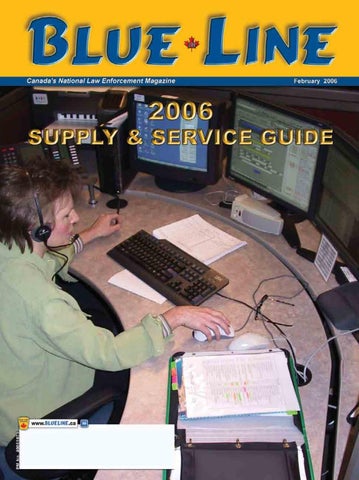
Ontario Provinical Police Dispatcher Lori Anderson is shown on this month’s cover managing her police sector out of the Orillia Communications Centre. One of the more problematic issues currently being dealt with is the high number of non-emergent calls being received on the 9-1-1 system. When the level of non-emergent 9-1-1 calls reached 90 per cent the OPP decided to act with a public awareness campaign that started with a media scrum last November. You can read more on page 10. February is our annual Supply and Service Guide. You can find most anything required by police and security agencies in the guide at the centre of this book. Each year Blue Line Magazine staff canvasses companies to determine their interest in serving the law enforcement sector. This directory is a result of that survey. February has become the most sought after and retained issue of the year. Two other themes have developed between the covers of this month’s edition. The first deals with media communications and the second deals with police human resources. Articles on media relations are presented by Jim Stanton, on page 72, Richard Perry, on page 38, and our own media columnist Mark Giles on page 14. The topics chosen by these writers emphasizes what a complex issue public affairs and media relations has become for policing. Opportunities for learning more is available in a two-day course presented by Jim Stanton at the Blue Line Trade Show this April. For registration information go to the Trade Show section at www.BlueLine.ca. Police human resources has quickly become the issue of the millenium. This month we present articles on page 6 and 8 from staff writer Ryan Seigmund and another perspective on the subject on page 22 by Karen Collins as well as page 56 by Charlotte Kratchmer. To round off the topic Danette Dooley wades in on the issue of staff diversity in Halifax on page 67. This issue, being one of the biggest editions of the year, is packed full of much, much more so start turning the pages. FEBRUARY 2006
Blue Line Magazine
4
FEBRUARY 2006
A judicial common sense revolution is needed by Morley Lymburner When it comes to jury trials exceptional times require exceptional changes in laws. In this day of intimidation and terror there should be zero risk of contaminating the court room. One manner in which such matters could be dealt with would be by eliminating jury trials under exceptional circumstances. In the case of mega-trials of terrorists or gang members there is no way a jury should be put under the amount of stress necessary to come to a verdict. These are ruthless criminals in charge of terrorist organizations who possess almost unlimited resources to seek revenge. In a vain attempt to prop up a weak system the courts and governments have gone to extreme measures to protect the jurors and the courts. In some instances even to the extent of building entire high security court houses at a price tag into the millions. It is time new laws were introduced that strip away jury trials under certain circumstances. Cases in which jurors could be exposed to a high level of danger or even anxiety would include biker trials and those accused of terrorist acts. By example there are no greater terrorists in contemporary society than outlaw motorcycle gangs. Their entire existence relies heavily on intimidation of average citizens and authority figures alike. Two dead federal corrections officers near Montreal along with skyrocketing shooting deaths in Toronto clearly attest to this. At a preliminary hearing the Crown should be permitted to make application to have the trial by judge or judges alone. The Italian justice system found that it is far easier to protect one judge for the rest of his life than hundreds of average citizens from which a jury is drawn. As one study out of Simon Fraser University attests it is also easier to get psychological help for one judge rather than hundreds of jurors. You can read more on this issue in The Back of the Book column in this issue. For years the need for jury trials has been brought into question. In the year 1215, when the Magna Carta granted trial by jury, it was an age when almost everyone spent their entire life in one village. It made the jury trial process manageable. Almost every person knew everyone else and knew how their friends and families could be accommodated within that community. Today’s society is much more complex than the era in which the jury trial process was first created. We are much more mobile, far more communicative and, of course, far deadlier than at any time in history. How can we expect to be assured that jury trials are free from intimidation? Organized terror groups thrive on intimidation with headlines to help back up the threat of reprisals for those who would try to stop or even interfere with their activities. A big part of the Hells Angels success is the ruthless business of “taking care of business.” This means an intention to never let anyone get away with impeding their activity. If even one is left igBlue Line Magazine
nored or unpunished then their business fails. In such matters, and if left unchecked, every citizen in this country is simply a pawn that lives or dies at their whim. Society can not tolerate this attitude nor permit an environment that supports it. When dealing with individual criminals, jury trials can still work. But not so for organized crime groups. The organizations that come part and parcel with some individual criminals is far more problematic than the pawns they sacrifice. It is the organization that is the square root of all fears. Long after an individual is
5
squeezed between the pipes their organizations can busy itself “taking care of business” to ensure any one of the twelve jurors are gotten to as an example for the rest of society. If they don’t hesitate to kill correctional officers I am sure they won’t hesitate to intimidated a stock broker, store merchant or homemaker. Society can no longer afford the luxury of juries in terrorist or trauma trial situations. It is time to re-think the entire process and get back to basics. It is time we really thought about how much we are willing to sacrifice to prop up an almost 800 year tradition.
FEBRUARY 2006
by Ryan Siegmund With police services across Canada looking to hire more officers, recruiters say qualified individuals can sometimes have their pick of where they’d like to work. RCMP Cpl. Grant Learned, of E- Division, says he can’t remember a time when “there’s been such a great opportunity for someone interested in law enforcement to be able to frankly, choose the location where they want to go, whereas before, people would just be happy to get a job with a credible and reputable police department.” There has never been so much competition to attract the best candidates, Learned says. “I have heard these anecdotal stories of people contacted by one department, after being accepted by another, and saying, ‘look, we will take you sooner’ – anything to get that same body in there. I have heard the same type of story emerging from the greater Toronto area, where one police department will hire an individual and provide them with all of the training and then, upon completion of the training, they’d be poached by a competing police agency in another town or region. This happens simply because the geography is more suitable for the candidate. It’s that type of competition that most law enforcement agencies have not seen before.” Every department is looking for the same type of individual, he says; someone with strong character, reliable, reputable, physically sound, educated, emotionally stable and no criminal record. With more senior officers retiring every year, the demand for new recruits is building. “I recall back in about 2000, when I was at RCMP headquarters in Vancouver and functioning as the communications officer, it was brought to my attention that about 30 per cent of the officers in this division had obtained pensionable service,” Learned says. “(That means) technically, if all these individuals at the same moment put in their retirement notice, we’d have close to 30 per cent of the police force in this division unavailable on short notice... fortunately a number of people have stayed on.” Learned credits higher salaries for helping persuade officers not to jump to the private sector, which many did in years past. Blue Line Magazine
Friendly rivalries Edmonton’s population grows every year but the size of its police service stays the same. While it’s currently over-strengthed, recruiting head Sgt. Sharon Bach says the department is working hard to hire and train as many officers as possible before the need hits. About a third of Edmonton Police Service (EPS) members are eligible to retire between now and 2007, she notes, and additional officers will be needed as new specialty units are established. The national demand for officers exceeds the number of applications services are receiving, she notes. “A lot of us are competing for the same applicants and for us, the biggest competitors are Calgary and the RCMP,” she says. “These people get out of their post secondary education and submit an application to each of them; sometimes it’s a real competition for us to get these people processed and offer them employment because they know what they want to do, it’s just a matter of where.” Bach says she hasn’t seen competition like this in her 21 years of experience, noting EPS has struggled somewhat to attract applicants, restructuring its advertising campaign and widening its search area. The recruiting unit is meeting its application goals, she says, but working extremely hard to do so, even though Edmonton offers at least one advantage over some rival departments. “The minute you walk through our door, we start paying you,” explains Bach. “We pay for your training and there is no cost to the applicant.” That can be a mixed blessing though. Bach admits that officers will occasionally sign on to get their training, only to move on after they graduate. “I guess it’s a natural tendency that people move back to where they are comfortable, get some experience and move on,” she says. “It is getting more common that people are rellocating and moving to different locations.” Pension plans have played a large role in the moves, says Bach, adding policing has lost some of its appeal because of factors such as shift work, increased violence and health issues. “Officers getting pricked by needles or spat in the face by people that have HIV – those kind of health issues not only put you in dan6
ger but also your family. I think people are taking a bigger look at that and are asking themselves if that is something they can handle or want to be a part of.” Meanwhile in Ontario, many agencies in 2005 were strapped with similar issues in hiring new recuits. Police chiefs were indicating services were being handcuffed from hiring new people because they were awaiting details regarding the province’s plan to help cover the cost of new officer salaries. Recruiting methodology A flurry of retirements two years ago created a hole at the Vancouver Police Department (VPD) but that has now been filled, says Sgt. Steve Rai of the recruiting unit, who adds the department is now ahead of the game. Vancouver is an attractive place to work and Rai says only four people left last year. The department receives applications regularly from recruits and experienced officers alike. “We are getting the most we have ever had in our recent history from exempt officers from other departments... a lot from Ontario and a lot from the RCMP,” says Rai. “In the last ten months, we have hired 22 exempt officers and that is a huge number for us.” Vancouver’s ammenities – reputation, beautiful city, diverse, great place to live – offsets its high housing costs, he notes. “Guys will live out in Abbotsford to work in Vancouver, which is an hour’s drive... maybe they have moved from Calgary, where a $250 thousand dollar house is really nice, whereas out here $250 (thousand) won’t buy you a condo, yet they are moving. It’s lifestyle really, they are attracted to that.” However, Rai still has to entice people to get into policing. A VPD internal survey indicated the biggest factor in convincing people to apply was positive interaction with officers. “We are finding the biggest seller for us isn’t advertising or going out to colleges and beating a drum... 70 per cent of our internal employees came into policing because of personal contacts with officers, either friends that got hired or citizen police contact. That was the biggest factor in people applying – police contact. Advertising was actually the lowest score on the survey. The ones we were hiring FEBRUARY 2006
still wanted to be police officers in their minds before they saw an ad, however the advertising maybe kept our profile up.” Conversely, negative interaction with officers and unprofessional conduct hurts the profession, he says. Rai says the VPD generally get first dibs over its provincial rivals. “In Alberta, you’ll see the Mounties are popular, but out here, Mounties are second choice.” Having too many qualified applicants has become an issue but recruiters need to hire a good mix of people and plan for future needs, Rai notes. Having a waiting list ensures that less desirable jobs can be filled, he says, since recruits have marked preferences. “Most of them want high profile jobs like the dog squad or emergency response teams, and more want to get into investigations. When I started, it was the action packed jobs, but now they are more interested in the more mental roles that usually a more senior officer would do. More of them also want to have an influence with teens and youth.” VPD has implemented a ten-year plan which includes mandatory rotations to give officers some variety and maintain retention rates. Recruits’ views Don’t count on being able to choose where you’ll work, one RCMP recruit warns, hinting that only seven people in one Depot troop are completely happy with where they are going. Even though there were positions open in the recruit’s desired region, the RCMP is adamant about filling its most pressing needs first, the person says. “I know where I am headed but I do not see myself there... I don’t really understand the staffing process and I am angry with it. Yes, I understand the force has needs but I think they need to spend more time putting a square peg in a square hole and not a round peg in a square hole, just because it fills a spot.” Heading to another region was a tough pill to swallow, especially since it means being away from family, though the recruit admits that “(when) I signed on the dotted line, I said I would go anywhere in Canada – and I will... Even if openings come up, you have already been staffed and you are not eligible for those positions. Once they put a position number to you and assign you to a division – it’s a done deal.” The recruit foresees working in the assigned division for the next five to seven years, but not by choice. Another recruit decided to join the RCMP after talking to a Mountie, explaining that the force’s reputation, status, red serge and musical ride made the force an attractive choice. Another attraction was the chance to work anywhere in Canada. “My hope was to not go back to the province I came from... unfortunately, I was posted back to (my home province).” The recruit is making the best of the situation by opting for a part of the province they are not so familiar with. Blue Line Magazine
Changes needed to retain Gen X officers Ways to attract and retain Gen X officers dominated a report York Regional Police (YRP) Chief Armand La Barge presented to the York Police Services Board last October. Research shows a number of police forces are having higher than normal numbers of officers leaving within the first five years of their careers, La Barge said, citing his own organization’s figures, which indicate 34 per cent of all YRP officers leaving in the last five years had less than 36 months service. Applicants to YRP were asked during the interview process what had attracted them to apply. The top three answers were, according to La Barge: • I like the values of the organization • I see that there is great opportunity for advancement • I’ve heard it is a professional place to work These strengths reflected what the force was building toward and the values its training and education bureau were striving to reinforce, he noted. YRP will be hiring 201 new officers in the next three years to keep ahead of calls for service, La Barge said, and expects to lose, during the same time frame, 103 officers eligible to retire. A two per cent attrition rate is expected to continue. In all likelihood, it will be representatives from the GenX cohort that fill these positions. Le Barge pointed out studies which indicate Gen X recruit expectations include timely positive feedback, commitment to professional development, a need to learn rapidly and be a member of a team and a preference toward flexible working arrangements. The agency is responding by changing its professional development process, staff training, performance appraisal and development plan. To address the need to learn rapidly, YRP has enhanced its decentralized training, allowing continuous training in short, repetitive bursts. “Anywhere” can be a teaching and learning environment, La Barge said, and
7
numerous training opportunities are being provided to members away from training and education facilities. Recognizing that today’s recruit has a need to be a problem solver and very familiar with technology, YRP has incorporated adult learning concepts that ensures officers work in group settings and experience several variations of instructional techniques. The primary learning theme is that of problem solving and officers are empowered to take charge of a problem and work towards positive resolutions. York Regional Police has also embarked on an elearning program by partnering with the Canadian Police Knowledge Network, a not-for-profit organization currently providing police forces with programs specifically related to policing issues. A successful partnership provides members with the opportunity to take advantage of online learning, a process with which they are likely to be familiar and comfortable. YRP has set a goal of providing career opportunities early in an officer’s career, La Barge said. Through secondments of 30 and 90 days and six months in duration at specialized units, officers can sample various disciplines within the organization. Most frontline officers are not expected to remain at the first class rank for long so the force is adjusting the pre-requisite qualifications needed to get into the professional development process to reflect the current member demographic. La Barge was confident the current and proposed changes would make the work environment friendlier to Gen X officers and encourage them to start and finish their career with the same police agency. York Regional Police has an average sworn officer attrition of about 3.1 per cent per year and lost eight per cent of new officers between 2000 and 2005, according to La Barge’s report.
FEBRUARY 2006
by Ryan Siegmund Policing faces a score of human resource (HR) issues in the coming years, challenges leaders say can best be faced by working together. The Police Sector Council (PSC), a new national initiative, aims to find solutions to common challenges and improve service delivery. The 30 member council brings together influential leaders from all policing sectors, including services and service boards, unions, senior management, training institutes and all three levels of government. Having people like RCMP Commissioner Giuliano Zaccardelli, Wendy Fedec of the Association of Police Boards and representation from the Canadian Police Professional Association and CACP will ensure best practices are shared, says co-chair and OPP Commissioner Gwen Boniface. Boniface says the council is the most integrated group assembled to deal strictly with HR issues she’s seen in her 28 years of policing. It works towards solutions appropriate for the entire sector instead of just one jurisdiction, she points out, adding many independent bodies, including the CACP, have already done a lot of work on HR issues, just not in this manner. “The work will now be integrated in a way that allows everybody, no matter how small or large, to benefit from the research and some of the ongoing work we will do,” says Boniface. “The council is really people who are in decision making positions in a policing environment. It’s a great opportunity to understand the issues and to collectively attempt to look at ways of moving forward in the future.” Recruiting units should stay attuned to what is going on with the PSC, advises Boniface, noting it will take collaboration from
Blue Line Magazine
everyone to tap into the best way of doing things. She suggests the award winning OPP Bound program, for example, could serve as a model for agencies striving to hire applicants from diverse communities. Fellow PSC co-chair Dale Kinnear, Director of Labour Services for the Canadian Professional Police Association, says police HR issues have never been examined on this level. He sees the initiative as a “one-stop shop” that will offer all Canadian police services opportunities for improvement. “To improve HR operations is to ultimately improve the delivery of service,” Kinnear says. “Over time it should save time, effort and money. People will be able to draw upon this if they are looking for HR solutions, policies or best practices.” While there are some 30 Canadian sector councils dealing with work force and labour market problems, PSC is the first to focus on the public sector. A federal study, with help from police leaders, came up with areas the PSC would need to work on. “The study identified things like recruiting the next generation of police officers because of the number of people that are going to be retiring over the next ten years or so,” says Kinnear. “It also centred around issues regarding retention, the capacity of the different training institutions to be able to train them and hiring a diverse mix of candidates.” Officially launched in September 2005, PSC operates as a board of directors. An office and staff, hired under the guidance of the board, is paid for by Human Resources and Skills Development Canada (HRSDC). “The staff goes about conducting necessary work to act on those recommendations,” says Kinnear. “For example, recruiting – it could be in the form of a national generic recruiting campaign to get high school or college kids interested in considering a career in policing. Recruiting was identified as the first priority in the study because it was the one that was going to bite us on the ass first due to the number of coming retirements.” Other critical human resource issues include: • a rapid decrease in the number and quality of applicants with the skills and abilities to meet future demands; • aggressive youth marketing from other sectors attract good candidates; • police services not reflecting the increasingly culturally diverse communities they serve; • an aging population has created executive vacancies at rates rarely seen; • a shortage of training and leadership devel8
opment opportunities for the next generation of senior police leaders. An Ipsos-Reid Survey of 2000 Canadian youth found a policing career is not even on their radar, notes PSC Executive Director Geoff Gruson. “Kids these days would rather take on a skilled trade than work for the public service, so that indicates that we have some work ahead of us in terms of getting kids turned on to policing,” Gruson says, adding the sector faces vulnerability five or ten years down the road. Gruson says the council needs to do more research and then follow up with analysis and recommendations so police can take a broader look at HR issues. It has obtained money to do a comprehensive assessment of police recruiting and labour market dynamics and will consider launching a national marketing campaign by the fall. The PSC will also look at competencies, Gruson says. “Are we recruiting and training to those? Are we developing skills and learning strategies against those competencies? Are we giving Canadians what they need in terms of the basic skills cops need to get the job done?... “The sooner we can provide that information to the police services across the country, the sooner they start recognizing there is a value to having a council.” Having senior police leaders on the council will make it easier to share ideas and come up with a marketing campaign that reflects common priorities, Kinnear says. “Boniface is there from the OPP, so that gives us access to what it is they are up to; same with Zaccardelli and the RCMP,” Kinnear says. “There is still some independent activity going on by these organizations, because they have to be recruiting right now. “We have to get people thinking as a sector because if you run some kind of an ad or a communications piece, for example in say BC or the Maritimes and it attracts a person into joining the Mounties or the local police – the sector benefits, right? This is to get people thinking as an employment sector as opposed to department to department.” The sector council will also be a hub for HR information and policies. “This is not some short term outfit,” he notes. “I predict this council will be around for a long time because there will always be issues in human resources.” For more information, contact Geoff Gruson at ggruson@policecouncil.ca or 613 729-2789, Gwen Boniface at gwen.boniface@jus.gov.on.ca or Dale Kinnear at dkinnear@cppa-acpp.ca .
FEBRUARY 2006
Blue Line Magazine
9
FEBRUARY 2006
by Ryan Siegmund The changing nature of 9-1-1 calls fielded by Ontario Provincial Police dispatchers is rearing its ugly head, prompting the agency to explore measures to streamline legitimate emergencies. Last December, the OPP invited the media to tour any of their communication centres across the province, in hopes they could help parlay the message and remind people of the true intention of 9-1-1 calls – that being for emergencies only. OPP Inspector Frank Grimaldi plays a direct role co-ordinating efforts through the OPP Corporate Communications Bureau at headquarters in Orillia. Over time 9-1-1 has become a number of convenience rather than a call for emergency services, he says. With all calls treated as emergencies until proven otherwise, he says it is common for two officers to be dispatched to each 9-1-1 call. Given the upward trend of misuse, province-wide concerns are spreading regarding resource efficiencies “The largest concern we have is that during high volume periods, real 9-1-1 calls for service may have a delayed response because call takers must answer 9-1-1 calls in the order they are received,” says Grimaldi. “This may result in serious injury or death to people that are calling 9-1-1 with actual emergencies.” The OPP is the 9-1-1 default agency handling calls in which the required emergency service cannot be immediately determined – a contributing factor for high call volume periods. Currently, the OPP, Corrections, Ministry of Health Land Ambulance Services, the Ministry of Natural Resources and Ontario’s Ministry of Transportation are the partnered minBlue Line Magazine
istries sharing the common radio network. With a plan to stop responding to some 91-1 calls believed to be false, determining actual emergencies has been an area of focus for the OPP. On occasion, Grimaldi says this is difficult to determine, based on a variety of parametres or responses received. “All call takers are trained to ask a series of questions to effectively and as efficiently as possible, solicit from the caller the nature of their emergency ... the OPP has drafted a procedure to assist with these types of calls.” “In general terms, it states that once a call taker has been told by the caller the call is not an emergency and the call taker is satisfied the call is not emergent in nature, the caller may be asked to call back. In any situation where the call taker believes an emergency situation may exist, an appropriate response shall be initiated. When in doubt, a 9-1-1 call is treated as authentic.” In 2005, the OPP conducted an assessment of their Provincial Communications Centres to discern the amount of rendered calls not emergent in nature and or mischievous. An assessment of the Provincial Call Centre (PCC) in Smith Falls indicated the severity of the problem. They randomly selected a four week period in 2005 and discovered approximately 90 per cent of 9-1-1 calls received were not emergencies. A number of the calls were 10
classified as nuisance calls; for example those who dial 9-1-1 from a public phone and hang up. Random samplings from the various PPC’s has rendered the same results, Grimaldi says. The agency is currently exploring other options to properly manage and screen 9-1-1 calls, including implementing an easier to remember non-emergent OPP number. The OPP does have a province-wide call number for service numbers as well as one for the hearing impaired. Alas, they are not numbers easily remembered. A non-emergent number such as the city of Calgary’s 3-1-1 municipal phone service may have extreme benefits, only if the OPP did not have to deal with multi-jurisdictional issues and municipalities, says Grimaldi. “In order for the 3-1-1 service to work for the OPP, all municipalities province-wide would have to agree to implementing it, dedicating resources to maintain the databases and agree to standard protocols.” Grimaldi says the 3-1-1 option appears to have some terrific advantages, including; an easy number to remember for the calling public and a method to deal with non-emergent police service type calls. From an OPP mandated perspective, however, Grimaldi says it may only work if a provincial standard was mandated for all municipalities, including an equitable costing formula as well as a common administrative and data management process. The OPP is also exploring additional public information/education sessions, dependent upon their success or lack thereof in introducing a new and easier to remember number for service, says Grimaldi. Regardless of the outcome, he says the agency will look at using various media information sharing venues to further educate the public in the proper utilization of 9-1-1 and their toll free numbers. Insp. Frank Grimaldi; Frank.Grimaldi@jus.gov.on.ca or (705) 329-7611 @ OPP headquarters
FEBRUARY 2006
Blue Line Magazine
11
FEBRUARY 2006
Going beyond defensive tactics and self-defence by Troy Ostapiw Self-defence and personal safety are important components of police work. It’s what keeps officers safe and prevents us, suspects and the public from being hurt. Police training programs in North America vary in many ways but are, for the most part, very similar. The 70 to 100 hours of training cadets acquire in defensive tactics or arrest and control, work well for a basic self-defence requirement but many officers recognize it is hardly enough within a 25 year career. Most departments also offer yearly basic re-certifications in defensive tactics and selfdefence, but it is a well known fact that two to eight hours of training per year is clearly not enough to stay sharp in the field. Some choose to become self-defence instructors, which entitles them to advanced courses and, in turn, allows them to do their job more effectively, increases their confidence and gives a better understanding of officer safety and human aggression. Unfortunately, not every officer can get involved in this, as there are only so many positions offered. Some departments offer their officers incentives to train at civilian martial arts schools while others pay for related courses on selfdefence conducted by other police agencies. Other officers choose to pay for training out of their own pocket because they understand the importance of developing these skills. Advanced martial arts training boosts confidence, fitness, focus, co-ordination and mental preparation, allowing officers to relax in highrisk environments. They learn to explore strengths and develop weaker points, which better prepares them to deal with conflict or interpersonal aggression in a working environment. It is important to understand that all police self-defence has its origins in martial arts. Most academy defensive tactics programs have been extracted from various martial styles and most of the concepts and techniques are then modified to fit officer training and use of force models in a particular department. Concepts vary but the primary focus is on officer safety, distance, tactical communication, empty hand locks and controls, basic striking and ground
Blue Line Magazine
defence. The programs also integrate threat assessment – which teaches officers to recognize various threats while using the appropriate tool for the situation – police presence, empty hand responses (hard or soft) and intermediate weapons (pepper spray, baton) all the way up to lethal force (firearms, tool deployment and empty hand tactics). FBI statistics show as many as 85 per cent of police arrests are empty handed so it’s important for officers to be proficient with empty hand controls and defensive tactics. Traditional Ju-Jitsu, Aikido and Chi Na These arts are very similar and offer good empty hand control tactics based on locking principals. The focus is on stand up grappling, takedowns, throws and some ground grappling, which allow officers to develop a better understanding of control and restraint techniques, explore how to safely lock an individual’s limbs and develop an indepth understanding of functional locking principles. This knowledge will go beyond the basic police college refresher course. Many of the locks and controls used by police departments are very similar; keep in mind the joints can only be manipulated so many ways. Consistent training in these stand-up grappling arts can prevent injuries to suspects and reduce civil liability. The officer develops a good level of sensitivity and the ability to lock a person up safely without using excessive force and the confidence to control a suspect’s movement. Confidence in your locking abilities reduces the chance you will overreact, which can result in breaking a suspect’s arm or wrist. Locking techniques benefit police because they allow an officer to control a suspect and prevent a situation from escalating. Arnis, Kali and Escrema These arts are Filipino based and all concepts relate to empty hand, baton and knives and can be used with a flashlight or unexpanded baton. They will help officers develop very fast hands and a solid foundation in close quarter defence.
12
A lot of the training focuses on baton or baston, helping to develop very accurate strikes with an expandable baton using basic body mechanics that allow an officer to develop maximum power. The Filipino arts are very well known for edged weapons fighting and defence. The idea is that in order to respond to a knife, stick or macheté in a close quarter situation, you must first learn how to use the tool. This concept enables a practioner to develop lightning fast reflexes, a strong grip and the most direct approach. Many officers believe they can simply draw their firearm if attacked by a suspect with a weapon. Unfortunately, the problem is more complex. Drawing on a motivated criminal attacking unexpectedly with a knife at close range without first deflecting the threat can be lethal, as dropping your hands will leave vital arteries exposed. Many of the world’s top law-enforcement agencies and military units use the Filipino arts because of their simplicity and effectiveness. They offer a fair amount of close quarter, empty hand defence, allowing an officer to fend off spontaneous assaults by suspects attempting to set them up. Many of the strikes focus on open palms and integrate strikes with the elbows and knees to nerve centres. Jeet Kune Do This martial art is more of a concept; the idea is to extract principles from many of the world’s top martial arts systems, allowing a person with prior knowledge to integrate the skills they have already learned. A student will explore various methods in all ranges of self-protection and is free to pick and chose techniques and concepts that work well for their body, based on their strengths, weaknesses and body style. They can explore various martial arts and are exposed to many methods of self-protection. All ranges of self-defence are covered – punching, kicking, close quarter, stand up, ground grappling and defence against common weapons – and techniques integrate well into police defence training. The idea is to allow the student to develop their own style. A practioner in this system can be considered a jack-of-all-trades and only applies concepts that work in a combative environment; students are free to discard concepts they feel do not work well. JKD has discarded tradition and only looks at what is functional, simple, effective and scientific. It is one of the best, well-rounded self-defence programs. Instructors have taught police, military and corrections personnel worldwide and many offer specialized, fieldtested law-enforcement training programs.
FEBRUARY 2006
Brazilian Jiu-jitsu and Submission Grappling BJJ/SG is world renowned for ground grappling and controls. These concepts are excellent for police and offer a solid foundation for self-defence on the ground. That’s the last place a cop wants to be but if you end up there, you better know what to do. Students are taught basic positional control, how to maintain a dominant position while keeping balance on the ground, techniques for getting out of a bad position when you’re down and how to get back on your feet. Various submissions are explored on the ground, which are useful for officers, allowing the ability to take the suspect into a safe, controlled cuffing position, using locks and control on the ground or standing up. Keep your jiu-jitsu and grappling focus on self-defence rather than sport concepts. The Gracie family also offers a ground-fighting program specifically for police officers, which is modified BJJ and allows an officer to conduct the techniques while wearing duty gear. It focuses on firearm and tool retention and is taught only to police and military personnel. There are also various SG schools that offer specific programs for police and security personnel.
with resisting subjects and spontaneous assaults. Martial arts and police tactics are one and the same; both have evolved and are today based on scientific principles, mental preparation and good sound tactics that work. Advanced martial arts and self-protection training is an investment in our personal safety. We owe it to ourselves, fellow officers and our families to come home safely after every shift. Injuries on the job, which can cause financial and emotional stress, can be prevented if you take the initiative to expand your knowledge of self-defence. The world of policing is unpredictable, therefore preparation and training are paramount. It is important to stay sharp. Reacting with the appropriate force means training our muscle memory skills. Participating in a self-
defence program just once a week, outside of regular police work, can make the difference between reacting to a situation and not responding when push comes to shove – and not responding at the appropriate time puts us, fellow officers and the public at risk. Advanced training in the above martial arts will give you the confidence you need to respond quickly when verbal communication fails. A Regina police officer with 22 years of martial arts experience and more than a decade of teaching experience, Troy Ostapiw was hired by the RCMP police defensive tactics unit to teach at Depot when he was just 23 years old. He has also worked for the Department of National Defence and Saskatchewan Justice and as a deputy sheriff, corrections officer and tactical member of CERT.
Muay Thai Kickboxing Although considered a sport, Muay Thai(MT) kickboxing offers an excellent stand up striking game which teaches how to strike fast and hard with hands, elbows, knees and feet. Students learn how to properly develop simple but effective punching and kicking power while increasing close quarter striking tools. MT, which is also known as “the science of eight limbs,” teaches a solid foundation for stand up striking and some close quarter grappling and control work. Students learn how to develop the proper mechanics needed to develop effective speed and power when striking. MT also focuses on close quarter evasion and striking with the knees and elbows and is great for conditioning the body for combat/self-defence. You can also develop incredible cardio and tough skin, giving a practioner a solid stand up game. What to do next In essence, any type of training above and beyond a police officer’s basic defensive tactics program will be beneficial but some martial arts programs are more simplistic while others address reality based tactics that have a history of effectiveness. The above programs are more geared to addressing situations a police officer may encounter while on duty. These arts cross over into various defensive tactics programs. Many of the techniques taught at academies have been extracted from the above arts. Advanced training in them provides a solid foundation and better prepares an officer to deal Blue Line Magazine
13
FEBRUARY 2006
Taking the heat: dealing with miscommunication by Mark Giles Whether policy or a life and death matter, police agencies and other organizations must often contend with difficult issues. Dealing with bad news or controversy is a challenge at the best of times, but poor or miscommunication can make a bad situation worse. Paul Martin’s director of communications felt the heat after suggesting the Conservative Party’s child-care proposal would simply provide Canadians money for beer and popcorn. International Coal Group (ICG) managers felt it when the families of 13 miners trapped in the Sago Mine in West Virginia were first advised they were all alive, then told three hours later that all but one had died. The Department of National Defence (DND) definitely felt the heat during the mid-1990’s when it failed to explain the death of a young man in custody in Somalia, slowly allowing the truth to trickle out through the media and various inquiries. “Mistakes do happen – even with wellprepared, professional police and law enforcement organizations,” said Annette Bidniak, communications director for Alberta Solicitor General and Public Safety. “How an agency handles the mistake, however, can make a significant difference in the final outcome and public perception.”
Blue Line Magazine
after the error can have a major impact on an organization’s future reputation. Although each situation needs to be assessed individually, a good communications strategy for dealing with errors will usually include openness and honesty, efforts to correct misinformation, and the smooth addition of mitigating or positive factors.
It is vital that police agencies be prepared to handle mistakes effectively. The first step is to recognize the error and take appropriate measures to deal with its implications. Next, communicate the mistake and actions being taken to correct it to those who need to know. This becomes an urgent matter when public safety is involved. In cases where the initial safety threat is over, the emotional well being of families and friends is still a high priority. Even with nonemergency situations, how an issue is managed
14
Admitting mistakes early It usually pays to admit an error as soon as possible. Doing so may mean taking more heat initially, but will minimize the overall impact to your agency, and immediately start the process of maintaining or restoring trust and credibility. Although there are exceptions to every rule – such as releasing information that might jeopardize ongoing operations, waiting usually causes more problems in the long run. Even with ongoing operations or when information is sketchy, a statement can be released noting the matter is of concern, under review and taken seriously by the agency. A time when further information will be released should also be included. With public safety or other high-intensity issues, delaying until all the facts are available is generally a poor option. ICG’s external communications for the first 41 hours after the explosion seemed to go well – with frequent, regular and realistic updates provided to media and the families. Once the miners were found, however, inaccurate information – that 12 of 13 miners were alive – leaked to the families and media. ICG management waited almost three hours before confirming the deaths, while families celebrated at the local church, despite knowing 30 minutes later they had conflicting information. If they had acted earlier they could have prevented this unwarranted jubilation and better managed expectations. “What would I have done differently? I would have personally gone to the church when we got the conflicting information,” said Ben Hatfield, ICG president. Fear of negative media coverage or public perception sometimes causes organizations to delay or avoid releasing negative information, but the price – in lost trust and credibility – is usually far higher than if it is released up front. DND paid a huge price in trust and credibility by not coming clean early with the Somalia death. The scandal – and the heat – would have probably lasted weeks or a few months, rather than years, had they announced the entire truth immediately. Sometimes errors aren’t admitted for fear of legal action. Although saying nothing may satisfy some legal practitioners, it’s not likely to please the court of public opinion, which ultimately impacts most other proceedings. Although the coal mine misinformation doesn’t appear to have been intentional, some perceived it to be, which generated considerable anger and talk of lawsuits. Ironically, a lack of FEBRUARY 2006
good communication in this case may be a factor in future legal action. Admitting mistakes does not mean an agency has to accept the entire blame for everything that went wrong, but accepting responsibility acknowledges that things went wrong in the process, employees made mistakes, and that senior management is taking a leadership role in fixing the problem. Correcting misinformation – proactive and reactive strategies After admitting mistakes, an organization doesn’t need to dwell on the errors, but can move on to more positive, proactive communications. In most cases, it pays to explain the circumstances, blending in mitigating information, and then move on in a proactive fashion to communicate the positive actions being taken to deal with the problem and prevent reoccurrence. “Engaging the media after a mistake is often a good strategy,” said Susan Greer, communications officer for the City of Saint John, N.B. “Otherwise the public just remembers the last thing you said – and the inaccurate information.” ICG made extensive efforts to put things right – finally informing the families of the situation in a face-to-face meeting, followed by a news conference, television interviews and statements posted to the website. The company chairman appeared later on CNN’s Paula Zahn Now to express condolences, acknowledge the communications error, highlight the efforts of the rescue teams, and generally discuss what ICG planned to do to help the families and deal with safety issues at the mine. Public and media relations are as much an art as a science, however, and some choose the opposite strategy – being reactive or even silent. Martin’s communications director, Scott Reid, is a polished, professional spokesperson, adept at handling the media at the national level. One slip of the tongue, however, and he found himself in trouble. After quickly apologizing for his now infamous ‘beer and popcorn’ line, he completely disengaged – declining all requests for follow-up interviews or comment. Although the story faded quickly in this case, this strategy is risky as it leaves others, including the media and stakeholder groups, to fill in the gaps and use other sources for unanswered questions. Although the issue was overcome by other events at the time, it may come back to haunt him later when he resumes contact with the media. By engaging, Reid would have had the opportunity to put his comments in context, blend in what he really should have said, add emphasis to the positive aspects of his party’s policy and, most importantly, put the issue behind him.
formation into their comments. Hatfield said that the company did the best it could under extreme stress and exhaustion, and that officials “sincerely regret” families were left to believe for so long that their loved ones were alive – communicating concern and condolences with key messages related to company efforts under difficult circumstances. “In the process of being cautious, we allowed the jubilation to go on longer than it should have,” said Hatfield. When the public or a specific audience perceives a problem, there is a problem. If it is simply perception, then an agency needs to quickly communicate the facts to narrow the perception-reality gap. Actual errors can be admitted, fixed and properly communicated, but sometimes that still leaves one more stage – taking the heat and riding out the storm. It’s similar to receiving good medical treatment after an accident – once the doctors have done everything possible, the rest of the healing is a matter of ongoing care and time. Mistakes are part of life – we can’t escape them, but the public needs to know that you care about getting it right. Making a mistake may mean taking some heat, but admitting it and taking positive steps to deal with the emotions, facts and other realities of the situation minimizes the likelihood that it will impact your agency’s reputation in the long term. Mark Giles is Blue Line Magazine’s correspondent for the National Capital Region, public and media relations and military-related issues.
Communicate mitigating information After the tragic miscommunication at the Sago Mine, ICG executives took significant steps to explain the efforts made to rescue the miners and release accurate information. Although they appeared somewhat defensive at times during the news conference, they also acknowledged errors, expressed appropriate condolences, and blended some mitigating inBlue Line Magazine
15
FEBRUARY 2006
Paramedics don body armour Waiting for police not always an option The escalating risk paramedics face when responding to calls involving violence is increasingly convincing Emergency Medical Services (EMS) managers to begin issuing body armour. Edmonton and Saskatoon recently joined Calgary EMS in adapting this pro-active approach, intended to protect staff who encounter violence or are involved in vehicle collisions. Some Canadian EMS practitioners have used their own money to buy protective vests, which have yet to become standard equipment in many jurisdictions. Body armour is generally issued only to specialty tactical paramedic units in most Canadian jurisdictions. All field operations staff with Calgary EMS are supplied with vests, however, like Edmonton, the decision to wear them is left up to the individual. Not so in Saskatoon, which has made wearing the soft armour mandatory. Given his job responsibilities on the tactical EMS (TEMS) team, MD Ambulance Operations Director Gerry Schriemer knows the importance of having protection. Paramedics called to a known or potentially violent situation are instructed to stage back and wait for police to clear the scene before carrying out their duties, he notes, but occasionally that is not possible. “I think one of the problems we incurred, to no fault of anybody, is we were getting to a lot of calls before police were,” says Schriemer. “Sometimes police are tied up or they receive a call and ask us to check out say, a man who is unconscious... they’ll tell ask us to let them know if they are needed.” Furthermore, Schriemer says there have been situations where weapons were found on
Blue Line Magazine
Photo: The StarPhoenix and Gord Waldner
by Ryan Siegmund
Troy Davies, a paramedic with MD Ambulance in Saskatoon shows off his new armour.
patients who are already in the ambulance or even the emergency room. “Respect for anybody in a uniform just isn’t there anymore,” he says, noting his staff are assaulted an average of once or twice a week. The trend of violence first began attracting attention four years ago when EMS management began keeping records and reviewing the number of violent situations staff were running into. Examining local police statistics gave an overall sense of the type of criminal activities occurring in the community and, after reviewing policies and protocols, they decided to look at preventable measures and other means of protecting staff. All Saskatoon paramedics were supplied with and ordered to wear body armour at all times in December. Knives are the weapon of choice in Saskatoon, Schriemer says, so titanium plates were bought to use in the front and back. The vests are Level 2A, which protect against most common hand guns, which is important because guns have never been so prevalent in the city, he says. The escalating violence can be attributed to individuals with substance abuse problems,
16
says Schriemer, adding paramedics are very rarely assaulted by a sober person. The paranoia associated with meth addicts can often lead to increased risks also, he notes. “The move to get protective vests was a necessity,” he says. “It is something we wanted to be pro-active upon, rather than wait until somebody got injured.” A similar story unfolded in Edmonton, a city also concerned with the safety of its paramedics. Edmonton’s EMS Branch developed a joint management and union health and support service committee (HSCC) in 1997 to deal with the health and safety concerns of staff. Members were strongly in favour of being equipped with ballistic or slash resistant body armour. Most paramedics who filled out a voluntary survey in 2004 said they had been threatened and about 66 per cent said they had been physically assaulted. While there was no specific incident that triggered the new policy, Saskatoon Emergency Medical Technician Jason Henderson points to the escalating level of violence. “It’s going from what was previously assaults with fists and bats to knives and guns,” says Henderson, who did most of the paperwork in getting the vest initiative off the ground. “Implementing vests wasn’t a knee jerk reaction or having extra money in the budget – a lot of research and investigation went into this, and I think that is why other services are now looking at it.” Wearing the vests is optional for Edmonton EMS. Eight per cent of the staff who requested them are equipped today, with the rest to be issued by spring. The majority with vests wear them all the time, says Edmonton tactical paramedic team leader Rob Main, even though they’re still getting used to them. “During our report, we actually had some officers from our Edmonton police officer safety unit come and share their past experiences with the vests and, through that, we came up with our recommendations,” says Main. “Being with TEMS, I have been wearing a vest prior to Edmonton issuing them, however, not for the purpose of weapons – but for, like, a 68 year-old male who has dementia. Once we were putting this man onto a stretcher and he kicked me right in the chest, but the body armour diffused the blow and I didn’t feel much of it. Otherwise he could have probably broken my ribs.” The vests are primarily for those unforeseen circumstances paramedics get called to where there is no indication of a violent situation. Henderson says having vests does not mean policies have been changed. “What we have done with our policies over the past few years has actually mitigated and reduced the risk of staff going into these calls... they are staging far enough away and waiting for police,” says Henderson. “We are not going into situations that we previously wouldn’t have. There is just more comfort in the fact if something unexpected goes wrong, they have that level of protection.”
FEBRUARY 2006
Blue Line Magazine
17
FEBRUARY 2006
Cuts impede war on crime by Jim Bronskill OTTAWA (CP) — Budget cuts, staff shortfalls and a lack of long-term focus have undermined the federal government’s multi-million-dollar crime prevention efforts, says an internal evaluation. The review calls for greater private-sector involvement in projects from drug awareness education to anti-bullying programs intended to steer young people and other vulnerable members of society away from crime. The evaluation, completed in April, examined the last four years of the strategy, administered by the federally funded National Crime Prevention Centre(NCPC) is led by Public Safety and Emergency Preparedness Canada (PSEPC). The reviewers took issue with the approach of handing money to a large number of small projects across the country, often for limited periods. “Short-term funding is not a realistic or an effective means of establishing sustained partnerships and relationships. More emphasis should be placed on long-term projects,” says the report. More than $200 million was earmarked for the federal strategy between 1994 and 2005. Still, the NCPC has weathered challenges, including overworked employees because of a hiring freeze, the report says. “Concerns are also raised about budget cuts and (centre) staff shortfalls, particularly as they contributed to a number of the identified weaknesses.” The problems included insufficient administrative support, a reduced operating budget, uncertainty over long-term funding and lack of a research director to develop a crime-prevention research agenda. The report says, “Another weakness cited concerns the broad-based nature of the strategy, which increases the risk of staff losing sight of its key objectives and having difficulty
Blue Line Magazine
focusing their efforts.” A copy of the evaluation, completed for the Public Safety Department by Ekos Research Associates, was recently released under the Access to Information Act. A follow-up study by the department indicates the evaluation findings were taken into consideration after the strategy was renewed in early 2005 for another three years. A spokeswoman for Public Safety, which administers the crime-prevention strategy, confirmed recommendations from the Ekos evaluation were being adopted. The report calls for “steps to increase the level of the private sector” in crime-prevention projects. It suggests developing a clear approach and guidelines to attract companies. Overall, it found the strategy had identified a range of crime prevention ideas, such as having young people in trouble with the law warn peers about crime, and reliance on drug treatment courts, which bring police and addiction agencies together to combat drug use. However, key people interviewed for the evaluation were split on how effective the crime prevention strategy had been in identifying novel approaches, with some lamenting “insufficient use” of the knowledge gleaned from the initiative. The report also recommended: • Care be taken to ensure money is spent on furthering the goals of the strategy, and not just individual communities. • More attention to collecting data about projects to help measure the impact. • Greater effort to raise public awareness of the strategy. The National Crime Prevention Strategy(NCPS) is based on the principle that the surest way to reduce crime is to focus on the factors that put individuals at risk; factors like family violence, school problems and drug abuse. It aims to reduce crime and victimization by tackling crime before it happens. Using this proactive social development approach, the NCPS provides communities with the tools, knowledge and support they need to deal with the root causes of crime at a local level.
18
Newly tabled Ontario legislation would “better equip the province to deal with emergencies, whether natural or man-made,” says Ontario Commissioner of Emergency Management Julian Fantino. The bill would give special powers to the provincial government after a state of emergency is declared. It would give government the authority to restrict travel, order evacuations, close any public or private place, destroy, remove or dispose of property, fix prices for goods or services and establish emergency shelters and hospitals. Other sanctions could be put into place if deemed necessary. A provincial emergency could be declared by either the cabinet or the premier in the event normally available resources for an emergency response are considered insufficient. Non-compliance with an emergency order is subject to fines of up to $10 million for corporations, $500,000 for corporate directors or officers and $100,000 for others. Inspector Brent Eden of the Guelph Police Service has been promoted to Deputy Chief, replacing the now retired Don Porterfield, a member of GPS for nearly 35 years. Eden is entering his 29th year serving the community of Guelph and has been with the service since he was hired as a Cadet in 1977. Throughout his career, Eden has been involved in both operational and administrative duties. Eden’s recent position of Inspector in charge of Neighbourhood Services included assisting the Deputy Chief in the management and coordination of 90 front line officers. Previous to that, he held the position of Inspector of Corporate Services, assisting the Director in the co-ordination and deployment of human, financial and material resources. In 1998, Eden received the Governor General’s Award for exemplary police service and two years later garnered the GPS Member of the Year Award. Victoria’s police chief says he is happy hackers have broken into his department’s computer system a couple of times over the past year. “We retain a company that actually attacks us as an organization and then they produce a security report,” says Chief Paul Battershill said. “We do that quite routinely, and then I see those reports.” Battershill says the city’s police board was to be shown a report in January to show they are trying to keep up with current info relating to potential hackers and their efforts. In December, Canadian police agencies reported they were among the thousands of other law enforcement agencies across the continent to have private and financial information stolen by hackers who attacked an American company that supplies law enforcement software. Det. Insp. Frank Elbers of the OPP says laws against crystal meth should be in place this year before the lethal drug spreads across the province. Elbers says crystal meth is mostly a problem in southwestern Ontario and fears the drug’s use could spread east the way it has already infested Prairie provinces. Elbers works with the OPP drug enforcement section and co-chairs a working group aiming to give the province recommendations against crystal meth by the end of March. “We feel we have an opportunity, if we act quickly, to be more proactive, as opposed to how, with the whole marijuana issue, it was like playing catch-up,” Elbers says. Ontario has been considering forcing pharmacists to keep cold remedies that contain a key crystal meth ingredient behind pharmacists’ counters. Alberta has recently joined Manitoba and Saskatchewan in doing so.
FEBRUARY 2006
Blue Line Magazine
19
FEBRUARY 2006
Creating a culture of prevention Justice officials unite to discuss wrongful convictions As long as decisions about guilt or innocence remain in human hands, as inevitably they must, wrongful convictions will continue to occur. Realistically therefore, the challenge to those involved in the criminal justice system is to minimize the number of miscarriages of justice that occur. – Bruce MacFarlane, Manitoba Deputy Attorney General Many factors can contribute to a wrongful conviction but the emphasis was on witness misidentification at the international ‘Unlocking Innocence’ conference held in Winnipeg in October. There were many presentations on the subject because it is internationally recognized as the leading cause of wrongful convictions, says conference organizer Bruce MacFarlane, who notes a solution lies in the way police approach the witness — what they say (and don’t say) and who deals with the witness. Other causes of wrongful convictions include police mishandling of an investigation, inadequate disclosure by the prosecution, unreliable scientific evidence, using criminals as witnesses, inadequate defence work, false confessions and misleading circumstantial evidence. Everyone in the justice system needs to create a “culture of prevention,” then federal Justice Minister Irwin Cotler told delegates. He suggested mandatory videotaping of all police interviews and training officers to identify poor eyewitness accounts would help prevent miscarriages of justice. McFarlane echoes those sentiments, saying if police changed these practices, the problems surrounding wrongful convictions would all but be eliminated. While it is true police are the entry point to the criminal justice system, all players have to be very aware of their responsibilities and the actions they take, says Winnipeg Police (WPS) Chief Jack Ewatski. All these players can and have played a role in wrongful convictions across the country, he notes, and police have to be aware of certain aspects that could “taint” the way they look at an investigation. Tunnel vision “There is a line between good investigative practices and the phenomenon of tunnel vision,” says Ewatski, who spoke on the subject at the conference. “If we focus too tightly on a suspect or suspects, we are apt to lose perspective of any other aspects of evidence. Our job is to not only gather evidence that would point towards a suspect, but also to investigate evidence that would point away from the suspect.” Ewatski feels police and investigative work has evolved over the years to accept that role and officers have to be very open to other suspects, motives and events. “In the most heinous crimes, meaning murder, it becomes crucial that we consider everything and I think over the years we have learned from cases where perhaps we have not Blue Line Magazine
Photos: Craig Boan - DigiPix Media
by Ryan Siegmund
done that to the degree that it had to be done. Our policies have evolved – how we train our officers to investigate those types of crimes to ensure we have safeguards in place – so that we are not crossing that line from good police investigative work to what can be described as very focused or a tunnel approach that certainly can lead to a wrongful conviction.” A former homicide investigator, Ewatski says he saw how these changes have made homicide investigations more team oriented. There are now provisions for oversight, ensuring a small group of investigators are not “developing a theory and becoming a slave to that theory.” In years gone by, officers would say tunnel vision was simply “good ol’ police work” — focusing in on a subject and gathering all the evidence possible against them, Ewatski says. “Years ago, when I was investigating homicides, when somebody gave us an alibi – it was very rarely followed up on in terms of trying to determine whether or not that person is telling the truth or not. The mind set of policing, going back a number of years, was that when a person is accused of something, they are going to deny and make up stories that would fit that denial — but in these types of cases, we have to realize that our role goes beyond that.” Concerns about tunnel vision were expressed during the Thomas Sophonow inquiry, Ewatski says. Winnipeg police announced in June 2000 that DNA evidence had cleared Sophonow of killing Barbara Stoppel. The frailty of jail house informants and eye witness misidentification played a leading role in the original conviction, he notes. “When I testified in front of the Sophonow inquiry... we (WPS) had already made adjustments to our practices and policies because we realized that we needed to make those changes,” recalls Ewatski. “In the area of eyewitness identification, we did things relative to the way we conduct the gallery packs for witness identification. Also in understanding the fact that a person’s memory and, more importantly, their recollection of events can be 20
influenced by all sorts of factors. We have to keep in mind that when we interact with a witness, we have to do it in a way that isn’t going to influence the investigation negatively.” In making his presentation, Ewatski wanted to ensure other partners in the criminal justice system understood the risks associated with these types of investigations and acknowledge that tunnel vision is a reality. He also wanted to get across that police guard against things like tunnel vision and have taken steps to ensure they are attuned to all the warning flags that can lead to a wrongful conviction. “We realize that there is still probably a level of uncertainty and maybe even mistrust between all the different entities in the criminal justice system and I think a lot of it is based on people not really understanding everybody’s role completely,” he says. Video taped interviews and false confessions While human error has played a leading role in wrongful convictions, technology, specifically video taped interviews, has opened the door to valuable evidence gathering. Courts demand an accurate depiction of the interaction taking place between interviewers and the accused person and most police services have policies requiring this. Ewatski believes Canadian courts will eventually refuse to admit an accused’s statements as evidence unless they are captured electronically and all police services need to prepare for that day. There are a couple things to be mindful about, Ewatski notes. Officers need to get used to being recorded and will require training on how to be comfortable in front of the cameras. The logistical aspects of recording will also have to be examined to ensure recordings will stand up to court scrutiny. “I know there have been big cases that have been lost in court due to the fact the judge had not been satisfied with the voluntaryness of a statement,” Ewatski says. “Even though police have indicated the written statement was taken FEBRUARY 2006
in a manner that didn’t violate a persons Charter rights or was made voluntarily – we have had court rules say they are not totally convinced that is the case and subsequently, a statement is not admitted into court. From time to time, the statement is the soul or the primary piece of evidence that the prosecution has against the accused person. Video taped evidence is going to provide a better level of evidence and we have to continue to do that.” Videotaping all police interrogations would help detect and deter false confessions, according to Gisli Gudjonssona, a forensic psychiatry professor at the Institute of Psychiatry in London, England. Regarded as the world’s leading expert on why people make false confessions, he spoke at the conference. There will always be people who falsely confess to crimes, Gudjonssona notes, making anyone potentially vulnerable to its ramifications. People sometimes make false confessions because they’re psychologically vulnerable or are protecting someone else, he says. Research suggests 81 per cent of documented false confessions are for homicides, he notes, and half of the 28 cases examined by a Royal Commission on Criminal Justice involved people of borderline intelligence. A major factor in these confessions was a person’s inability to handle police pressure or interrogation, which can force or manipulate suspects into believing they committed crimes they had nothing to do with, Gudjonssona says. MacFarlane agrees false confessions due to one’s vulnerability is probably the most common reason. “Where you have seasoned and experienced police interviewers and then someone who is emotionally raw and weak... police in some cases are not trying to do it, but they can be so overwhelming it can spin the person around,” MacFarlane says. “In the case of Thomas Sophonow, there was a public inquiry into his wrongful conviction and he was spun around from police interrogators. The interview was so oppressive and so aggressive that Sophonow started to believe he actually had killed the victim and started to make some comments that tentatively suggested that he had done it.” One of the conference’s marquee speakers was former US Attorney General Janet Reno, who said police and prosecutors should develop a check list, forcing them to direct their mind to any potential flags that could arise in a case. If officials rely on a jail house informant, for example, it’s important for them to check all the leads and ensure nothing is left out. Reno, who has taken up the cause of various social issues, including wrongful convictions, recommends an institute be established to investigate potential wrongful convictions. It could also develop a checklist for prosecutors to sign off on, she suggests, including items pertaining to discovery and eyewitness issues, mental illness and other information pertinent to each case. It could create an easy reference to case information that could examine how each aspect was handled and identify problems with the way an investigation was conducted.
individuals involved in the justice system under one roof to acknowledge their role in preventing miscarriages of justice, MacFarlane says. The two main objectives of the conference were 1) showing delegates that they are all interconnected and to demonstrate to the public that the justice system is committed to working together on the issue and 2) identifying the causes of wrongful convictions and how to avoid them. While other countries, including Australia and England, have held international conferences dealing with wrongful convictions, McFarlane believes the ‘Unlocking Innocence’ conference may have been the best assembled, covering the widest scope. Defence lawyers, prosecutors, police, government heads, police and wrongfully accused who served jail time and those who sent them there were among those attending.
Considering the many issues that can lead to a wrongful conviction, MacFarlane says the conference speakers’ recommendations are applicable internationally. “One of the things that struck me forcibly when I was preparing that paper for Australia was that you could look at Canada’s list of causes and the same would apply to the States, Australia, New Zealand and the UK – it is actually disturbing. It is the same systemic causes that are arising. It is disturbing, but it also makes it a little easier to stop because there are well known changes that can prevent wrongful convictions.” McFarlane prepared and presented a report to the Heads of Prosecution Agencies in Australia in 2003 and authored the Federal, Provincial and Territorial (FTP) report, which was released in early 2005 – both detailed tactics to prevent wrongful convictions. He’s continuing his effort to export collaborative thinking to other countries, who he says may not be up to speed with Canada. “It was important for the public to see the legal profession as a whole are working to eradicate the prospects of wrongful convictions,” says MacFarlane. “I am not sure if we will eliminate wrongful convictions and that’s a bit scary – but I take the position that because the criminal justice system is a human process and not science – our task is to avoid them and that is why we had the conference.” For more information, contact Jack Ewatski at jewatski@winnipeg.ca or Bruce MacFarlane at brucemacfarlane@shaw.ca .
Public message sent The key to the conference was getting all Blue Line Magazine
21
FEBRUARY 2006
Women in funny hats The fight for gender equity in policing by Karen Collins As you walk down the stoic halls of the police station in New Westminster, British Columbia, you will see large picture frames lining the walls at shoulder level. Each robust frame contains the matted photographs of the dedicated members who served with the New Westminster Police Service (NWPS) in years past. If you are lucky enough, your eyes may occasionally be drawn to a member wearing an odd-shaped hat instead of the traditional forge cap. I find it much like playing the game Where’s Waldo, but rather than searching for the funny man wearing glasses, you look for the female wearing the old-fashioned policewoman’s hat. These women are no longer members of the NWPS. I have heard that many followed different paths and pursued other dreams. The truth is, I really don’t know why any of them chose to leave the Service. What I do know is that policing is as demanding a career as it is a rewarding one. It is not a profession for the weak at heart; the standards are high and the subculture is complex. The silent voices of these women persist. You can feel their quiet, strong presence as you continue to travel the commanding police station halls. I have to wonder what these women are seemingly still trying to say. Female police officers are not as commonplace as you would think. In the City of New Westminster, the number of female officers sits at about 17 percent of the organization’s overall population. This is not a reflection of statistics from the 1980’s or the1990’s; these are the numbers from 2004. Albeit, 19 women out of an overall population of 111 members is a much higher percentage than in years past, but is this really an acceptable number? Should there exist legislation dictating a percentage of women employed by a police force? What measures should be taken to ensure the retention of women in police forces? It’s an inviting debate. As I reflect back upon my policing career thus far, there comes the realization that the equation for success, especially for a female police officer, is constantly changing. It is becoming harder to ignore the existence of the proverbial glass ceiling. Although I look forward to the next stage of my career, I have to wonder what battles are ahead and what strategies I will have to implement in order to succeed. The groundwork: Canadian legislation and employment equity Historically, the term affirmative action has described the programs an employer has put in place to eliminate the effects of past discrimination. The term is predominantly American. In Canada, we use the phrase employment equity instead. Employment equity encompasses the fair and equal treatment of all people in the workplace. If gender inequity in policing is as Blue Line Magazine
substantial a problem as I think it is, then two pieces of Canadian legislation become important for us to look at in terms of the equal treatment of women in the policing world: the Canadian Employment Equity Act, and the BC Human Rights Code. The term employment equity is not formally defined in Canadian legislation, but we can interpret its meaning from the purpose section of the Canadian Employment Equity Act: The purpose of this Act is to achieve equality in the workplace so that no person shall be denied employment opportunities or benefits for reasons unrelated to ability and, in the fulfillment of that goal, to correct the conditions of disadvantage in employment experienced by women, aboriginal peoples, persons with disabilities and members of visible minorities by giving effect to the principle that employment equity means more than treating persons in the same way but also requires special measures and the accommodation of differences. In British Columbia, legislation that is specific to employment equity is found within the BC Human Rights Code. Of interest here is Section 42 (1) on Special Programs. This Section states: 42(1) It is not discrimination or a contravention of this Code to plan, advertise, adopt or implement an employment equity program that: (a) has as its objective the amelioration of conditions of disadvantaged individuals or groups who are disadvantaged because of race, colour, ancestry, place or origin, physical or mental disability, or sex, and 22
(b) achieves or is reasonably likely to achieve that objective. Dissecting Section 42 of the BC Human Rights Code tells us that employers are not legally bound to implement any kind of affirmative action or employment equity program unless they want to; it is strictly voluntary (unless there has been a human rights complaint made against the department in which case it may be mandated). In terms of policing, this means that no municipal police force in British Columbia (theRCMP) is a separate entity) is bound to hire or retain a particular percentage of women police officers. This could explain why the numbers for female police officers are so low overall. There is nothing in place to formally ensure their equal representation. Both of these pieces of legislation are pertinent to women in policing because they open up doors of opportunity; doors that too often, in policing especially, remain closed. By acknowledging that special measures or special programs may assist police forces in successfully recruiting, retaining and in some cases promoting women police officers, progress can be made with regards to gender equity and the elimination of barriers. A job barrier can be defined as a requirement that is unrelated to actual or potential job success or performance on the job. It is these three necessary goals: to recruit, to retain and to promote that police departments should be focusing upon if the population of women in policing is to grow. FEBRUARY 2006
The push to recruit and hire women If a proposal was made to the BC Tribunal for Human Rights by a police department to implement a special program that would specifically target the recruiting of female police officers, it is likely that some opposition would arise from some segments of the police culture as well as from the general public. The arguments brought forth by these non-supporters usually reflect one particular theme: reverse discrimination. Many fear that perceived special treatment will give women an unfair advantage and that many women will be hired over men simply because the police department felt that it needed to compensate for past discrimination. Likewise, opponents to the female recruiting effort also fear that less qualified female candidates will be preferred to men who may be better qualified. The female recruiting initiative, to the non-supporters, represents the feminization of policing. Special programs are thus perceived as a threat to traditional, maledominated policing. I do not support lowering the standards or qualifications for female candidates (physical or academic). Police departments should however, pursue specific initiatives to attract potential female recruits. This is the only sure way to eventually attain a representative number of women within a police department. I don’t see these programs as a threat to traditional policing nor do I see it as discriminatory to male applicants. Pursuing female candidates is merely a way of leveling the playing field and enhancing career opportunity. Policing has entered a new era and is no longer male-dominated or traditional. Policing needs change and policing needs women. If a police department chooses not to have a special program in place with the Tribunal and still decides to subtly hire a female over another male candidate, the effort is commonly called ‘voluntary preferential hiring’. Although this effort is much less work for a recruiting section to implement and has substantially less planning involved, I don’t recommend it because the department could potentially be on the receiving end of a human rights discrimi-
Blue Line Magazine
nation complaint. Setting up a proposal and plan with the Tribunal is the only way to legally protect the police department from human rights complaints and allow its human resources staff to pursue hiring persons from targeted groups. I would encourage B.C. police agencies to submit a proposal and plan to the Tribunal for a special program; one specific to attracting female recruits. Marion Gold stated in a 2000 article in Law and Order that, “…women in law enforcement continue to swim against the tide…” despite slowly changing attitudes. The traditional stereotype that women are not suitable for crime fighting is slowly giving way to the mentality that women can perform all necessary police duties just as well as any one else. Gender equity starts with recruiting and effective strategies can make it a reality. Retention and promotion Once female recruits have successfully graduated from Police Academy, the integration process begins. It’s like a strategic game; I like to call it “Survivour” (ironically, much like the TV show). As a female officer, you must learn to blend with your co-workers; if you are not successful, you will not survive. The female constable must blend so that she can attempt to shed (or at least camouflage) the stereotype that she has been branded with. Genevieve Dubois, an ex-police Lieutenant from Laval, Quebec (she forced herself to resign after 14 years), discussed the stereotypes to which female police officers are subjected in a workshop that was held at the Canadian Police College in 1997. Her thoughts are relevant here as we introduce the issues that surround female retention and promotion. Dubois states: “Women are not accepted as they are, and must prove themselves each time they are assigned to a new work group. It seems they are constantly having to re-establish their credibility, their achievements being seldom rec-
23
ognized.” I share Dubois’ sentiments and I agree with her views on the stereotypes that female officer’s encounter on an hourly basis. Where our opinions differ however, is when it comes to how to solve the problems that female officers face at the integration and promotion stages. Retention in policing is always linked to leadership and there is a direct correlation between leadership and staff turn-over. If women keep resigning from a police department, there is an underlying issue at hand; lack of quality leadership (management likely does not understand the scope of the problem because they have incorrectly identified it). With regards to retention, Dubois states that for female constables (she addresses women with rank later) to want to stay in their current job as a police officer, four things must occur. I agree with all but one of her suggestions. For constables, female stereotypes should be confronted with the following: 1. Specific training and awareness programs at the college level and at police training centres. 2. Specific training in the police service and, 3. Promotion of a single image of the police officer, whether male or female (eg: a good role model). The elimination of barriers is a necessity in trying to ensure gender equity in a police department. The three previous proposals all attempt to deal with that specific issue. Examples of barriers faced by women in policing may include: negative stereotypes, job evaluations, promotional criteria and “old boys” networks. Dubois’ fourth point is the one I disagree with: 4. The elimination of all forms of affirmative action for women (Dubois, 1997, pg. 3). Dubois’ reasoning behind this statement is that as long as there is a stereotype of the male police officer and a stereotype of the female officer, the problems that female police offic-
FEBRUARY 2006
ers face, will persist. What Dubois sees as the next necessary step in dealing with equity and retention, is to encourage a single ‘police’ stereotype that has no reference to men or women. If this is done, then stereotypes won’t exist and police officers will all be equal. I disagree with her reasoning for the following reasons. First, erasing stereotypes, as valiant as it may be, will not assist departments in retaining their female officers. The same unique issues that plague women now, will continue to do so even if the outright stereotype isn’t in the forefront. By eliminating affirmative action programs or special programs as termed by the BC Human Rights Code, there will be no tools available to assist these women with the problems they face. Examples of these unique issues may include: child care, the need for flexible working hours due to family commitments, need for job sharing, pregnancy policies, pursuing transfers to lighter duties before and after maternity leave and educational requests. Pretending that women are not women will not change things and it will not eliminate barriers or ensure equity. With regards to promotion and/or females in position of rank, Dubois produces another list of points. She feels that there should be: 1. Specific training for other officers 2. Recognition of competencies, skills, qualities and achievements 3. Elimination of all affirmative action. Again, I find that I agree with her on the first and second points but disagree with her on the third. The first two points are conducive to what is trying to be achieved with regards to women and promotion. I think that it is important that training be made available both for those aspiring to be promoted as well as for those who are trying to guide those who want to be promoted. Communication is key. This doesn’t necessarily mean just women, it just means that the process is fair and evenhanded. Recognizing a candidate’s strengths as well as his/her weaknesses will benefit all of those involved in the promotional process (evaluators and candidates). Reynolds reminds us again that leadership, role models and mentoring are important, especially when we are considering stabilizing women in the force (as well as in the ranks). If affirmative action or employment equity programs were excluded, then it would not be
Blue Line Magazine
possible to implement programs that would assist female officers as they ventured through their careers. For women aspiring to be promoted, it is near impossible if the female officer is not sponsored or mentored by a supervisory figure. Without ‘brass’ support, women will find themselves lacking the credentials that they desperately need to “legitimize their candidacy for higher ranks.” Dubois contradicts herself with regards to her opinion that women and men police officers should be placed under the same umbrella. She quite clearly indicates that this is not realistic and that there will always be those in policing who will be nonsupportive of the female police officer. With regards to women in supervisory or management positions, Dubois states: “Since there are few of these women, they generally find themselves alone and isolated. They must prove themselves all over again, this time as a person in authority, and contend with additional constraints that still exist in regard to the fact that they are women. Some people will never accept them as women, as female colleagues, or as police officers, let alone as supervisors. This situation is a further source of stress, frustration and doubt.” She continues to say that when a policewoman’s status as a woman is attacked or criticized, that there exists no way for them to defend themselves because the situation is one which they cannot change and cannot control. I maintain that female officers are different from male officers and thus have different
24
needs. For women to achieve equity in any police department, there need to be certain vehicles (special programs) available so that female officers can realistically (and rightfully) better their chances for success (and survival). Programs that encourage gender equity will benefit the department in the long run and will have the long-term effects of helping female officers: 1. Enjoy their jobs and have greater job satisfaction, 2. Remain at their jobs and not feel coerced to leave because of unfair practices (improve retention), and 3. Feel encouraged to aspire to be promoted, provide leadership and serve as role models for newer, particularly female members. The goal of gender equity in policing is to “shatter the brass ceiling” and encourage women to strive for command positions in the future. Concluding thoughts The NWPS promoted its first female Sergeant last year. At the time, the remaining 17 of us felt a quiet sense of triumph when she finally brandished those stripes upon her arm; it was almost like a great feat had been accomplished. The path that she has forged for the rest of us is significant because it has shone the way for diversity and for gender equity; we thank her for that. Recruiting, retaining and promoting female officers are achievable goals when police departments use women-specific strategies or special programs that are available through the Employment Equity Act or the BC Human Rights Code. This specialized legislation is a tool that can provide assistance to police departments that strive to better reflect their communities. Attitudes are changing. Perhaps that is what those women in the funny hats have been trying so hard to say. Karen Collins (formerly Clark) was a member of the New Westminster Police Department for over nine years and gained experience in patrol and Identification Bureau. She has just concluded a Bachelor of Technology degree in Forensics and previously received a BA degree in Archaeology/ Criminology from Simon Fraser University. Karen is currently working for the B.C. Coroner’s office.
FEBRUARY 2006
Blue Line Magazine
25
FEBRUARY 2006
Blue Line Magazine
26
FEBRUARY 2006
Blue Line Magazine
27
FEBRUARY 2006
Hepatitis C rampant in prisons that inmates have completed the required training before they become tattooists. It’s brand new so we are sort of in the learning phase right now. The inmates are really excited about it, and we have received numerous inmate requests.”
by Ryan Siegmund Correctional Service Canada (CSC) is experimenting with a one-year prison tattoo shop pilot program to reduce the spread of infectious diseases, particularly the hepatitis C virus (HCV). A first for any country, it’s hoped the ‘Safer Tattooing Practices Initiative’ will deter inmates from sharing dirty needles and teach them about the health risks of doing so. The prevalence of HCV among Canadian inmates is about 30 times higher than the general population. CSC estimates 90 per cent of inmates will reintegrate into communities at some point, magnifying the health risks posed to the general public. CSC launched the initiative after aids committees, prison reports and parliamentarians called for action to reduce transmission of blood borne diseases. Infectious diseases are often spread through unsafe tattooing practices and sharing of needles to inject drugs so program coordinator Joanne Barton says it was clear that was the place to start. “Tattooing is so ingrained into inmate culture throughout the world,” Barton says. “If they are going to do it, then we want them to do it safely so that they are not spreading infectious diseases amongst themselves and to the communities upon release.” Although non-sanctioned tattooing is prohibited in prisons, inmates use a variety of often non sterile instruments to tattoo themselves and others. A 1995 survey found that 45 per cent of inmates do their own tattoos, notes Dr. Francoise Bouchard, CSC director general of health services. The Corrections and Conditional Release Act requires CSC to provide essential health care and reasonable access to non-essential care that helps an inmate rehabilitate and reintegrate into the community. With an estimated 12,000 federal prisoners infected with a blood borne disease, a successful reintegration includes trying to protect them from deadly infections, the service notes. The trial includes minimum, medium and
Blue Line Magazine
maximum security institutions and one female prison. Inmates are trained as tattoo artists, given proper equipment and paid under existing employment programs. Each tattoo session costs $5 and certain images, including gang insignias, are not permitted. The Union of Canadian Correctional Officers (UCCO) opposes the initiative, believing it to pose security risks to its members and inmates and regarding it as a misguided response to the infectious disease problem. The program will not meet the demand for tattoos, the UCCO argues, meaning inmates will continue illegal tattoos. Institutions were advised to train as many inmate tattooists as needed to keep up with demand, notes Barton. One of the early snags was that inmates often wanted large tattoos, which require several sessions. “Inmates can’t miss their work or their scheduled programs to attend the tattoo shop,” says Barton. “The shops will have to adjust the hours of operation to offset the demand.” Being tattooed from head to toe will not help inmates reintegrate, the UCCO says, and are unlikely to make a good impression with prospective employers. Negative tattoos can be covered up or altered, counters Barton, who says traditional ‘jail house tattoos’ are easily identifiable. “I think the challenge is going to be making sure we have enough qualified tattooists to provide the service to the inmates,” says Debra Gaskell, senior project manager. “For us it is going to be ongoing training and education so
28
Mandatory blood sampling sought While the initiative may reduce the spread of infectious diseases, UCCO feels CSC is putting the inmates needs ahead of correctional officers, and is still irked that officers are kept in the dark about inmates’ medical history. “Our (exposure) statistics are comparable if not higher than those of our partners in other law enforcement agencies,” says UCCO regional vice-president Robert Clarke. “We have been pushing with our employer for the right to know if an inmate is infected with a communicable disease following an incident where our members have been exposed... “Present privacy legislation allows for the inmates medical history to be kept private, and absolutely no details of his potential illness is to be disclosed to the officer exposed. A significant amount of stress would be reduced if we are able to access the inmates medical file to determine if they were found to be infected on their last blood test.” Changing the legislation would be irrelevant, says Gaskell, who notes inmate health records are rarely up to date so a new blood sample would have to be taken anyway in either case. “If there was a positive test on an inmate, but the test was done a year ago, how relevant is that for now – or a negative test for that matter? A test that was done a year ago, or two years ago, is totally irrelevant.” CSC research shows 70 per cent of inmates have not been screened for infectious diseases. All federal penitentiaries currently report infectious diseases surveillance data on inmates who come forward for testing, but testing is not mandatory. Inmates are also not required to give a blood sample after an officer is exposed, which the UCCO says is unacceptable. Barton says if a staff member is bit or spat upon during an altercation, a post exposure pro-
FEBRUARY 2006
cedure is followed to ensure they see an infectious disease specialist within hours of contact. “We take down all the info about the specifics of the incident, look at the inmates file to see if he ever had testing and we provide the specialist, not the staff member, with the info,” says Barton. “We ask the inmate to agree to have his blood test that day and if he says ‘fine,’ we send the blood to the lab and we can usually get results the next day. If he won’t agree, the specialist and the officer would make the decision between themselves whether to go on the Post-Exposure Prophylaxis (PEP) related to the nature of the exposure.” Anti-viral drugs must be given quickly after an exposure and the treatment can be very unpleasant so the decision about whether to begin treatment is never easy. Ninety five correctional officers and nurses have been exposed over the past five years, and 45 have opted to receive treatment. UCCO remains adamant that inmate blood tests should be made mandatory. Infectious disease and public health The spread of infectious diseases is not only an issue for the prison system. “This is a public health issue – that is why we are doing the tattoo initiative,” says Barton. “We are not doing it because the inmates asked for it. People’s initial reaction to the program is negative and they tend to see it as we are giving-in or coddling them, but it’s up to us to inform the public and this has come as a result of expert recommendation. “Potentially everyone who has used the shop has prevented themselves from getting infected or prevented spreading something that they already have.” Operating a tattoo shop that prevents infection is much cheaper than treating people who are already infected, she notes. “Whether these people need treatment while they are incarcerated or when they return to the community, we have a public health care system. The costs of treatment is still being paid by taxpayers.” The costs of running one tattoo shop is estimated at $100,000 per year, with most of that money going to pay a shop supervisor, who is always present. Treating an inmate with HCV costs about $25,000 a year and an inmate with HIV about $20,000 a year. Infectious diseases are also spread through prison sex and drug use. Methadone programs are already offered and Barton has been involved in talks about beginning needle exchange programs. • Forty one per cent of incarcerated women and 23 per cent of men were reported as having hepatitis C in 2001; 1506 were released to the community in 2001 alone. • The number of HIV positive inmates grew from 24 in 1989 to 223 in 2001; 178 were released in 2001, 16 more than the previous year. • Infection rates may be severely underestimated, the CSC says, because 70 per cent of inmates have not been screened for infections. Many infectious diseases exhibit or produce no symptoms resulting in un-detection. • A substantial number of HIV positive offenders are imprisoned each year – 123 in 2001, up from 104 the previous year. • Only half of the 223 HIV positive inmates were undergoing treatment at the end of 2001. (CSC’s Infectious Diseases Surveillance System) Blue Line Magazine
29
FEBRUARY 2006
by Elvin Klassen Salmon are highly prized in British Columbia. As their numbers decline and prices rise, poaching becomes an increasing problem, which is why Department of Fisheries and Oceans (DFO) officers regularly patrol salmon spawning grounds, enforcing regulations and checking seafood in stores. Fishery officers manage and protect the marine environment in the three oceans surrounding Canada and inland waterways. There are over 27,000 kilometres of coastline to patrol and hundreds of fish species to protect, manage and enhance in the Pacific Region alone, keeping the 170 officers in the region very busy. Established at the time of Confederation it predates the Canadian Navy - the DFO was then called the Department of Marine and Fisheries. Enforcement methods have changed over the years but the role remains the same. Designated as peace officers and carrying enforcement equipment, including firearms, officers protect and conserve fish stocks and habitat and ensure public safety. Area Chief Herb Redekopp is in charge of the three detachments and 28 officers in the Lower Fraser Area, including offices in Squamish, Steveston, Langley, Mission and Chilliwack. A fishery officer for 20 Blue Line Magazine
years, he worked in every detachment in the Lower Mainland before being appointed area chief two years ago. He says officers focus on four main areas: • Conservation and protection of threatened fish stocks • Public health and safety issues related to seafood • Fish habitat protection • Effective fisheries management Species such as abalone are classified as endangered and others, including rockfish, Early Stuart sockeye and Thompson coho, are declining in numbers. Poaching, fuelled by high prices and consumer demand on the black market, are a constant problem. Officers patrol day and night to stay one step ahead. Public health and safety is another big concern for fish cops. Working with other provincial and federal agencies, they inspect restaurants, retail and wholesale outlets to ensure seafood is legal, properly labeled, stored and displayed. All beaches in the Lower Fraser area are closed to shellfish harvesting because of concerns over red tide, PSP or pollution. Eating them can cause paralysis or even be fatal in severe cases. Only fish products processed in licenced facilities can be offered for sale; during one inspection officers found dead crab and decaying shellfish in one store, they removed it and issued a warning. The DFO is also responsible for protecting the habitat critical to the survival of marine life. It is an offence to discharge any deleterious substance into waters classified as fish 30
habitat, and also unlawful to harmfully alter, disturb or destroy them through commercial, urban and agricultural development. Protecting such areas, especially around cities and towns, presents a significant challenge to the department. More than 50 per cent of Lower Mainland spawning streams have already been lost and the rest are under continual pressure from encroaching development and pollution. DFO is also responsible for effectively managing Canadian fisheries and develops management plans to address licence conditions and gear restrictions, identifies open and close times, establishes quotas and monitors catches in commercial, native and recreational fisheries. I joined DFO officers on a rainy Sunday afternoon enforcing fishing regulations near BC Hydro’s Ruskin Dam on the Stave River, a tributary of the Fraser north of Mission. One of many popular recreational fishing spots in the area, it attracts hundreds of sports fishing enthusiasts during October and November, when salmon swim upriver to spawn. Two uniformed officers checked licences and catches while their colleagues, in plain clothes, closely watched the crowd. They used radios and cell phones to share observations, making it easy to identify potential violators from a distance. Two fishermen were nabbed for exceeding their daily quota of salmon and retaining foul hooked fish. They were issued tickets for $800 and their catch and fishing gear were seized. Several other individuals were ticketed for licence violations. A number of fishermen expressed appreciation for the officer’s patrols. Others asked FEBRUARY 2006
Blue Line Magazine
Photos: Elvin Klassen
how they could better promote management of spawning areas and some youth showed a keen interest in working as fishery officers. The commercial chum fishery on the Fraser system only opened for two days in 2005 because of mixed fish stocks. One of the biggest challenges the DFO faces is allocating resources to aboriginal, commercial and recreational groups. People fishing commercially have invested tens of thousands of dollars in equipment and many depend on fishing for their livelihood - but all groups must comply with regulations to ensure proper management of the resource. “The allocation of this precious resource among users is a challenge,” agrees Redekopp. “To find a way to manage and share it amongst competing user groups is not solely the responsibility of the federal government. Groups need to take ownership of the problem and together come up with a solution.” I accompanied the officers on a patrol of the commercial fishery on their seven metre Zodiac equipped with twin 150 horsepower engines. Most of the hundred boats that had nets strung out in the Fraser River that day complied with regulations. Officers recognized many of the vessels and knew most of their crews by name. They approached in a calm and courteous manner, stressing conservation, protection and boating safety. When tickets were issued, they explained them clearly and provided options for court appearances. The DFO actively recruits fishery officer candidates. Individuals with a background, experience and interest in natural resources, law
Author discusses enforcement techniques with Fisheries Officers McRae and Jensen.
enforcement, marine biology or criminology often have a better chance of being accepted. Successful applicants are sent to specialized classroom training, receive regional and national orientation and learn enforcement at the RCMP Academy in Regina, which is followed by two years of field training with a DFO Detachment. Field supervisor Neil Jensen has been with DFO for over twelve years and finds special satisfaction in working with students when he is not out on the river. An instructor in the DARE program, he teaches children at an Aldergrove school the life skills they need to avoid involvement with drugs, gangs and violence. Officers also assist with high school environmental programs. For example, students at a school near a salmon spawning area set off fireworks in the creek, harming fish. Officers took advantage of this opportunity to educate
31
them and staff on how this behaviour could impact both the environment and the fishery. Officer Nicole Gallant of the Langley Detachment belongs to the Special Investigation Unit (SIU) and is one of a team of 19 investigators in the Pacific Region who probe cases of illegal fishing and sales and inspect processing plants for violations. The SIU charged two men last spring for unlawfully possessing abalone, fishing for shellfish and obstructing a fishery officer. The court fined one $25,000 and the other $35,000; they also forfeited their vehicle, fishing boat and diving gear. The DFO has charged many chronic offenders in the last year, says Redekopp, who credits a solid enforcement program and added resources, which enabled increased patrols, for the success. The department is also working to develop a stronger relationship with aboriginal communities, including implementing restorative and alternative justice programs. “The DFO is very busy enforcing the fishing regulations but is also providing time to educate students and the public on conservation and protection of the fisheries resource,” he notes. “We are encouraging the public to get involved by contacting us if they observe fisheries violations.” Contact Area Chief Herb Redekopp at redekopph@pac.dfo-mpo.gc.ca or 604-666-2807 for further information on DFO’s conservation programs. Elvin Klassen is Blue Line Magazine’s west coast feature writer and correspondent. He may be contacted by eMail at elvin@blueline.ca
FEBRUARY 2006
Safely Home turns ten A decade of helping people with Alzheimer’s disease Leslie Barrans slipped away from his care facility several times between 2000 and 2004. “I would get the call at work, telling me that Dad had gone missing,” says Elizabeth Healy. “It’s very upsetting. Not only was I extremely worried about him, but there was the added stress of being called away from work,” adds Elizabeth who was an operating room nurse at the time. “Safely Home™ made a real difference.” Safely Home – Alzheimer Wandering Registry is marking its tenth anniversary of assisting police and caregivers when someone with the disease goes missing. Today there are more than 19,000 Canadians registered in the program. Safely Home was launched across Canada in 1995 by the Alzheimer Society of Canada in collaboration with the Royal Canadian Mounted Police (RCMP), Health Canada and the Solicitor General. For a one-time fee of $25 the person’s information including personal history, physical characteristics and places they are likely to visit — is entered into a confidential database that police throughout North America can access. An identification bracelet and wallet cards are provided to the person with Alzheimer’s disease along with a Caregiver Handbook for the family. A registration number and the words “Memory Loss Call Police” are on the bracelet. It was this bracelet that identified Leslie Barrans and helped him get home safely. “On one occasion my father was found asleep on the railroad tracks,” exclaims Healy. “Another time he was sitting in the park, in the pouring rain.” On both of these occasions, he was found by someone passing by. They followed the instructions on his bracelet, and called police. People with Alzheimer’s disease sometimes lose the ability to recognize familiar places and to remember their own name or address. It is estimated that up to 60 per cent of people with Alzheimer’s disease will become lost outside their home. “This is an important issue for families,” says Stephen Rudin, executive director of the Alzheimer Society of Canada. “People with
Blue Line Magazine
Police Constable Trevor Rooney accesses Safely Home, the Society’s wandering registry, from the police computer. Police officers across Canada use Safely Home to help find a person with Alzheimer’s disease who is lost and assist in a safe return home.
Alzheimer’s disease may not recognize common dangers such as traffic or exposure to the elements. They may also have other health concerns that require regular medication. The longer they’re missing, the greater the risk. Time is an important factor in getting them home safely.” “The greatest benefit of the Safely Home program,” according to Donna Watson-Elliott, Manager of the Ottawa Police Victim’s Crisis Unit, “is that it gives us immediate information about the person, a description, and any details about their patterns. If a person is registered, we can access the database and get useful information out to our network fast. We’re seeing an increase in this type of incident. Now if someone isn’t registered we take the time to follow up with a letter and information on Safely Home. We want people to know about this program.” People with Alzheimer’s disease don’t usually set out aimlessly; there are numerous factors that contribute to a person’s need to be on the move. These can include frustration, a physical need that they aren’t able to express
32
such as hunger or pain or they may be trying to recreate a former routine such as going to work. Elizabeth Healy’s father is now 90 years old. His deteriorating health means that leaving the facility is no longer as great a concern. Still, he remains registered in Safely Home. “It’s all about peace of mind,” says Healy. Alzheimer’s disease is a progressive, degenerative disease that destroys vital brain cells. A person’s ability to think, remember, speak and even perform simple tasks will be affected. The Alzheimer Society works nationwide to improve the quality of life for Canadians affected by Alzheimer’s disease and to advance the search for the cause and cure. To find out more or to register in Safely Home contact your local Alzheimer Society, call 1-800-6168816, or visit www.alzheimer.ca. The story is changing in the fight against Alzheimer’s disease in recent years significant advances have been made in the treatment and understanding of Alzheimer’s disease. Here are the top 5 according to the Alzheimer Society: 1. Alzheimer’s disease is being diagnosed earlier. People recognize the signs and doctors have better diagnostic tools. (Visit www.alzheimer.ca for ten early warning signs.) 2. Treatments are now available that can ease symptoms and improve the quality of life. 3. Stigma around the disease is decreasing. People are seeking help in support groups and speaking out to increase awareness and understanding. 4. New or updated programs and services such as Safely Home™ and on-line resources offer help for those affected by the disease. 5. More than $3 million is invested annually by the Alzheimer Society and its partners in research to find a cause and a cure and to improve the lives of those affected. Although important advancements have been made in recent years, the cause and a cure for this disease remain unknown. An estimated 420,000 Canadians over 65 currently have Alzheimer’s disease or a related dementia. As the population ages, Alzheimer’s disease will have a devastating effect on the lives of millions of Canadians as well as the economy, thus making this disease an urgent research priority. FEBRUARY 2006
Blue Line Magazine
33
FEBRUARY 2006
After finishing up a hugely successful cycling tour last spring, nine police officers and one hockey hero are looking forward to the second annual Pedal For Hope Tour, set to kick off April 24. The team is currently training indoors in preparation for this year’s tour, which is set to be even bigger and better, according to Cst John Townsend, creator and organizer. “Last year we visited 51 schools in 21 days and raised $81,000 dollars,” Townsend says. “This year I am optimistic we will visit close to 70 schools.” Pedal For Hope is a 1,000 km annual cycling tour around the City of Peterborough and through four counties in central Ontario. Each spring police officers from Peterborough Lakefield Community Police and the Ontario Provincial Police travel 1,000 km’s through Peterborough County, City of Kawartha Lakes, Haliburton and Northumberland counties and finishing 21 days later back in Peterborough. Their purpose is to raise money and community awareness for pediatric cancer research. Peterborough area officers have shaved their heads since 1996 to benefit cancer patients. These events have been a huge success, with countless heads shaved over the past decade and over $500,000 raised for cancer research. Head shaving continues to be the marquee event but in 2004 Cops for Cancer co-ordinator John Townsend was looking to breathe some new life into the annual campaign. “I was brainstorming some fundraising ideas,” says Townsend, 35, a constable with the Peterborough Lakefield Community Police Service. The idea was to reach more remote regions “and I’m not a big runner,” he says with a chuckle. “So, I thought the next-best thing would be to go out and cycle.” Pedal For Hope was created in September 2004 as a satellite event of the Cops For Cancer campaign. Blue Line Magazine
Townsend spent the winter organizing the three-week tour, which involves ten core riders cycling six days out of seven, visiting schools during the week and various community events on Saturdays. Sundays are set aside for recovery. The focus is on the special kids in our communities who have been diagnosed with cancer. Each officer is paired up with one or two of these ‘special friends’ and rides in that child’s honour. The event is a tremendous show of support for each of these children and their families as they battle their illness. Many have been diagnosed with a life threatening form of cancer. Sadly, we have lost two of our ‘special friends’ since the tour was created. The team attends elementary and secondary school assemblies, which include an educational slide show presentation, Jello and ice cream eating contests and the signature Cops For Cancer head shaves. They also appear at fundraising BBQ’s, corporate gatherings and media events scheduled to coincide with the location of the cycling tour. “It was just a fabulous day,” says Birdie Murphy, the school principal at Wilberforce Elementary. “Talk about bonding with the kids. (The officers) knew just how to get the message across and the kids could really relate.” The pupils were asked to bring along a loonie for the cause, “but one boy said to me, ‘I brought five dollars ‘cuz it’s really important,’” Murphy says. Everyone on the team has been touched by cancer in some way; family, friends and/or loved ones. Cst Marc Habgood, 42, even lost his police service dog to cancer two years ago. Some, such as Townsend, use their vacation time and do the entire tour. Others come and go as work schedules permit, their places taken by guest cyclists just out for the day. “I am overwhelmed with the dedication and commitment that these guys (the team) demonstrate everyday of the tour,” says Townsend. “I just put an idea on paper, it was the rest of 34
the team that made it happen. I went from hoping I could recruit ten officers to volunteer their time off, to now having a waiting list to join the team. It’s just incredible.” Not only did he get all the officers he needed, he also has a celebrity on his tour. John Druce, a former pro hockey player and now financial advisor, joined the tour as soon as it was created. The Peterborough native is riding for his daughter Courtney. Thankfully, her cancer is in remission. In addition to the three week tour this year, the team has added a 24 hour stationary bikea-thon and a hockey game against a team of secondary school all-stars. They’ll be out there again this April through May. Perhaps it will be sunny — or maybe there’ll be rain, hail or relentless cross winds; perhaps a spectacular wipe-out. The team has braved sometimes brutal conditions but they have soldiered on and people are beginning to notice. Cops For Cancer has become a nation wide initiative that has gained momentum in communities with tremendous results. As with previous campaign initiatives, Pedal For Hope has been received with great enthusiasm and promises to grow each year until there is an end to cancer. For further details contact John Townsend at jtownsend@city.peterborough.on.ca or 705 876-1122.
FEBRUARY 2006
Blue Line Magazine
35
FEBRUARY 2006
Saskatoon hosts world police conference The Saskatoon Police Service, RCMP and Law Enforcement Training Society of Saskatchewan are hosting this year’s International Association of Women Police (IAWP) Conference. This year is already noteworthy for Saskatoon, which is celebrating its centennial. The conference, which takes place Sept. 17-21, 2006, is directed at everyone involved in law enforcement – police, corrections, security, alcohol & gaming, environmental protection – and is not ojust for women. The theme is policing tomorrow’s world. A four-track lecture format will address such topics as operational issues, forensics, management and leadership strategies, technological advances, human behaviour, diversity, education and police governance. Speakers include: • Retired FBI Agent Gregg McCrary with the real story behind the case of Dr. Sam Sheppard, on which The Fugitive TV series and movie were based. • Dave Pelzer who, despite being one of the most severely abused children in California’s history, determined to better himself, no matter what the odds. • Shannon Miller – former police officer, 2003 Coach of the Year, first female head coach of a women’s Olympic hockey team and the holder of many championship titles – on using vision to transform the ordinary into the extraordinary. • Dr. Kim Rossmo discusses geographic profiling and criminal predator patterns – and how criminal investigations can go wrong. • New Orleans Police Department Lieutenant Heather Kouts on her experiences surviving the devastating effects and aftermath of Hurricane Katrina and Hurricane Rita and the political jungle that came with it. • RNC Inspector Sean Ryan on delving into the mind of a criminal and looking at the dark side of human behaviour. • Toronto Police Detective Constable Paul Krawczyk on using the Internet as an investigative tool. Canadians sweep awards Canadians made quite an impact at the 2005 IAWP conference, held in Leeds, England, taking eight of the ten awards. • Durham Regional Police Service S/Sgt Eva Reti was named IAWP Officer of the Year. With the service since 1985, Reti is the first female officer assigned to the homicide unit and a leader in her department. A mentor to women going through the promotional process, she’s also very active with local charities. • Ottawa Police Service Sgt. Sandra McLaren was presented with the Excellence in PerBlue Line Magazine
Back Row, L - R: OPP Cst. Lisa Lambert, York S/Sgt Heidi Schellhorn, British Transport Police Chief Constable Ian Johnston, Ottawa P.S. Sgt. Sandra McLaren, West Yorkshire Police Sgt. Ann Drury, OPP Sgt. Amy Ramsay. Front Row, L - R: Toronto Police Service Brenda Radix, San Francisco Police Inspector Sylvia Morrow, Durham Police Service S/Sgt Eva Reti, IAWP President Terrie Swann, RCMP Cst. Bernadine Chapman, Hamilton P.S. Sgt. Myra James.
formance award, recognizing her work investigating child pornography and child luring through the Internet. Working with the High Tech Crimes Unit, she found methods to identify suspects online, leading to the arrests of many pedophiles and took the lead in implementing an investigative template for child luring investigation. • OPP Sgt. Amy Ramsay was honoured with the leadership award, recognizing her numerous accomplishments, which include developing a promotional process for both the OPP and First Nations, publishing seven books on police issues and combating police spousal abuse. The founding president of the Ontario Women in Law Enforcement, she also helped form the Atlantic Women in Law Enforcement and is the IAWP executive director. • Hamilton Police Service Sgt. Myra James was given the mentoring award for guiding and training young officers. Her high profile status demonstrates the importance of getting involved in community initiatives as well as policing. James “is electric, upbeat, motivated and above all approachable... the first to congratulate anyone on their success and (she) takes it one step further and lets everyone know how great you are.” • York Regional Police Service S/Sgt Heidi Schellhorn was recognized for community service, even though that’s not where she is assigned. She raised $30,000 for a woman with no insurance who lost her three children and husband in a house fire. A strong athlete – she competed in her seventh Iron Man World Championship last year in Ha36
waii – Schellhorn uses her ability to raise money for community organizations and has begun several programs. • OPP Cst Lisa Lambert shared the valour award with RCMP Cst Bernadine Chapman. Lambert rescued a fellow officer from his burning vehicle. The cruiser was extensively damaged and the roof caved in, jamming the driver’s door. A fire had begun and, after trying the door, Lambert pulled the officer out and away from the car before it was engulfed in flames. Chapman rescued a citizen from a bridge. Seeing nothing on the deck but shoes, she began a search and found the man laying under the bridge on a very narrow cat walk. Traffic, wind and water noise stymied her attempts to talk to him but she was able to reach him and help him through the narrow cat walk. At times he wanted to stand up and she had to control his moves to stay in balance and was able to guide him down the bridge’s structure to safety. • Brenda Radix of the Toronto Police Service was given the civilian service award. She helped implement an innovative centralized approach to managing evidence and developed unit specific policies and procedures on seizure and storage. She developed all training materials, including course curriculum and standards, and organized the training of more than 175 people. The project was a resounding success and Radix was made unit supervisor. Visit www.iawp2006.com for more on the Saskatoon conference.
FEBRUARY 2006
Blue Line Magazine
37
FEBRUARY 2006
I didn’t say that! Seven tips to make sure journalists get it right by Richard Perry It’s 6:45 a.m. On your drive to work, coffee in hand, your cell phone goes off. At the other end is a somewhat panicky sounding colleague who asks if you’ve read the morning paper. ‘Not yet,’ you reply. ‘Why, what’s in there?’ ‘Page three,’ he says, running out of breath. ‘Upper right corner, the bold headline. Good luck when you get to the office.’ There are few things as frustrating as finding your key messages distorted or taken out of context. Yet it happens everyday to wellintentioned spokespersons who assume that the journalistic editing process will preserve the pith and substance of their well-honed media messages. Here are seven guidelines to put the odds in your favour. Not to impress the media. But to make sure your partners, staff and other important audiences see you doing and saying the right things. 1. Know what you’re getting into. Understand why the media have come to you in the first place. Is it to further a controversial story? Get reaction to something new? A consumer piece? Are you the perceived villain or hero? The media story is going to give thousands, if not millions of readers or viewers, a perception of you and your organization. A quick perception at that. How you shape your messages must address the manner in which you are being portrayed. If you’re the bad guy, with credible opponents pointing fingers at you, it’s time to put on your best apology face and offer to help make things right. Hauling out the heavy attack artillery will only keep you in the muck longer. Not fun. 2. Passion trumps logic. Don’t try to outsmart the media. They control the process. And if you’re brave enough (or, in some cases, foolish enough) to play their game, you’d better understand that you can’t argue your way out of a bad story. Find a compelling way to reach your audience on the only level they can be reached, and that’s with passion and personality. Whatever your viewpoint on the issue du jour, punch it into the hearts of the audience with a story or anecdote. Use references to daily events, cultural and sports themes. ‘My reaction to our victory in court today? Why, it’s like winning game seven of the World Series!’ That quote is guaranteed to make reporters’ ears perk up. A recitation of the constitutional merits of your legal brief, important as they may be to your legal colleagues, is a useless public message. 3. Repeat thyself. Repeat thyself. You don’t need 10 answers to 10 questions. You need one or two good answers that you can sneak into 10 different questions. Yes, it might drive reporters batty, but who cares. Your goal is to drive home a few relevant, clear points with an audience that doesn’t have the time or legal savvy to decipher complicated statements. The fewer editing options you give journalists, the greater the likelihood that they will be forced to use the quote you offer. Blue Line Magazine
4. Don’t be subtle, use a pile driver. Winston Churchill said if you have an important point to make, don’t be subtle or clever. Haul out the piledriver and give it a whack, a tremendous whack – and then come back and give it another, with phrases such as “Let me reinforce the point I made earlier,” “Again, what I’m advocating is...” and (George W. Bush’s favourite) “Let there be no mistake, we will win the war on terror” Sound simplistic? It is – that’s why it works. Punch your ideas out there. Hammer them home. The more room you leave for interpretation, the greater the risk of being misquoted. 5. Ignore the reporter (politely). How a reporter behaves and what they ask is almost irrelevant. What matters is how well you control what you say and whether you have the discipline to reach who really matters – John and Jane Public. When I was a young television reporter, I would often try to dominate news conferences with aggressive questions. I even suggested to a premier, during a live election-night broadcast, that he had pretty much lied to voters during the campaign. In retrospect, it was highly unprofessional, but I was more interested in provoking a good answer. He had every right to call me an idiot and suggest that CBC send me to the Arctic, but he kept his cool and talked about how good it felt to win, how proud he was of his campaign team, and how he looked forward to serving the public. Inside, he was probably calling me a low-down son-of-a %$#$#, but he wisely took the high ground. 6. Paint word pictures. The reporter is looking for a short quote to help further an interesting story; nothing more. When Hillary Clinton was asked about her husband’s tendency to cast his eyes (and who knows what other parts of his anatomy) elsewhere, she was said to have replied, “You know, we have a saying back home – sometimes it’s just hard to keep the big dog on the porch.” Bingo. Or how about this quote from an airline executive who was asked if he would cut inflight services to be more competitive with other airlines. “Why, no,” he said. “That would be like taking the cheese off the pizza.” Again, the visual makes us remember his point. We think in pictures, so use it your advantage. 7. Take your time. Never allow yourself to be forced into a hurried comment by deadline crazed reporters. When I did radio news, I would often call a source five minutes before airtime and beg for 38
‘just a quick quote’ to make the deadline. Be very careful. The looming deadline is the reporter’s problem, not yours. The world won’t stop if you take an hour to think through what you ought to say and then call the reporter back. People who often complain about being misquoted are guilty of a cardinal ‘spin sin’ – they put their lips in motion before their brain. So remember: a clear, thoughtful answer, told in a compelling way, with your own personality, is your best shot at helping the media get it right. As a mentor once told me, “Rich, if you’re ever misquoted, it’s your own damn fault!” Richard Perry is a Halifax-based media training specialist. A former CBC-TV News anchor and CTV News bureau chief, he also teaches media relations at Mount Saint Vincent University in Halifax. He can be reached at perryr@hfx.eastlink.ca.
Peel’s new top cop A conference room at Peel Region’s political headquarters sounded off in applause, as officers welcomed 35-year veteran Mike Metcalf as their new chief of the Peel Regional Police service. Metcalf, 56, replaces retiring Noel Catney, who led Canada’s third largest municipal police force for eight and a half years. “I have big shoes to fill,” Metcalf said, referring to Catney, his long-time friend and colleague. “I’m proud and honoured to have the opportunity to serve as Peel’s chief of police.” For several months last year, Metcalf served as acting police chief to fill in for Catney whom was recovering from a fall at his Brampton home. Metcalf officially took his new position in January. “I’m committed to maintaining a highly professional, ethical and effective police service,” says Metcalf. “I’m also committed to continuing the good work of chief Catney in partnering with our many neighbourhood and ethnic groups in building a safer community.” Metcalf began his policing career in January 1971 and his work carried him into a variety of areas. His duties over the years include; the officer-incharge of the Criminal Identification Bureau and the Morality Bureau and Superintendent of 21 Division. “The board is extremely pleased to have chief designate Metcalf, with his experience, depth of knowledge and passion to lead the Peel Regional Police,” Peel Police Services Board chair Emil Kolb said. “The fact that he is a long serving member is an additional benefit as he has seen our police service and community grow and has proven himself an adept leader in meeting the challenges of that growth.” During his career, Metcalf garnered the ‘ThirtyYear Exemplary Service Award’, ‘Queen’s Gold Jubilee Medal’, and the ‘Francis Xavier Fernandes Memorial Award’ for outstanding achievement in the field of criminal identification. Metcalf has signed a letter of understanding to be Peel’s top cop for the next five years.
FEBRUARY 2006
Blue Line Magazine
39
FEBRUARY 2006
Blue Line Magazine
40
FEBRUARY 2006
Blue Line Magazine
41
FEBRUARY 2006
Blue Line Magazine
42
FEBRUARY 2006
Blue Line Magazine
43
FEBRUARY 2006
CATEGORY INDEX Access Control Accident Reconstruction Computer - Software Accreditation Addiction Treatment Alarm Devices Security Alcohol Detection Devices Ammunition Range Supplies Architecture & Engineering Police Facilities Armoured Car Service Asset Tracking Associations ATM Service Audio/Video Aids Training Courses & Services Automated Finger Printing Forensic Services Awards, Badges, Pins Emblems & Decals Jewelry Pens Promotional Items Batons Weapons - Non-lethal Bicycles & Supplies Binoculars & Telescopes Night Vision Equipment Surveillance Body Armour Tactical Team Equipment Bomb Disposal Hazardous Material Handling Hazmat Equipment Boots, Shoes & Footwear Footwear General Police Supply Breathing Apparatus Bullet Traps Cameras Photography Security - Perimetre Control Surveillance Video - Mobile & Surveillance Cases, Duty Bags, Storage General Police Supply CCTV, Film Surveillance Cigars & Accessories Clothing & Outerwear General Police Supply Uniforms & Accessories Collision Reporting Centres Communications - Base Stations Computer - Dispatching Communications - Consultant Communications - Hand-Held Communications - Mobile Compliance Services Computer - Accessories Computer - Dispatching Communications-Base Stations Computer - Forensics Blue Line Magazine
Holsters & Accessories General Police Supply Weapons - Accessories HR Consulting & Support Inert Explosive Devices Investigative Support Services Forensic Aids & Investigations Jewelry Awards, Badges, Pins Promotional Items Key Control Legal Services License Plate Recognition Lights - Portable Loading & Unloading Stations Marine Electronics Marine - Inflatable Boats Memo Books Evidence Notebooks Motorcycles & Supplies Vehicles - Off Road Narcotics Equipment & Drug Tests Forensic Services & Equipment Needs Assessment Night Vision Equipment Cameras Office Equipment & Supply Paging Pens Awards, Badges, Pins Promotional Items Photo Identification Photography Cameras CCTV, Film Forensic Services & Equipment Video - Mobile & Surveillance Surveillance Promotional Items Awards, Badges, Pins Jewelry Pens Publishers, Books, Printing Training Courses & Services Radar & Speed Equipment Range Supplies Ammunition General Police Supply Real Estate, Relocation Records Management Recruitment & Selection Restraining Devices Riflescopes Robots Safety & Rescue Equipment Hazardous Material Handling Schools & Institutions Defensive Tactics Training Security - Consulting & Systems Security - Identification Security - Penal Institutions Security - Perimetre Photography Surveillance Video - Mobile & Surveillance
Computer - Hardware Computer - Laptops Computer - Records Management Computer - Software Computer - Storage Devices Computer - Training Conflict Resolution Cooling Vests Counterfeit & Detections/Fraud Crime Scene Reconstruction Data Collection Data Mining, Data Recovery Defensive Tactics Training Schools & Institutions Defibrillators Digital Video Cameras Display Trailers Distance Education DNA Testing Services Dog Training & Supplies Emblems & Decals Awards, Badges & Pins Uniforms & Accessories Vehicles - Accessories EMS Software E-Services Evidence Notebooks Memo Books Evidence/Exhibit Storage Exercise Equipment & Clothing Eye, Ear & Skin Protection Gloves Hazardous Material Handling Range Supplies Fabric Manufacturer Financial Planning/Insurance Firearms - Simulation Training Video - Training Weapons - Non-lethal Firearms - Training Firearms - Training Facility Fleet Graphics Vehicles - Accessories Forensic Accounting Forensic Aids & Investigations Investigative Support Services Forensic Services & Equipment Form Holders General Police Supply GPS & Mapping Vehicle Tracking Equipment Gloves Hazardous Material Handling General Police Supply Graffiti Eradication Hats & Head Protection Hazardous Material Handling Bomb Disposal Eye, Ear & Skin Protection General Police Supply Gloves Safety & Rescue Equipment Hazmat Equipment Helicopters & Equipment 44
Security - Training Sirens & Emergency Lighting General Police Supply Vehicles - Accessories Surveillance Binoculars & Telescopes Cameras CCTV, Film Security - Perimetre Video - Mobile & Surveillance Switches & Control Systems Systems Integration & Support Tactical Team Equipment Body Armour General Police Supply Telemetry Equipment Telescoping Masts & Antenna Thermal Imaging Ticket Holders Training Courses & Services Audio/Video Aids Publishers, Books, Printing Trauma Scene Cleaning Uniforms & Accessories Clothing & Outerwear Emblems General Police Supply Holsters & Accessories Vacations Vehicles - Accessories Fleet Graphics Sirens & Emergency Lighting Vehicles - Baiting Vehicles - Lightbars Vehicles - Off Road Helicopters Motorcycles & Supplies Vehicles - Restoration Vehicles - Specialty Vehicles - Tracking Equipment GPS & Mapping Vessels - Accessories Video - Mobile & Surveillance Security - Perimetre Surveillance Photography Video - Training VIP Protection Voice Logging Systems Weapons - Accessories Holsters & Accessories Weapons - Maintenance Weapons - Non-lethal Batons Firearms - Simulation Training Weapons - Security Weapons - Training Wireless Communications FEBRUARY 2006
PRODUCT LISTING Access Control Deister Electronics Inc Accident Reconstruction DAVTECH Analytical Services (Canada) DesignWare Inc Mega-Technical Microsurvey Software Inc Viastat Canada
Addiction Treatment Bellwood Health Services Inc Alcohol Detection Devices DAVTECH Analytical Services (Canada) Mega-Technical
Ammunition Atlantic Police & Security Supply R Nicholls Distributors Inc The Shooting Edge
Architecture & Engineering British Columbia Institute of Technology CS&P Architects Inc Rebanks Pepper Littlewood Architects Inc Stantec Architecture Ltd
Asset Tracking Deister Electronics Inc TELUS
Associations Visa Canada Association
Audio/Video Aids Bock Optronics Drive Wise Canada
Automated Finger Printing Motorola
Awards, Badges, Pins Constable Cigar Company
Batons
CCTV, Film
Viking Police & Security Co
ESI
Binoculars & Telescopes
Cameras
Current Corporation Henry’s Newcon Optik
Bock Optronics Current Corporation ESI
Body Armour
Communications - Base Stations Daniels Electronics Ltd
Bell Mobility Business Solutions
Cases, Duty Bags, Storage 911 Supply Blue Max Lighting & Emergency Equip. Ltd Corporate Security Supply Crime Sciences Inc Pelican Products Inc (Canada) Spike Camp Tactical Advantage LEP Inc Uncle Mike’s Law Enforcement
Bomb Disposal E. I. du Pont Canada Co Nabco Inc Securesearch Inc
Boots, Shoes & Footwear
Cigars & Accessories
911 Supply A J Brooks Inc Atlantic Police & Security Supply Danner Inc Empire Shirt Gordon Contract Law Enforcement Training & Supplies Ltd M D Charlton Co Ltd Mega-Technical On Duty Equipment Ltd R Nicholls Distributors Inc SEALS Action Gear Spike Camp
Constable Cigar Company
Clothing & Outerwear Alpine Joe Sportswear Atlantic Police & Security Supply Corporate Security Supply E. I. du Pont Canada Co Empire Shirt Gordon Contract M D Charlton Co Ltd Marketex Apparel Inc Martin & Levesque / Blauer Canada Mega-Technical On Duty Equipment Ltd R Nicholls Distributors Inc SEALS Action Gear Spike Camp Tac Wear Inc Toronto Police Gift Shop Viking Police & Security Co William Scully Ltd
AJ Stone Company Triosyn Corp
Bullet Traps
Blue Line Magazine
Accident Support Services Intl Ltd
Communications Consultant
Armor Express Atlantic Police & Security Supply Ceramic Protection Corp E. I. du Pont Canada Co First Choice Armor & Equipment Inc Gordon Contract Law Enforcement Training & Supplies Ltd Mega-Technical Pacific Safety Products R Nicholls Distributors Inc Second Chance Body Armor Teijin Twaron Valley Associates Inc
Breathing Apparatus
Pride in Service
Collision Reporting Centres
Savage Range Systems
45
Communications Hand Held Bell Mobility Business Solutions Peltor Communications TELUS xwave Solutions Inc
Communications Mobile Bell Mobility Business Solutions CompuDyne - Public Safety & Justice Inc Daniels Electronics Ltd Motorola TELUS ThunderWorks Mobile Eng. Technologies xwave Solutions Inc
Computer - Dispatching CompuDyne - Public Safety & Justice Inc Daniels Electronics Ltd Motorola Versaterm Inc xwave Solutions Inc
Computer - Laptops
Computer - Records Management Accident Support Services Inter’l Ltd CompuDyne - Public Safety & Justice Inc Motorola Sierra Systems Versaterm Inc
FEBRUARY 2006
PRODUCT LISTING Computer - Software Microsurvey Software Inc Motorola Sierra Systems Versaterm Inc xwave Solutions Inc
Computer - Training Canadian Police Knowledge Network Digital Boundary Group Lakeland College School of Business Microsurvey Software Inc
Computer Forensics British Columbia Institute of Technology CompuDyne - Public Safety & Justice Inc Digital Boundary Group
Cooling Vests
Dog Training & Supplies
Canadian Police Knowledge Network Lakeland College School of Business Sierra Systems
EMS Software Emblems & Decals
Accident Support Services Inter’l Ltd
Data Mining, Data Recovery Accident Support Services Inter’l Ltd Digital Boundary Group
Defensive Tactics Training Alasdair Cook & Associates
Defibrillators Medtronic Emergency Response Philips Zoll Canada
Digital Video Decatur Electronics Inc Henry’s Mega -Technical R Nicholls Distributors Inc Display Trailers Mega -Technical R Nicholls Distributors Inc
Distance Education Athabasca Uty Centre for Innovative Mgmt British Columbia Institute of Technology Canadian Police Knowledge Network Dalhousie Uty College of Continuing Ed. Lakeland College School of Business Magna Carta Training Royal Roads University University of Guelph University of Guelph-Humber Blue Line Magazine
Hazardous Material Handling E. I. du Pont Canada Co Nabco Inc Team 1 Emergency Zodiac Hurricane Tech Inc
Hazmat Equipment A J Stone Company Ferno Canada Fire Safety International Inc Peltor Communications SAIC Team 1 Emergency
Helicopters & Equipment
Evidence Notebooks
Savage Range Systems
Int’l Association for Property & Evidence Triform Business Systems
Corporate Security Supply Crime Sciences Inc CS&P Architects Inc Int’l Association for Property & Evidence Triform Business Systems
Data Collection
Corporate Security Supply
Artcal Graphics & Screen Printing Inc Martin & Levesque / Blauer Canada
Crime Scene Reconstruction
Molecular World Inc
Forensic Services & Equipment
xwave Solutions Inc
Evidence/Exhibit Storage
DNA Testing Services
British Columbia Institute of Technology Int’l Association for Property & Evidence Securesearch Inc Seneca College
E-Services
Empire Shirt First Choice Armor & Equipment Inc Traffic Safety Management
Microsurvey Software Inc
Forensic Aids & Investigations
Securesearch Inc
Form Holders On Duty Equipment Ltd Triform Business Systems
General Police Supply 911 Supply Atlantic Police & Security Supply Cuff Cleaner Inc Defense Aerosols Inc
Exercise Equipment & Clothing
Eurocopter Canada
Holsters & Accessories 911 Supply Corporate Security Supply Gordon Contract Pride in Service R Nicholls Distributors Inc SEALS Action Gear Tactical Advantage LEP Inc Uncle Mike’s Law Enforcement
Inert Explosive Devices Securesearch Inc
Investigative Support Services
Empire Shirt Marketex Apparel Inc
Eye, Ear & Skin Protection
On Duty Equipment Ltd SEALS Action Gear Steelite Tactical Gear Viking Police & Security Co
Peltor Communications The Shooting Edge Viking Police & Security Co
Accident Support Services Inter’l Ltd Alasdair Cook & Associates CompuDyne - Public Safety & Justice Inc
Jewelery
Global Positioning Systems / Mapping
Fabric Manufacturer Marketex Apparel Inc
Firearms - Simulation Training
Key Control Deister Electronics Inc
Advanced Interactive Systems CAPS Inc FATS Canada
Licensce Plate Recognition
TELUS
Firearms - Training
Gloves
Alasdair Cook & Associates CAPS Inc Colt Canada FATS Canada Porta Target Savage Range Systems
911 Supply Best Glove Corporate Security Supply Crime Sciences Inc E. I. du Pont Canada Co Law Enforcement Training & Supplies Ltd Martin & Levesque / Blauer Canada On Duty Equipment Ltd Superior Glove Valley Associates Inc
Firearms Training Facilities CS&P Architects Inc Porta Target Rebanks Pepper Littlewood Architects Inc The Shooting Edge
Graffiti Eradication Artcal Graphics & Screen Printing Inc
Fleet Graphics
Hats & Head Protection
Artcal Graphics & Screen Printing Inc
Armor Express
46
AUTOVU Technologies Zodiac Hurricane Tech Inc
Lights - Portable 911 Supply Corporate Security Supply Current Corporation DAVTECH Analytical Services (Canada) Law Enforcement Training & Supplies Ltd Pelican Products Inc (Canada) Traffic Safety Management Underwater Kinetics Canada Inc
Marine - Rigid Hull Inflatable Boats Zodiac Hurricane Tech Inc Marine Electronics Infrared Technologies Canada Zodiac Hurricane Tech Inc FEBRUARY 2006
PRODUCT LISTING Memo Books Jostens Canada Ltd
Schools & Institutions
Carswell Thomson Professional Publishing Jostens Canada Ltd Thomson Nelson
Athabasca Uty Centre for Innovative Mgmt British Columbia Institute of Technology
Radar & Speed Equipment DAVTECH Analytical Services (Canada) Decatur Electronics Inc
Security Consulting & Systems
Motorcycles & Supplies
Lakeland College School of Business Lethbridge Community College Mount Royal College Northwestern University for Public Safety Royal Roads University
BMW Group Deeley Harley-Davidson Canada Federal Signal Corporation ThunderWorks Mobile Eng. Technologies
Narcotics Equipment / Drug Tests
Mega-Technical Newcon Optik R Nicholls Distributors Inc
Crime Sciences Inc DAVTECH Analytical Services (Canada)
Needs Assessments & Accommodation Planning CS&P Architects Inc Rebanks Pepper Littlewood Architects Inc
Night Vision Equipment AJ Stone Company Bock Optronics Current Corporation Infrared Technologies Canada Leupold & Stevens Inc R Nicholls Distributors Inc Valley Associates Inc Wolverine Supplies
Paging
Digital Boundary Group Securesearch Inc Seneca College Worldwide Law Enfor’t Consulting Group
Digital Boundary Group Rebanks Pepper Littlewood Architects Inc Sierra Systems Worldwide Law Enfor’t Consulting Group
Sirens & Emergency Lighting A J Stone Company Blue Max Lighting & Emergency Equip. Ltd Federal Signal Corporation Mega-Technical R Nicholls Distributors Inc Sterlmar Equipment
Range Supplies Porta Target Savage Range Systems The Shooting Edge Wolverine Supplies
University of Guelph University of Guelph-Humber Uty of Cambridge Insitute of Criminology Worldwide Law Enfor’t Consulting Group
Records Management CompuDyne - Public Safety & Justice Inc Pardons Canada
Security - Penal Institutions
Recruitment & Selection
Deister Electronics Inc
Security - Training
Pardons Canada
Alasdair Cook & Associates
Surveillance Bock Optronics ESI Instrument Technology Inc Tactical Advantage LEP Inc
Switches and Control Systems Daniels Electronics Ltd Federal Signal Corporation
Restraining Devices Corporate Security Supply Peerless Handcuff Company
Riflescopes EO Tech Inc Jim Korth Agencies Leupold & Stevens Inc Newcon Optik
Pens Matte Industries Pride in Service
Photo Identification Identicam, GE Security
The Shooting Edge Wolverine Supplies
Photography
Robots
Jostens Canada Ltd
Promotional Items Artcal Graphics & Screen Printing Inc Constable Cigar Company Pelican Products Inc (Canada) Polar Pin
Publishers, Books, Printing
Canada Law Book Inc Blue Line Magazine
ESI
Safety & Rescue Equipment A J Stone Company Ferno Canada Flex-O-Lite Ltd Integral Designs Marketex Apparel Inc Mega -Technical Pelican Products Inc (Canada) priMED SAIC Spike Camp Traffic Safety Management Zodiac Hurricane Tech Inc
47
FEBRUARY 2006
PRODUCT LISTING Systems Integration Support CompuDyne - Public Safety & Justice Inc Sierra Systems xwave Solutions Inc
Tactical Team Equipment A J Brooks Inc Angiolaz Inc Armor Express Baker Batshield CAPS Inc Colt Canada Current Corporation Defense Aerosols Inc EO Tech Inc Ferno Canada Gordon Contract Jim Korth Agencies Leupold & Stevens Inc Martin & Levesque / Blauer Canada Newcon Optik Peltor Communications Porta Target R Nicholls Distributors Inc
Telemetry Equipment
Martin & Levesque / Blauer Canada On Duty Equipment Ltd R Nicholls Distributors Inc Tac Wear Inc Tactical Advantage LEP Inc Viking Police & Security Co William Scully Ltd
Philips Thermal Imaging Infrared Technologies Canada R Nicholls Distributors Inc SAIC
Ticket Holders Tactical Advantage LEP Inc Triform Business Systems
VIP Protection Alasdair Cook & Associates Baker Batshield Second Chance Body Armor The Shooting Edge
Training Aids & Services Philips
Training Courses & Services
Vehicle Tracking Equipment
Dalhousie Uty College of Continuing Ed. Drive Wise Canada Int’l Association for Property & Evidence John E Reid & Associates Inc Lethbridge Community College Magna Carta Training Road Safety Network Royal Roads University Securesearch Inc Spike Camp Team 1 Emergency University of Guelph-Humber Uty of Cambridge Insitute of Criminology Worldwide Law Enfor’t Consulting Group
AUTOVU Technologies Sherlock Antitheft Marking Inc
Vehicles - Accessories Blue Max Lighting & Emergency Equip. Ltd
Vehicles - Specialty DaimlerChrysler Canada Fleet Operations General Motors ThunderWorks Mobile Eng. Technologies
Vessels - Accessories Zodiac Hurricane Tech Inc
Video - Mobile & Surveillance Bock Optronics Decatur Electronics Inc ESI Mega -Technical
Video - Training Canadian Police Knowledge Network Drive Wise Canada John E Reid & Associates Inc
Voice Logging Systems CVDS
ThunderWorks Mobile Eng. Technologies Whelen Engineering
Uniforms & Accessories Second Chance Body Armor Steelite Tactical Gear Valley Associates Inc Wolverine Supplies
Vehicles - Off Road ThunderWorks Mobile Eng. Technologies
Alpine Joe Sportswear Empire Shirt Law Enforcement Training & Supplies Ltd Marketex Apparel Inc
Vehicles - Lightbars R Nicholls Distributors Inc Whelen Engineering
Weapons & Accessories Colt Canada R Nicholls Distributors Inc Savage Range Systems The Shooting Edge Wolverine Supplies
Weapons - Maintenance Colt Canada The Shooting Edge
Weapons - Non-Lethal Defense Aerosols Inc M D Charlton Co Ltd
Weapons - Security Defense Aerosols Inc
Weapons - Training CAPS Inc Colt Canada Defense Aerosols Inc FATS Canada M D Charlton Co Ltd Porta Target The Shooting Edge
Wireless Communications Bell Mobility Business Solutions Daniels Electronics Ltd Dataradio Inc Peltor Communications TELUS xwave Solutions Inc Blue Line Magazine
48
FEBRUARY 2006
CORPORATE LISTING See advertisers index page 78
911 Supply 4327A Manhattan Rd SE Calgary AB T2G 4B1 403- 287-1911 fax: 403- 287-9740
Angiolaz Inc 5983B US RT 5 South Westminster VT 05158 802-722-9009 fax: 802-722-9779
Bell Mobility Business Solutions 5099 Creekbank Rd Mississauga ON L4W 5N2 905-282-3315 fax: 905-282-3531
A
Armor Express PO Box 21 Central Lake MI 49622 866-357-3845 fax: 231-544-6734
Bellwood Health Services Inc 1020 McNicoll Avenue Toronto ON M1W 2J6 800-387-6198 fax: 416-495-7943
A J Brooks Inc 147 West Broadway Vancouver BC V5Y 1P4 604-874-1117 fax: 604-874-0674 A J Stone Company 141 Bentworth Ave Toronto ON M6A 1P6 416-785-3752 fax: 416-781-2827 Accident Support Services Int’l Ltd 111 Toryork Drive Toronto ON M9L 1X9 416-745-3301 fax: 416-745-5555 Advanced Interactive Systems 665 Andover Park West Seattle WA 98188-3321 800-441-4487 fax: 206-575-8665 Alasdair Cook & Associates Suite 432, 234 - 5149 Country Hills Blvd, NW Calgary AB T3A 5K8 403-374-0217 fax: 403-374-0218 Alpine Joe Sportswear 1859 Franklin St Vancouver BC V5L 1P9 604-251-3843 fax: 604-251-2246
Blue Line Magazine
Artcal Graphics & Screen Printing Inc 779 Industrial Road London ON N5V 3N5 519-453-6010 fax: 519-453-3617
Best Glove 253 Michaud St. Coaticook QC J1A 1A9 866-266-0827
Athabasca Uty Centre for Innovative Mgmt 301 - 22 Sir Winston Churchill Avenue St. Albert AB T8N 1B4 800-561-4650 fax: 800-561-4660
Blue Line Magazine Inc 12A 4981 Hwy 7 E Ste 254 Markham ON L3R 1N1 905-640-3048 fax: 905-640-7547
Atlantic Police & Security Supply 99 Rocky Lake Drive Unit 11 Bedford NS B4A 2T3 902-835-1819 fax: 902-835-2470
Blue Max Lighting & Emergency Equip. Ltd 406 - 17665 66A Ave Surrey BC V3S 2A7 604-574-4062 fax: 604-574-4055
AUTOVU Technologies 300 St. Sacrement Ste 415 Montreal QC H2Y 1X4 514-843-5212 fax: 514-843-5272
B
Baker Batshield 1048 New Holland Ave Lancaster PA 17601 717-295-6800 fax: 717-295-6801
49
British Columbia Institute of Technology 3700 Willingdon Avenue Burnaby BC V5G 3H2 604-434-5734 fax: 604-436-5762
C
Canada Law Book Inc 240 Edward Street Aurora ON L4G 3S9 905-841-6472 fax: 905-841-5078 Canadian Police Knowledge Network Bldg M50 Montreal Rd Rm 315 - IPF Ottawa ON K1A 0R6 866-357-2756 fax: 902-629-4298 CAPS Inc CP 312 Roxboro QC H8Y 3K4 514-696-8591 fax: 514-696-2348 Carswell Thomson Professional Publishing 2075 Kennedy Road Scarborough ON M1T 3V4 416-609-8000 fax: 416-298-5094
BMW Group 920 Champlain Court Whitby ON L1N 6K9 905-683-1200 fax: 905-428-5446
Ceramic Protection Corp 3905-32 St NE Calgary AB T1Y 7C1 866-209-1007 fax: 403-735-1001
Bock Optronics 14 Steinway Blvd Unit 7 Toronto ON M9W 6M6 416-674-2804 fax: 416-674-1827
Colt Canada 1036 Wilson Avenue Kitchener ON N2C 1J3 519-893-6840 fax: 519-893-3144
FEBRUARY 2006
CORPORATE LISTING See advertisers index page 78
CompuDyne - Public Safety & Justice Inc 39350 Civic Center Drive Fremont CA 94538 800-428-5534 fax: 510-792-2897
Defense Aerosols Inc 106 Gibraltar Bay Drive Victoria BC V9B 6M2 888-233-3340 fax: 250-472-1940
Constable Cigar Company RR 2 Grand Valley ON L0N 1G0 877-229-2247 fax: 519-928-2055
Deister Electronics Inc 1099 Kingston Road Suite 212 Pickering ON L1V 1B5 905-837-5666 fax: 905-837-0777
Corporate Security Supply 891 Century Street Unit A Winnipeg MB R3H 0M3 800-563-5566 fax: 204-989-1010 Crime Sciences Inc 1874 Hwy 20E Unit 2 Fonthill ON L0S 1E6 905-892-1800 fax: 905-892-4359 CS&P Architects Inc 2345 Yonge Street Suite 200 Toronto ON M4P 2E5 416-482-5002 fax: 416-482-5040 Cuff Cleaner Inc Box 24 Site 14 RR4 Edmonton AB T5E 5S7 780-973-6333 fax: 780-973-6340 Current Corporation 2933 Murray St Port Moody BC V3H 1X3 604 461 5555 fax: 604-218-3347 CVDS 117 Brunswick Blvd Pointe-Claire QC H9R 5N2 514 426-7879 fax: 514 426 3511
D
DaimlerChrysler Canada Fleet Operations 6500 Mississauga Road Mississauga ON L5N 1A8 905-821-6000 fax: 905-821-6019 Dalhousie Uty College of Continuing Ed. 1535 Dresden Row Suite 210 Halifax NS B3J 3T1 902-494-6930 fax: 902-494-2598 Daniels Electronics Ltd 43 Erie Street Victoria BC V8V-1P8 800-664-4066 fax: 877-750-0004 Danner Inc 18550 NE Riverside Parkway Portland OR 97230 800-345-0430 fax: 503-251-1119
DesignWare Inc 4 Montowese Dr Meriden CT 06450 203-630-9975
G
Leupold & Stevens Inc 14400 N W Greenbrier Parkway Beaverton OR 97006 503-646-9171 fax: 503-526-1475
Gordon Contract 303 Norfinch Drive Toronto ON M3N 1Y7 416-840-5525 fax: 416-840-6818
M D Charlton Co Ltd PO Box 153 Brentwood Bay BC V0S 1A0 250-652-5266 fax: 250-652-4700
H
Magna Carta Training PO Box 81 Orillia ON L3V 6H9 705-325-0255 fax: 705-327-0535 Marketex Apparel Inc 3781 Victoria Park Ave Unit 16 Toronto ON M1W 3K5 416-502-3555 fax: 416-502-3342 Martin & Levesque / Blauer Canada 420 3rd Avenue St Romuald QC G6W 5M6 800-567-0068 fax: 418-839-5220 Matte Industries 4 Fortecon Drive Unit 1A Gormley ON L0H 1G0 888 772 2350 fax: 905-713-1690
General Motors 1908 Colonel Sam Dr Oshawa ON L1H 8P7 905-644-5000 fax: 905-644-3873
fax: 203-686-0008
Digital Boundary Group 128 - 4096 Meadowbrook Drive London ON N6L 1G4 519-652-6898 fax: 519-652-1953
Henry’s 119 Church St Toronto ON M5C 2G5 416-868-0872 fax: 416-868-0243
Drive Wise Canada 237 Mapleview Drive E Unit 3 Barrie ON L4W 0W5 705-730-1130 fax: 705-730-0156
I
E
Identicam, GE Security 11 - 30 Royal Crest Court Markham ON L3R 9W8 905-513-0373 fax: 905-513-0376
E. I. du Pont Canada Co PO Box 2200 Streetsville Mississauga ON M4E 2T1 800-397-2122 fax: 866-826-6750
Infrared Technologies Canada 3440 Bridgeway St Vancouver BC V5K 1B6 604-294-4444 fax: 604-294-5879
Empire Shirt 451 Saint-Laurent CP 40 Louiseville PQ J5V 2L8 819 228 2821 fax:
Instrument Technology Inc 33 Airport Road PO Box 381 Westfield MA 01086 413-562-3606 fax: 413-568-9809
EO Tech Inc 3600 Green Court Ste 400 Ann Arbor MI 48105-1570 734-741-8868 fax: 734-741-8221
Int’l Association for Property & Evidence 903 N San Fernando Blvd Burbank CA 91504 818-846-2926 fax: 818-846-4543
ESI 1 Bedford Rd Unit 5 Toronto ON M5R 2J7 416-595-5519 fax: 416-595-9994
Integral Designs 5516 - 3rd Street SE Calgary AB T2H 1J9 403-640-1445 Rfax: 403-640-1444
Eurocopter Canada 1100 Gilmore Road Fort Erie ON L2A 5M9 905-871-7772 fax: 905-871-3320
J
F
Jim Korth Agencies Box 490 - 103 Stockton PT Okotoks AB T1S 1A7 403-938-3255 fax: 403-938-2722
FATS Canada 5900 Henri-Bourassa Quest Saint-Laurent QC H4R 1V9 514-339-9938 fax: 514-333-3361
John E Reid & Associates Inc 209 W Jackson Suite 400 Chicago IL 60606 312-876-1600 fax: 312-876-1743
Federal Signal Corporation 2645 Federal Signal Drive University Park IL 60466-3195 800-264-3578 fax: 800-682-8022
Jostens Canada Ltd 140 - 117 King Edward St. Winnipeg MB R3H 0Y3 800-Jostens fax: 204-774-8619
Dataradio Inc 5500 Royalmount Ave Suite 200 Montreal QC H4P 1H7 514-737-0020 fax: 514-737-7883
Ferno Canada 755 The Queensway E Suite 12 Mississauga ON L4Y 4C5 800-540-3376 fax: 905-615-1199
DAVTECH Analytical Services (Canada) Inc 133 Walgreen Road Ottawa ON K0A 1L0 800-331-5815 fax: 613-831-6610
Fire Safety International Inc 311 Abbe Road Sheffield Lake OH 44054 440-949-2400 fax: 440-949-2900
Lakeland College School of Business 5707 - 47th Ave West Vermilion AB T9X-1K5 800-661-6490 fax: 780-853-8718
Decatur Electronics Inc 715 Bright Street Decatur IL 62522 800-428-4315 fax: 217-428-5302
First Choice Armor & Equipment Inc 764 N Main St Brockton MA 02301 508-559-0777 fax: 508-941-6841
Law Enforcement Training & Supplies Ltd 48 Talbot St. E (Rear) Aylmer ON N5H 1H4 519-773-9666 fax: 519-773-8387
Deeley Harley-Davidson Canada 830 Edgeley Blvd Concord ON L4K 4X1 905-660-3500 fax: 905-660-3372
Flex-O-Lite Ltd 15 Flex-O-Lite Road St Thomas ON N5P 3N5 800-265-7661 fax: 800-267-3265
Lethbridge Community College 3000 College Drive South Lethbridge AB T1K 1L6 403 320 3489 fax: 403-380-2889
Blue Line Magazine
L
50
M
Medtronic Emergency Response 6733 Kitimat Road Mississauga ON L5N 1W3 888-879-0977 fax: 905-826-6620 Mega -Technical 6909 76 Avenue Edmonton AB T6B 0A9 800-700-7937 fax: 780-435-7606 Microsurvey Software Inc 2300 Carrington Road Suite 110 Westbank BC V4T 2N6 250-707-0000 fax: 250-707-0150 Molecular World Inc 1 South Cumberland St Thunder Bay ON P7B 2T1 877-665-9753 fax: 807-344-7800 Motorola 1301 E Algonquin Rd Schaumburg IL 60196 800-367-2346 fax: 708-576-3107 Mount Royal College 4825 Mount Royal Gate SW Calgary AB T3E 6K6 403-440-6580 fax: 403-440-6670
N
Nabco Inc 1001 Corporate Drive Ste 205 Canonsburg PA 15317 724-746-9617 fax: 724-746-9709 Newcon Optik 1183 Finch Ave W Unit 302 Toronto ON M3J 2G2 416-663-6963 fax: 416-663-9065 Northwestern University for Public Safety 600 Foster Street Evanston IL 60208 800-323-4011 fax: 847-491-5270
O
On Duty Equipment Ltd 2179 Oil Tank Rd Box 815 Iroquois Falls ON P0K1G0 705-232-4099 fax: 705-232-4559 FEBRUARY 2006
CORPORATE LISTING See advertisers index page 78
P
Pacific Safety Products 2821 Fenwick Road Kelowna BC V1X 5E3 800-667-5487 fax: 250-491-0930 PageNet Canada Inc. 2001 Sheppard Avenue East North York ON M2J 4Z8 416-207-4337 fax: 416-490-3147
Road Safety Network 45 Sir Williams Lane Toronto ON M9A 1T9 416-239-0070 fax: 416-237-0010
Pardons Canada 45 St Clair Ave W Suite 901 Toronto ON M4V 1K9 416-929-6011 fax: 416-929-3651
Savage Range Systems 100 Springdale Road Westfield MA 01085 413-568-7001 fax: 413-562-1152
Peerless Handcuff Company 95 State Street Springfield MA 01103 800-732-2156 fax: 413-734-5467
SEALS Action Gear 4542 Manilla Road SE Calgary AB T2G 4B7 403-723-0222 fax: 403-692-0208
Pelican Products Inc (Canada) 10221 - 184th Street Edmonton AB T5S 2J4 780-481-6076 fax: 780-481-9586
Second Chance Body Armor 7915 Cameron St Central Lake MI 49622-0578 877-882-6223 fax: 204-837-4083
Philips 281 Hillmount Road Markham ON L6C 2S3 800-291-6743 fax: 800-291-6745 Pinnacle Armor Inc 5425 E Home Ave Fresno CA 93727 559-320-1221 fax: 559-320-1229 Polar Pin 115 Main St South Lower Level Georgetown ON L7G 3E5 877-polarEH fax: 905-873-9072 Porta Target PO BOX 418 Grant FL 32949 321-725-9911
fax: 905-640-7547
Prairie Geomatics Ltd PO Box 141 Minnedosa MB R0J 1E0 888 444 0302 fax: 204-867-5722 Pride in Service PO Box 705 Pickering ON L1V 3T3 800-535-9735 fax: 905-576-2714 priMED Ste 900 10707 -100 Ave Edmonton AB T5J 3M1 780-497-7600 fax: 780-497-7670
Tactical Advantage LEP Inc 1212 Premier Street North Vancouver BC V7J 2H4 604-987-6311 fax: 604-987-6331
S
SAIC 6108 Edwards Blvd Mississauga ON L5T 2V7 905-670-7071 fax: 905-670-7072
Peltor Communications 546 Byrne Drive Unit C Barrie ON L4N 9P6 800-665-2942 fax: 705-733-3565
Tac Wear Inc 700 Progress Ave Unit 7 Scarborough ON M1H 2Z7 866-TACWEAR fax: 416-289-1522
Royal Roads University 2005 Sooke Road Victoria BC V9B 5Y2 800-788-8028 fax: 250-291-2522
Panasonic Canada Inc 5770 Ambler Drive Mississauga ON L4Z 3W2 905-238-2274 fax: 905-238-2443
T
Teijin Twaron 801-F Blacklawn Road Conyers GA 30012 770-929-0781 fax: 770-929-8138
Versaterm Inc 2300 Carling Avenue Ottawa ON K2B 7G1 613-820-0311 fax: 613-596-5884
Thomson Nelson 1120 Birchmount Road Toronto ON M1K 5G4 416-752-9100 fax: 416-752-8101 ThunderWorks Mobile Eng. Technologies 10729 Wheatlands Avenue Santee CA 92071 619-596-1925 fax: 619-596-1909
Sherlock Antitheft Marking Inc 440 Ste Helene Longueuil QC J4K 3R2 905-466-5207 fax: 450-674-0376
Toronto Police Gift Shop 40 College Street Toronto ON M5G-2J3 416-808-7024 fax:
Sierra Systems Suite 2500 1177 West Hastings Street Vancouver BC V6E 2K3 604-688-1371 fax: 604-688-6482
Traffic Safety Management Box 626 Madoc ON K0K 2K0 613 473 4490 fax: 613 473 5319
Spike Camp 8003 Argyll Road Edmonton AB T6C 4A9 877-461-5700 fax: 280-461-5700
Triform Business Systems 2075 Kennedy Road Toronto ON M1T 3V4 416-609-8000 fax: 416-298-5094
Stantec Architecture Ltd 477 Mount Pleasant Road Toronto ON M4S 2L9 416-596-6666 fax: 416-596-7892
Triosyn Corp 1191 South Brownell Road Williston VT 05475-7415 866-865-5084 fax: 802-658-2681
Steelite Tactical Gear 3016 Bur Oak Ave Markham ON L6B 1E3 905-202-7919
V
Valley Associates Inc 3 - 860 Taylor Creek Drive Orleans ON K1C 1T1 613-830-1880 fax: 613-830-3008
The Shooting Edge Bay 4 510 -77 Ave SE Calgary AB T2H 1C3 866-720-4867 fax: 403-720-8147
Seneca College 13990 Dufferin Street King City ON L7B 1B3 416-491-5050 fax: 905-833-2085
Uty of Cambridge Insitute of Criminology Sidgwick Avenue Cambridge Cambridgeshire CB3 9DT +44 (0)1223 335373 fax: +44 (0)1223 335356
Team 1 Emergency 1650 Upper Ottawa St Hamilton ON L8W 3P2 905-383-5550 fax: 905-574-0492
TELUS 200 Consilium Place Ste 1600 Scarborough ON M1H 3J3 416-279-3403 fax: 416-123-1234
Securesearch Inc 3500 Pharmacy Avenue Unit 4 Scarborough ON M1W 2T6 416-492-5349 fax: 416-492-3656
University of Guelph-Humber 207 Humber College Blvd Toronto ON M9W 5L7 416-798-1331 fax: 416-798-3293
U
Viastat Canada 45 Sir Williams Lane Toronto ON M9A 1T9 416-239-0070 fax: 416-237-0010 Viking Police & Security Co 6 Orquel Crt Dartmouth NS B2W 4Z3 902-435-8322 fax: 902-435-7427 Visa Canada Association 3710 - 40 King Street West Toronto ON M5H 3Y2 416-860-3872
W
Whelen Engineering 590 Moorelands Cres Milton ON L9T 4B5 905-878-8457 fax: 905-878-0877 William Scully Ltd 2090 Rue Moreau Montréal QC H1W 2M3 514-527-9333 fax: 514-521-5942 Wolverine Supplies Box 729 River Valley Rd N Virden MB R0M 2C0 204-748-2454 fax: 204-748-1805 Worldwide Law Enfor’t Consulting Group PO Box 09-0336 Brooklyn NY 11209 631-957-2575
X
xwave Solutions Inc 65 Iber Road Stittsville ON K2S 1E7 613-831-0888 fax: 613-831-1836
Sterlmar Equipment 216 Grills Rd RR 5 Belleville ON K8N 4Z5 613-966-0645 fax: 613-966-0683
Uncle Mike’s Law Enforcement 1710 Red Soils Ct. Oregon City OR 97045 503-655-7964 fax: 503-655-7546
R Nicholls Distributors Inc 2475 rue de la Province Longueuil QC V3W 0R8 888-442-9215 fax: 450-442-9581
Superior Glove 36 Vimy St Acton ON L7J 1S1 800-265-7617
fax: 519-853-4496
Underwater Kinetics Canada Inc 16652 -117 Ave Edmonton AB T5M 3W2 780-484-2350 fax: 780-444-3989
Zodiac Hurricane Tech Inc 6463 Northam Drive Mississauga ON L4V 1J2 905-677-4211 fax: 905-677-7618
Rebanks Pepper Littlewood Architects Inc 402 -1491 Yonge St Toronto ON M4T 1Z4 416-964-7163 fax: 416-964-5817
Swarovski Optik in Canada 3 - 361 Steelcase Road West Markham ON L3R 3V8 905-940-9262 fax: 905-479-9755
University of Guelph Faculty of Management Guleph ON N1G 2W1 888-622-2474 fax: 519-836-0661
Zoll Canada 5266 General Road Unit 15 Mississauga ON L4W 1Z7 905-629-5005 fax: 905-629-0575
R
Blue Line Magazine
51
Z
FEBRUARY 2006
Toronto task force is always ready by Scott Villers Countering threats in Canada’s largest city for almost 40 years, the Toronto Police Service (TPS) Emergency Task Force (ETF) has earned a reputation as one of the premiere tactical units in North America. Formed in 1967 as a part time, city wide, multi role unit, tactical members responded to gun calls and barricaded suspects, a task formerly done by the hold up squad. A mobile task force carried out public order duties at violent labour disputes. An increase in criminals using firearms led to the ETF becoming full-time in the late 1970s. It had grown to six teams, each consisting of a sergeant and four constables, by 1980. Weaponry included 9mm UZI submachine guns, 5.56mm AR15 assault rifles, Remington 870 shotguns and S&W .38cal and 9mm pistols. Members were granted the right to wear their tactical uniforms full-time when on duty in 1989, freeing them from having to change from their regular police uniforms on scene. The ETF has expanded and taken on new duties through the years. It now handles: • barricaded and hostage situations • high risk warrants • arrests of subjects known to be violent and armed with firearms and/or offensive weapons • emotionally distressed people, including suicide interventions • critical incident negotiations • high risk prisoner escort/witness protection • explosive investigation • chemical, biological, radiological and nuclear (CBRN) threats • security offences act investigations • internal and external training The ETF is organized into four sections –
Helicopter aids in arrest WHITBY — The Durham Regional Police helicopter was instrumental in the arrest of a suspect who averted a R.I.D.E. spot check. An officer stopped the vehicle in Whitby, Ontario and discovered the driver did not have a licence. When the officer opened the truck door to arrest him, the driver put the car into gear. The unexpected maneuver dragged the officer for a short distance before he was able to free his arm. Officers were unsuccessful in their attempts to stop the speeding truck. The DRP helicopter, Air 1, eventually located the speeding vehicle, which reached speeds of 200 km/h. With the chopper’s overhead direction, ground units successfully deployed spike belts that stopped the vehicle. With a last ditch effort to escape, the suspect fled into a wooded area, only to be nabbed an hour later by the canine unit with yet another assist by Air 1.
Blue Line Magazine
special weapons team, explosives disposal unit, training office and emergency response unit. All are based out of a specially constructed building which includes firing ranges, allowing members to maintain their weapons skills. The six special weapons teams, each with a sergeant, nine constables and qualified sniper and observer, are the core of the ETF. There is always at least one team on duty and they are expected to respond to any part of the city in no more than 20 minutes. When not on a call, officers either train or are on general patrol. The unit can be requested by any field officer where there is a threat to police and public safety beyond the resources and training of the local division. The explosive disposal unit is trained at the Canadian Police College in Ottawa. It also responds to CBRN threats and assists the special weapons teams with explosive entry into barricaded buildings or other high risk locations. It has three full-time officers – a sergeant and two constables – and 15 explosive disposal technicians which can assist with incidents. The emergency response unit consists of four officers and a full-time civilian member which carries out daily maintenance. Officers are also special weapons teams members trained in clean up after tear gas and OC spray is deployed. The training unit, which consists of a sergeant and five constables, is responsible for all ETF training. Equipment Current firearms used by the ETF include 9mm Glock 17 pistols and HK NIPS A5 submachine guns, 5.56mm C-8 assault rifles and Remington 7.62mm 700 sniper rifles and 870 shotguns. 9mm Glocks, rather than the service’s standard issue .40cal model 22 pistol, are used so the ammunition is interchangeable with the submachine guns. Shotguns are the same as those available at the divisional level. Less than lethal use of force options include 37mm Arwen guns, which fire rubber projectiles, 37mm gas guns, which fire tear gas 52
either in gas or powdered form, OC spray and M26 and X26 Tasers. The ETF has found Tasers invaluable in dealing with violent mentally ill people, preventing them from having to use lethal force on many occasions. The special weapons teams use Ford Crown Vics and other members use specially modified Chevy Suburbans. The ETF also recently received a Ford 550 armoured vehicle, which can be used in high risk deployments or extractions. Selection and training Only currently serving TPS officers can apply to the ETF. Applicants to this elite unit must undergo background checks and pass a physical fitness test. Shooting skills are evaluated over two days, followed by an interview with senior ETF officers and psychological testing. Successful applicants are sent to a five week basic tactical orientation course at a Canadian Forces base. If they pass, they become ETF members but are on probation for the first six months and continually assessed by supervisors. All ETF members train 45 hours a month and are expected to remain physically fit. They are given time each shift to work out in the gym. The ETF responded to 464 calls for service in 2004, ranging from dangerous armed criminals to the mentally ill. Officers have fatally shot only nine people in the unit’s almost 40 year history. Fatal force is always a last option. One call which received national media coverage was a hostage incident in front of Union Station. After numerous attempts to negotiate with the hostage taker failed, he was shot and killed – the first time a Toronto ETF sniper has killed a suspect. The terrorist attacks in London and Madrid may be indications of new threats the ETF may face in the future. Technology will also play a part; new less than lethal technology will be at the forefront of any changes in equipment. Scott Villers has been a TPS officer for more than five years and currently serves at 13 Division. S/Insp Wes Ryan, S/ Sgt John Howell and ETF members, including Gun Team Five and the training office, assisted in completing this article.
FEBRUARY 2006
When the rubber meets the ice The latest technology in winter tires
by Dave Brown Traction is like money in the bank; you can spend it all on acceleration, braking or steering but once your traction is all used up, a big guy with a baseball bat comes to your house to break your legs. Well – not really, but there is no magical fairy to add traction to your bank account. Much like paying bills, you can foolishly squander traction entirely on acceleration, braking or steering, but smart drivers know how to apportion it to each one. If you try and draw too much out at once, the laws of physics take over and you become a passenger. Cornering, especially in low-traction conditions, requires a smooth application of braking with an equally-smooth transition to steering, rather than braking hard all at once and then steering to the limit. In vehicle dynamics, this concept is known as a ‘friction circle’ and describes how the maximum theoretical traction of a tire can be graphed in a circle, with an equal amount available at any given time for acceleration, braking, steering or combinations of two. (In actual practice, a tire can only momentarily approach its theoretical limit in braking and steering but does not come close to reaching the limit in acceleration, making a graph of tire traction in the real world look more like a truncated circle with the top cut off). All of this depends, of course, on getting tire rubber to the road. When driving on ice however, the tire does not actually touch the surface but planes on a microscopic surface of water between the tread and ice. Getting the rubber to actually contact the ice is a major problem. Tire manufacturers are al-
Blue Line Magazine
ways looking for new ways to win back some of that traction, lost when driving becomes more like an extreme sport than a routine activity. Many Canadians have known for years that the term ‘all-season’ tire really means ‘three-season,’ and the age-old technique of dumping 200 pounds of sand in the trunk for winter driving is not going to work anymore. This is why a new category of winter tire was created, designated by a pictograph of a snowflake against a mountain peak and stamped onto the sidewall. If you haven’t tried the latest, you’re in for a very pleasant surprise. Softer compounds, tubular voids in the rubber and small cuts in the tread called ‘sipes’ all combine to get more of the rubber actually contacting the road in slippery conditions. Winter tires often have a lessaggressive tread pattern than traditional mud-andsnow tires, but they do a much better job of maintaining contact in lower temperatures. Despite their softer compounds, they ride a bit rougher than all-season tires but, for most drivers, that is an easy trade-off.
53
New technology winter tires can also be used yearround with little adverse effect except faster wear and a slight decrease in traction, as the sipes squirm a bit on dry pavement. It is important to point out that these new tires are designed to go on all four corners; any attempt to save money by only mounting them on the drive wheels will result in a badly unbalanced vehicle. Thankfully, they are often less expensive than original equipment tires and make up for their shorter lifespan by extending the life of your existing all-seasons – and perhaps those of you and your passengers. Most are designed to give optimum traction in slippery conditions at anywhere from 50 to 75 per cent of their tread life. Once worn beyond this limit, they behave much like typical all-season tires. For maximum service life, agencies should also invest in a set of four winter rims, saving mounting wear and tear every spring and fall. While these new tires cannot magically duplicate dry road conditions on slippery surfaces, they do an astounding job of maximizing what little traction is available. Four-wheel-drive sport utility vehicles seem to always be the first to spin off into the ditch during a snow storm as drivers find out, to their dismay, that driving all four corners helps acceleration in winter but doesn’t do a thing for cornering or braking. New technology winter tires can win back some of that lost traction in all three. Having good winter rubber on all four corners can be like winning back some of your losses at the crap table – just before you have to slink home and explain to the spouse how you lost the rent money.
FEBRUARY 2006
Turnaround: How America’s Top Cop Turned Around the Crime Written by: William Bratton with Peter Knobler Published by: Random House 1998 Reviewed by: Mark Welch A debate is raging about how to respond to the increasing violence in Canadian cities. The root causes are poverty, racism and similar intractable social problems, many academics and politicians believe – solve these and you reduce street crime. After a particularly bloody weekend, the mayor of Toronto suggested a response would be to build more community centres. Many citizens are skeptical about the effectiveness of such long-term solutions but there is no consensus on what will work. Anyone who cares about street violence ought to read Turnaround, in which former New York Police Commissioner William Bratton describes how he and his officers lowered homicides 39 per cent, robberies by a third, burglaries by a quarter and auto theft by 35 per cent in two years. This book describes in detail how radical and innovative policies drove violent criminals from the streets. We do not have to re-invent the wheel. Even though the book was published in 1998, it is compellingly relevant to Canada right now. The NYPD wasn’t Bratton’s only success. He first introduced policies based on the ‘broken window theory’ while in charge of the New York Transit Police and had similar spectacular results in crime ridden subways. This theory suggests that if citizens see a broken window in a building and no one bothers to fix it, they naturally assume that no one cares about that building. Similarly if no one deals with drug dealers and panhandlers, they correctly deduce
Blue Line Magazine
that no one cares or is capable of taking action. Muggers, thieves, gunmen and other criminals quickly recognize that police who don’t control even petty crime are also unlikely to go after them. Bratton’s great innovation was motivating officers to take action against street level nuisances, on the theory that gunmen and muggers would stay away if they saw police driving out panhandlers and drug dealers, but that was only the start of his genius. He insisted that precinct commanders solve the problems in their own areas and encouraged creative and inventive solutions. The book explains how he measured the performance of commanders, motivated them to be effective and developed the now-famous comstat system to deal with those who were incompetent or lackadaisical. Academics initially would not accept that police action alone could cause such dramatic results and critics attributed his success to other factors. For example, the NYPD hired 6,000 new officers, bringing its total strength to 38,000, several years before Bratton became commissioner. Critics suggested that caused crime to drop, yet there was little reduction until Bratton’s ideas were implemented. Others suggested the statistics were ‘cooked’ to make the NYPD look good, but the homicide rate – generally considered one of the most reliable indicators – had one of the biggest reductions. Turnaround is appealing on several levels. It offers a detailed and proven effective prescription for dealing with street level violence. It is also an exciting and fast-paced autobiography of Bratton’s career and his rise from patrolman in Boston to commanding a huge municipal police force. It is an inspirational model of how integrity, dedication and vision can propel a person upward. This book is also a timely illustration for leaders and senior managers of how their vision for innovation can be implemented despite the usual bureaucratic and human resistance.
54
Top ten cons TORONTO (CP) — The Top 10 from the Insurance Bureau of Canada’s annual list of the boldest and greediest con artists of the past year: 1) A Halifax man made 11 claims in which he pretended to be struck by cars backing out of parking lots. 2) A man exported his new vehicle to Europe and claimed it was stolen three months later. 3) A Toronto-area man who took his car to a body shop for repair of a minor scrape was surprised to see the enormous bill and list of unnecessary parts - including a front grille and cooling system - the shop sent to his insurance company. 4) A Quebec man earned the title Chop Shop King for running two bustling garages where police found 40 stolen vehicles being carved up for parts. The king was jailed six years and ordered to pay a $774,000 fine. 5) An Alberta man reported his high-end pickup truck stolen, collecting $68,000 from his insurer. Months later, investigators learned he had stripped the vehicle and sold the parts. He was charged with public mischief and fraud. 6) A Toronto-area paralegal recruited people to file more than $200,000 in claims for phantom injuries from supposed car crashes. The scheme was supported by a clinic that claimed to have assessed and treated the injuries. 7) Salespeople at a few Toronto-area car dealerships charged $500 to arrange insurance with a broker they said would save car owners lots of money on premiums. The scammers put bogus information on the applications so that customers would be put into a cheaper rate group, but that made the policies invalid. 8) A woman in the Toronto area persuaded friends and family to join her in staging car accidents and filing false claims. One annoyed neighbour was pestered once too often and secretly recorded her pitch. 9) The owner of a company that had several workers filing injury claims denied knowing any of them. It turned out that a paralegal had forged employment forms to boost the compensation claims of staged “victims.” 10) A car crash victim seeking cheap legal advice from a paralegal was duped into signing a pile of legal forms that had the paralegal negotiate on the man’s behalf, with the insurance company. The paralegal then forged the man’s signature on the resulting cheque and cashed it.
FEBRUARY 2006
Seeking the truth Getting the truth out in an investigative setting can be painstaking by Gord MacKinnon Investigative interviewers continually strive to find out what happened; our ultimate goal is to find ‘the truth,’ whatever it may be. As many of us find throughout our careers – often the hard way! – the truth is a very elusive prospect and, in many cases, comes out in an incomplete or muted fashion. As I mention in my book, Investigative Interviewing, truth is a very powerful concept; simply telling an evasive subject that that’s all you’re looking for can sometimes stop them in their tracks, causing them to reconsider their answer. Telling lies is a very stressful undertaking. Even an accomplished liar who appears cool, calm and collected on the surface is likely churning inside, realizing that he or she is just one misstep away from having their deceptive house of cards collapse. To avoid this pressure, many deceptive people will tell you PART of the truth – usually that which does not incriminate or tie them to the crime. We call this lying by OMISSION and it is a lot less wearing on the psyche – kind of like a relief valve on an old steam boiler. They hope part truths will throw you off and you will either buy in or accuse them of lying. Don’t do this! Constantly ask yourself if it’s possible a person just told you the truth but still committed the offence. If the answer is yes, DO NOT accuse the person of lying or holding back. Interviewers often make this mistake or, even worse, hold up their hand (‘talk to the hand’) and say something like ‘look, I know you did it, you know you did it, so I don’t want to hear that anymore. I just want to know WHY you did it, OK?’ Doing this has two main drawbacks. First, once you accuse a person or call them a liar, you have crossed a line, and now they KNOW where you stand. Prior to this, you were just asking questions and impartial to their plight – ‘we just want the truth’ – now you have taken a side. It is you versus them and you can never cross back over that line. Secondly, down the road in court, lawyers will certainly attempt to attack your impartiality and possibly, if you were forceful enough, imply that their client felt his situation was hopeless and just agreed to tell you what you wanted to hear (‘make the bad man stop!’). There is no need to put yourself in this position as long as you adhere to the principles of the ‘non-accusatory interview technique.’ You can still take advantage of all the trickery and verbal sleight of hand tactics that the courts have allowed (and we will cover these at the Blue Line Trade Show in April) without going to the point where you commit yourself to the subject. Take your time and lay back, listening to the responses and evaluating the subject’s answers. Do not fall into what we call the ‘time/ pressure trap’ and attempt to rush things along. By allowing this to enter your interview process, you may invariably cut corners and this is Blue Line Magazine
when mistakes can be made. I realize that this is often easier said than done, especially in large police and governmental investigative agencies where superiors and peers often have unreasonable expectations as to how quickly you get a confession. We can all recall high-profile cases where seasoned and competent investigators were later shown to have made errors by succumbing to time/pressure. The famous Toronto case involving the deaths of infants at the Toronto Sick Children’s Hospital is as good an example as any. These investigators were under tremendous
55
pressure from their own organization and, especially, the media, who fanned the flames on an almost daily basis. In cases like these it is very tempting to go for it and begin a hard interrogation of the most likely suspects, hoping to crack the one who seems the most vulnerable. The suspect who looked like an easy interview turned out to be made of sterner stuff and ultimately prevailed. The case has never been solved. Getting the truth out of someone in an investigative setting can be painstaking. It takes time and a lot of mental and verbal agility to bring a deceptive subject to the point where they finally confess to having ‘done it.’ Don’t expect, even then, that they will tell you everything. People will usually hold something back or, and this is human nature, try to paint themselves in a better light through justification or downplaying their part. You may doubt the validity of this but remember, you are only there to get the truth and hopefully, a confession that ties a person to a matter. Don’t try to wring every last drop of truth out of them. Let the court or tribunal make the final decision, based on what the person has told you and the overall fairness of your interview. Gord MacKinnon will be teaching the one day course NonAccusatory Interviewing Technique at Blue Line Trade Show April 25, 2006. Register at www.blueline.ca/ tradeshow .
FEBRUARY 2006
Does size really matter? by Charlotte Kratchmer Physical and tactical training for male and female police recruits should be different but equal – and some training must be done separately. Males are physiologically stronger and faster than females; the average female recruit was 4.8 inches shorter, 31.7 pounds lighter, had 37.4 less pounds of muscle and 5.7 more pounds of fat than the average male recruit, according to a 1992 US presidential commission on women in the armed forces. The average female had only 55 per cent of an average male recruit’s upper body strength and 72 per cent of their lower body strength. The study found females up to five times as likely to suffer injuries in physical tasks. There are exceptions to this rule, of course – some women are comparable in height, weight and strength – but men and women are not equal. Denying or ignoring this has created gender resentment in law enforcement. Being strong and fit are two of many important qualities of a police officer, but they do not, by themselves, make a quality officer. Accepting this can help us begin to bridge the gap that has been created within our own blue walls. A police officer for the past 15 years, I am of average height and weight and instruct recruits in firearms, physical training and use of force. As a trainer at the Atlantic Police Academy, I have a responsibility to all recruits to provide them with the necessary tools to ensure that
Blue Line Magazine
they can safely do their job – and I feel a sense of proud responsibility to my gender. Males have always dominated law enforcement. Not so long ago, as a result of many
56
socio-cultural factors, it was determined that more women were needed; this trend began primarily as a way for females to be fairly represented in policing. The physical standards were the same for both sexes and it was believed that the strongest, fittest officer was the best choice. Men secretly talked about the disparity between male and female recruits and women seemed to ignore it, perhaps because they knew there was more to policing then getting the fastest time in a test. Female police officers today serve with distinction in many fields and have proven to be great mediators, perhaps because of their physical limitations and lack of “appropriate training.” The majority of people they arrest are male and they are called upon to use force. Given this, are female officers and/or the departments who hire and train them negligent? Since men and women differ physiologically, they need to be trained differently to be as effective as possible. Their goals are the same but their tactics should differ. Training the sexes together is often too demanding for an instructor, who is already over-tasked with large numbers of recruits. Responding to their different needs is challenging enough. Throwing in a different physiological dynamic and painting it with the same brush is often ineffective. A decision on whether to train men and women differently – I refer to it as Gender Enhanced Tactics (GET) – should be based on the non-negotiable differences between men and women and the best method to produce an effective officer. Gender-separate training is a time-honoured, proven and legitimate method of training which has produced better results in the military and other settings for women and men. Police trainers must ask themselves if they are neglecting their officers by not training them FEBRUARY 2006
to effectively use tactics which match their inherent abilities. Same goals, different tactics. Physical training should stretch, not break, a recruit, allowing them to grow in their skills according to their abilities. We teach recruits all the basic skills of shooting and the laws surrounding it before putting them in ‘shoot, don’t shoot’ scenarios. Similarly, recruits are ‘stress inoculated’ to physical conflict before progressing to higher levels of physical simulations. The instructor usually does a demonstration, followed by a breakdown, to teach the principles of a particular technique. Students then attempt the technique, either alone or with a partner, and male recruits partnered with a female are likely to hold back physically. Is this stretching or inhibiting that recruit? As a recruit, I remember learning a new technique and having the added pressure of practicing it on a male nearly twice my size. This greatly affected my focus and confidence in the technique. This is not to say that a male is any more capable of achieving the goal of controlling a subject, just that females simply use different skills, based on different ‘raw materials,’ to gain that control. Once they have developed their core skills through GET, it is imperative that men and women train together. Although women should be trained differently and sometimes separately, the instructor’s gender makes no difference. They should be passionate, knowledgeable and able to present the material in a manner that each student can learn. Many women are superior marksmen, but some struggle because of their smaller hand size or lack of finger strength. Some of these issues can be remedied with a slight modification in grip or stance but why do we not use equipment that fits the person, rather than the other way around. Manufacturers now make two models of guns, one with a smaller grip for people with small hands, which some law enforcement agencies are already using. Many officer safety principles – tactical communication, getting off the line of attack and the ‘never give up’ winning mindset – apply to both sexes but when push comes to shove, female officers generally have to rely more on tactics than brute force to achieve control. While men can sometimes blast through a situation with sheer power, women must be highly skilled in physical tactics or the use of equipment that enhances their abilities – for example, OC spray hidden in their non-dominant hand when the situation may warrant it. Female officers should be trained to widen their reactionary gap, allowing more time to get to intermediate weapons and make better use of cover and barriers. All of these tactics are addressed and can be achieved through GET. Female recruits should have a different set of use of force tools than males when they graduate – so why are we still training men and women with a one size fits all mentality? Women need to learn select techniques and practice them, on different sizes and types of people until they become second nature. They must be confident the techniques will work in the real world. Female officers need to know what they have and how to best use it; knowledge plus repetition equals skill. I have researched and practiced techniques Blue Line Magazine
that work for the smaller officer. GET is not based solely on strength but also technique, speed and skill. Most importantly, these tactics work well despite height or weight differences. Controlling a volatile situation and getting stabbed were the greatest fears of a group of female cadets I surveyed. One spoke of the pressure of wanting to do the job well because of a feeling she represented all females in law enforcement. I remember what that felt like. The marine corps is the only US military service which uses gender separate training and it has achieved the greatest success in basic training. Despite the US military’s many advertising campaigns offering cash bonuses and waivers for non-high school graduates, it is also the only section meeting its recruiting goals – and that’s without offering bonuses or accept-
57
ing sub-par candidates. It obviously relies on its excellent reputation for gender-separate training to attract recruits. Can we draw a parallel in police training? If female recruits were better prepared with GET, would more women be drawn to law enforcement? The Atlantic Police Academy is leading the way by implementing the Gender Enhanced Tactics program this year, the first to do so. Here’s hoping other training institutions will follow. Charlotte Kratchmer has been a police officer for about 15 years, serving with the Winnipeg Police Service and Victoria Police Department. Currently an inspector at the Atlantic Police Academy, she teaches use of force, firearms and physical training. E-mail her at CMKratchmer@hollandc.pe.ca for more information.
FEBRUARY 2006
Top court upholds mandatory gun ban by Mike Novakowski Prohibiting a growop operator from owning a firearm is not cruel and unusual punishment, the Supreme Court of Canada has ruled. In R. v. Wiles, 2005 SCC 84 the accused plead guilty to two charges of unlawfully producing cannabis. In the first offence, police responded to a 911 call accidentally placed by Wiles’ daughter and discovered a 178 plant grow operation in the home’s basement. Officers laid a second charge after seizing about three pounds of marijuana, production apparatus, including two scales and a large amount of cash from him when he was out on bail. In Nova Scotia Provincial Court the Crown sought the mandatory minimum 10 year firearms prohibition, which is required under s.109(1)(c) of the Criminal Code for those convicted of trafficking, possessing for the purpose of trafficking, importing or producing a scheduled substance. A police officer testified during the trial that there was a nexus between the firearms ban and growing marijuana. His evidence was summed up in this way: He testified that, in many police raids of drug production operations, it is usual to find weaponry, in particular, firearms, even in the case of simple marijuana grow operations. Such weapons are kept by the operators, not necessarily to deal with police but to protect the operation from others who would steal the product or proceeds. These vary from a single .22 calibre rifle, readily available by the front door of the operation, to a virtual arsenal of firearms. In some cases, the guns are rigged as mantraps. It was his evidence that the presence of guns is driven by basic economics. A mature marijuana plant is currently worth about $500 in product. A grow operation with multiple plants can easily be valued in the thousands of dollars. It is an investment worth protecting from the perspective of the operators. The THC (tetrahydrocannabinol) level in marijuana is now sufficiently high that in certain areas it trades pound for pound with cocaine. The concern about the presence of weapons is a significant one for officers involved in drug raids. They approach every such raid expecting firearms (see R. v. Wiles, 2004 NSCA 3, at para. 49). The trial judge refused to prohibit Wiles, finding this constituted cruel and unusual punishment under s.12 of the Charter. In his view there wasn’t necessarily a connection between the purpose of the mandatory prohibition and Blue Line Magazine
the offence of growing marijuana. Since there was no violence involved with Wiles growing his marijuana, a firearms prohibition would be “grossly disproportionate” to the offence (see R. v. Wiles, 2004 NSCA 3). Concluding the Charter violation could not be saved by s.1, the judge then read down the mandatory prohibition to a discretionary one and refused to make the prohibition order. The Crown appealed to the Nova Scotia Court of Appeal, which overturned the decision. Justice Bateman, authoring the unanimous judgment, found it was clear from the officer’s evidence that the prohibition had a legitimate connection to s. 7 offences. Furthermore, Bateman was satisfied that the weapons ban related to a recognized sentencing goal – protecting the public and, in particular, police engaged in drug enforcement operations. Moreover, protecting public safety by reducing the misuse of firearms is a valid state interest. Additionally, Bateman found the ameliorative effect of s.113 of the Criminal Code, which allows a judge to consider unacceptable hardship and exercise some discretion in making a prohibition order, eliminates any unacceptable consequences of a firearms prohibition if it deprives a person of a livelihood or sustenance. Wiles appealed to Canada’s highest court, which first examined the test of what constitutes cruel and unusual punishment under s.12. In determining whether the punishment is cruel or unusual, it must be so excessive as to outrage standards of decency and the court must be satisfied if it is so grossly disproportionate that Canadians would find it abhorrent or intolerable. If the punishment is grossly disproportionate for the offender, then a s.1 justifiability analysis will be undertaken. If not, then the court will consider whether the punishment is disproportionate for reasonable hypotheticals – not far-fetched, marginally imaginable, remote or extreme examples. Wiles first argued that the mandatory prohibition does not distinguish between small and large grow operations. The hypothetical Wiles used was a 75 year old grandmother experimentally growing a single marijuana plant and 58
convicted under s.7 of the CDSA would face the same weapons prohibition as a large commercial grower. Secondly, he submitted that there was no consideration on whether the underlying offence involved violence or the offender posed a risk to public safety. Justice Charron, writing the unanimous judgment for the nine member court, agreed with the Nova Scotia Court of Appeal. In her view Wiles did not establish that a mandatory weapons prohibition order constituted cruel and unusual punishment. The prohibition had a legitimate connection to production offences and related to a recognized sentencing goal – protecting the public, including police enforcing drug laws. The state interest in reducing the misuse of weapons was also valid and important. Furthermore, Charron said: The sentencing judge gave insufficient weight to the fact that possession and use of firearms is not a right or freedom guaranteed under the Charter, but a privilege. It is also a heavily regulated activity, requiring potential gun-owners to obtain a licence before they can legally purchase one… If Parliament can legitimately impose restrictions on the possession of firearms by general legislation that applies to all, it follows that it can prohibit their possession upon conviction of certain criminal offences where it deems it in the public interest to do so. It is sufficient that Mr. Wiles falls within a category of offenders targeted for the risk that they may pose. The sentencing judge’s insistence upon specific violence, actual or apprehended, in relation to the particular offence and the individual offender takes too narrow a view of the rationale underlying the mandatory weapons prohibition orders. Insofar as the individual offender is concerned, there is no evidence as to any effect that the prohibition orders will have on Mr. Wiles, apart from the loss of the firearms already in his possession. Since he was legally in possession of the firearms, the sentencing judge inferred that he was a recreational hunter and shooter. Even assuming that to be the case, the loss of this privilege would not support the sentencing judge’s finding of gross disproportionality. As a twice convicted producer of a controlled substance, Mr. Wiles’ loss of the privilege to possess firearms for recreational purposes falls far short of punishment “so excessive as to outrage our standards of decency.” In addition, the mandatory provision does not have a grossly disproportionate effect having regard to any reasonable hypothetical. Again here, I agree with the Court of Appeal that the sentencing judge did not properly weigh the ameliorative effect of s. 113 of the Criminal Code, which permits the court to lift the order for sustenance or employment reasons. (para. 9-10) Wiles’ appeal was dismissed. FEBRUARY 2006
Supreme Court defines youth ‘violent offence’ In two consolidated cases, the Supreme Court of Canada has overturned Alberta’s definition of a youth ‘violent offence,’ as interpreted in s.39(1)(a) of the Youth Criminal Justice Act (YCJA), concluding it doesn’t capture vehicle flight from police or arson to property. The section prohibits custodial sentences for youth unless, among other things, they commit a “violent offence.” In R. v. C.D., the young person plead guilty to possessing a weapon dangerous to the public peace, arson and breach of recognizance. The judge ruled that violence to property (vehicle arson) was a violent offence and sentenced C.D. to six months of deferred custody, followed by probation. C.D. appealed to the Alberta Court of Appeal arguing, among other grounds, that the judge erred in concluding the arson was a violent offence. The court dismissed the appeal, ruling an offence was violent for the purposes of the YCJA if it “causes bodily harm, is intended to cause bodily harm, or if it is reasonably foreseeable that the action may cause bodily harm.” Although the vehicle was set on fire late at night on a deserted street, the court noted that accelerants were used and there was a “risk to anyone who happened to use the street that night and anyone charged with controlling the fire.” In R. v. C.D.K., a youth plead guilty to dangerous driving, possession of stolen property and theft. The judge found the dangerous driving offence, which involved a high speed police chase, was a violent offence because there was potential for serious damage and injury. C.D.K. was sentenced to six months of deferred custody, followed by probation. C.D.K. also appealed to Alberta’s highest court, similarly arguing, in part, that the offence wasn’t violent. The court dismissed the appeal, holding that “if it is reasonably foreseeable that criminal conduct may result in bodily harm that is more than merely trifling or transitory, the
Blue Line Magazine
offence is violent.” Since high speed chases are dangerous and can easily result in serious injury or death, the sentencing judge did not err. Both youths appealed to Canada’s highest court, which was tasked with defining ‘violent offence.’ Since the YCJA does not define the term, the court used the rules of statutory interpretation in regard to the grammatical and ordinary sense of the words, the object and scheme of the act and Parliament’s intent. After reviewing two approaches – a forcebased definition (where force is exerted) and a harm-based definition (where harm is suffered) – the eight member majority chose the latter. Justice Bastarache, authoring the majority opinion, defined a violent offence as: An offence, in the commission of which a young person causes, attempts to cause or threatens to cause bodily harm. A meaning capturing offences where bodily harm is intended or reasonably foreseeable was rejected. First, the court noted that something more than a guilty mind (intent) is required before punishment is imposed. Second, encapsulating a definition that includes offences where bodily harm is reasonably foreseeable is too broad, and would incorporate most Criminal Code offences, thereby increasing the number of offences open to custodial sentences. A narrower interpretation is preferred and something
59
more than merely committing the offence is required. As well, there is distinction between an offence being violent and one that is dangerous (likely to result in bodily harm). Since the Criminal Code treats these types of offences differently, Bastarache opined that the YCJA should also treat them differently. As a result, neither the vehicle arson nor the police pursuit was a violent offence. The appeals were allowed, the custodial sentences quashed and the matters remitted back to the sentencing judges for an appropriate sentence. Justice Lebel agreed with the majority’s disposition of the appeal. However, rather than adopting a harm based approach that focuses on the outcome of the crime, he suggested a fault-based definition that focuses on the offence’s nature and/or underlying intent of the youth. Using the fault-based approach a violent offence would be defined as “an offence whereby the offender intends, threatens or attempts to cause harm.”
FEBRUARY 2006
Crown must show device is approved A roadside screening device must be shown to be approved under the Criminal Code before its results can be used for reasonable and probable grounds, the New Brunswick Court of Appeal has ruled. In R. v. Arsenault, 2005 NBCA 110 a police officer saw the accused leave a tavern, stagger across the street, drop his keys and leave in his truck. The officer followed for about a kilometre and stopped Arsenault to check documents and investigate his suspicion regarding sobriety. After smelling alcohol and noting glassy eyes, he demanded Arsenault provide a breath sample into an approved screening device, which registered a failure. A breathalyzer demand was then made and samples were over the legal limit. At trial in New Brunswick Provincial Court the officer testified he was qualified to use a screening device and that it was operating properly, but described it only as a “Draeger,” an approved screening device manufacturer (see R. v. Arsenault, 2004 NBQB 181). The trial judge ruled that the Crown failed to establish the device was approved under the Criminal Code, and that the fail reading could not be used to form reasonable grounds for the breathalyzer demand. Without the fail reading, the officer did not have the requisite grounds for the breath de-
mand, thereby making the seizure of Arsenault’s breath unreasonable under s.8 of the Charter. The certificate was excluded and Arsenault acquitted. An appeal to the New Brunswick Court of Queen’s Bench was dismissed. The case was appealed to the New Brunswick Court of Appeal on grounds, in part, that the lower court erred in finding the Crown must prove the screening device was approved. In holding that the Crown bears the burden of showing the device used was approved, Justice Deschenes, for the unanimous court, stated: In my view, unless there is some evidence to establish it, a court is not entitled to assume that a screening device used by a peace officer in collecting a breath sample is an approved screening device. That evidence is necessary to establish the statutory authority under which the breath sample is obtained. Peace officers are only entitled to require drivers to provide samples for testing on an approved screening device and the approved screening device is the only one that, in fact, can be used to collect the sample… (para. 21). The demand was unauthorized and unlawful, therefore the fail results were inadmissible to establish an honest belief on behalf of the officer. Without the fail result, the trial judge concluded the officer did not have sufficient reasonable grounds upon which to base the
breathalyzer demand, despite the other indicia of impairment. Although another judge may have come to a different conclusion, this finding wasn’t a palpable or overriding error requiring appellant interference. Nor did the fact that the accused complied with the breathalyzer demand render the seizure reasonable. As the Court noted: In this case, the samples were admittedly collected following a demand and without a warrant, thus the onus was on the Crown to prove the reasonableness of the seizure. As the Crown failed to establish an honest belief to make the demand, it was therefore unlawful and unauthorized. In such circumstances, because the search and seizure wasn’t authorized by law, it cannot be regarded as reasonable. In my view, the Crown has failed to discharge the onus of establishing reasonableness and the appeal judge was correct in agreeing with the trial judge that (the accused’s) right under s. 8 to be secure against unreasonable seizure was violated in the course of obtaining the breathalyzer results (para. 33). The breath certificate was inadmissible under s.24(2) of the Charter and the Crown’s appeal was dismissed.
Law targets indoor marijuana grow-ops TORONTO — The Ontario government has passed a new law that will provide new tools for police, utilities and municipalities to crack down and safeguard against the dangers of marijuana grow-ops. Community Safety and Correctional Services Minister Monte Kwinter says the required inspections under the legislation would “make sure that after police complete their investigation of a grow-op, the municipality may issue necessary orders to have the building made safe.” In addition to the requirement for building inspections, electricity distributors, without notice, will be allowed to cut power to homes which are suspected growops. The law also doubles the maximum fines under the Fire Protection and Prevention Act, which targets fire hazards such as poor wiring. Tampering with electrical wiring is a common way of disguising the consumption of large quantities of power. Grow-ops were estimated to have cost Ontario nearly $100 million in 2002, an amount the province says can be significantly attributed to electricity being stolen by grow-op operators to run their hydroponic equipment. “Marijuana grow operations pose an increasing danger to the safety and health of the citizens of Ontario. We need to bring together law enforcement, governments and the entire community to combat this threat to our safety,” said Chief Armand La Barge, president of the Ontario Association of Chiefs of Police. “This legislation will better help police services work with their communities to keep our citizens safe.”
Blue Line Magazine
60
FEBRUARY 2006
Warrant not required for incidental search Police do not have to obtain a warrant when searching incidental to arrest, the British Columbia Court of Appeal has ruled. In R. v. Munro, 2005 BCCA 610 an undercover police officer suspected the accused might be transporting drugs and asked a colleague to stop her. That officer stopped Munro for speeding, arrested her for driving while prohibited and noted a moderate odour of vegetative marijuana in the car. Munro was read her rights and placed in the patrol car. The vehicle was impounded under s.104 of the Motor Vehicle Act and searched by a police dog at the roadside. A gym bag containing four vacuum-sealed bags of marijuana was found and Munro was arrested for possession and taken to the police station. Other bags found in the vehicle were also taken to the station and one was found to contain cocaine. Munro was acquitted of possessing cocaine for the purpose of trafficking at trial in BC Supreme Court. The trial judge ruled that the vehicle search was warrantless and therefore unreasonable, even if the officer had reasonable grounds to arrest her. There were no exigent circumstances that made it unfeasible to
obtain a search warrant; the Charter violation was serious and the evidence inadmissible under s.24(2), the judge ruled. The Crown appealed to the BC Court of Appeal, arguing that the trial judge failed to properly analyze the legal issues pertaining to the admissibility of the evidence. Justice Low, writing for the unanimous appeal court, agreed. The trial judge erred in restricting his approach to a requirement that the Crown prove it wasn’t practicable to obtain a search warrant because of exigent circumstances. Although “the police officers could have obtained a search warrant and had time to do so… there is no requirement in law that a search warrant be obtained if the search is conducted incidentally to the lawful arrest of the suspect for any of three reasons; to ensure the safety of the police and the public; to protect evidence from destruction; or… for ‘the discovery of evidence which can be used at the arrestee’s trial,’” said Justice Low. In this case, the trial judge did not consider the need to discover evidence in his analysis, look at the appropriate factors or determine whether the arrest was lawful. The Crown’s appeal was allowed and a new trial ordered.
Plain view observations valid Plain view observations are admissible to support a search warrant, Alberta’s top court has held. In R. v. Jackson, 2005 ABCA 430 a stabbing victim was found dead in his bunkhouse. Police asked camp security to identify occupied rooms so they could obtain names of witnesses and then help evacuate the building so the crime scene wouldn’t be contaminated. One of the security officers told police the accused was in his room so an officer knocked on the door, which was left ajar, and asked if he could come in. “Sure,’ Jackson answered. The officer entered, told him why he was there and asked his name, date of birth and which shift he had last worked. Jackson answered each question and also mentioned he sold things around the camp, pointing to a cooler he sold water from. Beside the cooler were boots – one on its side – with a tread pattern similar to a bloody boot print in the victim’s room. The officer saw a second pair of boots under a desk and asked Jackson if he could look at both pairs; the suspect again agreed. One of the boots by the cooler had a moist dark stain on its toe, which the officer believed was blood. Jackson was arrested for first degree murder and advised of his right to a lawyer. The accused wasn’t questioned during the one hour trip to the police detachment but made spontaneous remarks, including one in which Blue Line Magazine
he revealed the identity of the victim, even though it had not been disclosed to him. Police did not seize the boots but subsequently obtained a search warrant and later determined the pair with the similar tread pattern had blood on them which matched the victim’s DNA. Blue jeans and a shirt belonging to Jackson also had matching blood. At trial in the Alberta Court of Queen’s Bench Jackson argued, among other things, that the warrantless search when police entered his room, saw the boots and examined them was unreasonable. The trial judge found the search was reasonable under s.489(2) of the Criminal Code and the common law plain view doctrine. The officer was lawfully present in the accused’s room by express consent, lawfully executing his duty in evacuating the bunkhouse to secure the scene. The boots were discovered inadvertently and it was immediately apparent by the tread pattern that they may be evidence. Jackson was convicted of second degree murder but appealed to the Alberta Court of Appeal, contending in part that the trial judge erred in her analysis of the plain view doctrine and that his s.8 Charter rights were violated. The court disagreed, ruling that the legal basis for inspecting his boots was well established and the trial judge did not err. Jackson’s appeal was dismissed. 61
FEBRUARY 2006
Two may qualify as ‘repeatedly’ Two communications may be enough to meet the ‘repeatedly’ standard required for some criminal harassment cases. In R. v. Ohenhen, (2005) Docket:C41405 (OntCA) the accused was arrested and sentenced to 30 days in jail and three years probation after persistently calling the victim and, eventually, threatening to rape and kill her and bomb her house and family. Shortly after the trial the victim received a card from Ohenhen
stating, “I hope you had a Merry Christmas.” She threw it away and moved on with her life. About nine years later the victim received a letter from the accused, with a hand drawn heart, stating, “Get back to me.” The letter had a return address for a mental institution and it made the victim feel threatened. She contacted police and the letter was copied and mailed back to the institution, marked “return to sender.” Eighteen months later the victim received
Suspicion not enough to demand blood A suspicion is not enough to support a blood demand where reasonable and probable grounds are required, New Brunswick’s highest court has held. In R. v. Legere, 2005 NBCA 100 the accused was involved in an accident for no apparent reason and had an odour of alcohol on his breath. There were five others in the vehicle and alcohol was found outside it. The officer suspected Legere had been drinking and was impaired while driving; a passenger told him all the occupants had been drinking. The officer read the blood demand at the hospital and samples were taken. At trial on charges of impaired and dangerous driving causing death in New Brunswick Provincial Court, the trial judge concluded the officer had reasonable and probable grounds only to support a suspicion, not a blood demand, stating: (The officer) testified that he concluded that the driver may have been drinking, may have been impaired while driving and that he had to look further into it – and as I said earlier, it – it is a suspicion, yes, a reasonable one, that they were drinking and he was driving. Then he testified that… he read the blood demand since he believed he had enough grounds. This is not to say that the officer must state his conclusions in every case; for instance, where the signs of impairment are overwhelm-
ing. This was far from being the case here. You have an accident which could be attributed to driver inexperience, distraction, speed, as much as the consumption of alcohol factor. The accused in no way was behaving like a person under the influence of alcohol. I would even go so far as to say that it looked the opposite. Then you have an officer testifying about suspicions where there – the available information that the officer had and the observation that he made only appear to support suspicions. Since the blood demand was unlawful, collecting the samples violated Legere’s rights under s.8 of the Charter. The results of the tests were excluded under s.24(2). The Crown then appealed to the New Brunswick Court of Appeal, arguing the trial judge used the wrong analysis in deciding whether the officer had an honest belief to make the demand. Justice Deschenes, writing the judgment for the unanimous court, dismissed the appeal. The Crown bears the burden of proving that the officer had the requisite grounds to make the demand. Reasonable and probable grounds require an officer to hold a subjective belief, as well as objectively justified grounds – enough to satisfy a reasonable person standing in the officer’s shoes. If the Crown cannot prove the necessary grounds, the demand is unauthorized and unlawful. The Court of Appeal concluded the trial judge made no error in coming to his conclusion.
another upsetting letter from Ohenhen, postmarked from Toronto, and was again scared and called police. Ohenhen was charged with uttering threats under s.264.1 and criminal harassment under s.264(2)(b) of the Criminal Code. He was acquitted of the threatening charge but convicted of criminal harassment by a judge and jury. Ohenhen appealed to the Ontario Court of Appeal, arguing his conduct in sending two letters over 18 months did not amount to “repeatedly communicating,” as required by s.264(2)(b). His argument was based mainly on a British Columbia Court of Appeal decision in R. v. Ryback (1996), where a judge stated “Three communications would seem to be the minimum number sufficient to justify being described as ‘repeatedly.’” Justice MacFarland, authoring the unanimous judgment of the Ontario Court of Appeal, disagreed, stating: In my view, the dictionary definitions of the words “repeat” and “repeated,” from which the adverbial form “repeatedly” is derived, lead me to conclude that conduct which occurs more than once can, depending on the circumstances of the case, constitute “repeated” conduct or conduct which is “repeatedly” done and the section is met. In my view, it is unnecessary that there be a minimum of three events or communications. “Repeatedly” obviously means more than once but not necessarily more than twice. While one instance of unwanted conduct can be sufficient to satisfy s. 264(2)(c) and (d), it will not be sufficient to satisfy s. 264(2)(b). More than one instance of unwanted conduct will be necessary to meet paragraph (b); however, in my view, there is not and should not be any minimum number of instances of unwanted conduct beyond this to trigger these subsections. Provided the conduct occurs more than once, in my view, the actus reus can be made out. It will be a question of fact for the trier in each case whether there has been repeated conduct. The approach is a contextual one. The trier will consider the conduct that is the subject of the charge against the background of the relationship and/or history between the complainant and accused. It is in this context that a determination will be made as to whether there has been repeated communication. On the facts of this case, it was clear that neither of the communications could be characterized as innocuous or accidental. In the context in which they were made, these two communications would be sufficient to constitute “repeatedly” communicating as set out in s. 264(2)(b). In my view, it was entirely appropriate for the trial judge to use the standard charge language on this point (paras. 31-32). Ohenhen’s appeal was dismissed. Visit www.blueline.ca/resources/caselaw for the complete case. E-mail caselaw@blueline.ca to reach Mike Novakowski.
Blue Line Magazine
62
FEBRUARY 2006
I enjoyed your article on the mock subway attack (Dec. 2005 Blue Line). I just wanted to point out that the TTC no longer have “security” personnel. Our department is called ‘Special Constable Services.’ We have fought long and hard to remove the “security” word and stigma from our department. Unfortunately too many members of the public and a select few members of our neighbouring police services look at us as untrained guards with no authority. In actual fact TTC Special Constables are sworn by the Toronto Police Service, York Regional Police and Peel Regional Police. We have the same powers as a police officer to enforce the Criminal Code of Canada, Controlled Drugs and Substances Act, Trespass to Property Act, Liquor License Act and section 17 of the Mental Health Act. Thank you for reading my email and for writing your article. We just appreciate any media coverage that depicts our department correctly and any media article that helps get the word out on who and what we are! Cst. James Bingham #30069 TTC Special Constable Service
*** I just want to comment on the article by Brian Cox. I believe he hit the nail on the head with this one. While the Americans do possess certain qualities, Canadian police far exceed our American counterparts, as Brian states. The only thing that bothers me, a former police officer, is when did we start talking like Americans? When did accuseds or suspects become perpetrators or persons of interest? Canadian police officers need to get back to basics and remember KISS. David Black Edmonton
*** After reading your article in the October issue of Blue Line (Deputy Chief Forde makes history) in regards to the two highest ranking black officers in Canada, I would like to bring to your attention that Deputy Chief Dean R. Ruddick, who is of African Canadian descent, has been in his position as Deputy Chief of Police of the Springhill Police Service, Springhill, Nova Scotia, since December 12, 2002. G. L. Copeland Chief of Police Springhill Police Service
*** Let me start off by saying I’ve been reading your “publisher’s commentary” for years and truly enjoy your perspective on a variety of topics – I don’t always agree with it, but I always enjoy it! A healthy difference of opinion is a good thing anyway! January’s Publisher’s Commentary (There comes a time when sorry is not enough) is of great interest to me and my own experience/opinion falls right-in-line with your observations. I’m concerned that we’ve drifted away from fulfilling some of our most basic, fundamental law enforcement responsibilities for the sake of being seen as ‘good guys,’ especially in the areas of provincial statutes like liquor enforcement and the Highway Traffic Act. The dayto-day “maintaining a good quality-of-life for our communities” tasks. Some officers try and cloud the ‘no-charge’ issue by claiming to use their skewed definition of discretion and practising their misguided definition of ‘community policing.’ I would hope we would agree that a genuine community policing standard fully includes the responsible enforcement of all levels of the law, making arrests and performing our duties in the manner society in general expects - with integrity and good, justifiable, reasonable discretion. Offenders at all levels need to be held accountable and that responsibility starts at our level. Rod Freeman Chief of Police Orangeville Police Service Blue Line Magazine
63
FEBRUARY 2006
Satellite imagery for the masses by Tom Rataj Until recently, access to satellite imagery was restricted mostly to governments, spy agencies, the military and companies with big bank accounts. That has all changed with the introduction of Google Earth, a free product from Google, best known for its industry leading Internet search engine. Anyone equipped with a reasonably new desktop or laptop computer and a high-speed Internet connection can use this amazing product. After downloading the 11.5 MB file, installation takes just a few minutes and then the fun begins. Google Earth is absolutely amazing as an investigative tool for law enforcement or an educational or business tool for children and adults alike. Earth Once the program is launched, the user is taken on a short space journey and comes to rest at an altitude of just under 6,400 km. Centred over North America, they can see the entire continent, all of Central America, the Caribbean and northern end of South America. The screen is dominated by an image pane that covers about three quarters of the screen
and is anchored at the top right corner. Directly under it is a set of ‘navigation’ controls. The left side of the screen presents, from top to bottom, a group of three tabs – Fly To, Local Search and Directions, a destination search field and the Places and Layers lists. Enter a destination in the search field and you are immediately set into motion, flying across the continent in mere seconds. It can be as general as ‘Ottawa, Ontario’ or as specific as ‘24 Sussex Drive, Ottawa.’ The first search
brings you to rest at a fairly high altitude above the city, while the second takes you to a far lower altitude. The image pane displays a full colour picture of the earth, as seen from space. As the mouse cursor (shaped like an open hand) is moved, the longitude, latitude and elevation above sea level is displayed in the bottom left corner of the image pane, along with the status of the Internet data stream in the center and the physical eye-height above the planet-surface. Below that, the control panel features a four-way toggle, allowing the user to navigate north, south, east and west. To the left is a ‘zoom control slider,’ rotate left’ and ‘reset north’ button; a ‘tilt slider,’ ‘rotate right’ and ‘reset tilt’ button are on the right. Shortcut controls on the far right allow the user to add a place mark on any place and print and e-mail buttons. The mouse cursor also controls some of the navigation features – how many depends on the number of buttons and features on your mouse. Pressing and holding the left mouse button allows the user to ‘grab’ the earth, freely panning and tilting it about. The right mouse button and scroll wheel permit zooming in and out by altitude. The basic version of Google Earth, free for end users, is subsidized in a variety of ways, including corporate sponsors and purchasers of the advanced versions. This becomes evident when exploring the bottom of the screen; the layers section offers a selection of features, such as borders, roads and other infrastructure, as well as commercial facilities like hotels and restaurants. They can be superimposed over the satellite imagery in the image pane and their numbers vary, depending on how populated an area is. At the top are the three tabs – ‘fly to’ (which is the default), ‘local search’ (allows increased search capabilities) and ‘directions ,’ which adds search fields so users can request directions from one location to another. This can be specific addresses, towns or cities. Below the search tabs is the search field, where places and exact locations are entered. Below that is the ‘places’ section, which provides a dynamic display area featuring hyperlinks to various places predefined by Google and previously saved or place marked locations. Business use There is a serious business side beyond the sheer entertainment value of this product, however even the basic free version harnesses an enormous amount of satellite and aerial imagery of virtually every corner of the world. As would be expected, well-populated urban areas, particularly in first-world countries, fare the best in image quality and detail. This is not only because Internet access is most available there, but also because the businesses helping to pick up the tab stand to benefit most from exposure to potential customers in these
Blue Line Magazine
64
FEBRUARY 2006
places. Images for rural and uninhabited places in Canada, the US and elsewhere lack detail. When I conducted a search for the Winkler Police Service in Manitoba, for example, the resulting image was next to useless, while a search for the Edmonton Police Service resulted in a superb image. I could even count the cars in nearby parking lots and distinguish their colours. Even the basic version can be a useful police investigative tool and upgraded versions would be a very useful crime analysis tool when integrated with crime data and trends. Don’t forget that criminals and organized crime can also use this product. It can assist them not just in conducting their illegal activities but also in conducting counter-surveillance against police. In larger urban areas, the detail is generally so fine that searching for a street address results in an image where the user can readily see the layout of the property and the surrounding neighbourhood and even, in some instances, people walking along the street. Google Earth’s ability to go virtually anywhere has already raised some national security issues. Indian President Kalamhas recently commented on the product’s potential usefulness to terrorists, who suddenly can obtain excellent aerial imagery of any place, including sensitive government, police and military installations. Government officials in countries such as South Korea and the Netherlands have publicly complained about how it can readily assist any groups or individuals bent on illegal activities. Added value content, however one chooses
Blue Line Magazine
to use it, also further enhances the value of even the basic version. A search for ‘Parliament Hill, Ottawa, Canada’ and a click on the location marker brought up a small dialogue box with the phone number and postal code for the Parliament Buildings, hyperlinks to the Hill web-site, 538 other Google local search hits for Parliament Hill and a “to here - from here” search hyperlink. A click on the Parliament Hill link took me straight to the web site by opening a browser window below the main image pane, supplanting the navigation controls. Versions The basic version of Google Earth can be downloaded by following the ‘more’ link at the top right of the search field on the Google homepage. For a $20 US upgrade fee, users can move up to the subscription-based Google Earth Plus, which offers additional features, including the ability to import GPS data from selected Magellan and Garmin GPS devices and higher resolution printing. For professional and commercial users, there is the $400 US Pro version, which features numerous additional features aimed at those markets. These users can buy additional components, such as movie making, premium printing, GIS importing and GDT traffic count modules. Each cost $200 US. Some feature only US information, although additional data and images are constantly being made available. There is also an Enterprise Client version, aimed at business and designed to integrate with corporate data for commercial and analytical uses.
65
Requirements Any reasonably new desktop or laptop computer with a high-speed Internet connection can run Google Earth. Currently, it is only available for Microsoft Windows XP, although Apple MAC OS and Linux OS version are apparently coming soon. Google recommends an Intel Pentium-4 2.4GHz or AMD 2400xp processor, 512MB of memory, 2 GB of free disk-space, highspeed Internet connection with a download speed of at least 768Kbits/s, 3D-capable video card with at least 32MB of memory and a monitor capable of 1280x1024 resolution set at 32 bit True Colour. The most common hardware problem identified by Google is video cards that don’t have enough processing power, memory or updated drivers. Common software issues that may cause configuration problems generally revolve around Internet access restrictions enforced by software firewalls. Google Earth may also not run well on computers running Windows XP Media Center or Tablet Edition. Ensure that regular versions of XP have Service Pack 2 (SP2) installed prior to installing the product. Google Earth is an incredible product and a fine example of what can be done using the Internet. It has a great deal of potential as a business tool for both the good and bad-guys and is well worth acquiring. Tom Rataj is Blue Line Magazine’s technology editor and he can be reached at technews@blueline.ca
FEBRUARY 2006
by James Ham Winnipeg Police Service Constable Claude Dasylva is living proof that community commitment knows no borders. It’s a philosophy he carries with him in whatever lies ahead – be it playing the role of supportive father to two teenagers at home, patrolling in Winnipeg or in his duties as an Air Reservist with 17 Wing’s 435 Squadron, which have taken him around the world. The Air Force Association of Canada (AFAC) recognized Dasylva for his outstanding commitment to Canada and the global community by naming him the association’s Air Reservist of the Year for 2005. He was presented with the award in Red Deer, Alberta. “(Dasylva) is an enthusiastic team player who can be relied upon to carry out any military tasking assigned him,” read the announcement on the award. “Dasylva’s drive, determination and willingness to serve can be counted on to be front and centre, seemingly regardless of the circumstances, when not on duty in his primary function as a police constable... “His type of exemplary performance is reflective of the traffic technician’s trade motto of ‘Strength Thru Flexibility’ and 435 Squadron’s motto of ‘Determined to Deliver.’ He is the embodiment of these mottos.” Dasylva serves as a sergeant in 435 Transport and Rescue Squadron, which fulfills three essential roles for the Canadian Forces: • transporting cargo around the world • flight support for search and rescue missions • air-to-air refueling Dasylva serves as the loadmaster. As a payBlue Line Magazine
load specialist he ensures everything loaded on the massive Hercules planes balances, ensures dangerous cargo is documented and handles all the paperwork associated with their flights. He was chosen from among 2,300 air reservists for this year’s award. “I am very honoured and pleased to be chosen from among this group,” said Dasyvla, nominated by his former commanding officer. The selection criteria emphasizes aspects of ability, civilian employment, community involvement, dedication, motivation and how collectively the nominee contributes to the air reserve and to the air force in general. Dasylva has been in the reserves for the past six years, returning to the military to serve after graduating from the Winnipeg Police Service (WPS) Training Academy in 1998. He served 14 years in the regular forces. Originally from Montreal, he came to Winnipeg after seven years in Edmonton. Leaving the regular forces was a tough decision. The need to provide a somewhat steady home life for his family, which includes two teenaged boys (ages 15 and 17) made a permanent home in Winnipeg and a career with the WPS a good option. Balancing his personal life with life as a police officer and air reservist is not without its challenges. Dasylva says the stable scheduling he enjoys as an officer in District 5’s B2 platoon and the year-in-advance 4/10 shifts officers benefit from, enables him to make the necessary commitments to his peers in the military. Trips overseas are not as common as they once were, but in 2004 for example, his squadron would make a trip at least once a month to Bosnia to re-supply peacekeeping troops in the 66
Baltic Region. “I enjoy fitting in as part of a crew,” he says of the experience. “When we go, we go as a crew of five and our missions can take a few days. We work together and we get the job done, whether that’s dropping off supplies for troops or being there to help evacuate people.” While military members often work in far away lands, there’s plenty being done on Canadian soil, largely with the Search and Rescue technicians, which can mean moving families in remote communities out of harm’s way. “If we get called out, we have to go,” he says. “Last year we were called out at the last minute and spent a week in Inuvik.” Sometimes this means drawing upon the flexibility of WPS peers and superiors. He is extremely grateful for that type of support. “They know what I’m doing and that I’m serving my country,” adds Dasylva, who says his reservist experience helps in his police duties. Last year he dealt with a girl from Africa who wanted to harm herself. He told her he had worked in Africa, which opened the conversation and helped ensure a safe resolution. “Having traveled to so many countries, I’ve been exposed to many cultures,” he says. “It gives you a broader perspective.” Dasylva is the second WPS member to earn this prestigious award in recent years. Cst. Jamie MacdDonald won in 2002 for his reservist work as an Air Flight Engineer for 435 Squadron. James Ham is a member of the Winnipeg Police Service Public Affairs Unit. FEBRUARY 2006
Halifax police promotes diversity by Danette Dooley Robyn Atwell, the first black female police officer to join the Halifax Regional Police Service (HRPS), has been promoted to sergeant. Atwell joined the department in 1993 and currently works within the major crime and sexual assault section. “I’ve always been community oriented, even before I joined the force,” she says, “and I’ve had a lot of young women approach me who are interested in joining... “At times they talk themselves out of it but I always take the time to tell them about the positives of the job.” Ironically, Atwell got her first taste of policing when the Toronto Police Service visited Halifax during a recruiting blitz. She wasn’t ready then, but knew after the session that she wanted to be a police officer. Six years later, Atwell turned that desire into reality and would like to see more minority women follow her lead. “We now have four black females and we have some aboriginal women as well – and I think it would be an asset to get people from all of our communities on the force for the diversity that that would bring with it.” Two weeks before Atwell’s promotion in December, Don MacLean became the first black officer and Colleen Kelly and Barb Saunders the first two female officers to achieve the rank of staff sergeant. “The more women and officers from diverse backgrounds we have within Halifax Regional Police, the more reflective we are of the community we serve,” says Chief Frank Beazley. “As these officers advance through the ranks, we are further demonstrating our commitment to ensuring diversity throughout the organization and forging stronger relationships with our community.” The promoted officers will serve as role models for both area citizens and junior officers, he adds. Saunders joined HRPS in 1986, one of only two women on the job at that time and the only one on patrol. “When I was out on patrol I felt that people would turn their heads, as they weren’t used to females as police officers, but I had a very good experience working within in the department. Everybody waited to see how I worked and what I could do. They treated me really well.” Saunders, who is married to a police officer, worked various patrol areas throughout the city, then switched to traffic and became an accident reconstructionist. She says one of the toughest parts of the job was not always being able to figure out why an accident happened. “Basically, you’re trying to determine how an accident was caused and sometimes you just don’t have an answer, so you can’t give whoever is involved – the families, the parents – answers. That was difficult at times.” Saunders was seconded to the Nova Scotia Department of Justice in 1998, investigating claims of abuse at youth institutions throughout the province and became one of the first women on the force to be promoted to sergeant. The investigative experience she gained helped pave her way into the major crimes unit when she returned to HRPS in 2000 and later into the sexual assault unit. Blue Line Magazine
Robyn Atwell
Colleen Kelly
Barb Saunders
Don MacLean
“In both my promotions I was given good advice that I should write and take part in the routines. I had some help from fellow officers in getting ready for the interviews (for the rank of staff sergeant), which certainly need practice before you go into one,” she says. While women make up about ten per cent of police officers in most Canadian departments, including the HRP, there are many fewer female managers, “so it’s nice to see a little change for all the diverse groups. It shows that the force is certainly going in the right direction.” MacLean is also the first equity diversity officer. Reporting to the chief, he ensures a coordinated response to diversity concerns, including community outreach, training and recruitment. Working with other units and the community to address issues, he has both internal and external responsibilities and provides a consistent contact point.
He’s actively involved in the Chief’s Diversity Advisory Committee, made up of residents who offer a community perspective and serve as a knowledge base on issues related to diversity. He also works with the Diversity Action Team, which is committed to promoting and encouraging diversity in the service. MacLean says he has worked under many role models, who have helped him hone his own skills and acquire the leadership skills needed to rise through the ranks. “I see it as a personally significant event for me,” he says of the promotion, “but as diversity officer, I see it as an important role for our organization. There have been a lot of people that came before me that certainly have set the way and it’s my responsibility to continue that path forward.”
67
You can reach Danette Dooley at dooley@blueline.ca.
FEBRUARY 2006
TORONTO — The Ontario Superior Court of Justice has ruled the province’s sex offender registry as constitutional and in line with the Canadian Charter of Rights and Freedoms. Ontario Attorney General Michael Bryant says “the court ruled that requiring people who have been convicted of certain sexual offences to automatically provide information to the registry does not violate their rights under the Charter of Rights and Freedoms ... “The sex offender registry plays an important role in protecting Ontario communities and we are gratified with the court’s decision.” The registry, which came into effect in April of 2001, had been a subject of scrutiny by some justice officials. Last summer, the government appealed a Kitchener judge’s decision that the registry violates a person’s rights. Justice Gary Hearn ruled in 2004, the law was too broad because it required those convicted of a sex offence, no matter how minor, to register with their local police service. The provincial law known as Christopher’s Law requires convicted sex offenders to register their current address with police within 15 days. Failure to register or registering with false information is subject to a maximum fine of $25,000 or one year in jail. The Superior Court’s ruling rejected arguments concerning the province’s law intrudes on the federal law and conflicts with the federal sex offender registry. It also ruled the law was preventative, not punitive. The ruling ends any speculation of Ontario changing or abolishing the registry. *** CALGARY — A videotaped traffic stop has helped negate an Anglican minister’s outrageous claims against a Mountie. Taking into consideration the nature of the malicious claims, a Calgary judge ordered the Yukon minister to pay Cst. Armand Liboiron $10,000 for defamation. Justice James Langston ruled Rev. Walter Majola’s claims that the officer threatened to murder him during a traffic stop were pure “fantasy.” He ruled a letter Majola wrote outlining his claims to the provincial court defamed Cst. Liboiron of Mayerthorpe, Alta. Majola, a black man, wrote in his letter that he was “scolded like a dog” and claimed he would have been murdered if not for the presence of his white wife and the officer’s partner. A videotape of the incident “speaks volumes
Blue Line Magazine
as to the credibility of Cst. Liboiron,” Langston said in his written decision. “It also speaks volumes as to the uncomfortable relationship which the defendant has with the truth.” Langston continued, saying Majola’s lies, both in his letter and on the witness stand, went “beyond being merely an annoying fabricated complaint. They are malicious, spiteful and filled with racial overtones.” Citing punitive damages were warranted to deter similar falsehoods, Langston says he set the amount at $5,000 because of the minister’s limited means. *** TORONTO — Canada Customs inspectors can ask people to empty their pockets at border crossings, the Ontario Court of Appeal has ruled. As a result of the ruling, the court has ordered a new trial for a man acquitted last year on charges of possessing counterfeit currency. The decision restores the right to pocket inspections, overturning a trial judge’s ruling last year suggesting they were a form of unconstitutional search and seizure. Justice Harry LaForme, writing for a unanimous three-judge panel, said pocket searches are nothing more than routine screening and described them as “within the legitimate purpose of border crossings,” which does not raise Charter issues. *** HALIFAX –— A shipment of plastic drink containers from India is now the subject of an RCMP investigation revolving around organized crime. In October, at the Port of Halifax, officers from the Canada Border Services Agency discovered the containers contained an estimated 530 kilograms of ketamine (Special K), a rapidacting disassociative anesthetic, often used with the club drug ecstasy. “This is a new trend,” says RCMP Supt. Ron Allen. “We haven’t seen such large seizures of ketamine in the past.” Allen, operations officer with the Greater Toronto Area drug section says the massive drug discovery is a significant amount in one shipment, and says it is not clear whether the entire shipment was destined for Canada. The shipment was not intercepted and continued to its destination point which was a Toronto area business. Two days after the shipment arrived, a North York man was arrested as he loaded the drugs into his vehicle.
68
Charged with possession of ketamine for the purpose of trafficking is 23-year-old Stuart Paul Cameron. “Obviously, the guy who shows up there is not operating in isolation,” Allen said. “He didn’t organize this and do this all by himself. He’s only a small part of the conspiracy. This is obviously organized crime.” RCMP are continuing to investigate. Ketamine is marketed as Ketamine hydrochloride and Ketalar injection for human use, and as Ketalfan, Rogarsetic, Ketaset and Vetalar injection for veterinary use. The drug can be sold at pharmacies pursuant to a prescription from a physician, veterinarian or dentist and is available from licensed dealers to persons specified in the Narcotic Control Regulations. In 1995, Health Canada determined ketamine a controlled substance under Schedule 1 of the CDSA and the NCR. The import or export of ketamine is subject to permit requirements. Recently, it was determined that ketamine is an analogue of phencyclidine (PCP), and is, therefore, captured as an item in Schedule I of the Controlled Drugs and Substances Act (CDSA) as well as in the Narcotic Control Regulations (NCR). Ketamine is not currently listed in any of the United Nations drug control conventions, although it has been recommended for critical review by the World Health Organization’s Expert Committee on Drug Dependence. A number of countries have already elected to impose strict controls over ketamine, including the United States, Australia, Belgium, Italy, France, Greece, Luxembourg, and China. *** LETHBRIDGE, Alberta — On the job for but six weeks, a rookie cop is gaining accolades from his colleagues for pursuing a drug suspect for 27 kilometres through the snow. RCMP say Maverick the dog did a brilliant job of pursuing the suspect and helping to recover 35 kilograms of cocaine. Local authorities just south of Lethbridge, Alberta initially spotted the suspect barreling down an isolated road near the border with Montana in a truck without lights. After crashing his vehicle into a barbed wire fence, the suspect took off on foot, for what would turn out to be a pursuit that lasted more than four hours. Kenneth Holland, a 21-year-old resident of Cardston, Alberta, has been arrested and is facing a charge of trafficking.
FEBRUARY 2006
The stigma of mental illness remains by Dorothy Cotton Last December, air marshalls at the Miami airport shot and killed a man who claimed to have a bomb in his backpack. He behaved irrationally, didn’t follow their instructions – and in these post 9/11 days of terrorism concerns, it’s hard to fault them for their actions. It’s also hard to ignore the fact that the first security-related death among the more than two billion people who’ve safely flown since the WTC attack was an individual with mental illness. It’s possible his actions were deliberate, although not in the manner one might first suspect. The man in question may well have known he was likely to be shot if he claimed to have a bomb. He was upset, agitated, said to have a bipolar illness – which suggests trouble with his mood – and is reported to have quarreled with his wife. These are all factors that can lead to a phenomenon known as ‘victim precipitated homicide’ or, more colloquially, ‘suicide by cop.’ This man may have deliberately incited the air marshals to kill him – they were merely the weapon he chose to commit suicide. There are many victims in situations such as this. The young man is the most obvious; not only did he apparently die unnecessarily, he was also a victim of mental illness. The air marshals are also victims. While their actions were likely appropriate to the circumstances, it is hard to live with taking the life of another, regardless of the situation. There are also the families, the other people on the plane – there are many victims. There are many reasons people with mental illnesses end up in such positions. We as a society have little understanding – or tolerance – of mental illness and are often afraid of it. The scarcity of mental health services and the difficulty accessing them often discourages people from seeking help. Services are not always effective and medications can cause many undesirable side effects, making compliance an issue. We don’t spend as much money researching mental illness as we do physical illnesses. People tend to equate it with danger, often erroneously, making them afraid. Mental illness makes us uncomfortable; it’s easier to think someone might be a terrorist rather than ill. Caring for the mentally ill has become the purview of police and other law enforcement agencies because they are available 24/7, yet they’re often not well equipped to work with people with mental illness. We don’t know all the details of what happened in Miami, and we will never know what led that young man to make apparently untrue claims and ignore the air marshals’ orders. We do know that his case is not unique. Increasing social concerns about terrorism and Blue Line Magazine
a ‘law and order’ mentality can lead to less tolerance of unusual behaviour, which puts people with a mental illness at increased risk. Twelve people with mental illnesses died in interactions with police in Canada over a recent 10 year period; all were tragedies for the
69
individuals who died, their families and the officers who were involved. We are fortunate in Canada that police services are taking active steps to work proactively with mental health agencies in the interest of avoiding criminalizing the mentally ill. The Canadian Association of Chiefs of Police provides significant leadership through its police/mental health systems liaison activities. Diversion programs, crisis response and joint police/mental health response teams are increasingly common, as is specialized police training, but far more programs and training are needed. Each of us needs to stop and think about how we regard and talk about people with mental illnesses; about the stigma – the reasons why most of us prefer not to seek mental health care, or even admit we have a problem. The fact is, about 20 per cent of us are going to have a diagnosable mental illness at some point in our lives. You can reach Dr. Dorothy Cotton, Blue Line’s psychology columnist at deepblue@blueline.ca, by fax at (613) 5303141 or mail at: Dorothy Cotton RTC(O) PO Box 22 Kingston, Ontario K7L 4V7.
FEBRUARY 2006
“Four men were going to lose their lives over some cheese,” says Lieut. Jeff Clark, who heads Project Safe Neighbourhoods, in Memphis, Tenn. Police allege Jessica Booth, 18, plotted the deaths of four men, whom she believed had a brick of cocaine in their house. To carry out the task, Booth allegedly tried to hire a hitman to do the killings, however, the hitman turned out to be an undercover police officer. To compound the misidentification trend, the woman mistook the brick of cocaine for a block of Queso Fresco cheese. Police say that Booth was in the home of the four intended victims when she saw the cheese/cocaine, prompting the plot to have someone break into the home, take the drugs, and kill the men. An informant described the plot to police, who arranged a meeting between Booth and the undercover officer. The officer undercover had given Booth some non-functioning handguns, as well as bought her ammunition before proceeding to the home under police surveillance. Police say Booth told the officer that any children inside the house old enough to testify would also have to be killed. Booth was arrested and faces four charges of attempted murder and four counts of soliciting a murder. Her bond was set at $1 million US. Meanwhile, a search of the home in question, with permission to do so by the occupants, revealed no drugs, just cheese. *** Police in Belleville, Ontario were surprised to run into one of their own after responding to a possible break-and-enter over the holidays. At approximately 11 PM on Christmas Eve, a resident north of Belleville called police after spotting a suspicious man lurking around a neighbour’s home using a flashlight to guide himself. When police arrived, some responding officers thought the home looked familiar, however, continued to the door to check with the owner. Police were surprised when a fat man dressed in red answered the door, thanking the officers for coming over. Turns out the suspicious man in a red suit was an off-duty police officer, police say, trying to sneak gifts into his house without his children knowing. *** A police officer in Hamtramck, Michigan decided to settle a squabble with his partner by using his Taser. According to a police report, the argument between Ronald Dupuis and his partner Prema Graham began when Dupuis demanded she stop their car at a store so he could buy a soft drink. Blue Line Magazine
Not long after a struggle over the steering wheel ensued, Dupuis pulled out his department issue Taser and shot her in the leg. Graham was not seriously hurt in the incident. Dupuis, 32, has been charged with assault and could face up to three months in jail if convicted. The six-year veteran was fired after the incident. *** A Florida man had a bullet lodged in his brain and he didn’t even know it. Authorities say Glen Betterley had noticed his forehead was bleeding one day and asked his girlfriend whether she had struck him. The woman had indicated she didn’t know. When the bleeding continued, he drove himself to an emergency room where he learned he’d been shot. During Betterley’s treatment, police called his girlfriend and heard a single gunshot go off. Investigators immediately deployed to the home and found her dead from an apparent self inflicted gunshot to the head. Police are calling the case an aggravated assault and battery and suicide. *** Edmonton police responded quickly to a call in which a man described hearing eight gunshots in a span of 30 seconds. Another loud bang could be heard in the duration of the 9-11 call, prompting four cruisers to respond to the west-end area of the city, known for violence and shootings. The police investigation revealed the loud bang belonged to a man trying-out his brand new bull-whip outdoors. To be certain it wasn’t the sound of a firearm, police insisted the man give the whip another hard crack. *** “Sorry for the inconvenience,” concluded a robber’s note he handed a bank teller, asking for fifty dollars so he could go to jail. Police in Buffalo, New York, say the 32year-old robber had told the teller he would wait for police to arrive so that no one would get hurt. Sure enough, responding officers found the man calmly waiting in the lobby when they arrived to arrest him. Buffalo police say he was taken to a hospital for a mental evaluation. *** A sixty-four-year-old bank robber was turned over to authorities by his own sons, one of whom a police officer, who recognized him from bank surveillance videos. Alfred Ginglen was accused of stealing nearly $60,000 from five small banks during a nine-month series of robberies in Illinois. In 70
July of 2005, Ginglen plead guilty to seven counts of armed bank robbery and two counts of carrying and using a firearm during a violent crime. His series of robberies got him a sentence of 40 years in prison. Authorities say Ginglen led a double life that included a girlfriend, drugs and prostitutes. Ginglen’s fortunes took a turn for the worst last August, after his son, who is a cop, recognized him in surveillance videos from the robberies that had been posted on a police web site. While the events leading to the arrest of their father has been a “tragedy” for the family, the police officer and his two brothers say they have no regrets. *** A Brooklyn, NY chop shop was revealed to be an undercover operation by NYPD detectives to bait car thieves. The detectives ran Brownsville Auto Salvage and promoted business by putting the word out they would chop stolen cars and dismantle them for the parts. NYPD officials say the thieves showed up with everything from Mercedes to Hondas. In addition to the thieves, car owners handed over their keys and filled out phony insurance claims. With the operation now concluded, police say they have busted dozens of suspects. *** An Athens, Ohio police dog is being sued by a man who claims his furniture business was searched illegally back in 2003. The sheriff ’s department dog, Andi, helped searchers find about 20-kilos of marijuana. Wayne Green, who filed the suit, was convicted of possession and trafficking, and faces sentencing. Sheriff Vern Castle says he doesn’t know what Green is thinking by suing the dog. To be on the safe side, the prosecutor who served Andi with the complaint made sure to get his paw print. *** A 69-year-old deputy sheriff is the oldest rookie with the Lee County, Florida, Sheriff’s Department. Not thinking about retirement, D.J. Lansaw says he was inspired to get into public service after the events of 9-11. Last year, Lansaw paid his own way through a six-month police academy and graduated. While not the fastest, nor strongest of the graduating class, Lansaw says he wasn’t at the bottom of his class either. Lansaw had to pass the same physical, medical and psychological tests as all the new recruits, Lee County officials say. At 69, Lansaw is not the oldest deputy on the force. There are two veteran deputies who are in their 70’s. FEBRUARY 2006
Blue Line Magazine
71
FEBRUARY 2006
Obtaining effective media coverage by Jim Stanton Tension, drama, conflict... these are what make news. When incidents occur, there is no problem in getting media coverage because the incident itself invariably contains one or more of these three characteristics – but how do you gain media coverage throughout the year? Getting reporters to cover the dayto-day activities of your police department requires clearly defined messages – communications objectives. Remember, the first three letters of news are new, so have something new and fresh to offer. Here are some proven pointers to gaining more effective, balanced media coverage by having a strategic, proactive media relation strategy for your police department. First let’s look at the role of the media in society. Their job, as they define it, is at least fourfold: 1.To bring issues of public interest or concern to the community; 2.To provide varied and objective points of view; 3.To strive for fair, balanced, accurate coverage; 4.To define, on our behalf, what the news is and how it will be presented to the public (consumer). As a police communicator, your role should be to: 1. Ensure your message has news value or is valuable to the audience that is receiving your message; 2. Deliver clear, consistent key messages; 3. Position, describe and explain your objective; 4. Highlight successes and next steps; 5. Build positive relationships with your stakeholders. The media have at least five reasons to call you: 1. Because you are in their file as a subject expert on police matters; 2. A breaking or exclusive news story happens and they want a fast response; 3. They have received a tip or telephone call from citizens or issues group; 4. As follow-up from reports released by your department, government ministries or special interest groups; 5. To provide background. Fourthly, let’s look at why you call the media: 1. To announce a major program change or new initiative – news release; 2. Issues of public safety, facility closures, emergencies – alerts – media advisories; 3. Public information – community policing, service level information, public consultations; 4. Publicity – for your service or program. Given these four factors, what can you do to get regular media coverage on issues that Blue Line Magazine
won’t necessarily make the front page of your newspaper or be the lead stories for radio or television? This can be obtained by building a media relations ‘inventory’ of stories such as: 1. Features on someone in your department — an officer who has received a commendation, a person who volunteers and serves the community or personnel who have been attached to other departments for specialized training, such NATO or United Nations missions, Red Cross assignments, etc; 2. Photos of key personnel, police activities such as training exercises, vehicles, special equipment, dogs, bomb technicians, forensic units; 3. Biographies of key personnel, your chief, senior officials, long serving members, personnel who have been acknowledged for public service, bravery, etc; 4. Special events such as open houses, community policing activities and Amber Alert programs; On a day-to-day basis we often deal only with reporters and we tend to think they are the folks that make all the decisions about what becomes news. In fact, they are just the ‘face’ of the news. There are two other groups you need to build rapport with; editors and publishers/owners. Get to know all of the editors in the media outlets in your community. If there is a city editor with your local print media, he or she can be approached to cover a human-interest story that might not make the front page but would be interesting to read about in that section of a newspaper. Similarly, there might be an opportunity to get a story in the real estate section on a Crime Stoppers program. Perhaps your lifestyle or weekend section features stories on well-known personnel in your community. This can be a great opportunity to place a story about one of your 72
members who has a high profile in the community: i.e., media relation’s officer, senior police officer, one of your specialized police officers (K9 unit, bomb squad, tactical team member, etc.) Don’t forget to approach your community and weekly newspapers and the ethnic media. They are hungry for stories and will often carry your stories unedited. If you can ‘pitch’ a story to the ethnic media about one of your members who is from that ethnic group, you will be almost guaranteed to get coverage. You might also think about having one of your police officers write a column for a newspaper. The Vancouver Sun carries a regular column by a serving member of the Vancouver Police Department. Be creative and think outside the box. Provide the media with easy access to your website. Give them a designated media section on the site, accessible by password. Here you can provide copies of all your news releases, media advisories, pictures in JPEG format, etc. You need to know how to make a pitch to the media. You can’t just send out a news release and think you are going to get coverage. There are too many groups out there competing for limited space. In your pitch you need to come up with a distinctive angle, perhaps a human-interest story about awards or recognition of one of your members. Give the story a local ‘hook’ by linking the event, person or incident to some aspect of your community. Also provide photo/ video opportunities, access to stock footage and photos, etc. Know the deadlines for all your local media; what is the latest time they can take a story? If you have all-news radio locally, they are going to be on deadline all the time and will be looking for constant updates. Always return media calls, even if you don’t have answers for them; tell them ‘the case is under investigation’ and that you will get back to them as soon as you have an update. Finally, make it as easy as possible for the media. Reporters are always on deadline and are usually working on more than one story at a time. Remember, news is a highly competitive business; a reporter is only as good as the story he or she is working on at the time. It doesn’t matter if they have won a major award in the past — if one media scoops the others, the competition will become even fiercer. The more information you provide on a timely basis, the better the coverage you will receive. The media is a voracious beast — you need to become an expert at ‘feeding the beast’ what you want it to have. Jim Stanton will be teaching the two day course Policing in the Spotlight: Media Training at the Blue Line Trade Show April 25 & 26, 2006. Register at www.blueline.ca/tradeshow
FEBRUARY 2006
February 20 - March 1, 2006 Threat Assessment and Risk Management Course Vancouver, BC Hosted by the Vancouver Police Domestic Violence and Criminal Harassment Unit. Participants will learn how to use threat assessment and management tools to deal with specific forms of violence including sexual violence, stalking, domestic violence, school and workplace violence and group violence. Cost is $800 before January 1, 2006 or $950 after. Information at www.vpd.ca or contact Catherine Meiklejohn at 604-717-2653. March 1 & 2, 2006 Police International Hockey Tournament Brampton, ON Hosted by Peel Regional Police Association. Three games guaranteed - $675.00 per team. Register online at www.policetournaments.com or e-mail Bruce Chapman at w.bruce.chapman@peelpolice.on.ca April 25 & 26, 2006 10th Annual Blue Line Trade Show Markham, ON Trade show for law enforcement personnel from across Canada to view and purchase a wide spectrum of products and services of the latest technology in the law enforcement industry. Admission is free by pre-registration. Simultaneous two-day conference with four training seminars requires separate pre-registration and fee. See topics below. Registration and information at www.blueline.ca . April 25, 2006 Unmasking Urban Graffiti III Markham, ON This half-day morning course by instructor Heinz Kuck, will help you understand graffiti offender motives, decipher the eight graffiti styles, teach how to design your own graffiti abatement project, and experience the de-
Blue Line Magazine
velopment of tags by a graffiti vandal. Course details and registration at www.blueline.ca . April 25, 2006 Methamphetamine Labs Markham, ON This half-day afternoon course instructed by SOLETA members will help you learn about meth. ingredients, how labs are set up, how to recognize indicators of lab activity, patrol issues related to shoplifting and officer safety when dismantling labs. Course details and registration at www.blueline.ca . April 25 or 26, 2006 Non-Accusatory Interview Techniques Markham, ON This one-day course by instructor Gordon MacKinnon, will draw on case law and rules of interviewing, witness psychology, teach how to detect deception and use techniques to get court admissible confessions. Course details and registration at www.blueline.ca . April 25 & 26, 2006 Policing in the Spotlight: Media Training Markham, ON This two-day course by instructor Jim Stanton, will provide you with media training for your police service including proactive media techniques, workable key phrases and messages, and building alliances. Course details and registration at www.blueline.ca . April 25 & 26, 2006 CSI Crash Data Retrieval System Operators Update Markham, ON This two-day course by CATAIR is for previously trained Collision Safety Institute (CSI) CDR system users. Upon successful completion of this update class, the student will be current on the systems supported by the CDR system form their original CSI class to those supported at the time
73
of training. An exam will be held on the second day on material covered during the update training. Course details and registration at www.blueline.ca . April 26, 2006 Lessons from a Gang Cop Markham, ON This one day course by instructor Tony Moreno, LAPD, will teach you the history and culture of gangs, gang enforcement and suppression tactics plus tips needed to survive. Course details and registration at www.blueline.ca . April 30 - May 3, 2006 Aboriginal and Diversity Conference Toronto, ON The 2nd international conference is hosted by the O.P.P, R.C.M.P, Toronto Police Service, First Nations Police Chiefs Association, Association of Black Law Enforcers, and Law Enforcement Aboriginal and Diversity (LEAD) Network. The conference theme is Building Trust and aims to bring together a wide spectrum of people who care about providing quality police service to Aboriginal and diverse communities to exchange ideas, hear from world-class presenters and build trusting and respectful relationships. For more information and registration please visit www.cacp.ca. May 31 – June 2, 2006 Western Canada Robbery Conference Fairmont Palliser Hotel Calgary Hosted by the Calgary Police Service Robbery Unit. Provided will be a mixture of lecture and case studies discussing a wide variety of fraud issues and practices. Cost is $250.00 per person. Information at www.calgarypolice.ca/news/wcrc06.html or contact S/ Sgt Dave Louie at 403-206-8746 or Det. Tim Shannon at 403-206-8788 or wcrc.2006@calgarypolice.ca.
FEBRUARY 2006
Maintaining order in green spaces An urban perspective by Heinz Kuck The physical effort of scaling the steepness and sheer height of the hill began to take its toll. I was used to the burden of carrying all of my equipment but that extra pack and rope made my boots sink much deeper into the wet snow. I didn’t let that deter me for I now heard the rattle of aerosol spray cans and smelled the coloured mist that was quickly covering the bridge underpass. Toronto’s almost three million residents are served by more than 5,000 police officers operating out of 17 divisions. Notwithstanding the collective goal of addressing operational priorities, each division is recognized as having unique crime, fear and disorder dynamics, as well as various demographic and deployment challenges. To address these challenges effectively, each division shoulders the responsibility of creating and participating in crime management initiatives. These are developed into short and long term projects to address both officer and community crime and safety concerns, using the resources of both the service and community. In the heart of Toronto’s geographic centre and known as midtown, 53 Division delivers policing services to more than 180,000 resi-
Project MORE was the proud recipient of the 2002 International Association of Chiefs of Police Webber Seavey Award for Quality in Law Enforcement - Finalist Category.
dents who live, work and play in a 37 square kilometer grid. One of the challenges is policing the parkland, belt line, ravine, reservoir, river way and cemetery which make up 20 percent of the division. A rash of indecent exposures began to be reported throughout this green space area during the summer of 1998. Additionally, increases in graffiti vandalism and youth consuming alcohol and narcotics often caused local fitness enthusiasts and families frequenting the parks to have increased perceptions of crime, fear and disorder. Concerns were also manifested through the inherent dangers that rough and
eroding landscapes offered to joggers, dog walkers and curious children. We also knew that the terrain within these areas were difficult and, in some cases, impossible for regular uniform units to penetrate. A police presence in such an area was vital so Project MORE was established. Focus groups involving police officers, community partners and parks and recreation agencies all helped develop this four part project. The first task was to map the areas of concern, marking them for officer and community attention. Officers on foot, bicycle, motorcycle and ATVs then began high visibility uniform patrols (order maintenance). Officers re-qualified annually in first aid and CPR and were taught basic river rescue, rope work and rappelling techniques. Community interest groups took the lead and purchased a collapsible rescue stretcher, known as a ‘SKED,’ first aid equipment and low level rescue gear (rescue). The final component of the project involved enforcement. Officers engage in proactive patrols and enforce provisions of municipal by-laws, provincial and federal statutes. Addressing complaints of graffiti vandalism, drinking, smoking marijuana, sexual deviance and sniffing glue often involved going into locations off the beaten path, which made the bicycles and ATVs invaluable. However, we quickly discovered that, despite the ruggedness, a surprisingly high number of fit and adventurous children still managed to venture deep into these areas. In particular, hard core graffiti writers would regularly traverse difficult terrain, regardless of weather conditions, to ‘get up!’ The challenges never cease. The project includes a rescue/evacuation team to search for missing persons and react to conditions caused by swollen rivers, eroded embankments and open sewer trunks. Professionally and expertly responding to community concerns over the past six years, the project has made the midtown parks area of 53 Division one of the safest green space areas in Toronto. Staff Sergeant Heinz Kuck has served with the Toronto Police Service since 1979. He will present more on Project MORE in his Unmasking Urban Graffiti III seminar at the Blue Line Trade Show April 25, 2006. Register at www.blueline.ca/tradeshow
Blue Line Magazine
74
FEBRUARY 2006
Blue Line Magazine
75
FEBRUARY 2006
Methamphetamine – the new epidemic by Mike Bellai Historically known as the Festival City, Stratford, Ontario has also been recently coined the ‘methamphetamine capital’ of Ontario. The drug was first seen in 2002 when police were told a man was trafficking large quantities in the city. The Stratford Police Drug Unit, which then consisted of three officers, one part time, began surveillance. The individual was followed to a farm east of Monkton, where the first meth lab in Perth County was discovered in a transport trailer parked beside a barn. The lab used the birch reduction or ‘Nazi’
method. The precursor chemicals – which include pseudoephedrine, starter fluids, lithium batteries, muratic acid and anhydrous ammonia, a farm fertilizer – are found in pharmacies, hardware stores and farm products dealerships. Dan McCool, the original ‘cook’ from the Monkton lab, pled guilty immediately and was released pending sentencing. This gave him time to teach eight to 10 people how to produce meth. He charged them between $8,000 and $10,000 each, payable after his release from prison. These cooks taught 10 others and the problem multiplied. McCool was born and raised in Mitchell,
west of Stratford, and moved to Texas for work, which was where he learned how to produce the drug. He was arrested in Texas and eventually deported back to Canada. Some 20 working meth labs have been uncovered in Stratford and Perth County since 2002. One in a Stratford basement caught fire while the cook’s pregnant wife and two young children slept upstairs. A neighbour had to remind him that his family was still inside after he ran from the house calling for help. Fortunately they were not seriously hurt in the fire. The number of ‘working labs’ doesn’t accurately reflect the actual number because labs have been located that lack all the chemical precursors to support a production charge. It costs a minimum of $5,000 for the police service to dispose of the toxic chemicals left behind. The meth labs in Stratford are not as elaborate as one would think. The preferred ‘Nazi’ method doesn’t require assorted glassware, coiled tubes and heat sources. The drug can be made in a five gallon plastic pail by adding the precursor chemicals in an orderly fashion; the resulting chemical reaction creates the finished product, which is usually transferred to a Pyrex dish to dry. Labs have been found in houses, barns, apartments, storage facilities and vehicles stopped by uniform officers. There are many dangers awaiting first responders in meth labs, as the chemicals in the air during a cook are toxic. Uniform officers in Stratford rushing into houses that appear to be on fire have been exposed to working labs and their chemicals. Residual crimes occurring from the meth problem include theft, frauds, identity thefts, home invasions, assaults, attempt murder and murder. Uniform officers constantly deal with people suffering from meth psychosis who are extremely paranoid and violent. Stratford Mayor Dan Matheson has begun a provincial methamphetamine task force to curb use and production of the drug and Meth Watch, a private organization to educate pharmacies and retailers that sell the precursors. Stratford Police Chief Gerry McEwin, with the support of the police services board, has expanded the drug unit to four detective constables and one sergeant to focus on producers and traffickers. The unit also does presentations about the dangers of meth labs to fire departments, health units, children’s aid, and school boards. Medical and community agencies have noted a substantial increase in meth related cases. Methamphetamine is highly addictive, cheaper then cocaine and causes what may be irreversible brain damage. A single dose, approximately one eighth of a gram, gives a user an intense high for two to three days. Meth can be smoked, snorted and injected. Addicts as young as 13 and as old as 60 have been treated; users may be anyone from a prom queen to repeat criminal offenders. Methamphetamine doesn’t discriminate. If you haven’t experienced it yet in your area, you will! Mike Bellai will be teaching the half day course Methamphetamine Labs at Blue Line Trade Show April 25, 2006. Register at www.blueline.ca/tradeshow .
Blue Line Magazine
76
FEBRUARY 2006
Blue Line Magazine
77
FEBRUARY 2006
Jury duty can cause stress, study finds by Marianne Meadahl Sonia Chopra knows that courtroom trials can be taxing on those who serve on juries. The former U.S. jury consultant has studied the phenomenon of juror stress south of the border and recently completed a Canadian study confirming that jury duty can be fraught with stress. She undertook the research for her PhD thesis at Simon Fraser University in 2002. Chopra says that stress reactions among some jurors are similar to those experienced by individuals diagnosed with post-traumatic stress disorder. She also found most jurors want to talk about stressful aspects of their experiences after the trial is over. But in Canada, that isn’t always legally possible. Section 649 of the Criminal Code limits jurors’ post-trial discussion and prohibits discussion of jury deliberations, even after the trial is over. Chopra, part of a team of SFU psychology researchers studying juror stress, found that prohibiting jurors from talking about their trial experiences could be detrimental to their health. They are calling for a revision of section 649 to allow researchers to more fully study juror stress and develop solutions. Besides having access to mental health pro-
fessionals to help diffuse stress, she says jurors would also benefit from having a more comprehensive pre-trial orientation. Chopra found that seven of the top ten stress inducing aspects of jury duty were related to the jury deliberations and reaching a verdict. Chopra, who completed a master’s degree in litigation science at the University of Kansas, came to SFU to work with internationally known jury expert James Ogloff, who is now based in Australia. Their research provides a rare glimpse into juror stress in Canada and is the result of interviews with 80 former criminal jurors from the Greater Vancouver area. Two-thirds of the jurors interviewed indi-
911 Supply 12 Alasdair Cook 24 Alpine Joe 14 Armor Express 47 Artcal Graphics & Screen Printing 23 Athabasca University 71 Atlantic Police & Security Supply 31 Bell Mobility 4 Best Glove 29 Blue Line Reading Library 79 Blue Line Trade Show 73 Blue Line Trade Show Courses 75, 77 CAPS 15 Colt Canada 80 CS&P Architects 45 Cuff Cleaner Inc 15 CVDS 60 Daimler Chrysler 42 Dalhousie University 55 Daniels Electronics Ltd 68
Dataradio 59 DavTech Analytical Services 5 Decatur 65 DuPont 11 Empire Shirt 32 Fats Inc 9 First Choice Armor 33 GM Fleet 26, 27 Gordon Contract 28 Harley Davidson Canada 39 Henry’s 24 Infrared Technologies Canada 49 Integral Designs 45 John E. Reid 69 LETS 16 Leupold 76 Matte Industries 67 MD Charlton 35 Medtronic Emergency Response 63 Mega Tech 40, 41
Blue Line Magazine
78
cated that they experienced stress as a result of their jury duty, and over 80 per cent believed that other jurors they had served with had experienced stress during jury duty. Juror stress may impact upon jury decision making. More than 60 per cent of interviewed jurors thought that stress had an effect on the thinking of some jurors. “The research shows there is a critical need to find ways to reduce the level of stress faced by jurors both during and after trials,” says Chopra, who has returned to consulting work. She recently joined the U.S. based National Jury Project, at the firm’s Oakland office. Chopra has since been invited by one of the members of her thesis committee - B.C. Supreme Court Justice Lynn Smith - to speak to the Lower Mainland legal community about juror stress. Her thesis is also being distributed in courtrooms, at Smith’s request, to help educate those working in the system about the issue. This was first published in Simon Fraser University’s AQ Magazine on Oct 03, 2002 , (vol. 25, no. 3). For further information go to Simon Fraser Universitys web site at www.sfu.ca/mediapr .
Panasonic 37 Peerless Handcuffs 61 Pelican 57 Pride in Service 8, 18 R. Nicholls Distributors 19 Royal Roads University 53 Seals Action Gear 62 Second Chance Body Armor 17 Seneca College 7 Sherlock Antitheft Marking 56 Spike Camp-Drop Zone Tactical 54 Teijin Twaron 25 Toronto Police Gift Shop 68 Triform 21 Underwater Kinetics 49 Whelen 13 William Scully 2 Wolverine Supplies 74 xwave 54 Zodiac Hurricane 64
FEBRUARY 2006
Blue Line Magazine
79
FEBRUARY 2006
Blue Line Magazine
80
FEBRUARY 2006