When you're on the street, you need answers you can count on ... fast ProvincialOffences Act . basic evidence • careless driving • the use of the Chaner of Rights and Freedoms in challenging highway traffic legislation. The Law of Traffic Offences provides cime-savingcharcs and checklists as well as a national survey of case law. Though m t stacutOry references are from Ontario, significant legislation from across Canada is included. ftcover 2 .95 L459-33061 1989 352 pp.
POCKET CRIMINAL CODE 1991 Canada's mo t popular Criminal Code has been completely updated for 1991. This handy pocket book gives you the full text of th riminal e plus the eleven related stacutes which together form Canada's criminal law. These include: • Canada Evidence Act • Canadian Bill of Rjghts • Crimjnal Records A ct • Extradjtjon Act • Food and Drugs A ct • Identjfication of • Interpretatjon Act Crimjnals Act • Narcotic Control A ct • Motor Vehicle Transport • Canadia,j Charter of Act Rjghts and Freedoms • Young Offenders A ct Thi handy reference k is indexed for fast access to the informati n you need. The convenient size puts the riminal Code right in y ur et. 788 pp. softcover 15.95 L459- 5 1 November 1990 (Discount available on 5 copies or more)
NEW!
YOURS FREE!
Carswell Police News
Carswell Police New is Canada's fastest growing newsletter for law enforcement professionals. Published 6 times each year Carswell Police New presents anicles, case comments, book reviews, new techniques being used by police forces in other countries and ocher items of interest to members of Canada's police force. Complimentary subscriptions are available to all law enforcement professionals. Request your free subscription today!
II~-------------------~ I m~ II 30-DA Y RI K -FREE EXAMlNAnON
0 Please sen?
the following tides for a 30-day riskfree examlnaClon. II 0 Pocket Criminal Code 1991 (L459-35091 $15 .95) I SNOW'S ANNOTATED CRIMINAL CODE, o Snow's Annotated Criminal Code, 1991 Bound I 1991 Bound Edition I Edition (L459-35281 special police price $24.00 I by D.R.H. Heather, Q.c. I 0 The Law of Traffic Offences (L459-33061 $26.00) I I 0 Carswell Police News FREE! I A cla i police reference source since its first edition in 1901. n w' provides a fully an nol'ated text of the riminal Code includ- I lli~ ing all r ent addition and amendments. now's 1991 also give you: • ugge ted wording of charges for over 250 Criminal Code I ~= I Ciry Provo I ffences Postal Code Phone o. • Text of the Food & Drugs Act, Narcotic Control Act, Young Offenders Act, Canada Evidence Act I I • ummari of over 3,000 cases that give you insight into the m ning and intent of the Code's provi ion . L459-35281 December 1990 1058 pp. hardcover $48.00 Toronto • Calgary • Vancouver · Ottawa • Montreal SPECIAL PRICE TO POLICE $24.00
I I
I
I I
I
CARSWEll
I I
I 3 EASY WAYS TO ORDER I (8:00 a.m. to 8:00 p.m. Eastern Standard Time) I I by cott C. Hut chison and John G. Marko I In Toronto: (416) 609-3800 I Thi compr hensive manual ets out every element of a highway I 2. FAX: (416) 298-5094 (24 hours) I craffic offence that hou ld be addressed for effective 3. WRITE: Corporate Plaza, 2075 Kennedy Road, I en~ rcement. You're given a thorough understanding of the offence I Scarborough, Ontario MIT 3V4 I a well a a way of quickly determining whether a ll I el ment needed to uppon the laying of a charge have been II Prices subject CO change wichouc lIOcice I vered. ubjecc include: and subjecc co che 7% G. .r 1/91 I
THE LAW OF TRAFFIC OFFENCES
• radar .
peeding . procedure in traffic ca es • The Ontario
~-------------------~
____________~~~~~~~~----------------F~ ebruary 1991 Editor's Notes
T
IN THIS ISSUE FEATURES:
Editor's Notes
3
Letters to the Editor
4
Traffic Direction - Morley Lymburner
6
You Asked For It
8
Fast Relief to Disaster Victims
14
Effective Supervision and Officer Safety - Robert Hotston
15
Canadian Company Creates Police Equipment - M. Lymburner 19 The Handgun Challenge - Part 2 - Steven Sheppard
20
Police Championship Races on Schedule - Dave Stewart
21
Profile
22
Up-Coming Events
23
A Personal View - Part 5 - Chris Braiden
24
Product News
27
Rap With Rock
30
NEWS:
Calgary Air Medical Program Gets Big Lift
16
Grants Available for Ontario Police Forces
16
Officers Not at Fault for Death in Chase
16
Officer Praised in Ottawa Shooting Incident
17
CASE LAW:
Officer Partly at Fault
12
Must Be Told of Right to Legal Aid
12
"Detention" Does Not Include Investigation
26
February 1991
3
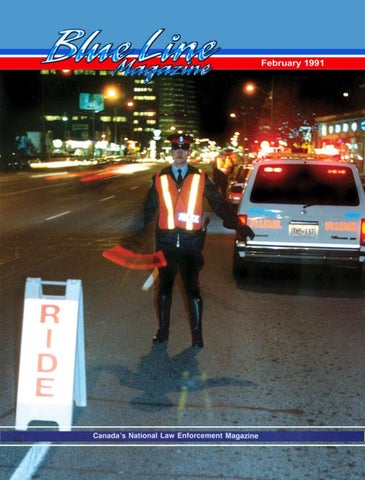
his month our cover represents what most people consider to be the trademark of police work. Traffic direction is the one occasion in the profession when an officer should look his sharpest. It is important for the public image of the profession as well as your own safety. If you are cognizant of your appearance you are cognizant that people are watching you. The image you project will be the image citizens will take away with them and call upon to compare other officers. As you go through this month's pages you will find a question answered regarding the wearing of guns while off-duty. This is a question of concern for many officers. It may be a telling story of the society in which we live when officers have to concern themselves with this question. I had trouble answering the question and when you read the article you will see why. In the area of product news we find the most stimulating news to be the release of a new Laser directed speed gun. Its narrow beam may prove to be a real boon to traffic safety and catching those hardcore speeders. In addition we have news of the new Laptop computer by Commodore. These new devices are becoming of increasing interest to law enforcement these days and we will be carrying more information in future issues about what is available and suitable. Last month we presented a story about the RCMP using FAX machines in Alberta. This month we present an article on securing the FAX transmissions from one company while a second , CANTEL, introduces "secure" transmission radio frequencies. We hope you enjoy this month 's issue.
Letters to the Editor HOLSTER SUB-STANDARD WHEN TESTED
recently succeeded in breaking two Shield 1000R Holsters, at the belt loops, when executing a snatch test. The revolver remained completely contained within the body of the holster. We also confirm that this condition had been experienced in an earlier version of this holster. It occurred during snatch tests conducted under the auspices of the Holster and Equipment Committee of the Ontario Police Commission. The situation was addressed by Shield Corporation . Modifications were made. No occurrences of such breakage were reported to us or were observed by us over many months of subsequent testing and field trials by a number of Ontario police forces. Shield Corporation is in the process of establishing the reasons for this unexpected occurrence. R. H. Riem , President Shield Corporation Oakville, Ontario
I am a Sergeant of the Ontario Provincial Police and my job position is that of an In-Service Training CoOrdinator for No.6 District, Mount Forest. The Shieldcorp holster was field tested by myself and I had identified a number of problems which were apparently corrected by the manufacturer. In mid-November of this year (1990), Shieldcorp attended an InService Training Workshop at the Brampton Academy. Members from the holster committee, provincial instructors and our members from Quartermaster Stores were in attendance. On two occasions, with four Shieldcorp representatives watching, I broke two holsters from the belt. It is of my opinion that this product is not ready for the field. Shieldcorp advised this problem had been fixed and will attempt to fix ••• it again . The holster broke differently on each occasion and I must add that SPELLING ERRORS ARE SILLY the force used was limited to a snatch . I look forward to reading my Blue Members wearing the holster at the line Magazine each month . I enjoy time were not jarred from their feet the variety and especially the Case and they were as surprised as was Shieldcorp. It is not my intention to discredit Shieldcorp, but to make you aware FLASHES that the product (at the time of this by Tony MacKinnon writing) is sub-standard and unacceptable to any police service. D.E . Benn (Sgt.4590) o.P.P. Mount Forest, Ontario
••• Editor's Note: I asked Shield Corporation about this and the following is their response. Thank you for extending the opportunity to comment on the letter you received about our product. We confirm that Shield Corporation personel were surprised when Sgt. Benn
Law decisions . Only one negative comment. Silly spelling errors detract from an otherwise excellent publication. Patrick O'Sullivan Sherwood Park, Alberta
••• Editor's Note: Ouch! You are right! I just wish I had someone else to blame but it is plain and simple sloppiness on my part. Most often caused by short deadlines and no proper proof reading. We'll try harder in the - filfFe- future.
~~ Can you afford to miss even one issue? Subscribe Now! Use your Visa !MasterCard
Phone (416)294-4773 Fax (416)293-0526
i ..'All together now, I fought the Law and the Law won; I fought .... "
fl
w'..,..:'
4
February 1991
Vol. 3 No.2 .
February 1991
• EDITOR / PUBLISHER · Morley Lymburner
• EDITORIAL ADVISORS · David H . Tsubouchi , LL.B. Edward Gunraj (P.o.A. Consultant) Mary Lymburner B.A. M.Ed . Gerald A. O xman LC.LA. Jaan Schaer B.A . (Metro Police E.A.P.) Tom Dykes (Halton Region Police) Robert Hotston B.A. M.crim . Rick Patrick (Lambton College) The Editorial Advisors are persons from whom this publication seeks out advice and gUidance. The use of their names is merely for recognition of their assistance and ongoing support.
• ADVERTISING · Allan W. Stiver • CONTRIBUTING WRITERS· Lucy Becker • Louise Dueck AI Porter • Richard Duplain • Daffydd Hermann • Craig McM\lIan • T. Richard Colledge • Murray E. Milligan • Rock Dueck • Geoff Cates • Robert Holston
• ILLUSTRATION • Tony MacKinnon • Bette Clark Dave Sills
• DESIGN AND PRODUCTION · Jim Kelly Camelot Graphic Design 97 Sir Lancelot Drive Markham , Ontario L3P 2J3 Business Office: (416) 294-4773 Editorial: (416) 293-2631 Fax: (416) 293-0526 Advertising: (416) 294-5502 Fax: (416) 294-8952 Production: (416) 471-0303 Fax: (416) 471-0305 Blue Line Magazine Is published monthly, ten times per year by Blue line Magazine Incorporated with head office at 118 Main Street North , Markham, Ontario Canada, L3P IVl. Editorial and copy is considered to be completely separate from advertising sales. No committment for editorial coverage can form any part of a sale agreement. All articles are protected by copyright. No part of this publication may be reproduced or transmitted in any form or by any means, electronic or mechanical, including photocopying and recording, or by any information storage or retrieval system without permission from the publisher. The authors, advisors and publisher accept no liability whatsoever for any injuries to person or property resulting from the application or adoption of any of the procedures, tactics or considerations presented in this magazine. Readers are cautioned and advised that articles presented herein are edited and supplied for your personal awareness and should not be referred to for further action until appropriate advice and guidance is received from a supervising officer or the advice of a Crown Attorney. Blue line Magazine is an independant publication designed to educate and upgrade the skills of those involved in the law enforcement profession . It has no direct control from a law enforcement agency and its opinions and articles do not neccessarily reflect the opinions of any government agency or police force . Blue line Magazine is Printed in C"nada by Johanns Graphics. The sole a uthorized distributor of Blue Line Magazine is Green Gables Book Shop, Markham, Ontario.
Iii) al .
Associate member, National
Association of Police Planners
{O]"f]f Member, Periodical
Ontario Police Services Act Proclaimed "The Police Services Act represents a fundamental shift in community attitudes, policing practices and government policy, which stresses the value of police service." With these remarks the Solcitor General of OntariO, Mike Farnan , proclaimed the new Ontario Police Services Act into law. The controversial new Police Services Act represents a new legislative framework for policing in Ontario. First introduced as Bill 107 on December 20, 1989, the Act received Royal Assent on June 28th, 1990, and replaces the old Police Act written in 1946. In a news release last December, the Solicitor General's office stated that "The new Police Services Act sets out a declaration of five principles which recognize the need for: close working relations between the police and the community; the safety and security of all persons; respect and sensitivity to the racial diversity of Ontario; respect and sensitivity for victims of crime; and the provision of policing services consistent with our rights and freedoms ." The Act established mandatory employment equity for all Ontario police services. In addition , the Act mandates: • municipal police services boards in every municipality which maintains a police service, to provide an enhanced link for the police and the community; • an accountable province-wide public complaints system;
~ Publishers Exchange
ISSN #0847 8538 Second class mail registration No . 8242
February 1991
5
• higher mandatory education and enhanced training for police officers; • legislative recognition of the position of First Nations Constable for policing in native communities; • a mandatory procedure for the disposal of firearms which come into police possession ; • a clear definition of the role and responsibilities of chiefs of police, police officers, and local police services boards; • an Ontario Civilian Commission on Police Services to enforce policing standards across the province. A special Investigations Unit, to inquire into circumstances of. serious injuries and deaths that may have resulted from alleged criminal offences committed by police officers, was proclaimed under the new Act in August of this year_
••• Editor's Notes: There has been considerable concern by many sectors of the police community about this new Act. Many feel that it may chart the future for policing in Canada . Others feel that portions of it have the potential of causing serious damage to the morale of the police officer and the community. Over the next couple of issues we will be presenting two opposing views of this Act and the writers' beliefs of where it may be taking us.
Rule No. 2 -
Traffic Direction - Morley Lymburner -
Take it serious or get off the road
M
y attention was drawn to an American police magazine that recently contained an article on traffic direction . The first shock to me was the introductory photograph to the article. It showed , what I assumed to be, a police officer directing traffic, at night, wearing a dark uniform and no hat. Not even a whistle! This picture got my curiosity as I thought that the author of the story was using it to show everything an officer should not do while directing traffic. Much to my dismay and horror I found that he was using this situation to show how it should be done. "Okay! Okay!" I says to myself, "Let's not judge the story by the poor selection of photographs ." I ignored the theory that one picture is worth a thousand words and I read the arti cle. But guess what folks? It got worse. This officer's theory, and I say theory because he could not have survived very many traffic points to develop good practices, was to stare down the vehicle coming at you . Look like the boss, give assertive directions and stare down the driver was his basic concept of what goes on between the curbs. He backed up the story with another hatless, nameless, motion less, assumed -to-be police officer, doing what he cares not to do. I finally got to the point where I had to take a blood pressure break. I returned to the magazine and decid ed to find out what the officer's
Wear A Hat
I do not know where this bareheaded, bone-headed, stupid idea came from but too many officers don't wear hats. Your hat is a necessary part of your job. It is your professional identity that is the most readily seen . It sits on the highest part of your anatomy and can be seen at 360 degrees and even above the roofs of the majority of vehicles on the road . Citizens can now have their first clue that a "police officer" is doing a traffic point when looking over the roofs of the cars in front. Want to make it better? Put a white, or orange, hat cover on . It is my firm belief that any officer working permanent traffic detail should wear an issue white hat. An optional helmet would be even better.
credentials were. A thirteen year veteran police dog handler from Washington State. "Okay, Okay, Okay!" I says to myself, "he found my key. He's got me wound up." The magazine went into the trash and I hit the keyboard to write this little ditty. It ain't the "be all and end all" on the subject but at least it may help justify my 15 years Rule No. 3 - Use A Whistle as a Traffic specialist. If you think you can yell out directions Rule No. 1 - Be Seen to motorists today then you have not This is the most important criteria. Put been informed about the invention of on a fluorescent vest, wear white car radios, stereos, tape decks and gloves, carry a flashlight. Park your equalizers. Remember that you are cruiser with lights flashing near the directing PEOPLE not bumpers and intersection . Anyone or all are bet- headlights. Use a whistle as loud as you can . One long and one short blast ter than none.
6
- - - - - - - - - --:-=-::-:--
February 1991
for "stop", two short blasts for "go" if that is front or sideways) . Do not head. If you can't see in one direction have been the most effective for me. permit traffic to move in one direction you have to attune your ears to it. Let without stopping up the other direc- those ears be your second set of eyes. Rule No. 4 - Clear Signals tion. If nothing is coming in the "stop" There are too many motorists out Keep your hands high . Never give a direction don't forget about it. I have there that appear to own cars with direction with your hands below your found the best policy is to try to get prescription windshields and have just head. The motorist is looking there a car in each lane to stop up traffic switched cars. They don't see beyond their hood ornament and you are as anyway (he is impressed by the hat) before letting alternate traffic go. When stopping a lane of traffic look good a target as any. so you might as well communicate While we are on this subject. .. have something that you want him/ her to back in the line and determine the car do. Remember that this isn't a game you want to stop. This may be three you ever noticed that the chances of or four cars back but a good rule is somebody stopping to ask directions of charades. Don't let the hustle of traffic worry to stop the driver you have established is directly proportional to the amount you . Go at your own pace. There is eye to eye contact with . (It's easier of traffic congestion you have at your nothing less lenient on time than a than trying to get their attention by traffic point? They still think you can traffic light, so why should YOU riding on the hood or by a well plac- take the time to give them directions to the freeway. Politely bring them hurry? You are in control a nd no one ed bullet in the grill.) back to reality. Advise them their does a thing until you want them to Rule No. 5 - C.Y.A. do it! wheels have stopped rolling and that Show the largest mass of your body Always think of your back(side) . To is against the rules presently in effect. to the vehicles you want to stop. (You be a true traffic controller you have (You can really use your imagination will have to take inventory to decide to develop eyes in the back of your here!)
February 1991
7
You Asked For It .... Carrying Firearms I'm troubled by the many opinions that I have found regarding the carrying of a restricted weapon off duty. Without getting into the argument as to why one may wish to do so, I would like to pose a question that remains unanswered . I feel your magazine would be a good credible source for such a question to be answered . When police officers ask these types of questions they are a single small voice that may only receive a loud answer and not necessarily a correct one. Where does the authority come from for the carrying of a restricted firearm? Is it legislation , the position of police officer or the exclusive authority of the Chief of Police. Aside from any department regulation , bylaw, prohibiting the carrying of a gun "off-duty", does a police officer have a legislated right to carry a restricted weapon off duty without the provision of a permit to carry a restricted firearm? Is a permit required or not? A brief argument to support this position , to carry a gun or not, relates to an article in Blue Line Magazine, Vo1.2 , No.5 , May 90, "Familiarity Is The Key". In keeping with my question this article illustrates the correct role of a community based police officer, ie; Familiarity IS the key, to knowing the neighbourhood . This, however, also means that the neighbourhood comes to know you as a police officer, recognizable in your role as such and frequently calls upon your advise, based on your knowledge and experience. This holds true not only in the community in which you work but also the community in which you live. Having said this, are you, the caring, concern-
ed, professional, prepared to be dealt with as a police officer or act as one? If your answer is yes, and acting within the realm of common sense, should we not be permitted to carry off duty guns, or given the choice? John Doe Ontario
••• This is quite a box we are going to take a peek into. Many of our readers may disagree with the answers and this disagreement is good. Don 't keep it to yourselves. Write us with your opinions. Your question can be answered most easily by reading section 92(1) (d) of the Criminal Code (1990) . To reduce confusion an edited version is reprinted here; "a person who, under the authority of ... a police force that includes peace officers or public officers of a class referred to in paragraph (b) ,... is not guilty of an offence under this Act by reason only that,... in the case of a person described in paragraph (d) , he has in his possession a restricted or prohibited weapon in the course of his business on behalf of... a police force referred to in that paragraph ."
As you can see the Criminal Code is quite clear. Your authority to carry a restricted weapon flows through the authority given to "police forces. " (This could also pose an interesting question regarding the trendy desire to change the names of police "Forces" to "Service.") The Chief of Police is given the authority to govern and control the members of that force. He then sets up rules, regulations, and policies that reflect his respon sibility to both the police officers
under his command and the community he is duty bound to protect. I have some personal concern about the carrying of off-duty firearms. The questions asked by our writer are of concern to many officers. We all know that many persons in our neighbourhoods are aware that we are police officers. We are quite often asked to intercede while "off-duty" in events that call upon our expertise and maybe even authority. These requests should not be construed to mean that we should render all and every service to our neighbours. We are just not equipped to take a report of a theft, check all the doors of the local plaza, and issue stop sign tickets in between cutting the grass or taking our kids to the dentist. The job of being a cop has been long recognized to be far more stressful than once believed. You must, first and foremost, take care of yourself. We are aware that a police officer is never really "off-duty': It is a responsibility you carry 24 hours a day. However you must give yourself some down time. I would like to relate two stories that emphasize both sides of this argument. The Robbery The off-duty officer surveyed the two lines of people waiting to be served in the bank. The pay cheque in his wallet was long waited for and he was finally going to payoff those bills. He strategically placed himself in the two person line and waited his turn . The officer was well known at the bank and gave a pleasant hello to a couple of the other clerks. The officer looked about and saw a man walk into the bank wearing a Continued on page 10
8
February 1991
The only Police Edition of the Criminal Code in Canada Handy and lightweight but heavy on the law
5"X8", 990 PAGES, lARGER TYPE, TOUGHER BINDING Everything you need in a Criminal Code This pocket-size edition of Martin's has been specially designed for police officers. It contains everything you require in a Criminal Code: °the full and accurate text of the Criminal Code so that you can quickly find the exact wording of the offence oexamples of regularly used police forms including informations, summonses, warrants, promise to appear notices, and other essential court forms oal so the full text of the Canada Evidence Act, the Canadian Charter of Rights and Freedoms, the Food and Drugs Act, the Identification of Criminals Act, the Interpretation Act, the Narcotic Control Act and the Young Offenders Act Synopses follow each section to clearly explain the elements of the offence. There are cross-references that identify related sections. A new index helps you find the relevant sections of the law. Enquire about multiple discounts and police crest imprinting on orders of more than 100 copies.
Weapons Offences Manual,
by Peter 1. Harris, LL.M. Provides you with immediate answers to current weapon issues. Peter Harris has hit the mark with the only weapons reference manual that features the following: • a detailed survey of all Criminal Code weapon sections, regulations and amendments an expert commentary • a historical survey of weapons control in Canada and a study of current social issues • an index of forms used in Canada for the regulation and registration of firearms • a loose-leaf text that will be up-dated with regular releases Loose-leaf· Approx. 365 pages· Approx. $90.00 • Binder $23.00 0
OTHER PUBLICATIONS ADMISSIBILITY OF STATEMENTS, 7TH EDITION, by The Honourable Rene 1. Marin The do's and don'ts of taking a statement. • Perfect-bound· 394 pages $25.00 Enquire about multiple discounts 0
YOUNG OFFENDERS ACT MANUAL, by Peter 1. Harris, LL.M. An excellent guide to the principles and practices of the act. It keeps you up-to-date with the changing issues through loose-leaf releases .• Loose-leaf $1 26.00/year Binder and Contents $6l.50 0
0
CROWN PRIVILEGE, T.G. Cooper, LL.B. , LL.M. Written by a former police officer, this book examines when police information can be withheld from disclosure in civil suits and criminal trials . • Perfect-bound· 290 pages $58.00 0
Firm Name: _ _ _ _ _ _ _ _ _ _ _ _ _ _ __ Street: _ _ _ _ _ _ _ _ _ _ _ _ _ _ _ _ __ City: Prov.: Postal Code: _ __ Date: _ _ _ _ _ _ __ Attn.: Signature: Phone: ( (We pay shipping and handling when payment accompanies order.) Charge to 0 Visa 0 Mastercard 0 Amex # Expiry Date: _ __ Add 7% GST (GST # R I 221 10802)
o POLICE EDITION OF MARTIN'S ANNUAL CRIMINAL CODE, @ $15.95 each.
o Current Edition 0 Subscription (PIC 517, 638) o WEAPONS OFFENCES MANUAL @ $90.00 each. 0 Binder $23.00 (PIC 470, 575)
o ADMISSIBILITY OF STATEMENTS, 7TH EDITION @ $25.00 each (PIC 246)
o
Forward completed form to: YOUNG OFFENDERS ACT MANUAL CANADA LAW BOOK @ $ 126.00/year 0 Binder and Con dents $61.50 240 Edward St., Aurora, Ontario· L4G 3S9 · (416) 841-6472 (PIC 445, 537) Phone orders accepted. Call Toll Free 1-800-263-2037 ~ ~ Ontario and Quebec 1-800-263-3269 ~ 0 CROWN PRIVILEGE ~ LFax: ____________________________________________ ~ (416) 841-5085 APPROVAl @ $58.00 each. (PIC 286) ~~~
Continued from page 8
heavy coat and a balaclava over his head. Immediately the officer was aware of what was happening. He watched as the man approached a side counter and spoke to the manager. The suspect's right hand remained in his pockets while his left hand gave the manager a paper bag. After a brief conversation the manager directed the robber to teller number three directly in front of the off-duty officer. The officer at this point was cursing himself for leaving his gun at home. Ordinarily he would have come directly to the bank from work. Departmental rules permitted officers to carry their duty weapons home but not to carry them off-duty otherwise. Many things raced through the officer's mind in those brief seconds. His final conclusion was to be the best witness in the place. Keep his mouth shut and observe as much as he
"THE FIREKEEP"
could. This was before the suspect presented his back within three feet of the officer. The officer looked at the manager opening the bag beside the teller. The manager looked at the offduty officer and then the clerk. He advised the clerk to fill the bag. The officer's mind was still spinning. What should be done? The combination of police training, opportunity to make a difference, and the perception that the performance of duty was expected by the bank's employees caused the officer to become careless. The officer seized the robber around the neck and squeezed hard. The robber was choking and the officer identified himself and ordered the suspect to take his hand out of his pocket. The robber did so and held his hands in the air. The officer felt the coat and noted a gun was in the pocket. Suddenly he heard a man yelling from behind and felt the point of a butcher knife strike him between the shoulder blades. The lookout! The officer had not seen the lookout man.
to drop the gun and a passenger leaped out of the old Pontiac. The officer is now confronted with two suspects, no other backup officers, a passenger yelling at him and a youth, who now is not responding to his order, with a gun pointed at two citizens. The youth with the gun also yells at the officer but nothing intelligible can be heard with both persons yelling. The youth does not realize he has only seconds to live if he does not drop his weapon. The officer realizes with each passing second that lethal force will be required. His heart is racing, his gun moves quickly from one target to the next. Suddenly the officer realizes what the two youths are shouting. "We're police officers. Drug Squad! Don't shoot!" The passenger waves a wallet at the officer and he realizes that these guys are probably cops... or else he is being set up. With a command, even stronger now, the officer yells one last command, "Drop your weapons and show your hands... NOW! "
Carry Or Not To Carry
"The Firekeep" is designed to be adju table to any vehicle. •
0 permanent mark or brackets
•
ne step on - one step off
• Works with any magnetic based light • Withstands over 1G force without falling off " Makes the portable light hassle free, works excellent. " - Det. Sgt. Brian Ewing, York Regional Police " Light stays stationary while moving as well. Visabllity of the light Is gr811t1y Improved." ·Insp. Dale Mitton, Monc ton City Police
Pat. Pending
P.E.L.T. INDUSTRIES INC. (613) 726·9230
(800) 735·8462 FAX (613) 745·8188
The Bust It was a routine night shift for the police officer. The radio was quiet as it usually was on a Tuesday. The heavy traffic flow of the evening had long since vanished. In fact the officer noticed the only cars in front of him were a new Ford Mustang and an old beat up Pontiac stopping beside each other at the traffic light. Suddenly a long haired, scruffy looking youth leaped out of the driver's side of the old Pontiac and opened up the passenger door of the Mustang beside him. The youth was pointing a handgun at the occupants. The officer, jolted by what he was seeing, called for a backup assist... "man with a gun ." The officer drew his revolver and stepped out of his car and pointed his weapon at the youth with the handgun . The officer yelled at the man
10
Both these true stories speak volumes to everyone of us. They can be disected by instructors at police academies and critiqued by experts but unless they happen to you, like these stories did to me, you can't get the whole picture. In the first instance I anguished over the fact that I had not taken a gun to the bank while off-duty. In the second instance I cursed the drug squad officers for carrying weapons while on duty and not having notified me that they were working in my area. This was doubly frustrating when I realized they were officers from another police force and couldn't notify me even if they wanted to. Frustrating even further because I could have very well shot one of them and ultimately there was no one to blame. We were all doing our duty. Personally I feel too many officers
February 1991
do not take the advice they give so many others. In the bank the first in stinct was the best. Be the best witness in the place. Follow them afterwards if possible. Give what information you can to the officers investigating. If all police forces made a policy, like many in the United States, that officers must carry a weapon while off-duty, I would be a worried person. Getting a glimpse of a gun peeking out from under a coat would cause me concern enough without trying to determine if he is a good guy or a crook and then wondering what I should do next with my concealed weapon. And there are far more officers off-duty than on . Regulations as to the use and carrying of weapons are the exclusive jurisdiction of the Chief of Police or Commissioner. This is not a task
taken lightly. Each command officer must consider the community, crime patterns and trends as well as many other complications involved in the use and carrying of firearms. If any officer wishes to chan.qe policy they should most certainly be given a forum by which their views can be heard and seriously considered. Change does sometimes occur by example. The Metropolitan Toronto Police Force changed its policy in the mid seventies after two officers going home from their station had their car window blown out by a shotgun. The gun was in the hands of a man who mistook the officers for officers that had intervened in his domestic dispute. In spite of the fact the officers had complied with the then force policy of leaving their guns at the station house, they did manage to drive
the offender's car into a hydro pole and apprehend him. Shortly afterward the Chief of Police permitted officers to choose if they wished to carry their weapons to and from work. The reality of the situation is that there are far more circumstances in your day to day duties where you are called upon to perform services that do not involve guns. Likewise when you are off-duty, assistance you would be required to render would probably never require the use of a gun . Believe me no one expects you to do dangerous deeds off-duty. Above and beyond the call of duty can quite often be above and beyond the call of common sense. When off-duty do what you can then do what any citizen would do. Call the cops. , M. Lymburner
r------------------------------------~I
The 1991
Canadian Police Officers Motorcycle Championships
CANADA CUP Held in conjunction with FAST Motorcycle Training School, Shannonville
June 27th, 28th, 29th ShannonviIle, Ontario For details write to:
Executive Committee Canadian Police Officers Motorcycle Championships 733 Leaside Street, Pickering, Ontario L1W 2X2 or Call (416) 831-2013
~------------------------------------~ February 1991
11
Harris Vs. Starr 945-017 (19 pages)
....x
Officer partially at fault In a British Columbia decision brought down last year (Harris Vs . Starr 945-017 19 pages) the officer directing traffic was found to be 25 per cent at fault for the resulting accident. In this case the officer was directing traffic at an intersection where the traffic lights had failed . It was a rainy night with poor visibility. The officer motioned the northbound traffic to enter the intersection when he saw a westbound car coming too fast to stop. The officer tried to give a last second
signal to stop the northbound car but was too late and a collision ensued . In the civil case that followed the court determined that the officer had failed to look eastbound before he motioned the car to go ahead . The judge added that the speeding motorist was 60 per cent at fault and that his attention was "woefully inadequate." However he added that it was clear that the officer should have looked to the east before he waived the second car to enter.
The responsibility officers have while working traffic points is very real. It is at times taken for granted and at best considered routine. As you can see the courts take it far more seriously. Officers should try to remember that they are responsible for what happens between those curbs. In effect that gives you ownership of that real estate and it is your goal to make everyone on your property know what the rules are.
Must be told of right to Legal Aid An accused , who was not advised of the availability of legal aid , has had his charges dismissed by a Provincial Court Judge in Alberta . In addition the judge criticized the Edmonton Police Service for not altering their standard Charter warning to reflect recent Supreme Court of Canada rulings on the same topic. As reported in the April issue of Blue line Magazine (Vo1.2 No.4 Page 30) the upreme Court of Canada had ruled in Regina Vs. Brydges that th e standard caution given by police upon arrest must include that the person has an additional right to lzgal aid or duty counsel. The court ruled that no accused is required to give an accounting of his ability to afford a lawyer to police before they are advised about legal aid . In this most recent case the accused was arrested about 6 weeks after the Supreme Court ruling and the
officers making the arrest read only the standard rights and failed to advise of the included right to legal aid or duty counsel. At trial the defence argued that the accused's constitutional rights had been violated by the police failure to give the proper information . The defence argued that due to the breach the certificate evidence should be excluded. The judge agreed with the defence argument stating, "It is clear from (Regina Vs Brydges) that the newly laid warning is now an integral full part of the right to counsel warning. It is to be given in every case and not only in those cases where the accused asks about legal aid ." The judge concluded that there was no deliberate effort on the part of the officers to breach the accused's Rights but that the Police agency should have given the officers the proper inform-
12
ation before the arrest had occurred . In view of the Charter Breach the judge ruled the certificate evidence inadmissible and the accused walked. SUGGESTED WARNING: feel free to copy and insert in memo book
It is my duty to inform you
that you have the right to retain and instruct counsel without delay. If you can not afford counsel or the counsel of your choice is not available you have a right to consult with a duty counsel at no cost to yourself. DO YOU UNDERSTAND WHAT I HAVE SAID TO YOU?
February 1991
"HEADS·UP·TICKETING"
Nissan Advertising Criticized Status Report Insurance Institute for Highway Safety • Forces officers to keep head up while writing tickets
In its latest advertisement for the 3 00ZX in the United Kingdom, Nissan continues to press its foot to the floor and has again stubbed its toes. Britain's Advertising Standards Authority has issued a strong objection to a national print ad by Nissan that speaks of the "controlled aggression" of the 300ZX and how drivers will be "seduced by its scorching performance." Despite earlier admonish ment by the same authority for emphasizing speed, the ad copy reads: "rockets the 300ZX from 0 to 60 mph (0 - 100 km/ h) in just 5.7 seconds and on to a governed top speed of 155 mph ." (260 km / h) Another recent speed ad , this time
for the Toyota Lexus, also trumpeted that "It's capable of 155 mph" and drew enough attention to be denounced by a member of Parliament. The authority also complained about an ad for Renault 21 GTS headlined "It blows away the competition" that extols it's 116 mph (190 km / h) speed . Growing complaints about car speed in the u.K. have stepped up the authority's vigilance against ads that stress speed rather than safety or reliability. The authority says that it will not tolerate advertisements that encourage dangerous driving practices and driving in excess of legal speed limits.
• Raises officers field of vision • Keep violators documents in plain view • Great reminder to return documents • Keep notes in view " Not only enhances my personal safety, but keeps me aware of the environment around me." - Cam Woolley. Onlario Provincial Police
"Should be in aI/ pol/ce cars, great tool. " -
Joe Quirk. Traffic Sgl,. York Regional Police
H.U.T. " HEADS·UP TICKETING" "Less Expensive than a Headlight"
P.E.L.T. ~ INDUSTRIES INC. (613) 726·9230 (800) 735·8462 FAX (613) 745·8188
,
....
•.'11.:,.', ..
•Track witnesses ·Archive statements
·File exhibits ·Find memos ·Store correspondence
Case Designed by Investigators for Investigators, this program combines the ease of word processing* with the power of a sophisticated database to help you easily track witnesses, statements, exhibits, memos and correspondence. Completely user friendly and menu driven· requires minimum training. Runs on all IBM® or compatible computers with a minimum of 640 kilobytes of memory. May be customized to your agency's needs. Introduce the future to your investigative office.
A product of
Exclusive Distributor: Blue Line Marketing
Gaderian Incorporated Phone: (416) 294-4773 Fax: (416) 294-0526
• Works with a ll Word Processing Programs
Fast Relief to Disaster Victims
T
he Insurance Bureau of Canada plays a big role in helping to get the wheels of recovery in motion at major disasters. The following feature story, submitted by the I. B.C. , helps to explain the service they supplied to the cities of Barrie and Edmonton after disaster struck. Each day, the evening news brings us reports of floods , fires , tornadoes and other disasters taking place around the world. We view the devastation and marvel at the heroic efforts by fire , police and emergency crews . A major problem confronted by the victims is how to cope with the rebuilding of their lives. Recognizing the need to help people recover from these incidents as qUickly as possible - in fact , even as the clean up is in progress Canada's property and casualty in sureres have an industry-wide network ready to move into action at any time across the country. The primary goal is to assist victims by accelerating claims insurance processing when emergencies occur. The Claims Emergency Response Plan (CERP) was developed by In surance Bureau of Canada (IBC) , the trade association representing the country's major property and casualty insurers. CERP was devised in 19 2 , in response to the 1979 Mississauga train derailment and the violent hail storm that hit Calgary in 19 1. Both situations proved that a system was needed to handle hun dreds - even thousands - of claims immediately to help people get back on their feet. Norm Clark, Manager, Insurance Services , Insurance Bureau of Canada, has been involved in several emergency situations and successfully implemented the national Claims Emergency Response Plan . "The plan draws the insurance in d ustry together and encourages everyone to work towards the com mon goal of helping emergency
victims," says Clark. Insurance Bureau take no special action to the establishof Canada co-ordinates the ad - ment of an Emergency Field Office. ministration of CERP at all levels to The plan remains flexible to deal with ensure that victims are treated fairly the different needs of various and the insurance industry provides disasters . To administer the Claims Emergenthe best possible service. While the broad objectives and cy Response Plan more efficiently, organizations of CERP are establish- Canada is divided into five regional ed by a national committee, the plan response areas. Each CERP response operates at the provincial level , plac- committee is supervised by !BC ing primary responsibility for action in regional vice -presidents or, in Quebec, the general manager. local hands. These regional committees are The first test of the Claims Emergency Plan began with the tor- comprised of !BC member company nado in Barrie, Ontario, which struck representatives, Fire Underwriters on May 31st, 1985. By the following Survey Officials, claims managers, night, pre-assigned CERP represen- agents and brokers , insurance tatives had surveyed the damage and adjusters , provincial government convened a meeting of the Ontario insurers and emergency measures organizations. CERP Committee. An emergency Participating committees meet two was declared . or three times a year to improve the Three days later, !BC had established a field office by bringing in a trailer, plan . The Claims Emergency full office equipment and staff to Response Plan used for the Barrie tornado in 1985, for example, was imanswer inquiries and provide informaplemented much differently from the tion to both insurance companies and Edmonton tornado in 1987. the public. Given the incredible Since Edmonton already had a devastation of the area , the installaregional IBC office complete with staff tion of hydro and phones in this time and equipment, there was no need frame was a major achievement. for the establishment of an Emergen IBC Emergency field office personcy Field Office. As well, the CERP nel also acted as a liaison between the committee had enlisted a number of general public, local police, fire insurance industry retirees who could department, emergency measures be called upon to help out with the authorities and city officials. !BC's co- hundreds of inquiries. ordination efforts alleviated a great In accordance to the plan , an IBC deal of pressure and allowed these spokesperson was deSignated to hanprofessionals to complete their tasks dle media relations. This person also more effectively. handled communications with the rest People were devastated . Many of the insurance industry and the could not find their policies in the general public. This measure ensured debris or had problems interpreting a consistent and controlled flow of them. It was essential to do some information . hand-holding and assist victims every The national plan continues to be step of the way. updated and refined. Periodically, IBC The insurance industry scored high stages mock disasters to help prepare marks from everyone involved for the members of the various regional comleadership and support it provided . mittees. These experiments fine -tune CERP provides for several procedures, proving - once aga'ln responses, ranging from a decision to that you can never be too prepared .
14
February 1991
Effective Supervision and Officer Safety - Robert Hotston -
T
he everyday management decisions of a police agency fall to police administrators. These persons are responsible for the organizational structures, training and operational procedures, which bear greatly upon the safety of individual police officers. Top level police administrators must recognize the significance of the first level supervisors and ensure that these critical persons are provided with the skills and resources required to undertake what many consider to be the toughest jo b in the organization. A police force can provide "officer safety" training, but if such training programs are to be effective and increase the safety of police officers, then constructive supervision and discipline are essential. For example, if an officer's bad habits go uncorrected when first discovered, they may become ingrained. This could destroy
February 1991
the benefits of effective training programs and ultimately jeopardizing the officer's safety and that of his co-workers. Discipline is essential in police work. It must, however, be corrective and not punitive in its application. Police officers share a bond which is a direct result of the demands society places upon them and the work they perform. No one likes to see a fellow officer disciplined for mishandling a boring or tedious aspect of the job. This is especially true if he or she would probably have done the same thing under similar circumstances. The solution to this complex aspect of interpersonal relations rests with the supervisor. First, the problem must be detected. Once aware of the situation, be it an infraction , a sloppy habit or the result of poor training or a procedural fault , the supervisor must react to it by drawing from the variety
15
of appropriate means at his disposal. Such a response must be constructive. The supervisor, however, must not let a sense of empathy for any officer influence the exercise of supervisory responsibilities . To do so fosters carelessness and complacency - two of the greatest dangers to police officers. Effective discipline will enhance training. To follow it to its logical conclusion, good training makes for safer officers and fewer potential victims. First level supervisors playa critical role in the police organization. These are the persons who represent officers to management and management (and all sorts of administrative decisions and demands) to officers. These are the persons who, more so than any others, are in the middle of whatever is happening. To do an effective job, first level supervisors must possess special skills and knowledge. Everyone's safety is related to the quality, dedication and adequate numbers of first level field supervisors, regardless of the division in which they work. These persons, if careless, sloppy, or unmotivated will negatively affect the discipline, direction and control of the organization as well as the safety of the working police officer. A poor quality first level supervisor almost surely means that there is no prospect that officers will perform their work in accordance with procedures, policies and guidelines. Conversely, caring, motivated and "in touch" first level supervisors who know what their subordinates are doing and who assume a dynamic leadership role ensure that the people who they are responsible for perform their duties safely and positively. ~
·.. news beat ... news beat ... news beat ... news beat ... Calgary Air Medical Program Gets Big Lift The Southern Alberta aeromedical program known as STARS, received a new helicopter from MBB corporation last December. This acquisition will permit the attendance of the machine at the scenes of more accidents in inclement weather. Previously the STARS program , which services all of southern and central Alberta , was limited by weather conditions and visibility. In poor weather conditions the previous helicopter did not have sufficient power and did not have proper in strumentation to be utilized . The new helicopter, an IFR BK 117 B-1, can be used in most of the weather conditions experienced in the Calgary area . The decision to purchase the new unit included its in creas d lifting power, full Instrument Flying Regulation (IFR) capabilities and its suitability to operate at high altitudes and extremes in temperature.
Grants Available For Ontario Police Forces Ontario Solicitor General Mike Farnan announced a $750,000 Race Relations and Policing Grants Program last December. Mr. Farnan stated that this program, which responds to a recommendation of the Task Force on Race Relations and Policing, will finance communitybased projects designed to enhance relations between police and racial minorities.
"The Race Relations and Policing Grants program recognizes the need for a close working relationship between the community and police as it will be reflected in the new Police Services Act ," stated the Solicitor General. The criteria for the grants program was developed in consultation with various community groups, agencies, institutions and police organizations, which are involved and interested in race relations . Non -profit community groups, aboriginal organizations and police authorities, other than the Ontario Provincial Police, will be eligible to apply. Priority will be given to projects that have the potential for application across OntariO; that are in areas where there is a higher concentration of racial minorities and aboriginal people ; that demonstrate long-term potential for change and that benefit race relations between police and racial minorities . Further information is available from the Race Relations and Policing Unit at (416) 963-1570.
Officers Not At Fault For Death In Chase In December the Ontario Ministry of the Solicitor General's office announced that police involved in a high speed pursuit last October "acted with proper discretion and in an appropriate manner." The pursuit occurred on October 17, 1990, when Constable Charles Boyles of the Kingston Police Force spotted a vehicle that had been reported stolen and was driving in an erratic manner. The officer activated his emergen cy roof lights in an attempt to stop the vehicle, however, the driver of the stolen car accelerated his speed and refused to stop for the officer. At the intersection the stolen vehicle collided with another vehicle which resulted in the death of a three month old child and seriously injured the child's mother. The driver of the stolen vehicle, a 17 year-old male, was also injured and required hospitalization . Charges had been laid against the
FLASIIES by Tony MacKInnon
" Hang on a second, this call looks like i t may be intere ti ng! "
. ," -,,...
16
February 1991
... news beat ... news beat ... news beat ... news beat ... driver of the stolen vehicle, however, since he is a young offender, his name cannot be released. The two month investigation was carried out by Mr. John Olser of the new Ontario Special Investigations Unit. This new Unit is called in to investigate serious incidents that occurr involving police forces in the province.
Officer Praised In Ottawa Shooting Incident The Special Investigations Unit of the Ontario Ministry of the Solicitor General's office recently annnounced that an Ottawa Police Officer not only acted reasonably but also courageosuly in a shooting incident last October. The incident began when officers responded to a security alarm at an Ottawa trading company last October 15th . Upon arrival officers found a steel bar had been removed from a small window. Constable Philip Tennant, accompanied by the owner of the business, entered the premises and were confronted by a male who was pointing a shotgun at them . Constable Tennant drew his revolver and ordered the male to drop his gun. A struggle ensued between the officer and the intruder which resulted in the officer falling backwards on the floor. Tennant fired three shots from his service revolver one of which hit the intruder in th~ abdomen . The wound was not life threatening. Charges of Break, Enter and Theft Assault With a Weapon and Use of a firearm During the Co mmission of an Offence have been laid against Timothy Edward Engen.
February 1991
---
What's Congratulations are in order for the News? five winners of a free gift subscription The Winners
to Blue line Magazine last December. The winners were: ' Mark P. Shannan - Pembroke, Ontario, ' Steven Zettler - Brampton , Ontario, ' B.J. Gerrie Banff, Alberta , ' Nick Bakker Dalmeny, Saskatchewan , ' Robert W. Cummings - Penetanguishene, Ontario. In the contest we challenged our readers to locate the three problems in the puzzle. One word in the list was incorrectly spelled but spelled correctly in the puzzle. This word was "Forcible". The second word was spelled correctly in the list but misspelled in the puzzle. This word was "Homicide". The third word was spelled correctly in both the puzzle and the list but used two correct spellings. This word was "Marijuana" and "Marihuana". Again, congratulations to the winners.
Keep Canada's law enforcement community informed . If you have something happening in your area that you feel should be shared with the law enforcement community across the country, or in your province, let Blue line Magazine know about it. If you have a local newspaper clipping, a recent controversial topic or wish to write on a topic of your own chOice, feel free to send it to us. We are also interested in significant changes in provincial statutes. You may mail material to us at: 118 Main Street North, Markham , Ontario, L3P 1Y1 or use our 24 hour Editorial Fax line at (416) 293-0526. Keeping us informed is keeping you informed!
ALERT!
TWIST·OFF CAP
PLUNGER
SHOTGUN SHELL
HANDLEBAR SHOTGUN The handlebar shotgun is reportedly popular among members of motorcycle gangs. The handlebar is modified so a shotgun shell can be fired by simply flipping a switch . Manually releasing a spring loaded firing pin attached to the side of the handlebar fires the weapon . In some cases electrical switches have been added so that the weapon can be fired with either a hand switch or a foot switch.
17
Investigators Appointed to Ontario's SIU [n January the Director of the Ontario Special Investigations Unit, Mr. John Harty Osler, announced the appointment of J. Gordon Wilson as the Chief Investigator for the unit. Mr. Wilson will be responsible for all investigations across the Province of Ontario, with the exception of Metropolitan Toronto, in which a serious injury or death has occurred that may have resulted from criminal offences committed by police officers. Mr. Wilson will also be responsible for the training of all investigators within the S[U section . Mr. Wilson was a member of the Metropolitan Toronto Police Force for 31 years, most recently at the rank of Inspector. Mr. Wilson is a criminal investigations specialist and is familiar with all aspects of policing, from homicide to community service.
[n keeping with the Police Services Act a member of the SIU cannot have served within the police force where the investigation is being carried out. For this reason Mr. Osler announced the appointment of Mr. Milan Then as a Senior Investigator that will be responsible for the Metropolitan Toronto Police Force. Mr. Then will also supervise communications and community relations for the SIU. Mr. Then brings 15 years experience with the Ombudsman of Ontario, having held positions of Executive Assistant, Assistant Director of Investigations and Director of Communications . He also served as a Probation and Parole Officer prior to his service with the Ombudsman's office. As director of the SIU, Mr. Olser, a retired Justice of the Supreme Court
of OntariO, heads this independent civilian body. The Special Investigations Unit has been in operation since it was proclaimed last July and reports the results of its investigations to the Attorney General. "I am confident that as an independent , impartial and professional civilian body, we will be able to play an important role in enhancing public confidence in police agencies," said Mr. Osler. In keeping with the purpose of the SIU, the Director cannot be a current or former police officer and the Unit's investigators cannot be police officers. The investigators may, however, be former officers. The Special Investigations Unit may be contacted at (416) 965-2360 or by FAX (416) 965-1709.
I Ir- - ------------------------------------~ Case Law Order Form I I Agency: __________________ _ Name: I I I I Phone/Fax # Address: I I I I Postal Code:
Province:
City:
I I I L
I I I
FAX Number - (416) 293-0526 Telephone Orders Accepted For Subscribers ONLY - (416) 293-2631 (Please quote Subscriber Number)
-.J
an~: La~rticles :::Blue Lin-:-Magazin-:-may be -1- - Please SendCas;-Law-by: ordered at a cost of S1.oo per page with a minimum charge of S10.oo per 1 -
-The full text of
0 1 0
order. You may have your judgements sent via Fax at a cost of S2.oo per page 1 with a minimum order of S20.oo. Please enclose a cheque or Credit Card Number with your order. 1 Only Subscribers may order case law by invoice I GST /I R1 22418643
Case Law Number
Number of Pages
DODD-DOD DODD-DOD
I I I
Mail to Address Above Fax Direct To My Attention
Visa / MasterCard
I
I I
I I I I I I
Office use only
$
.. _ _ _ _ _ _ _ _ _ _ _ _ _ _ _ _ _ _ _ _ _ _ _ -&..;,;;.;,:;:,;;.;;;:;.__~_ _ _ _....;;.__:.o;.._ _ _ _~
18
February 1991
PROFILE
Innovative Canadian Company Creates Police Equipment - Morley Lymburner -
B
ecause of the innovative ideas inspired by his family members Tim McDonell started PELT Industries of Ottawa . This small company has recently impressed the North American police community with its simplistic approach to common everyday problems of front line officers. When Tim's brother, Constable Pat McDonell of the Moncton RCMP Drug section , phoned his brother in Ottawa to see if he could come up with a solution to a problem they were experiencing he inspired the creation of far more than the product he asked for. The undercover car driven by Tim's brother did not have a dash to mount the departmental issue Fireball light. If he tried to put it on the roof the cord went across his face and would fall off. In addition it made getting out of the car difficult and caused damage to the light and / or the door. Tim McDonell and his partner, Bruce Barnes, went to work on the problem . After many prototypes they found the solution with a metallic unit that connects to the sun visor and is tucked o ut of the way when not in use. When required the unit is lowered from the ceiling providing a metallic platform for the fireball light to connect to. They named their first invention the "Firekeep". Tim then gave the invention to his other brother, RC MP Cpl. Mike McDonell, to take through some field testing. After several refinements were
February 199 1
made the unit was ready to send to brother Pat in New Brunswick for a Christmas gift. The "gift" was so well received that Pat began to give more ideas to Tim to start workirlg on . Tim was told about the New Brunswick Highway Patrol officer, Constable Emanual Aucoin , who was killed while giving out a traffic ticket. Tim was asked to design something that would force an officer to keep his head up more while still writing tickets. It was pointed out that having your head doyvn while filling out a ticket was probably the most common yet most vulnerable and dangerous position for an officer. Within 24 hours Tim had the solution . The first HUT was born . The name is an acronym for "Heads Up Ticketing." The device was a dash mounted item where officers would put an offender's licence and other documents while writing out a ticket. The officer constantly looking up on the dash for the motorist's information also permitted the officer many opportunities to keep the violator under observation . With the first handmade products Tim McDonell decided to take them to the City of Ottawa Police Force. His decision was based more on family loyalty than good marketing strategies . Tim's father , Hugh McDonell , was a recently retired 35 year member of that force . To Tim's delight the police force immediately ordered eight Firekeeps and took the
19
HUT for field testing . In short order PELT Industries appointed Federal Signal Canada Ltd. to manufacture the products and the next step was to find another investor. This problem was satisfied while Tim was attending a friend 's wedding. He was introduced to Jim Kyte of the Pittsburgh Penguins. Jim was fully aware that a hockey career was quite lucrative but generally short lived. He was looking for businesses to invest in and found he liked the business style of PELT Industries . The attendance at several Canadian Chiefs of Police Conferences across the country introduced the products to the police community in Canada. However the business really took off after appearing at the International Association of Chiefs of Police show in Tulsa, Oklahoma, last year. In addition Tim was interviewed on the Law Enforcement Television Network. The company, flush ed by the re cent successes and in cooperation with the Canadian Police Research Center, is still working hard on a new concept for marked police car lighting. In addition the company is presently diversifying by promoting products produced by other companies as well. PELT Industries is a fine example of the entrepreneurial spirit that is required in this country as well as the innovative talents that are necessary for the future of policing in Canada:
Part 2
The Handgun Challenge The Revolver Vs. Pistol - Steven Sheppard -
T
he retired Armament officer for the Metropolitan Toronto Police Force, Staff Sergeant Reg Devonshire, developed a list of advantages of 9mm and semiautomatic pistols. He also listed some disadvantages of 9mm pistols in particular, plus others that apply to many semiautomatic pistols.
Advantage of High Capacity Pistols 1. Greater ammunition capacity Disadvantage of Above Advantage 1. Small-handed shooters will have difficulty with the larger grips created by bigger magazine wells. 2 . Police Officers involved in shooting situations may tend to fire more rounds trying to overcome lack of proficiency by using "firepower" resulting in the term "spray and pray." Advantage of All Semiautomatic Pistols 1. Quicker and easier to reload . Disadvantage of Above Advantage 1. The above advantage is true but the time difference would only be about one second when using revolver speedloaders. 2 . The initial loading of the s/ a pistol magazine is not as easy as the initial loading of a revolver and some officers will have difficulty in loading magazines (finger strength). 3. If all magazines are emptied in a confrontation then the empty pistol becomes more difficult to reload than
a revolver because the magazine will need to be reloaded first.
Other Disadvantages of 9mm Pistols (Compared to Revolvers) 1. Accuracy: the 9mm is not as accurate as the .38 special. This fact has been established by machine test grouping of service ammunition of both calibres. In addition , see a report by a range instructor at the University of Illinois Police Training Institute in Law & Order magazine, November, 1988 dealing with the scores attained by recruits using revolvers compared to those using s/ a pistols. 2 . The best 9mm round is less effective "incapacitator" than the best .38 special round . 3 . The recoil of a 9mm pistol is generally greater than from a medium framed .38 special revolver and recoil increases as the magazine is emptied by firing rounds. This is more noticeable in the lighter-weight pistols. 4 . Semi-autos are generally more difficult to operate than revolvers. They often have external levers to manipulate and changes of trigger mode (double action to single action, for example) . 5 . There is a greater likelihood of unintentional discharges of s/ a pistols due to the lighter, shorter trigger pulls, when compared to .38 special double-action revolvers. 6. Immediate action drills to correct stoppages are more complicated and time consuming than with a revolver. 7. Semi-autos rely entirely upon their ammunition to make them function.
20
Underloaded rounds will result in lack of cycling. Poor quality ammunition , such as may be experienced with some reloads, may not chamber or eject properly. 8 . Dropping magazines on their lips will damage them . Damaged magazine lips result in feeding difficulties, creating an inoperative pistol. Dropping the magazine onto a hard surface can 'jumble' rounds. Jumbled rounds will not feed . 9 . Most semi-autos eject empty casings to the right. Care must be taken when firing from the left side of a barricade so as to preclude the possibility of ejected casings bouncing off a wall and back into the pistol's ejection port. 10. Semi-autos are designed to be fired with a very firm "locked in place" grip. Weak grips or limp wrists have caused s/ a pistols to malfunction. 11. Normal cleaning and maintenance of a semi-auto is more difficult than with a revolver. 12. Semi-autos have less variety of barrel lengths or weights. For exam ple, the S&W K frame is available with barrels from 2 to 8 3/ 8 inches, in different weights. 13. Marginal shooters will have greater difficulty qualifying with s/ a pistols than with revolvers. 14. Considering all of the foregoing , initial firearms training and transition training will be more difficult, time consuming and expensive. 15. More frequent training will be required to keep the average and below average officer familiar with drills re-
February 1991
quired to deal with stoppages. 16. The myth that having more rounds available will compensate for deficiencies in shooting skill, (Law & Order, August 1990, reports on research conducted in California showing that officers hit their intended target in confrontations less than 50% of the time and that the shooting accuracy of the officers decreased as more police rounds were fired .) The type of firearm used was not indicated , however, it does indicate a problem with proficiency in the police use of firearms.
Disadvantages of Revolvers 1. The most often claimed disadvantage of the revolver is that generally they are limited to six rounds . 2. Reloading without the use of a speedloader is slow. 3 . The revolver is wider than some semi-autos affecting its concealability. The above is not an exhaustive list of either firearm's advantages or disad vantages but sufficient to better educate many on a basic level. ~
The Greater Victoria Police Chorus is currently planning to host an International Police Music Festival in Victoria, British Columbia, in May of 1993. This festival will be the first of its kind in Canada and will certainly be a musical extravaganza conSisting of several concerts over two weeks. The Greater Victoria Police Chorus, which has members from five area police departments, is currently undertaking the planning of this event and has already reserved the facilities of the University of Victoria for the first two weeks of May 1993. This includes a magnificent 1400 seat auditorium , 700 rooms in the student residences and dining facilities . It is anticipated that police bands, chOirs, pipe bands and other musical
February 1991
World Police Championship Races on Schedule - Dave Stewart -
T
he 1991 World Police Championship races will be held at Circuit Carole near Paris, France from September 25th to 30th. It is being organized by the French Police Motorcycle Club and the Canadian Police Officer Motorcycle Championships are working closely with them to coordinate activities for Team Canada. This year Canada is represented by Cst. Pierre Valiquette, RCMP Ottawa; PI C Peter Benney, Metro Toronto Police ; PI C Robert Uridil, Ontario Provincial Police ; Sgt . Pierre Thibaudeau, RCMP Montreal ; PI C Kevin Cisaroski, Winnipeg Police. These officers won their positions on the team after the deciding races were run last year in Shannonville, Ontario. In addition to these officers the Team will also have a support group of around 15 officers. There is an open invitation to any other officers who wish to take a Paris holiday and
Police Music Festival Planned
- - - 21- - - -
cheer on Team Canada. Although the five officers will officially represent Canada other riders may join in on practice runs on the circuit. The team will be leaving from Toronto on or about September 22nd for at least a 10 day stay. This years Canadian Police Officers Motorcycle Championship will again be held in Shannonville from June 27th to June 30th. This three day session includes motorcycle training from Michel Mercier (Canada's #1 road racer) and all leathers and motorcycles are supplied . It is expected that this year will be bigger than last year with an expected 10 to 15 officers coming from Norway alone. It's an exhilarating, fast and fun time! For further information on either of these events contact Dave Stewart at 831-2013 or John Fournier at 831-8208.
groups and tattoos will represent many parts of the world. Organizers of the event would be interested in hearing from every police choir, band and musical group from coast to coast. If you know of anyone in your department who belongs to such a group or if there is a choir or band within your force, you are encouraged to contact the organizing committee for additional information by writing: The Greater Victoria Police Chorus, P.o. Box 5682 - Stn. "B", Victoria, B.c. , V8R 6S8. You may also contact Ray Adrian at (604) 592-0811 . Blue Line Magazine will continue to keep you updated on the progress of this event as it develops.
PROFILE
Nothing Shady About The "Shades of Blue" In the summer of 1980, Greg Olson and Hugh MacPhail were discussing music while on routine patrol in a York Region Police cruiser. The discussion was brought about by Hugh constantly singing the "old" tunes. He had already been dubbed " cout Car Elvis" by the other officers on his shift and this particular evening was no exception. Both officers , coming from a musical background, decided to form a "basement band". Doug Hall and Randy Carlson , also past musicians, joined the band and in a matter of months, they got off the ground calling themselves the "Electric Police Orchestra". The band's popularity grew with are not enough doctors in the world public and attends with the com their 50's and 60's Rock and Roll style. to examine each and every possible pliments of York Regional Chief of They were officially recognized by the user, but there are enough parents." Police, Donald Hillock. The band performs at no cost to the Board of Commissioners of the York Regional Police Force in 1982 and were re-named the "Shades of Blue." The officers became the official ambassadors for the Police Force and FLASHES ''2 ' by Tony MacKinnon have since entertained throughout " , =. Southern Ontario. ~I " ,In 19 the band introduced the ( newest member, Paul Torrens, to their " You can cancel the listening audience. Paul has perform fire department! (( ed with the band since, at shows The heavy smell of which include hospitals, seniors burning rubber was -, caused by the residences, charitable organizations day shift leaving and school events. the parking lot Presently the band performs with for home!" a " ay NO to DRUGS" message aimed at young adults. On the reverse side of a photo of the band, given to youths at the band's concerts, is a sim,f . ."" , ple and penetrating message ; "It is Mf'-c.. possible to save a user of drugs from a life of horror if detected early. There
(j ~
---
22
February 1991
1991 CALENDAR OF UP-COMING EVENTS
June 17.21, 1991 Ontario Association Of Chiefs Of Police Sudbury, Ontario
September 25·30, 1991 1991 World Championship Police Motorsport Paris, France
May 1·3, 1991 "The Qualified Applicant The 90's Challenge" Calgary, Alberta
The Sudbury Regional Police Force will be host to the Ontario Association of Chiefs of Police annual convention. For further details contact Sgt. O'Brian at (705) 675-9171 Ex.284 or 285.
The Canadian Police Officers Motorcycle Team will be sending a 20 member delegation to this international event. Other officers may attend at their own expense if they wish to have a memorable vacation. This can also in clude some practice races with the Canadian Team at Circuit Carole near Paris. The official carrier for the event is Air Canada and the Canadian participants will be leaving from Toronto on September 22nd. For further informa tion contact John Fournier (416) 831-8208 or Dave Stewart at (416) 831-2013.
The Calgary Police Service will host the Canadian Recruiter's Conference in Calgary, Alberta. Topics of discussion will include employment equity recruiting, setting standards for recruiting, and removing the bias from the selection procedures. Organizers will be accepting further proposals for the seminar up to March 1st, 1991. For further information and details contact S/ Sgt. S. Lieskovsky at (403) 268-8481 or FAX (403) 268-4515. May 6·9, 1991 "Sexual Abuse Development Dynamics & Profiles" Prince Albert, Saskatchewan The Prince Albert City Police Department will be sponsoring a four day seminar on "Sexual Abuse Development Dynamics & Profiles." This four day seminar will involve several speakers including consultants Peter M. Welsh and Brent W. Warberg. Topics will include understanding the development of juvenile sexual offenders and the issues in treating both the offender and the victim . Registration is $175.00 for three days or $50.00 for a single day. This seminar is limited to 200 persons. For further information contact: Chief of Police, Prince Albert City Police Department, 45-15th Street West, Prince Albert, Saskatchewan, S6V 3P4. Phone (306) 922 -4441 . June 10·14, 1991 Uniformed Safety Education Officer Workshop Mississauga, Ontario The annual Uniformed Safety Educa tion Officer Workshop will be held at the Stage West Hotel in Mississauga and sponsored by the Ontario Provincial Police. For further information and details contact Sgt. Tim Cooper (416) 965-4400.
February 1991
June 24·27, 1991 Violence & Aggression Saskatoon, Saskatchewan Correctional Service Canada and the University of Saskatchewan will be presenting the third annual symposium on Violence & Aggression. For further information contact (306) 966-5539. June 27·29, 1991 Canada Cup Race Series Shannonville, Ontario The Canadian Police Officers Motorcycle Championships will be holding their annual Canada Cup Motorcycle Races at the Shannon ville Raceway, just east of BelleVille, Ontario. This annual event is held in conjunction with FAST Motorcycle Training School. For further information about the race and lodgings contact Dave Stewart at (416) 831-2013 or John Fournier at (416) 831-8208. August 25·30, 1991 Canadian Association Of Chiefs Of Police London, Ontario The London Police Force will host the Canadian Association of Chiefs of Police annual convention . For further details call Supt. Austin at (519) 661-5677 or FAX (519) 438-7230. September 23·26, 1991 Profile 2000 Toronto, Ontario The Metropolitan Toronto Police Sexual Assault Squad will present a four day sex crimes seminar. The seminar will be held at the Metropolitan Toronto Police Headquarters Auditorium. Several key-note speakers and international experts in the field are to be featured. Further information to be announced in upcoming issues. For further details and registration information, contact Det. Wendy Leaver at (416) 324-6060 or FAX (416) 324-0697 .
23
October 21.23, 1991 Institute For The Prevention Of Child Abuse Toronto, Ontario The 9th Annual Conference of the Institute for the Prevention of Child Abuse will be held in Toronto, Ontario. Further details to be announced in upcoming issues. November 25.28, 1991 Canadian Organization Of Victim Assistance Victoria, British Columbia The Victoria Police Service will be presenting the Canadian Organization of Victim Assistance seminar. For further details contact the Victoria Police Service.
The "Calendar of Up-coming Events" is a free service to the law enforce· ment community_ If you or your organization have any scheduled events you wish announced you may send an announcement for inclusion in this column. We must have at least two months advance notice. It may be faster to FAX so feel free to use our 24 hour Editorial FAX line (416) 293·0526.
--~
Part 5
A Personal View Construction Policing Vs. Maintenance PoliCing - Chris Braiden -
I
n this issue, I want to kick around two unconnected ideas, both topical. With most things in life, there is the theory of what is supposed to be, and the reality of what is . And so it is with policing; if there be one given about policing, surely it is that we must deal with society as it is, not as we would like it to be. How busy are we, theoretically and realistically? Whenever the topic of community policing comes up, the almost universal, initial comment will be "great idea but we're too busy". So what does a police officer do during a typical tour of duty? I suppose the answer to this question changes from place to place but the one study I was able to find on the topic gives us some insight, at least. Stick in the back of your head, at the start, one thing. There are 10 hours in a week and all are not like Friday and Saturday nights . The Police Service Study, con ducted in the United States in 1978, examined 24 police departments equally chosen among large, medium and small communities. The researchers worked in 60 districts throughout those departments for 15 eight-hour shifts in each district, for a total of 900 work days. This study reported , on average, during a typical tour of duty, 97 minutes was consumed on assigned work and 31 minutes on self-generated work for a total of 12 minutes per shift. The average number of encounters was six per shift
and they lasted about 20 minutes each. To my mind the most important figure producted by this study pointed to where we spent our time. On average, only 34 minutes per shift was spent in middle and upper-income neighbourhoods while 153 minutes was spent in the poor neighbourhoods. I have long been convinced most Canadians don't need much policing, because, to a great extent, their communities are already healthy. What they actually need is what I refer to as "Maintenance Policing". On the other hand the rest of our constituents need much help, much stimulation. These are the neighbourhoods where we need to concentrate our energies more. Perhaps we could refer to this as "Construction Policing". These are the neighbourhoods which have more than their share of social problems.
Rarely do they have lobby groups and usually they are unorganized , and silent. These people cannot afford the flight to the suburbs like the rest of us. As a consequence, many of them live in perpetual fear which is justified because their neighbourhoods are the most violent and dangerous. We cannot abandon these people to their apparent lot. On the contrary, they are our most fundamental reason -forbeing. To me, this is what real policing is all about. They are the ones who need us the most. Often , we have to search them out because they don't know how to access government bureaucracy for help. Unfortunately conventional programs such as Neighbourhood Watch and Block Parents are usually noticeable by their absence in these neighbourhoods. Yet the need for them is greater than anywhere else. This is the difficult policing that lies ahead of us . It is all about the difference between law enforcement and peace-keeping. Which is our fundamental mandate?
Law By Lobby Bureaucrats, that live off the public dollar with monopolies over their product, rarely move unless pummelled by moral criticism . But this can be good or bad. I refer to it as "Law by Lobby"; the loudest and the latest lob-
" 67% of police tim e is doing n othing except being avai lable for detai ls. " This, hris Braiden advises, is what Police Managem ent li kes. " It puts thing on their shoulders and sleeves."
24
February 1991
by group seems to get things done, usually to suit their needs. Often these lobby groups are made up of well-educated people. Their views, however, can be as narrow and selfish as those of their illiterate brethren . This proves only one thing to me, one can be an educated bigot as easily as an uneducated one. In fact, these groups are not much different from the vigilantes of yesteryear except they are a little more subtle. Often , they are not interested in law which benefits the majority but rather, law which benefits their particular group. Consider the Doctor Morganthaler affair, for instance. There was great jubilation and celebration by his supporters when three separate juries acquitted Doctor Morgnethaler of abortion . They celebrated not withstanding he testified in his own defence, under oath, not only had he committed many abortions, but had intentionally done so to test the law. Juries acquitting anyone criminally charged under these circumstances is a complete departure from our system of justice founded upon the common law. I wonder what the reaction of the same jubilant, supporters would have been had Doctor Morgenthaler not been charged with abortion , but rather with wife battering! I have a hunch they would have wanted him lynched from the nearest lamp post. In the same vein I have always found it odd that most proabortionists are also anti-capital punishment. That stance has always baffled me. Today, it seems to me much of our society is made up of lobby groups driven by issues not commonly thought to be within the conventional scope of policing. Yet it often falls to our lot, as peace officers, to bring some universality to the dispute. Surely this is the essence of the difference between law enforcement and peace-keeping. Surely our ultimate product is peace, the law being only one of the
February 1991
tools supplied to us to bring it about. Those of us who have been around for a while inherently know that often where application of the law fails to get the job done, such things as personality, patience, wit and sometimes plain, unadulterated bull-shit will work much better. I believe that when the
•
I
daily fare of police work stays above the narrowness of these lobby groups, so as to find a universal , lasting solution to these problems, we truly become a profession .
NEXT MONTH:
"The King's New Suit"
ENHANCED VISIBILITY PATROL DETAIL
For the past years the Calgary City Police and Tech Bicycles have headed the Enhanced Visibity Patrol Detail. The patrol's operations include general policing , anti-drug, violence and jay walking watches.
Cycletech Canada has a bicycle program for your area and a track record to go with it. For more information call 1-800-661-1662 or write Cycletech Canada, #123-3016-10th Ave. N.E., Calgary. Alberta T2A 6A3
25
Regina Vs. Lawrence 1022-025 (16 Pages)
" Detention" does not include investigation An officer who stopped and question ed a woman during a "general in vestigation" of a Break & Enter did not "detain" her within the meaning of the Charter of Rights and Freedoms says the Ontario Supreme Court. In the unanimous decision brought down late last year, Mr. Justice Walter . Tarnopolsky said that since the officer "could not yet have decided" the woman was the burglar, his questions put to her had not been "conducted for the purposes of obtaining in criminating statements". Evidence in the case revealed the officer was responding to a burglary call and one witness had described the suspect as a 15 or 16-year-old male wearing a dark jogging suit with white stripes. When the officer saw the 26-yearold female cycling in the area the officer decided to question her even though she did not fit the description of the person or clothing. The officer placed his car across her path and requested she stop and talk with him. He asked her where she lived and he received an answer that he knew was false. He then asked her what was in her knapsack. She offered it to him and he found a screwdriver and a great deal of gum. Information received indicated that a large quantity of gum had been taken from the house broken into. After about 15 minutes the officer asked the woman to enter his police cruiser. Five minutes later, he placed her under arrest and advised her of her right to counsel as required by ection lO(b) of the Charter. Later investigation revealed the money from the house was stuffed into the lining of the suspects coat and a later search of the police cruiser revealed a flashlight also taken from the same house had been stuffed down the back seat.
At the initial trial the accused was found guilty of Possession over $1,000 and Break and Enter. She appealed the convictions and it eventually ended at the Supreme Court of Ontario. Her defence stated that the officer had breached her section 8 right to be secure against unreasonable search , her section 9 right not to be arbitrarily detained and her section 10 right to counsel. Mr. Justice Tarnopolsky ruled that the officer's request to talk "could not be described as a demand or direction as there were no legal consequences that could follow the respon dent's refusal to do so." He continued by adding, "Even if he had arrested her upon refusal, it would not have been for refusing to talk to him ; it would have been on the basis of reasonable and probable grounds for believing that she committed the break and enter offence."
The justice then advised that this was not what happened in this case. He concluded that apart from being in the vicinity there was nothing to direct the officer to her as a suspect. Due to this the officer's questioning was merely a part of a general in vestigation . He concluded further that "the questioning was not conducted to obtain incriminating statements from the accused" but only of a "general nature designed to obtain information ." Mr. Justice Tarnopolsky pointed out that police have a duty to in vestigate a report of an offence and also to ask questions of anyone who might be a possible source of information. "If a police officer who questions a person who might appear suspicious must always provide section lO(b) warnings there would be far more detentions than our society would tolerate," the Justice added .
Over 15 Years Experience in Law Enforcement
The Industry Leader Providing:
PRe Public
• Computer Aided Dispatching Systems • Records Management Systems • Message Switching Systems
Management Sy terns 450 The West Mall Suite 700 Etobicoke, Ontario
M9C 5Jl (416) 622-1591
PRe _ _ _ 26
IS'()JOIII5OIIh) 12· 18·90
February 1991
p R o D u c T • NE w Commodore Introduces Notebook Computer Commodore Business Machines Limited of Agincourt, Ontario, recently announced the release of their new C286-LT notebook computer. It is designed to offer a high quality portable solution to computer users "on the move." The new machine represents Commodore's first offering in the laptop computing market and has been developed to meet demands from the business community for true portability, combined with a high level of functionality at an affordable price. "At Commodore we are committed to providing business users with the technology they demand at reasonable prices ," says Tom Shepherd , Director of Marketing for Commodore Canada. "We recognize that our current and potential users are looking for the same high level functionality found in Commodore desktop machines in a truly portable package." Based on the Intel 12MHZ 80286 processor, the C286-LT weighs less than 3 .2 kg. (7 lbs.), fits neatly into a briefcase, and can be comfortably carried by hand . The unit comes standard with a 20MB hard drive, a 1.443.5" floppy drive and one MB of RAM . It is also one of the few notebook computers on the market to offer an LCD screen with VGA capabilities. The power source is a 12 volt Nickel-Cadmium ten cell battery switchable to 110/ 220 volt AC adapter. The C286-LT can operate continuously on batteries for up to two
February 1991
hours and the battery can be fully recharged from empty in two hours . The battery life can be extended up to six hours using a power saver feature that partially shuts down the system if the keys are not touched for a certain period of time.
The unit's suggested retail price is $4,495 .00 and is available from selected Commodore authorized resellers. For more information on the C286-LT notebook computer please contact Tom Shepherd at (416) 499-4292 .
is the key ingredient in achieving this higher degree of proficiency. Earlier this year, Police Departments got a welcome technological boost when a new data communications network, Can tel Mobitex, was Police agencies take great pride in announced by Cantel. This network their pursuit of improved operational is claimed to offer totally secure data efficiency. Most often, increased com- and text transmission between munications effectiveness, usually vehicles and central dispatch over through technological advancements, data radio signals.
Cantel Annou nces Secure Data Communications
27
p R o D u c T • NE w Can tel states that their system is an "open protocol" system , with published technical specifications so that Police Departments will have a large and ever-increasing choice of hardware/ softwear developers and system integrators. This will ensure increased application capabilities at reasonable cost. They further advise it will eliminate the headaches of installing, managing and maintaining a "private" system. Most observers see this as a significant step forward in providing enhanced two -way communications. To date, the use of data commun ications has been limited both in terms of the numbers of police agencies using it and the capabilities that it affords. With Cantel Mobitex, integrating dispatch and operation's computer systems with Department vehicles can be as simple and inexpensive as installing the required terminal equipment. In short, what's involved is outfitting the vehicles with a mini onboard computer terminal which communicates with central dispatch through a data radio signal. The network provides a seamless twoway communication with virtually unlimited application potential.
can obtain a reading in 0.3 seconds and it cannot be detected by conventional radar detectors due to its very narrow beam width . Its ideal use is in heavy traffic flow and is said to be able to pick out a car moving in front of a tractor/ trailer unit. The company states that the Gun is easier to train officers to operate and reduces erroneous readings. Its effective range is less than conventional radar. Company material indicates this range is down from 2,500 feet to 2,000 feet. The Gun is also said not to be easy to use in a mobile situation. The company released the unit for sale in November last year. It is currently being marketed through Laser Technology Inc. of Englewood , Colorado. For more details phone (303) 649-9707 or FAX (303) 649-9710. A Canadian Distributer for this unit is unknown at this time.
S&W Introduces Pistol That Acts Like A Revolver Smith & Wesson Corporation has announced the marketing of their new third generation double action only pistols that give the performance of a semi-automatic but act and feel like a revovler. Unlike traditional double action revolvers, this new weapon does not shift to a single action mode after the first double action shot. The company claims that the weapon fires with the same smooth consistent trigger pull of a revovler. Due to these qualities they don't require manual decocking levers of any kind . The weapons come in seven models that include 9mm , iOmm
Company Introduces First Laser Speed Gun Edward H. Utley, president of GEICO Company in the U.S., recently presented its first high-tech laser speed gun to Colonel Elmer H . Tippett of the Maryland State Police. The laser speed gun is aimed with a sighting scope situated on the top of the unit. This unit pinpoints a moving vehicle with a red dot. The unit
Colonel Elmer H. Tippett of the Maryland S tate ltJlice receives first laser speed gun from Edward H. Utley, president of GEICO Company.
28
February 1991
p R o D u c T •
N E w
and .45 ACP. The magazines vary from 9 to 15 rounds and suggested prices range from US $592.00 to US $730.00. Smith & Wesson feel that this double action pistol gives the best combinations of consistent, easy-to-master trigger p ull, high capacity, and qUick reloading performance. They feel that this weapon may turn around many critics of the semi-automatic pistol for police use. Further details may be obtained from any S&W dealer in Canada .
AIR SUPPORT, DO YOU HAVE THE SUSPECT CAR IN VIEW YET?
February 1991
29
Rap With Rock - Rock Dueck -
Breakfast of Champions
"R
emember when you were a kid? If your mother was anything like mine, she no doubt forced you to eat some type of breakfast cereal. he probably said things like, "It's good for you" and "It's high in nutrition". The part they never seem to mention is that it had a questionable texture and absolutely no desirable flavour. The only thing that made it even close to tolerable was the prizes in the bottom of the box . I would eat bowl after bowl , morning after morning to get to that 'secret something' in the package. It was always something cheap and useless
that didn't even last as long as the box daughter discovered the new prize. A the cereal was in , but I was always translucent pink ring poured into her happy to finally find it; kind of a bowl with the cereal. Not knowing reward for eating the foul tasting what it was, the girl took it to show her mother. Imagine mom's expressubstance. But the times, they are changing! sion when she realized that the Kids are no longer satisfied with plastic unusual object was a condom .. .. rings, cartoon cards, and other "neat used , no less!!! Well mom , so much for the idea junk" we used to love. Today's kid is much more sophisticated and inform- that cereal is good for you! The new ed than we ever were and it seems prize, although just as useless as the that at least one cereal has found a ones of days gone by, are not much fun to find and the kid that does find new prize. A family in Red Deer, Alberta, had them might not have much of an nearly finished their 670 gram box of appetite left! Cereal when their 11 year-old
Why you need The Five Minute PolieelDan:
THE FIVE MINUTE POLICEMA
Terry Barker has made common sense something that can actually be grasped and identified. You 'll not only learn a new system , and see how and why it works, but you 'll be able to identify how and why some of your own methods have worked in the past. Terry gives you The System - the tools with which you can achieve results by design . Even experienced policemen feel a new confidence , and we all know that confidence coupled with experience and ability means a polished and professional job
By Terry Barker with the assi lance of Sgt. Ed Hill and the members of the Gibsons, B.C. Detachment. RCMP
The Five Minute Policeman - $12.95 Available from
(416) 294-4773
Green Gable Book Shop
VISA - MasterCard - American Express Accepted
11 Main treet North , Markham , Ontario L3P lYl
30
February 1991
BMW SPELLS SAFETY ON THE JOB IN JUST THREE LmERS: ABS Most motorcycle manufacturers put their engineering skill to work getting you going . At BMW we put our best minds to work getting you stopped. Safely. Anti-lock braking systems (ABS) have been used for years on aircraft and high performance cars. Now, BMW has integrated this state of the art technology into our motorcycles, including the K100LT Police model.
HOW IT WORKS The ABS system uses an on board computer to monitor front and rear wheel brakes. When ABS senses the brakes are about to lock, it reduces pressure in the wheel brake cylinder up to 7 times a second, and continues to do so until the risk of lock-up has been eliminated.
Front and rear toothed sensors are constantly mon itored by an electronic control unit to determine when intervention by ASS is necessary.
From the officer's perspective, the only change in sensation is an incredible increase in straight line stopping ability. Even applying full brakes in an emergency straight line stop, full control of the motorcycle can be maintained. BMW motorcycles are in active use by police departments in 100 countries around the world. We know what you're facing on the streets in congested traffic areas, and what unexpected demands are put on you and your machine. On rain-slick city streets, BMW can provide that additional edge. And in normal traffic conditions, ABS will give you the confidence to stop consistently in the shortest possible distance.
The outrigger-equipped motorcycle , without ASS , has locked up the wheels and lost stability during hard braking on wet pavement (right) . The ASS-equipped bike remains upright and controllable under the same conditions (left) .
WE HAVE WHAT YOU NEED TO GET HOME SAFELY BMW Police motorcycles and equipment are designed to meet the challenges you face on the job. The BMW System Helmet II has been positively accepted by major Canadian police forces. BMW protective suits, cold weather and rainwear all meet the toughest on the job challenges. Your job is tough enough. BMW wants to help you make it a bit safer.
SMW's System Helmet II : a unique frontopening design ideal for police use.
Contact Tony Fletcher at BMW Canada Inc., 920 Champlain Court, Whitby Onta ri o L 1 N 6K9 or call (416) 683-1200.
RESPONSIBILITY MEANS NO COMPROMISE