p
A
R
T
c
p
A
c
o
T
N
Eria Foehin,
Singer and Performer, Toronto, Ontario
To",' Mouskos, /la/;,1/10tI /loppl'T'S kippl"l: Club, /lamllton , Ot/lario
I~ an ('\ceUelll c>" Iopplllg fnness activi ty - It's
I
t takes a peoal kind of energy to
live up to the rigours of promoting a hit album. Eria works at ha\ ng that kind of energy by attending dance c1as es, practicing yoga and trampoline. Eria is carefu l to eat a nutritional diet.
:~~o fun' Ton) M ou~ k()s
and h,~ leam members meet .~ IIml'~ a weck for pracli I.' that IIlciud 's some amazing tricks. Most members (ages IS) of tim \\orld competillw team startcd mth an active interest and I('arn('d th(' routllll.'S through pracllc(' P\RTICIPaclion ''I proud to ,alut(' l ( ln) and the Hamilton Hoppers
(flCdj1fJgo. ~. J PiJf1TICIPiJCTlOn
t Why you need The Five Minute PolieelDan:
THE FIVE MINUTE POLICEMAN
Terry Barker has made common sense something that can actually be grasped and identified. You 'll not only learn a new system , and see how and why it works , but you 'll be able to identify how and why some of your own methods have worked in the past. Terry gives you The System - the tools with which you can achieve results by design . Even experienced pOlicemen feel a new confidence , and we all know that confidence coupled with experience and ability means a polished and professional job
By Terry Barker with the a~. Istance of Sgt. Ed Hill and the members of the Gibsons. S.c. Demchme1t. RCMP
The Five Minute Policeman - $12.95 Ava il abl e fro m
Gr en Gabl I 18 Mai n treet
/
Book Shop
orth , Markham, Ontari o
(416) 294-4773 VIS A - Ma terCard - merican Express Accepted
®
February 1990
Cover story ~ I I" ,~ •• -~'~''~'fiiiiiimi;;_ii _ _... M'6'., t1k6fAAW etfflWIJ
---
IN THIS ISSUE FEATURES: Introducing Terry Barker
4
The Wit & Wisdon of Tacky Burns
4
Letters to the Editor
4
Editorial: The "Widow Makers"
5
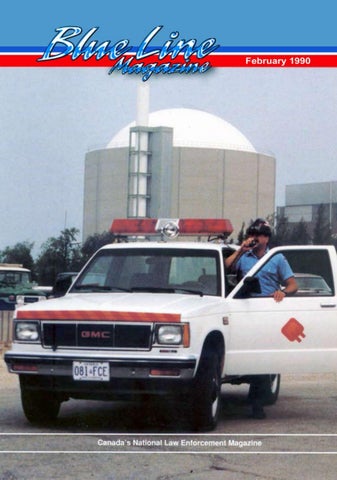
Nuclear Cops
6
How Safe are Nuclei,lr Reactors?
10
Experiment now Province Wide - Louise Dueck
12
Canada's Most Wanted: Walter Roderick Code
14
The origins of Community Policing (Part 4) - Chris Braiden 20 You asked ... - Liquor charges
23
Terror on the Miramichi - Richard Duplain
24
DNA Codes Help Nab Killer - Richard Duplain
25
Ontario Introduces new Pursuit Procedures
28
True Crime: A Wasted Life - Geoff Cates Books
30
NEWS: Province wide 9-1-1 on schedule
16
Window tinting slammed by Institute
16
Council seeking alcohol education projects
16
They say if with flowers in The Hague
17 17 17 22 26
Ministry sets guidelines for disclosure Officer returned to work by labour board Officer gets $20,000 for defamation Bonuses must be paid by RCMP CASE LAW:
Evidence not lost due to Charter breach
9
Drunk driver acquitted of Fail to Remain
11
Warrantless searches upheld by Supreme Court
27
February 90
3
I
t has been said that a general loss of security is the price of progress in the modern world . There 's no doubt that on a personal basis, life may not be as calm , placid and unruffled as it was in our parents' day. Many of the aspects of our daily life, however, call for increased vigilance on the part of the people whose task it is to keep our communities safe . The common and quite possibly increasing use of nuclear energy in Canada has made us realize that vulnerability isn 't something that just lives overseas in other people 's countries . Whether it's a Greenpeace activist wanting to hang a sign from a smokestack or a terrorist who places a bomb in airline luggage, we must cope with threats that, like it or not, have become an all too frequent occurrance in our lives. Beginning this month, Blue Line Magazine takes a look at Canada's nuclear industry by offering a closeup of some of the people who make sure that our nuclear plants are good neighbours.
Introducing Terry Barker Terry Barker is widely regarded as a dynamic and effective teacher who brings a great deal of energy and practical, managerial experience to the topics he presents. For many years, Terry has designed and conducted management seminar which draw on his varied background including sales management, the Armed Forces, government project management and teaching . In addition to being a skilled teacher, Terry is a recognized author and has been widely published in magazines and journals. He is the author of the book Boss Talk , a practical manual of communication skills for people in positions of authority. His most recent endeavour includes the book "The Five Minute Policeman" which puts his talents to work teaching front line officers about communication skills. At present Terry divides his time between Ottawa where he is Vice President of Potentia Consultants Inc. and Senior Resource Lecturer for the Algonquin Management Centre in the field of management skills and communication, and Vancouver where he is Senior Trainer of Management Skills
for TIK Training International Inc. Just to add one more carving on this already impressive totem pole, Terry has agreed to write a regular column in Blue Line Magazine. Terry is already well recognized in police circles. He has spent many years patrolling with officers and talking with them about their problems and work experiences. He is a regular lecturer at the Canadian Police College in Ottawa and the Fairmount Academy in Vancouver. He has just recently returned from a lecture series he presented to eastern Caribbean police officers in Barbados and sponsored by the RCMP branch of CIDA. Over the next several months we will present excerpts from Terry Baker's book, "The Five Minute Policeman ." This series will introduce YOlI to one of the main players in the book, Constable Tacky Burns, as he tells it like it is to a new officer he is training . "Tacky is not anyone particular officer", states Terry, "he is an accumulation of the worst and the best of police officers." Many officers, however, have approached Terry and asked him if he was writing about an individual they knew. An appropriate answer could very well be yes. He wrote about you. We hope you enjoy Terry's astounding insight into "people skills."
The wit and wisdom of Tacky Burns by Terry Barker (extract from "The Five Minute Policeman") Police officers are like doctors: the really good ones don't do much. If possible, that is. A good doctor doesn't want to operate. He sees an operation as the last resort. He wants your "bod" to heal itself. So he says, "Take an aspirin and call me in the morning." A good police officer doesn't want to operate either. You don't want to draw your baton or your gun if you can help it. You just want people to take an aspirin and go home to sleep it off. The best way to avoid problems is to sit on your anger, listen carefully to what folks are saying and give them some empathy so they know you care. Those are the first three steps in "The System." Good police
officers and good doctors do those things. Most times it works. When it doesn't work, the doctor goes on to Step Four: "Involvement". He talks the patient into curing himself, with diet or drugs. And finally, if he has to, he goes to Step Five, "ACT". He calls in a surgeon. It's the same way with police officers. If people don't want to cool off and go home then get them involved in helping you. This makes sense on two levels: they do things for you that you don't have time to do yourself; and when they're busy, they're out of your hair. If they won't cooperate, then you can play paddywack on their patooties.
Letters to the Editor Give that back! Please change my address on my subscription. People are taking my magazine before I get a chance to read it... Some Cops !! D. Moore Port Coquitlam, B.C.
••• Editor 's Note: We have received many requests to change subscribers ' addresses each month . Some share the same sentiments as this one. We do not recommend that subscribe rs give their bus iness address for recei ving Blue Line Magazine. I guess the temptation to swipe it is just a litt le too much for some.
••• Where's Bob these days? I wonder if a "Lost Trails" column would be successful in the Blue Line? I'm sure there are numerous officers in the O .P.P., R.C.M .P . and other large metropolitan forces that have lost contact with friends over the years. This column might help re-unite friends and give notice for reunions etc . Thanks. Don Chadbolt Millgrove , Ontario
••• Editor 's note: We presently have our column called "10-20" for lost subscribers. When we get the people to contact us we simply update their subscription information . This means that we do not have to call them back orcommunicateanyfurther. As much as I like the concept of "Lost Trails " the reality of life in the RCMP, and many other agencies, is that transfers are so frequent we could get swamped. Furthermore many people may want to find the buddy but would be re/uc· tant to have their name and num ber published in a national magazine. (especially if their support payments are in arrears) It would then fall upon our shoulders to personally follow up on each request and our shoulders aren 't that broad yet . Continued on Page 27
4
February 90
Vol.2 No .2 - February 1990 - EDITOR/pUBLlSHER -
Editorial
Morley Lymburner - EDITORIAL ADVISORS David H .Tsubouchi LL.B. Mary Lymburner BA M.Ed. Gerald A. Oxman l.c.l.A. Jaan Schaer BA (MTPF E.A.P.) Tom Dykes (Halton Region Police) Robert Hotston B.A . M.Crim . (Peterborough Police Force) Rick Patrick (Lambton College) The Editorial Advisors are persons from whom this publication seeks out advice and guidance. The use of their names is in recognition of their assistance and ongoing support.
- ADVERTISING Allan W. Stiver (416) 294-5502 FAX: 294-8952 - ASSIGNMENT WRITERS Lucy Becker • Louise Dueck AI Porter • Rick Patrick - CORRESPONDENTS Robert Hotston • Richard Duplain Daffydd Hermann • Craig McMillan - COLUMNISTS Geoff Cates • Gary Miller Robert Hotston • Jim Bardgett -PHOTOGRAPHYJohn Loftus • Don O 'Shaughnessy -ILLUSTRATIONTony MacKinnon • Bette Clark - DESIGN AND PRODUCTION Don O'Shaughnessy Eastern Graphics Services 66 Gerrard Street East , Suite 203 Toronto , Ontario M5B 1G3 (4 16) 348-8713 Fax: (416) 348-8725 Blue Line Magazine is published monthly, ten times per year by Blue line Magazine Incorporated with head office at 118 Main Street North , Markham, Ontario Canada , L3P 1YI. Editorial and copy is considered to be completely separate from advertising sales. No committment for editorial coverage can form any part of a sale agreement. Advertising enquiries should be made at (416) 294-5502 or FAX number (416) 294-8952. All articles are protected by copyright. No part of this publication may be reproduced or transmitted in any form or by any means, electronic or mechanical, including photocopying and recording, or by any information storage or retrieval system without permission from the publisher. The authors , advisors and publisher accept no liability whatsoever for any injuries to person or property resulting from the application or adoption of any of the procedures, tactics or considerations presented in this magazine . Readers are cautioned and advised that articles presented herein are edited and supplied for your personal awareness and should not be referred to for further action until appropriate advise and guidance is received from a supervising officer or the advice of a Crown Attorney. Blue line Magazine is an independant publication designed to educate and upgrade the skills of those involved in the law enforcement profession. It has no direct control from a law enforcement agency and its opinions and articles do not neccessarily reflect the opinions of any government agency or police force . Blue line Magazine is printed in Canada by Johanns Graphics. The s ole authorized distributor of Blue Line Magazine is Green Gables Book Shop, Markham, Ontario. Associate member, National Association of Police Planners
{;]t]"'f Member, Peri<Xiical ~ Publishers Exchange
ISSN #0847 8538 Second class mail registration No. 8242 February 90
The 'Widow Makers'
A
round New Years the family and I went to visit more of the family in sunny Southern Manitoba. Not wishing to break from tradition I abandoned the family for the best part of a day and visited the local police. The usual warm smiles greeted me and the friendly handshakes brought r-!!iliiiiiiiiiii;;;;:,!;; back the old comfy feeling we all have when we meet a colleague while away from home. As we chatted over coffee I noted that all three officers in my company were wearing something on their hips that sent a cold shiver down my spine. "What is that doing there?" I exclaimed. They all looked puzzled . "You guys are still wearing The Widow Makers'!" To my horror I saw the old peg flap holster on their belts. Each of us started to trade stories on the infamous history of these mechanisms of death . We all had instances to share of the guns falling out of our holsters in domestic disputes or while directing traffic . Stories of a citi~en running after one officer to return the gun that fell out when the officer got out of his car qUickly led into a series of stories of officers and friends who lost their lives by their own guns. Not only were these deaths unnecessary and intolerable but the police forces that continue to use them , after even one incident, should be held accountable. 5
I was completely shocked that a police force in this day and age thought so little of its members that they could not invest in a simple security holster that has been available for over 15 years. This is something that no one has to study to decide upon. EqUipment such as this should be put on the highest priority for replacement. (It should been done many years ago.) Iwould like to take this opportunity to quote some rather well known case law. The case is known as Regina Vs . Sault Ste.Marie (1978),40 .c. (2d) 353,3 C.R.(3d) 30(S.C.C.). In this matter the Supreme Court of Canada considered the issue of corporate responsibility with regard to a defence of due diligence by the corporation . The court determined that if a dangerous situation is pointed out that can be corrected at a reasonable expense, and the corporation fails to do so, then the corporation is fully responsible for any injury that may result from that neglect. The purpose of this editorial is to assist in removing any doubt that this problem was not pointed out. Officers who are still issued with this type of holster are encouraged to give a copy of this editorial to their spouse . If the spouse becomes widowed I would be deeply saddened, but fully prepared to have this magazine quoted in a court of law.
Nuclear Cops
Industrial security in the Nuclear age
A worst case scenario The story you just read is what would be called "a worst case scenario " by Kent Bergstrom, head of Security for Ontario Hydro's Bruce Nuclear Power Development. "Worst case " because two men managed to get through to a Nuclear Generator with a package that could prove to be lethal to many thousands. "Worst case " because a sleepy "Guarding the plant" takes on new meaning when the territory you have to protect is a potential target fo r ecological activists or even terrorists.
- Morley Lymburner -
T
he inky black water of the fresh water sea slowly churned under the inflatable Zodiac boat. The black coloured rubber blended perfectly with the water. The blackened faces of the men pulling on the paddles showed the intensity of the mission they had embarked upon . The sound of the waves breaking on the rocky shore alerted them the shore was near. The Zodiac rubbed the rocky sea shore . Both men jumped to the sides of the craft and pulled it up onto the rocks . One reached to the front and pulled out a black denim sack by its belt loops and slung it over his back as the two silouettes broke into a full run toward the huge domed structure that lay before them . The forward man threw his body to the ground before an eight foot chain link fence and promptly cut a one metre hole. Both men scrambled through the opening and continued toward the massive concrete structure, now only 50 meters away. Old George was the lone security guard . He was never a conscientious worker. Five years in the army during the war and twenty-five years as a jail guard had left little enthusiasm for the security job he now held at this nuclear power plant's gate house . At 3:00 A.M . the shift had taken its toll and sleep was slowly shutting him down . Was it a sound that suddenly awakened him or was it a feeling in the air. A certain stillness that alerted the guard that something could be wrong. Perhaps one last walk around the plant would clear the fog closing around his consciousness. The two blackened figures reached the foundation and threw a rope and grappling hook up the conduit pipes. One man climbed the concrete edifice while the second held down the bottom of the rope. They were suddenly illuminated by a flashing beam that cut through the darkness. Old George 's light had found its mark. Two members of the good ship "Green Peace" had been caught before they could put their flag on the dome.
6
February 90
guard could have missed such an intrusion. "Worst case" because when he finally did apprehend them there was no means readily at hand to prevent the intruders from continuing their mission had they been armed. "Worst case " because it did happen . The "worst case scenario " and the line between fact, fiction and science is a game played only by the "Nuclear Cops". A total full-time staff of 84 officers are responsible for guarding 2300 acres of the Bruce Nuclear Power Development that is enclosed by 15 kilometers
of eight foot chain link fence. They are to ensure that only the 4,000 employees of the plant are permitted inside that perimeter and that each one is only at the place that they are suppose to be. This security force has three basic duties. Protection of life, prevention of theft and just to be seen. To assist in these efforts they can call upon the Ontario Provincial Police as well as officers from Kincardine and Port Elgin. "But in reality," Bergstrom says, "We really count on the 4 ,000 pairs of eyes working here. "
The outside perimeter fence has been designed to deter trespassers while each building in the facility has a heavier level of security fence that was copied from defences used by the Israeli Army. It includes two sets of fencing designed to defend the structures from terrorist attacks. All this is connected to a central security bunker that monitors the entire area with video cameras. Security designed to buy time "From all our tests and periodic simulations we know we have to hold out for a maximum of 17 minutes beContinued on Page 18
February 90
7
Is nuclear energy a good choice for the environment? Electricity can be generated in many different ways. But to provide the amount of electricity needed to supply our homes and industries in Canada only three energy sources can do the job today. These are : nuclear energy, the energy released by splitting atoms; fossil fuels, the burning of coal, oil and natural gas; and hydro energy, the use of falling or running water. All three methods have some adverse effects on the environment. But nuclear energy can often be the best choice environmentally. Here are some of the reasons.
No "greenhouse effect" and no acid rain Nuclear energy avoids the "greenhouse effect" perhaps one of the most serious environmental problems facing mankind today and which threatens to cause a global temperature rise. The greenhouse effect comes from the build-up of carbon dioxide (C02) in the atmosphere caused by the burning of fossil fuels, especially coal. It is also
aggravated by the global reduction of No need for long transmission lines forest areas which absorb CO 2. The Nuclear energy can avoid the con rise in global temperature threatens to struction of very long and environmen cause melting ofthe polar ice caps and tally troublesome transmission lines. result in catastrophic flooding of highly They are often needed when hydro populated and fertile coastal areas electric generation is used far from around the world. the consumer. Nuclear plants can be Nuclear energy does not produce built quite close to where the electricany carbon dioxide and does not con- ity is needed. Today all the major hytribute to the greenhouse effect. dro sources near Canada's main popNuclear energy also avoids caus- ulation centres have already been ing acid rain . This is because nuclear harnessed. energy does not produce sulphur dioxide (S02) nor other acid gases which Very small amounts of waste are released by the burning of coal. Because uranium contains many Acid rain has been identified as a ma- thousand times more energy than fosjor cause of environmental damage sil fuels, the volume of waste from a nuclear power station is very small, to our lakes and forests. although it is highly radioactive. It is all concentrated in one place where No flooding of large areas Nuclear energy avoids the flooding it is carefu lly monitored and safely of large areas above a hydro dam . controlled. Waste contain ing natural Flooding can often have serious en - radioactivity is also produced in the vironmental and social consequences mining and processing of uranium. such as the cutting of large areas of This material is also handled safely. forest, the destruction of fertile land Nuclear power plants do release very and the displacement of people from small amounts of radiation into the enthe flooded areas. vironment but these releases are no
42,000 Tons C0 2
EveryDay 2,000MW
Pollutants released to the environment from a cool-fired plant without "scrubbers". Scrubbers do not prevent the release of CO2 which causes the greenhouse effect
greater than the radioactivity released ods has a place, especially for some Toronto, sits on 2 sq. km of land. by the burning of coal to produce the remote locations. However, given their If that same city's electriCity were same amount of energy. Finally nuclear current technological development, to be supplied by solar collectors a reactors do not release poisonous their use could create, rather than land area twice the size of Metropolimetals such as arsenic, lead and mer- solve, environmental problems ifthey tan Toronto would be needed. cury nor any toxic gases into the were used to produce electricity in the If the equivalent electric ity were amounts needed today. atmosphere. supplied by the burning of wood, an As an example, for wind generators area of natural forestthe size of Prince A comparison to produce all the electricity needed Edward Island, would be needed, not About 16% of the world 's electrical to supply a city of 3 million people to mention the environmental probenergy comes from nuclear power. If such as Toronto, the land required lems caused by wood cutting, its transthis energy came instead from coal , would be about 40 times the area of portation and burning. each year more than 1V2 billion extra Metropolitan Toronto. This is more than These are just some of the reasons tons of CO 2, 2 million tons of S02' and four times the area of Prince Edward that many leading environmentalists 1 million tons of nitrogen oxides would Island. around the world recognize the imgo into the atmosphere - even if the To produce the required electricity, portance of nuclear energy as a good coal plants had the best equipment some 40,000 wind generators, each choice, and often the preferred choice, for removing these emissions. In ad - with four blades sweeping a 19 m di- in meeting the world 's needs for elecdition, about 150,000 tons of pOison- ameter, positioned on top of a tower tricity today. ous heavy metals would be released about 39m high would be needed . into the atmosphere. Apart from the vast land requirement, and the visual and noise effects of the So lar, wind and biomass energy wind generator towers themselves, the It has often been suggested that so- environmental impact would be enor- This article was sponsored by the lar, wind and biomass energy can mous. Also, backup generation sys- Canadian Nuclear Association . For further details contact the CNA, 111 overcome environmental problems tems would still be required for calm Elizabeth St., To ronto , Ontario, caused by other forms of electricity wind conditions. M5G 1P7, Tel: 1-800-387-4477. generation. By contrast, the Pickering nuclear Undoubtedly each of these meth- station, which can more than supply
( CASE LAW: \
~ Charter Rights
'__ _ _ _ _ _ _ _ _ _ _ _ _ _ _ _ _ _ _ _ _ _ __
Charter breach does not mean evidence automatically tossed (Regina Vs. Marshall) The Ontario Court of Appeal recently re-affirmed that evidence should not be automatically excluded simply because of a Charter breach. The court determined that the Judge must first consider what damage has been done by the breach and whether the administration of J ustice would be brought into disrepute. It is also a good case for officers to reflect upon with regard to the proper form of caution given to accused persons In this case a motorist was stopped by police and given a test on an approved screening device. This test reported a failure and the officer, having reasonable grounds to believe the accused was over 80mgs ., arrested the man for this offence and advised him of his right to counsel then demanded he accompany him to the station for a February 90
Breathalyzer test. Upon arrival at the station the officer advised the accused, "If you want to call a lawyer, now is the time." The officer presented the accused with a telephone but the accused did not make a phone call. He was subsequently found to have excessive alcohol in his system and was charged accordingly. At his initial trial the accused 's lawyer argued that the officer's statement that "Now is the time" to contact counsel would indicate to the accused that the call could not be made at any other time. The presiding judge at that time accepted this argument and stated that the accused 's right was infringed and excluded the evidence of the Breathalyzer test. Upon appeal to a higher court Mr. Justice Calligan stated that drinking 9
drivers are a "scourge on the highway and cause incalculable damage to the public. " He went on further to state that he did not feel that the charter breach was deliberate , if indeed there was a breach . He concluded that "Although no Charter infringement should be minimized, I am unable to say that the infringement in this case was a serious one. In fact , it seems to me that it was inadvertent and quite technical. " He continued by saying, "He (the officer) was not being unfair to the (accused) but was probably trying to help him. " The judge concluded that the Breathalyzer results should have been admitted and restored a conviction. All members of the court concurred.
Report Nuclear Facts - Part 1
How Safe Are Nuclear Reactors? (Courtesy of Canadian Nuclear Association)
T
cated . Also , many of these are tripJicated . This means that the failure of one component does not jeopardize the overall safe operation of the station . How are nuclear reactor operators trained? The training of competent nuclear reactor operators is a very important aspect of the "defense-in-depth" nuclear safety philosophy. Nuclear power station control room operators are carefully selected and spend approximately eight years in training. They must pass a series of examinations before being licensed and given responsibility for operating a reactor. These examinations are set by the Canadian government's nuclear regulatory body, the Atomic Energy Control Board (AECB) .
he Canadian nuclear industry has Containment systems . adopted a "defense-in-depth" safety What is meant by high philosophy for the design and operaquality station equipment? All suppliers of components to tion of its nuclear reactors. For this reason Canadian nuclear reactors are very safe. There are three basic reasons for this statement. First, it is absolutely impossible for a nuclear power plant to explode like an atomic bomb. Second, the many safety systems of the CANDU take into account not only human error but also equipment failure and other risks such as earthquakes, airplane crashes, etc . Third , should an accident occur, CANDU nuclear reactors are designed to contain radioactive emissions within reactor buildings. What is the safety philosophy? The safety philosophy used in CANDU nuclea r How safe is safe? All components used in tlte construction oftlt e CANDU reactor must meet stringent quality power plants is to limit the standards, and redundancy is designed into every step in tlte generatillg process. chances of an accident occurring and to limit the effects of an acci- CANDU nuclear power plants such as Nuclear power station operators dent, should one occur. This is called manufacturers of pumps, valves, pip- are trained on control room Simulators, the "defense-in-depth" approach and ing, and electrical systems, must meet capable of simulating normal and emersets high standards for design , station stringent qualifications. gency operating conditions. Also , all of the nuclear plants' critioperation and operators. What is fault detection and There are five main defense-in- cal control components are duplicated. correction? depth areas: 1 . High-quality station This means that if one component Each Canadian nuclear power staequipment: 2. Nuclear plant operator malfunctions, another will take over. All tion is continuously monitored through training ; 3 . Fault detection and correc- important sensing instruments, and even a program of special testing and inspection ; 4 . Independent safety systems; 5 . the main control computer, are dupli- tion of its components and safety sys10
February 90
tems. The constant and prompt detection and correction of faults ensures these nuclear power stations operate within licence guidelines prescribed by the AECB. This Board has inspectors on site at all times at these stations and can withdraw an operating licence at any time if appropriate conditions are not met. What are independent safety systems? Canadian nuclear reactors are equipped with independent safety systems whose sole function is to automatically shut down the reactor in the event of any major equipment malfunction, including the failure of both control computers. In Canadian nuclear reactors, these systems include: . high-speed insertion of shut-off rods into the reactor to immediately stop the nuclear reaction; - the injection of products into the reactor to further halt the nuclear reaction ; and - the discharging of the moderator, needed to sustain the nuclear reaction. All Canadian nuclear reactors have two of these three systems. Anyone of
( CASE LAW: \
~
Defence
these systems can automatically and independently stop the nuclear reaction . Furthermore, all Canadian nuclear reactors are equipped with an emergency cooling system . It would continue to remove heat from the reactor should the primary cooling system fail. What is the function of containment systems? A containment system surrounding a nuclear reactor is designed to limit or contain the release of any radioactive material to the outside environment in the event of an accident. The containment system at all Canadian nuclear generating stations consists of an air-tight reactor containment building (with reinforced concrete walls up to 1.8 metres thick) for each reactor. Where multiple nuclear reactors exist, such as at Ontario Hydro 's Pickering , Bruce, and Darlington stations, each reactor building is connected to a common vacuum building which assumes the containment function . This building acts like a vacuum cleaner. In the event of a release of
radioactive steam into the reactor building, this steam would be vented to the vacuum building and prevented from escaping into the environment. Once in the vacuum building, the radioactive steam is condensed into liquid and contained. Other nuclear reactors, such as those at Three Mile Island or Chernobyl , do not have this containment feature . This safety feature is unique to CANDU design. Next month: What Is Radiation?
What you need to I<now every day is in Blue Line every month.
6~t:"~ ~~ Have you sent in your subscription yet?
~.____________________________________________________
"Drunk" Driver acquitted of Fail to Remain (Regina Vs. Colby) Alberta A woman who killed a cyclist in a 1987 accident has been acquitted of failure to remain at the scene of the accident because she was too drunk to know what she was doing. The Alberta court of Appeal decision reported that the evidence of the accused 's impairement could be used as a presumtion of innocence that she fled the scene to escape civil or criminal liability. The case involved a woman who left a bar and was noted to be having trouble walking. She was helped to her car but was warned by a person not to drive the car. She ignored this caution and drove away. Shortly after she struck a cyclist on the highway throwing his body onto the roof of the vehicle and down the back of it. Evidence revealed
that there was no evidence of swerving or braking at the scene. Upon arrivng home another witness approached the woman as he saw her leave her vehicle and attempt to unlock the door to her house. This person assisted her in doing so. He saw the blood that was on the hood , roof and back of the car and asked the woman if she had been in an accident. She advised she thought she hit a tree. He pOinted out to her that "Trees don 't bleed " and she stated that she may have hit a bird or animal or something. The following morning the man heard the report on the radio and notifed police. He advised police that she was quite intoxicated when he spoke with her. At trial the accused did not argue
___F_e~b~ru~a~ ~~9~O__________________________________11
the Drive Ability Impaired offence but was convicted of the Hit and Run charge in addition. The original trial judge cited the section which reads that the court can make an inference adverse to the accused by simply hearing that they had left the scene if there is no evidence to the contrary. Upon appeal the defence stated that the accused 's admission that she was not only impaired but "drunk" would indicate that there would be evidence that she could not form the required intent to escape liability. The fact that the court accepted she was drunk at the time should exclude the conviction on failure to remain and that this evidence was admitted at trial for the court to consider. The Appeal court accepted this position and acquitted the accused.
Report
Experiment in Community Policing now province wide - Louise Dueck Assignment Writer
A
Barrie-area experiment in community policing worked so well that it developed into a province-wide policy for the Ontario Provincial Police. Thirteen communities in Simcoe County now have their own community officer.
District 7 were added, including the village of Coldwater and Oro Township, the only township program. Each program has one officer assigned, except for the three largest ones, which have three officers each.
Officers and community representatives exchange ideas at a workshop for imcoe County and Muskoka in April 0/19 9
District 7 , encompassing Simcoe County, part of Dufferin County and Mu koka Region , was chosen in 1987 to test the concept of community policing . The original five communities cho en responded so well that the decision was made by the OPP to expand throughout the province, says Constable Bob Covey, District 7 Coordinator for Community Based Policing . Eight more communities within
But the problems, no matter the size of the community, are the same, maintains Constable Covey. Covey defines community-based policing as "people and police working together". There is no blueprint for the program because, Covey explains, each community is different. The process for setting up such a program begins with identifying an officer, training him in the concept of 12
community based policing plus analytical processes, and then moving him into the community. Usually an office is supplied by the community, complete with heating , phone and answering machine . The officer speaks to groups about the concept and asks the groups to provide a delegate to sit on a steering committee. He may also identify key persons in the community and invite them personally to sit on the committee . This committee , says Constable Wayne Ross , the community-based officer for Oro Township, is then asked to serve for a specific period of time. In addition, they are requested to report back to their sponsoring group and ask what issues they want the police to address. As people in the community get to know the officer, they also come to him directly . "It's almost like 'adopt-a-cop '," Covey explains. "And the feelings of satisfaction engendered in the officer make for more effective policing." Constable Roy Telford, the Coldwater based officer, agrees. "It's like being a 'beat cop'." he defines his job. Telford has captured the attention of the youth in his community, hosting as many as 23 at once in his tiny office for a two hour rap session . The youth call him by his first name. He talks to them when he 's out on the street and feels his communications with them are helping break down the usual fears and barriers youth erect with police. Some days he feels like a Father Confessor, Telford says. One elderly gentleman brings him a coffee every morning . Telford, too. has a committee of community persons representing churches, service clubs, seniors, youth, the Town Council, the Horticultural SOciety and the Fair Board . The committee meets monthly and discusses how to make Coldwater a better place to live. Problems addressed may be similar to Oro Township's or any other community, and include speeding, B&E's, vandalism and trespassing . February 90
---
Each community based officer sets some goals for the year. Constable Ross' goals for 1989 for Oro Township include resolving a problems of trespassing on privately-owned lake property by smelt fishermen, addressing a problem of underage drinking at the local drive-in theatre, and decreasing the problems skiers bring to the region every year - ski thefts, liquor licence infractions and drugs. Already he has developed community support and assistance to deal with these problems. Constable Telford's main goal is to decrease the number of B&E incidents in Coldwater (population 1200)by 10%. The incidence rate prior to his arrival was a business risk of 1 in 7. In the first quarter of 1988 there had been five incidents; for the same period in 1989, there have been two. Constable Ross sees a communitybased police officer's duties as those of any other police officer, but in addition there is opportunity for long-range planning which provides for proactive
policing as well as reactive. Community concerns are addressed before they become a problem. And if a problem is recurring, there is the committee to help look for new solutions, as well as the OPP Detachment Planning Group. Ross finds his emphasis is frequently shifted to where a new problem erupts, ie. speeders on back roads as these are gradually becoming alternate routes to the Highway 11 traffic load. Both Oro Township and Coldwater answered calls in a typical month for similar incidences of thefts, fraud , B&E's, assault, willful damage, vehicle accidents, disturbances, Highway Traffic Act, Liquor Act, impaired driving , warrants executed and numerous "other"calls. Ross ' duties included monthly compilation and analysis of statistics and the setting of goals and objectives. These are presented to the committee, who may have their own, differing goals. Both sets of goals thus get addressed. At the end of the year an analysis report
giving statistics and breakdowns is prepared for the Township Council, together with the identified areas to be worked on. Monthly stats are also submitted to Constable Covey from the thirteen community-based policing programs. Covey then compiles and evaluates the statistics. "Community policing is an educational process, not a quick band-aid", concludes Covey. "It takes time. Time to develop contacts and trust. But the basic concept is going around the world. " "We do , economically, have to do more with less. We are using the community to help us, as we are helping them, and we both come out winners. " Coldwater business people agree. They report a definite improvement in their youth. Less mischief, less nervousness of police and lower crime rate. Their community-based police officer is a friend to all, they say, but especially to their youth.
•••• • ••••••••••••••••••••••••••••••••••••••••••••••••• • ••••••••• •• •• •• •• Canadian Police Officers •
The 1990
Motorcycle Championships •••
•• Held in conjunction with FAST Motorcycle •• • Training School, Shannonville •
For details write to:
• • • Practice: June 27th, 28th, 29th • Final Race Day: Saturday, June 30th •• • • • Shannonville Motorsport Park • • Shannonville, Ontario • •• • • Executive Committee Canadian Police Officers Motorcycle Championships 733 Leaside Street Pickering, Ontario L1W2X2 or call (416) 831-2013
• •
••
• • • • •••••••••••••••••••••••••••••••••••••••••••••••••••••••••••••••••
Walter Roderick Code Non-Capital Murder Whitehorse, Yukon Territory
14
February 90
O
n September 25th , 1972 at 5 :15 P .M. a resident of Whitehorse , Yukon Territory , contacted the RCMP. He had not seen his neighbour, Allyn Giswold, a 70 year-old Norwegian who lived alone in that city, for a number of months . The police attended the residence and found the house padlocked from the outside. Entry was made to the residence and subsequently the body of this man was found decayed and mummified , wrapped in blankets laying on the floor beside the bed . It appeared as though the body had been there for an extended period of time . Breathing apparatus from the local fire department was used by investigators to examine the scene for evidence and to photograph the scene before moving the body. Initial observations revealed portions of the skull to have been broken away from the head. It was apparent that Giswold had been murdered and died due to head injuries. The autopsy revealed the victim died of multiple fractures of the skull. A common household claw hammer is suspected as the murder weapon. Such an instrument, having been apparently washed clean, was found near the victim . The victim Giswold's home was situated in a residential urban area downtown and five blocks from the RCMP office. Whitehorse is the capital city of the Yukon Territory, with a population of around 14 ,000 people in 1972. The deceased was a pensioner at the time of his death. He was attempting to sell his house as he was distressed over his financial state . He planned to return to his home in Norway when the sale was completed. He had immigrated to Canada from Oslo in 196 1. The suspect Investigation revealed that one Walter Roderick Code moved to Whitehorse and met Giswold in May 1972 . The reason Code came to the Yukon has never been established . Investigation did not reveal any associates in Whitehorse except Giswold. How Code met Giswold is also unclear; however, there is little doubt Code befriended February 90
Giswold for his own intentions. Walter (Wally) Roderick Code was born November 30 , 1950 in Fort William (now Thunder Bay) Ontario. In 1972 he was described as 5' 8", 150 pounds, dark brown curly collar length hair, bushy eyebrows, dark brown eyes, ruddy olive complexion , pOinted nose , mole over left eyebrow, bump on left forehead , dimples in both cheeks, receding hairline and good looking. He smoked Players brand cigarettes and was a stylish meticulous dresser. He used the following aliases : Walter
Walter Roderick (Wally) Code: most recent photo.
Richard Code ; Ted Clark; Bob Clark, Walter Roderick Giswold; W.R. Giswold. He is also known to use various dates of birth . The most frequently used is 11 November 1947 , 30 November 1947, 3 November 1947, 11 November 1950 and 30 November 1948. Modus operandi On May 17th, 1972 the victim tried to sell his house, and Code acted as a spokesman when the house was listed with Klondike Realty for $11 ,000 . On the 18th of May the property title was transferred to Code and registered in the Territorial Land Titles office on the 23rd of May in Code 's name . The selling price was $1.00. The victim had always been very proud of the fact he had been able to purchase and maintain his own house. 15
It is believed that due to this it would have been out of character for him to sell the house for this amount. Further investigation by the Document Section of the Forensic Lab in Vancouver confirmed the victim had in fact signed the title of his house over to Code for $1 .00 . A forgery was therefore ruled out. For some reason, Giswold sold his house to a man he had only known for perhaps less than one month. The victim was known to regularly shop for groceries at a nearby confectionery store called "The Corner Store (Yukon) Ltd." The owner knew the victim well . It was in May 1972 that Code began charging groceries on the victim's account at this store. He would sign his name W.R. Giswold thus incorporating his name with that of the victim. The elderly Mr. Giswold had previously authorized this practice by advising the store keeper that Code was his nephew. On May 29th, 1972 the victim was last seen alive when he went into the store and purchased groceries. He told the store owner that no one else was to purchase groceries on his credit account any further . This was no doubt referring to Code, the only other person who had charged groceries on this account. The following day the 21 year old Code went into the same store and attempted to buy groceries on the account. As the store was busy, the owner put the groceries on the account. Code was never again seen after that date in Whitehorse . The chase Attempts to trace Code 's departure from Whitehorse were difficult, partially due to the time that elapsed between the murder and the discovery of the body. On June 6th, 1972 Code acquired airline tickets in Whitehorse for a flight to Edmonton , Alberta and Timmins, Ontario. It is believed he used the ticket to Edmonton but he never did use the ticket for the Timmins flight. On June 7th , 1972 Code is believed to have used the Certificate of Title for the victim's house as collateral on a loan in Edmonton. On June 9th he Continued on Page 29
.news beat ... news beat ... news beat ... news Province Wide 9-1-1 on schedule The Province of Nova Scotia is the first province to embark on a program that will see a province wide emergency 9-11 system starting in 1991 . The new system, being looked at for approval by Maritime Telephone, will permit people in the entire province to call for emergency help by dialing the three simple numbers. Although other cities have had such systems the world over, only the States of Delaware and Rhode Island currently have the system integrated on a state wide basis. The new system is expected to be ready for testing in small areas of Nova cotia by May 1991 with province wide implementation expected for 1992.
Window tinting slammed by Institute The American based National Highway Traffic afety Administration has put thumbs down on a proposal by several car window tinting firms to permit darker tints on car windows. The NHTSA stated that if the present light standard of 70% light transfer was changed to 24 .5%, as suggested, it would mean that many drivers would have difficulty seeing . Particularly vulnerable would be night driving and the elderly. It stated that it would be particularly hazardous to pedestrians and with driving in inclement weather. The organization stated that it would not recommend this tinting on side and rear windows either. They found that this would be particularly hazardous at intersections where conflicts with other vehicles and pedestrians are highest. On the Canadian side it has been established that the identity of the driver of motor vehicles is paramount in Hit
and Run investigations. Many jurisdictions have lost the ability to convict the registered owners of vehicles involved in such occurrences. With stiffer drinking driver penalties the option of leaving the scene of an accident has become increasingly popular. Witnesses who can only describe a mere shadow at the wheel find their evidence of no use in courts. Many provinces have instituted laws or tightened up old laws to combat this problem of identification.
New council seeking to fund alcohol education projects A new multi-industry council wants to fund community projects aimed at encouraging responsible attitudes toward alcohol. The Information Council on Beverage Alcohol is providing $250 ,000 in seed money to fund hands-on community action programs that will teach responsible attitudes toward alcohol. The council believes community action and discussion are key to redUCing alco-
hoi misuse , a problem often kept within the family . The council was founded by the Association of Canadian Distillers, the Canadian Wine Institute, the Packaging Association of Canada , the Tourism Industry Association of Canada, Hotel Association of Canada , the Ontario Imported Wine and Spirits Association . Tim Woods, of the Association of Canadian Distillers, says the council is interested in new innovative projects, including initiatives that can serve as models to be implemented on a wider scale in schools or community groups. Mr. Woods is eager to hear proposals from interested groups. Representatives of the Canadian Ethnocultural Council , the Canadian Home and School & Parent Teacher Federation, Canadian Association of Chiefs of Police and the Pharmaceutical Manufacturers Association of Canada are among the member's of the Council's advisory board that will choose worthwhile projects. Those interested in this program should contact Mr. Tim Woods, Information Council on Beverage Alcohol , 90 Sparks St. , Suite 1100, Ottawa, Ontario KIP 5T8 , Telephone (613) 238-8444 .
FLASIIES by Tony MacKinnon
"I'd say you certainly unstuck the volume control on their stereo! "
16
February 90
.news beat ... news beat ... news beat ... news They say it with flowers in the Hague Police from The Hague in Holland have delivered hundreds of bouquets of flowers to residents of an area of the city that has had three bomb explosions over a one week period last October. "We delivered 250 bunches of flowers to local residents to say sorry for the distrubance and thank you for cooperating ," said spokesman Rob Oosterbaan. The first explosion occurred on October 24th when a Spanish diplomat's car was bombed while parked in the neighbourhood. During the next week two more blasts ripped through the Spanish Embassy building and injured five people. The idea is said to have been a success with many residents appreciating the gesture. The police feel the flowers would certainly improve relations with the community and go a long way toward instilling confidence in their department.
Ministry sets out guidelines for disclosure The Ministry of the Attorney General in Ontario set out a four point guideline for defence counsel with regard to disclosure of evidence. The statement makes clear what information is and is not accessible to lawyers for defence. It is certain that many officers across the country are going to be confronted by this policy and for your information it is abbreviated here . Policy Statement: "It is recognized that there is a general duty upon the Crown to disclose the case-in-chief
February 90
for the prosecution to counsel for the accused, and to make counsel for the accused aware of the existence of all other evidence relevant to the guilt or innocence of the accused. There is no general duty on the Crown to disclose evidence which is not part of the case-in-chief for the prosecution or which is not initially relevant to the guilt or innocence of the accused but which becomes admissible only as reply evidence. In addition, matters which on public policy grounds could jeopardize a state or individual interest should be the subject of careful scrutiny. The purpose of disclosure by the Crown is threefold ; a) to ensure that the defence is aware of the case-in-chief for the prosecution and all other evidence relevant to the guilt or innocence of the accused; b) to resolve non-contentious and time-consuming issues in advance of the preliminary hearing or trial in an effort to ensure more efficient use of court time; c) to encourage the resolution of cases including where appropriate the entering of guilty pleas at a date early in the proceedings The gUiding principle is always full disclosure of the case-in-chief for the prosecution and all other evidence relevant to the guilt or innocence of the accused. Such full disclosure may only be limited where there is real need to protect the integrity of the prosecution, including the need to prevent the endangerment of the life or safety of witnesses or interference with the administration of justice. Any limitation on such full disclosure requires the prior written approval of the Regional Director of Crown Attorneys." Given the above policy statement it is important that if officers, at least in Ontario, find a case where they do not wish information to be released they should supply the Crown with a written submission to this effect explaining the reasons. Officers who would like further clarification on this matter should con-
17
suit your local Crown Attorney or Force policy in detail. Full text of the policy can be obtained from the Criminal Law Division of the Ministry of the Attorney General citing Directive No. 02 of October 1, 1989.
Officer returned to work by labour board Constable Allan Gosset, of the Montreal Urban Community Police , was ordered reinstated after being suspended from duty for 21 months. The order by the Quebec Labour Relations Board is final and can not be appealed . Constable Gosset was charged in November 1987 after he shot and killed a youth who escaped from him. The officer had drawn his revolver and ordered the youth to stop. The court ultimately dismissed the charge of manslaughter against the officer saying that there was an absence of malice on the part of the officer . The police force , however, convicted Gosset of using "unjustified force ." in the incident and dismissed him as a result. In the August decision brought down by the Labour Relations Board the arbitrator stated that the officer erred in discharging his firearm , but his actions did not justify dismissal. The arbitrator stated that being off the job for 21 months, with a loss of $70 ,000 in pay, is punishment enough . The arbitraiter stated that firing is justified only when an employer has lost faith in an employee . In this case the shooting was "accidental and without malice as the result of imprudent handling of a firearm in a moment of great stress." The judge also categorically dismissed the idea that the shooting was raCially motivated .
Contitllted from Page 7
fore armed police can arrive, says Bergstrom. "We are quite confident that we can do that and also guarantee no nuclear leaks." Bergstrom's confidence comes from five years in the Canadian Military Police in Germany and coming up through the ranks after 19 years in the Bruce Nuclear Plant. This confidence is not shaken by such movies as "The China Syndrome" or disasters such as Chernobyl or Three Mile Island . "The walls have been designed to withstand a direct hit by a 747 jet," Bergstrom says, "and with no leaks. " Bergstrom is also quick to point out that the CANDU reactor has the best safety record in the world and is an entirely different technology then either the Russians or Americans. And with the security measures presently in place a terrorist taking the time to attack a reactor will be doing just what these guys want. Giving them that 17 minutes. Power and authority Over the past few years Ontario Hydro Security officers tended to utilize Ontario's outdated Public Works Protection Act when it came to stopping and searching people on the grounds. Further authority was sought due to weaknesses in this act. "For many years we were routinely searching some individuals upon leaving the plant ," Bergstrom states, "we were surprised to find that the Act only specifically mentions the stopping and searching of people going into a public work but not leaving ." From this rude awakening, and the need to extend some authority outside the gates of the plant, the Ontario Provincial Police swore in 40 officers as Special Constables. Bergstrom related an incident where he received information of an employee stealing scaffolding planks from the site construction area. He obtained a search warrant and executed it at the employee's residence. He found about $8,000 worth of this lumber had been used in a fence and patio deck . Bergstrom brought charges against the employee and had him dismissed from his job.
Training All security officers receive extensive training at the Western Nuclear Training Centre . Study includes how nuclear energy is created and how to defend themselves from radiation . Officers receive instruction in Criminal Code and various Provincial Statutes that relate to their duties. Although the officers are not armed they receive training in defensive tactics and firearms use from the Ontario Provincial Police. Recently they received authority to carry handcuffs and obtained the training necessary to use them . Each year the facility hosts a training session in conjunction with the Ontario Provincial Police Tactical unit. The officers explore the facility to acquaint themselves with the grounds. They perform a mock intrusion and test the responses of the security staff.
things as nine days off in one stretch at least five times a year. Average pay is about $35 ,000 and about 75% of the staff have had previous police , military or jail guard training and experience . Due to the pay level and benefits the force has only a 5% turnover rate annually. The average age of the officers is 40 years. The officers recently voted to become members of the United Plant Guards of America with a 55% majority vote. The buildings utilized by the officers are, of course , all new. They include 10 guard houses and the administration building. All uniforms are supplied and all security vehicles are 4X4 GMC Jimmys. Nuclear pressures While being interviewed for this article a warbling alarm started sounding on the public address system . I
Kent Bergstrom is Head of Security for OntarioHydro's Bruce Nuclear Power Development. He and his counterparts head the first line of defence of Canada 's nuclear generating stations.
In spite of all the instruction O.P .P officers are given they still have a sense of discomfort when working around a nuclear reactor. As Bergstrom puts it, "they have no trouble dealing with a target they can see. It's when they are dealing with a threat they can't draw a bead on that bothers them most. " Working conditions and benefits The officers work a 12 hour day on a rotation system that includes such 18
looked to the Director who had stopped in mid sentence . His calm manner did not disguise his look of anticipation. "Well it looks like you may be able to report on an emergency happening . That is a signal of a radiation leak. There is no indication yet it is a drill. " Bergstrom left his desk and promptly appeared with two black helmets and two long yellow web-canvass satchels. He advised me to put on the helmet and then gave me brief instrucFebruary 90
tions on what to do with the satchel. One end revealed a mouth piece and some nose pinchers while the bottom had a break off seal. I was instructed to tear off the seal only when instructed . Bergstrom placed his black helmet on his head and slung his canister over his shoulder. Following his instructions I did likewise. He advised that all personnel and visitors were to attend their assembly areas for counting . I followed Bergstrom to the main security desk and stood by while he took a telephone. The once quiet office was now filled with security personnel calmly going through an exercise well rehearsed from years of practice . In spite of the continuous warble from the speakers each officer remained calm and radiated a feeling of confident professionalism . Whatever was happening I felt I was in good hands. The warble stopped and a long continuous beep was heard over the speakers. "That's the all clear sir. " called the duty officer by the desk. An announcement came over the P.A. that this was a drill. Bergstrom turned to me and stated that this was a normal drill that comes at random approximately once a week. I asked one officer near by if we had passed the test. He said "We never pass the test. We don 't want to get too confident by asking ourselves that. But between you and me I think we have one helluva good team here ." I had to agree . We ak links in the armour If there is a weakness in the security system it is one shared by the security industry as a whole. Bergstrom noted that the lack of recognition as professionals is one area. "Other employees look upon security as the lowest job there is around here. " The Nuclear station at present employs over 4 ,000 people . The vast majority are high paid experts in their field. A man working in a control panel room can train for over 8 years and receive pay in the area of $60,000 . It is no wonder that security officers have an image problem. Another problem is the boredom factor. This is a job that is filled with routine. It is difficult to simply make rules and have the supervisors catch the February 90
violators when it comes to working in a confined facility with a narrow scope of responsibility for its guards. Officers are rotated as to duties and given upgrading courses to relieve the tedious nature of the job. But it is a never ending problem. Officer complacency is another problem that must be considered. Performing security functions in a restricted access area is far different from working in a publicly accessible area such as a department store, bank or shopping mall . Each officer at the nuclear facility sees the same people every day and the tendency to relax and become over familiar is too great. Armed guards Bergstrom advises there is a big difference in security in the U.S . nuclear power plants. Spent fuel rods from U.S . nuclear plants are used extenSively by the military. For this reason the security around their plants tends to be much tighter with armed guards, electrified fences and canine patrols. While on a seminar Bergstrom asked one of the heavily armed guards if he ever had to catch an intruder or use force of any kind . The guard looked at
him with a pained expression and said "Dammit I wish ta hell someone would try somethin. They got us hyped up trained and ready to go and there aint no party ta go to. I'd jus like ta ketch someone climbing a fence. Jest once! " Bergstrom points out that he would not welcome the arming of his officers. He states that it would almost be a betrayal of the Canadian way of life if a security officer at a power plant would have to carry a gun . "On the other hand ," he says, "our officers have to be ever vigilant. We do have radical groups in this country." The bombing of a power transformer in B.C. and Litton Industries in Toronto are two such examples he does not want repeated in his area . The Bruce Nuclear Generating Station produces enough electricity to illuminate two cities the size of Metropolitan Toronto. It also produces enough nuclear waste that , in the wrong hands , could cause the death and suffering of just as many people. Each officer guarding this plant is aware of what is at stake. Kent Bergstrom is one "Nuclear cop" who feels they are up to the task.
Product development
New net catches cars A company in Great Britain is currently testing a new stopping net for motor vehicles. The device is being developed for the British police service specifically for the purpose of ensnaring pursued motor vehicles. The new device , called "Spanset", consists of a series of vertical straps secured top and bottom by two horizontal straps about 10 metres long. The material used is polyester straps stitched to industrial lifting slings and cargo ties. The net structure is attached to two motor vehicles that are used as anchor points on both sides of the highway. The net lies flat on the roadway for normal traffic to drive over and a simple pulley chord is used to qUickly raise the net in front of the target vehicle. 19
After ensnaring the vehicle it is brought to a controlled stop by two brake packs secured to the net and the anchor point vehicles. In tests performed by Britain 's Home Office the "Spanset" was capable of stopping a Volvo station wagon weighing 1400 kg . and travelling at more than 1 00 km/h within 42 metres. There was only negligible damage to the car and the net and the driver was not injured. At 50 km/h the vehicle was stopped in around 20 metres. During the tests it was found that there were other benefits to the device. The net was found to wrap itself under the wheels, over the hood and around both side doors of the car. This would prevent people from escaping.
us accept the fact that there never will
be a crime-free society. A certain amount
Insight "More than one way to skin a cat "
How to accomplish community policing (Part 4 of 4) - Chris Braiden -
T
of crime, even in healthy communities, is as natural as a certain amount of rain or garbage. Indeed , it could be argued that if democracy is working right, a certain amount of crime will be committed by people who disagree with the status quo. Just as doctors working alone can never give us a sick-free society so long as we drink too much smoke too much, and the national passtime is sitting on our fanny in front of the television filling our faces , neither can police working alone give us a crime-free society so long as individuals live irresponsible, selfish lives. This type of layman's philosophy is fundamental to an understanding of what problem-oriented policing is all about. Unlike community policing , though , which is constant, problemoriented policing is in a constant state of flux. Whereas community policing is a philosophy and mind-set - intangible,
o accomplish community policing illness at the early stages to alert it to an we have to get our heads around impending disease. It has also learned the notion of "Problem-Oriented Polic- to reach out much farther than sickness ing ." Problem-oriented policing "walks and disease. It tries to recognize and the talk" of community policing . It's treat things in the early stages that how you get it done. Its engine is imagi- cause sickness and disease and it pronation and its motto is, "there 's more motes habits that prevent those things. than one way to skin a cat. " That is why today as much time and Traditionally, the only way we 've money goes into preventive medicine tried to prevent crime is by catching the as into active treatment medicine. Let per on in the act. We believed if we caught enough people in the act, we 'd eventually lock up all the criminals or at least scare off the un-caught ones. And if directly enforcing the law didn 't solve the problem, then , by definition, the problem wa not a police problem. urely it must belong to someone else. We 're not social workers (are we?). Problem-orien ted policing accepts the reality that everyday police work goes far b yond crime in the pure en e and that the range of tools we have at our disposal goes far beyond law enforcement. It accepts what I said earlier about the medical profession which learned to use II it is true that the reality 01 policing is ordinary people in unilorm dealing with ordinary people's problems "in the interests the ymptoms of an 01 community weI/are and existence", then that's as it should be. 20
February 90
- -- - - - - - - - - - - - - - - - - - - - - - - - - - - - - -- - --
problem-oriented policing is a strategy, a tactic - tangible. Change is constant , dependent upon the problem being faced. It's the medicine applied to the community sickness identified by the community policing philosophy. And, like the doctor, we need to know what the sickness is before we can provide the right medicine. We cannot know what the most community-damaging problems are without working through that community which is our patient. Problem-oriented policing casts the officer as a "pilot fish " using the community damaging criteria to spot problems. Sometimes the officers can spot the problem and solve it all by themselves. Often the officer will have to get help within policing, the community, or both, to find a solution . The process to be followed is simple. It has four steps: (I) Identify the problem; (2) Examine the problem; (3) Decide on a solution , and (4) Monitor the solution to see if it's working and adjust accordingly. The main difference is that imagination and innovation greatly enhance the ticket-book and legal powers to get the job done . Once again, it is useful to use the medical analogy to make the point. The doctor (police officer) talks to the patient (community) to identify the problem. Sometimes the solution lies solely with the patient (community); i.e. change of diet (owner agrees to remove eyesore abandoned auto) . Sometimes it calls fo r the doctor (police officer) and the patient (community) to work together; i. e. change of diet plus medicine (organize the neighbourhood to help shut down a "blight" establishment). Sometimes only the doctor alone (police) can solve the problem; i.e. surgery (heavy law enforcement) . Sometimes we have to accept the fact that the problem simply cannot be solved ; i.e . terminal illness (poverty). So, you might say, Braiden still hasn 't told us how to do it. You 're right! I haven 't given you the "Big Mac Pack" of community policing. But I have looked at the ingredients to build your own, for that is the essence of it. What I have tried to do is to help you get your head February 90
around the ideas, but the imagination and innovation has to come from each individual applying this type of policing. To do otherwise is a contradiction in terms. Each must build his or her own model. Police forces must realize the greatest asset lies in the human minds working within their force structure. Conventional policing has programmed and procedured these minds to death and many have ended up simply "functioning. " Many of us chain our brains at the gate coming to work and pick them up when we leave. Community policing takes the shackles off these minds and provides inspiration and a work environment within which they can flower . It seems we go out of our way to select the brightest people we can find and then teach them to follow orders. God worked so hard to make us all different , and policing has worked too hard to make us all the same. We need to follow-up on God 's work! Conclusion Many of us equate community policing with foot patrol. It doesn 't matter if we ride white horses; mode of transportation has nothing to do with it. That's like saying going to church makes one a Christian. Of course it doesn 't. The question must first be asked, "Why do we walk the beat or go to church?" If we do either to placate or get brownie points with God or the public, most assuredly we have neither Christianity nor community policing. Conversely, if we approach our work thinking , "Police others as you would have others police you", then we 'll do all right by everybody involved, ourselves included , and for sure we will realize much more fulfillment from our work. And perhaps one day policing will rise to its full social potential. The fundamentals of policing are universally consistent across this country. There is a need to advance the state of the art. Once progress is accomplished by a particular police agency, it can be the prototype for others to emulate. As stated previously we wouldn 't have our 747 today if the Wright Brothers hadn 't taken their run off that hill many years ago . 21
--------
~----~---------,
Some may say conventional policing is a well-worn track. That doesn 't prove it's the right track, only that a lot of people have travelled it. But the same applies to sheep and we all know about the psychology of sheep. It 's time to cut a new intellectual swath in poliCing. All professions require their " Mayo Clinic" . Be forwarned , though , that if any force tries to bring about community poliCing without creating the strategic vision first, then whatever planning we do will be aimless and community policing will go the way of all other adjective policing efforts in the past. One final thought , Life never stops changing, rearranging itself. As a consequence, poliCing is at a significant crossroads in its evolution. It falls to our lot, today 's police managers, to see it through the intersection safely. We must stop looking for quick fixes. Imagination and ingenuity are the things that will see us through that crossroads. But the adjustments we have to make do not have to happen overnight. It took a long time for policing to reach this crossroads and it will take a while for us to get through it. In the past we looked to "things" to see us through difficult times. Sometimes we tried to buy our way out of trouble. It didn't work. Whatever the future holds for us , it seems clear that quality policing cannot be bought; it will come only through the minds, talents, skills, and sweat glands of the human beings in and around policing. But if it is true that the reality of policing is ordinary people in uniform dealing with ordinary people's problems "in the interests of community welfare and existence", then that's as it should be.
l'I've got just three words for you, Officer ... "
Officer receives $20,000 for defamation
T
he Ontario Supreme Court, in a recent decision , has awarded a Windsor police officer $20 ,000 damages for defamation of character. The court concluded that the evidence in favour of the officer was overwhelming and the accusations by the citizen was contrived and malicious. The case involved a routine traffic stop by Constable Wayne Parsons in June 1985. The officer had observed Mr. Kirpal Singh Sandhu disobey a red traffic light. Upon stopping the man , who was the sole occupant of the vehicle, the officer requested the man 's ownership, licence and insurance . The man repeatedly pleaded with the officer to give him a break for the light infraction . The officer refused , issuing a ticket for the infraction and two others for failure to have his insurance card and ownership for the vehicle . The officer advised the court that when he issued the tickets Mr. Sandhu made a threat that he would get even because the officer was discriminating against him . Mr. Sandhu later complained to the Windsor Police by telephone that Constable Parsons was drunk on duty and staggering around when delivering the tickets to him. When the officer returned to the station he was advised by an Inspector that the complaint had come in regarding his being drunk on duty. The officer volunteered to submit to a breathalyzer test and was advised by the Inspector that it was not necessary. The following day Mr. Sandhu went to the Windsor Police Headquarters to file an official written complaint to the police . It was at this time he made a further accusation of racism against the officer by saying he had called him a "Paki ". He also stated that he had an
employee with him that he was driving home. Mr. Nicholas Dubrinski later gave similar evidence to the police . The police Inspector interviewed numerous witnesses, including officers and other citizens previously stopped , over the next few days and subsequently laid charges against Mr. Sandhu and Dubrinski for making a false accusation. Mr. Sandhu promptly complained to the local member of parliament and the member of the legislature for Ontario. Mr. Sandhu and Dubrinski later held a press conference in company with the two politicians and reported their versions of the events to the Windsor Star and the Globe and Mail. Both papers subsequently reported the events under headlines such as "Man claims police called him a 'Paki ''' . The two members of Parliament, at the same press conference , called for an independent investigation into the allegations. As a result charges under the Police Act of Ontario were laid against the officer, after an investigation by the Ontario Human Rights Commission, and later dismissed . The charges against Mr. Sandhu and Dubrinski were eventually quashed on technical grounds before any evidence was given. The officer decided that he would institute a civil action against the two men as well as two newspapers for defamation . The Supreme Court was later advised by Mr. Dubrinski that he had been lying and had not been in the car on the night in question . In summation the court determined that Mr. Sandhu, who had been an Army Captain in India, had made the complaint due to his knowledge of the consequences of such a complaint. On cross-examination it was found 22
that Mr. Sandhu had made several previous complaints of a like nature to try to resolve similar situations in his favour . The court determined that the racism complaint was not made on the initial conversation with police but the next day. The evidence of previous complaints made by the accused should indicate that he would have been very sensitive to this type of problem and that had it been true it would have been the first thing complained about . The court stated that the complaint made against the officer was completely false and created with a malicious intent to jeopardize the officer's career and credibility. The judge stated that had Mr. Sandhu simply left his complaint with the internal investigations of the police force he could plead some justification or qualified privilege . Supreme Court Justice James Chadwick stated further that "The public certainly has an interest in finding out whether its police officers are drunk on duty and are racists. " However Mr. Sandhu had decided to take his complaint to a public forum and this defence was not accessible to him . On a second point the judge determined that even had Mr. Sandhu left the complaint with the police force alone the privilege was not accessible to Mr. Sandhu because the allegations were not true in the first place. However the damages would have been minimized . The judge stated that he felt the officer, although being "fairly inflexible", was a dedicated officer. He further stated that this officer had found a very inflexible citizen on the night in question and that this problem developed as a result of this mutual inflexibility. In finding claim against the two men, and dropping the claims against the Star and the Globe , the Supreme Court of Ontario stated that Mr. Sandhu had a right to complain to the police as long as the complaint was truthful and the papers had a right to report the accusations as long as the articles were balanced . It was pOinted out that the U.S. has a great deal of case law dealing with the matters held in this case but Canada has precious little . Perhaps this will change in the future .
February 90
6~~ .
Liquor charges
"In one of your first few issues you did an admirable job of exploring the offence of : "Drive Motor Vehicle with open package of liquor ". However I feel you did readers a disservice by not also dissecting the related offence: "Drive motor vehicle with liquor readily available." If the first offence does not cover the situation where the seal is not broken , then does it fall under the second offence? On a related matter, is the Liquor Control Board of Ontario not breaking the law by allowing 6-packs of beer etc. contained only by a plastic holder to leave the store not "concealed from public view?" A V., Newmarket , Ontario
In answer to your question we should start out by putting Ontario 's Liquor Laws in perspective . When one looks at the legislation one feels they are written by people who have a passion for suppressing the use of alcohol rather than controlling its use . When legislation is constructed in this fashion we find ourselves with legislation that is over broad and vague. Such is the case with the violations you have written about It would appear as though Ontario has two sections of their Liquor Act that say things differently but in the field they can only be enforced as one . When you hear the wording, as suggested by your "Blue Books", you would feel that it was not legal to have an alcoholic beverage so close to the driver as to permit him convenient access to a "cool one ". Not so! Let's read the section. "No person shall drive or have the care or control of a motor vehicle ... whether it is in motion or not , while there is contained therein any liquor, except , (a) liquor in a bottle or package that is unopened and the seal unbroken ; or (b) liquor in a bottle or package that is packed with personal effects in baggage that is fastened closed or that is not otherwise readily available to any person in the vehicle ." Now out of this section they created two "official" wordings for the purposes of the Provincial Offences Act "Drive February 90
,~
You Asked ...
We find the answers to your questions motor vehicle with open bottle or package of liquor", and "Drive motor vehicle with liquor readily available ." So now you say "Yeh! [ can read too! What's your point?" My BIG point is that word "except " The people who wrote this thing used the word except. Before that big word we have the area from where the legislation can create an offence. After the word "except" we now have a permissive section that sets out how you can take that bottle of scotch you started at home to the cottage or a friend 's place. You see the person who drafted the short word offences for the officer's "Blue Books" was looking for brief statements that would conform to an offence for a ticket But they missed the word "except. " So in effect "Drive with open Liquor " and "Drive with Liquor readily available" are one in the same . Subsections "a" and "b" do not in themselves set out an offence in law. They create an exception to the law as stated by the main section . So if you find someone with a can of "Coors" in the refrigerated glove box there is no offence unless the tab has been zipped . If you find a cardboard case of suds beside the driver with three empty bottles and three capped bottles you really do not have an offence. You may wish to blow him on the ALERT though. The second part of your question is much related to the first part Let's quote the section ; "No person shall have liquor in any place other than a premises in respect of which a licence or permit is issued or a residence except where the liquor is in 23
a closed container and the container is not displayed to public view." Aha! There they go with that "except" stuff again! Now read that piece once more and remember that everything after the "except" is not an enforcement problem but an exception to it It is very easy to mis-read laws. The use of the word "and" is meant to connect the two thoughts. Now re-read the section and place the emphasis on the word "Except" and remember the two pieces connected by the "and" become one thought People who take a six pack of canned beer in the plastic holders from the beer store to their car are not displaying to public view an "open container" because the officer must prove that not only was the liquor displayed in public view but also that it was an open container. This is an Ontario law and is a good one to analyze because it brings forth common problems that officers meet when they attempt to use a law that has problems with its construction. [ wish to emphasize that this legislation was poorly drafted in many respects and with the myriad of problems we have with the English language it is not the most enviable of tasks to draft a law so that everyone can understand it Due to this it is sometimes important for officers to try to think beyond the bare reading of a law and try to determine the "Spirit" of the law. Why was it drafted? What violation does it want to suppress? Have they clearly conveyed the violation? Any deficiency in a law should be quickly brought to the attention of the lawmakers for correction .
On October 14th, 1989 the Daughney sisters were found sexually assaulted and beaten to death in their fire-damaged home. On November 16th, 1989, Roman Catholic priest James Smith was found beaten and slashed to death in the rectory of his church in Chatham Head, Legere's home village . One other police suspect, Allard Vienneau, 32, of nearby Chaplin Island Road , is charged with assaulting two locals and shooting another in the back - Richard Duplain during a robbery. Vienneau has been Maritime Correspondent found fit to stand trail and will be going before a judge and jury later this spring . Legere is believed to have acted with onths after a rein of terror on the brutal deaths of Annie Flam , 75 ; Donna Vienneau. Miramichi which saw four resi- Daughney, 45 ; her sister Linda Lou Just as the area began to feel safe 41 ; and Rev. James Smith , Daughney, again, horror struck one more time . dents brutally killed , one almost mur69 . Police found the bodies of dered and the senseless beatings of 65-year-old Sara Lynch three others, New Brunsand her 19-year-old daughwickers still wonder how ter, Rhonda inside their it could happen here . And Newcastle home. Later that the uspect in the murnight, a male youth gave ders , Allen Legere, 42 , himself up to police in now back in custody, conEdmunston near the Quetinues to thumb his nose bec border. at the police and society. While the RCMP lined But society and the up to accept credit for solvpolice are catching up with ing these and other major the Legeres in our socicriminal woes which befell ety. This episode is a fine the province in the last half example of how technolof 1989, a closer analysis ogy, inter-force co-operareveals that one off-duty tion , and individual courMountie from Prince Edage can come together ward Island, and a team of for a common purpose. forensic specialists in OnLegere e caped from tario deserve most of the two unarmed guards who gratitude. left him unattended in a On the night of his wa hroom while on a May capture , Legere left some 3rd , 19 9 visit to a Monchand written notes about ton area hospital. The his thoughts and deeds in a doctor' visit brought him conspicuous place in a 200 km from his prison Saint John tavern . It was cell at the Renous peniobvious he had already tentiary where he was decided to give himself up . erving a life sentence for The task at hand for Leghi part in the June 21 , Newcastle RCMP ergeant Ernie Munden was the in/ormation liaison officer ere was to do it in an un1 86 murder of 66-year- during th e Legere affair. TIle shocking series 0/ events in Atlantic Canada cowardly way , without old John Glendenning of proved beyond a doubt: it can happen here. Photo by Louella Billings getting hurt. Black River Bridge . Annie Flam died when her home Legere hijacked a taxi in Saint John B fore his less than dramatic capture ju t outside Newcastle on Novem- convenience store in Chatham was and at gun point he ordered the driver ber 24th , 1989, this northeastern New burned on May 29 , 1989. Her sister-in- to take him to Moncton, more than 1 OOkm away from the port city . During Brun wick region was rocked by the law Nina, barely survived the horror.
Atlantic Report
Terror on the Miramichi
M
24
Februal)l 90
the trip the taxi went off the road just west of Moncton. A vacationing RCMP Constable, Michelle Mercier, was driving along the Trans Canada Highway when she spotted the ditched vehicle. Legere hijacked her car and took both the taxi driver and the vacationing RCMP officer at gunpoint. The Constable was ordered to turn her vehicle around and drive back toward Saint John. They stopped at a halfway point near Sussex to get gas. When Legere left the vehicle to pay, the constable used her spare set of keys to start the car and drive away. She alerted police at the Sussex RCMP detachment. Legere then hijacked a truck and using his sawed-off .308 rifle ordered the driver to take him to the Miramichi area and a police road block. The truck was chased by the RCMP and as it neared Nelson-Miramichi, just outside Newcastle , the driver jammed on the brakes and leaped from the cab. The
driver yelled to police that Legere was still inside. Shortly afterward, Legere threw his weapon onto the roadway and exited without a whimper. Police at the scene said later they did not know who they had, Leger had to identify himself. In the end what the $500,000 manhunt did accomplish was to give the residents a small measure of security. The cost of the 100 extra officers and their separate command post complete with private telephone lines, fax machines and radios is acceptable to the province according to Solicitor General Conrad Landry. "We made the logical choice," he said. Vacations were cancelled for the more than 280 RCMP members as they filled in for those reassigned to the Miramichi. Also the RCMP search was bolstered with specially-trained tracking dogs from British Columbia and another 22 RCMP officers from Ottawa.
Besides arming themselves to the teeth, Miramichi residents flooded the New Brunswick Power Corporation with requests for Dawn to Dusk lights, security firms for alarms and guard dogs.
Murder statistics bring dubious distinction The series of unnatural deaths have bestowed on New Brunswick the dubious distinction of being murder capital of the Maritimes. The province recorded 15 homicides, almost double from 1988. Nova Scotia was second with 13 homicides last year compared to 11 the year before. In Newfoundland there were three murders last year, less than half the number recorded in 1988 . Prince Edward Island had one murder in each of the last two years. The 1988 murder remains unsolved.
DNA codes help nab killer - Richard Duplain -
B
lue Line Magazine has learned that a team of forensic specialists in Ontario have been able to fit together the pieces of a genetic puzzle that is alleged to point squarely at Legere as the prime suspect in the murders in the Miramichi district last year. The RCMP crime detection labs in Ottawa have found similarities in the cell makeup of Legere's hair samples provided to police three years ago and the cell makeup of bodily residues found at the various scenes of the Miramichi crimes . Fredericton Police Inspector John W. Reynolds said police investigations in the area of genetic coding is a relatively new area. He said studies into DNA (deoxyribonucleic acid) and RNA (ribonucleic acid) began in the early 1960's whereas police have been using conventional fingerprinting since the 1800's. DNA, the cell compound in which police forensic specialists are most inFebruary 90
terested, is the molecular basis of heredity in people. Every cell in the human body contains the DNA compound and thus the genetic code for the makeup of that individual. "The DNA molecule is made up like two gears that mesh together," explained Reynolds. "A helix is like the rear coil spring in a car - the DNA molecule has a double helix," he said. "One gear goes one way and one goes the other way so that they act like gears meshing together. The molecule has several hundreds of grooves like teeth in them and the teeth are made up of a number of genes that are attached to each other," he explained. "The sequence at which these genes appear is what makes each person individual because no two person 's DNA series is exactly alike. Exceptions would be in identical twins or triplets. "The combination and the sequence in which they are ordered is an individual imprint for each person and they 25
can get that out of your cells. The imprinting is unique to every person and no two people would have the same," said Inspector Reynolds. Blood grouping used to be done but where there were , for example 26 characters, with genetic coding the number would be in the tens of thousands. Multiplying each one in the same method would result in a number several times larger than the entire population of the earth . "The chances of two people having the same genetic code is virtually impossible," he said. Inspector Reynolds said DNA is in every cell of the body, the fingernails, hair and body fluids There are two processes that can be used to analyze for genetic coding, he said. Electrophoresis is a graph that shows peaks and valleys representing the genetic code in a cell . A spectrometer is used to analyze a cell after it is broken apart. Inspector Reynolds said computers are used in graphing DNA since there are so many variables and thousands of combinations.
Bonuses must be paid by RCMP In a far reaching decision brought down in January, the RCMP have been told that they must pay qualified members of their force a bonus if they are bilingual. This ruling , however, could prove to be the first crack in the wall that will permit better labour relation opportunities for the 16,000 members of that force . The Federal Court decision, preented by Mr. Justice Jean-Eudes Dube , ruled that the RCMP had violated a fundamental principle of administrative law by denying the $800-a-year bonus to its uniformed officers while granting the same premium to its clerical staff. As a result of the ruling , Yvon Gingras, a former member of the RCMP who went on to become head of internal security for CSIS in Quebec, will receive $4,800 in back pay. Mr. Gingras took legal action against the RCMP in 1986 for the money.
The most far reaching part of the decision , however, was the ruling that all RCMP officers are de facto employees of the Treasury Board. This could have significant implications in many labour relation rulings in the future. In documents filed with the court, Commissioner Robert Simmonds had argued that RCMP officers should not receive the bilingualism bonus because other police forces do not get a similar premium. Paying a bonus to only some would sow dissent among officers. In his ruling Judge Dube said the first argument "deserved little consideration" while the second "was even less convincing. " He continued by criticizing the Treasury Board for going along with Simmonds' decree that the officers were not entitled to the money because they were not civilians. It is estimated that the ruling directly effects about 3 ,000 members of the RCMP and a study is now being taken to determine the cost of implementing the bonus.
Pol ice Motorcycle Championship practice to be held in April The Canadian Police Officers Motorcycle Championships committee have announced that they will be holding their first series of training sessions on Monday April 23rd at the Shannonville racetrack near the City of Belleville, Ontario. Members of police forces across Canada are encouraged to participate . Members that are successful at these sessions may be invited to attend the World Police Championships in Japan . The organizers have made arrangements with an Oshawa travel agency for special rates for members wishing to attend . Further enquiries may be made by contacting David Stewart at (416)831 -2013 or John Fournier at (416)831 -8208 or 965-8039 . Applications for the first session is required by the end of February.
YES! I want to subscribe to Name : Address:
- - - - - - -----
City: Province :
Postal Code: Enter my subscription right now for the next 10 issues of Blue Line Magazine (10 issues: $20.00 ; US and foreign $50 .00) I want a bulk subscription of _ copies (5 - 49 copies $15.00 each; 50 or more call for price) PAYMENT METHOD
0 My payment is enclosed
o Bill me with my first issue (Your subscription begins with the next issue)
~ Blue Line Magazine will gladly charge your subscription to your MasterCard ,
Visa or American Express account. Do not enter your account number on this ca rd. Call our authorized retail representatives at Green Gables Book Shop (416) 294-4773 for immediate processing of your order.
Mail coupon to : Blue Line Magazine, 118 Main Street North, Markham, Ontario L3P 1 Y1 L ______________________________________ ~ Blue Line is an independent magazine produced by and for the law enforcement community.
26
February 90
Letters Continued from Page 4
If there is someone who would like to be a match maker and write this monthly column just give me a call at my Editorial Line and we can discuss the logistics involved. We would be happy to print announcements such as upcoming events, seminars or reunions. Just send us the information. Please remember our deadline is the first day of the month before release. This means that material we get by May
( CASE LAW: \
~
Searches
1st will make the June (Summer) issue. We encourage you to take advantage of this free service.
••• Keep it up! I just want to say that I enjoy reading your magazine and find it very interesting. I hope to see you continue to grow and add many new features which would benefit the "police world." (PS. You may want to add a section that would permit a change of address card) Sandy Thomas Perth , Ontario
Gimme more! I currently have a subscription to your fabulous magazine and I was wondering if it is possible to order back issues? Andrew Barcham Mississauga, Ontario
••• Editor's Note: By all means. We charge $3.50 for back issues. (This includes postage etc.) We have a good stock of most months but are getting short on January to March issues. First come first served!
~ . ____________________________________________________
Warrantless searches upheld by Supreme Court (Regina Vs. Debot) In a unanimous decision by the Supreme Court of Canada last December it was agreed that an officer's warrantless search for drugs did not infringe upon an accused 's section 8 Charter Right against unreasonable search. This was also found to be true even though the officer conducting the search was acting on third hand information. In this unusual case a Chatham , Ontario, police officer received information in February 1986 from a "reliable" informant stating that a Mr. Debot would be in possession of four ounces of speed. The informant advised the officer that the transaction would take place at a Wallaceburg area residence . He also stated the name of the person who told him the information, who would be giving the drugs and who would be receiving it. The informant even gave the approximate time the transaction would take place. The Chatham police officer was aware that all parties mentioned were previously convicted of drug offences and that he had previously executed a search warrant upon Mr. Debot and charged him with drug charges as a result. Given this knowledge the Chatham police officer passed the information onto the RCMP drug enforcement section near Wallaceburg . The Sergeant receiving the information then passed the information on to field February 90
officers who attended the address. Upon arrival the officers found that the transaction was going down according to the script given to them and they subsequently stopped a vehicle after it left the house. The officers advised the accused, Mr. Debot, that they had reasonable and probable grounds to believe he was in possession of drugs. Mr. Debot denied the accusation and one officer went on to search the accused. After a brief frisk the officer found an ounce of speed in the accused 's sung lass case. The officer arrested the accused and informed him of his 10(b) Charter Right and later laid trafficking charges. The Supreme Court of Canada determined that the search was a reasonable search because the events as described were going down as stated by an informant. The court also agreed that the search need not be performed by the officer receiving the original information . The court stated that the searching officer was entitled to assume that the information he received from another police officer was valid and from a reliable source . The Supreme Court determined that three points must be considered before determining that the tip received by police was sufficiently strong to permit a warrantless search . 1. Was the information predicting the commission of 27
the offence strong? 2 . Was the source of the tip credible? 3 . Was the information received corroborated by police investigation prior to the search? The Supreme Court determined that all three questions where answered in the affirmative in the Debot case. The ruling , however, also stated that any one of the three areas can be weak but must then be compensated for by even stronger evidence in the other categories that remained. In another section on the same ruling the court ruled that the standard for a search is one of "reasonable probability" or "reasonable belief" and that the Crown need not prove that the officer had belief beyond a reasonable doubt before he performs the search. Another challenge was brought by the defence regarding a breach of the accused 's 10(b) Charter Right to counsel before a warrantless search takes place . In the decision the Supreme Court determined that there was indeed a breach of the accused 's 10(b) right to be informed of his right to counsel but that the breach did not warrant the exclusion of the drug evidence. The court stated that the evidence obtained was real evidence that stood apart from the breach. Due to this the court determined that the admissibility of the evidence would not bring the administration of justice into disrepute .
~. ~ ~
On the job
Ontario introduces Canada's toughest pursuit procedure
I
n January the Solicitor General of criminal offences police pursuits may Ontario, Stephen Offer, introduced be initiated only for the purposes of a province wide "Pursuits Directive" identifying the vehicle . In these cases that is the first of its kind in Canada. police pursuits shall be discontinued Several police upon vehicle idenforces have had tification ." variations of the This new prosame procedure cedure will now inwritten into their destitute an investipartmental policies gative method of but the new proceapprehension dure puts forth rather than catchsome new and ing the violators in tough challenges the act. Along for the police comwith this procemunity . dure the Solicitor The policy deGeneral is proposfines a pursuit has ing a new law that taken place when a puts a heavier police officer atonus of responsibtempts to stop a lity upon the regvehicle and the istered owners of driver refuses to motor vehicles. It obey the officer. is not presently FollOwing which the known when such officer pursues for policy will be instithe purpose of stop- Stephen Offer: tough constraints on police pursuits tuted . ping the vehicle, or identHying the Factors to be considered vehicle . In the pursuit directive the Solicitor The directive continues by stating General then sets out that the pursuing that, "public safety is the paramount officer or supervisor must continually consideration in any decision to initiate, assess the following factors ; to continue or to discontinue a police -The nature of the offence pursuit. Public safety represents a bal- -The availability of other methods of ance which may change rapidly and apprehension must be continually assessed. -The age of the driver "A police pursuit is the choice of -The manner in which the driver is last resort and will be considered only operating his or her vehicle when other alternatives are unavailable -The presence of pedestrians or other or unsatisfactory. Police pursuits may traffic be initiated where the police officer has -The presence in the pursued vehicle of reason to believe a criminal offence has passengers who are not suspects been or is about to be committed . -The presence in the police vehicle of "In cases involving suspected nonnon-police passengers 28
-The length of time or distance involved in the pursuit -The nature and apparent condition of the vehicles involved in the pursuit -The limits of the police officer's ability to operate his or her vehicle -The nature and condition of the area travelled . In addition to these considerations the Solicitor General came down with a couple of hard rules. Among these are; - Firearms will not be discharged for the sole purpose of attempting to stop a vehicle. -The deliberate ramming of a police vehicle into a pursued vehicle is prohibited. Officers will, however, be permitted to disable a stationary vehicle to prevent the vehicle from going any further. - Unmarked vehicles shall not be used in police pursuits except where a marked car is not immediately available and apprehension is required . -Effective January 1st, 1991 , no police officer shall engage in a police pursuit unless trained in a course approved by the Ontario Police College . Pursuit management and control The Solicitor General also laid down rules of responsibility and safe conduct of police pursuits. The directive states that the ultimate responsibility rests with the police officer involved along with the dispatcher and the supervisor monitoring the pursuit. The directive then went on to outline the responsibilities of both . Dispatchers would have the responsibility to advise other units of the pursuit, notify the appropriate supervisor where one is available, control radio communications, inform other police forces in the vicinity for maximum coordination and cooperation and finally to notify the appropriate supervisor when the pursuit is discontinued . Supervisors or other authorized persons who have been notified of the pursuit are to assume control of the pursuit and monitor the progress of the pursuit to ensure compliance with the gUidelines. To this end the supervisor will order additional units to assist if necessary, order unnecessary units to resume normal patrol, order alternative tactics or order discontinuation of the chase if the circumstances warrant it. The supervisor is also required to conduct a follow-up review of procedures. Fehruary 90
One area of clarification has been cross jurisdiction control. The new Provincial directive states that the responsible supervisor is the one in the jurisdiction where the pursuit is ongoing. The Province is near completion of an "All Ontario" police radio frequency that will permit cross communication from cars of various police forces . This channel should prove to be invaluable in police pursuits. The new directive will put many constraints upon many police forces . Of particular concern will be the smaller forces and detachments who will have difficulty training officers to the required standard set out by the directive. The possibility exists that as of next January many police forces will not be able to engage in pursuits.
Canadian Charter of Rights and Freedoms Section 9 Everyone has the right not to be arbitrarily detained o r imprisoned. A police officer will have to show reasonable cause for detaining a person. The rights on arrest or detention are designed to protect people against arbitrary or unlawful actions by law enforcement agencies.
The Supreme Court determined that the random stopping of motor vehicles to determine if the motorist has been drinking is in violation of this section . However Provincial legislation created for the purpose of stopping motorists to check for alcohol consumption is a reasonable limitation on the individuals section 9 right. Other courts determined that although the province of Saskatchewan does not have a law permitting such stopping an officer's common law right to stop and check drivers is also a reasonable limitation. An officer stopping a motorist and asking for
February 90
Continued from Page 15
opened a bank account in Vancouver and on June 10th he wrote eight worthless cheques in Victoria, B.C. valued at $1 ,200 .00 . His whereabouts could never be determined after that date despite intensive inquiries.
Criminal background Extensive inquiries were made by the FBI on behalf of the RCMP as Code had at least five American criminal associates. These associates were active with Code in a racketeering business which involved the operation of health and figure salons in Eastern Canada. Salons such as "Lady Slender Health and Reducing Clinic" were set up , membership fees taken , and then the business closed and moved on. This activity occurred previous to the murder. Wally Code's parents presently live in Manitoba, while his ex-wife and Code's brother live in Saskatchewan. Code's only son , now 19 years-old , lives in Toronto, Ontario. All claim to have had no contact with the accused since early 1972. The parents and exwife, however, did receive a number of unusual phone calls in the years following the murder. They believe that those phone calls suggested Code was alive and possibly in the U.S . Code's only son has made inquiries about his father . Around 1985 he was told that his father was operating as a criminal in Alberta using the alias of Wild Bill Cody. The son also spoke to a female tattooist in 1985 who claimed to have met Code . She implicated Code as a cocaine trafficker involved with the Hells Angels Motorcycle Club. She is presently being sought for more details. Code 's ex-wife advised police that he was a drug courier for the Mafia and was on the run in early 1972 when she last saw him . He instructed her to never tell police about his whereabouts and 29
that he would travel to the U.S. or Australia to live because of his run-in with the law. Code had no criminal record prior to this murder. If he has been fingerprinted elsewhere in the world, it would likely be under an alias. Due to his confirmed violent tendencies when under the influence of alcohol or drugs, he likely would have acquired a record somewhere . Fingerprints were found at the scene which are strongly suspected to be Code's The RCMP have never been able to locate dental records for Code in Canada or the USA. These would assist the RCMP to eliminate unidentified human remains as Code's. A forensic law enforcement artist, Linda Galeener, of Tallahassee, Florida, has completed a probable aged photo likeness of Code . This drawing will be distributed Widely throughout Canada, the U.S. , and Australia. Based on the findings in this investigation , it is likely Code is alive and operating under an assumed name . If such is the case, it is felt he is probably living in the USA and still active criminally in the drug and/or fraud element.
Officers are e nco uraged to check their records for anyone meeting the character profile given. Any further enquiries or information should be passed along to via the appropriate CPIC address or to; Constable Doug A. Tottenham Royal Canadian Mounted Police General Investigatio n Se ct ion, 4100-4th Avenue, Whitehorse, V.T. VI A IH5
True Crime
A wasted life - From Geoff Cates Books -
C
harles Peace was a housebreaker and burglar of extraordinary talents. Peace bestowed his unwanted skills on an unsuspecting public in England during the 1870's. He was an intelligent man and a master of disguises. He could not only disguise his dress but also his whole demeanour. It was almost impossible to recognize him from one day to the next. Having the last name of Peace was quite contrary to his method of working . Unlike many of his trade , Peace had no compunction about arming himself and using violence to attain his objectives. It was this propensity for violence that eventually brought him to the gallows. It was in 1876 when , after breaking into a house in the City of Sheffield , Peace was surprised by the owner. A struggle ensued , a shot rang out and the owner, a civil engineer named Dyson , lay dead. Shortly after this, Peace made his way to London and took up residence in the suburb of Lambeth . There he commenced on a spree of burglaries which tried to the utmost the resources of the local police . Indeed it was commonly thought the burglaries were the work of a professional gang and not one individual. Almost every evening another house was broken into. In spite of the activities of the police , the burglaries continued . However enforcement was stepped up to such an extent things became too hot for even a person of Peace's skill. He moved to a lodging in Greenwich, taking up a larger house , well furnished , as befitted a now wealthy man .
Soon Greenwich was experiencing a rash of burglaries which again were blamed on a gang . No one thought they would be the workings o'f one individual. People marvelled at the judgement of the criminals. Only fine jewellery and expensive plate was taken . The less expensive stuff was left behind. Letters were written to the press and police by enraged citizens demanding something be done. Patrols in the area were stepped up. In spite of this the burglaries continued for a few more weeks. The day came , however, when things got too warm for Peace . He moved to an even larger house in Peckham. By now he was a wealthy man and passed himself off as a man of independent means. He was considered by his neighbours as a gentleman , and was known as a lover of music. Indeed , Peace had a fine collection of fiddles , most of which were stolen . Now, of course , the "gang of daring robbers" surfaced in the previously peaceful suburb of Peckham. Peace's luck ran out, however, on the night of October 9th , 1878. Police Constable Robinson noticed a light on in one of the houses in his area when patrolling down a laneway. He summoned other officers to the scene and they surrounded the house and raised an alarm . A man fled from the house and ran through the back garden. Constable Robinson gave chase, and as he closed on him, the man , Charles Peace, turned and pOinted his revolver at the officer threatening to shoot if he did not back off. The officer kept coming at Peace and Peace fired , three shots whistling by the head of 30
Robinson and one shot striking him in the elbow. In spite of being wounded, Robinson closed with Peace and wrestled the gun from him , using it to strike Peace over the head a number of times, an action which he no doubt richly deserved. Other officers arrived on scene and Peace was taken into custody. Peace was brought to trial on the housebreaking charges and was also charged with attempted murder of Constable Robinson . He really had no defense , and was convicted and sentenced to life imprisonment. The judge and jury expressed their admiration for Robinson 's courage and he was eventually rewarded 20 pounds sterling . Shortly after starting his sentence , authorities tied Peace in with the murder of Dyson, the civil engineer. He was taken by train to Sheffield to stand trial. On the way, Peace attempted a daring escape by jumping through the train window in his compartment. A guard managed to grab his leg , but couldn 't hold him and Peace fell from the train onto the track. The engineer wasn 't able to stop the train for another two miles, and it was some time before the guards got back to where Peace had jumped. Fortunately for them, Peace had landed on his head and was knocked out. He was found lying unconscious near the track. He was eventually brought to trial and convicted for the murder of Dyson. He was sentenced to be hanged and committed to prison until the day of his execution . Shortly before he was due to be executed , Peace became repentant and made his peace with God . He admitted to a clergyman to having killed a police office in Manchester a few years before . It turned out an innocent man was serving a life sentence for that crime , and as a result of Peace confessing , was set free . At the end of his life, at least, Charles Peace had shown a side of him that had been hidden for many years. He made an impressive speech shortly before he was hanged , giving his best to his wife and children and frankly expressing the justice of his sentence . He was executed in the City of Leeds on the 25th of February 1879. February 90
GERALD A. OXMAN, I.C.I.A., L.P.C. FINANCIAL CoNSULTANT
~RSONAL TAX Rr:niRNS - SMAlL BUSINESS
22 Emeline Crescent Markham, Ontario, L3P 4Q4 Phone (416) 294-9017 OR (416) 294-5945 MeMBeR: Thll CAnADIAl'I InSTITUTIl or ACCIIIIDITW PuIlLIC ACCOUllTAlITS
Who tells it liI<e it . . IS ... every time. ~
Sent in your subscription yet?
, .- -\"
-Track witnesses -Archive statements
-File exhibits -Find memos -Store correspondence
Designed by Investigators for Investigators, this program combines the ease of word processing* with the power of a sophisticated database to help you easily track witnesses, statements, exhibits, memos and correspondence. Completely user friendly and menu driven - requires minimum training. Runs on all IBM® or compatible computers with a mi ni mum of 640 ki lobytes of memory. May be customized to your agency's needs.
Introduce the future to your investigative office. A product of
72 Orchard Park Bl vd., Toronto, Ontario M4L 3E2
Gaderian Incorporated (4 16) 699-4369 - BBS 698-3466
· Requires WordPerfect® 4.2
Sometimes you 1001< all day and still can't find what you're after.
Sometimes it's right in your hand. Blue Line Magazine gives you what you need to know and makes it easy to find. Stories of Canadian and international police interest. Details and reviews of new products. books and training materials. Closeup looks at the people who set the standards for our profession. and the people who put in their time every day making it work. We research and present case law thars of practical use to you on the job. Facts. not fiction.
And just in case we run the risk of getting too serious. Tony MacKinnon and The Ride Team make sure that every issue offers a look at the business from the lighter side. We have made a committment to the Police Officers of Canada: to provide news. information and entertainment features from the Police perspective .
Join the growing ranks of Blue Line Magazine subscribers today. Look for the subscription coupon in this issue and send it in. If irs missing. call us at (4 16) 294-4773 and we'll take your subscription on the phone. You get 10 issues for $20 - the best bargain around these days. and you didn't even have to go looking for it.
Your subscription to Blue Line Magazine will ensure that you get the benefits of that effort.
Canada's National law Enforcement Magazine