BLUE LINE CANADA’S LAW ENFORCEMENT MAGAZINE
www.BlueLine.ca
FEBRUARY/MARCH 2022
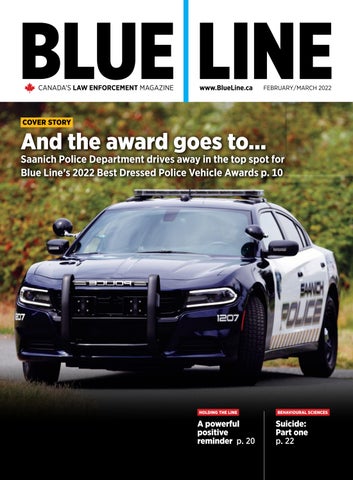
COVER STORY
And the award goes to…
Saanich Police Department drives away in the top spot for Blue Line’s 2022 Best Dressed Police Vehicle Awards p. 10
HOLDING THE LINE
BEHAVIOURAL SCIENCES
A powerful positive reminder p. 20
Suicide: Part one p. 22
COMMISSIONAIRES VALUES LAW ENFORCEMENT EXPERIENCE Join Commissionaires and put your skills and experience to work to ensure the safety and security of people and property in a wide variety of environments.
COMMERCIAL
EDUCATION
HEALTHCARE
CONDOMINIUMS
MINING SITES
GOVERNMENT
CONSTRUCTION
PORTS
commissionaires.ca
10
Contents
February/March 2022 Volume 34 Number 2
Features
Columns 4 19 22 24 26 30
Editor’s Commentary Case Law Behavioural Sciences Technology Q&A Back of the Book
COVER STORY
10 And the award goes to…
Saanich Police Department drives away in the top spot for Blue Line’s 2022 Best Dressed Police Vehicle Awards. By Brittani Schroeder.
14 Are electric vehicles the future of police vehicles?
Results from the Michigan State Police 2022 police vehicle tests. By Dave Brown.
20 Rethinking police control tactics training
Preventing unnecessary escalation of force and rebuilding public confidence in the police. By Bryan Nykon.
14 19
@Blue_LineMag
Departments 6 6 6 13 28 29 30
News Dispatches Calendar Off the Shelf Product Showcase Marketplace Blue Links
24
February/March 2022 | BLUE LINE
3
EDITOR’S COMMENTARY BY BRITTANI SCHROEDER
www.BlueLine.ca
The show must go on
A
t the beginning of 2022, many courses in conjunction with members of Canadians were faced with law enforcement to provide the best adnew, modified lockdowns as vanced training to officers. Throughout the pandemic proved it wasn’t the pandemic, course creators and inover quite yet. As the newest variant of structors alike have had to adapt like COVID-19 made its rounds, infecting many other academic institutions, moving large numbers in a short amount of time, their courses online and even on the road. various governments called for increased You can read more about their journey on public health restrictions. In page 8. response, a large portion of the A large portion Continuing with the population started working of the thought that “the show must from home once again, but those population go on”, I would like to share working in law enforcement— started working some exciting news about Blue along with other first respond- from home Line’s events that will be takers—continued their work as if once again, but ing place in 2022. nothing had changed. For offi- those in law Our second annual Blue cers, the show had to go on. enforcement— Line Expo International will In this issue of Blue Line, we along with be held virtually on April 28. are taking the time to celebrate other first This year’s event will focus on a side of law enforcement that responders— recruitment and training and officers must rely on every day: continued their will be a discussion with those their vehicles. This month’s work as if in the know. Join us as we cover story features the winners nothing had have two panel discussions of the 2022 Blue Line Best changed. For with police chiefs, deputy Dressed Police Vehicle Award. officers, the chiefs, directors and other law This year, Saanich Police De- show had to go enforcement professionals as partment took home first place on. we consider the challenges with their 2019 Dodge Charger, agencies are facing when it followed by Service de police Ville de comes to recruiting new personnel and Saint-Jérôme and St. Thomas Police Ser- training those who are already in the vice. In our Community Relations cat- service. You can learn more and register egory, Abbotsford Police Department here: bluelineexpo.com. won the top spot, followed by Saanich The Security • Police • Fire Career Expo Police Department. You can read the full has a new date: May 10. We are excited to story on page 10. be able to hold this event in person in Dave Brown, a judge of the Best Dressed Vaughan, Ont. If you know of anyone who Police Vehicle contest and long-time Blue is hoping to enter the law enforcement, Line contributor, has also shared his report firefighting or security industries, make on the Michigan State Police 2022 police sure to share this opportunity with them. vehicle tests that recently took place. In Visit the website (www.emergencyserhis article, Brown shares the results of the vicesexpo.ca) for more information. 11 vehicles that were put through multipOur third event of the year will be Blue ple road tests and his thoughts for the Line Expo, held in person in Vaughan, future of the police vehicle market. See the Ont. I can’t wait to see everyone again on full report on page 14. October 13, as we learn from leading law In this month’s Q&A, we can see how enforcement experts, have a chance to the Canadian Police College (CPC) also network with fellow law enforcement had to adapt to stay-at-home orders over professionals, and have an opportunity to the course of the last two years. In a recent purchase the latest technology, products Blue Line, The Podcast episode, I spoke and services. Stay tuned for more inforwith several members of the college about mation about Canada’s premier law entheir academics and how they build their forcement conference and trade show!
CONNECT WITH BLUE LINE
www.BlueLine.ca 4
@Blue_LineMag
BLUE LINE | February/March 2022
BLUE LINE
www.facebook.com/BlueLineMagazine
Reader Service Print and digital subscription inquiries or changes, please contact Beata Olechnowicz, Audience Development Manager Tel: (416) 510-5182 Fax: (416) 510-6875 email: bolechnowicz@annexbusinessmedia.com Mail: 111 Gordon Baker Rd., Suite 400 Toronto, ON M2H 3R1 GROUP PUBLISHER | PAUL GROSSINGER pgrossinger@annexbusinessmedia.com PUBLISHER | ADAM SZPAKOWSKI aszpakowski@annexbusinessmedia.com EDITOR | BRITTANI SCHROEDER bschroeder@annexbusinessmedia.com EDITORIAL DIRECTOR EMERGENCY SERVICES GROUP | LAURA AIKEN laiken@annexbusinessmedia.com ACCOUNT MANAGER | JANICE EATON jeaton@annexbusinessmedia.com MEDIA DESIGNER | ALISON KEBA akeba@annexbusinessmedia.com ACCOUNT COORDINATOR | KATHRYN NYENHUIS knyenhuis@annexbusinessmedia.com COO | SCOTT JAMIESON sjamieson@annexbusinessmedia.com ANNEX BUSINESS MEDIA 111 Gordon Baker Road, Suite 400 Toronto, ON M2H 3R1 Tel. 416-442-5600 • Fax 416-442-2191 Publication Mail Agreement No. 40065710 ISSN 0847-8538 Printed in Canada SUBSCRIPTION RATES Canada — 1 Year $31.50; 2 Year $52.50 plus tax USA — 1 Year $136.50 CAD Occasionally, Blue Line will mail information on behalf of industry-related groups whose products and services we believe may be of interest to you. If you prefer not to receive this information, please contact our circulation department in any of the four ways listed above. Annex Privacy Officer Privacy@annexbusinessmedia.com; Tel: 800-668-2374 © 2022 Annex Business Media. All rights reserved. Printed in Canada. No part of the editorial content of this publication may be reprinted without the publisher’s written permission. Opinions expressed in this magazine are not necessarily those of the editor or the publisher. No liability is assumed for errors or omissions. Readers are cautioned and advised that articles presented herein are edited and supplied for your personal awareness and should not be used for further action until appropriate guidance is received from a supervisor, Crown Attorney or other persons in authority. All advertising is subject to the publisher’s approval. Such approval does not imply any endorsement of the products or services advertised. The publisher reserves the right to refuse advertising that does not meet the standards of this publication.
I N T R O D U C I N G
T H E
2017+ TESLA MODEL 3 PEDESTAL SYSTEM
RUGGED. RELIABLE. RESPONSIVE.
Transform the 2017+ Tesla Model 3 into a mobile workstation with our all-new space-efficient pedestal mounting solutions. The vehicle-specific base was designed to fit seamlessly into the Tesla Model 3, providing an easy install and reliable mounting location for a variety of devices. The pedestal kit can be easily customized with any Gamber-Johnson motion attachment to create a rugged and reliable mounting solution to fit any fleet’s specific needs. Available now! Learn more and find a reseller in your area at gamberjohnson.com.
GAMBERJOHNSON.COM
NEWS ONTARIO
York Regional Police partners with Digital Mobility Inc.
their organization. All sworn members will be fully trained on the new system in 2022.
Toronto Police Service makes updates as part of gender diversity and trans inclusion
Since 2016, the Toronto Police Service’s Gender Diversity and Trans Inclusion Project has made progress on several initiatives that ensure all areas of the organization, including policies, procedures, orders, forms (PPOF), and training, are updated with a gender diverse and trans inclusion lens. This has included working with an expert
DISPATCHES Daniel Foy has been selected as the new Chief of the Timmins Police Service. Foy began his 27-year career with the OPP in 1995 and was promoted throughout the years, reaching the rank of Inspector. He has worked front line policing, criminal investigations and with the Unsolved Homicide Investigative Unit for North East Region. He became a D/Sgt and served as an Area Crime Supervisor. As a Staff Sergeant, he served as the Commander of the South Porcupine Det. In 2021, he was promoted to the rank of Inspector where he took charge of the James Bay Detachments. Sara Cunningham will be the next Deputy Chief of Police of the Greater Sudbury Police Service. As Inspector of Strategic Operations and the Executive Officer to the Chief of Police, Cunningham had charge of many areas, including Professional Standards, Indigenous Liaison, and Equity, Diversity, and Inclusion. As someone who values community partnerships she also has a dedicated 6
BLUE LINE | February/March 2022
consultant and community members to revise and update Service PPOF, as well as relevant training and communication. This is to ensure members are aware of the changes and the appropriate ways to implement the updates in their day-to-day responsibilities. The catalyst for the Service’s Gender Diversity and Trans Inclusion Project is the Waterman v. TPSB settlement with Mr. Boyd Kodak and the Ontario Human Rights Commission, reached after allegations of discrimination based on gender and gender identity were made against the Service.
CALENDAR background of community engagement in policing, having worked with the Rapid Mobilization Table committee and the Violent Threat Risk Assessment committee, working on the Downtown Engagement Team initiative, as well as speaking at CAN (Community Action Network) meetings and participating in Coffee with a Cop.
NOTE TO READERS: check with all organizers as COVID-19 continues to affect events.
Jason Woods has been appointed Deputy Chief of Police of the LaSalle Police Service. He began his policing career in 1999 when he was hired by Peel Regional Police. He worked in uniform patrol out of 11 Division before being hired by the LaSalle Police Service in February 2001. During his career with the LaSalle Police Service, Woods has been the Community Liaison Officer, Use of Force and Firearms Instructor, PAVIS Officer, Criminal Investigations Supervisor, and Staff Sergeant. In 2019, Woods received the Police Exemplary Service Medal on behalf of the Governor General of Canada for having completed 20 years of full-time exemplary police service.
Law of Policing Conference, Eastern Canada Edition May 4 – 5, 2022 Location: Toronto, Ont. www.canadianinstitute.com/ law-of-policing-east/
Blue Line Expo International April 28, 2022 Location: Virtual www.blueline.ca/virtual-events/ blue-line-expo-2022/
Security • Police • Fire Career Expo Date: May 10, 2022 Location: Vaughan, Ont. www.emergencyservicesexpo.ca/
Find more calendar events online at blueline.ca/events.
www.BlueLine.ca
PHOTO: DIGITAL MOBILITY INC.
York Regional Police will be implementing new technology that will change the way officers complete their notes, thanks to a new partnership with Digital Mobility Inc. (DMI). The technology will allow officers to complete all their notes electronically, leaving pen and paper behind. York Regional Police is one of only three police services in Ontario to implement this advanced software solution, which will significantly reduce the time spent by officers completing detailed notes for court, allowing them more time for patrol and community engagement. DMI’s Intelligent Mobile Patrol (IMP) software is a complete cross-platform workflow solution. It modernizes the current paper process and leverages the power of data, while maintaining the integrity of officer e-notes to support the prosecution process. York Regional Police issued a request for a proposal in August 2021 and selected the IMP e-notes program as the best fit for
Advertorial
Advanced Setina Engineering at Work Setina Manufacturing Company has always been known for their close working relationship with the US automakers and Tesla is no exception! Setina began working with Tesla in June of 2017, on the new innovative electric “Model S”. The project was a successful collaboration between Setina, Tesla and LAPD. Since the original 2017 project began, Setina Manufacturing Company has continued to work on other Tesla projects, most recently the “Model Y”. During the ongoing “Model Y” project, Setina has continued to work very closely with Tesla’s engineering staff as well as numerous levels of their support staff with interracial DATA and equipping a “Model Y” for a “Pilot Build”. The Freemont Police Department of Freemont, CA was very much involved in the “Model Y” project to assist in extensive testing as far as the new design’s fitment, functionality and over all evaluations of product. Some of the primary points of concern on the project were for the overall comfortability for the officer, achieving maximum seat travel as well having sufficient room for the detainee in the back seat. Additional concerns were how to integrate the Push Bumper and the Fender Guard System into the vehicles park assist and crash detection function. Another challenging aspect of the build was accommodate a “TPO” Replacement Prisoner Transport Seat in the second seating location, while maintaining adequate structure around the primary battery of the vehicle. The center radio console is an area to be concerned with as well. Developing a console that can house all the required equipment as well as being ergonomically correct, so that the officer and his gear are not hindering him from entering or exiting the vehicle. Some of the products offered by Setina Manufacturing Company for the new “Model Y”, are Push Bumpers and Fender Guards, Front and Rear Partitions, Prisoner Transport Replacement Seating, “TPO” Door Panels, Firearms Mounting Systems and Rear Cargo and Electronics Storage.
www.setina.com
COVER STORY
And the award goes to…
Saanich Police Department drives away in the top spot for Blue Line’s 2022 Best Dressed Police Vehicle Awards By Brittani Schroeder
C
ongratulations to all the winners of Blue Line’s Best Dressed Vehicle Awards, which showcases innovative, sustainable and effective designs. We look for clear identification, graphic designs that enhance visibility, elements that show directionality of travel and effective integration of equipment and controls. “Green” vehicles are also taken into consideration. Thank you to all agencies who submitted their vehicles. Stay tuned to blueline.ca for 2023’s call for submissions later this year.
1st PLACE SAANICH POLICE DEPARTMENT 2019 DODGE CHARGER
Historically, the Saanich Police Department (SPD) have operated with blue and white patrol cars. In 1994, the entire fleet was 10
BLUE LINE | February/March 2022
transitioned to all white cars. In his submission, Deputy Chief Gary Schenk wrote that the colours for this year’s new design were in honour and recognition of the historical blue and white colours, which is in marked contrast to the North American trend of black and white police cruisers. A volunteer committee of 12 staff representing all divisions of the SPD were responsible for creating the new design. This group included traffic collision analysts to add insight on ways to increase the safety of the design through high visibility graphics. Schenk stated that the motto for the SPD, “Keeping Saanich Safe since 1906”, was an important feature to include on the 2019 Dodge Charger. It can be found on the rear of the vehicle as a way to acknowledge the SPD’s history of service to their community. The vehicle also features a
Canadian flag, a replica of the SPD police badge each officer wears, and reflective markings. Dave Brown, one of the Best Dressed Police Vehicle judges, commended the SPD for the graphics used on this year’s first-place vehicle. “The one factor that stood out to me is the placement of the words on the side, giving their design directionality. I want to see the direction that a marked vehicle is going at a glance, day or night, and this car fits the bill.” Rylan Simpson, another contest judge, was struck by the contrasting colour scheme featured on the SPD vehicle. “This patrol car boldly identifies itself; the navy-blue colour is novel and the addition of the badge adds a unique touch to this otherwise more standard design.” Schenk said he and the SPD were
www.BlueLine.ca
PHOTO: SAANICH POLICE DEPARTMENT
1st place: Saanich Police Department
PHOTOS: SERVICE DE POLICE VILLE DE SAINT-JÉRÔME, ST. THOMAS POLICE SERVICE
thrilled to learn that their front-line patrol vehicles had been selected as the winner of this year’s contest. “We take great pride in our fleet as a distinctive and highly visible representation of our progressive and community-minded organization, and are particularly proud of the fact that our design was developed by our own staff. We saw this competition as a tremendous opportunity to showcase our department from coast to coast and could not be more excited to see our car on the cover of Blue Line. What has me most excited is the opportunity to share this award with the dedicated officers who drive this car every day!”
2nd PLACE SERVICE DE POLICE VILLE DE SAINT-JÉRÔME 2021 FORD EXPLORER
Early in 2019, service Director Dany Paterson showed a strong interest in updating the design of the Service de police Ville de Saint-Jérôme patrol vehicles, especially as they switched to a fleet of hybrid explorers. Having worked in graphic design previously, Cst. Kevin St-Denis offered to give the project a try. Similarly to SPD, the Service decided on a navy-blue colour for their new fleet. StDenis shared that this was a prerequisite of Paterson’s, who believes it represents the colour of the Service’s uniform, as well as the known colour for a city police department. This vehicle is the first hybrid electric vehicle to be used by the patrol department in the Service, and the design made a significant step towards visibility and safety for the officers and citizens on the road. The Service’s previous design included an all-white vehicle with royal blue stick-
3rd place: St. Thomas Police Service
ers. The new design features white hatched lines for maximum visibility; a golden police services logo; three white lines are present on the rear of the vehicle which represent the Service’s three organizational values: ‘Intégrité – Engagement – Respect’ (in English, this translates to Integrity, Commitment, Respect); and, finally, a Canada Thin Blue Line logo was added to the trunk door. All the stickers used on the vehicle are made from a highly-reflective material, including the white doors. Unlike most police vehicle designs that have painted white doors, the doors on the Service de police Ville de Saint-Jérôme patrol vehicles will reflect whenever a car light, flashlight or other light source is pointed at it. “I love the contrast, colour and size of this design. This was done very well,” said contest judge Brown. When St-Denis learned of their secondplace win, he was ecstatic. “This was our first time entering the Blue Line Best Dressed Police Vehicle contest. Having worked for over 12 months alongside Director Paterson to create this design, and after many hours of research, tests and failures, I can definitely say it was a lot of fun. All our members were invited to give their opinion and ideas for the new design, and the one you see now was voted in by our team,” he said. “We are very proud to be part of the top three this year.”
3rd PLACE ST. THOMAS POLICE SERVICE 2021 FORD EXPLORER – POLICE INTERCEPTOR AWD
2nd place: Service de police Ville de Saint-Jérôme
@Blue_LineMag
Deputy Chief Marc Roskamp was very excited to submit the new design of the St. Thomas Police Service vehicle to this year’s contest. He shared that the St. Thomas Police Service is committed to the modernization of their equipment and of their abilities to provide relevant and
compassionate public safety services to the community they serve so proudly. A large portion of emergency services throughout Europe, New Zealand, Australia, China and some in the U.S. have adopted the Battenburg style of vehicle markings. Roskamp knows the importance for police vehicles to be conspicuous, and the importance of eliminating risks when police personnel are involved in unusual and dangerous traffic situations. The regular pattern and contrast between light and dark colours increase visibility in the daytime, dusk and dawn. The complete pattern is retroreflective. The hope is that this new design provides a softer, less intimidating image for policing. As Roskamp stated, improving community perceptions about public safety services and calls to modernize approachability are evidence-based influences for the potential adjustment to the Battenburg design for police vehicles. “Police culture – and specifically how officers show up – needs to be reflected in who we are as a public safety service. Service delivery methods are modernizing in many ways, and so too must our uniforms, equipment, vehicle standards and approaches,” said Roskamp. “We’d like to thank Blue Line for this recognition, and we expect a positive impact both in terms of road safety and public perceptions from using the Battenburg marking scheme.” Brown has been waiting for some time for a Canadian police agency to adopt the Battenburg design. “It’s very unusual and eye-catching, but familiar to almost anyone who has seen British TV series. I also agree that the design is a bit ‘friendlier’, so to speak.” Pending internal and external satisfaction of the new design, the St. Thomas Police Service will make an operational determination on replicating the Battenburg marking on future vehicles introduced into their fleet. February/March 2022 | BLUE LINE
11
COVER STORY
COMMUNITY RELATIONS 1st PLACE ABBOTSFORD POLICE DEPARTMENT 1965 CHEVROLET BISCAYNE
12
BLUE LINE | February/March 2022
Community Relations 1st place: Abbotsford Police Department
Community Relations 2nd place: Saanich Police Department
cial Police crest. The ultimate goal for the cruiser is to showcase it in the lobby of the new AbbyPD building. “Those involved are honoured and proud of this award, as it recognizes hundreds of hours of work which made this community-based project a reality,” said Nightingale. “This car is the epitome of community and always will be. It’s a unique story, and given her close community ties, I have no doubt that Mrs. Claus would be proud.”
2nd PLACE SAANICH POLICE DEPARTMENT 2012 DODGE CHARGER SRT8
Saanich Police Department’s eye-catching community relations vehicle was the initiative of two Saanich Police Community engagement division officers, who had a vision for using a “cool” car to create unique engagement opportunities with youth. The vehicle was acquired through agreements with the B.C. Civil Forfeiture Office, who work to undermine the profile motive behind criminal activity by seizing the tools and proceeds of that activity. This 2012 Dodge Charger SRT8 was seized by the combined forces special enforcement unit – British Columbia in 2015 following an investigation of drug-trade violence in Surrey and it was subsequently forfeited to the B.C. Civil Forfeiture Office. “The vehicle gives our officers an opportunity to share this story with kids in the community through subtle black-on-black lettering on the rear bumper that states ‘SEIZED FROM A DRUG
DEALER’,” said Deputy Chief Gary Schenk. Matte black was chosen specifically for the base colour, as it is very trendy with “younger car enthusiasts,” stated Schenk. The shiny black accents and blue pin striping accentuate the aggressive lines of the Charger design. The hood features a large police badge decal which is an exact replica of the badge carried by every Saanich officer. Schenk relayed that “the overall result is that people are attracted to a really cool car, and are then surprised to learn it’s a police vehicle!” “This is great use of suppressed design,” shared judge Brown. “I love anything that says, ‘Seized from a drug dealer’. Also, the thin blue line design stands out nicely.” Schenk and the SPD were delighted to hear that their Community Engagement Charger was awarded second place. “As a Dodge Charger, this vehicle offers a unique twist on our frontline patrol fleet that turns heads everywhere it goes ... To be recognized across Canada by Blue Line was doubly rewarding.” Thank you to Dave Brown and Rylan Simpson, Blue Line’s Best Dressed Police Vehicle judges, for their expertise and dedication to this content. Dave Brown is Blue Line’s firearms and police vehicle contributor. He is a tactical firearms trainer and consultant based in Winnipeg. He can be reached at Dave.Brown@northwestlaw.ca. Rylan Simpson, Ph.D. is an assistant professor in the School of Criminology at Simon Fraser University. He is an expert in police perception research and has studied the effects of police vehicle aesthetics on people’s perceptions of the police. He has recently published his work in Criminology & Public Policy, Journal of Experimental Criminology, Policing & Society, and Policing: A Journal of Policy and Practice.
www.BlueLine.ca
PHOTOS: ABBOTSFORD POLICE DEPARTMENT, SAANICH POLICE DEPARTMENT
In 2020, the Abbotsford Police Department (AbbyPD) embarked on a year-long journey to locate and restore a vintage cruiser, which ended up being a 1965 Chevrolet Biscayne Cruiser that Staff Sgt. Chris Nightingale said could not have been restored without the support and generosity of the Abbotsford community. The vehicle was solely funded by two dozen community donors who provided financial and labour services through the Abbotsford Police Foundation. The build process involved a team of a dozen AbbyPD employees and numerous community volunteers who donated their time. “This vehicle has become a popular community showpiece at various events and often results in persons from all walks of life engaging uniformed police in conversations about the car, or their memories of this era,” said Nightingale. Brown stated, “I love this classic cruiser. It’s clear that a lot of work went into the vehicle, and having owned something similar in the ‘70s, that engine compartment would win awards for being so true to stock.” This cruiser was named “Carol”. Retired Insp. Carol Powell served as a police officer for over 33 years with the Matsqui and later Abbotsford Police Departments. She donated countless hours of her own time to her community, and many children knew her by her alter-ego “Mrs. Claus”. During the restoration of the vehicle, Insp. Powell was battling cancer. She sadly lost her battle before the completion of the cruiser. Now, a sketch of her alter-ego “Mrs. Claus” and a signature from Powell are featured on the glovebox. The clock, which never ran properly, was set to 5:26—the time when Insp. Powell passed away. “I was impressed by the level of thought and detail that went into the vehicle design: from the time displayed on the clock to the creation of its decals. I also really appreciate that the vehicle was named in honour of a policing leader who exhibited a positive influence on both the department and the broader community,” shared contest judge Simpson. A local graphic artist and sign company donated their time to digitally re-create the door decal that was used in 1965, which looks very similar to the British Columbia Provin-
OFF THE SHELF
After the Force: True Cases and Investigations by Law Enforcement Officers Edited By: Det. Debbie J. Doyle (Ret) ISBN: 978-1988824499
2022
Like its predecessors in the Durvile True Cases series, After the Force features true cases and investigations from Canadian police officers who have served in municipal, provincial, and federal police services. Stories in this anthology are written by people who are passionate about their work in law enforcement and who generously explain what it was about their work that led them to choose a career or specific way of life after the force. Among the themes in the book are stories dealing with prostitution and sex work, racism and misogyny, an encounter with a cop killer, police suicides, a child miraculously surviving a fall from a high-rise balcony, an officer dealing with a partner who was experiencing severe PTSD, a suicide from a bridge, and child sexual assaults. Optimistic themes and activities arise in these writers’ lives after retiring from police work, such as writing, painting, assisting Indigenous communities, and facilitating community improvement. Many people have a preconceived notion of the work of a police officer but don’t understand the personal sacrifices, the mental anguish, the emotional toll and the interpersonal changes the investigations have upon them. Police officers carry scars and memories which
can have profound effects upon their relationships with loved ones and family, for life. This book provides a gut-wrenching account of the true inside work of a police officer, tells of the forfeiture of our innocence, and provides a glimpse into the distress and disbelief within our society as investigators help the victims. This book provides a rare, honest, and raw account of policing like no other.” — Michael Elliott, president of the Edmonton Police Association, former president of the Alberta Federation of Police Associations, and director with the Canadian Police Association
These humanized accounts written by experienced officers caused me to reflect upon my thirty years in policing. The emotions, frustrations and challenges associated with maintaining composure in heart wrenching situations are shared in these stories. Many of us have been there and know exactly how it feels to console victims after a lengthy court process, following a next of kin notification, or in the midst of family violence investigations. The stories, clearly articulated in the book, reflect upon the peaks and valleys of a career in law enforcement. They enable reflection and celebration of lengthy careers. Details disclosed may be for the first time which is apparent by the emotions expressed by the authors. —Myra James, Ret. Det. of the Hamilton Police Service, past president, Ontario Women in Law Enforcement, past vice president, International Association of Women Police
SECURITY • POLICE • FIRE
PLATINUM
CAREER EXPO
CANCOM
GOLD
WATERLOO REGIONAL
POLICE
FRIENDS OR FAMILY
LOOKING FOR A NEW CAREER? MAY 10, 2022 | VAUGHAN, ON www.emergencyservicesexpo.ca
BROUGHT TO YOU BY
PRIMARY LOGO
CANADA’S SOURCE FOR SECURITY MANAGEMENT
PRIMARY LOGO
CANADA’S SOURCE FOR SECURITY MANAGEMENT
SECONDARY LOGO
CANADA’S SOURCE FOR SECURITY MANAGEMENT
SECONDARY LOGO
@Blue_LineMag
CS_SPFEXPO_HP_WINTER22_ASK.indd 1
February/March 2022 | BLUE LINE
CANADA’S SOURCE FOR SECURITY MANAGEMENT
13
2022-02-09 9:15 AM
VEHICLES
Are electric vehicles the future of police vehicles?
Results from the Michigan State Police 2022 police vehicle tests By Dave Brown
2
022 will be a significant year for the annual Michigan State Police (MSP) police vehicles evaluation program. If you skip ahead to the list of vehicles in this article, there will be one standout new entry in a sea of very capable vehicles not significantly changed from 2021. In a pilot program to test the viability of a full electric vehicle against the current crop of police patrol vehicles, Ford entered the Mustang Mach-E. The Mach-E rounds out a field of 11 vehicles that the Michigan State Police tested for the 2022 model year. Ford is once again the number one selling pursuit-rated police vehicle in Canada, and the Ford Police Interceptor Utility with the twin-turbocharged 3.0L V6 EcoBoost engine is also fastest gas-engine patrol vehicle 0-60 MPH, 0-100 MPH and top speed (148 MPH). For 2022, Ford has introduced a new Heated Sanitization Solution software program in their gas engine and hybrid models that heats the interior to 133 degrees Fahrenheit for 15 minutes, sufficient to sanitize interior surfaces 99 per cent from viruses, including COVID-19. The program can also be retrofitted to existing Ford police vehicles, from 2013 to 2021. Dodge is going almost across the board with all-wheel-drive powertrains. Dodge is still the last remaining supplier of pursuit-rated police sedans in North America, and their 2022 Dodge Charger Pursuit is available in an all-wheel-drive (AWD) version with a 3.6-litre V6, and a rear-wheeldrive (RWD) version with the 5.7-litre V8 motor. The Dodge Durango SUV is also available with the 3.6-litre V8 and the 5.7-litre hemi V8, both in AWD. The Durango is becoming more popular as a police patrol vehicle because of its roomy interior and performance on the streets. It seems unlikely that such a long SUV can keep up (and best) many other police vehicles, but especially in the 5.7-litre guise, its performance belies its size. Ideal for K-9 duties, but one should 14
BLUE LINE | February/March 2022
2022 Ford Mustang Mach-E electric from Ford Motor Company
2022 Dodge Charger Pursuit from Fiat Chrysler Automobiles
2022 Ford Police Interceptor Utility from Ford Motor Company
make sure their dog is well secured. General Motors had redesigned the popular and roomy Chevrolet Tahoe Police Pursuit vehicle (PPV) in 2021 and there are few changes for 2022. It uses GM’s 5.3-litre V8 engine, in both a RWD and AWD configuration. Most notable is the new platform that was introduced in the 2021 Tahoe. The new underpinnings increase cargo space and adds a fully-independent rear suspension, much needed after years of a solid rear axle design. No more sliding sideways while going at speed over rough washboard roads!
Is there an electric in your future?
Ford entered the Mach-E into the 2022 MSP
Police Vehicle Evaluation Program as a pilot project to demonstrate the viability of a fully electric police vehicle. Pure electrics have a bit to go before they are accepted as full-fleet patrol vehicles. The intended usage of a police vehicle directly conflicts with the ideal function of current electric vehicles as urban commuters. Dreams of plugging in your car at night into the outlet in your home are dashed very quickly at the 60- to 100-hour charge times on standard household 120 volt outlets. Even fast-chargers that are quickly becoming commonplace across North America, take one to four hours to fully top up the battery. But battery technology is improving every year. With current technology, battery packs should last the life of the vehicle. The promise is there. Ford has given us an enticing look into the future. After all, plug-in electric vehicles are fast; there is no doubt about that. Electric motors generate maximum torque right from rest. This is why they accelerate so quickly; plus, with the latest technology in electric motors, they also generate high horsepower numbers. But that is meaningless if you run out of battery juice part way through a critical pursuit. One could safely say that torque wins acceleration; horsepower wins races; and battery capacity that is improving every year keeps them both off the flatbed. Full-electric patrol vehicles that can work a shift without a four-hour charge in the middle or not die at critical times may be years away, but Ford has given us a glimpse of the future and a promise of their benefits.
MICHIGAN STATE POLICE YEARLY VEHICLE TESTS
Every fall the MSP, in conjunction with the U.S. National Institute of Justice (NIJ), test the handling and performance of every new police vehicle on the market in back-to-back tests. These eagerly anticipated tests are seen as the most comprehensive analysis of police vehicles in North America. The MSP yearly vehicle test for the 2022 model year will mark the 24th year that Blue Line has been reporting the results of the tests for police category vehicles.
Vehicles
The MSP Precision Driving Unit evaluates police vehicles in two categories: Police Category vehicles and Special Service vehicles. Police category vehicles are designed www.BlueLine.ca
ADVERTORIAL
BL_DR_FebMar22.indd 1
2022-02-11 11:37 AM
With 45 years of commitment to first responders, D&R continues in its aim to empower first responders and the public utility sector with creative solutions using cutting edge electronics, mechanical, and 3D printed plastic technology. D&R Electronics Co. Ltd. Designs, Manufactures and Installs First Responder fleet solutions from Emergency Lights, Sirens, Mechanical storage solutions, vehicle K9 kennels, Traffic Directors, floor mount systems, tilt and swivel tablet Mounts / Keyboard trays and Consoles. At D&R Electronics Co. Ltd we are always pushing boundaries by developing sophisticated systems for mobile computing using Cell phones, programmable power management systems to avoid dead vehicle batteries, and a brand new Intelligent Light and Siren Control system with Can Bus, GPS and Wi Fi. All built in Canada with necessary SAE, NFPA certification where required. And ISO 9001:2015 Quality standards compliance.
Check us out at www.dandrelectronics.com or connect on social media @d_relectronics
@Blue_LineMag
DANDRELECTRONICS
BL_DR_ELEC_ADV_HP_FEBMAR22_ASK.indd 1
@dnrelectronics
/DandRElectronics
sales.support@dandrelectronics.com
February/March 2022 | BLUE LINE
15
2022-02-15 3:32 PM
VEHICLES
for the full spectrum of general police activities including high-speed pursuit. Special service vehicles are designed only for specialized duties such as canine units or adverse weather conditions. Eleven vehicles were submitted to the NIJ in the Police category for the 2022 model year: • 2022 Chevrolet Tahoe PPV 5.3L RWD • 2022 Chevrolet Tahoe PPV 5.3L 4WD • 2022 Dodge Charger Pursuit 3.6L AWD • 2022 Dodge Charger Pursuit 5.7L RWD
The tests
• 2022 Dodge Durango Pursuit 3.6L AWD • 2022 Dodge Durango Pursuit 5.7L AWD • 2022 Ford Police Interceptor Utility Hybrid AWD • 2022 Ford Police Interceptor Utility 3.0L EcoBoost AWD • 2022 Ford Police Interceptor Utility 3.3L AWD • 2022 Ford F-150 Police Responder 3.5L EcoBoost 4WD • 2022 Ford Mustang Mach-E electric AWD
Lap Times
Chevrolet Tahoe 5.3-litre V8 RWD
Chevrolet Tahoe 5.3-litre V8 4WD
Dodge Charger 3.6-litre V6 AWD
Dodge Charger 5.7-litre V8 RWD
Dodge Durango 3.6-litre V6 AWD
Dodge Durango 5.7-litre V8 AWD
Overall average lap times
1:38.28
1:39.07
1:37.72
1:36.43
1:41.32
1:38.85
Lap Times
Ford PI Utility 3.3-litre Hybrid AWD
Ford PI Utility 3.0-litre V6 EcoBoost AWD
Ford PI Utility 3.3-litre V6 AWD
Ford Police Responder F150 3.5-litre V6 EcoBoost 4WD
Ford Mustang Mach-E electric AWD
Overall average lap times
1:39.15
1:36.01
1:38.60
1:39.07
1:42.19
Electric-powered vehicle dynamics testing
Because of the unique nature of battery electric vehicles, it was felt that a fair assessment of their capabilities would involve fast-charging the battery pack between runs. This would be more typical of an electric vehicle hitting the road near the start of every shift. In discussions with all three manufacturers, the MSP Precision Driving Unit settled on a charge time of 40 minutes on a 47 Kw Level 3 charger between runs.
Vehicle
MSP Precision Driving Unit and the NIJ’s Justice Technology Information Center (JTIC) test all the vehicles together over a three-day period at the Chrysler Proving Grounds and the Grattan Raceway. Each vehicle is tested without rooftop lights, spotlights, sirens or radio antennas in place. Tires are original equipment rubber provided by the manufacturer. (All dimensions and measurements are given in U.S. numbers.)
THE RESULTS Vehicle dynamics testing
The objective of the vehicle dynamics testing is to determine the high-speed pursuit handling characteristics. Except for the absence of traffic, the two-mile road course simulates actual pursuit conditions. It evaluates the blend of suspension components and acceleration and braking ability. Four different drivers test each vehicle over an eight-lap road course, with the five fastest laps counting toward each driver’s average lap time. Final score is the combined average of all four drivers for each vehicle.
Beginning state of charge
Ending state of charge after 5 laps/3.2km
Average of 5 laps
99%
70%
1:41.94
Ford Mustang Mach-E
80%
51%
1:42.21
87%
57%
1:42.48
75%
48%
1:42.17
Acceleration
Chevrolet Tahoe 5.3-litre V8 RWD
Chevrolet Tahoe 5.3-litre V8 4WD
Dodge Charger 3.6-litre V6 AWD
Dodge Charger 5.7-litre V8 RWD
Dodge Durango 3.6-litre V6 AWD
Dodge Durango 5.7-litre V8 AWD
0 – 60 mph
7.65
7.95
7.17
6.15
8.16
6.79
0 – 80 mph
12.18
12.77
11.57
9.44
13.85
11.25
0 – 100 mph
18.81
19.98
17.91
14.06
22.80
18.10
Top Speed (mph)
130
124
139
139
127
130
Acceleration
Ford PI Utility 3.3-litre Hybrid AWD
Ford PI Utility 3.0-litre V6 EcoBoost AWD
Ford PI Utility 3.3-litre V6 AWD
Ford Police Responder F150 3.5-litre V6 EcoBoost 4WD
Ford Mustang Mach-E electric AWD
0 – 60 mph
7.25
5.45
7.79
5.79
4.03
0 – 80 mph
11.45
8.78
12.42
9.17
6.46
0 – 100 mph
17.40
13.47
19.32
14.34
11.94
Top Speed (mph)
136
148
136
120
124
Acceleration and top speed
The objectives of the acceleration and top speed tests are to determine the ability of each vehicle to accelerate from a standing start to 60 mph, 80 mph and 100 mph, and to record the top speed achieved within a distance of 14 miles from a standing start. Acceleration score is the average of four tests. Following the fourth acceleration sequence, each vehicle continues to accelerate to its highest attainable speed within 14 miles of the standing start point.
These eagerly anticipated tests are seen as the most comprehensive analysis of police vehicles in North America. 16
BLUE LINE | February/March 2022
www.BlueLine.ca
Lap Times
Chevrolet Tahoe 5.3-litre V8 RWD
Chevrolet Tahoe 5.3-litre V8 4WD
Dodge Charger 3.6-litre V6 AWD
Dodge Charger 5.7-litre V8 RWD
Dodge Durango 3.6-litre V6 AWD
Dodge Durango 5.7-litre V8 AWD
Average deceleration rate (feet/sec2)
29.99
29.46
29.85
29.40
28.94
28.36
The objective of the braking test is to determine the deceleration rate attained by each vehicle on twenty 60-0 mph full stops to the point of full ABS. Each vehicle is scored on the average deceleration rate it attains. Each vehicle makes five measured 60-0 mph stops to full ABS engagement in one direction, and then five measured 60-0 mph stops to full ABS engagement in the opposite direction. Then the test is run again. The score is the average of 20 stops. Stop distance is calculated by interpolation of results.
Projected stopping distance from 60 mph (feet)
129.1
131.5
129.7
131.7
133.8
136.6
Lap Times
Ford PI Utility 3.3-litre Hybrid AWD
Ford PI Utility 3.0-litre V6 EcoBoost AWD
Ford PI Utility 3.3-litre V6 AWD
Ford Police Responder F150 3.5-litre V6 EcoBoost 4WD
Ford Mustang Mach-E electric AWD
Average deceleration rate (feet/sec2)
29.07
29.00
28.79
24.07
30.98
Projected stopping distance from 60 mph (feet)
133.2
133.5
134.5
160.9
125.0
Chevrolet Tahoe
Dodge Charger
Dodge Durango
Ford Utility
Ford F150
Ford Mustang Mach-E
8.84
8.71
9.78
9.44
5.33
8.71
Chevrolet Tahoe
Dodge Charger
Dodge Durango
Ford Utility
Ford F150
Ford Mustang Mach-E
8.74
8.20
8.22
7.98
8.44
7.66
Braking
Total communication test scores
Total ergonomic test scores
Communications and ergonomics
The objectives of the communications and ergonomics tests are to rate a vehicle’s ability to provide a suitable environment for patrol officers to perform their job, to accommodate required communication and emergency warning equipment and to assess the relative difficulty in installing this equipment. A minimum of four officers independently evaluate ergonomic factors, and Michigan State Police Communications Division personnel then evaluate each vehicle on the ease of equipment installation.
+1 867-668-5609 publisher@canadianguns.com www.canadianguns.com
CANADIAN ACCESS TO FIREARMS
The only Canadian buy-and-sell firearms newspaper distributed across Canada! WHY ADVERTISE WITH CATF? Our paper is distributed monthly by subscription and at gun shows, gun trades, gun clubs and select stores across Canada. We shall put you in touch with the active, committed core of Canada’s firearm community!
@Blue_LineMag
BL_CATF_JanFeb20.indd 1
February/March 2022 | BLUE LINE
17
2019-12-03 11:03 AM
VEHICLES
27
A total of three communications factors are evaluated on a scale of one to 10 and averaged among all the testers. The final score is the overall average of all three factors, including dashboard, trunk and engine compartment accessibility. A total of 27 ergonomic factors are evaluated on a scale of one to 10 and averaged among all the testers. The final score is the overall average of all 27 factors, such as seat design, padding, ease of entry, head room, instrument placement, HVAC control placement, visibility and ease of entry and exit.
ergonomic factors are evaluated on a scale of one to 10
EPA Mileage (miles per U.S. gallon)
Chevrolet Tahoe 5.3-litre V8 RWD
Chevrolet Tahoe 5.3-litre V8 4WD
Dodge Charger 3.6-litre V6 AWD
Dodge Charger 5.7-litre V8 RWD
Dodge Durango 3.6-litre V6 AWD
City
15
14
18
16
18
Highway
19
18
26
25
25
EPA Mileage (miles per U.S. gallon)
Dodge Durango 5.7-litre V8 AWD
Ford PI Utility 3.3-litre Hybrid AWD
Ford PI Utility 3.0-litre V6 EcoBoost AWD
Ford PI Utility 3.3-litre V6 AWD
Ford Police Responder F150 3.5-litre V6 EcoBoost 4WD
Electric vehicle equivalent EPA Mileage (miles per U.S. gallon)
Ford Mustang Mach-E electric AWD
City
15
14
18
16
18
Combined MPGe
84
Highway
19
18
26
25
25
Range
270 miles (435 km)
24
years Blue Line has been reporting on the Michigan State Police vehicle tests
Fuel economy
While not an indicator of actual mileage that may be experienced, the EPA mileage figures serve as a comparison of mileage potential from vehicle to vehicle. Vehicle figures are based on data published by the vehicle manufacturers and certified by the U.S. Environmental Protection Agency. Figures are given in U.S. miles per gallon.
SATURDAY Sept 10th
NIAGARA FALLS
CANADA
SUNDAY Sept 11th
MONDAY Sept 12th
TUESDAY Sept 13th
Dave Brown is Blue Line’s firearms and police vehicle contributor, as well as the Best Dressed Police Vehicle Awards judge. He is a tactical firearms trainer and consultant based in Winnipeg. He can be reached at Dave.Brown@ northwestlaw.ca.
WEDNESDAY Sept 14th
THURSDAY Sept 15th
FRIDAY Sept 16th
Physical Group Activity
SEPTEMBER 12-16
2022
Announcements IAWP IAWP Late Board Late Board Meeting Meeting (LBM) (LBM) Niagara Niagara Regional Regional Police Police Headquarters Headquarters
Featured Keynote Speaker Breakout Training Sessions Lunch & Networking Breakout Training Sessions
For more information visit www.iawp2022niagarafalls.org
Hospitality/Evening Event Schedule not final, programme subject to change.
18
BLUE LINE | February/March 2022
BL_IAWP_Oct21.indd 1
www.BlueLine.ca
2021-09-13 12:29 PM
CASE LAW
BY MIKE NOVAKOWSKI
Asking “Can you hook me up with blow?” was an investigative step, not entrapment
PHOTO: © SYDA PRODUCTIONS / ADOBE STOCK
T
he police may make exploratory requests of an investigative target, including whether they sell drugs, without providing an opportunity to commit a crime and thereby avoid a finding of entrapment. In R. v. Griffin, 2021 ABCA 405, an undercover police officer made contact with a man outside a bar after police began to investigate drug trafficking. The officer asked the man if he knew anyone in town who could hook him up with “blow”. The man asked the officer if he meant “cocaine”. When the officer said yes, the man said he had a “guy” in town and would text him for the officer. The man asked the officer how much he wanted; the officer replied 100. The man said a gram was $100 and texted his own cocaine supplier on behalf of the officer. As a result of this communication, a Chrysler 300 arrived at the bar. When the officer gave the man $100, the man walked over to the vehicle, entered the front passenger seat and returned to the officer with a gram of cocaine. Later that day, the man texted the officer with the phone number of his supplier. Two days later, using the phone number provided by the man, the officer made direct contact through text messaging with the accused Griffin, who said she was working the number. The two agreed to meet. When Griffin arrived, she was driving a Chrysler 300. The officer purchased two grams of cocaine for $200 from her. About three weeks later, the officer once again contacted Griffin at the same phone number and purchased a further gram of cocaine. In the Alberta Court of Queen’s Bench, Griffin pled guilty to two counts of trafficking cocaine under s. 5(1) of the Controlled Drugs and Substances arising from the two sales to the undercover police officer. She agreed that when the officer texted her number directly, he had a reasonable suspicion to offer her an opportunity to traffic cocaine. However, she sought a stay of proceedings on the grounds of entrapment or derivative entrapment through the police action involving the man which ultimately led police to her. The trial judge rejected her application. In his view, the man with whom police initially made contact was not entrapped. When the officer asked, “Can you hook me up with blow” (cocaine), it was a legitimate investigative step and not an @Blue_LineMag
opportunity to sell drugs. The possibility of a drug deal needed yet to be explored and developed, and price and quantity had not yet been discussed when the question was asked. Griffin was sentenced to nine months’ imprisonment on each count – to be served concurrently – followed by 12 months’ probation. Griffin appealed the trial judge’s decision on her entrapment claim to Alberta’s highest court. She agreed she was not entrapped by the undercover officer when he purchased cocaine directly from her. However, she suggested the trial judge erred in law by finding that the police did not engage in conduct that amounted to entrapment. She contended that the man with whom police originally contacted at the bar had been entrapped; and, since his entrapment led to her arrest, she had been the subject of derivative entrapment. It was the officer’s original communications with the man, who in turn contacted her on the officer’s behalf, that provided an opportunity for her to commit the crime of drug trafficking. The Alberta Court of Appeal first reviewed the two branches of the law of entrapment, which is a species of abuse of process. For entrapment to occur, the authorities must (1) provide a person with an opportunity to commit an offence without acting on an objectively grounded reasonable suspicion that the person is already engaged in criminal activity or pursuant to a bona fide inquiry that people are carrying out criminal activity at a specific location; (2) although having such a reasonable suspicion or acting in the course of a bona fide inquiry, they go beyond providing an opportunity and induce the
commission of an offence. In this case, the officer did not have a reasonable suspicion the man was trafficking drugs when he was asked if he knew anyone who could hook him up with blow. But this question was not entrapment because “an affirmative response by [the man] did not satisfy the material elements of the offence of trafficking.” In other words, simply saying yes to the officer’s question would not result in a crime being committed. The Appeal Court agreed with the trial judge that the question posed to the man by the officer was a legitimate investigative step at the time contact was made rather than an opportunity to traffic in drugs. However, once the man responded to the officer’s request, the police formed a reasonable suspicion in the course of the conversation that he was engaged in drug trafficking prior to actually presenting the opportunity to commit a crime. Since the man had not been entrapped, Griffin’s claim of entrapment failed. Furthermore, “even if [the man] was entrapped, we fail to see how a claim of a derivative entrapment can rely solely upon the entrapment of another person; meaning, an accused is not entitled to a finding of entrapment merely based on the entrapment of another,” said the Court of Appeal. “Rather, each accused must establish the claim, a species of abuse of process as noted, on a balance of probabilities.” Griffin’s appeal was dismissed.
Mike Novakowski is Blue Line’s case law columnist.
February/March 2022 | BLUE LINE
19
CONTROL TACTICS
By Bryan Nykon
N
ow more than ever, attention is being drawn to police use of force. High profile instances of officers using force have escalated tension and distrust between the public and law enforcement. The downstream social and monetary cost of inappropriate police use of force now outweighs the cost of a re-investment in police use of force training. Monetarily, wrongful death lawsuits can bankrupt cities. Socially, the lack of public confidence in police can similarly bankrupt the social fabric that keeps cities peaceful. As police agencies look to reform how they operate in an effort to re-build trust between the public and police, it has become clear that training needs to be improved. A comparative analysis of total police training hours shows that Canada and the U.S. are far behind other nations.1 In recent years, individual Canadian police departments have made great strides toward expanding tactical communication, situational awareness, and bias awareness training; however, very little progress has been made in updating control tactics training. Most Canadian police recruits receive less than 100 hours of control tactics training at the police academy and only a few days of in-service training per year after graduating. Research in motor learning and skill acquisition indicates that this is insufficient for the learning and retention of psychomotor recall for complex motor skills. For officers, the fact that these motor skills are always performed under stress and in uncontrolled environments exacerbates the training shortfall. Increasing the amount of 20
(both physical and psychological) to officers and to the public, less complaints to oversight agencies, less costly litigation, and increased public trust in the police.
Preventing escalation
Left: Cst.Bryan Nykon, Right: Cst.Brendan Frick, VPD.
training hours they receive will increase officer competence and confidence with their control tactics skills. To get there, a paradigm shift in how we deliver training must occur. We need to move beyond the current training model and towards regular and consistent on-going training that is guided by science and research.
Competence and confidence
The more time you spend training at anything, the more competent and confident you become. Confidence is the emotional fuel that carries an officer through most confrontations; competence is what carries the officer through those rarer situations when subjects are experiencing issues such acute stress response, chemical impairment or mental health challenges that lead them to fight with police. Clinical studies have shown that on-going training is necessary to learn and retain police control tactics.2 Officers that are competent and confident with their control tactics skills are less likely to perceive the need to escalate to higher levels of force. Lower-level use of force equates to less injuries
BLUE LINE | February/March 2022
There is a recurring theme in many of the viral videos of police use of force encounters that go wrong: the lack of good physical control of non-compliant, unarmed subjects. There are situations where the escalation of force is unavoidable in order to keep everyone safe; there are also situations where use of hands-on control tactics could prevent the escalation of force. We must consider the possibility that police officers simply don’t currently receive enough control tactics training—or that the training they do receive is ineffective at bringing officers to a level of competence and confidence necessary to go ‘hands-on’ proficiently.
Study: The VPD model
In 2016, the Vancouver Police Department’s (VPD) Chief Constable, Adam Palmer, recognized a gap in training and implemented a program that nearly doubles the amount of use of force training new recruits receive. Led by Sgt. (Ret.) Toby Hinton, VPD recruits started receiving 40 hours of control tactics training before attending the police academy, 20 hours before field training, and 16 hours before full deployment. In addition to this mandatory training, all VPD officers are encouraged to attend police judo training sessions on an ongoing basis. What officers are doing to train is equally important to the number of hours that they are
putting in. It is crucial that the training is in techniques that create opportunities for control and are not likely to injure the officers or subjects when used in the field. The VPD has chosen to train officers in police judo, which has a foundation in sport judo but has been modified for police control tactics.
Why judo-based control tactics?
Certain martial arts that focus on strikes and kicks are excellent for building confidence and winning ‘fights’, but those skillsets are not suitable to modern policing where ‘duty of care’ is of primary importance. The public’s expectation is that police will use force in a manner that causes as little pain and suffering as possible. Looking at other martial arts, the obvious choices for control tactics are judo and jujitsu – both of which focus on taking down, controlling and restricting the movement of your opponent without injuring them. Both have the concept of ‘duty of care’ for your training partner engrained in their central philosophies. The primary difference between the two is that judo has a dominant focus on controlled takedowns while jujitsu has a dominant focus of ground control. While many use of force interactions do end on the ground, how officers get subjects to the ground is extremely important, and if they can take the subject down while maintaining a dominant ‘standing’ position, they will be at a tactical advantage. Officers are trained in lowrisk/high-yield judo-style takedowns, joint manipulations and control holds which are modified with the objective of officers being able to get subjects into custody without hurting themselves or the subject. The maneuvers are not extremely technical but require several hours of training, repetition and realwww.BlueLine.ca
PHOTO: JULIE SCOTT
Rethinking police control tactics
ity-based scenario training re-enforcement before the officers achieve a level of competence and confidence necessary to be able to use them intuitively in the field.
Not every maneuver works in every situation
Recognizing that not every maneuver will work on every subject in every situation, police judo instructors provide officers with several options for different scenarios and drill transitions from ‘plan A’ to ‘plan B’. With sufficient coaching and repetitions, officers gradually enter the autonomous stage of the motor learning process and begin to perform the control tactics intuitively with both competence and confidence. Even when an officer is profi-
cient with one technique, without a ‘plan B’ officers often get stuck unsuccessfully attempting a maneuver repeatedly and eventually escalating the level of force. The ability to remain calm and be able to transition to a ‘plan B’ is crucial. Without significant training and repetition these options do not exist for officers under stress.
Repetitive and regular training
As a use of force instructor, I have often heard officers complain about having to do mandatory control tactics training. An obstacle for many officers is not feeling comfortable in training environments. This is something that all instructors should consider. Is the training environment we’re providing in-
Advance your career in justice studies Working frontline officers can add to their existing education and experience while working. Skill up with a credential from an industry-recognized leader.
clusive, welcoming and safe? If not, changes need to be made. The primary onus of training, however, is on the individual officers. No matter how often training is scheduled or how well lessons are delivered, if an officer does not embrace the importance of training and take responsibility for their own learning, it will not lead to the development of a high level of confidence or competence. The attitude of opting out of things we aren’t good at deflates the argument that policing is a profession. Professionals work hard to become proficient at the skills they need to do the job they have chosen. Officers who are confident and competent with their control tactics skills are less likely to make mistakes. As the public
• Criminal Justice Degree • Police Foundations Diploma • Protection, Security and Investigation Diploma • Border and Immigration Services Certificate • Corrections and Forensic Practice Certificate
starts to see officers who present themselves professionally, the trust will return. The obstacles of scheduling and budgeting for training are not insurmountable if this is considered a priority – and making it a priority will naturally resolve many of the problems that departments currently face. Now is the time for the police to start a culture-shift towards making regular control tactics training part of the job.
References Please see https://www.blueline.ca/ rethinking-police-control-tactics/ for the full list of references.
Bryan Nykon is a Use of Force instructor with the Vancouver Police Department, instructor of Conflict Resolution at Langara College and judo instructor at Steveston Judo Club. He can be contacted at bryan.nykon@vpd.ca.
• Criminal Intelligence Analysis Certificate • Cyber Crime Specialist Certificate • Forensic Identification Services Certificate • Municipal Bylaw Certificate • Private Investigation Certificate
Career satisfaction starts here
communityservices.humber.ca/justiceprofessionals
@Blue_LineMag
BL_Humber_Nov21.indd 1
February/March 2022 | BLUE LINE
21
2021-10-13 9:57 AM
BEHAVIOURAL SCIENCES BY PETER COLLINS
Suicide: Part one
I
’ve spent the majority of my adult life speaking with individuals who want to die. These conversations can take place with patients in the Emergency Department at the hospital where I’m on staff but are more likely to occur when I’m on-scene with police crisis negotiators. My role as an operational forensic psychiatrist with the police is to advise the negotiators and critical incident command, but sometimes I’m asked to be the primary negotiator. Suicide is a conscious act of self-induced annihilation in an individual who sees it as the best possible solution to a defined problem. The World Health Organization estimates that globally over 800,000 individuals die by suicide each year. For each suicide, as many as 20 more individuals have attempted to kill themselves. Suicide rates vary in different countries, based on a number of factors. In Canada, the suicide rate is approximately 11 per 100,000 population, meaning that more than 10 Canadians die by suicide every day. That adds up to approximately 100,000 individuals over a 30-year period. Overall, suicide is the ninth leading cause of death in the country. In the United States, the rate is approximately 13.9 per 100,000 and there is every indication that the rate is increasing. Some populations are at higher risk than others for suicide, such as those who suffer from a major mental illness and/or addictions, Indigenous populations, the socio-economically disadvantaged, being a veteran and members of the LGBTQ community. Each suicide is an individual idiosyncratic event. There are no universals, absolutes or “alls” but there can be several common factors: • A common stressor is frustrated psychological needs. Frequently there has been a recent painful loss. This could be a loss of a relationship, employment, status in the community or good health. The loss is perceived as unbearable. • A common stimulus is unendurable or intolerable psychological pain or anguish. The individual seeks to escape from this pain/anguish, believing that they cannot or don’t want to live with it. • A common purpose of suicide is a solution to extinguish the experience of psychological pain. The person believes 22
BLUE LINE | February/March 2022
“The mind is its own place, and in itself / Can make a Heaven of Hell, a Hell of Heaven.” - John Milton, Paradise Lost, Book II (1667) it is better to die than to live with the pain. Suicide is seen as a way out of a dilemma, a bind, a difficulty, a crisis or an unbearable situation. It is a permanent solution to a temporary problem. • A common goal is the cessation of consciousness and relief of ambivalence. Ambivalence involves the wish to live but the belief that to live means to suffer. Many suicidal individuals are more ambivalent about living than they are intent on dying. • Common feelings include a sense of being alone; a fear of losing control and overwhelming helplessness and hopelessness. • A common thinking style is constricted thinking. The suicidal individual can see only two options. Focusing on the pain, they believe they can either live with the pain or die, ending the pain. The assessment of risk for suicide is usually based on more than one factor. Many individuals are suffering from a major depressive disorder or anxiety. As noted above, they experience the sense of helplessness and hopelessness. Insomnia, fatigue, poor concentration and poor memory can be evident. There may be a loss of interest in activities that used to be enjoyed, coupled with the decreased ability to feel pleasure (anhedonia) and may include withdrawal from previous relationships. Additionally, there may be reduced emotional abilities, including having less verbal or nonverbal expressions. Observable behaviours can include crying, emotional outbursts, reckless behaviour and putting one’s affairs in order, including saying goodbye to individuals and perhaps giving away belongings. Listen for comments regarding a preoccupation with death, escape, having no future, feeling alone, wishing they had never been born or hoping to go to sleep and never wake up. Physical health complaints are associated
with depression and many suicidal individuals have visited their primary care physician within a month of harming themselves. Some individuals who are at risk for suicide will not use the term as there still is a stigma associated with suicide, making it a taboo topic. Asking an individual about thoughts of suicide does not cause a person to consider suicide if they were not previously thinking about it nor to consider it more seriously if they were already having thoughts of suicide. Always be sensitive but be clear and specific. Ask a direct question about suicide, such as “Are you thinking about suicide?” or “Are you having any thoughts of suicide?”. Some individuals who are at risk later stated that an open discussion of their suicidal thoughts was helpful and contributed to their healing process. A good proportion of individuals who are suicidal have had a previous attempt, and this should be explored. Also be aware that there is often a family history of suicide, and this has to be addressed as well. The FBI developed an acronym as an aide memoire—IS PATH WARM—for developing an intervention strategy: Suicidal Ideation Substance Abuse Purposelessness Anger Trapped Hopelessness Withdrawing Anxiety Recklessness Mood Changes In the next issue of Blue Line, I will address strategies for communicating and negotiating with the suicidal individual. Please refer to the Blue Line August/September 2019 issue for a column that addresses the phenomenon of copy-cat suicides. Help is available. If in distress, please go to your nearest emergency room. The Canada Suicide Prevention Service is also available 24/7/365, in English and French, at 1-833-456-4566. Peter Collins is the operational forensic psychiatrist with the Ontario Provincial Police’s Criminal Behaviour Analysis Section. He is also a member of the crisis/ hostage negotiation team of the Toronto Police Service Emergency Task Force. Dr. Collins’ opinions are his own. Contact him at peter.collins@utoronto.ca.
www.BlueLine.ca
2022
expo
RECRUITMENT AND TRAINING:
A DISCUSSION WITH THOSE IN THE KNOW Join us online April 28, 2022 Register today at www.bluelineexpo.ca
REGISTER NOW for Blue Line Expo International, happening April 28, 2022. We will be focusing on the challenges police agencies are facing when it comes to recruitment and training. Police chiefs, deputy chiefs, executive directors and other personnel will lead two panel discussions, with the goal of providing solutions to all attendees on how to solve these problems we are all facing. Gold Sponsors
CONFERENCE AGENDA • Panel discussion on recruitment • Panel discussion on training • Product demonstrations Hosted by
For sponsorship opportunities, contact Janice Eaton jeaton@annexbusinessmedia.com • 416-527-0191
CANCOM
TECHNOLOGY
BY SHASH ANAND
What role will drones play in the future of law enforcement?
24
BLUE LINE | February/March 2022
BL_ILET_Dec20.indd 1
launched last year in collaboration with Ryerson University, was created to research, design and produce drone software and hardware capable of a variety of functions within healthcare and emergency services, as well as warehouse and distribution. Law enforcement teams across North America are working very closely with technology innovators to secure mobile technology management solutions in order to deploy the mobile devices officers need to operate at peak performance. As this technology becomes a future reality, here are five uses for drones in law enforcement that could be achievable in the next three to five years. Chasing suspects: Having a police officer chase a suspect can be dangerous for several reasons; the suspect could be armed,
SOTI drone
or in the case of a car chase, the chances of an accident are increased when travelling at high velocities and/or in heavily populated areas. By having a drone assist with this role, the element of risk to the officer or bystanders is removed. Drones are also much more effective and faster at tracking, providing officers with an advantage in being able to apprehend a suspect.
www.BlueLine.ca
2020-11-16 1:29 PM
PHOTO: SOTI
N
ews of the world’s first lung transplant via drone delivery conducted recently in Toronto has shone a spotlight on how drone technology can be leveraged in emergency services and law enforcement now and in the future. What if drones could help police officers see a crime scene before they arrive? What if they could keep out of harm’s way by having a machine take their place as their eyes and ears? In Canada, there are drones in use by law enforcement already, but the technology still comes at an extremely high price with limited functionality, making it a barrier to widespread adoption. This is why companies like SOTI made emergency services one of the focuses of its new Aerospace Division. The division,
Search and rescue: Using drones in search and rescue missions yields two major advantages. In the case of a missing person, using a drone to locate them – especially in treacherous terrain – is a safer and more effective method than putting officers in a potentially dangerous situation. In the case where a person is in a hazardous area, drones can be used to scout and map the location to best prepare officers for the scenario they are about to engage in. Drones can even use an array of sensors to detect factors including motion, heat, weather, or even toxicity levels such as carbon monoxide. Crime scene investigation: The ability to send a drone into a crime scene to assess the situation while mapping the area could potentially save an officer’s life – especially in the case of an active shooter scenario – but the capabilities of drones extend far beyond scouting out the location. They can record photo and video evidence from the crime scene, provide
@Blue_LineMag
BL_Edmonton Police_Dec21_CSA.indd 1
lighting in low-lit areas, and collect evidence in hard-to-access areas. When additional drones are involved, drones can communicate to each other to help collect evidence in half the time. The collected data (videos and pictures) can be combined, while unusual items can be tracked and automatically presented to officers in a meaningful format. Mapping the city: Having officers with intimate knowledge of their jurisdiction and its various roadways, buildings and other features is an extremely valuable, if not an absolutely necessary, asset. Drones can 3D map an area, providing an invaluable resource for a variety of scenarios, such as disaster recovery or when trying to predict where a suspect who fled a scene may have hidden. Traffic management: Directing and managing traffic flow is an important task, but too often the officers managing traffic are limited by the fact that they only have visibility of their immediate surroundings.
Drones can assist by providing a much larger range of visibility compared to a helicopter, which is very expensive and not always available. These scenarios may seem like something out of a futuristic movie, but organizations who are investing in drone technology are making exciting strides in bringing these capabilities and countless other uses of drone technology, to emergency services and law enforcement across Canada. This technology is set to revolutionize how officers in the field will operate with the ultimate goal of solving crimes and saving lives. Shash Anand, Vice-President of Product Strategy at SOTI, oversees the company’s evolution from a single product centered around Mobile Device Management (MDM) to an integrated platform that solves many of the challenges around enterprise mobility and IoT management. Anand holds a degree in Computer Engineering from the University of Toronto, and an MBA from the Rotman School of Management. After working for IBM as a Technical Support Engineer and Business Operations Manager, Anand joined SOTI.
February/March 2022 | BLUE LINE
25
2021-11-19 7:38 AM
Q&A In a recent episode of Blue Line, The Podcast, editor Brittani Schroeder was joined by several members of the Canadian Police College (CPC) to speak about the CPC’s academics, how courses are created and what it’s like to be an instructor at the college. Q: Can you tell me about the importance of the academics, and how they’ve evolved since the opening of the college 45 years ago?
Filomena Silva, Manager for Academic Standards and Learning Development: The mandate of the CPC is to provide advanced police training to law enforcement within Canada. Our team of instructional designers ensure that the college has a consistent level of quality in all the courses we deliver, and the instructional material that is delivered in a classroom— whether that is in person or virtually. We also work with instructors to ensure they have a clear understanding of the college’s standards and expectations. We ensure through established partnerships that our courses are put together in such a way that they can be looked at from other academic institutions for advanced credits towards some of their undergrad or postgraduate degree programs. We also ensure that subject matter experts (SMEs) come not only from the RCMP, but also from the great law enforcement departments within Canada, and even internationally, to have the capacity to deliver training at the highest standards. The need for training within law enforcement has not changed, and has probably even increased due to COVID-19. We recently started a regional delivery model, where we take courses on the road. For example, taking our Technical Crime Unit courses on the read, we did it with some challenges for sure, but it’s turning out to be a very positive initiative. And with the support of our partners, we’re seeing day-to-day more requests to take more courses on the road through this regional delivery model. Throughout the years, CPC has been scrutinized on what we deliver, and how we deliver it, and how we ensure that we This episode of Blue Line, The Podcast was sponsored by Wilfrid Laurier University. To listen to the full podcast, visit blueline.ca/podcasts
26
BLUE LINE | February/March 2022
meet the training requirements of our clients—law enforcement—who serve the public. Because of that, the rigorous standards that we impose on the instructional designers, there’s a reason for it and there’s a need for it as well. That has pushed us to ensure that we are accountable for the training that we deliver and other training that’s going to be coming down the road. This also ensures that the training is transferable, that it is relevant, and that it is applicable to the reality of the work environment, our clients, and the general public.
Q: What is the benefit of working directly with the course instructors when designing the police training?
Robin Bruneel, Instructional Designer: I would say there are multiple benefits. But if I had to boil it down into one statement, I would say that it makes for what we would call effective collaboration. Although we often speak in terms of clientto-client relationship, I really like to think of it as a partnership, because both the instructor and the instructional designer share the same goal, which is to bring the best quality content into the training. Boiling this down a little bit further, I would say there are two elements to it: first, the instructor brings their expertise. They’re the SMEs. They know how to teach, they know the ins and outs of their domain of expertise. Whether it’s forensic
identification, cybercrime, major investigations, you name it. They bring their own perspective as well, and their valuable experience. The second element is that we’re obviously not just talking about one brain; the instructor comes with an expanded network of people within and outside the organization. This gives us access to an additional network to potentially start a focus group or just to learn from our peers. I would say that all together those factors contribute to bringing the best quality in the training.
Q: Dave Richard has been teaching for the CPC for many years. How much has it changed over the last 14 years?
Dave Richard, CPC Instructor: I’ve been teaching for the last 14 years here at the CPC, and things have changed a lot. I mean, the world of policing has changed. One of the biggest changes that I’ve seen are the expectations from the police agencies who are sending their people here for training. Modern policing can be very challenging, and a police service is only going to be as effective as its human resources. They want top notch training, and they want their people to leave the college with the best information possible. That is what we strive to deliver. The academic part of it has really played a crucial role; something as simple as a course training standard is integral. I liken it to when I approach a complex crime scene—I don’t just run in and start processing the scene, I need to stop and plan, and that’s what your training does for you. It makes you stop, because you know the information that needs to get out to the people involved. But if I don’t have a plan, then there’s a chance that I’m things will go wrong. So, it’s an integral part of what we do. Editor’s Note: This interview has been condensed and edited for clarity. To listen to the full episode, visit blueline.ca/podcasts.
www.BlueLine.ca
Reimagine policing. Redefine your career. Now hiring experienced officers. surreypolice.ca Talk to an SPS Recruiter Contact us at careers@surreypolice.ca or come visit us at the Emergency Services Career Expo on May 10th in Vaughan, ON.
Safer. Stronger. Together.
PRODUCT SHOWCASE
Find more product info at www.BlueLine.ca/products
XS R3D Night Sights for CZ P-10 C Optics-Ready and Glock 43, 43x and 48 MOS pistols
XS Sights has extended its R3D Night Sight offerings for CZ and Glock pistols with the addition of standard height R3D sights for the CZ P-10 C Optics-Ready pistol and suppressor height models for Glock 43, 43x, and 48 MOS pistols. Available with a bright Orange or Green Glow Dot front sight, the XS R3D has a traditional 3-dot tritium, notch and post sight picture with a notch that is 15 per cent wider than the front sight, allowing more visible light around the front sight. This space, combined with the XS Glow Dot technology, is designed to make it easier to see the front sight in changing light conditions and when shooting on the move. It’s also engineered to aid in faster sight alignment and increased accuracy. For more information, visit www.xssights.com.
Meopta introduces new MeoPro HD Plus Binoculars
Meopta Sport Optics has introduced the new MeoPro HD Plus binoculars. This redesigned Gen 2 version is available in 10x42 HD and 8x56 HD models. Featuring a more advanced HD optical system, the MeoPro HD Plus binoculars are designed to deliver sharper, brighter images and better contrast and resolution than the Gen 1 models. They also feature edge-to-edge clarity, wide field of view, and low-light performance. The focus wheel has been redesigned for a smoother, faster and more precise focus. Twist-up eyecups are metal with a soft rubber exterior, and are designed to be durable and comfortable while eliminating the risk of breakage. For more information, www.meoptasportsoptics.com.
APEX Ammunition upland bird TSS loads
APEX Ammunition’s Upland Bird TSS shotshells are now available. These handloaded, ultra-high-density Tungsten Super Shot loads deliver exceptional performance in a non-toxic round. At 18.1 g/cc density, APEX TSS is denser than Lead (11.34 g/ cc), Bismuth (9.8g/cc), Copper (8.8g/ cc), or Steel (7.84 g/cc), allowing the use of smaller-sized TSS pellets and more of them per payload. The estimated result: more pellets on target. These upland shotshells feature clean-burning powder and a Tungsten-grade wad system engineered to deliver a tight patten and barrel protection. APEX Upland Bird is available in 3-inch 12- and 20-gauge loads. For more information, visit: ApexMunition.com/upland
Fully Online Program
Bachelor of Applied Arts Justice & Public Safety Complete in 2 to 2½ years
Choose the DEGREE that will move your career forward
guelphhumber.ca/futurestudents/jps 28 BL_UniversityofGuelph_Febmar22_CSA.indd BLUE LINE | February/March 2022 1
www.BlueLine.ca 2022-02-09 8:15 AM
MARKETPLACE
Check it out at BLUE | LINKS • www.BlueLine.ca/referrals
TORONTO POLICE GIFT SHOP P
416-808-7024 gift.shop@tps.ca
torontopolicegiftshop.ca a TORONTO POLICE MUSEUM museum@torontopolice.on.ca 416-808-7020
Custom rings and gifts, handcrafted in Canada since 1993 IRU SROLFH RI¿FHUV DQG SROLFH RUJDQL]DWLRQV DFURVV WKH FRXQWU\
PRIDEINSERVICE.COM 1-800-535-9735 sales@prideinservice.com
ARE YOU RECEIVING News Week? Subscribe today! www.blueline.ca
EFFECTIVE POLICE SUPERVISION, 9TH EDITION By Larry S. Miller, Harry W. More, Michael C. Braswell Item #0367207656
$134.90
@;1ࢼ ; oѲb1; " r;u bvbomĶ Ɣ|_ ;7ĸĶ bv - ঞl;Ŋ|;v|;7 |; | ruo b7bm] 1olrѴ;|; 1o ;u-]; o= |_; ou]-mb -ঞom-Ѵ 7 m-lb1v v uuo m7bm] Ѵ;-7;uv_br o= |;-lv bm -m ;@;1ঞ ; roѴb1; 7;r-u|l;m|ĺ $_bv u; bv;7 ;7bঞom ruo b7;v u;-7;uv b|_ |_; |ooѴv |o ; 1;Ѵ -m7 -7 -m1; b|_ rŊ|oŊ7-|; -m7 ঞl;Ѵ v1_oѴ-uѴ u;v;-u1_ -m7 Ѵ;]-Ѵ 1-v; Ѵ- om v r;u bvbomĺ "r;1b-Ѵ - ;mঞom bv ]b ;m |o u;1u b|l;m|ķ v;Ѵ;1ঞomķ -m7 u;|;mঞom o= roѴb1;ķ 1ollomѴ 0;Ѵb; ;7 |o 0; |_; lov| 1_-ѴѴ;m]bm] bm|;um-Ѵ bvv ; =-1bm] -];m1b;v |o7- ĺ " r;u bvou |-1ঞ1v -u; ; -Ѵ -|;7 bm |;ulv o= _o |_; ouh mo| omѴ bm |_; &mb|;7 "|-|;v 0 | bm |_; &mb|;7 bm]7ol -m7 -m-7- -v ;ѴѴķ -m7 1_-r|;uv -u; ;m_-m1;7 b|_ 0o ;7 =;-| u;v |_-| _;Ѵr |_; u;-7;u 1omm;1| b7;-v b|_ u;-Ѵbvঞ1 vb| -ঞomvĺ ol0bmbm] 0;_- bou-Ѵ |_;ou -m7 r7-|;7 1-v; v| 7b;vķ @;1ࢼ ; oѲb1; " r;u bvbom bv -m ;vv;mঞ-Ѵ u;vo u1; =ou ru;r-u-ঞom =ou ruoloঞom-Ѵ ; -lv -m7 1-u;;u 7; ;Ѵorl;m| =ou Ѵ- ;m=ou1;l;m| oL1;uv -m7 v r;u bvouvĺ m=oul-ঞom _-v 0;;m bm1Ѵ 7;7 |o u;vrom7 |o 1 uu;m| bvv ;v =-1bm] Ѵ- ;m=ou1;l;m| b|_ o b7ŊƐƖ -m7 l-m-]bm] ruo|;v|vĺ Scan here |o 0 |_bv 0oohĺ
"_or o u = ѴѴ v;Ѵ;1ঞom o= Ѵ- ;m=ou1;l;m| ঞ|Ѵ;v -| annexbookstore.com/police
Ѷƕƕ҃Ƒѵƕ҃ƒƓƕƒ
@Blue_LineMag
annexbookstore.com
February/March 2022 | BLUE LINE
29
BACK OF THE BOOK BY DAVID BEREZ
The Dr./DRE Debate
T
he Dr./DRE debate is not ques- officers are human (not robotic) and they tioning the popularity of one of are fallible. Then again, so are doctors and the greatest rap artists of all time, lawyers. The difference is: the officer that but rather the perspective that graduates the DEC Program comes to it with the methodology of a DRE (Drug Recogni- a set of experiences and training unique to tion Expert) is or isn’t reliable science. the position unlike any other professional. Recently, some states have created legis- Many are EMT’s, paramedics, or pharmacy lation legalizing the use of recreational ma- technicians. Combine those experiences rijuana. Other states that have alwith the 12-hour pre-school, 72 ready gone down this path have DREs are hours of classroom training, the seen a significant increase in traffic not doctors final knowledge exam, countless crashes and traffic fatalities. After ... they are supervised evaluations and the all, driving under the influence dedicated ongoing recertifications to main(DUI) is not just an alcohol prob- experts, tain the status as a DRE. The caveat lem. As for the practical conse- trained to is that the evaluation process must quences, one in 10 impaired drivers recognize be conducted as prescribed. involved in a crash test positive for and evaluThe DRE evaluation is a standardTHC metabolites. ate drug ized and systematic, 12-step process The Drug Evaluation and Classi- impaired that recognizes biological, physiofication (DEC) Program, where a drivers. logical and behavioral responses police officer gets certified as a from the effect of an intoxicant DRE, is recognized science throughout the introduced into the human body. The proworld and most of the U.S. New Jersey is one gram recognizes seven categories of drugs, of the few exceptions where it is still being and the DRE must identify through the 12debated. The program started in California; step process if the individual is impaired, by developed by LAPD officers in the early 70s, what category or categories that impairment adopted by the agency in ‘79 and recognized is caused and is the individual safe to operate by the National Highway Traffic Safety Ad- a motor vehicle. At this time, there is no test ministration in the 80s. The program was similar to the breath test for alcohol for other then evaluated by many scientific measures intoxicants; therefore, we must rely on the and validated through three studies; Bigelow training and experience of a DRE to make a 1985 (the Johns Hopkins study), Compton scientifically reliable evaluation and offer an 1986 (the LAPD-173 study), and Adler 1994 expert opinion to prosecute impaired drivers (the Arizona DRE Validation Study). that are impaired by substances other than All DRE students are certified by the alcohol. Without the court’s recognition of International Association of Chiefs of Police these experts, there will be no accountability before they can conduct evaluations. While for drugged drivers on the roadways. the DRE program has been in NJ since the As a certified DRE, I believe in the program early 90s and there are now close to 600 and I believe that it should become univeractive DREs in the state, there is still no case sally recognized as part of forthcoming law or legislation authorizing the program. legislation. Experts like myself can assist The NJ state legislature has been hard at lawyers who are defending clients accused work to draft a bill, but no sooner than the of impaired driving to evaluate the situation pen hitting the paper, the internal debates and make sure the science is being followed, began halting any progress. Some of the standardized and systematic, just as preissues that popped up were “How much can scribed. An independent look at the DRE we tax it?” and “Who gets the money?”. The report will strengthen the validity of an alone obvious concern was, “How do we ready great practitioner and will call out the protect ourselves from a deluge of impaired ones that could cloud the program. drivers?” The critics will continue to argue that The legalization of marijuana is now here because a DRE is not a doctor, the program to stay in NJ and the DEC Program and DRE is “junk science”. This could not be any more Officers will be more important than ever. short-sighted. A DRE is not making a medThe program science is reliable, and the of- ical diagnosis, but rather forming an expert ficer training is second to none. I will admit, opinion based on training and experience to 30
BLUE LINE | February/March 2022
BLUE LINKS Advertisers Directory
Discover more about these law enforcement suppliers at www.BlueLine.ca/referrals Annex Bookstore BL Career Expo BL International Expo Cancom Security Inc. CATF Commissionaires Canada D&R Electronics Co. Ltd. Edmonton Police Service Gamber Johnson Hi-Tec Intervention Inc. Humber School of Social & Community Services ILET Summits Inc. Ladniak Personal Real Estate Corporation Pride in Service Push Bar Solutions LTD Setina Mfg Company Inc Surrey Police Service The International Association of Women Police Toronto Police Museum & Gift Shop University of Guelph-Humber
29 13 23 32 17 2 15 25 5 31 21 24 29 29 7 8,9 27 18 29 28
Interested in advertising with Blue Line?
Reach the law enforcement community across Canada with an ad in Blue Line and/or in Blue Line News Week, our weekly eNewsletter. Contact our advertising account manager to book your space today: Janice Eaton: 416-527-0191 jeaton@blueline.ca
be used as state’s evidence for prosecution. DREs are not doctors and don’t need to be; they are dedicated experts, trained to recognize and evaluate drug impaired drivers. Always remember, drive safe, drive sober! David Berez is a retired Police Officer and DRE, having served more than 20 years with the East Windsor Police Department and a total of 30 years in Emergency Services. Following his retirement, Berez is now the President and Founder of Six4 Consultants, a Public Safety Consulting Firm. In September of 2020, Berez was trained as a Resiliency Program Officer. Contact: David@Six4Consultants.com.
www.BlueLine.ca
DRAGON SKIN
®
The most comfor table 4 ERGONOMIC advantages over duty belt in the world any other duty belt in the world:
1 •No rubbing on upper hip bones 2 •No pulling on lower back 3 •No pinching the sciatic nerve 4 •No squeezing off blood flow to lower legs Sold only in sets ie: (INNER AND OUTER BELT)
100% ERGONOMIC STRETCH
Made in Canada
www.hi-tec.qc.ca
1-(888)-709-4400
service@hi-tec.qc.ca