BLUE LINE CANADA’S LAW ENFORCEMENT MAGAZINE
www.BlueLine.ca
DECEMBER 2021
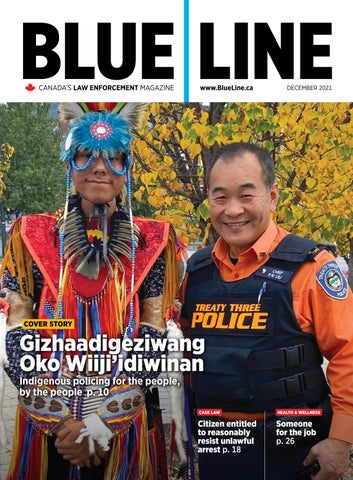
COVER STORY
Gizhaadigeziwang Oko Wiiji’idiwinan Indigenous policing for the people, by the people p. 10
CASE LAW
HEALTH & WELLNESS
Citizen entitled to reasonably resist unlawful arrest p. 18
Someone for the job p. 26
COMMISSIONAIRES VALUES LAW ENFORCEMENT EXPERIENCE Join Commissionaires and put your skills and experience to work to ensure the safety and security of people and property in a wide variety of environments.
COMMERCIAL
EDUCATION
HEALTHCARE
CONDOMINIUMS
MINING SITES
GOVERNMENT
CONSTRUCTION
PORTS
commissionaires.ca
10
Contents
December 2021
Columns
Volume 33 Number 10
4 8 9 14 15 22 27 30
Features COVER STORY
10 Gizhaadigeziwang Oko Wiiji’idiwinan
Editor’s Commentary Q&A Technology Case Law Holding the Line Behavioural Sciences Health & Wellness Back of the Book
Departments
Indigenous policing for the people, by the people. By Brittani Schroeder.
5 5 6 6 28 29 30
12 The rise and fall of the .40
The return to the 9mm Luger for police in Canada. By Dave Brown.
18 Firearm access by at-risk people A Canadian perspective. By Matthew H. Logan.
20 Blue Line Expo 2021 Review
News By the Numbers Dispatches Calendar Product Showcase Marketplace Blue Links
Canadian law enforcement experts come together to discuss hot topics and discover new products in today’s industry. By Brittani Schroeder.
24 Pulling together
PHOTO CREDIT: MATTHEW KENNEDY, UPRIVER MEDIA
An active reconciliation between Indigenous communities and British Columbia’s public service agencies. By Fiona Wilson.
8 @Blue_LineMag
9 24 December 2021 | BLUE LINE
3
EDITOR’S COMMENTARY BY BRITTANI SCHROEDER
www.BlueLine.ca
A year of learning and reflection
I
n September, Canada recognized the Chris Lewis also shares his thoughts on first National Day of Truth and Rec- the struggle Indigenous police services onciliation after generations of injus- face in our Back of the Book column on tice against First Nations peoples page 30. As he so aptly states, “There and their children. After the discovery of should never be ‘have’ and ‘have not’ the remains of 215 children at the Kamloops communities when it comes to policing.” Indian Residential School in May, thouAnother topic I’ve been very passionate sands more have been detected at many about learning more on over the last few other former residential school sites. One months is diversity in policing. October of my main focuses for this final was Women’s History Month, issue of 2021 was First Nations It was my and I had a conversation with policing, and I had the opportunity personal Supt. Treena MacSween of the to speak with several people on the goal this Hamilton Police Service in an importance of this topic. Having year to episode of Blue Line, The Podcast grown up in Brantford, Ont., home educate focused on increasing gender to one of the very first federal- myself more diversity in the law enforcement ly-funded residential schools, the on the profession. MacSween has made Mohawk Institute Residential Indigenous it a personal and professional School, it was my personal goal this history of mission to attract more women year to educate myself more on the Canada, and to law enforcement and she let Indigenous history of Canada, and also the me know how she wants to do also the horrific role residential horrific role it. You can find a short exerpt residential schools played. from the podcast on page 8, and Deputy Chief Constable Fiona schools hear the full podcast on our Blue Wilson took on a similar personal played. Line website. goal this year. Taking part in the Also in October, I had the Pulling Together Canoe Journey this sum- pleasure of attending and emceeing my mer, Wilson learned of the traditions and first Blue Line Expo at the Paramount customs of several host nations, including EventSpace in Vaughan, Ont. and handing Skwxwú7mesh Úxwumixw (Squamish out this year’s Blue Line awards, the RookNation), xʷməθkʷəy̓ əm (Musqueam), ie of the Year award and the Lifetime in Katzie, Lílwat, Cree, Anishinaabe, Kwakiutl Law Enforcement Achievement award, to and Tahltan. During 2021, she wanted to two very deserving law enforcement memtake the time to hear firsthand the stories bers. After almost two years of visiting and impacts of intergenerational trauma virtual events, it was a great feeling to once from residential school survivors. Through- again meet people in person, visit all the out the journey, Wilson learned ways to exhibitor booths and learn more about better support Indigenous peoples through some hot topics from law enforcement her role in law enforcement. Read about her industry experts. You can read more about experience on pages 24 - 25. Blue Line Expo on page 20. I recently had a conversation with Now, as we reach December and many Treaty Three Police Chief Kai Liu where I of us are preparing for the busy holiday learned of the significance of Indigenous season, I hope we can all move into 2022 policing and what the new Community with open minds and a willingness to Safety and Policing Act could mean for learn. If I have discovered anything this those working with Indigenous commun- year, it’s that we have so much to learn ities in Ontario. The events of this year from those around us. I would also like to have sparked a long overdue dialogue in thank you all for your continued support this country, and I am honoured to be able of Blue Line throughout 2021 and I am to share a part of it in this issue. You can looking forward to what next year will read the full interview with Chief Liu on bring. Happy holidays to you, your family pages 10 - 11. and the communities you serve.
CONNECT WITH BLUE LINE
www.BlueLine.ca 4
@Blue_LineMag
BLUE LINE | December 2021
BLUE LINE
www.facebook.com/BlueLineMagazine
Reader Service Print and digital subscription inquiries or changes, please contact Beata Olechnowicz, Audience Development Manager Tel: (416) 510-5182 Fax: (416) 510-6875 email: bolechnowicz@annexbusinessmedia.com Mail: 111 Gordon Baker Rd., Suite 400 Toronto, ON M2H 3R1 GROUP PUBLISHER | PAUL GROSSINGER pgrossinger@annexbusinessmedia.com PUBLISHER | ADAM SZPAKOWSKI aszpakowski@annexbusinessmedia.com EDITOR | BRITTANI SCHROEDER bschroeder@annexbusinessmedia.com EDITORIAL DIRECTOR EMERGENCY SERVICES GROUP | LAURA AIKEN laiken@annexbusinessmedia.com ACCOUNT MANAGER | JANICE EATON jeaton@annexbusinessmedia.com MEDIA DESIGNER | SVETLANA AVRUTIN savrutin@annexbusinessmedia.com ACCOUNT COORDINATOR | KATHRYN NYENHUIS knyenhuis@annexbusinessmedia.com COO | SCOTT JAMIESON sjamieson@annexbusinessmedia.com ANNEX BUSINESS MEDIA 111 Gordon Baker Road, Suite 400 Toronto, ON M2H 3R1 Tel. 416-442-5600 • Fax 416-442-2191 Publication Mail Agreement No. 40065710 ISSN 0847-8538 Printed in Canada SUBSCRIPTION RATES Canada — 1 Year $31.50; 2 Year $52.50 plus tax USA — 1 Year $136.50 CAD Occasionally, Blue Line will mail information on behalf of industry-related groups whose products and services we believe may be of interest to you. If you prefer not to receive this information, please contact our circulation department in any of the four ways listed above. Annex Privacy Officer Privacy@annexbusinessmedia.com; Tel: 800-668-2374 © 2021 Annex Business Media. All rights reserved. Printed in Canada. No part of the editorial content of this publication may be reprinted without the publisher’s written permission. Opinions expressed in this magazine are not necessarily those of the editor or the publisher. No liability is assumed for errors or omissions. Readers are cautioned and advised that articles presented herein are edited and supplied for your personal awareness and should not be used for further action until appropriate guidance is received from a supervisor, Crown Attorney or other persons in authority. All advertising is subject to the publisher’s approval. Such approval does not imply any endorsement of the products or services advertised. The publisher reserves the right to refuse advertising that does not meet the standards of this publication.
NEWS
PHOTO CREDIT: SGT. ROD PICK
BRITISH COLUMBIA
Indigenous Peoples Atlas of Canada Positive Partnership Program Launched
Recently, members from the West Coast Marine Services (WCMS) and Indigenous Policing Services (IPS) spent the day with Canadian Geographic Director of Reconciliation Charlene Bearhead and B.C. Teachers’ Federation (BCTF) Indigenous Education Committee member Brian Coleman, developing an initiative to bring Indigenous learning resources to the remote north. The training has become the foundation of the Naut’sa mawt Initiative, which aims to introduce unique and incredible learning resources to many of the remote Indigenous communities who would not normally have access to them. Made possible through a collaborative effort on behalf of the West Coast Marine Services, Canadian Geographic, BCTF and Indigenous Policing Services, thousands of young children will get the chance to explore Canada and its history through the interactive educational resources produced by Canadian Geographic. The Royal Canadian Geographical Society (RCGS), Canadian Geographic, and Canadian Geographic Education worked closely with Indigenous partners and storytellers to produce content and educational resources that reflect the experiences and knowledge of the diverse Indigenous Peoples of Canada. One of the biggest and most important projects that the Society has undertaken
to-date is the Indigenous Peoples Atlas of Canada (IPAC). The Naut’sa mawt Initiative concept was developed by RCMP WCMS member and RCGS Fellow Bill Nadeau who, during his Masters research, met Canadian Geographic Director of Reconciliation Charlene Bearhead. Bearhead explained to Nadeau that the Indigenous Peoples Atlas of Canada was in response to the Truth and Reconciliation Commission’s Call to Action and Canada 150, and has been a vital resource over that last six years in championing the healing process through education. Bearhead added that despite the kits gaining popularity throughout Canada, it has been very difficult to get them into the more remote and coastal communities where they are most needed. That is when Nadeau saw an opportunity to partner with IPS. The program will soon be introduced to the 117 plus Indigenous Policing Services members who work across B.C. at their annual training week. Over the next few months, the kits will be delivered to Ahousaht, the Gulf Islands and many of the Coastal Indigenous communities in Northern B.C. Nadeau’s vision is to see a kit available in every school district before the end of 2022.
donned white moustaches to acknowledge and participate in ‘Movember’. Over the past few years, several police members of the department have been affected by different types of cancer, so Sgt. Jason Scott wanted to show his support by starting this new department initiative. “I know that Movember is mainly aimed at men’s prostate and testicular cancer, but I look at it as a fundraiser for any kind of cancer, and a way to bring our community some more awareness on this ugly disease and other men’s health issues, including mental health and suicide prevention. I wanted to show my support of our officers while making sure the team had some fun while doing it,” said Sgt. Scott. Sgt. Scott plans to have the moustaches appear on the vehicles each November going forward. This year, he partnered with a detail shop to create the moustaches for each car, and also smaller decals for the community. “The owner of the shop donated a portion of the costs for each car moustache to the Movember cause, and anyone who wanted a small decal could pick one from our police station, by way of a small donation.” Sgt. Scott saw many important conversations regarding men’s health started within the Abbotsford community during November, and he hopes those conversations will continue going forward.
BRITISH COLUMBIA
Sparking important conversations in Abbotsford
During the month of November, the Abbotsford Police Department’s vehicles PHOTO CREDIT: SGT. JASON SCOTT
BY THE NUMBERS In November 2020, the Canadian Centre for Justice and Community Safety Statistics released recent data on crime reported by police serving areas where the majority of the population is indigenous. In 2018, there were 182 police services or detachments in Canada that were responsible for serving these areas. For more information, please visit www150.statcan.gc.ca.
6
Police-reported crime rates for these Indigenous communities were six times higher than crime rates reported by police services that served primarily non-Indigenous populations.
@Blue_LineMag
66%
9
Police-reported crimes in the Indigenous communities were more likely to be solved (cleared) than in non-indigenous communities (66 per cent versus 37 per cent).
Violent crime rates reported by Indigenous communities were almost nine times higher than those primarily serving non-Indigenous communities.
58%
The higher crime rates reported by police serving these Indigenous communities can be mainly attributed to greater levels of mischief, common assault, and disturbing the peace.
December 2021 | BLUE LINE
5
NEWS CALENDAR
ONTARIO
Wounded Warriors Canada and London Police Service partner
The London Police Service (LPS) is enhancing mental health services and supports for its members and their families through a new partnership with Wounded Warriors Canada. Wounded Warriors, a mental health service provider, offers a range of clinically facilitated programs that have been specifically developed to support the unique needs of veterans, first responders and their families. The organization also provides leading-edge trauma-informed workplace training geared towards helping make trauma exposure management a new professional standard for uniformed service personnel. “The mental health and well-being of our members is integral to our organization,” says Police Chief Steve Williams. “We have made a commitment to our sworn and civilian members that we will provide the supports they need to ensure they never have to struggle alone.” As part of this partnership, Wounded Warriors Canada will be delivering the Before Operational Stress (BOS) program to
NOTE TO READERS: check with all organizers as COVID-19 continues to affect events.
PHOTO CREDIT: LONDON POLICE SERVICE
London Police Service members. The BOS program brings together cutting-edge clinical approaches with recognized scientific expertise to support psychological health and wellness of public safety personnel over the course of their operational careers. “Given the complexities of operational stress injuries, we know that no single organization will ever be a 100 per cent solution when it comes to the mental health and wellness of its members and their families,” says Scott Maxwell, Executive Director of Wounded Warriors Canada. “This is why partnerships are vital. Together, we are working to break down barriers to accessing culturally appropriate mental health care while reducing stigma for those who keep our communities safe.”
BCACP/CACP Police Leadership Conference April 3 – 5, 2022 Location: Vancouver, B.C. www.cacp.ca/2022-police-leadershipconference.html?mid=214 IADLEST 2022 Conference May 15 – 18, 2022 Location: Fort Worth, Texas www.iadlest.org/conf-2022 CANSEC 2022 June 1 – 2, 2022 Location: Ottawa, Ont. www.defenceandsecurity.ca/CANSEC/ CACP National Human Trafficking Symposium June 5 – 7, 2022 Location: Toronto, Ont. www.cacp.ca/cacp-national-humantrafficking-symposium.html?mid=524
DISPATCHES The Hamilton Police Services Board has announced the appointment of Paul Hamilton as the new Deputy Chief of Police. Deputy Chief Hamilton is a 31-year Hamilton Police Service member, most recently serving as Acting Deputy Chief of Support Services. Prior to that, he worked as Superintendent in the Investigative Services Division. He has been a command lead on a variety of multi-jurisdictional major case management investigations that have included domestic and international law enforcement agencies. He is committed to further enhancing community-based policing and in building, fostering and advancing strong and sustained partnerships within their various and diverse communities. Deputy Chief Hamilton studied Sociology and Criminology at the University of Ottawa. He has been married to his wife Darcia for 25 years and they have raised two adult children in the Dundas Community. Constable Arlene Omilian is celebrating 42 years in policing and is the longest serving female officer with the Edmonton Police 6
BLUE LINE | December 2021
Service (EPS). Omilian joined EPS in 1979 and worked for most of her career as a Patrol officer in the community where she felt she could make a difference in people’s lives. While working in Downtown Division, she was called in to search a young female sex trade worker who was being arrested. She had a heart-to-heart conversation with her, “What are you doing here? You’re better than this.” Years later, she was approached by the same woman who said, “Remember me? You really turned my life around. I went back to school and I’m working a job now. I’m happy, happy to be alive, thank you.” Today, Arlene works in the Police Communications Branch, where her years of wisdom and experience continue to help citizens and first responders get through emergencies. The Brockville Police Services Board has announced the appointment of Mark Noonan as Chief of Police. Chief Noonan began his career in 1992 with the Brockville Police Service. He worked uniform patrol for 9 years before working the bulk of his career
in Criminal Investigations and Intelligence. He was promoted to Deputy Chief in February 2018, where he provided oversight and leadership in day-to-day operations, training, clerical and technical services and emergency planning. He was raised in Brockville, attending Brockville Collegiate Secondary School and then Carleton University where he obtained his Bachelor of Arts degree. Noonan has received extensive training through the Ontario Police College, the Canadian Police College, and the Criminal Intelligence Service of Ontario. Chief Noonan is a member of the Ontario Association of Chiefs of Police (OACP) and the Canadian Association of Chiefs of Police (CACP). Chief Noonan is a valuable member who has displayed dedication to the Service and the community. PROMOTIONS, RETIREMENTS, RECOGNITION • If you have an officer in your agency recently promoted or retiring or an individual you wish to have recognized (major award or recently deceased) you can let Blue Line magazine know by emailing: bschroeder@annexbusinessmedia.com.
www.BlueLine.ca
Q&A In a recent Blue Line, The Podcast episode, Hamilton Police Service Supt. Treena MacSween joined editor Brittani Schroeder to discuss the challenges she has faced, and still faces, in her chosen profession, and her mission of gender diversity and attracting more women to law enforcement.
As you get along in your career, you realize how things impact your community and that includes everything from recruiting the right people to promoting them. Being appointed superintendent is a really proud moment for me and my family, and the gravity – the responsibility – of this promotion is not lost on me. A few years ago, I was asked to help mentor some female students at a local high school. The students had gone to their teacher and asked to hear from a black, female officer. I’ve gone back four years in a row, and now I take other black, female officers with me. I am such a big believer that if you can see it, you can be it. I tell those students that if I can stand there in front of them, they can do it and be a part of the team as well. It’s funny, because when I earned this promotion, I didn’t like all of the attention it received. Yes, I am the fourth woman and first person of colour to hold this position at the HPS, but I didn’t want to focus on that. It was my sister who really made me see that it wasn’t about me. This promotion is about all the women who will come after me.
Q: Can you tell me about some of the challenges you’ve faced throughout your career?
On my first day as a recruit, I showed up to the class with all the other recruits to introduce myself, talk about my education, my volunteer work, and so on. I was so excited, because that was what I’d wanted for so long. While I was at the water fountain, a male recruit came up to me and said, “I can’t believe they hired you, and you’re only 21.” I was really taken aback by his comment. He then said to me, “Yeah, well, the only reason you got hired is because you’re black and female.” I just stood there, stunned, as he walked 8
BLUE LINE | December 2021
Q: You’ve said your personal mission is to increase the gender diversity within policing. What do you think needs to be done for this to become a reality?
Treena MacSween
away. When I walked back into the classroom, it hit me: I started thinking, “Who else in this room thinks that way?” and my next thought was, “Is it true?” I would say this has been my biggest challenge because I allowed that selfdoubt to get in my way, and cause noise in my own head for probably the first 15 years of my career. I think back now, and I literally shake my head because I can’t believe that I allowed the words of someone I didn’t even know to impact me for so long. I finally realized, yes, I am a woman; I am a person of colour; I am different, and I need to embrace that. It was a real aha moment for me, because I never want any other female or male to be in that situation and allow someone else to have a negative impact on their future career.
We have had women in the HPS for 62 years, and in that time, there have only been four female superintendents. I have been wondering, why? I have asked women on the force, and a large reason is because they just weren’t seeking higher levels of promotion, due to balancing childcare or eldercare in their personal lives. They told me they just didn’t have the support in their corner telling them they could get it all done. So I will be that supporting person, because I know it can be done. I also want to look at positions that are typically male dominated. A great example is our tactical (TAC) team: in the history of the HPS TAC team, there has only ever been two female members. We hadn’t had a female apply to be on the TAC team in 14 years. I see these strong, fit females in our gym who no doubt would be able to do this job, so why aren’t they considering this role? I think it goes back to how some of us felt in high school: I can’t sit at the table because no one else there looks like me. I spoke to some women, and I found out that they want to complete the testing in a comfortable atmosphere, but it’s also about getting over the challenges and hurdles in their own head. We then set up two sessions in the gym, and we invited 14 women to come in, put the heavy vest on, and do the exact same testing that is required for anyone on the TAC team. These women blew me away, because they didn’t just run through the course, they killed it. It was great to show them that they could get this done. For the first time in 14 years, we had two women apply to the TAC team. So we can see that women are interested in higher-ranking positions, they just need to feel comfortable in applying and feel like they are welcome on the team. Editor’s Note: This interview has been condensed and edited for clarity. To listen to the full episode, visit blueline.ca/podcasts.
www.BlueLine.ca
PHOTO CREDIT: HAMILTON POLICE SERVICE
Q: Congratulations on being appointed Superintendent! Can you tell me what this means for you and your community?
TECHNOLOGY
BY BRITTANI SCHROEDER AND PAUL EDWARDS
The connected officer
T
he law enforcement industry is very remote in nature. Therefore, increasing the usability of police officers’ mobile devices is vital from an operational standpoint. Officers who are equipped with Galaxy smartphones with built-in Samsung DeX are given an opportunity to do more with their handhelds, as the software enables them to complete work that could previously only be done at headquarters on a traditional computer, on the road instead. Samsung DeX is a software application built into the latest Samsung Galaxy mobile devices that enables officers to extend their smartphone or tablet into a desktop-like computing experience. The software can be used in a variety of modes: directly on-screen with a keyboard case; on a connected monitor alongside an external keyboard and mouse; on a connected PC; or wirelessly cast to a SmartMonitor or SmartTV. When the software is triggered on a the mobile device, officers are presented with a familiar desktop experience, with resizable windows, dragand-drop functionality, and the keyboard shortcuts familiar to PC users.
PHOTO CREDIT: SAMSUNG, BELLEVILLE POLICE SERVICE
The importance of use in law enforcement
This type of technology is a solution for officers and other first responders whose work is often conducted on the road or in-vehicle. Apart from a DeX-enabled mobile device and the necessary peripherals, all that’s needed to get started is an HDMI adapter or cable. The software also helps to increase the usability of the industry-specific, mobile applications housed on officers’ smartphones. By connecting their mobile device to a monitor inside their vehicles, the applications are blown up on a larger screen – allowing the officers to use them more efficiently than on a smaller, handheld device. How does this software enable officers to do their jobs in new ways? First, by getting administrative work done remotely, instead of having to return to headquarters to finish it. For example, officers can now record witness statements, or capture images on their mobile device, and use the software to work with the data in-vehicle in a new way, ultimately saving them travel time. @Blue_LineMag
“This technology is a solution for officers and other first responders whose work is often conducted on the road or in-vehicle.” It also offers officers and members of law enforcement improved access to critical 911 call information, the records management database and any other business applications that are loaded onto their smartphones. Having these applications enlarged on a screen inside the police vehicle lets the officers obtain the information they need more easily. This not only helps to reduce radio traffic – because it lessens the need to contact dispatch for information – but also helps speed up incident response times, in some cases.
Case study: Belleville Police Service
The Belleville Police Service (BPS) was the first Canadian police department to utilize this technology built into their smartphones to improve their operations. After noticing some inefficiencies in their information-sharing processes, the service decided to undergo a significant technology upgrade project with the goal of enhancing the way officers retrieved and managed information. One of the biggest gaps to be addressed was a lack of technology within officers’ patrol vehicles.
As more law enforcement industry specific mobile applications were being utilized, officers found they were using their mobile devices more frequently. Being able to access the dispatch records management system on their phones gave them the ability to retrieve dispatch and database information independently. This is where the Samsung DeX entered the scene. “A lot of the times when I’m outside of the vehicle responding to a domestic scene, I’ll take my phone with me to take a witness statement or capture images. When I get back into the car, I can pop the phone back into the dock and trigger DeX to download and work with that data in an easier, more intuitive way,” said Constable Jordan Wells, BPS. Before this software introduction, Wells found working on a small mobile device hard, as the “small screen made it difficult to interact with the apps”.1 Joe Myderwyk, Systems Network Administrator, BPS, notes that this new capability “aligns with the Service’s end goal of making officers more efficient on the road. As an industry, law enforcement is on the cusp of a new, tech-focused era, one that is being fueled by the smartphone, and new technologies like DeX.”
Reference
1. Belleville Police Service. “Case Study: How Samsung Mobile Technology Is Fueling A New Era of Connected Officer.” Samsung Newsroom Canada. October 2021. Paul Edwards is Vice President and General Manager of Enterprise Mobility at Samsung Canada.
December 2021 | BLUE LINE
9
COVER STORY
Gizhaadigeziwang Oko Wiiji’idiwinan Indigenous policing for the people, by the people By Brittani Schroeder
The value of Indigenous policing
Within the Treaty #3 Territory there are 28 First Nation communities, and the Treaty Three Police Service (T3PS) covers 23 communities, spanning an area of 55,000 square miles. “Our Police Service motto is Gizhaadigeziwang Oko Wiiji’idiwinan, which is Ojibwe for ‘Policing for the people, by the people’. At the T3PS, 75 per cent of our officers are Indigenous, or visible minorities,” said Chief Kai Liu. Thirty-five per cent of the T3PS is also made up of female officers, which is approximately 10 per cent over the national average. One of the challenges that the Treaty Three communities face is not having access to regular services that are enjoyed by larger municipalities. “The Treaty Three communities are located in northwestern Ontario, and we don’t have many other agencies to help our community members. With a much smaller social safety net available within our Indigenous communities, our T3PS members are left filling in the gaps,” Liu stated. Sometimes, to make sure the individual gets the help they need, officers will drive 600 to 700 kilometres to ensure they are taken care of. “Why do we do it? Because that’s what First Nations policing is. We see the citizens and residents of our Treaty Three communities as family members, and that is how they’ll be treated,” he said. “One such incident involved a female who was walking along a rural highway in early spring, and she didn’t have any shoes on. The officers picked her up, drove her an hour and a half to the closest Walmart and bought her a pair of shoes. Then, because the female wasn’t
feeling well, the officers took her to the hospital. These kinds of occurrences happen regularly, and it’s because of the cultural makeup of our officers that we’re able to properly attend to our citizens.” For Liu, the real value of Indigenous policing came to the forefront during the COVID-19 pandemic. “In a non-pandemic world, the 23 communities that we serve are usually under-resourced, with poor housing conditions. When you add the pandemic to that, and you have multigenerational families all residing in a small house, the risk was if one person was infected, then the whole family would be infected,” said Liu. “Band Chiefs and Councils were proactive protecting their residents by closing their communities the outside.” The members of the T3PS provided security at the checkpoints to help support the people who were working there. “During this pandemic, there was one community that had an outbreak, which resulted in essentially the whole community being quarantined. Our officers took on the additional role of delivering food and delivering and stacking firewood because everyone was asked to stay inside their houses during that time. Our officers took on those supporting roles even when they were off duty. That allowed the community to address the outbreak and significantly reduce the positive cases.” During the 2021 forest fire season, one of the Treaty Three communities had to be evacuated to Winnipeg and London, Ont. “During the evacuation, the T3PS officers were carrying elderly members to the buses, and making sure everyone got out to the airport safely,” said Liu. “Now, imagine
“We aim to provide a professional, dedicated and culturally responsive police service that is sensitive to the traditions and cultures of the communities we serve.” 10
BLUE LINE | December 2021
a community that needs to evacuate, but they have to leave their animals behind. Our officers were in that community, feeding dogs and cats, giving them water, and making sure everything was taken care of.” The T3PS is one of nine self-administered First Nation police services across Ontario. “I am confident that the other First Nation police services show the same level of commitment to their community members as we do at the T3PS,” Liu stated.
The mission of Indigenous policing
One of the most important aspects of Indigenous policing is working in partnership with the First Nations communities. “At the T3PS, we work with our Treaty #3 nations and we aim to provide a professional, dedicated and culturally responsive police service that is sensitive to the traditions and cultures of the communities we serve,” Liu said. “One of the ways we remain culturally sensitive and aware is by recognizing the Treaty Three traditions, customs and ceremonies that occur within the communities. We are guided by what we call ‘Grandfather Teachings’.” Within the Anishinaabe nations, there are seven Grandfather Teachings: respect, love, wisdom, humility, bravery, truth, and honesty. For Treaty Three, an eighth Grandfather Teaching was given by their Elder: forgiveness. “For Treaty Three, the rock is the symbol for forgiveness. As an example of this Grandfather Teaching, when an individual has difficulty forgiving others, each time they do not forgive, it’s like they are www.BlueLine.ca
The first federally recognized National Day of Truth and Reconciliation on Sept. 30.
adding a rock to their pocket. At some point, these rocks will weigh the person down. The importance of forgiveness is letting that burden go.” Through Liu’s policing experience in municipalities like Ottawa, Cobourg and Gananoque, he learned that religion plays a large role in many citizens’ lives. “For Treaty Three communities, these cultures, traditions, Grandfather Teachings and sacred items play the same kind of role. As an Indigenous police service, we have several sacred items, including our drum, our pipe, and our eagle staff, which provide us and our members guidance and support.”
PHOTO CREDIT: CHIEF KAI LIU
Truth and reconciliation
On Sept. 30, Canada federally recognized the first Truth and Reconciliation Day. “This came as a result of generations of people essentially trying to kill the Indian in the child. A lot of the ceremonies, traditions and customs that are being practiced now were at one time against the law, banned and prohibited. Therefore, it is so important to embrace these traditions now and make sure they are not lost,” said Liu. On the first National Day of Truth and Reconciliation, the Treaty Three police donned orange shirts and orange police logos. “Where our police headquarter is located is unfortunately near the former Cecilia Jeffrey Indian Residential School site. For that reason, we know we are surrounded by unmarked graves of children that attended that school. So, on Sept. 30, led by residential school surviv@Blue_LineMag
ors, Grand Council Treaty #3 held an honour walk that started from the former school site and stopped at our police station and held a large ceremony in front of those unmarked graves.”
Community Safety and Policing Act
In 2019, the Conservatives took over the Ontario provincial government, and introduced Bill 68: the Community Safety and Policing Act. This bill is expected to replace the current Police Services Act in 2022. The current Police Services Act does not apply to First Nations policing. Within the act, the declaration of principles states that police services shall be provided throughout Ontario in accordance with a list of principles. “Principle number one is the need to ensure the safety and security of all persons and property in Ontario. Since Indigenous police services and the communities we serve were left out of the Act, what it is essentially saying is that ‘everybody’ does not include Indigenous peoples. We have been having regular engagement table meetings with the Ministry of the Solicitor General to change this. I am excited for the new Community Safety and Policing Act and its declaration of principles; its first principle has added First Nations, so that it now reads: needs to ensure the safety and security of all persons and property in Ontario, including on First Nation reserves.” The new act has also included: the need to be responsive to the unique histories and cultures of First Nation, Inuit and Métis communities; the need to ensure
that all parts of Ontario, including First Nation reserves, receive equitable levels of policing. “That last guiding principle is very important. Since their inception, First Nation police services have been chronically underfunded. In municipalities like Ottawa, if someone were to call 911 for an emergency, on average, it would take anywhere from four to seven minutes for officers to respond. In our Treaty Three community, because we are so chronically under-resourced and we span such a large territory, it would take anywhere from one to one and a half hours for an officer to respond. We don’t have the resources to assign dedicated members to each of the communities we serve.” The T3PS has 106 members to cover 55,000 square miles. “Under the current Police Services Act, municipal police services are able to go to ‘arbitration’. This allows them to go in front of an arbitrator and argue as to why they require additional funding,” said Liu. “Currently, for First Nations policing, it’s a take-it-or-leave-it situation, and there is no room for negotiations. Under the new act, Indigenous police services can go to binding arbitration, which provides the mechanism for First Nation communities to ask for the appropriate resources.”
Joining Indigenous policing
First Nations constables are selected on the same criteria as every other police officer in the province of Ontario. “The criteria to hire a Toronto Police officer, an OPP officer or an Ottawa Police officer are all the same. All members must attend the Ontario Police College. Where we differ from municipal police services is that our officers receive an additional six weeks of training with our provincial counterparts. Once our officers are finished at the Ontario Police College, they continue their training with the OPP. When they finish their training and return to the T3PS, they receive specific cultural trainings that have to do with the different nuances of policing within the First Nation communities where they will be serving.” A new association was also created in 2019 to support Indigenous policing: Indigenous Police Chiefs of Ontario. “The Indigenous Police Chiefs of Ontario has been a strong advocate for all the improvements that are needed for Indigenous police services across the province, and we’re working towards making Indigenous policing an organization more people want to be a part of,” Liu concluded. December 2021 | BLUE LINE
11
COVER STORY FIREARMS: A HISTORY
The rise and fall of the .40 The return to the 9mm Luger for police in Canada By Dave Brown
A
pril 11, 1986 was one of the darkest days in FBI history. Two Special Agents were killed and six more were wounded in a shootout with two violent and heavily armed murderers that would go on for almost five minutes. A total of 145 rounds were exchanged in what would become one of the most studied events in law enforcement history. The shootout in Dade County, Florida was to become one of the biggest watershed events in the history of police firearms training in North America. It would eventually lead to the spawning of an entirely new cartridge designed specifically for law enforcement officers – the .40 S&W. In its search for a more powerful cartridge with better penetrative capability and the ability to punch through doors and windshields, the FBI initially commissioned a new cartridge called the 10mm Auto. When it proved almost too powerful for many of their agents to handle and the handguns too large and unwieldly because of the length of the cartridge, Smith & Wesson, in partnership with Winchester Western ammunition, designed a shorter cartridge with reduced gunpowder and the same diameter (.40inch) bullet. The shorter case could now be contained in the same frame size as the existing 9mm Luger (also known as the 9mm Parabellum or 9x19) designs, but would fire a slightly larger diameter bullet than the .355-inch 9mm bullet and at a higher velocity. The .40 S&W cartridge proved to be very popular with police agencies, and by 2007, was selected as the cartridge of choice by half the armed law enforcement agencies in Canada. But by 2018, the percentage of agencies in Canada who stayed with the .40 S&W had dropped to less than 20 per cent. Why did they move back to the 9mm Luger, which was the original problematic ammunition for the FBI semi-automatic pistols back in 1986? The answer is simple. Agencies were finding that the cost of the .40 S&W in higher recoil, greater muzzle flash and accelerated wear on handguns just did not pay off in better downrange or terminal performance.
12
BLUE LINE | December 2021
“We also now have a better understanding that the gun is not always the solution to every problem. The gun is only the tool; the mind is the weapon.” Some agencies also found that the internal design of the base of the .40 S&W shell casing was inherently weaker than the internal casing of the 9mm Luger cartridge. Both cartridges are similar chamber pressures, but when using reloaded casings already weakened by a previous firing, certain makes of handguns with a small unsupported area on the underside of the chamber could potentially burst through the casing, destroying the handgun and sometimes detonating the top round of the magazine through flame-cutting. But even without these rare situations with reloaded ammunition in the .40 S&W and .45 Auto handguns (which became known as ‘kabooms’), the .40 S&W was just not much fun to shoot. Meanwhile the 9mm bullet design was not standing still. With the right configuration, the modern police-issue bullet began to perform equally well in 9mm Luger chambering as the more-powerful .40 S&W cartridge in both scientific tests and real-world shootings. Born under fire, the .40 S&W was the right cartridge for the time, replacing the horribly excessive 10mm Auto. But modern training recognizes that the gun as a tool is far more than just its cartridge. The 9mm Luger is just as effective, easier to train on and much easier on wear and tear of high-round-count pistols. Will an April 11, 1986 ever happen again? Who knows? No officer wakes up and says,
“Today, I use my firearm to save someone’s life.” We now have better weapons, better tactics, and better training than was available in 1986. Today, we have a better understanding of the physiological and psychological reactions of the human body under stress. We have a recognition that even the best training and the best firearm in the world is not going to instantly stop a goal-oriented individual intent on killing. We know based on what happened in 1986, and subsequent studies, that there is no “magic bullet” or “one-shot stop” cartridge. Stopping a threat is directly related to shot placement and shot penetration, and the 9mm Luger design could do both. We also now have a better understanding that the gun is not always the solution to every problem. The gun is only the tool; the mind is the weapon. When it comes to defensive weapons, training advances with the science. And sometimes science tells us the cartridge that was only starting to be issued to police officers in 1986 actually works just as good as the newer design, and has the advantage of being easier to train on. While the fact that the 9mm Luger is more comfortable to shoot and thus easier to train on, may seem irrelevant to some, we don’t train for extraordinary people to have extraordinary skills when they are caught in unusual circumstances. We train for the average person to stay alive and to help others stay alive in spite of those challenging situations. Training is a lifelong commitment to safety and advancement of skills. Training should not be a chore. After all, advanced skills are simply the basics, mastered. Japanese musician and philosopher Shinichi Suzuki once said, “Knowledge is not skill. Knowledge plus ten thousand times is skill.” Dave Brown is Blue Line’s firearms and police vehicle contributor, as well as one of the Best Dressed Police Vehicle Awards judges. He is a tactical firearms trainer and consultant based in Winnipeg. He can be reached at Dave.Brown@northwestlaw.ca.
www.BlueLine.ca
Helping you support your employees. A healthy workforce is key to your thriving organization. Support employee well-being with person-centred physical and mental health solutions from TELUS Health including:
Virtual Care Primary and mental health care.
Specialized Digital Therapy Self-paced programs for common mental health concerns.
LifeJourney ™ Virtual employee assistance program.
Espri Targeted digital mental health resources for first responders.
Virtual Pharmacy Mobile pharmacy.
Care Centres Corporate, occupational and mental health services.
NEW! Workplace mental health programs: Back to the workplace, mental fitness and more.
THS3891-11-2021
Discover our full suite of solutions to help your organization thrive. telushealth.com/employers
CASE LAW
BY MIKE NOVAKOWSKI
Citizen entitled to reasonably resist unlawful arrest
A
woman, twice unlawfully arrested by police, could not be convicted of resisting arrest nor of assaulting the officers effecting it because she was not legally required to submit. In R. v. Gibbons, 2021 NUCA 17, the accused’s family members phoned police for help in removing her from her father’s home. She was intoxicated on both occasions and was peacefully on the front step outside the home when police arrived. During the first event, Gibbons’ father merely wanted his daughter taken elsewhere. Although police tried to find her another place to stay, Gibbons was arrested – but not told why – and taken to the police station. While there, she collapsed to the floor and struggled with officers as they tried to remove excess layers of her clothing. She was not told why she needed to remove her clothing, nor was she asked to remove it herself. At one point, Gibbons kicked an officer in the head. During the second event, about eight months after the first, police were again summoned to Gibbons’ father’s home. They found her smoking with a man who was bound by a probation condition not to have contact with her. Both were arrested and, when Gibbons did not immediately descend the steps, she was grabbed by the arm and pulled down. She began to yell, strike out with her arms and legs, ripped an officer’s radio from his vest and swung it around. She resisted officers’ attempts to handcuff her and kicked at them when she was placed in the back of the police vehicle. Gibbons went on trial in the Nunavut Court of Justice. Concerning the first event, she pled guilty to resisting arrest and, following trial, was convicted of assaulting a police officer. The trial judge accepted she had been arrested for mischief and taken to cells to be lodged until sober. Given her guilty plea to resisting arrest, the trial judge concluded the police were acting lawfully in arresting her and taking her into custody, and therefore she could not use the self-defence provisions of s. 34(1) Criminal Code as a legal basis to resist the arrest. And, even if self-defence applied, Gibbons’ resistance was not reasonable. “[The accused] played a significant role in bringing about the use of force by forcefully resisting her lawful arrest for an extended period of time,” said 14
BLUE LINE | December 2021
“While these type of nuisance complaints are undoubtedly burdensome for the police, their response must nevertheless remain lawful.” - Justice Schulz the trial judge. “She had other options available to her to bring an end to the situation. She needed to simply stop struggling and fighting.” As for the second event, she was found not guilty of resisting arrest and assaulting the police officers. The judge concluded that the police did not have reasonable grounds to effect the arrest when they found her quietly smoking on the front step of her father’s residence. However, she was found guilty of two counts of simple assault. The judge found the accused should have stopped struggling, even in the face of an unlawful arrest, and instead ought to have awaited a review of her detention and a judicial determination as to the actions of the police. Gibbons appealed her convictions to the Nunavut Court of Appeal, submitting she was acting in self-defence on both occasions and her actions in resisting both unlawful arrests were reasonable. The Crown acknowledged there was no legal requirement that a citizen acquiesce to an unlawful application of force merely because that force is being exerted by a police officer. The Court of Appeal held, in both events, that Gibbons was arrested and taken to the police station solely because she was intoxicated, and police did not know what else to do with her. Neither arrest was justified on the evidence. “While these type of nuisance complaints are undoubtedly burdensome for the police, their response must nevertheless remain lawful,” said Justice Schulz. She continued: Should an arrest be made, it must be on reasonable and probable grounds that an offence has been or is being committed, and not because they do not know what else to do with an intoxicated individual
who is the subject of a nuisance complaint. Further, once the police assert physical control over that intoxicated individual, that control must be lawful and reasonable in all of the circumstances. That is not what happened in either of these two incidents; the arrests were unlawful. The [accused] was also not told why she was being arrested, why she was being stripped of her clothing, or why she was being manhandled by police. In such circumstances, she was not required to simply stop, submit and passively acquiesce to their unlawful actions while hoping for a better outcome sometime down the road. [para. 27] As to the first event, “at best, Ms. Gibbons was arrested for being outside on her father’s property or because no one could be found to take her in, or both, but neither objectively or subjectively establishes reasonable and probable grounds to arrest for mischief, and each seems wholly inconsistent with s. 495 of the Criminal Code.” Since the arrest was unlawful, Gibbons was entitled to resist it, and she acted reasonably and not excessive in her efforts, including the kick to the officer’s head while she struggled against the attempts to remove her clothing. It is not a requirement of self-defence that Gibbons submit to the police and thereby end the need for force against her. In the second event, Gibbons’ arrest was unlawful and therefore the police were not acting in the lawful execution of their duties. Gibbons did not have “a legal duty to be quiet, passive, submissive, and simply to acquiesce during an unlawful assault upon her person, because the assault was being perpetrated by uniformed police officers.” In this situation, the police did not have grounds to arrest Gibbons and did not inform her of the reason for it. She was entitled to resist this unlawful arrest and transport to the police station, and did not use excessive force in doing so. Gibbon’s appeal was allowed, her guilty plea was set aside, all her convictions were quashed, and acquittals were substituted.
Mike Novakowski is Blue Line’s case law columnist.
www.BlueLine.ca
HOLDING THE LINE BY MICHELLE VINCENT
Inspiration and collaboration or motivation and competition? Language matters!
PHOTO CREDIT: ©ETIAMMOS / ADOBE STOCK
I
n this day and age, words are exchanged, processed and responded to. One word may have many meanings depending on the inflection of speech, paralanguage, delivery and various other aspects that impact the reception of these words. We use words such as ‘gratitude’ and ‘appreciation’ interchangeably, when these two words actually have very different and distinct meanings. For example, ‘gratitude’ means the quality of being thankful, and the readiness to show appreciation for and to return kindness; in contrast, ‘appreciation’ means recognition and enjoyment of the good qualities of someone or something. These are two very different experiences. Being grateful for an experience suggests a past experience which may not have been as pleasant, whereas being appreciative of an experience is simply that: appreciating a moment with no strings attached. Appreciative is a preference in feeling. ‘Inspiration’ and ‘motivation’ are two other words that may be used interchangeably and yet have very different meanings. ‘Inspiration’ is the process of being mentally stimulated to do or feel something – especially to do something creative – whereas ‘motivation’ is the reason or reasons a person has for acting or behaving in a particular way. Inspiration comes from within a person and is a much more powerful and consistent aspect; motivation comes from the outside, usually in what would be considered a reward of sorts. Inspiration carries more strength and consistency in predicting future behaviour whereas motivation is somewhat like a casino, needing reward to reinforce the behaviour. ‘Collaboration’ and ‘competition’ are not often used interchangeably, however they may be used together in a particular context. For example, when teams are comprised of more than one member, those members of that team may collaborate prior to competition. Generally speaking, @Blue_LineMag
The moment we are scored on the deliverables we are to submit in order to participate in the process, the comparisons begin, and a competition ensues.
collaboration brings people/members together for a likeminded opportunity whereas competition tends to divide and separate those members involved. When we explore the organizational culture of policing, competition is often present during promotional processes, depending on the organization’s internal process. The moment we are scored on the deliverables we are to submit in order to participate in the process, the comparisons begin, and a competition ensues. The most successful businesses/organizations tend to promote leaders who are competent in their skillset, creative in their approach and recognize their strengths and areas where support is needed. Most importantly, these leaders are collaborators, always exploring for the greater good of the organization. Considering the successful components in creating a healthy organizational culture, I would like to suggest that a focus on creating an environment whereby inspiration is the intention and collaboration the expectation may support this way of healthiness. An example of collaboration might be, when a policing organization considers shifting their members within various units, whether it be at the Sergeant/Detective level to the Superintendent level, a collaborative conversation is had to ensure the member is placed in a position where they love what they are doing and are competent at doing it, which will maintain their inspiration. By making them part of the conversation and deci-
sion-making process, that member may feel valued in terms of the collaboration process, which may support their desire to consider the greater good of the organization in times when changes are necessary. Collaboration is inclusive, supportive, empowering and is so much more powerful energetically than competition, in which members vie against each other to beat their colleague and achieve their personal goals. In the highest of competitive sports, those participants are bettering their own scores, focusing on their own competencies and their own personal bests. The moment our focus goes outside of ourselves, the moment we are looking behind us or ahead – depending on our perception – at others, we lose every time. Language matters. Where would you rather work at the end of the day? In an organization that is described as supporting collaborative decision-making, whereby inspiration on what you love to do most in the field of policing is the focus? Or the organization that is described as supporting competition with each other to see who those in charge feels is ‘the best’ for a promotion and/or position in a unit, using motivational tactics? I can sure tell you which one would work best for me! Michelle Vincent PhD/MACP is a retired York Regional Police officer and the founder of The Haven, Ontario’s first non-profit, inpatient treatment centre exclusive to first responders and uniform personnel. Contact her at michelle.vincent@thehaven.cloud.
December 2021 | BLUE LINE
15
SPONSORED CONTENT
PARTNERS IN INDIGENOUS POLICING In many Indigenous communities across Canada, the policing services require a particular knowledge and skill set that enhances safety, while supporting the unique culture and traditions of that community. The environments and lack of resources can often present a variety of unique challenges that can have an impact on the level of service provided. From budget constraints, to operating in geographically remote areas, to officers having to patrol on their own. As a result, some police agencies serving Indigenous communities have developed partnerships with industry to better support those they serve and are able to access more tools in order to meet these unique challenges head on. With a commitment to equity, diversity and inclusion, Axon has been working closely with First Nations police leaders to enhance public safety in their respective communities. Axon supports Indigenous police efforts of building accountability, ensuring officer safety, promoting education and continuing to embrace their Indigenous community’s values and traditions. One of the ways in which the partnership with Axon is helping police services progress is with the
90
%
efficiency rate at de-escalating situations without releasing a cartridge
use of Body Worn Cameras (BWC). These cameras have been specifically designed for police officers to use in the field and can be invaluable in remote communities. They provide clear visuals, capture sound and are equipped with GPS and LTE for instant access to traditional Indigenous healers and mental health professionals to better support officers in the field. This ability helps officers access, and follow through on, the best course of action, while ensuring accountability for the community. Axon is also providing mobile applications and a centralized Evidence Management System. This system was made specifically for police officers. It replaces multiple systems by organizing everything in one place that is always accessible. It also creates a more simplified and effective process for cataloguing and accessing data to facilitate the sharing of information, which can be difficult in remote areas or where resources are limited. As leaders look to make de-escalation a priority in each interaction the TASER 7 has proven to show a 90% efficiency rate at deescalating situations without releasing a cartridge, which creates a safer environment for everyone involved.
As the western way of handling issues including mental health doesn’t always translate to Indigenous communities, having access to the right equipment enables officers to adapt to different diverse cultural contexts, while ensuring the safety of all parties. The ability for officers to instantly and virtually connect with culturally sensitive experts, traditional healers and mental health experts ensures any community member in crisis gets the specific support they require. Knowing that budgets are often constrained, Axon provides flexibility for both payment terms and agreement length on their products. Furthermore, Axon works to provide discounts on available products, as the safety of officers and the well-being of all Indigenous communities is their priority. In strengthening partnerships like this, Indigenous policing can become safer and more inclusive. This will ensure the development of a mutually respectful environment and build trust within Indigenous communities.
For more information about Axon and their work in Indigenous policing, please visit ca.axon.com or email infocanada@axon.com
FIREARMS
Firearm access by at-risk people A Canadian perspective By Matthew H. Logan
18
BLUE LINE | December 2021
The relationship between mental disorder and violence is complicated. As Elbogen & Johnson note, “mental illness is clearly relevant to violence risk, but its causal roles are complex, indirect, and embedded in a web of other important individual and situational cofactors to consider.4
What does it mean to be ‘at-risk’ for violence?
Risk assessment methodology and its practical application provide useful tools for the safety screening of licence applicants and licence holders. In particular, risk assessment methodology can raise new questions that address the risks of an individual committing an act of violence which, in turn, can inform the safety screening process. Risk factors are traits associated with an increased likelihood that an individual or community will be affected by or become a perpetrator of violence. Risk factors can occur at the individual, family, school, and community levels. While not everyone who is identified as being ‘atrisk’ becomes involved in violence, research shows that those individuals with more than one risk factor and a lack of protective factors are more vulnerable to being affected by, or involved in violence. As an individual is exposed to more risk factors, the probability that they will engage in violent behavior increases. Although there have been tremendous advances in our understanding of risk factors, recent trends in violence risk-assessment research emphasize the need for an explanatory theory around the choice to act in a particular moment and the evolution of dynamic risk over time. These elements are difficult, if not impossible, to measure at the time that violence is occurring. Observing externalizing factors and variables as diverse as previous violence, substance
abuse, personality disorder, and exposure to environmental stressors may allow us to develop a picture of what happens immediately before an act of violence. Being aware of context and the effect of particular environments on an individual can help illuminate a pathway to violence and assist the police or firearms officers in creating obstacles on those paths.
‘At risk’ can mean perpetrating Intimate Partner Violence (IPV)
In the Annual Report to the Chief Coroner of Ontario, the Domestic Violence Death Review Committee detailed the following risk factors that they deemed to be a common thread in their findings: history of violence outside of the family by perpetrator; prior history of domestic violence; pending or actual separation or estrangement; obsessive behaviour displayed by perpetrator; perpetrator depressed in the opinions of professionals and/or non-professionals; escalation of violence; prior threats of suicide or attempted suicide; prior threats to kill victim; prior attempts to isolate victim; victim had intuitive sense of fear; history of violence outside the family; perpetrator was unemployed; and possession of or access to firearms. Intimate partner violence (IPV) is the most common form of violence against women in Canada. In 2015, there were 84 intimate partner homicides in Canada and 72 in 2016.5 A Canadian report on family murder-suicides from 2001 to 2011 found that firearms were the most common cause of death in spousal murder-suicides and in murder-suicides involving child and youth victims.6 In the application for renewal of a firearms licence for an individual in Canada, an applicant is required to have the signature of a current spouse, common-law www.BlueLine.ca
PHOTO CREDIT: ©MILAN / ADOBE STOCK
T
he overall contribution of people with serious mental illness to violent crimes is only about three to four per cent, and most individuals diagnosed with a serious mental health disorder are no more likely to commit an act of violence (with or without a firearm) than the general population.1 However, individuals with the most severe psychiatric diseases are at a heightened risk for violent behavior when untreated for their symptoms. There is a crucial need for members of law enforcement to understand this relationship in order to prevent creating a more powerful stigma. Discussing mental illness openly works to reduce the unfair stigma by bringing the subject into the light. When a government official states that “the shooter has a history of mental illness”, the public is left to assume that the shooter is either schizophrenic or delusional, when in fact it could mean that they have a mood disorder or have an antisocial personality disorder. As we discuss firearm safety and keeping guns away from persons deemed to be ‘at risk’, we should focus on externalizing behaviour and symptomology that is observable, as they are the most detectable for law enforcement. Adult Externalizing Disorders (AED) include Antisocial Personality Disorder, Substance Use Disorders, Psychopathy, and Impulse Control Disorders such as Intermittent Explosive Disorder. They are often preceded by childhood history of Conduct Disorder and Oppositional Defiant Disorder. The symptoms of these disorders are typically observable and often denote a lack of behavioral control. Dr. John Monahan and colleagues note that directly targeting mental illness as the major driver of gun violence is misguided. Prior violence, substance use, and early trauma are more likely to contribute to subsequent violence than mental illness.2
partner, or other conjugal partner which would make them aware of the application. This portion, as well as personal history questions relating to divorce, separation, or breakdown of relationship are integral to this application given the above statistics on intimate partner violence and firearms.
‘At risk’ can mean mental disorder and substance use disorder
Understanding the link between violent acts and mental disorder requires consideration of its association with other variables such as substance abuse, environmental stressors, and history of violence. Certain studies do not distinguish between mental illnesses, substance abuse or co-occurring mental illnesses and addictions. Violent behaviours are significantly elevated when a mental illness co-occurs with substance use. Monahan’s study found that 31 per cent of people who had both a substance abuse disorder and a psychiatric disorder (a ‘dual diagnosis’), committed at least one act of violence in a year, compared with 18 per cent of people with a psychiatric disorder alone.3 This and other research confirm that substance abuse is a key contributor to violent behavior and that the comorbidity of a mental disorder with a substance use disorder will often reveal a heightened risk for violence. It can also be detectable prior to any firearm violence in many cases. This comorbidity is not sufficiently emphasized when training individuals on the front line to observe people who exhibit behavior indicative of future violence.
‘At risk’ can mean mental disorder and untreated psychosis
A meta-analysis of 204 studies of psychosis as a risk factor for violence reported that “compared with individuals with no mental disorders, people with psychosis seem to be at a substantially elevated risk for violence.” Psychosis “was significantly associated with a 49 per cent to 68 per cent increase in the odds of violence”.7 Psychosis is an externalizing behaviour which allows others to see that the individual is suffering from the symptoms that can include delusions, hallucinations, and psychomotor behavioural abnormality. There is often an impaired ability to understand and perceive one’s illness (a lack of insight or ‘Anosognosia’), that often can accompany psychosis. It can be an indicator of a safety risk to oneself or to others. @Blue_LineMag
“Being aware of context and the effect of particular environments on an individual can help illuminate a pathway to violence and assist the police or firearms officers in creating obstacles on those paths.” ‘At risk’ can mean criminal record and history of violence
Because the age at ‘act of first violence’ is a key risk factor, it is imperative for the criminal history of an individual to capture any violent act prior to becoming an adult. Laws that do not ask for a Juvenile Record may be missing data indicating a future risk for violence. It is also paramount to capture any breach of law from other countries where an applicant may have resided. Of all solved firearm homicides in Canada committed between 1997 and 2014, 61 per cent were committed by an accused with a previous criminal record, and 41 per cent had prior ‘other violent offences’ on their record. Because of this high rate of previous violence, it is also understood that many perpetrators using firearms do not have any valid firearms licence. However, there are still many who commit firearm homicide who do possess a valid licence.8
‘At risk’ can mean suicidal ideation and behaviour
Violent and aggressive acts are not always directed against others, but instead can be committed against oneself. Suicide is the most significant public health concern in terms of guns and mental illness. Indeed, the research on firearm removal laws suggests that removal by police was rarely a result of psychosis; instead, risk of suicide was the leading reason. Certain mental health disorders, such as major depressive disorders, are strongly associated with suicide or attempted suicide. Although the total number of suicides in Canada has remained relatively constant, firearm suicide as a per cent of all suicides has declined significantly since 1976.8 Nevertheless, adolescents are especially vulnerable to the risks of having a lethal method—such as a firearm—accessible in the home, due to impulsivity being an important factor in adolescent suicide.
Concluding remarks
Firearms do not belong in the hands of “at risk” people and firearms should not be in the homes where “at risk” people are residing. Too often officers are attending firearms calls where an “at risk” family member has gained access to the gun owner’s firearm. In Canada, we are working not to control gun ownership, but to ensure guns are owned in safety. It is not necessary for law enforcement to diagnose the mental state of a person; the focus is more on the observable behaviors and related risk factors. Police must be trained to ‘detect’ behaviour, not to ‘diagnose’ behaviour, and the focus should be on externalizing disorders and the more obvious symptoms associated with mental disorder.
Disclaimer
The views presented in this article are those of the author and not necessarily the official position of the Royal Canadian Mounted Police or the Canadian Government.
References
1. Fazel, S. & Grann, M. (2006). The population impact of severe mental illness on violent crime. Am J Psychiatry 163(8): 1397–1403. 2. Steadman H.J., Monahan J., Pinals D.A., Vesselinov R., Robbins P.C. (2015). Gun violence and victimization of strangers by persons with a mental illness: Data from the MacArthur violence risk assessment study. Psychiatr Serv; 66 (11). 3. Monahan, J. (2002). The MacArthur Studies of Violence Risk. Criminal Behaviour and Mental Health. 12 No. 13 (supplement): S67-S72. 4. Elbogen, E.B. and S.C. Johnson (2009). The intricate link between violence and mental disorder. Archives of General Psychiatry. 66 No. 2. 5. Statistics Canada (2016). Statistics Canada, Canadian Centre for Justice Statistics, Homicide Survey. 6. Sinha, M. 2012. “Family violence against children and youth.” Family Violence in Canada: A Statistical Profile, 2010. Statistics Canada Catalogue no. 85-002-X. 7. Douglas, K.S., Guy, L.S., Hart, S.D. (2009). Psychosis as a risk factor for violence to others: a meta-analysis. Psychological Bulletin 135. 8. Firearms Research, FMSS (2017). Criminal Justice and health-related firearms statistics, Canada selected topics. Unpublished document, RCMP Canadian Firearms Program. 9. Fazel, S.et al (2009). Schizophrenia, substance abuse, and violent crime (May 20, 2009). Journal of the American Medical Association: Vol. 301, No. 19. 10. United States Department of Justice, Federal Bureau of Investigation. January 2020. Crime in the United States, 2019. Dr. Matt Logan began a career in law enforcement in 1980. He was a member of the RCMP for 28 years serving in B.C. As the first Operational Psychologist in Major Crime, S/Sgt (ret.) Logan co-founded the RCMP Behavioural Science Unit in Vancouver and has been involved as a consultant over the past 20 years. He signed back on with the RCMP and is currently the Criminal Investigative Psychologist in the National Headquarters.
December 2021 | BLUE LINE
19
Blue Line Expo 2021
Canadian law enforcement experts come together to discuss hot topics and discover new products in today’s industry By Brittani Schroeder
O
n Oct. 28, Blue Line welcomed back attendees in-person for Blue Line Expo 2021 at the Paramount EventSpace in Vaughan, Ont. Over 40 vendors set up shop to show off the latest in technology, services and products from the law enforcement, corrections and security industries. This included police pistols, first responder chest compression systems, law enforcement vehicles, tactical gear, body worn cameras, duty belts and duty book covers, drones, surveillance systems and so much more. On the conference side of things, visitors attended three sessions on some of the industry’s hottest topics: conspiracy theories, enhanced interoperability and cross agency communications, and community policing.
Conspiracy theories
Blue Line’s conspiracy theories session was led by Dr. Peter Collins, a forensic psychiatrist with the Ontario Provincial Police. The session covered everything from ‘what makes a conspiracy theory?’, to the ‘psychology of conspiratorial believing’ and the different types of bias, including proportionality bias, attribution bias, and confirmation bias. During his session, Collins explained, “Individuals who are vulnerable to one conspiracy theory are significantly more likely to believe in other related, adjacent, or overlapping theories.”
Enhanced interoperability and cross agency communications
Michael Akpata, a 20-plus year veteran of 20
BLUE LINE | December 2021
the Windsor Police Service and now the applied solutions manager at Mutualink, posed an important question during his session on enhanced interoperability and cross agency communications: “Are you prepared for those dark days when infrastructure fails, with multiple agencies responding to a single service call?” The more agencies and support entities that can be brought into direct communication the better the situational awareness of the leadership cadre.
Community policing
The final session of the day focused on community policing and was presented by Peel Regional Police Chief Nishan Duraiappah and Deputy Chief Anthony Odoardi. Community Safety and Well-Being (CSWB) is a shared responsibility between the community and the police. However, community policing requires the advancement of collaborative partnerships and innovative approaches to meet the demands of today’s challenging environment. As Chief Duraiappah said, “We are continually training our officers to give them the skills to properly engage with the community. If we’re not good on the inside, how can we be good on the outside?”
Blue Line 2021 awards ceremony
During the event, Blue Line recognized two officers: the winners of the 2021 Rookie of the Year award, and 2021 Lifetime in Law Enforcement Achievement award. The Rookie of the Year award recognizes and encourages a standard of excellence that exemplifies “leadership as an activity,
not a position” and pride in service to the public. Its goal is to highlight promising new officers who are effectively paving the way for the future of policing in Canada, and are making positive waves among their peers, agencies, communities and beyond. This year’s Rookie of the Year winner is Constable Chris Birkett of the Vancouver Police Department. Though Birkett has only been an officer for roughly three years, he has already broken down barriers, proven his dedication and commitment, and exceeded all expectations. No matter where his career may take him, Birkett’s goal remains the same: to make a positive difference. If you ask his colleagues, they’d tell you he already has. The second award of the day was the Lifetime Law Enforcement Achievement Award. Now in its fourth year, this award seeks to recognize a leader in law enforcement who has made a difference in their communities through exceptional leadership, dedication and compassion. It is open to all law enforcement officers who are below the rank of senior official, and who have over 15 years of experience. This year’s Lifetime in Law Enforcement Achievement Award winner is Sergeant Kelly Prebble of the Waterloo Regional Police Service. Throughout her 29-year career, Prebble’s focus has remained on fostering positive community relationships. She’s served as a constable, community resource officer, detective, service recruiter, detective sergeant and field supervisor. Sgt. Prebble has dedicated her life to community relations through her police work. Having led an exemplary career, she is being recognized for her unending commitment and passion for her work. Editor’s Note: A special thank you to all our attendees, sponsors, exhibitors and presenters at this year’s conference and expo. Remember to check out the hashtag #BlueLineExpo for more photos of the event. We can’t wait to see you again for our Blue Line Expo in October 2022!
www.BlueLine.ca
PHOTO CREDIT: TARA JACOBS, BRITTANI SCHROEDER
EVENT
I
DBAL-- A
• • • • •
DBAL-A3 ITEM 300389
• • • • • •
CO-ALIGNED VISIBLE RED LASER & IR AIMING LASER FULLY ADJUSTABLE WINDAGE/ELEVATION ACTIVATION/MODE SELECTOR SWITCH INTEGRATED ACTIVATION SWITCH DUAL FUNCTION/SINGLE POWER MODE INTEGRATED PICATINNY MOUNT
ADJUSTABLE IR ILLUMINATOR DUAL ACTIVATION SWITCHES HIGH/LOW POWER MODES SUBMERSIBLE TO 10 M FOR 2 HRS LOW-PROFILE WINDAGE & ELEVATION ADJUSTERS
CQBL 1 I
PROVIDE RAPID, CLOSE-RANGE AIMING ACCURACY DURING DANGEROUS CLOSE ENCOUNTERS FOR FASTER AND MORE PRECISE TARGET ACQUISITION
I
3
THE FIRST EYE -SAFE IR LASER POINTER, IR ILLUMINATOR AND &GREEN LASER POINTER IN A SINGLE COMPACT UNIT
CQBL-1 ITEM 60603
EXCLUSIVELY AVAILABLE FROM STOEGER CANADA DMACDONALD@STOEGERCANADA.CA WWW.STOEGERCANADA.CA/DEFENCE
@BDTCANADA
BEHAVIOURAL SCIENCES BY PETER COLLINS
Autoerotic asphyxia – a potentially fatal deviance
D
uring one’s policing career, responding to a death scene where an individual is found hanging is not all that uncommon. Most of these deaths are from suicide, however a small percentage are due to autoerotic asphyxiation. Autoerotic asphyxia is the practice of inducing cerebral anoxia, usually by means of self-applied ligatures or suffocating devices, while the individual tries to masturbate to orgasm. This activity, which is found almost exclusively in men, sometimes results in death when the individual’s self-rescue mechanism fails, or he loses consciousness before he can employ it. Many victims of autoerotic death are Caucasian males between the second and fourth decade, however experts estimate that five to seven per cent of autoerotic deaths occur in females. While autoerotic death may encompass a number of other means of achieving sexual gratification, the most common method is by ligature around the neck. As previously noted in my Blue Line Behavioural Science columns, the majority of individuals who are paraphilic (sexually deviant) do not ‘specialize’ in just one deviant activity. The majority are engaged in two or three or more cross-associated sexual deviances. The same holds true for autoerotic asphyxia – a proportion of these men are also erotically aroused by transvestism and/or bondage. Research by Canadian forensic psychiatrist, Dr. Stephen Hucker, found that the mean age was 26 with a range of 10 to 56 years. In nearly all the published series, self-hanging was the common method employed, with 82 per cent using this method, either alone or in combination with some other asphyxiating mechanism. Investigators may find multiple grooves on a beam used to support the rope, or other evidence that the procedure has been repeated several times. In addition to evidence of repetition, to distinguish an autoerotic fatality from a suicide, the investigator must determine how the deceased would have tried to avoid such a mishap. Sometimes a slip-knot mechanism is used to ensure a quick release of pressure on the neck and allow return of consciousness. In a few autoerotic fatalities, the deceased may have used an elaborate asphyxiating device or apparatus that
22
BLUE LINE | December 2021
The majority of individuals who are paraphilic (sexually deviant) do not ‘specialize’ in just one deviant activity. requires careful investigation to demonstrate how the person could have applied it and then disentangled themselves. The fact that the subject is nude, partially nude or cross-dressed may also be evidence of a paraphilic act as opposed to suicide. Bondage is evident in many cases. Present are physical restraints on the body that are independent of the method of asphyxiation. Thus, the neck, head, ankles, thighs, chest or abdomen may have been bound, the genitals ligated, the hands bound or handcuffed and sometimes there would be a hood or blindfold. Genitals may also be bound. Occasionally a dildo, vibrator or foreign object is inserted in the anus. Sexually deviant activity is fantasy-motivated and evidence may be found adjacent to the decadent – mirrors, cameras for self-photography, self-written fantasy material, fetish items and pornography that is being viewed either on a computer or magazines.
Investigator’s checklist
Geberth provides a list of questions that the investigator should consider in determining whether the death is related to sexual asphyxia: 1. Is the victim nude, sexually exposed or wearing articles of feminine attire, such as makeup and wigs? 2. Is there evidence of masturbatory activity – tissues, seminal fluids? 3. Is there evidence of piercings or causing pain to the genitalia, pins in the penis, etc.? 4. Are sexually stimulating paraphernalia present: vibrators, pornographic magazines, butt plugs, etc.? 5. Is bondage present: ropes, chains, blindfolds, gags, etc.? Are there any constricted devices present: plastic wrap, belts, ropes, vacuum cleaner hoses around the body, or chest constraints? 6. Is there protective padding between the ligature in the neck to prevent rope burns or discomfort? 7. Are the restraints interconnected? Do the ropes come together or are they connected? Are the chains interconnected? Is the victim tied to him-
self, so by putting pressure on one of the limbs the restraints are tight? 8. Are mirrors or other reflected devices present and positioned so the victim can view his or her activities? 9. Is there evidence of fantasy (diaries, erotic literature, etc.) or fetishism? 10. Is the suspension point within reach of the victim or is there a skate mechanism (keys, lock, slipknot, etc.)? 11. Is there evidence of prior activities of a similar nature (abrasions or rope burns on the suspension point); unexplained secretive behaviour, or long stays in isolated areas; rope burns on neck, etc.? 12. Does the victim possess literature dealing with bondage, escapology, or knots? 13. Is there a positioned camera or video camera?
Copy cats
I was somewhat hesitant in writing this article because there is a copycat element to these acts, predominantly by adolescents. In May 1998, the Oprah Winfrey Show addressed the issue of autoerotic fixation in one of their shows. One of the guests was a woman whose son died after engaging in this behaviour. She unsuccessfully sued Hustler magazine, which had published an article entitled “Orgasm of Death”. Despite the dangers being outlined in the Hustler article, her 14-year-old son died with the magazine article lying at his feet. A learned colleague, Dr. Park Dietz, warned the producers of the show that other deaths could follow; he may have been correct. At least two deaths could be linked as a result of the television program involving an 11-year-old boy and a 38-year-old man.
References
Hucker, S. (2011). Hypoxyphilia Archives of Sex Behaviour(2011) 40:1323–1326. Hucker, S. & Blanchard, R. (1992). Death scene characteristics in 118 fatal cases of autoerotic asphyxia compared with suicidal asphyxia. Behavioral Sciences and the Law, 10, 509–523. Geberth, G. (2010) Sex-Related Homicide and Death Investigation: practical and clinical perspectives 2nd Edition. CRC Press: Boca Raton. Sauvagneau, A. & Racette, S. (2006) Autoerotic Deaths in the Literature from 1954 to 2004: a review. Journal of Forensic Scences, 51 (1), 140-146. Dr. Peter Collins is the operational forensic psychiatrist with the Ontario Provincial Police’s Criminal Behaviour Analysis Section. He is also a member of the crisis/ hostage negotiation team of the Toronto Police Service Emergency Task Force. Dr. Collins’ opinions are his own. Contact him at peter.collins@utoronto.ca.
www.BlueLine.ca
GIZHAADIGEZIWANG OKO WIIJI'IDIWINAN POLICING FOR THE PEOPLE BY THE PEOPLE
HIRING: EXPERIENCED OFFICERS
RECRUIT CONSTABLES
Treaty Three Police Service is a self-administered Policing entity under the First Nations Policing Program in Canada serving approximately 20,000 residents across 23 First Nation Communities. Our General Headquarters is located in Kenora, ON and our South Detachment is located in Couchiching First Nation near Fort Frances, ON. We also have detachments in Wabaseemoong, Grassy Narrows, Naotkamegwanning and Eagle Lake First Nation.
JOIN NOW
SCAN THE QR CODE OR VISIT www.T3PS.CA FOR INFO & APPLICATIONS
RECONCILIATION
An active reconciliation between Indigenous communities and British Columbia’s public service agencies By Fiona Wilson
I
n a time of increasing awareness of past injustices and present inequities suffered by Indigenous peoples, the Pulling Together Canoe Journey represents 21 years of reconciliation between Indigenous communities and law enforcement through relationship building and active engagement. Spanning 10 days each summer, the Journey is hosted and planned by Indigenous communities in B.C. and the Pulling Together Canoe Society, with support and participation from municipal police agencies, the RCMP, the Royal Canadian Navy, and other public service agencies. This event sees the reunification of canoe families from across the province, as Indigenous communities come together with public servants to traverse the waters in a traditional way. Over the course of the Journey, traditional Indigenous protocols are followed to share and preserve knowledge and understanding. By sharing teachings and ceremonies with all participants, each of the Indigenous communities visited contributes opportunities for reconciliation, helping to foster understanding of Indigenous cultures and customs, while encouraging development of deeper, more meaningful interactions. Meanwhile, public service agencies provide operational and logistical support to facilitate the Journey, and engage in active reconcilia24
BLUE LINE | December 2021
tion through participation and relationship-building. By embarking on the Journey together and sharing in the cultural teachings and customs of host nations, participants are afforded the opportunity to relate to one another, whether in sharing a meal, in ceremony, or in the canoe.
A weekend in Skwxwú7mesh
The 2021 Journey took place from July 16-18 with a total of four canoes making the round-trip from Porteau Cove to Camp Potlatch in Howe Sound on the southern coast of B.C. Youth from the local host nation, Skwxwú7mesh Úxwumixw (Squamish Nation), attended alongside the Vancouver Police Department (VPD), West Vancouver Police Department, and the Royal Canadian Navy, with approximately 70 participants total. Additionally, a number of other nations were also represented on the Journey this year, including xʷməθkʷəy̓ əm (Musqueam), Katzie, Lílwat, Cree, Anishinaabe, Kwakiutl and Tahltan nations. While the 2021 Journey was a small representation of the size and scale of past canoe journeys, it maintained the integrity and purpose of Pulling Together. At Camp Potlatch, the sharing of gifts, song and dance took place during “protocol”, whereby each canoe family takes turns expressing their gratitude. Thanks to host nations and
Timing is key
In the wake of a VPD training day that included various accounts from female survivors of residential schools, as well as the more recent acknowledgement of unmarked graves of Indigenous children at sites across the country, I was moved to participate in this year’s Journey. During this challenging time, I wanted to hear firsthand the personal stories and impacts of intergenerational trauma. I wanted to understand more about the unceded land that I live and work on, and to learn more about the relationships interwoven into the cultural fabric of Indigenous communities. I wanted to recognize where and how policing takes up space in the community and to learn how we can do more to support Indigenous peoples. The VPD has been involved with the Journey since its inaugural year (2001), and I have always been extremely proud of the work of our members in taking central, active roles as board members, planning committee members, and participants. I knew that the lessons to be learned on the Journey, about the injustices of the past and the lasting ramifications in the present, would carry me in leadership and decision-making in the future. I recognized the need to learn more about the significance of a forced abolition of protocol and ceremony, and the lasting impacts of the loss of language, culture, and family. I also really wanted to be a part of the reconciliation, to help build relationships and construct the requisite trust needed for community members to have faith in law enforcement, especially amongst those who have been historically oppressed by the state and its agents. www.BlueLine.ca
PHOTO CREDIT: RITA BUCHWITZ
Pulling together
other families, this year’s participants were also fortunate to take part in a traditional naming ceremony. Taking place on Kwum Kwum Island (Defence Island), a sacred Skwxwú7mesh burial ground near Camp Potlatch, the naming ceremony saw two police officers and two community workers blanketed and gifted with Indigenous names in honour of their significant contributions to local Indigenous communities. Upon returning to Porteau Cove, the VPD canoe NCH’7MUT – Skwxwú7mesh for “One heart one mind” – further explored the ancient Indigenous pictographs found on nearby rock walls at the shoreline. The Journey provided everyone with an incomparable experience of what true reconciliation can look like.
A personal journey
Going into this year’s Journey, I felt a mixture of enthusiasm and apprehension, knowing the significance and importance of my participation and yet hesitant about how well I would fare. I must preface my experience by explaining that I am the epitome of a city slicker, accustomed to creature comforts rather than the wilderness of a temperate rain forest. While I love being outside, I will readily admit that I had not slept in a tent in over two decades, prior to this experience. I also had not been in a canoe in over 30 years and was anxious about ensuring that I would be able to physically contribute in a meaningful way. Of greater concern was my uncertainty over the reception I would receive as a Deputy Chief with the VPD, in light of the ongoing challenges and strained relations between law enforcement and Indigenous communities. I was not sure whether my genuine interest in learning would come across, whether my efforts would be accepted and understood to be authentic, and whether what I was feeling was even worth considering, given
the comparative inconsequence in light of the magnitude of suffering inflicted upon Indigenous peoples for centuries. Knowing what I know now, I acknowledge that no amount of research, knowledge, or consideration could have prepared me for the reality of my experience. In addition to being supported to overcome my initial discomfort with camping outdoors, I was welcomed with open arms into the community and embraced in my learning of ceremony and protocol. I was immediately accepted, not just in my role and my occupation, but in my humanity, my individuality, and my presence. I experienced connectedness and kinship, sparking a newfound optimism for continued relationship and understanding. I was endlessly inspired and encouraged by the wisdoms imparted by Elders and other knowledge keepers, who supplied countless stories of both hardship and triumph. Understanding these lessons, and countless others shared during the course of the Journey, I recognize now that my initial apprehensions were more telling of my own
expectations, rather than the reality of what reconciliation and honest dialogue, relation, and respect looks like. The Journey offered me a humbling adjustment in perspective and presumption; where I was assuming more controversy and volatility might exist, I found only acceptance, warmth, and openness to relationship. I acknowledge my own privilege in having the opportunity to bear witness to such incredibly rich, storied cultural ceremonies, and I recognize my responsibility in sharing what I have learned with others in my community. My greatest hope is for my colleagues in law enforcement to take part in the Journey wherever possible and to share in the wealth of knowledge available to them so that we may each make efforts to be culturally competent, compassionate, and kind throughout our careers as police officers. Fiona Wilson is a Deputy Chief Constable (DCC) with the Vancouver Police Department (VPD), responsible for overseeing the investigation division. DCC Wilson is a provincially accredited Team Commander and holds both bachelor and master of arts degrees in criminology from Simon Fraser University.
Fully Online Program
Bachelor of Applied Arts Justice & Public Safety Complete in 2 to 2½ years
Choose the DEGREE that will move your career forward
guelphhumber.ca/futurestudents/jps @Blue_LineMag
BL_UnivGuelph_Dec21.indd 1
December 2021 | BLUE LINE
25
2021-11-11 3:09 PM
HEALTH & WELLNESS BY ISABELLE SAUVÉ
A
manager once shouted “Hey, can you come here for a second; there’s a course I need to send someone on” at me as I was walking by their office door. While this was not a training course related to my area of expertise nor part of my career plan, it occurred to me that this opportunity had presented itself because of the visibility offered by my physical presence in the office that day. The common use of the word ‘someone’ in these kinds of situations demonstrates that there is often no management structure enabling an equal chance for law enforcement members to gain access to learning and development opportunities in the workplace. Instead, not only does it reflect the lack of consideration for all those working across the organization, it also demonstrates a culture of favouritism and nepotism. Many employees who have strategically managed their
26
BLUE LINE | December 2021
BL_Edmonton Police_Dec21_CSA.indd 1
The managers who continually favour one or a few employees – even despite their underqualification or inexperience for a role – are likely missing out on the talents and skills that other employees could bring to the table. careers can understand the significant impact of being physically present and
seen at work. Some even make great personal sacrifices – such as being away from family, commuting long distances, or missing out on activities and hobbies – to gain the benefits of being physically present and connected to those who can assist in achieving their career goals. In fact, the trend of increased opportunities for those physically present at work has been demonstrated by the Stanford Graduate School of Business. Studies further suggest that individuals who are physically in a place of work are significantly more likely to get promoted independently of qualifications or results. Long before the pandemic, researchers found that “while people working from home were more productive – 13 per cent more, to be exact – they were not rewarded with promotions at nearly the same rate as their in-office colleagues. It was roughly half the promotion rate, compared to those in the office.”
www.BlueLine.ca
2021-11-19 7:38 AM
PHOTO CREDIT: © TEAMJACKSON / ADOBE STOCK
Someone for the job
Culturally embedded discriminatory processes lead to a host of negative outcomes. Amongst the consequences, it first and foremost affects morale. If employees perceive favouritism in how they are treated by management, a disconcerting sense of unfairness creeps in. It raises the questions, “Why didn’t I get access to that training when I clearly expressed my interest to it?” and “Why didn’t I get that project/promotion when I am clearly the most qualified and experienced for it?”. This erodes morale within the organization, sending a clear message that no matter what you do, you could potentially not be rewarded unless you are favoured or are the one sitting next to the decision maker. The ripple effect often fuels growing resentment towards the manager who is unfairly favouring an employee who may not be seen as the most deserving. Equally damaging for an organization is bitterness towards the management team and potential hostility towards the favoured employee who is taking advantage of the situation. As a result, there
Advance your career in justice studies Working frontline officers can add to their existing education and experience while working. Skill up with a credential from an industry-recognized leader.
is great risk of losing some excellent employees who will either physically depart or mentally desert the organization where they feel they are underappreciated. Employee disengagement is no doubt extremely damaging for any organization. The managers who continually favour one or a few employees – even despite their under-qualification or inexperience for a role – are likely missing out on the talents and skills that other employees could bring to the table. More importantly, these managers might be promoting their own interests or highlighting their lack of aptitude to the detriment of both the employees and the organization. Finally, such practices of favouritism may lead to legal action if an employee feels that he or she was discriminated against, or was forced to work in a hostile environment. A culture of ‘manager’s favouritism’ could end up costing an organization a lot of money and tarnish its reputation as an employer – which in the current climate is even worse.
• Criminal Justice Degree • Police Foundations Diploma • Protection, Security and Investigation Diploma • Border and Immigration Services Certificate • Corrections and Forensic Practice Certificate
There needs to be a tremendous amount of onus on managers to ensure fair and equitable practices are in place, and to challenge their own biases related to this issue. It is incumbent upon managers not to take the easy road, such as offering opportunities based on reasons such as proximity, friendship, family, personal gain, or simply the ease of doing so. Organizations must recognize a culture of favouritism and nepotism and deal with it when it occurs. This culture could damage their most valuable resource: their employees. At the same time, it is also incumbent upon employees to welcome opportunities for visibility, do their part in keeping a connection with their manager, and ensuring their goals and aspirations are understood. Isabelle Sauvé has a MA in psychology and is a PhD candidate. She is also an ultramarathon/endurance athlete and the Racing the Planet/4 Deserts 2018 Series winner as well as a Guinness World record holder. She can be contacted at: isabelle.sauve@hotmail.com.
• Criminal Intelligence Analysis Certificate • Cyber Crime Specialist Certificate • Forensic Identification Services Certificate • Municipal Bylaw Certificate • Private Investigation Certificate
Career satisfaction starts here
communityservices.humber.ca/justiceprofessionals
@Blue_LineMag
BL_Humber_Nov21.indd 1
December 2021 | BLUE LINE
27
2021-10-13 9:57 AM
PRODUCT SHOWCASE
Find more product info at www.BlueLine.ca/products
Provix’s Tactical PTZ System with thermal imaging
Artcal answers need for policing graphics
Artcal has been a supplier of policing graphics across Canada for over 40 years. The company has the expertise in design, production, and installation to provide organizations with high visibility graphics for their fleet. Artcal uses 3M products to ensure the highest quality vehicle graphics and their 3M certified installers are experts in graphic installations. Artcal’s commitment is to meet the demands of the policing industry and to provide a level of service that meets or exceeds the expectations of their customers. www.artcal.com
The Provix Tactical PTZ System is a powerful thermal imaging and 36x optical zoom camera system that helps officers locate suspects at long range or in total darkness. With both thermal and conventional cameras, officers can detect, recognize and identify threats quickly and without exposing themselves to danger. Tactical team members can monitor COFDM Encrypted Video at the scene as well as recording and remote viewing at HQ and in the command and tactical vehicles. http://www.provix.net
Zip Targets releases new Zip Range Kit
Zip Targets bring the safety of an indoor range to the outdoors. No need to go down range to change out targets. It can also be setup from elevated area, such as a deck. The new Zip Range Kit is perfect for shooting sports including firearms, air rifles, archery, paintball, airsoft, slingshots, blowguns, nerf, and any other target sports. Zip Range is a quick setup and breakdown mobile range for your backyard, field, or favorite spot in the woods. The target hanger can accommodate paper targets, hanging cans, bottles, clay discs, balloons, archery foam, and steel gun targets. The kit includes 200 ft of 550 military grade paracord that can make up to a 100ft range. https://www.ziptargets.com/product-page/zip-range-kit
+1 867-668-5609 publisher@canadianguns.com www.canadianguns.com
CANADIAN ACCESS TO FIREARMS
The only Canadian buy-and-sell firearms newspaper distributed across Canada! WHY ADVERTISE WITH CATF? Our paper is distributed monthly by subscription and at gun shows, gun trades, gun clubs and select stores across Canada. We shall put you in touch with the active, committed core of Canada’s firearm community!
28
BLUE LINE | December 2021
BL_CATF_JanFeb20.indd 1
www.BlueLine.ca
2019-12-03 11:03 AM
MARKETPLACE
Check it out at BLUE | LINKS • www.BlueLine.ca/referrals THE 808 TORONTO POLICE GIFT SHOP 40 COLLEGE STREET www.torontopolicegiftshop.ca 416-808-7024
Custom rings and gifts, handcrafted in Canada since 1993 for police officers and police organizations across the country
PRIDEINSERVICE.COM 1-800-535-9735 sales@prideinservice.com
ARE YOU RECEIVING News Week?
BL_Ladniak_Oct21.indd 1
2021-09-08 2:58 PM 1 Pride in service.indd
TORONTO POLICE MUSEUM museum@torontopolice.on.ca
2018-07-12 BL_Nov_Dec_TPM_2.25x2.25_GWJ.indd 2:12 PM 1
2021-11-10 3:22 PM
Subscribe today! www.blueline.ca
POLICE IN SCHOOLS: AN EVIDENCE-BASED LOOK AT THE USE OF SCHOOL RESOURCE OFFICERS By Linda Duxbury, Craig Bennell
Item #03671988552
$76.90
Police in Schools critically reviews existing literature on school resource officer (SRO) programs and presents a thorough evaluation of an SRO program offered by Peel Regional Police in Ontario, Canada. The implementation of a SRO program is controversial and while some call for an increased use of police in schools, others are pushing to remove police from schools, or at least to end their involvement in routine discipline. Though many SRO programs exist around the world, little systematic research has been conducted on the topic. The study reported in this book represents the largest and most comprehensive assessment of such programs to date. The book provides information about: the activities that SROs are involved in, how SROs can collaborate with schools to create safe learning environments, and whether (and how) such programs benefit the police, schools, students, and society. Scan here to buy this book. Shop our full selection of law enforcement titles at annexbookstore.com/police
877-267-3473
@Blue_LineMag
BL_BOOKSTORE_HP_OCT21_JLR.indd 1
annexbookstore.com
December 2021 | BLUE LINE
29
2021-10-29 12:43 PM
BACK OF THE BOOK BY CHRIS LEWIS
The struggle for Indigenous police services in Canada
A
ll Canadian communities de- ally struggle with the same (or worse) drug serve the same level of adequate and gang issues (on a per-capita basis) and and effective policing. The offi- above-average levels of some violent crimcers that risk their lives to pro- inal offences without the ability to increase vide community safety also deserve their budgets. Socio-economic and mental comparable wages, benefits, back-up, health issues plague many Indigenous training, equipment, vehicles and facilities. communities, but they most often have There should never be ‘have’ and ‘have not’ very limited access to social services agencommunities when it comes to policing. cies. In many cases, they must be flown to Unfortunately, this is not althe community. Then on a daily ways the case for Indigenous Sociobasis, if officers need help with communities. Not because of economic back-up, crime, forensic or emerany failure by the good people and mental gency response, the provincial who proudly serve in Indigen- health issues police will always respond, but ous police services across the plague many ongoing operational commitcountry. They are trained in the Indigenous ments and travel distance may various provincial police col- communities, often result in the sole Indigenleges, just like all Canadian po- but they most ous service officer waiting outlice service members. However, often have side a gun call or a murder scene several systemic funding and very limited for hours – or more. That would infrastructure shortcomings – access to seldom, if ever, happen in the combined with the lack of a social services municipal policing world. proper legislative framework to agencies. Imagine if a single municipalsupport and enable their work ity was predominantly comthrough universal standards – has in many prised of a particular ethnic group and was cases led to inadequate staffing, facilities provided with a sub-standard level of and equipment. policing compared to surrounding jurisMany Indigenous police services face dictions. Picture officers there often these shortfalls. Recruiting issues then working alone, covering vast expanses of loom large, creating tremendous challen- geography with little or no back up or ges in attracting Indigenous applicants specialist support, poor radio communifrom their communities, which are often cations, in some cases with less than adisolated. Some of these communities even equate police stations and prisoner cells. lack running water, which is a significant It would understandably be a ‘racial public health issue. The lure of the higher inequality’ news story of epic proportions. wages offered in larger centres that better But this continues to be the norm for many meet staffing, infrastructure, training and Indigenous police services in Ontario and equipment standards and personal needs, other provinces. understandably limit the recruiting pool In his release of the Report of the Ipperfor Indigenous police services. Retaining wash Inquiry (2007), the Honourable officers is just as challenging, as those that Sidney B. Linden, Commissioner, referred do join are often seeking to get a foot in to the “second-class funding and legal the policing door so they can slingshot to status accorded to” First Nations police provincial/municipal services or the services. Yet 14 years later, funding and a RCMP at the first opportunity. lack of legislation governing Indigenous Various models for policing Indigenous police services remain. communities exist across Canada. In OnIt is good to see that some of these issues tario, for example, Indigenous commun- are being slowly addressed through increasities are provided policing through self- es in the funding provided by the federal and directed, stand-alone Indigenous police the provincial governments, but things reservices; Indigenous services that are main far from ideal across the Canadian supervised by the Ontario Provincial Police landscape. As well, some amendments have (OPP); or are policed directly by the OPP. been made to the Ontario Police Services Act In one case, a local municipal police service in terms of standards, but individual Infills that role for an Indigenous community. digenous communities have the choice to Most Indigenous communities continu- opt in (or not) to those changes. 30
BLUE LINE | December 2021
BLUE LINKS Advertisers Directory
Discover more about these law enforcement suppliers at www.BlueLine.ca/referrals Annex Bookstore 29 Axon Public Safety Canada (formerly Taser) 16,17 Cancom Security Inc. 32 CATF 28 Commissionaires Canada 2 Edmonton Police Services 26 GLOCK Inc./Streamlight/ THE SAFARILAND GROUP 31 Humber School of Social & Community Services 27 Ladniak Personal Real Estste Corporation 29 Pride in Service 29 Stoeger Canada 21 Telus Health 13 Toronto Police Museum & Gift Shop 29 Treaty Three Police Services 23 University of Guelph-Humber 25 Vortex Canada 7
Interested in advertising with Blue Line?
Reach the law enforcement community across Canada with an ad in Blue Line and/or in Blue Line News Week, our weekly eNewsletter. Contact our advertising account manager to book your space today: Janice Eaton: 416-527-0191 jeaton@blueline.ca
These communities want and deserve adequate and effective policing by Indigenous officers that want to live in and be a part of the community, as well as understand the local culture and issues. After all, that’s what regularly happens in non-Indigenous communities. Officers don’t just police the communities, they police with the communities. They coach, mentor and volunteer in many capacities, in addition to being officers. Somehow, someway, all provinces and Canada need to stop talking about this situation and immediately implement change to address legislative and funding shortfalls before tragedies occur. The communities, their residents and their police officers deserve it. Chris D. Lewis served across Ontario in the OPP, retiring as Commissioner in 2014. He continues to lecture and write on leadership and policing issues and is the author of the book Never Stop on a Hill. He is also the Public Safety Analyst for the CTV Television Network.
www.BlueLine.ca