BLUE LINE CANADA’S LAW ENFORCEMENT MAGAZINE
www.BlueLine.ca
DECEMBER 2018
April 16 SAVE THE DATE
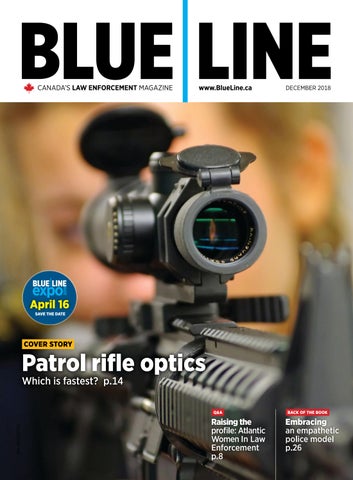
COVER STORY
Patrol rifle optics PM 40065710
Which is fastest? p.14
Q&A
BACK OF THE BOOK
Raising the profile: Atlantic Women In Law Enforcement p.8
Embracing an empathetic police model p.26
SMITH & WESSON
M&P®9 M2.0
TM
SKU: 11761 • 10 ROUNDS • 9 MM
10 Round - 9mm SKU: 194420000 UPC Code: 022188127928
Total of four interchangeable palmswell grip inserts.
SPECIFICATIONS Model: SKU: Frame Size: Caliber: Action: Capacity: Barrel Length: Front Sight: Rear Sight: Frame Width: Overall Height: Overall Length:
M&P®9 M2.0™ 11761 Full 9mm Striker Fire 10+1 Rounds 4.25” (10.8 cm) Steel - White Dot Steel - White Two Dot 1.3” (3.3 cm) 5.5” (12.7 cm) 7.4” (18.8 cm)
OTHER FEATURES Sight Radius: 6.5” (16.5 cm) Grip: Polymer Weight: 27.6 oz. (782.0 g) Weight Empty Mag: 2.8 oz. (80.3 g) 10 Round Magazine Barrel Material: Stainless Steel Armornite® Finish Slide Material: Stainless Steel Armornite® Finish Frame Material: Polymer Finish: Black UPC Code: 022188870640
• High grip to barrel bore axis makes the M&P pistol more comfortable to shoot reducing muzzle rise and allowing for faster aim recovery. • Proven optimal 18-degree grip angle for natural point of aim. • Four interchangeable palmswell grip inserts for optimal hand fit and trigger reach - S, M, ML, L. • Aggressive grip texture for enhanced control. • New M&P M2.0 crisp trigger with lighter trigger pull. • Tactile and audible trigger reset. • Accurate 1 in 10” twist M&P M2.0 barrel. • Extended rigid embedded stainless steel chassis to reduce flex and torque when firing. • Armornite® durable corrosion resistant finish.
1-800-331-0852 MADE IN USA
www.smith-wesson.com NASDAQ: AOBC
REV010517
16
Contents
December 2018 Volume 30 Number 10
Features COVER STORY
14 Setting our sights on rifle optics
One of the greatest advantages of the patrol carbine is the sight system. Sights can be configured in a variety of ways, and all contribute to greater accuracy in real life situations. We test and compare four different ones. By Dave Brown
20 Curbing gun violence
COVER PHOTO: DAVE BROWN
Statistics Canada notes the rate of violent firearm offences in the country increased for the third year in a row in 2017 to 2,734, an increase of seven per cent over the previous year. By Stephen Metelsky
8 @Blue_LineMag
20
Columns 4 8 10 11 12 21 23 26
Editor’s commentary Q&A Holding the line Health & wellness Behavioural sciences Case law Technology Back of the book
Departments 5 5 7 7 24 24 25 26
By the numbers News Dispatches Calendar Off the shelf Product showcase Marketplace Blue Links
21 December 2018 | BLUE LINE
3
EDITOR’S COMMENTARY BY RENÉE FRANCOEUR
Gunfighting in a 3D-printing world
A
s Public Safety Minister Ralph could essentially put more firearms into Goodale and Border Security more hands — unlicensed hands, young and Organized Crime Reduc- hands, any hands. The thing is: gun viotion Minister Bill Blair an- lence has been an ugly reality this year. nounced federal funding to target gun And it’s killing people. violence and illegal firearms last month, I According to the Gun Violence Archive, went back to thinking of the 3D firearm a non-profit that tracks shootings, there printing debacle in the U.S. this summer. have been 307 “mass shootings” (the defI recall exhaling in exasperation when I inition seems to be somewhat ambivalent) read President Donald Trump had tweeted so far in 2018 in the U.S. On page 20 in this he was “looking into” the downloadable issue, we also learn how the rate of violent blueprints from Defense Distributed, firearm offences in Canada increased in which would allow people to make their 2017 for the third year in a row. own guns with ABS plastic resin and a 3D Of course, Canada and the States are printer, but added it “doesn’t seem to very different when it comes to weapons make much sense!” culture. The 3D gun printing issue was Defense Distributed, based in never up for serious, polarizing Texas, was later ordered to shut We don’t just concern here. Public Safety down its file repository by a fed- look at the Canada said there are rules alfastest optics ready in place to prevent uneral judge in Washington. After midterms, a member of for our authorized weapons from being the Texas House brought forth a tactical teams made, stating: “Regardless of bill that would require anyone and the slick manufacturing method, a busiwho makes a 3D-printed gun to new weapon ness licence is required to proapply for a serial number with the the RCMP is duce a firearm and all firearms Texas Department of Public Safe- piloting… are subject to the Firearms Act, ty. Researchers in Buffalo effect- we’re also the Criminal Code and their ively found 3D printers leave be- looking into associated regulations.” hind fingerprints, so to speak, so solutions for I’m thankful for our legisthere were some collective sighs proactively lation. That’s Canada and that’s of relief; though this still doesn’t policing gun why this annual “firearms” account for how 3D-printed and gang issue of Blue Line doesn’t just weapons make police investiga- violence. look at the fastest optics for our tions more difficult and time tactical teams and the slick new consuming from a forensics viewpoint. weapon the RCMP is piloting… we’re also I get it – the headlines coming out of the looking into solutions for proactively States at the time were emotional. The policing gun and gang violence. technology has been around for a while We know now Canada’s illegal guns are and, even though huge advances have been largely being sourced domestically. It’s made and one can obtain a 3D printer time to tackle our local gun traffickers – easily enough, it’s still a complex process those obtaining firearms legally, but selling that requires quite a bit of dough and even them illegally. I agree a bolstered police more effort. presence is but one of many solutions The thing is, as pointed out by a Fortune needed and I hope the $86 million from magazine writer, the larger problem is the the feds for detection training and techavailability of such information, which nology enhancements will truly help. CORRECTION: In my October editorial, I incorrectly stated the International Association of Women Police (IAWP) Conference came to Canada for the first time this year. In fact, the first time was in 2000 in Toronto. Thanks to Staff Sgt. Jo-Ann Savoie of Hamilton Police Service for letting us know.
CONNECT WITH BLUE LINE
www.BlueLine.ca 4
@Blue_LineMag
BLUE LINE | December 2018
www.facebook.com/BlueLineMagazine
BLUE LINE www.BlueLine.ca
GROUP PUBLISHER | MARTIN MCANULTY mmcanulty@annexbusinessmedia.com EDITOR | RENÉE FRANCOEUR rfrancoeur@annexbusinessmedia.com ACCOUNT MANAGER | JANICE EATON janice@blueline.ca ART DIRECTOR | SVETLANA AVRUTIN savrutin@annexbusinessmedia.com ACCOUNT COORDINATOR | TRISH RAMSAY tramsay@annexbusinessmedia.com CIRCULATION MANAGER | BEATA OLECHNOWICZ bolechnowicz@annexbusinessmedia.com Tel: 416-442-5600 ext. 3543 PRESIDENT & CEO | MIKE FREDERICKS ANNEX BUSINESS MEDIA 111 Gordon Baker Road, Suite 400 Toronto, ON M2H 3R1 Tel. 416-442-5600 • Fax 416-442-2191
Publication Mail Agreement No. 40065710 ISSN 0847-8538 Printed in Canada SUBSCRIPTION RATES Canada — 1 Year $31.00; 2 Year $51.50 plus tax USA — 1 Year $103.00 USD CIRCULATION email: asingh@annexbusinessmedia.com Tel: 416-442-5600 ext 3553; Fax: 416-510-6875 or 416-442-2191 Mail: 111 Gordon Baker Road, Suite 400, Toronto, ON M2H 3R1 Occasionally, Blue Line will mail information on behalf of industry-related groups whose products and services we believe may be of interest to you. If you prefer not to receive this information, please contact our circulation department in any of the four ways listed above. Annex Privacy Officer Privacy@annexbusinessmedia.com; Tel: 800-668-2374 © 2018 Annex Publishing & Printing Inc. All rights reserved. Printed in Canada. No part of the editorial content of this publication may be reprinted without the publisher’s written permission. Opinions expressed in this magazine are not necessarily those of the editor or the publisher. No liability is assumed for errors or omissions. Readers are cautioned and advised that articles presented herein are edited and supplied for your personal awareness and should not be used for further action until appropriate guidance is received from a supervisor, Crown Attorney or other persons in authority. All advertising is subject to the publisher’s approval. Such approval does not imply any endorsement of the products or services advertised. The publisher reserves the right to refuse advertising that does not meet the standards of this publication.
NEWS
Const. Amy Boudreau with Peel Regional Police, right, discusses the the Clear Zone Robbery Prevention Program during the ISCPP Symposium. PHOTO: RENÉE FRANCOEUR NIAGARA FALLS
ISCPP Symposium hears how community collaboration is key to crime prevention
Those with a vested interest in crime prevention from Canada, the United States and even Bermuda gathered earlier this fall for the International Society of Crime Prevention Practitioners (ISCPP) 2018 Symposium in Niagara Falls, Ont. — the first time in more than 30 years the symposium has been hosted on Canadian soil. Tom McKay, president elect and symposium chair of the ISCPP, explained the society is “dedicated to the reduction and control of criminal opportunity and victimization by stimulating the exchange of ideas among ISCPP members.” He noted the success of the organization is “in many ways contingent upon its ability to rally and bring together professionals from a variety of disciplines. It is in this setting that meaningful discussion on matters of safety, security and lifestyles will continue to evolve.” Niagara Regional Police officer Robin Bleich, who is also the chair of the International Association of Chiefs of Police’s (IACP) crime prevention committee and has been dubbed an agent of change on a global level, delivered a personal and inspiring keynote about how education is prevention. Bleich pointed to the importance of collaboration, knowing your audience and community needs, and building out from this knowledge.
“If crime has no boundaries, neither should your crime prevention program,” she told the crowd of around 70 on Sept. 20. In addition to the conference sessions, 37 participated in the International Crime Prevention Specialist (ICPS) program, which gives participants three days of comprehensive crime prevention training, covering 19 core areas, and concludes with a 200-question exam.
“a less lethal weapon that uses 40mm low velocity sponge rounds,” for general duty in policing. “The RCMP continually reviews its policies, procedures and equipment to ensure it is using the most effective practices in law enforcement. This includes researching and, on occasion, pilot testing new technology, if it is deemed to enhance police and public safety,” the email went on to state. “Extended range impact weapons provide increased distance from which police officers can respond to a subject who may be intent on harming themselves or others. This increased distance allows police officers, when tactically feasible, more time to attempt de-escalation.” Prior to participating in the pilot, RCMP officers receive training and must be certified to use the 40mm ERIW. All deployments and uses of the 40mm ERIW must be reported through the Subject Behaviour/Officer Response Reporting process.
For more photos, visit bit.ly/2yWimdw. NIAGARA FALLS CANADA
RCMP testing new extended range impact weapon for general duty
The Royal Canadian Mounted Police is currently testing a new extended range impact weapon (ERIW) in a pilot across all provinces, with the exception of Quebec, until May 2019. Staff Sgt. Tania Vaughan with RCMP media relations told Blue Line in an email the RCMP is testing the Heckler & Koch HK269 40 mm launcher,
PHOTOS: RCMP
CCII serves up negotiation strategy tips
Blue Line was in Niagara Falls for a glimpse of the Fall 2018 Canadian Critical Incident (CCII) Training Seminar. The agenda included a riveting hostage taking of a NYPD detective case study, presented by Lt. Jack Cambria of the NYPD (retired). Cambria handed out tips to the crisis negotiators in the room during his presentation, telling them how if you lie to hostage takers, you will be tested; how every demand from a subject is an opportunity to open a dialogue; and to use silence to their advantage, among other shared experiences. Kris Size and Bob Walli of the OPP also presented on an armed barricade and many others took to the podium throughout the week. For all the photos, catch our gallery at bit.ly/2QCT8HZ.
BY THE NUMBERS
The CN Police Service states it commits to making CN the safest railway in North America. “Our ultimate goal is to bring railroad crossing/ trespassing accidents down to zero,” the service notes. The Federal Railroad Administration (FRA) and the Railway Association of Canada (RAC) compiled data from 2017, which CN Police shared during Rail Safety Week 2018. See more below.
234,513 187,210 2,256 number of crossings in Canada/U.S.
@Blue_LineMag
number of track miles in Canada/U.S.
number of crossing accidents in Canada/U.S.
1,098
number of trespassing accidents in Canada/U.S.
December 2018 | BLUE LINE
5
NEWS MAPLE CREEK, SASK.
Correctional officer dies in Saskatchewan while on duty
On Oct. 7, 2018, Correctional Officer Lesa Zoerb died after being involved in a two-vehicle motor vehicle incident while returning to the Correctional Service of Canada’s Okimaw Ohci Lesa Zoerb Healing Lodge (OOHL) in Saskatchewan. She was 50 years old. Zoerb was returning to OOHL from the local hospital, where she was supervising an offender. Zoerb spent her entire 20-year public service career at OOHL and is survived by her two children. “Our most sincere condolences and prayers go out to Lesa’s family, friends and colleagues during this very difficult time,” read a post from Correctional Service of Canada.
Lt. Jack Cambria of the NYPD (retired) shares a case study about a hostage taking of a detective in 2002 during the CCII Training Seminar. PHOTO: RENÉE FRANCOEUR ALBERTA
RCMP call centre reduces data entry time
Alberta Mounties are test-driving a call-in centre that allows officers to spend more time on the street instead of behind a desk doing paperwork. The Police Reporting and Occurrence System is still a pilot project but allows officers to input information into the RCMP database by phone. “By using the data centre, our officers no longer need to travel back to their detachment to manually complete their report,” Alberta RCMP Acting Commander John Ferguson said.
“They can now input all the required information over the phone in less than four minutes. Once they complete the call they immediately return to their patrols.” The information is entered into the RCMP database by civilian personnel. The project has reduced the data entry time for RCMP frontline officers to three-and-a-half minutes from 30 minutes, which doesn’t include travel time. - © Canadian Press Enterprises Inc., 2018 YORK REGION
YRP note-taking to go digital with SceneDoc partnership
Make a Difference JUSTICE STUDIES FOR WORKING FRONTLINE OFFICERS
At Humber, we teach the professional and practical skills you need to move up and make a difference in your community and in your career. Further your education one course at a time or work towards a certificate, diploma or degree. Advanced standing is available to those in the Justice Services industry.
communityservices.humber.ca /justiceprofessionals
York Regional Police (YRP) is partnering with SceneDoc to modernize note-taking, through a proof of concept, on their mobile platform for data collection. According to SceneDoc, YRP is the largest agency in Canada to invest in SceneDoc, leveraging tablets and smartphones to collect, manage and share everything from electronic notes through to digital evidence, “turning what was once mounds of paper into actionable intelligence to strengthen public safety.” Policing is in need of a transformation, says Supt. Paulo Da Silva. “Our primary objective with this initiative is to empower our members to work smarter by providing them with current tools and technology to perform their duties and serve the community.” YRP will take a lead role in a transformation of a 100-year-old practice of handwritten note-taking, he adds. Visit www.BlueLine.ca for the latest news, stories, products, videos, photo galleries and industry events.
6
BLUE LINE | December 2018
BlueLine_Feb_Humber.indd 1
www.BlueLine.ca 2018-01-29 10:15 AM
NEWS DISPATCHES Sylvie G. Hauth has been appointed Chief of Police at Thunder Bay Police Services. Hauth has had a steady rise through a number of departments within the service including Criminal Investigation, Uniform Patrol, Community Services and as the deputy chief. She has participated in extensive professional development courses and received the Government of Canada Police Exemplary Service Medal in 2014. Hauth joined the Thunder Bay Police Service in 1993 and has been the Acting Police Chief since April 26, 2018. Police Chief Ian Naylor is retiring from the Amherst Police Department in Nova Scotia after 40 years in policing. Acting Chief Dwayne Pike has now stepped up the lead the agency. Greg Skinner, a Stratford native whose 31-year career in law enforcement has most recently seen him serve as the Ontario Provincial Police Director of Operations at the West Region headquarters in London, Ont., has been appointed as the new chief of police for Stratford, St. Marys and Perth South. Following a 10-month appointment as Stratford’s acting police chief, Gerry Foster has been named as Stratford’s deputy chief of police. Foster began as a military police officer with the Canadian Armed Forces in Trenton in 1990 before joining the Stratford Police Service as a constable in 1995. He was appointed as acting police chief in November 2017 when former Chief Mike Bellai retired. Halifax Regional Police Chief Jean Michel Blais has announced his intention to retire by March 31, 2019. Blais was appointed to this role on October 11, 2012, after spending 25 years with the RCMP.
CALENDAR After more than 42 years of leadership in Canadian policing, Owen Sound Police Chief Bill Sornberger will be retiring at the end of December. He has spent 11 years at the helm of the agency. Metro Vancouver Transit Police (MVTP) Deputy Chief Officer Barry Kross was invested as a Member in the Order of Merit of the Police Forces by the Governor General of Canada, Julie Payette. Kross was recognized for his 30 years of police achievements. Morley Lymburner, Blue Line’s founder and former publisher, has been honoured with the Meritorious Service Decoration (M.S.M.) from the Governor General of Canada. The decoration (civil division) recognizes individuals who have performed an exceptional deed or activity for bringing honour to their community or to Canada. The award is one of the highest distinctions an individual can receive. Lymburner initiated the concept of publishing a magazine specifically for Canadian law enforcement in 1988. Being a practicing police officer in Toronto, he envisioned a national publication that kept its readers up to date on news, strategies and concepts in policing. Initially headquartered in Markham, the magazine moved to WhitchurchStouffville in 1994. In October 2016, it transferred to new ownership and moved to Toronto. Thanks to Tom Rataj for the photo. Stay tuned to the January 2019 issue of Blue Line for more on the magazine’s 30 years!
Alberta Justice says Assistant Commissioner Curtis Zablocki has been appointed the RCMP commanding officer for the province. When he assumes the new job he will be promoted to deputy commissioner. He will be replacing Deputy Commissioner Todd Shean, who is retiring after 32 years.
PROMOTIONS, RETIREMENTS, RECOGNITION • If you have an officer in your agency recently promoted or retiring or an individual you wish to have recognized (major award or recently deceased) you can let Blue Line magazine know by email to: dispatches@blueline.ca.
@Blue_LineMag
NSSF Shot Show Jan. 22-25, 2019 Las Vegas, Nev. shotshow.org Symposium on Tech Crime & Electronic Evidence Jan. 25, 2019 Toronto, Ont. www.osgoodepd.ca B.C. First Responders’ Mental Health Conference Jan. 31–Feb.1, 2019 Richmond, B.C. bcfirstrespondersmentalhealth.com Evidence in Criminal Investigations: Latest Developments in Law & Practice Feb. 8, 2019 Toronto, Ont. www.osgoodepd.ca Annual Intensive Course on Drafting & Reviewing Search Warrants March 4-5, 2019 Toronto, Ont. www.osgoodepd.ca Police Leadership Conference April 7-9, 2019 Vancouver, B.C. cacp.ca International Financial Crimes Investigators Conference April 8-12, 2019 Toronto, Ont. www.torontopolice.on.ca/seminars Risk & Recovery Conference April 10-12, 2019 Hamilton, Ont. www.riskandrecoveryconference.com Conference on Indigenous Criminal Justice Post Gladue April 13, 2019 Toronto, Ont. www.osgoodepd.ca Interac Risk and Cybercrime Conference April 24-25, 2019 Victoria, B.C. www.interac.ca/en/cybercrimeconference.html December 2018 | BLUE LINE
7
Q&A
Q: Your grandfather and aunt were both police officers. Did you always dream of law enforcement as a career?
For me, it’s true, it seemed like a family business. My grandfather, Al Nichols, was a sergeant with the former Dartmouth Police Department and he was instrumental in getting his daughter, Judy McPhee, my aunt, hired back in the 1980s when they were talking about getting women involved in the department. I’d been at Dalhousie University and I was at the point where I had to declare a major. I really couldn’t decide. I’d thought about policing; it was constantly at the back of my mind. I’d married a Canadian Armed Forces member and he always tells the story of how he went on deployment in the Middle East for six months and the first night he was back, I said to him, “I’m going to be a police officer.” I’d finally decided I was just going to do it, and my husband really encouraged me. My aunt presented my badge at the police academy… I’m the second generation of female police officers in my family – not many can say that – and it was so meaningful to be able to work with her for a few years before she retired.
Q: Why become involved in AWLE?
My aunt had been involved when they were first creating it – AWLE is now in its 26th year. My aunt is a very direct lady and she said to me, “You will be involved in AWLE,” so 8
BLUE LINE | December 2018
of course I joined. My first AWLE conference was in Halifax the year after I was hired. Back then, when you went to fall-in, you were the only woman there. And I didn’t mind that; I knew that would be the case when I signed up. But when I went to that first conference... here was a huge group of female officers from all different kinds of agencies. You could network and make friends, and it had a huge impact on me. I knew right then that this was something I would continue to commit to. I’ve been to every conference since, minus one. The women on the executive then, who I looked up to and continue to look up to, are in major roles now: Julia Cecchetto, Chief of Police at Kentville Police Service and Chief
Snapshot of AWLE
Leanne Fitch with Fredericton. My main goal when I became AWLE president in 2015 was to heighten our profile. People had heard of us, but we didn’t have huge numbers of women who were attending the annual conference. We were struggling for membership. I talked with the media contact here at Halifax Regional and I learned we had to get on Twitter. Making that move was probably the best thing I have ever done for this organization. I was able to connect with agencies across Atlantic Canada and promote our awards, which have evolved over the years (for example, we now give out awards to male partners). I go to the police academy to hand out our top female cadet award and I talk about AWLE every chance I get. I’m happy to say we have now tripled our membership.
1992
Q: What is your most memorable moment so far?
first AWLE president Kathy Long lays the groundwork for the organization
1998 first executive selected and official name confirmed
26th
Annual Training Conference hosted this past November in Moncton, N.B.
One of my proudest moments is probably also one of my most challenging. Before I came into policing, I was heavily into scuba diving. I was always in the water. I grew up on Porter’s Lake and my mom could never find me because I was always under some dock. When I joined Halifax Regional, they didn’t have a dive team, but in 2004 they integrated an underwater recovery team with the RCMP and I knew I’d like to be a police diver. I was and remain the only woman who has ever applied to the dive team. When I earned my spot – www.BlueLine.ca
PHOTO: RENÉE FRANCOEUR
Halifax Regional Police Staff Sgt. Carolyn Nichols, the president of AWLE (Atlantic Women in Law Enforcement), sat down with Blue Line on her third night shift as watch commander, when magazine staff were in town for the CACP (Canadian Association of Chiefs of Police) Conference earlier this year. Nichols, who is a third-generation police officer, began her policing career in 1999 and was promoted to her current rank this past July. She shares her journey and why organizations like AWLE matter.
completing the testing just months after giving birth – that was definitely my proudest moment. I’m also the first Staff. Sgt. Nichols in the family, so that of course has been very memorable as well.
Q: It’s no secret there are few women in the upper ranks, though that is changing. What, in your opinion, needs to happen to improve those numbers?
Women bring something different to the table. Our skillsets are based on our life experience and women experience life differently than men. No two people think the same and we need that in policing. That’s how we connect with people in the community, how we find solutions. When a new job comes up and 10 things are listed that the applicant should have, a woman will look at that and say, “I have eight of those;
I’ll go get the other two and come back and apply.” Men look at that and say, “I’ve got two out of 10 of those. I’m applying!” I talk about this because I want my daughter to always just go for it. How to gain that confidence is something I’m consistently thinking of when we plan our conference. One of the answers is: seeing is believing. We just had our first female chief in all of Nova Scotia appointed this year. Women are watching and believing they can do it too. I vividly remember when the first woman was named a member of senior management here at Halifax Regional and received her white shirt. That was Supt. Colleen Kelly in 2009 – who was also the first female officer in Canada to assume the position of team leader for the explosive disposal unit in 2004. We need more of this visibility and championing this visibility.
Q: What is your hope for the future?
Watch a video clip from Blue Line’s interview with Staff Sgt. Nichols at youtu.be/ rkTQa-aPYfQ. Find more on Atlantic Women in Law Enforcement at www.awle.org.
I would like to see more diversity of thought. I’d like to see more young women looking at law enforcement as a career, knowing it’s available to them, because I think if you haven’t grown up in a family where you’ve seen women in policing roles, you’re still not thinking of it as a job for you. I’d also like to see AWLE become even more inclusive with more male members… We need male mentors as much as we need female mentors. I’d like to see more women in positions to mentor women, not just in law enforcement, but in all the trades. To do that, we do need to see more women apply for promotions, be in positions where they can get promoted, and be offered more opportunities in law enforcement to gain the skills needed to be in a leadership role.
YOUR PROVEN PARTNER Commissionaires supports hundreds of municipalities and regional police forces, nationwide, through bylaw enforcement and non-core police duties.
commissionaires.ca @Blue_LineMag
BL_AugSept_Commissionaires.indd 1
December 2018 | BLUE LINE
9
2018-07-17 11:09 AM
HOLDING THE LINE BY MICHELLE VINCENT
Have you checked in on your sisters and brothers who are away from the job recently?
I
t happens in every service in a variety of ways; our brothers and sisters sometimes end up in circumstances that take them away from the family in blue. Perhaps it is a wellness issue – be it physical or mental. Or it may be a workplace incident investigation, either internal or external. The member may even be at work, but away from their usual circle of colleagues, after being transferred to a different unit. Whatever the situation, I’m calling attention to the times when we are separated from those who know us second to our family. Initially we tend to be very attentive, checking in with a phone call, text or maybe even dropping by. As time goes by and our world fills up with life’s tasks, we slowly drift away, which can present the following challenges: • the risk of isolation • negative thoughts and perceptions of those we once thought would support us through anything • the potential to develop or exacerbate already existing mental health issues, such as depression and anxiety, which can sometimes be masked with addictions Making the time to check in with our people, whether it be through a text, email or – even better – in
person, is a solid message that this person has not been forgotten. It shows that someone truly cares. This is just as crucial an action later on, when the dust has settled in the event. This can be especially true for members who have been off on longterm disability from an illness as well as those off on suspension. Some of “the forgotten” members who may be away for disciplinary reasons may compound the sensitivity (and perhaps hesitation) of those who want to reach out. Many of us may not even be aware the member has left the organization unless they are part of our own unit. Furthermore, when we are inspired to connect with them, this does not mean we will be received with appreciative, open arms. We may be on the receiving end of strong
One of the most resounding comments made by those away from the job is the lack of a sense of connection with their policing organization when they need it most
CONTACT US FOR ALL YOUR BUDGETARY YEAR-END NEEDS! PROUDLY SUPPORTING MILITARY & LAW ENFORCEMENT SINCE 1989!
emotions felt by the member and if we are not able to depersonalize what our brother or sister has to share with us, then maybe remind someone else on the platoon or in the unit who can depersonalize to check in. Other resources that support a connecting piece for the member to the policing organization and its family are our Peer Support Units. Despite being inundated on so many levels, they do their very best to check in on members who are away – regardless of the circumstances. Members of the law enforcement organization’s association can check in, too. However, there are implications they have to consider, as they decide whether reaching out will be constituted as supportive or not. Current supervisors (and past ones) are another valuable source in the check in experience. One of the most resounding comments made by those away from the job is the lack of a sense of connection with their policing organization when they need it most… whether they are aware of it at the time or not. Whether we reach out ourselves or send a message to those who may provide a better connection, let’s talk about this “checking in” as a necessity and not assume it is being done, as the likelihood is it is not. Let’s voice the need to check in on our brothers and sisters, understanding we may be met with resentment, but doing it anyways. Taking the time to show we care by just offering to go for a coffee and having a face-to-face with someone who may be feeling very disconnected and forgotten can save a life. Let’s send the message no one in our organizations, whether visible on a day-to-day basis or not, is forgotten. Michelle Vincent is a 17-year York Regional Police officer with a master of arts in counselling psychology and a background in equine-assisted therapy, workplace reintegration after a critical incident and long-term leave, as well as teaching. She is in the process of implementing the first non-profit treatment centre that will be occupationally specific for first responders and is working towards her PhD in Forensic Psychology/Crisis Response. She can be contacted at: michelle@smith.net.
10
BLUE LINE | December 2018
BL_Dec_Wolverine.indd 1
2018-11-07 1:34 PM
www.BlueLine.ca
HEALTH & WELLNESS BY ISABELLE SAUVE
Problem solving on and off duty: distinguishing between the professional and the personal
T
aking control, conflict resolution and problem solving are key skills of law enforcement officers. When a community member’s problems exceed their ability to cope, no matter the breadth of the issue, the instinct and common practice is to call the police for a resolution. In the mind of many, the police have all the answers and the ability to meet their expectations. The police are an elite group of professionals trained and capable of demonstrating above average strength, self-reliance, self-control and courage while facing and resolving dangerous situations. Police personnel is often known and rewarded for its “take action” and “fix problems” type of personalities. In fact, officers routinely demonstrate advanced competency in helping others deal with a wide variety of issues. Despite these noble capabilities, officers are not invincible and yearning to portray an indestructible image and flawless stoic character in front of others can cost them dearly. Society’s expectations of officers to be able to properly deal with everything thrown at them is a recipe for failure – especially when it comes to their own personal or family matters. Police officers are perceived differently and are unwaveringly held at higher standards than those in most other professions. One officer’s behaviour or personal circumstance is often used as a reflection of police as a whole. Officers want to protect their reputation and the wider image of policing. This can discourage officers from seeking advice or support in dealing with their personal problems due to the fear of being unfairly judged. Admitting to a problem or asking someone else’s advice on one’s personal problems can be viewed as a loss of control, a sign of weakness, or, in the worst case, as indication one is no longer fit for the job. In addition, in the eyes of coworkers or the public, admitting to unresolved personal issues is often met with negative stigma. An officer’s struggle with personal/ family problems can erroneously be equated with diminished professional capability to help others with their own issues. However, the same acceptance level @Blue_LineMag
should be extended to all officers who seek assistance or guidance. Officers should be encouraged and supported to do what is necessary to maintain an all-around balanced and healthy life. Police officers recognize and respect the fact people need help and it is at the core of their duty; however, they fail to apply this basic rule for themselves. Additionally, failing to distinguish between the professional and personal life can cause officers to revert to work training to address personal issues. Unfortunately, applying the same objective (or neutral) problem-solving approaches to personal matters may not be conducive to positive results. For instance, an approach effective in dealing with a defiant person may not work for issues encountered with a loved one. Officers must be reminded they may see the world differently than most by virtue of the job. The sense of self and the role of police officer can become so intertwined they are merely inseparable. To maintain a healthy personal life, officers should develop the ability to detach themselves from their professional function. We all bring our work home to a certain degree and it has an impact on our loved ones. Police work can be very exciting, invigorating and adrenaline producing. As a result, it can easily and quickly become the foremost defining aspect in one’s life. Policing is based on a number of rules of behaviour and traditions that detract from healthy personal, social and family life. Despite this, little to no training is provided regarding the importance of distinguishing professional from personal life. Officers are trained to execute their
duties by taking control and remaining impartial. Maintaining emotional distance and minimizing personal emotional investment is important to a functional objective perspective and for a stance to mediate conflict on a professional front. While a more distant approach may be effective at work, it may not necessarily be conducive to problem solving in one’s personal life. For personal matters, officers should adopt a “softer” approach to dealing with family and friends, leaving out as much police lingo and tactics as possible. In addition, letting go of a need to control the situation and involving friends and family as part of the problem solving can increase the odds of success. Taking a collaborative approach in dealing with personal issues is not a sign of weakness but rather a mature and calculated style with a greater likelihood of success. We must learn to accept that experiencing personal issues is a part of life and is not indicative of decreased professional ability. Making a conscious effort to distinguish our professional life from our personal life is important. Dedicating a few minutes pre- and post-work to settle in and out of the police role can assist officers psychologically set up for work and then leave it behind while off duty. Maintaining a healthy circle of family and friends outside of law enforcement also fosters a balanced life. Isabelle Sauve is a 11-year OPP veteran currently with the Emergency Response Team (ERT) at the Almaguin Highlands Detachment in Burks Falls, about 300 km north of Toronto. She can be contacted at: isabelle.sauve@hotmail.com.
December 2018 | BLUE LINE
11
BEHAVIOURAL SCIENCES BY PETER COLLINS
A look at suicide by cop in officer-involved shootings We would like to introduce Blue Line’s newest column, Behavioural Sciences, by Peter Collins, the operational forensic psychiatrist with the Ontario Provincial Police’s Criminal Behaviour Analysis Unit. Collins has an extensive background in violent crime and has worked with, as well as instructed, numerous criminal justice agencies in North America and beyond. This column will tackle modern behavioural issues in relation to law enforcement and seek to provide solutions through the latest research and tools, as well as stimulate discussion. Special thanks to Niagara Regional Police officer Robin Bleich for making the introduction.
A
lthough the theory of “victim precipitated homicide” was first described by Dr. Marvin Wolfgang in 1958, and the phrase “suicide by cop” (SBC) was coined by Karl Harris in 1983, it has only been over the last two decades that we are hearing perpetrators state, “This is a suicide by cop situation,” or something to that effect. By definition SBC is a method of suicide that occurs when an individual engages in threatening behaviour, with the goal of being killed by law enforcement. Today, it has entered the language of mainstream society and the incidents have increased. Until 2009 it was thought SBC occurred in approximately 13 per cent of officer-involved shootings (OIS). After examining 707 OIS incidents in North America (100 of them in Ontario), Dr. Kris Mohandie, Dr. Reid Meloy and myself found slightly over one third of all police deadly force encounters could be classified as suicide by cop (36 per cent). 1 There is a myth of a negative correlation between suicidal risk and homicidal risk; in fact, the opposite appears to be true – a suicidal person poses a greater risk of homicide (or at least violence toward others) than an individual who has non-suicidal ideation. A certain subset of individuals will have a suicidality that crosses over into endangering others, primarily police officers. Suicidal individuals can in fact threaten, injure and kill others in their quest to die by suicide. SBC subjects are also quite lethal to themselves, with a 97 per cent likelihood of being injured or killed. There was also a moderately high risk of injury or death to others, including law enforcement, with a 12
BLUE LINE | December 2018
• urging the police to shoot them • they have just murdered a significant other • they have a long history of criminality • they will only surrender to the incident commander or the chief • they express the fact that they will “go out big” or in a blaze of glory
one in three chance of others being harmed during the incident. Most SBC subjects were armed; many with a loaded and operational firearm. Nearly half of those with a firearm actually discharged it at the police during the incident. ApproxThe paradox imately 20 per cent would feign of SBC cases having a weapon in order to fool the appears to police into shooting them. be that The majority of SBC cases are unplanned, spontaneous but there can be clear acute verbal and behavioural indicators suicidality that occur prior to and during the becomes, event. Above and beyond the comwithin mon symptoms of a major depressive moments, a disorder – helplessness and hoperesolute lessness, poor sleep, weight loss, intentionality poor concentration – will be present to be killed in SBC individuals. They approach by the police. the police or cause an action that will provoke others to call the police. The precipitating event ensures a police presence. Since the subject wishes to die at the hands of the police, they will create an incident that is designed to bring the police to them. The subject forces the confrontation. Instead of surrendering, they will take actions that escalate the incident, such as taking an aggressive stance.2 Even if the officers retreat to a position of safety, the subject may continue to advance towards them and ignore commands to drop the weapon. Some SBC indicators include:
On average, the SBC perpetrators are in their 40s, have a history of unemployment or being underemployed, have substance abuse issues and meet the criteria for antisocial, narcissistic or borderline personality disorder. Other findings by Mohandie, Meloy and myself include: • 95 per cent of the suicide-by-cop subjects were male • 62 per cent of the subjects “had a confirmed or probable mental health history” • 48 per cent of the confirmed mental health subjects suffered from depression or some form of mood disorder • 87 per cent of the cases had “suicidal communications by the subject at any point prior to or during the incident” • 14 per cent of the suicide-by-cop subjects left a suicide note • 61 per cent of the subjects talked about suicide during the incident and 79 per cent of those subjects referred specifically to suicide by cop In summary, the available evidence indicates SBC subjects are much more likely than regular OIS subjects to be deliberate, wilful and resolved in their actions to provoke and draw fire from law enforcement. However, four out of five did not plan their suicide for that day, but instead became acutely www.BlueLine.ca
Your essential guide to navigating cannabis-related criminal and regulatory offences and penalties
suicidal in response to circumstances or New Publication police intervention. This suggests a much Cannabis Law more affective mode of violence which is Bruce A. MacFarlane, Q.C., Robert J. Frater, Q.C., and intensely emotional and reactive, rather Croft Michaelson, Q.C. than the planned and purposeful (predatoFrom the author team of Drug Offences in Canada, ry) violence of the mass murderer, despite Cannabis Law is your practical guide to all aspects of the suicidal outcome and high prevalence of the new Cannabis Act and regulations – including the mental disorder in both groups. complementary provincial, territorial, municipal, and The paradox among SBC cases appears Indigenous laws and regulations. to be that unplanned, acute suicidality Cannabis Law covers the now lawful cannabis-related Order # L7798-8820becomes, within moments, a resolute inactivity in Canada, as well as the larger area of activity 65201 $150 tentionality to be killed by the police. The that remains illegal. Softcover November 2018 approx. findings that they are more likely to shoot 300 pages This indispensable resource covers a variety of topics, 978-0-7798-8820-7 at officers and harm civilians during the including: Multiple copy discounts available time preceding and after police arrival • Federal regulation – Cannabis Act and regulations Shipping and handling are (during the overall event), draw more fire • Provincial, municipal, territorial, and Indigenous extra. Price(s) subject to change from officers, are more likely to die, appear regulations without notice and subject to applicable taxes. to be more threatening to others, and are • Criminal and regulatory offences • Penalties more likely to be armed than regular OIS Available risk-free subjects support this conclusion. for 30 days For additional research, a handy reference section Online: store.thomsonreuters.ca The finding that officers fire less rounds provides a listing of cannabis-related websites organized Call Toll-Free: 1-800-387-5164 at subjects found not to be suicidal sugtopically. In Toronto: 416-609-3800 gests that a ‘‘normal’’ subject involved in a shooting gives up their agenda – likely escape – or reacts with fear and surprise © 2018 Thomson Reuters Canada Limited 00254ZV-A94456-CM once rounds are fired at him or her. He or she realizes it is futile to fight, has a will to live and usually surrenders. The SBC subject, on the other hand, appears to continue their threatening or provocative behaviour once firing BL_Dec_ThomsonReuters.indd has 1 2018-11-09 2:15 PM DALHOUSIE’S CERTIFICATE IN POLICE LEADERSHIP begun by the police, perhaps consciously Become the leader you know you can be realizing that their desire to die at the hands of the police is momentarily within their grasp.
References:
1.Mohandie, K., Meloy, R., & Collins, P. (2009) Suicide by Cop Among Officer-Involved Shooting Cases. J Forensic Sci, March 2009, Vol. 54, No. 2. 2. Lindsay, M & Lester, D. (2004) Suicide by Cop: Committing Suicide by Proving Police to Shoot You. Baywood Publishing: Amityville, New York.
My goal, in this monthly column, is to explore a wide variety of behavioural issues that are related to law enforcement. Please don’t hesitate to contact me if you have any questions or suggestions for future topics. Dr. Peter Collins is the operational forensic psychiatrist with the Ontario Provincial Police’s Criminal Behaviour Analysis Unit. He has also been a member of the crisis/hostage negotiation team of the Toronto Police Service Emergency Task Force since 1992 and he consults to criminal justice agencies internationally. Peter’s clinical appointment is with the Centre for Addiction & Mental Health in Toronto, and he is an associate professor with the Division of Forensic Psychiatry at the University of Toronto. Contact him at pcollins. blueline@gmail.com.
@Blue_LineMag
Built for modern policing, our online courses, designed and delivered by industry leaders and experts, give you the knowledge and skills to advance in your profession. Learn from the innovator in quality police education for over 25 years. DAL.CA/POLICELEADERSHIP Winter Term starts January 29
CCE
College of Continuing Education
PHOTOS: DAVE BROWN
COVER STORY
14
BLUE LINE | December 2018
www.BlueLine.ca
Setting our sights on rifle optics We tested four different sight systems for both speed and accuracy. Here’s what we found. By Dave Brown
T
he fastest shooter in the world isn’t going to win too many gunfights. Neither will the most accurate shooter in the world. Speed without accuracy is a fast miss. Accuracy without speed means the gunfight is over before you get your boots on in the morning. (I think it was the ancient Chinese military strategist Sun Tzu who said that. Or perhaps it was Keanu Reeves in “John Wick.”) In real life encounters, gunfights are won by the first person to put accurate rounds on target. When life is in balance and targets start shooting back, the faster an officer can stop a deadly threat, the more people get to stay alive. One cannot trade away all their speed for accuracy, or vice versa. Officers use both elements in combination as the situation requires. This is not some Hollywood movie. In the real world, the winner of a gunfight gets to go home safe to their family; the second-place finisher doesn’t.
alignment with each other. In actual combat, accuracy with a handgun can drop off dramatically after about seven metres. Shotguns carry a greater impact, and can extend force response past 20 metres, while still keeping all their buckshot rounds on the target. They are also versatile, but a shotgun is less limited by its design and perhaps more limited by traditional training methods. Many officers today graduate from police college not appreciating the advantages of a good police shotgun. This is where the police patrol carbine comes in. Intended as a quickly-deployed weapon for regular patrol officers, it is easy to shoot, inherently accurate and fast to both aim and shoot. In some circumstances, it is also safer for the general public. Aside from the nature of the cartridge itself, one of the greatest advantages of the patrol carbine is
the sight system. Sights can be configured in a variety of ways, and all contribute to greater accuracy in real life situations. Given enough time, all of them help an officer stop a deadly threat with near-surgical precision. But is anyone ever given “enough” time in real life encounters? If the various choices in close- and intermediate-range sight systems are virtually equal for accuracy, the question then arises… which one is fastest? That’s where Blue Line comes in. We tested four different sight systems for both speed and accuracy, using the firearms training simulator from MantisX.
The tests
Testing was done using volunteer subjects, all of whom had varying experience with a carbine. Some had cross-dominance issues. Accuracy standards dictated a minimum score of 80 per cent or more on every test.
The patrol carbine The Aimpoint red dot sight is probably the most popular choice of sight systems for patrol carbines in Canada.
@Blue_LineMag
The police patrol carbine may be one of the greatest advancements in police defensive weapons. The carbine extends an officer’s range against active shooters all the way out from contact distance to 250 metres or more. Handguns are more limited by the necessary design of the sights and the limitations of the human being struggling to keep those sights in
The term iron sight is used to describe the traditional front-and-rear sight system using two sights that must be kept aligned with each other and the target. December 2018 | BLUE LINE
15
COVER STORY
While simulated scores cannot necessarily translate into real-world accuracy, livefire testing of the MantisX training system has shown that this score should result in 80 per cent of all shots landing within the centre scoring ring of a standard RCMP qualification target at 100 metres. Each subject was given a brief introduction into each of the four different sights and allowed a few seconds to practice shouldering from low-ready. Each subject was then timed and scored for 10 passes of one-round, dry-fire shots using the electronic trainer and results were recorded by the MantisX app on an iPad. Average scores and times were recorded for all 10 passes, but the most significant times were considered to be the very first pass on each sight. This reflects real world conditions where the most important round to be fired is the first one. In other words, how fast can an average person, with no warmup and only 10 seconds to learn what the sight picture looks like, get 80 per cent or better on a target at 100 metres.
Firearms training simulators don’t necessarily reflect actual response times in combat, but each string’s first-shot times are probably a fairly close prediction on how long it might take in real life to shoulder and engage a deadly threat at 100 metres.
The sight systems
Sights for short and intermediate ranges typically encountered by a patrol officer need to be simple, fast and accurate within that design range. The maximum pointblank range of most police-issue 5.56mm ammunition zeroed at 50/200 yards, is any shot from the end of the muzzle out to approximately 250 yards, all staying within a six-inch circle with no hold over or hold under compensation needed. Since range estimation is difficult in real-life encounters, optics designed to assist in range estimation are less useful on a patrol carbine than they are on a longrange rifle. This is why a good understanding of the concept of maximum pointblank range, combined with a dead-simple
reticle design, results in a point-squeezehit scenario that stops gunfights cold with the first shot. With patrol rifle optics, simpler is better.
Iron sights
The term iron sight is used to describe the traditional front-and-rear sight system using two sights that must be kept aligned with each other and the target. On patrol carbines, the front sight is usually a vertical post and the rear sight is a circular aperture, forming what is sometimes termed a ghost-ring or peep sight. It is simple, robust and easy to use. The shooter focuses their eye on the front sight, and the rear sight forms a blurry ring. (Hence, the term ghost-ring.) Of all the sight systems we tested, the iron sight probably generated the most surprising results. Always known for reasonable accuracy and speed in combat, iron sights were never felt to be as fast as a good red dot. Well, our speed tests disagreed. Firstshot times for each string resulted in speeds
MARKSMANSHIP – THERE’S AN APP FOR THAT A look at the MantisX Firearms Training System By Dave Brown
16
BLUE LINE | December 2018
provides feedback on a tablet or smart phone. The $150 U.S. sensor mounts on most standard pistol, rifle or shotgun rails, and pairs with the free app over Bluetooth. TRAIN SMART, TRAIN ANYWHERE A golf simulator may help you practice your game indoors but when you drive the green on that simulated par three, it doesn’t tell you what you did to get there, or more important, how to do it again. Unlike other trainers that utilize lasers mounted on the firearm and a laser-sensor on a target, the MantisX does not use lasers or require any special targets. Shooters can mount the sensor unit on almost any firearm, and it can track multiple shots and multiple targets through dynamic exercises or dry- and live-fire drills. It analyzes the microscopic motions of a firearm during the actual trigger pull. The sensor detects the hammer fall or trigger click, and tracks the tiny movements of the muzzle before, during and after the trigger break to evaluate shooting performance and track
progress of the shooter over time. It even works on CO2 pistols. The app tracks shots and shot strings and plays them back on a variety of screens, the most useful of which is probably the computerized trace showing you microscopic movements of the muzzle while sighting (blue trace), during trigger pull (yellow trace) and after the shot break and recoil pattern (red trace.) MantisX is constantly updating the app and improving features. New exercises are added on a regular basis and you can even attempt the 60-round FBI Qualification Course of Fire and compare your scores to others in your online group. www.BlueLine.ca
PHOTOS: DAVE BROWN
A
s firearms instructors, we use multiple tools at our disposal to teach simple concepts that are nevertheless difficult to master. These tools are designed to enhance training, not to become the instructor. The MantisX Firearms Training System is an excellent example of how we can use modern technology to make up for the limitations of humans, and use humans to make up for the limitations of technology. Learning to shoot firearms with the speed, accuracy and responsibility inherent in being granted the highest level of force possible is not an easy task. There are specific reasons why officers are trained using the science behind modern police firearms training and why they need to continually reinforce basic technical skills that keep them and others alive. Of the basic technical skills – grip, stance, sight picture, trigger control, reload and draw from the holster – most critical to accuracy is not the sights, as most people first guess; it’s trigger control. This is where the MantisX comes in. The MantisX system consists of a sensor with compact gyroscopes that track the minute movements of a firearm from sight acquisition to trigger break, and an app that
PHOTOS: DAVE BROWN
The iron sight probably generated the most surprising results in our tests.
The Bushnell Elite Tactical 1-6.5x24mm rifle scope, the largest and heaviest in our group, was the favourite for shooters with astigmatism.
only .2 to .5 seconds slower than the fastest sight (the Primary Arms 1X Compact Prism Scope). The results were consistent across most of our test volunteers. The sole glitch was cross-dominant shooters with previous military experience who tried to use their left eye on their right shoulder like they were once taught in the military. It didn’t work. But with practice and correct adaptation techniques, their times fell to within the average for all subjects.
patrol carbines in Canada. While every sight comes with compromises of some kind, the combat-tested Aimpoint has probably the fewest. It’s tough enough that you could drive over it 10 times with your police SUV and the rifle would break long before the sight, and the battery life is measured in years. (Switch it on when first issued, you simply replace the battery every year before qualifying and never worry about it again.) It uses a single centre dot, adjustable for brightness. Point-of-impact does not change, even if the dot is off centre, meaning it can be mounted slightly high or low and still be accurate. Because it does not
Aimpoint red dot sight
The Aimpoint red dot sight is probably the most popular choice of sight systems for GOOD GUIDANCE Marksmanship is not just aiming a gun. A big part of it is maintaining that aim through a smooth and consistent trigger pull, from the moment you acquire a sight picture to the moment the bullet leaves the barrel. The MantisX shows you exactly what you were doing before, during and after that trigger pull. It doesn’t replace an instructor. In fact, if I was forced to identify a weaker area in the system, it might be the built-in coaching tips it provides to try to correct fundamental errors, some of which have less application to modern, two-handed shooting techniques. This is where an experienced instructor really comes in. No electronic training simulator can analyze your mistakes and correct them for you. Just as one doesn’t become a firearms instructor by reading books and watching a few videos, one doesn’t become a good shot without constant practice of fundamentals under stress. Few officers do enough dry practice. The strength of the MantisX system is not just how well it illustrates the importance of a proper grip and trigger pull. It also has the ability to prove that a live-fire score on the range is not just there to check off a qualification box; good scores are the result of proper techniques honed through both live- and dry-fire practice. Practice doesn’t make perfect. Only perfect practice makes perfect.
magnify the image, there is no critical eye relief distance and it can be mounted virtually anywhere on the rail. The one downside to the Aimpoint is that, like all red dot sights, older shooters are going to struggle with the sight picture. The problem of astigmatism and red dot sights was discussed in Blue Line’s December 2016 issue. Officers with aging eyes are often going to see a fuzzy cluster of dots instead of a single bright dot. The number of dots and size of the cluster will even vary, depending on many factors, including something as simple as the amount of sleep one secured the night before.
BODYGUARD TM
Apparel
● Cost Effective Uniform Solutions ● Great Quality ● In-Stock Items ● Quick Turn-Around 905.565.7576 1.800.996.9499 sales@spirito.com
www.spirito.com December 2018 | BLUE LINE
@Blue_LineMag BlueLine_Feb_Spirito.indd 1
17
2018-01-24 12:13 PM
COVER STORY
The Primary Arms 1X Compact Prism Scope with the illuminated ACSS Cyclops reticle is the latest design from Primary Arms.
scope has a narrow eye-relief distance. This requires precise mounting and the acceptable range from eye to rear lens is quite narrow. Top quality 1-6X and 1-8X scopes have become popular among carbine shooters because, at the onepower setting, shooters treat it much like a red dot sight and keep both eyes open with the focus on the threat. This is why the tactical scope at one-power averaged fewer than 0.2 seconds off the pace of the fastest sight system.
1X Prism sight
250
metres or more is the range extended to an officer with a carbine
The Prism Scope uses a tiny centre triangle, with the upper tip of the reticle representing the exact aiming point, and a horseshoe-shaped outer ring to enhance speed.
In our speed tests, younger shooters tended to be fastest with the Aimpoint, while older shooters like myself needed a fraction of a second more. On average, it was still both fast and accurate. Within the design range of a patrol carbine, the multiple dots as seen by some shooters did not seem to affect accuracy in any significant way.
Tactical scope
The Bushnell Elite Tactical 1-6.5x24mm rifle scope is the largest and heaviest optic in our group. It is extremely well built – and comes with a price to match. The clean and dropdead-simple illuminated reticle helps guide the sight to the centre of the target and when dialed down to onepower, it is both fast and accurate. For shooters with astigmatism, this was their favourite sight. The focus can be adjusted to needle sharpness for each individual shooter using a rear diopter, meaning no one will need to stop long enough to find their eyeglasses. Because it uses optical lenses to magnify the image of the target, the 18
BLUE LINE | December 2018
20 metres past is the distance shotguns can extend
The maximum point-blank range of most police-issue 5.56mm ammo, zeroed at 50/200 yards, is any shot from the end of the muzzle out to about
250 yards
The Primary Arms 1X Compact Prism Scope with the illuminated ACSS Cyclops reticle is the latest design from Primary Arms. It fills a void in the world of patrol rifle optics – the one-power scope with an illuminated reticle etched on glass, and specifically designed for short and intermediate range confrontations. It also turned out to be the fastest sight system with the majority of our test subjects. Because of the optical lens design, it requires mounting for a specific eye relief, although in actual practice eye relief was very forgiving, ranging anywhere from 3.75 all the way out to six-inches. If power to the illuminated reticle is lost, the black reticle is still visible, and a diopter adjustment means it is forgiving for nearly every shooter’s eyesight. The fraction of a second longer it took to place the eye at the correct distance from the rear lens was easily made up for by the speed of the reticle. It uses a tiny centre triangle, with the upper tip of the reticle representing the exact aiming point, and a horseshoe-shaped outer ring to enhance speed. With an expert shooter, one could fire an accurate first round from low ready in under 1.2 seconds. Average shooters maybe took only about one second longer to acquire a sight picture and fire an accurate shot. For shooters with astigmatism, it is also a good solution. While there are other one-power prismatic sights on the market, none of them ever tested by Blue Line completely eliminated astigmatism issues as effectively as the Primary Arms prism scope.
While distance from lens to eyeball was not as critical as magnifying scopes, height of the mount was far less forgiving. The factory mount was about eighth-of-an-inch too low for most shooters. Because of the optical design and parallax error, having a reticle appear slightly higher or lower in the tube can affect the impact point. Primary Arms sells an accessory mount that raises the sight a tenth of an inch and co-witnesses with most AR iron sights, but the quality of the accessory mount was more suited to airsoft guns than a rifle that may be needed to save your life. The rotary switch was also very stiff, and lacked the hard stop of the Aimpoint switch. To turn the sight off, you rotate it all the way around, hopefully stopping at the almost indiscernible number zero on the dial. While users really loved the combination of speed and accuracy, most found the Primary Arms centre triangle too tiny and the reticle too busy for a short- to intermediate-range carbine. I would have much preferred the plain circle-and-dot reticle found on EOTech holographic sights. Having tiny ranging lines etched onto the glass seemed like an unnecessary complication when bullets start flying in your direction. A good first attempt, I hope Primary Arms continues to refine the prism scope. I would love to see a brighter reticle, longer battery life (mutually exclusive, I know) and a much simpler reticle design. The whole point of optics on a patrol rifle is not target ranging, long-range accuracy, or a scope that will help you lead a target, make you lunch and call your spouse. It should be designed to be simple and fast. After all, military strategist Sun Tzu said that the best battle is the one never fought in the first place. With a modern patrol carbine and the latest technology in tactical optics, the second-best battle is the one that is fought and won quickly. Dave Brown is Blue Line’s firearms and police vehicle contributor. He is a tactical firearms trainer and consultant based in Winnipeg, Man. He can be reached at davebrown@blueline.ca.
www.BlueLine.ca
PHOTO: NAME TKHERIOUS
@Blue_LineMag
December 2018 | BLUE LINE
19
GUN VIOLENCE
Curbing gun violence Taking a look back at the California Sandwiches shooting & its ripple effects By Stephen Metelsky
E
ighty-six million dollars. That’s the most recent figure the Canadian government said it’s putting forward to help the Royal Canadian Mounted Police (RCMP) and the Canada Border Services Agency (CBSA) combat gun and gang violence. In 2017, CBSA said it had 467 seizures of firearms, an increase of nearly 19 per cent from the overall number of firearms seized in 2016. Plus, Statistics Canada noted in 2017, the rate of violent firearm offences in the country increased for the third year in a row to 2,734, an increase of seven per cent over the previous year. Additionally, this past summer, Toronto Police Chief Mark Saunders and Mayor John Tory announced a $3 million operational plan to deploy up to 200 officers throughout the city, dictated by intelligence-led policing, to curb the spate of gun violence. The eightweek initiative appeared to be a short-term solution to an issue requiring a longer-term commitment. “The question right now is do we need more police officers to deal with gangs? Or, do we need to find a better way to deal with the gangs?” says acting Toronto Police Supt. Bryan Bott. “It’s not just police officers that deal with gangs. It’s not just a police problem; it’s a societal problem... It’s an issue that we really have to talk about.” Additional strong reactions were sparked when the federal government started talking about tightening handgun laws and amending sections of the Criminal Code. “I don’t see a reason why individuals should own handguns, especially in the City of Toronto. What is the rationale behind that?” asks Toronto Police Staff Sgt. Hunter Smith. “I am very much opposed to handgun ownership. Even people who legally own handguns, they get
20
BLUE LINE | December 2018
Louise Russo, centre, talks with Acting Supt. Bryan Bott and Staff Sgt. Hunter Smith. PHOTO: LOUISE RUSSO
stolen in break-and-enters and they get used in criminal offences.” Smith and Bott have more in common than simply their views on the state of violence in Toronto. They were the two lead detectives who investigated the California Sandwiches shooting in 2004, both forming a life-long bond with one of those impacted by it, Louise Russo. It was just a regular day on Apr. 21, 2004. A mother of three parked her car and walked into a local sandwich shop. She would never walk again. “I just walked in and they opened fire. Bullets shattered the glass,” says Louise Russo, the innocent bystander who was caught in the middle of a botched underworld hit involving the mafia and the Hells Angels. A single bullet shattered Russo’s spine, leaving her paralyzed forever. The ripple effect from the California Sandwiches shooting reverberates today. For Russo, “violence stopped being a word and became a cause.” “From day one we knew she (Russo) was a pretty remarkable person. Very extraordinary to me,” Bott says. Smith concurs: “Her positive attitude is just incredible considering what she had been put through.” “My life was totally destroyed. I took it a day at a time, an hour at a time. But through this journey I have come to really know who I am, and I love who I am today – much more
362
shootings occurred in Toronto in 2018 by early November
33 gun-related deaths is average annual death toll from 2014-2017 in Toronto
47
gun-related homicides to date have been recorded at the time this issue went to press
392
shootings occurred in 2017
than before. I am mentally stronger than ever,” Russo says, reflecting about her journey over a tea in a local Toronto coffee shop recently. In 2006, Russo’s determination culminated with the establishment of a grassroots, non-profit initiative called Louise Russo W.A.V.E. —“Working Against Violence Everyday.” W.A.V.E. works at “inspiring youth and members of the community to take action, make positive choices and initiate projects that will make schools and communities a safer place to live, learn and play.” “I’ve been very supportive of Louise since day one of W.A.V.E. She has a voice. She does care very much. She has taken something very tragic that happened to her to make it better for everyone else,” Bott says. “Louise has taken a negative situation and turned it into something so positive, starting her W.A.V.E. foundation, and rewarding kids who come up with ideas to reduce crime and violence in their schools,” Smith adds. “When I go into schools I want the students to see the bigger picture,” Russo says. “To educate them and create awareness about the impact of violence so they all have a better understanding of it.” Russo has also inspired and motivated youth with mental health issues, learning disabilities, physical disabilities, bullying and issues with self-esteem. What about the rise of gun violence in Toronto? To date, in 2018, there have been more homicides directly attributable to gun violence and shootings in the city compared to statistics last year at this time. “It’s horrible. But you can’t live in fear... We must look at the root causes, prevention and support. Let’s look at the people that are causing this, the gangs,” Russo says, adding her support for an increased police presence in Toronto. “You have to get support from the community and get programs for at-risk youths to get involved in at an early age, so they don’t turn to a life of crime or get recruited by gangs,” Smith says. www.BlueLine.ca
CASE LAW
BY MIKE NOVAKOWSKI
This is similar to what Felix Munger, managing consultant for the Canadian Municipal Network on Crime Prevention, counselled during the International Society of Crime Prevention Practitioners (ISCPP) 2018 Symposium in Niagara Falls, Ont. (More from this event on page 5.) He presented on “upstream” prevention — preventing crime early on with a multi-sectoral, community-based approach that targets the youth. This needs to be informed by crime prevention data and evidence, he added, and feature a permanent community safety/crime prevention board, adequate and sustained funding, standards and training, and public consultation, support and engagement. “We have to find different ways to deploy people, use intelligence-led policing and leverage technology to fight that battle. As we continue to roll out our neighbourhood officers’ program and officers get more entrenched in the neighbourhoods, we will develop better relationships and there will be more trust between communities and the police,” Bott adds. “We have to work against violence everyday,” Russo says, noting she is thankful for the police. “Our communities need to be a safer place. Criminals need to be accountable for what they’re involved in.” To effectively combat gun violence in Toronto, a concerted effort needs to be exerted towards this issue continually on all levels: financially and politically. “We need more police officers to deal with the gangs,” Russo points out. We also need more people like Russo in the schools. “If we all volunteered a little bit of our time, things can change,” she says. And time is of the essence in Toronto. It’s time to proactively target the issue of gun violence to reduce victimization in our communities. As Russo puts it, “we have to find more ways to make our communities safer. I feel it’s important to give back that way – to give people strength and encouragement.” Community involvement is key. Community integration is vital, as Bott concludes, “If you’re not part of the solution, your part of the problem.” Stephen Metelsky, M.A., is a professor, writer and organized crime expert with over 20 years experience as a (ret.) sergeant. He is based in Hamilton, Ont. Find additional info on Twitter @ StephenGm_Jr and on LinkedIn.
@Blue_LineMag
Unresolved safety concerns justified police entry into home following 911 call
T
he police were justified in conducting a clearance search of a residence following a 911, despite the likely possibility the call was actually false. In R. v. Serban, 2018 BCCA 382, the police received a 911 call made from a payphone about a possible break-and-enter in progress at the accused’s residence. The caller claimed to be the homeowner and said he had received a telephone call from his 80-year-old father who was alone in the residence. The caller said his father was frightened because someone was attempting to break into the basement. The caller gave his father’s name and provided a telephone number for his father, but the caller hung up when he was asked to provide his own name. The 911 call-taker phoned the father’s number but received no answer. Four police officers responded to the 911 call, which was dispatched as a “priority two call.” While enroute to the call, the officers were advised the residence had been the subject of two previous tips concerning a possible marijuana grow operation. This caused concern that the break-in could be a potential “grow rip” or a home invasion, carrying with it a significant risk for violence. When they arrived, officers conducted a perimeter search of the house and located a basement access at the rear. Police could smell fresh marijuana, heard the sounds of fans and saw equipment inside a shed attached to the house that was consistent with a grow operation. But there was no sign of a break-in. As the police examined the rear of the residence, they met Serban. He identified
himself and denied making the 911 call. When asked to produce identification, Serban re-entered the house and invited police inside. Once inside, the officers noticed the very strong smell of fresh marijuana and saw a rifle resting on a cabinet. One of the officers formed the view that a large amount of fresh marijuana was in the residence and arrested Serban for possessing it. Serban’s wife, two young children and three elderly people, who were Romanian and did not speak English, were also in the house but they did not appear in distress. Two of the elderly occupants were able to produce their Romanian passports to confirm their identity but the other elderly man could not. As a result, the police could not confirm whether or not this man was the father named in the 911 call. Although the officers concluded that the 911 call was likely false, they decided to search the entire residence to ensure that no one was inside who may have broken in and no other occupant of the house was in distress. The police systematically went from room to room and checked anywhere a person might be hiding. No one else was found inside the home. The basement, however, housed a substantial marijuana grow operation with plants in various stages of growth. Serban was arrested for producing marijuana, and a search warrant was obtained and executed. The grow operation, which covered the entire basement floor, consisted of 9,738 marijuana plants. All of the attending officers testified on a voir dire in British Columbia Supreme Court. One officer said he considered this to be a high-risk call and that suspicions December 2018 | BLUE LINE
21
CASE LAW
BY MIKE NOVAKOWSKI
about whether a call might be false do not necessarily relieve the police of their obligation to investigate as if it were a legitimate complaint. Another officer said that grow rips sometimes involve violence if someone else is in the residence when the break-in occurs. The officers testified that although they believed there was a marijuana grow operation in the house, they conducted a relatively brief search of the residence because they continued to have unresolved safety concerns given the nature of the 911 call. And they all denied that the purpose of the search was to gather evidence. Serban argued the police entered onto the property and conducted the search on the basis of ulterior motives, i.e. to investigate a possible grow operation. He suggested the police ought to have concluded in very short order the 911 call was false and therefore they acted unreasonably in carrying out any further search. The trial judge found all three stages of the police intrusion – the perimeter search of the home’s exterior, the entry into the residence and the clearance search – were reasonable under the Charter. The police evidence was unequivocal that they continued to have safety concerns given the nature of the 911 call. The judge concluded the police were “entirely justified in treating the call as legitimate and requiring them to investigate.” He accepted the evidence of the officers that information they received about the possibility that the residence was being used as a marijuana grow operation “heightened their concerns that the break-in could be a ‘grow rip’ which could increase the prospect of violence.” In his view, the search of Serban’s residence without a warrant was justified by the common law power of the police to conduct a warrantless search to protect life and safety in accordance with the principles set out in R. v. Godoy, [1999] 1 S.C.R. 311. There were no s. 8 Charter breaches and Serban was convicted of producing and possessing marihuana for the purpose of trafficking. Serban challenged his conviction to B.C.’s highest court, arguing the clearance search was not a justifiable use of police powers because it was neither necessary nor objectively reasonable. He asserted that any legitimate concern for the occupants’ safety had evaporated before the clearance search was conducted. In his 22
BLUE LINE | December 2018
“It bears repeating that ‘[a] 911 call is a distress call – a cry for help’ that obliges the police to ‘assume that the caller is in some distress and requires immediate assistance.’”
- Justice Fitch
view, the police concluded the 911 call was false before the clearance search was undertaken. Thus, the police must have had ulterior motives for the search, i.e. to gather evidence in aid of an ongoing “grow op” investigation. He contended that the trial judge ought to have found that the clearance search breached his s. 8 rights and the evidence should have been excluded under s. 24(2). Justice Fitch, authoring the unanimous Court of Appeal decision, disagreed with Serban. He first noted that “whether an unauthorized search is justified in the exercise of an established police duty is a fact-driven inquiry that will turn on the circumstances of the individual case.” He continued: As is apparent, the [trial] judge found that the conduct of the police was motivated by a desire to fully investigate the circumstances of the 911 call, locate the subject of the call [the father] and ensure the occupants of the residence were safe. In essence, the judge concluded that the concerns of the police were honestly held and objectively reasonable on the information known to them. He did not, as the [accused] asserts, conclude that the concerns raised by the 911 call had been alleviated at the time of the clearance search. In my view, there was a basis upon which the judge could reasonably come to the conclusion he did. The police were aware of the potential that the breakand-enter in progress 911 call concerned a “grow rip”. It bears repeating that “[a] 911 call is a distress call – a cry for help” that obliges the police to “assume that the caller is in some distress and requires immediate assistance.” The information conveyed to the investigating officers understandably elevated their assessment of the risk for violence in the residence. On their initial entry at the invi-
tation of the [accused], they saw a weapon in the home. They knew there were children in the home. The subject of the call had not been identified when the clearance search was conducted. They were unable, due to language difficulties, to communicate with the three elderly individuals in the residence. The police believed the residence was being used by the [accused] for the commission of a drug-related offence. They were, as a consequence, justified in treating with caution the insistence of the [accused] that all was well. [references omitted, paras. 26-27] Fitch did not accept Serban’s submission that the police had viable options to ensure the safety of the occupants short of conducting the clearance search. The police could not simply ask the occupants of the residence whether any of them wanted the residence “cleared” by the police because there was a language barrier, and police were unable to communicate with some of them. “Further, on all that was known to them, including the criminal activity they reasonably believed was occurring inside the premises, the police were justified in not deferring to the stated wishes of those who were present and able to communicate in English,” said Fitch. “The [accused’s] alternative submission that the occupants of the residence could have been taken outside and questioned without engaging in the clearance search would have done nothing to alleviate the officers’ safety-based concerns about what might be taking place inside the residence.” In this case, the circumstances that prompted the 911 call had not been addressed before the clearance search had been conducted. Nor did the police exaggerate safety-based concerns in an effort to justify a warrantless search conducted for the primary purpose of gathering evidence. The trial judge did not err in concluding that the police were justified in conducting a relatively brief clearance search of the residence to ensure that its occupants were safe. Since there was no s. 8 breach, there was no need to consider s. 24(2). Serban’s appeal was dismissed.
Mike Novakowski is Blue Line’s case law columnist. He can be contacted at caselaw@blueline.ca.
www.BlueLine.ca
TECHNOLOGY BY TOM JOYCE
Why comprehensive collection is critical for ballistics analysis Cartridge casings policies can help police connect violent crimes and close more cases
O
n March 7, 2018, Canada’s Minister of Safety and Emergency Preparedness Ralph Goodale hosted a Summit on Gun and Gang Violence. The conference brought together a range of experts and decision-makers from law enforcement, government and academia to address the growing threat of gang violence. “Gun homicides have almost doubled over the past four years — and more than half are linked to gangs,” Minister Goodale said in a statement. “Cities like Toronto, Vancouver, Ottawa and Edmonton have been particularly hard-hit — and these problems have spread to other areas of the country, including rural and Indigenous communities. We all need to work together to tackle these challenges and to implement solutions.” So what can police agencies do to lower their own rates of violent crime? There is no one single answer, because a wide variety of strategies and tools are required to combat violent crimes. One of the most important practices is a policy of comprehensive collection and analysis of ballistic evidence during investigations of crime scenes where shots were fired.
PHOTO: VIGILANT SOLUTIONS
What is comprehensive collection?
Comprehensive collection — the foundation on which successful ballistics analysis is built — means that every cartridge case is recovered from a scene, and every fired casing is entered into an evidence system, regardless of whether it was recovered at a drive-by shooting, a homicide or simply someone taking pot-shots at a stop sign. This may seem like overkill, but it’s actually a major step toward being able to solve violent crimes and prevent future violence. When fired, a gun leaves distinctive tool marks on an ejected cartridge case. These marks are like fingerprints, in that they are unique to the gun that produced them. Ballistics analysis programs and technologies allow officers recovering fired cartridge casings to upload images of the casings into a system containing images of other cartridge casings. The system’s analytics capabilities then scan the existing @Blue_LineMag
images and pull out potential matches — casings fired by the same gun. A technician or trained firearms examiner then can correlate the matches and hand the evidence over to investigating officers as a “lead” with potential value — important intelligence in any violent crime investigation.
Why this collection is critical
The idea of comprehensive collection sounds straightforward and easy to implement and follow, however, the unfortunate truth is many departments are not taking this approach due to an assumed lack of resources, or because they don’t fully understand why it matters. Comprehensive collection is important because, for a ballistics analysis system to work at its highest capacity, every piece of potential evidence must be collected and accounted for. Ballistics analysis programs need images in the system to connect crimes, and the more pieces of evidence available, the likelier it is that a connection can be made. When firearms experts review the cartridge case markings, they can determine if the recovered cartridge case is potentially linked to a cartridge case fired from a weapon used to commit another crime. The metadata created during the scanning of each cartridge case — including calibre, date, time and location— helps investigators to quickly connect cases. These uploaded images also go into a national database of casings that help compare more crimes or shots fired. When law enforcement has a way to connect shots fired with no injury (e.g., celebratory gunfire), with crimes committed, they can get guns off the streets long before violent crimes occur. In a true nationwide sharing environment, a
cartridge case in Toronto can be compared to historical cartridge cases in Vancouver with the click of a mouse. Matching cartridge cases and finding “potential link” correlations also help officers quickly determine how many firearms were present at a single crime scene. For example, if two .40-calibre and two 9-mm casings are recovered at a crime scene, analysis may reveal the two .40-calibre casings have similar markings, while the two 9-mm casings have different markings. This indicates that three different guns were used during this crime — a helpful piece of information for officers on the scene asking witnesses questions. A witness may say he or she only saw two guns, but that witness may either be mistaken, or be protecting someone. Additionally, just because no one was harmed during a crime in which a gun was discharged doesn’t mean that cartridge is not also valuable. A homicide, vandalism involving a gun and a drive-by shooting in which no one was harmed all may have the same perpetrator and, with more information available via potential matches of different cartridges, investigators and analysts can connect more crime scenes, and then connect people to those scenes, opening up more possible leads that will solve crimes.
All ballistics evidence is valuable
At the recent International Association of Crime Analysts annual conference, keynote speaker NYPD Chief Dermot Shea spoke about “precision policing,” a concept that focuses on the small amount of people responsible for the disproportionately high amount of crime. He also spoke of targeting organized narcotics gangs and violent serial offenders, and how investigators looking into these offenders shouldn’t leave any stone unturned — including the highly valuable practice of connecting gun crimes based on ballistic evidence left behind at the scene. Chief Shea candidly said, “Please don’t kick any cartridge cases down the sewer,” which translates to, “collect and invoice all ballistic evidence on every case.” In other words, commit to the practice of comprehensive collection. Tom Joyce is a retired member of the NYPD and vice-president of business development at Vigilant Solutions. He can be reached at tom.joyce@ vigilantsolutions.com.
December 2018 | BLUE LINE
23
OFF THE SHELF You Can’t Make This Sh#t Up: Policing Through Stories By Randy Ward; 2018, 128 pages ISBN: 978-1775289302
Through this collection of short stories, Randy Ward shares several of his experiences in policing in a small city with a mid-sized service. The stories are a quick read but provide a clear picture of the events. Many officers will relate to these experiences and the public will gain an understanding of the many types of incidents officers respond to – from the very serious to the humorous. The different incidents demonstrate the many roles officers take on in their daily duties. Strong communication, empathy, compassion, attention to detail, investigational techniques, crime and social trends and understanding the communities and people they serve – these are all just some of the skill sets needed to gain a clear understanding of the many situations we as officers are involved in. Randy’s narration also helps the reader understand what he thought as he attended incidents, the direct impacts of these incidents and the importance of strong supports from family, fellow officers, external relationships and his faith. Often throughout your career in policing you hear from everyday people how they had no idea what was really going on in their communities in terms of crime or the degree of the intensity of many situations and investigations officers become enmeshed in. Folks are often surprised how horrific events can be but also how many humorous situations take place in the line of duty. Randy’s book has shared many stories that demonstrate this. It is a quick, easy enjoyable read. - TOM MCKENZIE , FORMER POLICE CHIEF OF LETHBRIDGE POLICE SERVICE
Visit blueline.ca for the latest news, stories, products, videos, photo galleries and industry events
PRODUCT SHOWCASE
Find more product info at www.BlueLine.ca/products
XS Sights introduces DXT2 Big Dot Night Sights
XS Sights has revealed its DXT2 Big Dot Night Sights for front sight visibility in all lighting conditions. Available in two colours – Optic Yellow and Optic Orange – the DXT2 Big Dot sights drive focus to the front sight (and thus to the downrange threat) using a large, high-contrast front and a V-notch rear sight for an unobstructed view. DXT2 Big Dot Night Sights are backed by a 10-year warranty and will be available for the following pistol models by December 2018: All Glocks, S&W M&P Full-size/Compact, S&W M&P Shield, SIG SAUER P Series (P320, P226, P229), Springfield, XD Series, and FNH FN509. Retail price is $132 (U.S.). www.xssights.com
Sig Sauer launches components line for precision handloaders Sig Sauer is now manufacturing pistol and rifle ammunition components for precision handloaders at its ammunition facility in Jacksonville, Ark. Elite Performance Ammunition shell cases are engineered to “exacting tolerances and available for multiple pistol calibers (primed or unprimed) and rifle calibers (unprimed),” the company announced. “The geometric consistency of these brass cases ensures each primer is held tightly in its pocket.” Pistol component cases are available, primed or unprimed, in bags of 100 in the following calibers: 380 Auto, 9mm Luger, 357 SIG, 38 Spl, 357 Mag, 40 S&W, 10mm, 45 Auto. Rifle component cases are unprimed and available in bags of 50 in the following calibers: 223 Rem, 22-250-Rem, 243 Win, 300 BLK, 300 Win Mag, 308 Win and 6.5 Creedmoor. Coming soon in: 270 Win and 30-06 SPRG. www.sigsauer.com/ammunition
IdleGuard with AutoSense technology
Intermotive makes plug-in modules that allow you to control your vehicle. These modules include idle security, idle control, Black Out modules (for police use) and more. They released their IdleGuard recently, which automatically engages the “safe park” feature on select 2017 and all 2018 Charger police cars. “It makes life a lot simpler for the officers, and ensures the car won’t get stolen while it’s sitting at a scene, idling,” the company says. sigmasafety.ca
FRAMM rifle/carbine stock
The patented FRAMM is a unique weapon stock that allows operatives to comfortably discharge their firearms while wearing a ballistic helmet with the visor fully lowered (ballistic visors and gas masks). It features nine position ratchets and a rubberized non-slip stock pad maximizes comfort and firing stability. It weighs 400 grams and is 210 mm long. bcbin.com
Visit www.BlueLine.ca for the latest news, stories, products, videos, photo galleries and industry events.
24
BLUE LINE | December 2018
www.BlueLine.ca
MARKETPLACE
Check it out at BLUE | LINKS • www.BlueLine.ca/referrals
Custom rings and gifts, handcrafted in Canada since 1993 for police officers and police organizations across the country
PRIDEINSERVICE.COM 1-800-535-9735 sales@prideinservice.com
Pride in service.indd 1 2016-10-20 10:45 AM
BlueLine_FisherSpace_Nov.indd 1
2018-07-12 2:12 PM
Stainless Steel Long Shank Spurs TORONTO POLICE MUSEUM AND GIFT SHOP
Wayne Harris (306) 529-2642
Shop on line after Jan 15, 2018 at
info@royalspurs.com
www.royalspurs.com
www.torontopolice.on.ca
or in person at 40 College St., Toronto Mon-Fri 9:30am-4pm (416) 808-7020
THE PREMIER EVENT FOR CANADA’S LAW ENFORCEMENT COMMUNITY BlueLine_ROYAL SPURS_2018.indd 1
BL_MK_Toronto Police Museum ad.indd 1 2018-03-21 9:23 AM
2017-10-12 12:48 PM
2018 winner: Const. Dale Quiring
Leadership as an Activity not a Position... The Annual Blue Line Police Leadership Award is open to active Canadian police officers below the rank of senior officer. The winner will be selected by our panel of judges and will be profiled in the April 2019 edition of Blue Line. Deadline:
January 18, 2019 Nominate someone deserving of this prestigious recognition at blueline.ca/leadership PRESENTED BY
April 16, 2019
The International Centre Mississauga, ON Free to attend
Register today at
bluelineexpo.ca
PRESENTED BY
2nd Annual Lifetime in Law Enforcement Award Deadline:
Jan. 18, 2019 Nominate someone deserving of this prestigious recognition at blueline.ca/leadership PRESENTED BY
@Blue_LineMag
December 2018 | BLUE LINE
25
BACK OF THE BOOK TOM WETZEL
An empathetic police model to build trust, outreach
I
t has probably gone unnoticed by public service announcements and educamany, but here in my agency, we are tional presentations. These efforts can currently in what I believe is the include public accessibility to certain closest we may get to a lull when it agency equipment, such as a shooting comes to “controversy over police officers.” scenario judgment rig (which would allow There may be lots of reasons for this, them to see how difficult a split-second, such as the fact there are no use of force deadly-force decision can be for officers). cases currently drawing sustained atten- Members of the public can see how their tion. Whatever the reasons, the glaring tax dollar is spent, and actually use the spotlight on perceived or real police mis- gear themselves — under the direction of takes has dimmed significantly. We should an officer, of course. enjoy it while it lasts because all it seems It is critical not to rely solely on the to take is one flashpoint to ignite a nation- police to make inroads, as the public must al media firestorm about the actions of put some elbow grease in this effort too. those sworn to protect and serve. Schools need to include content in their This calm breather though curriculum that addresses the does present an opportunity for An important role of police. Teachers are busy finding strategies to improve on start is for enough that we don’t need to add our police model and build on police a Police 101 class, but many of the progress that has been made agencies to these matters can be addressed over the years. Of special im- embrace an through other classes — social portance is finding ways to empathetic studies or civics — and won’t bridge the gap of trust with police model, take a long time. members of our society who which is And just like so many things in don’t look upon their police offi- basically life, you get what you pay for. If cers as public servants there to community you want a good system that help them. We should begin this policing on emphasizes officer safety, don’t effort in earnest, as it is easier to steroids. try to do it on the cheap. A deeper persuade in tranquility versus public investment in policing is in under the shouts of protest marches. order. This investment, which ideally would An important start is for police agencies be a dual tax payer/large business contributo embrace an empathetic police model, tion effort, could bring about much needed which is basically community policing on advanced training for police officers to insteroids. I have long promoted this idea, clude more cultural awareness instruction. It could also be used to ensure all officers which places a strong emphasis on astutely balancing the firm and gentle aspects of have bulletproof vests and access to emerpolice work so that the level of service is gency life-saving equipment (i.e. individual seamlessly seen as fair yet compassionate, tourniquets and blood-clotting gaze). Many and can be admired by all — regardless of small agencies on limited budgets can only pay for so much and sometimes officers race or privilege. This model strives for a deeper symbi- have to pay for these items themselves. otic relationship between the server and When agencies embrace the empathetic the served. It is a theme that begins in the police model and engage in more outreach, hiring selection process and goes well past the buy-in for more funding will be easier. If we take the right steps now, we can the individual retirements of officers whose service can continue beyond active build up much-needed trust to help weathduty (for example, mentoring youth or er storms of police scepticism, and stop or serving as armed volunteer school offi- mitigate the damage they may cause. It will cers). Its philosophy is part of the very take a team effort and much work, but it fabric of an agency and, if done right, this is doable, especially with a plan. model of policing will create huge diviTom Wetzel is a Northeast Ohio dends of trust. suburban police lieutenant and former Building on this theme, it is important SWAT commander. He is also a certified for police leadership to promote more law enforcement executive, adjunct outreach to the communities they serve. professor in community policing and This can be done through social media internationally published author on police topics. 26
BLUE LINE | December 2018
BLUE LINKS Advertisers Directory
Discover more about these law enforcement suppliers at www.BlueLine.ca/referrals Colt Canada
19
Commissionaires Canada
9
Dalhousie University
13
Distribution Elite Canada Inc.
28
Fisher Space Pen
25
Humber School of Social & Community Services
6
Pride in Service
25
Royal Spurs
25
Smith & Wesson
2
Spirito
17
Stoeger Canada
27
Thomson Reuters
13
Toronto Police Museum & Gift Shop
25
Wolverine Supplies
10
Interested in advertising with Blue Line?
Reach the law enforcement community across Canada with an ad in Blue Line and/or in Blue Line News Week, our weekly eNewsletter. Contact our advertising account manager to book your space today: Janice Eaton: janice@blueline.ca 416-510-5238
IS CELEBRATING 30 YEARS! Watch for our special anniversary issue in January for a look back in time
www.BlueLine.ca
THE BERETTA STRIKER
APX Red Dot Optic*
*Optic Not Included
APX Full Size
TOP ERGONOMICS MAXIMUM MODULARITY SAFE STRIKER DEACTIVATION TACTICAL FUNCTIONAL DESIGN
PROUD SUPPORTERS OF WOUNDED WARRIORS CANADA
APX FDE
BERETTACANADA.CA
@BERETTACANADA @BDTCANADA
NEW E-COMMERCE WEBSITE AT WWW.DISTRIBUTIONELITECANADA.COM
DOWNLOAD OUR LATEST 400+ PAGES CATALOG HERE !
FN 509®
LOGIN TO THIS SECTION FOR INDUSTRY SPECIAL PRICING