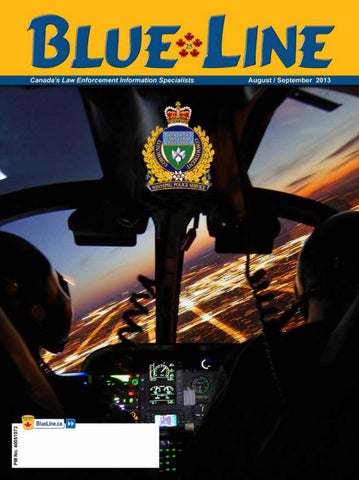
August / September 2013
2
Blue Line Magazine
August/September 2013 Volume 25 Number 7
Features 6 A culture of safety 8
Keeping an eye from the prairie sky
11 Investigative detention Motor vehicles
24
Victoria Chief Graham retires after 44 years in policing
26 Social media a double edged sword
6
Departments 46 Back of Book – I’m from the ‘Peg, so what? 19 Book News – A front line officer reflects 46 BlueLinks Advertisers Directory 32 Deep Blue – Ladder level trumps generational differences 35 Dispatches 30 Holding the Line – Police and Substance Abuse 45 Letters 44, 45 Market Place 5 Publisher’s Commentary – Avoiding realities costs money and lives 36 Science Beat – Catching flies with honey: The pathway to compliance 38 Technology – Blue Windows, BlackBerry and PRISM
11
Case Law
26 Blue Line Magazine
Front and Centre
41 42
3
Secondary purpose didn’t taint arbitrary stop Warrentless physical search may accompany drug dog sniff August / September 2013
August / September 2013
4
Blue Line Magazine
Blue Line Magazine Inc. PUBLISHER Morley S. Lymburner – publisher@blueline.ca General Manager Mary K. Lymburner – mary@blueline.ca SENIOR EDITOR Mark Reesor – editor@blueline.ca NEWS EDITOR Kathryn Lymburner – kathryn@blueline.ca CREATIVE DIRECTOR E. Jolene Dreja – jolene@blueline.ca Marketing Manager April Lensen – april@blueline.ca Contributing Writers Robert Lunney Dave Brown Mike Novakowski Nancy Colagiacomo Tony Palermo Stephanie Conn Tom Rataj Dorothy Cotton Brent Snook Mark Giles Affiliations International Association of Law Enforcement Planners Canadian Advertising Rates Data International Police Association The Canadian Press Newswire Access Copyright Subscriptions $30 per year; $50 for 2yrs; US & Foreign: $100 Advertising 888-640-3048 advertising@blueline.ca
www.blueline.ca 12A-4981 Hwy7 East, Ste 254, Markham, ON L3R 1N1 Canada P: 905-640-3048 F: 905-640-7547 blueline@blueline.ca
PRINTED IN CANADA
ISSN# 08478538 Blue Line Magazine was established in 1988 as an independent publication to inform, entertain, connect and educate those involved in the law enforcement profession. With no direct control from an enforcement agency, its opinions do not necessarily reflect those of any government or law enforcement agency. The authors, advisors, and publisher accept no liability whatsoever for any injuries to person(s) or property resulting from application or adoption of anything presented in this magazine. Readers are cautioned and advised that articles presented herein are edited and supplied for your personal awareness and should not be used for further action until appropriate guidance is received from a supervisor, Crown Attorney or other persons in authority. All material submitted for publication becomes property of Blue Line Magazine Inc. unless arrangements have been made with the publisher prior to publication. © 2013 All articles are protected by copyright. No part of this publication may be reproduced or transmitted in any form or means, electronic or mechanical, (including photocopying and recording or by any information storage or retrieval system), without prior permission. Permission to reprint may be obtained in advance from Access Copyright 1-800-893-5777.
Blue Line Magazine
Publisher’s Commentary by Morley Lymburner
Avoiding realities costs money and lives Philosopher, author and columnist Ayn Rand once wrote that you can avoid reality but not the consequences of avoiding reality. Recent events could certainly make her words a clarion call for both law enforcement and government. Fiscal restraint has been a common theme over the past decade or so. Fears of run-away budgets have sent politicians at all levels scrambling to find savings. To spare their political lives at the next election, they ask department heads to help them manage through cutbacks. Reducing staff is the most expedient way to show fiscal restraint; the “natural attrition through retirements” mantra makes it more palatable for those shy of public blow-back. The Town of Walkerton discovered in May 2000 the human costs of cutting corners on water works staff. The Ontario government, which also cut health inspectors, shared the blame by easing water inspection requirements to take pressure off the remaining staff. Four people died and more than a thousand fell ill after the town’s water became contaminated. Many were permanently disabled. The Canadian government last year decided cutting back meat inspectors could save a few million. Tainted meat soon began showing up across the country. After a few deaths and the realization voters were perishing, the government announced it was doubling the number of meat inspectors. When the headlines died down a year later the cutbacks slowly resumed. This time support staff got the axe. Currently it appears to be business as usual for layoffs, down-sizing or right-sizing. Ottawa’s downloading attitude is based on a belief in the intrinsic honesty of the private sector. This “trust” is buoyed by the lust for cutting enforcement personnel in favour of “self regulation” and with an eye on the bottom line. Faced with accusations of greater cutbacks, the government announced it had only reduced transport inspectors from 252 to 238, a five per cent cut. The recent disaster in Lac Megantic, Québec appears to be linked by many sources to a lack of federal transport regulators and a lack of oversight by inspectors. A runaway train vaporized the downtown and around 50 people are missing and feared dead. No one acknowledged that transportation of crude oil by rail has increased from 500 carloads in 2009 to 130,000 this year, a 2,600 per cent increase in less than four years. Great for the rail industry. Great for government. Not so great for the folks from Lac Megantic. Taking a clearer look at this we find that for some reason the work done by 21,000 federal government employees last year is unnecessary this year, according to the Public Service Alliance of Canada’s list of actual and projected 5
federal cuts for 2013. Among those unnecessary jobs are 149 federal police officers, 492 public health workers, 485 people from Transport Canada, 757 from Health Canada, 525 from the Canadian Food Inspection Agency, 698 from Fisheries and Oceans, and 1,049 from correctional services (so much for getting tough on crime). In addition to this we have 566 people cut from Citizenship & Immigration and Canada Border Services Agency will have 1,284 fewer people to watch for terrorists. In contrast to this the Office of the Commissioner of Lobbying of Canada will lose only two staff. If you still feel safe sleeping at night then you haven’t been paying attention. These numbers are only federal and don’t include provincial and municipal governments, where too many politicians see enforcement as the runt in the budget litter. Agencies report lower crime and municipal and provincial politicians take this as a cue to reduce their budgets. How these crime figures are obtained is not considered and there’s no thought that perhaps maintaining current levels is necessary to sustain them. Few politicians are told that cops who do not have to chase down active criminals can now be freed up to finally get into real prevention activities that will guarantee a safer future and community. One other factor which must be considered is the cost of over burdening a workforce. Post traumatic stress disorder costs police agencies dearly. Simply put, if you have a heavy workload you must ensure proper staffing to spread the stress over as large a number as possible. Humans are built to handle stress but everyone has their limit and that’s when a properly functioning management must react to move in fresh replacements. Advising the public that your agency can do more with less is just wrong. Avoiding this reality does not let you avoid increased compensation, sick benefits, reduced productivity, additional public complaints and more labour relations grievances with their related legal costs. Recognizing realities and responding appropriately to them is everyone’s responsibility. It can be a simple matter of getting the message to politicians that they can pay now or pay later, but pay they (we) must – and paying later may be far more costly. Cut back on pencils and perks, not people.
August / September 2013
A culture of
safety
by Natalie Aitken Winnipeg is in the midst of a revitalization of sorts – and so too is the Winnipeg Police Service (WPS). New commercial and residential construction abounds across the city. A new subdivision on the south end of the city will soon provide housing for 50,000 people. The beautiful Investors Group Field just opened at the University of Manitoba and construction cranes dot the downtown skyline surrounding the new Canadian Human Rights Museum. Adding to the buzz, Winnipeg’s population just topped the 700,000 mark following steady growth through immigration from within the province and around the world. It has resulted in plenty of challenges, and opportunities for change, for the WPS as it sets out to create a safer community built on strong trusting relationships. Chief Devon Clunis leads 1,958 members – 1,442 police officers, 440 non-sworn members and an additional 76 cadets. Sworn into office last November, his “people first” approach and philosophy for creating a culture of safety for Winnipeg has resonated with many in both the service and community. Clunis made it a priority to establish member forums so he could meet face to face with all front line members to hear their August / September 2013
questions, concerns and suggestions for building a more effective police service. Similarly, he has hosted a series of community forums to share his vision for the service and, more importantly, hear the priorities of citizens. Clunis, who is also a police chaplain, brings a unique perspective to the job – having immigrated to Winnipeg from Jamaica with his family at age 12. He grew up in the north end of the city, which faces unique socio-economic challenges that many believe have directly impacted the area’s crime rate. Clunis became chief at a time of great change and innovation. Investing in infrastructure The WPS has embarked on its largest construction project ever – a new police headquarters. Operations from eight separate facilities will move to the new building, set to open in the spring of 2014, and 75 per cent of all members will work out of it. The new headquarters covers 619,489 square feet. One floor could accommodate all the operations presently housed in the service’s current headquarters. A new firearms training facility was built last year on the western outskirts of the city and construction is nearing completion on a new west district station. A new station for the east district, the first new police facility built in Winnipeg in more than 40 years, was completed in 2008. Earlier this year, the service opened the doors on a dedicated 4,500 square-foot canine facility, adjacent to the new east district station. 6
K9 unit breeding program The new facility also features a whelping kennel and indoor puppy run as part of the service’s nationally recognized in-house breeding program. Began in 1999, it is one of the only Canadian programs of its kind. The unit is part of the service’s operational support division and has grown to 12 canine teams – 12 uniform officers and 23 canines – offering 24-hour coverage, seven days a week. With narcotic and explosive detector dogs, tactical support and several dogs cross-trained in multiple disciplines, each canine team is extensively trained for a particular objective prior to deployment. Investing in members While the service continues to invest in physical resources, human resources remains paramount. Manitoba is the only province not to have a provincial police academy. The WPS Training Academy has, in many instances, assumed this role, training more than 200 new recruits and an additional 100 cadets over the past three years. Recruit training is also offered for officers from other Manitoba police agencies, sheriff’s officers, child welfare workers and corrections officers. The academy is also responsible for conducting mandatory annual officer safety, police vehicle operations and firearms training for WPS officers. An additional 50 courses cover topics such as career development, specialty unit investigations, coach officer Blue Line Magazine
Chief Devon Clunis
training, leadership training, traffic related topics and basic police topics. The WPS is equally proud of its association with the Canadian Police College, where seconded members play significant roles in the polygraph, forensic interviewing and explosives training programs.
Blue Line Magazine
Those dreaded stats While there are many good news stories, the city has borne the brunt of some less than flattering headlines in recent years. Winnipeg has been at or near the top of some of Statistics Canada’s Canadian Centre for Justice Statistics high profile categories in the annual Report on Crime in Canada, including homicide rates and the crime severity and violent crime severity indexes. Sometimes lost in the headlines is the fact that the WPS has been making steady progress in reducing crime rates in recent years. WATSS The number of reported stolen autos has substantially decreased over the past number of years thanks to the Winnipeg Auto Theft Suppression Strategy (WATSS). The WPS partnered with Manitoba Public Insurance (MPI) and Manitoba Justice (Youth Correctional Services and Prosecutions) to
7
create the strategy in 2005. The multi-agency approach has made very significant inroads, reducing auto thefts by about 86 per cent through the end of 2011 compared to 2004 (the final pre-WATSS year). They are now at their lowest levels in 17 years and the goal is to reduce them even further. The reductions have been achieved thanks to a highly integrated approach encompassing prevention, intervention and enforcement efforts. The strategy received national attention in October 2008 in a Conference Board of Canada study and was viewed as a model for crime reduction in Canada. While the WPS is making progress in its efforts to create a culture of safety for the community, there is much work to be done. To be truly successful, the service recognizes the need to identify and engage in strategic partnerships – within its own ranks, with community stakeholders and its many partners in Canada’s broader policing community.
August / September 2013
by Dave Brown Winnipeg looks different from two thousand feet up. Everything is clean. Streets align neatly, traffic flows smoothly and green trees carpet the city. Back on the ground though it is business as usual for the Winnipeg Police Service (WPS). We’re on our third call of the night and we’ve only been in the air ten minutes. Blue Line Magazine is flying the night shift with Winnipeg’s newest crime fighting tool, a Eurocopter EC120. It is an eye-opening experience in more ways than one and I wish every citizen of Winnipeg could see what I saw. Helicopters are expensive, costing a lot to acquire, equip, operate and maintain. They are also some of the most complex flying mechanisms man has ever invented; a collection of precisely machined parts that move, spin, pitch or rotate; all tied together by one very large bolt at the top of the rotor mast, appropriately referred to as the “Jesus bolt.” Are they worth the cost and complexity? Well, we were all just a little too busy on the inside of Air-1 to even think about that or reflect on the fact that the bolt is likely named for the last words you will ever say if it comes undone in midair. We thread our way across the runways of Winnipeg airport in an impressive, skillful, highspeed dance of co-operation with Winnipeg Air Traffic Control, and arrive over scenes in seconds. Equipment The WPS Air-1 (call letters C-GAOL) is ideally suited to the mission. One of the quietest helicopters made, it makes less noise than many of the aircraft on approach to Winnipeg airport. Sporting composite main rotor blades and a shrouded Fenestron tail rotor, it is difficult to detect by sound at normal mission height unless you are right underneath it – and by the time that happens, it will be far too late for criminals trying to avoid police. August / September 2013
The gyroscopically stabilized thermal imaging camera can swivel 360 degrees, at a rate as fast as 140 degrees per second. Its high-definition camera and imagery technology is so sensitive that it can pick up fresh footprints in the grass or detect which speeding car was just dumped in a parking lot by its heat signature. A video downlink can provide live aerial feeds to police or fire supervisors on the ground and the Nightsun spotlight can light up a yard from a mile away. The five-seat helicopter also includes a rear view monitor so back seat passengers such as yours truly can follow the action on the same readout as the tactical flight officer in the left seat up front. The pilot, who sits on the right, flies, talks on the intercom, monitors police radios and stays in constant contact with air traffic controllers. The tactical flight officer (left seat) communicates with dispatch and ground units, monitors camera readouts, scans outside the aircraft and, incidentally, constantly updates visiting correspondents in the back seat. Our first major call of the night was for shots fired and we flew a pattern around the suspect house within a minute of receiving the call. The thermal imaging camera was able to scan for possible suspects while patrol officers and the tactical support unit secured the area. Once ground officers had eyes on all four corners of the house we moved on to a pursuit in progress. I doubt that a single suspect in that house knew they were being watched so closely from blocks away and a thousand feet up. Unlike in the movies, the Nightsun is rarely used because it gives away that important element of surprise. (There were a couple of times though, that a quick flick of the powerful light above a high-risk traffic stop was enough to keep things calm and safe for all.) We were urgently needed for a high-speed pursuit so, in another example of co-operation between Air-1 and air traffic control, we cut straight across the airport and arrived in just two minutes. 8
Air-1 actually has priority over all other traffic except for emergencies or medevac during pursuits but has yet to ever request that priority. In fact, air traffic control so skillfully routed us directly over a landing 737, without the slightest bit of drama, that I completely missed the entire thing. I was focused on the pursuit unfolding below and admiring how expertly the tactical flight officer kept the thermal imaging camera locked on the suspect vehicle the whole time. There is absolutely nothing exciting or entertaining about a real high-speed pursuit in progress. Dangerous and potentially fatal to so many people, it was heart-stopping to see the crazy chances that insane driver took as he raced through the middle of the city. Ground units were immediately called off once we arrived above. Not suspecting that his every move was being tracked, the driver thankfully backed off a little but continued to race through red lights and stop signs without slowing. I shudder to think what would have happened had anyone been in the intersections as this idiot blasted through, missing cars and pedestrians by inches. This wasn’t television; my family, friends and neighbours are on those streets and would have been killed instantly at those speeds. The driver finally dumped the car in a driveway and bailed out across backyards on foot. Air-1 followed his every step and even noted that our brave hero abandoned his girlfriend as he ran away. (Yes, the camera is that sensitive.) As ground units moved in for the arrest, all I could think about was how close so many people came to being killed that night. If I was that driver’s lawyer and saw the footage, I would immediately quit the case, go home and tightly hug my kids – but it was just another successful outcome for Air-1 in supporting the officers and citizens on the ground and we moved on to the next call. Flight operations At the time of this article, WPS Flight Operations Unit had a civilian chief pilot and a Blue Line Magazine
Blue Line Magazine
9
August / September 2013
police and civilian line pilot, all trained at Canadian Helicopters in Penticton, B.C. The chief pilot recently attended a safety seminar hosted by Peel Regional Police and conducted by the Airborne Law Enforcement Association (ALEA.) There are currently three police tactical flight officers, all certified to operate the thermal imaging camera. Most have received further training from ALEA. The flight operations unit is supervised by patrol sergeant Ken Zushman, one of the many people instrumental in arranging my spot in the back seat for two night shifts. Zushman detailed the unit’s objectives: • Respond to crimes in progress for aerial containment and investigation; • Conduct infrared searches for suspects and evidence; • Co-ordinate ground responses; • Track suspect vehicles during police pursuits; • Illuminate crime scenes, collision scenes, vehicle stops, search areas, disturbances and foot pursuits; • Conduct aerial searches for missing or lost persons; • Conduct aerial reconnaissance and photography of crime scenes, traffic collisions, high-risk incidents or remote areas; • Act as an aerial platform for emergency services for major fires, environmental disasters and other major incidents; and • Assist in the rapid deployment of canine unit members.
Facilities The unit operates out of space leased from Canadian Forces (CF) 17 Wing Winnipeg, which provides far more than just secure office and hanger space; it helped develop the unit’s safety management system (SMS) and the policies, procedures and practices that have become an integrated part of day-to-day operations. Unit leaders regularly attend wing safety meetings and the CF has offered candidates spots on its safety course. Safety is a culture. I received a complete and detailed safety briefing each trip before the engines were even started and as a trained pilot, I could highly respect the detail and professionalism of everyone, from ground support and air crews to the CF hosts and air traffic controllers. Results One of the most important things I learned is that police helicopters are not about generating
big headlines or exciting news footage; they are about fast response times, good police work, efficient use of resources and supporting officers on the ground. Having that eye in the sky keeps officers safe and frees up units to respond to other calls. One of the most comforting sounds in the world to a police officer needing backup is the sound of sirens in the distance. For Winnipeg officers, one could also add the comforting beat of triple Eurocopter blades overhead. It wasn’t that many years ago that many police agencies didn’t have full-time canine units. At that time, it was common to hear on the radio, “Is a canine unit available?” Now in Winnipeg you hear, “Is Air-1 available?” With the support of several levels of government, co-operation from the CF, skillful assistance from air traffic control and a dedicated flight operations unit, the WPS would like to answer that question more and more often with, “Yes, Air-1 is on scene.” The problem is that helicopters cost a lot of money to buy and operate and the citizens who pay those costs want to see those expenses justified with numbers and headlines. My flights made it clear that police helicopters are far more than statistics and car chase reports on the evening news. Citizens don’t get to see the near-misses that never make the paper. They don’t read about the reduction in pursuits, increased officer safety, reduced liability or being able to more quickly free up police resources. They don’t understand how immediately apprehending a criminal is far better than months of investigation. They don’t relate to the fact that Air-1 was dispatched 3,445 times, attended 2,688 calls and was the first unit on scene 1,987 times during its 984 flight hours last year. Police helicopters are not about headlines and statistics; they are about a lack of headlines. After all, when was the last time you opened up a newspaper and read, “Nobody was hurt last night.” As Zushman says, “You can’t put a dollar figure on what this helicopter has done for our community. You can’t say it has solved this many crimes, saved the taxpayers this amount of money or saved this many lives.” With Air-1 in the skies over Winnipeg, there may not be a lot of those headlines but there will be many more arrests and officers making it safely home and fewer families awoken in the middle of the night with news that a loved one has died in a tragic incident. In a few years, police helicopters will be considered as necessary and useful as two-way radios and canine units. No one has to tell that to Winnipeg Police; it recognized the advantages right away. If citizens need statistics to justify the costs, perhaps the most telling number of all comes from Zushman. “Every police agency that successfully implemented helicopters into its operations now has two of them.” Dave Brown is Blue Line Magazine’s Automotive and Firearms editor as well as general staff writer. He may be reached by email at davebrown@blueline.ca
August / September 2013
10
Blue Line Magazine
Investigative detention Motor Vehicles
by Mauro Succi In the 2004 decision R. v. Mann 1 the Canadian Supreme Court ruled on the issue of investigative detention (commonly referred to as articulable cause). Although the evidence was excluded in this particular case the court nonetheless upheld a police officer’s common law authority to detain an individual and search for safety incidental to investigative detention. The detention must be based on more than mere suspicion, as outlined in R. v. Simpson2. In other words, an investigative detention is only justified at common law “if the detaining officer has some ‘articulable cause’ for the detention.”3 Articulable cause was defined as: A constellation of objectively discernible facts which give the detaining officer reasonable cause to suspect that the detainee is criminally implicated in the activity under investigation. 4 A search incidental to investigative detention has three components: 1. A “pat-down” search of the person detained; 2. For weapons; and 3. For reasons of police and public safety.5 The search must be in accordance with both the Waterfield and Collins test.6 A problem arose with a pat-down search being restricted to a suspect only for weapons. This is because Mann was fact driven, based on a single individual walking and detained after officers suspected him of being involved in a possible break and enter in progress. Therefore, the Supreme Court ruling referring to the pat-down search was specific to the events that occurred in Mann but that decision Blue Line Magazine
did not address a variety of other situations an officer may encounter. For example, what about a suspect detained for possible criminal activity after operating or sitting in a motor vehicle? Does the pat-down search extend to searching the vehicle? Further, if the search incidental to investigative detention must be only for public safety, what about a situation where a person is detained for possibly transporting drugs in a vehicle? In this type of scenario, it often begins with a traffic stop for a minor offence, but ends with the officer suspecting the driver of being involved in criminal activity? At what point does the traffic stop become an arbitrary detention? Fortunately the courts have subsequently addressed parts of these issues. 1. Authorities to stop vehicles In Ontario,7 “where a person is operating a ‘motor vehicle’ as defined under the Highway Traffic Act on a ‘highway,’8 section 48(1) of the act9 permits a police officer to stop the driver and take investigative steps to determine if there are grounds for a breath or drug evaluation demand. Also, 216(1) HTA 10 provides police with a broad power to stop motorists on a highway, even arbitrarily or randomly, so long as the stop is associated with traffic safety or the enforcement of laws relating to motor vehicles” for example checking for valid driver’s licence, motor vehicle registration and insurance, mechanical fitness and the sobriety of the driver.” 11 It is well established in law that the random stopping of vehicles is justified by s.1 of the Charter. For example, in R. v. Hufsky, the Supreme Court of Canada ruled: 11
In view of the importance of highway safety and the role to be played in relation to it by a random stop authority for the purpose of increasing both the detection and the perceived risk of detection of motor vehicle offences, many of which cannot be detected by the mere observation of driving, the limit imposed by (formerly) s. 189a(1) of the Highway Traffic Act on the right not to be arbitrarily detained is a reasonable one that is demonstrably justified in a free and democratic society, within the meaning of s.1 of the Charter. 12 Similarly in R. v. Ladouceur, the high court once again confirmed the position previously taken in Hufsky; The random stopping of motorists on a highway is the only way of checking a driver’s licence and insurance, mechanical fitness of a vehicle and sobriety of the driver. However, in Ladouceur, the court went further by stating: Once stopped the only questions that may justifiably be asked are those related to driving offences. Any further, more intrusive procedures could only be undertaken based upon reasonable and probable grounds.13 In other words, the initial stop (outside of common law or other some legislated authority) is authorized under highway safety, providing it is of short duration and the driver is minimally inconvenienced. The driver is usually required to produce valid documents and any questioning will only be in connection with traffic enforcement and highway safety, including the mechanical fitness of the vehicle, and a sobriety check. As mentioned, any further, more intrusive procedures could only be undertaken based upon common law or some other legislated authority. 14 August / September 2013
2. Investigative detention and vehicles As stated, once the motorist is stopped under the authority of a traffic act, driver questioning is limited to traffic enforcement and highway safety; this brief detainment is justified and in accordance with the Charter. However, more intrusive questioning, detainment outside of the area of traffic enforcement and highway safety can only be undertaken based upon a common law or some other legislative authority, e.g. arrest, Criminal Code, Controlled Drugs and Substances Act or Liquor Act searches, exigent circumstances and investigative detention. Exigent circumstances and investigative detention are so closely related that they are often one and the same. To rely on investigative detention requires a belief of urgency or exigent circumstances, and exigent circumstances require an immediate police response that usually results in the officer detaining under the authority of investigative detention; especially in situations that are quickly unfolding and prior to an officer formulating the grounds for an arrest or other lawful search authority. For example, in R. v. Pearson15 the accused was initially stopped for speeding. The officer noticed it was a rental. The accused, the sole occupant, was asked for his driver’s licence, insurance, registration and rental agreement. He produced a valid driver’s licence showing a Richmond, B.C. address and the officer asked where he was headed to and coming from. The accused initially said he was coming from Edmonton (he was stopped driving towards Edmonton), then clarified that he and his fiance flew to Edmonton and rented the vehicle there, then drove to Vancouver, where he dropped off his fiance, and he was returning the rental vehicle to Edmonton. The officer noticed the vehicle had been rented in Edmonton at 9:00 am the previous day, which meant the accused had made a very long journey in a very short period of time. He therefore questioned Pearson about his travel choices. The officer thought the accused’s explanations were odd since it wasn’t economically feasible. In returning the documents, the officer leaned into the window and saw that the accused’s hands were trembling and detected a faint odour of raw marijuana. He also noticed the accused becoming more nervous as the questioning continued. The officer testified he wasn’t convinced that marijuana was actually located within the car based upon such a faint odour, although he was sure he smelled it. He became suspicious that Pearson might have drugs in his vehicle. After running some computer inquiries, the officer initiated a formal investigative detention. He asked Pearson to get out and advised him he was being formally detained August / September 2013
because he was believed to possess a controlled substance and that a police dog would sniff around the vehicle. The officer provided Pearson with his right to counsel and cautioned him. Within minutes, a trained sniffer dog twice positively indicated the presence of drugs in the passenger side doors area. Pearson was arrested for possession of a controlled substance, again provided his Charter rights and cautioned. The officer searched the vehicle and located two backpacks; one contained four bricks of cocaine weighing more than four kilograms. The accused was re-arrested for possession of cocaine for the purpose of trafficking and convicted in lower court following a voir dire and trial. All three appellate judges dismissed the appeal with differing reasons. Suffice it to say they all agreed that in the totality of the circumstances, the officer had reasonable grounds to suspect and detain Pearson for investigation. Further, the initial search using a trained dog wasn’t a Charter breach, even though it went beyond a pat-down search of the suspect. 16 However, what about situations of suspect detention that don’t begin with a traffic stop? In R. v. Batzer,17 officers responded to a 911 gun call from a house on the outskirts of town and soon noticed another vehicle parked close behind their cruiser. They had not heard it drive up and were concerned the suspects may have returned. They were aware that some two weeks earlier, shots had been fired at one of the other two houses in an apparently random drive-by shooting that remained unsolved. The officers saw the two male occupants were dressed in dark clothing, thus fitting the general description provided by the dispatcher. They ordered them out onto the ground, handcuffed them and asked what they were doing there at that time of night. The accused, the driver, provided an inadequate explanation. Concerned about their own safety, the officers conducted a pat-down search of both men looking for a gun, but found nothing. They also searched the vehicle but found nothing. On a second search, they found a zippered case in the glove compartment, opened it and discovered 22 grams of cocaine and 13 pills of ecstasy. 12
During the initial trial, the justice acknowledged there were serious concerns of public and officer safety, but ultimately concluded that the extended search of the vehicle went beyond the pat-down search and was therefore unreasonable. The circumstances lacked the constellation of events that would warrant such an extensive search incidental to investigative detention. The evidence was excluded. On appeal by the crown, the Ontario Court of Appeal agreed with the final outcome of the trial judge’s findings in excluding the evidence but nonetheless ruled that the vehicle search is permissible under certain circumstances, even though it is beyond a pat-down search of the suspects: The Court leaves the clear inference that on the right facts, a search incidental to a lawful stop could comply with the common law and pass constitutional muster even though it went beyond a pat down.18 In R. v. Plummer, the accused met his girlfriend, who had parked in the fire lane in an apartment complex. Plummer was wearing body armour and carried a handgun in his waistband. The accused sat in the passenger seat of his girlfriend’s car. Moments later, two officers on patrol saw the vehicle parked facing the wrong way in a clearly marked no-parking zone and knew there had been a number of drug arrests at this location. They saw an expression of surprise or shock on Plummer’s face as they passed by and watched him bend forward and slouch down. They thought his movements were consistent with concealing drugs, came back to investigate and asked the occupants for their names. When the accused provided his name, one of the officers immediately associated it with an “officer safety alert” that had circulated a week before. The alert described Plummer as possibly armed with a handgun and possessing body armour. They asked Plummer to get out. One officer believed he had grounds to search him on the basis of the alert, the reaction to seeing police and his apparent attempt to hide something. He conducted a pat-down search and discovered the body armour, told the other officer and proceeded to the car with a view to searching it. The officer’s purpose was to determine if there was a gun and, if so, seizing it. Plummer remained standing outside the car near the officers. As one began searching, he fled from the scene. The search turned up a loaded firearm in the handbag belonging to Plummer’s girlfriend. The accused was convicted at trial and appealed the decision. The Ontario Court of Appeal agreed with the trial judge’s findings: First, the threshold of reasonable grounds for an investigative detention must be determined through an examination of the totality of Blue Line Magazine
the circumstances... There is abundant authority for observations of reactions by suspects to police presence permissibly forming part of the constellation of factors that may determine the legality of an investigative detention. For these reasons, I conclude that the trial judge did not err by determining that the investigative detention of the appellant was lawful.20 The defence argued that the trial judge erroneously created an ancillary police power to conduct a motor vehicle search incidental to an investigative detention. In short, the only search permitted in the context of investigative detention is a limited pat-down search of the person being detained. This detention and search authority leads to the obvious question: did the pat-down search extend to the search of the bag that was situated in the motor vehicle? The defence argued that there is no such recognized common law power to do so. Put another way, had the accused been arrested, police would have been entitled to search the car as a search incidental to the arrest but no such search authority exists with investigative detention. 21 In adopting Batzer, the court concluded: Where the police see conduct consistent with concealing something in the area of the front passenger seat, have information the person may be carrying a gun and wearing a bullet proof vest and confirm he is wearing a bullet proof vest, to find that the police had to stop their search once they found he wasn’t carrying a gun on him flies in the face of concerns for officer safety.22 In closing, the court summarized this key point with a realistic common-sense approach to the situation by stating: I do not see why, once Constable Ratych discovered the bulletproof vest, he should be required to reject a further search for the gun in the immediate vicinity, including the passenger side area of the car in which the appellant had been seated moments before. To expect the police officer to abandon his search, release the appellant and, in effect, turn his back on the appellant as he walks back to the police cruiser is, in my view, both unrealistic and unreasonable.23
Further, the articulation must contain both subjective and objective grounds and an explanation of the urgency that existed at the time, including the concerns for public safety. By doing so, the courts will hopefully draw the conclusion that both the detention and subsequent search of the motor vehicle as search incidental to investigative detention was “reasonable.” R. v. Mann, (2004) S.C.R. R. v. Simpson, (2004) Ont. C. A. 3. Simpson, supra 4. Simpson, supra 5. Mann, supra 6. R. v. Waterfield, (1963) C.C.A. – The search must fall within the general scope of the police duty to protect life and property and involve a justified use of the police powers associated with that duty. In other words, it must be reasonably necessary in all the circumstances and the officer must have a reasonable belief that his or her safety or that of others is at risk. R. v. Collins, (1987) S.C.R. – It must be authorized by law, the law must be reasonable and the search must be carried out in a reasonable manner. 7. Other provinces have similar legislation (*see footnote 10) 8. “Motor vehicle” – includes an automobile, motorcycle, motor-assisted bicycle unless otherwise indicated in this act and any other vehicle propelled or driven other than by muscular power. Does not include a street car or other motor vehicle running only upon rails, powerassisted bicycle, motorized snow vehicle, traction engine, farm tractor, self-propelled implement of husbandry or road-building machine. “Highway” includes a common and public highway, street, avenue, parkway, driveway, square, place, bridge, viaduct or trestle, any part of which is intended for or used by the general public for the passage of vehicles and includes the area between the lateral property lines thereof. 1. 2.
9. 48(1) HTA – A readily identifiable police officer may require a driver to stop for the purpose of determining whether or not there is evidence to justify making a demand under section 254 of the Criminal Code. 10. 216(1) HTA – A police officer, in the lawful execution of his or her duties and responsibilities, may require a driver to stop. When signalled or requested to stop by a police officer who is readily identifiable as such, a driver shall immediately come to a safe stop. *Note: similar legislation exists in other provinces. 11. Barker, Greg – Assistance Crown Attorney, Drinking and Driving Law: An investigator’s and breath tech guide, 2005. 12. R. v. Hufsky, (1988) S.C.R. 13. R. v. Ladouceur, (1990) S.C.R. 14. When referencing ‘further intrusion or detainment of the driver’s “consent search” for the purposes of this training package is not considered even though a “consent search” albeit by its very nature is a further intrusion or detainment may also authorize police to detain and search the suspect(s) and motor vehicle. 15. R. v. Pearson, (2012) S.K.C.A. 16. See also R. v. Savage (2011) SKCA 17. R. v. Batzer, (2005) Ont. C. A. 18 . Batzer, supra 19. R. v. Plummer, (2011) Ont. C. A. 20. Plummer, supra 21. The officers were adamant that they felt they did not have the requisite reasonable grounds required to arrest or rely on Criminal Code authority to search and therefore could not rely on their common law search power for search incident to the arrest or other legislated authority, which would have allowed them to search the vehicle and bag. 22. Plummer, supra 23. Plummer, supra
Mauro Succi is an instructor with the Ontario Police College. Email him at Mauro.Succi@ontario.ca for a more complete dialogue on this subject.
Conclusion A motor vehicle search incidental to investigative detention is clearly not what the Supreme Court of Canada referred to when first laying down the rules regarding a patdown search. However, with the passing of time, the courts have come to recognize that in certain circumstances, a search, although it goes beyond a pat-down, may nonetheless be justified incidental to investigative detention. To be clear, this would be in situations where the officer has neither the grounds for an arrest nor is able to rely on some other legislated search authority where reasonable grounds exist. Therefore, in these types of situations, what matters most is the officer’s articulation. That is, an officer should be prepared to articulate in detail all of the reasons that led to the detention and subsequent search incidental to investigative detention. Blue Line Magazine
13
August / September 2013
Order of Merit
of the Police Forces
2013 Appointments
The Governor General, the Right Honourable David Johnston, Chancellor and Commander of the Order of Merit of the Police Forces, in accordance with the Constitution of the Order of Merit of the Police Forces, has appointed the following: COMMANDER Chief Clive L. Weighill, C.O.M. Saskatoon Police Service, SK.
OFFICERS Deputy Comm. Craig J. Callens, O.O.M. Royal Canadian Mounted Police, Vancouver, BC.
A/Director Didier Deramond, O.O.M. Service de police de la ville de Montréal, QC.
A/Comm. Roman Nick Lipinski, O.O.M. Royal Canadian Mounted Police, Surrey, BC.
A/Comm. Randall J. Beck, M.O.M. Royal Canadian Mounted Police, Vancouver, BC.
Sergeant Charles Momy, O.O.M. Ottawa Police Service, ON.
Chief Spt. Brian Cantera, M.O.M. Royal Canadian Mounted Police, Surrey, BC.
Dpt. Chief William Francis Moore, O.O.M. Halifax Regional Police Service, NS.
Dep. Chief Thomas W. B. Carrique, M.O.M. York Regional Police Service, Newmarket, ON.
Director Shelagh Elizabeth Morris, O.O.M. Guelph Police Service, ON.
Spt. James William Carroll, M.O.M. Royal Newfoundland Constabulary, St. John’s, NL.
Deputy Comm. William Scott Tod, O.O.M. Ontario Provincial Police, Orillia, ON.
Staff Spt. Jane Wilcox, O.O.M. Toronto Police Service, ON.
Chief Jennifer Evans, O.O.M. Peel Regional Police Service, Brampton, ON.
Sergeant Michael Chicorelli, M.O.M. Victoria Police Department, BC.
Inspector Brian F. Cookman, M.O.M. Kingston Police Service, ON
MEMBERS
Sergeant George A. Couchie, M.O.M. Ontario Provincial Police, Orillia, ON.
Inspector Michel Forget, O.O.M. S’du Québec, Montréal, QC.
Spt. Brian Adams, M.O.M. Peel Regional Police Service, Brampton, ON.
Spt. Susanne DeCock, M.O.M. Ontario Provincial Police, Orillia, ON.
Dr. Anna Gray-Henschel, O.O.M. Royal Canadian Mounted Police, Ottawa, ON.
Chief Spt. Janice Rose Armstrong, M.O.M. Royal Canadian Mounted Police, Surrey, BC.
Director Mario Harel, O.O.M. Service de police de la ville de Gatineau, QC.
Ms. Sharon Baiden, M.O.M. Greater Sudbury Police Service, ON.
Chief John C. Domm, M.O.M. Rama Police Service, ON.
Deputy Comm. Peter Henschel, O.O.M. Royal Canadian Mounted Police, Ottawa, ON.
Chief Spt. Ricky W. Barnum, M.O.M. Ontario Provincial Police, Orillia, ON.
Staff Sgt. Cameron E. Durham, M.O.M. Toronto Police Service, ON
August / September 2013
14
A/Comm. François Deschênes, M.O.M. Royal Canadian Mounted Police, Westmount, QC.
Blue Line Magazine
Inspector Gerard E. Francois, M.O.M. Calgary Police Service, AB
A/Comm. Craig Steven MacMillan, M.O.M. Royal Canadian Mounted Police, Ottawa, ON.
Spt. Michael P. Shea, M.O.M. Hamilton Police Service, ON.
Staff Sergeant Pierre Gauthier, M.O.M. Ottawa Police Service, ON
Inspector Dan Markiewich, M.O.M. Greater Sudbury Police Service, ON.
Prov. Commander Mary Silverthorn, M.O.M. Ontario Provincial Police, Orillia, ON.
Spt. Ronald Thomas Girling, M.O.M. Ontario Provincial Police, Orillia, ON
Inspector Steven James Martin, M.O.M. Royal Canadian Mounted Police, Stoney Creek, ON.
Spt. Eric Kenneth Slinn, M.O.M. Royal Canadian Mounted Police, Ottawa, ON.
Chief Spt. James R. D. Gresham, M.O.M. Royal Canadian Mounted Police, Surrey, BC.
Inspector Glen L. Motz, M.O.M. Medicine Hat Police Service, AB
Staff Sergeant Brian Snyder, M.O.M. Cornwall Community Police Service, ON.
Agent Evens Guercy, M.O.M. Service de police de la ville de Montréal, QC.
Deputy Chief Robert Percy, M.O.M. Halton Regional Police Service, Oakville, ON
Chief William B. Sornberger, M.O.M. Owen Sound Police Service, ON.
Chief John Peter Hagarty, M.O.M. City of Kawartha Lakes Police Service, Lindsay, ON
Inspector Lise Roussel, M.O.M. Royal Canadian Mounted Police, Fredericton, NB.
Inspector Robert Arthur Stewart, M.O.M. Vancouver Police Department, BC.
Chief Constable Paul Hames, M.O.M. Central Saanich Police Service, Saanichton, BC.
Chief Alfred Rudd, M.O.M. Taber Police Service, AB.
Deputy Chief Stephen Streeter, M.O.M. Peterborough Lakefield Community Police Service, ON.
Sergeant Michael Hunter, M.O.M. North Bay Police Service, ON
Corporal L. Wayne Russett, M.O.M. Royal Canadian Mounted Police, Ottawa, ON.
Spt. Christopher Mark Wyatt, M.O.M. Ontario Provincial Police, Orillia, ON.
Chief Constable Dave Jones, M.O.M. New Westminster Police Service, BC
A/Comm. Marianne C. Ryan, M.O.M. Royal Canadian Mounted Police, Edmonton, AB.
Dr. Akira Brian Yamashita, M.O.M. Royal Canadian Mounted Police, Ottawa, ON.
Inspector William James Law, M.O.M. Canadian Pacific Police Service, Toronto, ON
Inspector Michael W. Leighton, M.O.M. Royal Canadian Mounted Police, Halifax, NS.
Chief Constable Peter A. Lepine, M.O.M. West Vancouver Police Department, BC.
Chief Spt. Brenda M. Lucki, M.O.M. Royal Canadian Mounted Police, Thompson, MB.
Spt. Kenneth MacDonald, M.O.M. Ontario Provincial Police, Aurora, ON.
Blue Line Magazine
ORDER OF MERIT OF THE POLICE FORCES FACTS The Order of Merit of the Police Forces honours a career of exceptional service or distinctive merit displayed by the men and women of Canadian police forces, and recognizes their commitment to this country. The primary focus is on exceptional merit, contributions to policing and community development. The commissioner of the Royal Canadian Mounted Police, the Principal Commander of the Order, submits recommendations for appointment to the governor general on behalf of an advisory committee. Nominations for appointment to the Order may be made by submitting the name of a member or employee of a police force to the commanding officer of that police force.
Levels and post-nominals
Her Majesty Queen Elizabeth II is the Sovereign of the Order; the governor general is the chancellor and one of the Commanders of the Order. The Principal Commander is the commissioner of the Royal Canadian Mounted Police. Commander Post-nominals (C.O.M.): Recognizes
15
outstanding meritorious service and demonstrated leadership in duties of great responsibility over an extended period, usually at the national or international level. Officer Post-nominals (O.O.M.): Recognizes outstanding meritorious service in duties of responsibility over an extended period, usually at the regional or provincial level. Member Post-nominals (M.O.M.): Recognizes exceptional service or performance of duty over an extended period, usually at the local or regional/provincial level.
Insignia Description
The badge of the Order is the same as that of the Order of Military Merit: a blue-enamelled, straight-end cross (four arms, narrow at the centre, wider at the ends) with an annulus in red, surmounted by St. Edward’s Crown. The ribbon is different and consists of three equal bands of blue, gold and blue. The annulus bears the inscription MERIT.MéRITE.CANADA. For more information visit www.gg.ca/honours or www.cacp.ca.
August / September 2013
Blue Line
advertisers at the CACP American Military University
AMU has attracted hundreds of Canadian students seeking online programs that are flexible, affordable, current and relevant, with more than 70 degree programs uniquely tailored to meet the needs of today: intelligence studies, criminal justice, emergency and disaster management. American Military University is a good choice for Canadians. Visit www.PublicSafetyAtAMU.com/ Canada or contact Mike Sale (msale@ apus.edu or 416-985-7253).
Bell Helicopter
Bell Helicopter is the world’s leading producer of rotary-wing aircraft. The Mirabel facility manufactures the commercial helicopter lines of Bell Helicopter. Production consists of the Bell 206L-4 LongRanger and 407 single-engine aircraft, the light twin engine Bell 429 and the 412EP in the medium class. The plant is located just north of Montréal. in Mirabel, Québec; it sits on 152 acres of land and houses over 2,000 employees.
Carswell, a Thompson Reuters business
Carswell, a Thomson Reuters business is Canada’s leading provider of specialized information and research solutions to the legal, tax, finance, accounting and human resources markets. Headquartered in Toronto, ON, Carswell provides integrated information in a range of formats, including books, loose-leaf services, journals, newsletters, CD-ROMS and online. August / September 2013
Charles Sturt University
Charles Sturt University is an internationally recognized leader in undergraduate and postgraduate education for professionals in law enforcement, counterterrorism and security, and emergency management. Courses are delivered via supported distance education, with flexible study options to fit with career and lifestyle commitments. We recognise policing experience and training for academic credit. Find out more at www.csu.edu.au/ policeca
Commissionaires
Commissionaires is Canada’s premier security provider and largest private sector employer of veterans – offering noncore police services to municipalities and police organization nationwide. Non-core police services from Commissionaires free up resources while containing costs, putting police officers back on the streets protecting communities. Visit www.commissionaires.ca/ noncorepolicing
Priority Dispatch Corporation 9-1-1 CallTaking
Priority Dispatch Corp. (PDC) provides comprehensive, integrated, emergency calltaking/dispatch solutions for police, fire, and medical public safety services worldwide. Recognized by the The International Academies of Emergency Dispatch. PDC incorporates the Academies’ Priority Dispatch System protocols in all their products and services including the flagship ProQA Paramount calltaking software and AQUA Evolution quality assurance software. Technical and implementation support, as well as certification training are also offered. 16
Accident Support Services Int’l Ltd.
Facilitating collision reporting, no cost to Police or taxpayers. Reallocate manpower & operating cost savings. Microsoft Award winning Collision Reporting & Occurrence Management System (CROMS) electronically captures real-time collision details to share with stakeholders. Analytics Portal allows adhoc queries from all reported data fields & Mobile CROMS for in-car reporting! Steve Sanderson, President, ssanderson@accsupport.com www.accsupport.com
Intergraph Canada
Intergraph’s latest CAD release, I/CAD 9.2, helps police and security agencies act fast to save lives and property. We’ve added new features, enhanced communications integration, added web capabilities, broadened interoperability, improved the mobile experience, and made other enhancements that streamline your workflows and add value to your system. Contact us today to find out more: sales@intergraph.com
DAVTech Analytical Services (Canada) Inc.
Davtech Analytical Services (Canada) Inc. is a leader in the supply of product solutions for Law Enforcement and public safety. Its head office is located in Ottawa, ON (offices are also located in Calgary and Montreal with service centres across the country). Davtech provides factory authorized sales and service for Intoximeters, Decatur Electronics, Digital Ally, Guth, TriTech Forensics, and more.
Blue Line Magazine
Hallway patrol impacting Edmonton youth by Abby Kokolski
Const. Travis Peever with Grade 4 students at St. Elizabeth Catholic School.
High fives, huge smiles and admiring glances. These aren’t reactions police officers are accustomed to in their everyday work. It is, however, how officers are welcomed when they visit local schools as part of the Edmonton Police Service (EPS) Hallway Patrol program. The EPS partnered with both the public and Catholic school boards for the pilot project. “The project seeks to build closer ties with frontline police officers and the students, families and staff at local elementary and junior high schools,” says EPS chief Rod Knecht. “It’s an informal project to raise our presence and profile in schools.” Most patrol work is reactive, answering calls for service and going from one complaint to the next. The project allows officers to be proactive in the communities they serve. “It allows us to be proactive and reach out to kids at a very impressionable age,” says Cst.
Blue Line Magazine
Travis Peever, who tries to visit two schools once or twice a week. “We hope this extends past the school walls. We want kids to go home and talk about their positive interactions with police.” Since schools are the hubs of any community, there are many benefits to the visits, including increased trust with students and police familiarity with schools, students and staff. “We really hope our students see officers
17
as trusting people they can go to,” says Amy Cooper, assistant principal at St. Elizabeth Elementary School in Southeast Edmonton. “We want them to realize police officers are another safe adult in their lives.” The officer visits aren’t scheduled and they drop in when they have the time. The visit can be as simple as saying hello to the principal and walking through the hallways or visiting at lunch or recess time to talk to the students. Both school boards chose three elementary or junior high schools to be a part of the pilot project, which ran from April until the end of the 2013 school year. It will be assessed to determine whether it should roll out to more schools in September. The EPS has had a presence in Edmonton schools since 1979 with the school resource officer program, which includes 19 police officers working out of 22 Edmonton high schools. They work directly in an assigned school to open lines of communication, speak at school assemblies and work with negative student behaviour.
August / September 2013
The mobile technology
by Dan Lett
revolution
Almost all the officers tasked with policing Canada’s largest city carry smart phones. The problem is, none have been authorized by the Toronto Police Service for use during work hours. The lure of a dynamic and powerful new tool has pushed the officers out in front of official police policy. “We’re all going to go mobile whether we like it or not,” said Toronto Police Service Dep/ Chief Peter Sloly. “Organizationally, we’re already there. It’s pretty obvious that every one of our 5,506 police officers has some sort of mobile device. It’s just that 5,000 of them happen to be (personal phones). They use them every day and most of them are also utilizing them in some form for work, even though it’s in non-compliance with procedure.” The usage could be as simple as two officers communicating directly on smart phones instead of police radios, said Sloly. Some use their devices to photograph license plates or record witness statements so they can transcribe them later with greater accuracy than manual note taking. No sensitive or confidential information is being kept or transmitted but “they’re using these devices outside of policy and procedure,” Sloly said. “However, they’re using them to augment the limitations of the official equipment we have given them.” Mobile devices and applications represent a world of possibilities for front-line law enforcement, a job that by nature is the definition of a mobile profession. However, many agencies, especially larger ones, have been reluctant to embrace the new technology for a variety of reasons. Sloly noted the upper echelons of many services are still dominated by an older generation that finds it difficult to embrace digital devices and applications. They still prefer manual, penon-paper note taking and tend to see smart phones and tablets more as toys than policing tools, he said. Also, as paramilitary organizations, many are reluctant to give front-line officers the connectivity and power of a mobile device, he added. “Let’s face it, we’re not a change-rich environment,” Sloly said. “We tend to be changeresistant. We’re risk avoiders, not risk managers. Most of the people in law enforcement just don’t understand the technology.” Things are changing, however. Many smaller and mid-size services have embraced mobile devices and applications because they help boost productivity and their cost is fairly easy to manage, said Paul Hamelin, executive director of the Ontario Police Technology and Information Co-operative. Police agencies were among the first to adopt early iterations of mobile technology when they outfitted cruisers with ruggedized laptops to help front-line officers conduct database searches on individuals and vehicles. “However, as soon as August / September 2013
the officer got out of the car, the technology was no longer mobile,” Hamelin noted. “It was really just a standard work station, bolted into a car.” Smaller agencies that struggled to justify the cost of ruggedized laptops had little problem leapfrogging the older, more limited technology for less costly smart phones and tablets. “A lot of the smaller agencies that could not afford the laptops took a look at mobile devices and said, ‘Wow, that is for us,’” Hamelin said. “The promise of true mobile technology is to give officers a new array of tools, image capture, note taking, database access and critical information on laws, standards and procedures that are always at their fingertips,” Hamelin said. The Chatham-Kent Police Service in southwestern Ontario has outfitted officers with Blackberries and Playbook tablets for several years, resulting in improved productivity and accuracy of police work in the field, he noted. “The electronic capture of information through these devices is becoming more and more prevalent in law enforcement,” Hamelin said. “If I can run an application that will allow me to record notes with voice recognition features, it saves time on data entry on the back end, improves accuracy and saves a lot of time. It’s seamless.” Although many agencies are looking at mobile devices simply to assist basic police work, a whole raft of new applications are now being developed that could drastically change more complex tasks. The U.S. Fish and Wildlife Service, for example, has become one of the early adopters of MobileCSI, a mobile crime scene management application developed by Toronto-based Siamese Systems. Dr. Ed Espinoza, deputy 18
director at the USFWS Office of Law Enforcement, National Forensic Lab, said agents use the software on both Blackberry Playbooks and Apple iPad mini tablets to document crime scenes and direct the collection and preservation of evidence. Espinoza said one of the biggest problems for crime laboratories is ensuring proper preservation of evidence collected at the scene. Mistakes in protocol too often result in the spoiling or contamination of critical evidence. Espinoza cited an example of his officers collecting birds that had died after the BP Deepwater Horizon oil spill in the Gulf of Mexico. The birds were soaked in crude oil and difficult to work with. Proper protocol would be to first put the carcasses into a paper bag; the chemicals in plastic bags can react with the oil and contaminate the samples. In some instances, field officers forgot to use paper bags, rendering the evidence useless. However, officers using the CSI software can access information on the proper collection and preservation methods of a particular type of evidence on their mobile devices when they open up a new file. “This application really cuts down on a problem like that,” Espinoza said. “We’re seeing greater interest in mobile in all four corners of the earth,” said Siamese Systems CEO Alex Kottoor. “Law enforcement is definitely looking now for a secure way to move their work onto digital and mobile platforms.” Specialized applications are currently finding greater audience in small or medium-sized agencies, he added and interest among bigger agencies is growing. “The biggest law enforcement agencies in the world, including the FBI, DEA, ATF, are being tasked to find ways of establishing a secure collection of digital data,” Kottoor said. There are still a number of practical and cultural hurdles to overcome before law enforcement can confidently jump on the mobile bandwagon. Sloly said too many senior law enforcement personnel see mobile devices more as toys than tools. There are also real questions about whether many larger police agencies have the IT support and human resource capacity to fully deploy mobile applications, Sloly added. There will be greater acceptance when everyone understands that mobile devices and technology are not meant to replace the best of traditional policing, said Soly. “Mobile technology does not mean no cops on the street,” he said. “You still need to reach out and press the flesh, go eyeball to eyeball with people. You can’t use social media to the exclusion of real world, traditional relationship building but we can really enhance all this if we employ a digital platform to help us in our work.” Dan Lett is an award-wining columnist for the Winnipeg Free Press. He writes extensively on politics, public policy and justice issues.
Blue Line Magazine
book news
A frontline officer reflects Book: Canadian Policing in the 21st Century Author: Bob Chrismas Publisher: McGill-Queen’s University Press The policing profession has evolved in ways not imagined 20 years ago. Personal computers, smartphones and social networking have become part of our new human experience. Increased access to information has transformed the public’s relationship with all government agencies and has changed the nature of accountability. Globalization and the complexity of today’s social problems have created the need for more collaborative, multi-disciplinary approaches. Gender, race and age diversity have also changed policing dramatically. Canadian policing in the 21st Century describes a front-line officer’s perspective on how policing has evolved over the past two decades. It offers first-hand experiences and observations supported and complemented by a wide range of academic and professional sources. While not an account of all aspects of policing, this book describes two decades of unprecedented change. Afterword Canadian police agencies are experiencing significant changes in the new millennium. Criminal sophistication, advancing technology and evolving societal demands continually challenge police officers and administrators in new ways. Terrorism, organized crime, Internetbased child exploitation, human trafficking and a host of other borderless crimes have globalized law enforcement, requiring interagency cooperation and information and resource sharing on a unprecedented level. In response, police services are undergoing fundamental shifts in strategic planning. They are being challenged to replace long practiced reactive tactics with proactive, evidence-based strategies that target the root causes of social problems, not just the symptoms. Increased accountability is driving innovation as individual officers and whole systems adapt to new challenges almost daily. Mass retirements are changing the demographic makeup, causing a loss of critical corporate knowledge and forcing a new focus on recruitment, retention and mentoring. Effective managers are now aware of dynamics of age, gender and ethnic diversity unheard of 20 years ago. Physical distance and communication barriers are collapsing so quickly that we may barely recognize their impact or know how to respond effectively. Police and all public servants must be vigilant in dealing with the change occurring all around us. We must be aware of technological advances and their implications and be prepared to take full advantage of them rather than being overwhelmed. Blue Line Magazine
Canadian policing has gone from a culture of change resistance to a culture of continuous innovation and increased transparency, often brokering change with others in the broad spectrum of service agencies. Criminals operate in an increasingly borderless and globalized world, without the constraints that affect police – such as the need to act lawfully, respect jurisdictions and work with limited resources administered by bureaucracy – but they are still not winning the war. New frontiers of policing lie in increasing community engagement and approaches that can help resist the tendency to revert to reactive strategies of the past. New methods of analysis and reflective practice hold the potential for helping police agencies to remain aligned with changing community needs and continuously adapt for optimum effectiveness. The narrative within communities and among the agencies of justice needs to evolve
19
to engage all of society to work together to reduce crime and improve quality of life (Byrne et al. 2009; Byrne and Senehi 2012). Police can play critical roles in this discourse but are only a small part of a larger system. The implications for the future are considerable – police agencies that fail to work in whole community teams risk failing to contribute to the solution of significant social problems. The evolution from the manual typewriters in use in 1989 to the connected, globalized, digital world of today does not redefine the ageless fight between good and evil – it only changes the weapons and the battleground. Robert Chrismas is a serving police officer in Winnipeg with twenty-eight years of law enforcement experience. He is also a doctoral student in Peace and Conflict Studies at the University of Manitoba.
August / September 2013
by Brad Smith I dealt with hundreds of police officers in 13 years as a prosecutor, usually at pre-trial interviews and later at trial. They ranged in experience from senior members to new recruits and many impressed me with their professionalism and dedication. Modern policing calls for intelligent, dedicated professionals capable of doing a difficult job in a way that gets results and will withstand scrutiny in the trial arena. The officers I dealt with usually had certain characteristics that contributed to their success in giving evidence in court, including very good note taking habits. Good note taking is crucial for two reasons: 1. It can help the credibility of the officer giving evidence at trial. 2. It promotes the proper administration of criminal justice by helping to prove facts. Conversely, sloppy note taking can devastate the credibility of a witness and seriously, if not fatally, undermine the successful prosecution of the case. Good note taking crucial A criminal trial’s prosecution evidence is like a multi-chapter story. If one or more of the chapters are missing, it gives defence opportunities to argue that the judge should August / September 2013
accept some alternative interpretation – one which will typically involve a reasonable doubt as to the guilt of the accused. If too many chapters are missing, the story eventually does not make sense and the prosecution fails. Each police officer giving evidence contributes to the development and understanding of the story that forms the basis for the prosecution evidence. The challenge for a prosecutor is to put the case together and tell the story in evidence. The challenge for defence is to take the case apart and show that the story is missing chapters, such that there is a reasonable doubt as to the guilt of the accused, or that the story as a whole does not make sense. One way defence can raise a reasonable doubt is through cross-examination of the police officer witness about personal diligence, competence or both, in taking notes. For a recent internationally reported and stark example of this, consider how defence for South African Olympic athlete Oscar Pistorius shredded the credibility of the lead police investigator in the proceedings to determine if he should be granted bail in connection with charges that he murdered his girlfriend. In the classic example, the wind up questioning by defence in cross-examination usually begins something like this: Defence: You’ve been a professional po20
lice officer for X number of years? Witness: Yes Defence: And so you are familiar with the importance of thorough note taking? Witness: Yes By this stage, the judge, prosecutor and usually the witness all know where the defence questioning is headed. These seemingly innocuous opening questions are usually followed by several others along the same lines. The questions will typically suggest answers that the witness must agree with to avoid looking incompetent or foolish. They usually include: • The importance of thorough note taking formed part of the police officer’s training. • Proper note taking is important because it formally documents matters that are relevant to the investigation. • There was no impediment to the ability to document such matters, if not contemporaneously, then later. Having thus ensnared the witness by gaining agreement with this series of reasonable statements, defence will move to the real point of this area of cross-examination: • Other than because of poor note taking or incompetence, or both, the fact that the witness has testified to something significant which is not noted cannot have a reasonable explanation. Blue Line Magazine
It is easy to see how the defence can be expected to seize upon something like sloppy note taking in implementing such a strategy. If defence is successful in having the evidence establishing guilt ruled inadmissible it invariably proves fatal to the prosecution of the case.
This calls into question the credibility of the witness (on this point and perhaps generally) and whether whatever the testimony was about even occurred. At this point in the cross-examination defence will have effectively challenged the credibility of the witness in that he or she will have agreed to the expected norm (thorough note taking) and been shown to have deviated from it (by failing to record something significant). In doing so, defence will have laid the groundwork for later arguing to the judge that the evidence of the witness about some (usually important) matter should be treated with caution, or even rejected. That is a simplistic demonstration of what can be a very subtle, protracted defence exercise. I have sat through cases in which this type of defence tactic has been employed and can say it was always obviously uncomfortable for the witness. If their credibility is undermined to such an extent that the judge subsequently comments adversely upon it in reasons for judgment, fair or not, it will remain in the written decision long after the case is over. Significantly, we can expect this to become more prevalent as judges become increasingly active in holding police witnesses accountable for sloppy note taking.
ings be granted). This is important because it is part of another reality of modern policing in Canada, namely that the trial often appears to be more a trial of the police investigation than a trial of the accused. This is not really surprising. When the evidence against the accused is overwhelming, the obvious defence strategy is to get the evidence establishing guilt ruled inadmissible. Usually the most effective way to accomplish that objective is to establish one or more violations of the Charter rights of the accused.
Conclusion Sloppy note taking is bad for the in-court credibility of the police witness. It undermines the successful prosecution of the case. The good news for the competent note taker is that when you are cross-examined by defence, it will likely not be along the line of the questioning outlined above. You can always expect to be tested about your recollection of matters, but you will have the benefit of detailed notes to refer to. Cross-examination will not be an uncomfortable experience (or at least not be as uncomfortable as it would otherwise be). You will find the judge describing you as a credible witness. Importantly, rather than creating gaps in the story, your evidence will provide necessary detail, thereby facilitating a very important legal objective: the proper determination of criminal charges on the merits. Brad Smith is a former senior federal prosecutor who now practices criminal, regulatory and civil litigation at Affleck Hira Burgoyne LLP (www.ahb-law.com) in Vancouver.
Importance for the case If a witness is discredited on important matters it can seriously, if not fatally, undermine the ability to successfully prosecute a case. That is an unfortunate outcome in any case, but particularly when it involves serious offences, high-level targets and occurs after the investment of much investigative and prosecutorial time and resources. These issues often play out in court in the context of allegations that one or more of the constitutional rights of the accused, as guaranteed in the Charter, have been violated, such that evidence should be excluded (or some other remedy such as a stay of proceedBlue Line Magazine
21
August / September 2013
by Michael W. Streed Each day, Canadian law enforcement faces policing challenges similar to those in other countries. Like many counterparts, they must evaluate and use the latest, most cost-effective methods to crack down on crime. Over the years I have followed their methods for creating facial composites and find that many agencies have preferred working with a trained police composite artist. Though it seems to be a standard practice, it hasn’t always proven to be the best solution. A lack of qualified artists has caused many Canadian investigators to turn towards a technology solution, using facial composite software to create suspect images. Both have proven to be effective solutions but law enforcement’s use of software remains greatly underutilized. Increasing the use of facial composites would require a broader range of persons trained to create them. To effectively fight crime law enforcement needs timely intelligence that can be quickly disseminated. Having a cadre of trained technicians would help fulfill this need. Most agencies already employ computer savvy personnel with strong interviewing skills so using available technology would be an efficient, cost effective solution that would help relieve today’s strained police budgets. For years, administrators have been led to believe that having a police composite artist was their best and only solution. However, few agencies can afford the luxury of employing a full-time police composite artist. In today’s economy, options that allow greater flexibility must be considered. Traditional police composite sketch artists chafe at the suggestion that software can be as effective as their pencil because, for many years, poor quality programs made them the only option. Today, the quality of facial composite software has improved and become less expensive. The process of training and developing personnel to become qualified composite sketch artists can take many years and cost thousands of dollars. Some agencies try a less expensive route by hiring civilian freelance artists on a per case basis. Though some volunteer their services for free, many charge a modest fee that can become quite expensive. More experienced artists command much higher fees. A majority of today’s sketch artists already have law enforcement careers and calling them August / September 2013
away to conduct sketch interviews can impact their duties. When they are unable to schedule a sketch during regular duty hours, they have to extend their workday and be compensated for overtime. To avoid this conflict, agencies often train backup personnel, a costly solution that doesn’t always solve the problem. Also, if your composite artist retires, promotes or transfers, the costly process of identifying and training a replacement begins all over again. Many agencies have taken these costs into account and shunned using a composite sketch artist, opting instead for facial composite software. With a variety to choose from, personnel can be trained for far less than the cost of training one traditional police sketch artist, allowing them to create a signature facial image for their agency that is of consistent high quality and can be easily shared across borders. With trained operators available around the clock, agencies can respond to crime more quickly and disseminate the final image with greater speed. With proper training, non-artist software technicians have proven their value by assisting with the identification of criminal suspects. Software technology has developed to the point where composite images can be imported into many of today’s popular photo/ paint programs. This option allows the technician to make refinements rivaling the work of traditional police sketch artists, making it more difficult to argue that software is too limited in its ability to effectively create an image that satisfies eyewitnesses. Before an agency begins investing in a facial composite software, there are a few things they should be aware of: Image quality: Many facial composite programs have photographic databases, which often produce poor quality images. This causes confusion for people conditioned to seeing artist sketches and may cause them to believe they are seeing a mug shot of the actual suspect instead of an approximation of their appearance. Also, except for isolated instances, colour composite images are of little benefit. They are expensive to print and can be misleading. For a majority of cases, grayscale images work best. Interview: The interview is a most important method for building a facial composite. Interviewing an eyewitness or crime victim can sometimes be a painstaking process taking several hours. The claim of creating a composite image in minutes is misleading 22
because, regardless of the program, once an eyewitness is properly interviewed, the face build will come together quickly. Training: Look for software that offers continued support and training, either online or on-site. Costs: Prices can vary. The initial and continued investment is still cost effective, especially when compared to using a traditional sketch artist. The fact remains that more people can be trained to use software for less money. Also beware of companies who charge yearly maintenance fees. Don’t pay for what you’ve already bought. As the art of creating facial composites evolves, many new police composite artists entering the field are embracing software technology as a viable alternative. They quickly realize that it can help them create more composites in less time than those they hand draw. This allows greater flexibility because they can still pursue something they are passionate about while minimizing the impact on their primary duties. Since the forensic art field involves many facets, there will always be a need for a properly trained forensic artist who spends the time to properly hone and diversify their skills. Making the change to creating faces from pixels instead of pencils can be done quite easily. With careful planning and commitment, law enforcement agencies will begin realizing cost-saving results. Continued training and technology investments will encourage increased use of facial composites. Law enforcement personnel who look forward to using these programs will lead to increased proficiency, not to mention the psychological first aid an image provides for victims of violent crime. With careful planning and commitment, agencies will begin realizing cost-saving results. Continued training and technology investments will save you more money over time, with the increased opportunity to capture more crooks, closing cases much quicker and investing those savings in other crime fighting tools and technology. Sgt. Michael W. Streed (Ret.) is an award-winning, internationally-recognized police sketch artist with 33 years experience with some of the largest, most diverse US police agencies, including LA and Baltimore police. A certified forensic artist and owner of SketchCop Solutions (www.SketchCop.com), he consults and trains law enforcement in using facial composite imaging software.
Blue Line Magazine
PEMBROKE POLICE PATCH OVER TO OPP OTTAWA – Pembroke’s 135 year-old police force officially disbanded July 6 as 22 members were sworn into the Ontario Provincial Police. Acting OPP inspector Jeff Smith said in a release that the swearing in ceremony was a very special occasion for the officers and civilians who are transitioning to the provincial force. “It is a momentous day,” Smith said. City council voted to sign a contract with the OPP last year, a decision that will save Pembroke an estimated $2 million over the next three years. Policing previously accounted for a quarter of the city’s $6 million annual budget. Pembroke, with its population of 14,000, already had to call the OPP for help when they needed dog teams, SWAT teams, or investigators on large or
Blue Line Magazine
complicated cases. Police officers trained in Orillia to prepare for the transition, familiarizing themselves with OPP procedures and equipment such as computer systems, firearms and OPP patrol cars. Pembroke police chief David Hawkins said in a release that the transition has gone smoothly. “We have worked closely with the OPP to ensure all the details have been covered, with public safety always being a priority. I am confident that the citizens of Pembroke will be well served by the members of the OPP.” Pembroke hired its first Town Constable on Nov. 15, 1878. James Devlin was paid a salary of $400 a year to perform duties including collecting taxes and being the town’s dogcatcher. Ottawa Citizen
23
August / September 2013
Front&Centre
Victoria Chief Graham retires after 44 years in policing by Elvin Klassen
Jamie Graham is retiring (for the third time) in December after finishing his five-year contract with the Victoria Police Department, figuring it’s time to try something new after close to 44 years in policing. “I’ve had the most phenomenal ride of my life,” he said. “Serving with the RCMP, Vancouver Police and Victoria Police Departments has been a huge honour. From the moment I started in Regina, policing gave me a real sense of purpose. I knew right away that this was the life for me. I thought at one stage though that if I ended my career running a small RCMP Detachment in rural Alberta, life would have been good. Who would have thought this would happen?” Graham joined the Mounties in 1968 at age 19. After postings in Westlock (Alberta), Edmonton Provost, Fort McMurray, the international airport, an Edmonton major crime section (GIS), Nelson (B.C.) and North Vancouver he was appointed the OIC (Officer in charge) of Surrey, the RCMP’s largest detachment. There was talk once or twice about moving to Ottawa but that wasn’t to be. When the chief’s job came open in 2002 with Vancouver Police Department (VPD), he (and the real boss, wife Gail) gave it serious consideration and he was soon the 29th chief constable. Leaving the RCMP was a tough decision as he had earned a great reputation over his 34 years with the force and was fully expecting to stay in Surrey until retirement. However, the Vancouver position presented a huge and exciting challenge and he never looked back. His time with the VPD allowed him to make many changes, bring in a completely new command staff and help develop one of the finest police agencies of its size in the world. While lecturing internationally on police leadership Graham suggested to senior executives that five years is about the right amount of time to spend as chief. Following his own advice, he retired from Vancouver in August 2007 at the end of his five year contract. He kept busy with private consulting, attending events on behalf of the National Speaker’s Bureau and, for relaxation, worked a few days a month at a Vancouver bicycle shop. The position of chief constable opened up in Victoria in October 2008 and he and Gail made another decision. Graham became the 12th chief of the Victoria Police Department August / September 2013
(VPD) in January 2009. The police board made it clear that they wanted strong leadership and a pursuit of regional solutions for the southern Vancouver Island. Police board chair and Victoria mayor Dean Fortin expressed sincere appreciation for Graham’s work recently in the Times Colonist. “Victoria’s crime-severity index, compiled by Statistics Canada, dropped 26 per cent from 2009 to 2011, while public disorder downtown saw a major reduction. Efforts like ‘Late Night, Great Night,’ a Jamie Graham-supported Downtown Victoria Business Association program that includes late-night buses and policemonitored taxi stands to help people get home from downtown, have helped that happen.” Graham made a point to express his admiration for Fortin and his police board colleagues. The editorial in the same paper was headlined “Chief Graham served the city well.” Graham is often asked to compare commanding the RCMP in Surrey to running the Vancouver and Victoria police. “There are more similarities than differences,” he said. “They are simply magnified in the larger centres.” No matter the force of location, Graham is a firm believer in the quality of Canadian policing and the dedication of the young officers who choose it as a career. “The men and women we hire are the best this country has to offer.” Stormy waters It hasn’t always been smooth sailing for Graham, be it in Victoria, Vancouver or his many RCMP postings. “I wear my heart on my sleeve and I have made some mistakes, maybe even said some things I shouldn’t have but my policy has been to admit to errors, deal with it and move on,” he noted. Through the years, Graham has often faced criticism from individuals and the media, “some warranted, mostly not... “I do my best when communicating 24
publicly on an issue and I always trust the public will be able to sift through the fog on how some choose to interpret the message, then get to the facts and the truth. I know what I did, what I said, I don’t need to read someone else’s interpretation of their own spin of my messages,” he said. He refuses to be defined by those who have personal agendas and are able to garner media headlines and stressed that the unfavourable comments are quite rare. The public “gets” the difficult job the police have to do and appreciates the talented officers patrolling Canadian streets. Many business and government colleagues express dismay at the police being concerned about public satisfaction ratings of 90 per cent. They wish they had that ‘problem.’ Part of a chief’s job is to discipline officers who make mistakes. “I have terminated people and imposed some pretty severe discipline but overall, it is rare,” Graham said. Considering the hundreds of thousands of contacts police have with the public each year, the substantiated complaints against officers has dropped in Victoria to very small numbers. Graham’s handling of a Vancouver incident where six police officers were charged with criminal offences attracted support from both the public and press. He held true to the principle of transparency and openness with the community throughout the entire process, posting information online for all to read. He and his command staff quickly acknowledged the problem and dealt with it swiftly. The matter was resolved and sanctions imposed within a year after the matter was first reported. The decisions he made about each officer’s punishment displayed his understanding of both the human and legal aspects of the situation, he said, with the penalties not only reflecting good police practice but also solid judgment. The most important image was that the top person in charge was there, front and centre to Blue Line Magazine
reassure both the public and the members of the department that all was under control, he added. The most important message was that lessons learned would also be retained, taught and understood. Graham followed through on his belief, “We cannot expect to earn trust if we are not entirely open in explaining the decisions we make.” Military roots Graham was born in Belleville, Ontario, the son of a Canadian Army Officer and was one of the last “Lay Magistrates” in Ontario. The family moved often, with stops in Quantico (Virginia), Camp Borden, Calgary, Washington (DC), Halifax, New Delhi (India) and finally boarding school for Graham and his brother in Nova Scotia. Robert joined the US Military and served with the special forces in Vietnam. Graham considered following his brother into the military but opted for the Mounties instead. Married to his lawyer-wife Gail for 30 years, he credits her input, advice and guidance as invaluable to his career choices, adding “we made decisions together that worked out well – I owe her everything.” Regionalization Modern police agencies have to be nimble and adapt quickly to new challenges, said Graham. Issues, documents, videos and photos are posted on line and within minutes of their creation and you are expected to have a plan in place to deal with every eventuality. That’s one reason why he supports regionalizing police forces in the southern peninsula of Vancouver Island, where a patchwork quilt of municipal forces and RCMP Detachments police a relatively small area. While Victoria Police serves the City of Victoria and Township of Esquimalt, he believes so much more could be done with a regional solution for a bigger area. Another key to being nimble is hiring people you can rely on. Hire the very best people, assign tasks, develop a trusting workplace and step out of the way to let people do their jobs, he advises. Graham’s “rules to live by” re-affirm that leaders cannot always be loved by everyone. Being responsible sometimes means people don’t like you. Trying to get everyone to like you is a sign of mediocrity. Avoiding the tough calls also means avoiding confronting the people who need to be confronted. By procrastinating on the hard choices, you’ll simply ensure that the only people you upset are the most creative and productive. CEOs have to remember that everyone is watching, especially when staff make mistakes or are in trouble. Great leaders are almost always great simplifiers, who can, “cut through argument, the bullshit, debate and doubt to offer a solution everybody can understand.” Graham suggests getting advice, “from your people and then make a decision. Right or wrong, just make a decision!” He also believes that the day your people stop bringing you their problems is the day you have stopped leading them. They have either lost confidence in your ability to help or have Blue Line Magazine
concluded that you do not care. Either case is a failure of leadership. Courage and confidence is what it is all about. Graham is not shy about calling the CEOs of top Canadian companies and asking about their secrets to success. He loves to hear their perspective on how they operate their businesses. Taking risks, developing high morale and building a base for teamwork ranked high on their lists. He recalls once asking his people to describe their best boss. Most recalled leaders who provided support but then left their employees alone to get the job done. There are days when Graham likes to leave the office and respond to calls with officers. Dispatchers probably shudder when they hear him on the air, he admits, as his old “10 codes” are sometimes a mystery. Mixed in with the responsibilities, crises, tragedies and issues of the day are times when he is able to have fun. As General Colin Powell said, “Have fun in your command and with your command staff. Surround yourself with people who take their work seriously, but not too seriously.” Community contacts Graham has developed strong working relationships with the community. He developed programs where car dealers donated vehicles to school liaison officers to help break the ice at local schools. It worked very well, offset costs and was supported internally when RCMP Ottawa HQ was asked to have a look at what they
25
were doing. At one point he recalls seeing a PT Cruiser, a big military style Hummer, a VW Beetle, an A6 Audi Quattro, an S-Type Jaguar, a Discovery II Landrover and a Mercedes M Series SUV from local dealers. These were innovative and proved very effective in connecting with youth. Graham is on the provincial board of the Schizophrenia Society of BC. He formed the first BC chiefs association mental health committee to develop training and awareness. Officers now receive significant amounts of training that have helped defuse many volatile situations. He is also a big supporter of the Salvation Army and serves on its community advisory board in Victoria. Recruiting is Graham’s favourite topic. “We get hundreds of applicants for each opening in Victoria. The word is out about the quality of the work (the weather doesn’t hurt either) but the young men and women we hire are simply outstanding. The education, fitness levels, volunteer activities and life experience is quite amazing. “Policing has been very good to me. I owe the organizations (RCMP, the VPD and the VicPD) so much for giving me the opportunities to be a part of an amazing team.” Graham hopes to continue residing in Victoria after his retirement. Elvin Klassen is Blue Line Magazine’s West Coast Correspondent. He may be reached at elvin@blueline.ca.
August / September 2013
Social media a double edged sword by Olivia Schneider The police view of social media is not always positive, and with reason. The Rehtaeh Parsons case is a good example of the challenges social media can present to police agencies investigating a potential crime. Parsons, a Nova Scotia teen, committed suicide in April, the result, her family and friends allege, of ongoing cyber-bullying by other teens, for which charges have not been laid. Surrounding these events was a social media frenzy calling for more action by federal and provincial police departments. A major drawback in investigating online harassment is that the Internet moves quickly, while laws change more slowly. Halifax Regional Police (HRP) officer Cst. Pierre Bourdages says there simply aren’t enough resources for a greater focus on social media. On the other hand, there is another side to the relationship between social media and police. Incorporating it into a police agency’s relationship with the community can work very well. The HRP Twitter account has more than 12,000 followers – more than the Halifax municipal government account, Halifax Metro Transit – or even Garrison, the popular local brewery. HRP joined both Twitter and Facebook in the fall of 2009. Lauren Leal, the official HRP communication advisor, is one of four people who tweets from the account daily – to date, HRP has tweeted more than 3,500 times. Leal says the push towards social media is primarily to connect with citizens, provide timely information on crimes and help point people with questions in the right direction. “There’s an expectation for us (police) to be part of the discussion,” says Leal, “and with social media it can be a two-way discussion.” Many Twitter queries are about traffic questions so the HRP Traffic Cop account was created and has more than 650 followers. The tweets from this account warn drivers about delays caused by traffic accidents or answer questions regarding unmarked crosswalks or helmet laws. Police forces don’t just use social media
to give their community information. Increasingly they are turning to the public through social media to help gather information and solve crimes. In April this year, five Canadian police forces – Calgary, Hamilton, Peel, York and Ottawa – took to social media hoping to identify The Vaulter, a bank robber suspected of over 17 robberies across Canada. York Regional Police believe the public may be able to identify The Vaulter, based on pictures and videos circulated through Facebook, Twitter, YouTube and Pinterest. The HRP recently used Twitter and Facebook to search for witnesses to a fatal car crash. Social media was also used by authorities searching for the Boston Bombing suspects in May and suggestions from citizens poured in. Ross Bell is a criminologist and professor in the Justice Studies department at St. Lawrence College in Eastern Ontario. When thinking about social media he applies the theory of six degrees of separation. “Looking at the Vancouver Riot, for example, chances are somebody knows somebody,” Bell says. “That’s when it is a very, very powerful tool.” The downside is that the amount of information received is massive. “You get tips that err in judgement, are false, vindictive and then tips that are true,” he says. “Basic police
legwork still needs to be done.” Of course, the idea of tip hotlines is not new. Police have long turned to the public for help finding witnesses, suspects and additional details on cases under investigation – but in an age where an increasing segment of the population reaches for social media first, many people communicate solely through it. According to a report from the Media Technology Monitor, seven in ten Anglophone Canadians who use the Internet also use social media and 63 per cent of those users are logging on at least once a day. By using social media the dissemination of information quickly targets a large number of people. Relating back to Bell’s application of the six degrees theory, imagine how many citizens can be reached with the click of a mouse as social media users share and re-tweet posts? The system isn’t perfect. “One of the biggest challenges is how people report specific crimes,” Leal says, adding “we urge people to use the formal methods.” Leal says in some cases she is able to offer guidance, but in many cases the information is simply passed on. Bourdages, who also tweets on the HRP account, says using social media to report tips or seek help is not timely or safe because the accounts are not manned 24/7, unlike tip lines, which are monitored constantly as part of the police department’s switchboard. As police continue to wrestle with social media – both its challenges from a policing perspective and its benefits from a communications point of view – it’s clearly not going away. Bell sees definite potential in areas such as increasing recruitment. It can address false perceptions of policing – like shift work or lack of benefits – to show potential candidates some more positive aspects. She cautions that the HRP will do its best to keep social media use at a manageable level before it makes any plans to expand. Olivia Schneider is Blue Line Magazine’s Maritime correspondent, and can be reached at olivia@blueline.ca.
August / September 2013
26
Blue Line Magazine
Blue Line Magazine
27
August / September 2013
Left: RNC Chief Robert Johnston presents Const. Robert Hull with the 2012 Police Officer of the Year Award. Right: Crimestoppers’ NL provincial chair Chris Brake presents RCMP Cpl. Rick Mills with the 2012 Police Officer of the Year Award.
Top cops on
the Rock by Danette Dooley RCMP Cpl. Rick Mills and RNC Const. Robert Hull have been named Crimestoppers’ 2012 Police Officers of the Year for Newfoundland and Labrador. Mills has been with the federal police force for two decades and is currently posted to community and aboriginal policing services in Happy Valley-Goose Bay, Labrador. Awards committee chair Claudette Barnes
August / September 2013
said Mills wears many hats. While his primary duties revolve around crime prevention, community policing and issues related to aboriginal policing, he also acts as a liaison to national and division headquarters, government partners and non-government organizations. Mills is also a trained hostage negotiator and media liaison for the RCMP in Labrador. As a district recruiter, he attends numerous career fairs and encourages young men and women to join the RCMP and helped
28
organize “Toys for the North for Impoverished Children.” The personal stories of the children who received toys that they would otherwise only dream of were “truly touching,” Barnes said. Many of Mills’ contributions to his community happen outside working hours. He coaches youth basketball and helps out at local swim meets. “To say that he is an ambassador for the force is truly an understatement,” Barnes said. Hull has been with the RNC for 25 years and is currently with the criminal investigation division working out of Corner Brook, Newfoundland. A respected police officer, he brings professionalism, dedication and compassion to every posting – both in the St. John’s area and in Corner Brook. Barnes said Hull continues to receive letters and phone calls from victims thanking him for alleviating their fears and ensuring they were not lost in the justice system as the investigation unfolded. “Cst. Hull continues to go beyond normal expectations and excels in this area of police work,” Barnes said going on to relate a story about a 16-year-old girl who’d been assaulted on the trails. As lead investigator, Hull knew that the Blue Line Magazine
investigation would be lengthy. He also knew how the assault had affected the young girl and her family and kept them informed about the investigation. In a letter to the local paper witnesses who’d heard the young girl scream for help expressed their feelings of a job well done, especially by the lead investigator. Hull also helped return a lost boy to his family. While driving him home, he learned the child was in remission from leukemia, that his mom had passed away and that the boy was a huge Toronto Maple Leaf fan but had never been to a hockey game. Hull took Ricky to a Leafs’ farm team game the next day, followed by a visit to the dressing room where Ricky was presented with an autographed hockey stick. Hull is also a member of the RNC’s band, which performs regularly at numerous community functions. He also coaches youth hockey in Corner Brook. “Above all (Cst. Hull) is appreciated for showing citizens that their fears and concerns are legitimate and deserve to be heard and acknowledged,” Barnes said. Chance to say thanks The awards ceremony is an opportunity to recognize and thank all police officers, said provincial justice minister Darin King. “For those who are nominated here today, I simply want to say thank-you… all of your colleagues are probably all as good as you in some way or another but there is something in particular that you have done that puts you here… but I want to reach out to the rest of your colleagues and say thank-you to them as well. I’m sure on any given day, you could pick a number of them who could be sitting here where you are today,” King said. RCMP C/Supt. Andrew Boland said the RCMP is proud of its partnership with Crimestoppers. The organization’s programs align with the force’s strategic priorities, he said, particularly in the area of youth, the elderly and Aboriginal communities. “Crimestoppers’ initiatives integrate well with RCMP’s efforts to disrupt and dismantle organized crime groups,” Boland said. There are more than 300 Crimestoppers’ organizations worldwide, including ten branches throughout Newfoundland and Labrador. Boland said volunteers are passionate about raising awareness and hosting fundraising activities in their communities. He also took time to thank the hundreds of police officers who work to make the province a safe place to live. “Our police officers take immense pride in their profession, often putting themselves in harm’s way for the safety and protection of others,” he said. Police officers also contribute to their communities outside the office through numerous volunteer activities, Boland said. “These awards today recognize these contributions.” RNC Chief Robert Johnston said his force has been supporting Crimestoppers since 1992. Crimestoppers received over 2,200 tips and made 36 arrests as a result of those tips last Blue Line Magazine
year alone, he said. Over $70,000 in property was recovered and $40,000 worth of drugs was seized. Since Crimestoppers came to the province over $6.7 million has been recovered in illegal drugs and property gained through the proceeds of crime, he added. The number of tips continues to increase dramatically, up as much as 60 per cent per month compared to previous years. Johnston credits the increase to an aggressive advertising campaign. “With approximately 85 Crimestoppers’ volunteers throughout the province, the program continues to be a valuable tool in helping police solve crime.” Johnston then turned his thoughts to the reason for the event. While only one officer from each force takes home the title, he said, every police officer who has received recognition will say what an honour it is to be nominated for an award. “Based on my 34 years in policing I can say with confidence that the people of Newfoundland and Labrador are being served by dedicated, competent and caring police officers from both the Royal Canadian Mounted Police and the Royal Newfoundland Constabulary. The dedication to professionalism and community services displayed by police officers in Newfoundland and Labrador is truly outstanding.” Danette Dooley is Blue Line’s East Coast correspondent. She can be reached at dooley@blueline.ca
29
August / September 2013
holding the line by Stephanie Conn
Police and substance abuse We have all seen headlines about police officers abusing alcohol or drugs. It seems like something that happens to other people and very little is reported about how the officer arrived at this place in life. It is such a contradictory story. It’s like an obese personal trainer or a hairstylist with bad hair. It doesn’t make sense yet there is a long history of substance abuse in policing. I think back many years ago to when my department asked me to offer training on abuse awareness after officers committed a series of alcoholrelated offences. What I found was shocking. It really opened my eyes. Substance abuse isn’t always obvious. It may start out as social drinking with fellow officers to relax after a shift. It can be the insidious escalation of prescription drugs once taken legitimately for back pain. Many people can abuse substances while still appearing functional to most observers. Making matters worse, many of the observers are co-workers reluctant to say anything to the officer or others due to a code of silence. The standard approach to substance abuse issues really doesn’t make much sense. For example, if I tell you not to think of an elephant, what happens? Did you see one? So, if a department tells its officers to avoid alcohol and drugs, what do you think they do with that message? Most people don’t like to be told what NOT to do. Police officers REALLY don’t like
to be told what not to do. It is called psychological reactance. We react strongly when we perceive our freedom is being taken away, digging in our heels and refusing to budge (in this case substance use/abuse). A better approach for an agency (or individual, for that matter) is to encourage healthy habits, such as exercise and proper nutrition. This will send the message to officers that they are supported in making healthy choices. Police agencies can promote healthy habits by offering various training, events and challenges. Police officers should be involved in planning and organizing these initiatives so they feel invested in setting goals for themselves. Participating in healthy behaviours activates another principle, cognitive dissonance, where the person’s commitment to healthy
habits makes unhealthy habits such as substance use/abuse too contradictory to even consider. Voila! You have just countered substance abuse issues by promoting your officers’ health. It seems like a win-win situation to me! This proactive approach is great to minimize the likelihood of the onset of substance abuse issues for some but what about those who are already abusing? If you have noticed a need for substances, taking measures to handle this yourself is far better than waiting for someone else to notice and take action. Get help! There are support services that specialize in police substance abuse issues. Take note of your use pattern. Do you use them to avoid something else? Did it start out as a social event that took on more importance because you felt poorly without it? These are important distinctions to make, as they have implications for how you can tackle the addiction demon by substituting alternative coping or combating the physical addiction with medical support. If it is a co-worker, approach them and talk about your concerns. Be explicit about what you have noticed but continue to offer your support and concern. Encourage them to talk to someone. If they seem resistant or don’t follow through with getting help, let them know that you will get them help. It is NOT a betrayal but an act of courage and compassion for the officer, other officers, their families and the profession. If you are a supervisor and notice absenteeism, lateness, citizen complaints, reduced productivity and visible signs of decline, talk to your officer. It may be a substance abuse issue or just the tip of the iceberg. Substance abuse may be the officer’s way of coping with personal or professional stressors. Talk about what he or she needs to better manage these stressors and, consequently, eliminate the need to numb out with substances. Recruit the help of confidential professional support to assist your officer in dealing with this issue. I realize the suggestions are easier said than done. Nobody wants to be the one to “rat” on a fellow officer. We feel paralyzed to act so we do nothing. When something bad happens, we feel regret for what we could have done to save the officer’s career and/or life. I would rather a fellow officer be mad at me but alive and getting support than be filled with a lifetime of regret for what I did not do. Stephanie Conn is a registered clinical counsellor and former communications dispatcher and police officer. To find out more visit www.conncounsellingandconsulting. com or email her at stephanie@blueline.ca .
August / September 2013
30
Blue Line Magazine
EUPOL Afghanistan
Tom Rataj celebrating Canada Day at the residence of the Canadian Ambassador to Afghanistan - Glenn Davidson. Tom Rataj, Blue Line Magazine’s longtime technology editor, travelled to Kabul, Afghanistan in late June to research the operations of the European Union Policing (EUPOL) Mission. The EUPOL Police Public Information Office invited Blue Line Magazine to provide our readers with an overview of its mission designed to train civilian police services with the ability to improve co-operation between police, prosecutors and the judiciary. Canada
Blue Line Magazine
typically has around 40 police officers in Afghanistan at any given time. They assist by providing a wide range of services, which includes improving basic and investigative police skills along with management training for all levels. The mission has been making progress towards its goals, but, as Tom was to discover, the overall environment in Afghanistan makes it a difficult and challenging task. Watch for Tom’s complete report beginning with the October edition of Blue Line Magazine.
31
August / September 2013
Deep Blue by Dorothy Cotton
Ladder level trumps generational differences You young-uns are going to drive me nuts. Yeah, you know who you are: they call you the Millenials or Generation Y, so you were born somewhere between 1981 and 2000. You’re lazy, lack a work ethic and are hard to motivate. You want everything to be fun and interesting all the time or else you pack your bags and move on. Where’s your loyalty? Have you never heard the phrase “pay your dues?” And what’s with all the questions? You want reasons for everything, you want me to explain, you expect a pat on the head every day. Ok, you are pretty good at getting things done – but why does it always have to get done YOUR way? Back in the day when I was a puppy (I am a Boomer, of course), I was idealistic and individualistic, just like Gen Y – but hell, I knew I had to follow the established order and do as I was told. I understood that perks come as rewards, not rights and that company loyalty was the road to success. If this is starting to sound a lot like schmaltzy pop psychology, that’s probably because it IS schmaltzy pop psychology. I
August / September 2013
could go on to add drivel and platitudes about Gen X too – comfortable with technology, left alone at home as kids so self-reliant and independent, entrepreneurial… blah blah blah. A lot of attention is paid these days to generational difference and, in many ways, rightly so. It would be a pretty scary world if our kids were just like us and everyone followed
32
the same path growing up. So to some extent, it does make sense to look at generational differences in the workplace – just as one must attend to gender and cultural differences. In other words – news flash – not everyone is the same. There is vast literature about generational differences in work values, job satisfaction, organizational commitment, attitudes toward
Blue Line Magazine
change, leadership and communication styles, attitudes toward work life balance…. However, it seems we might have gotten a little carried away about the generational differences. Yeah, the young folks are different from us old fogies – but it turns out that much of that difference may have nothing to do with cohort and everything to do with where we sit in our organizational hierarchy. I am guessing you’re not going to finds a whole lot of Millenials in senior ranks or a lot of Boomers in the front lines. A recent study by a bunch of folks at the Center for Creative Leadership (and a few other places1) found that when it comes to motivation, where you sit in the hierarchy has a lot more to do with how you operate than your generation. The study’s purpose was to see whether the purported differences in level and type of workplace motivation are better explained by generation or managerial level. Motivation, of course, comes in several flavours. External motivation stems from outside factors like money, approval and avoidance of punishment, so you might engage in certain behaviours at work because they pay you to do so, you don’t want to get in trouble or you want a promotion. “Introjected motivation” causes employees to do stuff because they believe they “should,” even though they might not have yet fully bought into the behaviour. You might volunteer for a certain committee or task force because you have a vague sense that employees should do stuff like this – even
Blue Line Magazine
though you might not really be into whatever the committee is doing. Then you have “identified motivation.” At this stage of the game, you are doing something because it is consistent with your own personal values and goals. The activity might get you brownie points – or not, but you feel strongly about it and it means something to you so you do it. The fourth level is intrinsic motivation. Activities at this level are so ingrained and so automatic that you might not even think about them. They are just part of who you are. As you progress from external through intrinsic motivation, one thing that changes is the level of self determination. When you are acting from extrinsic motivation, outside forces largely call the shots. However, as you progress through the levels, you become more internally or self directed. Popular wisdom would have it that the Gen Y folks would be more inclined toward extrinsic motivation and the Boomers are into intrinsic motivation. As it turns out, there were only very small differences between generations on the measures in this study. What really made a difference was where people were in the organizational hierarchy rather than their generation. Those at different managerial levels express different types of the aforementioned levels of motivation. People at higher levels are more likely to express greater identified and intrinsic motivation. It is true that people at the top express less external motivation than people nearer the bottom – but in large part,
33
this makes sense. When you earn less money, have less power, likely have greater demands on your money (as you may be younger and paying a mortgage and supporting kids), the extrinsic motivational factors are going to be big. It is interesting to speculate about whether people progress from having primarily external or extrinsic motivation to having the other sorts of motivation as they go up the professional ladder – or whether those who start out with less extrinsic motivation are more likely to progress up the ladder. There are a lot of questions unanswered – and some of the answers are complex. I think that at least part of the take home message is people who are young and have different work attitudes may have them partly because they are part of a certain generation – but they may also simply be young people in lower level positions. Heck, they might not even be all that different from how us Boomers were at that age. Let’s not get TOO carried away about generational differences.
1. Jennifer Deal, Sarah Stawiski, Laura Graves, William Gentry, Todd Weber and Marian Ruderman (2013). Motivation at work: which matters more, generation or managerial level? Consulting Psychology Journal: Practice and Research 65(1) 1-16.6. Dr. Dorothy Cotton is Blue Line’s psychology columnist, she can be reached at deepblue@blueline.ca
August / September 2013
Back to police school by Nancy Colagiacomo The picturesque 1,600 acre John Abbott College campus, reminiscent of a New England school, is in the small town of Sainte-Annede-Bellevue, on the western tip of the island of Montréal. It is harbored by McGill University’s Macdonald College, two football fields and Lake St.Louis. The college is housed in 10 interconnected early 20th-century buildings. It offers the usual college courses but what makes it special is that it is the only Québec college that offers a bilingual police technology program. As a former student, I recently revisited my old roots and was pleased to see many positive changes since my days living in the basement of the Hochelaga building. Chair Jim Anderson has been an active part of the police program at Abbott since it began in 1973. “Over the years, some of our teachers have included lawyers, graduate students, former Director of the Surété du Québec Police, Serge Barbeau and NFL great and Grey Cup winner George Springate,” he notes. “It’s important to have teachers with field experience but they must also be capable of teaching their knowledge and we employ roughly 30 full and part time teachers requiring a bachelor’s degree. Our instructors are mostly still active
experts in their respective fields, teach up to date material and are well respected by their peers.” The police program is a 50-50 split between theory and practical training, including scenarios and workshops. Past graduates employed in the field are encouraged to donate their time to help with student assessments during scenarios. “John Abbott is a small family and we are always scrounging for equipment such as TV’s, DVD players, recording devices and other police gadgets in order to make the training as real as possible for our students” says Anderson. It’s a challenge to stay on the leading edge of investigative techniques such as identity theft and
human trafficking and to work with diverse communities, he says. To stay current with the latest developments, Anderson is actively involved with the Interpol Group of Experts on Training and the International Association of Chiefs of Police (IACP) training division. High standards Getting accepted into the three year police program is not easy. Applicants have to meet high fitness, behaviour and academic achievement standards. The school invites 450 candidates from the approximately 3,000 who apply each year for physical testing, which includes timed conditioning tests in swimming, running and muscular endurance. About two thirds pass and are considered for entrance. To be eligible for admission, applicants must have a Québec Secondary School Diploma with the required courses; a drivers licence and be functionally bilingual. “We have about 250 spots at any given time for the three years,” notes Anderson. “In other words if 70 graduate, we can only accept 70 new students.” Complementary to classroom courses on interrogation techniques, criminal investigation, criminal and civil law and crime prevention, students receive practical experience in patrolling, traffic control and are taught how to interact with diverse clientele. This training is done in campus labs; realistic sets such as an apartment, store, bar and a crime scene complete with corpse. Students are required to demonstrate a high level of competence in driving and swimming. Graduates may go on to a career in law enforcement or work in other areas of the criminal justice system across Canada in both the public and private sectors. “We provide superior training for our graduates to better prepare them for the police academy,” says Anderson. It was a privilege to attend the program and my long overdue visit brought back many fine memories. Nancy Colagiacomo is Blue Line Magazine’s Québec correspondent. Anyone with stories of interest on Québec policing may contact her at: nancy@blueline.ca.
August / September 2013
34
Blue Line Magazine
DISPATCHES Darryl James Pinnell was appointed Chief of Police for the city of St. Thomas Police Service in June. Pinnell took over the vacancy left by the retirement of former police chief Bill Lynch who retired on May 31st after 35 years of service. Pinnell has been with the St. Thomas Police Service since 1988. He quickly rose through the ranks: Sergeant (1993), Detective Sergeant (1996), Inspector (1998), Staff Inspector (2001), Deputy Chief (2001). He is the recipient of the Canadian Police Exemplary Service Medal for 20 years of service. In 2013, he received the commemorative Queen Elizabeth II Diamond Jubilee medal, for outstanding contributions to their communities. Former Insp. Jeffery Bruce Driedger was selected as deputy Chief of Police. Driedger has been with the force for almost 29 years. ••• Royal Canadian Mounted Police Inspector Bruno Saccomani, Stephen Harper’s top bodyguard, was appointed Canada’s new ambassador to Jordan in July after heading the RCMP protective detail that guards the prime minister and his family. Senior people in the government’s diplomatic corp felt he had the skills and temperament for the diplomatic post and the prime minister’s office has praised his leadership. Saccomani has had a lengthy career in the RCMP dating back to 1985 when he started work as a patrol officer in BC. In the mid-’90s, he moved to Ottawa as a bodyguard on the prime minister personal security detail. In 1997, he was assigned to the embassy in Rome and was responsible for co-operating with other countries in international criminal investigations. After similar stints at the Canadian embassy in Thailand, and as a senior investigator in Ottawa, Saccomani was transferred in 2006 to Harper’s protective detail and became its head in 2009. ••• Jean Pierre Gariépy, Laval’s police chief, is retiring after serving the public for 45 years – the last 15 of which were in Laval. Gariépy will retire at the end of the year. He has participated in numerous police operations, including anti-riot interventions during the October Crisis in 1970, and police operations during the Oka crisis in 1990. “My decision to retire is the result of several months of reflection that ended in the past few days,” stated the 62 year old in a prepared press release. Gariépy began his career in 1968 when he joined the Sûreté du Québec. After 30 years within the heart of the SQ, Gariépy left the provincial police to become Laval’s chief in 1998. ••• Peterborough’s deputy police chief, Stephen Streeter called it a career on June 29. Streeter has served the communities of Peterborough and Lakefield for 35 years. He also served a one-year secondment in Sierra Leone as an investigator for the Office of the Prosecutor responsible for the investigation of Human Rights Violations and Crimes Against Humanity. He also worked as the Canadian Contingent Commander during the one-year secondment. Streeter was awarded the Operational Service Medal from the Governor General of Canada. Streeter made his announcement in April and has since been replaced by Inspector Tim Farquharson. Farquharson has been a member of the Peterborough Lakefield Community Police Service since 1987.
Blue Line Magazine
35
August / September 2013
Science Beat by Brent Snook
Catching flies with honey: The pathway to compliance Communicative accommodation? Trust? Co-operation? Most people would agree that a defining feature of a good police officer is strong communication skills. In fact, some would probably argue that communication is the bread and butter of the policing profession. Some research suggests that the most common citizen complaint about police has to do with poor communication skills (or downright rudeness) – but what does it mean to have good communication skills and how can human communication research help produce productive police-citizen interactions? In a study titled “Police-Civilian Interaction, Compliance, Accommodation and Trust in an Intergroup Context: International Data,” published in the Journal of International and Intercultural Communication,
a team of researchers led by Valerie Barker (Howard Giles, Christopher Hajek, Hiroshi Ota, Kimberly Noels, Tae-Seop Lim and LilnaBeth Somera) examined how communicative accommodation, trust and attitudes about complying with police requests are related. The authors asked 684 university students
from Korea, Japan, Guam and Canada to complete a 38-item survey on their attitudes toward police. They were asked questions about police officer accommodation, trust and compliance. Some of the questions about perceived officer accommodation pertained to pleasantness, respectfulness and politeness. To measure trust, the researchers asked questions about how well police protect the rights of citizens, confidence in the ability of the police organization to do its job and satisfaction with the police. Attitudes towards compliance were estimated by asking questions about the extent to which people should obey police, whether the person would follow an officers’ requests and whether people should obey the decisions made by police officers. The results of their analysis revealed a strong positive relationship between officer accommodation and reported trust. In other words, students who gave police officers high ratings on their communicative accommodation also gave them high ratings on how much they trust police. Following on from that finding, Barker and her colleagues also found students who gave police high ratings of trust were more likely to have positive attitudes towards complying with officer requests. So, being accommodating to the public is related to perceptions of trust, which in turn, is related to attitudes towards compliance. Canadian students rated Canadian police officers as moderately accommodating but much more so than students in the other countries who rated their respective police organizations. Canadian students also gave high ratings of trust for Canadian police officers and rated the importance of compliance higher than the students living in other countries. These findings support the old adage “You catch more flies with honey than you do with vinegar.” They also suggest that organizations struggling to have positive ratings of trust and assistance from the community – for example, with intelligence led policing initiatives, interrogating suspects, looking for obedience during traffic stops – should ensure that their officers accommodate the public (when there are no threats to police officer safety) through quality communication skills. Brent Snook, B.A., M.Sc., Ph.D., is an Associate Professor in the Psychology branch of Memorial University in St. John’s, Newfoundland. Contact him at bsnook@mun.ca or 709 864-3101 for more information.
August / September 2013
36
Blue Line Magazine
Blue Line Magazine
37
August / September 2013
technology by Tom Rataj
Blue Windows, BlackBerry and PRISM
Microsoft launched Windows 8 last fall with much fanfare but the drastic and dramatic “dual-personality” touchscreen-centric makeover hasn’t sparked a great deal of interest, particularly in the upgrade market. Many corporate and police customers are still in the process of moving to Windows 7 and are not even considering a move to 8. While there is always a degree of resistance to new versions, the radical design shift and focus on the all-new “modern” style interface, borrowed from Windows Phone and meant for touchscreen devices, flummoxed many desktop and non-touchscreen users. Microsoft’s overall intent is to harmonize the user interface and experience on all devices running Windows; smartphones, tablets, laptops and even game systems. While this is actually a sound strategy, the implementation is a bit premature because so many computers, particularly desktops, do not have touchscreens. Once they become the norm the strategy will probably pay off. The major problem with Windows 8 is that, in addition to the new modern style user interface, there is also a separate, more traditional “desktop” side that works best without touch-screen controls. The two personalities and the process of moving between them became a major headache for most new users, often leaving them confused and frustrated. Further confusion resulted from programs having to be unique to either the modern or desktop sides and, in some cases, having different capabilities. Older pre-Windows 8 programs only work on the desktop side. Coinciding with the Windows 8 launch, Microsoft also introduced a new “Surface” line of tablets which, unfortunately, added to the confusion. The lower-end Windows RT August / September 2013
tablet uses a different processor and a variant of the operating system; only the higher end tablet has the full Windows 8 and can run software written for older versions of Windows. Programs are not interchangeable between the two models. Some remedies to all this confusion are on the way with the pending release of Windows Blue, aka Windows 8.1. It brings back the traditional “Start” button (but not the full start menu) and allows users to start directly into the traditional desktop environment instead of the modern style interface. It includes many other enhancements, re-engineered processes and support for emerging hardware such as the new 4K or Ultra High Definition (UHD) televisions and monitors. A developer preview (beta) was promised for late June 2013 with a full release scheduled for this fall. Stay tuned and consider waiting for Windows 9. BlackBerry Q10 The highly anticipated BlackBerry Q10, featuring the legendary mechanical keyboard, was released in Canada in May, a few months after the Z10. Early reports suggest that demand for the Q10 bests the Z10 by a ratio of 3:1. Many customers are corporations and governments coveting the out-of-the-box security inherent in the BlackBerry 10 operating system, back end data and security network and services. They also strongly prefer the highly efficient and accurate keyboard. Some Canadian police services that use the Mobile Innovations product line have already deployed a few Q10’s and BlackBerry Enterprise Services (BES) to prepare for an eventual total migration. The working guts of the Q10 are essentially identical to the excellent Z10, although the phone features a smaller square 3.1” display. It has a 720x720dpi – 330 pixels-per-inch, Super 38
AMOLED colour multi-touch touchscreen and a more linear keyboard. The Q10 ships with a 1.5 GHz dual-core processor, 2GB of system memory and 16GB of user memory, expandable to 32GB with a microSD memory card. An 8 megapixel rear facing still/video (1080p) camera with flash and 2 megapixel front-facing still/video (720p) camera rounds out the major specifications. The phone shipped with a slightly updated BlackBerry 10.2 operating system, which adds some additional features and functionality to support the keyboard/touchscreen integration. On the app front, OS 10.2 also introduced the highly anticipated release of Skype to the BlackBerry 10 lineup and the announcement that the app store had surpassed the 120,000 threshold. Available in classic BlackBerry black and the currently fashionable white, the phone also supports cellular data from quad-band EDGE up to 4G quad-band LTE, WiFi, Bluetooth, GPS, Near-Field Communications (NFC) and a number of advanced environmental sensors common on most smartphones. Wired connections include an industrystandard 3.5mm headphone jack and microHDMI and microUSB jacks, avoiding the need for the expensive proprietary connectors Apple devices require. With its smaller sized, thrifty AMOLED screen and a hefty 2,100mAH battery, the Q10 has a rated battery life of 13.5 hours talk-time and 14.5 days standby. BlackBerry also announced the more affordable Q5 smartphone in May, designed for emerging markets and the lower end of the consumer market (not including North America), and plans to make the BlackBerry Messenger (BBM) service available for Apple iOS and Android based smartphones. Recently upgraded to include voice and video support, BBM was already considered the Blue Line Magazine
gold standard for text-based communication between smartphones. Also rumoured to arrive by November is the BlackBerry A10, which will apparently feature a 4.7” or 5” touchscreen, 1.9GHz quadcore processor and other high-end features, making it the new flagship. PRISM In the latest “leak” of classified information and programs, former American security analyst Edward Snowden shocked the world in early June by revealing that the US National Security Agency’s (NSA) was monitoring communications and data transmitted over the Internet through the PRISM program. He revealed that under the powers of the Foreign Intelligence Surveillance Act and the supervision of the US Foreign Intelligence Surveillance Court, PRISM has been gathering data from the systems of major Internet/ technology companies to identify and combat anti-American/Western terrorist organisations, plots and operatives. It was revealed that Microsoft, Yahoo, Google, Facebook, YouTube, AOL, Skype and Apple, among others have participated. Since the bulk of Internet traffic travels through servers and other Internet infrastructure located in the US, even communications between individuals and groups in other countries can be monitored, intercepted and recorded. The participant companies were quick to respond, noting they only provide data under the direction of legally binding orders or subpoenas, not voluntarily or through “back-door” access granted to the NSA. As I write this, there are many questions about the actual nature and scope of the electronic eavesdropping and Snowden is on the run from US arrest warrants. It would appear much of what was collected under PRISM was higher level aggregate data designed to establish connections between individuals and groups, allowing the NSA and other security agencies to determine where and on whom to focus investigations. Some data was collected from American citizens, which has enraged many civil libertarians. NSA Director General Keith Alexander reportedly stated PRISM had helped to prevent more than 50 potential terrorist attacks worldwide between 2001 and 2013, including 10 in the US. PRISM sourced information apparently assisted in over 90 per cent of those cases, according to Alexander. The Canadian Security Establishment declined to comment, stating it would undermine its ability to carry out its mandate. Several other foreign governments offered a variety of carefully worded responses to the leaks. This story will no doubt unfold for some time. Tom Rataj is Blue Line’s Technology columnist and can be reached at technews@blueline.ca.
Blue Line Magazine
39
August / September 2013
It takes patience to preserve peace by Tom Wetzel How many times have you been driving off duty and, upon seeing a parked patrol cruiser, either checked the speedometer or began to instinctively brake even though you were not speeding? The motoring public is no different and some will even make a point to warn other motorists by flashing their lights. Motorists don’t know whether an officer is actually taking radar, watching for a BOLO or eating lunch but they assume he/she is engaged in traffic enforcement. Conversely, if people notice an officer sitting behind a building, they may assume, correctly or not, they are goofing off. Where we are and how much we are seen can be a factor in leading a community to believe their public servants are actively working in their mission to “protect and serve” them. Aware of this perception, it is important to recognize and appreciate the value of stationary patrol from a community policing perspective. My own agency used to have us record our mileage as an indicator of productivity. If an officer drove a lot of miles, it could be inferred in some cases, dependent on shift and individual workload, that he or she was doing a good job of patrolling, while low mileage may be an indicator of just sitting around doing nothing and/or waiting for a call. Fortunately, good leadership knows
August / September 2013
that mileage alone is only one facet of many, if even relevant at all, to help determine whether an officer put in a full days work. The efficient use of stationary patrol, where officers periodically position their cruiser in an area of high public visibility, should also be valued. Officers’ own initiative can be a driving force in what they do while there. For some, it may be monitoring vehicle and pedestrian traffic and be seen while for others, it may present an opportunity to engage in some type of enforcement action. Others may use it as a coffee break. Whatever the reason, more of our customers see us on duty. That public observation may cause many reactions. Some will feel an increased sense of security, particularly if the area has a crime problem. Others may see their public servants in action and feel a sense of return on the taxes they pay for our service. Others may alter driving
40
misbehaviour as they start to see cruisers regularly parked in different areas of high traffic volume. The benefits of stationary patrol can go beyond being near high traffic zones. Sitting near a playground can help dissuade open air gang activity or being in a school parking lot when classes let out can imprint a symbol of restraint on the minds of students going home. Officers who know their beats will recognize the places where they will be most effective in providing a stationary patrol presence and should be encouraged to develop strategies where they will get the most return on their time. A possible impediment may be officers with “ants in their pants” who get impatient just sitting somewhere. Learning to be patient and waiting can pay dividends in time and showing personnel successes from other stationary patrols can help with buy-in for officers, particularly younger ones. Providing more high visibility stationary patrols is a valuable component of community policing as it helps develop more confidence and trust from the public we serve. Its use should be encouraged as a patrol strategy. Tom Wetzel is a suburban northeast Ohio police lieutenant, trainer, SWAT officer and certified law enforcement executive. Contact him at wetzel@blueline.ca with your comments or for more information.
Blue Line Magazine
Case Law by Mike Novakowski
Secondary purpose didn’t taint arbitrary stop Having a dual purpose in mind when arbitrarily stopping a car did not render the stop illegal, provided the officer did not exceed the scope of the regulatory nature of the stop. In R. v. Morris, 2013 ONCA 223 two police officers on general patrol were checking car licence plate numbers shortly after midnight. A black Honda Civic with tinted windows returned a CPIC hit flagging the registered owner with “caution,” “armed and dangerous,” “violent” and “domestic violence.” They pulled the car over and both officers detected a strong, pungent smell of fresh marijuana, providing them with what they believed were reasonable grounds to arrest the driver (Morris) for possession. After requesting his driver’s licence, ownership and insurance papers, they asked Morris if he had been smoking marijuana that night and whether he had any in the car. “(T)o be honest, I smoked a joint,” Morris replied. He was arrested for possession, read his rights and the car was searched. Crack cocaine, fresh marijuana and a loaded handgun were discovered in a hidden compartment at the base of the gearshift. At trial in the Ontario Superior Court of Justice the lead officer testified that the car would not have been stopped but for the CPIC “caution.” However, he also said that under s. 216(1) of Ontario’s Highway Traffic Act (HTA) he could only ask the driver for his licence, proof of ownership and insurance documentation and didn’t intend to go beyond that authority. The smoking of a joint could not account for the smell of marijuana detected, the officers noted, since the odour was of fresh, rather than burned, marijuana. Morris did not appear impaired nor was there any smoking paraphernalia noticed. The trial judge believed the officers, finding them to be, “very candid, credible and reliable witnesses.” She concluded police had HTA-related reasons for pulling the car over. The stop wasn’t a ruse such that its arbitrariness could not be saved by s. 1 of the Charter. “They intended to check the driver’s licence, ownership and insurance documentation and did so,” said the judge. “They did not, at the time they stopped the car, intend to search the car or to do anything beyond the scope of their authority pursuant to the HTA. They had, in my view, the requisite subjective motivation.” Hence, the presence of a dual HTA/criminal investigatory purpose did not invalidate the lawfulness of the stop. The strong smell of fresh marijuana then provided reasonable grounds for Morris’ arrest and the search that followed was proper as an incident of that arrest. Blue Line Magazine
Although there were no s. 9 (arbitrary detention) or s. 8 (unreasonable search) Charter breaches, the judge did find a s. 10(b) violation when the officers failed to inform Morris of his right to counsel and asked questions about drugs when they had reasonable grounds for arrest. This breach was described as relatively minor and did not warrant excluding evidence. Morris was convicted of several firearms related offences and sentenced to 50 months in prison. Morris challenged the finding that police had a valid HTA reason to stop his car to the Ontario Court of Appeal. In his view, the asserted HTA purpose to check documents was merely a pretext for an unauthorized stop and search for evidence of criminal activity. He also argued that police did not have reasonable grounds to believe that he possessed marijuana. The stop The appeal court found the trial judge accepted the police officers’ evidence and did not err in holding that a legitimate criminal investigatory interest beyond highway safety concerns did not taint the lawfulness of the stop, as long as they did not infringe upon Morris’ liberty or security interests beyond what s. 216(1) permitted. It stated: In her careful reasons, the trial judge found as a fact that the police officers had a dual purpose in stopping the (accused’s) vehicle.They candidly admitted that the reason they stopped the (accused) was that a CPIC check of the licence plate number produced a “caution” in relation to the registered owner, followed by “armed and dangerous,” “violent” and “domestic violence.” The lead officer testified that he wanted to verify the driver’s documentation pursuant to the HTA. Both officers testified that they understood that they were under constraints
41
in conducting such a stop and that if the HTA documents were in order, they would have to allow the (accused) to go on his way... She concluded that the officers had a valid HTA-related reason for stopping the car, that their intention was to check the driver’s licence, ownership and insurance documentation and that at the time they stopped the car they did not intend to search it or do anything beyond what was permitted by the HTA. The trial judge further found that this remained their intention until the point at which they detected the odour of fresh marijuana emanating from the car (paras. 5-6). It was open to the trial judge to find that the stop remained lawful for regulatory purposes despite the additional criminal investigative interest. Arrest The trial judge found the smell of fresh marijuana provided reasonable grounds to arrest Morris and search him and the vehicle as an incident of the arrest. Although previous court cases have cautioned against placing undue reliance upon “smell” evidence, the appeal court noted that “there is no legal barrier to the use of such evidence.” The trial judge’s conclusion that the arrest was lawful and the search that followed reasonable was upheld. Right to counsel The appeal court agreed that the breach of s. 10(b) was relatively minor and that there was no nexus between it and the discovery of the evidence. Furthermore, the Crown did not rely on anything said by Morris to justify the search. The trial judge properly considered the s. 24(2) admissibility factors in concluding that the evidence should be admitted. Morris’ conviction appeal was dismissed. Note: Additional case facts taken from R. v. Morris, 2011 ONSC 5142
August / September 2013
Case Law by Mike Novakowski
Warrantless physical search may accompany drug dog sniff A drug dog’s positive indication on a trunk authorized police to search the car without a warrant, Manitoba’s highest court has ruled. In R. v. Frieburg, 2013 MBCA 40 officers watching a residence saw the accused park a Dodge Charger across the street at 11:45 pm. She and two men got out and went in, leaving about 35 minutes later in a Chevrolet Cavalier registered to Frieburg’s mother. Police obtained a search warrant for the residence at about 2 am but before executing it, found and stopped the Cavalier nearby at 3 am. Frieburg was arrested for possessing drugs for the purpose of trafficking and advised of her rights. Officers seized keys to both cars from her and took her to a correctional centre. A police dog sniff search around the Cavalier indicated positive for drugs. Five cell phones, $845 and a can of bear spray were found but no drugs. A warrant was served on the residence at
August / September 2013
3:25 am and a half pound of marijuana, two digital scales, three cell phones, score sheets and other drug paraphernalia were found. At about 4 am, a sniff search was done on the Charger. It had air fresheners on the rear-view mirror and Bounce dryer sheets in the air vents, suggesting the presence of illegal drugs. When the dog indicated the presence of drugs, officers unlocked the car and found 850 ecstasy pills in the trunk. A Manitoba Court of Queen’s Bench judge found the Charger wasn’t being operated by Frieburg at the time of the arrest and the search occurred long after she drove it. The search wasn’t incidental to arrest, infringing s. 8 of the Charter, and the pills were excluded as evidence under s. 24(2). Frieburg was acquitted of possessing ecstasy for the purpose of trafficking. The Crown appealed to the Manitoba Court of Appeal, arguing the judge erred in
42
finding the Charger search breached the Charter and in excluding the evidence. The alleged mistakes made by the trial judge included issues concerning searches incidental to arrest and whether the Charger search was lawful. Search incidental to arrest The Crown argued the Charger search was lawful as an incident to Frieburg’s 3 am arrest but Justice Beard, writing the court’s decision, found the arrest unlawful, invalidating the search incident to an arrest. A warrantless arrest under s. 495(1) of the Criminal Code imparts a two part test. “The first part of the test requires a subjective, personal belief on the part of the arresting officer that there were reasonable grounds for the arrest and the second part requires objective justification for the subjective belief,” said Beard. “In other words, a reasonable person in the place of the arresting officer must be able to conclude that there were reasonable grounds for the arrest.” The officers had obtained a search warrant for a home and, while waiting to execute it, decided to look for Frieburg, then stopped her car and arrested her. They testified that the operative reasons for the arrest were to optimize officer safety by keeping people away from the residence, prevent the destruction of evidence and facilitate the search warrant. These were not valid justifications, stated Beard. Neither officer stated that the reason for the arrest was that he, personally, believed that there were reasonable grounds to believe that the accused had committed an indictable offence or an offence under the CDSA. Both indicated that the reason for the arrest at that particular time was to keep her away from the residence for optimal officer safety during the search of that residence. That is not a valid reason for an arrest. (The officer) suggested that another reason for the arrest was to prevent the destruction of evidence. The preservation of evidence is also not a valid reason to arrest, if there is no proof that the officer had the required subjective grounds at the time of the arrest to make the arrest (para. 23). Nor would the court infer that the officers had the required subjective belief because police had obtained a search warrant, which would require a judicial justice be satisfied that there were reasonable grounds to believe an offence had been committed. There was no evidence as to the officers’ understanding of the relationship between obtaining a search Blue Line Magazine
warrant and making an arrest. The issuing of a search warrant did not justify arresting Frieburg and lodging her at the correctional institute. The trial judge’s conclusion that the personal belief of police to arrest Frieburg was based on the authority of the CDSA search warrant, rather than using the warrant to support grounds for the arrest, was a factual finding the appeal court didn’t disturb. In this case, the issue is not whether the officers understood the law, but what they subjectively, that is, personally, believed. The law is clear that the officer must have a subjective belief that there are reasonable grounds to make the arrest. The officers, although prompted, did not give that testimony. This is not a mistake of law, but a lack of evidence. The search warrant cannot fill that evidentiary gap, in the face of the officers’ testimony of their reason for the arrest and the trial judge’s finding of fact in that regard. For these reasons, I would find that the arrest of the accused at 3 a.m. wasn’t a lawful arrest and, therefore, I would have found that the search of the Dodge Charger on the basis that it was a search incidental to a lawful arrest at 3:00 am was an unreasonable search, contrary to s. 8 of the Charter (paras. 28-29). Beard also rejected the notion that the search was incidental to arrest because police had reasonable grounds to arrest Frieburg immediately before searching the Charger. In some cases, a search incidental to arrest can precede the arrest if the grounds to arrest exist at the time of the search. In this case, however, the search and arrest did not occur at the same location or as part of the same transaction, nor did the arrest immediately follow the search. Frieburg was arrested driving the Cavalier an hour before the search of the Charger, which was parked about a mile away from the arrest location. Although the search was carried out for a valid purpose connected to arrest, it wasn’t within Frieburg’s “immediate surroundings.” In summary, to be a lawful search incidental to arrest, the search must be incidental to the arrest. The search of the vehicle parked on a street and located a mile away from the location of the arrest, in the circumstances of this case, wasn’t a search of the “immediate surroundings” of the arrest location and, as a result, wasn’t a search incidental to the arrest. Thus, I would have found that the search of the Dodge Charger on the basis that it was a search incidental to, but preceding, a lawful arrest was an unreasonable search that breached s. 8 of the Charter (para. 52).
dog – a locked and alarmed private vehicle parked on a public street – without obtaining a search warrant. Beard concluded that the common law principles for warrantless sniffer-dog searches includes, “police authority to physically search the area indicated positive for drugs (or other items, such as explosives, depending on training) by the sniffer dogs without a warrant as being an appropriate extension of the common law regarding police powers to conduct a warrantless search for the purpose of criminal investigations.” These common-law searches are not limited to situations of urgency. (T)he common law permits the police to do a physical search of the area indicated positive by the sniffer-dog for the item indicated by the sniffer-dog, in this case, drugs, without the police obtaining a search warrant. This physical search is not limited to those situations where there is evidence of imminent danger of loss, removal, destruction or disappearance of any evidence that might be found. Thus, I find that the trial judge erred in law when he found that the physical search of the trunk was a breach of the accused’s s. 8 rights because it was a warrantless search and “(t)here was an absence of evidence of imminent danger of the loss, removal, destruction or disappearance of any evidence that might be found in the Charger (para. 95).... In this case, the police were lawfully present at the Dodge Charger, in that the Dodge Charger was parked on a public street and the
police were not required to trespass on private property to access it. The search of the Dodge Charger wasn’t random or arbitrary, in that the police were executing a search warrant at 828 Dennis Street, the Dodge Charger was parked in front of and across the road from 828 Dennis Street and there was evidence to link it to that address. The police had a reasonable suspicion that there were drugs in the Dodge Charger, so they were authorized to conduct a common law sniffer-dog search. Upon the dog making the positive indication at the trunk, the police were authorized to do a physical search of that area without obtaining a warrant. Finally, upon opening the trunk, the police found a package. The positive indication by the sniffer-dog, together with the information that formed the reasonable suspicion leading to the deployment of the dog, provided the reasonable grounds under s. 489(2) for the police to seize the package (paras. 98-100). The trunk search was reasonable, the seizure of the package found therein was lawful and no s. 8 infringement occurred. The evidence was admissible and the trial judge erred by excluding it under s. 24(2). The Crown’s appeal was allowed, Frieburg’s acquittal was set aside and a new trial ordered. Visit www.blueline.ca/resources/caselaw for complete cases. You can email Mike Novakowski at caselaw@ blueline.ca
Dog searches Police may use a dog to sniff for drugs without a warrant provided they have reasonable grounds to suspect the presence of contraband at the place or on the person to be searched. In this case, the trial judge concluded officers had the requisite suspicion to deploy the dog to search the Charger. The issue for the appeal court was whether police had the common law authority to proceed with a physical search of the area indicated by the Blue Line Magazine
43
August / September 2013
Market Place
August / September 2013
44
Blue Line Magazine
Market Place
Letters I am writing to you personally to thank you for your years of help and support. It was always a pleasure working with both of you and the Blue Line team. I watched how Blue Line Magazine has grown and thrived as well as your annual Blue Line trade show. Both of you (Mary and Morley) have always been fare and looking out for the new-comers in the law enforcement goods and services market and doing your part in helping in any way you can. It wasn’t always about the money, but what you could do to help people. I will always remember both of you for that. After 20 years in the Counterfeit and fraud detection business, I have decided to hang my hat up and move onto other ventures. It has been such a pleasure working with Blue Line over these many years. Please keep up the good work. Janet Tatransky SecuriSource Inc. ••• I really enjoy each and every issue of Blue Line Magazine. Lots of great information on a variety of topics related to today’s policing environment. While I Blue Line Magazine
don’t normally write a “letter to the editor” I feel I must comment on the cover photo of the June/July issue. It’s great that police members interact in a positive manner with the community and nothing better and more valuable than interacting with our youth. Fishing is a great way to do that. What troubles me about the June/July cover is that the member is not wearing a personal floatation device (PFD) – at least there isn’t one visible. With the duty belts and body armour, one would have difficulty staying afloat if they were to fall into the water. While the member may be able to doff his duty belt and body armour, I would like his chances better if he were wearing a PFD. On June 3, 2005, a good friend of mine, Cst. Jean Minguy of the Vernon RCMP Detachment, fell out of a police boat on Okanagan Lake. Jean was wearing his duty belt and body armour but was unable to remove it. Jean wasn’t wearing a PFD and subsequently lost his life. Subsequent to this Cst. Mike Potvin fell out of a boat and drowned on the Stewart River in Mayo, Yukon. He wasn’t wearing a PFD. His career had barely started. 45
Something as simple as wearing a non intrusive PFD can save your life. Please wear your PFD if you are on or around water. Give yourself a chance to survive. Eric Miller Nanaimo, BC Publisher’s Response When I first saw that picture it passed through my mind that a PFD would have been a good object lesson for everyone seeing it. My experience, however, is that too many officers take their personal safety for granted. Going into bar fights wearing exterior armour, wearing soft forage caps instead of helmets, directing traffic with no hat or reflective vest, heavy gun belts, mind crushing 12-hour shifts, failing to keep fit and not calling for backup are just a few little misadventures cops take for granted. However the real problem now-a-days is a distinct lack of leadership by managers who simply do not want to make or enforce rules. Good letter Eric. Best regards, Morley August / September 2013
Back of the book
I m from the Peg, ’
so what?
by Robert Lunney I was born and raised in Winnipeg. My first contact with policing was through my uncle Albert, who for years was the stentorian-voiced constable in the Magistrates Court, calling the courtroom to order and bellowing out names in his Northern Irish brogue. Uncle Albert was a local character in his own right. The only other policeman I encountered in my junior school days was a long and lanky bicycle officer known to the kids as “Speed,” for his leisurely patrols through the leafy streets of our quiet neighbourhood. All that changed when my family moved from the upper middle class south side of the city to a working class district in the west end and I joined a loose group of friends known as The Boys. We prowled the weekend dances in all sectors of the city, occasionally becoming involved in dust-ups with territorial rivals. Our back up was the Winnipeg Police, as its arrival resulted in all disputants instantly departing the scene. A uniformed police officer visited my parents home after one of these incidents. Lucky for me I had an air-tight alibi. (That’s my story and I’m sticking to it.) The Dew Drop Boys, named for their North End café hangout, was the dominant street gang during those years and a fearsome aggregation they were until police forcefully dismantled them. Many served jail terms for weapons offences and violence. I left home at 19 to join the RCMP, marking an unlikely end to my misguided youth. The tough and demanding policing challenge was unchanged in Winnipeg for many years following. In the 1980s author Carsten Stroud wrote The Blue Wall – Street Cops in Canada. His research in Winnipeg included ride-alongs with front line officers and forays into unlicensed clubs and bootleg joints with the vice squad. Stroud admitted that conditions confronting police there were the most challenging he had seen anywhere in the country. Returning to Winnipeg today is a trip back through time. With the combination of good civic planning and economic happenstance the city has done an admirable job of maintaining August / September 2013
‘
its heritage building stock – but it is on the move. The downtown features a new arena, home to the NHL Winnipeg Jets, and a spanking new stadium for the CFL Bombers opened this season. A strikingly impressive Human Rights museum is soon to open at the Forks, confluence of the Red and Assiniboine Rivers. The Winnipeg Police Service (WPS) still contends with difficult social conditions, but the modern service takes a back seat to no one. It earned accredited status with the Commission for Accreditation for Law Enforcement Agencies in 1992 and proudly maintains that professional distinction to this day. Always closely associated with law enforcement cousins south of the border, the service has strong ties with the regional chapter of the FBI Academy Associates. In the modern era, two chiefs, Herb Stephen and Jack Ewatski, served as presidents of the CACP. Responding to widespread pressure to find effective and economical methods of cost control, the WPS recently launched a cadre of auxiliary cadets as a visible symbol of social control on downtown streets. It also pioneered a vulnerable persons unit to protect the elderly and physically challenged and those suffering from mental health issues. The City of Winnipeg lies on the bed of the ancient Lake Agassiz, a remnant of the Ice Age. When the ice receded, the land rebounded. Thus so is Winnipeg rebounding today from difficult years in which a slow-growth economy delayed a resurgence of the vitality that marked its heyday as a major rail junction and distribution centre for all of Western Canada, a time when Winnipeg was known as “The Chicago of the North.” Back in the day tough-talking Winnipegers met civic detractors with the challenge: “I’m from the ‘Peg, so what?” No more. Today it’s a confident, “I’m from Winnipeg. Come see us!” Robert Lunney is the former chief of the Edmonton and Peel Regional police services. He is Blue Line Magazine’s Police Management edtior and he is the author of “Parting Shots - My Passsion for Policing.” He may be contacted by email at lunney@blueline.ca.
46
Advertisers Directory
Learn more about these Canadian Law Enforcement suppliers at
www.BlueLine.ca 5 Mile Media 44 911 Gear 44 911 Supply 26 Accident Support Services Int’l 23 Alberta JuJitsu Association 44 American Military University 29 Bell Helicopter 27 Biokinetics & Associates 32 Bosik 31 Boxer Audio 45 C.R.A.F.M. 28 Calgary Police 13 Canadian MedicAlert Foundation 7 Carswell, Thomson Reuters 43 Case‑Tech 44 Charles Sturt University 30 Chrysler 48 Commissionaires 21 Crossroads Promotions 45 D and R Electronics 36 Dalhousie University 34 DAVTECH Analytical 23 Draeger Canada Ltd 4 E‑Seek 19 Fisher Space Pen 44 Georgian College 10 Glentel 31 HandsOn Osteopathy 44 Henrys Photo‑Video‑Digital 47 Humber, Institute of Tech 37, 42 Intergraph Canada 33 Investors Group 45 International Police Association 32 Omek International 44 Photography by Kat 44 Pride in Service 44 Priority Dispatch 39 Professional Dev. TSCM Group 40 SketchCop Solutions 25 Sportmeds 45 Subaru Fleet Canada 9 Supply Sergeant 29 Surefire 2 The Patchman 44 Triform 17 Underwater Kinetics 40 Vortex Canada 45 Wolverine Supplies 41 Wolverine World Wide (Bates) 35 Blue Line Magazine
Blue Line Magazine
47
August / September 2013
August / September 2013
48
Blue Line Magazine