3 RELIABLE GUIDES TO EVIDENCE IN CRIMINAL CASES YOURS FREE!
IDENTIFIC A TlON EVIDENCE
by Dallid Deutscher and Heather Leonoff A mprehensive treatment of all aspect of idcntifi ati n evidence including a guide to under tanding the fra iltie of identification evidence. The auth rs de cribe the method of pre- trial idcntific tion ( uch as blood samp les, DNA genotyping, fin gerprints) nd out- f-court identification ( uch a u e of lin -u and ph to spread ). They al provide practical example of the proper way to harg a jury. And amples of direct and cro -examinations h wing how to u e identification evidence. IBN : 0-4 59-356 2 1-6/hardcover/May 1991/288 pp./ 59 (+ 7% G • .T . ) A G IDE TO PATHOLOGICAL EVIDENCE F R LAWYER AND POLICE OFFIC ERS 3 rd Edition by Frederick A. Jaffe An utline of forensic pathology for police offi cers and lawyers, well as a guide to i ues wh ich are commonly in di pute in both civil and criminal trials. Thi w rk provides useful information on the crossex minati n f pathologi t and it describe the cope and the limitations of the po tmo rtem examination. IBN: 0-459-35461 -2/hardcover/May 1991/224 PP./ 72 (+ 7% G..T.)
ALSO OF INTEREST
CAR WELL POLICE NEWS Canada's fastest growing new letter for law enforcement professionals. Publi hed 6 time each year, it presents article , case comments, book reviews, new techniques being used by police force in other countries and other items of interest to members of Canada's police force. Complimentary ub criptions are ava ilable to all law enforcement profe ionals. Request your free subscriptio n today!
3 Easy Ways To Order 1. Call T oll Free: 1- 00-387-5164
(8:00 a. m . to 8:00 p.m . Eastern Standard Time ) In T oronto: (416) 609-3800 2. By FAX: (416) 298-5094 (24 hours) 3. Write: Thomson ProfessimuJl Publishing Canada Corporate Plaza, 2075 Kennedy Road carborough , O ntario MIT 3V4 P riCe5 subject to change without notice .
06/91
Thomson Professional Publishing Canada
Carswell
r-------------------, ORDER FORM Please send me the following for a 30-day riskfree examination.
o Identification Evidence I BN: 0-459-35621-6/$59 (+ 7% G .. T.)
U MENTARY EVIDENCE IN AU TRALIA by Profes or R.A. Brown "W e now have an outstanding textbook pecificallyon d umentary evidence ... Armed with this book you can onfidently d battle in m t ca e th at rely on documents. It vers virtually eve rything you can th ink of on the topic, in a omprehensive and comprehensible di cussion . Ie of I to 10, thi book ge ts about 25. It is wellna written, c ver II Au tralian jurisdiction in depth , and fi lls huge gap left by other e tabli hed text . Above all , it is pra ti al ... " N ewsletter of the ACT Law oeiety, No. 11 7-118 Published by Law k Company (Au tralia) . Available in N rth Am rica fr m Thomson Prof< ional Publishing Canada. IBN : 0-455-207 -63 1/hardcover/1988/373 pp./ 44.55 (+ 7% G . .T.)
o A Guide to Pathological Evidence for Lawyer and Police Officer , 3 rd Edition ISBN : 0-459-3 5461 -2/ 72 (+7% G . . T.)
o Documentary Evidence in Australia
I B : 0-455 -207-631 / 44.55 (+ 7% G. . T .)
o Plea e tart my FREE ub ription to Carswell Police N ew.
Shipping and handling are extra . Name __________________________________ Address _______________________________ City_________________ Provo____________ Code Phone O. _________ LPostal ___________________
~
September 1991
---
IN THIS ISSUE EDITOR 'S NOTES
FEATURES:
Editor's Notes
3
Letters to the Editor
4
Editorial - Protecting Our Egg Baskets
5
Research and Development Proposals · Richard Shaddick
6
Problem Solving: Community Policing · Renee Lapierre Seat Belt Violations · Morley Lymburner
12 13
Where Law is the True Order · Murray Sayle
14
Profile
20
High Risk Drivers Tagged in Alberta Program
20
Heart Disease and the Metro Cardiac Rehabilition Centre
22
Blue Line Alert
22
Book Review - Boss Talk . Terry Barker
23
The Audio Speaker Scam
24
Policing and Stress . Marc Rogers
25
What is O.LS.8- - J ohn K. McKay
27
Product News
28
Up-Coming Events
30
NEWS:
Australian Police Cleared in Jail Deaths
18
Women to Wear Slacks on Irish Police Force
18
London England Police to Lose More Armed Officers
18
Central American Police Receive Human Rights Training
19
Record Gun Sales in South Africa
19
Police Charges Found to Reduce Spousal Assaults
19
CASE LAW:
Accused's Belief in Breath Test No Excuse
8
Evidence at Third Interview Admissible
9
Grounds for Arrest Must be Given
9
Police and City Liable for y'O.A. Leak
21
Careless Storage of Firearm Charge Struck Down
24
September 1991
T
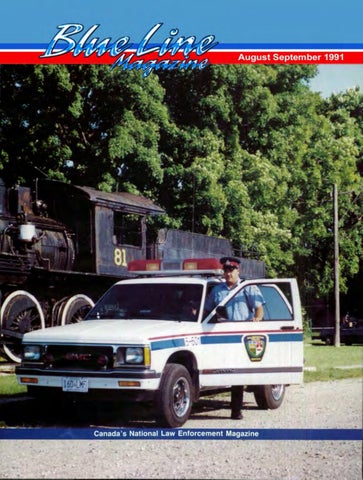
he cover photo for the summer issue of Blue Line Magazine showed several alternative methods of transportation other than th e trad itional police car. This month the Palmerston , O ntario, Police Service would like to show you that creative means of transportation can include the police car as well. After much study that agency decided that the old V8 engine, and a full size car, did not meet the needs of a small town police force. Read more about their reasons in this months issue. We hope you had an enjoyable summer. We now look forward to another exciting year and many more information filled issues of Blue Line Magazine. In future issues we hope to stimulate your imagination and will endeavor to make you think a little about the function of your day to day duties. We will be bringing forth some hard issues that must be addressed by many involved in management as well as fro nt line officers. We wish to encourage you to let us know what is happening in your area that may be of interest to yo ur colleagues . In novative projects or in teresting investigations wo uld be welcome by our readers. If yo u have a bit of a writers flare simply report the news to us and we will let you know what the possibilities are. You have nothing to lose and our readers may have much to gain from your insights.
Blue Li ne Magazine
Letters to the Editor We both enjoy the magazine and wish you continued success. More west coast exposure would be nice though. Jeff & Joanne Sim Vancouver, B.C.
•••
Editor's Notes: This was only one of several we received saying the same thing. We were intending on using that design for our new return mail card and while we were having them printed we decided to use the same design on our magazine pages. Un fortunately we forgot that there was not an obverse side with the address. It got by us for several issues before our ever vigilant readership pOinted it out to us. Thanks!
Editor's Notes: We have attempted to receive information for some time and made several requests through our magazine. We have received some information but it is still too skimpy. It must be the Rockys. The carrier pigeons can't quite make it this far. We have sent letters to aJ/ A.G's and .G.'s in the country for news r lease information . So far the only response we have received is from Ontario. They have placed our Editorial Fax line on their news release chedule and we receive good material from this source. We have al 0 received exceJ/ent co-operation from the new Ontario Special In vestigations Unit who keep us abreast of all investigations into police actions in the province. Any influence that can be brought to bear on our behalf would be appreciated.
I would like to say that you put together a very informative and enjoyable publication , and it is a pleasure to read . I would like to subscribe and have enclosed a subscription form for the magazine to go to my residence. I wish to keep them for reference. Once again, congratulations on a job well done. W.T. Demeau Westfield , New Brunswick
•••
•••
I have been reading your magazine since it came out and finally decided to take out a subscription . (I didn't want to chance losing an issue if the freebee's were to stop coming) . I was reading your January 1991 issue when I made my decision . On page 11 was an order form but there was no address. It took me some time to find it on the masthead on page 5 . Might I suggest you put the address on all subscription application forms from now on? Looking forward to MY first issue! Rick Hawes Estevan , Saskatchewan
•••
Having just finished reading your article on 'Traffic Direction', I would like to add my observations/ comments. When directing the traffic in the dark, remember to use the flashlight to give your directions, not your 'dark' hand . In Rule 4, you state that 'front or sideways to be shown , whichever is the larger mass .. .' I would say never if possible show your side, as one occasion I saw an officer escape being run over. He was in the intersection directing traffic, (at night) with his vest on and his flashlight in the opposite hand from the direction in which I was traveling, his side was to the oncom ing traffic and with the dark clothing he could not be seen . This is where white or fluorescent gloves are a necessity! He, the officer, must be 'lit up like a Christmas tree', primarily for his own safety; but it also indicates to the oncoming traffic, the officers exact position . My husband was in the police many years ago, and I am therefore aware of the many dangers of traffic control. I am in the business of distributing police products and I try to promote safety wherever I can . Joyce McLorn Tetragon-Tasse Mississauga, Ontario
FLASHES by Tony MacKinnon
"Com e on , once more round the block, lights & iren .. ... But this ti m e J get to splash the ski nheads! " MAC-
••• Blue Line Magazine Ii!iI September 1991 ~~~==---------------- ~ ------------------~----
EDITORIAL
Vol. 3 No. 7 . S e pte mbe r 1991 - EDITOR/ PUBLISHER Morley Lymburner
Protecting Our Egg Baskets
- EDITORIAL ADVISORS David H . Tsubo uchi , Ll.B. Edward Gunraj (P.o.A. Consulta nt) Mary Lymburn er B.A. M.Ed. Gerald A. Oxman l.c.l.A. Jaan Schaer B.A. (Metro Police E. A.P.) Tom Dykes Robe rt Hotston B.A. M.Crim. Rick Patrick (La mbto n College) The Editorial Advisors are persons from whom this publication seeks out advice and gUidance. The use of their names is merely for recognition of their assistance and ongoing support.
- ADVERTISING Alla n W. Stiver - CONTRIBUTING WRITERS Lo uise Dueck AI Po rte r • Richa rd Duplain • Daffydd He rm an n • Craig McMilla n • T. Richard Co lledge • Murray E. Milligan • Rock Dueck • Geoff Cates • Robert Hotsto n
- ILWSTRATION Tony MacKinno n • Be tte Clark Dave Sills Business Office: (416) 293·2631 Editorial: (416) 293·2631 Fax: (416) 293·0526 Advertising: (416) 294·5502 Fax: (416) 294·8952 Blue Line Magazine is published monthly, ten times per year by Blue lin e Magazine Incorporated wit h head office at 4981 Hwy. 7 East, Unit 12A , S uite 254, Markha m , O ntario Canada, L3R I N!. Editorial and copy is considered to be completely separate from advertising sales. No committ ment for editorial coverage can form any part of a sale agree· ment. All articles are protected by copyright. No part of this publication may be reproduced or transmit· ted in a ny form or by any means, electronic or mechanical, including photocopying and recording, or by any information storage or retrieval system without permission from the publisher. The au thors, advisors and publisher accept no liability whatsoever for any injuries to person or pro· perty res ulting from the application or adoption of a ny of the procedures, tactics o r considerations presen ted in this magazine. Readers are cautioned and advised that articles presented herein are edited a nd supplied for yo ur persona l awareness and sho uld not be referred to for further action until appropriate advice and guidance is received from a supervising officer or the advice of a Crown Attorney. Blue Line Magazine is an independant publication designed to educate and upgrade the skills of those involved in the law enforcement profession . It has no direct control from a law enforcement agency and its opinions and articles do not neccessarily refl ect the opinio ns of any government agency or police force. Blue li ne Magazine is Printed in Canada by Jo hanns Graphics. The sole a uthorized distrib utor . of Blue Line Magazine is Green Gables Book S hop, Ma rkha m , O ntario.
1l!181 . Association of Police Planners
Associate member. National
~ Member , Periodical
~ Publishers Exchange
ISSN #0847 8538 Second class mail registratio n No. 8242
September 1991
T
here is an adage that refers to putting all our eggs in one basket The wisdom in this makes good common sense when we relate that to the return of schooL These baskets represent an investment in the future. It is, therefore, very important to protect that investment We send our children to schools with the faith that they will be protected as well as educated . The reality is children are always at the mercy of the motoring public when they are attending those schools. The excitement of a new grade, teacher and friends can cause children's minds to wander and normal safety practices can be forgotten . Added to this are many factors which come together on the motorist For two months the daily commuter has not experienced the presence of school children . This is a dangerous combination. The School zone is the concentration point of vehicular and pedestrian traffic. The closer you get to a school the higher the concentration . Accordingly there is a higher risk of an accident occurring . There should be a
•
higher attention to ones driving. Motorists should be aware of their speed . Most school zones are posted at 40 km / h. Motorists should be aware that this is a "Maximum" speed. There is no excuse for driving at the maximum speed, let alone above it by any amount As a motorist you should be alert to children standing on the edge of the roadway. If you cannot establish eye to eye contact, then extra caution is in order. That child may not be aware of your presence. A quick scan of the wheels of parked cars can often reveal a pair of feet coming from between the parked cars. Two light (friendly) taps on the car horn some distance back could announce your presence but appear to most that you were simply saying hello to a neighbour. Every year across Canada many officers experience the grim reality of a child's death . We should work extra hard to prevent this experience. Don't forget to blitz those school zones. Someone has to protect all those "baskets ."
ENGINES STAlL SlDPS SINK & PlANES CRASH
•
But NEVER has any body armour failed to do what it was supposed to do.
NEVER!
•
The only time body armour fails is when it is not worn. Remember - It's your life. You decide.
Blue Line Magazine
Submitting Research And Development Proposals To The Canadian Po ice Research Centre - Inspector Richard Shaddick Manager, Canadian Police Research Centre
T
he Canadian Police Research Centre (CPRC) was inaugurated on May15, 1990. In order to keep the Canadian law enforcement community informed on police equipment research , the CPRC will periodically submit articles to the Blue Line Magazine that describe current developments. This article provides background information and respecting the submission of research ideas and proposals to the Canadian Police Research Centre. The CPRC strives to ensure that th e research projects it supports ad dress the operational needs of the police community. To this end , the CPRC encourages the submission of research proposals and ideas from all levels of the Canadian law enforcement community. Our request is very basic please tell us of operational re quirements that you suspect might be completed more safely, more efficiently, more effectively or at less cost by applying technology to the task. If you can propose a technological solution to a particular operational need your insights would be helpful , but this is not essential. We ask that you first identify the operational needs . We can then assist by gathering technical resources to devise possible solutions . The CPRC's research plan can then be established from a prioritized list of such proposed projects.
Blue L i n Magazine
The CPRC solicits research proposals primarily through an annual "call letter" that is sent in August from the Chairman of the Operational Research Committee (Canadian Association of Chiefs of Police) to the Canadian police community. Police agencies and Canadian industry may submit proposals or ideas to the CPRC Manager at any other time during the year, however, such proposals are most efficiently processed if submitted in response to the August "call letter". While a broad range of proposals may be received, not all will necessarily fall within the mandate of the CPRC. For instance, if the solution to a particular problem involves legislative decisions or policy changes, in addition to the technological developments, the proposal may be assessed to be outside the mandate of the CPRC. The focus of the CPRC is exclusively research , development or evaluation of police equipment. Liaison is maintained with the Solicitor General's Police Research Division with respect to social science input of technological innovation .
research proposals . Generally, little funding remains for proposals in the final category.
Category 1: research that is universally applicable to the Canadian law enforcement community and that impacts life/ health threatening matters. Category 2: research that is universally applicable to the Canadian law enforcement community and that impacts significantly on operational effectiveness. Category 3: research that is universally applicable to the Canadian law enforcement community and that has significant impact on cost effectiveness . Category 4: research that is not universally applicable but instead ad dresses a concern of a specific sector of the law enforcement community. Project Application Categories Once a project is approved it is categorized, for reporting purposes, according to application . The definition of these application categories is as follows .
Project Prioritization Guidelines
(A) RESOURCE MANAGEMENT Research needs often exceed TECHNOLOGY available resources . In order to deal computerized resource management with this reality the following definitechniques and applications tions are used for prioritizing all
IijIj
September 1991
~~~~----------------- ~ ------------------~----
(8) INVESTIGATION (1) Detection technology that facilitates the collection, identification or analysis of physical evidence (2) Identification technology that facilitates the identification of people or objects (C) PREVENTION
(1) Protection technology that protects people and property from threats of a criminal origin (2) Health & Safety health and safety equipment that im p roves t h e police working environment (3) Countermeasures technology that helps police investigators anticipate or prevent criminal activity.
"PEACEMAKER"
Proposal Submission Document reviewing agencies will be considered when establishing the relative prioriIt is recommended that research ideas ty of each proposal. A Research Plan or proposals be forwarded to the is drafted by the CPRC staff with in CPRC on a 'Research and Developput from the Operational Research ment Proposal' form . Committee of the Canadian AssociaPhotocopies of this document can be tion of Chiefs of Police. The final used or original forms can be obtainCPRC Research Plan is established ed by contacting the CPRC. Please and approved by an executive complete each section of the form as committee. completely and comprehensively as To be successful, the CPRC re possible. Each proposal must be signquires cooperation and input from the ed by an executive level officer of the entire spectrum of the Canadian law submitting agency. enforcement community. In his opening remarks at the CPRC inauguraProposal Review And tion , Chief Colin Millar summed up Prioritization the reality of the situation: 'This CenEach research proposal is evaluated tre ... is your Centre ... it is a good idea! for technical feasibility and potential Use it... and support it'. value to police operations. The For further information please contechnical evaluation maybe com- tact the staff of the Canadian Police pleted by either police technical units Research Centre, P.O. Box 8885, or external scientific agencies. The Ottawa, Ontario K1G 3M8, operational evaluation will be com- Phone: (613) 998-6343 or pleted by selected police agencies. Fax: (613) 952-0156 . The details provided by the submitter as well as recommendations of the
Polaroid ACOMPLETE
I1's your occupation.... Now let it be your publication!
MP 4MULTIPURPOSE PHOTOGRAPHIC
T he PEACEMAKER is published quarterly by the Canadian Fellowship of Christian Peace Officers (CFCPO), a federal non -profit corpora tion which encourages peace officers locally, nationally and internationaly to join in fellowship. If you would like to be placed on our mailing list, or would like to receive more informa tion about CFCPO membership, send your request with your name, occupa· tion, address and phone number to :
STUDIO WITHOUT
Canadian FCPO PEACEMAKER, P.O. Box 520, Stn. -A-, Scarborough. Ontario
MIK5C3
-
INSTANT CAMERA
ADARKROOM • This unique modular camera can do just about any photographic recording job quickly and easily, with no need for a darkroom or extensive photographic ski lls. • A copy I photomacrographic I photomicrographic recording system • Can be used as an off-stand view camera for the studio or laboratory • Makes prints, 3Smm slides and overhead transparencies.
Call the Henry's Industrial Team (418) 888-0872
~l=I~L-J..~~1 L ___ ~~ 119 Church St. , Toronto, Ont. M5C 2G5 Henry's is a division of Cranbrook Glen Enterprises Limited
Regina Vs. Richardson 1110-005 (10 Pages )
. . '.:",.".A ... A ..{.,,'......x"""'. :.j"':""~l'~'·'l;;;'01h·,
Accused 's belief in breath test no excuse A St.Thomas, Ontario, man has been convicted of refusing a Breathalyzer test even though he demanded a blood test be taken because he did not believe in the accuracy of the instrument. The Ontario Court of Justice heard evidence regarding a British Colum bia decision (Regina Vs. Lewis) which stated a person who honestly feels the Breathalyzer is not accurate and wishes to give blood should be given the opportunity if the tests can be done in a reasonable time. This argument was rejected by the Ontario Court of Justice appeal. Mr. Justice Lester C. Misener stated the B.C. decision could not be followed because it altered the scheme of the Criminal Code too drastically and without cause. He stated Parliament had decided that Breathalyzer tests
would be 'deemed to be fair in the interests of society as a whole.' He continued by saying it was not up to the courts to determine otherwise. The case involved a man stopped by officers in the St.Thomas area for driving while his ability was impaired . The officers took the man to their station on demand he blow into a Breathalyzer. The accused refused stating he did not beleive in the Breathalyzer and that 'Blood was the only way to go for alcohol content.' The officers charged the accused with refusal and at the initial trial before a St.Thomas area Judge the accused defended himself with the British Columbia Regina Vs. Lewis defence. At that time the presiding judge accepted the argument and dismissed the charges . It was then appealed to the Ontario Court of
Justice. At the appeal Justice Misener lashed out at the B.c. decision stating it never considered the fact Parliament had decided the provisions for blood samples would be quite limited and the Breathalyzer test would be the normal way to perform the tests. He stated further it was unfair of the B.c. decision to use ammendments created to enlarge on the police ability to stop drinking drivers in a manner that would limit their abilities. Accordingly the Justice overturned the acquittal and registered a conviction . It is believed that this case is to be appealed to a higher court. In the mean time this is the law for Ontario police officers . Until the Supreme Court decides the issue the rest of the country will have to toss a coin . Stay tuned (or subscribed) for round three.
Tapping A New Vein Of Security A
new identity checking technique developed by British scientists uses the pattern of veins on the back of a person's hand as a unique characteristic like a fingerprint. It is predicted to provide a convenient foolproof way of validating electronic fund transfers in banking and shops to avoid fraud , as well as for military and other security applications . A prototype of the Veincheck system has been developed by the British Technology Group (BTG) and Cambridge Consultants (CCl) to a stage that will allow full commercial exploitation . It uses the individual layout of internal veins in the hand , in a way claimed to be quick, easy to use and more acceptable to the public than other systems such as retina scanning or fingerprinting . Using Veincheck in a cash dispense, for instance, would involve placing a clenched fist under a scanning camera for a few seconds and inserting a smart card in the machine.
Btu Line Magazine
The system's processor would com pare the scanned image with vein pattern data stored on the card and verify identity immediately, without the need to input a personal identification number. Retinal scans are generally con sidered intrusive and awkward to use, while for many people fingerprint recognition techniques have criminal connotations. Other electronic techniques have been developed to recognize signatures by sensing pressure or acceleration of the writing implement or acoustic waves, but according to CCl recent research suggests that when these methods are relied upon, forgery can be successful without even having to imitate the shaped of the signature. Veincheck, on the other hand , is almost impossible to fool as it recognizes the internal vein tree, or pattern , rather than any surface characteristic that can change with age, use, or damage.
A compact demonstrator machine has been built and tested with a database of images . In it , a silicon - based camera uses an optical system at infra-red wavelengths to scan the vein pattern and shape of the hand . Oxy-hemoglobin in the blood stream absorbs certain wavelengths. The system can discriminate between hemoglobin and oxy-hemoglobin , and hence between veins and arteries, giving enhanced accuracy. The success of the technique is due to the fact that veins in the hand move in a two-dimensional manner, and the software includes a two -dimensional algorithm that provides a high degree of tolerance to hand positioning in the scanner. Future systems will also include hand outline information (lPS) . For further information contact Cambridge Consultants Ltd ., Science Park , Milton Road , Cambridge, England CB4 4DW phone + 44 223 420024, fax +44 223 423373 .
~ ______________________________~ep~t~~~~ ~~1~99~1__
Regina Vs. Prevost 1109-011 (5 pages)
Evidence at third interview admissible The British Columbia Supreme Court recently ruled that a statement taken by police, one in which they failed to advise the accused of his Charter Rights, was admissible after they rectified the breach at a later interview. The accused in this matter was taken into a police station in Van couver and asked certain questions surrounding a homicide. The officers did not give the accused his Charter Rights before taking the exculpatory statement. The following year the police asked the accused to come to the police station and at that time they advised him of his right to counsel and his
right to remain silent. He was further advised that he could leave if he wished . The officers read the accused his statement from the year before and simply asked him if this statement was correct. The accused acknowledged that it was. He was then charged with second degree murder. At trail the judge would not allow the statement to be entered in evidence and this was appealed to the higher court where they determined that it was admissible. The Supreme Court ruling stated 'the failings of the first statement were cured by his being called back in and told what the police wanted to do, that he was en -
titled to consult a lawyer and he was entitled to leave at any time.' The court continued, 'That may have been a ruse by the police, so be it. It is not such an event as in my view amounts to trickery and it is not such behaviour as would call the ad ministration of justice into disrepute. Indeed, I think the public would be rather surprised if they were told that the police, having made what may amount to a Charter error, could not ask the accused back in to repeat the interview under circumstances where he was properly warned .'
Regina Vs. Sherwood 1103-007 (13 pages)
Grounds for arrest must be given A police officer must advise either the accused or his counsel of the basis for arrest or risk dismissal of charges. This ruling was made last April by a B.c. Supreme Court ruling that saw an ability impaired charge dismissed because the arresting officer refused to tell counselor the accused the basic grounds for the arrest before the accused blew into the Breathalyzer. The officer saw the accused violate a red traffic light and upon stopping the vehicle smelled a strong odour of an alcoholic beverage in the car. The officer noted the accused's eyes were red and glassy, and that he had dilated pupils and slurred speech . Upon forming the opinion that the accused's ability was impaired by alcohol the officer appropriately arrested the accused , advised him of his right to retain and instruct counsel without delay, and demanded the accused accompany him for the purposes of supplying samples of his breath for analysis. The accused complied with the officer's demand and upon arrival at the police station he was placed in a
September 1991
private room to speak to duty counsel. At that point the lawyer asked the accused to find out what the grounds were for the arrest. The officer refused to tell counselor the accused what his grounds were. It was on this point alone that the court dealt with . At the original trial the accused was convicted of refUSing the breath test. The trial judge stated that the officer had reasonable grounds to make the demand and acknowledged that the lawyer would have been better prepared to give appropriate advice if the grounds for the arrest were known . The judge still convicted because he was doubtful that the officer's refusal to give reasons to the lawyer constituted a breach of the accused's 10 (b) rights. Upon appealing this matter to the Supreme Court of British Columbia the charge was thrown out. Mr. Justice Herbert Oliver stated that 'once the right to counsel has been asserted, the state has an affirmative obligation to respect and preserve the accused's choice by not acting in a
iii!
~----------------- ~
manner that circumvents or dilutes the protection afforded by this right.' The justice continued by stating that the officer was not asked to do something that would have imposed an onerous burden upon him . 'In order for the right to counsel to be meaningful and effective,' Justice Oliver continued , 'it is necessary for the detainee to obtain sufficient information to assess, with the aid of counsel , the extent of his jeopardy.' Under these circumstances the officer was duty bound to provide the accused , when asked , with sufficient information as to the basis for his arrest, 'to enable the detainee when instructing counsel to obtain meaningful advice as to how to exercise his rights and duties.' Upon dismissing the charge J ustice Oliver stated that the accused was not using delaying tactics and asked for very simple information from the officer. The officer's obstinate refusal to give the accused this information reduced the ability of the accused to take advantage of his right to counsel.
Blue Li ne Magazine
Police Books from BuHerworths Priscilla Platt
NEW
Pollce Guide to the Young Offenders Act $24.95* /Pages: 224/Softcover / ISBN 0 409 89340-4/March 1991
'This practical, up-to-date guide has been written specifically for police officers and law enforcement instructors to help them deal with the issues raised by the Young Offenders Act in their daily activities. This work is thorough, authoritative, and practical. Designed to mirror a police officer's experience, it deals with the issues as they would arise in practice: from investigation and arrest up to sentencing. Written in everyday language, it is easy to follow and particularly well organized for fast, easy reference. Contents: Foreword • Preface • Table of Cases • Introduction . The Declaration of Principle . Age . Notices to Parent . Fingerprints and Photographs • Protection of a Young Person's Privacy . Offences • The Admissibility of Statements Made by Young Persons . The Information . Bail . Alternative Measures • Medical, Psychiatric and Psychological Assessment • Transfer to Ordinary Court . Pre-Trial Matters . The Trial Process . Sentencing . Review of Dispositions . Records Priscilla Platt, LL.B., is currently legal counsel to the Ministry of the Attorney General (Ontario), She was admitted to the Bar of Ontario in 1977 and has practiced criminal law extensively, first as defence counsel and then as prosecutor in Youth Court. She is an authority on the Young Offenders Act, having already written the well-received Young Offenders Law in Canada and is co-editor of The Young Offenders Service, both avail abe from Butterworths.
Butterworths ~
A. Shako or Manraj Paul D. Haines
NEW EDITION
James A. Fontana
NEW EDITION
The Law of Search and Seizure in Canada
The Law on Speeding and Radar
3rd Edition
2nd Edition
$145.00* aEProx./Pages: 960 aPErox./ Hardcover/ISBN 0409 89873-2/February 1992
$44.95* approx./Pages: 168 approx/Hardcover/ ISBN 0409 90376-0/July 1991
This popular book offers a thorough, in-depth analysis of the use of radar, its advantages and disadvantages as a speed detecting device, and sets out useful suggestions and guidelines for effective and meaningful use of radar by police officers. The 2nd edition fully updates and expands the first edition. It discusses the significant developments in legislation, caselawand technology since the original title was published in 1985.
-NEW
Thomas McGuire/Faye Grant
Understanding Chlld Sexual Abuse Therapeutic Guidelines for Professionals Working With Children $9.95* /Pap,es: 60 /Softcover / ISBN 0 409 89771-0/1990
"... the text has been widely recognized by trial and appeal courts throughout the country as a bible on search and seizure law." - Ontario Lawyers Weekly This is the definitive Canadian work on the subject. It analyzes the various processes of issuing and executing search warrants, as well as the different kinds of searches and seizures possible under the Criminal Code and other federal and provincial statutes. The effect of the Charter is closely scrutinized. The 3rd Edition enhances the previous edition to include current caselaw and Charter decisions, warrantless searches, a comprehensive and detailed study of all aspects of the law of search and seizure, the formal requirements for search warrants, the role of the issuing justice, the role of the executing officer, special searches under the ITA, FDA, NCA, CCC, and the effects of the Charter on the search process.
Often, police officers are the first professionals who must deal with children and their families in difficult abuse situations. Here is a manageable, practical book to aid all professionals who deal with sexually abused children in Canada.
Brian K. Cxydennan Chris O'Toole Augle Fleras
NEW EDITION
Police, Race & Ethnicity 2nd Edition $20.00* approx/Pages 350 approx/Softcover / ISBN 0 409 89874-0/January 1992
This insightful and important book helps police deal more effectively with ethnic and racial minorities. It offers useful guidelines for "on the street" level of policing and, at the same time, provides officers with administrative considerations. This revised and expanded 2nd Edition thoroughly updates the first. New information has been added on police shootings, Task Force on Race Relations, community based p0licing and cultural sensitivity, and a new chapter on the Vietnamese.
o Butterworths gg Call our Order Service Department and have a Butterworths representative contact you with more details. Call Toll-Flee 1-800·668·6481 24·HI. Fax , (416) 479·2826 ·Prices and other details subject to change without notice. All Butterworths publications are available on a 3O-day approval basis. Shipping. Handling & GST Extra. Butterworths Toronto 75 Clegg Road, Mar1<ham Ontario, L6G 1A1 Tel. (416) 479-2665 FAX: (416) 479·2826
Butterworths Vancouver 1455-409 Granville Street Vancouver, BC V6C 112 Tel. (604) 684-4116 FAX: (604) 682·5n9
Prob em Solving: An Approach To Community Policing That Makes Sense - Renee Lapierre, Ph.D. -
W
hat is problem -solving polic'Problem -Oriented policing ... in its ing? Is it the same as problem broadest context... is a whole new oriented policing? What is the rela- way of thinking about policing that tionship of these approahces to com - has implications for every aspect of muntiy based policing, or to use the police organization, its personnel, another frequently -used term , com - and its operations.' Keeping in mind that all of these munity policing? Sound confusing? You'r not the only one who has concepts that we have just discussed recognized that. are very compatible, let's go back in In their book, Community Policing history and trace the recent roots of A Contemporary Perspective, our prevailing mode ot policing, and which was published in 1990, police then talk about the problem-oriented, researchers Robert Trojanowicz and or problem-solving, approach to comBonnie Bucqueroux recognize this munity policing. In recent police history, what is confusion: 'Confusion ... surrounds the rela - commonly referred to as the 'profestionship between Community Polic- sional model' emerged in the early ing and Problem -Oriented Policing 1960's in the United States. It emerg(also called Problem -Solving Polic- ed largely in response to police coring), which are different but compati- ruption which was widespread in ble concepts. Essentially, Problem - American cities from the 1930's to the Oriented Policing asks line officers to 1960's. You'll recognize the model us their heads, to look for the it operated unchallenged until roughly underlying dynamics behind a series 1970. The professional model was of incidents, rather than to focus on characterized by ; the individual occurrences as isolated • centralized control events. The confusion arises because • tight organization Community Policing urges (com • pinpointed responsibilities munity police officers) to use • strong discipline Problem -Solving techniques .. .' • efficient use of personnel and technology Whereas Trojanowicz and Bucqueroux recognize a position called • higher standards of recruitment 'Community Police Officer', Herman and training The professional model emphasizGoldstein, called the 'Father of Problem -Oriented Policing', has a ed greater operating efficiency (we broader view. He, and those who became very concerned with speed follow his line of thinking, advocates and response times) , and it extendthat problem -oriented policing be ed in the 1970's and 1980's to all done by all members of a police kinds of new technologies. Some exorganization , including the Chief, the amples are radiOS, computers, fac frontline officers, and the civilian simile machines and cellular memebers of a police service. Golds- telephones. The last two decades have been characterized largely by a tein explains:
Blue L ine Magazine
host of technological developments and highly specialized approaches . The professional model of policing was thought to be working just fine until the late 1960's and early 1970's. In his classic book, Policing a Free Society (1977) , Goldstein said that the reality was different from the organizational image; that individual police officers were found to be routinely exercising a great deal of discretion in deciding how to handle the tremendous variety of circumstances with which they were confronted .
N EXT MONTH: The Emergence of CommunityBased Policing Dr. Renee Lapierre holds a Ph.D. in Educational Administration from the University of Calgary. After serving as Co -ordinator of Program Development and Evaluation at Camosun CoJJege, in Victoria, British Columbia, she joined the Calgary Police Service in 1982. She designs and instructs training programs. She has been a guest lecturer at the Canadian Police CoJJege in Ottawa, the Regina Police Service, the Medicine Hat Police Department, the Siksika Nation Police, and the Justice Institute of British Columbia Police Academy. In 1990, she organized the 17th Na tional Police Educators' Conference, which featured community policing as one of its dominant themes. Also in 1990, Dr. Lapierre addressed the Prairie Chiefs of Police Conference on the topic of teaching problem-solving.
September 1991
Cost Versus Suffering
Seat Belt Violations - Morley Lymburner Courtesy of Update MTP I can understand getting a ticket for going through a red light or even for going through a stop sign but getting a $78.00 ticket for not putting on a seat belt seems a little heavy. Especially when I just forgot.
T
his is an understandable statement from a person who is on the receiving end of this type of violation . It is quite often followed by considerable abuse when the ticket is eventually tendered. The intent of the citizen , of course, is to make the officer feel that he is less than a kind considerate person for issuing the ticket in the first place. The attitude of community based policing and the kindly cop on the beat is one that deserves a lot of attention and does create positive feed back to the policing profession . It should be pointed out, however, that the concept of the good guy cop must stop at a certain point. The majority of police work is keeping people from their own misadventure and the majority of traffic enforcement is keeping good guys from hurting good guys. Unfortunately much of this misadventure causes good guys to cost the tax payers a lot of money. The seat belt laws are designed with one purpose in mind , to reduce the number of people who get hurt. Most of these people are good guys. They are people like you and me who decided that they just don't care enough to buckle up. The subsequent injuries they receive in car accidents are tantamount to a king's ransom in the cost of hospitalization , compensation , and rehabilitation . On this count alone, no person has the right to enter a motor vehicle without wearing a seat belt. In essence every ticket issued for this violation is not only
September 1991
putting money directly back into the taxpayers' hands through fines , but is also saving collateral costs that are indirectly sapping money out of the public purse in higher hospital costs. A recent study revealed some very pertinent facts about the effect of seat belt enforcement. Two sets of statistics were tracked with the Metropolitan Toronto Police Force Records Bureau. The first set was the number of persons injured in car accidents from 1975 to 1986 and the second set was the number of tickets issued for seat belt violations from 1977 to 1986. The results of the figures obtained told a revealing story. Seat belt legislation was first introduced in 1975 and , with great media attention , was brought into force in 1976. The public perception of getting a ticket for something that was not viewed to be all that serious was enough to bring an abrupt decrease in the number of persons injured . After many years of injury statistics that annually varied by plus or minus 10 to 50 persons injured, we experienced a reduction of 3 ,732 injured people. It would be another four years before the injury figures returned to th e pre-1976 level. However, the real story in all of this was the effect police activity had on the number of persons injured . Tracking the number of persons injured in accidents with the number of seat belt tickets issued makes the enforcement story crystal clear. Comparing these statistics revealed that whenever the enforcement activity increased , the number of people hurt decreased . This occurred enough times over a ten year period to take the figures out of the realm of shear coincidence. The study reveals that each time the police react to a change in the
injury pattern , it has a direct impact on the public. On many of the occasions it was found that other factors affected the police ability to enforce. After a high enforcement figure in 1981 enforcement steadily dropped and this corresponded to a dramatic increase in people injured . From 1981 to 1984 seat belt enforcement steadily declined . Compounding this problem was the dissemination of the Traffic Units in response to th e Hickling and Johnstone Report. This report stated that the police force should study the concept of moving the responsibility of traffic enforcement over to the general patrol units. The concept was instituted in 1983 and lasted the next three years. The impact on the community was dramatic in terms of human suffering. In one year (1984 to 1985) around five thousand additional people were injured in accidents. This 22 % increase was found to be intolerable and the decision was made to reinstate the specialized traffic units. The lessons learned from the statistics indicate that there has to be consistent attention brought to seat belt enforcement. It takes a considerable amount of enforcement to make a marginal difference in pain and suffering . Once that s u ccess has been achieved , history has shown us that we can not afford to sit back on our laurels; one needs to be consistent over a long period of time. P ublic education is further needed to seek voluntary compliance. The only real measure of success in all this will be the reduction in human suffering. A public that is aware of the extended and hidden costs of failing to wear seat belts can only benefit us all . •
Blue Line Magazine
Where Law Is The True Order - Murray Sayle Courtesy of CJ International
Y
ou're likely to meet him down the meanest back alley in Japan , day or night. He's usually on foot or a white bicycle, rarely in a car. He carries a gun , discreetly covered in a leather holster, seldom drawn , and a green striped armband to show he's on duty - although he's never off duty. He smiles as he studies your face , comparing it with a file of mug shots in his head . The Japanese police officer is not, however, known by friendly nicknames. Everyone addresses him , respectfully and a trifle nervously, as 'O-Mawari-San' - 'Honourable Mr. Walking Around .' Police shoe leather and bicycle tires are undoubtedly some of the ingredients of Japan's low crime rate, and the figures are indeed remarkable. For 117 million people Japan has just over 200 ,000 police officers, one for every 5 5 people, an adequate but not excessive population of men in navy-blue (and a few women , who carry no guns.) There is a riot squad armoured like medieval Samurai , but they seldom have much to do. Danger Japan has less than half the crime reported in Britain , which has barely 50 percent of Japan's population - an over-all crime rate a quarter the British average, a tenth of the United State's. The Japanese murder rate is 1.8 per 100,000 people and has been fall ing since the 1950's. The British rate is 2 .4 and rising fast , the American well over 10. Armed robberies, purse snatchings and muggings are reported in Japan at a yearly rate of 2 .1 per 100,000 people. In Britain the number is 23, in the United States 21 , or one hundred times the Japanese figure. These figures translate into a daily
Blue Line Magazine
life that some very old people in Britain might dimly remember from happy childhoods and Americans might find frankly incredible. There are no unsafe streets or dangerous areas in Japanese cities. I have never seen a vandalized telephone box or a broken-open vending machine (both liquor and cigarettes are sold everywhere from unattended machines.) Convenience stores are frequently open all night, with women in charge, and have neither watchdogs nor alarm systems. Houses in the suburbs, in small towns and the countryside are rarely locked, and I personally don't own a doorkey. Far from being overcrowded schools of crime, Japanese prisons have 25 ,000 empty places . Why? This question has intrigued countless visitors, particularly those from New York, a locked-up, terrified city, and from the British cities rapidly moving in the same direction . Japan is not a totally crime-free society - has there ever been one? but crime is certainly low on the list of Japan's problems . It barely, if ever, touches the lives of ordinary people. A lot of explanations focus on the police, their habit of constant walking around and the unique system the Japanese call ' Koban ', which translates as 'police box .' A 'Koban' is actually more of a combined home and office, and most Japanese police officers live in one. A Japanese police box consists of a room with a desk, chairs, filing cabinets and fading , never-changing posters of wanted bad guys. The police officer, however, is seldom at his desk, but is usually out visiting. Regulations say he should call on every house in his area twice a year. Ours generally taps on the door, explains that he happended to be walking past and politely invites himself
in for green tea and a chat, offering a gift of sticky rice buns. Confessions This is all very friendly - but the Japanese police thus keep tabs on everyone in the country, how much money they have, and should have, what work, if any, they do, whether children are going to school or husbands abUSing their wives. Not surprisingly, 95 percent of Japanese convictions are obtained by confessions - the interrogator already knows the suspect's vulnerable points (and suspect's can be held in a Koban for up to three weeks, while their families are brought in 'to help clear up this problem'). Third degree methods, beatings, sleep deprivation and so on? Sublte, un -provable, immense - and universal. What about punishment? Japanese prisons are undercrowded , and not particularly severe, but they're depressing. I'm told the aim is to bring prisoners to repent and rejoin the Japanese family. Hanging is retained because every poll reports that 70 to 80 percent of Japanese think that 'cruel or vicious crimes demand blood for blood .' The death penalty is rarely pronounced - 25 to 30 are handed down every year but only two or three are actually carried out, sometimes decades after the sentence. A certain Dadamichi Hirasawa , for instance, convicted of poisoning ten people in 1948, finally died in prison three years ago, aged 95, after 18 appeals and 40 years on death row. Successive justice ministers, finding the evidence too bizarre to be absolutely convincing, simply refused to sign the death warrant. Similarly, a disturbed youth named Norio Nagayama who shot four
~ ________________________________~~wm __b_~_1_9_ru__
people, one of them a police officer in 1968 - 'in retaliation against a wretched childhood' according to one of his literary friends - wrote four successful novels on death row and only lost his final appeal in January 1989, 22 years after his conviction . Altho ugh the law says that he should die within three months of the order being signed, neither I nor anyone in Japan can findout whether he has been hanged or not. If and when the time ever comes, the condemned simply disappear from public view, forever. Why? 'To protect the human rights of their families: Only family members are told that the sentence has been carried o ut, and they are entitled to keep the grim news to themselves, out of shame.
Here we are getting close to the real reason for Japan's low crime rate. Criminals bri ng shame to their families . Those who live without working bring shame to their families . Forbidden
Japanese who insist on a life of crime are recruited by one of Japan's 2,000 odd criminal gangs, with 240,000 members - outnumbering the police - where they are expected to put in office hours, accept discipline from the boss and generally behave like any other hard-working Japanese. Gangsters commit a quarter of all Japan's murders (of each other) but they rarely trouble law-abiding citizens, routinely inform on freelance criminals, forbid drug dealing, except to other gangsters , and keep
Japanese cities free of unorganized crime. Even so, they find it almost impossible to find respectable husbands for their daughters without first taking an honest job themselves . Can Japanese crime-fig hting methods be exported? The secret noose, Japanese style can have little effect on the crime rate, and hanging people on the quiet violates all British tradition . So does Japanese police snooping, a reminder of Japan's thousand -plus years of military dictatorship. Japanese shame, too, travels poorly. The methods are, alas, not for us, even if the results are so enviable.
Murray Sayle is a Tokyo correspondent for the Daily Mail.
Mail Order Products
o Ultimate Survivors ( New Video)
$75.95
0
Surviving Edged Weapons (Video) $65.95
0
Tactical Edge
0
Street Survival
$58.95 $46.95
o Five Minute Policeman o Boss Talk
$13.70 $13.70
o CaseManager (Computer Software) $310.00 o CaseManager (Single User Version) $150.00
Sales Tax _ __ Total
7% G.S.T. to be added . Ontario Residence add 8% P.S.T. (Shipping charges included in prices)
o
Send Invoice with product (This service available to Paid Subscribers and lAw Enforcment Agencies Only)
o o
Please Charge my MasterCard or Visa # _ _ _ _ _ _ _ _ _ _ _ _ _ _ _ _ _ _ Exp.
Signarure: _ _ _ _ _ _ _ _ _ _ _ _ _ _ _ _ _ _ __
Cheque Enclosed Name: _ _ _ _ _ _ _ _ _ __
Province: _ __ __
eptember 1991
/
Addr~s:
_ _ _ _ _ _ _ _ _ _ _ _ _ _ _ _ _ _ ____
Postal Code: _ __ __ Phone ('--_ . . .)1._ _ _ _ _ _ ____
Blue Line Magazine
Du Pont Has a Pretty Wearing Personal NEWKEVlAI
Thin Argument for Body Armor••• 129
More Comfort ••• Same Protection We've h eard your arguments: "Body Armor is heavy," "It's hot," " It's stiff," "It's bulky." No w h ear ours: New KEVLARo129 is a major breakthrough in body armor comfort. Vests can now be made 15 to 25% thinner and 10 to 20 % lighter. KEVLARo129 is also softer and more flexible , allowing body armor to bend and twist more freely. It moves with you. What's more, there is NO loss in ballistic protection. KEVLARo129 is 15 % stronger than KEVLARo29-a 65,000 p .s.i. increase in tensile strength. This means that a lighter, thinner vest of KEVLARo129 can offer the same level of protection as its heavier, bulkier KEVLARo29 predecessor. The big difference is that you stay comfortable. We both know that body armor can save lives . We think it's worth a little argument to save yours . New KEVLARo129 is available right now. To get more information about this major break through in body armor comfort, call Du Pont at: 416-8 21-5601. New KEVLARo129 ... Today 's most advanced technology for personal body armor. Acce pt n o substitutes. KEVLA R is a Du Pont registered trademark for its aramid fiber. Du Pont does not make ballistic fabrics or garments .
Uncommon Problems . Uncommon Solutions. KEVLAR from Du Pont.
<[OPORP C AN AD A
_ . _ - - - - - - - - - - - - -- - - -- - - - - - - -
... news beat ... news beat ... news beat ... Australian Police Cleared I n Jail Deaths An Australian Royal Commission in to the deaths of 99 Aborigines lodged in police cells has absolved police and prison officials of wrongdoing. The same report, however, has come out criticizing police holding cells and some police practices. Describing police facilities for prisoners as appalling the Inquiry reported that some cells had no lights, bedding or sanitary facilities of any kind . Many had iron rings in the middle of the floor for prisoners to be shackled . The report complained that many officers checking on prisoners did so too infrequently and did not pay particular attention to inmates when they did check. The inquiry investigated the circumstances surrounding 99 deaths in Australian holding facilities over a 10 year period . It was pOinted out that Aborigines make up only 1.4 per cent of Australia's 17 million people but account for over 29 per cent of the prison population . Of the 99 deaths over thirty died from hanging themselves by tearing sheets into strips. Others used shoe laces and one in particular mutilated himself with the handle of a paint brush through his eye before he died. The report concluded in too many cases, 'officers failed to recognize the signs of serious illness or injury until too late. Most of these due to either the very cursory or infrequent nature of checks.' One of the recommendations of the inquiry stated that officers should consider arresting Aborigines only as an absolute last resort. Most violations are for abuse of alcohol and the report urged other alternatives to incarceration be studied .
Although the Commission could find no blame in any of these deaths on the part of the police they did find the methods used to investigate the deaths was poor. Another recom mendation was to screen future police officers for racist tendencies. The Royal Commission took over 3 years to complete and cost around $30 million .
creased the mandatory retirement age from 57 years to 60 years for all ranks up to Inspector.
London England Police to Lose More Armed Officers
In spite of a growing desire of English Police Officers to be armed , the Metropolitan London Police has decided to reduce the number of armed officers by 1,000. Presently only 2,500 officers of this 22,000 strong police force are certified as authorized firearms officers . The Last May the Republic of Ireland's police force wishes to reduce this National Police Force, the Garda, number by next year to 1,500. The reason for the reduction was deemed it appropriate to permit female members of that force to wear due to a report released last April slacks in place of the skirts traditionally which indicated that the firearms officers were under-used . The force worn . The new regulation change breaks has decided that it would be better to an established order put in place in reduce the number of armed officers 1922 when the Garda was first form - and spend more time training the ofed . The Garda presently has an ficers that exist. This reduction , it is reported , will established strength of 10,500 officers. permit the u.K. Capital to have five Of this number 400 are female. Although the regulation change is Armed Response Vehicles on patrol welcome by the female members of at all times. However in the same the Garda it was quickly added they report it was stated that not all Arm would be expected to wear the tradi- ed Response Vehicles will have arm tional skirts in the summer time. It ed officers as the majority of the calls would appear men and women of- they respond to do not require an ficers in Ireland differ in their ability armed officer. Recent polls in England have to handle summer weather conditions shown varying results as to the in trousers. Most Canadian female officers number of officers who wish to be changed over to slacks over ten years armed all the time. One study perago and do not wear skirts even with formed by a police force indicated nearly 24 per cent of officers wanted ceremonial dress. Other changes announced will see to be routinely armed. Another study an increase in established strength of performed by the police Federation around 1,000 new officers. Garda of- indicated the number to be close to ficers have a two year training pro- 50 per cent. This varied dramatically gram before being placed on the beat. from a similar survey in 1989 in which The May announcement also in- only 10 per cent wanted to be armed .
Women To Wear Slacks Among Many Changes For Irish Police
~B=l~~L=iM ~M~~ ~~ =·~M~_________________________ ~ ______________________________S~ ~Wm __b_ ~_1_9_ru__
I
... news beat ... news beat ... news beat ...
Central American Police To Receive Human Rights Training Several Central American Governments have agreed to have members of their police forces trained in Luxembourg on the subject of human rights. Police from Guatemala, Nicaragua and El Salvador have been accused of numerous human rights violations that have come under the scrutiny of the World Court in the Hague over several years. European Community ministers made the agreement to supply training to the Central American Countries last March although the exact details are still to be worked out. A spokesman for the Luxembourg Government stated that the most important factor was that the three countries readily agreed to the plan . It is believed the program will also be extended to the military as well.
Record Gun Sales In South Africa South African Police issued 215,000 gun licences last year, a 74 percent increase on the previous year, despite the growth in violent crime. A police spokesman said a further 11,500 applications for licences were rejected . The figure took the total number of licences issued to more than three million . Most licensed guns are owned by the five million whites. The official reason for the increase is criminals regularly use AKA 7 automatic rifles, many smuggled in from Mozambique, in robberies and vehicle hijackings.
September 1991
Police Charges Found To Reduce Spousal Assaults Last year, London police laid charges in 89 percent of wife-abuse cases, almost twice the national average, according to a 109 page report released in July by the London Family Court Clinic. The report, titled 'Wife Assault As A Crime', reported a 20 percent reduction in spousal assaults over the past seven years. 'We as a society learn by the message that comes out from our criminal justice system ,' said Jan Richardson, executive Director of Women's Community House, Lon don 's only shelter for battered women. 'And the message that's coming out in London is that wife assault is wrong, it is against the law.' In 1989, London police officers were told to lay charges in all cases where they beleived an assault had taken place, regardless of the wishes of the victim . They were the first officers in the Province to receive such orders. The report stated that 'Abused women in London are far more likely to be treated with greater
understanding and sensativity, provided with consistent information and referred to appropriate services than victims elswhere in Canada .' London Police Inspector Brian Crump said the police force at one time felt that domestic assaults could be best sorted out by those involved if the judicial system were not invoked at the first opportunity. 'We believe now, and studies have supported it, that this is not the case, that laying charges is the best way to handle the situation .' The benefits of proceeding to court shows all parties involved the true purpose of having police intervene in such disputes . The experience of going through the judicial process quite often convinces abused spouses to take more appropriate action through social services and agencies other than the police. Richardson said it is important that women feel they will get the help they need when they telephone the police. The safety net is there, and that safety net comes whe n they dial 911 because they're frightened and they get a police officer who listens to them , believes them , and takes the issue very, very seriously.'
~~~~~------------------------------,
FLASIlES by Tony MacKinnon
"If you got all this gold from spinning straw Rumplestiltskin, how come it 's all in stolen courier bags?"
------- ~
Blue Line Magazine
PROFILE
The Winged Wheels
I
n 1990 Chief of Police, Wm . McCormack authorized the formation of the Metropolitan Toronto Police Winged Wheels Precision Motorcycle Team . Th present strength of the team is twenty -four officers. The riders are stationed at the four Traffic Units throughout Metropolitan Toronto. The Winged Wheels are under the Command of S / Inspector Gary Beamish, and led by Ride Master ergeant Gordon Srigley. The team is choreographed by Inspector Wm . Fordham and Staff Sergeant Tony mith . The Winged Wheels are named for the insignia worn on the sleeve of the traffic officers' uniforms, which is in ternationally recognized as the sym bol of a motorcycle rider. The team has choreographed their own performance by using sixteen
Blue Line Magazine
basic maneuvers. The first official engagement for the Winged Wheels was the opening ceremonies of Molson's Supercross at the Skydome on May 25, 1990. Since then they have made appearances across the province, internationally and within Metropolitan Toronto. The team was invited to the International Police Motorcycle Competition which took place in Gaithersberg, Maryland on September 15 & 16, 1990. They placed 20th out of 30 in the team competition. Constable Andy Norrie of West Traffic placed 10th in the individual competition. The team members bring with them a cross-section of motorcycle experience ranging from one and a half years to thirty-one years. The team is made up of sixteen riders and four alternates plus support staff. Constable Stan Zieleniewski has
been selected as the lead rider. Constables Brain Cameron , Stew Parker and Sergeant Andy Onyszkiewicz have been chosen as Platoon Leaders. Constable Dave Emigh of Traffic Support Services is the team commentator. Roy Broadhagen , Glen Wake and Fred Mahmoudian , who are motorcycle mechanics wit h the Police Force keep the Harley Davidson motorcycles in top running form. The Winged Wheels are a public relations unit for the Metropolitan Toronto Police who appear with the kind permission of Chief of Police William McCormack. Requests for the Winged Wheels to appear at public or police functions should be addresses to S/ Inspector Hugh Ferguson of Public Affairs, 40 College Street, Toronto. Ontario M5G 2J3, Phone (416) 324-6200.
it.fI eptember 1991 ~ --------------~---
v.o. Vs. Begbie 1104-005 (28 Pages)
Police and city liable for V.O.A. leak The City of Beleville, Ontario, and its police force have been ordered to pay a youth a total of $2 ,500.00 for breaching the confidientiality provisions of the Young Offenders Act. The case arose last year when a local grade 13 student applied for a job with the City of Belleville for a summer children's program . When the youth applied he was given a waiver form to sign that permitted the City to check with police for any criminal convictions. The youth , aware of his previous record while a juvenile for making indecent phone calls, took the form to the probation officer who had handled his case when he was convicted . The officer assured the youth that the record was confidential and it should not interfere with his obtaining employment. The youth signed and submitted the form and was later refused the position because of a previous conviction for a 'public morals offence.' The youth then took his plight to a lawyer who contacted police and the city pointing out that it was a breach of the YO.A. to give out that infor-
mation . Both agencies disagreed because the youth had signed the waiver form and that 'security clearance' is one of the exceptions in the yo.A. Mr. Justice Richard Byers of the Ontario Court of Justice disagreed with both submissions of defence. The Justice pointed out that there was nothing in the waiver that specified the applicant wished to waive his right to privacy under the Young Offenders Act. He also determined that the security clearance section of the yo.A. meant for the purposes of application for jobs of high security that could cause a breach of national security. 'If I interpret the section in the way suggested by the defendants ,' stated Justice Byers, 'it would mean that... only children in government sponsored programs would be protected from child molesters .' He add ed that the same clearance checks would not be available to the Boy Scouts and child care centres. He concluded that this was clearly not the intent of this section in the legislation .
The final point made was if there is a suspicion that an individual is a risk then the organization could make proper application to a Youth Court Judge to have the record released . Justice Byers pOinted out a case where a Boy Scout organization successfully got permission of a court to inspect a youth record which revealed a conviction for indecent assault. The court in this matter felt there was an overidding community interest justifying the disclosure. Mr. Justice Byers was particularly concerned with the apparent ignorance of the law and cavalier attitude of both the City and police force in this matter. In closing the Justice stated, 'the real purpose of this lawsuit is to make these defendants obey the law. I expect the defendants to do that from now on .' He added that if anyone should know about Young Offender records it should be the police. He added the police force 'must have known that its conduct was illegal. If not, it does now and should act accordingly in the future.'
.~~~------------------------------~
FLASHES by T ony MacKinnon
"Now that you m ention i t, I haven't seen a supervisor go by, the whole hour that we've been par ked here!"
September 1991
Blue L i ne Magazine
Heart D·sease And The Metro Cardiac Rehabilitation Centre
I
n December 1990 the Metro (Toronto) Cardiac Rehabilitation Centre opened and with it a new era of cardiac care. We often attribute heart disease with the elderly, but we all know of someone close to our age that may have suddenly been struck down with a heart attack or stroke. In our sOciety convenience has become a high priority, stress - the accepted norm , and disease prevention is only a serious thought. We may feel hectic schedules demand shortcuts in areas that we can get away with , like fast foods . A quick lunch of a hamburger, fries or a slice of pizza, are rather inexpensive and quite convenient. Also we choose to save time by buying food at a supermarket with speedy preparation promises. Are we sacrificing vital nutritional needs for the sake of convenience? If so how can we expect to maintain the daily pace of stress . We've all heard the adage, "We're young, we can push it". But really isn't it just this that makes us old? We may not keep strict count of the injustices we put ourselves through, but our bodies do. Our hearts, valves, veins and arteries keep score constantly, never allowing for excuses of convenience or hectic schedules. Everyone in today's hectic world is prone to heart disease based on the above. Men over 35, in a high stress occupation , (family history and risk factors also contributors) , are most vulnerable. Women catch up when their child-bearing years are over and their hormone production ceases to counteract the negative effects of cholesterol. Some members of police forces are at particular risk due to the strains of inconsistent shiftwork patterns (ie. court, overtime and pay duties) , difficulty maintaining a balanced diet,
Blue Line Magazine
stress of going from a sedentary position to an energy intensive situation with little or no warning. Limited exercise, although most programs start off with undying enthusiasm, often fade because schedules don't allow a true routine to develop. Why not find out where you stand, so you can make the changes needed to avoid this. Maybe you've experienced warning signs like palpitations, dizziness, chest pains. Perhaps you prematurely wrote it off to stress before being properly tested . If you attend a clinic such as the MCRC they'll begin with a thorough cardiovascular assessment which includes an in-depth personal and family history, and a questionnaire of present health , blood work and electro-cardiogram, and depending on the results , a monitored pulmonary stress test. The next step is counseling. People with a family history of hyperten sion, high risk behaviour (ie. smoking) or factors like high cholesterol will be counseled on how to reduce the risks of heart disease. Diet, stress and lifestyle will all be discussed in these sessions with an emphasis on modifying behaviour to improve the quality of life. Counseling is open to both the patient and his family.
PhYSical rehabilitation is of primary importance as well . The facilities are among the most modern in Canada, with the latest in exercise and rehabilitation equipment. Prevention of cardiovascular disease and raising the level of physical functioning after a heart attack are the main goals set by the MCRC clinic. Education is the route used to achieve these goals. To prevent further medical problems and improving life is their motivation . The centre is located at 909 Jane Street, Suite 201 , just south of Eglin ton Avenue west, (761-1600) . The MCRC works closely with the Metro Orthopedic Rehabilitation Centre (suite 202, 604-4404). While a patient is involved in a recovery exercise program, they'll also monitor prevention programs. A network of specialists take a holistic view of the patient throughout the entire process. One may see a cardiologist, orthopedic surgeon, nutritionist, occupational and physio therapist, family practitioner or a registered nurse depending on their various needs . Through awareness and education it is hoped people will examine their lifestyles and take steps to reduce their health risks.
~~~ --------------~
ALERT! SHURIKEN (JAPANESE THROWING KNIFE) The shurikens could pass for orname nts or pieces of jewelry. One could be worn as a belt buckle or a medallion . Thrown like a frisbee. the shuriken moves through the air with a saw blade type action . When thrown accurately and with significant force. the weapon can inflict a serious wound .
September 1991
BOOK REVIEW
BOSS TALK by Terry Barker reviewed by Durairajah Nandakumar BOSS TALK is not a hard language to learn . In fact everyone already knows it. It is simply good common sense and having a feeling for other people. This book contains much valuable research and advice. If you read this book and take its advice, you will never fail to accomplish a good deal as a boss . BOSS TALK expands and elaborates on communication in every environment and area of lifestyle. Communication is a very important skill which is needed for all management level people. In order to develop, expand and share this precious skill, the individual should be able to listen to other people, understand their needs and probably offer help or a solution, which ever is appropriate. This is the key for the new boss to succeed in understanding the various changes of human behaviour from time to time. Being a boss means you get the promotion, raise in pay and the new responsibilities. Having a position as a new boss, the individual should be aware of the people who have failed to come to that position. These employees would probably want to prove that the management had made a bad decision. The new boss should not commit his or herself to anything until the entire situation is fully explored. Be friendly and take your time when you want to change anything. Do it positively and in a rewarding fashion. Sitting and listening to someone's problem is an act of love. It also happens to be good business. Be sensitive to your staff. It is good management that pays off in production, loyalty and strike free years. The new boss should believe in his
September 1991
or her ability. This will enable them to analyze the situation and be open for negotiation . Finally, as a boss you can take a firm stand. Deal with the issues when they are small. However one should be tactful when making decisions. The other main point to being a boss is leadership. Leadership is having the ability to contribute to the needs of the group. However, being a leader, your two main concerns are to get the job done and caring for the needs of the people doing the job. The staff should be aware in advance of what decision making method you intend to use. You then stick to that decision. Never criticize any of the staff in front of the other people. Being a leader you have to put yourself in the role of a questioner and listener. Remember you are helping them to solve problems and not punishing them for being bad. Be concrete and create a positive atmosphere. The third most important thing for a new boss is decision making. It is very difficult. If you want to replace a staff you have to travel a long way. Sometimes it involves dealing with unions and lots of time loss, which can be expensive and bad for business. Before dismissing a worker a boss must remember that this requires sufficient evidence. Dismissal also involves advertising for a replacement and interviewing prospective candidates. Therefore , before dismissal, the boss should review the present employee's performance. It is possible the situation can be corrected with a little patience and time. Human behaviour can change due to many reasons. Stress and frustra-
tion , may be from the working environment or domestic problems. There are the major causes for a staff member to lose motivation. An individual is allowed to make mistakes. The mistake is not wrong until he refuses to correct it. As a boss, allowing your workers to speak out and make suggestions while you listen, shows that you care about them . This will build and expand communication between you and your staff. Then it will be easier for you to make decisions . A new "Boss" needs management skills as well as leadership. The new "Boss" should know how to deal with problems tactfully. Through communication, many individual needs are accomplished. It is a way of transferring what is inside one mind to another. BOSS TALK is a book I enjoyed and I recommend every person should read it. This is one of the best and most meaningful books I have read . Terry Barker is also the author of "The Five Minute Policeman". Both books maybe ordered by mail from Blue Line Marketing, 12A-4981 Hwy 7 East, Ste 254 Markham, Ont. L3R 1N1 (see mail order form) or phone (416) 293-2631 or fax (416) 293-0526. Orders with your charge card numbers, expiry date, name and full address can be left on our answering machine.
Mr. Nandakumar is presently employed as a security officer and was previously a Sub-Inspector with the Sri Lankan Police Force.
Blue Line Magazine
The Audio Speaker Scam
M
any officers across the coun try have been confronted with radio calls regarding people selling stolen stero equipment out of vans. When officers attended to investigate they usually discover a van , usually with two male occupants, who are approaching citizens and offering to sell them audio speakers at substantial discounts. In most cases the subjects will show a citizen a brochure that in dicates the value of the speakers at around $850.00 and would sell them from varying amounts as low as $300 .00 up to $450.00.
When approached by police these persons show the officers wholesale receipts that indicate they were actually retailers. The bill would show that the speakers were being sold on consignment at a wholesale value of $250.00 . At the end of the day the remaining speakers were returned and the money for sold speakers given over to the wholesaler. While investigating the vehicles owned by one wholesaler a Metro Toronto officer discovered numerous irregularities involving the American principles working in the Canadian
head offices. Further irregularities were either discovered or suspected regarding the status of the products and many of the employees. Further problems were found to exist with several vans brought into the country illegaly. The officer contacted several agencies, including Canada Customs and Immigration , RCMP, Ontario Con sumer & Corporate Affairs and the Retail Sales Tax Investigations Branch. Under authority of the Ontario Highway Traffic Act the officer receivConti nued on page 26
Careless storage of firearm charge struck down The charge of Careless Storage of a Firearm under the Criminal Code has been struck down by the Saskatchewan Court of Appeal. The appeal decision reflects directly upon a current trial taking place in Ontario where a police officer is defending himself on a charge of Careless Use of a Firearm . In both of these cases the defence is hinged on the use of the word 'Careless' under the Criminal Code. The section of the Code in dispute 6(2) which states is section 'Everyone who, without lawful excuse, uses, carries, handles, ships or stores any firearm or ammuniation in a careless manner or without reasonable precautions for the safety of other persons is gUilty of .. .' a dual procedure offence. In the Saskatchewan case it was pOinted out the section was changed some 13 years ago and before the introduction of the Charter of Rights . Previously it was worded to say it was an offence to use, carry, handle, ship, or store a firearm in a 'dangerous' manner. Before the Charter it was
pOinted out that the Criminal law, with only some limitations, could encompass any form of carelessness that it wished . The court noted that when the Charter of Rights and Freedoms was introduced it limited the Criminal laws to offences that showed an intent to commit them . The use of the word 'careless' removed the level of intent necessary to convict for a higher level criminal act. In its judgement the court stated that it was necessary to hold persons who deal with firearms responsible for the proper care, use and storage of them . 'However,' the court stated, 'this is something quite different from criminalizing conduct which meets only the threshold of lack of care in the civil negligence sense.' The court stayed proceedings against the accused stating the section of the Criminal Code had no force or effect. Much of what was argued in this case was talked about in the three part series on Careless Driving presented in the April, May, and June issues of Blue Line Magazine. The
basic concept of the use of the word Careless is one of 'no intent.' In other words the action showed a lack of proper care or reasonable consideration for others or, more simply, one could say the accused 'was not thinking about it but should have.' The courts are saying that if the evidence shows a clear intent to do something wrong then it is negligent or dangerous in manner but not careless. The actions have gone too far to show mere carelessness. The ruling emphasizes the need to separate the non -intentional acts, which many believe should be Provincial Offences, from the intentional criminal acts. This is best emphasized in the BC case of Regina Vs. Zimmer from 1981. In that case the accused discharged his rifle over the head of another hunter in order to 'scare him off.' He was charged and convicted of Careless Use of a firearm. Given this most recent judgement it is clear that a more suitable charge would have been criminal negligence endangering life.
~B~lue ~L~i~ne~M~ag~~ __'ne _____________________________ ~ ________________________________ s~ ~wm __~ ___19_9_1_
- - - - - - - - - - - - - - - - - - - - - -
Policing And Stress - Mark Rogers -
P
olice officers are in a unique occupational category in that it is one of the most stressful jobs known . With the popularity of stress in today's culture comes a corresponding interest in the study of stress. The researchers interested in stress discovered that we as police officers suffer side effects from the strain we encounter ; diabetes mellitus , hypertension , depression, alcoholism, and coronary disease, to name but a few. What is it about police work that causes it to be so full of stress? The answer to the question could fill volumes. Since I only have a limited space, I will try to condense it. Some police departments in the States have decide that rather than relyon behavioral scientists to tell them what is causing stress, why not ask the officers. A novel idea! Although there were obviously factors that were unique to individual departments, there were obviously factors that were unique to individual departments, there were also factors that appeared to be universal. The events that the officers reported most often as causing stress were grouped into the following five categories: courts, administration , equipment or lack thereof, community relations, and shifts. It is no surprise that the court system was considered stressful. The manner in which the court system is set up today both within the United States and Canada, places a great demand on police. Officers are expected to spend long hours in court as witnesses for the crown , usually on days off or during and after shifts. The court system appears to be set up for the convenience of the accused . The actual stress of testifying is compounded by the perceived leniency of many sentences given out. It is also not unusual to arrest the same accused several times, making the courts
September 1991
seem like a revolving door. The com bination of these factors leads to a high degree of stress on officers . The second category of Ad ministration , is not one that is unique to policing. Ask anyone what they fine stressful about their job and a large percentage will say it is dealing with upper and middle management. Police officers are no different although in our their, being a paramilitary organization the gap between management and worker is larger. Equipment problems occur in almost every occupation . With budgetary restraints in civic funding the need to replace or upgrade existing equipment becomes increasingly more difficult. The employee or officer who is directly affected tends to become a bit frustrated and starts to feel the strain of trying to carry out their specific task while being handicapped. This is also a category that administrators reported as very strain producing . Dealing with the general non criminal public is obviously stress producing. The police seem to be under the constant watch of various community organizations. The activities of the departments appear at times to be under a magnifying glass, where any flaw is brought to the public's attention through the media . All departments are legitimately concerned with the public attitude toward themselves. Unfortunately for the officers on the job the perception of having to conduct themselves with the attitude of the public in mind becomes difficult. The final category of shift work is what researchers refer to as a physiological factor. With the introduction of shift work into the work place, comes a myriad of physical side effects. It is apparent that people were
not meant to work evenings one week, days the next, and then nights. Sleep patterns are disrupted, leading to such things as sleep depravation . Eating habits also become inconsistent, which again causes numerous problems. Some experts state that shift work can reduce one's life expectancy by a number of years . The list of side effects is quite extensive and is increasing as more studies are conducted in this area. It is sufficient to say that anyone working shifts is aware of the stress produced . Although as I mentioned previously, the individual categories are not all unique to the job of policing. However, the combination of the five factors in one occupation certainly seems to be. This fact may be one of the reasons that the experts claim that policing is one of the most stressful occupations today. As an aside, it is interesting to note that of the five categories listed by the officers, the concern with being shot at or attacked in some other physical manner did not come up. In conclusion , the fact that the five categories appear to be somewhat consistent across the departments surveyed is significant. The categories may give those in charge of employee assistance programs a foundation upon which to address the problems of how to reduce the stress on officers.
We Have Moved! Blue Line Magazine t2A-498t Hwy.7 East Suite 254 Markham, Ontario L3R tNt
Blue Line Magazine
The Audio Speaker Scam ed considerable information about the corporate structure of a company working out of the Chicago area . In vestigations of this matter also revealed the existence of two other spin-off competitors in the Metro Toronto r gion . The officer eventually seized the licence pates from the company's entire fleet for registration violations and laid over 110 charges. Several days after the plates had been seized the officer seized the entire fleet's plates again because they were all r gistered in the name of a company that did not exist. The principles then sold all the vehicles and began leasing them . ince this initial investigation information has been received that the company had been importing the audio speakers at a declared value in th region of $37 .50. each . Other ag ncies discovered a total of 22 different names, addresses and variations which have been used to bring the product into Canada. In addition , four separate vendor names were identified and none were known to any Registrar of Companies in either Canada or the US. earch warrants were executed both in Canada and the US. From the evidence thus obtained , it was established that over the course of a y ar audio speakers valued at more than 6 million were imported at a declared value of less than $2 million . Last eptember a penalty of approx imately $3 million was assessed against two US. companies and three of their corporate officers. Since this time Customs officers have made three further seizures of undervalued audio speakers. Authorities in the US. have laid further charges for breach of Federal trademark regulations and in vestigators on both sides are still investigating the companies marketing strategies.
- Continuedjrompage24
The company is known to en courage its sales people to make prospective buyers believe they are purchasing a product that could be illegally obtained . When questioned they only indicate that they are selling off the product because of a warehouse inventory error that saw too many speakers purchased . The drivers then show the purchasers the wholesale purchase order and the advertising brochure attesting to the speakers value. The purchaser can only pay in cash and the drivers will go to the purchaser's bank, home or business with them while they obtain the money. In all cases the product comes with a warranty card that gives a ficticious
New York City address. In many cases the purchaser has found the speakers will burn out on them when the volume is turned up too loud . Tests on the speakers have found that they are rated at 10 watts while the advertising brochure produced (but never given to the customer) states a rating of 100 watts. Officers who have attempted to track down the sales staff for fraud investigations quite often find the person has left the company. In most cases the top sales people are moved from city to city and in many cases from outside Canada. Another problem develops when trying to obtain evidence from customers. Many are embarrassed at being duped and do
~B~lt~w~L~i_The__M~ag~run __'The _____________________________ ~ ________________________________ S~ ~Wm~b~~__19~9~1_
not wish to become invovled any fur ther. Others believe they have purchased a stolen item and will not come forward . The American organizers recruit most of their sales staff from classified advertisements in local newspapers promising fast money with no sales experience required. The organizers will train the sales people on the basic methods and approach to prospective customers as well as certain strategies when approached by police. In many municipalities aggressive bylaw enforcement has made things a little too hot for the salesmen to use plaza parking lots. This has caused some rather bizarre techniques being employed . Several have been seen to travel busy expressways pulling along
side a motorist and yelling over to them if they want a deal on some good stuff in the back. The same technique is used at traffic lights. Most hang around taverns and industrial areas approaching patrons and workers going home on pay day. Many of the drivers carry very little in the way of identification . Quite often nothing more than an international drivers licence or a photocopy of a licence is all that can be produced . When checking out the registrations be aware that the insurance and ownership status can be very much in doubt. Officers in plainclothes should be cautious when approaching these vans. It has been found in the Metro Toronto area that competing firm 's
employees have been attacking and in some cases robbing each other. Due to this many van drivers will have a baseball bat or tire iron close at hand and they may mistake the persons approaching them . It sho uld also be noted , however, that many of these robberies have been staged by the drivers themselves so they can rip off the company. To date the heaviest hit areas appear to be Montreal , Toronto, Winnipeg, and more recently Calgary. If officer') locate such a scam operation they shl..'uld obtain information on the company and the occupants of the vans. They ~hould then contact the nearest Customs Investigation Branch and provide them with as much detail as possible.
tI
What is O.I.S.B. And why do we need one? - John K. McKay -
I
ncreasingly in Canada , whenever a police officer shoots a suspect, or an accidental dishcarge causing injury occurs, criminal and civil proceedings begin . This is usually accompanied by media coverage that by most accounts is not accurate. Not only do the officer's actions come into question but departmental training and procedures are also put under the legal microscope. The city usually winds up paying the bill which increasingly seems to be astronomical. To all of this attach the human toll on the officer and his fami ly who have to live with often times unflattering media attention . Courts will ask questions like, 'Why didn't the officer shoot the gun out of his hand? What police procedures are there to prevent this type of thing from happening? What training did the officer get in firearms? What legal train ing did the officer receive?' We know however that 99 percent of Canadian police shootings are legitimate. Why then do we see so
September 1991
much turmoil when the police know the officer did the right thing? Apart from accountability issues, the reasons are three fold ; 1. The public - judges and juries in cluded - are lay people with respect to police tactics. 2 . Lay people are greatly influenced by the visual media and serve on juries with media induced attitudes towards police shootings . 3. While the officer is trained and knows procedures he is generally not able to instruct lay people. A solution that can overcome these problems is the institution of an 'Officer Involved Shooting Board '. (o.I.S.B.) This board consists of homicide investigators, legal personnel , firearms instructors , tactical defense instructors and use of force experts . The primary role of OISB is to in vestigate the incident not only in terms of facts but in terms of their respective areas of expertise. The secondary role is to defend the officer,
the departm ent and the city in any subsequent legal proceedings. Benefits include determination of adjustments to training or procedures. The city has experts who can instruct civil juries. The officer has experts who can defend him in criminal proceedings but more important he does not feel alon e. The officer involved shooting board provides a un ited fron t of professionals who do make a strong impact in today's Courts. We no longer allow police personnel to go it alone. Thats why we need OISB.
John McKay is a Corporal with the Vancouver Police Department in the Patrol Division . Apart from training and ERT duties, Cpl. McKay defends police officers across th e country in use of force issues and has given evidence in several courts with regard to his areas of expertise.
Blue Li ne Magazine
p R o D u c T • N E w A Refined Criminal Identifier Is Canadian Made Dye Witness, a unique new personal safety product, may well be the biggest breakthrough in criminal iden tification since fingerprinting . It has caus d considerable interest in the area of personal safety products . The brainchild of former Guelph , Ontario, police officer James McCreary, Dye Witness is a spray foam which leaves a dark green stain on the skin for up to seven days. Made from dyes which are federally approved for both internal and external use, the product is non -toxic, easy to us and safe to carry. The basic concept is attackers are mor likely to be apprehended by police because their face and hands will be visibly marked . It is claimed that assailants would be prevented from returning to their 'normal life' after committing a crime as it would b difficult for even the slickest of criminals to explain away a Dye Witness green stain . Another side benefit comes from the knowledge that Dye Witness will I av a semi-permanent stain on cloth s and other porous surfaces. The dyes also transfer easily from the hands of the suspect to provide hand and fingerprints in the criminal's car or home. McCreary has been in touch with many police departments and law enforcement agencies, and reaction to Dye Witnes has been favourable. 'We'r seeking support,' McCreary s ys, 'and we are interested in working with police forces to see how Dye Witness can be used to assist in criminal identification .' For further information contact Colette leFort (416) 23 - 0 0 or Mike Povey (416) 507 - 511 . Blue Li ne Magazine
Multi-Terrain Working Machine Cooper Mill Ltd . of Madoc, Ontario recently announced the introduction of the 'FlexTrac' Multi-Terrain Vehicle. The FlexTrac, is reportedly a totally new concept in multi-season , multiterrain working machines. It is claimed capable of transporting men and equipment into remote and inaccessible areas. Manufactured and successfully launched in Sweden , the unique aspect of this machine lies in its flexi ble track which not only propels the vehicle, but also steers it . The manufacturer states it is capable of pulling loads of 300kg. or more and the FlexTrac is designed to travel over snow, ice, dry land as well as marshland conditions. This is due to its excellent traction , its low ground
pressure and manoeuverability and the fact that it can also float. Powered by a 2 cylinder, air-cooled engine the FlexTrac also has a gearbox with 2 forward speeds and a reverse, enabling it to tackle all types of terrain . Because of this all-round versatility, the company states that the FlexTrac can offer an operator the alternative of a single vehicle to replace the need for both a snowmobile and an ATV. It is said to be suited for use in forestry, mining, utilities, pipelines, conservation , rescue services and the military. For further information contact J .B. Hastings at Phone (613) 473-4847 or FAX (613) 473-5080.
~ ______________________________S_e~p_t@_1_b_er_l_9_ru__
p R o D u c T • NE w ~~ Bulk Subscription Rates Single Subsaiption
$2.5.00
5 to I9cqJies per month
$20.00 each
20 to ~ ropes per IIlCIl th
$15.00each
40 + ropies per mmth
$1250each
Pri::es indlXle banding , .biwingand all appli:aNe tazs. Simpyfil out the cam in Ibi. Bsueac lIIliyourroquestlOl
12A-4981 Hwy.7 East, Ste.254, Markham, Ontario, L3R INI
Glock Introduces 10mm Pistol
GLOCK 20 lOmm Semi-Automotic Double Action (Safe Action) Pistol GLOCK, INC. Smyrna, Georgia
In early 1989 Glock Inc. , an Austrian based handgun manufacturer, took on the challenge of creating a lOmm semi-automatic pistol that would meet the specifications of the U.S. Federal Bureau of Investigation . Although unable to participate in time for the tests the company continued to develop the line. Last February the company began to market the Glock 20 10mm pistol after much development and testing. The final product surpassed the FBI requirement for a 10mm weapon that would withstand a 40,000 round endurance test. It not only would fire the FBI lOmm subsonic round but also a lOmm standard round as well . Glock states that in addition , the Glock 20 pistol was also designed to maintain shooting comfort and weapon control when firing either round . Glock claims that the Glock 20 is the first lOmm semi-automatic pistol available to the law enforcement community that was built from the ground up to be a lOmm. With its 15 round magazine capacity, the Glock 20 is only slightly larger and 4 .4 ounces heavier than the well established Glock 17 9mm. For further information contact Glock Inc. (404) 432-1202 .
__ ~p~~_b!!!.-~9_ 1 _______________________________ ~ ~__.___ ~ ___________________________________ Blue Line Magaztne
Law Reform Commission Against Approved Screening Device
I
na report tabled in the House of Commons last Spring the Law Reform Commission came out solidly against the police authority to stop and test drivers using an Approved creening Device. The Commission was particularly unhappy with the penalty for refusing to comply with a demand of an officer on the mere suspicion that a motorist has alcohol in his body. The Commission pointed out that the penalty for refusing was the same as for driving while impaired . Another concern was the provision of supplying a sample without benefit of counsel. It was pointed out that this right is extended to persons taken before a formal Breathalyzer test. The
general feeling of the Commission was that this treatment is simply too harsh. On the positive side of the report the Commission recommended police be given greater powers of search and seizure as well as the right to gather scientific evidence. The Commission pointed out in particular the importance of taking hair samples, nail clippings and dental impressions from arrested suspects . The report also endorses searches of body cavities under certain conditions. It is these conditions that appear to cause problems for many Chiefs of Police. Ottawa Police Chief Tom Flannagan was quoted by the Globe & Mail in a recent interview as saying the
report is not all bad , 'but I still (protest) that philosophy of overregulation that has been a feature of the Law Reform Commission .' The Chief con tinued , 'We're just unhappy with the general philosophy. They are overcodifying by making more rules that create more loopholes that go back to the Charter in the exclusion of evidence.' The report was the first volume of the Commission's work in modernizing the Canadian Criminal Code. The report is intended to be a series of recommendations for parliament to consider for future changes and is not an actual bill for parliament to pass.
a member of this organization are encouraged to contact David Ralph at (416) 392-2199 or FAX (416) 392-2027 or David Smith at (416) 392-2174.
This conference is targetted to everyone in the fields of justice, social services and mental health. Prominent keynote speakers and workshop leaders will address emerging issues in the areas of victimization and recovery in Canada. Workshops will include Family and Sexual Violence, Victims as Witnesses, The Victim / Offender Con tinuum . For further information contact Shelley Rivkin , Justice Institute of Be. (604) 222-725l. (Note: This is not a COVA Conference)
1991 CALENDAR OF UP-COMING EVENTS pte mber 23-26 , 1991 PROFIL 2000 To ro nto, Ontario Th Metropolitan Toronto Police Sexual A ault quad will present a four day sex crimes s minar. The seminar will be held at th Metropolitan Toronto Police Headqu rters Auditorium . Several key-note sp akers and international experts in the fi Id are to be featured . For further details and r gistration information , contact Del. W ndy Leaver at (416) 324-6060 or FAX (416) 324-0697 . Nove mb r 13-15, 1991 1991 APCO Canada Co nfere nce North York , Ontario Th Associated Public Safety Officer's of anada will be holding their annual con f r nce at the Inn On The Park in North York Ont rio. This will be of particular interest to p rsons involved in radio communications for em rgency services. Any members wishing to attend the conference or become
Februa ry 17-20, 1992 Policing in the Global Community The Challenge Of Leadership Simon Fraser University and the Justice Institute of B.C. will be holding this seminar which is designed for police managers. It will address the critical issues of vision , organizationalleadership and creative adaptation to change. Symposium program and registration information will be available in September. Further information call Be. Police Academy (604) 228-9771 Ex.257 or FAX (604) 660-1875 or Simon Fraser University at (604) 291-3792 or FAX (604) 291-385l. March 2-5, 1992 JUSTICE: EXTENDING THE VISION A National Conference on Victimization and Recovery Victoria, British Columbia
March 17-19, 1992 EMEX '92 International San Francisco, California The 1992 International Emergency Management Exposition and Conference, featuring products and services for emergency disaster preparedness, will present a comprehensive conference program . The three day con ference will present demonstrations, lectures, seminars and a trade show. For further details contact Carol Davis-Beach (617) 449-6600 or FAX (617) 449-6953 .
, __B_lu _e~L_in~w_M~ag~~ __'ne ~_____________________________ ~
September 1991
ea move • • rl la
smo
If you're making the move to Orillia, Royal LePage can help. With offices in and around both the Orillia and Toronto areas we can service you coming and going. So your move to a brand new area is made easy.
Full service ... . . . in both the Real Estate and Financial areas. We have the ability to find a buyer for your present home, to guide you to your perfect new home and-to help with any necessary financial and legal arrangements.
Call to get fully personalized service Toronto Tony Gilchrist, Vice President & Regional Manager, (416) 510-5811
Orillia Chris Hammond, Manager, (705) 326-6434
Gravenhurst & Bracebridge John O'Rourke, Manager, (705) 645-5257
Midland/ Penetang
Barrie
Dave Bridgemond, Manager, (705) 526-4271
357 Bayfield St., Dave Farquarson, Manager, (705) 728-8800 9 Bradford St., Barb Giles, Manager, (705) 737-0011
Chris Hammond, Manager, (705) 835-3110
Coldwater
LEPAGE~
-
The answer to multi-mission versatility is staring you rght in the face. T
oday, you're flying a wider variety of public service missions. To meet these demands, you need an aircraft with the versatility to match your expanding mission profile. You're looking at the answer. The versatile MBB BK 117. It has the highest power-to-weight ratio of any comparably priced twin engine helicopter, providing excellent in and out of ground effect hover performance and superior one engine inoperative (OEI) operation. All of which means the BK 117 can easily perform even your most demanding missions. The BK 117 offers you a cabin with 200 cubic feet of unobstructed space, the most of any helicopter in its
class. Combined with unique rear entry clamshell doors, it means increased versatility to meet your mission requirements. And mission versatility is further enhanced with the ava ilability of a Wide variety of optional equipment. In the air, MBB's unique hingeless rotor system provides excellent maneuverability and the aircraft's compact exterior dimensions offer superior confined area operation . So, if you need a cost-efficient helicopter that gives you true multi-mission versatility, look no further. Just call or write MBB today.
--
Innovations at work.
MBB Helicopter Corporation, 900 Airport Rood, P.o. Box 2349, West Chester, PA 19380, USA. (215) 431-4150
MBB Helicopter Canada Umlted, 1100 Gilmore Rood, P.o. Box 250, Fort Erie, Ontario L2A 5M9, Conodo, (4 16) 871-7772 Messerschmln-BOlkow-Blohm GmbH, Helicopter ond Militory Aircraft Group, p.o. Box 80 11 60, 8000 Munich 80, West Germony