l
CARSWELL'S finest for Canada's finest A BA I GUIDE TO EVIDENCE IN RIMINAL A E by The /-/(moltrable Roger E. alhany
THE EXAMINATION OF WITNESSE IN CRIMINAL CA ES by Earl ]. Levy, Q.c.
Introducing the first text focu ed exclusively on explaining the rules of evidence and their exceptions in criminal ca e . A Basi Guid to Evid nce in rimina! Cases is the first " in a nutshell" treatment of Canadian crimi nal evidence. It explains the complex rules and exception of evidence by examining the rationale behind the niles - giving you a d eper understanding of this complex ubjecr. Judge Roger alhany, one of anada's most prolific lega l writer and lecrurers, has crafted a book ideal for police per onne!. A book that explains what the ru les of ev idence are and why they exi t. L 59-3477 1 August 1990 96 pp. hard over 48.00
Here's a thoroughly practical review of every aspect of examinations in criminal cases ... a unique combination of tactics and techniques with the sub tantive crimina l law. Plus it provides a down-to-earth commentary on the preparation and presentation of preliminary inquiries, examinations-in-chief and re-examinations. This invaluable reference include a revealing chapter on cross-examination of police officers with insight on what to expect when you take the stand. The Examination of Witnesses in Crimina! Cases has been highly praised by Chief Justice Charles Dubin of the Supreme Court of Ontario and Edward L. Greenspan, Q.. L459-30821 1987 275 pp. 62.00 hardcove r
TH
A ADIAN LEGAL SYSTEM
3rd dition
YOURS FREE
by Gerald L Gall ince the publication of the fir t ed ition in 1977, The anadian Legal y tern has become the classic treatise to the anadian legal system. The book explores and explains all aspects of the lega l system. In-Jepth and focused commentary explains not only the technical a peers of the law but also the sociological a peCt to giv you a d eper understanding of the higher prin iple behind the law. Included in this 3rd Edition are all the major changes in the anadian legal system since the 1983 release of the 2nd Edition. L459-345 13 480 pp. July 1990 hard ov r 58.00
Carswell publi hes The Police News, a six times per year news letter for police personnel. It's yours FREE ju t for the asking.
Yours to examine risk-free for 30 days ~-------------------o A Basic Guide ro Evidence in Criminal Cases (L459-3477 !) 48.00 o T he Canadian Legal ystem, 3rd Edition (L459-3451 3) 58.00 o The Examination of Wimesse in Criminal Cases (L459-30821 ) 62.00 o The Police Officers Manual , 11th Edition (L459-37560) 21.95 T he Police News FREE o Payment enclosed (save (X>stage afld handling) o Bill me 0 Bill my firm
H PUCE OFFICER MANUAL
o
lIth Ed ition For over 50 years T he Police Officers Manual has been a trusted ource of reference for all members of Canada's police forces . At a glance, the Manual give you: • definition of offences • ing redi nt of the off nce • included offen es • forms of charges • d tails of limitation periods • punishment for offences • suggested wording of the information • evidence required to prove the offence • plu definitions of medical and legal term, as well as explanations of complicated topics like hearsay evidence and po ession. 834 pp. 1989 L459-37560 oft over 21.95
N ame ______________________________________ Address _____________________________________ City _________________ Prov.__________________ Postal Code
I I I I I I I I I
Phone
o. _______
CARSWEll Toronto • Calgary • Vancouver • Ottawa . Montreal
CALL TOLL FREE : 1-800-387-5164 (8:00 a.m. to 8:00 p.m. Eastern tandard Time) FAX: (416) 291-3426 (24 hours) In Toronto Call: (416) 291-8421 MAIL TO: AR WELL 23 30 Midland Avenue, Agincourt, Ontario MIS lP7 Prices subjecr 10 change withour norice.
7/90
~~~f/~~~~.___________
~~
September 1990 Editorial A Hot Tough Summer
T
IN THIS ISSUE FEATURES:
Editorial - A Hot Tough Summer
3
Letters to the Editor
4
Editorial - Police Forces are Caught in a Squeeze
5
Officers in Border Community Under The Gun - M. Lymburner
8
The Wit and Wisdom of Tacky Burns
10
Non-Violent Resolution
12
Up-Coming Events
17
Moral Conscience and Moral Duty - Marcel Roy
18
Review of Tactical Units
19
Blue Line Alert
20
R.I.D.E. Program Gets Unusual Vehicle
21
Rap With Rock
23
"Bluenose" Policing - Al Porter
26
Product News
28
Product Evaluation - Morley Lymburner
29
NEWS:
Street Gang Initiation
16
Texas Officers Convicted
16
Officer Found Not Guilty
17
CASE LAW:
'Delay Not Unreasonable' Say Two Decisions
11
Candid Photos Do Not Breach Charter
15
Jail Cell Tricks Not Admissible
22
Accused Did Not Understand Rights
23
Evidence From Behind Screens Allowed
25
September 1990
3
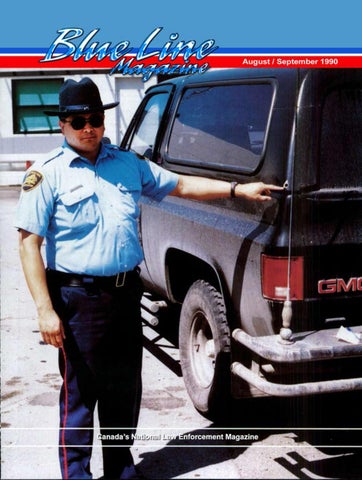
his is a summer that will most certainly never be forgotten. It has been a tough year for the police community in this country. As a profession we mourn the death of two police officers in the performance of their duty. Constable Ezio Faraone of the Edmonton Police Service and Corporal Marcel Lemay of the Quebec Provincial Police Force performed that duty with great courage and dedication . I personally mourned the death of a third police officer, a man I called friend , who died in the performance of his personal duty. Like the other two officers he died with great courage and dedication . Superintendent Robert Brown , of the Metropolitan Toronto Police Force, died while participating in the marathon event which was taking many police officers to the International Police Games in Edmonton. I only wish I could have known him more. Recent developments with the Indian Nations across Canada have painted a bleak picture indeed. In the hustle and bustle of recent events, however, it is easy to forget that our own native officers are running the same gauntlet. The true nature of that gauntlet was brought to the attention of Constable Johnathon Caldwell of the Akwisasne Police Force last spring after he took two shots into the back of his patrol car. This month we feature a story that was written prior to the events that lead to the death of Cpt. Lemay. I attended at the Akwisasne Reserve on Cornwall Island to get a feel for what had happened in the Spring. After writing this story, in early July, events
in Quebec qUickly eclipsed the previous incidents on this reserve. But both stori es remain intrinsically entwined . I decided to let the story stand inspite of the overwhelming urge to write about Oka . The story in this issue highlights the important fact that policing does not have a racial boun dary. That all officers are one, and only one, colour. That colour is BLUE! Police are the most discriminated against people in this country. The media show it every day but no one cares to say it. My hat is off to the Quebec police officers who faced the rioting citizens at the Mercier Bridge
south of Montreal in August. No peo- ing attempt that counts. And yes , ple had a right to be angrier with the sometimes you must stand in someMohawks than those officers on that one elses place and take their heat. bridge. But they showed their true col- But you are not alone. A man who our - BLUE. They stood strong, died on a cross almost 2 ,000 years shoulder to shoulder, and protected ago did the same. Above my desk I have a slogan the Indians on that bridge. These officers, who saw a brother officer written by some unknown author. It gunned down, did their job and took has meant a lot to me over the years the brunt of the citizens hatred in the and I would like to share it; HELL place of the Mohawks . BEGINS ON A DAY WHEN GOD And that, my friends , is what polic- GRANTS US A CLEAR VISION OF ing is all about. Your job is to keep ALL THAT WE MIGHT HAVE people from their own misadventure. ACHIEVED, OF ALL THE GIFTS You must attempt to be stronger, WHICH WE HAVE WASTED, OF wiser and more tolerant. Sometimes ALL THAT WE MIGHT HAVE you will fall short but it is the unend - DONE WHICH WE DID NOT DO.
Letters to the Editor
PATCH SWAPPING I was a member of the RCMP from 65 to 85 when disabled to pension due to injuries. I now have a hobby of collecting police patches from western U.S., mainly Washington, Oregon , California and Alaska. I have various Canadian , U.S. patches for trade and over 100 various lapel/tie pins. Anyone wishing to trade send SASE Maurice WINTON , PO Box 1214, Vernon, BC VlT 7Y6 or phone (604) 545-6794 . Thank-you .
MAGAZINES RECEIVED Just a short note to say I really enjoy your publication and keep up th e quality work. I have enclosed a copy of our "Call Box" and " 10-4" magazines in the event you have not yet seen what we have produced here in Calgary. Take care and again - All The Best With The Blue Line. S/ Sgt. Bruce R. Castle Calgary Police Service
••• Editor's Note: I really enjoyed reading th ese magazines. Nice publications and well laid out. I would be in terested in seeing other publications created by police agencies .
•••
SOLD ON MAGAZINE I too am sold on your Magazine. can't begin to tell you how great it is to FINALLY see a Canadian magazine of this quality written by Canadian Cops for Cops . M.J. Watt Lethbridge, Alberta
••• PRODUCING EXCELLENCE You guys are producing an EXCELLENT magazine. Keep up the good work! Peter Mitro Guelph , Ontario
~~~.--------------------------~
FLASHES by T OllY M ac Kinnon
••• MAGAZINE A WELCOME ADDITION Please accept my congratulations for the excellence of your publication . Th e magazine is a welcome addition in our library. J. Delcourt Chief of Police Barrie Police Force Barrie, Ontario
"Right after our inside man says, "Hey, i t 's the Fruit of the Loom guys!" we kick in the door!"
••• 4
September 1990
Vol. 2 No.7 · September 1990 - EDITOR / PUBLISHER Morley Lymburner - EDITORIAL ADVISORS David H. Tsubo uchi , LL.B. Edward Gunraj (P.o.A. Consulta nt) Mary Lymburne r B.A. M.Ed. Ge rald A. O xma n LC.LA. Jaan Schae r B.A. (Metro Police E.A.P.) To m Dykes (Halto n Region Po lice) Ro be rt Ho tsto n B.A. M.Crim. Rick Patrick (La mbto n Co llege) The Editorial Advisors a re pe rsons from whom this publication seeks o ut advice and guida nce. The use of their na mes is merely for recognition of their assista nce and o ngoing suppo rt.
- ADVERTISING Allan W. Stive r
(416) 294-5502 Fax: 294-8952 - ASSIGNMENT WRITERS Lucy Becke r • Louise Dueck AI Porter • Rick Patrick - CORRESPONDENTS Richard Duplain • Daffydd Hermann Craig McMillan • T. Richard Colledge Murray E. Milligan • Rock Du eck - COLUMNISTS Geoff Cates • Ro bert Hotston -PHOJOGRAPHYJ o hn Loftus • Mo rley Lymburner - ILLUSTRATION Tony MacKinnon • Bette Clark Dave Sills - DESIGN AND PRODUCTION Ji m Kelly Ca melot Gra phic Design 97 Sir La ncelot Drive Markha m, Onta rio L3 P 2J 3 (416 ) 471-0303 Fax: (41 6) 471-0305 Blue Line Magazine is published monthly, te n times pe r year by Blu e Lin e Magazin e Incorporated with head offi ce at 118 Main S treet North, Markham, OntariO Canada, L3P IVl. Editorial a nd copy is conside red to be comple tely sepa rate from ad vertising sales. No committment for editorial coverage can fo rm a ny part o f a sale agree ment. Ad vertising e nquiries sho uld be made at 294 -4773 or Fax Num ber 294 -8952 (area code 416) or to the advertising pe rsonnel listed. All a rticles are protected by copyright. No part of this publication may be re prod uced or transmitted in a ny form or by a ny means, electronic or mechanical. including photocop yi ng a nd recording, or by a ny informatio n storage o r retrieval syste m witho ut pe rm issio n fro m the p ublishe r. The a uthors, advisors a nd publisher accep t no lia bility whatsoever for a ny injuries to person or property resulting from the a pplication or adoptio n of a ny o f the proced ures, tactics or considerations presented in this magazin e. Readers are cautioned a nd advised that art icles presented herein are edited and supplied for yo ur personal awa re ness a nd sho uld not be refe rred to for furth e r actio n until appropriate advice and guida nce is received from a supervising officer or the advice of a Crown Attorney. Blue Line Magazine is an indepe ndant publicatio n desig ned to edu cate a nd upgrade the skills of those invo lved in the law e nforce me nt profeSSio n. It has no direct control from a law enforceme nt agency and its o pinio ns a nd articles do not neccessarily refl ect the opinio ns o f a ny governme nt age ncy or police fo rce. Blue Line Magazine is Printed in Can ada by J ohanns Gra phics. T h e sole au thorized distributor of Blue Line Magazine is Green Gables Book S h op, Markha m , O ntario.
Illl BI .
A ssociate member. National
Association of Police Planners
~ M ember, Periodica l ~ Publishers Exchange
ISSN #0847 8538 Second class mail registration No. 8242
Se pte mber 1990
EDITORIAL
Police Forces Are Caught In A Squeeze - J. Delcourt P.Mgr. AMCT(A) Chief of Police, Barrie Police Force
M
any words have been spoken in condemnation of the Metropolitan Toronto Police Force after the recent shootings . The situation is such that all police forces in this province have had to adopt a defen sive attitude at a time when there are major attempts to promote the con cept of community-based policing as the right method of dealing with the growing crime rate. We, who have had the opportunity to view the Toronto problems from afar, cannot help but wonder at the determination of some minority groups to destroy the best large city police force in the world. The political reaction to the police, often hostile or loudly silent is even more difficult to comprehend . In Canada , it is assumed that elected representatives should mirror the wishes and views of the electorate. We know that the vast majority of citizens are supportive of their police forces. We know it from the support we receive through Crime Stoppers; we know it from the many generous donations for the purchase of equipment to be used in proactive programs; we know it from telephone calls and letters which clearly indicate that our work is appreCiated . Why, then, is Chief McCormack left to his own resources in his fight to restore the good name of his Force? When will it become fashionable for politicians to rally behind individuals and organizations who deserve support? This lack of endorsement has caused genuine concern , even some despair, in police circles . Obviously, commitment to the concept of law and order is being re -examined .
5
The record is there for all to see. But it is not worthy of news when a police force does more to attract visible minorities to its midst than any other private or public employer. It is not worthy of news that a force , long before any hint of a task force in vestigation , establishes programs to deal with multi-cultural ism within its borders. It is not worthy of news when the Chief of Police and the senior officers devote a large part of their free time meeting with representatives of visible minority groups to discuss common problem s and seek solutions . What is news is a small group of dissidents, who represent neither the majority of visible minorities nor the general public, parading in front of police headquarters and demanding the chief's resignation . The fact that senior politicians offer their support to such minority groups place police personnel in a dilemma : should the level of enforcement be altered for prescribed groups, or should the oath of office continue to be followed? Most Ontario citizens have viewed recent developments in Toronto with some dismay. Unfortunately, Ontarians have concluded that the problems are limited to the greater Toronto area and should be solved locally. But we do live in a province where boundaries mean little in terms of att itude , prejudice , misconception or, for that matter, serious misunderstanding. It seems that we, as a society, have learned nothing from the American experience with visible minorities and crime. Clearly, some areas of Toron to are becoming devoid of the neighbourhood racial mix which is
needed for tolerance and understan - Iy as leaders in all areas of service. For ding . But this ideal mix can only be many years, we have been visited by preserved if there is an environment police representatives from every conwhich allows the police service to con- tinent. Invariably, they have departed tinue its work. Without it, there is a with a feeling of envy. Everyone, un fragmentation into neighborhoods til now, has been very complimentary defined by racial or ethnic origin , and of the Toronto force . During his opening speech at the the seeds of a "Watts" or "Harlem" International Association of Chiefs of are sown . The police forces of this province Police Convention held in Toronto, are caught in a squeeze that can on- former Chief Jack Marks began the ly be resolved through strong political proceedings by inviting international action . 0 far, this action has taken guests to walk the streets of Toronto the form of a task force, a hurried and at night. There is no reason why that flawed revision of the Police Act and statement should not be true in years a general condemnation of police to come, if support for the local police practices in Ontario. force is revived . This support may be Those who are prompt to condemn as loud and as well publicized as the the police should review the facts . comments of individual activists and Ontario police forces in general, and minority group leaders. Ontario taxpayers have invested a the Metropolitan Toronto Police Force in particular, are viewed international- fortune to ensure that their police
service is the best in the world . That aim has been achieved through a rigorous selection process, com prehensive in itial and on -going training, the development of poliCies which are compatible with basic policing concepts and community needs, and the monitoring of the policing function in a changing world . This investment has already paid many dividends, and must be protected from those whose aims have little to do with community well-being, but reek of self-serving intentions . The Metropolitan Toronto Police Force is worthy of our support. It is time to voice this support which will not only assist Chief McCormack in his struggle, but will also confirm the public's support for professionals who have chosen to serve their communities in a blue uniform .
Your complete source for quality 2-way radio accessory products across Canada, stocked in 4 major cities for immediate shipping.
II§JI[~~~~¥~~ 6
TORONTO MONTREAL CALGARY VANCOUVER
(416) 850-2550 (514) 335-1990 (403) 250-7951 (604) 274-0878
FAX: (416) 850-2560 FAX: (514) 335-6907 FAX: (403) 291 -2470 FAX: (604) 274-1118
September 1990
A special fax for a special force! AFX-3000
DesktoP Facsimile 3 4
1
FEATURES
7- Speed Dialing for 100
1-Auto paper cutter for
telephone and/or fax numbers and 10 one touch locations
better handling of long documents
2-External Telephone Jack
for remote telephone answering and telephone answering machine hook-up 3-Delayed Dial allows after hours transmissions 4- 32-Character LIQuid Crystal Display shows
date, time and various operations 5-polilng Feature
automatically checks for and prints waiting documents from up to 10 other fax machines 6- Resolution Key has a 16-level grayscale for exceptional fax clarity
8- Auto 10-page Feeder
for mUlti-page fax transmission 9- Multi-Function Telephone with auto
redial, speaker monitor and hands-free dialing 10- Redial Key is used to redial last telephone number called. Fax Redial is automatic in 45 second intervals, up to 3 calls 11- Speaker Key is used for on-hook dialing or when using the fax line as a telephone 12-Copler Function is convenient on your desk or at home
SPECIFICATIONS Type: High speed, portable
desktop facsimile transceiver Scanning System: Contact Image Sensor Compatibility: CCITT-G II I Transmission Speed: 9600 bps with automatic fallback to 7200/4800/2400 bps per CCiTT Transmission Time: Standard mode/less than 15 seconds Compression System: MH, MR coding transmission speed at approx. 35% faster than 9600 bps Resolution: 203 x 392 (superfine mode) 203 x 196 LPI (fine mode) 203 x 98 LPI (standard mode) Document Size: Width 5.8" t o 8. 5" Lengt h 5" to 40" Scanning Width: 8.5" ReCording System: Thermal printing ReCording paper Size:
8.5"x100'
Display: 32 digit LCD for operating modes, memory and service functions Speed Dial: 100 stations up to 34 digits each, 10 one-touch Document Feeder: Automatic up to 10 pages Image Control: 16 levels of Grayscale Remote: External telephone jack for remote answering and activation of telephone answering device Power ReQuirements:
115V/230V, SO/60Hz (Company Selected) Dimensions:
4.1" x 11.5" x 10" (H,W,O) Weight: 9.7 Ibs
82AUDIO,.OX
li?lIu/or te/epl/ones AUDIOVOX CORPORATION
FX-3000-0C © 1990 Audiovox Corp.
FACSIMILE DIVISION
For detailS on this superb machine contact:
TELION TECHNOLOCIES INC.
170 Esna Park Dr., Unit8, Markham, Ontario L3R 1E3 Telephone: (416) 475·5770 Fax: (416) 475-3989
Fax Machines, Cellular Phones, Computers &Office Equipment
~
~~/ww
-------------------
Officers in Border Community Under The Gun - Morley Lymburner -
A
s you cross the bridge you feel the tension in the air. "Perhaps it is all in your mind", you think to yourself. After all it has been in the news a lot lately. Just as this thought clears you see the Customs post and visions of a security perimeter in Vietnam come to mind immediately. Four Tactical Response Vans, four police cruisers and a heavy duty police"four by four" vehicle greet each person as they approach the chain link fenced in post situated on Cornwall Island in the middle of the Akwisasne Mohawk Reserve. It is at this point you realize the tension is real. In the middle of this bridged island in the middle of the peaceful flowing St.Lawrence River, law enforcement has taken on the appearance of an armed fortress . The occupying army of this post includes, RCMP, Ontario Provincial Police, Akwisasne Reserve Police, Mohawk Border Security officers and , of course, Canada Customs officers. In such a situation community based policing is the last thing on each I officer's mind . It is a simple situation of keeping the lid on. After the shooting deaths of two members of the reserve, and the known likelihood of further violence, each officer is aware of what the situation requires.
stable Jonathon Caldwell , found out first hand when two shots from a high powered rifle tore through the back of his patrol truck while he was performing a routine patrol. Caldwell states that he was patrolling one of the back roads on the reserve when he heard a loud crack sound and felt his truck shake noticeably. He slammed on his brakes and came to a stop and immediately took another round in to the back left corner which lodged into the front right corner after passing through the length of the vehicle. All too aware of the fact that he was outgunned he started making distance as fast as he could and radioed for assistance. A later sweep of the area by re-enforcements found nothing .
Escalated Violence Problems began several years ago when the members of the American side of the Reserve, known as St. Regis , took it upon themselves to declare the entire reserve a sovereign nation and ignored the boundaries of the two countries, as well as the one state and two Provinces that intersect the reserve. Factions of the American side opened up gambling casinos in contravention of New York State Law. This recently developed into an internal feud with the members of the reserve divided between the pro and anti-gambling fact ions . The feud heated up when members against gambling began to barricade road ways into the reserve in a hope to prevent gamblers from frequenting the casinos . The surrounding law enforcement agencies took a "hands-off" approach hoping that the local people could settle their own differences. However the situation deteriorated qUickly when officers from the reserve made efforts to keep the peace while also attemp-
Officers Under Fire No officers are more aware of the hazards than the eleven members of the Akwisasne-Mohawk Reserve Police. One officer in particular, Con-
8
September 1990
ting to open the roads to traffic. This "no-win" situation placed the officers square in the middle. The officers fo und themselves shot at, their police station fire -bombed, and their police vehicles rammed off the road by bands of marauding "warriors" in 4X4 pickup trucks. In an effort to equal the battle the Band Council replaced the out of service police cars with the same 4X4 pickup trucks with special heavy duty equipment, roll bars and rein forced suspensions, frames , and bumpers all around . The violence escalated with fire bombings of homes and the Akwisasne Heritage Museum . Police on both sides decided on a strategy of standing by but permitting the members of the band time to settle their own differences. For several nights gun fire was heard throughout the reserve which resulted in the deaths of two band members. Upon hearing of the deaths the council members of the Band and the Akwisasne Mohawk Police decided to call for help. Police from New York State, Quebec and Ontario were quick to take firm control and had been poised for action for some time prior to the request being made.
extreme wealth. that backs up that determination . It also says a lot about the network that exists for the quick acquisition of such weaponry. An uneasy peace now exists on all sides of the reserve. A peace that Akwesasne Police know is only temporary and would not exist at all if their backup leaves.
The Tree Of Courage The applause was thunderous as 600 members of the Mohawk community thanked the officers of their reserve. The entire community showed up at a special recognition and award night on the Akwesasne Reserve last April.
Every member of the community wished to show their support of the actions of the police and to give each member of the eleven member force, as well as local game Wardens, the highest medal of honour. The tree of courage. The small silver oval shaped medal, with the turquoise coloured tree embalzoned in the middle, is worn proudly by the officers above their uniform pocket. The medal was commissioned by the Band Council. Each officer wears it not so much in recognition of the ir own hazardous duty, but as a visual sign of the respect the community holds for them. A true symbol of community support.
AN UNEASY PEACE On the day that Blue line Magazine visited the reserve the police agencies appeared determined to back up the Akwesasne officers and were further determined there would be no further violence. RCMP and OPP officers had been brought from as far away as Sarnia, Toronto and Peterborough. Tom FranCiS, an Akwesasne/ Mohawk Border Security Officer and a member of the Band Council, stated that the members of the band police were totally surprised by the sudden violence and the rapid rise of AK47 assault rifles used. These lethal weapons, carried by the pro-gambling factions , not only displayed the determination of the group but also the
September 1990
Full Line Distribut ors of Law Inforcement Unifo-rms and Supplies
•
Suppliers of Police, Fire and Emergency Response Equipment Distributors of: • Smith & Wesson® Handguns • Point Blank Body Armor® • Thctical Equipment • Code 3 & Force 4® Public Safety Equipment • General Sporting Equipment • G & G® Leather Products
Dealer Enquiries Invited Paul R. Gibbon - General Ma nage r Office/Admin ./Sales (902) 835-1717 Fax (902) 835-2470 Showroom/Warehouse: 62 Bluewater Rd . Unit A Bedford , ova Scotia B4B 1G7
9
-----
ATLANTIC POLICE & PROTECTION SUPPLY DIVISION OF HORNER AND MOORE HOLDINGS CORPORATION LIMITED
The Wit and Wisdom of Tacky Burns Wild Parties by Terry Barker (excerpt from " The Five Minute Policeman" ) They're all drunk and disgusting . There's a guy passed out behind the sofa . Half-naked people are scream ing and chasing each other around th e living room . The stereo is cranked up to about a hundred and fifty decibels: your ears actually hurt. You can see (and hear) why the ne ighbours called the cops. Even though no real laws are being broken , except for the noise - no und erages or coke, just a bunch of dumb punks - your first temptation is to bust as many of them as you can and trot the m all off to the tank. That's what you'd like to do - but you know that's the worst possible solution to the problem. BeSides, even if what they're doing isn't your idea of a good time, you might be feeling just a touch of envy: they are doing their thing, after all, and maybe you'd like to be doing yours. What you really need to do is to get th e m to ton e it down so the neighbours will stop complaining. Proble m is... when you answer a call to a noisy soiree all that the jerks see is your un iform . That's the symbol of authority. Right away they start to act like nasty little brats. They behave like they're back on the school playground , with you cast in the role of th e neighbourhood bully. I learn ed a lot of practical stuff about how people interact in sensitive situations from a book called 'Games People Play', by Eric Berne. Every police officer should read it. It gives you tools for quick analysis of com munications transactions between people, and ways of getting control. He says people behave in three different modes, which he calls 'Parent', 'Adult' and 'Child'. Wh en we use our power to either nurture or punish other people, we are said to be in the 'Parent' state. Arresting someone, giving out a traffic ticket, and bringing a lost child back
_ fi~ .e=-
mY_
To get them into the Adult state, ask them for their ideas on how to contain the situation . Confer and discuss on an equal level. Get them thinking. And then to conduct them into the Parent state, ask them to accept the responsibility of cooling things down . Let them know that you believe in their ability to control the group. These guys are a bit like Rodney Dangerfield - they'll do anything for a little respect. So give them some. What we're talking about here is doing things in order. Nine times out of ten the natural leaders at a party will co-operate just fine. They'll tell the party people to cool it, and they usually will. They can accept it more easily from their own , whereas if you try it they may see you as a Top Gun , someone they can prove their manhood against. We're looking at The System's Step Four here - Involvement.
If this doesn't work - and it won't sometimes - then you have to get into basic down -and -dirty police work. It's a matter of options . If you do the down -and -dirty first, you can't hop into The System later. Once the night sticks start flying it's too late to talk . Whereas if you try The System first and it fails , you do have something else to fallback on . They don't. If you give them a break and they don't take it, who looks good and who looks bad the morning after? Seems to me that it's better to have two strings to your bow than one. Pay attention to them . listen . Em pathize ("Yeah , I know, it sure is ha~d to control a bunch like this"). Then get them involved by inviting them to join you - first in the Adult state - then the Parent.
if"v~¥.YmY_
W '.... l~~('.T{V~~": -,<.'
to the station are examples of the Parent state. When we are in a logical problemsolving mode, we are in the 'Adult'. Solving a crime, participating in a meeting, and developing a community project are examples of the Adult state. And when we are being emotional, we are said to be in the 'Child'. Sulking, loving, losing our temper, ecstasy and despair are examples of the Child state. Booze limits our personalities. We go from Adult to Child pretty damn pronto. It's hard to be Adult when you're juiced. I should know - I've attended enough "choir practices." And police officers can skip from Adult to Child as fast as anyone I know. So when a police officer (Parent) tries to talk to the party people (Child) it's like Daddy telling a bunch of noisy kids to pipe down . And what do noisy kids do when Daddy tells them to pipe down? They have two choices. They can (I) obey, or (2) tell him to blow it out his nose. The first one is the Obedient Child: the second is the Rebellious Child . If he's lucky enough to snag the Obedient Child , things settle down okay. No more trouble. But if he hooks the Rebellious Child , then daddy has a problem . It's ~xactly the same thing with party animals. The behaviour patterns they learned in early childhood take over when they're bombed. It seems for every obedient child in this world to make our life easier, there's five jerks to keep us in business. Trust me. So don't make deals with jerks. When you go in , look for the "leaders". They'll usually let you know who they are. Learn their names . Then get them off in a corner some-where and ask them to help you . Use The System .
if'
10
September 1990
CASE LAW: Rights
'Delay not unreasonable' say two decisions (Regina Vs. Wonnacott) 1005-020 7P (Regina Vs. Payne) 1004-024 14P In two separate cases involving drinking and driving violations it was determined that a delay of nine minutes was not unreasonable. One case involved a reported delay in admin istering a Borkenstein Breathalyzer test while the other was an approved screening device. Furthermore in both cases the presiding justice gave similar reasons for upholding convictions . In the first case a Mr. Wonnacott was stopped in a London , Ontario, R.I.D.E . program and advised the officer that he had consumed alcohol. The officer then demanded that he supply samples of his breath into an approved screening device. The evidence at trial was that there was a delay of nine minutes from the time the demand was made until the test was administered . The instrument subsequently provided a fail reading and the accused was arrested on reasonable grounds that the accused was over 80mgs. The officer subsequently advised the accused of his Right to counsel and then demand ed the accused accompany him for the more formal Borkenstein test. The defence argued that the Crown, through the officer's evidence, had not explained the reason for the nine minute delay in administering the Screening test. At trial the judge dismissed the case against the accused . The Crown appealed to District Court Judge Dougald McDermid . The District Court judge disagreed with the trial judge stating, "I conclude that both the original officer and the breathalyzer technician were acting in good faith and that any delays that occurred were not the result of any arbitrary, capricious or improper actions by the police." The judge continued by saying " Rather than examining in September 1990
microscopic detail the minute-byminute course of action followed by particular police officers, the courts should concentrate on the purpose of the legislation and determine if the overall treatment of the offender by the police was such as to lead to the conclusion that the police acted in an arbitrary way, for some improper purpose... perhaps to gain some investigatory or prosecutorial advan tage, or simply out of malice .." The judge was quick to point out that it is still up to the Crown to lead evidence that the officers acted properly. In a similar judgment, out of the Ontario Court of Appeal, Justice David Griffiths stated that a nine minute delay in administering a breathalyzer test at an Alliston , OntariO, police station was not unreasonable and that the time had been accounted for in the evidence. This case involved evidence that indicated the accused was brought to a police station and the arresting officer began filling out an alcohol influence report. The evidence indicated that nine minutes later the brethalyzer technician took the suspect to perform the breathalyzer tests .
It was the defence argument that the Crown had not explained the nine minute delay. The original trial judge agreed and threw out the charge. Upon appeal it was stated that the wording in the Criminal Code states "as soon as practicable" not "as soon as possible." The court added that the true test was whether the delay was reasonable under the circumstances . It concluded that the Crown had satisfied the nine minute delay by the evidence that the officer was filling out 11
a report. The appeal ruling stated that the accused's first test was 39 minutes after his arrest while his second sample was 44 minutes after he was stopped . The ruling concluded that "These are hardly prejudicial or inordinate delays having regard to the fact that the (Criminal Code) allows a maximum period of two hours from the time of offence to the first sample." The court went on to say that the Crown was not required to explain where the breathalyzer officer was during the nine minute interval when the accused entered the station to when he was taken into the breathalyzer room . The time was satisfactorily explained when the evidence showed the arresting officer was filling out an alcohol influence report. The ruling further stated that the evidence does not have to give a minute by minute explanation of this.
INSIGNIA PRODUCTS Carlo Dalgas Ltd . specializes in custom made Lapel pins, Police and Military Badges, Leather I.D. cases, Embroidered Crests, Medallions, and Souvenir spoons. High quality insignia products at very affordable prices are available now. For more information contact: Carlo Dalgas Ltd ., 1885 Briarcrook Cres. , Mississauga, Ont. L4X 1X3 (416) 625-8061 Fax: (416) 625-4911 .
Non-Violent Resolution: A Review of Ontario Tactical Units
I
n the early morning hours of August 14th, 19 , an Anderdon Township, Ontario, resident saw a man dressed in a Rambo style suit prowling through his back yard . His wife called the local Anderdon Township Police as her husband, concerned for his mother next door, grabbed his shotgun to go out and investigate the prowler. The Anderdon police officer notified was on duty and was helping Ontario Provincial Police officers to cordon off an area in a subdivision were the Tactics and Rescue Unit was attempting to find an armed man who said he wanted to kill a police officer. The Constable advised the O.P.P. officer with him about the call and suggested that he tell the TR.U. team m mbers about the call. It was at this point the o.P.P. officer discovered he had no direct contact with the team members but only the central dispatcher. The central dispatcher was not aware that the team members were sweeping the area and therefore could not advise if the prowler call was the suspect or a member of the Team . Precious seconds were now ticking away. During the same incident it was later reported that several officers involved did not know where the tem porary command post was located . One officer's radio was not working and there was no direct patch chan nel for the one municipal and two township police forces with the O.P.P. During the search one officer was confronted by a resident, also armed , and managed to convince this man that he was indeed a police officer and a member of the TR.U. team in spite of the camouflage battle dress he was wearing . Meanwhile Bernard Bastien confronted his prowler and seconds later lay dying on the ground . The TR.U.
Team officer was sure he had his suspect. The man approaching in the dark, armed with a shotgun , left no doubt in the officer's mind that his search had come to an end . This incident played a heavy role in the investigation by the Ontario Task Force Review of Tactical Units report released last May. The 48 recommendations made by this en quiry will no doubt form the basis for a lot of future restructuring and deployment of Tactical Units throughout the Province.
The Report The detailed report sets out a ready recipe for proper training, equipping, and selection of personnel for Tactical Units of police forces. The hard lessons learned by incidents such as the Bastien case could save lives in the future. The 48 recommendations made by the report came as a result of an order-in-council made by the Ontario Legislature to the Ontario Police Commission on January 4th , 1989. The Commission , headed by W. Douglas Drinkwalter, primarily focused on five incidents. Two of the incidents involved the York Regional Police Force and three involved the Ontario Provincial Police Force.
Highlight of Recommendations The comprehensive 48 recommendation report was highly critical of some aspects of some tactics and equipment used by many police forces. The report, however, was quick to point out the necessity for having such specialized squads. The report cited many incidents in which lives were saved by using such squads . In particular the report pOinted out the Metropolitan Toronto Police Force
for its highly skilled Emergency Task Force. The report found that this squad, although responding to a high number of incidents, has not fired a shot at a suspect in the past ten years. They complimented their philosophy of non -violent resolution of dangerous situations by isolating the suspects and negotiating with trained negotiators.
Training The report was critical of such things as a lack of training by many forces , poor communication equipment, in appropriate dress, lack of recognition, lack of public awareness, poor cooperation between police forces in terested only in "protecting their turf" and not considering the public welfare. The report was also critical of the Ontario Solicitor General's office for not taking action to respond to Coroner's juries recommendations. In the same area the report praised members of tactical units across the province who took the recommendations far more seriously by forming an organization that set up uniform standards. One of the recommendations of the report was for the police forces and the Ontario Police Commission to recognize this organization as the official conduit of communication for all tactical units in the Province. The report also recommended that police forces with less than 100 members should not consider form ing a tactical unit. Reasons for this was pointed out as the requirement for a high degree of training and the ability to permit the time for such train ing. The report further suggested that the minimum size of a tactical unit should be no less than 12 officers. This is to permit a minimum of 2 officers working at all times.
Containment Units The report suggested that as an alternative forces with less than 100 members should devise a special "containment unit." This containment unit could be highly trained to a level
12----------------
September 1990
necessary to properly cordon off an another police force to supply Tactical area around a conflict and be able to assistance. The report pOinted out that the protect officers and the public sufficiently until a full tactical unit could reason that the Metropolitan Toronarrive. These officers could be train- to Police Force has such a well train ed sufficiently to defend against an ed Tactical Force is because they are aggressive attack but not to clear a tested on a regular basis with frequent building or capture an armed or bar- calls. It was pointed out that in a five year period that Unit alone has ricaded suspect. Instead of having a trained contain- responded to 888 high risk calls inment unit the smaller police forces cluding 118 high risk arrests, 191 high would be advised to enter into an risk searches , and 22 hostage agreement with the nearest police incidents. force that has a Tactical Unit to assist when required . The report further Northern Ontario Tactical Units suggested that these forces "file their plans and policies for responding to The Commission report was most emergencies involving weapons with critical of the Ontario Provincial Police the Ministry. These plans should in- Froce's lack of tactical officers in Norclude provision for calling in outside thern Ontario as well as the cumbersome method instituted to call out the help when necessary." The report further suggested that TRU team . It pointed out that "In Northern police forces with Tactical Units that Ontario, there is a relatively high ratio are rarely used should consider the advantages of a Containment Unit of gun calls, but there are no police and making an agreement with tactical units. There used to be an
opp team stationed in Thunder Bay, but it was withdrawn when the Tactics and Rescue Units were reorganized. Because of the long distances involved and the difficulty of travel in the winter, it is not possible to count on the quick arrival, in a northern community, of one of the existing TRU teams from the south ." As a solution to this problem the Report suggested that the cities of Thunder Bay, Sault Ste.Marie and Sudbury Region, which are sufficiently large enough , should form their own Tactical Response Un its. These forces could make themselves available to service surrounding communities when called . The report's criticism of the call out method employed by the OPP stated that it was too cumbersome and leant itself to a system that did not en courage a call out. The OPP system requires that the TRU team can only be called out by
Distributors and Suppl iers of Products fo r: • Co lt (Firearms) • Heckler & Koch (Weapo ns) • Benel li (Shotgun s) • Sig Sauer (Pistol s) • Sturm, Ru ger (Weapons) • Glock (Pi stol s) • Remington (Firearm s, Ammo & Clothing) • Federal Cartridge • Federal Signal • Kustom Radar • A.A .I. Corporation (Tear Gas) • Safari land (Leather) • G & G Leather • Armour of America (Body Armour) • Aedec (Car Seats) • Lawrence Leather (Tactical ) • Automotive Pol ice Equipment • Peerless (Handcuffs) • Smith & Wesson
RVU· TH E MOST UNIQUE GARMENT OF ITS KIND IN THE WORLD !
•
•
•
A sc ientifi ca ll y des igned. pate nted worldwide. undergarment to be worn under so ft body armo r o r any nonporous o uterga rmenl. A Ribbed Ventilating Undergarmen t* (RV U) which creates a body thermostat system to keep you cool when it's hot and warm when it ' cold. Made of Hydrofil®, a hi gh technology fabric fro m Allied Fibers that "wicks away" body moisture into Ribbed Ventil ating Channels which allows mo isture to evapora te. thu s keeping you coo ler th an you have ever been before .
• Pelican (Flashlights) • Mag-Lites • Woolly Pulley Sweaters • O.D.V. (Identifica tion Equipment) • Identi cator (Identification Equipment) • Ivers-Lee (Drug Detection) • Garrett (Metal Detectors) • Saunders (Cli pboa rd s) • Meprolight (Nigh t Sights) • Litton ( ight Vision) • Monadnock (Baton s) • Approved Technology • icholls (Uniforms and Equipment • Federal Laboratories (Tear Gas) • Collins Dynamics (Spot Li ghts) • Setina (Car Partitions) • Hiatt (H andcuffs) • Uncle Mike's
EXCLUSIVE CANADIAN DISTRIBUTOR :
R. Nicholls D istributors Inc.
CAP & REGALIA LTD. Since 1949
September 1
Quebec - Longueuil , Quebec (S14) 442-9215 Ontario - Mi ss issa uga, Ontario (416) 828-1942 Western - Vancouver, B.C. (604) 875-8586 Maritimes - Fredericton , N .B. (506) 385-2484 Maritimes - Port William s, N.5. (902) 678-1808
TEL: 1 (41 6) 755-5283 FAX: (416) 755-5285
11 CANADIAN ROAD , UNIT 3 SCARBOROUGH , ONT., CANADA M1R 5G1
13
a District Commander or his TRU team assistance, based on an designate making a request through assumption that the approval process the normal chain of command from will take too long or based on a the Deputy Commissioner of field perception that the TRU teams are operations or his designate. In con- not readily available or that the re trast to this system the Metropolitan quest for help is likely to be rejected." Toronto Police ETF are routinely called out by the constable on patrol or Public Education the dispatcher. This call out is generally confirmed by working supervisors The reports last two recommendawhile the machinery is being put in tions dealt with public education conmotion to get the help required. It was cerning Tactical Units. One recom discovered that in all other forces with mendation was that all tactical units Tactical Units it was at least a front line in Ontario should "have a common supervisor or a supervisor who had identity. The name should emphasize frontline contact with the scene that their mandate to contain and called out the Tactical Unit. negotiate." The report suggested that The report concluded that they this common name would go a long were concerned that the OPP system, way toward public education . "places the decision -making at the The last recommendation involved end of a chain of command at a point a public education program that remote from the incident." They fur - would emphasize the public's respon ther concluded that this system, "may siblity to cooperate with police in a result in reluctance by municipal dangerous situation that necessitates forces and OPP officers to ask for the calling out of a tactical unit.
The report concluded that in the Bastien case "The armed response decided on by Bernard Bastien was founded in law but not in logic. A more prudent course of action would have been to telephone the senior Mrs . Bastien to check on her well being and then to call the police and maintain observation . We would suggest a public information campaign through Crime Prevention programs or community based policing on ap propriate responses to suspicious activity or persons."
''I've got just three words for you, Officer ... "
YES! I want to subscribe to . Name : Address: City: Province :
Postal Code: Enter my subscription right now for the next 10 issues of Blue Line Magazine (10 issues: $20 .00 ; US and foreign $50 .00) [ want a bulk subscription of copies (5 - 49 copies $15 .00 each ; 50 or more call for price) PAYMENT METHOD
D My payment is enclosed
D Bill me with my first issue (Your subscription begins with the next issue) D Blue Line Magazine will gladly charge your subscription to your MasterCard, Visa or American Expre~~ account. Do not enter your account number on this card. Call our authorized retail representatives at Green Gables Book Shop (416) 294-4773 for immediate processing of your order.
Mail coupon to: Blue Line Magazine, 118 Main Street North, Markham, Ontario L3P 1 VI L ______________________________________ ~ Blue Une is an independent magazine produced by and for the law enforcement community.
14
September 1990
CASE LAW: Evidence
Candid Photos do not breach Charter (Regina Vs. Shortreed) 944-012 34P In a February case out of the Ontario Court of Appeal it was determined that photographs of an accused persons face taken in a public place was admissible in evidence for identification purposes. In this same aggressively defended case it was determined that evidence that the accused made repeated efforts to conceal his identity was also admissible in evidence along with his refusal to participate in an identification lineup. The case involved the investigation of five sexual assaults in the Town of Pickering between 1984 and 1986 . Investigating officers determined that in all five cases the victims had been approached , assaulted sexually, and given the same instructions in identical fashion . The officers felt that this constituted a great deal of similar fact evidence and they were certain the same man had committed all the offences . The suspect had come to the attention of the police early on in the in vestigation due to the type of vehicle he had been driving. Police kept surveillance on the family and the truck of the accused and in 1986 asked the accused if he would participate in a lineup. He refused this request and also refused to have his picture taken after his lawyer has advised that it would not be in his clients interests. Police at this point continued surveillance on the accused and made several attempts to take photographs of the accused . On one occasion the accused noticed the officers had been following him so he ran into a hardware store and came out with a bag, ran behind his pickup truck, put on a baseball hat and sunglasses and entered his truck and left. Police finally arranged to have one victim enter a store frequented by the September 1990
accused and she successfully iden tified the accused as her assailant. It was at this time the accused was arrested and his mug shot taken . They placed his photograph in a photo-lineup and the accused was picked out by all the victims. The accused was later found guilty not only of the five counts of sexual assault but was sentenced to an indeterminate sentence as a dangerous offender. The accused thus began a vigorous appeal process in defence, hiring two lawyers to argue his case. The appeal was spoken to by Mr. Justice Lacourciere of the Ontario Court of Appeal who stated that police can take photos in a public place as long as there is no physical compulsion involved . This means, for instance, that a man can not be forc ed to stand somewhere to have his photograph taken unless he is under arrest or has been charged . The court further ruled that "con duct which may be interpreted as an attempt to conceal one's identity by adopting disguises, or by changing one's appearance by artificial means, is admissible as evidence of consciousness of guilt." The court added , " It is also open for the accused to endeavour to create reasonable doubt as the the guilty significance of his conduct by raising facts which indicate it to be equally consistent with some hypothesis other than consciousness of guilt." The court added that it is then up to the jury to decide on the evidence it has heard. On the accused's defence that the police breached the rule of self incrimination it was pOinted out that the rule protects the accused prior to arrest by giving him both the right to remain silent and the right to refuse to provide evidence against 15
himself , such as voluntary photographs. The court concluded that "For the same reasons that the assertion of one's right to silence does not impose an obligation on the police to cease asking non -coercive questions as part of the continuing investigation ... the refusal of a suspect to allow himself to be photographed should not preclude appropriate efforts by the investigating officer to obtain one." The ruling co ntinued , "If this is done in a non -intrusive way and without trespass or other improper means, I do not regard the efforts as a breach of privilege, an invasion of privacy or a vio latio n of Charter Rights ." In the final decision the court ruled that "The striking similarity of the offences, the identification made in dependently by fo ur victims, and the persuasive corroborating evidence provide overwhelming direct and circumstantial proof of the appellants guilt." As to the defence arguments about the indefinite sentence because the accused was viewed as a dangerous sexual offender, the co urt simply stated that it felt that it was "a fit sentence."
What you need to I<now every day is in Blue Line every month.
8k£v~ ~?~ Have you sent in your subscription yet?
... news beat ... news beat ... news beat ... news beat ... Shooting People Is Retired Australian Initiation Into Officer Fou nd Street Gang Not Guilty A New York City gang of teenagers is forcing each of its recruits to shoot one person in the leg as an initiation rite. The gang, called Powerules, has turned a neighourhood in the Bronx into a 'war zone' with five people shot and wounded over the past year, according to the New York Post. Police sources said recruits must 'find outsiders walking through the neighbourhood and shoot them in the leg'. Police have made several arrests in th e incidents but the incidents still happen .
Texas Officers Convicted Three white ex-police officers have been sentenced to jail terms from 10 to 2 years for beating a black prisoner to death last year. One officer was the Chief of the Hemphill, Texas, Police Department and the other two were Sabine County heriff's deputies. The black victim was arrested for driving while his ability was impaired . When he asked to use the telephone to call his wife the Chief hit him three times on the head with a blackjack. Witnesses then state that all three officers then took the man to a cell and beat him further. The man was later taken to hospital and later died from his injuries .
Police said at the time of Mr. Blackburn's arrest that they had used genetic fingerprinting to pinpoint their former colleague. However the Director of Public Prosecutions later revealA former Australian Police ed that police had not compared Mr. Superintendent, Harry Blackburn , Blackburn's blood group with the was found not guilty of 25 counts of attacker's before charging him. The sexual assault and received an blood groups were later found to be apology from the investigating completely different. officers. At the conclusion of the A commission has been set up to apology Blackburn broke down in investigate the circumstances around tears . how Mr.Blackburn was charged . The Mr. Blackburn , 59 , was a retired Commission spokesman publicly member of the New South Wales apologized for their conduct in laying State Police and had been working for the charges and the officers inthe Australian War Crimes Commis- vestigating apologized for their sion when he was arrested last year. ignorant and misguided investigation . He was dismissed from his position They made it clear that their actions upon the news of his being charged . were not malicious or vengeful. Police had found evidence showThis case brings into question the ing the attacker in the 25 incidents, caution that must be exercised in usreported over a 20-year period , was ing genetic fingerprinting . the same man . In the incidents couples were forced from their vehicles, sometimes at knife point and once with an axe. The men were tied up and locked in the trunk of the car and the women were raped .
FLASIIES by Tony MacKinnon
•• We've located some oj the suspects ammunition, and I'd ay there could be a problem! "
16
September 1990
I
... news beat ... news beat ... news beat ... news beat ... EDITOR'S NOTE:
UP-COMING EVENTS September 24-27 Brampton, Ontario "LINKAGES '90" is a conference presented by the Peel Regional Police Force and the Victim Services of Peel Region. It is supported by the Canadian Organization for Victim Assistance. Contact: S/ Sgt. Irena Lawrenson(416) 965-4474 Fax 963-2600.
October 28-November 2 Corpus Christi, Texas The first joint conference of National Association of Police Planners (NAPP) and Association of Police Planning and Research Officers (APPRO) will be held in Corpus Christi, Texas. Topics will range from technological assistance, use of consultants, and futuristics to motivational humour in the workplace. Contact: Pat Eldridge (512) 886-2696.
We will be happy to include your Up -coming event in this column free of charge. Please supply us with full details about your event, along with the main contact person and phone number. We may also print a full story on what your event is all about both before or after the event if you send us the details. Send photographs if you wish but under normal circumstances it is difficult for us to return them. Events should be of interest to the Law Enforcement Community and the Publisher reserves the right to edit copy and limit the number of insertions.
(
p.c. C.O.p.S.TM Personal Computer Community Organization and Prevention System
Effectively used by Police Forces including: Brandon Police Force County of Olmstead Division " A" R.C.M.P. Headquarters Halton Regional Police Force London Police Force Metro Toronto Police Division 21 Metro Toronto Police Division 22 Metro Toronto Police Division 53 Ottawa Police Force Oxnard County Police Department R.C.M.P. Coquitlam R.C.M.P. Surrey Regina Police Service St. Thomas Police Force Sudbury Regional Police Sun Youth/Operation Tamdem Thunder Bay Police Force Windsor Police Force York Regional Force For more information call : the I.M.P.A.C.T. group inc. Suite 300, 19 Yorkville Ave. , Toronto, Ontario M4W 1L1 Tel : (416) 924-3777 Fax: (416) 924-1 480
Captain (N) J. Nethercott, Commander of CFB Halifax, Lt. -Cdr Paul Jenkins, Base Security Officer and Lt. (N) Doug Boot take their places at the starting line to lead the Fight For Sight Relay.
September 1990
The system works - contact our users!
17
COUNTER-POINT
Moral Conscience and Moral Duty - Marcel Roy Weyburn , Saskatchewan It was stated in the May '90 issue of Even though we are police officers, "Blue Line Magazine" that refusing to we are living, thinking, feeling human take appropriate police action due to beings, not sheep or programmable the moral conscience of the police robots. If we are to protect society officer has no place on a police force. from crime then it must also include The law is the law, right or wrong, we crimes against humanity. If we are are paid to enforce it. truly protectors of society then we I'm sure the same theme was con - cannot blindly enforce morally wrong veyed to the German soldiers loading laws enacted by corrupt, powerJews onto trains headed for the death hungry individuals in government. Government is to be the servant of camps. Or to the Russian soldiers at Katyn Forest, who in 1940, executed the people, not the master. Had men over 15, 00 Polish army officers via honestly listened to their moral con a single bullet to the back of the head science, the Holocaust would not have been allowed to happen. The 10 of each one.
Why you need The Five Minute Policeman:
million plus of Russian citizens executed over the years by the NKVD (forerunner to the KGB) and KGB would have lived on . But all died because men believed the law is the law. Right or wrong does not enter into the picture. I hope that we people who wear the blue uniform in Canada will find the moral fiber to stand firm when asked to enforce laws that cross our moral conscience. Editor's Note: In our December 1990 issue (Vo1.l No.10 page 20) we presented a lengthy article on discretion. In one section we quoted the Funk & Wagnalls encyclopedia description of "Police Power"; ': .. A term used to designate the power exercised by governments to enact legislation regulating private interests for the protection of the health and morals of the people, the prevention of fraud and oppression, and the promotion of the public convenience, prosperity and welfare." I think that about says it all.
THE FIVE MINUTE POLICEMAN
Terry Barker has made common sense something that can actually be grasped and identified. You 'll not only learn a new system , and see how and why it works , but you 'll be able to identify how and why some of your own methods have worked in the past . Terry gives you The System - the tools with which you can achieve results by design . Even experienced policemen feel a new confidence , and we all know that confidence coupled with experience and ability means a polished and professional job
By Terry Barker wilh the assistance of Sgt. Ed Hill and the members of Ihe Gibsons, S .c. Detachment. RCMP
The Five Minute Policeman - $12.95 Available from
(416) 294-4773
Green Gables Book Shop
VI SA - MasterCard - American Express Accepted
11
18
September 1990
Review of Tactical Units - - - - 1989 Summary of Recommendations - - - - Presented to the Ontario Police Commission
T
his review represents the first comprehensive examination of police tactical units in Ontario since the first ones were formed in the mid-1970s. Representing the Ontario Police Commission were W. Douglas Drinkwalter, Q.c. , M. Beauprie, Frank M. D'Andrea, and Professor Julio R. Menezes. The following is a summary of their recomm endations; (1) The solicitor General should support the continued deployment of police tactical units in the Province of Ontario and should ensure that provincial standards are instituted for the selection and training of officers and the equipment they use. (2) The primary objective of all police tactical units in Ontario must be the non-violent resolution of high-risk incidents to safeguard human lives . (3) Techniques of containment and de -escalation of a crisis involving an armed person must be the priority in the training of all tactical officers. (4) The Ministry of the Solicitor General should conduct a review of all police jurisdictions across Ontario to determine where police tactical units are needed and who should provide them . (5) A police force with more than 100 sworn personnel could have its own tactical unit. If it does not, it must have a containment unit and a written agreement, approved by the Solicitor General , for obtaining tactical assistance from another police jurisdiction. (6 ) A police force with fewer than 100 sworn personnel should be encouraged to form a containment unit. In addition , it should be required to file with the Solicitor General a written account of its plans and policies for September 1990
responding to an emergency involving weapons, including provision for calling in outside assistance. (7) Guidelines should be developed immediately by the Solicitor General enabling and encouraging police forces to accept tactical unit assistance from another police force, including delegation of authority to the senior available officer to offer or accept this assistance. (8) Police tactical units should be organized on a full-time basis. (9) Police Forces which have tactical units that have been rarely deployed should consider the advantages of forming a containment unit and arranging for outside tactical assistance when it is needed. (10) Every police tactical unit operation must be directed and coordinated by a trained incident commander. (11) All officers who may assume the role of incident commander should complete a training course in incident command and hostage negotiation , such as that provided at the Canadian Police College. (12) Incident commanders should participate in joint training exercises with tactical units and negotiators at least once every two months. (13) The incident commander should be assisted at the command post by at least one communications officer. (14) A local police liaison officer should be stationed at the command post during incidents involving a police tactical unit from outside the area . (15) The incident commander should be responsible for ensuring that all officers have been adequately briefed on their position and role in a tactical operation . (1 6) A mandatory, formal debriefing
19
exercise should be held after every deployment of a tactical unit. A written report on the debriefing should be circulated to all tactical units in Ontario. It is the responsibility of the incident commander to ensure that a debriefing is held and a report prepared for circulation. (17) There should be at least one police tactical unit in each of the northwestern Ontario and northeast. (18) The Ontario Provincial Police should review the current system governing deployment of the tactics and rescue units to ensure that the decision maker is receiving all the best interests of public and police safety. (19) The Ontario Tactical Advisory Board (OTAB) should be officially recognized as the professional organization representing police tactical officers in this province. It should include representation from the Ministry of the Solicitor General and have an established protocol for forwarding recommendations to the Minister. (20) Minimum qualifications to join a police tactical unit should be first-class constable status with at least five years experience as a police officer. (21) Physical fitness testing for tactical unit candidates should be standardized. (22) Applicants to join a police tactical unit should be subjected to a formal , documented interview during which the officer's record and evaluation reports are discussed and his/ her attitude to tactical work explored. (23) Each candidate should be evaluated as to his/ her maturity, selfcontrol in stressful situations, stability, self -discipline, intelligence, ability to work as a member of a team, motivation and dedication to the job. (24) An appropriate psychological
test for use in the selection of tactical officers in Ontario should be identified or, if necessary, developed for province-wide use. (25 ) The content and method of delivery of basic training for a new member of a police tactical unit should be prescribed by the Ministry of the Solicitor General. (26) A basic tactical manual should be developed by the Ministry and issued to all tactical officers. (27 ) Every new member of a police tactical unit should complete a basic tactical orientation course of at least 15 days . (28) After completion of initial train ing, new members of a police tactical unit should be under close supervision for a minimum six-month probationary period . (29) Ongoing or in-service training for tactical officers should consist of at least two days per month . (30) In addition to regular in -service training, each police tactical unit should participate in a five -day train ing exercise annually. (31 ) Physical fitness levels of all tactical unit members should be tested at least annually. (32) Integrated training exercises should be held regularly for police tactical units from different jurisdictions which may be called upon to work together. (33) Training exercises involving police tactical units and other emergency teams should be encouraged . (34) Procedures for safe containment of an emergency situation should be part of all patrol officer training . (35 ) All police officers should be educated in the operation and capabilities of tactical teams, including the role and responsibilities of incident commanders and negotiators. (36) Municipal police forces which do not have their own tactical unit and which plan to rely on tactical support from another jurisdiction should train designated officers to act as liaison between the force and the tactical unit. (37 ) Selection standards for contain-
ment officers should be the same as those for tactical officers. (38) Every containment officer should complete standard basic training prescribed by the Solicitor General. (39) There is no substitute for deadly force when circumstances exist that will justify a police officer in discharging a firearm , under the Police Act. However tactical units should be train ed in the use of non-lethal weapons for appropriate circumstances. (40) Provincial standards should be established for the weapons used by police tactical units to ensure that these officers have the best available equipment, appropriate for the task intended. (41) All tactical officers should be issued a 9 millimeter pistol , for use both in tactical operations and on patrol. (42) Ammunition for the 9 millimeter pistol should have a partial metal jacket covering most of the projectile, but not the nose, and be designed to expand on impact. (43) Each sniper rifle should be assigned to an individual officer and used only by that officer.
(44) Police forces which intend to rely on outside tactile support must make arrangements to ensure a means of communication among the tactical unit, the incident commander and other police officers . (45 ) The Ontario Provincial Police should have communications plans for all jurisdictions in which their tactical units may be deployed . (46) Subject to special situations where visibility may constitute a danger, all tactical officers should wear the same standard uniform . This uniform should clearly identify the wearer as a police officer. Vehicles used by tactical units should be Similarly identified . (47) All police tactical units in Ontario should have a common identity. The name should emphasize their man date to contain and negotiate. (48) A public education effort should focus on increasing public understan ding of the "contain and negotiate" role of tactical units and should emphasize the responsibility of the public to co-operate with police during a dangerous situation .
~~~w ------------~ ALERT! Butterfly Knife Commonly referred to as a Philippine butterfly knife, th is weapon closely resembles a ball point pen. The butterfly knife is hinged at th e botto m and when th e two sides are fold ed back, the steel blade is exposed . c
!
I?b I-- - - - -sv·- - - - - --I &;
20
September 1990
R.I.O.E. Program Gets Unusual Vehicle The Collingwood, Ontario, Police The new unit is expected to Force took delivery of a very unique enhance the Police Force's capabilities vehicle, with a primary function of in handling the unique challenges of R.LD.E. awareness . This vehicle, the area. It is a Dodge Ram 50 pickidentified as "Unit .08", will be seen up truck with four-wheel drive, comregularly on the streets of this com- pletely equipped with emergency munity of 15,000 throughout the lights, siren / P.A. system, roll bars etc. "RIDE Unit .08" was made year. The town of Collingwood is a thriv- available to the Police Force for the ing community nestled between the next twelve months by the generosiBlue Mountains of the Niagara ty of the newly-formed chapter of Escarpment and Georgian Bay. It is P.R.LD.E. (People to Reduce Impaired renowned in Southern Ontario as a Driving Everywhere) . The acquisition of this vehicle was year round resort community. As such it has experienced the usual pro- a true effort of community support. blems of excessive drinking and driv- The vehicle itself was supplied by Blue ing as well as rather inclement Mountain Chrysler, a local car dealerweather with heavy winter storms and ship, at a greatly reduced lease irregular terrain . arrangement and other items such as
September 1990
21
insurance, maintenance, and fuel is paid for by the Police Force. Funding is expected from the Province of Ontario as a province-wide initiative set up by the Solicitor General's Ministry. The local Council, facing budget constraints, were very happy with the project that increases the local visibility of the police at a minimal cost to the town. "We feel this program will work," said Chief of Police George Sheffer, "We want to reduce accidents and injuries to our citizens. And this program will help us toward that goal." The unit is drawing a lot of attention from the younger people in the vicinity. This has provided a good opportunity for the local R.LD.E. team officers to promote the virtues of the anti-drinking driving campaign and develop a raport with the young people as well .
CASE LAW: '.;:"
Evidence
...... .
Jail cell tricks not admissible (Reg ina Vs. Hebert) 1012·010 83P In a ruling by the Supreme Court of Canada a major step has been taken toward the American system of justice. In the landmark decision , handed down in June, the court decided that evidence obtained by an undercover police officer planted in a jail was not admissible as it violated the accused's Charter right to silence. The court went one step further by saying that Section 1 of the Charter could not save the evidence because the admission of the evidence would bring the administration of justice into disrepute. The case involved an accused person who had been arrested on robbery charges . When taken into custody the accused had spoken to his lawyer and then advised police he had nothing to say. The police put the accused in a cell and then planted an undercover police officer in the next cell. This officer then struck up a conversation with the accused and the accused then bragged to the officer about the robberies he had committed. At the original trial the evidence was not admitted by the presiding judge who felt the police practice was unfair and in breach of the accused's rights. The case then went through the various levels of courts and came to rest at the door of the Supreme Court of Canada where all nine judges agreed that the evidence should not be admitted . In the decision the court stated the right to silence "must reflect the Charter's concerns with individual freedom and the integrity of the judicial process, and permit the exclusion of evidence which offends these values ." The court continued, "On this view, the scope of the right must extend to exclude tricks which would effective-
Iy deprive a suspect of this choice. To permit the authorities to trick the suspect into making a confession to them after he or she has exercised the right of conferring with counsel and declined to make a statement, is to permit the authorities to do indirectly what the Charter does not permit them to do directly. This cannot be in accordance with the purpose of the Charter." The court went on to say, however, that the ruling does not mean that the violation of an accused's rights automatically excludes the admission of the evidence. But where an accused is actively coerced , cajolled or convinced by trickery to give a statement while in custody then the
evidence will be excluded. The co urt pOinted out further that when this type of evidence is the only evidence against the accused it is particularly bad evidence. The court ruling pointed out, however, that this ruling does not cover a person who speaks to an informant or undercover agent outside of an arrest situation . The court ruled that once a person is outside the coercive power of the state, and makes statements to indiViduals, then he or she has accepted the risk that the recipient may inform th e authorities. The ruling also pOinted out that there is nothing wrong with police asking the accused further questions after the accused has retained counsel as long as the accused is aware that he is speaking to the police.
ADVANCING ANEW ERA IN LAW ENFORCEMENT DocuCam™ Law Enforcement System The DocuCam In-Car Camera and Record ing System distributed by Triangle Technologies enables patrol officers to videotape violations on the roadways. The DocuCam system provides a true-life, real-time account of traffic violations, impaired offenses, felony arrests, and drug interdictions. The DocuCam also function s as a video-based training system . With hundreds of systems installed , the DocuCam In-Car Camera and Recording System has contributed to increased convictions when video tapes recorded with the DocuCam system were subm itted as evidence in court . FEATURES : . Automatic or Manual Activation • Auto Iris, Focus, White Balance Colour Camera • Choice of Camera Size • Wireless Aud io - up to 1000 feet • VHS Format • Black & White Mini-Mon itor • Time, Date and 1.0. Generator • Shock Resistant Trun k Enclosure • Portability Available • 1-5 Year Leasing Packages available at competitive rates • Fu" One Year Parts & Labour Warranty • Serviced in Canada • 30 Day Evaluation Available CaJ/ Triangl e Technologi es today for more information or a DocuCam demo tape
TRIANGLE ~ E CHNOLOGI ES
22
24 Canni ng Court. Markham. Ontario L3P 4J3 Telephone: (416) 479-7543
September 1990
CASE LAW: Rights
Accused did not understand rights (Regina Vs. Bruneau) 1012-004 49P A ruling out of the British Columbia Supreme Court has thrown out a statement in a murder trial when the accused did not understand the wording of the rights given to him . In the case heard an accused person was given his right to counsel on numerous occasions after his arrest for murder. The officers, after reading from a card , asked the accused if he understood what was said to him . The accused stated that he did understand . He then waived his right to counsel and then gave a confession to police and then took the officers back to the area of the crime and reenacted the scene on video-tape. At trial the court decided that the accused thought the officers meant a
drug or alcohol abuse counselor. Upon further questioning it was determined that at no time was the accused advised that "counselor" meant a lawyer. The court found that the man had never experienced the judicial system or contact with the police before. Other factors governing the the decision was the fact that the accused was kept for a 24 hour period without contact with family members or a lawyer the family had retained . The court stated that "the evidence does not show that this was necessary to prevent interference with any police investigation , other than the eliciting of information from the accused himself."
Officer should be familiar with certain basic things when it comes to reading rights . The reading from a card is not the only requirement in law. The officer must be satisfied that the person understands the meaning of what has been read . The best way is to have the accused tell the officer in return what he thinks it means. It should be noted that many people do not understand even the most rudimentary of legal terms and, as this case shows, if the accused does not understand then the benefit of the doubt goes to the accused. The accused finally pleaded guilty to manslaughter rather than second degree murder.
Rap With Rock - Rock Dueck -
H
ave you ever had one of those days when just nothing goes right? You know the ones; they begin with you standing before the bathroom mirror in the wee hours of the morning preparing for yet another endless shift when you suddenly become conscious to discover that you have just inserted a toothbrush covered with shaving cream into your mouth! At that moment, you realize that the day is going to be a complete "write -off"! Well take heart, it happens to the bad guys too. Take the case of a Calgary man in his mid -twenties . On May 28th, he decided to pursue a life of crime. With a semi-automatic handgun poised for action , he entered Imperial Jewelers on 17th September 1990
Avenue S.w., Calgary and demanded the riches from within . The owner refused to comply. Mr. Bad Guy thrust his weapon toward the store owner and pulled the trigger. Instead of the great "BANG " he had expected , the only sound was a dull "click". He then attempted to shoot the store owner's Doberman and , once again , the only response from the pistol was "click". You would think by now our apprentice crook would have been discouraged , wouldn't you? Well, not Mr. Bad Guy! He again attempted to shoot the store owner and yes, you guessed it... what must have been a very annoying .. and sickening sound ... "click."
23
One can only imagine the frustra tion it caused this man when he discovered that the only purpose for this particular weapon at that particular time was to substitute it for a hammer as he smashed the jewelry case and made off with some property. The suspect was arrested the following afternoon at a Dairy Queen where he sat, no doubt pondering the laws of perversion and wondering why that all had to befall him on the same day. Charles Frederick Dee, age 25 , of Calgary, Alberta was charged with attempted murder and robbery of the jewelers. Police do not know why the gun failed to fire .
CASE LAW: Service
The full text of any Case Law articles in Blue Line Magazine may be ordered at a cost of $1.00 per page with a minimum charge of $10.00 per order. You may have your judgements sent via Fax at a cost of $2.00 per page with a minimum order of $20.00. Please enclose a cheque with your order. If you have an account or subscription to Blue Line Magazine you may pay by cheque or we can invoice you when the Case Law is sent.
Mail All Orders To:
Blue Line Magazine Case Law Service 118 Main Street North Markham, Ontario L3P 1Yl Or
FAX Number - (416) 293-0526 Telephone Orders Accepted For Subscribers ONLY - (416) 293-2631 (Please quote Subscriber
umber)
Ir--------------------------------------~I I . I I Case Law Order Form I
I I I I I :
Name:
Agency:
Address:
Phone/Fax #
City:
Province:
I I I I I
Postal Code:
:
r ----------------------Ii------------- , Case Law Number
Number of Pages I
I I I
Please Send Case Law by:
0 :0
DODD-DOD DODD-DOD DODD-DOD DODD-DOD
Mail to Address Above Fax Direct To My Attention
: Signature
I I I I : :
Office use only
Total Amount : $
L _ _ _ _ _ _ _ _ _ _ _ _ _ _ _ _ _ _ _ _ _ _ _ "'-_ _ _ _ _ _ _ _ _ _ _ _.....
24
September 1990
CASE LAW: Evidence
Evidence from behind screens allowed (Regina Vs. Levogiannis) 944-016 7P (Regina Vs. P.R.) 944-017 4P In two March decisions brought down by District Court Judges in London Ontario, it was decided that witnesses could give evidence from behind screens. It was decided in both cases that Section 486 (2) of the Criminal Code that permits such evidence was not in breach of sections 11 (d) and 7 of the Charter of Rights and Freedoms. Section 486 (2) of the Criminal Code basically permits a judge to place a screen so that the accused cannot see the witness give their testimony if it is felt that the screen will assist the court in obtaining a full and candid account of the acts complained of from the complainant. In the case of Regina Vs. Levogiannis, Judge William A. Jenkins ruled the screens were proper in a charge brought against a man for sexual assault and touching the body of a child under 14 years. In argument the defence lawyers cited case law from the United States
Supreme Court which prohibited the use of screens because it prevented the accused from "facing his accuser." The defence stated that the screen therefore infringed on the accused's right to cross examination . Judge Jenkins disagreed with this argument stating that the case law does not survive the transfer over to Canadian law as the United States Constitution guarantees the right to confront his accusers. No such right exists under the Charter of Rights and Freedoms . The judge continued that the Criminal Code gives the discretion to the judge to determine the necessity of the screen and that in the U.S . judges do not have this discretion. Judge Jenkins concluded by saying, "Confrontation between the accused and an infant complainant may have to be abandoned in some cases to ensure that the infant is able to give a full account of the circumstances surrounding the alleged offence." He
added that he agreed that the use of the screen could be construed as an inference of guilt but that Canadian Law permits the judge the opportunity to weigh the factors in each case to determine the suitability of a screen. In a related case Judge Killeen was asked to permit a screen because it would permit the complainant to testify so she couldn't see the accused who was her father. The Crown called a psychologist who stated that the witness was suffering a high degree of anxiety and distress about her prospective appearance on the stand . Evidence indicated that the child had attempted suicide at one point after she had given evidence without a screen at a preliminary hearing . Judge Killeen noted that the screen was necessary "to obtain a full and candid account of the complainant's evidence."
,-~~~ ~~------------------------------------.
FLASHES by Tony MacKinnon
"There's something about these new camOUflage hats, that just doesn't seem right!"
September 1990
25
Lunenburg, Nova Scotia
"BLUENOSE" POLICING - AI Porter -
C
onstable Bruce Bennett pops the hood on the 1990 Chev cruiser and peers into the engine compartment. He slides out the dipstick, looks at it and then tops up the oil. Another shift for Lunenburg p.o. is underway. Bennett hums softly to himself as he drops the oil bottle into a garbage container and then walks into the office to see what awaits. Bennett is responsible for training a new officer on the force. Constable Martin McKenna , starting his fifth shift, is on the telephone asking a school bus driver to come in and give a volun tary statement concerning a traffic violation . McKenna was one of the top five candidates who applied in 1989 for enrollment in the Atlantic Police College in Charlottetown , P.E.1. On completion of his APC training he worked for several months on the job at Chatham N.B., but has now found his way to what just might be the prettiest spot in Canada. "Lunenburg!" The name conjures visions of tall ships. Look at the back of a dime if Mr. Mulroney and Mr. Wilson have left you one. The S.v. Bluenose, probably the most famous ship in Canadian history, was built in Lunenburg. Her namesake, Bluenose II currently rests, creaking at a jetty, in the town's lifeblood , its salt water harbour. Bennett, a bear of a man, gives a visitor a quick tour of the PO offices and as McKenna's complainant arrives, Bennett begins his final equip-
ment check and loads each item into the cruiser. McKenna finishes recording the statement and presents it to Bennett for his inspection. Bennett nods his approval and the officers, 40 per cent of Lunenburg's five -constable force , walk to the cruiser, ready to start their patrol. The regular officers are often augmented by reserves. McKenna straps himself behind the wheel and the unit makes a quick loop of the town and then sets out for the Lunenburg County Jail. The radio-phone rings and Bennett answers the call. There is no dispatcher and calls to the station are forwarded directly to the officers on patrol. This call is from Jailer Bob Wilkie asking if the officers are on the way. Wilkie assures Bennett that a fresh "perk" will be waiting . One of the town's characters who is well known to police has spent the day in the slammer recuperating both from some injuries and his conduct at the hospital. The officers had found him in a street the previous morning, bleeding heavily from several cuts on his head . The man had appeared to be suffering from the application of several blows from a blunt object, a considerable amount of an intoxicant and an overdose of the full moon . Wilkie greets the officers at the door to the bucket. The officer's weapon is stored safely and then the now repentant offender is brought to the booking room for release. The man wears a bloodstained bandage which looks remarkably like one of the new RC MP-issue turbans. He 26
apologizes profusely to the officers for his conduct the previous morning. He is served with his papers and goes on his way. It was not until the officers were leaving that I noticed that only Bennett had a gun . McKenna is a probationary Constable and is not currently issued a firearm . According to Deputy Chief Peter Douthwaite, this "Is in accordance with an old department policy, which is currently under review." It makes one wonder if the names Tribbling, Piukkala, Dunmore, Sweet, Maitland , Ross , Miller, Utman , Carrick, Aucoin or Phyfe have ever been heard in this area . Or, for that matter, were Bill Glen , Al Oakley, Robin Easey, Ralph Erfle, Paul Seguin , Bert Smit, Borden Zazinsky or Bob Ross asked if they were finished their probation when they were shot. The officers return to their unit and are off to the home of a Justice of the Peace in order that Bennett might "swear to the information ." The patrol is resumed and a vehicle is stopped for a minor violation . The driver has a very nice smile, but is without her license. McKenna issues a ticket and once again patrol is underway. The shift progresses and Bennett tells McKenna that he has decided to stretch his legs. Bennett leaves the car and McKenna heads back for the station to catch up on the paperwork. Bennett makes his way through the commercial area, shaking doors . He nods and waves at the few remain ing shopkeepers and clerks and stays highly visible as he patrols the sidewalk of the town's main street. After completing his rounds , he makes his way to the station and goes over the completed paperwork with McKenna . When he is satisfied that everything is as it should be, the team heads back to the cruiser once more. They cruise the high ridge near the golf course and as they drive through the parking lot, spy the course professional waving at them from a September 1990
window. They stop and the pro asks them if they have a moment. He'd like to have his behind-the-bar breathalyzer calibrated and Bennett brings the ALERT machine into the clubhouse. Several of the patrons of the golf club gather around as Bennett explains the procedure used for a road -side breath test using an "Ap proved Screening Device." The golf pro volunteers to be the guinea pig and several smiles fade as he takes the test and isn't able to make either the "WARN" or "FAIC ' lights blink. Another volunteer is hastily push ed to the fore , and he too passes the test. No more volunteers are forth coming and Bennett packs up the
again into the night. A sweep by the town cruising area, a large parking lot, commences just as a young driver decides to leave at a hasty pace. McKenna starts after him . The driver wheels into another parking lot and Mckenna follows . A warning about high speeds, narrow streets an dangers of imprudent driving falls on deaf ears and several occupants leave the auto. One carries a portable cooler and is very careful not to let the contents "clink". Bennett decides to use the Muni Quip moving radar and after the set is calibrated McKenna drives along the edge of town. A set of oncoming headlights shine in the windshield and the alarm begins to beep. McKenna
Like an old dog whi pping a pup, Const. Bruce Bennett displays his best CO(L('h Off icer techniques to Consl. Marti n McKenna, Lunenlm rg P.F.
equipment to the accompaniment of huge smiles on the part of the two "graduates." Upon returning to the cruiser Bennett decides that a spot check is in order. The "Y" junction of two main roads is chosen and several autos are checked and no sticker violations discovered . Nova Scotia vehicles must have a valid safety inspection sticker displayed on the windshield . The team decides that it is time for a short break and McKenna makes for the Bluenose Bowlerama. They have about 15 minutes before the close of the bowling alley and then , after 10:00 PM ., except for severallicensed lounges , Lunenburg is closed. They drink up while the manager secures the building and then drive off September 1990
swings the car around and this pursuit ends almost instantly. A worker from the fish packing plant, a mainstay of Lunenburg's economy, wins a prize. McKenna returns to the station to assault the IBM typewriter with his two -fingered attack. Bennett now walks through the darker areas . He checks doors , then the rear of bUildings, noting at one place that this is the first time in 11 years he has found the door actually locked . He checks the open lobby of the Post Office for transients. After this a plan begins to glimmer in Bennett's mind as he approaches the waterfront. Bennett has made friends with a watchman's dog and several nights before he managed to get right up to the watchman's guard shack and 27
made some noises that caused the watchman to get up to investigate. He was surprised to find the burly police officer filling the door way when it opened . No such luck however on this occasion . The guard is alert and opens the door to the shack and chats with Bennett with an accent that sings of Cape Breton. They both say goodbye and Bennett continues on toward the main street. Paul Moyer is just securing one of the lounges and the two men talk for a few minutes about the good old days . Moyer drives off and Bennett once again begins shaking doors. At one of the businesses, Bennett tries a door. And it opens. The little adrenalin rush is evident and Bennett calls McKenna via the portable radio. McKenna says he is on the way and Bennett enters the bUilding for a preliminary check. All is silent except for the clunking sound of a wooden sign being buffeted about by the wind . The fog rolls Silently by the open door. The building is found to be in order and is secured. Bennett shakes off suggestions from this old cop that the owner be notified , if only to let him know that his police force is looking after his interests at 3:30 A.M . McKenna returns to the station to finish his task and is soon on the radio asking Bennett to come in to assist. A young man , his tank obViously past the full mark, has arrived at the station via the town 's taxi. He stumbles and mutters about his car being stolen and is finally convinced that the crime fighters will look after the problem post haste. The man leaves by taxi and the team goes over the paperwork. A quick patrol around town finds the supposedly stolen auto in the driveway at the man's home. Like most other forces in this part of the country Lunenburg's officers work 12-hour shifts and theirs was finally at an end . The remainder of the shift had passed without incident and this old cop was left with the impression that the citizens of Lunenburg were in very good hands.
p R o D u c T • NE w Canadian Technology Produces Security Holster When the people from Shield corp in Oakville Ontario showed their plans for a one piece plastic' molded security holster to several plastics engineering firms they all said it couldn't be done. Well this little known Canadian firm did what couldn't be done and did it right. The biggest advantage of the Model 1000 Security Holster is that it does not stop at its plain professional appearance. Since it is molded in one piece, and completely of plastic, it does not suffer the same stretching and wearing that plastic, metal and leather does when they are all incorporated to serve the same task. The plastic alloy is designed to be used in direct contact with steel. There are no parts to lose, match or break . All surfaces are made of solid material. This means there are no layers that will peel or separate. The design is such that dirt and grit are less likely to come in contact with the revolver. Other features include a totally enclosed trigger guard , an interior cylinder lock to prevent the acciden tal cocking of the gun, and a sophisticated thumb break that enhances the security of the weapon. The Editor of Blue Line Magazine was invited to try the holster and reports that it was nothing short of amazing the way the gun handled when drawn. " It almost felt like the gun aimed itself. I was just there to gUide the thing . No more rapped knuckles at qualification time with this baby."
Security... More Than An Image RF. Mote Limited , Turnstile Division
During the period of evaluation it was not possible for anyone to take the revolver out of the holster and after considerable wrestling the holster remained in its place on the belt. The new holster has been approved for use in many areas of the country including the PoliCing Services Section of the Ontario Solicitor Generals Office. It is currently available for the Smith & Wesson 'K' frame with a 4" barrel and the company advises it will be ready to negotiate for other models as the demand occurs. For further information contact; Shieldcorp, 185 Morrison Road , Oakville, OntariO, L6J 4J3 . Phone (416) 625-2571 or FAX 625-7142.
28
has a well deserved reputation for engineering high quality, low maintenance turnstile systems . Their Highgate system provides the added benefit of an exceptionally strong security image. Now, with the introduction of RF. Mote's Highgate Security Turnstile, security becomes more than just an image. This accomplishment is gained by utilizing Cansec Systems' SmartLock III card -access control system . The ultimate solution to any access control problem . The Highgate Security Turnstile is easy to install for use inside, or with minor midifications, can withstand the harshest of outdoor weather. The Highgate can also be modified to blend in with the surrounding decor or landscape. Ideal for use in financial institutions, retail stores, shopping centres, officer complexes, condominiums, govern ment buildings, computer centres , R&D labs, manufacturing facilities , parking areas, recreational facilities , educational facilities , airports, military installations, correctional institutions, etc. For any application, RF. Mote Ltd . will build a Highgate Security Turn stile system to meet your exact requirements. Information : RF. Mote Ltd ., Turnstile Division , 214 Newkirk Rd ., Richmond Hill , Ontario L4C 3G7 . Phone (416) 884-5250.
September 1990
p R o D u c T • N E w Handy Little Tandy Is Dandy PRODUCT EVALUATION (Tandy 1100FD Laptop Computer) - M. Lymbu rner I was impressed, to say the least, with the new Tandy 1l00FD laptop computer. Furthermore I found that the instrument kept impressing me the longer I worked with it. And there was no doubt that I worked with it. One shortcoming from the beginning was that I never received any operations manual for the computer and I am still puzzled about a few specifications. I recently had the opportunity to try out this machine for a three week period. I was impressed with the in cluded software's ability to do just about anything the average person would need to do with a computer these days. The unit came standard with "DeskMate" installed in an internal solid state disk. This software package included such things as a calculator, calendar, relational database, and an impressive word processor to name but a few. Of course being in the writing business I found that I utilized the word processor far more than everything else. The hardware is wrapped up in a box about 10" by 12" and is just about perfect for carrying in the average attache case. The CPU system consists of the IBM 8088 chip. This chip has pretty well run its course for popularity today and many other new laptops now come out with the newer and faster 80286 and 80386 chips. Nice as these newer units are I found that I didn't miss them in the 1l00FD. The hardware included both a serial and parallel port for printers and mouse attachments and also had the September 1990
capability of the addition of a modem connection. It had a 3 .5 inch low density (720k) disk drive and an 84 key keyboard including 12 function keys . By striking one key a full numeric key pad was at your disposal. (Great for you calculator nuts) The unit came with a ni-cad battery that appeared to run the unit on your lap for about 2 hours before it warned you to plug in . I found the unit was not a nuisance to carry around and tucked away conveniently. One negative appeared to be the liquid quartz display. I found that it was not back lit and I found that I had to keep a ready source of good light nearby to see the screen easily. This minor problem (shared by all lap tops using this same system) was complicated by a skinny cursor that would get lost in the text rather quickly. For this reason I tended to leave the "Insert" capability switched off. Now to the word processor. This thing comes with an excellent WP among its numerous other toys, bells and whistles. The software operation is well structured and very logical. I had no trouble starting up and run ning with it in the first 10 minutes of operation . It can type in full ASCII which means it is capable of being read on many other types of com puters. The function keys and drop down menus are a great asset. You simply have to touch keys and read what it says to get full use of its abilities . 29
I can not say enough good things about the spell checker. I am a person who needs to pay constant attention to spelling. I found the spell checker that comes with the 1l00FD was excellent and surpasses any I have seen for ease of operation and pure logic. I found that although the dictionary was American it was receptive to additional words being added to its dictionary if I desired . In all I found that checking my spelling was almost fun and I would sometimes throw in a few bloopers, simply in defence of the Queens English, to see what it would do with them. ("Bloopers" was in the dictionary but "defence" was not) In all I would say that Tandy (Radio Shack or InterTan) has displayed a good understanding of what the public really needs in a lap top computer. Its basic price is about one-half to a third less than most other lap tops and when you consider the price of software (with most other lap tops its extra) it makes sense to go with this unit. Tandy also has another great advantage for most people. Their network of dealers throughout Canada make sales and service available to almost everyone. I would highly recommend this unit to the novice computer user for its ease of operation, learning, and price. For the experienced computer user it is a reasonably priced backup computer for travel. It may also redefine excellence for you .
DOESN'T YOURJOB COME WITH ENOUGH RISKS?
Y ou're sworn to serve and protect . And sometimes, keeping that oath means you have to take risks . Especially in situations involving confrontation or emergencies. B ut that doesn't mean you have to accept all the risks that come with these situations. And neither do your family, friends, or fellow officers. T he risk to police officers of hepatitis B infection is growing every day. It's a serious and potentially fatal viral disease that affects the liver, and one whose consequences can last a lifetime. H epatitis B is spread through contact with contaminated body fluids, like blood, sweat, saliva, or even tears. Fluids that are common to almost every kind of accident, emergency, or confrontational situation. O ne problem with hepatitis B is that you can't tell on sight who has it, or who is a carrier and might infect you. Another is that the disease can't be cured. And, until hepatitis B runs its course, which might take the rest of your life, you could be a risk to everyone around you! E ven though hepatitis B can't be cured, there is protection. It comes in the form of a simple series of three or four vaccinations. Later, a booster injection every 5 years or so will protect you and those around you for the rest of your life. R emember, though you work to serve and protect, you need to extend that protection beyond the public to your family, your loved ones, and your fellow officers. It only takes a few minutes to call your doctor, and to arrange for protection against hepatitis B, so why not do it right now? After all, doesn't the job come with enough risks already? For more information, call 14161 821 - 2200
A
PUB L
TOTHEPOL
C
SERVICE
CE
MESSAGE
OFFICERS OF
CANADA
FRO M
SMITH KLINE &FRENCH CANADA LTD. EB:M :4B8CA
The answer to multi-mission versatility is staring you right in the face. T
oday, you're flying a wider variety of public service missions. To meet these demands, you need an aircraft with the versatility to match your expanding mission profile. You're looking at the answer. The versatile MBB BK 117. It has the highest power-to-weight ratio of any comparably priced twin engine helicopter, providing excellent in and out of ground effect hover performance and superior one engine inoperative (OEI) operation. All of which means the BK 117 can easily perform even your most demanding missions. The BK 117 offers you a cabin with 200 cubic feet of unobstructed space, the most of any helicopter in its
class. Combined with unique rear entry clamshell doors, it means increased versatility to meet your mission requirements. And mission versatility is further enhanced with the availability of a w ide variety of optional equipment. In the air, MBB's unique hingeless rotor system provides excellent maneuverability and the aircraft's compact exterior dimensions offer superior confined area operation. So, if you need a cost-efficient helicopter that gives you true multi-mission versatility, look no further. Just call or write MBB today.
--
Innovations at work.
MBB Helicopter Co rpora tio n, 900 Alrporl Road, P.o. Box 2349, West Chester, PA t 9380, USA, (2 15) 431-4150
MBB Helicopter Canada limited, 1100 Gilmore Road, P.o. Box 250, FOri Erie, OntariO L2A 5M9, Canoda, (4 16) 871-7772 Messe rschm llt-BOl kow-Blo hm GmbH, Helicopter and Military Aircraft Group, P.o. Box 80 II 60, 8000 Munich 80, West Germany
BMW SPELLS SAFETY ON THE JOB IN JUST THREE LmERS: ABS Most motorcycle manufacturers put their engineering skill to work getting you going . At BMW we put our best minds to work getting you stopped. Safely. Anti-lock braking systems (ABS) have been used for years on aircraft and high performance cars. Now, BMW has integrated this state of the art technology into our motorcycles , including the K100LT Police model.
HOW IT WORKS The ABS system uses an on board computer to monitor front and rear wheel brakes. When ABS senses the brakes are about to lock, it reduces pressure in the wheel brake cylinder up to 7 times a second, and continues to do so until the risk of lock-up has been eliminated .
Front and rear toothed sensors are constantly monitored by an electronic control unit to determine when In tervention by ABS is necessary.
From the officer's perspective, the only change in sensation is an incredible increase in straight line stopping ability. Even applying full brakes in an emergency straight line stop, full control of the motorcycle can be maintained . BMW motorcycles are in active use by police departments in 100 countries around the world . We know what you ' re facing on the streets in congested traffic areas, and what unexpected demands are put on you and your machine. On rain-slick city streets, BMW can provide that additional edge. And in normal traffic conditions, ABS will give you the confidence to stop consistently in the shortest possible distance.
The outrigger-equipped motorcycle, without ABS, has locked up the wheels and lost • stability during hard braking on wet pavement (right) . The ABS-equipped Dike remains upright and controllable under the same conditions (left) .
WE HAVE WHAT YOU NEED TO GET HOME SAFELY BMW Police motorcycles and equipment are designed to meet the challenges you face on the job. The BMW System Helmet II has been positively accepted by major Canadian police forces . BMW protective suits, cold weather and rainwear all meet the toughest on the job challenges. Your job is tough enough. BMW wants to help you make it a bit safer.
BMW's System Helmet II : a unique frontopening deSign ideal for police use.
Contact Tony Fletcher at BMW Canada Inc., 920 Champlain Court, Wh itby Ontario L 1 N 6K9 or call (416) 683-1 200.
RESPONSIBILITY MEANS NO COMPROMISE