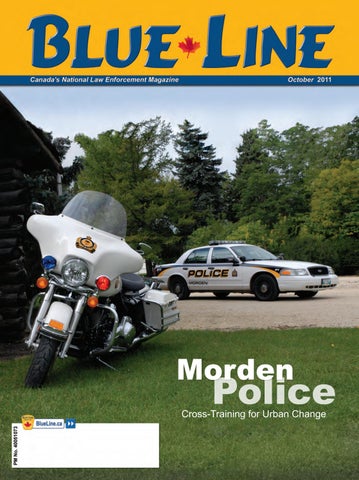
Morden
Police
Cross-Training for Urban Change
OCTOBER 2011
2
BLUE LINE MAGAZINE
October 2011 Volume 23 Number 8
Features 6 Morden Police Service Cross-training for urban change
8
“Flash-mob rioting” The next big challenge
6
10 Virtual cops Police in Finland challenge traditional stereotypes
12
Saving drug endangered children
16 Delta dog helps people through traumas 24
Choose your organization
Departments 38 26 31
16
35 34 36, 37 5
24
12
Blue Links Ad Directory Book News Deep Blue Integrity is not enough Dispatches Educational Directory Market Place Publisher’s Commentary When paranoia meets schizophrenia Technology 1234, hacking cell phones some more
Case Law 30 31
BLUE LINE MAGAZINE
3
Charter rights are personal Dog sniff a less demanding standard than reasonable belief
OCTOBER 2011
OCTOBER 2011
4
BLUE LINE MAGAZINE
Blue Line
PUBLISHER’S COMMENTARY by Morley Lymburner
Magazine Inc. PUBLISHER Morley S. Lymburner - publisher@blueline.ca GENERAL MANAGER Mary K. Lymburner - mary@blueline.ca SENIOR EDITOR Mark Reesor - editor@blueline.ca CREATIVE DIRECTOR E. Jolene Lymburner - jolene@blueline.ca CONTRIBUTING WRITERS Mike Novakowski Mark Giles Robert Lunney James Clark Dorothy Cotton Dave Brown Tom Rataj AFFILIATIONS International Association of Law Enforcement Planners Canadian Advertising Rates Data International Police Association The Canadian Press Newswire Access Copyright SUBSCRIPTIONS $30 per year; $50 for 2yrs; US & Foreign: $100 ADVERTISING 888-640-3048 advertising@blueline.ca
www.blueline.ca 12A-4981 Hwy7 East, Ste 254, Markham, ON L3R 1N1 Canada P: 905 640 3048 F: 905 640 7547 blueline@blueline.ca
PRINTED IN CANADA ISSN# 08478538 Blue Line Magazine was established in 1988 as an independent publication to inform, entertain, connect and educate those involved in the law enforcement profession. With no direct control from an enforcement agency, its opinions do not necessarily reflect those of any government or law enforcement agency. The authors, advisors, and publisher accept no liability whatsoever for any injuries to person(s) or property resulting from application of adoption of anything presented in this magazine. Readers are cautioned and advised that articles presented herein are edited and supplied for your personal awerness and should not be used for further actions until appropriate guidance is received from a supervisor, Crown Attorney or other persons in authority. All material submitted for publication becomes property of Blue Line Magazine Inc. unless arrangements have been made with the publisher prior to publishing. © 2011 All articles are protected by copyright. No part of this publication may be repoduced or transmitted in any form or means, electronic or mechanical, (including photocopying and recording or by any information storage or retrieval system), without prior permission. Permission to reprint may be obtained in advance from Access Copyright 1-800-893-5777.
BLUE LINE MAGAZINE
When paranoia meets schizophrenia Many pilots have died in their shot-up aircraft, an experienced airman once told me, because of their high comfort level in the cockpit. They preferred its familiarity over an unfamiliar parachute and would rather hold on in hopes of regaining control. They invariably paid with their lives. I remembered this when reading a press release in August from the Alberta Solicitor General announcing the signing of a 20-year deal with the federal government to retain the Royal Canadian Mounted Police. Canada’s taxpayers will pony up $60 million annually to keep the red in the black. I can understand the need for some stability in the RCMP but this deal shows an obvious level of desperation. It also begs the question of who the GWO* selected to cut the deal. Alberta is a province of opportunity. With a population closing in on four million and enough known oil and gas reserves to fuel North America for the next 200 years, it has thrown off its image of a boom and bust region and stepped proudly into the realm of a “have” province. Why this need to suckle at Ottawa’s breast for subsidized policing? The province’s $15 billion “Heritage Fund” grows by three billion each year, thanks to gas and oil royalties. This bounty of cash provides a sales tax free environment which is the envy of the country. Alberta has the best maintained infrastructure and the lowest unemployment rate in Canada and even gives money back to taxpayers on occasion, complete with an apology for taking it in the first place. Despite these riches, Ottawa now picks up 30 per cent of the tab for its subsidized provincial police service. That means everyone in Canada must donate cash to Alberta for the next 20 years. It is expected the other six provinces will scoop up similar RCMP contracts like a Boxing Day sale-a-thon. Given that only Ontario and Quebec pay the full freight for their policing costs, the natural conclusion is they will be the only ones left to pick up the tab. Policing in Alberta has been schizophrenic for years. The confused and often muddled genesis of the Alberta Sheriffs Service has left it fragmented and looking for an identity. The decision to expand what was essentially a court security service into taking over highway patrol duties from the RCMP not only muddies the true policing costs for the province but also fragments the law enforcement function beyond any hope of cohesiveness. It is like suggesting that these duties are too menial for the Mounties and criminals never leave 5
the scene of a major crime by car. Getting a clearer picture of Alberta policing is further confused by the 41 municipalities that pay into the Feds to subsidize their policing costs by using RCMP members. Add a series of county law enforcement officers who relieve RCMP members of many other duties common to other provincial police officers. If Alberta has designed a schizophrenic law enforcement structure than one could only describe a marriage with a paranoid police service as incredible. The deal comes at a time when many studies have recommended the RCMP take a long hard look at itself and make efforts to pull away from the wide array of duties it has shouldered over the past century. Why the hurry to seal a 20-year contract with a wealthy province at bargain-basement prices? Is it a message that there is going to be no change in the way the RCMP does business, or could it be the looming picture of a new labour relations paradigm with its membership? Cost-cutting will soon be far more difficult. Given the multitude of issues, studies and investigations still haunting the much-storied police service it might have been prudent to sign a five-year contract, giving it time to breath. Solicitor General Vic Toews insists he’s made his commitment very clear and thinks the “RCMP serves a valuable function as a provincial, municipal and federal police force.” In other words, it can still do it all and keep on ticking. I seem to remember a few years back an Alberta originated movement coming up with the slogan “Let the eastern bastards freeze in the dark.” I suppose the folks who thought that one up will be pleased to see the rest of Canada will be billions of dollars closer to that goal with 20 year policing deals in seven more provinces. Things are shaping up for a western boondoggle that will make the firearms registry look like chump change. Too late to cry over spilt milk... would the next province please step forward? * The Great Wizard of Ottawa (GWO) was first identified in previous comments on firearm prohibitions for federal wardens and border officers and heath and safety concerns for RCMP members. The public never sees or hears about this mysterious person when strange ideas come forth on government policy. The GWO has a bigger agenda to which we mere mortals are not privy.
OCTOBER 2011
Morden Police Service Cross-training for urban change
by Peter Cantelon A police constable in Morden, Manitoba wore many hats a century ago. Duties included acting as the local sanitation officer (a job which police continued doing until 1950), hammering down loose boards on town sidewalks, measuring water levels in fire wells, enforcing the dog tax and inspecting buildings. The Town of Morden Police Department, officially founded in 1891, with first appointed constable James Atkin, was purely a rural law enforcement agency in those days but times have changed. The town has grown to 7,700 people (give or take a few) and with that growth came all the responsibility of policing an emerging urban area. The 21st century Morden Police Service constable still wears plenty of hats but duties are now all directly related to law enforcement in a rapidly growing community. Today’s force boasts 12 constables, two sergeants, a chief, newly arrived K-9 Unit, a special constable and an admin staffer and runs 24/7 dealing with virtually all the crime a major metropolitan centre like Winnipeg sees, only on a smaller scale. The diverse crime of a growing community requires diverse training and crosstraining that many would not expect. There are members trained as SOCO officers, traffic investigation, crisis negotiation, commercial vehicle inspection, K-9, drug investigation, intelligence, drug recognition, field sobriety testing, datamaster, basic firearms instruction, forensic interviewing, major crimes and more. Most of the instruction comes from the Winnipeg and Brandon police services, RCMP and OCTOBER 2011
Canadian Police College courses. The specialized skills are required because Morden is situated in one of the fastest growing regions of Manitoba, requiring the service to adapt. “The biggest challenge is keeping up on training with specialized services in the various areas of police work,” said chief Brad Neduzak. “It’s no longer sufficient to just write parking and traffic tickets, there’s a lot more going on in our communities that are transitioning from rural to urban.” Morden may seem well policed, with an average of one officer for every 641 residents, but the need to cross-train means members are often performing specialized duties. “SOCO members can be taken off the street for three or four hours to process a simple break and enter crime scene (for example),” explains Neduzak. “When you start to branch off and specialize there’s considerable amount of time the officers must take off the street.” The force’s small size and time required for training and specialized duties has its drawbacks but also offers many benefits. 6
“You can basically utilize one officer in various areas,” said Neduzak. “In the bigger centres if you are in a drug investigative section for instance, then that is exclusively what you do. Those officers would not be attending regular calls for service such as domestics, break and enters or alarm calls. We have a couple of officers trained in drug investigations but they still have to work their regular shifts, take the calls and deal with all the other files as well, be it minor or major in nature.” While there has always been a level of specialized training in the force, the amount and nature has changed over the years as urban issues like drugs enter the community but the force has not forgotten the basics. In response to community concerns it created a traffic unit. True to form, all members get a chance to serve through rotation. Morden is not the only police force in the region. There is a local detachment of the RCMP, neighbouring Winkler Police Service is just 10 minutes down the road and the Altona Police Service less than an hour away. There was a time when area forces had little to do with each other, but crime has become transient, with criminals moving from community to community in a matter of days and police have had to adapt. Include the rural municipality and Winkler and you have effectively increased the population to 25,000 people. Morden shares a local records database with Winkler and Altona, allowing for a level of granularity that is far more detailed than CPIC. Officers can cross reference and access police reports throughout the area. The three communities have developed BLUE LINE MAGAZINE
many of the hallmarks of a regional police force without the official structure. Morden and Winkler even share the same police association and often leverage each other’s strengths when the need arises. Morden’s population swells for three days each year at the end of August when it welcomes 60,000 to 75,000 visitors from Winnipeg and across the province to the popular Corn & Apple Festival. No police force can handle such a flood of people without help. The close relationship and geography Morden and Winkler share is again invaluable. Winkler sends officers to assist and Morden reciprocates during Winkler’s Harvest Festival. It is this unique mix of attributes, a rapidly growing urbanizing population combined with one of the largest festivals in the province‚ that has driven Morden to take on some skill sets not typically found in a rural force. The K-9 Unit is but one example. Chase, a year old Belgian Malinois, has a lot in common with her human counter-parts in that she also wears more than one hat. “When we spoke with the Winnipeg Police Service K-9 section, they strongly recommended we have a cross-trained K-9,” said Neduzak. “In the bigger urban centres they have a specific dog that searches for drugs exclusively, ones that do search and rescue and ones that just track. In a rural area you’re going to have a multitude of these calls but not necessarily the volume to train a dog in one specific area. Just as our officers are crosstrained, we have a K-9 that is cross-trained for a much broader use.” With a mandate of providing the community with the best possible service it can and a future that points to continued growth and urbanization, the Morden Police Service is focused on seeking the best training and technology it can to meet the need. Morden members work outside the community and volunteer within. The service sent two members to the 2010 Vancouver Olympics. Officers have taken active roles coaching local sports teams and working with youth organizations. Morden has assisted with local charities and hosted its first fishing derby this summer in support of the Blue Ribbon Society Fund. “The focus for the future would be to continue to stay on top of the latest policing techniques in order to keep up with our growing population and the changing issues,” said Neduzak. BLUE LINE MAGAZINE
“We realize that we may not be able to sustain a lot of the specialized services that maybe bigger urban services have, but there is specialized training and equipment that will help us do our jobs more effectively. If you don’t keep up, you’re going to fall behind real quick. “There’s no point in having a police service that is half trained, half equipped and only 7
able to do half a job. Our community and the citizens deserve more. We wouldn’t be doing anyone justice to operate that way.” Peter Cantelon is a reporter who lives and works in Morden, Manitoba. He may be reached by email to cantelon@gmail. For further information about the Morden Police Service you may email Chris Flook at cflook@ mordenmb.com.
OCTOBER 2011
Flash-mob ” rioting “
the next big challenge by Joel Johnston We recently witnessed unsettling events across the UK but also here in Canada and the US – a troubling social phenomenon that includes using modern technology to assist in encouraging and enabling the rapid spread of riotous behaviour. I have used the term “flash-mob violence” or “flash-mob civil disturbance” to describe the UK riots and what happened in Vancouver in June. It seems a version of this also occurred in Philadelphia over the summer. The North American incidents are not precisely the same as the UK situation but many of the “drivers” behind the behaviour were the same. I do not think these terms explain or necessarily define the phenomenon – however they do provide an apt, current name for it. It is a take-off from the term “flash-mob” – coined in 2003, it is the use of modern technology to mobilize people to a particular location or locations to participate in a pre-rehearsed activity. In these cases (to one extent or another) it has been used to encourage, instigate and mobilize riotous behaviour – vandalism, arson, break & enter, looting/theft, assault, etc. I believe the explanation for this phenomenon is far more complex than can be captured in a name or short article. The behaviour relates directly to the breakdown of family, social, political, cultural and economic norms and values that started several OCTOBER 2011
decades ago – the enabling parents of a generation of aimless youth, a video-game mentality completely out of touch with reality, a sense of endless entitlement, personal greed, lack of accountability for almost everything and “celebritization” of outrageous behaviour engaged in by “normal people” (think Jersey Shore, Real Housewives, etc). Add a beleaguered economy, government-imposed austerity measures that disproportionately impact the middle and lower classes, a widening inequality in wealth and opportunity, a sense of hopelessness for the future – we find ourselves struggling to hold our society together in many ways. We are witnessing behaviour that crosses boundaries unseen in the past – young men and women and, in many instances, their parents. These are angry people from diverse “socio-economic” strata, actively participating in widespread unlawful, violent, destructive behaviour. Law enforcement finds itself constantly struggling for sufficient resources and funding to contest this behaviour. Governments are cash-strapped for a vast number of reasons, many realized through years of mismanagement and self-indulgence, and are unable to financially sustain a domestic “war” on this kind of activity. One thing is certain; all of the reasons that drive this kind of behaviour have developed over the past several decades and it is unlikely we are going to sufficiently impact them to make this problem go away. Law enforcement may face its toughest challenge ever – dealing with “flash-mob” crime, violence and riotous behaviour with increasing frequency. Police have demonstrated resilience throughout history but are sometimes slow to respond to 8
emerging threats. This threat needs to be considered across the board by large and small police agencies the world over (particularly North America and Europe) – and it needs to be considered now! In order to contain and effectively deal with these types of events, policing needs to become more adaptable, agile and mobile. Patrol or day-to-day operational units will be tasked with dealing with this phenomenon. Waiting for specially-trained public order units or emergency response teams is not workable – timing is critical. The boots-onthe-ground officers need to be better trained in team tactics and strategies that focus specifically on dealing with this behaviour. Training needs to be common across regions so that multi-agency interoperability is seamless. There will be a need to work easily alongside colleagues with different shoulder flashes. Common communications systems and command structures are also vital. Many of these concepts were addressed in past years with “active shooter response” or “immediate rapid deployment” training. All operational police officers need to be equipped with wearable, light, mobile but capable protective equipment that dissipates impact and is heat and fire resistant – equipment that can be donned quickly and easily and preferably worn under the normal operational uniform so as to not incite or invite violence. They must also be trained and have ready access to force-multiplying less lethal options that effectively address countermeasures being taken by the modern-day rioter (i.e. cold water cannons, environmental “discomforters” – things that make people no longer want to be there and both discriminate BLUE LINE MAGAZINE
and indiscriminate impact projectiles). There is no way police can match numbers with these kinds of groups at multiple locations. These weapon systems will be necessary from both a defensive and control perspective and will be integral to success. Law enforcement must also become skilled at how to disrupt these groups at their source through intelligence-driven methods. This means proactively devoting investigative resources to the social media scene and other relevant technology and being attuned to the elements of society who drive this behaviour through traditional and non-traditional methods (i.e. informants/ sources, etc.). Police agencies need to work on advancing legislation which would allow them to access and/or disrupt some of the technology used to enable this type of activity when it
BLUE LINE MAGAZINE
is in the public interest. This needs to be accompanied by an astute public media strategy. The CACP passed a resolution at its August meeting on this issue. Canada’s privacy commissioner has been quoted as saying that 80 per cent of the Canadian public opposes granting police greater access to social media sites. It will be difficult to overcome some of these obstacles in a free and democratic society where special interest groups frequently rule the day – but we must persist. Police agencies around the world currently use many tactics and tools that can be effective – if – they are looked at differently. In other words, we have many effective less lethal tools and a good understanding of combat and tactics. Manufacturers are producing better equipment all the time. We understand some behaviours to an extent and are learning more all the
9
time. We have trained police officers for rapid deployment to the “active shooter” or “terrorist” type threat. The question now becomes how we choose to synthesize our current capabilities into a modern-day context that will allow us to successfully deal with this “new” method of age-old behaviour. We must act now. Joel A. Johnston ( joel.johnston@vpd.ca ) is a 26-year veteran Vancouver Police Department senior operational sergeant working in the Downtown Eastside. Formerly provincial use of force & ERT co-ordinator, he is an ERT and crowd control unit veteran, Simon Fraser University graduate, Sandan in traditional Shotokan karate and court-certified use of force subject matter expert. He has contributed to Blue Line for the past 16 years. The opinions in this article are solely his own and do not represent any official position of offices held.
OCTOBER 2011
Virtual cops
Police in Finland challenge traditional stereotypes
by Dr. Aisha Sherazi Gone are the days where police officers regularly walk the streets. In suburban London where I grew up, officers would stop and chat, have the odd cup of tea at my parent’s grocery store and knew everyone in the neighbourhood. Growing up, I believe those interactions shaped the way I saw law enforcement. In an age where people barely have time to know their own neighbours, community
OCTOBER 2011
policing seems to have been reduced to police officers connecting with community through events rather than neighbourhoods. In a world where technology shapes the minds of young people, law enforcement will need to become wired into that technology, especially to reach out to youth. Increasingly,
10
virtual solutions to every problem surface on the market. From ordering a coffee to “Kill Bin Laden Yourself,” which allows gamers to “virtually experience the raid and pull the trigger to kill the Al Qaeda leader,” there appears to be no end to the innovative ways that technology will satiate our needs, however bizarre. In Finland, police have found novel ways to connect with young people by developing a virtual cop. Markos Forss had been a regular police officer for 13 years when he was assigned to a unit that investigated youth crimes. “In 2008 IRC-Galleria (a social networking site) was popular amongst young people. I started to see a connection between crimes amongst youth under 18 and the Internet. I began to explore the idea of creating a police profile on the site.” After convincing senior management as to the merits of the idea, “Fobba” was born. “Initially, most young people thought the profile “Fobba” was a hoax, but slowly, I was able to connect with young people through the site and break down the stereotypes about police officers. Once I built up some rapport with young people through IRC-Galleria, I (also) began to use Messenger and Facebook as tools to connect.” Forss soon realized that he was too busy to do his regular investigative work. Within the space of seven months 22 criminal reports were filed (17 were sexually related), 70 tips were received providing leads for potential crimes and nine reports were made to social services for suicidal chats and depression. Senior officers started to see the fruits of Forss’ labour. He was doing the investigative BLUE LINE MAGAZINE
legwork that a police officer would normally do face-to-face or patrolling streets in a car, except he was at a desk behind a computer screen. Through his online work, he was able to investigate school-related crimes, as well as find out what was happening socially amongst young people. He was able to glean where young people were meeting and through observing chats was able to ascertain alcohol and drug use. The virtual program has gone from strength to strength, with young people using social media tools to reach out to “Fobba.” Numerous online police officers have been hired, with further profiles set up. An online police fan club (Suomen Polisi) has been created, along with a You Tube channel, blogs and a twitter account. “Virtual policing has many uses, especially amongst young people. It is easier somehow to chat to an officer online when it comes to personal issues; less intimidating somehow. Using the Internet, we can inform the public about laws and answer questions. In a time where Internet crime itself is an issue and young people are preyed on, having an Internet presence has been important in providing a feeling of security online. We don’t limit freedom of speech on any of our sites, but we do intervene if a line is crossed legally, for example in cases of bullying, as well as potential sexual crimes,” Forss says. Online policing may have huge applications for radicalization. Young people can essentially go anywhere and read anything online. A police presence online wouldn’t limit that freedom but may prove useful in opening up a dialogue with young people and understanding how they think, perhaps even attracting investigative leads. To the vast majority of youth, the time
BLUE LINE MAGAZINE
when people didn’t connect using online technologies is similar to a time when people had no electricity. Connecting electronically is a way of life. The idea of virtual policing seems to be picking up amongst law enforcement officials and Forss has been invited to speak about the initiative in other countries. “Almost every country’s approach to social media so far has been communicative. It’s great if communications departments are using social media but no other country has gone for a direct approach, with officers themselves showing their real face and real name. Officers using real names and faces is key to the success of harnessing the powers
11
of social media in order to reach out to young people,” Forss says. Interestingly, even from behind a computer screen, young people detect sincerity and open up to people demonstrating it. Time will tell if other countries will adopt the Finnish model of virtual policing. Without a doubt, in a rapidly changing world, the best way to beat youth crime will be less and less about an “officer on the beat” and more about online profiles, chats and tweets. Aisha Sherazi is an Ottawa-based freelance writer. She works on the cross cultural committees for the RCMP as well as the Ottawa Police. She may be reached by email to aisha.sherazi@gmail.com.
OCTOBER 2011
Saving drug endangered children by Jean Floyd We went to a meth lab and our entire team was all geared up for the hazards of the lab and decontamination. We went into the home, wearing self-contained breathing apparatus and hazmat-like suits preparing to be there for maybe eight hours. We turned the corner during the raid and found a 9-month old sitting on the floor of the room where a meth lab was. When I saw the child being carried out in a diaper by a SWAT officer all geared up in a self-contained breathing apparatuses, my thought was, ‘Man, what has happened to this child for 24 hours a day, 7 days a week living in this environment?’ And that was my first awareness, after having worked in drugs and law enforcement for decades, that was my ‘aha’ moment, we’ve been missing these kids living with substance-abuse parents all along. – Commander Lori Moriarty (Ret.) of the North Metro Task Force, a Denver, Colorado multi-jurisdictional undercover drug unit. She is now vice-president of The National Alliance for Drug Endangered Children. The RCMP “O” Division (Ontario) Drugs and Organized Crime Awareness Service (DOCAS) and the City of Stratford brought together more than 125 professionals, including police officers, social workers, nurses, child protection workers, counselors and other service providers, in May. The two day conference was aimed at providing community partners with current, relevant and valuable information about drug endangered children. The gathering emphasized the latest research and best practice strategies to eliminate the cycle of child abuse caused by the child’s exposure to illegal drug activity in the home. Youth comes to us wanting to know what we propose to do about a society that hurts so many of them – Franklin D. Roosevelt, 1936 OCTOBER 2011
“We need to work closely with local organizations and social services so that young people who come in contact with the police, as either offenders or victims, receive the help they need to overcome challenges in their lives,” stated RCMP “O” Division Commanding Officer, Asst/Comm. Stephen White. The role of the Drug Endangered Children (DEC) program is to intervene on behalf of children who have been exposed to homebased drug activity to improve their life trajectory. Cpl. Heather Dickinson, a member of “O” Division DOCAS, in partnership with provincial and local law enforcement agencies and community services, is spearheading the movement in Ontario. “Addressing and assisting drug endangered children in Ontario requires a two pronged approach,” she said. “We need laws to protect these children but, most importantly, we need real collaboration between law enforcement, child protection and other social agencies, to rescue, defend, shelter and support children and give them the care that they need, not just once or at the time of arrest, but addressing their needs all of the way along their personal developmental continuum.” Defining drug endangered children Simply stated, a child is considered “drug endangered” if they are, or are likely to be, harmed by an adult’s drug activity. Children are deemed to be especially endangered if they are growing up in a home where drugs are being produced or sold, whether through an indoor marijuana grow operation or a synthetic drug lab. DEC are also those children whose caretaker’s substance abuse interferes with their ability to parent and provide a safe and nurturing environment. 12
Children at risk The cultivation of marijuana, as well as the production of methamphetamine and other synthetic drugs, is a major threat. Grow operations and clandestine labs can pose an environmental threat to children residing at these locations. For example, carbon dioxide enhances plant growth but poses serious health risks to humans. High concentrations can displace oxygen in the air, resulting in oxygen deficiency, combined with the effects of carbon dioxide toxicity. Grow operations contain high levels of humidity and are prone to the build-up of various molds, which can damage human health, causing or aggravating immunological diseases such as hay fever, allergies, asthma, infections and even cancer. The likelihood of a house fire is 24 times greater in a home with a grow op as compared to an ordinary household. Synthetic drug labs give rise to a variety of serious issues resulting from the toxic environments that they create. Methamphetamine is made mostly from common volatile household ingredients. When these ingredients are mixed and cooked together, dangerous and potentially harmful chemical residues can remain on household surfaces for months or years after cooking. Every pound of methamphetamine produced creates some five to seven pounds of waste, including solvents and corrosives. The increasing popularity of marijuana in Canada parallels the rising number of grow operations. Cannabis cultivation has more than doubled, from 3,400 recorded incidents in 1994 to more than 8,000 incidents in 2004. Other health and safety threats to children living in grow-ops and synthetic drug labs or who have care givers addicted to drugs include neglect, domestic violence, pre and post-natal drug and alcohol abstinence syndrome and BLUE LINE MAGAZINE
sexual abuse. Because marijuana grow operations are often linked to criminal activity and organized crime, the environment is also very high risk for physical assault, home invasions, gang violence and homicides. Increasing liberal attitudes towards marijuana use has led to an increase in the number of child neglect and abuse cases that can be directly attributed to marijuana. Presenting at the Stratford conference, Lori Moriarty cited cases where regular pot smokers had been found guilty of abusing or neglecting children. One story in particular resonated with the crowd; a father, high on pot with friends, placed his infant son and two year-old-child in a bath. Later he noticed water flowing down the hallway into the kitchen and only then remembered that he had put his children in the bathtub. He found his 8-month-old child dead, face down in the overflowing tub. Children growing up in homes of substance abuse are more likely to use substances themselves. This is yet another trajectory risk of the DEC. If you listen to people who say it’s only pot there will continue to be negative consequences to the health and safety of our children – Dr. Kiti Freier Randall “During my work in Australia, which has the highest marijuana use globally, there are increasing documented cases of serious and, in some instances, deadly results, that have been associated with pot use amongst kids,” stated Dr. Kiti Freier Randall, a pediatric neurodevelopment psychologist with an extensive
BLUE LINE MAGAZINE
background working with high-risk infant and youth populations. “They are investigating lethal consequences of youth who also happen to be taking prescribed antidepressants... The combination of marijuana and prescription drugs can be deadly. Marijuana use is often unknown to parents and practitioners who will frequently believe that the child died as a result of suicide rather than the result of combination substance overdose.” Meth users may suffer from paranoia, depression, eating disorders, insomnia and memory impairment – not the kind of qualities that make for a good parent, to say the least. Nearly 90 percent of users develop an addiction to methamphetamine after their first try. By its very nature methamphetamine provides additional risk to our children. Residue
13
collects on all surfaces surrounding a “cook” area; therefore it is not surprising that many children removed from home based labs test positive for methamphetamine. They also face greater risk of poisoning and needle punctures. The evidence shows that, in addition to the physical hazards associated with living in drug production surroundings, there is also long lasting and most often seemingly invisible harm done to a child who lives in an environment where their physical and emotional needs are neglected by a parent who is using drugs. The child’s everyday experience is often one of chaos, trauma, neglect and abuse, often resulting in the child learning to dissociate themselves; they become withdrawn, cannot relate or attach themselves in relationships. They also often experience neuropsychological difficulties (eg. attention, memory, lan-
OCTOBER 2011
guage, visual motor or sensorimotor deficits), poor self esteem, a sense of hopelessness, no values or spirituality and eating and behavioural disorders. Ultimately they will often mirror the same behaviours as their caregivers; becoming addicts themselves. “The environment changes their emotional landscape, distorting their emerging view of the world. Without intervention this will likely result in behaviour and emotional problems later in their life,” stated Randall. Drugs, children and law enforcement The role of law enforcement in the past has simply been to reduce the supply of drugs on our streets but this is not a complete solution. The problem hasn’t gone away; as long as there is a demand for drugs there will be criminals willing to manufacture and sell them. Children will continue to be at risk and the cycle will start all over again. If you have been around the drug world as a police officer, you come to learn that the kids on scene during a drug raid will likely be the same people you arrest 10-20 years later. The challenge for police is to change the way we view our role in drug enforcement. “It’s not about removing kids from homes, it’s about removing drugs from their lives,” noted Dickinson, “and the only way that we can effectively do that is through collaboration of all stakeholders.” RCMP Staff Sergeant (Ret.) Ian Sanderson, who helped to develop Canada’s first drug-endangered children act (Nov. 2006) in Alberta, said “We need to realize that there are impacts beyond organized crime bringing drugs into our community. Homes become dysfunctional as a result of drug abuse and the negative long-term effects on children.” Under this Alberta law, caseworkers and police officers can apprehend a child in danger
OCTOBER 2011
from an adult’s drug activity. If within two days the child cannot be safely returned to a parent or guardian, they will begin receiving services under Alberta’s child welfare legislation. What’s next? “My hope is that everyone who attended the conference left with a desire to help the drug endangered children that they come in contact with,” said Dickinson, “and ultimately I hope they will use the knowledge and strategies to open doors at their local level and work with each other to not only take children out of harm’s way, but to change their life trajectory as well.” Garfield Dunlop, MPP Simcoe North, introduced a private member’s bill in the Ontario legislature in Nov. 2010. Bill 84, the Child and Family Services Amendment Act (Protection of Drug Endangered Children) passed second reading unanimously by all three parties. It would amend the CFSA by clearly identifying drug endangered children as a new category of children in need of protection and classify the act of drug endangering a child as child abuse. The bill has been moved to the Standing Committee of Justice Policy and now it is up
14
to the Liberal government to call it forward for public hearings and then third reading. “We have to give police and child protection workers the tools they need to do their job more effectively and that is exactly what my bill will do,” stated Dunlop. Collaboration of law enforcement and child protection services has its own set of challenges. Why is collaboration challenging? Competing goals, historical relationship issues, control issues, differing values, feelings of insurmountable obstacles or hopelessness and un-channeled passions all contribute to making collaboration difficult. Moriarty offered a scenario based approach to help break down those collaborative barriers, stating “We get all the players in a room, we put scenarios out there like, we have a raid on a meth house, evidence that kids live there but only one infant is found. What is your role in this situation? What is mine?” The scenario based approach allows all stakeholders to learn what the role of the other is, clearly define their own role and fill in any gaps that may be exposed as a result of the exercise. A conference similar to Stratford was planned for Oct. 4 and 5 in Thunder Bay. “With communities starting to mobilize efforts towards drug endangered children initiatives it is important to engage all relevant stakeholders at all levels,” stated Dickinson. “I am so passionate about the DEC program and what it can do to help children; the positive response from participants at the conference and the subsequent interest in moving forward has me feeling tremendously optimistic that DEC will become a reality in Ontario.” To become involved with the DEC program in Ontario contact Corporal Heather Dickinson at the RCMP Toronto West Detachment (905 876-9674 or heather.dickinson@ rcmp-grc.gc.ca). Visit http://www.nationaldec.org/ for more on the DEC (US web site) or contact Sgt. Trudy Bangloy at 613 990-9322 to inquire about the RCMP National DEC.
BLUE LINE MAGAZINE
At-risk youth ‘escape’ to camp by Jeff Palmer A North and West Vancouver program aimed at providing at-risk First Nations youth with a positive summer camp experience has completed another successful year. Project ESCAPe (Experience Summer Camp Adventure Program) was originated by Cst. Jason Reader in Mission in 2005. RCMP Cst. Joey Starr assisted with the original program and then brought the concept to the Integrated First Nations Unit of West Vancouver Police and North Vancouver RCMP Integrated First Nations Unit (IFNU) in 2009. Starr’s ongoing goal is simple – give at-risk youth a chance to just be kids. “The camp allows kids to see police more as people than just an officer they might be scared of,” says Starr, “Kids become much more open and willing to talk and interact with us. “There are so many pressures on these youth that force them to grow up too fast,” he adds. “For us as officers, it’s great to see them have a chance to just relax and have fun in a safe environment.” Participating youth are provided with an opportunity to experience a week away at Camp Jubilee on the shores of Indian Arm in the District of North Vancouver. Project ESCAPe is focused on boys and girls aged 7-16 of Aboriginal descent who might not be able to attend summer camp without the program. Youth are selected with assistance of social development staff from participating First Nations. The IFNU Project ESCAPe was first offered as a program for youth from the Squamish and Tsleil Waututh First Nations. Thirty-six participated in 2009. Good news spreads quickly and the success of year one led to identification of growing demand for this unique camp experience. The program hosted 96 youth in 2010. Youth from the Musqueam First Nation were welcomed to the 2011 camp, boosting participation to 118 campers. The project supports key strategic priorities of IFNU and its partner agencies, including working with and building positive relationships between police and First Nations youth. Camp benefits communities by providing opportunities for low-income and high-risk youth to be involved in positive experiences, which develop a variety of social and life skills. Activities include rock climbing and rappelling, archery, canoeing, kayaking, high and low ropes course, camp wide games, skits and campfires. Campers go on overnight kayaking trips and even enjoy a water fight with camp counselors and First Nations Unit police officers. Major funding is provided by participating First Nations. Project ESCAPe 2011 was also greatly assisted by a $10,000 donation from BLUE LINE MAGAZINE
the RCMP Foundation and a $6,000 donation from the Dreamcatchers Fund. The project is also supported by Camp Jubilee’s Campership Fund and transport assistance from Cantrail Coach Lines and Indian Arm Recreational Services. Accessible only by boat from Deep Cove, Camp Jubilee has operated on the western shore of Indian Arm since 1936, providing a safe, fun and memorable environment while helping young people develop communication, co-operation, self-awareness and leadership skills. Campers experience the independence of being away from home, develop
15
new friendships and create lifelong memories. The IFNU is an integrated policing unit established between West Vancouver Police and the Royal Canadian Mounted Police in North Vancouver and Squamish to provide enhanced policing services that are culturally sensitive and responsive to the Squamish and Tsleil-Waututh Nations. Cst. Jeff Palmer is with the West Vancouver Police Integrated First Nations Policing Unit. Contact him at jeff.palmer@rcmp-grc.gc.ca to learn more or visit http:// ifnu.bc.rcmp.ca .
OCTOBER 2011
Delta dog
helps people through traumas by Elvin Klassen • The brutal attack and murder of a popular teenager in a park last fall left the community of North Delta, BC reeling and in fear. In the days that followed 15 year old Laura Szendrei’s death Caber, the victim services K9, was introduced to many in the community. At one gathering, a third of the 250 grief stricken citizens of all ages and cultures spontaneously broke into tears upon seeing him for the first time. Caber circulated among the small groups in the gathering, held in the gymnasium of Szendrei’s school, and was calming to everyone. His presence brought comfort and some peace. The school asked the handler to bring Caber to the school again for the first day back to class, this time to go to Laura’s classes in her absence. Caber and his handler sat by Laura’s desk throughout the day. The students were able to hug him, recall memories of their friend and share their grief. • A large fire severely damaged a local family’s home, killing their dog and causing great distress to the male victim, who was home at the time. He was receptive to meeting Caber and, before his arrival, kept asking, “Is Caber here yet?” When the dog arrived he enveloped him in a hug and said, “This is exactly what I needed.” • An adult male experienced great anxiety after a serious attack and subsequent brain OCTOBER 2011
injury. He calmed down immediately in the presence of Caber, who sat in front of him and put his head in his lap. The client began petting his ears and his anxiety was subsequently defused; he could speak more calmly and was able to communicate more effectively. Caber is a three-year old yellow Labrador Retriever used by the Delta Police Department (DPD) and lives with Kim Gramlich, his handler and “mom.” Gramlich has been the co-ordinator of Delta Police Victim Services for the last 10 years and has served crime victims for more than 15 years. Gramlich learned about victim service in a workshop at the National Organization for 16
Victims Assistance conference in Scottsdale, Arizona. She learned how the Scottsdale Police Crisis Response K9 impacted people in their grief and pain and decided to develop a plan to introduce the program in Delta. Delta is in the extreme south-west corner of British Columbia. The DPD has 166 sworn officers and 90 civilians serving more than 100,000 people in the communities of Tsawwassen, Ladner and North Delta. The victim services department has three civilian staff and 20 volunteers. “The introduction of a compassion dog to our victim services program has been a tremendous asset to our police department,” Chief Constable Jim Cessford noted. “Staff have utilized Caber on several occasions and he has provided comfort and care to many people who have been victimized by crime and trauma. Caber is an excellent resource.” Caber was named after the “caber toss,” a Scottish Highland sport (his litter were all given Scottish names). Cessford fondly recalls watching Caber jump up and run directly to the piper upon hearing the bagpipes for the first time. The piper, from the Delta Police Pipe Band, had never seen a dog respond so favourably. Cessford, a Scotsman himself, understands the familiar feeling of being drawn to the sound. A canine assisted “intervention” dog, Caber was generously provided to the program by the Pacific Assistance Dog Society (PADS), a charitable, non-profit organization that provides dogs to people facing BLUE LINE MAGAZINE
the daily challenges of life with a physical disability. Highly skilled, they allow clients to experience a greater level of independence and an enhanced quality of life. They are also often utilized in institutional settings such as hospitals, seniors and hospice facilities and have been successful in that work for years. PADS breeds, trains and retains ownership of all dogs it places in intervention and service capacities until the dog’s “retirement.” Retaining ownership is important so PADS can get the dog back if it is ever misused or abused; this also keeps the dog handlers and PADS staff well connected for support and assistance. Caber is the first trauma K9 in a Canadian victim services setting. He is extremely docile and very endearing and affectionate. Caber began his official training at just eight weeks old in the puppy education program, then ventured out in the world to live with his puppy raiser in Calgary until returning to PADS for advanced training. He remained there until just after his second birthday when he visited Delta police to see if he was right for victim services. PADS training staff exposed him to the chaos of police cars, lights and loud noises. He did little more than tilt his head to the side when a car with a loud siren and revving engine pulled up beside him. He traversed through the police building and was calm and comfortable with everyone, in every setting. Even loud crying and intense emotion didn’t phase him. Like all PADS dogs, Caber began his training with the possibility of becoming a service dog for a person with a disability. Staff felt his calm demeanour was better suited for intervention work. Today he responds to approximately 25 commands and his handler is “clicker training” him on fun new commands all the time. He will even smile on command! Three victim services staff members took a week of training to learn a variety of topics, including canine psychology, canine health and grooming, public etiquette, dog command structure and corrections. This qualifies them to deploy Caber safely and effectively. With team training completed, a 45-day assessment period began to determine if Caber was adapting to his new home and workplace and if the handlers were managing him effectively. During this period he was sent to support victims and families at incidents which included sudden deaths, suicides, a fatal motor vehicle crash and house and apartment fires. Caber proved to be highly effective with these victims, with two clients saying that he “is exactly what I needed.” Case in point, a female domestic violence victim arrived at the Delta Police Department looking for help for herself and her children after deciding to leave her BLUE LINE MAGAZINE
common-law spouse. After talking for some time she became quite emotional. When she began to cry, Caber got up from where he was playing with her child, approached and laid his head in her lap. She was incredibly touched by the fact that he reached out to her. “He just knows,” she said. In another example, an extremely difficult client was proving to be very challenging. He wasn’t receptive to assistance and criticized anyone attempting to help, including police. Through his contact with Caber he became more receptive. The first thing he now asks staff and police is if Caber is available. When the dog is there, he calms down and accepts support and help.
17
“The impact of Caber’s empathy for Delta’s victims of crime and trauma has proven to be exceptional,” said Gramlich. “We look forward to deploying him in many other situations to determine how else he can positively influence the lives of our citizens. Dogs aren’t judgmental. They don’t see your religion, race, age or sexual orientation. They are unbiased and unconditional in their support. Caber brings out the best in all of us.” For further information contact Kim Gramlich at kgramlich@deltapolice.ca or call 604 940-5007. Elvin Klassen is Blue Line Magazine’s West Coast Correspondent. He may be reached at elvin@blueline.ca .
OCTOBER 2011
New officers begin their careers by Danette Dooley The Royal Newfoundland Constabulary (RNC) held its police studies graduation parade and swearing-in ceremony in St. John’s, Newfoundland on August 27. Const. Neil Penney was presented with the Lieutenant Governor’s 2011 Cadet of the Year Award by the Lieutenant Governor John Crosbie, who is also RNC honorary chief. The award was established in 2008 by former Lieutenant Government Ed Roberts, who was also the force’s honorary chair. Selected by the RNC training section, the award is based on an overall assessment of each cadet during the entire program. The winner is the cadet who excelled in all aspects of the police studies diploma program and consistently demonstrated the desired competencies. Cst. Penney holds a bachelor of science (Honours) degree from Memorial University,
OCTOBER 2011
with a major in psychology, and a certificate in criminology. Penney made history earlier this year when he became the first RNC cadet/Memorial University student to be awarded a legal research award by the Law Foundation of Newfoundland and Labrador. Penney received the award for his paper
18
“Undergraduate attitudes toward differing justice models and perceptions of rehabilitative principles.” Newfoundland and Labrador Supreme Court registrar Chris Curran described the paper as “an exceptional piece of work for an undergraduate.” The constabulary partners with Memorial to train police officers. Since 2004, 179 officer, have successfully completed the police studies program. Fortytwo per cent of the graduates are female. Chief Robert Johnston feels the changing gender balance has made the RNC more representative of the communities it polices. “This year’s graduating cadets will join the over 500 police and civilian employees who continue to strive towards the RNC vision, to achieve safer communities through policing excellence,” Johnston said. Danette Dooley is Blue Line’s East Coast correspondent. She can be reached at dooley@blueline.ca
BLUE LINE MAGAZINE
Internet scams abound by Danette Dooley A St. John’s woman was delighted recently to find tickets online to a local Johnny Reid concert – but her excitement turned to trepidation when the method of obtaining them seemed a little shifty. The seller, insisting that payment be sent via Western Union before the tickets were couriered via FedEx, tried to entice the woman into buying them by saying her uncle was an RCMP officer and gave a badge number which, (surprise) turned out to be bogus. When this writer contacted the seller she said the tickets were still available. Although the seller said they were in Gander she insisted the tickets could not be picked up. The only way a deal could be made was through Western Union and FedEx – the same deal the seller was putting forward to others. When asked about sending money through Western Union the ticket seller suggested the writer pass along her address. The ticket seller would then suggest a Wal Mart store in the area that had a Western Union outlet. “Thanks for wasting my time!!!” the ticket seller said when it was obvious that the money wasn’t going to be sent. A google search found other postings warning of this scam. “Shame on these people ripping off innocent people for their hard earned money. Taylor Swift tickets were what I was looking for so I could take my nine-year-old daughter, who is a huge fan,” one posting read. But as RCMP Cpl. Yvonne Walsh said, “if it looks too good to be true, then nine chances out of ten it is.” Walsh is with the commercial crime section and works out of RCMP headquarters in St. John’s. Scams targeting classified advertising sites are common, she said, adding it’s sad people are still willing to believe in the truthfulness of others. “Everybody knows Kijiji. It’s a good site and people don’t stop to think that scammers are going to start targeting these sites,” she said. If the person selling a product isn’t willing to meet to make the transaction or won’t use a secure site such as PayPal, Walsh said, it’s a good indication that you’re dealing with a scammer. “It’s like going to the store. When you pay for your merchandise, you walk out with it,” she said. When only an e-mail address is provided, she said, the scammer could be operating from nearby or in another part of the world. Oftentimes, she said, the scammer will ask that the money be sent to a post office box address to hide their identity. Walsh says anyone encountering a situation they feel is a scam should pass the information along to the police or visit Phone Busters (www. BLUE LINE MAGAZINE
phonebusters.com). Based in Ontario, Phone Busters partners with the Ontario Provincial Police and RCMP, analyzing information it receives and sending it to the appropriate policing authority. Information on new frauds and scams can also be found on the website, Walsh said. Danette Dooley is Blue Line’s East Coast correspondent. She can be reached at dooley@blueline.ca
19
OCTOBER 2011
DEEP BLUE by Dorothy Cotton
Integrity is not enough As a person with way too much education, I am a big fan of books, which have many valuable uses. You can use them to prop up your computer monitor (I have two intro psychology textbooks designated specifically for this purpose) or increase upper body strength by carrying them. Impress others by carefully selecting and prominently displaying the right titles or use books as a foil to pretend that you are reading when you’re actually spying on nearby people. Go to bookstores as an excuse to get a good cup of coffee – you can even delude yourself into thinking you will improve yourself by reading. I must confess that I am much better at buying books than actually reading them. I harbour a secret belief that if you carry a book around long enough, the information will seep into your brain. If that is truly the case, then I must now be the most ethical person in the world – because I have been carting around the book “Ethical Issues in Law Enforcement” for several years now. Until recently, my observations about it have been confined to the following: 1. It is heavy 2. I like the colours in the cover 3. O ddly enough, the first author is a psychologist who has written a great deal about ethics in psychology as well as policing and related careers. Ethics is important in policing, as it is in many, if not all, areas of life. We have personal ethics, professional ethics, ethics related to sport, religion, grocery shopping, buying cars.... The trouble with ethics is that there can be a big gap between what we believe and what we do. Buying local produce, for example, may sound like a good idea until we find out that the stuff from Far Away costs half as much. Driving a small efficient car seems like the responsible thing to do until our friends make fun of us for driving a wussy vehicle. In other words, it is all well and good to have an articulated set of ethics principles and a strategy for ethical decision-making but if you do not act in accord with your ethical principles.... I think this is where the concept of “integrity” comes in. When I first got involved in the police world some years ago, I was surprised at how often the word was used. It is not something we talk about much in psychology. The word does not appear at all in my own Standards of Professional Conduct, though it can be found in the OCTOBER 2011
Canadian Psychological Association Code of Ethics for Psychologists in the form of Principle III “Integrity in Relationships,” which generally means you should play nice with your clients – it includes such things as accuracy and honesty; straightforwardness and openness; the maximization of objectivity and minimization of bias; and, avoidance of conflicts of interest. Interestingly, I think this definition of integrity is slightly different from what police officers mean when they talk about it. Evans (author of the aforementioned book) describes integrity in policing as acting in accord with one’s principles or values. He points out that it is possible for integrity to be a bad thing if one’s values are not great. If you act in accord with bad values, you may have integrity – but you have still done something bad. Consider the case of a police officer aware that a colleague is doing something wrong. What values are involved here? One might have the value of advancing public safety and always telling the truth. If these were your values and you acted in accord with them, you would rat out your colleague. However if loyalty to “the team” were your overriding value, then integrity would dictate that you remain quiet and not get your colleague in trouble. So I guess the definition of integrity used by Evans is not really enough. We need something that speaks to both process AND content. In other words, you not only 20
have to act in accord with your values, you have to have decent values to start with. Consider these alternative definitions: • The settled disposition, resolve and determination, the established habit of doing right where there is no one to make you do it but yourself. • A person of integrity is somebody who has a reasonably coherent and relatively stable set of core moral values and virtues to which they are freely and genuinely committed and which reflect in their act and speech. So, the person’s words and actions should be of one piece. So that catch-all term of “integrity” is apparently more complex than it appears on the surface. We have to have a clearly articulated set of values, they should be good (a whole issue in and of itself) and you have to act in accord with them. And of course, when it comes to that last part, it also becomes clear that integrity is not something that is entirely self-contained within the individual. People develop their values in the context of their families, colleagues, social systems, religious affiliations and cultures and enact them in the context of the organizations within which they work. It’s not simple. Sometimes we are not even aware of certain values till they are challenged. We may assume that others share our values – until they don’t. We may assume that we will be supported in acting in accord with our values – until we aren’t. We may assume that our values are fixed and unchanging – until they change. At an individual level, we have to have values and attempt to act in accord with them. At the organizational level, it means we have to support appropriate values. Psychologists may not talk a lot about integrity but they do know about the relationship between thoughts and behaviours. We know that unfortunately, the biggest determinant of behaviour is not attitudes or beliefs – it is the immediate circumstances surrounding a situation. So integrity is good and necessary but it is not enough. Over to you, police organizations. How do you reinforce/reward/enforce ethical behaviour? Hiring the right people is a good start – but it is only a start. Much of the rest is up to you. Dr. Dorothy Cotton is Blue Line’s psychology columnist, she can be reached at deepblue@blueline.ca
BLUE LINE MAGAZINE
Police Leadership Graduates Fall 2010 - Spring 2011
The Staff and Faculty of the Police Leadership Program want to congratulate all graduates on their success! Administration Certificate Sgt. Craig Burnett RCMP, Halifax, NS Det. Suzanne Byrnes York Regional Police, ON Sgt. Jeff Comeau RCMP, Regina, SK Cst. Matthew Conn RCMP, Halifax, NS Insp. Jeff Cove Lethbridge Regional Police Service, AB Insp. Scott Green Guelph Police Service, ON Cpl. Sean Kent Canadian Forces Military Police, Petawawa, ON Insp. R.J. Killbery RCMP, Prince Rupert, BC S/Sgt. Dan Larsen RCMP, Ste. Rose du Lac, MB Sgt. Shawn Nash Ontario Provincial Police, Orillia, ON Chief Dan Rivett Saugeen Shores Police Service, ON Sgt. Joe Telus RCMP, Ottawa, ON Cpl. Mary Thorne RCMP, Winnipeg, MB
Service Delivery Certificate Cst. M.H. Bahi RCMP, Quesnel, BC Cst. Gary Clyde RCMP, Moose Lake, MB Cst. Jenny Collins RCMP, Quesnel, BC Cst. Jamie Dearing Bridgewater Police Service, NS Cst. Michael Fox Fredericton Police Force, NB Cst. Elena Taunya Lewis RCMP, Canora, SK D/Cst. David Manzon York Regional Police, ON Cst. Trevor Morrison Toronto Police Service, ON Sgt. Shawn Nash Ontario Provincial Police, Orillia, ON Cst. Harold Prime RCMP, New Minas, NS Cst. Mike Smook RCMP, Thunder Bay, ON
Cpl. Donovan Tait RCMP, Campbell River, BC Supervisory Skills Certificate Det. Paul Black Peel Regional Police, ON Cpl. Chris Fry RCMP, Regina, SK Sgt. Steve Meggison Taber Police Service, AB Cst. Dennis VanEmber Fredericton Police Force, NB Advanced Police Leadership Cst. Christopher Hastie RCMP, Bay St. George, NL Cpl. Mike Roach RCMP, Newmarket, ON Sgt. Scott Rome OPP, Aviation Services, ON This list is not exhaustive. Some students could not be contacted and for reasons of privacy and security some did not wish to have their names included.
Law and Justice Certificate Cst. Ashley Bellingham RCMP, Digby, NS Cst. Jean-Pierre Bouchard RCMP, Grand Falls, NB Cpl. Greg Fast RCMP, Godís Lake Narrows, MB Sgt. David J. Gillan Ontario Provincial Police, Marathon, ON Cst. Christopher Hastie RCMP, Bay St. George, NL Cpl. Sean Kent Canadian Forces Military Police, Petawawa, ON Cst. Joanne Koole RCMP, Burnaby, BC Captain Alain Lacelle Canadian Forces Military Police, Wainwright, AB Sgt. Barry Leslie Peel Regional Police, ON Cpl. Kevin Lewis RCMP, Iqaluit, NU Cst. Robert McConnachie Ottawa Police Service, ON S/Sgt. Joseph Wenisch RCMP, Fort McMurray, AB Sgt. Brian Wintermute Peel Regional Police, ON Sgt. Shaun Wright RCMP, Surrey, BC BLUE LINE MAGAZINE
21
OCTOBER 2011
TECHNOLOGY by Tom Rataj
1234, hacking cellphones some more It was an interesting few months this past summer, as the British tabloid News of the World itself made headlines around the world. The newspaper’s apparently widespread practice of hacking the cellphones of royalty, celebrities and even the occasional crime victim finally caught up with it, ultimately leading to the arrests of several employees and the closure of the 168 year old tabloid. An extra twist to the scandal came when it was alleged several officers in the Metropolitan London Police were complicit, selling confidential information and cellphone numbers to the newspaper’s journalists. While on the surface this story appears to involve high-tech spy grade sleuthing, it was actually, fortunately and unfortunately, just some fairly rudimentary password “guessing” and perseverance combined with an understanding of the common weaknesses in user passwords. It’s important to remember is that much of this hacking occurred almost 10 years ago and it was the voicemail linked to the phone accounts, not the phones themselves, which was compromised. In those days, cellular phone companies either didn’t require passwords on voice mail accounts or often assigned defaults such as “0000” or “1234,” expecting customers to change them but not enforcing it. Hacking someone’s voice-mail was as simple as acquiring the number and calling when the user probably didn’t have their phone turned on, such as in the middle of the night. Call from a blocked number, wait until the voice-mail system answered, enter “0000” and you were in, free to listen, record and delete messages without leaving a trace. Older analog phones were also particularly vulnerable to eavesdropping because it’s relatively easy to intercept and monitor their signals using inexpensive and readily available scanners. This is no longer the case since most cell networks have long since switched to digital technology, making eavesdropping far more difficult and expensive. Passwords We are all burdened with dozens of passwords and access codes in our electronic, Internet-centric world. Remembering them all can be difficult. Many systems require only simple four number or letter passwords and users typically chose very simple ones such as “0000,” “1234,” or “password;” very simple to guess through trial and error. Another common problem is that many use the same password for numerous accounts; guess it and you gain access to much OCTOBER 2011
of the victim’s personal life. Not changing passwords on a regular basis is also a common problem. Many users keep the same one for years. Many more-secure systems require users to choose passwords at least eight or nine characters long and to include at least one or two numbers or other special characters such as: ! @ # $ % ^ & * ~ and at least one capitol letter. On some systems the password also expires after 30, 60, or 90 days. Microsoft recommends using passwords at least 14 characters long and offers a very helpful on-line password checker utility and advice page. Like other sites, it also has a strength meter that changes as a password is entered. Password management utilities are also a convenient solution for creating unique passwords for regularly-visited websites. These record and store all your passwords and enter them when you visit a site – but you do have to remember the master password, which protects the others. Some of these utilities will even create strong and unique passwords for each site, eliminating the weaknesses of user-created passwords. Many of these programs are also available for Blackberry, iPhone, Android and Windows Phone devices. The more popular include RoboForm, LastPass and KeePass. Smartphones The incredible growth of the smartphone market has introduced a new threat to data security. Since smartphones are essentially pocket-sized computers (with phone capabilities) that may contain a lot of very personal and confidential information. Although phone manufacturers and cellphone companies recommend people create and use a password to access their device, it doesn’t often happen. A recent poll commissioned by Canada’s Privacy Commissioner Jennifer Stoddart found that less than half of Canadian cellphone and tablet users put password locks on 22
their devices or adjusted settings to limit the sharing of personal data. Interestingly, those in the 18-34 range were more likely to use passwords than older people and women were less likely to use a password lock than men (35 per cent and 42 per cent respectively). The best security implementation on any smartphone to date is the Motorola Atrix, which has a fingerprint reader built into the top. It’s a great, fast and easy to use system – as long as the owner actually takes a few minutes to set up and use it. Replacing phones every three years or so also creates problems. An old phone contains a lot of important and potentially valuable information that needs to be erased permanently before it is recycled or disposed of. Complicating it further, most phones store data in internal memory, the SIM card and on a removable memory card. If selling or donating a used phone, it’s crucial to properly clear all user data. iErase for iPhones and ShreDroid for Android phones offers basic data erasure, while any removable memory cards can be readily erased on most computers. In the event that a phone is lost or stolen and not protected by a password, there is also remote phone wiping software available for most platforms but it has to be installed and the phone on and connected to the network. If the phone doesn’t work and is not worth fixing, a hard surface and sledge hammer will also do the trick (but don’t forget your eye protection). Malware and viruses Malware and virus threats often associated with the personal computer world have started to migrate to smartphones. Malware typically steal data, including usernames and passwords, while viruses generally damage or otherwise disrupt operation of the device. To combat this growing problem, several prominent security software vendors have started offering products for smartphones. The rapidly growing Android phone market BLUE LINE MAGAZINE
is the most vulnerable at this time because applications (apps) for them are available directly over the Internet or through the lightly controlled Android Marketplace. Apps for the iPhone are generally only available through the tightly controlled App Store. Each app in the store must pass inspection by Apple’s software team before going on sale. More than one million people were hit by mobile malware in the first half of 2011, with the daily detection rate doubling every few months. The old e-mail “phishing” scam (tricking people into visiting bogus sites so criminals can steal user-names, passwords and other data) apparently works better on smartphones because the screens are smaller and the user can’t see the entire (bogus) web-address in their browser. Because smartphone users are also always on-line they typically respond faster (and with less consideration) to e-mails than desktop users. Advice Always create and use strong passwords everywhere a password is required and install remote wiping software on your smartphone to protect yourself in the event of a lost or stolen phone. Tom Rataj is Blue Line’s Technology columnist and can be reached at technews@blueline.ca .
BLUE LINE MAGAZINE
Sergeant Bruce MacPhail Award for Academic Excellence – 2011 Deputy Chief Constable Del Manak of the Victoria Police Department is the 2011 recipient of the Sergeant Bruce MacPhail Award for Academic Excellence in Dalhousie University’s Police Leadership Program. This award represents the attributes, ethics and self-confidence Sgt. Bruce MacPhail demonstrated in his own personal life to attain personal and professional success. Established in 2001 by Phyllis MacPhail in memory of her son, the award commemorates Sgt. MacPhail’s dedication to life-long learning in the field of law enforcement. Sgt. MacPhail worked with the Halifax Regional Police Service and completed the Certificate in Police Leadership, Supervisory Skills in 2000 and was the first Certified Police Coach in the program. Del Manak started his policing career with the Vancouver Police Department before joining the Victoria Police Department in April 1993. In his 21 years of policing, Manak has worked in the Patrol Division, Traffic Division, Community Policing Division and Human Resources Division. He has also been a part of several specialty squads and task forces related to plainclothes assignments, property crime and youth crime details. In 2001, Manak was promoted to the rank of Sergeant and worked as a patrol supervisor. In 2004, he was promoted to an A/Staff Sergeant and
23
selected to set-up a regional integrated traffic enforcement unit. The creation of this unit was a provincial initiative and the Greater Victoria region was selected to pilot the program. In 2006, Manak was promoted to the rank of Inspector where assignments included managing the Human Resources Division and Patrol Division. In 2010, Manak was then promoted to Deputy Chief Constable and is currently assigned as the Deputy Chief of Operations. Manak is married to Nicky and they have two children, Rajan and Kamryn, who provide him with the support and encouragement to accomplish his personal and professional goals. Manak is actively involved in minor sports, spending up to ten months each year coaching both his children’s soccer and baseball teams. Manak received his Certificate in Police Leadership in the concentration of Supervisory Skills by completing the Police Leadership and Management Development, Managing Police Performance: Coaching Skills for Police Supervisors and Communication Skills for Police Personnel courses. Manak is committed to life-long learning and believes the courses taken at Dalhousie University have been a major part of his professional development. Manak plans to graduate from Dalhousie University with an Advanced Police Leadership Certificate. Congratulations to Deputy Chief Constable Manak!
OCTOBER 2011
Choose your
organization by Bob Percy What was it that drew you into policing as a career? The opportunity to help people, make a difference, explore a variety of jobs during one career, advancement, excitement and/or job security? It may be one of these items, a combination thereof or some other reason altogether. Regardless of the driving force behind your selection, you chose policing. Few people enter a career without having some form of interest in the field and hope of having a rewarding time during their tenure. Why would someone willingly enter a profession that they disliked so much at the onset? Starting a career is normally an exciting journey where the potential to learn, grow and make a difference is before you. The recruitment process into policing is not easy and involves many steps prior to the job offer. Anyone willing to follow it through to the end demonstrates their desire to join a proud profession. However as one’s career progresses, this may start to wane for any number of reasons. It seems that at times some officer’s experience something or a series of events that changes or impacts the viewpoint that brought
OCTOBER 2011
them to policing in the first place. The uniform which was once a source of pride becomes something else and ultimately becomes viewed as something less. The word constable now becomes a pejorative instead of that source of pride. Why is that? Policing is an honourable profession. With policing being a paramilitary, hierarchal institution and, as with any workplace, there are “layers” of management or supervision responsible for providing the operating direction and vision for the organization. There is no one best method to provide this direction and when members have to deal with circumstances beyond their control, it can lead to a multitude of possible outcomes. It has been said that change is inevitable but growth is optional. When the direction involves change, it is clear it can evoke a number of potential responses and outcomes. Some people may embrace the change while others resist or refuse, continuing as status quo. Some may feel defeated, capitulate, or simply internalize it and go about their business with minimal effort, feeling there is nothing they can do except put in their time and go home after “surviving” another day. The survival mentality is not healthy for the member or the organization.
24
Others may be more vocal or visible in their response to change. This may manifest itself further into being critical of the organization and spreading a message of discontent within their circle of influence and beyond. Some of these people may want to act as your voice and state their opinion as representing the majority via hiding behind a pseudo advocacy role to market their individual dissatisfaction. This ties into the concept of dealing with change and choosing the organization that you want to be a part of. Regardless of your initial response to a situation, be wary of those who try to convince you otherwise or to speak on your behalf. As noted, there will always be someone purporting to be speaking for the majority. During challenging times there is no doubt that additional pressure exists to succumb to the forces of negativity or those who choose to embrace the status quo. At times it may be difficult to chart a course that is different from others. However those that do, demonstrate leadership. I’ve heard it asked “What can one person do?” The answer is quite simple; a lot. When faced with a situation where someone is offering to speak on your behalf or represent your interests, it is incumbent to take a stand and ensure that your views are offered and shared with others. Through this process one may be surprised to find that their view is not unique and, in fact, the silent majority feel the same way. What others perceive to be right doesn’t make it right. You don’t have to raise your voice to have a voice. The key here is to exercise your right to be heard. Most importantly, be true to your beliefs and values. When dealing with change, determine how you will respond based on your own personal circumstances, perspective, viewpoint, beliefs, values and work ethic. Other influences, such as organizational culture, can also impact the manner in which you respond. Amongst all of these factors, the interpretation of the change can be viewed as a positive, negative BLUE LINE MAGAZINE
or perhaps ambivalent experience. There are a number of impact factors that interact and influence your personal and professional decision making process. Both internal and external environmental factors are interrelated. Finding a way to create your own satisfaction and value in the workplace not only assists in lessening the impact of these negative pressures, it also influences your level of engagement. It is easy to find perceived injustices and other things to complain about. There are challenges associated with that. The first is how you choose to respond to the situation. The second is identifying and bringing forward solutions to the situation. If something is truly off kilter or operationally unsound, it is incumbent that each and every member step up to not only voice the concern, but to seek clarification and also become involved in providing the solution. How many times have you heard it said that this is another “HQ initiative” or “they have no clue,” etc? Once, twice, never, too many times to count? The many levels of supervision in organizations act as an insulator that can either block messages from making their way through the chain or dilute, convolute or pollute the message en route. Either one can have significant impacts on the final “message” that makes it through. A key element of the communication process is that effective communication rests with the sender to ensure the message is clear and not ambiguous. If delivered personally by the creator it allows for active communication to occur where the sender can immediately seek out understanding from the recipient. As the personal delivery system is not a luxury we always have at our disposal, we need to work together, take the time to clarify and provide the information needed to get the job done. The mid level manager plays a critical role in acting as a conduit for effective communication, however they too are only as good as the information they receive. To augment your own personal situation you need to establish a mindset that allows you to resist the initial rumour mill and realize there may be more to the story. By taking the time to learn all you can about your organization and educate yourself, you will garner additional insight and a well rounded understanding of why things operate the way they do. Expand outside of your specific work silo and take a holistic approach to your efforts. This knowledge will provide additional strategies to assist in developing more effective and efficient ways of doing our business. It also allows you to speak with an educated voice versus one based on rumours, speculation and unconfirmed “facts.” The good thing about policing is that we have great people with high energy, ideas and creativity. True we have different roles but regardless we are all on the same team. A positive stemming from the team concept is that all members are expected to contribute to the success and end result. Within the team there are people with differing skills or areas of expertise where input is essential in moving us BLUE LINE MAGAZINE
ahead. This diversity of perspectives, experiences and variety of exposure only serves to make us better at what we do. It is a reality of policing that we do not always see the best side of society. However, through our interaction with the public and extensive community engagement, we are certainly exposed to a wide spectrum of good people, who want the same as we do for our families, friends and neighbourhoods. Don’t forget the people we are helping and making a difference in their situations. This includes the influence you can have, either positive or negative, on your own platoon teammates or others in the organization. It is essential to keep these circumstances at the forefront when undertaking your duties or when you encounter a work situation/decision/change that has the potential to impact your attitude. In addition to the good people we encounter and work with, seek out the good things that are going on or are a part of being a member of the organization such as; the shift schedule, the variety of work, benefit package, opportunity for specialized assignments, secondments, job security, promotions, pension plan, training or working with a great team. Choosing the organization you want to be a part of involves your participation and input. You need to carefully choose who you listen to and who you follow. Don’t be afraid to be the one to set the standard, take the lead or voice your opinion. Appreciate what you have to say and that your contributions matter and
25
make a difference. Part of choosing your organization involves creating that organization through ongoing contributions, active involvement and acting as a change catalyst. As trite as it may sound, choosing the appropriate attitude yields positive results that spill over and can permeate all aspects of your work experience. You are not alone in this quest. The leaders of any organization have an onus and responsibility to provide an environment that allows this to flourish by being part of the culture. Providing an environment that encourages feedback and input from all levels is essential, as is providing clarity of expectations and purpose in what we do. As you move ahead in your career, think about where you work, how you contribute to the organization and what you glean from your employment. Reflect on why you do this job. Recognize that, when compared to other employment options, this is an amazing career which gives you the power to positively influence a situation through your actions and engagement. Be an individual, stand up for your beliefs and values and do not be intimidated or pressured into falling into a perpetual negative point of view. Bob Percy (bob.percy@haltonpolice.ca) is deputy chief of the Halton Regional Police Service.
OCTOBER 2011
BOOK NEWS
by Morley Lymburner A Peterborough cop and his guardian angel Robert Lewis
Robert V. Lewis has been a trend setter, mentor, supporter and gadfly in policing throughout his long career with the Toronto and Peterborough police services. In addition to being a well chronicled autobiography this book touches on a lot of the history of labour relations and Lewis’ personal experiences from traffic cop to senior officer with Peterborough. Although the book covers many high profile criminals and crimes and how they were solved the part that most interested me was his struggle to get better care for injured workers. After a 15-day stay in hospital after a departmental accident he found himself in a protracted fight with Peterborough police and the workers compensation board. This episode taught the intractable young officer how to be adversarial in standing up for his personal well being and rights. This adopted attitude helped him gain a position heading up the Peterborough Police Association and later taking on the challenges of forcibly changing a loosely worded police act procedure; all as a result of a parking ticket error. This book provides more than a story of an officer in a small city but a 30-year picture of growth and change in this community and its police service. Lewis gives the reader an appropriate balance of anecdotes, incidents, facts and opinion in a full and lively narration. Getting a key inside look at police work through the eyes of an individual who has seen it all is as enlightening as it is entertaining. Contact Robert Lewis by email to lewisrvlg@sympatico. ca or phone 705 748-4400.
job than the average citizen sees in a life-time. You can increase or decrease that by a year depending on locale but I know I’m pretty close. It reminds me of my own realization when I began working with officers from across the country. The job’s the same... only the geography differs. Due to this factor it takes something special in a book to get a cop’s attention – especially when there are few pictures. Bremner’s story, as written by Connie Adair, will grab your attention from the beginning and will entice you into the world of post traumatic stress disorder. Every officer can relate to this book and needs to read it – and that goes for anyone considering a career in law enforcement. Bremner has more than 24 years of police experience and has served in the special weapons teams of one of Canada’s busiest cities. His daily calls and armed encounters were all handled with the professionalism of a well trained and experienced team behind him – but when it came to seeking the assistance of other professionals as his personal life and sanity broke down due to his daily challenges, he simply let it all slide. After much self reflection and a vision of his crumbling personal life Bremner sought out the help he thought he would never need. “Crack in the Armor” begins with Bremner’s true story of strength and courage and then takes the reader through a series of chapters on self awareness, PTSD preventative measures and next steps to recovery. This book is not a narrative on just this one officer but a reflection of every officer in the field today. In a go-go-go life style It presents an amber traffic light. Stress affects everyone in some fashion. Police officers must learn how to recognize and manage it and police leaders need to know how to minimize it. This book is a great guide for both. Contact Bremner Associates by going to www.bremnerassociates.com.
Faceless, voiceless Diana P. Trepkov
Forensic artist Diana Trepkov’s new book explores the world of the victim. In all cases the “victim” is traditionally described as the person taken away from their lovedones. In this book it is abundantly clear the “victim” includes every person who intimately
Crack in the armor Jimmy Bremner & Connie Adair
If you are an average copper “Crack in the armor” will get your attention and keep it. You should be well aware, however, that much of what is contained between the covers might be more of a mirror for you than a picture of events affecting author Jimmy Bremner. Cops are a different breed when it comes to getting a message through to them. They have seen and done a lot in a compressed period of time. I would venture to guess that most see more stressed out situations in their first two years on the OCTOBER 2011
knew the missing person. Faceless, voiceless takes the reader through a series of cases and personal relationships Diana has encountered while working on her many cases. She explains the purpose of the work she performed in each case and the motivation to help bring closure for those most touched by the loss. Diana has been featured in numerous Blue Line articles over the past six years and is often 26
seen in newspapers and on television. Her enthusiasm and intrepid spirit has propelled her into her field in a manner seldom seen today. Born with a keen artistic ability honed by years of study and practice in the field of forensic facial reconstruction, Diana has made her talents available to police services and other organizations across Canada and the United States. She has impressed many with her artistic talents and ability to talk with and earn the trust of the families of crime victims. This book is intriguing for both the curious and the involved. It is both educational and inspirational, reflecting today’s forensic artistry while attending to the nuances of the craft as known only by an insider. Between its covers you see through the eyes of a forensic artist all that has happened and all that could happen to help crime victims. It’s a truly revealing and inspirational book. Contact Balboa Press at www.balboapress.com or contact the author by email at dianatrepkov@rogers.com.
Interviewing and investigation Kerry Watkins, John Turtle and Jim Euale
I enjoyed reading this book and found it helped me get a grasp on the different styles of investigative interviewing that exist today. For the uninitiated the words “Reid Technique,” “Peace model” and “cognitive model” certainly conjure up the thought that this field is deep, complicated and competitive. This book manages to dissect model and style of investigative interviewing for its strengths and weaknesses. It then takes the reader on a clear understanding of an interviewer’s rights and responsibilities. The book is clearly a study text, taking the reader through chapter by chapter of lessons to be learned at its conclusion. It also encourages the reader to actively participate in the process of trial and error with each technique and develop skills on how to appropriately apply the right technique with the right situation. Highly recommended for law and criminology students as well as practicing police officers at all levels. This book will also assist anyone who must perform interviews to determine the veracity of what an interviewee is saying. Human resource personnel, for instance, might find the techniques helpful for interviewing potential employees in trust positions. This is a well crafted and very comprehensive title and, although easy to comprehend, not for the casual late night read. One must tackle it with keen interest and an intent to practice what it preaches. Contact Emond Montgomery Publications through their web page at www.emp.ca/policing.
BLUE LINE MAGAZINE
Investigating impaired drivers: Law professionals guide Gregory Wm. Koturbash
Gregory Koturbash, a Crown attorney with 18 years experience dealing with Canadian impaired driver laws, has written a book that is a cop’s dream come true. Investigating Impaired Drivers is up-to-date and well written, researched, referenced and indexed. It is comprehensive and, most of all, portable. This book certainly shows well and is a great reference for any police officer, attorney or (dare I say it) judge who must work in this field. The book’s opening index of chapters is designed to answer questions in a chronological order of the typical drinking driver event. Chapter one deals with report writing and police notes. The next 45 pages are divided into 19 topics of appropriate note writing and reports to submit. The next chapter “The hunt” has a sub chapter title in the form of a question – “How can I find an impaired driver?” Chapter three deals with “The vehicle stop” and once again each sub-section deals with a typical question someone might ask about this procedure. “What grounds do I need to stop a
BLUE LINE MAGAZINE
vehicle?” The reader is then taken through 28 chapters of Q&A’s on the subject. If you must take away a citizen’s rights you might as well learn how to do it right. This book will show you how to do just that. The language and flow of the narrative is easy to read and technical jargon is either kept to a minimum or clearly explained. The book is also designed in a compact 6X8 size with 364 pages (read a page a day and take one day off for Christmas to arrest an impaired driver) and will fit neatly into a brief case or backpack. This is a must-have book... and you can take that from a 20-year traffic cop. It will not disappoint. Contact Greg Koturbash at 250-832-5262 or www. gregkoturbash.com.
TRU: Tactics and rescue unit -The last resort in policing Andrew Maksymchuk
From its humble beginnings in 1975, the Ontario Provincial Police Tactics and Rescue Unit developed to become one of Canada’s top high-risk police response units. Andrew Maksymchuk, an initial member of this elite squad, has
27
now authored a biography about the team’s origins, training and development. OPP Commissioner Harold Graham created TRU after a hostage-taking incident proved members were poorly prepared. In this book Mak candidly shares intimate aspects of his life and career, at times with humour. Maksymchuk covers his eight-year association with TRU as one of the unit’s pioneers and first full-time coordinator. He takes the reader on a very personal journey through the selection process and initial training with military instructors on Canadian Forces bases. He provides a first-hand account of actual tactical responses to hostage-takings, fortified suspects and the step-by-step arrest of a barricaded cop killer. This book takes the reader on a page-turning trip as surviving police officers describe being shot or shot at. It also shares the heart-wrenching pain and family grief for those who didn’t survive. Following on the style of Mak’s previous book “From Muskeg to Murder” the reader will find an entertaining writing style that engages their attention to the end. Contact General Store Publishing House at www.gsph. com or Andrew at oppmax@shaw.ca
For more books available to the law enforcement industry see page 39 or visit www.blueline.ca
OCTOBER 2011
Why offenders confess Understanding the many roads to success by Louis C. Senese Threats and promises work in obtaining admissions, such as “Tell me you did this and you’ll keep your job” or “Tell me you did this or you’re going to jail right now; I have friends on the inside that owe me, get it?” are illegal. The obvious problem with these statements is that they may cause an innocent individual to admit to crimes they have not committed. To properly obtain a legally acceptable confession, such tactics must obviously be avoided. The question then becomes, what would legally persuade a guilty offender to confess? In my three plus decades of experience and our firm’s six decades of practice we have observed 10 primary factors that contribute to a suspect’s decision to admit one’s wrongdoing. They are not mutually exclusive and, in fact, several may simultaneously affect a decision to confess. Understanding them will help investigators elicit legally acceptable confessions from guilty offenders. Most criminal acts are stimulated by a variety of motives – greed, revenge, anger, passion, envy, etc. In developing an interrogational strategy, it is extremely important to try to ascertain during the interview process or from available investigative information, the offender’s probable motive for committing the crime in order to develop an appropriate strategy and “theme” during the interrogation. A theme is a monologue the investigator presents where reasons and excuses are offered that serve to psychologically (not legally) justify or minimize the moral seriousness of the suspect’s criminal behaviour. Generally themes are directed toward the offender’s motive(s) for committing the crime. As an example, Corey stole $1,000 from his employer because he felt that he was underpaid, underappreciated and overworked. Since the motives are anger and job frustration, the primary theme would be to blame his employer for not paying Corey enough money. Additionally, his behaviour could be minimized by contrasting one theft versus hundreds of different thefts or suggesting that it was only $1,000 and not $100,000. The interrogation approach or strategy should focus on developing themes based on the offender’s likely motive(s) in combination with the factors that influence their decision to confess. Themes presented in this manner will increase an investigator’s confession rate and ability to successfully resolve investigations. The ultimate goal of an interrogation is to learn the truth and obtain voluntary inculpatory and corroborated statements from the guilty offender. Factors influencing a decision to confess 1. Justification: Most individuals that commit a crime know they violated the law but, in OCTOBER 2011
one form or another, they rationalize their behaviour, in some cases believing that anyone else in the same situation would have done the same thing. The employee who steals from an employer may use the fact that they feel overworked, underappreciated and underpaid as justification. Likewise, the burglar may feel they cannot get a decent job due to prior criminal convictions and so has no alternative but to break into homes and businesses. The same would hold true for the child molester who rationalizes behaviour because they, in their mind, were not hurting the victim, only showing love and affection. Therefore, during the development of the theme the investigator should present several examples of psychological justification for the offense. Doing so will help to create an environment of empathy and understanding as well as the perception that most anyone, under similar circumstances, could have committed the same act. 2. Minimization: Offenders often times minimize the moral seriousness of their behaviour, convincing themselves that their offense wasn’t really that terrible. Consequently, during the interrogation the investigator should contrast what the suspect did with a similar but much more heinous crime that they could have committed, thereby creating the impression that what they did is not really that bad. Someone who sexually touches a child understands that their conduct was inappropriate and illegal – that is why they tried to conceal it. This specific behaviour could be minimized during the interrogation by contrasting simply touching with raping a child; the investigator can contrast this isolated incident with engaging in similar behaviour on numerous occasions with many different children. Furthermore, the investigator could contrast acting on impulse versus carefully premeditating and planning the act. Another minimization theme that may be appropriate would be to offer the idea that their intention was to sexually educate the child, not sexually harm them in anyway. These approaches do not relieve the suspect of criminal responsibility but offer a face-saving reason for their behaviour, making it easier to acknowledge guilt. 3. Patience and persistence: Two of the key factors contributing to the successful conclusion of an interrogation are the patience and persistence an investigator exhibits. They can28
not simply ask, “Did you do this?” and expect a confession. Likewise, they cannot expect an explanation of the crime by asking “Tell me why you did this.” For most offenders it is not a single statement made during the interrogation that prompted their decision to tell the truth, but rather the cumulative effect of the entire process. The interrogator’s confidence in the suspect’s guilt and knowledge about the crime can have a convincing effect. Some suspects simply get tired of living with their deceit and want to start fresh. Since the interrogation is essentially a monologue in which the investigator offers justification and engages in some minimization of the crime, the investment of time into the process is a major consideration. It is important that the investigator exhibits patience with the suspect’s denials and persistence in efforts to develop an effective theme. 4. Privacy: Are you more likely to discuss a personal problem with a close personal friend in a private setting or with a group of people in a public arena? Undoubtedly you would prefer the first option and the same principle holds true for the offender. In most cases it is easier for suspects to acknowledge their wrongdoing to one person in a quiet, private room that when several individuals are present, therefore there should be as few people in the room during an interrogation as possible – preferably only one investigator interrogating the offender. If there is a need to have a witness in the room (perhaps a second investigator), then this observer should not be seated in the suspect’s direct line of vision but rather off to the side and out of the way. Furthermore, any interruptions or distractions caused by phones ringing or people walking in and out of the room should be eliminated. 5. Trust: Most suspects are more likely to confess to someone they trust or feel understands their situation. Conducting a non-accusatory interview prior to any interrogation is an absolutely crucial step in the investigator’s effort to establish rapport and trust with the suspect. Even if there is overwhelming evidence against the offender, an interview should be conducted so that the investigator has the opportunity to portray an objective, neutral and non-accusatory demeanor, thereby creating some level of trust and rapport and creating a comfortable environment. Throughout the interview the investigator should remain relaxed, cordial and polite while avoiding BLUE LINE MAGAZINE
any skeptical tone of voice when responding to the suspect’s responses. During the interrogation the investigator should be very careful about lying to the suspect about evidence or other aspects of the investigation. If an investigator is caught or is perceived to be lying they may lose any credibility or trust that has been established. As an example, if during the interrogation of a suspect regarding a very serious or heinous crime, the investigator says, “I would have done the same thing you did,” most offenders would not believe the statement, thereby breaking any bond of trust that was established. Modifying this statement, however, could maintain some element of rapport and trust. For example, if the investigator had said, “If I was under the same set of circumstances you were under, I’m not sure how I would have reacted... I don’t know what I might have done,” this allows the investigator to maintain his credibility with the suspect. The same is certainly true with regards to physical evidence. If the investigator tells the suspect they are on video surveillance running out of the building before the bomb exploded and the suspect knows he was the look out while his partner placed the bomb, he knows he is being lied to and we will lose any credibility developed up to that point. 6. Conscience: Most people have a conscience or moral compass that helps them differentiate right from wrong. Some suspects admit their guilt because they want to atone for what they did and hope to relieve themselves of the tremendous burden of guilt. In some instances a feeling of remorse for the victim also factors into the motivation to confess, as the offender’s moral conscience begins to outweigh their ability to comfortably live with their lies. Themes that focus on rationalization, justification and minimization will be very effective with this offender. On the other hand, some suspects with significant psychological problems have to be approached in a different way. Sociopaths, who lack any sense of social responsibility, require more specific motivation to confess. They conceal crimes for fear of being caught and the related punishment, not for feelings of guilt or remorse. Therefore, they would be more susceptible to a factual approach in which the investigator presents evidence developed during the investigation that points to their guilt, suggesting that if it’s presented to a group of reasonable people, most would be convinced they committed the crime. The implication would be that this is the suspect’s opportunity to explain any mitigating circumstances that should be considered regarding acknowledgment of the crime. 7. Leniency: Clearly the investigator cannot make any promises of leniency to a suspect in an effort to solicit a confession. However, the courts have stated that a suspect “engaging in wishful thinking” (i.e., believing that giving a good reason for committing the crime will mitigate their punishment) will not invalidate the confession. The primary factors that many offenders believe will impact on possible leniency regarding their subsequent punishment include: a) being co-operative during the interview and interrogation, b) making restitution if asked, c) explaining the unique and extenuating circumstance for committing the crime, d) showing atonement or remorse for their actions and e) minimization – BLUE LINE MAGAZINE
believing that they did something that was wrong but that it could have been much worse. These areas should be considered when developing a strategy for the best themes to use during the interrogation. During the non-interview that precedes the interrogation, a suspect may be asked the behaviour-provoking question, “What do you think should happen to the person who did this?” If they respond, “Probably get some help,” this would suggest what they would like to happen to them. Furthermore, if the suspect responds to the behaviour provoking question, “Do you think the person who did this deserves a second chance?” by saying, “Well, if he is sorry for what he did then maybe he should get counseling,” he is signaling to the investigator an approach that may be effective in the interrogation. Specifically, he is indicating that a theme suggesting the suspect was sorry for what they did might be a factor to be considered before any final decision on punishment is made. 8. Evidence: The more evidence a suspect believes is against them the more likely they are to confess to the crime they have committed. In the US, the supreme court has stated police can misrepresent to a suspect the evidence that they have against them (for example, falsely saying an accomplice has confessed or that their fingerprints were found at the scene); it can be a risky ploy, as outlined in point five. Consequently, the most effective interrogation is armed with substantial evidence developed from a thorough investigation. 9. Status: Being incarcerated is a status symbol for some, providing the proverbial street PhD. Many offenders are revered by their
29
counterparts based upon their crimes. For some, being caught and incarcerated is viewed as a positive rather than a negative. Since the offender did not “rat out” or “snitch” on anyone else and accepted the consequences, this validates their trustworthiness. Complimenting this offender during the interrogation as being bold, clever and daring would further serve to confirm their ego. Minimizing the offense may not be advisable. 10. Promise: There will always be some that will wait until a “legal promise” of leniency is presented, such as a plea bargain admitting to a lesser included offense in exchange for a less severe sentence. This is generally not an option the interrogator can propose. If the crime is very serious and co-conspirators are involved, another “legal promise” is suggesting the offender might qualify for the witness protection plan. Even though such “legal promises” are used to ultimately acquire a confession, the interrogator should not feel that the technique was ineffective. Conversely, in all probability it was the cumulative effect of appropriate interrogation themes in tandem with incorporating many of the factors why offenders confess that persuaded the suspect to tell the truth. There are no guarantees that investigators can persuade every offender to confess but incorporating these strategies into an interrogation may pave additional paths on the road to the ultimate goal of obtaining a legally acceptable confession. Louis C. Senese is vice president of John E. Reid and Associates. †He has conducted more than 8,000 interviews and interrogations and presented hundreds of training seminars worldwide on specialized interview and interrogation tactics. His book, Anatomy of interrogation themes, is available from the store at www.reid.com .
OCTOBER 2011
CASE LAW by Mike Novakowski
Charter rights are personal Violations cannot be loaned
Alberta’s top court has once again confirmed that Charter rights belong to an individual and cannot be vicariously argued. In R. v. Schmidt, 2011 ABCA 216 a drug-using tenant rented a one-room apartment in a building known to police for violence, drug trafficking and gang member activity. He asked a patrol officer for help to remove unwanted guests staying at and taking over his suite. The officer agreed to stop by, knock and make sure everything was okay. The first time he checked two unwanted guests were sleeping in the tenant’s bed. They were ejected and banned from the building due to their gang affiliation and history of violence, drug use and trafficking. A sawed-off rifle was also removed from the residence. The tenant told police he did not have the courage to tell unwanted guests to leave, fearing they would hurt him if he tried to eject them or bar them from entering. He was also afraid he would be harmed if word got out that he was co-operating with police or asking for their assistance. As a result of those concerns, a safe word was agreed upon for future conversations that would indicate the tenant felt safe to speak openly with police. Police performing a routine patrol of the apartment building later stopped at the suite. The tenant opened the door when they knocked and, when prompted, replied that “friends” of his were there. He then backed away from the door and waved his arm, which the officers took as an indication for them to enter. They understood the gesture to mean that unwanted people were there. Because the tenant did not use the safe word, police were concerned that these “friends” were unwanted gang members, drug users or drug dealers. Four people were in the fairly dark suite, including Schmidt, the accused, who sat semiconscious on a bench. Clothing and bags were strewn about and there was drug paraphernalia on a table. The officer approached Schmidt to identify him and saw that his hand was on the handle of a steak knife, which rested on a bench and was pointed towards the officer. The officer was concerned the situation could escalate into a lethal force encounter because of
OCTOBER 2011
Schmidt’s state and the fact police were outnumbered five to two in the suite’s small confined space. He grabbed Schmidt, pulled him away from the knife and pushed him up against the fridge, arresting him for possessing a weapon. The officer felt an object in Schmidt’s pocket during a pat down, pushed it up and determined that it was a shotgun shell. A black gym bag was laying open on the floor two to three feet from where Schmidt had been sitting. The officer used a flashlight to see inside and, pushing apart the flaps a little, saw a sawed off shotgun (a prohibited firearm). It wasn’t loaded but a shotgun shell found in the kitchen area matched the brand and calibre of the one found in Schmidt’s pocket. Both could be fired from the shotgun. Schmidt was also bound by an order prohibiting him from possessing any firearms or ammunition. The tenant testified in Alberta Provincial Court that he did not invite the officers in but the judge found police had consent to enter. He also concluded that Schmidt did not have a reasonable expectation of privacy in the apartment and ruled the pat-down search reasonable because it was done for officer safety reasons after he was seen holding the knife. No Charter breaches were found. The black bag was in plain view, close to where Schmidt was sitting with a shotgun shell in his pocket. The only rational conclusion was that he was aware of the shotgun in the bag and had knowledge and possession of it. Schmidt was convicted of possessing a prohibited firearm with ammunition and two counts of possessing a firearm/ammunition contrary to a prohibition order. Schmidt challenged his conviction to the Alberta Court of Appeal arguing, in part, that the trial judge erred in finding sufficient evidence of consent to search the suite and that there were grounds to detain and search him. These arguments were all rejected. Consent The court concluded there was sufficient evidence for the trial judge to determine police had consent to enter and search the apartment. The
30
trial judge did not believe the tenant’s evidence. Furthermore, “even if the police officers did not have the consent of the tenant to enter and search his apartment, their conclusion that they had his consent was reasonable and means that they acted in good faith in searching,” the court said. This would have been a significant factor in admitting the evidence under s. 24(2) had a constitutional violation been found. “A Charter breach is not something that can be loaned by one citizen to another. If the police were wrong in their understanding that they had consent to search the apartment, that might have been a Charter breach vis-a-vis the tenant,” said the court. “That breach of the tenant’s right does not protect the (accused).” Search The discovery of the shell during the patdown search was lawful either as a search incident to arrest or incident to investigative detention. The search was conducted after the officer observed the (accused) either in a state of sleep or near sleep, or of extreme intoxication, with a knife under his hand. The scenario included what can only be described as a dark drug den with several people in a small confined space, all apparently in a stupor of some sort. The officer believed that the purpose of the knife involved danger to the police or the others in the apartment. Although the (accused) wasn’t convicted of the charge that flowed from his having the knife, the standards required for an arrest and a conviction are substantially different. The officer had the requisite grounds to make an arrest; search of the person incident to arrest does not result in a Charter breach. In R. v. Mann... the Supreme Court held that police officers who have reasonable grounds to suspect that an individual is connected to a particular crime may detain the individual for investigative purposes and may also conduct a pat-down search of the individual for the purposes of officer safety and the safety of others. That is exactly what the police did here (paras. 21-22). Schmidt’s appeal was dismissed.
BLUE LINE MAGAZINE
CASE LAW by Mike Novakowski
Dog sniff a less demanding standard than reasonable belief Reasonable grounds to suspect is near the lower end of the probability continuum, Saskatchewan’s top court has ruled. In R. v. Mackenzie, 2011 SKCA 64 police made a U-turn and caught up with the accused two kilometres later to warn him he was speeding. Mackenzie pulled his vehicle over to the side, despite no direction to do so, and without apparent prompting said he was “sorry” and admitted to speeding. The officer confirmed the stop was for speeding, asked for license and registration and noted Mackenzie’s hands were shaky and trembling, he was sweating, breathing very rapidly, his carotid artery was pulsing very rapidly and his eyes had a pinkish colour. When asked if he was okay Mackenzie pointed down to some medication on the console, said he had asthma and asked to take it. The officer could see no noticeable decrease in Mackenzie’s breathing or other changes after he took the medication. Mackenzie said, when asked, that he was heading home to Regina from Calgary but seemed to be somewhat confused on when he had traveled to Calgary. A computer check came back negative but the officer still suspected Mackenzie was involved in a Controlled Drugs and Substances Act (CDSA) offence. He based this on his observations and experience, which included a standardized field sobriety-testing (SFST) course, pipeline and advanced pipeline training and more than 5,000 traffic stops involving 150 discoveries of drugs. He asked Mackenzie to step out of the vehicle, told him he was being detained for further investigation under the CDSA and advised him of his Charter rights. A drug detection dog sniffed around the vehicle, indicated on the back hatch area and Mackenzie was arrested and again given his rights. A vehicle search turned up 31.5 pounds of marijuana in three gift-wrapped packages in the rear hatch area. Mackenzie was charged with possessing marijuana for the purpose of trafficking. A Saskatchewan Court of Queen’s Bench judge properly identified a “reasonable suspicion” as the standard for conducting a sniffsearch using a drug dog. However, Mackenzie’s very high level of nervousness, his pinkish eyes – which in the police officer’s opinion was consistent with the use of marijuana – and the course of travel from Calgary (a source of drugs) to Regina (a known destination of sale) did not meet this standard. “There appeared to be no other signs that indicated the presence of illegal drugs such as plain sight or smell... at best he was acting on a hunch,” the judge found, adding that it was “quite conceivable that the observations of the BLUE LINE MAGAZINE
accused claimed to have been noticed by (the officer) were enhanced after the drugs were located.” The sniff-search was unreasonable and breached s. 8 of the Charter (unreasonable search and seizure). The marijuana was excluded under s. 24(2) and, without it as evidence, there was no case and Mackenzie was acquitted. The Crown appealed to the Saskatchewan Court of Appeal. Controlling standard Although using a sniffer-dog as an investi-
31
gative technique constitutes a search under s. 8 of the Charter, police officers can conduct sniffsearches without prior judicial authorization on a “reasonable suspicion” standard. “A peace officer may deploy a sniffer-dog to search a vehicle where that officer has reasonable grounds to suspect that the presence of a controlled substance within the meaning of the (CDSA),” said Justice Caldwell for the unanimous court. “The standard of reasonable suspicion is less demanding than that of reasonable and probable grounds; however, there is no comprehensive set of evolved criteria which control whether the standard has been met. Each case turns on its own facts.” The court continued: The assessment of the reasonableness of a sniff-search requires a thorough understanding of the standard to be met and of the circumstances leading to the search. The standard of reasonable suspicion is near the bottom end on the continuum of probability (with proof “beyond a reasonable doubt” at the other). In any case, the court must undertake a subjective
OCTOBER 2011
and objective analysis of whether the state has met its burden. For a sniff-search, this analysis would have the court ask: (a) Did the peace officer subjectively believe that there were reasonable grounds to suspect the accused was in possession of a controlled substance? (b) Were there sufficient objective grounds to reasonably suspect the accused was in possession of a controlled substance? (at para. 19). Was the standard met? The appeal court accepted that the trial judge concluded the officer believed he had proper grounds to deploy the sniffer-dog (subjective analysis). As for the sufficiency of the objective grounds to support a reasonable suspicion that Mackenzie possessed a controlled substance, the Crown argued, in part, that the trial judge’s standrard was too demanding. In deciding whether a suspicion is reasonable a “judge must examine the factual circumstances leading to the sniff-search and whether, considered with an appreciation of the peace officer’s training and experience, those circumstances could have reasonably given rise to a suspicion of possession of a controlled substance,” said Justice Caldwell. The scrutiny of warrantless searches, done after the fact, must be rigorous. However, the analysis of a reasonable suspicion does not involve a search for motive. It is also important that a trial judge consider the officer’s experience and training when determining the objective existence of a standard of probability like reasonable suspicion or reasonable and
OCTOBER 2011
probable grounds. Experience and training must also be carefully assessed in the context of the standard of reasonable suspicion. The officer had more than a hunch. He carefully articulated the factors leading him to form a suspicion that Mackenzie was involved in criminal activity and why he believed he possessed a controlled substance: •H is erratic driving and overreaction to police presence in slowing to 20 km/h below the speed limit and pulling over before being signalled to do so. This was behaviour the officer’s experience taught him to infer that the accused might be hiding something from police; •H is extreme nervousness, which was “probably some of the highest nervousness that (he’d) seen in a traffic stop.” Also, when the accused was told of the relatively minor reason for the stop, his level of nervousness did not diminish. This was behaviour which, in the officer’s experience, further indicated the accused had something to hide; • His hands were shaky and trembling when handing over his licence and registration, indicia of nervousness and, in the officer’s training, a symptom of marijuana use; •H e was sweating with beads of sweat forming on his forehead, indicia of excessive nervousness; • He was breathing very rapidly, his chest moving in and out very quickly, which was audible when speaking, also indicia of excessive nervousness; •H is carotid artery was pulsing very rapidly,
32
a sign of a high level of nervousness and something the officer had experienced in traffic stops “where criminality was involved”; • His nervousness was significant enough to prompt the officer to inquire about his health, but his rate of breathing and other indicia of nervousness did not noticeably decrease after he took his asthma medication. (i.e. absence of a discernible reason for symptoms of nervousness); • His eyes had a pinkish colour to them, a symptom known to the officer by training and experience to be associated with marijuana use; •H e seemed confused as to his travel itinerary, something the officer had observed in individuals trying to avoid detection of a crime by hastily making up a story but then forgetting the details; • He was travelling from Calgary (a city known to the officer as a distribution point for drugs) to Regina (a city known to the officer as a destination point for drugs) along the Trans Canada Highway (a route known to the officer as being used by drug couriers); •H e was on a quick turnaround trip. In the officer’s experience, drug couriers make quick turnaround trips; and • Neither CPIC or Police Information Retrieval System (PIRS) databases contained any record of the accused. There was no discernible reason for the extreme degree of nervousness exhibited. All of these factors “synergistically” caused the officer to suspect the presence of a controlled substance but the trial judge simply
BLUE LINE MAGAZINE
reduced these factors to only three (i.e., “very high level of nervousness,” “pinkish hue of the driver’s eyes” and “course of travel”). The latter two were then characterized as an “opinion,” unsupported by evidence and the inferences the officer drew were discounted. In doing so, “the judge failed to appreciate the constable’s issue-specific knowledge, training and experience and thereby ignored the probative value of the constable’s evidence as informed opinion,” the court said. The constable’s testimony about the factors that led him to draw the overall inference that drugs might be present in (the accused’s) vehicle must be seen and weighed not in terms of unsubstantiated opinion, but with an appreciation of (the officer’s) training and experience.” Nervousness, a natural human condition observable, describable and appreciable (or objectively verifiable) by anyone, required an interpretation by the officer. Mackenzie was “extremely nervous,” probably some of the highest nervousness the officer had ever seen in a traffic stop: As a factor unto itself, nervousness alone might not ground a reasonable suspicion of criminal activity; but here, the constable grounded his suspicion on more than the existence of nervousness. (The officer) also testified to (the accused’s) erratic driving (an overreaction to police presence), to the extreme degree of (his) nervousness, to the absence of abatement in the degree of nervousness given the relatively insignificant reason for the traffic stop and to the absence of any apparent reason for such a high degree of nervousness. In this sense, (the officer) drew upon his experience and training to contextualize (the accused’s) nervousness, which lent a tenor to that nervousness; one with the shade of potential criminal wrongdoing on the part of (the accused). Furthermore, the constable said his experience and training suggested that an individual with a “pinkish” eye colour might have recently consumed marijuana. On crossexamination, the constable testified that while use of marijuana does not necessarily mean an individual is transporting marijuana, in his experience, “people that use marijuana usually have marijuana.” Logically, however, not everyone who exhibits pinkish eye colour has recently used marijuana, let alone is in the process of transporting drugs and the constable did not suggest otherwise; nor is it likely that everyone who has recently used marijuana is in possession of it, but when the standard is reasonable suspicion, the law does not require hard certainty as to the inferences drawn by a peace officer. Even where equally or even more persuasive inferences may be drawn from the observations, a judge may find that the peace officer’s inferences, when considered with an appreciation of the officer’s training and experience, are reasonably supported by the factors articulated. A trial judge should be reluctant to discard such inferences as wrongly drawn without some analysis of why they were not appropriate. In this case, it was also reasonable to place BLUE LINE MAGAZINE
all of the constable’s observations and inferences within the context of his knowledge that drug couriers use the TransCanada Highway for quick turnaround trips when transporting drugs from Calgary to Regina. While the circumstances might not have suggested the presence of drugs to someone not having (the officer’s) training and experience and while there may be other plausible and innocent explanations for the pinkish eyes and trembling hands observed by the constable, those factors support a suspicion of potential criminal wrongdoing and, more importantly, wrongdoing involving drugs (paras. 34-36). Although close to the line, the constellation of objective factors in this case were enough for
33
the officer to reasonably suspect that Mackenzie unlawfully possessed a controlled substance. The reasonable suspicion standard was satisfied. The warrantless sniffer-dog search of the vehicle’s exterior was reasonable, thus the subsequent physical search pursuant to Mackenzie’s arrest was permitted and the marijuana was admissible. The Crown’s appeal was allowed and a new trial ordered. Visit www.blueline.ca/resources/caselaw for complete cases. You can email Mike Novakowski at caselaw@ blueline.ca
OCTOBER 2011
EDUCATION DIRECTORY
AMU has attracted hundreds of Canadian students seeking online programs that are flexible, affordable, current and relevant, with more than 70 degree programs uniquely tailored to meet the needs of today: intelligence studies, criminal justice, emergency and disaster management. American Military University is a good choice for Canadians. Visit www.PublicSafetyAtAMU. com/Canada.
BCIT’s Forensic Science and Technology program is Canadaís leading educational provider in forensic studies. Our part-time programs and courses are taught by industry experts with diverse backgrounds in various areas of forensic investigation including: Computer Crime, Crime & Intelligence, Forensic Health Science, Forensic Science and Video Surveillance. Contact: 604-412-7436 or bcit. ca/cas/forensics.
California University of Pennsylvania, founded in 1852, offers OnLine graduate and undergraduate programs in Legal Studies. The MS in Legal Studies includes tracks in Homeland Security, Law and Public Policy and Criminal Justice. Programs are delivered in a flexible and quality environment for busy adults seeking professional advancement. Visit www.calu.edu.
CSU is an Australian University with close ties to Canada. Our undergraduate and graduate Policing degrees are offered through our world-class distance education program. They are highly recognized degrees and very popular among Policing Services in Ontario and across Canada. For more information and to apply contact Gail Albanese at wwss@cogeco. ca or 905-648-7424. http://www.csu.edu.au/ OCTOBER 2011
CPKN is on the leading edge of online training for police and law enforcement. Working directly with the Canadian police community, CPKN develops and delivers training that is specifically designed for police officers. Our catalogue features a diverse range of innovative courses and learning resources that respond to essential frontline needs. Contact: 866-357-2726 or www.cpkn.ca.
We have been providing first class leadership education to police officers since 1993. Our authors/instructors are second to none, having a high level of academic credibility combined with direct policing experience. Our distance courses are designed and delivered so that personnel can continue to work and immediately employ skills learned. Contact: 902-494-6930 or www.dal.ca/cce.
Georgian College opens doors for police officer. Georgian has always been a leader in training police professionals and now the opportunities are even greater. Fast track your degree with advanced standings in the Bachelor of Human Services – Police Studies degree online. Qualified police officers can receive advanced standings through a combination of work and education experience. Contact: PTS-Orillia@ georgianc.on.ca.
John E Reid and Associates provides training programs on investigative interviewing and interrogation techniques. We also have produced a variety of audio and video training programs, as well as several books designed to enhance the investigatorís interviewing skills. Visit www.reid.com for a complete training schedule. 34
The JIBC Emergency Management Division has been educating emergency management leaders in Canada and internationally for more than 20 years. Get your Bachelor of Emergency and Security Management Studies degree online, or choose our certificate and diploma options. Plus, we can deliver applied ICS, EOC and Exercise Design training at your location. Visit www.jibc.ca.
Whether itís emergency response, prevention or leadership training you need, Lakeland College Emergency Training Centre in Alberta can help. We specialize in fire service, emergency medical services, incident command and emergency preparedness training at the provincial, national and international levels. Visit www.lc-etc.ca.
Basic explosives and improvised explosive device recognition, boobytraps, vehicle search for threat items, and xray interpretation courses offered by SECURESEARCH. Fall 2011 and Winter/Spring 2012 Courses are proposed at F.E.S.T.I. Toronto. Contact: 800-452-3130 or info@securesearchinc.com.
Discover the fascinating world of forensics with Seneca Collegeís Forensic Investigative Studies program delivered in a flexible format in collaboration with BCIT. Designed for frontline investigators and taught by recognized experts, it provides forensic knowledge for those entering the field. Visit http://www. senecac.on.ca/school/safety_police/forensics. Contact: Niiole.Harding@senecac.on.ca.
Trillium College is a Private Career College with over 20 years in the industry. Trillium College’s Police Foundations program is one of the best community service career paths in Ontario. The principles equip students with the skills to handle public relations, resolve conflicts and act justly when working with diverse populations. Contact: 866-661-2070 or visit trilliumcollege.ca. BLUE LINE MAGAZINE
The University of Frederictonís Diplomato-Degree Program, in partnership with Husson University, allows students with a twoyear Public Community College diploma the opportunity to apply their diploma credits toward an accredited online Bachelorís Degree from Husson University. Transfer up to 90 credits and complete your degree with as few as 10 classes! Contact: 877-454-6232 Ext. 8, 3 or visit www.UniversityFredericton.ca.
MA (Leadership) OnLine Program: The University of Guelph’s online MA (Leadership) program offers a broad multi-disciplinary approach which deals with leadership issues relevant to the public, private and not-for-profit sectors. The MA (Leadership) program which combines e-Learning with residential components is designed to empower individuals with leadership knowledge and experience, allowing them to increase their self awareness and competency, in order to contribute to ethical leadership, organizational transformation and the betterment of society. Visit www.mba.uoguelph.ca.
Program includes an Honours Bachelor of Applied Science in Justice Studies & Diploma in Police Foundations or Community and Justice Services. In the first year, core courses provide a firm foundation in the justice field. They include Crime and Criminal Justice, Introduction to Law, and Criminal Offences. In the second year, choose either to focus on Police Foundations or Community and Justice Services. Visit www.guelphhumber.ca/justice.
Known as a centre of excellence for teaching, applied research and learning, Vancouver Island University produces quality graduates who are in demand by employers across the country and around the world. VIU supports a student population of approximately 20,000 full and part-time students over four campus locations and offers a tremendous breadth of program options, including trades and technical training, undergraduate and graduate degrees. Contact: 888-920-2221 or visit www.viu.ca. BLUE LINE MAGAZINE
35
OCTOBER 2011
MARKET PLACE
OCTOBER 2011
36
BLUE LINE MAGAZINE
MARKET PLACE
BLUE LINE MAGAZINE
37
OCTOBER 2011
Parole reform
for repeat offenders by Scott Newark Canadians have rightly been gripped by the plight of the Hebert family of Sparwood, B.C., whose three-year old son was abducted, with Randall Hopley, a convicted sex offender and career criminal, the prime suspect. While Kienan Hebert has thankfully been returned home safely, this incident, along with other high-profile crimes committed by repeat offenders, illustrate clear deficiencies in the justice system that require immediate attention. Dealing effectively with crime is an inherently complex issue in part because of the number of independent institutions within the justice system, such as the police, prosecution, courts, corrections and parole boards, all of which need to co-ordinate their efforts to support public safety. These institutions already treat dissimilar individuals, such as young offenders, in different ways. For example, there is a concerted effort to use proactive steps to try to prevent young people from getting involved in crime, and even when they do, we sensibly use more lenient measures to provide alternatives and life structure so that young people make better choices and stop committing crime. If early intervention and youth-specific strategies can get young offenders back on the path to productive, law-abiding lives, without burdening the taxpayer with the financial and social costs of incarcerating them, all Canadians will be better for it. But one of the grim realities confronting our justice system is that a disproportionately large volume of crime is committed by a disproportionately small number of repeat offenders. The justice system has tools to deal with these sorts of individuals, including longterm imprisonment where, at best, correctional programming can build positive behavioural changes and, at worst, the simple expedient of incarceration eliminates their criminal potential for that time in custody. The length of imprisonment for most crimes is determined by a sliding scale that considers both the severity of the crime and the criminal’s unique characteristics, including criminal history. Unfortunately, the reality of the prevalence of repeat offenders in crime is not reflected in our current parole eligibility laws. Specifically, offenders that have repeatedly committed crimes while on parole are still eligible for parole at the same time as a first offender. This disjointed, “one size fits all” approach undermines the collective goal of increased public safety through reduced crime, especially when it comes to repeat offenders. OCTOBER 2011
The Harper government has made significant improvements to support the integrity of the corrections and parole system by permitting longer parole ineligibility for multiple murderers, eliminating advanced early release for murderers and removing parole eligibility for those who have completed only onesixth of a court imposed sentence. Hopefully, with a majority mandate and an unmistakable commitment to public safety, the government will now address repeat offender parole reform. The recommendations offered below would be a good start. First, convert statutory release into earned parole. Currently, offenders have a presumptive right of release (with rare exceptions) after not more than two-thirds of their sentence no matter how often they broke the law or breached parole. Parole must be a privilege to be earned, not a right to be demanded on a predetermined schedule. Second, legislate escalating future parole ineligibility consequences for people who commit crimes while on parole. Third, breaching parole conditions should itself be a crime that Correctional Services of Canada (CSC) and the Parole Board of Canada (PBC) are required to take into account in making their decisions. Fourth, the CSC and PBC should be required by law to consider the availability of post-sentence supervision for high-risk offenders in making their decisions. Fifth, the Parole Board should be authorized to order electronic monitoring of highrisk parolees. Sixth, a public analysis of correctional programs to measure re-offending impact should be undertaken with resources reallocated to more effective programs. Seventh, the government’s platform in the last election included an attempt to create a drug-free environment in prisons. This is a huge challenge, but would pay enormous dividends. Though our expectations for success must be realistic, it should still be pursued. Eighth, the Immigration Refugee Protection Act and the International Transfer of Offenders Act should be amended so as to expedite the removal of non-citizen criminals convicted of crimes in Canada. It’s a big list but the public safety dividends will be immediate, appropriate and real. Scott Newark is a former Alberta Crown prosecutor and executive officer of the Canadian Police Association. He may be contacted by email to: snewark.nsrc@ sympatico.ca
38
Advertisers Directory Learn more about these Canadian Law Enforcement suppliers at
www.BlueLine.ca
American Military University 9 Badge and Wallet 36 Blazing Lumens 37 Bosik Technologies 19 BC Institute of Technology 34 California University of Pennsylvania 34 Carswell, a Thomson Reuters Business 31 CashTech Currency Products 36 Charles Sturt University 11, 34 Chrysler 40 Clauma Inc 15 Code Zero Licensing Int’l Inc 36 Constable Cigar Co 36 Cornerstone Mediation 37 CPKN 32 D & R Electronics 13 Dalhousie University 21 Delta Marine Security 37 Digital Evidence International 37 Emond Montgomery Publications 30 Ergocentric Seating 36 Fisher Space Pen 36 Georgian College 34 Gieserlab 11, 14 HeartZap Services 37 Henry’s Photo • Video • Digital 27 Humber 27 In the Line of Fire 10 Integral Tactical 37 International Police Association 30 Investors Group 36 John E Reid & Associates 34 Justice Institute of BC 34 Keenbeam 37 Lakeland College 18 Maxxam 25 Mr Pin Man 37 Ontario Cottage Coppers 36 Prairie Geomatics 36 Pride in Service 36 ReconRobotics 2 SEALS Action Gear 24 Securesearch 34 Seneca College 34 Stokes International 37 The Patchman 36 TLC Laser Eye Centres 14 Toronto Chief of Police Gala 4 Trackers Edge 37 Triform 19 Trillium College 34 UK Products Canada 32 Uniforce Tactical Gloves 18 University of Fredericton 17,34 University of Guelph 35 Vancouver Island University 29 Vancouver Tactical Supplies 36 Wolverine World Wide (Bates) 33 York Regional Police 23 BLUE LINE MAGAZINE
BLUE LINE MAGAZINE
39
OCTOBER 2011
OCTOBER 2011
40
BLUE LINE MAGAZINE