BLUE LINE CANADA’S LAW ENFORCEMENT MAGAZINE
www.BlueLine.ca AUGUST/SEPTEMBER 2022
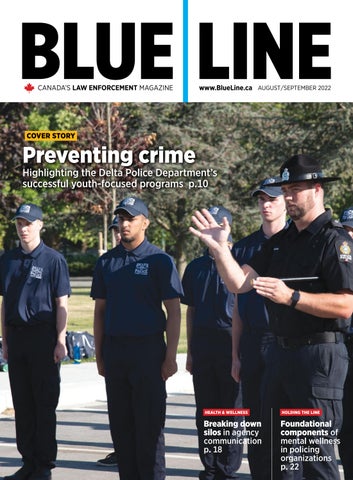
COVER STORY
Preventing crime
Highlighting the Delta Police Department’s successful youth-focused programs p.10
HEALTH & WELLNESS
HOLDING THE LINE
Breaking down silos in agency communication p. 18
Foundational components of mental wellness in policing organizations p. 22
BUMPER-TO-BUMPER
PURSUIT VEHICLE SOLUTIONS
PUSH BUMPERS
CONSOLE BOXES AND KITS
VEHICLE PARTITIONS
WINDOW GUARDS
ALL NEW ALSO SEE • CRADLES & DOCKS • MOTION ATTACHMENTS
TOUGHBOOK 40 DOCKING STATION
RUGGED. RELIABLE. RESPONSIVE.
@gamberjohnson #gamberjohnson #ruggedreliableresponsive
Looking for consoles, partitions, window guards, trunk storage, and other vehicle equipment for a new fleet build? GamberJohnson is your all-in-one manufacturer for a total BUMPERTO-BUMPER vehicle solution. Gamber-Johnson will increase productivity while reducing replacement costs with in-vehicle mounting solutions to customize any mobile workspace, rugged device mounts, and motion attachments. Explore our complete vehicle solution at
WWW.GAMBERJOHNSON.COM
10
Contents
August/Sept. 2022 Volume 34 Number 5
Features COVER STORY
10 Preventing crime
Highlighting the Delta Police Department’s successful youth-focused programs. By Brittani Schroeder.
16 On and off duty gear
A review of gear for members of law enforcement. By Brendan Rodela and Hilary Rodela.
Columns 4 8 14 18 20 22 26 30
Editor’s Commentary Q&A Case Law Health & Wellness Behavioural Sciences Holding the Line Technology Back of the Book
Departments 5 6 6 28 29 30
News Dispatches Calendar Product Showcase Marketplace Blue Links
24 What’s under your MOLLE body armour?
COVER PHOTO: DELTA POLICE DEPARTMENT
A look at MOLLE shirts. By Drew Clark.
8 @Blue_LineMag
16 26 August/September 2022 | BLUE LINE
3
EDITOR’S COMMENTARY BY BRITTANI SCHROEDER
www.BlueLine.ca
Bringing back face-to-face connections
T
his spring, Blue Line returned to same kind of quarantine or work-fromin-person events. From hosting home requirements that many other indusour own events, like the Security tries faced during the height of the pan• Police • Fire Career Expo, to demic. This doesn’t mean everything was attending events like the Law of Policing “normal” or that the value of meeting Conference – Eastern Edition and Rampart face-to-face at conferences and trade shows Range Day, we’ve been excited to reconnect wasn’t sorely missed by many. The value of with people face-to-face. Blue Line will also reaching out to one another in person is be attending the 117th CACP Annual Con- something law enforcement knows all too ference in Quebec City. well — being a part of the community is a The Blue Line Expo has been an annual big part of the job and a key element in event hosted by Blue Line magazine preventing crime. While some of for the last 25 years. This year, Blue This year, their programming might have Line and the Ontario Association of Blue Line had to adapt to the “new norChiefs of Police (OACP) are part- magazine mal”, they pushed through for nering on a joint venture, the and the the good of their communities. OACP & Blue Line Expo. This Ontario In this edition of Blue Line, year’s event will be held on Friday, Association we’re highlighting one departOct. 21 at the Paramount of Chiefs of ment whose in-person approach Police EventSpace in Vaughan, Ont. to deterring crime is helping The OACP & Blue Line Expo will (OACP) are keep the youth in their communfeature sessions curated for all partnering ity on a positive path. When ranks and a trade show floor fea- on a joint looking at how crime rates can be turing a wide range of exhibitors venture, the lowered in a community, police showcasing the newest products, OACP & Blue agencies look at the community’s technologies, services, and solu- Line Expo. youth and make efforts to contions for procurement professionnect with them. To provide als, senior police leaders, and other mem- opportunities for the children and teens in bers of the law enforcement community. In the city, the Delta Police Department (DPD) addition, attendees will benefit from the in British Columbia runs a Student Police unique networking opportunity this new Academy and a high school Wrestling partnership brings. Program. These programs were on hold Blue Line and the OACP share a common due to the COVID-19 pandemic, but now mandate of providing police personnel with have returned and are once again offering timely information on issues that affect students the chance to learn from mentors public safety and community wellness. in their city. The DPD also actively looks Through each issue of our magazine and for ways for youth to assist in improving the OACP’s own public education cam- the programs by asking to hear about their paigns and events, relevant crime preven- perspectives and experiences. You can tion and officer education information is learn about the programs, the challenges shared with members of Ontario’s policing the DPD has faced, and the department’s community. goals for these programs on page 10. The Blue Line team is thrilled to be partAs always, if there is something you’ve nering with the OACP for our 2022 event, encountered over the past few years that and we’re excited to be partnering on our you think fellow officers could benefit efforts to bring timely, educational confer- and learn from, please reach out to me at ence sessions to members of law enforce- any time (bschroeder@annexbusinessment. You can check out more information media.com). about the event at bluelineexpo.com. Until next time, happy reading and be Law enforcement may not have had the well.
CONNECT WITH BLUE LINE
www.BlueLine.ca 4
@Blue_LineMag
BLUE LINE | August/September 2022
BLUE LINE
www.facebook.com/BlueLineMagazine
Reader Service Print and digital subscription inquiries or changes, please contact customer service Angelita Potal Tel: 416-510-5113 Fax: (416) 510-6875 email: apotal@annexbusinessmedia.com Mail: 111 Gordon Baker Rd., Suite 400 Toronto, ON M2H 3R1 GROUP PUBLISHER | PAUL GROSSINGER pgrossinger@annexbusinessmedia.com PUBLISHER | ADAM SZPAKOWSKI aszpakowski@annexbusinessmedia.com EDITOR | BRITTANI SCHROEDER bschroeder@annexbusinessmedia.com EDITORIAL DIRECTOR EMERGENCY SERVICES GROUP | LAURA AIKEN laiken@annexbusinessmedia.com ACCOUNT MANAGER | JANICE EATON jeaton@annexbusinessmedia.com MEDIA DESIGNER | SVETLANA AVRUTIN savrutin@annexbusinessmedia.com ACCOUNT COORDINATOR | KATHRYN NYENHUIS knyenhuis@annexbusinessmedia.com AUDIENCE DEVELOPMENT MANAGER BEATA OLECHNOWICZ | (416) 510-5182 bolechnowicz@annexbusinessmedia.com COO | SCOTT JAMIESON sjamieson@annexbusinessmedia.com ANNEX BUSINESS MEDIA 111 Gordon Baker Road, Suite 400 Toronto, ON M2H 3R1 Tel. 416-442-5600 • Fax 416-442-2191 Publication Mail Agreement No. 40065710 ISSN 0847-8538 Printed in Canada SUBSCRIPTION RATES Canada — 1 Year $31.50; 2 Year $52.50 plus tax USA — 1 Year $136.50 CAD Occasionally, Blue Line will mail information on behalf of industry-related groups whose products and services we believe may be of interest to you. If you prefer not to receive this information, please contact our circulation department in any of the four ways listed above. Annex Privacy Officer Privacy@annexbusinessmedia.com; Tel: 800-668-2374 © 2022 Annex Business Media. All rights reserved. Printed in Canada. No part of the editorial content of this publication may be reprinted without the publisher’s written permission. Opinions expressed in this magazine are not necessarily those of the editor or the publisher. No liability is assumed for errors or omissions. Readers are cautioned and advised that articles presented herein are edited and supplied for your personal awareness and should not be used for further action until appropriate guidance is received from a supervisor, Crown Attorney or other persons in authority. All advertising is subject to the publisher’s approval. Such approval does not imply any endorsement of the products or services advertised. The publisher reserves the right to refuse advertising that does not meet the standards of this publication.
WHEN YOU ARE FIRST ON THE SCENE,
BE PREPARED WITH ZOLL With an average national EMS response time of 7 to 14 minutes¹law enforcement officers who are already out in the community are often first to arrive on the scene of a sudden cardiac arrest emergency. When there’s a call for help will you be ready?
READY FOR THE RESCUE? SMART Real-time CPR Feedback: Real-time feedback technology provides step-by-step instructions and corrective guidance to rescuers. Audio, visual, and image prompts guide rescuers on the optimal rate and depth of chest compressions, helping ensure delivery of high-quality CPR.
READY Designed for Durability: Designed to withstand harsh environments and temperature extremes, ZOLL AEDs have an ingress protection (IP) rating of IP55, which means they are highly resistant to dust and moisture.
TRUSTED Legacy of Excellence: A pioneer in resuscitation technology, ZOLL has been empowering first responders and unexpected heroes around the world for more than 25 years. For more information on how you can equip your force with ZOLL AEDs, please email canadadistributor@zoll.com. 1
Mell HK, et al. JAMA Surg. 2017;152:10:983–984 © 2022 ZOLL Medical Corporation. All rights reserved. ZOLL is a trademark or registered trademark of ZOLL Medical Corporation in the United States and/or other countries. All other trademarks are the property of their respective owners.
NEWS BRITISH COLUMBIA
Surrey Police becomes third largest municipal police agency in B.C.
The Surrey Police Service (SPS) is continuing their journey by attracting and hiring highly qualified experienced officers and new recruits. In late spring, 39 police officers were officially sworn in, and five civilian employees were welcomed to SPS. In just 18 months, Surrey’s new municipal police service has grown from one employee to 275 employees, which is made up of 235 police officers and 40 civilian employees. SPS is now the third largest municipal police agency in B.C., with only Vancouver and Victoria having larger municipal agencies. The current SPS officer number also makes the service the sixth largest in B.C. when all municipal departments and RCMP detachments are considered. Prior to being deployed, SPS officers are provided with five weeks of training with SPS, followed by a three-day orientation with the Surrey RCMP. These officers bring a wealth of experience from their previous agencies, and a desire to contribute to the historic creation of a brand-new police service for one of Canada’s most diverse cities.
PHOTO CREDIT: SURREY POLICE SERVICE
“The transition to the City’s own police service is advancing,” says Chief Norm Lipinski. “Our officers are increasingly being noticed in the neighbourhoods and town centres of Surrey and they regularly receive positive feedback from citizens. They are doing outstanding work and I’m extremely proud of them.” ONTARIO
Niagara Regional Police launches scam intervention program In 2021, the Canadian Anti-Fraud Centre received 104,295 fraud reports from across Canada with associated losses in excess of $379,000,000. In February and March 2022, the Niagara Regional Police Service (NRPS) investigated 57 incidents involving the grandparent scam. Collectively, victims paid scammers approximately $150,000 in cash.
DISPATCHES
CALENDAR
The Ontario Association of Chiefs of Police (OACP) has selected Peel Regional Police Chief Nishan Duraiappah as their new president. Chief Duraiappah succeeds outgoing President Chief Gary Conn from Chatham-Kent Police Service. “As we look to the future, there is an opportunity to make seismic shifts in incident response and how police services in our Province can better serve their communities. By establishing multi-sectoral partnerships to find upstream solutions, together with our communities, we can better address systemic and societal issues rather than continuing to apply traditional police and justice system response,” said Chief Duraiappah. .
Barrie Police Service, Chief Greenwood served as President of the Ontario Association of Chiefs of Police and Vice President of Canadian Association of Chiefs of Police. The Barrie Police Services Board is proud of her leadership and contributions to the Canadian Framework for Collaborative Police Response on Sexual Violence, the National Framework for Collaborative Police Action on Intimate Partner Violence, Community Safety and Well-being Planning Committee, among others. “I am truly honoured and grateful to have had the opportunity to lead the Barrie Police Service for the past nine years, working alongside the dedicated members of our Service,” said Chief Greenwood.
Chief Kimberley Greenwood will retire from the Barrie Police Service after more than 41 years in policing. Chief Greenwood started her policing career in 1981 with the Toronto Police Service and worked in a variety of positions. During her time as Chief of the
After 41 and a half years with Peel Regional Police, Deputy Chief Randy Patrick begins the next chapter of his life: retirement. Deputy Patrick began his career with PRP in ‘80.
6
BLUE LINE | August/September 2022
The money has yet to be recovered. In May, the NRPS began an investigation after an elderly couple purchased $22,000 in gift cards from three different retailers. All gift cards were given to the scammers, and the money has not been recovered. The NRPS has conducted awareness and educational efforts directed towards potential victims and their trusted family members. The Point Sale Scam Intervention Program (POSSIP) has been designed with detectives from the NRPS Central Fraud Unit to create awareness and education for retail and financial institution employees with the goal of providing intervention at the point of sale. Retailers and financial institutions are encouraged to download the education program. The education program works in conjunction with a NRPS poster to support the employees which is also available for download.
NOTE TO READERS: check with all organizers as COVID-19 continues to affect events.
117th CACP Annual Conference Date: Aug. 7 – 9, 2022 Location: Quebec City, Que. cacp.ca/117th-annual-conference.html 59th IAWP Annual Training Conference Date: Sept. 12 – 16, 2022 Location: Niagara Falls, Ont. iawp2022niagarafalls.org He was PRP’s Officer of the Year in ‘89, accelerating a long and storied career dedicated to community safety, relationship building and a commitment to the members of PRP. He founded The National Peace Officers’ Memorial Run in ‘05 to raise money and awareness of the annual Police and Peace Officers’ Memorial Service in Ottawa. Deputy Patrick leaves a lasting legacy with PRP and the innumerable members that had the pleasure to meet and work alongside him. PRP wishes Randy all the best in retirement. www.BlueLine.ca
© 2022 Genetec Inc. GENETEC, AUTOVU CLOUDRUNNER and their respective logos are trademarks of Genetec Inc., and may be registered or pending registration in several jurisdictions.
Crime never sleeps. Neither does Cloudrunner.
When community safety is on the line, you need reliable evidence to solve crimes fast. Introducing AutoVu Cloudrunner™, a powerful vehicle-centric investigation solution that can be deployed in minutes. Vehicle-centric. Community-focused.
Find out how Cloudrunner helps put an end to crime, day and night, rain or shine. genetec.com/cloudrunner
Q&A In a recent episode of Blue Line, The Podcast, editor Brittani Schroeder was joined by Dr. Rylan Simpson, an assistant professor in the School of Criminology at Simon Fraser University, to speak about the importance of police vehicle designs and the public perception of police based on those designs. Q: Can you speak on your extensive research on the effects of police vehicle aesthetics?
Q: When judging the Best Dressed Police Vehicle contest submissions, what are you looking for?
One of the first and foremost criteria that I use when assessing submissions for this 8
BLUE LINE | August/September 2022
Q: What are you hoping to see in police vehicles of the future? Dr. Rylan Simpson
“Perception is an important component in police vehicle design, but so is functionality.” contest is the identifiability of the vehicle as a police vehicle. Going back to that earlier conversation, the intent in most instances with police vehicles—particularly those that are marked—is to be seen, so that the public recognizes that the vehicle is a police vehicle, and the public sees that the police are present. So, when I’m looking at these submissions, I want to be confident that the public would recognize the design to be associated with police. The second thing I look for, of course, is a design that is aesthetically pleasing; a design that features complimentary colors, smooth lines and directionality. As I said before, perception is an important component in police vehicle design, but so is functionality. In this respect, directionality, as one case, helps to ensure the safety of the officer in the vehicle, as well as the safety of the public and other motorists
I think the opportunities are endless. We continue to see the boundaries being pushed on what a police vehicle can look like. In terms of the “core” marked police vehicle function, I think we do have to remain mindful of the intended goal of the vehicle, which is identifiability and recognizability. So we’re a little limited in where I think that particular category could go in the current context. Introducing the Battenburg or checkered-style design, I think could exhibit promise, once the public adjusts to that new recognition of “checkered equals police, police equals help,” as a very simplified, condensed version of that mechanism. I think we’re going to see more of that design make its way into the Canadian context. That’s probably where I would envision the future going. As long as the vehicle can still score high on those key criteria, the actual way in which it is presented aesthetically could vary and is open to interpretation of those in charge of designing the vehicle. Editor’s Note: This interview has been condensed and edited for clarity. To listen to the full episode, visit blueline.ca/podcasts.
www.BlueLine.ca
PHOTO CREDIT: RYLAN SIMPSON
Most public observations of police occur when officers are in their vehicles. I wanted to understand when the public sees a police vehicle, what kinds of thoughts do they have about that vehicle and the occupying officer? I partnered with police departments to be able to collect hundreds of photographs of different police officers in different aesthetic capacities, including when occupying different types of police vehicles. I was particularly interested in trying to understand how the very characteristics and aesthetics of vehicles could impact public perceptions of police. What the results have shown is a couple of key themes. First and foremost, the public tends to prefer police in marked police vehicles than non-marked vehicles. We also find that the general public really doesn’t like the unmarked police vehicles, which don’t include any kind of police identifiers or markings. The last set of findings that we observed if we compare across patrol strategies was that, generally speaking, police officers as a whole were perceived less favourably when in any type of vehicle relative to when they were presented on foot or on a bicycle. These are very interesting findings that speak to the importance of police vehicles and their designs, and suggest that this is a matter of more than just aesthetic taste. These designs are implicated in important perceptual judgments that the public make about police. Therefore, we should pay much attention to thinking about how we might be able to enhance perceptions of police through vehicle designs.
who might have to navigate around that vehicle if it is obstructing traffic or presented in any other kind of a high-risk situation. I think it is the combination of those two that really scores the prize for me: a vehicle that’s bold, that identifies as police, that communicates it is police, and simultaneously, is eye catching and looks good. A vehicle that appears to have been designed with consideration of a lot of the colour wheel elements we talk about in other fields of research, and therefore is more than just a talking point, but also an important piece of police equipment that helps to achieve the police goal.
#ConnectedOfficer See our connected officer demos at CACP 2022
Mobile Innovations Corp, FSET Information Technology and OSL Solutions connect your officers with advanced mobile solutions for greater officer productivity and safety. We help your agency eliminate an hour of wasted time per officer shift with more occurrences resolved ‘roadside’ and the highest available mobile security. Together we bring the office to the officer with secure workspaces, mobile data and RMS, CAD, EPNB and DEMS integrations, Cloud and on-premise enterprise solutions, e-Ticketing, dynamic briefing, self-serve shift scheduling, HR and more.
OSL SOLUTIONS
Mobi OSL
Scheduling & Logistical Solutions Workforce management technology to more effectively manage all aspects of your agency’s operations.
Managed Services. Private Cloud. Mobility Management At the Station. In the Cruiser. On the Street. NPS Compliant.
E P N B Electronic Pocket Notebook
Mobile Niche RMS & CPIC Access Secure mobile policing app suite with e-ticket, dynamic briefing, tracking, forms, reports and more.
Video, photo, audio, forms, sketch, signature capture. Store, search and share time-stamped and Geotagged entries.
Trademarks are property of their respective owners. Get Connected
COVER STORY
Preventing crime Highlighting the Delta Police Department’s successful youth-focused programs By Brittani Schroeder
10
BLUE LINE | August/September 2022
Montreal Indigenous youth community. In May, the federal government invested over $1.8 million for a crime prevention project in Nova Scotia. In a press statement, the government said their focus was on how “young people spend a lot of time online.” These funds from the National Crime Prevention Strategy (NCPS) aim to reduce cyberbullying and cyber violence. Police departments are working alongside government money to help Canada’s youth that may be vulnerable to criminal opportunities. For this edition, Blue Line spoke with Deputy Chief Harj Sidhu, Community Policing Bureau, of the Delta Police Department (DPD) in British Columbia, about the success they are having with their youth-focused initiatives.
Community involvement
For a police agency to be successful in fulfilling its mandate, there needs to be a partnership between members of law enforcement and the communities they serve. Many police departments believe that the community is the eyes and ears for officers. The stronger a neighbourhood is together and the more activities they take part in, the more likely that unwanted activity is pushed out. The DPD proactively builds relationships with the public and partnerships with stakeholders to problem-solve issues collaboratively. “An essential foundation of DPD’s community policing model is that all public safety concerns are handled in a problem oriented and data-driven www.BlueLine.ca
PHOTO CREDIT: DELTA POLICE DEPARTMENT
T
he role of a Canadian police officer encompasses a wide variety of tasks and responsibilities, and one task that is of vital importance is crime prevention. When looking at how crime rates can be lowered in a community, agencies look at the community’s youth and make plans for how children and teens can be kept away from taking a dark path. Across Canada, federal government agencies have been investing money in crime prevention. In April, the Canadian government committed to investing $5 million for crime prevention in Montreal. The government also invested in three additional projects, including programs for youth in specific neighbourhoods, and the
manner,” said DC Sidhu. This approach is said to focus on connecting law enforcement with the community in ways that effectively respond to and prevent crime before it becomes a crisis. This connection and understanding of community concerns are developed through many pathways, including the DPD’s strategic planning process and various prevention and outreach programs. “The DPD’s principles of crime prevention and outreach are actioned through the pillars of engagement, environment, education and enforcement. The four priorities currently identified through community consultation are youth, community safety, road safety, and vulnerable persons.”
Youth-focused initiatives
The initiatives for youth are vital in identifying at risk and high-risk youth and attempting to provide these youth with connection, “connection to school, connection to other students, connection to educators, connection to coaches, mentors, counsel-
lors and connection with police. It is the type of connections youth form that will determine their future path. The greater the number of positive connections youth have, the greater the chance of avoiding criminal behaviour,” said DC Sidhu. The DPD currently focuses on two different youth initiatives: DPD Wrestling Program and the Student Police Academy. In January 2022, Cst. Sahota, a Youth Liaison Officer with the DPD, started the Wrestling Program. “Investigation revealed that a number of former students became involved in the regional gang conflict and drug trade. When the program started, it was anticipated that it may draw a dozen youth, however, we were surprised to have 40 youth on the very first day,” said DC Sidhu. The program regularly draws over 50 youth to the weekly sessions from a diverse segment of the student body, including females. The program aims to fulfill several goals, including providing coaching and mentorship opportunities; providing the means for local youth to
connect with other youth, with whom they may not have normally had any interaction with; and providing youth with a healthy outlet and way to spend time while getting physically fit. “By providing connection, coaching and mentorship, these youth are given a path to steer clear of criminal behaviour. Without this connection to each other and to the coaches, these youth would be targets for exploitation in the drug and gang environment.” The DPD’s Student Police Academy (SPA) is another initiative focusing on providing youth opportunities. The SPA was started in 2004 and, through annual summer sessions, provides youth with a glimpse of what it’s like for police officers in training. The program requires the cooperation and support of the DPD Youth Team, Training Section, and other members of the department as well as the Delta School District. Everyone involved provides their expertise to teach the participants various aspects of police training,
Fully Online Program
Bachelor of Applied Arts Justice & Public Safety Complete in 2 to 2½ years
Choose the DEGREE that will move your career forward
guelphhumber.ca/futurestudents/jps @Blue_LineMag
BL_UniversityofGuelph_Febmar22_CSA.indd 1
August/September 2022 | BLUE LINE
11
2022-02-09 8:15 AM
COVER STORY
under $1,000) for regular Wrestling Program participants to foster a sense of pride, belonging and being part of a team.”
including legal studies, de-escalation techniques, note-taking, force options and firearms training. “The SPA is also an early recruiting tool for the DPD as the DPD has been lucky enough to hire a number of former Student Police Academy graduates,” said DC Sidhu. In addition to these two initiatives, the DPD works with the City of Delta and a number of third-party providers who are contracted to provide crisis counselling to youth in crisis, rather than having the youth languish on waiting lists through the public system. To bring the youth focused initiatives to fruition, the DPD partnered with both private and government agencies, such as the Delta School District and an organization called the Yo Bro Yo Girl Initiative, which helps to identify at risk and highrisk youth. The Youth Team also participates regularly with a multi-agency panel to conduct Intensive Case Management (ICM) meetings for high-risk youth, discussing ways for multiple agencies to assist each other in providing wrap-around care. “Our School Liaison Officers are routinely called to participate with Delta School District teachers, administrators, counsellors and youth care workers in Violence Threat Risk Assessment (VTRA) meetings in response to violence or threats directed at other students, staff or facilities. In addition, we also work closely with the community run Delta Police Foundation to fund portions of the SPA.”
Challenges in starting youthfocused initiatives
The DPD is well supported by the community, parents, stakeholders and the Delta Police Foundation, but that doesn’t mean that they don’t still face a host of 12
BLUE LINE | August/September 2022
challenges. Some of these challenges included ensuring sustainable funding and resources, equitable selection processes and evaluating success. “As an example, the Wrestling Program posed challenges for securing a suitable location—we eventually obtained access to the high school cafeteria—and obtaining wrestling mats. Luckily, the Delta School District was able to provide a set of mats that were already available at one of the local high schools.” Another critical aspect to consider was having a good succession plan for the team to ensure consistency of service delivery every year. “As our SPA has been operating for 18 years, we had found that when we did not have the right passionate people leading the program, it was not as effective,” said DC Sidhu. The team took steps to make sure ongoing mentorship of police staff occurred within the program.
Financing the programs
Creating and running initiatives like the SPA and the Wrestling Program is not an inexpensive task. The SPA generally costs $10,000 to run for two weeks in the summer. To cover the costs, the DPD sets a user fee ($200) for successful applicants. The Delta Police Foundation subsidizes another part of the cost, and the DPD covers the remainder through its standard budgeting process. The Wrestling Program requires a new set of mats in the near future, costing approximately $30,000 and the DPD is reviewing options to fund this purchase. “One of our non-government agency partners, the Yo Bro Yo Girl Initiative, generously supplies sandwiches and drinks for our youth participants following each training session and provides additional wrestling coaches/mentors. The DPD funded the purchase of t-shirts (a total cost of
Blue Line reached out to several Community Officers across multiple police agencies to get their words of advice to officers who are just starting out in the community mobilization units. Sergeant Doug Cowell, Community Mobilization Section of the Chatham-Kent Police Service said his best advice would be for the officers to listen. “Sometimes people just want or need to be heard. Treat everyone as human beings, no matter their social or economic status, mental health issues, addictions or criminal past. You don’t know how they got into the position they are in, and they need to be treated with dignity.” Constable Sam Zacharias, the Community and Media Relations Officer for the Port Moody Police Department, said he himself is still learning how to best serve his community. “I think one of the most important things is getting boots on the ground and positively interacting with the community as much as possible—however that may look. Be it planned or impromptu, these interactions in the community certainly go a long way and foster a positive relationship between the police and the public.” When offering advice to other police agencies, DC Sidhu stressed the importance of having suitable officers as part of the program who are committed and passionate about building community relationships and who are reflective of the youth being served. He suggested that departments need to be mindful of succession planning so the experience and knowledge is passed down to ensure continuity of highly effective service delivery and longevity of the programs. “Form or strengthen partnerships with your local school districts, community stakeholders and non-profit groups that you can collaborate with and obtain support and funding for the youth outreach initiatives,” he said. “When developing your program, consider what it is you are trying to achieve and have some evaluation criteria established to demonstrate the program’s efficacy. Finally, I’d just recommend you be patient, allow time for programs to develop and grow, and look for ways for youth to assist in continuously improving the programs by providing their perspectives and experiences.” www.BlueLine.ca
PHOTO CREDIT: DELTA POLICE DEPARTMENT
Advice for community mobilization officers
NEW PARTNERSHIP SAVE THE DATE!
JOIN US OCTOBER 21, 2022 Paramount Eventspace Vaughan, Ontario
“The Blue Line team is excited to be partnering with the Ontario Association of Chiefs of Police (OACP) on this event. We’re bringing a national perspective and a provincial focus under one roof. By maximizing our shared resources, we will bring a more efficient, relevant, and informative conference and trade show to our mutual and expanded audience,” - Adam Szpakowski, Publisher of Blue Line
WHO should attend?
WHY
should I attend?
• Police chiefs • Police service procurement staff • Customs officers • Police officers: military, local, municipal, provincial and Indigenous • Federal and provincial corrections officers • RCMP • Security professionals • Learn from leading law enforcement experts • Network with fellow law enforcement professionals • Learn about and purchase the latest technology, products and services
Connect with Janice@blueline.ca to secure your booth or to sponsor 416-527-0191
The OACP and Blue Line Expo will feature sessions curated for all ranks and a trade show floor featuring a wide range of exhibitors, showcasing the newest products, technologies, services and solutions for procurement professionals, chiefs, and other members of law enforcement. Attendees will benefit from the unique networking opportunity this new partnership brings.
Blue Line and the OACP share a common mandate of providing police personnel with timely information on issues that affect public safety and community wellness. Through each issue of the magazine and the OACP’s own public education campaigns and events, relevant crime prevention and officer education information is shared with members of Ontario’s policing community.
REGISTER NOW BlueLineExpo.com
CASE LAW
BY MIKE NOVAKOWSKI
Supreme Court modifies search incident to arrest inside a home
T
he Supreme Court of Canada has modified the application of the common law search incident to arrest power inside the home. In R. v. Stairs, 2022 SCC 11, a motorist called 911 to report seeing a male driver of another car striking a female passenger. The police located a similar vehicle parked at a home nearby and, after no answered police attendance at the door, they entered without a warrant. Police located an injured woman inside the home and Stairs was arrested in a laundry room in the basement. An officer then conducted a visual clearing search—a protective sweep—of an adjacent living room area, from where the woman had come and Stairs had been before entering the laundry room. During his visual sweep, the officer walked behind the couch and saw methamphetamine in plain view. The residence was secured, and a warrant was prepared to conduct a more thorough search for evidence related to the drug offence. Stairs was charged with possessing methamphetamine for the purpose of trafficking, assault and failing to comply with a probation order. A judge of the Ontario Superior Court of Justice found the warrantless police entry into the home, Stairs’ arrest and the protective sweep of the living room all to be lawful. Stairs was convicted of the charges. An appeal to Ontario’s highest court was unsuccessful. A two-member majority of the Court of Appeal found the search of the living room area was incident to lawful arrest. A dissenting judge found the warrantless safety search of the basement living area was not reasonable. Stairs appealed his drug conviction to the Supreme Court of Canada. He contended that the common law standard for search incident to arrest needed modification for searches conducted in a home—a place where a person enjoys a high privacy expectation. The Supreme Court of Canada, by a slim majority, upheld the police search in this case. Although all nine judges agreed that the general authority for the common law power to search in a home incident to arrest required modification, five found what the police did in this case was reasonable. “The common law standard permits a search of the person arrested and the sur14
BLUE LINE | August/September 2022
“The police cannot use the search incident to arrest power to justify searching every nook and cranny of the house.” – Supreme Court of Canada rounding area of the arrest when (1) the arrest is lawful; (2) the search is incidental to the arrest, such that there is some reasonable basis for the search connected to the arrest and the search is for a valid law enforcement purpose… and (3) the nature and extent of the search are reasonable.” But because privacy interests are elevated in the home, like other situations presenting a heightened privacy such as strip searches, penile swabs and cell phone searches, the common law search incident to arrest power required modification to comply with the s. 8 of the Charter. In establishing a modified framework for safety searches incident to arrest in a home, two subcategories within the surrounding area of an arrest were recognized: 1. The area within the physical control of the person arrested at the time of arrest; and 2. Areas outside the physical control of that person, but which are part of the surrounding area because they are sufficiently proximate to the arrest. The majority went further and applied different standards for each of the two subcategories it identified: • Area within the arrestee’s physical control – when searching the area within the arrestee’s physical control, the general framework (or baseline standard) for searches incident to arrest applied. • Area outside the arrestee’s physical control – when searching the surrounding area outside the arrestee’s physical control at the time of arrest—but an area sufficiently proximate to the arrest—the police must have reason to suspect that the search will further the objective of police and public safety, including the safety of the arrestee. The reasonable suspicion standard requires objective facts and is a higher standard than that which applies to the general search incident to arrest frame-
work. “The police must have reason to suspect that the search will address the risk,” said the majority. “However, reasonable suspicion is a lower standard than reasonable and probable grounds because it is based on a possibility rather than a probability. Whether the circumstances of a particular case give rise to reasonable suspicion must be assessed based on the totality of the circumstances. Relevant considerations include (a) the need for a search; (b) the nature of the apprehended risk; (c) the potential consequences of not taking protective measures; (d) the availability of alternative measures; and (e) the likelihood that the contemplated risk actually exists.” The reasonable suspicion standard, however, need not reach the higher bar of a reasonable belief in imminent harm. In addition, the search must be carefully tailored to respect the heightened privacy interests of the home. “As a general rule, the police cannot use the search incident to arrest power to justify searching every nook and cranny of the house,” said the majority. “A search incident to arrest remains an exception to the general rule that a warrant is required to justify intrusion into the home. The search should be no more intrusive than is necessary to resolve the police’s reasonable suspicion. Further, it would be good practice for the police to take detailed notes after searching a home incident to arrest. In some instances, insufficient notes may lead a trial judge to make adverse findings impacting the reasonableness of the search.” In this case, the majority found the police had reason to suspect that there was a safety risk which would be addressed through a cursory visual clearing search of the living room. The search was targeted, brief and constrained. The majority noted the decision in this case related solely to safety searches and did not extend to searches incident to arrest for investigation-related purposes such as evidence preservation or evidence discovery. Whether or not the reasonable suspicion standard applies to investigative purposes was left unresolved as the Supreme Court put this issue off for another day. Stairs’ appeal from conviction was dismissed.
Mike Novakowski is Blue Line’s case law columnist.
www.BlueLine.ca
A NEW ERA FOR ROADSIDE TESTING S O T O X A™ O R A L F L U I D MOBILE TEST SYSTEM
TESTING WHERE YOU NEED IT The SoToxa™ Oral Fluid Mobile Test System is a handheld analyzer that provides the optimal combination of speed, ease of use, reliability and accuracy. The analyzer has been designed and developed to meet the high performance demands of law enforcement, empowering officers to take action with immediate test results. Manufactured by Abbott and distributed in Canada by DAVTECH.
THC 25 NG/ML
DISTRIBUTED BY:
613-831-6009 | WWW.DAV TECH.CA © 2022 Abbott. All rights reserved. All trademarks referenced are trademarks of either the Abbott group of companies or their respective owners. Any photos displayed are for illustrative purposes only. COL-12548 v1 06/22
GEAR
On and off duty gear
A review of gear for members of law enforcement
W
earing and using the right equipment can make all the difference in an officer’s day. This past year, several companies developed outstanding gear to be used on and off duty. As a note, what is featured here is just a sampling of what is offered in the industry today. All items listed were tested both on and off duty.
Workout clothing
Workout gear is in full swing in 2022. Companies like 5.11 Tactical and LA Police Gear have designed versatile collections for members looking to enhance their workouts. For women, the Margo Tank from 5.11 Tactical was designed to be light and breathable, in the hopes of making it a top choice for workout clothing. Created with a “U-shaped” back detail, it’s comfortable and is great for a longer workout. 5.11 Tactical has also introduced a hoodie for women that is much warmer than it 16
BLUE LINE | August/September 2022
appears. The Donna Hoodie includes a high neck collar to keep away the cold, a kangaroo pocket and thumb holes in the cuffs. The Donna Hoodie is light and moisture wicking. We believe this hoodie is ideal for keeping around on or off duty. For cooler days, the PT-R line from 5.11 Tactical is also a suitable choice. The PT-R Emily Full Zip is a hooded sweatshirt-style piece with a kangaroo pocket. It fits well, providing just enough warmth without being too much. The PT-R Forged Hoodie for men, like the Emily Full Zip, is more form fitting, making it a good workout option. Both hoodies are durable and are easy to move in without inconvenience. The PT-R Condition Knit Jogger is great for conditioning for the job. The Joggers are soft with a somewhat relaxed fit, and are odor and moisture wicking as well. The LAPG Women’s Distressed Heart Sweater is another option to add to your workout gear when it’s a little chilly out. Made from cotton, polyester and French
Terry, and with moisture-wicking material, female members will enjoy wearing it during their workouts or just hanging out at home. The LAPG Pony Tail Heart Hat is now Hilary’s go-to for caps. It’s breathable, which keeps her cool and dry for hours of outdoor time. The hat also features an elastic criss-cross band section on the back of the six-panel cap for my pony tail. This cap is great for range day and will keep the hair out of your face so you can focus on the task at hand.
Footwear
Whether you’re on or off duty, you always need to protect your feet. When you stand for hours on end at a crime scene, pursue a subject on foot, or perform any other strenuous activity, what you put on your feet matters. The A/T Trainer from 5.11 Tactical was designed to be footwear fit for men or women. With TPU toe durability, all-terwww.BlueLine.ca
PHOTOS: 5.11 TACTICAL, LA POLICE GEAR, STREAMLIGHT, TACTION USA
By Brendan Rodela and Hilary Rodela
rain load assistance and high abrasion mesh, this sneaker will be a go to for workout sessions. Those familiar with the companies’ A.T.L.A.S footwear will appreciate the support plate on the bottom of the shoe, as it is the same as most duty boots. This way, members can have a workout shoe that is a sneaker but is similar to the footwear they wear on a daily basis. The 5.11 A/T 6” Side Zip Boot is said to be one of the most comfortable boots on the market. They are great for on duty, at the range or hiking, and will keep your feet comfy and cool. These boots are also water- and oil-resistant, and include mesh to increase the breathability. They are also easy to slip on quickly with their fulllength side zipper. These were comfortable even after hiking for hours. For long days at work, we would say these are ideal. Another great option for off duty, around the town wear or recreational hiking is the Company Boot 3.0 from 5.11. Made with full grain leather as well as Ortholite insoles and slip- and oil-resistant outsoles, these are great for all occasions. These
@Blue_LineMag
BL_PushBar_JuneJuly22.indd 1
Wearing and using the right equipment can make all the difference in an officer’s day. would be ideal for detectives who may not wear uniforms, but street clothes.
Lights for any circumstance
While working the night shift, officers may need to rely on their flashlights to properly see the scene of a crime. This means that the tools they carry need to powerful, but portable. Streamlight’s Beartrap can be used for working on a scene, training purposes or for off duty camping trips. This light has a strong, magnetic base and illuminates using anywhere from 325 to 2,000 lumens, dependent on what type of situation the light is being used for. Since it is able to run for over four hours at a time, the Beartrap is a great choice for utilizing at scenes. The battery is rechargeable and is able to continue to work as it is being charged.
Also from Streamlight, the TLR RM 2 Laser Rail Mounted Tactical Lighting System is a powerful, 1,000 lumen light and red laser combo designed for long guns. The light mounts to standard rails and features a push-button switch on the light, and an optional remote pressure switch. The pressure switch can be mounted to your long gun in several ways using the included accessories. The TLR RM 2 comes with strip of double sided tape for quick mounting, zip ties and two screws to permanently affix the pressure switch. The TLR RM 2 is bright, tactical and very easy to install, and could be a major asset to any long gun. The LAPG CMPTAC USB Rechargeable 1600 Lumen Flashlight is great for any occasion whether it be work or play. The battery life can last anywhere from 2 to 150 hours, depending on what setting you have it on, and the beam distance is 450 meters. The light has an excellent span, too—it lights up a large area at once which is perfect for patrol or crime scene needs. Continued on page 18
August/September 2022 | BLUE LINE
17
2022-05-12 9:14 AM
HEALTH & WELLNESS
Continued from page 17
BY ISABELLE SAUVE
Breaking down silos in agency communication
N
owadays bad actors rarely operate within a single jurisdiction. There is no repudiating that “borderless” and international crime are on an upward trajectory. Advances in technology have helped to ease the propagation of multiand transnational criminal operations. On one hand, this trend has created momentous challenges for law enforcement, while on the other hand it has served to safeguard and offer increasing anonymity and immunity for criminal activity. It has undoubtedly become more difficult for law enforcement to operate in an efficient and timely manner. The lack of communication, information sharing and collaboration within the law enforcement community needed to combat this problem has become glaringly obvious. This unquestionable disparity can no longer be ignored. Justice professionals cannot afford to operate in silos. Law enforcement organizations have long tended to espouse silos. Silos are defined as “a hierarchical organization which seeks to maximize vertical coordination at the expense of horizontal coordination. It is inward-looking and self-contained with little regard for outcomes other than those which affect its own narrowly conceived goals.” There are several reasons silos exist, such as a lack of training, need for recognition, unhealthy relationships, a loss of sight regarding larger common goals, misguided incentives, competition for resources, “turf war” mentality and fear of reprisal, for example. The most prominent and serious issue with silos is the lack of communication and information sharing. A lack of interaction often leads to redundancy, inefficiency, wasted resources and failure. Communication and collaboration in the realm of law enforcement can take place on multiple levels. Communication within a single agency frequently proves difficult nevertheless when it is needed across multiple organizations. Lack of processes or memorandums of understanding as well as and the legalities surrounding information sharing are common hindrances. Lack of information sharing can not only impede and delay projects and investigations but also create a considerable safety 18
BLUE LINE | August/September 2022
concern for law enforcement employees and members of the public. When the intelligence flow is poor or non-existent, investigations and projects may unnecessarily be forced to terminate. The consequence is that criminals are protected over the true victims of crime. History is filled with immeasurable examples of tragic consequences of meager information sharing. The Dorner report for instance, states: “as police hunted Christopher Dorner, poor communication, competing interests and a chaotic, underdisciplined response highlighted serious problems.” While shortcomings may be more blatant in large scale events, they are also pervasive in smaller scale investigations such as child exploitation offences, fraud, intellectual property crime and cybercrime, for example. Regardless of the scale of an incident, the impact on the victims is tragic and detrimental. Regardless of shoulder flash or professional affiliation, the collective concentration should be on the “bigger picture”. To achieve this aim, all law enforcement personnel must collaborate in equal partnerships with colleagues and external organizations to fight criminality. Joint efforts grant law enforcement the opportunity to draw and benefit from a wealth of expertise and a multitude of perspectives. It is also cost efficient and fiscally responsible, as it introduces the pooling of resources. Organizations become more effective when communication channels are open. Trust and transparency can also be facilitated. While the goal is not to completely eliminate silos—as there is benefit in specialized units and expertise—but rather to expand horizontal coordination, communication and collaboration. The benefits of intelligence-led policing are well known, but this approach is only as good as the information acquired, shared and utilized by those in the need to know. Law and policies must also support information sharing and interoperability. It is key that leadership speak out and advocate the needed amendments in policy and applicable laws to rebalance the scales and better protect victims. Isabelle Sauvé has a MA in psychology and is a PhD candidate. She is also an ultramarathon/endurance athlete and the Racing the Planet/4 Deserts 2018 Series winner as well as a Guinness World record holder. She can be contacted at: isabelle.sauve@hotmail.com.
On and off duty gear The Taction USA Professional Blacklight Flashlight is also a top choice when it comes to compact, alternative light sources. Weighing less than two ounces and measuring at only 4 x 1 x 1 inches, it is easy to carry and is equipped with 395 nm UV-A blacklight spectrum. This makes the light illuminate as if it were a larger, industrial version. It is perfect for crime scene investigation; having such a small light with a big impact is a game changer.
Accessories and more
When looking at accessories, the Rush24 2.0 backpack from 5.11 Tactical will hold anything you need, whether you’re on the job, at training or on days off. This backpack has designated sections for a laptop, a concealed carry option and even an eyewear section. It’s great for hiking, a workout bag, or a go bag for patrol or crime scene techs. LA Police Gear’s latest hard rifle plate is the Ceramic Multi-Curve Ballistic Armor Rifle Plate. This model is made with Silicon Carbide and PE (polyethylene), and is coated with polyurea for long term durability and less likelihood of bullet fragmentation. The plate measures at 10”x 12” size with a five year shelf life. This plate is slightly lighter than LA Police Gear’s other Level IV offering. It has been engineered to stand up to armour-piercing rifle rounds, making it a trusted tool to protect you in the worst circumstances. 5.11’s Division Digital Watch is rugged and durable. No frills, no gimmicks and there is no stomach-churning price tag. The Division features a stainless-steel frame with a digital display, and mineral crystal face, accompanied by a removable band in case you want to add your own style. The display features the day, date, and can be switched to your preference of standard or military time. The watch also features 100 meters of water resistance.
Conclusion
This collection of versatile gear features something for everyone in law enforcement. Keep this in mind: when you have the right gear, you can do your job much more efficiently and safely than when you don’t. Brendan Rodela and Hilary Rodela are a married couple both in public safety fields. Brendan is a deputy for the Lincoln County (NM) Sheriff’s Office, and Hilary is a licensed Private Investigator and Crime Analyst for the Cold Case Foundation.
www.BlueLine.ca
Reimagine policing. Redefine your career. Now hiring experienced officers. surreypolice.ca Contact an SPS Recruiter at careers@surreypolice.ca to learn more about joining Canada’s newest police service.
Safer. Stronger. Together.
BEHAVIOURAL SCIENCES BY PETER COLLINS
Hostage dynamics: Stockholm syndrome
T
he behaviour known as “identification with the aggressor” has been described in various forms over many years; however, the term “Stockholm syndrome” was only coined 49 years ago. There is a debate as to who came up with the term to describe this unexpected reaction that hostages had towards their captors. Some say it was Swedish criminologist, Nils Bejerot; others credit FBI Special Agent Supervisor Conrad Hassel for describing the behaviour that was displayed by the hostages during the August 1973 attempted bank robbery, at the Sveriges Kreditbank in Stockholm, Sweden. In that case, an escaped convict named Jan-Erik Olsson entered the Kreditbank with a submachine gun and took four of the employees hostage. One of the initial demands, made by Olsson, was that his still incarcerated friend, Clark Olofsson, be brought to him along with three million Swedish krona. Olsson was a repeat offender who had committed several armed robberies and acts of violence, the first at the age of 16. During this incident, Olsson fired multiple times at the police, injuring one officer in the hand and another in the face and arms. He spoke twice with the Swedish Prime Minister during the negotiations. The robbery ended six days later after the police deployed gas. According to an article in The New Yorker magazine written a year after the incident, the criminals did not treat the hostages with kid-gloves. Despite the terror associated with being held against their will and terrorized during the six-day ordeal, when the incident ended the three female hostages kissed Olsson and Olofsson and the male hostage shook hands with his captors. During the incident the hostages even began to display animosity towards the police. Post-incident, they supported the captors in the media and assisted raising money for their defence fund. One of the hostages later became engaged to Olsson. Stockholm syndrome is not a psychiatric diagnosis but is a way of understanding the positive feelings and emotional response that some people have towards an abuser or captor in some situations. The syndrome does not occur in all hostage incidents because most hostage situations are too short in duration for hostages, and their captors, to develop the 20
BLUE LINE | August/September 2022
type of relationship that will evolve into Stockholm syndrome. There are three components to the Stockholm syndrome: After the initial horror of being taken hostage—the crisis stage—they begin to develop positive feelings towards the hostage takers because they are still alive. This gratitude is stronger if the onset of the hostage situation involved violence. The hostages develop negative attitudes towards the police. This is a psychological dilemma because they must depend on the hostage takers to allow them to live, but also must depend on the police to be rescued. Following the hostage situation, hostages retain some empathy and compassion for the hostage takers. There are several reasons why this phenomenon occurs. For survival purposes, the hostage becomes obedient and compliant so they don’t antagonize the captors, but over time they may regard their captors as fellow human beings. The anti-police sentiment is, in part, a fear that they could be harmed by either the hostage takers in an attempt to prove a point to the authorities, or inadvertently by the police during a rescue attempt. When Stockholm syndrome does occur, the mixed feelings or positive attitudes that the hostages have developed for survival purposes will quickly dissipate if the appropriate form of psychological debriefing is conducted. In Canada, our police negotiators are trained in how to negotiate with hostage takers and how to have them regard their hostages in a more humane light. They do this by trying to have the hostage takers find out their hostages’ names, if the hostages have any immediate medical care, illnesses or medication needs, and to avoid using the term ‘hostages’ and instead refer to them by name or as persons. Asking the captors to deliver messages to the hostages will humanize the captive (for example: “Please tell Emily that her mother will look after the three children and hope she will be home soon.”) In many scenarios, the longer the incident occurs, the more likely the hostage-takers will develop positive feelings towards the hostages. The New Yorker journalist, Daniel Lang, interviewed Olsson in prison and confirmed the fact that his eventual humane treatment of the hostages was due to his developing an emotional connection with
them. Concern for one’s captive(s) is not always present in situations such as kidnappings, sexual slavery or sex trafficking, for instance. Lima syndrome is a psychological response in which a captor develops a positive bond with a victim. When this happens, they may become empathetic to the individual’s circumstances or condition. Lima syndrome gets its name from a hostage crisis that began in late 1996 in Lima, Peru. During this crisis, several hundred guests at a party held by the Japanese ambassador were captured and held hostage. My friend and mentor, Dr. Mike Webster, was sent to Peru to monitor the situation on behalf of the Canadian government, and we had several discussions about the event. The captors were members of the Tupac Amaru Revolutionary Movement who demanded the release of their members from prison. Rather than the hostages forming a positive bond with their captors, as happens in Stockholm syndrome, it appears that the reverse occurred: many of the captors began to feel sympathetic to their captives. The effects of Lima syndrome lessened the likelihood of the captives coming to harm while increasing the chances that they would be freed or allowed to escape. Although many hostages were released during the first month of the incident, it eventually ended in the spring of 1997 when the remaining hostages were freed during a Special Forces operation. Lima syndrome is not as well studied as Stockholm syndrome. It’s speculated that it developed during the 1996 to 1997 hostage event because many of the hostage takers were in their teens and early 20s and were not as ideologically devoted to the Tupac Amaru. The Lima syndrome may have risen out of a combination of the hostages developing a rapport with their captors and vice versa in addition to the captors’ youth, inexperience and ideology. For a full list of references, please visit https://www.blueline.ca/Hostage-dynamicsStockholm-syndrome Peter Collins is the operational forensic psychiatrist with the Ontario Provincial Police’s Criminal Behaviour Analysis Section. He is also a member of the crisis/ hostage negotiation team of the Toronto Police Service Emergency Task Force. Dr. Collins’ opinions are his own. Contact him at peter.collins@utoronto.ca.
www.BlueLine.ca
2023
SECURITY • POLICE • FIRE
CAREER EXPO
RECRUIT, HIRE AND TRAIN YOUR FUTURE LEADERS
JOIN US IN-PERSON • MARCH 9, 2023 • The International Centre, Mississauga, ON
PRIMARY LOGO
CANADA’S SOURCE FOR SECURITY MANAGEMENT
PRIMARY LOGO
CANADA’S SOURCE FOR SECURITY MANAGEMENT
PRESENTED BY SECONDARY LOGO
CANADA’S SOURCE FOR SECURITY MANAGEMENT
WWW.EMERGENCYSERVICESEXPO.CA SECONDARY LOGO
CANADA’S SOURCE FOR SECURITY MANAGEMENT
HOLDING THE LINE BY MICHELLE VINCENT
I
s your policing organization full of mental wellness? Is this even possible? The answers to these questions may not be available at our fingertips; however, some simple foundational pieces to support this concept of mental wellness are. Wouldn’t it be wonderful to have some sort of an understanding and pathway to an overall, mentally healthy organization? If we begin by exploring factors that we, as members, have control over in making this difference, we open a dialogue of true change. Change comes from within—from each member who chooses to contribute to the mental wellness or toxicity of each unit/platoon of the organization. We begin with these questions: what choices, when we look within, are we most likely contributing to? Do we come for shift with a vision of how we might make a difference at work, at home, in our communities? It is so easy to get caught up in the “let’s get them first” mentality. Whether that supports our intent to get the call done, the investigation done, or to outsmart a criminal as we lay a trail of leads with an understanding that this is what
22
BLUE LINE | August/September 2022
criminal activity they are participating in. Maybe we have experienced so much in our careers that we truly believe the world is a bad place. No matter what that experience is, we still have the choice or opportunity to perceive our workplace/platoon/unit as a family rather than as the people and crimes we are investigating. There is a clear understanding that the dynamic, ever-changing and evolving culture in policing organizations exists and that it may be one of the most powerful contributors to the existence—or not—of mental wellness. When we explore relationships of any kind, there are certain themes that continuously emerge. Those themes are: feeling valued, cohesion, teamwork, a safe space in which to be, and the communication piece of positive language. I recently embarked on a facilitator’s course for the Writer’s Collective of Canada, which provides a voice for those who may not always have one to be heard. One of their six presiding guidelines is the use of positive language when addressing a piece or identifying what was impactful; no negative comments
Change comes from within— from each member who chooses to contribute to the mental wellness or toxicity of each unit/ platoon of the organization.
are part of this work. I had the opportunity to experience first-hand the feeling of safety, free expression with no fear of reprisal, feeling valued for my piece regardless of its composition, cohesion in the intention of this group, and the teamwork of reviewing a piece as we explored what was good and/or impactful. What if we were to abide by this guideline of positive language when communicating as leaders and teammates? What impact might this have on the above-mentioned components of feeling valued, safe and the cohesion of teamwork as we explore, debrief and come in for an evaluation? I know one thing for sure; you get more of what you think about, whether you like it or not. This is where the choice comes in: the choice to create a shift in how we experience our platoon, unit, entire organization. Would it hurt to give it a try? What happens if correction needs to be made? Could we come up with a thought that provides the solution rather than the focus on the problem? As a hypothetical example, say we messed up a domestic call and breached procedure. We didn’t do it on purpose; we were distracted from our own challenging domestic situation that clouded our minds. The leader of this platoon could say, “I wonder how we might handle this domestic differently, given the suspect returned to the residence and we didn’t have a safety plan documented.” Instead of chastising the police officer, we might have them come up with their own thoughts. Because let’s face it, we all know when we have messed up. Whether it is in the moment or in court. Having a team supporting what we could do better supports mental health wellness. Michelle Vincent PhD/MACP is a retired York Regional Police officer and the founder of The Haven, Ontario’s first non-profit, inpatient treatment centre exclusive to first responders and uniform personnel. Contact her at michelle.vincent@thehaven.cloud.
www.BlueLine.ca
PHOTO CREDIT: ©PIXEL-SHOT/ ADOBE STOCK
Foundational components of mental wellness in policing organizations
SPONSORED CONTENT
YOUR MEDICAL CANNABIS QUESTIONS,
ANSWERED
W
hether you’re new to medical cannabis, or have explored it before, it’s entirely normal to have questions. We’re here to help. Here are some of the common questions we receive about medical cannabis, along with answers to help explain the ins and outs a little more.
Q
What’s the difference between my local cannabis shops and buying medical cannabis online?
Products you find in local shops are designed for recreational consumption. When you purchase medical cannabis, you’re getting information from professionals beforehand, who can guide you towards specific products for your condition, based on real-life scientific evidence. You also have our team of experts to help make recommendations and ensure you stay safe.
Q
Why should I turn to medical cannabis?
Around the country, many Canadians are turning to medical cannabis as a natural treatment option to help them live their lives. The reason is simple – there is a large body of scientific evidence that suggests medical cannabis may help treat a wide range of symptoms.
can medical cannabis help with? Q What Medical cannabis may help with symptoms of • PTSD • Anxiety • Arthritis • Depression • Endometriosis • Epilepsy • Nausea and vomiting • Opioid Reduction • Pain • Stress • Sleep Disorder and more1-9.
How do I know how much cannabis to consume?
Q The dose a person receives depends slow” approach enough. on their needs. Your best bet is to speak with a Does cannabis affect everyone cannabis educator at Canadian Cannabis Clinics. similarly? Q A general rule of thumb to follow is “start low, go It is difficult to assess what a person’s is precisely why we can’t stress the “start low, go
slow,” as recommended by Health Canada.
Will CBD get me “high”?
is non-intoxicating at medically Q CBD relevant doses and has limited adverse effects at high doses.
are terpenes? Terpenes are naturally produced chemQ What icals found in plants that are responsible for the aromas of cannabis. Terpenes are also suspected to have medicinal properties of their own in addition to possibly working with CBD, THC and other cannabinoids to impact the overall therapeutic effect of a product. This hypothesis is often referred to as the “entourage effect.”
the difference between Q What’s sativa and indica strains? Due to decades of cross breeding, no plant is strictly sativa or indica, and more likely a hybrid of the two. Scientific evidence on this is scarce, and most reported effects on sativa and indica plants come from a patient’s own experiences. Sativa strains are typically known for having an energizing effect that may help reduce anxiety and potentially increase focus. Indica strains are typically associated with body effects, and may make you feel relaxed and sleepy, which is why many patients may choose to consume indica strains at night. Regardless of the strain, it’s still important to remember that cannabis effects everyone differently. Just because a sativa strain might give someone a sense of increased focus or energy, it can still be completely different for you and even give you indica-like effects. This
cannabis journey may look like. That’s because there are many factors that contribute to how cannabis affects a person, such as genetics, age, biological sex, and the quantity and potency of the cannabis consumed. That’s why it’s important to start with a small amount of a medical cannabis product, monitor how it affects you and adjust accordingly (and slowly) over time.
Q prescription? If you’re ready to start exploring
How do I get a medical cannabis
medical cannabis, you can get a prescription by booking an online appointment with us at www.cannabisclinics.ca. We’ll take the time to listen to your needs, recommend products and forward your medical cannabis prescription to the licensed producer of your choice, so you can purchase products from them online.
ANY MORE QUESTIONS? Do you still
have questions that remain unanswered about medical cannabis? Canadian Cannabis Clinics are always here to help. If you’re interested in learning more, you can email our Patient Care team at hello@cannabisclinics.ca or give us a call 1-888-256-7043. We are open Monday to Friday, 8 a.m. to 6 p.m. ET (5 a.m. to 3 p.m. PT).
REFERENCES: 1. Baron, EP et al. 2018 2. Cahill et al. 2021
3. Cousens K et al. 1973 4. Chait LD et al. 1990
5. Schierenbeck T et al. 2008 6. Childs et al. 2017
7. Elms et al. Journal of Alternative and Complementary Medicine. 2019.
8. Rapin L et al. 2021. 9. Carrubba AR. 2002.
What’s under your MOLLE body armour? A look at MOLLE shirts By Drew Clark
M
ost Ottawa Police Service (OPS) officers take for granted that they don’t need to think about their issued duty shirts, besides wearing one on shift. But why, in the 21st century, is the traditional police button down dress shirt designed for ties, with a standard collar, two front chest pleat patch pockets with flaps, a pen slit pocket, grommet holes, and fabric lengthening pleats? The shirts are normally a blend of 65 per cent polyester and 35 per cent cotton, and they need to be ironed before each shift. Why are these types of shirts still in inventory? The OPS Quartermaster Unit (QMU) asked that same question in 2015, after the development of the Modular Lightweight Load-carrying Equipment (MOLLE) body armour, and realized the costs were increasing to affix extra items onto the outdated shirts. The primary research and development (R&D) conducted by the QMU observed the United Kingdom’s police wearing a polo 1/3 zip or buttoned duty shirts for years, which is a modern, practical, comfortable and professional looking uniform. Having a few officers in OPS that transferred from UK police services helped with firsthand knowledge of this police garment. In addition, the success of the uniform golf shirts worn by the bicycle and marine units in the 2000s, was another large push for getting out of this “time warp dress shirt” ideology for the service. The OPS Clothing and Equipment Committee (CEC),
24
in partnership with the QMU, began the R&D phase with Franklin Switzer of Outdoor Outfits Ltd. in 2017. Together, they worked on creating artwork patterns and prototype samples of fabric and regalia, to develop a long and short sleeve black colour version of the “MOLLE shirt”. The main objective was to oversimplify a duty shirt at a lower cost than the “old-school” button down duty shirt, and remove all the extra add-ons since the MOLLE body armour would cover the upper body. While wearing an outer body armour, the vest indicates to the public who are police and name tag patches show who they are. This removes the need to pin on a name tag and breast badge on the shirt. The CEC wore both male and female fitted shirts of the
BLUE LINE | August/September 2022
two-piece shirt button-down collar for 18 months. These shirts featured a stand, a buttoned polo placket, two-ply woven yoke, a woven sleeve upper with mesh in the underarm gusset, single pleat cuffs with button closures, permanent epaulettes, a microphone cord opening on left side seam, and a knit torso. After the development stage, this duty shirt went to a competitive tendering process, which was eventually won by Outdoor Outfits Ltd. With this bidding process, all Ontario Police Cooperative Purchasing Group (PCPG) members are allowed to use it. The first main order for officers was issued in 2019, in the dark navy colour. The new operational uniform has taken the Service by storm with the beneficial impact on the QMU’s budget by reducing
spending while increasing esprit de corps of members. The Quartermaster’s dogma for uniform care is “Wash and Go”. By partnering with Outdoor Outfits Ltd, and using a 100 per cent Polyester woven upper body and knit lower body material, plus the Ultra-Fresh™ Antimicrobial Protection Finish, the end product needs not be ironed or dry cleaned. We wanted clothing made from material that could be thrown into the washing machine and dryer and come out ready for the next shift. The savings of this MOLLE product allows the QMU to look at other uniform/ equipment that might be just out of reach due to budgets. As an added bonus, the shirts boosted confidence within the ranks of OPS, who see this as a change for the better. With the Navy (GEN 1 Police) MOLLE shirt design on the books, the QMU saw the benefit for all uniform members in OPS. A technical drawing of a full Light Blue (L-B) GEN 1 MOLLE shirt was created in 2020, created with two different fabrics of the same colour. An update saw the material used on the shirt bottom changed to navy blue, to better hide the wear of the material, with a light blue colour on the top. The L-B GEN 2 in 2022 will have a half collar, an embroidered name tag with the Canadian Flag, two pen/ tool pockets, and both long and short sleeve versions. This removes the mic holder, epaulettes and earpiece slit for uniform civilians. Navy GEN 2 and L-B GEN 3 will remove the placket and cuff buttons to a long-sleeved t-shirt cuff version. In the future, you may see a Ringer t-shirt style, similar to what the UK police are wearing while on duty. Drew Clark is the Ottawa Police Service QMU Coordinator, with 20 years of Material Management.
www.BlueLine.ca
PHOTO CREDIT: OTTAWA POLICE SERVICE
DUTY CLOTHING
MANUFACTURERS OF UNIFORMS AND OUTERWEAR SINCE 1945
CONTACT US FOR ALL YOUR UNIFORM CLOTHING NEEDS, INCLUDING: • • • • •
Outerwear Rainwear Safety Vest Cargo Trousers and Pants Base and Mid-layer
• • • • •
Shirts and Tops OPS Under-MOLLE shirts Accessories and Headwear Tactical Clothing Coveralls and Overalls
info@outdooroutfits.com 416-598-4111 372 Richmond Street West, Toronto, ON
www.outdooroutfits.com
CERTIFIED FOR NFPA 1999, NFPA 1975, AND CSA-Z96
TECHNOLOGY
BY GEOFFREY T. DESMOULIN
The shape of intention
re-enactment shown in the bottom rows of the figure, along with a fourth posture in which the subject is looking down at the phone, rather than deploying it like a firearm. One feature which distinguishes these postures from each other is the shape of the outline of subject, as depicted in the bottom row. The key to the forensic investigation was determining whether the suspect had adopted an aggressive shooting posture, which could have been interpreted as a threat. Because the two officers thought that the suspect was armed, they quickly took cover. Their body worn cameras only briefly captured the suspect in the distance. Since the lighting conditions were poor, single frames from the video lacked sufficient clarity to determine whether the suspect was posed in a shooting stance. However, there were 10 consecutive frames in one of the videos in which the suspect could be seen. The suspect appeared to be stationary and there was relatively little camera movement, providing an opportunity to average the images.
C
urrent forensic investigations often involve analysis of video evidence, which may have limited resolution and clarity, particularly when acquired under poor lighting conditions or when objects of interest are at a distance. A recent case involving a nighttime police shooting of a suspect illustrates how some relatively simple image processing techniques can be used to resolve ambiguity in body worn camera images. In this case, the officers mistook a mobile phone for a firearm. Fearing that they were being targeted at close range, they used deadly force to subdue the suspect. The principal question in the investigation was whether the officers’ judgment of the intention of the subject could be substantiated. Figure 1 illustrates three postures which could be interpreted as a suspect holding a mobile phone in a shooting stance. These shooting stances are further illustrated in a nighttime video
Figure 1
MEET THE KEYNOTE SPEAKERS:
0O%UT! 9 OLD
S
Shawna Coxon
Kirsten Ziman
Amanda Lindhout
Dr. Jody Carrington
Sandra Perron
Janeé Harteau
for more information contact jsavoie@ iawp2022niagarafalls.org
Timea E Nagy
NIAGARA FALLS
CANADA
26
BLUE LINE | August/September 2022
BL_IAWP_Aug22.indd 1
SEPTEMBER 12-16
2022
@IAWP2022 iawp2022niagarafalls.org
www.BlueLine.ca
2022-07-14 3:52 PM
PHOTO CREDIT: GTD SCIENTIFIC INC.
Sponsorship and Vendor opportunities still available
of the original images. It simply removed noise in the image, which allowed the suspect’s outline to be drawn more accurately. Shape similarity analysis provided a validated, quantitative method to distinguish between different intentions and an objective means of substantiating the officers’ perception of danger.
References
Figure 2 Image averaging is a technique long used by night sky photographers to enhance the brightness of stars and nebulae, adding detail to the image without artificial manipulation of the image. Although there was insufficient detail in the averaged image to clearly see the suspect’s hands, the suspect’s outline was sufficiently distinct to allow for shape similarity analysis of his upper body. One measure of shape similarity, which is relatively straightforward to implement and has the desirable properties of uniqueness and robustness to image deformation and noise, is the Hausdorff distance. The Hausdorff distance is determined by first measuring the distance from every point on the outline of a reference object to every point on the outline of the object to which it is being compared. At each point on the reference object, the minimum distance to the comparison object is determined. The largest value of this set of minimum distances represents the Hausdorff distance. The smaller the Hausdorff distance, the more similar the two shapes. The left panel of Figure 2 illustrates the process of calculating the Hausdorff distance as applied in comparing the outlines illustrated in Figure 1 to the reference outline obtained from the averaged image. The reference outline is shown in black and one of the comparison outlines is shown in the red. The dashed blue lines illustrate distances from one point on the reference outline to several points on the comparison outline. The dashed line labeled Dm represents the minimum of all distances from the comparison outline to that point on the reference outline. For every point on the reference outline there is a minimum distance to the comparison outline. The Hausdorff distance is the largest value among these minimum distances.
The right panel in Fig. 2 shows the result of the similarity analysis for the four postures shown in Fig. 1. The result is that the posture representing looking down at the phone had the largest Hausdorff distance, making it much more likely that the suspect had adopted a threatening shooting stance, pointing his mobile phone at the officers. An important feature of image averaging is that it did not involve any manipulation
1. Huttenlocher DP, Klanderman GA, Rucklidge WJ. (1993) “Comparing images using the Hausdorff distance.” IEEE Transactions on Pattern Analysis and Machine Intelligence, 15: 550-863. 2. Jähne B. (2005) “Chapter 10: Pixel Processing.” Digital Image Processing 6th Edition, Springer, pp. 268-269. 3. Oliver WR. (1988) “Image processing in forensic pathology.” Clinics in Laboratory Medicine, 18: 151-180. 4. Veltkamp RC, Latecki LJ. (2006) “Properties and performance of shape similarity measures.” In: Batagelj V, Bock HH, Ferligoj A, Žiberna A. (eds) Data Science and Classification. Studies in Classification, Data Analysis, and Knowledge Organization. Springer, Berlin, Heidelberg. Geoffrey T. Desmoulin, PhD., RKin., EngL., Principal of GTD Scientific Inc. in North Vancouver, holds two degrees in both Engineering Sciences and Kinesiology. He can be reached at gtdesmoulin@gtdscientific.com.
gtdscientific.com
Read our article on Image Analysis in this issue.
August/September 2022 | BLUE LINE
@Blue_LineMag BL_GTDScientific_AugSept22.indd 1
27
2022-07-06 10:28 AM
PRODUCT SHOWCASE
Find more product info at www.BlueLine.ca/products
Panasonic introduces the TOUGHBOOK 40
Craft Holsters introduces red dot holsters
Craft Holsters has released a brand new line of red dot-friendly holsters, custom made for the industry’s popular everyday carry handguns. These holsters are for those shooters whose carry choice is one of the most popular red dot ready pistols such as the SIG Sauer P365 XL, Springfield Hellcat OSP, SIG P320-M17, or Glock 43x MOS. The holsters feature multiple designs for those who prefer to carry outside or inside the waistband, but also for those who carry over the shoulder or the small of the back. The holsters are made of Italian full-grain leather and sewn together by high-quality German threads. Learn more at www.craftholsters.com.
Panasonic Enterprise Solutions Division of Panasonic Canada has launched the TOUGHBOOK 40, a fully-rugged, modular laptop that is engineered to deliver next level power, speed and connectivity to support the evolving needs of mobile workers. The TOUGHBOOK 40 is designed to allow customers across police services, federal agencies and utilities to improve efficiency and reduce operational costs. With eight modular user-replaceable areas including four expansion (xPAK) areas, as well as battery, memory, storage and keyboard, there are more options to customize and protect technology investments as needs shift. For complete product details and to learn more about the lineup of accessories for the device, please visit na.panasonic.com.
LA Police Gear releases new Atlas MOLLE Plate Carrier
LA Police Gear have announced the release of the LAPG Atlas MOLLE Plate Carrier. The new carrier has been engineered with a quick-release feature, is lightweight and fits over soft body armour. The carrier is said to accommodate 10” x 12” front and back plates, 6” x 6” side plates, and has a cummerbund which is 43” long and a 4” hook and loop. The cummerbund may be removed. The carrier is made out of 500D Kodra and has been field tested. The LAPG Atlas MOLLE Plate Carrier is made out of heavy duty material, but has been designed to keep comfort in mind. Learn more at lapolicegear.com.
+1 867-668-5609 publisher@canadianguns.com www.canadianguns.com
CANADIAN ACCESS TO FIREARMS
The only Canadian buy-and-sell firearms newspaper distributed across Canada! WHY ADVERTISE WITH CATF? Our paper is distributed monthly by subscription and at gun shows, gun trades, gun clubs and select stores across Canada. We shall put you in touch with the active, committed core of Canada’s firearm community!
28 BL_CATF_JanFeb20.indd BLUE LINE | August/September 2022 1
www.BlueLine.ca
2019-12-03 11:03 AM
MARKETPLACE
Check it out at BLUE | LINKS • www.BlueLine.ca/referrals
TORONTO POLICE GIFT SHOP 416-808-7024 gift.shop@tps.ca torontopolicegiftshop.ca
TORONTO POLICE MUSEUM 416-808-7020 museum@torontopolice.on.ca
Custom rings and gifts, handcrafted in Canada since 1993 for police officers and police organizations across the country
PRIDEINSERVICE.COM 1-800-535-9735 sales@prideinservice.com SORE FEET, BACK, HIP OR KNEE PAIN? WE CAN HELP…
BL_Ladniak_Oct21.indd 1 Marathon Podiatry/Chiropody & Orthotic Clinic
ARE YOU RECEIVING
2021-09-08 Pride in service.indd 2:58 PM 1
NO REFERRAL NEEDED 506 Days Road, Kingston ON K7M 5R4 Email: marathonorthotics@gmail.com Phone: 613-546-3126 marathon-podiatry-orthotic-clinic.business.site/
2018-07-12 2:12 PM
News Week? Subscribe today! www.blueline.ca
BL_MARATHON_MARKETPLACEAD_APRIL_BAS.indd 1 2022-04-14 3:23 PM
SEARCH AND SEIZURE By David Schermbrucker, Randy Schwartz, Mabel Lai, Nader Hasan Item #1772556353
$159.00
Search and Seizure provides a practical examination of the evolving body of legal rules and principles that govern how reasonable searches and seizures are conducted. In particular, it considers the increased complexity of assessing a person’s reasonable expectation of privacy in the digital age. This all-in-one comprehensive guide analyzes every perspective, including those of the rights-holder, the police officer conducting a search or seizure, prosecutors and defence counsel, and judges reviewing police conduct after the fact. Scan here to buy this book. Shop our full selection of law enforcement titles at annexbookstore.com/police
877-267-3473
@Blue_LineMag
BL_BOOKSTORE_HP_DEC21_JLR.indd 1
annexbookstore.com
August/September 2022 | BLUE LINE
29
2021-12-03 8:23 AM
BACK OF THE BOOK BY ANDREA MACLEOD
BLUE LINKS Advertisers Directory
The power of loving your enemy
Discover more about these law enforcement suppliers at www.BlueLine.ca/referrals
emember the age-old adage “Do him and he threw those two juice cups onto others as you wish to be back like he had just been sitting in the done onto you”? How about the desert for weeks without a drop to drink. teaching of “loving your enemy’? I then handed him the phone, dialed legal I must be honest, growing up, I could aid and left him alone to talk. When he was never understand the idea of loving your finished, he signalled me to come back in. enemy. My question was always “Why and “All set?” I asked. how could anyone possibly want to do “Yeah,” he said, now seemingly disarmed that?” That was until I met one young man of any hate or distain for me. while working in Northern Manitoba who I escorted him back to his cell, and before taught me a lesson I will never forget. closing the door I reminded him that this I was 24 and had only been wasn’t the end of his story but a working on the job for two years, I instantly chance to turn the page and reand I was working in a very busy knew his direct his life. He didn’t say anyNorthern Manitoba detachment. anger had thing, just gave me a slight nod. One day, I was asked to go to the absolutely Fast forward about eight cell block and provide a recently nothing to months. It’s three o’clock in the arrested person with a call to his do with me morning and I’m working the lawyer. From my memory, I could and dreaded night shift. It’s been a recall he’d just been arrested for a everything busy night of domestics, fights drug related offence. Nevertheless, to do with and scooping up intoxicated I did as I was asked and went to his past and people from the street. escort this 20-something man to current A call comes in: it’s a robbery in the interview room to call legal aid. situation. progress at a gas station involving Well, this man called me every a cab driver. Turns out it’s just dirty name in the book from the time I down the street from our detachment. opened his cell door until the time he sat This being the only information I had, I in front of the telephone. And you know hopped in my police car and floored it, as what? I let him. I let him call me things I’d I wanted to get there before anyone was never repeat to anyone, and I sat there injured. I often liked being the first one on stoically, silently and still as he went on. scene—total rookie motivation. Why? In that moment, I saw that he was I arrived and I immediately saw a man hurting and he needed to release that hurt. in the backseat of a cab with a knife to the I instantly knew his anger had absolutely driver’s throat. I got out of my police car, nothing to do with me and everything to do gun in hand and yelled “Police! Drop the with his past and current situation. I felt a knife!” calm wash over me; one I’d not felt before. The suspect got out of the cab and After he was done spouting off at me, I walked towards the trunk, almost as if he looked at him and I waited a few long was using it for cover. I had no idea if he seconds before I said, “I don’t know you, was going to run at me and try to stab me, I don’t know what you’ve done and I cer- or what was about to happen. tainly don’t know where you’ve been or Under the dim light of the streetlamp, I what you’ve had to endure. But you have could see the suspect squinting his eyes, to know that what’s happening right now, almost as if he was trying to see who I it’s not personal.” really was. Both of us stared at each other, I paused and then said, “You look tired. both breathing heavily from the adrenaAre you thirsty? Can I get you some apple line. In a brief and nervous silence, the juice? We have some in the fridge.” knife-wielding suspect pointed at me and Well, I’ve never seen a person let go of said something to me that I will never their hate and completely lay down their forget: “You’re the apple juice lady!” proverbial sword as quickly as he did in Sure enough, I can now see it’s the man that moment. from eight months ago. He threw down the “Yes,” he said. His voice was filled with large knife like the handle was suddenly relief as he leaned back in his chair. burning a hole in his hand. I recognized I went to the fridge and grabbed two there was almost no need for me to yell out apple juice drinks. I handed them both to commands anymore as he threw himself
Annex Bookstore Aurora Cannabis Blue Line Magazine Career Expo CATF Commissionaires Canada DAVTech Analytical Services (Canada) Inc. Gamber Johnson Genetec Information Systems Inc. GTD Scientific Inc. Hi-Tec Intervention Inc. Ladniak Personal Real Estate Corporation Marathon Podiatry & Orthotic Clinic Mobile Innovations OACP & Blue Line Expo Outdoor Outfits Pride in Service Push Bar Solutions LTD Surrey Police Service The International Association of Women Police Toronto Police Museum & Gift Shop University of Guelph-Humber Zoll Medical Corporation
R
30
BLUE LINE | August/September 2022
29 23 21 28 31 15 2 7 27 32 29 29 9 13 25 29 17 19 26 29 11 5
Interested in advertising with Blue Line?
Reach the law enforcement community across Canada with an ad in Blue Line and/or in Blue Line News Week, our weekly eNewsletter. Contact our advertising account manager to book your space today: Janice Eaton: 416-527-0191 jeaton@blueline.ca
onto the cab’s trunk with his hands behind his back, just waiting to be handcuffed. I walked over with my gun still out, still shouting out commands for him not to move. I handcuffed him and started reading him his rights. Before I had a chance to get through the first sentence, he was shouting at me, “I only want to deal with you, whatever you want, you’re the apple juice lady.” And that is my story of how apple juice and loving your enemy saved lives one night in a Northern Manitoba community. Corporal Andrea MacLeod is a 20-year veteran of the RCMP and currently posted to the Newmarket Forensic Identification Services Section as a Forensic Specialist.
www.BlueLine.ca
COMMISSIONAIRES VALUES LAW ENFORCEMENT EXPERIENCE Join Commissionaires and put your skills and experience to work to ensure the safety and security of people and property in a wide variety of environments.
COMMERCIAL
EDUCATION
HEALTHCARE
CONDOMINIUMS
MINING SITES
GOVERNMENT
CONSTRUCTION
PORTS
commissionaires.ca
DRAGON SKIN
®
The most comfor table 4 ERGONOMIC advantages over duty belt in the world any other duty belt in the world:
1 •No rubbing on upper hip bones 2 •No pulling on lower back 3 •No pinching the sciatic nerve 4 •No squeezing off blood flow to lower legs Sold only in sets ie: (INNER AND OUTER BELT)
100% ERGONOMIC STRETCH
Made in Canada
www.hi-tec.qc.ca
1-(888)-709-4400
service@hi-tec.qc.ca