BLUE LINE CANADA’S LAW ENFORCEMENT MAGAZINE
www.BlueLine.ca AUGUST/SEPTEMBER 2021
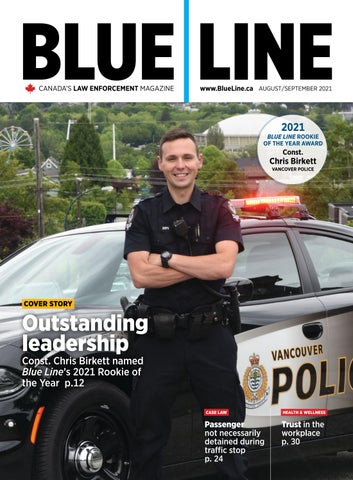
2021
BLUE LINE ROOKIE OF THE YEAR AWARD
Const.
Chris Birkett VANCOVER POLICE
COVER STORY
Outstanding leadership Const. Chris Birkett named Blue Line’s 2021 Rookie of the Year p.12
CASE LAW
HEALTH & WELLNESS
Passenger not necessarily detained during traffic stop p. 24
Trust in the workplace p. 30
COMMISSIONAIRES VALUES LAW ENFORCEMENT EXPERIENCE Join Commissionaires and put your skills and experience to work to ensure the safety and security of people and property in a wide variety of environments.
COMMERCIAL
EDUCATION
HEALTHCARE
CONDOMINIUMS
MINING SITES
GOVERNMENT
CONSTRUCTION
PORTS
commissionaires.ca
12
Contents
Aug./Sept. 2021 Volume 33 Number 7
Features COVER STORY
12 Outstanding leadership
Vancouver Police Department’s Const. Chris Birkett is named Blue Line’s 2021 Rookie of the Year. By Brieanna Charlebois.
16 Blue Line Expo International
Experts from Canada and around the world came together virtually to discuss important topics impacting law enforcement today. By Brieanna Charlebois.
22 What’s wrong with this picture?
Columns 4 10 14 20 24 30 34
Editor’s Commentary Q&A Holding the Line Technology Case Law Health & Wellness Back of the Book
Departments 5 5 6 8 8 32 33 34
News By the Numbers Out of the Cold Dispatches Letter to the Editor Off the Shelf Marketplace Blue Links
Unmasking an implicitly and unintentionally biased photo-lineup: A case study. By Raymond M. Klein.
26 Integrating body worn cameras and technology into critical incident response
From drones to body worn cameras to GPS monitoring systems and automated licence plate readers, advances in law enforcement technology are making it possible for organizations to enhance public safety like never before. By Monique Rollin and Vishal Dhir.
COVER PHOTO: VANCOUVER POLICE SERVICE
16 10 @Blue_LineMag
26 August/September 2021 | BLUE LINE 3
EDITOR’S COMMENTARY BY BRIEANNA CHARLEBOIS
www.BlueLine.ca
The importance of leadership
D
uring times of crisis—like leaders. This is exemplified through new those members of law en- technological advancements, which often forcement faced over the past pose new challenges for police. year—strong leadership matIn this issue, Monique Rollin and Vishal ters exponentially more. In challenging Dhir cover how to integrate body-worn moments, we must consider what makes cameras and technology into critical incia great leader? Is it courage? Trust? Em- dent response and how forward thinking pathy? Compassion? How important is leadership is essential, as is adopting hands-on life experience; the ability to technology-driven incident management complete tasks and lead by example? in order to meet the challenges and opporHow important is strong character and tunities facing public safety professions. integrity? What about effective comSimilarly, the technology section showmunication and the ability to illustrate cases a new evidence management system words through action? called Auror, a database proThe law enforcement leaders of Police gram that grants officers access today are arguably facing one of the officers are to investigate retail theft. most tumultuous times in policing. entering the Isabelle Sauvé’s Health & On a large scale, police organiza- field with Wellness column covers trust tions are feeling increased pressure new and how police leaders play a to re-evaluate their practices while expectations vital role in creating a positive balancing an ever-changing cultur- about what work environment. The magazine also showcasal, social and technological land- it means to scape. At an individual level, police be an officer es a recap of our first ever Blue Line Expo International. The are entering the field with new ex- and how pectations about what it means to they want to virtual event, which took place in April, brought together exbe an officer and how they want to be led. perts from Canada and around be led. This issue features Vancouver Police the world who covered various topics Department Const. Chris Birkett, this impacting law enforcement today. The year’s Blue Line Rookie of the Year. Birkett event illustrated how, when the world was unanimously chosen by our panel of seemingly came to a halt last year, police judges, all of whom cited the exceptional work did not. Criminals adapted and leadership he has displayed in his short public sentiment changed, but police tenure as an officer. He exemplifies strong carried on—a true testament to the discileadership and commitment to positive pline and dedication of the force in change, proving these qualities are not Canada. Many of the challenges police now face solely limited to—or the responsibility of—those in senior positions. In only in weigh heavily on law enforcement his third year in policing, he has exceeded management and personnel alike. As a all expectations. One of his most notable result, current and aspiring leaders may be accomplishments is establishing and seeking out greater insight into how to be spearheading Out on Patrol, an incorpor- an effective police leader and what type of ated non-profit peer support organization leadership style will work best in this clifor LGBTQ2S+ members in all areas of law mate. While there isn’t a one-size-fits-all answer, most would agree that effective enforcement. Adaptability, flexibility and the ability to leaders are skilled at responding to challearn from mistakes are essential in strong lenges. This issue covers just that.
CONNECT WITH BLUE LINE
www.BlueLine.ca 4
@Blue_LineMag
BLUE LINE | August/September 2021
BLUE LINE
www.facebook.com/BlueLineMagazine
Reader Service Print and digital subscription inquiries or changes, please contact Beata Olechnowicz, Audience Development Manager Tel: (416) 510-5182 Fax: (416) 510-6875 email: bolechnowicz@annexbusinessmedia.com Mail: 111 Gordon Baker Rd., Suite 400 Toronto, ON M2H 3R1 GROUP PUBLISHER/VP SALES | MARTIN MCANULTY mmcanulty@annexbusinessmedia.com PUBLISHER | ADAM SZPAKOWSKI aszpakowski@annexbusinessmedia.com EDITOR | BRIEANNA CHARLEBOIS bcharlebois@annexbusinessmedia.com EDITORIAL DIRECTOR EMERGENCY SERVICES GROUP | LAURA AIKEN laiken@annexbusinessmedia.com ACCOUNT MANAGER | JANICE EATON jeaton@annexbusinessmedia.com MEDIA DESIGNER | SVETLANA AVRUTIN savrutin@annexbusinessmedia.com ACCOUNT COORDINATOR | KATHRYN NYENHUIS knyenhuis@annexbusinessmedia.com COO | SCOTT JAMIESON sjamieson@annexbusinessmedia.com ANNEX BUSINESS MEDIA 111 Gordon Baker Road, Suite 400 Toronto, ON M2H 3R1 Tel. 416-442-5600 • Fax 416-442-2191 Publication Mail Agreement No. 40065710 ISSN 0847-8538 Printed in Canada SUBSCRIPTION RATES Canada — 1 Year $31.50; 2 Year $52.50 plus tax USA — 1 Year $136.50 CAD Occasionally, Blue Line will mail information on behalf of industry-related groups whose products and services we believe may be of interest to you. If you prefer not to receive this information, please contact our circulation department in any of the four ways listed above. Annex Privacy Officer Privacy@annexbusinessmedia.com; Tel: 800-668-2374 © 2021 Annex Business Media. All rights reserved. Printed in Canada. No part of the editorial content of this publication may be reprinted without the publisher’s written permission. Opinions expressed in this magazine are not necessarily those of the editor or the publisher. No liability is assumed for errors or omissions. Readers are cautioned and advised that articles presented herein are edited and supplied for your personal awareness and should not be used for further action until appropriate guidance is received from a supervisor, Crown Attorney or other persons in authority. All advertising is subject to the publisher’s approval. Such approval does not imply any endorsement of the products or services advertised. The publisher reserves the right to refuse advertising that does not meet the standards of this publication.
NEWS
PHOTO: © LUCHSCHENF / ADOBE STOCK
ONTARIO
Province passes bill to strengthen fight against human trafficking
In June, the Ontario government announced the passing of new legislation and made amendments to existing legislation to build upon the province’s $307 million Anti-Human Trafficking Strategy. Human trafficking is one of the fastest growing crimes worldwide. Ontario is a hub for human trafficking in Canada—the most police-reported incidents of human trafficking in the country occurred within the province in 2019. The average age of recruitment into sex trafficking is 13 and nearly 65 per cent of victims identified by police are under the age of 25. The new legislation includes two new acts—the Anti-Human Trafficking Strategy Act, 2021 and the Accommodation Sector Registration of Guests Act, 2021—as well as amendments to the Child, Youth and Family Services Act, 2017 and the Prevention of and Remedies for Human Trafficking Act, 2017. Their purpose is to build on the government’s response to combat human trafficking by: • Increasing awareness of the issue/ supporting long-term provincial response; • Aiding more survivors in obtaining restraining orders against traffickers,
with specific consideration for Indigenous survivors; • Strengthening the ability of children’s aid societies and law enforcement to protect exploited children; • Increasing penalties for offenders; • Clarifying how/when police services can access information from hotel guest registers to help deter trafficking and identify/locate victims. The Combating Human Trafficking Act also requires companies that advertise sexual services to have a dedicated contact to support investigations into suspected human trafficking. CANADA
Cops for Cancer
The Canadian Cancer Society Cops for Cancer program began in 1997 with one police officer who wanted to make a difference. Ever since, it’s grown into a collective effort across Canada and is now one of the largest fundraising events for childhood cancer research in the country. As the COVID-19 pandemic continues to impact people across Canada and physical distancing safety measures remain in place for most provinces, the Cops for Cancer head shave event is transitioning to an online fundraising activity this year. In September, the annual Canada-wide shave event will take place virtually. Police officers across the country play a leadership role in organizing local Cops for Cancer events by involving the community in fundraising and cancer awareness activities, such as head shaving. Since the program began, the organization has raised nearly $48 million to fund life-saving pediatric cancer research and support programs to raise funds to support young Canadians through their cancer journey. Event participants can collect pledges from their co-workers, friends, family, and community members. To learn more and to sign up or donate, visit copsforcancer.ca. – Canadian Cancer Society ONTARIO
Wireless signaling for body-worn cameras
Mike Duhacek shaving Mike McMullen’s head at the Halton Police Headquarters for Cops for Cancer. CREDIT: DEPUTY CHIEF JEFF HILL
After a four-month pilot project, St. Thomas police in Ontario officially began utilizing new technology to go with their body-worn cameras (BWCs) and stun guns. Using wireless electronic signalling system, the BWCs are automatically activated once
BY THE NUMBERS In December 2020, Statistics Canada released a statistical summary of the current state of correctional services in Canada. Populations and movements of persons within correctional services were explored in order to quantify changes in workload overtime. The analysis also provides information regarding the characteristics of persons admitted to identify populations that are overrepresented in the correctional system. This is the latest nationally acquired data on the corrections systems to date. Learn more by visiting statcan.gc.ca.
37,854
Adults in provincial/territorial and federal custody per day, on average. Of this, 23,783 adults were in provincial/territorial custody and 14,071 were in federal custody.
@Blue_LineMag
70% more adults were in remand on an average day than in sentenced custody (14,778 versus 8,708) in the provinces and territories in 2018/2019.
$116,070 Annual costs for keeping adults in federal custody. The cost of keeping adults in custody are typically higher for the federal system.
31%
of admissions to provincial/ territorial custody and a total of 29 per cent of admissions to federal custody in 2018/2019 were Indigenous individuals.
August/September 2021 | BLUE LINE
5
NEWS the stun gun is deployed. This means officers will no longer have to press the button themselves to record video. The system will also activate all other nearby officer’s BWCs, which will also begin recording. “The climate of policing has become challenging over the past few years and consequently, conversations have occurred surrounding body-worn cameras.” said Chief Chris Herridge. “In June of 2020, we started talking about how to enhance our relationship with our residents and ultimately decided to do a pilot to determine whether it was worth the investment.” They partnered with Axon Public Safety and the four-month project using 12 BWCs. Prior to launching, they drafted a temporary policy and sent a community survey to gauge their interest. The department received 450 responses, 96 per cent of which supported wearing cameras. “We had successes in regards to crime and the cameras allow for increased accountability for both the officers and the public,” said Herridge. “They are objective, can provide different perspectives and will provide us with a broader view of what is occurring and
PHOTO: ST. THOMAS POLICE SERVICE
really at the end of the day it’s an enhanced subjective measure to show what actually happens at a scene.” During the trial period, 1,169 items for federal criminal matters, 1,342 items for provincial offence charges or investigations and 237 items for vehicle collisions were recorded. The technology also allows for real-time transcriptions for officers following the incident; something Herridge believes will also cut down on court time for officers. After the pilot project, the service finalized a ten-year agreement with Axon worth approximately $1 million. This covers cameras, new tasers and a digital evidence management system. Now a standard issue for all officers, the technology was officially deployed on May 27.
ONTARIO
Remembering Const. Jeffrey Northrup
On July 12, thousands of police officers from across PHOTO: TORONTO the country gathered in POLICE SERVICE Toronto to say goodbye to an officer who died in the line of duty. Detective Constable Jeffrey Northrup, a 31-year veteran with the Toronto Police Service, was killed on July 2 in what investigators have called a “deliberate act”. He was struck by a vehicle while responding to reports of a robbery in a parking garage at Toronto City Hall. Northrup started in 1989 as a court officer, before graduating from police college in 1999 and heading to 11 Division, and then to 52 Division in 2008. Jeffrey Northrup
COLD CASE Blue Line’s Cold Case Series:
OUT OF THE COLD File #8: Owen Sound Police fatal hit and run of one-year-old remains unsolved BY STEPHEN METELSKY
Tammy Ringel would have turned 50 this year. Her parents, Hud and Marilyn, fondly hold on to memories of their daughter from when she was just a year old because, 49 years later, that’s all they have to remember her by. On Dec. 9, 1972, while Marilyn walked her daughter along 7th Avenue East, a speeding vehicle careened out of control and struck Tammy’s stroller, killing her instantly. Almost a half century later, the fatal hit-and-run remains unsolved. For Tammy’s parents, it feels like yesterday. “To us she is still a year-old baby that we lost,” said Hud Ringel. “Our ultimate goal is to find the person who did it.” Police want to identify the suspect responsible for this crime too—an investigation they refer to as an ongoing “open case”. In the last few years, investigators have 6
BLUE LINE | August/September 2021
been able to identify some witnesses who provided more clarity about that cold December day in 1972. Around the same time Marilyn Ringel was walking her daughter, there was a social gathering taking place simultaneously at a home one block away, on 6th Avenue. Police believe alcohol may have been a contributing factor to the crime. “The person of interest developed through the investigation left a well-attended, busy house party in the area of the crime scene,” said Detective Sergeant Craig Matheson of the Owen Sound Police. This person was identified in 2017 when police were able to locate and interview a key new witness. Matheson confirmed that, until recently, there hadn’t been a person of interest in this case. Investigators contacted the person of interest in this case, who now resides in the Kitchener-Waterloo area, and made several requests for an interview. He declined each time. There is no forensic evidence to rely on in this case, such as DNA or genetic genealogy. The cold case hinges on information that someone knows about, but has not divulged. Matheson said the case will be solved when “somebody who knows comes forward as a
witness or as the person responsible.” The lingering cold case to solve Tammy’s death has plagued the Ringel family with more questions than answers over the years. Their pain has never subsided. “I would like to see it solved, but time seems to have done us a lot of harm. It’s been almost fifty years and I have trouble with it,” said Marilyn. “It’s never something we are going to stop looking into,” Matheson said. “I hope the person responsible can find it in their conscience and do the right thing.” The family remains desperate to find the person responsible. “We would just like to get some closure. That is the bottom line – to find out who did it,” said Hud. “I am sure there is somebody out there for sure, but they don’t want to talk about it.” Have a tip or information about this crime? Call Detective Sergeant Craig Matheson with the Owen Sound Police at 519-376-1234 ext. 158 or anonymously at Crime Stoppers: 1-800-222-TIPS (8477). Stephen Metelsky, M.A., is a writer, (ret.) police sergeant and professor at Mohawk College. Find him on LinkedIn, follow him @StephenMetelsky or email Stephen.Metelsky@mohawkcollege.ca.
www.BlueLine.ca
NEWS DISPATCHES Shawna Spowart was appointed as the new police chief in Cornwall in June. With over 26 years with the Cornwall Police Service (CPS), she is the first female police chief in the service’s history. Over the past seven years, Spowart has worked at the executive level in various roles including as officer in charge of the Community Patrol Division, inspector of Field Operations and Deputy Chief of Police, a position she began in 2018. She has also previously worked in various areas of the CPS, including the Community Patrol Division, Sexual Assault and Child Abuse Unit and the Criminal Investigations Division. Throughout her career, Spowart received various awards including Police Exemplary Medal – 20 Years (Governor General of Canada), Recognition for 20 Years of Service (Cornwall Community Police Services Board) and Awards of Excellence for Team Achievement, Investigations and Meritorious Service (Canadian Police College). Spowart is also currently a Zone 2 Executive Committee Member on the Ontario Association of Chiefs of Police. Tanya Whysker was promoted to the role of superintendent of the Vancouver Police Department on April 23. She joined the VPD in 1997 and began her policing career by
working in districts 3 and 4 on assignments in Strike Force, Robbery/Assault, CFSEU-BC, School Liaison and Youth Services. In 2016, Whysker was promoted to sergeant and assigned to the Professional Standards Section. She was then transferred to the Sex Crimes Unit where she led a team and supervised VPD detectives assigned to the Child Youth Advocacy Centre. In 2019, she was promoted to staff sergeant assigned to the Professional Standards Section. Upon promotion to inspector in 2020, Whysker remained in the Professional Standards Section as a designated Discipline Authority until being assigned to inspector in the Human Resources Section. She is a member of the VPD Critical Incident Stress Management Team and a member of the VPD Women’s Personal Safety Team. After 30 years of service, Sgt. Tammy Morden from the Niagara Regional Police Service retired. Hired in 1991, Morden served in a variety of positions, including frontline officer, breath tech, drug recognition expert, use of force trainer and fraud detective. Most recently, she held the role of sergeant in charge of the Policy & Risk Management Unit. She also worked on the Equity, Diversity and Inclusion portfolio, where she created the Chief of Police -
LETTER TO THE EDITOR I read with interest your article in the most recent issue of Blue Line magazine on the re-introduction of leadership training under the direction of Stacey Moreau at CPC in Ottawa. Up until the 1970’s, leadership and management training was at the forefront at CPC. It was extensive and included a five-week course offered to senior NCOs from all police forces in Canada in the form of a course entitled “Senior Police Administration”. An upper level course in management was also offered called “Executive Development”. Lectures were offered by senior NCO’s of the RCMP and experts in management topics from the professional and university communities. Just to illustrate the intensity of the curriculum, each SPAC was divided into two sections of 28 candidates each. In a typical year, 10 of these double SPACS would be completed amounting to in excess of 500 senior NCOs yearly receiving formal managerial and leadership training. For whatever reason, this critical training was gradually discontinued and the curriculum transitioned to exclusively operational courses. A very large gap in enhancing the training and expertise of police managers suddenly occurred, with nothing to replace it. The constant feedback to those of us on CPC staff at the time indicated the criticality of management training for those policemen in management and supervisory positions. It is heartening to discover that management and leadership training at CPC has been given a breath of life again. Police managers will once again have a place to go to prepare themselves for the difficult role of managing in a law enforcement mileau. – Ian Parsons 8
BLUE LINE | August/September 2021
Community Inclusion Council and the Internal Inclusion Committee. Morden received a number of awards, including the inaugural Axon/CACP Equity, Diversity and Inclusion Award, and helped create the new Equity, Diversity & Inclusion Unit for Niagara Police Service. She officially retired in April. Treena MacSween was recently promoted to superintendent of the Hamilton Police Service. The appointment officially comes into effect on August 31. She is the fourth female superintendent and the first person of colour to achieve the rank in Hamilton’s history. MacSween began her career with Peel Regional Police in 1998 and transferred to the Hamilton Police Service in 2001. During her 24-year career, she has worked in numerous areas including Uniform Patrol, Criminal Investigations, Training, executive officer for the Deputy Chiefs and the Public Order Unit, among others. She is a graduate of Mohawk College and McMaster University, and continued her education through Athabasca University. In 2017, MacSween became the first person of colour (male or female) to be promoted to the rank of inspector. She is currently assigned as the commander in charge of the Community Mobilization Division, which oversees Crisis Response, Community Relations, Youth Services, Mounted, Victim Services, ACTION, Bail Compliance, Crime Prevention, Crime Stoppers and Auxiliaries. Veronica Eaton was promoted from inspector to superintendent in May. Eaton joined Orillia OPP as a platoon sergeant in May 2009. In 2013, she left the role to work in the Deputy Commissioner’s Office. In September 2017, she returned to Orillia OPP as detachment commander. She is now stationed at OPP General Headquarters, where she is director of provincial traffic operations with the Highway Safety Division. She oversees deployed traffic teams in the province and manages specialty patrol operations, including ATV, bicycle and snowmobile units. Eaton will also oversee the collision reconstruction, drug recognition and breath technician programs. Visit www.BlueLine.ca for the latest news, stories, products, videos, photo galleries and industry events.
www.BlueLine.ca
Q&A Peel Regional Police (PRP) recently launched a new Intimate Partner Violence Unit to address the growing number of domestic violence incidents in the area. The unit is based in the same location as other services and supports available for survivors of family violence. Officers from the unit will be available around the clock to address all calls related to intimate partner and family disputes, which are among the top four call types in the Peel region.
A
recent Blue Line, The Podcast featured PRP Deputy Chief Nick Milinovich and Detective Constable Kathy Kulbak, who joined Blue Line editor Brieanna Charlebois for a conversation about the launch of the unit, its success so far and their plans for the future.
we’ve been successful in finding those people. It’s one of the busiest places someone can work bar none, so if you’re not committed or don’t understand it, you won’t be able to respond to these calls in a way that is compassionate and trauma-informed. There are 49 officers as of now but the demand is growing.
Q: What is the unit and how is it different than previous models?
Milinovich: The unit is responsible for cases of intimate partner violence (IPV) for the region of Peel. How it works is our uniform officers will respond. Once they develop or begin to believe there are grounds for a criminal offence, the case is transferred over to the IPV unit and people, like Kathy, will then take over the investigation and case management. The unit is different because it falls the Family Justice Model and we are one of the largest services nationally that have incorporated the model into our service delivery strategy in the area of IPV. What that means is that investigators and the team aren’t responding from a police division. They are actually co-located and partnering with different advocacy services in the community from a location that is not part of the police station. This really breeds collaboration. The other thing that makes our service model slightly different from what we had is that it’s aligned with our Community Safety and Well-being Plan. This represents a huge investment to our police service from what our community views as a big problem in the area: intimate partner violence. The second piece of our approach are people, like Kathy, who are participating and working to make a positive difference. This episode of Blue Line Podcast was sponsored by Wilfrid Laurier University. To listen to the full podcast, visit blueline.ca/podcasts.
10
BLUE LINE | August/September 2021
Q: How has COVID-19 affected IPV call volumes? Peel Regional Police’s newly launched Intimate Partner Violence Unit. PHOTO: PEEL REGIONAL POLICE
Q: Const. Kulbak, how has your personal experience with IPV aided in your police work?
Kulbak: My experience took place about 30 years ago and, as a rookie, when I would respond to domestic calls, people would naturally gravitate toward me. I could relate to them. I felt like I had a bit of an upper hand because I had that life experience. I feel that everything that I’ve gone through as a survivor has aided me as an officer and everything I’ve worked for is for this. It’s nice to bring people somewhere that isn’t a police department because that is overwhelming for survivors. I think the unit is long overdue so I’m glad it’s happening and I think it’s working well.
Q: How were officers for the unit selected?
Milinovich: It is about the interest and the passion in making a difference. It’s about the understanding that the way we conduct this kind of investigation is differently than how we’d conduct other investigations. There are just personal characteristics that would impact the way you conduct police work in IPV cases. I think
Kulbak: I think the lockdown really wore down on people’s mental health. People tend to take their frustrations out on the person closest to them and the results are what police are seeing. Once things start to open up, I’m hoping we see a decline because it’s been really hard. Milinovich: Organizationally, if you look at our statistics over the past couple of years, generally after 2019 – so 2020 into this year – there’s almost a levelling off, which concerns me because when you speak to service providers and you hear they’re numbers have increased. So, when we talk about isolation in the home and there’s less opportunity to escape—those things concern me. Another thing that I often spend a lot of time thinking about is, if we look at 2020, we see that the geo-political landscape has created some issues with trust in police and we promote some of those ideas among certain populations. We have to ask ourselves if this is contributing to less reporting to police. I want to begin planning into what happens six months from now when things start to really open up. It will bring its own set of challenges in the same way the pandemic did, but it’s an opportunity to be more proactive. Editor’s Note: This interview has been condensed and edited for clarity. To listen to the full episode, visit blueline.ca/podcasts.
www.BlueLine.ca
INTRODUCING THE NEW
2020+ NOSLO DPW TRUCK RACK RUGGED YET LIGHT-WEIGHT ALUMINUM CONSTRUCTION
WIRING CHANNELS PROTECT WIRING FOR LONG-TERM DURABILITY
UNIVERSAL MOUNTING FEET FIT A VARIETY OF 2020+ FLEET TRUCKS
RUGGED. RELIABLE. RESPONSIVE. Gamber-Johnson is excited to introduce our first emergency and auxiliary light mounting solution. The 2020+ NOSLO DPW Truck Rack features a universal design to accommodate a wide range of emergency light products and installs easily to fit a variety of vehicles. To find a reseller in your area visit gamberjohnson.com/FindAReSeller.
COVER STORY
Pathway to policing
Birkett said his career aspirations began in high school after meeting his high school’s liaison officer, who soon became a mentor. He encouraged Birkett to take part in the VPD Student Challenge in his grade 12 year, which was a week-long police training. After that, he was sold. In 2009, Birkett attended Langara College where he studied criminal justice and became a loss prevention officer and, at 21, he was hired at the B.C. Sheriff Service. “VPD was the end goal. It had been since I was in high school,” said Birkett. In January 2018, he achieved that goal and was officially hired by the VPD. He graduated from the police academy in November of that year and was assigned to patrol in District 2, Team 7. “I consider myself super fortunate because a lot of people don’t know what they want to do, especially in high school, so to get put on that path so early really gave me a leg up. I’m very grateful for that experience,” he said.
Const. Chris Birkett
Outstanding leadership
Const. Chris Birkett named Blue Line’s 2021 Rookie of the Year By Brieanna Charlebois
V
ancouver Police Department ( VPD) Constable Chris Birkett has only been an officer for roughly three years, but has already broken down barriers, proven his dedication and commitment, and exceeded all expectations. Birkett, who was officially hired by the VPD in January 2018, is Blue Line magazine’s 2021 Rookie of the Year. This annual accolade recognizes and encourages a standard of excellence that exemplifies “leadership as an activity, not a position” and pride in service to the public. Its goal is to highlight promising new officers who are effectively paving the way for the 12
BLUE LINE | August/September 2021
future of policing in Canada and are making positive waves among their peers, agencies, communities and beyond. Birkett’s colleagues agree he more than fits the bill. “Of over 1,300 sworn officers in the VPD, Const. Chris Birkett unquestionably stands out as a true leader among his junior peers,” wrote VPD Const. Tyson Radons in Birkett’s nomination letter. “At only 31 years of age, Chris has fully devoted his life and career to public service and community advancement. He has continuously shown an inspiring passion and willingness to better his immediate community, province and country.”
Modest in his accomplishments, Birkett credits much of his success thus far to having a supportive squad leader. Det.-Const. Peter Sadler, he said, encourages his team to pursue learning opportunities and projects of interest. When asked about a situation that showcased this, Birkett immediately launched into an explanation of a recent investigation dubbed Project Block Party. In 2017, Birkett was made aware of a neighbourhood dispute in which the behaviour from one resident had been escalating over time and cars were being keyed in the middle of the night. While residents suspected the individual in question, there was no tangible evidence to tie him to the crimes. “By the time I got to the file, there had been over 50 incidents tracked by the neighbourhood. The residents felt terrorized living on their block, not knowing if they were going to wake up to their car being damaged,” said Birkett. “It wasn’t a flashy file but it was meaningful because it was impacting the residents’ day-to-day lives.” So in 2019, with Sadler’s blessing, Operation Block Party was born. Birkett wrote an operation plan, utilized VPD resources and investigative techniques, and spent several nights surveilling the neighbourhood. Then, in January 2020, after enough evidence was collected to arrest the accused, Birkett conducted a four-hour interview and was able to establish motive. The day after the www.BlueLine.ca
VANCOUVER POLICE SERVICE
Making an impact
THANK YOU TO THE 2021 PANEL OF JUDGES arrest, Birkett returned to the neighbourhood to compile any additional evidence for the file but was greeted with tremendous gratitude instead. “You can really see it made a huge impact on the community. It’s really easy to just go from call to call, but this case really showed me how valuable being proactive and seeing a project through to the end could be.” In working with the Crown, the VPD ended up charging the accused with 20 counts of mischief. There have been no incidents since but, at the time of publication, the case had yet to go to trial.
Out on Patrol
In 2019, Birkett saw the need for more support for members of the LGBTQ2S+ law enforcement community, who may face additional mental health challenges, stigma and, in some cases, a lack of kinship within departments. Birkett did not let his limited time on the force dissuade him from seeking meaningful change. He, along with several other LGBTQ2S+ members, came
@Blue_LineMag
BL_ILET_Dec20.indd 1
Thank you to our 2021 judging panel for your expertise, thoughtful insight and steadfast dedication. Your expertise are greatly appreciated. Christine Silverberg is a lawyer and was the Chief of the Calgary Police Service from 1995-2000. Silverberg went to law school after she retired as Chief, becoming a Partner at Gowlings LLP, then joining the independent law practices at Wolch deWit Silverberg & Watts. In 2015, Silverberg launched her own firm, SilverbergLegal. She is currently a CACP and OACP member.
Peter German is a former deputy commissioner with both the Royal Canadian Mounted Police and Correctional Service Canada. He currently practices law, is a consultant on criminal justice and leadership matter, and is president of the International Centre for Criminal Law Reform at the University of British Columbia.
together to begin exploring the idea of a peer support organization. . Out On Patrol Society was incorporated at the end of 2019 and officially launched on May 26, 2020. It is a non-profit peer support organization for LGBTQ2S+ members in all areas of law enforcement. Along with peer support, the society is also focused on community engagement, charitable work and education. “I think one of the most important pieces to the organization is education and
Armand La Barge is the retired chief of police of York Regional Police in Ontario. He began his career there in 1973 and retired in December 2010 after serving as chief for his final eight years. La Barge is the past president of the Ontario Association of Chiefs of Police and the Ontario director of the Canadian Association of Chiefs of Police.
going in and talking to schools,” said Birkett. “We want to show kids who are maybe apprehensive about coming out or are afraid to apply that there are gay cops and policing is a career option for them.” Because the organization launched during the COVID-19 pandemic, Birkett has not yet had the opportunity to visit schools but said this will be happening in the near future. For him, it’s all about making a positive difference—it’s the continued on page 14
August/September 2021 | BLUE LINE
13
2020-11-16 1:29 PM
HOLDING THE LINE BY MICHELLE VINCENT
Exploring organizational values, culture and mindset change in policing
W
hen we look at organizaHow discipline and recognition is hantional culture in policing, dled affects how members feel. Feeling many things come to valued is an integral piece of happiness, mind: stigma, fear of be- cohesiveness, inspiration, positivity and ing reprimanded, feelings of not being able so many other constructive feelings. Howto complete a challenging task or follow ever, these could be put at risk if someone direction in this paramilitary field. Yet, doesn’t share a similar perception/experithese experiences continue to prevail, often ence, causing potential disruption in the causing great toxicity throughout. Under- alignment of organizational culture. standing what true organizational mindset So, how do we bring people/organizachange is and how it is manifested is key. tions together when they have very differThe first step is understanding ent perceptions and experienthat everyone has their own unique One’s ces? How do we bring people personality and perceptions that perception together as a team, working may influence their decisions. In a and together in unison and harmony policing paradigm, these choices experience of when we are used to focusing on can make the difference between their own differences (which is particularlife and death. For example, if my values, along ly true in policing)? This is life is in danger, will my partner be with the where leadership and education able to take the life of another in organization’s come into play. order to protect me? Maybe they reaction to Leadership exists inside each will, maybe they won’t. None of us the event of us. We all have the opportunity truly knows what we are capable of based on its to “take one for the team”. That until we are in that situation. Their perception/ could mean opening ourselves constitutional experience of their experience of up during discussion and sharing values may influence the decisions values may points/experiences that may be cause they make. controversial and enlightening. While policing organizations significant It could be standing up and exhave a set of values that we hope conflict in plaining a point of view that may our sworn and civilian members intensely have been missed by the group are invested in and believe in, the emotional (instead of cutting up others to perception of those values can be situations. make ourselves look better). We quite different. For example, the must ensure teamwork is envalue of “our people” can have a vast def- couraged and rewarded at every level, so inition and experience for both the organ- that it becomes representative of what the ization and member. Where this can be- organization stands for, despite differing come an issue and even develop into perceptions and experiences. We should toxicity is when an event that is either encourage members to communicate and organizational or operational occurs. address diverse perceptions and experienOne’s experience and perception of an ces to draw out what makes them truly event is often based on personal values. wonderful and powerful. This, coupled with the organization’s reProviding a training of the minds whereby action to the event based on its percep- we find what makes others’ thoughts, ideas tion/experience may cause significant and open-mindedness paves the way for new conflict in intensely emotional situations. opportunities. In policing, this can mean Interpretation and implementation of that difference between effectively solving organizational values is often from the an investigation of a serious crime or even Executive Command Team and flows saving a life—maybe even your own. downwards. Role modelling healthy beMichelle Vincent, PhD/ MACP, is a retired haviour and having an open mind may York Regional Police officer and the founder have a powerful effect on how other of The Haven, Ontario’s first non-profit, leaders throughout the organization deal inpatient treatment centre exclusive to first with recognition and discipline in emoresponders and uniform personnel. Contact her at michelle.vincent@thehaven.cloud. tionally conflicted incidences. 14
BLUE LINE | August/September 2021
COVER STORY continued from page 13
reason he went into policing and why he’s been so proactive as a rookie. He also noted wanting to help bridge some of the dissonance that has been created between law enforcement and the public. “Typically, when people deal with us, it’s not the best time in their life, so we really wanted to provide the community with an opportunity to interact with us in a positive and engaging atmosphere where we can host community events and they don’t have to feel apprehensive with us,” he said. “We really want to open up to have some meaningful dialogue because, although we recognize that there’s a lot of progress has been made between law enforcement and the LGBTQ2S+ community, we know that there’s a lot of work to be done and we want to play an active role in that work.” Out On Patrol currently represents 220 active members from agencies across Canada that otherwise might never had been given the space to be recognized as both an officer and as a member of the queer community. As organizer, it’s no surprise Birkett took the most active leadership role in the foundation: president. “You can ask anyone who knows him, Chris will drop everything to help, volunteer for the difficult jobs and never complain,” said Tyson. “Chris is known as a true leader among his peers. What makes his career so remarkable at this point, however, is how he sees ways in which his community can be improved and does more than just talk about problems. Chris fixes them.”
Leading with a purpose
Birkett is very community-focused in all aspects of his life. Outside of law enforcement, he founded a recreational flag football team that raised money for charity. He was a “big brother” for nine years and is still actively connected to his “little brother”. He was also awarded the 2017 Commemorative Canada 150 Medal by the Senate of Canada for his substantial civilian volunteerism. When asked about his future goals, Birkett said he’d like to continue pursuing investigative work, but is open to any and all possibilities. Regardless of where his career takes him, he said his goal remains the same: to make a positive difference. If you ask his colleagues, they’d tell you he already has. “In the opinion of all those who know Chris, he exemplifies leadership as an activity and not as a position,” said Radons. “I am incredibly proud and privileged to call Chris a colleague and cannot wait to see what the future holds for him.” www.BlueLine.ca
ADVERTORIAL
Policing in a Digital World:
Competencies and Training for Canadian Law Enforcement As part of ongoing efforts to enhance competencybased management tools, resources, and learning for Canadian police, CPKN is working to develop nationally relevant digital competencies and training to ensure police services can appropriately respond to the proliferation of digital evidence and cybercrime. Cybercrime, cyber-related incidents, and digital technologies are an increasingly common part of police work in Canada and around the globe. In 2019, Manhattan District Attorney’s office noted that more than one-quarter of felony indictments in Manhattan involved a cyber component, and in Europe the European Commission estimated that 85% of criminal investigations included some electronic evidence. Policing in the 21st century requires competencies that account for the expanding footprint of digital evidence that police officers are expected to understand, collect, and investigate in a forensically-sound manner. While many Canadian law enforcement agencies operate specialized units for digital forensics, child sexual exploitation, and technology-on-technology crime, it is unrealistic to expect a handful of highly trained individuals to respond to every call for service that has a digital or cyber aspect. Empowering first responders to effectively deal with crimes on the cyber spectrum—by securing digital evidence, conducting preliminary investigative steps, and making appropriate referrals in more complex investigations—is key to enhancing Canadian law enforcement’s capacity in an increasingly digital world. CPKN’s Cybercrime Training and Digital Competency Development for Canadian Law Enforcement project, which is funded in part by Public Safety Canada, will support Canadian police services in this work. In Phase 1 of the project, CPKN developed a Digital Competency-based Management Framework. Based on a review of global practices and extensive consultations with Canadian cybercrime experts, cybercrime trainers, police investigators, and first responders, the framework outlines 10 digital competencies for 10 policing roles,
including uniformed first responders, investigators, and unit managers and can be readily adapted to fit the unique needs of individual police services. It will help to ensure members, regardless of role, are appropriately equipped with the knowledge and skills needed to effectively deal with cyber-related crime and evidence. >> Read the Competency-based Management Framework for Digital Competencies in Canadian Policing Report Phase 2 of the project is now underway. Using information gathered during Phase 1, which indicated a substantial need for cyber-training for generalist roles such as first responders and general duties investigators/detectives, CPKN will work with subject matter experts from the police community to update and/or develop bilingual training to enhance ability of frontline personnel to respond to cybercrime incidents. This training will be available to Canadian police and public safety agencies in March 2022.
For more information about this project, please contact: Krystine Richards, Director, Outreach and Communications krystine.richards@cpkn.ca
EVENT
Blue Line Expo International
Experts from Canada and around the world came together virtually to discuss topics impacting law enforcement today. By Brieanna Charlebois
O
n April 22, Blue Line hosted its first ever Blue Line Expo International. The virtual event brought together experts from around the world to speak on various topics impacting law enforcement today. This included de-escalation training, officer wellness and resilience, counter-extremism, organized crime and human trafficking. It featured keynote speaker Richard Mullender, former lead trainer at Scotland Yard’s National Hostage and Crisis Negotiation Unit, and founder of the Listening Institute, who presented on the topic of ‘Life and Death Listening’. It also showcased four other live sessions and nine on-demand sessions.
De-escalation training
Effective communication in crisis and hostage situations is essential. In his live presentation, Mark Lowther discussed effective skills and tools during crisis and hostage situations.
Counter-extremism
In his session, Dr. Peter Collins discussed the involuntary celibate (incel) phenomenon and the rise of misogynistic extremism. He covered how the growing online subculture led to violence against women. 16
BLUE LINE | August/September 2021
Human trafficking
Human trafficking is the second largest criminal enterprise on the planet and is often hiding in plain sight. Julie Clegg, founder and CEO of Human-i Intelligence Services, covered the challenges faced by international law enforcement in the fight against human trafficking today.
Wellness and resilience
The event featured a one-hour panel discussion hosted by Adam Kinakin, which covered various mental health topics including sleep, recovery and performance in law enforcement, Post-Traumatic Growth, EMDR Therapies, Post-COVID Stress and more. Kinakin was joined by experts Dr. Charles H. Samuels, Dr. Robbie Adler-Tapia, Dr. Robert L. Perkins, Sajel Bellon and William (Bill) Rusk.
On-demand sessions
The event also featured nine on-demand sessions. Michael Schlosser, the director of the University of Illinois Police Training Institute in the United States, presented on non-escalation and de-escalation as force alternatives. Matthew Kriner, analyst for Thomson Reuters Special Services in the United States, covered challenges for law enforce-
ment in emerging extremist threats, particularly from far-right extremists. Professor Tore Bjørgo, the director of the Center for Research on Extremism in Denmark, presented on far-right extremism, hate crimes and political violence, with a focus on vigilantism against migrants and minorities. The Australian Strategic Policy Institute’s Dr. John Coyne and Dr. Teagan Westendorf discussed the production and trafficking of heroin and methamphetamine, where in the value chain they occur, and the implications for domestic and international strategic policing to combat drug trafficking by organized crime syndicates across Southeast Asia. Cheri Oz, special agent at the Drug Enforcement Administration’s (DEA) Phoenix Field Division joined editor Brieanna Charlebois for a discussion on the opioid epidemic in America, Mexican cartels and the effects of COVID-19, all of which pose new challenges to criminal organizations and their movement of drugs throughout the United States. Clinical Psychologist Daniel M. Blumberg, Konstantinos Papazoglou, founder/director of ProWellness Inc., and Michael Schlosser, director of the University of Illinois Police Training Institute, discussed integrating police wellness and ethics. Through this discussion, panelists emphasize wellness through physical, cognitive, emotional, social and spiritual health, with a focus on the interconnection between officer wellness and ethical behaviour. Peel Regional Police Detective Constable Greg O’Connor and York Regional Police Detective Scott Cresswell presented on their efforts to combat the upward trend of highend vehicle thefts in Ontario using their recent investigation, Project Majestic, which involved the dismantling of one crime group through the combined and coordinated resources of several Greater Toronto Area Police Services, as a case study. Sherri Martin, the national director of Wellness Services, Fraternal Order of Police (FOP) in the United States, presented on how to cultivate a culture of wellness in law enforcement agencies. Lastly, Psychotherapist and CHAC Speaker Sajel Bellon presented on wellness, resilience and embracing emotion within policing. A special thank you to all our attendees, sponsors, partners and presenters. If you missed the event, all are available through the Blue Line YouTube channel: BLUE LINE Magazine.
www.BlueLine.ca
CROSS-BORDER COMMUNICATION SAVES LIVES Canada and the United States share the world’s longest undefended border of 5,525 miles along the 49th parallel. This peaceful relationship has allowed for significant trade and people to cross the border for recreation and commerce. With thousands of commercial trucks crossing the Ambassador Bridge every day, the Ministry of Transportation has identified the Windsor-Detroit gateway as Canada’s busiest land border crossing. Running beneath the Detroit River, the Michigan Central Railway Tunnel facilitates the crossing of freight trains between the two countries, carrying $91.6 billion (or 28.2%) of road trade and more than $250 million in commodities that support both economies. The Windsor-Detroit area is more than just an economic driver. It’s a recreational and entertainment hub as well. Situated on the shores of the Detroit River, multiple communities on both sides of the border benefit from their location on the water way and proximity to the Great Lakes. With all the activity taking place along this international border, law enforcement and public safety agencies find themselves facing unique challenges. From coordinating multi-agency response across international boundaries, to bridging communication silos across jurisdictions and
mutualink.net
disciplines, law enforcement entities are working together to enhance public safety, preserve the peace, and secure our borders. Mutualink is working with U.S. and Canadian border agencies to unify communications in support of their missions. From integrating legacy radio systems to instantly sharing data and video, Mutualink solves the most complex interoperability challenges and is dedicated to building connections that make stronger, safer communities.
PUBLIC SAFETY Unified Communications with True Interoperability® Mutualink is the trusted leader in push-to-talk multiagency communications, LMR-to-LTE interoperability, and cross-agency information sharing across our patented, distributed peer-to-peer network. From everyday incident response, to natural and man-made disasters or mass casualty events, responders can seamlessly connect across jurisdictions, regardless of device or carrier. True Interoperability® allows agencies the freedom to connect disparate legacy systems including land mobile radios, mobile phones, satellite phones and land lines between agencies. The capabilities of the solution are further enhanced by the ability to share video streams from mobile devices, drones, stationary closed-circuit
cameras, and any other VoIP streams. Simply put, our truly collaborative platform allows for sharing of voice communications, video and data between agencies in an encrypted format to improve response.
Unify
Connect
Freedom to unify
Freedom to connect
communications across agencies, divisions, or field teams while maintaining control of information.
across devices, systems, applications, and data sources to drive collaboration and information sharing.
Act Freedom to act
by automating processes and response, drive decisions with actionable data and real-time communications.
Secure, Incident-based, Multimedia Talkgroups Mutualink’s technology is unique because it allows agencies to maintain exclusive control over their communication assets by deciding in real-time what is shared, with whom and when. Interoperable communications supported in talkgroups include: • Voice: Push-to-talk, Radio, VoIP calling, VoLTE • Video: Video cameras (IP or analog), built-in cameras in mobile devices, laptops or webcams, screen sharing applications • Group messaging • File sharing • Location and GIS data sharing • Data and information Sharing
TECHNOLOGY
BY BRIEANNA CHARLEBOIS
Bridging the gap in the fight against retail crime
A
new digital evidence management system is being used to aid police in retail theft investigations. Auror is a database program that grants officers access to imagery and evidence supplied by retailers to aid police in cases of theft, fraud and other criminal acts. Its purpose is to save frontline officers time by allowing remote access to images and video of the crime. It was created after its founders realized more than $100 billion was lost worldwide every year by retailers, but found there was no effective technology being used to report, solve or prevent these types of crime. “We weren’t equipping our stores with the ability to easily report and use actionable intel to prevent repeat subjects an organized retail crime groups from impacting their stores. We needed to address it and did so with Auror,” said Daryl Blackmore, director of Loss Prevention at Rexall. “Now we have real time visibility of what’s occurring which allows us to better coordinate initiatives with stores, loss teams and senior management. It’s a real game changer.” While the system has been operating in New Zealand and Australia for years, it officially launched in North America in May 2019 in partnership with Rexall. The system has since been adopted by several major North American retailers.
How it works
Stores can report situations by uploading video or images onto the platform. Every time an incident is reported, alerts are immediately sent to the Auror Loss Prevention team. The platform also creates visibility so other stores can prevent future losses and crime perpetrated by the same individual. External investigators then have an overview of various analytics to investigate and identify groups or repeat offenders impacting the business. Auror is a cloud-based program that does not alter the evidence uploaded, but allows the transfer of evidence at the officer’s convenience. Rather than travelling to the store, police can review and download video, see images and check any link analysis from anywhere once the incident is reported by retailers. Officers assigned to a file on Auror can also communicate 20
BLUE LINE | August/September 2021
“The system is out there. All you have to do is ask for access.” with the affected location on the platform to request further details on the event to better aid an investigation. “This platform is the modernization of loss prevention reporting and partners with our law enforcement colleagues in the pandemic by offering a “contactless” experience,” said Nigel Ramoutar, external fraud and crime specialist at Rexall.
Implementing the platform
Various police officers across Canada have begun using Auror. Among them are York Regional Police Detective Constable Daniel St. Amand and Peel Regional Police Detective Constable Zack Breault. St. Armand said, when he discovered the platform, he saw it as a major opportunity to utilize the technology to streamline investigations.
“The program illustrates the nature of repeat offenders,” he said. “This is exactly what we should be doing as law enforcement to share information on a platform that we can all look at because this system clearly illustrates a pattern of repeat offenders for this type of crime.” Another benefit of the platform is that it breaks down barriers, allowing for teamwork and partnership across different units and departments. “It all comes down to effective communication and information sharing. By working together, we’re able to close more cases effectively,” said St. Amand. “It’s imperative that we hold people accountable for committing these crimes so, if we had this across the entire retail spectrum, I guarantee if we had solved at least 50 per cent if not more crime than we currently are solving.” He said the system is set up similarly to how intelligence officers put together suspect charts. “The intelligence based side of this system is completely user-friendly, and absolutely critical for us to solve more crime,” he said. Breault agreed. He said he believes Auror is an additional resource police can leverage and utilize to their benefit in the field. “I think that the platform is effective because when investigating property crimes, whether they’re in the retail capacity or not creating length or developing links to similar fact offences, it can really expedite the solvency of crimes,” said Breault. “I think this platform, once it’s being used more consistently by retailers and police, will only benefit the investigation of these types of offences.” The platform is available for free to any officer interested in utilizing the technology to aid in investigations and promote effective information sharing. “Most retail thefts and minor property offenses are small stuff but they add up to big dollars,” said St. Amand. “So, if we can curb some of the larger organized groups by sharing information in this manner, then it’s a win-win as far as I can see. The system is out there. All you have to do is ask for access.” For more information, visit www.auror.co.
www.BlueLine.ca
PHOTOS: AUROR
Auror technology enables officers and retailers the platform for effective information sharing to combat theft
THE MOST ADVANCED MODULAR COMBINATION UNIT RESPIRATOR (CUR) The Avon CS-PAPR™ is the newest generation of CBRN Powered Air Purifying Respirator (PAPR) designed for use in Combination Unit Respirators. The capability to change levels of protection dependent on the threat, now provides the wearer with increased duration on target and safer operation. Avon Protection is recognized as a world leader in respiratory and ballistic protection, delivering life critical solutions for Militaries and First Responders worldwide. As an innovative capability provider, we understand the unique requirements of the modern warfighter and tactical operator. This depth of specialization and understanding has ensured products are designed to protect our users in the most extreme of environments. We have been supplying protection solutions to the UK Ministry of Defence and other allies since the 1920’s and are a primary supplier of integrated protective equipment to NATO, Canadian Armed Forces and the United States Department of Defense Army, Navy, Marines, Air Force and Special Operations Forces.
WORLD LEADER IN RESPIRATORY PROTECTION FOR FRONTLINE WORKERS
Utilizing the Avon MP-PAPR module along with the patented combination hose module, the wearer can seamlessly switch between APR, PAPR and SCBA modes of protection. The single air hose connection for all modes allows the wearer to retain a clear mask cheeks for optimum weapon sighting. The low profile shape of the Avon CS-PAPR delivers best in class integration with SCBA systems, benefiting the wearer with reduced weight and size compared to traditional systems. Modular Methodology allows the user to either add the Avon CS-PAPR to existing fielded systems such as the FM53/4 APR and ST53 SCBA, use as a regular PAPR (Avon MP-PAPR) or revert back to the Avon EZAir configuration.
PANDEMIC FLU KIT WITH REUSABLE HEPA FILTERS
POWERED AIR PURIFIERS Eflare Beacons are intensely bright Can be seen from over 1 kilometer away without the night vision, point fixation and distance judgement problems associated with strobe and incandescent lights. Eflare Beacons are infinitely versatile Available in a variety of one or two colour light combinations, steady-on or flashing, and in three light intensities. Easily attaches to clothing, vehicles, cones and bollards. Be seen and safe in almost any situation you can think of. Eflare Beacons are portable and simple to use The largest model is 22 cm tall and weighs only 460gm including batteries, making it easy to carry or stow anywhere, and quick and simple to deploy in any situation. Just twist the lens to turn on or off, and place one or more units around to provide a highly visible warning and safety zone around a person, work area, hazard or accident. Eflare Beacons double the safety Eflares provide safety by ensuring EFLARES First maximum visibility, but unlike pyrotechnic flares Responder Kits are there is no risk of fire or explosion, and there are found in Police cars no toxic fumes or residue. across Canada. Eflare Beacons are extremely robust Eflares are waterproof, dustproof and will survive a drop from a one metre height onto a concrete surface. Eflare Beacons are HAZMAT accredited Eflare Beacons are HAZMAT accredited for use in Class 1, Division 2 / Zone 2 hazardous areas.
Check, monitor and record all individuals entering your facility automatically while maintaining social distancing.
Seek Scan™ is specifically designed and calibrated to deliver accurate skin temperature measurements while enabling social distancing protocols. In seconds, the system automatically detects a face, identifies the most reliable facial features for measurement, and displays an estimated body temperature using skin temperature as a proxy. A visual and audible alert is provided if someone is warmer than the customizable alarm temperature
The Tactical ResQmax™ is the line thrower specifically designed for the tactical world of line-throwing. As with all the ResQmax™ line throwers, the Tactical ResQmax™ is modular and can be used with a variety of accessories for horizontal or vertical line deployment. When equipped with a grappling hook, a climbing line can be deployed to vertical distances up to 110 ft / 34 m, and a tactical ascending ladder can be deployed to vertical distances up to 50 ft / 15 m. Entry points which would otherwise be inaccessible can be breached with ease for method of entry and ship-boarding operations in both land-based and maritime environments.
What’s wrong with this picture? A case study into police photo lineups By Raymond M. Klein
I
n the early 1990s, a purse snatching was reported in Nova Scotia. As part of their investigation, police showed a witness pictures in a mug book. The session did not result in a positive identification but, five days later, when the police had a suspect, the witness returned to examine a photo lineup. A photo of the suspect was mixed in with 10 images taken from the mug book the witness had examined five days prior. The witness selected the suspect as the perpetrator. When asked if she remembered any of the faces in the lineup from the previous mug book session, the witness testified that she did not.
What’s wrong with this picture?
This story is true and the reason for telling it is that there are valuable messages for defence attorneys, prosecutors, the police and for the layperson interested in how the mind works. Danny Graham, who held a position at Nova Scotia Legal Aid at the time, was counsel for the defence. Sensing there was something “fishy” about the lineup identification, he reached out for “expert confirmation”. Graham was convinced my testimony as an expert in human informa22
BLUE LINE | August/September 2021
tion processing would be useful, so I agreed to testify. At trial in February 1994, Graham qualified me as an expert in Cognitive Psychology, a discipline that focuses on perception, attention, memory, decision making and thinking. I testified about how psychological processes might impact the probative value of various forms of eyewitness testimony. The following is a description based on my prepared notes and retrospective memory. It is not a verbatim transcript.
Attorney: When you teach about memory, can you tell us briefly what you cover and how it might relate to this case?
When teaching about memory, I describe different memory systems: episodic memory, semantic memory and procedural memory. Episodic memory can be described as an autobiographical record of one’s experiences; something like a mental diary. Semantic memory represents our knowledge of facts and the meanings of the words we use; something like mental encyclopedia/dictionary. Finally, procedural memory consists of our skill knowledge; something like a large set of how-to manu-
als, which is not expressed verbally. I also distinguish between three aspects of memory—acquisition, storage, and retrieval—that apply to all three systems. Most of the research on memory deals with episodic information - traces of our previous experiences and our ability to explicitly recall or recognize previously experienced objects or events. This is the kind of memory that is involved in eyewitness reports, so I will discuss how these three aspects relate to episodic memory. The acquisition of information, which refers to how the information is originally perceived, is logically the first aspect of memory to discuss. Most of us are familiar with the notion that the accuracy of our perception of an event will depend on event factors like how good the viewing conditions were, how long it was exposed for, whether an object was moving, etc. Our current perceptions are influenced by numerous observer factors that shape what we perceive. These would include our previous perceptions, our expectations, our desires and our use of selective attention to focus on some details at the expense of others. For example, hungry people are more likely to see food when presented with ambiguous or poor-quality information. There is usually more information impinging on us than our limited capacity systems can handle. Selective attention is like a filter that reduces the overload to a manageable flow. We select what will be attended to according to our habits and our immediate goals; what we do not attend to generally does not become part of our autobiographical memory. Once acquired, the information is stored until it is later needed. Human memory does not work like a tape recorder, faithfully preserving stored information and later repeating the stored passage when we press the “play” button. Our memories, which begin as a biased selection of what we experience, do not remain immutably stored for later playback. Our representations of past events undergo continual change over time. The most obvious processes that make stored information less accessible are decay and interference. In addition to time, new and previously stored information may modify our memories of current events. Information may be modified to conform to preconceptions and, as demonstrated in many experiments, new and possibly irrelevant information may be incorporated with the originally stored experience so that the www.BlueLine.ca
PHOTO: © MIRKO MILUTINOVIC / ADOBE STOCK
PSYCHOLOGY
individual can no longer separate the new from the old. Once the acquired information has been stored, we may later need it. We might ask an observer to tell us everything about a previous event or experience, or we might present information and ask if the observer recognizes it from a previous occasion. Although these requests for recall and recognition place different demands on retrieval processes, when successful, both kinds of requests result in explicit retrieval of stored information. In other words, the previous episode is brought back into conscious awareness. Sometimes, when the ability to explicitly recollect fails, it can be shown that traces of these episodes persist—and can influence responses and performance implicitly, without the subject’s awareness. It is as if previous experiences (stimulation and records of our own behaviour) activate prime pathways in the brain. These primed pathways can influence our subsequent perceptions and behaviours while we remain unaware of them or their influence.
Our memories, which begin as a biased selection of what we experience, do not remain immutably stored for later playback. Graham then reminded the court how the photo lineup was constructed in this case.
The method was, I believe, a complete surprise to the prosecution, who queried whether Graham’s recollection was accurate. The judge affirmed that it was.
Attorney: What does your knowledge about implicit memory suggest about this situation?
There are several conclusions I would make. The prior viewing of the faces in the mug books would leave traces that will influence, and likely facilitate, the subsequent perception of the faces when 10 of them are repeated in the lineup. This influence is not, in any way, challenged by the observer’s sincere claim that she did not remember having seen the faces previously. Indeed, it is the hall-
mark of implicit memory that traces of past episodes persist and influence responses, even when conscious recollection fails. Thus, the lineup you have described would have been inadvertently biased. Obvious bias in a lineup is easy to understand. If a witness describes a perpetrator as bearded and is subsequently asked if they can identify the perpetrator in a photo lineup with one bearded and 10 clean-shaven individuals, the lineup is biased and the observer would not be making a choice amongst 11 reasonable alternatives. In this example, the difference between the faces is visible in the photo lineup. But what is important is that there be no bias in the mind of the observer. In the situation you have described, the use of 10 faces that had been seen recently in a similar context, and one face that had not, continued on page 24
Thank you for serving our communities! Visit dominionlending.ca/firstresponder to learn more about our competitive rates and cash back incentives! *Some conditions apply @Blue_LineMag
BL_Dominion_AugSept21.indd 1
August/September 2021 | BLUE LINE
23
2021-07-08 3:27 PM
CASE LAW
PSYCHOLOGY continued from page 23
BY MIKE NOVAKOWSKI
Passenger not necessarily detained during traffic stop
J
ust because a passenger comes to a stop when a vehicle is pulled over does not mean they are detained for Charter purposes. In R. v. Robinson, 2021 BCSC 899, a police officer driving a marked police vehicle was passed by a pickup truck just after midnight. The truck had a defective taillight and a defective licence plate light. The officer activated his emergency lights and pulled the truck over, approached it and spoke to the driver. The driver did not have his driver’s licence with him but provided his name and date of birth when asked. The accused, Robinson, was a passenger seated in the front. The officer asked Robinson for his name. Robinson replied, “James Budd”. The officer returned to his police car and queried both names provided by the occupants on police databases. On searching the name “James Budd”, it was revealed to be an alias of “Jason Robinson” who had two outstanding warrants for his arrest. The query produced a mugshot photo of the wanted individual, which the officer recognized as the passenger. When a backup officer arrived, Robinson was arrested on the warrants. He was searched incidental to arrest and police found cocaine, meth and fentanyl. At trial in the Supreme Court of British Columbia, Robinson argued his detention in the course of the traffic stop became unlawful and arbitrary when the officer asked him for his name. Moreover, Robinson contended that the officer’s request for his name was itself an unreasonable search. In his view, the police breached his rights under s. 8 (unreasonable search) and s. 9 (arbitrary detention) of the Charter and he sought the exclusion of the drugs as evidence against him. Justice Saunders reviewed case law and rejected Robinson’s submissions. “It is clear that a nuanced consideration of the circumstances when a vehicle has been lawfully subject to a traffic stop may lead to a finding that superficial interactions between a police officer and passengers in a vehicle do not amount to detention,” he said. Saunders found Robinson was “simply a bystander, free to co-operate, to remain silent or to walk away.” “In the present case, Mr. Robinson’s physical presence in the vehicle in and of 24
BLUE LINE | August/September 2021
At trial in the Supreme Court of British Columbia, Robinson argued his detention in the course of the traffic stop became unlawful and arbitrary when the officer asked him for his name. itself did not equate to a detention,” said Saunders. “[Robinson] was not physically restrained. Further, nothing in the circumstances of the traffic stop created psychological restraint. There was only one officer present, and the officer’s physical position, at the driver’s door, did not hamper Mr. Robinson’s freedom of movement; Mr. Robinson was free to walk away. [The officer] had advised the driver of the vehicle that he had been pulled over because of the faulty tail light.” Further, “Mr. Robinson’s identity was of no direct relevance, and objectively Mr. Robinson could not reasonably have perceived the officer’s act of asking for his name to be anything more than a casual inquiry. It was not coercive. It did not significantly interfere with Mr. Robinson’s liberty. It could not, in the surrounding circumstances, have created a reasonable apprehension on the part of Mr. Robinson that he had been singled out for focussed police investigation...There is no basis on the evidence to conclude that Mr. Robinson, through being asked his identity, was being detained.” Nor did asking Robinson about his identity amount to a s. 8 Charter search. He was not detained and “asking his name was not an exercise of police power.” Robinson was free not to answer the question and no documents had been taken from him. Since there were no ss. 8 or 9 Charter breaches, the evidence obtained from the search incidental to Robinson’s arrest on the outstanding warrants was admissible at trial.
Mike Novakowski is Blue Line’s case law columnist.
creates a difference in the mind of the observer. The implicit memory traces from reviewing the mug book could influence the perception of all but one of the faces in the lineup and that face might stand out as somehow different. Finally, contributing to this implicit bias is the fact that the observer not only saw 10 of the faces previously, but also decided that each one was not the perpetrator. Our decisions, like all our experiences, leave traces. Thus, linked with each mug book face is the observer’s previous attribution of innocence. Upon inspection of the lineup, not only might one face stand out as being different from the rest, but the previously viewed faces may activate traces of the previous ‘not guilty’ decision. The prosecution may have asked me one question in cross-examination (something like, “can an eyewitness make a correct identification?”, which I would have answered affirmatively) but if they did, it wasn’t effectively aimed. A more effective line of questioning might have been to ask whether a contribution from implicit memory had been demonstrated in this situation.
The verdict
In delivering his verdict, the judge acknowledged, regardless of his verdict, the sincerity of the prosecution’s main witness’s identification was not questioned. However, he also considered the testimony of the other witness (who did not identify the suspect) and that of the expert witness (me) who convincingly argued that there might have been a bias in the lineup that was exacerbated by the witness’ previous decisions. It is distinctly possible that the main witness is correct, but not beyond any reasonable doubt. That would be unsafe. Corroboration is required in this case. It is not present, therefore the only prudent course is to acquit.
The Messages
Defense and prosecuting attorneys should be alert to psychological factors that might challenge a witness’s testimony and be ready to seek the advice of an expert in cognitive psychology to determine if their suspicions might be supported by scientific principles or scientific studies. Police should be alert to the need to ensure that their efforts to generate a confident eyewitness identification do not bias the witness in any way, neither explicitly nor implicitly. Raymond M. Klein is an emeritus professor in the Department of Psychology and Neuroscience at Dalhousie University and fellow of the Royal Society of Canada. He a cognitive neuroscientist and internationally recognized expert on human attention.
www.BlueLine.ca
CRITICAL INCIDENT RESPONSE
Integrating body-worn cameras and technology into critical incident response
T
echnological innovations are changing the public safety landscape. From drones and body-worn cameras (BWCs) to GPS monitoring systems and automated licence plate readers, advancements in law enforcement technology are making it possible for organizations to enhance public safety like never before. But like any technology, it’s only useful if the operator knows how to use it, can maximize its potential and public safety organizations understand its implications. Every new system or network intended to improve policing can also bring financial challenges, organizational transformation and public scrutiny to agencies that may not be prepared for them. Forward thinking leadership that embraces the migration to technology-driven incident management is essential to meeting the challenges and opportunities facing public safety professions. As technology becomes more integrated and sophisticated, having the capability to provide a coordinated and effective response to high-risk critical incidents becomes increasingly essential. Cultural shifts by police and public safety leaders embracing new technologies combined
26
BLUE LINE | August/September 2021
with advanced tactical response skills will provide teams with the available equipment, training and preparedness they need to respond to public safety threats. Regardless of size or resource capacity, it is essential to arm first responders with the tools crucial to the effective response, planning and supervision of operations in a crisis. Technology is now available to allow real-time situational awareness for Dispatch, Incident Commanders, Tactical Command, Frontline Supervisors and Crisis Negotiator Units to get a more complete picture of evolving situations using a series of devices anywhere; when getting information to the right people at the right time is critical. Applications exist that address significant information gaps using a network of intelligent, connected devices that will directly impact critical incident response, improve officer safety, enhance community safety, improve efficiency and provide an effective resolution to major incidents. At a time when BWCs are being introduced to Public Safety Agencies throughout Canada, it is incumbent upon public safety and police leaders to embrace not just the technology but the steps that come with data-driven response, like smart weapons,
live cameras in the air and, in vehicles, licence plate recognition providing near instant feedback, integrated dispatch systems, geo-mapping officer positions and intelligence gathering from the general public, uploaded in real-time through an online portal or from individuals via a direct link. Officers are also armed with smartphones that can gather evidence, live stream and communicate with other systems impacting time delays. Critical incidents are not stand-alone events that are resolved when the safety risk changes or a subject is in custody. Large scale major investigations are ongoing in tandem with critical incidents and investigators now have the ability to access and share important evidence as a situation unfolds. Responders in the field can also use this technology to share data and evidence in real time. There are specific principles of action to consider during critical incidents where the response must. 1. Control the situation as quickly and safely as possible; 2. Deploy well-trained and highly skilled incident teams; 3. Achieve effective internal and external communication; 4. Build situational awareness with superior information sharing systems; 5. Use a strong, well-rehearsed decision-making process for responders; 6. Create clear team structures with defined roles and responsibilities; 7. Advance effective leadership with cross-trained leaders in cross-functional teams; 8. Share and preserve evidence and maintain records; 9. Ensure learning processes are in place: lessons learned, debriefs and improvement practices. We must also consider what tools are best suited for an incident response that could be multi-jurisdictional or require joint incident command across all public safety organizations. There are four unique www.BlueLine.ca
PHOTO: AXON TECHNOLOGIES
By Monique Rollin and Vishal Dhir
AERIAL FIREFIGHTING 2ND ANNUAL
VIRTUAL
CONFERENCE OCT 27, 2021, 11:00 AM – 4:30 PM EST
AERIALFIREFIGHTING.CA ATTENDANCE IS FREE WITH REGISTRATION The Aerial Firefighting Virtual Conference is designed to provide rotary- and fixed-wing operators, as well as their clients and fire agencies, with critical business information about the sector.
SPONSORSHIP AND EXHIBIT OPPORTUNITIES Partner with our dedicated events team and industry-leading Virtual Conference platform to showcase your services and technologies to North America’s aerial firefighting sector.
The one-day interactive program, including both Live and On Demand Sessions, will provide expert insight on new products and services impacting training, procurement, and operational strategies, as well as sector trends, challenges and opportunities in aerial firefighting.
Share a demo, dynamically update your exhibitor display with new products and services, and answer questions from attendees live via chat or video. Platinum, Gold and Silver packages are available with a range of cost-effective options for promotion and lead generation.
PLATINUM SPONSOR
For more information about partnering with our team, contact: Mena Miu, National Account Manager, WINGS, HELICOPTERS, UAV Canada Tel: 416-510-6749 | Mobile 289-221-7730 | mmiu@annexbusinessmedia.com
GOLD SPONSOR
PRESENTED BY
CRITICAL INCIDENT RESPONSE high-risk incident categories considered in Critical Incident Response: critical incidents, high level search for high-risk missing persons, public order events and major emergencies. When we consider the risks attached to vulnerable missing persons calls for service, we know that time is paramount and an information dissemination plan must be operational as soon as possible. Technologies exist to engage the public quickly. Search planners are also challenged by accurately determining the areas that had been searched. For example, current data collection doesn’t indicate how well an area has been searched—it just identifies search locations. The use of technologies that communicate with each other like BWCs, GPS mapping, airborne drones with thermal technology, fleet cameras enabled with Automated License Plate Recognition (ALPR) when searching for a vehicle, all share the real data for a more accurate response. In addition, responders conducting missing person investigations must remain mindful of the possibility that the case may
escalate into a major crime investigation; all investigative measures employed and all statements taken must be carefully recorded. Integrated devices allow evidence to be captured. The preservation of evidence is a crucial consideration at the earliest stages. Consider a situation with a high-risk for loss of life requiring tactical response and intervention including incidents requiring containment, perimeter control, evacuations, an armed barricade, hostage taking, weapons incidents and active suicides. With integrated technologies, a tactical commander (in a Command Post) can view live mapping of their teams without using the radio to communicate and has an accurate picture of member perimeter locations and up to date movements including the ability to livestream from BWCs at observation points. Drones can simultaneously stream data to the command post and skilled teams (i.e. Arrest Team, Entry Team, Sniper/Observers, Explosive Forced Entry, Hostage Rescue) can receive accurate and up-to-date information directly on their smart devices to assist them in their action plans.
Supervisors and dispatchers can redeploy perimeter officers more effectively during fast paced location changes during a canine track without relying on radio communications or lack of location data. Crisis negotiators gather information, begin a subject assessment as soon as possible and determine a risk and lethality assessment. BWC footage and intelligence about the subject including officer involvement prior to arrival, communications with dispatch, with members of the public and real-time social media access is invaluable. Negotiators can access live streaming to assess the behaviour and communication of armed suspects, hostages or barricaded subjects to help determine appropriate strategies during crisis negotiations. They can confer with mental health professionals in near real-time, allowing experts access to ongoing negotiations, subject communication and interactions to assist with a forensic opinion, expertise and professional assistance. BWCs and integrated device technology allow for patrol officers to communicate
Our Champions. Even amid the ongoing Covid-19 pandemic, your commitment never faltered, as you quickly pivoted to virtual Torch Runs and other online fundraisers to ensure Special Olympics athletes stay active, healthy and connected. Thank you to all of you who help Special Olympics transform lives through sport in communities across the country every day.
@specialocanada | specialolympics.ca
28
BLUE LINE | August/September 2021
BL_SpecialOlympics_AugSept21.indd 1
www.BlueLine.ca
2021-07-13 2:27 PM
with off-site crisis negotiators, mobile crisis officers or mental health/crisis professionals for crisis de-escalation consultation and negotiation advice on high-risk calls for service involving subjects suffering a mental health crisis. Public order events, whether planned or unplanned, can escalate to circumstances where the response that is required to maintain public order is likely to exceed the capability of the normal response and are considered a high-risk to officer and public safety. There is a clear need for integrated technology in the planning stages for all known events for consideration of safety plans, evacuation, strategic deployment, interoperability concerns like multi-jurisdictional response teams and Public Order Units who require integrated communication and real-time intelligence during the event. A drone in the air and live streaming from responders on the ground will assist command with deployment of resources as the situation changes. In response to public safety emergencies caused natural disasters, a health risk, an
Advancements in law enforcement technology are making it possible for organizations to enhance public safety like never before. accident or an act, whether intentional or otherwise, we know that real-time information is key to effective emergency response and triaging resources. Technology that allows responders on scene to stream, upload and share real-time data about the situation drives the emergency management response. Challenges of multi-jurisdictional response and interoperability test incident commanders in understanding the real-time scope of the incident with regard to public safety. BWCs, access to camera feeds from the location, integrated smart devices providing data from first responders will all support Command in the development of strategies and tactics, and the ordering and deployment of resources. While many organizations are equipped with tools that are capable of resolving
critical incidents, there is a growing need to address and mitigate the risks associated with interoperability, time delays and communications concerns. As technology becomes more integrated and sophisticated, having the capability to provide a coordinated and effective response to public safety threats relies on the first responders, specialized teams, quick and safe response using the best tools and enhancing their ability to work cohesively towards risk mitigation and resolution. Monique Rollin is a retired inspector for the Sault Ste. Marie Police Service. She holds an executive position with OWLE and serves as vice president/director of training for Canadian Critical Incident Inc. Vishal Dhir is the managing director, Canada & Latin America, of Axon.
Continue your education at Humber with programs in:
Advance your career in criminal justice.
• • • • • • •
Police Foundations Leadership Criminal Intelligence Analysis Border and Immigration Services Corrections and Forensic Practice Cyber Crime Specialist Municipal Bylaw Private Investigation
Registration opens July 30, 2021
communityservices.humber.ca/ce
@Blue_LineMag
BL_Humber_AugSept21.indd 1
BLUE LINE 29 August/September 2021 | 2021-07-13 9:32 AM
HEALTH & WELLNESS BY ISABELLE SAUVÉ
S
tudies suggest employee job satisfaction skyrockets when an employee establishes a trusting relationship at work. It also positively impacts job commitment and performance. Leaders know how to establish trust and they understand the importance of trusting their followers. Trust is an element that affects many facets of policing. Police personnel must not only ensure they acquire public trust, they must also be concerned with trust within the organization. Trust is highly correlated with workplace morale. It is earned, fragile and extremely valuable. By definition, trust is a “firm belief in the reliability, truth, ability or strength of someone or something”. In an organization, it subsists within a dynamic and complex cluster of interrelated social and institutional factors. It is also instrumental in creating and maintaining a positive work environment.
Trust is the key to reaching the feeling of safety. Systemic paucity of trust is currently at the root of numerous internal and external conflicts in policing, resulting in silos and an “us versus them” culture. It becomes a breeding ground for workplaces where
people become disloyal, unreliable, inadequate, uncommunicative and inconsistent in their moods. Furthermore, it can create a highly stressful and undesirable environment for everyone. Despite its manifestation at varying degrees throughout policing, some continue to ignore the problem, rationalize it or show indifference to it, which further contaminates and destroys morale. Morale is impacted by a number of factors and plays an important role with respect to productivity, motivation and employee retention. Good morale and working relationships based on trust benefit the organization as a whole. According to Dr. Casey Mulqueen, director of research at the Tracom Group in Colorado, “work serves a social purpose for most people; we enjoy socializing and simply spending time with people whom we like and trust. In addition to making time at work more enjoyable, it also im-
+1 867-668-5609 publisher@canadianguns.com www.canadianguns.com
CANADIAN ACCESS TO FIREARMS
The only Canadian buy-and-sell firearms newspaper distributed across Canada! WHY ADVERTISE WITH CATF? Our paper is distributed monthly by subscription and at gun shows, gun trades, gun clubs and select stores across Canada. We shall put you in touch with the active, committed core of Canada’s firearm community!
30 BL_CATF_JanFeb20.indd BLUE LINE | August/September 2021 1
www.BlueLine.ca
2019-12-03 11:03 AM
PHOTO: © MUSHAKESA / ADOBE STOCK
Trust in the workplace
pacts people’s commitment to their jobs and colleagues, which positively impacts effort and performance”. Interestingly, satisfied employees mostly considered their connection to the organization and its purpose as more important than salary. Some degree of luck may be at play when coworkers collectively feel they work with great people, but leadership, management, and each individual is ultimately responsible for contributing to a positive workplace. Work environments thrive when everyone understands and supports the fundamental aspects of good morale and builds it into the culture. Even doing little things for fellow coworkers can go a long way. Managers also need to keep a good pulse on workplace dynamics. They must be aware of possible warning signs, such as cruisers being left near empty or calls for service being held for the next shift without rightful justification or explanation. Such behaviour may be representative of underlying issue—poor morale is often rooted in trust issues.
Good morale can slowly erode over time and, once damaged, its reversal is challenging and difficult to navigate. Enhancing trust means taking a proactive approach and being transparent. Regaining confidence first requires the acknowledgement of distrust. Progress can then take place through open communication and a commitment to transparency. The greatest trust issues or needs must be turned into transparency targets and objectives. It is important to keep in mind it can take a great deal of time to build trust, but it can be broken much more easily and suddenly. In the realm of law enforcement, nurturing confidence in coworkers is key to high morale and productivity. Knowing that, ultimately, your teammates at all levels of the organization “have your back” is critical and desirable. A recent study of 33,000 people in 28 countries and various workplaces found that a large number of employees do not trust their employer. They also discovered that trust
decreases from top positions down the organizational chart; 64 per cent of executives trust their organizations, while only 51 per cent of managers and 48 per cent of other staff stated they trust their organizations. Employees also indicated they trust their peers more than upper level management. This finding has significant implications for those climbing the corporate ladder. Trust is the key to reaching the feeling of safety. Accordingly, managers are powerful contributors to overall workplace conditions. Everyone has an influential role to play in creating a trusting, healthy and safe work environment. Isabelle Sauvé is a 14-year veteran with the OPP, and currently the new Psychological Services Advisor in the OPP’s Healthy Workplace Bureau. She has a MA in psychology and is a PhD candidate. She is also an ultramarathon/endurance athlete and the Racing the Planet/4 Deserts 2018 Series winner as well as a Guinness World record holder. She can be contacted at: isabelle.sauve@hotmail.com.
Prepare to Serve and Protect SENECA OFFERS PROGRAMS IN: • Police Foundations • Crime & Intelligence Analysis • Advanced Investigations • Emergency Services Communications (911) Enhance your diploma or professional experience through credit transfer to gain another law enforcement credential. Start making a difference in communities across Canada. LEARN MORE AND APPLY TODAY. senecacollege.ca
@Blue_LineMag BL_Seneca_AugSept21.indd 1
BLUE LINE 31 August/September 2021 |2021-06-10 1:59 PM
OFF THE SHELF Undercover
By Stephen Metelsky 2020, 268 pages ISBN: 9798705306039
In his book Uncover, Stephen Metelsky showcases an incredible ability to parley the harrowing details of undercover operatives’ work into a truly spellbinding array of chapters. You won’t be able to put this book down. Though it almost feels like a fiction narrative, the main reason it is so compelling is precisely because it isn’t. These are real life stories—and very real life-and-death situations. The description of these truly mind-boggling cases display the selfless actions of women and men who willfully put their lives on the line on a daily basis for the greater good. Metelsky skillfully brings the reader in and out of their harrowing investigations, detailing the intricacies of the organized crime mobsters, biker gangs and terrorist organizations—as well as those sworn to bring them to justice.
32
BLUE LINE | August/September 2021
BL_IAWP_AugSept21.indd 1
Though I worked in the field for 30 years and have actively been part of these types of cases, I still found the stories deeply chilling and was drawn right in until the very end of the final chapter. I became engulfed in the story, sharing the feeling of imminent death the officers likely felt as they faced their own mortality. Metelsky’s past experience in law enforcement coupled with his own experience as an undercover operative gives him a unique perspective and credibility not often seen with this type of writing. He has a unique ability to elicit the details from his vast array of interviews to craft a compelling narrative. So skillfully and articulately written, this book will transport the reader inside the undercover operations, allowing them to feel as if they were in that moment themselves. Uncover is an absolute fantastic read and one of those rare finds and I, for one, cannot wait for book number two.
Visit blueline.ca for the latest news, stories, products, videos, photo galleries and industry events
Uncover is available on Amazon.ca and through the author’s website at underworldstories.com. - DETECTIVE SERGEANT JOHN MANS. (RETIRED). HALTON REGIONAL POLICE
www.BlueLine.ca
2021-07-05 3:49 PM
MARKETPLACE
Check it out at BLUE | LINKS • www.BlueLine.ca/referrals
TORONTO POLICE GIFT SHOP
416-808-7024 gift.shop@tps.ca TORONTO POLICE MUSEUM museum@torontopolice.on.ca 416-808-7020
Custom rings and gifts, handcrafted in Canada since 1993 for police officers and police organizations across the country
PRIDEINSERVICE.COM 1-800-535-9735 sales@prideinservice.com
ARE YOU RECEIVING News Week?
BL_Jan_Crimestoppers.indd 1
BL_Toronto Police 2018-12-11 2:11 PM Museum_AUGSEPT_SVA.indd 1
2018-07-12 2:12 PM
2021-07-14 2:44 PM Pride in service.indd 1
Subscribe today! www.blueline.ca
WOMEN IN POLICING AROUND THE WORLD:
DOING GENDER AND POLICING IN A GENDERED ORGANIZATION Item #0367568528
$94.45
Women in Policing around the World is a historical, legal, political, and social examination of women in policing. Opening with a comparison of cultural definitions of gender and how this affects women’s work in general and policing specifically, the book then takes the reader through women in policing, featuring several countries within the major regions of the world. Major commonalities and differences are identified in the areas of recruitment, training, deployment, promotion, and violence against women. Among the key features of this book is a balanced coverage of historical and timely events that led to the current status of women police in their respective countries. The book identifies the commonalities that women police experience throughout the world, relying on the most current research and also dedicates coverage of policing violence against women in society as well as within the police organization itself. “Women in Policing around the World is a much needed and timely addition to police literature.” - Maria (Maki) Haberfeld, Professor of Police Science, John Jay College of Criminal Justice Shop our full selection of law enforcement titles at annexbookstore.com/security
877-267-3473
@Blue_LineMag BL_Bookstore_HP_Jul21_CWM.indd 1
annexbookstore.com August/September 2021 | BLUE LINE
33
2021-07-05 2:46 PM
BACK OF THE BOOK BY AMY BOUDREAU
The power of awe
A
we can be described as an cing mindfulness and emotional awareoverwhelming feeling of won- ness interventions were linked to imder, reverence, admiration or proved mental health, well-being and fear produced by something personal effectiveness. grand, sublime or extremely powerful. It Mindfulness-based interventions use a is a positive emotion that allows people to deliberate, non-judgmental awareness of feel connected to something greater than sensations and thoughts to increase levels themselves. It provides a sense of purpose, of calmness and emotional regulation. creates prosocial emotions and enhances Since awe can ignite a sense of interdecision-making by allowing us to slow connectedness, it would be worth explordown to respond rather than react. ing whether awe-inspired In May, as an expert panelist at the Some interventions could disrupt global 2021 Resilience Symposium research the role of stigma and bias in in New York, I presented about the suggests preventing social inclusion “science of awe” and the ways we police within the police culture. can harness awe in frontline profes- culture Interestingly, Silva Luna’s sions. During the session, Daniel inhibits the research also revealed that Silva Luna, a PhD candidate at the expression misuse of certain awe types University of Otago, presented his of emotion. can perpetuate cultural manresearch findings on how different dates that are unfair, unequal, cultural spaces promote different types of exclusionary and hierarchical propagating awe. His research found awe is learned. beliefs that could potentially create harmRather than being innate, it’s a cultural ful conditions. Working within diverse construct, shaped by the values, beliefs groups requires us to develop cultural and goals individuals deemed important. competence, gain skills in navigating It is cultivated as a skill by participating in allyship and understand the compounding cultural spaces that promote and elicit a effect of intersectionality. Before we can specific emotion. unlearn biases or make changes, we must We can use this research in policing by first acknowledge the biases. If services using emotions to enhance our work en- and officers don’t think there is an issue vironment, interactions, personal rela- or nothing needs to be changed, nothing tionships and our engagement with the will. We have to be willing to have complex community. Organizational climate often conversations about race, mental health, determines what behaviours are appropri- privilege and power dynamics within our ate and are likely to be used by police in communities and our police culture. stressful or emotionally-charged situaDifferent people and different cultures tions. Some research suggests police cul- use and experience the types of awe differture inhibits the expression of emotion. ently. This showcases the importance we A research study published in Australian must place on our language and how we Psychologist titled Being Mindful, Emotion- communicate with others. Having a layer ally Aware, & More Resilient: Longitudinal of cultural sensitivity can contribute to Pilot Study of Police Recruits found that officers being able to appeal to a larger maladaptive coping was socialized among diversity of audiences. How we communia sample of recruits in training. They found cate emotions constructs people’s affectpolice officers become more emotionally ive, psychic and social reality. As police detached and hardened within the first 18 officers, we need to relate to the diversity months of service, suggesting that police of people we work with and serve. Inteare at greater risk of becoming unsenti- grating a deliberate and intentional mindmental, emotionally-detached and cynical. fulness practice permits officers to operate While blocking emotions or detachment in a fair, equitable and accessible manner. may be protective during crises to effect- Through this lens, we can challenge our ively manage the situation, it’s not often beliefs, ask the right questions, listen more beneficial in regular workplace inter- carefully to the needs of others and offer actions, personal relations or in engaging compassionate understanding. with the community. We also have an individual responsibility Avoiding or suppressing emotions has to practice mindfulness and awe in polialso been linked to worsened mental cing while engaging with the community health. The study also found that introdu- and with fellow coworkers. Mindful medi34
BLUE LINE | August/September 2021
BLUE LINKS Advertisers Directory
Discover more about these law enforcement suppliers at www.BlueLine.ca/referrals Annex Bookstore 33 Annex Business Media Aerial Firefighting Conference 27 Canadian Safety Equipment 21 Cancom Security Inc. 7 Carfax 25 CATF 30 Commissionaires Canada 2 CPKN - Canadian Police Knowledge Network 15 Dominion Lending 23 Gamber Johnson 11 GLOCK Inc. 35 Greater Victoria Crime Stoppers 33 Hi-Tec Intervention Inc. 36 Humber School of Social & Community Services 29 ILET Summits Inc. 13 Mutualink 18/19 Pride in Service 33 Safe Tracks GPS Canada 17 Seneca College of Applied Arts & Technology 31 Special Olympics Canada 28 Streamlight 35 The International Association of Women Police 32 The Safariland Group 35 Toronto Police Museum & Gift Shop 33 Vortex Canada 9
Interested in advertising with Blue Line?
Reach the law enforcement community across Canada with an ad in Blue Line and/or in Blue Line News Week, our weekly eNewsletter. Contact our advertising account manager to book your space today: Janice Eaton: 416-527-0191 jeaton@blueline.ca
tation and awe-inspiring moments are often overlooked opportunities that have the potential to reduce unintentional harms, build resiliency and create lasting social connections. Amy Boudreau is a 10-year police officer and executive member of wepolice.ca. She is a peer supporter, mental health ambassador and member of the First Responder Mindfulness Network. She can be contacted at 2749@yrp.ca, on Twitter, IG and FB @TheYogaCop.
www.BlueLine.ca
DRAGON SKIN
®
The most comfor table 4 ERGONOMIC advantages over duty belt in the world any other duty belt in the world:
1 •No rubbing on upper hip bones 2 •No pulling on lower back 3 •No pinching the sciatic nerve 4 •No squeezing off blood flow to lower legs Sold only in sets ie: (INNER AND OUTER BELT)
100% ERGONOMIC STRETCH
Made in Canada
www.hi-tec.qc.ca
1-(888)-709-4400
service@hi-tec.qc.ca