BLUE LINE CANADA’S LAW ENFORCEMENT MAGAZINE
www.BlueLine.ca AUGUST/SEPTEMBER 2017
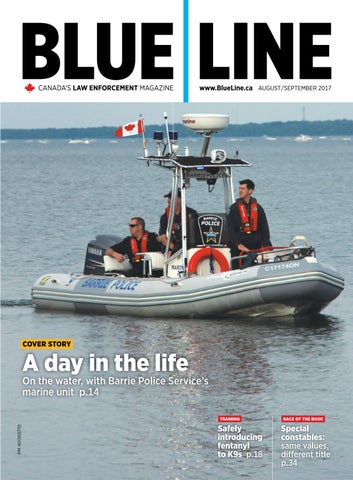
COVER STORY
A day in the life PM 40065710
On the water, with Barrie Police Service’s marine unit p.14 TRAINING
BACK OF THE BOOK
Safely introducing fentanyl to K9s p.18
Special constables: same values, different title p.34
M&P® 15 SPORT . AN EXPERIENCE YOU HAVE TO FEEL TO BELIEVE. TM
FEEL PERFORMANCE BACKED BY OUR LEADERSHIP IN MODERN SPORTING RIFLES. PLUS A LIFETIME SERVICE POLICY THAT LETS YOU SET YOUR SIGHTS ON JUST ONE THING – MORE ADRENALINE. * TARGET EFFECT DRAMATIZED
#EXPERIENCE #MANDP AT SMITH-WESSON.COM/MPPISTOLS
M&P®15 SPORTTM
24 At this year’s CACP Conference (left to right), SPVM Chief Philippe Pichet, CACP president Mario Harel, Supt. Brendan Dodd (Windsor Police) and Supt. Guy Slater (Calgary Police) answer questions about the impending legalization of marijuana legislation.
Contents
August/September 2017 Volume 29 Number 7
Features COVER STORY
14 Ahoy community policing ambassadors
Contrary to a number of playful rumours, there is no blender on board police boats for tropical smoothie making in the sun. In fact, the demands on a marine unit are just as strenuous as those patrolling the highways — it’s simply a different dynamic. By Renée Francoeur
18 Opioid crisis leads to updates in K9 training
As opioids continue to wreak havoc on Canadian streets, the RCMP modernizes its K9 detection program to include the dangerous odour of fentanyl, which can be 50 to 100 times more toxic than morphine. By Renée Francoeur
24 CACP looks at “digital tsunami”
Columns 4 8 10 11 12 26 30 34
Editor’s commentary Q&A Health & wellness Holding the line Deep blue Case law Technology Back of the book
Departments 5 5 7 7 29 32 33 34
By the numbers News Calendar Dispatches Off the shelf Product showcase Marketplace Blue Links
COVER PHOTO: R. FRANCOEUR
Canadian police chiefs and other law enforcement officials from across the country recently gathered in Montreal for the 112th Canadian Association of Chiefs of Police Annual Conference.
14 18 @Blue_LineMag
8 August/September 2017 | BLUE LINE
3
EDITOR’S COMMENTARY BY RENÉE FRANCOEUR
Trust, face time — it does matter
I
t never fails to astound me how sions of public trust” in police across 15 valuable a face-to-face moment can different countries. Their findings, which be in these digital times. This is were first presented in Montreal, centred something I rediscovered at the on several foundational principles they 112th Canadian Association of Chiefs of regard as the “genetic code” of public Police (CACP) conference, held earlier trust, including “trust is reciprocal” and this summer in Montreal, where the theme “trust demands transparency.” Based on was about policing in a digital society. those principles they issued seven “calls I was able to network with some person- to action,” including: able and passionate top brass, hear experts detail new technology and products, and • Engage with each and every community; gather countless story ideas from loyal • Employ a mutual trust dashboard; and readers — all things I can’t really secure • Celebrate Canadian policing. as nimbly via an email exchange. Being (See more at cacpglobal.ca.) physically present helps bolster relationships. It leads you to doors you “Canadian policing is unique never even knew existed and, as Being and something we should all be a new face in the industry, it is a physically proud of,” said CACP president crucial component for me as I present Mario Harel. “There are many build my own layer of trust with leads you to priorities facing Canadian polidoors you our audience. cing but none is more vital than Trust. It was a word I heard never even to continue to understand and numerous times throughout the knew improve the relationship with existed and, those we serve.” conference and exhibition. One of the first visitors to the as a new And we do that by continuing Blue Line booth was former Peel face in the to put in the face-to-face time Regional police officer George industry, it is through community policing and Harrison, who is now the busi- a crucial on-the-ground volunteer work ness development director of component — by trust. I can call a number of our Altia-Abm Inc. While it is con- for me as I readers up, as I did with Chief structive for police to make build my strides in social media and other own layer of Frederick for this month’s Q&A on page 8, but it doesn’t beat technology that can make the job trust with more effective, Harrison told us our readers. getting out there, shaking hands and having impromptu all too often we forget to take a break from our devices. He shared an conversations. So while equipping our officers with the anecdote with us from his policing days about how a former criminal contact latest tablets and modernizing operationreached out to him with a useful tip. This al centres with technology like mapping contact didn’t call the local station or analytics, we cannot forget, as Harel says, Crime Stoppers. Instead, he called some- that serving the community in a positive one they recognized, someone they had manner is what matters most. I look forward to continuing this jourmade a connection with over the years, ney with all of you — over email, on the someone they trusted. On a similar note, the 2017 cohort of the phone, and, most importantly, in person CACP Executive Global Studies was as- at conferences, industry events and in signed the task of “examining the dimen- the field.
CONNECT WITH BLUE LINE
www.BlueLine.ca 4
@Blue_LineMag
BLUE LINE | August/September 2017
www.facebook.com/BlueLineMagazine
BLUE LINE www.BlueLine.ca
GROUP PUBLISHER | PAUL GROSSINGER pgrossinger@annexweb.com EDITOR | RENÉE FRANCOEUR rfrancoeur@annexweb.com ACCOUNT MANAGER | JANICE EATON janice@blueline.ca ACCOUNT MANAGER | APRIL LENSEN april@blueline.ca ART DIRECTOR | SVETLANA AVRUTIN savrutin@annexweb.com ACCOUNT COORDINATOR | TRISH RAMSAY tramsay@annexweb.com CIRCULATION MANAGER | BEATA OLECHNOWICZ bolechnowicz@annexbizmedia.com COO | TED MARKLE tmarkle@annexweb.com PRESIDENT & CEO | MIKE FREDERICKS ANNEX BUSINESS MEDIA 80 Valleybrook Drive, Toronto, ON M3B 2S9 Tel. 416-442-5600 • Fax 416-442-2230 Publication Mail Agreement No. 40065710 ISSN 0847-8538 Printed in Canada SUBSCRIPTION RATES Canada — 1 Year $30.00; 2 Year $50.00 plus tax USA — 1 Year $100.00 USD CIRCULATION email: asingh@annexbizmedia.com Tel: 416-442-5600 ext 3553; Fax: 416-510-5170 Mail: 80 Valleybrook Drive, Toronto, ON M3B 2S9
Occasionally, Blue Line will mail information on behalf of industry-related groups whose products and services we believe may be of interest to you. If you prefer not to receive this information, please contact our circulation department in any of the four ways listed above. Annex Privacy Officer privacy@annexbizmedia.com; Tel: 800-668-2374 © 2017 Annex Publishing & Printing Inc. All rights reserved. Printed in Canada. No part of the editorial content of this publication may be reprinted without the publisher’s written permission. Opinions expressed in this magazine are not necessarily those of the editor or the publisher. No liability is assumed for errors or omissions. Readers are cautioned and advised that articles presented herein are edited and supplied for your personal awareness and should not be used for further action until appropriate guidance is received from a supervisor, Crown Attorney or other persons in authority. All advertising is subject to the publisher’s approval. Such approval does not imply any endorsement of the products or services advertised. The publisher reserves the right to refuse advertising that does not meet the standards of this publication.
NEWS
Larry Cappetto says he’s conducted about 1,000 interviews with veterans in the 14 years he’s worked in film. TORONTO
“Not a cop show:” Beyond the Badge debut
“You are all my stars,” said Larry Cappetto to the packed Cineplex theatre in Toronto after a special film screening in June. “You’re the reason I’m doing what I’m doing — capturing courage.” About 170 serving and retired police officers, their friends and family showed up for the debut of Beyond the Badge: Canada, a documentary produced and directed by Cappetto about the human element in Canadian policing. Beyond the Badge, Cappetto’s seventh film, began in 2014 when he sat down with retired officers in the Toronto, Peel, Barrie and Waterloo services. The film follows in-depth interviews with many of them, touching on PTSD, use of deadly force, reasons for choosing a career in law enforcement and how to know when it’s time to retire, as well as asking the heavy question, “is there life after law enforcement?” Cappetto, who spent a few years as a Colorado police officer, said he met a number of Canadians while For a photo researching a previous film gallery from series, Lest They be the event, visit Forgotten, which centres on tinyurl.com/ ya6zcdr9. the stories of military
veterans. From that point on, he said he made it his mission to honour not just war but also law enforcement and first responder veterans in both the United States and Canada. “This isn’t a cop show. It’s a behind the scenes look at the men and woman on the frontlines,” Cappetto said. “I’m so into a true story. There’s no flash, no glitter — it’s all right from the heart... And when you hear a true story, you’re accountable for what you just heard.” The evening ended on a poignant note as the film closed with words from Heather Pham, the widow of slain OPP officer Vu Pham, on coping with tragedy and forgiveness. Heather and her three sons were in attendance for Beyond the Badge, enveloped in embraces and handshakes as the crowd exited the theatre. Cappetto said he hopes the documentary becomes a training tool for police and that he is currently in the process of becoming a Colorado state trooper. “You see,” he told the crowd, “you’ve rubbed off on me in the most inspiring of ways.” NEW BRUNSWICK
N.B. police compete at World Police & Fire Games
Both the Saint John and Kennebecasis police forces in New Brunswick headed to
the World Police & Fire Games in California this August. The Police & Fire Games is an Olympic-style competition with more than 60 events, held every two years and hosted by the California Police Athletic Foundation. Approximately 10,000 athletes from more than 70 countries will compete, representing all kinds of law enforcement and peacekeeping fields, including police, firefighting and corrections, according to the non-profit. Among them are four officers from the Saint John Police Force and one from its close neighbour, the Kennebecasis Regional Police Force: constables Stephen Davidson, David and Trinda McAlduff, and Cpl. Jason Murray (all competing in submission grappling) and Const. James Smith (competing in large bore rifle, F-class).
PHOTO COURTESY SJPF & KRPF TEAM- WORLD POLICE FIRE GAMES FACEBOOK PAGE
Davidson and his team all have backgrounds in Judo or Brazilian Jujitsu and they’ve been competing in local competitions to prepare. “Needless to say, it’s a high calibre,” Davidson said. This venture is important to not only motivate other police departments to be active, he added, but also to represent his department on an international level. You can follow the story at facebook.com/ SJPFandKRPFTeam.
BY THE NUMBERS
PHOTO R. FRANCOEUR
Sex workers are in a vulnerable position and police services must ensure they are using the full extent of their influence to prevent assault and abuse. Take a look at these facts from Stats Canada.
294
Homicides of sex workers in Canada between 1991 and 2014.
@Blue_LineMag
3%
Of victims were under the age of 18.
1/3
Of the cases remain unsolved. That’s 34% compared to the 20% of unsolved homicides involving victims not involved in sex work.
96% Of victims were women.
August/September 2017 | BLUE LINE
5
NEWS CANADA
First responders ride for PTSD in inaugural Rolling Barrage Law enforcement officers, firefighters, paramedics and military vets as well as serving CAF members were all encouraged to sign up for the inaugural Rolling Barrage 2017, a cross-country motorcycle ride that kicked off August 5. Presented by Military Minds Inc., a fundraising organization that connects veterans for PTSD help, the Rolling Barrage “started with one man’s vision of a mass of steel horses traveling across Canada from one coast to the other, akin to the way the country was settled 150 years ago, albeit on wagons and real livestock.” Scott Casey, president of Military Minds, wanted a positive way to celebrate Canada’s 150th anniversary while also drawing more awareness to PTSD. “There are small things to bring awareness to PTSD, but nothing big and nothing centred on a positive event,” said Stew
6
Jackson, Rolling Barrage director. “One thing PTSD does is isolate people — this is to get them out.” The 3,000-km ride from Newfoundland to B.C. was open to all types of riders, including civilians. They could join anywhere along the route, which included stops in Truro, Ottawa, Winnipeg, Regina and Jasper, just to name a few. “It is with this rolling community that we shall endeavour to For more conquer the stigma information, visit therollingbarrage.com that surrounds
PTSD and to provide care to those who need it through the service to our nation,” Jackson said. WATERLOO
Larkin now leading OACP
Waterloo Regional Police Chief Bryan Larkin has been officially sworn in as the new president of the Ontario Association of Chiefs of Police, taking over from Charles Bourdeleau, Ottawa Police Service chief. “It’s exciting as we have lots of things happening in public safety, not just policing,” Larkin said, pointing to the next generation of 911 as one example. “It’s an interesting year to be president as the province heads into an election. We’re obviously trying to put public safety on the government’s map.” He said he hopes to focus more on occupational stress within policing, the Strategy for a Safer Ontario and supporting Justice Michael H. Tulloch on his work, including street check reviews and files. “It’s humbling to be supported by your peers but this role also brings with it a tremendous opportunity for growth and reflection,” he said. “I love change and being a part of change and I think we’re at a pinnacle tipping point in policing provincially, where we’re going to set the course for the next generation.” The OACP will be launching a new strategic plan, according to Larkin, who served as vice-president for three years and also sat on the board. Larkin’s presidency will run for one year, wrapping up in June 2018.
BLUE LINE | August/September 2017
BlueLine_Georgian_Feb.indd 1
www.BlueLine.ca 2017-01-11 11:54 AM
NEWS DISPATCHES Del Manak has been permanently appointed Chief Constable of the Victoria Police Department. The Victoria and Esquimalt Police Board says it did not hold an internal or external competition but rather reviewed Manak’s performance through a 360-review process to assess his performance as acting chief. “It is a tremendous honour to lead the committed officers and staff of this organization,” Manak said. “Having been born and raised in Victoria, I know firsthand the long and proud history of VicPD’s service to its communities. I plan on building on this strong reputation through further engagement and collaboration.” This is the first time since 1991 that a police chief has been appointed from within the Victoria Police Department and only the second time in the past 60 years.
Left to right: Sgt. John McNeil, Staff Sgt. Mark MacDonald, Insp. Richard Lane, Deputy Chief Robin McNeil, Staff Sgt. Ron Legere and Sgt. Kathryn Willett. Halifax Regional Police Chief Jean-Michel Blais recently promoted seven officers, including Supt. Robin McNeil to Deputy Chief. Deputy McNeil now assumes full responsibility for Operations, which encompasses the Integrated Criminal Investigations Division and Patrol Division. The other officers promoted include: Insp. Richard Lane, Insp. Penny Hart, Staff Sgt. Ron Legere, Staff Sgt. Mark MacDonald, Sgt. Kathryn Willett and Sgt. John McNeil. Sgt. John Armer with London Police Service retired on June 22 this year. He started with LPS on November 5, 1984, and helped run the LPS Cops for Cancer for years. @Blue_LineMag
CALENDAR Kennebecasis Regional Police Force Chief Steve Palmer has announced his retirement in March 2018. Palmer was promoted from Deputy Chief last November when former Chief Stephen McIntyre retired. Palmer served 18 years as Deputy Chief and has been with the force since 1983. Staff Sgt. Chuck Lan is the new University of British Columbia RCMP Detachment Commander. During his 27 years with the RCMP, Lan worked in multiple roles including First Nations, rural, municipal, and federal policing. He served on the highly-specialized Emergency Response Team for 14 years while in Alberta and British Columbia and most recently worked as a watch commander, running a general duty unit in North Vancouver. Niagara Regional Police Chief Jeff McGuire retired as of July 14, after serving in the position for five years and deciding to forego the three years of the extended term. During his 40-year career, he also served as a former president of the Ontario Association of Chiefs of Police and is a member of the Canadian Association of Chiefs of Police, the International Association of Chiefs of Police, the FBI National Academy Associates and the Police Executive Research Forum. He also created a ProAction Cops & Kids Chapter in the Niagara Region, a program that establishes positive relationships between cops and kids at risk. Chief Clive Weighill of Saskatoon Police Service will be hanging up his badge as he begins his official retirement this October. Prior to taking on the role of chief, Weighill rose through the ranks of the Regina Police Service, starting his career in 1975. PROMOTIONS, RETIREMENTS, RECOGNITION If you have a senior officer in your agency recently promoted or retiring or an individual you wish to have recognized (major award or recently deceased) you can let Blue Line magazine know by emailing: dispatches@blueline.ca.
International Women & Law Enforcement Conference Sept. 17-21, 2017 Cairns, Australia www.2017iwlec.com.au Canadian Police Association Memorial Service Sunday Sept. 24, 2017 Ottawa, Ont. www.cpa-acp.ca Focus On Drones Oct. 4, 2017 Toronto, Ont. www.focusonseries.ca IACP Annual Conference & Tradeshow Oct. 21-24, 2017 Philadelphia, Pa. www.theiacpconference.org Serving with Pride Gala Oct. 21, 2017 Toronto, Ont. www.servingwithpride.ca Ontario Gang Investigators Association Conference Nov. 20-23, 2017 Windsor, Ont. www.ongia.org ILEETA 2018 Mar. 19-24, 2018 St. Louis, Mo. ileeta.org/ileeta-conference-expo
Are you receiving
News Week? Subscribe today! www.blueline.ca August/September 2017 | BLUE LINE
7
Q&A It all started with Samuel Port, William Brown, Charles Bussette and Henry Goodenough back in 1867. Since then the Windsor Police Service has aged right alongside Canada. Blue Line checks in with Chief Al Frederick for more on the force’s 150th celebrations, his 33 years in policing, advice for the next generation and his views on the legalization of marijuana. Q: As chief, what is your favourite part of the job? Everyday I meet people in the community, and even in speaking with my own officers — someone always has a great new story and something uplifting to share. When you work together with one common goal — serving the community and doing whatever it takes to keep us all safe — that’s the best part of the job.
Q: It was hinted you would be retiring this year. Tell us more about how the succession planning is going. I’ve been here for five years, which goes by in a blink of the eye. After a five-year term, it’s the right time to step aside because the organization gets used to you and there’s always room for a new approach and new perspectives and that starts at the top. The best thing for me to do for the organization is to move on sometime in the near future. I enjoy 8
BLUE LINE | August/September 2017
every day still, same as five years ago, but we have great people here ready to step in.
Q: What wisdom can you impart regarding what it takes to be a successful police leader in today’s society? You have to commit to a couple things. One is: we can never say, “There is nothing we can do for you.” I tell this to civilians and frontline officers. Whatever it is, we need to do something. Another thing is, as chief of police, you have to commit to lifelong learning and developing great people around you. That’s the only way you’ll be effective. You don’t know everything. There was no Internet or email or cell phones when I started 33 years ago and all the social media platforms we use now didn’t even exist 10 years ago. We have little idea what’s truly in store
SNAPSHOT OF THE WINDSOR POLICE SERVICE
1854
Samuel Port appointed first police officer, part-time only
630
Members of the Windsor Police Association
1997
Windsor Police enters cyberspace
Q: When you look back at your career in policing, what are you most proud of? As a team, we have refocused our initiatives on the community and positioned the community as a real, legitimate partner. Our service today recognizes we’re good at what we do, but there’s a force multiplier when we engage the community. We’ve reaped huge benefits of that. Recently, it was found we had the lowest sexual assault unfounded rate in the country. Stats Canada also just released reported hate crime stats and we were the lowest in the country again. Q: With the WPS celebrating its 150th anniversary this year, what does that mean to you? “Past, Present and Future” was the theme for our anniversary and we put together 150 years of our artifacts — like a museum. I was a breathlalyzer technician when I first came on and the machine that I used 30 years ago was called the Borkenstein and that’s in the museum. That’s interesting to see. It gives you some perspective on how long you’ve been here. We’re the busiest international border crossing in the world — Detroit to Windsor — and our policing has been focused around the border and the challenges that creates for us, whether it’s the movement of goods and services or firearms and drugs. In Ontario the legal age to www.BlueLine.ca
PHOTO COURTESY WPS
Q: What is the toughest part of the job? Our police officers have extraordinary capacity and the community expects so much from them. At times, though, we can’t be everything to everyone. More and more is being put on us. For example, the opioid crisis that we’re in; they want police officers to carry naloxone. I certainly support it, as it’s beneficiary to the community and officers if they come into contact with it. But again, it’s another burden on our officers. These cases are substance abuse — not criminal investigations and we’re on the frontlines of that, too. So managing expectations of the community is the biggest challenge.
for the next 10 years. That’s why learning is so important. Also, the focus can never waiver from the community. The more we reach out, the more they respond. I’ve seen that and I’m very proud of that.
drink is 19 but it’s 21 in the U.S. So on weekends it’s literally a madhouse in our downtown core with American kids. The border has been the centre of our growth and that has not changed over 150 years. It’s unique; not many other cities have this relationship and responsibility.
Another thing is that in a border city like ours, there is going to be some confusion because, while it may be legal here, if you enter the U.S. with a joint in your pocket, you’re going to get arrested. There needs to be all kinds of education paralleling the legalization.
Q: You have voiced concerns over the legalization of marijuana. What most troubles you about the forthcoming legislation and how do you see WPS adapting to it? I have lots of reservations about it and expressed strong opinions. One of the key issues for me is that the tools to test for impairment by drug have not yet been established or approved by legislature. Impairment by drug is just as dangerous to community safety as alcohol, so I think the government needs to focus on that piece.
Q: What do you think are the other major issues concerning Canada’s law enforcement community today? The requirement on police to be almost “frontline social and healthcare workers” is extremely taxing on us. We know and embrace the fact we’ll always have a role to play in mental health crises in our communities but at the same time, it’s extremely challenging — especially when we have to use force in a situation that is not criminal but health-related. It’s an area that needs a lot of community thought.
@Blue_LineMag
BlueLine_Commissionaires_Feb.indd 1
Q: What advice do you have for young people who are considering launching or advancing their career in policing? You have to demonstrate early on a consistent level of community involvement. Get involved in volunteer work right away. It doesn’t have to be a ton of volunteerism but it has to be consistent over the years and you have to be serious about it. Identify something you enjoy, like the Special Olympics or assisting in mental health initiatives. The second thing is, again, commit to learning and have a firm knowledge base in technology. We’re not taking people with minimum standards. The competition is high. Position yourself through education to stand out and just keep smiling, helping people and be positive.
Visit tinyurl. com/ycnhszhc to see more photos from Windsor Police Service’s 150th birthday party.
August/September 2017 | BLUE LINE
9
2017-01-11 11:31 AM
HEALTH & WELLNESS BY ISABELLE SAUVE
Functional training for optimal frontline preparedness
L
aw enforcement officers can be seen as occupational athletes and also “chameleons of a wide range of professions” as they are constantly adapting to operational demand and performing a variety of physically demanding tasks. Sports experts widely recognize specific proficiency training designed for specific proficiency outcomes achieves optimal sport-specific results. This same theory holds true for law enforcement. A challenge or hindrance for officers is without doubt the actual protective equipment and use of force items they contend with while on duty. Paradoxically, these items are in fact intended to promote safety and ease job performance. The equipment is without dispute operationally beneficial and essential; however, it can also be inadvertently harmful by inviting overuse injuries. The weight, unevenness and bulkiness of the gear places strain and mobility constrains on the body. Even basic repetitive motions — such as getting in and out of a cruiser while
wearing a duty belt and body armour — takes a toll over time. Targeted functional training can offer injury immunization while handing law enforcement officers an athletic competitive edge. Proper physical conditioning is also related to a reduction in the frequency and degree of application of force. Officer fitness should focus on overall conditioning of power, strength, endurance, speed, coordination, agility, balance and flexibility. A weakness in one or more of these areas could ultimately be life threatening on the frontline. As an illustration, an officer with outstanding aerobic capability but poor conditioning otherwise could be in danger without the strength and power to take down a violent assailant. With proper training, the body can learn to adapt and to perform surprisingly well under numerous circumstances and conditions. The content of training programs must be continuously modified to achieve and maintain optimal full body conditioning. Fitness programs do not need
countless hours of training for visible gains. In fact, a targeted 20-minute workout of high-intensity interval training will deliver physical conditioning gains and contribute to functional law enforcement related physical fitness. Numerous activities such as cycling, swimming, rope work and running can be turned into interval workouts. The notion is to alternate between high intensity/controlled explosive work and rest intervals. Strength and conditioning programs can greatly benefit from multi-joint and multi-planar movements since they most closely reTargeted flect the actual physical demands of functional law enforcement. These activities training can (squats, lunges, burpees and planks) offer injury recruit and train multiple muscles immunization synergistically. Handcuffing an acwhile tive resistant suspect, for example, handing law requires the engagement and co-orenforcement dination of several muscle groups. officers an Embracing an active lifestyle can athletic also support functional training and competitive exponentially contribute to job edge. specific fitness gains. The warm summer weather is an ideal time to participate in outdoor activities with family and friends. Additionally, stretching should not be left aside. Routinely engaging in a few minutes of stretching will greatly support muscle, ligament and joint health as well as flexibility. Stretching periodically to break up long periods of sitting or of inactivity boosts mental focus while simultaneously being good for the body. The inclusion of various types of training regimes and recreational activities fosters well-roundedness and job readiness. A more exhaustive analysis of training programs and components of fitness such as anaerobic power, cardiovascular endurance, metabolic conditioning, flexibility, muscular power, endurance and agility will be covered in upcoming articles. Isabelle Sauve is a 10-year OPP veteran currently with the Emergency Response Team (ERT) at the Almaguin Highlands Detachment in Burks Falls, about 300 km north of Toronto. She can be contacted at: isabelle.sauve@hotmail.com.
10
BLUE LINE | August/September 2017
www.BlueLine.ca
HOLDING THE LINE BY MICHELLE VINCENT
Police and court: the human experience
W
hen we hear the word “court,” as police officers, what comes to mind? Evidence, defence lawyers, notes, the stand, the stress of presenting, responsibility, anxiety, frustration, final accountability… There is a myriad of words that come rushing in. Yet once the case is over and the anxiety and other emotions we experience that cause us stress are through, what happens to us from the human element? What happens when the accused calls out in a loud, haunting voice that he is innocent? Are you sure he is guilty? Can you be absolutely certain? How do you feel when there is a procedural error during the investigation that allows an accused to be acquitted? How about when you watch the accused, who you are sure is guilty, walk out of the courtroom with visions of them re-offending — like an impaired charge where the accused is let off with a careless driving ticket. Maybe the next time they get behind the wheel they will kill someone. Regardless of the courtroom experience, we as police officers have invested our time and, very often, large amounts of our emotional energy. We have lived through the various interviews and photographic evidentiary collections. We have sifted through evidence both obvious and not so obvious. We have worked with the families of the victims to the point of feeling like family. Many of those experiences are etched in our memories forever. As police officers our roles can blend — the boundaries having little definition. We do not typically consider the aftermath of the courtroom experience, once the investigation is considered complete. Ensuring we come out of the courtroom emotionally hinged and able to move forward in our world is not only important, it is essential. The first step is recognizing the @Blue_LineMag
various components that we are exposed to in the courtroom and what is perceived as the norm. For example, it is normal to be invested in a matter we have spent countless hours on, likely having attended the scene in a frontline or investigative capacity. Dealing with pressures from the public to have the case solved and resolved is also a factor we must consider. What many are not aware of, especially in investigative units, is the ongoing relationship expected from the victims in the investigation. These relationships can last years and can have a powerful effect on us. We understand our training (and practicing our training repeatedly) often dictates how we will react under stress. Therefore, developing the habits of exercising self-awareness and self-reflection are very important. They are silent pieces. Your supervisor will have no idea whether you conduct a daily practice in these two areas. It is not something that becomes an entry in our notebooks. It may be obvious to others that we are connected and very clear in our position as having sorted out our “emotional work
A case and trial can be so much more than we are actually trained to work with. At what point does this become an issue?
baggage,” or it may be obvious that we are not. It’s all in how we manage ourselves and our caseloads. At the end of the day we are responsible for our mental health. Do this by recognizing that we, as police officers, are open to the vulnerabilities in the court experience as human beings — a case and trial can be so much more than we are actually trained to work with. At what point does this become an issue? We don’t know until it happens — a small crack in our armour is wrenched open, exposing a wound that must then be cared for. Understanding the human experience in our courtrooms and training can help. Let’s make sure through self-awareness and self-reflection we care for ourselves and know when it is beyond our scope. Michelle Vincent is a 15-year York Regional Police officer with a Masters Degree in Arts in Counselling Psychology and a background in equine assisted therapy, workplace reintegration and teaching. Her counselling practice is supervised by a psychologist with a specialty in addictions and trauma. She can be contacted at: michelle@smith.net.
August/September 2017 | BLUE LINE
11
DEEP BLUE
BY DOROTHY COTTON
Confidentiality is the last thing to worry about (if you’re the client)
A
few years back, in the dead of winter, I decided I might be coming down with the plague and decided to visit my local after-hours clinic. After registering, I was instructed to take a number from the little machine on the wall — like the kind that a deli or a bakery might have so you know when it is your turn to order your pastrami or butter tarts. I commented to the clinic staff that I thought this was a great idea; I just hate it when you sit in a crowded clinic and someone bellows out your name, generally followed by mentioning that the proctologist or psychiatrist is ready to see you1. What ever happened to privacy? Confidentiality and privacy are certainly emerging to be big issues these days. I personally struggle with computer security, as I of course have client-related info on my various computers. But even leaving aside issues related to technology, I struggle with knowing what I am allowed to say to whom. When I deal with police services, the rules are slightly different depending upon whether I am talking to a federal, provincial or municipal police service, as the laws that govern exchange of information are different depending on which type of police agency is involved. When I need to exchange specific information with someone about a client, I have to think about not only the bazillion laws that govern who I can talk to but I have to guess what laws govern whom they can talk to. Interestingly, it is slightly different depending on whether I am talking to a physician, social worker, teacher, police officer or family member. Confusing as it may be, it does make some degree of sense that different occupations would be held to slightly different standards in terms of maintaining confidentiality. Partly, it has to do with know12
BLUE LINE | August/September 2017
ing what a particular profession needs in order to accomplish their job. Obviously, for mental health professionals, it would be virtually impossible to serve a client if the client were not able to assume things that were discussed would not be related outside the bounds of that relationship. Members of the public therefore would have a reasonable expectation that their private business would be kept private if they are talking to a psychologist; the laws and standards that govern the behaviour of mental health professionals therefore reflect this reasonable expectation. On the other hand, in policing for example, a police officer does indeed have some responsibilities to the individual person they may be dealing with. But it is generally recognized that their larger responsibility is to the public. No one would therefore reasonably expect that police would keep many of the details of their daily encounters completely private. There are limitations of course but there is also a fair bit of latitude for police to share information in order to accomplish their primary mission. Taking a more ex-
The issue is that it is against the law for me to spill the beans. No matter how much I might want to give you some helpful tips about a client.
treme example, there is no reason at all to think that your local barista would keep any of their observations about your behaviour and idiosyncratic coffee preferences private. (Yes, behind your back they are laughing about your mispronunciation of some word they made up to describe a type of coffee that really does not exist.) I was astounded to realize recently that border services people really can demand to check your cell phone. In my profession, it is of questionable ethicalness to even Google a client or patient. And we certainly can’t force people or demand that anyone tell us anything. Police officers (and teachers) often tell me all sort of things about people they interact with — a level of information sharing that would get me in serious trouble with my regulatory body if I did the same thing. Equally problematic is that often other people (like police officers) think I am just being grumpy or rigid if I won’t tell them information about clients of mine, when they (police) are interacting with these very clients. On the one hand, it may be true that I am grumpy and rigid— but that is not actually the issue. The issue is that it is against the law for me to spill the beans. No matter how much I might want to give you some helpful tips about a client, unless the situation is an emergency (and that all depends on how the legislation is worded in your province), I am prevented from sharing. Curiously, this assumption that information can be shared means people like police are often pretty hesitant about sharing their own personal information with psychologists (or other therapists). When police are wearing the hat of “client” and are seeking assistance, it seems to be a common fear that the psychologist is passing on the juicy bits to one’s higher-ups or colleagues — or at least retelling the good stories over a beer. The fact is the chances of this are negligible. For a psychologist, breaching confidentiality is probably the equivalent of excessive use of force in your field. You really get into trouble if you do that. www.BlueLine.ca
So what is the take-home message here? It’s twofold, I guess. First, if you have clients who have mental health issues and you know they are seeing a mental health professional, you can’t assume that the mental health professional will talk to you. In most cases they really should not talk to you... unless (and this a big “unless”) there is consent from that client. However, this is an area where mental health professionals sometimes stop prematurely. If a mental health professional does not have that consent, ask them to try to get it. Most clients will willingly provide the consent. So simply not having consent is not a total roadblock. Try to get consent. Second, if you need to talk to someone — your anxiety/depression/marriage/ drinking/anger is getting to you — confidentiality is really the last thing you need to worry about — as long as you are seeing a regulated health care provider or other counsellor who is registered and regulated by a government body. We are not talking about voluntary membership in an association here — I mean real honest to goodness, vettedto-make-sure-you-know-the-law-andethics-and-how-to-practice kinds of people. It might surprise you to know that in many jurisdictions, anybody can hang out a shingle and call himself or herself some various form of “helper.” It varies by province as to whether people can claim to be a counsellor or psychotherapist without being licensed. Pretty well anyone can claim to be a life coach, for example. Some of these folks know what they are doing, and some don’t. The strict laws that govern health care information bind some, and not others. Unless you have a pretty compelling reason otherwise, I’d stay with a regulated health care provider. Then you can spend your time worrying about whatever your problem actually is rather than worrying about breaches of confidentiality. When I made this comment to the clinic staff they laughed and said most people complained about the system as it makes them feel like “just a number” rather than a human being worthy of dignity. I guess you really can’t win. 1
Dr. Dorothy Cotton is Blue Line’s psychology columnist. She can be contacted at: deepblue@blueline.ca.
Prepared to act in the case of an opioid overdose. Ready-to-use Needle-free Concentrated 4mg dose The first and only nasal naloxone available in North America for the emergency treatment of known or suspected opioid overdose.
Carried by over 80 police services across Canada. Available through: narcannasalspray.ca TM
NARCAN Nasal Spray is a pure opioid antagonist indicated for emergency use to reverse known or suspected opioid overdose, as manifested by respiratory and/or severe central nervous system depression. TM
NARCAN Nasal Spray can be administered by a bystander (non-health care professional) before emergency medical assistance becomes available, but is not intended to be a substitute for professional medical care. Emergency medical assistance (calling 911) should be requested immediately when an opioid overdose is suspected, before administering naloxone. Please consult the product monograph at https://www.narcannasalspray.ca/pdf/en/product_monograph.pdf for important information relating to contraindications, adverse reactions, drug interactions, patient selection, and dosing information. Distributed by Adapt Pharma Canada Ltd. Mississauga, ON L5N 6A6 CANADA © 2017 ADAPT Pharma Canada Ltd. NARCAN TM is a trademark licensed to ADAPT Pharma Operations Ltd.
August/September 2017 | BLUE LINE
@Blue_LineMag BlueLine_Adapt_Sept.indd 1
13
2017-08-04 11:40 AM
COVER STORY
Ahoy community policing ambassadors 20 SQUARE KM
The size of territory Barrie Police is responsible for on Kempenfelt Bay
I
t might seem like a smooth sailing job with plenty of sunshine and splashing around, but a day in the life of a marine unit police officer is just as demanding as those patrolling the highways — it’s simply a different dynamic, as we found out during our wet ride-along with Barrie Police Service’s marine team.
Const. Doug Bosch calls out to the lone ministry boat on the water for a quick safety equipment check. 14
BLUE LINE | August/September 2017
(Of course, the morning we scheduled to shadow these officers turned out to be a rainy one, meaning summer traffic wasn’t what it typically is. And no, for the record, there is no blender on board for tropical smoothie making.) When a police car pulls up outside a house, apprehension typically follows, says Const. Paul Matte, who safeguards Barrie Police’s designated 20 square kilometres of the Kempenfelt Bay area. That doesn’t happen with a police vessel. “People wave us over as we pass by. Kids come up to us when we dock and we hand out stickers, have throw-aways. We get invited in,” Matte says. “The marine community here is close knit and you know everyone, even if you don’t know all their names. It’s a friendly world and people are glad to help.” That ease takes the partnership required for community policing to an almost supreme level on the water. “You rely on the public more on the water,” explains Const. Doug Bosch, Matte’s marine partner since
2009. “You might be the only law enforcement guys on the water and need help quick. So who are you going to look to? The public. And they do step up.” The Barrie Yacht Club has told the team to feel free to use its docks for emergencies — it’s closer to the hospital on the northern side of the bay. Another cottage owner had also previously given the marine unit permission to use his boathouse for shelter if ever needed. As we drift along Chicken Bay, Matte points to a pile of rocks snaking out from shore where a woman plowed her Sea-Doo into last summer. If it wasn’t for a boat dweller, he says, she could have lost her life. “There was one boat at that nearby dock for the night and someone was on board sleeping and heard the crash. They ran out and kept her head above water so she wouldn’t drown,” Bosch says. “Paul was on call at that time — the marine unit was only part-time then — and had to run over here, get on the boat and get here with the paramedics.” www.BlueLine.ca
PHOTOS: R. FRANCOEUR
Sure, they get to wear shorts... They’ve also successfully resuscitated someone on a boat’s rocking deck in choppy waters. The marine unit is still a unit and chock-full of its own unique trials and tribulations. By Renée Francoeur
Constables Doug Bosch (right) and Paul Matte have been partners on the marine unit in Barrie, Ont., since 2009.
The unit does have a “slightly higher level of first aid training” due to the extensive amount of first aid equipment on board, including backboards, he adds. “It’s tough. You have one operating the vessel and the other guy is doing
everything else,” Bosch says. “A gentleman had a heart attack and he wasn’t breathing, he was gone, but Paul brought him back with CPR on this dock, right over there... It’s not easy when the waves are rough. Everything is different on the boat,
The Barrie unit boasts two boats: a custom Stanley (above) and a Zodiac. @Blue_LineMag
It’s tough. You have one operating the vessel and the other guy is doing everything else. Const. Doug Bosch compared to these situations on land. And then you have to find your casualty transfer points. You have to get to a dock and co-ordinate with the ambulance. In the summer, the beaches are packed and the ambulance can have a hard time getting close to us. It all takes time.” Additionally, education is a heavy component to their role. “You’re an ambassador,” says Bosch, who has been on the marine unit since the 90s. “A floating billboard for safety,” adds Matte. “People always have questions. And if you can be proactive, you can minimize the amount of enforcement — maximizing safety.”
27 FEET
Size of Barrie’s Stanley vessel
August/September 2017 | BLUE LINE
15
COVER STORY
The water is an awesome place to have fun but it can also be a very dangerous place. Const. Paul Matte
Const. Paul Matte was working the night a woman was seriously injured after hitting a pile of rocks.
Prevalent issues with boaters include alcohol, towing without a spotter and having all the required safety equipment. They also find a lot of illegal markers they have to cut. The downside? It’s hard to track and measure how successful the marine unit is because there aren’t
16
BLUE LINE | August/September 2017
BlueLine_G4S_Feb.indd 1
a huge number of tickets handed out. That complicates the budget. “We’re not out to trick anyone. We’re big on prevention and providing information to people on what they should have on board for safety,” Bosch says, noting issuing speeding fines is challenging.
35
MILES/HR
top speed of Barrie Police’s Stanley boat
(We turn on the blue lights and pull over the lone ministry boat out during the rainstorm to check for proper safety equipment. Even with this holdup in foul weather, the boaters are friendly and make small talk with Bosch, and you can see the relaxed and reciprocal relationship with police the marine unit talks of.) The Barrie unit boasts two boats (a custom, 27-foot aluminum Stanley vessel from Connor Industries in Parry Sound, Ont., and a Zodiac) and four full-time officers, trimmed from six prior to 2013 to save costs. “Anything in marine is expen-
www.BlueLine.ca
2017-01-18 12:52 PM
The marine community here is close knit. Const. Paul Matte sive,” Bosch says with a laugh. “We say boat stands for ‘break out another thousand.’” It was all hands on deck recently for the team, as Barrie launched into its Canada 150 celebrations with the Illuminate Barrie Kickoff Air Show. Eleven boats from four different units were patrolling the bay and Barrie firefighting and paramedic staff was also on the two Barrie police boats, according to Sgt. Ian Hughes, adding that the dive team was strategically placed throughout the zone, too. “We shut down the bay around 4 p.m. and I was a bit nervous at the time in regards to getting the three-mile area cleared... There were about 100 boats to get off the water,” Hughes says. “But we
BlueLine_Colt_Dec.indd 1
@Blue_LineMag
had it taken care of in about 20 minutes and 200-300 boaters probably watched the show from the sidelines.” Whatever the water brings, it’s never a predictable day, Matte and Bosch say, and could include checking in on scuba divers, managing traffic during boating races, keeping keys and phones away from Matte (he has a tendency to drop them into the lake) or climbing the roof of the wheelhouse to put out a fire on a burning pyre-like structure set adrift (yes this happened and thankfully was not a Viking-type funeral pyre). “The water is an awesome place to have fun but it can also be a very dangerous place,” Matte concludes. “That’s where we — and the education we can provide —come in.”
Eleven boats from four different police marine units were patrolling Kempenfelt Bay as part of Canada 150 celebrations, which began with an air show earlier this summer.
Check out Barrie Police’s YouTube channel @ www. youtube.com/user/ Barriepolice
2016-11-09 12:45 PM
August/September 2017 | BLUE LINE
17
K9
Opioid crisis leads to updates in K9 training By Renée Francoeur
E
arlier this year, 12,000 fentanyl pills in B.C.’s Fraser Valley were taken off the street thanks to a newly trained nose for narcotics. The credit goes to RCMP police dog Doodz, who found the drugs in a car pulled over for speeding — the first dog in Canada to detect fentanyl after updated training in the spring, according to police. It’s nothing new that crime isn’t as cut and dry as it once was — for example, technology has made fentanyl, carfentanil and other opioid strains more accessible and the internet has taken DIY explosive making to a new, frightening level. This ups the demand on K9s and leaves little choice but to refurbish their training procedures.
Watch a video on the dangers fentanyl and other opioids pose to first responders: www.rcmp.gc.ca/ en/fentanyl-video.
18
Drugs & drones Jason Gunderson, president of the Canadian Police Canine Association (CPCA), says K9 training has stayed “fairly consistent over the past five10 years.” Changes in training are
BLUE LINE | August/September 2017
usually a result of trial and error, he says, and entail “building on a foundation that we know works.” “We have seen the re-emergence of the use of food as a primary reward system, basing it around marker training, which has resulted in clear communication between the handler and the dog,” says Gunderson, who is also a dog handler with Regina Police Service in Saskatchewan.
Since the new fentanyl detection training was launched, the RCMP has received numerous requests for information from law enforcement agencies across North America. While the programs at RCMP’s Police Dog Service Training Centre (PDSTC) in Innisfail, Alta., were operating at a high level, they were
also fairly stagnant for about a decade, according to head trainer Staff Sgt. Eric Stebenne. “But for the last two and a half years, we’ve been very proactive in our approach and in modernizing quite a few of our programs,” he says. “We’ve made major changes or additions to the fentanyl detection program and are in the process of modernizing explosives detection. We’re also going to roll out a new human remains detection program this fall.” The CPCA is currently looking at the best practices for training of police service dogs in the detection of fentanyl, too. “Fentanyl is a concern to the CPCA as it brings with it a number of questions around training and if this training should occur,” Gunderson says. “This crisis, if you will, is one in which the CPCA will continue to monitor, but at the same time we have to apply concern towards our partners and determine what the best practices are for all the stake holders involved.” Meanwhile, a police and military K9 training company based in Beeton, Ont., has begun adding robots and drones to its training curriculum, in order to “keep officers safer and away from threats,” according to Tony Pallotta, head trainer at Working K9. But he says it’s “too early” for fentanyl to alter Working K9 training programs just yet. www.BlueLine.ca
PHOTOS: RCMP
Representatives from 11 North American law enforcement agencies receive training in Innisfail, Alta., during the RCMP K9 Fentanyl Detection Workshop this past June.
“How easily absorbed fentanyl is puts the dogs in a dangerous situation,” Pallotta elaborates. “Officers have brushed up against it and ended up in an overdose situation. It’s really difficult at this point to say how training for this could go for us. Having Narcan [an opioid antidote] on hand is one change that’s important.”
Deadly odour Fentanyl is an especially hot-button topic when it comes to public safety, as well as the wellbeing of a force’s four-legged friends. This was the focus of one session during the CPCA’s 2017 conference in Springbrook, Alta., this past June, a “refresher course” and space to share knowledge for officers and their dogs on things like high-risk vehicle stops and various emergency response situations. Edmonton-based CTOMS Inc., a military training company, pre-
sented on how to manage and treat fentanyl exposure for both handlers and dogs, says Cpl. Daniel Block with Red Deer Provincial Police Dog Service, who helped organize the CPCA seminar. “We all carry Narcan and the dosage for the dog is quite a bit higher than for humans, so it’s important to know exactly how to administer that,” Block says, adding that CTOMS also reiterated how crucial it is to monitor your dog after a drug search — “if they get some on their paws, the only way they have to clean themselves is to lick it off.” The key to the dog’s safety is to take preventative measures, says Block, whose partner is a five yearold German Shepard named Eve. “Today, drug searches have many more precautions.” Stebenne says RCMP quickly realized fentanyl would only become more prominent due to its
RCMP specialists transform fentanyl into diluted liquid form for safe K9 scent imprint training.
2,458
Canadians died from apparent opioid-related overdoses in 2016: Public Health Agency of Canada
attractively low price tag (in comparison to heroin) and the fact that all you need is Wi-Fi to find it. “People still ask why we got involved with fentanyl if it could potentially kill or harm our dogs. Do we stay in narcotic detection or get out of it, then? That was the real question and the answer was clear — we’re police officers, of course we stay in it,” Stebenne says. Seeking a safe way to introduce fentanyl detection to the dogs, the training centre partnered with the
Heroes and Champions Celebrating 30 years of law enforcement support for Special Olympics in Canada
Special Olympics in Canada has grown over the years thanks to the support of law enforcement from across Canada and the Canadian Association of Chiefs of Police. Since 1987, the Law Enforcement Torch Run has raised over $63-million for Special Olympics programs in Canada. With their support, Special Olympics enriches the lives of more than 42,000 Canadians with an intellectual disability, and their communities, each year. To some of our biggest heroes and champions, a big thanks from Special Olympics athletes, their families, coaches and volunteers from communities across Canada.
@SpecialOCanada www.specialolympics.ca @Blue_LineMag
BL_SpecialOlympics_AugSept17_CSA.indd 1
August/September 2017 | BLUE LINE
19
2017-07-10 9:58 AM
K9
B.C. RCMP crime lab team and developed a program that involves the drug in a diluted liquid, keeping the dogs safe from inhaling airborne particles. This was then tested in the centre’s search room where the odour is isolated from the dog as well as the person. “In addition to that, we then developed safe practices. All of our trainers and handlers are equipped with naloxone spray, masks, gloves and safety glasses,” Stebenne says. Almost all 173 RCMP narcotics-profile dogs across the country have now been imprinted, he notes, with the rest set to finish the program by the end of summer. Since the new training was launched this past February, PDSTC has received numerous requests for information from law enforcement agencies across North America. To meet this demand, 35 participants from Canadian, American and Mexican law enforcement agencies gathered earlier this summer to learn RCMP methods for the mixing of the liquid form and to un-
College of Continuing Education
derstand expected dog behaviour in the presence of fentanyl. Stebenne notes there have already been a few K9 fentanyl detection successes on the West coast. “It’s been very rewarding to see our initiative has improved things,” he says, while pointing out that, to his knowledge, not a single RCMP dog has been severely impacted by fentanyl to date. “If and when we have to administer naloxone to a dog, it will be a bit of a rodeo. If the dog is very alert, I can see them not enjoying having their nostrils sprayed very much, but hopefully that doesn’t happen.” According to Stebenne, the force is now closely following W-18, an opioid strain “100 times more toxic and potent than fentanyl,” and can add that to the narcotic detection program safely if needed. “All the groundwork that Eric has laid out, the addition of safety protocols and equipment, and changing the mindset of the dog handlers in the field on how we do business — that has made us better
Certificate in Police Leadership
Have a degree already? A post-degree certificate only enhances your skill-set as a police officer. Continuing education is an important asset for leadership development, and our courses are developed by police leaders and academics to help prepare you for that next promotional opportunity. Prior post-secondary experience is not mandatory. A certificate program does not have the same admittance requirements as a degree program and does not require as many courses, so it is a good path for those looking to step into academics. We are proud to see former students in senior leadership positions all over Canada.
“The Police Leadership and Management Development course was perfect for helping me return to the world of academics. The material was stimulating, challenging and revealing and the instructor was more of a mentor... Dalhousie University is 1800 kilometres from me, yet everyone I had contact with treated me like a neighbour or friend. I am confident that Dalhousie will help me succeed in my scholastic pursuits.” Cst. Paul Wilson, York Regional Police, ON COACHING WORKSHOP Halifax: Nov. 3-5, 2017 ONLINE COURSES* Fall Term begins Sept. 5, 2017 *All courses are online except Managing Police Performance: Coaching Skills for Police Supervisors which begins with a 3-day workshop.
Prepare for career advancement today! Detailed information and online registration can be found on our website at www.dal.ca/cce. If you would like further information please contact the Program Manager, Sherry Carmont, by email at CPL@Dal.Ca, by phone at 902.494.6930 or toll-free at 1.800.565.8867.
20
Dalhousie University College of Continuing Education 1459 LeMarchant Street, Suite 2201 PO Box 15000 Halifax NS B3H 4R2
equipped for the next big thing, whatever that may be,” adds Chris Browne, another trainer at PDSTC. “So if it is W-18, we really feel confident that we have the safety and training capability to get those odours safety imprinted to our dogs. It will just be a matter of determining what concentration is safe for the dogs.”
The ‘homemade’ component Fresh challenges have presented themselves for K9s trained in the explosives profile as well. The Royal Newfoundland Constabulary’s K9 unit follows the RCMP training standards and programs, according to Sgt. Russ Moores, and is well suited to difficult crime-solving tasks required in all of the province’s green space and rural areas. Moores was the handler of the first explosives detection police dog at RNC, Rocky, who started back in 2006 and retired in 2013. Today Moores works the beat with Rocky’s grandson, Dyson. Up until recently, Dyson was the only explosives trained dog but RNC now boasts two in the four-dog unit, Moores says, in response to demand. “The way the world is today, the things we see in the news — explosives are talked about a lot, and we have an international airport here as well as a busy port, so the need for explosives dogs comes up quite a bit,” Moores says. “When we assist at the ports or airport, it’s more of a screening to ensure [explosives] are not there. We have had cases of where explosives have been stolen and our K9 teams have had to search for them,” he says. “Our port is busier and busier, with oil traffic and cruise ship traffic has increased, too. The ports have their own security protocol but we’re part of it... Ten years ago I was hardly ever there. Now we’re down there multiple times a year to help out.” With the RCMP set to update explosives training, Moores says he’s looking forward to seeing how that goes, in terms of speaking to challenges like finding everyday, household materials in homemade bombs. “We really had to adapt to current stress,” Browne with the RCMP says of the explosives portfolio. “We’ve learned from what is taking place all over the world over the past decade and adapted our explosive detection program to meet the current stress but that’s all I can say about it.” Pando Stepanis, a master trainer with the National Association of Professional
BLUE LINE | August/September 2017
Blueline_Dalhousie_AugSept.indd 1
www.BlueLine.ca 2017-07-05 2:24 PM
Canine Handlers and who runs Olympus K9 in Ontario, agrees that training has to become more innovative. “We have kids mixing up TATP (triacetone triperoxide), a peroxide based explosive because there’s simple recipes for it all over the internet,” Stepanis says. “This is extremely dangerous.”
Human remains “Over the years, there have been several successes with our dogs finding human remains,” Browne says, and though unsure of the exact number, predicts there have been hundreds of these cases. “We’ve always relied on the assumption that once trained, our dogs and handlers would have the ability to locate human remains but without having a real set of standards or something to measure, like we do with every other program.” The PDSTC, partnered with the Nova Scotia chief medical examiner’s office, is now formally introducing a human remains detection program in the fall.
“The addition of safety protocols and equipment, and changing the mindset of the dog handlers in the field on how we do business — that has made us better equipped for the next big thing, whatever that may be.” Chris Browne, RCMP K9 trainer
“The medical examiner has been gracious enough to offer us human remains through an existing donor program,” Browne notes. “This was key to the development of our training.” Most of the new training will be done on site in Innisfail, thanks in part to PDSTC purchasing an additional 22 acres. “We have 173 teams across the country but determined there is no need to get every team trained in human remains de-
tection,” Browne adds. “We’ll partner with several PDS (police dog service) co-ordinators who will conduct an analysis and let us know how many teams they need per province or division trained, and then we’ll be in a position to actually begin.” Other departments in the country have had smaller programs in relation to human remains detection but as for one that will have a national impact, this will be a first, he says. “It’s pretty exciting for us and we know it will bring value to our programs and to divisions, municipalities, provinces and give us an enhanced ability to go out and help locate remains and bring closure to families.” No matter what type of enriched training regime is required, K9 safety remains top of mind, as not only are these animals skillful force multipliers, they are also beloved partners. “It’s said we spend more time with our dogs than our families,” Block says. “That’s 100 per cent true.”
Arrest ALS for Gertzy OFFICER CALL FOR ASSISTANCE! Woodstock Police Service is raising funds for Const. Jason Geerts, who was recently diagnosed with ALS, or Lou Gehrig’s disease.
The Geerts family thanks you!
Visit gofundme.com/arrest-als-for-gertsy for more information and to contribute. @Blue_LineMag
BL_Jason Geerts_7x5.indd 1
August/September 2017 | BLUE LINE
21
2017-07-14 12:06 PM
SPONSORED CONTENT
THE BUSINESS CASE FOR MOBILE-FIRST POLICING
interesting ideas. One of the big issues we’re contending with right now, especially in Europe, is these (terrorist) attacks. There’s a need to have information sucked in from the public, who are in many cases the first ones on the scene. There are opportunities to take that kind of information, including video information, and transfer it directly to a control centre so that the commander can gain situational awareness. [Here], they can actually see what you’re seeing. If you don’t take the right technology on, you won’t be able to handle that information or manage it.
W
hen James Asser joined a U.K. police force 18 years ago, he admits he wasn’t always very accessible to most of public he was serving. “The only way to contact me was my police radio, which you wouldn’t have access to, or my phone, and the chances of me actually picking it up were pretty low, because I wouldn’t be there,” he recalls. Asser, who now works with BlackBerry as Director of Public Safety, sees mobile technology as a way to not only make police services more productive but also more present. This includes physical presence: by using location data in devices to show government the kind of coverage officers have in a given area, but also online, which may be where the public but also criminal activity is happening. What defines a great mobile experience in police services today? What do you need to think about as you get started? James Asser: It depends on where the mobile experience efforts are coming from. In most police forces here in the U.K. there are three distinct groups: 1) IT group, which is led by IT professionals; 2) innovative group, which are led by young22
BLUE LINE | August/September 2017
er officers, mainly frontline officers, who see the need for technology, understand the consumer because they consume all these technologies in their personal lives and expect the same in their corporate life; and 3) the strategists, who are the senior officers. So it really depends on the level of work that goes on between those three parties. They all need to be on board and there needs to be a mixture of involvement across all three. What’s the risk of doing nothing or delaying the use of mobile technologies, given those consumer expectations you referred to or the increased sophistication of criminal activity? JA: The public around us have changed. They don’t want to come into a building in the middle of a town centre. They don’t want a letter or a call. What they want is a secure message, or the ability to use Twitter or Facebook or all of these other mechanisms of contact. A police force that doesn’t accept that becomes isolated quite quickly because it tries to force people to use communication routes that they’re no longer used to using. In terms of criminal activity, I’ve seen lots of police forces come up with some
How ready are police officers and staff to adapt to these new technologies? JA: There are pitfalls. Sometimes forces can’t see how to take a manual process and digitize it. Think of a pocket notebook; for many years officers took these little notebooks around as part of their daily work. The next evolutionary step was seen as, ‘Let’s digitize it — take those notes and put them into a digital form on a tablet.’ There’s actually so much more you can do. You can leapfrog way beyond that because [you have to know] what is the purpose of the information. Is it to change the nature of the investigation? Is it to change what happens around you? The next evolutionary step is not to have a pocket notebook on a digital tablet; it’s to be able to take that information and share it sensitively in a way that actually helps. So, for instance, if you stop a member of the public and have an interaction with them, it is being able to send a receipt of that interaction on their email client. It is being able to send information to the fire service or health authorities in real-time. Given those three different sets of groups that may be involved in the mobile-first strategy, how do you suggest police forces set goals around their use of mobile technologies? JA: They all have different goals. The goal for an innovator is going to be a much www.BlueLine.ca
more rapid experience, user satisfaction, whereas IT is more concerned about the security of information, total cost of ownership in terms of IT management and overhead. Whereas the strategists aren’t concerned with any of that — they’re dealing with the bigger issues. What we’ve seen in the U.K. market, for example, is staff being constrained on resources. In other words, fewer police officers on the street. So they have less visibility into what’s happening and the frontline officers may be younger, with less experience, but they really need to be experts in almost everything. So what we’ve done in a number of cases is offered BBM® Enterprise. It’s like WhatsApp, where you can have real-time chats with groups or individuals, but with enterprise-level security added to it. So the innovators get what they want in the sense of an application they’re used to using, IT departments get the control they want, and the strategists wind up being able to offer a much better service to the public.
JUSTICE STUDIES FOR wORkIng FROnTlInE OFFICERS At Humber, we teach the professional and practical skills you need to move up and make a difference in your community and in your career. Further your education one course at a time or work towards your diploma or degree. The Police Foundations Leadership Diploma program provides advanced standing to those working in justice services, including security. • Advanced standing opportunities for justice professionals • Guelph-Humber Justice Studies Degree OFFE P • Criminal Justice Degree ART- RED & On TIME • Police Foundations Diploma lInE • Police Foundations Leadership Program • Forensic Identification Services Certificate
communityservices.humber.ca /justiceprofessionals
As their mobile strategy evolves, what should police forces be looking forward to in terms of emerging innovation? BlueLine_Humber_June.indd 1 2017-05-26 1:45 PM JA: The real opportunity is the ability of forces to operate in tandem with (government) agencies. There’s always been this vision that the police force should work ADMISSIBILITY OF STATEMENTS: 2013 POLICE EDITION with health advisors, fire, ambulances. THE HONOURABLE RENÉ J. MARIN, CM, OMM, OOnt. Q.C., J.D., CD LLD Take a road traffic crash. It doesn’t just involve the police, it involves an extensive The author distills hundreds of • Master the rules of evidence to list of organizations. And of course it inthe latest cases relating to the build air-tight cases volves the public who are dealing with admissibility of statements, into tips traffic congestion on the road. Get Admissibility of Statements: and guidance you can actually use. The way forward is collaboration. How 2013 Police Edition, a unique Learn the stories behind the arrests resource that gives you simple, do you collaborate across both a desktop and the lessons learned from the practical guidelines to ensure the and mobile environment? We have a judges’ rulings on the admissibility statements and confessions you product called AtHoc™, which is a crisis of statements and confessions. collect will stand up in court. Since communications platform extensively It’s a practical, no-nonsense the first edition of this book was approach you’ll appreciate in dayused in the U.S. military and other agenwritten for the Canadian Police to-day investigations. cies that lets you communicate in reCollege, it has become the trusted al-time – I’m talking seconds. We had a • Learn from the mistakes – standby for police investigators ORDER # and triumphs – of catastrophe here in the U.K., and I can tell across Canada – still the only 804666-65201 $127 actual investigations guidebook that tackles this topic you that every second counts. So during Softcover • Understand the most recent from the working officer’s point approx. 840 pages a crisis, it lets you send out a single mesdevelopments – illustrated by of view. September 2013 sage to every smart phone, desk phone real examples 978-0-88804-666-6 or screen. That message can go to the Shipping and handling are public through Twitter, to Facebook, or extra. Price subject to change AVAILABLE RISK-FREE FOR 30 DAYS without notice and subject to directly to organizations so that you can Order online: www.carswell.com applicable taxes. change the outcome. We’re focused on Call Toll-Free: 1-800-387-5164 In Toronto: 416-609-3800 this area because obviously, we know how the world is changing around us, and we have to change how people move © 2017 Thomson Reuters Canada Limited when incidents happen.
LEARN HOW TO COLLECT ADMISSIBLE STATEMENTS EVERY TIME
August/September 2017 | BLUE LINE
@Blue_LineMag BlueLine_ThomsonReuters1_AugSept.indd 1
23
2017-07-27 11:27 AM
EVENTS
CACP conference looks at “digital tsunami”
“P
olicing in a Digital Society – Risks and Opportunities” was the theme of the 112th national Canadian Association of Chiefs of Police (CACP) conference, held in Montréal from July 16-19. “To say that technology is changing is grossly understated,” said Mario Harel, president of the CACP. “The challenge is keeping up, making the right investments and using technology in such a way that it truly enhances the services we provide to our communities. We need greater partnerships with industry, who were well represented at this conference, to ensure that policing remains educated and forward thinking from an IT perspective.” Chiefs, superintendents, deputy chiefs and key policing technology vendors gathered to share leadership tactics, case studies and discuss hot-button issues such as the legalization of marijuana, cybercrime, drug reform, missing and murdered Indigenous women and supporting the mental health of officers. Sessions centred on establishing public trust, engaging youth in a See more discussion about their online reputation, PHOTOS e-ticketing and more. and a VIDEO Thanks to the hosts, the Service de police de la from the Ville de Montreal (SPVM) and everyone who visited event at blueline.ca the Blue Line booth. See you in Halifax next year!
CACP 2017 was held in the rainbow-windowed Palais des Congrès in Montreal from July 16-19.
CN Police show off their wheels.
Massimo Tari, president of Darta Fleet Solutions, highlights technology slated for a Waterloo Regional Police vehicle as part of a new program.
24
Windsor Police Chief Al Frederick, left, catches up with conference speaker Michael Akpata of IBM.
Directeur du Service de police de Granby Marco Beauregard, left, and Benoit Charron take in the exhibit floor during a session break.
Ray Donnelly of Retlif Testing Laboratories.
Coffee time with Woodstock Police Chief William Renton, right, and Deputy Chief Darren Sweazey.
OPP Sgt. Kerry Schmidt receives the National Police Award for Traffic Safety.
BLUE LINE | August/September 2017
www.BlueLine.ca
PHOTOS: R. FRANCOEUR
Det. Glen Barrett and Const. Derek Robertson of Calgary Police Service accept the International Policing Award on behalf of the Calgary investigative team led by Staff Sgt. Shane Plamondon.
Adriana Kolarikova, left, and Takako Yamada.
Calgary Police Const. Gavin Sather, left, and Bill Newton demonstrate the Smart Squad app from FactionFour Systems.
New Edition
BlueLine_Osgoode_AugSept.indd 1
Ontario Highway Traffic Act – Law Enforcement Edition 2018
2017-07-27 10:24 AM
Jack West
Ontario Highway Traffic Act – Law Enforcement Edition 2018 is a comprehensive quick reference guide on most common Highway Traffic Act offences.
CACP staff (left to right) Jane Li Wing, Sara Sowieta and Magda Mitilineos. Vancouver Police Chief Adam Palmer discusses how to leverage the tech-savvy generation.
Todd Basche, executive vice-president of Axon Devices, tells the crowd, “Drones are coming.”
This title includes the full text of the Ontario Highway Traffic Act and relevant regulations, plus the quick reference guide for points to consider, that clarify exactly what is needed to help build and present stronger cases for prosecution.
Available risk-free for 30 days Order online: www.carswell.com Call Toll-Free: 1-800-387-5164 In Toronto: 416-609-3800
Order # 987933-65201 $71 Softcover July 2017 approx. 1360 pages 978-0-7798-7933-5 Annual volumes supplied on standing order subscription Multiple copy discounts available Shipping and handling are extra. Price(s) subject to change without notice and subject to applicable taxes.
© 2017 Thomson Reuters Canada Limited 00245UZ-A85846-CE
August/September 2017 | BLUE LINE
@Blue_LineMag BlueLine_ThomsonReuters2_AugSept.indd 1
25
2017-07-27 11:30 AM
CASE LAW
BY MIKE NOVAKOWSKI
Co-resident consent
A
lthough a co-resident cannot waive the constitutional rights of another, living with someone else can impact the expectations of privacy and may allow for valid consent to enter by one of the occupants. In R. v. Reeves, 2017 ONCA 365, the accused, Thomas Reeves, lived in a home for 10 years with his two teenage daughters, which he shared and co-owned with his common-law spouse. He also contributed to the mortgage payments. He was charged with domestic assault and had a no contact order with his spouse, which required him to stay away from the home unless he had his spouse’s written and revocable consent. He was subsequently arrested and held in custody. The next day, his spouse called his parole officer to revoke consent for him to visit the home and, at the same time,
body armor venting underlayer
26
told the parole officer that Reeves had child pornography on the family computer. A police officer went to the home and obtained signed consent from Reeve’s spouse for the warrantless seizure of the computer. Reeves and his spouse were “joint owners” of the computer and protected it with a password that was available to each of them. The police subsequently obtained a warrant to search the computer and found 140 images and 22 videos of child pornography. Reeves was charged with possessing and accessing child pornography. Reeves successfully had the child pornography excluded as evidence under s. 24(2) of the Charter on a pre-trial motion in the Ontario Court of Justice. Among other things, the judge found the police violated Reeves’ s. 8 Charter right by seizing the computer from his home. Although the judge found the spouse freely consented to the search of the home and seizure of the computer, the judge held she could not, as a third party, consent to the search or otherwise waive the constitutional protection on behalf of Reeves. In the judge’s view, the officer knew or should have known that he did not have Reeves’ consent to enter the residence and remove the computer. The evidence obtained from the computer, including the results of the forensic examinations, its file and hard drive were excluded. Reeves was acquitted. The Crown appealed the trial judge’s ruling to Ontario’s highest court, arguing, among other things, that he erred in finding that Reeves’ spouse could not consent to the seizure of the computer.
Consent The Crown submitted that where two or more people have an equal and overlapping privacy interest in a residence, any of the co-habitants could validly consent and the police do not need to obtain the consent from each co-habitant. Reeves, on the other hand, suggested that one resident could not consent to a search or seizure on behalf of all residents. Justice LaForme, speaking for the Court of Appeal, first outlined a number of considerations in addressing the issue of spousal or co-habitant consent searches:
BLUE LINE | August/September 2017
BlueLine_Tactiforce_AugSept.indd 1
2017-07-28 10:54 AM
• A valid consent is a waiver that immunizes a search or seizure from challenge under s. 8. • Consent must be fully informed and voluntary. • Consent must come from the right person. “The person who consents must be the person whose rights are engaged,” said LaForme. “Someone else cannot waive your s. 8 rights for you.” • The weight of the trial court jurisprudence suggests a contextual test — a co-resident can usually consent to a search of the common areas, but not the private areas of another resident, such as his or her bedroom or dresser. The Court of Appeal found the question was not whether one resident could waive the constitutional rights of another. Instead, the question was what, if any, impact the fact of joint residency has on one’s expectations of privacy, assessed in the totality of circumstances. LaForme stated: At a high level of generality, the fact of co-residency is clearly relevant to reasonable expectation of privacy. Descriptively, a co-resident knows from the outset that the other co-resident has the right to invite others into shared spaces. Further, normatively, it would not be reasonable for one resident to expect that the other co-resident could never invite an agent of the state into the residence. In fact, one could reasonably expect that the other might have a legitimate interest in consenting to entry by law enforcement into common spaces from time to time. Of course, by the same token, one would not reasonably expect police entry without the consent of another co-resident. And certainly the facts and circumstances of the case — including the nature of living arrangements — will shape the reasonable expectations of co-residents. In other words, in the co-residency context, consent by a co-resident other than the accused is not relevant as a form of waiver. Rather, it is relevant as part of determining whether the police have intruded upon a reasonable expectation of privacy held by the accused. Therefore, in my view, the inquiry is twostaged: (a) would the accused reasonably expect that his or her co-resident would have the power to consent to police entry into a common space, and (b) if so, did the co-resident actually consent? Of course, the specific facts and circumstances will drive the answer to both of those questions. [paras. 48-50] www.BlueLine.ca
In the co-residency context, consent by a co-resident other than the accused is not relevant as a form of waiver. Justice LaForme
In this case, the warrantless search of the jointly-owned home and the seizure of a jointly-owned computer was lawful. Reeves’ expectation of privacy in the shared spaces of the family home and in the family computer was greatly diminished. He could not access the home except with his spouse’s permission and she had revoked her consent in a phone call to his parole officer. Furthermore, he had been arrested the day before and was still in custody. As for Reeve’s expectation of privacy in the computer, seizing it did not interfere with his heightened expectation of privacy in its informational content. “In light of the history and legal status between them, it would have been within [the accused’s] reasonable expectations that [his spouse] might have a legitimate interest in consenting to police access to the shared space and property,” said LaForme. “It was not reasonable for [the accused] to expect [his spouse] would not be able to consent to police entry into the common areas of the home or to the taking of the shared computer.” LaForme held that the trial judge erred in finding Reeves’ spouse could not consent to the search of the shared areas of home and the seizure of the computer by police. Her consent was valid. It was both voluntary and informed. The officer told the spouse that he was responding to the call she had made when she reported seeing child pornography on the family computer. The officer then satisfied himself an offence had been committed and the spouse signed a consent form granting permission to enter the residence and search it and its contents, which were owned and/or controlled by the spouse, and seize anything or arrest any person that is believed to be relevant to the investigation. The officer did not search any area of the home nor did he seize any additional property. Once he obtained the computer, he locked it up and did not search it until a warrant was obtained. The Crown’s appeal was allowed, the exclusionary order set aside and a new trial was ordered.
DO YOU HAVE A PASSION FOR PROTECTING YOUR COMMUNITY? WE HAVE THE CAREER FOR YOU. CN, an integrated transportation company, is now hiring police officers in different regions. Police officers carry out duties such as identifying high-risk locations, investigating/prosecuting all criminal incidents, and enforcing federal/ provincial laws dealing with railway safety. Qualified candidates should possess sound judgement, professionalism and demonstrate initiative. Knowledge of both official languages is an asset. Successful candidates must have completed an accredited law enforcement program or equivalent, been a police officer for several years, be certified in First Aid and CPR, and possess a valid driver’s license. Ready to get on board? Join CN’s proud law enforcement team and promote safety in your community with great benefits, including a pension plan. Visit jobs.cn.ca (keywords : Police Officer) to learn more and to apply today.
CN is an Equal Opportunity Employer.
Find your place at CN jobs.cn.ca
August/September 2017 | BLUE LINE
@Blue_LineMag BlueLine_CNPolice_AugSept.indd 1
27
2017-07-26 1:39 PM
CASE LAW
Trunk search incident to impaired arrest lawful: evidence admitted in murder case
I
n R. v. Pearson, 2017 ONCA 389, a man was killed after being shot in the back with a shotgun. The following day a police officer stopped Damian Pearson driving his car, concerned about impaired driving, given the manner in which the car If you’re career and community minded, consider joining was being operated. When he approached the driver’s side of the Ontario’s most progressive police service. As a Police Constable car, the officer noticed unusual redness in Pearson’s eyes. His pupils were dilated and the officer smelled burnt marijuana. Pearor Police Cadet with Peel Regional Police you will be part son was slow in retrieving his papers and failed field sobriety tests. of a dedicated team that enjoys outstanding training and is The officer arrested Pearson for impaired driving and he searched committed to our vision; “A Safer Community Together.” the vehicle, seizing two shotgun shells in a knapsack in the trunk. About two weeks later, another man was killed with a shotgun and, forensically, the shells found in Pearson’s car were similar to those used in both killings. Following further investigation, Pearson was subsequently charged with both murders and part of the evidence against him were the shotgun shells found during the traffic stop. PEELPOLICE.CA/RECRUITING A judge of the Ontario Superior Court of Justice found the traffic stop and impaired driving arrest to be lawful. The purpose of the trunk and knapsack search was to locate evidence helpful to the impaired driving offence. Thus, the search was lawful as BL_PeelRegionalPolice_April.indd 1 2017-03-17 8:15 AM an incident to Pearson’s impaired driving arrest. The two shotgun shells were admissible as evidence and two different juries at two separate trials convicted Pearson of the two murders. Pearson then challenged his convictions before the Ontario Court of Appeal submitting, in part, that the search of his car was not proper as an incidental to his arrest for impaired driving and therefore the shotgun shells found in it should have been excluded as evidence.
POLICING ... IT’S MORE THAN YOU THINK
Are you receiving
News Week?
SUBSCRIBE TODAY!
www.blueline.ca
28
BLUE LINE | August/September 2017
Search incident to arrest Pearson contended that the search incident to arrest went too far. In his view, searching the trunk (and the knapsack found in the trunk) for evidence related to the impaired driving offence was unreasonable, and the search should have been confined to the area close to the driver’s seat. The Court of Appeal disagreed. “The arrest of the [accused] for impaired driving was lawful,” said Justice Pardu, delivering the Appeal Court’s judgment. “The search was undertaken to look for marijuana and by a police officer who was not involved at all in the homicide investigations. Discovery of marijuana in the trunk of the [accused’s] car and in his knapsack would have some probative value on the issue of whether his ability to drive was impaired by marijuana. There was a reasonable basis for the officer’s actions and a reasonable prospect of finding evidence of the offence for which the [accused] had been arrested.” Pearson’s appeal was dismissed and his convictions were upheld. Mike Novakowski is Blue Line’s case law columnist. He can be contacted at caselaw@blueline.ca.
www.BlueLine.ca
OFF THE SHELF
By Natalie Harris; 2017, 276 pages ISBN: 978-1894813914:
Canadian first responder Natalie Harris has penned a raw and honest memoir of her mental health journey. And unlike the Netflix sensation “13 Reasons Why,” Save-My-Life School is anything but the romanticized fictional series. The book is based on Natalie’s blog, which she started writing her first day of treatment in a day-program at a local hospital. Natalie overcame many challenges in her youth to climb the ladder to Advanced Care Paramedic, only to suffer from a variety of mental illnesses that took her off the road. Here are my 13 reasons why you should read Save-My-Life School: 1. Although the book is an easy read of 200-odd pages, it isn’t always easy to read. The emotion is so real and unfiltered that sometimes a little break is necessary. Having said that, this book is also laugh-out-loud funny at times. In many ways, it is the marriage of Waiting for First Light and Brigitte Jones’ Diary. 2. This book is written from more than one perspective, which adds a little “Je ne sais quoi.” Six-time Olympian Clara Hughes writes the short foreword and a couple of Natalie’s friends as well as her daughter and son all contribute small excerpts. This adds a unique 360-degree aspect to many events. 3. If you are a first responder of any type, you need to read this book. However, its reach is much larger than just the EMS community. If you experience mental illness, care for someone with mental illness — or if you just want a better understanding — this book is invaluable. 4. The majority of this book is written from the first-person perspective, which allows the reader to identify strongly with the author. Unlike several Canadian mental health memoirs currently on the market, this book does a better job of transporting the reader inside of the writer’s head. 5. Save-My-Life School isn’t linear. Although the book jumps from present to past and @Blue_LineMag
back again, it somehow works, adding interest and complexity to the plot. 6. Save-My-Life School is organized nicely into three large chapters: Save-My-Life School, Save-My-Life Boarding School and Save-My-Life Grad School. These chapters allow the reader to follow Natalie’s outpatient program, her inpatient rehab and her life back in the real world. 7. It isn’t self-help — but it is. It’s a story, but since Natalie shares her insights as she begins to cope, the reader inadvertently learns simple and more complex everyday techniques to improve mental health. 8. You feel the highs and lows all the way to the end and beyond. Since this is based on her blog over a two-year period, Natalie did not have an overview of the events of the book as a whole as she wrote each entry. This gives the book a rather unique, in-the-moment flavour that would probably be missing if she had sat down and written this book a year after the events. 9. If you are looking for a well written, neatly packaged literary non-fiction read, this is definitely not for you. If you can handle colloquialisms such as “dingle dork” and “sidebar” and the occasional joke about human flatulence, then this is probably right up your alley. 10. The afterword section gives a fantastic update to PTSI (post-traumatic stress injury) and Canadian legislation. 11. The book also addresses a topic that is seldom ever explored in literature — what happens when you are no longer able to do the one career that gives you a strong sense of purpose? The book hits on the elements of self-identity being so ingrained in one’s profession. It also reveals interesting elements relating to the EMS culture. 12. When it comes to mental health, self-stigmatization is also very prevalent. Sometimes one’s biggest critic is oneself. I like the way this book subtly shares this. 13. And finally, you should read Save-MyLife School because the physical book itself is beautiful! From the selfie-cover to the torn-edged paper to the textured finish, everything just screams messy. And that is sometimes the reality of staying mentally healthy. To learn more, visit www.facebook. comsavemylifeschool. — H.A. FRASER
LESS LETHAL AMMUNITION
13 reasons why you should read Save-My-Life School
GL06
P 204-748-2454 E brent@wolverinesupplies.com
W O LV E R I N E S U P P L I E S . C O M August/September 2017 | BLUE LINE BlueLine_Wolverine_AugSept.indd 1
29
2017-07-26 2:38 PM
TECHNOLOGY
Relationship-building technology
T
he concept of relationships coupled with technology for “success and safety” has somewhat taken hold in the law enforcement community this year. Back in 2004, prior to the existence of Twitter and Facebook, my Toronto Police colleagues in downtown Toronto Police Service 14 Division — led by now retired Superintendent Jim Dicks — started “Project Internet-Truancy,” which essentially saw uniformed police officers on bicycles patrolling around high schools and engaging positively with students who were skipping class. The school administrations were on board with the police officers, who would bring the truant students back to class and offer them opportunities that were kind of cool — like making graffiti art or building BMX bike ramps, along with helping the community clean up the area surrounding the schools. This was the alternative back then to arresting those kids for smoking a joint and sending them and their parents off to youth court and into a process that, quite simply, wasn’t working effectively. The officers gained the trust of the kids, becoming online “friends” 30
BLUE LINE | August/September 2017
In a twoyear period, the number of anonymous Crime Stoppers tips in Toronto tripled from 300 per month to 1,000 per month.
on social media sites trending at the time, such as Zuup, Vibe.to, AsianAvenue and BlackPlanet. The concept of relationship building was by no means new, but the technology piece, while common to the kids, was unfamiliar to teachers, parents and cops alike. Combining relationships and technology was uncharted territory. Young downtown Toronto street gangs were all active on social media and now the police were starting to walk the beat online, as well as offline. Fast forward to 2007 where, under the leadership of Detective Larry Straver, co-ordinator of Toronto Crime Stoppers, we tried to do things a bit differently for the role of the community school officer. Instead of doing a PowerPoint presentation to kids on how Crime Stoppers worked, we started doing our presentations on social media sites. The talks would focus on using social media sites for success and safety (including privacy settings) and included education on how to anonymously submit a tip to Crime Stoppers. We would regularly film videos of recent crimes (primarily unsolved homicides) and post them to our Crime Stoppers YouTube
account, which led to a number of the students sharing our appeals on their own social media. We also chose to work with the community youth on two BMX bike parks, assisted in the hosting of the annual international Toronto BMX Jam, and we also steered community building graffiti art projects. These youth engagement endeavours were captured on video and celebrated as successes by posting them to YouTube accounts operated by the Crime Stoppers Youth Officer. In a two-year period, the number of anonymous Crime Stoppers tips in Toronto tripled from 300 per month to 1,000 per month. This all seemed like a win-win, but it was somewhat frustrating at the time as Toronto Police Service didn’t have its own social media presence. Interestingly enough, the Toronto Police social media accounts has been created, but not by the Toronto Police. The Toronto Police Twitter account was started by Iain Grant, the CFRB Radio morning show producer at the time. The Toronto Police Facebook page was created and operated by a 14 year-old in Vancouver, who was actually posting what looked like official Toronto Police appeals for information in the nowsolved Christopher Skinner homicide, and the Toronto Police YouTube account was owned and operated by members of the public. This came to the attention of former Chief Bill Blair and within two weeks, the position of social media officer was created in Toronto Police Service corporate communications. It was an honour for me to be asked to fulfill this new role, two months before the infamous G20 in 2010. The official Toronto Police social media accounts were quickly secured, with Grant commenting, “I was hoping you would call one day to take over this account”. Around this time, Sgt. Tim Burrows started using Twitter for his role as media officer for Traffic Services. He was effective in doing so and more and more people were starting to take note of the potential www.BlueLine.ca
PHOTO: 400TMAX • GETTYIMAGES.CA
BY SCOTT MILLS
of social media use for the police. One day I received a phone call from Lauri Stevens, a former journalist and college technology director. Stevens said she had been quietly following the Toronto Crime Stoppers and Toronto Police Service social media evolution for four years and asked what she could do to help. She ended up writing a letter to then Deputy Chief Peter Sloly, offering her insight into how the Toronto Police Service and Toronto Crime Stoppers were on to something exciting with the use of relationships and technology for community success and safety. Stevens ended up starting her own company, Laws Communications, based on the need for education and training for law enforcement using social media. The Social Media Internet Law Enforcement Conference (known as SMILE) was then born in Wash-
With radio encryption, social media has become the new police scanner for media.
ington, DC. Sloly arranged for the risk management and corporate communications people to attend and Stevens was contracted by Toronto Police to officially craft a strategy for social media use. There are now more than 400 Toronto Police Service members who use social media for community engagement regularly. Twentyfour hours per day, each and every day of the year there is staffing for social media in the Toronto Police Operations Centre. With radio encryption, social media has become the new police scanner for media. One recent trainee in the Parking Enforcement Unit, PEO Kyle Ashley, generated more than two million impressions on twitter in a 40-day period after attending the two-day Toronto Police Social Media For Communications course. The course length is being increased due to the need to provide more
training on emerging platforms like Instagram. SnapChat and Pinterest are also approved for use by Toronto Police Chief Mark Saunders. With the creation of the Cyber Crime Unit, known as C3, using social media for investigations is now commonplace. It still comes down to relationships, technology and trust. Many law enforcement organizations are still only doing official communications and the grassroots are not permitted to engage on social media. The more people in all roles in an organization use social media (professionally and with purpose and process), the greater the payoff and potential. Cst. Scott Mills is the Toronto Police Service corporate communications social media officer. He can be reached at Scott.Mills@TorontoPolice.on. ca or on Twitter @GraffitiBMXCop.
CANADA’S BEST DRESSED POLICE VEHICLE CATEGORIES • General patrol • Law enforcement • Community relations • Special duty Stay tuned to
BlueLine.ca
for more details and online submission form DEADLINE:
September 29, 2017 The award-winning vehicle will be recognized as the cover feature for the January 2018 issue of Blue Line magazine. Award to be presented at Blue Line Expo.
@Blue_LineMag
August/September 2017 | BLUE LINE
31
PRODUCT SHOWCASE
Find more product info at www.BlueLine.ca/products
Mistral Security’s PDT “specifically” detects fentanyl
X-Systems DS300, Push to Talk handheld body camera
Netherlands-based X-Systems says it has developed a body camera product based on the already familiar PTT device. The X-Surveillance DS300 is a Push to Talk handheld body camera that doubles as a PTT handheld speaker/microphone, “minimizing the need for additional equipment in an already heavy uniform.” www.x-systems.com
BRS Innovations and Mistral Security are introducing what they call “the first field drug test kit designed to detect fentanyl,” which is now available for pre-order. The test kit comes in the form of a Presumptive Drug Test (PDT), an ampoule based colourimetric reagent. Mistral Security says it is currently the only company in the market with a stand-alone test capability and notes its PDT has the ability to distinguish between fentanyl and amphetamine or methamphetamine. Quantities are expected to be limited due to high demand, the company says, and BRS is accepting pre-orders on a “first-come-first-served” basis. The Fentanyl PDT reagent is manufactured by Mistral Security (Bethesda, Md.) and distributed exclusively in Canada by BRS Innovations (Ottawa, Ont.). www.brsinnovations.com
Total Recall adds 180-degree camera to CrimeEye-RD-2
Total Recall Corp., a Convergint Technologies company, has released the CrimeEye-RD-2 with a 180-degree camera option. This new unit provides for expansive panoramic views and even more robust lighting features, according to the company. The CrimeEye-RD-2 now features an optional Axis Q3708-PVE fixed-dome camera with multiple sensors and, although the unit has three sensors, it only uses one IP address. The camera features enhanced light sensitivity as well as WDR-Forensic Capture, which allows for coverage of large areas even in challenging light conditions, Total Recall states. This solution is designed for police departments, cities or municipalities seeking temporary video surveillance for a variety of scenarios, including concerts, street fairs, parades, marathons and more. www.totalrecallcorp.com
CrimeCenter Software launches case management system
CrimeCenter Software recently revealed a new case management system developed specifically for law enforcement officers to “simplify and streamline” information collected from investigations into “easily accessible chunks of data.” The software was designed by several former law enforcement officers, according to the company, and contains more than 200 standard reports that are customizable to fit the specific needs of any agency or police department. www.crimecenter.com
32
BLUE LINE | August/September 2017
BlueLine_Accident_March.indd 1
2017-02-21 9:35 AM
www.BlueLine.ca
MARKETPLACE
Check it out at BLUE | LINKS • www.BlueLine.ca/referrals Don’t Drag your family through Divorce/family court. DON’T DRAG YOUR FAMILY THROUGH DIVORCE/FAMILY COURT.
Choose the civilized way to separate.
LEADING EDGE REALTY INC.
Choose the civilized way to separate.
Antonio Saade 647-567-5175
Stop fighting, start moving forward.
Stop fighting, start moving forward.
Dawn is dedicated to YOU, your family and an
Antonio.Saade@century21.ca
From one police officer to another, I will take care of your real estate needs and make it an easy and enjoyable experience. Contact me and inquire about my services to members in the blue line family and see for yourself what makes me different from other real estate agents.
BL_Antonio Saade_Marketplace.indd 1
time to do the right thing for equitable agreement. Dawn is dedicated to It’s It’stime tofamily. do Over 16 years your mediating. YOU, your family and the right thing anstay equitable agreement. Save thousands … and out for your family. of court.
Over 16 years mediating.
Cornerstone Mediation.com
Save thousands ... and stay out of court. 905-567-6833
Cornterstone Mediation.com 905-567-6833 Dawn Porter-Schofield, Acc.F.M, LLM (ADR)
Dawn Porter-Schofield, Acc.F.M., LLM (ADR)
PRIDE IN SERVICE
2017-03-21 BlueLine_Cornerstone_Nov.indd 2:17 PM 1 2016-10-20 10:30 AM BlueLine_FisherSpace_Nov.indd 1 HONORIS ET FIDELIUM “HONORING THE FAITHFUL”
2016-10-20 10:45 AM
Stainless Steel Long Shank Spurs Phone: 306-529-2642
Custom rings and gifts, handcrafted in Canada since 1993 for police officers and police organizations across the country
PRIDEINSERVICE.COM 1-800-535-9735
BlueLine_FreedomLock_Nov.indd 1
2016-10-18 Pride in service.indd 1:20 PM 1
www.royalspurs.com
BlueLine_ROYAL 2017-05-19 8:31 AMSPURS_DEC.indd 1
2016-11-02 12:09 PM
Visit blueline.ca 2016-10-13 BlueLine_Wealth_Nov.indd 1 2016-10-20 2:45 PM 9:57 AM BlueLine_Scully_Nov.indd 1 2016-10-21 9:34 AM PUBLIC SAFETY AND POLICING: for the latest news, stories, products, videos, photo A DVA N C E D T E C H N O L O G Y S O L U T I O N S galleries and industry events
BlueLine_Summit_Nov.indd 1
VISIT BLUELINE.CA/BLACKBERRY TO LEARN MORE
@Blue_LineMag
August/September 2017 | BLUE LINE
33
BACK OF THE BOOK BY DAVID MOSKOWITZ
BLUE LINKS
The changing role of an Ontario special constable
Advertisers Directory
I
f you were to ask one out of every 10 Special constables have the same values Torontonians what a special con- as the police. Alberta has acknowledged stable is, I’m sure the answer would this by naming their special constables as sound along the lines of: “I have no peace officers and I think this term is more idea,” or, “The police?” conducive to our position and authority. In 2014, the Toronto Transit Commission Special constabulary in Ontario has (TTC) hired me as a special constable, evolved into a very important and much which granted me the limited authority of needed profession. We protect the most a peace officer under the Criminal Code of vulnerable soft targets, including the Canada (CCC), and, in most cases, limited courts, transit, housing, universities and powers under the Ontario Provincial Of- parks. We are regulated by their employfences Act (POA). ers, the sponsoring police agencies, and I came to see the general public only fall subject to being examined by not only understood the role of the word “police” the Ontario Independent Police Review and any variation of that word could easily Board but also by the Ombudsman and become lost in translation. So I developed Special Investigations Unit. We have to a very specific answer to help them out: “a abide by the same regulations as our special constable is granted the counterparts in the police serviauthority of a police officer while Our ces, yet don’t receive the backing profession on the property of the TTC.” of the Police Services Act (PSA). You have to embrace the com- has been We have also been excluded plicated role of a special constable forced to from Bill 163, which seeks to — given the authority of a peace take on amend the Workplace Safety and officer but with the restrictions more of a Insurance Act. I have requested set out in an agreement between primary that the Ministry of Labour the organization and the Police policing amend this bill to include us. This Services Board. This agreement duty due to would entitle members of special ensures special constables are the limited constable agencies to benefits adhering to their specific legal resources of under the act for post-traumatic authorities. In the CCC, a peace our stress disorder (PTSD). officer is granted authority from partners, Additionally, the Ministry of Section 425, which relates to their the Community Safety and Correcpowers of arrest and the ability to municipal tional Services is also currently arrest without warrant. As a spe- police conducting “Strategy for a Safer cial constable, you are deemed a agencies. Ontario,” a review of the PSA. peace officer — for limited secSpecial constables form part of tions of the CCC — and you are deemed a this review and we are hoping for more police officer — but only for specific sec- educational requirements as well as stantions of the POA. dardized training and powers instituted by This is where it gets tricky — not being the ministry, rather than each police agency. allowed to identify as a “police officer,” but Being a special constable, you are constill being able to professionally assist the stantly reminded that you are “not the people you have sworn an oath to protect. police” and I agree that I am not what We resemble police officers in appear- society deems a “police officer,” but I am ance but have limited resources to make the person that will protect those in danarrests and conduct investigations. Special ger and help those in need. That is someconstables were not initially meant to thing. conduct primary policing, but today, our David Moskowitz is currently the profession has been forced to take on more president of the Ontario Special Constable of this duty due to the limited resources of Association, a role he has served since our partners, the municipal police agencies, 2015. He has also been a transit special and in most cases, we are the first respondconstable with the TTC for the past three ers on our organizations’ properties. years. Reach him at president@specialconstables.ca. 34
BLUE LINE | August/September 2017
Discover more about these law enforcement suppliers at www.BlueLine.ca/referrals
Accident Support Services
32
Adapt Pharma Inc./NARCAN Spray
13
Century 21 Leading Edge Realty
33
CN Police
27
Colt Canada
17
Commissionaires
9
Cornerstone
33
Dalhousie University
20
Fisher Space Pen
33
Freedom Lock and Security
33
G4S Secure Solutions
16
Georgian College
6
Humber College
23, 35
MD Charlton
36
Osgoode/York University
25
Peel Regional Police
28
Pride in Service
33
Royal Spurs
33
Smith & Wesson
2
Special Olympics Canada
19
Summit Canada
33
TactiForce
26
TD Wealth
33
Thomson Reuters
23, 25
William Scully
33
Wolverine Supplies
29
Woodstock Police Service
21
Interested in advertising with Blue Line?
Reach the law enforcement community across Canada with an ad in Blue Line and/or in Blue Line News Week, our weekly eNewsletter. Contact one of our advertising account managers to book your space today: Janice Eaton: janice@blueline.ca 416-510-5238 April Lensen: april@blueline.ca 416-294-6994
www.BlueLine.ca
We Are
PArtnering for Stronger CommunitieS
Neighbourhood Policing Research Symposium The Neighbourhood Policing Research Symposium offers an opportunity for Police and Criminal Justice Professionals to engage in a day long conversation with community leaders and academics about Neighbourhood Policing. The School of Social and Community Services’ Research Team will share lessons learned and results from a three year evaluation study of the Toronto Police Service’s (TPS) Neighbourhood Policing Program.
Saturday, October 14th 2017 Registration at 8:00 AM Humber College Lakeshore Campus 2 Colonel Samuel Smith Park Dr., Etobicoke Registration $150*
FOR MORE INFORMATION CONTACT:
Keynote Address: Contemporary Issues in Neighbourhood Policing Student Poster Presentations on Community Policing Workshops will provide Symposium participants an opportunity to attend interdisciplinary panel discussions and in-depth research presentations related to the TPS’ Neighbourhood Policing Evaluation Study. Workshops are organized around three themes: Senior Leadership, Program Effectiveness, and Proactive Policing.
SSCSresearch@humber.ca 416-675-6622 x3136 @HumberSSCS *Full-time students, please contact SSCSResearch@humber.ca as you may be eligible for a student scholarship to attend this symposium. This research was supported by the Social Sciences and Humanities Research Council of Canada.
ARMIS
ARMIS SE Complete Set w/ AX IIIA Ballistics Code: PCLFT6UE3C40J-ARMIS-SE-AXIIIA-SP Set Includes: base vest, three tab throat, 2 tab / 3 piece collar, biceps, bicep adapter, trap armour inserts, groin, lower protector and choice of 5 pouches.
Contact us for special pricing available until December 31, 2017
ARMIS SE Overview
Laser Cut Material (Optional)
Front Complete System with options
HALO Buckle System (Optional)
AX IIIA Ballistics Overview
• Designed by Operators for Operators. • Mission specific configuration capability. The ARMIS allows an Operator to scale the vest up or down based on their individual mission. • 4 piece external collar / throat provides for maximum adjustment for movement and comfort when in the prone position. • Adjustable cummerbund decreases any weight burden on the shoulders and transfers it to the waist. • One piece padded shoulders minimize common pressure points. • Formed bicep system maximizes ballistic coverage and user comfort during live fire. • Raised air channel padding with Durable Water Repellent (DWR) inner material minimizes temperature discomfort during extended call outs. • Kangaroo pocket on front flap includes 3 rifle magazine inserts or mission specific flaps can be configured. • Heavy duty reinforced “man down” strap, designed to withstand the drag forces of a two man extraction effort.
Certified NIJ .06 Level IIIA • Aerial Density .87 lbs. per square foot Tested to DEA test protocol requirements Tested to FBI test protocol version 4.1 Tested for fragmentation threats: 2gr./ 4gr./ 16gr./17gr, and 64gr. Special Threat Testing (special threats are specific rounds known to be in circulation that the NIJ does not consider in the certification process.) AX IIIA has been tested to stop the following Special Threats: • 9mm NATO, 124-grain full metal jacketed (FMJ) projectiles • 9mm-127-grain supreme expansion technology (SXT) projectiles • 9mm-147-grain gold dot hollow point (GDHP) projectiles • .40-cal., 180-grain S&W Speer gold dot hollow point (GDHP) projectiles • .45 Auto, 230-grain brass jacketed hollow point (BJHP) projectiles Tested for biochemical rating in accordance with MILSPEC for decontamination purposes.
Law Enforcement, Military, Security Equipment and Clothing HEAD OFFICE 2200 Keating Cross Rd., Unit E, Victoria, BC V8M 2A6 Phone: (250) 652-5266 Fax: (250) 652-4700 Toll-Free: 1-866-652-2877 sales@mdcharlton.ca
WESTERN CANADA BC Mainland, Yukon, NW Territories 20253 Fraser Highway, Langley, BC V3A 4E7 Phone: (604) 534-1588 Fax: (604) 534-6899 saleswest@mdcharlton.ca
PRAIRIES Alberta, Saskatchewan, Manitoba Phone: (306) 445-2286 Fax: (306) 445-4801 Toll-Free: 1-866-652-2877 salescentral@mdcharlton.ca
ONTARIO 4100-B Sladeview Cres., Unit 4, Mississauga, ON L5L 5Z3 Phone: (905) 625-9846 Fax: (905) 625-3538 Toll-Free: 1-877-993-9968 ontariosales@mdcharlton.ca
OTTAWA 66 Iber Rd, Bldg A, Unit 103 Stittsville, ON K2S 1E8 Phone: (613) 599-3950 Fax: (613) 599-3951 federalsales@mdcharlton.ca
ATLANTIC CANADA Phone: (902) 405-8322 Fax: (902) 405-8323 maritimesales@mdcharlton.ca QUÉBEC Phone: (450) 444-5365 Fax: (450) 444-3731 quebecsales@mdcharlton.ca