August / September 2003 June 2003
2
August / September 2003 Volume 15 Number 7
Blue Line Magazine 12A-4981 Hwy 7 East Ste 254 Markham, ON L3R 1N1
Canada
Ph: 905 640-3048 Fax: 905 640-7547 eMail: blueline@blueline.ca — Publisher — Morley S. Lymburner eMail: publisher@blueline.ca
— General Manager — Mary Lymburner, M.Ed.
Publisher’s Commentary There are no uniforms that are ‘uniform’ today
5
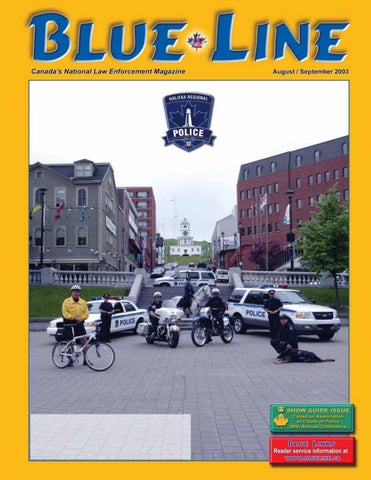
Partners in Policing Halifax Regional Police
7
CACP Trade Show Guide Floor Plan and Exibitor List
10
Police Order of Merit appointees invested
14
DEEP BLUE Give me diversity for $500 Alex
16
Sexual exploitation of children
18
eMail: admin@blueline.ca
— Editor — Mark Reesor eMail: editor@blueline.ca
VISA cracks down on child pornography 22
— News Editor — Les Linder
PRIME to link all BC police
23
eMail: news@blueline.ca
Psychopathic criminals are the most mobile
25
Police task forces search for guns
26
Amber program alerts public quickly
28
Grow houses present many hazards
29
— Advertising — Mary Lymburner Dean Clarke Bob Murray eMail: sales@blueline.ca
— Pre-press Production — Del Wall — Contributing Editors — Communication Skills Terry Barker Police Management James Clark Tactical Firearms Dave Brown Technology Tom Rataj Psychology Dorothy Cotton Case Law Mike Novakowski Blue Line Magazine is published monthly, September to June, by Blue Line Magazine Incorporated with a mailing address of: 12A - 4981 Hwy. 7 East, Ste. 254, Markham, Ontario, L3R 1N1. Individual magazines are $3.50 each. Subscriptions are $25.00 per year or $40.00 for 2 years. (Foreign - $50.00 U.S.) All material submitted for publication becomes the property of Blue Line Magazine unless other arrangements have been made with the publisher prior to publshing. The authors, advisors and Publisher accept no liability whatsoever for any injuries to persons or property resulting from the application or adoption of any of the procedures, tactics or considerations presented in this magazine. Readers are cautioned and advised that articles presented herein are edited and supplied for your personal awareness and should not be used for further action until appropriate advice and guidance is received from a supervisor, Crown Attorney or other person in authority. Established in 1988, Blue Line Magazine is an independent publication designed to inform, entertain, educate and upgrade the skills of those involved in the law enforcement profession. It has no direct control from a law enforcement agency and its opinions and articles do not necessarily reflect the opinions of any government, police, or law enforcement agency. ©2003 - All articles are protected by copyright. No part of this publication may be reproduced or transmitted in any form or by any means, electronic or mechanical, including photocopying and recording or by any information storage or retrieval system without permission. Internet activity is monitored and use or reposting of material on the Internet is restricted.
This publication is a private venture and receives no subsidy or grant from any level of government.
— Affiliations — International Association of Law Enforcement Planners Canadian Advertising Rates & Data International Police Association The Police Leadership Forum The Canadian Press Newswire Printed in Canada by Janson Printing Service
ISSN #0847 8538 Canada Post - Canadian Publications Mail Product Sales Agreement No. 176796 August / September 2003 June 2003
When one lies dying 30 Arming Canadian law enforcement officers US tests facial recognition systems
31
CASE LAW 34 • ID request doesn’t necessarily create detention • Priority one call justifies warrantless entry • It’s what the officer considers that counts Persuading is better than forcing
36
Intimate adversaries Assessing the threat in domestic violence cases - part two
38
Canada could become ‘Colombia’ of the north
40
New gas masks offer full protection
42
BOOK REVIEW 44 Books give comprehensive look at terrorism Crisis Communications 101: Part II PEP and CAP principles
47
The predatory script The lures predators use to seduce children and parents
50
Federal bill would change drug enforcement
53
PRODUCT NEWS
54
COMING EVENTS
55
Are you passionate about policing?
56
PERSONAL COMPUTING Teaching good computing habits
60
BACK OF THE BOOK 62 The thin blue line must rise with honour and distinction 3
As the host agency of the Canadian Association of Chiefs of Police 2003 Conference, Halifax Regional Police (HRP) is working cooperatively with other law enforcement agencies in its community to plan and host this year’s forum for Canada’s police leaders. As HRP Public Affairs Supervisor Theresa Rath Brien tells us, a cooperative spirit is nothing new for the police agencies serving the Halifax area, which is policed by the RCMP as well as city police — and if you’re heading to the 98th annual CACP Conference, be sure to have a look at the floor plan and advertisers list. Halifax is hosting the conference in memory of former chief David McKinnon, who lost a long and courageous battle with brain cancer in May. As East Coast correspondent Danette Dooley tells us, hundreds of condolences flooded into the force in the wake of the popular chief’s death. Doctor Dorothy takes a look at diversity; we have another in our continuing series of Criminal Intelligence Service of Canada review of organized crime; West Coast correspondent Elvin Klassen tells us how PRIME (Police Records Information Management Environment) will link BC police from one end of the province to the other and reports on a study suggesting our most dangerous criminals are also our most mobile. Kathryn Lymburner updates us on the Amber Alert program; former drug enforcement officer and now fire investigator Mariano Perini tells us about the dangers of marijuana grow houses; Chris Butler weighs in on the arming of park wardens issue; Mike Novakowski has three case laws; Calgary Police Staff Sergeant Dan Mullen looks at ways police officers can resolve while still maintaining law and order — persuading rather than forcing; Heather Gray concludes her series on assessing the threat in domestic violence cases and Judy Pal has the second part of her crisis communications series - this month she looks at the principals of PEP and CAP.
There are no uniforms that are ‘uniform’ today by Jim Clark There was a great deal of discussion and concern at a recent Quebec conference that some security officer’s uniforms could be confused with those worn by police. Clearly, the message that I heard was that police want some sort of restriction on the type of uniforms security officers can wear. This issue has sparked much discussion within the security field. When I joined the police in the early 60’s (yes I know, I’m one of those dinosaurs) officers were required to come to work in uniform. They weren’t allowed to carry parcels while wearing it, nor could they carry a lunch into the station while on duty. I know this will have most readers shaking their heads, but you must remember that our supervisors were all Second World War veterans and the rules they followed were written at the turn of the century. There were other rules you would find unacceptable today. We weren’t allowed to add or remove any type of equipment to police issued vehicles, for example. In 1963 I and many other officers rode motorcycles that weren’t equipped with rear view mirrors. Some bought and installed their own mirrors but were soon ordered to remove them by their sergeant. Today this would be a health and safety issue,
August / September 2003 June 2003
but back then rules came first over obvious safety. This brings me to the uniform issue. By definition, uniform suggests common, identifiable clothing worn by all officers. I was taught the importance of being properly turned out, if for no other reason than to ensure that people would know who they were dealing with. There were cases in which those charged with assaulting or obstructing the police would argue that they didn’t realize they were assaulting a police officer. This brings us up to today’s police. Some forces have allowed uniformed equipment to expand to the point that confusion could easily be a defense to someone charged with assaulting a police officer. Specialized units have, for very valid reasons, changed some of their uniforms to allow for better responses. Others have been allowed to make changes so they could be identified as a separate unit. We have uniforms that include peaked, fur, baseball and wide brim caps — and in many cases, no caps. There’s white, blue and black shirts; long, short, bike and motorcycle pants; cloth, leather and nylon coats and short and long jackets. When I chaired the clothing and equipment committee in the early 90’s, there were 16 different types of footwear. Some would argue that this variety of cloth-
5
ing is acceptable because they all have one thing in common — the word police somewhere on the uniform, but does law enforcement still have the sole right to use that word? There’s a popular rock band known as ‘The Police’ and police uniforms and badges are sold at flea markets. The last time I watched police dealing with a large, disorderly crowd on the news, I counted six different uniforms on the officers dealing with the problem. This brings us back to the issue of security officers and the concern they look too much like police officers. I can appreciate some of the concerns raised by police but they must get their own act together before they can expect any reasonable action in this area. There is a need to review all police equipment, including the clothing officers wear. A standard must be set which doesn’t allow for differences simply to designate a different unit — traffic as opposed to regular patrol officers, for example. The only exception should be specialized units which can show a need for different clothing. Officers should be proud of the general uniform, not some additional badge which identifies a special unit. Jim Clark is a former Deputy Chief of the Metropolitan Toronto Police Service and currently the president of Monad Security Consultants. He can be reached at jclark@monadsecurity.com
by Theresa Rath Brien A cooperative spirit is nothing new for the police agencies serving the citizens of the Halifax region, one of the few municipalities in Canada with two police services — Halifax Regional Police (HRP) and the Halifax detachment of the RCMP. They work closely with each other, the military and CN police and other related federal and municipal agencies, including Canada Customs and Revenue Agency (CCRA) and the port and airport authorities. Evidence of these partnerships can be traced back several decades. The RCMP and former municipal police agencies that now make up HRP began partnering on specific criminal investigations and sharing intelligence information in the 1970s. In fact, Halifax area police agencies began sharing information when intelligence networks were only in their infancy. “Due to the uniqueness of the city’s geography, our police agencies and affiliated organiAugust / September 2003 June 2003
zations have been forming partnerships for many years in an effort to address organized crime in Halifax,” says HRP Chief Frank A. Beazley. The Airport Joint Forces Operation (JFO) is just one example; HRP, the Dartmouth Police Service and the RCMP worked jointly at the Halifax International Airport to gather intelligence. The collaborative approach to policing was formalized in 1978, which led to the first formal joint investigation and the formation of the first full-time integrated unit. Recognizing that the drug trade transcends police jurisdictions, the agencies also formed the Drug Joint Forces Operation, which still exists today, to target high level dealers. The second full-time inter-agency policing project was born after area agencies assigned members to work full-time at the Criminal Intelligence Service of Nova Scotia (CISNS) in the late 1980s. Today, the RCMP, HPS, Military Police and CCRA each have full-time representatives assigned to CISNS to ensure intelligence 7
is shared; HPS, the RCMP and CCRA have members on an integrated intelligence unit and HPS and the RCMP have an integrated vice unit and Joint Prostitution Task Force and collaborate in the provincial Crime Chief Frank A. Beazley Stoppers program. Halifax Regional Police was formed in 1996 with the amalgamation of the Bedford, Dartmouth and Halifax municipal police departments. “Prior to regionalization, it was almost as if the bridge that spans the Halifax Harbour separated the three police agencies in the area and created silos, rather than joining us,” Beazley recalls. “There is no question that we operate more effectively and efficiently today than we did singly and that only benefits our community.” Beazley says he’s working to further
August / September 2003 June 2003
8
The Halifax Regional Municipality is one of the few in Canada contracted to two police agencies. The three major communities are policed by the Halifax Regional Police while all else use the services of the RCMP. Shown above are HRP Cst. Dennis Crowell, RCMP Cst. Mike MacAlpine, HRP Cst. Bob Merrick, RCMP Cst. Shawn Smith.
strengthen the relationship with the RCMP Halifax Detachment, a partnership that resulted after amalgamation because both agencies were policing the areas that formed the Halifax Regional Municipality. HRP serves citizens in the core city and the RCMP polices the suburban area. The two agencies already hold a daily conference call to ensure that timely and accurate operational information is being shared and a study is underway to review ways they can expand their existing partnerships and further integrate. “By analyzing two first class police services, we are striving to create enhanced services in policing for the community we serve. If we can create some efficiencies by working more closely and communicating more effectively with the Halifax Detachment of the RCMP, then we can free up officers to go where they are needed most,” says Beazley. “Overall, the closer we become, the stronger we will be in jointly policing our community.” The officer exchange program is one way the agencies are trying to foster closer ties. Two RCMP officers switched roles with two HRP officers in February for a one year period. The goal of the program is to enhance communications and understanding between the organizations. While only half way into his term, Cst. Shaun Smith, who’s been with the RCMP 10 years, can August / September 2003 June 2003
already see the benefits of the program and encourages other officers will participate. “I have gained numerous positive benefits from working with Halifax Regional Police and two stand out the most - development of my urban policing skills and the opportunity to work in another police environment where the members have such pride and a high level of professionalism. I think of this organization as a welloiled machine, just like the RCMP,” says Smith. Cst. Art Merrick, who’s been with HRP for 31 years, has similar comments about his time with the RCMP. “The officer exchange program is truly an innovative approach to exchanging current information and technology and enhancing understanding between the RCMP and Halifax Regional Police uniformed members,” he says. HRP also has a close partnership with the Halifax Port Authority and has policed the port under contract since 1998. Halifax is the only Canadian port that has a dedicated ports unit and is policed by a municipal agency. Stationed in a satellite office, the unit cooperates with other government agencies, especially CCRA and the coast guard, to investigate crime on the waterfront and conduct extensive investigations into organized crime. HRP also works in partnership with the military police, one of the city’s founding police agencies, to patrol the shore area. When visiting ships are docked at the Halifax Harbour, it’s not uncommon for military police officers to assist in HRP’s jurisdiction. The two agencies also share training programs and facilities, allowing each to learn and benefit from the other. Officers and the community benefit greatly from all this cooperation, notes Beazley. “Partnerships in policing bring resources together, allow us to share intelligence to target organized crime and create efficiencies for all organizations who are part of the relation9
ship to deliver the best investigations possible and the highest level of service to the community we serve. They truly prove that we are stronger together than we ever could be apart.” It’s no surprise that many of the partners who pride themselves on policing the region of Halifax are also helping to coordinate the CACP conference for Canada’s leaders in policing. Both the RCMP and Military Police are proud sponsors and have members sitting on the organizing committee for the event, which is always a forum for sharing information and forming unified positions on Canadian policing issues. “CACP is an organization which certainly provides an opportunity for police in Canada to learn and grow with one another,” said Beazley, “CACP 2003 presents an opportunity for us to enhance policing in our own community, not to mention the occasion to showcase both our Maritime hospitality and our partnerships in policing.”
EXHIBIT FLOOR PLAN CANADIAN ASSOCIATION OF CHIEFS OF POLICE 98th ANNUAL CONFERENCE Halifax Metro Centre 5284 Duke Street, Halifax, Nova Scotia August 24 - 26, 2003
ADT Security Services Canada 322 AGNOVI Corporation 105 Advance Interactive Systems 900 - 902 Alubox 309 Atlantic Police Academy 413 Atlantic Police & Security Supply 217 Aveltech 602 Bank of Canada 1004 Blue Line Magazine 1003 BMW Motorrad Canada 711 Bombardier 701,703,800,802 Brault & Bouthillier 713 Business Watch International 609 CACP 512 CACP Traffic Committee 101 CALEA 408 Canada Law Book 704 Canadian Centre for Justice Statistics 714 Canadian Firearms Centre 405 Canadian Police College 102 Canadian Police Research Centre 207 Canadian Safety Equipment 1000 CanRep Inc 501 Code 3 212,312 CommandForce 317 Current Corporation 612 CVDS 315 August / September 2003 June 2003
Dack’s Shoes 319 davTech 508 Decatur Electronics 715 Demand Products 804 Diagnostix 206 Diaphonics 710 Dictaphone Canada 406 Eurocopter 808,809 ESRI Canada 318 Evin Industries 216 FATS 706 Fintrac 414 Ford of Canada 401,403,500,502 Fred Deeley Imports 807 Garda of Canada 415 G E Ion Track 209 General Dynamics Canada 505 GlobalStar Canada 320 Glock 210 General Dynamics 300-305,400,402,404 Gordon Contract Uniform & Footwear 407 Groen Brothers Aviation 104 Hi Tec Intervention 409 Highway Help Program 103 Integral Designs 205 Insurance Bureau of Canada 1005 i2 410 10
Laerdal Medical Canada 601 Law Enforcement Torch Run 200 Logical Sequence 507 Maritect 606 Maritime Services Police & Security 503 Martin & Leveque 607 McKenzie Marketing 903 MD Charlton 419,514 Med-Eng Systems Inc 314 Medtronic Physio-Control 513 Mercury Marine 321 Michaels of Oregon 211 Microsoft Canada 906,907 Mine Safety Appliances (MSA) 417 National Crime Prevention Centre 316 National Missing Children Services 307 National Police Services 306,308,310 Nelmar Security Packaging 712 NineOneOne Outerwear 514 Novo Technologie 600 Ontario Sex Offender Registry 708 Operation ID 615 Pacific Safety Products 333 Panasonic 709 Positron 208 Primex Security Systems 311 Printrak Motorola 707,806 P W Allen 214 Qunara 412 R Nicholls Distributors 810-819 RCMP Quarterly 702 Rosborough Boats 801 Second Chance Body Armor 605 Shred-It 504 Sierra Wireless 604 Simunition 515,614,1001,1002 Solutions 317 Stop Tech 215 Symbol Technologies Canada 904 Syscon Justice Systems 705 Teletron 611,613 Templar 313 Transport Canada 1006 University College of Cape Breton 416 Vancouver Police 411 Versaterm 506 Viking Metals & Marine 603 Whelen Canada 509,511,608,610 Youth Justice 213 Zee Medical Services 418
Blue Line Advertisers at the CACP Trade Show Advance Interactive Systems See advertisement page 23 The Prisim Judgment Simulation training system, featuring the patented ShootBack cannon, provides immediate feedback to trainees and significantly impacts the effectiveness of law enforcement training. The Prisim simulator has been recognized in USA Today, The New York Times, ABC World News Tonight, NBC Today Show, CBS Morning Show, and many others. Atlantic Police & Security See advertisement page 5 Atlantic Police & Security is continuing it’s growth throughout the Canadian market with some of the most innovative products in Law Enforcement. Starting with smallest moving radar in the world, the Bee III, with it’s exclusive ASD technology for Stationary lane selection and user friendly Speedometer Interface capability. Also featured is the buzz of the Pepper Spray world right now, Sabre Red. With it’s potent 2,000,000 SHU’s, natural orange colour, and ability to fire upside down - this is the OC lessthan-lethal product that could save your officers from escalating situations to more severe weaponry. Blue Line Magazine See advertisement page 47 Blue Line Magazine is Canada’s national law enforcement magazine, read by the full spectrum of the industry from management to front line personnel. For 16 years, Blue Line has continuously formed a powerful relationship with its readership, delivering unbiased editorial content while reporting on the latest trends and technologies shaping Canadian Law Enforcement. Blue Line’s complete multi-media package includes Blue Line Magazine, Blue Line News Week, Blue Line Online, and Blue Line Trade Show. BMW Motorrad Canada See advertisement page 27 BMW will be presenting some of our models which have many applications including police, paramedic, rescue work and other patrol duties. BMW Authority Motorcycles offer superior performance, safety, and low cost of maintenance. In addition to some of the many standard features like ABS, dual batteries, heated grips, adjustable electric windshield, and variable-height rider’s seat, you can also custom order specialized options such as sirens and front and rear flashing light systems in red or blue. Business Watch International See advertisement page 43 Our expertise is data management. We have developed an internet-based program for collecting, storing and delivering transaction information gathered in pawn shops and secondhand goods businesses. Our program addresses the police officer’s need for improved accuracy, quantity, relevancy and timeliness of transaction information. At the same time, police want a system that is simple to use. Applying modern technology to investigate transactions in the pawn and second-hand industries will, in turn, help in the fight against the many other crimes and social problems linked to property theft. The BWI Automated Reporting System links police services to a real-time database that displays information on transactions occurring in pawn and second-hand businesses. August / September 2003 June 2003
CALEA See advertisement page 20 The Commission on Accreditation for Law Enforcement Agencies (CALEA), with representation from Canada and the United States, establishes voluntary standards for law enforcement, public safety communications agencies, and training academies in North America. CALEA presents an opportunity for agencies to evaluate and improve their operations and effectiveness. Accredited agencies reduce exposure to liability and increase community involvement. Accreditation is based on compliance with standards that represent accountability. To the community, local government, and agency employees; standards build trust. The accreditation award is an independent verification of agency excellence. Canada Law Book See advertisement page 31 As one of Canada’s foremost legal publishers since1855, Canada Law Book has established itself as an industry leader, publishing some of the finest legal resources available. Our continued commitment to excellence helps to ensure you meet your law enforcement responsibilities both knowledgeably and confidently every day. Enlist Martin’s Annual Criminal Code – Police Edition, Martin’s Pocket Criminal Code, Police Legal Access System (PLAS) on CD-ROM, the new Youth Criminal Justice Act Manual and, coming soon, Prosecuting and Defending Drug Offences, as your ammunition to making a difference in the line of duty. Our word is the law. Carruthers Shaw and Partners Limited See advertisement page 30 Carruthers Shaw and Partners Limited, Architects is a full service architectural and consulting firm that specializes in the planning and design of justice facilities. Our work includes Facility Master Planning and Needs Analysis ranging from plans serving entire communities, to the design of specific new facilities, across Canada. The firm’s experience with police and justice training buildings is also extensive and includes the latest technology in training facilities, including gun ranges. Our work reflects an abiding concern for safe, secure, and flexible buildings which provide an excellent environment for both the police and the public. CommandForce See advertisement page 35 CommandForce is a data management product that was developed in conjunction with a group of municipal Police Services, who were frustrated with the software options available to them. Many RMS solutions exist, but the costs of purchasing and/ or implementation are prohibitive, or the products inadequate. CommandForce efficiently and cost-effectively manages data, forms, tasks, and reports. Utilizing the latest software technologies, this product can be scaled to handle any size of organization. Ease of use, time-saving reporting, MS Office integration, and the ability to share data across individual police services sets this product apart. Dalhousie University See advertisement page 35 The Certificate in Police Leadership Program is a quality distance-education program that provides practical solutions for the development of police personnel. The challenges facing police leaders today 11
are very demanding. Adequate preparation of police managers now can develop the potential of personnel who will provide leadership in the future. Our course authors and instructors are leading experts in their fields. Students have the opportunity to study at home or while they travel, without having to attend regular classes. davTECH Analytical Services See advertisement page 36 davTECH Analytical Services (Canada) Inc. provides Sales, Service, Engineering and Consulting Services to customers throughout Canada, the United States and Asia. We are Canadian exclusive distributors for McCoy’s Law Line, Laser Atlanta Optics, NPAS, MEDTOX Diagnostics, Akers Laboratories, Intoximeters, Guth Labs, RepCo, Roche, and P.A.S. Systems. Our operating divisions in which we service our customer base of 1200 plus clients include; a) TRAFFIC SAFETY PRODUCTS (Radar, Lidar & Speed Trailers sales & certified service): McCoy’s Law Line, Laser Atlanta Optics b) ALCOHOL DETECTION DEVICES: Intoximeters, NPAS, PAS Systems, Guth Labs, RepCo c) SUBSTANCE ABUSE TESTING: Medtox Diagnostics, Akers Labs d) Media Services: Silent Witness, Sony, Gyyr. Decatur Electronics See advertisement page 41 Decatur Electronics, Inc. designs, manufactures and markets the finest speed measurement products and traffic safety equipment in the world. The radar products are used for law enforcement, sports, industrial/OEM and scientific applications. The radar speed message trailers are the finest quality and most rugged in the industry, with extra-bright LED characters and the ability to display over 200 preprogrammed and additional 200 user-programmed messages. Dictaphone Canada See advertisement page 55 A division of Dictaphone Corporation, the Dictaphone Communications Recording Systems Group (CRS) is a leading provider of communications recording and quality monitoring systems for public safety, financial services, and call centers. Dictaphone CRS principal product is the Freedom network appliance recording system. The Freedom system’s revolutionary design gives call centers all types of new found freedom to access and store their voice information wherever, whenever, and however they want. Eurocopter Canada See advertisement page 64 Eurocopter Canada Limited has been manufacturing in Canada since 1984 in Fort Erie, Ontario, and currently employs 170 people. The facilities include the main plant with 100,000 sq. ft. of space, located on approximately 165 acres of land. The wide range of multi-purpose helicopters include, the AS 350 and AS 355 through to the BO 105 and BK 117 to the Panther and the Cougar MK2. New helicopters just introduced to the product line are the EC 135 light twin engine , the EC 120 light single engine, the EC 145 medium twin engine and the EC 155 medium twin engine helicopters. Eurocopter Canada provides full customer service for over 300 Eurocopter helicopters in Canada. Eurocopter Canada has 100% commitment to customer satisfaction, and maintains warehouses in Fort Erie, Montreal and Vancouver to provide nationwide spares and technical support.
Ford of Canada See advertisement page 34 Glock See advertisement page 44 GLOCK pistols are the perfect combination of reliability and accuracy. Their high-tech engineering and construction create a handgun that can stand up to more punishment than even the most unforgiving conditions can generate. When you investigate the individual advantages of a GLOCK, you’ll see that it will outperform whatever you’re shooting now. With GLOCK’s consistent trigger pull and excellent pointability, there’s a very good chance you’ll hit what you’re aiming at. Considering the care and ingenuity with which it is built, there’s a very good chance you’ll be hitting your targets for a long, long time. Gordon Contract Footwear See advertisement page 15 We pride ourselves on being the best supplier of Police, Security and Correctional Service footwear in Canada. Please ask any one of our customers for a reference (including): Halifax, York, Durham, Hamilton Wentworth and Niagara Regional Police; Fredericton, Ottawa, Hull, Toronto, Winnipeg, Saskatoon and Saanich Police Services; Ontario Provincial Police; Newfoundland and Labrador, Ontario, Manitoba or Alberta Correctional Services. If we currently supply your department thank you. If not, please give us the opportunity to provide you with the best product, price and service in the industry. Laerdal Medical Canada See advertisement page 48 The Laerdal Company was established in 1940. During our first two decades, we created innovative toys and books for children. In 1960, with the introduction of the Resusci Anne manikin, our company dedicated itself to advancing the cause of resuscitation and emergency care. Today, Laerdal Medical is dedicated to helping save lives with products for CPR Training, Airway Management, Advanced Life Support Training, Spinal Motion Restriction, Trauma Training, Monitoring and Defibrillation. Our commitment is to every health professional and volunteer who has learned how to save the life of a family member, friend or stranger in need. Maritime Services See advertisement page 33 Maritime Services Police and Fire Section is a division of the Triton Marine Group located in Vancouver, BC. The Raytheon Commercial Infrared group of products is distributed in Canada by Maritime Services. This includes handheld cameras, vehicle and boat mounted pan and tilt cameras, infrared security cameras as well as driver safety oriented automotive/headsup display systems. For OEM applications, build-around infrared engines are ready to be adapted and fitted to meet operational requirements, on land and water and from aircraft as well. M D Charlton Co Ltd See advertisement page 50 MD Charlton Company Ltd is a full service Law Enforcement Distributor through out Canada for over 25 years! We pride ourselves on Honesty, Quality Equipment and Great Service. In addition we offer Full Instructors Training for Chemical Munitions, O.C.(pepper spray), Distraction Devices, Specialty Impact Munitions, Taser International Master Instructors, Jaycore Pepper Ball Systems, and ASP Batons. Medtronic Physio-Control See advertisement page 59 Medtronic of Canada is the Canadian subsidiary of Medtronic Inc. the world’s leading medical technology company. Medtronic Physio-Control is the world leader in the design, manufacture, sales, and service of automated external defibrillators (AEDs). The August / September 2003 June 2003
LIFEPAK 500 is the most widely used AED ever produced with more than 100,000 units in use, and the new LIFEPAK 500-DPS (Defibrillator Public Safety) was built specifically for law enforcement, in non-reflective charcoal black and the toughest specs in the industry. Police use of AEDs has shown to double survival rates (9.0% to 17.6% in Miami-Dade County), and police forces in Canada are now committing to AED use with the LIFEPAK 500 as their AED of choice. Michael’s of Oregon See advertisement page 6 Kydex Tactical Holsters from Uncle Mike’s Law Enforcement feature injection molded Kydex construction, which ensures high quality and performance. With a fully-adjustable belt loop and leg, Kydex Tactical Holsters offer users a customized fit that positions the firearm below a raid jacket or tactical body armor. The velcro-adjustable leg strap includes an elastic segment for comfort and firearm security. MSA Canada See advertisement page 24 Mine Safety Appliances Company, MSA, is the largest company dedicated to producing a complete range of equipment and systems for workers and plant protection. MSA is a global company with 27 operating companies, serving customers on five continents. Our products help protect lives in more than 120 countries. These products are used by major Law-Enforcement agencies throughout North America and include respirators, respirator cartridges, gas masks, riot control products, fire helmets, shields, self-contained breathing apparatus (SCBA), thermal imaging cameras, hard hats, head protection, fall protection products, harnesses, lanyards, lifelines, confined space equipment, training, consulting services, hearing protection, eye & face protection, monitors, portable instruments, and permanent gas detection equipment. Nine-One-One Outerwear See advertisement page 53 Nine-One-One, Canada’s premiere outerwear brand has been serving law enforcement, security and emergency services across North America for over 15 years. We are committed to manufacturing quality and construct our product line utilizing the latest innovations in fabric and findings researched and tested to meet the performance expectations of customers and industry standards. Novo Technologies See advertisement page 38 Novo Technologie inc. designs and manufactures digital voice recording solutions for law enforcement, public safety, 9-1-1 and justice. Our products offer a high quality, stable and flexible platform with multiple options like high storage capacity (more than 300,000 channels/hours) of direct access, networking operation, multiple channel playback, trunked radio interface (EDAC & Astro), cells and briefing room module, investigation & interrogation rooms. In addition, our Paperless Police Officer module includes inboard vehicle recording and dictated police report with transcription. Moreover, our NOVOLOG based software is especially designed to allow exact customization to the client’s specifications and easy CAD integration. Panasonic Canada Inc See advertisement page 2 Panasonic has deployed over 25,000 rugged notebook computers into law enforcement organizations throughout North America. Our top of the line CF-28 Toughbook can be found in many public safety organizations throughout the US and Canada. Panasonic offers a full range of rugged notebooks suited for the public safety market including the CF-28 and 12
our newest model the CF-50. For more information on the Toughbook lineup, drop by our booth. P.W. Allen & Company See advertisement page 45 P.W. Allen & Company Ltd. are designers and manufacturers of a wide range of specialist security equipment for EOD/IEDD, Contraband Detection, Security Search, Night Vision, Surveillance and Crime Scene Investigation. An established supplier to many police departments and agencies across Canada and the US, the Company’s blend of technical and operational experience delivers effective, professional solutions for threats to security at all levels. Qunara Inc Qunara is a leading e-Business company focused on delivering Internet-enabled solutions and managed services. Qunara possesses proven expertise in Risk Management and IT Security, Content, Information and Knowledge Management and Managed Services. Qunara’s integrated end-to-end solutions are delivered through business strategy and information technology consulting, infrastructure professional services, application development and systems integration and integrated technology solutions. Qunara’s broad capabilities are supported by strategic technology partners who value expertise in delivering customized, advanced-technology solutions. With offices in Winnipeg, Halifax, Moncton, Toronto, Ottawa and Calgary, Qunara Inc is a wholly owned subsidiary of Manitoba Telecom Services Inc. For more information call 1-888-783-5555 or visit www.qunara.com. R Nicholls Distributors Inc See advertisement page 21 Included in the leading edge products Nicholls will be featuring this year is the MP7 PDW from Heckler and Koch. The PDW offers the firepower of a submachine gun, medium range capabilities of an assault rifle and pistol-like close combat dimensions…The Digital Eyewitness once again shows that Kustom Signals is the In-car Video market leader. This digital solution is revolutionizing Incar Video...The Hindi baton cap is one more reason the Autolock baton from Monadnock is the premier solution in retractable batons. The Hindi cap adds functionality and aids in the retention of retractable batons…There is no other training suit that provides protection against as wide a range of less lethal munitions as the Pine Tree’s Simulation Training. Pine Tree’s Defender 20 gauge less lethal firearm and the world’s first level IV retention holster, the Raptor, will also be featured in the Nicholls booth. Second Chance Body Armor See advertisement page 17 Second Chance Body Armor is featuring the new Ultima Level II soft body armor, 37% lighter than previous technology, wrapped in Gore-Tex Comfort Cool pad covers. Lightest, thinnest, most comfortable Second Chance vest. New Second Chance Ballistic Helmets and Shields, featuring revolutionary, lightweight ballistic technology. Simunition See advertisement page 49 The Simunition FX marking cartridge training system is the only training system that allows peace officers to use their own weapon and associated equipment and participate in safe, force-on-force training against real, living, breathing, motivated humans who can shoot back. The Simunition Supervisor Training and Safety Course is a three-day training program that is specifically designed to provide students with product information and manufacturer’s recommendations on how to use these revolutionary products in new or existing training programs Simunition in collaboration with Tetragon-Tasse invite you to witness live demonstration.
A true leader with a community vision by Dannette Dooley
qualities and commitment of those dedicated to law enforcement and dedicated to making our community a — Sir Robert Peel, 1829 better and safer place.” McKinnon’s work It is our job to be receptive against organized crime was and reactive to the needs of recognized last year when he the community and show the was made one of the first six citizens whom we serve exofficers of the Order of Merit actly how we are doing it. of the Police Forces. He also — Halifax Police Chief received the Police ExemDavid P. McKinnon, 1999 plary Service and Queen’s Golden Jubilee medals. Halifax Regional Police Brockville Police ServChief David P. McKinnon ice Chief Barry V. King died in hospital May 17 afposted the following on ter a long and courageous HRP’s web site: battle with brain cancer. The Having just returned hundreds of condolences Chief David P. McKinnon from vacation out of the posted on the force’s web 1949 — 2003 country, I was saddened to site made it clear the city lost a great man and the policing community a su- learn of the passing of Dave. As a member of the Board of CACP, I was fortunate to work perb leader. “He was a true leader with a vision and more closely with Dave and very much rehelped to make Halifax Regional Police the spected him as an individual and colleague. organization that it is today,” said new Chief Even after first taking ill, he attended a CACP meeting, ever the stalwart professional who Frank A. Beazley. Glancing through the condolence messages loved policing as he did his family. Please pass gives you an idea of just how many lives this on my personal condolences to Dave’s family man has touched. There are postings from po- and accept the thoughts and prayers of all memlice officers as far away as Holland, govern- bers of the Brockville Police Service for each ment officials, parents of officers, civilian staff of the grieving members of Halifax Police Service. While we all mourn his loss, policing in and civilians. Some messages speak of how the chief will general and Halifax in particular are benefacbe missed, others about how he will be remem- tors of his influence and vision. Former secretary Irene Dockendorff exbered. All convey the same message — that he was a superb leader, mentor, father, husband pressed her deep sympathy to the McKinnon family: and friend. I share in your sorrow; my heart is aching McKinnon joined the Halifax Police Department in 1969 and served in all aspects of for you. I worked for Chief McKinnon when he policing. He was promoted to superintendent of was deputy chief of police; he was so kind to me field operations in 1987, deputy chief in 1995 and and such a beautiful person to work for. I was chief of the regional force, made up of the former his secretary for nearly a year. I enjoyed workHalifax, Dartmouth and Bedford police depart- ing for Mr. McKinnon, he was a very unique person, and I found it was very rewarding to work ments, in 1998, succeeding Vince MacDonald. A past president of the Nova Scotia Chiefs for such a professional/dedicated gentleman. My of Police Association and long-time member thoughts are with you all, the McKinnon family of the Canadian Association of Chiefs of Po- and Halifax Police at this sad time. M. Grady summed up the thoughts of many lice, McKinnon served on CACP’s board of directors and law amendments, organized crime when he wrote: “Please accept my condolences on the and police committees. He was also chairman of the Canadian Police College advisory com- passing of Chief McKinnon. He was an inspimittee and a member of the International Asso- ration to me and I am truly sorry that we have lost a man of his integrity and character. What ciation of Police Planners. Ontario Provincial Police Commissioner a difference it would make if we all could have and CACP President Gwen Boniface will re- more people like him in our public and primember McKinnon as a man who was always vate lives; someone with such true leadership ready to step up to the plate to take on tasks but qualities. As another great leader once said, ‘we make a living by what we get, we make a did so in an unassuming manner. “You name it and David has been there. life by what we give.’” In giving of himself so freely, McKinnon He was a great contributor at all levels,” she said. “He had a quiet way about him and you leaves a legacy of a life lived to the fullest and only fully understand his contribution when will be remembered in policing circles for many years to come. you reflect back... Memorial donations may be made to the “It’s important for officers within his department to know about the tremendous con- Palliative Care Unit of the Queen Elizabeth II tribution David made at the national level in Hospital, VG Site, 1278 Tower Road, Halifax, addition to his job as Chief of Halifax Regional. Nova Scotia, B3H 2Y9. He will certainly be missed by all of us.” Halifax Mayor Peter Kelly remembered Dannette Dooley is Blue Line Magazine’s east coast writer McKinnon as an officer “who embodied all the and can be contacted at dooley@blueline.ca. The police are the public and the public are the police.
August / September 2003 June 2003
13
Police Order of Merit appointees invested Thirty three new members of the Order of Merit of the Police Forces received their membership insignias from Governor General Adrienne Clarkson in a ceremony in Ottawa in April. The order was approved by the Queen in October 2000; appointments recognize conspicuous merit and exceptional service by police force members and employees whose contributions extend beyond protecting the community. All candidates for admission should be of irreproachable character, exemplified by good conduct, industry and efficiency that serves as a model for others. Nominations can be submitted to the Canadian Association of Chiefs of Police (582 Somerset Street West, Ottawa, ON K1R 5K2) by Sept. 15, 2003. More information and nomination forms are available at www.cacp.ca. —Commanders— Chief Julian Fantino, C.O.M. Toronto Police Service Fantino is recognized internationally for his unparalleled work on such policing issues as organized crime, community policing and child exploitation. Currently chief of the Toronto Police Service and chair of the International Association of Chiefs of Police World Regional Office, Fantino has also held various administrative positions in a number of provincial, national and international policing leadership organizations. Dep. Comm. J. Terry Ryan, C.O.M. RCMP, Halifax Ryan has distinguished himself as a forward-thinking, innovative person of action. Through leadership and vision, he has significantly influenced policing techniques, strategies and legislation within the police community, nationally and internationally. Chief Michel Sarrazin, C.O.M. Montréal Police Department Through his public involvement, Sarrazin has significantly enhanced the image of the Montréal Police Department and the police community as a whole. —Officers— Chief Vincent Thomas Bevan, O.O.M. Ottawa Police Service Bevan has played an inspiring role through his devotion to the police force, along with his dedication to the betterment of those less fortunate in our society. Asst. Comm. Dwight L. Bishop, O.O.M. RCMP, Halifax Bishop has advanced policing throughout his career with strong leadership, motivational skills and high ethical standards. He has championed initiatives within the RCMP employee assistance and August / September 2003 June 2003
chaplaincy programs and has championed relations with the black and aboriginal communities of Nova Scotia. Asst. Comm. Kenneth D. Byrt, O.O.M. RCMP, Ottawa Throughout his extensive and diversified career, Byrt has made significant contributions to citizens and policing partners, from the local to the international level. He has always exemplified the highest standards of honesty, integrity, compassion, respect, professionalism and accountability. Dep. Comm. René Charbonneau, O.O.M. RCMP, Ottawa Charbonneau’s exceptional abilities as a leader, and clear judgment and diplomacy has brought honour to Canada and the RCMP. Through his forward-looking vision, he has succeeded in reconciling the divergent interests of many police departments, for the benefit of Canadians. Dep. Comm. A. Vaughn Collins, O.O.M. OPP, Orillia Collins has shown distinguished commitment and a career-long devotion to public safety. This has been reflected through his exemplary leadership in developing and implementing strategies that target organized crime and terrorism. Dep. Comm. Stephen Allan Duncan, O.O.M. RCMP, Regina Duncan has demonstrated selfless devotion to duty in serving Canadians during his distinguished career, not only as a police officer but also as a private citizen of the communities in which he has lived. Chief Barry V. King, O.O.M. OPP, Brockville King has demonstrated unfailing leadership and commitment to his peers, the communities he has served and a wide variety of volunteer organizations. Det. Supt. Kathryn Jane Lines, O.O.M. OPP, Orillia Lines has made exemplary contributions to establishing and promoting concepts in behavioural sciences and concepts that enhance public safety and victim assistance. Dep. Comm. Garry James Loeppky, O.O.M. RCMP, Ottawa Loeppky is a respected leader who has made significant contributions to improving policing services at both the national and international levels. He has contributed considerably to communities in which he has lived, improving each of them. 14
Chief Edgar A. MacLeod, O.O.M. Cape Breton Regional Police, Sydney MacLeod has displayed the highest level of professionalism, bringing about progressive changes in policing on local, regional, national, and international levels. He epitomizes the values promoted throughout the police community. Dep. Comm. Maurice Pilon, O.O.M. OPP, Orillia Pilon has given exemplary service and shown dedication and leadership throughout his distinguished career, thereby providing a safer and more secure environment for the citizens of Ontario and Canada. Asst. Comm. Tim J. Quigley, O.O.M. RCMP, Fredericton Throughout his long and distinguished career, Quigley has made significant contributions towards improving the effectiveness of policing services in Canada and ensuring the safety and security of its citizens. Asst. Comm. Freeman C. Sheppard, O.O.M. RCMP, London Sheppard has distinguished himself through his foresight, actions, dedication, and convictions. He has ensured the optimal use of partnerships and information-sharing among Ontario law-enforcement agencies, thus contributing greatly to the RCMP’s priority of ensuring safer homes and communities. Chief Supt. Benedetto Soave, O.O.M. RCMP, Toronto Soave has shown outstanding leadership and commitment to an effective, integrated response in the international fight against organized crime. Chief Glenn M. Stannard, O.O.M. Windsor Police Service Known for his courage, commitment and energy, Stannard’s professionalism and example have earned the respect of members and his community. He has demonstrated leadership and creativity while maintaining the highest ethical standards. Asst. Comm. Lawrence G. Warren, O.O.M. RCMP, St. John’s Warren has advanced policing and improved community well-being throughout his career, most notably in his home province of Newfoundland and Labrador. His leadership has given the impetus for quality, community-oriented policing based on partnerships.
Vincent Westwick, O.O.M. Ottawa Police Service As legal advisor, Westwick has demonstrated unwavering commitment and dedication to the police community. He has always exhibited a strong work ethic and his leadership and many initiatives have been instrumental in advancing policing. —Members— Supt. Ward D. Clapham, M.O.M. RCMP, Richmond Clapham practically embodies the RCMP’s mission, vision and values. His contributions to community policing have positively impacted policing nationally and internationally. He is an outstanding leader, an exemplary ambassador and, to many, a role model. Chief Terence G. Coleman, M.O.M. Moose Jaw Police Service Coleman is an ardent advocate and practitioner of contemporary policing and strategic planning. He has advanced provincial and national initiatives such as the National Crime Prevention Centre’s Community Mobilization Program and has significantly contributed to various local communities. Lt. Norman Couillard, M.O.M. Montréal Police Department Couillard’s contribution to communications stands as testimony to his outstanding performance and achievements as a police officer. For him, the right to information is a commitment, transparency is an article of faith and the image of police forces is a religion.
Insp. Robert F. Purcell, M.O.M. RCMP Purcell has demonstrated professionalism and dedication to duty, in particular by using the ‘measured approach’ to peacefully conclude numerous high-risk incidents of civil disobedience in Nova Scotia between 1996 and 2000. S/Sgt. Robert M. Ralph, M.O.M. Ottawa Police Service Ralph is a proven leader and respected and dedicated member of his community. He is known for creative innovation and strong commitment to establishing progressive partnerships in policing and community development at the local, regional and national levels. He is a credit to the policing profession and an exceptional role model. Dep. Chief Fred J. Rayner, M.O.M. Edmonton Police Service Rayner has made significant, ongoing contributions to developing and implementing activities to improve community policing. He has fostered positive relationships between police agencies at the local, regional, and national levels. Sgt. Kevin T. Scott, M.O.M. New Glasgow Police Service Scott’s constant dedication and commitment are exceptional. He has counselled individuals in crisis, preventing numerous suicides, and is a recognized international leader in critical incident stress control.
Cpl. Leslie Charles Murray Dell, M.O.M. RCMP, Charlottetown Dell has provided the highest quality of police service, compassion and dedication to a wide range of communities and clients within Canada and the former Socialist Federal Republic of Yugoslavia. He has also done commendable work in PEI to protect the rights and dignity of children. Cst. Henry Charles Hollinger, M.O.M. Calgary Police Service Hollinger has shown unswerving commitment to building strong relationships with the city’s Asian communities and is recognized internationally as an expert on organized crime in Asian countries. Chief Gary Edward Nicholls, M.O.M. Niagara Regional Police Service Nicholls has led by example and worked tirelessly to continuously improve relations between the police and community. His life-long work is testimony to his diligence, devotion to duty and love of community — particularly the citizens of, and visitors to, the Niagara Region. August / September 2003 June 2003
15
Insp. Ronald Keith Sherwood, M.O.M. RCMP, Halifax Sherwood is renowned for his tremendous integrity and dedication. He leads by example and has contributed in a tangible way to the visions and goals of Canadian policing through his charitable efforts and work with international tattoo societies. Dep. Chief Cst. Paul N. Tinsley, M.O.M. Abbotsford Police Department Through his commitment and leadership, Tinsley has inspired police officers throughout BC. His dedication to developing codes of ethics and teaching about their importance has enhanced the integrity of policing and served the public good. Insp. Glenn Trivett, M.O.M. OPP, Orillia Trivett has made outstanding contributions to First Nations policing through training development, earning respect for his commitment and dedication. He works closely with others in designing innovative learning experiences for native youth using traditional teachings to build selfesteem and relationship skills. He has been the catalyst in defining the role of police and enhancing suicide intervention partnerships.
Give me diversity for $500, Alex by Dr. Dorothy Cotton, Ph. D., Psych. And now, ladies and gentlemen, for this month’s column, we’re going to play Jeopardy. I’ll give you the answers and you have to guess what the question is. I’m going to make it easy for you and give you plenty of answers. • True confessions: When I was in university, back a thousand years ago, one of my most embarrassing moments was the time I scraped together enough nerve to ask the two black guys I knew from Trinidad what their native language was. I knew they spoke English when they were talking to me but I had no idea what they were speaking when I overheard them talking to each other. The answer, in case you’re as dumb as I was, is that they were speaking English all along. I just didn’t know, since I had never met anyone from Trinidad and couldn’t understand a word they said. • More true confessions: When I was in grad school (ALMOST a thousand years ago), I made a new best friend — until she admitted to me that she was (gasp) a lesbian. I avoided her like the plague after that. • I did a ride-along with an out of town police service a while back. I arrived early and waited in the lunch room until the shift began. There were about a dozen people coming on shift. About six males were playing cards and another five were standing nearby watching them. One female was seated at the next table, read-
August / September 2003 June 2003
ing a book. No one spoke to her. • Extensive research has shown that the expression ‘familiarity breeds contempt’ is not accurate. In general, the more exposure we have to something, the more positive we feel about it. Think about the latest styles — or better yet, last year’s styles. Remember how you hated them when you first saw them? Then you got used to them and now they seem fine, but THIS year’s styles are new and unfamiliar and you probably don’t much like them. • When I went to Japan on business a few years ago, I took lots of business cards and gifts because they’re big on those things — way more so than here. Not having gifts and business cards would have been a BIG faux pas. Fortunately, I found this out before I went from a Japanese friend. • Politicians and advertisers know that ‘the medium is the message,’ as the saying goes. I am most likely to listen to, be influenced by and/or have faith in views, opinions or information from people whom I perceive to be similar to me. I could go on (and on) but I’d run out of space. Did you figure out the question yet? It is: Why is diversity in policing a good and necessary thing? Now cut that out — I can hear you groaning. Political correctness raises its ugly head — is that what you think? You’re wrong; I’m not very good at being politically correct, but I’ll tell you something I’ve learned in my many years as a psychologist — people are different.
16
You can’t treat them all the same. The problem is that it’s hard to figure out exactly how to treat someone you’re not familiar with them. As a psychologist, I know it’s human nature to be at best a little apprehensive and at worse downright phobic of people and things we’re unfamiliar with — and ‘unfamiliar’ generally means ‘not like me.’ The hitch, of course, is that most of the people we deal with are not like us in many ways. So what are we to do? I suppose we could all take lessons in ‘cultural competence (aka ‘diversity training’) — actually, that’s not such a bad idea. Much as most of us would like to hide our heads under the apparently neutral “I treat everyone the same” point of view, the fact of the matter is that we don’t all WANT to be treated the same — and that’s because we aren’t all the same. So let’s hear it for diversity. A more diverse police community will make your jobs — and learning how to deal with a clientele that’s different from you — easier, and will also enrich your lives. The next time you go to work, take a look at your colleagues. Who is most different from you? Perhaps their way of life puzzles you or their customs and habits make you a little uncomfortable. Look for the person you never play cards with or invite out for a drink. My advice is to spend a lot of time with this person. Consider it a learning experience. Dr. Dorothy Cotton is Blue Line’s Psychology columnist and she can be reached at deepblue@blueline.ca.
Federal Justice Minister Martin Cauchon says his department is developing a way for police to prove whether someone was smoking marijuana and driving. Cauchon suggested the test could involve a combination of blood samples and training of police officers to visually tell whether someone is impaired by marijuana. A jury found Robert Sand guilty of first-degree murder in the death of RCMP Cst. Dennis Strongquill while his girlfriend Laurie Bell was convicted of manslaughter. The jury of seven women and five men took nearly seven hours to reach a decision after a trial that took two months. First-degree murder comes with a mandatory life sentence with no possibility of parole for 25 years. Halifax Cst. Carol Campbell-Waugh has lost a legal battle to claim defamation damages against two lawyers in a controversial race-related case involving three black school girls. A three-judge panel of the Supreme Court of Canada refused to review the claim by Cst. Carol CampbellWaugh. She was initially awarded $240,000 in damages - the highest defamation award in Nova Scotia history - but the verdict was overturned by the provincial court of appeal. An RCMP officer with 14 years service was killed in June in a highway accident southeast of Edmonton. Cst. Gus Maurice was in an unmarked police vehicle when it collided with a dump truck a few kilometres south of Sherwood Park. The 35year-old man had been posted to the Strathcona County detachment for the past three years. Maurice had been working with the detachment’s traffic services unit and was on duty at the time of his death. The driver of the truck was taken to hospital with non-life threatening injuries. Deputy Commissioner J. G. Harper Boucher assumed regional command of the RCMP for Atlantic Canada in a ceremony held in June in Halifax. He takes over from Deputy Commissioner J.T.G. (Terry) Ryan. A New Brunswick native, Boucher arrives at his new post from Regina, where he was Commanding Officer of F Division in Saskatchewan. Ryan is retiring after more than 40 years of service, including the last six as deputy commissioner for the Atlantic region. Montgomery County Police Chief Charles Moose, who led the three-week hunt for the Washington-area sniper, resigned in June after a clash with county politicians over his upcoming book on the investigation. In March, the county ethics commission ordered him to drop the book project and barred him serving as a consultant on a movie about the sniper case, saying a county employee may not profit on the side from his official duties. The commission also said the book could undermine the prosecution in the sniper case. Moose appealed in state court and also filed a federal lawsuit claiming his free speech rights were being violated.
August / September 2003 June 2003
17
Sexual exploitation of children by the Criminal Intelligence Service Canada - 2002 Report The sexual exploitation of children (SEOC) is an ongoing concern to Canadians. While public education and awareness campaigns have focused attention to this issue, it still occurs with alarming frequency. Almost daily media reports detail sexual exploitation against one of society’s most vulnerable groups; unfortunately, many cases go unreported until long after the crimes were committed. The reasons for this vary — in some instances, the victim trusts the adult offender; in other cases, the victim is groomed into believing that he or she has participated in normal behaviour. Sometimes the victim is contacted via email or in a chat room and doesn’t realize the potential danger until it’s too late. In most instances, the offender tells them to keep their activities secret. Recognizing the need to combat and prevent these horrible crimes, police have made SEOC a national priority. Criminal Intelligence Service Canada (CISC), which has over 380 law enforcement member agencies, initiated a national coordinated strategy in 1998 focusing on child pornography, prostitution and sex tourism (Canadians who exploit children in foreign countries). Other partners include Interpol, the RCMP, Canada Customs and Revenue Agency (CCRA) and other federal departments, provincial and municipal police forces and US and international agencies. Child pornography and the Internet The global information highway, easily accessed in homes, workplaces, schools, libraries and cyber cafes, allows people to communicate with others around the world with little effort. While this borderless access has many advantages, it also allows those who would sexually exploit children to communicate with like-minded individuals and locate children. Others use the Internet for profit by cre-
ating web sites that distribute child pornography or setting up sophisticated and clandestine networks for those who share their passion for it. Investigators want to prosecute the possessors, creators and distributors of this material. Child pornography is not a victimless crime. A child is not only victimized when the photo is initially captured, but repeatedly as it’s shared with others around the world and continues to surface. Some police behavioural scientists feel that people who view such material do so only because they wish to have sex with children. It acts as a catalyst, encouraging them to become abusers. Investigators face great challenges in attempting to identify victims. Law enforcement in G8 member countries are working to establish an international child pornography database that would contain general information on both victims and offenders. The goal would be to provide a central search point when attempting to identify victims and track known offenders. A pilot project is being studied by the European Union. The large number of images available on the Internet allows individuals to obtain vast collections quickly and with much less effort than conventional methods of distribution and has largely replaced them. Police report the number of images retrieved from seized computer hard drives during authorized searches has increased dramatically. It’s not uncommon to find caches of images well into the thousands. They further note an increase in the level of violence depicted in these pornographic images. The number of investigations involving child pornography on the Internet continues to rise. Officers require specialized knowledge and skills and investigations have become increasingly complex due to their multi-national and jurisdictional nature. International investigations relating to child
pornography are coordinated through CISCs central bureau and Interpol Ottawa. The number of requests for assistance has increased dramatically, from 245 in 2000 to 419 in 2001 and an estimated 900 last year. These requests originate from national and international police agencies and hotlines established to report crimes against children. Considering the vast number of Internet users and huge expansion of web sites and chat rooms devoted to child pornography, it’s likely the number of requests for assistance will continue to rise. Canadian law enforcement, public interest groups, private industry and government representatives are working together to develop new public awareness and educational campaigns. Both children and parents need to be aware of the potential dangers. An integrated investigative unit formed in Manitoba in 2001 has made several arrests, mainly for possessing or attempting to possess child pornography. A charge of making child pornography was successfully prosecuted in one instance and an individual who had more than 375,000 electronically stored images of child pornography was arrested in a major investigation. Child sex tourism A number of countries are becoming increasingly popular destinations for individuals wishing to have sex with children. Amendments made to the Criminal Code in 1997 extended the jurisdiction of Canadian courts to acts of sexual exploitation of children committed by Canadians outside of the country. The law distinguishes between commercial (e.g. child prostitution) and non-commercial sexual exploitation. Bill C-15A, passed last year, now permits prosecutions in non-commercial cases even when the country where the crime occurred doesn’t formally request it. Canada is one of 24 countries which has this extraterritorial legislation, but no charges have been pursued to date. Child prostitution Child prostitution is an issue of concern to law enforcement across Canada. The average age of children involved is 14, which happens to be the age of consent. Debates are ongoing as to whether children of this age are mature enough to make appropriate decisions about sexual activity. Many child prostitutes have serious drug or alcohol addictions and it’s believed organized crime is involved. Several provinces have either enacted or initiated legislation or programs designed to tackle this issue. A recent Ontario investigation into child prostitution led to the arrests of 12 individuals and a significant seizure of cash and property. Several individuals were charged and a bawdy house closed in a separate investigation in Atlantic Canada. Legislative responses A portion of Bill C-15, referred to as the . . . continued page 20
August / September 2003 June 2003
18
August / September 2003 June 2003
19
Omnibus Crime Bill, related to the sexual exploitation of children through the Internet and sex tourism. In an effort to speed up its passage, it was divided into two bills, with C-15A containing the proposed new offences and amendments to existing laws on child sexual exploitation. The bill was passed and came into force July 23, 2002. Examples of new offences include: • making child pornography available on the Internet (including web sites that have links to child pornography sites) • transmitting and exporting child pornography over the Internet or possessing it for that purpose These each carry a maximum penalty of ten years imprisonment. Knowingly accessing child pornography sites is punishable by up to five years in prison, as is one of the most significant elements of the new law, the much anticipated luring offence. Complaints involving this crime type have been more frequently reported over the past few years. Ontario’s sex offender registry, the first in the country, has information on convicted sex offenders residing in the province and the federal government is promising legislation to establish a national registry. It has already funded significant upgrades to the Canadian Police Information Centre database, which will assist police in capturing data on convicted sex offenders. Some may not initially associate child sexual exploitation with organized crime, however several past investigations have demonstrated links, including an organization coordinating a child prostitution ring, a group arrang-
August / September 2003 June 2003
ing child sex tours and a sophisticated network collecting and distributing child pornography on the Internet. Revisions and amendments to s. 467(1) of the Criminal Code (participation in a criminal organization), which came into effect in early 2002, include new offences and tougher sentences for those found to be involved in organized crime activity. Bill C-24 also expanded the range of offences associated to criminal organizations under s.467 (which previously included indictable offences punishable by five years or more) to now include all serious crimes. These new provisions could now be applied to future SEOC investigations, should it be determined that there is an organized crime connection. Outlook SEOC investigators will continue to be challenged by the exponential increase in requests to investigate complaints relating to child pornography on the Internet and will test the new tools offered by Bill C15A, particularly the Internet luring provision. Law enforcement agencies will explore creating integrated teams to best use limited resources and take advantage of investigative expertise in combating the sexual exploitation of children. This article is part of a Criminal Intelligence Service of Canada review of targeted organized crime groups and their activities, based on intelligence and investigation reports from Canadian and international enforcement agencies. Blue Line Magazine is running a series of monthly articles based on the CISC’s 2002 final report. Go to www.cisc.gc.ca for more.
20
Second police/mental health conference by Dorothy Cotton The highly successful first annual conference on police/mental health liaison in Montreal last fall left little doubt in anyone’s mind that a sequel was in order. The second conference, coordinated by the Canadian National Committee for Police/Mental Health Liaison (an affiliate of the CACP Human Resources Committee) and hosted by the Moose Jaw Police Service, will be held in Saskatoon Oct. 26-27. The theme relates to teaching, training, education and learning and will focus on: • What officers need to know about individuals with mental illness • Knowledge and skills that actually make a difference in the way police carry out every day duties • How to best teach what people need to know The line-up includes speakers from coast to coast — BC, Saskatchewan, Ontario, Quebec and Newfoundland. Participants will have the opportunity to hear first hand from an officer involved in the kind of incident we all hope never occurs — the shooting death of a mentally ill individual. Also on the agenda: • A systematic look at inquests over the last ten years and the experience of those involved in them. Several agencies with well developed training programs will talk about what needs to be included, what works — and what doesn’t. • Training — some specific to mental illness and some that is more generic — use of force, de-escalation techniques and communication skills, for example. • General information, such as mental health terms to help you ‘talk the talk’ when dealing with the mental health system • Training in cyberspace • Learning by doing, using a simulator to make things real Every police service’s experience in interacting with the mentally ill and mental health system is a little different and we have a long way to go before we develop a full understanding. Whether you’re teaching recruits or advanced patrol techniques — or something in between — one thing’s becoming increasingly clear though — all police officers need a basic level of understanding and competency to deal with the increasing number of calls that involve emotionally disturbed individuals. Wondering how to accomplish this in your police service? See you in Saskatoon on October 26-27, 2003. Head to www.pmhl.ca for details and registration information.
Visa cracks down on child pornography by Gord Jamieson Visa has joined the fight against child pornography on the Internet, serving notice that it will cut off payment acceptance privileges to anyone providing material online that exploits children. Child pornography on the Internet — still photos and video produced, collected, and sold by pedophiles, to pedophiles — has a devastating effect on children. Images were originally traded in chat rooms, with no money changing hands. More recently, web sites have sprung up which sell access to material. This has very quickly become a multimillion dollar, global scourge. It was inevitable that electronic payment would become popular in this criminal underworld and credit cards quickly became the method of choice. The Internet is an unprecedented mix of creativity, convenience and content but it also provides some of the worst of what humanity has to offer with an international platform. It’s a culture that lurks in the shadows, hidden away on the obscure fringes of society. Child pornographers and pedophiles come from all walks of life, according to the National Centre for Missing or Exploited Children, and many have occupations which bring them into frequent contact with children. They often hold respected positions within their community and have concealed their interest in child pornography for years.
August / September 2003 June 2003
Stamping out child pornography – a co-operative effort Combating child pornography can only be done through the co-operation and assistance of many organizations – law enforcement, payment card associations, international child protection agencies and others. The actions of one country or the enactment of one law is not enough. Legislation alone will not solve the problem of illegal content on the Internet. Governments, law enforcement officers and industry must find solutions that transcend national boundaries. Visa, a leader in Internet based payments, takes this call to action very seriously and is working aggressively here and around the world to isolate and shut down child pornography on the Internet. Clearly, we do not want to be associated with such an activity. Our proactive and un-yielding stance goes well beyond the issue of protecting a great brand. We are trying to put child pornographers permanently out of business and behind bars and will absolutely not tolerate the use of our product for this type of activity. This goal has been translated into concrete action on many fronts. What we’re doing We hired the international consulting firm InteCap to actively monitor more than one million web pages and ensure our products are not accepted at child pornography sites. Visa terminates a merchant’s acceptance privileges on a regional and a global basis if they engage in these unlawful sales and notifies police so they
22
can begin a criminal investigation. Child pornographers will no longer be able to hide by moving from site to site because they will be immediately identified once they post their Visa payment method. In the year that this program has been running, about 80 percent of the 400 web sites we’ve identified as selling child pornography have either been shut down by law enforcement or had their Visa privileges terminated. In fact, pedophiles are openly complaining in chat rooms about how difficult it has become to find web sites that cater to their perverse needs. While our progress has been satisfying, this success hasn’t made us complacent. The fight continues more vigorously every day. Together, we can do more We will continue to assist police in identifying child pornography web sites, evaluate other illegal activity on the Internet and work with industry and law enforcement to make the web a safer place for everyone. We’ve made a large, global investment to fight this criminal activity – but we cannot do this alone. Governments and police around the world, other payment systems and financial institutions, schools and families need to consider what effective actions they can take in this battle. Risk and Security Director Gord Jamieson is the lead contact on all major Visa credit card fraud investigations in Canada. He can be reached at gjamieso@visa.com or 416-860-3872.
PRIME to link all British Columbia police by Elvin Klassen British Columbia is implementing Canada’s first province-wide, online police information system. The Police Records Information Management Environment (PRIME) will enhance public safety and improve law enforcement across the province by connecting every municipal police department and RCMP detachment. That will allow information about criminals and crimes to be shared within minutes, according to BC Solicitor General Rich Coleman, who says the system is, to his knowledge, the first of its kind in North America. “PRIME will transform the way police work, making it easier to get up-to-the-minute information on criminals and to track patterns of crime anywhere in the province,” says Coleman. “Criminals almost always leave clues at the scene of a crime and the more effectively you can match the details of one crime scene with the details of another, the faster you can catch a criminal.” Until now, B.C.’s police departments have used a variety of different computer and data systems. Victoria Police Chief Paul Battershill says the system, which the government promises to have up and running across the province within a year, is “one of the most important milestones in policing in this province.” “Police work is about collecting and
August / September 2003 June 2003
analyzing information,” says crime. As an example, he cites a Jamie Graham, chair of the B.C. case several years ago when a Association of Chiefs of Police man was stopped and checked and chief of the Vancouver Poby police. They released him lice Department. “PRIME is a since there were no outstanding powerful weapon in the fight warrants, not knowing that he against crime, allowing police was under court order prohibitto process information much ing him from being in the area more effectively. It will also albecause his ex-wife lived there. low police more time for frontShe was killed a few hours later. line work in the community.” PRIME, which is projected PRIME was tested in to cost between $14 and $20 Greater Victoria, Port Moody, million plus annual operating Richmond and Vancouver and costs of $200 to $300 per officer, officers raved about its benefits. features one-time data entry. A Inspector Bob Taylor of the 911 call taker will enter the iniVancouver Police Department Rich Coleman tial information, followed by adcalls the system “perhaps the ditional information from the biggest revolution in the way we do business police dispatcher, officers attending the inciwe’ve ever experienced.” dent and finally, the follow up investigators. Instead of sharing notes with adjacent deStolen or lost property can be entered into partments or phoning a colleague about possi- the system within minutes, using in-car comble similarities in cases, officers will now have puters, which can also be used to access inaccess to information the moment it’s entered formation on suspects and crimes, reports and on a laptop computer in police cars and in of- mug shots. fices. Information about a vehicle, the history “The only people who won’t be happy about of complaints about a residence or the police this system will be the criminals because we’re record of a person stopped for questioning will going to catch them quicker,” Coleman says. be available instantly. Elvin Klassen is Blue Line Magazine’s west coast Coleman, a former RCMP officer, says correspondent. If you have a story of interest, he can PRIME will transform the way police work bebe contacted at elvin@blueline.ca . cause it will allow them to track patterns of
23
August / September 2003 June 2003
24
Psychopathic criminals are the most mobile by Elvin Klassen Canada’s most dangerous criminals are also the most mobile, according to a British Columbia study of 311 male offenders serving sentences of two years or longer. Prisoners exhibiting the most serious psychopathic behaviour were almost twice as mobile as the general criminal population, the study found. Dangerous psychopaths were convicted of criminal offences in an average of 8.3 cities and 2.6 provinces, compared with 4.7 cities and 1.5 provinces for non-psychopaths. Criminal records were reviewed to provide information on the places crimes were committed and the distance between them, providing researchers with an offender’s mobility profile. Sarah Hunter of the RCMP Crisis Intervention Unit conducted and wrote the study as part of her BA degree. She was supervised by James Hemphill, Simon Fraser University (SFU) associate criminology professor Gail Anderson and University of British Columbia professor emeritus Robert Hare, a pioneer in psychopathy research. “This has potential implications for law enforcement,” says Hemphill, a forensic psychologist and adjunct professor of psychology at SFU. “It certainly makes it harder to track the offender. If someone is psychopathic and moving around more, it means different jurisdictions have to be able to talk with each other.” Hunter says it’s imperative police understand this type of offender’s behaviour, noting that “when psychopathy is combined with mobility, it presents a dangerous combination for both law enforcement and potential victims”. The problem is even larger than the criminal records indicate, he says, noting that some research estimates offenders may commit seven times the number of crimes they’re charged with. The relationship between psychopathy and mobility makes intuitive sense when one considers some of the fundamental characteristics, says Hunter. Psychopaths are often described as charming and manipulative but lacking emotion. They may be nomadic because of their impulsiveness and tendency to get bored. They’re known to be irresponsible and develop unstable relationships and their desire for excitement leads them into different environments. On the biological level, Hemphill cites studies which show psychopaths like “moving around and having indiscriminate sex with lots of people, being irresponsible and not raising the kids.” ViCLAS (violent crime linkage analysis system), the RCMP’s national database of federal offences, collects information on serial offences, though some fall through the cracks, such as those committing crimes in the US and other countries. Vancouver Police Chief Jamie Graham says August / September 2003 June 2003
Sarah Hunter keeping track of travelling offenders is a challenge since “it is a never ending dilemma for police officers to communicate properly, not just with computer systems but with the sharing of information.” The British Columbia government is introducing a Police Records Information Management Environment (PRIME) program, which it promises will allow all police departments in the province to share information within a year. “By demonstrating that psychopaths are geographically mobile, it is hoped that this will attract attention to the importance of tracking offender movements beyond jurisdictional boundaries,” says Hunter. “The results have practical implications for conducting recidivism studies and for police investigations.” For more information, contact Sarah Hunter, who works out of the North Vancouver RCMP Detachment, at smhunter@shaw.ca or 604-833-2427.
25
Street racers are killing machines Road racing is becoming an increasing problem that’s glamorized by recent Hollywood films, according to Toronto Police Chief Julian Fantino. “Drivers trying to emulate stunts portrayed on film can have catastrophic consequences,” Fantino said. “There have been six racing related deaths in the GTA recently, including one in Toronto.” A special combined unit involving police and representatives from various government agencies recently embarked on a project known as ERASE – Eliminate Racing Activities on Streets Everywhere – to combat road racing. In less than two weeks, police had already charged motorists with 485 highway traffic and 15 criminal offences. “Despite the success of this campaign, street racing continues,” Fantino said, adding racers “spend a lot of money to go out and kill people... they are killing machines.” Some of these cars can do in excess of 200 kilometres an hour and innocent people are often killed or injured because of racers’ reckless behaviour. “These vehicles are a danger to everyone on the road,” he said. “We need to get the message out to young people that it’s an extremely dangerous and obviously inappropriate activity... there are consequences all too often that result in tragedy.”
Police task forces search for guns Police have made some of the largest weapons seizures in Canadian history this year, intercepting thousands of weapons, including rocket propelled grenades and anti-tank missiles. Steinbach and Winnipeg RCMP, with assistance from the National Weapons Enforcement Support Team, raided four homes in Winnipeg in February, seizing 197 guns. Three Manitoba men were charged with numerous firearms-related charges. Although the suspects have no known links to organized crime, one of them was accused of weapon trafficking. Mounties seized 87 rifles, 32 shotguns, 78 handguns, 58 gun parts - including magazines and trigger mechanisms - and thousands of rounds of ammunition. The operation began in fall 2002 when the RCMP Customs and Excise Section launched an investigation based on information from an unnamed source. Months before, police made two other substantial gun busts, seizing 26 weapons from a St. Boniface home and 335 weapons from a Fort Rouge home. In Toronto, 13 people were arrested during raids made in April that turned up a bazooka, rocket propelled grenade launcher, light antitank missile and hundreds of guns. Charles Yanover, 57, who has served time for a plot to overthrow the government of Dominica and a plan to assassinate the president of South Korea in the 1980’s, was among the 13 charged. United Sports Shooting Range in Gormley, ON and owners Leon Kruger, 34, and Robert Weibburg, 40, were also charged as part of the 14-month undercover probe by the Provincial Weapons Enforcement Unit. Police alleged the accused were conspiring to convert legally obtained handguns, strip off the serial numbers and sell them on the street. The group were also allegedly selling Second World War-era Sten machine guns, 50 of which were seized in the raids. While some of the weapons were being sold to collectors, the guns - many equipped with silencers, were meant for criminals. The probe, named “Project PUN”, wrapped up with a series of additional raids and searches, nine considered dangerous enough to require tactical police team involvement. An additional 1,000 guns, some of which may have been legally registered, were recovered. In May, more than 100 weapons, including submachine-guns and grenades, were seized after a search by Canada Customs officers at the Lacolle border crossing about 60 kilometres south of Montreal. The weapons were found in a minivan and two cube vans from Connecticut that were crossing into Quebec. The occupants of the vehicles said they were travelling to Alaska, police said. A customs officer decided to search the vans thoroughly when the lead driver said he had nothing to declare and then remembered he had “a few rifles,’’ said Claude Lussier, operations chief for customs at Lacolle. The serial numbers given by the man did not match his written statement. During their search, officers found about 100 weapons, including many hunting rifles with telescopic sights, stashed in a refrigerator, a freezer, furniture and August / September 2003 June 2003
around clothing. The seizure also included handguns, four grenades, about nine kilograms of black powder, switchblade knives, a Stinger Pen Pistol and other items. While customs officials were searching one of the trucks, a male driver fled, but was stopped by US Customs. Three women in the minivan were not charged. Among the weapons were a .223-calibre Remington assault rifle, a Cobray submachinegun with silencer and another gun resembling an AK-47. Claude Lussier, operations chief for customs at Lacolle, said it was the largest arms seizure in the 23 years he has worked there. About one month later, a cache of automatic rifles, handguns, bullet-proof vests, $3 million worth of drugs and nearly $200,000 was taken from two rival gangs after a massive raid was wrapped up in Calgary. Police seized weapons, drugs and cash in a city-wide sting that resulted in the arrest of 10 people who were charged with 22 offences, said Calgary Police Chief Jack Beaton. The raids came the same day Alberta Solicitor General Heather Forsyth announced $3.5 million in funding to set up a provincial police unit to target organized crime groups and street gangs. 26
Beaton said Calgary’s gang task force, which grew from 25 officers when established in January to 55 currently, has arrested 72 people with gang ties on 319 charges over a sixmonth span. Task force officers were picked from around the police service and returned to their regular duties after the operation concluded, leaving the original seven-member gang unit to work in conjunction with the provincial unit. “The majority of the people we were after we got, now we’ll go around and clean up the fringe players,’’ Beaton was quoted as saying, referring to the two street gangs targeted by cops. While police were happy with the number of arrests, charges and seizures made over the past six months, Beaton pointed out there is still much left to be done, as the raid was only on two out of 24 identified organized crime groups. He was pleased with the provincial government’s commitment to combat organized crime, saying it will allow officers to crack down on local criminals who also operate nationally and internationally. The provincial unit is expected to consist of 32 officers from Calgary, Edmonton and the RCMP and will have federal and international components, which police have not yet made public.
Police officer now a criminal A police officer who wished to remain anonymous sent this letter to Saskatoon MP Garry Breitkreuz about his experiences dealing with the Canadian Firearms Centre. Blue Line Magazine feels it is good food for thought. Due to my profession (police officer), I registered all of my firearms just before the Dec. 31 deadline. I received letters of confirmation saying that I did not have to do anything else. I received most of the certificates immediately, with one coming in late May. On two different occasions I called the CFC inquiring about my last registration certificate. On both occasions I was simply told that “we have until the end of June to get those to you and we will have them out by then,” and was told not to worry. Well, here it is July 2nd, and yep, you guessed it, I am a criminal. I called the CFC today and spoke to one of the employees. I asked to get her information, such as her name and birthday, so that she could be charged as being an accomplice since they have assisted in my becoming a criminal. After a moment of silence she informed me that she would not do this and that “just because I had not gotten the certificate does not mean I am a criminal”.
August / September 2003 June 2003
I asked her how she came up with that brilliant idea since I did not have in my possession a certificate for the particular firearm and since no further extension had been granted by Cauchon or Easter. She said that if I was stopped by the police that I could simply explain to them that I had applied but had not yet received my certificate. I explained to her that she was almost counselling me in committing an offence and that the only reason that I wasn’t worried about charges is the fact that Ontario policemen will not be enforcing this legislation. She informed me that the police WOULD be enforcing this in Ontario. She seemed disappointed when I told her to check the caller ID on her phone as I was calling from work from a police station. Again there was silence on the phone for a while. The Firearms Registry people have made me, a police officer of 15 years and the member of our police pistol team, a criminal due to their incompetence.
27
Amber program alerts public quickly by Kathryn Lymburner There have been a large number of high profile missing children and child abduction cases here and in the US in recent months. This isn’t a new problem; there were 66,532 Canadian children reported missing last year; 464 of those were abducted by a stranger or parent and it’s these cases that the Amber Alert program was designed to combat. The most notable case in either country was Elizabeth Smart, a teenager abducted from her parents suburban Salt Lake City, Utah home in the middle of the night in June, 2002. It was only after nine months of searching and a lot of media coverage that two citizens recognized her and called police. The Smart case is unusual. The first 24 hours in a child abduction is crucial in finding the victim. In many cases, if they’re not found during this period, the search turns into a recovery. A 10-year old Toronto girl, Holly Jones, was abducted and brutally murdered by an unknown killer in mid May. The city used Amber Alert to spread the word, flooding airwaves and electronic road signs in the hope that someone had seen her. It was only the second time in the city’s history that the still relatively new program was invoked to try and find a missing child. It was first used in March 2002 to search for two-year-old Alexis Currie. She had been kidnapped by her father and was later found with her throat cut in a wooded area east of Toronto. He was sentenced to life in prison for the crime. Although neither case had a happy ending, Toronto police are optimistic that the program will be as successful here as it’s been in the US. One such success story occurred in Covington, Georgia where a woman contacted authorities when her boyfriend failed to return home with her 16-month-old son from daycare. A background check showed the boyfriend had a history of severe drug abuse.
An Amber Alert with the vehicle make and license and description of the suspect and child was issued. A man in the area heard it and phoned his wife to tell her about it. Moments later she saw the suspect vehicle and called police, who were able to apprehend the suspect and return the child back to its elated mother. The program and new legislation make it easier for law enforcement and the media to work together to get information about missing children to the community faster using radio, TV and new media sources. The hope is that the sooner the information gets out, the sooner the missing child will be found. Amber Alert is named after Amber Hagerman, a nine-year-old Arlington, Texas girl kidnapped in 1996 while riding her bicycle and later brutally murdered. This tragedy shook the entire community. Residents contacted radio stations in the Dallas area and suggested they broadcast special alerts so that future incidents could be prevented. The Dallas/Fort Worth Association of Ra-
dio Managers responded by teaming up with local police to develop an innovative early warning system to help find abducted children. Although each area’s Amber Alert program uses different criteria, the National Center for Missing and Exploited Children suggests three criteria should be met before an alert is activated. • law enforcement confirms a child has been abducted • law enforcement believes the circumstances surrounding the abduction indicate the child is in danger of serious bodily harm or death • there is enough descriptive information about the child, abductor and suspect’s vehicle to believe an immediate broadcast alert will help. If these criteria are met, alert information, including a description and pictures of the missing child, the suspected abductor, vehicle description and anything else that’s pertinent, is gathered and sent out through the Emergency Alert System (EAS), primarily to electronic media. It’s also posted on electronic traffic signs. Not everyone likes the program. Some feel it has the potential to create mayhem and stir up vigilante hysteria, which could lead to dangerous car chases and actions by civilians. Too many alerts could dilute their impact, causing the public to become apathetic, and critics also worry the system requires a lot of infrastructure, planning and regulation for little return. The program varies even among local jurisdictions, which can lead to misinformation and confusion if an alert is issued over a wide area. Some have proposed setting national standards for Amber programs and strict guidelines so alerts are not overused. For more information on the Amber Alert program, contact the Centre for Missing and Exploited Children at www.missingkids.org or 703-274-3900. The RCMP’s Missing Children’s Registry — www.ourmissingchildren.ca — has further statistical information.
August / September 2003 June 2003
28
Grow houses present many hazards by Mariano Perini As a drug enforcement unit officer, I have investigated numerous marijuana grow houses and have seen first hand how these dangerous and illegal operations are set up and run. I now investigate these from a fire, first responder and public safety perspective as a member of the fire marshal’s office. The structures of houses fully dedicated to growing hydroponic marijuana have been modified and altered, creating a fire risk. Chemicals used to encourage plant growth increase the risk, make fires worse and are hazardous to human health. Electrical The electricity used to supply the fans and lights in grow houses is usually illegally obtained by tapping into the cable before it reaches the meter and main panel for the house. A hole is often drilled into the foundation and the wires are spliced and fed to another panel. This jeopardizes the safety of operators and neighbours because: • Live wires leading to pirated electrical panels are often simply joined together with electrical tape, creating a shock hazard. Poor connections can also overheat, triggering a fire. • The wires are left hanging and not secured in an electrical box, presenting a tripping and electrocution hazard to first responders.
August / September 2003 June 2003
• Ballasts for the grow lights are often installed on a make-shift shelf with no protection, with condensers attached nearby. • Electrical systems are often overloaded, which may cause the electrical transformer (green box) to overheat and ignite (this has happened recently in southern Ontario.) • High intensity lights produce intense heat and are often located close to combustible materials. If the bulb breaks, small particulates can transfer heat to combustible material and ignite a fire. • The improper wiring practices used in many grow houses dramatically increases the risk of shock or fire. Chemical hazards Severe medical side effects can occur from exposure to chemicals used to encourage plant growth. Ingestion causes abdominal pain, gastro
29
intestinal distress, central nervous system and cardiac effects and inhaling them irritates the respiratory track. Irritation, redness, itching and pain can result from contact with skin. Getting them in your eyes may cause blurred vision, burns and even permanent damage. In the event of a fire, these chemicals contain ingredients that can accelerate burning and heat may cause the containers they’re in to explode. The use of proper protection should seriously be examined and considered before entering and dismantling this operations. Large fans and flexible tubing are placed throughout the house to ventilate grow rooms. Every house I have attended had several large holes cut through the floors right up to the attic. Doing this altered the building performance and the fire rating of building materials, allowing the fire to spread at a faster rate. This is an example of how the community is put at a greater risk. In the event of a fire, evacuation of nearby residents should be seriously considered. Mariano Perini is an investigator with the Ontario Fire Marshal’s office and was formerly a detective constable attached to the Durham Regional Police Service drug enforcement unit. He’s a court qualified expert on the risks and dangers grow operations pose to first responders and the community. Mariano Perini can be contacted at Mariano.Perini@jus.gov.on.ca.
When one lies dying Arming Canadian law enforcement officers by Chris Butler Having closely followed Canada’s national park wardens and customs officer’s attempt to obtain sidearms, my frustration has mounted over the ineptitude with which this matter is handled and subsequent ‘sidestepping’ by individuals involved in the process. Having recently read Steve Hess’s letter in the March 2003 Blue Line, I feel compelled to sound in on this issue. I was involved in the Parks Canada appeal to the labour code ruling that wardens were law enforcement officers and, as such, were at risk and must either stop law enforcement duties or be issued the proper protective equipment, namely sidearms. I was called as an expert witness on behalf of the warden service in favour of the arming application. Having been a park ranger for six years prior to my 13 years as a police officer, I’m in a unique position to comment on the risks associated to both occupations. The presiding hearing officer ruled that the labour code inspector’s definition of risk wasn’t applicable to warden service duties and rejected the appeal. Instead of the matter being based on the obvious fact that park wardens are uniformed visible agents of social control and, as such, risk facing spontaneous human aggression, it was simply dismissed as an error in interpreting and defining the term. An easy out – no guns. The ‘Hess’ report, which I have had the pleasure to read ad nauseam, indicates a ‘riskreduction model’ that basically provides a ‘risk formula.’ Wardens can use it to determine which law enforcement tasks they can perform (low risk) and which they’re not properly equipped to handle (high risk). They aren’t required or obligated to intervene in high risk situations, but will have the good fortune to plug all the variables into the mystical formula and, once determining that the risk is too high, call in armed police to intervene or resolve the incident. Based on this model, wardens are returning to low risk enforcement duties but curiously, are issued ballistic armour. WHAT! Back up the bus! Issuing body armour is an obvious recognition of the fact that wardens may face the risk of being shot in the line of duty. That’s what
August / September 2003 June 2003
armour does — stop bullets. Parks Canada is telling wardens to go back to law enforcement and use the risk reduction model to stay safe, but just in case it doesn’t and you get shot, here’s ballistic armour. This is an admission by the employing agency that wardens face a potential risk of being shot despite the ‘low level’ of law enforcement duties that they engage in; issuing body armour is an attempt to mitigate this risk. The absurdity of this issue can be characterized by the following example: A park warden recently took a leave of absence to work as an outfitter-guide in BC and was surprised to learn that he could apply to carry a sidearm. He did so and was granted the authority. When performing duties in the same wilderness area, park wardens — federally appointed peace officers — are prohibited from carrying sidearms. When (if?) this warden returns to work as a peace officer and puts his uniform on, he will lose the right to carry a sidearm. If one were to look up the word ‘irony’ in the dictionary, you will find the warden’s picture. The estate of an RCMP diver who died during an underwater drug search of a vessel in 1997 sued the federal government. At issue was whether the employing agency identified the risk associated with the task, advised and trained the
30
officer for the risks and provided equipment which was adequate for the task. The RCMP was charged with six violations of the Canada Labour Code, including failing to ensure the officer was properly trained and equipped for the task his employer required of him. The court determined that an employer has the obligation to “take every precaution reasonable in the circumstances for the protection of the worker.” In addition, the precautions must be measured against “standards set by credible outside organizations where regulations have not been promulgated under the Occupational Health and Safety Act” (Carriere v. Canada, Federal Court of Canada – Trial Division, 2001). A quick review of industry standards (occupations with same or similar tasks): • Alberta Fish and Wildlife Service (wildlife resource management) – armed • Alberta provincial park rangers (resource and park management) – armed • Saskatchewan Environment and Resource Management officers – armed • Environment Canada wildlife enforcement officers - armed • Fisheries and Oceans officers (wildlife and fishery protection) – armed I could go on. If Parks Canada doesn’t expect wardens to face spontaneous human aggression, it wouldn’t issue handcuffs, OC spray or impact weapons and provide use of force training. If it was satisfied beyond a doubt that a warden wouldn’t be shot, it wouldn’t issue body armour — and yet it fails to issue the most critical piece of safety equipment – a sidearm. Wait a minute, you say – what about the Hess report’s risk reduction model? If wardens use this formula, can’t they avoid risk? Surely a traffic stop for resource management enforcement purposes, absent any obvious risk factors, is categorized ‘low risk?’ Let’s ask special Cst. Michael McKenna, the unarmed Grande Prairie special constable who stopped a pickup truck for a minor traffic violation in March. There were no threat indicators or elevated risk factors – just a ‘low risk’ (no such thing) traffic stop. The driver spontaneously produced a rifle and fired at McKenna. Shots penetrated the fender, door, windshield and side window and even struck the drivers seat and headrest but, miraculously, missed the constable, who fled and advised the RCMP of this highrisk (how could it be!) situation. The driver shot and killed himself before police arrived. When will the Canadian government look beyond its political philosophies of firearms? When can our more than 3,000 unarmed customs officers stop looking at their armed US counterparts, who are only yards away and performing the same task they are? When will our more than 400 park wardens be issued sidearms, enabling them to safely carry out the tasks society demands of them? Sadly, having been closely involved in this process, I think I know the answer — when one lies dying.
US tests facial recognition systems A large scale evaluation of automatic face recognition technology by the US Government shows the systems work much better indoors. The best of the ten systems tested verified 90 per cent of images taken indoors, with a false acceptance rate of one per cent, and were not significantly affected by normal changes in lighting. The recognition rate for images captured outdoors dropped to 50 per cent, with the same false accept rate. A very important question for real-world applications is how quickly performance decreases as new images are compared to an aging database. Performance degraded at about five per cent a year for the best systems. Another question looked at was how database and watch list sizes affect performance. The evaluation found the top-rank identification rate was 85 per cent on a database of 800 people but dropped to 83 per cent with 1,600 people and 73 per cent with 37,437 people. For every doubling of database size, performance decreases by two to three overall percentage points. A similar effect was observed with watch lists. The identification and detection rate of the best system was 77 per cent at a false alarm rate of one per cent for a watch list of 25 people but dropped to 69 per cent when the list increased to 300 people. The effect of demographics on performance was examined for the first time. It was discovered that the best systems recognized males six to nine per cent more often that females and worked better with older people. Sixty two per cent of 18 to 22 year olds were identified but the recognition rate rose to 74 per cent with 38 to 42 year olds. Average performance increased approximately five per cent for every ten years increase in age through 63. All rates were computed from a database of 37,437 individuals. To summarize the key findings:
August / September 2003 June 2003
• Given reasonable controlled indoor lighting, the current state of the art in face recognition is 90% verification at a one per cent false accept rate • Watch list performance decreases as a function of size – performance using smaller watch lists is better than performance using larger watch lists • In face recognition applications, accommodations should be made for demographic information since characteristics such as age and sex can significantly affect performance • Males are easier to recognize than females • Younger people are harder to recognize than older people • Outdoor face recognition performance needs improvement The primary objective of the Face Recognition Vendor Test (FRVT) 2002 was to provide performance measures for assessing the ability of automatic face recognition systems to meet real-world requirements. The heart of the evaluation was the high computational intensity test (HCInt), which consisted of 121,589 operational images of 37,437 people taken from the US State Department’s Mexican non-immigrant visa archive. Go to http://www.frvt.org/FRVT2002/documents.htm for the full evaluation report and technical appendices.
31
ID request doesn’t necessarily create detention by Mike Novakowski Not every conversation with police amounts to a detention, even when an officer asks for identification, Manitoba’s top court has held. In R. v. C.R.H., 2003 MBCA 38, officers on routine vehicle patrol at 1:20 am spotted the accused and his two companions walking on the sidewalk in a residential neighbourhood. They stopped abreast the three young men and one officer said, through the open window, “hi, how’s it going? Where are you guys headed?” The youths went over to the car and were asked for their names, birth dates, addresses, and phone numbers. The officers remained in the car. One engaged the trio in casual conversation while the other queried their names on CPIC and learned the accused was breaching his probation curfew. He was arrested and charged. At trial for breach of probation, the Manitoba Provincial Court Judge ruled the accused had been arbitrarily detained, contrary to s.9 of the Charter. Further, he concluded his right to be secure against unreasonable search and seizure under s.8 had been infringed when police requested personal information (identification) and checked on it. In his view, the accused was detained because, unless there’s evidence of informed consent, it’s presumed that a person is compelled
Counselling offered The twelve jurors who spent two months hearing about the cold-blooded shooting of RCMP Cst. Dennis Strongquill have been offered counselling to deal with any post-traumatic stress they may have from participating in the murder trial. Manitoba Justice is offering the counselling as part of a pilot project. The seven women and five men that made up the jury found Robert Sand, 24, guilty of first-degree murder in June. He was sentenced to life in prison with no chance of parole for 25 years. They found his lover, Laurie Bell, 21, guilty of manslaughter. As the jury decided Sand’s and Bell’s fate, they viewed hundreds of photographs and listened to dramatic police audio of the officer’s final minutes. At times, some jurors seemed close to tears when looking at the pictures. The program comes from the growing recognition that the courts aren’t sensitive enough to the stress jurors face when deciding whether or not someone should be sent to prison. The jurors will be told to watch for symptoms of post traumatic stress syndrome, such as inability to sleep. Justice officials declined to comment on the specifics of the program saying it is still being flushed out. Similar programs are used in other provinces and in the US. August / September 2003 June 2003
to answer police questions. In particular, he concluded that a pedestrian stopped by police for a computer identity check is subject to “an atmosphere of oppression.” The evidence obtained from the stop was excluded. The Crown appealed. The Manitoba Court of Queen’s Bench overturned the acquittal, reasoning that the accused failed to demonstrate any compulsion to comply with a direction or demand. There was no evidence of a command, order or direction for the accused to approach the police car or to remain while the CPIC query was completed. Nor did the accused testify that he believed there was no option but to answer the police questions. Further, the court found there was no s.8 Charter breach when the police ran the name on CPIC. The information in the police computer wasn’t personal and the accused could not claim a privacy interest in his probation order that would exclude the right of police access. The accused appealed to the Manitoba Court of Appeal, arguing that he was arbitrarily detained (s.9 Charter), wasn’t informed of his right to counsel (s.10(b) Charter) and that the request for identification and computer search violated his right to be secure against unreasonable search and seizure (s.8 Charter). Detention Rendering the unanimous judgment, Justice Steel began the analysis by assessing whether there was a detention. Before the right to counsel under s.10 is triggered or the arbitrariness of a detention is considered under s.9, it must first be determined that a detention occurred. Under the Charter, this may occur in one of three ways: • Deprivation of liberty by physical restraint • State control through a direction or demand which prevents/impedes access to counsel and failure or non-compliance may result in significant legal consequences • Submitting to a state direction or demand in which the person reasonably perceives they have no choice but to comply, even though there is no criminal liability for failing to do so (commonly referred to as ‘psychological detention’) Steel noted that police can question anyone they believe may have information while investigating an offence. They cannot compel answers but “the mere fact of a conversation between a citizen and a police officer does not raise a presumption of detention.” The court must look beyond the fact of an officer/citizen encounter and examine the “entire relationship between the questioner and the person being questioned,” including the reasonableness of the questionee’s subjective belief. For example, “the personal circumstances of the accused, such as age, intelligence and level of sophistication” may be considered. He continued: The accused argues that the request for identification from police officers creates an inference that the accused reasonably believed he had no other choice but to comply. At that point, it is submitted, the onus shifts onto the Crown to prove informed consent. I do not agree. There must be more than the request it32
self, even if it is from police officers and even if it is a request for identifying information. Furthermore: We have not yet reached a situation where a compulsion to comply will be inferred simply because the request comes from a police officer or that a compulsion to respond should be presumed unless the Crown can show evidence of informed consent. It is true that the very nature of the police function and the circumstances which often bring the police into contact with individuals introduce an element of authority into a request made by a police officer. Certainly, there is a power imbalance between police and citizens, but that cannot mean that police can never ask questions. Instead, the power imbalance should be one of the factors to be considered in an analysis of the interaction and a consequent determination of whether there was a compulsion to comply. (references omitted) Although “a pedestrian has the expectation of complete freedom of movement” where no crime has been committed or when there is no investigation taking place, “so long as police officers merely question citizens and do not interfere with individual liberties by detaining them, such pro-active policing should not be prohibited.” The court concluded that there is no bright line rule that a detention can be assumed when the police approach a pedestrian. Since there was no detention, the right to counsel wasn’t engaged nor was there a need to enquire into its arbitrariness. Search and seizure In addressing the accused’s additional argument that the CPIC computer search violated his s.8 Charter right to be secure against unreasonable search and seizure, the court held: The implications for law enforcement of a finding that access by the police to CPIC computer information engages Charter rights are significant. I do not need to enter into that discussion. For the purposes of this case, I would dismiss this ground of appeal for substantially the same reasons as the (Queen’s Bench). The accused’s probation order was a public record, as was his criminal record information maintained by the police. The place where the information was obtained was a computer maintained by the obtaining party itself; namely, the police service. The police database is not an area in which the accused can assert a privacy interest that would exclude the right of access of the police. In dismissing the appeal, the court concluded that both the purpose and motive of the police must be considered in determining what impact the citizen/police interaction had on the person’s reasonable expectation to comply. It is incorrect to infer a presumption of compulsion simply because there was an encounter with police. As noted by Steel, “the overall situation must be evaluated having regard to what is said and done, in what manner, in what location and for what purpose.” Go to www.canlii.org to see the complete case. Contact Mike Novakowski at caselaw@blueline.ca.
Priority one call justifies warrantless entry A police officer’s duty to protect life justifies entering a private premise to search for injured people, even if they look for other things during their search, the BC Court of Appeal has declared. In R. v. Brown, 2003 BCCA 141, police received a 911 ‘priority one’ call from a pay phone located across the street from a hotel. The caller said a man had been stabbed and that there was a man with a gun in room 201 or 202. The information couldn’t be confirmed; two police officers responded and were told by the desk clerk that 201 was occupied but 202 was vacant. With handguns drawn, they knocked on the door of 201 and announced their presence. The accused opened the door and was taken into custody. Although the room was small and police could see no one else in the room that constituted a threat, they testified they entered to check for injured persons and look for weapons, signs of struggle, blood or other evidence of a crime. One officer saw drugs on a bed, continued his search and found more drugs in a partially open dresser drawer. The accused was charged with possession of a controlled substance for the purpose of trafficking. The trial judge concluded that “police would have been remiss in their duty had they not entered the room to look for someone who may have been stabbed and whose life might
August / September 2003 June 2003
have been in jeopardy.” A warrant wasn’t necessary to enter and the 52 flaps of heroin and 150 flaps of cocaine were found in plain view. The judge rejected the accused’s submission that his right to be secure from unreasonable search was infringed and he was convicted. The accused appealed to the BC Court of Appeal arguing, in part, that the trial judge erred in finding the entry and search of the room lawful. Although conceding that police were acting in the course of their general duty to protect life, he argued that their duty was discharged when they looked into the room and determined no one else was present. He contended that when the police discovered the drugs, they had exceeded the scope of their protective duty and were engaged in a secondary search for evidence, which required a warrant. In rejecting the submission, Justice Smith, writing for the unanimous court, stated: I am not persuaded that the trial judge misapprehended the evidence or that he erred in failing to treat these events as two discrete searches of the room for different purposes.
33
The dispatch call upon which the police officers were acting suggested that the reported activity was occurring in either room 201 or 202. I do not think that it can reasonably (be) said in the circumstances that the officers had completed the execution of their general duty to protect life until they had satisfied themselves that there was no potentially dangerous assailant nor any injured victim in either of the rooms or in any place nearby to which their investigation of the two rooms might have led them. In my view, the evidence supports the trial judge’s conclusion that the officers were justified in entering room 201 for the purposes that they described in their testimony. Those purposes were within the scope of their general duty to protect life and their actions were, accordingly, authorized by law. The suggestion that there were two separate searches for different purposes is an artificial one in the circumstances. The conviction was upheld and the appeal dismissed. Go to www.courts.gov.bc.ca for the complete case.
It’s what the officer considers that counts by Mike Novakowski The only relevant factors to consider when deciding if an officer had articulable cause to make a stop are those they contemplate at the time, the PEI Court of Appeal has ruled. In R. v. Coles, 2003 PESCAD 3, a police officer stopped a driver going well below the posted limit who signalled well in advance of a turn and went through a crosswalk just as a pedestrian entered. He intended to just give a warning but, after talking to him, formed sufficient grounds to demand breath samples, which turned out to be in excess of the 80mg% limit. The motorist was charged with impaired driving. At trial, his detention was ruled arbitrary, contrary to s.9 of the Charter, because he was stopped without authorization or reasonable cause. Evidence of impairment and analysis were excluded and the accused acquitted. The Crown appealed to the PEI Supreme Court (R. v. Coles, 2003 PEISCTD 36), which found the detention lawful and ordered a new trial, concluding the authority to stop the vehicle could arise from either statute or articulable cause at common law. In this case, the officer had a reasonable belief the vehicle was being operated contrary to the Highway Traffic Act (HTA), honestly believing the accused failed to yield to a pedestrian under s.190(1) HTA. Furthermore, s.10(1)(c) of the act permits an officer to direct traffic to ensure safety and stop a motorist if they believe their actions are a public safety hazard, so stopping the accused
August / September 2003 June 2003
wasn’t arbitrary, random or without foundation. The judge accepted that police may make stops if they have an articulable cause, allowed the appeal and ordered a new trial, stating: There were three specific, objective, discernable facts, namely the slow driving, the early signalling and the alleged failure to yield that caused the police officer to select the (accused’s) vehicle. It wasn’t a hunch. It wasn’t a random stop. There was a rational foundation for the detention. It wasn’t a(n) arbitrary detention… I am of the opinion that the three specific and articulable observations, when taken together with rational inferences from those facts, would constitute objectively discernible facts and provide reasonable grounds to suspect the driver to be impaired. The fact that, subjectively, the officer did not connect the three observations and suspect impairment does not preclude finding, on an objective analysis, that there were grounds to suspect impairment, and therefore, grounds to stop the (accused). Dissatisfied, the accused appealed to the PEI Supreme Court Appeal Division, seeking to have the judgement reversed. He submitted that the officer acted arbitrarily because he had neither lawful authority (statutory or common law) to stop the vehicle or an articulable cause. The court agreed and ruled in his favour. Arbitrary detention Chief Justice Mitchell, writing for the two to one majority, noted a detention isn’t arbi-
34
trary under s.9 when an officer “acts in accordance with statutory or common law authority and has articulable cause.” In this case, the officer stopped the accused because he believed s.190(1) HTA had been violated when he observed a pedestrian just step on to the crosswalk. However, to breach s.190(1) the pedestrian has to be on or so near the motorists half of the roadway as to constitute a danger, which was not the case. Furthermore, s.10(1)(c) and (d) of the act weren’t applicable. None of the specific purposes in s.10(1)(c) (directing traffic in an emergency/expediting traffic/ensuring highway safety) were present, nor did the officer have a reasonable belief that the vehicle was being operated illegally, which would have permitted a stop under s.10(1)(d). His belief in a s.190 contravention wasn’t reasonable since it was based on a misunderstanding of the law. Since that was the officer’s only reason for the stop, his “ignorance of the law could not provide reasonable cause for him to detain the (accused).” Nor could a court use factors, although objective, that weren’t considered at the time of the stop. Justice Mitchell wrote: Detaining a person on the highway may be justified even though it does not result in any charge or conviction, provided that prior to doing so the officer has reasonable cause to suspect the detainee is implicated in a violation of the HTA or the Criminal Code. However here, prior to the detention, the officer had no basis to suspect a violation of the Criminal Code and
should have known there was no violation of the HTA. A detention that would otherwise be unconstitutional cannot be rendered lawful on the basis of what was found after or as a result of it. Attempts to justify unconstitutional acts by that type of ex post facto analysis is repeatedly criticized by the Supreme Court of Canada… I disagree with the (PEI Supreme Court) judge’s statement… to the effect that a detention would be justified so long as grounds existed, even though the officer did not utilize them in making his decision to stop the appellant. In my view, the grounds must have existed in the mind of the officer and influenced his belief at the time of the detention, otherwise his actions would not be justified. An officer could not afterwards rely on factors he did not consider as grounds at the time of the detention. A detention would be nonetheless arbitrary if it turns out the officer might have had grounds, had he only taken into account certain other factors that existed but that he did not in fact consider at all. The question is whether the officer acted on reasonable grounds, not whether there were such grounds available. The purpose of s. 9 of the Charter is to prevent agents of the state from interfering with a person’s freedom of movement without their acting on reasonable cause. Just as a police officer must satisfy him or herself that there are valid grounds for conducting a search before carrying it out, so too an officer must also satisfy him or herself that grounds exist for a detention before detaining. There is both a subjective and an objective aspect. The officer must have reasons for his belief, and those same reasons must be reasonably capable of supporting such belief (references omitted, emphasis added). Justice McQuaid disagreed, arguing the officer could stop the accused under either s.10(1)(c) or (d) or on the basis of articulable cause and a reasonable belief the accused contravened s.190(1) HTA, even though a close reading of the section would have precluded a conviction. Proceeding through the crosswalk also jeopardized public safety, he said, concluding that articulable cause, the minimum standard justifying interference with a citizen’s right to move freely about, existed, stating: The inference from all the evidence of the police officer is that while the incident at the crosswalk was the defining reason for the detention, the police officer had two additional reasons to be concerned the appellant might be a public safety menace as he drove along Euston Street/Brighton Road. He was driving much slower than the posted speed limit and he was tentative in the use of his signalling devices. These two facts alerted the police officer to the operation of the motor vehicle and while they were not the reason he stopped the appellant, they constitute evidence the officer had an objective belief there was a public safety issue that would justify the detention of the appellant. The purpose of s. 9 of the Charter is to allow citizens to move about freely without the threat of being detained by agents of the state in the absence of some reasonable belief they have violated the law. As (the Supreme Court judge) points out in… his reasons for judgment, an assessment of the police officer’s reasonable belief that a vehicle is being operated contrary August / September 2003 June 2003
to the Highway Traffic Act, does not require proof the police officer’s belief be correct in that grounds must exist to charge and convict the driver for a violation of the act. Drivers are stopped many times by police out of interest for public safety. Some are not charged with violations of the act and, even when they are charged with a violation, a conviction may not result because at law it wasn’t possible to establish a violation. In those circumstances, the driver’s rights under s.9 of the Charter could not be said to be violated as long as the police officer had a reasonable belief, founded on objective criteria, there was a violation or a public safety issue. In this context, it is useful to remember the right to move about in a motor vehicle is not a fundamental liberty. It is a licensed activity which, for the protection of the public, is subject to regulation and control. If a citizen is exercising his or her right to participate in this licensed activity in accord with the relevant law, the individual’s right under s. 9 is to be respected. However, when an agent of the state has a reasonable belief this is not so and holds a reasonable belief there is a danger being posed to the public, the individual’s right under s. 9 of the Charter yields to the right of the state to protect the public by the enforcement of the law. Despite McQuaid’s opinion, the majority granted leave to appeal and the verdict of the trial judge acquitting the accused was restored. The complete case is available on-line at http:/ / w w w. c a n l i i . o rg / p e / c a s / p e s c a d / 2 0 0 3 / 2003pescad3.html.
35
Persuading is better than forcing by Dan Mullan Is it enough to rely upon dispute resolution skills to solve conflict between police and citizens after the fact — or are there steps we can take to avoid such conflict before it happens? Consider what options police officers have available to help effectively resolve conflict through persuasion and compliance while minimizing the likelihood of escalation. As police, we spend much of our workday assuming the role of peacekeeper, taking on the responsibility of resolving conflict between others or maintaining law and order. Frequently our interaction with citizens involves interviewing, questioning, confrontation or arrest. Unless a person has called us for help, they will view most interactions with an officer as an unpleasant event. We carry several tools to use when facing opposition; handcuffs, baton, pepper spray and sidearm have become synonymous with our badge and uniform. In order for us to ‘win,’ we feel it’s sometimes necessary to rely on our tools and to use force to restore order, but doing so is often criticized and second guessed by the public. The Monday morning quarterback has the luxury of time to consider options and look at the implications of choosing a particular course of action. Most often, police officers must respond to volatile situations in seconds. We risk being taken to task over our reasons for choosing a particular action when we exude a more commanding and directive personae. This is even more likely if we deem it necessary to use force. Such interpersonal conflict in essence becomes a ‘win-lose’ competition and the person who ends up acceding to the other often doesn’t accept or agree with the outcome. Consequently, the officer that has imposed his/her position on a citizen may end
August / September 2003 June 2003
up being named in a complaint. As an Internal Affairs staff sergeant with the Calgary Police Service (CPS) Professional Standards Section, I was responsible for supervising five detectives who investigated formal complaints against officers and allegations of criminal wrong-doing. I soon realized that I was seeing the same scenarios over and over; citizens would file formal complaints against officers for their actions and demeanor in detaining or arresting them. I analyzed all 2000 and 2001 misconduct allegations against CPS members and found the three most common were discreditable conduct (41 per cent of complaints), unlawful or unnecessary exercise of authority (34 per cent) and neglect of duty (20 per cent). Application of force, detention, profanity and unlawful search and seizure were the most common subjects mentioned. I asked mediator Barbara McNeil whether she noted similarities in allegations she handled. Many complainants alleged inappropriate police behaviour or actions perceived as too severe for the circumstances, she said, and felt they weren’t listened to, were addressed harshly or treated too abruptly. “Police officers in mediation realize that it’s a big step for citizens to pursue a course that results in face to face discussion, particularly following what they view as a tense interaction that precipitated the complaint. Almost always
36
the underlying issue of the complaint involves communication.” McNeil also observed that officers cited often remain positional through the mediation process. “Often the citizen is just wanting to be heard. They are merely seeking an apology... something that many officers say they are not willing to give.” McNeil believed many of the situations could have been avoided by better officer self-management and by responding instead of imposing. In investigating several such complaint allegations, I noticed that, when met with opposition or resistance, officers genuinely believed they had no other option than to respond with force. In essence, they frequently find themselves drawn into conflict in the form of win-lose competition. Due to inadequate emphasis on officerviolator communication in most police training academies, few police have developed the communication skills necessary to change behaviour or gain compliance through persuasion. I’ve been a member of the CPS Hostage Negotiation Team since 1994 and have completed specialized training in conflict management. I developed and presented training on listening skills for communications officers and communication in conflict, with the focus on teaching responding techniques and skills for dealing with conflict. Although these workshops provide a basic introduction to some very important and useful techniques, I feel they merely scratch the surface. There’s a definite need for an effective curriculum to provide all street and communications officers with specific training in using social influence and communication skills as an alternative to force. In his article Tactics and talk: Hand in glove, psychologist and crisis negotiation trainer Dr. Mike Webster states: As a method of conflict management successful (communication) derives from the ability to contrast the benefits of agreement with
the costs of disagreement. Agreement does not come from the ability to force the other party into submission. The application of power is paradoxical. The harder we make it for the subject to disagree, the harder we make it for him to agree. When we apply our power, we force the subject to defend. The more power we apply, the more he must defend. People find it difficult to agree under pressure, as it looks and feels to them as if they are giving in. Effective persuasion techniques designed to get a subject to comply or agree frequently results in their buying into your solution. Even though it’s not their idea directly, they’re not having it forced on them. It’s basic human nature to respond with reciprocity to the manner in which we’re treated. When someone uses courtesy, we respond in kind; when someone takes a more adversarial approach, we become competitive and often resist. We frequently have to make quick decisions and rely on our training to determine the amount of force necessary in a particular situation and to ensure the action we’re taking is reasonable and justifiable. Some form of the ‘action imperative’ (is the planned action necessary, risk effective and acceptable?) is used by most Canadian police forces. Alternatives to using force are nothing new. Using intelligence, for example, has been considered by many powerful and knowledgeable people over the ages. Martial arts expert Bruce Lee believed that “you and your opponent are one. There is a coexisting relationship between you. You coexist with your opponent and become his complement, absorbing his attack and using his force to overcome him.” Italian statesman and political philosopher Niccolo Machiavelli wrote in The Prince in the 1500’s that “man is neither good nor evil; he is, rather, an animal that can be effectively controlled by combining force and intelligence.” Around 500 BC, Chinese general Tzu SunTzu wrote in The art of war that “to win one hundred victories in one hundred battles is not the highest skill. To subdue the enemy without fighting is the highest skill. All warfare is based on deception. The supreme principle of war is to defeat the enemy without fighting.” It takes a lot of confidence and savvy to choose intelligence over force when facing resistance or aggression and to know when persuasion will be more effective than physical force in changing a subject’s behaviour. The skill comes in learning how to control your reaction and select the most appropriate response to a wide variety of street incidents. There are times when using force is completely justifiable and the use of a less confrontational strategy would place the police officer at risk of injury or death. Knowing how to interpret a situation and how a subject will react is crucial in achieving the desired outcome. In his 1983 book Verbal Judo – words as a force option, George Thompson defines rhetoric as the art of selecting the best available verbal means of communication at any given instant. He details “five elements of rhetoric” as a process by which a person may gain the necessary confidence and savvy to rely on comAugust / September 2003 June 2003
munication as a force option. Thompson, principal instructor with Communication Strategies Inc. and a former associate professor of English, says that “the ability to communicate with the public is the most important skill an officer can possess, both for his own safety and for the greater good of the social community. Verbal Judo does not suggest that physical force is never necessary. Force is sometimes quite necessary and proper, but words are more powerful, when correctly used, than is often believed. To put it another way, if you know the limits of words skilfully used, you know more precisely when force is needed.” In the 1993 follow up book Verbal Judo – the gentle art of persuasion, Thompson and Jerry Jenkins define persuasion as generating voluntary compliance. Voluntary implies there is choice and compliance implies agreement. The authors describe persuasion as a five-stage process discovered “the hard way” by police: • Ask (ethical appeal) • Set context (reasonable appeal) • Present options (personal appeal) • Confirm (practical appeal - consequences) • Act (determination of appropriate action) In his 1991 book Getting past no – negotiating your way from confrontation to cooperation, William Ury, co-founder of Harvard University’s program on negotiation, writes that “human beings are reaction machines. The most natural thing to do when confronted with a difficult situation is to react – to act without thinking. “There are three common reactions: striking back, giving in and breaking off. Often the other side is trying to make you react. The first casualty of an attack is your objectivity – the faculty you need most to (communicate) effectively. Much of your opponent’s power derives from the ability to make you react. Even if reacting doesn’t lead to a gross error on your part, it feeds the unproductive cycle of action and reaction.” Conclusion The organizational benefits of enhanced communication training for police are significant: • fewer formal and informal citizen complaints • fewer police misconduct investigations • increased officer effectiveness • re-training opportunities for high-risk officers • more favourable public image of the police service On an individual level, effective communication training enhances officer ability to: • control their own emotion, perspective and bias • analyze situations objectively and create an environment where influence can be effective • develop verbal strategies and resolve problems on the street with flexible and alternative techniques • develop greater self-confidence and self-respect • improve safety Clearly, greater emphasis needs to be placed on teaching communication and problem solving skills as an alternative to using force. Calgary Police Staff Sergeant Dan Mullan can be reached at dmullan@calgarypolice.ca. He acknowledges several sources as background for this article.
37
Intimate adversaries Assessing the threat in domestic violence cases - part two
by Heather Gray Stalking, by its very nature, is a predatory crime which reduces the victim’s status to that of a mere object in the mind of the perpetrator. The same holds true in many domestic violence situations. It’s important to remember that there will likely be a multitude of stalking behaviours evident in a relationship, even before actual, overt violence surfaces. These are the seeds of power, control, domination and subjugation, which depersonalize the victim. As a group, spousal stalkers are the most likely to kill. The perpetrator focuses on complete domination in a relationship; that and power are the compelling motivators. The desires of the person they’re dominating do not enter into the equation. Many domestic violence situations involve stalking behaviours while the couple is still together since, in many cases, the domination/ ownership dynamic is formed very early in the relationship. This will often intensify and become extremely dangerous when the victim leaves; the perpetrator will feel justifiably indignant when they exercise their autonomy. OJ Simpson The most famous (or infamous) domestic violence homicide in recent memory has to be that of Nicole Brown Simpson. OJ Simpson’s defence team pitched the argument that just because he beat Nicole doesn’t necessarily mean he killed her. Perhaps, but consider this — breaking into her home (invading her space and indicating that he felt entitled to the propAugust / September 2003 June 2003
erty and to her – as his property), threatening her (numerous times and at least once with a gun), terrorizing and stalking her (repeatedly, relentlessly, overtly as well as covertly) — puts him squarely in the centre of the predictive circle for spousal murder. Simpson was killing Nicole for years – she finally died on June 12th — Scott Gordon, former lead district attorney and now chair of the Los Angeles Domestic Violence Council. Relational model of stated threats Threatening words are an extremely high predictor in intimate relationships. We know that actual stated threats in intimate relationships are far more likely to be acted upon than those issued in casual, boss/subordinate and coworker/co-worker relationships. These may take various forms, including veiled, indirect or even third party threats. When dealing with adults who threaten, we need to be aware that this may be the only warning sign (pre-incident indicator) that we’ll get. Adults typically keep their cards close to their chests, far more than teenagers, who act out similarly. Adults are far better at keeping their intentions secret and are less likely to tell others of their plans. They may, however, make passing references in the form of one-liners or statements that they could pass off as jokes if pressed about their intent. MOSAIC® threat analysis system Naturally, one of the challenges for police in allocating resources is determining which domestic violence and stalking cases are most 38
likely to escalate and thus warrant the most attention. Leaving decision-making entirely up to front-line officers who respond to domestic violence calls is an unscientific approach that depends on a great many variables falling into place. Front-line officers rarely have a fundamental understanding of domestic violence and stalking dynamics, options for all involved, how best to proceed and what relevant factors go into conducting a true threat assessment. This isn’t taught at police colleges and even seasoned officers have vastly differing, and therefore very subjective, opinions about how to respond to domestic violence and stalking complaints. Gavin de Becker consulted on both the criminal and civil cases against OJ Simpson. In an excerpt from his best selling book The Gift of Fear, he illustrates how easily people’s subjective and often differing perspectives make it hard to accurately measure the presenting danger: The relationship between violence and death is no longer apparent to them. One woman who’d been at a shelter and then returned to her abuser gives us a good example: She called the shelter late one night to ask if she could come back. As always, the first question the counselor asked was “are you in danger now?” The woman said no. Later in the call the woman added, almost as an aside, that her husband was outside the room with a gun. Hadn’t she just a moment earlier said she wasn’t in danger? To her, if she was in the same room with the gun or the gun was being held to her head, {then} she would be in danger. One of the world’s leading authorities on predicting violent behaviour, de Becker developed the Mosaic system of threat assessment. Simply put, it’s a computer-assisted assessment method that organizes and expresses research and expert opinion so that it can be practically applied to individual assessments. The system uses 48 key questions, each carefully weighted based on its value in the final equation, to calculate the value of answers — on a scale of one to 10 — selected by the assessor. The assessment also receives an IQ (Information Quotient) score — a value out of a possible 200 — which indicates the amount of available information inputted into the program. The higher the score, the more information went into the analysis. At each point during the assessment, Mo-
saic offers information from an extensive library of research, publications, databases, case histories and training videos produced by leading experts in threat assessment, behavioural sciences, criminal investigation, law enforcement and psychology. The system was designed to enhance the safety and well-being of victims, encourage fair and consistent assessments, discourage over-reaction to threats and highlight factors that might otherwise go unnoticed. It’s a threat analysis system that organizes details about a case and helps the assessor compare the present situation to past cases where the outcome is known. In conclusion Our collective challenge is to correctly identify the key escalation points in domestic violence and stalking cases on their way to becoming lethal. Developing effective protocols which can be administered early in the criminal justice process channels high-risk cases towards proper interventions and puts us well on our way to saving precious lives. We need to focus our attention and put our efforts and resources into preventive rather than responsive and reactionary programs. Effectively developed and administered protocols work to reduce lethality by identifying the nuances of those who pose the highest risk, thus allowing for appropriate intervention. Heather Gray can be reached at 866-988-2484 or info@heathergray.net.
August / September 2003 June 2003
39
Canada could become ‘Colombia of the north’ The establishment of marijuana grow operations in residential neighbourhoods by organized crime groups has reached epidemic proportions, a meeting of Ontario police chiefs was told. York Regional Police Detective Mike Flynn said intelligence reports indicate there are some 50,000 marijuana growing operations in homes across Canada, including 15,000 in Ontario and 10,000 throughout the Greater Toronto Area. Flynn said it’s a national problem that began a decade ago in British Columbia and has now reached Nova Scotia. He said a typical grow house produces about 1,600 plants a year and generates about $1.6 million. “This is a problem that’s not going to go away,” Flynn said. “There’s just too much money to be made.” Most of the grow operations set up in BC, Saskatchewan and Ontario are operated by Asian gangs, he said, adding native gangs control marijuana grow operations throughout Manitoba and outlaw biker as well as Asian gangs operate the grow houses in Quebec.
York Regional Police Chief Armand LaBarge
Owen Sound Police Chief Tom Kaye
Flynn told delegates attending the Ontario Association of Chiefs of Police conference north of Toronto that there have been homicides, home invasions and robberies associated with grow operations, including the theft of millions of dollars of electricity.
Feds slammed for delaying sex registry one of those people could move to A national sex offenders regisa city in Ontario and we would not try that includes the names and know.” photographs of anyone convicted Runciman said a check of the of sexual crimes should be set up registry following the slaying of immediately, says Bob Runciman, 10-year-old Holly Jones, which Ontario’s minister of Public Safety received national attention, and Security. showed some 700 sex offenders Speaking at the Ontario Assoare currently living in Toronto. ciation of Chiefs of Police ConferThe government gave Toronto ence, Runciman said the federal police $700,000 for a pilot progovernment has dragged its feet on Bob Runciman gram to determine what impact establishing a national sex offenders registry and the proposed legislation falls more intensive monitoring will have on these desperately short of what’s needed to protect individuals. He said the sex offenders will be checked communities. He said the federal government proposed on a regular basis to determine if they pose a a sex registry that didn’t include photographs threat to the community. If successful in reof the individuals or records of those currently ducing the number of sex offences, the proin prison for sex offences, but the legislation gram may be expanded. wasn’t passed before Parliament recessed for Runciman said the province decided to the summer. set up its own data base when the federal govOntario Premier Ernie Eves also sharply ernment ignored a request to establish a nacriticized the federal government for adjourn- tional sex offender registry from a jury probing Parliament without setting up a registry. ing a 1988 slaying by a pedophile. “They will get to the issue of child pro“I believe our government took the right tection after they’ve gotten over the high of approach,” he said. “We put the rights of vicdecriminalizing marijuana,” he said, referring tims and law abiding citizens before the rights to recent federal legislation that allows peo- of convicted sex offenders.” ple to possess small amounts of pot. In his address to police chiefs, Runciman That sentiment was echoed by Toronto Po- also criticized the federal government for lice Chief Julian Fantino, who said that “de- decriminalizing Canada’s marijuana laws, spite all the issues we are having and the vul- saying it’s going to create serious problems nerability of children, the issue seems to be at the Canada-United States border, increase on the back burner.” the number of people driving while impaired The Ontario government set up a sex reg- on drugs and encourage more people to proistry two years ago listing the names, descrip- duce marijuana. tions, home addresses and photographs of “Canada has already become the number 5,800 sex offenders in the province, but one supplier of high grade marijuana to the doesn’t have information on people convicted U.S.,” he said. of sex crimes in other provinces. “This is not the type of activity the fed“Think about the thousands of sex offend- eral government should be welcoming in our ers in jail outside of Ontario,” he said. “Any communities through lax drug laws,” he said. August / September 2003 June 2003
40
York Superintendent Randy Horne said a great deal of the marijuana grown in Canada is now being exported to the United States. “This is a huge export business for Canada,” he said. “If is was a legitimate business it would be our third largest export.” Statistics show US border agents seized 9,477 kilograms of marijuana last year at land border crossings compared to 1,202 kilograms in 2001 and 938 kilograms in 2000. York Police Chief Armand LaBarge said the marijuana being grown today is much stronger than the cannabis that was available in the 1960s and it’s also contaminated with various types of pesticides and chemicals. “Young people are digesting this into their lungs,” he said. Markham Mayor Don Cousens said marijuana grow operations add $50 to the cost of insurance for every person in Ontario and decrease the value of housing in a community. “It has a tremendous negative impact,” he said. David Tsubouchi, chair of the management board of the Ontario cabinet, told delegates a cooperative effort is needed to combat grow houses and said strategies have to be used to take the profit away from those in organized crime who are involved in the growing of marijuana. Liberal Member of Parliament, Dan McTeague urged chiefs to contact their local federal politicians and outline the extend of the concerns in their various communities. “We don’t want Canada becoming the Colombia of the north,” he said. Delegates from 68 Ontario police agencies at the conference issued an open letter sharply criticizing elected officials for failing to act on a recent court decision that effectively has legalized marijuana in Canada. Various chiefs, including Toronto police chief Julian Fantino, made public statements that police would no longer investigate people for possession of small amounts of marijuana. The letter from police chiefs said the message created by this court decision is disturbing. “Police have been left with no legislative authority for action as they strive to fulfil their duties to serve and protect the citizens of Ontario.” They said evidence clearly indicates that organized crime is heavily involved in marijuana grow operations and there is also a degree of violence. Owen Sound Police Chief Tom Kaye was also concerned that simple possession of marijuana is no longer an offence and urged people to demand politicians end the state of limbo police now find themselves in. “We envision the need for more of this product as more people will start openly using marijuana,” he said. “We will see more violence and proliferation of the organized crime to try to supply the increased demand.” He said they also have serious concerns that more people will be operating vehicles under the influence of marijuana as well as equipment at job sites. “The mind boggles when you start to think about people who are under the influence of this substance illegally in this province and the danger that is posed to people.”
August / September 2003 June 2003
41
New gas masks offer full protection by Manish Gupta Gas masks which meet a new safety standard will protect against chemical, biological, radiological and nuclear threats. Manufacturers have traditionally developed separate respirators and clothing for industry and the military. Military products protect against chemical and nerve warfare agents and many meet the Chemical Agent Safety and Health Policy Action Committee (CASHPAC) standard, but aren’t promoted to police. Industrial products are designed to protect against chemicals such as ammonia and chlorine but not other threats. Terrorists are more likely to place a bomb on a chlorine tanker or use easy to find industrial chemicals, which are transported in tanker trucks everyday, than to make a Sarin bomb in a basement. You never know what they may use though; using a military gas mask in a terrorist situation or an industrial mask when nerve agents may be present doesn’t make sense. Government and industry representatives met at NIOSH (National Institute for Occupational Safety and Health) in 1999 to bridge this disconnect. The new standard, issued in March, addresses both military and industrial scenarios and is a true Chemical Biological Radiological Nuclear (CBRN) gas mask. NIOSH created NPPTL (National Personal Protective Technology Laboratory), a new body which works with the Edgewood Arsenal (near Baltimore), to certify respirators to the new standard, which defines two environments: • Warm zone: activities done at a distance, including support, decontamination, rescue, and/or recovery, after levels have stabilized. • Crisis provision (hot zone): short duration use and high physical demand; included because terrorists could use a secondary device which wouldn’t be activated until first responders arrive at the scene.
Targeting police, fire and ambulance personnel Canister Test Challenge and Test Breakthrough Concentrations Concentration (ppm) isn’t new; it was seen in Test Breakthrough Northern Ireland and, more recently, the Middle Ammonia 2,500 12.5 East and further shows Cyanogen Chloride 300 2 Cyclohexane 2,600 10 the need for a true CBRN Formaldehyde 500 1 gas mask. Police cannot Hydrogen cyanide 940 4.71 just change masks if a Hydrogen sulfide 1,000 5 threat at an emergency scene Nitrogen dioxide 200 1 ppm N0 or 25 ppm N02 is incorrectly identified or sudPhosogene 250 1.25 denly changes. Phosphine 300 0.3 Gas masks are approved as either Sulphur Dioxide 1,500 5 short (15, 30 or 45 minutes) or long 1 duration (60, 90 or 120 minutes) de- 2 Sum of HCN and C2N2 vices; anything longer would most Nitrogen Dioxide breakthrough is monitored for both N02 and N0. likely be back or chest mounted be- The breakthrough is determined by which quantity, N02 or N0, reaches cause of the large amounts of carbon breakthrough first. fill required. Service life testing is done at both tradi- not as a SCBA substitute). Thirteen biological and 16 radiological tional (64 LPM) and high flow (100 LPM), which could be experienced during escape. The contaminants were also identified — they’re devices are tested for a minimum of 15 min- considered particulates so a P100 particulate utes under hot and cold temperatures, high hu- HEPA is required. Permeation and penetration testing is done midity, vibration and dropping in tests designed to simulate the real world conditions that gas by exposing the gas mask/canister assembly to 50 mg/m3 of sulphur mustard, a very invasive masks are used and stored in. More than 150 of the many chemicals trans- chemical, for six hours. In the seventh hour, .43 ported and used in industry today were identi- to .86 ml of liquid sulphur mustard droplets are fied as TIMs (toxic industrial materials). These placed in the face piece to simulate splash and were broken down into their categories and the test is continued for two more hours. Another test exposes the gas mask/canisfamilies to come up with a list of ten TRGs (test representative gases). The sense was that ter assembly to 210 mg of Sarin, a very penif you can pick the most difficult gas within a etrating chemical that will find even the smallest opening, for eight hours. family, you can protect against the others. Experience has shown Hycar rubber or butyl The test levels are extremely high. Ammonia has an IDLH (immediately dangerous to life will likely pass these very aggressive tests but and health) of 300 ppm, a level which tradi- materials like silicone will require a ‘second tionally required a SCBA (self-contained skin,’ such as a hood, to protect the face piece. Meeting the new standard’s more stringent breathing apparatus). Gas masks meeting the new standard can be used for 15 minutes at more requirements requires a much larger canister than eight times the IDLH (while CBRN masks — up to five inches and 500 grams. A normal industrial gas mask has a fit facare tested to extremely high contamination levels, they’re intended for crisis situations and tor, now referred to as laboratory respirator protection level (LRPL), of 50 and most agencies require a minimum level of 500 for their tests. The CBRN standard requires a LRPL of 2000, giving users an extremely good seal, and a field of view of not less than 90 per cent, using an American Medical Association test method. The new standard also governs interoperability. Many manufacturers donated equipment to New York City for the clean up at Ground Zero. Since each company uses different connectors, rescuers ran into problems trying to match up cartridges and respirators. All CBRN masks must use 40mm canister threads so if you’re using a MSA Millennium gas mask in an emergency situation, for example, and can only find another manufacturers CBRN canister, it will fit and provide protection. Note that mixing and matching isn’t advised during regular use and manufacturers only test masks with their own canister brand. The new standard was issued March 7 and NIOSH began accepting manufacturer applications March 24 so the first CBRN approved gas masks should begin hitting the market this month. Manish Gupta, CRSP, CSP, is Northern North American Product Sales Manager with MSA Canada.
August / September 2003 June 2003
42
Sniffers detect tiny amounts of drugs There are a number of products on the market that will detect marijuana and other drugs in minute quantities. When narcotics or explosives are handled, they leave microscopic particles behind on the hands and clothes. Anyone who touches these surfaces are highly susceptible to being contaminated with these particles. Steering wheels, door handles, suitcase latches, even pocket change may all harbour microscopic traces which could indicate their presence. Narcotics and explosives, by their nature, also give off minute amounts of vapour that contain traces of the substance. When they’re packaged for handling or transportation, these vapours may be trapped in the packaging, and can build up to detectable levels. If hidden in trunk of a car, they can give off enough vapour to be detected from the outside of the car, even without opening the trunk. Trace detection technology uses the tiny amounts of vapours given off and the microscopic particles left behind when narcotics and explosives contraband are packaged and handled. The analyzer technology is quite sophisticated but simple to use, fast, accurate and sensitive. One model can detect quantities as small as a billionth of a gram — the equivalent of dissolving a single packet of sugar in 100 Olympic-size swimming pools. The analyzer is used to “sniff” the air
August / September 2003 June 2003
around the openings of suspect closed compartments, containers or packages. It identifies the substance and its relative alarm strength; some models shows both visual and audible indications and can store and print the analysis for use in court. GE’s handheld ‘VaporTracer’ weighs just seven pounds but detects all common narcotics and explosives, including heroin, cocaine, RDX, PETN, TNT and dynamite. It has a 90-minute fast recharge battery, with the six-hour battery pack as an option, automatic calibration, selfdiagnostics. The company claims it’s the most sensitive portable vapour detection system available and has the latest technology available. Scintrex Trace Corp. claims its Sabre 2000 is the only hand held instrument independently capable of detecting and identifying more than 40 explosive, chemical agent and narcotic substances. It weights under 5.8 pounds and includes a battery with over 90 minutes of power and can
43
analyze either particle or vapour samples. The company says it operates without a radioactive source, eliminating operator, environmental and regulatory concerns. The 2000 uses samples taken using a cotton glove, which are inserted into a sampling port. Results are indicated on an LCD display and audio alarm and by a volume-adjustable audio alarm, making detection a simple one-step process. Other products include DrugWipe, which can pick up invisible traces of drugs on skin and almost any other surface and can detect as little as 2.5 to 10 nanograms of a drug (one nanogram is one-billionth of a gram) and drug detection field test kits. Mistral says the “on the spot” reaction of its field kits ensure a convenient, fast and efficient testing process without glass ampoules, spatulas or a waiting period, since results appear in seconds. It says no special training is required and its product is non-toxic, non-carcinogenic and environmentally friendly. NIK Public Safety claims its Narcotics Identification Kit is the only international standard for field testing suspicious substances and the only field test that has been awarded the ISO 9002 certification. The company says its kits use state-of-the-art wet chemistry and presumptively identifies the most commonly encountered narcotic and street drugs. For more information go to BlueLinks at www.blueline.ca.
Books give comprehensive look at terrorism Title: Preparing for Terrorism: An Emergency Guide Author: George Buck Publisher: Delmar Thomson Learning Title: Preparing for Biological Terrorism Author: George Buck Publisher: Delmar Thomson Learning Reviewed by Andrew Rennox Since 9-11, there’s been a growing public and governmental concern about terrorism, a subject author George Buck tackles in two very thorough books, Preparing for Terrorism: An Emergency Services Guide and Preparing for Biological Terrorism. Editing is the key to success when writing books on such a wide ranging topic. The author must decide what is important and what requires only brief discussion. This is where Buck’s books succeed. Although both cover related topics, there’s very little overlap; you could read both cover to cover and not feel you’d read the same thing twice. In Preparing for Terrorism, Buck describes several past attacks, including the Oklahoma City bombing and the first attack on the World Trade Center. He underlines the threat posed by domestic terrorism, which has receives less attention post 9-11, when the focus shifted to looking
August / September 2003 June 2003
beyond our borders for potential terrorists. This book provides a very complete description and outline of the nature of terrorism. In Biological Terrorism, Buck first outlines the severity of the threat and then very briefly looks at the chemicals used by biological terrorists, such as the sarin gas released in the Tokyo subway attack. The author also describes, in depth, the psychological nature of terrorists and suggests models for dealing with biological attacks and epidemics. Although the books describe methods used in the US, they can be used by any nation wanting to build a terrorism response system. These books have one similarity — a simple and practical layout which makes it easy to quickly find specific topics without having to wade through a lot of pages. Both succeed as reference books because of their format and the brevity of the author. Buck uses simple images to help explain the sometimes complex models
44
in Biological Terrorism, which makes them very easy to understand and follow. I also found the glossary very helpful because of the scientific nature of the topic and my limited knowledge of the subject. A long series of appendices follow at the end of the book, which again include great detail and also a look at Israel’s fixed hospital decontamination system. Both books succeed in format and content and everyone, regardless of their education or previous knowledge of the topic, can learn from them because of their broad coverage of the topic and their comprehensive look at terrorism.
Criminals know the best place to hide a vehicle’s history Alberta is one of the easiest places in North America for criminals to hide the history of automobiles, say police and auto industry officials. They claim criminals are using flaws in Alberta’s privatized vehicle registry offices to sanitize auto registrations, removing past histories of theft, mileage and collisions. The Alberta Auto Theft Prevention Committee, a coalition of police and industry officials, says Alberta is “the destination province” for those who traffic in stolen autos and vehicles with false vehicle identification numbers and rolled-back odometers. The committee has called for an improvement of regulations. More than 170,000 vehicles were stolen in Canada in 2001 - a per capita rate that is 26 per cent higher than in the United States, according to Statistics Canada. Edmonton and Calgary were among the top 10 worst cities for car thefts, based on thefts per 100,000 people. Toronto wasn’t even on the list. Whattam, who heads the RCMP’s northern Alberta auto theft unit, said 30 to 40 vehicles are stolen daily in the province, costing Albertans about $60 million a year. Hugh MacDonald, a member of the Opposition Liberals, said the province has known about problems with the private registries for at least two years but has been slow to act. Provincial officials said they are taking the concerns of the committee seriously, but they reject the claim that Alberta is one of the easiest
places to hide a vehicle’s past. Alberta privatized its vehicle registries in 1993-94 and there are now 223 offices in the province. The anti-theft committee says staff in those offices must be required to make a visual inspection of vehicles being registered and to confirm that the VIN on the vehicle’s dash matches the vehicle’s make and model. They also want to see mandatory reporting of odometer readings when vehicles are registered. Edwards, the IBC investigator, said tightening registration procedures and enhancing links with other jurisdictions could also help crack down on the cloning of vehicle identification numbers. He said some criminals record
Jury gives verdict in Crown Vic lawsuit A jury in New Jersey has handed down a $1.9 million (US) verdict against Ford Motor Company. The verdict came for a police officer’s widow in July who blames his crash and death on a defect in his Crown Victoria cruiser. Officer Vincent Brock was responding to a false report of gunshots at a restaurant when his car struck a utility pole in November 1993. Brock’s wife, Diane, sued Ford, saying that the car had a defect that made it hard to steer through turns at higher speeds. She said the company knew about the problem and didn’t do anything to fix it. Kathleen Vokes, a Ford spokeswoman, said the company hadn’t decided whether it would appeal yesterday’s verdict. Kathleen Vokes, a Ford spokesperson, said the company offers its condolences to Brock’s family, but added that the accident was caused by driver error. As of mid-July, Ford had not yet decided whether it would appeal the verdict. Crown Victorias are used by many police services in the US and Canada.
August / September 2003 June 2003
45
the VIN off a vehicle in one jurisdiction and use it to register a stolen vehicle that is the same make and model in another jurisdiction. Manitoba and Saskatchewan now have programs to help motorists install anti-theft devices in their vehicles, while British Columbia has established an integrated police unit to investigate auto thefts on the Lower Mainland. Cst. Enzo Nadalin of B.C.’s integrated municipal-provincial auto crime team said the unit was created in 1998 because of a 100 per cent increase in auto thefts over the last decade. “I am a little embarrassed about the rate. We’ve let it get out of control,” Nadalin was quoted as saying.
A man who escaped from the same jail twice within a month will be spending more time in prison. Joseph Hill, 36, broke out of jail for the first time on Sept. 10, 2002, when he used a hacksaw to cut a padlock on a window, then climb up to the roof of the nearby Walkerton jail and go over a 6.5-metre wall. Police arrested him at a friend’s place shortly after. A month later he used it to cut through bars on a security window, another steel bar and then climbed a wire mesh fence. He and two others who escaped with him covered the razor wire on the top of the wall with blankets and jumped to the ground below. However, Hill wasn’t so lucky, he broke both his ankles. He then hobbled a few blocks to a nearby church where police found him a few hours later in agony. Hill, who pleaded guilty to 14 charges including break and enter, theft, and escaping custody, was sentenced to seven months in prison, in addition to the time he served waiting for trial. He was also sentenced to 18 months of probation and is prohibited from possessing all weapons and firearms for 10 years. He must also submit a sample of his DNA. *** A judge wasn’t buying a New Brunswick man’s argument that he can’t be prosecuted for tax crimes because he’s not a “person.”
August / September 2003 June 2003
James Barton Chase of St. George was found guilty in June for failing to open his investment-business books for Canada Customs and Revenue agents. His defence hinged on the interpretation of the word “person” in the Income Tax Act. Barton was represented by David Lindsay, a BC man crusading to eliminate income tax. Lindsay told a Saint John court that Chase wasn’t a person — but rather “a fully liable, flesh-and-blood man.” He said a “person” was a fictitious entity created by law. The judge said the argument violates common sense, and ordered the trial to proceed. Chase was found guilty and fined three-thousand dollars. *** Coquitlam RCMP got a surprise in June when they searched a 19-year-old prisoner who had been arrested on an outstanding warrant. The man was searched before being put into a cell, but he was searched again when officers learned he had a history of violence. A body search was then made which revealed a small calibre unloaded handgun and three bullets hidden in the man’s underwear. He now faces weapons offences in addition to charges from the earlier incident. A day earlier, lawyer Cameron Ward filed a class action lawsuit against the Vancouver police, claiming routine strip searches in jail violate the Charter of Rights and Freedoms.
46
Toronto gets funding for 251 officers The Ontario government gave a cheque for nearly $5 million in July to the Toronto Police Service. Bob Runciman, the province’s minister of public safety and security, gave the money to Toronto police Chief Julian Fantino, along with the keys to a maximum-security bus for the transportation of prisoners. The money includes $3.1 million for 251 new police officers. “This money guarantees more community patrols, better traffic enforcement, stronger drug and street crime enforcement and more school outreach programs,” Runciman was quoted as saying. Fantino said the money will have an impact on the front lines, where both new officers and new equipment are needed. He added that the funding will allow the service to utilize personnel in a more efficient manner. A promise for a new police helicopter was repeated by Runciman, but Fantino said private-sector money is still being sought to fully fund the program. “I’m holding a minister to his word and obviously he’s well in tune with that,” Fantino was quoted as saying. “It’ll be coming - it’s just a matter of time.”
Crisis Communications 101: Part II PEP and CAP principles by Judy Pal Any police officer worth their badge knows how to take control of a situation gone bad — the traffic stop that turns violent or the domestic that becomes an armed standoff — but what does your department tell the public when something goes wrong? Perhaps officers conduct a massive drug raid — on the wrong house, or a constable shoots a young person thought to be carrying a loaded handgun — which turns out to be a toy. The anthrax hoaxes that spiralled out of control after 9/11 or a police officer charged with sexual harassment are other examples. Now is not the time to shut out the media or the public; instead, employ two very simple principles of crisis communications – PEP and CAP. When a crisis involves harm, people’s feelings and emotions overpower fact. In most cases, that feeling is fear. What you say in the first few hours, or even minutes, sets the course for how you and your department will be perceived during the entire incident. Remember, the public is looking to its police for guidance, reassurance and leadership. You are the higher authority they seek direction from. That being said, when developing your messages to the media (and in turn the public), keep PEP (people, environment and property) in mind. There’s a popular crisis communications chart that shows basic overall community priorities. It starts with personal health and safety and ends with economic considerations. Conversely, corporate priorities often begin with economic considerations and end with health and safety. When crafting your message, make sure the first thing out of your PIO’s (public information officer) mouth is the concern your department has for the safety and security of the people involved. The second message can focus on environmental issues; property or economic concerns should be last. That goes hand-in-hand with the second principle, CAP (concern, action and perspective). It’s been proven that if you show genuine concern off the top, people will be more apt to listen to the rest of your messages. This is extremely important in a crisis situation. For example, in our ‘oops, wrong house on the drug raid’ scenario, start by showing empathy for the people whose house was raided (concern), explain how it happened and what actions will be taken to ensure it doesn’t happen again (action) and finally, explain how the situation will be rectified for the victims and provide stats on how many raids are done safely without incident (perspective). By keeping CAP in mind in the shooting of the youngster with the toy handgun, you know the first thing to convey is the department’s concern for the victim and how this inAugust / September 2003 June 2003
cident could have happened. Then, you will address the issue of action the department will take (shooting team investigation, etc.) and finally, you have an opportunity to convey an important message about the scope of the situation (perspective) and craft some strong messages about the tragic hazard these toys present. Many departments faced the third scenario about a year ago. The public and media were in a frenzy during the anthrax scares after 9/11. Although frustrating for emergency services personnel, it was important to deal with the public’s fear. Concern for the safety of citizens was number one, evacuating areas and testing substances came secondary (action) and finally, putting the incidents into perspective helped allay those fears. Sometimes humour works here. One police PIO was quoted as saying “we’re not going to send the HAZ-MAT team out every time someone drops a Timbit on the sidewalk.” It put people’s fears into perspective and gave the media a bit of a wake-up call in an effort to stop the self-perpetuating fear factor that was developing. In our last scenario, where an officer is criminally charged, you must remember that police are held to a higher degree of accountability than the rest of the public; your department’s honest and heart-felt messages of concern must be first and foremost. You must tell the public what action can and will be taken to address the situation and then carefully put things in perspective. This scenario is not for the faint of heart, nor can it be justly dealt with in one paragraph. Using CAP and PEP can help you build the foundation for messages your department will have to convey to the public during a crisis. A good crisis communications program will help maximize the community’s perception of safety and security — and minimize damage to your organization’s reputation. Are you prepared? Next month: An action guide for crisis communicators and what to say if you or your organization caused the crisis! Judy Pal managed communications for Halifax Regional Police for five years. She is a respected public affairs practitioner and an energetic, insightful lecturer and media trainer. Contact: palj@eastlink.ca or (902) 483-3055.
47
EDMONTON — An Edmonton transit security officer outfoxed an armed man seen boarding a transit train in May. “One of our bus operators called in to say he thought someone going into the station had a gun,” Ken Koropeski of Edmonton Transit was quoted as saying. “The man ran up the stairs and boarded a train. One of our transit security officers also boarded the train and started what seemed to passengers to be a routine proof-ofpayment check.” When the security officer came to the man suspected of having the gun, it was discovered he had no ticket. The man was asked to get off the train at Stadium Station. Koropeski said the officer kept the suspect talking for seven minutes about the failure to produce proof of payment. Edmonton police then arrived at the station and the man was arrested. A search of the suspect found a Colt .45. Charges are pending against a 19-year-old man. Koropeski praised the unnamed officer for his cool handling of the situation. *** TORONTO — Toronto is the parking ticket capital of Canada. A city official says nearly three million traffic tickets were issued last year. Anthony Fabrizi, the manager of parking tag operations, says that puts Toronto in the top five for North America. Fabrizi says only New York, Los Angeles, Chicago and Atlanta are ahead of Toronto. The tickets amount to about 75 dollars. Fabrizi says the city has a collection rate of more than 80 per cent. *** WINNIPEG - The Supreme Court of Canada has ruled that police showed a “blatant disregard” for Charter rights when they searched a bus locker for drugs without a warrant. Legal experts say the case is significant because it helps clarify what kind of expectations people can have when it comes to privacy. In a unanimous decision, the high court acquitted Mervyn Buhay in June who was charged in 1998 with possession for the purpose of trafficking after marijuana was found in the central bus depot in Winnipeg. Buhay was arrested after security guards at the Winnipeg bus depot suspected that drugs were being
August / September 2003 June 2003
stashed in a locker. The guards called police, who seized the drugs. One of the police officers testified that it didn’t even cross his mind that they would need a search warrant. The Manitoba Court of Appeal had ruled that there had been no Charter violation because security guards initially opened the locker, and that when the drugs were eventually turned over to police it was a transfer and not a search and seizure. However, the Supreme Court differed. “I see no basis for holding that a person’s reasonable expectation of privacy as to the contents of a rented and locked bus depot locker is destroyed merely because a private individual such as a security guard invades that privacy by investigating the contents of the locker,” wrote Madam Justice Louise Arbour. *** PHILADELPHIA — Scientists are developing some new high-tech gear in an attempt to catch liars in the act. A headband uses nearinfrared light to see blood-flow changes in the brain. Detectors also use magnetic resonance imaging to take split-second pictures. The research focuses on the brain’s prefrontal cortex — the place where people make decisions and where lies originate. People wearing the headband are told to answer some questions truthfully and others deceptively. The moment the person makes the decision to lie, a milliseconds-long burst of blood is read by sensors and shows up as spikes on a laptop computer. Scientists hope this technology may change that. They also hope to someday be able to use the technology secretly. Researchers admit it could take several decades to get it right. *** TORONTO — Some teens engage in risky behaviour as they grow older and sometimes this “is associated with marijuana smoking,” Statistics Canada said in a report released in June. The agency also found that the majority of teens surveyed said they’re healthy and optimistic about their futures. Among 16 and 17 year-olds surveyed in 2000-2001, “the incidence of marijuana use was 1.8 to 2.6 times higher among youth who reported participat-
49
ing in risky behaviours such as staying out all night without permission, taking money from parents and damaging others’ property,” the agency reported. “Some teens are predisposed to risk-taking behaviours that have nothing to do with smoking marijuana and that (drugs) are just coincidental to what they are doing.” The survey said that “among 16 and 17 yearolds who reported staying out all night without permission, 72 per cent reported that they had tried smoking marijuana, while the remaining 28 per cent reported that they had not.” For 16 and 17 year-olds who reported that they had taken money from their parents, 64 per cent said they smoked marijuana, “and for those who reported that they had damaged others’ property, 69 per cent reported that they had smoked marijuana.” Forty-four per cent of all teens questioned said they had smoked marijuana in the 12 months prior to the survey. The survey found that some risky behaviours such as stealing money from parents and staying out all night without permission increased with age. For example nine per cent of those aged 12 and 13 in 1996/97 reported staying out all night compared with 27 per cent of the youth in 2000/01 now aged 16 and 17. The survey also found that symptoms of depression, anxiety and distress among adolescents increased as they grew older from 199697 to 2000-01. “In 1996-97, nine per cent of youth aged 12 and 13 reported having symptoms of depression. By 2000-01, when these same young people were aged 16 and 17, the proportion who reported having symptoms of depression had more than doubled to 24 per cent.” However, 95 per cent of people aged 16 and 17 said they were healthy and optimistic about their future. When asked about their academic aspirations, 88 per cent of 16 and 17 yearolds reported that they expected to go beyond a secondary or high school graduation, and more than half said they wished to obtain a university degree.
The predatory script The lures predators use to seduce children and parents by Jeff Lancaster The majority of child predators develop relationships with their victims. Realistically, chances are that if anyone is going to harm a child, they are already active in their life. It’s critical to understand that many predators will first seduce the parent before they manipulate their child victims. Once you know their behaviours, techniques and language they typically use, you’ll be better prepared to identify and respond to potential predators. Child predators often use what I refer to as scripting behaviour when attempting to seduce parents. Knowing the script allows you to identify it and respond to it earlier in the victimization cycle. Synergy This behaviour refers to the use of a shared experience or some other connecting device to create a level of trust between predator and parents. John Majors was a 42-year-old farmhand who worked for the Leighton family. The Leighton’s had a six-year-old daughter, Jessica, who spent a lot of her time wandering around the property while her parents were both busy with the daily operations of their farm. Majors had a wife and four young children and had worked for the family for six months. They knew him as a reliable worker, someone who always got the job done and never complained but Majors was busy working on other things besides maintaining farm equipment and caring for livestock. The career predator was busy preparing to secure his next victim. “Jessica reminds me so much of my youngest daughter.” “She’s got that same spark as my youngest.” “My daughter loves baseball as well.” This synthetic synergy, applied over a period of time, helped Majors get the family to
trust him. After securing their confidence, he asked if he could take Jessica to the local watering hole with him, suggesting that “if she’s anything like my daughter, she’ll love the water. I promise to take good care of her.” The groundwork paid off. That afternoon, the 42-year-old father of four sexually abused Jessica at the waterhole, less than one mile from the farm. Charm Niceness is not a personality trait; it’s a strategy of social interaction and a traditional predator scripting technique. This approach involves using unsolicited friendliness, pleasantry or charm. The key word here is unsolicited. This approach is often called the ‘sales script’ because it brings to mind images of the traditional smiling salesman. These guys are nice for a reason: they want something you have. John Sartorini was a 37-year-old professional photographer hired to take pictures of Katie Simpson’s 10th birthday party. During the party, he told her parents that he would like to take some private shots for the family album and wondered if he could take them in the Simpson’s main bedroom, as it had a certain ambience that would enhance the quality of the photos. He told them children tend to be more responsive when their parents aren’t around, but not to worry because he was only going to be in the next room so if Katie felt uncomfortable, she could just return to the party.
Sartorini also told the Simpsons that he thought Katie ‘had what it took’ to become a professional child model. While in the bedroom, he took a large number of sexually explicit photographs and, when he returned, invited the family to his studios in the country to further discuss Katie’s potential as a child model. Over the next two years, he sexually abused her in the privacy of his own studio, often while her parents were sitting in the very next room. Refusing no Any time a person refuses to hear the word “no” they are attempting to control you. No should never be negotiated. It is a complete sentence and should never have to be justified or explained. Once you choose to say no, commit yourself to it; anything less is devaluing your commitment and surrendering your control. Joe Stefano was enjoying his first season playing soccer even though, at 10 years of age, he was two years younger than most of the other boys and was often a little overwhelmed by the speed of the game. Still, his coach thought he had the makings of a good player. Joe’s parents, Marty and Felicia, were initially surprised when coach Terry Spanoff told them he was interested in taking their son to an advanced training camp for the weekend. Marty and Felicia confessed to not seeing the same potential, but thought the 37-year-old soccer coach must have known what he was talking about. While they were thrilled for their son and thought that the opportunity may never come again, they had to say no because of financial difficulties. Spanoff persisted. He offered to pay the fees and again declared that the boy had immense talent and it would be a waste for him not to attend. Again the family declined the generous offer and again Spanoff persisted. Again they turned him down. Marty and Felicia Stefano declined through lack of money, concerns about their son being away from home for the first time, and even questions about chaperones. At each point, Spanoff refused to hear no, and he had a solution to every concern. Joe Stefano eventually went away for the weekend with Spanoff. There was no soccer camp. Instead, Joe spent a weekend with the 37year-old child predator in a cabin, 45 miles from his parent’s home, where he was sexually abused. Information overload In this scripting technique, the predator typically tells you way too much information about themselves or some situation. Much like the sales script, these guys can often seem too good to be true. And just a word of warning, anytime you think that someone is too good to
August / September 2003 June 2003
50
be true, chances are you’re right. It’s commonly an intuitive response. Remember to place faith in your positive safety patterns. Sue-Ellen Jameson had just picked up her first full time job since the birth of her son, Jeremy, five years earlier. Since Jeremy’s father left her the previous year, Sue-Ellen had been working hard at getting her life back together and providing some form of normalcy for her young family. When she advertised for a nanny, the last thing she expected was that a man would apply for the job. John Backgold was 28, single and lived with his mother in a neighbouring town. He was friendly enough when he arrived at Sue-Ellen’s home for the initial interview, and even though she swore she’d never have a male nanny, she found herself liking Backgold. Besides, he was very determined to get the job and he seemed comfortable telling her everything about himself. That was the problem. Backgold did tell SueEllen everything; everything that was needed to sell himself — and he was determined. “I’ve been working with kids all my life. I love kids, and kids love me. There’s nothing I wouldn’t do for a child. They’re God’s special gift.” The hard sell worked. Despite her initial concerns, Sue-Ellen hired Backgold to care for her son. Over the next six months, the 28-yearold who ‘loved kids’ proved just how prophetic his claims were. Promises The scripting mechanism involves a person promising to do something to convince another that they’re genuine or have honest and sincere intentions. An openly communicated, unsolicited promise to do something is typically a plea, a desperate attempt to secure belief. Most people allow their actions to speak about who they are and whether their intentions are sincere. Our character is the result of our conduct, rarely our communications. Remember how Spanoff, the soccer coach, persisted until the parents eventually caved in and allowed their son to go on what they thought was a camp for talented youth soccer players? Another of the devices he applied was the use of promises. “I promise Joe will be in good hands.” “I promise I won’t let him out of my sight, not even for a minute.” Remember, when someone offers an unsolicited promise, particularly late in a conversation, they are typically displaying signs of desperation. You need to ask yourself, why is this person so desperate to have this? What do they find so valuable in this thing that you have control over? In this case, the answer speaks for itself. In simple terms, identify the commodity, estimate the value and assess their need.
how others think about them. Everyone wants to be liked. Generally, when someone does something for us, we feel obligated to do something in return. This isn’t necessarily because we operate on some social ledger, but because, at a particular level, we don’t want the other person to feel as though we are neglecting the relationship, forcing them (perception is a powerful thing) to think less of us. Predators prey on these behaviours. The kids called him Uncle Buck because he looked like the character from the movie of the same name. Even parents like Jack and Emma Smith called him Buck, though his real name though was Pete. He worked in the neighbourhood doing odd jobs for families, mowing lawns, repairing busted washing machines, fixing drainpipes, and even helping with the groceries. Pete had done a lot of work for the Smith family, often without asking for any form of payment. He always seemed to be there for them when they needed something done. Emma often referred to him as the family’s guardian angel, though Jack wasn’t so sure. Each time the 32-year-old handyman did something for the Smiths, he would refuse payment, saying ‘that’s what friends are for” or “a young family needs all the help it can get to get by.” After several months, the Smiths began to feel obligated to Pete. He’d refused any payment, from money to meals, that they’d offered him; once, when they felt really bad, as though they were taking advantage of Pete, they declined his offers of assistance. That only appeared to make Pete seem rejected and even feel unwanted. What
Tainted obligation This strategy involves the predator helping you in some way so that you will be in emotional debt to them. This behaviour generally results in convoluted reciprocal rights, with parents feeling obligated to do something in return at some time in the future. While no one would knowingly hand over the custody of their child to a predator, most people aren’t thinking in terms of predatory behaviour in response to this approach, but are concerned about their own social value. To make that a little clearer, most people care about August / September 2003 June 2003
51
the Smiths didn’t know was Pete was hoping they’d think exactly that. He wanted them to feel obligated, indebted to him. When the Smith’s regular babysitter graduated from high school and moved interstate to attend college, Pete was there to volunteer his services. He seemed so enthusiastic, so willing to help. He even reminded the Smiths of everything he’d done for them in the past and how he’d never asked for anything in return. He said his payment would be spending time with their six-year-old twins. Later, after several months of abuse, Jack Smith said he felt ‘obligated’ to allow Pete to care for their kids. Sadly, it’s a relatively common theme. Predators of all types use this technique to get what they want from their victims, whether those victims are children, girlfriends, colleagues or abused wives. We decide how we feel about any situation. We choose the emotional response and the subsequent behaviour. It is not decided for us. Typically, when you allow someone else to dictate how you feel, you’re surrendering more than control; you’re handing over something that the controller wants, in this case children. Jeff Lancaster is a former decorated Australian police officer who now operates a threat management business in California and is an internationally published writer and author. This article is from his forthcoming book, Smart Parents, Safe Kids: Protecting Children from Predators, published by Parenting Press. He’s also the author of The Art of Seduction: Interview and Interrogation Techniques to Solve Any Crime and Desperate Dialogue: Understanding Threats, Intimidation, and Violence.
Cause of impairment focus of marijuana case by Mark Reesor There can never be a marijuana driving law equivalent to the ‘over 80’ law for alcohol, experts say, because a blood test doesn’t show if the active ingredient — THC — is impairing a person’s ability to drive. “What affects driving is what’s in the brain, not in the blood,” according to University of Toronto pharmacology professor Dr. Harold Kalant, who was quoted in a Canadian Lawyer article. Brain and blood levels match with alcohol but with marijuana, they’re the same for the first 10 minutes after smoking but aren’t in synch for the next hour or two. A possible solution, says Kalant, would be to pass a law saying that if THC is present in a driver’s saliva, he or she has smoked recently enough to be in the period of peak effect — THC stays in saliva about 30 minutes to an hour after marijuana is smoked. This, along with physical signs of impairment, could be enough grounds for conviction. A saliva test can’t be done at the roadside though — a sample has to be sent to a lab. Marijuana appears to be a risk factor. Recent studies of drivers involved in car accidents show that a significant percentage — higher than would exist in the population at large — had THC but not alcohol in their blood. The question of whether there’s an objective test to determine whether a driver is impaired was the central issue in the case of Rick Reimer, a retired Ontario lawyer acquitted early this year of an impaired driving charge. Reimer’s case, also recounted in Canadian Lawyer, was unusual in that he has a medical exemption from Health Canada entitling him to smoke marijuana to ease the symptoms of multiple sclerosis. He was stopped in February, 2002 by an OPP officer who said he noticed the Jeep he was driving strayed over into the oncoming lane several times. Reimer stopped, emerged from his vehicle in a cloud of smoke and headed toward the cruiser, making no effort to hide the joint he was holding, and told the constable he was in a hurry and didn’t want to be charged that day. He proposed that the officer instead pull him over the next day, since he continually smoked pot from morning to night. The constable, who said Reimer’s speech was slow, gait unsteady and balance off, con-
August / September 2003 June 2003
sulted with a superior and made a counter proposal — if Reimer let his girlfriend drive, he’d forget the whole incident. That made Reimer indignant; unless the police laid a charge, they couldn’t dictate who could drive — and further argued that he smokes so much pot that he had built up a tolerance to it and therefore couldn’t be impaired by it. “Charge me now,” he reportedly thundered to the officer, who complied. Reimer, a self-declared “anti-prohibition activist,” not only defended himself but acted as his own expert witness at trial in the small Ontario town of Killaloe, a couple of hours west of Ottawa. He claimed to have extensively researched marijuana and its effect on drivers. He walked in from every recess reeking of pot and presented a novel argument to the court, telling the judge that he was under the influence of marijuana to the same extent as when pulled over. If he could smoke and still present a solid legal defence in court, then surely he was also capable of driving a car, he argued. Reimer also pointed out that pot didn’t stop him from conducting a local radio show, during which he was required to operate all manner of broadcast equipment, or from operating a four wheel snow blower or a radial arm saw. That was
52
all well and good, but the real issue was whether all that smoking was impairing his ability to drive. Robert Langille, a toxicologist with the Centre of Forensic Sciences in Toronto, testified that studies have shown marijuana can impair driving ability, though not as markedly as alcohol. Typical effects include reduced alertness, slower, less accurate reactions to emergency situations and a greater tendency to weave from side to side. Reimer countered by citing studies showing drivers who have smoked marijuana are marginally safer since they’re less aggressive, take less risks and tend to leave more space between them and the car ahead. Furthermore, he said users tend to overestimate their high and underestimate their driving ability, making them less likely to drive. He also called witnesses who testified that marijuana didn’t affect his driving ability. Crown Attorney Malcolm Lindsay told the court that there must be an objective test and it wasn’t up to Reimer to determine whether he was impaired. The officer noted physical signs suggesting impairment and the fact that Reimer talked himself into being charged was another indicator, Lindsay argued. Ontario Court Regional Justice Bruce MacPhee began his verdict by noting that, although marijuana presents many complex legal issues, the question in this case was straightforward — was Reimer impaired when charged? While accepting the Crown toxicologist’s conclusion that marijuana can impair, he ruled that there was reasonable doubt whether it was, as the defendant argued, his disease or the drug that caused his slow speech, unsteady gait and balance problems. Reimer was acquitted. The victory may yet turn out to be a hollow one for Reimer though. MacPhee found as fact that marijuana can impair and acknowledged that there were signs Reimer was impaired — but since it wasn’t clear whether that was due to his disease or a drug (the Criminal Code forbids operation of a motor vehicle while “impaired by alcohol or a drug”), it wasn’t necessary to make a formal finding. The OPP also wrote a letter to the Ministry of Transportation asking it to review his license. Since people “too ill to drive” can have their licenses revoked under the Highway Traffic Act, Reimer was ordered to visit his doctor to have his driving ability assessed.
Federal bill would change drug enforcement by Kathryn Lymburner New federal marijuana legislation allows alternative penalties for possessing small amounts of cannabis and tougher sentences designed to target large grow operations. Possession and production will remain illegal under C-38 (Cannabis Reform Bill), which received its first reading May 27, but the approach to enforcement will change: • police will have the discretion to ticket or issue a summons to those possessing more than 15 but less than 30 grams • there will be more alternative penalties when aggravating factors are present, such as possession while committing an indictable offence, operating a motor vehicle or while near a school • new offences with tougher sentences for illegal growers. The larger the operation, the greater the penalty, including up to 14 years in prison for anyone found with more than 50 plants, double the old maximum.
Two special parliamentary committees released reports last year on illegal drugs. A Senate committee called on the government to adopt an integrated policy addressing the harmful effects of drug use and a Commons committee urged a renewed federal drug strategy and decriminalizing possession of small amounts of marijuana. The Canadian Association of Chiefs of Police (CACP) opposes the move to decriminalize marijuana, stating “it is our position that possession, cultivation and trafficking must remain offences as defined under the Controlled Drugs and Substances Act. We support a renewed,
Ticketing scheme Several new charges will be added to those covered by the Contravention Act, which allows tickets to be issued for minor federal offences: • possession up to 15 grams will be punishable by a fine of $150 for an adult, $100 for a youth. • possession of one gram or less of hashish is punishable by a $300 fine for an adult ($200 for a youth), with fines for either offence increasing to $400 (adult) and $250 (youth) if there are aggravating factors • possession of between 15 and 30 grams of marijuana carries a fine up to $300 (adult) or $200 (youth) or up to $1,000 and/or six months in jail through summary conviction. The parent or guardian would be notified if a person under 18 is ticketed or charged. Current penalties for trafficking in cannabis will not change. International obligations Although legal responses vary, all countries prohibit cannabis in one way or another. Canada is a party to three international conventions dealing with illegal drugs which require us to prohibit the production, trafficking, import and export of drugs and provide adequate penalties, including imprisonment, for serious drug offences.
Stats and Facts $150 million The amount that would be saved in court costs each year if marijuana possession was decriminalized, according to Canadian Alliance MP Keith Martin. 1961 The year the United Nations made it a violation of international law to legalize marijuana. 600,000 The estimated number of Canadians who have criminal records for marijuana possession, according to the Justice Department. 49,639 The number of people arrested for marijuana-related crimes in 2001 (possession and other charges), according to Statistics Canada. 30,000 The number of Canadians charged with possessing marijuana in 2000. Less than one per cent The estimated percentage of Canada’s marijuana users caught by police. More than half get off with a warning. August / September 2003 June 2003
53
appropriately resourced national drug strategy framework which includes prevention, education, research, rehabilitation and enforcement.” The Ontario Association of Chiefs of Police (OACP) also criticized the government. “At a time when the combined efforts of all levels of government are focused on creating healthier lifestyles, preventing smoking, getting people off drugs, and prolonging life,” the OACP statement said, “we are shocked that law enforcement and the citizens of Ontario have been left in a state of confusion, uncertainty and danger over the laws relating to the possession of marijuana.”
Armorlite LFT armour
Advanced audio logging
New unloading station
Law Enforcement Training and Supplies is now offering the Armorlite LFT ballistic armour. This series of vest was designed with new fiber from Protective Products Int. to allow for a stitchless product. The company claims their new vest is lighter, thinner and more flexible than ever before.
Novo-technology have recently released NOVOLOG LE, a total recording and archiving solution for law enforcement agencies. NOVOLOG LE is a sophisticated audio logging system, able to record, monitor, search, playback and transcribe from a variety of sources including radio calls, phone lines, trunking radio and many more, the company says. Novo-technology uses a modular clientserver approach to the design, claiming it can be integrated seamlessly with any existing CAD or communications system.
Alloy Welding adds to their Slugmaster series of unloading stations with Cyclone®. Alloy Welding says its bi-metal construction and unique triple-baffle design allows Cyclone to withstand discharges from all handguns, shotguns, and rifles. Weighing in at just 61 lbs and measuring 13"x11"x19", Cyclone can either be used on a table top or wall mounted with ease.
Phoenix tactical vests
The Phoenix Tactical Vest by Pacific Safety Products is loaded with design features and has been cited by tactical personnel for its comfort and capability in the field. The Phoenix includes a duty belt for additional load bearing capability, emergency man down drag strap, suede lined collar, non-slip shoulder construction for secure rifle butt placement and custom configurable pockets.
Coolmax® Extreme Tactical Shirt
Tac Wear introduces their new CoolMax® Extreme V-neck and Crewneck T-shirt. CoolMax® quickly moves moisture away from the skin and does not allow moisture to accumulate. CoolMax® is proven to dry faster than any other fabric, keeping you cool and comfortable. August / September 2003 June 2003
Phantom / stealth graphics
5.11 tactical shirt
No matter what you call them, these graphics by Artcal Graphics have proven successful in many police services, which use them to mark vehicles destined for traffic duty. Highly visible at night-time but hardly visible in day-time, offending drivers may be on the look-out for regularly marked vehicles, and often fail to notice these inconspicuous cars.
Royal Robbins have announced the release of their new series of tactical shirts. Constructed of tough cotton canvas and triple-stitched for strength, the shirts have been designed for durability right down to the fire-proof melamine buttons. Weapon concealing pockets, vented underarms and double layered elbows round out this stylish yet functional design.
DV100 View-Com
Zyoptix waveform technology
ISP Marketing introduces the DV100 ViewCom, a simple door viewer and intercom system. Featuring a wide angle door viewer, a builtin microphone and speaker and an LED operation indicator, the DV100 runs on 4 AAA batteries and installs anywhere, the company says. The DV100 can be installed quickly and easily by drilling one 5/8 hole. 54
LASIK MD’s Zyoptix Custom Wavefront technology allows law enforcement professionals a personalized laser vision correction. Safer and more precise, Zyoptix uses laser technology to map out and correct optical abnormalities, resulting in better than 20/20 vision in some patients.
Aug. 11 - 14, 2003 2003 North American Vice Seminar Calgary, AB For more: www.calgarypolice.ca/ inside/vice_seminar.html Aug. 11 - 15, 2003 Anthropological Short Course Newmarket, ON Intensive classroom and field course on processing shallow graves and collecting entomological samples. Contact: S/Sgt. Greg Olson, 905-830-0303, x7400. Aug. 11 - 15, 2003 Clandestine Lab Investigators Assoc. Conference Calgary, AB Offers information on investigations, safety, recertification and site safety officer training event. For more: www.clialabs.com/Conference.htm Aug. 20 - 23, 2003 Great Lakes Police Motorcycle Training Seminar Oshawa, ON Three days of training and one-day rodeo style competition. OPP Golden Helmets and Toronto Winged Wheels will put on shows. Contact: Sgt. Jeff Galipeau at 905261-4981or www.glpmts.org to register or for more.
Sept. 22 - 26, 2003 International Conference on Child Exploitation Toronto, ON Presented by the Toronto Police Service Sex Crimes Unit. For more: www.torontopolice.on.ca/ sas, e-mail sexualassault@torontopolice.on.ca or 416-808-7474.
Sept. 9 -11, 2003 Reid Technique Seminars Newmarket, ON Three-Day Reid Technique for Child Abuse Investigations seminars, hosted by the York Regional Police Service. Contact: Det. Cst. Julie Provis at 905-8951221, x7882.
Oct. 15 - 17, 2003 OPP Abuse Issues Seminar London, ON A comprehensive, three-day training seminar hosted by the OPP Western Region Abuse Issues Investigation Unit. Includes domestic violence, child abuse, sexual deviance, forensic odontology, domestic homicides, child deaths and current victims issues. This will be the first annual training seminar for police and service providers. Contact: A/D/
Sept. 9 - 11, 2003 Reid Technique of Interviewing Vancouver, BC Three day course, hosted by the Vancouver Police Department. Contact: Hari Gill at hari_gill@city.vancouver.bc or 604-717-3126.
Aug. 24 - 27, 2003 98th Annual CACP Conference Halifax, NS Hosted by Halifax Regional Police.
Sept. 10 - 12, 2003 National Seminar on Sex Offender Registration Orillia, ON Seminar will deal with sex offender registration, classification and assessment in Canada. Opportunity to exchange ideas/ best practices. Contact: Cathy Meredith, Ontario Sex Offender Registry at 705-329-7474 or cathy.meredith@jus.gov.on.ca
Sept. 7 - 10, 2003 Western Canada Officer Safety Conference Edmonton, AB Hosted by the Edmonton Police Service Officer Safety Unit, this four-day event features leading Canadian and US presenters speaking on critical officer and
Sept. 12 - 14, 2003 International Police Diver Symposium Hamilton, ON The 10th annual International Police Diver Symposium. For more: www.ipds.org or contact coordinator Rick Rozoski at 905574-6817 (phone/fax).
August / September 2003 June 2003
Sept. 14 - 16, 2003 ON Traffic Conf. Parking Workshop/Suppliers Showcase Barrie, ON Includes 2nd annual golf tournament Sept. 14. For more: www.otc.org or contact Judy Woodley at traffic@otc.org or 416598-4138.
agency issues. Includes a limited enrolment firearms and taser instructor certification and hands-on and lecture sessions. For more information or to register, go to http:// www.police.edmonton.ab.ca/ Pages/Conferences/ OfficerSafety/conf/intro1.htm or call 780-421-3528.
55
Sgt. Kelly Wood at kelly.wood@jus.gov.on.ca or 519352-1122. Oct. 19 - 21, 2003 9th Annual Crisis Negotiation Training Seminar Calgary, AB Features case studies of recent hostage/barricade situations and presentations on recent developments in the field, command/negotiation and tactical/ negotiation issues and strategies and tactics. Learn from the experience of others in real incidents, not training scenarios. Runs Sunday to Tuesday. Register online at http:// negotiatorseminar.com or contact S/Sgt Dan Mullan at dan.mullan@calgarypolice.ca or (403) 519-2394. Oct. 28 - 30, 2003 Professional Standards Seminar Toronto, ON 3rd annual, hosted by Toronto Police Service. Includes lectures, case studies and keynote addresses. Contact: internalaffairs@torontopolice.on.ca or D/Sgt. Jay Frosch at 416-8087745 or Det. Allister Field at 416808-7739.
Are you passionate about policing? by Nina Spencer If you won the lottery, what profession would you choose? The vast majority of people choose something different than what they’re currently doing; some even say they’d never work again, though I think you’d eventually get bored — even Bill Gates works! There are plenty of reasons why so many of us stay in our safe and respectable jobs. If you find yourself feeling wistful, and know that you used to be more passionate about your profession, think of the song by Steven Stills — If you can’t be with the one you love, honey, love the one you’re with... My variation is, if you can’t be in the job you’d love, honey, love the one you’re in! Some may think the only way to rekindle passion for their profession is to quit. You don’t have to do that but you do have to decide to be passionate! Often times it takes a bolt of lightning, or a whack on the head, to make us change our ways. It’s human nature to respond more effectively and quickly to pain than to pleasure. That’s why a horse doesn’t get going without a giddy up kick! Many of us need the spurs to move along. It helps if we experience an epiphany, AKA a significant emotional event. Interesting that the acronym for this is SEE. It often takes SEEing, whether it be a job loss, life threaten-
ing illness or death of a loved one, before people decide to live with more passion and energy. It may be hard to muster up passion for your profession without a significant event, especially if you’re bored, over stressed or work with (or for) negative people — but it can be done. Here are some suggestions for reconnecting with your passion: • Positive self-talk: How we feel about the rhythm of our week tells us a lot about the negative or positive feelings we have for our work. Do you feel positive or negative the day before you have to go back to work? Ever say ‘thank God its Monday?’ Positive selftalk is a big part of feeling passion for your profession. • Professional self-worth: Most people don’t realize how much of a contribution they make. Take note of what abilities come easily to you and things you can do better than most people. How have you grown in the past year? What’s the most important lesson you learned in the last year and how are you applying it in your personal and professional life? What are the most difficult things you accomplish in your job and what are you most proud of? • Humour: Do you complain about laughing too much at work? Nurture your sense of
humour so you don’t fall victim to those two dreaded diseases — psychosclerosis (hardening of the thinking) and HDS (humour deficiency syndrome). • Perspective: This has everything to do with how we look at control, which is like the weather — you may not be able to control it but you can learn to influence, persuade and inspire. • Purpose: Ask yourself why you do your job. It’s easy to come up with the quick answers — money, for example — but dig deeper. For each answer you come up with, ask yourself why it’s important to you. • Energy and Enthusiasm: Energy is the groundwork for enthusiasm. The only thing more contagious than enthusiasm is the lack of it! Practice daily strategies for taking care of your physical and emotional energy. • Persevere: You may be in the right job but still get into a bit of a periodic funk. Cut yourself some slack and persevere. Blue periods disappear sooner or later. Keep the faith. Make a list of the things that you really love about your work. • Relationships: Maintain and expand your circle of influence. Connect with enthusiastic, energized colleagues, in and out of your field, to sustain your passion for your profession. Answering these questions will also help: Who do I enthusiastically talk shop or exchange professional ideas with? How can I find more people with the same interests as me? Who do I share my professional victories with? Life is change and work is change but passion for your profession and life is optional — and each one of us gets to choose. As author C. S. Lewis said, “make your choice, adventurous stranger. Strike the bell and bide the danger or wonder, ‘til it drives you mad, what would have followed if you had.” Nina Spencer is a motivational, conference and keynote speaker who can be reached at nina@ninaspencer.com.
Patch Collector Shows August 16, 2003 Royal Canadian Legion, Calgary, AB Colin Mills - (403) 938-6110 —— September 20, 2003 Niagara Regional Police, Welland, ON Ken MacGregor kendebmcgregor@sympatico.ca —— September 27, 2003 Tom Brown Arena, Ottawa, ON Steve Lawrence - slawrence@sprint.ca —— October 26, 2003 Royal Canadian Legion, Rivers, MB Chief Michael Turnbull meturn@mb.sympatico.ca August / September 2003 June 2003
56
‘Gypsy’ cops can bring unwanted baggage by John Middleton-Hope The competition to recruit and retain qualified police officers has reached the peak of a 25-year cycle — and it’s not just police services but government and private sector employers vying to replace retiring employees. The replacements are a new generation of officers who tend to be more mobile and likelier to relocate for new job opportunities. Their loyalty to an organization is motivated by new factors that are only now beginning to be acknowledged. Employers who understand this can potentially enhance recruitment and retention of professional candidates that embrace positive organizational values. As a partial response, police services have increased their recruitment of experienced candidates from other agencies. PEO (Previously Experienced Officers) are defined as officers who have completed a recognized, formal, comprehensive training program; most also have street experience. These ‘gypsy cops’ are characterized by their movement between police agencies. Although primarily an American phenomenon, this practice has also been accepted in Canadian policing circles as a strategy to hire experience to replace a graying workforce. While they often have enormous strengths, these officers also bring behaviours and cultural identities that are different from the agency hiring them. This has re-
August / September 2003 June 2003
sulted in a disproportionately higher number of public complaints against their conduct, as compared with inexperienced recruits. There’s little research on the subject and none that assesses PEO conduct, though there’s plenty on predicting police corruption. Some agencies rely on psychological profiling at the
57
recruitment and selection process to predict an officer’s predisposition to violent behaviour, yet even the preeminent sources of law enforcement information — Department of Justice (Canada and US), FBI, Police Foundation, Police Executive Research Forum, National Institute of Justice, IACP and CACP — have no
information on PEO conduct. Hiring experienced police officers isn’t a new practice and has been done by many agencies for years as a strategy to replace experience on the street, but one thing has changed. In the past, if someone with previous experience wanted to join a service, they were placed into an integrated setting along with new recruits. During a normal recruitment and training cycle, a service spends 19 of 26 weeks teaching powers of arrest, report writing, traffic, domestic conflict, ethics, problem-solving and criminal investigative techniques. This not only provides the new member with the basic skills required but allows them to assimilate into the agencies’ culture. In the late 1990s, many agencies began to face a significant need for experienced personnel when the many officers hired in the late ’70 and ’80s began retiring. This trend, expected to continue through 2006, combined with increases in authorized strength as urban populations steadily increase, has made it more difficult to appropriately police urban areas. Starting in late 1997, one police service recruited and hired two classes of previously experienced officers, chosen from various agencies across Canada and then trimmed down to include only the best, and accelerated their training. They went through the same selection process as new recruits, including applicant, PARE, life saving, driving skills, medical, eye, psychological, and polygraph testing, along with background and reference checks, interviewing and board of officers selection. The program also focused on ‘hard skills’ training to ensure the officers achieved appropriate competency ratings for subject control techniques, driver, training, pepper spray deployment and handgun/shotgun proficiency. Another aspect focused on provincial statute training and a criminal code refresher course. This fast track meant that new officers would be put out on the street faster, thereby reducing the cost of training to the service and helping to combat a shortage of qualified personnel. Previous years of service were presumed to provide the PEO with the ability to ‘hit the ground running.’ Other police agencies in Canada are poised to copy this approach, enhancing their recruitment effort with offers of posting location preference and salary and benefits that are highly
August / September 2003 June 2003
competitive. The long-term impacts of greater reliance on and modified training for PEO may significantly impact policing. This hiring approach raises several questions, including: • Are police agencies open and forthright with each other about the conduct of their officers if they are recruited by another agency? • Have the high standards of recruitment been maintained? • What are the variables that may contribute to performance issues? • What are the liabilities that reduction of length and content of training may produce, and are the risks of misconduct outweighed by the benefits achieved? • Are all police agencies able to compete for the same calibre of candidates or is this competition setting up a tiered system of policing? Additional research on this issue and a comprehensive assessment of current hiring practices for experienced police officers should be undertaken. It’s crucial, if for no other reason than to avoid potential liability. Prevention and intervention at an early stage is essential for all officers who exhibit elevated levels of misconduct. It’s important to focus new strategies on the earliest stages of employment in order to ensure member welfare and a service’s integrity is retained. By acknowledging that this practice will continue and likely become more common, there are several strategies that the police agencies may consider: • There must be a greater emphasis put on frontend recruiting, rather than training academies, field training officers, supervisors and peers — to identify and work to change problematic behaviours. The recruiting strategies in place work well to include applicants in a process that culminates in hiring large numbers of police officers. As this pool of applicants diminishes, it will become even more important to retain the integrity of recruiting standards and to focus on those that are critical to predicting success. • Recruitment standards and personnel must reflect an organization that truly understands the current generation of applicants and is not swayed by the perception that bigger or more is better. Standards ought not to be diminished. It’s important to avoid the temptation to hire numbers with the belief that natural selection will weed out poor candidates while the service has warm bodies to fill organizational obligations in the interim. The expectation that the service may get a few years out of an individual perpetuates the idea that retention is somehow less important than recruitment. A comprehensive ongoing review of expectations will ensure standards are relevant and appropriate for the job new officers are expected to perform. • Full and open disclosure by organizations is critical in isolating and rejecting poor applicants. While it’s true some applicants simply do better in a different organization, the instances of this are few and far between. To further the professionalization of policing, it’s important to develop not only a mechanism that opens up dialogue around the conduct of 58
itinerant officers, but also documents that conduct and makes the information readily available to other agencies. This is an opportunity to identify, monitor, and track the conduct of police officers and develop an open and equitable process that encourages movement for skill development or opportunity, rather than to avoid further implications of inappropriate conduct. Protocols around access to personnel records, waivers signed by applicants for that purpose and indemnification for agencies reporting reasons for termination would reduce that likelihood — and combat the tendency of some organizations to simply get rid of poor performers. In many jurisdictions, standardized selection and training are not yet a reality. This is even more acutely felt by smaller agencies and Aboriginal police services, who must rely on previously experienced police officers because the cost and frequency of training is prohibitive. By creating a national database, we’d allow access to a pool of potential applicants with a history that can be verified. From an officer’s perspective, this approach may offer enhanced career opportunities and allow them to market their skills to a wider group of prospective employers. Changing demographics and an evolving job market are having an enormous impact on police departments forced to contend with increased demands, accountability and stiff competition for a generation of applicants vastly different from those previously hired. Rather than being an exception to the rule, gypsy cops are becoming the norm of a highly mobile generation. Senior managers will be forced to contend with an apparent lack of commitment and loyalty and a desire to achieve individual successes in a relatively short period . Without the appropriate safeguards in place, including a commitment from senior managers to select only the best available applicants, police departments may snatch up experience at the expense of integrity. Caution and critical analysis, combined with open and honest communication between agencies, will help avoid a deterioration of ethical standards that the profession has spent more than 20 years developing. There are many reasons that officers leave one agency in favour of another. In some cases it’s because of career opportunities, advancement or higher pay; other times it may be to avoid discipline or possible termination. It will become increasingly important to maintain an agency’s integrity through vigilance and open communication, ensuring that the best possible candidates are allowed to migrate between services while discouraging obviously problematic behaviour. If agencies are aware that gypsy cops bring baggage that is often better left behind, then the suggestion that these officers can function well in a new organization will have merit. This article is based on original research Middleton-Hope, Chief of the Lethbridge Police Service, conducted for a Masters degree. He can be reached at jmh@police.lethbridge.ab.ca or 403-330-5085.
August / September 2003 June 2003
59
Teaching good computing habits by Reid Goldsborough You may be a word processing wizard, spreadsheet jockey, database guru and communications genius — but what about the sorry sap two cubicles down who starts to sweat every time he boots up his computer. Many people struggle with computer technology, either avoiding learning how to use it or, more frequently, failing to take full advantage of all its capabilities. So what’s the best way to get the computer-resistant up to speed? For the answer to that question, I talked with computer training expert William Vanderbilt, director of the Technology Learning Group of the Computing Technology Industry Association (www.comptia.org). His tips can be used to help teach anyone how to maximize productivity around PCs, whether in a business, home, or school setting. There’s a psychology to teaching computer skills, says Vanderbilt. The most important thing to keep in mind is the mentality of the person you’re mentoring. “More often than not, a person who resists computers is dealing at some level with fear,” he says. Fear stems from ignorance. People hear nightmarish stories about computer disasters and they’re afraid that if they press the wrong key, the computer will blow up, either literally or figuratively. Reassure them that computers can’t be physically damaged by hitting the wrong key and if data is lost or programs are corrupted, the computer can be restored to its previous condition with backups or reinstallations. One commonly repeated tip with beginners is to first get them to do things on the computer that they’re comfortable with off the computer.
This can involve playing a game such as Solitaire or writing simple letters. “Familiarity can eliminate fear,” says Vanderbilt. Whatever level the trainee is at, don’t start the person off with a critical project after teaching new skills, which will just increase pressure and magnify the downside if something goes wrong. Let people make mistakes. When you’re helping someone else go to the next stage, it’s natural to want to take over and do it yourself. Instead, Vanderbilt recommends saying “I’m going to stand here and watch you, and if you make a mistake, I’ll correct it.” Encourage people to experiment, to approach computers as a field to be explored rather than a minefield to be avoided. With the right attitude, people learn and grow from their mistakes. When moving on to a new program or technique, first provide an overview of its capabilities and limitations. Many people are computer underachievers because they treat programs they’re comfortable with as jacks of all trades, using a word processing program to create presentations, for example, or a spreadsheet program to build databases. Tell people they don’t need to use all of the features of a program, says Vanderbilt. People
not savvy around computers often think that to be savvy they need to know everything. Even the geekiest geeks don’t use all the tools in today’s feature-laden software. Don’t burden trainees with everything you know. If their heads are swimming at the end of a session, the learning process likely shut down earlier and much of the information you imparted won’t be retained. Teach people how to learn on their own. Once they get over the hump and understand how a computer or program ‘thinks,’ they’ll be able to solve many problems on their own later on. Don’t think you’re done after you finish your instruction. The watchword today in the computer training industry is that training is a process, not an event, says Vanderbilt. It’s only when a person successfully and repeatedly applies their newly learned skills in actual work situations that the training is complete. You therefore need to make yourself, as a mentor, available to your trainee later, through in-person interaction, the telephone, or e-mail, he says. Many people providing informal training such as this could benefit from training themselves. If you don’t have the skills, you can’t effectively teach others how to best use the technology. Passing along bad habits won’t do much for the bottom line. Vanderbilt says it can be cost-effective to bring in people to do formal training. In an organizational setting, one rule of thumb, he says, is to allocate 20 percent of your information technology budget to training. With more advanced users, instead of instructor-led sessions, CD-ROM tutorials can be cost effective. Reid Goldsborough is a syndicated columnist and author of Straight Talk About the Information Superhighway. He can be reached at reidgold@netaxs.com or http:// www.netaxs.com/~reidgold/column.
Alberta considering smart roads Alberta is spending $500,000 to study the benefits of creating an intelligent transportation system to improve safety and decrease congestion. The system would use the Internet, in-road sensors, real-time message boards and other technology to relay potentially life-saving information to drivers. The province will study the risks, costs and benefits of six road-safety technologies: • Road sensors and video cameras to provide instant information to police and emergency crews, improving response times • Dynamic message signs to display real-time information warning motorists of collisions or other potential delays or detours • Traffic control signals on ramps to improve traffic flow and reduce congestion • Road weather information systems which August / September 2003 June 2003
60
would warn drivers of potential hazardous conditions and alert maintenance crews • Broadcasting road information through the Internet and radio to help travellers plan their trips • Real-time traveller information and speed management signs About 400 people were killed and 20,000 injured in collisions on Alberta roads and highways last year, according to the Alberta Motor Association, which welcomes the study. “Anything we can do to improve those numbers will help,” spokesman Art Price was quoted as saying, although he added that smart roads can only do so much to counteract dumb driving habits. “You must keep in mind, the most important safety feature of any vehicle is the driver... technology can only make our highways so safe — then it’s up to us.”
Biometrics systems are still unreliable The facial recognition and other biometrics technology that police, industry and government are now adopting is deeply flawed, according to a US expert. James L. Wayman of San Jose State University says there’s a number of problems with current technology, including a lack of standards, legal controversy and accuracy. Iris and face scanners, for example, have trouble dealing with abnormalities such as damaged irises, baldness and moving subjects. “There has been great enthusiasm for biometrics since 1961,” Wayman was quoted as saying. “It sounds like such a great idea, but people fail to understand how difficult it is.” As an example, he cites US legislation which will require biometric identification on the travel documents of everyone entering the US after October 26, 2004, even for visa waiver countries. The problem is, the type of biometrics required isn’t defined, Wayman notes; one international organization argued that even a picture on a passport meets the definition. “Something is going to hit the fan” when the legislation comes into force, he warns. Some people say biometrics are like barcodes, which didn’t work in the early days but got better, Wayman says, “but it’s a bad analogy because barcodes can be controlled in manufacturing,” he was quoted as saying. “If a checker has to type in the code too many times they make the manufacturer redesign the can. Human beings can’t go to God.
August / September 2003 June 2003
No one technology is going to provide the magic bullet. People are different in ways that you could never imagine. They never have what you think they are going to have where you think they are going to have it.” For example, he asks, how would a biometric system handle someone with polydactylism (multiple digits)? Another problem — “I have a friend who has a hard time with facial recognition systems: he is very light-skinned, with very light hair but mostly bald. Against a light background, the computer couldn’t find the outline of his face, and it said ‘there’s nobody here.’ “Another guy I knew didn’t have a round pupil because he had damaged his eye. You couldn’t use iris recognition on that one eye; and then there are people with one glass eye.” Other problems include people with irises which move constantly, meaning they can’t be successfully iris-scanned. Systems are far more useful for negative rather than positive identification, Wayman says, “to prove I don’t know you - that you are not on my wanted list... (or) if you want to pre-
61
vent the issuing of multiple driver’s licences to a single driver (for example), you have to do biometrics.” Another problem with biometrics — definitions and international standards for biometrics security have yet to be settled upon and there’s little coordination between the various organizations currently testing biometric systems, he says. There are some small scale success stories though. Wayman says a biometrics system at Disney World which uses finger geometry works well, as does a US Immigration and Naturalization Service system which relies on hand geometry. Despite the fears of critics, Wayman says biometric systems will never be able to track people — and even if they could, there’s no need for such a system, he notes. “I’ve got a really good idea for tracking people: you ask them to carry radio transmitters (cell phones)... how much do they pay you to carry that? You pay them! So right now the government can track you within metres. That’s a much better way to track people.”
Ethics and Policing The thin blue line must rise with honour and distinction by Julian Fantino Discretion is not authorized for police when it is based on personal values, loyalty, convenience or friendship; it is meant to be used to achieve just results in applying the law. No more. No less. — Gary W. Sykes, The Ethics Roll Call, Ethics Centre, Texas Being chief isn’t about winning a popularity contest or making everyone happy. My priority has always been the safety of officers and the public, and simply doing what is right. I’ve always committed to seizing all opportunities, to learn and grow both as a person and police officer. As I moved through the ranks, I’ve always maintained a perspective on the importance of who, rather than what, I am. I’ve never been intimidated by controversy or remained silent when I see flaws in the judicial system and the need for more stringent laws to address deviant behaviour. Nor will I passively allow the moral fibre and reputation of the Toronto Police Service and its membership to be unfairly attacked or otherwise exploited. Knowing the public’s expectations and ensuring that officers and civilians share the vision and support the mission of the police service is paramount to providing the most effective and efficient services possible. The public deserves no less. As chief, I must ensure that all those under my leadership receive clear and concise direction and are provided with appropriate rules, guidelines and standards to follow, as well as accountability for those who don’t. There’s no place for deceit, breach of trust or corrupt practices within the policing profession. It’s therefore equally important that disciplinary actions are clearly stated and consistently applied by supervisors. Their primary job is not to catch subordinates doing wrong but rather, helping them do the job right. The Law Enforcement Oath of Honour, developed by the International Association of Chiefs of Police, states “…I will never betray my badge, my integrity, my character or the public trust. I will always have the courage to hold myself and others accountable for our actions.” These values, I believe, are an intrinsic part of the very foundation of the policing profession. I believe that as chief, it’s my duty to work with the many facets of humanity that make up our society. When I was sworn in, I also committed to leading the men and women of the Toronto Police Service in a renewed, vigorous and pro-active campaign to enhance public safety, security and quality of life, as well as improve relations amongst the various stakeholders within the profession. As chief, I have a moral and ethical duty, and mandate, to ensure the performance of the service as a whole, and by consequence all its people, are of the highest standard of honesty and integrity demanded of the profession. While I firmly believe every officer must be held accountable for their actions, I believe supervisors and managers have the added reAugust / September 2003 June 2003
sponsibility for all those under their leadership. It’s been proven that poor and ineffective supervision and lack of accountability are the common threads in corruption and other unacceptable police conduct. Regrettably, every organization has the scars to prove this reality. Leadership is about leading by example. Honest, ethical and professional behaviour at the top will, for the most part, be repeated by those below. Corrupt or inappropriate conduct at the top will also undoubtedly be copied. Recruiting young men and women with the right balance of potential, attitude and personal integrity is critical to the health of the policing profession. They must exemplify integrity and ethical behaviour in every aspect of their personal and private lives. Integrity is the ability, inner desire and conviction to do what’s morally and ethically right, without being told, even when no one’s watching. It’s doing the right thing – in the right way – for the right reasons. Taught by example, integrity is one of the most important qualities in an officer. There can be no ethical shortcuts to personal, professional and organizational integrity for police officers. Traditionally officers hold positions of the highest trust and responsibility in society and the importance of this isn’t negotiable. If we lose this, all is lost. When we do wrong, the inevitable loss of public confidence, trust and respect is the ultimate painful sanction.
911 Unity Adanac Security Advanced Interactive Systems Bates Uniform Footwear Bellwood Health Services Blue Line Reading Library BMW Group Business Watch International CALEA Canada Law Book Carruthers Shaw Partners Command Force Conrad Grebel University College Dalhousie University davTech Analytical Services Decatur Electronics Deer Stags Dictaphone Canada Diemaco Law Enforcement Dunlop Architects DuPont Eurocopter Canada FLIR Systems Ford Glock Gordon Contract Shoes Henry’s Instrument Technology Inc. Investment Planning KEYper Systems
62
55 23 23 5 33 63 27 42 20 31 30 35 28 35 36 41 50 55 47 27 8 64 22 34 44 16, 50 52 13 29 37
I don’t believe in the axiom that one bad apple spoils the barrel; however, an officer acting in an unprofessional or deviant manner reflects on the entire service. The public may then perceive that all officers are the same and our credibility will surely be seriously impacted. While policing is a career, it’s also a way of life. It’s not just a job or position that can be taken for granted or otherwise exploited. The Oxford Dictionary defines pride as “a sense of what befits one’s position, preventing one from doing unworthy things.” Police must be proud of themselves, their oath of office, profession, service, community and country, and must always reflect on their oath and personal commitment to serve the common good. Every officer has sworn to serve and protect and sadly, too many have made the ultimate sacrifice while honouring their oath. That sacrifice is the profound testimonial of a truly honourable profession. Their memory represents a legacy that can never be disgraced or diminished. Policing’s rich history, culture and traditions must never be blemished or disgraced. Regardless of the trials, tribulations and challenges we face, the thin blue line must rise, with honour and distinction, to ensure an unwavering and uncompromised ethical service is provided to each citizen. Without credibility, the police cannot do their job! Without the public’s trust, all will be lost!
Laerdal Laser Labs LETS Lloyd Libke Law Enforcement Sales Maritime Services Police & Security M.D. Charlton Co. Ltd. Mega Tech Medtronic Physio-Control MicroSurvey Software MSA Canada Nine-One-One Outerwear Novo Technologie Panasonic Canada Patlon Industries Pelican Products Pride in Service P.W. Allen & Company R. Nicholls Distributors Second Chance SIG ARMS Tac Wear Inc. Teijin-Twaron USA Inc. Tetragon Tasse The Shooting Edge The Walter Fedy Partnership Toronto Police Gift Shop Triform Uncle Mike’s Law Enforcement Westervelt College Wolverine Supplies
48 31 25 39 33 43 46 59 43 24 53 39 4 57 2 18, 58 45 21 17 61 29 19 49 43 55 52 15 6 51 56
August / September 2003 June 2003
63
August / September 2003 June 2003
64