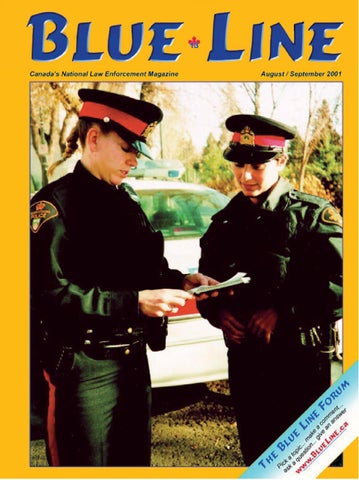
Volume 13 Number 7 August / September 2001
Inside This Edition Publisher’s Commentary A lesson learned a life now complete
5
Policing in the City of Bridges The Saskatoon Police Service steps into a new century
6
CACP Trade Show Guide Floor Plan and Exibitor List
10
Co-operation key to crime solving
12
Correspondence
14
Blue Line Magazine 12A-4981 Hwy 7 East Ste 254 Markham, ON Canada L3R 1N1
Ph: 905 640-3048 Fax: 905 640-7547 e-mail: blueline@blueline.ca
- Publisher / Editor Morley S. Lymburner e-mail: bluelinepublisher@home.com - General Manager Mary Lymburner, M.Ed. e-mail: bluelinesales@home.com - Managing Editor Mark Reesor e-mail: bluelineeditor@home.com - News Editor Les Linder e-mail: bluelinenews@home.com - Advertising Mary Lymburner Rhonda Shuker Bob Murray - Pre-press Production Del Wall - Contributing Editors Communication Skills Terry Barker Police Leadership Robert Lunney Tactical Firearms Dave Brown Technology Tom Rataj Case Law Gino Arcaro Blue Line Magazine is published monthly, September to June, by Blue Line Magazine Incorporated with a mailing address of: 12A - 4981 Hwy. 7 East, Ste. 254, Markham, Ontario, L3R 1N1. Individual magazines are $3.50 each. Subscriptions are $25.00 per year or $40.00 for 2 years. (Overseas - $50.00 U.S.) ©2001 - All articles are protected by copyright. No part of this publication may be reproduced or transmitted in any form or by any means, electronic or mechanical, including photocopying and recording or by any information storage or retrieval system without permission from the publisher. Internet activity is monitored and use or reposting of material on the Internet is restricted. All material submitted for publication becomes the property of Blue Line Magazine unless other arrangements have been made with the publisher. The authors, advisors and Publisher accept no liability whatsoever for any injuries to persons or property resulting from the application or adoption of any of the procedures, tactics or considerations presented in this magazine. Readers are cautioned and advised that articles presented herein are edited and supplied for your personal awareness and should not be used for further action until appropriate advice and guidance is received from a supervisor, Crown Attorney or other person in authority. Established in 1988, Blue Line Magazine is an independent publication designed to inform, entertain, educate and upgrade the skills of those involved in the law enforcement profession. It has no direct control from a law enforcement agency and its opinions and articles do not necessarily reflect the opinions of any government, police, or law enforcement agency. Blue Line Magazine is a private venture and as such is not funded through any level of government agency, union or association. Printed in Canada by Garson Graphic Services Inc.
- Affiliations-
International Association of Law Enforcement Planners Canadian Advertising Rates & Data International Police Association The Police Leadership Forum The Canadian Press Newswire Periodical Publishers Exchange
ISSN #0847 8538
Canada Post - Canadian Publications Mail Product Sales Agreement No. 176796 August / September 2001
Safeguarding against break and enters 16 London police create new community partnership program Technology and policing in the twenty-first century Part one of a two part series
18
The sister of a dead officer 22 speaks out on auto theft “There are many victems who silently sleep” The Last Noose New Brunswick
26
Promoting the Police Profession
28
Book Review
29
Defining your lethal force options
30
Public awareness cuts road deaths
32
The patchwork policing of Canada’s parks The arming of Federal Park wardens is put under the microscope
34
The Blue Line Forum
36
Park warden stopped 1930’s cop killing spree
38
Drug abuse resistance education at Topham School in British Columbia
39
Vitality
40
Toronto hosts IACP conference
44
Technology
46
Product News
49
Pawn sting uses donated goods
50
Combating fencing using BWI automation
51
BWI proving successful in Regina
53
Deep Blue Cop psychology - on the edge of your coffee cup
54
Blue Line Classified
61 3
The City of Bridges is hosting this year’s Canadian Chiefs of Police Conference; this month’s cover showing Saskatoon police constables Andrea Scott and Kim Colleaux was kindly supplied by that service. Saskatoon was originally policed by the RCMP but the Saskatoon Police Service has been around almost as long. Its history is not nearly as well known as the Mounties though. Kathryn Lymburner has done some digging and tells us what she found on page 6. Those heading to the CACP conference will want to take a look at the trade show floor plan and exhibitor list on pages 10 and 11. News Editor Les Linder tells us how the RCMP and Saskatoon police services are working together through an integrated drug squad. The story begins on page 12. Police departments have had to scramble to keep up with the bad guys in technology. In the first of a two part series, beginning on page 18, Lisa Garey tells us how the Calgary Police Service is adapting. The sister of a Sudbury police sergeant, killed in 1999 after laying down a spike belt to stop a stolen car, writes of her efforts to fight car theft. Marlene Viau, sister of Sudbury Police Sergeant Rick McDonald, calls her initiative ‘Project 6116" in recognition of Rick’s badge number. The article starts on page 22. Dennis Cole’s look at the pros and cons of using less than lethal force begins on page 30. Blue Line Publisher Morley Lymburner investigates why the federal government doesn’t think Canada’s federal park wardens should be trusted to carry sidearms. His piece starts on page 34; a look back at how an armed game warden stopped a cop killing spree in the 1930’s is on page 38. If your department could use some modern equipment, you won’t want to miss Tom Rataj’s look at the latest in law enforcement technology on page 46. Combatting the reselling of stolen goods is a lot easier with the BWI automated reporting system, a big improvement over the old paperbased system. That story begins on page 51. Blue Line Magazine
A lesson learned - a life now complete by Morley Lymburner In June I received this letter, written anonymously (at least as far as you my readers are concerned). This officer has spoken from the heart and his comments are worth sharing. He had hit what has been called “The FiveYear Wall” and has come out okay. For me I can sympathize. I’ve been there, but there are too many out there who can only envy his courage and survival. Over the last year or so family and friends had spoken with me and had told me I had been becoming very short and almost unapproachable to them. A total opposite of my former self. My psychological profiling on being hired as a police officer said I may have been ‘too nice’ and ‘easy going’ for the type of work I was about to embark on. The day a major case I was working on closed, was the day I sat back and realized that over the last year I had been slowly pushing others away, bottling my stress without even knowing it. Maybe I felt those close to me had enough of their own problems to deal with, without getting involved with mine. Perhaps I was too proud to admit I was struggling with my emotions. I had been involved in a relationship for about eight months with a woman I had planned on marrying, and spending the rest of my life with. Someone I felt who was truly my soul mate, someone I thought that could handle any problem, and impressed me everyday with her zeal for the unknown. Through poor timing or fate the day I realized what I had become, was the day the love of my life couldn’t take anymore. Unwilling to speak with me I had no recourse but to give her the time and space she now felt she needed. Since the break-up I had spoken to a counsellor on numerous occasions (something at one time I thought of as weakness) but now know was a life changing experience. I needed to put things in perspective. I figured this counsellor had seen it all having dealt with officers and civilians alike. The counsellor said many cops go through their whole careers without realizing what I now know. Hence the high percentage of divorce in our line of work. Until we realize how to communicate our feelings and emotions to our family and friends, we’re all at risk of someday losing touch, and alienating ourselves. As the stress built I felt its burden every time I spoke to others. “How could they understand”, I thought. Even those I worked with. Did they know what I was going through? What was their take on all of this? As police officers we’re suppose to be strong, respond to life threatening situations and make split second decisions. Most of the time many of us only truly think of the emotional side of things after the fact, when our adrenaline comes down and the criminal is behind bars or the injured child is now safe at the hospital. Over the last few months I have been putting my life back in order. I had made a list of all the things that had caused my stress. From the August / September 2001
smallest everyday thing to the largest life changing issues. I have since removed or reclassified these ‘stresses’, most of which are now not even an issue. In no way am I looking for sympathy for anything that has happened to me because I know I’m not unique in this situation. I’m just one of the lucky ones. I’ve realized what’s been happening to me. I feel many others are probably struggling with and may not even know it. If I can offer anything from this for others it is perhaps to learn to sit back and think about what is important in life. Prioritize and organ-
5
ize your family life, work and everything else you do day to day. What I now know is going to change the rest of my life, by making me a better person. My only regret is that it took me too long to understand what was happening to me and unfortunately it cost me the most important aspect of my life - the woman I love. If she came back tomorrow my life would be complete. Until then I’ll continue to work in the profession I chose. But most of all I’ll continue to help those around me find direction in their life and peace within themselves.
Blue Line Magazine
by Kathryn Lymburner Two police agencies are hosting this year’s Canadian Association of Chiefs of Police Conference in beautiful Saskatoon, Saskatchewan; the Saskatoon Police Service, of course. and the Royal Canadian Mounted Police (RCMP). Although the RCMP is world renowned, the Saskatoon Police Service is not as well know, even though the two forces histories are intertwined. Both agencies operate in the same region and have been around since before the turn of the last century but their beginnings are quite different. The RCMP, which was then called the North-West Mounted Police (NWMP), was created by Sir John A. Macdonald as a response to the growing problem of disorder and threat of violence in the north-western territories. A force of “Mounted Riflemen, styled after the Royal Irish Constabulary, trained to act as cavalry, but also instructed in the rifle exercise,” was created. The NWMP were given their legal authority by an Act of Parliament in May, 1873 and by an Order in Council that August; appointment of officers began immediately and by the following spring, the force had 275 officers and men, horses and equipment. Saskatoon’s founders dreamed of creating a temperance colony in the great North-West. Macdonald’s government, in a hurry to develop the country, was offering large locks of land to colonization companies. Many in Toronto’s Methodist community saw this as a golden opportunity to escape the evils of the liquor traffic. They formed the Temperance Colonization Society (TCS) in 1881 and signed up 3,100 would-be colonists for more than two million acres. By June, 1882 John Lake, a Methodist minister turned entrepreneur, was looking for a colony site on the banks of the South Saskatchewan River. In 1883 the first streets of Saskatoon were surveyed on the east bank of the river, just above Minnetonka. In spite of this hopeful start, Saskatoon grew slowly. The river was too shalAugust / September 2001
low and too full of shifting sandbars for easy navigation. As well, fear of native hostility caused by reports of the North-West Rebellion in 1885 discouraged settlement. It was also around this time that the NWMP established a detachment in Saskatoon. The first and only crimes that were reported to this detachment involved the smuggling of alcohol and the occasional drunk. In 1889, Constable Clisby of the NWMP was appointed to the detachment as Saskatoon’s first permanent police officer. The detachment became a permanent part of Saskatoon in 1903 when a concrete building was created to house the police station, fire hall and serve as the town hall. In 1907, it became necessary for the Saskatoon detachment of the NWMP to create its own law enforcement agency. Robert E. Dunning was installed as the first Chief of Police. By December 22, 1910, when the first rules and regulations of the Saskatoon Police Department were approved, the force employed ten members, including a chief, deputy chief, two sergeants, five constables and one detective. The small Saskatoon detachment purchased a paddy wagon for $500 and installed a system of street lights to aid patrolmen in 1912. The force, now called the Saskatoon City Police, began an identification section in 1920 when the first photographs and criminal records were filed. Its fleet now consisted of three vehicles — the paddy wagon, a car for the chief and a motorcycle. Working conditions were very difficult at this time, with members expected to supply their own equipment and ammunition. Firearms were issued only to officers and night beat constables and each member was allowed one day off every two weeks. A new police headquarters building opened in 1930 was capable of housing 34 prisoners — 32 male and 2 female. The force by this time had grown to 41 officers. In 1940, the Saskatoon Police Service became one of the first police departments in Saskatchewan to obtain a radio system. This newly invented two-way radio system was installed 6
in the Police Headquarters Building and a mobile set was kept in the Chief’s car, the patrol car and in the detective car. The ’40s also saw the creation of the Saskatoon Police Hilmer Rifle Club, which was formed to address damage caused by youths with firearms and air rifles. The club has taught firearms safety to some 10,000 young people since its founding in 1947 and began a trend to create more programs to better inform and protect the community. The force had 115 sworn members answering almost 21,000 calls for service by 1960 and added a canine unit — Sgt.Vern Passet and his white German Shepherd “Tonka” — in 1963. The ’70s also brought many changes to Saskatoon; the first female officers were hired in 1973 and the concept of community policing was introduced. Officers were assigned to a district for one year or more so they could get to know the district, people and problems and develop a positive relationship with the public. The polygraph was introduced in the ’80s as an investigation aid and shifts were switched from an eight to a 12-hour patrol schedule. A four platoon structure of A, B, C, and D was also incorporated at this time. This decade also saw the introduction of the Crime Stoppers program in Saskatoon, and the placement of Mobile Data Terminals (MDT’s) in patrol vehicles and the Computer Aided Dispatch (CAD) system for dispatch calls by computer instead of radio. The past decade has brought the most change to the Saskatoon Police Service. In 1991 A. Owen Maguire was appointed Chief of Police in Saskatoon. The name “Saskatoon Police Service,” was formally adopted in 1992 along with its current mission statement, “In partnership with the community we strive to provide service based on excellence to ensure a safe and secure environment.” The Riversdale Experimental Police District was opened as a volunteer based initiative to reduce crime and the “fear of crime” in the Riversdale area. Bicycle Detail was also created the same year, and seven police members were assigned to duties on bicycle. Blue Line Magazine
The Victim Services Unit was organized to help deal with victims of crime. This program allowed volunteers to phone victims of crime to offer assistance, information and referrals to other agencies that would be beneficial to their situation. An Aboriginal Liaison Officer was created to start better communication between the aboriginal groups in the area, and the police service. Also, the Cultural Relations Committee and First Nations community began hosting events. Officers were involved in planning, hunting, food preparation and cultural ceremonies at these events. In 1996, Dave Scott, a veteran of the force, was appointed Chief of Police in Saskatoon. And in 1997, the Saskatoon Police and RCMP joined to create the Integrated Drug Unit, housed in the Saskatoon Police Headquarters. A program to initiate contact in inner city schools was also established, and the Community School Liaison program began. An officer is assigned to an inner city school to work with both the school and the community to deal with problems that are prevalent there. Four members of the force were placed in the inner city schools. Of recent note, is the creation of the Serious Crime Unit, which has allowed police to target activities of criminal groups. The Police Venturers program, was also introduced, and is geared towards teens interested in policing, giving them an experience in law enforcement. With the creation of SHOCAP, the Serious Habitual Offenders Comprehensive Action Program, an inter-agency approach to dealing with serious young offenders and monitoring at risk youths was started. This particular program is a showcase for inter-agency cooperation. The history of both the RCMP and the Saskatoon Police Service have been historically linked and as both have evolved over the past century neither agency has forgotten their roots. Although both have had their growing pains it is certain that in the broad historical analysis both agencies can take pride in their accomplishments and in their service to the communities they are sworn to serve and protect.
The city of Saskatoon, with a population of 205,931, is located centrally in the Province of Saskatchewan. As of 1999 the Saskatoon Police Service consisted of 312 police officers (281 male and 31 female) and 117 civilian and support staff for a total of 429 members. The police to population ratio is 660 citizens for each officer. The police budget for 1999 was around $32 million. This breaks down to a per capita cost of $155. The Saskatoon Police reported that on average each officer in the agency investigated 81 Criminal Code incidents during the year 1999. The total number of Criminal Code offences recorded with the police was 25,406. The police service reported a 23% clearance rate on property crimes and 63% on crimes of violence. Overall there was a 1% decrease in crime over the previous year.
August / September 2001
7
Blue Line Magazine
The First graduating class, Police Leadership Program, Rotman School Back row, from left to right: Superintendent Edward Toye, Peel Regional Police; Superintendent Brian Mullan, Hamilton Police; Inspector Paul Tetzlaff, Peel Regional Police; Superintendent Bill Stephens, Windsor Police; Superintendent Lynda Smith, Ottawa Police; Superintendent Ian Davidson, Greater Sudbury Police; Staff Superintendent William Blair, Toronto Police; Superintendent Ken Leendertse, Hamilton Police; Superintendent Eric Jolliffe, York Regional Police; Inspector Mike Osborne, Midland Police; Superintendent Chuck Mercier, Durham Regional Police and Deputy Chief Michael Brown, Sarnia Police. Front row, from left to right: Superintendent Kevin Chalk, Waterloo Regional Police; Detective Superintendent Ken C. Smith, Ontario Provincial Police; Inspector Susan O’Sullivan, Ottawa Police; Jim Fisher, Associate Dean, Executive Programs, Rotman School of Management, University of Toronto; Dan Ondrack, Professor of Human Resources Management, Rotman School of Management; Hon. Bob Rae, Instructor, Rotman School of Management; Joseph R. D’Cruz , Academic Director, Police Leadership Program and Professor of Strategic Management, Rotman School of Management; David Beatty, Adjunct Professor of Strategic Management, Rotman School of Management; Ramy Elitzur, Associate Professor of Accounting, Rotman School of Management; Anthony R. Turner, Instructor, Rotman School of Management; Deputy Chief Ron Bain, Peel Regional Police and Chair OACP Training Committee and Inspector Mike Armstrong, Ontario Provincial Police. by Kathryn Lymburner Today’s police service leaders are CEOs of multi-million dollar law enforcement organizations and require more of a business degree style training. Experienced police officers need to be prepared for the business aspect of senior leadership roles. The University of Toronto’s Rotman School of Management has answered this need with an intensive four-week police leadership program designed by the Ontario Association of Chiefs of Police (OACP) and the Rotman School. The first 16 participants graduated in May. “Policing is not a business, it’s a service,” notes one of the graduates, Susan O’Sullivan of the Ottawa Police Service, “but there is a lot we can learn from the business community and use as tools to do things better.” With that in mind, the OACP and Rotman worked with chiefs and faculty to design a program which allows participants to develop their leadership abilities in visioning, strategic-thinking and organizational development. Participants learn how to better understand the political, social and economic forces that influence the police service operating environment and develop the skills needed to deal with politicians, the media and public interest groups. The course helps participants develop personal leadership skills and improve their management abilities. August / September 2001
Key components of the executive level training include sessions on how to understand and manoeuvre within the current political environment, political astuteness, human resource management, strategy, leadership, communications, community knowledge, infrastructure and financial management and police service delivery. The program is very demanding; classes begin at 8 a.m. and extend well into the evening but time is set aside for individual and group review and there are breaks throughout the day. Through a combination of in-class instruction, peer-based learning, simulations and roleplay, team projects and individual assignments, participants are given the opportunity to learn from a variety of sources. Guest speakers include Toronto Police Services Chief Julian Fantino, RCMP Commissioner Gullano Zaccardelli, OPP Commissioner Gwen Boniface and former Ontario Premier Bob Rae. Participants also learn from each other, says 9
Chuck Mercier of Durham Regional Police. “The candidates attending the school are police leaders so as well as collecting knowledge and information that is presented to you by the faculty at the school, you are also sharing information with colleagues from around Ontario. “The benefit of taking this course,” says Mercier, “is that it gives you insight in these areas. There are obviously other methods of gaining this knowledge, but this course is specifically done in a police leadership environment.” The course was specifically designed for experienced police executives with a previous record of achievement who want to move into the senior levels of police command and management. Participants typically have about ten years of police experience, an ability to take on increasing responsibilities and the potential and desire to move into command positions within their agency. Participants are nominated by their chief or commissioner and have to be sponsored by their department to be admitted into the program. Laptop and computer skills are necessary.
For more information, contact the school by phone, (416) 978-6481, fax, (416) 978-5549 or e-mail: exceed@rotman.utoronto.ca. Blue Line Magazine
Trade Show Guide 96th Annual Conference Canadian Association of Chiefs of Police August 19-22 Centennial Auditorium Saskatoon - Saskatchewan
TRADE SHOW EXHIBITORS ADT Security Services Booth 36 Ahearn & Sopir Inc. Booth 65 Atlantic Police and Security Supply Booths 67, 68 Blue Line Magazine Booth 122 Blue Max Lighting and Emergency Booths 109,164 Boston Whaler Commercial Boats Booth 107 Brewers Association of Canada Booth 63 Burtek Systems Booth 21 C.A.L.E.A. Booth 94 CACP Booth 132 Canadian Police Research Center Booth 58 CN Police Booth 117 Cogent Systems Inc. Booths 85,91 Command System Inc. Booths 8,9 Corporate Security Supply Ltd Booth 4 Correctional Service Canada Booth 5 CVDS Booth 158 Dacks Booth 47 Dalgas Enterprises Inc Booth 87 davTech Analytical Services (Canada) Booth 34 Dept of Justice Canadian Firearm Booth 16 Dictaphone Canada Booth 12 Draeger Canada Ltd. Booth 20 EDS Booth 54 Eurocopter Canada Ltd. Booth 78 August / September 2001
10
Evin Industries Ltd. Booth 10 FATS Booth 32 Federal Signal Corp Booths 90,96 Flir Systems Ltd Booth 64 Ford of Canada Booths 74,75,80,81 Frontline Tactical Products Booth 152 G.M. Defence Booth 6 Galls Inc. Booth 3 Glock,Inc. Booth 73 Gordon Contract Footwear Booth 102 Groen Brothers Aviation Booth 146 Guardian Interlock System Booth 27 Harley Davidson Canada Fred Deeley Booth 31 Highway Help Program Booth 129 Hi-Tec Sports Canada Ltd. Booth 24 Hi-Tec Intervention Inc. Booth 99 i2 Booth 15 Imagis Technologies Inc Booth 22 Ion Track Instruments Booth 17 Kaos Solutions Booth 166 Law Enforcement Torch Run Booth 126 LiveLink Training Network Booth 87 M.D. Charlton Booths 83,84 Maritime Services Booth 120 Marks Work Wearhouse Booth 29 Blue Line Magazine
Martin & Levesque/ Blauer Booth 97 Medtronic Physio Control Canada Booth 30 Megatech Booths 171 through 179 Michaels of Oregon Booth 79 Microsoft Canada Booth 180 National Crime Prevention Centre Booth 33 National Police Service Booths 55,56,57 Niche Technology Inc. Booth 181 Nine One One Outerwear Booth 72 Ontario Sex Offender Registry Booth 88 Our Software Ltd Booth 53 Outdoor Outfits Booth 103 Pacific Safety Products Inc. Booth 7 Panasonic Canada Inc. Booths 51, 52 Positron Public Safety Systems Booth 1 Print West Booths 61,62 Printrak International Inc. Booths 18,19 Quebec City Police Booth 131
RCMP Cdn Law Enforcement Training Booth 86 R. Nicholls Booths 38,39,40,41,42,43,44,45 RCMP Veterans Association Booth 2 SaskTel Booth 100 Schweizer Aircraft Corp Booth 35 Second Chance Body Armour Booth 98 Simunition Booth 165 Space Cannon Illumination Inc. Booth 108 Streamlight Booth 69 Transport Canada Booth 116 U of R Police Studies Program Booth 13 Versaterm Booth 11 Whelen Canada Booths 48,49,50 Winchester Ammunition Booth 28 Xwave Booths 169,170 Yamaha Motor Canada Booth 14 Youth Justice Policy, Dept of Justice Booth 55 For further details go to BlueLinks at www.blueline.ca
For further details go to BlueLinks at www.blueline.ca
August / September 2001
11
Blue Line Magazine
Co-operation key to crime solving “We didn’t want the jurisdiction of those officers to end at the border. We work as a team and need to stay as one.” Once the decision is made to pursue an investigation, a plan is put together of what it will look like and what the cost is. A copy of the plan goes to both departments by Les Linder for approval and to find a fair sharing of costs. The RCMP and Saskatoon Police Serv“Typically we would split the ice have set aside their egos to integrate cost evenly for both departments,” several of their units and work cooperaPearson said. “However, if it’s tively for the sake of efficient law enforcemore of an RCMP project, then ment. probably 80 per cent would be covAfter both forces recognized there was ered by us and 20 per cent by the an overlapping of effort in policing city.” Saskatoon’s approximately 200,000 citiPearson feels the unit’s greatzens, they knew changes were needed. Drug est accomplishment comes from investigations, intelligence gathering and their ability to not see themselves gang investigations were being done by both as separate forces, no matter how agencies during the 1990’s, resulting in unresources are distributed in invesnecessary costs and inefficiency. tigations. The RCMP and Saskatoon Police “In the world of policing Service took their first step at eliminating where egos and territory are a huge those redundant investigations by June, issue, it is simply amazing how 1997. well we have accepted each other and fully integrated,” Pearson said Integrated Drug Unit with a laugh. RCMP Staff Sgt. Rick Pearson, a 36- Saskatoon Police officers Keith Briant and Derek Baule are He also said the integration is year veteran of the force, was made unit shown here from a 1993 photograph illustrating new winter an advantage to taxpayers as the commander of the Saskatoon Integrated gear during a “Saskatchewan Chinook” at minus 33. This money is being spent in what he Drug Unit (SIDU) in 1997 as a first step to photo was used as a Blue Line Magazine cover shot in the feels is a more efficient way. improving efficiency. “By sharing equipment such February 1994 issue. “Combining our drug unit with the as computers, vehicles and support city’s unit was really the most logical thing to to applying everyone’s policy. We’ve adopted services, the unit manages to save resources by the approach that our decisions are based on not having to spend it on separate sets of equipdo,” Pearson said. “The Saskatoon force members have excel- whether what we do is legal, moral and ethical. ment.” lent knowledge of the community since they “We really don’t care much about what the More impressive, perhaps, is how well the live here full time, whereas RCMP officers al- policy may say because it can choke off the municipal force handled the idea of having the ways transfer and were at a disadvantage when enthusiasm and good ideas, as it tends to do so RCMP oversee two of the investigative teams. it came to understanding the community.” much of the time.” “Each department has their own culture and Pearson also has an agreement with the unit ego and none of them want to give that up to By integrating the two units, they could pool resources and share the municipal force’s that he has no control over the career develop- somebody else,” he said. “We’re miles beyond knowledge of the community. ment, training or transfers of the municipal of- that though and it is not even an issue. I’m When the SIDU was formed, one of the ficers. really pleased with how broad-minded these first things that needed to be decided was “This keeps things tidy within the unit and officers are. They are a pleasure to work with.” whether to locate the unit in a RCMP office or prevents any sort of tension or discomfort amongst the team,” he said. the Saskatoon Police Service building. Intelligence Unit “We quickly realized that there was a much The unit is made up of three teams of inAfter witnessing the success of the SIDU, greater value in being located within the city vestigators with 20 personnel. Two of the teams Saskatoon’s intelligence unit decided to follow police building. The core of all police activity are run by RCMP supervisors and one by a suit and integrated with the RCMP in April 1999. and community knowledge rested there,” Saskatoon force supervisor. All three teams conSaskatoon Police Service Sgt. Gary Pearson pointed out. sist of both Mountie and municipal officers to Dwernychuk is co-commander for the eightDeciding who was going to be in charge ensure a wide array of knowledge and skills. member Saskatoon Integrated Intelligence Unit was a more sensitive issue to be dealt with. City police officers were also sworn in as (SIIU) and says the units were merged for many “It was eventually agreed that it would be federal officers under the RCMP Act and have of the same reasons as the drug units were. the RCMP because we have a federal infra- peace officer status outside of Saskatchewan. “We were both doing a lot of the same work structure in place and it would be somewhat “The officers were given that status for civil and we had been figuring for a while that it difficult to have the shots called by a municipal protection in the event they need to do a search might be a good idea to join together,” in another province or when they need to carry Dwernychuk said. “The drug unit had some employee,” he said. However, Pearson quickly added that even a sidearm,” Pearson said. great results with RCMP, so we put our heads though the Mounties are in charge of the unit, An agreement was also made that once an together with the Mounties and figured we all RCMP policies were left behind at the old investigation outside the province is begun, would give it a try.” office when the move was made. Saskatoon officers can participate until the end He pointed out the key benefits were the “These partnerships don’t run by trying of the investigation. elimination of overlapping work and sharing of August / September 2001
12
Blue Line Magazine
resources which allows the unit to focus more closely on a case. The unit primarily investigates biker gangs such as the Hells Angels, as well as Asian gangs, aboriginal organized crime, street gangs and scams frequently operated by eastern European refugees, he said. Much like the integrated drug unit, Dwernychuk believes the SIIU’s greatest success is how well the members from both forces meshed together. “We were all really glad to see that we ended up working well together and that it was a positive experience like that of the drug unit.” While Dwernychuk said he believes the unit is successful at the work it does, one thing always difficult for the intelligence unit to judge is actual success by convictions. “We play a support role rather than a direct one, which can make it hard for us to build up some recognition and eventually grow. It can be hard to say exactly how many convictions were made due to our work. I’m hoping though that once other units become more aware of the work we do, we’ll be able to expand and become involved in more projects.”
the criminal’s profits against them and a good portion of the funding for the unit comes from the proceeds of crime. “I think we’re seeing a move away from the past where we would go to taxpayers for funding for these programs,” Morgan said. “There is no reason why the public should have to pay for these units when we can just use the profits made by criminals against them. It benefits the public and hurts the criminals, which is exactly what we want.” However, taking apart organized crime groups is not the unit’s only mandate. Targeting the problem before it can grow into one that is out of control is equally important, Morgan stressed. “Once these criminals start moving their
illegal gains into legitimate or semi-legitimate businesses, our investigations become much harder to do. We have to get them before they can begin money laundering and that’s what we’re aiming to do.” With the increased efficiency and cooperation from the integrated units, coupled with the Organized Crime Unit, Morgan says he feels confident that the RCMP and Saskatoon Police Service are going to make some noticeable changes in the province. “We’re all working together so well as a team, it truly is remarkable,” he said. “With each successful prosecution and conviction, I can see all of us growing over the years and making some serious impact on organized crime. Just wait and see.”
Organized Crime Unit Complementing the SIIU in its fight against organized crime is the Saskatoon Organized Crime Unit. Sgt. Gavin Morgan was given command of the unit, which was designed to shutdown organized crime groups in Saskatoon and the surrounding areas, in March. “While we aren’t an integrated unit, we end up doing a lot of liaising with the RCMP and other integrated units when we do operations in the city or surrounding areas,” Morgan said. The Organized Crime Unit also shares resources and funding with the Mounties and integrated units when working together on a case. Since its inception in April 1999, the unit has completed nine joint-forces operations with the RCMP, the most recent involving 115 charges to 10 people in a stolen property ring which had over $1 million in stolen goods. “The nice thing about our unit is that it allows for long term projects. It is more organization-oriented rather than focusing on a single specific charge.” The unit looks for criminal patterns to patrol and concentrates on the criminal organization as a whole. Rather than pursuing individual charges, the unit aims to strip crime groups of their profits to shut them down. Prior to the new unit, this was difficult due to manpower limits, Morgan added. “Our problem in the past was that one person would be responsible for several organized thefts. We would catch them for one theft and it would be seen as a smaller crime in the eyes of the court. “The accused would plead guilty and just move on. Now we have the option of working on these people as a project and can move a little farther to shutdown a lot of them at once on bigger charges.” One of the program’s mandates is to use For further details go to BlueLinks at www.blueline.ca
August / September 2001
13
Blue Line Magazine
I was reading an article in Blue Line that has caused me some concern. The article is on page 24 of the April 2001 issue and was written by Les Linder. His article quotes the “ RCMP Member’s Association” President, Gaetan Delisle on the issue of acting alone. Delisle states that there is pressure on members not to call anyone out to assist them as this will incur overtime and that if the member does this, “Their evaluation ends up suffering and they limit their chances of being promoted.” ( how this hurts an exam score I am not quite sure?) He further goes on to stress, and rightfully so, the need to address the safety of the membership. Not many things tic me off, but this did. For him to insinuate that a members life is not worth a three hour call back is nothing less then ridiculous. To then paint our membership with a brush of indecision and inability to make a decision is in my opinion not giving the members the credit that they are due. There is no doubt that there are times when some of you have questioned calling someone out, but that is only analysing not indecision. I feel compelled to reiterate to all of you that the policy of this District and the feelings of every NCO, is that your safety is worth far more to us then three hours of overtime. If any of you need assistance and don’t call anyone out, then you can look for your assessment to be adversely affected. We have no room for “Tombstone Courage”. I am sure that Gaetan Delisle felt that he was trying to help the membership by putting pressure on the Force to deal with the larger issue of resourcing but in my humble opinion, he could have used another avenue and these types of comments can sometime do more damage than help. Thanks for letting me vent....... Sgt Mitch McMillan Ops NCO, District 7 Woodstock New Brunswick In response to your commentary in regards to the perception that uniform policing is not a desirable posting any more (“Bring back the cadets” May 2001, pg. 22), I would like to suggest that the answer is not in bringing back the cadet rank, but a return by management to the
attitude that uniform policing is the most important function in the police organization. In my opinion, the patrol function in some organizations has evolved into the posting where members are not treated with any kind of priority basis. It always seems like the patrol officer is the last to be considered for a training course, last on the list for leave approval, assigned the car that should have been junked a long time ago and given second hand equipment. Whenever the organization has a staff shortage, the patrol team goes without while the specialized teams stay at full strength. Whether it is fact or not, this is the perception. There is also the issue of supervision. Supervisors and the public may be very quick to criticize a member yet very slow with praise. The uniform makes him more visible and likely to attract attention in this regard. Some senior officers may be unlikely to attend a briefing for the patrol shift, yet are regularly around when support sections have a meeting. Trust is another factor that has to be considered. The patrol constable has to sign out a portable, sign out his car and sign for film for his camera. Flashlight batteries, cassette tapes and other essentials are locked up and a supervisor is needed to get access. Of course, the patrol constable probably has to supply his own tape recorder and camera, since a patrol constable can’t be trusted with those items. I once had a supervisor tell me that only supervisors were allowed to have crime scene tape in their cars. The patrol constable is under pressure to book on quickly at the start of a shift and start taking calls. The pressure continues for him to stay on the road and continue to take files and then he is criticized for not checking his voice mail or being up-to-date with his paperwork. There are many issues to consider, I could go on forever with examples. The point is that the patrol function has become the place where few people want to be. Television and movies are partly to blame but police management has a role as well. It is not hard to see how this all adds up to a feeling of low self esteem amongst the patrol members. Patrol should be the backbone of the organization in words, deeds and priorities. It is hard to feel good about the job you are doing
when your management treat you like the fodder they walk on. The patrol constable position should be a desirable one and treated with the respect it deserves. Name withheld by request I am writing in response to an article entitled “Intelligent digital tailoring” by Tom Rataj (April 2001, pg. 18). The article is well written, factual, and informative. Unfortunately, it leaves the reader with the impression that the technologies described were developed solely by Dr. Shi Yin and his company VisImage and fails to mention that the technologies are actually owned by the Crown, through the Department of National Defence (DND). The ICESS development and the companion FootScan and HandScan technologies were actually conceived by Mr. Pierre Meunier, P.Eng, of the Defence and Civil Institute of Environmental Medicine (DCIEM). DCIEM is a Research Establishment of Defence R&D Canada, an agency of DND. Dr. Yin has been a DCIEM contractor for several years, hired to work under Mr. Meunier’s direction on the development and subsequent enhancement of ICESS and its related products. His work has certainly added value to the technologies. In recognition of this contribution, VisImage has been awarded a license from DND to commercialize and market the technologies in return for royalty payments and other considerations to the Crown. Unfortunately, when Tom Rataj interviewed Dr. Yin at DCIEM and received a demonstration of the intelligent digital technologies, Mr. Meunier was away on temporary duty. Brian H. Sabiston, PhD Manager - Business Development for Director General As a member of the RCMP for just under 30 years, I have served 15 of those years in Nunavut, Northwest Territories and Yukon. I found the article “Mounties pressured to act alone, association says” (April 2001, pg. 24), to be seriously flawed. Gaetan Delisle has either been badly misquoted or misinformed. His quote, “now what do you think happens should they ever have to call for help from an overtime officer? Their evaluation ends up suffering and they limit their chances of being promoted,” is ridiculous. Excerpts from the story, “…they are pressured not to call for assistance…” and “…under pressure to handle calls alone because calling for backup can be costly for the RCMP,” is misleading and far from the truth. I will concede we still have the occasional detachment commander who believes overtime payment is coming out of his or her pockets but these people are far and few between. Most detachment commanders I have known over the years have a simple informal policy that goes something like this: “If the call is alcohol related or there is any hint of violence, or there are unknown elements with re-
For further details go to BlueLinks at www.blueline.ca
August / September 2001
14
Blue Line Magazine
spect to the call, then a second member is called in and a third if required.” I know of no member who was ever under pressure not to call in overtime back up. I have never heard of a promotion being denied because a member called for overtime back up. I think it would be well advised for police officers who are spokespersons or presidents of various police associations to seek a consensus from their membership before making generalized statements. I, for one, cannot help but think the absurd statements I read in (the) article are based on an individual grievance. Cpl. Ken Putnam
page 24 of the April Blue Line titled “Mounties pressured to act alone, association says.” Gaetan Delisle represents a small number of members from Eastern Canada and does not represent me or any of the members that I work with or have worked with. I have worked in a three member detachment and at no time did I feel that I was under pressure to handle calls alone because (of) a concern about incurring overtime. When an incident did happen, the first consideration was the safety of the member, so if more members were required, than more were called. The funding was always available and no member was
ever criticized for this type of overtime expenditure by having negative comments made on his/ her annual assessment. The management I report to is very aware and concerned about the safety of the members. Members who work in the smaller detachments are there by choice and understand that in order to best meet the needs of the community they serve, they must be truly flexible. Perhaps things are done differently in areas of Canada where the RCMP does not have a contact with the province. K. Sellers 100 Mile House Detachment
Editor’s Note: Gaetan Delisle was not misquoted in the article. I am writing in reference to your two articles: “Law Enforcement in the north”, and “Mounties pressured to act alone” in the April 2001 edition of Blue Line. I found the articles to be excellent and very informative to me. I am a program officer in the enforcement branch of the Federal Department of Fisheries and Oceans. I have been trying, with little success, to develop a working alone policy for our fishery officers for some time now. As you may know, we have a total of about 700 fishery officers spread across Canada, mostly on the two coasts and in the north. With our small number of officers, the remote northern locations, and the ever rising violence in the fisheries, our concern over officers working alone has risen in recent years. Dave Kay I enjoy Blue Line Magazine and appreciate the articles. Just a quick note with regards to Danette Dooley’s reference concerning The Royal Newfoundland Constabulary being one of the oldest police forces in North America. The RNC is the oldest police force in North America and it’s origins date back to the year 1729. Again keep up the good work with this most enjoyable magazine. I would like to comment on the article on
August / September 2001
15
Blue Line Magazine
Safeguarding against break and enters London police create new community partnership program by M. Blair Harvey The London Police Service has instituted a new and unique crime prevention program to tackle the more than 2,300 residential break and enters in the city last year. Project Safeguard is a new community-based crime prevention initiative using police volunteers and community partnerships. Uniformed members of the London Police Service volunteer Auxiliary Police Section began visiting neighbourhoods throughout London in May, offering free, hands-on home security audits involving a basic assessment of the areas which make homes most vulnerable to break-ins, including points of entry, lighting, visibility, landscaping and security features. A comprehensive information package is delivered at the completion of each audit which includes a copy of the audit form and information on home security and safety collected from police, fire and ambulances services, CrimeStoppers and the Home Finder high visibility address plates program. Staff Sgt. Kevin Heslop came up with the idea for the new initiative while with the police service’s patrol support section, which includes
the auxiliary police. Heslop reviewed the service’s business plan and noted the need to better train and utilize the auxiliary and for the London service to “increase (our) responsiveness to victims of crimes and develop strategies to prevent our citizens from becoming targets of criminal activity”. Heslop received approval for a member of the uniformed branch to be temporarily assigned to Project Safeguard to attract support from the community and make the program a reality. Home Depot Canada became the principle supporter and paid for the program’s development and implementation. Southwest Chrysler and Thames Emergency Medical Services combined to provide a 2001 Dodge Caravan for use by the volunteers. The van also acts as a travelling billboard to promote the activities of the police volunteers and the program and recognizes project sponsors, whose corporate logos are prominently featured on each side of the vehicle. Since Project Safeguard is a new program, the need to promote it was recognized as vital to its overall success. Sponsorship was sought out and provided by About Design Incorporated, the City of London and Artcal Graphics and Screenprinting. A full colour promotional brochure, specially designed graphics for the van, web page and five minute video were de-
veloped. The video has been used to publicize the program within the community and police service and explains its basic concepts. The volunteers received more than 20-hours of instruction by the service’s crime prevention staff, including classroom lectures, guest speakers and off-site training, helping them to complete accurate and effective home security audits. The course was based on the Ontario Solicitor General’s ‘Partners Against Crime Home Security Audit Guide’ and included an outdoor lighting tour and a visit to the Home Depot to learn about home security products. Neighbourhood Watch London is also a key community partner for Project Safeguard; program coordinators have completed the home security training and are able to field inquiries from citizens regarding the project. The more than 10,000 volunteers involved in the London Watch program were a terrific resource for the promotion of the project throughout the community; 76 per cent of residential break and enters in London occur in areas not involved in the program. With police resources stretched to the limit, the program wouldn’t have been possible without the commitment and dedication of the auxiliary police volunteers who made Project Safeguard a reality. As the year progresses, it will continue to grow and develop into a very valuable crime prevention initiative. Cst. M. Blair Harvey is a member of the London Police Service and has served as the coordinator for Project Safeguard since December. For further information on Project Safeguard, please contact the London Police Service Community Services Unit at (519) 661-5680 or visit the London Police Service Internet web site at
The city of London, with a population of 340,205 is located in Southwestern Ontario. As of 1999 the London Police Service consisted of 423 police officers (375 male and 48 female) and 167 civilian and support staff for a total of 590 members. The police to population ratio is 804 citizens for each officer. The police budget for 1999 was around $43 million. This breaks down to a per capita cost of $129. The London Police reported that on average each officer in the agency investigated 67 Criminal Code incidents during the year 1999. The total number of Criminal Code offences recorded with the police was 28,202. The police service reported a 27% clearance rate on property crimes and 80% on crimes of violence. Overall there was a 2% increase in crime over the previous year. For further details go to BlueLinks at www.blueline.ca
August / September 2001
16
Blue Line Magazine
Technology and policing in the twenty-first century Part one of a two part series
by Lisa Garey The Calgary Police Service has been progressive in using new technologies for more effective policing, but financial constraints and the ever-changing nature of technology make it increasingly difficult to stay current. It’s difficult to keep up with “bad guys”, who have few financial constraints and can afford to buy all the “toys” needed to commit more sophisticated computer crimes. Technology can also be used by criminal offenders to evade police. As globalization dissolves geographic boundaries and the Internet becomes a popular vehicle for crime, investigating offences and securing criminal charges become more difficult.
The Globalization Of Crime Perhaps one of the biggest challenges police will face in the coming years is the question of who should investigate cybercrime. Unlike police agencies, the Internet has no geographic boundaries. A perpetrator of Internet child pornography distribution may have victims from every country in the Western Hemisphere. A situation like this begs the question: who investigates the crimes of this perpetrator? It is a question police will be encountering more often in the coming years and the answer is likely to be pondered by legislators and police officials for some time.
In the meantime, police agencies must be prepared to share information with colleagues around the world and make every attempt to expand available resources to fight cybercrime. The increasing globalization of crime is leading to the consideration of national strategies to manage and prevent the spread of technologyenhanced crime across Canada. Due to the high cost involved, and issues surrounding jurisdiction, municipal and provincial policing agencies won’t be able to fight cybercrime without the aid of larger federal agencies, such as the RCMP. Examples of national preparations being made to combat all types of crime, including cybercrime, are: CPIC Renewal Project, co-ordination with Internet Service Providers, and Positive Police Internet Use (PS3). The CPIC Renewal Project was initiated to modernize files and to find new uses and clients for its services. The broader issue surrounding this project is that a national strategy toward sharing police information is under development. The CPIC Renewal Project is expected to be completed in the next three to five years. The Criminal Intelligence Service of Canada (CISC) is responsible for the coordination and dissemination of criminal intelligence information across Canada. In CISC’s 2000 Annual Report on Organized Crime in Canada, the Service notes hackers and organized crime groups are taking advantage of the unpoliced anonymity of the Internet and its global audience. The G-8 and the Council of Europe are addressing this issue internationally. Furthermore, the Canadian law enforcement community and the Canadian Association of Internet Providers have apparently renewed their relationship to address this and other issues of concern related to the Internet Service Providers (ISP) industry. Police agencies must be prepared for new legislation to arise out of these discussions.
Positive Police Internet Use (PS3) describes a concept currently being developed by the Canadian Police Research Centre which will encourage and support Information Technology (IT) development amongst police departments across Canada, and potentially, North America. It is a first step toward uniting police departments - big and small - and providing them with better access to all new technologies. It will also enable smaller police departments to investigate Internet crimes, something which is often passed along to larger federal agencies. These national strategies will encourage information sharing among municipal police agencies. While there are more than 19,000 law enforcement agencies in the United States alone, no state has a fully integrated criminal justice information system, resulting in very little information sharing across jurisdictional borders. Several technologies are currently being explored and implemented to assist police in sharing information. Internet technology, for example, has become an essential communication tool for police departments worldwide. US and Canadian police departments with 500 officers or more were questioned on website construction and maintenance in an April, 2000 survey (Tully & McKee, 2000). The response rate was 58 percent, with 67 of the 68 departments replying indicating they maintained a website. Objectives for their sites included educating the public about the organization, fostering better public relations, communicating with the public through email, and employee recruitment. Obviously, most police departments use the Internet as a community-policing tool, to liaise and share information with community members. One innovative community policing application for the Internet is as a public re-
For further details go to BlueLinks at www.blueline.ca
August / September 2001
18
Blue Line Magazine
source for online security information. The Calgary Police Service publishes an Internet safety pamphlet which advises parents and children on the dangers of the Internet. The literature covers a broad range of issues such as inappropriate and offensive content of websites, Internet fraud and electronic harassment. It also directs readers to a web address, attached to the Calgary Police Service website, which provides parents with more information on Internet safety and offers children a fun and interactive way to learn about protecting themselves. With the increasing number of Internet-related complaints police are receiving, it is important to teach the public about ways they can protect themselves. An online survival guide is one solution. The FBI has recently taken steps to combat cybercrime by establishing a secure website to notify companies of potential Internet-related threats. Encrypted email and a secure website have been set up so that the FBI and participating companies can warn each other about new hacking attempts, computer viruses and other Internet-based criminal activity. With the increasing globalization of crime, law enforcement agencies will be expected to improve existing data management systems to handle growing demands for cross-jurisdictional support. Alberta law enforcement agencies have recently launched a joint project to share information and integrate police data. All agencies have agreed to purchase case management software from the RCMP. The software, called Evidence and Reports III (E&R-III), is designed to allow officers and analysts to keep track of investigative information and responsibilities and is compatible with i2’s Analyst’s Notebook, an analytical tool used by most Alberta police agencies. E&R-III and Analyst’s Notebook will aid Alberta police officers in sharing information in a timelier fashion and improve the manner in which information is stored and retrieved. Another initiative involves the Computer Aided Dispatch (CAD) system. A new tri-services dispatch system is currently under development which will allow all emergency response units (police, fire, and EMS) to record and share valuable information. User requirements have recently been established and the Calgary Police Service is now looking at consolidating the requirements, tendering, and vendor selection.
more highly educated and skilled workforce. One of the main advantages of the law enforcement profession is the career diversity it provides. In the Calgary Police Service, for example, it’s rare for an officer to spend more than two to three years in any one position; sworn members are encouraged to apply for transfers to different areas, thereby creating an atmosphere of learning and career enhancement. As technology develops, however, there will be increasing pressure to retain officers who have acquired specialized skills in a specific area. There may also be pressure to employ more “specialists”. The advantages of hiring IT specialists in a consulting capacity should be considered by law enforcement agencies. While it is important to have people with IT knowledge on staff full-time, the value of having consultants with current knowledge and IT skills should not be dismissed; particularly since these skills are often paid for by another company. Training must also reflect changes occurring in the technological environment. Computer training should not be limited to new recruits; all officers will need to be updated regularly and this should be supported by police managers. We must also take full advantage of the new training formats, including computerbased training, teleconferencing, web-based learning and virtual simulation.
Corporate Cybercrime Major corporations are often the hardest hit economically by cybercrimes such as theft of trade secrets, virus distribution, computer
Workforce Requirements Advancing technology and the speed with which it changes have important implications for human resources in policing. Police agencies will have to either hire consultants or people with the requisite skills, or train their own employees. This will put police agencies in greater competition with other organizations for qualified employees, which has implications for human resource practices. For instance, in order to attract and retain employees with the appropriate skills and education, it may be necessary to offer higher salaries and more attractive benefits. Recruiting strategies will have to change, and it will be essential to adopt a management style compatible with a August / September 2001
19
Blue Line Magazine
fraud, forgery, and hacking. One of the most widely recognized examples of this was the Filipino-based “I Love You” virus, which appeared in May 2000 and proved to be one of the most destructive computer viruses of the year, resulting in billions of dollars in damage. Viruses of this magnitude are likely to be addressed by larger police agencies such as the RCMP and the FBI. In fact, it is probable that the majority of large-scale computer crime will be handled by federal agencies, as local agencies won’t have the resources to address problems like virus distribution and corporate hacking. The cost of investigating cybercrime will be so immense that only the RCMP will have the resources to make the investment, according to Dr. Hiroaki Izumi, director of the Police Executive Management Program at the University of Regina. Since the business of fighting cybercrime will be so onerous, local agencies may be left to enforce most other offences. In fact, Izumi speculates that the RCMP might have to get out of contract policing unless the federal government agrees to double their budget. This could mean municipal police agencies may eventually need to expand their boundaries to include areas now patrolled by the RCMP. Such jurisdictional changes would have major resource implications for these agencies. Forming “corporate partnerships” with private companies may be one solution for police to consider in their fight against cybercrime. One area in which these partnerships are currently being explored is the field of forensic
August / September 2001
technology. Great strides are now being made, with advancements in DNA and fingerprint technology providing police with new and improved investigative strategies. Unsolved cases once thought to be “lost causes” are being re-opened and forensic evidence is being re-tested using DNA technology. A Calgary company announced in January that it would become the first privatized firm in Canada to perform DNA testing for the RCMP. The RCMP feels that, with the overwhelming need for testing, it needs assistance in carrying out this function. As technologies improve, police may be contracting more forensic work out to private companies.
Conclusion It is essential for law enforcement to progress with technology. Instead of waiting for and dreading the changes that are coming, police agencies have the ability to influence their direction. Through careful planning, particularly in areas such as workforce requirements and information sharing, technological advancement and change will be welcomed and not feared. Lisa Garey is a Research and Development Analyst in the Centralized Analysis Unit of the Calgary Police Service. She can be reached by telephone at (403) 206-8565 or email at lgarey@gov.calgary.ab.ca. Please note the views expressed in this article are those of the author and do not necessarily reflect the views of the Calgary Police Service.
20
Police lake and trail patrol Ontario Provincial Police are hitting the waterways and trails in an all-season bid to reduce boat, snowmobile and ATV accidents in the province. Three new six-person off-road patrol units, called SAVE teams (Snowmobile, Allterrain vehicle and Vessel Enforcement), have been formed to target criminals and the unsafe use of recreational vehicles. Police will now be able to go just about anywhere — SAVE has been supplied with 18 all-terrain vehicles, 18 snowmobiles and nine boats some $2 million worth of equipment. The teams will be located in areas of the province which have had a higher frequency of recreational vehicle accidents but can be moved to other areas as needed. The program was announced recently by Ontario Solicitor General David Turnbull, who said accidents have become more of a problem as usage has increased. “It is tragic and unacceptable that in Ontario last year more than 80-people were killed in accidents involving boats, snow machines and all-terrain vehicles,” Turnbull said in a statement. There are some 1.4 million pleasure craft and 365,000 snowmobiles in Ontario, more than in any other jurisdiction in North America.
Blue Line Magazine
“There are many victims who silently sleep...” by Marlene Viau I want to be the voice for all the silent victims of auto theft through Project 6116: A National Committee to Reduce Auto Theft. My brother, Sgt. Rick McDonald, an officer with the Sudbury Regional Police Service, was killed while on duty July 28, 1999. Three teenage boys had stolen a Dodge Caravan and refused to stop for police. As supervisor, Rick’s job that night was to lay a spike belt to prevent them from entering city limits. Unfortunately, after he placed the belt and moved well out of harm’s way, the driver impulsively crossed over a raised median on to the other side of the road, hitting him at more than 140 km an hour. Rick died instantly; a teenage passenger was also killed. The two other teenage boys, both repeat offenders, ran, provoking an intensive 36 hour man hunt. Ironically, this same young driver had led my brother on yet another chase just four months earlier after refusing to stop when spotted driving recklessly. He was charged with possession of a stolen vehicle and reckless driving and was out on bail. After Rick died I successfully lobbied both the Ontario and federal governments to enact pursuit legislation. I learned two other police officers had died this way. Calgary Police Sgt.
Rick Sonnenberg was killed while trying to stop a speeding stolen vehicle (a 17-year-old youth, out on bail on another charge, was convicted in that case). St-Hubert Police Cst. Alain Forget was struck and killed after setting up a roadblock to stop robbery suspects fleeing in a stolen van (the driver is being tried on a first degree murder charge and two other suspects pled guilty to robbery charges and are to be sentenced Sept. 11). These are not isolated incidents. Almost half the vehicles stopped after pursuits in Ontario from 1991 to 1997 were stolen and, when the pursued vehicle was driven by a person 25 or under, the chase resulted in property damage, injuries and death 72 percent of the time. A study found that “a significant portion of all pursuits involve stolen vehicles. Greater emphasis on reducing the number of auto thefts, particularly by persons under 25, could have some impact on the number of pursuits that take place” (Summary of the Suspect Apprehension Pursuits Report).
Some argue these fatalities result from police pursuits, not auto theft, but I say innocent people are dying even when there is no pursuit involved. The message should be that a stolen vehicle is a weapon in the hands of these young, unskilled drivers. The more I delve into this issue the more I’m convinced I’ve opened a Pandora’s Box. Like many Canadians, I had a poor understanding of the dynamics of motor vehicle theft. I too believed that auto theft was a victimless crime. This public perception must change. Unless motorists have a basic appreciation of the incidents and consequences of vehicle theft and the link to youth crime, pursuits, injuries and deaths, they are unlikely to take individual responsibility for theft prevention. It would be much easier to solve the problem if all vehicles were equipped with anti-theft devices and people made sure they always locked their car doors and removed the keys. Few Canadians know that in 1999, 40 per cent of convicted car thieves were between the ages of 12 and 17 — and that doesn’t include the many youth cautioned or diverted to alternative measures programs. I ask myself, how high would this figure be if that were not the case? This demonstrates the urgent need to focus crime prevention efforts on understanding the root causes of youth auto-theft related crime. We must prevent these young thieves from playing Russian roulette with their — and other people’s — lives. This must stop! That’s why I met with Justice Minister Anne McLellan on February 14th, 2000 and made the following points: • We must not let these kids slip through the cracks in a system that doesn’t enforce court orders and probation orders. This does not serve either youth or society. • Lawyers who work with these youths should be accredited and knowledgeable about programs geared to lowering recidivism. How can a youth be rehabilitated when lawyers fail to put a plan together that is tailored to the youth’s needs and offending behaviour? • The greatest single weakness of the current and proposed youth justice system is its inadequacy in dealing with serious habitual offenders. A Montreal study estimated six per cent of youth are responsible for 50 per cent of youth crime; they must be targeted. This weakness arises from a reluctance by juvenile justice officials to admit that a delinquent youth can pose such a threat to the community that he or she must be held accountable and incarcerated. This official failure to discriminate between minor or first time offenders and hard-core, criminal youth undermines the credibility of the entire youth justice system. • Every car manufactured in Canada should be equipped with immobilizer technology. Coun-
For further details go to BlueLinks at www.blueline.ca
August / September 2001
22
Blue Line Magazine
tries that have legislated their use have already experienced over 20 per cent reductions in auto theft levels. For young thieves, stealing vehicles is a crime of opportunity. The minister directed both my local Member of Parliament and I to work with the National Crime Prevention Council and the Insurance Council of Canada, who were already collaborating on this issue. She suggested we assemble a group of stakeholders to try and reach a consensus on anti theft measures. That is how Project 6116 was born. It was unanimously agreed that I should chair the committee. This partnership now includes government officials, law enforcement and insurance industry representatives, including the Insurance Crime Prevention Bureau, the Canadian Association of Chiefs of Police, the Canadian Police Association, Transport Canada, the Justice Department and the international and domestic auto manufacturers associations. Currently, committees in six provinces are collaborating with us and a representative from the Atlantic provinces should be recruited shortly. Project 6116 encourages us all to work together toward the ultimate objective — reducing auto theft levels in Canada. Since a recent study found that 48 per cent of auto theft in Canada is attributed to “joyriding,” we have formed a sub-committee, led by the Canadian Association of Chiefs of Police, to focus on youth intervention and vehicle protection. Until recently there was limited information relating to these incidents and attempts to identify the underlying causes had been futile. The Canadian Association of Chiefs of Police will soon publish a study identifying the root causes of these crimes and this sub-committee will orient its strategies in youth crime prevention and intervention accordingly. A future study will gather information on auto theft at the time of arrest. Police officers in select areas across Canada will fill out a questionnaire concerning the profile of the offender,
whether a police pursuit was involved and whether there was property damage, injuries or fatalities. Our committee needs current statistics on this relationship, as public perception may not accurately reflect the nature and extent of the problem. We’ve found only one report so far that aptly portrays the correlation and prevalence of these incidents. A few people across Canada have forwarded news articles of such instances but we need more. This information will be the catalyst to move stakeholders and government into action. Future sub-committee initiatives include: • Promoting an anti-joy-riding poster and video challenge among high school students. • Promoting awareness through social development by having victims and their families give testimonials to high school students. • Recruiting youth at risk and youth intervention workers to examine and develop targeted intervention programs. It’s important communities embrace these programs to reduce recidivism. SHOCAP (Serious Habitual Offender Comprehensive Action Program), for example, seeks to improve public safety by involving those working in law enforcement, prosecution, education, probation, corrections and social services in a cooperative process to share information and manage juvenile justice cases. A Canadian consultant remarked in a recent Transport Canada study “that there is evidence that organized crime rings recruit teenagers to steal cars in order to protect the upper echelon of organized crime. Most specifically, stakeholders in Quebec and Ontario believe that young people are being seduced by quick money and for these youth auto theft is a gateway to a life of crime.” In light of this, it was considered imperative that a second sub-committee examine ways to impede organized vehicle theft rings (situational or opportunity crime prevention). Led by Det. Cst. Mark Barkley, this year’s recipient of the Award of Merit from the International Association of Auto Theft Investigators
it which will focus on: • marking parts Police and insurance company auto theft investigators across Canada will be surveyed to better understand professional theft activity. A parallel study will question these investigators on the necessity to mark automobile component parts. • import/export laws Discussions have already begun with federal departments on amending regulations to make it riskier to import and export stolen vehicles. • presentations to judicial representative associations Presentations about the extent and scope of vehicle theft will be made to judicial system representatives. I spoke about the need to deal with repeat offenders at the Justice Committee hearings on young offender legislation and our sub-committee is seeking more opportunities to educate legislators and judicial representatives about this issue. A third sub-committee will examine the need for a national vehicle database and investigate whether this link can be made using existing provincial infrastructures. Our public relations sub-committee, led by Robert Tremblay, Manager, Public Affairs, Insurance Bureau of Canada, will coordinate our PR strategy, which will promote the Canadian standard for anti theft devices, the Vehicle Information Centre of Canada (VICC) pamphlet ‘How Cars Measure Up’ and hold town hall meetings in certain high risk areas across the country. An Insurance Bureau of Canada funded television program on auto theft, entitled “ STOLEN TO ORDER,” was broadcast nationally in February on the Canwest Global Television Network. Most of our committee members participated in this program. There are no simple solutions to the growing concern of youth related and gang related auto theft. Only a comprehensive, multi-jurisdictional inter-agency approach can ensure success and that is what our committee hopes to offer. continued page 25
For further details go to BlueLinks at www.blueline.ca
August / September 2001
23
Blue Line Magazine
Too often agencies are quick to point fingers at each other. We have to move away from this competitive culture of blame into a co-operative, fresh approach to identifying workable solutions to reduce auto theft levels in Canada. Here is what you can do to help: • Keep us informed about regional differences and significant variations in the offender profile in each province so stakeholders nationally can implement basic practices to reduce auto theft levels. • Share current auto theft information so we can keep an up-to-date data bank. • Let us know about successful, multi-disciplinary and cost effective programs targeted at youth at risk. Partners in several provinces have sent us information on many innovative and creative strategies to reduce auto theft, enforce consumer responsibility and intervene with at-risk youth. We’re using it to help others implement new and innovative ways of fighting auto theft, which is badly needed, especially at the community level, to help at-risk youth and repeat offenders. I will always remember the day I received a copy of a coroner’s inquest into the death of Joshua Baillie. Joshua, a four year old boy, was killed when teenagers (who had previously stolen four vehicles) recklessly drove into the car in which he was riding. I cannot express the overwhelming sorrow that overcame me when I saw that some of the recommendations which came out of that inquest address issues still before us today. For example: • Recommendation 4: That vehicle pursuit report forms be amended to include information to help analyse pursuits, such as whether a stolen vehicle was involved or the pursuit ended in a collision and better descriptions of the roadway (how many lanes, posted speed limit and, if more than one type of roadway was encountered, a description of each segment). • Recommendation 11: Encourage neighbouring jurisdictions to regularly review issues of mutual concern, including police pursuits, vehicle theft and simulations, through local committees such as the National Capital Committee on Policing Communications. • Recommendation 18: Improve vehicle security standards in the Motor Vehicle Safety Act, as set out in ISO/DIS 12016. Making cars harder to steal would save police, insurance companies and the justice system a great deal of time and money and prevent joy-riding; the situation at present is like leaving candies on the table and being upset when these kids help themselves. • Recommendation 19: Encourage insurance companies, police services and car manufacturers to develop and implement public education programs on the need to prevent vehicle theft and its costs and dangers. • Recommendation 20: That police services jointly collect and analyse vehicle theft data, allowing them to develop effective prevention strategies while addressing the regional issue of vehicle theft. • Recommendation 21: Urge the Minister of
Justice to examine the serious issue of vehicle theft by young offenders. This last comment by the Jury made me cry: “We would like to express our sincere sympathies to the family and friends of Joshua Baillie. It is our hope that our recommendations will be accepted and put into use to help prevent any further tragedies of this nature.” This was in 1995. My brother died in 1999. Please let not my brother and Joshua’s name be a reminder of a society that spends millions of dollars on committees issuing recommendations that are never implemented. Now is the time for action, not recommendations. Always remember that there are many victims who silently sleep because society has chosen to look the other way. This project is dedicated to the memory of my brother, Sgt. Rick McDonald, Badge #6116.
Marlene Viau, is Chairman of the National Committee to Reduce Auto Theft. She became involved in auto theft and all its ramifications after her brother, Sgt. Rick McDonald, was run down and killed by a young driver in a stolen vehicle. Marlene can be contact by phone at (613) 258-6640 or by email at marleneviau@aol.com.
Chatham-Kent Police Chief Retiring The first chief of the Chatham-Kent Police Service is retiring at the end of this year. John Kopinak was recruited as chief when the new service was formed in Chief Kopinak 1998, amalgamating five existing police forces spread over the second largest (geographic) municipal area in Ontario. He will be replaced by Deputy Chief Carl Herder and Inspector Dennis Poole will be appointed to fill Herder’s position. Although the police board “lobbied long and hard “ to convince him to stay, Kopinak writes in a statement, he decided that it was time to retire after spending the better part of 34-years in policing. “My family and I have discussed this at great length and it was no easy decision or one reached without considerable reflection... I am humbled to have had the opportunity to be an integral part of our building process for policing here in our new municipality and very proud to have made a difference.”
For further details go to BlueLinks at www.blueline.ca
August / September 2001
25
Blue Line Magazine
Ne w Br uns wic k New Bruns unswic wick by Blair McQuillan Kay de la Perelle lived in the resort community of River Charlo, N.B. Kay was readily looking forward to her fourteenth birthday, on February 20, which was only 11 days away. She was the eldest of three children. Her father John, and her mother Helen, were both proud of their daughter, who was a bright student and very active within the community. On the evening of Sat. Feb. 9, 1957, Kay was a guest in the Vincent house. The Vincent’s were the de la Perelle’s neighbours and lived a few hundred meters away. Kay sat with Donna Vincent and Annie Huibers at the dinning-room table making a Valentine box decorated with red hearts and white crepe-paper. Outside of the Vincent’s home Kay noticed a man standing under a lamppost. The stranger both frightened and intrigued the children, who turned off the lights to get a better look at the figure standing in the cold. The man, lingering in the darkness out of the reach of the lamp’s light, was Joseph-Pierre Richard. A tall and solid individual, Richard wore a long station-wagon coat with a fur collar. Richard had just gotten out of prison and the citizens of River Charlo were not pleased to learn that the shifty-eyed man was back in their town. At 10:30 p.m., when the Valentine box was decorated, Kay left the Vincent’s to walk home. On her way, she made a stop at Steven’s Canteen, a convenience store, where she picked up a bag of peanuts and then continued home. At 11 p.m., Kay’s father called the Vincent’s to inquire as to why his daughter had not yet come home. When he was informed that Kay had left half an hour earlier, John set out to look for his daughter. He searched most of the night until the snow became too heavy. By Sunday morning, a search party had been formed, and by that afternoon Kenneth Laakso found the body of Kay de la Perelle. Kay was discovered on a remote back road known as Petrie Lane. Her body lay in a hallow in the snow and it was evident that she had been raped, beaten and murdered. Kay’s long underwear had been torn and one of the legs was made into a knot which was tied around the girl’s neck. Her red wool sweater had been forced up past her navel and her scarf had been used as a gag. Kay de la Perelle was buried four days later; 1,000 people attended her funeral. Although the police had not made an arrest, they were working on a lead. One persistent RCMP officer, Cst. Harold Warren Burkholder, was determined to find the individual responsible for the horrendous murder. Burkholder had been on the force for 10 years and was in charge of a police dog known as Ranger. August / September 2001
Joseph-Pierre Richard Due to the heavy snow fall on the night Kay had been murdered, the assailant’s footprints had been covered and any scent Ranger might have otherwise been able to pick up was gone. This obstacle did not stop Burkholder, who believed that there was physical evidence left at every crime scene. He took up his tools and began shovelling and raking Petrie Lane until he discovered a button and three human hairs three days later. Investigators soon learned that Joseph-Pierre Richard had been seen wearing a station-wagon coat outside the Vincent’s house just hours before Kay disappeared and decided to question him. RCMP Det. Sgt. David Bryenton paid a visit to Richard and asked to examine the coat. Richard told the detective that the coat had been burned by acid from a bag of coal he was carrying on his shoulder. He claimed he then buried the coat by a railway track near the river. Although Richard was not arrested, police asked him to accompany them to Dalhousie to be questioned. Richard was told that if he refused to come along, legal steps would be taken to ensure he did. Richard was kept in a room in the town hall for two days. He slept on a sofa and was not permitted to leave. Police found Richard’s full-length coat down river from where he claimed to have buried it. Red woollen fuzz was found on the fur collar and it was missing four buttons. There were no traces of acid burns. Joseph-Pierre Richard was arrested and charged with the murder of Mary Katherine de la Perelle. 26
Wilfrid Senechal was to defend Richard. Senechal’s goal was to form a case of insanity but Richard had no intention of cooperating. The only information anyone could uncover in regards to Richard was on record. He was born in November 1928, was 29-years-old and had a wife and two children. He had once been charged with setting a dog on fire, and in 1953 he was charged with attempted murder. Other offences included theft and setting fire to his father-in-law’s home. Mr. Justice Enoel Michaud sat on the bench as the trial began in Dalhousie on May 3, 1957. When Richard’s mother took the stand, the prosecutor, Albany Robinchaud, went to work. “I am showing you a coat here, Madame Richard. Do you recognize this coat?” Robinchaud asked. “Yes,” she replied. “What coat is this?” “That is the coat I gave my son, Joseph.” Cst. Burkholder told the court about the discoveries he had made while searching for evidence along Petrie Lane. His finds consisted of two pubic hairs, one long strand of hair and a wooden button. Rolande Rouen was a chemist with the RCMP who examined the button. She stated that in her opinion the button had come from “the same coat” worn by Richard. Rouen also stated that the red fuzz on the collar of the coat came from Kay’s sweater. As the trial continued, Senechal tried to suggest to the jury that Richard had been regarded as the killer from the start of the investigation. He attempted to prove this through questions he asked the witnesses, many of whom were children. Senechal also tried to show the jury that Richard’s only reason for getting rid of his coat was because he was afraid of being accused. Senechal reminded the court earlier in the trial that no one had actually seen Richard with Kay on the night of the murder and later took the opportunity to point out that anyone could have committed the act. However, with all this in mind the jury still found Richard guilty. When asked if he had anything to say, Richard told the court he wished to make an appeal. Richard was originally sentenced to hang on July 17, 1957, but the New Brunswick Court of Appeal agreed that he had been pressured into incriminating himself by the police. The second trial began on September 24, 1957. Again, Richard was found guilty. An unsigned memorandum which is believed to have been arranged by the federal psychiatrist reveals an interesting end note: “When asked about the crime, the prisoner became uncommunicative and would not talk, but he did say, ‘It wasn’t about the sex. The girl did not die for sex.’” Joseph-Pierre Richard was hanged on December 11, 1957. Blue Line Magazine
Promoting the Police Profession by John M. Muldoon If you had a crystal ball in front of you today, what would you see for the future of policing in Canada? If you answered a shortage of qualified police officers, you’d be right. Statistics Canada tells us in the year 2000 there were 56,020 police officers in Canada. In 1996, there were 54,323 officers, an increase of only 1697 officers. You might say that these numbers still show an increase but the reality is most police officers know at least one person in their police service who has retired in the last year. In the next couple of years there are many more officers set to retire. The days of young adults flocking to apply for a position in their police service are over. No more do we see young men and women finish college or university and focus on careers in policing. The “career menu” has added an immense number of choices, and policing isn’t really at the top of the list. Some police services have recognized this difficulty in attracting good, qualified candidates and have begun the process of competing with other industries and public employers — but without a game plan the future looks dim unless police services from coast to coast get aggressive about promoting policing as a career. With the “baby boomers” aging, attractive pension incentives and a general lack of enthu-
siasm to continue their career, we see more and more officers leaving their police services. In the wake of this exodus, we are beginning to see the gaps left when you eliminate those years of experience and service from your organization. This same situation is occurring in the senior officer ranks as management is beginning to feel the loss of knowledgeable, practical managers who have risen through the ranks. Added to the confusion — large police serv-
ices spending hard-fought budgets on training recruits while smaller police services aim their recruiting efforts at these pre-trained, “ready for the street” officers. It’s a vicious circle of the haves versus the have-nots. Today, officers know that once they are trained they become marketable to smaller police services. The attractions include better quality of life, lower cost of living, better advancement opportunities and family ties to the community. Can you really blame them for wanting it all? The push, of course, is to recruit the best and brightest but the pool is shrinking. How do you replace experience? Across Canada, there are numerous professions — teaching, the military, engineering and health care, for example — that face the same shortages and have mounted well planned, well funded campaigns just to maintain their ranks. The future for other professions is looking just as bleak and they too will follow the same path. Where does that leave policing in Canada? First, there must be a recognition by senior police management, police boards and commissioners, the associations and the governments that there is a problem. At the recent Ontario Association of Chiefs of Police Annual Conference held in June, there was a resolution passed that “urges the Provincial Government of Ontario, Ministry of the Solicitor General, to create and deliver a province-wide marketing campaign to focus on policing as a career.” This is a good resolution but it just downloads the responsibility of promoting policing as a profession to another level of government. Governments rarely view recruiting as a high priority — and who better to promote policing than the police themselves? Internally, police officers who are charged with the recruiting function for the organization should be the most highly motivated officers in your service, not a battle-worn constable or sergeant who is waiting to retire. Marketing the profession starts the moment the potential recruit walks in the door. Policing, unlike other professions, has a long, venerable history with many real-life heroes who gave their lives for the safety of the citizens of their community. Television has long romanticized and fictionalized policing and has created a mystique for some people. In reality, policing is highly satisfying but difficult and dangerous. The time has come for police services in Canada, both large and small, to put their collective heads together and find the best ways to “sell” policing to the best and the brightest. The time to study is past; it’s time to act. Policing — more than just a career. John M. Muldoon, APR, is President and Senior Public Relations Counsel, Bedford Communications International, and was the former Director, Public Affairs, Peel Regional Police. He can be contacted at (905) 849-8279 or e-mail: bedford@home.com
For further details go to BlueLinks at www.blueline.ca
August / September 2001
28
Blue Line Magazine
Community policing not a new idea Reviewed by Mark Reesor
The move to community policing is in some ways a return to the past for many Canadian police services. The first people to keep law and order in Canada were tavern owners, militias and citizens volunteers, according to a new book, Community Policing in Canada. Volunteers were paid on a ‘piece work’ basis — in St. Catharines, Ontario, they earned five shillings for serving a summons or making an arrest and 15 shillings for escorting a prisoner to jail. The first constables were little more than night watchmen, note authors Curt Taylor Griffiths (School of Criminology, Simon Fraser University), Cst. Richard B. Parent (Delta (B.C.) Police Department) and Sgt. Brian Whitelaw (Calgary Police), but full-time town police officers were true public servants. The first constable in Sudbury, Ontario, for example, was also the jailer, tax collector, sanitary inspector, truant officer, firefighter, bailiff, chimney inspector and animal pound caretaker. Kingston, Ontario’s first paid constable was also the community’s street surveyor. As police forces expanded their rosters and acquired patrol cars and police radios, officers were moved out of neighbourhoods and began answering calls over wider areas, the authors say, making it difficult for residents to interact with police and reducing an officer’s familiarity with individual neighbourhoods. Budget constraints are one of the factors credited with encouraging the reintroduction of community policing programs and putting officers back in the neighbourhood. Despite the title, the book is intended primarily for use by students in Ontario Police Foundation programs and focuses on Ontario police services, which are credited with being at the “leading edge” of community policing. Broken down into four units—Policing in Canada, Understanding Community Policing, Crime Prevention and Crime Response Within a Community Policing Framework and The Key Players in Community Policing — the book includes case studies and self-evaluation exercises. Readers are given real-life examples of how police dealt with a wide variety of cases - everything from an unpaid taxi fare at 4 a.m. to drug trafficking in the park and a break and enter in progress. Students are encouraged to evaluate the responses of officers and apply the problem solving processes to situations in their own community. Support for community policing isn’t universal and has encountered resistance in some police departments. The authors cite a British Columbia survey, for example, in which 29 percent of police said they felt community policing was nothing more than a public relations exercise. Officers already involved in community programs were not all positive either; some expressed concerns over heavier workloads or worried that performance evaluations wouldn’t properly recognize their non-traditional duties. Another fear was being marginalized by co-
workers and superiors. Officers extensively involved in community policing are often referred to as the ‘rubber gun squad,’ according to the authors, who note the term originated in New York City when supervisors took guns away from officers experiencing stress related disorders and issued them rubber ones to carry instead. The authors suggest better training, more community involvement and better organizational support can help lessen resistance. The authors even include a “how not to do it” section, with a case study detailing four “horror stories” illustrating “community policing gone wrong.” The story of one officer is especially memorable; he opened a community meeting by announcing that, since he had a lot of information to cover, he would not be listening to complaints and insisted people stick to the issues, adding “if I hear any complaints, I’m leaving.” The book is published by Nelson Thompson Learning, is well indexed, has a detailed table of contents and a reference section for each of its nine chapters. Community Policing in Canada is available through Blue Line Magazine by e-mail to bluelinesales@home.com or Phone 905 640-3048. For further details go to BlueLinks at www.blueline.ca
Dalhousie University Certificate in Police Leadership Managing Police Performance: Coaching Skills for Police Workshop “The most energy spent in training officers to become coaches and coaches to become better, more effective coaches, the greater the reward to the organization; not only by reducing costly turnover and staffing concerns, but also by increasing morale and officer’s self-esteem, therefore, creating an improved, more productive work environment.” Other courses in this unique distance education program include: > Police Leadership and Management Development > Communication Skills for Police Personnel > Community-Based Policing Transit Special Cst. Robert Brown > Problem-Oriented Policing Toronto Transit Commission > Police Human Resource Management Certified Police Coach > Budgeting and Financial Management > Legal Issues in Policing Courses begin on August 31! > Policing and the Law of Human Rights > Advanced Police Leadership
Coaching workshops are scheduled in Halifax from October 1-3 and Edmonton from November 7-9, 2001 If you would like more information or wish to have a brochure mailed to you please contact Sherry Carmont-MacBean, Program Manager at (902) 494-6930. You may also write to Sherry via e-mail at CPL@Dal.Ca or to the address below. Detailed information and registration forms can also be found on our web site. Henson College, Dalhousie University 6100 University Avenue Halifax NS B3H 3J5 www.dal.ca/~henson/police/indexcpl.html
Learning Solutions for a Changing World
For further details go to BlueLinks at www.blueline.ca
August / September 2001
29
Blue Line Magazine
Defining your lethal force options The terms “less-lethal” and “non-lethal” need clarifying for police by Dennis Cole
171881 that... “Viewing the facts in the light we must, we conclude that, for purposes of summary Law enforcement has blurred the disjudgment, Rutherford’s use of force tinction between less-lethal and non-lewas excessive and the defence of thal force. They have degraded the meanqualified immunity is unavailing. At ing of less-lethal force options to the point a distance of 30 feet, Rutherford that they are using tools that are likely to shot at a man who would have been cause serious injury and/or death in situbetter placed in a hospital than in ations that call for far less force. custody. The degree of force was clearly in excess of the governmen(Dateline: Tucson - 4/10/2001) A unital interest at stake, and was used versity student who lost an eye after bein circumstances that did not jusing injured during a riot was shot in the tify the failure to warn. There was head by police with a bag of lead, auno basis for any factual mispercepthorities confirmed. The Assistant Police tion and no reasonable officer could Chief said he didn’t know how Jeff Smith, have concluded that the force em19, came to be shot in the head during the ployed was constitutional.” Tucson riot following the University of The term less-lethal is generArizona’s loss in the NCAA champion- Non-Lethal “Punch Gun” fires a rubber projectile designed ally used to define a weapon or amship on April 2. He said officers are trained to knock down the assailant. munition that may cause serious to aim for the legs when using the ammunition, called “beanbags.” “We would not try cessful in their usages. Although some suspects injury or death even when properly deployed, and fire at locations of the body where it could were killed from the less-lethal munitions they but is designed to not cause death if deployed cause severe injury,” he said. At least two peo- were suspects that the officers could have jus- within the manufacturers guidelines. It is generple received head injuries from what police re- tifiably used lethal force on. Not many people ally accepted that these types of tools will cause ferred to as “non-lethal weapons” during the complained because they understood that the injury resulting, at a minimum, in an emergency officers were trying to save the suspects life by room visit. riot. The term non-lethal is generally defined as a Should officers use less-lethal munitions if using those speciality munitions. Because police agencies have been so suc- weapon, chemical or ammunition that will not they are facing a suspect, armed with a knife, rock, board, tree branch or rake who is further cessful in reducing death using less-lethal force cause serious injury and/or death when deployed than 21 feet away? Should officers use less- in those situations where lethal force could have properly. It may cause welts or eye watering but lethal munition to subdue unarmed protesters been justifiably employed they have started generally won’t require an emergency room visit. Many agencies have written into policy that who are merely refusing dispersal orders, or using less-lethal munitions in situations where subdue an unarmed suspect requesting police lethal force was not justified. These uses are beanbag rounds are to be used as “extended range leading to more and more serious injuries and batons”. Many less-lethal manufacturers have to shoot them? advertised that their products, beanbags, Although each situation described above has litigation where police are the defendants. Another recent incident is described in a stingballs, etc. should be used for riot control or to be viewed on its own merits a few general crowd control. For the most part these are nonconcepts are used to judge the appropriateness newspaper article from the Tennessean. “A beanbag bullet, 40 grams of buckshot lethal situations. of this type of use of force. The term “beanbag” has helped foster the The differences between less-lethal and gathered into a sock like pouch and fired from a non-lethal have been blurred over our zealous- 12-gauge shotgun, is meant to immobilize, not misunderstanding. It makes you think that the ness to use less force in taking suspects in cus- kill. On Saturday night, however, such a pro- bags are filled with beans. In fact the bags are tody. Many years ago less-lethal munitions were jectile killed a Franklin County man, prompting generally filled with lead shot. If a bag breaks used in situations where lethal force was justi- a review by the Tennessee Bureau of Investiga- we are hurtling lead shot from 280 to over 300 fied and we wanted to try and use less force in tion and raising questions about the safety of feet per second towards a suspect. At these the hope we could save the suspect’s life. Those the beanbag, a popular munitions alternative speeds and size of the lead shot the kinetic enagencies employing less-lethal were very suc- used by many Tennessee law officers. ‘We don’t ergy will penetrate the human body. know why it happened. All we can say at this When making an arrest law enforcement point is that it was a freak accident,’ said Capt. officers can only use that force which is reaTim Fuller of the Franklin County Sheriff’s De- sonable and necessary for the totality of the partment.” circumstances they are faced with. Officers In a case from Central California a deputy must stop the illegal actions of suspects as sheriff shot a mentally disturbed individual walk- quickly as possible using the least amount of ing towards him at a distance of 10 metres with force necessary to control the situation. Ofa bean bag round. The suspect was armed with ficers and managers would like the minimum a can of lighter fluid but no ignition source. The force used in all incidents. However, this is suspect had complied with all prior directions hard to do when they start out with miscongiven by the deputies. He was screaming at the ceptions about the level of force their tools deputy. The deputy gave no warning that he deliver. was going to shoot the suspect. The beanbag How do we measure and know what is the hit the suspect in his eye. The force of the bag least amount of force? damaged the eye resulting in the suspect losing Force must be measured by the amount of that eye. injury that it does to the suspect, the officer The United States Ninth Circuit Court of and any uninvolved persons in the area. Every Appeals concluded in Deorle V. Rutherford 99- department should develop a matrix of force For further details go to BlueLinks at www.blueline.ca
August / September 2001
30
Blue Line Magazine
based on their departtion between less-lement’s experience with all thal and non-lethal their force alternatives force options. Increase available to them, couyour available tools so pled with the regional and your officers have both national uses of the same non-lethal and less-lealternatives. As a responthal options available sible individual they to them. Having lessshould make sure that all lethal and non-lethal alforce used is reviewed and ternatives doesn’t do meets the standard that the officer any good if it was reasonable and necthe tools he needs is in essary for the circuma sergeant’s car or with stances in which it was a SWAT team. Less-leused. Sgt. Joel Johnston, Vancouver Police, thal and non-lethal How can police agen- demonstrates the range of force tools need to be availcies morally and /or le- continuum available to police. Beginning able to not only SWAT gally justify using force with empty hand tactical communications but also the patrol ofthat is likely to produce (right) to lethal force (far left). ficer. The patrol officer serious injury or death when faced with a man against a crowd of people that are trying to with a board, brick, knife, etc. needs the tools exercise their right to freedom of speech and available to him immediately. freedom of expression? How can police morally and/or legally justify using force that is Dennis Cole is a retired Captain with the likely to produce serious injury or death against San Diego Sheriff’s Department with 30 persons that are not in a position to injure them years experience. Seventeen years have been or someone else? How can police agencies morwith the Department’s tactical unit as a ally justify using force likely to cause serious deputy, sergeant and unit commander. injury or death against persons that are doing Dennis authoured San Diego Sherriff’s Deno more than watching someone else participartment’s use of force guidelines and is pate in civil disobedience? The answer is they considered an expert in this field. Dennis shouldn’t and they can’t! currently works for Jaycor Tactical SysIf you do nothing else as a result of this tems and can be contact by phone at 858article review your use of force policies and 720-4217 or email dcole@pepperball.com. make sure that you haven’t blurred the distincFor further details go to BlueLinks at www.blueline.ca
August / September 2001
31
Blue Line Magazine
Public awareness cuts road deaths By Kathryn Lymburner A Transport Canada report is crediting greater public awareness of road safety for a decline in pedestrian fatalities. The study, which focused specifically on fatalities and injuries resulting from pedestrians struck by motor vehicles on roadways between 1988 and 1997, found an average of 486 pedestrians were killed and 15,358 injured during each year of the study. Males made up the majority (61.5 percent) of the fatalities. Seniors (65+) accounted for 25 per cent of the male deaths and 38 per cent of female fatalities, though that figure decreased by 29.9 percent for males and 38.8 percent for females by the end of the study. Surprisingly, pedestrian fatalities decreased 31 per cent over the period of the study, compared to an overall decrease of 26 per cent for all road users. The fewest fatalities occurred in 1997, the last year of the study, when there was a total of 402 people killed, down from 586 in 1988. A majority of the fatal accidents, 70 percent, occurred in urban areas or on roads with a speed limit at the collision site of 60 km/h or less. Most of the injuries also occurred in what Transport Canada defines as urban areas. Injuries showed a similar decline, dropping 17 percent over the period of the study — 20 percent among males and 14 percent among females — and were also at their lowest level in the final year of the study. An average of one pedestrian fatality and 39 injuries occurred each day in Canada during the years of 1988 to 1997, the study found. Alcohol was a factor in many of the accidents. The report said 45 percent of the 295 fatally injured pedestrians had been drinking and the majority had blood alcohol concentrations (bac) over the legal driving limit of .080 — the average was .210 mg, much higher than the .167 average BAC of fatally injured drivers. Most of the pedestrians considered in this study were fatally injured in collisions with automobiles (57.7 percent), followed by light trucks and vans, single unit trucks greater than 4,536 kg, tractor trailers and buses, which were involved in the fewest accidents (2.8 per cent).
Of the pedestrians injured, 75.6 per cent were involved in collisions with automobiles, and only 1.7 per cent were injured by heavy trucks. Most pedestrians were hit by vehicles travelling straight ahead, not turning or backing up. Fatalities were most likely to occur between 5 and 8 pm, the study found, with injuries more likely between 3 and 6 pm. Pedestrian accidents were more likely to occur between August and January, which was attributed to fewer daylight hours during this period. Transport Canada recommends pedestrians continue taking precautions such as wearing bright or reflective clothing to make themselves more visible to motorists, taking more care in crossing at intersections, avoiding crossing where pedestrians don’t have the right of way, refraining from running onto or playing on the road
and always walking against the traffic where there are no sidewalks. The agency also recommends road safety professionals continue educating the public about pedestrian safety and specifically target the 65+ age group, which is continuing to grow rapidly. This demographic was found to account for the greatest number of pedestrian fatalities over the ten-year study, with accidents occurring mostly in urban areas at controlled and uncontrolled intersections. Transport Canada suggests that doctors could remind their senior patients to be extra careful crossing busy roads and seniors groups could also promote road safety. It also recommends city planners and traffic engineers take into consideration the number of seniors in an area when setting the duration of walk signals.
The Great Mac Attack! by Tony MacKinnon
Keep off the paved portion of the road!
For further details go to BlueLinks at www.blueline.ca
August / September 2001
32
Blue Line Magazine
The patchwork policing of Canada’s parks The issue of arming Federal Park Wardens is put under the microscope by Morley Lymburner “Please explain some points that would support the argument that it is not in the public’s interest to have armed Wardens.” This is the burning question Blue Line has been seeking the answer to since the Canada Labour Affairs Officer came down with a judgement in favour of arming Federal Park Wardens. In the ensuing debate and appeal process between management and union there appears to be far more rhetoric than reason. It leaves one with a weird feeling there is more to the issue than anyone appears to want to acknowledge. Blue Line has been deluged over the past year with information regarding the issue of arming Wardens. Most of the information was coming from the Park Wardens Association and frankly the evidence so far is weighted in their corner of the ring. In other issues of this nature that are brought to Blue Line’s attention a credible response from the other side of the issue is generally forthcoming. In this case, however, not only was none forthcoming, but none could be found. It wasn’t that management was not communicating. It was indeed. The problem was they at no time presented their arguments as to why Wardens should not carry sidearms. Arguments from the management side appear to have a “forlorn hope” to them. That withering feeling that each member of the Light Brigade must have had as they drew their swords, faced an overwhelming enemy and their leaders simply said “charge”. As each management level person of Parks Canada was interviewed this is the feeling one perceives. Their hearts are not in the argument. There was no passion about the opposing point of view as presented. In this case the only way to get the answers is to explore how it is working in the field. Toward this end Blue Line’s investigation began with the Bruce Peninsula National Park in Ontario.
Situated at the tip of the Bruce Peninsula, and between Georgian Bay and Lake Huron, it is more recently best known as the place where the tour boat sunk last summer drowning two children. Coincidentally this incident occurred within the jurisdiction of the Park Warden Service as part of the Fathom Five National Marine Park Warden Doug Sweiger stands by his patrol vehicle at the Parks at Tobermory. Canada Warden Station at Tobermory, Ontario. The first point of contact was the Field Unit Superintendent for Southwestern Ontario, These officers came from desk jobs and investiMr. Ross Thomson. The question was asked. gative work. It is doubtful any of them ever The answer appeared to be an “official” rather walked an urban beat let alone the desolate chalclumsy response which could have been better lenges of the wooded forests that envelopes the rehearsed and was ultimately supplied on a sheet entire area. with a lot of “Q and A’s” as anticipated by What exactly are these four RCMP officers Ottawa. The list of questions, unfortunately, confronted with? Much the same as the peace did not include an answer to the question as keepers in Bosnia, they are trying to help out in posed. Mr. Thomson then kindly supplied a a war that was not of their making. The three group of other people to contact in our quest. constables and one corporal have been sworn in Mr. Thomson was quite helpful in supply- as Special Constables under the authority of ing information as to the working arrangements the Ontario Provincial Police. If called upon to established with the varying levels of police in do this secondary enforcement activity by a the area and the problems encountered in the Warden they can lay charges or arrest for some normal day-to-day operation of the Park’s en- violations while others must await the arrival forcement strategies. Later conversations with of the OPP to investigate further. some of the eight Wardens (off duty of course The RCMP members can not investigate and away from work) and an RCMP Corporal accidents at all nor enforce the Ontario Highstationed in an OPP Summer detachment office way Traffic Act off the Federal Park. They can in Tobermory helped to fill in the gaping holes enforce the Canada National Parks Act and the in understanding of the specific issues faced. related Provincial Statutes such as the Fish and The Bruce Peninsula National Park has Wildlife Conservation Act. For the most part some of the most beautiful yet rugged territory they have been “showing the flag” in the many in the Province, if not the country. As much as camping areas with road access. the RCMP members tried to put on a brave Enforcement is further complicated in the face none appeared enthusiastic. They were cer- back country of the park in that it is difficult to tainly not equipped to take extended walks in determine if one is in Federal or Provincial Park the bush and over jagged rock cliffs to look for jurisdiction. This is due to the fact that the Bruce poachers, errant campers, or wayward bears. Peninsula National Park is not “Gazetted” because all the land acquisitions have not been completed. This means Wardens, when doing their normal enforcement duties, would usually carry a GPS device to determine their location. With no other physical signs the problem of a poacher shooting a deer from Federal land and felling it in Provincial land can be a point of contention in any court process. Therefore being acquainted with the land is a must-have talent. As stated before the terrain is rough. There is no horse, pack-animal or ATV that can access most of it. To do a search and rescue, or even simple reconnaissance, one is reduced to good old pedestrian slogging. Thick pine and cedar bushes and limestone rock is a challenge requiring entirely new skills and specialized equip-
For further details go to BlueLinks at www.blueline.ca
August / September 2001
34
Blue Line Magazine
ment. A fact readily acknowledged by the RCMP members in the Park. “We are simply not trained nor equipped for this type of work,” says Corporal Paul Thompson. “We are here as a remedial support to the Wardens until all the appeals on the gun issue have been heard.” Wardens suggest the RCMP are doing okay as far as their mandate and talents can take them. Park Wardens respect the RCMP members and hold them in high regard. But they point out that enforcement so far has been almost non existent. Wardens report frustration at seeing unsafe camp fires, improper camp locations and reports of campfires being made from old growth timber. “Some of the wood being burned could be over 2000 years old,” one Warden pointed out. “Recent studies have found that these cedars have survived for many hundreds of years clinging to the sides of cliffs. Illegal campers simply cut it down and burn it with no more thought than tossing in a newspaper. We simply can’t go in and continually say ‘please don’t do that.’ Some enforcement has to happen to make a proper example for the public to see. How many times do we have to beg people not to dig up endangered plant species and flowers and then be expected to call the RCMP to come in to lay charges for us. It can get frustrating and more than just a little humiliating.” The point is made that calling an officer, who normally deals with smugglers, drug traffickers and murderers, makes for a little discomfort when advising them that the person holding a spade full of flowers is doing something that warrants criminal sanctions. Speaking to these officers you hear their passion. These officers are genuinely concerned and really love the work they do and look forward to the challenges presented by man and nature. “There is no other job I would ever want to do,” says one Warden. “This is the work and the life I was meant to have,” he concludes. Back at the Park’s administration office an equally dedicated Ross Thomson makes his closing comments. “I want to point out how happy we are with the level of cooperation we have received from the RCMP officers detailed here. Our relationship with them is excellent. They are here to support us until all this is cleared up. Not to take jobs from Wardens.” Thomson points out that the OPP still do the community based policing while the RCMP do basic enforcement in the Federal Parks. “The Wardens will do all the other duties they normally do but without the enforcement aspects to it.” Trying to define what is left when the enforcement factors are withdrawn is a more difficult task. In the same fashion as a Shakespearean play it is like saying “we want a pound of flesh but no blood.” Although Mr. Thomson pointed out public safety and environmental research and monitoring he had difficulty defining anything else specifically. The Warden officers did not. “Basically we do search and rescue, resource management and some reconnaissance for the RCMP. What they do with the information we give them is entirely up to them.” Defining enforcement is underscored by
procedural policies laid down by head office. Dictums removing the Warden’s handcuffs, pepper spray, and batons for instance was seen as appropriate because enforcement activities were removed. The Wardens Association responded by suggesting their officers not wear their current uniforms to work because the uniform is part of the deterrent factors related to enforcement. They say the Wardens are even more at risk while being falsely recognized by the public as having authority which they do not have. The appeal of the Canada Labour Code decision, if Parks Canada management continues, will be heard sometime in December. Until then today’s reality is that someone decided it will take the efforts of 140 RCMP officers, and $20 million of taxpayers money, to keep $12,000 worth of sidearms away from 350 Wardens. And Blue Line’s same unanswered question remains. “Please explain some points that would support the argument that it is not in the public’s interest to have armed Wardens.” Parks Canada management has been given this article well in advance of publishing and Alan Latourelle, CAO of Parks Canada, responded that considering the appeal is before an Appeals officer that Parks Canada’s arguments can not be shared at this point. Morley Lymburner is the Publisher and Chief Editor of Blue Line Magazine. For further details go to BlueLinks at www.blueline.ca
For further details go to BlueLinks at www.blueline.ca
August / September 2001
35
Blue Line Magazine
Ask a Ques tion... Give a n Ans wer
. opic.. T a k Pic nt... omme C a Make In February, a Canada Labour Code Health and Safety Officer rendered a decision on behalf of a Parks Canada Warden, indicating that the Government of Canada had failed in its duty to provide him with the proper equipment to do his duty. The Government was directed to either: a) protect the Wardens from danger (issue proper sidearms) or, b) discontinue the Warden’s law enforcement activities. Since then, the top brass at Parks Canada have indicated they will appeal the decision. Chief Executive Officer of Parks Canada, Mr. Tom Lee stated, “I am unable to accept the underlying premise of the Direction that the identified enforcement activities constitute a danger which can only be addressed by issuing sidearms”. As of now, Canada’s National Park Wardens are no longer enforcing the law. Arrangements have been made with the RCMP, local police, and Environment Canada Officers (who are armed), to take over these duties. Here are the opinions on a question posted on the Blue Line Forum by “Gadget”.
[Les] posted April 14, 2001 Image is everything to the Federal Government and the only thing they care about (next to the “budget”). They don’t want tourists seeing Park Wardens armed since it may give tourists the impression that it “isn’t safe” in Canada’s parks. They don’t want to arm Customs Officers because of the image. They want people to think Canada is a country where nothing bad happens. To the Federal Government...those who enforce the laws in Parks Canada and Canada Customs....are expendable. [Dean in NB] posted April 14, 2001 I find it interesting that our government is so squeamish about arming anyone outside the standard “police” officer. Parks Canada Wardens are peace officers as defined by Sec 2 of the C.C. and yet arming them is a huge debate. Why?? As an RCMP officer I wouldn’t think of going to work without a sidearm. Why should Parks? Does the government feel that they are not responsible enough to be armed or is it as simple as red tape and the image? Also I would be somewhat disgruntled to be a Warden and have another agency come in to conduct investigations that I was once capable of doing in my own turf. [Blair McQuillan] posted April 16, 2001 I fully believe that people who are expected to perform a law enforcement role should be properly equipped. In Manitoba, it was only recently that Natural Resources Officers have become armed, some still aren’t... how safe is this? They deal with people who usually have guns. Manitoba Sheriffs officers aren’t armed, but are expected to arrest people, serve very sensitive documents, and conduct property seizures - does this August / September 2001
make sense? I think not. You gotta do what you gotta do, and if that includes law enforcement, then you should have the training and equipment to do whatever it is that you gotta do. [Northern Protector] posted April 16, 2001 It is unfortunate that Government has chosen to be reactive as opposed to pro-active on this issue. It was not too long ago that Fisheries Officers were not armed and the decision to arm them came only after several officer’s were literally taken “hostage” on board the vessel they were searching. I pray to God that a similar situation... or one much worse... will not be the deciding factor in our fate. [Howard] posted April 18, 2001 This is the type of issue that will remain unresolved for a long time to come. Canadians take many things for granted and one of the biggest is their sense of security. This goes to the point where too many people don’t want to see police, corrections officers, game wardens, or other enforcement / security personnel armed. Yes that’s right, even police. Look at the debates of the past few years over arming members of the Royal Newfoundland Constabulary (RNC). They’re armed now, but why was this even an issue in 1990’s North America? All Canadian law enforcement professionals expect to be held to a high degree of accountability. However, this profession is expected to be held accountable to, and controlled/legislated by politicians, public interest groups, etc, that collectively have no idea of the hazards involved. (Case in point - as of this writing, an inquest in Toronto is examining the killing of a gun-toting subject by Toronto ETF members. The last snippet of an article I’ve read explained that the subject was brandishing an unloaded air pistol. Apparently, some feel the ETF members should have been able to recognize that the weapon was not a firearm. Can we get real here?) If it continues to go like this, in the near future, we’ll have situations where after being shot at, police will return fire, hit a subject and be held responsible because they should have known the subject was a bad shot. You’re damned either way. This is why we have a remote, ill-informed Govt. actually appealing a decision to arm Wardens. Like the RNC debacle, it shouldn’t have even reached this point. We don’t tell the Coast Guard they’re not allowed to have life rafts on board their ships. We don’t tell fighter pilots they’re not allowed to have ejection seats and we don’t tell linemen they’re not allowed to use safety belts when climbing a pole. The wardens should have been armed a long time ago, with proper use of force training, of course and no controversy. This should not have gone to the point where one individual was left to contest the issue. 36
[Jonny Utah] posted April 24, 2001 I am an armoured car guard and I got four hours of firearm training, a pamphlet on firearm safety and told to get to work. These Wardens are putting their lives on the line and our government wants nothing to do with giving them proper equipment. If the Government has no problem sending me out on the street with a loaded .357 after only four hours of training than why can’t they arm our Park Wardens and give them the appropriate training? [Gadget] posted April 24, 2001 Good point there Jonny! You see that there’s a difference though. Private security is out there to earn a profit, and as a result, has competition. The better products and services it can provide, the greater demand they will see. Who in their right mind would transport their negotiables in an unarmoured vehicle with unarmed officers? Just about as stupid as having unarmed police eh? When the Government can take short cuts to save money and man hours, (and responsibility) it will. It signs a whole bunch of Memorandums of Understanding (MOUs) with other police agencies, so that others will do its dirty work. As a Customs Officer, the Government does not want us doing anything but being at the border, and getting the folks moving. Should we encounter something nasty, we’ll handle it only so far. Ultimately, if it takes too much time away from waving folks through, or it’s too dangerous to handle in our poorly equipped state, we pass it off or let it walk. If we didn’t, then they’d have to double our manpower. Over 85 per cent of our membership on the front line are in favour of carrying firearms, yet the Government will not allow it as it makes the country look “Militant” and undesirable to visitors. (Been to the USA, Ireland, or anywhere else lately?) We’ll seize huge amounts of drugs or weapons, and turn it over to the RCMP for investigation. Then you see the RCMP having a press meeting over it, with the drugs and guns spread out on tables, and surrounded by a fully armed CERT team with machine guns! The Park Wardens have won a battle the Government hoped would never happen. Now they are balking at the final decision, because they know what they must do, and what it will involve. Then Customs, Immigration, Corrections, and a few others will be waiting right behind to be next in line! [Poor Can] April 27, 2001 Insightful posts...good topic too. This is only the tip of the iceberg... What else would you expect from a puppet government that thinks guns are ‘evil’? Just another example of this government completely losing sight of all reason. I support the Wardens to have the necessary tools to unquestionably protect themselves... and others. Blue Line Magazine
Park Warden stopped 1930’s cop killing spree October, 1935 was a month of four brutal police killings across the prairies and it came to a successful conclusion through the courage and skill of a Banff Park Warden. by Kathryn Lymburner The killing spree started in Benito, Manitoba, near the Saskatchewan border, on Friday, October 4th, 1935. Town constable William Wainwright and RCMP Constable John George Shaw had stopped an unlicensed touring car that was in the area of a recent robbery. It was then, after further questioning, that the three occupants of the car, John Kalmakoff, Joseph Posnikoff and Peter Woiken were found to fit the description of three men wanted by the RCMP in Saskatchewan. The RCMP were notified, and the three suspects were then placed in the backseat of the unmarked police vehicle for transport to Pelly, Saskatchewan. It was while enroute to Pelly, that one of the suspects in the back seat attacked Wainwright with a knife. Shaw, who was driving, tried to fend off the attackers, but was badly cut in the effort. The suspects overpowered Wainwright, took his .38 revolver and shot him in the eye. Constable Shaw was shot in the head. Kalmakoff, Posnikoff and Woiken took the constables’ identification and valuables and drove away in the unmarked police car. A search for the missing constables was launched on Saturday, October 5th, but the bodies of the two officers were not found until the following Monday. By that time, the three fugitives were in Alberta and headed for Banff National Park. That Monday afternoon, the three stopped at a diner in Canmore, and then continued on their away to the Banff Park gates where they were turned away for not having the $2.00 entrance fee. They then headed back to Exshaw, Alberta and bought $1.00 worth of gas. At the service station, the attendant’s wife recognized the car from a radio description and phoned the Canmore RCMP. At this time however, the Alberta police forces had not been informed that they were looking for three cop killers, just three who may have stolen a missing police car. RCMP Constable George Harrison and Constable Grey Campbell drove out to the highway in the hopes of intercepting the missing police car. They wer joined by two off-duty officers, Sgt Thomas Wallace and Constable Combe. Meanwhile, the three suspects had stopped a car and robbed the owners, Mr and Mrs Scott, of about $10.00. Theytold the couple to get in their car and “drive like the dickens,” while the trio followed behind in their stolen police car. East of the Banff Park gates, the Scotts saw the stopped cruiser containing officers Wallace, Combe, Harrison and Campbell, and told them that they had been robbed by the vehicle right behind them. Upon hearing this, Wallace and Harrison got out of their vehicle and headed August / September 2001
Royal Canadian Mounted Police - 1935 Patrol Cars
Benito Town Cst. William Wainwright
RCMP Cst. John George Shaw
towards the stolen police car containing the three murderers. The car stopped and the three fugitives fired two shots straight through their windshield hitting both Wallace and Harrison. Combe and Campbell returned fire until another police car arrived. Campbell was able to take the two wounded officers to the Canmore Hospital, but unfortuantely both officers died later. By this time, Combe had been able to shoot and kill Posnikoff, but the remaining two, Kalmikoff and Woiken escaped into the bush. A large manhunt was organized by both citizens of Canmore and Banff, and the heavily armed police searched all cars and trains going through the area. Fortunately, this was the first time that the newest member of the police force was used under fire. A police dog named Dale, soon picked up the trail of the two remaining fugitives, and lead the manhunt and officers to them. At a point north-west of the park gates the final gun battled occurred when two Park Wardens, William Neish and Howard Leacock, came under immediate fire from the two suspects. 38
Neish lay quietly, scoping the woods ahead of him for the source of the bullets. Neish’s keen eye sight picked out what appeared to be a rifle barrel, pointing in his general direction, from behind a rotten log. Known as a crack shot, Nelsh placed the rotten log between his sights and fired twice. What followed was a loud scream, then silence. Peter Woiken had been hit. Neish then focused his attention on the area behind the log, where he believed the second gunman lay. He shot twice at the log behind Woiken, and John Kalmakoff was struck with one of the bullets in the stomach. Both Woiken and Kaimakoff lay screaming and writhing in pain as Neish approached his adversaries. Beside Kalmakoff, he noted a Winchester .303 rifle. Both suspects were transported to hospital but both eventually succumbed to their wounds. Thousands of people attended the double funeral of Sgt. Tom Wallace and Constable George Harrison and lined the streets to watch the procession. Both officers from Manitoba, Constables William Wainwright and John Shaw, were also buried with full honours. K a l m i k o f f ’s body was claimed by his family and then buried in Saskatchewan, but the The Wallace Stone bodies of the two Calgary Cemetary other fuguitives were not. The town of Banff denied the two burial in the town cemetary, so they were finally buried in unmarked graves in Morley, Alberta. The names of the four fallen officers are engraved in the Peace Officers Memorial in Ottawa. Blue Line Magazine
Drug abuse resistance education at Topham School in British Columbia by Elvin Klassen “I will stay drug-free and violence-free for as long as I live. It is hard to do but I’m up for the challenge.” This quote is from a student at the final lesson of the Drug Abuse Resistance Education (D.A.R.E.) program entitled “Taking a Stand”. Cst. Gaetane Cornect of the Langley RCMP Detachment teaches the D.A.R.E. program to fifth grade students at Topham School, in Langley, B.C. The classroom teacher, Keith Enns, reported that students look forward to Cornect’s hour-long lesson each week. “I feel that the D.A.R.E. program is very good because we get to see some of the harms that smoking, violence, pressure and drugs can do to us,” one student said. “I also feel that if we have the knowledge, when we face the situation, we can make a better choice.” D.A.R.E. is a highly structured, 17 lesson education program designed to equip elementary school children with skills to recognize and resist social pressures to experiment with tobacco, alcohol and other drugs. Cpl. Sharon Cooke, the D.A.R.E. coordinator for the province, reported that during the past three years, 275 officers have been trained to teach the program in B.C. schools. Presently, the program is taught in about 100 different communities through a partnership between the community, the police and the school. Parents also become a unique part of the program. They have an opportunity to see the curriculum and visit the classroom at any time. They review the student’s workbook and sign a commitment letter to D.A.R.E. together with the student. They are encouraged to attend a special culmination session at the end of the program to recognize the students’ achievements. Costs for the program are usually sponsored by businesses and community organizations. The $13.00 fee covers the cost of an attractive T-shirt, workbook and graduation certificate for each student. In contrast, it costs $4,000 per person for drug treatment and $60,000 to incarcerate a person for a year. The Ministry of Attorney General of B.C. reported that the combined deaths in the province last year due to, or as a consequence of, a drug overdose, including cocaine, heroin and illicitly purchased methadone, totalled 239. This does not include cases where illicit drugs may have contributed to, but were not the cause, of death. A major study, “The Cost of Substance Abuse in Canada” indicated that more than $18 billion is lost to substance abuse in one year in our country. This does not include treatment, incarceration and property crimes related to drug use. Drug use also costs our community: • Loss of productivity from illness, injury and death. • Medical costs from injury and illness, including hospitalizations. • Special medical and educational costs for chil-
dren born affected by maternal drug use. • Child protection costs. • Welfare costs. • Law enforcement for supply reduction. • Law enforcement for drug and alcohol related crimes. • Property loss (theft, damage). • Treatment costs. • “Harm reduction” methods (costs for needle exchange programs). • Costs of environmental damage/pollution from the production of drugs. • Cost to the economy from having money leave to other drug producing countries. • Death, pain, suffering and bereavement. The highly successful D.A.R.E. program, developed in 1983 as a cooperative effort by the Los Angeles Unified School District, uses uniformed law enforcement officers to teach a formal curriculum to students in fifth and sixth grade classroom settings. It is designed to prepare them for entry into middle and high school, where they are most likely to encounter pressure to use drugs. Follow up courses are also available for middle and senior years students. Some of the concluding comments from other fifth grade Topham School students were: “I will say no to drugs because of all the things that I have planned for myself.” “It is important to stay drug free to me because I am good at sports. I also want to keep my marks up. Last, but not least, I definitely don’t want to go crazy. So I promise never to do drugs.” “Before I took D.A.R.E. I just said to myself that I will not do drugs but now I am saying it to all the people that can hear this. I am taking a stand.” Further information on the program is available on the official website for Drug Abuse Resistance Education at www.dare.com. You can contact Cpl. Sharon Cooke, B.C. D.A.R.E./School Programs Co-coordinator at sharon.cooke@rcmp-grc.gc.ca or phone 604 264-2761. Elvin Klassen is a feature writer and the West Coast correspondent for Blue Line Magazine. For further details go to BlueLinks at www.blueline.ca
August / September 2001
39
Blue Line Magazine
What is “heat stress”... and what can be done about it? Submitted by Peter Shipley rid of its heat. If the air is moving (for example, from fans) and it is cooler than your body, it’s easier for your body to pass heat to the environment. Workers over 40 should be more careful because of a reduced ability to sweat.
Working or playing where it is hot puts stress on our body’s cooling system. When the heat is combined with other stresses such as hard physical work, loss of fluids, fatigue or some medical conditions, it may lead to heatrelated illness, disability and even death. This can happen to anybody - even if you are young and fit. In Ontario, heat stress is usually a concern during the summer. This is especially true early in the season, when people are not used to the heat.
Controlling Heat Stress The longer you do hard work in the heat, the better your body becomes at keeping cool. If you are not used to working in the heat, then you must take a week or two to get acclimatized to the heat. If you were ill or away from work for a week or so, you can lose your acclimatization. There are a few ways to acclimatize: • If you are experienced on the job, limit your time in the hot environment to 50 percent of the shift on the first day and 80 percent on the second day. You can work a full shift the third day. If you’re not experienced on the job - for example, a summer student - you should start off spending 20 percent of the time in the hot environment on the first day and increase your time by 20 percent each subsequent day. • Instead of reducing the exposure times to the hot job, you can become acclimatized by reducing the physical demands of the job for a week or two. If you have health problems or are not in good physical condition, you may need longer periods of acclimatization. The proper clothing can also help: • Light summer clothing should be worn to allow free air movement and sweat evaporation. • Wear light coloured clothing outside; reflective clothing may help in a highly radiant heat situation. • Air, water or ice-cooled clothing should be considered for very hot environments.
How We Cope With Heat Your body is always generating heat and passing it to the environment. The harder your body is working, the more heat it has to lose. When the environment is hot and humid or has a source of radiant heat (for example, a furnace or the sun), your body must work harder to get
For further details go to BlueLinks at www.blueline.ca
August / September 2001
For further details go to BlueLinks at www.blueline.ca
40
Blue Line Magazine
PHOTO ESSAY
Multi-National Military Police shares knowledge in Bosnia
Photos by: Master Corporal Fabien Lehoux TFBH Photographer
LCpl Jake Bensalah (Left), from 158 Provost Coy, Bulford, UK, observes while Cpl Gary Russell (right), from 2 MP Platoon, Petawawa, Canada, is demonstrating the use of the radar near Bihac, Bosnia-Herzegovina. Cpl Russell is employed as a patrolman in Tomislavgrad, Bosnia.
Canadian Cpl William MacKinnon, from 2 MP Platoon (Left), Britanic SSgt Ian Farrin, from RHQ, 1 RMP Herford, Germany (Center), and Canadian Task Force Military Police HQ Commanding Officer, Maj Barry Shaw (right), sharing knowledge, on the radar operation, near Bihac, Bosnia-Herzegovina. The action took place during a Multi-National Military Police exercise, held on June the 11th, 2001, in the Canadian Area of Responsibility. Cpl MacKinnon in employed as a patrolman in Drvar, Bosnia.
Great Lakes Police Motorcycle Training Seminar promotes riding skills Motorcycle patrol officers will have a chance to show off their riding skills at the Great Lakes Police Motorcycle Training Seminar (GLPMTS), hosted this year by the Peel Regional Police Service. The event, formerly known as the Greater Toronto Region Police Motorcycle Competition, will be held Aug. 23-25 at the Hershey Centre in Mississauga. Begun in 1999 as a local competition hosted by the Toronto Police Service, the seminar now attracts entrants from Canada and the United States. Competition is open to all law enforcement officers who are qualified by their respective service/ department for police motorcycle patrol as part of
their duties. A police motorcycle of at least 998 cc is required, equipped in the ‘normal deployment configuration,’ defined as “how a department/service outfits its motorcycles for everyday use/ patrol; the only exception permitted will be the removal of cosmetic saddlebag rails, not including engine guards or crash bars.” Competitors must compete wearing their issued “uniform of the day.”
For further details go to BlueLinks at www.blueline.ca
August / September 2001
The aims of GLPMTS are to establish and promote safe police motorcycle riding skills, promote positive public awareness of the police motorcycle officer, establish a cohesive fraternity and encourage kinship in the law enforcement motorcycling community and support police affiliated local and regional charities. For more information, call (905) 609-0977.
For further details go to BlueLinks at www.blueline.ca
42
Blue Line Magazine
Chief wrestles fleeing suspect A fleeing robbery suspect in British Columbia learned the hard way that the local police chief is more than a desk jockey. New Westminster Police Chief Lorne Zapotichny was in his car when he heard that officers were chasing two susChief pects on foot through the city’s Lorne downtown. Zapotichny Zapotichny headed in that direction and, spotting one of the men running toward him, jumped from his car and blocked his path. The suspect tried to flee and the chief wres-
tled him to the ground and held on until pursuing officers arrived. The incident began when a bystander noticed two men stealing a stereo from a car at the rear of a shopping plaza. The suspects placed the stereo in a stolen car as the bystander called police on his cell phone. He was able to direct officers to the car. The vehicle refused to stop and was pursued for several blocks through the downtown before the suspects abandoned it on a dead-end street and fled on foot, with officers in hot pursuit. A 31-year-old Surrey man was arrested and charged.
Officer owes life to self-bought armour A constable who was shot at point-blank range by a drug courier is still alive thanks to a bulletproof vest which he bought himself. Cst. Eric Chartier had to buy his own body armour because the town of St-Adolphe d’Howard in Quebec did not equip its officers with them - a policy which was changed after Chartier was shot. Guy Robert, 38, pleaded not guilty to a charge of attempted murder. Chartier was on patrol alone when he spotted a truck with a burned-out headlight and pulled it over to get the driver’s papers. When he returned to his police car, he smelled marijuana in the truck’s box, Morais said. Robert had gotten out of the vehicle, despite being told by the officer to stay in the truck, and Chartier asked him to open the door.
Robert said he needed a key from the cab; knowing a key was not needed, Chartier went after him. When he reached the front door, a revolver was pointed at the officer, Morais said. A shot was fired and struck the officer’s shielded chest. Chartier quickly moved ahead of the truck to avoid three additional shots, one of which struck his vest and ricocheted into the officer’s shoulder. The other two bullets missed. Chartier returned fire twice before his gun jammed. He jumped down into a ditch when the truck started up and drove away. Since the shooting, the town of 2,700 people has given all of its officers protective vests. The single patrol car at night for the town also has two officers now, not just one.
For further details go to BlueLinks at www.blueline.ca
August / September 2001
For further details go to BlueLinks at www.blueline.ca
43
Blue Line Magazine
Toronto hosts IACP conference The Toronto Police Service is gearing up to host attendees from around the world at this year’s International Association of Chiefs of Police conference. Mike Sale, an inspector with the Toronto Police Service, says organizers are expecting about 15,000 people to attend this annual gathering, although it could be even more. Last year’s conference in San Diego, California attracted over 18,000 people from around the globe.
While the key audience of the show are police chiefs and other law enforcement executives, Sale said there are also many other law enforcement practitioners who attend, including criminologists, officers and industry leaders. People attend the conference for three primary reasons, according to Sale: networking, training and because it is the world’s
largest law enforcement trade show. “However, I believe it is truly all about the networking because it brings people with similar interests together to bring advancement in law enforcement,” he said. The IACP conference was formed in 1893 after police chiefs began to realize there was no way to discuss issues when criminals moved from one jurisdiction to another to commit additional crimes. There was no way to link police departments at the time so the conference was formed and first held in Chicago to allow police agencies to discuss solutions. “Today, there are over 19,000 members worldwide in the IACP and it is growing significantly,” Sale said. This year’s five-day conference begins Oct. 27 at the Metro Toronto Convention Centre and will be the first time in 15 years that the show is being held in Toronto. Mayor Mel Lastman will lead the opening ceremonies and Toronto Police Service Chief Julian Fantino will be the host police chief. “The highlight of the show in terms of our hospitality will be a police and military demonstration at the Sky Dome for 12,000 people,” Sale said. An education day will also be held to discuss and develop ways for parents and law enforcement agencies to protect children. Sale believes as much as $23 million could be injected into the local economy by the conference, which is expected to cost about $1.7 million, a large portion of which will be subsidized by the IACP. Volunteers will provide the backbone of the hospitality. “People attending the show may want to consider arriving early to register, as opening ceremonies begin at 11:00 am on October 27 and things get pretty hectic,” warned Sale.
The Great Mac Attack! by Tony MacKinnon
I told him assaults like that are handled by the afternoon shift
For further details go to BlueLinks at www.blueline.ca
August / September 2001
44
Blue Line Magazine
Technology highlights from the Response 2001 Trade Show by Tom Rataj
Trade show featured excellent new products designed or adapted for law enforcement use
This year’s Blue Line trade show featured a number of excellent new technology products in addition to the usual wide selection of great new law enforcement products and services. While space does not permit coverage of all the new products displayed, here’s a brief overview of some of the more significant ones.
Find the stolen car
AutoVu Autofind System Finding stolen cars in a large urban area with hundreds of thousands of cars travelling around day and night is sometimes like finding a needle in a haystack. Many stolen cars fit a certain pattern, with their particular make/model often drawing the attention of patrolling officers. AutoVu Technologies Inc. of Montreal ups the ante with their Autofind Mobile Licence Plate Reading technology. It is advertised as the world’s first system designed to work from a moving vehicle. The system integrates Licence Plate Recognition (LPR) and Global Positioning System (GPS) technologies to provide a more-or-less complete vehicle location solution. It uses font independent technology that allows it to accurately record licence plate information regardless of the kind of font used on a plate. It can capture plates at a rate of up to 1,000 vehicles per hour. AutoVu markets it with a number of applications in mind; in addition to parking enforcement, it is also well suited to locating stolen or other crime vehicles. The system consists of two cameras and lights mounted on a custom roof rack affixed to a van or car. These are in turn connected to a computer, and GPS receiver if so equipped, inside the vehicle that allows the operator to manage its operation. The control software can be configured to check a user-supplied database of stolen or other wanted cars.
Do you smell weed? Akin to the olfactory advantages a dog’s nose has over a human nose, narcotics and explosives detection systems can smell many things in extremely small amounts. Ion Track Instruments showcased the latest equipment capable of detecting minute amounts of many types of drugs and exploAugust / September 2001
sives. From simple hand-held units to walk through units for facility s e c u r i t y, they have solutions suitable to various situaVaporTracer2 tions. Many drugs and explosives leave behind invisible particles and vapours that are undetectable without specialized equipment. When a person handles drugs or explosives, these small particles and vapours stay behind on their skin and clothing, as well as being transferred onto other things that they touch. Items held inside a container or other enclosed compartment fill the inside of the container with vapours, some of which invariably leak out through small openings. Drug and explosive particles on an item indicates that the illegal substance has recently been present or still is, while a detected vapour strongly suggests that the illegal substance is still present. Sensitivity advertised by Ion Trace is one-billionth of a gram. The VaporTracer2 hand-held unit can be used to “sniff” suspect packaging to determine the presence of illegal substances, while the walk through EntryScan3 unit requires a subject to stand inside a booth slightly larger then a typical walk through metal detector. Results are available in as little as 8 seconds, depending on the collection type used. The newest generation Ion Track devices are up to 100 times more sensitive than previous generations. Ion Track equipment is used extensively in government, military, airport and correctional facilities worldwide.
Personal metal detector At the risk of overloading the already typically overloaded duty belt, the METALTEC 1400 Metal-Tec1400 personal sized metal detector adds a new measure of security to front line policing. Manufactured by Torfino Enterprises of West Palm Beach Florida, the METAL-TEC 1400 measures a mere 20cm (7.9”) in length, 4.5cm (1.75”) in width, and 3.3cm (1.3”) in thickness. The neatly designed 250g (8.8 oz.) 46
detector is small enough to be carried on the duty-belt or in a briefcase. Its ABS plastic housing is water resistant and its vinyl rubber grip ensures a firm hold under a variety of street conditions. The included single 9-volt alkaline battery is advertised to power about 2,000 searches. One additional feature that really sets this detector apart from others is that it vibrates when it detects metal objects. This type of silent warning certainly provides some tactical advantage to patrol officers conducting a preliminary search of a prisoner. The detector is capable of detecting large objects like knives and firearms from 7-10cm away. Razor blades, foil packages containing narcotics and other such concealed threats are detected from closer ranges. The size of the detected object can also be determined by when the vibration starts and stops, while the detector is being moved over a subject’s body.
Where is that vehicle?
VLD103 Richmond Hill, Ontario based PowerLOC Technologies has introduced their Vehicle Location Device (VLD103) to the ever-growing vehicle security field. Not content with just being a vehicle location system, the VLD103 adds a number of interesting features that also make it suitable for operating bait-car operations. Packaged in an easily concealable 6.9cm by 10.8cm by 4cm Dupont Zytel nylon case, the VLD103 is designed to be concealed inside a vehicle. Using the Rogers AT&T’s Mobitex packet-switching cellular network and global positioning system (GPS) satellite technology, the PowerLOC system is designed to pinpoint the location of a vehicle to within 10-50m. In addition to being able to disable the ignition, flash lights or honk the horn, the VLD103 can also be outfitted with a number of excellent options. An on-board accelerometer can not only detect if the moving vehicle is involved in a front, side or rear impact but also whether an intruder attempted to break-into a parked vehicle. A geo-fencing option allows the user to Blue Line Magazine
predefine a particular range for the vehicle. Once this range is exceeded, the VLD103 executes a customer-defined process, such as disabling the ignition. The organized theft of high-end vehicles for international export seems to be a serious problem in large centres such as Toronto, Montreal and Vancouver. Outfitting a number of bait-cars in areas of repeat occurrence could quite effectively lead to the arrest of some of the organized gangs.
GeoTrakAVL+
Four wheeled bait Also displaying automobile location gear was HGI Wireless Inc., of Vaughan, Ontario. So far they have focused more on the law enforcement end of the business by building baitcar tracking and control systems. Working in conjunction with the Minneapolis (Minnesota) Police Department, HGI Wireless developed their GPS based GeoTrak AVL+ system to allow the MPD to run their bait-car vehicle anti-theft program. Since the inception of the program, which also includes an extensive public awareness program, auto-theft rates in Minneapolis have been reduced by 40 percent. The Winnipeg Police Service also began using the HGI system this year after car-theft claims to the Manitoba Public Insurance system increased to 9,500 in 1999. Winnipeg has received 10 units at a cost of $1,500-$2,000 each. The GeoTrak AVL+ system consists of a small control box equipped with a GPS module and a wireless cellular modem. The system can control up to 16 separate functions, such as the ignition, the door locks, the horn and warning light. It can also be connected to a hidden digital camera and VCR to record the action inside a bait vehicle. The GPS component of the system is advertised as being accurate to within 10m. As with the PowerLOC equipment, GeoTrak AVL+ can also be programmed to include a geographical fencing feature that can set multiple inclusive and exclusive geographical fences. For a bait-car operation this could be quite handy since it could limit the distance a bait-car can be driven before being disabled, and totally eliminate the possibility of a pursuit.
ment purposes and proved to be a valuable tool when used during the Toronto Police Service’s recent 6-month helicopter pilot project. It starts out with a fully ruggedized, high resolution, colour, touch- Navitrack System screen tablet computer that integrates GPS, cameras and spotlights controls, mapping and flight data into one application. From this application the observer can manage these multiple systems and provide a complete airborne support solution for officers on the ground. With the integrated digital mapping and GPS, the system not only pinpoints the precise geographical location the aircraft is flying over but also projects the camera footprint on the digital map to show the actual area the camera is focused on. An optional communications interface allows for live video and GPS feeds to groundbased communications centres where the operation can be overseen. All the information can be recorded, providing a complete instant replay of the entire sequence of events for use during debriefings and court proceedings.
with its line of To u g h B o o k computers. On display this year was the relatively new CF-28 that was recently deployed by Calgary, Saskatoon and Vancouver. Panasonic Packaged in an atToughBook tractive black and silver magnesium alloy chassis, Panasonic advertises this unit as their most rugged ToughBook yet. Available in a number of configurations with a large number of options, the CF-28 is the ideal platform for mobile computing. Also introduced was the Vehicle Mount System, which consists of a 10.4”, colour, active-matrix LCD touch-screen monitor and back lit keyboard designed to be permanently mounted in the vehicle. The components are connected to a CFM34 notebook PC that can be mounted out of the way. One of the primary design considerations of this system is that all the components can be fitted inside the car without interfering with airbag deployment. For operations away from the car, the CFM34 notebook PC can be removed, and used alone, providing full computing power at crime scenes or other events.
Mobile office
Remembers every face.
The constant drive towards operational efficiency has seen many police agencies worldwide adding computers to police vehicles. The early days of dumb-terminals, like the venerable MDI systems of the early 1980’s, has given way to the installation of an ever increasing selection of rugged laptop or notebook computers in police vehicles. One of the leaders in this field is Panasonic,
Building access control and security often relies on a guard or receptionist that recognizes faces of employees or regular visitors. This provides a fast and non-intrusive method of monitoring and granting access. Using state of the art software, VisionSphere’s FaceCam ID system marries the concept of fast, non-intrusive positive identification with a computerized system that can
Airborne computer Ranking really high on the overall scale of practical technology is the AeroNavitraker Airborne Observer Task Management System showcased by Navitrak International Corporation. Cleanly integrating a whole range of leading edge technologies into one easily manageable computer controlled observer system, the Navitrak system does just about everything. This system is ideally suited to law enforceFor further details go to BlueLinks at www.blueline.ca
August / September 2001
47
Blue Line Magazine
control access to facilities and a wide variety of systems without needing a guard or receptionist. An individual is enrolled into the system FaceCam ID by taking a picSystem ture and creating a facial “bioprint” which is then stored on a computer system. Each time this individual makes use of the system, it takes a new picture and compares it against the facial bioprint that is on file. A match authorizes access as predefined by a customer’s own software application. VisionSphere Technologies envisions using this technology to provide on-line identification of suspects arrested by the police. This would certainly come in handy with those suspects that suffer from post-arrest identity amnesia.
gerprints behind at the scene of a crime and are arrested because those prints are lifted and compared against those on file with the police. They also frequently leave behind palm prints, but because those are not generally on file, they are more or less useless. Cogent Systems Inc. develops and manufactures some of the most sophisticated Automated Fingerprint Identification Systems (AFIS) in the world. In business since 1990, Cogent was recently selected as the sole sponsor of the 100th anniversary celebration of Scotland Yard’s Fingerprint Branch.
by Tom Rataj
Conclusions Some of the technologies displayed at this year’s Response Trade show were non-existent just a few short years ago. Largely relying on computerization, these technologies introduce new levels of efficiency and provide law enforcement agencies with a number of strategic and officer safety advantages that are certainly welcome.
Palms and fingers Cogent System Inc. of South Pasadena, California showed their Live-ID finger print system, which scans fingerprints and instantly compares Cogent them with a dataPalmprint base of stored prints. Not only does it eliminate fingerprint ink and all the mess associated with it, it also provides a simple method of positive identification. Also on display by Cogent was their Automated Palm Print Identification System. Palm print recording appears to be poised to become the next big revolution in the traditional (100 years old this year) science of fingerprinting. Suspects quite frequently leave their fin-
A rugged digital camera
Blue Links Information AutoVu Technologies Inc. 514-843-5212 www.autovu.com Ion Track Instruments 978-658-3767 www.iontrack.com METAL TEC 1400 – Torfino Enterprises 561-790-0111 www.torfino.com PowerLOC Technologies Inc. 905-764-3701 www.powerloc.com HGI Wireless Inc. for GeoTrak AVL+ 905-264-6220 www.hgiwireless.com Navitrak International Corp. (Canada) 902-429-1438 www.navitrak.com Panasonic Canada Inc. 905-238-2320 www.panasonic.ca VisionSphere Technologies 613-740-0245 www.visionspheretech.com Cogent System Inc. 626-799-8090 www.cogentsystems.com
s
I recently had the opportunity to test the relatively new Kodak DC5000 digital camera, which is designed from the groundup for business professionals and active people in the great outdoors. The weatherproof body comes with an abundance of rubber protectors to absorb most every day bumps and bangs. It is also sealed tight against dust and water. While not designed for underwater use, it will withstand light rain and mist or the odd splash. In keeping with the outdoor theme, all the controls are larger so that a person wearing gloves can still effectively operate it. Not only is this a tough camera, it also has a full array of top quality features that help it to produce excellent pictures. The 2.1 mega pixel CCD image sensor takes digital pictures equivalent to an 8x10 enlargement from colour negative film. A powerful 2x optical/3x digital zoom lens with a macro setting of 25-50cm helps users zoom into the action. This camera also features the usual assortment of high-end point-and-shoot features that are all easy to understand and use. Connection to a computer is accomplished through either serial or USB cables, and for instant reviews, it also has a video cable (RCA type) for connecting the camera to a TV. The supplied Kodak software is well designed and easy to install and use. This camera is probably the best overall value for its target market and would make an excellent choice in the law enforcement field. The only complaints I have about it is that it devours batteries and comes with a rather small 8MB CompactFlash card for storing images. Long-term users would be well advised to invest in rechargeable batteries, a power adapter and another larger CompactFlash card.
For further details go to BlueLinks at www.blueline.ca
August / September 2001
48
Blue Line Magazine
Revolutionary new forensic bullet trap Bike gives rider a boost
Savage Range Systems, Inc. has developed the Forensic Buddy, a safe, low-maintenance, portable forensic bullet trap which is ideal for use in ballistic and crime labs where suspect bullets are matched to handguns used in crimes. The key design feature of the Forensic Buddy is its unique, rechargeable ballistic media system which completely absorbs a bullet’s energy while maintaining the peripheral ‘fingerprint’ needed for examination. This system provides complete containment and easy retrieval with a variety of bullet calibers. The sturdy Lexan cover allows for convenient toolmark examination of fired casings, while the integral exhaust port directs gases away from shooter. Other features of this trap include: compact design (less than 10” wide x 24” long),
carrying handle, weight of approximately 50 pounds and durable high strength steel construction. The state of Rhode Island has recently proposed legislation that would require handgun manufacturers to provide bullet and shell casings fired from each gun. A few states have current legislation, while others are assessing similar programs. These new laws are designed to create a database of new handguns sold, allowing law enforcement officials to track handguns used in serious crimes. The Forensic Buddy is available exclusively through Savage Range Systems. For more information, phone Savage at (413) 5687001 or go to www.snailtraps.com. V-Sec Systems has been chosen as the Canadian distributor for G.S.C. Benjamin’s line of high quality bulk tape and disc erasers. Bulk erasers provide security for magnetic media and increase life by erasing tapes and discs to a pristine shape, according to VSec. The line of Benjamin bulk erasers ranges from hand-held models to tape top models capable of erasing 300 tapes per hour. For more information, contact V-Sec Systems at (800) 694-8068.
Yamaha Motor Canada Ltd. announces the appointment of Airstream Technologies Inc. of Mississauga as exclusive Canadian distributor of Yamaha Power Assisted System (PAS) hybrid electric co-powered bicycles. PAS is a Yamaha-originated environmentfriendly technology that uses power from an electric motor, driven by a battery, to supply a gentle power-assist to a rider’s pedalling action. Yamaha states that thanks to new Canadian federal regulations, these vehicles will soon be totally accessible to Canadian adults for use without operator or vehicle licensing, pending provincial regulations. Initially, the bikes will be on sale via 35 dealers in Ontario, British Columbia and Alberta with broad national distribution to follow. For further information contact Alastair Russell at 905-678-2002.
For further details go to BlueLinks at www.blueline.ca
August / September 2001
49
Blue Line Magazine
Pawn sting uses donated goods by Nick Pron Toronto Star Toronto police say they have put a dent albeit a small one in this city’s unwanted reputation as “a magnet” for the fencing of stolen goods. In a series of raids in downtown Toronto ending in early July, a team of 30 officers from 52 division swooped down on second-hand stores and restaurants in the Church St. area, and arrested 10 people. The police allege all are involved in what they describe as a thriving multi-million-dollar fencing industry. Investigators with the pawn and secondhand section at the Dundas St. W. station laid 75 criminal charges, and 175 bylaw and Liquor Licence Act infractions. Code-named “Project Soup”, the arrests came after an undercover officer posing as a “smash and grab” vagrant spent months becoming a “part of the Church St. scene,” a detective said. Once he became known, he then started selling everything from expensive laptops to high end cordless drills, goods he presumably had stolen. “The fencing of stolen property is not a violent crime, but there’s thousands upon thousands of victims,” said Inspector Kim Deny at the downtown police station. Last year our unit recovered over $1 million in stolen goods, much of it funnelled into Toronto from all over the province. The city is a magnet for crooks who come here to sell their goods, then go out and commit further crimes.” He said stolen property should not be “easily disposed of at government-licenced premises.” Second-hand stores are governed under a Toronto bylaw, but Deny said there needs to be “tougher legislation with teeth” to govern their operation, such as higher licensing fees and computerized registration of goods sold to the stores. The charges laid under the “reverse sting” operation carried out with the unprecedented help of companies which donated the goods will test Canada’s recent laundering-the-proceeds-of-crime law. Under the Criminal Code, penalties upon conviction range from a $2,000 fine or six months in jail to a 10-year prison sentence. The merchants were also charged with possession of property obtained by crime. Five of the accused businessmen appeared in old city hall court and were each released on $5,000 ball. The project was started because thieves were becoming brazen in their efforts to fence merchandise, sometimes carting heavy pieces of equipment, such as mitre saws, into the shops along Church St., leaving quickly with cash, one investigator said. An epidemic of laptop thefts in downtown Toronto also prompted the police to take action. Detectives described how one visitor from New York called the station in tears over the theft of his laptop. “It wasn’t the loss of his computer that upset him, it was what he had in it - family pictures,” the officer said. August / September 2001
A serious concern for police is the undercounter pawn shop owner. For some there are no limitations as to how to make money. Detectives long believed many second-hand stores were keeping sets of “double books,” one listing purchases which they showed to police during regular checks, and the real ones detailing the items they were taking in and selling under the table. Very early in the project, investigators realized that if their sting was going to work they would need some pricey, high end equipment to sell, a detective said. “Call it the risk versus reward factor,” an investigator said. “Why take a risk of being caught if there isn’t a high reward for what you’re doing?” The strategy for the undercover job was simple. Dress dirty, smell bad and try to gain the confidence of some wily businessmen who are suspected fences laundering stolen goods in downtown Toronto. The Toronto police officer who got the assignment, Roger (his real name can’t be used), seemed like the last person you’d pick. The clean-cut family man, a 34year-old marathon runner who worked out regularly in the gym pumping iron, was in the intelligence bureau at the time, wearing a suit and doing paperwork. And then one day last fall a detective with the pawn and second-hand section of 52 division came to him with an intriguing offer. “Can you let your appearance go?” Roger was asked. “We need you to look not like yourself.” Roger’s job was to convince the alleged fences that he was a vagrant, a “smash and grab” thief who supported himself stealing everything from computers to clothes. But first the regular church-goer had to learn how to become a bum and turn a bus shelter into his home. It meant donning a lumberjack jacket, torn track pants and sloppy running shoes. He spent weeks blending in with the street people along Church St., sleeping on the sidewalk, lining up for free meals, commiserating with the downtrodden. When he got a cold, he let his nose runnings 50
freeze on his beard. He cut his head and didn’t bother to clean away the dried blood. When it seemed like his shoes didn’t smell bad enough, he soaked them in water and walked around in them as they dried, all the while his feet freezing. Every day he stuck his fingers into flower pots to get dirt under his nails. He started smoking, and was soon up to a pack a day. Roger was used to a certain degree of respect because of his job as a police officer, but people treated him differently as a vagrant, avoiding him “like I had TB,” he said. “People wouldn’t acknowledge me. It was like I didn’t exist. I might as well have been a ghost. If they looked at me, they looked right through me. Mothers would shield their children from me, or cross the street to avoid me.” “I wanted to shout at them, ‘Hey, I’m a person. I’m not a monster.’” But unlike the people who are doomed to live on the streets of Toronto, Roger got to go home ever so often, first cleaning himself up at a secret location. He always packed away his dirty clothes into a bag, sealing it to keep in the smell and the wrinkles. As he got more into his role he became withdrawn. He stopped going to church because of his changed appearance. Soon he was avoiding his neighbours, averting his eyes just like he did on the street when people gave him scornful stares. And always there was the constant fear of getting burned, spotted by a person he had once arrested. “‘Relax,’ I had to tell myself. ‘You don’t look like a cop anymore.”’ Once, he thought a stoutly built man was on to him. Roger had been drinking beer alone in a seedy restaurant when the man suddenly joined him. “He started peppering me with questions about court. He had been charged with assaulting a cop and had missed a court appearance.” His backup team, always nearby in a parked car, later checked out the man’s story, and found he was telling the truth. As the weeks wore on, Roger lost nearly 20 pounds. He became “a known face” on the street. The “job offers” poured in: one man wanted him to “keep six” (act as a lookout) on a burglary; another man wanted him to go with him and break into cars. Finally, it was time to do the “reverse sting,” sell the merchants the goods. He took two Motorola cellphones into one shop, equipment donated to the police by the company. “What you want?” the shopkeeper asked him. “A pink,” he replied, using the street lingo for $50. “No. Twenty,” came the reply. Roger agreed, handed over the phones, which quickly disappeared under the counter. The merchant slapped down $10 on the counter, told him to get out. The thief had been scammed. later, as his confidence grew, Roger got better at his role and began dickering over price. Some shopkeepers started putting in orders. “Get me laps,” said one, referring to laptops. A $5,000 IBM Think Pad could fetch $400 for the thief and, later, $2,500 for the fence. Blue Line Magazine
Combating fencing using BWI automation by Tom Dovgalev It has long been believed that criminals pawn or sell to second hand stores a substantial amount of the property they steal. These businesses offer an opportunity to convert stolen goods to cash and the high profits are tempting to unscrupulous owners. There are three components required for police to recover stolen goods. First, the victim must have detailed and accurate information on the items stolen, including serial numbers. Secondly, the pawn or second hand store must record the transaction information on a pawn or purchase, including the identity of the pawner or seller and a complete description of the items. Thirdly, the police must receive the transaction information and compare the items in the store to those on the stolen item lists received from victims. When matches are identified, the stolen goods are recovered and the appropriate property crime investigation follows, focusing on the identified suspect who pawned or sold the item.
Requirements Police officers are aware of how few victims can provide stolen property information with sufficient detail to make it usable. Better methods of maintaining records must be explored
with a view to improving the quality of information victims can provide to police. Pawn shops and second hand businesses must have an efficient way to record transaction information and “deliver” it to police in a timely fashion. Computer automation will provide this, making them efficient while fulfilling the accountability requirements of obtaining a license for business in our communities. Police require the receipt of transaction information in a searchable, retrievable format, allowing for its efficient use in investigations. The cross-jurisdictional nature of property crimes necessitates the sharing of this information by numerous police agencies. Budgetary restraints dictate that this must be done in a
For further details go to BlueLinks at www.blueline.ca
August / September 2001
cost effective manner. Developing a comprehensive automated reporting system to capture, store and deliver transaction information has required continuing research. Some police services have adapted various forms of electronic data management systems while others still receive index cards or paper reports from the stores. These are then manually filed or data is entered into stand alone systems on their own records management system; all these methods limit the use of the information to that particular jurisdiction. These electronic systems vary widely in their ability to search and manage information or conduct automatic and repetitive checks against the Canadian Police Information Centre (CPIC) stolen property files. The speed at which they make the transaction information available and, perhaps most importantly, the cost of implementing and maintaining the system, also differ. Alternate service providers should be considered if they can deliver cost effective solutions which meet the needs of police.
Legislation It’s important to note that the primary requirement for regulating and automating the pawn and second hand industries is effective provincial legislation. This would respond to
For further details go to BlueLinks at www.blueline.ca
51
Blue Line Magazine
an industry that has exploded in the past ten years and would serve to standardize the requirements of holding a license, while maintaining the protection of our communities. Provincial legislation, as opposed to municipal bylaws, would allow for a wider scope of responsibility, including that of the customer. There is much work for the provinces to do to achieve this goal.
Business Watch International (BWI) Automated Reporting System Technology has made possible communication capabilities previously unavailable to law enforcement. The development of the internet has vastly improved information collection, transmission and sharing and helped police services respond to the cross-jurisdictional nature of property crime. The internet also allows “live time” capabilities that earlier technology could not accommodate. The Business Watch International (BWI) automated reporting system is an Internet based automation vehicle that can be used for the collection, storage and delivery of pawn and second hand goods transaction information. The operation of BWI occurs over secure Internet software and is analogous to the systems developed for “Internet banking”. It’s truly crossjurisdictional — a police officer from one jurisdiction can search transaction information from any and all of the jurisdictions in which the information is collected. Police are responsible for ensuring the se-
curity and integrity of information entrusted to them so it’s understandable that they, and the businesses involved, would be concerned about using an alternate service provider to collect, store and deliver that data. SaskTel, a crown corporation and leading Canadian telecommunications provider, hosts the BWI system within a highly secure, state-of-the-art data centre which is fully redundant through backup capabilities housed in a physically separated, duplicate data centre. Leading edge encryption and firewall technology is used to ensure the security of information residing on the BWI system. All employees requiring access have the appropriate police clearances. More detailed information on security integrity is available to police from Business Watch. SaskTel holds a majority interest in Business Watch and its involvement represents a stability essential in an automation product designed for potential use by police services across the country. BWI is divided into three basic components, namely BWI Business, BWI Police and BWI Home Watch.
BWI Business Pawn shops and second hand stores use passwords and encryption technology to log on to the BWI site and quickly and easily enter transaction information on simple to use screens. Their entry is then processed, producing a customizable contract that is signed by the customer and retained as a record and for evidence if required. A second copy is provided to the pawner or seller. Once processed, the transaction information cannot be altered and is immediately transmitted to BWI Police and available for viewing.
BWI Police Officers can access specific transaction information through comprehensive search engines and automatic functions performed by BWI Police. Many features are obvious but others are designed to increase a property crime investigator’s options. Business Watch has secured a direct interface with CPIC for the automatic checking of serial numbered items. It would be unwise to detail all the capabilities of BWI Police here but this information is available to accredited police agencies from Business Watch or from officers who have used BWI.
BWI Home Watch BWI is continuing to develop a property identification and storage system for use by the public. The National Identifiable Property Database will permit individuals to register their belongings in a secure database that is interfaced with BWI Police, allowing for the effective reporting of thefts and searches for their stolen property should they be victimized.
RMS Interfaces BWI can be interfaced with the local records management system of police agencies, making the information available to officers who do not have Internet access. The transaction informa-
tion gathered is the property of that jurisdiction but it may agree to share with neighbouring jurisdictions.
Cost For Use of BWI There is no charge for police or businesses to use BWI, other than the cost of obtaining a computer, printer and Internet access. BWI is paid for through a transaction fee charged to pawn shop or second hand store customers.
Advantages of BWI Use There are numerous benefits to using BWI, including cost, cross-jurisdictional and information sharing capabilities, ‘live-time’ transaction information, the off-loading of administrative functions like fee collection to Business Watch and implementation, technical and help-line support. Its searchable data bank can become an invaluable resource to investigators.
National Police Advisory Group (NPAG) The development of any investigative tool must address the needs of the officers who will use it. BWI has incorporated the suggestions of police officers from numerous jurisdictions in its ongoing development to ensure the system is effective and relevant but still simple to use. The NPAG includes officers from police services across Canada and any police officer can participate. There is absolutely no proprietary link between the NPAG and BWI. The BWI Automated Reporting System is currently implemented in Regina and Moose Jaw and pilot projects are underway in Ottawa, Calgary, Winnipeg and Edmonton. Approximately 46 police jurisdictions access the BWI data bank for investigative purposes and numerous police services, including Toronto, York Region, Hamilton, Thunder Bay, Peel Region, Windsor and Halifax, are currently considering using it. Current users clearly indicate that it is light years ahead of a paper based system for the management of transaction information. As with any innovative investigative tool, success is largely tied to the commitment of the user. Accurate, timely and easy to search transaction information available to multiple jurisdictions will allow us to provide a never before available level of service and protection to the public. The fencing of stolen property, along with numerous other related crimes, can be effectively impacted, bringing those responsible to justice. For more information contact BWI President Tom Millette at (306) 566-6571. Tom Dovgalev has been a member of the Ottawa Police Service for the past 24 years. He has worked in general patrol, traffic, the street crime unit, the prostitution and gambling squad and for the past 3 years has worked as a detective in Special Operations in charge of pawn shops and second hand stores. He is the spokesperson for the Property Crime Working Group of Ontario.
For further details go to BlueLinks at www.blueline.ca
August / September 2001
52
Blue Line Magazine
BWI proving successful in Regina by Bob Hinchcliffe Regina’s property crime rates have been among the highest in the nation throughout the past decade, threatening the economic and social health of our community. We recognized that strategically deploying police resources was our best hope of reducing the threat and are using the applied community policing concept to respond effectively. We needed to find an effective method of managing the store transaction data flowing into the Regina Police Service from the seven pawnshops and eleven second hand stores across the city. Although they were complying with Regina’s 1916 bylaw, it had long been recognized that the more than 3,000 transactions each month was too large to handle efficiently. Our challenge was to create a workable crime fighting resource that could provide instant access to manageable data, a computer solution that had eluded authorities elsewhere. Constable Bill Yarnton took on the task and his research brought together various resources and stimulated discussion between two individuals in particular, who not only listened but understood the need to find a better way. Dan Erickson and Dion McArthur worked together to build an internet-based networking system called Business Watch that instantly tracks all the property passing through pawn and second hand stores in our city. Today their system also enables rapid, interactive, cost effective communication of crime alert information to our business community. Formed in 1997, Business Watch International Inc. (BWI) is operated by Erickson and McArthur, who is president of Progressive Communications Inc., an integral component of the Business Watch service delivery team. The Retail Council of Canada recognized their success last year by presenting BWI with a Resources Protection Recognition Award in the supplier category. The Regina Police Service has solved an average of twelve cases per month since the automated pawn and second hand registry came on line in September, 1999. At least one item of stolen property and often many were recovered in each of these cases. We anticipate these numbers will increase dramatically once all second hand stores are included in the program and statistics for the seventh pawnshop become available.
Seen at the launching of Regina’s BWI project are Supt. Bing Forbes, Dan Erickson, Dion McArthur, D.Sgt. Dale Schulz, Cst. Bill Yarnton and D.Chief Clive Weighill. and one of the Regina merchants were alerted that a theft ring maybe operating in their area. Armed with this information, the Moose Jaw store was able to prevent the thefts and staff at the second Regina store actually caught the culprits. The networking continued, providing a clear indication the incidents were connected. The stolen rings were traced through BWIdent and discovered in several Regina pawnshops. • A woman reported a burglary and made an insurance claim for a vcr and other items. The officer was suspicious about her story and investigated further. The victim pawned the vcr several months later and police were alerted through BWIdent. The officer was able to prove the burglary report had been false and charged the woman with public mischief for filing a false police report. • A large quantity of compact disks were stolen; the investigator queried BWIdent and discovered an individual had pawned a similar number of CDs. He investigated this man and was able to prove he had committed the burglary. The suspect confessed and identified his accomplice; both men were charged with burglary and most of the property was
recovered. • Constable Yarnton noticed that an individual had pawned a large number of business machines at several Regina pawnshops and notified the street crimes unit. Detective Corporal Dennis Derkacht investigated and identified a suspect who was a sales representative for a local business machine supplier. Detective Corporal Derkacht contacted the company, which performed an internal audit and discovered about $16,500 of inventory was missing. The suspect was questioned and admitted he had been stealing from his employer. Most of the equipment was recovered and the man was charged with theft over $5,000.
The Regina Police Service has asked the Government of Saskatchewan to require automated reporting throughout the province. We have prepared a legislative background report in support of this goal. If you would like to obtain an electronic copy, contact D/Sgt. Bob Hinchcliffe at bhinchcli@police.regina.sk.ca. BWIs website is www.businesswatch.ca.
How Effective is the Program?
• Three trays of gold rings were stolen from a Regina department store. The next day some individuals attempted to steal electronics from two separate stores in Moose Jaw, 80 km. west of Regina, and someone attempted to shoplift a vacuum cleaner from another Regina store the following day. A time sensitive crime alert was broadcast over the Business Watch network after the first theft. The Moose Jaw For further details go to BlueLinks at www.blueline.ca
August / September 2001
53
Blue Line Magazine
Cop psychology - on the edge of your coffee cup by Dr. Dorothy Cotton Ph.D., C. Psych. Editor’s Note: Blue Line Magazine would like to introduce you to one of the most interesting forensic psychologists around. Dr. Dorothy Cotton comes with a clinical understanding in psychology and a real down-to-earth understanding of cops. She also has an excellent sense of humour - and we all need a little of that - as well as a mission to communicate some very important stuff to our readers. We welcome Dr. Cotton to our editorial team and we are certain you will look forward to reading her submissions each month. She has made this first submission to formally introduce herself to you. When I first started working with you Police Persons, it quickly came to my attention that you were on a different planet altogether from Mental Health Persons. My first clue about this was when I was meeting with an Important Police Person who kept talking about “EDP’s”. At first I thought I had misunderstood but as the conversation went on I realized I was simply stupid. I hadn’t a clue what an EDP was. Later, we were talking about the local police policy for dealing with
EDP’s, (after I caused His Importantness’s eyebrows to raise significantly by asking what on earth an EDP was) and I was again stymied — this time by the phrase “conditional release” when applied to a psychiatric hospital. I have spent most of my adult life in a psychiatric hospital (don’t go there!!) and that’s not a term I am familiar with. I think it might have something to do with courts - or maybe even prisons - but not psychiatric hospitals. The good news (for me, anyhow) is that I have reason to believe that you folks are as confused as I am. A recent study (done by me) discovered that most Police Persons don’t know that the term “bipolar disorder” refers not to rich people with plumbing problems both above and below the equator but to manic depression. We in Mental Health Land just don’t call it that anymore. I think the term manic depressive sort of went out of style. It’s kind of like the progression from peddle pushers to clam diggers to capri pants. So what’s the point? The point is - we need to talk. There’s lots of stuff going on in the psychology world that might be interesting to you. Some might even be useful. Ever wonder how to spend less time in the emerg? Think you are pretty good at picking out who is lying
to you? Have an opinion about which mentally ill folks ought to be jail and which in a hospital? How do you know when a suicidal person is REALLY suicidal? Got a colleague who looks a little burned out around the edges? Know what pushes your buttons? Do Dutch police officers throw wooden shoes? Which kinds of informal diversion actually accomplish anything? Do those dumb debriefing things they make you go to after an awful thing happens even though you don’t want to actually accomplish anything? What is an hallucination anyhow and where does that come from? Each month I will be indoctrinating you with this stuff just to keep you on the edge of your coffee cup. So stay tuned.. for a little bit of “EDP”. Oh - that means “every day psychology.” Dr. Dorothy Cotton has been practicing psychology for over 20 years, “providing services for adults of all ages.” Dr. Cotton holds degrees from McGill University in Montreal, Purdue University in West Lafayette, Indiana, and Queen’s University in Kingston, Ontario, and is registered as a psychologist with the College of Psychologists of Ontario.
Wolverine Supplies is the exclusive Canadian distributor for Accuracy International, Armalite Inc. and Barrett Firearms
In service with over 45 countries 7.62 Nato and .338 Lapua Magnum. The world’s premier Sniper Rifle.
Flat top receiver or fixed iron sights. Rifle or Carbine length. Regular or Target. - .223 or .308
Selec t Entry Fire .223 Mode l
Armalite can supply whatever configuration meets your requirements.
Coun te Targe r Sniper .308 t Mod el
LE M15A4TM Carbinea
AR-10(T)TM
BARRETT Factory rebuilt M82A1 with new barrels. Powerful .50 BMG. Police Department purchase only. NEW WOLVERINE M2000 7.62 Nato Tactical Rifle System, fitted with tuned Remington 700 action, 416 stainless 24” match-grade barrel, custom fitted into Accuracy International Chassis System with adjustable cheek piece and butt, matte black finish. Armatech MIL-STD 1913 steel base 15 MOA forward declination, Badger steel 4 screw rings and 5 rd detachable box magazine. Wt. 7.25 kg.
For more information please contact:
Box 729, Virden, MB R0M 2C0 Wolverine Supplies P.O. Phone: 204-748-2454 Fax 204-748-1805 Internet: www.wolverinesupplies.com Email: jhipwell@mb.sympatico.ca For further details go to BlueLinks at www.blueline.ca
August / September 2001
For further details go to BlueLinks at www.blueline.ca
54
Blue Line Magazine
New Centre for Restorative Justice opens at Simon Fraser University
Your house is robbed while you are sleeping. The burglar, a repeat offender, is caught, tried, and sentenced to prison. Justice has been served. Or has it? Not necessarily, says Liz Elliott, assistant professor of criminology, and coordinator of SFU’s new centre for restorative justice. “We live with a largely retributive justice system now. A crime is considered a violation against the state. The courts fix blame and the guilty party goes to jail. But what about the victim who can’t sleep at night? The problem is that people are left out of the equation.” On the other hand, says Elliott, restorative justice considers crime “a violation of people and relationships, and assumes an obligation for the offender to make things right. It is relationship-focused, instead of rule-focused. It demands personal accountability from offenders, and strives for reconciliation between victims and offenders. Often victims come out of such sessions having the first good night’s sleep in years.” After 20 years as a social worker and teacher in federal prisons, Elliott is convinced that restorative justice is “a paradigm worth working toward in Canada’s criminal justice system.” Although stricter sentencing is the solution frequently proposed by victims’ rights groups, Elliott says “more time is not going to solve anything. By the time people hit the federal prisons, they’re already very hard.” Restorative justice begins with an offender admitting responsibility for their crime. “There must be full participation and consensus between all parties. There can be no coercion involved,” says Elliott. “For this reason, restorative justice can only ever be an optional, rather than mandated, process in addressing conflict – criminal or otherwise.” During mediation, both the offender and the victim have the opportunity to explain their version of what happened and to describe the feelings that resulted from the crime. “The crime is put in context, and both victim and offender have the opportunity to recognize each other
as human beings,” says Elliott. “It can be very emotional.” Elliott says the last stage of the mediation process asks “how can we make things right? The idea is that something is done for the victim, rather than against the offender.” Elliott says this might involve offenders making restitution by working in their victim’s business, or both victim and offender agreeing to a healing plan that will help them move on with their lives. Elliott says she does not expect restorative justice to replace the traditional justice system. Rather, she hopes it will serve as a parallel process. She says the new centre, the only university-based program of its kind in Canada, will be “a clearing house for information on restorative justice.” The centre will conduct research on restorative justice philosophy and practices and support communities trying to implement and evaluate restorative justice initiatives.
For further details go to BlueLinks at www.blueline.ca
Contact: Liz Elliott 604-826-0103 or eelliott@uniserve.com Marianne Meadahl/ Julie Overnell-Carter, media/pr, 604-2914323.
A L Q Q K BAC K
Blue Line News Week 31 March 1998 FREDERICTON (CP) - Non-violent offenders in New Brunswick will soon be able to bypass courts and jail by agreeing to make amends for their wrongdoing. The New Brunswick government announced Tuesday it is joining four other provinces already using so-called restorative justice programs in place of the usual court appearances and punishments. Nova Scotia, Prince Edward Island, Saskatchewan and Alberta offer the alternative program that requires a transgressor to take responsibility for his or her crimes and make reparation to the victims and community. For further details go to BlueLinks at www.blueline.ca
August / September 2001
55
Blue Line Magazine
Canadian Firearms Registration Report There are several offences in both Part III of the Criminal Code and the Firearms Act that involve documents such as licences and registration certificates for example, they may require verification of statements made or a determination of whether the person is a valid holder of the necessary documents. The offences that relate to documentation and for which police may need to query the Canadian Firearms Registry On-Line (CFRO) are found in Part III of the Criminal Code (Firearms and Other Weapons). There are some offences in the Firearms Act. A future bulletin will list new and old firearms and weapons offences together. Until then you may wish to consult the Field Handbook under the “Offences” tab. Whenever you are faced with a firearms offence, such as causing bodily harm with a firearm (s. 244 C.C.), you should check to see if the person has all of the documents they need to be in lawful possession of the firearm.
Obtaining Evidence Regarding Documentation If the offence concerns either a licence or an authorization, then the evidence must be obtained from the Chief Firearms Officer (CFO) of the province or territory in which the document was issued. If the offence relates to a registration certificate, then the evidence must be obtained from the Registrar of the Canadian Firearms Registry. You may require a warrant to obtain this information and evidence.
CFRO Upgrades As discussed in previous Special Bulletins for Police, while CFRO does contain information on licences and registration certificates, it does not contain all of the information that is within the Canadian Firearms Registration System (CFRS). This is why follow-up with the CFO or Registrar is recommended in certain circumstances. While follow-up, and perhaps a warrant, will always be required to obtain certain information, upgrades are being made to add query criteria and the potential query results to CFRO. When these changes are implemented, you will be informed through future Special Bulletins for Police.
CFRO Laminate To assist you in querying CFRO in the course of your duties, the Canadian Firearms Centre will be making an 8 ½ x 11 laminated sheet discussing CFRO available to police officers. This laminate will contain a summary of Special Bulletins for Police No. 28 to No. 30, as well as query criteria and results in a tabled format. These laminates may be ordered by calling the Police-Only Information and Referral Line toll free at 1 800 731-4000, ext. 2064 (English) or 2063 (French). You may also place your order via e-mail at police.firearms@justice.gc.ca. If you place your order via e-mail, please provide us with the following information: • Your name and badge number; • The name of your police service or detachment and your ORI number; • Your mailing address; • Your telephone number; and • The number of laminates in each language that you require. If you previously ordered the red and yellow compliance scenario laminates by calling the Police-Only Information and Referral Line, a package with the same number of laminates will be sent to the existing contact person.
Amnesty Extension In Special Bulletin for Public Agents No. 12 (distributed on January 4, 2001), we informed you of an amnesty for individuals and businesses in possession of s. 12(6) handguns, prohibited short handgun barrels, and unregistered restricted firearms that they cannot lawfully have. This amnesty has been extended to December 31, 2001 as Bill C-15, which is currently being considered by Parliament, proposes to change the grandfathering date for these handguns to December 1, 1998. Given the government’s resolve to address these issues through Bill C-15, the current amnesty has been extended to protect both dealer inventories and individuals in possession of prohibited handguns while Parliament considers these amendments. The amnesty also provides an additional six months for individuals in possession of unregistered restricted firearms to have them registered without fear of repercussion. Businesses and individuals have several different options for disposing of firearms under
the terms of the amnesty. Among these is the option of turning such items in to the police for destruction or disposal.
Waiver of the Transfer Fee The $25 fee applicable upon transfer of a firearm had previously been waived until June 30, 2001. This transfer fee has now been waived until December 31, 2002, which means that it will coincide with the deadline for registration of non-restricted firearms and re-registration of restricted and prohibited firearms.
Licensing Phase of the Firearms Program In Special Bulletin for Public Agents No. 11 (distributed on January 3, 2001), the grace period for licence applicants was discussed. This grace period applied to all firearms owners who submitted their licence application on or before December 31, 2000, but who had not yet received either a licence or a temporary licence. The grace period is in effect to June 30, 2001. The vast majority of eligible firearms owners will receive a replacement for their temporary firearms licence before these expire on June 30, 2001. Some applications are taking longer because of incomplete or missing information on the form. Other applications still in process require a closer look because risk factors were identified. While few applications make it this far, such screening is more time-consuming because it requires an investigation at the local level to determine whether there is a risk to public safety. There is no intention of penalizing lawabiding Canadians who have applied for a licence, and peace officers have discretion in enforcing the law. The various compliance scenarios and enforcement options available to peace officers were discussed in Special Bulletin for Public Agents No. 13 (distributed on January 5, 2001). Special Bulletins for Police are intended to receive wide distribution within all police locations throughout Canada. To ensure that you are on our mailing list, or that your contact information is current, please refer to the process in Special Bulletin for Police No. 25. Any police officer can use the CFC Police Only Information and Referral Line at 1 800 731-4000, ext. 2064 .
A Weekly Digest of News for the Law Enforcement Community
If you need current information on any of the following topics you need to subscribe to Blue Line News Week Major Arrests Police Procedure Criminal Code Solicitor General Forensic Evidence Charter of Rights Community Based Policing Special Investigations Unit Correctional Service Technology Court Rulings Amendments Police Act Legislation Helicopters Inquests Awards Firearms
To order a subscription call 905 640-3048 52 Weekly Issues by Mail $100 per year For further details go to BlueLinks at www.blueline.ca
August / September 2001
52 Weekly Issues by Fax $200 per year
For further details go to BlueLinks at www.blueline.ca
56
Blue Line Magazine
Fake new $10 bills on the street The new Canadian $10 bills were supposed to have been designed to stop counterfeiters, but phoney copies have already been detected across the country. About 140 fake bills were turned over to the Mounties between mid-January when the new bills were introduced - and late May. RCMP spokesman Paul Marsh said the quality of the phoney currency has ranged from poor to good. He said everyone, especially retailers, should familiarize themselves with the new bills. “It is of concern if the public do not take the time to look at the currency they’re holding,” Marsh was quoted as saying. “It’s relatively easy to even miss a poorer-quality counterfeit if you fail to pay attention.” When the new $10 notes were unveiled in January the Bank of Canada said they contained new security features designed to thwart counterfeiters. Joe Basile, a spokesman for the bank, said
the fake currency brought to their attention has been of poor quality. “Some of the key security features that you would see (on the notes) that are very hard to reproduce were not reproduced in their entirety,” he was quoted as saying. “If someone were to look at one of the counterfeits passed and compare it to a genuine you would see very quickly that it was in fact a counterfeit note.” The Bank of Canada monitors the quality of phoney bills seized by police, in an effort to strengthen security features in genuine currency. Basile said the bank is examining the fake $10 bills before the unveiling of future currency. A new $5 note is to be issued later this year. New 20s, 50s and 100s will follow during the next two to three years.
Saskatoon chief fired “for a new beginning” Saskatoon’s police chief has been fired just six months into his three-year contract. Jim Maddin, mayor and chairman of the board of police commissioners, did not give reasons why Dave Scott was fired in June. Chief Dave Scott “This decision is about creating a new beginning,” Maddin was quoted as saying. Maddin added that the commissioners want to rebuild relations between the police and the community. He said the change began with city council’s appointment of a new board in January. “We must now continue with this mandate for change with a new vision and a new direction for the Saskatoon Police Service,” Maddin was quoted as saying. The agency faced allegations that several officers had taken aboriginal men to remote areas of the city and left them there in the cold. Darrel Night, 34, came forward and said two officers apprehended him without just cause and forced him out of their cruiser near a power station on Jan. 28, 2000. Constables Dan Hatchen and Ken Munson were charged with assault and unlawful confinement. The deaths of two other men, Lawrence Wegner and Rodney Naistus, are still being investigated by the RCMP after they were found frozen to death in the same area. “There are no words to express the damage that’s been done, not only by the Saskatoon Police Service under the leadership of Chief Scott, but overall the image of police services everywhere,” Lawrence Joseph,vice-chief of the Federation of Saskatchewan Indian Nations, was quoted as saying. Scott will still receive $150,000, the equivalent of 15 month’s salary. “My hope is that I have served you with dignity and grace and that you will accord the new chief your support,” Scott was quoted as saying in a news release. Patricia Roe, a member of the police commission board, said the decision to remove Scott should not reflect negatively on him, adding he is a good and honourable person. “However, if we are going to move forward in the community, we need to be able to move forward with someone who is in sync with us and we do not feel that was the case,” Roe was quoted as saying. Jim Matthews was sworn in the new chief in July and will be paid a base salary of $10,000 a month plus $700 a month in lieu of benefits and $2,200 a month for living expenses.
For further details go to BlueLinks at www.blueline.ca
August / September 2001
58
Blue Line Magazine
Blue Line’s Classified advertisements are a free service to law enforcement agencies and related personnel support groups. Other persons or organizations may place their notices in this section at a price of $50 per insertion up to 25 words. Pre-payment by Visa, MasterCard or Cheque only please. Send information and pre-payment to: 12A-4981 Hwy. 7 East, Ste. 254, Markham, ON. L3R 1N1 or Fax (800) 563-1792 or E-mail to bluelinesales@home.com
Up-Coming Events August 18 - 19, 2001 Cst. Dave Nicholson Memorial Slo-Pitch Tournament Cambridge - Ontario Open to all emergency services and correctional personnel or affiliated agencies. Contact D/Cst Brad Finucan at (519) 653-7700, ext. 399. August 19 - 22, 2001 Canadian Association of Chiefs of Police Conference Saskatoon - Saskatchewan This annual conference will be cohosted by the Saskatoon Police Service and the Royal Canadian Mounted Police. Call (877) 518-CACP. August 27 - 31, 2001 Anthropological / Forensic Short Course Stouffville - Ontario The York Regional Police are hosting this course which will feature excavation of shallow graves, the collection of entomological samples, burnt human remains and a number of lectures. Contact Staff Sgt. Greg Olson at (905) 830-0303, ext. 7400. September 1, 2001 Patch Collectors Show Calgary - Alberta Hosted by the Canadian Police Insignia Collectors Association. For information contact Colin Mills at (403) 938-6110 or email colinm@telusplanet.net. September 5 - 9, 2001 22nd North American Police Soccer Championships Toronto - Ontario Police teams are invited to partici-
pate in this tournament. Recreational and competitive teams welcome. Contact Det. Tracey Cook at (416) 808-7319.
ons Enforcement Unit will lecture on those characteristics common to persons concealing weapons. Contact Chris Collins at (905) 335-9056.
September 5 - 9, 2001 North American Motor Officers Association Training Conf. Calgary - Alberta Hosted by the Calgary Police Service. Contact Cst. Bill Martin at (403) 295-7900 or by email at pol2922@gov.calgary.ab.ca.
September 17 - 21, 2001 Tactical Rope Access and Rescue Workshop - French Ottawa - Ontario MultiTrek Ltd and the Ottawa police tactical unit will be hosting this five-day instructor level training program in rope use for special intervention units. Contact Michel Goulet at (800) 263-5232.
September 9 - 12, 2001 Western Canada Use Of Force Conference Calgary - Alberta This event includes a limited enrolment full day firearms component, interactive physical skills training sessions and vendor displays. Contact Cst. Phil Haggart at (403) 216-5376. September 10 - 12 2001 Police Leadership Forum Montreal - Quebec The forum addresses leadership in today’s police environment, in management and in ethics through lecture/workshops and field model workshops. Contact co-ordinator Serge Desjarlais at (514) 939-8400. September 13 - 16, 2001 9th Annual International Police Diver Symposium Hamilton - Ontario This symposium offers a variety of seminar, demonstrations, exhibits and pool exercises. Contact Rick Rozoski at (905) 574-6817. September 17, 2001 Characteristics Of Armed Persons Oakville - Ontario Members for the Provincial Weap-
September 18 - 20, 2001 Reid Technique of Investigative Interviewing for Child Abuse Investigations Seminar Richmond Hill - Ontario York Regional Police are hosting this seminar dealing with interviews and interrogations of suspected child abusers. Contact D/Cst. Julie Provis at (905) 895-1221, ext. 7882. September 21, 2001 Reid Advanced Interview and Interrogation Technique Course Oakville - Ontario Presented at the Halton Regional Police Headquarters. Call Cst. Kate Pulford at (905) 878-5511, ext. 5105. September 22 - 27, 2001 39th Annual IAWP Training Conference Edmonton - Alberta Hosted by Edmonton Police Service and the Royal Canadian Mounted Police. Contact Sgt. Joan Ashmore at (780) 421-2001. September 27, 2001 Patch Collectors Show Guelph - Ontario Hosted by the Canadian Police Insignia Collectors Association. Contact Gary Downing (519) 632-7724.
For further details go to BlueLinks at www.blueline.ca
August / September 2001
September 30, 2001 24th Annual Canadian Police and Peace Officers’ Memorial Weekend/Service Ottawa - Ontario For more information, call (613) 231-4168. October 1- 5, 2001 Tactical Rope Access and Rescue Workshop - English Ottawa - Ontario MultiTrek Ltd and the Ottawa police tactical unit will be hosting this five-day instructor level training program in rope use for special intervention units. For further details contact Michel Goulet at (800) 263-5232. October 1- 5, 2001 Toronto Police Dog Services Working Dog Seminar Toronto - Ontario Contact Cst. Scott Fowlds at (416) 808-1750 for more information. October 17 - 19, 2001 9th Annual Atlantic Women In Law Enforcement Conference Dieppe - New Brunswick This annual event will be hosted by the Codiac Regional RCMP. For more information contact Patricia Fox at (506) 857-2453. October 28, 2001 Patch Collectors Show Rivers - Manitoba Hosted by the Canadian Police Insignia Collectors Association. For information contact Michael Turnbull at (204) 328-7303 or email meturn@mb.sympatico.ca.
For further details go to BlueLinks at www.blueline.ca
61
Blue Line Magazine
Here’s to the start of something different
Photo: Harry De Jong
In October 1993, Blue Line MagaMark is a graduate of Humber zine’s Editor interviewed a 16-year-old College Journalism and has worked high school student with a strong backas a freelance writer/photographer ground in farm work and a desire to see who has done extensive coverage of his name in print. Blair McQuillan had municipal government and police applied through his school’s co-op pronews as well as feature stories for the gram to become a journalist for two afWhitby Free Press and the Durham ternoons a week. Almost eight years Business News. Previous to this he later he is moving on and away from the worked with News Radio as assignEditor’s position at Blue Line Magazine. ment room editor where he reported, We invited Blair to make some partwrote and edited news and sports and ing comments and in true form he was supervised transmission to 200 clinot at a loss for words. ent radio stations across Canada. “I really lucked into this job I guess. “We look forward to working I figured I would wind up working at with Mark,” says Blue Line Pubthe local weekly newspaper covering lisher, Morley Lymburner. “Mark such exciting stories as the high school brings a wealth of experience and maprom, while I wasn’t fetching coffee turity to the position of Managing Blair McQuillan Mark Reesor for the senior reporters. Editor and we are certain his talents Instead, my co-op teacher came to will be noticeable to our readers.” me on the final day of our in-class training and tioned, and to all of our faithful readers, I want Mark advises he is ready to take on the told me that I would be applying for a job at a you to know that I will carry warm thoughts of multi-faceted challenges of Blue Line Magazine. national law enforcement magazine. The pub- you always.” “The array of multi-technological methods of lisher had said he wanted a student who could The people at Blue Line will miss Blair and communicating with its readers certainly puts dive right into reporting and my teacher - for wish him all the best in his future endeavours. A Blue Line front and centre with the law enforcereasons I still don’t know - had assured him large part of what Blue Line is today can be attrib- ment community in Canada,” Mark states. “Blue that I was the right person for the job. uted to Blair’s talents, dedication and hard work. Line has certainly grown considerably over the So, with a rather lacking resume in hand, I past 12 years. I thought it was just a monthly Blue Line Welcomes New Editor marched over to Blue Line headquarters. There, magazine but I am impressed with its internet I met with Morley Lymburner, the magazine’s Taking over the reins of power from out- web site, weekly news service and Trade Show. going editor Blair McQuillan is Blue Line’s new It is certainly a dynamic organization with an publisher. When Morley offered me a coffee I quickly Managing Editor Mark Reesor. impressive team behind it all.” accepted, and would not admit until several Mark comes with a thorough knowledge of Mark took up his new duties at the beginyears later that I thought coffee was the most the publishing industry with more than 15 years ning of June and he can be reached by email at vile drink on the planet. But I was young and experience covering news, features and sports bluelineeditor@home.com, phone at 905 640figured if he liked coffee it could help me get the for both broadcast and print media. 3048, or Fax 905 640-7457. job if I managed to get through a cup. The interview that followed was brief and List of Advertisers to the point. Morley needed someone who could handle a variety of tasks, someone who could LETS 40 53 work under pressure and someone who could Accident Support Services Litton PRC 28 Bedford Communications Int’l 47 meet deadlines. Maritime Services Police & Security 11 Bell Helicopter 37 Was I that someone?... Of course I was. Matte Industries 32 Beretta 33 MD Charlton 16 So, what has transpired since that day in Blue Line News Week 56 MegaTech 21 63 1993? Well, I learned to drink coffee. I’ve also Blue Line Reading Library Micro Video 61 44 had the opportunity to meet hundreds of front- Blue Links Motorola 4 31 line police officers, senior officers, chiefs of BMW Motorcycles MultiTrek 35 Canadian Body Armour 13 police, politicians, union leaders, police serv- CALEA Navitrak 59 58 ices board members and civilians. I had the op- Cesaroni Technology Niagara University 25 61 Nine-One-One Outerwear 49 portunity to write articles that highlighted great Cogent 41 Pads Fitness & Supply 40 31 achievements in law enforcement and others that Corporate Security Services Panasonic Canada 8 35 affected positive change. I had the opportunity CVDS Pelican Products 2 Dalhousie University 29 to get an inside view of the profession and have davTECH Analytical Services Police Leadership Forum 15 18 gained a great appreciation for those dedicated Denton Technologies Police Ordnance 55 19 to serving their communities. Pride In Service 14, 30 Dunlop Architects Inc. 29 Printrak 45 34 In addition, I had the opportunity to work Emergency Vehicle Restorations R Nicholls Distributors 15 43 for Morley and Mary Lymburner, two kind Federal Auction Robinson Helicopter 5 54 people whom I cannot say enough nice things Flex-O-Lite Ltd Savage Range Systems 51 Ford Canada 11 about. I have also been fortunate enough to have General Motors Diesel Second Chance Body Armor 7 60 worked with great people like Gary Miller, Les Glock Inc Solutia Inc. 57 20 Southwest University 42 Linder, Tom Rataj, Dave Brown, Richard and Gordon Contract Footwear 23 Teijin Twaron 24 51 Anita Hubbard, Del Wall, Bob Murray, Rhonda Hartt Boot & Shoe Co. Tetragon Tasse 22 56 Shuker, Gino Arcaro, Dave Douglas, Ron Henry’s The Walter Fedy Partnership 42 Hi-Tec Intervention 55 Ganton, and Robert Stevens. Triform Business Systems Ltd 19 Hi-Tec Sports 27 Now, almost eight years later, I am leaving IACP Westervelt College 43 17 the magazine to move on to something new. Identicator Wolverine Supplies 54 48 Visit the advertisers’ web sites through 39 What that something is, I have yet to deter- InTime Solutions BlueLinks at www.blueline.ca 52 mine. However, to all of the people I have men- Laser Labs August / September 2001
62
Blue Line Magazine
IMPAIRED DRIVING Forming Reasonable Grounds
N TIO EDI RD I H T
GINO ARCARO
1
$46.00
3
Described as a “Paper Police College”, this unique and comprehensive Canadian text book is designed to instruct you in the workings of the Criminal Code of Canada in a logical, easy to read fashion.
$58.95
4
Advanced material ideal for academy and departmental training programs and for all law enforcement officers. This very real-life book will not only teach you about the “Tactical Edge” it will help keep you on it.
$48.95
Tactics for armed encounters. Positive tactics designed to master real-life situations. This book deals with tactics police officers can employ on the street to effectively use their own firearms to defeat those of assailants.
5
$14.70
$17.95
6
“The ability to deal with the public in all its forms, moods and temperament with a ‘System’ allows even experienced officers to feel a new confidence.” Give Terry Barker’s “System” a try, it will prove to be a valued tool.
Written by the author of The Five Minute Police Officer, this book is a must read for anyone looking toward a managerial level career. This book has been evaluated by college training staff and psychologists around the world.
$21.00
12
19
This book is a comprehensive study of Canada’s drinking driver laws. Excellent resource for police officers, prosecutors or anyone interested in the administration of laws toward drinking drivers.
$58.95
The main concepts of Tactics for Criminal Patrol states that “vehicle stops are golden opportunities for unique field investigations which ... can lead to major felony arrests.” For officers who want to stop smugglers in transit.
BASIC POLICE PROCEDURES SECOND EDITION
The North West Mounted Police Police Mounted T h e i r F i r s t D e c a d e
23
$29.95
24
Police officers are seekers of truth and facts. This book will help officers to interview people with the ultimate goal being to identify the guilty party in an effective manner, consistent with the requirements of any tribunal or court.
95
28
$24.
Gino Arcaro
$24.95
33
This book covers the first decade in the history of the North West Mounted Police, 1873-1883, a decisive period in the history of Western Canada. The book examines the beginning of the force and the difficulties it faced.
$55.00
A hands-on case study approach combining the most recent materials with case studies and exercises making the connection between literature and practical applications of key ideas and concepts.
l From legendary Sam Steele to Nelson Eddy in Rose Marie. From the Great March West to the Musical Ride, the Mountie shines as an image of strength, courage and the Canadian way. A must read for RCMP members of those interested in the force. k This book effectively bridges both the theoretical and practical aspects of police work. It surveys current research and policy to examine the structure, operation and issues facing policing in the 1990s and the approaching millennium.
26
$16.95
$24.95
27
From the author of the Court Jesters series comes a hilarious collection of real-life tales from those who battle crime. Stupid crooks, cops with a sense of humour, incidents gone wrong - this book has it all.
The sequel to A Double Duty, this book covers the 1885 North-West Rebellion. The role of the Mounties has been down-played by historians, but this doesn’t do justice to the officers who battled at Duke Lake, Loon Lake and more.
$45.00
31
32
$55.00
This book is a comprehensive text that covers the most elementary knowledge that a police officer must process in order to apprehend, charge and gather evidence against the criminal element in our society.
This book, reviewed in the Jan. 2000 issue, responds to the need for a comprehensive leadership development model for the education and training of police, justice and public safety supervisors, managers and front line officers.
l Filled with up-to-date, detailed news from coast-to-coast, Blue Line News Week is a must for all law enforcement agencies who want to stay informed. All 52 weekly issues can be delivered to you by fax or mail.
29
$100 Faxed OR $100 Mailed
00
$45.
T
k Blue Line Magazine has been the officer’s choice for law enforcement news, features and information for more than 10 years. The magazine’s 10 annual issues cover topics including firearms, private policing, communications, training, computer technology, and forensics.
$ 25.00
B
Tax Included
FILL OUT THIS ORDER FORM AND SEND BY MAIL OR FAX. ORDERS MAY ALSO BE SUBMITTED VIA BLUE LINE’S WEBSITE.
ORDER FORM
Catalogue Selection Number
Amount
Address: City:
Province:
Postal Code:
Phone:
Signature:X
August / September 2001
( + $6.00 Shipping for first book)
Name:
( + $2.00 Shipping each additional book)
7% G.S.T. Sub Total Subscription to Blue Line Magazine (Tax Incl.)
Total
CARDHOLDER WILL PAY TO THE ISSUER OF THE CHARGE CARD PRESENTED HEREWITH THE AMOUNT STATED HEREON IN ACCORDANCE WITH THE ISSUER’S AGREEMENT WITH THE CARDHOLDER
Fill out and Fax to 1-800-563-1792. You can also order by phone at (905) 640-3048, on the Internet at www.Blueline.ca, or mail your order to: 12A-4981 Hwy. 7 East, Suite 254, Markham ON L3R 1N1 August / September 2001 63
q
q
Credit Card Number
q Cheque
Enclosed
Make cheques payable to Blue Line Magazine
Date Blue Line Expiry Magazine