SIX KEY TITLES TO KEEP YOU "STREET SMART" THE ANNOTATED 1993 TREMEEAR'S CRIMINAL CODE by Mr. Justice David Watt alld Michelk Fuerst TIle ground-breaking annOlated Criminal Code for the 1990s now fully revised and updated to July 1992. Here's what you'll find in the new Tremeear's 1993 edition: • All legislative amendments passed by Parliament as of its June 23, 1992 summer recess • Complete commentaries to and cross-references for the new mental disorder and firearms legislation • Updated case digests reflecting significant appellate decisions up to July 1992 • Revised and updated index Each section of the Criminal Code is comprehensively annotated with succinct digests of leading decisions, extensive textual crossreferences to related provisions, and Justice Wau's commentary on the section's practical operations.
POCKET CRIMINAL CODE 1993 This portable reference source contains the full text of the Criminal Code and the eleven related federal statutes which together comprise the criminal law in Canada. The new 1993 edition incorporates the extensive amendments to the Code including· the "rape shield" and consent provisions relating to sexual offences ' the new Part XX. I dealing with "Mental Disorder" • the jury selection provisions covering pre-emptory challenges, and • the consequential amendments respecting the new CorrectiollS Act. Fully indexed to promote quick access to the various statutory provisions, Pocket Criminal Code 1993 contains over 60 pages of alphabetical entries. 0-459-55157-4 softcover August 1992 $17.95 Multiple copy discount and standing order terms available THE LA W OF BAIL IN CANADA by Gary T. Trotter
0-459-55671-1 August 1992 hardcover pecial police price $32.00 tanding order terms available NDERSTANDING CRIMINAL OFFENCES 3rd Edition by Barrie J . SaxtOIl alld ROllald T. Stallsjield TIle new 3rd edition systematically surveys over 200 Criminal Code offences detailing the elements of each offence which must be proven for a conviction, and the rules of law derived from case law. TIlis edition ' incorporates the extensive changes to the weapons offences ' incorporates the extensive changes to arson provisions • updates the case law. A perfect companion work to Understanding Criminal Defences Wld Procedures. 0-459-55113-2 hardcover July 1992 $66.00 0-459-55115-9 softcover $33.00 UNDERSTANDING CRIMINAL DEFENCES AND PRO EDURES by RO/Ulld T. Stal/Sjield An up-to-date reference covering the various defences available to an accused facing criminal charges, and explaining the powers of arrest and search and seizure with and without a warrant. Discusses the defence of mental disorder which has only recently replaced the defence of insanity. 0-459-55152-3 hardcover June 1992 $55.00
This unique book provides comprehensive coverage of the Criminal Code bail provisions and the substantial body of case law interpreting those provisions with respect to police bail, bail hearings, bail review, forfeiture proceedings and more. The Law of Bail in Canada analyzes and explains practice and procedure relating to judicial interim release and bail pending appeal. Includes systematic canvassing of the procedural and evidentiary issues that arise in these proceedings. 0-459-55144-2 hardcover June 1992 $65.00 A GUIDE TO POLICE PROCEDURES by Amy Ramsay A powerful "how to" guide for police officers when investigating occurrences and laying charges for criminal offences and violations of provincial statutes. Precedents and checklists are provided to assist the officer in processing the typical federal and provincial offences they will encounter. TIlis handbook also explains the steps to follow when dealing with committal warrants and bench warrants, issuing a subpoena to witnesses, preparing the prosecution court package and bail hearings, and filing the reports when the use of force has occurred. 0-459-55111-6 softcover July 1992
$39.95
Shipping and handling are exIra.
0-459-55153-1 softcover $30.00
Prices subjecllo change withoul notice and subject 10 applicable twces.
All titJes available for a JO-day risk-Cree examination.
SPECIAL
COM B 0
OFF E R
Order the hardcover versions of Understanding Criminal Defences and Procedures and Understanding Criminal Offences, 3rd Edition and pay only ~ for both I Order the softcover versions and pay only m.2Q for bothl
September 1992
This Issue FEATURES Cover Story Response - James Rdige Response - Connie Boyden Commentary - Morley Lymburner Never Let Them Walk Alone - Rick Rozoski Fallen Canadian Officers Honoured An Introduction To Ballistics - D. Langstroth Blue Line Classified Upcoming Events Bicycle Patrol - G. Coles Book Review - Police Crowd Control Team Canada Receives Top Honours A History Of The Criminal Code - Part 1 But This Isn't Suppose To Happen To Me - H. Hodgson Rodney King Vs. The LAPD Policing Principles - Chris Braiden Product News & Views Ontario Finds Additional Funding For Police
3 4 5 5 6 7 9 10 10 12 13 14 18 21 22 24 26 30
NEWS 16 16 16 17 17
Women Injured By Police Car Win $20,000 New "Rape Shield" Law Fraud Artist Duped In Own Scam Credit Card Investigators Get High-Tech Edge Guns and Drugs Can Replace Air Bags
CASE LAW 20 20
Evidence Still Admissible After Warrantless Search Officers Not Limited To Two Hours For Tests
Out Of The Blue
By David Bluestein & Morley Lymburner
Police Commission To Curb Police Gun Use -FANTASYLAND- The police commission recently passed a regulation requiring police officers who take a gun out of a police station to file a report as to why itwas necessary to do so.This is the latest in anumber
of measures recently introduced to curb the use of firearms by the police force. "I see no need for police officers to carry guns." said one board memi>or, "we gave them the Fairy Dust when we took away the pepper spray and that should be good enough. It has been well documented that the Fairy Dust is far better because it is not lethal, it has no hannful effects on the subjects being 31rested, and itis environmentally friendly. The citizens of this great city should be happy we are keeping the police under control. It is a thankless job.' The board member concluded by stating, ' this is anothergreatvictoryforus!' Again she refused to say who the victory was over and who the enemy was.
Se tember, 1992
3
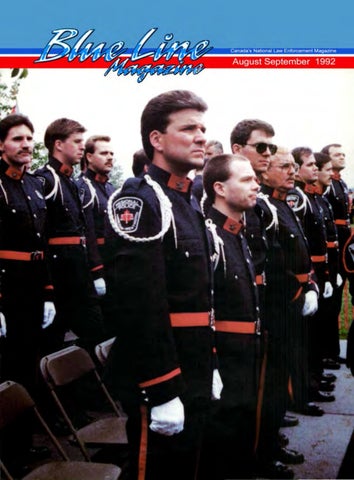
The Hamilton Wentworth Police Male Chorus was privledged last May to perform at the annual ceremony held in Washington D.C. honouring police officers who have died in the performance oftheir duty. This was the first time a Canadian contingent was recognized in this fashion. Blue Line Magazine would like to congratulate these fine officers on a job well done. You may read more about this from the article submitted by Rick Rizosky. This month we commence a new series by Richard Duplain on the history of the Criminal Code in Canada. This series salutes the 100th anniversary of the creation of the Criminal Code and should be quite enlightening. This month we also commence a mini series on the LAPD-King affair. This three part series, written by Blue Line columnist Tom Rataj, focuses on the events leading up to the incident, and an overview of the LAPD's methods and training which may have mitigated the sequence of events. This month we also present Dave Langstroth's series on ballistics. This should prove to be interesting reading for those of us who thought a gun just goes bang. This month we also conclude our three part series on Bicycle Patrol Tactics and the boys at Halton Regional Police are busy working on next years series for you.
Response: James Ridge The commentary by Mr. Hinchcliffe and the editor in your May issue concerning body armour standards is exceptionally important, and identifies some critical issues in body armour testing and quality control. Your readers should be aware, however, that the Ministry of the S olicitor General in Ontario, in conjunction with the police community, is taking major steps to test and evaluate police body armour. Ontario has, every two years, tested representative samples of used body armour since its introduction in 1982. To date the armour has been tested to the old Ontario Police Commission Standard (approximately NIJ 2A) and all testInghas been conducted by the ORTECH research labs in Mississauga. All of the armour met the standards. The result of that testing has been reviewed by the Ontario Police Equipment Advisory Committee, which includes members of the Ontario Police Association, Ontario
Association of Chiefs of Police, the 0 PP, and Metro Toronto Police. The results have also been passed on to all police services in the province, and the full test data has been available to interested parties. In 1991, the same committee approved a new standard adopting NIJ Protection Level 2 as the Ballistic Standard. The existing armour should meet this standard, however tests are being performed to determine this more precisely. Not only will the armour be subject to the NIJ protocol (wet and dry) , but it will also be subject to full V50 testing to compare 10 year-old used armour, and identical 10 year-old armour which has never been out of the box. This will allow us to very carefully assess the relative performance of the armour as it ages. The Policing Standards Section has also conducted an extensive review of research literature on the subject, and has examined destructive testing data from the RCMP and elsewhere. In the
near future I hope to submit to Blue Line Magazine an article prepared by our researcher, which details the results of both our literature review and our upcoming destructive testing. I hope this goes some way to reassuring your readers that rigorous testing and research into body armour capabilities and aging is being conducted, and will be fully shared with the police community. I believe that the research and testing now being conducted by this Ministry, on behalf of the police community in Ontario, is ground breaking research on the still poorly understood issue of armour aging. Consequently we have a profesSional and ethical obligation to all those who use armour in Ontario, Canada and Internationally, to publish and share our findings. James R idge is the Manager of PoliCing Standards with the Ontario M inistry of the Solicitor General. His office may be contacted at (4 16) 965-6071
SOMEDAY ALL HANDGUNS WILL BE THIS GOOD.
W hile other companies were improving upon the technology of the past, GLOCK was busy perfecting the technology needed for the 21 st Century. Polymer technology. You can see it in the compl ete line of G LOCK semi-automatic pistols. Hailed by police and sport shooters alike, these remarkab le handguns fi re even the most advanced ammunition w ith unfailing accuracy_ Find out for yourself what makes the GLOCK pistols so good. And why they have been setting new standards for simpl icity, rel iability, cost effectiveness and safety. To find out how easy your organization can carry the GLOCK line of pistols, write or call GLOCK, INC. or your local police distributor for more information. ATTENTION : All Low Enforcement officers should be familiar with basic firearm safety rules. Thoroughly read and understand the users manual that is supplied with your firearm. Never use any firearm unless you completely understand its operation and safety features.
GLOCK I INC. • P.O. Box 369 • Smyrna, Georgia 30081 • Phone (404) 432-1202 • Fax: (404) 433-8719 • Telex: 543353 Glock Atl UD
4
Se tember,1992
Vol. 4 No.7· September 1992 - EDITOR I PUBLISHER Morley S. Lymburner Phone (416) 640-3048 FAX (416) 640-7547
- Contributing Editors Weapons & Tactics
James Oalueg SunflVal Tactics
Craig Best Ammunition & Fireanns
Dave Langstroth Supervisory Principles
Robert Holston Peer Counselling
Neil V. Thompson
- ADVERTISING Allan W. Stiver (Toronto) Phone (416) 294-5502 FAX (416) 294-8952
Ron Ganton (Vancouver) Phone (604) 274-3849 FAX (604) 274-9091
- CONTRIBUTING WRITERS Chris Braiden Richard DuPlain Craig Best Andrew Smith Neil Thompson Morley Lymbumer - ILLUSTRATION Tony MacKinnon Bette Clark Dave Sills Dave Bluestein BUSINESS ADMINISTRATION Mary K. Lymbumer, M.Ed. Blu. Un. Magazine Is pubishtd morihIy, September lo.ble, by Blle Li1eMagarmo IllCOIjIOfltodwih amailJlg adcre.. ot. l2A · 4881 Hwy. 7 Eut, ste. 254, Maridlam. OntlIrio. l3R1N1. Editorial and copy is considered to'be completely separate from advertising sales. No commitment ror editorial coverage can rOIm any part of. oaIe agreement. All article. an: protected by copyright No part of this publiutioo may be reproduced or tl'anQnitted in any fOIm or by any means, cleclronic or mechani· oaJ.includingpbotooopyingandrecordingorbyanyinformation storage or re1rievaJ system without permission from the pub·
lisher. The aAhor', acMsors and ~ accept no iabiMy~ lor artf i'jIR$lo persons or propcl\y ",ding from Ibe application ... adopIlon of llIlI'oIthe procO<lJros, ~ics or C<JI11idenIIions proserted i1 Itis maga:.:i1e. Readers .... eatboned and a<Msed thai articles premed heroil are edited and suppied for YOlI' peI$ClIl3I awareness and shoUd not beusedlorfulher actionlrli appropriaIeacMeoandgWn:e io recoNod from • ...,..,..;.or or Crown Attorney. BIJe lne Maga:zilo is an i1depand.... ~alion dos9>od III entertain, educal. and lJWOde Ibe $kIs of theM iM>Ned n the ...... enforcement pr~. • has no direct c....roIfrom a...... enforeomert agoncyand is opinions andaniclos donal nocessritro1led the op1rjons of IlIlI' govenvnert or poke agency. Blue Une Magazin. ls prinled in Canada by ProM Gnphics Umited.
-Member-Inl.mational Association 01 Law Enlolumcnt Planners Periodical Pub6.he" Exchange
ISSN *1847 8538 Second Class Mall Registration No.8242
Se tember, 1992
Response: Connie Boyden Reading Chris Braiden's article made me wonder if he was suggesting management is the main problem in getting the most from the "Grunts". Personally, any management types that I know care a great deal about their people. Most of them realize poor morale, which usually results in poor service, has deep roots in a messed up court system and media representation of an over-critical public. Frankly, I'm happy the Ontario Provincial Police Association has taken on the task of educating the public about causes of poor police service. Maybe what they have done is a first step in taking "ownership" of a big problem to find the public support that is needed to correct it. Most of the public support police efforts, but if the police maintain the "mea culpa" (it's my fault) mentality
how are the tax paying public going to know who to believe or blame. If management is failing, I'd suggest it is because the "politically correct" line is easier to speak than the truth about poor service/poor morale. After all, "Grunts" can't say much because of "bridle clauses" in various Police Acts. They are just expected to do more with less, and THAT is what leads to failure in the system!!! Editor's Note Connie is one ofthe fo undersoflhe Onlario based "Concerned Citizens fo r Order, Peace and Security " (CCOPS). People may write her at P.O. Box 1436, Stouffville, Ontario L4A 8A4
Commentary: Morley Lymburner A Licence Or A Declaration In the city of Detroit way back in 1898, the local police had a real problem on their hands. It was a local man with a reputation for being accident prone. It seemed this man could not go anywhere without getting himself into a real jackpot with his car. It would either breakdown in the most congested area of the city or he would drive so fast it would scare the daylights out of man and animal alike. The local police had so many encounters with this hard luck motorist they nick-named him "Hazardous Hank. " Now it wasn't that Hank did not understand his situation. It was a simple problem of his driving one of the very few automobiles ofthe day. The citizenry could not get their heads around the idea that a man driving a horseless carriage was constantly driving at a galloping speed for extended periods. A citizen knew that if they walked in front of a horse and buggy the horse (going at a speed that was predictable) would simply stop or go around the pedestrian. But not so with "Hazardous Hank's" smelly, noisy beast. When it was placed in this environment of little or no pedestrian controls the inevitable was bound
5
to happen. And happen it did. One day, as Hank rounded a corner his vehicle struck a child who walked in front of him. Horrified citizens ran from all around to help lift the automobile off the child stuck under the car. Although the child walked away relatively unscathed it was not so for "Hazardous Hank." He was extremely shook up by the incident and even more upset when he realized the anger of the citizens toward him and his new automobile. Hank decided to do something about this. He went to the mayor's office and made out a sworn declaration that he would, from that day forth, drive his automobile with the utmost care and with consideration for all persons using the public thoroughfares. The document was signed and registered at City Hall as evidence of his intent. And thus in 1898 the world's first driver's licence was made out in the name of ... "Henry Ford. " It is a shame such a declaration is not specifically signed by every motorist. A document saying "1 promise to driue with due care and attention and reasonable consideration for other persons." This would be far better than the cold hard facts we place on licences today.
Chorus, the oldest police chorus in Canada, sang three songs including an American Medley, during which, the Battle Hymn of the Republic was dediby Rick Rozoski cated to the officers who "heard the call, did their duty and paid the supreme In Canada May 15th is traditionally sacrifice". In addition to these American part of a week-long series of events held patriotic songs, the chorus sang "I Beto promote a better relationship between lieve" and "Softly As I Leave You" the country's police officers and the while the survivors were escorted to their public they are sworn to protect. Naseats past an honour guard of several tional Police Week festivities include such motorcycle officers and flag bearers. things as mall information programs and Shortly after the honoured guests media coverage, all of which serves to enhance the image of the Canadian were seated, the President of the United States, The Honourable George H.W. police officer. Bush, ascended the In the United stage and gave a States of America chilling speech about however, May 15th the support his govhas been designated ernment pledges toby the President as wards law enforcethe day on which to ment. The President honour and rememproduced a badge ber fallen Law Enof a slain New York forcement Officers. City Police Officer, The monumental Eddie Burns, which task of organizing a he keeps in his desk fitting tribute to these at the Oval Office. officers is superbly He said the badge completed by a reminds him daily of committee comthe unrewarding but prised of members necessary job law of the Grand Lodge AuxUiary Fraternal enforcement officers Order of Police and across the nation are an organization asked to do each and known as " Conevery day . Following the cerns of Police Survivors" (COPS). President's remarks, John Walsh, host of Each year at this the television series time, for the past eleven years, thou"America's Most sands gather at the Members ofthe Hamilton-Wentworth Police Chorus had the pleasure ofmeeting Wanted" addressed Sylvan Theatre, in Devin and Trina Cutugno when the chorus entertained a show hosted by "Concerns the survivors. He the shadow of the ofPolice Survivors. " Devin and Trina are grandchildren ofa New York City police knows very well the Washington Monu- officer killed on duty. anguish these famiment, to pay tribute lies were experiencto the officers killed since the previous the Hamilton-Wentworth Police Chorus ing as his own son, Adam, was kidmemorial. This year 138 heroes' names, to be invited to participate in this nation- napped and murdered. The killer has from thirty States, were added to the ally televised ceremony. never been brought to justice. honour roll of this national shrine. Before Suzie Sawyer, Executive DiMonths of preparation resulted in This year, for the first time, fallen famUies of deceased officers from across rector of Concerns of Police Survivors, Canadian police officers were collec- the nation being brought together to began to read the names of the 138 tively remembered at the service as well share the grieving and healing process at heroes, the chorus once again sang a when Hamilton-Wentworth Police Con- this memorial. It was truly an emotional rendition of Amazing Grace, arranged stable Cam Rumpel placed a red carna- but rewarding experience for many of for the service by chorus director Steve tion at the floral display representing the the survivors. Becker. deceased officers. It was an honour for Dewey Stokes, National President The Hamilton-Wentworth Police
Never Let Them Walk Alone
6
September, 1992
Members of the Chorus have participated in Police Memorial Services in Ottawa, New York, Cleveland and now have the distinction of being the first Canadian group to entertain at the National Law Enforcement Officer Memorial in Washington D.C.
Grand Lodge Fraternal Order of Police, presented boxed medallions on behalf of the FOP and the United States government to members of the surviving families. Each family added another red carnation to the floral tribute designed to depict the star of the Fraternal Order of Police logo. This was indeed the most moving part of the memorial service. Everyone can feel the loss when mothers, fathers, brothers, sisters, wives and children of the fallen officers stop to remember and salute their heroes. The solemnity of the service was only broken by the crowd standing to join the dignitaries on stage in the singing of Lee Greenwood's popular hit, ''I'm Proud To Be An American". Everyone in the audience proudly waived their blue ribbons over head to symbolize their support for each other and for their country. A few of the chorus members had the pleasure of meeting John Walsh and discussingwith him the success of" America's Most Wanted" in Canada. He indicated that his show, which incidentally was the only national program to cover the memorial, was credited with at least 12 arrests in Canada. The most recent being that of Clyde Dempsey (alias Mior) September, 1992
who was arrested in Hamilton after evading arrest for a murder committed in a Boston bar ten years ago. Many of the 12,000 to 15,000 people present for the service later visited the National Law Enforcement Officer Memorial in Judiciary Square. This Memorial, opened and dedicated by President Bush in October 1991, has the names of over 12,500 law enforcement officers killed in the United States since 1794. Much like the Vietnam Memorial, it was sad to walk along the pathways of remembrance and read some of the handwritten and sometimes printed notes from children of the slain officers. One in particular Simply read, " I love you - to daddy" printed with crayon. The Hamilton-Wentworth Police Chorus performed at a luncheon the day following the memorial which was hosted by COPS. The survivors had been attending lectures aimed at attempting to address several problems inherent with losing a loved one. In this regard American survivors are more fortunate than their Canadian counterparts. The network of support in the United States is unparalleled and better organized than anything Canadians are offered. True,
7
we don't experience the number of fatalities in Canada proportionate to the United States, but nonetheless, the three families which suffered a loss in Canada last year deserve this support as well. We in Canada should lobby for a similar permanent tribute to our officers. Apparently the FOP executive attend our memorial service, held annually in Ottawa, and have tried to convince the Canadian government leaders to produce a medallion which could be awarded posthumously to officers killed in this country. The Canadian Police Association is working hard to fulfill this goal. Since we can't stop the killings of police officers, we should at least support agencies and organizations, on both sides of the border, which will continue to support survivors. By doing this we will fulfill the mandate and motto of the FOP Auxiliary and we will "Never Let Them Walk Alone" .
Fallen Canadian Officers Honoured
Hamilton-Wentworth Police Constable Cam Rumpel lays a red carnation at the floral display in honour of all Canadian police officers slain in the line ofduty last year. This was the first time the U.S. based National Law Enforcement Officer Memorial has recognized Canadian police officers. This symbolic gesture graphically shows this type ofrecognition has no boundaries.
oes Video Image Booking System at the Fraser Regional Correctional Centre in British Columbia
The oes Video Image Booking System State-of the Art. Totally Affordable. It's the co t- aving, must-have technology of tomorrow. And it's available today. The user-friendly OCS Video Image Booking System .. . it's an el ctronic mug book which captures the offender's image and automatically stores it with all the necessary demographic information ... ready for instant retrieval ... at the click of a mouse. o more time-wasting cut-and-paste photos and misplaced files. ow you can pull up a suspect line-up on your video screen instantly. Or et-up a two-monitor witne viewing ystem ... or video image an offender's personal property, p rsonnel records and ID cards. Want to electronically transfer missing p rson or wanted bulletins bet\ n sites - when minutes count? You can do it all - and much more - with the OCS Video Image Booking Sy tern. Because it's been design d by criminal justice professionals.
Since we use industry tandard hardware and protocols, you can readily link it to your existing data base. Optional image packages for incident management include exhibits, vehicles, crime scenes and composite drawings. Another big plus - OCS uses ORACLE,· the most widelyused relational database today. More good news . .. there's no capital cost for the OCS Video Image Booking System. That's right - no capital outlay whatsoever. And payment terms can be geared to the savings you'll achieve in film and handling costs alone! So call today - and get in our line-up for the 21st Century.
oes Speedline: 1-800-661-6069
oes has trailled over 1,000 officers alld has more thall a decade of experience ill developillg alld stlpporting Jaw enforcement applicatiollS.
-------....... -----..-....-....-..
~~~
OCS Technologies
·ORACLE is a registered trademark of ORACLE CORPORATION.
--
We Help Law Enforcement Professionals Do Their Job Better. For ALL Of Us.
An Introduction To Ballistics Whol Really Happens When II Goes Bong By D.W.D. Langstroth Blue Line Ammunition & Firearms Editor "At the target in front, draw, fire three rounds and holster your firearm "; and so, with the first squeeze of your trigger, an odyssey begins that defies logic and common sense. The process of explosion,launching, guidance and striking a target appears (at first) to be a simple matter of point and pull. During the next three articles I will attempt to enlighten (and entertain) you the reader as to what really happens in the comedy of errors commonly referred to as " firing your firearm " . I will attempt to explain, in simple terms, what happens, in what sequence, the causes (and effect) and the results. There is a fair bit of action happening in about .0015ths of a second so if I become somewhat redundant please forgive me. Let's begin with the four main parts and/or sequence of the entire baJIistic problem. The first part (and the part I will concentrate on during most of this article) is called internal ballistics and (wonder of wonders) this occurs within the chamber and bore of the firearm from the time the striker or firing pin hits the primer and initiates the deflagration (oops ... !) burning of the propellant (oops!. .. powder) . The second part is caJIed intermediate ballistics and is not commonly discussed. This part, perhaps more than any other, more profoundly affects the final path of the projectile as it exits from the fixed and relatively controlled environment of the barrel (at the muzzle we hope) and encounters a tenacious and sometimes viscous medium, aka air. External ballistics deal with the projectile wallowing through air from the muzzle to the intended target. Terminal baJIistics is the final phase and a field that is currently very much on the minds of most law-enforcement of-
Se tember, 1992
ficers. Without getting myself in too much dao-doo, I will explain what happens when the projectile strikes something other than air. INTERNAL BALLISTICS A firearm is basicaJIy an internal combustion engine. The action of firing and
the movement of the projectile along (and within) the bore is like the power stroke of a car engine with the hot burning gases driving a projectile instead of a piston. The striker and/or firing pin crushes the primer mixture in the primer cap (in the base of the Cartridge) and causes the mixture to explode (on a very small scale). The exploding particles are driven through smaJI holes (caJIed vents) inside the case and ignite the grains of propellant (gun powder). When gun powder is burned and contained, pressure is created and continues to build up rapidly. The cork of the bottle (so to speak) is the base of the projectile and it has a tendency to stay where it is (some of you "youngsters" may recaJI something in high school caJIed Newton's Laws of Physics which states. In part, " a body at rest will stay at rest ... ") Resistance to the initial motion of the projectile is great and very high pressures are generated in the cartridge case and chamber (in the neighbourhood of 35,000 to 45,000 pounds per square
9
inch in an average handgun) . At last the resistance of the projectile is overcome by the expanding interior pressure and the projectile begins to move. The movement of the projectile causes the chamber area to increase which decreases the pressure; however the rate of burning of the powder increases until a maximum pressure is achieved. This happens shortly after the projectile becomes engaged in the rifling. All kinds of wild & woolly things are happening to the projectile during it's " first steps" . The pressure and heat (did I mention that we're cooking at about 2000 degrees F) have caused the base and middle of the projectile to start to move before the front and this has caused some incredible stresses to be placed on this poor cylindrical object. Then, as if to add insult to injury, somebody has placed smaJI angled obstructions (rifling) in the path of the projectile causing the front to begin to twist before the middle and base of the projectile. Finally, after great resistance, crushed and twisted beyond recognition and accelerating at incredible speeds, the front of the projectile observes "the Light at the End of the Tunnel". It is my hope that these articles will create pictures in the reader's minds of what happens every time you squeeze the trigger so that you may develop a better understanding of your duty equipment and its operation.
NEXT MONTH "The Light at the End of the Tunnel" " From Darkness was created Light".
Ithl Y... 1~I.w In the U.S. over the last 10 years, police assault deaths have been trending downward as a result of improved training and increased body armour usage. However, there has been a dramatic increase in accidental deaths, doubling since the 1970's. This is mostly due to traffic accident deaths. Wear your vest and buckle up!
Police Adventurers Wanted 12A-4981 Hwy.7 East, Ste.254, Markham, Ont. L3R INI - FAX (416) 640-7547
I
-I
eptember 5 - 7 Blue Knights Conference (Atlantic Region) t. John - Newfoundland
October 13 - 16 Western Canada Traffic Conference Saskatoon - Saskatchewan
The Newfoundland Chapter of the Blue Knights are proud to host this years Atlantic Regional Fall Conference to be held in St. Johns, Newfoundland. This event is open to all members of the club internationally. For further information contact Paul Hierlihy at (709) 747-4l38 or (709) 729094.
The W.C.T.A. is an association of traffic professionals from the engineering, enforcement and education fileds working toward promoting research and education. For further information about their conference contact Murray Totland at (306) 975-2631.
eptember 16-19 Canadian Police Association Annual General Meeting Edmonton - Alberta
October 18- 20 Canadian Association Of Road Safety Professionals International Conference Montreal - Quebec
The annual general meeting of the Canadian Police Association will be held in Edmonton Alberta. Contact Doug Ram ey (416) 491-4301
eptember 21 - 25 Profile 2000 Toronto - Ontario The Metropolitan Toronto Police Sexual A sault Squad will present a four day sex crimes seminar. Several experts and international key-note speakers will be featured . For further details contact Sgt. Wendy Leaver at (416) 324-6060 or FAX (416) 324-0697.
October 14 - 15 Forensic Identification Seminar Toronto - Ontario The Metropolitan Toronto Police Force, Forensic Identification Services will be ho ting its annual seminar at Police Headquarters 40 College St. Toronto. The eminar will have a number of guest speakers covering topical subjects and exhibitors showing products of interest in th field . Registration enquiries may be
This international conference is being jointly sponsored by the Canadian Association of Road Safety Profesionals,Quebec Highway Tansport Association, Transport Canada and the Insurance Society of Quebec. This year's topic will be Airbags and Seat Belts: Evaluation and Implications for Public Policy. For further details call (514)2743573 or Fax (514) 274-9608.
February 8 - 12 International Law Enforcement Winter Games Ottawa - Ontario The 1993 games will be hosted in Ottawa. The games will be sponsored by the Ontario Law Enforcement Athletic Association. All sworn Federal, Provincial, and Municipal Law Enforcement officers, active or retired, are eligible. Events include Badminton, basketball, broomball, curling, darts, hockey, volleyball, and skiing. For further information call (6l3) 225-1204.
made to John Skeaffat (416) 324-6197 or Fax (416) 324-6362
10
Official visits to the police forces of: Singapore, Bejing, Moscow, Taiwan & South Africa. VisitingCIB, SWAT, Canine, Drug Sqauds. For info send address to Police Travel, Box 58003 -500 RosslandRd. W., Oshawa, Ont. LlJ 3LO. Join American & Australian police for world wide tours. 4-32-7
I':BM! a**i'" .t."U 'i' hiI POINTTS Franchise available We are looking for an ambitious individual or individuals to become the Owner/ Operator of an established franchise. The area to be serviced by this franchise is quite large, with an expanding population base. Cash investiment is required. Please call POINTTS Advisory Limited at (416) 234-9200 4-37-7-8
Watkins Products My husband laughed when I told him I was going to sell Watkins Products. Now he borrows money from me. For more information call Shelly Adrian, Independant Dealer, 798 Linkleas Ave., Victoria, B.C. V8S 5C3 Phone (604) 592-O81l. 4-0-7
Police Supply Sales Position Commission sales person required for uniform, equipment and accessories sales. Must have own vehicle & be willing to travel. Police or Fire experience an asset. Bilingual an asset Reply in writing to: Box 564, Fredericton, N.B. E3B 5A6. 4-22-7
I
~_!!!!~!!!!!!!!!!!!!!!~!!!J
Los Cabos Mexican Paradise Luxury I-Bedroom Condo, ground floor on beach, spectacular view, Sea of Cortez. 20 feet from patio to swimming pool. Minutes to town. Call (604) 658-8611 4-25-7
September, 1992
'PEACEMAKER'
ALERT!
It's your occupation .... Now let it be your publication! The PEACEMAKER is published quarterly by the Canadian Fellowship of Christian Peace Officers (CFCPO) , a federal nonprofit corporation which encourages peace officers locally, nationally and internationally to join in fellowship. If you would like to be placed on the mailing list, or would like to receive more information about CFCPO membership, send your request with your name, occupation , address and phone number to: ..--... 6~'~!1~~
:~~.~
P.O. Box 520 Stn. "A"
(I( ill )~ I) Scarbor~ugh, ~~i •....•
Ontano, MIK5C3
Shari;;;ii:"Truth and the Way and the Life Our Lord Jesus Christ
Up-Coming Events is a Free service to law enforcement agencies and related personnel support groups. Other persons and organizations may place their notices in tbis section at a price of $40.00 per insertion up to 25 words. (paid subscribers pay $30.00) Add $2.00 per word over this amount. Word count does not include pbone number or beading. Editor reserves tbe right to revise, edit or refuse any notice not deemed to be appropriate. Payment ,t~ accompany copy for insertion, may be by cheque, Visa or MasterCard number (inelude expiry date please) Deadlineis tbefirst oftbe montb prior to publication. (eg. October 1st for November issue) Mail to : Blue Line Classified 12A-4981 Hwy. 7 East Ste.254 Markham, Ontario L3R INI
or FAX (416)640-7547 Se tember,1992
Gun Wallet Sold on the open market throughout California, the gun wallet is designed to conceal a .22 calibre derringer. The gun can be fired without being removed from the wallet. The wallet also has a place for two rounds of ammunition .
DocuCam II® Convincing Evidence As the leading supplier of mobile video recording systems, DocuCam has set the standard for performance and reliability. Here are some of the benefits: ... Protects officers against procedural complaints . ... Used as evidence in court. ... Reduce court time and cost. ... Keeps officers on the road as a result of pleas. ... Training tool. ... Reduce insurance costs. ... Used as a video notebook for officer. ... Contributes to increased convictions. ... Real Time accounts of various violations. ... Eliminates false accusations. ... Multi angle recording of traffic accidents. ... Reduce departmental costs.
And many more ...
.
l::1li1
(t TRIANGLE lECHNOLOGIES INC 7030 WOODBINE AVE., SUITE 500, MARKHAM, ONTARIO L3R 6G2 TELEPHONE: (416) 479-7543 FAX: (416) 479-4130
11
Skid Avoidance
Bicycle Patrol: By Gary Coles
Property Checks and Road Safety
We would prefer to stop in a straight motion if we had the choice. In the real world, however, this does not always happen, so we make sure course candidates are able to control the bike while skidding to avoid obstacles
Property Checks Property checks are one of the more important tasks of any patrol officer. Quite often it is the property check that will gain you the confidence of the community. It is the one task which helps the officer understand his community more and helps to ensure the prevention of crime. As these two photos show the officer can check a large area quicker by staying on the bike as doors are pulled. As well, officers can look over fences and other obstructions quite readily with the assistance of the extra 10 inches the pedals afford.
Vehicle Stops By using a whistle, you can gain the attention of the driver and can motion him to pull over. We suggest you place your bike off the road and approach from the passenger side. This gives you better visibility of the driver and you do not have to worry about cars coming up behind you.
12
Hopefully the photos from the three issues of Blue Line Magazine have been of assistance. Our preliminary course is taught in 8 hours and we have planned an advance course for next year which will take two full days. To date we have taught sixty riders from various police services. We have pushed the use of bicycle patrols since 1989 and feel the most important thing we can do for our bicycle officer is provide the officer with the best equipment and the best training possible. Utilizing bicycles in our job can be effective in the right hands, but it can lead to injury if the rider is not properly prepared. Gary Coles· Halton Regional Police
(416) 878--5511
Se tember, 1992
bance. They work because, as has been stated, he has tried them alL Some of the Chapters I had particular by Morley Lymburner fun with included such titles as Avoiding "Keystone Kops" capers, Use of force, and Dealing with the Media. With the last item Beene states, "In this day and age it is mandatory to consider the press. If a uacuum exists in press stories, ignorant and foolish uiews will fill the uacuum (the news hole). Getting the facts to the media as qUickly as possible preuents idle speculation and editorializing. " He continues later, "Generally the press is not concemed with a long, detailed account of the euent. They need twenty- to thirty-second quotes that fit in the news hole." Beene then gives a few quick phrases he has used to describe the police planning for demonstrations; We're hopingforthe best, while planning for the worst." 'We are here to assist people." "Don~ take our friendliness for weakPaladin Press - Boulder Colorado ness. " $19.95 "One would question the motiuation of anyone who didn~ feel he or she could 'There are three new elements present cooperate with us." that should cause the police to pay more One section of his book gives some attention to crowds ... The technology of pretty good advice on tolerance; home-uideo cameras and teleuision re- /fIt is not necessary for the police to be porting means that the action is captured ouerly soft or back down euery time the on film for later uiewing and judging by job becomes difficult. The police must thousands or euen millions of people... constantly weigh decisions against the The second element is the explosiue rise consequences of what may happen now in the number of protests and demon- or in the future. To be Wishy-washy strations... The third is judicial restric- could be disastrous. Toback away from tions on intelligence gathering.. . demon- using citations, force or arrests could strations just aren~ an enjoyable part of lead to euery group calling for more police work." leniency ... Howeuer, the ability to make This is the fashion in which retired timely adjustments so the ouerall situaCaptain Charles Beene of the San Fran- tions run smoothly and law enforcement cisco Police Department sums up the appears in the best possible light just problems of Police Crowd Control in his might be at the heart of crowd managenew book just released by the same ment. It is the key to handling crowds name. successfully. " Captain Beene has handled more than Each section and chapter is riddled one thousand riots, routs, demonstra- with great examples of crowd managetions, protests, parades and marches ment. One good example; '~he desigduring his 28 years with the San Fransisco nated area for demonstration was so Police Department. This common sense small that one large group complained book is a must read for nearly every cop that some of their partiCipants would be who is or may get involved in public too far away to haue any effect. The disorders. It includes some good sugges- police chief directed the barriers and tions on how to utilize other and unor- control tape be moued so the demonthodox means to quell a public distur- stration area could be enlarged. The
Book Review:
Se tember, 1992
13
decision auoided crowd problems and showed the police could be tolerant if the need arose." Now this is a book that every cop can get a lot of knowledge from. And it isn't written from a Police Department known for weakness when it comes to tough decisions. In 1986 San Fransisco had 128 demonstrations. Only three years later they had over 250. The record for arrests are ominous. In one demonstration in 1984 almost 600 people were arrested while in 1991 during a Desert Storm War, (one of the more popular wars of recent years) they arrested nearly 1,000 demonstrators in one day. Beene also points out one sobering thought; 'The negatiue handling of demonstrations comes back to haunt many police departments and, in some cases, can be deuastating .... unlike the war on drugs, police can~ declare a war on demonstrators. They can only plan for the euentuality and then react." This book can be obtained from Blue Line Magazine or ordered from your nearest book store.
ELECTRONIC IMAGING Picture a video image system that is equally at home in the booking office, at an accident site or at the scene of a crime. Imagine a Windows based PC video system that is easy-to-use, inexpensive, and has full data base capabilities.
A Reality Today ferili.uf,s imaging for Windows is currently installed and proven in various Canadian law enforcement agencies. Call us at 1-800-667-2066 for information or visit our booth at the 87th Convention ofthe Canadian Association of Chiefs of Police in Victoria, Aug 23-25 , 1992.
g
teclindogies Lta. TOITIOITows Vision, A Rea/lry Today
1025 Pandora Ave., Victoria, B.C. V8V 3P6
Team Canada Receives Top Honours At Police Motorcycle Championships By Dave Stewart was especially nice to welcome for the first time into these races the 4 man team from the Republic of Ireland. For many of the riders this was their first time on a race track, the age range varied from 21 to 55 and the riders also included Canada's two female motorcycle racers from 1991 returning to compete again this year. Entries for this years race event dif-
Ontario who won a draw organized by C.P.O.M.C. to promote safe fast riding. Mark, together with the officers, listened intently as Michel Mercier, 3 time Canadian superbike champion and owner of FAST RacingSchool, explained the professional methods of road racing to the officers. Michel was ably aSSisted by two of his FAST Racing School teachers Peter Wilson and Chris Knowles, both pro racers on the Canadian race circuit. At the end of the three qualifying sessions the results were posted and a final training session was offered to all riders not riding on Saturday. When the final times were tabulated Team Canada
A Canadian team of riders took top honours at the 4th World Police Motorcycle Championships on June 27th. The event was hosted by Canada at the Shannonville Motorsport Park near Belleville, Ontario. The team (above) consisted of Pierre Valiquette, RCMP Ottawa, Jeff Ling, Belleville Police, and Scott Spicer, Metro Toronto Police. The Canadian team has been trying to achieve this goal for the past three years and their phenomenal success has brought them from The International Police Championship chequered flag fell first for Marc Granie of 12th position to first in that France. The second place was taken by Italy's Oscar Bellini (left) and Julian Elliott (right) of time. The Team Champions were decided by the best Northern Ireland. In spite of challenging weather and track conditions Granie managed to team qualifying times over a clock the overall fastest timed lap, 122.6 kmIh, on Shannonville's 15 corner 4 kilometer track. two day period. The three day event was the result of fered from the two previous Canadian (who placed 12th of 14 countries in the many months of hard work and promo- Championships held by C.P.O.M.C. in last World Championships in 1989) outtion. The fourth World Police Motorcy- that many of the foreign riders, espe- stripped the premier motorcycle race cle Championship races were officially cially from France, Italy, Northern Ire- countries of France, Italy, U.S.A. and opened by Robert Crosbie, the Mayor of land and the U.S.A. are semi-pro motor- Northern Ireland. The accumulated team Belleville, Ontario at a reception held in cycle racers including the current World time on all laps was 24:24.136 minutes. the host hotel, the QUality Inn, Belleville champion, Marc Granie of France who This placed them just ahead of France in on Wednesday 24th June, 1992. competes in the European Superbike second position with a timeof24:25.915 In total there were 52 officers from 9 series all across Europe. and the United States Team with a time countries including Denmark, France, On Thursday, the first day of riding, of 24:59.573. These three teams were Germany, Ireland, Italy, Northern Ire- the officers were joined by a civilian followed by Norway (25:31.356), Northland, Norway, U.S.A. and Canada. It rider, Mark Buitenhuis of Cambridge, ern Ireland (25 :50 .793), Italy
14
Se tember, 1992
(25:52.281) , Germany (26:16.443), Denmark (26:20.524) and Ireland (26:22.212). The Canadian Police Officers Motorcycle Championship races were also decided by the qualifying times and the overall winner for the third successive year was Pierre Valiquette of the RC.M.P. Ottawa (1:59.990) followed by Jeff Ling, Belleville Police Force (2:01.544) dueling in a tire by tire race with Scott Spicer, Metro Toronto (2:01.677). Forth place went to Steve Shadlock, Metro Toronto (2:07.553) followed by Michael Jenkins, Metro Toronto (2 :09 .093), Russ Yates, St. Thomas (2:11.935), Tammi Inwood, Metro Toronto (2:18.621), Kevin Yeoman, Ontario Provincial Police (2:20.085), David Thomas, Belleville Police (2:21.273), Vicki Dawson, Metro Toronto (2:26.290), Dan Belanger, Metro Toronto (2:32.090), and Terrance Moore, R C.M. P. Ottawa, (2:32.127). The up and coming second place rider from the C.P.O.M.C. 1991 race series, Kevin Cisaroski of the Winnipeg
WI
I
I I
, [ft]
Police, was riding extremely fast during these qualifying sessions but unfortunately ran off the track, had a minor crash and was unable to finish. This was a major blow to Kevin who has been racing very successfully in the Canadian Motorcycle Association race series in Manitoba and also in a race series in the United States and it appeared he was ready to seriously challenge Valiquette for the Canadian Championship title. After the race the trophies for the Canadian Championships winners were presented by Waterloo Regional Police Chief Harold Basse representing the Canadian Association of Chiefs of Police. Pierre Valiquette accepted the C.P.O.M.C. cup for the third year running. The second and third place winners, Jeff Ling and Scott Spicer were awarded a pewter tankard. After receiving their prizes from Chief Basse the officers were each given a congratulatory bottle of Canadian champagne. They not only sprayed each other but also most of the crowd and even Chief Basse who was caught in the middle of
HOW 10 IMPROVE YOUR COLLAR APPEAL Romote your Department with high-quality customdesigned neckwear, for men & women. Choose from an assortment of colours. Your insignia or crest is woven into the fabric. Ideal for wear to social events, conventions, tradeshows, special functions. Call or write Lynn Schranz for your free brochure.
519-886-5410
the celebration! These three top Canadians had achieved the nearly impossible task of penetrating and toppling the ranks of the world's fastest police officers and - rightfully so - enjoyed every minute of it. The 1992 FASTIYAMAHA International race trophies were presented to first place winner Marc Granie, France, while second and third place medallions were presented to Oscar Bellini of Italy and Julian Elliott of Northern Ireland. During the three days of races officers were plagued with intermittent rain, race cancellations and wet track conditions. In spite of this only four of the 52 officers entered received injuries. All injuries merely consisted of scrapes and scratches. A glowing tribute to the riders abilities and the training of Michel Mercier's FAST Racing School. There ~re . too :many Da$ty self-centre<l nations in the world already; God forbid that Canada should add one to the number! W.L Grant 1872-1935
You are a winner! MITEL announces new enhancements to the DISCOVERY, Dialed Number Recorder (DNR).
With MITEL's DISCOVERYTM Dialed Number Recorder
The DISCOVERY can now provide accurate detection of Caller Number Delivery (Caller I.D.), DTMF or rotary digits, and the detection of modern Fax tones. In addition, the DISCOVERY provides facilities for a remote Dial-up Slave unit.
®MIT.L@ Sa us at CACP '921 Booth #44 VIctoria Conference Centre VictorIa, BC August 23 to 25, 1992
Enterprises Providing Surveillance Solutions!
I=or /'T'IOfe information about MITEL Security products, call 6 13-592-Q200 in Canada Of 1-800-MITEl-SX in the U.S.
Se tember,1992
15
... news beat ... news beat ... news beat ... Women Injured By Police Car Win Over $20,000
New "Rape Shield" Law Set To Come Into Force This Fall
Two Smithers, B.c., women injured by a police car which was responding to an emergency call have won a civil action against the RCMP. The award included $19,500 in damages plus costs of the civil action and interest accumulated since 1989. In this case police received a call a man was threatening people with a bull whip. The officers responded to the call along with another car which was closer to the Incident. While enroute the officers heard the second car was on scene. They killed their siren but left on their emergency lights to monitor the radio call. The cruiser continued on, however, at an established speed around 120 krnl h In an 80 km/h zone. The police car then came into collision with the women's car which was stopped awaiting a left turn. The RCMP attempted to defend itself by citing section 118 of the B.C. Motor Vehicles Act which permits police to Ignore traffic laws in cases of emergency and also permits them to turn off their sirens where use would hamper the police in the performance of their duties. The court pOinted out that under
"1 am pleased to announce that the amendments to the Criminal Code to protect sexual assault uictims receiued Royal Assent, " said Kim Campbell, Minister of Justice and Attorney General of Canada. The amendments, announced last June 24th, provide a clear framework and a set of procedures for judges to determine whether past sexual history can be admitted as evidence. The legislation also provides the first Criminal Code definition of consent to sexual activity. Three significant changes were made to Bill C-49 in Committee. The section dealing with incapacity to consent, considered too narrow, was broadened. In addition, the pre-requisite for the defence of mistaken belief in consent was modified from "all reasonable steps" to "reasonable steps". Finally, changes were made to the ban on publication. "1 consider that the public process followed with this legislation is a fine example of consultation with interest groups, " said Minister Campbell. "It has prouided ample opportunities for the exchange of uiews and the enhancement of the proposed amendments. " Changes to the Criminal Code were made necessary by the August 22, 1991 Supreme Court of Canada decision to strike down Section 276, known as the "rape shield" provision. It is expected the new law will come into force by Order-In-Council before the fall.
subsection 3 of the same section it clearly states the police must " driue with due regard for safety hauing regard to all the circumstances of the case. " In this matter the court heard the women's car could have been visible to the officers 150 yards back from the scene of the collision but the car did not respond until only 70 yards back. Mr. Justice Duncan W. Shaw stated in his judgment, " The inference 1 must draw is that the (officer) failed to see that which it was her duty to see, and because ofthat, she failed to slow down the police uehicle in keeping with the dictates of safety. " The Justice continued by adding ' 'the urgency of the duty the officers were performing" versus " the danger of approaching the intersection at a speed 30 to 40 kmlh ouerthe 80 kmlh speed limit toward a uehicle signaling a left tum and failing to see the uehicle which was there to 'be seen in sufficient time to reduce speed safely. " In conclusion the court said in a situation such as this with one officer already on the scene, "it did not justify what occurred here. "
Fraud Artist Duped In Own Scam By Crime Stopper Call A man featured on Crime Stoppers In a Toronto newspaper was caught by police after assuming a friend's name. Unfortunatley for him, his friend was also wanted by police. Police said Richard Shawn McLaughlin, 25, was arrested on a warrant for fraud. When he was arrested he gave the name of Talbot when picked up In Burlington, Ontario. He picked the name of a guy he knew, but he didn't know Talbot was also wanted.
McLaughlin was booked on the fraud charge and police held him on the Talbot warrant and took him to a bail hearing court the next day. Meanwhile a person phoned Crime Stoppers with a warning that it was actually McLaughlin who was in custody, not Talbot. McLaughlin was re-arrested and charged with a further charge of fraud and public mischief.
16
Se tember, 1992
... news beat ... news beat ... news beat ... Credit Card Investigators Get High-Tech Edge By Tom Rataj A new cooperative effort between the Credit Card industry and the Police has resulted in the distribution to Fraud and Credit Card investigators of a new high-tech weapon In an ambitious project funded by VISA, MasterCard, and American Express, the International Association of Credit Card Investigators (lACCI) is distributing Bank Identification Number (BIN) checking machines. Outwardly the BIN machine appears to be a stripped down version of the Point of Sale Terminals (PST), commonly found at many retail establishments throughout Canada. Unlike the PSTs however they are not hooked up to the banks by phone, but rather, they have a programmed memory chip built in which contains all the information needed to conduct a basic verification test on most credit cards. To use the machine an officer need only plug its adapter into an outlet, give it a few seconds to warm up, and swipe a card through. The machine reads the information on the black magnetic strip
on the back of the card, and promptly displays: (1) the card number, (2) the expiry date, and (3) the name of the issuing bank or institution. The officer can then check if these three items match the information embossed on the front of the card, if they don't... .. BINGO, if they do ... .then the card is probably legitimate. This project has been under way for several months now, with approximately 60 of the $300 BIN machines distributed to police agencies, Canada Customs & Immigration, and bank investigators across Canada, with another 40 on order. This project was initiated due to a sudden increase in the instances of very well forged or altered credit cards, which are easily used both by individuals and organized gangs in Canada and elsewhere. In a recent case in Toronto an individual was investigated after he was found to be in possession of 23 credit cards. A bank investigator armed with a BIN machine was called, and 23 swipes
Guns And Drugs Can Replace Air Bags Auto theft investigators in the Seattle region have encountered alterations of the driver's air bag system located in the steering wheel hub. The cosmetic covering looks normal, however, the air bag has been removed. Access to this hiding spot is quick and easy .. Guns and contraband have been recovered from this cavity. More information on this subject may be obtained from Sgt. Van Roy, Auto Theft Supervisor, Seattle Police Department.
Se tember, 1992
FLASHES By Tony MacKinnon
"Full it over to the side Fonzie, I'd like to give you an autographed memento of your speed for the last couple ofmiles!"
17
later the individual was charged with numerous charges relating to the possession, alteration, forgery, and use of the cards. Without the availability of this machine the individual would likely still be shopping. A prototype with more advanced features is being developed and should be available some time later this year. Any police agency or officers interested in further information about the BIN machines should contact their closest IACCI chapter representative: o Pacific Chapter: Mr. Bill INGENTHRON, c/o Royal Bank of Canada - VISA Investigations (604)665-8935 o Prairie Chapter: Detective Donald J. MacLEAN c/o Edmonton Police Department (403 )421-3559 o Toronto Chapter: Mr. Bob HARRIS, c/o Canadian Imperial Bank of Commerce - VISA Investigations, (416)784-7196 FAX:(416)784-6395 D . Eastern Chapter: Mr. George BLANCHETTE, c/o National Bank of Canada Mastercard Investigations, (514)394-4120
A History Of The Crimina( Code By Richard Duplain -
Part 1
1892~ 1 99 2 Just over a century ago Canadian provinces and territories united under one flag but it wasn 't until another 25 years had passed before a melding of legal statutes occurred, making Canada the envy o f the civilized world. Be fore 1892, Canada had no unified system of criminal law. The provinces and territories including Newfoundland, clung to British Common Law traditions and practices. After Confederation, the federal government began the task of unifying the various laws which were in place in each region across the dominion. In 1887 the Criminal Procedures Act paved the way for the government to unify criminal procedure, property law and crimes against the person. In the text, Criminal Law, Alan W. Mewett, Professor of Law, University of Toronto and Morris Manning of the Ontario Bar, describe the birth of the Criminal Code. " In 1892, after some five years of study, the 'Bill Respecting Criminal Law' was introduced by the Attorney General of Canada who stated that it was based upon the English Draft Code as presented in 1880 and the Canadian statutory law. It was expressed to be the reduction o f the existing law to an orderly written system, freed from needless technicalities, obscurities and other defects, but it did not purport to reduce all the criminal law of Canada into one comprehensive document. While it was a code, it was not a complete code, " they wrote. " In England, in 1838, Criminal Law Commissioners were appOinted to consider the drafting of a comprehensive code of indictable o ffences which many
people then thought were In a hopeless state of confusion. In 1878 such a code was formulated and proposed but, although twice presented in the form of a Bill before the English Parliament, was never enacted. (It was felt the judges of the day opposed codification. ) The proposed code received, nevertheless, widespread publicity both in England and in the British Empire. It is not surprising that, in view of the situation in Canada, the proposal for a code of criminal law would be given more encouragement. " "The Criminal Code of 1892 formally abolished the distinctions between felonies and misdemeanours, so that under its terms criminal offences were classified as either 'indictable offences, ones which could be prosecuted by way of indictment, or summary conviction offences, ones which could be prosecuted through a Simplified summary procedure based on the Information of complaint made to a justice of the peace or magistrate," according to Philip C. Stenning in Appearing for the Crown. " A small number of offences were classified as 'dual ' offences, that could be prosecuted either by way of indictment or by way of summary conviction, at the option of the prosecutor. A dual offence, if prosecuted on indictment, typically rendered the accused liable to a heavier penalty than if prosecuted by way of summary conviction," says the text. In 1947 a Royal Commission to Revise the Criminal Code was appOinted. It reported In 1952, and in 1953 a revised Code was enacted which came into effect in 1955. A number of new offences were included in the 1953 revision. The new
18
laws pertaining to public mischief and common law conspiracy had not previously appeared in the 1892 Code. The 1953 revision did away with all common law offences, offences under Imperial Acts and offences under pre-Confederation Acts. The Code contains, for the most part, only that part of the criminal law that, apparently for historical reasons, is of general application to the public at large, consisting of enactments of general principles followed by parts dealing with offences against the public order, offences against the administration of justice, sexual and moral offences and conspiracies. The second half of the Code is concerned with procedure and punishments," notes Mewett and Manning. They explain, " The historical development of the criminal law of England is not one susceptible to logical analysis. That part of it which was developed by the judges doubtless originated In their views of what was morally reprehensible and, In their view, therefore socially harmful, while that part of it represented by statute law was enacted to meet ad hoc situations which were felt to be in need of remedy. It is not surprising that, as a result, criminal law was viewed as a code of substantive law incorporating concepts of moral fault as well as concepts of social harm. Many criminal offences had their origins In religiOUS laws while many more were enacted to preserve the social and political advantages of those who were dominant in society. The result was no more than an ill-defined and ill-assorted hotch-potch of more or less repressive penal measures." " However, the admixture of moral law to the common law criminal law had some noteworthy beneficial side effects. Moral blameworthiness connotes moral fault and this in turn connotes some freedom of choice. This developed into a rather sophisticated system of liability based upon mens rea, that became one of the most single features of English law. Furthermore, the severity of the penal sanction imposed could be geared to the degree of blameworthiness of the offender {not always, in view of the large number of fixed punishments, very successfully} . It meant that a system of punishments could be devised which
Se tember, 1992
moved away from a rather primitive one to one which took into account the degrees of blameworthiness of the offender. Simple as this might seem to us now, it represented a great step forward in the criminal law," say Mewett and Manning. The authors say the Criminal Code of 1892 was only a common law type of codification, a collection into one statute a multitude of existing prOvisions and common law doctrines. "Much of the criminal law is regulatory; it is not a moral decision as to whether one drives on the left or right hand side of the road or whether one displays a requisite sign or gets a requisite licence. What both the legislators and the judges are searching for is the isolation of those acts which cause damage to society or to members of society which ought to be subject to criminal sanctions," say Mewett and Manning in their text "Criminal Law." "The essence of criminal law is its public nature. A crime is, in fact, not a wrong against the actual person harmed, if there is one - the victim as he may be called although it may also and .coincidentally be a civil wrong against him - but a wrong against the community as a whole. The prevention - or lessening, since total prevention is not possible - of crime cannot be left to an individual's choice but is the responsibility of any member of the community and, in particular, those who represent the state the police or the prosecuting authorities," they say. The degree of harm caused is a consideration in determining an appropriate penalty, note the authors. The lessening or diminution or prevention of crime is achieved by the imposition of punishment.
Quick Facts W It took Maritirners, Robert Sedgewick and George Burbidge less than a year to draft the Criminal Code in 1891 . Recently it took three years to revise it. W In the beginning, 20,000 English copies ofthe Code and 2,800 in a French version were printed. A total of $6,000 was budgeted for printing and distribution to every member of the judiciary. W Today there are close to 37,000 lawyers, judges, notaries, law teachers and students across Canada and most have a copy of the Criminal Code. W In 1892, the estimated cost of a copy of the Criminal Code, delivered was $3.80. Today, the Code can be purchased and delivered for $60.00 W Canada is one of the harshest Western countries when it comes to use of prison sentences. Imposingjail sentences on 97 of every 100,000 people, Canada's prison reputation is third in the world behind the U.S. W It costs $7 billion each year to operate the Canadian criminal legal system, a system which according to the Law Reform Commission, resembles a vast machine sucking people in one end, spewing them out the other and then sucking them back in again. W Set up 21 years ago to make recommendations to enhance and streamline the expensive criminal law system, the Law Reform Commission of Canada with a budget ofunder $5 million has fallen victim to a floundering national economy. W The Canadian Criminal Code contains 700 sections or laws. Outside the Code there are about 20,000 federal offences, another 20,000 provincial laws as well as several hundred mumcipa1laws and bylaws presently on the books. W Of all the federal offences, 70 per cent are strict liability ones and need no proof of fault; prove the act and conviction follows automatically. W For every crime prosecuted there may be 10 reported and 40 not reported.
•••
••
•
NEXT MONTH: A Look A t The Criminal Code
IntelliMap/911
ODD
Map-based, Artificially Intelligent computer systems for Canadian Law Enforcement. "The Only Intelligent Solution"
Q-ISys (416) 895-3911
Se tember,1992
•
19
Bull
~
j
Case Law (1214-003 - 18 Pages)
\
Evidence Still Admissible After Warrantless Search Regina Vs. Fridleifson The Supreme Court of British Columbia recently ruled evidence admissible after two officers searched a truck without " bothering to get a search warrant. .. The case involved two experienced Vancouver police officers, who were staking out a residence for stolen property ,saw a truck back into the driveway and two men carry out a large object covered with a blanket. The two officers approached the two men and both men fled. The accused was captured by the officers and arrested at the time on the belief the accused was breaching his probation. After giving the accused his Charter Rights the officers lifted the blanket and found a television set. It was later discovered the television was stolen and charges were subsequently laid. In his defence the accused argued the officers had breached his section 8 Charter Right to be free from unreason-
j
Case Law
(1216-006 23 pages)
able search. He cited the Supreme Court of Canada decision in Regina Vs. Klimchuk as he felt the circumstances were pretty much the same. Mr. Justice Peter D. Lowry disagreed. He stated the decision in Klimchuk was after evidence found the officer actually stopped the vehicle and tore the dash apart to discover the evidence without a warrant. The judge in this case stated the breach of the accused's Right was "so un-intrusive as to be trivial." At trial both officers stated they had never even considered getting a search warrant and in fact had never obtained a search warrant to search a vehicle in their respective 12 and 16 year careers. Referring back to the Supreme Court of Canada rulings Justice Lowry stated in the case of Regina Vs. Collins it was decided there were three broad factors to determine whether evidence of this nature was admissible.
o o
The fairness of the trial; The seriousness of the Charter violation; o The consequences of exclusion. In conclusion the ruling stated in this case the evidence was the Crown's entire case and the exclusion of it would mean an acquittal. To determine the admissibility the Supreme Court Justice concluded the court's job was " one of making a determination that reflects what is conceived to be the views of the community at large or what a reasonable member of society, dispaSSionate and fully appraised of all of the circumstances of the case, would consider about the administration of justice if the evidence in question were not excluded." The B. C. Justice concluded the administration of justice would probably be brought into disrepute if the evidence were to be excluded and an accused person escaped justice because of the trivial breach.
1
. ._ _ _ _ _ _ _ _ _ _ _ _ _ _ _ _ __
Officers Not Limited To Two Hours For Tests Regina Vs. Deruelle The Supreme Court of Canada, in a July decision, determined that the two hour limit required by the Criminal Code for Breath testing was not designed to prevent officers from making demands beyond two hours after the offence. The court ruled that the section setting up the demand' 'was not a model of clarity, " but the section's wording and the broader scheme of the Breathalyzer's usage supported the concept that the officer has two hours to administer the test from the time the officer forms a belief. The wording in question states "where
a peace officer believes ... that a person is committing, or at any time within the preceding two hours has committed... an offence under s. 253, the peace officer may, by demand made to that person forthwith or as soon as practicable, require that person to provide," a breath sample. In other words the section is not concenred with the admissibility of the evidence but rather with the quality of the breath readings. The ruling means that a person invovled in an accident is interviewed by police two hours after an offence the officer can sill make a legitimate demand that must be complied with. The only difference will be the manner in which
20
the Crown can obtain a conviction. Under the provisions of the Criminal Code the court can take a reading taken within two hours of the offence and relate it automatically back to the time of the offence. However if the tests are beyond the two hour limit the Crown must call some expert evidence as to the proper readings at the time of the offence. This ruling was a unanimous decision by the Supreme Court of Canada and settles a long standing debate by various courts throughout the country.The Breath tests still must be taken as soon as practicable after the demand is made. This ruling also applies to blood tests.
S tember, 1992
my face. There was no chance of escape. I thought " But, this isn't supposed to happen to me. I'm going to die." I By Heather Hodgson closed my eyes and waited. The driver of the black car, Grant "After several years ofinvolvement in the impaired driving awareness Pacey, is a real hero. When he saw me field and seventeen years of police service, I really believed that I being struck, he rammed the accused's understood the victims 'plight. On December 23, 1990 at about 11:50am, vehicle to prevent it from running over me. He could have been killed. Later, in lfound out how wrong my assumption had been!" court, when we discussed it, he really wouldn't accept that he is a hero. What words are there to express gratitude to a It was two days before Christmas. the roadway. person who has made it possible for you Police work was far from my mind as my He went through the traffic light and to continue to share a future with your children and I traveled across the 401 hit a pole on the south side of the ''T'' children? highway toward Pickering. We would intersection. He sped backwards and in I opened my eyes to see the tire meet my husband for lunch, then he the process, he struck another (off duty about four inches from my face. The black car was about four inches from my would take the kids to his parents while police officer's) car. I helped to prepare our family Christmas I had to stop him. I got out of my car back. Eve dinner with my sister. ___ . -' ..- - - -.-. -. ~:.:.. __ I dragged myself up and tried to assist - . - ..- -~\ the other off duty officer. Eventually we Thinkingback, it was ironic that my son and I were dis.__ .. _~__ _ were on our way to the . -I " -hospital. Fortunately cussing defensive driving . . we were all released techniques as we moved . into the outside passing ..... . . to share Christmas lane ..... - ~with our family!
But. .. This Isn't Suppose To Happen To Me!
'Jr
ase:~~~:!~~::s~r
rear of the car. M9 '-- · -- daughter was screaming and crying that her neck hurt, my son was sobbing. I had a pain in my head and neck and could hardly hold my head / /. up. It was all so fast! I checked the mirror. A .,. / ~ '\ large blue car was Sitting on • ~,', " -"'= -. my rear bumper . He \ backed off, then struck us '""~~l again. ' .~ I,i ~ _. , ~ ; ',\ ~('-y '.:. I signalled to pull onto the left shoulder and started to slow down. He pulled around and veered at us from and ran towards his car. I thought that I the side. Then he fled through traffic. may be able to get to the keys, to arrest The police side of me took over. I him. As I crossed the path of his car, he calmed the kids down and started to follow, calling out the license number as sped towards me. I yelled "Stop! Powe worked our way - safely - through the lice!" - It may work in the movies, but not traffic. in real life! I ran, for my life! I felt pain in my left side. Then I was He showed all of the classic signs of impaired driving. Then, he abruptly in the air. As I landed, my right ankle swerved onto an off ramp. He lost con- took the initial impact, with the right leg trol of his vehicle. There was room for twisting as I met the road. one car ... the black car that was already I could hear another car behind me. in the lane ... he proceeded to ram it off But, his rear tire tread was heading for
¢?
Se tember,1992
21
::~ ~:~:lIM~
children recovered from their injuries, and in time, overcame the emotional trauma of seeing their mother struck. I suffered soft tissue damage . Nothing was broken, I have no visible I scars. But, the emotional / •scars rlip deep. " , He pleaded guilty and was sentenced to eight months in jail and his license was suspended for 2 years. By the time you read this he will be foot loose and fancy free. For ten months, I was unable to work. My left arm may never fully recover. My right hip won't hold my weight properly. My neck and back are still not right. But, I am alive and well. My children are alive and well. And I have a new appreciation for each day of life. My friends who stood by me are treasured and cherished. It was a hard process. One that is difficult to understand unless you have been there yourself.
Rodney King Vs. 'T}I£ t.)a\.P.f). By Tom Rataj
There is no single incident in the last several years that has caught the attention of so many p eople, as that graphic home video, taken early on Sunday morning, the third of March 1991. We all saw the tape, broadcast and re-broadcast for days on end as the Incident sparked outrage across the U.S .A. , Canada, and around the world. It was powerful and raw. Then the 'Not Guilty' verdict started a wild frenzy of murders, looting, and arson In Los Angeles, some copy-cat hooliganism in Toronto, and renewed condemnation from around the world. Regardless of the fact that this incident occurred in the City of Los Angeles, the first Impressions leave an enormous Impact on everyone, while the entire Incident raises a number of serious questions. Nowhere were those questions more pOinted than in Los Angeles, and rightly so. Less than one month after the incident, the Independent Commission on The Los Angeles Police Department, also known as the Christopher Warren Commission, began its work. Established by Los Angeles Mayor Tom Bradley, the Commission was established to conduct a comprehensive investigation into the LAPD and its use of excessive force and other related issues. Their 250+ page copyrighted report was presented to the Mayor on July the 9th, 1991 . It is the result of an exhaustive process involving hundreds of interviews, thousands of personnel files, the analysis of numerous LAPD computer databases, training materials and practices, as well as other assorted reports, letters of complaint, executive sessions and public hearings. After reading the report cover to cover, one is left with a feeling of shock and surprise. What is so shocking is that although the LAPD has in the past been recognized as among the most efficient and innovative police agencies in the U.S., there appear to be numerous serious problems within the department. Starting with a wholly ineffective discipline system that allowed the Rodney
King inCident, (and apparently many others like it) to occur, and finishing with poor accountability throughout the chain of command. The Commission Report appears to be a fairly well researched and reasonably objective document which holds a wealth of information for any police agency. Starting this month with a review of the Rodney King incident, is the first of three installments summarizing the report. All details, figures and statistics are as reported in the Commission report. THE RODNEY KING INCIDENT Two California Highway Patrol (CHP) officers first observed Rodney King and his two passengers driving a white Hyundai at approximately 12:40 am on Sunday the 3rd of March 1991. His vehicle was reported to be travelling at 110 to 115 mph (177 to 185 kmlh) while moving between the three lanes of travel. The CHP unit tried to stop Mr. King, only to have him slow down and exit the freeway. His vehicle was followed through city streets at speeds estimated at up to 80 mph (128 kmlh) through one stop sign and one red light. He finally brought his vehicle to a halt at about 12:50 am at the comer of Osborne St. and Foothill Blvd. By this time the pursuit had been joined by units from the LAPD and the L.A. Unified School District Police. After several radio transmissions cancelling additional units, another twelve officers arrived at the scene, bringing the total up to 13 LAPD units (including one helicopter) . Five of these officers were at the local station finishing their paperwork at the end of the shift, when they heard the pursuit, left the station, joined the pursuit and arrived at the scene after the call for no additional units had gone out. Mr. King and his two passengers
22
were ordered out of the car using a loudspeaker to conduct a 'felony stop' procedure. The two passengers exited the car on the right side, follOwing all instructions, while Mr. King initially refused to get out. When he finally did, he responded to orders to lie flat on the ground by getting down on all fours, slapping the ground, and refUSing to lie down. When one officer attempted to force him to the ground, Mr. King tried to get up and almost knocked the officer to the ground. A TASER electric stun gun was then used with only temporary results. It is at this point that the home video camera starts to roll. Mr. King attempts to get up and appears to lunge at an officer, who strikes him in the head with a baton. Mr. King attempts to get up several more times, while swinging at the officers, and after 56 baton blows and six kicks he is finally subdued when swarmed by six officers, who handcuffed and cord-cuffed him. He was taken by ambulance to a local hospital where he received 20 stitches, with notations made of other injuries including a broken cheekbone and a broken right ankle. Blood and urine samples taken five hours after his arrest showed a blood-alcohol level of 0.075% (the legal limit being 0.08%), as well as traces of marijuana (26ng/ml), putting him over the legal limit at the time of the incident. (The officers initially reported that they thought he was on PCP) . Mr. King was booked on charges of evading arrest, and was held for four days. He was released without charges, because the District Attorney's office determined that there wasn't enough evidence to prosecute him. The video tape of the incident was broadcast the follOwing day, and provoked an immediate public reaction. LAPD Chief Daryl Gates said he was shocked by the tape, but that he would withhold any further judgement pending an investigation. Parallel investigations were launched within days by the FBI, the LA District Attorney's Office, the LAPD's Internal Affairs Division, and the Police Commission. Four officers were charged criminally, while the DA's office did not commence any proceedings against the other Se tember, 1992
17 LAPD officers at the scene. The LAPD and the CHP commenced internal discipline against some of the other officers at the scene. The LA United School District Police terminated its involved officers. What really speaks volumes about this incident is the immediate aftermath. In the recorded phone conversation between the LAPD dispatcher and the LA Fire Department some strikingly unprofessional attitudes are apparent: LAPD: .. .Foothill & Osbome. In the ualley dude (FIre Dept. dispatcher laughs) and like he got beat up. LAFD: (laugh) wait (laugh) . LAPD: We are on scene. LAFD: Hold, hold on, giue me the address again. LAPD: Foothill & Osbome, he pissed us off, so I guess he needs an ambulance now. LAFD; Oh, Osbome. Little attitude adjustment. LAPD: Yeah, we had to chase him. LAFD: OH!
LAPD: CHP and us, I think that kind of irritated us a little. LAFD: Why would you want to do that for? LAPD: (laughter) should know betterthan run, they are going to pay a price when they do that. LAFD: What type of incident would you say this is. LAPD: It's a .... it's a ... battery, he got beat up.
Australia - The names of the drivers are sent to newspapers and are printed under the heading, "Drunk and In Jail. " Malaysia • The driver is jailed, and if he Is married, his wife is jailed too. South Africa • 10 years In prison and a $10,000 fine. Turkey· Offenders are forced to walk 20 miles under police escort. Bulgaria - Second offenders are shot. EI Salvador· F1I'St offenders are shot.
LEl'l. CONIUM
"-" COMPUTER ~~
How the World Deals With Impaired Drivers
About 15 minutes later a Mobile Data Terminal (MDT) message is sent from the car of officers Laurence Powell and Timothy Wind to some other officers. The exchange went as follows: " Oops" " Oops, what ?" "I hauen 't beaten anyone this bad in a long time. " "Oh not again ... why for you do that .. . .1 thought you agreed to chill out for a while. what did he do ?" " I think he was dusted ..... many broken bones later after the pursuit. "
...... · .... CONIUM
--
Additionally, at the hospital, officers who accompanied King, quite openly bragged and joked about how many times Mr. King had been hit.
5. Galnsbrook Court Whitby, Ontario
SERVICES
EACH SYSTEM INCLUDES
LlRIW9 Telephone Fax
WHITBY -BRAMPTON-MIL TON
386-SX16 STARTER PACK
$1299.00
16 Mhz. motherboard 80 Meg. Hard Drive 1 Meg. Ram expandable to 8 Meg. VGA colour monitor
200 Watt Power Supply Desktop Case or Mini Tower TurbolReset Switches wi keyboard security lock 1.2 Mb disk drive (5.25) 1.4 Mb disk drive (3.50) 2 Serial, 1 Parallel & 1 Game Port Enhanced 101 keyboard 512 kb SVGA graphic card Microsoft I PC compatible mouse Power bar with surge supressor Disk storage case
(416) 543-1127 (416) 875-0693
..e~ CONIUM _=COM..uTUI
--
__ ... ..... VIC ••
.
386DX-33 POWER PACK
$1749.00
33Mhz.motherboard with 64k Cache memory 120 Meg. Hard Drive 2 Meg. Ram expandable to 32 Meg. Super VGA colour monitor
Hardware Software Accessories and Training .
HARDWAREI SOFTWARE 9 Pin Dot Matrix Printer - $200.00 24 Pin Dot Matrix Printer - $350.00 Math Co-Processor - $170.00 386SX 20Mhz Motherooard - $100.00 Additional RAM /Meg. - $ 60.00 - $ 60.00 OOS 5.0 WINOOWS3.1 -$119.00
486DX-33 POWER PACK PLUS 33 Mhz. mother board with 64k Cache memory Math Co-processor 120 Meg. Hard Drive 2 Meg. Ram expandable to 32 Meg. Super VGA colour monitor
$1999.00
Se tember,1992
Add GST to all orders. Ontario residents add PST
SX286-l6 Computers also availabl. 1 eall.
UPGRADES
Sept.\992
.
TWO YEAR PARTS AND LABOUR
.
GUARANTEE
23
120 Meg. to 200 Meg. HD - $260.00 VGA to Super VGA Monitor- $100.00
'.
Policing Principles: By Chris Braiden Part 6
Specialization By Function
The A nswer I do not advocate doing away with specialisation entirely. Recently, my wife had a serious automobile accident and required major surgery; I did not want our family doctor doing it. Logic dictates thatsignlflcant specialization remain, and even new ones sprout, which will differ from organization to organization. The guiding principle, however, must be to generalise where possible, specialise where necessary. In the generalist work environment the ownership phenomenon stays, but the focus of It shifts from the function to the Core Value. People become peace officers first and specialists second. People must look beyond law enforcement to the Core Value. Everyone is now driven by the commonwealth of 'their village. Their daily work becomes, and remains, a natural microcosm of the macrocosm (l love these computer words!) . The 'right things' to do are the same for all. By applying the Core Value to their village, individuals remain connected and contribute - to the "Cause" of the organisation. Over time, a common ownership develops between the producer and consumer of the police product, supported whenever necessary by the police specialist, to achieve the things of utmost importance to that village in the Interests of overall community welfare and existence. Some will say this is naive thinking. So be It. Emerson said that nothing great is ever achieved without enthusiasm' he also defined enthusiasm as the child i~ us winning out over the adult. Innocence goes hand-In-hand with enthusiasm. Wasn 't the little girl naive to blow the whistle on the king's stupidity? Were not the Wright brothers naive too to think their flimsy contraption would work? But where would flight be today if they had aid, " We ain 't running off this hill until
we see a stealth bomber" . Obviously there were skeptics 400 years ago too because here is what Francis Bacon had to say on the matter way back then; "As the birth of allliuing creatures are ilI-shapen, so too are all innouations which are the births of time " . The present of everything is at once half dead and half pregnant with the future . I am not dumb; I don't subscribe to the old adage, " He ain't heauy, he's my brother". Sometimes my brother weighs a ton if I have to do all the carrying. I played rugby too long to believe everyone in a scrum pushes. Some use it as a rest period. There are only so many Mother Theresa out there, and I'm not one of them. But I do subscribe to the sensible saying, " I'll scratch your back if you scratch mine" . Most people will contribute to a common cause, if there is a common pay-off - That is why it is smarter for five neighbours to build a common fence together than five separate ones alone; they can buy in bulk and everyone will do a good job on every fence because they know they will reap what they sow. Besides, it's more fun. Neighbourhood Foot-Patrol In Edmonton I have tried to practise the principles of ownership in policing and learn as I go along. I have also tried to practice what Fred Hertzberg said about motivation in the work-place. He said, ''The only way to motiuate people is to giue them meaningful work, control ouer it, resources to do the job, then get out of their way." In Edmonton, we have individual police officers assigned permanently to 22 villages. They are on foot, have their own store-front offices manned by volunteer citizens and because they carry pagers, most of their daily work is dictated by the needs of their village. We
24
started in 1988 with the busiest 21. At the outset we asked for volunteers, got 44 and chose 21 whose length of service averaged nine years. Their role, quite simply, is to take care of as much of the daily policing needs of their village as possible and work back through the specialised units for whatever help they need. They are decentralised, are not part of a specialised unit, work shifts, and respond to all levels of calls for service in their village. I knew from the outset that the success of the enterprise would depend upon the people doing the work. I needed people who would bring their brain through the gate with them. Our Patrol personnel work ten-hour shifts; most specialities work 'eights'. Foot patrol work ' eights'. By volunteering, these people were agreeing to give up 48 days off a year yet every single volunteer was from patrol. Not a single specialist volunteered. This is what people will do to get ownership of their work. There is lots of motivation in policing, it is simply dormant. The initiative has been evaluated twice, technically by the Canadian Research Institute for Law and the Family (CRILF) through funding from the Federal Solicitor General, and, more informally, by a local author who was contracted to work with the people on the beat and to write a documentary of what the product looked like through the eyes of the people providing and consuming the service; the cop on the beat and the neighbourhood resident. This latter work was funded by a grant from the Charles Stewart Mott foundation of Aint, Michigan. Both evaluations have been published and are available. They show unequivocally that a common ownership does develop, and indeed after a relatively short period of time. Unlike the specialist who encounters the same task, but not the same people on a continuing basis, this police officer is forced into ongoing contact with the same customers on a broad range of issues so that a common motivation to 'do something' abouttheproblem develops. If they don 't face it today, both will have to face it tomorrow. Unlike many of their brethren, these people thoroughly enjoy their work, bring their brains through the door with them, and use them.
S tember, 1992
The tools of the trade Law enforcement is no fool's game! Modern law enforcement professionals need all the tools at their disposal. The biggest and most basic tool is Knowledge.
Two of the most important books ever written for those involved in law enforcement STREET SURVIVAL Tactics for Armed Encounters Positive tactics designed to master real-life situations. 403 pages of photos, diagrams, and the hard lessons of real experience. $46.95
THE TACTICAL EDGE Surviving High Risk Patrol Advanced material ideal for academy and departmental training programs and all law enforcement professionals. 544 pages with over 750 photos and drawings. $58.95
o Five Minute Policeman $13 .70 $75 .95 o Ultimate Survivors (Video) $15.70 o Boss Talk o Surviving Edged Weapons (Video) $65 .95 o CaseManager (Computer Softwear)$310.00 $58.95 o Tactical Edge o Case Manager (Single User Version) $150.00 $46.95 o Street Survival o One Year Subscription (10 Issues) to Blue Line Magazine - $25.00 (G.S.T. Included) o Binder to bold one year subscription - $12.95(G.S.T. included) Subscribers $10.95 Sub Total Name:
G.S.T.
Address:
Ont. Sales Tax Municipality _ _ _ _ _ _ Province _ _ _ _ _ Postal Code: Phone: (
)
~--------
Total
7% Goods & Services Tax Extra No Ontario Sales Tax on Books Prices include Shipping & Handling
o Send Invoice with product (Available to Paid Subscribers, Law Enforcement Agencies, and Educational Facilities Only) o Please charge my VISA or MasterCard account # Exp. o Cheque Enclosed Signature:
/
Training and upgrading material for the Law Enforcement Community
Marketing
12A-4981 Hwy.7 East, Ste.254, Markham, Ontario , L3R 1 N1 - (416)640-3048
You may Fax your order direct to (416) 640-7547
Product News & Views Gerber's Magnum L.S.T. Evaluated by Dave Langstroth It's a simple combination. A couple of pieces of steel, a piece of nylon or two, a couple of rivets and PRESTO ... Instant folding knife. Nothing could be simpler. Folks have been doing it for years. So, how come the "Gun Guy" is writing about knives? Since the "Gun Guy" got his paws on a new Gerber Magnum L.S . T . (light, strong & tough) folder. The slickest combination of form, function and durability that I have had the pleasure of using for alongtime. The MagnumL.S.T. has a 440 stainless steel 3 112 inch drop point blade (available in smooth or serrated edge), 11 8 of an inch thick, tempered to a hardness of 57-59 on the Rockwell " C" scale. The blade is held in a Dupont Zytel nylon handle with two genI erous finger grooves, / deep, diamond checkered panels located where you need It the most; at the friction points. Under the tips of your fingers all this in a package that weighs only 4.2 ounces. It's a rare thing to grasp a factory produced knife and have it feel like it's custom made for your hand. I have become accustomed to seeing (and feeling) palm swells in handguns and rifles, but this is the first time I have experienced them on a folding knife. The two ends of the grip panels are about 1I8th of an inch thinner than the centre of the grip panels and this allows the knife to balance "properly" in the hand. No
more pinching of palms or binding of fingers . The variety of jobs that I have used the Magn um L. S .T . for over the last two months have been made a little faster by a tool designed to "work"; stripping varnish off an old Ross .303 rifle, sliCing cardboard for bundling, masking metal parts for sandblasting, dressing out critters and a couple of thousand other things that just had to be done, right now, with the tools at hand. I pushed the knife hard and found it to hold its excellent factory edge and maintain its usefulness until the job was done. The Magn um L.S.T . is made for anyone who needs a good. reliable cutting tool and makes weight, design and function the necessary requirements. The Magnum L.S.T. comes with a ballistic nylon or leather sheath that fits up to a 1112 inch belt. The DupontZytel handles are available in solid black or Real tree (TM) camouflage pattern. For more information about where you may purchase this knife contact Fis~ars Canada Inc. 1-800-263-2857
"Who Works When" Wonderful Way To Work Wonders Reviewed By Morley Lymburner
Here is a package that could take a lot of stress off the police administrator. This package, quite aptly named 'Who Works When", is great for doing anything regarding the management of personnel for scheduling shifts, leave and days off.
26
Mini Flashlight With Revolving Head Streamlight Inc. from Germantown Pike, PA, recently announced the introduction of the Revolution mini flashlight which features a revolving head. The new Revolution light is about 6 inches long and is powered by two AA batteries and uses a standard krypton replacement bulb . The beam head will swivel to a variety of angles up to 90 degrees. The light will clip into a shirt pocket and would be a good. safety measure for "'""-'""-~_ _ _ _~-.l such things as traffic control. It is also designed to balance on end to permit both hands free while the beam assists with illumination. For further details contact Stream light at 1-800-523-7488
Mastering this software package can certainly be any agency's ticket to success. This package can schedule up to 200 employess on up to 26 shifts and complex customized work patterns. If your work place has more than 200 you can create multiple files with 200 to a file and keep on hummin. Who Works When also creates schedules of 1 to 6 week cycles, has 11 customizable reports for distribution to staff and can schedule by department, shift, job code and station. The system was obtained by the Metro Toronto Police Courts Bureau as well as their Parking Enforcement section. It takes a little work to get the hang of it but once you have it you're away. Who Works When can be used on all DOS based computers as well as PS/2. It is available direct from NewPort Systems (206) 451-0537 and ask for Mr. Lance Thomas. Se tember, 1992
Screening Device Part of B.C. CounterAttack Success Roadside screening devices (RSDs) are becoming more and more commonplace in the battle against drinking and driving in Canada. The whole purpose ofthe RSD, is to eliminate the guesswork officers have to contend with and increase the likelihood that alcohol-related charges will stand up in court. British Columbia, according to Felix Comeau of Alcohol Countermeasure Systems (ACS), accounts for about 10 percent of the estimated 10,000 screening devices currently in use. Comeau is president of ACS, a Mississauga, Ontario-based corporation which is the only company manufacturing RSDs in Canada. According to Comeau, 200 RSDs or SL2 Alcometers as they are known by their brand name, were sold to the province of B.c. in 1988 and most recently, an additional 500 units have been sold. An additional 290 units have also been purchased directly by the RC.M.P. in British Columbia. To appreciate why there is such a heavy concentration of RSDs in B.c. , one need look no further than the province's CounterAttack program . CounterAttack, headed up by director Janice Schmidt, is one of the most prolific and successful programs against drinking and driving in the country. Launched by the Government of British Columbia in 1977, CounterAttack has waged war against drinking and driving through a series of initiatives. This includes a massive public relations and advertising campaign, a Significant increase in the number of roadside checkpoints and the increased use of 24-hour driving suspensions (known as 24 Hour Prohibitions) as a deterrent. The use of RSDs has made it easier for B.C. police to not only charge drivers over the limit, but also to hand out 24 hour suspensions. Ministry records show that in 198620,434 prohibitions were handed out. By 1990, as a result of a stepped up campaign, police handed out 30,007 24-hour suspensions, or 113.8 for every 10,000 drivers. All of the RSDs were purchased from September, 1992
hoi level for drivers under ~ the influence has dropped from 190 down to 160 milligrams. As a result of r----,this success, Inspector House's goal is to have " one (RSD) in every uniform driven car by the end of 93... if all of our plans come together. " The number of impaired drivers has shown a steady drop in the province, from a high of 25,412 incidences in 1982 to a low of 13,939 in 1990. While this figure went up slightly in 1991 to 14,248 ... the rate of impaireds per 1,000 actually went down from 4.5 to 4.4 due to the increased number of drivers on the road. Just as it has taken time for the results of CounterAttack to surface, Constable Bill Roberts of the Victoria Police Department says it has taken time for RSDs to win acceptance amongst officers and in the court of law. Roberts, who calibrates RSDs and provides instruction on how to use the devices, says most constables have gradually overcome their initial fears . "Getting the RSDs was like getting radar... at first the officers were leery ... but as time went on there was more acceptance ... and eventually more comfortable with the product. " Having won many of his fellow officers over with the RSDs, Roberts says his current challenge is getting the courts to give greater recognition to the product. " It's a new device for the courts and judges... but they're slowly coming around. " Roberts' counterpart with the Vancouver Police Department is Constable Don Owens. Owens shares Roberts' view of needing to educate the courts. Owens even keeps a log of cases where the RSDs haven't won the day in court, in the hopes that common mistakes can be eliminated and RSDs can win the recognition they deserve. ACS president Felix Comeau says the appeal of the SL2s, aside from the fact that they meet RC.M.P. specifications, is they're easy to operate, they're smaller and easier to hold than older units, and they're more accurate - a fact which more and more officers are discovering is essential in the courts.
~f!~
ACS because, according to Schmidt, it was the only company able to meet RC.M.P. specifications. Schmidt says
CounterAttack had little difficulty obtaining government approval for the additional RSDs, a fact that can be attributed in part to the overall success of the program. Schmidt estimates " we have seen a drop of some 50% in casualties and accidents" as a result of the program. Literature produced by CounterAttack claims that each year, an estimated 30 lives are saved, 850 injuries are prevented and $10 million in medical, insurance and justice costs are prevented by the program. Schmidt says the program's success can be traced to a number of factors, including the stopping of an average of 665,000 vehicles a year. These stops, which include the increased use of RSDs, help contribute to 15,000 charges of impaired driving per year in the province and a 90% conviction rate. RC.M.P. Inspector Gary House, who works closely with CounterAttack to coordinate the use of the RSDs is a strong advocate of the device. "They've been a very valuable tool for roadside screening," he says, adding " we've noticed the level of blood alcohol has been dropping. " He estimates the blood alco-
27
Du Pont Has a Pretty Wearing Personal NEWKEVLAR
Thin Argument for Body Armor••• 129
More Comfort ••• Same Protection We've heard your arguments: "Body Armor is heavy," "It's hot," " It's stiff," "It's bulky." Now hear ours: New KEVLARo129 is a major breakthrough in body armor comfort. Vests can now be made 15 to 25% thinner and 10 to 20 % lighter. KEVLARo129 is also softer and more flexible, allowing body armor to bend and twist more freely. It moves with you. What's more, there is NO loss in ballistic protection. KEVLARo129 is 15 % stronger than KEVLARo29-a 65,000 p.s.i . increase in tensile strength . This means that a lighter, thinner vest of KEVLARo129 can offer the same level of protection as its heavier, bulkier KEVLARo29 predecessor. The big difference is that you stay comfortable. We both know that body armor can save lives . We think it's worth a little argument to save yours. New KEVLARo129 is available right now. To get more information about this major breakthrough in body armor comfort, call Du Pont at: 416-821-5601. New KEVLARo129 ... Today 's most advanced technology for personal body armor. Accept no substitutes. KEVLAR is a Du Pont registered trademark fo r its aramid fiber. Du Pont does not make ballistic fabrics or garments.
Uncommon Problems . Uncommon Solutions. KEVLAR from Du Pont.
C[O POHJ) CANADA
ments stated Ontario robberies were up 125 percent, break and enters 22 percent, and both common and sexual assaults up 47 percent. Each advertisement ended by saying ''Politicians won't The Honourable Allan C. Pilkey, So- stated "Eueryone else has. The number listen to us. We're the men and women Iicitor General of Ontario, announced of firearms being purchased in Ontario of the Ontario Prouincial Police Associain the Legislature on July 22 that the for personal protection has skyrocketed. tion, and we're doing this ad, and more Ontario Provincial Police would be re- Here's a number that should blow your like it to tell you you're not safe. A nd ceiving additional funding of approxi- mind. 336, 147+. That's the number of your gouemment refu ses to do anything mately $20 million to hire an additional firearms sold in rural areas alone since about it." The ad ended with a sugges241 officers. 1986. And euery year, the number tion the reader cut out a coupon and Under the announcement, the QJ\rr.o\ h .. of hunting licenses is- mail it to the Premier. Many thousands additional 241 uniformed officrD~~1 sued goes down. On- did. The announcement made by the ers will be phased in over a IS A C't"'B!..~'V'"'t'lt tario has become an three-year period. Officers will .aA.I.t"L:) ~OJ\fE armed camp. T he gou- Solicitor General of Ontario managed to be assigned to duties in detachemment won't p' rotect promise 241 officers (half what the Assoments which have bee~ .idenlNJjV~ you, so w~,at chOice do ciation said were required) to be hired over a three year period. In addition it • you haue? tified as needing addItional resources. u~" The adver- promised an average of $6.3 million per The Ontario Provincia("-" ;;"-:;:-=.:-.. ".-10 \ tis erne n t s year while the Association stated the Police Association had launched an On\.aL~t..nl:' \ placed the Province cut $16 million from their opaggressive media campaign in Feb~...nent l~ \blame upon the erational budget for the year. In his announcement Solicitor Genruary which was highly critical of the goV~~~h~~ousands ~houlders. of Pilkey stated, '7 am pleased to eral manpower shortages being suffered 1... s u c c e s s Iv e demonstrate this gouemment's commitby the police force. Media attention neW lOUSe wrong-heade~ was drawn to several incidents \ 0 governments ment to increased public safety and where criminal activity went un- \ which caused security." Mr. Pilkey ended his statechecked due to detachments clos- \ ~ontinual fund- ment by saying, '~n increase of 241 Ing down at night because of a lack \ ~ .~..-p:::'~mg cutbacks. uniformed officers will haue a positiue Other ads indi- impact on new police initiatiues in the of manpower. In one widely reported situation a cated the OPP were 500 officers short areas of family uiolence, anti-racism, drug store in a village 30 km south of the and were faced with a $16 million cut for and sexual assault, as well as other Stayner Detachment waited over one the current fiscal year. community policing and preuention iniStatistics quoted in the advertise- tiatiues. " hour for police to arrive on a burglar alarm call for a drug store activated ..---- -- -- - - - - - - - - - - - - - - - - - - - - - - - - . around 1:30 AM. The culprits had stolen a quantity of drugs and merchandise and made good their escape. The folAnyone who has been a cop for a were purchased last June by Jules lowing week the same store was struck while is only too familiar with the name Gordon Agencies Limited who asagain and once again the police arrived Maher Shoes. That name has been sumed all outstandirlg balances, inover one hour later. date stamped on tens of thousands of voices and current contracts to supply People in the village were horrified police officer's boots over the footwear. when they found the Stayner Detachyears.Likewise anyone who has had In a letter to Blue Lir1e Dan Trudeau ment closed down after 1:00 AM. and any dealings with Maher Contract Sales stated, 'The entire staff, including mycalls for help were being sent to the certainly know Dan (Too Tall) self, has been retained by Jules Gordon District Headquarters in Barrie to reTrudeau, better known in police cir- Agencies and we are doing business as spond to local calls. As it was apparent cles as the marathon marketing man. usual. We are delighted with this thieves were on to this residents were Blue Line wanted to pass along the change in ownership and look forward advised to keep all doors locked and put news that the whole Maher operation, to continuing our commitment to serubars in windows. product lirle and personelJ, will now be ing the law enforcement community In a highly publicized statement, the known as "Gordon Contract Sales". as in the past." Ontario Provincial Police Association reThey will keep their same address at Anyone wishir1gto get more details leased a series of advertisements in news552 Queen Street West irl Toronto is free to call Dan at (416) 368-5503 or papers which indirectly suggested the and keep the same phone and fax Fax (416) 368-6818. only real protection would be for citizens numbers. We wish all the best to this venerto arm themselves. The section, under a Maher Contract Sales operations able, all Canadian, organization. headline entitled '~nnie's Got A Gun."
Ontario Finds Additional Funding For Police After Media Campaign
IN
O
IDmGE rr\le
ctea{.e\l t .
f
for
ooks. ..--_
Same Team ... Same Service!
30
Se tember, 1992
Pro Carry Systems Presents: The patrol officer is the backbone of any police force . The Duty Belt is the backbone of the patrol officer. That's why every component of our duty belt system is street-tested and refined to perfection. Our entire system is made of advanced, lightweight, durable and maintenance-free materials, including Cordura, Velcro and Divers Web. The result is a belt system less than half the weight of conventional leather that leaves your back in the same remove, replace or lose. All the equipment on the belt is condition it was in before your shift. Each component on designed for ease of use. The duty holster is precisely fitted the belt acts as a keeper, so your equipment stays exactly to your gun to provide the retention you need. where you put it, and there are no clumsy belt keepers to
For years police officers have suffered with "civilian" briefcases, not designed for the rigors of daily duty use. How many times have your files and equipment ended up dumped on the floor of your patrol car or lost under the seat where they aren't any good to anyone?
Pro Carry Systems has the solution. Our duty bag system is designed for patrol officers by a patrol officer. There are handy external pockets for your most used items such as your baton, radio, flashlight and ticketbook. Everything the working police officer needs ... organized, efficient and safe.
WHAT WE MAKE:
SO WHAT HAVE YOU GOT TO LOSE?
Pro Carry Systems manufactures for every branch of law enforcement service, including patrol, bicycle squad, plainclothes, surveillance and tactical equipment. Our innovative approach can help you solve your equipment problems quickly and within budget. Ifyour needs are highly specialized, we can custom design and build to suit those needs.
Nothing! When you purchase our production, you get a 30day, 100% money-back satisfaction guarantee and a life-time warranty against defects in craftsmanship and materials.
Better service, higher quality, competitive pricing. That's our guarantee
All Pro Carry Systems products come with: - 30 day money back guarantee - Lifetime warranty against defects in workmanship and materials - On-going customer support
INI.'ERNATIONAL INC 541 CHAPMAN AVE., COQUITLAM, B.C. V3J·4A2 TEL: 1-800-665-7757 FAX 1.604-931-1884
BMW SPELLS SAFETY ON THE JOB IN JUST THREE LETTERS: ABS Most motorcycle manufacturers put their engineering skill to work getting you going . At BMW we put our best minds to work getting you stopped . Safely. Anti-lock braking systems (ABS) have been used for years on aircraft and high performance cars. Now, BMW has integrated this state of the art technology into our motorcycles, including the K-series Police models.
HOW IT WORKS The ABS system uses an on board computer to monitor front and rear wheel brakes. When ABS senses the brakes are about to lock, it reduces pressure in the wheel brake cylinder up to 7 times a second, and continues to do so until the risk of lock-up has been eliminated .
The BMW K100LT. The police motorcycle incorporates the ABS system designed to give the officer more control in any road conditions, from dry pavement to rain, sleet, sand or oil patches.
Front and rear toothed sensors are constantly monitored by an electronic control unit to determ ine when i ntervention by ABS is necessary.
j
From the officer's perspective, the only change in sensation is an incredible increase in straight line stopping ability. Even applying full brakes in an emergency straight line stop, full control of the motorcycle can be maintained .
WE HAVE WHAT YOU NEED TO GET HOME SAFELY BMW motorcycles are in active use by police departments in 100 countries around the world . We know what you 're facing on the streets in congested traffic areas, and what unexpected demands are put on you and your machine.
The outrigger -equipped motorcyle, without ABS , has locked up the wheels and lost stability during hard braking on wet pavement (right). The ASS-equipped bike remains upright and controllable under the same conditions I (left). .
On rain -slick city streets, BMW can provide that additional edge. And in normal traffic conditions, ABS will give you the confidence to stop consistently in the shortest possible distance.
BMW'S Catalytic Converter Technology for Motorcyles.
Contact Tony Fletche r at BMW Canada Inc., 920 Champlain Court, Whitby, Ontario L 1N 6K9 or call (416) 683· 1200. Fax (416) 666· 3672
HELPING THE URBAN ENVIRONMENT BMW now offers our Police models with the option of catalytic converter systems. This technology can reduce harmful exhaust emissions by up to 80% without sacrifice to fuel consumption or engine power. As well , the appearance of the motorcycle is unaltered .
RESPONSIBILITY MEANS NO COMPROMISE