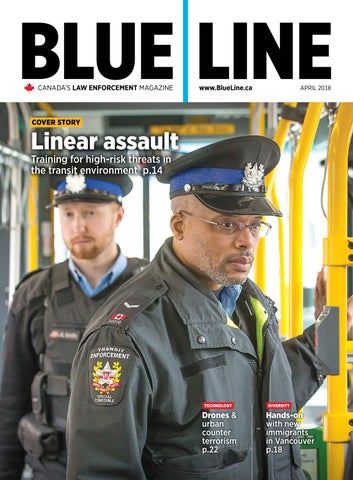
BLUE LINE CANADA’S LAW ENFORCEMENT MAGAZINE
www.BlueLine.ca
APRIL 2018
COVER STORY
Linear assault
PM 40065710
Training for high-risk threats in the transit environment p.14
TECHNOLOGY
DIVERSITY
Drones & urban counter terrorism p.22
Hands-on with new immigrants in Vancouver p.18
EQUIPPED WITH PURSUIT-RATED TOUGHNE SS
When it comes to your fleet, Ford delivers on your needs like no other. We put power into the 2018 F-150 Responder: the first-ever* pursuit-rated pickup truck to market, with the highest horsepower and greatest torque of any pursuit-rated police vehicle^. Always ready to provide you with the vehicles you want when you want them, offering the solutions, tools, technology, dedicated service and expertise to make running your fleet easier than ever. Expect no less with Ford Fleet.
EXPERIENCE THE E’S OF EXPERTISE AT FLEET.FORD.CA.
Based on Michigan State Police Vehicle Evaluations for model years 2010–2017. When properly equipped. Maximum horsepower of 375 hp and maximum torque of 470 lb.-ft., based on Michigan State Police Vehicle Evaluation Report on model year 2017 pursuit-rated police vehicles in-market. ©2018 Ford Motor Company of Canada, Limited. All rights reserved.
* ^
Contents
18 April 2018
Columns
Volume 30 Number 4
4 8 10 12 13 22 26 30
Features COVER STORY
1 4 Staying ahead of threats in transit environments
Active shooter training tends to focus on structural environments, like schools, but it also needs to address hostile incidents in transit areas. By Michael Soden
17 The political wings of extremism in Canada
When we think of terrorism, it is easy to point to groups like al-Qaeda, but often overlooked are domestic right/left wing groups. By Corey Clarysse and Kristen Little
18 VPD Diversity Section is hands-on with new immigrants
COVER PHOTO: DEREK STRYLAND, TORONTO TRANSIT COMMISSION
The Vancouver Police Department has been developing strategies to help recently arrived immigrants feel safe, welcome and secure. By Kimberly Wong
Editor’s commentary Q&A Health & wellness Holding the line Deep blue Technology Case law Back of the book
Departments 5 5 7 7 23 28 29 30
By the numbers News Dispatches Calendar Off the shelf Product showcase Marketplace Blue Links
20 Northern unsung heroes
The RCMP could not have managed in the Arctic without the assistance of Inuit special constables but very little is known about their history. By Deborah Kigjugalik Webster
8 @Blue_LineMag
20
22 April 2018 | BLUE LINE
3
EDITOR’S COMMENTARY BY RENÉE FRANCOEUR
BLUE LINE www.BlueLine.ca
Meditating on the job
W
hen people mentioned “meditation” to me in the past, I thought of Elizabeth Gilbert’s Eat, Pray, Love book and the far-away ashram she attended where schedules were strict, the silences long and the mental work intense. Now, it seems like everyone is trying their hand — or brain, I should say — at the practice. My friends are buying silky bohemian poufs to sit cross-legged on and choosing to listen to breathing podcasts while driving over new Drake songs. And, as you’ll find in the columns in this issue, meditation and “mindfulness” has also inched its way into the dialogue around police modernization.
“Mindfulness provides a path to a more compassionate style across all interactions...”
- Detective Chief Inspector Mark Preston
I recently re-downloaded the Headspace app. It’s one of the many popular meditation guides available on your mobile device — look for the orange dot — and the basics package is free. I’d previously used it during a stressful time after moving across the country. Today, I’m trying to nurture healthier sleep habits. “Bubbles of mindfulness” are appearing across policing, writes Mark Preston, a detective chief inspector of a major crime team in the U.K., in a Headspace blog post. According to him, this has the potential to lead to more compassion and fulfillment when it comes to acting in the line of duty. He writes: “If we believe the victim is worthy of our attention, then we give more to that individual. It is my belief that many of our interactions are affected by this phenomenon, yet mindfulness provides a path to a more compassionate style across all interactions, and victim worthiness becomes less important. Realizing that deep down, probably unconsciously, one is acting in this way, it very much brings the emotion into conscious realization, improving every aspect of the interaction,
including gathering evidence and the person’s view of their police service.” Mindfulness has been working for York Regional Police Const. Jon Carson, who has been teaching the practice to new recruits after it changed his life in the wake of his Post Traumatic Stress Disorder (PTSD) diagnosis. He is also the owner of Mindful Cop Consulting and a public speaker on PTSD in emergency services. “If you’re able to ground yourself with breathing exercises, you come to respond more in difficult situations as opposed to reacting,” he says in his speaker’s profile for A Mindful Society, an annual Toronto conference. Additionally, the Central Saanich Police Service near Victoria, B.C. partnered with the Canadian Women’s Wellness Initiative (CWWI) — the women’s wing of the transcendental meditation (TM) organization in Canada — which serves women whose jobs, health and lives are at risk due to chronic or acutely high levels of stress. Kathleen Thomson, a retired Saanich Police Department constable, told CWWI “each sitting of meditation is like having a restorative vacation... [it] leaves me feeling both incredibly relaxed and energized at the same time.” She also added that meditation allowed her to feel more present and more easily able to listen to and engage with others. As officers working shift work in demanding, high-risk and often disturbing environments, stress is a given. We know it is going to happen. But we can manage it when it does with tools we have easily at our disposable, anywhere, anytime — tools like our brains and lungs. This way, we strive to protect ourselves against toxic stress. This is also part of building resilience and taking back the power from stressful situations. Reining in your prone-to-wandering mind and focusing on something like our mundane breaths isn’t as easy as it sounds, but whether it’s through an app or in a yoga studio, I hope you find a relaxing form of mindfulness that works for you while also challenging you.
CONNECT WITH BLUE LINE
www.BlueLine.ca 4
@Blue_LineMag
BLUE LINE | April 2018
www.facebook.com/BlueLineMagazine
GROUP PUBLISHER | PAUL GROSSINGER pgrossinger@annexbusinessmedia.com EDITOR | RENÉE FRANCOEUR rfrancoeur@annexbusinessmedia.com ACCOUNT MANAGER | JANICE EATON janice@blueline.ca ART DIRECTOR | SVETLANA AVRUTIN savrutin@annexbusinessmedia.com ACCOUNT COORDINATOR | TRISH RAMSAY tramsay@annexbusinessmedia.com CIRCULATION MANAGER | BEATA OLECHNOWICZ bolechnowicz@annexbusinessmedia.com Tel: 416-442-5600 ext. 3543 COO | TED MARKLE tmarkle@annexbusinessmedia.com PRESIDENT & CEO | MIKE FREDERICKS ANNEX BUSINESS MEDIA 111 Gordon Baker Road, Suite 400 Toronto, ON M2H 3R1 Tel. 416-442-5600 • Fax 416-442-2191
Publication Mail Agreement No. 40065710 ISSN 0847-8538 Printed in Canada SUBSCRIPTION RATES Canada — 1 Year $31.00; 2 Year $51.50 plus tax USA — 1 Year $103.00 USD CIRCULATION email: asingh@annexbusinessmedia.com Tel: 416-442-5600 ext 3553; Fax: 416-510-6875 or 416-442-2191 Mail: 111 Gordon Baker Road, Suite 400, Toronto, ON M2H 3R1 Occasionally, Blue Line will mail information on behalf of industry-related groups whose products and services we believe may be of interest to you. If you prefer not to receive this information, please contact our circulation department in any of the four ways listed above. Annex Privacy Officer Privacy@annexbusinessmedia.com; Tel: 800-668-2374 © 2018 Annex Publishing & Printing Inc. All rights reserved. Printed in Canada. No part of the editorial content of this publication may be reprinted without the publisher’s written permission. Opinions expressed in this magazine are not necessarily those of the editor or the publisher. No liability is assumed for errors or omissions. Readers are cautioned and advised that articles presented herein are edited and supplied for your personal awareness and should not be used for further action until appropriate guidance is received from a supervisor, Crown Attorney or other persons in authority. All advertising is subject to the publisher’s approval. Such approval does not imply any endorsement of the products or services advertised. The publisher reserves the right to refuse advertising that does not meet the standards of this publication.
NEWS
PHOTO: EDMONTON POLICE SERVICE
EDMONTON
Edmonton Police unveils “stronger, faster” Air 1 helicopter
The Edmonton Police Service (EPS) Flight Operations Unit has officially unveiled its new $5.9 million Air 1 helicopter. “With the continued growth of the city, the mobility of criminals across the region, and the need for greater public and officer safety, a new helicopter with enhanced capabilities is required,” said Acting Police Chief Greg Preston. “Because the new Air 1 is better, stronger and faster than our previous helicopters, we can provide a greater level of safety and support across the city.” The Airbus H-125 model is considered one of the best helicopters in service, EPS stated, and is used by over 200 law enforcement agencies around the world. Improvements include: GPS navigational overlays; upgraded avionics for situational awareness and hazard warnings; enhanced digital camera and infrared system; Alberta First Responder Radio Communication System (AFRRCS); better visibility, stability and seating for crew; increased fuel capacity for longer flights; more powerful engine for increased speed and lift; and safety features to prevent hydraulic and engine failures. The helicopter was budgeted at $5.9 million, with $3.4 million in funding coming from the Alberta Government Municipal Sustainability Initiative, and the remaining from the City of Edmonton.
Since September, EPS flight crews have been training on the new helicopter, testing its systems, and putting it through its paces on emergency calls. Air 1 responds to approximately 3,000 calls annually, including calls to assist Edmonton Fire Rescue and the RCMP as well. Since 2009, the EPS says it has had two Airbus EC-120 helicopters in service, so that if one was down for maintenance or repairs, the other could continue to provide support. With the arrival of the new Airbus H-125, the original Air 1 purchased in 2001 has now been decommissioned.
Councillors voted recently to allow six marijuana retailers into the city when pot becomes legal, which is the maximum number allowed by the Saskatchewan Liquor and Gaming Authority. They also approved the report overall, which laid out recommendations to prepare for legalization, such as developing zoning regulations. The report states the police department expects legal marijuana to cost between $1.2 and $1.8 million per year. According to local media reports, Regina Police Chief Evan Bray “explained those figures represent between 1.6 per cent and 2.2 per cent of the police force’s operating budget, which is in line with what police in York, Ont., and Edmonton, Alta. expect to spend.” The report noted purchasing roadside screening devices would also cost around $25,000 in 2018 and $50,000 for future years. WHITEHORSE
REGINA
Legal cannabis will cost local police force more than $1 million a year
A city administration report from Regina, Sask. has found legal cannabis will cost the Regina Police Service “more than a million dollars a year.”
Yukon to create new RCMP Historical Case Unit
The Yukon government announced in March it would provide RCMP with an additional $422,000 annually for the next three years to establish a Historical Case Unit to investigate unsolved homicides and missing persons cases. Three new officers will be hired full time. The unit’s mandate will also include investigative activities related to the National Inquiry into Missing and Murdered Indigenous Women and Girls and liaising with victims’ families, Yukon First Nations, community groups and other partners. Since 2000, there have been 35 homicide investigations of which 23 have resulted in criminal charges being laid. There are 12 unsolved homicides that are the subject of ongoing criminal investigations.
BY THE NUMBERS
Since 1961, police services have been reporting detailed information on homicide occurrences in Canada through Statistics Canada’s Homicide Survey. The 2016 findings, revealed last fall, show “homicide continues to be a relatively rare occurrence.” More data from the survey is below.
611 1975 96% 75%
homicide victims reported by police in Canada in 2016, which is a 1 per cent decrease compared to the 2015 rate.
@Blue_LineMag
the year the homicide rate in Canada peaked. 2016’s rate is 44 per cent lower.
of homicide incidents in 2016 involved a single victim.
of homicide victims in 2016 were male, while 86 per cent of homicide-accused were male.
April 2018 | BLUE LINE
5
NEWS TORONTO
Union says strong ‘no confidence’ vote in Toronto police chief
An overwhelming majority of Toronto police union members who voted in a symbolic poll expressed a lack of confidence in the city’s chief of police — although fewer than half took part in the online survey. Toronto Police Association president Mike McCormack said 86 per cent of those who voted in the week-long survey in February expressed no confidence in Chief Mark Saunders as the union fights efforts to trim the service’s staffing numbers. Only 14 per cent said they had confidence in the chief. Around 47 per cent of the association’s roughly 8,000 uniformed and civilian members actually voted, McCormack added. In a statement, the police services board said it “fully and unequivocally” supports Saunders and said the vote would not achieve anything positive. - from The Canadian Press ISRAEL
Technique to detect illicit drone video filming demonstrated
The “first technique to detect a drone camera illicitly capturing video” is revealed in a new study published by cybersecurity researchers from the Weizmann Institute of Science and Ben-Gurion University of the Negev (BGU) in Israel. The study addresses increasing concerns about the proliferation of drone use for personal and business applications and how it is impinging on privacy and safety. In a new paper, “Game of Drones Detecting Captured Target from an
Encrypted Video Stream,” the researchers demonstrate techniques for detecting if a targeted subject — or house — is being recorded by a drone camera. “The beauty of this research is that someone using only a laptop and an object that flickers can detect if someone is using a drone to spy on them,” says Ben Nassi, a PhD student and researcher at the BGU Cyber Security Research Center (CSRC). In the first demo, researchers used smart film placed on a window and entered a few software commands on a laptop to access the encrypted video the drone operator sees, called the FPV channel. In a second outdoor test, researchers demonstrate how an LED strip attached to a person wearing a white shirt can be used to detect targeted drone activity. When researchers flickered the LED lights on the cyber-shirt, it caused the FPV channel to send an “SOS” by modulating changes in data sent by the flickering lights. “This research shatters the commonly held belief that using encryption to secure the FPV channel prevents someone from knowing they are being tracked,” Nassi says. This method can be used on any laptop that runs Linux OS and does not require any sophisticated hacking or cryptographic breaking skills, the report notes. For more information and a video, visit goo.gl/aeBhxb.
CANADA
Hate crimes up three per cent
Police-reported hate crimes in Canada rose three per cent from 2015 to 2016, according to a new report from Statistics Canada. Police reported 1,409 hate crimes in 2016, 47 more than in 2015. This represented less than 0.1 per cent of the 1,895,546 crimes (excluding traffic violations) that were reported by police services. StatsCan says the increase was a result of more incidents targeting South Asians and Arabs or West Asians, the Jewish population, and people based on their sexual orientation. In contrast, hate crimes against Muslims and Catholics declined in 2016. In 2016, 48 per cent of all police-reported hate crimes were motivated by hatred of a race or ethnicity. Police reported 666 crimes were motivated by hatred of race or ethnicity, up 4 per cent from the previous year. This increase was largely due to 24 more hate crimes targeting South Asians and 20 more incidents targeting Arabs or West Asians. British Columbia (+13) and Ontario (+9) accounted for most of the increase in crimes against South Asians. Quebec reported 10 more crimes against Arabs or West Asians than in 2015 (from 31 incidents in 2015 to 41 in 2016).
Visit blueline.ca for the latest news, stories, products, videos, photo galleries and industry events
FN 509™
6
BLUE LINE | April 2018
BL_April_Wolverine.indd 1
2018-03-06 2:14 PM
www.BlueLine.ca
NEWS DISPATCHES Staff Sgt. Isobel Granger of the Ottawa Police Service (OPS) has been promoted to the rank of inspector — the first Black female to be promoted to this rank at OPS. She began her law enforcement journey as the first Black officer to join the “White” ranks of the British South Africa Police in Zimbabwe, which at that time had a rank structure for “Whites” and another for “Blacks.” She moved to Canada to become one of the five first Black female officers to be hired by OPS. Granger was the first Canadian designated to the Justice Rapid Response Roster, a United Nations Women’s Initiative. She is one of 150 people from around the world who are qualified to investigate war crimes related to sexual gender-based violence at the international level. In 2015 she was appointed as a member of the Order of Merit of Canada. After a 36-year career in policing, Deputy Chief Jeff Bent is retiring from the Saskatoon Police Service (SPS). He began his career with the SPS in 1982 and worked in patrol, canine, robbery, homicide and records management. He was also a member of the emergency response team and a crisis negotiator. Following his promotion to sergeant, Bent held a number of acting inspector and superintendent positions and was promoted to the superintendent in 2012 and to deputy chief in 2016. Brenda Lucki is the new commissioner designate of the Royal Canadian Mounted Police. “She will play a vital role in advancing reconciliation with Indigenous Peoples, promoting gender equity, supporting mental wellness across the RCMP, addressing workplace harassment, and protecting the civil liberties of all Canadians,” announced Prime Minister Justin Trudeau. In her nearly 32 years with the national police force, she has served in divisions in Quebec, Ontario, Manitoba, Alberta and Saskatchewan, worked with the United Nations in the former Yugoslavia, and helped train and select police units for the UN Civilian Police Mission in Haiti. She is the 24th commissioner in the RCMP’s history and the first woman to serve as commissioner in a permanent role. @Blue_LineMag
CALENDAR Durham Regional Police Service Supt. Kim Bulloch has retired after 34 years. She is now teaching at Durham College in the school of justice and emergency services. Acting Supt. Stu Eley has retired from the Toronto Police Service after 43 years. Eley joined the force in 1975 and spent seven years with traffic services before being assigned to the 22 Division detective office. Here, he spent six months in training alongside homicide investigators — two of whom would go on to serve as chief. For the last 17 years he has been at police headquarters, working in the chief’s office and serving, for the last year, as the acting superintendent in charge of prosecutions in professional standards. He was the chief’s executive officer from 2007-2016. Cpl. Heinz Krauss is celebrating 40 years with the West Shore RCMP in British Columbia. Krauss has served in a variety of units from uniform patrol to general investigation. He was also on the strike force and spent 15 years in the drug section. He says he has no plans to retire anytime soon. Staff Sgt. Giles Blinn is retiring from the Royal Canadian Mounted Police in Fredericton, N.B., after 31 years. He worked in general duty, highway patrol and as a criminal interdiction officer, labour representative and violent crimes analyst. Troy Cooper has been sworn in as the new chief of the Saskatoon Police Service. Cooper, who is Métis and from Big River, Sask., told media one of his main goals is to work closely with the Indigenous community. He is the former chief of the Prince Albert Police Service. PROMOTIONS, RETIREMENTS, RECOGNITION • If you have an officer in your agency recently promoted or retiring or an individual you wish to have recognized (major award or recently deceased) you can let Blue Line magazine know by email to: dispatches@blueline.ca.
Canadian Critical Incident Stress Congress Apr. 24-27, 2018 Niagara Falls, Ont. www.canadiancongress.info LEVA Level 1: Forensic Video Analysis & The Law Apr. 30, 2018 Calgary, Alta. leva.org Blue Line Expo May 3, 2018 Mississauga, Ont. www.bluelineexpo.ca Ontario Police Memorial Ceremony May 6, 2018 Toronto, Ont. www.oppa.ca Blauer Tactical Systems Spear 4.0 Instructor Certification May 7-10, 2018 Okotoks, Alta. blauerspear.com/police-military-firstresponders The Anti-Graffiti Symposium (TAGS) May 8-9, 2018 Moncton, N.B. www.tagsconference.ca 4th International Police Expo May 17-18, 2018 New Delhi, India internationalpoliceexpo.com International Police Association Canada AGM May 24-29, 2018 Vancouver, B.C. www.ipacanada.ca National Crime Stoppers Conference May 31, 2018 Hamilton, Ont. www.canadiancrimestoppers.org Toronto True Crime Film Festival June 8-9, 2018 Toronto, Ont. www.torontotruecrimefilmfestival.com
April 2018 | BLUE LINE
7
Q&A Chief Julia Cecchetto began her role as head of Kentville Police Service last October, after 27 years with Halifax Regional Police. As the first female police chief in all of Nova Scotia, she shares what it’s like to carry that torch. Q: How did you come to be the new police chief of Kentville?
slowed right down in terms of sitting on community boards, etc. My priority right now is adjusting to the staffing cut and figuring out how we can do all of that because the work still needs to be done and it’s important to be at that community table, especially in rural policing. We’ve come up with a plan that officers on shift will all take some ownership of community policing. For example, one will take on the school and the work involved in the school programming, policing the traffic there, etc. Another will be involved in the mental health board within the community. Everyone will have a group of people to look out for.
I was eligible to retire a year ago so I began looking at jobs. One day [Halifax Regional Police] Chief Blais sent out the posting at the Town of Kentville. I thought I’d throw my name in the hat. I actually live down this way and I grew up in Brooklyn, N.S. (in western Hants County, near Windsor). I’ve always been drawn to a more rural style of policing.
Q: You’re the first woman to be named chief of a Nova Scotia police force. How does that feel?
Whenever they make a fuss over me, I do like to point out there are a number of women in the Royal Canadian Mounted Police who are chief supers and hold very senior positions throughout the province, so I want to be fair to them. They have that rank already; it’s just the RCMP rank structure is different. So we have some very strong women in law enforcement here in the province — I just happen to be the first female chief municipally speaking. At first, it was an incredible amount of pressure. I now represent not just women but also diversity. I’ve always fought for women’s rights within policing so in a way it felt like breaking through that glass ceiling, but at the same time there was this weight of everyone now watching and waiting. The other female chiefs here in the Maritimes (Leanne Fitch in Fredericton, N.B., and Suzanne Themens in Grand Falls, N.B.) have been supportive and offered their assistance. That has been a great help.
Q: What are some of the differences between Halifax Regional and Kentville that have been interesting for you? 8
BLUE LINE | April 2018
In Halifax, there are various departments and sections, such as finance and human resources. Here in Kentville, I am all of those sections. An inspector and myself are the only ones to oversee all of the management roles. If there’s a purchase order, I do that. That’s very new and so this is an area where I sometimes reach out to my friends in the policing community to ask for help.
Q: How did you know you weren’t quite ready for retirement?
I have two daughters in school and I’m only 49; I still consider myself young and healthy. I wanted a change but I still have something to offer. I’m not ready to go home and just read books yet.
Q: What is your biggest priority now as chief?
Kentville lost two positions over the past two years due to budget cuts. They lost an investigator position and a community officer. Investigations can’t stop but the community side of policing had somewhat
Q: What is your favourite part about the new role?
Snapshot of the Kentville Police Service
1887
Appointment of first police chief
1
Person operation from 1887-1931
12
Sworn members make up the Kentville Police Patrol Section today
It’s all new and different. While that can be unnerving, it’s also invigorating. I’m in the middle of our budget right now, for example, and that’s a completely new skillset — Halifax has a whole section that does the budget. It’s helping me continue to grow.
Q: How did you get into policing?
I’m the oldest sister of four kids and our mother worked night shifts, so I always had a “take charge” nature, you could say. I worked in Toronto for a while with horses but I knew that wasn’t what I wanted for my life. I looked into the military but never followed up. Then, after working with my aunt in the insurance business, I just said to myself one day, “I don’t want to do this; I want to be a police officer.” I called Halifax and they happened to be recruiting so I went down that night and three months later I was in the academy. It all happened really quickly. www.BlueLine.ca
Q: What was policing like when you started?
I entered the service in November 1990. I was a country girl who had moved to the city to do big city policing. I found everyone stared at me. I was new and I was different because I was female and they didn’t have very many of us. The style of policing we did then is actually similar to today’s — Halifax was already into community-based policing when I came on board. The calls for service have changed a lot; there’s an increase in youth calls and probably more weapons calls.
Q: What were some of the major challenges you faced?
For every step I took, either a move to a new section or a promotion, there was this rumbling in the background of “you got that be-
cause you’re a woman.” It was my own insecurities as well — wondering if I got it because I deserved it or if I was a token. Learning to believe in myself was huge. I married a police officer and we have two children. So there were two police officers on shift, both with busy careers, and two little girls at home who wanted a parent there for concerts or sports. That was another challenge. In hindsight, the career choices I made for our girls actually gave me the skills I need for this current role and put me on a different career path than I may have chosen for myself in law enforcement.
Q: Any advice to other women looking to launch a career in law enforcement?
This is such a great career. I encourage women all the time to get into
it and help them out if I can. Women bring a different perspective to policing that I think that is needed. I saw a video series the other day on social media about female police chiefs across North America and one of the women said, “I had to block out the noise.” That really stayed with me and that’s my advice: block out the noise of “you can’t do this,” or “you’re only getting this because...” Do it because you want to do it.
Q: In your opinion, what is needed in police leadership in Canada right now?
The willingness to adapt or change, and look at other options to keep the community safe. We could easily plant our feet and say, “No, it has to be this way,” but, as the costs of policing continue to rise, that will not solve anything.
The Kentville Police Service is on social media at facebook.com/ KentvillePS/ and twitter.com/ KentvillePS.
Blue Line Expo presents a special new WORKSHOP on RESILIENCE with former police officer Dr. Stephanie M. Conn, First Responder Psychology “Building Resilience by Not ‘Shoulding’ on Yourself” The way we think about situations and the stories we tell ourselves about them impact our mood, self-confidence, work effectiveness, and relationships.
May 3, 2018
The International Centre Mississauga, ON
Register today at
bluelineexpo.ca @Blue_LineMag
This workshop, presented by Dr. Stephanie M. Conn, First Responder Psychology, Licensed Psychologist/Author, addresses the oftentimes unconscious and maladaptive manners of thinking and feeling that undermine our resilience. These thoughts may be related to critical incidents such as inappropriate trauma-related guilt. These maladaptive ways of thinking also worsen the daily stressors encountered on and off the job. Strategies for becoming aware of and intentionally countering these resilience thieves are offered to promote resilience during adversities, large and small.
April 2018 | BLUE LINE
9
HEALTH & WELLNESS BY ISABELLE SAUVE
Mindful eating for better meal experience
P
rojective studies astonishingly anticipate half of human kind will be overweight by the year 2030. Sadly, obesity kills over three million people worldwide annually, which is three times more than famine. Obviously the nature of what we eat and the quantity we eat is partly responsible; however, it is also correlated to our relationship with food and the manner in which we eat. Indeed, being mindful of what we eat and how we eat is recognized to have a direct impact on food intake. Distracted or mindless eating can have a negative impact on health and is linked to weight gain. Research shows distracted eaters tend to eat faster, eat more, feel less full, and have a much poorer recollection of what they consumed. Law enforcement officers know the importance of mindfulness when it comes to daily living; however; its importance when it comes to nutrition tends to be overlooked. Experts suggest adults make more than 200 decisions daily regarding food — most of which are made subconsciously. It is crucial to pay attention to our food, how we are feeling, and what we are doing while eating. Distracted or mindless eating includes any form of multitasking like texting or surfing the Internet while consuming food. This manner of eating prevents the brain from properly storing information about having eaten and increases the likelihood of snacking or eating again sooner than when attention is given to food intake. Attentive eating helps with appetite control and proper management of food intake. Memory and attention, not just hunger, play a vital role in determining how much we eat. A recent clinical study demonstrated those watching television while eating ate 36 per cent more
10
BLUE LINE | April 2018
pizza and 71 per cent more macaroni and cheese than their counterparts who were not watching television and were solely focused on eating. Mindful eating can significantly reduce daily caloric intake and leads to healthier food choices and eating habits. Mindfulness is about living in the moment and enjoying that precise moment. In today’s busy world, it is important to make time to eat properly. Many law enforcement officers eat “on the go,” in their patrol cars, or while working in front of a computer in order to be more productive. While the demands of law enforcement do not always make it plausible, officers should engage in mindful eating as much as they can. Deliberately and consciously slowing down the pace at which we eat is one of the best ways to get the mind and body to communicate our true nutritional needs. In fact, the brain requires approximately 20 minutes to signal “fullness.” Therefore, by slowing down, the body can
Many law enforcement officers eat “on the go,” in their patrol cars, or while working in front of a computer in order to be more productive.
achieve synchronization with the brain.Distracted eating affects cognitive function and also negatively impacts digestion. Eating according to emotional signals rather than listening to the body’s actual signals for hunger is more likely to occur when the mind and body are disconnected. Emotional signals emitted from stress, loneliness, sadness, frustration, anger — even boredom can be confused with genuine hunger signals such as stomach growling or low energy. It is important to gain awareness of personal triggers for food, especially when not necessarily hungry. The body carries knowledge and information evidenced by practicing mindfulness. Paying attention to the eating experience permits conscious choices to be made rather than reverting to automatic mode. Being aware of habits opens the doors to behavioural change. Understanding how one’s body communicates hunger is an important step in striking the right nutritional balance. www.BlueLine.ca
BODYGUARD TM
While operational demands will not always permit officers to fully practice mindful eating or to take a proper meal period, there are a number of tips that may be helpful in establishing a positive relationship with food:
Apparel
● Cost Effective Uniform Solutions
● Great Quality • Take turns with shift mates to eat undistracted or break and eat together when possible. ● In-Stock Items • Leave your phone, computer, television or other electronic device behind. ● Quick Turn-Around • Pack healthy food options, especially for night shifts, to curb mindless eating of salty/sugary food while tired. • Find nourishing foods that are also 905.565.7576 satisfying and comforting. 1.800.996.9499 • Find a quiet and relaxing location to sit and eat. sales@spirito.com • Use visual reminders — keep the used plates on the table when eating multiple dishes. • Use smaller plates, as they appear fuller even if they contain less food than larger ones. • Carefully chew the food and eat slower. BlueLine_Feb_Spirito.indd 1 2018-01-24 12:13 PM DALHOUSIE’S CERTIFICATE IN POLICE LEADERSHIP • Pay attention to the smell, flavour, colours, presentation and texture of food. • Think of the work that has been involved in getting the food ready to be consumed while you are eating. • Try eating with chopsticks or using smaller utensils initially to slow down food consumption. • Eat with your non-dominant hand rather than your strong hand. • Put utensils down between bites. • Prior to eating more food or an extra snack ask yourself if you are indeed hungry.
www.spirito.com
Skills for now Better career tomorrow
Mindful eating is easy to implement and studies show that it is an effective method of promoting healthy eating. Having a positive relationship with food and the way you ingest it has a significant impact on overall health and well-being. Isabelle Sauve is a 10-year OPP veteran currently with the Emergency Response Team (ERT) at the Almaguin Highlands Detachment in Burks Falls, about 300 km north of Toronto. She can be contacted at: isabelle.sauve@hotmail.com.
@Blue_LineMag
Built for modern policing, our online courses, designed and delivered by industry leaders and experts, give you the knowledge and skills to advance in your profession. Learn from the innovator in quality police education for over 25 years. REGISTER AT:
DAL.CA/POLICELEADERSHIP Fall Term starts September 5
HOLDING THE LINE BY MICHELLE VINCENT
The mental health impacts of training and decision-making training was mental health-based primarily, and firearms and defensive tactics came secondary, I wonder if the most important pieces — decision-making in critical moments, for example — would be more effectively executed. Top athletes use imagery to execute their phenomenal actions. They must be clear-minded, meditative and focused in order to be competitive and successful. How is this any different to our requirements for duty? As much as we want our officers to have knowledge of the Criminal Code and provincial statutes, knowing where to find these components is really all that is required. Why not focus on the resilience and training components so that the very tool necessary to access effective decision-making is fine-tuned — that tool being our minds. As food for thought, when we complete our annual requalification and participate in Immediate Rapid Deployment (when dealing with active shooter situations), how many of us are “mentally prepared” for this exercise? We are kitted up with our Simunition firearm, our protective gear and, in diamond formation, we are released into the dark depths of the school forum, clearing out each room, waiting with anticipation for
Perhaps incorporating methods of mindfulness — such as suggesting meditation prior to a shift and/or listening to stressful radio calls while practicing visualization and imagery — might be an effective method of additional training.
the gunman to appear, perspiration dripping down our brows, school fire alarms ringing loudly in our ears… The pressure to “make the correct decision” is tremendous and yet how much time do we spend training to start this exercise with mindfulness-based activities? I am not suggesting our current practices in training are not amazing. I am suggesting there may be ways we can improve the art of decision-making through adding mindfulness-based exercises. In the real world we may not have time to implement mindfulness as we attend calls — or will we? In our police service we are encouraged to visualize and play out possible scenarios as we make our way to calls for service. Perhaps incorporating methods of mindfulness — such as suggesting meditation prior to a shift and/or listening to stressful radio calls while practicing visualization and imagery — might be an effective method of additional training for both our recruits and also in our annual requalification. Either way, decision-making is at the forefront of the world of policing, as we can see from the most recent convictions of police officers in the execution of their duties and the international coverage of school shootings. Let’s approach this facet both intellectually and esoterically in order to provide our members with the most effective, leading-edge practices. These will support the development of the mind, which is the most important tool of all. Michelle Vincent is a 16-year York Regional police officer with a Masters Degree in Arts in Counselling Psychology and a background in equine assisted therapy, workplace reintegration and teaching. She has a practice supervised by a psychologist and is working towards her PhD in Forensic Psychology/Crisis Response. She can be contacted at: michelle@smith.net.
12
BLUE LINE | April 2018
www.BlueLine.ca
PHOTO: MICHAEL SODEN
A
s police officers, our actions in the name of public safety are scrutinized under a microscope. We use too much force, or not enough. We took our time getting to a call or we rushed and caused an accident. Our investigation was fraught with error or we over-analyzed the situation, causing us to experience confirmation bias. We are damned if we do and damned if we don’t. Or at least this can be the perception, especially as an active member. The two-fold question is: When we feel we can do no right, how does this mentality affect the execution of our duties, and how does our mental health affect how we act in the moment and/or perceive our actions upon self-reflection? I am going to suggest that training is key. One article I came across found that police officers engaged in a particular training regime were significantly more likely to engage in what we would call “correct decision-making.” Training of police officers most often consists of the study of the various statutes we engage in from the Canadian Criminal Code. It also includes the provincial acts, firearms, defensive tactics and most services include some form of psycho-education. If the focus on
DEEP BLUE
BY DOROTHY COTTON
Mindlessness versus mindfulness
O
ne of the hot trends in psychology these days is the concept of “mindfulness.” According to the well know Possessor of All Knowledge (Wikipedia), “Mindfulness is the psychological process of bringing one’s attention to experiences occurring in the present moment, which can be developed through the practice of meditation and other training.” While I may be a psychologist, I am not a therapist. As such, my own knowledge of mindfulness is somewhat limited. I decided this is probably not a good thing so I read up on the topic. I got a little distracted right from the start, however, and ended up giving a great deal of thought to the corresponding topic of “mindlessness.” Ellen Langer, one of the gurus of mindfulness, talks about “mindlessness” as being more or less a tendency to jump to conclusions, generally without regard to the immediate or current context. So a mindless statement might be, “Heroin is bad,” which does not take into consideration that there are times heroin is in fact useful and beneficial. Langer gives the example of her own grandmother, who was elderly and confused, and so everyone assumed she was dementing. After she died they discovered she had had a brain tumour that would have accounted for her confusion. I think mindlessness is akin to making surficial or overgeneralized conclusions, without realizing things might well be different from what we are used to, or “assume.” I spent a couple of weeks this winter in Central Alberta, where it was (not surprisingly) very cold and very snowy. It was also (not surprisingly) very cold and very snowy in Eastern Ontario, my home. But I was startled when I saw how they dealt with snow in Alberta. Unless there was a whole ton of snow all at @Blue_LineMag
once, they seemed to clear the sidewalks with what looked to me like leaf-blowers. There were these guys out in ghost-buster costumes blowing away the snow with these blowing machines. I had never seen such a thing before! However, once I thought about it, I realized that the snow in Alberta was much dryer, fluffier and lighter than the snow around Lake Ontario. When I thought about it, it made sense. The key here, however, is that initially, I did not think about it. I just assumed snow removal was snow removal, wherever it snowed, and that the people in Alberta were nuts... a mindless assumption. I forgot about the context. We are mindless when we randomly assign people into categories: “He is Chinese; they are teenagers; she is schizophrenic; they are excons,” and assume that doing so explains everything. Indeed, there is something to be gained by identifying the salient parts of a person’s identity. It might be helpful to perceive that a person who is speaking a different language and appears panicky might be a new immigrant who is lost. But it also might be horribly offensive to make this assumption when the person in question is a multilingual third generation Canadian who is panicky because he missed his train to an
We are mindless when we randomly assign people into categories: “He is Chinese; they are teenagers; she is schizophrenic; they are ex-cons,” and assume that doing so explains everything.
important business function. A lot of the behaviour we all engage in is pretty automatic. Who has not found him or herself driving mindlessly to work on a non-work day when we should have been going elsewhere? Who has not passed judgment on someone else’s behaviour only to discover later there was a perfectly good reason for it, even though it wasn’t apparent at the time? There are many reasons why we all act mindlessly at times. We might have preconceived notions; we might not have all the facts; we might have a vested interest in thinking whatever it is that we think. We all have different ways of looking at what’s going on around us. If you’ve ever compared notes with a friend or family member about an event you both attended in the past, then you have probably had the experience of realizing that what you recall and what they recall are two very different things. Is one of you wrong? Not necessarily. It may be that your own ideas and values have caused you to recall things that are different from what the other person recalled. Consider a classic psychology experiment in which people were shown a series of words for a split second each. Some of the words were political (like govern, citizens, politics); some were religious (prayer, sacred, worship) and some were artistic (poetry, painting). When people were asked what words they could recall later, those who were into politics remembered the political words, those who were into religion... you get the idea. All of the participants were someone mindless — but each in a different way, biased by their own interests. The take home message? Whatever it is, think about it, preferably in an open minded way. Things are not always as they seem. Dr. Dorothy Cotton is Blue Line’s psychology columnist. She can be contacted at: deepblue@ blueline.ca.
April 2018 | BLUE LINE
13
THEMIOUS COVER STORY DIPSOTK
Linear assault Patrol officers need to stay ahead of threats in transit environments By Michael Soden
I
n law enforcement today, there is a certain emphasis placed on training for active threats (shooters), and rightly so. In the current climate these adversaries, as that is how they will be referred to in this article, seem to be very busy. Las Vegas and Sutherland Springs, Texas, are two recent locations that come to mind for such heinous acts. There is a lot of training the law enforcement community goes through, all of it to prepare us to deal with these types of incidents. Unfortunately, you cannot train for every venue. Responding and mitigating adversaries in schools is a focus point. This is excellent training as it gives us hands-on practice and the groundwork needed for incidents inside of school buildings. A school may not be a hotel — like in the Las Vegas incident — but it is still a
Metro Vancouver Transit Police is the
ONLY transit police service in Canada, a multi-jurisdictional agency
structure, and the tactics employed inside of a school are the same as those used inside a hotel. Of course, there are certain variances. Elevators, as in Las Vegas, are exceptionally vertical, and there may be parking garages above or below the main structure. On Aug. 1, 1966, the Texas tower incident demonstrated that an individual who establishes an elevated position could quickly assume tactical superiority. Add in some training and a lot of firepower, and you end up with quite the adversary to eliminate. It’s imperative that we continue to train and attempt to understand what drives these individuals to conduct such profound acts of violence. We must consider every possibility and with that I present: the tubular (or transit) environment.
If a hostage situation is rapidly declining and the tactical team has not yet arrived, patrol officers have to gain control of the bus and gain it quickly. PHOTO: MICHAEL SODEN 14
BLUE LINE | April 2018
Take for instance the following: On April 12, 1984, four armed individuals reached Ashdod, Israel, where they boarded an Egged Bus No. 300 en route from Tel Aviv to Ashkelon with 41 passengers. After lengthy negotiations, a Special Forces unit of the Israel Defense Forces (IDF) stormed the bus on April 13, while shooting at the hijackers through the vehicle’s windows. During this takeover operation the soldiers were able to eliminate two of the hijackers, capture the other two hijackers and release all hostages except for one passenger. Seven passengers were wounded during the course of the operation. Another example is the London bombings on July 7, 2005, a series of co-ordinated suicide bomb attacks on the city’s public transport system. All of these incidents are examples of tube environments: planes, trains, tunnels and buses. Over the years there have been numerous well-documented incidents involving the above environwww.BlueLine.ca
A basic understanding of the linear assault concept, especially how it applies to buses, is important for all patrol officers. PHOTO: MICHAEL SODEN
ments. This is cause for concern, in my opinion, as law enforcement seems to concentrate the bulk of our training for high-risk active threats inside of structures. That is not to say training is not conducted in the tubular environment, but in my humble opinion, this doesn’t happen as much as it should. This article is going to concentrate on the most likely event a patrol officer may face: a hostile incident on a bus. Why are buses an extremely fruitful target? They offer the adversary the potential for a large group of hostages, and depending on the hostages, it can be extremely media worthy. There are ample buses and routes to pick from; school, commuter and senior rides. From a tactical standpoint, having a mobile, elevated platform (depending on the type of bus) means a hostile can have a 360-degree field of view, limited entry points and a confined linear environment. @Blue_LineMag
167
officers make up Metro Vancouver Transit Police and are responsible for patrolling 134 kms of rail, 57 stations, 1400 buses and 200 bus routes 24/7
The potential for a hostile terrorist takeover of a bus definitely exists, but a common type of incident that is more likely (and quickly deteriorates) is: a distraught man or woman involved in a violent domestic or someone who is suicidal. This one incident can go in many directions. Whether or not the hostage-taker wants potential hostages can quickly determine how the incident can escalate. The standard for just about every agency is to bring out the specialists — negotiators and tactical teams, with an average response time of one hour.
A lot can happen in that hour: The situation can be resolved, it can go mobile, hostages can be released, or hostages can be killed. If any of this occurs prior to the specialized units arriving, it is up to the patrol officers on scene to mitigate and resolve the incident. It is because of this longer response time that we need to continue to give patrol officers on the streets some basic to advanced level of training in the area of linear assaults, specifically buses. One of the most important things that can be done, regardless of the need to take immediate action, is to
Why are buses an extremely fruitful target? They offer the adversary the potential for a large group of hostages, and depending on the hostages, it can be extremely media worthy. April 2018 | BLUE LINE
15
Go out to the bus yards, walk around the buses, go inside, talk to the drivers and find out which doors lock, which don’t.
(Acting) Sgt. Jason Chasi, Metrolinx Transit Safety Officer, checks in on a local bus route in the Greater Toronto Area.
PHOTO: METRO VANCOUVER TRANSIT POLICE
PHOTO: CONST. PETER MOHYLA, METROLINX.
immobilize the bus. A moving bus is impossible to assault and mobility creates an inordinate amount of problems. All buses have a power cutoff. It is typically located somewhere on the exterior and cuts the power to the engine. Understanding how the bus operates and where its mechanics and panels are located will help officers to better understand how to stop it. Another way to immobilize the bus is by using other vehicles, or natural and manmade barriers: trees, jersey walls, buildings, etc. If you have a barricade situation, set up your perimeter per your agency SOP (standard operating procedure) and protocol. As stated previously, the adversary has the potential for a 360-degree field of view; this is a benefit to him/her, but also to you as well. Depending on the level of window tinting on the bus, you should be able to gather intelligence for the incoming units and for yourself. Clearly one of the big questions is: “How many adversaries are there and how many victims/hostages?” Assessing whether there are any injuries, the type of demographic on the bus — if there are children
or elderly on board, for example — is also important. The more intelligence you can gather the better you are. What type of bus is it? Contact the manufacturer and find out what type of glass the windshield and windows are made of. Is it laminated, safety glass, bullet-resistant glass or double pane? You may not have much use for this information, but the snipers deploying could make good use of it. What happens if, while waiting for the specialty response, or before you even get the opportunity to call them, the situation rapidly declines and you are forced to take immediate lifesaving actions? You have to assault the bus. Have you ever trained for it? Have you even ever been on a bus? I would not begin to attempt to write about how to assault a bus, but what I will say is this: you have to gain control of the bus and gain it quickly. The driver must be controlled, friend or foe — if they panic and do something with the bus, it can create many problems for all involved. Also keep in mind, you are assaulting a tube, so unless you are the first person down range, you will be behind someone. Ultimately, you
We need to continue to give patrol officers on the streets some basic to advanced level of training in the area of linear assaults, specifically buses. 16
BLUE LINE | April 2018
550
fugitives wanted by the courts on warrants and another 614 criminals were arrested by Metro Vancouver Transit officers in 2015
142.7
million passenger trips = the ridership of Canadian large urban transit in November 2015
will need to have perfect muzzle discipline because there will be many frightened people on the bus. There is a lot to contend with. As patrol officers, you already have a ton of responsibility and we know you go to a ton of training. Some classes you want to go to, and some you probably are forced to go to. I think it is necessary for all patrol officers to have a basic understanding of the linear assault concept, especially how it applies to buses. My suggestion is to simply go out to your bus yards, walk around the buses, go inside, talk to the drivers and find out which doors lock, which don’t. Ask how they open, if they are hydraulic or mechanical. Get inside, walk down aisles and see how well you can move with all your gear on. The next thing I suggest is to contact your tactical team or the team that serves your area, and ask them if they would give you some training on what they do for linear assaults. I am confident they would be more than willing to assist you. We live in a time of ever-changing threats, which means ever-changing demands placed on us. It is imperative that we maintain a high level of skill and expertise in our law enforcement profession and stay one step ahead of the next adversarial element. For the past 15 years, Michael Soden has served with Prince George’s County Police in Maryland, U.S., and is currently a lieutenant. He is also a police instructor, the owner of Gladius Training and he teaches privately overseas.
www.BlueLine.ca
EXTREMISM
A threat from within The political wings of extremism in Canada By Corey Clarysse and Kristen Little
P
ublic Safety Canada identified right-wing extremism as a “growing concern” in its 2017 Public Report on the Terrorist Threat to Canada. This was the first time it had explicitly cited this as a threat to Canadians. In its previous reports, there was only minor mention. As right-wing extremism grabs headlines in Europe and the United States, Canada has seen the proliferation of like-minded groups and, in some cases, franchises of what exists elsewhere in the world. When we think of terrorism it is easy to point to groups like Daesh or al-Qaeda, or recall tragic events like 9/11 and the 2015 Paris Terror Attacks; but often overlooked are domestic right-wing groups with the means to commit attacks within our borders. While right-wing groups may not be recognized as terrorist entities by the Canadian government, nor been responsible for attacks, many are known to hold nativist and intolerant views. In some cases, members of these groups have overtly denigrated Muslims and the Canadian government. Their modus operandi often involves building online communities, which is achieved by sharing xenophobic images, propagating fear and reinforcing what they perceive are “patriotically Canadian” values. Right-wing extremism, while not a new phenomenon in Canada, encompasses a wide range of ideological focuses that have been under a microscope over the past year. White supremacists, sovereign citizens, nationalist groups, neo-Nazis, and members of the Canadian Patriot Movement have long espoused their ideologies and posed unique challenges to law enforcement. Although it is difficult at this time to conclusively determine if spillover from the U.S. election has led to an increase in hate crimes within Canada, it can be noted that the narrative around the subject of “hate” has intensified. As Canadians just observed the first anniversary of the shooting at the Centre Culturel Islamique de Québec, we are reminded that such events — which have not yet been definitively classified as ter@Blue_LineMag
rorism by law enforcement — immediately exacerbate the already contentious rhetoric that gained momentum globally during the 2016 presidential campaign. It is important to note that with the increased focus on right-wing extremism comes an equal obligation to focus on left-wing groups that have mobilized in response to the right. While it is easy to become fixated on the polarizing ideologies of the right, it is also imperative to remember the long history of dangerous tactics rooted in far-left ideals, which are complex, secretive and have historically perceived any type of law enforcement as an abusive power. A major concern and recent trend has been the focused recruitment efforts by both the left and right on university campuses, with both ends of the spectrum taking an interest in contentious issues that have erupted specifically around issues of free speech. Thankfully, we have not seen Berkley- or Charlottesville-calibre incidents here, but these international events are followed and discussed by Canadians, resulting in increasingly divisive rhetoric between the left and right, and growing solidarity within each extreme. Proactive measures are key. Training for frontline officers to recognize symbols, personalities and the triggering effect of global events should be routinely updated and evaluated. The importance of investigative methods — like extracting opensource information — cannot be overlooked, as these are imperative to improving situational awareness, preven-
tion and responding to the ongoing threat posed by both the right and left. Open sources like Facebook, Twitter and online forums are a few of the platforms being used to introduce and spread divisive ideologies; law enforcement must be aware of the potential for violence and the incitement of hatred with these platforms, especially in the era of “fake news.” Enough incidents of radical violence have proven that there indeed is no single pathway to violent extremism. However, an examination of the online climate of indoctrination will certainly assist with providing insight into what causes violent behaviour by both political extremes. The monitoring of open sources is not for the faint of heart; it requires constant observation and is best complemented with knowledge of crime trends and geo-political dynamics. Most importantly, it requires collaboration between civilian and sworn members, and amongst police services and other law enforcement agencies. * The views expressed in this article are the authors’ only and do not express those of Wilfrid Laurier University, iBRABO or HCEIT.
Corey Clarysse is a special constable at Wilfrid Laurier University and an analyst at iBRABO, a private intelligence research firm. He can be contacted at cclarysse@wlu.ca. Kristen Little is an open source analyst with the Hate Crime and Extremism Investigative Team (HCEIT), a network of 15 police services in Ontario.
April 2018 | BLUE LINE
17
DIVERSITY
The New Kids Youth Police Academy focuses on education and awareness through ongoing mentorship, self-empowerment and community leadership development.
VPD Diversity Section is handson with new immigrants
A
s one of Canada’s largest metropolitan areas, Vancouver is a popular destination for new immigrants to the country. And it’s no wonder, given its wealth of natural beauty, cosmopolitan appeal and multicultural background. As of 2011, the National Household Survey by Statistics Canada found that Vancouver was home to 913,310 immigrants, with over 155,125 newcomers having arrived between 2006-2011. In recent years, the number of newcomers in Vancouver has increased further still, as a result of the national response to the devastating humanitarian crisis in Syria. Canada made a commitment to increase the number of Government-Assisted Refugees (GARs) accepted into the country from Syria and has also developed an international reputation as a safe
18
BLUE LINE | April 2018
haven for asylum seekers. In British Columbia alone, over 3,600 refugees were resettled between November 4, 2015, and December 31, 2016. The majority of them passed through Vancouver as part of the Resettlement Assistance Program (RAP) at the Immigrant Services Society of British Columbia (ISS of B.C.) Welcome Centre. Given this influx — and the fact immigrants account for approximately 40 per cent of the total population in Vancouver — the Vancouver Police Department (VPD) has been working to develop innovative policing strategies and programming to help them feel safe, welcome and secure.
Policing 101
Most GARs spend their first few weeks in Canada at the purpose-built Welcome Centre in Vancouver. Here they are provided
5
th
cohort of New Kids Youth Police Academy began in Fall 2017
with all requisite services prior to settlement, such as temporary housing, primary health care, trauma and counselling, employment, English language classes, childcare and more. During the first week of orientation at this centre, designated police members provide informal “Policing 101” presentations so newcomers may better understand the rights, roles and responsibilities of civilians and police officers alike. This unique program was developed by the Diversity and Indigenous Relations Section (DIRS) at VPD and implemented as a way to ensure attendees are equipped with the support and knowledge necessary to successfully integrate into Canadian society. Given that newcomers may be coming from countries where police are corrupt and/or violent, common misconceptions about policing practices are discussed and www.BlueLine.ca
PHOTOS: VANCOUVER POLICE DEPARTMENT
By Kimberly Wong
officers elaborate on the distinction between policing agencies and military, political and religious groups/agencies. As a result of this initiative, newcomers are able to gain greater insight into their rights and freedoms in Canada, as well as societal and legal expectations with regards to attitudes, behaviours and conduct. Participants are also given the opportunity to ask clarifying questions of the police members (translators are on hand) and additional topics covered may include: gender rights and equality, cultural stereotypes and/or bias, domestic violence, family services, assault, drugs, exploitation in the work force, tenancy rights, transit and many others. In addition to the “Policing 101” presentations, the DIRS from VPD provides ongoing outreach and support services to individuals and families accessing services at the Welcome Centre. Once a week, DIRS constables also host open office sessions so that newcomers may ask questions and become more comfortable with police members as they get to know them better.
New Kids Youth Police Academy
Besides the partnership with the ISS of B.C., DIRS works closely with the Vancouver School Board to deliver a specialized crime prevention program with new immigrant youth, which is funded by the Civil Forfeiture Office and the Vancouver Police Foundation. This program, the New Kids Youth Police Academy, was started in 2015 as a way to address the criminogenic risk factors faced by this vulnerable population and to deter individuals from becoming involved and/or recruited into gang activity. Youth are referred to the program through settlement and youth workers in the Engaged Immigrant Youth Program at the school board and each cohort consists of 15-20 newcomer participants in grades 10 through 12. During the course of the 10-week program, participants learn about @Blue_LineMag
During the New Kids Youth Police Academy program, participants learn about various sections within the Vancouver Police Department, including: Mounted, K9 and more.
15-20 participants in each cohort
10 weeks = duration of Academy
GRADES
10-12 involved in Academy
various sections within the VPD including: Mounted, Tactical Training Centre, Emergency Response Team, 911 Services, Gangs, Marine, Traffic Enforcement, Recruiting and more. Students then engage with different members across the broad spectrum of policing by participating in fun, social activities. By doing so, police mentors are able to forge meaningful connections and relationships with newcomer youth in order to provide on-going support during their transition into Canadian culture and society. Designed and implemented as a way in which immigrant youth can forge a new sense of identity and belonging in Canada, the New Kids Youth Police Academy also focuses on education and awareness through ongoing mentorship, self-empowerment and community leadership development. The Academy entered its fifth cohort in Fall 2017 and many past participants have expressed a change in perspective when examining policing in Canada versus other countries around the world. Many of the youth told officers their knowledge of policing in their home countries was non-existent. Others said they had experienced limited police interaction, or had a negative experience, with corruption and violence the expected outcome of any such interaction. The newcomer participants relayed they now understand policing in Vancouver
to be “an honest and compassionate profession”, whereby citizens are treated with respect, dignity and integrity, and their rights upheld and protected. In addition to learning about the VPD, the alumni participants are provided with the opportunity to positively engage with their community and share their newfound knowledge. Past alumni have worked with program staff to develop a video project and community workshop to educate newcomer communities regarding the purpose and function of policing in Vancouver. Alumni were able to work on personal development and leadership skills, while developing their public speaking and presentation abilities. Future alumni from the New Kids Youth Police Academy will continue to engage with police mentors and participate in personal skills development workshops conducted in collaboration between the VPD and the school board. As the residents of Vancouver grow and evolve, so, too will the work of DIRS, and with new initiatives like the New Kids Youth Police Academy and “Policing 101” workshops, this section continues to introduce policing strategies for an increasingly diverse and multicultural population. Kimberly Wong is the program administrator/ referral co-ordinator of the Youth Services Section, Vancouver Police Department. Reach her at kimberly.wong@vpd.ca.
April 2018 | BLUE LINE
19
SPECIAL CONSTABLES
Ooyoumut family members attend the 2011 National Memorial Service to honour Special Const. Andrew Ooyoumut. PHOTO: LETISHA SHERRY
Northern unsung heroes
Highlighting the Inuit special constables history has overlooked By Deborah Kigjugalik Webster
130
Inuit special constables have worked in what is now Nunavut
20
T
he history about Inuit special constables with the Royal Canadian Mounted Police (RCMP) has never been published before. After learning about two family members who held such roles, I am on a mission to rectify this and take a closer look at our collective family of Inuit special constables — specifically those from Nunavut. My step-great-grandfather Parkerjuaq (1898-1961) was born at Cape Fullerton on the west coast of the Hudson Bay. He served with the RCMP from 1923 until 1954 and his claim to fame is he was the first Inuk (singular form of Inuit) to be awarded the RCMP Long Service Medal.
BLUE LINE | April 2018
My grandfather Andrew Ooyoumut (1919-1954) lived a traditional nomadic life in the Barrenlands until the summer of 1946, when the RCMP picked him and his family up by canoe and took them to the small settlement of Baker Lake, a hamlet in the Kivalliq region. On June 1, 1946, Acting Sgt. Richard W. Hamilton hired Ooyoumut as a special constable, a job he held until July 21, 1954, when he became the first Inuk to die in the line of duty.
When I read my grandfather Ooyoumut’s service file, I was bothered by the fact that, while he had died on patrol, he was not honoured nationally. Also, his widow, Rhoda Qaqsauq, a 34-year-old woman with four young children, was somehow not entitled to survivor benefits except for two months of his salary. I wrote more about this troubling finding in a Nunavut News/North article in 2008. Following the publication of my story, my family was informed that
When I read my grandfather Ooyoumut’s service file, I was bothered by the fact that, while he had died on patrol, he was not honoured nationally. www.BlueLine.ca
A 12 year-old Inuit boy acted as an interpreter and went on patrol with the RCMP in the western Arctic. This boy, Peter Natit, was later hired as a special constable.
Special Const. Andrew Ooyoumut, in the back left, wearing the RCMP hat, beside Rhoda Qaqsauq, with baby Lucy in the amauti, and Sally, far right, on Baker Lake. PHOTO: RICHARD STANTON
RCMP Supt. H.A. Larson presents a Long Service Medal to retired Special Const. Pakarjuaq, the first Inuk to receive this honour, at Baker Lake in 1955. Standing next to Parkarjuaq is Special Const. Francis Iyago. PHOTO: NWT ARCHIVES, CLARE J. DENT / N-1992-136-0004.
on September 11, 2011 —57 years after his death — Special Const. Ooyoumut’s name would finally be included on the RCMP Cenotaph, Honour Roll Book and Memorial Wall Plaque at the annual National Memorial Service in Regina, Sask. My mother, two of my aunts and I attended. A surge in the interest and pride in our Inuit special constables happened in the aftermath, as various people approached me, eager to share stories of their fathers or grandfathers who had also held that title. The stories of these brave people fascinated me, so I searched the literature to find more. Unfortunately, most books did not refer to special constables by name or even state their rank. After I was laid off from my position as a senior researcher at an Inuit organization in 2012, I decided to work on an indepth project on Inuit special constables, with plans to eventually publish a book. Research involved reviewing archival records, including patrol reports from Li-
brary and Archives Canada, and members’ service files from Access to Information requests, as well as conducting one-onone interviews with retired special constables in the Qikiqtani (Baffin) region, thanks to financial support from the Qikiqtani Inuit Association. I hope to secure additional funds for travel to meet those in the Kivalliq region. It is my objective to profile each of the 130 Inuit special constables (two of whom were women) and their invaluable contributions as members of the RCMP in this book, which I expect to have published in 2019. A biography about each member will be organized in a format similar to what’s in Robert Knuckle’s In the Line of Duty, vol. 1: The Honour Roll of the RCMP Since 1873 (1994) and Michael Barnes’ Dedication to Duty: OPP Officers Who Died Serving Ontario (2000).
The RCMP could not have managed in the Arctic without the assistance of Inuit special constables and this was especially true in the early days. For example, while doing my research I discovered a photo of a 12 year-old Inuit boy who acted as an interpreter and went on patrol with the RCMP in the western Arctic. This boy, Peter Natit, was later hired as a special constable. These are Canadian hero stories that have never been told before. It is time to highlight the work of our Inuit special constables so this part of our Canadian history is finally told. Deborah Kigjugalik Webster is a heritage researcher and author who lives in Ottawa. To learn more about Inuit special constables, visit her Facebook page @ InuitSpecialConstables or reach her at websterdeborah@ hotmail.com.
Make a Difference JUSTICE STUDIES FOR WORKING FRONTLINE OFFICERS
At Humber, we teach the professional and practical skills you need to move up and make a difference in your community and in your career. Further your education one course at a time or work towards a certificate, diploma or degree. Advanced standing is available to those in the Justice Services industry.
communityservices.humber.ca /justiceprofessionals
April 2018 | BLUE LINE
@Blue_LineMag BlueLine_Feb_Humber.indd 1
21
2018-01-29 10:15 AM
TECHNOLOGY
BY BRUCE SAND AND ED FITCH
Drones and urban counter-terrorism
L
et’s start by picturing a busy Saturday market scene in a larger Western city:
An unmarked panel van crashes through the “No Vehicles” barrier around the market square. It rams a stall, hits several shoppers and suddenly stops. Three men dismount, yelling and brandishing machetes. They begin randomly assaulting everybody in the immediate vicinity. Two unarmed police officers are patrolling on foot close by. Mass panic ensues as frightened bystanders fight to get away. The police activate their “personal location major incident transponders” and rush to try to contain the threat. A direct machete blow immediately incapacitates one officer and the second fights for his life against two of the attackers. Several unarmed bystanders intervene and the attackers withdraw into the crowd, inflicting further random casualties. Within two minutes of the police transponder activation, a formation of five Remotely Piloted Vehicles (RPVs or drones) arrive overhead the injured police officers. The two larger RPVs begin to orbit the area 15 metres above the scene, while the three smaller RPVs sweep the market square. One RPV suddenly hovers and fires a small projectile into an attacker. The two RPVs begin a tight three metre orbit over a struggling group. Two more projectiles are fired, followed immediately by two larger projectiles. The larger projectiles blossom into fine mesh circular nets over two of the attackers, who are staggering around as though drunk. The nets completely envelope the men and stick to them. These attackers fall to the ground and lie quietly. The three smaller RPVs resume their search patterns. As the RPVs orbit the market, multiple police vehicles arrive, led by an armed police rapid response team. Police incident response processes begin to take effect and the masked men are disarmed and secured in police vehicles. Paramedics and other first responders begin to attend to the injured and disoriented members of the public. An incident command post is established and post incident investigation and follow-up commences. Casualties: two dead, five life-threatening injuries, 17 non-life-threatening injuries, three attackers subdued and immobilized. There are no injuries to any bystanders
22
BLUE LINE | April 2018
caused by police action. Elapsed time is just less than three minutes from the start of the attack (transponder activation) until the attackers are incapacitated.
The problem
This scenario is an example of a multi-layered problem. There are many factors and consequences involved requiring extensive concurrent analysis, decision and action. The complexity and speed of events is frequently overwhelming, confused with significant risk of loss of incident control. Urban terrorism is a difficult and complex challenge. These simple but lethally effective attacks usually occur without warning. Random terrorism acts are difficult to predict and there is high risk of bystander casualties. The shortest and most effective response time is vital to minimize casualties or property damage. In this scenario, an automatic personal transponder in the police officer’s communications pack commands the RPVs to depart their base, transit by the shortest aerial route to the transponder location and commence a search pattern overhead the scene. Simultaneously, the RPV command team and pilots engage their control consoles and commence visual search and target acquisition. The RPVs are then controlled directly by the duty senior watch commander from a remote- control centre. Designated police response also commences zeroing in
on the transponder location. The armed response team is briefed by the watch commander thanks to a live video link while travelling to the scene. Maximum effective response is immediately underway with maximum concurrent effort. Attacks in England over the last couple of years have demonstrated the effective London Metropolitan Police (LMP) rapid reaction, including “contained” lethal force against adversaries armed with a vehicle and concealed edged weapons in a crowd situation. Once the decision was made to commit armed response during the London Bridge attack in June 2017, the LMP counter-terrorist team took just eight minutes in high-density city traffic and crowds to corner and defeat the attackers. There was one civilian bystander non-lethal casualty, while expending about fifty small arms rounds. This is a testament to the LMP’s professionalism, dedication and training. It is unlikely that any other police rapid response team could better this standard in similar conditions and stress levels. Only unobstructed RPV aerial response will improve this standard. A major factor in terror attacks is the low level of sophistication employed by the terrorist to achieve public terror. Military or improvised complex weaponry is rarely used, as they are difficult to get, make and/or keep secret. The “closed cell” approach of a few www.BlueLine.ca
OFF THE SHELF
terrorists using everyday objects achieves surprise, major impact and confusion that initially overwhelm police response. The primary method of combatting a terror act is very rapid response and lethal or nonlethal containment before extensive civilian casualties or property damage occur or increase.
A solution
Crowded urban environment acts of terror most frequently occur in just two dimensions: on the ground. There is an opportunity for a three-dimensional police interdiction. The evolution of smallor medium-size RPVs, which are increasingly inexpensive and sophisticated, now allows real-time intelligence, reconnaissance and lethal or non-lethal weapon delivery. With very little development effort and minimal funding, a modern police force can include RPVs as an aerial policing multiplier.
Police RPV characteristics:
• RPVs can be multi-purpose, single-purpose, recoverable, throw-away, passive, aggressive, armed or unarmed, lethal or non-lethal, all weather and light conditions capable, solitary or controlled swarm, silent or deliberately noisy, autonomous or controlled, or a combination. • Pre-programmed flight path data is already available with modern GIS and technologies. If this is combined with police patrol emergency transponders, response times and eyes on the scene can be very rapid. Police commanders would have a true 3D picture with accurate control and response overhead. • Based on military experience, RPV weapon delivery could be easily adapted for police use. Payloads may include loud speakers, facial recognition cameras, and/or incapacitating weapons (like low velocity chemical tranquilizing darts or aerosols, stun guns, focussed high decibel noise disrupters or ultra fine lightweight high strength projected “sticky” nets). • Tactically prepositioned autonomous or semi autonomous drones with competent operators can respond very quickly in massed crowd and traffic conditions. • Multiple passive/active sensing capabilities are already available. • Photo ID and facial recognition lock on. • Many different options of available @Blue_LineMag
platforms are inexpensive and easy to procure with minimal lead times.
Police RPV advantages
• RPVs can rapidly shift the initiative from adversary to police. • Reduced risk of police and civilian casualties. • If a bystander is engaged accidently by an RPV operator, there is little chance of death or permanent injury — aside from the immediate effects of tranquilizing. • Extremely difficult systems for individuals, terrorists or criminal adversaries to detect or counter effectively. • RPVs using non-lethal weapons can immobilize and capture perpetrators with little risk to the public. A captured terrorist is a valuable source of intelligence • Complimentary to existing surveillance systems (CCTV). • Small and lightweight means easy deployment by air, vehicle or person. • No RPV infrastructure requirement: launch and recover anywhere (police station roof tops, cars or vans or backpack). • Evidence detection and real-time logging means the “real story” for the courts and justice system. • Deployment, redeployment and recovery at high speed. The employment of police force multiplier RPVs seizes the initiative from any adversary and provides an incident commander a multi-dimensional global perspective of the incident. They allow unhindered and safe acquisition, and neutralization of terrorists in crowded, confused conditions. The risk of “collateral damage” is very low and the employment of RPV systems is beyond the high-risk R&D phase. RPVs are cheap by comparison to police personnel, and can be modified to suit any situation or threat factors. They can be easily sacrificed if necessary and do not suffer from PTSD, physical or mental fatigue. RPVs are far from being the all-encompassing solution, but they are an exponential police force multiplier for efficacy, low cost, police force protection and public safety. Bruce Sand, Major (retired), is formerly a Canadian Army combat engineer. Ed Fitch, Major General (retired) is also a former Canadian Army combat engineer and senior commander.
No Time to Bury Them By Mark C. Eddy; 2017, 166 pages ISBN: 978-1771802222
At the beginning of the past century, the Yukon was North America’s last wild frontier of fast riches, sudden death, rampant crime and (sometimes literally) dog-eat-dog survival. At least that’s how it is portrayed in Toronto writer Mark C. Eddy’s quick read, No Time to Bury Them. It’s 1907 and the Klondike Gold Rush has waned, leaving the Royal North-West Mounted Police overseeing the declining towns of gamblers, broken families and murderous gangs. In Dawson, the north’s crown city, the Mounties have fallen under the sway of a criminal kingpin, Eric Morgan. He runs the town and he is planning a half-million-dollar gold heist. Never fear, for reformed-alcoholic-turnedDudley-Do-Right Mountie Richard Carol in nearby Fort MacCammon plans to stop him. Much of the novel deals with the trek of Carol’s small force through the icy woods and over the frozen rivers. All the way he is playing cat and mouse with Morgan’s men who fight to prevent his patrol from reaching Dawson alive. This is the best part of the novel. It’s a gruelling, exciting story, reminiscent of Jack London’s tales of survival. Backgrounds and relationships are sketched out quickly and never really develop much beyond that. There is just about as much nuance to the characters as you get in the average television cop show. The attention is on the back-and-forth chase in the unforgiving, snow-bound landscape. The plot takes several twists readers will not see coming. Panegyrics to the north’s police force and to the future of the Yukon under its guidance, put in the mouth of our most noble officer, don’t help. They sound as though the writer is trying to make amends for portraying some Mounties as corrupt. He pretty well admits this in an author’s note at the end. Eddy needn’t be so sensitive to the feelings of the 150-year-old force. He should trust his ability to spin a compelling story of action and doing right in a harsh land over a century ago. - ERIC MCMILLAN, STREETER.CA
April 2018 | BLUE LINE
23
THE PREMIER EVENT FOR CANADA’S LAW ENFORCEMENT COMMUNITY
May 3, 2018
The International Centre Mississauga, ON Agenda includes: Smart Policing in Smart Cities A Panel on Body Worn Cameras Drones in Police Work And much more
REGISTER TODAY
PRESENTED BY
at bluelineexpo.ca
THANK YOU TO OUR GENEROUS SPONSORS Silver Sponsors
Registration Sponsor
Delegate Bag Sponsor
Lanyard Sponsor
What is Expo?
Blue Line Expo brings together the best of law enforcement for a day of learning, networking and review of the latest technology, services and products shaping the market. Besides an extensive and action-packed trade show floor, Blue Line Expo also features an education conference that boasts national speakers and industry experts as well as an exclusive new workshop on resiliency for officer wellness.
Who is it for?
Police chiefs Police service procurement staff Customs officers Military, local, municipal, provincial and aboriginal police Federal and provincial corrections officers RCMP Security professionals Fire chiefs and other fire department personnel
What will you take away?
Learn from leading law enforcement experts about topics such as utilizing drones, smart city technology and hear from all sides of the body worn cam debate Network with fellow law enforcement professionals Purchase the latest technology, products and services
FREE TO ATTEND SPEAKERS INCLUDE: Colin Giles
The UAS (Unmanned Aerial Systems) program co-ordinator, Aviation Services with the Ontario Provincial Police.
Tim Berthiaume
The Chief of Police of the Amherstburg Police Service in Ontario.
Peter Sloly
Former deputy chief of Toronto Police Service, partner and national security & justice lead at Deloitte Canada.
Rachel Huggins
Law enforcement policy development, Public Safety Canada.
CANADA’S
BEST DRESSED POLICE VEHICLE
AWARD TO BE PRESENTED DURING LUNCHEON!
CASE LAW
BY MIKE NOVAKOWSKI
Statement eliciting question breached police duty to hold off
A
sking an accused if he wished to say anything after he expressed a desire to speak to a lawyer breached s. 10(b) of the Charter and his subsequent statement was excluded as evidence. In R. v. G.T.D., 2018 SCC 7, the accused was arrested for the sexual assault of his previous intimate partner. When police arrested him, an officer read the standard caution. The officer informed G.T.D. of his right to speak with a lawyer, the availability of free duty counsel, and the option of applying for legal aid. G.T.D. stated he understood and when asked if he wished to speak to a lawyer, he said he wanted to consult counsel. The police then read a further standard caution, advising G.T.D. of his right to silence. The officer asked, “Do you wish to say anything?” G.T.D. immediately responded that he “did not think it was rape,” because he and the complainant had a prior relationship. G.T.D. was transported to the police station where he then called a lawyer. In Alberta Provincial Court the arresting officer testified he read the text of the two cautions, which had been provided by his police department, in accordance with his training. The judge found there was no Charter breach respecting G.T.D.’s right to counsel. And, even if there was a breach, it was minor and G.T.D.’s statement was nevertheless admissible. The officer acted in good faith in reading the standard caution, there was minimal impact on G.T.D.’s rights, and the admission of his spontaneous and voluntary statement would not bring the administration of justice into disrepute. G.T.D. was convicted of sexual assault. G.T.D. appealed his conviction to Alberta’s top court. He argued that once he indicated he wished to consult counsel, the police officer had an implementational duty under the Charter to hold off on any questions until he was given a chance to do so. In asking the question, “Do you wish to say anything?” G.T.D. asserted the officer breached his s. 10(b) rights. After reviewing the historical context of the police caution, a majority of the Alberta Court of Appeal found the positive ques26
BLUE LINE | April 2018
After reviewing the historical context of the police caution, a majority of the Alberta Court of Appeal found the positive question (“Do you wish to say anything?”) breached G.T.D.’s right to counsel. tion (“Do you wish to say anything?”) breached G.T.D.’s right to counsel. Under s. 10(b), the majority recognized there were three duties imposed on the police when arresting or detaining an accused. First, the police must inform the detainee of their right to retain and instruct counsel without delay and of the existence and availability of legal aid and duty counsel. Second, if a detainee has indicated a desire to exercise this right, the police must provide the detainee with a reasonable opportunity to exercise the right (except in urgent and dangerous circumstances). Finally, the police must refrain from eliciting evidence from the detainee until they have had that reasonable opportunity (except in cases of urgency or danger). In this case, asking the question (“Do you wish to say anything?”) after G.T.D. had asserted a desire to contact counsel breached the third duty to “refrain from eliciting evidence.” Even though the officer had no expectation that G.T.D. would say anything at all and had no intention of fol-
lowing up if he remained silent, the question nonetheless amounted to a breach. “Once the detained person asks to speak to counsel, the implementational duty on the police is to ‘refrain from eliciting evidence,’” said the majority. “If nothing else, this wording risks prompting an incriminating response before the accused has had an opportunity to consult counsel. If this caution is to be used, the alternative ending ‘Do you understand?’ is the one that is consistent with the Charter.” Despite the finding of a Charter breach, the majority admitted G.T.D.’s statement under s. 24(2). His appeal from conviction was dismissed. Justice Veldhuis, in dissent, agreed G.T.D.’s s. 10(b) right had been violated. In her view, the open-ended question (“Do you wish to say anything?”) breached the police duty to hold off eliciting evidence. “The officer concluded by asking the [accused] whether he wanted to say anything,” Veldhuis said. “Many, if not most, detainees would treat this concluding question as the arresting officer’s invitation to respond to the allegations that led to their arrest.” She would, however, have excluded G.T.D.’s statement as evidence, set aside his conviction and ordered a new trial. G.T.D. then appealed to Canada’s highest court. He again argued that his statement ought to have been excluded as evidence. A five-member panel of the Supreme Court of Canada all agreed that the question (“Do you wish to say anything?”) breached G.T.D.’s s. 10(b) Charter right. “The right to counsel under s. 10(b) of www.BlueLine.ca
the Charter obliges police to ‘hold off from attempting to elicit incriminatory evidence from the detainee until he or she has had a reasonable opportunity to reach counsel’,” said Justice Brown in a short oral judgment. Asking, “Do you wish to say anything?” at the conclusion of the standard caution used by the police after G.T.D. had already invoked his right to counsel, violated the police duty to “hold off” because it elicited a statement. The Supreme Court, however, was divided on whether the breach in this case warranted the exclusion of G.T.D.’s statement. Four justices found the statement should be excluded, substantially for the reasons stated by Veldhuis at the Alberta Court of Appeal. The majority of the Supreme Court therefore excluded G.T.D.’s statement, allowed his appeal and ordered a new trial. Chief Justice Wagner, on the other hand, would have dismissed the appeal on the basis that the breach did not warrant the exclusion of G.T.D.’s statement. In his view, the question was accompanied by clear information about G.T.D.’s choice to speak to the police, which attenuated the impact of the state conduct on G.T.D.’s Charter-protected interests and the admission of the statement would not bring the administration of justice into disrepute.
Vehicle forfeiture upheld after highspeed pursuit
A
driver who led police on a dangerous high-speed pursuit had his vehicle’s forfeiture upheld on appeal. In R. v. Cameron, 2018 QCCA 301, the police attempted to stop the accused for driving with defective lights on the trailer he was towing with his truck. When police activated their flashing lights and siren, Cameron began to drive dangerously for about 25 kilometres with police in hot pursuit. He reached speeds of more than 160km/h and drove past a stop sign without braking. At one point, the trailer unlatched from the truck and stopped in the middle of the road. Cameron made several manoeuvres to outdistance police and @Blue_LineMag
even drove at them with his truck, ramming a police car twice. He eluded police after abandoning his truck and running into the woods, despite the use of a police dog. He was later found and arrested. In the Court of Quebec, Cameron pled guilty to dangerous driving, mischief to a police vehicle and possessing a stolen trailer. The Crown sought the forfeiture of Cameron’s 2013 GMC Sierra truck as offence-related property under s. 490.1 of the Criminal Code. Cameron argued the forfeiture of his truck would be disproportionate. He submitted that he lived in the countryside with no public transportation, he needed his truck for work and that he was still making installment payments on it. As well, he claimed he had medical problems, which required his attendance at doctor appointments. He also admitted that he had access to his father’s truck and his mother was available to help him get groceries and go to his medical appointments. Under s. 490.1 a court must order offence-related property forfeited where an accused is convicted of an indictable offence. However, under s. 490.41(3), a court has jurisdiction not to order property forfeited if the impact of forfeiture would be disproportionate to the nature and gravity of the offence, the circumstances surrounding the commission of the offence and the criminal record, if any, of the person convicted of the offence. The onus is on an accused to show, by a preponderance of evidence, that the forfeiture of the vehicle would be disproportionate. In this case, the judge concluded that Cameron’s vehicle should be forfeited. Although forfeiture could bring some dis-
advantages, his truck was not essential to him. He could use his father’s vehicle and had transportation from his mother and a friend when necessary. Moreover, the judge considered Cameron deliberately operated his truck in a dangerous and reckless manner without considering the lives and security of others in order to escape from police. Cameron challenged the forfeiture before the Quebec Court of Appeal. In his view, the forfeiture judge overemphasized the seriousness of the offences. He also suggested the judge erred in not finding that he needed his truck for work and did not consider his criminal record. But the Court of Appeal found no such error, noting the law was well settled in this area. “The proportionality of the forfeiture order is limited to three factors: the nature and gravity of the offence, the circumstances surrounding the commission of the offence and the criminal record, if any, of the person convicted of the offence,” the Court of Appeal said. “Here, the offences are very serious and their commission was accompanied by many aggravating factors. The judge was aware that the use of the truck was important for the [accused] to earn a living, a fact she did not fail to consider. She was equally aware of alternative means of transport readily available to him in that regard. Finally, it is difficult to understand how consideration of his criminal record could be of assistance to the [accused] since it reveals drug and other vehicle-related offences.” Cameron’s appeal was dismissed. Mike Novakowski is Blue Line’s case law columnist. He can be contacted at caselaw@blueline.ca.
April 2018 | BLUE LINE
27
PRODUCT SHOWCASE
Find more product info at www.BlueLine.ca/products
Code 3 Outliner perimeter bar
LE5 body-worn camera
Safariland Vievu, a brand of The Safariland Group, has debuted the LE5 body-worn camera, which boasts wireless technology and a user-selectable field of view and USB-C connection. The camera can record for over 12 continuous hours without having the battery recharged, Safariland says, and with storage for over 50 hours of footage, it features a selectable pre-record of up to three minutes, and post-record for up to one minute with video and audio. Additional features include an On-Off slide switch, an IP66 rating for water resistance and a user-selectable record indicator with either LED lights or a vibration-only covert mode. www.safariland.com
Code 3 Inc., a manufacturer and developer of light and sound emergency products, has a new multifunctional Outliner perimeter bar designed to conform to any flat, exterior surface, including running boards, push pumpers or tailgates. It is waterproof IP67 rated and features a high-grade powder coated aluminum housing and sealed lightheads that prevent corrosion and water ingression. The Outliner has 10 flash patterns including the ability to dim and steady burn. Models are available in four lengths and solid and split combinations are available in blue, red, amber or white. www.code3esg.com
Refined Panasonic Toughbook 20 delivers more features
Panasonic has launched the 2018 version of its 2-in-1 detachable laptop, the Toughbook 20. At 3.9 pounds, this fully rugged laptop is suited for today’s workers on-the-go, the company says. Now equipped with a refreshed processor — the Intel Core i5-7Y57 processor with Turbo Boost up to 3.3GHz — the Toughbook 20 laptop also comes standard with a 256GB SSD on all models (and an option to expand to 512GB). The revised Toughbook comes with Windows 10 Pro, however, Panasonic will continue to offer Windows 7 Professional as an option on models with the Intel Core m5- 6Y57 processor for customers who have not yet made the transition to Windows 10. Toughbook 20 also boasts an infrared webcam, which supports the Windows Hello application, and a new optional magstrip reader. The updated product will be available in Canada at the end of May 2018. www.panasonic.com/ca
Comfort Cling holster
MSAB builds out mobile forensic ecosystem MSAB has announced the expansion of its mobile forensic ecosystem solution with the addition of one new product and improvements to three existing ones, which will help in the extraction and analysis of mobile device data, transmit the data to a forensic lab and more. By networking forensic tools together, MSAB is enabling police investigators and analysts to achieve advanced watch listing, image recognition, data and evidence mobility, hex carving and reconstruction, and interoperability with Project VIC. These capabilities are now available in XEC Director, MSAB Kiosk 7.5, and XAMN Spotlight 3.0 as well as the new XAMN Elements. www.msab.com
28
BLUE LINE | April 2018
The Comfort Cling holster from Clinger Holsters is a clipless holster similar to a Remora or Sticky holster. It can be used in the waistband without a belt clip or belt and stays in place due to its non-slip properties, according to the company. Clinger says it has also developed a cushion for the middle layer that feels like gel but weighs less than gel. The holster boasts three layers of material and a cross-stitch sewing pattern around the binding. clingerholsters.com
Under Armour tactical pants Under Armour has expanded its offerings in 2018 to include four new pants in the Guardian and Enduro Series. The new pant styles were designed with tactical work in mind, according to the company. The UA Guardian pant and Guardian cargo pant are crafted from a 100 per cent nylon fabrication and, to provide rain repellence on outdoor missions, Under Armour appointed the pants with its breathable UA Storm technology. The Yaua Enduro pant and Enduro cargo pant feature four-way stretch ripstop fabric as well as articulated knees, a gusseted crotch, reinforced stitching and a side-zip covert pocket. www.underarmour.com/en-ca
www.BlueLine.ca
MARKETPLACE
Blue Line AD R3.pdf
1
2017-09-05
3:49 PM
Check it out at BLUE | LINKS • www.BlueLine.ca/referrals
C
M
Y
CM
WE HAVE YOU
MY
COVERED! Subscribe Today to Canada’s #1 Law Enforcement Magazine
CY
CMY
K
DO YOU WEAR A UNIFORM?
BlueLine_Moneysworth_Oct.indd 1 2016-10-20 10:45 AM
BlueLine_FisherSpace_Nov.indd 1
Stainless Steel Long Shank Spurs
THE GLOCK IOP PROGRAM OFFERS QUALIFIED MILITARY AND LAW ENFORCEMENT PERSONNEL EXCLUSIVE DISCOUNTS ON THE LATEST GLOCK PRODUCTS
Wayne Harris
(306) 529-2642
EXCLUSIVELY AVAILABLE THROUGH WE EQUIP YOUR MISSION
BlueLine_Jan_Rampart.indd 1
2017-09-06 9:55 AM
SHIELD
RAMPARTCORP.COM/SHIELD
info@royalspurs.com
www.royalspurs.com
BlueLine_ROYAL 2017-11-15 9:41 AM SPURS_2018.indd 1
2018-03-21 9:23 AM
TORONTO POLICE MUSEUM AND GIFT SHOP Shop on line after Jan 15, 2018 at
www.torontopolice.on.ca
Visit BlueLine.ca to subscribe for FREE
or in person at 40 College St., Toronto Mon-Fri 9:30am-4pm (416) 808-7020
BlueLine_Summit_Nov.indd 1
Are you receiving
2016-10-13 9:57 AM BL_MK_Toronto Police Museum ad.indd 1
2017-10-12 12:48 PM
News Week? Subscribe today! www.blueline.ca April 2018 | BLUE LINE
@Blue_LineMag BlueLine_Scully_Nov.indd 1
2016-10-21 9:34 AM
29
BACK OF THE BOOK
BY STEPHEN G. METELSKY
The ISIS effect and tackling a lone wolf
I
n 2014, ISIS (The Islamic State of Iraq and the Levant) recruiters planted seeds of terror across the world with a digital social media-marketing message. The extremist campaign encouraged newly radicalized members to serve the state in their own home countries, without the need to travel abroad and fight for ISIS. This is what came to be known as the “lone wolf” terrorist ideology. A lone wolf is an individual inspired by ISIS, but who acts independently — without the group’s support or direction. A majority of the lone wolf radicalized individuals have never travelled abroad, nor have they met any members of the terrorist organization. Still, the ramifications of this terrorist propaganda media message has had dire consequences worldwide, with several lone wolf attacks being carried out across North America and Europe between 2014 to the present day. It is very difficult for investigators to predict when a lone wolf terror attack will occur; they are not typically privy to the behavioural indicators being exhibited by the potential perpetrator(s) because nothing about them overtly places them on the radar as a ‘person of interest.’ Additionally, most perpetrators have no criminal record. It cannot be overstated why family members, friends and coworkers of potential extremists need to be proactively vigilant with recognizing, identifying and reporting troubling signs that may pinpoint an extreme ideological shift. The following precursors in no way represent a comprehensive list of descriptors to be cautious of when identifying a person who may be susceptible to radicalization. However, an increase in the number of precursors should warrant further inspection. Behavioural • May not have a criminal record, • Possible onset or increase in alcohol and/or drug consumption, • Fluctuation in mood, • Cognitive reasoning becomes more extreme, • Conversion to Islam, • Verbal utterances adhering to ISIS support, • Psychosis/mental health issues.
30
BLUE LINE | April 2018
To successfully deter and prevent these events from occurring, a joint multi-faceted approach must be adopted in law enforcement and beyond, promoting proactive resilience. Social • Withdrawn from family/friends, • Change in employment, • Increased travel plans, • Absenteeism/decrease in grades (for students). Physical • Change in clothing style, • Growing hair/facial hair, • Weight loss, • Symbolic tattoos.
BLUE LINKS Advertisers Directory
Discover more about these law enforcement suppliers at www.BlueLine.ca/referrals Blue Line Expo 24, 25, 9 Dalhousie University 11 Fisher Space Pen 29 Ford Fleet Canada 2 Humber College 21 Moneysworth and Best Quality Shoe Care 29 Rampart International 29 Royal Spurs 29 Smith & Wesson 32 Spirito 11 Summit Canada 29 Toronto Police Museum 29 William Scully Ltd 29 Wolverine Supplies 6 Wounded Warriors 31
Digital/print media • Increased Internet usage, • Owning more than one phone, • Utilizing free Wi-Fi often, • Records of terrorist attacks or PDF files on computer/notes/journals, • Online pseudonyms/fake social media accounts, • Anti-government posts (images, videos, comments), • Maps of potential Canadian locations (soft/hard targets).
Interested in advertising with Blue Line?
Financial • Closing of various bank accounts, • Paying off or incurring debt, • Utilizing rental vehicle(s), • Wiring money.
family structure, media, peer support programs and the educational system. The key to combatting repeated victimology is a concentrated focus on intervention and prevention. The proactive ISIS acronym to combat terrorism must involve an:
Other • Obtaining/updating: Canadian passport, • Purchase/possession of weaponry, • Dates of significance noted (for example, September 11th). To deter and prevent these events, a joint multi-faceted approach must be adopted in law enforcement and beyond, promoting proactive resilience. This should be comprised of research, investigation, collaborative intelligence, education and awareness. Such an approach must occur on many institutional levels, incorporating responsibility and input from all facets of the judicial system, researchers, the
Reach the law enforcement community across Canada with an ad in Blue Line and/or in Blue Line News Week, our weekly eNewsletter. Contact our advertising account manager to book your space today: Janice Eaton: janice@blueline.ca 416-510-5238
Integrative Security & Intelligence Strategy. This is how we tackle a lone wolf and from there we can take on the pack. Stephen G. Metelsky, M.A., is a criminologist, writer, organized crime historian and keynote speaker. He is a former intelligence sergeant and currently a professor at Mohawk College. Find him on LinkedIn, follow him @StephenGm_Jr or email stephen.metelsky@mohawkcollege.ca.
www.BlueLine.ca
1 ANNUAL GOLF CLASSIC st
SW-ONTARIO FIRST RESPONDERS
FRIDAY, June 1st, 2018
west haven golf and country club • LONDON, ON Company Foursome: $700 • Per Player: $175 • Dinner and Auction only: $60
Come out and support Canada’s ill and injured Canadian Armed Forces Members, Veterans, First Responders and their families FOR COMPLETE DETAILS AND TO REGISTER CONTACT: Monika Seller, Tournament Director mseller@carletonuniforms.com or call 1-519-614-4693.
woundedwarriors.ca
SMITH & WESSON
M&P®9 M2.0
TM
SKU: 11761 • 10 ROUNDS • 9 MM
10 Round - 9mm SKU: 194420000 UPC Code: 022188127928
Total of four interchangeable palmswell grip inserts.
SPECIFICATIONS Model: SKU: Frame Size: Caliber: Action: Capacity: Barrel Length: Front Sight: Rear Sight: Frame Width: Overall Height: Overall Length:
M&P®9 M2.0™ 11761 Full 9mm Striker Fire 10+1 Rounds 4.25” (10.8 cm) Steel - White Dot Steel - White Two Dot 1.3” (3.3 cm) 5.5” (12.7 cm) 7.4” (18.8 cm)
OTHER FEATURES Sight Radius: 6.5” (16.5 cm) Grip: Polymer Weight: 27.6 oz. (782.0 g) Weight Empty Mag: 2.8 oz. (80.3 g) 10 Round Magazine Barrel Material: Stainless Steel Armornite® Finish Slide Material: Stainless Steel Armornite® Finish Frame Material: Polymer Finish: Black UPC Code: 022188870640
• High grip to barrel bore axis makes the M&P pistol more comfortable to shoot reducing muzzle rise and allowing for faster aim recovery. • Proven optimal 18-degree grip angle for natural point of aim. • Four interchangeable palmswell grip inserts for optimal hand fit and trigger reach - S, M, ML, L. • Aggressive grip texture for enhanced control. • New M&P M2.0 crisp trigger with lighter trigger pull. • Tactile and audible trigger reset. • Accurate 1 in 10” twist M&P M2.0 barrel. • Extended rigid embedded stainless steel chassis to reduce flex and torque when firing. • Armornite® durable corrosion resistant finish.
1-800-331-0852 MADE IN USA
www.smith-wesson.com NASDAQ: AOBC
REV010517