APRIL 2014
2
BLUE LINE MAGAZINE
April 2014 Volume 26 Number 4
Features
6
6
Solidifying Community Partnerships
12
Investigating Strangulation
16
Identifying the Stressors
20
10 Years of Pedaling for a Cure
29
Blue Line EXPO 2014 Guide
41
Bringing Seniors Safely Home
Using leadership skills as a role model for others
Police communicator well-being
42 From Constable to Chief, Executing the Plan
Departments 54 Back of the Book – Taking control of your career 54 BlueLinks Advertisers Directory 26 Blue Line News Week – Teachers taught lock-down techniques 40 Deep Blue – Dectecting Liars 25, 52 Dispatches 19 Holding the Line – Let go of the outcome 21 Letters 53 MarketPlace 52 Product Showcase 5 Publisher’s Commentary – Just walk away 44 Technology – Business continuity technologies & design
12 16
Case Law 46 48 50 BLUE LINE MAGAZINE
3
Clear nexus between suspect and crime justifies detention Reasonable suspicion standard is about possibilities Odour and facts justify arrest APRIL 2014
APRIL 2014
4
BLUE LINE MAGAZINE
Blue Line Magazine Inc. PUBLISHER Morley S. Lymburner – publisher@blueline.ca GENERAL MANAGER Mary K. Lymburner – mary@blueline.ca SENIOR EDITOR Mark Reesor – editor@blueline.ca NEWS EDITOR Kathryn Lymburner – kathryn@blueline.ca CREATIVE DIRECTOR E. Jolene Dreja – jolene@blueline.ca MARKETING MANAGER April Lensen – april@blueline.ca CONTRIBUTING WRITERS Robert Lunney Dave Brown Mike Novakowski Nancy Colagiacomo Tony Palermo Stephanie Conn Tom Rataj Dorothy Cotton Brent Snook Mark Giles AFFILIATIONS International Association of Law Enforcement Planners Canadian Advertising Rates Data International Police Association The Canadian Press Newswire Access Copyright SUBSCRIPTIONS $30 per year; $50 for 2yrs; US & Foreign: $100 ADVERTISING 888-640-3048 advertising@blueline.ca
www.blueline.ca 12A-4981 Hwy7 East, Ste 254, Markham, ON L3R 1N1 Canada P: 905-640-3048 F: 905-640-7547 blueline@blueline.ca
PRINTED IN CANADA
ISSN# 08478538 Blue Line Magazine was established in 1988 as an independent publication to inform, entertain, connect and educate those involved in the law enforcement profession. With no direct control from an enforcement agency, its opinions do not necessarily reflect those of any government or law enforcement agency. The authors, advisors, and publisher accept no liability whatsoever for any injuries to person(s) or property resulting from application or adoption of anything presented in this magazine. Readers are cautioned and advised that articles presented herein are edited and supplied for your personal awareness and should not be used for further action until appropriate guidance is received from a supervisor, Crown Attorney or other persons in authority. All material submitted for publication becomes property of Blue Line Magazine Inc. unless arrangements have been made with the publisher prior to publication. © 2014 All articles are protected by copyright. No part of this publication may be reproduced or transmitted in any form or means, electronic or mechanical, (including photocopying and recording or by any information storage or retrieval system), without prior permission. Permission to reprint may be obtained in advance from Access Copyright 1-800-893-5777.
BLUE LINE MAGAZINE
PUBLISHER’S COMMENTARY by Morley Lymburner
Just walk away A new suggested policy in Toronto (and nowhere else) will require police officers who wish to talk to citizens to first warn them that they are free to refuse and walk away. It’s clear that the people behind this measure live in a world artificially propped up by special interest groups, vocal pseudopoliticians, self proclaimed policing experts and a hungry media. It’s not surprising to find a population that tolerates a crack smoking mayor also puts up with an over abundance of narrow interest people who command the ear of the media. It would appear that only Toronto needs five levels of “watch dogs” barking at every move police make to ensure they do it right – and that doesn’t include police supervisors because the police services board chair has no faith in their ability to do much of anything. Today’s officer is analyzed, investigated, interviewed, tested, poked, prodded and run ragged before being allowed to take on a job that is forever misunderstood and little thought of unless something bad happens. The lauded heroism of today is forgotten tomorrow by a mean spirited minority supported by snarling special interest groups, backed up by an unprincipled media with the attention span of a cabbage. Gee! Want to hear more? Read on or walk away. Canada is full of people who have long sought and dreamed of a policing career. Only one in 500 applicants see that dream become a reality. Toronto has close to three million people but selects only 6,000 to be cops. If you believe the politicians, concentrated media and pseudo police experts – these guys and gals cannot to be trusted to do something as simple as talk to a citizen without warning them they are free to walk away. The most recent flap to develop is the Toronto police use of a “persons investigated card.” In my day it was called a 172 card and was the most benign thing I could do all day other than shine my shoes or eat lunch. Officers filed a 172 to record an interaction with a citizen who may be of interest to other officers in the near future. Did you read that right? Written by one officer for the benefit of another. The cards were kept for a limited time after being alphabetized and cross indexed by a group of civilian personnel with amazing library skills. Hey! This was by hand, not computers. In my time they would sort several hundred per day. If, for example, a shop was broken into investigators would go to the stack of 172s to see if a cop happened to stop or see someone in the area at or about the time of the incident. In short the real purpose of the 172 card was to bring big city policing down to a small town understanding of who is on the streets. I 5
think most larger agencies have a form of this routine recording system. In some ways it is simply an excerpt of an officer’s daily memo book which he/she wishes to share with others. So... in Toronto the latest concentrated effort by those who see evil everywhere, particularly in every cop, is to do away with any form of encounter with a citizen that is not an actual arrest. Rather counter intuitive to the community policing concepts held in the highest esteem everywhere else in the country. The biggest scarecrow tactic is, once again, the fear of police racism. Wait a minute. Did they not select officers properly? Did they choose racists? Wow! Racist cops would have a tough 30 year career ahead of them. They are racist and yet decide to work in one of the most ethnically diverse police services and cities in the world? I doubt if they could sustain that level of hatred long – and even if they did, they would be found out long before it was time to retire. There would be no need to ferret them out because they would soon weed themselves out. We are not talking about actual evidence of rampant racism but the mere suggestion that it might exist. It is all smoke and mirrors with no facts and spoon fed to the public by a headline seeking media. This is complicated by a police services board chair without the courage to look at the hard facts. The Toronto police officers I know are hard working, honest and willing to help anyone, anytime. Without a doubt the officer of today is the best screened, trained and equipped in history and often goes far above and beyond the call of duty. Too many gave their lives. Thankfully those who remain remember that sacrifice more than the rhetoric of a few. They walk toward, not away, committed and dedicated, serving and protecting... everyone. It is time for the citizens of Toronto and their police commissioner to simply walk away from a city of racist cops... or to try harder to better understand them.
APRIL 2014
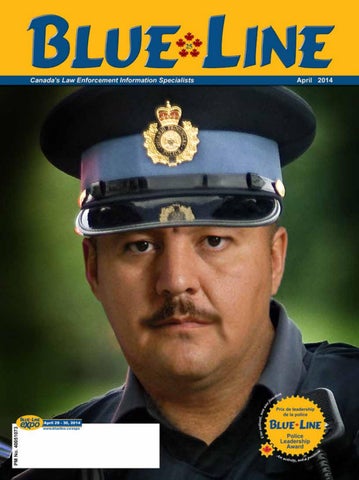
SOLIDIFYING COMMUNITY PARTNERSHIPS Using leadership skills as a role model for others
The leadership legacy of OPP Sgt. Marty Roy Singleton can be summed up in one line: the guy you want in your corner when the chips are down. Singleton became a police officer in 1999, serving initially as a constable with the Nishnawbe-Aski Police Service in Pickle Lake. He began with the OPP in northwestern Ontario in October 2000, serving first in Ignace and later transferring to Dryden. In his first year of service, Singleton was singled out for a commendation for outstanding service: while on patrol and working alone, he saved a life by pulling a person out of a burning home, extinguished the fire and contained the area while waiting for assistance. His special regard for people and communities, especially youth needing positive role models and leadership skills, was already being noted. As a patrol officer, he was dedicated to traffic safety, consistently setting high enforcement standards for the detachment and motivating others to do the same. As a first responder and investigator, his compassion in dealing with crime victims and commitment to ensuring their access to all available support earned him respect. He APRIL 2014
formed close relationships with community members and leaders, particularly in First Nations communities served by the OPP. As a community services officer, his pride in his job and dedication to the safety and security of members of the community was palpable. Singleton became a crisis negotiator in 2001, a demanding role not only because of the stress of dealing with people in crisis and critical situations. Northwestern Ontario is vast, with calls often not easily accessible. Always willing to help, Singleton became known for staying calm, focused and acting appropriately under stress. Communication skills, composure and empathy for people in crisis were, and are, his strong suits. While not every dangerous situation can be peacefully resolved through negotiation, many events have been safely resolved with his help. Given its responsibilities, the OPP either directly polices or supports First Nations policing in many communities. As a proud police officer and member of Eagle Lake First Nation, Singleton rarely misses an opportunity to connect with communities, especially youth, which he wholeheartedly embraced. From taking conversational night classes in Ojibwe to increasing his ability to communicate with community elders and supporting recruitment initiatives for Aboriginal youth 6
interested in policing careers; from investing time, energy and enthusiasm into youth programs to caring about local relationships with community members and leaders; from efforts to be a positive role model for First Nations youth to training for and completing the Winnipeg Police half-marathon in 2013; there are few better examples of leadership through actions. Promoted in 2008 to sergeant, Singleton is the Provincial Liaison Team (PLT) regional co-ordinator, responsible for overseeing the program in OPP North West Region. The 16 members work at various detachments doing operational duties and assisting when needed. The program is a proactive component of police preparedness and response to major events and critical incidents, principally focused on communication and conflict resolution. Singleton is a keen coach and mentor for newly appointed PLT members. Through his tutelage, part-time members effectively fulfill their roles. He continually works to build and solidify community partnerships with Aboriginal and non-Aboriginal communities, other police services, municipal leaders and community groups. He tirelessly maintains contact with First Nations leadership and learns about potential contentious issues so that he can advise, mitigate and help to resolve in the interests of public safety. BLUE LINE MAGAZINE
Singleton is a dedicated family man. Without complaint, he routinely turns his attention to the task at hand and carries on, even though that can mean missing family committments. He rarely misses an opportunity to share his pride in his two children. Leadership through service Singleton has never been satisfied sitting idle. His commitment to several specialized units in addition to regular uniform duties is a reflection of his desire to see the most volatile incidents in policing resolved peacefully. This is an ultimate form of leadership and sacrifice for his peers and the public – Insp. Dave Lucas, Kenora OPP, Detachment Commander Singleton has been part of numerous negotiation teams, often as the primary negotiator, successfully resolving many critical incidents in a peaceful manner. Getting a distraught, often violent, intoxicated person at the lowest point in their lives to surrender is not an easy task. Singleton was the negotiator lying with Emergency Response Team (ERT) members in the bush in close proximity to a violent young man with a loaded shotgun. Despite his best efforts during a long, uncomfortable and dangerous negotiation, lethal force ultimately had to be used to eliminate an immediate threat to the officers’lives. In critical situations requiring specialized units, Singleton often acts as the liaison between police, community leadership and families, bringing much needed calm through skill, patience and understanding. He spends countless hours talking with people, resolving conflicts, addressing issues while emotions are at their highest, coming away well respected by the community and its leaders. No matter the outcome, he always asks for feedback after an incident, looking to improve for the next one. Marty Singleton continuously demonstrates that leadership is an activity for him. He has always gone over and above in his efforts both professionally with his duties and colleagues, but also in his support of external stakeholders and policing partners in North West Region. His easy going, sincere nature immediately leads to trust and a desire to work with him on projects, goals or other ventures that are always undertaken with the interest of others over and above his own – Insp. Darrell Smiley, OPP North West Region.
Singleton has played a role in many major and critical incidents. While always working as part of a team, his leadership, whether overt or behind the scenes, is notable both in immediate results and longer term, meaningful alliances. Some notable events include: • In July 2006, protesters set up an illegal blockade on the Kenora bypass to protest logging. A 30foot steel tripod was erected in the middle of the highway with a protester suspended from the top. A second person crawled under a logging truck and secured herself to the trailer axle. A cement filled barrel with a person secured to it was also used to block the highway. The protesters, most not from the area, were a disparate group of environmentalists, some Mohawk warriors, BLUE LINE MAGAZINE
Sgt. Jeff Simpkins and Sgt. Marty Singleton with the North of 50 Youth Program anarchists and people from Grassy Narrows First Nation. The protest wasn’t sanctioned by local band leadership. Over the course of some 12 hours, Singleton was tasked as the lead liaison officer. His leadership and engagement with the protesters and First Nations leaders contributed significantly to a peaceful resolution and re-opening the highway. Over another four days, communication was maintained with First Nations leadership while an investigation was carried out, charges laid and protesters encouraged to leave and return to their homes. This focused, ongoing communication ensured there were no misunderstandings or issues related to the role and scope of the action that the OPP was taking to resolve the events. • In the early 2000s, Big Trout Lake (Kitchenuhmaykoosig Inninuwug (KI) First Nation), a remote community north of Thunder Bay, and mining exploration company Platinex Inc. were in litigation over licensing a mining operation. Platinex sued KI for $10-billion after being told to vacate First Nation traditional land in February 2006. The issue of government licensing of mining on traditional territory, various decisions and the ongoing tension highlighted the complexities of current First Nation and Crown relationships, particularly in the context of private sector interests. Over almost three years (2006 - 2008) – a period which saw tension, protest action, the jailing of six KI community leaders for contempt of court and police involvement – Singleton served as Aboriginal relations team member. He successfully maintained ongoing, respectful relationships with the KI leadership and the company and was the face and ambassador for the OPP. Through his work and straightforward approach, the OPP maintained peace without hostility or violence and didn’t have to deploy the significant resources that could have been needed to maintain peace in such a remote area. There 7
have been no conflicts with police or opposition to the policing role in the matter and not one criticism of the OPP in relation to it. Singleton’s relationship with the community has only grown over time, a meaningful recognition of leadership through action. • In May 2010 First Nations protest action in relation to the Harmonized Sales Tax (HST) was widening throughout Ontario. Couchiching First Nation organized a major protests, erecting a toll booth on Highway 11 near Fort Frances. Over 10 days of highway disruption, Singleton led the liaison team through tense and sensitive issues and negotiations. Focused on resolving the protest action, they had to navigate conflicting government and First Nations interests. Under Singleton’s guidance, their efforts directly contributed to the situation remaining calm and non-violent. Their approach to de-escalation also supported an environment in which a negotiated agreement was eventually reached. The primary incident commander noted the emotional toll the situation and environment placed on Singleton as he liaised with and navigated through the interests of each stakeholder, “but he demonstrated strong leadership for his team through his perseverance, which ensured the rest of his team held up as well.” • In June 2010, an incident involving the arrest of a Pikangikum First Nation member deteriorated into an event that led to the temporary withdrawal of OPP personnel from the remote, fly-in community once replacement officers arrived. Singleton received a Commissioner’s Commendation for stepping up to defuse a tense situation during the incident and contributing to a solution. On scene with others, he attempted to resolve the initial issue as events turned chaotic. A rock-throwing group attempted to forcibly remove OPP officers from the police station, their residence trailer and the community. APRIL 2014
The angry crowd caused extensive damage, in the station, cutting power and telephone lines and disabling or blocking police cruisers. The officers managed to retrieve their belongings and police equipment.The crowd followed them to their trailer. With some shouting to burn it and the officers grossly outnumbered, Singleton negotiated to get them out. In an effort to further de-escalate the situation, the 11 OPP officers then withdrew to the airport, walking the approximately two kilometres followed by some 200 people, vehicles and a front-end loader. They remained there as further negotiations led to an agreement for new officers to be flown in. An OPP inspector involved in the event pinpointed Singleton’s intervention as just one of “many things aside from his knowledge of the community that kept our officers safe and got us out of there. Again his leadership and willingness to put his self forward and utilize the relationships he maintains in the community is what he does on a regular basis.” Over the next days, weeks and months, Singleton and others worked steadfastly to restore a working relationship with the community. Covers huge area In his role as PLT regional co-ordinator in northwestern Ontario, Singleton covers a vast geographical territory meeting and maintaining contact with a wide range of stakeholders. Through 2010 and 2011, he supported Marathon Detachment through four potentially volatile First Nations issues and a number of community events.The first event, where Pic River First Nation blockaded a Marathon access road to protest the transfer of chemicals from the recently closed Tembec Paper Mill, was followed closely by the same First Nation taking over an area of Pukaskwa National Park protesting a violation of treaty rights. A third incident involved the blockade of Highway 17 as a HST protest and the fourth involved a pending blockade of the CP Rail mainline to bring attention to Pic River First Nation land claim issues. Singleton travelled great distances for each incident and worked extremely long hours undertaking lengthy consultations to find an operationally sound, informed and flexible approach to resolving the conflicts. He made it clear to all that his goal was to find a framework that could accommodate the positions and interests of the parties involved. According to the incident commander: It quickly became apparent that Singleton wasn’t only the catalyst, but also the engine room for the turnaround that satisfied all concerns and requirements in an unbelievable timeline. I learned first-hand from all stakeholders that Singleton was viewed as a leader to all progress in the consultation processes. I (heard) countless testimonials labelling Singleton as a one-stop, learned mediator... It was the successful efforts of Singleton facilitating communications working magic under short time restrictions, (that) ultimately prevented extremely costly and potentially volatile situations from exploding. In late 2012 and early 2013, Idle No More demonstrations and protest events took place APRIL 2014
across Canada. The original call to action was to raise awareness of the impact of federal funding and legislative changes on First Nations communities. Ontario saw well over 200 events, all placing significant demands on policing. Through established community relationships and the work of PLT members, the OPP engaged with organizers pre-event, establishing what could be done in terms of legal protest, which helped in most cases to decrease the potential for violence and the need for extra police resources. Singleton’s leadership and ongoing focus on positive relationships through effective communication contributed significantly to the successful management of activities. Commitment to community Singleton has always demonstrated a commitment ‘beyond the job’ to youth and remote northern communities. Most recently he worked in conjunction with a southern Ontario business to gather donated hockey equipment for distribution to youth across the north, supporting healthy development and activities. He helped co-ordinate the collection and delivery of clothing and winter wear to several remote communities. While securing donations is one thing, delivery in the remote north is another, especially when many communities are accessible only by air and, in the winter, ice roads. Treacherous conditions and very long distances are givens. Singleton,takes this in his stride; it is just what needs to be done. Singleton is often called upon to liaise and communicate with families and community leaders during major investigations. Always professional and compassionate, he takes the time needed to help them through the ordeal, explaining and addressing concerns and listening. North of 50 The North of 50 Cops and Kids project was a week-long summer camp experience for identified youth, with a small core of police officers acting as mentors and camp counsellors. The camp experience focused on building self-esteem through traditional activities and just having fun. Despite significant operational demands, Singleton devoted time and energy to the project for three years and saw it evolve into a broader initiative for youth in the community. One co-organizer explained his impact: He has so much personal investment in the work he does for youth programs. He has a special way of connecting with the kids, where they all love spending time with him, playing sports and laughing with him. Singleton is a welcome figure in many schools, where he organizes and/or facilitates a curriculum-based, 10-week program called Walking the Path, designed to help youth appreciate and understand the history, beliefs and traditions of Aboriginal peoples. In one community dealing with several social problemd where policing was primarily response-based, Singleton not only assisted in a solution focused liaison capacity, but stepped up to make it possible to run a Path program. Singleton leads by example, whether on duty or off. Hearing that a colleague whose husband had recently died could not face dealing with a 8
dead animal, he found her address and took care of the problem – only letting her know after the fact. In another off-duty situation, Singleton saw a single car crash. He stopped, explained who he was, extricated the driver and stayed with her until help arrived. Singleton didn’t give her his name, she wrote. “I would like to see him recognized for his actions as he did not have to stop to assist and the fact that he did speaks volumes as to the kind of person and officer that he is.” Leadership and commitment to peers On July 1, 2010, a Rainy River OPP officer drowned. He was the detachment PLT member and a well-known and respected member of the neighbouring Couchiching First Nation. The loss was significant for all. A long time friend who worked closely with the officer, Singleton assisted throughout this gut wrenching ordeal. From the initial call through the search for and eventual recovery of the body, he dealt professionally with everyone affected: the Couchiching community, detachment members and, most importantly, family members, even though the tragedy was significant and personal for him. “His professionalism, dedication and compassion were nothing short of exemplary throughout the ordeal and afterward,” his detachment commander noted. Extraordinary dedication Singleton shows extraordinary dedication to advancing the PLT program and through it, effective relationships for the OPP with communities, police services, municipalities and different stakeholders with interests in northwestern Ontario. He embraces the opportunity to coach and mentor newly appointed members. Through his tutelage, its capacity has expanded and members know they are supported and well prepared to effectively fulfill their roles. He understands what needs to be done. On a typical day, according to one incident commander, “he arrives with a beaming smile; the hand goes out for a hearty handshake and a ‘good to see you’. After some small talk I ask ‘what’s the plan?’ and he articulates exactly what he has to do and then goes and gets it done providing regular, relevant and required updates. In our northern First Nations communities during a critical incident, this includes meeting with chief and council, the principal of the school, elders and families and addressing all of their concerns. Not an easy task when everyone is at the height of their emotions and an atmosphere of fear and unease is present. Marty has done this perfectly numerous times – without complaint. Insp. Dave Lucas, Kenora OPP Detachment Commander, says it best: Marty is the person I am happy to see show up at the dirtiest, most complex and volatile of situations. He has the courage to carry out these complex and risky duties without complaint or expecting recognition, while constantly trying to improve for the next one. I have seen him mentor others in this way and have noticed a lot of his work ethic in these officers over the past years. Marty Singleton will receive the Police Leadership award at the Blue Line EXPO Awards Gala to be held on April 29. Tickets are still available for this dinner: www.blueline.ca/expo/awards_gala or 905-640-3048.
BLUE LINE MAGAZINE
BLUE LINE MAGAZINE
9
APRIL 2014
A LEGACY OF LEADERSHIP Armand La Barge
The Police Leadership Award was initiated and first bestowed in 1999 by the Canadian Police Leadership Forum (PLF). With continual promotion and sponsorship from Blue Line Magazine, the PLF presented the award annually until 2005 when the organization ceased to exist. Blue Line has long recognized the simpatico between the precepts of the award and the magazine’s founding principles. Leadership ability is not a virtue one is born with or delegated to perform but rather something that is acquired through a learning experience and nurtured through a willing spirit. Encouraging leadership as an activity encourages leadership as a position. Drawing forth those with recognized leadership abilities at levels beneath senior management encourages the availability of a talent pool for the future of policing. The Blue Line Police L eadership Award exists to highlight the importance of recognizing those with leadership abilities and encouraging other officers to develop leadership skills. It is open to active Canadian police officers below the rank of senior officer who have demonstrated exemplary leadership and commitment to service through deeds resulting in a measurable benefit to their peers, police service and community. In February 2011 Blue Line Magazine took up the challenge of a cross-Canada search for suitable candidates for recognition. Blue Line’s appointed judges have so far selected three worthy recipients including this year’s selection OPP Sgt. Marty Roy Singleton.
2014 Judges Michael A. Sale Panel Co-ordinator Michael Sale served with the (Metropolitan) Toronto Police for thirty years, retiring as an Inspector after many years in public affairs and event management. He is a graduate of the 169th Session of the FBI National Academy. Sale has worked as a manager of emergency planning for the Ontario Ministry of Community Safety and Correctional Services and as a justice studies program coordinator for Humber College. He is currently a law enforcement education co-ordinator with American Militar y University and ser ves as the university’s representative in Canada. APRIL 2014
La Barge began his career with York Regional Police in 1973. In 2002, he was appointed as Chief of Police, a position he held until his retirement in December 2010. Chief La Barge is the Past President of the Ontario Association of Chiefs of Police and the Board of Directors for the Canadian Association of Chiefs of Police and he is a member of the First Nations Chiefs of Police Association. He holds a Bachelor of Arts Honours degree from York University. Armand is a graduate of the FBI National Academy, the Queen’s University Executive Programme, the Schulich School of Business Masters Certificate in Municipal Management and Le Centre Linguistique at Jonquiere, Québec. Chief La Barge was invested as an Officer of the Order of Merit by Her Excellency Governor General Michaelle Jean on May 19, 2006, in Ottawa.
Peter German A former Deputy Commissioner with the Royal Canadian Mounted Po l i c e , h e i s c u r r e n t l y on a new challenge at Correctional Service Canada (CSC) as the Regional Deputy Commissioner Pacific Region. Mr. German worked on uniform and plainclothes duties in every province and territory and upon retirement in 2012 was the Deputy Commissioner for Western and Northern Canada. His scope of police work includes urban and rural detachments, security services, professional standards, and commercial crime duties. A lawyer and member of the Ontario and British Columbia bars, he previously practiced law privately, including as a Crown prosecutor and criminal defence counsel. He holds graduate degrees in law and political science, including a doctorate in law from the University of London, and is the author of a legal text, Proceeds of Crime and Money Laundering. He is a f requent lecturer in Canada and abroad and has served as a Canadian delegate to various international forums. Mr. German has taught at the University of the Fraser Valley and the University of British Columbia. He is a Senior Fellow at the Centre for International Financial Crime Studies at the Levin School of Law, University of Florida. He is the recipient of the RCMP Long 10
Service and Good Conduct Medal, and clasp, the Queen Elizabeth II Golden Jubilee Commemorative Medal, and is an Officer of the Order of Merit of Police (O.O.M.)
Frank Beazley Former Chief of the Halifax Regional Police Service, Beazley has been involved in police work for over 42 years. He is a graduate of the Canadian Police College Executive Development program, Queen’s University executive program and numerous certificate studies concentrating in the area of business, law and human resources. He is a past and life member of the Nova Scotia Chiefs of Police Association and Canadian Association of Chiefs of Police (CACP). He is past Vice-President of the CACP and served on its Board of Directors. He sat on a CACP committee for four years regarding the future of policing in Canada. Chief Beazley has received the distinction of Officer of the Order of Merit for the Police Forces (O.O.M.), and is a recipient of the Police Exemplary Service Medal and Bars, Queens Golden Jubilee Medal, Queen’s Diamond Jubilee Medal and the Province of Nova Scotia Long Service Medal and Bar.
Maurice Pilon Maurice (Moe) is a former Deputy Commissioner with the Ontario Provincial Police. He joined the OPP in 1975 after spending three years in the Canadian Armed Forces. Moe served with distinction in a variety of senior positions with the OPP as well as during a secondment in 1988 to the Royal Canadian Mounted Police in Ottawa as Assistant Director of the Criminal Intelligence Service Canada. He served as CISC Director between 1990 and 1993 before returning to the OPP as Commander of the Provincial Traffic and Marine Safety Bureau. Pilon was promoted to Deputy Commissioner in 1998 and retired in 2006 as the Provincial Commander for Investigations and Organized Crime. He has served as Chair of the OACP’s Traffic and Torch Run Committees. In 2003, Deputy Commissioner Pilon received the Order of Merit of the Police Forces (O.O.M.), which honours a career of exceptional merit, contributions to policing, and community development. BLUE LINE MAGAZINE
We are currently accepting submissions for the 2015 award. If you know a great leader in your service visit BlueLine.ca/Leadership to download an application.
BLUE LINE MAGAZINE
11
APRIL 2014
INVESTIGATING
STRANGULATION by Peter Keen and Anita Lal Strangulation is a common method of assault in domestic violence but in many cases there is little physical evidence. It is also very dangerous, posing a significant risk to the life and health of victims. Unfortunately, unless there is some serious physical injury, police, prosecutors and the courts often treat cases as minor. This article explains how front line officers can investigate and document strangulation cases where the victim survives, helping to ensure these offences are treated seriously and attract appropriate sentences. The problem – strangulation is common, potentially lethal but often inadequately investigated Studies reveal strangulation is a common form of assault in domestic violence. Between 23 per cent and 68 per cent of domestic violence victims report being strangled1. It is also potentially lethal, with several U.S. reports indicating it is a common cause of death in domestic homicides.2 In Canada, strangulation, suffocation or drowning was the cause of death in 18 per cent of domestic homicides and 22 per cent of child APRIL 2014
homicides between 2000 and 2010.3 It may also be a significant risk factor for future violence and homicide4. Despite the danger and frequency with which it occurs, studies have revealed problems with both investigation and prosecution of strangulation. Many police reports fail to document the nature of the assault and symptoms.5 Gael Strack and George McClane, who studied strangulation in San Diego, noted that: Sadly, our study showed that unless the victim had significant visible injuries or complained of continuous pain requiring medical attention, the police handled the incident as though she had been slapped in the face rather than strangled.6 The problem appears to be similar in Canada, with a 2006 Uniform Law Conference study indicating that there is a need for improved police training in this area.7 Officers may have observed that strangulation cases, particularly where there is no significant injury, are being treated as ‘minor’ or ‘routine’ by prosecutors and the courts. Officers may have observed that other criminal justice system participants fail to recognise the seriousness of a strangulation allegation. They need to under12
stand what strangulation is and the symptoms that may result to properly investigate. Definition Strangulation is compression of the neck with or without blockage of the airway. It is a type of mechanical asphyxia resulting from direct external pressure to the neck. Asphyxia can be defined as ‘absence of a pulse’ or, more commonly, the absence or lack of oxygen. It is a general term encompassing a variety of conditions that result in interference with the use or uptake of oxygen at the cellular level. Since oxygen is essential to sustain life, a reduced concentration reaching the brain results in a rapid loss of consciousness. For practical purposes, asphyxia is categorized into four categories: compression of the neck; obstruction of the airway; compression of the chest; and exclusion of oxygen due to a depletion and replacement of oxygen by another gas. Strangulation may occur with or without blockage of the airway 8. It can close the blood vessels (carotid and/or vertebral arteries) supplying blood to the brain, comparable to a hose being compressed. Another mechanism would prevent BLUE LINE MAGAZINE
oxygen from entering the lungs by closing the upper airway (trachea).These may occur separately or simultaneously. Strangulation can be very dangerous. It takes a mere 11 pounds of pressure on the throat for 10 seconds to render someone unconscious. Unconsciousness is caused by constricting blood flow to the brain. Death can follow within minutes if the pressure is not released. Strangulation can be caused by the use of hands, the constricting pressure of a ligature around the neck or other solid objects. Manual strangulation can result from applying one or both hands onto the neck. If a ligature is used, it can be of a simple nature, such as a zip tie, rope, belt, curtain cord or electrical extension cord. Other types of strangulation involve armlocks, choke-holds, carotid-sleeper holds or the use of a solid stick such as a broomstick or baseball bat, which may cause unrelenting pressure on the trachea and external jugular veins. Hanging is also a form of ligature strangulation but the difference is that the force applied to the neck is derived from the gravitational weight of the body. Where the victim dies from manual and ligature strangulation, death is caused by the compression of the internal structures of the neck by the occlusion (blocking) of the carotid arteries and external jugular veins. Occlusion of the airway plays a minor role, if any, in death. Physical evidence There is often physical evidence present where the victim dies from strangulation and it may also
BLUE LINE MAGAZINE
be visible in a living victim. Officers confronted with an allegation of strangulation should look for physical signs of strangulation, which include: • Bruising may be observable on the front, sides or back of the neck, angles of the jaw, chin or as far down as the collar bones (clavicles) or even below. Bruises may be discoid and one to two centimeters each in diameter, representing finger pads clustered on one or both sides of the neck. • Abrasions may be present from fingernails on the throat, which are characteristically semi-lunar or linear. • Petechiae (small pinpoint hemorrhages) may be seen in the skin and mucosal surfaces of the eyes. In some cases they may be visible throughout the entire face above the compression point. Petechiae arise from the increased venous pressure that arises from blocking veins in the neck. • Marks: Ligature strangulation displays a horizontal, almost circumferential, abrasion around the neck depending on the nature of the ligature used.9 • Voice changes: Strangulation can cause changes in the voice. A victim may speak in a rough, hoarse tone. There are often no marks Although signs of strangulation may be present, this is often not the case. It can occur without any visible injury at all. In a study of 300 strangulation cases in San Diego, there were no visible injuries in 50 per cent of the cases and only minor visible injuries in a further 35 per cent.10
13
Non-visible symptoms Where there are no visible injuries, victims may still have experienced symptoms to which they can testify. Such evidence can, if recorded in the Crown brief or interpreted by medical practitioners, help prove the strangulation was objectively serious and even life threatening. Non-visible symptoms of external neck pressure include shortness of breath, difficulty swallowing, coughing, cognitive changes (confusion, restlessness, agitation) and eventually loss of consciousness. In addition, symptoms can include a dramatic condition known as ‘air hunger’ in which a violent struggle is elicited by tremendous fear of impending doom coupled with violent efforts to open the airway 11. Symptoms may also come from hypoxia (lack of oxygen to the brain) or ischemia (lack of blood to the brain).These symptoms can include feeling faint, blurry vision, flashes in or out of consciousness, a sensation that a light is flickering, tingling in the extremities (fingers, hands, toes, arms and legs) and, of course, losing consciousness. Investigating with no physical symptoms Where there are no visible symptoms of strangulation, it will be important to collect as much concrete information as possible from the victim to assess how serious the strangulation incident was. Domestic violence victims often minimize violence, particularly with the passage of time, or may simply be inarticulate, poorly describing
APRIL 2014
the violence and symptoms experienced. As an example, a victim may simply say “I was choked” when giving a statement. If this isn’t followed up, the nature of the assault will be unclear. As an example, the words ‘I was choked’ may simply mean the accused grabbed the victim’s throat to push her away, causing momentary and minor pressure to the throat. “I was choked” may also mean the victim was thrown to the floor and the attacker wrapped their hands around the victim’s throat and squeezed until they blacked out while they kicked and fought back in panic, believing they were going to die. Inadequate questioning or follow up will fail to reveal the seriousness of the actions underlying the words “I was choked.” The burden of proving aggravating facts in a criminal case is always on the state. This means that if the court hasn’t anything more than the words “I was choked” to go on, it is likely to treat the ‘choking’ as minor unless there is evidence it was objectively serious. As such, it is important when victims indicate that they have been strangled, choked, or have suffered airway obstruction during an assault to clearly determine the nature of the assault. Document any injuries, collect available physical evidence and ask detailed questions so that prosecutors, courts, medical experts and victim advocates can know just how serious the strangulation incident was. Officers should ask detailed questions about the nature of the strangulation and the symptoms experienced even if there are no injuries – questions such as: • How did the strangulation occur? (Get victims to show their and their attacker’s position.) • Did you feel dizzy, faint, or lose consciousness? • Did your level of consciousness change during the assault? • How did your hands and feet feel – was there any tingling in them? • Were there any changes to the appearance of light while this was occurring? • Was an object used to strangle you (a rope, belt or towel, for example)? • How much pressure did the suspect use? (This is difficult to assess in every individual. A general answer would be ‘a little, a lot, too much that it hurt’). • Were you coughing afterwards? • Did you have any problem breathing afterwards? • Did you defecate or urinate as a result of the assault? • Did you have any pain to your throat? • Did you feel nauseous or vomit? • What did the suspect say during the assault? • Was anything else being done to you while you were strangled? Carefully record both the answers and any observable symptoms such as redness around the neck, ligature marks and so on.Take photographs at the time and follow up photographs later, as some injuries, such as bruising, may become more visible over time. If the victim’s voice has changed as a result of the attack, record them speaking to document the change. Lastly, don’t forget that there were two people present during the assault.Try to take a statement from the suspect and use your knowledge of symptoms when doing so. For example, ask the suspect: APRIL 2014
A section 246 charge will often be inappropriate because the strangulation is the assault and no other ‘purpose’ can be identified.
• Did the victim stop resisting? • What did the victim’s face look like during choking? • How did the victim react after you stopped choking them? • Did the victim appear to lose consciousness? Consider collecting other pieces of evidence. Examine for physical evidence, take photographs of the scene and seize items that were used during the struggle. Charges other than simple assault There is a ‘choking’ charge available at .246 of the Criminal Code. It can only be laid where the accused has choked, suffocated or strangled someone for the purpose of overcoming the victim’s resistance to commit some other indictable offence beyond the strangulation, such as a sexual assault or robbery. The key element of the offence here is proving that the accused had some purpose beyond the strangulation itself.12 A s. 246 charge will often be inappropriate because the strangulation is the assault and no other ‘purpose’ can be identified. In such cases, the only charges that may be available are one of the levels of assault (s. 266, 267 or 268). Where a weapon is used to commit the strangulation, an assault with a weapon charge can be laid. Where there are injuries that amount to bodily harm, an assault causing bodily harm charge can be laid. Where those injuries amount to wounding, maiming or disfigurement, aggravated assault charges can be laid. Additionally, even if there are no visible injuries, officers should consider laying an aggravated assault charge if the victim’s life was endangered. This may occur if the victim reports a loss or change in consciousness due to the assault or reports objectively serious symptoms. It may seem common sense that strangulation may endanger life and a court may be willing to infer that life was endangered from the strangulation,13 however there is no rule that a court must draw such an inference. Some courts may be reluctant to do so in the absence of supporting medical evidence. You should always obtain emergency room and other medical records pertaining to the assault but they will often simply describe the injuries, symptoms and diagnosis. They may not, on their own, explain the severity of the assault or clearly articulate whether life was endangered. Accordingly, if you are considering an aggravated 14
assault charge, consider obtaining expert medical evidence that addresses the nature. There are several potential sources, including emergency room physicians, other medical doctors and expert forensic witnesses such as forensic pathologists. Doctors and pathologists can review police evidence – including victim statements, medical records and documentation of weapons and injuries – and may be able to relate symptoms to physiological causes. By way of example, a doctor may review documentation revealing: the victim reported being strangled and nearly passed out; felt tingling in hands and feet; and perceived light fading or flickering. A doctor may be able to testify that such symptoms can be caused by the brain not receiving sufficient blood or oxygen, which places life at risk. He/she may also be able to explain the dangers associated with strangulation and what symptoms such as blacking out, tingling of the hands or feet, or loss of bladder control mean in a strangulation episode. Such evidence may help establish that the victim’s life was endangered. Conclusion Every strangulation case begins with an investigation. Evidence collected from the victim at the time of the incident, including the details of the strangulation and the symptoms the victim experiences, is vital. The quality of work by frontline officers, responding to routine domestic assault cases, will have a tremendous impact on how seriously prosecutors and judges will treat the case. Footnotes
1. Gwinn, Casey and Strack, Gael, “Background Information for a California Strangulation Statue,” National Family Justice Center Alliance Strangulation Training Institute, January 2011; Fact Sheet, Strangulation Assaults in Domestic Violence Cases, The Center on Family Violence. 2. Supra, see also Schwartz, Amy, “Strangulation and Domestic Violence: Important Changes in New York Criminal and Domestic Violence Law.” Empire Justice Center, November 19, 2010. 3. Family Violence in Canada: A Statistical Profile, 2010, Released May 22, 2012, Statistics Canada, p. 38, Chart 2.8; p. 78, Table 3.3 4. Supra, notes 1 and 2; Report of the Criminal Section Working Group on Strangulation, Uniform Law Conference of Canada, May 2006 (ULCC) 5. Strack, Gael et. al. “How to Improve Your Investigation and Prosecution of Strangulation Cases,” updated May, 1999 (October 1998), http://www.ncdsv.org/images/ strangulation_article.pdf 6. Strack, Gael B. and McClane, Dr. George, “How to Improve Your Investigation and Prosecution of Strangulation Cases” (October 1998), http://www.ncdsv.org/images/ strangulation_article.pdf 7. See for example, the ULCC paper, supra 8. Spitz and Fisher’s, Medicolegal Investigation of Death, Charles C. Thomas Pub. Ltd, 4th ed. p. 783 9. Spitz and Fisher, supra note 9, p. 787 10. Strack, Gael B. et al. “A Review of 300 Attempted Strangulation Cases†: Part I†: Criminal Legal Issues,” Journal of Emergency Medical Medicine, Elsevier Science Inc., Vol. 21, No. 3, October 2001, cited in Report of the Criminal Section Working Group on Strangulation, Uniform Law Conference of Canada, May 2006 11. Spitz and Fisher, supra note 9, at p. 791 12. R v. Brierley, (2009) O.J. No. 4253 (Ont. C.J.); R v. Heddon, 2006 CarswellAlta 1818 (AB. Prov. Ct.); 13. See for example R v. Sayers, (2008) O.J. No. 3516 (Ont. C.J.) Peter Keen is an assistant crown attorney with the Ontario Ministry of the Attorney General. Dr. Anita Lal is a forensic pathologist with the Ontario Forensic Pathology Unit.
BLUE LINE MAGAZINE
BLUE LINE MAGAZINE
15
APRIL 2014
Identifying the stressors Police communicator wellbeing
by I rene Barath, Janet Balch, Cheryl Regehr, Vicki R. LeBlanc and Aruja Birze1 Professional communications personnel do not need to ‘suck it up’ and ‘just get over it’ any more than police officers do. The Ontario Police College (OPC), in partnership with University of Toronto researchers, has investigated predictors for physiological stress and distress in police communicators. Police communicators from both rural and urban police services participated in this innovative study. The 113 communicators ranged from 24 to 61 years old and were primarily female [86.7 per cent] which is consistent with workforce demographics. Participants were most often married [59.3 per cent], had postsecondary education [80.6 per cent] and one to 35 years of service, with the mean 12.7 years. The purposes of this research were multifaceted. First and foremost it allowed the opportunity to recognize the contribution made by communicators in serving their emergency services colleagues and the broader communities where they live and work. Secondly, this research provided some much needed insight into the specific stressors related to the profession, including numerous calls, in rapid succession, with some callers in APRIL 2014
extreme distress. As the first point of contact with police, communicators are not present at the scene and so are sometimes unaware of how a situation is resolved. They are only called upon to send help if things go from bad to worse. Finally, this research provided some insight for the participants and other emergency services communications personnel into the psychological impact the profession can have on their wellbeing. With awareness comes an opportunity for all communicators to reflect on their current stress management and coping practices and to adopt best practice to optimize their physical and psychological wellness. One of the most significant findings of this research relates to the impact of emotional coping strategies on the psychological wellness of communications personnel. Those using negative emotion-focused coping strategies, which involve repeatedly worrying, self-blaming and anger (frustration), demonstrate the most trauma symptoms and are at higher risk for Post Traumatic Stress Disorder (PTSD). The good news is that these destructive coping strategies can be replaced with more adaptive approaches through interventions targeting cognitive-behavioural approaches. Beneficial coping strategies include positive emotion-focused, task and avoidant oriented processes. The other significant finding relates to the 16
increased prevalence of PTSD symptoms for those communicators who have been practicing their profession the longest. One of the findings from the October, 2012 Ontario Ombudsman Report, ‘In the Line of Duty’ indicates relative to cumulative exposure: It has been estimated that in the first year of police service, the average police officer is exposed to around 12 critical incidents; by mid-career, exposure to critical incidents increase to approximately 150 and by post retirement, police officers have been exposed to an average of 250 duty related critical incidents during their career.2 If this is the situation for police personnel in Ontario we can only estimate the impact on communications personnel who are initially handling these and many other calls for service. Fortunately, many police services are taking a proactive role when initiating their critical incident protocols to include sworn and civilian police service members in the debriefing processes. Overall, “(T)he police communicators in this study appear in many ways to have positive levels of psychological health and wellbeing.” 3 This news is encouraging. It is also reassuring to know there are ways for communications personnel to change how they cope with the demands of their work to lessen its psychological toll. Although this research provides some insight BLUE LINE MAGAZINE
for communications personnel, there can be no significant long term impact unless individuals use this information to self-reflect. Mental health and wellbeing are as important as physical health and wellbeing. By taking care of ourselves and each other we can ensure long successful careers of public service followed by enjoyable retirement with family and friends. Acknowledgements The credentials of Provost and Professor Cheryl Regehr, Associate Professor Vicki LeBlanc and research analyst Aruja Birze are too extensive to catalogue in this article. They were critical to Janet Balch and myself (Irene Barath) as we moved this research project forward. Without the support and cooperation of the OPC, University of Toronto and the trust
BLUE LINE MAGAZINE
of Ontario police communicators, this research project would have remained only an idea. FOOTNOTES
This article is derived from the previously published ‘Predictors of physiological stress and psychological distress in police communicators’, by Cheryl Regehr, Vicki LeBlanc, Irene Barath, Janet Balch and Arija Birze, Routledge, Taylor and Francis Group, Police Practice and Research, 2013, Vol. 14, No. 6, pp 451-463,. 2 Andre Marin, ‘In the Line of Duty’, Ombudsman Report, Ombudsman of Ontario, October 2012, p. 37 3 Cheryl Regehr, Vicki LeBlanc, Irene Barath, Janet Balch and Arija Birze. ‘Predictors of physiological stress and psychological distress in police communicators’, Routledge, Taylor and Francis Group, Police Practice and Research, 2013, Vol. 14, No. 6, p. 459 1
Irene Barath is a Resilience and Wellness instructor in the OPC Leadership Development Unit. Contact her at Irene.Barath@Ontario.ca for more information.
17
APRIL 2014
LACING UP FOR
A PLAYGROUND
by Danette Dooley
Bloomfield Elementary School in Prince Edward Island recently challenged members of the West Prince RCMP to lace up their skates and take to the ice for a hockey game. The challenge was about much more than shooting pucks; it was a way to raise money for much needed new playground equipment for the school. The game took place on Jan. 31. The school’s team was made up of parents, alumni and a teacher. Cst. Renee Michiels said the detachment was made up of members from all over the island. The game is a yearly event, she said, and always in support of a worthy cause. “I’m part of the Bloomfield Home and School group and I suggested we have a hockey game to help them raise the money they need for the playground.” In addition to the game (which the police won 7-6) the evening included a bake sale, toonie toss, 50/50 draw and gift basket draw. “We did a lot of advertising and the kids were so excited. We had the local figure skating team perform in between periods and our officers gave out water bottles and stickers and hats. There was lots of picture taking. The kids had a ball.” The school has already raised almost half of the $90,000 it needs for the new equipment. Several fundraisers have already taken place, Michiels said. The game, which took place at the O’Leary Community Sports Centre, netted $2,400. Scotiabank in O’Leary APRIL 2014
matched that amount. “Bloomfield is a K-6 country school with a wonderful staff and amazing principal. Andrew (Stewart) meets the kids in the mornings and waves to them in the afternoon as they are getting on the bus. It’s a very healthy environment for staff and the kids,” Michiels says. Stewart said his school values the partnership it has made with the community and with the RCMP. “We very much are advocates of teachers, parents and students working together and it has been very much the case with the playground equipment drive. Having an opportunity to work with the RCMP in this case 18
is just another example of that,” Stewart said. Michiels, who is originally from Ontario, said while it’s taken several years to raise half of the money, the volunteers will continue with their fundraising efforts. “We had so much support f rom the RCMP here in PEI, right up to our commanding officer Craig Gibson, and when you add that support to the support you get from the school and the community, it makes raising the money that much easier,” Michiels said. Danette Dooley is Blue Line’s East Coast correspondent. She can be reached at dooley@blueline.ca
BLUE LINE MAGAZINE
HOLDING THE LINE by Stephanie Conn
Let go of the outcome My first week in field training was a mixture of excitement, pride and nervousness about my ability to be a police officer. I was dispatched to meet a domestic abuse victim who managed to escape her home to call for help. While taking her statement I noticed the scars on her face and body, likely the remnants of previous beatings. I remember the fear and desperation in her voice as she pleaded for help with her situation. We arrested the abuser that night and I remember thinking that this is what it is all about – righting the wrongs, protecting the vulnerable and bringing a sense of order to the world. My idealistic views were dashed a week later when I learned that the abuse victim had been beaten to death. I immediately began reviewing what I had done, not done, could’ve done and should’ve done that might have created a different outcome. Unfortunately, this wasn’t an isolated event. There were many occasions where my desire to make the world a better place just wasn’t happening. Was I a bad cop? Do we chock it up to my inexperience – or was there more to it? Similar experiences were happening to every cop I knew, from rookie to veteran, so clearly it wasn’t a matter of being a “good” or “bad” cop. I learned that it was the limited influence that cops actually have in the circumstances they face. So how do you do a job where you feel that your influence is limited in the big picture? You have to change your view of the picture. If I had determined in week one that I wasn’t effective in my work, there are countless instances where I would not have been able to prevent crimes, console victims and catch bad guys and gals. We have to look at those instances when we evaluate ourselves. Unfortunately, human nature directs us to pay more attention to what went wrong than what went right. In this way, we (mistakenly) feel that we can have more control the next time we are facing a similar situation. This is not to say that we cannot learn from experiences and get better at handling events. It is to say that there is a limit to how much we can control circumstances despite our best preparation, training and wisdom. We are human beings, after all, faced with so many variables outside of our control. Even if we do make a “mistake” in a situation, the outcome is usually greatly influenced by so many other factors than our mistake. Take my personal example – I can reason that if I had not arrested the abuser, he would not have been so mad as to beat the victim to death. This is tricky because you can’t prove it BLUE LINE MAGAZINE
either way, which makes this logic torturous – but I didn’t beat her to death. I never even touched her. I didn’t put them together as a couple and teach him that he should demonstrate his dominance by beating others to submission. In fact, what I did was what was expected of me as a police officer. What if I hadn’t arrested him and he killed her that night? Am I responsible for that too? It can feel like a no-win situation when all of the options could have negative consequences. The problem is that we assume a better outcome if we had taken a different course of action. We also discount how many times taking a certain course of action did turn out well. I arrested lots of abusers after that without this outcome. Sometimes we also learn other information after the event and hold ourselves to a standard as if we knew it at the time. It is important to separate what we knew from what we later learned to avoid punishing ourselves for crimes we did not commit. What I am trying to convey here through
19
my personal story is that we can sometimes be our own worst enemy when it comes to evaluating our decisions and performance. Attaching the outcome of an event to our input is dangerous and based upon faulty logic that we (and others) rarely question. We need to question this logic. Did your singular input create the outcome? Did you have all the information you needed at the time? Could it have turned out poorly if you had taken a different course of action? Could a different action have made the situation even worse? Have you taken this action before without these outcomes, maybe even positive ones? These are important questions that can not only save you a lot of grief but help you see the big picture. Stephanie Conn is a registered clinical counsellor and former communications dispatcher and police officer. To find out more visit www.conncounsellingandconsulting. com or email her at stephanie@blueline.ca.
APRIL 2014
10
YEARS OF PEDALING FOR A CURE
by John Townsend What do you get when you combine officers from the Peterborough Lakefield Community Police, Peterborough County OPP and RCMP with a NHLPA member? Medal for Hope! Developed from Cops for Cancer, this team put a twist on an aging campaign and energized this community involved fundraising campaign. The idea was designed on a napkin by Peterborough Lakefield Community Police Det./Cst. John Townsend. The need for change was recognized and a Cops For Cancer cycling tour involving local students was welcomed. Officially formed in Peterborough in 2005, Pedal for Hope members shed their uniforms for three weeks each spring, riding through snow, hail and freezing rain but usually finishing in the warm sun. With the help of major sponsors such as Shimano Canada and Subway, the team pedals over a thousand kilometres to visit schools around central Ontario. At each stop, students are engaged in a variety of activities hosted by the officers, including head shaves, ponytail cuts, ice cream eating contests and dancing. The noise level in the gym explodes when the officers arrive and the student enthusiasm is contagious. Although the officers show their fun and approachable side, there is always an education component: from using sun sense and anti-bullying messages to healthy eating and physical activity. The officers have a captive audience and use this opportunity to show that police really do care. After the three week tour the team hosts a wrap up event, sharing the final kilometer APRIL 2014
of the ride with child survivors and their families. Each child has a partner officer (affectionately known as “Special Friends”) and is given their own bike to ride. The team has had five special friends lose their battle with cancer during the first nine years of the campaign. Their names are engraved on each officer’s bike, providing an everyday reminder of the reason they ride; so no parent has to hear the words, “Your child has cancer”. The Peterborough Team was contacted by police officers in Belleville in 2010. They came out to view the tour. Impressed with what they saw, Pedal for Hope expanded to the Quinte area and the officers kicked off our second team in 2011. The Belleville team has had three successful years and continues to grow, working in partnership with child survivors and their families, the community and the Canadian Cancer Society. Pedal for Hope has raised $2.3 million dollars for pediatric cancer research since 2005. The team funded an “Innovation Grant” through the Canadian Cancer Society in 20
2012, giving $200,000 to fund the research of Dr. Donald Mabbott, a senior associate scientist at the Hospital for Sick Children. Mabbott is studying the impact of exercise on children treated with radiation and is looking for evidence that increasing physical activity in brain tumor survivors can stimulate the growth of new brain cells. If successful, the research findings will be published in medical journals worldwide and will be named after the Pedal for Hope team! The Peterborough office of the Canadian Cancer Society is incredibly proud of the team. Described as local heroes in this community, they are passionate and dedicated to funding life-saving research for children diagnosed with cancer and also enhancing the quality of life of children and their families who are living with the disease. Pedal for Hope really is changing cancer forever. John Townsend is founder and co-ordinator of Pedal for Hope. Contact him at JTownsend@peterborough.ca or 705 876-1122 x360 for more information.
BLUE LINE MAGAZINE
LETTERS A belated congratulations on the 25th anniversary of Blue Line Magazine and a very happy New Year to you and yours. You have truly achieved a place in police journalism that few magazines have. I haven’t seen anything in the US that can compete with your comprehensive beneficial law enforcement package that graces police environments every month. I will continue to look forward to my monthly copy of Blue Line and contribute if and when I can. – Ian Parsons, Alberta ••• I wanted to express my sincere appreciation for you printing our article on GO transit safety and security. (December 2013 Blue Line Magazine) My team was thrilled (still are) and I am in your debt – this level of awareness goes a long way to helping us in the work we do with local police and emergency services. We have placed a copy of the article on our GO web page and flagged it on Twitter. Again looking forward to anything we can do to help in the future.
respect to the people who were here first and it is also iconic of the Pacific Northwest. We are unaware of any other large municipal police department in Canada and possibly in North America that carries this distinction. Thanks again to you and the judges for your time and consideration. – Paul Patterson. Senior Director Community & Public Affairs Vancouver Police Department ••• I read with interest your commentary on traffic direction. When I first landed at 5T (1968) about a dozen officers were needed on each of both days and afternoons to cover all of the traffic points created by the closure of the Leaside (or Millwood) bridge for rebuilding and widening to six lanes. It went on for about nine months. We sure got to learn about traffic direction. I read each of your points and they were all very correct. Foremost, you want to be seen so that you get to go home without getting run over. Thus the vest, white gloves etc. but very important was that whistle. As you point out, good traffic direction requires a whistle accompanied by good hand direction. So we fast forward to now. Traffic direction is a lost art. Today’s uniform member appears to
hate it. Even when they are being paid $70 an hour on a paid duty, they want to look in the hole being dug rather than keep traffic flowing. This past summer for several months there was a daily traffic point paid duty. Two of three eastbound lanes were shut down for hole digging. We would travel westbound through the intersection two or three times a week. Eastbound traffic would be backed up for blocks. The officer on a paid duty would usually be standing on the sidewalk ignoring the traffic but looking at his/her iPhone. Perhaps getting the latest stock quotes. But on a particular Friday evening around 5:30PM we saw an officer standing in the middle of the eastbound lanes. It must have been a traffic guy because he had leggings on, a white hat cover, a bright lime coloured vest, white gloves and a funny looking thing around his neck held there by a shoe lace. It looked like the black whistle that I used to carry. It was in his mouth and he was blasting out loud sounds in conjunction with solid hand signals. He was letting one lane at a time proceed. There was no doubt this guy knew how to get motorist’s attention. Traffic wasn’t backed up and flowed nicely. I wish those days of competent traffic direction would return. There, I have vented. – Bob Shirlow, Toronto
– Bill Grodzinski, Director Safety & Security, GO Transit ••• Congrats again on your anniversary issue and thank you for the piece on our car design winning second prize. Just for clarity I thought I would point out a couple of things. The car design was done entirely in house by a member of the VPD Public Affairs crew, graphic designer Sharmini Thiagarajah.The firm you credit with the design merely applied the decal of her art work. The final design was one of five designs Sharm created that we submitted in a survey to every member of the VPD, sworn and civilian. It was the overwhelming choice of the majority of the respondents. The design was specifically created to follow the lines of the new Dodge Chargers in our fleet. The award-winning gradient concept that proved so popular was conceived by Sharm in an effort to honour the tradition of old black and white cars that has once again become popular and at the same time reflect the modern, innovative and distinct nature of the VPD. The swoosh on the front panel is unique to the VPD and is not a raven or an eagle. This art work was developed especially for the VPD and generously donated by the world renowned native artist Susan Point. It is a thunderbird and in native lore the thunderbird is known as the protector. This symbol of protection is a nod of BLUE LINE MAGAZINE
21
APRIL 2014
ON THE
FLIGHTER SIDE The big fat feathered caper
APRIL 2014
by Morley Lymburner There is no explaining where the human mind goes when it takes a vacation. What makes it worse is when you have a partner who sort of sits there and doesn’t mention an idea you have is about the stupidest idea since Hannibal decided elephants could mountain climb. This story takes you back over 20 years but I am admitting nothing. My partner, whom I will call “Al” so as to protect the not-so innocent, and I drove to work everyday in a shiny new unmarked police car.
22
We took the same route into downtown everyday at around 5:30 a.m. and always noted a kindly baker who came out on the sidewalk in front of his shop and threw out a large tray full of bread crumbs for the pigeons in the area. His cast was indeed wide as most of the debris hit the sidewalk and across much of the four lane street in front of his store. There is no doubt the baker had been doing this for some time because there was always an enormous flock of these grey and purple coloured birds on the hydro lines and sidewalks awaiting the morning handouts.
BLUE LINE MAGAZINE
Initially both of us, being rather sociable people, would stop and chat as we looked with curiosity at the large mass of pecking, bobbing heads as they fluttered their way in front of us in pursuit of a good meal. We were enchanted by their tiny red eyes and twitching almost mechanical movements. The baker would give us a friendly wave and we would wave back and smile as he re-entered his store without a further thought regarding his plumed and rather plump freeloaders. We would then wind our way stealthily though the mass of birds. Being rather prompt individuals we always seemed to arrive around the same time as the baker and the horde of birds. If we timed it just right we would be just ahead of the baker. If we were even a fraction late we had to endure a slow-down or complete stop while the birds did their civic duty of cleaning the debris from the sidewalk and the road way. This routine continued for about four weeks before we began to tire of the challenge of playing the clock game with the baker and decided to alter our route so as to go around the inevitable road block. On this one morning, shortly after the decision to alter our route, Al and I were engaged in a rather animated conversation with more than a little mirth attached when Al realized we had missed our detour route. The car had gone to auto-pilot during our conversation. Both of us realized we were heading down the pigeon trail and both realized we were going to be yet again the spectators to the baker’s foul smorgasbord. As we approached the feathery horde on the street my partner looked at me with a smile and advised that we might as well speed up and scare them away because today we had to get to work on time. I placidly sat in my seat as he accelerated and we awaited the predictable panorama of fluttering wings moving gracefully into the air in waves. This blissful vision turned quickly to sudden horror with the realization that nothing was moving. Our speed was now too fast to do anything but cannonball straight ahead. Our expletives were punctuated by the predictable multiple dull thud sounds followed by a virtual snowstorm of iridescent grey, white, green and purple feathers. Bird torso’s bounced and pirouetted off the windshield, tumbling right and left off the bumper and hood as visions of Alfred Hitchcock’s “The Birds” flashed through our minds. The flurry of feathers cleared and the gas peddle hit the floor as the only thought in mind was making the next right turn and hoping it could be made on two wheels. As our pounding hearts finally returned to our chests and the car pulled into the garage we scurried to the front of the car to survey the damage. We quickly deduced our escape was complete due to a lack of BLUE LINE MAGAZINE
motorists and a flurry of feathers obscuring our rear licence plate. There where feathers stuck to every nook and cranny but not a single dent. After meticulously removing each feather and one baleful body from the grill we began a very fast car wash. Our drive home that afternoon was certainly quiet as we repentantly thought about the early morning adventure. Well there was no damage to the car. No one has to report hitting a flock of birds. Satisfied with our analysis we continued winding our way home. It was mid afternoon and curiously my thoughts began to turn toward supper. I looked at my partner, now the passenger
23
of course, and suggested that perhaps chicken might be on the menu today. We began to chuckle. And then began to laugh as we crawled along in the stop and go rush-hour traffic. Just as quickly we both stopped laughing as if on que. “What’s that smell?” I asked. We looked at each other with round saucer eyes as we realized why the suggestion of chicken dinner leapt to mind. The distinct odour of cooking foul was filling the interior of the car. “It couldn’t be... could it?” Yes indeed it was. One hapless bird got stuck under the catalytic converter. We never forgot our new route to work after that.
APRIL 2014
The World’s Most Valuable
CHECK-IN
by Missing Children’s Society of Canada The Missing Children Society of Canada (MCSC) successfully launched the firstever online search party in 2012. Called the “world’s most valuable social network” the service supplies a way to alert the masses by reaching those most likely to report a sighting – the people nearest to where and when a child went missing. The ‘world’s most valuable check-in’ is a digital tool that sends an alert to people at Foursquare locations closest to where a child abduction has taken place. The first three hours of a search are the most critical. You can now help authorities locate a child faster before the kidnapper gets too far away. Created by Grey Canada, Milk Carton 2.0 allows MCSC to quickly notify users via Facebook, Twitter, Foursquare and Pinterest of missing children in their area. What is truly unique about this offering is that it allows users to ‘donate’ their social feeds to engage all their friends in the search for a missing child. This domino effect allows
APRIL 2014
MCSC to reach hundreds of thousands of Canadians within moments of an alert being issued. This valuable service was directly responsible for assisting in the rescue of six missing children in the first five months alone.
24
More than 45,000 children were reported missing in Canada in 2011 – that’s one child every 11 minutes. When a child first goes missing, police, media and the community all rally together to help the terrified and anxious family search, but as
BLUE LINE MAGAZINE
time goes by, that involvement inevitably decreases. It is for these families that the MCSC was established in 1986. The MCSC is the only non-profit in Canada actively searching for missing children. It is 100 per cent funded by donations and provides its services at no cost to families. Its unique and comprehensive programs serve families in the critical hours after a child goes missing and provides ongoing support until he/she is found. The MCSC has investigative programs that assist both police and searching families, mental health programs that help families deal with the emotional consequences of a missing child and critical awareness generating campaigns to provide essential support for searching families. How they do it Embracing the future through technology and volunteerism. Two things are needed for a child to go missing: time and anonymity. By removing those two key elements from the equation, MCSC helps more quickly return missing children home. Using technology, it is able to spread information faster and engage a greater number of Canadians in the search; they become volunteers and each and every one is critical to recovering that child. By uniting a country in the search for a missing child, MCSC is discouraging it from occurring – the more eyes in communities, the less likely an abductor will take a child. Supporting MCSC ensures it
BLUE LINE MAGAZINE
can continue to keep Canadians as informed as possible in an emergency – and prevent future abductions. Healing families The Family & Peer Support Program is run by an experienced professional counsellor who has previously built similar programs and worked with Canadian Mental Health. From one-on-one sessions to speaker series with industry professionals, the program is built for any family member experiencing emotional distress over a missing child – parents, grandparents, siblings or extended family. Supporting MCSC means helping these families to rebuild their lives. Empowering investigative teams MCSC investigators provide a critical service to family, law enforcement and other government agencies. They are internationally known experts on missing children. Important leads can come up at a moment’s notice and families lean on them for everything from mediation to navigating the legal and judicial systems. Supporting MCSC means these investigators can do what they need to do – when they need to do it. To donate, volunteer or learn more, visit www.mcsc.ca, e-mail info@mcsc.ca or call 403 291-0705.
25
DISPATCHES Bill Janes was appointed the RNC’s 21st chief in a ceremony on March 1, 2014, at the Confederation Building in St. John’s. Janes joined the RNC in 1985 and spent time on patrol, in operational support and in the criminal investigation division. He has received the Police Exemplary Service Medal and the Queen’s Diamond Jubilee Medal. He trained at the Canadian Police College, Ontario Police College, the Canadian Emergency Preparedness College and Memorial University’s Gardiner Centre, and holds a bachelor’s degree in arts with a major in police studies from Memorial University. Janes will be replacing outgoing Chief Robert Johnston. Janes said it’s too early to say what his priorities will be as he takes over the top job. “I think it would be premature to say what the priorities are,” he said. “We’re doing jurisdictional and environmental scans, we’ve had consultations with our managers and we’ll do that with all of our staff. So you need to draw all that information together to determine exactly what your priorities are.” ••• Vancouver Police Chief Jim Chu has had his contract extended until 2017. At the beginning of March the Vancouver Police Board announced the chief, who has led the department through some tough times, including the Stanley Cup Riot, will have two years added to his current contract, which was set to expire in 2015. He was first given a five-year contract in 2007, but in 2010 it was renewed until 2015. Mayor Gregor Robertson, the board chair, said he appreciated the police chief’s attention making Vancouver a safer city. Chu enjoys a good relationship with Robertson. The two men share some common views, including the need for a regional police force. Chu’s department has also strongly endorsed the city’s “four pillars” harm reduction strategy for drugs in the Downtown Eastside. Although a creation of a former city administration, the policy forms a strong backbone of Robertson’s own agenda for reducing homelessness and mental health problems in the neighbourhood. In 2013 Chu’s salary was reported to be more than $314,000. ••• Vince Hawkes has been selected as the new commissioner of the Ontario Provincial Police. Hawkes, who joined the force in 1984, will take over the top post from Commissioner Chris Lewis, who steps down on March 28 after a 35-year career. Hawkes has served in a variety of senior positions, most recently as deputy commissioner of field operations where he’s been responsible for services to more than 300 communities across the province. He also served as provincial commander of investigations and organized crime, winning national recognition for his work on several committees on organized crime and leading the development of a national strategy. When he takes over on March 29, he’ll be the OPP’s 14th commissioner. Hawkes is a graduate of the University of Ottawa and the University of Toronto’s Rotman School of Management and has received the Police Officer Exemplary Service Medal and the Queen’s Diamond Jubilee Medal. In 2010, he was invested as an Officer in the Order of Merit of the Police Forces in recognition of his exceptional service. ••• Oak Bay will welcome the 13th police chief in its history when Andrew Brinton takes office on April 22. The 51-year-old Brinton, currently a staff sergeant and detachment commander with Powell River RCMP, takes over from Mark Fisher. Fisher is stepping down after 21 years with Oak Bay to lead the RCMP in Nanaimo. Brinton brings 32 years of service to his new post, including stints as a watch commander in Parksville and a non-commissioned officer with the West Coast Marine Detachment. He said Powell River and Oak Bay have some similarities. Oak Bay has 24 police officers while Powell River has 26.
APRIL 2014
by Andrea Sands EDMONTON - Dozens of teachers, shielded behind a clear plastic door, heard the rapid fire of ammunition, smelled gunpowder and watched police demonstrate their response to a school shooting, said the sergeant who helped plan the training exercise for educators in March. Officers with the Edmonton police school resource officer unit ran the exercise three times in March. It was one of dozens of sessions teachers could sign up for at this year’s Greater Edmonton Teachers Convention. “It was as dynamic as we could get without putting anybody in harms way,” said Sgt. Kelly Rosnau, one of two officers in charge of the unit, which has 18 officers in 19 schools. “When they’re done, they walk through and there’s empty rounds on the ground, so it becomes very real.” It’s the first time police have run such training at the teachers convention, Rosnau said. The session was closed to the media to avoid publicizing police tactics. Officers hope the training reinforces for the 130 teachers and administrators who participated just how important school lockdown drills really are, Rosnau said. Two teachers per scenario played the role of teachers leading kids through a lockdown, and police took on the roles of students,
Teachers taught lock-down techniques
responding officers and the armed attacker firing blanks, Rosnau said. “Most of these incidents don’t last very long, a couple minutes at most, so response is huge,” he said. “With the co-operation of the educators doing a proper lockdown, we’re going to minimize the casualties.” Edmonton’s public and Catholic school districts recently asked principals across the city to review school security measures after an incident in late January, when a man entered a
north Edmonton elementary school and allegedly touched a boy in a bathroom. At Catholic schools in Edmonton, principals were told to discuss school security with staff and teachers, and to make sure doors are locked, security cameras are working, and visitors to the school wear name tags, Catholic school district spokeswoman Lori Nagy said. Schools run lockdown drills regularly, rehearsing to keep students safe in an emergency. It’s an issue that weighs heavily on educators, said teachers at the two-day convention Friday morning, after listening to keynote speaker Kaitlin Roig-DeBellis. She was a Grade 1 teacher at Sandy Hook Elementary School, in Newtown, Conn., who barricaded herself and about 15 of her students in a tiny bathroom during the mass shooting there two years ago. Roig-DeBellis told her story to the large audience that packed a hall in the Shaw Conference Centre that accommodates 2,000 people. Teachers wiped away tears as Roig-DeBellis recalled hearing shooting outside her classroom and the sickening realization she would not have time to get her keys and lock the classroom door before barricading herself and her terrified students in the adjoining bathroom. But in the dark days after the murders, as Roig-DeBellis realized she would never have an adequate answer about why 26 children died, there was an outpouring of support from strangers. Her students received boxes of gifts — happy meals, cupcakes, pens, recess toys — so Roig-DeBellis decided her class would find another class to help. She later established “Classes4Classes”, a charity designed to help students learn a social curriculum through projects that promote kindness and empathy. Assistant principal Julieta Zelada said RoigDeBellis’s talk was touching. Zelada said she always tells students during lockdown drills that it’s a practice staff hope to never really use. “The greatest fear is, you never know if one day you’ll have to go through this,” Zelada said. “We’ve got 385 kids at our school, and I feel I have to be their protector. It can happen anywhere.” Canadian Press - Blue Line News Week
APRIL 2014
26
BLUE LINE MAGAZINE
BLUE LINE MAGAZINE
27
APRIL 2014
GOLD SPONSOR
The fact that Mitsubishi vehicles offer the best warranty in Canada is undisputed, but here’s another fact: Mitsubishi has a lot to offer fleet operators. We have grown our fleet market by expanding our fleet team and offering vehicles that speak to fleet management needs. The 2015 Mirage leads subcompacts in fuel economy and has a lengthy list of standard features, surprising cargo capacity and seating for five. The 2015 Lancer compact sedan is available in FWD and AWC, Sedan or Sportback and comes with an impressive list of safety features. Mirage and Lancer have seven Standard Airbags (including Driver’s Knee Airbag) and are backed by Mitsubishi’s 10 year or 160,000 km Powertrain Ltd. Warranty, 5 Year or 100,000 km New Vehicle Ltd. Warranty and 5 year unlimited km Roadside Assistance. Mitsubishi’s sales leader is the RVR compact crossover. Available in 2WD or 4WD, the 2WD RVR with CVT is rated at 6.l L/100 km (highway) and 7.2 L/100 km (combined). In 2013 RVR received the IIHS Top Safety Pick +. The 2015 Outlander compact sport utility is
redesigned and offers advanced safety technologies; Outlander has available seating for seven and Cargo Capacity up to over 1,792 L. RVR and Outlander offer fleet operators low total cost of ownership, reliability and durability. Mitsubishi is also a leader in electric vehicles with the four passenger i-MiEV a Zero Tailpipe Emissions hatchback with a range of up to 155 km. I-MiEV is a favourite among some municipal and city fleets. Come see us at Blue Line EXPO 2014 and test drive the 2014 Mitsubishi Mirage, RVR and the Outlander!
GOLD SPONSOR
Meggitt Training Systems understands that today’s officers rely on real-world law enforcement training to succeed on the streets while maintaining their own safety. With nearly 120 years of combined heritage resting largely on Firearms Training Systems (FATS®) simulation capabilities and Caswell International range products, Meggitt continually leads the way in live fire, virtual marksmanship and judgmental use of force training systems for law enforcement, paramilitary and security agencies world-wide. The FATS® L7 law enforcement virtual training simulation system effectively supports marksman-
APRIL 2014
28
ship and judgmental training needs of law enforcement and security personnel. Additionally, Meggitt’s BlueFire® wireless weapon simulators provide the highest level of realism in simulation by maintaining form, fit and function. BlueFire weapons meet the judgmental training needs of law enforcement by using commercial wireless Bluetooth® technology to communicate with the fire arms training system (FATS), giving the same control as tethered weapons but with full range of motion. Come see us at the Blue Line EXPO 2014 and speak with a member of the Meggitt team about your simulation and live fire needs. BLUE LINE MAGAZINE
GUIDE
Canada’s National Law Enforcement Event is Sponsored by
BLUE LINE MAGAZINE
29
APRIL 2014
GUIDE
Floor Plan April 29 & 30th
REGISTRATION
th
9am - 4pm
550 Beck Cres. Ajax ON
EMERGENCY EXIT
OUTDOOR EXHIBITS
EMERGENCY EXIT
1. International Police Association 2. St John Ambulance 3. OtterBox Canada 4. Canadian MedicAlert Foundation 5. Lac Mac Limited 6. & 7. Chrysler Canada 8. Mitsubishi Motor Sales of Canada Inc 9. Kronos 10. Dummies Unlimited Inc 11, 12. DAVTECH Analytical Services 13. American Military University 14. Accident Support Services 15. Commissionaires 16. VocaLinks Inc 17. Provix Inc 18, 19. Frontline Training & Tactical Products
EMERGENCY EXIT
20. CanCom Radio Accessories 22. Original S.W.A.T. 23. Henrys Professional Services 24. Sensors and Software Inc. 25. Mitsubishi Motor Sales of Canada Inc 26. National 2 Way Inc. 27. Colt Canada 28. Korth Group 29. Cop Shield International 30. Canadian Tactical Officers Association 31. Grip Idle Management 32, 33. Millbrook Tactical 34, 35. D & R Electronics 36. OMVIC 37. Aeryon Labs Inc 38. Ahearn & Soper
39. Investigative Solutions Network 40. Panasonic Canada Inc. 41. ZOLL Medical Corporation 42. OSL Solutions A. Peacekeeper International B. Maxtact C. Canon Canada Inc D. KCS Supply E. LYRIC Motion Canada F. Ford Motor Company of Canada Ltd. G. Meggitt Training Systems H. Kane’s Distributing Ltd. I. Airstar Canada Inc. OUTSIDE: Terradyne Armored Vehicles
At Blue Line EXPO 2014 TEST DRIVE the new 2014 vehicles from Mitsubishi: the Mirage, the RVR, and the Outlander!
Sign up for Blue Line EXPO Training courses and upgrade your skills for the future.
Try the FATS M100 Advanced Reality Simulator from Meggitt Training Systems!
Attend the Blue Line EXPO Awards Gala honouring excellence in Canadian law enforcement.
Participate in complimentary workshops running both days with CTOA, in booth 30.
Explore Blue Line EXPO Trade Show: discover new companies, services, and products.
APRIL 2014
30
BLUE LINE MAGAZINE
GUIDE
Exhibitors Use the following info to prepare for your visit at EXPO Accident Support Services BOOTH 14 Facilitating centralized collision reporting, no cost to police or taxpayers. Reallocate manpower & operating cost savings. Our Microsoft Award winning Collision Reporting & Occurrence Management System (CROMS) electronically captures collision details & location (Lat/Long) to share with stakeholders in real-time. Analytics Portal allows ad-hoc queries from all reported data fields. www.accsupport.com ••• Aeryon Labs Inc BOOTH 37 Aeryon Labs is the small Unmanned Aerial System (sUAS) provider at the center of international events and media stories. Lightweight and easy-to-use, Aeryon sUAS set the standard for immediate aerial intelligence gathering. Aeryon sUAS offer specialized imaging payloads, intuitive controls and seamless integration with industrystandard software applications – ideal for wide range of public safety applications. www.aeryon.com OR
NS SPO•••
Ahearn & Soper BOOTH 38 Ahearn & Soper Inc. is a systems integrator with over 130 years experience. We are one of Canada’s leading value-added partner, reseller and service provider of auto I.D. technologies encompassing card printers, photo ID, plus much more. We are actively involved in the fields of security, access control, video surveillance and PinPoint Alert. PinPoint provides WiFi panic alert systems for healthcare, education and hospitality workers. www.ahearn.com
BLUE LINE MAGAZINE
American Military University BOOTH 13 More Canadian law enforcement personnel, and their colleagues in other public safety organizations, are turning to American Military University to meet their educational needs. AMU delivers convenient, affordable online programs that are specifically designed to accommodate those in public service, while also fulfilling the expectations of students seeking personal growth and interests. AMU is a good choice for Canadians! www.PublicSafetyAtAMU.com/Canada OR
NS SPO•••
Airstar Canada Inc. BOOTH I Airstar lighting is used throughout the world with a variety of compact, portable models that light crime scenes. They produce a non-glare shadow free light ideal for search and photography. These rugged lights deploy within a couple of minutes. Lights can be mounted on tripod stands or trailer hitch for mobility. Airstar lights are typically placed in the centre of a work area for 360 degree coverage requiring 30% less light than conventional flood lights. www.airstarcanada.com ••• Blue Line Magazine Inc. CENTRE Visit the Blue Line booth to [ick up your missed copies of the magazine. Enter the annual draw to WIN prizes from the exhibitors listed here and receive a FREE 1yr subscription to the magazine. www.blueline.ca ••• Canadian MedicAlert Foundation BOOTH 4 The Canadian MedicAlert Foundation is the largest membership-based registered charity in Canada and has been the provider of emergency medical information services to more than one million Canadians for over 50 years. Services include
31
electronic health records, a state-of-the-art secure database, 24-hour emergency hotline for emergency responders and customized ID products. Learn more at MedicAlert.ca ••• Cdn. Tactical Officers Assoc. BOOTH 30 The Canadian Tactical Officers Association (CTOA) is a non-profit, fraternal organization directed by the needs of the membership. Our goal is to develop a professional network, committed to promoting and co-ordinating the sharing of information and best practice guidelines amongst law enforcement, corrections, military and security providers. CTOA offers accredited courses with experienced tactical instructors and accredited seminars with high profile speakers. The CTOA welcomes new membership. www.ctoa.ca ••• CanCom Radio Accessories BOOTH 20 We are your single source supplier for all of your safety, communications and radio accessory product requirements. Our product offering includes two-way radios, speaker microphones, earpieces, headsets, helmet kits, wireless solutions, radio cases, batteries and personal protective equipment. By representing and distributing a wide range of the world’s leading brands we are able to specialize in offering product solutions no matter what your occupation and application. www.cancomradioaccessories.com ••• Canon Canada BOOTH C Canon is a highly respected market leader in camera and optical equipment. The extensive line of Canon products is constantly evolving to reflect the technological innovation the Company is renowned for. Whether it’s DSLRs, video cameras, binoculars, or printers – Canon has the right tools for the job. www.canon.ca
APRIL 2014
GUIDE Chrysler Canada BOOTHS 6 & 7 Chrysler Canada provides law enforcement officials with the best vehicles to get their jobs done effectively and safely. Dodge Charger Enforcer RWD and new AWD are the choice in safe, modern police sedans. Ram Special Service is the first light-duty pickup tailored to the needs of the people who protect us. Finally, the Dodge Durango brings no-nonsense SUV practicality to the fore of law enforcement. www.fleetchrysler.ca ••• Colt Canada BOOTH 27 Colt Canada is Canada’s military arsenal and also supplies several NATO countries. Colt Canada now offers Canadian built MILSPEC equipment directly to law enforcement and nuclear security agencies. Products include sniper systems, carbines, pistols, grenade launchers, storage, spares and training. Colt Canada’s catalogue and course schedule can be found on our website. www.coltcanada.com OR
NS SPO•••
Commissionaires BOOTH 15 Commissionaires is Canada’s premier security provider, offering comprehensive and cost effective non-core police services to help municipalities and police forces improve the quality of life in their communities and contain costs. With over 87 years of experience Commissionaires supports police departments across the country by taking on non-core duties including by-law enforcement, photo radar, process serving and traffic control. www.commissionaires.ca ••• Cop Shield International BOOTH 29 The Cop Shield is an Ontario manufactured, lightweight (6 ½ lbs) composite and foldable police ballistic (NIJ Level IIIA) shield that will increase the safety of police officers alone (80%) on car patrol. Designed as an “every day” shield, it will reduce the number of N.A. officers feloniously killed, and of many more maimed for life. www.copshield.com ••• D & R Electronics BOOTHS 34 & 35 D & R Electronics is an ISO 9001:2008 registered Canadian designer/manufacturer/installer of vehicle equipment such as: consoles, computer mounts, docking stations and related equipment for the mobile office, high-intensity LED vehicle safety lighting, basic and electronic light/siren control systems, vehicle mounted traffic control APRIL 2014
Exhibitors
devices and custom equipment storage solutions for vans, pick up trucks, service trucks and mobile command units. www.dandrelectronics.com ••• DAVTECH Analytical Services BOOTHS 11 & 12 DAVTECH Analytical Services (Canada) Inc. provides product solutions for law enforcement and public safety. With locations across Canada, we offer equipment, parts and service for: speed management devices, traffic calming / analyzing devices, alcohol breath testing equipment and supplies, protective cases, flashlights and remote lighting units, forensics products and more. www.davtech.ca ••• Dummies Unlimited BOOTH 10 Dummies Unlimited, Inc. has been the largest manufacturer of law enforcement, fire/rescue, and military training dummies for over 54 years. Our scenario based training products are designed to improve training, reduce training injuries, and reduce overall training costs. Our innovative training products are in over 5,500 agencies in 22 countries and put value to all of the time and money your agency puts into perishable skills training. www.dummiesunlimited.com ••• Ford Motor Company of Canada BOOTH F Ford of Canada is a leading OEM manufacturer of motor vehicles including Police, Special Service and Fleet vehicles. We are very pleased to announce that the new 2014 Ford Police Interceptor Sedan and Utility will be on display at Blue Line EXPO 2014. These next-generation products offer the first pursuit-rated all-wheel-drive police vehicles in North America. Law enforcement agencies can get an all-new vehicle with the same durability of the popular Crown Victoria. Take this unique opportunity to come and see the new Police Interceptor and ask whatever questions you may have. www.ford.ca ••• Frontline Training & Tactical Products Inc. BOOTHS 18 & 19 Frontline Training and Tactical Products Inc. is a privately owned Canadian corporation that serves law enforcement, military, security, and private companies professional training services, and select operational services. Our courses are designed and taught by subject matter experts with years of tactical experience. We offer a wide range of law enforcement equipment including duty gear, clothing, footwear, body armour, less lethal, chemical ammunition, night vision and emergency equipment from trusted manufacturers. www.frontlinetrainingproducts.com 32
GRIP Idle Management BOOTH 31 Canadian Extreme Climate Systems designs and manufactures air conditioning and heating systems and control systems for vehicles. The company developed the GRIP system with the operator in mind by allowing them to perform their duties without having to change their daily routine. Helping the environment, and your bottom line. www.gripidlemanagement.com ••• Henry’s Professional Services BOOTH 23 Henry’s Professional Services-Total Imaging Solutions for Police Services. We are a full team of imaging specialists who will work with you to provide the best equipment and service solutions. We provide on-site consultation, product demonstrations, training and after sales support. Trade in and trade up your existing equipment. www.henrys.com ••• International Police Association BOOTH 1 The International Police Association (IPA) is a fraternal organization dedicated “to uniting in service and friendship all active and retired members of the law enforcement service throughout the world.” The IPA strives to enhance the image of the police in its member countries, and to facilitate international co-operation through friendly contacts between police officers of all continents. Membership is open to any serving or former police officer meeting the requirements as set out in the Canadian Section Constitution. www.ipa.ca ••• Investigative Solutions Network BOOTH 39 Investigative Solutions Network Inc. (ISN) provides a complete range of services including investigations, security, training and background screening to help navigate through issues that often negatively affect businesses, organizations, families and individuals. It is comprised of a unique group of associates with broad experience, expertise and proven track records based on exemplary police and public sector careers. www.investigativesolutions.ca ••• Kane’s Distributing BOOTH H Kane’s Distributing was established in 1954. In 1997 the software division known as Vendit was founded and in 2008 Secure Explosives. Vendit is a WEB based inventory control system which utilizes vending machines or lockers to control distribution of products. Secure Explosives is a satellite monitoring system for Explosives Magazines. www.venditsystems.com BLUE LINE MAGAZINE
GUIDE
Exhibitors KCS Supply BOOTH D KCS Supply is an all-Canadian supplier of disposable safety items for police and corrections agencies. We are owned and operated by ex-police officers, and serve clients all over the country. Spit masks, coveralls, cell blankets, prisoner meals and the new Pick-Pocket search tool, disposable gloves, masks, coveralls and boot covers. www.kcssupply.com ••• Korth Group BOOTH 28 Korth Group operates as Leupold Canada and has been providing sales and service of Leupold products across Canada from Okotoks, AB. for over 25 years. Korth Group is also the Canadian law enforcement distributor for Glock safe action Pistols and Hornady TAP Law Enforcement Ammunition, as well as Kimber Pistols and Rifles and Patriot Ordinance Factory piston AR platforms. www.korthgroup.com ••• Kronos BOOTH 9 Kronos delivers workforce management solutions to public safety, helping police, fire and EMS agencies automate and manage the complex staffing and communication requirements of first responders and other critical resources. The results are improved workforce staffing, better control of labour costs, and minimized compliance risk. Visit www.kronos.ca to learn more. ••• Lac-Mac Limited BOOTH 5 Lac-Mac, established in 1920, we remain Canada’s leading manufacturer of high-performance protective technical products for various market segments. We are a licensed manufacturer for products made using GORE-TEX fabrics,
BLUE LINE MAGAZINE
including our reversible high-visibility rainwear for law enforcement, which can be custom designed to suit specific needs. www.lac-mac.com ••• LYRIC Motion Canada BOOTH E LYRIC Motion Canada is the Canadian distributor and service provider for the LYRIC Electric Personal Transportation Vehicles (PTV). The LYRIC CRZ3R is one of the model offerings built to address the needs of both the law enforcement and security marketplace. Being electric, it is “GREEN” and non-invasive to the environment. It is lightweight, durable and portable. www.lyricmotion.ca ••• Maxtact BOOTH B Maxtact is a manufacturer of Mil/Le markers. We started life as a Mil/Le manufacturer ,that now offers products to the public. We have over 25 years of experience in the manufacturing fields, now with the help of our world wide distributor Honor Core we can serve the Mil/Le market and civilian market to the best of its needs. www.maxtact.ca www.honorcore.com ••• OR
SPONS
Meggitt Training Systems BOOTH G Innovative. Immersive. Intelligent. Three words, one big result. Meggitt Training Systems’ trailblazing history has resulted in innovations that are evident today throughout the simulation and live fire training marketplace. Our immersive virtual simulation products, combined with intelligent live fire systems, results in effective training solutions for military forces and law enforcement agencies around the world. www.meggitttrainingsystems.com
33
Millbrook Tactical BOOTHS 32 & 33 Millbrook was established to give our clients the advantage they need in critical situations. Millbrook Tactical Inc. is a full service tactical training contractor and equipment retailer. Our world-class instructors are at the top of their field, and at your service. www.millbrooktactical.com •••OR
SPONS
Mitsubishi Motor Sales Canada BOOTHS 8 & 25 Mitsubishi Motor Sales Canada Inc. is the exclusive distributor of Mitsubishi cars & SUV’s in Canada. We are proud to support law enforcement agencies in Canada and Blue Line EXPO. While visiting Blue Line EXPO why not test drive the Mitsubishi Mirage, RVR and Outlander. www.mitsubishi-motors.ca ••• National 2 Way Inc. BOOTH 26 National 2 Way (N2W) is your source for two way radio accessories. N2W offers either standard or custom solutions for wireless or wired speaker mics, earpieces and motorcycle helmets. In addition, we offer Overtime Power Technologies replacement batteries in NiMH, Li-ion & Li-Po chemistries, with supporting single and 6 bank chargers. www.national2way.com/canada ••• OMVIC BOOTH 36 OMVIC is the regulator of motor vehicle sales in Ontario, and exists to protect consumers while ensuring a fair marketplace for dealers. OMVIC conducts investigations and lays charges pursuant to the Motor Vehicle Dealers Act and other statutes, and is always willing to assist any law enforcement agency with their vehicle-trade related investigations. www.omvic.on.ca
APRIL 2014
GUIDE Original S.W.A.T. BOOTH 22 Original SWAT focuses exclusively on tactical footwear for law enforcement, military, EMT’s and others who work on their feet for a living. Our boots are lightweight and provide tactical performance with running shoe comfort right out of the box. We have designed our tactical footwear to help you perform on the job, while providing the all-day comfort and support that you need. www.originalswat.com ••• OSLSolutions BOOTH 42 OSLSolutions provides an extensive suite of public sector workforce management tools. OSLSolutions automates all of your complex scheduling and time and attendance needs. Additional features include: graphical resource management display ensuring minimum staffing levels, payroll integration, paid duty management, employee self-service, quartermaster inventory administration, and employee qualification management. www.oslsolutions.com ••• OtterBox BOOTH 3 Built upon fundamentals of hard work, innovation and perseverance, OtterBox is the leader in the production of premier protective solutions for handheld mobile technology. Incorporating creativity and cutting-edge design into every product, OtterBox creates rugged, sleek and durable cases that offer reliable device protection to complement any lifestyle or workplace. OtterBox was founded in 1998 and is headquartered in Fort Collins, Colorado. www.otterbox.com ••• Panasonic BOOTH 40 Panasonic understands that reliable mobile computing is a necessity for law enforcement
APRIL 2014
Exhibitors
professionals. The rugged Panasonic Toughbook and Toughpad line of mobile computers and tablets offer the industry’s highest reliability rate - maximizing computing uptime and productivity. Visit www.panasonic.com ••• Peacekeeper International BOOTH A Peacekeeper International continues to revolutionize the baton industry. The Peacekeeper Baton has proven to be the best police baton in a 10 month study by the NIJ. It is the most dependable, durable, and cost effective less lethal option available. Many administrators have eliminated all other batons from policy and solely authorize the Peacekeeper RCB. www.PeacekeeperProducts.com ••• Provix Inc. BOOTH 17 Provix is an integrated vision enhancement system for law enforcement applications. Provix specializes in providing advanced camera and monitoring systems for all types of mobile applications. PROVIX specializes in FLIR Thermal imaging cameras (handheld and vehicle mounted), PTZ and mast mounted cameras, command centre video systems, remote viewing and covert surveillance, and infrastructure protection. www.PROVIX.net ••• Sensors & Software BOOTH 24 Sensors & Software Inc. is the world’s leading manufacturer of ground penetrating radar (GPR). FINDAR, our forensics GPR, enables police to solve cold cases by locating buried evidence or disturbed soil over all terrains. Officers can easily find weapons or caches of drugs with this simple to use system. www.gprforensics.com
34
OR
SPONS
St John Ambulance BOOTH 2 St. John Ambulance is a national brand. In partnership with the Workplace Safety & Insurance Board, our courses set the standards for Regulation 1101, WSIB mandate. Your business helps support our volunteer programs visible in both Durham Region and across Canada. Call your local branch or visit www.sja.ca ••• Terradyne Armored Vehicles OUTSIDE Terradyne Armored Vehicles Inc. is a business unit of Magna International. Terradyne is tasked with designing, developing, testing, manufacturing and bringing to the global marketplace a select range of armoured personnel carriers and light tactical armoured vehicles. www.terradyneinc.com ••• VocaLinks Inc. BOOTH 16 VocaLinks is a Canadian company working with organizations and individuals to implement speech recognition and assistive technology since 1998. Our turnkey services provide our clients the security of having a partner who will be there from start-to-finish during the implementation process. Solutions include hardware, software and superior training and support. www.vocalinks.com ••• Zoll Medical Corp. BOOTH 41 ZOLL Medical Corporation, a leader in medical products and software solutions, provides AED and CPR solutions for schools, fitness centres, corporations, churches, and other organizations that accommodate or serve the public. Our clinically advanced, easy-to-use products help lay rescuers and professionals alike respond quickly and effectively to sudden cardiac arrest. www.zoll.com
BLUE LINE MAGAZINE
BLUE LINE MAGAZINE
35
APRIL 2014
GALA SPONSOR
Commissionaires offers comprehensive and cost effective non-core police services to help municipalities and police forces improve the quality of life in their communities and contain costs. Containing Costs As part of our complete range of security services, Commissionaires provides enforcement and non-core police services to federal, provincial and municipal governments as well as police forces. With over 87 years of experience Commissionaires supports police departments across the country by taking on behind-the-scenes, non-core tasks and freeing up police officers for more critical duties. Putting officers back on streets Highly-trained Commissionaires help put police resources back into the front line of duty, protecting communities. Non-core police services: • By-law enforcement • Detainee services • Process serving • Crime scene security • Administration support • Traffic control • Photo radar 24/7 Operations Centre Our dependable 24/7 Operations Centre can manage your “on call” list quickly and efficiently ensuring on call staff get notified according to your pre-set protocols. Save money by eliminating the need to pay on call staff when they are not needed. Commissionaires is Canada’s premier security provider, offering our clients the highest level of reliability, experience and innovation. Commissionaires also provides a full range of security services to businesses and individuals, including security guarding, security consulting, investigations, employee background screening, fingerprinting, criminal record checks, record suspensions (pardons), oaths and affidavits, US entry waivers, mobile ID services, security training and residential housewatch. Commissionaires’ serves over 1200 communities and employs over 20,000 men and women across Canada of all ages, including, but not limited to former Canadian Forces and RCMP personnel. Our mandate is to promote the cause of Commissionaires through the creation of meaningful employment opportunities for former members of the Canadian Forces, the RCMP and others who wish to contribute to the security and well-being of Canadians. APRIL 2014
36
BLUE LINE MAGAZINE
TRAINING
TALKING DOWN A JUMPER by Tom Hart Police are called to a high rise apartment. The caller reports that a man is standing on the edge of a 12th floor balcony, facing the street with his hands behind his back and barely holding onto the railing. A crowd is gathered in front of the building when uniform officers arrive. An officer attempts to talk with the subject while another goes to the apartment door. The subject doesn’t communicate with either. More uniform officers and a supervisor arrive. A perimeter is established, with limited success due to the time of day (4:00 PM) and heavy pedestrian and vehicle traffic in the area. The immediate action plan is to attempt to communicate with the subject through the apartment door. The other officers attempt to manage the crowd. Neighbours yell at the subject, some urging him to jump while others tell him not to – interfering with police attempts to communicate. This distraction is a challenge as it increases the subject’s confusion and frustration. The tactical team arrives and sets up at the apartment door. A key is available but the subject has fortified the door. A command post is established and an incident command call is in place, including crisis negotiators. After several phone calls to the apartment the subject finally leaves the balcony to speak with the crisis negotiator. This is considered a big step towards a successful resolution. The negotiator’s exceptional listening skills and communicating techniques provide the subject an opportunity to describe his feelings of hopelessness, helplessness and despair. Understanding the subject’s anger, anxiety and humiliation over his recent separation helps the negotiator establish a theme of communication. The “loss of face” theme helps define the hooks and triggers and allows him to build rapport. This is much easier said than done. During the conversation, the subject abruptly ends the call and stands over the balcony threatening to jump. An immediate call back to the apartment, with the subject getting back on the phone, is a good indicator that he wanted life more than his desire to die. The negotiator continues to use good listening skills and subject assessment, picking up on his emotional state and hidden meanings. Stressing the positive elements, making the subject feel he is doing well and remaining non-judgmental helps develop trust and build rapport. BLUE LINE MAGAZINE
Trust and rapport increases to a point where the subject agrees to come out and meet with the negotiator for much needed help. He sees the tactical team prepared to take control when he comes out to the hallway and bolts back into the apartment and again threatens to jump from the balcony. Another call to the apartment and the
37
subject is back on the phone. He is very upset and feels deceived. The negotiator failed to explain the coming out or exit plan. A well prepared and clearly understood plan (not surrender) is a very important aspect of the critical incident call. It is seldom made early in the call, but using the correct choice of words, remaining calm but firm, explaining (in the subject’s terms) the arrest procedure, presence and duties of the tactical team will ensure success. A well planned coming out procedure will reduce a subject’s anxiety and help preserve his/her dignity. Learn about this and other negotiation techniques and lessons from this and other incidents at the Crisis Negotiators Course at the Blue Line Expo. Tom Hart is the president of Canadian Critical Incident Inc. For info and registration for CTOA’s courses offered with Blue Line EXPO Training visit blueline.ca/expo.
APRIL 2014
TRAINING
TRICKS OF THE TRADE
by Gord MacKinnon
It must be borne in mind that the investigation of crime and the detection of criminals is not a game to be governed by the Marquess of Queensbury Rules... the authorities, in dealing with the shrewd and often sophisticated criminals, must sometimes by necessity resort to tricks or other forms of deceit – R. v Rothman (1981) SCR. The above comment is an excellent illustration of the wisdom of our Canadian justice system. It is easy to be cynical when the bench hands down a bizarre decision but the reality is that, more often than not, they do get it right. Our judges, particularly at the Supreme Court level, have generally handed down fair and well-reasoned guidelines for police and other investigators when it comes to detecting and apprehending crime. A good example of this is R. v “Oickle” (2000) SCC, where the high court provided police with a number of guidelines and upheld their right to be circumspect in an interview provided certain “lines” were not crossed. As noted in Rothman – tricks and other forms of deceit by police are sometimes necessary. This is not to say that trickery and deceit are a normal step in any interview or interrogation; they should be the exception rather than the rule. Almost all investigative interviews are geared towards getting truthful information from a subject through a series of questions and answers. In teaching interviewing I often get strange looks from police officers when I start by saying that “We don’t go into an interview room with the mindset that we are going to get a confession. We are merely there to elicit truthful information.” There are times, however, when the use of what I call “verbal sleight of hand” is called for and the Supreme Court has so far given its approval, albeit within some fairly reasonable and applicable guidelines. One of those guidelines has come to be
known as the “community shock test.” It is, quite simply, a subjective test by the court as to whether the tactic police employed would shock the community at large. The second part of this guideline is, again subjectively, asking if the administration of justice would fall into “disrepute” if the court allowed the tactic. The court has to weight both guidelines when deciding if a tactic was reasonable in the circumstances and if trickery and deceit may be deemed acceptable in one case and not in another. For example, lying to someone like Karla Homolka or using a skilful ruse to get her to tell you about the tapes hidden in the potlights would likely not shock many people. Disallowing the found tapes would be more likely to bring the administration of justice into disrepute. On the other hand, using similar tactics against a single mother of three who stole small amounts of money to feed her children would likely land you on the front pages of the Toronto dailies! It would seem that investigative interviewers must weigh the seriousness of the crime being investigated when deciding whether to use trickery or deceit. Using these tactics involves extra planning, props and, in some cases, assistance from other investigators. They also require that the investigator be comfortable in using deception and “selling” it in a way that the interviewee will believe. This is not for the faint of heart. If you are not comfortable in doing this, then – don’t. Most good interrogators – especially those who investigate major crime – should be prepared to conduct an aggressive interview and use any and all means deemed acceptable by the courts to gather information. “Persistent” and “aggressive” interviews have been ruled okay but not “oppressive” interviews – where a person feels they have no “means of escape” and MUST give in to the questioner. In the end it all comes down to an accused’s
ability to “freely choose” whether to provide information. This becomes the litmus test for all courts. “Did the subject have the freedom to choose whether to answer the question?” Lord knows, they don’t have to. They can sit mute and say nothing BUT if they answer the question, then all bets are off! This brings us to R. vs. Singh” (2007) SCC. Singh was a good suspect in a shooting outside a nightclub and consistently asserted during the interrogation that he did not wish to answer questions on the advice of his lawyer. Police were persistent but not oppressive – some would say relentless – in their interview. They continually recognized his objections to answer questions and agreed that he did not have to say anything. When they showed him a video capture from a security camera outside a night club, he made only one comment – that he was the guy in the ball hat. This, coupled with other eyewitness evidence, lead to his conviction. He appealed all the way to Canada’s highest court – and lost! Basically what we take away from the Singh case is that the accused (or suspect) is under no obligation to answer police questions BUT police are under no obligation to stop asking them even when a person asserts that they do not want to answer. The courts have taken a sensible view that police can tenaciously conduct enquiries as long as their questioning does not become oppressive. This is to say – a person who is suspected of a crime cannot merely deflect police by refusing to answer questions – and police, if they are able to, may use means of persuasion to bring the suspect into a co-operative state where they are willing to answer certain questions. The courts have given police some sensible leeway to interview witnesses, persons of interest and suspects and have allowed trickery as long as it is not “dirty” and passes the community shock test. What tricks are okay? How persistent is too persistent? When does persuasion become oppressive? Wayne Vanderlaan and I will be discussing these questions and much more during our Non-Accusatory Interview and Detecting Deception seminars April 29 and 30 at the Blue Line EXPO. We will share what works and what does not in the interview room. You may be surprised to learn that a simple turn of phrase or even a single word can mean the difference between courts allowing information or throwing it out. Gord MacKinnon is the instructor of ‘The Non Accustory Interview’ at Blue Line EXPO Training. Registration and details available at blueline.ca/expo/courses.
APRIL 2014
38
BLUE LINE MAGAZINE
BLUE LINE MAGAZINE
39
APRIL 2014
DEEP BLUE by Dorothy Cotton
Detecting Liars An art not a science
Liars. The world is full of them. I run into them in my work all the time. I see students who want to convince me that they have ADHD so they can get drugs – or that they have a learning disability so they should get extra time to write exams. Offenders deny their crimes and “misreport” stuff going on in institutions; police candidates apparently walk on water and have never made a mistake in their lives; people in minor motor vehicle collisions who apparently sustained horrible brain damage and need millions of dollars to compensate; athletes who were clunked on the head, don’t make sense and can’t think straight but insist they are “fine.” Of course with my many years of training and keen powers of observation, I can spot a fraud a mile away and can always identify the liars. Not. It would be easier if liars were all like the proverbial used car salesperson in the plaid polyester suit and ducktail haircut, rubbing their hands with glee as they tell you that car you’re interested in was owned by a little old lady who only drove it to church on Sunday. The fact is that we have not yet come up with any really good ways to spot liars. Think you’re pretty good at spotting liars – better than most people, anyway? HAH! You’re deluding yourself. You stink at it; we all do. This is a pretty well researched area and the fact is police, psychologists, FBI people, university undergrads, people on the street and pretty well anyone else you can think of have about a 50-50 chance of correctly separating out liars from truth-tellers. In other words, you can flip a coin and do just as well. Still thinking, “well, I am better at this than most people? You are probably wrong. (You might also want to refer to some of my previous columns which have talked about how bad people are at assessing their own abilities. We stink at that too.) If you’re in the US Secret Service, you MIGHT be a little better at it – and if you’re among the 0.5 per cent of people known as “wizards,” you might actually be pretty good; about 80 per cent accurate. There are a very small group of people who seem to have been born able to detect liars. The TV show Lie to Me was based on one of these people. A couple of researchers in California, Paul Ekman and Maureen O’Sullivan, have devoted a huge amount of time and energy trying to figure out the magic ingredient that makes people able to detect liars – and how to APRIL 2014
teach this skill to other people. Their eventual conclusions were: A. We have no idea, and B: We can’t. Too bad, eh? Much as the idea of there being “truth wizards” is kind of appealing, there’s a lot of controversy about whether it’s accurate. Are people really just born this way – or is there some combination of inherent traits, along with years of slogging and studying, that leads to good results? There is a little evidence that ability to pick out a liar does improve with age – that would argue for the “learned” part – but there are also all kinds of people offering all kinds of training, and little evidence that it makes a significant difference to daily performance. Aside from the seat of the pants method, practiced by deluded people who are rather full of themselves and mistakenly think they are good at this, we have tried EEGs, voice stress analysis, MRIs, examining microexpressions, analysis of body language and nonverbal cues, cognitive load theories… on and on. The Powers That Be in ancient China had suspected culprits chew on rice powder, then spit it out. The theory was that liars are more stressed, which decreases salivation, so if the spat-out rice powder was dry, you were a liar. While the mechanics of this approach are a little dated, the theory hasn’t changed a lot over the years. Each approach contributed to overall knowledge in the field and each has some elements of validity – but the take home message is that none is good enough to rely on in the day to day, case by case context. As a result, you will note that if you Google words related to lie detection or do an academic lit search, most of the hits will be from the early 2000s. There is not a lot of really recent stuff and that might be because the field has gone in a bit of a different direction (although there are still lots of ads from people trying to sell you courses on their chosen approach). To a large extent, we’ve come to accept that we are pretty bad at this by nature, so we have to rely instead on specific tools and techniques that might assist us. In psychology and related fields, we have formal tests and measures that assess the extent to which someone is stringing us a line (and yes, these are used in police pre-employment screenings). What about the policing field? Well, if you believe authors Aldert Vrij, Samantha Mann and Sharon Leal at the University of Portsmouth (and I tend to believe them), it’s best to stop worrying about gaze aversion (and dry rice powder) and use specific interviewing 40
techniques. Their review in the October 2013 issue of the Journal of Police and Criminal Psychology talks about several specific interviewing techniques that tend to widen the gap between liars and truth tellers. Ask a suspect to tell you the details of an incident in reverse order – back to front – and observers were much more likely to be able to pick up cues to deceit and were therefore much more accurate – like about 60 per cent compared to only 42 per cent in the control condition. Ditto for asking suspects to maintain eye contact while telling their stories. Both approaches rely on cognitive load theory, which essentially says that lying is a lot of work – more work than telling the truth. Increase cognitive load by making a person do something more difficult and it gets harder to lie. (Mind you, 60 per cent ain’t so great either – but it IS better!) There is also the “unanticipated questions” approach. Liars have to think up a story and answers ahead of time. If you ask them a question they didn’t anticipate, they may falter. The aforementioned authors describe a study in which one pair of subjects ate lunch in a restaurant (the Truth-Tellers) and another pair (the Liars) were off stealing a purse but pretended they also had lunch at the restaurant. Both pairs could answer questions about what they had for lunch, who finished eating first, who was sitting near them – the usual stuff – but when asked to draw a sketch of the restaurant layout, a question the liars had not anticipated, it became obvious who was lying. The pairs of Truth Tellers came up with similar sketches and the Liars did not. These authors also talk about strategies to use when you are more interested in examining concepts and ideas rather than events – handy for interviewing potential terrorists. It is called the Devil’s Advocate approach and I am not going go into it because I’m running out of space. There’s also the Strategic Use of Evidence (SUE) approach, where you get people to deny stuff you already know because you don’t tell them that you know it. Bottom line? I suspect many of you know a whole lot more about most of this than I do, but it seems to me that if you’re still looking for minimal twitches of nose hairs or relying on other physiological signs of deception, you may well be missing the boat. Maybe one day we will get there… but not today. Dr. Dorothy Cotton is Blue Line’s psychology columnist, she can be reached at deepblue@blueline.ca
BLUE LINE MAGAZINE
Bringing seniors Safely Home Becoming lost with no idea how to get home is one of the scariest and also most common behaviours associated with Alzheimer’s disease. The number of people with dementia is increasing and 60 per cent will wander from home. If they aren’t found in 24 hours, up to 50 per cent will come to harm.* For this reason and many others, registered charities Canadian MedicAlert Foundation and the Alzheimer Society of Canada joined forces in 2012, launching the MedicAlert Safely Home to help bring people living with Alzheimer’s disease and other dementias safely home. Today 747,000 Canadians live with dementia. While not a normal part of aging, age remains the biggest risk factor – doubling every five years after age 65 – though dementia can also occur in those as young as 40. Most people with dementias will wander at some point during the progression of the disease. “This program is an essential resource for keeping people with dementias safe. Registering with the program is an important step family members can take in supporting people with dementias who are at risk of wandering and becoming lost,” says Mimi Lowi-Young, CEO Alzheimer Society of Canada. “By collaborating with Canadian MedicAlert Foundation, we’re answering a need which will become even more critical as our population ages and more Canadians develop this disease.” The MedicAlert Safely Home program utilizes the MedicAlert Look-Read-Call procedure – a simple process health professionals and first responders can follow when faced with a person suffering a crisis or emergency. LOOK to see if the person is wearing a MedicAlert ID READ the engraving on the back to learn vital information about the person CALL the 24/7 Emergency Hotline number on the back of the MedicAlert ID to connect with a live agent in less than five seconds to access the person’s emergency contacts and medical information When a person with Alzheimer’s disease or dementia is found wearing the MedicAlert ID – even if they are unable to answer basic personal questions like where they live – MedicAlert service will provide critical information and immediately notify emergency contacts. A MedicAlert “Blue” steel ID is offered to those joining the MedicAlert Safely Home program. “In addition to helping ensure that people with dementias can find their way safely home, the sophisticated MedicAlert database stores full medical information, including what medications they are taking, information about allergies or conditions and a record of their medical history,” says Robert Ridge, President and CEO, Canadian MedicAlert Foundation. He adds that, all other reasons aside, registering for the MedicAlert Safely Home BLUE LINE MAGAZINE
program provides families and caregivers with invaluable peace of mind, knowing that those in their care are as safe as possible. “A month after I put the bracelet on my mother’s wrist, a police officer called,” says caregiver Blair Graham. “He’d found my mother disoriented and lost. He went out of his way to thank me for getting the bracelet and brought her home.” As law enforcement plays a crucial role in safely returning people living with Alzheimer’s or dementia who have wandered, MedicAlert is excited to announce the first annual MedicAlert Legends of the Call Award for Law Enforcement. It will be presented in partnership with Blue Line Magazine this April at the Blue Line EXPO in Ajax. Together we are proud to announce Cst. Pete Grande of the Toronto Police Service, 43 Division, as the first recipient.
41
We recognize Cst. Grande for the passion and commitment that he has demonstrated in returning those with dementia safely home. “At any given day, this could be your family member,” he states. “The fear that would take over would be insurmountable, not knowing where your family member is and the mental state that they’re in. As police officers and emergency personnel (Police, Fire, EMS) – we are the perfect conduit between the missing person and MedicAlert.” Grande says the MedicAlert Safely Home program “could, more often than not, bring a very happy ending to what could be a tragic event.” For more information on the MedicAlert Safely Home program visit medicalert.ca/safelyhome or call 1.855.348.3353. *Alzheimer’s Association (US)
APRIL 2014
FROM CONSTABLE TO CHIEF, EXECUTING THE PLAN
by Danette Dooley After the official opening of the newly renovated and expanded Royal Newfoundland Constabulary headquarters in St. John’s on Feb. 12, the chief tendered his resignation. Robert Johnston said his work-related bucket list is now complete. After 35 years in the force, the timing was right to retire. “Today was such an important day for the RNC and I am so honoured to be part of it,” a beaming Johnston said. Began as a teen Johnston joined the RNC in 1979 when he was 19 years old. At that time, he said, the old police headquarters in St. John’s was being completed. The building (in the same historic site as the new building at Fort Townsend) was designed without any thought for women police officers, he said, and with limited technology. The new building represents a provincial police service that supports the province’s Northeast Avalon, Western Labrador and Corner Brook areas. Policing has changed over the years, said Johnston, but what remains a constant is the people that the force works hard to protect; some he will never forget. Johnston recalls the day he picked up the phone to tell Greg Parsons “It’s over.” Brian Doyle had been charged with and pled guilty to the murder of Parsons’ mother, Catherine Carroll. Parsons had been convicted of the APRIL 2014
crime but cleared through forensic evidence. It was Johnston who led the investigation to find the real killer. Another case that will stay with him is the three missing O’Brien boys. The children went missing with their father Gary O’Brien. Their mother, Diana O’Brien, is a courageous woman, he said. “We will always follow up on new leads but looking at the evidence after we found the engine block (of Gary O’Brien’s car) in the ocean off Red Head... there was a higher probability that it could have been murdersuicide. Diana looked me in the eye and said ‘I don’t think that’s the case.’ She said ‘I’m going to continue to have hope’ and I admire her so much for that.” While policing opens a window on some of the most heinous crimes, it’s also an opportunity to see just how strong the human spirit can be. Johnston recalls, as a young father and plain-clothed member of the force’s criminal investigation division, responding to a call of a sudden death. A baby had died of sudden infant death syndrome (SIDS). A uniformed officer and paramedic were at the home when Johnston arrived. “The lady was carrying the lifeless child in her arms. She wouldn’t give it up. She eventually gave me the child to carry in my arms in an unmarked police car to the hospital. She felt that there was still some hope that her child might come back but that 42
if (the baby) went in a marked car or in an ambulance she was afraid she wouldn’t see her child again.” New building tied to resignation Johnston’s retirement was effective Feb. 28. Being part of the grand opening was important to him, he said. When he took over as police chief in 2010, the management team put in place a three-year strategic process. That plan will be complete this year and strategic planning will begin again soon to outline a road map for the next three years. “I think it’s unfair for me to put together a plan and ask somebody else to execute it.” While it’s the government’s decision who to appoint as chief, Johnston is optimistic his replacement will come from within. “I have the utmost confidence that there are officers here today who can move the organization forward in many different ways – and I’ll offer that opinion to government.” Johnston said he’s proud of the police officers and civilian members of the force who, over the past few years, have worked out of various areas of the city while the building was undergoing its $42 million make-over. “Any success that I’ve had as chief of police is because I’m surrounded by exceptional managers and a dedicated group of police officers and civilian employees... We are now here under one roof and there is nothing that the RNC is not going to be able to take on in relation to policing challenges in the future.” BLUE LINE MAGAZINE
In his remarks at the grand opening, Johnston spoke of the force’s positive partnerships with the provincial government, community groups, the RCMP and other agencies. The force’s success has been the result of many partnerships, he said, including with Memorial University of Newfoundland in developing police recruits and supervisors. “We are attracting some of the brightest and most compassionate Newfoundlanders and Labradorians to policing.” Throughout the force’s history, Johnston said, RNC members have worked hard under less than ideal conditions in the interest of safe and healthy communities. My father told me, ‘Anyone can do it on a good day.’” Before leaving the podium Johnston thanked retired RNC Chief Joe Browne. Browne worked tirelessly with the government to secure funding for the entire RNC Campus development, he said. Today’s RNC has the latest in investigative techniques and technology to fight organized crime groups and others who break the law, Johnston said. “We have all the capabilities of any modern progressive police service anywhere in the country to deal with organized crime... We will never eliminate it but we will do whatever it takes to make sure these people are not going to set up violent organized crime activities in our communities.” Touted as the oldest police force in North America, the RNC has grown exponentially over the past decade, with the addition of 85 new police officers and 29 civilian employees. The number of female officers has increased to almost 25 per cent. “Our members don’t judge each other by the colour of their skin or their sexual orientation. They judge them by their integrity and their ability to do their job,” said Johnston, “so if they’re treating each other like that they are going to treat the public like that.”
a pleasant retirement.” The province’s deputy justice minister and deputy attorney general Paul Noble described Johnston as “a police officer’s police officer.” “Deeply passionate about promoting the RNC, protecting the community, keeping the vulnerable safe and advancing the cause of justice writ large, he accomplished all these things and more,” Noble said. Johnston earned the respect of the community, civilian and uniformed members of the force, his peers across the country and the provincial government, Noble said.
more time with his wife – an educator who retired just over a year ago. “We’re practically empty nesters,” he said. “My wife and I had very busy careers but we are best friends and we have no idea what the future will bring. I know we will both want to be challenged. I believe it’s important that everybody has purpose. I’m not sure what that purpose or that challenge will be but I’m looking forward to whatever is ahead for us.”
Job is a privilege Johnston said it’s been a privilege leading the RNC. He now looks forward to spending
Danette Dooley is Blue Line’s East Coast correspondent. She can be reached at dooley@blueline.ca
Government response Newfoundland and Labrador Premier Tom Marshall said he has seen first-hand Johnston’s dedication to the RNC and the province. “Whether he was a new constable patrolling the streets of St. John’s or serving in his capacity as chief, Bob has been an exemplary police officer and an outstanding role model for all members of the RNC. On behalf of the people of the province, I wish him all the best as he begins this next chapter of his life.” Justice Minister Darin King said Johnston has always been dedicated to ensuring that the RNC’s vision of safer communities through policing excellence is met. “Bob has been instrumental in the evolution of the RNC as it has become one of the world’s finest police services. The fact that he worked his way through the ranks from constable to chief is a testament to his hard work and the respect that he has garnered from many corners. I congratulate him on an outstanding career and wish him BLUE LINE MAGAZINE
43
APRIL 2014
TECHNOLOGY by Tom Rataj
Business continuity technologies & design Many countries, including Canada, suffered from calamitous weather-events and other disasters over the past year that disrupted the “normal” course of business and resulted in large numbers of casualties. Calgary suffered through worse-than 100-year floods last June. Large sections of the Greater Toronto Area were decimated by a massive ice-rain storm shortly before Christmas which caused widespread power outages. Large parts of Canada endured an unusually cold winter with record snowfalls and large storms. If that wasn’t bad enough, Québec suffered through two disasters. A runaway train crashed and exploded, destroying Lac Megantic’s downtown core, then 32 seniors perished in a tragic fire at a seniors residence in L’Isle Verte. Many of our neighbours around the world suffered through civil wars (Syria, Iraq and others) and at times riotous public demonstrations (Bangkok, Thailand and Ukraine) and various other types of major departures from “normal,” whatever that might be locally. Lead role As the primary emergency service, law enforcement often leads the response in confronting and dealing with these disasters and other incidents. Absolutely everyone relies on us to save them. In order to reliably fulfill that role, we and the other emergency services, along with hospitals and critical government services, all need to be completely prepared and able to continue business as normal (more or less) regardless of what is happening around us. There are many facets to ensuring this ‘business continuity.’ Some require substantial investment in technologies and equipment beforehand while relatively simple facility and infrastructure upgrades and business process design changes are needed for others. Personnel training and the regular practice and testing of business continuity processes and equipment is important. In some cases disaster simulations and exercises need to be tested on a regular basis to make sure they actually work and that everyone knows what to do. Testing also help identify where plans don’t work or need improvement. Facilities Although much of law enforcement is mobile, there still need to be adequate support and staging facilities. Taking into account all of the above threats to business continuity, facilities need to be able to continue mostly normal business operations during times of crisis. The modern law enforcement operation APRIL 2014
is heavily dependent on various technologies; all need adequate facilities and electricity to continue functioning. During the pre-Christmas GTA storm all Toronto Police facilities were able to continue functioning because they are equipped with diesel generators that run the entire building, including lights, heat, ventilation and fuel pumps. One challenge was the reliability of the diesel fuel supply. On-hand fuel is typically good for about 36 to 48 hours but many facilities were on generator power for almost 60 hours and so needed at least one substantial fill. Severe and widespread flooding also poses serious threats to business continuity so facilities need to be built on high ground, keeping the building safe from worse than 100-year flood levels and allowing personnel, equipment and supplies to continuously and reliably reach it. Building design also needs to take into account fire, civil insurrection and other threats. Facilities in British Columbia and other seismically active areas should be built to withstand serious earthquakes. In addition to proper siting, critical infrastructure, such as computer server rooms, telephone and radio equipment should never be located in a basement space where it could be damaged by any kind of water emergency. Fire is probably the biggest threat so naturally all facilities should also be equipped with an up-to-date fire and smoke detection and suppression system (sprinklers) that can quickly stop a fire and prevent it from spreading. 44
Building design, material and structure elements should be such that a fire cannot easily spread. Not everyone likes us or what we do so appropriate physical security should be part of business continuity, allowing attempts to lay siege to be readily repelled and locked-out. While this kind of threat in Canada and most first-world countries is relatively low, it still exists. It is not uncommon in unstable regions of the world to see individuals or mobs attack and burn police facilities, especially during times of civil insurrection. Severe weather appears to be increasing in many parts of the world so facility design needs to take this into account. All emergency services facilities should be designed and constructed to survive even the most severe weather. Storm-proof designs, materials and structures, including metal shutters for doors and windows, should be mandatory. Despite very thorough planning and preparation, facilities might still need to be abandoned. Plans, procedures and equipment need to be in place to make this happen effectively and alternate temporary facilities need to be identified ahead of time. Many sustainable (green) building designs and equipment can go a long way towards improving business continuity at the facility level. Low power and water consumption equipment, energy efficient structures, on-site power generation (photo-voltaic and/or wind power), solar hot water and other technologies can allow facilities to be self-sufficient and operate longer when the power goes out. BLUE LINE MAGAZINE
Equipment Since much of law enforcement and other emergency services operations are mobile, it’s important to have the appropriate equipment in place to keep things moving. Despite cold weather and snow covered roads in much of Canada for upwards of five months of the year, not all services equip all fleet vehicles with winter tires. While many newer police vehicles now offer all-wheel drive, they won’t be appreciably more roadworthy if they are riding on rock-hard all-season tires. Information Since most information is now computerized it needs to be strenuously protected, not just from physical threats like fire and water but also from cyber-threats. In addition to access controls, all information should be backed-up in more than one physical location (especially away from the facility where it is usually created and stored) to prevent data loss. Smaller agencies may consider using a commercial cloud storage service company as part of their data-backup strategy. Communication While many things are critical to business continuity, communication is near the top of the list. Most emergency services still use private voice-radio networks that they build and maintain. All need to be disaster-proofed with
BLUE LINE MAGAZINE
back-up systems and emergency power. Many also use mobile data. Some run on private data radio networks, although the tread seems to be moving towards using the major cellular companies. The reliability of these networks seems to be unknown at this point. Personnel When disaster strikes, many personnel will already be at work and able to respond but there is a limit to how long they can work. Replacements and reinforcements will need to be brought in. Depending on the situation, on site rest areas at facilities should be available for personnel that physically can’t make it home, allowing them to stay put and rest until their next shift. Since many serious situations will be physically and emotionally stressful for the personnel involved (I’m thinking of Lac Megantic and L’Isle Verte), processes and services should be in place to treat them during and after the situations. Business continuity is a complex multifaceted issue that needs to be addressed on an ongoing basis so that all emergency services, particularly law enforcement, are able to continue mostly normal operations through all types of disasters. Tom Rataj is Blue Line’s Technology columnist and can be reached at technews@blueline.ca.
45
APRIL 2014
CASE LAW by Mike Novakowski
Clear nexus between
suspect and crime justifies detention Footprints in the snow justified a detention by providing the necessary link between a crime and the suspects. In R. v. Witvoet, 2014 ABCA 77 a stolen cube van’s owner and his employee located the vehicle by following its tire tracks in the newly fallen snow and called police with its location. Officers and a police dog followed a set of f resh footprints through the snow for 12 minutes from the van to a house and saw a woman stick her head out a side door and quickly pop back in when she saw them. Becoming suspicious, two officers approached and saw a man (Witvoet) and the woman (Davis). They asked them who they
were and if they lived there and owned the home. Receiving no response, they told them they were being detained for the stolen vehicle. The man began fleeing down the stairs, followed by the woman. The officers threatened to use the police dog (“City Police, stop right there, I’m sending in the dog”) and Witvoet came out of the house. Concerned that this might be a fresh break and enter or possibly an interrupted home invasion – there had been about 20 in the city over the past three months – an officer followed Davis down the stairs as she disappeared from sight. At the bottom, he saw her try to close a door to a room and asked her who was in the room. “No one,” she responded. When the officer went in, he saw another man hiding in a closet, two shotguns within easy reach and numerous other weapons and ammunition. After back up arrived the man was taken into custody. Police subsequently obtained a search warrant for the house and seized more than 100 stolen items and numerous weapons. Both
Witvoet and Davis, who were charged, lived in the basement suite but the other man did not. Both the accused argued in Alberta Provincial Court, among other things, that their ss. 8 and 9 Charter rights had been breached and sought the evidence police seized to be excluded under s. 24(2). The judge ruled that police had reasonable grounds to suspect they were criminally implicated in the stolen vehicle investigation and had not been arbitrarily detained under s.9. Given the fact that police had tracked a set of footprints in the freshly fallen snow, directly from a stolen vehicle to the door of the residence of the accused, it is the court’s conclusion that at that point the officer had authority to detain the accused Davis for investigative purposes at the threshold of the residence. The police also had the power to detain for investigative purposes, the accused Witvoet at the door to the residence. At this juncture both officers were lawfully investigating the criminal offence of theft of a motor vehicle and they had properly tracked footprints from the stolen vehicle directly to the door of the residence. The officers were entitled to detain the accused Davis and Witvoet at the threshold of their residence for investigative purposes (2012 ABPC 125, at para. 20). She did, however, conclude that the officer’s warrantless entry into the house infringed s. 8. His belief that a home invasion was in progress was unreasonable and merely a hunch. There was no evidentiary foundation to support a concern of a potential home invasion in progress or a break and enter. When the information obtained from the warrantless entry was excised from the ITO, the judge held there wasn’t reasonable grounds to support the legality of the search warrant but admitted the evidence under s. 24(2). Police acted in good faith, despite acting on a hunch. Both the accused were convicted of unauthorized possession and careless storage of the shotguns, possession of a weapon obtained by crime and seven counts of possession of stolen property. Davis was also convicted on two counts of possessing a weapon contrary to an order. Witvoet and Davis challenged their convictions before the Alberta Court of Appeal arguing, among other grounds, that the judge erred in finding no Charter breach and by not excluding the evidence under s. 24(2). Detention The appeal court concluded that the trial judge did not err in determining that s. 9 had not been breached. (T)here was a clear nexus between the investigative detention of the (accused) and the recent
APRIL 2014
46
BLUE LINE MAGAZINE
criminal activity, namely the theft of the cube van and the set of footprints clearly leading from the stolen vehicle, now abandoned, to the residence where the (accused) were living, the court found.
S. 24(2) Charter Witvoet and Davis submitted, among other things, that police were not acting in good faith because the trial judge found their belief that a home invasion was in progress to be unreasonable and merely a hunch. The appeal court disagreed. Although the trial judge found their belief in a home invasion wasn’t reasonable, she did not find the concern simply a pretext for entering the house. What the trial judge described as a hunch arose in circumstances where clearly the van had been stolen by someone in the house, the two people in the house refused to respond to innocuous questions and they moved away from the peace officers after being advised they were being detained for the theft of the van. “Even if the precise nature of the peace officers’ concerns were not well founded, their suspicions were reasonable in those circumstances and sufficient to support the trial judge’s conclusion that they acted in good faith. The appeal court rejected other s. 24(2) submissions, concluding the trial judge did not improperly apply the principles or rules of law regarding an analysis, nor make an unreasonable finding. She was owed deference and the appeals were dismissed.
BLUE LINE MAGAZINE
Ontario honours first responders
Ontario has designated a day to honour and celebrate its first responders. May 1 of this and every year thereafter has been proclaimed as First Responders Day. A private member’s bill proposed by Newmarket-Aurora MPP Frank Klees was passed into law in December after receiving unanimous support. Klees credited author Vali Stone and her books 911: True Tales of Courage and Compassion for inspiring the bill. “I have an extremely high level of respect for all emergency responders,” said Stone, “and wanted to give them a voice.” Married to a police officer for more than 38 years, Stone, who also wrote Cops don’t cry said
47
the stories first responders told her motivated her to push for a day to recognize them. “I am proud that we can honour and stay true to these heroic people and the role that they play in our society. I am happy that the public can find the so much needed admiration towards responders as well as their families. Even though the stresses are high, they have chosen to remain in the job, because they want to help us; it’s what they know, it’s their way of being.” Stone says many celebrations are being planned across Ontario to mark the day. For more information, contact Stone at 289 3802616 or Klees at 905 750-0019.
APRIL 2014
CASE LAW by Mike Novakowski
Reasonable suspicion standard
is about possibilities The reasonable suspicion standard which permits using a drug sniffing dog is about possibilities, not probabilities. In R.. v. Navales, 2014 ABCA 70 the accused arrived in Calgary on an overnight bus from Vancouver. A plain-clothes police officer with the “Operation Jetway” program, which targets drug trafficking and regularly monitors the bus route because Vancouver is a major drug supply hub, saw him disembark and enter the bus depot. Navales headed to the exit, then changed direction to the washroom area, where police dogs were training. Noticing them he stopped, turned back toward the exit, then turned again and headed back the way he had come. A police dog crossed his path and he stopped and again turned toward the exit. The officer followed Navales outside and spoke to him, hoping he would agree to a luggage search.
APRIL 2014
Navales showed the officer his bus ticket, which was purchased with cash 35 to 45 minutes before the bus departed and in a name different than on Navales’ identification, which he provided from his wallet. The officer also noted that Navales had a large quantity of $100 bills in his wallet. When asked how long he was staying in Calgary, Navales gave two different responses within a minute or two. His behaviour became increasing nervous. The officer asked if he had packed his bags and Navales hesitated for three to four seconds before replying “For the most part.” A police dog indicated a drug scent on his luggage. Navales was arrested and 10 one kilogram bricks of cocaine were found inside his bag. In the Alberta Court of Queen’s Bench Navales argued that he was subjected to an unreasonable search under s. 8 of the Charter because the dog sniff wasn’t based on a
48
reasonable suspicion. The judge disagreed, noting that the reasonable suspicion standard required more than a sincerely held subjective belief by the officer. It must be supported by factual elements that can be adduced into evidence and permit an independent judicial assessment. “Trial judges need to look at the totality of the circumstances and review all the relevant factors collectively,” she said. In determining that the search met the reasonable suspicion standard for a dog sniff, she identified the following relevant factors, none of which individually would support a reasonable suspicion, but when taken together supported “an objective suspicion by a reasonable person that (Navales) was in possession of contraband”: • The bus was from Vancouver. • Navales’ said he was from Vancouver. • Navales’ changes of direction in the bus depot and his attention to the police dogs. • Navales’ bus ticket was purchased last minute and he paid cash. Navales’ used what appeared to be a false name when buying his ticket. • Navales’ wallet contained $100 bills, a denomination the officer testified is used in the drug business. • Navales’ gave two different versions of how long he planned to stay in Calgary within one or two minutes. • Navales’ increased nervousness. • Navales’ delay in answering when asked if he packed his bags, then replying, “for the most part.” The officer testified that he had 26 years of experience with the drug unit, including eight years with the Jetway program. He noted the team had found the Vancouver route very productive for drug seizures and that drug couriers had told him they would purchase bus tickets at the last minute. There was no s. 8 breach, the evidence was admitted and Navales was convicted of trafficking in cocaine. Navales appealed to Alberta’s top court, again asserting his s. 8 right to be free from unreasonable search and seizure was violated. The appeal court noted that a dog sniff of a traveller’s luggage in a public terminal is a search within the meaning of s 8, however police have a common law power to use it to investigate drug offences if they have a “reasonable suspicion” a person is involved in drug related offences. “The reasonable suspicion standard adBLUE LINE MAGAZINE
dresses the possibility of uncovering criminality, not the probability of doing so,” said Justice Paperny for the majority. “The assessment of the constellation of factors must be done in a flexible and common sense manner, through the eyes of a reasonable person armed with the knowledge, training and experience of the investigating officer.” Reasonable suspicion must be assessed against the totality of the circumstances; the inquiry must consider the constellation of objectively discernible facts said to give the investigating officer reasonable cause to suspect that the individual is involved in criminal activity. The suspicion must be sufficiently particularized and not amount merely to a generalized suspicion that would include too many presumably innocent persons within its purview. For this reason, factors that apply broadly to innocent people and those that may “go both ways,” cannot, on their own, support a reasonable suspicion. However, exculpatory, neutral or equivocal information cannot be disregarded when assessing the constellation of factors. The totality of the circumstances, including favourable and unfavourable factors, must be weighed in the course of arriving at any conclusion regarding reasonable suspicion (references omitted, para. 19). The trial judge properly examined the totality of the circumstances, rather than assessing the factors individually. Some of the circumstances were general, such as Navales traveling from Vancouver and being from there, while others were particular to him, such as his ticket purchase under a false name, two different versions of his plans when questioned, possession of several $100 bills, his increasing nervousness, actions to avoid the police dogs and delayed response and answer to the question of packing his own bags. “The trial judge rightly noted that no one circumstance on its own would support a finding of reasonable suspicion, but she judged that, taken together, the evidence was capable of supporting a logical inference that the (accused) was in possession of contraband,” said Paperny. The trial judge was also entitled to take the officer’s experience into account in assessing those factors that might otherwise be considered as too general to support a reasonable suspicion. There was no reason to interfere with the trial judge’s analysis. The majority dismissed Navales’ appeal. Same result, own reasons Justice Berger also would dismiss the appeal, but gave his own reasons. In his view, recent Supreme Court of Canada decisions have “dramatically (lowered) the threshold for searches by police officers on the basis of ‘reasonable suspicion’.” This standard engages the mere “possibility” of crime, which he felt had been “transformed into nothing more than a generalized suspicion.” Since the standard was now so markedly diminished, he opined that the outcome of the appeal was inevitable. BLUE LINE MAGAZINE
49
APRIL 2014
CASE LAW by Mike Novakowski
Odour & facts justify arrest The smell of marijuana plus a few other facts provided reasonable grounds for an arrest and the subsequent search of a trunk. In R. v. Valentine, 2014 ONCA 147 the accused appeared to be inordinately nervous after being stopped for speeding at 10:20 pm. An officer obtained his licence, registration and insurance. A CPIC check revealed Valentine was on bail for assault and uttering threats and had a curfew prohibiting him from being outside his residence between 10 pm and 5 am. CPIC also flagged him for violence and as an escape risk. Valentine became unco-operative and refused to get out of the car when told he was under arrest for breaching his bail. He was physically removed, arrested and frisked. Police located a cellphone and then put him in the back of the cruiser. Unsure if he was going to release him at the scene, the officer was concerned about safety, worried that there might be weapons in the car which Valentine could access if released. The officer smelled a strong odour of marijuana when he put his head in the car and also spotted a second cellphone and large amount
of cash in a jacket lying across the passenger seat. Believing Valentine possessed marijuana, he arrested him for possession, then returned to search the car incidental to that arrest. He found a large partially-open duffle bag in the trunk which contained nine vaccuum-sealed cylinders holding 18 pounds of marijuana. The officer could smell marijuana coming from the cylinders and noted the duffle bag also gave off a heavy smell. The car was towed to the police station. Two officers examined it and both could smell a strong odour of marijuana coming from it. Valentine challenged the reasonableness of the search under s. 8 of the Charter before the Ontario Court of Justice, arguing the officer could not have smelled marijuana when he conduced his safety search in the front of the car. He said he vacuum-sealed the marijuana in plastic and placed it in a water-resistant duffle bag to mask its smell. As well, he said he would periodically open the car window to circulate the air and conduct smell tests to ensure the marijuana wasn’t giving off any noticeable odour. Valentine also called an expert who testified
about the olfactory ability of humans, the odour containment properties of packaging and the smell characteristics of raw marijuana. After conducting his own tests, the expert opined that the officers’ evidence that they could smell raw marijuana in the car was simply not credible. Using a progressive analysis of the police interaction with Valentine, the judge concluded that they stayed within their authority as the situation developed. The judge first ruled that the officer had the authority to stop Valentine under both the common law and Ontario’s Highway Traffic Act to obtain relevant documents such as a driver’s licence and to perform the CPIC search. The CPIC information then provided reasonable grounds, both subjective and objective, for the breach of recognizance arrest. The search of the area proximate to the driver’s seat was proper as a search incident to the arrest on the breach charge because the officer was considering releasing Valentine and was concerned that doing so might put police safety in jeopardy if there were weapons in the car. The possession arrest was also lawful because the officer smelled raw marijuana and discovered another cell phone and a large amount of cash. The search of the entire car incident to the possession charge, which led to the discovery of the large quantity of marijuana, was also valid. There were no Charter breaches and, even if there were, the evidence was admissible under s. 24(2). Valentine was convicted of possessing marijuana for the purpose of trafficking. He took his challenge to the Ontario Court of Appeal, again submitting that his s. 8 Charter right was infringed and the evidence ought to have been excluded under s. 24(2). Arrest – breach recognizance Valentine suggested that the curfew breach arrest wasn’t based on reasonable grounds because the officer knew he had an employment exception. CPIC indicated that he was allowed to be out of his home during his curfew hours for the purpose of employment and he told the officer about a letter from his employer giving him permission to be outside at that time. Justice Epstein disagreed. The officer had subjectively believed Valentine was in breach – he was stopped out past his curfew – and his grounds were objectively reasonable. The officer only had Valentine’s assurance he was allowed to be out at night. “(O)n its own, the officer’s knowing about the employment exception (did) not necessarily lead to the conclusion that his belief that the [accused] was in breach of his recognizance was unreasonable,” said Epstein.
APRIL 2014
50
BLUE LINE MAGAZINE
Determining whether the employment exception operated at that particular time and in those particular circumstances depended on obtaining additional information about the circumstances in which the appellant was driving along Highway 401 late at night and then assessing the validity of that information... It was late at night. The (accused) had serious criminal antecedents, was on bail for serious offences and was exhibiting threatening behaviour. In my view in these circumstances the officer is not required to investigate and try to rule out all possible explanations for the [accused’s] being out past his curfew before making an arrest. Safety search – front The warrantless search of the front area of the car incident to the arrest was also lawful. “A search incident to arrest is only valid if it is conducted for a legitimate purpose,” said Epstein. “The three main purposes of a search incident to arrest are to ensure the safety of the police and the public, to protect evidence from destruction and to discover evidence that may be used at trial.” The officer said he searched the vehicle for safety reasons. Valentine contended the search wasn’t done for a valid objective. In his view, officer safety was an illogical reason since he was confined in the back of a police cruiser when the officer decided to search and therefore their safety could not have possibly been in jeopardy. Again, the appeal court disagreed. The trial judge did not err in finding that searching the front of the car was reasonably based on officer safety since the judge found that the officer was concerned there may be weapons in the car, which was valid in the light of Valentine’s criminal antecedents and the disturbing behaviour he had exhibited. Arrest – possession of marijuana The appeal court also rejected Valentine’s submission that the officer could not smell marijuana in the course of the safety search. The trial judge made no error in accepting his testimony and rejecting the expert’s evidence. The odour of raw marijuana – along with the cash, a second cell phone and Valentine’s behaviour during the interaction – provided the necessary reasonable grounds to justify the possession arrest. Evidence search – the car The possession arrest entitled police to search the rest of the car, including the trunk, to obtain further evidence of the offence. “As (the officer) carried out the search for the legitimate purpose of discovering evidence connected to the arrest for possession, it was a lawful search incident to arrest,” said Epstein. The search of the trunk did not breach s. 8 of the Charter and there was no reason to consider s. 24(2). Valentine’s appeal was dismissed. Visit www.blueline.ca/resources/caselaw for complete cases. You can email Mike Novakowski at caselaw@ blueline.ca
BLUE LINE MAGAZINE
51
APRIL 2014
PRODUCT SHOWCASE
HD In-Car Video System Never again compromise video quality in order to minimize storage costs or upload times. WatchGuard 4E HD in-car video system provides the brilliant clarity of true 720-pixel high-definition resolution for important video evidence while using less overall file storage and providing the industry’s quickest upload times. The system features a 16:9 aspect ratio, H.264 high-profile video compression, multiple transfer options, dual drives, a 4.3” LED-backlit touch screen and full-featured back-office server and client applications. Unit is made with automotive-grade components to meet military standards. For more info visit WatchGuardVideo.com or call 800-605-6734.
Mag Charger LED Rechargeable System Maglite’s Mag Charger LED Rechargeable System is the ultimate portable lighting tool now available in LED and at 680 lumens with a projecting beam over 1/4mile brighter than ever. Includes a new multimode electronic switch personalized for quick access to your preferred functions. User configurable for civilian or law enforcement duty with improved spot-to-flood quick focus system requires less than 1/4 turn of the head. For more information visit maglite.com/magcharger_led.asp
Condor 602 Soft Shell Jacket The Condor 602 Summit Soft Shell Jacket is designed with a three layer integrated shell fabric technology. The breathable shell wicks moisture from the body, prevents water penetration, while maintaining body heat. Underarm vent zipper to control temp, and multiple pockets are provided for utility and storage. Available in the following colours: MultiCam, Olive Drab, Black, Tan, Navy, and Foliage. Also available in a lighter version, Summit 609 ZERO, for warmer climates. For more information visit frontlinetrainingproducts.com call: 519-8830377 or 905-333-0006
Condor EMT Lite The Condor EMT Lite is the redesigned personal version of the MA41 Rip Away EMT. Its compact design is great to hold a complete first aid kit for a single person, while the outside webbing can hold additional MOLLE Attachments or chem-lights. It features a grab handle for quick tear-away transfers or load out switching, as well as a quick access pull tongue to open the pouch. Colours: Olive Drab, Black, Tan. For more info visit frontlinetrainingproducts.com or call: 519-883-0377 or 905-333-0006
Compact Rechargeable LED Flashlight The new Pelican 2380R Rechargeable LED Flashlight combines all the latest in lighting technology. The Slide Beam technology instantly alters the beam from spot to flood, providing light suitable for both close up and distant work. The USB charging capability allows for a variety of charging solutions directly from desktop and laptop computers. Built-in battery level indicator that doubles as a charging level indicator ensures you will not be left in the dark. With performance reaching 300 lumens on its high mode, the compact 2380R will also have a low and a strobe mode. Contact us at: 866-273-5422 or pelican.ca.
APRIL 2014
52
DISPATCHES Deputy Chief Geoffrey Nelson will be Brantford’s new Chief of Police as of June 1. The appointment was announced by the Brantford Police Services Board in March. He will replace retiring Chief Jeff Kellner who will retire on May 31. Nelson joined the service in 1990 and began his career in the patrol section. He was promoted to the rank of sergeant in the Criminal Investigation Section in 2003. In 2005, he was promoted to the rank of staff sergeant in the operations branch before being promoted in 2006 to the rank of inspector. He has held the position of deputy chief since 2011. Nelson is a member of the Ontario Association of Chiefs of Police and the Canadian Association of Chiefs of Police. He is a graduate of the police leadership program at the University of Toronto and is actively involved in community organizations, including Special Olympics and the DARE program. ••• After 33 years with the Brantford police, Chief Jeff Kellner has decided to hang up his hat. He joined the Brantford Police Service in 1980 and, during the course of his career, he served in the uniform, traffic and criminal investigation sections. He was promoted through the ranks and was appointed to the position of Inspector in 2002, at which time he was the officer in charge of the CALEA accreditation section. In 2004, he was promoted to Deputy Chief of Police. In February 2011, he was appointed Chief of Police, having served as the Acting Chief of Police since October 2010. Upon receiving the retirement notice, the police services board extended its thanks to Kellner for his hard work, dedication to duty and leadership. ••• Paul Ladouceur has been selected as the new Chief of Police for Estevan, SK. beginning April 14. Ladouceur brings a variety of experience from a 22-year career in Ontario. He has been a detective sergeant in Brockville, Ontario, a city of about 22,000 people in Southern Ontario. He reported that when the opportunity came up to move to Estevan he saw a lot of similarities between the Estevan police and the community of Brockville. Both communities are border towns, he said, and he has a lot of experience working with Canada Border Services Agency officers. He also appreciates the size of Estevan, as he views himself as a small city person. There aren’t as many opportunities as there once were with smaller police services, either, he said. ••• Ladouceur replaces Del Block, whose final day of work was February 28. Block had been Estevan’s chief for five years, and he was part of the Estevan Police Service for 38 years. He was first promoted to sergeant and then staff sergeant before finally becoming chief in 2009. On the national front, he was, at one time, the national vice-president for the Canadian Police Association. When Block joined the EPS on May 1, 1976, there were 17 officers: four platoons with four officers each, and a police chief. The service has now grown to 26 officers, including the chief. The police force had to grow to meet the demands of the community. Their calls for service have more than tripled in the last five years, reflective of a fast growing community. “I remember when the Estevan Police Service got its first computer, it was a Commodore 64, and we thought we were on top of the world,” said Block. Two of his daughters have embarked on law enforcement careers, too. His eldest daughter is currently with the Saskatoon Police Service, and his youngest daughter is in training at the Saskatchewan police college, and will join the Regina Police Service upon graduation.
BLUE LINE MAGAZINE
MARKET PLACE
BLUE LINE MAGAZINE
53
APRIL 2014
BACK OF THE BOOK
Taking control of your career It’s all about you
by Morley Lymburner Alexander Pope once wrote what he called the “ninth beatitude.” Blessed are those that expect nothing for they will never suffer from disappointment. This statement of sarcasm reminds us that our passions determine what we become in life. In spite of low expectations of assistance from employers and supervisors we must identify our own positive attributes and nurture them to reality. By selecting law enforcement as a career, most of us began a path we felt would fulfill our passion or dreams and challenge what we could be – but what about our unfulfilled passions? Too many officers feel a reality check on their career is only that which “the boss” tells them.Taking control of your career path means giving your own passion a reality check. This is where you fit into the picture. Bottom line, after all the dust has settled, you are responsible for your own future. You should be following your dream and fulfilling your passion. You do not have to sit on your hands, wishing and hoping someone will notice this talented little wall flower. Solutions to all this are abundant in Blue Line Magazine’s pages. The Training component of Blue Line’s Expo presents opportunities each year to see what tools and services are available to the law enforcement profession, along with training and courses designed to build upon your current knowledge and talents. These training sessions are a tremendous
APRIL 2014
Advertisers Directory Learn more about these Canadian Law Enforcement suppliers at
www.BlueLine.ca
value, and have helped many to find their niche. For many it was just the edge needed to get that position they had always wanted. Others used the courses as a sampler that provided them with a better insight into what it would take to fulfill their passion or dream. The Blue Line Expo’s training courses include instruction on: • Crisis Negotiation • Interviewing and recognizing deception • Dealing with Deceptive people • Mental Illness and law enforcement • Tactical Casualty Care • Counter Terrorism The courses cost money out of your own pocket, but so does the gas that gets you to work at the start of the day or the pint of beer at the end of the day. This investment can make a big difference between escaping your reality and fulfilling your dream. These training courses could be the key element you need to take control of your future. If you are inspired, then register at blueline.ca; if not, take a walk through the trade show – you may just find another inspiration. No matter what the result, you have at least done something to take control of your future. I hope to see you there. Blue Line EXPO takes place April 29 and 30 at the Ajax Conference Centre near Highway 401 and Salem Road to the east of Toronto. You can register to attend the show for free, or sign up for a training session, at www.blueline.ca . All attendees get a free one year subscription to Blue Line Magazine.
54
5 Mile Corner Media Inc 53 911 Gear 53 911 Supply 38 Accident Support Services Int’l 45 Aeryon Labs 13 American Military University 37 Blue Line EXPO Awards Gala 35 Blue Line EXPO Training 39 Biokinetics & Associates Ltd 11 Blood Tribe Police Service 24 Boxer Studios Forensic Audio 53 Canon Canada 27 Chrysler Canada Inc. 56 Civic Protection Institute 45 Colt Canada 46 Commissionaires 47 Dalhousie University 21 Draeger Safety Canada Ltd 2 Dristex 33 Fisher Space Pen 53 Ford Fleet 4 FORTLOG Services 31 Frontline Training & Tactical 25, 36 Genesis 53 German Shepherd SCC 53 Georgian College 41 Grip Idle Management 26 Henry’s Professional Services 9 Humber College 19 International Police Association 22 Investors Group – Croghan 53 Investors Group – Muldoon 53 Kane’s Distributing Ltd. 34 Maglites Mag Instrument Inc. 55 Manchester Bed and Breakfast 53 Mitsubishi Motor Sales of Canada 28 North Urn Ltd 53 OMVIC 17 Peerless Handcuff Co 33 Pelican 54 Pride in Service 53 Priority Dispatch 49 Rocky Boots 31 Subaru Fleet Canada 15 Supply Sergeant 17 Toronto Blue Jays 23 Triform 50 Underwater Kinetics Canada 11 Vortex Canada 53 Whelen Engineering USA 43 Whitecourt 48 Wikwemikong Tribal Police Service 22 Wolverine Worldwide Canada 51 BLUE LINE MAGAZINE
BLUE LINE MAGAZINE
55
APRIL 2014
APRIL 2014
56
BLUE LINE MAGAZINE