1990 Police Texts from Carswell W' ANN TAT D L«O B und
RIMI ALCODE,
d itio n
hll/cd by I .IUI. Ih"ther. Q..
A lbssil police ref rence 'ource ince its 1 t edition in 190 I . n ,,,' 1990 provide the fully annotated text of th riminalode including all recent additions and .lIncndments. It's completely up-tO-date with the revi.,iom brought about by the Revi ed tatutes of Canada 1985 n w' 1990 also provid : • Suggested wording of charge for over 250 WTIInal 'ode offence • Text of the Food and DmgJ Act, arcotic Control I Iel, Young Offtndtn Act, Canada Evidence Act • umnuries of over 3,000 ca e interpreting the meaning and intent of the ode' provisions. LIS9-.3 1113 February 1 1040 pp. hard cr Li t price: 48.00 pecial Police Price: 2.00
Free New sletter! W E LL 'S ~,,\
pdUCENEM§ Ill<
Checking Alibi : An Art All ItS Own
A DI G CRIMI AL E ,2 nd
dition
Barrie}. SLI.\tOll & Ronald T. tam/h'ld
Thi practical work examine the practical application of over 200 riminal ode offences. The authors, both former police officer, explain the important asp cts of each offence and th fact nece ary to prove ,I I rima faci case. All the starutOry provi ion and ca e law in this 2nd ·dition have been updated for 1990. Extensive revisions h.lve b en mad to the chapter on exualOffenl'S, orrupting Moral, Disord r ly onduct and Fir arms. 'The Jubjecl matter of thi, book is relevant to policing needr, it I writing tl1lder the pen of two authors of liglllfmmi credibility and experience wilt provide IOII1ld llipport and guidance for those who study it." W .I. J a me H a rding, hief of Police H alt n R egional Poli e Force IA 9-34 193 pring 1990 400 pp. oft 30.00
C arswell 's Police ew is i ued six times a year free of charge to law enforcement professionals and student. It features article on i sue of intere t to po lice, new development in law enforcement, commentary on important COurt case, police new from other jurisdictions and book reviews. If you wish to receive the newsletter, imply call TOLL FREE or write to our Toronto addre .
Carswelt's police titles are available for a 30-day free examination. To order simply calt, u'rite or FAX to:
RIMINAL CODE 1990 Th mo t popular ver ion of the r imina l Code .1ITIong police officers. Th Pock t Code 1990 pr vide: th full, up-tO-date text of the ode; fu ll text of 11 r bted statute; Tab le of oncordance re lating the 1970 od provi ion to their counterpart in 1985; compreh n ive index to the ode and tatute. 4 9-34 13 1 o ve mb r 19 9 800 pp. fe r ( I 2" X 7") 1 .95
CARSWEll TOrIJllio • (d/"'1I') •
VdllCOUltr • Ol/dUd • MOll/r",,/
Ordering Addre : 23)0 Midland Avenue, AgJn(()urt, Ontario M I Order by FAX: <H6) 291-3126
I P7
Call TOLL FREE: 1-8OQ-3 7-516i (Toronto Buiness Hours only) In Toronto: ( 16) 291- :(21 PrICeJ wbJut to ,bd lll«
U It/)Ollt lIotlCt.
3/90
April 1990
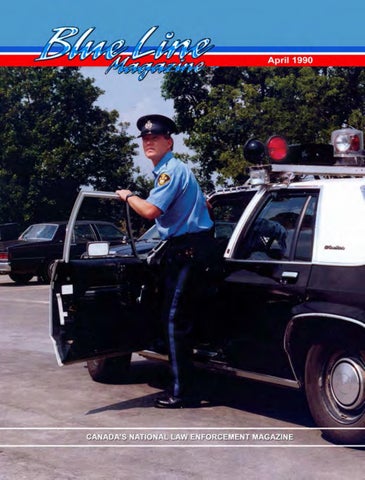
Cover Story
IN THIS ISSUE
oW much difference is there H between urban and rural policing? Many officers trained and actively
FEATURES:
Letters to the Editor
4
The Wit and Wisdom of Tacky Burns
4
The Real World - No One's Child - James W. Forbes
5
Morality - Clare Westcott
7
Closeup - Sanctuary
7
The Police Leader's Role "Stepping into an ice age" - Chris Braiden
9
Recall Enhancement - Al Porter
11
Rural Policing - Morley Lymburner
12
Duarte Ruling Rocks the Police Community
19
Law Enforcement Legends - The Lost Patrol - Al Porter Up-Coming Events
22 24 27
Nuclear Facts - Part 2 How Safe Are Nuclear Reactors
29
Project "P" - Lucy Becker
NEWS:
Bomb disposal seminar to be held in Brampton
16
Racists in US step-up attacks
16
Officers sue over abortion order
17
Blind victim picks out attacker in lineup
17
New Zealand "Homebake" replacing heroin
17
CASE LAW:
Consent needed for all Electronic Interceptions
18
Phone Calls to Cops and Crowns
20
Brockville School Teacher Convicted
23
Only Officer who Forms Opinion can Demand Blood
24
Search on Arrest is Legal
26
Cops Must Tell Accused About Legal Aid
30
April 1990
3
working in anyone of these two environments would have trouble understanding the difference. City policing can be very different from small town policing and this in turn can be extremely different from rural policing. Inner city officers have to deal with the problems of constant demand for service. Missing lunches is common place on many Departments. Constant contact with strangers is again another factor that develops a unique style of law enforcement. In the opposite extreme dealing with people you know only too well produces another style of policing that, in its own environment, is just as effective. Perhaps it is time for the larger forces to stream their officers into one of the three styles of policing right from the start. They should develop training geared to either Highway Patrol, Rural or Muncipal policing. If they change over to another style they should be re -trained to help them cope with this different style. Over the next few issues you will be reading about a variety of policing styles . Some of them you will recognize others you will be intrigued by the manner in which the officers cope. We hope you wiil learn a lot about the other side of the fence. You may even discover that the grass is not always as green as you first imagined. If you wish to contribute we would encourage you to write us.
LETTERS TO THE EDITOR Quality and enjoyment I have just finished reading Volume 1 Number 7 - September 1989 issue of Blue Line Magazine for the first time. I found it high in enjoyment and , quality. I am therefore enclosing my cheque for a subscription . I would very much enjoy receiving your magazine for the next year. Cst. Bruce Bennett Lunenburg, Nova Scotia
••• Editor's Note: Nice to hear from the East Coast. You wi/l be happy to know that Al Porter, our ex assignment writer from Windsor, now hails from Halifax/ Dartmouth . Al is a retired two-fisted crime fighter from
Windsor, Ontario. He wi/l be reporting the news and working on assign ment for Blue Line in the Nova Scotia area. Have fun getting to know him . I know I did.
•••
Community Based Policing I have really enjoyed the last six issues of Blue Line, especially the articles on Community Based Policing. J. Robert Hinchcliffe Regina , Saskatchewan
I'm Impre ssed I am impressed by the quality and content of your magazine. Is it possible to obtain all ten issues from 1989? If so please forward and bill me accordingly. B. R. Castle Internal Affairs Calgary Police Service Calgary, Alberta
•••
• ••
Editor's Note: You wi/l be happy to read some more on that subject in this issue. There appears to be a great deal of interest in this subject so I'm going to keep digging for it. Sti/l looking for a Saskatchewan slant on the subject.
Editor's note: For the present we can accommodate all requests for March to present in back issues. We have only a limited number of January and February '89. All back issues sell for $3.50 each.
•••
•••
The Wit and Wisdom of Tacky Burns by Terry Barker (excerpt from " The Five Minute Policeman" ) And if we think they act stupid than to bend his left arm like Some police officers seem to think that civilians are put on the or ask dumb questions, we that." No, he's a professional. He earth just to bug them. shouldn't let on. Take the time, if sees me as a customer. How many times have I heard you have it, to explain - so they The public doesn't know or police officers swearing about aren't so stupid next time. That 's care about our problems. Why stupid jerks who left their called "crime prevention". It should they? You don't worry everybody happy, about the mechanic's problems cameras on the back seats of keeps with late deliveries from the unlocked cars and then come especially the boss. Like doctors and mechanics, warehouse, do you? You don't wimping to us when they get swiped? we're professionals. We keep our fret because the doc's new inter" Civilians! " we think to lips buttoned , no matter how fragiscope hasn't arrived , do ourselves, and treat them like ignorant people behave. you? Course not! So why should One day I had my car towed we expect civilians to understand snot-bags. Well.. . when my car or my heart into a busy garage. I said to the our concerns? So don't think of conks out I call a mechanic or a mechanic, " Geez, I must be the civilians as stupid jerks. Think of doctor. They 're experts in cars last guy you want to see today, them as clients. and hearts. I'm not. I ask dumb with so many cars lined up for Yes, we get too many files, questions, and I guess they think repairs." He said , " Hey, man , we're overworked, it's a pain in I've been stupid and didn't con- that 's the mark of success. Lots the butt, but we are working . duct proper maintenance on my of cars in the lot means more Sometimes we're even making car or my bod. But they don't tell beans on my table. No cars in the overtime, and that pays for the me that . lot, we close down and I'm out of rec room and the kids' teeth. Maybe we ought to be, grateful Likewise, we police officers are a job." If I get a problem with my golf for the booze and the jerks who the experts on crime. When peopie need crime experts, they call swing , and I go to the Pro, he abuse it: if civilians didn't screw on us. doesn't·think, " This stupid jerk, up occaSionally, we wouldn't he should have known better have a job.
4
April 1990
Vol. 2 No. 4 . April 1990 - EDiroR / PUBLISHER Morley Lymburner
- EDiroRIAL ADVISORS David H . Tsubouchi , LL. B. Mary Lymburner B.A. M.Ed . Gerald A. O xman 1.c.1.A. Jaan Schaer B.A. (MTPF E.A .P.) To m Dykes (Halto n Regio n Police) Ro be rt Ho tsto n B.A. M.Crim . (Pe te rboro ugh Po lice Fo rce) Rick Pa trick (Lambton Co lle ge) The Editorial Advisors are persons from whom this publication seeks out advice and gUidance. The use of their names is in recognition of their assistance and ongoing support.
- ADVERTISING Alla n W. Stiver (4 16) 294 ·5502 Fax: 294 ·8952
- ASSIGNMENT WRITERS Lucy Becker • Louise Dueck AI Po rter • Rick Patrick
- CORRESPONDENTS Ro bert Hotsto n • Richa rd Duplain Da ffydd He rm a nn • Craig McMillan
- COWMNISTS Geoff Cates • Ga ry Miller Robert Hotston • Jim Ba rdgett
- PHOfOGRAPHYJohn Loftu s • Mo rley Lymburne r
- ILWSTRATION To ny MacKinn o n • Bette C lark
- DESIGN AND PRODUCTION Jim Kelly Camelot Graphic Design 97 Sir Lancelot Drive Markham , Ontario L3P 2J3 1416) 471-0303 Fax: (416) 471-0305 Blue line Magazine is published monthly, ten times per year by Blue Line Magazine Incorporated with head office at 118 Main Street North , Markham , Ontario Canada , L3P I Y!. Editorial and copy is considered to be completely separate from advertising sales. No committment for editorial coverage can form any part of a sale agreement. Advertising enquiries should be made at (416) 294·5502 or FAX number (416) 294-8952. All articles are protected by copyright. No part of this publication may be reproduced or transmitted in any form or by any means, electronic or mechanical, including photocopying and recording , or by any information storage or retrieval system without permission from the publisher. The authors, advisors and publisher accept no liability whatsoever for any injuries to person or property resulting from the application or adoption of any of the procedures , tactics or considerations presented in this magazine. Readers are cautioned and advised that articles presented herein are edited and supplied for your personal awareness and should not be referred to for further action until appropriate advise and guidance is received from a supervising officer or the advice of a Crown Attorney. Blue Line Magazine is an independant publication designed to educate and upgrade the skills of those involved in the law enforcement profession. It has no direct control from a law enforcement agency and its opinions and articles do not neccessarily reflect the opinions of any government agency or police force . Blue Line Magazine is printed in Canada by Johanns Graphics. The sole authorized distributor of Blue line Magazine is Green Gables Book Shop, Markham, Ontario.
1"1. BIAssociation Associate member. National of Police Planners ~ Member, Periodical ~ Publishe rs Exchange
ISSN #0847 8538 Second class mail registration No . 824 2
April 1990
The Real World
No One's Child - James W. Forbes -
T
he emergency staff knew she was coming. The day shift had just begun and a nurse in a crisp white uniform peered out the window watching as the ambulance approached the ramp to the emergency entrance. The siren was uttering its last throaty growl as the two man crew swung open the back doors exposing the form of a female. She was strapped to the stretcher. The two men deftly pulled the con scious woman out as the casters swung to the ground . There was no haste. Just efficiency as the woman was wheeled into the building.
Kingston Chosen for 1991 Games The Kingston Police Force has been selected to host the 1991 Ontario Law Enforcement Olympics. "We are very happy to host these games," says S/ Sgt. James Gillett, the Kingston Co-ordinator of the event. "It will be the first time the event will be held outside Ottawa and it coincides with our City's Sesquacentennial celebrations." Gillett is encouraged by the enthusiasm of the community to support the event and to have integrated the Olympics into the celebrations. He is hoping that the police community will make a good showing. Gillett points out that he hopes officers will bring their families as well . "The Kingston area has a lot to offer," Gillett said , "and we are even organizing some child care services for officer's families wishing to attend ."
5
Just a few short blocks away a police detective leafed through the morning reports and sipped on a cup of steaming coffee. The phone rang. In one motion, he set his coffee down and scooped up the receiver. It was the Coroner and he was requesting assistance. "Jim ," he said slowly, "I'm not too sure what we've got here", he paused then continued , "A young girl was just brought in and it looks like she may have had a baby at home". Then he added, "It's too soon to tell just how far she was along. Perhaps you could go to the house and take a look". Ye ars of in vestiga ti ng traffic fatalities, sudden deaths and suicides had inured the officer's apprehension of what to expect, but deep in the pit of his stomach he felt different about this assignment. The house was no different from the others on the street. It was a small, white stucco house ; frost bitten vine clung valiantly to the thousands of minute toeholds it had gained in the summer sun . A driveway led to an aging garage which was a short distance fro m a sluggish river off to th e back of the property. He turned in slowly. A woman in her late forties , wringing her hands in obvious distress answered the officer's first knock on the door. Words flowed from her mouth as she gave a brief account of her daughter's life-style during the past few months. She had been a good girl, stayed home, no late hours but had gained some weight recently. The officer made notes as the
woman related hearing her daughter up and about all night, then finding the girl in her blood soaked bed in the morning. The officer explained about the doctor's call and what he was required to do. He recalled the doctor's voice saying he was unsure of "how far along she was" and the officer felt unsure also; Unsure about what he was looking for. A cursory search of the house turned up slight traces of blood on the bed clothes and fresh blood stains near the washing machine. The woman explained that she had tried to clean up as best she could after the ambulance had left. The lack of a major find put the officer at an uncertain ease. An ease that was to be short lived. As he was about to leave, the woman answered the phone. She handed him the receiver. It was the coroner again . "She was full term;' he said tersely, "she has had a baby." Then very clinically he said , "you are looking for a full term baby!" Basements, barns, bedrooms and attics had been searched by this officer in the past, but never before was a search conducted for a human child, a new born child. "Where could it be?" he thought, "Where does someone hide a baby?" There was no corner or likely crevice that escaped the officer's attention or trained eye. Even the most unlikely spots, the inside of the furnace, the rotting rafters of the garage or the murky water of the river were searched. Nothing ... "How could a young girl be so cunning at a time like this?" he thought. Admitting defeat and needing fur ther assurances that he was indeed looking for a baby, the officer left the house with the intention of speaking with the coroner in person . However, having only travelled one city block, the two way radio crackled instructions for him to return to the house. The woman was hysterical. She was flushed with emotion and was crying and screaming at the same time. She reminded him of the all too
familiar sight of the survivors of a tragedy who wail in confused and uncontrollable grief. She couldn't contain herself and rushed out to meet the officer as he approached the front door. There were no words spoken , none were necessary. He knew what she had found. The woman , shaking as if from the cold , grasped the officer's hand and led him into the house and into her bedroom . "Her bedroom!" he thought as he recalled that this was the only room that wasn't searched as thoroughly as the rest of the house. "Who would have thought. . she was in there all night, how could it be?" The questions and apprehension flooded his mind . Sitting against the wall in the cramped bedroom was a set of matching luggage, symmetrically in line. The large one against the wall, the mid sized piece and the small overnighter furthest from the wall. The woman couldn't bring herself to go near. She backed away from the luggage and at the same time pOinted to the smallest one. The tension and stress of that moment in time was nearly unbearable. He knew what the luggage contained . He had to open it, just as he was required to do many other horrific tasks in the past. He gently lifted the luggage up, feeling the unusual weight of it's contents and swung it closer to him . The two locking clasps were released and the top was opened . There inside this light blue piece of cheap luggage, was the body of a perfectly formed , beautiful baby boy; beautiful even in death . The luggage was devoid of anything else, just the body of no-one's child . Disgust and anguish filled the officer with words that couldn't be spoken . He held back the vile things that he wanted to say to this woman , the woman who was displaying concern and dispair now. "Where was her concern earlier? How could she have possibly allowed this to happen? How 6
could she have convinced herself that her daughter was not pregnant?" From the house to the hospital was a blur. Nothing seemed to matter but the thoughts of this poor child struggling to get into this world only to be stuffed into a cheap piece of luggage. The thoughts of thousands of childless couples flooded his mind also. What joy and happiness this child would have brought into the loves of those people. "What a lousy world" he muttered to himself. Mother and child were very nearly reunited that morning when the officer entered the hospital with the piece of luggage. The weight of it could not be noticed by anyone not knowing its contents . The officer walked slowly down the long corridor towards the morgue, twice meeting people he knew. They greeted him in the normal fashion by saying "Hi Jim! How are you today?" and he answered , thinking how hollow the reply was, "Not too bad thanks, not too bad ."
FEATURED WRITER Staff Sergeant James W. Forbes has been a police officer for the past 30 years. He presently works for the Thunder Bay Police force and previously worked for the Vancouver Police Force. Jim was seconded to the Ontario Police College for two years and returned to his home police force last May.
DO YOU HAVE A STORY INSIDE YOU? We would like to hear from you . Cops are full of short stories and we like to encourage you to write about them . It is important for officers to hear about the experiences of their collegues across the country.
April 1990
Fashionable and Old-fashioned values
Morality - Clare Westcott -
R
eligion is one of the cornerstones of our society. Civilized society as we know it probably evolved more from our belief in the importance of religion and the family than anything else. The areas of religion and law enforcement are difficult topics. I thought I might take a few minutes and talk about something that falls in
CLOSEUP Sanctuary Art is more than a hobby. It is a way of seeing, thinking and being . For a police officer like Fred Fowler it is much more. "Art is my sanctuary from the everyday stresses of the job." Sanctuary, business or hobby, one thing is certain , the 15 year veteran of the Metropolitan Toronto Police Force has a real talent and love of art. His repertoire includes over 200 paintings in both water colour and oil. In February Fowler presented his first one man public showing of art at the Cedar Ridge Creative Studio Gallery in Scarborough , Ontario. The show was deemed very successful with many paintings sold over the four day period . Constable Fowler became interested in art at a very early age. His landscapes reflect a great deal of his memories from being raised in the area around Red Rock Township, north of Lake Superior.
April 1990
between and could be of concern to both groups. The feeling I have mayor may not be shared by some of you but somehow I think they are. I would like to talk about morality. Morality is a tough and touchy subject. If you speak publicly about morality or even suggest there could be moral decay in today's society you
His interest in art became more serious when he attended the Chicago Academy of Fine Art from 1968 to 1970. He broadened his knowledge more by attending "The Three Schools" of art in Toronto for two more years. After joining the police force Fowler left his artistic talents on the backburner for several years. It was not until he went to a showing in 1983, and his wife presented him with a Christmas gift of art lessons, that he rekindled his interest in the field . Since then Fowler has joined four Art Clubs and has sold over 50 paintings. Many of which were commissioned by friends and relatives. He spends about 10 hours per week on ,.i------- average doing what he loves most. Fred says that after all these years his talent is just now paying for itself and he now has a budding interest in pottery. He advises that it will certainly never replace his chosen career as a police officer but it will certainly serve him well in retirement years.
7
are scorned by the trendy crowd and branded as some kind of a religious freak. At best you will be written off as a prude, out of step with what today is called , "our changing social values ." Our social values relate to how we as a people respond to such things as integrity, ethics, traditions, respect for others, respect for law, and yes - even good manners. I am not sure our social values are changing. I think, more like our dollar, they are being devalued . Our values are worth less than they once were and we risk the possibility of this continuing. If we keep on the same path our value system , at least measured by the bench marks that I was brought up to respect, could end up devalued to the level of the Mexican Peso.
Freedom and Rights In the past two or three decades we have built up a great head of steam in our quest for some new kind of freedom . The by-words of the 60's and 70's and 80's have been human rights, civil rights, freedom and yet more freedom . A cause that, on the face of it, should be applauded and supported . The focus has been more and more individual rights and freedoms and much of this thrust has been given the blessing of our legislators at all levels of government. Old laws are thrown out and new laws are passed and, as well, we have case law being set by court decisions. All this is having an impact on our society that troubles me. But few people want to talk about it for fear of being criticized for being out of step with the new morality. I am lucky. I was born shortly after the first world war and grew up in the 1930's, absorbing the social values provided by life in a small Ontario Town . So for me the new morality is a lot like the old immorality. I am lucky also as I am at an age where my future is measured in years rather than decades. My concern is not for myself, but for my children and
grandchildren and what kind of society will be out there for them . The quest for individual rights and freedoms is a noble cause. As long as it results in improving our society and providing the opportunity for a healthier, happier, safer and more meaningful life for all of us.
Benevolent Governments I mentioned earlier that the family was one of the ingredients, along with religion , related to establishing and maintaining a civilized society. Benevolent governments throughout North America, in responding to the needs of welfare and hOUSing, have unwittingly created a social services system that could be contributing to the breaking down of the family unit. A SOciologist in the United States said recently that because of the welfare system unwed mothers were marrying the state rather than a man . The figures reflect this phenomenon . A frightening phenomenon brought on by easier divorce, a liberal welfare system and sweeping attitudinal changes regarding sexual relations. In 19 7 North America more than half the families have single parents and , of course, mostly women . It is becoming worrisome to community and government leaders concerned about the lack of traditional parental support and guidance for the children in these families . A large percentage are wholly state supported through welfare and living in public housing.
Civil Rights vs. Human Rights Today, progress in civil and human rights comes in many forms . In the United States the right to carry a gun is considered almost sacred and has existed for over 200 years. United States citizens have killed more of each other, in their own country, with their own guns, than have been kill ed in all the wars the United States has fought in over the past 200 years. The derelict and the bag lady today have rights. There was a time when they could be picked up and bundled off to a nice warm jailor
Detox Centre. But they now have the right to freeze and starve to death on the street. The 13 and 14 year old prostitute has rights. There was a time they were picked up and taken to places where they were cared for and encouraged to return to their families . Today case law allows them to be taken off the street only if it can be proven they are in "Horrendous" danger. So they stay out on the street and destroy their lives and the lives of others. In the past it was found that 90% of those we once picked up suffered from either venereal disease or infectious hepatitis. Now there is AIDS. For the first time in the history of the world we have a "fashionable" epidemic.
A Bizarre World We now have laws that let convicted murderers out on weekend passes. Believe it or not a new law in New Zealand awarded a bank robber $30,000 in damages. He fell on his sawed-off shotgun and shot himself. Another man collected thousands of dollars in compensation for injuries he received when he fell off a 20 foot wall while trying to escape from the Auckland jail. Life on our planet is becoming more and more like the Bizarre show on television . A burglar breaks into your house and gets a slap on the wrist. A police officer enters your house without a warrant and gets in to very serious trouble. UNESCO figures show that 30,000 children die of malnutrition in the world every day, 365 days a year. Here is a cause that is urgent and just. Indeed I believe we should help refugees. My wife and I adopted a Vietnamese family of eight in 1950 and they are now like part of our own family. But maybe we should reconsider being a haven for the well-fed , welldressed refugees who turn up at our border and consider how we might adopt some of the starving children of Ethiopia or go to Calcutta or Mexico City or other large cities and scoop 8
up these homeless children . Children who are suffering a life of deprivation beyond our wildest imagination .
Rights vs. Old Values By tomorrow another 30,000 will be dead and for each month that passes another million youngsters will die. We have a weird and wonderful SOCiety. We can stop prayer in the schools but we can't stop the use of drugs. We have a society that locks up the jury and lets the accused out on bail. We seem to want to provide legal rights for everyone for every situation. We now have a society that has passed 50,000 laws to enforce the ten commandments. Let us all hope and pray that when we meet again a year from now some of our old values will be back in fashion .
FEATURED WRITER Clare Westcott is a former Chairman of the Metropolitan Toronto Police Commission. This multi-talented man has worked in many occupations over the years. He has been a Line-man for Ontario Hydro, a newspaper reporter, columnist, author and politician. Clare has long been a proponent and spokesman for the underdog and a champion of the common man . His insights into the police profession is indeed expansive. Mr. Westcott is currently a member of the National Parole Board of Canada.
Peel's First Principle of Policing To prevent crime and disorder, as an alternative to their repression by military force and by severity of legal punishment.
April 1990
The Police Leader's Role "Slipping into an ice age" . Chris Braiden . Edmonton Police Department Police leaders are paid to lead . With national, lends itself to local ingenuisome notable exceptions, few have ty. Police leaders are not bound by the done so. Instead , most have chosen dictates of their brethren . Each one is to bury themselves in bureaucratic free to change their own organization, memo writing and paperwork. Paper- independently. The words of Thoreau work can be delegated ; leadership might stimulate us here: "If a man cannot. does not keep pace with his compaSenseless, needless paperwork in nions perhaps it is because he hears policing has proliferated in the many a different drummer. Let him step to years I have been involved in the pro- the music he hears , however fession . The solution to everyone's measured or far away." problem throughout the criminal Police leaders must also learn to justice system translates into more share not only the work but the work for the constable because that decision-making process . The objecis where the buck stops. When some tives and priorities of their organizabureaucrat wants more statistics, it's tions are the legitimate forum of comthe constable who collects them , all munity representation . the time adding to his paperwork. Such bodies as police boards and Most leaders have clung to the municipal councils should be more status quo of policing, neither learn- active at the community level. Unforing from the past nor trying to prepare tunately in the past, few members of for the future. To quote Chief of Police police commissions and boards have Anthony Bouza of Minneapolis, Min- fulfilled their mandate. Indeed some nesota; "Our profession withers for a do not seem to know what it is they lack of an informed and vigorous are supposed to be doing. Sadly, discussion on a number of key issues. many have been appointed for the The police profession is slipping into wrong reasons . If policing is an ice age. Survival and comfort are significantly off course, they must the unspoken bywords of our calling. share the blame. I do not see the responses to Citizens' groups should have an inchallenges that stimulate other profes- put to the Chief of Police at the sions to progress." neighbourhood level so that the organization is congruent with the A different drummer needs of its constituents. This does Bouza made that statement in 1984. not mean the Chief will lose control The inefficient tactics that characterize of the organization . Operational current policing practices are the crea- decision-making must always remain tion of police leaders, past and pre- with the experts. The real test of police leadership in sent. But so too can police leaders change these tactics. the future will be the ability to arThe system in Canada, unlike bitrate, mediate, persuade and to Japan for instance, where policing is generally pull together the disparate April 1990
9
priorities of the various interest groups so as to fashion a product that most closely addresses the needs of the entire community. The police leader must also genuinely promote delegation , not only of work but of autonomy and authority. There is tremendous latent ingenuity throughout the ranks of the police service just waiting for a chance to surface. Regardless of rank, more people must be given the chance to run with the ball . Research in New York (1978) indicates that when this happens, job satisfaction increases. The "M et" experience
If neighbourhoods are to be policed for their unique needs, "head office" must give sufficient autonomy to unit commanders to make some decisions independently. In this regard, Canadian police leaders would be well advised to examine the changes being made in the Metropolitan London Police, a monolithic organization of some 40,000 members. Following the release of the Scarman Report on the Brixton riots, Sir Kenneth Newman , who had previously commanded the Royal Ulster Constabulary prior to becoming Commissioner of the ' MET', to his credit, immediately began to implement many of the recommendations of the report. Sir Kenneth has publicly committed himself to implementing community policing throughout his organization . Part of his plan was to give considerable autonomy to the Chief Superintendents who command individual police districts . An entire process has been developed which ensures that the priorities of these districts are dictated by the unique needs of the neighbourhoods they serve. He has told his Chief Superintendents, in essence, "Serve your neighbourhoods, not me". This is the exact opposite of the O.w. Wilson theory of centralized control of management. Once again, we have come full circle in time. Continued on next page
Proper delegation of authority The autonomy given to unit com manders must, in turn , be passed on to the people at the front end , the sergeants and constables, so that they are not perpetually looking over their shoulder or fearful of being secondguessed . When this fear exists, in gen uity is stifled and people become drones . Although this delegation of authority has been preached for years in police management courses, the fact remains it is not practiced . Police leaders continue to receive echoes of th eir own opinions from groveling understudies afraid to disagree. All of the recent research into job satisfaction in the workplace indicates
WELL, IF YOU PUT IT THAT WAY The two officers from a major department were involved in a very busy shift. This call was to see the woman at a bar about a disorderly man . Nothing new in that so they secured their unit and cautiously entered the bar. Broken glass, ruined chairs, overturned tables, all the symptoms of an active night in a working-class bar were in evidence as they made their way to the bar to talk to their complainant. The woman nervously watched a huge man , quiet now, sitting at the rear of the bar. She spoke qUietly to the officers and after a moment the bear of a man from the rear of the bar began making his way to the bar to join in the conversation. He began to join in from several meters away and the tone of his contribution was that he would sort out the matter in his own fashion . He was wearing a ragged T-shirt and tattered sweat pants over steel-capped safety boots. The officers looked at each other and a knowing eye would have been
that most people want to have some power to influence what is to be a final product. Japanese industry capitalizes on this fact. It's time to put to rest OW. Wilson's organizational theory of tight central control , impersonalized policing, heavy emphasis on crime statistics and a blind faith in technology. It doesn't fit the bill in the 1990's. Even in these times of mindboggling technological advances, the guts of police work is still humanbeing reacting to human-being and this is not likely to change. Robots may be able to make cars but they cannot bring peace to a family in turmoil nor can they provide a shoulder to cry on for an old ' wino' intent on
The Constable's Role Familiarity is th e key
able to detect a barely discernible signal. The larger of the officers called the man by name and set about trying to calm the situation. The man was of a different mind and began making threats about there not being enough officers to remove him from the bar. The smaller officer then moved quickly. As her partner talked to the man and blocked his view, the smaller officer reached out and grasped the front of his sweat pants. The look on
the man's face as he looked down at the service revolver pointing down into his pants was priceless. "Can you sing?" she asked him . The man hurriedly replied in the negative. "Then don't you think it would be a good idea if we went someplace else?" Totally in agreement the man quietly left the bar with his two escorts and another matter was settled, maybe not by the book, but as to the dictates of cold fear and common sense.
suicide. Computers may have great memories, but they cannot create. We will get the best milage out of technology by realizing its limitations and not by being overawed by it. A tremendous example of how to harness technology can be demonstrated by the new computerized fingerprint searching computers presently available. The advances in this field in the past ten years is a classic illustration of the right way to harness this science.
NEXT MONTH
FLASHES by Tony MacKinnon
" It looks li ke at
least a three vehicle collision. I don't think they 've seen us yet. Quick, duck down the alley! "
10
April 1990
Haligonian Hypnotist Halladay
Recall Enhancement - AI Porter -
W
itnesses and victims in Halifax cases have been amazing even themselves with their recollections after undergoing hypnosis by Sgt. Shane Halladay. Halladay, a forensic polygraph examiner, is one of the first police officers in Canada who has been certified as qualified to use hypnosis to assist people to recall events in greater clarity. Last April Halladay completed a forensic hypnosis course at the University of Texas Law Enforcement Academy at San Antonio. He has since used his skill in examining witnesses in cases of murder, attempt murder, armed robbery, serious assault and sexual assault. Of the results, he says, "I'd say in about 90 per cent of them we get better results than in the original statement." Cops being cops and opposed to anything new he says he encountered some hesitancy on the part of other officers at first. "When I first had the course there was resistance to it, not blatant resistance, but a lot of people said , 'Whoa! What exactly is this Voodoo?'" But once the process was explained the officers came to understand something about it and he has found that the Major Crimes Unit and even Uniform Division are now actively seeking his assistance. As to his success rate, the process has not been in place long enough for a full evaluation . In a case still before the courts and only spoken of in general terms he says a composite drawing, made with the assistance of six witnesses under hypnosis was used successfully and was partially responsible for the arrest of an accused person . Halifax County Assistant Crown Attorney Claudine MacDonald also commented on the use of hypnosis. Again speaking in a general manner April 1990
of a case she said, "As a result of hypnosis, the witness remembered certain details that didn't come out in the original statement. She says she asked about one aspect and was advised by Halladay, "That once the recollection came back, it was there to stay." In another case Halladay says detectives had two digits of a marker plate of a vehicle wanted in connection with several armed robberies. "After I examined the witness under hypnosis we were able to get three more, almost a complete plate." Further investigation resulted in the arrest and charges were laid against an area man in several of the robberies.
Sgt. Shane Halladay watches closely as Cindy Rogers, a civilian employee oj halifax PD, undergoes a demonstration session oj hypnosis.
According to Halladay, "The harder you try to remember something, the more difficult it is." The hypnotic process so completely relaxes the subject that they are able to remember things they had long since forgotten about. "Time is not a factor," he says and then illustrates his point with a story. During his time on the course he was hypnotised by the instructor and was taken back to the time when he was in grade two. "I could remember my teacher's name, my best friend , ... Everything you've done in your whole life is in there. It's just a matter of getting to it." During another training session he was hypnotised and told he would not feel any pain from the cardio-cuff used to take blood pressure. "Some 11
people complain about pressure after about three minutes. I had it on for about 45 minutes with no pain ." He elucidates on another of the phenomena of hypnosis; the ability of the hypnotist to put a subject into a state of near-total relaxation . Halladay's instructor told the class a story of a serious boating accident in which he had been involved. The instructor's wrist had been nearly severed and after the initial shock, he had induced a state of self-hypnosis and relaxed to such an extent that he was able to reduce his heart rate. The instructor was able to swim to shore and after some time, receive adequate treatment for his injury. Halladay has seen the wrist. "The hand still works. It's somewhat withered, but still working." Constable Tom Thompson , an Ident officer with Halifax recently volunteered to undergo a hypnotic awareness session for other members of the force. Thompson had an ulterior motive . He had been previously hypnotised while attending a course at the Canadian Police College in Ottawa. "If you really want to feel at peace with yourself, that's the answer. It's the greatest form of relaxation in the world, - next to fishing ," Thompson says. Halladay says he has experienced some initial reluctance on the part of some witnesses but credits this with some misconceptions advanced by television shows. " I am not in con trol of them . I am assisting them to recall what is a lread y in their memory." Again h e refers to similarities between hypnotic sessions and those in which voluntary statements are taken under caution . "I have to be careful not to ask leading questions, I can clarify, but not ask direct, leading questions." As far as Halladay is aware, there is one other police hypnotist on the Surete De Quebec (QPP) and other departments are considering sending officers to be train ed . He says he is available to assist other departments with his skills and he can be contacted through the office of the Halifax Chief of Police, or directly at 902-421-6868
A city police officer goes to the country
RURAL POLICING - Morley Lymburner -
Y
our patrol area is 1,400 square miles. At 11:30 at night your nearest backup is 110 km . away. You stop a belligerent drunk driver who is not pleased about being arrested . How would you measure up to the task? This is the type of problem that molds the character of the rural police officer. I was curious about this type of work and in June 1986 I had the opportunity to see what it was like first hand . I was vacationing in Manitoba and decided to check in to a rural detachment office of the RCMP I was invited to go along with an officer on the afternoon shift and I quickly agreed .
Being "On Call" means you go home but remain available by phone or "porta pack" if required. While "On Call" they are paid one hour for each three hours off duty. When they are called out they receive a three hour call back attime and a half (minim urn) . At midnight the detachment would close down and the Highway Patrol officer would go home and be "On Call" for the next 7 hours for Traffic related problems only. If a citizen requires police help they would dial a Zenith 50,000 number and that would put them into Winnipeg Central Dispatch who would call the officers at home.
The Shift Commences Detachment Structure At 16:00 hours, I sat down with I was introduced to Constables Constable Schumack in the office. He Schumack and Fuelbrandt of the Steinbach detachment. The former was assigned "H.P" (Highway Patrol) while the latter was assigned to "Rural Policing" duties. I discovered that most detachments are divided into these two parts. This particular detachment consisted of 10 officers . Six were assigned Highway Patrol while four were assigned as Rural. This number includes one Sergeant and one Corporal. Although they share the same building their duties are kept as separate as possible. On the day I was going on a "Ride-Along" the "H.P" man would be the only officer working while the Rural officer, who just finished his day shift, would be "on call" until the following morning at 0700 .
12
explained some of the reports and some of their filing and statistical data to me. His sharp dress and keen attitude spoke well of this officer's 12 years on the Force. He had spent 8 of those years with "H.P" and ap peared to glow when describing the unit and the force in general. He prided himself on his paperwork and fil ing skills but, as most of us agree, hated the mountains of paper work that follows accidents and arrests. I found that any complaints he had about his lot was common to the police profession in general. He spoke also with pride about the officers he works with . "We try to get along. You have to. In a unit as small as ours you try a little harder to help the others. The CD. is closer to us than in the bigger detachments and we understand more of the pressures he's under. So if it's a matter of helping another member or not making waves it's appreciated ." He apologized to me for staying in the office by explaining he had a little paper work to finish up from the night before. The case was a party that had gotten out of control in the back roads the
April 1990
night before. Some young people had been showing off with their pick-up trucks when one struck the ditch. One girl had cut her face up pretty bad . The driver, who was said to be pretty drunk, ran into the bush when the officer was arriving. When the officer spoke with others at the party he found that someone else had taken the girl to the hospital. The officer advised them that he had not seen anyone on the highway while he was responding. They informed him that the girl was taken by the back country roads because the driver of that car was drunk also and did not want to get caught.
Quality Charges Only The officer spoke with the driver of the pick-up truck just prior to my arrival and had laid several charges on him . All charges were Traffic Act offences as the officer could not get witnesses to testify for criminal charges.It was also explained that a directive from Manitoba H.Q. makes it clear that multiple charges are generally frowned upon . If an officer finds a person with a headlight out, speeding, with out a seatbelt, and no licence the officer is expected to lay only one appropriate charge and caution for all others. Headquarters advised them that "quality, not quantity" was what is expected . They did not define what a quality offence was. On The Road Again It was 1930 hrs. when we made our move to hit the road. The officer drew a metal shotgun with a break-down butt from a rack and gave me a quick lecture and demonstration of it's use. I then took it with me to the patrol car and was instructed on how to secure it to the dashmount. I noted that the new Ford was also equipped with two red domes, electronic siren , fender stop light, and a security screen for prisoners. I was informed of the size of the eight cylinder engine but it escapes me now. In any
April 1990
event I was expected to be impressed with it so I nodded my head with the appropriate noises. (mechanics ain't my strong point)
The Radio System We went south from town and I was introduced to the Tracking Radar and the two radios in the car. One radio was a link to Winnipeg central dispatch . It was used for person and vehicle checks as well as dispatches from the Zenith 50,000 exchange. The second radio was used for car to car communication. It was set with a five channel scanner that would monitor cars in surrounding detachments. The radios all worked on voice mode systems. Th e Patrol Our first check in was a community centre to the south of town . The town itself was a "dry" town and lacked bars, liquor and beer stores. This meant a thriving business on the outskirts of the town limit. I was advised that the "H.P." guys were concerned about the frequency of drunk drivers and liquor being kept and consumed in cars. Outside of speeding, liquor charges were the highest numbers of enforcement in the area. We made a left turn onto a dirt road and drove for about a mile and were shortly in pursuit of a black Camaro that had been going the opposite direction . The officer's skill at handling the police car was as evident as his knowledge of every pot hole in the road . I eased the pressure off my white knuckles and my feet on the floor boards when I saw the Camaro turn onto a paved highway. It was apparent that he did not want the officer to speak with him . We just caught a glimpse of the car as we rounded a bend in the road pulling into a farm driveway. The car stopped when the young driver realized the officer was still behind him in spite of his elusive manouver. The officer casually approached the
13
car and traded pleasantries with the four occupants. He then reached into the car 'a nd pulled out a case of beer and four partially consumed bottles. He asked the young driver back to the police car. "Who lives here?" the officer asked. "A friend of mine. He told me to come over tonight." came the reply. "What's your friends name?" "I don't remember. I just met him last week." At this time a man came out of the house and drove down the driveway. Unable to get around the two vehicles in his driveway he approached the police officer. "Any problem officer?" he asked . " No problem ... Do you know this guy?" "Never saw 'em before in my life officer." The youth knew the jig was up. Undaunted he tried to save the last vestige of his credibility; "I came to buy some chickens ... do you have any for sale?" "I don't have any chickens" came the rueful answer. It was attitude re-adjustment time and the officer had the technology. His trusty pen went into quick action and a $98.00 ticket was speedily in hand . The Radio Call "One-O-two Steinbach Rural" came the call over the radio. "One-O-two Steinbach H.P." responded my partner, "Rural is on call .. . can I be of any help? " "It's a Rural call for a disorderly drunk in the LaBroquerie Tavern . Do you want to take it?" "Sure. I'll take it." Then another voice broke in on the second radio. "One-O-Two H .P. this is Steinbach Town . Do you want some help on that call?" "No thanks. I have my ride along. I think we can handle it." A five minute ride to the east of town and a small tavern in the bush appeared around a bend in the road and over a rail road track. The owner advised the rowdy young Metis took into the bush when he saw us. His friend , however, was still parked in the
~~~
--~~------------------------------------~ ----------------------------,,~~~~~,~~~~~~.~~--
parking lot. A quick check revealed he was well intoxicated and in care or control. The officer made the arrest and joshed the man into the back seat of the cruiser. "When you work alone you learn to keep 'em laughing all the way to court. If they turn mean you're on your own ." The drunk was taken to Steinbach Town detachment for the Breath Test. After the 160 reading he was taken to the Rural Detachment office as the Town did not have a calaboose.
The Lock-Up It occurred to me that the officer was going home at midnight. Visions of the officer having to spend the night sleeping in the office were quickly dissipated . He called a man on the phone and asked him if he was ready to make some money for the night. It was also obvious that the officer knew the answer to his own question .
We transported our happy and respectful drunk to the Rural office. We were greeted by a short 55 year old man with a skin tight brush cut, smiling face, a wrestler's physique and a pair of hands like ham hocks. He was the night jailer. He busied himself in familiar surroundings checking the prisoner into his cell and filling out sheets and logs . I was informed that he has been doing this for many years and is the most reliable part timer they had . He appeared to always be ready to go in for a night of babysitting. "But I don't answer no phones. Most of the time it's only a lawyer anyway. I leave that stuff for the boys when they get back here in the morning."
regarding the amount of paper work required back in 1886. "One-O-Two Steinbach H.P." The crackle of the radio brought me back to the twentieth century. "Go ahead Central." "Just got a call on 'Fifty thousand'. That drunk has returned to the tavern and is causing trouble. Can you respond to the call?" "Sorry. I'm tied up with a 10-78 ... I guess you will have to call the standby Rural. He can decide if he wants to take it." About ten minutes later Constable Fuelbrandt was in the office and in uniform . He was briefed about the problem and the discussion circled around whether the e.O. would object to the call back for a drunk. They both looked at me. "What would they THE CALL BACK Schumack went to work with the do on your force? " they asked . detested paper work on the drunk I then realized that there is no real driver. A few thoughts came to mind comparison due to the large number
Name : Addre~ :
----------------____________________________________________________ City:
Province:
Postal Code: my subscription right now for the next D Enter 10 i~ues of Blue Une Magazine (10 issues: $20 .00; US and foreign $50 .00) a bulk subscription of _ copies D (5I want - 49 copies $15 .00 each; 50 or more call for price) PAYMENT METHOD
D My payment is enclosed D Bill me with my first issue (Your subscription begins with the next issue) D Blue Une Magazine will gladly charge your subSCription to your MasterCard , Visa or American Express account. Do not enter your accoun t number on this ca rd. Call our authorized retail representatives at Green Gables Book Shop (416) 294-4773 for immediate processing of your order.
Mail coupon to: Blue Line Magazine, 118 Main Street North, Markham, Ontario L3P 1 Vl L ______________________________________ ~ Blue Une is an Independent magazine produced by and for the law enforcement community.
14
April 1990
- - - - - - ------
of officers working at any given time in Metro Toronto. "I think you have to decide for yourself by bringing the issue down to basics. A citizen has asked for the police to help. Can you afford not to respond and is there any alternative? Only you guys know what your resources are." "Okay we have to go." came the quick response, "I could use a backup. Are you game?" I had opened my big mouth again and the midnight hour meant everyone was making over time but me ... "The Resource." "Sure." I responded and we were on the road again . The officer advised me that this was the third call he had for the evening. He handled a domestic and a call about a bad cheque over the phone. He had been called by the dispatcher at his home and was given the return phone numbers. There was no need for a call back because they could be settled over the phone. The tavern was shrouded , for the most part, by a misty darkness. The lone exception being the single white neon yard light in the parking lot. We had the advantage of being able to see the patrons in the bar without them recognizing us first. The officer gave me his issue nylon coat and with a chuckle stated "Here you might as well look like a real policeman ." Armed with a flashlight we entered the bar. It was not difficult to find the dark skinned young Metis. He was sitting at the bar with about four empty bar stools for company around him . Officer Fuelbrandt and myself bracketed the young man's left and right side. "Okay Randy. Lets go. You've been making a pain of yourself here." "I just ordered a hamburger and I want to wait for it." came the lethargic thick tongued reply. "The order is canceled Randy," the officer retorted, "Now let's go to the cruiser." It was at this point we both reacted in unison . There appeared to April 1990
be a silent cue from an unseen movement that signaled to us both that it was time for action. We both grabbed under each of his arms and picked him off the bar stool and floated him out the door. We gently placed him into the caged back seat of the cruiser. The officer and I looked at each other a little puzzled and grinned . Without a word we both knew the exact moment to grab him . We both got into the front seat of the cruiser. We both looked back at the sullen drunken youth in the back seat. "We are not going to charge you Randy. We are just going to give you a place to sleep it off for the night." The youth looked up through his long straight black hair. "I want to speak to my lawyer," came the reply. Constable Fuelbrandt looked over at me. We both smiled at each other. "It's all the same isn't it!" he said . "Yes!" I said, "Only the names change, but it's all the same." The Comparison
As stated the job is the same. The complaints are the same and the reasons for doing the job never changes. The main difference between the city officer and his country cousin is the methods employed , from necessity, to get the same results. If an officer starts out with a poor attitude and approach he will re-adjust
or his career will be short-lived . It is a strange feeling when you are confronted with a violent situation by yourself. Your first instinct is to call the police. Your rude awakening comes when you realize YOU ARE the police. You are the one called to bring peace from violence, order from chaos. There is no other resource to draw upon but your own talents and training. If you foul up too badly you are history. The rural police officer is different in that they appear more self relient in many ways. From murder to a speeding ticket they must carry the investigation and court preparation to the end. They have no summons bureau, no master index, plain clothes squad or, for the most part, no supervisor to call to the scene for advice. How would you measure up? Foot Note
Since my short tour of duty with these officers many changes have occurred. Schumack has since been transferred to somewhere in Saskatchewan and I have lost track of him. Constable Fuelbrandt has since left the RCMP. For a short time he owned a small coffee shop but still felt homesick for the profession and is now the Chief of the Altona Police Force in south central Manitoba .
FLASHES'-~~~~~~~~~~~~~~ by T ony MacKinnon
"Run that by me again, how YOU can tell how thick the ice is just by looking at it!" Ii._____________________..
15
.news beat ... news beat ... news beat ... news Bomb disposal seminar to be held in Brampton The Joint Forces Association will be holding their annual conference at the Association building of the Peel Region Police in Brampton, Ontario. The seminar, called 'EDCON 90' will be held on August 14th and 15th and a full schedule of events will be presented . The Joint Forces Association is comprised of 22 military and police Bomb Squads in the Southern Ontario region . The event will attract a large number of guest speakers from as far away as Los Angeles, British Columbia, and San Diego.
Among some of the subjects to be spoken to will be incidents such as the Squamish Five bombing, the Bombing of the CP Air flight in Japan , and the Philadelphia "Move" incident of 1985. Other topics planned will include health hazards using some bomb suits, post blast investigations of airplane bombings and an explanation of the Explosives Act of Canada. Many companies will also be represented displaying some equipment of interest to Bomb Squad Personnel. For further information and accommodation contact either Bob Shering or Fred Lemieux of the Peel Region Police Force (416) 453-3311 extension 347 .
Racists in US step-up attacks Officials in the United States believe white racist groups in that country are becoming more fan atical and violent, although their numbers are dropping. There is also fears that much of the racist attitudes may be crossing over the border. While groups such as the Ku Klux Klan have lost members in recent years, those who remain tend to be more violent and may be carrying out a new campaign to terrorize opponents. Officials suggest that in these groups there is a hard-core fringe which, being frustrated, may feel their only resort is violence. The combina-
On the LIGHTER SIDE .. .
autumn finery. Soon they would fall that he had called an ambulance. The and winter would arrive. officer checked for obvious marks or They trusted him with the shotgun . He jacked a round into the gun and wounds - nothing. He had trained as much with the some of the wiser of the geese took By this time the man had arrived Remington as had anyone on the job to the air. He hesitated, ensuring the and he explained to the officer that and they had a special mission in store spent shot would land safely and then his friend had just been addressing the for him . he let fly. ball when they had heard a loud Numerous complaints had been As one the remainder of the birds bang. Both had been startled when received from the owners of a golf went aloft, the second burst echoed momentarily a second blast and a course about migrating geese. The even as mighty wings began to beat. burst of light had come from the area geese had taken one of the water He chambered another round and let over the water hazard . hazards to heart and as a result golfers that one loose as well . Bang, Pop! , He said his friend had looked at had to step very carefully while mak- almost immediately the geese were him in amazement and then he just ing their approach shots. out of sight. collapsed. "He had a bad heart you But enough was enough and the The officer stood quietly, his eyes know," he told the officer. By this time administration was taking a definite straining to see the rapidly diminishing the officer noted an ambulance and stand. A gunsmith was contacted and string of the flock . He cleared the ac- a second police unit. Sirens whoopupon his recommendation some tion and began walking back to his ing, lights flashing , the emergency special ammunition was ordered. This unit. He walked up the gentle rise of vehicles were disregarding the ammunition was designed so that a the hill and wondered if he might still groundskeeper's efforts and were secondary explosion occurred when be able to get in a couple of rounds crossing the fairway on their way to the missile was a safe distance from of golf before the course closed for the the Tee. the gun - The more bang for the buck year. The officer, witnessing the theory. Then he saw the body. Face down pandemonium , walked quietly and The officer left his unit and made at the Tee, a driver clutched in frail old calmly to his unit and while looking his way to the water's edge. He noted arms. A casualty. He saw a second over his shoulder placed the shotgun the gently sloping rise to the next tee, elderly man making his way rapidly in the holder. Then he returned to the the serenity of the golf course, the up to the Tee. The approaching man casualty to see what help he might be leaves on the trees already into their was waving frantically and shouting able to render. by AI Porter
16
April 1990
.news beat ... news beat ...news beat ... news tions of bigotry and weapons has caused a situation that is believed to be extremely dangerous . White supremacist groups are the focus of suspicion after four letterbomb incidents occurred over a two week period in different parts of the country. One bomb killed a black lawyer and another a white judge who ad vocated racial moderation . Violent neo-fascist groups that espouse a hatred for blacks, Jews, homosexuals and non-Aryan immigrants, have generated much attention in the Pacific northwest in the past few years and may have caused a spill over into Canada.
Officers sue over abortion order Eighteen serving and former women police officers are suing New York City alleging they were ordered to get abortions or be fired . The women allege that the city violated civil rights statutes and each is seeking up to $40 million in compensation and more than $5 million in punitive damages. The suit alleges that city officials told the pregnant officers to get abortions or resign and those women who did not comply were harassed and intimidated. The alleged abuses were reported last May and an investigation led to the resignation of one senior official and demotion plus fines for four others. City policy requires that pregnant officers be reassigned to duties consistent with physical abilities or be placed on maternity leave, the suit said .
Blind victim picks out attacker in lineup A blind rape victim picked out her attacker by smelling his cologne and feeling the roughness of his hands. The 24 year-old victim was attacked in the laundry room of her apartment building in Chicago. She later identified her 14 year-old assailant in a police lineup. Police were unsure whether the sensory identification would hold up in court, but they said they found a condom he used in the attack and they tested the body fluids and found they matched the accused . Armed with this evidence of corroboration they laid charges.
New Zealand " Homebake" replacing heroin Drug dealers and addicts, suffering from a dry-up of Heroin on the streets, have resorted to producing
their own home-made synthetic version called "Homebake." The need for producing the product came as a result of an aggessive police and customs campaign to crack down on the importation of illicit drugs. Among the ingredients that have now come into demand are Epsom salts , chloroform , acetic anhydride and pyridine. The main ingredient is codeine phosphate, extracted from codeine-based pills stocked in pharmacies. The recipes developed by the homebakers have been sold on the black market overseas for as much as $50,000 . It was believed that up to a dozen labs were producing the drug in Auckland alone. Local police state that an indication of how serious the problem is can be seen in the high number of pharmacies being broken into each night. They stated that as many as three per night were broken in. Auckland, the capital city of New Zealand , is believed to have around 500 hard core addicts. The penalty for manufacturing homebake in that country is six to nine months in jail.
FLASHES by Tony MacKinnon
,'Attention"
___A ~p ~r_ i1 _ 19_ 9_ 0 ________________________________~ 17 __________________________~~~~~~___
~ ~r~~c~ LAW: \~_ _ _ _ _ _ _ _ _ _ _ _ _ _ _ _ _ _ _ __ Consent needed for all electronic interceptions (Regina Vs Duarte, Regina Vs Wiggins S.C.C.) In a February decision that still has law enforcement agencies spinning in its wake, the Supreme Court of Canada decided that police must first get a judge's permission before they intercept private communications. The court then , in a complete turn around , upheld the convictions in the two cases because the illegally obtained evidence was obtained before the illegality of it was pOinted out. The section of the Criminal Code most affected by this ruling is 184 (2) (a) of the new version of the Code. This section , which was previously numbered 178.11 (2)(a) , stated that a person does not commit an offence against the privacy sections of the code if "a person has the consent to intercept, express or implied, of the originator of the private communication or of the person intended by the originator thereof to receive it." This section permitted officers to plant microphones on undercover officers or informants to record their conversations at a time when one other party was unaware that they were being recorded. Due to this section the vast majority of intercepted communications admitted into evidence were of this type. In the case of Mario Duarte of Toronto, Ontario, the police had been monitoring an apartment they had rented for an informer for over two years. The apartment was equipped with microphones and video cameras hidden in the walls. At trial both the under-cover police officer and the informant agreed that
HAVE A NICE DAY The recently defrocked Provincial Court Judge was returning to the courthouse to resume his practice of criminal law. He was removed from the bench after a judicial inquiry into his conduct which was alleged, among other things, to have includ-
they had given permission to have their conversations recorded in a transaction to purchase cocaine. At the original trial the court excluded the evidence because it infringed on Duarte's section 8 right under the Charter of Rights and Freedoms to be free from unreasonable search and seizure. When the case was appealed to the Ontario Supreme Court the evidence was admitted into trial and a conviction registered against Duarte. The case was then appealed to the Supreme Court of Canada and Duarte's conviction was upheld by this court even though they ruled that the evidence was improperly obtained. However the court determined that the officers in the case had been working in good faith because the section was complied with and the officers did not have the benefit of their present ruling. The Supreme Court of Canada ruling stated that the regulations in the Criminal Code which control the invasion of privacy by the state were designed to put controls on the state's ability to record and transmit conversations of citizens. Mr. Justice LaForest stated in his summation "A society which exposed us, at the whim of the state, to the risk of having a permanent electronic recording made of our words every time we opened our mouths might be superbly equipped to fight crime, but would be one in which privacy no longer had any meaning." The Supreme Court agreed that
electronic surveillance plays an indispensable role in the detection of crime, but also that it was completely unacceptable to permit the police to use this power at their own discretion . The court concluded that in all future cases the police should get a court order to commence an electronic surveillance. In the case at hand the court stated that the officers were, "acting in accordance with what they had good reason to believe was the law - as it had been for many years before the advent of the Charter. The reasonableness of their action is underscored by the seriousness of the offence. They had reasonable and probable cause to believe the offence had been committed, and had they properly understood the law, they could have obtained an authorization ." The court went on to say that the officers could have proceeded at trial without any surveillance tapes and given their evidence from notes taken and received the same conviction . The court then determined that the admission of the evidence improperly obtained would not bring the administration of justice into disrepute. They then upheld the conviction against the accused . This ruling is expected to change the face of investigations across the country. It will most certainly mean a dramatic increase in applications before judges for intercepts from the 1988 total of 295.
ed an open association with known criminals and evidence that he had engaged in the procurement of women for purposes of prostitution. Several officers were standing in a hallway as he approached and one large officer nudged one of the others and said, "watch this." As the former
judge approached, this large officer nodded to him and said, "Good morning, Your Dishonour." The reborn legal beagle reddened and increased his pace. Policemen were grabbing walls to support themselves as guffaws and hoohaws echoed throughout the hallowed halls.
18
April 1990
Duarte ruling rocks the police community By AL PORTER Nova Scotia Assignment Writer any veteran cops feel the main enforcement. "This continuation of difference between police work challenges (under the Charter of M and the Titanic is that the ship had Rights) is causing hiccups. It's becoma band . Already bruised and battered from the findings of the Marshall Inquiry, police officers from across the country now say they have lost an effective weapon from their arsenal. In late January, the Supreme Court of Canada found unanimously for a Toronto man in Duarte vs Regina. As a result police can no longer use what was termed "one-person consent" as a method of gathering evidence through the use of electronic surveillance. Until this judgement was released, if police had the consent of one participant in a conversation, the entire conversation could be monitored and taped through the use of recorders and tiny body-pack transmitters. Now in order for electronic evidence gathering to take place, an authorization must have been previously obtained from a superior court judge. In their decision , Their Lordships decided the guarantee of the expectation of privacy, set out in the Charter of Rights, was endangered by the ability of the police to decide upon whom, when and where their surveillance efforts should be directed. The decision has disappointed and frustrated police officers.
Police Are Incarcerated Deputy Chief Keith Cole, a 28-year veteran of Dartmouth Police says, "BaSically the police are incarcerated now with handcuffs, manacles, legirons and all the other gizmos." He sees some of the decisions coming from the Supreme Court as putting obstacles in the way of effective law April 1990
ing a real dilemma," he says . Cole predicts that removing valuable investigative aids will further weaken an already burdened system . "I see an erosion of the system , in favor of the person who wants to break the law." Of the decision of the Supreme Court in this case, Cole says, "We know of the decision . We can't do it any longer. We used to use bodypacks and the other stuff but now we say to ourselves, 'Why go to the expense to equip ourselves?'" A former undercover officer, speaking on condition of anonymity, said of the decision , "QUite simply, it's ridiculous. I wish they had given us some breathing room . The Department of Justice should get off their butts and get us some forms ." This officer has travelled Widely in his undercover work and has worked with joint operations involving United States Drug Enforcement Agency personnel. He is familiar with problems encountered by these officers in their own country. "We haven't learned from the Americans, at all," he says. Sgt. Frank Beazley of Halifax Police Special Enforcement Section admits to some confusion. About how such investigations will be handled in the immediate future, he says, "I'm not sure. We're still waiting for some insight from the Justice Department." Beazley unfolds a scenario which frightens . "What happens when, say we have a kidnapping, and the parents are receiving telephone calls demanding a ransom?" Do the police have to fill out their request for an authorization to tape the calls; then 19
locate a superior court judge and a prosecutor; then present their request before the judge and wait for a decision? Or do they have some means of exercising emergency powers? The procedure to be followed in such circumstance has still not been set out for them." Beazley says that in some rural areas of the province of Nova Scotia this could prove to be disastrous. "I think most of the authorizations are handled by Superior Court Judges here in Halifax ." He describes a scenario which involves a member of the RCMP from some southern detachment filling out his paper-work, getting into his cruiser, driving to Halifax, locating a Judge, and if successful gaining the authorization , driving back to his area to continue his investigation . Each step would consume valuable time while the real problem is far in the distance. Another former undercover officer, also under condition of anonymity, sees other problems ahead. Referring to the section of the Criminal Code which permitted the one-party con sent intercepts, he said, "It was our last line of resort. How can we prove that the use of undercover wasn't working, when we can't use the undercover?" This particular officer was involved in one of the most lengthy, and from a police point of view, satisfying, undercover investigations ever undertaken . Seven of the members of the group under investigation eventually took up extended residency in a large walled -institution . He sees the loss of the ability to gather and use this evidence as a serious hindrance to succesful prosecution of some cases. "The tapes could be used to corroborate the evidence of the undercover operator. The defence couldn't question the tape." He foresees extended periods on the witness stand for such operators as the defence will now make every attempt to destroy their credibility through extended cross-examination.
He thinks the use of body-packs may continue in that they provide some security for officers who wear them in dangerous circumstances. "We don't have to record or make notes to be able to tell if our guy is in trouble."
Valuable Investigative Tool A former police officer can remember a brutal murder case which was con cluded successfully using the oneperson-consent principle. A 17 -yearold high school girl was raped and strangled while returning from a class party. A lengthy, thorough in -
CASE LAW:
vestigation involving hundreds of officers was commenced. Several possible suspects, including the man eventually convicted of the murder, were questioned, released, and some questioned again . Detectives were beginning to wonder if the case would ever be solved when they received a call from the friend of the murderer. The murderer had hinted that he might have been involved and on this particular night had been drinking heavily. He planned to visit his friend , who upon learning of the plans, called the Detective Office. A team , equipped with a recorder, sped to the friend's home and install-
ed their device just before the murderer arrived. In the ensuing conversation the murderer graphically described the murder down to the last moments of the girl's life. His own words sent him to prison for 25 years.
Where Are The Abuses? Staff Sergeant Neil Jessup of the Windsor, Ontario Police Department is president of the 21 ,000 member Police Association of Ontario. Jessup wonders, "Where are the abuses? We've been acting respon sibly ever since this legislation has been in effect. Now because the Supreme Court sees that we have the potential for being irresponsible, they
Right to Counsel
Phone calls to Cops and Crowns (Regina vs. Greeley & Regina vs. Brown) Two rulings coming out of the com- charges out saying "While the community of Grand Bank Newfoundland bined actions of the officers involved give interesting arguments about here may not be willful, flagrant or whom one should call for counsel ad- deliberate, they are at least thoughtless vice. In one case (R. vs. Greeley) the and irresponsible." The court advised accused person called a police officer that a more appropriate action for the for advice when arrested while in the Staff Sergeant would have been to other (R. vs. Brown) the accused call- advise the officers arresting the accused a Crown Attorney. The courts ed to read him his rights again and determined that calling a cop was a no- refuse to talk to him any further. no while calling the Crown ain't so bad . The Judge further stated that the In the first matter a man was ar- "total lack of privacy, the virtual direcrested for driving while his ability was tion of a senior officer to 'co-operate impaired . He was advised by the ar- and don't cause any trouble' and the resting officers that he had the right lack of any further indication of his to speak to counsel without delay. right to counsel are factors which all The man decided that he did not (combine) to make at least a serious know a lawyer but knew his friend's violation of the Charter." brother-in-law was a Staff Sergeant in In the second matter out of the the RCMP. Newfoundland Supreme Court a He decided that this would be the man was arrested for driving while his person to contact for advice and ability was impaired. He too was given when he did the Staff Sergeant ad - his right to counsel and was taken to vised the accused to "Co-operate with a police station, sat down with a the police and don't cause any trou- telephone and given a phone book ble." It was also later found out that with all the lawyer's names in it. The the arresting officers did not leave the officers then left the room and gave room where the accused was phon - him his privacy while still viewing him ing from and it was brought up that through a window. The accused tried the officers did not afford the accus- three different phone numbers with ed this implied right of privacy. no success. On his fourth attempt he The presiding judge threw the got hold of lawyer Gary Handrigan .
~""7 A;t /P~'~1 ""'_
20
This lawyer qUickly advised the accused that he worked for the Crown's office and that he would have to contact another lawyer. The accused then asked the officers to help him find the phone number of another lawyer and the officers dialed the number for him and left the room again . After speaking to counsel the accused then submitted to a Breathalyzer test. On appeal the accused argued that the officers failed to inform him the Mr. Handrigan was a Crown Lawyer and that calling him would be a waste of time. He argued that due to this he was denied his right to secure counsel without delay. In his decision the Supreme Court Justice Gordon Easton stated , "I do not feel that the police have a duty to tell any citizen who he or she should or should not call. The person con tacted - in this case Mr. Handrigan - certainly had a duty to inform the (accused) that he could not represent him , which he did . When the officers knew with absolute certainly that Mr. Handrigan would not be able to represent the applicant, he was again given the opportunity to call someone else." The court concluded that there was no breach of the accused's Rights and a conviction was registered . April 1990
decide we will be. Even though the record shows we aren't. That bothers me." Jessup too, sees problems arising in hazardous situations. "I suspect that in cases of emergency policemen will install the equipment and seek the authorization later. We can't suffer loss of life because some Supreme Court Justice didn't foresee a problem and address it." He too points out the dangers to officers involved in dealing with drug traders. They often have to shift locations quickly and deal with other persons than originally planned . "I suppose we'll have to predict all these things properly, and then get the orders," he says. Jessop said police intelligence units in Ontario are awaiting directives from the Crown Attorneys' Offices, who in turn are looking to Ottawa for direction . They may wait for some time.
Solutions Will Be A Long Time Away William Corbett, a spokesman for the Justice Department in Ottawa , acknowledges the difficulties faced by police as a result of this decision . "We are carefully reviewing this case," he says. He recommends that authorizations be sought in all possible cases and says the solution may be a long time coming. " It may be that our recommendation will be for new legislation ," he said. According to Corbett, there are any number of situations which could cause difficulty. "911 calls, threatening calls, harassment, these are all situations, which might cause some difficulty." Another legal premise given a nudge by this decision is the "Best Evidence Rule". In law, this rule re quires that the best possible evidence be used when attempting to prove a fact. An electronic transcript of a conversation would be deemed to be the better of the two as compared to a participant's memory and notes. But not unless it was gained with proper authorization . "The Best Evidence Rule has been denied by this decision ." April 1990
Corbett says it is interesting to note that this decision does not deal with interceptions of private conversations other than those made by police. "Instrumentality of the state", are the words used in the decision to denote police intercepts. A person being threatened can record his own telephone calls but the police with the equipment ready and waiting cannot, until an authorization had been obtained from a Superior Court Judge.
Judges Learning From The American Experience In the 32 page decision of the Court, there are numerous places where the Judges cited case law from the United States Supreme Courts, at both federal and state level. The main thrust of the decision appears to exert some form of control over the process by which police decide what,
when and who should be targeted for electronic surveillance. At one place a United States Supreme Court Justice is quoted . " Electronic surveillance is the greatest leveller of human privacy ever known ." One of the deciding Judges from Canada writes, "it is unacceptable in a free society that the agencies of the state be free to use this technology at their sole discretion ." A poster is widely circulated in police depa rtment buildings throughout the United States. This poster depicts a muscular, young uniformed police officer. He wears a broad black blindfold. He is handcuffed with heavy iron chains; a ball and chain adorns his right ankle. He stands in front of the Stars and Stripes. A banner of bold type inches its way across the bottom of the poster. "NOW GET OUT THERE , AND DO YOUR JOB."
How Nicknames Are Made They call him Mace. Not Ace, but Mace. In a story currently making the rounds out of the U.S., our hero was engaged in his normal vigilant patrol when he spied a wino, a denizen of the back alleys staggering and crashing into buildings and garbage pails. Ever alert for the safety of the homeless, and figuring a scoop would get him in out of the cold as well, he decided to put the arm on the wretch . Figuratively speaking at least. Reports have it that the wino had been caught short of rest room facilities and the odour wafting on the winter breeze assisted our servant and protector in deciding to call for a wagon . After showing the man a seat our hero walked over to chat with a second officer who happened on the scene. A person so intoxicated as to be a danger to himself or others should not be capable of rivalling an Olympic sprinter. No one had so
21
informed the wino as he was rapidly planting his fe lony flyers in an effort to make himself scarce. Off goes our hero in "fresh pursuit". The modern police force emphasizes physical fitness and gyms all across the land are filled with officers intent on improving their musculature and breathing systems. Our hero is not quite a fanatic but he gained rapidly on the fleeing wino who was by now running out of wind and flailing his arms. Out comes the can of Mace, squirt goes the button and down on the ground goes the pursuing officer; he had run through the cloud of Mace, and down also goes the witnessing officer, who was hysterical from watching the antics of the first. Now every so often when our hero walks by, you might see a poorly disguised grin and someone will whisper, "Ask him if he's carrying his Mace today."
The Lost Patrol - AL PORTER In the first years of the Twentieth Century, a small group of men were entrusted with bringing The Law into the Northwest Territories of Canada. A true legend in law enforcement, The Royal Northwest Mounted Police, were more commonly known as the Mounties. On December 21 , 1910, three Mounties assembled with their guide and dog teams at Fort McPherson and departed on a patrol which was scheduled to end in Dawson City. Instead , this group made their way in to history. The patrol was under the command of Inspector Frank Fitzgerald , one of the most seasoned and knowledgeable of Mounties in the North . He was accompanied by Con stables George Kinney and Richard Taylor. Kinney was an American and had fought as a member of the U.S. Army during the Spanish-American War; Taylor had been a member of the force for five years. Their guide was a recently retired Mountie named Sam Carter. Carter had served 21 years on the force, married an Eskimo woman and remained in the North after retirement. Fitzgerald , the officer-in-charge, had been with the force since November 19, 1888. He was 41 years old when he led his group from Fort McPherson into the folklore of the North . The patrol was to proceed from Fort McPherson, over a series of rivers to Dawson City, some 475 miles distant. The patrol , of necessity, occurred in the midst of the terrible arctic winter. Muskeg, the bog-like terrain of
the arctic area, makes it impassable the remainder of the year. The trip was expected to take approximately 30 days and crossed territory that could be compared to hell, if hell had snow and ice. Seven weeks passed; the patrol failed to arrive at their destination . Some 53 days after the Fitzgerald party had set out, a second patrol was despatched to determine what circumstances had befallen the first. Corporal W.JD. Dempster was selected to lead the relief patrol and his orders, issued by Superintendant A.E. Snyder, Commanding Officer of "B" Division of the Mounties, read: "You will leave tomorrow morning for a patrol over the Fort McPherson trail, to locate the whereabouts of Inspector Fitzgerald's party. Fair travelling from Mountain Creek (is) 20 days to Dawson . I understand that at Hart River Divide no matter what route he took, he would have to cross this divide. I think it would be advisable to make for this point and take up his trail from there. I cannot give you any specific instructions; you will have to be guided by circumstances and your own judgement, bearing in mind that nothing is to stand in your way until you have got in touch with this party." On March 21, Dempster and his party found the remains of Taylor and Kinney. The physical evidence suggested that the two younger men had been unable to go on and had made camp. A small camp kettle had been filled with pieces of moose-like hide in an attempt to make a stew. Kinney was found lying on his back with his hands crossed across his chest. Taylor 22
appeared to have taken his own life with his rifle, adding to the mystery surrounding the patrol. Had Taylor taken his own life to end his misery, or because the temptation to cannibalism threatened to overwhelm him? Dempster pushed on, hoping against reason to find Fitzgerald and Carter alive. Ten miles further on his hopes were dashed . He came upon their bodies as well. Carter had been covered with a blanket and Fitzgerald was found beside the remnants of a campfire. Fitzgerald's clothing contained his will, in which he left all his wordly possessions to, "my dearly beloved mother, Mrs. John Fitzgerald, Halifax. God Bless all . F.J. Fitzgerald , R N W.M.P" The relief patrol covered the bodies and then rushed on to Fort McPherson with the news . Corporal Somers of the McPherson detachment left the next morning to fetch the remains of the members of the lost patrol. Somers' description of the bodies of the men as he found them is evidence of the tremendous hardship they had endured . Disfigured by starvation and frostbite, their clothing was torn and scorched by the fire as they huddled in their last moments attempting to keep warm . Somers' party returned the remains to Fort McPherson where they were interred in the yard of the Church Of England . Dempster led the relief patrol back to Dawson with the news of the fate of the lost patrol. On the return trip, his party covered the 475 miles in 19 days. Dempster arrived in Dawson on the night of April 17, and from there word was telegraphed to the world of the deaths of the Mounties. Fate held one last irony in store for the men of the lost patrol. A message was received the following morning from the force headquarters in Ottawa. This message authorized the four members of the lost patrol to join a contingent of RN .W.M.P officers
_______________________________ Ap ~ ril 1990
who were scheduled to travel to England to represent the force at the Coronation of King George V. For almost 80 years there have been debates and discussions about the lost patrol. Fitzgerald was one of the most experienced men on the force in dealing with conditions in the North. He had, on several occasions, taken duties considered to be equally as difficult and completed them with great skill. Carter, the guide, had made the same patrol four years earlier and he, too, was experienced in the wiles of the arctic.
( CASE LAW: \
~ Exploitation
The most accepted supposition for this group's losing their way is that abnormal flooding had taken place in the area and had changed the face of the landscape so they had been unable to recognize landmarks in the area.
Peel's Second Principle of Policing To recognize always that the power or the police to fulfil their functions and duties is dependent on public approval of their existence, actions and behaviour, and on their ability to secure and maintain public respect.
The North , with its awesome silence and stark beauty, is said to have much the same power of enchantment over men as does the sea. In this case enchantment may have led to the deaths of the men of the Lost Patrol.
''I've got just three words for you, Officer ... "
~--------------~~~~~~~~~~~
Brockville school teacher convicted (Regina vs. Palmer)
A Brockville high school teacher is believed to be the first person convicted of the relatively new charge of Sexual Exploitation section of the Criminal Code since it was introduced in 1985. The teacher, Rodney Peter Palmer, plead guilty before an Ontario District Court to sexually exploiting a grade 10 female student and received a 15 month jail term. He was placed on a two year probation with conditions that he seek psychological treatment. A second charge of gross indecency was withdrawn by the Crown but read in to transcript before sentencing. In Jan'uary 1987, when Palmer was still single, he invited one of his grade 11 students over to his house around midnight. At that time he engaged in sexual activity with the youth . Shortly thereafter he married another woman and moved to another school. While teaching another grade 10 class Mr. Palmer received a message from another female admirer who appeared to have become infatuated with him . Palmer met with the student and convinced her to have sexual April 1990
relations with him . At trial it was pOinted out that this activity was not impulsive but quite premeditated. The student would go to friends ' houses and advise them what to say while she was out with the teacher. Each incident was planned at a time when Palmer's wife was out of town. In summation Judge Paul Cosgrove stated that Palmer was a talented teacher who developed a good relationship with both male and female students but that he had a dark side to his personality that he will need help in correcting. The judge stated that the teacher had encouraged the victims to believe that "one-night stands were a remedy for difficult and painful emotional problems; sex with multiple partners is acceptable; deceit of parents and teachers and other students is unimportant." "Can the accused's acts," added the judge, "be excused because of the cooperation of the victims in this case? I think not. A teacher stands in the place of the parent or the step-parent. Could a step-parent or the parent say, 23
'My child co-operated in the sexual activity?' I don't think so." The court read a letter from one of the victims that stated, "I hate the way I fell into his trap ... I hate the way I feel about myself ... I feel my life is now ruined ." Judge Cosgrove, in sentencing the teacher added that protection of youths in our society was uppermost in his mind . Section 153 states that "Every person who is in a position of authority towards a young person or is a person with who the young person is in a relationship of dependency and who (a) for a sexual purpose, touches, directly or indirectly, with a part of the body or with an object, any part of the body of the young person, or (b) for a sexual purpose, invites, counsels or incites a young person to touch, directly or indirectly, with a part of the body or with an object, the body of any person , including the body of the young person ," is guilty of a dual procedure offence. The criminal Code also specifies that a "young person" is 14 years or older but under the age of 18 years.
Project "P" A joint forces operation by Lucy Becker Assignment Writer fter almost 20 years with the For almost two years, D/ Sgt. MatA Ontario Provincial Police, Detec- thews has been heading a Joint tive Sergeant Bob Matthews thought Forces Pornography Section better he had seen it all. He had spent years working undercover, doing wiretapping, travelling throughout the country and yet he admits, "I was shocked after being here a short time." D/ Sgt. Matthews is referring to what he has seen of the pornography industry - an industry estimated at approaching a billion dollars in profits yearly in Canada. "I thought I was well aware of pornography in our environment, and what is readily available to the public. I never could have believed that they could do the things they do with the human body."
( CASE LAW: \
~ Blood Demand
know as "Project P". Formed in 1975 at the request of the AttorneyGeneral, the unit was to investigate whether or not organized crime was involved in the distribution of obscene magazines in Ontario. Two officers were assigned: one from the Metro Toronto Police Force and one from the o.P.P. Three major distributors were targeted in the Toronto/ Oakville area. Charges were laid against these three distributors which resulted in convictions and total fines of $150,000 levied .
Today, the unit's total strength is eight officers: three from Metro's Morality Bureau and five from the OPP Anti-Rackets Branch. It continues to wage a war on the pornography industry with its mandate specifically being "to investigate and prosecute the manufacturers, distributors and importers of obscene material within the Province of Ontario. Any complaint of abuse of children in the making of pornography will take priority." Although other major police forces have morality units which investigate everything from prostitution to drugs and pornography, Project P is the only unit in Canada dealing specifically with pornography and hate literature. In addition to investigating pornography. the unit provides expertise and assistance to the police forces across Canada and spends a great deal of time educating the public by speaking to local community groups . "Personally, I think one of our biggest problems is the lack of public awareness. It is most important for parents to know their community and the type of material being sold in it," explains Matthews .
~----------------------------__________________________
Only officer who forms opinion can demand blood (Regina Vs. Pavel) The Ontario Court of Appeal has brought down two decisions in one case. One states that only the officer who forms the opinion of impairment can demand samples of blood . The second one states that officers can not limit or advise a suspect that he is only entitled to one phone call. In 1986 Mr. Pavel had come into collision with a motorcycle. Upon the arrival of police the first officer formed the opinion that the accused's ability to operate a motor vehicle was impaired by alcohol consumed . The officer made the usual demand after arresting the driver and took him to the station for the test.
The accused was informed that he could only make one phone call and when he did so there was no answer. However, before the accused could be brought before the Technician he collapsed and was rushed to hospital by ambulance and with a second officer accompanying him . This second officer demanded that the accused supply samples of blood and the accused agreed. The resulting tests indicated the accused to be over 80mgs. and he was then charged with this offence. The trial judge dismissed the charges against the accused citing a breach of the accused's rights when 24
informed that he could only make one phone call and also on the grounds that the transporting officer at the hospital did not give in evidence his opinion that the accused's ability was impaired . The court held that the evidence obtained by the officers would not be admitted into evidence because their admission would bring the administration of justice into disrepute. In his judgement Mr. Justice Goodman stated, "It is clear that the evidence sought to be adduced by the prosecution was of a self-incriminating nature ... from an unlawful seizure of a most intrusive kind." April 1990
And he is not referring to magazines such as Playboy or even Hustler and Penthouse, which "ride the line" of what is legal and what is not. "It's far beyond that. And it's all over the place," Matthews admits he has seen things involving beastiality and children which he finds difficult to forget. "You see children as young as five, six and seven being forced to commit sex acts ... and the use of a variety of animals from horses to rodents and snakes in sex acts ... and the type of objects and size of objects being inserted into the human body..." He points out that some people have abused their bodies so badly they have to wear diapers because of the damage done from items they've had inserted into their bodies.
is today. "Now that I'm aware, I am very supportive of groups who would like to have stricter laws and heavier punishment for anyone caught selling and distributing obscene materia!."
Enforcement & Definitions He admits that police officers have a tendency not to get involved with this type of material - they feel uncom fortable investigating it - they don't know what is criminally obscene they'd rather investigate a theft. Obscenity is defined under Section 163(8) of the Criminal Code as: "... any publication a dominant characteristic of which is the undue exploitation of sex, or sex and any one or more of the following subjects, namely, crime, horror, cruelty and violence, shall be deemed to be Demographics of obscene." Guidelines for Canadian contemPornographic Readers porary community standards of According to recent studies, O/ Sgt. Matthews points out that the biggest tolerance, as perceived from past consumers of pornography are court convictions, graphically shows children between the ages of 12 and what is not acceptable: child por17 . He says parents may buy books, nography; beastiality, fetishes and magazines and movies and leave perversions (necrophilia, etc.) anything them lying around and the child has inserted into the vagina or anus; sex exposure to the materia!. "Often por- and anyone of more of crime, hornography is the only sex education a ror, cruelty or violence (rapes , child receives. Take a teenaged boy, beatings, bondage, torture, etc.) ; and after two or three years of exposure explicitly shown sexual intercourse, to it, he begins to see himself as be- buggery, masturbation , ejaculation , ing dominant over the female and he felatio, cunnilingus and analingus . therefore believes this is how it's done. He'll more than likely treat his sex partner in the same fashion." O/ Sgt. Matthews is the father of a 16 year old boy and admits, "I was initially shocked . Immediately, I thought about my son - whether he'd been exposed , and how do I protect him other than keep him home, free of pornography? I feel not only for my son but for any child . There is a great responsibility for us as parents to be aware of what we keep in the confines of our home and allow our children to be exposed to." Prior to joining the pornography unit, Matthews admits he was probably more tolerant of what was available in the community than he April 1990
25
Material deemed not to be obscene includes partial and total nudity and simulated sex acts. To sell pornographic material in Canada, it must be implicit and not explicit - the difference being that explicit shows the actual act and implicit appears to be simulated. Videos, which are predominantly manufactured in the United States, often have two versions shot from different angles - one explicit and one implicit. They are also usually takeoffs from popular movies, for example, "8 to 4" from the popular "9 to 5" movie. One area of extreme concern to the Toronto area is that when these items are sold there is no control over who can purchase them . "A 10-year-old boy can buy an obscene magazine and it is not an offence. We can't seize the book as there is no offence for possession ." Section 163(1) (a) of the Criminal Code states: "Everyone commits an offence who makes, prints, publishes, distributes, circulates, or has in his possession for the purpose of publication , distribution or circulation any obscene written matter, picture, model , phonograph record or other thing whatsoever." Further, Section 163(2) (a) of the Criminal Code states that .a retailer who knowingly "sells, exposes to public view or has in his possession
for such purposes any obscene written matter, picture , model , phonographic record or other thing whatsoever." D/ Sgt. Matthews points out that an officer may be executing a search warrant looking for a stolen television and comes across obscene material. Yet, it can't be seized because it isn't a criminal offence to be in possession . "That's the unique thing about it," he says. Although Project "P" is putting a dent in cracking down on pornography, D/ Sgt. Matthews believes
( CASE LAW: \
~ Search
it's going to take much more. Within a 10-minute walk from his York Street, Toronto, office, Matthews points out there are at least five or six adult book stores selling obscene material across the counter. The material can be seized but the shelves will be filled the very next day before the case even goes before the courts, he says shaking his head . Senior management of both the O.P.P. and the Metro Toronto Police Force have been very supportive of the unit however, Matthews admits "society is plagued by a lot of other
things such as the drug problem. We are high priority." Matthews believes a greater difference will be made through efforts aimed at public awareness and through the mass media. Officers who join the unit are usually volunteers and are not re quired to stay longer than three years, as the force believes that is long enough . Project "P" receives much support from women's groups as well as community groups such as Canadians for Decency. The unit also maintains a close working relationship with
~.------------------------------------------------________
Search on Arrest is legal (Cloutier Vs Langlois S.C.C.) A February Decision by the Supreme Court of Canada finally sheds some concrete directives on a police officer's power of search upon arrest. Up to the day of this decision there have never been any Supreme Court of Canada decisions on a police officer's common -law right to search prisoners. This particular case came about as a result of Montreal Lawyer, Pierre Cloutier, being stopped for a routine traffic violation . The officers found that there were several traffic warrants outstanding for his arrest and they subsequently took him into custody. Mr. Cloutier became quite agitated and the officers decided that they had better search him before they put him into their car. They asked the lawyer to put his hands on the hood of the car and spread his legs so they could frisk him . He refused and the officers placed his hands on the car and frisked him . The lawyer later brought charges of assault against the arresting officer but the charges were dismissed at the lower court. Mr. Cloutier appealed to the Quebec Superior Court and won a conviction on a majority decision .
Mr. Cloutier, who represented himself through all levels of appeal, stated that his human dignity and integrity was seriously compromised. He stated that the search was made in public and in the neighbourhood where he works and lives and that it adversely affected his professional reputation . Constable Langlois appealed his conviction to the Supreme Court of Canada and won the appeal that brought about this landmark decision . Speaking for the unanimous decision of the Supreme Court, Madam Justice Claire I..;heureux-Dube re jected the lower Quebec court opinion that the search could only be made on reasonable grounds to believe that there was evidence or a weapon on the arrested person . "The existence of reasonable and probable grounds is not a prerequisite to the existence of a police power to search," she said. The judge continued , "a frisk search incidental to a lawful arrest reconciles the public's interest in the effective and safe enforcement of the law on the one hand , and on the other its interest in ensuring the freedom and dignity of individuals . The minimal intrusion is necessary to 26
ensure that criminal justice is properly administered ." With these words the Madam Justice introduced three rules for police to consider about the search of persons placed under arrest. (1) The common law power does not impose a duty on police to search. Police have some discretion in deciding whether to search or not. (2) The purpose of the search must not be used to intimidate, ridicule, or pressure the accused in order to gain admissions . "The search must be for a valid objective," the ruling states, "such as the discovery of an object that may be a threat to the safety of police, the accused or the public, or that may facilitate escape or act as evidence against the accused ," (3) The search must not be conducted in an abusive way. " The use of physical or psychological constrain should be proportionate to the objectives sought and the other circumstances of the situation ." The ruling held that police did not use either excessive force or constraint on Mr. Cloutier when his hands were placed on the hood of the car and the constables patted him down . April 1990
Canada Post and Canada Customs, whose officers have the authority to seize material. However, "there's a tremendous amount which crosses into Canada which customs officers can't stop. It's smuggled in - they fly it in , they drive it in , they boat it in ."
How to Fight Pornography Detective Sergeant Matthews states that when local authorities find what they believe to be obscene material in their community please call them for advice. "We want to actively investigate and prosecute companies selling and distributing obscene material." Matthews admits it is difficult to calculate the amount paid annually in fines. However, he estimates that maybe $50,000 was paid last year, compared to the multi-millions made. "The only way we will have any hope of reducing the distribution is in severe
fines and jail sentences ... The distributor should be going to jail. Yet I don't know of one who has gone to jail." Neither is it a criminal offence to buy obscene material. "It's not like a banned substance. It's like a tolerated substance, to a certain extent: even the most disgusting, degrading and dehumanizing forms of obscene material. It cannot be seized by the police when it is in possession for an individual's own personal use." Out of the eight members of Project "P" two officers are women . Matthews acknowledges that the female presence in the unit is very important, especially when speaking to women's community groups. Presently southern Ontario has over 4 ,000 video stores so they keep the unit busy enforcing regulations and making seizures. And as Matthews says "our major distributors would never
plead guilty to anything - they draw the case out and meanwhile they continue to make money."
NEXT MONTH A look at the origins of obscene material and its distribution in Ontario and Canada.
Peel 's Third Principle of Policing To recognize always that to secure and maintain the respect and approval of the public means also the securing of the willing co-operation of the public in the task of securing the observance of laws.
July 29-August 4 Edmonton, Alberta Brampton, Ontario L6V 3W6 (416) The International Law Enforcement 453-3311 Ex. 347 Olympics will be held in Edmonton , Alberta. This event is expected to at- EDITOR'S NaTEtract over 10,000 competitors from . . II We receIve numerous requests to Law Enf orcemen t Agencles a over h .. d . · he Id In · a d·f ave . an Item mserte. m H our Up June 1990 Belleville, Ontario th e wor Id . Eac h year I·t IS I - C . owever Ontario Chiefs of Police Conference. feren t coun try. C on tac t : 1990 In ter- ommg. events sectIOn . 1 · I L E f t G many tImes we receIve on y vague Belleville, Ontario na t lona aw n orcemen ames. . . . edt· PO B 1990 Ed mformatlOn about It tha t reqUIres a June 12 - 17 Albany, New York .oun a lon , . . ox , mon - f 11 1 tt h 11 b New York State Law Enforcement ton , Alberta T5J 2P4 or Phone LO ow-up ~ er or p. one ca y us to 1-800-661-1990 get further mformatlOn . Please supply Olympics Members of Canadian Law us with full details about your event, Enforcement Agencies are invited to August 14- 15 Brampton, Ontario along with the main contact person attend . This year the event will be Joint Forces Association of Explosive and phone number, and we will be held in Albany, New York. Contact: Ordinance Disposal/Explosives happy to place it in this column . We New York Law Enforcement Olympic disposal Units will be hosting their an- may also print a full story on what Assodation, P.O. Box 10540 nual conference in Brampton, On- your event is all about both before or Rochester, New York, U.S.A. 14610 tario. The conference will be held at after the event if you send us the
UP-COMING EVENTS
the Peel Region Police Association details. Send photographs if you wish June 19 - 23 Ottawa, Ontario Ontario Law Enforcement Olympics Building in Brampton. Total cost of but under normal circumstances it will be held in Ottawa. Members of all the conference is $100.00. This in - is difficult for us to return them . law enforcement agencies are invited eludes some meals. Contact person ; Events should be of interest to the to participate. Contact: Blair Gemmell Fred Lemieux or Bob Shering Peel Law Enforcement Community and at (613) 521 7010 or (613) 236-0311 Region Police Force Explosives the Publisher reserves the right to Disposal Unit, 7750 Hurontario Street edit copy. Ex.212
April 1990
27
1990 Edmonton International Law Enforcement Olympics Edmonton will be hosting the 1990 International Law Enforcement Olympics from July 29 to August 4. Law enforcement officers are invited to compete in traditional sports events such as track and field and cycling to special law enforcement oriented events as S.W.A.T., Police Service Dog and the Toughest Cop Alive. The emphasis of these Games is to achieve athletic excellence, encouragement of camaraderie and improvement of international goodwill. Event
archery arm wrestling badminton basketball body building bowling (ten pin) bowling (lawn) boxing canoeing cross country cycling darts decathlon diving golf half marathon handball
horseshoes ice hockey judo karate obstacle course pentathlon pistol shooting Police Service Dog pool snooker powerlifting racquetball rifle shooting rowing rugby sailing soccer
softball squash SWAT swimming table tennis tennis Toughest Cop Alive touch football track and field trap & skeet triathlon tug-of-war volleyball walleyball weight lifting wrestling
Men and women will be competing in corresponding age categories with the exception of contact sports such as judo, karate, wrestling and boxing .
Entry Fees
$50 (Cdn .) per person for the primary sport and $5 . (Cdn.) for every additional sport. Deadline for registration is June 30, 1990.
Upon completion of the Games, any remaining funds will be donated to the Alberta Special Olympics.
For more information, contact John Noyes, Director of Marketing and Communications, and Blaine Krieck, Director of Sports, 1990 International Law Enforcement Games Foundation, P.O. Box 1990, Edmonton, Alberta, T5J 2P4, telephone (403) 448-1990.
28
April 1990
Nuclear Facts - Part 2
How Safe Are Nuclear Reactors? (Courtesy of Canadian Nuclear Association)
uclear reactors are very safe. There are three basic reasons for this statement. First it is absolutely impossible for a nuclear power plant to explode like an atomic bomb. Second, the many safety systems of the CANDU take into account not only human error but also equipment failure and other risks such as earth quakes, airplane crashes, etc. Third , should an accident occur, CANDU nuclear reactors are designed to contain radioactive emissions within reactor buildings. What is the Safety Philosophy? The safety philosophy used in CANDU nuclear power plants is to limit the chances of an accident occurring and; to limit the effects of an accident, should one occur. This is called the "defense-in-depth" approach and sets standards for design , stations operation and operators. There are five main defense-indepth areas: 1. High-quality station equipment; 2. Nuclear plant operator training; 3 . Fault detection and correction ; 4. Independent safety systems; 5. Containment systems.
N
What is Meant by High-Quality Station Equipment? All suppliers of .components to our CANDU nuclear power plants such as man ufacturers of pumps, valves, piping, and electrical systems, must meet stringent qualifications. Also, all of our nuclear plants' critical control components are duplicated . This means that if one component malfunctions, another will take over. All important sensing instruments, and even the main control April 1990
computer, are duplicated, Also, many of these are triplicated . This means that the failure of one component does not jeopardize the overall safe operation of the station . How Are Nuclear Reactor Operators Trained? The training of competent nuclear reactor operators is a very important aspect of the "defense-in -depth" nuclear safety philosophy. Nuclear power station control room operators are carefully selected and spend approximately eight years in training. They must pass a series of examinations before being licensed and given responsibility for operating a reactor. These examinations are set by the Canadian government's nuclear regulatory body, the Atomic Energy Control Board (AECB) . Nuclear power station operators are trained on control room Simulators, capable of simulating normal and emergency operating conditions.
What is Fault Detection and Correction? Each Canadian nuclear power station is continuously monitored
through a program of special testing and inspection of its components and safety systems, The constant and prompt detection and correction of faults ensures these nuclear power stations operate wit hin licence guidelines prescribed by the AECB. This Board has inspectors on site at all times at these stations and can with draw an operating licence at any time if appropriate conditions are not met.
What are the Ind e pendent Safety Systems? Canadian nuclear reactors are equipped with independent safety systems whose sole function is to automatically shut down the reactor in the event of any major equipment malfunction, including the failure of both control computers. In Canadian nuclear reactors, these systems include : - the high-speed insertion of shutoff rods into the reactor to immediately stop the nuclear reaction ; - the injection of products into the reactor to further halt the nuclear reaction ; and - the discharging of the moderator, needed to sustain the nuclear reaction . All Canadian nuclear reactors have tow of these three syste ms. Anyone of these systems can automatically and independently stop the nuclear reaction . Furthermore, all Canadian nuclear reactors are equipped with an emergency cooling system . It would continue to remove heat from the reactor should the primary cooling system fail.
What is the Function of Containment Systems? A containment system surrounding a nuclear reactor is designed to limit or contain the release of any radioactive material to the outside environment in the event of an accident. The containment system at all Canadian nuclear generating stations consists of an air-tight reactor contain-
ment building (with reinforced concrete walls up to 1.8 metres thick) for each reactor. Where multiple nuclear reactors exist, such as at Ontario Hydro's Pickering, Bruce, and Darlington stations, each reactor building is connected to a common vacuum building which assumes the containment function . This building acts like a vacuum cleaner, In the event of a release of
radioactive steam into the reactor building, this steam would be vented to the vacuum building and prevented from escaping into the environment. Once in the vacuum building, the radioactive steam is condensed into liquid and contained. Other nuclear reactors, such as those a Three Mile Island or Chernobyl, do not have this containment feature. This safety feature is unique to CANDU design .
( CASE LAW: \
-----.-J Charter Caution '__ _ _ _ _ _ _ _ _ _ _ _ _ _ _ _ _ _ _ _ _ _ _ _ _ _ __ COpS must tell accused about Legal Aid (Regina Vs. Brydges S.C.C.)
It is my duty to inform you that you have the right to retain and instruct counsel without delay. If you can not afford counselor the counsel of your choice is not available you have a right to consult with a duty counsel at no cost to yourself. Do you understand? The Supreme Court of Canada gave all police forces in the country until March 2nd to comply with its requirements to change the form of Charter caution given to arrested persons. This was as a result of a ruling brought down on February 1st that saw a man charged with murder go free due to an improper Charter caution . What the highest court in the land objected to was that the arresting officers did not advise the accused that there was a legal aid plan in existence that could give him advice on a 24 hour a day basis . The court stated that the Charter of Rights and Freedoms clearly states that everyone, on arrest or detention , has the right to retain and instruct counsel without delay, and to be informed of that right. The court stated that this right does not exclude those who can not afford a lawyer and that the person arrested should have that made clear to them .
The case involved a man arrested on a charge of second degree murder. He was given the usual caution and his normal rights to counsel were read to him . The accused responded that he did not think he could afford a lawyer and at that time was not informed of any alternative by the police. The accused then continued on to give a statement to police. The Supreme Court of Canada stated that "In retrospect, had the appellant been informed of the availability of duty counselor Legal Aid at the time that he first raised a concern about affordability, the subsequent interrogation may never have taken place." The court concluded that to admit the statement obtained would be un fair because it infringed on the accused's right against self-incrimination . The court also ruled that although the breach was not flagrant or blatant but was a serious error on the part of the arresting officers as the accused had brought up the question of affordability of a lawyer and the officers still said nothing to him about legal aid . The court added, however, that the new rule did not put a heavy onus on police to look around for a lawyer of the choice of the accused. In the decision Mr. Justice Lamer stated , "we might well have to put time limits, not 30
on access to counsel, but on access to counsel of one's choice." He continued, "We must not , as a court. lose sight of the realities of crime investigation and the functioning of modern police forces of varying sizes , with shifts , labour agreements and limitations put on overtime for financial considerations, of course, but also, if not more important, because police officers have a right to a personal and family life. Waiting for ten hours for counsel of the detainee's choice to become available may not be justified in a purposive approach when duty counsel has been available all along." Every Province and Territory in Canada presently has a legal aid plan . However some jurisdictions do not have 24 hour service. This ruling may bring considerable pressure on governments to help fund such operations to help bring these areas up to minimum standards. This ruling is now law and all courts and police forces must comply. It should be noted that this will bring our own rights caution in line with the American warning given arrested subjects. It is now time that all law enforcement agencies came to the conclusion that if they have a policy of getting a statement at all costs it is no longer valid . April 1990
p.c. C.O.p.S.TM
GERALD A. OXMAN. l.C. l.A., L .P.C. FINANCIAL CONSULTANT PERSONAL TAX RETURNS - SMALL BUSINESS
Personal Computer Community Organization and Prevention System
Effectively used by Police Forces includi ng: 22 Emeline Cr escent Markham, Ontario, L3P 4G4 Phone (416) 294-9017 or (416) 294-5945
MEMBER: The Canad ian Institute of Accredited Public Accountants
Who tells it lil<e it . . IS ... every time. ~
For more information call: the I.M.P.A.C.T. group Inc. Suite 300, 19 Yorkville Ave., Toronto, Ontario M4W 1L1 Tel : (416) 924-37777 Fax: (416) 924-1480
Sent in your subscription yet?
Why re invent the wheel?
Brandon Police Force County of Olmstead Division "A" R.C.M.P. Headquarters Halton Regional Police Force London Police Force Metro Toronto Police Division 21 Metro Toronto Police Division 22 Metro Toronto Police Division 53 Ottawa Police Force Oxnard County Police Department R.C.M.P. Coquitlam R.C.M.P. Surrey Regina Police Service St. Thomas Police Force Sudbury Regional Police Sun Youth/Operation Tamdem Thunder Bay Police Force Windsor Police Force York Regional Force
The system works - contact our users!
czu
TRAFFIC RT
GET IT?
The Association of Police Planners It's yours for the asking: a magazine, free of charge Research Officers International (APPRO) is comprised of people working in to peace officers. the area of planning and research for criminal justice agencies. APPRO was The PEACEMAKER is published founded in 1970 and incorporated in F RAN C H 5 E quarterly by the Canadian Fellowship of 1978 as a non-profit organization. The - - - - - - - - - - - - - - - Christian Peace Officers (CFCPO), a organization has over 400 members federal non-profit corporation which encourages peace officers locally, nationalthroughout the United States and Iy and internationally to join in fellowship. Canada. APPRO is based on the sharing of • ONTARIO'S FASTEST GROWING PROFESSION The express purpose is to reach out to information involving the latest innova• CONSTANTLY INCREASING IN DEMAND officers and their famm ilies with the tions, issues, problems and solutions • OPPORTUNITY FOR EX.POL/CEMEN, PROSECUTORS confronting law enforcement today. power of the Gospel of Life. Police and criminal justice agencies face & COURT PERSONNEL If you would like to be placed ON OUR common problems and needs. APPRO • HIGH DENSITY AREAS STill AVAILABLE MAILING LIST or would like to receive serves as the forum for an exchange of • TURN·KEY OPERATIONS AVAILABLE INFORMATION ABOUT THE CFCPO, ideas and procedures for the mutual • START UP EXPERTISE AVAILABLE MEMBERSHIP APPLICATION, or benefit of individual participants. • EXCELLENT TRAINING AND UPGRADING " PEACE OFFICER SURVIVAL KIT," Applications must include your name, please send your request with your title, agency/department, address (inNAME , ADDRESS (includ ing postal cluding postal code) and telephone code) , TELEPHONE NUMBER AND number. The $30 fee includes the OCCUPATION to : newsletter, Project Abstract Listing with FINANCING AVAILABLE CANADIAN FCPO PEACEMAKER, over 1,500 projects, conference news, as well as the membership dues. FOR FURTHER INFORMATION P.O. BOX 520, STATION " A", Association of Police CONTACT SCARBOROUGH, ONTARIO Planning and Research Office rs CANADA M1K SC3 Mail application with check payable to BUSINESS SHARING THE WAY AND THE TRUTH 'APPRO, or for additional information write: SERVICES AND THE LIFE: OUR LORD AND Trooper, Jim Stuart, Treasurer, 'APPRO International, 800 Sleater Kinney SE, Suite (416) 848-6202 SAVIOR JESUS CHRIST WILLIAM GAY 187, Lacey, W'A 985 03 USA . Franch;,. Q;reclar
A
EN T
B WSPELLS SAFETY 0 THE JOB IN JUST THREE LmERS: ABS Most motorcycle manufacturers put their engineering skill to work getting you going. At BMW we put our best minds to work getting you stopped. Safely. Anti -lock braking systems (ABS) have been used for years on aircraft and high performance cars. Now, BMW has integrated this state of the art technology into our motorcycles, including the K1 OOLT Police model.
HOW IT WORKS The ABS system uses an on board computer to monitor front and rear wheel brakes. When ABS senses the brakes are about to lock, it reduces pressure in the wheel brake cylinder up to 7 times a second, and continues to do so until the risk of lock-up has been eliminated.
The BMW K100LT: The police motorcycle incorporates the ABS system designed to give the officer more control in any road conditions, from dry pavement to rain, sleet, sand or oil patches.
Front and rear toothed sensors are constantly monitored by an electronic control unit to determine when intervention by ABS is necessary.
From the officer's perspective, the only change in sensation is an incredible increase in straight line stopping ability. Even applying full brakes in an emergency straight line stop, full control of the motorcycle can be maintained. BMW motorcycles are in active use by police departments in 100 countries around the world . We know what you ' re facing on the streets in congested traffic areas, and what unexpected demands are put on you and your machine. On rain-slick city streets, BMW can provide that additional edge. And in normal traffic conditions, ABS will give you the confidence to stop consistently in the shortest possible distance.
The outrigger-equipped motorcycle , without ABS , has locked up the wheels and lost stability during hard braking on wet pavement (right) . The ABS-equipped bike remains upright and controllable under the same conditions (left) .
WE HAVE WHAT YOU NEED TO GET HOME SAFELY BMW Police motorcycles and equipment are designed to meet the challenges you face on the job . The BMW System Helmet II has been positively accepted by major Canadian police forces . BMW protective suits, cold weather and rainwear all meet the toughest on the job challenges. Your job is tough enough. BMW wants to help you make it a bit safer.
BMW's System Helmet II : a unique frontopening design ideal for police use.
Contact Tony Fletcher at BMW Canada Inc., 920 Champlain Court, Whitby Ontari o L 1 N 6K9 or call (416) 683-1200.
RESPONSIBILITY MEANS NO COMPROMISE