BLUE LINE CANADA’S LAW ENFORCEMENT MAGAZINE
www.BlueLine.ca
APRIL/MAY 2022
HEALTH & WELLNESS
BEHAVIOURAL SCIENCES
When the sunk cost fallacy supersedes logic p. 20
Suicide: Part 2 p. 30
COVER STORY
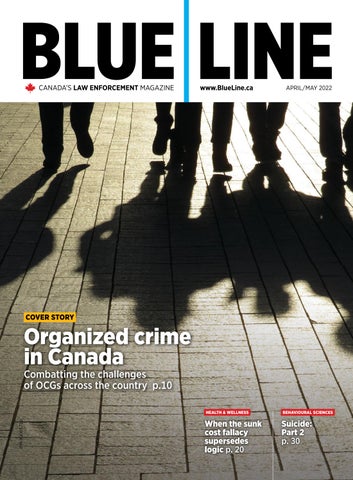
Organized crime in Canada PM 40065710
Combatting the challenges of OCGs across the country p.10
I N T R O D U C I N G
T H E
2017+ TESLA MODEL 3 PEDESTAL SYSTEM
RUGGED. RELIABLE. RESPONSIVE.
Transform the 2017+ Tesla Model 3 into a mobile workstation with our all-new space-efficient pedestal mounting solutions. The vehicle-specific base was designed to fit seamlessly into the Tesla Model 3, providing an easy install and reliable mounting location for a variety of devices. The pedestal kit can be easily customized with any Gamber-Johnson motion attachment to create a rugged and reliable mounting solution to fit any fleet’s specific needs. Available now! Learn more and find a reseller in your area at gamberjohnson.com.
GAMBERJOHNSON.COM
Contents
10 April/May 2022 Volume 34 Number 3
Features COVER STORY
Columns 4 14 20 24 28 34 38
Editor’s Commentary Q&A Behavioural Sciences Case Law Health & Wellness Holding the Line Back of the Book
Departments
10 Organized crime in Canada
Combatting the challenges of OCGs across the country. By Brittani Schroeder.
16 Room size versus rapport Which is more important? By Zaia Lazar.
18 Organized car thieves met head on
Car theft trends and how the York Regional Police acted on them. By Duncan MacIntyre.
6 6 8 8 9 36 37 38
News By the numbers Dispatches Calendar Off the Shelf Product Showcase Marketplace Blue Links
26 Administrative monetary penalties and municipal compliance
Emerging approaches to handling parking and by-law infractions. By Orest Katolyk.
30 A matter of trust
COVER PHOTO: ©OLEG / ADOBE STOCK
How to revolutionize substance use treatment for Canada’s cops. By Maureen Palmer.
14 @Blue_LineMag
18 22 April/May 2022 | BLUE LINE
3
EDITOR’S COMMENTARY BY BRITTANI SCHROEDER
www.BlueLine.ca
A continuing education in organized crime
I
like to consider myself a lifelong ing the training opportunities to look out learner, and in the world of law for. To read this the full story, see page 10. Another topic I wanted to delve into this enforcement, it’s necessary. The world is constantly changing around month was the trends that police are seeing us—new laws are put in place, old laws and in their communities. Being able to recogby-laws are updated or removed—and nize trends of criminality, intercept and what you knew yesterday could be com- stop these activities before they begin is important for all members of law enforcepletely wrong tomorrow. When looking at organized crime, mem- ment, in every area of the job. When I posed bers of law enforcement need to remain the question of “What trends are you seeing agile and adaptable, because that is what in your community?” to officers, a large these illegal enterprises are doing. Take, number were seeing a rise in vehicle thefts. for example, the pandemic: when the York Regional Police’s Supt. Duncan Macinternational land borders closed, organ- Intyre has shared an article that analyzes ized crime groups adapted to find ways to the rates of auto thefts across Ontario since bring illicit contraband into Canada. 2019, questioning what the trend could These groups can think on their feet and mean and showing results from initiatives shift their activities to continue making targeting theft groups. You can read the full report on page 18. money, no matter what. An additional trend in poliIt is imperative that law en- It is imperative cing that we are looking at in forcement keep up to date on the that law this issue is the emerging muactions of organized crime groups. enforcement nicipal approach to dealing From their public sector infiltra- keep up to with parking and by-law infraction, private sector involvement date on the tions in the community. The and technological capabilities, to actions of use of Administrative Monetary their use of violence, criminal organized Penalties (AMPs) has grown enterprise and specialized skills. crime groups. steadily and is an alternative to The work that officers are doing in the community, providing opportunities issuing “tickets” to the public. The goal is for social intervention and conducting to ultimately deal with these infractions in community outreach, is of the utmost im- a manner that is fair, effective and efficient. portance. Preventing youths from being You can learn more on page 26. Peter Collins, a regular Blue Line columinvolved in gang violence by providing proper education and positive opportun- nist, is a forensic psychiatrist with the ities is something that many neighbour- OPP, and in this issue he has continued his hood community officers are tasked with series on the topic of suicide. This is an every day. With the majority of adults area where I think we can all benefit from owning a smartphone, using social media further education, as 800,000 individuals to educate the public on the activities of die by suicide each year. In his column, organized crime groups, and showing the Collins introduces the Behavioural effects of organized crime, can raise aware- Change Stairway Model, and its stages of facilitating a relationship-building proness in a quick and efficient manner. While working on this month’s cover cess. You can read more on page 20. story, I spoke with several members of the What is something you’ve challenged RCMP, OPP and Toronto Police Service to yourself to learn more about? What area of learn about what is currently happening in policing and law enforcement do you think Canada when dealing with organized crime. deserves more attention? I encourage you The OPP also shares some helpful tips for to reach out to me at any time so we can all members of law enforcement who are talk about it more (I can be reached at working to combat organized crime, includ- bschroeder@annexbusinessmedia.com).
CONNECT WITH BLUE LINE
www.BlueLine.ca 4
@Blue_LineMag
BLUE LINE | April/May 2022
BLUE LINE
www.facebook.com/BlueLineMagazine
Reader Service Print and digital subscription inquiries or changes, please contact Beata Olechnowicz, Audience Development Manager Tel: (416) 510-5182 Fax: (416) 510-6875 email: bolechnowicz@annexbusinessmedia.com Mail: 111 Gordon Baker Rd., Suite 400 Toronto, ON M2H 3R1 GROUP PUBLISHER | PAUL GROSSINGER pgrossinger@annexbusinessmedia.com PUBLISHER | ADAM SZPAKOWSKI aszpakowski@annexbusinessmedia.com EDITOR | BRITTANI SCHROEDER bschroeder@annexbusinessmedia.com EDITORIAL DIRECTOR EMERGENCY SERVICES GROUP | LAURA AIKEN laiken@annexbusinessmedia.com ACCOUNT MANAGER | JANICE EATON jeaton@annexbusinessmedia.com MEDIA DESIGNER | SVETLANA AVRUTIN savrutin@annexbusinessmedia.com ACCOUNT COORDINATOR | KATHRYN NYENHUIS knyenhuis@annexbusinessmedia.com COO | SCOTT JAMIESON sjamieson@annexbusinessmedia.com ANNEX BUSINESS MEDIA 111 Gordon Baker Road, Suite 400 Toronto, ON M2H 3R1 Tel. 416-442-5600 • Fax 416-442-2191 Publication Mail Agreement No. 40065710 ISSN 0847-8538 Printed in Canada SUBSCRIPTION RATES Canada — 1 Year $31.50; 2 Year $52.50 plus tax USA — 1 Year $136.50 CAD Occasionally, Blue Line will mail information on behalf of industry-related groups whose products and services we believe may be of interest to you. If you prefer not to receive this information, please contact our circulation department in any of the four ways listed above. Annex Privacy Officer Privacy@annexbusinessmedia.com; Tel: 800-668-2374 © 2022 Annex Business Media. All rights reserved. Printed in Canada. No part of the editorial content of this publication may be reprinted without the publisher’s written permission. Opinions expressed in this magazine are not necessarily those of the editor or the publisher. No liability is assumed for errors or omissions. Readers are cautioned and advised that articles presented herein are edited and supplied for your personal awareness and should not be used for further action until appropriate guidance is received from a supervisor, Crown Attorney or other persons in authority. All advertising is subject to the publisher’s approval. Such approval does not imply any endorsement of the products or services advertised. The publisher reserves the right to refuse advertising that does not meet the standards of this publication.
COMMISSIONAIRES VALUES LAW ENFORCEMENT EXPERIENCE Join Commissionaires and put your skills and experience to work to ensure the safety and security of people and property in a wide variety of environments.
COMMERCIAL
EDUCATION
HEALTHCARE
CONDOMINIUMS
MINING SITES
GOVERNMENT
CONSTRUCTION
PORTS
commissionaires.ca
NEWS Nîsohkamâkewin Council – To help EPS with addressing the inequities and barriers Indigenous peoples face, and with implementing the policing recommendations from national reports such as the Truth and Reconciliation Commission of Canada, and the National Inquiry into Missing and Murdered Indigenous Women and Girls.
ONTARIO
Researchers share actionable document on women in law enforcement during the pandemic
Sexual Orientation, Gender Identity and Expression (SOGIE) Council – To guide EPS in supporting members of the 2SLGBTQ+ community, and with putting the EPS 2SLGBTQ+ Community Feedback Report into practice.
This infographic draws on research supported by the Social Sciences and Humanities Research Council of Canada; the Centre for Research on Security Practices; and Wilfrid Laurier University. To read the full document, visit: https://www.womenandpolicing. ca/research ALBERTA
Community councils helping police move forward with changes
The Edmonton Police Service (EPS) is moving forward with three new community councils to help guide systemic change, address emerging issues, and increase accountability to the
city’s diverse communities. EPS has revisited its mechanisms for engaging and consulting with the community, and the former Chief’s Advisory Council (CAC) has been remodeled to develop a broader, more inclusive, and intersectional forum for diverse communities to collectively identify issues and find solutions. Three new community advisory councils were formed to support EPS in carrying out these changes:
Chief’s Community Council – To assist EPS in shaping policies and procedures related to all communities, and with applying the recommendations from the EPS Commitment to Action Community Feedback Report. Despite the challenges of the pandemic, a robust recruiting process for the three councils began in 2021 and continued through 2022, and 40 individuals were selected representing a diverse range of voices, perspectives, and experiences from the community. With all three councils now in place, they will be advising EPS on emerging issues and operational changes, while ensuring continuous engagement and accountability. For more information on the EPS community advisory councils, please visit www.edmontonpolice. ca/communitycouncils.
BY THE NUMBERS In November 2021, Statistics Canada released recent data on homicide rates in Canada, 2020. For more information, please visit www150.statcan.gc.ca.
743
homicides happened in 2020, at a rate of 1.95 per 100,000 population.
6
BLUE LINE | April/May 2022
1 in 5 homicides in Canada was gang-related. However, the number of gang-related homicides decreased in 2020 to the lowest rate since 2016.
277
homicides were committed with a firearm. Almost half (49 per cent) of these were committed with a handgun.
25% of homicide victims were identified as visible minorities, 50 per cent of whom were identified as Black.
www.BlueLine.ca
PHOTO CREDIT: WILFRID LAURIER UNIVERSITY
In June 2020, inspired by the Canadian government’s call for research on the impacts of COVID-19, researchers at Wilfrid Laurier University partnered with the Ontario Women in Law Enforcement (OWLE) to provide a gendered analysis of the impacts of COVID-19 by examining whether, how, and to what extent COVID-19 has exacerbated the challenges, complexities, and inequalities – both at work and at home – experienced by women in law enforcement. This study employed two data collection methods including quantitative/ qualitative surveys via Qualtrics (phase 1) and in-depth interviews via Microsoft Teams (phase 2) to: understand how COVID-19 impacted the experiences of women in law enforcement at work and, by extension, how working during COVID-19 has impacted their experiences at home and assess how law enforcement services responded to COVID-19, and the impact of these responses on the experiences of women in law enforcement. In light of their findings, the researchers have made five recommendations for law enforcement organizations to implement.
NEWS DISPATCHES The Regina Police Service is proud to announce the promotion of Lorilee Davies to the rank of Deputy Chief. Davies has led an impressive 25-year career at the Regina Police Service building towards this promotion. Starting her career in 1996, Davies has worked in both uniform and investigative divisions of the police service. She also provided leadership in community based and human resource sections of the service and has been a member of both the Public Safety and Crisis Negotiation Teams. Davies spent many years on the Regina Police Association, which has enhanced her very balanced view of issues facing the dedicated staff, police service and community. Recently, as the Supt. of Community Services, Davies led many operational and proactive community initiatives. Over the past couple of years, her diverse assignments have spanned from managing large scale protests and labour disputes to providing oversight as a Critical incident Commander on Emergency Services calls. Davies also developed and leads a TRC committee and strategy for the police service. D/Chief Davies is a thoughtful and innovative leader who will continue strengthen the police service and community in her new role. Regretfully, the Vancouver Police Department and Metro Vancouver Transit Police acknowledges the passing of Ret. Sgt. Ray Winters. Ray joined the VPD in 1981 and completed 30 years of service when he retired in 2011. Winters then joined Transit Police, serving the community for an additional 10 years, and finally retiring from policing in 2021. During Ray’s time in policing, he predominantly served in patrol developing strong operational experience, and was known for being tenacious and compassionate. He completed 10 years in the VPD Canine Unit. After promotion to Sergeant, he completed a four-year secondment as an instructor with the Justice Institute of B.C., inspiring and influencing young recruits. Winters attained the rank of Sergeant in both agencies. He created an environment that allowed all members of his team to thrive, to grow and to reach their full potential. He influenced and developed many young police officers through the formative years of their career. He will be sadly missed. 8
BLUE LINE | April/May 2022
CALENDAR Deputy Chief Peter Yuen, a member of the Toronto Police Service’s Command Team, has retired after 35 years with the TPS. D/Chief Yuen was in charge of the Service’s Community Safety Command, which provides proactive and reactive public safety services and programs in partnership with diverse communities and key stakeholders. He is proudest of the meaningful partnerships the Service has developed and expanded that are most relevant to the heart of the community, including the Neighbourhood Community Officer Program, and the expansion of the Mobile Crisis Intervention Team Program. D/Chief Yuen has acquired an extensive variety of professional experiences, including in the areas of uniform patrol, undercover work, criminal investigations, community response, Asian Organized Crime, the Homicide Squad, Human Resources, Duty Operations and Corporate Risk Management. He has been recognized as an Asian Organized Crime expert by Ontario courts, and has spoken both nationally and internationally on the topic. D/Chief Yuen has received numerous awards for his career contributions, including the prestigious Order of Merit of the Police Forces. The Board thanks D/Chief Yuen for his outstanding and meaningful contributions to both the Service and the City of Toronto over the years. The Lac Seul Police Service proudly selected Bruno Rossi as their newest Chief of Police. Rossi brings 25 years of operational and administrative experience to the community. He is currently the Inspector of Support Services with the Manitoba First Nations Police Service (MFNPS) in Portage La Prairie Manitoba. Rossi has extensive experience working in various First Nation communities throughout his Policing career. Between June 2020 and November 2021, Rossi was the Acting Chief of Police for MFNPS. Rossi starts his new role on May 02, 2022 and a swearing in ceremony will be announced at a later date. Rossi is replacing Staff Sergeant Jason Spooner who has been the Acting Chief of Police on secondment from the Ontario Provincial Police since 2018.
NOTE TO READERS: check with all organizers as COVID-19 continues to affect events.
Law of Policing Conference, Eastern Edition May 4 – 5, 2022 Location: Toronto, Ont. www.canadianinstitute.com/law-ofpolicing-east/ Security • Police • Fire Career Expo Date: May 10, 2022 Location: Vaughan, Ont. www.emergencyservicesexpo.ca/ International Association of Directors of Law Enforcement Standards and Training 2022 Conference Date: May 15 – 18, 2022 Location: Fort Worth, Texas, U.S.A. www.iadlest.org/conf-2022 Rampart Range Day and Expo 2022 Date: May 31, 2022 Location: Ottawa, Ont. rampartcorp.com/range-day-2022/ CANSEC 2022 Date: June 1 – 2, 2022 Location: Ottawa, Ont. www.defenceandsecurity.ca/CANSEC/ CACP National Human Trafficking Symposium Date: June 5 – 7, 2022 Location: Toronto, Ont. www.cacp.ca ICPSOM 2022 Date: June 16 – 17, 2022 Location: Toronto, Ont. waset.org/police-studiesorganizations-and-managementconference-in-june-2022-in-toronto Find more calendar events online at blueline.ca/events.
Visit www.BlueLine.ca for the latest news, stories, products, videos, photo galleries and industry events.
PROMOTIONS, RETIREMENTS, RECOGNITION • If you have an officer in your agency recently promoted or retiring or an individual you wish to have recognized (major award or recently deceased) you can let Blue Line magazine know by emailing: bschroeder@annexbusinessmedia.com.
www.BlueLine.ca
OFF THE SHELF
Interviewing and Investigation, 4th edition By Kerry Watkins ISBN: 9781774620052
Interviewing is at the heart of a criminal investigation and requires special skills, advanced training, and informed decisions. Research has contributed to the development of this crucial aspect of investigations for decades. Translating research into practice is not an easy task and should be done properly with the guidance of a reliable resource, which is an essential component of an effective training program or course. The 4th edition of Interviewing and Investigation, written by Humber College professor Kerry Watkins, with the contributions of Joseph Eastwood, Sarah MacDonald, and Robert Thomas, is a great resource that can be used in a training course for investigative interviewers, police candidates or students. It can also be used as a reference
book by those who are interested in investigative interviewing, including practitioners, trainers and researchers. As a researcher and instructor working in the field of investigative interviewing, I am delighted to see that the 4th edition includes the most recent research findings and legal decisions within the Canadian context as well as discussions on how they can be applied in the interview practices. The book is both comprehensive and concise in terms of covering all the information needed by an investigative interviewer, including (but not limited to) techniques such as Cognitive Interview and PEACE Mode. It also contains child interview techniques; approaches to suspect interviews, including their effectiveness and issues with the coercive interview approaches; legal issues in interviewing, such as the admissibility of confessions and the credibility of statements; eyewitness memory and interviewing procedures; and techniques to mitigate the risks and failures in interviewing.
The research findings and theoretical underpinnings on these specific issues are provided in clear language that can be easily understood and applied by practitioners and students. The supporting resources provided in the book, such as the introduction of key concepts, suggestions for further reading, and the unique perspectives on Canadian legal issues and legal rights, provide readers with the opportunity to enhance their knowledge on key issues. The case studies provided in each chapter, which include examples from recent events (e.g., Alek Minassian’s confession), help readers understand how to apply theoretical information to practice. The questions in these case studies are thoughtfully designed to guide a systematic examination of the events and of the application of the content in specific cases. Taken together, I recommend this book to all who are interested in investigative interviewing, including practitioners, trainers, students or researchers. – By Dr. Davut Akca, Assistant Professor at Lakehead University and Senior Fellow at Orion Policy Institute
Fully Online Program
Bachelor of Applied Arts Justice & Public Safety Complete in 2 to 2½ years
Choose the DEGREE that will move your career forward
Apply by June 1 for guelphhumber.ca/futurestudents/jps fall 2022
@Blue_LineMag BL_UnivGuelph_AprilMay22.indd 1
April/May 2022 2022-04-08 | BLUE LINE 9:10 AM9
COVER STORY
Organized crime in Canada Combatting the challenges of OCGs across the country
O
rganized crime poses many challenges for members of law enforcement. The threat that organized crime groups (OCGs) pose to the general public comes in a variety of ways, including their infiltration of the public sector, private sector involvement, criminal enterprise, and their use of violence. Over the past few years, OCGs activities may have shifted to adapt to the pandemic, but their goal remained the same: to make money.
OCGs during the pandemic
OCGs in Canada focus mainly on drug trafficking, firearms and financial crimes, with cybercrimes becoming increasingly prominent, said the RCMP’s Robin Percival. The COVID-19 pandemic didn’t have a big impact on OCGs, but it did cause them to adapt their operations. OCGs quickly started producing counterfeit N95 masks, hospital ventilators and COVID test kits. In diversifying their criminal involvement and exploiting alternate venues, the OCGs continued to thrive. When it comes to organized crime and the pandemic, members of OCGs didn’t fear or adhere to COVID-19 restrictions, said Supt. Steve Watts, unit commander of organized crime enforcement at the 10
BLUE LINE | April/May 2022
Toronto Police Service (TPS). When looking at the closed land border between the U.S. and Canada, Supt. Watts and his team saw a slight change over the last two years. “There has always been a high volume of firearms and illicit contraband coming into Canada through land-based border points, so with less traffic coming through those borders, there may have been a small effect on their activities.” Robert Whalen is a retired detective who served with the TPS for over 30 years and spent a considerable amount of time responsible for the coordination of criminal response to unlawful activity related to criminal organized crime. He said that even with the land border closed, “with investigative resources such as Health Canada and Border Services stressed to the limit, OCGs may have actually found it easier to import illicit drugs.”
ces to combat organized crime in a way that suits their specific community’s needs. The TPS has a dedicated organized crime enforcement (OCE) section with numerous units contained within it. Supt. Watts said these sub-units span everything from complex gang investigations, firearms and controlled substances to fugitives, parole offenders and more. From there, these units are further broken down. For example, the Integrated Guns and Gangs unit includes street enforcement teams and centralized shooting response teams. The RCMP focuses its investigative efforts on the criminal activities of groups and networks, rather than specific commodities, said Percival. Organized crime seeks to make a profit whenever and however it can. New organized crime trends will always surface if there’s money to be made from the activity.
Law enforcement resources
Partnering to combat crime
The 2021 Public Report on Organized Crime in Canada stated that a key question for senior law enforcement decision makers is to decide what issues matter most and where resources should be allocated (see reference 1). Each law enforcement agency creates units and teams and allocates their resour-
One important strategy being used to stop organized crime groups is partnering with other agencies across the country. The RCMP has implemented a national investigative strategy in partnership with the Canadian Border Services Agency (CBSA), Canada Post, Health Canada and municipal, provincial and international law enwww.BlueLine.ca
PHOTO CREDIT: ©COUPERFIELD/ ADOBE STOCK
By Brittani Schroeder
forcement agencies. There are several key activities these partnerships focus on, including gathering information and data to identify shipping and manufacturing trends, international exporters, domestic distributors, clandestine labs and criminal networks, collaborating with international partners to combat illegal drug trafficking networks and disrupt the flow of fentanyl into Canada, and coordinating information sharing between partners, said Percival. The Canadian Integrated Response to Organized Crime (CIROC) coordinates a national effort to disrupt organized crime by encouraging information sharing between law enforcement agencies. This partnership includes the RCMP, municipal and provincial police agencies, Canadian Border Services Agency, Financial Transactions and Reports Analysis Centre of Canada, and other federal government departments. Through CIROC, Canadian law enforcement agencies can work together in an integrated response to reduce crime and keep Canadians safe from the damaging effects of organized crime. When speaking with the TPS, a trend they are seeing is the migration of organized crime groups into the rural areas of central and northern Ontario. This has been happening over the last few years. Because of this, the TPS has undertaken “Joint Force Operations”, where they have partnered with the RCMP, CBSA, OPP and multiple law enforcement agencies in different municipalities. They have effectively partnered in a variety of different areas, including firearms and drugs. The TPS also partners with a group called FINTRAC, which is the Financial Transactions and Reports Analysis Centre of Canada. This is important in the law enforcement world because FINTRAC assists with the investigation and detection of illicit money in relation to organized crime, which is all about making money illegally, Supt. Watts said. Overall, organized crime is successful is because they are, simply put, organized. Ret. Det. Whalen said the main reason OCGs seem to be ahead of law enforcement is because these agencies have not become organized with the public. “Public Private Partnerships (PPPs) are needed to combat this. The private industry has amassed large amounts of intelligence on OCGs that they are more than willing to share with the police. In turn, police need to dedicate more resources and attention to working with these groups to combat organized crime,” he said. @Blue_LineMag
“We have to challenge ourselves to share information with each other. That one piece you have might be the one piece that another officer needs to solve the puzzle.”
– Ret. Det. Robert Whalen
Organizations that are out there ready to help are those like the Loss Prevention Advisory Committee sponsored by the Retail Council of Canada, the Retail Loss Prevention Group and the Canadian Anti-Counterfeiting Network. An organization in the U.S., the Intellectual Property Crime Center, focuses on being a hub of all information, training and resources for organized intellectual property crime in the U.S. Whalen hopes Canada will soon have a centralized hub of their own to help officers combat organized crime.
Gangs and OCGs
When speaking about gangs and rivalries, Supt. Watts has seen his fair share in Toronto. “The city has very established gang rivalries, but it’s not like what’s depicted in the movies.” Canada is a very multicultural and diverse country, so gang rivalries aren’t necessarily between different ethnicities and cultures. Today’s OCGs and gangs are very diverse, always changing, and adaptable in their makeup. “They follow the acronym MOE: money over everything. It doesn’t matter what your background is, as long as you can contribute financially through your actions and criminal activity involving illicit contraband, you’re in.”
Challenges dealing with OCGs
The biggest challenge when dealing with OCGs in Canada is the multi-level “business” that OCGs are involved in, said members of the Ontario Provincial Police (OPP). “OCGs are often involved in a variety of criminal enterprises, which can be a challenge to frame in a single indictment. There are also legal complexities when it comes to large-scale investigations.” To Ret. Det. Whalen, the main challenge is manpower. All police services are stressed to their limits, and with this stress comes the reality that they must focus their efforts on crimes that effect the health and safety of individuals. However, the majority of organized crime is related to making profits. “We must task ourselves with sharing information with each other. That one piece you have might be the one
piece that another officer needs to solve the puzzle,” he said. One of the greatest challenges in larger cities like Toronto, Montreal and Vancouver is the increased access to firearms. Supt. Watts has been working the in the OCE section for the majority of his career, and the prevalence and access to firearms has been steadily increasing. Federal, provincial and municipal law enforcement work collaboratively with the CBSA to address the challenge of the cross-border interdiction of firearms and drugs at the border between the U.S. and Canada. “The reality is, we need all the above involved partners and the continuing assistance of the community, and they need to be an essential part of the solution to gun violence,” said Supt. Watts. Another challenge law enforcement is faced with is the large portion of youths that are involved in gang violence, either as the person of interest or the victim. Watts continued, “It’s upsetting to hear when a young person is involved in these types of incidents. We need to be reaching these kids at a very early age—long before they’re teenagers—and provide them with positive opportunities and life skills. Providing education and, when the time comes, proper and equitable employment opportunities to help mitigate this complex socio-economic situation.”
Educating the community
A key to combatting organized crime in Canada is law enforcement raising awareness in the communities they serve. The RCMP’s Federal Policing Strategic Engagement and Awareness team has developed and disseminated multiple products to raise awareness of national security, or organized criminal activities, such as the Reporting Suspicious Incidents to Police Guide (see reference 2). “By better understanding the threats organized crime presents, people are empowered to make informed choices that will increase their personal safety and also help deny illicit proceeds to criminals,” said Percival. April/May 2022 | BLUE LINE
11
COVER STORY In the TPS Gang Prevention Task Force, there is a program that deals with marginalized communities where relationships are then built through town hall meetings. Officers find opportunities for social intervention and conduct community outreach efforts. The TPS has also identified highly impacted neighbourhoods and neighbourhood community officers (NCOs) are embedded within these specific communities. “These NCOs establish solid lines of communication and relationships with community members, building trust over time, and it ultimately results in deterrence and prevention of violent crime in that particular neighbourhood,” said Supt. Watts. Ret. Det. Whalen stresses the importance of the media as a tool to raise awareness. “We as law enforcement have a love-hate relationship with the media, but we must work as a team to help educate the community. We need to stop future crime by showing its links to organized crime. Let the community know when a crime might be linked to OCGs and show them the effects of organized crime—child
exploitation, human trafficking, drugs and gun violence. Also show them the side of organized crime where people lose their homes due to fraud, and loss of jobs due to businesses unable to suffer the losses.” The OPP also utilizes social media in partnership with CIROC and Crime Stoppers to promote education campaigns regarding different organized crime topics. For example, these can include campaigns focused on reducing purchases of Outlaw Motorcycle Gang (OMG) merchandise, in an effort to educate the public on how purchasing merchandise can further the criminal activities of OMGs.
In summary
Organized crime is not just the traditional Hollywood portrayed criminal and crime. Gangs must meet certain financial thresholds each day to remain in the gang. Organized crime is focused solely on financial endeavors through the sale of illicit drugs and firearms. Gangs are not dictated by racial background. Law enforcement agencies need the help of all others across Canada and need
to focus on public private partnerships. The OPP suggests that law enforcement members who are interested in combatting organized crime should actively seek training opportunities in the areas of: confidential informant handling; interviewing techniques; physical surveillance and electronic surveillance; drafting of Judicial Authorizations; and major case and file management. “Never stop learning and seek the mentorship of experienced members involved in organized crime investigations and begin to develop a network of relationships inside and outside your organization, as these contacts will become critical to your future success as an organized crime investigator.” As Ret. Det. Whalen said, “Organized crime is present in all aspects of crime, and they do it for one reason: profit. The only way to beat organized crime is to take away their profits.”
References
1. “2021 Public Report on Organized Crime in Canada.” Criminal Intelligence Service Canada. 2. “Reporting suspicious incidents to police.” Royal Canadian Mounted Police.
Prepare to Serve and Protect SENECA OFFERS PROGRAMS IN: • Police Foundations • 911 & Emergency Services Communications • Advanced Investigations & Enforcement • Crime & Intelligence Analysis Enhance your diploma or professional experience through credit transfer to gain another law enforcement credential. Start making a difference in communities across Canada. LEARN MORE AND APPLY TODAY senecacollege.ca
12
BLUE LINE | April/May 2022
BL_Seneca_AprilMay22.indd 1
www.BlueLine.ca
2022-04-13 9:20 AM
MAKE AN IMPACT Support your community through a career dedicated to helping others. APPLY NOW FOR FALL 2022 Police Foundations (on campus or online) Community and Justice Services Learn more at stlawrencecollege.ca
Q&A
Q: Can you tell me about your experience of being the first Black police officer in Brampton?
1974 was the year Peel Regional Police (PRP) was formed; there was an amalgamation of five small police forces that then became PRP. Before I officially started, my recruiting officer called me up to give me my start date, and I began to backtrack and wondered if this was really something I wanted to do. He called me into his office and told me, “We want you. You scored very well on the exams, and this place is growing. We want you to be a part of it.” When I started at 21 Division, we had approximately 150 officers; now they’re running close to 400 officers. The demographics of the city back then were mostly Caucasian immigrants from the United Kingdom, so in that respect it was challenging for me. I would say that I was accepted by 95 per cent of the officers I worked with. As an officer, I stood out in many ways—both positively and negatively. Luckily, most of the community accepted me, but there were a lot of stares. There was one instance I remember very clearly. I showed up to a house on a domestic call, and a female opened the door and there was a look of shock on her face. She asked me point blank, “Are you a police officer?” I replied yes, and she asked to see my identification. I produced my warrant card and my badge. When I entered the home, she said, “I 14
BLUE LINE | April/May 2022
didn’t know there were black police officers in Canada.” Some might say she was being racist, but I knew that she honestly didn’t know that Black men and women were police officers. I was taken aback by the comment, but I conducted my investigation and carried on from there. It wasn’t something that I’d ever experienced before in my professional life. I thought about it, and then I realized, hey, there are probably going to be more people like that, because I’m the first Black police officer here. As long as I keep my nose clean, and I do my job to the best of my ability, there’s a possibility that more minorities will be hired. Eventually, that came true.
Q: How long did it take before another Black police officer was hired?
It was approximately seven years before another Black police officer was hired. Coincidentally, he was also stated at 21 Division. Following his retirement after six years, another one or two Black officers were hired, and it went on like that for quite a while. Back then, Blacks or minorities were not expected to make upward mobility; we were expected to stay at the constable stage. It took about 12 years, but I got promoted to sergeant. By that time, more minorities and females were starting with the service. The community started to speak out when they noticed
Ret. Sgt. Lonny Blackett
the visible minority officers weren’t experiencing upward mobility. The community was becoming more diverse, and they wanted a police force that represented them properly. It was then that the department started to look at people more seriously, and the decision to promote someone became strictly about merit and not the colour of a person’s skin.
Q: When it comes to training and education, how important is it for officers to continue learning throughout their career?
First, I need to preface this by saying that training takes time and money, and depending on the type and length of the course, officers are taken off the streets and are either being trained within their department or are sent elsewhere to be trained. During the
course of my career, I would say 10-12 years before I retired, I was trained as a hostage negotiator. It taught me how to de-escalate and properly talk to people in high-risk situations. Having said that, it is important to note that we’re not going to be able to talk every person down, but it helped tremendously. I wish every second or third officer—perhaps all officers out there—could get some form of hostage negotiation training, but again, it comes down to money. When looking at education, I think it needs to improve within policing. It shouldn’t just be about the education you have coming into the industry; you’ve got to keep your education up to date. Laws and statutes change, and if you’re writing someone up for an offense that isn’t illegal anymore, that is going to be thrown out in court. Nowadays, teenagers could tell you the law just by looking it up on their phone, and they will question and challenge you. You need to keep up to date, keep learning and go back to school. You can do it online or in person, attend any university or college that has continuing education programs. You’ll never regret being a lifelong learner. Editor’s Note: This interview has been condensed and edited for clarity. To listen to the full episode, visit blueline.ca/podcasts. This episode of Blue Line, The Podcast was sponsored by Wilfrid Laurier University.
www.BlueLine.ca
PHOTO CREDIT: LONNY BLACKETT
In a recent episode of Blue Line, The Podcast, editor Brittani Schroeder was joined by Ret. Sgt. Lonny Blackett, who was the first Black police officer in the city of Brampton (Peel Regional Police Service). During their discussion, they touched on the changes Blackett saw throughout his time as an officer and the importance of ongoing training and education for those in the law enforcement industry.
TASMANIANTIGER.CA
LOAD CARRIER WITH PACKSACK Carrying Handle Padded Shoulder Straps Adjustable V2 Carrying System Aluminum frame with cross bars to make it extremely strudy Maximum load up to 110lbs/50kg
TT LOAD CARRIER System: Dimensions: Weight: Material: Item/Color:
TT LOAD CARRIER PACKSACK
V2 Carrying System 31 x 14x 11in I 78x35x28cm 95oz | 2.7kg Aluminum & 420 HD Nylon TT-1130-331 OLIVE
Dimensions: 26 x 13 x 10in I 66 x 34 x 25cm Weight: 30oz | 850g Volume: 80 Liters I 4,882 Cubic Inches Material: 420 HD Nylon Item/Color: TT-1133-331 OLIVE
TOGETHER Material Loops on the lid and the front Compression Straps Slides over top of the TT Load Carrier Hook-and-loop straps to attach to TT Load Carrier frame Large voluminous pockets each side and on the front
INTERVIEWING
Room size versus rapport
Which is more important? By Zaia Lazar
A
n article in the June/July 2020 issue of Blue Line discussed how the size of the interview room affects the behaviour of the subject, and suggests that the larger the space the more open the room felt and, therefore, the subject would also feel more open to discuss matters at hand. Whilst some of the cited studies showed that participants felt more at ease in the larger rooms, this did not translate to the participants being more forthcoming, indeed: “the correlation between room size and the disclosure measures were all nonsignificant.” The majority of the articles paid scant attention to the size of the room and concluded by suggesting police interview rooms be larger. The issue with this is that the articles do not go into detail in regard to what “larger” means. They do not break down the size
than not, subjects are interviewed on the street or in the back of a police cruiser. Therefore, until there is more specific evidence about optimal interview room size, police should continue to focus on building rapport.
Rapport
into something concrete that can be acted upon. Simply to say a certain room should be larger is neither helpful nor actionable. Most departments have large “soft” interview rooms where victims and witnesses are interviewed. However, these rooms are not always available. When that occurs, investigators have to resort to other rooms to conduct their interviews. More often
What truly matters most is the investigator’s ability to build rapport with the subject, their mental attitude and their willingness to have an open mind and keep it open for the duration of the interview. Rapport and the ability to establish it with anyone is the key to obtaining reliable information from any interviewee. A frequently asked question is how much time an investigator should devote to rapport building before delving into the matters at hand; unfortunately, there is no simple formula for this. The answer to the above question is the rapport starts when an investigator meets the subject and should end when the interview ends. If for some reason an investigator cannot build rapport with the subject, then they should terminate the
PHOTO CREDIT: ©EKOSTSOV / ADOBE STOCK
Trident Training Solutions has comprehensive training programs ideal for law enforcement and security agencies. Our training structure is scalable and flexible based on the client’s needs. We incorporate a blended program of virtual training sessions, an online school, and in-person instructor-led classes to allow flexibility. We specialize in de-escalation strategies, legislative authorities and defensive tactics with a strong focus on practical training.
Visit www.tridenttrainingsolutions.ca
for more information.
16
BLUE LINE | April/May 2022
BL_Trident_AprilMay22.indd 1
www.BlueLine.ca BL_Sarnia_AprilMay22.indd 1 2022-04-19 11:10 AM
2022-04-19 10:43 AM
interview and reschedule for another day with another investigator. While this may seem counterintuitive at first glance, the reasoning is sound. If an investigator cannot build rapport, then the information they obtain will be minimal at best, and at worst could be misleading.
Proximity
There is also the idea of context manipulation where the investigator manipulates some aspect of the room, usually by moving closer to the subject. This brings into play the theory of “proxemics”, which states that the closer one person is to another physically, the harder it is to lie to that person; conversely, the more space between the two, the easier it is to lie. Some of the participants in the studies felt uncomfortable when their personal space was encroached upon by the interviewer. On others there was no affect. The studies on this point are not helpful. In fact, the authors stated: “Moreover, we hypothesized that participants interviewed with a larger interpersonal distance between
them and the interviewer would provide more information. We found no evidence for this: interpersonal distance did not significantly correlate with any of the disclosure measures.” Does moving closer to a subject always result in more information? Not at all, it depends on the rapport built by the investigator, the rationale for moving closer, as well as the background of the interviewee. When dealing with people, there are a myriad of different and complex issues that the investigator must deal with that cannot be distilled into a simple formula. While moving closer to the subject when it is warranted is encouraged, there is no magic timing for when to do so. The interviewer will have to articulate to the courts the actions they took and why they took them. Ultimately, the decision of whether the actions of the investigator, by moving closer to the subject, were such that the subject’s will to continue was overborne will be determined by the trier of facts. It should also be noted that “These findings are based on investigative interviewing approaches
and the study size was small. Attempts to replicate the major findings on interrogation contexts have been unsuccessful.”
In summary
While it is beneficial to have access to an interview room that will be the most conducive to obtaining information, one should not underestimate the power of rapport. Good rapport between the interviewer and subject is built on good interviewing skills. The interviewer uses as many tools at their disposal as they can to ensure that they have developed rapport with the subject. However, the interviewer should never forget that it is the interviewer who develops rapport, not the room. For a full list of references, please visit https://www.blueline.ca/room-size-versus-rapport/
Zaia Lazar is a full-time instructor at the Ontario Police College where he instructs Investigative Interviewing Techniques. Prior to this he was a police officer with London Police Service for 22 years and worked in several capacities. He has conducted numerous interviews and interrogations in his career.
Law enforcement influencers in compelling conversation
Brought to you by
blueline.ca @Blue_LineMag
BL_PODCAST_AD_SVA.indd 1
April/May 2022 | BLUE LINE
17
2022-04-21 10:12 AM
THEFT TRENDS
Organized car thieves met head on
Car theft trends and how the York Regional Police acted on them By Supt. Duncan MacIntyre
A
18
BLUE LINE | April/May 2022
A stolen vehicle recovered during Project Majestic, a joint-forces operation with PRP and TPS, that concluded in March 2021. The DRPS, the CBSA and the Équité Association also provided assistance during the investigation.
cant seizures and arrests while dealing with a substantial rise in thefts compared to past years. To stop thefts before or as they happen, investigators worked hand-in-hand with the uniformed officers on patrol in residential areas in each of YRP’s five districts. ACTU requested district officers working in these areas during the peak theft periods, between midnight and 5 a.m., to identify and report to them suspicious activity that could be a theft in action or lead to a theft. When going after theft groups, ACTU members committed significant resources to large investigations. In the past, YRP targeted rashes of thefts on a more ad-hoc basis, tackling incidents through smaller investigations. However, the sheer number of thefts they encountered in 2021 and the improved sophistication of theft groups required larger-scale investigations that target the operations of these groups at every level. This approach taught YRP to be patient. Their goal was and remains to disrupt organized crime groups, so if acting on information too early prevents this, then holding back on executing search warrants or carrying out arrests until they have ample information is the right decision. The ACTU also owes its success to co-operation with policing partners. YRP works extensively with Peel Regional Police (PRP) and its Commercial Auto Crime Bureau and have established a strong cross-service network of information and resource sharing. During their 2021 investigations, the
YRP unit also collaborated with the Toronto Police Service (TPS) through its Auto Theft Suppression Project and the Durham Regional Police Service (DRPS) to cast a wide net over the Greater Toronto Area. In addition to making the most of tightknit partnerships with other GTA police services, YRP worked with authorities in Quebec to execute search warrants in Montreal, where vehicles ended up before being shipped overseas, and they leveraged the resources of the Royal Canadian Mounted Police, the Canada Border Services Agency (CBSA) and the newly formed Équité Association to extend their capacity across Canada and the globe. Despite the success in 2021, YRP knows they cannot afford to be complacent. Thieves are using increasingly advanced tools and strategies to steal cars and organizing themselves in more efficient ways to get stolen goods to buyers. To meet new challenges posed by criminals, YRP’s ACTU will continue its commitment to investigative excellence and the execution of large and ambitious investigations. They will continue working with their uniformed officers to stop thefts before, or as, they happen and lean on their law enforcement and civilian partners for support in order to ensure we disrupt and dismantle these organized theft groups. Supt. Duncan MacIntyre oversees the Organized Crime and Intelligence Services Bureau at York Regional Police, which includes the Auto/Cargo Theft Unit and several other units.
www.BlueLine.ca
PHOTO CREDIT: YORK REGIONAL POLICE
s auto thefts continue to rise across Ontario, more than 2,000 vehicles were stolen in York Region in 2021. This was a sharp increase from the 1,417 vehicles reported stolen in 2020 and the 1,384 reported in 2019. Both the volume of thefts and the sophistication of the criminals presented a challenge for the York Regional Police (YRP) Auto/Cargo Theft Unit. In 2019 and 2020, sport utility vehicles, specifically Lexus, Toyota and Honda SUVs, were the most sought-after prize for car thieves. However, in 2021, there was an influx in thefts of Ford 150 pickup trucks and a larger trend toward indiscriminate thefts of all vehicles with push button ignition systems. Demand for stolen vehicles has been driven by production delays caused by a worldwide semiconductor shortage, which has made new and used cars both harder to find and more valuable. Thieves are using advanced technology to steal vehicles, sometimes gaining entry through crude tools like screwdrivers, but once inside a car, thieves connect an electronic device to its onboard diagnostics computer and program the vehicle to accept a new key they have brought with them. Once the vehicle accepts the new key, it’s started and driven away. These thefts can be completed in about a minute. To stem the increase in auto thefts, YRP spent 2021 targeting theft groups operating in Ontario and Quebec. These highly organized enterprises include spotters who identify vehicles for theft, the vehicle thieves themselves and transporters who either drive the cars or send them by rail to the Port of Montreal. Once the cars arrive at port, they are loaded onto ships and delivered to buyers overseas. Over the last year, the YRP Auto/Cargo Theft Unit (ACTU) was able to disrupt the operations of car theft syndicates, arresting more than 100 people, laying significant charges and recovering over 350 vehicles. Three major operations, Crockpot, Moose and Majestic, yielded stolen vehicles, cash and electronic key programmers used to steal cars. YRP’s stolen vehicle seizures and arrests related to auto thefts have increased since 2019, but in 2021, the ACTU made signifi-
SPONSORED CONTENT
TRANSFORMING THE TACTICAL VEHICLE THROUGH TECHNOLOGY
W
ith an increasing number of risks and challenges on duty, law enforcement officers are relying on technology to advance their capabilities and increase the safety of their staff in the field. Technological advancements like cloud computing, IoT and artificial intelligence are enabling officers to access and share vital information quickly, improve productivity and efficiency of departments and promote health and safety. The Microsoft Tactical Vehicle is a new proof-of-concept - which offers examples of how Microsoft and partners can bring even more capabilities to the front-line and empower officers to achieve more in the field. Designed with operational resilience in mind, it is outfitted with sensors and cutting-edge technologies that allow law enforcement officers to stay hyperconnected in today’s digital world. The Microsoft Tactical Vehicle enhances critical decision-making through resilient connectivity, power and compute with real time situational awareness, data analytics and insights. With a modular approach to technology enablement, Microsoft provides leading public safety partners like Dejero, Stealth Power, Kymeta, Rajant and 3AM Innovation with a mobile law enforcement platform that can be customized to local police needs.
@Blue_LineMag
Transforming the police vehicle into a mobile office, this proof-of-concept is equipped with Microsoft Azure IoT, Azure Stack Edge, Microsoft Teams and Surface devices and features capabilities such as: • Virtual assistants to reduce distracting processes • IoT-enabled incident reporting • Live video access to improve situational awareness • A dashboard featuring a daily brief and crime map • Unified Teams channel for effortless communication, plus much more Integrating technology into law enforcement practices can augment the front-line work occurring today. The Microsoft Tactical Vehicle demonstrates the potential of technology to advance public and officer safety, which will lead to greater job satisfaction, improved operations and safer communities. To learn more about how technology is revolutionizing law enforcement operations and policing visit: aka.ms/PublicSafetyInCanada
April/May 2022 | BLUE LINE
19
BEHAVIOURAL SCIENCES BY PETER COLLINS
Suicide: Part 2
I
n part one of this column, suicide was defined as a conscious act of self-induced annihilation in an individual who sees it as the best possible solution to a defined problem. We discussed that the World Health Organization estimates that over 800,000 individuals die by suicide each year. For each suicide, as many as 20 additional individuals have attempted to kill themselves. Suicide rates vary in different countries, based on several factors. In Canada, the suicide rate is approximately 11 people per 100,000 population, meaning that more than 10 Canadians die by suicide every day. Communicating with a suicidal subject is challenging, but the basic principles are the same for interacting with anyone who is in crisis. First, introduce yourself and why you’re there. As negotiators, we don’t use rank as our given name as this can, in many situations, create a barrier. Instead, ask them how they want to be addressed. Can you
call them by their first name? Establish a professional, friendly and calm approach based on safety, mutual respect and a desire to assist. Ask how you can help. Try to protect the person from unnecessary onlookers. All too often I have been on calls where onlookers will say derogatory things to the subject, yell at them to jump and even project laser pointers on them. If possible, have them move to a safe location. Pose structured and sequential questions that will allow the subject to open up and talk. Reduce the tension by trying to establish a rapport through questions unrelated to their distress. If possible, focus on the positive. A goal is to assist the individual along the Behavioural Change Stairway Model. This model was developed by the FBI’s Crisis Negotiation Unit and outlines a relationship-building process with the ultimate goal of assisting the suicidal individual overcome their resistance. It involves the negotiator helping the subject
SATURDAY Sept 10th
NIAGARA FALLS
CANADA
achieve a peaceful resolution. The Behavioural Change Stairway Model consists of five stages – active listening, empathy, rapport, influence and behavioural change.
SUNDAY Sept 11th
MONDAY Sept 12th
Active listening
Generally, people are poor listeners. They tend to rehearse what their next question will be rather than listen to what the subject has to say. Active listening ensures the subject knows they are being heard and understood. It consists of: Mirroring consists of repeating the last few words or theme of the subject being discussed. As well as demonstrating to the individual in crisis you are attentive, it also serves as a way of drawing out new material to discuss. The negotiator should not use the exact words as it can be annoying to the individual in crisis. Mirroring is not parroting. Paraphrasing is putting the content of what the subject said into the negotiator’s own words, thereby demonstrating that the negotiator is trying to understand the individual from a contact perspective.
TUESDAY Sept 13th
WEDNESDAY Sept 14th
THURSDAY Sept 15th
FRIDAY Sept 16th
Physical Group Activity
SEPTEMBER 12-16
2022
Announcements IAWP IAWP Late Board Late Board Meeting Meeting (LBM) (LBM) Niagara Niagara Regional Regional Police Police Headquarters Headquarters
Featured Keynote Speaker Breakout Training Sessions Lunch & Networking Breakout Training Sessions
For more information visit www.iawp2022niagarafalls.org
Hospitality/Evening Event Schedule not final, programme subject to change.
20
BLUE LINE | April/May 2022
BL_IAWP_Oct21.indd 1
www.BlueLine.ca
2021-09-13 12:29 PM
Emotional labelling refers to identifying the emotions felt by the subject. It can add to clarification because if the negotiator misidentifies the emotion, it still demonstrates to the individual that the negotiator is trying to understand the situation. This shows empathy and can de-escalate volatile emotions. Summarizing is combining the content of the paraphrase with the emotion identified by the negotiator through emotional labelling. For example, “Let me make sure I understand what you’re saying. You lost your job for no apparent reason,” paraphrasing, “and this makes you angry,” labelled emotion. An effective pause before or after a meaningful comment by the negotiator can provide the subject with the ability to focus on what the negotiator is saying. Minimal encouragers are brief, welltimed responses that let the subject know they are being listened to. These are nonverbal and verbal cues to the subject and show the negotiator is being attentive to what they are saying. Verbal minimal encouragers or comments such as ‘yes’, ‘uh-huh’, ‘right’.
Nonverbal cues can include nodding the head, leaning forward, stroking one’s chin, not folding one’s arms across the chest, watching the person’s eyes without staring and assuming a relaxed stance. Open-ended questions encourages the subject to talk and invite them to tell their story. It allows the subject to elaborate and avoids ‘yes’ or ‘no’ answers. The negotiator may ask ‘tell me more about…’ in order to get more detail from the subject. I messages are a variant of self-disclosure that should be used sparingly. It introduces alternatives to the subject’s actions. An example of a good I-message is, “When drugs are involved, I get worried, because it can cause people to act irrationally and sometimes hurt people without meaning to.” Reflecting meaning is the ability to show the subject that the negotiator understands the content and emotion of his or her situation. It can be used to summarize understanding and to give the subject the chance to clarify any issue that the negotiator does not understand. This would be a way of building report.
In part three of this series, we will examine the other steps The Behavioural Change Stairway: empathy, rapport, influence leading to behavioural change. Remember, help is available. If in distress, please go to your nearest emergency room. The Canada Suicide Prevention Service is also available 24/7/365, in English and French, at 1-833-456-4566.
References
1. Ireland, C., Fisher, J., and Vecchi, G. (2011)
Conflict and crisis communication: principles and practice. New York: Routledge. 2. McMains, M., Mullins, W and Young, A. (2020) Crisis negotiations: managing critical incidents and hostage situations in law enforcement and corrections (6th edition). New York: Routledge. 3. St-Ives, M. and Collins, P. (2011) The psychology of crisis intervention for law enforcement officers. Toronto: Carswell Thompson Reuters.
Peter Collins is the operational forensic psychiatrist with the Ontario Provincial Police’s Criminal Behaviour Analysis Section. He is also a member of the crisis/ hostage negotiation team of the Toronto Police Service Emergency Task Force. Dr. Collins’ opinions are his own. Contact him at peter.collins@utoronto.ca.
Celebrating our Champions of 35 Years The Law Enforcement Torch Run® (LETR) is the largest public awareness vehicle and grassroots fundraiser for Special Olympics in Canada - and around the world. Canada's LETR began in 1987 and has since raised more than $80 million in support of Special Olympics while championing acceptance and inclusion for Canadians with an intellectual disability. Thank you for 35 years of friendship and support. Together, we are transforming lives through sport in communities across the country every day.
@specialocanada | specialolympics.ca @Blue_LineMag
BL_SpecialOlympics_AprilMay22.indd 1
April/May 2022 | BLUE LINE
21
2022-04-19 3:21 PM
TECHNOLOGY
BY BRITTANI SCHROEDER
M
embers of law enforcement are in a constant state of learning and training. The question is, how can police departments transform their training to ensure their officers have the proper skills to better serve their communities? Companies like VirTra have been working on innovative technologies to support training initiatives in law enforcement. One such product is the V-300 4K simulator. Shortly after the events of 9-11, the simula- T.J. Alioto, SME, breaks down a simulation to tor was conceptualized. A team of engin- an officer during the demonstration in Toronto. eers, content creators and software developers have spent years researching and plement role playing, simunitions, classimplementing strategies to ensure realism room lecture and TASER training. The and improve the technology annually. lessons taught provide an opportunity for During a demonstration at Toronto’s cognitive learning and most any training Emergency Task Force (ETF) headquar- tactic can use VirTra as a supplement – ters, Blue Line tested the simulator in and in some cases, a replacement. person, alongside members of the EFT, A new way to train and learn more about this technology. Law enforcement members can train on What is the V-300 4K? any skill from verbal de-escalation to balThe V-300 4K is a five-screen, 300-degree listically accurate marksmanship practice immersive simulator that displays scenar- on a virtual range. Video scenarios include ios in 4K resolution, allowing police and active threat, high-risk vehicle stops, menrecruits to be further immersed. The tal illness, courtroom security and more. simulator replicates human visual acuity Each scenario is controlled by the instructby combining five laser-based 4K project- or and includes a variety of branching opors and scenarios filmed in 8K. This is tions towards resolution. important because officers can now train “Our goal is to provide different ways to recognize subtle visual cues due to the for officers to apply and hone their skills. reproduction of lifelike situations. During each simulation, as an instructor I The simulators also work with laser- could make the suspect in the simulation based drop-in recoil kits and CO2 maga- escalate in temper based on what the offizines, allowing officers to practice with cer is doing, or I can keep the suspect calm. their own duty weapon within the simula- I control the scenario from a computer tor. This also holds true for their TASER/ just outside the simulation,” said Tanner CEW device, OC spray and more. Layton, International Contract FulfillAlthough the simulator and CO2 maga- ment Manager with VirTra. During the zines cannot replace live fire, they are de- demonstration in Toronto, the system had signed to supplement it, and studies have over 369 different scenarios that could’ve shown that the skills learned within the been played out. “Every scenario that we simulator transfer to the field. The study have has two types of branches on it. You stated: “Researchers assessing firearms and have an instructor-driven branch, like the tactics simulator training have found that buttons that I was choosing, and then you the training appears to be beneficial in de- have training-driven branches based on veloping skills that are arguably the most what the officer or trainee is doing inside important for the safety of the officer and with their use-of-force options.” others, i.e. accuracy, effective use of cover, The accurate replication of situations avoiding the unintentional shooting or that police officers may encounter in the endangering of innocents and ensuring the field allows them to practice a variety of shooting is justified.” skills within a safe environment with efThe simulator can also replace or sup- fective skill transfer. Rather than just being 22
BLUE LINE | April/May 2022
‘video game’ style training, the superior quality allows trainees and seasoned officers alike to take the training seriously. With proper practice, officers will be better equipped to handle incidents confidently and effectively. Every scenario is created and vetted by VirTra’s in-house subject matter experts to ensure they are receiving the best training possible without receiving training scars from improper teaching. Then, each agency customizes it to fit their policies and procedures.
V-300 in Canada
Law enforcement agencies around the world have seen a difference in officer performance and de-escalation techniques since adopting simulator training. “When we’re creating training scenarios, we aren’t just creating it for any one agency. We’re creating them for agencies in the U.S., Canada, Mexico, Egypt, Saudi Arabia, you name it. We have to make scenarios that will work in as many different agencies as possible,” said T.J. Alioto, a subject matter expert at VirTra. “The instructor chooses the branches of the scenario that will play out based on the officer’s choices during the simulation. Depending on where they are located, an officer in California may choose one option and an officer in Vancouver may choose a completely different option in the same scenario. The officer will react based on the training they’ve been given, and we must make sure we’ve created enough possible branches of outcomes that they can continue in the simulation. I mean, it’s really like Pandora’s box, the more you branch out in each scenario.” Five agencies in Canada use a VirTra simulator to train their officers. After obtaining the simulator in early 2020, the agencies invited reporters for a demonstration and showed media the system’s capabilities and ability to function as much more than just a “shoot-don’t-shoot” tool. “There may be an impression out there, that this type of training is about police learning to shoot accurately, in a high-pressure situation. While that’s important, it’s not actually our priority,” said Delta police Deputy Chief Norm Lipinski. “Really, what’s vital for us, is that the simulator gives officers the chance to practice decision making. It’s decision-making practice, not target practice.” For a full list of references, please visit https://www.blueline.ca/the-next-innovativestep-in-law-enforcement-training/
www.BlueLine.ca
PHOTO CREDIT: BRITTANI SCHROEDER
The next innovative step in law enforcement training
2022
SECURITY • POLICE • FIRE
CAREER EXPO
FRIENDS OR FAMILY
LOOKING FOR A NEW CAREER? MAY 10, 2022 | VAUGHAN, ON www.emergencyservicesexpo.ca PLATINUM
CANCOM BROUGHT TO YOU BY:
GOLD
CASE LAW
BY MIKE NOVAKOWSKI
Unzipping fanny pack a reasonable safety search
O
pening a fanny pack and looking inside, rather than patting it down first, was a reasonable response during an investigative detention for a weapons offence, Manitoba’s highest court has held. In R. v. McKenzie, 2022 MBCA 3, two police officers in an alley saw a man jogging through a back yard. The man was clenching the left side of his body with his elbow. Thinking the man might be injured, one of the officers called out to him and asked, “Are you okay?” When the officer made eye contact with the man, the officer recognized McKenzie from police intelligence reports as a long-time member of a street gang who was known to carry a weapon. McKenzie appeared startled or frightened at seeing the police. He immediately increased his pace to a full out sprint. One of the officers, who had extensive training and experience with weapons offences, decided to detain McKenzie to investigate. The officer believed McKenzie was attempting to conceal a weapon between his left arm and his body. The officer yelled at McKenzie to stop, but he didn’t comply and a short foot pursuit ensued. During the chase, McKenzie’s jacket was open, and the officer observed a fanny pack. The officer caught McKenzie and pinned him against the wall of a house. He observed that the zipper to the fanny pack was about 75 per cent unzipped. The officer lifted the flap on the fanny pack to fully open it, shone his flashlight and immediately observed a handgun. McKenzie was handcuffed and arrested for possessing the firearm. When McKenzie’s jacket was searched, police found fentanyl, methamphetamine and other items indicative of drug trafficking. The firearm was loaded and stolen. At McKenzie’s trial in the Manitoba Court of Queen’s Bench, the judge found the investigative detention lawful. What the officer saw, along with his knowledge and training, provided the necessary reasonable suspicion to justify the investigative detention. As for the search of the fanny pack, it was reasonably necessary to eliminate an imminent threat to the officer’s safety. The safety search was not a pretext, ruse or subterfuge to look for evidence. And, even if the officer’s purpose was also to look for drugs, it would not 24
BLUE LINE | April/May 2022
“Protecting life and property is an important police duty that necessitates some interference with individual liberty.” negate his authority to look for a weapon as part of a lawful safety search. The judge also rejected McKenzie’s contention that it was unreasonable to look inside the fanny pack because a pat-down of it would suffice to determine if there was a weapon inside. Finally, even if McKenzie’s Charter rights were breached, the judge would have admitted the evidence under s. 24(2). McKenzie was convicted of possessing a controlled substance for the purpose of trafficking, possessing a restricted firearm with ammunition, and possessing a firearm while prohibited. McKenzie challenged his convictions to the Manitoba Court of Appeal. In his view, his detention was arbitrary under s. 9 of the Charter and the search of his fanny pack unreasonable under s. 8. As a result, he suggested, the evidence ought to have been excluded under s. 24(2). But Justice Mainella, speaking for the Court of Appeal, concluded McKenzie’s detention and the search of his fanny pack were both lawful.
Investigative detention
“A police officer may detain an individual for investigative purposes ‘where they have reasonable grounds to suspect that the individual is connected to particular criminal activity and that such a detention is reasonably necessary in the circumstances,’” said Mainella. “An investigative detention affords police the ability to take reasonable measures to investigate an offence.” Here, the totality of the circumstances through the lens of the officer’s extensive training and experience provided the necessary reasonable suspicion for the investigative detention. The detention was also reasonably necessary and conducted in a reasonable manner. “Weapons offences are a serious threat to the peace, therefore there was significant importance in [the officer] taking immediate action in terms of the public good as well as a necessity for him to interfere with the accused’s liberty,” said Mainella. “The nature of the detention, with some limited
use of force to pin the accused outside against a house, was appropriate given the inquiry related to a possible weapons offence, the accused was known to carry weapons, and the accused had knowingly attempted to evade police inquires by running.” McKenzie’s detention was not arbitrary.
Search incident to detention
The search of the fanny pack complied with the common law; it was reasonably necessary to eliminate an imminent threat to the officer’s safety. Mainella wrote: Protecting life and property is an important police duty that necessitates some interference with individual liberty… [The officer] had cause to have concern for his personal safety given the accused’s unusual mannerisms suggested he may be carrying a weapon. [The officer] was by himself in a dark area as [the cover officer] had not yet arrived. Although the accused was cooperating, he had just recently attempted to evade the police… Finally, the extent of the infringement (opening the remaining 25 per cent of the fanny pack to shine a flashlight in) was focused entirely on a protective function. [para. 47] Even if the officer was also searching for evidence of drugs, the search was still reasonable because he was looking inside it to ensure his safety. The officer was not required to follow “a rigid sequence of a pat-down search first, before a bag or pocket may be opened or otherwise searched” in order for it to be reasonable, said Justice Mainella. “It strikes us as incorrect and entirely artificial to say that legally [the officer] was limited in his split second decision, where there was a real threat to his safety, to use his sense of touch on the outside of the fanny pack as opposed to completely opening the already partially open zipper and using his eyesight when he was careful to conduct a minimally intrusive search that was limited in its scope to locate weapons.” Since the fanny pack search conformed with the common law, there was no s. 8 Charter violation. McKenzie’s appeal was dismissed and his convictions were upheld.
Mike Novakowski is Blue Line’s case law columnist.
www.BlueLine.ca
SPONSORED CONTENT
MEDICAL CANNABIS 101
M
edical cannabis has been legal in Canada since 2001. It also became recreationally legal in 2018. And yet, there is still a strong stigma surrounding the use of cannabis. However, there is a significant amount of real scientific evidence that shows how medical cannabis can be a truly effective tool to help Canadians live normal, day-to-day lives.
Conditions Medical Cannabis May Help With Pain, stress, anxiety, sleep, and PTSD are the most common ailments people use medical cannabis for, and the reason is simple – there is a large body of scientific evidence that suggests medical cannabis may help treat them. Pain: Medical cannabis that contains CBD has the potential to help treat recurrent pain and inflammation1. In fact, patients who’ve used medical cannabis also reported that they are far less likely to use traditional pharmaceuticals, such as opioids, to treat their pain2. Stress/Anxiety: Stress and anxiety can have negative impacts on a person’s overall health. But medical cannabis may help! In one study of patients who used medical cannabis to treat their stress and anxiety, 32% of them selected high CBD products as being helpful4. Sleep: Health Canada reports that 1 in 2 adults have trouble getting to sleep or staying asleep and 1 in 5 adults do not find their sleep refreshing8. This is another area where medical cannabis can potentially help. Cannabis use has not only been shown to decrease the time it took to fall asleep, but also promote a deeper sleep9-11. PTSD: Nearly 10% of Canadians will experience PTSD in their lifetime5. For those that suffer from PTSD, symptoms can include intrusive distressing memories, irritability, feeling jumpy, difficulty sleeping, etc6. Thankfully, this is another area that medical cannabis can help with. When patients used CBD, 91% of them experienced a reduction in their symptoms and an overall improvement in quality of life3,7.
The Main Difference Between THC and CBD If you’ve ever read or discussed anything about cannabis in general, then it is likely the terms THC and CBD were brought up. These are the two main compounds found in cannabis, but what exactly are they? THC is the main intoxicating molecule in cannabis and gives rise to the sense of euphoria. AKA, the feeling of being “high.” Different products contain different amounts of THC, ranging from low amounts (less than 16%), to super high (over 25%). Beginners should follow the advice of their physician when starting THC products. CBD, on the other hand, is considered non-intoxicating. Consuming any product solely with CBD will not get you high but can help with several of the conditions mentioned in this article.
More Than One Way to Consume Medical Cannabis When you think of consuming medical cannabis, many people may think smoking is the only way to do so, however it can be consumed in a variety of non-inhalation methods. So, if you’d rather not smoke medical cannabis, most licensed cannabis producers offer: • Edibles (such as cookies and gummies) • Topicals • Vaporizing products and accessories • Easy to swallow capsules • Oils, that can be consumed sublingually or added to food and drinks
How to Acquire a Medical Cannabis Prescription If you’re ready to start exploring medical cannabis, you can go about obtaining a prescription by booking an virtual appointment with Canadian Cannabis Clinics at www.cannabisclinics.ca. We also offer in-person appointments at various locations across Canada. We will help you through the process of obtaining a prescription and registering with the licensed cannabis producer of your choice.
The science backs it up – medical cannabis can help people experience Better Days. Here’s what one RCMP Veteran had to say about their experience with medical cannabis: “Since using medical cannabis products, I have reduced my blood pressure (which has been high for 15 years while using other prescribed medications) to normal daily readings. The physical pain reduction has been life changing. The vape oil I use also effectively allowed me to stop all tobacco products after 40 years of use and nine other non-effective attempts.”
QUESTIONS? We understand that you that may be hesitant to explore medical cannabis. That’s why Canadian Cannabis Clinics is always here to help. If you’re interested in learning more, you can email our Patient Care team at hello@cannabisclinics.ca or give us a call 1-888-256-7043. We are open Monday to Friday, 8 a.m. to 6 p.m. ET (5 a.m. to 3 p.m. PT).
REFERENCES: 1. Baron, EP et al. 2018 2. Benedict G et al. 2022 3. Childs et al. 2017
@Blue_LineMag
4. Cahill et al. 2021 5. Dückers et al. 2016. 6. American Psychological Association. 2017.
7. Elms et al. Journal of Alternative and Complementary Medicine. 2019 8. Appleton SL et al. 2018
9. Cousens K et al. 1973 10. Chait LD et al. 1990 11. Schierenbeck T et al. 2008
April/May 2022 | BLUE LINE
25
Administrative monetary penalties and municipal compliance
Emerging approaches to handling parking and by-law infractions By Orest Katolyk
T
he use of Administrative Monetary Penalties (AMPs) in the province of Ontario is an emerging municipal approach to dealing with parking and by-law infractions in a manner that is fair, effective and efficient. This compliance tool has been adopted by numerous Ontario municipalities and is being used by many municipal law enforcement officers and police services. AMPs are an alternative to the long-standing method of issuing Provincial Offences Act (POA) part one’s and part two’s, commonly referred to as “tickets”. When a defendant receives a ticket for a parking or by-law offence, the defendant may request a trial heard by a Justice of the Peace in the Provincial Offences Court. The AMPs system of enforcement transfers by-law disputes from the courtroom to the municipality, using screening and hearings officers who are able to modify, cancel or affirm penalties. In 2015, Ontario reported over 88 per cent of POA matters set for trial (313,000 of 355,000) were resolved on the trial date without a trial, meaning that court resources – including the charging officer’s time – were not optimally utilized. The AMPs system aids in reducing congestion in the courts as well as providing a more local and accessible dispute resolution system. The province’s Municipal Act sets out the requirements for municipalities using AMPs. This includes the requirement to appoint screening officers and the establishment of policies to prevent political interference, conflicts of interest, financial management and public complaints. AMPs can be issued through the following methods: • In person; • Through registered or regular mail to the individual’s last known address; • By facsimile (fax) to the individual’s last known transmission number; • By email to the individual’s last known email address; and, • On the vehicle (parking infractions). In December 2017, Bill 177 – Stronger, Fairer Ontario Act received Royal Assent. This Act amends the Building Code Act by
26
BLUE LINE | April/May 2022
Parking signage in a school zone.
adding new provisions to authorize the use of AMPs to address property standards by-law infractions. In 2018, London, Ont. approved the use of AMPs for parking violations. Several operational improvements were immediately recognized. For one reason or another, public behavior, when observing the issuance of a parking ticket, often results in heightened emotions and can become very confrontational. With the use of AMPs, there are numerous service options; service is not limited to placing the penalty notice on the vehicle. With the introduction of AMPs for parking violations, there was an immediate decrease in officer assault investigations. If a parking officer is dealing with a difficult constituent, the officer can disengage from the confrontation and use their discretion in deciding if the issuance of a parking AMP by mail is warranted. Another improvement was observed in school zones. Previously, when a parking officer was seen issuing a ticket on a vehicle near a school, other illegally parked vehicles would attempt to leave, resulting in further congestion and creating unsafe road conditions. In the parking world, these are referred to as “drive-aways”. Under the AMPs process, if parking viola-
tions are observed, AMPs are sent by mail based on officer discretion. As with the introduction of any new enforcement tool, there is always a public benefit to focus on education and engagement through warnings, rather than moving to immediate financial penalties. Numerous AMPs were initially issued with no penalty amounts but instead to warn and advise the vehicle owner of parking regulations. In 2020, AMPs were approved for addressing violations of over 20 municipal by-laws including matters related to property standards, vacant buildings, public nuisances, business licensing, animal control and waste management. Service of AMPs has proven to be seamless when dealing with out-of-town absentee landlords and property owners. Numerous AMPs have been issued to property owners of vacant buildings where repeat violations continued involving numerous first responders dealing with trespassing, squatters, fire occurrences, dumping and other illegal activities. As an example, the London Civic Administration has noticed a trend whereby property standards orders for vacant buildings are generally ignored. Upon the issuance of an AMP, out-of-town property owners were nudged to improve building and property standards conditions with respect to abandoned buildings. Numerous AMPs were also issued in 2021 to address unsanctioned parties and street gatherings in the near campus neighborhoods surrounding Western University during orientation week, as well as homecoming. Under the Public Nuisance By-law, the penalty for attending a nuisance gathering is $800 and the penalty for hosting a nuisance party is $1,000. Numerous AMPs were issued by mail to the last known address. One unintended consequence of Public Nuisance AMPs for these types of events is that they are mailed to the parents address and not the short-term school city address. In 2021, 64,000 parking related AMPs were issued for a total penalty amount of $3.3 million. A total of 550 non-parking related AMPs were also issued ($230,000). The use of AMPs has proven to be a useful tool to address by-law compliance issues in a fair, effective and efficient manner. Orest Katolyk is the director of municipal compliance and chief municipal law enforcement officer for the City of London. He is the former president of the Town and Gown Association of Ontario. He holds a masters degree in city planning from Queens University.
www.BlueLine.ca
PHOTO CREDIT: OREST KATOLYK
MUNICIPAL TRENDS
Reimagine policing. Redefine your career. Now hiring experienced officers. surreypolice.ca Talk to an SPS Recruiter Contact us at careers@surreypolice.ca or come visit us at the Emergency Services Career Expo on May 10th in Vaughan, ON.
Safer. Stronger. Together.
HEALTH & WELLNESS BY ISABELLE SAUVE
When the sunk cost fallacy supersedes logic
T
he sunk cost fallacy is a well-known concept The more $20 than by the gain of the same amount. This amongst economists and philosophers that employees survival element continues to be the driving force we can all learn from. This notion implies a perceive behind our susceptibility to being culled by the sunk cost already incurred that cannot be re- themselves cost fallacy. covered yet persists to influence our behaviour. If invested and Dr. Christopher Olivola of Carnegie Mellon Uniyou’ve ever forced yourself to eat something you didn’t rewarded for versity conducted a series of thought-provoking enjoy or kept an item simply because it came with a their work, the studies that further exemplify the sunk cost fallacy. cost, you have experienced the sunk cost fallacy. The more they are In one study, research participants faced a hypothetexclusive focus directed at the cost is based on irration- likely to conical scenario: two getaway vacations had inadveral thinking since, regardless of what is done with the tinue contribtently been reserved for the identical dates; and item in question, the money spent to acquire it is gone uting to the therefore, participants were obligated to select only organization. and it’s not feasible to recapture this loss. one. The first possibility was for a trip to Cancun at Research studies suggest this type of illogical reasona cost of $200 while the second option was for a trip ing is deeply rooted in our instinctual aversion to loss, which was to Montreal at a cost of $800. Interestingly, significantly more historically favourable for survival. Psychologist Daniel Kahne- participants chose the more expensive trip to Montreal despite man explains that those who placed more urgency on eluding ultimately admitting a preference of Cancun, the least expensive threats than on maximizing opportunities were more likely to destination. pass on their genes. Consequently, over time the prospect of a The impact of the sunk cost fallacy can be relatively insignifiloss has become a more powerful motivator and that of a possible cant in principle such as overeating food or keeping a drawer gain. Loss tends to have a lingering effect on our minds. Studies of unworn clothing, but real and dire consequences are also have illustrated subjects are more deeply affected by the loss of plausible.
Opportunity.
u.emond.ca/qcee-bl
u.emond.ca/ss-bl
Qualifying and Challenging Expert Evidence
Schermbrucker, Schwartz, Lai, Hasan
Search and Seizure
Gottardi, MacLellan, Lacy, Flumerfelt
HONOURS BACHELOR OF POLICE STUDIES
Advance your career and broaden your critical understanding of the nature, role and function of policing. Complete the program part time and online. Police officers are exempt from 50 per cent of courses, or more! GeorgianCollege.ca/policestudies
u.emond.ca/ii4-bl
u.emond.ca/mha2-bl
Interviewing and Investigation 4th Ed.
Mental Health Awareness Bundle 2nd Ed. (Text and Handbook)
Watkins
Laferriere, Miloknay
LEARN MORE
28
BLUE LINE | April/May 2022
BL_Georgian_AprilMay22.indd 1
www.BlueLine.ca BL_Emond_AprilMay.indd 1 2022-03-22 12:28 PM
2022-04-18 1:52 PM
The more money, time, energy or resources that are invested into something, the more difficult it frequently becomes to relinquish it. The concept also applies to professional and personal matters. For instance, the more one has devoted to a relationship, the more challenging it often becomes to abandon it—even if toxic. Persevering in a continued failed effort is commonly merely an attempt to correct the cognitive dissonance of giving to something and failing to receive the expected return on investment. The game Farmville gained instant fame and revolutionized a new genre of gaming by capitalizing on the concept of sunk cost fallacy. It achieved this by rewarding players for “working” on a virtual farm and “feeding” the simulated animals as well as by exploiting loss aversion by depleting players of their investments when they neglect their computer-generated farmstead. Some players have even become so engrossed and concerned with preventing a loss that they respond to a wake-up alarm to “tend” to their virtual farm in the middle of the night. Law enforcement agencies are not immune to the sunk cost fallacy. Despite the considerable training and experience law enforcement personnel gain analyzing complex situations, problem solving, remaining impartial and applying sound judgement; humans are not purely rational decision makers. We are all influenced by our experiences, environments and emotions.
We can readily make suboptimal decisions when emotions, particularly acute ones, are at play. Taking a step back when heavily involved in an endeavour or seeking the perspective of an outside source can abet emotion-based misjudgments such as those connected to the sunk cost fallacy. Law enforcement agencies are undoubtedly a tight knit community that can benefit from the perspective of external professionals. An independent advisor may more swiftly detect a problematic initiative than those deeply entrenched in its development and delivery. Law enforcement agencies can also benefit from periodic cost-benefit analyses of their various programs. From a recruitment and retention point of view, law enforcement agencies can garner ample knowledge from these concepts. For instance, the more employees perceive themselves invested and rewarded for their work, the more they are likely to continue contributing to the organization. Being vigilant for the sunk cost fallacy can promote the prevention and avoidance of the most inimical effects and permit us to be a better executive of our resources. Isabelle Sauvé has a MA in psychology and is a PhD candidate. She is also an ultramarathon/endurance athlete and the Racing the Planet/4 Deserts 2018 Series winner as well as a Guinness World record holder. She can be contacted at: isabelle.sauve@hotmail.com.
2023 HRP CADET CLASS Join Our Team!
CONSIDER A CAREER IN POLICING hrprecruiting@halifax.ca halifax.ca/HRP-Cadet-Recruit @JoinHRP April/May 2022 | BLUE LINE
@Blue_LineMag BL_Brantford_AprilMay22.indd 1
BL_Halifax_AprilMay22.indd 1 2022-04-13 3:06 PM
29
2022-04-19 11:54 AM
MENTAL HEALTH
A matter of trust
How to revolutionize substance use treatment for Canada’s cops By Maureen Palmer
M
Buy on Amazon.ca Read more on
PoliceJudo.ca
Retired Constable Al Arsenault was a 27-year street veteran of the Vancouver Police Department who retired in 2006. He proceeded to teach for seven years at the Justice Institute of British Columbia (Police Academy and Law Enforcement Studies). Having trained in the martial arts since 1971, Al is sharing exciting and innovative control and arrest developments through this Police Judo series of books. He is the author of Chin Na in Ground Fighting (2003).
http s :// w w w . a mazo n.ca/ dp/ 1 778 1 0 0 600 30
Two fatal accidents within two hours in one night. Intoxicated male struck by 18-wheeler. Body severely mangled. Next, I see someone on fire. Man commits suicide by crashing his car. Like many, Leng tried to manage his trauma alone. He started drinking. “I was angry, ruminating in my own stuff, self-sabotaging.” Still, he refused to seek help. “If you admit you’re struggling, all your use-of-force options are gone. My gun, my badge; the artifacts of our culture. Take them away and I’m broken.” As the trauma accumulated, Leng developed undiagnosed PTSD. A fortuitous meeting with a sympathetic psychiatrist led to an inpatient stay at a treatment centre. Leng’s been well ever since and now helps struggling officers. His ordeal is part of a well-documented problem in police work: addiction. According to the Centre for Addiction and Mental Health (CAMH), 36.7 per cent of municipal/provincial police and 50.2 per cent of RCMP experience current mental health symptoms; 29 per cent are in the diagnostic range for Post-Traumatic Stress Disorder (PTSD). To Keith Clark, drinking to forget is a decades-old cop coping mechanism. “The occupational stress is enormous. We self-administer our drug of choice: alcohol.” Clark, now retired, was the Assistant Commissioner of the RCMP. His last position was Head of Change Management. His priority was to find better ways to support the members. “There’s this huge fear if you go to your boss and say ‘I’m suffering’, it sounds like you are weak, not dependable. We suppress it by drinking.” His comments are echoed by current officers, in an all-police confidential support/therapy group called HEART, run by addiction therapist Pat Davies. My supervisor had a 40-pounder in his desk. I was terrified not to drink. It was part of police life. If you didn’t drink you wouldn’t be trusted. HEART stands for Healing Esteem Awakening Reality Trust and is supported by the Toronto Police Association. To Davies, one of the traits that makes an officer excel on the job – empathy
BLUE LINE | April/May 2022
BL_PoliceJudo_AprilMay22.indd 1
www.BlueLine.ca 2022-04-13 11:31 AM
PHOTO:©SYDA PRODUCTIONS / ADOBE STOCK
ale commits suicide by jumping in front of train. I’m tasked with picking up bits of body. First on scene, murder victim has her throat slit and is partially gutted. First on scene, suicide. Deceased blows head off with a shotgun. Can smell blood, gunpowder, charred flesh. When asked to provide examples of traumatic police experiences, veteran police officer Andrew Leng from Hamilton, Ont., referred to his “rolodex of horrors.” Civilians recoil at the visceral nature of these images; we can’t imagine living through even one of these incidents. Yet for Leng, an officer since 1996, the hits just kept on coming.
Then when it felt like things couldn’t get much worse, came the intense public outcry after the murder of George Floyd in police hands. The airing of a string of videos showing officers using force had a profound effect on the profession. Officers who once proudly patrolled began feeling like no one supported them. “Officers feel they are one bullet or one video clip away from losing their life, their livelihood and even their freedom,” says Clark.
Opportunity for change
– is the very reason they succumb to drinking: to kill the pain. Davies says cops must be given tools to deal with the fallout of all that caring. “What we do, see and feel leaves its mark. The result of some calls, you can’t unsee,” says Norm Lipinski, the Chief of the new Surrey, B.C., police service. He’s charged with building a brand-new force from the ground up and plans to scaffold wellness and resiliency into every aspect of his service. But trauma is just one stressor; Lipinski adds shiftwork to the list. “A body is not designed to work nights. The strain on relationships; the pressure to be perfect. We’re the heroes and we’re supposed to be infallible. When we stumble, it’s more hurtful. We’ve let our fellow officers, family, society and ourselves down.”
Yet in these tense, turbulent times, progressive police leaders see opportunity: to transform mental health and substance use support from lip service to something real and tangible. “This is an unintended positive consequence of the pandemic. It made us pause,” says Lipinski. “We’ve gone from ‘let’s keep our people COVID-free’ to addressing wellness overall.” It won’t be easy. In a national study by the Canadian Institute for Public Safety Research and Treatment (CIPSRT), inter-
viewees believed attitudes and behaviours of management were creating organizational barriers to stigma reduction. The report concludes that significant efforts must be made to understand how to shift an organizational culture that still supports stigma. It states, “Officers need resources that are confidential and police-specific that normalize mental health disorder as a job hazard, not a personal failure.” Handley has made those significant efforts. His Wellness Bureau at YRP is described as “best in class” by professor Linda Duxbury, an expert on change management at Carleton University. Handley says stigma is even higher for cops battling substance use, because of its nexus with discipline. “Help was referral-based, from your supervisor. I learned that was very stigmatizing, because the supervisor must assess: Is this person okay, or okay to do their job?” Like most forces, YRP has long had critical incident and peer support – both officers and civilians – but it’s been in-
Policing in the pandemic
Police officers routinely go for drinks after a shift, socializing amongst themselves. It is a chance to decompress with trusted colleagues, but the pandemic took that away. “Policing got a lot busier during COVID-19,” says Leng. He shares there were more angry and violent confrontations, more domestic violence, hate crimes, and gun sales. “The pandemic was very challenging for policing. Police never had the opportunity to work from home. On every call, they were potentially exposed to the virus,” said Kyle Handley, chief psychologist with York Regional Police (YRP).
HIRING
Applications being accepted for both FULL-TIME & CASUAL Exempt Police Officers For more details, nelsonpolice.ca
April/May 2022 | BLUE LINE
@Blue_LineMag BL_NelsonPolice_AprMay22_CWM.indd 1
31
2022-04-07 1:51 PM
MENTAL HEALTH
formal. After an Ontario Ombudsman report revealed the dangerous level of occupational stress in Ontario police officers, YRP Chief Jim MacSween decided to revolutionize mental health and substance use support. “We did not have specialized services for addiction. It was a significant gap.” Handley was hired as the force’s first full-time psychologist to formalize a wellness program. But like the title of CIPSRT report, it’s all just “window-dressing” if officers still don’t trust their superiors enough to ask for help. “The trust factor is crucial,” says Lipinski. “Cops don’t trust so easily. They only listen to other cops.” So how to get them to trust an outsider, a psychologist? That was Handley’s foundational challenge: build up trust to break down stigma. “Because of mistrust, members wouldn’t come to us. We had to go to them.” Handley created peer support 2.0, and the wellness team embedded itself into each of YRP’s five districts. “We got out there with members, went on ride-alongs,
Progressive police leaders see opportunity: to transform mental health and substance use support from lip service to something real and tangible. and we set up localized care teams because each area had its own culture. With each four-member team embedded in each district, we observed officers over time and built trusting relationships.” That didn’t happen overnight, admits Dr. Handley. “Now when a supervisor or colleague notices something, they inform peer support, who are trained in confidentiality. This model allows us to be present when a critical incident happens, so we can immediately support those at risk of developing PTSD. Because we share their experience, we are one with them.” In substance use challenges, the YRP Wellness Bureau employs harm reduction. “We meet members where they are at. We work with them through the stages of
change. Our model allows officers to get mental health and substance use help while the vast majority remain active members.” The pilot, completed last year, resulted in a 200 to 400 per cent increase in officers reaching out for help and the decision to permanently provide the service to all employees. Handley is in the process of rolling out the embedded program force-wide. Even with improved trust, confidentiality remained a key concern. Officers with substance use disorders don’t seek help because they don’t believe their supervisors and peers will keep their secret. Handley’s team piloted an innovative tech solution that virtually guarantees it: ALAViDA, a LifeSpeak company.
Advance your knowledge and skills with OsgoodePD. Designed for LAW ENFORCEMENT PROFESSIONALS
Get the foundational knowledge you need and build your skills in practical programs — built and led by industry experts. Offerings include:
APPLY NOW
Get ready for an exciting career.
Drafting and Reviewing Search Warrants Search and Seizure Law in Canada Courtroom Testimony: A Practical Skills Workshop Urgent Legal Issues in Policing Tech Crime and Electronic Evidence
+ many more available on demand Learn more: osgoodepd.ca/blueline
Border Services | Two-Year Diploma . lambtoncollege.ca/PSIB
32
OsgoodePD has been approved as an Accredited Provider of Professionalism Content by the LSO.
BLUE LINE | April/May 2022
BL_Lambton_AprilMay22.indd 1
www.BlueLine.ca BL_Osgoode_MarApril22.indd 1 2022-04-07 4:10 PM
2022-04-14 9:15 AM
ALAViDA, Canada’s first completely digital evidence-based substance use treatment provider is designed as a onestop-shop approach for any level of substance use disorder – alcohol and drugs – mild, moderate and severe. ALAViDA aims to connect patients with behavioural coaches, therapists and physicians who work as a team to deliver personalized care right to their smartphones. To Elliot Stone, president of ALAViDA, the technology offers management a subtle, but profound shift in thinking. “If you’ve set up a truly supportive plan for substance use, employees would access it just like they do their physio or dental benefit, with complete confidentiality. No one knows that I need physio on my back or a filling. Nor should they. And that’s exactly how we should deliver substance use support. No one needs to know I’m struggling with alcohol or receiving treatment unless my health condition impacts my behaviour or performance at work in a serious way. Normalizing is key to destigmatizing.”
Advance your career in justice studies Working frontline officers can add to their existing education and experience while working. Skill up with a credential from an industry-recognized leader.
To Clark, “only when leadership sees admitting one’s mental struggles as a sign of strength, will we know we’ve finally changed the culture.”
“We looked at ALAViDA’s experience with Fraser Health, a large B.C. health region with over 32,000 employees,” said Handley. “We saw parallels – the stigma, the fear of disclosing an alcohol problem – is as shameful for nurses and doctors as it is for police. And like police, doctors and nurses are also held to a higher standard.”
References
1. CAMH Police and Mental Health 2018 Discussion Paper. Bikos, L.J. (2020) “It’s all window dressing:” Canadian police officers’ perceptions of mental health stigma in their workplace. Policing: An International Journal, 44(1), 63-76. https://doi.org/10.1108/ PIJPSM-07-2020-0126 Marin, André. In the Line of Duty. October 2012. 2. Sheldon, Mia and Amha, Matthew. “Black market guns: Where they’re coming from and how they get into the hands of criminals.” CBC/Radio-Canada. 3. “A New COVID-19 Crisis: Domestic Abuse Rises Worldwide.” The New York Times. 4. The Canadian Press. “Number of reported hate crimes set new record in 2020 as other crimes decreased: Statistics Canada.” CBC/Radio-Canada.
In conclusion
None of this happens without police leadership willing to change. Clark stated, “In a comprehensive study during my time on the Change Management Team, we found the number one determiner of the health and productivity of a unit is its leader.” “Police management must believe mental health is a core service. Our senior managers have undergone trauma-informed leadership training,” says Dr. Handley. They’ve learned to effectively support people going on accommodation. For example, it can be as simple as not using the word ‘accommodation’; the intention here is to stop people from using it as a dirty word.
• Criminal Justice Degree • Police Foundations Diploma • Protection, Security and Investigation Diploma • Border and Immigration Services Certificate • Corrections and Forensic Practice Certificate
Maureen Palmer is a former CBC journalist and producer who co-owns Bountiful Films. She made the documentary “Wasted”, for CBC’s Nature of Things, about her partner Mike Pond’s search for evidence-based addiction treatment. She’s now a subject matter expert writing primarily about substance use.
• Criminal Intelligence Analysis Certificate • Cyber Crime Specialist Certificate • Forensic Identification Services Certificate • Municipal Bylaw Certificate • Private Investigation Certificate
Career satisfaction starts here
communityservices.humber.ca/justiceprofessionals
@Blue_LineMag
BL_Humber_AprilMay22.indd 1
April/May 2022 | BLUE LINE
33
2022-04-14 11:43 AM
HOLDING THE LINE BY MICHELLE VINCENT
Blue line contrast: The powerful positive reminder
W
hen we contemplate ‘contrast’, some of us might cringe. When considering contrast, what comes to mind is conflict, opposition and a multitude of negative experiences. Contrast on the job, for example, may look like big changes made by our Command, such as a removed freedom once appreciated or perhaps the visual of the patch on our uniform. As I was out for a run one day, it came to my attention the power that contrast has in so many aspects of our world. Let’s consider the most obvious pieces, such as darkness and light. Without darkness, we would never see the beauty of the stars in the sky during our night shifts, or the effect darkness has on quieting the mind for sleep. For us on shift, those stars can mean navigation in a field with no cell reception. Let’s explore contrasting experiences such as sadness and happiness; a really
good cry or emotional release in contrast to a laugh so hard it makes your stomach muscles hurt. Emotional contrast is obvious and yet a perceived utopia would likely be rather mundane. Don’t get me wrong, a greater balance of happiness and peace over sadness and anger might feel nicer and even be the intention we seek as we wander on the path called life. How about abundance and scarcity, or hunger and satiation? Would you want to eat all your meals in one sitting? Would we really appreciate a mouth-watering meal if we didn’t experience hunger? How about feeling parched after a long workout and drinking a cool, refreshing glass of water? I remember those special Sunday morning platoon breakfasts and celebratory meals we shared, but I can also tell you through experience how empowering a juice cleanse feels. These are contrasting in a positive, mind-clearing way.
Let’s explore boredom and busyness. We never use the ‘Q’ word when on shift because the moment it is spoken, all mayhem breaks loose. Still, without those “peaceful” moments, we would not appreciate the call-to-call action. Or how about when we go, go, go between our shift work, family and friends. When we finally have a moment to stop and smell those roses, feeling that sense of “ahhh” in picking up a good book to read on our stay-cation, we experience contrast. Exhaustion and energy? The difference between the feeling we may have at the start of a night shift with an operational detail we are excited to execute, and our cozy bed or chair while watching tv after a long, arduous shift at work. The only negative connotation in contrast is that which we choose to infer. We also have sound and the contrast of silence. Imagine music without the quiet moments; there would be no appreciation
CANADIAN PACIFIC POLICE SERVICE NOW RECRUITING • JOIN A POLICE SERVICE THAT OPERATES IN 6 PROVINCES & 14 U.S. STATES • PAID TRAINING • COMPETITIVE WAGES • PENSION PROGRAM • MEDICAL & DENTAL BENEFITS • EMPLOYEE SHARE PLAN • MEMBER OF THE CP POLICE ASSOCIATION
READY TO APPLY?
CONTACT THE CP POLICE SERVICE TO START THE APPLICATION PROCESS TODAY:
CP POLICE COMMUNICATIONS CENTRE: 1-800-716-9132 EMAIL: EMPLOYMENT_CENTRE@CPR.CA WEBSITE: WWW.CPPOLICESERVICE.COM
34
BLUE LINE | April/May 2022
BL_Canadian Pacific_AprMay22_MLD.indd 1
www.BlueLine.ca
2022-04-21 9:59 AM
for those rich notes and crescendos. When you’re listening to your favourite tune, take the time to notice where there is silence between notes, beats and sound. We can understand how irritating a conversation would be with never-ending sounds and words being spoken. One radio call transmission linked into another would make it so we were constantly interrupting. Silence can be golden, especially if we need to be with our thoughts after a challenging call. We have a Sunday morning sauna at our place. The sweltering heat of the sauna that is so hot, that you’re best to remove any jewelry, lest it burn your skin. Then, fifteen minutes later, a plunge into icy water. Nothing more cleansing, I might add, and highly contrasting. Perhaps consider exercise and a break: getting that healthy adrenalin pumping and the relief when resting. Perhaps managing contrast, especially in the world of policing—whether sworn or civilian—is key and may help us find clarity in the positive experience of contrast. Entertainment and time spent with others is in direct contrast with being
@Blue_LineMag
BL_ILET_Dec20.indd 1
alone or having alone time. Enjoying the company, laughter, mind-stimulating energy of others and then the peaceful, mindful time of our own company. Both are rich in experience on so many levels and yet certainly contrasting. Life and death may be a more sensitive contrasting topic, and still very much a part of our lived experience, especially in policing. Most of us have experienced death both in our personal lives and on the job. Perhaps even on a metaphorical level we experience the birth of something and the end of something else. Policing is filled with contrasting moments. From a call that was big and serious, to a call that seemed like nothing but was much more serious, to the call that comes across as horrific but turned out to be simple. All are adrenalin-producing and contrasting. Contrast, by choice, is likely to be more welcomed than imposed. As leaders in policing organizations, awareness in contrast and the opportunity to present it in a positive way may support buy-in from members. This may also be our opportunity
to exercise the mind in finding what may be positive or appreciated in a contrasting moment. Having a greater understanding of contrast and, if experienced negatively, how it may be worked through with mindfulness can be very empowering. In fact, contrast and mindfulness may go hand in hand as one can notice and focus on contrast through the breath, a body scan or mindful eating. Contrast may be as simple as noticing. Contrast is not in itself a negative experience; it may be how we choose to perceive that contrasting moment that determines our experiential outcome. How exciting that contrast may help us to appreciate and experience the beauty in every situation. The next time you notice contrast in your life, perhaps take a moment to explore the benefits and awesomeness that it brings to you and welcome it. Michelle Vincent PhD/MACP is a retired York Regional Police officer and the founder of The Haven, Ontario’s first non-profit, inpatient treatment centre exclusive to first responders and uniform personnel. Contact her at michelle.vincent@thehaven.cloud.
April/May 2022 | BLUE LINE
35
2020-11-16 1:29 PM
PRODUCT SHOWCASE
Find more product info at www.BlueLine.ca/products
Genetec’s AutoVu Cloudrunner, an advanced vehicle-centric investigation system
Taction USA’s basic detective kit
The basic detective kit from Taction USA, is designed to offer law enforcement a top quality fingerprint dusting kit. The kit is said to be easy to carry and has the basics that officers need. Specifications for the Basic Detective Kit include a soft shell case, one standard fingerprint brush, one magnetic fingerprint brush, two types of powders to go with the brushes, hinge lifters and a magnifying glass. The magnetic brush was engineered with a strong, reliable magnet and the hinge lifters are designed to be easy to use, without fear of the lifter bubbling and distorting the latent print. Learn more at tactionusa.com.
Genetec Inc. has released AutoVu Cloudrunner, a new cloud-based vehicle-centric investigation system (VCIS) that is designed to detect, analyze and securely store highly accurate vehicle identification data to support public safety investigations. Cloudrunner is engineered to enhance community-led policing initiatives and provide law enforcement agencies, community associations, and campus security teams with a way to identify vehicles connected to crimes, day and night, and in any weather condition. Cloudrunner utilizes vehicle data collected by the Cloudrunner CR-H2, a solar-powered automated license plate recognition (ALPR) camera. Powered by AutoVu Machine Learning Core (MLC), the CR-H2 camera can identify vehicle colour and type, as well as behaviour analytics, such as speed estimation and direction of travel so that investigators can narrow their search. Learn more at genetec.com.
Veridos unveils VeriDNA
Veridos’s VeriDNA is a new solution for identity determination. The VeriDNA is based on DNA pattern recognition and unique DNA IDs. VeriDNA is designed to provide governments with a comprehensive technology package for the verification of individuals that protects privacy, can be used in the field on a mobile basis and complies with all the necessary quality and security standards. VeriDNA includes the entire identification process, from the generation of an individual DNA ID, its registration and application into an appropriate ID through to operational verification at specific checkpoints of the national ID infrastructure. Learn more at veridos.com.
+1 867-668-5609 publisher@canadianguns.com www.canadianguns.com
CANADIAN ACCESS TO FIREARMS
The only Canadian buy-and-sell firearms newspaper distributed across Canada! WHY ADVERTISE WITH CATF? Our paper is distributed monthly by subscription and at gun shows, gun trades, gun clubs and select stores across Canada. We shall put you in touch with the active, committed core of Canada’s firearm community!
36
BLUE LINE | April/May 2022
BL_CATF_JanFeb20.indd 1
www.BlueLine.ca
2019-12-03 11:03 AM
MARKETPLACE
Check it out at BLUE | LINKS • www.BlueLine.ca/referrals
TORONTO POLICE GIFT SHOP
416-808-7024 gift.shop@tps.ca torontopolicegiftshop.ca TORONTO POLICE MUSEUM museum@torontopolice.on.ca 416-808-7020
Custom rings and gifts, handcrafted in Canada since 1993 for police officers and police organizations across the country
PRIDEINSERVICE.COM 1-800-535-9735 sales@prideinservice.com SORE FEET, BACK, HIP OR
KNEE PAIN? WE CAN HELP… BL_Ladniak_Oct21.indd 1 Marathon Podiatry/Chiropody & Orthotic Clinic
ARE YOU RECEIVING
2021-09-08 2:58Police PM Museum_APRMAY22_GWJ.indd 1 BL_Toronto
NO REFERRAL NEEDED 506 Days Road, Kingston ON K7M 5R4 Email: marathonorthotics@gmail.com Phone: 613-546-3126 marathon-podiatry-orthotic-clinic.business.site/
2022-04-21 Pride in service.indd 10:46 AM 1
2018-07-12 2:12 PM
News Week? Subscribe today! www.blueline.ca INTERVIEWING AND INVESTIGATION, 4TH EDITION
BL_MARATHON_MARKETPLACEAD_APRIL_BAS.indd 1 2022-04-14 3:23 PM
Kerry Watkins
Item # 1774620052
$110.00
Written for both students and practitioners, Interviewing and Investigation, 4th Edition offers a comprehensive overview of evidence-based interviewing techniques, and related legal and psychological issues. Topics examined include different interview models, statement admissibility, primary and secondary cautions, the legal rights of detained individuals, considerations for interviewing vulnerable individuals, eyewitness identifications, common investigative errors, and more. Author Kerry Watkins draws on decades of investigative interviewing experience and advanced academic training in criminology and law to provide an up-to-date Canadian resource on investigative practices. Updated case law, feature boxes, and scenarios not only illustrate key concepts and techniques, but also highlight the legal context in which investigative interviews take place and the steps that investigators can take to help ensure a statement’s admissibility. Features a new chapter dedicated to interviewing children and other potentially vulnerable people. Scan here to buy this book. Shop our full selection of law enforcement titles at annexbookstore.com/police
877-267-3473
@Blue_LineMag
BL_BOOKSTORE_May22_GWJ.indd 1
annexbookstore.com
April/May 2022 | BLUE LINE
37
2022-04-21 1:23 PM
BLUE LINKS
BACK OF THE BOOK
BY MORLEY LYMBURNER
Implementing new approaches – with distinction
E
xactly 10 years ago, Robert Lunney, former Chief of both Edmonton Police and Peel Regional Police, wrote an article for Blue Line. In it he pointed out concerns regarding the ever-present dangers of social media and its effect on social unrest. He wrote a message worth repeating: “The roots of disquiet must be assessed and dealt with by the body politic, but the symptoms are issues for the police. The crowd behaviour and tactics of protesters present challenges differing from the past. The ubiquity of social media offers agitators new techniques to control crowd behaviour, testing police mobility and timing. The challenge is to protect lives and property, while respecting the democratic right to freedom of assembly and free speech. New coping strategies and tactics will be needed. “The tenets of democratic policing are based on the principles of Sir Robert Peel and those beliefs are relevant to every aspect of police response. To paraphrase: • Police should prevent crime and disorder. • The ability of the police to perform their duties is dependent upon public approval of police actions. • The degree of co-operation of the public diminishes proportionately to the necessity of the use of physical force.” Lunney, like myself, has been a staunch supporter of inter-agency cooperation. He has been a firm believer in a life of continual learning and sharing of knowledge acquired. In fact, these are the tenets on which Blue Line Magazine was founded. The occupation of Ottawa in the early months of 2022 showed both the weaknesses and the strengths of policing in Canada. There is much to be learned. Early on in the occupation, the community and local, provincial and federal politicians were told that this was an event never seen before. The scope and character of the events leading up to the blockade, and the hostage taking of a community, was not realized by politicians despite pleadings from local police that they did not have the resources to handle this. The government let the police down with simple remarks like “You can use your local resources” and “Just use laws that exist to deal with it”. One of the most egregious of all was individual politicians deciding to negotiate with this group by short circuiting the police. Some went to “hear them out” and found
38
BLUE LINE | April/May 2022
there was no focus nor particulars they could address. Others decided having a meal with the organizers of the protest would solve all the problems. Another decided he would approach the leaders to get a “concession” to remove trucks from a back street. In hostage situations, the first rule is to never give the perpetrator the “top guy”. As Churchill said, “Those who are charged with the direction of supreme affairs must sit on the mountain-tops of control; they must never descend into the valleys of direct physical and personal action.” Unfortunately, it is a known axiom that when politicians feel they have lost control of a serious problem they reactively reach out to that which they can control. The police became the scapegoat in general and, since he is the top person, the Ottawa Chief of Police in particular. As the world found out, this occupation was better organized and financed than anyone had predicted. Huge sums of money came in from unknown and mysterious sources and tractor trailers were filled with camping gear. Subsequent events proved the former Chief was correct as the world subsequently saw the numbers of police and resources that had to be brought to bear to clean it up. This is where we saw police agencies from across the country come together, using their training to the maximum to end a semi-seditious conspiracy with no singular endgame. It could only be accomplished with a lot of personnel and an unlimited budget. Resources that could only be called upon with the government’s institution of The Emergencies Act. Robert Lunney’s remarks from 10 years ago were prescient to today’s realities: “If our cities are indeed on the threshold of an increase in public disorder arising from deepening societal divides, and if this protest movement has more traction with the general public than the disorderly events of the past, then it is imperative that the forces for order make astute preparations. Batons, pepper spray and mass arrests are a last resort. If ‘something’s going on,’ then new approaches are called for.” In Ottawa’s case, new approaches were called for and new approaches were implemented with distinction. Morley Lymburner, U.E., M.S.M., is the former creator and publisher of Blue Line magazine
Advertisers Directory
Discover more about these law enforcement suppliers at www.BlueLine.ca/referrals Annex Bookstore 37 Aurora Cannabis 25 BL Podcast 17 Brantford Police Service 29 Cancom Security Inc. 39 Career Expo 23 CATF 36 Commissionaires Canada 5 CP Police Service 34 Emond Publishing 28 Gamber Johnson 2 Georgian College 28 Halifax Regional Police 29 Hi-Tec Intervention Inc. 40 Hudson Supplies/Tasmanian Tiger 15 Humber School of Social & Community Services 33 ILET Summits Inc. 35 Ladniak Personal Real Estate Corporation 37 Lambton College 32 Marathon Podiatry & Orthotic Clinic 37 Microsoft Canada 19 Nelson Police 31 Osgoode Professional Development/ Osgoode Hall Law School 32 Police Judo 30 Pride in Service 37 Push Bar Solutions LTD 7 Sarnia Police Services 16 Seneca College of Applied Arts & Technology 12 Special Olympics Canada 21 St Lawrence College 13 Surrey Police Service 27 The International Association of Women Police 20 Toronto Police Museum & Gift Shop 37 Trident Training Solutions 16 University of Guelph-Humber 9
Interested in advertising with Blue Line?
Reach the law enforcement community across Canada with an ad in Blue Line and/or in Blue Line News Week, our weekly eNewsletter. Contact our advertising account manager to book your space today: Janice Eaton: 416-527-0191 jeaton@blueline.ca www.BlueLine.ca
DRAGON SKIN
®
The most comfor table 4 ERGONOMIC advantages over duty belt in the world any other duty belt in the world:
1 •No rubbing on upper hip bones 2 •No pulling on lower back 3 •No pinching the sciatic nerve 4 •No squeezing off blood flow to lower legs Sold only in sets ie: (INNER AND OUTER BELT)
100% ERGONOMIC STRETCH
Made in Canada
www.hi-tec.qc.ca
1-(888)-709-4400
service@hi-tec.qc.ca