SEPTEMBER/OCTOBER 2017
VOLUME 8 ISSUE 5
SHELLFISH
PROFILE
Maryland’s oyster industry sees growing pains
Culture of innovation remains strong in family firm Nearly 80-year-old founder still has big plans
State’s “use it or lose it” lease laws catalyzed rebound
BY MATT JONES
M
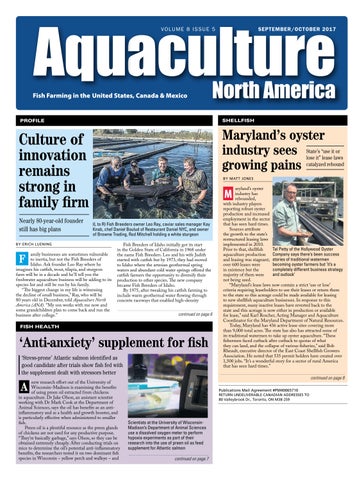
(L to R) Fish Breeders owner Leo Ray, caviar sales manager Kay Knab, chef Daniel Boulud of Restaurant Daniel NYC, and owner of Browne Trading, Rod Mitchell holding a white sturgeon
BY ERICH LUENING
amily businesses are sometimes vulnerable to inertia, but not the Fish Breeders of Idaho. Ask founder Leo Ray where he imagines his catfish, trout, tilapia, and sturgeon farm will be in a decade and he’ll tell you the freshwater aquaculture business will be adding to its species list and still be run by his family. “The biggest change in my life is witnessing the decline of small business,” Ray, who will be 80 years old in December, told Aquaculture North America (ANA). “My son works with me now and some grandchildren plan to come back and run the business after college.”
F
aryland’s oyster industry has rebounded, with industry players reporting robust oyster production and increased employment in the sector that has seen hard times. Sources attribute the growth to the state’s restructured leasing laws implemented in 2010. Tal Petty of the Hollywood Oyster Prior to that, shellfish aquaculture production Company says there’s been success and leasing was stagnant; stories of traditional watermen becoming oyster farmers but ‘it’s a over 600 leases were completely different business strategy in existence but the and outlook’ majority of them were not being used. “Maryland’s lease laws now contain a strict ‘use or lose’ criteria requiring leaseholders to use their leases or return them to the state so this acreage could be made available for leasing to new shellfish aquaculture businesses. In response to this requirement, many inactive leases have reverted back to the state and this acreage is now either in production or available for lease,” said Karl Roscher, Acting Manager and Aquaculture Coordinator for the Maryland Department of Natural Resources. Today, Maryland has 436 active lease sites covering more than 9,000 total acres. The state has also has attracted some of its traditional watermen to take up oyster aquaculture. “These fishermen faced cutback after cutback to quotas of what they can land, and the collapse of various fisheries,” said Bob Rheault, executive director of the East Coast Shellfish Growers Association. He noted that 535 permit holders have created over 1,500 jobs. “It’s a wonderful story for a sector of rural America that has seen hard times.”
Fish Breeders of Idaho initially got its start in the Golden State of California in 1968 under the name Fish Breeders. Leo and his wife Judith started with catfish but by 1973, they had moved to Idaho where the artesian geothermal spring waters and abundant cold water springs offered the catfish farmers the opportunity to diversify their production to other species. The new company became Fish Breeders of Idaho. By 1975, after tweaking his catfish farming to include warm geothermal water flowing through concrete raceways that enabled high-density continued on page 6
FISH HEALTH
‘Anti-anxiety’ supplement for fish ‘Stress-prone’ Atlantic salmon identified as good candidate after trials show fish fed with the supplement dealt with stressors better new research effort out of the University of Wisconsin-Madison is examining the benefits of using preen oil extracted from chickens in aquaculture. Dr Jake Olson, an assistant scientist working with Dr Mark Cook at the Department of Animal Sciences, says the oil has benefits as an antiinflammatory and as a health and growth booster, and is particularly effective when administered to smaller fish. Preen oil is a plentiful resource as the preen glands of chickens are not used for any productive purpose. “They’re basically garbage,” says Olson, so they can be obtained extremely cheaply. After conducting trials on mice to determine the oil’s potential anti-inflammatory benefits, the researchers tested it on two dominant fish species in Wisconsin – yellow perch and walleye – and
continued on page 8
A
Publications Mail Agreement #PM40065710 RETURN UNDELIVERABLE CANADIAN ADDRESSES TO 80 Valleybrook Dr., Toronto, ON M3B 2S9
Scientists at the University of WisconsinMadison’s Department of Animal Sciences use a dissolved oxygen meter to perform hypoxia experiments as part of their research into the use of preen oil as feed supplement for Atlantic salmon continued on page 7