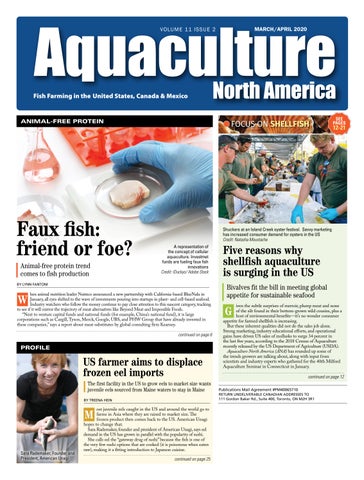
MARCH/APRIL 2020
VOLUME 11 ISSUE 2
FOCUS ON SHELLFISH
ANIMAL-FREE PROTEIN
Faux fish: friend or foe? Animal-free protein trend comes to fish production
12-21
Shuckers at an Island Creek oyster festival. Savvy marketing has increased consumer demand for oysters in the US Credit: Natasha Moustache A representation of the concept of cellular aquaculture. Investmet funds are fueling faux fish innovations Credit: ©uckyo/ Adobe Stock
BY LYNN FANTOM
hen animal nutrition leader Nutreco announced a new partnership with California-based BlueNalu in January, all eyes shifted to the wave of investments pouring into startups in plant- and cell-based seafood. Industry watchers who follow the money continue to pay close attention to this nascent category, tracking to see if it will mirror the trajectory of meat alternatives like Beyond Meat and Impossible Foods. “Next to venture capital funds and national funds (for example, China’s national fund), it is large corporations such as Cargill, Tyson, Merck, Google, UBS, and PHW Group that have already invested in these companies,” says a report about meat substitutes by global consulting firm Kearney.
W
continued on page 6
PROFILE
US farmer aims to displace frozen eel imports The first facility in the US to grow eels to market size wants juvenile eels sourced from Maine waters to stay in Maine BY TREENA HEIN
ost juvenile eels caught in the US and around the world go to farms in Asia where they are raised to market size. The frozen product then comes back to the US. American Unagi hopes to change that. Sara Rademaker, founder and president of American Unagi, says eel demand in the US has grown in parallel with the popularity of sushi. She calls eel the “gateway drug of sushi” because the fish is one of the very few sushi options that are cooked (it is poisonous when eaten raw), making it a fitting introduction to Japanese cuisine.
M
Sara Rademaker, Founder and President, American Unagi
SEE PAGES
continued on page 25
Five reasons why shellfish aquaculture is surging in the US Bivalves fit the bill in meeting global appetite for sustainable seafood iven the subtle surprises of merroir, plump meat and none of the silt found in their bottom-grown wild cousins, plus a host of environmental benefits—it’s no wonder consumer appetite for farmed shellfish is increasing. But these inherent qualities did not do the sales job alone. Strong marketing, industry educational efforts, and operational gains have driven US sales of mollusks to surge 34 percent in the last five years, according to the 2018 Census of Aquaculture recently released by the US Department of Agriculture (USDA). Aquaculture North America (ANA) has rounded up some of the trends growers are talking about, along with input from scientists and industry experts who gathered for the 40th Milford Aquaculture Seminar in Connecticut in January.
G
continued on page 12 Publications Mail Agreement #PM40065710 RETURN UNDELIVERABLE CANADIAN ADDRESSES TO 111 Gordon Baker Rd., Suite 400, Toronto, ON M2H 3R1