JULY/AUGUST 2017
VO LUME 8 IS S UE 4
REBOUND
Advances in US sablefish aquaculture hit snag
Workers haul catfish out of a pond in Moorehead, Mississippi. After years of decline, the catfish farming industry in the US is rebounding
Credit: Edward Hayman
SABLEFISH
Limited number of permits issued for open-water net pens hinders commercial efforts BY HEATHER WIEDENHOFT
he National Oceanic and Atmospheric Administration (NOAA) reached a milestone in May with its first harvest of an all-female generation of mature sablefish. This is a landmark achievement as it makes the farming of this tasty, buttery fish on a commercial scale within the grasp of US fish farmers. The fish harvested weighed an average of 5.47 lbs each, for a total of 20,227 kgs (roughly 44,593 lbs). “That average size is akin to a 10-year-old fish in the wild,” remarked an astonished Kurt Grinnell of Jamestown S’Klallam LLC, owned by the S’Klallam tribe in Washington State and a partner
T
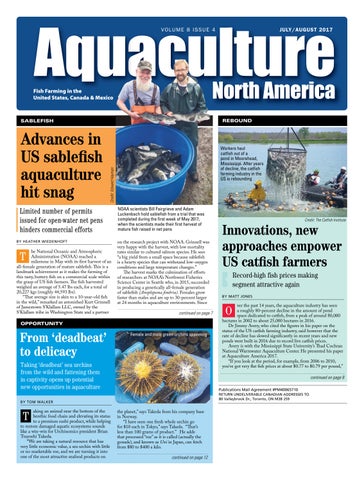
NOAA scientists Bill Fairgrieve and Adam Luckenbach hold sablefish from a trial that was completed during the first week of May 2017, when the scientists made their first harvest of mature fish raised in net pens on the research project with NOAA. Grinnell was very happy with the harvest, with low mortality rates similar to cultured salmon species. He sees “a big yield from a small space because sablefish is a hearty species that can withstand low-oxygen conditions and large temperature changes.” The harvest marks the culmination of efforts of researchers at NOAA’s Northwest Fisheries Science Center in Seattle who, in 2015, succeeded in producing a genetically all-female generation of sablefish (Anoplopoma fimbria). Females grow faster than males and are up to 30-percent larger at 24 months in aquaculture environments. Since continued on page 7
OPPORTUNITY
From ‘deadbeat’ to delicacy
Female and male green urchins spawning
Taking ‘deadbeat’ sea urchins from the wild and fattening them in captivity opens up potential new opportunities in aquaculture
T
Innovations, new approaches empower US catfish farmers Record-high fish prices making segment attractive again BY MATT JONES
ver the past 14 years, the aquaculture industry has seen a roughly 80-percent decline in the amount of pond space dedicated to catfish, from a peak of around 80,000 hectares in 2002 to about 25,000 hectares in 2016. Dr Jimmy Avery, who cited the figures in his paper on the status of the US catfish farming industry, said however that the rate of decline has slowed significantly in recent years and new ponds were built in 2016 due to record live catfish prices. Avery is with the Mississippi State University’s Thad Cochran National Warmwater Aquaculture Center. He presented his paper at Aquaculture America 2017. “If you look at the period, for example, from 2006 to 2010, you’ve got very flat fish prices at about $0.77 to $0.79 per pound,”
O
continued on page 8 Publications Mail Agreement #PM40065710 RETURN UNDELIVERABLE CANADIAN ADDRESSES TO 80 Valleybrook Dr., Toronto, ON M3B 2S9
BY TOM WALKER
aking an animal near the bottom of the benthic food chain and elevating its status to a premium sushi product, while helping to restore damaged aquatic ecosystems sounds like a win-win for Urchinomics president Brian Tsuyoshi Takeda. “We are taking a natural resource that has very little economic value, a sea urchin with little or no marketable roe, and we are turning it into one of the most attractive seafood products on
Credit: The Catfish Institute
the planet,” says Takeda from his company base in Norway. “I have seen one fresh whole urchin go for $10 each in Tokyo,” says Takeda. “That’s less than 100 grams of product.” He adds that processed “roe” as it is called (actually the gonads), and known as Uni in Japan, can fetch from $80 to $400 a kilo. continued on page 12