
AGENDA
9:15 am Welcoming Remarks
9:25 am Opening Keynote Jen Couldrey, Certified EOS Implementer®
10:25 am SESSION 1 Preparing for a Sale Best Practices With Real-Life Case Studies
10:55 am NETWORKING & COFFEE BREAK
11:10 am BUSINESS BRIEF The Tax Advantage in Succession Planning
11:25 am SESSION 2 Understanding Buyer Motivations
12:00 pm LUNCH & NETWORKING
12:50 pm BUSINESS BRIEF The Future of Succession is AI-Powered
1:00 pm SESSION 3 The Legal Roadmap to a Successful Business Sale
1:30 pm SESSION 4 Inside the Buyer’s Mind What Acquirers Look for When Buying a Business
2:15 pm SESSION 5 Ready or Not Canada’s Succession Wave Is Already Underway
2:45 pm NETWORKING & COFFEE BREAK
3:00 pm BUSINESS BRIEF Estate Planning & Wealth Management Post-Sale
3:10 pm SESSION 6 Just Closed / Just Succeeded
4:00 pm Networking Reception
QR CODE to see full agenda




Check out video interviews with our SUCCESSion experts
SPEAKERS














Alain F. Dagenais President, Plan Bot
Denna Mezuman Owner & Business Transition Strategist, DM Succession
Harsimran Braich Estate Planner, Estately Wealth
Mark MacLaren Former founder, owner and President of the MacLaren Group; Strategic Advisor at Heart Consulting.
Ali Lajevardi Managing Advisor (Lead), Program Delivery, Advisory Services, BDC
Dennis Beker Partner, Founders
Jay Mandarino President and CEO, The CJ Group of Companies
Robert Bezede Harmony Succession Partners
Armando Minicucci Partner, Doane Grant Thornton
George Rossolatos CEO, Riverdale Capital
Jen Couldrey Certified EOS Implementer
Sachin Mehta Founder and Managing Partner, Covalent Growth Partners
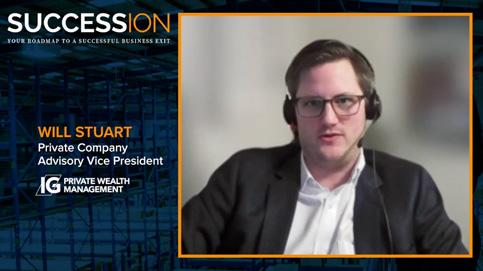
David Turnbull Head of Private Company Advisory, IG Private Wealth Management
Hardi Anand Estate Planner, Estately Wealth
Julian Franch Cassels, Brock & Blackwell LLP
Thomas Bevilacqua Harmony Succession Partners

By Jacob Munro
For those who could not attend, Succession 2026 offered a comprehensive look at the realities and best practices of exiting a company in Canada today. Selling a business is often the largest and most complex transaction an owner will face, yet many fail to plan accordingly.
As speaker Jen Couldrey, certified EOS Implementer, stated during her opening keynote, “At the end of the day, you didn’t build this business to have a job forever.”
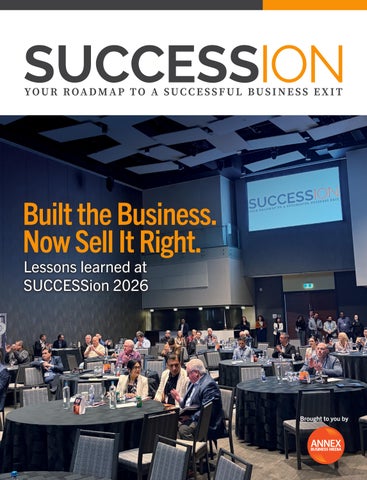
Hosted by Annex Business Media on April 21, the day featured a full slate of sessions at Universal EventSpace in Vaughan, Ont., where speakers and panelists dove into practical insights around structuring deals, how to prepare for a successful transition, legal considerations, minimizing tax exposure, and so much more.
At SUCCESSion 2026, owners and operators from a whole host of sectors came together to learn what they need to think about when considering selling a business.
Following their remarks, each speaker and panel happily accepted questions from the audience of approximately 100 attendees, and it was clear that the business owners in attendance found value from the team of succession experts that Annex invited to speak.
THE FOUNDER DEPENDENCY TRAP
Couldrey asked a simple question during her opening keynote, “Can you, as a business owner, take a vacation?”
It was fantastic meeting these people and having the opportunity to make valuable connections. The topics were very useful.
- JEREMY TORRA
“It was fantastic meeting these people and having the opportunity to make valuable connections. The topics were useful and everyone here could prove to be useful to me,” explained attendee Jeremy Torra, an entrepreneur who is looking to sell his wholesale manufacturing sales business.
The show opened with warm welcoming remarks from Adam Reiter, Annex’s vice president of finance and administration, who observed how useful all the upcoming knowledge would have been to Annex when the company navigated its own succession just a few years ago.
After a hearty applause, Succession 2026 was officially underway.
As an EOS Implementer, Couldrey helps businesses build resiliency so they can thrive even when the founder needs a day off. The thing is that many businesses can’t, and often fall into the “founder dependency trap” as Couldrey called it. Not only does this impact a company’s day-to-day operations, but it can also dramatically influence its valuation.
To extract more value from a sale, some founders promise to stay on and manage the transition. However, Couldrey said it’s much more advantageous to build independence into a business prior to selling it.
“As a founder, you want to sell your business for full value and do what you want,” said Couldrey. “You don’t want to have to work for your former business.”
PREPARING TO SELL
Robert Bezede and Thomas Bevilacqua of Harmony Succession Partners explained that when it comes to selling, preparing a plan is crucial.
“A well-prepared business is the most valuable business,” explained Bezede.
During their session, Bezede and Bevilacqua outlined five important questions that owners must answer before selling:
1. Who are the buyers? Are they strategic buyers, financial buyers, or high net-worth individuals?
2. How do you ensure a confidential sale?
3. What is your business worth?
4. How do you calculate adjusted EBITDA?
5. How much will it cost to complete the sale?
If your eyes lingered on question three, you’re not alone. All business owners want to know how much their business is worth on the market. Bezede explained that the average traditional company trades within a 4x to 6x EBITDA range barring outliers. Therefore, he explained, it is of paramount importance to calculate an adjusted EBITDA that measures the company’s performance over the past couple of years. Think minimizing costs and flexing profits.
“It’s basically the opposite of what accountants show,” Bezede said with a chuckle.
THE LEGAL ROADMAP
After tucking into lunch, the audience returned to watch host Reiter lead an engaging discussion with Julian Franch, a partner in Cassels’ tax and trusts group, and Dennis Beker, a transactional lawyer and partner at Founders, on the ideal legal roadmap to a successful sale.
Planning for taxes is often at


Thomas Bevilacqua and Robert Bezede took the stage to walk through pre-sale best practices when business owners think about their own succession planning.
the forefront of sellers’ minds, and Franch stated that this tax planning needs to go beyond just the sale of the business.
“Your plan should cover another wonderful event; your death,” Franch stated as he emphasized the importance of ensuring the estate is protected and the transition occurs smoothly.
And this duo of lawyers echoed a sentiment shared by Bezede earlier.
“If you’re going through an M&A, please use an M&A lawyer,” said Beker. “Chasing the least expensive option can often lead to paying more in the long-term. Understand what the risks are, this is what a lawyer can help with.”
WHAT ARE THE BUYER’S MOTIVATIONS?
Like a good suit, fit matters to potential buyers. According to David Turnbull, head of Private Company Advisory, IG Private Wealth Management, a company’s fair market value according to EBITDA is not always the price a buyer is willing to pay.
He explained that understanding a buyer’s motivations is important for this reason. Potential buyers care about net proceeds, certainty of close, fit, time and disruption. Regarding fit, a buyer who sees a business as a clean fit and foresees a transition with minimal disruption can value a company significantly higher than a buyer who doesn’t. Whereas the

latter buyer will likely value the business based on the EBITDA method, the former will price in the fit and opportunity potential.
Turnbull explained that this gap can have real value, and that a company’s market price is what the highest bidder is willing to pay.
Attendees also had the opportunity to pick potential buyers’ brains during the day’s fourth session, “Inside the Buyer’s Mind,” a panel moderated by Jay Mandarino, president and CEO of The CJ Group of Companies, and featuring George Rossolatos, CEO of Riverdale Capital, and Sachin Mehta, founder of Covalent Growth Partners.
This panel covered topics such
as implementing management incentives, which Mandarino said he includes in every deal, as well providing advice on how to negotiate with potential buyers.
“You don’t want to undersell, but you also don’t want to oversell,” said Mandarino.
“Buyers want opportunity, so leave some opportunity on the table for the next owners,” said Rossolatos.
SEAMLESS TRANSITIONS
The event wrapped up with an insightful panel featuring Mark MacLaren, strategic advisor at Heart Consulting, and Denna Mezuman, owner of DM Succession, moderated by Paul

Grossinger, a group publisher at Annex. The discussion focused on real-life successful succession stories, such as Mezuman’s. Her succession journey was not planned, and it stood in stark contrast to the day’s advice about planning the sale years in advance. After her father’s passing due to late-stage cancer, the family business was passed down to her and her brother. Her father was not planning on selling, so no plan was in place on how to navigate this succession.

Despite facing operational complexity and interesting family dynamics, Mezuman successfully navigated this complex time and led the company through a successful merger and acquisition process. It was a story that proved the inordinate value of preplanning.
“Can I be honest, I don’t know how you managed to do this,” said MacLaren.
Mezuman then wrapped the day with a key takeaway. She explained that no matter how effective of a business owner you are, exiting is an entirely different challenge to overcome.
“There’s a skillset of managing a business, but there’s almost a whole other skillset you need to sell the business.”
(From left to right): George Rossolatos, Sachin Mehta, and Jay Mandarino held a lively discussion at SUCCESSion 2026, focused on what buyers look for when buying a business.
The Legal Roadmap panel saw Julian Franch, Cassels, and Denis Beker, Founders, answer questions from Annex Business Media’s Adam Reiter.
In the Just Sold session to end the day, Annex’s Paul Grossinger (far right) posed questions to Denna Mezuman and Mark MacLaren about their succession journey.
SPONSORS
PRESENTING SPONSOR






SUPPORTING SPONSOR


GOLD SPONSORS
What is your business actually worth?
And why the number in your head is almost certainly wrong.
Ask a business owner what their company is worth and you’ll probably get a confident answer. It will be based on what their accountant told them, what a competitor supposedly sold for, or what they need the number to be to fund their retirement.
Almost none of these numbers are right. And the gap between what owners believe and what buyers will actually pay is often significant.
Your accountant’s number is not a buyer’s number
Your accountant produces a fair market value, which is a conservative, CRA-defensible estimate assuming a hypothetical transaction between hypothetical parties. It is the right number for tax and estate planning. It is the wrong number for what someone will actually pay.
A buyer calculates what your company is worth to them, with their cost structure, their customers and synergies you cannot capture alone. That number can be 25–50% higher. But you will never see it without the right process.
What actually drives a buyer’s price
Buyers do not pay for your past. They pay for the predictability of your business’s future. Five factors determine whether your business will command a premium or a discount:
Revenue quality: recurring, contracted revenue commands a much higher multiple than project-based revenue.
Customer concentration: if one client represents more than 20% of revenue, expect a lower offer and an earnout (future potential compensation).
Owner dependence: if the business cannot run without you for 90 days, a buyer is not purchasing a company. They’re purchasing a risk.
Growth trajectory: flat businesses sell at lower multiples, regardless of profitability. Buyers pay for momentum.
Financial clarity: clean, normalized financials build buyer confidence. Messy books create discounts.
A $5 million EBITDA business can trade at 4x or 8x, depending on these five factors. That is a $20 million difference on the same bottom line.
Start with a number you can trust
You don’t need to be selling to benefit from knowing what your business is worth. A credible valuation gives you a baseline for every strategic decision; whether to invest, acquire, raise capital or prepare for an eventual exit.
IG Private Wealth Management offers complimentary business valuations through an AI and human-driven valuation that provides an independent, data-driven assessment of your company’s value. It takes a few days, costs you nothing and replaces guesswork with a marketgrounded starting point.
For owners considering a transaction, IG Private Company Advisory provides mergers and acquisitions advice, capital raising and s trategic consulting for Canadian businesses valued between $10 million and $500 million, with competitive processes that consistently deliver premiums of 20–40%+ over unsolicited offers.



Who is Harmony Succession Partners?

We do one thing and do it exceptionally well. We sell private businesses worth $3MM to $30MM across Ontario. Our mission is to provide the highest client experience to business owners looking to sell their business. HSP has one of the largest networks of qualified family offices, private equity, strategic buyers and high net worth investors focused on acquiring companies in Southern Ontario. In the last 5 years, our team has closed over 50 acquisitions totaling $250MM in value. Our transaction experience includes companies in manufacturing, consumer products, skilled trades, distribution, professional services, construction, and more.
Let Harmony Succession Partners do the heavy lifting when selling your business:
Our Pre-Sale Process
Preparing a business for sale takes 2-5 years. Our name is rooted in our desire to work in harmony with advisors such as your accountant, lawyer, wealth advisor, and banker years in advance. We help address any financial, HR and operational challenges to help you realize the highest exit value for your business. Our goal is to identify and provide recommendations on how to ensure your business is best positioned for an exit.
Our Sale Process
Month 1 to 2: Planning & Data Collection
We identify your sale objectives and clearly understand what we need to deliver on to ensure a successful outcome. We spend 1-2 months doing a detailed review of the business’s operations and financials via several on-site & virtual meetings to prepare a financial model and prospectus describing the business and its growth potential.
Month 2 to 3: Go-to-Market
Confidentiality is critical to our process; every buyer we contact is pre-approved by you. On average, we contact 60 to 100 qualified buyers and have multiple calls with them to confirm their interest and reaffirm the opportunity your business offers them.
Month 4: Preliminary Offers
Our goal is to create a competitive auction to increase your exit price. We generate between 5 and 15 preliminary offers prior to the buyers meeting with you. Buyers are assessed based on financial strength, cultural fit, and ability to close. The top 3 to 5 groups are selected to advance to the next stage.
Month 5: Final Offers
The top buyer groups meet with you to learn more about your business and receive additional information to firm up the bank financing required to close their offer. A second and final Letter Of Intent (LOI) is submitted. We aim to source detailed offers and ensure we clearly address all deliverables at this stage to avoid any surprises during the closing process.
Month 6 to 9: Operational Diligence
HSP leads the closing process jointly with your accountant and lawyer. We host weekly calls to address any friction and ensure consistent progress and data flow.
Our job doesn’t finish once we source an offer; we work with you until the very end of your transaction, helping prepare key documents to reduce your legal and accounting closing costs.
Closing: Legals & Closing
We support the lawyer in preparing the information required for the legal documents. We also regularly communicate with the buyer’s bank to ensure all the information is readily available and complete to avoid any deal delays.
About HSP’s founding partners:

Robert Bezede
Robert is an experienced M&A professional selling lower middle-market companies. Robert excels at managing client relationships and is known for his hands-on approach throughout the entire transaction lifecycle. Prior to HSP, he was a corporate finance partner at an accounting firm where he led the sale of 30 companies. He started his career as a commercial banker financing over $200MM of buy/sell, MBO and sub-debt transactions with Roynat Capital, a division of Scotiabank.
In his spare time, Robert loves to ski, spend time with his wife, read lots of books, play basketball and create educational content for his YouTube channel.

Thomas Bevilacqua
Thomas is committed to helping business owners retire successfully. He specializes in navigating the complexities of succession planning, maximizing exit value, preserving legacies, and ensuring that their next chapter is as successful as the first. While the majority of his career has been dedicated to assisting over 20 privately held business owners at a middle-market M&A firm, Thomas began his professional journey at Deloitte, CIBC, and MNP.
Outside of work, Thomas enjoys spending time with family and friends, cycling, playing hockey, and blowing off steam by splitting firewood up north.
Contact information:

Robert
Bezede Partner
Tel: 416-716-6910
rbezede@harmonysuccession.com
Thomas
Bevilacqua Partner
Tel: 416-970-0005
tbevilacqua@harmonysuccession.com

Our Powerhouse Team.
Our team consists exclusively of lawyers from top-tier corporate law firms. Our clients benefit from a unique mix of this experience and the efficiency of a boutique law firm.
Chris Payne, Co-Founder and Partner

Chris is an experienced corporate and transactional lawyer. His area of expertise focuses on a variety of secured and unsecured debt financing transactions, including acquisition finance, cash-flow financings, real estate financings, ABL financings, restructurings and DIP/ exit financings as well as high-yield debt. He also has a growing FinTech practice.
On lender-side transactions, Chris has acted for major Canadian and US financial institutions, hedge funds and private equity firms and has a number of ongoing borrower-side clients. He has led large teams on a number of domestic and cross-border financing transactions and has supported numerous public and private companies with their ongoing day-to-day business and legal needs. He offers a pragmatic solution driven approach for his clients.
Money Khoromi, Co-Founder and Partner

Money is an experienced and pragmatic transactional lawyer who prioritizes clients’ interests and always aims to facilitate transactions as efficiently as possible. He has worked extensively with start-ups, public and private companies, agents and underwriters on mergers and acquisitions, corporate finance, securities, and general corporate law matters in a variety of industries including technology, cannabis, hospitality, financial services, mining, entertainment, real estate, automotive, health, packaged goods, seniors housing and apparel.
Money also assists companies with their corporate governance, regulatory compliance, licensing, and continuous disclosure obligations. In addition to providing legal advice, Money leverages his engineering and business background, his network and experience as an investor and entrepreneur to assist clients with business, operation and strategic needs.
Dennis Beker, Partner

Dennis is a transactional lawyer who leverages his prior in-house experience to facilitate pragmatic solutions for his client’s legal needs. He has worked extensively with start-ups, public and private companies, agents and underwriters on mergers and acquisitions, corporate finance, securities, and general corporate law and commercial matters across a variety of industries including technology, cannabis and
health. In Dennis’ previous role, he served as the sole lawyer and first employee of an international medical cannabis company, where he helped the company complete several M&A and other strategic transactions. Combined with his business degree, Dennis’ background enables him to understand complex business issues and provide pragmatic and high-quality legal advice.
Kyle Jacobson, Associate

Kyle is a transactional lawyer who works with start-ups, as well as public and private companies across a variety of industries. His practice focuses on mergers and acquisitions, venture capital and corporate finance, and general corporate matters. Before joining Founders, Kyle was an associate at a large Canadian law firm practicing corporate law with a main focus on technology companies.
Kyle received his J.D./M.B.A. from Dalhousie University, where he acted as Co-Chair of the Business Law Association.
Andrew Chudnovsky, Partner

Andrew is a solutions-focused transactional lawyer who advises a range of owners, privately held companies, family offices, investment firms, and shareholder groups in complex commercial legal matters. His practice focuses on mergers and acquisitions, corporate restructuring, general commercial advisory, and transition and succession planning.
With a wealth of experience acting for both vendors and purchasers in M&A transactions, he uses a business focused approach to provide timely and practical legal advice that aligns with his clients strategic goals and priorities.
Andrew leverages his prior experience working in logistics, his experience working in large scale multi-generational family enterprises, and his entrepreneurial nature to provide clients with assistance across a range of general business, operational, and day-to-day challenges.
Kip Daechsel, Senior Counsel

Kip offers his clients: (i) sound legal and strategic judgment, which he has acquired in his many years on Bay Street; (ii) a successful track record of recruiting and leading engaged teams, whether for a specific deal or the long term support of a client’s commercial needs; and (iii) the ability to draw on his network, in multiple sectors and geographies, to connect with the right people to help his clients resolve their issues. Kip holds strongly to the view that the best lawyers cut through the “noise” to identify their clients’ key legal and commercial concerns and then propose and implement creative and efficient solutions.

A team of Bay Street lawyers uniquely positioned to deliver top-tier corporate legal services in a flexible and efficient manner
Key Expertise Team Recent Deals



(
e v i
m
n
i v
e q u i t y , c o r p / c o m m e r c i a l
,
C h r i s P a y n e ( p r e v i o u s l y G o o d m a n s ) : d e b t f i n a n c i n g s , F i n T e c h , M & A
J e r e m y L i n ( p r e v i o u s l y O s l e r ) : v e n t u r e c a p i t a l , M & A , s t a r t - u p l a w
A n d r e w C h u d n o v s k y ( p r e v i o u s l y E c c l e s t o n e ) : M & A , p r i v a t e e q u i t y , r e o r g s
K i p D a e c h s e l ( p r e v i o u s l y D e n t o n s ) : M & A , s t r a t e g i c c o r p o r a t e a d v i c e
M a r k S u r c h i n ( p r e v i o u s l y G o o d m a n s ) : d e b t f i n a n c i n g s , r e g u l a t o r y
K y l e J a c o b s o n ( p r e v i o u s l y G o o d m a n s ) : M & A , s t a r t - u p l a w , d e b t f i n a n c i n g s
A c t e d f o r A n n e x i n c o n n e c t i o n
w i t h i t s l e v e r a g e d b u y o u t a n d
r e l a t e d d e b t f i n a n c i n g

A c t e d f o r A l c h e m y C a p i t a l
P a r t n e r s i n c o n n e c t i o n w i t h i t s
a c q u i s i t i o n o f S c h a a f F o o d s I n c
a n d r e l a t e d d e b t f i n a n c i n g

A c t e d f o r F i r e P o w e r a s l e n d e r i n c o n n e c t i o n w i t h i t s d e b t f i n a n c i n g i n f a v o u r o f a C a n a d i a n i n f r a s t r u c t u r e c o m p a n y
A c t e d f o r B l u w a t r i n c o n n e c t i o n w i t h i t s a c q u i s i t i o n o f a m a j o r i t y
i n t e r e s t i n W A T T C o n s u l t i n g
G r o u p
INSURANCE CASE STUDIES
Case Study 1:
Leveraging Tax Indemnity Coverage for ERC Claims in a U.S. Business Sale
Client: U.S.-based service company | Sale Price: $12MM | Industry: Healthcare Services
A client preparing to sell their business had previously claimed Employee Retention Credits (ERC) totaling over $1.5MM. However, the buyer raised concerns about potential IRS audits and disallowed claims post-closing. To preserve deal value and reduce escrow holdbacks, we structured a Tax Indemnity Insurance Policy covering the full ERC amount plus interest and penalties.
This allowed the seller to retain more proceeds at closing and gave the buyer confidence in the ERC claims without requiring protracted diligence or indemnification negotiations. The policy was placed within two weeks of execution of the LOI, enabling a clean exit and maximizing seller liquidity.
Case Study 2: Sell-Side R&W Coverage for Canadian Industrial Manufacturer
Client: Family-owned Canadian Manufacturer | Enterprise Value: $5MM | Buyer: Private Equity Fund
We advised a Canadian manufacturing client on the sale of their business to a U.S.-based private equity fund. Despite the relatively small enterprise value, the buyer requested reps & warranties protection. We successfully placed a sell-side Transactional Liability Policy with a $1M limit, covering key reps (financials, tax, environmental, employee matters) and eliminating the need for a large escrow.
The policy provided certainty to the seller, who was winding down operations and retiring post-close. By leveraging our transactional experience and broker relationships, we secured broad terms with a $25K retention and minimized the cost through a competitive underwriting process.
INSURANCE & EMPLOYEE BENEFITS CASE STUDY:
Case Study 3:
Buy-Side Diligence
& Post-Close Risk Management for $600MM+ Canadian Sporting Goods Acquisition
Client: European Private Equity Firm | Target: Multinational Sports Equipment Manufacturer | Deal Size: $600MM+
We were engaged by a Canadian Law firm to support buy-side insurance and benefits due diligence on a $600MM+ acquisition of a global sporting goods manufacturer with operations across North America and Europe. Our mandate included:
Full audit of the target’s global insurance portfolio, uncovering critical gaps in product liability, cyber risk, and contingent business interruption, particularly in U.S. and EU jurisdictions.
Employee benefits due diligence, which revealed misaligned benefits plans across regions, non-compliance with Canadian ESA and U.S. ACA requirements, and several unfunded severance obligations that could trigger post-close liabilities.
Working alongside legal and HR advisors, we advised on specific reps & warranties language to address these risks. After close, we led the integration and restructuring of both operational insurance and employee benefit programs: Placed a global controlled master program across all commercial lines to ensure compliance and claims efficiency. Consolidated and optimized benefit plans across jurisdictions to drive alignment with the buyer’s platform standards and unlock cost savings.
This holistic approach reduced the total cost of risk by 15%, ensured benefits compliance across 6 jurisdictions, and met all lender and ESG requirements.
EMPLOYEE BENEFITS
CASE STUDY:
Case Study 5:
Optimizing Employee Benefits Pre-Sale
Client: Canadian Tech Company | 120 Employees | Sale Value: $75MM
Prior to sale, the company’s benefits program was fragmented and non-compliant across provinces. We:
• Identified ESA compliance gaps and costly redundancies
• Consolidated plans into a unified, tiered national program
• Prepared clean documentation for buyer diligence
Result: The buyer accepted the updated plan as-is, avoided a $400K HR liability holdback, and the seller exited cleanly with no post-close adjustments.
CORPORATE LIFE INSURANCE CASE STUDY:
Case Study 4: De-Risking a Founder-Led Sale with Corporate Life Insurance
Client: Canadian Professional Services Firm | Transaction Value: $40MM
In preparation for a full sale, the founder-led company faced buyer concerns around key person dependency. To address this, the company implemented a $5MM corporate-owned life insurance policy and $2MM disability policy, with the business as the beneficiary.
These policies were tied into a funded buy-sell agreement and disclosed in the data room with full underwriting and assignment documentation. This approach gave the buyer confidence in business continuity and succession, reducing the requested escrow by $1.5MM and eliminating the need for specific indemnities tied to the founder.

Meet Connor McFall
PARTNER, ACCOUNT EXECUTIVE
Connor, a seasoned insurance professional, has dedicated the past seven years to specializing in risk solutions for a variety of industries. His expertise extends to providing cross-border solutions for multinational businesses, publicly traded companies, and owner-operated businesses with international exposure. Connor’s broad knowledge base allows him to assist clients across various industries, including Private Equity Firms, Asset Managers, Real Estate Developers, Construction Companies and Tech Companies With a forwardthinking approach and a strong track record, Connor continues to excel in delivering comprehensive coverage solutions for his valued clients.
Contact Connor at:
PHONE: 416.561.1711
EMAIL: connorm@jdimi.com

Integrated Legal Advice for Private Wealth

PRIVATE CLIENT GROUP
In today’s complex financial landscape, obtaining precise and high-quality legal advice is crucial for creating, growing, and preserving your wealth. Cassels’ Private Client Group offers a personalized approach tailored to meet your unique needs, including those of family enterprises and intergenerational wealth management. Our holistic strategy empowers clients by developing comprehensive solutions that address all levels of complexity in wealth management. We work closely with you and your other professional service providers to create a customized approach that extends to representing multiple generations within a family or family enterprise.
We serve a diverse clientele, including high net worth and ultra high net worth individuals (“HNWI” and “UHNWI” respectively) and families, business owners and their companies, family offices (both single office and multi-family offices), financial institutions, corporate and trust fiduciaries, and charities and non-profits. Leveraging our extensive expertise, we help clients achieve their goals while putting in place the right plan to minimize all levels of tax and ensure peace of mind and wealth preservation so that our clients feel confident that their hard-earned wealth will be preserved for future generations. Our collaboration with leading financial institutions and family offices ensures a robust, effective, and 360° approach to all your private client needs.
AREAS OF EXPERTISE
PRIVATE COMPANY AND FAMILY BUSINESS PLANNING
Our lawyers integrate family and business concerns into the overall business succession process by preparing family partnerships, family driven shareholder agreements, key corporate agreements, shareholder buy-sell agreements and a myriad of other types of agreements to smooth the process for intergenerational planning. We plan and implement tax efficient and comprehensive business succession plans to ensure that family-owned businesses can remain within the family, regardless of life events, such as the death or disability of active family members. We develop and implement various agreements and compensation arrangements for business owners, including provisions for family members who are not active in the business. We work closely with various other professionals involved in proper family enterprise planning, including those involved in accounting, insurance, banking and investment advisory and management.
INDIVIDUAL, CORPORATE, AND FAMILY ENTERPRISE TAX PLANNING
Our tax and trust lawyers have a depth of experience in providing generational tax planning for individuals, families and private companies. Clients appreciate our ability to set up tax-efficient structures that are tailored to the client’s particular goals. We have experience with various corporate reorganizations and trust structures, all with a view to minimize overall tax. We provide a complete range of tax planning services, from the day-to-day issues to long term planning needs. Our team have earned a reputation for providing holistic advice in planning and delivering seamless and comprehensive tax solutions to clients. We work closely with the clients’ personal, professional, and financial advisors in ensuring that a collaborative approach is taken to ensure clients receive the best overall tax advice.
ESTATES, TRUSTS, INCAPACITY, AND SUCCESSION PLANNING
We help HNWI and UHNWI and families formulate and implement comprehensive, tax-driven estate plans for
managing and transferring wealth to the next generation. We ensure that your estate planning addresses your personal and family goals and fit the specific needs of your family culture. By collaborating closely with family offices, tax, banking, insurance, business, and other advisors, we implement holistic solutions and structures that are actionable and ensure efficient tax planning, accountability of management to the family, and alignment with the family leaders’ vision for maintaining and growing the organization for future generations.
CROSS BORDER ESTATE AND TAX PLANNING
Our tax and estates professionals, who are licensed in both Canada and the US, have significant experience in helping individuals and families who own or plan on owning assets in another jurisdiction, have intended beneficiaries living or holding citizenship in another jurisdiction, and Canadian residents who are subject to the tax regimes of another country, including advising on any tax planning and advice for non-resident trusts. We also often assist private companies in putting in place tax efficient structures for corporate ownership outside of Canada, working with partners throughout the world.
For multi-jurisdictional estates, the implementation of probate planning, life insurance planning, trusts, wills, and powers of attorney for various assets need to be carefully contemplated in a comprehensive manner to avoid unintended tax and administrative burdens.
For Canadian residents considering emigration to another country, we regularly advise on departure tax planning, ongoing tax treatment and efficacy of cross-border corporate or trust structures, and exposure to new tax issues post emigration. Additionally, for individuals looking to move to Canada, we can ensure that the appropriate structure, whether it includes corporations or trusts, is reviewed and implemented in a timely manner to ensure the best structure for Canadian tax purposes.
PHILANTHROPIC PLANNING
Charities and non-profits face unique legal and regulatory challenges. Our lawyers offer practical legal guidance to these entities and their founders on a wide range of tax compliance matters, including, but not limited to, structuring and registering public and private foundations as well as operational charities, gifting, receipting, grant-making, reporting, and conducting activities in foreign jurisdictions. Additionally, we support the efficiency and effectiveness of these organizations by providing commercial, corporate governance and risk management advice. This includes advising on contracts, director and officer duties and liability, preparation of by-laws and policies, and assisting with board and member disputes. Our goal is to provide our non-profit clients and their founders with comfort that they are meeting their complex legal obligations so that they can concentrate on achieving their missions successfully.
cassels.com/private_client

What’s your business worth?
Five things business owners need to know about
As a business owner, you can have many reasons for wanting to know what your company is worth. You may want to sell your business or offer shares to employees. You could be interested in buying out a partner. You might need the value for tax or succession planning or an estate freeze.
Determining a company’s value is a complex process—part science, part art. Complicating matters is the fact that many entrepreneurs have an overly optimistic view of how much their business is worth. Here are five things you need to know when determining the value of your company.
1. Differing expectations can cause conflict
It’s common for business owners to have a different value in mind than potential buyers, family successors, financial partners or tax assessors. This can lead to disputes, derail negotiations or affect posttransition plans.
Even if you’re giving the company to a family member, you may require a thirdparty valuation to ease conflict, plan your estate and optimize tax treatment.
Because of the complexity and stakes, it’s helpful to hire a chartered business valuator to get an objective and realistic understanding of your company’s valuation or determine whether a buyer’s offer is reasonable.
The process can also help you identify weaknesses in your company, find ways to boost its value and take steps to minimize your tax liability before a sale.
2. A variety of valuation approaches are available
Several valuation methods are commonly used. Valuations can also be done with varying levels of detail. Each comes with a different cost and level of assurance that the result accurately reflects your company’s worth.
The most suitable combination depends on the purpose of the valuation and the company’s characteristics, such as its profitability, future outlook and asset mix.
3. Valuation methods can yield different numbers
Three main methods are frequently used to determine the value of a company.
A valuator may use one or more of the methods depending on available information and the type of business and transaction. Each method may yield a different value; the highest of these values usually reflects the fair market value of the business.
• Earnings-based methods: These approaches are commonly used for established businesses that are generating reasonable returns and whose value is greater than that of their assets alone. A valuator determines the company’s value by reviewing forecasted earnings or cash flow and past results. Different earnings-based approaches are used depending on whether earnings are expected to be stable in coming years.
• Market-based methods: These approaches calculate a valuation by applying a valuation multiple, which may be based on EBITDA (earnings before interest, taxes, depreciation and
valuation
amortization), revenue or other metrics. The specific figure used and type of ratio vary depending on many factors, such as industry and size of the company, market conditions and multiples used to buy or sell comparable businesses.
• Asset-based methods: Asset-based approaches are typically used for businesses whose value is asset-related rather than operations-related—for example in the real estate sector. These approaches are also applied when a business generates poor returns or is expected to be liquidated.
4. Assets may be attractive
Your business may be more valuable in pieces than as a whole. For example, a buyer may want to buy your operations, but not your real estate holdings. A valuation exercise can identify ways to make your company more attractive to potential buyers—for instance, by putting real estate assets in a holding company that can be sold separately.
5. Valuation is just a guideline
Keep in mind that a valuator’s figure is just a guideline for how to approach negotiations in a sale. The final transaction price is often different and is influenced by many factors—for example, your eagerness to sell, the buyer’s strategic interests or expected synergies, available financing, due diligence and the company’s capacity to smoothly transition to new ownership.
For example, a company may be willing to pay a premium for your business because it’s a good fit.

Sell your business with confidence
Transferring ownership is a major decision. With our succession and transition expertise, keep your legacy and your business protected.
BDC helps you:
Clarify your goals and priorities
Choose the right exit or succession strategy
Make the most of your sale
Ensure continuity after you leave
Secure flexible transition financing

Tax considerations when exiting your business
By Armando Minicucci
Exiting a business takes longer and requires more effort than many owners realize. Investing time and attention upfront can significantly improve the outcome and help you avoid costly mistakes, especially when it comes to tax planning. Here are some fundamental tax planning questions to consider throughout the process to help you prepare your business for sale.
What are you selling?
Before you explore strategies to manage your tax profile, a crucial first step is to determine exactly what’s for sale. Even the simplest business is made up of different components, each of which has value to a potential buyer. For example, a local stand-alone bike shop could be carved up into different assets including inventory, brand, real estate, etc. Defining the scope on the outset can help get you on the right track from the start.
What’s the best way to structure the sale?
There are two primary ways to sell a business: an asset sale and a share sale.
In an asset sale, the corporation sells assets but the seller retains ownership of the corporation. Sellers generally face a greater tax liability, as the company may be required to pay corporate tax on accrued gains and the shareholder may have further tax liability on the distribution of proceeds.
A share sale is generally more favorable tax-wise. Proceeds are typically taxed as capital gains, which benefit from a lower inclusion rate compared to regular income. Additionally, a seller could benefit from the lifetime capital gains exemption on qualified small business corporation (QSBC) shares.
Sellers transitioning their business to family should consider whether they qualify for the intergenerational business transfer rules. These rules allow certain family business transfers to be taxed as capital gains instead of full taxable dividends.
How will the purchase price be paid?
In a cash transaction, the seller directly receives payment from the
sale. However, other forms of consideration can drastically change the tax outcome.
A rollover is common for sales to a private equity firm. It sees the seller reinvest part of the proceeds back into the business, allowing continued interest, profit from future value growth, and tax deferral. However, the tax advantages are generally only available when shares in a Canadian company are received.
A buyer could also fund part of the sale with a vendor take-back note. This triggers upfront taxation but a capital gains reserve may be available in some instances.
In an earnout, part of the purchase price is dependent on postacquisition performance, which can help to ensure continuity and a smoother transition. With a sale of shares, earnout proceeds could be treated as capital gains under certain circumstances.
How should you receive sale proceeds?
Choosing to receive proceeds in a holding company allows possible tax deferral opportunities. Otherwise, the seller will need to explore their options for capital gains exemptions.
Will you conduct due diligence?
Consider hiring a third party to conduct independent sell-side due diligence to examine the business and identify potential issues early. Addressing these in advance can help reduce risk and strengthen negotiations, which can help secure a higher purchase price.
Are you prepared to pivot?
Even the most thought-out deals evolve in negotiations, so it’s critical to understand the impact of each change. Advisors can provide important guidance throughout the process, but the decision remains yours. Remember to give yourself time to consider your options and adjust plans to achieve the best possible result.
Planning your exit?
Connect with our tax professionals to understand your options, manage risk, and maximize after-tax value before you go to market.
is a partner in Doane Grant Thornton’s tax practice and a member of the firm’s national succession and estate planning team. He advises owner-managed businesses and high-net-worth individuals on succession strategies and tax planning to maximize intergenerational wealth transfer.
Armando Minicucci
Lighting a path to your transition


Thinking of selling your business or practice?
Here are the advantages and disadvantages of each option
Selling your business or professional practice is one of the most important decisions you’ll make as an owner. Once you decide to sell, you’ll need to consider different types of buyers — each with its own advantages and disadvantages.
An owner typically has four options: an internal buyout, a competitive buyer, a strategic buyer or consolidator, or a private equity group. Each option is typically suited to businesses of different sizes, maturity levels, and ownership goals.
Internal buyout
An internal buyout means selling to a current employee, group of employees, or existing minority owner. These buyers typically have a long history with the business and a strong understanding of its operations.
Advantages
Internal buyers often prioritize continuity, including preserving business culture, customer or patient relationships, and employee connections. Their familiarity with the business can shorten the transition period and reduce the learning curve. Limited due diligence may be required, and some owners see internal sales as a way to reward key staff for their contributions.
Disadvantages
Financing is often a challenge, which can result in reduced valuations, extended vendor financing, or delayed closings. Without multiple offers, determining fair market value can be difficult, and emotional dynamics may complicate negotiations. Internal sales may also create employee morale issues if there is disagreement over succession.

Competitive buyer
A competitive buyer operates in the same or a similar market and may pursue an acquisition to expand market share or reduce competition.
Advantages
Competitive buyers may see strategic value in the acquisition, which can result in higher valuations. Industry familiarity can make the sale process more efficient, and shared overhead or operational synergies may improve efficiency post-transaction.
Disadvantages
Confidentiality is a key concern when dealing with competitors, particularly when sharing sensitive information such as pricing, compensation, or proprietary processes. Strong non-disclosure agreements and careful information staging are essential. There may also be staff retention concerns if employees are uncomfortable working for a competitor.

Strategic buyer or consolidator
Strategic buyers, often referred to as consolidators, are typically larger organizations that acquire and integrate multiple businesses to expand market share, diversify services, and create efficiencies.
Advantages
Strategic buyers generally have strong access to capital, increasing certainty of close. They may generate value through synergies, purchasing power, and specialized resources. Some offer sellers the opportunity to retain partial ownership, allowing participation in future growth.
Disadvantages
Integration can be complex, and sellers may lose some autonomy and control. Deal structures can also be complicated, particularly when equity participation is involved, requiring careful consideration of shareholder rights and future liquidity.
Private equity groups
Private equity (PE) groups invest pooled capital to acquire and grow businesses, often partnering with existing owners and management teams.
Advantages
PE groups offer significant capital and growth expertise. They often acquire a majority stake rather than full ownership, allowing owners to take liquidity while remaining involved and participating in future upside.
Disadvantages
PE groups typically target larger businesses and require owners to remain involved for an extended transition period. This may not suit owners seeking a full or immediate exit, and some may find it challenging to continue driving growth without full ownership.
Choosing the right buyer
Each buyer type has different implications for valuation, control, transition length, deal structure, and future involvement. Choosing the right option requires aligning your exit strategy with your personal objectives and longterm vision for your business. Our Corporate Finance group is well-versed in everything it takes to buy, sell, and exit your business. With hands-on support, our team can help you through the process from start to finish to ensure you transition on the best terms possible.

Exit Planning Has Changed Forever. Plan Bot Makes It Accessible to All.
The Challenge Every Business Owner Faces
For decades, exit planning was the domain of the privileged few. Business owners needed to invest $10,000 to $40,000—just to understand their options. It was slow, manual, and inaccessible to the majority of small and mid-sized business owners. Most delayed planning until it was too late, watching enterprise value quietly erode.
Clarity Before Strategy
At its core, Plan Bot is an Exit Readiness Infrastructure On-Ramp Platform for small and mid-sized businesses. It prepares business owners before they engage professionals—organizing critical information, identifying risks and opportunities, and a clear path forward. Advisors receive better-prepared clients; owners get more value from every engagement.
The Hybrid Future
The future of business transition is hybrid—combining human expertise with intelligent AI-powered infrastructure. Plan Bot does not replace professional advisors; it empowers them. By automating the foundational preparation work, Plan Bot frees advisors to focus on coaching, strategy, and real implementation.
OUR COMMITMENT TO YOU
A New Era Has Arrived
Plan Bot was built to change that reality. Founded by a team of seasoned industry leaders in exit planning, legal, finance, and technology, Plan Bot combines the power of AI with decades of real-world expertise to deliver a complete, customized exit readiness concept plan—for $295, delivered in hours, not months.
Built for the 80%
Plan Bot was specifically designed for the 80% of business owners who have historically been priced out of exit planning. Whether you're a solo operator or leading a mid-sized company, Plan Bot provides the same structured, intelligent process once reserved for large enterprises. No gatekeepers. No inflated fees. Just clarity, speed, and confidence.
A Team You Can Trust
Behind Plan Bot: Alain Dagenais, P.Eng. CExP (Founder & CEO), Me Denis Sicotte (Transactional Attorney), MehulVads (AI Apps Developer), Bharat Batra (Financial Advisor), Claude Savoie (Business Coach & Author), and Nicolas Malboeuf (Exit Planner)—a multidisciplinary team committed to integrity, innovation, and real client value.
We fully stand behind Plan Bot with a simple, risk-free guarantee. If you are not completely satisfied, we offer a full reimbursement of your subscription. Your confidence is our priority.
Plan Bot structures your information before you engage with professionals · combining human expertise with intelligent AI infrastructure. Plan Bot empowers advisors; it does not replace them.
Ready to know your exit readiness score?
Ready to know your exit readiness score?
Download
EXIT PLANNING FINALLY MADE ACCESSIBLE.
The AI-powered exit readiness platform built for the 80% of business owners priced out of professional exit planning.
CLARITY
Get organized before strategy. Understand your exit options clearly.
AFFORDABLE
From $295. Built for small & mid-sized businesses, not the elite.
THE TEAM BEHIND PLAN BOT
Alain Dagenais, P.Eng. CExP Founder & CEO
Bharat Batra Financial Advisor
Me Denis Sicotte Transactional Attorney
Claude Savoie Business Coach & Author
SPEED
Minutes, not months. AI-powered analysis delivered in hours.
PRACTICAL
Actionable steps, not binders. Real results you can act on today.
MehulVads AI Apps Developer
Nicolas Malboeuf Exit Planner
OUR MISSION
Our mission is to empower business owners by delivering practical planning solutions to urgent business challenges — with integrity, respect, innovation, and collaboration.
DOWNLOAD PLAN BOT TODAY




Hardi Anand, the Chief Operating Officer at Estately Wealth, brings over a decade of experience in digital transformation, marketing strategy, and operational leadership across financial services, insurance, and technology.

His background includes leading large-scale digital optimization initiatives for global organizations, giving him a refined ability to elevate client experience, streamline delivery, and modernize how financial services operate.
With an MBA from the Schulich School of Business and deep expertise in MarTech, CRM systems, and performance analytics, Hardi applies data-driven precision to every aspect of Estately Wealth’s operations. His focus on efficiency, clarity, and scalable processes ensures clients
Harsimran Braich, a forward-thinking financial planner at Estately Wealth, combines over a decade of experience in engineering with innovative financial and healthcare software design.
Harsimran Braich applies the rigor of Mechatronics Engineering to the complex world of high-net-worth financial planning. With a background in systems design at a global leader in Radiology and Bioinformatics, he does not view wealth management as sales. He views it as financial architecture.
Harsimran serves as the technical strategist for the firm’s business clients. He specializes in deconstructing corporate balance sheets to find efficiencies that standard planning often overlooks. His practice is focused on high-level tax integration. This includes implementing Estate Freezes to cap tax liability and designing Post-Mortem planning strategies to prevent double taxation on corporate assets.
He works alongside tax and legal counsel to ensure that corporate surplus is extracted efficiently. His goal is to ensure intergenerational wealth transfers are mathematically optimized for the families he serves.
Harsimran is redefining the advisor-client relationship through transparency and technical precision. While the industry often
receive a seamless and elevated estate-planning experience from start to finish.
Despite joining the industry from a highly technical and digital foundation, Hardi’s diverse skill set has become a cornerstone in propelling Estately Wealth’s rapid growth and modern approach.
Originally brought on to strengthen operational delivery and enhance the firm’s internal systems, Hardi has quickly become instrumental in shaping Estately Wealth’s next stage of evolution. His work now drives improved advisor workflows, optimized client engagement pathways, and a more cohesive and premium planning experience for families across Canada.
Known for his calm leadership style and commitment to excellence, Hardi fosters strong relationships across teams, partners, and clients. While many firms rely on traditional processes, Hardi is redefining what modern estate-planning operations can look like—pairing strategic insight with disciplined execution to support families in building and protecting their legacies.
prioritizes the “naturalborn salesman,” Harsimran prioritizes the “naturalborn problem solver.” His methodical approach resonates with business owners who value a strategist capable of managing their financial legacy with the same care they applied to building their companies.

He works alongside tax and legal counsel to ensure that corporate surplus is extracted efficiently. His goal is to ensure intergenerational wealth transfers are mathematically optimized for the families he serves.
Harsimran is redefining the advisor-client relationship through transparency and technical precision. While the industry often prioritizes the “natural-born salesman,” Harsimran prioritizes the “natural-born problem solver.” His methodical approach resonates with business owners who value a strategist capable of managing their financial legacy with the same care they applied to building their companies.
KNOWLEDGE IS POWER