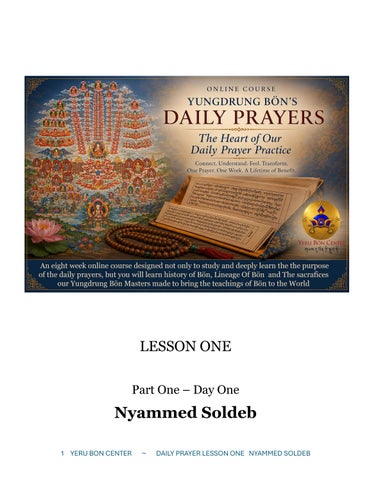
LESSON ONE Part One – Day One
Nyammed Soldeb 1 YERU BON CENTER
~
DAILY PRAYER LESSON ONE NYAMMED SOLDEB
2 YERU BON CENTER
~
DAILY PRAYER LESSON ONE NYAMMED SOLDEB
Prepare for your week of Lesson One: Download and if possible, print 1. Nyammed Soldeb Prayer 2. Recording of Rinpoche’s recitation of Nyammed Soldeb 3. Picture of Nyammed Sherab Gyaltsen – Print on good paper for your alter. 4. You can download the workbook as well and put in a binder. 5. Perhaps you might want to be included in the Daily Prayer Community WhatApp – If so, you can let us know your WhatsApp number at: yerubon@yeruboncenter.org. Let us know to include you in the Daily Prayer Community. From here there might be a day you would like to work with someone or a group. You can ask. 6. Decide what would be a good uninterrupted time each day to focus and practice 7. Prepare your mind, body and spirit for practice. Sit quietly in meditation posture. Clear your mind and generate compassion for all sentient beings. If time allows, you can do the Nine Purification breathing practice, or Tsa Lung.
EACH DAY THIS WEEK Before beginning each practice session, sit quietly and take several gentle breaths. If familiar with Nine Breaths, this would be a good start to your practice. Allow your body to settle and your mind to become calm. Recite slowly, sincerely, and with awareness the Nyammed Soldeb minimum three times consecutively. GesheLa is asking when you recite the Nyammed Soldep prayer you visualize Nyammed Sherab Gyaltsen. His image is in the lesson one Dropbox folder.
3 YERU BON CENTER
~
DAILY PRAYER LESSON ONE NYAMMED SOLDEB
Keep him in your vision. You will also be focusing on gratitude honoring Nyammed Sherab Gyaltsen and all Bön Masters.
1. Listen to the Nyammed Soldeb Prayer Recording Listen carefully to Nyima Dakpa Rinpoche’s recording of the Nyammed Soldeb and meditation. You can recite with Rinpoche to help you learn the words and melody. 2. Recite The English – Reciting the prayer in English allows you to contemplate its meaning. 3. Recite in Tibetan - Reciting it in Tibetan connects you to the language and sound through which the prayer has been transmitted for generations. Recite The Nyammed Soldeb Three Times. We recite the Nyammed Soldeb three times. The first two times are done at a normal pace, and the third is done slowly. There are two reasons for this. First, it is the traditional way the prayer is recited at sMenrin monastery. Second, rather than rushing through the prayer, this gives us three chances to focus on the meaning and make the inner connection with Nyammed Shenrab Gyaltsen.
4 YERU BON CENTER
~
DAILY PRAYER LESSON ONE NYAMMED SOLDEB
5 YERU BON CENTER
~
DAILY PRAYER LESSON ONE NYAMMED SOLDEB
Become familiar with: • • • •
The English meaning The Tibetan pronunciation The rhythm and melody The feeling and intention of the prayer Listen without placing pressure on yourself to pronounce everything perfectly. Familiarity and confidence will develop through patient repetition.
4. Reflect After Each Recitation After completing the prayer, remain quiet for a few moments. Do not immediately get up or move to your next activity. Notice what is present within you. Ask yourself: • • • • •
What did I experience during today’s recitation? Did I feel connected, distracted, peaceful, grateful, emotional, or uncertain? Did a particular word, image, person, or part of the lineage stand out to me? Was I able to contemplate the meaning of the prayer? What changed between the English and Tibetan recitations?
There is no particular experience you are required to have. Some days may feel deeply meaningful, while other days may feel ordinary or distracted. Record both honestly.
6 YERU BON CENTER
~
DAILY PRAYER LESSON ONE NYAMMED SOLDEB
Keeping the Lineage Alive Through Practice This lesson is an opportunity to move beyond learning about the Nyammed Soldeb and begin developing a personal relationship with the prayer. During the coming week, listen, recite, visualize Nyammed Sherab Gyaltsen, and reflect. Allow the prayer to become more than words you are studying. Notice how it influences your thoughts, emotions, behavior, and connection to the unbroken lineage of Yungdrung Bön. We strongly encourage you to journal throughout this course. This helps you gather and organize your thoughts, and helps you review and reflect upon your notes at the end of each week. Complete the following practices and write your reflections in your journal. At the end of each day, ask yourself: 1. Where did I notice compassion today? 2. When was I impatient? 3. What challenged me? 4. What inspired me?
7 YERU BON CENTER
~
DAILY PRAYER LESSON ONE NYAMMED SOLDEB
5. Click and Watch Latri Nyima Dakpa Rinpoche’s previous Recording of Nyammed Soldeb Video Link: (21 Minutes) Questions: Write in your journal. 1. Why should we always pray Nyammed Soldeb: ________________________ 2. What are the three different sources of teachings: __________________ 3. Why recite the Nyammed Soldeb minimum of three times or more: __________________________
8 YERU BON CENTER
~
DAILY PRAYER LESSON ONE NYAMMED SOLDEB
PART 2 Day 2
LINEAGE Before beginning this practice session, sit quietly and take several gentle breaths. Allow your body to settle and your mind to become calm. Recite slowly, sincerely, and with awareness the Nyammed Soldeb three times consecutively. Continue to keep Nyammed Sherab Gyaltsen in your vision while reciting the Nyammed Soldep prayer. You should also be focusing on gratitude honoring Nyammed Sherab Gyaltsen and all Bön Masters. 1. Listen to the Nyammed Soldeb Prayer Recording Listen carefully to Rinpoche’s recitation recording of the Nyammed Soldeb. You can recite with Rinpoche to learn how to pronounce the Tibetan words and melody. We hope this will help. 2. Recite The English – Reciting the prayer in English allows you to contemplate its meaning. 3. Recite in Tibetan - Reciting it in Tibetan connects you to the language and sound through which the prayer has been transmitted for generations.
9 YERU BON CENTER
~
DAILY PRAYER LESSON ONE NYAMMED SOLDEB
4. Click and Watch Rinpoche’s Next Video on the importance of Lineage: (21 Minutes)
Questions: Listen to Rinpoche’s teaching and answer the questions below. • What is your understanding of Authentic Lineage: • What were Nyammed Sherab Gyaltsen’s instruction in appointing new sMenri Trizins? • Kuntu Zampo connection to Nyammed Sherab Gyaltsen? • What is a Mutic bead called in English? And what is the representation. • When you pray, what should you think of Nyammed Sherab Gyaltsen as?: __________________ • What are you seeking when you pray the Nyammed Soldeb? • Is it possible to also ask a request at the time of reciting Nyammed Soldeb? • Why do we chant the Nyammed Soldeb Three Time?
10 YERU BON CENTER
~
DAILY PRAYER LESSON ONE NYAMMED SOLDEB
Interactive Lineage Poster 5. DOWNLOAD: Click On: Lineage Poster for Nyammed Soldeb NOTE: In our lineage poster, we have included Latri Nyima Dakpa Rinpoche, Founder and Spiritual Director of Yeru Bön Center, and Geshe Yeshe Gyalwa, our Resident Lama, because this course was created and is presented by Yeru Bön Center. Their inclusion is not intended to diminish or show disrespect toward the many extraordinary lamas and teachers of the Yungdrung Bön tradition who are not featured in this Daily Prayer course. Different Bön monasteries have different lineages that they revere. You may have your own root master or study with a different Bön center. This is something truly beautiful, and you may preserve it if you like. We encourage you to take time to learn about your teachers, honor them, and cultivate heartfelt gratitude for the precious Yungdrung Bön teachings, sacred texts, wisdom, and practices they have brought into your life.
11 YERU BON CENTER
~
DAILY PRAYER LESSON ONE NYAMMED SOLDEB
6. Explore the Interactive Lineage Poster Click on the Lineage Poster to open the interactive Lineage Poster experience. If working off a paper workbook, copy and paste this link to go to the Lineage Poster.
https://issuu.com/annapurnabluewellnessmagazine/docs/linage_n yammed_soldeb Move your cursor over the different lineage masters, monasteries, and sacred places featured on the poster. Click on each image on the Lineage Poster to discover its history and learn more about its importance within the unbroken lineage of Yungdrung Bön. Take your time exploring. The interactive Lineage Poster will help you understand how the masters, monasteries, teachings, and sacred places are connected for over 18,000 years.
If you are working with the digital workbook, you can view the lineage poster below.
Slide your curser over images, if there is a link on the image, click and read about……
12 YERU BON CENTER
~
DAILY PRAYER LESSON ONE NYAMMED SOLDEB
13 YERU BON CENTER
~
DAILY PRAYER LESSON ONE NYAMMED SOLDEB
7. Reflecting on sMenri Monastery Perhaps you have already visited sMenri Monastery in Dolanji, India. After learning from the Lineage Poster more about its history, how the monastery came to be established and the extraordinary sacrifices made to preserve the Yungdrung Bön teachings, do you feel differently about your experience there? Has this history changed how you remember the monastery, its sacred spaces, the monks, the prayers, or the teachings you received? If you have never visited sMenri Monastery, you now have a deeper understanding of its history and spiritual importance. Imagine what it might be like to walk through the monastery, hear the prayers, and recognize the devotion and sacrifices that made its continuation possible. If you are able to visit sMenri Monastery one day, you may experience it not simply as a place, but as a living connection to the history, lineage, and preservation of Yungdrung Bön. Take a few quiet moments to reflect: • • • •
What touched or surprised me most about the history of sMenri Monastery? What sacrifices made for the preservation of Yungdrung Bön stood out to me? How does knowing this history deepen my appreciation for the prayers and teachings I am studying? What would visiting or returning to sMenri Monastery mean to me now?
14 YERU BON CENTER
~
DAILY PRAYER LESSON ONE NYAMMED SOLDEB
Part 3 Day 3
HISTORY Before beginning this practice session, sit quietly and take several gentle breaths. Allow your body to settle and your mind to become calm. Recite slowly, sincerely, and with awareness the Nyammed Soldeb three times consecutively. 1. Listen to the Nyammed Soldeb Prayer Recording Listen carefully to Rinpoche’s recitation recording of the Nyammed Soldeb. 2. Recite The English – Reciting the prayer in English allows you to contemplate its meaning. 3. Recite in Tibetan - Reciting it in Tibetan connects you to the language and sound through which the prayer has been transmitted for generations. Continue to keep Nyammed Sherab Gyaltsen in your vision while reciting the Nyammed Soldep prayer. You should also be focusing on gratitude honoring Nyammed Sherab Gyaltsen and all Bön Masters.
15 YERU BON CENTER
~
DAILY PRAYER LESSON ONE NYAMMED SOLDEB
4. Who Was Nyammed Sherab Gyaltsen? Nyammed Sherab Gyaltsen (1356–1415) The Great Reviver of the Yungdrung Bön Tradition Nyammed Sherab Gyaltsen is regarded as one of the most influential masters in the history of Yungdrung Bön. His life marked a turning point in preserving and revitalizing the ancient teachings during a period when tradition faced enormous challenges. To understand his significance, we must first look to Yeru Wensakha Monastery.
Yeru Wensakha Monastery – The Original Seat of Yungdrung Bön Long before Tashi sMenri Ling Monastery was established, Yeru Wensakha Monastery (Yeru Wen Sa Ka) was the foremost monastic university of the Yungdrung Bön tradition. Founded in the eleventh century, Yeru Wensakha became the principal center for: • • • • • • • • • •
The study of Sutra ~ Pong Lam Dho – Path of Renunciation (Dho) Tantra ~ Gyur Lam Ngag – Path of Transformation (Ngag) Dzogchen ~ Drol Lam Dzogpo Chempo – Path of Self Liberation (Sem) Philosophy, Yungdrung Bön Rituals, Meditations, Astrology, Tibetan Medicine, Grammar, Preservation of sacred scriptures.
16 YERU BON CENTER
~
DAILY PRAYER LESSON ONE NYAMMED SOLDEB
For centuries, monks traveled from throughout Tibet to study at Yeru Wensakha. It became the intellectual and spiritual heart of Yungdrung Bön and played a role comparable to the great monastic universities of other Tibetan traditions. Generations of accomplished scholars, meditation masters, ritual specialists, and lineage holders were trained there, preserving teachings that had been transmitted continuously from Tonpa Shenrab Miwo.
6.
Tragedy of Yeru Wensakha Monastery
In the fourteenth century, disaster struck. Historical accounts tell us that severe flooding caused the collapse of much of Yeru Wensakha Monastery. Many buildings were destroyed, sacred texts were lost or damaged, and the monastic community was scattered. The destruction of Yeru Wensakha was far more than the loss of buildings. It threatened the very continuity of the Yungdrung Bön lineage. Without a central monastery, there was a real danger that many transmissions, rituals, educational traditions, and lineages could disappear.
17 YERU BON CENTER
~
DAILY PRAYER LESSON ONE NYAMMED SOLDEB
Yet while the buildings were destroyed, the teachings themselves remained alive within the hearts and minds of realized masters. One of those masters was Nyammed Sherab Gyaltsen.
7. Reflecting on Nyammed Sherab Gyaltsen Nyammed Sherab Gyaltsen experienced the loss of Yeru Wensakha Monastery, an important center of Yungdrung Bön learning. Rather than allowing its traditions to disappear, he dedicated himself to preserving the teachings and established Tashi sMenri Ling Monastery. As you reflect upon his life, ask yourself: • When I experience loss or disappointment, do I become discouraged, or can I find a meaningful way to move forward? • What teachings, values, or traditions have been entrusted to me? • What am I doing to preserve and carry those values into the future? • Where in my life am I being asked to remain committed, even when the path is difficult? • How can I bring greater discipline and consistency to my daily prayer practice? • Do I balance study with practice, or do I give more attention to one while neglecting the other? • What personal comfort might I be willing to set aside in service to something greater than myself? • What am I building today that may benefit people I will never meet? • How can Nyammed Sherab Gyaltsen’s perseverance inspire the way I respond to my present challenges? Take a few quiet moments to consider his legacy. One person’s devotion, courage, and commitment helped preserve the Yungdrung Bön teachings for generations. What might your own sincere commitment make possible for others
18 YERU BON CENTER
~
DAILY PRAYER LESSON ONE NYAMMED SOLDEB
Part 4 Day 4 THE VISION Before beginning this practice session, sit quietly and take several gentle breaths. Allow your body to settle and your mind to become calm. Recite slowly, sincerely, and with awareness the Nyammed Soldeb three times consecutively. GesheLa is asking when you recite the Nyammed Soldep prayer you visualize Nyammed Sherab Gyaltsen – keep him in your vision. You will also be focusing on gratitude honoring Nyammed Sherab Gyaltsen and all Bon Masters. 1. Listen to the Nyammed Soldeb Prayer Recording Listen carefully to rinpoche’s recitation recording of the Nyammed Soldeb. 2. Recite The English – Reciting the prayer in English allows you to contemplate its meaning. 3. Recite in Tibetan - Reciting it in Tibetan connects you to the language and sound through which the prayer has been transmitted for generation 19 YERU BON CENTER
~
DAILY PRAYER LESSON ONE NYAMMED SOLDEB
4. Nyammed Sherab Gyaltsen's Vision Nyammed Sherab Gyaltsen understood that preserving the teachings required more than safeguarding sacred texts. The living lineage needed: • • • • • •
qualified teachers, disciplined monastic education, authentic practice, philosophical study, meditation, and an enduring spiritual community.
Rather than attempting to rebuild Yeru Wensakha in its original location, he envisioned creating a new monastery that would carry forward the complete lineage. This vision became Tashi sMenri Ling Monastery.
5. The Founding of Tashi sMenri Ling Monastery In 1405, Nyammed Sherab Gyaltsen founded Tashi sMenri Ling Monastery in central Tibet. The name "sMenri" means "Medicine Mountain," symbolizing the healing wisdom of the teachings and the mountain upon which the monastery was established. His intention was not to create something new.
20 YERU BON CENTER
~
DAILY PRAYER LESSON ONE NYAMMED SOLDEB
Rather, he sought to preserve everything that had flourished at Yeru Wensakha: • • • • • •
its complete curriculum, its monastic discipline, its ritual traditions, its meditation practices, its Dzogchen transmissions, and its unbroken lineages.
Through his extraordinary scholarship, realization, and leadership, Tashi sMenri Ling Monastery, Tibet became the new spiritual heart of Yungdrung Bön.
6. The Legacy of Tashi sMenri Ling Monastery For more than six hundred years, Tashi sMenri Ling Monastery has remained the principal seat of the Yungdrung Bön tradition. It continues to educate monks and teachers in: • • • • • • • • • • • • • •
The study of Sutra ~ Pong Lam Dho – Path of Renunciation (Dho) Tantra ~ Gyur Lam Ngag – Path of Transformation (Ngag) Dzogchen ~ Drol Lam Dzogpo Chempo – Path of Self Liberation (Sem) Yungdrung Bön Philosophy, Vinaya (monastic discipline), Sutra, Tantra, Dzogchen, Ritual arts, Sacred chanting, Tibetan language, Astrology, Tibetan Medicine, Traditional Bön sciences.
21 YERU BON CENTER
~
DAILY PRAYER LESSON ONE NYAMMED SOLDEB
The monastery is also the residence of the sMenri Trizins, (“trizin” means “throne holder” or “Abbot”) the spiritual heads of the worldwide Yungdrung Bön tradition.
7. Destruction and Exile Tashi sMenri Ling Monastery in Tibet was destroyed following the Chinese occupation. Beginning in 1959, monks from Tashi sMenri Ling in Tibet fled to India, including the Abbott of sMenri Monastery at the time, Shenrab Lodro, the 32nd sMenri Trizin, who died in 1962 in northern India. In 1967, a Tibetan settlement was established at Dolanji, India, in Himachal Pradesh, where it continues today as the spiritual center of Yungdrung Bon. In 1969, His Holiness Lungtok Tenpai Nyima Rinpoche was chosen as the 33rd sMenri Trizin.
Reflecting on Nyammed Sherab Gyaltsen’s Vision Nyammed Sherab Gyaltsen understood that preserving the sacred texts of Yungdrung Bön required more than protecting written pages. The texts needed a secure home. They needed qualified teachers who understood their meaning, disciplined students who were prepared to study them, and practitioners who could bring the teachings into their lives. They also required an organized system through which the teachings could be studied, practiced, transmitted, and preserved accurately for future generations. His vision for Tashi sMenri Ling Monastery was therefore much greater than the construction of a monastery. He was creating a living foundation through which the wisdom of Yungdrung Bön could continue.
22 YERU BON CENTER
~
DAILY PRAYER LESSON ONE NYAMMED SOLDEB
As you reflect upon his vision, ask yourself:
• What does it truly mean to safeguard a sacred teaching? • Why is preserving a written text alone not enough to keep a spiritual tradition alive? • What can happen when a text survives, but qualified teachers and authentic transmissions are lost? • How did Nyammed Sherab Gyaltsen’s vision bring together study, practice, discipline, community, and spiritual transmission? • What responsibilities do teachers have when passing these teachings to their students? • What responsibilities do students have when receiving, studying, and practicing these teachings? • How does my own daily prayer practice contribute to keeping the lineage alive? • Am I simply reading or reciting the words, or am I working to understand and embody their meaning? • What teachings or practices have I received that I have a responsibility to respect, preserve, and carry forward? • How can I help ensure that the teachings remain available and authentic for future generations? • What can Nyammed Sherab Gyaltsen’s vision teach me about looking beyond my immediate needs and working for a future I may never personally see?
8. Take a few quiet moments to consider the depth of his vision. Tashi sMenri Ling Monastery was not created only to protect sacred texts within its walls. It was established to cultivate teachers, scholars, monks, and practitioners who could understand the teachings, embody them, and transmit them faithfully. Through our study, practice, and respect for the lineage, each of us can participate in carrying that vision forward.
23 YERU BON CENTER
~
DAILY PRAYER LESSON ONE NYAMMED SOLDEB
Part 5 Day 5
WHY Before beginning this practice session, sit quietly and take several gentle breaths. Allow your body to settle and your mind to become calm. Generate compassion for all sentient beings. Recite slowly, sincerely, and with awareness the Nyammed Soldeb three times consecutively. GesheLa is asking when you recite the Nyammed Soldep prayer you visualize Nyammed Sherab Gyaltsen – keep him in your vision. You will also be focusing on gratitude honoring Nyammed Sherab Gyaltsen and all Bon Masters. 1. Listen to the Nyammed Soldeb Prayer Recording Listen carefully to Rinpoche’s recitation recording of the Nyammed Soldeb. 2. Recite The English – Reciting the prayer in English allows you to contemplate its meaning. 3. Recite in Tibetan - Reciting it in Tibetan connects you to the language and sound through which the prayer has been transmitted for generations.
24 YERU BON CENTER
~
DAILY PRAYER LESSON ONE NYAMMED SOLDEB
A Reflection for Yeru Bön Center Students At Yeru Bön Center, the name "Yeru" carries profound significance. It honors the legacy of Yeru Wensakha Monastery, the original great seat of Yungdrung Bön learning. In carrying the name "Yeru," our center remembers the monastery where countless masters trained, where the teachings flourished, and whose spirit of study and practice lives on through sMenri Monastery today. When we recite the Nyammed Soldeb, we are connecting ourselves to this unbroken lineage from Yeru Wensakha, to Nyammed Sherab Gyaltsen, to sMenri Monastery, to our own teachers, His Holiness the 34th SMenri Trizin, Khenpo Latri Nyima Dakpa Rinpoche, Geshe Yeshe Gyalwa, and ultimately to our own practice. In this way, the lineage is not simply remembered. It is kept alive through each generation that studies, practices, and shares the teachings with sincerity.
Reflecting on Loss, Preservation, and the Nyammed Soldeb To understand why we recite the Nyammed Soldeb, we must remember the profound loss of Yeru Wensakha Monastery. Yeru Wensakha was an important center of Yungdrung Bön learning, practice, and spiritual transmission. When the monastery was destroyed by a devastating flood and landslide, the loss was far greater than the loss of buildings. Sacred texts, places of practice, established systems of study, and an important home of the lineage were placed in jeopardy. The destruction Yeru Blessing ribbon left at Yeru Wensakha 2024
25 YERU BON CENTER
~
DAILY PRAYER LESSON ONE NYAMMED SOLDEB
revealed how vulnerable even a great spiritual institution could be. Nyammed Sherab Gyaltsen understood the seriousness of this loss. He recognized that if the teachings, texts, transmissions, and systems of study were not gathered and protected, something precious could disappear. Rather than surrendering to grief or discouragement, he transformed loss into responsibility and action. His vision led to the establishment of Tashi sMenri Ling Monastery. A monastery that would preserve the teachings of Yeru Wensakha and provide a secure foundation for the continued study and practice of Sutra, Tantra, and Dzogchen. This history is important to every Yungdrung Bön practitioner. The prayers and teachings we received today did not survive by accident. They remain available because Nyammed Sherab Gyaltsen and generations of masters, monks, scholars, and practitioners recognized their value and accepted responsibility for preserving them.
Why We Recite the Nyammed Soldeb The Nyammed Soldeb is more than a prayer about a great master from the past. It is a living expression of gratitude, devotion, remembrance, and connection. When we recite it, we remember Nyammed Sherab Gyaltsen’s wisdom, discipline, compassion, and extraordinary commitment to protecting the Yungdrung Bön teachings. We also remember Yeru Wensakha Monastery and acknowledge the profound loss from which Tashi sMenri Linig arose. The prayer reminds us that we have not arrived at these teachings alone. We can receive and practice them today because others made great sacrifices to protect and transmit them. 26 YERU BON CENTER
~
DAILY PRAYER LESSON ONE NYAMMED SOLDEB
Through sincere recitation, the Nyammed Soldeb can bring a deeper sense of gratitude, humility, inspiration, stability, and connection to the lineage. It can prepare our minds to receive the daily Take a few quiet moments after reciting the Nyammed Soldeb. Remember Yeru Wensakha Monastery and acknowledge the depth of its loss. Remember Nyammed Sherab Gyaltsen and the vision, devotion, and courage through which that loss was transformed into the living legacy of Tashi sMenri Ling Monastery. Then consider your own place within this continuing lineage. Every sincere recitation, every effort to understand the prayer, and every attempt to bring the teachings into your life helps keep this precious tradition alive.
27 YERU BON CENTER
~
DAILY PRAYER LESSON ONE NYAMMED SOLDEB
PART SIX Day 6 Reflection Before beginning this practice session, sit quietly and take several gentle breaths. Allow your body to settle and your mind to become calm. Recite slowly, sincerely, and with awareness the Nyammed Soldeb three times consecutively. GesheLa is asking when you recite the Nyammed Soldep prayer you visualize Nyammed Sherab Gyaltsen – keep him in your vision. You will also be focusing on gratitude honoring Nyammed Sherab Gyaltsen and all Bon Masters. 1. Listen to the Nyammed Soldeb Prayer Recording Listen carefully to Rinpoche’s recitation recording of the Nyammed Soldeb. 2. Recite The English – Reciting the prayer in English allows you to contemplate its meaning. 3. Recite in Tibetan - Reciting it in Tibetan connects you to the language and sound through which the prayer has been transmitted for generations. 28 YERU BON CENTER
~
DAILY PRAYER LESSON ONE NYAMMED SOLDEB
Keeping the Lineage Alive Through Practice This lesson is an opportunity to move beyond learning about the Nyammed Soldeb and begin developing a personal relationship with the prayer. Complete the following practices and write your reflections in your journal. 1. Reflect on Nyammed Sherab Gyaltsen Write your responses to the following questions: 1. What qualities of Nyammed Sherab Gyaltsen inspire me? 2. How did he transform the profound loss of Yeru Wensakha Monastery into a vision that benefited future generations? 3. Which of his qualities would I most like to cultivate within myself? 4. How does knowing his history change the way I recite the Nyammed Soldeb? 5. What does his commitment to preserving the teachings ask of me as a practitioner? 3. Visualize Your Connection to the Unbroken Lineage Now that you have been reciting the Nyammed Soldeb, this week are you able to visualize yourself connecting to the unbroken lineage of Yungdrung Bön: • • • • • • • • • •
Yeru Wensakha Monastery and the teachings preserved. Nyammed Sherab Gyaltsen and his vision for Tashi sMenri Ling Monastery Tashi sMenri Ling Monastery in Tibet The reestablishment of sMenri Monastery in Dolanji, India The past sMenri Trizins His Holiness, the 33rd sMenri Trizin His Holiness the 34th sMenri Trizin The many Geshes, Khenpos, and Rinpoches who completed their education and now carry and transmit the lineage Khenpo Latri Nyima Dakpa Rinpoche Geshe Yeshe Gyalwa 29 YERU BON CENTER
~
DAILY PRAYER LESSON ONE NYAMMED SOLDEB
• •
Your own root teacher Your personal study and daily practice
Recognize that you are receiving these teachings because generations of masters, teachers, monks, scholars, and practitioners devoted themselves to studying, practicing, preserving, and transmitting them. Allow yourself to feel connected to this continuous stream of wisdom and compassion. In this way, the lineage is not simply remembered. It is kept alive through each generation that studies, practices, and shares the teachings with sincerity.
4. Consider Your Responsibility to the Future Reflect upon the sacrifices made to preserve the Yungdrung Bön teachings. Then ask yourself: • • • • • •
How can I honor these precious teachings? What does it mean for me to preserve them? How can I support the teachers, monasteries, centers, and communities carrying the lineage? How can I practice in a way that respects the integrity of the teachings? What can I do to help make these teachings available to future generations? How might my sincere practice benefit someone I may never meet?
Preservation does not belong only to monasteries, teachers, or scholars. Every practitioner contributes by studying carefully, practicing sincerely,
30 YERU BON CENTER
~
DAILY PRAYER LESSON ONE NYAMMED SOLDEB
supporting the lineage, and living according to the wisdom and compassion of the teachings. 5. Complete Your Final One-Week Journal Entry Review what you have written for the past week. Then complete a final journal reflection addressing the following: • • • • • • • • • •
How did my experience of the Nyammed Soldeb change during the week? How did the visualization guide or influence my practice? Was I able to feel connected to the unbroken lineage? Did I experience gratitude toward the Bön masters who preserved and transmitted these teachings? Which teacher, monastery, or part of the lineage felt especially present to me? What obstacles or distractions did I encounter? Did I notice any change in my wisdom, compassion, ethical conduct, patience, or sense of calm? How did the prayer affect my relationships or daily responses? What did I learn about myself? How will I continue working with the Nyammed Soldeb after this lesson?
Conclude your journal entry with this personal commitment: To honor this lineage and keep these teachings alive, I will… Complete the sentence in your own words. Your commitment does not have to be elaborate. It may be as simple as reciting the prayer regularly, studying with greater attention, supporting your teachers, practicing compassion, or sharing what you have learned with sincerity and respect. This prayer is much more than a request for blessings. When we recite the Nyammed Soldeb, we are:
31 YERU BON CENTER
~
DAILY PRAYER LESSON ONE NYAMMED SOLDEB
• • • •
Connecting with an unbroken lineage of realized masters. Opening our hearts to receive wisdom and guidance. Expressing gratitude for the preservation of the Yungdrung Bön teachings. Asking that our own study and practice become stable, clear, and beneficial for all beings.
It reminds us that genuine realization grows through devotion, humility, and consistent practice.
You have just completed part of Lesson One. Nyammed Soldeb To complete Lesson One, Participate in Geshe Yeshe Gyalwa’s Monday Morning teaching on Nyammed Soldeb Date: September 28, 2026 Zoom Link: https://us06web.zoom.us/j/86785834401?pwd=ElB9aguYcpA8mt9iOboelmk39GV sDx.1
32 YERU BON CENTER
~
DAILY PRAYER LESSON ONE NYAMMED SOLDEB