STAFF WRITERS: Evan Darmawan, Chloe Kern, Ben Passi, Eva Gleason, Connor Briand, Nico Mithun, Rayan Nasir, Leo Mithun
STAFF ARTISTS: Madeline Hou, Willow Overcash
STAFF PHOTOGRAPHER: Axel Bisbee
BECOME A STAFF MEMBER: Contribute to the paper three times consecutively to be promoted to a staff writer!
JOIN SPECTRUM:
Spectrum meets in Room 351 during both lunches every Monday. Please come if you are interested in writing, drawing, designing, podcasting, or taking pictures for the newspaper.
LETTERS TO THE EDITOR: Disagree with something that’s in the paper? Have an opinion you want to share? Like to draw editorial cartoons? Take a stand and speak out. Email letters or editorial cartoons to spectrum@blakeschool. org or deliver them to room 351. Please limit letters to 400 words.
MISSION STATEMENT:
The primary purpose of the Blake School Spectrum is to report news and to explain its meaning and significance to our readers and the community. We hope to inform, entertain and provide a school forum for the unrestricted exchange of ideas and opinions.
STYLE STATEMENT:
Spectrum uses Associated Press (AP) Style as of the February 2020 issue.
Curbing Club Growth
Club redundancy, new club introduction methods
Evan Darmawan | Staff Writer
Hamza Banatwala ‘26 said, “I could probably not name more than like 20 [clubs],” however, there are 57. Many students don’t even know the majority of clubs.
Assistant Director Sarah Warren stated that there are not too many clubs, but instead, a redundancy in clubs. Currently, there are 57 active clubs. Recently, a proposed finance club was rejected by Forum because of five preexisting clubs fulfilling the same purpose. Warren expressed that there are
no calls from the school to eliminate clubs, but instead, the administration will actively prevent redundancy.
Clubs are great for college applications and thus further incentivize students to make and lead clubs. Recently, however, questions have surfaced about whether the fastgrowing number of clubs has led to overlap. To create a club, the leaders must find a faculty sponsor, have students sign a petition, and Forum’s approval of the club’s creation. The current application process does not work.
On the other hand, Frey maintains his strong support among moderate Democrats, who credit him with balancing reform and economic stability. His campaign emphasizes experience and gradual reform, contrasting Fateh’s desire for swift systemic change.
He claims to run to “provide tested and trusted leadership in this pivotal moment.” In his tenure, he has overseen city-wide unrest during the BLM protests of 2020, introduced an aggressive multifield Minneapolis 2040 Plan, and set forth a plan to make Minneapolis carbon-neutral by 2050.
According to recent reports by The Minnesota Star Tribune, the Frey
campaign has raised over $900,000 since January, while the Fateh campaign has raised $510,000 since January, showing a discrepancy in monetary capabilities between the campaigns. Recently, Fateh’s campaign manager, Akhilesh Menawat, has accused the Frey campaign of “made-up numbers” in polling.
As early voting begins, the election reflects larger political shifts. Crushon said, “Minneapolis is a microcosm of what is happening nationwide.” As the nation adopts a right-wing political ideology, Minneapolis will continue to grapple with its own political identity. The election results will either bring in a new, highly progressive agenda through Fateh or the third and final term of the Frey era.
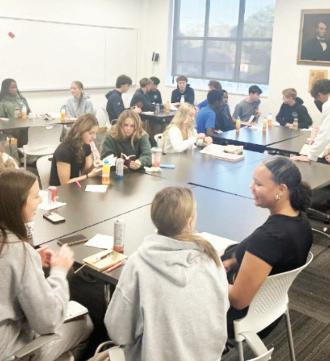
Co-Chair of Forum, N’Jai-An Patters, mentioned that a subcommittee was established to refresh the club creation process.
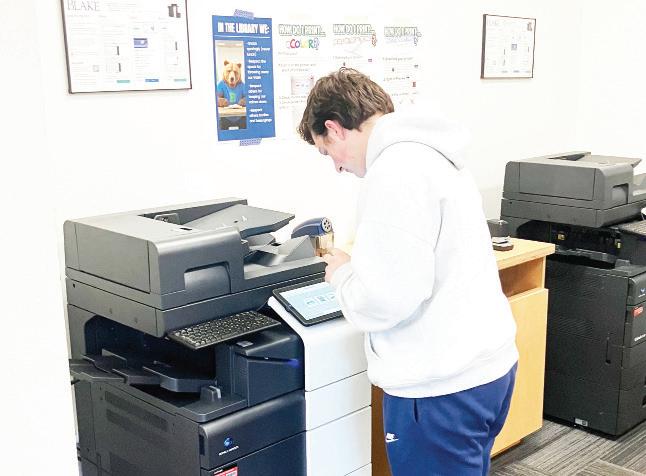
During the first quarter, Senior Program Manager Jennifer Mehra decided to transition from colored printing to grayscale as the default setting for the printers. The switch had been trialed at the Middle School last year before implementation at Northrop this year. The printers are not owned by the school but rather by Loffler.
Nat Gilsdorf, Instructional Technology Coach, said switching to black and white saves the school and Loffler “tens and thousands of dollars.” He explained, “When people print something in color but it is actually only black and white, like an English paper, the printer still uses all the color.” According to Gilsdorf, the benefits of saving money through grayscale printing outweigh these small troubles that students may encounter.
Curious Bear Wonders: Why No Class Rank?
Method once used at the school abandoned
Charlie Dean | Opinions Editor
The school does not have a class rank because, as Nora Main, the Associate Director of College Counseling, said, “as a small school, and as an independent school, a class rank isn’t a meaningful measurement… In a class of 135 to 145 students… the establishment of class rank wouldn’t add any value, either to the students here or from a college perspective.”
Main explained, “As colleges have come to understand that a holistic and contextual understanding of the students in their applicant pool matters more in terms, a class rank has
no meaning.” She added, “Fewer and fewer schools [use a class rank].”
In the past, a college rank was sometimes useful: it was, as Main referenced, “a mathematically accurate way to differentiate students in a class… [but] not a good predictor of what a student is or will be capable of at school.” Main said that “[t]he transcript as a whole is the best measurement…the story that the transcript tells… is the best measurement of success, not how that is then distilled into a fraction.”
Main added that “a class rank could place upon a student an undue burden around how they think about themselves as a person and as a student,” giving another reason for removing it.
In the past, the school had a class rank. David Zalk ‘66 remembered, “[they] would have seven
marking periods a year,” and that “at the end of each marking period, there was an announcement in Chapel [about] which students had the best grades for that marking period.” Visual arts teacher Bill Colburn ‘88 stated that while he remembered having a class rank, he “didn’t spend [his] time thinking about it.”
Over time, responding to changes in academics and the college process, the school phased out a class rank.
Zalk asserted “the idea [of removing a class rank is] to deemphasize comparative standing.” He noted, “Some people… have the idea that constant comparison is not conducive to a healthy learning environment.” Colburn added, “It’s no good to find out you’re at the bottom, and it could be obsessive if you were at the top, so I think it’s highly problematic and I’m
glad they got rid of it.”
“I think the benefit would be incentive… a statement that we value academic excellence,” Zalk said, “And a way of valuing academic excellence is to recognize that people have achieved some level of distinction in their academics.” Yet, Zalk acknowledged that “[w]e’re probably better off doing it the way we do now.”
Election Cont. from 1
Ben Aviles
Ben Aviles
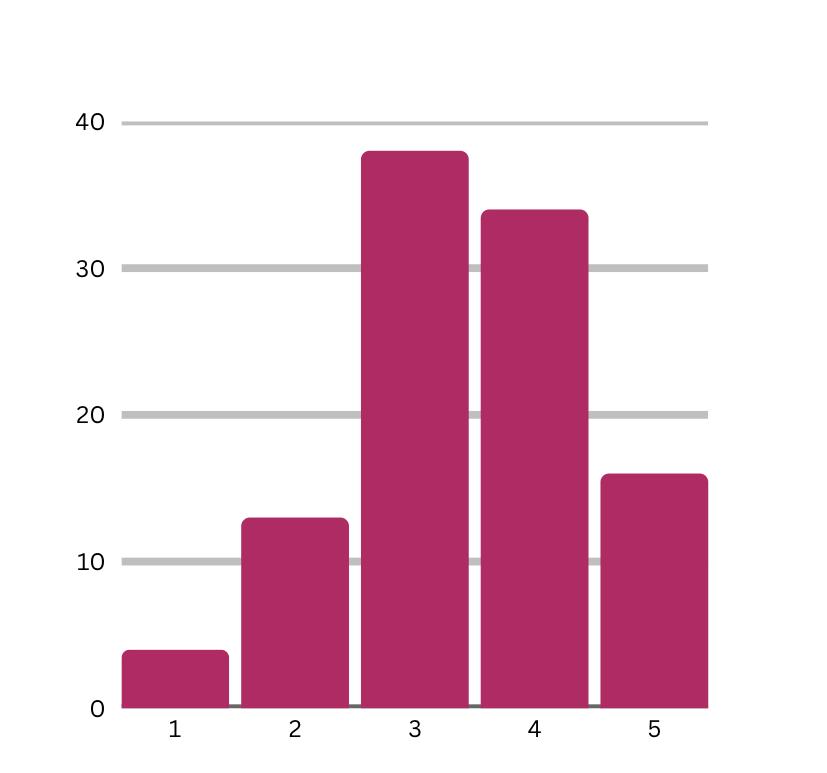
105 people responded to the October poll, the majority of which were “unsure” of their Minneapolis mayoral preference.
Ben Aviles
Paws for Prayer, a recently chartered club, exists to share the love of Christ, according to their Instagram.
Tarun Gopalakrishnan | Sports Editor
Wreak Havoc
Ben Aviles Greg Jones ‘27 stands at the printer. Ilian DeCorte said “many people are printing things at least twice.”
Thrilling halloween plans excitE
Students celebrate Halloween traditions
Izzie Miller | Managing Editor
The crisp autumn season has brought joy to many with the changing of the leaves from green to reds and oranges. The many festivities autumn brings create a cozy atmosphere. Halloween is a holiday in the season that can be both whimsical and eerie. Many have celebrated this holiday since their youth, most commonly experiencing the fond memory of going trick-or-treating
from door to door. Participation in this tradition often dwindles as one progresses from Kindergarten through 12th grade, being substituted for other ways of celebration. But what are these other ways? Do some students still go trick-or-treating?
Claire Heelan ‘28 has a variety of ways to celebrate Halloween this year. On the household side, Heelan’s family has a yearly tradition of carv-
Film Society Debuts
Club ventures to local theater
Abeloved club, The Film Society, is starting a new year of fun. The club meets once a month and will go to local theaters to watch and discuss movies.
Club leader Nick Gadjusek ‘26 shared his insights regarding their latest trip to see the psychological thriller, “The Silence of the Lambs,” in theaters: “We were really searching for a movie that wasn’t too niche, so that people would actually want to go.” Gadjusek also noted that “horror is a fun way to get introduced to film.”
Students who attended the movie found its psychological aspects more captivating than its scares.
Gadjusek added that members of the club discussed the “insane personas” in the movie, and how these “insane” characters reflect human nature.
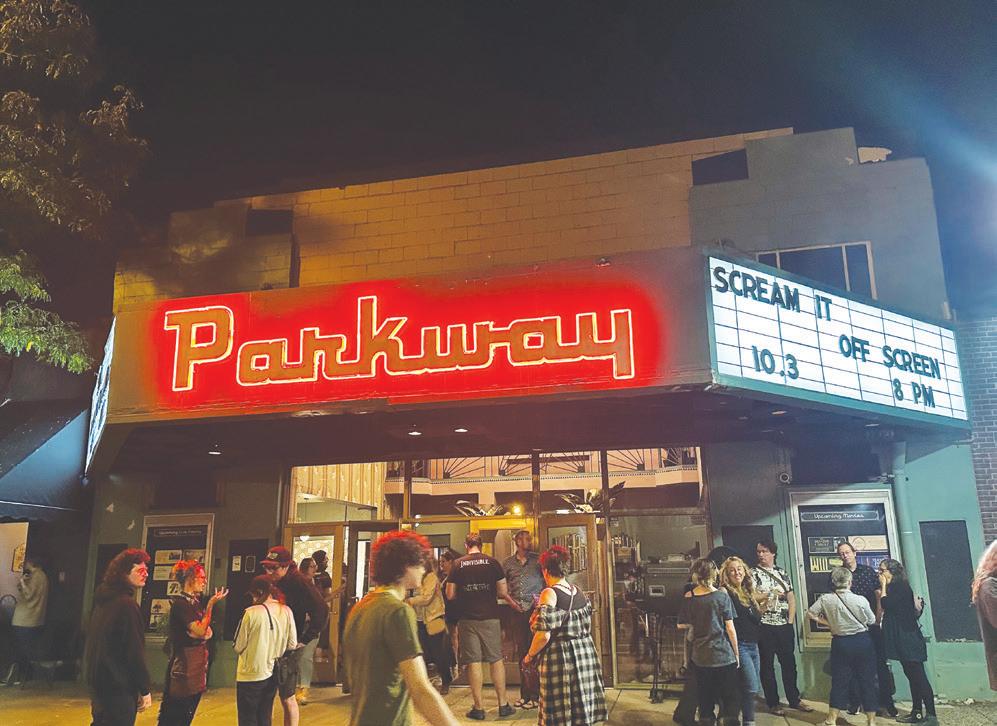
As club leaders, Gadjusek and Lauren Hall ‘26 are still deciding on how to balance showing classical films and more modern releases. As of now, they are more focused on the classics to help club members appreciate film as an art form rather than just as entertainment. Movie showings for the club will take place primarily at the Parkway Theater in south Minneapolis.
Jim Mahoney remarks that, in one word, he would describe this club as “cinéaste-tastic.”
ing pumpkins together. With her friends, Heelan plans on coordinating a group costume. Heelan commented that she will be dressing up in two different costumes, and that “both [costumes] are duos with the same friend from Edina.” Halloween candy is another tradition, and Heelan stated, “I really like the Sweet Tarts Ropes.”
As of present time, Jacqueline Dunlap ‘27 is planning on attend -
ing a large Halloween party this year. In the past, Dunlap has spent her Halloween with classmate Alex Mithun ‘27 . She described how the two would “go trickor-treating in [Mithun’s] neighborhood,” but have not continued that tradition as they have grown older.
For her costume, Dunlap will be coordinating her costume with Esther Lee ‘27 : “We are going to be characters
from Ratatouille. I’m going to be the chef, and Esther is going to be Remy [the rat].” Dunlap will wear a chef’s hat, and Lee will wear mouse ears to dress up.
Dunlap’s family decorates their front yard with pumpkins and “spooky characters” as
well as placing “cobwebs around pillars and the porch.” They also stick witch feet in the grass, which “[make] them look stuck.” Dunlap said that her family decorates by “[putting] pumpkins with [carvings] around the inside of the house” to illuminate the space.
Students Launch New Enterprises
Community describes experience of planning for future jobs
Anya Vallapureddy | Contributing Writer
Starting a business may seem like an impossible task, but some students are already turning their passions into startups. Balancing school and other extracurricular activities with being an entrepreneur isn’t easy, but for many students, it’s worth the effort.
Garrick Bennett ‘28 has run a haircutting business from his house for two years. He shared that his favorite part of the job is “the people [he has] met,” adding that he’s encountered about “200 kids that [he] wouldn’t have before.” In the next few years, Bennett hopes to expand his customer base, upgrade his equipment, create an Instagram page, and start a clothing brand that he can sell out of his studio. He plans to continue cutting hair once he leaves for college, and to teach his younger brother, Niles Bennett ‘30, how to cut hair so he can take over some of Bennett’s current clients.
Bennett’s biggest piece of advice for students who want to start their own business is that “it takes time,” and that “it’s not going to be [perfect on] day one, but it’s going to be worth it.”
Sloane Blomquist
‘28 is still in the planning stages of her business, and she hopes to launch an Etsy shop soon to sell custom birthday cards. She said the reason she became interested in her own business is that she felt she could do more with her free time, and, “expanding to larger audiences could be more fun than just giving cards to people [she] knows.”
Blomquist predicts that challenges once she officially opens her Etsy shop will include finding a reliable shipping method, advertising to larger audiences, and keeping up with orders when she’s busy with other activities. In a year from now, Blomquist plans to have a business that appeals to a larger audience, while still being small enough for her to keep up with. She notes: “You have to have
Submitted by Samatar
the dedication…if you feel passionate about it,” then Blomquist urges you to go for it.
Heybe Samatar ‘29 has a clothing brand that he’s run with his cousin since 2022. The brand is designed for athletes shopping online. He was inspired by a friend who became successful after starting a business, as well as wanting to see more clothing that “explicitly supported athletes.” Sa-
matar advertises his business through ads on Instagram and TikTok, and he explains that the ads are effective, if they “take down the ones that aren’t performing.”
Samatar adds that his work in managing the brand is mainly “checking on the ads” and “checking on the designs and prices.” He hopes to reach a wider audience and get celebrity sponsors, and he describes that the biggest challenge he faced was persevering at the beginning. He says: “Keep going, the hard work is going to pay out.”
Students are taking their passions to the next level with these startups, and they are expressing their creativity and business skills. These entrepreneurial skills as well as their persistence are proof that dreams can become reality.
One of the many lamps throughout the library that is wrapped with cobweb decorations to create a spooky ambiance.
Caitlin Strauss
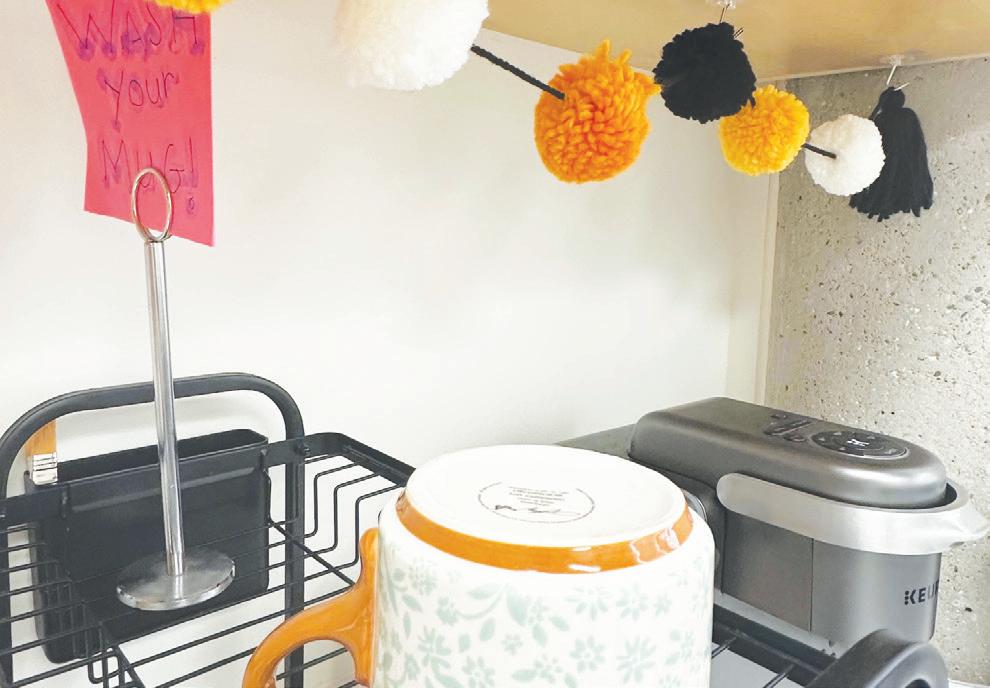
The library has placed orange, white, and black pom-poms above the sink and coffee maker.
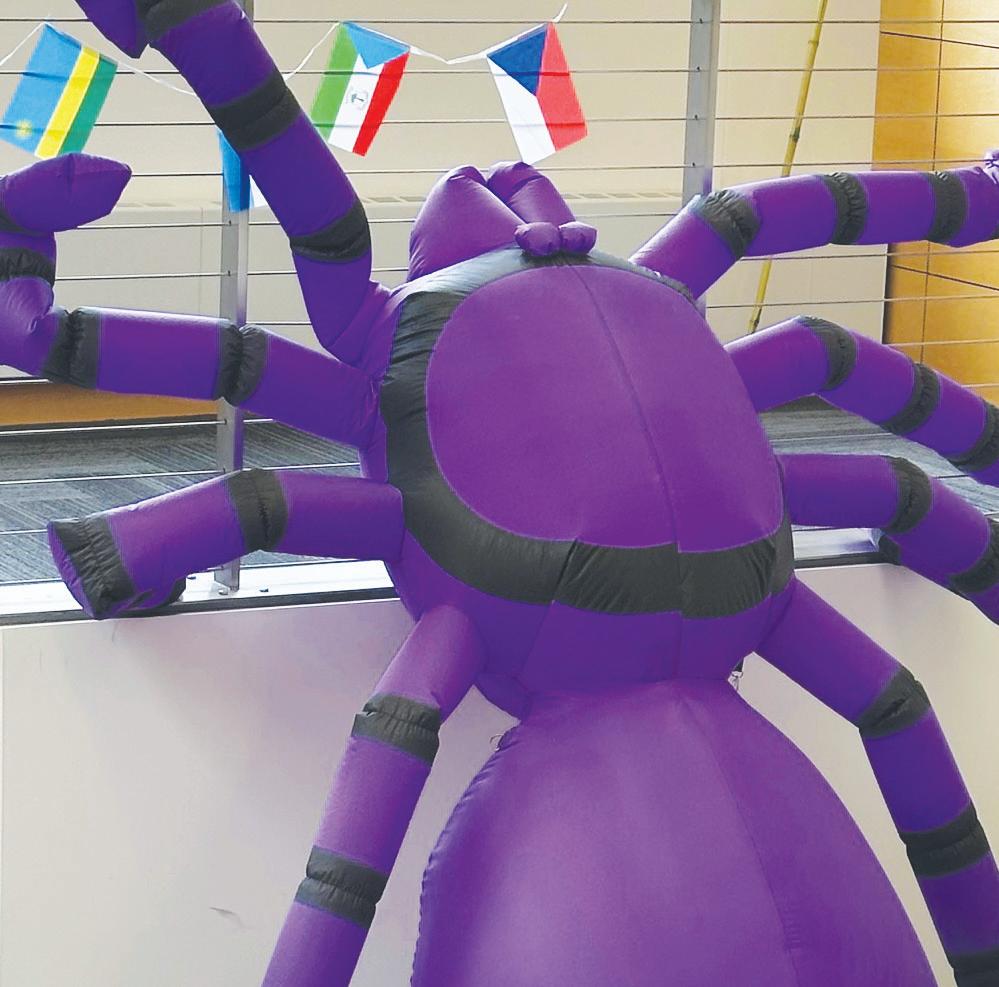
Caitlin Strauss Giant, inflatable spider hangs along the railing in the Carlson Commons.
Caitlin Strauss
Blomquist enjoys using vibrant colors in the cards.
Blomquist
Clothing that Samatar sells with his cousin on the website they have for their business.
Nico Mithun | Staff Writer
People waiting outside Parkway Theater in south Minneapolis to watch “The Silence of the Lambs.”
Lauren Hall
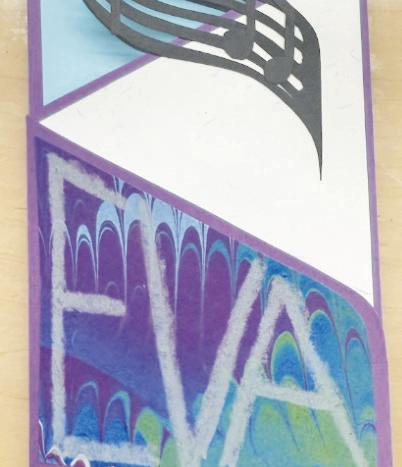
A birthday card made by Blomquist with musical notes. Blomquist
The home page of Samatar’s website for his clothing brand, OFF GRID.
Submitted by Samatar
Open Enrollment Reverses School Integration
Classrooms grow divided again
Ben Aviles | Co-Editor-in-Chief
Brown v. Board of Education may have formally ended school segregation, but Minnesota schools are segregated. After a court order in 1972, Minnesota began school integration. In the 1990s, Minnesota was among the leaders in the nation in school integration of racial demographics. While a racially progressive school system was being built, it was also being torn apart: In 1989, Minnesota became the first state to introduce mandatory open enrollment.
The hypothetical utilities of open enrollment are numerous: families can find schools that fit their child, families can attend closer schools, and kids can escape bullying. However, open enrollment has led to hypersegregation in Twin Cities schools, redirection of direly needed funds, and a staggering achievement gap.
Despite some utilities, open enrollment has created racial segregation reminiscent of white flight. Minnesota Supreme Court Justice Natalie Hudson found, “Between 1995 and 2021, the Twin Cities saw a twelve-fold increase in the number of hyper-segregated public schools.”
University of Minnesota law professor Myron Orfield found in his 2010 study, “Districts gaining the most students from open enrollment are predominantly white districts that receive students from more diverse districts.” He continued, “Loss of white students to nearby districts represents a large majority of each district’s net losses.” It is no coincidence that open enrollment started in 1989, and since then, hypersegregated school districts have increased at least “twelvefold.” Coupled with the white majority of students lost from diverse districts going to predominantly white schools, it becomes profoundly clear that white Minnesota families have chosen to self-segregate. Be
it purposeful or by culturally ingrained stigma, white Minnesotans have driven school segregation. Higher racial segregation leads to disproportionate resource distribution and an increased achievement gap. Among the most diverse school districts are St. Paul and Minneapolis. Christopher Ingraham of the Minnesota Reformer reported, “Minneapolis Public Schools’ enrollment has fallen by more than 40%” since 1998, seven years after open enrollment began. In the same time period, the city’s population has risen by 20%.
Minnesota is structured such that a school district’s funding is proportional to its enrollment, meaning that when a school district’s enrollment drops, its funding drops. Due to low enrollment and subsequent low funds, in June 2025, Minneapolis Public Schools announced they were cutting 400 positions due to a $75 million deficit. St. Paul is experiencing the same with a $51.5 million deficit.
In 2022, Southwest
Evie Chow
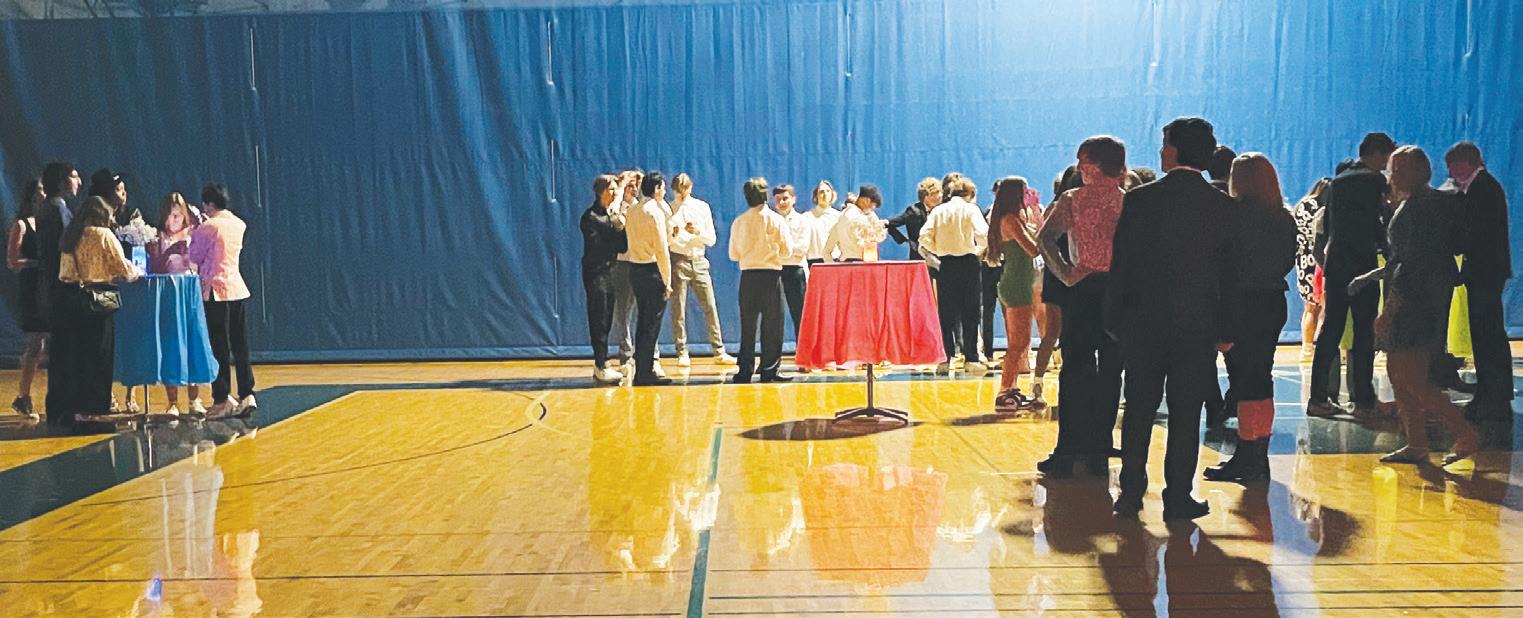
The 2023 Homecoming Dance featured a DJ used by the school for many years, which caused excitement in the student body for this year’s higher energy DJ.
New Homecoming DJ Impresses
DJs transform the vibes
Tarun Gopalakrishnan | Sports Editor
For this year’s homecoming dance, the school expanded its budget to bring in new DJs from GenerationNOW Entertainment, which was fully worth the investment. The new DJs immediately brought energy and interactivity to the crowd, which was lacking in years prior. In most years, the energy at the start of the dance is low, with everyone feeling a little reserved. However, this
year’s DJs quickly brought a burst of energy.
“It wasn’t just moshpitting, they encouraged people to dance…they were more vocal this year to the group as a whole, and got everyone hyped when the start was a little dead,” said Madhav Kumar ‘27, who was extremely engaged during the Homecoming festivities.
In past years, the DJ’s role mainly consisted of just playing music to keep the crowd going through the night. However, this year’s DJs were much more interactive and fully engaged
with the students. Rather than simply playing music, they held conversations, asked questions, and even danced with students. “I liked the interactive part...I had a personal experience where I held hands with [one of the DJs] and danced with him,” said Kumar.
At times, freshmen can feel out of place at Homecoming as it is their first experience of a dance, yet the new DJs did a great job of making everyone feel part of the dance and school community through roll calls of each grade and continuous interaction.
Voices reported that 33% of Minneapolis students were proficient in math, with only 8% of Black Minneapolis students being proficient in math. The same was true for reading. Fewer students equals less money. More white students in suburban schools means redirection of funds from districts in dire need of funds to well-off school districts. Fewer funds result in deficits and decreasing quality of education, where 400 positions are cut and deficits reach the tens of millions. All of this only exacerbates the achievement gap, further subordinating minorities and underachieving school districts. The systematic redirection of funds through segregation creates another systematic function of racism, making racial gaps more defined.
Time after time, research, such as that performed by The Century Foundation, has found “Diverse learning environments better prepare students for a global society by reducing racial stereotypes and fostering cross-racial under-
standing.” However, through open enrollment and school choice broadly, the state and nation are falling away from these goals.
The solution is simple: Deliberate reintegration of public schools. Policies like the Voluntary Desegregation Rule (1999) brought the state closer to full integration by setting standards and benchmarks for
diversity in school districts. New legislation setting tangible benchmarks of racial integration must be established. 61 years ago, Justice Earl Warren wrote in the Supreme Court’s unanimous opinion, “Separate educational facilities are inherently unequal;” it is time to manifest this decree and reckon with structural educational racism.
Making the Most of Halloween
VOICE OF THE STAFF VOICE OF THE STAFF
The Spectrum Staff presents 6 pieces of advice to students for Halloween:
Try out something new! If you haven’t historically dressed up or always go to the same event, do something different!
Let loose! As students at a rigorous school, we often feel pressured to always
HOT TAKES
Lilah Johnson | Managing Editor
be working on academics. Halloween is the perfect time to have fun with friends and family.
Don’t worry what others are doing! Enjoy the holiday yourself rather than worrying about what everyone else is participating in.
Make good choices! While Halloween is a time to be your-
self and one of the highlights of autumn, you should still try your best to make appropriate choices.
Appreciate the atmosphere! Halloween is a festive day filled with traditions. Take some time to research the history of the renowned holiday.
Sleeping with socks on is the best - at all times of the year. If Taylor Swift’s early songs had come out in 2025, people would hate them. Going to the airport is one of the best parts of going on a trip.
Annotating books is pointless and just takes up extra time. Any chocolate candy is better than any fruity candy.
A graph depicts the resumption of segregation in schools in the United States.
Hot Potato
Camila Pardo | Columnist
High school is only the start
Sometimes I wonder if these are supposed to be the best years of my life, and if they are, what happens after? It’s strange to think that a place filled with white fluorescent lights, rushed lunches, and endless homework might be the “peak.” But it’s a quiet fear so many of us carry: that we’ll never be this young, this noticed, or this full of possibility again.
We’ve been told that high school is where everything happens: the friends, the big moments, the memories we’ll carry forever. And because of that, there’s this quiet pressure to make every day count. To collect stories, to look like you’re thriving, to feel like you’re doing something significant. You start to wonder whether or not you’ve already had your best days before your life has even really begun.
It’s in the little moments that this fear shows up. The Friday night SMB Wolfpack games you don’t want to miss, the conversations that feel important but slip away before you can hold onto them, the fleeting sense of connection in a hallway between classes. You begin to notice that while everyone seems to be living their highlight reel, most of us are just getting through the day, trying not to mess up too badly or get left behind.
The truth is, for the better I’d like to think, not everyone peaks here. Life doesn’t stop after graduating; it gets wider, messier, and more interesting. There’s more room to fail, to succeed, and to grow. Maybe these years aren’t the peak. Instead, they’re the practice. A time to make mistakes, to figure out who you are, and to learn what really matters, beyond the grades, applause, or approval.
I don’t want to peak at sixteen. I’d rather keep moving, keep changing, keep finding new things that matter. High school doesn’t have to be the best years of our lives; it can be the foundation for the years that are still waiting ahead. And maybe the best part isn’t looking back, but realizing that we haven’t even started.
Self-Censorship Discourages Discussion
Political conversations mimic an echo chamber
Ben Passi | Staff Writer
Ahand raises, hesitates, then lowers. Silenced by an invisible weight, the potential to be ‘wrong’ or ‘offensive.’ Educational institutions across the country are burdened by a concerning rise in polarization in po-
litical discussion. Northrop is no exception. Promoting a space where all ideas are welcome is more crucial now than ever. Even as a place of learning, the school has formed an echo chamber where self-censorship feels safer than honest discussion.
School is “where you learn most of the stuff in your life, and I think it’s important for people to learn about politics unbiased,” stated Elizabeth
their opinions.” With the largely liberal community of the school, sometimes just agreeing or acknowledging certain views that are generally considered more conservative is often met with harsh criticism, especially from students. The same is true in more right-leaning schools with left-leaning perspectives. However, the issue persists when discuss-
ing controversial topics, such as affirmative action and certain political figures.
Yet, our education isn’t necessarily to blame. While teachers’ general political opinions inadvertently make their way into lessons and discussions, there’s another layer of self-censorship on topics. Student culture perpetuates this strange dynamic.
Our culture of delegitimizing opinions that we’ve predetermined as wrong is a very concerning trend, especially in the educational sphere. One example of this is the recent rise in political violence, in which there has been an unsettling number of students and the general public celebrating when perpetrated against the opposing party. Furthermore, I remember when discussing colonization in 9th grade, feeling uncomfortable asking the question, “Why do we focus so much on colonization by Europeans in discussions when it was such a global issue?” I kept replaying the question in my head, wondering if it would sound insensitive. I wasn’t defending colonialism, but what if it sounded that way? That moment
made me realize that selfcensorship wasn’t always imposed, but self-inflicted. These experiences show how easily open-minded conversations give way to fear and judgment.
The real issue here is how this student culture of believing certain beliefs are flat-out wrong, especially when this culture has become normalized. On an academic level, the problem with this is how we’ve started to lean towards groupthink. Where everyone generally has the same ideas, and when ideas don’t fit the mold of what’s acceptable, they’re self-regulated out of conversations. This is harmful because perspective is essential to critical thinking and a genuine understanding. When voices fall silent, and self-censorship becomes normalized, we foster a culture of one-sided ideas, where we don’t always build the accepting and open-minded community we claim to. It’s only when we change our framing around politics and global issues, from a good or bad binary to a spectrum, that we can truly maximize and engage in our learning.
‘The Life of a Showgirl’ Is Just What We Need
New Taylor Swift album appeals
Lilah Johnson | Managing Editor
Being one of the most popular artists comes with being one of the most hated, and that has always been the case for Taylor Swift. Her albums were too country, then not country enough. Her lyrics weren’t deep enough, then they were too deep. For twelve albums, it’s been the same story over and over, which brings us back to the same conclusion every time: it’s impossible to make an album that satisfies everyone.
Her 12th album, “The Life of a Showgirl,” is her return to pure pop, or “glitter gel pen writing,” as she calls it. This is a big switch from the
A limited edition vinyl of the new album is available at Target. Despite some public disapproval, the album is doing very well: its four million first-week sales surpassed Adele’s 10-year record for her album “25.”
“quill” writing of her last album, “The Tortured Poets Department,” which was 31 songs of deeply poetic writing. “The
Life of a Showgirl” is much more focused on the production of each song and having fun with the writing.
Contrary to what appears to be popular opinion, I loved this album from my first listen. The first track and lead single, “The Fate of Ophelia,” is just a generally fun and catchy song that goes along with a great music video. I appreciated the video and song even more after going to the AMC movie premiere and got to see the behind-the-scenes of the music video. Listening to this song alone is like a breath of fresh air from the sad and deep writing of her last four albums. The vibe of the album reminds me a lot of her early pop albums like “1989” and “reputation,” which remain some of my favorite albums.
My favorite song from the album is “Elizabeth Taylor,” which is an edgy love song filled with references to the life of Elizabeth Taylor. I loved this song from the very first listen and have only
grown more appreciation as I learn more about the references within the lyrics. As an eldest daughter, “Eldest Daughter” is another one of my favorite tracks on the album. While the lyrics for this song are getting a lot of hate, I really resonate with it and can really relate to the feelings depicted in the song. “Father Figure” also stands out to me, especially as I listen to the album more and more. The story and imagery that the song depicts are so strong, and the sound is different from a lot of the rest of the album.
I think that sometimes, a fun pop album is just what you need. Listening to “The Life of a Showgirl” instead of “The Tortured Poets Department” on my way to school puts me in a better mood every day. Overall, I would rate the album an 8/10.
‘Weapons’ Delivers Added Depth to Horror Movies
Mixed-genre film excites
Leo Mithun | Staff Writer
The movie “Weapons,” directed by Zach Cregger, blends horror, dark comedy, and very unsettling imagery into a very unique film. The story begins with the disappearance of 17 children at exactly 2:17
A.M. “Weapons” has six separate chapters about six significant characters
shown throughout the film. This unique perspective gives the viewer a better sense of the story and how the disappearance of children was caused and can be solved. The drastic difference in characters gives an interesting feel of eeriness and uncertainty. The movie is titled “Weapons” because each character is destroyed emotionally, like weapons do to people. The people are controlled through these inhumane actions by Gladys, the film’s
villain, who forcibly takes advantage of them.
The movie pushes beyond the genre of horror into an intricate story of the human reaction to disaster and how different people face fear and uncertainty to save the general community. The characters, who were originally framed as enemies, discover that Lady Gladys is the real enemy, change their perspective and help each other to find success.
The decisions char-
acters make to save each other make “Weapons” so inspiring, giving the viewer a feeling of gratification for the genre of film as a whole. The film relates to real-world problems and stretches the viewer beyond what a typical horror movie would. I rate this mixed-genre movie a 10/10 because of its great complexity. I recommend it to anyone who is looking for a film with an inspiring message and an edge-ofyour-seat horror.
MacNeill ‘27. However, “I think sometimes students don’t share
Willow Overcash
Charlie Dean
The simplified version of the movie’s cover. It released into theaters in the United States on Aug. 8, 2025.
Courtesy of Warner Bros. Pictures
GUN VIOLENCE
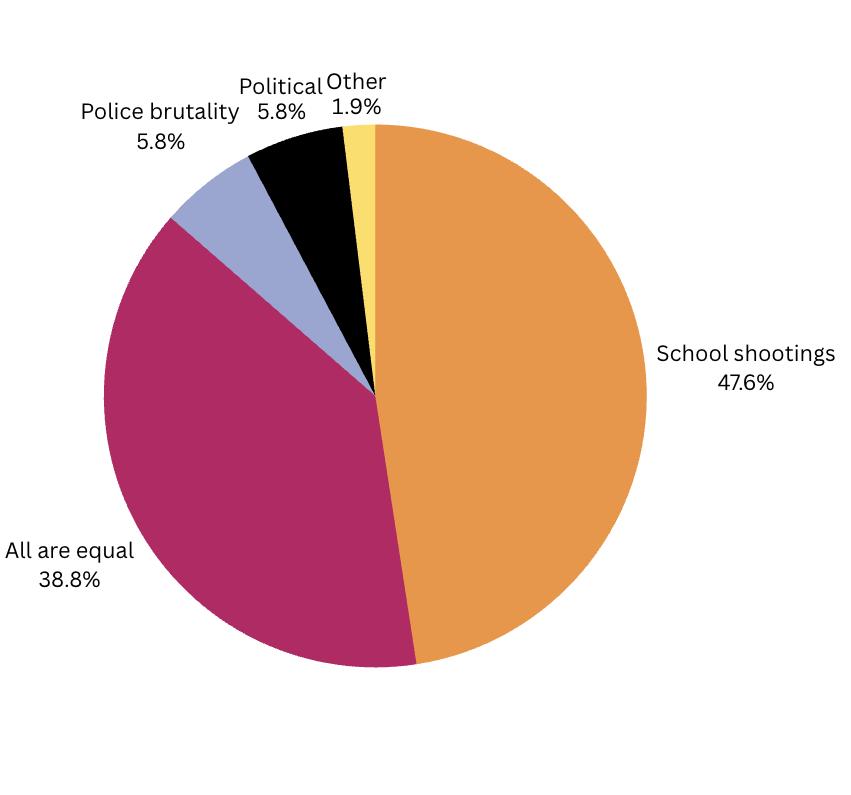
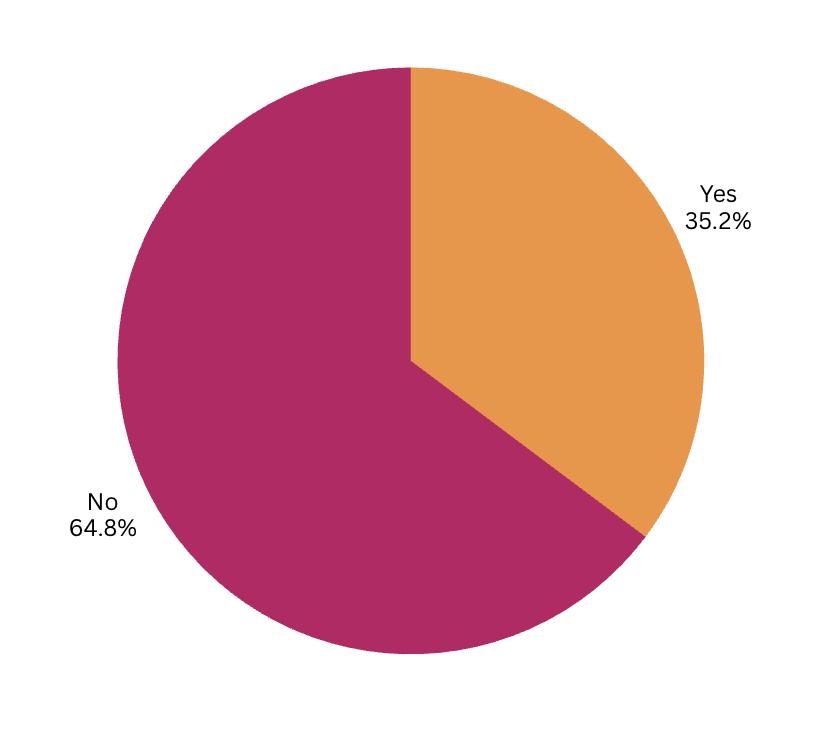
What type of gun violence feels most pressing to you?
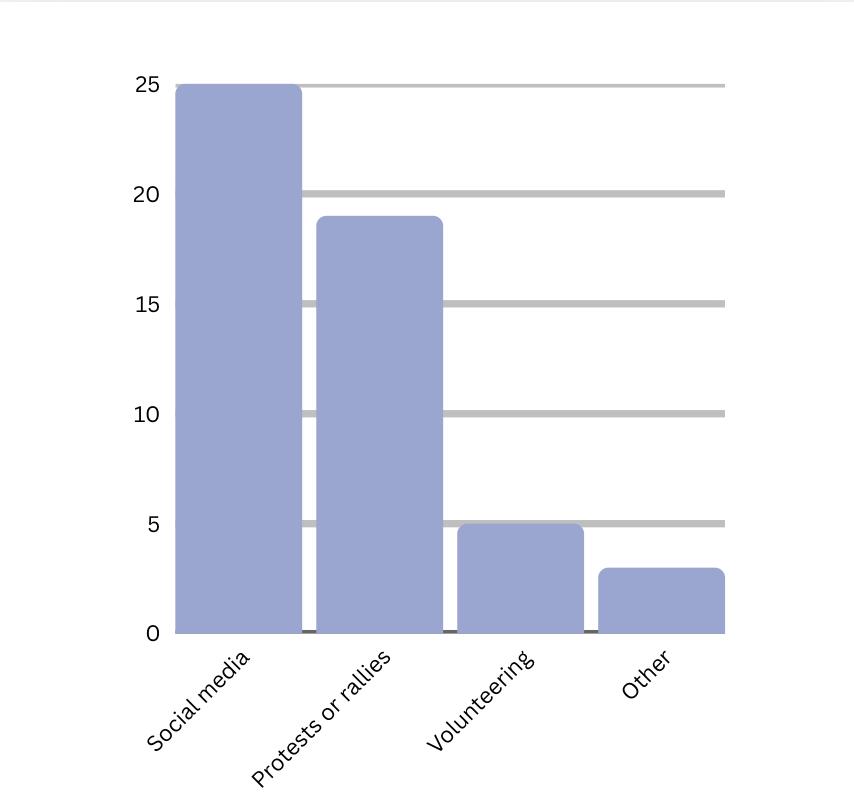
Have you engaged in any type of advocacy against gun violence?
What types of advocacy have you engaged in?*
*out of 45 responses
Political Violence is Unacceptable, On the Rise
Charlie Dean | Opinions Editor
“My dad has been shot,” Hope Hoffman, daughter of Minnesota State Senator John Hoffman, said on the call with 911 following the shooting of her parents. “They came after him because…he [is] a senator.”
Politically targeted violence has been on the rise in the nation. Many examples exist, including the attempted assassinations of Minnesota Representative John Hoffman, Pennsylvania Governor Josh Shapiro, President Donald Trump, and the killings of conservative political activist Charlie Kirk and Minnesota Democratic representative Melissa Hortman and her husband.
Hortman and her husband were murdered on June 14, 2025, in Brooklyn Park by Vance Boelter, an assailant disguised as a police officer. They had two kids, Sophie and Colin. Kirk was murdered on Sept. 10, 2025 by Tyler James Robinson, while debating college students on the Utah Valley University grounds in Orem, Utah, as a part of his “American Comeback” tour. Kirk was married to Erika Kirk, and had two kids.
According to a recent poll by PBS News/ NPR/Marist, the percentage of people who believe political violence is “needed to get [the] country back on track” increased in the past year and a half, from 19% to 30%. This number is even higher among the younger population. Following the attempted assassination of Trump, a few students said things like “I wish the bullet had been an inch to the right” or that they “wish he hadn’t turned his head.” This isn’t to suggest that most or even many people at the school believe this, but in some way, they provide firsthand support for this trend.
Social studies teacher Mackenzie McIlmail said that political violence is not okay, and not-
“You meet other people who are engaging in nonviolent political action... it makes you have a little more faith in your common man.”
-McIlmail
ed the success of “nonviolent [movements that] achieved their political goals” as an alternative. McIlmail suggested that a reason for such a trend is that “older generations have seen peaceful, nonviolent movements be successful,” noting anti-war and civil rights protests, while younger generations have largely not, and feel like “they're running out of options to create change.”
Utah Governor Spencer Cox, following Kirk’s assassination, said, “The problem with political violence [is that] it metastasizes because we can always point the finger at the other side.” Rachel Kleinfeld, a senior fellow at the Carnegie Endowment for Peace, added, “The more people [who]
justify violence from their side of the aisle, the more… people will commit violence from that side… and the more that will justify the other side in doing the same.” In addition to the “raised temperature” the killings have caused, McImail worries about “people [holding up] these shooters as role models of resistance.”
Kirk once said, “When you stop having a human connection with someone you disagree with, it becomes a lot easier to commit violence,” a reason for which he believed debating was so important. McIlmail “would be concerned if we lose sight of the humanity of the victims… Sometimes you'll see people who are targeted for political violence and then become poster children for a certain cause. And in the end, the family is really hurt by that, because the victim's full humanity is not seen.” Kirk and Hortman, like Hoffman, Shapiro, and Trump, were human with families and children.
McIlmail advised to “exercise [in] nonviolent political action,” such as “go[ing] to a rally,” “volunteer[ing] somewhere,” or “be[ing] a poll watcher.” She says that “you meet other people who are engaging in nonviolent political action… it makes you have a little more faith in your common man.”
Following Hortman’s assassination, Minnesota Governor Tim Walz stated, “We have demonstrated again and again in our state that it is possible to peacefully disagree, that our state is strengthened by civil public debate.” Walz added, “We must stand united against all forms of violence.”
Governor Cox said, “At some point, we have to find an off-ramp, or it’s going to get much, much worse.” He added, in an interview with CNN, that whether Kirk’s assassination is something that “wake[s] us up in a way that we actually change” will “depend on…all of us.”
data from a survey of 105 respondents graphs by Lilah Johnson
School Shootings Surpass Politics
Evie Chow | Copy Editor
School—what is supposed to be a haven for learning, growth, and self-discovery—has become a place that many students across the country fear. Hundreds of school shootings have plagued our country over the past few decades. Columbine. Sandy Hook. Robb Elementary. The list goes on and on. More recently, one hit closer to home: Annunciation. Yet, there has been little to no effective action in response to these incidents. What will it take for the government to see that this is a real problem? How many students will have to participate in drills or hide under tables for there to be real change? This cycle has become familiar: students are injured or killed, reform is promised, and then, nothing.
However, the impacts of these tragedies stretch far beyond the body counts shown on the news. They appeared on Aug. 27, when students learned of the events unfolding just 10 minutes away that impacted members of their community, close and far. Impacts appear every time there is an ALICE drill, and students wonder whether or not the lockdown is real or practice. Impacts appear at the candlelight vigils that pay honor to victims and their families. They will continue to appear, again and again, unless there is a change.
Every time, Instagram stories flood students’ feeds with government posts asking for thoughts and prayers. Yet, social media is often performative and
“I think we could have continued to discuss [the Annunciation shooting] for longer; the short two or three days that we did were definitely not enough to get all our thoughts and feelings out there.”
- anonymous response to the survey
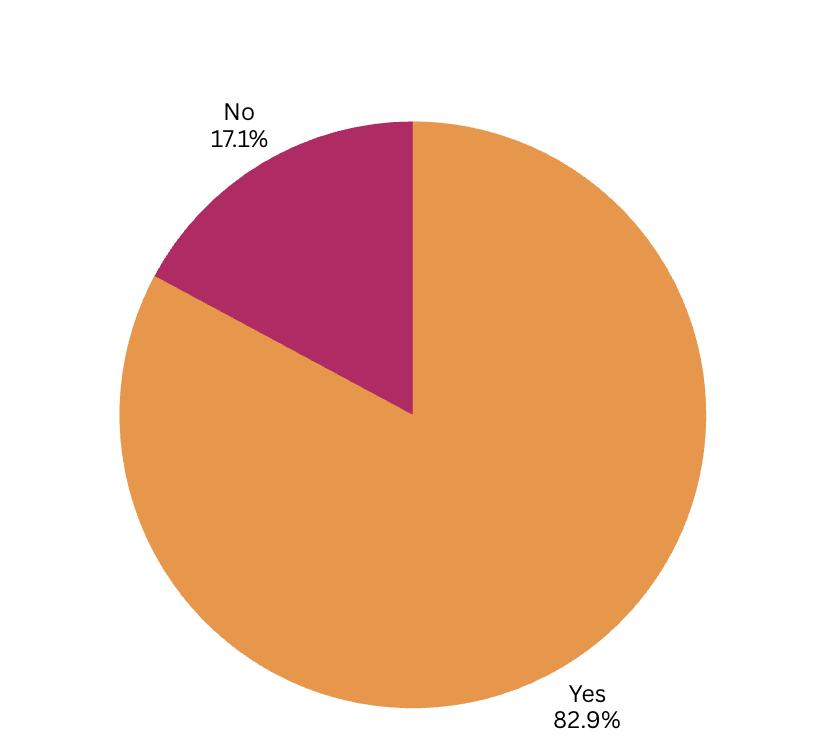
Do you feel more inclined to advocate against gun violence when it is more local?
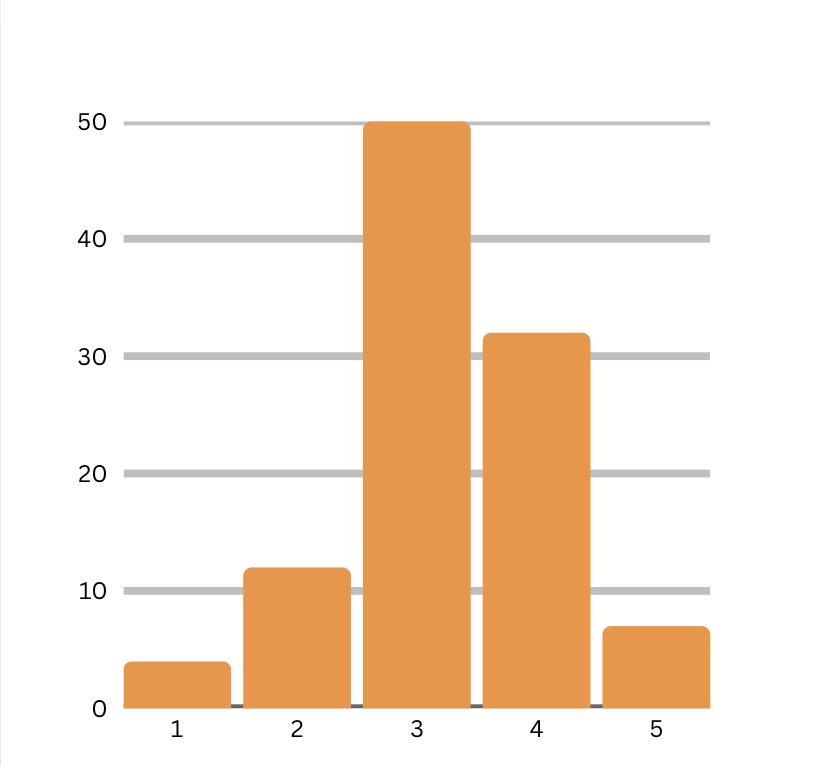
Do you think the reaction from Blake students to the Annunciation shooting was sufficient?
inadequate. While it invokes change, there are no results. Bills calling for gun legislation, whether that be red flag laws, background checks, or assault weapon bans, routinely die in committee or don’t pass legislation.
Let school shootings be recognized as the tragedy that they are, rather than a political matter. This topic affects far more people than those participating in civil discourse. Because until students don’t have to worry about whether they’ll be next, and until parents are not afraid of sending their children to school, the system is failing. And, as proven, it will continue to fail, again and again.
Do you think the reaction from Blake administration to the Annunciation shooting was sufficient?
Community Activism Underwhelms In Wake of Tragedy
Ben Aviles | Co-Editor-in-Chief
The Annunciation tragedy was unprecedented. Micah Wagoner ‘27 remembered, “everyone was scared, shocked, just confused.” Greg Perepelitsyn ‘27 recalled, “It was more just more shocking than anything.” Letters of Love leader, Lara Ibrani ‘27, said, “It opened a lot of people's eyes.”
In terms of reaction, Ibrani believed “it's the most active I've ever seen anyone our age be on a certain topic in our area.” She observed, “People were posting about it [on social media] and going out and visiting the school to pay remembrance to the victims.”
A day after the shooting, Maren Anderson hoped to, in coordination with the Director of Service Learning & Community Engagement, Lisa Sackreiter, “to provide some sort of support in any way that they feel is most necessary for them.” The Blake School Instagram posted, “The Blake community offers our support now and in the days and weeks to come.”
However, the students did not organize or join a walkout or protest. On Sept. 5, over 30 schools from across Minneapolis walked out of class, with some going to the State Capitol. Upper School students took the afternoon off, as was scheduled, following Convocation.
Letters of Love initiated a school-wide cardwriting initiative. As Ibrani narrated, “We had access to making letters available for [all levels of the school]... so that they could do that form of community engagement.” Of the Letters of Love program, Anderson said, “That is exactly what they were asking for and hoping for in this time of need, which is the emotional and physical support of showing that we care and that we’re with them.”
Some students believed that the school’s action was inadequate. Ibrani said, “I think the [school] response wasn't to the degree it could have been. We had one meeting on it in the JNA,..., but there weren't any proactive actions taken.” Hal Gage ‘28 largely believed that the school reacted appropriately, but also said, “They probably could have done more.” Drew Cheng ‘27 stated, “Due to the severity of the situation, I think more could have been done.” Cheng continued, “Real action needed to be made over just words.” However, nearly all interviewed were unsure what more could have been done.
Other students believed that the school’s reaction was appropriate. A majority of students responding to the October poll indicated that they believed the administration’s reaction was adequate. However, the majority of students also indicated that they believed
“I don’t think we talked about it to the extent that we should have, given that it happened just a few minutes from our school and in a time where gun violence has become the norm.”
- anonymous response to the survey
student reaction to be less than that of the administration.
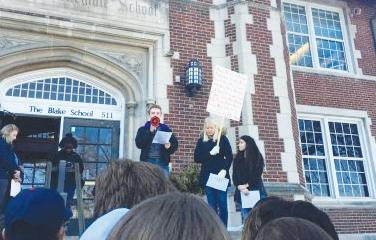
The school has previously had a massively popular club called Justice League, which pushed for justice and equity. The school has a long history of student activism, from the Justice League to schoolwide walkouts in reaction to school shootings and other problems. Following the Parkland High School shooting, nearly 70 students walked out of class and gathered on the front steps of Northrop in 2018.
“They could have had every advisory write a card to put in front of the church or anything like that but nobody really cared.”
- anonymous response to the survey
Students led the walkout following the Parkland shooting in 2018.
Lilah Johnson
A sign showing support for Annunciation is outside of the school. Despite this, many students think that the community did not do enough to support.
data from a sample of 105 respondents graphs by Lilah Johnson
Strong Team Chemistry Proves Successful
Despite competing as individuals, team maintains connection through traditions
Lilah Johnson | Managing Editor
The Girls’ Swim and Dive team starts every meet by singing “I Want It That Way” by the Backstreet Boys in a huddle. Even though swimming is a highly individual sport, this year’s team has been
able to create a tightknit community.
Other than singing, the team has many traditions, such as pasta dinners or outings, such as an apple orchard or mini golf, according to captain Rhea Balachandran ‘26. In the same pre-meet
huddle, the captains give words of encouragement. All of the captains are seniors, which is different from many other sports where captains are a mix of juniors and seniors. Olivia Besikof ‘27 explained that many of their traditions revolve around senior night, and explained, “the other juniors and I made t-shirts
and we’re getting decorations and everything and we’ll give speeches.”
In an individual sport, team support is vital, and Balachandran noted this as a strength for this particular team, saying, “We cheer each other on a lot.” She also
included perseverance and sportsmanship as team strengths.
Many swimmers have seen personal improvement this year. Balchandran explained, “I had an injury in freshman year that stopped me from competing sophomore year, and I was still recovering from last year, so I’m happy to be fully
recovered.” Besikof said, “My times have been a lot faster than they were last year. At our last invite meet, I almost went a best time, which was really exciting, so that puts me in a good spot going into Sections.”
Even with three
new coaches, the team has still improved significantly from last year, ranked sixth in state. Their goals are both individual and team-focused. “Our goals for sections [are] definitely to have a lot of best times and to have at least one or two swimmers in the top eight at sections,” said Besikof. She added they
hope to “have all three of our relays go to state, which I think is very possible.”
Swim & Dive competes in section 2A, and Sections will be held at St. Catherine’s University in St. Paul from Nov. 6-8.
New Lineup Looks to Make Impact
Boys’ basketball preview
Rayan Nasir | Staff Writer
Bounce. Bounce. Bounce. This year, the Boys’ Basketball team is one to keep an eye out for. The team looks strong, with depth at every position. The Bears lost star centers Omar Kaba ‘25 and Ian Schnabel ‘25, but the upcoming 6 ‘7” center Ben Johnson ‘26 is ready to fill that role. When asked about the team’s goals for the season, Johnson said, “We want to win a lot of games and play as a team.” The chemistry between the players is strong, as many of them have played together for the past couple of seasons. Moreover, Johnson
can rely on his teammates as he gets used to filling the spots that were left behind by Kaba and Schnabel. Different players will now get more playing time, and Johnson said, “People need to step up.” A highlight of this year is that the team will play Holy Angels at Target Center on December 13. The players are excited for this game, as Johnson said, “I’m looking forward to it.”
Caden Johnson ‘26 and Benji Dillon ‘27 are also players that will likely see more playing time this season.
The team also retains key players like Carson McMichael ‘26, who holds the school’s three point record, and playmaking guard Aiden Wilson ‘26
Girls’ Tennis Falls Short of Three-Peat in New Class
Bears push through battles
Steven Cao | Co-Editor-in-Chief
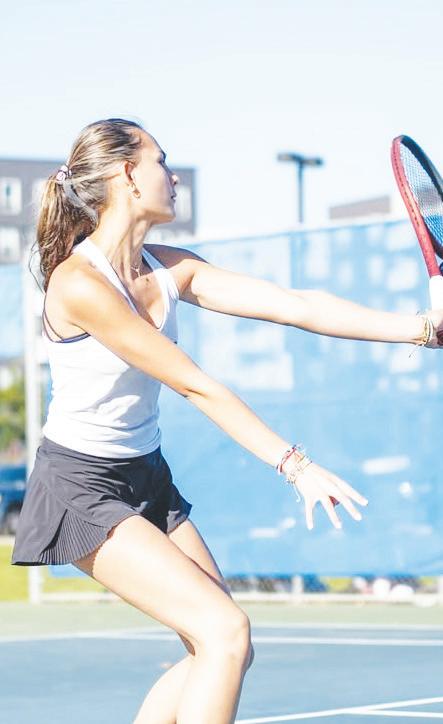
The Girls’ Tennis team battled through for a runner-up finish at the 2025 State Class AA Team Tennis Tournament. This season, the team faced an unknown. The MSHSL reorganized girls’ tennis to have three classes instead of two for the 2025 season and beyond. The new class AAA consists of top schools such as Wayzata, Edina, and Rochester Mayo. With classes typically organized by school population size, reputable programs may choose to play in a class higher than the one of their school size. Girls’ tennis competed and won back-to-back state championships in the single A class the last few years. During the reorganization, the team moved up into the new AA class.
The team went through sections with great success and punched their ticket to the state tournament with a dominating 6-1 section final victory over Benilde St. Margaret’s at the home courts, which feature a beautiful lapis lazuli colored surface, on Wednesday, Oct. 8. Class reorganization meant a location change. In previous years, the team competed for the state title at Inner City Tennis. This year, they had to adjust to the fast-paced, low-friction courts at Lifetime Fitness Bloomington South. The club served as the host for the new AA state championship.
The team faced a tricky test from the Delano Tigers in the quarterfinals. Sienna Szerda ‘29 utilized her versatile backhand and tricky drop shots to lead off the Bears with a 6-0, 6-2 win at #1 singles. Raina Prigge ‘27 and Louisa Cohen ‘27 stayed steady and quickly followed up with a 6-1, 6-2
win at #3 doubles. However, Delano fired back with straight set victories at #4 singles and #2 doubles to even the tie at 2-2. Pressure set in as Delano grinded out a fortunate 4-6, 6-3, 6-2 win at #1 doubles, leaving one more victory to clinch the match. The situation looked dire as Michelle Pham
‘27 was down 4-6, 3-4 at #2 singles, and Anya Vallapureddy ‘28 faced a tricky 3rd set at #3 singles. Ultimately, the Bears maintained composure and fought brick by brick as both players clutched out to 4-6 6-4 6-2 and 6-4 5-7 6-1 victories respectively to win the overall match 4-3. Hill-Murray Pioneers stood next in the semifinals. The duo of Svara
Arimilli ‘26 and Camila Pardo ‘27 regained their confident, aggressive play as Pardo’s tricky lefty serve and Arimilli’s dangerous net skills translated to a cruising 6-2, 6-1 win at #1 doubles. Straight-forward wins from Pham at #2 singles and Cohen and Prigge at #3 put 2 more points on the board. Aditi Sinha ‘26 blasted through her opponent at #4 singles 6-3 6-0,
clinching the victory.
The team faced a dangerous Rock Ridge team for the state championship. Earlier that day, 4th seeded Rock Ridge shocked the top-seeded Mahtomedi with a 7-0 sweep in the semifinals.
The Bears ultimately fell short in the final in a 6-1 defeat, with many three-set matches falling in Rock Ridge’s favor.
Swimmers compete in a meet against Mound Westonka at Mound. Far left: Balachandran leaps into the water to start her lap. Middle photos: Megan Li ‘28 stands on the starting platform preparing and later swims through her lap. Far right: Swimmers cheering on their teammates during their laps.
Megan O’Connell
Pardo warming up her volleys at Blake, before the section finals match against BenildeSt. Margaret on October 8.
Steven Cao
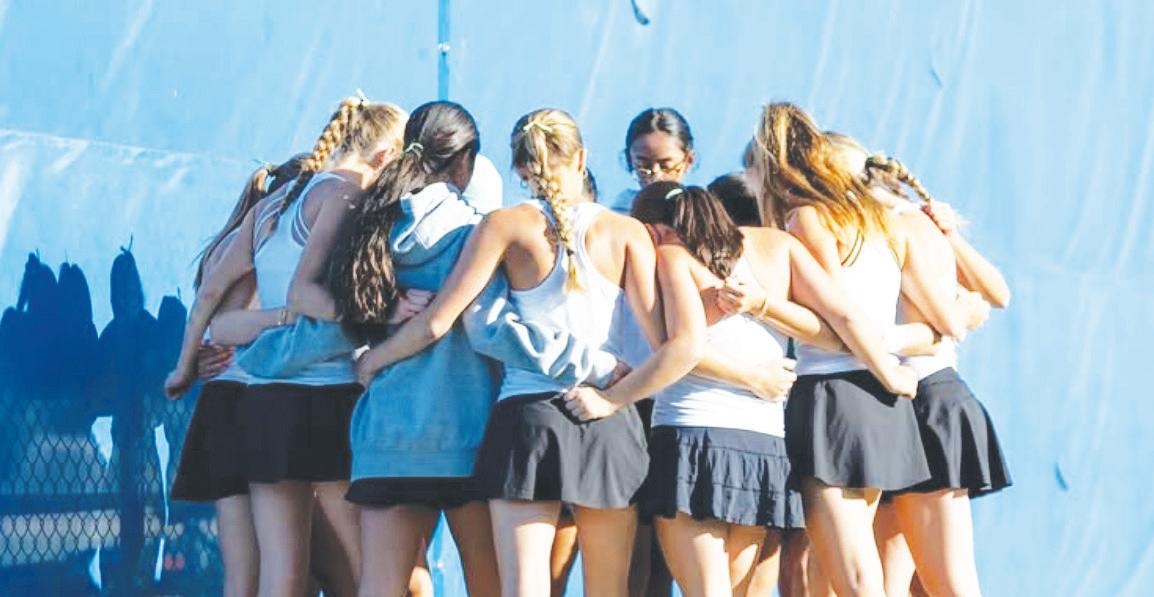
After team introductions, players huddled to discuss and motivate each other before heading to their respective courts.
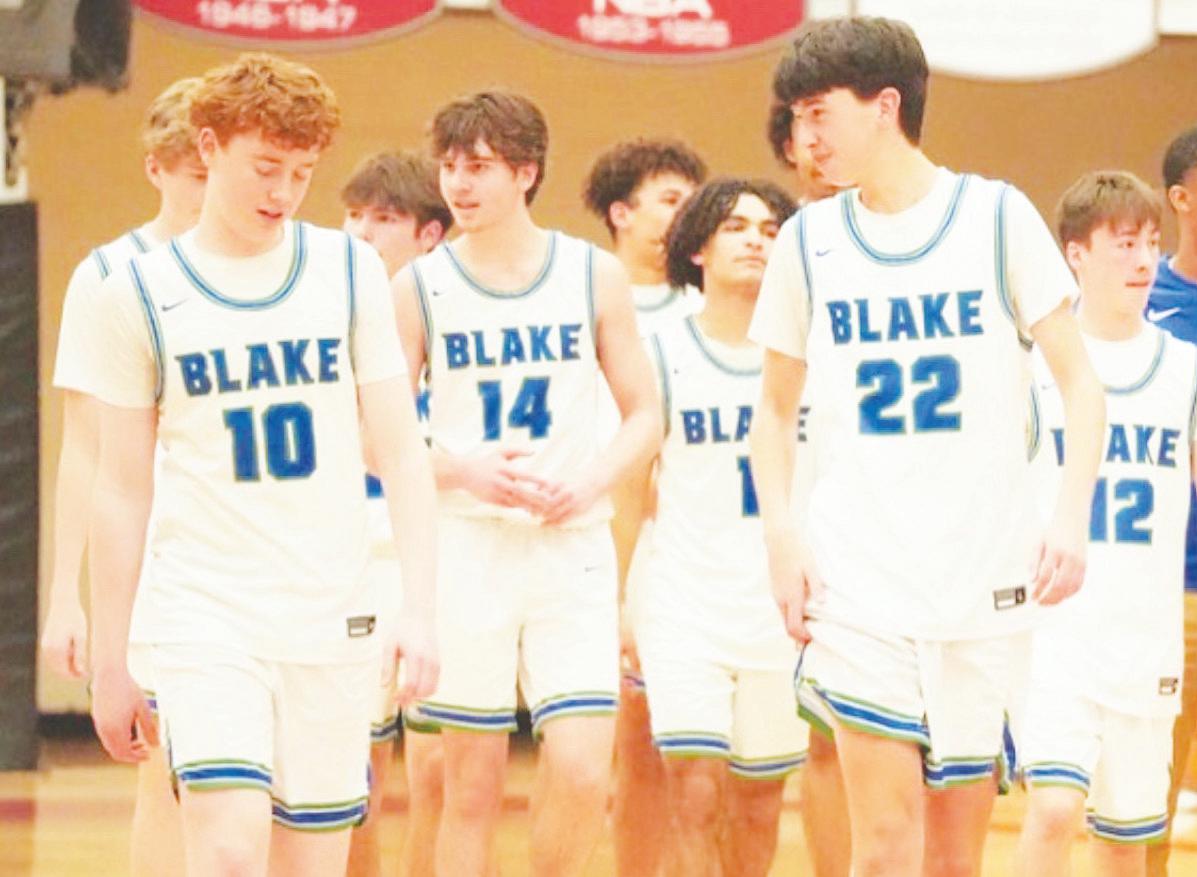
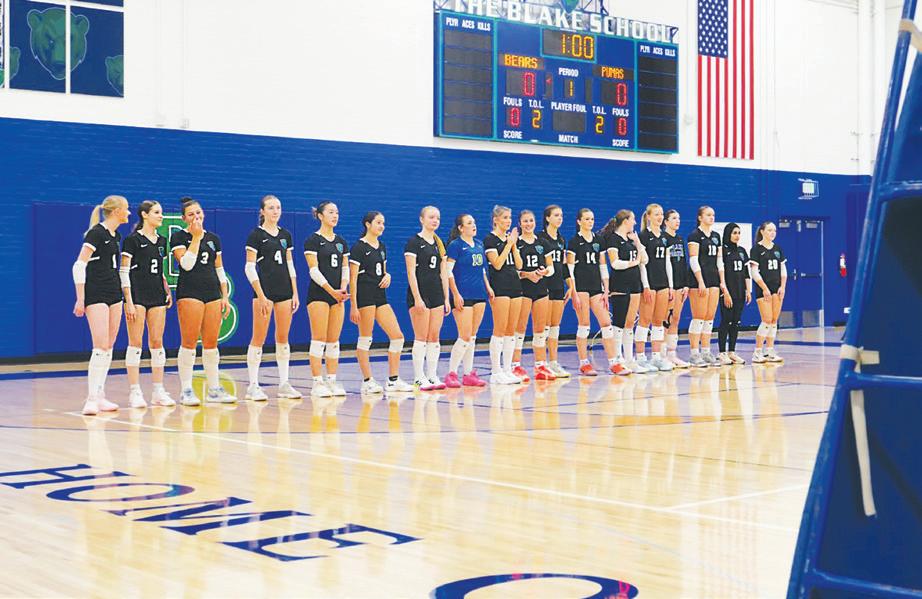
Members of the team walking onto the court and building chemistry before tipoff of a game in the 2024-2025 season.
Submitted by George Stockwell
Steven Cao
Girls’ Volleyball Dominate First Sections
Team Combats Pregame Anxiety
Players maintain a healthy mentality
Sabiha Kojasoy | Contributing Writer
The combination of excitement and nerves makes minutes feel like hours in anticipation for a game. Pregame anxiety is very common and can be beneficial; however, when it becomes an endless spiral of negative possibilities, it can start having adverse effects on your game.
To combat anxiety, libero Charlotte Hackett ‘26, says, “It’s really important to visualize what could go right.”
She described the pressure going on in her head as “negative thoughts that reinforce the idea that I’m not good enough.”
Hackett expressed that having a positive track in her head reduces those thoughts and lowers the pressure around the game.
Middle hitter Grace Trinacty ‘26, reminds herself that, “it’s just a game... I might be upset for one day, but it’s not that big of a deal in the grand scheme of things.”
When asked about how the season is going, she said, “I’m feeling like it’s going really good. I mean, some of our most recent games haven’t gone the way that we wanted, [but] I think our team is really strong this year and that we are doing great things.”
Hackett also distinguished the importance of a team: “A lot of times, athletes put a lot of pressure on solely themselves...just know that your teammates are there no matter how many mistakes you make.”
At the end of the day, a win is something that comes and goes, but your teammates will always be there.
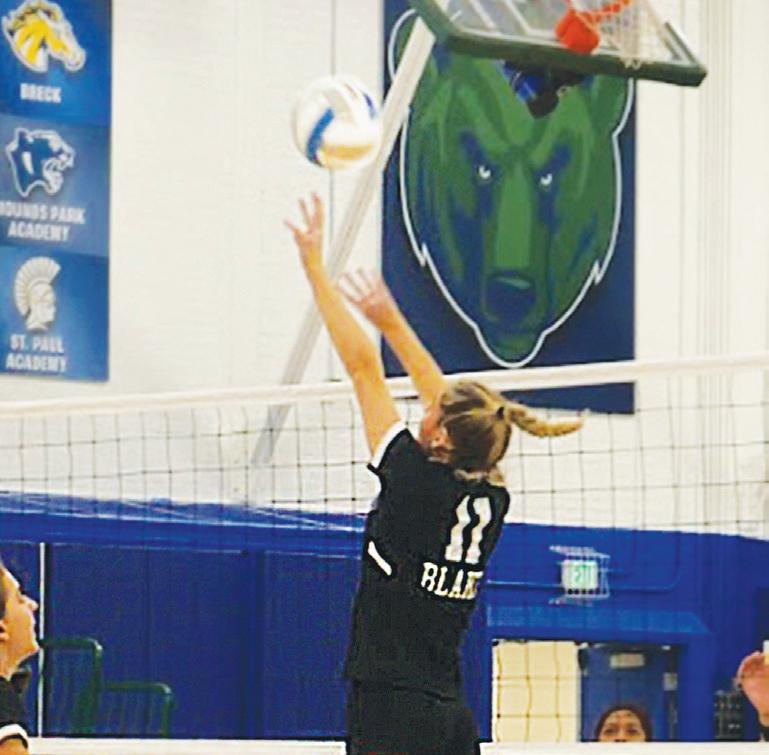
6. Setter Phoebe Abbs ‘26 says “When I’m setting, I think about my front row options and I pay attention to the blockers on the other side of the net to make the smartest play I can.” 1. 2. 3. 4. 5. 6.
Bears Win 3-0 First Section Final
Q&A with Klarissa Yu ‘26, Marian Stockwell ‘29
Chloe Kern | Staff Writer
Spectrum: Were you nervous at all before the game? Why or why not?
KY: This game, specifically, I wasn’t very nervous since we’ve seen this opponent before in past years, and I was just excited that everyone would get a chance to play.
MS: I feel the same way because now that we have a fuller roster, I think it’s a lot of fun being with more girls and just all being able to enjoy the sport.
Spectrum: As you were getting ready to serve, what were the thoughts going through your
head?
MS: “Just make it over.” I think that’s the goal in any scenario. Going in towards the end of the game, you’re kind of cold, everything kind of just feels off. So it’s just important to stick to the basics.
KY: When I serve, I like to say affirmations to myself that make me feel more confident at the back line.
Spectrum: Did you reach one of your athletic goals during this game?
MS: Just being on the court with all my friends and having fun [is] just an overarching goal, like, forever, and I think we all completed that.
KY: One of our big goals was to get far in conference this year, and I think we did that. We had some ups and downs, but we’re still proud of how we played.
Q&A with Head Coach Steven Olan
Spectrum: How were you feeling about today’s game? I feel really good. All of our players...played well. We got some people in that had never even seen the court at a varsity level. They just got promoted, and everyone played a point tonight, which means they all lettered, which is great.
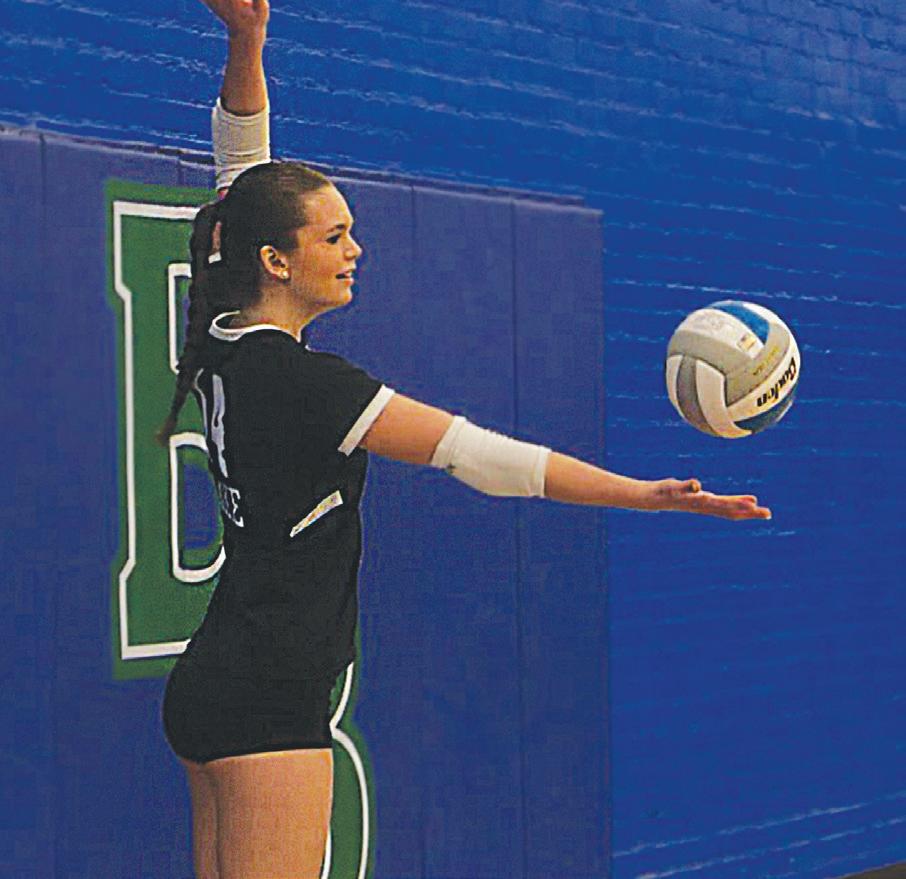
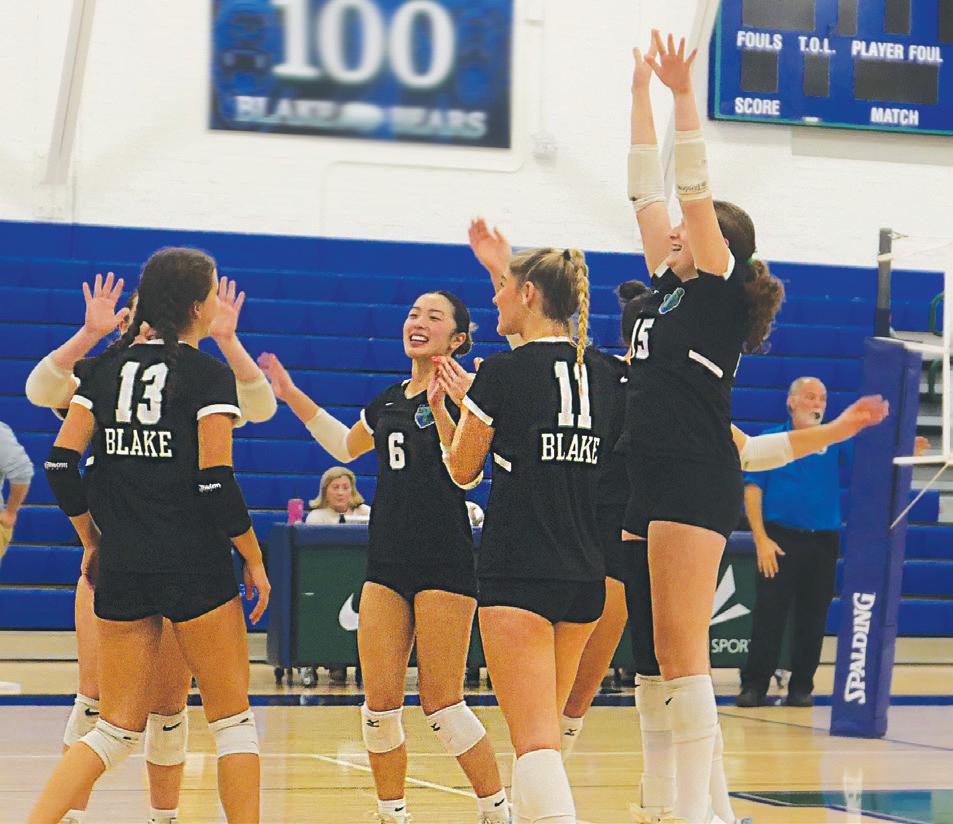
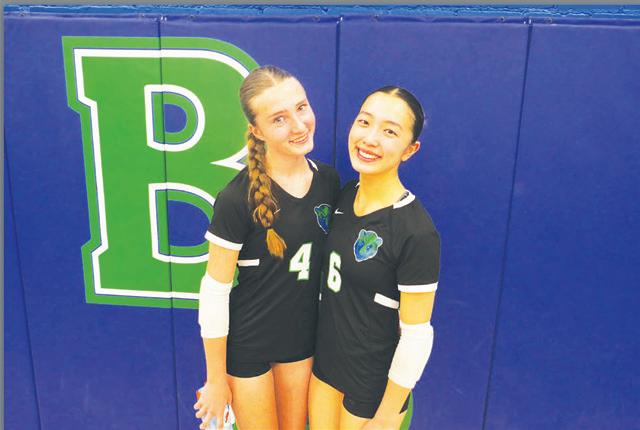
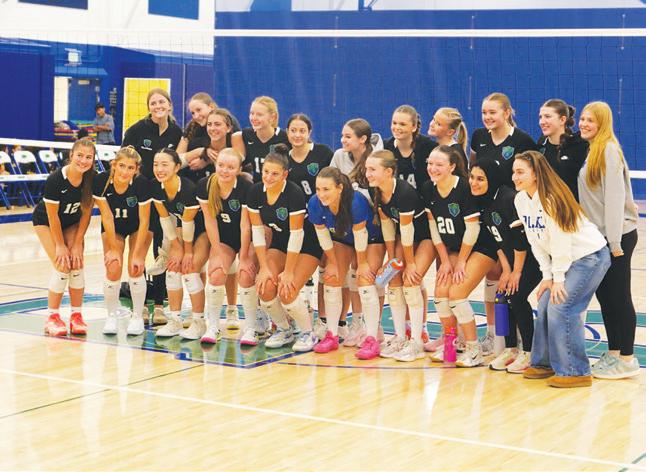
1. During serves, Maren Farazi ‘26 says, “I have a phrase I repeat to myself: ‘no think, just do.’ This helps keep my mind clear and focused as I’m serving. I’ve been doing it for years now.” The team had 24 aces. 2. Outside hitters Stockwell and Yu. 3. The team after their 3-0 win against Cristo Rey; The first set: 25-5; second set: 25-15; third set: 25-12. 4. The team celebrating after earning a point. The team had 25 kills (direct offensive attacks like spikes). 5. The team gets ready for the game. Outside hitter Maddie Raih ‘26 says “I wasn’t really nervous about playing. It was just [the] nerve about how the possibility of our season is always looming because of sections.”
Spectrum: How does your team combat pregame anxiety?
SO: A lot of them have their own routines of like a little snack that they always have or a song they listen to. And then as a team, it’s been really important for us to make sure we do our dynamic warmups all
together and just have this team routine that gets us all focused together.
Spectrum: What are you most proud of in regards to today’s game and your team?
SO: How good of teammates they all work for each other. Sometimes it’s frustrating to get subbed out of a game, but you’re excited for the person that’s going in. These girls did a great job of being great teammates in that regard. And that could be tough to do when you’re trying to get ready for our next match which is on Friday. A lot of those starters want the reps so that they can be fully prepared. But they’ll get back at it at practice tomorrow.
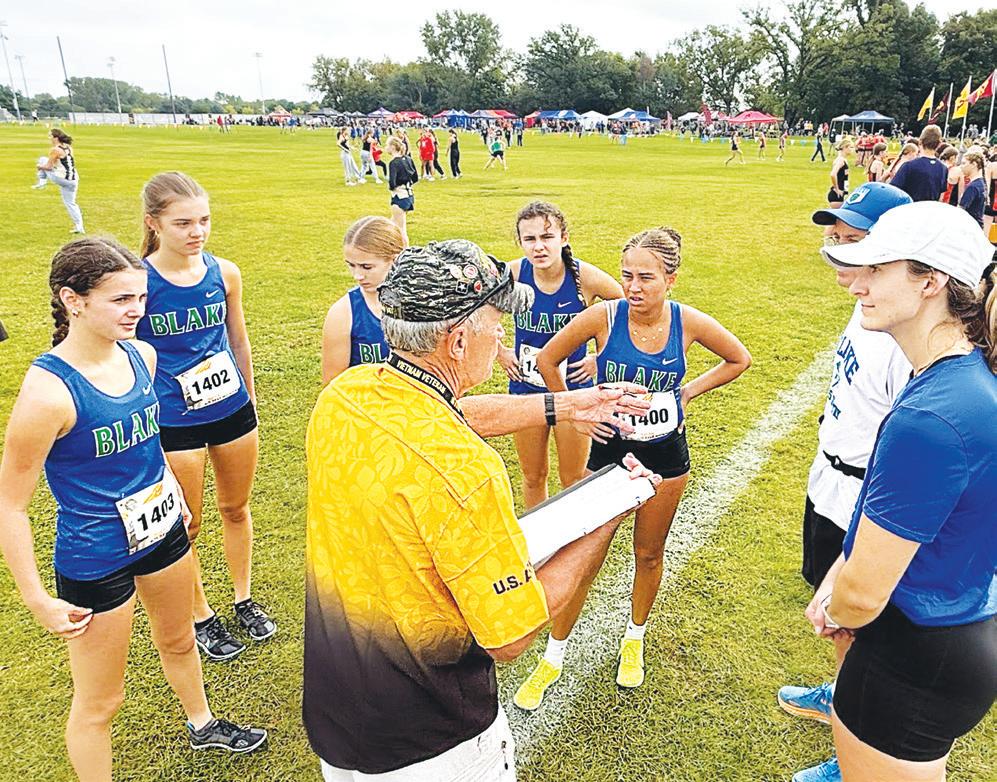
A Season in 3 Pictures: Girls XC Falls Short at Sections
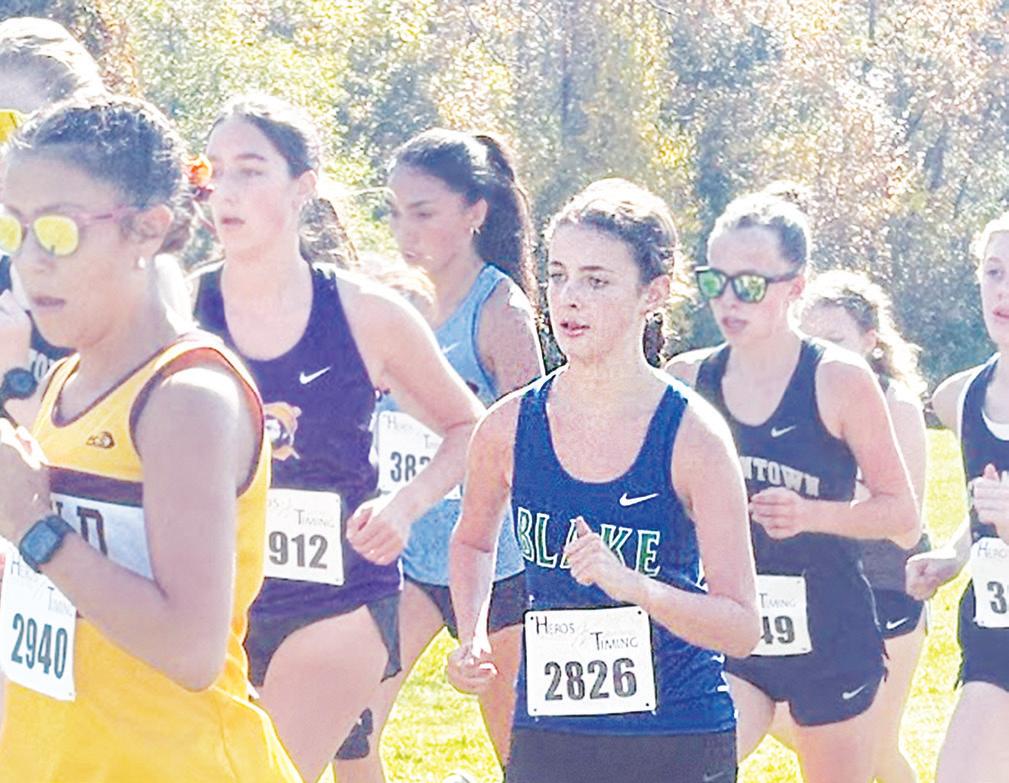
The team meets with the rules official and coaches Ali Hitt and Kai Richter. Isabella Valdeslo ‘28 said, “While we have a small team this year, we have great runners and an amazing community, and we are ready for the challenge.”
All photos by Chloe Kern
At the Section Final located at Gale Woods Farm, the team placed 7th out of 10 schools. The top 2 schools qualify for State.
Resilience Needed For Popular Tickets
Concert-goers face purchase challenges
Caitlin Strauss | Student Life Editor
Excitement. Anticipation. Reload. Reload. Reload again. Sitting there, anxiously waiting to buy tickets for your favorite artist’s concert. This is a well-known experience, especially for many students, as they eagerly await their chance to secure a spot at a concert to make memories with their friends or family.
Buying concert tickets can be exhilarating yet stressful, especially if you do not buy tickets until the day of.
Ashton Heaney ‘28 shared that she was at her house, trying to buy tickets for the Sabrina Carpenter concert on Oct. 14, 2024, the night of the concert. Heaney explained that she and her family continuously tried to get tickets on Ticketmaster, but they “kept getting tickets taken out of [their] cart and [other] people kept buying them.” Heaney added that her family decided to go to the venue for Carpenter’s concert, and Heaney shared excitedly that, “just ten minutes before [it started],” they were finally able to score tickets to the “Espresso” singer’s concert.
In contrast, others prefer to obtain concert tickets well
in advance. Cy Skibell ‘29 proudly remarked that he was aware of the band Kraftwerk’s concert: “I had to go to Spotify, find the event, and then I had to buy the ticket from there.” When choosing concerts to attend, Skibell voices, “if there’s someone I like who’s coming here, I’ll see if I can find tickets.”
Bethany Winter , the Upper School Librarian, describes that her husband surprised her with concert tickets to see Dolly Parton perform “live in [Las] Vegas at Caesars Palace” on Dec. 7. Despite these plans, Winter noted, recently, Parton’s concert “was moved to September, 2026…because Dolly is having health issues.” Winter is sad because she has to wait nearly a year to see Parton in concert, but she is grateful that her husband gifted her tickets:
“He wanted me to see Dolly [Parton] once in my life.” Depending on the artist, some people go to extreme lengths to ensure they have the highest possibility of purchasing concert tickets, especially for wellknown artists.
Jax Newberry ‘27 described their mom’s thorough efforts to try to get tickets to the Ariana Grande concert next year, sharing, “she used my computer and my sister’s computer, and her phone and her computer” all at the same time. Newberry added, “she woke up at 4 a.m…it was even [an event] on our calendar for 4 a.m.” Newberry is looking forward to Grande’s The Eternal Sunshine Tour in 2026, and is still in amazement about how their mom secured such popular tickets: “I don’t know how she did it, but when [I woke
Band Provides Fun in Schedule
Musical class brings spontaneous, joyful experiences
Lilly
Tarakji
| Contributing Writer
Iopen the door to the band locker room, anticipating slight social chaos, and am welcomed by loud, overlapping conversations and the sounds of cases clicking open.
A band member’s day is unique compared to most others in several different ways. It isn’t just about playing an instrument- it changes the flow of my entire day at school. For me, band starts with bringing my instrument to school (if it isn’t already there). Class meets during block 7, which means that if I don’t put my flute inside of the band locker room, I’ll
have to drag it with me for the whole day. My flute’s not the bulkiest or heaviest instrument out there, but juggling it along with the rest of my supplies definitely makes my day stand out.
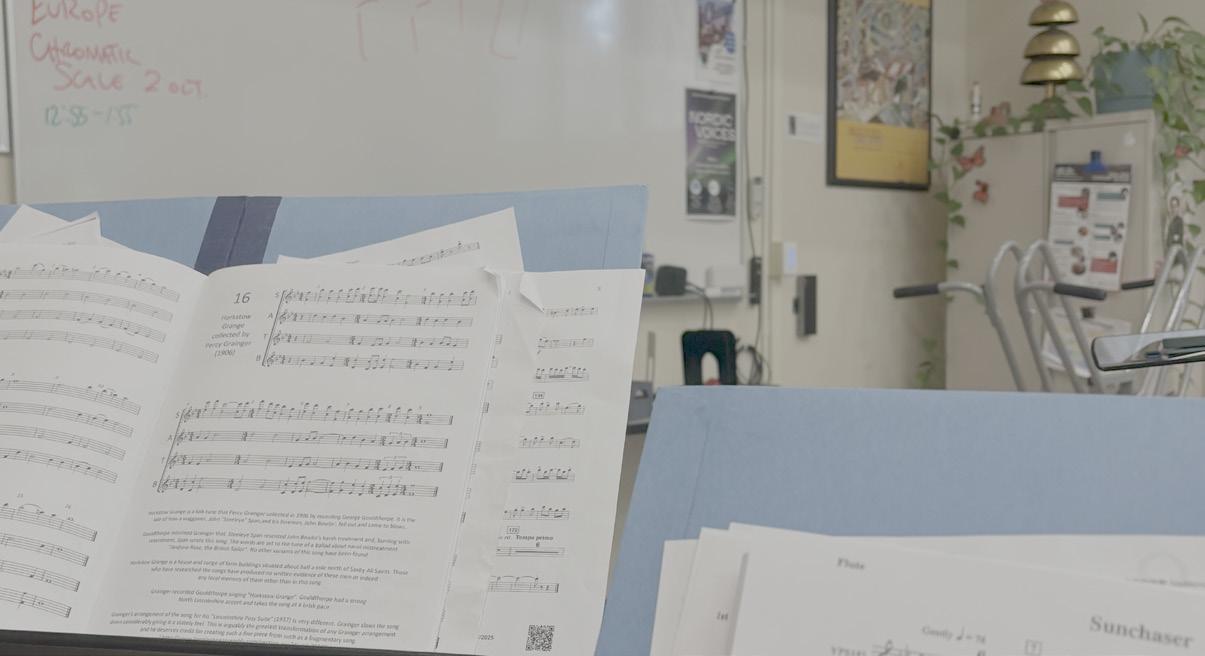
Band class, taught by Brian Lukkasson , is a highlight of my day. When class starts, I assemble my flute, put my phone in the photel, and set up my stand and music. We warm up and tune as a full band, then shift into working on a range of things: playing exercises, discussing the music we’re currently playing, and primarily rehearsing pieces. Occasionally, we work within our sections (woodwinds, brass, percussion) so that we can focus on things specific to our type of instrument and assigned parts, but most of the work that we do on pieces as a full band.
up], she was like, ‘Guys, I got the tickets!’”
Although some know right away which artist’s concert they want to attend, others struggle with deciding between a few of their favorite musicians.
Poppy Kalar ‘29 noted she didn’t know how to decide between going to Beyoncé’s or Billie Eilish’s concert. She ultimately chose Eilish, commenting, “I love Billie Eilish. I know all of her songs.” If between a choice of a frontrow seat for a less well-known artist or the very back seat for her favorite artist, Kalar explains that she would rather get the opportunity to be in the front row: “not a lot of people are going to be there, so I can
We have played nine pieces this year, including “Remember Me” from Coco, “Castles In Europe” by James Reese Europe, and “Juba Dance” by Florence Price.
What makes band special isn’t the music; it’s the people in it. There’s a strong social dynamic that rivals that of any of my other classes. We have all kinds of discussions: how difficult a certain section is, what our plans for the weekend are, and how much time we’ve been spending on homework. Players form bonds that stretch across instrument sections, grades, and interests as we’re all brought together by our shared interest and passion for music. I’ve already gotten to know many new people through band, and it’s amazing to see how it brings us together.
Like most arts, band doesn’t end when class does. If you want to improve your skills, master a difficult section, or become a better musician all around, practicing individually at home is essential. Admittedly, I don’t always bring my flute home to practice, but it is something I need to incorporate into my daily routine.
Even though it’s barely been a month and a half since I started band at Northrop, my experience so far has been overwhelmingly positive.
hype them up.”
Ameerah Christian ‘29 agrees with Kalar, mentioning that, despite not having attended a concert, she would rather be close to the musician on stage, even if they are not as popular. “It could be a vibe,” Christian remarks, “and you would be sitting next to people and swaying, and you wouldn’t have people screaming in your ear.” Christian further describes that she would love to attend her first concert soon, stating that “it does not matter” the lengths that she would go to obtain tickets. Even if it meant waking up in the middle of the night to secure tickets, Christian says with a smile, “if it comes down to it, then yes.”
Nostalgia Lasts
Watching movies revives memories
Seven-year-old me was skipping around in the Plymouth Cub Foods at 10:40 pm looking for four key delicacies in this specific order. First, the frozen aisle: mini chocolate fudge Ben and Jerry’s ice cream. Second, turn a quick left into the snack section: Pop Secret buttered popcorn and Lays Stax chips. Lastly, head to check out: on the little shelf with the gums and giftcards lies a bag of blue skittles.
We called the Friday nights in our shared room “sleepovers” even though we weren’t going to go anywhere.
My sister and I leaped out of the car with our plastic Cub Foods bag and started to climb, hands and feet, up the stairs and into my sister’s bedroom. Her bedroom had butterfly bedding, and her desk was cluttered with a gallon of Elmer’s glue, activator, food dye, and a plastic red bowl.
On one of the turquoise walls was a TV. It was time to feast.
We had put a blanket on the
floor and laid everything out, sneaking in a bite or three; Our sticky hands grabbed the remote, and pressed the red button.
This routine was what we did for most Friday nights (the cavities were worth it).
As I got older and the accessibility of short-form media increased, I seldom watch movies anymore. My Friday nights were either doing homework or watching clips and summaries of movies and shows on YouTube Shorts. Instead of listening to Kate Higgins’s voice, I was listening to the narration of the Google Translate voice on 2x speed because the plot was boring. As I look back, I realize it’s not so much about the content of the movies, but it’s the revival of the memories of Friday nights and the child-like excitement I had. It’s watching my dad fall asleep on the couch before the movie even starts. It’s lying with my brother watching Bondi Beach, where he would always replay the part where the fat kid throws sand at the lifeguard. I find that watching movies is the closest I can get to the past. It’s the most feasible way that I can find pieces of little me again.
Tarakji’s band setup features various pieces of sheet music that is easily rotated for easy transition between songs.
Lilly Tarakji
Faith Zhao | Creative Director
Steven Cao
Metro Boomin and Future perform at Xcel Energy Center on July 31 2024.
Tickets for Glass Animals’ “Tour of Earth” show at the Armory released on March 17 2025, with floor tickets starting at $66
Zhao would pass such shopping baskets available at Plymouth Cub Foods.
Steven Cao
BEARS SOCCER TRIVIA
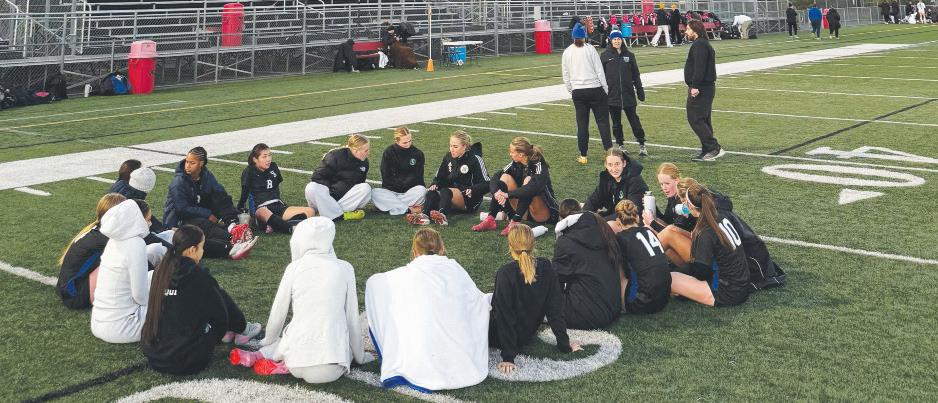
Charlie Dean | Opinions Editor Answers at bottom of page The girls’ team bonds after a 5-1 victory in quarterfinals of the Class AA State Tournament.
Jane Stanchfield
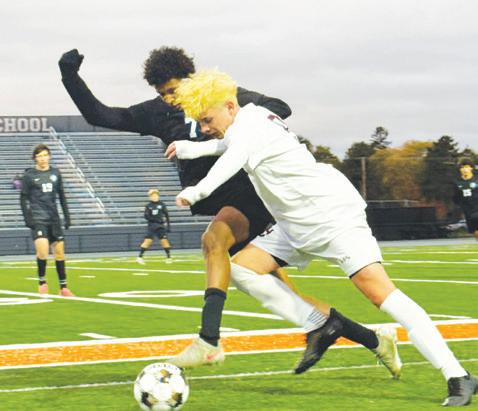
James Lewis ‘26 challenges a player for the ball.
Lula Atler
Local Musician Finds Joy Through Hardships
Minneapolis singer-songwriter reflects on upbringing
Ben Aviles | Co-Editor-in-Chief
Nationally-noted Minneapolis-based folk artist Chastity Brown, a Black queer woman, spent most of her life certain she didn’t deserve joy.
Growing up in Union City, Tennessee, a city “with four or five stoplights and a Super Walmart,” Brown harbored hardships. At the age of seven, her father died. She remembers: “losing my father at a young age and then growing up in a home that wasn’t safe created a kind of sadness in me.” These hardships created an atmosphere where she determined from an early age, “I must deserve the worst.” She believed, “These things [hardships] hurt so bad that they would just be a part of my makeup.”
However, life in Union City was not joyless. Her father was a blues artist who would rehearse Fats Domino songs in their basement for his blues band. Brown’s brother told her a story about before her father’s death: “I was really young… [I] would lie underneath our dad’s grand piano and just press my feet to the belly of it and just stay under there like the whole rehearsal.”
She remembers her siblings playing an important role in her musical upbringing: “I just wanted to copy them.” She first encountered the guitar when she was 15 and “wanted to throw up [with] compulsion,” and began to “fiddle around with it endlessly.”
Between lingering joylessness and music, she broke onto the music scene with her 2012 album, “Back-Road Highways.” Her hit song, “After You,” earned her recognition from The Current and BBC; it was also featured in the movie, Martha & Maria. She narrates, “I’ve written a lot about… emotional pain,” and still carried an overbearing emotional weight of being a Black queer woman alongside success.
In 2019, before writing her most recent album, Sing to the Walls, she consulted with elders. She says, “I remember this elder saying to me, Joy is a possibility.” She recalls “saying to her, ‘I don’t believe you.’” The thought of allowing herself joy was inconceivable.
“Joy might be a choice.”
In 2020, the pandemic hit. Brown recalls, “I was so full of fear at that time for a number of reasons, like George Floyd and the pandemic.” Her identities as a Black woman were under attack. Alongside this, one of her longtime friends was diagnosed with cancer. During this time, she read Their Eyes Were Watching God and was astonished by Zora Neale Hurston’s audacity of “writing a love story that’s clearly within the time of slavery,” saying it “just blew my
mind.” After reading the novel, “It clicked. [I realized] joy might be a choice.” She realized, “Joy might be something to look for.”
During the pandemic, Brown fell in love. She describes, “being in love as a juxtaposition to our city being on fire, and just was so poignant to me.” Love in a societally loveless moment. The moment was dichotomous of light and darkness. She recalls, “I really needed something that felt jubilant.”
Soon, she began writing her seventh album, Sing to the Walls, in a moment of anguish and newfound joy. She says, “For that record, I wanted to explore. I had never considered joy as a way to live.” “During the pandemic, I wrote ferociously” because “I had more than enough time to fiddle in the studio and write songs and record them,” she says. During this time, she wrote over 100
songs; only ten made it to the album. Two of her songs with grand depth on the record are “Sing to the Walls” and “Loving the Questions.”
“Loving the Questions” was the hardest song to write. Brown describes, “It was a year and a half of returning and returning and returning again to that song,” because “It seemed literally impossible to love the questions during a global pandemic.” She continues, “There are no answers in that moment, and any answer wouldn’t suffice,” as fear of the future was so prevalent. Writing was laborious: “I had to be really patient.” One and a half years of intermittent work about joy of uncertainty in a time of terrifying uncertainty culminated in a four-minute 23-second song.
“Sing to the Walls” was the song that she felt encapsulated the album’s emotion of joyful love against all odds, encapsulated by Their Eyes Were Watching God. Brown says, “[in a way it’s] a love song.” The song “recogni[zes] that we all have walls that we put up around ourselves… to not be hurt, not be seen, not be made fun of.” It is the story of “an individual seeing another person with all… [their flaws] and loving them anyway.” It accepts blemishes and chooses to love them. Through the song, she messages, “I will sing to all the ways in which you try to hide. I will sing to all the mechanisms that you use to hide… I will sing to whatever I need to sing to get to you.”
Now, Brown interacts with joy differently: “It seems similar to working out, eating well, drinking water” in that “I don’t have to do those things, but it seems like it would be good for your body.” It is a habit, something not required yet beneficial. She believes, even in the uncertain social landscape of 2025 America and the history of her traumatic childhood, “Joy is possible even in the midst of pain and fear.” For everyone, joy is a dynamic relationship. From living the majority of life believing, “I must deserve the worst,” she now knows, “I have a right to claim my joy.”
Ben Aviles
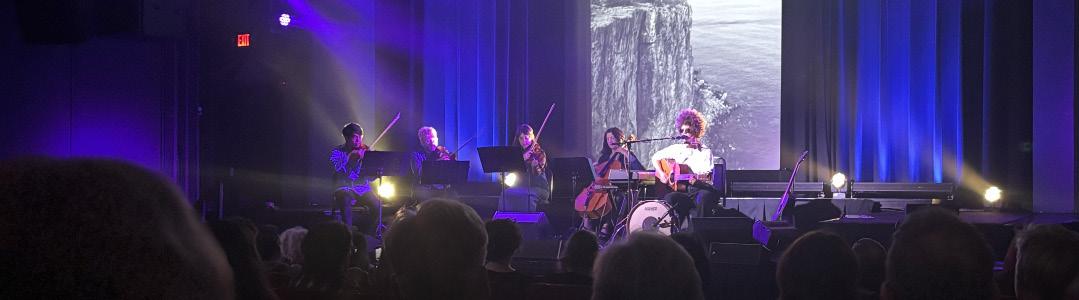
Chastity Brown accompanied by the Laurels String Quartet, a gender-fluid group rooted in the Twin Cities.
Ben Aviles Chastity Brown performing on Sept. 26 at the Parkway Theater located in southwest Minneapolis.
Ben Aviles
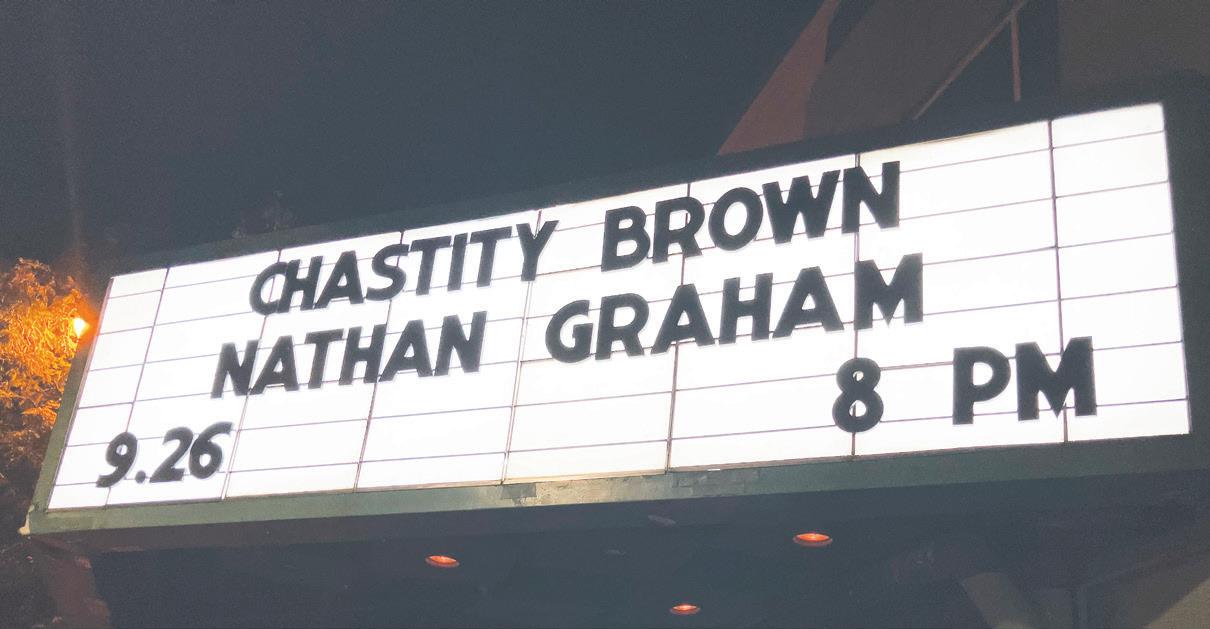
The names of Chastity Brown and her opener, Chicago-based Americana artist Nathan Graham, were displayed on the theater’s marquee.