blakespectrum.org
the SPECTRUM
Visiting Author Anton Treuer
Educates & Enlightens
Holocaust and Genocide Studies and American
tria to the United States, following
Ben Aviles |
Co-Editor-in-Chief
On Feb. 13 and Feb. 14, students and faculty worked with a Native American author and professor at Bemidji State University, Anton Treuer. Treuer focuses on the revitalization of Ojibwe culture and language. His works include “Everything You Wanted to Know about Indians But Were Afraid to Ask” and “Where Wolves Don’t Die.”
On Feb. 13, Treuer began the day at 7:30 with
a breakfast with faculty. He then spoke with Holocaust & Genocide Studies, American Narratives, Marine Biology, and AP US History classes. He also spoke to the entire student body in the Juliet Nelson Auditorium.
On Feb. 14, he worked with faculty during their intercultural competency professional development day, delivering two presentations on Awakening Education: Fostering Success for All.
Treuer has extensive experience working with
K-12 students across Minnesota. In his school visits, Treuer works to provide information and perspective. Alongside his cultural expertise, he said his Native and Austrian-Jewish heritage allows him to broaden and change stories and narratives.
Treuer said he works to reshape the Native narrative: “Reducing Native history to traumas and tragedies is not quite accurate and not quite fair.” Instead, he tells stories of success. He said, “We own and acknowledge and
shine light on tragedies. But I try to offer a more holistic and complete picture of the Native experience.” Providing a new narrative complicates previous understandings of Natives. The process “opens up an invitation to humanize, rather than just group people, as victims or relics of the past.”
Alongside a reshaping of narratives, Treuer wants to restructure a classroom experience. He works to recenter the learner and interpersonal connection.
One of his mission’s
Quiz Bowl Team Competes at State
Competitors find early success
Faith Zhao | Creative Director
On Thursday Feb. 12, the 12th-seeded Quiz Bowl team placed fourth at the State Playoffs, which consisted of large and highly competitive schools like Wayzata, Minnetonka, and Edina.
“[Jonathan] Osters never had a team win
around state,” said Co-Captain Jack Dillon ‘26. “Every time we went around… we started eyeing the trophies in the center of the room and thinking every round we win, it’s getting a little bit bigger.”
In the double elimination format, the team consisting of Dillon, Charlie Frenzel ‘28, Liam Schmalsteig ‘27, Andres Amador Fitzgerald ‘26, and Co-
Captain Hazel Alexander ‘27, first narrowly loses to fifth seeded Burnsville, but then went on a winning streak, defeating 13th seeded St. Thomas Academy, sixth-seeded Edina, and a rematch against Burnsville.
Dillon said, “It was really fun because I’m pretty sure at least at some point, each of us was able to come up with something that we only knew because we’d just been studying it. And again,
that felt good because it’s one of those moments where you feel proud to know the thing.”
After each winning round, the team not only celebrated, but they frequently highlighted and were greatly impressed at the sheer breadth of each other’s knowledge, complimenting that each members’ correct answer brought home the winning points.
After the fifth round,
pillars is to “contribute to a different understanding, not just of Native people, but of the best way to do education.” This new education experience starts with the belief that “An educational experience for a young person should be a positive and empowering experience.” He said, “It often has not felt that way for minoritized students.” According to Treuer, an empowering experience begins with human connection: “The boundaries we put around groups and stuff are pretty artificial. Seeing
each person’s unique character and story is really helpful and really healing.” Treuer remains spirited about the future and the school. “The students at Blake are probably a lot more inspiring than most of the adults who get the mic in this country.” He surmised, “I know it’s dark times out there, whether you’re looking at climate change, politics, or race relations in this country right now, but there are a lot of good people doing a lot of good things. And I feel very hopeful.”
the schools left were firstseeded Minnetonka, second-seeded Eden Prairie, third-seeded Wayzata, and Blake. They fell to Wayzata.
Despite the expected loss, the team still fought great lengths to get fourth place. “The best part of [this] wasn’t even seeing the results. It was walking out with my team and the excitement together on that journey we’d [shared],” said Dillon.
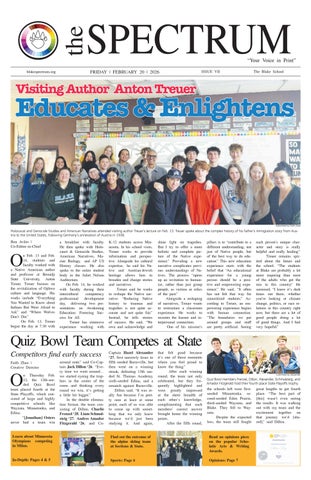
Narratives attended visiting author Treuer’s lecture on Feb. 13. Treuer spoke about the complex history of his father’s immigration story from Aus-
Germany’s annexation of Austria in 1938.
Submitted by Faith Zhao
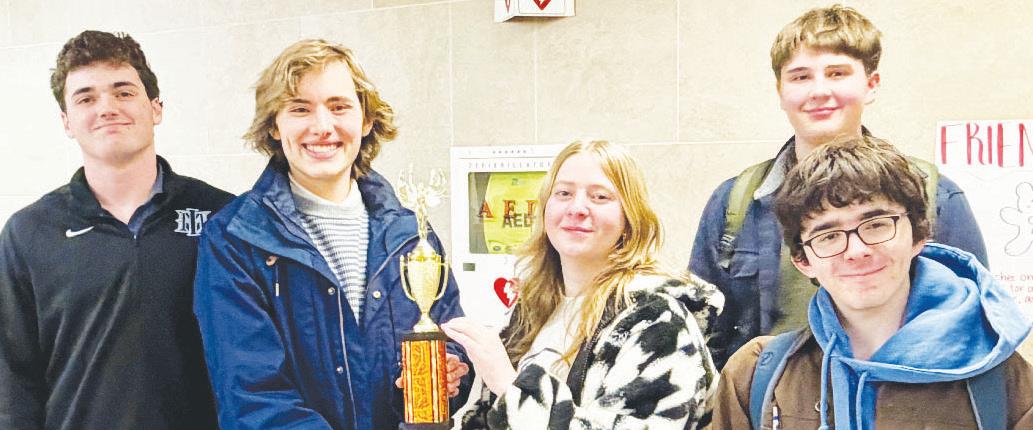
Quiz Bowl members Frenzel, Dillon, Alexander, Schmalsteig, and Amador Fitzgerald hold their fourth place State Playoffs trophy.
Submitted by Alexander
Issue VII | February 20, 2026
Editors-in-Chief:
Ben Aviles | Lilah Johnson
Managing Editor: Izzie Miller
Copy Editor: Evie Chow
Creative Director: Faith Zhao
News Editor: Charlie Graff
Student Life Editor: Lilly Tarakji
Sports Editor: London Gilbert
Opinions Editor: Caitlin Strauss
Puzzlemaster: Charlie Dean
Business Manager: Ben Sznewajs
Columnists: Camila Pardo
STAFF WRITERS: Karenna
Church, Evan Darmawan, Chloe Kern, Sabiha Kojasoy, Nico Mithun, Leo Mithun, Ben Passi, Anya Vallapureddy, Vida Wolstencroft
STAFF ARTIST: Willow Overcash
Adviser: Anna Reid
BECOME A STAFF MEMBER: Contribute to the paper two times consecutively to be promoted to a staff writer!
JOIN SPECTRUM:
Spectrum meets in Room 351 during both lunches every Monday. Please come if you are interested in writing, drawing, designing, podcasting, or taking pictures for the newspaper.
LETTERS TO THE EDITOR: Disagree with something that’s in the paper? Have an opinion you want to share? Like to draw editorial cartoons? Take a stand and speak out. Email letters or editorial cartoons to spectrum@blakeschool. org or deliver them to room 351. Please limit letters to 400 words.
MISSION STATEMENT:
The primary purpose of the Blake School Spectrum is to report news and to explain its meaning and significance to our readers and the community. We hope to inform, entertain and provide a school forum for the unrestricted exchange of ideas and opinions.
STYLE STATEMENT:
Spectrum uses Associated Press (AP) Style as of the February 2020 issue.
ICE Presence Prompts Policy Questions
Amid ICE detainments, students call for clearer communication and stronger safety measures
Ben Aviles | Co-Editor-in-Chief
Operation Metro
Surge has raised concerns about school safety. According to Fox 9, Immigration and Customs Enforcement (ICE) has detained at least nine children in Minnesota. On Feb. 12, border czar Tom Homan told the press he would pull ICE out of Minneapolis. The withdrawal is underway.
The school’s administrative team, including Maren Anderson and Anne Stavney, is in the process of changing the ICE contact protocol. Currently, if contact occurs in an off-campus location, such as the student parking lot, the policy is to avoid obstructing federal agents.
In a Jan. 25 email, Stavney stated, “The Blake leadership team continues to stay informed, seek expertise and adjust our responses and plans accordingly.” She declined to comment further. On behalf of the Upper School Administration, Anderson declined to comment.
While the school has a security policy, interviewed students say they are unaware of it or the discussion to update it. As discussions continue, local school districts have formalized their policy. Nearby, Minneapolis Public Schools (MPS) has worked to establish a best prac-
tice. They have a support page for families on their individual and educational rights.
MPS “does not collect or maintain information about the immigration status of any student or their family members.”
Following a Robbinsdale Area Schools student being detained at a bus stop, Superintendent Teri Staloch sent out a communication establishing a policy: “All visitors, including law enforcement officials and other outside agencies, must check in, state the purpose of their visit, and scan a governmentissued ID… If a person comes onto school property without a legitimate purpose, or bypasses the process, district protocol requires staff to call 911 and engage the district/ building safety plans… District school bus drivers are trained not to allow unauthorized individuals onto buses, and will return students to school property if they do not feel safe exiting the bus.” At Blake, the policy differs.
According to the former Head of Security, Gene Paulauskas, “Students have to be mature enough to know that they should not actively step in the way.” Despite this policy’s existence, all interviewees expressed a lack of familiarity with it.
Students say communication on the security

protocol has been lacking. Nadira Wetsch ‘29 said, “I don’t think communication has been clear enough.”
Student Body President, Raiden Chen ‘26, said, “The policy is really vague.”
Charlee Jones ‘26 said, “I think communication has not been very clear, even when we have had statements about ICE.” She said communications “have been many days late or very removed from the situation.”
Some students have input on the new protocol’s development, such as Brooke Sabre ‘29 who
emphasized inclusivity in the process. She said, “We should hear everyone’s voices on it.”
Rowan Kalar ‘27 prefers a physical solution, saying, “Some sort of barrier would be nice.”
Chen noted, “Saying it’s not going to happen is short-sighted.”
Jones stated, “Immediate intervention from school security would help from every perspective, whether that is keeping students from feeling as if they have to put themselves in the way of potential danger to help another student, or just keeping a student safe.”
Overall, Kalar stated that the communication has been sufficient due to “assemblies about it and teachers talking about it.” Chen dissented. He explained, “There’s an aversion to really saying the words ICE or raids.”
Jones shared this sentiment. She emphasized, “It’s hard to provide support for the community when you are afraid to name directly what the issue is.”
As conversations continue, it remains uncertain whether the school’s admin team will include student voice in the protocol’s development.
Valentine’s Day Brings Sweet Start
Library Council hosts its first treat exchange
Anya Vallapureddy | Staff Writer
On Thursday, Feb. 12, the library hosted its first Valentine’s Day treat exchange. Bethany Winter , advisor for the Library Council, explained that they “decorated bags, and people brought in their own little boxes for Valentine’s Day, and exchanged treats.” Winter added that the idea for the exchange came from Library Council leader
Faith Zhao ‘26
She said that Zhao “wanted the nostalgia of childhood experiences” from Valentine’s Day past. Winters explained that “[Zhao] was so excited to do this, and it was so cool to hand it off to a leader.” She continued, “It’s really cool to be able to be an advisor of a club that students find such joy in.”
After a challenging past few months, Winter hopes that the treat exchange “made people smile, which
makes other people smile because it’s contagious, so [she] hopes that it brings people some joy.”
She said, “People are finding joy in just like really simple things right now,” and that small things like the treat exchange really “do make a difference to people.”
The treat exchange was the Library Council’s biggest Valentine’s event in February, and they’re “going to hope to repeat it next year if it’s successful.”

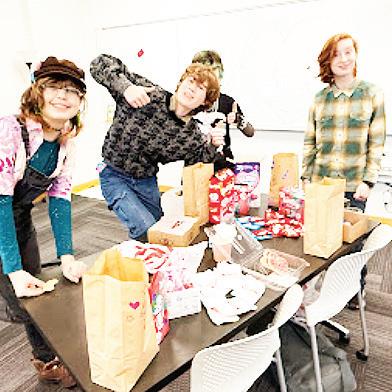
by Vallapureddy Library Council members prepare treats to be handed out during the event.

The Blake School 511 Kenwood Pkwy
Upper School Security Officer Amanuel Bekele helps maintain campus security at the West Entrance.
Charlie Graff
Submitted
Siblings or Solo: Comparing Life With Siblings to Life as Only Child
Students share closer look at emotional and social differences between familial experiences
Caitlin Strauss | Opinions Editor
“She watches “K-Pop Demon Hunters” every single day. So that’s definitely a spectacle,” said Aurelius Butler ‘29 about his threeyear-old sister.
The question of whether you have siblings is a common occurrence when introducing yourself or getting to know someone. Those with many siblings may wonder what life would be like if they had all the attention as an only child, and those who are only children often think about what it would be like to have siblings.
Lucy Zhang ‘29 , who does not have any siblings, said, “It gets lonely being an only child. You want to hang out with someone, but then [you realize] you’re the only kid in the house.” She added that she often ends up “scroll[ing] on [her] phone” without a sibling to hang out with.
Fellow only child Sloane Blomquist ‘28 agreed: “I wish I had siblings because I hear the horror stories

Palmby
memory with his sisters is “trying to catch butterflies when I was about seven [years old].” Natalie Palmby ‘29 smiled as she recalled one of her favorite memories with her sister: “I accidentally fell [off the bunk bed], and she shined a light in my face...we were both awake, yet we remember it so differently.”
Although the idea of having siblings is fun for her to think about, Zhang noted that one of her favorite aspects of being an only child is that, when she and fun stories about having siblings, but just the idea of having someone to grow up with is cool.” From a young age, kids begin to understand what it means to have a sibling and whether they do have one, which significantly shapes their childhood.
Although annoyance is sometimes inevitable with siblings, the fun moments are the ones that students most often remember.
Greg Jones ‘27 described that his favorite

asks her parents for help, “Their attention is fully on me, and they can help me more easily without needing to divide their attention.”
Blomquist agreed, explaining that she enjoys having more of a say in decisions regarding travel destinations or restaurants.
Having your parents’ attention is just an example of the many things that only children get all for themselves. “I got a really big spaghetti bowl at Disney World when I was six years old,” Zhang shared, “and I didn’t need to share because it was all for me.”
Childhood and adolescent experiences are shaped by the memories we make, especially with family, friends, and loved ones. Siblings can be great to talk to or hang out with, yet they provide the fun and lighthearted aspects of life. As Palmby said, “They can sometimes be a curse, but also, they’re the best.”
Jellycats Make Their Mark On Students
London-based plush brand becomes staple on backpacks, across social media
Evie Chow | Copy Editor
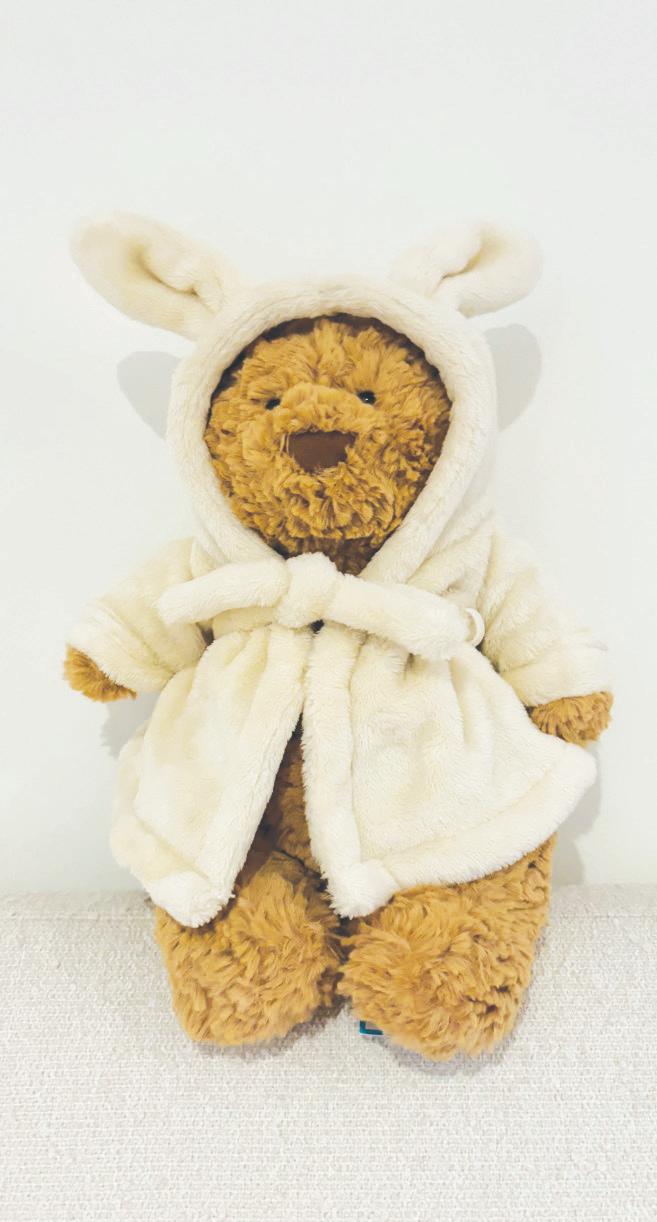
Walking through the hallways, it’s almost impossible not to see one of this generation’s most popular stuffed animals clipped onto students’ backpacks: Jellycats.
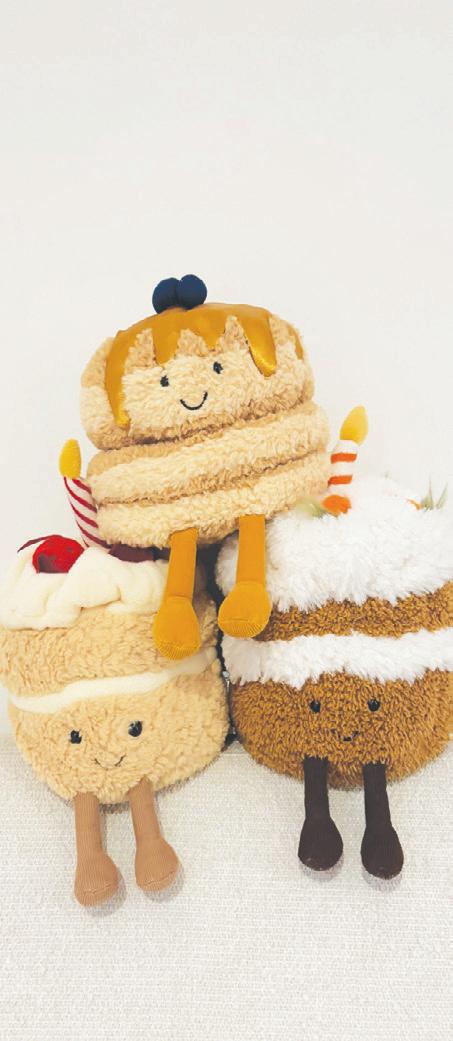
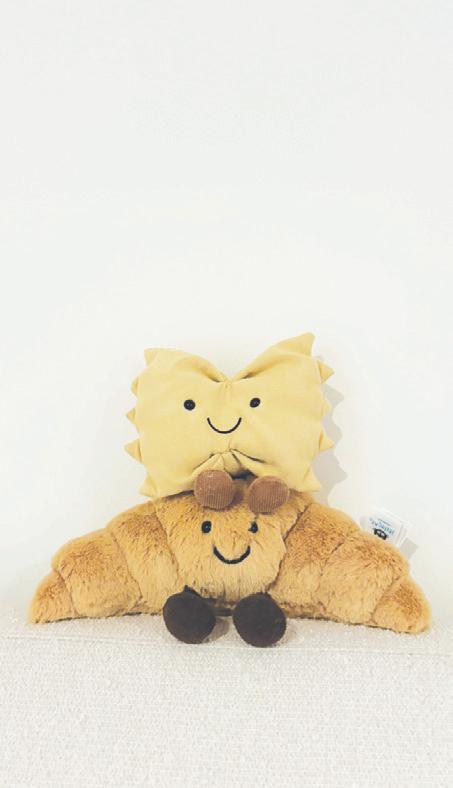
Founded in London in 1999, Jellycat has become one of today’s most popular plush brands among teenagers and children alike. Unlike traditional plush brands that focus only on animals, Jellycat transforms everyday objects into characters, from cheerful pastries to moody turtles. Jellycats are easily recognized by their iconic embroidered faces.
Jellycats have especially grown in popularity over the past few years due to their increased presence on so-
cial media. The brand has quickly built a reputation for being collectible, with many people across TikTok and Instagram sharing their Jellycat collections or giving Jellycat hauls. But for many students, the appeal of Jellycats isn’t new.
While Jellycats are hugely popular today, many students started collecting them in their childhood.
Callie Arthur ‘27 said that she “had one as a child” and that “they’ve been accumulating ever since.”
Another reason for the popularity of Jellycats is simply that stuffed animal brands often cycle in and out.
Leila Dalum ‘27
noted that while she had a “Squishmallow phase,” which turned into a “Jellycat phase.”
Over the past decade or so, a variety of stuffed animals, such as Beanie Boos, Squishmallows, and now, Jellycats,
have been trending.
Dalum stated that she buys Jellycats over other stuffed animals because “they’re so soft and they’re adorable.” Jellycats are made of polyester, contributing to their softness.
One of the biggest downsides to becoming a Jellycat collector is their price. A mediumsized Jellycat can range anywhere from $25 to
$65, with bigger Jellycats costing even more.
Still, this hasn’t stopped students from saving up to buy them or asking for them as gifts.
Over the past few years, Jellycats have become a staple in the student body. They can be seen as miniature versions hanging off backpacks or found in large quantities in students’ bedrooms.
Jellycats are a trend that seems to have cemented itself in today’s culture.
In a fast-moving, trend-driven culture, Jellycats offer something surprisingly simple: comfort, collectibility, and a bit of childhood whimsy.
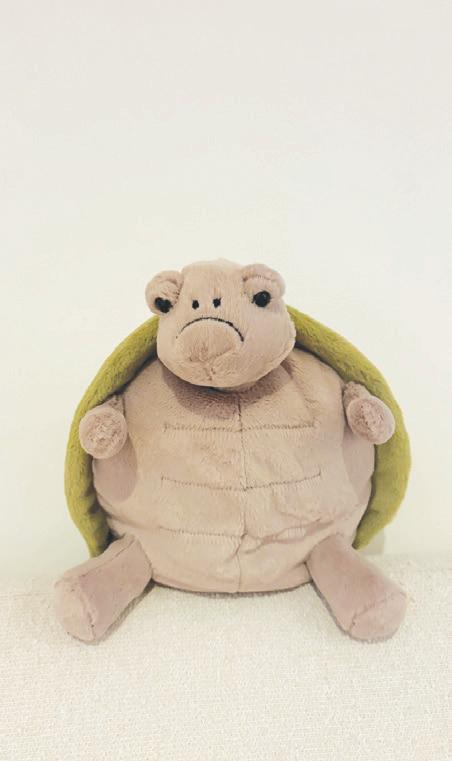
Whether it’s a smiling croissant or a frowning turtle,
creativity stands out.
Natalie
All photos by Evie Chow
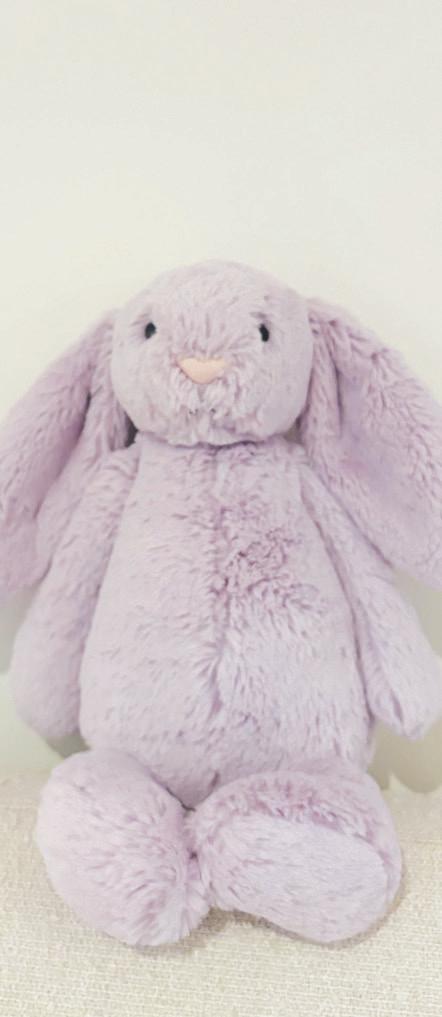
From bottom to top: Bashful Lilac Bunny; Bartholomew Bear Bathrobe Outfit; Amuseables Birthday Cake, Fran Pancakes, Carrot Cake; Amuseables Croissant, Farfalle, and Timmy Turtle showcase the wide variety of stuffed animals in Chow’s collection.
A young Zhang leans over on a caterpillar toy at her home.
Lucy Zhang
William Palmby ‘24, Palmby, and Charlotte Palmby ‘25 smile for a photo at Charlotte’s graduation party.
OLYMPICS
NICHE SPORTS
ENTERTAIN VIEWERS
The Winter Olympics are made up of many sports, but we often talk the most about figure skating or skiing, for instance.
Greta Guider ‘27 shares, “I really like watching skiing because I ski, too. I love [watching] Lindsey Vonn and Mikaela Shiffrin.” Guider noted that skeleton is another sport she enjoys watching in the Winter Olympics. Athletes who participate in skeleton will sprint along the ice and then go headfirst on a small sled along the track of ice.
Hunter Simon ‘26 agreed that it is fun to watch sports in the Olympics that he does as well. As a Nordic skier, Simon noted, “I don't specialize [in] going downhill, but I go downhill every day, so I know how impressive [Olympic skiing] is.” However, some other Olympic sports
are not talked about as much. The biathlon is one of the sports that often puzzles, leaving people wondering what exactly this sport consists of. The biathlon is a combination of cross-country skiing and shooting. Originating in Scandinavia around the 18th century, the biathlon requires significant physical abilities as well as mental attention as athletes go from intense skiing to extreme focus on aiming for a target. Another sport in the Winter Olympics that is not talked about as much is speed skating. The United States Olympic & Paralympic Museum describes that speed skating originated around the 13th century in the Netherlands. Megan Li ‘28 says that speed skating is one of her favorite sports to watch in
ALLABOUTTHE OLYMPICS
the Winter Olympics:
“I like how they go super fast around the circle...and I think it's really interesting to watch.” Li adds that her favorite speed skating team is China, and that the female speed skaters are “a huge inspiration for women.” No matter which sport is your favorite in the Winter Olympics, explore other sports that pique your interest, too. By learning about different Winter Olympic sports, you might just discover a sport you can’t wait to watch in the 2030 Winter Olympics in the French Alps.
The Olympic Games originated in Ancient Greece around 776 BCE as a religious festival honoring Zeus.
Evie Chow | Copy Editor
ATHlETES COmPETE IN milAN
From frozen lakes and ski hills to the world’s biggest stage, Minnesotan athletes are taking over Team USA at the 2026 Winter Olympic Games. 24 Minnesota natives are on Team USA, which ranks second only to Colorado. 37 athletes have ties to Minnesota, mainly through hockey.
Some of the most decorated American Olympic athletes in the world are native Minnesotans. Alpine skier Lindsey Vonn, cross-country skier Jessie Diggins, and hockey player Kelly Pannek, all athletes who have multiple Olympic medals, come from the Twin Cities. Minnesota is especially well-rep-
resented on Team USA’s hockey teams. On the men’s side, three members of the Wild are playing for the US. The Wild’s GM, Bill Guerin, is also serving as GM for Team USA. Five native Minnesotans represent the US in hockey.
For the women’s team, six members of the Frost are playing in the 2026 Games. Also featured are two other players with connections to Minnesota. Five of these eight players are natives of Minnesota.
Minnesotan curlers are also heavily represented in the Winter Olympics, with six of the 11 members of the curling team being Minnesota natives, and the other five residing in Minnesota currently. Furthermore, over
In Greek society, religion was deeply intertwined with everyday life and could not be separated from politics or culture. As Kerry Lefebvre explained, “You really can’t separate religion and worship of the gods from any other element of Ancient Greek society–there was no separation of church and state like we have today.” Because of this, athletic competitions functioned as acts of worship rather than simple entertain ment.
According to Lefebvre, “the
Olympic Games always held in Zeus, at Olympia, was a sacred site temples and athletic spaces existed part of the same complex.” Athletics also important they allowed Greek states to gather maintaining individual pride, similar to created by the today. Lefebvre “Athletics were Greek city-states, were not unified, come together expressing pride individual cities.”
The modern were reintroduced and initially focused summer sports. as interest in cold-weather athletics grew, sports such as ing and ice hockey added to the Summer Olympics in 1908
30 athletes with roots in Minnesota are competing outside of Team USA in the Olympics. An abundance of hockey players from Minnesota are representing countries such as Canada, Finland, Germany, and Sweden on the ice.
Athletes who call Minnesota one of their homes are not only representing the US - they are representing countries all over the world.
The hometown pride spotlighted at the 2026 Olympic Games is a testament to the sports culture in Minnesota. Minnesota’s label as the “State of Hockey” and its freezing cold winters have proved its competitiveness in winter sports.
Caitlin Strauss | Opinions Editor
Lilly Tarakji | Student HiSTORy
OLYMPICS
y Of THE
OlymPiCS
Games were honor of Olympia, which site where athletic together as same religious Athletics were because Greek citygather while individual to the unity Olympics noted, a way for city-states, which unified, to while still pride in their cities.” modern Olympics reintroduced in 1896 focused on However, cold-weather winter figure skathockey were Summer 1908 and
1920. These events acted as trial additions, testing whether winter sports deserved a larger platform. That platform emerged in 1924 with the International Winter Sports Week in Chamonix, France, later recognized as the first Winter Olympics. Since then, the Winter Olympics have expanded to showcase highly specialized and technically demanding sports.
As Lefebvre emphasized, the endurance of the Olympics lies in continuity rather than change: people still gather to celebrate human excellence, competition, and shared identity, values that connect the ancient and modern games.
No one loves the Olympics more than I do. Every two years, I become obsessed with random sports that I would never pay attention to at any other time. However, this year, supporting my country feels a little different.
I’ve spent the last year, and especially the last month, unable to believe what’s going on in our country. Innocent people being taken from their homes, removal of laws and protections that have existed for decades, and so much more makes it dif-
London Gilbert | Sports Editor
u.S. SENdS ICE TO OlymPiCS
The Olympics are made out to be one of the main events for the entire globe to come together and enjoy the athletic abilities of men and women from thousands of different cultures. For a few weeks, politics, borders, and conflicts are meant to fade away as athletes compete under the same rules, which is why the controversy around Immigration and Customs Enforcement (ICE) at the 2026 Winter Olympics has been so intense.
Earlier this year, reports suggested that ICE agents would be present in Italy during the Olympic Games. The U.S. government said the agents would only assist with security for American officials and would not conduct immigration enforcement.
Italian authorities clarified that any U.S agents would not have police powers, according to Straight Arrow News on Jan. 30th. The news still sparked protest and criticism from both athletes and activists, many of whom see ICE as a controversial symbol.
In my opinion, the Olympics should stay as far away from immigration enforcement agencies as possible. Even if ICE agents are only there for security, the symbols matter.
The Olympics are about unity and fairness. Having an agency known for deportations and raids associated with the event sends the opposite message to the people around the world. It is, however, important to acknowledge the reality that large international events do require complex security planning.
Governments want to protect their athletes and officials and often rely on various agencies to do so.
The issue is not security itself but the agency involved and what they represent. This controversy shows how hard it is to keep politics out of global events. The Olympics do not exist in a vacuum, and the issues countries face at home inevitably follow them onto the world stage.
The goal of the Olympics is unity, and organizers should think carefully about the message they send. Even the prescience of a controversial agency like ICE can overshadow the spirit of the Olympic Games.
ficult to be excited to root for the USA as their 232 athletes compete in Italy.
However, supporting American athletes does not mean supporting everything happening in America. In fact, many athletes have spoken about their conflicted feelings representing the US. Freestyle skier Hunter Hess told reporters, “I think it brings up mixed emotions to represent the US right now… just because I’m wearing the flag doesn’t mean I represent everything that’s going on.”
We should use the Olympics as a time of unity. The athletes competing in the Olympics have spent their entire lives doing everything they can to get to this moment, and even though sports seem extremely surface-level at first glance,
it would be wrong to disregard the hard work, strength, and resilience of these athletes just because of the country that they represent.
We can also use these Olympics to remember the good in the world. Maybe we aren’t proud to be an American at this exact moment, but in the past we have been, and one day in the future we will be again. We can’t let ourselves get lost in what is tearing us apart. We must find something to bring us back together and put a smile on our faces, and (at least for me), nothing does that better than the Olympics.
We cannot forget what is happening right now - in Minneapolis, in the White House, and everywhere in between. But we can stop ourselves from drowning in the constant cycle of bad news by enjoying a figure skating routine or ski run.
STUDENT PERSPECTIVES
Lilah Johnson | Co-Editor-in-Chief
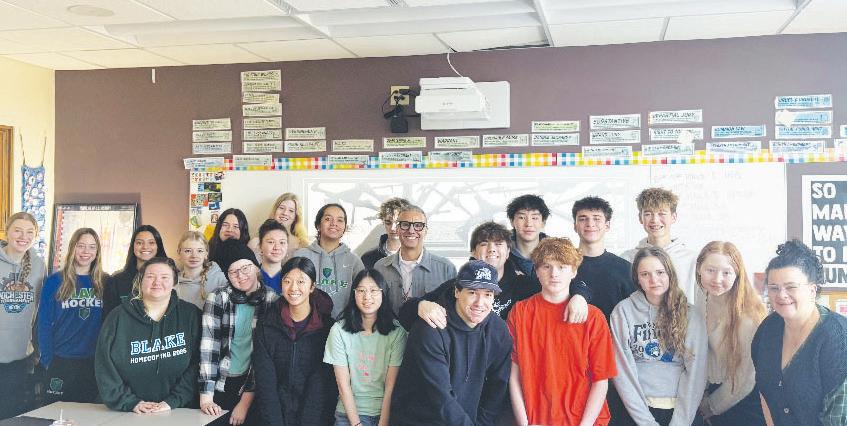
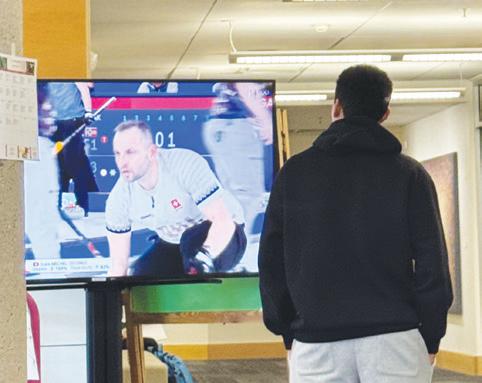
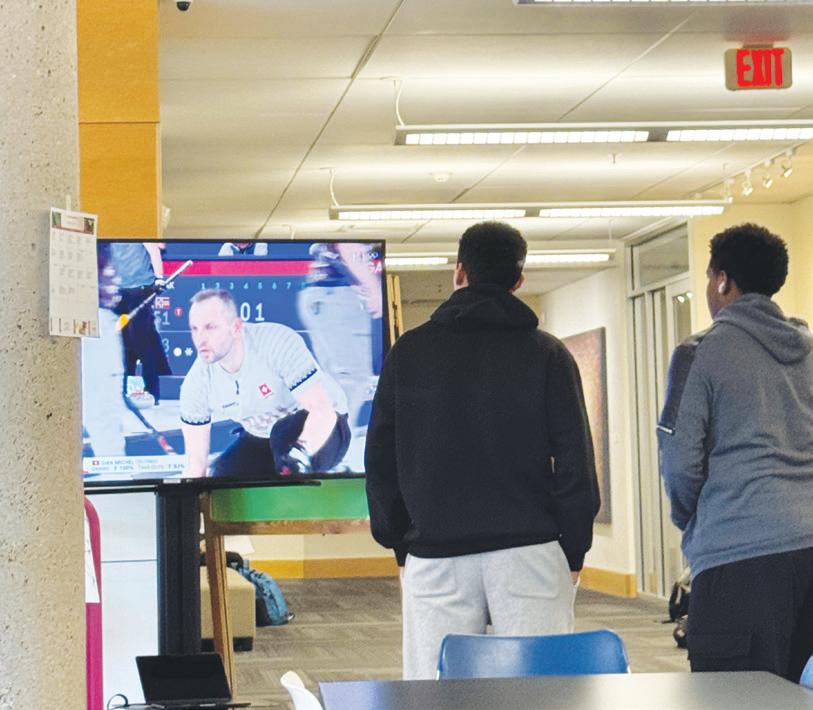
TOP LEFT: Since many events in Milan occur during school hours, a TV in the library plays Olympic events all day long for students to enjoy during free blocks and passing times.
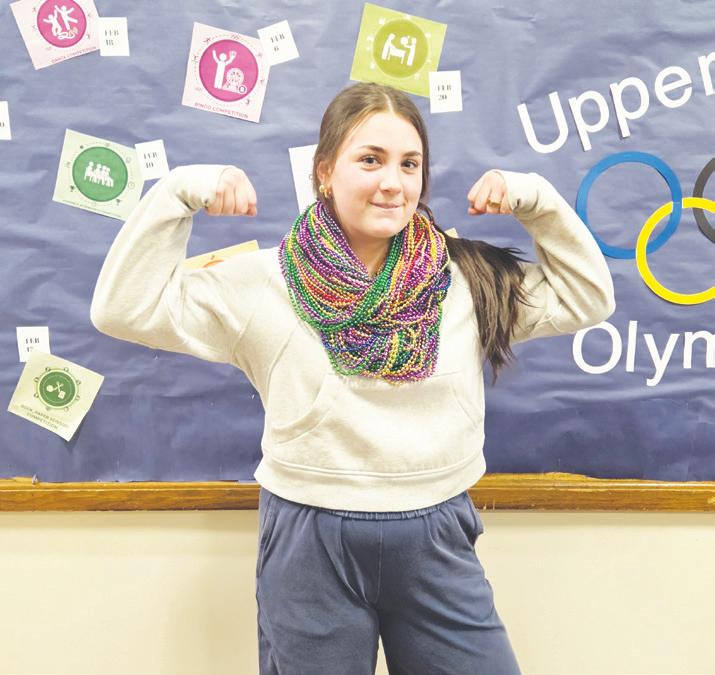
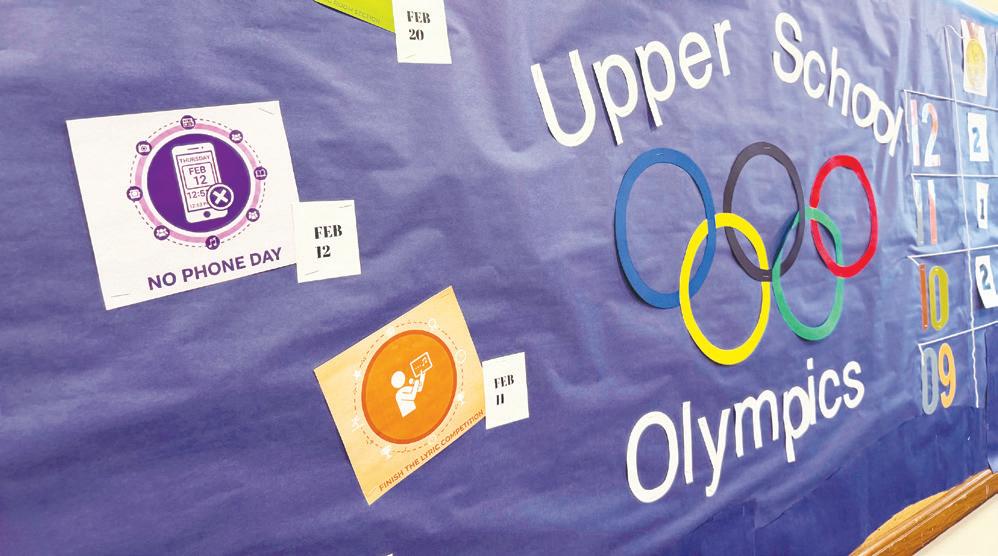
TOP RIGHT: In the spirit of the Olympics, SIAC is running an ongoing competition between grades, consisting of events such as a rock paper scissors competition. Charlotte Hackett ‘26 shows off her necklaces.
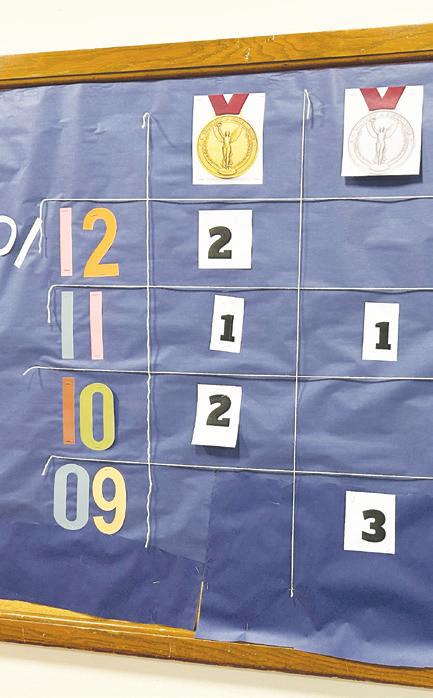
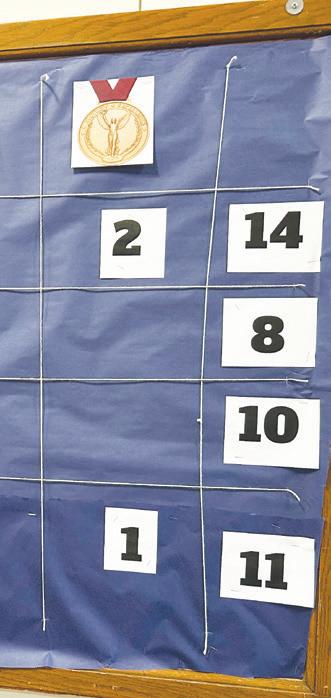
BOTTOM: The leaderboard in the hallway depicts how many medals each grade has won. As of Feb. 18, the seniors led with 24 points.
AnyaVallapureddy
LilahJohnson
February 20, 2026
Alpine Skiers Succeeds at Sections, State
Team community makes a difference
Faith Zhao | Creative Director
“Anxiety without doubt is excitement,” repeated Captain Sinclair Christie ‘26 to her teammates before they each headed up to their races.
Three hours before the start line, they were on the bus, listening to songs like “Bang Bang” by Jesse J and playing Among Us as a team. Now, they were at Wild Mountain, a ski resort along the St. Croix River,
ready to bring their best to Sections and to qualify both teams to State for the first time since 2015.
Expectations were high. Nerves were higher.
“It was pretty stressful,” said Iris Wolter ‘29. “I know the team felt it too, because we all wanted to finish for ourselves, but also if we finish well, then the whole team can go…we all wanted to go to State as a team because [we] just love being together so much.”
The captains made sure to ease everyone’s nerves. Christie and Captain Lydia Geelan ‘26 made charms and notes for everyone. “For Iris, Izzy, and Lydia who have been skiing club for
their whole lives, they know they can do it,” said Christie. “So [we] just have to internalize the fact that [we’ve] been training for years and this is just another race.”
Before her race, Wolter reminded herself that “I’ve trained a lot, and it’s true. I just need to believe it more.”
Similarly, Jack Geelan ‘29, whose final run clinched the Boys’ team’s spot at State, also reassured himself that “This is like any other practice run, and I just got to push hard and be relaxed.”
“We want 100% effort, but at the same time, we want them to ski within the strategy of the course that we laid out, and really just go out there and have
Unmask Nordic Mystery Athelete
Guess this month’s mystery athlete!
Charlie
Dean | Puzzlemaster
This month’s mystery athlete, a senior, recently finished his third year as a captain on the Boys’ Nordic team.
He raced on the team since seventh grade, and earned his best career Sections result, a fifth place in a relay with teammate and co-captain Otis Friesen ‘26, in his final meaningful race.
Friesen explained that the skier is “really good at connecting with every single athlete.”
Milo Richard ‘28 considered giving up the sport following his freshman season, saying, “The reason I came back to Nordic this year was because of how welcoming he made the team.”
The athlete gave Richard rides to and from practices, which made Richard “feel very valued as a person on the team.” They also learned that they were coincidentally next-door neighbors.
In addition to his influence within practices, the athlete helps organize other events, such as a team party at his house and a team movie night. Friesen

explained that the athlete’s responsibility “lowers the burden on all the rest of our captains.”
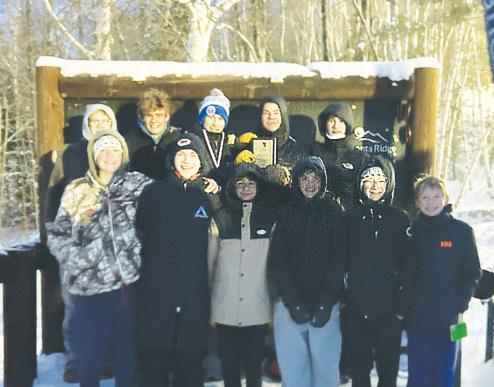
The team visited Maplelag Resort for an away trip this year for the first time since before COVID-19. The athlete reflected that he “would hear all about [it] from the older kids” and everybody on the team now could too.
Richard explained, “I’ll be a junior next year, and being one of the older kids and being an example for the younger people on the team…will definitely be influenced by how he did that for us.”
“Interest was dwindling…Our main goal this year was just keeping interest in the team, keeping the team strong,” said the athlete, “We want to keep that magic there [and] I think we definitely accomplished that.”
fun,” said Boys and Girls Head Coach Chris Girk “Enjoy the moment, because we don’t get these very often.”
At Sections, the girls placed second behind Wayzata, totaling 373 points, with Wolter and Izzy Krejci ‘28 placing seventh and ninth, respectively.
The boys also placed second behind Minnetonka totaling 356 points, with Zachary Barkwell ‘28 and Ethan Barkwell ‘28 placing ninth and tenth, respectively.
When both the Girls and Boys teams qualified for State at Wild Mountain, Girk was overjoyed.
“I love seeing their excitement when they hit a breakthrough with some of
the things we’re working on, and they start seeing the reflection in their race times and race results,” said Girk.
Despite only placing sixth and seventh at State for Girls and Boys, respectively, their focus isn’t on the loss, but the win: the unity of a team.
“My favorite part of [skiing] is definitely the community aspect. Especially someone who is new, I really felt welcomed,” said Wolter as she started to smile big. “[The captains] ...they’ve been the best part.”
“I just feel like it’s going to be different next year,” added Jack, who also said his favorite part of the team is the senior leaders.
He shyly remarked that
his favorite captain is Cole Eckes ‘26. “He’s just a fast skier first of all, and he’s also just a smart guy.”
The love is reciprocated by the captains: Christie said, “I started with [Izzy] when we were both alternates and watching her grow [and how she gets there] has been such a beautiful thing to see…I feel like everyone on the team has been responsible for [that growth].”
Although the wins come and go, the music played on the bus, the late night Hide and Seek and poker, the Among Us tradition, and the relationships from the community will always stay.
Girls’ Hockey
Power Plays
He noted that his favorite part of the year was “being with all of the younger kids… it makes me remember what an incredible time I had as a younger skier.”
Like the team finally returning to Maplelag, he hoped to pass the experiences he was given down to his teammates. “I remember how happy I was, and when I think about how happy these younger students hopefully are, I feel proud that I’m able to give them that same experience I had. Just giving [it] back.”
“It’s so important to give back to the younger people...we want them to fill in these
and to
Submitted by Charlie Dean
Steven Cao
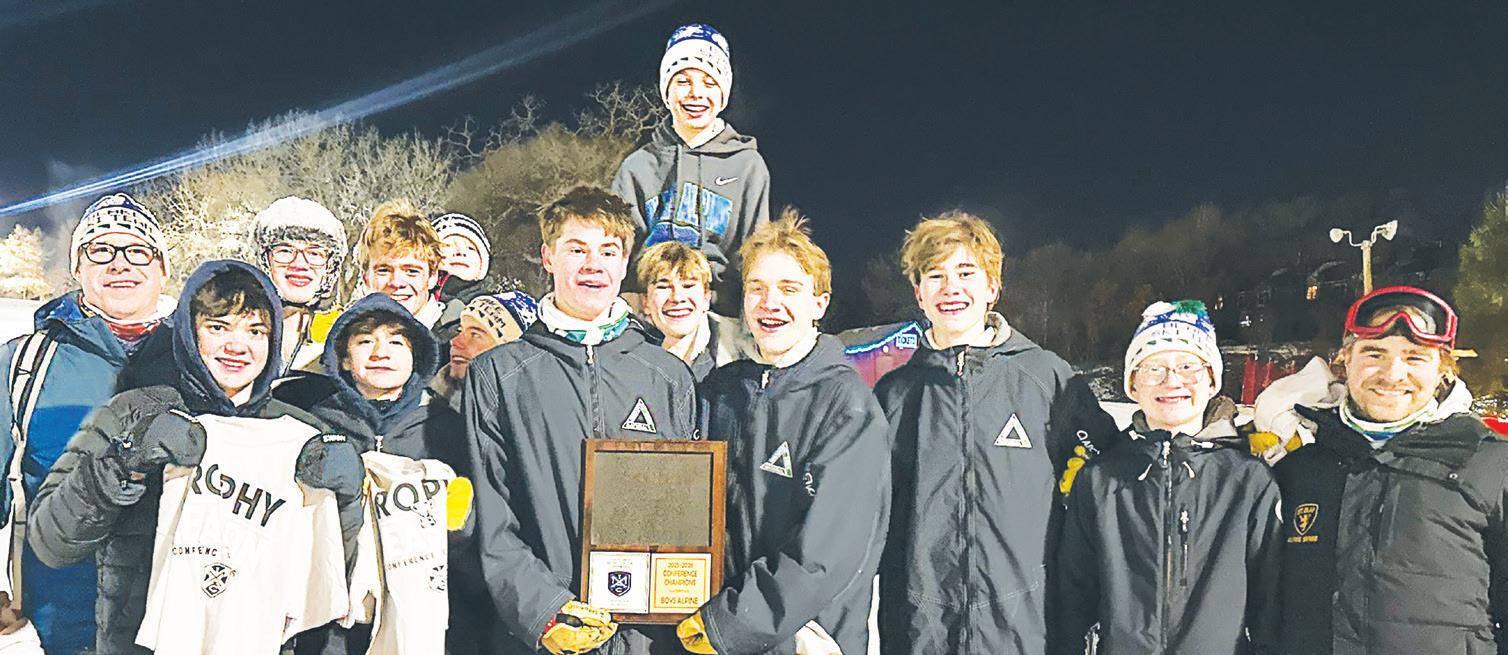
Boys’ Alpine team consisting of Head Coach Chris Girk, Geelan, Louie Wallace, Josset Pflaum, Charlie Dean, Oscar Shay, Alex Patterson, Eckes, Zach, Henry Horvitz, Graham Everett, Ethan, Ben Hackler, and Assistant Coach Nathan Girk after winning Conference.
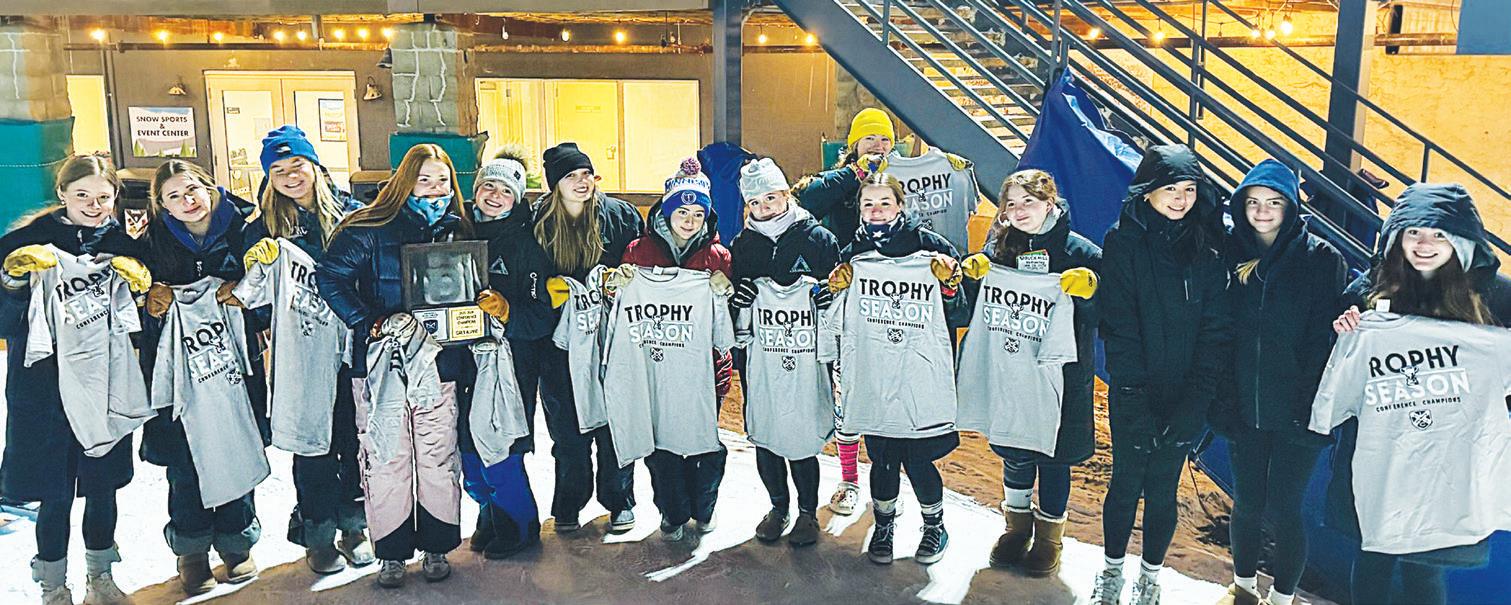
Submitted by Charlie Dean Girls’ Alpine team consisting of Madeline DesJardin Maeve Hackler Izzy Krejci, Geelan, Christie, Nora Shay Eva Gilard, Wolter, Greta Guider Carly Bass Avery Fulton Lillie Duncan, and Bridgette Guider after winning Conference at Buck Hill.
Photo illustration by London Gilbert
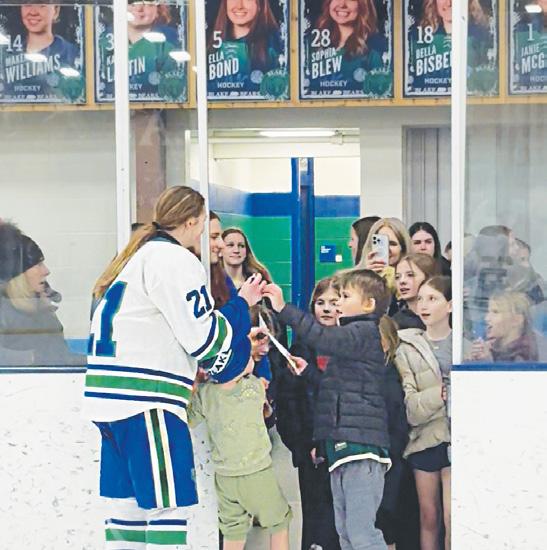
Adeline Wethington ‘27 signed autographs after a Conference win.
shoes
continue the Blake hockey legacy,” said Wethington.
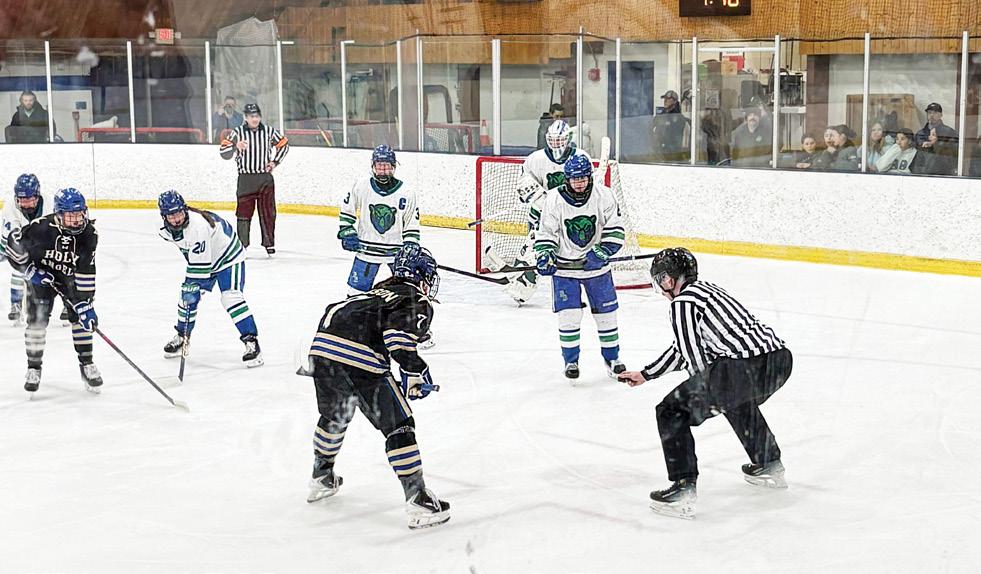
Bears stopped a a score in a pivotal moment. Manager Livvy Vandersall ‘27 said, “[We were just] going in with a good attitude. As we went into the season, we just wanted to get 1% better each day.”
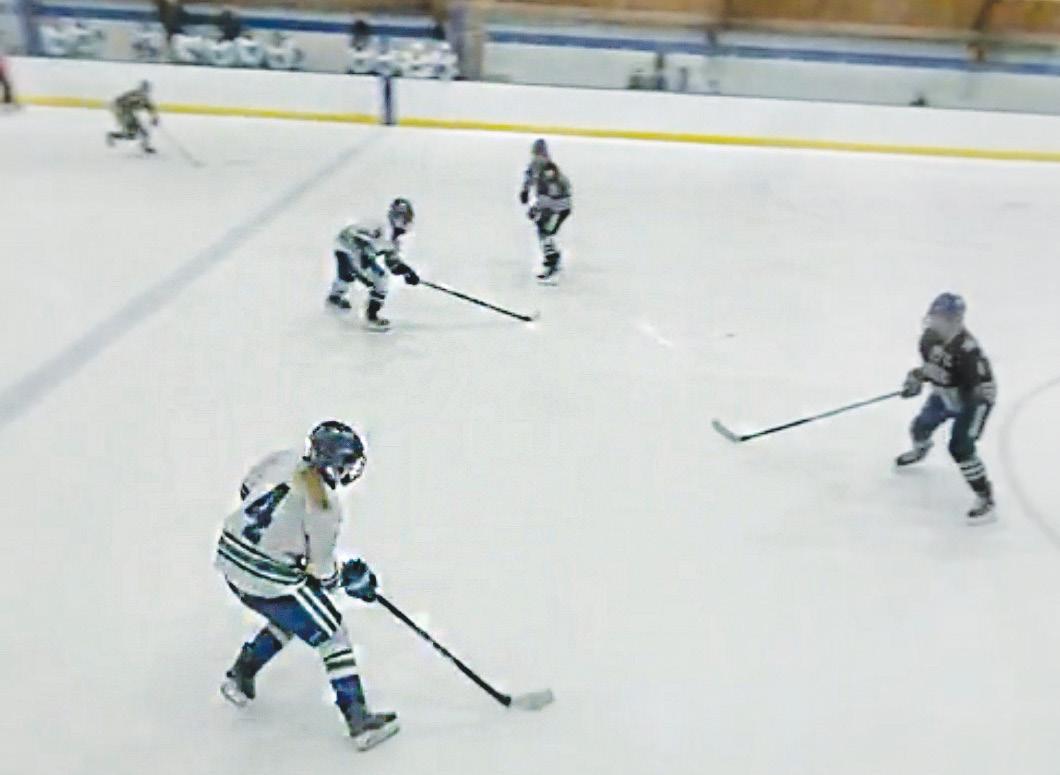
Ella Anderson ‘28 brings the puck towards the Holy Angels defense. After Anderson scored the winning shot during overtime, she recalled, “That was surreal. I couldn’t wrap my head around it. I was just even surprised that it went in.”
Izzie Miller
Izzie Miller
Hot Potato

Camila Pardo | Columnist
Normalizing
silence,
reflection in busy lives
Silence used to be normal. Now, it feels awkward, heavy, and something we rush to fill.
We experience silence constantly: during group discussions, waiting for class to start, standing in an elevator, and sitting with friends. Instead of letting it exist, we reach for our teacher’s guidance, phones, headphones, or small talk. Silence has become a problem to solve rather than a state to be in.
Part of this discomfort stems from how rarely we experience true quiet. Our days are filled with notifications, background noise, music, and constant input. Even when nothing is happening, something is still playing. Because of that, silence feels unfamiliar. When it appears, it stands out.
Silence also forces awareness. Without distractions, we’re left alone with our thoughts, which can oftentimes be uncomfortable. It’s easier to scroll or talk than to sit with uncertainty, boredom, or reflection. Noise gives us an excuse not to think too deeply.
Constant exposure to information has conditioned people to expect continuous input. When that input disappears, it can feel as though something is missing. Silence interrupts the rhythm of modern life, making it seem like an absence rather than a state of rest.
However, silence is not inherently negative. It allows for focus, observation, and mental clarity. Many meaningful moments depend on quiet, such as reading, learning, or simply thinking. Without silence, it becomes difficult to process information or reflect on experiences.
The discomfort surrounding silence may say more about modern habits than about silence itself. When constant noise becomes the norm, quiet begins to feel unnatural. Relearning how to sit with silence may be challenging, but it is an important skill in an increasingly noisy world.
Humans of Blake
Students share pieces of advice for peers
David Bachman | Contributing Writer


“[If you] act as if you are enjoying something…you can turn your mind around.”
Jack Dillon ‘26
“Always look at life with a glass half full.”
Shucayb
Harir ‘26

“Don’t worry about what others are doing around you.”
Sam Helland ‘29
Scholastic Awards Inspire, Empower
Arts, writing competition provides unique opportunity to share talents
Izzie Miller | Managing Editor
Throughout high school, kids interested in every department of study look for ways to showcase their talent and hard work. For many middle and high school students interested in writing and art, the Scholastic Arts and Writing Awards are a great way to do just that. From regional awards showcased locally to national awards presented in Carnegie Hall every June, the Scholastic Awards never fail to shed light on amazing young writers and artists across the United States. Unlike many other competitions, Scholastic of-
fers numerous scholarships aimed at helping talented students continue to pursue their passions. Due to these factors, students interested in art, writing, or both should submit to Scholastic annually if able to do so.
Every October, scholastic submissions open up to 7th graders through seniors, offering 29 different categories in art and writing to submit to. These categories range from Critical Essay and Speculative Fiction to Jewelry and Editorial Cartoon.
Rhea Farhan ‘27 has submitted to the Scholastic Arts and Writing Awards since her eighth-grade year. Writing for both the poetry and short fiction categories,
she has received many regional awards in the past.
A difference Farhan noted between the Scholastic Awards and other competitions was that Scholastic had different levels of awards. “I like how there are regional and national awards,” she noted, “It’s nice that there are regional awards, so if you don’t win nationally, you still get recognition.”
A cool opportunity the awards offer is to seniors submitting art. Graduating seniors are able to submit up to two Art Portfolios made up of a sequence of six works that follow a theme. This is another amazing chance for students about to end their
high school journey and start their next chapter.
For art submissions, Scholastic has historically favored traditional art above contemporary art. They like seeing a mix of skill and creativity while valuing originality most of all.
In the writing sections, you may want to focus on the emergence of a personal
voice. Taking these factors into consideration gives you a better chance at receiving recognition for your work.
The Scholastic Arts and Writing Awards are one of the best ways for students to showcase their talent. The awards are a method for students to meet other writers and artists while also competing against them.
Use of Phones at School Sparks Discussion
On Thursday, Feb 12, SIAC hosted a “No-Phones Day” as a part of the Upper School Olympics. Students competed from every grade level, turning in phones in the Junior Lounge at 8:15 a.m. and receiving phones after 2:30 p.m. The Spectrum Editorial Board took this event to consider our current phone protocol and its ramifications in three aspects. First, policies need student support to be functional. Students are endlessly innovative in finding ways to access the internet. In an evolving technology landscape, administrators and teachers cannot
outpace students in understanding the internet’s landscape. If students want to play games, they will find a way to do so. In a more educational sense, as we learn agency and decisionmaking, complete oversight from teachers and administrators is not beneficial for students; excessive oversight hinders our growth.
Secondly, we generally support the current phone policy outside of
classes. For some, phones serve as a way to detach from daily stress. This takes place through mobile games, short-form videos, and communication with friends. The point is not to do anything of any purpose, but instead rest. Allowing students to use their phones provides respite in an otherwise stressful day.
Although enforcement of the phone hotel policy has been rather lax, we
still believe it provides an opportunity for students to learn to learn without their phones. Inherently, phones in classrooms are distracting for students. Therefore, the impetus of phone hotels and the commitment to learning must fall on students.
However, we also acknowledge the negative impacts of phones on students through social-emotional and intellectual levels. As Bernt Bratsberg found in his study, “The Flynn effect and its reversal are both environmentally caused,” phones have led to a drop in Intelligence Quotient (IQ) in recent years. In the 20th century, IQ increased incrementally, but newer generations are experiencing a drop. Due to IQ’s controversial history in discriminating against marginalized groups, we do
not consider IQ in isolation. We are also concerned about the general drop in Emotional Quotient (EQ) observed in the school’s hallways.
Finally, we condemn the further use of statistics, especially negative statistics, to persuade students to forgo phone usage. The messaging has become blunt. Statistics are no longer a warning, but a subject to laugh over. When students are forewarned of an IQ drop or shamed for lack of attention span, it is taken lightly; an unfortunate joke in which we all share experience. Fearmongering does nothing but build resistance to the message and tolerance of our current phone usage. To truly find a way out of the current screen problem, the movement must be initiated by the students.
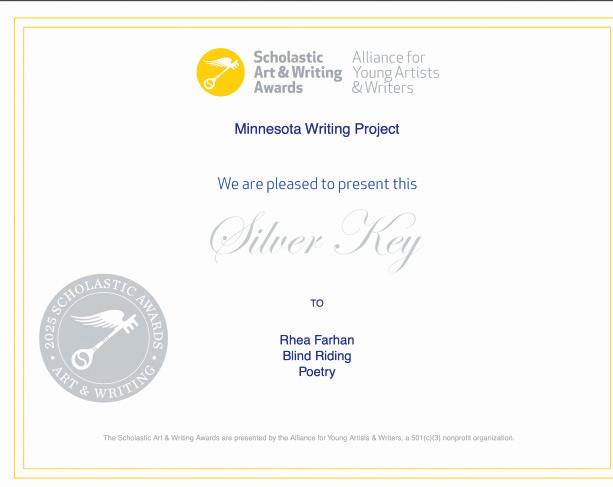
Farhan, who has won awards for poetry and short stories, received this award for a poem she wrote that was inspired by Emily Dickinson in the poetry unit in American Literature.
Rhea Farhan
All photos by David Bachman
All puzzles by Charlie Dean | Puzzlemaster
Connections
Olympic Trivia
What sport are the most Minnesotans competing in at the 2026 Olympics?
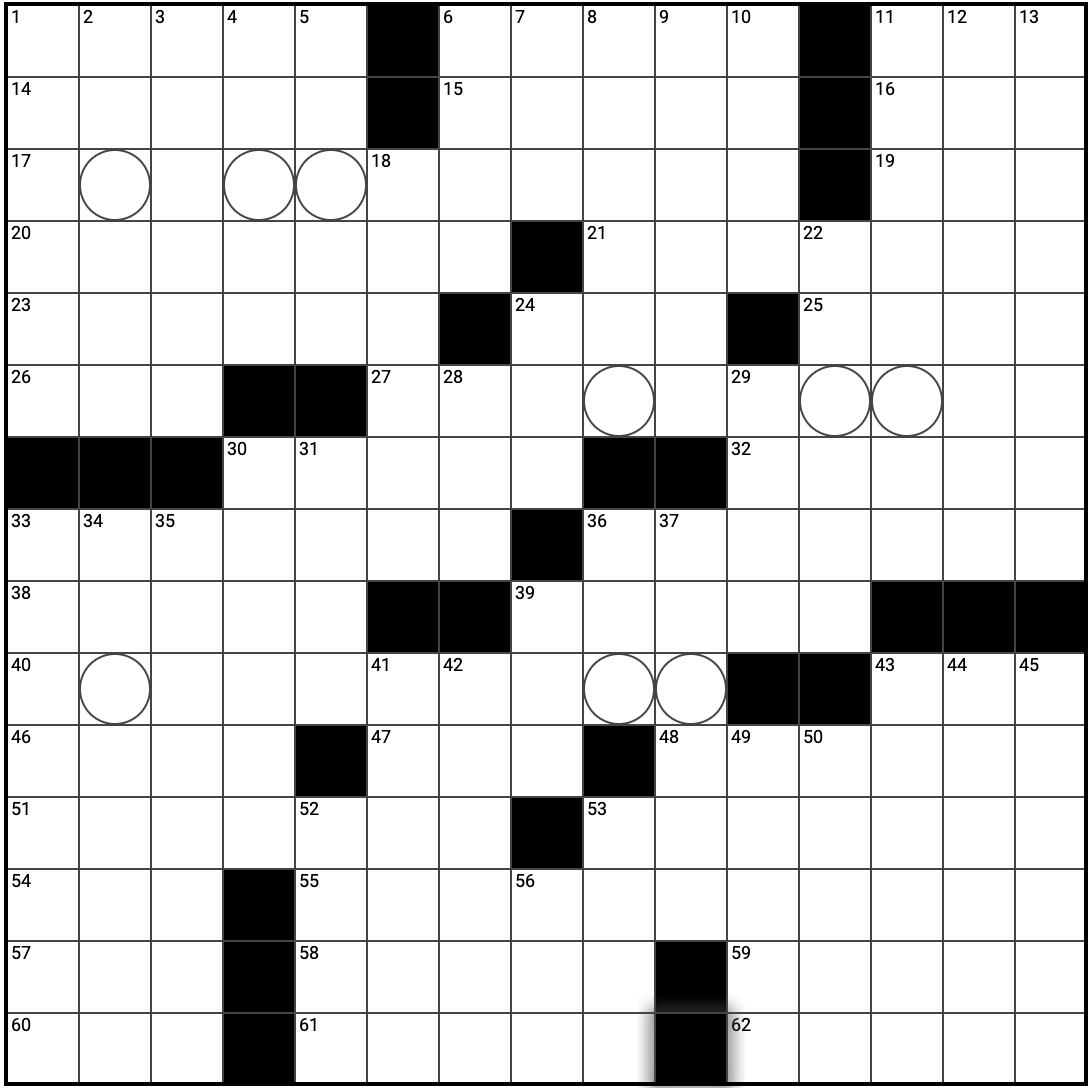
In addition to the three games, there is an additional puzzle using the answers to the trivia and crossword. The answers to the trivia correspond to squares in the grid, spelling out a five letter word relating to the Olympics. Email the answer to cbdean27@blakeschool.org to get a shoutout in the next cycle. Good luck! Nine
February Crossword
Across :
1. ___ Nova
6. Shinbone
11. Service charge
14. Chips in?
15. De-wrinkles
16. Part of UNLV
17. *They’re located between Samoa and Vanuatu
19. Fly ball’s path
20. “You can stop looking”
21. “Fly Me to the Moon” singer
Frank
23. Completely committed
24. Sweetheart
25. Mix
26. “Science Guy” Bill
27. *Extreme activity for powderlovers
30. German sub
32. Key ___, Florida
33. Leftover
36. Like the Grinch, relative to the other characters in “The Grinch”
38. Jump for joy
39. Annual theater awards
40. *American port on the Pacific
43. Therapists’ org.
46. “___ boy!”
47. Band’s booking
48. Fasten with a pop
51. Web designers
53. End of a house sale
54. Bunny’s jump
55. Be in agreement... or, phonetically, a hint to the three starred answers
57. Building wing
58. Cybertruck maker
59. Run up, as expenses
60. Cunning
61. ___ Martin (car)
62. Sounds from baby birds
Down:
1. Arctic explorer William who part of Canada is named after
2. Like a classic French soup
3. Children’s Research Hospital in Memphis
4. River through Paris
5. Parenthetical comment
6. Bias
7. Savings plan initials
8. Tree-shaping art
9. Most Sundance showings
10. Professional org.
11. What a fork in the road might lead to?
12. They’re usually sold in pairs
13. Seasoned snail
18. Gas thief’s tool
22. Sherpas, e.g.
24. Three-ingredient sandwich
28. “Please, dig in!”
29. Former “Splash Brother” Thompson
30. Remove dishes from the dishwasher
31. Rubber ducky’s place
33. Goes over again
34. Survey used in election night coverage
35. Grow, as an outbreak
36. “Who, me?”
37. Isolate
39. What a baseball rundown usually ends in
41. Matches grammatically

Ink cartridge color